Discover Constable and The Hay Wain @ the National Gallery

Six footers

In 1818 at the age of 42, the well-established English landscape painter John Constable made a conscious decision to start painting bigger works and so began the first of what became known as his ‘six footers’.

The first one, ‘The White Horse’, exhibited in 1820, was so successful that Constable was elected an Associate of the Royal Academy on the strength of it, so he knew he was on to a good thing. The ‘Hay Wain’ was the third in the series. Constable painted it under pressure to make the deadline for submissions to the Royal Academy’s 1821 exhibition and, maybe surprisingly, it was painted entirely at his home in London. But he was able to do this because of the countless sketches and previous paintings he’d made of the same location and setting.

The Hay Wain by John Constable (1821) © The National Gallery, London

Constable knew this place so well because his father, Golding Constable, owned it. Golding was a wealthy mill owner and corn merchant so John had grown up surrounded by the appurtenances of the trade and knowing exactly what went into growing, harvesting and processing wheat. The house on the left of the picture belonged to Willy Lott, a tenant farmer, but behind the painter, behind us as we look at the painting, stood Flatford Mill which belonged to Constable’s father. Both stood on the east bank of the River Stour which, at this point, forms the border between Essex and Suffolk.

Map showing location of the buildings in Constables paintings of Flatford Mill and Willy Lott’s cottage

The Hay Wain, like much of Constable’s best work, came to symbolise a certain type of innocent rural scene, eventually becoming iconic of an innocent way of life which industrialising Victorian Britain knew it was losing.

The bicentenary connection

The National Gallery was founded in 2024 so this is its bicentenary year. It’s using the occasion to re-explore favourite items in the collection. It was around Van Gogh’s much-loved painting of sunflowers that the gallery created the brilliant Van Gogh: Poets and Lovers show which you must go and see.

In a similar way, they’ve used the opportunity to take John Constable’s super-famous painting The Hay Wain (1821), and make it the centrepiece of an exhibition in its own right. The bicentenary connection comes in because 1824 was the year when The Hay Wain was displayed at the Paris Salon to great acclaim and was awarded a gold medal, which Constable received from the French King, Charles X, in person.

The medal is here, on display, and is just part of this fascinating and FREE exhibition at the National Gallery, which brings together 50 or so paintings, sketches, drawings, models, contemporary and modern cartoons, photomontages as well as the artist’s own palette (!) to place this super well-known and well-loved image in its full artistic, political, cultural, geographical, agricultural and biographical context. It’s full of beautiful, relaxing rural paintings and fascinating facts.

Political context

To begin with, the socio-political context of the 1810s is dealt with in a fairly small section. At the end of the Napoleonic Wars, after the victory at Waterloo on 18 June 1815, the British Army was rapidly demobilised, with no provision or thought for hundreds of thousands of demobbed men dumped back in their rural communities.

In the same year the Tory administration passed the first of many Corn Laws. These blocked the import of cheap corn from abroad, thus creating a monopoly for British wheat-growers i.e. the landowning aristocracy. But while it guaranteed these landowners a good price for their product it raised the price of bread and related foodstuffs very sharply for ordinary people, leading to hunger and hardship.

Since the landowning class was in the majority in the House of Commons and dominated the House of Lords, it was a very naked form of class war: a few thousand aristocratic landowners arranged the law and economy to their immense benefit and to the starvation of millions of rural workers and the increasing urban proletariat. The corn laws weren’t abolished until 1846 and only after a generation of protests, agitation, riots and criticism.

This cruel and oppressive law doesn’t have much traction in the exhibition. It is dramatised in four or so contemporary political cartoons, by the likes of James Gillray and Joseph Rowlandson. The fiercest is this one by Charles Williams and titled ‘Political Balance’ (1816).

Political balance, An unexpected inspection, or A Good Old Master Taking a Peep Into the State of Things Himself by Charles Williams (1816) © British Museum

The only contemporary artists who spoke out against exploitation, poverty and despoliation of the countryside was the great William Blake but none of his political work is included here, just a couple of tiny illustrations from the Songs of Innocence and Experience.

Interesting though all this is to those of us with a taste for history, none of this rural poverty or agitation is visible in any of the actual paintings by Constable or Gainsborough, Turner or Mulready, Stubbs or Combes which are included here. The subject is raised by the curators only to be quietly forgotten.

The Hay Wain’s radicalness

Landscape painting

At the time in Britain, landscape painting was still considered an ‘inferior’ genre compared to history painting. Among other goals, Constable was determined to raise its prestige and this was part of his motivation for creating the six footers.

‘En plein air’

The Hay Wain was painted in the artist’s London studio over five months in preparation for the Royal Academy annual exhibition which Constable had entered numerous times before. He painted it from several preliminary sketches, probably created ‘en plein air’, a revolutionary approach for the period which Constable eagerly adopted in his quest to represent ‘truth to nature’. It was considered revolutionary in other ways.

Brown

The exhibition includes works by slightly earlier painters including George Stubbs and especially Thomas Gainsborough to show what the traditional approach looks like. In this Gainsborough painting the dominant hue is brown and the play of light is suggested by lighter and darker shades of the relevant colour.

Smooth

Above all the brushwork is invisible and the surface of the painting is flat and smooth.

Cornard Wood, near Sudbury, Suffolk by Thomas Gainsborough (1748)

The Stubbs painting, like the Gainsborough, is dominated by brown, and is as smooth as a horse’s bottom, all slick and shiny surface. Go up close, peer right into the painting, and its surface is as smooth as a piece of porcelain.

Reapers by George Stubbs (1785) © Tate

By contrast 1) Constable boldly used a much brighter shade of green but 2) much more noticeable is his looser, expressive handling of the paint with noticeable brushstrokes which you can see even from a distance. When you go up close you can see countless details which completely lack the consummate finish of a Gainsborough or Stubbs, loads of places where the paint gestures at what it is depicting.

He used a range of marks, surfaces and textures to reflect the variety that he saw in nature and to add to the mood of the painting. He used a palette knife and brushes to create expressive surfaces which are surprisingly varied – scuffed and scored and smeared, lumpy or rasped across the canvas, with small ripples and waves, surfs of impasto. The closer you get, the more varied and dramatic you realise the paintwork is.

Detail of the Hay Wain by John Constable showing the washerwoman by Willy Lott’s cottage (photo by the author)

Smooth when he wants to be

What makes this really striking is that, when he wanted to be, Constable could easily be as smooth as his predecessors. The exhibition includes two paintings of the view from the first floor of his family home which, the curators tell us, he made shortly after the death of his beloved mother, Ann.

Golding Constables Kitchen Garden by John Constable (July 1815) © Ipswich Borough Council Collections: Colchester + Ipswich Museum Service

It’s a quietly beautiful picture in its own right. It has deep biographical resonance not only because of the poignant dating of it, but also because it shows, in the foreground, the garden which was his mother’s pride and joy. But, for our current purposes, the chief thing about it is that the finish is immaculately smooth. If you go right up and peer closely, and from the side, you can see how smooth and finished the paintwork is, completely unlike the ridged and rasped and sprawling brushstrokes of The Hay Wain. He could do it when he wanted to. Not doing it was a very conscious statement of artistic intent.

Constable snow

I was mighty pleased with myself for noticing and then becoming obsessed with Constable’s use of white paint to create a kind of silvery chrome effect all over the Hay Wain. The more you look, the more you see it, not just highlighting the water but iridescent along the tops of the wain itself, dusting spars of wood and brickwork, suggesting the flickering light across the landscape and its reflection off multiple surfaces.

Detail of the Hay Wain showing the silver highlighting

However, I was deflated to read in the curators’ labels that this liberal use of flecks of white paint to represent the sparkling or reflection of sunlight, was noticed and criticised at the time, some smart aleck nicknaming it ‘Constable’s snow’.

Alongside the visible brushwork, the rasps of paint on canvas, and the ridges of paint, this silvery snow was used in the general criticism that Constable’s paintings were unfinished. Constable, of course, considered the plein air approach, the loose brushstrokes and the use of silver slicks of sunlight central to his aim of creating a realistic effect of being there and seeing the landscape, of conveying the shimmering, ever-changing light and shade effects of a real English day, with its everchanging drama of clouds and light.

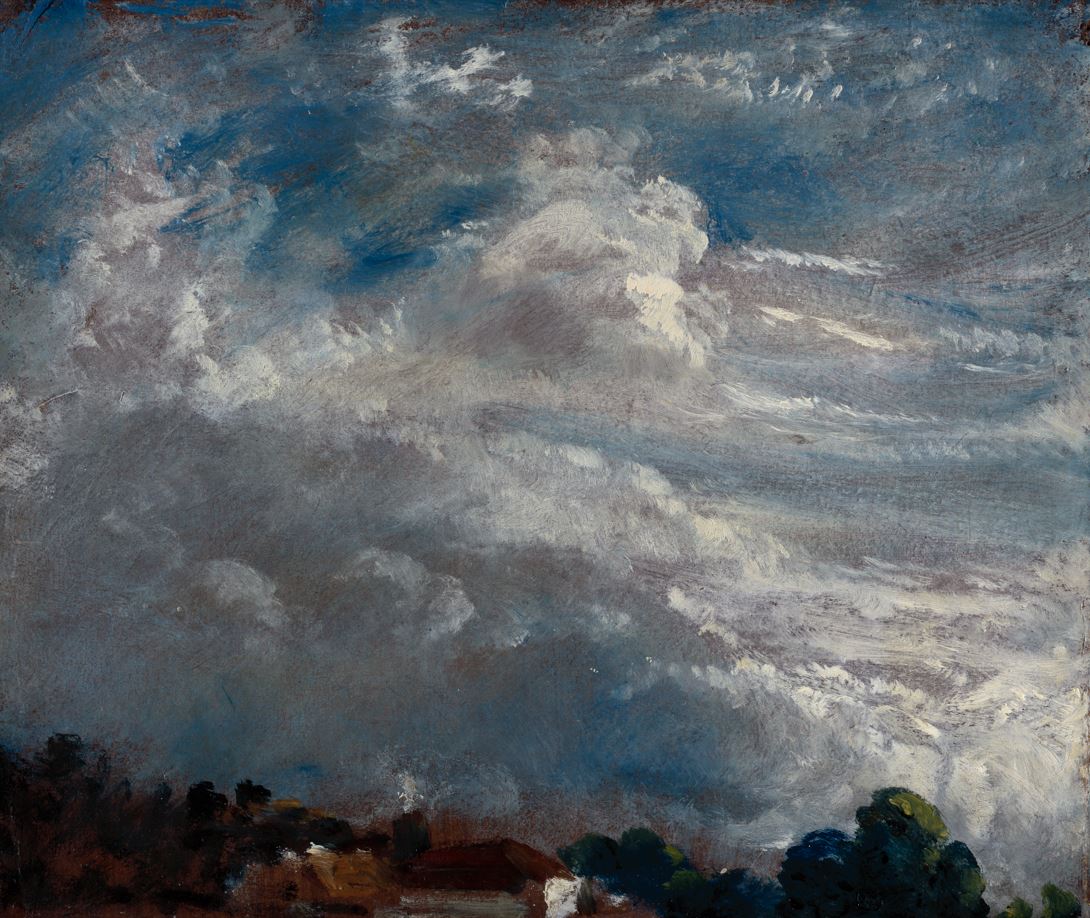
Clouds

Constable was particularly interested in the study of clouds. The exhibition includes numerous paintings, sketches and drawings he made of cloudscapes. A man named Alexander Cozens wrote a book titled ‘A New Method of Assisting the Invention in Drawing Original Compositions of Landscape’ which included different types of cloud shape and the exhibition includes some of the 20 drawings he made from the book as well as oil sketches.

Cloud Study: Horizon of Trees, 27 September 1821 by John Constable © Royal Academy of Arts, London; photographer: John Hammond

What Salisbury tells us

The show includes the splendid ‘Salisbury Cathedral from the Bishop’s Ground’ (1823) and it is a deep pleasure to sit on the bench in front of it and just drink it in. What sumptuous, sensual beauty of composition, colour and light.

Salisbury Cathedral from the Bishops Ground by John Constable (1823) © V&A Images / Victoria and Albert Museum, London

Slowly several points emerge, namely around the use of light and shade and clouds. The dark cloud rising from behind the cathedral gives the composition a sense of drama (it’s interesting to learn that the Bishop of Salisbury actively didn’t like this dark cloud).

It also indicates the kind of day it is, one of those days when the sun comes in and out between clouds, and this explains the radiance of the cathedral facade: it’s one of those moments when the sun comes out from between clouds and makes whatever it shines on appear radiant. Once you notice this, you realise it also applies to the meadow in front of the cathedral, up to and including the cow, whereas the field and trees further towards the viewer are still in shadow.

With this in mind, if we go back to the Hay Wain, I suggest part of its popularity is down to its use of cloud and light as design features. On the face of it, it’s a painting of a cart in a pond but if you focus just on the play of light, and light on clouds, several things become obvious.

The Hay Wain by John Constable (1821) © The National Gallery, London

The spiral

In the West we read from top left to right. I suggest that one of the reasons the painting feels so satisfactory and pleasing is the way its design plays to this deep way of ‘reading’ visual elements. So if you start at the top left the cloud is very dark which leads your eye to the right, towards the nice light cloud, and your eye continues on round and down into the meadow which stretches off into the distance and is dappled with sunlight, before swinging down into the water and round to the cart in the pond.

So my suggestion is that we don’t just perceive it as a complex composition and pick out details at random but enjoy this sense of sweep and progression.

Comparing the sketch

A bit more evidence for this us supplied by the full-sized sketch of the Hay Wain which the exhibition also includes. Comparing the sketch and the finished painting suggest quite a few points from which I’d emphasise two.

Full-scale study for The Hay Wain by John Constable (about 1821) © V&A Images / Victoria and Albert Museum, London

1. Brown and green

Remember the idea that older landscape artists used a tastefully subdued palette of brown when painting outdoors? Well, the sketch clearly shows that this is how Constable began, using a far more sombre, brown and rather lifeless palette. Comparing the sketch and the finished painting shows how powerful adding in the vibrant shades of green transforms the finished product. They bring it to life; they make it zing with life, foliage, fertility.

The Hay Wain by John Constable (1821) © The National Gallery, London

2. Decluttering the composition

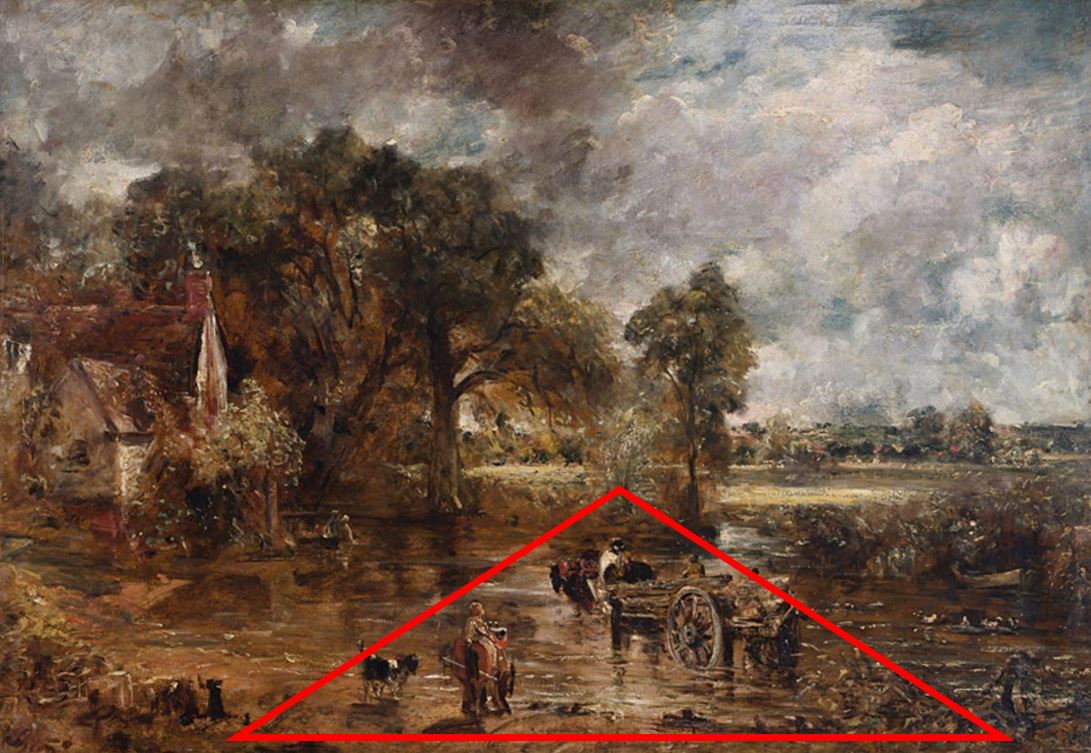
But back to the issue of composition, look at the one big, obvious difference between the sketch and the finished work. The figure of a horse and rider between the dog and the cart has been deleted. Why? Because including it crystallises the dog and cart from being light and almost random elements into becoming a strong central ensemble which dominates the picture. With it in your eye tends to go straight to it and you get distracted into peering closer to make out the precise nature of the figure on a horse (in fact, you have to peer quite closely to realise it’s a horse at all). And all this supersedes or obliterates the sweeping curve, the spiral I’ve described above.

Full-scale study for The Hay Wain by John Constable (about 1821) with added triangle © V&A Images / Victoria and Albert Museum, London

Keep it in and the eye goes straight to these central figures and tries to identify them / make them out, making you tend to overlook the wider composition. Remove it and your eye is freed to step back, to take in the larger compositional sweep, from dark cloud to light, round and down to the meadow, and only slowly and leisurely coming round to the cart. The picture becomes lighter and airier. It breathes.

History of an icon

It’s interesting to learn that John Ruskin, the godfather of mid-Victorian art criticism, really disliked Constable and helped depress his reputation for a generation. It was only later in the nineteenth century that Constable’s reputation bounced back and has remained high ever since.

The curators claim a major aim of the exhibition was to chronicle the rise of Constable from the kind of criticism he received in his lifetime and the active dislike of cultural arbiters in the mid-nineteenth century his current unassailable position as one of Britain’s classic painters. This is a fine ambition so it’s regrettable that the exhibition doesn’t really achieve it.

There are a few wall labels explaining that this or that painting was given to the National Gallery by supporters or, in one case, by his daughter, in this or that year, as if that tells us very much and that’s about it.

There’s a glaring absence of any explanation of what changed in aesthetic theory, in the practice of art, in social attitudes to the landscape, in artistic taste through the middle and later Victorian era to explain Constable’s rise and canonisation. I’d really like to have read this but didn’t see it anywhere.

So in the opening section there’s a 1920s black-and-white photo of Willy Lott’s cottage and we are told that it was extensively restored in the 1920s after a revival of interest in Constable’s paintings – but not why there was a revival of interest in Constable’s paintings. What was sufficiently different in the 1920s from the 1880s or 1860s to spark the investment? What changed and why?

Spoofs and parodies

To end on a lighter note, right at the start of the show, while they’re telling us how The Hay Wain has become an iconic image of the English countryside, the curators include half a dozen examples of how it’s been parodied and pastiched, used in cartoons and adverts for railways (‘Explore Constable country!’).

A striking one is this use of The Hay Wain in a 1929 cartoon bewailing the despoliation of the English countryside by cars and advertising hoardings. People tend to think this is a modern problem but here’s proof that it goes back at least a hundred years!

‘Had Constable lived today’ cartoon in the Daily Express, 2 March 1929, created by the Campaign for the Protection of Rural England © CPRE

There’s the satirical anti-war photomontage by radical anti-war artist Peter Kennard.

More up to date is this photomontage by Cold War Steve, where he’s cut and pasted leading political figures from 2019 into the scene. I like the truck full of dead washing machines but the killer detail is the image of Wayne Rooney riding a jet ski just to its left, so the joke is that this version of the picture should be titled ‘Hey, Wayne!’

The Hay Wain by Cold War Steve (2019) © Cold War Steve


Related links

Related reviews

Soulscapes @ Dulwich Picture Gallery

Landscape painting is associated with the classical tradition, with nostalgic views of often idealised landscapes (in England, by painters such as Gainsborough and Reynolds in the 18th century, via Constable in the 19th, and onto 20th century artists as varied as Ravilious or David Hockney). Above all it is associated with white, male, historical artists, and Dulwich Picture Gallery is home to numerous works by masters of landscape painting, in Britain and Europe.

And so the thought naturally arises: why not gather together works by non-white artists, by contemporary living artists who, in a host of different ways, can offer new and interesting perspectives on a well-worn subject? Hence this exhibition, ‘a contemporary retelling of landscape by artists from the African Diaspora.’

It sounds like a simple enough proposition but raises a surprising number of questions and issues, problems and perplexities, which I try to address through the course of this review.

Scope

‘Soulscape’ features about 33 works (20 paintings, 2 textiles, 10 photos and 2 videos and a video installation) by 21 contemporary Black artists. The works include large-scale pieces, a site-specific installation, and a big new painting commission from Michaela Yearwood-Dan. They cover a wide variety of media including photography, film, tapestry and collage. And they are all very 21st century. The oldest work is from 2012 but that’s an outlier, most are much more recent. I counted five a piece from 2020, 2022 and 2023. It’s up-to-the-minute stuff.

Some of the artists I’d heard of before, namely the film-maker Isaac Julien, photographers Marcia Michael and Mónica de Miranda because I’ve been to exhibitions of their work at the Black gallery, Autograph ABP (and de Miranda also features in Tate Britain’s current Women in Revolt! exhibition). But most of the rest were, to my shame, completely new to me.

As you might expect the show goes way beyond traditional limited interpretations of ‘landscape’ to bring in a host of weighty themes and ideas. Dulwich Picture Gallery is a relatively small space, made up of four consecutive galleries (with a small broom cupboard of a mausoleum at the break between rooms 2 and 3) and the rooms have each been assigned themes or topics, being: belonging, memory, joy and transformation.

1. Belonging

Room one is arguably the best room in the show. It contains just four big works, but I liked them all. They have been selected to illustrate the theme of belonging. I’m going to quote the curators’ introduction in full:

Belonging is fundamental to the human experience. It is intrinsically linked with our relationship to landscape and our place in the world. We can feel an emotional affinity to a place through shared histories, as well as being rooted somewhere through a collective identity.

Each artist here offers a unique perspective in the way their work draws links between self and nature. They reflect on the intersections of felt experience and the traditional understanding of belonging, often against the backdrop of colonial history, migration, and the complexities of disputed territories.

‘Limestone Wall’ (2020) is a large-scale painting by Hurvin Anderson, which depicts the tropical foliage of Jamaica and explores the artist’s relationship to his ancestral homeland. The curators write:

Anderson is the youngest of eight children born to Jamaican parents, the only one born in England. His work reflects an attempt to reconcile his inherited and imagined knowledge of Jamaica with his own limited experience of the landscape. ‘Limestone Wall’ invites us to consider the liminality of belonging through a landscape that was inspired by photographs taken on a visit to Jamaica.

Limestone Wall by Hurvin Anderson (2020) © Hurvin Anderson. Courtesy the artist and Thomas Dane Gallery. Photo by Richard Ivey

‘The liminality of belonging’. For those not familiar with curatorspeak, liminality means ‘the quality of being in between two places or stages, on the verge of transitioning to something new’. It’s a term taken from anthropology where it indicates ‘the quality of ambiguity or disorientation that occurs in the middle stage of a rite of passage, when participants no longer hold their pre-ritual status but have not yet begun the transition to the status they will hold when the rite is complete’ (Wikipedia).

This is, as you can see, a big and complex idea to attach to a painting of what looks like some kind of terrace (of a café, maybe?) set against a lush green tropical jungle.

The idea that immigrants, emigrants, the children of people who have emigrated from one society to settle in another and who remain, in some sense, between two worlds, and two identities, is a Central Issue of Our Times, and runs like a thread through all the rooms in the exhibition.

The question which this first room raised for me was not the one the curators intended, about belonging or identity etc, but more like: Does the knowledge about the artist’s family background and immigration status (I apologise if this is insensitive phrasing, all I mean is knowledge of whether the artist comes from a family which has emigrated from an African country to somewhere in the West, Europe or America), does and should this knowledge affect our appreciation of their art?

On one level it doesn’t matter at all to me, I don’t care where any artist comes from or what their ethnic background is. I’ve come to an art gallery, I’m looking at 30 or so paintings (and a couple of videos) and deciding which ones I like purely on the basis of how they look and how they make me feel. But it matters a lot to the curators. It’s the curators who’ve made it an issue, because it’s the curators who include this ‘immigration information’ in almost every wall label, as well as in the articles which accompany the show in the Dulwich Gallery magazine.

This is the room which hosts the pieces by Marcia Michael and Mónica de Miranda. Of the Miranda triptych of photos, the curators write:

De Miranda, a Portuguese artist with Angolan ancestry, explores the poetry of belonging throughout her work. This piece, from the series ‘The sun does not rise in the north’, investigates the physical and mental concept of borders and migration. Depicting landscapes that witness hope, de Miranda examines the complexity of migrant histories in Europe in relation to the politics of land. The three figures, standing amid breaking waves, lead us to consider the limitations of belonging.

Sun rise (detail) by Mónica de Miranda (2023) Courtesy of the artist and Sabrina Amrani Gallery, Madrid

She’s also represented by ‘When words escape, flowers speak’, massive digital photos of twin Angolan sisters standing in the seemingly natural but carefully constructed landscape of the botanical gardens of Floresta da Ilha (Island Forest) in Angola’s capital city, Luanda. The curators describe this city, Luanda, as bearing ‘a history of colonial presence’. Well, yes, Luanda ‘bears’ quite a bit more than that, since Angola gained independence in November 1975 and was immediately plunged into a devastating civil war which lasted, with interludes, until 2002, leaving up to 800,000 dead and the country’s economy and infrastructure in ruins. See my reviews of:

As so often, as in Tate Modern’s excellent exhibition of African photography, the (white liberal) curators bang on at great length about the evils of the colonial period, and simply ignore the 60 years of civil wars, military coups, famines and kleptocratic dictatorships which have ravaged Africa since the end of the colonial era.

On the big wall facing the entrance is Marcia Michael‘s 2022 work, ‘Ancestral Home 45’, from the series ‘The Object of My Gaze’. It’s a photograph of a jungle scene which has been mirrored vertically and horizontally to create a dazzling image of a tropical landscape.

Kaleidoscopic and mesmerising, this photographic work is a meditation on the sense of belonging that can be evoked through immersion in nature. It was created from a series of images captured by Michael on a visit to her late mother’s homeland in Jamaica.

2. Memory

Room two is devoted to memory. The curators, again, make a number of sweeping claims:

Landscapes have the power to unlock feelings that only a particular place can activate. Sometimes these memories are nourishing and affirming and at other times they are challenging, making us feel unwelcome or excluded. The artists in this section explore the space in between these extremes. 

Do landscapes ‘have the power to unlock feelings that only a particular place can activate’? Maybe. It’s a big claim, a big thought.

This room contains the most works, with 8 or so paintings and fabrics, 6 photos, plus a video and a still from a video.

The video is by Harold Offeh, is titled ‘Body Landscape Memory. Symphonic Variations on an African Air’ (2019) and is 20 minutes long. It consists of very calm, quiet shots of one, two or three Black people sitting on log benches in what looks like a typical (and typically boring) English park. There’s no dialogue or interaction. The calm scenes are accompanied by music from the early twentieth-century Black British composer Samuel Coleridge-Taylor. There’s a web page which gives more explanation, stills and a clip from the video.

The curators give an explanation which is presumably the artist’s, namely that:

These figures are liberated from any racialised notions of victimisation, or suffrage, to reimagine the inclusive possibilities of this romanticised environment.

The complete lack of action or dialogue is the point, and I (think I) understand the political or polemical aim, to show Black people in a nice park, with none of the melodrama or negative stereotypes which usually accompany Black people in TV dramas or movies. Bit boring, though.

In a similar vein, of normalising Black figures in non-urban settings, are two big digital photos by Jermaine Francis.

‘A Pleasant Land J, Samuel Johnson, & the Spectre of Unrecognised Black Figures’ by Jermaine Francis (2023) Courtesy of Artist Jermaine Francis

According to the curators Francis:

considers the issues that arise out of interactions with our everyday environments, positioning the Black figure in rural settings to instigate conversations around power, identity and the history of the English Landscape.

‘Conversations around power, identity and the history of the English Landscape.’ These are hefty topics, walloping great ideas, to simply mention and then leave hanging. For me they are like lead weights which have been hung on the photos, which drag down your response, which channel whatever initial response you have to them as works of art, into an urgent-sounding, political-sounding straitjacket.

And the ideas are just too big to engage with. Am I meant, somehow, to review the entire history of the English landscape based on just these two photographs?

I mentioned Isaac Julien. He’s represented by a big colour photograph, a still from a 2015 film installation Julien made titled ‘Onyx Cave (Stones Against Diamonds)’. The film aimed to celebrate the beauty of natural elements. The sequence the still is from was filmed in the rarely accessible ice caves in the Vatnajökull region of Iceland. It shows a Black figure standing in a beautiful ice-white and azure cave. It is accentuated by the presence of the onyx figure, dwarfed by the magnificence of the backdrop.

Onyx Cave (Stones Against Diamonds) by Isaac Julien (2015) © Isaac Julien / private collection, London

But this beautiful, awesome image isn’t enough. Again the curators corral it into one of their polemical concerns about Black inclusion/exclusion from the tradition of landscape art.

Historically, these depictions of cold-climates excluded the Black figure, so its presence here challenges notions of belonging and memory.

Obviously this is an idea implicit in the image, if you choose to read it this way. But if Julien really did intend his piece to be first and foremost a celebration of the beauty of nature, I wonder how he feels about this broad aim being straitjacketed into yet another discussion about Black figures in art. It made me wonder what any of these 21 artists thought about being chosen for this exhibition primarily for the colour of their skin rather than the quality of their work.

Interlude: the Mausoleum

It’s a quirk of Dulwich Picture Gallery that half way through, between rooms 2 and 3, off to one side, there’s a smallish circular room which is actually the mausoleum of three of the founders of the gallery. It is shaped to recall a funeral monument, with urns atop the building on the outside, sarcophagi above the doors and sacrificial altars in the corners.

The back wall is flat and it’s onto this wall that Phoebe Boswell has created a ‘site-specific installation’, namely a big door-shaped projection of a video titled ‘I Dream of a Home I Cannot Know’ (2019). This is a kind of visual collage depicting everyday activities of (Black) people in a beach in Zanzibar. It’s happy and innocent and lovely, with a low soundtrack of laughter and conversation and chat as holiday makers and day trippers runs, skip, play, go swimming, handle fishing boats etc. There are four attractive stools carved from a gnarly old tree because they contain gaps and holes, for visitors to sit on and be nicely lulled. It’s more or less the only piece in the show which really does convey a sense of the happiness and relaxing quality of being out of doors. However, the curators rope it back into their concern with migration, disaporas and the artist’s multi-country identity:

The work is a reflection on belonging, community, freedom, and migration. Boswell is informed by her own history, which spans various geographies and landscapes, and her work navigates the spaces between.

3. Joy

Room 3 is devoted to the theme of Joy. It contains nine works.

The joy that that comes from connecting with nature is a deeply personal and emotional experience. Whether experienced in solitude or socially with others, this feeling is often underlined by the nourishment and release that arises from being at one with the natural world.

The artists here invite us to join with them in sharing this moment of euphoria. For some, this is conveyed through evoking the sensory delight that comes from an immersion in the beauty of nature; the smell of fresh flowers, the feel of petals between one’s fingers. For others, depicting scenes of familial joy that place Black figures into classical pastoral scenes is a way of expanding the possibility for Black bodies to experience true ease and freedom.

‘…expanding the possibility for Black bodies to experience true ease and freedom’ rather begs the question: Do Black bodies currently not experience true ease and freedom? Anywhere? What would it take for Black bodies to experience true ease and freedom? The wall labels begged loads of questions which I found worried and distracted me from the art.

Anyway, I’m afraid I found most of the pieces in this room pretty meh. After strolling through the four rooms four or five times, I came to the settled conviction that I only really liked about ten, about a third of the 33 or so works. Some I found so horrible that I could barely look at them. It would be invidious to single out the really bad ones, but here are some I thought were very average.

‘Unforeseen Journey of Self-Discovery’ by Kimathi Mafafo (2020). The medium is interesting – it’s a hand- and machine-embroidered fabric so that when you get up close, you can see the individual threads and appreciate the extraordinary amount of time and patience it must have taken to make. I just didn’t like the final image very much. Maybe you do. Tastes vary.

‘Unforeseen Journey of Self-Discovery’ by Kimathi Mafafo (2020) Image courtesy of the artist / Kristin Hjellegjerde Gallery

However the curators load the work with some rather scary issues.

Mafafo explores the joyous embrace of nature as an act of resistance. The woman emerging from a cocooned veil of white muslin peers out with an air of excitement and wonder. The veil, once a sanctuary of peace and introspection, billows around her playfully as she rediscovers her world, uplifted by the natural beauty that defies the weight of patriarchy and racism.

Looking at the image cold, was your first response be that it is an act of resistance to patriarchy and racism? Maybe it was. But these struck me as being huge, troubling issues to load onto what (I think) is intending to be an image of innocence and natural beauty.

Another work which didn’t light my fire was a set of four paintings by Kimathi Donkor from her ‘Idyl’ series (2016 to 2020).

‘On Episode Seven’ by Kimathi Donkor (2020) Courtesy of the Artist and Niru Ratnam, London. Photo by Kimathi Donkor

These depict:

The concept of Black joy is a central theme of Donkor’s Idyll series. The figures in his painting display gestures of ease, relaxation and shared play between friends and family members. The pleasures of public green space and balmy weather are celebrated as precious gifts of nature, available to uplift us all.

‘Black joy’? Is this a lot different from white joy? Chinese joy? Latinx joy? Asian joy? Then comes then the polemical kicker:

For Black communities, this joy is also a form of resistance against being excluded, silenced or classed as victims.

OK, if this picture is something as serious and politically committed as ‘a form of resistance…for Black communities’, am I even allowed to have a view of whether I like it or not? The other three in the series were all in the same style and, well, I just didn’t like them very much.

On the plus side, the room contained two very good works. Njideka Akunyili Crosby’s lush multimedia piece, ‘Cassava Garden’ (2015), layers images from fashion magazines, pictures of Nigerian pop stars, and samplings from family photo albums to represent a hybrid cultural identity.

‘Cassava Garden’ by Njideka Akunyili Crosby (2015) © Njideka Akunyili Crosby. Courtesy the artist, Victoria Miro, and David Zwirner. Photo by Robert Glowacki

I always like collage, whether in its 1910s Cubism, 1920s Weimar or 1960s Pop guides, so I straightaway liked this. But I just responded to the size and feel of this work, it’s big and striking. I liked the way the repeated face of the women embedded in the fabric on the right is at right angles to the picture plane. You can’t really see them in this reproduction but in the two big green leaves at the top are embedded (from left to right) the faces of an African woman and man and they are both stunningly vivid and realistic. Maybe they’re photos somehow worked into the piece. If they were painted they’re extraordinary. And the off-centre positioning of the stalk of what is, presumably, the cassava plant. It all combines to make this one of my favourite pieces from the show. According to the curators:

The Nigerian-born American artist Njideka Akunyili Crosby uses an abstracted collage to engage with the idea of memory. The main feature is the cassava plant, whose broad leaves extend across the canvas and are layered with photographic images of the artist’s family life.

The collage is a reflection on Njideka Akunyili Crosby’s childhood trips to her ancestral land which were marked in her memory by the presence of cassava plants. She also references traditional West African material and patterns, signifying the duality of her cultural identity since making a new life in the USA.

Nearby are two more really good pieces, ‘The Climber’ (2022) and ‘Moonlight Searchers’ (2022) by Che Lovelace which depict the flora, fauna, figures, landscapes and rituals of the Caribbean. Again this catered to my slightly Asperger’s taste for squares and geometric shapes. I immediately responded to the way it consists of four rectangles bolted together, each signalling a different perspective or colour palette on the main composition. And then I liked the rather Cézanne-like way the two naked women are turning into geometric shapes or geometric shapes are emerging from their bodies, beginning to schematise or diagrammatise them. And I liked the colours, especially the green fronds of the palm tree leaves on the left.

‘Moonlight Searchers’ by Che Lovelace (2022) private collection. Courtesy of the artist, Corvi-Mora, Various Small Fires and Nicola Vassell Gallery

According to the curators:

Lovelace reflects on the loving embrace of the landscapes found in his homeland, Trinidad. His depictions of the rhythms of life on the Caribbean island are informed by his rootedness there. The result is a complex and nuanced expression of his sense of identity, as well as an exploration of postcolonialism, resistance, freedom and joy. The division of the canvases into quadrants reflects the interactions between different cultures on Trinidad. Both works show bodies at ease with nature, exploring and connecting with their surroundings.

Once again the wall label raised questions in my mind: Is this painting ‘an exploration of postcolonialism, resistance, freedom and joy’? Or are those just fashionable words thrown at these paintings, combined and recombined in an impressive number of ways but, at bottom, representing just a handful of ideas, none of which actually is actually ‘explored’. Are these terms like confetti thrown at a wedding, bouncing off the central figures and then lying around on the floor till swept up and thrown away?

4. Transformation

The Gallery often reserves the fourth and final room for Big works, acting as a climax to what came before and this exhibition is no exception, the fourth room containing four big, big paintings. The curators explain the theme of transformation thus:

Nature can be a powerful force that changes the way we see the world and its history, as well as equipping us with tools for healing physical and emotional wounds.

This begs so many questions, it left me dizzy. Is nature ‘a powerful force’? What does that mean, exactly? Surely we are part of ‘nature’, every organic thing, plus the geographical and geological environment, surely these are all part of nature? So what does it mean to say that ‘nature’ can change ‘the way we see the world’? How are these terms, ‘nature’ and ‘world’ different? Is it because the curators are assuming that ‘world’ gestures more towards the world of humans the world of culture and technology we surround ourselves with?

And what does it mean to say that ‘nature’ can change ‘the way we see…history’? How, exactly? Does walking through a park change my view of the French Revolution or the Rwanda genocide? I don’t really see the connection?

And these are all implications of just the first half of that sentence. the second half goes on to make the huge claim that ‘nature’ equips us ‘with tools for healing physical and emotional wounds’. Does it? What tools? How?

So I found myself hugely distracted by this simple couple of sentences, my mind buzzing with an explosion of implications and issues, so it took quite a while to settle down and actually look at the works in the room.

These include the one specially commissioned for the show, by Michaela Yearwood-Dan, ‘Another rest in peace – from a holy land in which we came’. It’s a huge landscape-shaped canvas filled with swirling paints, with ceramic petals and other matter stuck to the surface, and I actively disliked it. It looked like an abortion on a canvas and had absolutely no healing impact on me.

Next to it is an equally huge painting of a tropical rainforest which appears to be hanging over a river, although the paint is handled in such a way that it looks like it is melting into the river, an uncomfortable image of distortion, reminding me of the cover art for a science fiction book where some horrible radioactive disaster has struck the world. the grey blobs on the right, from a certain angle, looked like distorted skulls.

‘There Is Water at the Bottom of the Ocean’ by Ravelle Pillay (2023)

This is ‘There Is Water at the Bottom of the Ocean’ by Ravelle Pillay (2023) and, according to the curators:

In this moody and evocative painting, Pillay explores the legacies of colonialism and transformation of painful colonial histories alongside the conflicting nature of historical memory. The lush shoreline sits against the backdrop of a jungle made up of palm trees that appear weighted and changed by the histories they have witnessed. The water seems to hold spectral energy. The artist allows us to consider the way history can affect a landscape and reveal wounds that call for healing and change.

None of that was obvious to me. I just found it huge, overpowering and depressing. Maybe you think differently.

And, finally, a pair of enormous paintings, dominated by orange and browns, by Christina Kimeze, namely ‘Wader (Lido Beach)’ and ‘Interior I’, both painted in 2022. Here’s a link to the Wader, and to the Interior on Kimeze’s website. Actually, in small reproduction they scrub up quite well, the orange palette coming across very powerfully. Also, on the internet you can see installation shots of exhibitions with lots of her works together, which I imagine give a strong cumulative effect.

But here, the context of two other huge and not very appealing works dragged my reaction down into negativity. In the ‘Interior’ I found the space (is it inside a hut?) offputtingly square and rigid, and the depiction of the woman’s shape or outline disconcertingly clumsy and unappealing.

The figure of the pregnant woman in ‘The Wader’ is a lot more appealing, as is the liberal use of purple marking or strokes but, in the flesh, huge and oppressive in a small room, I found both these works the exact opposite of healing or transformative. I couldn’t wait to get away from their looming presence.

Summary

After carefully reading the 40 or so wall labels which repeatedly invoke troubling social and political issues around racism, ethnicity, migration, identity, Black oppression, Black suffering, Black exclusion and Black exploitation, I felt anything but soothed and healed by nature. I felt very troubled and anxious about some of the hottest hot-button issues in modern society. The labels of almost every work have the harassing, hectoring tone of a Guardian article lecturing you about your white privilege and asking what you are going to do for the Black Lives Matter movement. Quite stressful.

As to the healing, joyous and transformative power of nature which the main room captions repeatedly invoke, one minute in the lovely gardens surrounding Dulwich Picture Gallery, amid the deckchairs and playing children and picnicking families, was more instantly and deeply healing and calming than anything I saw in the challenging hour I spent in this difficult and very uneven exhibition.

Exhibiting artists

  • Njideka Akunyili Crosby
  • Hurvin Anderson
  • Michael Armitage
  • Phoebe Boswell
  • Kimathi Donkor
  • Jermaine Francis
  • Ebony G. Patterson
  • Alain Joséphine
  • Isaac Julien
  • Christina Kimeze
  • Che Lovelace
  • Kimathi Mafafo
  • Marcia Michael
  • Mónica de Miranda
  • Harold Offeh
  • Nengi Omuku
  • Sikelela Owen
  • Ravelle Pillay
  • Alberta Whittle
  • EVEWRIGHT
  • Michaela Yearwood-Dan

Promotional video


Related link

  • Soulscapes continues at Dulwich Picture Gallery until June 2024

Related reviews

Impressionists on Paper: Degas to Toulouse-Lautrec @ the Royal Academy

This exhibition in is in the smaller set of three rooms at the back of the Royal Academy building i.e. it’s more of an amiable stroll through three rooms of relatively small drawings, rather than, say, the full-on assault course of the 11 big rooms of the extraordinary Marina Abramović show.

It does what it says on the tin, brings together 80 or so works by all the famous Impressionist and post-Impressionist artists plus quite a few I’d never heard of before, experimenting with different media on paper.

Exhibitions need an aim or project and this one aims to explore how Impressionist and Post-Impressionist artists in late 19th-century France didn’t just use paper works as studies but radically transformed the status of works on paper. Previously, drawings were mostly conceived as preparations for paintings; in the hands of the Impressionists drawings, pastels, watercolours, temperas and gouaches were increasingly perceived as more than just preparatory techniques, and became autonomous works of art, claiming a shared aesthetic with painting.

Dancer Seen from Behind by Edgar Degas (c. 1873). Essence (diluted oil paint) on prepared pink paper. Collection of David Lachenmann

Who are we talking about? The eye-catching famous artists are: Mary Cassatt, Paul Cézanne, Edgar Degas, Paul Gauguin, Eva Gonzalès, Claude Monet, Berthe Morisot, Camille Pissarro, Odilon Redon, Pierre-Auguste Renoir, Georges Seurat, Henri de Toulouse-Lautrec and Vincent van Gogh.

Less well known are the likes of Albert Lebourg, Jacques Emile-Blanche, Armand Guillaumin, Frederico Zandemeneghi.

Impressionists recap

As the curators explain:

The avant-garde artists known as the Impressionists came to prominence during the late 1860s and early 1870s, first exhibiting in Paris as a group in 1874. They shared a concern to depict scenes from everyday life and to address contemporary issues, which encouraged them to challenge traditional attitudes to drawing and seek innovation. Vivid colour, a quick, loose touch, and daring viewpoints, together with a deliberate lack of finish, were their means of capturing the fugitive effects of nature as well as vignettes of modern life.

The portability of drawing materials greatly facilitated direct observation and the recording of scenes on the spot. The eight Impressionist exhibitions, held in Paris between 1874 and 1886, included a large number of works on paper and reflected their shift in status. This was also encouraged by dealers who recognised the economic advantage of exhibiting and selling works on paper.

Cliffs at Etretat: The Needle Rock and Porte d’Aval by Claude Monet (c. 1885). Pastel on wove paper. National Galleries of Scotland

What it’s like

The most striking thing, for me, was how the drawings faithfully echo the style of each artist’s paintings i.e. the way each of the artists have strong signature styles or vision no matter what medium they’re working in.

So you see a hazy landscape of cliffs by the sea and instantly know it’s Monet; charcoal images of ballet dancers posed at striking angles and know its Degas; a round-faced woman’s face smiling at some outdoors dance and know it’s Renoir; a grotesque, angular woman in an urban setting and you know it’s Toulouse-Lautrec; a light and airy landscape made out of cubes and rectangles of colour and you know it’s Cezanne.

So you can play an entertaining game of standing far away from the wall to try and identify the artist by their style, then stroll over to the wall label to find out if you were correct. For example, who would you think this is by?

Portrait de Marie-Thérèse Gaillard by Mary Cassatt (1894) Pastel on paper. Private collection. Photo © 2007 Christie’s Images Limited

In this case it’s a trick question. You might have thought Renoir, from the treatment of the face, but it is in fact by Mary Cassatt. Note the striking difference in finish between the face – expertly and completely rendered – and the clothes, rendered in a completely different, hurried, unfinished style, with the background wall hovering somewhere between the two.

What I liked

The most striking work in room 1 is the Portrait of Madame Henri Wallet by Jacques Emile-Blanche simply because of its size. It’s a John Singer Sargent-style and sized portrait of an elegant society woman, and so stands out in a room full of much smaller, much more hazy and impressionistic images.

Degas sketched and drew things around him so compulsively that his colleagues nicknamed him Monsieur Pencil and, appropriately, there are more works by him in this exhibition than any other  artists, 12 in total, all of which I liked.

I love sketches and drawings, I love art which is half-finished, ghostly, hinting at a half-grasped reality, which is why I’ve always loved Degas’ strange and mysterious Woman at a Window (1871), which used to be tucked away in a side room at the Courtauld Gallery. Here it is presented in all its pregnant mystery and an epitome, for me, of the power of paintings or drawings which are better left unfinished, full of hints and implication.

But I’d forgotten, if I ever knew, about Degas’s friend Frederico Zandemeneghi (1841 to 1917). Zandemeneghi was invited by the Impressionists to exhibit at four of their 8 exhibitions. He was particularly close to Degas. They shared an interest in depicting scenes of modern life featuring women subjects, seen from unconventional viewpoints, often cropping the image unexpectedly, and using vibrant colourful pastels.

This example has several of those characteristics in spades, namely the dramatic cropping which makes the subject feel really close-up and in your face. And the very bright colours, blue, yellow, orange, red, making the most of the range of human sight.

Study of a Woman from Behind by Federico Zandomeneghi (1890 to 1897) Pastel on cardboard. Galleria D’Arte Moderna, Milan. Photo © Comune di Milano

The show is in chronological order, starting with works from the 1870s. Room 2 contains works from the 1880s. The highlight for me was van Gogh’s ‘The Fortifications of Paris with Houses’ from 1887, made from a combination of graphite, chalk, watercolour and gouache. This reproduction in no way conveys the glowing brightness of the original. Then I liked the contrast between the architecturally accurate apartment block on the left and the vague ‘impressionistic’ grass in the foreground. Then I noticed the way the big fortification wall is not made of bricks but of hundreds of vertical dabs of orange and grey. And then I noticed the ghostly couple walking past in the foreground, ghosts of the millions of people who lived and died in the great cities of Europe, leaving barely a trace of chalk on paper. At which point I realised that there’s a kind of spectrum of solidity, from the super-solid apartment blocks on the right, to the more dabbed and impressioned fortifications themselves, and then to the human beings, the least permanent or impactful things in the picture or in history, hundreds of millions of us leaving less trace than walls or buildings.

The Fortifications of Paris with Houses by Vincent van Gogh (1887) Graphite, black chalk, watercolour and gouache on paper. The Whitworth, The University of Manchester. Photo by Michael Pollard

The exhibition concludes in room 3 with works from the 1890s and 1900s, which saw an ever-growing appreciation of works on paper and a proliferation of exhibitions of the medium. There’s a lot more Degas who emerges as probably the strongest and most consistent artist on paper. Off in one corner is a set of quiet, thoughtful, washed-out watercolours by Cézanne from late in his career. At the opposite corner of the room, both literally but also in terms of subject matter is a small set of three vivid, scratchy, angular images of the louche underworld of Montmartre by Toulouse-Lautrec.

But floating above this world of human troubles is the work I liked the best, a classic of what, during the 1890s came to be known as Symbolist art, the wonderful, visionary ‘Ophelia among the flowers’ by Odilon Redon.

Ophelia Among the Flowers by Odilon Redon (1905 to 1908) Pastel. The National Gallery, London

The Impressionists were trying to capture the truths of the modern world, applying light quick touches to capture the fleeting moment. Redon, by complete contrast, sought out ‘the light that never was on land or sea’, depicting images from the inner world of fantasy and dream. So I thought he was pretty out of place in an exhibition of impressionists. But his inclusion makes sense if we forget the exhibition’s main title for a moment and think of it more as a study of the evolution of drawing and painting on paper in France from the 1870s to the 1900s. From that perspective the inclusion of Redon makes sense for his technical prowess. The flowers are obviously the dominant element in the work, but after a while you realise that it’s the peculiar quality of the light in the top middle and right of the image which give it its haunting, apocalyptic quality.

Consequences

According to the curators:

The French avant-garde artists’ interest in drawing and the remarkable range of their production had far-reaching consequences. The hierarchical distinction made between painting and drawing ceased to exist. Freedom of execution and a laissez-faire attitude to materials provided an impetus that allowed the world to be depicted in more imaginative ways, leading to developments in 20th-century art such as Abstract Expressionism.

So as we progress through the works in chronological order, we are not just witnessing the development of visual styles, generally away from figurativism and towards greater abstraction, but the evolution of the medium of drawing itself, as it prepares for the great lift-off of modern art at the start of the twentieth century.

It’s not all masterpieces. Some are not-great early works (for example, by van Gogh or Gauguin) which are of largely scholarly interest, others are wishy-washy landscapes which are a bit meh (Armand Guillaumin). But overall it’s a lovely civilised way to spend an hour, enlivened by a regular stream of masterpieces. It’s worth visiting just to see the 12 Degas works and the 3 or 4 pieces by Frederico Zandemeneghi and the van Gogh. But other visitors will find other works to marvel at and cherish.

Dancers on a Bench by Edgar Degas (around 1898) Pastel on tracing paper © CSG CIC Glasgow Museums Collection


Related links

Related reviews

Rubens and Women @ Dulwich Picture Gallery

This is a stunning exhibition bringing together over 40 paintings by one of the most famous names from the classic period of western art, Peter Paul Rubens (1577 to 1640). It brings together masterpieces from international and private collections, many of which are appearing in the UK for the first time i.e. it represents a unique opportunity for lovers of classic Old Master art. There are some really stunning paintings and a suite of exquisitely crafted chalk drawings on display. It is a feast for the eyes and mind and imagination.

Questioning the Rubenesque

However, it cannot be emphasised too strongly that it is very much a themed exhibition. It really is about Rubens and women.

The stereotypical view of Rubens is as a painter of ample, fleshly, nude women, hence the adjective ‘Rubenesque’, which the Collins dictionary defines as:

‘of, characteristic of, or like the art of Rubens; colourful, sensual, opulent, etc. 2. full and shapely; voluptuous; said of a woman’s figure.’

This exhibition very much sets out to question that stereotype and to show that Rubens painted a much broader range of female characters, in a far greater range of postures, poses and compositions, than the stereotype suggests. Which explains why the poster for the show is very much not of a plump scantily clad woman but of the impeccably buttoned-up Marchesa Maria Serra Pallavicino (see below).

Strong independent women

Not only that but, in line with contemporary feminist ideology, the exhibition is keen to emphasise that many of these women were far from being passive victims of the male gaze, but in all kinds of ways were, in real life, and in the iconography of the paintings, strong independent women possessed of that key quality of feminist theory, agency.

Portrait of a Lady (about 1625) by Peter Paul Rubens. Courtesy Dulwich Picture Gallery

Thus almost all the 40 or so pictures here are of women, with men playing only peripheral or negligible roles, if they appear at all.

There are paintings of women members of his family, rich influential female patrons, lovely chalk sketches of naked women, key women figures from Christian iconography, and the show builds to a tremendous climax with a final room showing four enormous oil paintings of women figures from classical mythology.

There are some men in some of the paintings, but they are always playing a secondary or negligible role. In the words of the press release:

‘The exhibition will be the first to challenge the popular assumption that Rubens painted only one type of woman, providing instead a more nuanced view of the artist who painted more portraits of his wives and children than almost any other, even Rembrandt. The exhibition reveals the varied and important place occupied by women, both real and imagined, in his world.’

Rubens’ changing style

In a more specialist, art history kind of way:

‘A further theme follows the evolution of the female nude in Rubens’s art. It demonstrates how Rubens’s early nudes were quite different in style from those he became famous for, tracing how he arrived at his preferred form through an engagement with sculpture, careful study of antique models and observation from life.’

Room 1. Introduction

Room one contains eight wonderful oil paintings. One is an early self portrait to introduce the man himself, and then, in line with the exhibition theme, seven portraits of women. First, some historical background:

‘Early in his career Rubens realised that his extraordinary ability to paint portraits could open doors. In May 1600, aged 22, he left Antwerp for Italy, where he stayed until 1608, employed by Vincenzo I Gonzaga, Duke of Mantua. This position afforded him opportunities to travel to Spain, Venice, Florence, Rome and to Genoa, where his qualities as a portraitist became fully apparent. Rubens’s dazzling and innovative portraits of noblewomen revolutionised the genre and cemented his relationships with wealthy and powerful patrons.’

The first room is dominated by an enormous, sumptuous and commanding full-length portrait of the Marchesa Maria Serra Pallavicino. No reproduction can convey the scintillating, dazzling richness of the oil paint which makes up this awesome, luxury portrait. It is deliberately placed to dominate the first room and announce Rubens’s supreme skill as a painter of power, money and women.

Marchesa Maria Serra Pallavicino by Peter Paul Rubens (1606) National Trust Collections, Kingston Lacy (The Bankes Collection)

Once you’ve gotten over the visual shock of this huge masterpiece, you can move on to process the six other paintings of women. There’s a further portrait of a powerful woman, Isabel Clara Eugenia, Infanta of Spain, though depicted in the outfit of a nun, a member of the Order of Poor Clares, reminding us that this was the period of heightened Catholic religiosity referred to as the Counter Reformation.

There’s a series of portraits of ‘unknown women’, resplendent in 17th century dresses, whose luxury fabrics are depicted with loving precision, obviously well-off though not aristocrats.

But maybe the most affecting paintings is the set of ‘intimate’ portraits depicting Rubens’ family, namely his first wife Isabella Brant (1591 to 1626) and eldest daughter, Clara Serena (1611 to 1623), both of whom died relatively young, his daughter at just 12.

Clara Serena Rubens, the Artist’s Daughter by (1620 to 1623) Private Collection

Room 2. Figuring Faith

The second room is a long corridor shape and contains paintings and drawings of a religious nature. Working for the Catholic rulers of Antwerp, Rubens was commissioned to create works designed to promote the Counter-Reformation, the Europe-wide movement to revive and reinvigorate Catholic faith, theology, institutions, and project the power of the Catholic monarchs who defended it.

However, in line with the exhibition’s theme of women, the 20 or so works on display here are for the most part not huge, grand, overpowering and religiose images; most of them are relatively modest in scale but what they do have in common is the curators’ wish to foreground Rubens’s treatment of women in the Christian stories.

The Virgin in Adoration before the Christ Child by Peter Paul Rubens (1616 to 1619) KBC Bank, Antwerp, Museum Snyders & Rockox House

It is quite drily funny how, no matter what the subject depicted, the curators insist that the female figures in them are the real stars, the real centres of attention, exercising agency and power in the way every 21st century feminist would approve of.

There’s a wall-sized digital print of an adoration of the Virgin, printed out and plastered on the wall, in which the Virgin is quite obviously receiving her dues from an array of grovelling men.

In a depiction of the Flight into Egypt, it is Mary who taking the ‘heroic’ role of protecting the baby Jesus.

‘Despite the sense of foreboding, and the shadowy rider visible on the horizon, Mary radiates calm.’

There’s an Ascension of Mary which features lots of men in 17th century clerical dress (actually the apostles) but all they can do is stare upwards in amazement at the Virgin taking off into the sky.

There’s two long narrow portrayals of women accompanied by skinny clerics and these turn out to be portraits of two women saints, Walburga and Catherine of Alexandria, strong independent saints.

There’s a study of Saint Barbara fleeing from her father, who has his sword drawn ready to kill her. Typical toxic patriarchy.

By now seeing everything through the eyes of the curators what we notice in a depiction of the ‘The Lamentation’ is that:

‘it is the women who model how we are to respond to this heart-breaking sight. Gazing at Christ, Mary Magdalen pulls at her hair in distress. The Virgin cradles Christ’s body and tenderly closes his eyes. At his feet are The Three Maries (Holy Women from the Bible).’

And at the centre of all this fuss, a dead white man, the best kind.

The Lamentation by Peter Paul Rubens (1614) Kunsthistorisches Museum Vienna, Gemäldegalerie

Denying the Rubenesque

The curators are at pains to emphasise that Rubens’ women are no more voluptuous than those of his predecessors. They are simply more life-like, their skin more convincingly elastic and believably warm. Rubens’ nudes aren’t plumper or more fleshly, they insist, just better painted.

It’s an interesting claim, and I suppose you couldn’t assess it for yourself without reviewing hundreds more works by Rubens and as many by his contemporaries. But the evidence of your eyes tends to suggest that the most striking of Rubens’ women, the climax of his development as displayed in the stunning final room, are chubby, well covered, however you want to express it. See room 4, below.

Room 3. Stone Made Flesh

‘The female nude was a subject of fascination and constant evolution within Rubens’s art. In Italy, Rubens intensively studied ancient sculptures, memorising their forms and postures. He also drew on the Renaissance artist Michelangelo who was similarly informed by ancient art. Recording observations in his notebook, Rubens devised a new type of vigorous, monumental, female nude.’

This room is the most scholarly of the three, an exploration of how Rubens’ modelling of the female figure evolved, especially after a visit to Rome early in his career. This includes a series of studies, finished paintings, a classical marble sculpture, a silverware design, sketches of classical statues, and one large finished oil painting, of Adam and Eve, to demonstrate his early handling of the female nude – all demonstrating his changing approach.

‘Rubens’s nudes became increasingly dynamic and lifelike throughout the 1620s and 1630s.’

All of these works are relatively small and require quite a bit more study and historical knowledge than the bigger, more attractive, finished oil paintings, certainly for an amateur like me.

Alongside these scholarly specimens are eight or so lovely chalk studies of female nudes. I love chalk or charcoal sketches of nudes, male or female. After all these years I still find something magical in the way the human form and shape, the lifeliness of a human body, its warmth and shape, the beauty and pathos of the bare forked animal, can be conveyed by lines of chalk on flat paper when crafted by a master.

All of them were, obviously, really good, but one in particular stood out for me and, despite the blare of the bigger, finished paintings, might have been my favourite thing in the show. After I’ve finished walking slowly through an exhibition, weighed down by the duty of reading the wall captions, I always turn around and walk back, liberated from facts and figures and free to like whatever takes my fancy.

I often play a game where I ask myself, if I can choose just one work from each room, which would it be? This is the one work I’d want to own from the whole exhibition. Scholars think it might be a study for Mary Magdelene, maybe leaning down to wash the feet of Jesus.

What grabbed me is the immense skill of the shading and cross-hatching, the use of black and white chalk, leaving most of the surface untouched and so parchment colour standing in for fleshtone, and how this technique, this skill, can make a person of flesh and blood appear in front of you. The depiction of her lower back, the curve of her bottom, the shading of the thighs and the shadow where her calves are tucking up under her thighs, the creases in the sole of her foot, the five little pinkies. The delicacy, the skill and the exactitude never cease to pluck my heart, make me gasp.

Study for Mary Magdalen by Peter Paul Rubens (1610s) British Museum, London

Room 4. Goddesses of Peace and Plenty

In line with their feminist slant the curators emphasise that:

‘The women Rubens depicts are not simply passive figures to be observed but active agents of their own destiny. Nowhere is this clearer than in the dramatic mythological narratives that he loved to paint. Inspired by the Renaissance paintings of Titian and the ancient stories of Ovid and Virgil, in these scenes the goddesses Venus, Juno and Diana are presented as strong and intelligent. It is no coincidence that Rubens’s depictions of powerful, peace-making women were created at a time when his homeland was ravaged by the Eighty Years’ War (1568 to 1648).’

Hence it is that the fourth and final room contains four huge and awe-inspiring paintings with mythological themes and reputedly depicting these active agents of their own destiny, namely:

  • Venus, Mars and Cupid (c. 1614) from Dulwich Picture Gallery’s own collection
  • Diana Returning from the Hunt (1615) from Staatliche Kunstsammlungen Dresden
  • The Birth of the Milky Way (1636 to 1638) from the Museo del Prado, Madrid, on display in the UK for the first time
  • Three Nymphs with a Cornucopia (1625 to 1628) Museo Nacional del Prado, Madrid

The thing is that, although the curators try their best to claim that these women are not subject to the male gaze, but are strong independent women overflowing with agency, that’s not really how they actually look.

In my opinion this one, ‘Three Nymphs with a Cornucopia’ can be taken as a test case. It depicts the horn of plenty overflowing with the good things of life, namely a grocer’s shop full of ripe plump juicy fruit, so ripe and juicy that it has attracted the attention of scavenging parrots and a cheeky monkey, to add drama and narrative to a classical allegorical scene.

Is it just me or are the two naked women depicted as extensions of this vision of youthful fertile juicy fruitfulness?

I think they are. Far from asserting anyone’s agency, I’d have thought this picture epitomises the reverse: surely these women are totally objectified, depicted  in all their youthful sexiness as direct extensions of the world of fruit and fecundity.

This is one of eight paintings Rubens took to Spain as a gift from his patron, the Archduchess Isabel Clara Eugenia, to King Philip IV, to butter him up. Made by a man to flatter a king, far from being a rebuttal it strikes me as being a kind of triumph of the male gaze – sexy topless fruitful babes designed to decorate on the walls of the most powerful man in Europe.

Three Nymphs with a Cornucopia by Peter Paul Rubens (1625 to 1628) Museo Nacional del Prado, Madrid

More interesting to me, more persuasive and touching, is the information that Juno, in this huge representation of ‘The Birth of the Milky Way’ resembles Helena Fourment, Rubens’s second wife.

According to the curators, it is thought that his happy second marriage to Helene inspired his increasingly sensuous presentation of women during the 1630s. That seems to me a plausible and happy explanation of the plump sensuality of the nudes he painted in his final decade, just as Rembrandt’s love for his wife shine through his later paintings. I’m not sure anybody portrayed in a painting, male or female, has any ‘agency’. In my opinion they’re all trapped by composition, design, treatment, by the artist’s aims and whims, and all subject to the human gaze of us, centuries later, completely cut off from the value systems in which these works were created.

But paintings very much can convey tenderness and love. And that’s what I found in this small room full of magnificent works of art. The milk of human kindness. Motherly love. The pure, naked, redemptive love we all wish, deep down, we could recapture.

The Birth of the Milky Way by Peter Paul Rubens (1636 to 1638) © Photographic Archive, Museo Nacional del Prado, Madrid

Happily ever after

In fact this final wall caption made me realise that mention of Rubens’ second wife had been seeded throughout the show, starting with early mention of how, after the early death of his first wife, in 1630 Rubens married his second and much younger wife, Helena Fourment (1614 to 1673).

‘Their blissful marital state in the final decade of his life, during which time they had five children, provided a wellspring of love and an increased interest in sensual mythological themes.’

In a world afflicted with terrible pain and suffering it cheered me up to learn that this great artist was blessed with a long, happy, rewarding marriage. Good for him! And these images, painted late in his life, at the peak of his experience of art and life, however others may wish to interpret them, struck me as wonderfully accepting celebrations of beauty, humanity and love.

Rubens among his peers

I was struck by a quote from co-curator Dr Ben van Beneden which gives a pithy summary of three of Western Art’s Golden Greats:

‘If Raphael endowed his female figures with grace, and Titian with beauty, Rubens gave them veracity, energy and soul.’

Strong independent parrots

I noticed that one of the most powerful paintings in the final room, the Cornucopia, featured some beautifully vivid parrots pecking away at the fruit flowing from the horn, and this reminded me that the awesome painting of the Marchesa Maria Serra Pallavicino in the first room also features a parrot perched on her grand chair and bending down, twisting its neck in that inquisitive parrot way.

It occurred to me that maybe Dulwich’s next exhibition should be about ‘Parrots in Painting’. It could bring together depictions of a variety of strong, independent parrots who resist the human gaze to insist on their psittacine agency.

The video


Related links

Related reviews

The Rossettis @ Tate Britain

This is a spectacular exhibition, by turns absorbing, inspiring, fascinating and deeply educational about the individuals, their lives and their times. Not all the work on display is good, some is positively poor, but there are good things throughout, and it’s huge – featuring over 150 paintings and drawings as well as photography, design, wallpapers, furniture, rare books, printed and spoken poetry and more. And then, in the last few rooms, it turns into a spectacular celebration of Dante Gabriel Rossetti’s huge, sumptuous paintings of stunning pre-Raphaelite women, an orgy of masterpieces to leave you reeling. More than just an exhibition it feels like a sustained immersion in their lives and times.

I thought the exhibition might disintegrate into a general splurge about the extended network of artists and models which made up the Pre-Raphaelite Brotherhood – surely, the most written-about subject in British art – the gift shop is heaving with books about the Pre-Raphaelites.

But I was wrong. The exhibition remains very, very focused on the Rossetti family and, above all, on the favoured son, Gabriel. (Only in adult life did Gabriel move his middle name, Dante, to the front of his three names – maybe partly to catch up with triple-barrelled friends like John Everett Millais and William Holman Hunt – but the curators refer to him as Gabriel throughout and so shall I.)

Firsts

Tate owns a lot of Pre-Raphaelite paintings and drawings so it’s surprising to learn that this is the first retrospective of Rossetti ever held at Tate, and the largest exhibition of his iconic pictures in two decades. Less surprising to learn that this is also the most comprehensive exhibition of Elizabeth Siddal’s work for 30 years, featuring rare watercolours and important drawings, because most of us have never hear of her.

The rooms devoted to them show how Gabriel and Elizabeth’s relationship and works intertwined and reflected each other. If you like reading about the lives of great artists, then this deep dive into biographical minutiae will be right up your street.

Immigrants

First of all, they were immigrants. Gabriele Rossetti (1783 to 1854) arrived in London in 1824, as a political refugee from Italy. More than that he was an Italian nobleman, poet, constitutionalist, scholar, and founder of the secret society, the Carbonari. A noted Dante scholar he secured the post of Professor of Italian at King’s College London from 1831 as well as teaching Italian at King’s College School. He and his wife Frances Polidori Rossetti had four children, two sons and two daughters. Raised in a home drenched in poetry and literature, all four children went on to become artists or writers in their own right. They were: the writer Maria Francesca Rossetti (1827 to 76); poet, artist and designer Gabriel Charles Dante Rossetti (1828 to 1882); artist and critic William Michael Rossetti (1829 to 1919); and poet Christina Rossetti (1830 to 1894).

The curators add into this gang of four the figure of Elizabeth Siddal, model, artist and poet, who posed for many of the Pre-Raphaelites (most famously as Ophelia in the classic painting by John Everett Millais) but who enjoyed a lengthy relationship with Gabriel, in which they drew and painted the same subjects, copying and learning from each other. They married in 1860 at which point she became Elizabeth Rossetti and this, from a naming point of view, justifies her inclusion in the exhibition.

Christina Rossetti

The curators do something genuinely bold and interesting which is to start a major art exhibition with a room devoted almost entirely to poetry. Never seen that before. They are mostly by Christina Rossetti and are not only printed directly onto the walls in very large font size but, if you stand in places marked by signs on the floor, you can hear the poems being recited by what must be very cleverly focused loudspeakers, which seem to be addressing you and you alone.

Installation view of ‘The Rossettis’ at Tate Britain, showing Room One which features just three paintings because it is devoted to the poetry of Christina Rossetti, which are reproduced on all the walls. Photo by Madeleine Buddo © Tate

All four Rossetti children were artistic and wrote and drew from early ages, but it was Christina who had the earliest success, having a volume of 42 poems published when she was just 16, some of which were written when she was as young as 11!

Remember by Christina Rossetti

Remember me when I am gone away,
Gone far away into the silent land;
When you can no more hold me by the hand,
Nor I half turn to go yet turning stay.
Remember me when no more day by day
You tell me of our future that you plann’d:
Only remember me; you understand
It will be late to counsel then or pray.
Yet if you should forget me for a while
And afterwards remember, do not grieve:
For if the darkness and corruption leave
A vestige of the thoughts that once I had,
Better by far you should forget and smile
Than that you should remember and be sad.

This bold start does two things. One, it fulfils Tate’s feminist aims of promoting women, bringing women out from the shadow of more famous men, giving women more of a voice etc (as the promotion of Elizabeth Siddal later in the show also does). Two, it vividly demonstrates the extraordinary combination of sensitivity and sensuality which, arguably, were to be distinguishing features of the family, and especially the arch-sensualist, Gabriel.

Christina’s talent peaked with the volume containing her most famous poem, Goblin Market, of 1859. During her career she published over 900 poems, a phenomenal output. Taking five minutes to read all the works written on the walls here, and let them alter and direct your thoughts towards her strange combination of Victorian piety, with astonishing sensuality, is a rare and lovely experience.

Early sketches

The narrow but scholarly depth of the exhibition’s focus is established in the second room which contains 30 or so very early drawings and sketches by the boy Gabriel, alongside some by his sister, and two by his brother William. They demonstrate his precocious skill and his enthusiasm for original voices like William Blake and Edgar Allan Poe. Gabriel was an early devotee of the small cult of Blake, who didn’t become widely known until the 1860s. And he did numerous illustrations of Edgar Allen Poe stories and poems, notably The Raven.

The Raven by Dante Gabriel Rossetti (1848) © Victoria and Albert Museum, London

These are very uneven: some have great verve but many of them are cranky and cramped. So I suppose the idea of a progression of beautiful young girl ghosts, on the left, is well done, but nothing about the figure on the right is good, his tangled legs, the odd posture of his hands. But they’re all very interesting in a dry, scholarly way. You rarely get to see the early beginnings of a major painter in such detail and for this reason alone I found myself taking the time to study each of the sketches. I liked two sketches drawn with thick black lines which reminded me of Goya, but these were exceptions.

Man with a Woman Wearing Trousers by Dante Gabriel Rossetti (1844)

To buck the curators a bit, possibly the best things in this room are two marvellous charcoal and white chalk drawings by brother William, studies of Yarmouth beach. These far exceed in sophistication, depth and technique anything by Gabriel. And they are outdoors, giving them an airiness and lightness unlike anything by brother Gabriel. I can’t find them anywhere on the internet 😦

Gabriel’s unevenness

Maybe it’s worth making the point now, early on, that Gabriel Rossetti is strangely patchy or uneven as an artist. Many of these sketches are positively poor. What I mean is their depiction of the human frame is awkward and cranky. Gabriel’s figures are often bent at improbable or at least uncomfortable angles. His faces are sometimes smooth and angelic but sometimes angular and amateurish.

Later on there’s a room devoted to the period he spent living and working with Elizabeth Siddal, originally a model but, as this exhibition goes to great lengths to demonstrate, an artist in her own right. The curators place sketches, drawings and small paintings by Gabriel and Siddal alongside each other but I had the same experience as in Room 2 i.e. a lot of both of their work seemed to me poor, amateurish, ungainly, badly modeled figures and badly drawn faces.

The sketches introduce another theme which is how cramped and confined so much of Gabriel’s art is. At one point the curators point out that The Artist In His Study was a recurring theme of Gabriel’s work, but it’s not just the artist trapped indoors. In sketch after drawing after painting, the subject (always people, never landscapes or still lifes) has to bend over, lean in, wry their neck into the claustrophobic confines of the framing space. Almost all of his people are indoors and in a very cluttered, cramped and confined indoors at that.

All these qualities are on display in Ecce Ancilla Domini. It’s indoors; in a very cramped narrow room, emphasised by the vertical line of the narrow bed and, of course, the standing figure. Look how tightly frame it is with the picture edge right up against the left side of the angel’s gown and the red stand on the right, and the terrified woman pressed up tight against the hard cold whitewashed wall. I can barely breathe.

Ecce Ancilla Domini (The Annunciation) by Dante Gabriel Rossetti (1850)
© Tate

What’s so odd as to be barely believable is that the artist who produced these small cramped images, up to and beyond his Pre-Raphaelite phase in the late 1840s and 50s, then blossomed into the artist of the big, lush, sensual masterpieces of the 1870s and 1880s. It’s as if they were two completely different people.

The Pre-Raphaelite Brotherhood (the PRBs)

The exhibition has to cover Gabriel’s involvement with the Pre-Raphaelite Brotherhood which he founded in 1848 along with soul mates William Holman Hunt, John Everett Millais, James Collinson, Frederic George Stephens and Thomas Woolner, but it keeps it under control, as it were, not splurging but maintaining its focus on Gabriel (and to a lesser extent Christina).

This room is the one place where the curators bring in other works, by Millais and Hunt in particular, in order to explain the shared aims of the group. The idea was to reject the shadowy forms and stylised poses of the Italian Mannerist artists who succeeded Raphael and Michelangelo. The PRBs believed the classical poses and elegant compositions of Raphael, in particular, had been a corrupting influence on the academic teaching of art, hence their ambition to go back before Raphael to recapture the clean, detailed and precise style of artists who preceded the High Renaissance.

This led to a kind of super-realism where you can make out every hair on the head of the figures, where the background isn’t shady and blurred to indicate distance, but everything is seen in full detail, sparkling with a kind of universal light. This is one of the 3 or 4 paintings that the curators include as examples of the early, radical style of the Pre-Raphaelite Brotherhood, a typical selection of a medieval subject by William Holman Hunt. Note the hallucinatory clarity of every detail, of the flowers at bottom centre, the hair of the horseman on the right, the loving detail of the light reflecting on all the armour.

Rienzi vowing to obtain justice for the death of his young brother, slain in a skirmish between the Colonna and the Orsini factions by William Holman Hunt (1849) Private collection of Mrs E. M. Clarke

Realists and rebels – or inventors of a new form of escapism

A comment on the wall caption made me smile. The curators state that ‘The men and women in the Pre-Raphaelites’ circle wanted to express themselves authentically, with art and poetry based on lived experience and nature.’ Elsewhere they talk about the PRB’s commitment to depict the life of their times, and imply that this or that painting is a piercing critique of Victorian sexism, social inequality, poverty and so on. And indeed some, a very small number of paintings and drawings, can be interpreted in this way.

But a wider truth is conveyed in the wall label’s very next sentence: ‘Their paintings and writings explored stories from the Bible and medieval books that resonated with their modern lives.’ That’s closer to the mark because what comes over is the PRB’s commitment to flee the social realities of their time. The curators themselves point out how Gabriel, his family and friends sought inspiration in anything but their own time, in stories from the Bible, fairy tales, folk tales, Greek myths and legends and, above all, by escaping into a beautifully rendered and idealised version of the Middle Ages.

The Decameron, The Canterbury Tales, The Roman de la Rose, the Arthurian legends and, above all of them, a lifelong obsession the 14th century Dante Alighieri – all this was about as far away as you could possibly get from the political, economic or social life of their times.

The PRB’s speciality was escapism, and in this they followed the other poets of their day who mined John Keats’s lush sensuality to produce the medievalising monologues of Robert Browning but above all the tremulous emissions of the presiding poet of the era, Alfred Lord Tennyson. Take Browning’s poem ‘Pippa Passes’, allegedly written ‘to speak for the masses … cuffed and huffed from morn to midnight’. but whose subject, Pippa, is a silkworker who walks through the medieval Italian town of Asolo, singing and inspiring good. Or Tennyson’s log work the ‘Idylls of the King’, the king in question being King Arthur. While the British army subjugated more and more parts of the world, Britain’s poets vapoured about knights and damsels. And the Rossettis? Well, could they have made more drawings, sketches and paintings of knights in armour and damsels in distress?

Arthur’s Tomb by Dante Gabriel Rossetti (1860) © Tate

No, for actual lived experience of the mid-Victorian period the Rossettis and Pre-Raphaelites are the very last source you would consult. You would look in the novelists – the poet laureate of London, Dickens, to a lesser extent Thackeray, or the gritty novels of Mrs Gaskell with their harrowing accounts of working class life.

So taken at face value the notion that the PRBs were radicals who sought ‘authenticity’ and to depict life  with a new realism in defiance of the conventions of the society around them and of the artistic establishment represented by the Royal Academy seems nonsensical.

But maybe I’m missing the point. I think PRB fans would point out that the realism and authenticity they were seeking was an emotional and psychological realism. In the subjects of their art they fled the reality of their times to Greek legends and medieval stories in order to capture complex, fleeting, intense and evanescent emotions which the banality of day-to-day living in industrialising London seemed to crush and stifle.

Thus Gabriel’s very strange painting of Arthur’s Tomb, above, is radical in the sense that it rejects the entire tradition of Salon art, of the huge Grand Historical or Mythological Subjects promoted by the founder of the Royal Academy, Sir Joshua Reynolds, with their grand gestures and beautiful finish. Instead the characteristically cramped and claustrophobic composition, the sense that both figures are being squashed by the tee above, the awkward bending of Lancelot, Guinevere’s hand fending him off – the cramped awkwardness of the entire thing conveys a very modern, complex psychological moment, fraught with tensions.

So the flight into the Middle Ages which is enacted in painting after painting, was it a flight from contemporary reality – or was it the adoption of distant subjects the more easily to convey complex modern psychological states? Discuss.

Elizabeth Siddal

Following new research, Elizabeth Siddal’s surviving watercolours are shown in a two-way dialogue with contemporary works by Gabriel, exploring modern love in jewel-like medieval settings. As a working­ class artist who was largely self-taught, Elizabeth’s work was highly original and inventive, but has often been overshadowed by her mythologisation as a tragic muse (see, for example, this BBC article, The tragedy of art’s greatest supermodel).

According to the curators Siddal and Gabriel’s work together marks a turning point from Pre-Raphaelitism to the new, more imaginative and expressive Aesthetic style which emerged in the 1870s.

Lady Affixing Pennant to a Knight’s Spear by Elizabeth Eleanor Siddal (1856) © Tate

Aestheticism – Gabriel’s second revolution

There’s such a huge difference between Gabriel’s often clunky, cramped compositions of the 1850s and the huge, gorgeous flowing masterpieces of the 1870s that it’s as if they’re by two completely different people. The curators clarify that, a generation after helping found the Pre-Raphaelite Brotherhood, Rossetti was at the epicentre of a second great artistic revolution, this time the Aesthetic Movement with its credo ‘Art for Art’s Sake’.

He went on to lead a new avant-garde group even more influential than the Pre-Raphaelites: the aesthetic movement. This would change ideas, art and design around the world.

Already in 1864 the hazy light, colour and heavy symbolism of Beata Beatrix looked forward to the Aestheticism and the international Symbolist movement later in the century.

Gabriel’s portraits [in the later 1860s and 1870s] reflected the aesthetic movement’s ideals of ‘art for art’s sake’ and a new modern beauty. He adapted the likenesses of working-class women of unconventional appearance, notably model Alexa Wilding, into fantasies of enchanting femininity. Inspired by Renaissance portraiture and mythological texts, these sensual portraits suggested touch, sound and scent as well as vision. They emphasised the pleasure of form and colour, looking ahead to the abstract art of the following century.

This is the thinking behind the final two rooms which amount to an orgy of spectacular Rossetti classics.

Installation view of ‘The Rossettis’ at Tate Britain, showing Room Seven which features ten stunning paintings from Rossetti’s sensual prime. Photo by Madeleine Buddo © Tate

We learn about the art collector Frederick Leyland who owned the three paintings in the photo above plus two more which are hanging nearby. He displayed all five in the drawing room of his mansion at Princes Gate, London, and the exhibition features a contemporary photograph to prove it. Apparently it’s the first time all five paintings have been reunited in one space since Leyland’s heyday in the 1880s.

Originally from a modest background, Leyland rose to run one of the largest transatlantic shipping companies of his day. Because they see it as their job to take every opportunity to remind us of woke and feminist issues, the curators tell us that much of Leyland’s trade was based on the cotton that fed textile manufacturing in northern British towns and that the cotton came from the American South where exploitative labour continued long after the abolition of slavery.

Leyland used the money he made from his business to become a key figure in the aesthetic movement, transforming his Liverpool and London homes into palaces of modern art. It was Leyland who commissioned The Beguiling of Merlin by the Pre-Raphaelite painter Edward Burne-Jones and commissioned the architect Thomas Jeckyll and the American ‘aesthetic’ painter James McNeill Whistler to decorate his dining room, a commission which resulted in the Peacock Room, considered one of Whistler’s greatest works. A really key figure, then, and purchaser of some of Gabriel’s most stunning and sensuous portraits of beautiful, strong-jawed, thick-necked, frizzy-haired aesthetic beauties.

Monna Vanna by Dante Gabriel Rossetti (1866) © Tate

The femme fatale

Uneasy with these lush and opulent depictions of sensual, semi-erotic women, the curators take refuge in a familiar feminist trope. This is the notion that some of Gabriel’s paintings in his mature late style are of femmes fatales. This allows the curators to take refuge in familiar tropes about sexual objectifying of women and gender stereotyping and male anxiety about female sexuality, the usual shopping list.

Gabriel engaged with the idea of the dangerous, sexualised ‘fatal woman’ or the ‘femme fatale’. This usually negative figure of feminine power responded to Victorian anxieties about social change. It became a popular fantasy figure towards the end of the century, and persists in literature and art today.

Persists in literature and art today? Tut tut. And despite all the brave attempts of feminist curators to change the world. Shame. Sometimes I wonder how old art curators think their readers are. 10?

The kind of painting we’re talking about is Gabriel’s depiction of Lady Lilith. The ancient story has it that Lilith was Adam’s independent-minded first wife who he put away and replaced with Eve. In revenge, Lilith seduced and persuaded the serpent to tempt Eve which led to Adam and Eve’s expulsion from Eden’s bower and the fall of mankind. Naughty Lilith.

Lady Lilith by Dante Gabriel Rossetti (1866 to 1868) Delaware Art Museum, Samuel and Mary R. Bancroft Memorial, 1935

If you allow yourself to get worked up about millennia-old stories this is obviously a sexist trope designed to demean and blacken independent women everywhere. For those not so easily upset, it’s a pretext for a staggeringly sensual painting, rich in details of fabric, hair and flowers. Doesn’t look much like a denizen of prehistoric Mesopotamia, does she? Desert, snake, tree? The picture could, frankly, be given the name of almost any woman from myth and legend and make as much sense.

In fact, my view would be that this is a painting about money and luxury. These are the kind of extraordinarily richly coloured, beautifully detailed, dreamily luxurious images of extremely attractive women which Gabriel sold by the cartload to mega-rich patrons like Leyland. It is a luxurious depiction of luxury for those rich enough to live in luxury.

The magic of exhibitions like this is that we poor peasants, for the hour or so that we spend strolling round masterpieces like this, are also lifted into a realm of luxury, beauty, sensuality that has never existed with this kind of other-worldly perfection but which we, for a tenner, can for fleeting moments, enter and inhabit. The scent of the roses! The texture of that silk dress! The luxury of those endless tresses!

Lilith poem

As we’ve learned, Gabriel and many of his friends and lovers often wrote poems about the subjects they were painting or painted their poems, the two art forms interpenetrating. Thus next to this amazing painting there’s a striking sonnet by Gabriel. If you stand in the right spot (on one of the signs on the carpet) you magically trigger a reading of the poem in the lugubrious tones of actor Bill Nighy.

Lilith by Dante Gabriel Rossetti

Of Adam’s first wife, Lilith, it is told
(The witch he loved before the gift of Eve,)
That, ere the snake’s, her sweet tongue could deceive,
And her enchanted hair was the first gold.

And still she sits, young while the earth is old,
And, subtly of herself contemplative,
Draws men to watch the bright web she can weave,
Till heart and body and life are in its hold.

The rose and poppy are her flowers; for where
Is he not found, O Lilith, whom shed scent
And soft-shed kisses and soft sleep shall snare?

Lo! as that youth’s eyes burned at thine, so went
Thy spell through him, and left his straight neck bent
And round his heart one strangling golden hair.

The slightly knotty syntax takes a couple of readings to get quite straight (it took me a couple of goes to understand the importance od ‘not found in the 9th line) but then, wow. You could argue the slight entanglement of the lines deliberately mimics the strangling effect of Lilith’s golden hair.  Maybe. Presumably Lilith’s hair is golden in the poem because ‘golden’ sounds good, but orange-auburn in the painting because orange is such a dramatic and deeply luxurious colour as, for example, in Frederick Leighton’s famous painting, Flaming June.

Special attractions

Curators not only need a theme or pretext with which to concoct an art exhibitions but score extra points if they can come up with rare or unique or special features that make the show extra-special. The curators of this exhibition have excelled themselves with four or five of these ‘special features’ to look out for / be impressed by.

1. The wallpaper

Dante Gabriel Rossetti’s previously unrealised work as a designer is brought to life in The Rossettis. A wallpaper he designed 160 years ago has been created for the first time especially for Tate Britain’s exhibition. Intended to decorate the home that Dante Gabriel shared with Elizabeth Siddal after their marriage, the artist sketched and described the design for this unusual wallpaper in close detail but ever, it was never put into production and only existed as a drawing until now.

Now Tate Britain has worked with illustrator and designer llyanna Kerr to bring Rossetti’s design to life. The design depicts a grove of apple trees at dusk, with stars appearing in the deep blue sky above, in a style that looks forward to the Art Nouveau movement at the end of the 19th century.

Installation view of ‘The Rossettis’ at Tate Britain, showing Room Five which showcases a wallpaper designed by Gabriel but never produced in his lifetime. Photo by Madeleine Buddo © Tate

And it’s not just wallpaper. This room also includes some big bits of furniture, namely a Rossetti-related cabinet, chair, and sofa.

Installation view of ‘The Rossettis’ at Tate Britain, showing King René’s Honeymoon Cabinet (photo by the author)

King René’s Honeymoon Cabinet (1861)

J.P. Seddon (1827 to 1906) designed this architect’s desk, including the metalwork and inlay, in 1861 for his own use. Seddon had the desk made at his father’s cabinet-making firm. He also commissioned ten painted panels depicting the Fine and Applied Arts from Morris, Marshall, Faulkner & Co. Ford Madox Brown, who also designed the panel representing ‘Architecture’, suggested the overall theme. The ‘Painting’ and ‘Sculpture’ panels were by Edward Burne-Jones, while Gabriel was responsible for ‘Music’ and ‘Gardening’. Morris designed the decorative background for each panel. (Text from the V&A article about the cabinet.)

Installation view of ‘The Rossettis’ at Tate Britain, showing chair and sofa designed and decorated by Gabriel (photo by the author)

The chair and sofa

The conspicuous consumption that characterised fashionable Victorian interior design did not suit Elizabeth and Gabriel’s ideal of a more authentic life. They sought out and adapted furniture that was basic and true to its materials and methods of making. They found beauty in handcraft rather than elaborate ornamentation and liked open, gracefully turned wood.

Gabriel collaborated with William Morris’s design firm to create rush-seated chairs like the one on display here, and this early-19th-century style sofa for his and Elizabeth’s home. On the sofa backrests are insets representing Love, the Loving or Lover, and the Beloved, painted by Gabriel.

Honeysuckle wallpaper

The big blue wallpaper isn’t the only one created specially for this exhibition. Room 8 has a wall covered in honeysuckle wallpaper made specially for this exhibition. It’s based on an embroidered hanging designed by William Morris and sewn by Jane Morris. Jane, her sister Bessie and her daughters May and Jenny played a key creative role in the making of textiles and embroideries for the family firm Morris & Co. This collective approach makes it difficult to identify individuals’ work. We know Jane was embroidering Honeysuckle around the end of Gabriel’s life. The finished embroidery was exhibited at the first Arts and Crafts exhibition in 1888.

Installation view of ‘The Rossettis’ at Tate Britain, showing the honeysuckle wallpaper in Room Eight. Photo by Madeleine Buddo © Tate

The blue wallpaper, the closet and the sofa had one overwhelming impact on me which was to get rid of them. ‘Chuck out your chintz’ as the old Ikea ad had it. This was precisely the kind of heavy, dark, wooden, over-decorated clutter which the Modernist designers of the Bauhaus had to reject in order to create the modern, clean, simple design aesthetic of the twentieth century. It has great historical interest, and kudos to Tate for recreating it, but I cordially disliked all of it.

2. A handwritten poem

A handwritten poem by Gabriel is exhibited for the first time, on loan from the University of Delaware Library, Museums and Press. Entitled The Portrait, this is believed to be one of the pages which were buried with Elizabeth Siddal’s body in Highgate Cemetery in 1862. The coffin was later exhumed in October 1869 to retrieve the pages when Gabriel was preparing to publish his first collection of poetry. The manuscript shows his frantic revisions ahead of its publication, including editing out some of the more sensual lines like ‘our hair had to be untangled when we rose’.

The poem describes the ability of a portrait painting to inspire memories of an absent lover and bring her to life. It is closely associated with Gabriel’s iconic painting of Elizabeth, Beata Beatrix, which was created at the time of the poem’s retrieval, seven years after her death. The two are now brought together in this show, and their paring is typical of the way both Gabriel and Elizabeth conceived of poems accompanying paintings and paintings made to accompany poems.

Beata Beatrix by Dante Gabriel Rossetti (1864) © Tate

3. Three Proserpines brought together

Tate’s famous Rossetti painting of Jane Morris as the mythological figure Proserpine has been brought together with two later paintings of the same subject, both on loan from private collections. They reveal the artist’s obsessive attention to detail and his fondness for revision and experimentation, developed over multiple versions spanning many years. The languid yet studied pose, and the amazing finish of the dress, went on to influence many modern artists who wanted to express emotion in art through colour and shape.

Proserpine by Dante Gabriel Rossetti (1874) © Tate

Gabriel first began depicting Jane as Proserpine around the time they became lovers in 1870. Her sadness and longing for the summer months is perhaps intended to evoke the time Jane and Dante Gabriel are not able to be together. The painting is also a study in melancholy, a subject the two often spoke about. The exhibition includes a book on the subject, Robert Burton’s famous ‘Anatomy of Melancholy’, which Dante Gabriel gave to Jane as a Christmas present in 1873. An ink drawing of her, intended for her eyes only, was hidden inside.

4. Portrait of Fanny Eaton

The exhibition is a rare opportunity to see one of Gabriel’s finest drawings. On loan from Stanford University in California, this portrait of Fanny Eaton is one of a series of portrait studies of working-class professional models whose likenesses reappear in paintings throughout the exhibition. Eaton was one of the most successful and sought-after of these models, often shown by other artists in expressive and dramatic roles, but Rossetti here depicts her in a private moment of quiet thought. It is one of the finest images in the show.

Born in 1835 in Surrey, Jamaica, probably the daughter of an enslaved mother, Eaton came to Britain after abolition and set up home with James Eaton, a coach driver. She bore him 10 children who she continued to provide for on her own after James died in his 40s. Her grave in Margravine Cemetery, Hammersmith, was finally marked with a headstone 6 months ago, followed by a blue plaque on her last home near Shepherd’s Bush.

Head of a Young Woman [Mrs. Eaton?] by Dante Gabriel Rossetti (1863 to 1865) © Cantor Arts Center, Stanford University

The Eaton study appears in a fascinating room, Room Six, which is devoted to just one painting, The Beloved.

The Beloved (‘The Bride’) by Dante Gabriel Rossetti (1866) © Tate

To quote the curators:

Gabriel’s composition for ‘The Beloved’ was inspired by Renaissance artist Titian’s painting ‘Woman with a Mirror’ (1515) conceived as a Venus figure surrounded by many mirrors. He adapted this into an image inspired by the biblical ‘Song of Solomon’, about a young woman meeting her bridegroom, surrounded by attendants. In his eyes, the seven figures represented a universal vision of female beauty’. Created at a time when Britain was more connected to the globe through travel and colonial expansion, ‘The Beloved’ is Gabriel’s only oil painting to include models of colour. The work was conceived during the American Civil War (1861 to 1865) when newspapers debated universal freedom and the liberation of Black people enslaved in the Southern US states. The figures, flowers and accessories in the painting are appropriated from cultures around the world, particularly those from Asia and North Africa. They represent an ‘orientalist’ fantasy which mis-imagined these areas as archaic, exotic and interchangeable.

There you have a good example of the censorious, scolding tone of modern art scholarship. The purpose of devoting a room to this one painting is that the curators have assembled Gabriel’s preparatory sketches for each of the six heads which appear in the finished painting. It’s in this context that the stunning Head of a Young Woman appears a study of Mrs Eaton who appears in the final work as the third head from the left, with a completely different expression.

Thus there’s also a study of the black boy at the front of the painting. We don’t know his name but, as you can imagine, the Tate curators are super-alert to all the possible negative implications of his appearance:

Little is known of this boy, a visitor to London. Gabriel met him outside a hotel. Children had few rights in Victorian times. In this case, Gabriel negotiated the boy’s modelling work with an American described as his ‘master’, suggesting he was a student, servant or born into slavery. His gaze engages the viewer strongly, but Gabriel’s main intention was aesthetic. He wanted a model with what he described as ‘pure’ African heritage to add a different skin tone to the composition [giving him a] decorative and dehumanising role…

They go on to say something which slightly puzzled me:

Little is known of the boy’s experience of sitting. Gabriel is believed to have said he was both playful and tearful, and wondered whether he missed his mother. Where the girl models were drawn clothed, the boy was required to pose partly undressed. This may have contributed to his discomfort, expressed, perhaps, in the serious gaze. For the artist, the nudity objectified his appearance, displayed his dark skin and removed him from the present to the archaic fantasy space.

The bit that puzzles me is the idea that just this one boy, because he is black, has suffered a unique and grievous crime in being removed ‘from the present to the archaic fantasy space.’ Hang on. Haven’t the other four models been just as removed ‘from the present to the archaic fantasy space’? In fact, a moment’s reflection suggests that pretty much every model who ever posed for Gabriel and his friends was removed from the gritty realities of 1860s London and magically recreated in, the generally medieval, ‘fantasy space’.

I was genuinely puzzled why this ‘removal to fantasy space’ is absolutely fine and not worthy of comment on the hundreds and hundreds of occasions when it happens to white models, but troubles the curators so much that they comment on it in two separate captions, when the subject is black.

5. Rarely seen photographs of Elizabeth Siddal’s lost drawings

After Elizabeth Siddal’s death, Gabriel collected her drawings, had them photographed, printed and pasted into albums. Three pages of these albums are on display for the first time in this exhibition, on loan from the Ashmolean Museum in Oxford. Many of the original drawings have since been lost, such as her evocative depictions of the knight’s enchantment with the femme fatale from Keats’ poem ‘La Belle Dame Sans Merci’. New research into these drawings has revealed the ‘call and response’ of ideas between Elizabeth and Gabriel, with poses she used in her work reappearing in his later work.

The inclusion of these dozen or so photos of Siddal drawings is important to the curators because it furthers their deep aim of boosting women in art, in this particular instance adding just that bit more evidence to their case for the importance of Elizabeth Siddal, as an artist in her own right, and as a creative partner with Gabriel. They’re not, to be honest, anything special, but I appreciate where the curators are coming from.

Summary

I’m not a particular fan of the PRBs nor of Rossetti but, even as a semi-sceptic, I was blown away. This is a lovingly assembled, deeply intelligent and learned exhibition, beautifully designed and laid out, which includes many fascinating digressions and diversions, before leading up to the final rooms packed with staggering masterpieces. Wonderful. Amazing.

The video


Related links

Merchandise

More Tate Britain reviews

Dear Earth: Art and Hope in a Time of Crisis @ the Hayward Gallery

This is an outstanding exhibition. It may be my favourite exhibition of the year so far. Why? At least six reasons:

1. Empty It was empty. When I arrived at 10 past 10 there were 5 or 6 people in it. When I left an hour later there were more visitors, maybe 30 to 40, but I could still walk into a room and be the only person there. This is very rare at a gallery. At a blockbuster show at the National or British Museum, by 11 it would be so packed it often gets hard to see the pictures. Here I waltzed from one big white empty room to another, almost completely alone, like a private view.

2. Cold The Hayward’s galleries are, for the most part, big and spacious. On the first floor they are light and airy. And all of them have excellent air conditioning! I arrived hot foot from the boiling, sweaty tube, and the weather outside was warm and humid. So entering big, white, airy and beautifully cool spaces was a welcome balm to the senses.

3. Outstanding art This exhibition is full of outstanding pieces of modern art. I’ll pick out the four or five highlights below, but it feels like an excellent introduction to this is what art is like now, in 2023. Not old paintings by dead white men from 100 years ago. Many of the works are from just the last few years, no fewer than seven of them were commissioned specially for this show, so these are by way of being world premieres.

4. Big installations Many of these works are big and immersive. There are plenty of photos and paintings and a few rooms devoted to huge projections of videos i.e. traditional media. But half a dozen of the works are really massive and impressive and enjoyable. It’s just fun to walk around a very big work of art.

5. International And it’s very cosmopolitan, very international. Art these days is, of course, an international business, with a non-stop calendar of festivals and biennales which artists, curators and gallery owners have to jet to all around the world (Beijing, Dubai, Venice, Buenos Aires) and, thanks to the internet, works from exhibitions all round the world can be seen online. But this particular selection is deliberately global in range. It felt like a series of windows into alternative worldviews, from other countries, other sensibilities.

(I suppose if you were being cynical, you could argue the opposite; that all the works have a certain sameyness, if not of execution, then certainly of worldview and mindset, products of a fully globalised artworld with a highly conformist artspeak. Well, on this day, at this exhibition, I was in a good mood – helped by the lovely air-conditioning – and so responded lightly and brightly to all the shiny exhibits and chose not to be dour and cynical.)

6. Women artists And the majority of the artists are women. I’m not sure you could tell from just the art works alone, but on this particular day, on this particular visit, I enjoyed the knowledge of being surrounded by the work of caring sharing women; maybe it contributed, at some level, to the calming, healing, hugely enjoyable tone of the whole show.

Climate change

On the ramp up to the second room or space you’re confronted by a motto made of neon signage by the ‘passionate ecofeminist’ and American artist, Andrea Bowers. It’s from 2017 and reads CLIMATE CHANGE IS REAL. Maybe that was sort of necessary in 2017 but I think most people in the West now know about climate change, most educated people anyway.

Just over the last few days the front pages of the newspapers, on the radio and TV, there have been reports of Keir Starmer’s speech being interrupted by climate activists, Just Stop Oil disrupted the cricket test, protesters threw stuff at George Osborne’s wedding; there was the news that Monday and Tuesday had been the hottest days on record; the UN announced that the climate crisis is now out of control. So it’s no longer a niche issue: it’s all over the press and media on a pretty much daily basis, in fact it’s hard to ignore it.

Given almost universal awareness of the climate crisis, what is the point and aim of an exhibition like this? Let’s quote the press and publicity material issued by the Hayward Gallery:

‘Dear Earth: Art and Hope in a Time of Crisis’ brings together fifteen pioneering artists from across the globe, many of whom have created new commissions for this exhibition. Their work invites us to imaginatively rethink our responses to many of today’s major environmental issues.

Taking its cue from Otobong Nkanga’s suggestion that ‘care is a form of resistance,’ the exhibition focuses on artworks that seek to rekindle our bond with the natural world as a means of developing new attitudes and sustainable ways of being. Different forms of care are made visible throughout the exhibition, whether through nurturing communities, tending to plants or joining protests.

Many of the artists foreground the interconnected nature of all beings and challenge us to engage and empathise with non-human perspectives. Some works highlight the voices of environmental activists; others underscore histories of industrial and chemical pollution, whilst illuminating ways in which the growing ecological crisis is entangled with social, economic and political spheres. There are also works that commemorate loss – of people, species, habitats – due to climate change or ecological degradation.

But in one way or another, all of the artworks in ‘Dear Earth’ inventively imagine an ethic of care and compassion. Mapping out an ecology of hope and spiritual connection, they seek to deepen our engagement with the subject in ways that ultimately nurture both our understanding and our capacity to act in support of our planet.

I don’t want to be negative, but I don’t really believe in any of that, in, for example, ‘an ecology of hope and spiritual connection’. This world, and our species, contains Vladimir Putin, the Wagner Group, Xi Jinping, Islamic State, Jair Bolsonaro. Mass murder and ecocide are arguably the distinguishing characteristics of our species.

On a more mundane level, most people think it is fine to own and drive a car. Me, I think it should be a criminal offence to own and drive a car, van, lorry, bus, coach, motorbike or scooter. They should be banned. Everyone should cycle or walk, maybe ride horses, a return to mid-Victorian horse and carts. Cities should be redesigned without ICE-powered vehicles so that people can live closer to their work. Flying should be banned, obviously.

Either we need to make complete and comprehensive and sweeping changes to our lifestyles, and as soon as possible, or we’re just going to carry on as usual. I am a climate radical, a climate extremist. We need to stop burning fossil fuels NOW.

I’m fully signed up to the cause. I don’t own a car, am never getting on a plane again, have been recycling everything for 30 years. In the 1990s my wife helped launch The Forest Stewardship Council which promotes responsible management of the world’s forests. Last year we planted half a dozen trees in our back garden, along with as many butterfly and bee-friendly plants as we could fit in, and each year let it run wild to encourage insects, with the result that we get lots of birds. Trivial, insignificant stuff, I know, but the best I can do.

So maybe that’s why I wasn’t very interested in ‘the message’ of many of the works here – because I’ve been discussing, debating and embodying the same ‘messages’ for decades. With the result that I barely scanned the wall labels telling me how awful capitalism is, or how ruinous the oil industry is, or how the Amazon is being devastated etc etc, the kind of thing I’ve been reading and worrying about since the 1980s.

My pre-existing commitment to the cause freed me up to enjoy the works purely as works of art, judged solely by the impact they made on all my senses.

I can see what the various artists are aiming at, I can read what they wish the world was like, I understand their desire for a more caring and compassionate approach – to ourselves, to each other, and to the natural world around us. But that’s not what the world is like, that’s not what we’re like. We are horribly heedless and destructive. We have to face the facts and act accordingly.

Anyway this, the green environmentalist subject matter, is not why I liked this exhibition; I liked it because a lot of the art is really bold and impactful (and staged in big, calming, air-conditioned spaces).

Top works

As I mentioned, there are:

  • many excellent large photos – for example, of abandoned industrial plants by Richard Mosse (Ireland)
  • prints – for example, a series of X-rays of living organisms by Agnes Denes (Hungary)
  • big paintings – including a striking nude woman in a tribal style by Daiara Tukano

But what bowled me over were the installations.

1. ‘Memorial to Arcadia Woodlands Clear-Cut (Green, Violet, and Brown)’ by Andrea Bowers (2014)

The afore-mentioned ecofeminist Andrea Bowers made a big sculpture consisting of ropes or twines hanging from the ceiling, each ending with a fragment of wood. It’s entitled ‘Memorial to Arcadia Woodlands Clear-Cut (Green, Violet, and Brown)’. It commemorates a forest in California that Bowers attempted to save by climbing and tying herself to an oak tree alongside three other activists. The action failed to prevent the destruction of the pristine grove of trees and the protesters were arrested. Bowers later returned to the site, collecting the remaining wood chippings and connecting them with ropes and other tree-sitting gear to create this shrine. It is a ‘hanging sculpture’.

‘Memorial to Arcadia Woodlands Clear-Cut (Green, Violet, and Brown)’ by Andrea Bowers in ‘Dear Earth: Art and Hope in a Time of Crisis’ at the Hayward Gallery. Photo by Mark Blower. Courtesy of the Hayward Gallery

2. ‘we are opposite like that’ by Himali Singh Soin (2018 to 2019)

This is splendid. The space it’s in is dark, no lights. There is a big video screen but instead of hanging on a wall it is standing upright in a big square pool of something. Because it’s dark I wondered if it was oil, a protest against the oil industry etc, but a visitor assistant told me it’s water, flat, cold, completely black water. And so it reflects the action of the video above it. You sit on a bench and watch the video and watch its perfect reflection in the icy black water beneath.

The video itself is a haunting, slow-moving sequence of the artist appearing in various guises, sometimes wearing those foil protective suits against the cold, in Arctic or Antarctic landscapes. Reading the wall label you discover that it is Soin herself and she is playing Ice, an alien figure navigating a polar landscape speckled with coal mines. The film is based on the Victorian fears that a new ice age would advance across the world and consume the British Empire.

So, apparently the artist is reflecting on this colonial past and ‘the reparative possibilities of the Earth’s polar regions as they become increasingly vulnerable in the midst of climate change.’ Maybe. But just as striking as the imagery is the confrontationally modernistic soundtrack an original score (by David Soin Tappeser – any relation?) performed by a string quartet. Apparently the splintered, pointillist fragments are meant to denote the sounds of ice crystals, shifting ice platforms, an eerie, unhuman landscape.

Installation view of ‘we are opposite like that’ by Himali Singh Soin in ‘Dear Earth: Art and Hope in a Time of Crisis’ at the Hayward Gallery. Photo by Mark Blower. Courtesy of the Hayward Gallery

A photo can’t convey the impact of sitting in the dark, watching these beautiful images, hearing this jagged spooky music. There’s a video on YouTube of the artist introducing and explaining the piece, with a long extract starting at 3:44.

3. ‘Axis of Life and Vines in the Mountains’ by Aluaiy Kaumakan (2018)

Many of the rooms are such self-contained worlds or zones that they are separated by thick black curtains. You have to actively push through these to go from one artzone to another.

One of the best experiences in the show was pushing through some heavy black curtains into a big room to be confronted by this fabulous work, an enormous sculpture in multi-coloured fabric by Aluaiy Kaumakan. Kaumakan is not a rootless city-dweller but comes from a specific community within Taiwan. In 2009, a devastating typhoon forced the Indigenous Paiwan community to leave their mountain village in southern Taiwan. Kaumakan’s response to the disaster was to begin working collaboratively with other displaced women from her community, passing on the traditional Paiwan weaving techniques her mother had taught her. Apparently, the motifs and styles derives from Paiwan’s highly ornamented ceremonial dress, and Kaumakan combines natural fibres and recycled materials using the Paiwan technique of ‘lemikalik’, a process of binding fabric into cords looped in concentric circles.

This is all good to know but… wow! The piece is big and dramatic and strange and absorbing and mesmeric. I wandered off and came back twice, unable to tear myself away from its strange, and haunting power. Apparently, lemikalik can be translated as ‘intertwining’ and evokes both the joining of threads and the unbreakable bond between people and the land. I felt myself being drawn in, as in a science fiction film, into its strange, haunting, scary, huge, colourful world of skeins and ropes.

Installation view of ‘Axis of Life and Vines in the Mountains’ by Aluaiy Kaumakan in ‘Dear Earth: Art and Hope in a Time of Crisis’ at the Hayward Gallery. Photo by Mark Blower. Courtesy of the Hayward Gallery

4. ‘Green Screen’ by Hito Steyerl (2023)

You push through another set of thick, heavy, black curtains into a completely different world. The Kaumakan room is light and bright but next second you are in a room which is dark as a cinema. You are immediately confronted with a wall of what appear to be lightbulbs which are continually flashing ever-changing patterns of changing colours. There’s a bench to sit on and bean bags to slump on. I playfully asked the visitor assistant if the installation included drugs – obviously only natural, organic, environmentally-friendly drugs, things like peyote or mescaline. Apparently not. Shame. It’s screaming out for psychedelic enhancement.

Installation view of ‘Green Screen’ by Hito Steyerl in ‘Dear Earth: Art and Hope in a Time of Crisis’ at the Hayward Gallery. Photo by Mark Blower. Courtesy of the Hayward Gallery

But it is, obviously, not just a nightclub-style lightshow. It is an LED screen constructed from empty bottles and crates. When you go round the back you realise that plants, rubber plants, houseplants, are growing out of each of these bottles (‘a living wall of plants’). Now here’s the thing: bioelectrical signals from plants have been converted into the sounds and images displayed on the LED wall, with each bottle acting as a single pixel! So the ever-changing visual patterns (and the bleeps and tweeks which you hear) are generated by the living plants. Cool, eh.

5. Pabellón de Cristal I by Cristina Iglesi (2014)

Up the Brutalist concrete stairs you come across another wonder. This photo doesn’t do it justice.

Installation view of ‘Pabellón de Cristal I’ by Cristina Iglesi (2014) in ‘Dear Earth: Art and Hope in a Time of Crisis’ at the Hayward Gallery. Photo by Mark Blower. Courtesy of the Hayward Gallery

What happens is you walk up the concrete steps into something that resembles the steam room at my local gym, a square space with a (green) bench lining 3 sides and which you’re obviously meant to sit and rest on. But what makes it magical is the ‘floor’ is actually a metal grid under which is an uneven wrinkled brown surface, which looks like solidified lava flow, and across the multiple runnels and crevices of this surface is gurgling an abundance of real water. Actual flowing water, in an art gallery! The wall label gives a copious explanation:

The green glass room, benches and the grid floor affect the viewer’s perception of space, creating a sense of instability, while the increasing speed of the water draining away makes the passing of time more visible. Iglesias wants us to slow down and think about where we are standing. The land under our feet is an accumulation of different strata of rock and sediment, but also of layers of culture and memory, which are often overlooked. For the artist, consciousness of this stratification and how our planet is formed reveals our need to care for nature and the environment. ‘I want people to be aware that we’ve constructed the road and under that road, there’s a water system and there are also wider waters coming from deeper back in time,’ she explains.

Maybe. For me, as I mentioned, because the exhibition was incredibly empty meant that on the two separate occasions when I entered the Pabellon, I sat for a couple of minutes, I was completely alone. I put down my bag and notebook and pen and glasses and sat back against the green wall and closed my eyes and listened to the gurgling water and felt really, really chilled.

6. The Living Pyramid by Agnes Denes (2015/2024)

In one sense, the best is saved for last. Further along the corridor, you open double doors into the biggest display space in the Hayward, the Anna and Michael Zanni Gallery. And smack bang in the centre of this huge white open space, lit by skylights in the ceiling, sits the enormous Living Pyramid by Agnes Denes.

Installation view of ‘The Living Pyramid’ by Agnes Denes in ‘Dear Earth: Art and Hope in a Time of Crisis’ at the Hayward Gallery. Photo by Mark Blower. Courtesy of the Hayward Gallery

Denes is, apparently a leading pioneer of the environmental art movement, well known for creating outdoor works that engage with nature ever since the 1960s. She is perhaps best known for ‘Wheatfield – A Confrontation’ where she sowed, tended and harvested two acres of wheat on a landfill site beside the World Trade Centre in New York, and there are big colour photos of that and other similar works on the walls. But it’s obviously this dirty great pyramid lined with plants which grabs your attention.

The Living Pyramid was first shown in 2015 at Socrates Sculpture Park in New York and has become one of Denes’s iconic works, with versions appearing in Germany and Turkey. This is the first time it’s been shown indoors and this most recent iteration reaches five metres in height and showcases a flourishing selection of wildflowers and grasses. They include, for the gardeners among you, Calamagrostis, Deschampsia, Echinacea, Festuca, Helenium, Pennisetum, Rudbeckia and Veronica.

Obviously it’s meant to be saying something about the hierarchy of power in modern society and is probably a statement against capitalism or some such – but it’s also just a really impressive, big artefact, makes a awesome impression on the senses, is amusing and uplifting to walk around or to go up close and examine the plants.

However, at this point you notice something quite ironic, which is that quite a few of these carefully spaced and arranged plants are dying. I asked the visitor assistant if they’re getting enough water, because the soil around them (lovely compost-y soil, not like the heavy London clay soil in my garden) seemed very dry. This led him to tell me that the curators did at one point consider putting the whole thing outside, on the terrace just outside the Anna and Michael Zanni Gallery. That way it would have got natural sunlight and the showers which we’ve been getting here in London recently. He doesn’t know why they decided to stick it inside. There are skylights in the ceiling of the gallery, so the plants get some daylight but, by the looks of things, not enough. And not enough water.

I don’t know whether Denes intended this, for her work to be a pyramid of dying plants? Is that deliberate? Some kind of irony? It certainly raises the problem of creating works of art about ‘nature’ and displaying them in any art gallery because art galleries must be among the most sterile, antiseptic locations in the modern world. Clean, dry, air-conditioned and antiseptic in the highest degree to ensure the complete safety of priceless works of art.

Nature is dirty, messy, full of animals crapping everywhere, fungi and mould and spores and insects eating away at wood and dirty, unhygienic ecosystems everywhere you look. There is a profound contradiction between the messy world of nature and the spic and span world of art. This exhibition goes further than others I’ve been to, to try and address this gap. The very first display is a dirty great big fallen tree incorporated into a sculpture by Otobong Nkanga. But it is, characteristically, dead.

Installation view of ‘The Trifurcation’ by Otobong Nkanga (2023) in ‘Dear Earth: Art and Hope in a Time of Crisis’ at the Hayward Gallery. Photo by Mark Blower. Courtesy of the Hayward Gallery

I loved the Pabellón de Cristal with its real water, but the surface it was swirling across was completely lifeless resin moulding. The bottle bank LED had plants in it, but they weren’t the thing you noticed.

Anyway, the apparent ‘failure’ of the Living Pyramid highlights questions the ability of art to be genuinely fertile and full of life. Must art always be sterile and arid?

Videos

In addition to the wonderful Himali Singh Soin video, there are at least three other videos, all projected onto huge screens and so immersive experiences in their own right. Two stood out:

Grid (Palimi-ú) by Richard Mosse

In a big darkened room is a very widescreen projection of a series of poignant speeches by Yanomami people recorded on analogue 35mm infrared film in the village of Palimi-ú, near the Brazil-Venezuela border. On the wall adjacent is projected a series of images, multispectral photographs captured by drones flying over sites of environmental crimes in the rainforest. The aim is to’ document the impact of illegal mining and agribusiness in the Amazon’. Alas, the Amazon.

THE FUTURE (Sixes and Sevens) by Cornelia Parker (2023)

This is one of the seven works commissioned specially for this exhibition. In a darkened room are two massive video screens on which are projected primary school children answering questions about what they imagine their future will be like. After a while you realise the two screens are showing different kids answering the same question or raising other thoughts. In other words, out of this simply material is created a kind of polyphony. (The title is a reference to the very famous [if you’re me and Cornelia’s age] 1964 TV documentary ‘Seven Up!’ in which 7-year-olds were asked what they wanted to be when they grew up.) Watching kids is sweet and touching and maybe speaks to the exhibition’s theme of care and compassion. Doesn’t get us off the hook of doing something, though – doing something radical, now.

Installation view of ‘THE FUTURE (Sixes and Sevens)’ by Cornelia Parker in ‘Dear Earth: Art and Hope in a Time of Crisis’ at the Hayward Gallery. Photo by Mark Blower. Courtesy of the Hayward Gallery

Last tweet

Outside on the terrace are two works by the American artist Jenny Kendler. One is the rather scary sculpture, ‘Birds Watching III’, made up of paintings of the eyes of one hundred bird species that are threatened by the climate crisis. They are printed onto the reflective material used for traffic signs to give a sheeny, reflective and spooky effect.

More user friendly, child friendly, even, is the piece, ‘Tell it to the Birds’. This consists of half a ball or drum erected on a tripod and which you lean into to discover a microphone sitting nestled among a bed of foam. The idea is that you should say something into the microphone and… instead of your voice booming out across the rooftops, a savvy software ‘translates’ your words into birdsong. the software contains the calls of a load of endangered bird species and whatever you say will be ‘converted’ into tweets and calls. To quote the wall label:

These songs are broadcast for all to hear, yet only the speaker knows their true meaning. Driven by a desire to ‘re-enchant’ our relationship with the natural world, Kendler asks us to imagine what interspecies communication could sound like.

Installation view of ‘Tell it to the Birds’ by Jenny Kendler in ‘Dear Earth: Art and Hope in a Time of Crisis’ at the Hayward Gallery. You can see ‘Birds Watching III’ reflected in the window. Photo by Mark Blower. Courtesy of the Hayward Gallery

Obviously this is nothing whatsoever like what ‘interspecies communication could sound like’ but it’s a fun way to end a wonderfully inventive, big, immersive and enthralling exhibition. I can’t recommend it highly enough.

What can I do?

A few years ago UN Climate Envoy Christiana Figueres made a short list of things everyone should do, must do, right now:

  • give up meat
  • give up dairy
  • sell your car
  • never fly again
  • move any savings or investments you have from fossil fuel-supporting companies to sustainable, decarbonised investments

And plant trees. Lots and lots of trees. How many of these have you done? How many of these has anybody done?


Related links

Other Hayward Gallery reviews

Nalini Malani: My Reality is Different @ the National Gallery

This isn’t an exhibition, it’s an awesomely immersive installation of blistering power and intensity. I loved it. I wanted to stay all day. I can’t recommend it too highly. And it’s free.

Installation view of Nalini Malani: My Reality is Different @ the National Gallery

You go in the main entrance, up the stairs. through swing doors and across an old-fashioned gallery lined with grand 18th century paintings, to arrive at the entrance to the installation, with the title in big letters over the doorway – ‘Nalini Malani: My Reality is Different’.

Here a couple of visitor attendants stand, pointing out the wall label which explains the installation, the list of paintings used in it, and a list of quotes from the text, as well as advising people that it contains loud music, sounds, flashing lights, and brutal, violent imagery. All sounds great!

The animation chamber

If you want to proceed, you simply turn left and walk into a big, big room, the size of a school gym or assembly hall. The room is in pitch darkness but suspended from the ceiling are nine or so projectors and these are projecting continuous loops of overlapping, continually changing images and animations onto all four walls.

The basis of the loops are a selection of 22 classic paintings from the National Gallery collection and 3 from the Holburne Museum, Bath: 25 in total. There’s a full list in a wall label in the ante-room to the show but you don’t need to know them to ‘get’ the show – what they are becomes perfectly apparent as they morph in and out of view. The point is the treatment they’ve been subjected to, which is radical and brilliant.

Malani has turned them into continuous unfurling animations whereby each image appears and is immediately subject to all kinds of manipulations –flooded with colour wash, disintegrated as if by acid, and scribbled over with blunt crayon markings and animated figures generated by an iPad.

These beautiful, graceful classical paintings are walked over by matchstick figures engaged in indecipherable activities, are revived and reappear, are washed and disintegrated again, merge with other images, with photographs, with non-classical imagery of black or Asian people, are subject to random bars of colour exploding across them, at one point stock-market charts and graphic examples of complex financial systems, dancing stick figures, splurges of blood red paint, anarchy, chaos.

Installation view of Nalini Malani: My Reality is Different @ the National Gallery

Apparently there are 25 distinct animations, one for each classical painting, but they’re of different lengths and are projected over each other, so being played together like this creates endlessly changing juxtapositions and interactions. I was entranced, I was transported.

Cassandra’s story

Why the systematic over-writing, destruction and transformation of such beautiful, elegant paintings? The clue is in the voiceover because, if your eyes are overwhelmed by the continual huge looping animations coming at you from all directions, your ears are hearing a narration, a woman’s voice telling a terrible story from amid the crashes and blizzards of imagery, and it is a story of war.

For it is Cassandra talking, princess of Troy, daughter of King Priam and Queen Hecuba, sister of Paris and Hector. According to legend, Apollo fell in love with beautiful Cassandra and promised her the gift of prophecy if she would have sex with him. He gave her the gift but she went back on the deal, refusing to sleep with him, making him furious. Now the ancient gods could not rescind gifts they had given so Apollo couldn’t withdraw his gift of prophecy – so instead he took revenge by adding a codicil to the original gift – Cassandra continued to have the gift of seeing the future but Apollo now added that nobody would believe her.

Her plight was more than ordinarily significant or tragic because the main thing she foresaw was the sack of Troy after its long siege by the Greeks, its complete destruction, the murder of most of its inhabitants, including her venerable father, Priam, and the taking away into slavery of the remaining women, including herself and her mother Hecuba. This terrible fate she saw with crystal clarity and told everyone around her, but nobody believed her. Can you imagine the mental torment of her position, knowing the absolute worst but being powerless to prevent it?

Sound and vision

So, to recap, as images of classic paintings emerge out of the darkness, are defaced and scribbled over, a calm, detached woman’s voice reads a text which references the Tale of Troy, identifies as Cassandra, mentions key figures in the story such as Aeneas, Paris, Hector, seems to hint at the trauma of war and destruction, and yet, at other moments, segues off into what may be a description of a large sailing ship struggling through rain and storm of an ocean.

Noises, sound effects, washes of sound, obscure and cloud the voice just as the scribbles and animations deface the paintings.

The voice belongs to Malani’s longtime collaborator and friend, Alaknanda Samarth, and has the lofty visionariness of a classical actor – cool, detached, oblique – wonderfully fitting with both the classic paintings and the classical subject matter.

Installation view of Nalini Malani: My Reality is Different @ the National Gallery

Troy and Basquiat

1. Troy and Greek violence

I really loved this installation for two reasons. One is that I am besotted by the Tale of Troy and the Iliad, which I read as a boy and has stayed with me for the rest of my life, underpinning my studies at university, the central work of literature of the entire western tradition, standing at the door like a violent, lowering presence.

I happen to have recently read a lot of Roman literature including retellings of the tale of Troy by poets like Ovid and Seneca which has refreshed my memory with the extreme violence and rapine of the old Greek myths. Our modern culture has a cosy place for the old myths, treats them as assimilated and contained, but to reread them is to be appalled all over again by the brutality, the often exquisite tortures and the persistent sexual violence.

Thus, at the fall of Troy, Cassandra sought shelter from the pillaging Greeks in the temple of Athena, clinging to a statue of the goddess, but was dragged away and raped by Ajax the Lesser (there were two heroes named Ajax at the siege). For this desecration of her temple, Ajax was later killed by Athena. Cassandra passed as a slave into the possession of King Agamemnon and sailed back to Mycenae with him, where she was murdered along with Agamemnon by his wife, Clytemnestra, who had never forgiven him for the ritual sacrifice of their daughter Iphigeneia right back at the start of the war.

The Greek myths are not cosy and comforting. It’s bloodshed all the way through – rape, abduction, war, killing, massacre, more rape, revenge of the gods, murder. So what thrilled me about Malani’s installation is the way she has found an audiovisual equivalent of the terrifying destructive violence at the heart of Greek myth and legend. The scribbling over Old Master paintings with rude graffiti, acid destruction, incoherent animations perfectly captures the destruction of war, which is at the core of human history. That’s what thrilled me. Malini creates an audiovisual expression for the deepest truth about human nature. Congo. Iraq. Syria. Ukraine. The beauty of human perception and sensitivity is everywhere bludgeoned by brutes.

Installation view of Nalini Malani: My Reality is Different @ the National Gallery

2. Basquiat

The other reason was the powerful influence of Basquiat on the entire experience. Jean-Michel Basquiat (1960 to 1988) was a brilliant young American artist who rose out of the street art and graffiti scenes in New York to create a stunning visual language to capture contemporary urban experience. The Barbican had sell-out exhibition devoted to him back in 2017.

Basquiat developed a vibrant visual style based on the primary colours found in spray cans, on the designs and logos used in graffiti, incorporating and deploying all aspects of street art with style and panache. A lot of Malini’s animated squiggles, random attacks of primary colour, scribbling out, reveals, animations, matchstick figures struggling through the blare of pattern, reminded me of Basquiat at his vivifying, energising, bracing best.

It was pure visual pleasure to slump against one of the walls (like everyone else was doing) and watch the incredible panoramic animations explode across the walls.

Contemporary fellowship

My Reality is Different is result of Malini’s selection in 2020 to be the first artist to receive the National Gallery’s Contemporary Fellowship, supported by Art Fund and part of the National Gallery’s Contemporary Programme. As far as I’m concerned, it’s an absolute triumph. More, please.

Installation view of Nalini Malani: My Reality is Different @ the National Gallery

Two videos

As far as I can tell there’s no official video of the installation. In a sense, how could there be, if it’s designed to create a loop of indeterminable duration and complexity? So I’ve embedded here the longest of the three videos of it you can find on YouTube which have obviously been made by visitors. They’re obviously amateur – a bit chaotic, out of focus, swinging round too fast – but they give you a good sense of the barrage of brilliantly changing imagery and ghostly, shimmering narrative that the visitor is subjected to.

And:

The text

Here’s the text that Alaknanda Samarth reads out. It’s adapted by her and Malini from ‘Cassandra: A Novel and Four Essays’ by the East German writer, Christa Wolf (1951 to 2011).

It was here. This is where she stood. These stone lions looked at her, now they no longer have heads. The walls, today as in the past, the gate, where no blood can be seen seeping out from beneath. Into the darkness. Into the slaughterhouse. And alone.

Keeping step with the story, I make my way into death. Why did I want the gift of prophecy? To speak with my voice. There’s something of everyone in me, so I’ve belonged completely to no one. Troy’s end was in sight. We were lost. Aeneas had pulled out with his people.

What I grasp between now and evening will perish with me. ‘She’s laughing.’ They don’t know I speak their language.

Who was Penthesilea? I knew Penthesilea was going to fall in battle. I rejoiced to see her, a woman, put on her weapons. Who will find a voice again? ‘You’re lying when you prophesy we’re all doomed.’

War gives people their shape.

Nothing left to describe the world but the language of the past. The language of the present has shriveled. The language of the future, one sentence only. ‘Today I’ll be killed.’

Apollo. He conferred on me the gift of prophecy, approached me as a man. Due to my terror, he transformed into a wolf with mice, spat furiously into my mouth when he was unable to overpower me.

Dream-image. The sea burning. Last thing in my life, a picture, not a word. Will I split myself in two? Will I… How many realities were there in Troy beside mine? One day I announced ‘Troy will fall.’ A hot terror.

When I look, there’s no god, no judgement, only myself.

Events that aroused the craving for more events, finally for war. The first thing I really saw.

The paintings

  1. German School – The Judgement of Paris
  2. Jan van der Venne – The Temptation of Saint Anthony
  3. Johan Zoany – The Auriol and Dashwood Families
  4. Jacopo Bassano – The Way to Calvary
  5. Hieronymus Bosch – Christ Mocked (The Crowning with Thorns)
  6. Pieter Bruegel the Elder – The Adoration of the Kings
  7. Bronzino – An Allegory with Venus and Cupid
  8. Michelangelo Merisi da Caravaggio – Boy Bitten by a Lizard
  9. Michelangelo Merisi da Caravaggio – The Supper at Emmaus
  10. Michelangelo Merisi da Caravaggio – Salome receives the Head of John the Baptist
  11. Paul Delaroche – The Execution of Lady Jane Grey
  12. Luca Giordano – Perseus turning Phineas and his Followers into Stone
  13. Hans Holbein the Younger – Jean de Dinteville and Georges de Selve (‘The Ambassadors’)
  14. Master of the Saint Bartholomew Altarpiece – The Deposition
  15. Michelangelo – The Virgin and Child with Saint John and Angels (‘The Manchester Madonna’)
  16. Guido Reni – Lot and his Daughters leaving Sodom
  17. Guido Reni – Susannah and the Elders
  18. Guido Reni – Saint Mary Magdalene
  19. Peter Paul Rubens – Samson and Delilah
  20. Jan Steen – The Effects of Intemperance
  21. Harmen Steenwyck – Still Life: An Allegory of the Vanities of Human Life
  22. Zanobi Strozzi – The Annunciation
  23. Workshop of Rogier van der Weyden – Pietà
  24. Paolo Veronese – The Family of Darius before Alexander
  25. Joseph Wright ‘of Derby’ – An Experiment on a Bird in the Air Pump

Related links

Trojan War-related reviews

Basquiat at the Barbican

More National Gallery reviews

Mike Nelson: Extinction Beckons @ the Hayward Gallery

This is a great exhibition. You should definitely go. Fun, spooky, scarey, immersive, yet strangely liberating and uplifting. Completely different from the hard study required at something like the Tate Modern Cezanne blockbuster where you have to pay attention, read and study. Here you walk about and through and under and experience your own sensations, moods and thoughts.

Mike Nelson

British artist Mike Nelson specialises in big installations, room-sized installations, huge installations, assembled from industrial junk and derelict objects, knackered old tyres, abandoned doors, auctioned-off industrial equipment, bric-a-brac salvaged from junkyards, abandoned buildings, car boot sales and much more.

All this stuff and more is assembled into strange and eerie combinations and installations, some you look at, but some you can actually enter and wander through, all of them designed to tease and nag at the corner of your mind, with their eerie sense of abandoned building sites, derelict workshops, underground bars, rough plywood hoardings, half-plastered rooms.

I reviewed an installation of some of these works at Tate Britain back in 2019. There I go into some detail about the autobiographical reasons why I like modern art made from industrial junk, namely the number of labouring jobs I did when I was a teenager and young man, and so how powerfully evocative I find old industrial machinery, equipment, tools and especially tyres – car tyres, lorry tyres, their smell and feel and the black rubber marks they leave on your skin and clothes were a big part of my boyhood.

Anyway. Let’s consider some of the key works in this exhibition:

I, Imposter (2011)

A really big room filled with wide apart shelves crammed with all kinds of bulky non-descript industrial products, miscellaneous furniture and fixtures, with big palettes and wooden sheets leaning up against the wall. Atmosphere of a derelict warehouse. BUT the key fact: all illuminated by a low level but intense scarlet light. Not daylight or fluorescent light, but blood-red, deep dread, womb-red luminence. Abandoned, eerie, spooky. Straightaway taking you to another place, into the realm of horror movies or intense science fiction.

Installation view of I, IMPOSTOR by Mike Nelson (2011) at the Hayward Gallery. Photo by the author

The Deliverance and the Patience (2001)

Next we move onto a big gallery space in which has been created out of wood a maze of narrow corridors, unpainted, with damaged, derelict half-built walls – a zigzag of short passages with wooden doors of different styles, presumably picked up from skips across London, leading into claustrophobically small, low-ceiling walls, some of which have further doors leading you on into the maze, others don’t so you exit the way you entered. The process of navigating this space is surprisingly unsettling and, at one point, I felt a surge of the panic I get when trapped in really small, confined spaces, like the real panic I experienced when I once went potholing with my son (and a guide).

Typical corridor scene inside The Deliverance and The Patience by Mike Nelson (2001) at the Hayward Gallery. Photo by the author

Anyway, each of the ‘rooms’ – barely more than cubicles – are like tiny stage sets: one is a cramped bar with a photo-mirror of Elvis on the wall; another has old oil paintings of sailing ships and some model ships on the bar along with ‘Do not spit’ signs in English and Chines. Another is a sort of travel agents’, with a narrow counter and ancient posters of old-style air stewardesses standing in front of passenger jets. Another contains a small green baize table on which is a miniature roulette wheel, some tarot cards, and on the wall behind a communist-era Chinese poster of young model communist striding into the brave future.

The pokey little ‘travel agency’ inside The Deliverance and The Patience by Mike Nelson (2001) at the Hayward Gallery. Photo by the author

As far as I can tell these don’t ‘mean’ anything. They are meant to be experiences, of eeriness and spookiness. A world of other times and lives which have all been abandoned. Wreckage. Remains. Detritus. As in a thousand and one science fiction movies where the entire human race is whisked away leaving meals half eaten and cigarettes still smouldering, for the dazed survivors to blunder amidst.

The ‘gambling den’ inside The Deliverance and The Patience by Mike Nelson (2001) at the Hayward Gallery. Photo by the author

Triple Bluff Canyon (2004)

If all this cramped interiority is getting a bit claustrophobic, you then go up the steps to the upper galleries, which are dominated by one huge installation titled ‘Triple Bluff Canyon’.

Installation view of Triple Bluff Canyon (the woodshed) by Mike Nelson (2004) at the Hayward Gallery. Photo by Matt Greenwood. Courtesy the artist and the Hayward Gallery

First off this is a wonderful work, combining everything I love in modern art: big, imaginative, made of industrial detritus, a profound comment on modern society at the same time as being funny, a kind of art joke. And, reading the wall label, you realise there’s more to it than meets the eye, in fact three distinct elements:

First off, it’s a homage to an American artist named Robert Smithson who, in 1970, half buried a woodshack in 20 tonnes of earth. Nelson has recreated the basic idea, but replaced earth with sand, maybe in reference to the Gulf War and the West’s general inability to stop meddling in Arab countries.

Second, the tyres. From what I could make out, these are part of a separate series of works which are simply collections of wrecked, damaged and abandoned tyres which can be found alongside motorways and highways around the world. Each little collection is simply titled after the road where Nelson found them. And so these tyres are titled ‘M25’.

Third, you see the white rectangle on the right of the photo, well that’s actually a doorway into a corridor which curves round into the woodshed itself which has been turned, by being half-buried, into a grim, spooky bunker. First of all the corridor is only 10 yards or so long but curves quite steeply, so that I was lucky to enjoy quite a cinematic moment; because I’d got as far as the door into the bunker when I heard footsteps behind me. A woman with very loud heels had entered the curved corridor and was walking very slowly, with a very loud clack of each footstep, behind me, following me, but because of the steep curve I couldn’t see her. Rather than push the door and go into the bunker I waited and it turned into a surprisingly tense, eerie couple of seconds as I waited for my mysterious pursuer to appear.

The Uncanny

I’ve been rereading Freud. Freud wrote an essay on The Uncanny. My understanding is that we experience ‘the uncanny’ when something we perceive reminds us of, evokes and stirs, childhood feelings and emotions which themselves are concealing deeper ‘truths’ or drives or instinctive wishes, which we have successfully repressed. The uncanny is the dread we feel in situations in which our childish fantasies and fears appear more real and true than our adult knowledge and perspective.

This description applies 100% to the feeling I had after getting lost in half a dozen cramped, subterranean rooms in The Deliverance and the Patience, and then his uncanny moment inside ‘Triple Bluff Canyon’

Eventually she came into sight and wasn’t actually the science fiction-cyborg-horror monster my unconscious was momentarily panicking about, but a regular gallery goer – so I held the door into the bunker open and we both went inside. Into another womb-like cave, entirely lit by blood-red lighting.

Installation view of I, IMPOSTOR (the darkroom) by Mike Nelson (2011) at the Hayward Gallery. Photo by Matt Greenwood. Courtesy the artist and the Hayward Gallery

The wall label tells us that this interior is a separate work from Triple Bluff. This is ‘I, IMPOSTOR (the darkroom)’ which makes explicit reference to its nature as a mock-up of a photographer’s darkroom. Except it doesn’t feel like that at all. It feels like a cave, an underground bunker. The equipment on the bench doesn’t look like a professional photographer’s but is another collection of junk and detritus, and what’s the big boiler dominating the far end of the room? It feels like a room in a hobbit house late at night. More doors lead onto a half-wrecked room which is open to the sand pouring in from the main installation, again with a strong feeling of dereliction and abandonment, as in thousands of science fiction movies.

View from inside the sand bunker looking out – I, IMPOSTOR (the darkroom) by Mike Nelson (2011) at the Hayward Gallery. Photo by the author

Absence

When I was a literature student ‘absence’ was an important concept in critical theory. I think I read about it in the work of French philosopher Pierre Macherey. Put very simply, what is absent from a work can sometimes tell you more than what is present. But you don’t have to dig that deeply to realise that what all these installations have in common is the absence of people.

This is emphasised by the way so many of them are types of locations which ought to be populated, such as the bars and gambling den and travel agents of ‘The Deliverance and the Patience’, the hobbit-bunker of I, IMPOSTOR, or the eerily empty red warehouse at the start. That’s why I’ve mentioned several times the powerfully eerie sense of abandonment and loss that pervades the exhibition.

(I was reminded me of the phrase Homo absconditus which curators coined for an exhibition of painting by Norwegian artist Harald Sohlberg.)

Asset Strippers

Moving along the upper floor we come to another large room containing five items from the series Nelson calls ‘Asset Strippers’. I’ll quote my review of Asset Strippers’ when I saw it at Tate Britain.

There are old weaving machines, heavy-duty metal cabinets, two huge old-fashioned weighing scales, the threshing wheels of a tractor attachment, the huge rubber tracks from a mechanical digger. Nelson has collected knitting machines from textile factories like the ones he grew up around in the East Midlands, woodwork stripped from a former army barracks, graffitied steel awnings once used to secure a condemned housing estate, doors from an NHS hospital, and much, much more. It is a rag and bone yard, a paradise of defunct paraphernalia artfully arranged so that each piece creates a space around itself, defines its space, creates a psychic zone of defunct power.

Installation view of ‘Asset Strippers’ by Mike Nelson (2011) at the Hayward Gallery. Photo by Matt Greenwood. Courtesy the artist and the Hayward Gallery

In my review of the Tate Britain display I tackle Nelson’s intended aim of commenting on the destruction of British industrial manufacturing and the trope of cliché that tells us we live in a post-industrial society. For some reason, at some point, I was struck by the word ‘strippers’. I know the title refers to the kinds of financial companies which buy up businesses not to run them at a profit but to gut them of all their assets and sell on the shell, and Nelson is implying this modus operandi can be applied widely across British society in the neo-liberal era i.e. the last 40 years.

But this time round I was struck by the word ‘strippers’. As in strippers in a strip club. And for a while I enjoyed perceiving each of these carefully assembled artefacts as Dada joke reworkings of the human figure, using abandoned industrial machinery.

The exhibition then takes you back down to the ground level where there are two more enormous works:

Studio Apparatus for Kunsthalle Munster

Apparently this is one of a series of such works which are designed to parody the notion of an artist’s studio as ‘a place for authentic production’. As a thing what’s noticeable is the heavy industrial vibe of the big wooden hoardings but most of all of the threatening thick-wire mesh matrix. Only when you look closely do you realise that the grey balls suspended throughout it are in fact grey clay models of human heads. As far as I could tell, all the ones I saw looked like the heads of Black people and all of them are hung upside down. Why?

Installation view of Studio Apparatus for Kunsthalle Munster – A Thematic Instalment Observing the Calendrical Celebration of its Inception: Introduction; towards a linear understanding of notoriety, power and their interconnectednessl future objecs (misspelt); mysterious island by Mike Nelson (2014) Photo: Matt Greenwood. Courtesy of the artist and the Hayward Gallery

The Amnesiacs

Up the ramp behind this is a similar work, also using big industrial wood framing but much finer wire mesh to create what look like a series of rabbit hutches. These contain objects created from the standard sources to illustrate a fictional gang Nelson has created and which he calls The Amnesiacs. This little conceit combines a wistful yearning of ‘cool’ imagery from American culture (biker gangs from ‘The Wild Ones’ onwards) with Nelson’s characteristic feel for dereliction and decay.

Installation view of The Amnesiacs by Mike Nelson (1996-ongoing) at the Hayward Gallery. Photo by the author

I particularly liked the ‘motorbike’ which is actually constructed, in a semi-Dalì kind of way, from two old tyres, two walking sticks for the front wheel prongs, antlers for handlebars, three yellow rubber rings supporting the antlers, which themselves rest on an orange helmet standing in for the petrol tank, with the main body of the ‘bike’ being a packing case covered in a fleece. The way that Nelson has recreated an everyday object out of readymade material adds support to my idea that the asset strippers might in fact be sly, Dada-joke sculptures of the human body…

Thoughts

Spooky, surreal, claustrophobic, anxiety-provoking, wonderfully imaginative, beautiful, thoughtful, silly, funny, surreal and a bit disturbing. it only took me 45 minutes or so to go round the entire exhibition but it was a very intense 45 minutes, and I staggered out of the gallery feeling like I’d watched half a dozen different movies and read or read a bunch of upsetting and disturbing science fiction short stories. Go experience it for yourself.

As in life: some doors open, some do not. You nly find out when you try them.


Related links

Other Hayward Gallery reviews

This Is England by Matt Small @ Guildhall Art Gallery

In the small downstairs exhibition room at the Guildhall Art Gallery there hung till recently 27 portraits of the 2022 England football squad (and manager Gareth Southgate) by black artist Matt Small. Simplest way to introduce him and the artworks is the video:

Each portrait is extremely realistic in shape and anatomical features – so accurate in every respect that I thought they must surely be based on blown-up photographs. But then they are very freely coloured, in the manner of much modern painting, in the livid blotchy style which dates back maybe to Lucien Freud and, I suspect, has been taught at art colleges ever since.

Style

As with so much art it is one thing to see a flat image on a screen, as in this review, and quite a different thing to see the art work in the flesh. These works are not, as they appear here, flat and finished – they’re not even in one piece, they are three-dimensional assemblies or mini-sculptures.

Each portrait was painted onto some kind of plywood about half a centimetre thick, and then these were cut out to create silhouetted portraits and then glued or stuck onto the backdrops. And the backdrops aren’t just flat canvas or material. Each backing is made up of triangles of wood of different shapes and sizes, roughly sawn so they have splintered rough edges, roughly painted white so you can see the original wood colour at the edges, and assembled onto the basic base of each portrait so that the assembled triangles create a geometric pattern behind each head.

Apparently these white triangular tessalations are a kind of abstract geometric depiction of the English flag but I didn’t see that at all. Instead it struck me they look like the seams of a modern white leather football.

‘This Is England’ at Guildhall Art Gallery. Can you name all 11 players (manager Gareth Southgate being at the top left)?

If we’re being allegorical, it struck me that the way the roughly finished wooden shapes fit together so neatly symbolises the way the team, often from pretty poor backgrounds, suffering under various disadvantages (rough edges) nonetheless were arranged into patterns and shapes of tremendous beauty.

As to the faces themselves I’ve described how they have a photographic accuracy of shape, especially, for some reason, the eyes, which, in some of them, really do look like photographs until you get up close and see they’re painted like everything else.

The reproductions I’ve seen online don’t convey the impact of the actual paintings. Photos flatten colour and texture and so make them all look similar, they all look like they’ve got jet black hair and dark skin, they all look very samey, the white and the black men alike.

Phil Foden by Matt Small

In the flesh there’s much more variety. As you can see from this individual portrait of Matt Foden, the face is built up through a mosaic of surprisingly garish primary colours, including red, yellow, blue, turquoise and so on. Samey at a distance, the more you approach each individual work, the more vibrant its patchwork of vivid colouring becomes.

Second thing is the physical texture of the paintings. They’re not smooth and flat. Small has left in all the imperfections which come from splashing on pain, including brushmarks, swirls of pain, some kind of oxydising process which has produced discoloured blips and bubbles on virtually every patch.

Some people might regard these as imperfections but this is precisely the kind of record of a work’s production which has always thrilled me, ever since I saw my first Jasper John paintings 50 years ago, with their half-finished canvases and stencilled words saying ‘Fragile’, the sense that a modern painting merges into its surroundings, records and depicts the physical processes which produced it. I suppose they are signifiers of a kind of ‘authenticity’, denoting the hand-made, individual physical effort required to not only pain, but to saw out, assemble and glue together all the elements, as I mentioned above.

It’s a type of art which excites me as much as it did 50 years ago and so, on the crudest, physical, visceral level, I thrilled to the physical presence of these works, almost like being physically close to someone I’m really attracted to. Pretty much none of the physical nature of the works comes over in reproductions so you might be asking yourself what I’m on about. This is why it is still, despite everything, making the effort to try and see works of art in the flesh. It’s almost always a completely different experience from seeing any reproduction, especially on a flat 3-inch square screen of a modern smartphone.

Raheem Stirling by Matt Small

Message

Matt Small, the gallery and everyone involved is at pains to emphasise that the works as a whole have a polemical aim: this is to emphasise that the squad came from a diverse set of backgrounds, and that they not only made history (by making it further in the World Cup than any English team since 1966) and inspired the country through their teamwork and cohesion, but who also took a principled and inspiring stand on ‘equality, inclusivity and racial injustice’.

And this is all true: the team worked together not only on the pitch, supporting young wonder players like Jude Bellingham (aged 19!!!), Bukayo Saka (age 21) and Phil Foden (21) to score magnificent goals, but behaved with tremendous dignity and fluency off the pitch. Some of the after match interviews, young men pushed in front of a camera just minutes after giving their all on the biggest stage in the world, were models of politeness and articulacy.

Then individual stories like the return to form of Marcus Rashford who suffered such cruel abuse as a result of his outstanding efforts with charities to distribute over 21 million meals for children and families who might not otherwise eat – God, what an extraordinary inspiration to the whole country!

The show is accompanied by a few quotes. Gareth Southgate, measuring his words as always, says:

‘We are a team whose diversity and youth represent a modern country.”

But last word goes to Rashford, quoted as saying:

“Look what we can do when we come together.”

These portraits were created in the spring and put on display in the month before the tournament began – but little can Small or the gallery have imagined what genuinely inspiring, nation-uniting people these 27 players would turn out to be, making any English person with a soul burst with pride at these extraordinarily brilliant young men, their skill, their ambition, their commitment, and their embodiment of everything that is good about young, modern, inclusive England.


Related links

The display at the Guildhall Art Gallery has now closed.

Matt Small is represented by JG Contemporary who are planning to show some of the portraits in the National Football Museum in Manchester later this year, and selections may be displayed at other spaces later this year.

Meanwhile you can see other Matt Small artworks at the JG Contemporary Gallery in Chiswick, West London.

The National Theatre in London is going to present a new play about Gareth Southgate and the team, opening on 10 June.

Other Guildhall Art Gallery reviews

Heath Robinson’s Shakespeare Illustrations @ the Heath Robinson Museum

“Playing on pipes of corn, and versing love to amorous Phillida”. Published in A Midsummer Night’s Dream, London, Constable & Co (1914) The William Heath Robinson Trust

The Heath Robinson Museum in Pinner north-west London is my favourite small gallery in London. It’s only half an hour by tube from Oxford Circus (change at Baker Street onto the Metropolitan line for Pinner). It is a small but beautifully formed exhibition space and always  source of delight and enjoyment.

The museum hosts a steady series of fascinating little exhibitions in its one-room gallery which is big enough to hang 50, 60, 70 prints, illustrations and paintings. Sometimes they’re portmanteau exhibitions featuring a number of artists, for example, the fabulous one about neo-Romantic book illustrators, or the one about the Beardsley Generation.

This one is simpler and more focused; it features just one artist, Heath Robinson himself, with a selection of about 70 of his illustrations for luxury editions of Shakespeare’s plays.

Exhibition contents

The exhibition consists of:

1. 30 large prints of individual drawings or watercolours, hung on the walls.

2. About 7 framed collections which each contain up to a dozen smaller, black and white illustrations, each taken from pairs of plays, for example Macbeth and Julius Caesar (see below).

3. The four display cases each contain original copies of the luxury editions of the Shakespeare plays which Heath Robinson (HR) illustrated, alongside examples of similar volumes by contemporaries, being:

  • case 1: three original copies of the 1908 HR edition of Twelfth Night
  • case 2:
    • a 1914 edition of HR’s Midsummer Night’s Dream
    • 1908 edition of Midsummer Night’s Dream illustrated by Arthur Rackham
    • 1898 edition of Midsummer Night’s Dream illustrated by Robert Anning Bell
  • case 3: three old editions of The Tempest open to lovely illustrations
    • 1901 version illustrated by Robert Anning Bell
    • 1908 version illustrated by Edmund Dulac
    • 1908 version illustrated by Paul Woodroffe
  • case 4: four photocopies of comical illustrations HR made of Jacques’ Seven Ages of Man speech (from As You Like It) for the Bystander magazine in 1905

4. Finally, a slideshow of illustrations for Midsummer Night’s Dream for which the original artwork wasn’t available, projected onto the white gallery wall. There are 37 of these blown-up line drawings and it is quite mesmeric watching the sequence appear on the white wall. It has the effect of really bringing out the compositional clarity of HR’s black and white designs.

As to the 30 or so framed images hung round the walls of the gallery, they are divided into three groups, being selections of the illustrations HR made for:

  1. Twelfth Night
  2. A Midsummer Night’s Dream
  3. The Cape Shakespeare

1. Twelfth Night (1908)

In 1908 Hodder and Stoughton published Twelfth Night with forty coloured plates by Heath Robinson. It was the first time he had had the opportunity to illustrate a complete volume in colour. He didn’t attempt to provide a literal record of the action but, like a composer writing incidental music for a play, set out to capture the mood.

There are six framed originals. The first one is a wonderfully detailed, naturalistic study of a tall woman swathed in a full dress done in pencil (“Sir, my name is Mary”); the other five are richly coloured, deeply evocative, hugely impressive watercolours.

Duke Orsino: “So full of shapes is fancy.” Published in Twelfth Night by Hodder and Stoughton (1908). The William Heath Robinson Trust

Two things are obviously important about these. One is the architecture. There’s a person and what appears to be a squadron of ghostly cherubs in the picture but the real star is the buildings. The flagstones, the column he’s standing by and then the beautifully detailed colonnade across the square or atrium. It is thrillingly precise and accurate.

Second thing is the gloominess of the image, a night-time vibe which is emphasised when you see the daylight shining on the wall opposite and the top, and realise it is actually daytime. This has all been carefully crafted to capture the melancholy mood of the play’s male protagonist, Duke Orsino, who has plunged himself into a theatrically melancholy love for the aloof Countess Olivia:

If music be the food of love, play on;
Give me excess of it, that, surfeiting,
The appetite may sicken, and so die.

In the scene as written the duke is, of course, surrounded by courtiers, but this is what Heath Robinson meant by capturing the mood or feel of the play, because in his mind Orsino is a lovesick loner and this beautiful illustration very powerfully conveys that.

These are the darkest of all the works, in fact one of them, “Present mirth hath present laughter”, is so dark it’s difficult to make out what’s going on. In these illustrations Heath Robinson took a very painterly approach to composition, blurring his usually crisp clear lines to create an almost impressionistic effect. His genius for the comic is almost completely absent. Some of the paintings are reminiscent of the Turner at his most misty sunset moments.

You can see what I mean by going to this blog about HR’s Twelfth Night images:

A Midsummer Night’s Dream (1914)

In 1913 Heath Robinson, at the height of his career, suggested to his publisher, Constable, that he illustrate a luxury edition of A Midsummer Night’s Dream. The end result was a combination of 12 coloured plates and 40 pen and ink illustrations. The pictures fall, like the play, into two groups, the serious business of the aristocrats, among the temples and columned buildings of Athens, and the fantastical goings on among the fairies and ‘rude mechanicals’ in the woods.

Compared to the sombre impressionistic Twelfth Night pictures, the Midsummer Night’s Dream ones could almost be by a different artist. They are all much more clear and crisp, combining a taste for clean outlines with the fantastical element of the many goblins, sprites, elves and pixies and the down-to-earth comedy of the working class characters.

I opened this review with an image which combines the tremendous architectural precision of the temple depicted at the top with a characteristic stream of rather grotesque goblins and whatnot flowing top left to bottom right. The young man tootling his pipes at bottom right evokes the Edwardian fascination with the Greek god Pan, but what I really love about this image is the way he’s resting on a fallen column. At the top is the official world of a complete functioning temple but as your eye follow the trail of flying goblins you descend into a jungle which has overgrown the world of reason and commerce and law till you arrive at a definitive image of the collapse of law and order and reason, the fallen column, leaning on which is the god of mischief and pranks making merry music. It’s an incredibly symbolic, charged image.

Alongside the fantastical ones, are pictures which show the rude mechanicals, the comic working class characters Quince, Snug, Bottom, Flute and Starveling. Here they all are in an ensemble illustration:

Bottom: “I will move storms, I will condole in some measure.” Published in A Midsummer Night’s Dream, Constable and company (1914). The William Heath Robinson Trust

The most obvious thing is the space, the completely white top and bottom of the composition, relieved only by the single pot of drink. Amazing how the simple use of space creates drama and energy, makes the humdrum scene of half a dozen village idiots sitting on a bench seem supercharged with life.

This blog seems to have a good selection if not all of the Midsummer illustrations. You can see the clarity of the lines and the importance of architecture, straight columns, and angular steps in picture after picture:

Some of the colour illustrations, done in watercolour, retain the misty impressionism of the Twelfth Night set. I was particularly struck by a picture of a woman standing in the woods and at the top, instead of Heath Robinson’s detailed way with leaves (especially his favourite horse chestnut leaves) the painting dissolves into washes of green sprinkled with magic fairy lights which is impressionist in feel, almost like one of Monet’s lily pond studies.

Helena: “I’ll follow thee and make a heaven of hell, To die upon the and I love so well.” Pen and watercolour. Published in A Midsummer Night’s Dream by Constable and company (1914)

The Cape Shakespeare

The First World War effectively put an end to the market for sumptuous illustrated gift books. But in 1921 Heath Robinson received a commission from the newly established publishing house of Jonathan Cape to provide over 400 drawings to illustrate a new edition of the complete works of Shakespeare. He completed all 400 by June 1922 but, either though lack of fund for this particular project, or the general decline in the market for luxury books, the edition was never published. Amazingly, it was only in 1991 when Cape moved offices that this treasure trove of illustrations came to light and they are included in the exhibition courtesy of Penguin Random House, their present owner.

The colour illustrations

They’re fascinating for several reasons, first the large watercolour illustrations. The figures are bigger and more central than in the Midsummer Night’s Dream illustrations. They are more front and centre and dramatic.

Lear: “Blow, winds, and crack your cheeks! rage! blow!” (King Lear).

Next, the colouring is much clearer and cleaner than in either the Twelfth Night or Midsummer illustrations. Maybe it was the war, maybe it was a natural development, but Heath Robinson has consciously left behind the Turneresque, impressionist vagueness I mentioned about the earlier paintings. Here the backgrounds are plainer and the figures more sharply delineated.

And the faces, they’re much more gargoyly. They have bog bulging eyes under heavy brows. Both Lear and the fool’s eyes look unnaturally enlarged, almost bulging. Compare and contrast with the discreet, almost invisible eyes in all the earlier illustrations. The conscious change in the treatment of eyes is symptomatic of the far wider range of dramatic moods to be found in the Cape illustrations and the need (and ability) to convey this with more than physical posture, but with a lot more detailed facial description.

The black and white illustrations

Because they were never separated to make printing blocks the freestanding black and white illustrations, often relatively small, have been brought together into ‘sheets’ i.e. 7, 8 or 9 of them presented in the same frame. These combine images from different but linked plays, for example, Henry IV part two and the Merry Wives of Windsor, or Julius Caesar and Macbeth.

It was the latter sheet which really grabbed me. Quite obviously the previous two projects had concerned comedies. Here Heath Robinson was called on to illustrate tragedy, violence, horror, fear. He does it in part by really simplifying down his designs. The hundreds of leaves and flowers and cascades of goblins from the Midsummer Night’s Dream period are all eliminated. Instead Heath Robinson develops a new approach which is to eliminate all unnecessary detail, reduce the number of lines, simplify the figures, and use large pools of solid black to give bite and drama.

A sheet of illustrations for Julius Caesar and Macbeth by William Heath Robinson

These images just don’t have the same impact on a small screen as they did to me in the gallery (the top reason for going to any art gallery is that the impact of a work of art is always massively bigger in the flesh). I know some of the images, like the bloke with the shield, may be a little on the cartoon side. But the more I looked at the image of the assassination of Julius Caesar, the more uncanny it felt.

Illustration for Julius Caesar by William Heath Robinson

Heath Robinson using the big white space we saw used to comic effect in the Dream and applied it to an intensely dramatic moment. There is nothing comic or frivolous about the murder of Julius Caesar and so all the figures involved are depicted in the simplest manner with as few lines as possible. But what a stroke of genius to not do it close-up, to not show the agony and the spurting blood. But to depict it far in the background as possible. Somehow it makes it all the more ominous and horrible and distant and detached and gruesome.

And then – who is the bearded man at the bottom right? Is it the soothsayer who said ‘Beware the ides of March’? Why is he so very distant from the action, barely in the picture, is he hastily exiting the terrible scene? But look at his shadow? It’s like a Rorschach blot, it’s like an abstract swirl, it adds to the sense of disorientation.

The more I looked at this, the more spooked I grew. And the more it seemed to capture the terrible world-historical consequences of the deed, namely another thirteen years of civil war which eventually led to the overthrow of the Roman Republic. The weird kissing black aliens in the bottom… I felt more and more spooked.

Something similar with some of the Macbeth illustrations on the same sheet, especially the raddled old figure at the bottom right, almost entirely in ink-black silhouette and shadow. Or the long thin silhouette of the the weird sisters at top right. The more I looked, the more uncanny and powerful they all became.

Obviously they’re to some extent meant to be shadows of the characters but these flowing pools of jet black are done in a style which approaches a Japanese woodcut level of abstraction. The tendency is strikingly evident in a standalone illustration of the dead Cleopatra. For a moment Heath Robinson has travelled back in time 20 years and become Aubrey Beardsley. The simple lines and languid posture are 1890s, but it’s really the liquid shape of the jet black shadows which reveals the influence. Looking at the shadow of her arm and the folds in the bed (?), I wondered whether their serpentine shape was meant to hint at the slinking asps which, according to legend, she killed herself with.
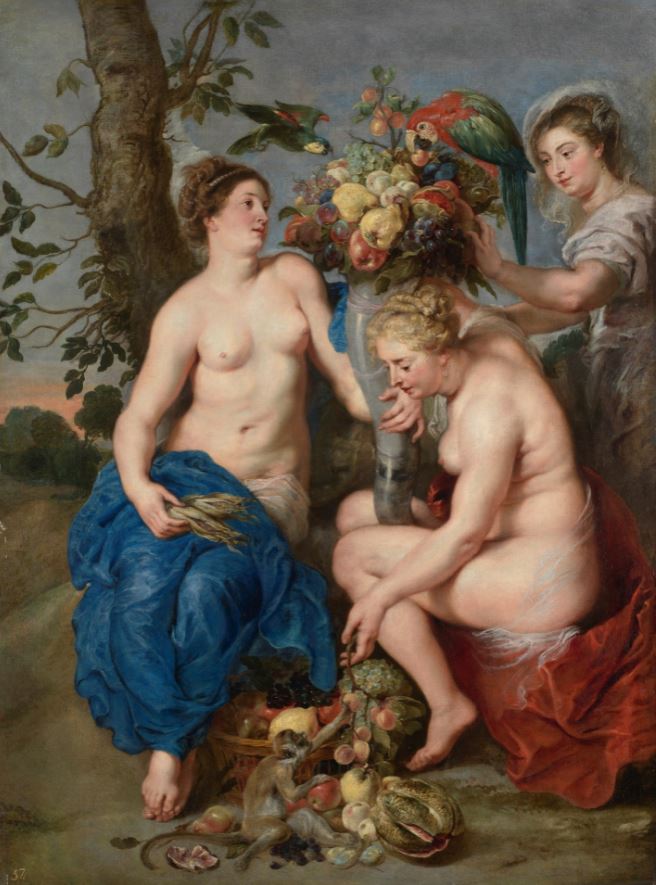
Cleopatra by Heath Robinson

As I mentioned, some of these b&w illustrations are very funny. There are quite a few comic illustrations of Falstaff and the other characters from Henry IV and the Merry Wives. But it was the uncanny images from Caesar and Macbeth which I kept coming back to. In only 15 years his style had travelled a long, way from the brilliantly naturalistic drawing which started the exhibition, “Sir, my name is Mary.” Although he remained, at the exact same time as doing this commission, a brilliant comic illustrator, some of these Shakespeare images seemed to me to break through to a completely new understanding of the stark, brutal forces at large in the world, unlike anything else in his oeuvre.

Illustrations for Henry VI and Richard III by William Heath Robinson, commissioned by Jonathan Cape in 1921. Unpublished. On long-term loan from Penguin Random House archive.


Related links

More Heath Robinson Museum reviews