Turner and Constable at Tate Britain

Joseph and John

Joseph Turner was born in 1775, John Constable in 1776. In other words, it’s just about 250 years since their joint births. Tate owns big holdings of paintings, watercolours, sketches and related paraphernalia (paintboxes, journals, letters, sketchbooks) by both of them, so they’ve used the anniversaries to bring lots of this up out of the archives – plus substantial loans from other collections – in order to create a blockbuster exhibition placing two of England’s most popular painters side by side. The aim is to compare Turner and Constable’s differing origins, styles, subject matters and careers, and the way that, even during their lifetimes, they were pitted against each other as rivals, with rival visions of art.

Turner versus Constable: ‘The Golden Bough’ (left) by Turner, faces off against ‘Dedham Lock’ (right) by Constable, in ‘Turner and Constable’ at Tate Britain (photo by the author)

Obviously, it’s full of lot and lots of good stuff but I confess I didn’t really enjoy it. I finished it with a great sense of relief and couldn’t wait to escape.

Massive exhibition

I expected the exhibition to be packed and it was, but I hadn’t anticipated it being quite so big, thorough and exhaustive. It contains some 190 oil paintings, watercolours and sketches, as well as seven or eight display cases containing everything from their paintboxes and brushes to Turner’s dismantled fishing rod (!).

Four outdoor sketches by Turner along with his dismantlable fishing rod, in ‘Turner and Constable’ at Tate Britain (photo by the author)

Most exhibitions are in 7 or 8 rooms but this one stretches to 12, concluding with a set of videos by contemporary artists (Bridget Riley, George Shaw, Emma Stibbon and Frank Bowling) describing aspects of Joseph or John which inspire their own practice.

The wall labels are admirably thorough in introducing each of the 11 or so major themes which each room addresses, plus detailed captions for many of the paintings, watercolours, sketches and objects – but there are just so many that by the end I was full, I couldn’t read anything more, and I was relieved to give up the effort.

Also, heretical though it is to admit it, I don’t really like Turner, I never have; and I like Constable in small doses but here, faced with 80 or more works, the brilliantly glorious works are diluted by a lot of much more humdrum stuff. Exposed at such length, over so many works, the weaknesses of both artists become more and more glaring and – for me – began to drown out their strengths.

For example whereas Turner arguably came into his own in his later years, from 1830 onwards, the final room shows four of Constable’s last works from 1835 to 37, and I thought they were really dire: they look like his Hay Wain-style landscapes but put through a blender or painted by someone with serious eyesight problems (details below).

In the end I found myself equally put off Turner’s huge shimmering light experiments and Constable’s sometimes lovely but often very scrappy Suffolk landscapes, and found relief in the much smaller, lighter watercolours and sketches by both artists, although Turner was generally better at these (see below).

To put it another way, I came away from the National Gallery’s small, thoughtful, very focused exhibition about the Hay Wain liking and appreciating Constable more. Whereas I left this exhibition with a measurably lower opinion of him, and hoping I don’t see another Constable for a long time.

Main points

Constable focused largely on the English countryside, especially the Stour Valley in Suffolk, developing a distinctive practice of outdoor oil sketching to capture natural light, weather, and atmosphere with unprecedented immediacy. His textured brushwork, bright colours, and close study of skies challenged academic conventions and gradually earned critical recognition.

Turner, by contrast, was a prolific traveller whose work ranged across Britain and Europe. He explored dramatic subjects from the sublime forces of nature to modern technology, working across oil, watercolour, and print. His radical handling of colour and light, particularly in watercolour, pushed the medium to new artistic heights.

So Constable was, on the whole, a homebody, whereas there’s an entire room devoted to Turner’s extensive trip to Italy, displaying his sketchbooks, explaining the detailed preparations he made, showing preparatory sketches and some of the huge oils he did of dramatic Alpine scenery. For the rest of his life was liable at the drop of a hat to produce another enormous work set in Venice or Rome or the Alps.

Still, the early works produced soon after that trip can be breath-taking.

The Passage of Mount St Gothard from the centre of Teufels Broch (Devil’s Bridge) by JMW Turner (1804) © Abbot Hall, Kendal (Lakeland Arts Trust)

Room summary

Room 1. Starting out (8 prints, 10 paintings)

Eight paintings including Turner’s self portrait and two portraits of Constable.

Turner was born in London, the son of a Covent Garden barber, Constable to a prosperous family in the Suffolk village of East Bergholt.

As a teenager, Turner earned money alongside his art studies at the Royal Academy. He worked as an architectural draughtsman’s assistant and a watercolour copyist, which introduced him to a wide range of art. He was a commercially minded, fast-rising young star who first exhibited at the Royal Academy in 1790 aged just 15.

By contrast, Constable was largely self-taught and undertook extensive sketching tours in order to perfect is artistic technique, not exhibiting at the Royal Academy until 12 years after turner, in 1802.

Both trained at the Royal Academy. Training at the Royal Academy centred on drawing the human figure. It aimed to produce painters of grand historical and mythological subjects. Landscape was far down its artistic hierarchy – so the main way both artists were innovators was in proclaiming landscape painting as a high genre in its own right.

It’s odd that the Academy focused on figure drawing when both Turner and Constable are dreadful, awful painters of human beings. It’s one of the things I dislike about them both. Any Turner painting with people in is going to be embarrassingly bad (see below). Constable’s figures are more superficially attractive until you go up close and see how gawkily the bodies are composed and how terrible the faces are, if he’s bothered with them at all. Constable’s clouds, ten out of ten. His faces, nil.

Room 2. Constable sketching outdoors (14 sketches, display case, chair)

Fourteen sketches and a display case showing his paintbox and palette. My wife and I both thought the most interesting thing in this room was Constable’s sketching chair.

Constable’s outdoor sketching chair in ‘Turner and Constable’ at Tate Britain (photo by the author)

Room 3. Turner in the Alps and Italy (4 big paintings, 7 sketches, 5 sketchbooks, display case)

A pause in the long war with France in 1802 allowed the 27-year-old Turner to travel to Paris, then on south to the Alps, Switzerland and the Val d’Aosta. Thirteen years later, when the wars finally ended in 1815, he went again. His extensive preparations for the six-month trip included reading guidebooks and making sketches of other artists’ views of key sites to visit. Turner was hungry for Italy’s scenic riches. He filled 23 sketchbooks five of which are on display here and came home with imagery that would underpin decades of finished paintings.

One of Turner’s extravagant fantasias from Italian history – Caligula’s Palace and Bridge by J.M.W. Turner (1831) Tate

Remember I was saying how poor Turner’s human figures are? From a distance they pass, they appear to fit in with the blurry mode of the paintings. But go up close and they’re embarrassing. Here’s a close-up of the most prominent two figures in this work.

Detail of Caligula’s Palace and Bridge by J.M.W. Turner (1831) Tate

The basket and hula hoop and kettle and the blue cloak at bottom right, yes. The two goats at top right, yes. But the two human figures on the left? The bloke’s legs, yes, but their faces? They look like Punch and Judy.

Room 4. Turner’s watercolours (6 watercolours, 10 sketchbooks)

Going back and forth through the rooms, slowly overcoming the sheer scale of some of the enormous paintings here, it takes the mind a little while to adjust to the scale of the smaller, more delicate sketches and watercolours. Eventually I came to think these were the works I liked best.

Turner at his most attractive: four (relatively) small watercolours, in ‘Turner and Constable’ at Tate Britain (photo by the author)

A contemporary critic wrote: ‘Another mused: ‘blended and sometimes delicately contrasted as [Turner’s] colours are – the effects are exquisitely tender, but not without sufficient force, from a certain magic arrangement, a graphic secret of his own’ and in many of them, you can see what he meant.

Room 5. Turner’s studio (9 paintings, 10 cloud studies)

Turner’s studio was a chaotic shambles. His landlady owned seven Manx cats and these are allowed to roam over wet paintings; we know this because their paw prints have been found. At his death it was discovered that he’d used his own paintings to block up gaps in the roof and had cut a catflap into one of them.

Room 6. Constable fields and sky (9 paintings, 10 cloud studies)

Most contemporary artists made extensive sketches on location then took them back to their studios to work up into finished compositions under controlled indoor conditions. In 1814 Constable began completing entire paintings on location, out of doors, and there are plenty of examples in the Hay Wain / Dedham Lock manner, as well as numerous preparatory sketches.

Taking this a step further, in 1819, Constable rented a house in Hampstead, then a village outside London where he started making rapid oil sketches of clouds, a practice he called ‘skying’. These works reflect Constable’s keen interest in weather.

Some of Constable’s cloud studies in ‘Turner and Constable’ at Tate Britain (photo by the author)

His preoccupation with the sky is evident in his dramatic 1823 depiction of Salisbury Cathedral, which became another recurring subject and is given the full Mona Lisa treatment in this show, complete with visitor bench to sit and gaze in awe.

Constable’s painting of Salisbury cathedral given the full treatment in ‘Turner and Constable’ at Tate Britain (photo by the author)

Room 7. Big is beautiful (5 Turner, 4 Constable huge paintings)

Both artists struggled to get noticed and one easy way to do this was to make their paintings big, really big, ginormous. Turner was already doing his huge classical and mythological paintings. In 1819 Constable joined him by exhibiting the first of his huge canvases (what he called his ‘6-footers’) ‘The White Horse’, and its appearance for the first time triggered comparisons with Turner. They were both now competing in sheer size – but what a complete difference in subject matter and style.

The White Horse by John Constable (1819) © The Frick Collection, New York (photo by Joseph Coscia Jr)

This feels like a great painting. If there had been just 4 or 5 works like this you’d have gone away inspired. It’s the fact that it’s accompanied by about 80 others, sketches, scraps and some decidedly bad works, which dilutes its effect.

Room 8. Fire and water (4 massive paintings: 3 JC, 1 T)

The rivalry was real. By the late 1820s Turner was the well-established master in all forms of landscape (oil, watercolour, prints). Constable only achieved official recognition in 1829 when he was finally made a member of the Royal Academy. To quote the curators:

Two years later, they came to blows. Artists hated being hung next to Turner in the Royal Academy’s annual exhibition because his paintings ‘caught your eye the instant you entered the room’. In 1831, Constable took up the challenge. As a member of the committee responsible for placement of works in the exhibition, he hung his Salisbury Cathedral from the Meadows next to Turner’s Caligula’s Palace and Bridge. The arrangement gave Constable’s own painting prime position. At a dinner party, Turner apparently came ‘down upon him like a sledge-hammer’. One onlooker recalled dramatically that Constable ‘wriggled… like a detected criminal’.

Room 9. Late Constable: ‘beyond Constable country’ (9 sketches, 3 big paintings)

With election to the Academy in 1829, Constable moved to expand his subject matter, producing works set in Brighton and London, away from his home turf in the Stour Valley. He tackled coastal storms and grand neoclassical architecture. I didn’t like his Brighton paintings but some of the sketches of the beach were appealing.

Rainstorm over the Sea by John Constable (1824-1828) © Photo Royal Academy of Art (photo by John Hammond)

I was tickled to read that Constable didn’t like Brighton and dismissed it as ‘Piccadilly by the seaside’. Plus ça change, eh?

In this room the curators are showing a clip from Mike Leigh’s 2014 movie, Mr Turner, dramatising another famous moment in their rivalry, when both painters had work hung in the 1832 Academy exhibition and Turner (played by Timothy Spall) adds a last-minute red buoy to his painting Helvoetsluys: Fishermen at Sea in order to catch the viewer’s eye and distract it from Constable’s long-laboured over piece, The Opening of Waterloo Bridge – which triggered Constable (played by the stalwart character actor James Fleet) to walk out in a huff. At least it’s all very dramatic in movieland.

Room 10. Late Turner (9 paintings, 8 sketches)

Turning 60 in 1835, Turner could have rested on his financial position and slowed down but he kept up the pace. 1835 saw him take one of his most extensive and taxing European sketching tours and he continued to travel abroad for another decade. He made topical paintings of contemporary subjects, including the fire that destroyed the Houses of Parliament.

The Burning of the Houses of Lords and Commons, 16 October 1834 by JMW Turner (1835) Cleveland Museum of Art

Favourite locations like Venice and the Swiss Alps came back into focus with repeat visits. There’s a really dreadful giant monster of a painting depicting Juliet and her nurse in a typically gauzy, highly romanticised Venice when, of course, the play is set in Verona, 120 kilometres away.

On the other hand, some of these late watercolours are truly visionary, and the curators are right to single out The Blue Rigi, Sunrise (1842) as awe inspiring.

The Blue Rigi, Sunrise by Joseph Mallord William Turner (1842) Tate

Room 11. Landscape and memory (3 Turner, 4 Constable, 4 prints)

Constable died in 1837, by now accepted as a classic. But his last years were saddened by the absence of his dead wife. The curators suggest his late paintings are clouded by melancholy but optimistically claim they reverberate with energy. Well, the four they hang in the final room are awful. They revert to the Suffolk subject matter but as if someone had thrown a bucket of mud over them. The palette has lost all its brightness and sparkle, everything is black and grey and mud. A couple of them have sets of diagonal white slashes across them as if someone had repeatedly stabbed them with a knife. They’re so horrible I made a list to show you:

My wife wondered whether he must have been suffering from some eye problem, cataracts or something, which would explain their dirgelike darkness, their fevered, cluttered, murky feeling. But that can’t be true because alongside it the curators hang a marvellously limpid and detailed drawing of fir trees on Hampstead Heath.

Fir Trees by John Constable (c. 1833) The Higgins Art Gallery & Museum, Bedford, UK/Bridgeman Images

(Incidentally,  you can see the join three-quarters of the way down the work; this is because Constable had originally drawn just the upper part of the tree but ended up devoting so much time and effort to it, that he glued on an extra strip of paper at the bottom so he could continue it down to the roots.)

Anyway, the point is that, if he could produce extremely clear, detailed and lucid drawings like this, then the dire appearance of a late painting like On the river Stour (1834) was an artistic choice.

By contrast with the murky Constable, this final room contains arguably the best Turner in the exhibition, certainly the one I liked best, Norham Castle, a work of pure luminousness, almost completely untainted by worldly subject matter.

Norham Castle, Sunrise by Joseph Mallord William Turner (c.1845) Tate

Room 12

This room is devoted to a big video screen onto which is projected an 11-minute-long film featuring interviews of contemporary artists Bridget Riley, George Shaw, Emma Stibbon and Frank Bowling, giving their opinions about T and C.

What’s really striking about this video is that it contains many tasteful close-ups of T and C’s works and these often make the paintings seem much more interesting and exciting and innovative than the complete, wider works do. It was a revelation to think of both their paintings like this, as collections of good bits which frequently impress more as inventive and wonderful details than they do as often contrived and stagey wholes.


Related links

Related reviews

Discover Constable and The Hay Wain @ the National Gallery

Six footers

In 1818 at the age of 42, the well-established English landscape painter John Constable made a conscious decision to start painting bigger works and so began the first of what became known as his ‘six footers’.

The first one, ‘The White Horse’, exhibited in 1820, was so successful that Constable was elected an Associate of the Royal Academy on the strength of it, so he knew he was on to a good thing. The ‘Hay Wain’ was the third in the series. Constable painted it under pressure to make the deadline for submissions to the Royal Academy’s 1821 exhibition and, maybe surprisingly, it was painted entirely at his home in London. But he was able to do this because of the countless sketches and previous paintings he’d made of the same location and setting.

The Hay Wain by John Constable (1821) © The National Gallery, London

Constable knew this place so well because his father, Golding Constable, owned it. Golding was a wealthy mill owner and corn merchant so John had grown up surrounded by the appurtenances of the trade and knowing exactly what went into growing, harvesting and processing wheat. The house on the left of the picture belonged to Willy Lott, a tenant farmer, but behind the painter, behind us as we look at the painting, stood Flatford Mill which belonged to Constable’s father. Both stood on the east bank of the River Stour which, at this point, forms the border between Essex and Suffolk.

Map showing location of the buildings in Constables paintings of Flatford Mill and Willy Lott’s cottage

The Hay Wain, like much of Constable’s best work, came to symbolise a certain type of innocent rural scene, eventually becoming iconic of an innocent way of life which industrialising Victorian Britain knew it was losing.

The bicentenary connection

The National Gallery was founded in 2024 so this is its bicentenary year. It’s using the occasion to re-explore favourite items in the collection. It was around Van Gogh’s much-loved painting of sunflowers that the gallery created the brilliant Van Gogh: Poets and Lovers show which you must go and see.

In a similar way, they’ve used the opportunity to take John Constable’s super-famous painting The Hay Wain (1821), and make it the centrepiece of an exhibition in its own right. The bicentenary connection comes in because 1824 was the year when The Hay Wain was displayed at the Paris Salon to great acclaim and was awarded a gold medal, which Constable received from the French King, Charles X, in person.

The medal is here, on display, and is just part of this fascinating and FREE exhibition at the National Gallery, which brings together 50 or so paintings, sketches, drawings, models, contemporary and modern cartoons, photomontages as well as the artist’s own palette (!) to place this super well-known and well-loved image in its full artistic, political, cultural, geographical, agricultural and biographical context. It’s full of beautiful, relaxing rural paintings and fascinating facts.

Political context

To begin with, the socio-political context of the 1810s is dealt with in a fairly small section. At the end of the Napoleonic Wars, after the victory at Waterloo on 18 June 1815, the British Army was rapidly demobilised, with no provision or thought for hundreds of thousands of demobbed men dumped back in their rural communities.

In the same year the Tory administration passed the first of many Corn Laws. These blocked the import of cheap corn from abroad, thus creating a monopoly for British wheat-growers i.e. the landowning aristocracy. But while it guaranteed these landowners a good price for their product it raised the price of bread and related foodstuffs very sharply for ordinary people, leading to hunger and hardship.

Since the landowning class was in the majority in the House of Commons and dominated the House of Lords, it was a very naked form of class war: a few thousand aristocratic landowners arranged the law and economy to their immense benefit and to the starvation of millions of rural workers and the increasing urban proletariat. The corn laws weren’t abolished until 1846 and only after a generation of protests, agitation, riots and criticism.

This cruel and oppressive law doesn’t have much traction in the exhibition. It is dramatised in four or so contemporary political cartoons, by the likes of James Gillray and Joseph Rowlandson. The fiercest is this one by Charles Williams and titled ‘Political Balance’ (1816).

Political balance, An unexpected inspection, or A Good Old Master Taking a Peep Into the State of Things Himself by Charles Williams (1816) © British Museum

The only contemporary artists who spoke out against exploitation, poverty and despoliation of the countryside was the great William Blake but none of his political work is included here, just a couple of tiny illustrations from the Songs of Innocence and Experience.

Interesting though all this is to those of us with a taste for history, none of this rural poverty or agitation is visible in any of the actual paintings by Constable or Gainsborough, Turner or Mulready, Stubbs or Combes which are included here. The subject is raised by the curators only to be quietly forgotten.

The Hay Wain’s radicalness

Landscape painting

At the time in Britain, landscape painting was still considered an ‘inferior’ genre compared to history painting. Among other goals, Constable was determined to raise its prestige and this was part of his motivation for creating the six footers.

‘En plein air’

The Hay Wain was painted in the artist’s London studio over five months in preparation for the Royal Academy annual exhibition which Constable had entered numerous times before. He painted it from several preliminary sketches, probably created ‘en plein air’, a revolutionary approach for the period which Constable eagerly adopted in his quest to represent ‘truth to nature’. It was considered revolutionary in other ways.

Brown

The exhibition includes works by slightly earlier painters including George Stubbs and especially Thomas Gainsborough to show what the traditional approach looks like. In this Gainsborough painting the dominant hue is brown and the play of light is suggested by lighter and darker shades of the relevant colour.

Smooth

Above all the brushwork is invisible and the surface of the painting is flat and smooth.

Cornard Wood, near Sudbury, Suffolk by Thomas Gainsborough (1748)

The Stubbs painting, like the Gainsborough, is dominated by brown, and is as smooth as a horse’s bottom, all slick and shiny surface. Go up close, peer right into the painting, and its surface is as smooth as a piece of porcelain.

Reapers by George Stubbs (1785) © Tate

By contrast 1) Constable boldly used a much brighter shade of green but 2) much more noticeable is his looser, expressive handling of the paint with noticeable brushstrokes which you can see even from a distance. When you go up close you can see countless details which completely lack the consummate finish of a Gainsborough or Stubbs, loads of places where the paint gestures at what it is depicting.

He used a range of marks, surfaces and textures to reflect the variety that he saw in nature and to add to the mood of the painting. He used a palette knife and brushes to create expressive surfaces which are surprisingly varied – scuffed and scored and smeared, lumpy or rasped across the canvas, with small ripples and waves, surfs of impasto. The closer you get, the more varied and dramatic you realise the paintwork is.

Detail of the Hay Wain by John Constable showing the washerwoman by Willy Lott’s cottage (photo by the author)

Smooth when he wants to be

What makes this really striking is that, when he wanted to be, Constable could easily be as smooth as his predecessors. The exhibition includes two paintings of the view from the first floor of his family home which, the curators tell us, he made shortly after the death of his beloved mother, Ann.

Golding Constables Kitchen Garden by John Constable (July 1815) © Ipswich Borough Council Collections: Colchester + Ipswich Museum Service

It’s a quietly beautiful picture in its own right. It has deep biographical resonance not only because of the poignant dating of it, but also because it shows, in the foreground, the garden which was his mother’s pride and joy. But, for our current purposes, the chief thing about it is that the finish is immaculately smooth. If you go right up and peer closely, and from the side, you can see how smooth and finished the paintwork is, completely unlike the ridged and rasped and sprawling brushstrokes of The Hay Wain. He could do it when he wanted to. Not doing it was a very conscious statement of artistic intent.

Constable snow

I was mighty pleased with myself for noticing and then becoming obsessed with Constable’s use of white paint to create a kind of silvery chrome effect all over the Hay Wain. The more you look, the more you see it, not just highlighting the water but iridescent along the tops of the wain itself, dusting spars of wood and brickwork, suggesting the flickering light across the landscape and its reflection off multiple surfaces.

Detail of the Hay Wain showing the silver highlighting

However, I was deflated to read in the curators’ labels that this liberal use of flecks of white paint to represent the sparkling or reflection of sunlight, was noticed and criticised at the time, some smart aleck nicknaming it ‘Constable’s snow’.

Alongside the visible brushwork, the rasps of paint on canvas, and the ridges of paint, this silvery snow was used in the general criticism that Constable’s paintings were unfinished. Constable, of course, considered the plein air approach, the loose brushstrokes and the use of silver slicks of sunlight central to his aim of creating a realistic effect of being there and seeing the landscape, of conveying the shimmering, ever-changing light and shade effects of a real English day, with its everchanging drama of clouds and light.

Clouds

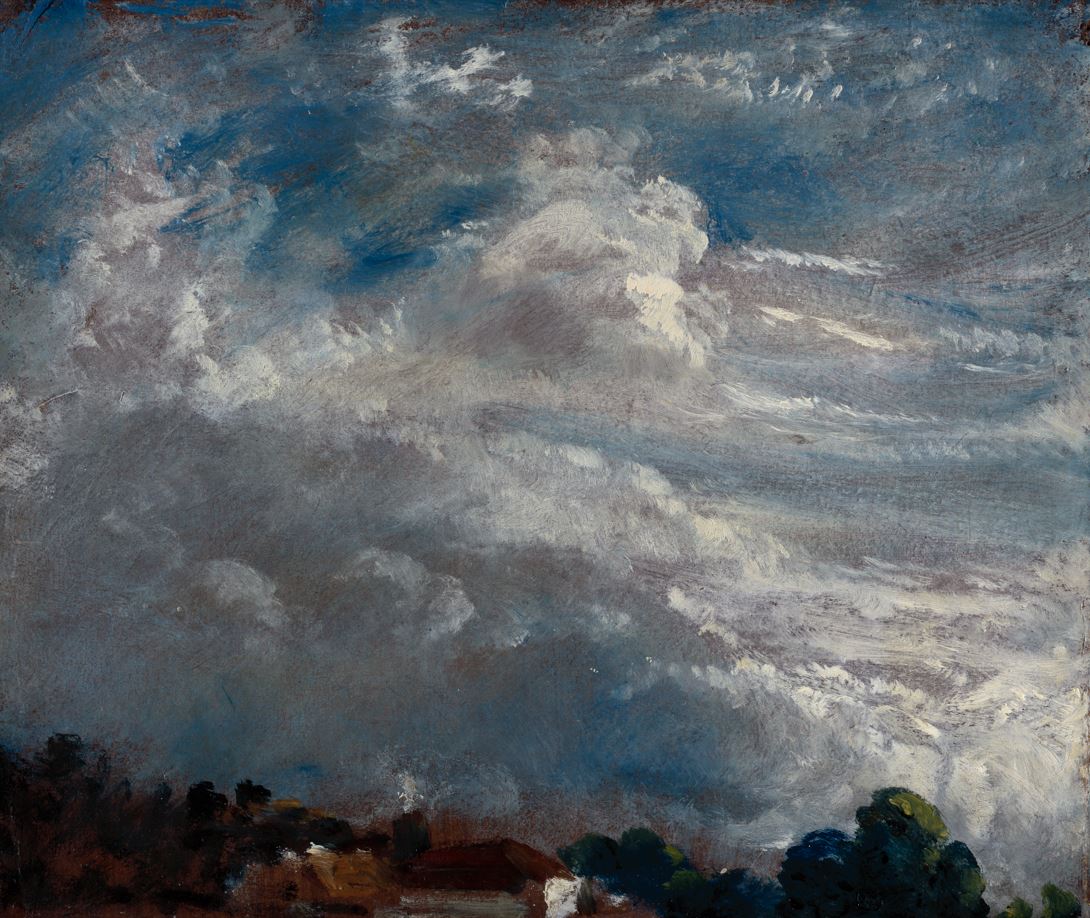
Constable was particularly interested in the study of clouds. The exhibition includes numerous paintings, sketches and drawings he made of cloudscapes. A man named Alexander Cozens wrote a book titled ‘A New Method of Assisting the Invention in Drawing Original Compositions of Landscape’ which included different types of cloud shape and the exhibition includes some of the 20 drawings he made from the book as well as oil sketches.

Cloud Study: Horizon of Trees, 27 September 1821 by John Constable © Royal Academy of Arts, London; photographer: John Hammond

What Salisbury tells us

The show includes the splendid ‘Salisbury Cathedral from the Bishop’s Ground’ (1823) and it is a deep pleasure to sit on the bench in front of it and just drink it in. What sumptuous, sensual beauty of composition, colour and light.

Salisbury Cathedral from the Bishops Ground by John Constable (1823) © V&A Images / Victoria and Albert Museum, London

Slowly several points emerge, namely around the use of light and shade and clouds. The dark cloud rising from behind the cathedral gives the composition a sense of drama (it’s interesting to learn that the Bishop of Salisbury actively didn’t like this dark cloud).

It also indicates the kind of day it is, one of those days when the sun comes in and out between clouds, and this explains the radiance of the cathedral facade: it’s one of those moments when the sun comes out from between clouds and makes whatever it shines on appear radiant. Once you notice this, you realise it also applies to the meadow in front of the cathedral, up to and including the cow, whereas the field and trees further towards the viewer are still in shadow.

With this in mind, if we go back to the Hay Wain, I suggest part of its popularity is down to its use of cloud and light as design features. On the face of it, it’s a painting of a cart in a pond but if you focus just on the play of light, and light on clouds, several things become obvious.

The Hay Wain by John Constable (1821) © The National Gallery, London

The spiral

In the West we read from top left to right. I suggest that one of the reasons the painting feels so satisfactory and pleasing is the way its design plays to this deep way of ‘reading’ visual elements. So if you start at the top left the cloud is very dark which leads your eye to the right, towards the nice light cloud, and your eye continues on round and down into the meadow which stretches off into the distance and is dappled with sunlight, before swinging down into the water and round to the cart in the pond.

So my suggestion is that we don’t just perceive it as a complex composition and pick out details at random but enjoy this sense of sweep and progression.

Comparing the sketch

A bit more evidence for this us supplied by the full-sized sketch of the Hay Wain which the exhibition also includes. Comparing the sketch and the finished painting suggest quite a few points from which I’d emphasise two.

Full-scale study for The Hay Wain by John Constable (about 1821) © V&A Images / Victoria and Albert Museum, London

1. Brown and green

Remember the idea that older landscape artists used a tastefully subdued palette of brown when painting outdoors? Well, the sketch clearly shows that this is how Constable began, using a far more sombre, brown and rather lifeless palette. Comparing the sketch and the finished painting shows how powerful adding in the vibrant shades of green transforms the finished product. They bring it to life; they make it zing with life, foliage, fertility.

The Hay Wain by John Constable (1821) © The National Gallery, London

2. Decluttering the composition

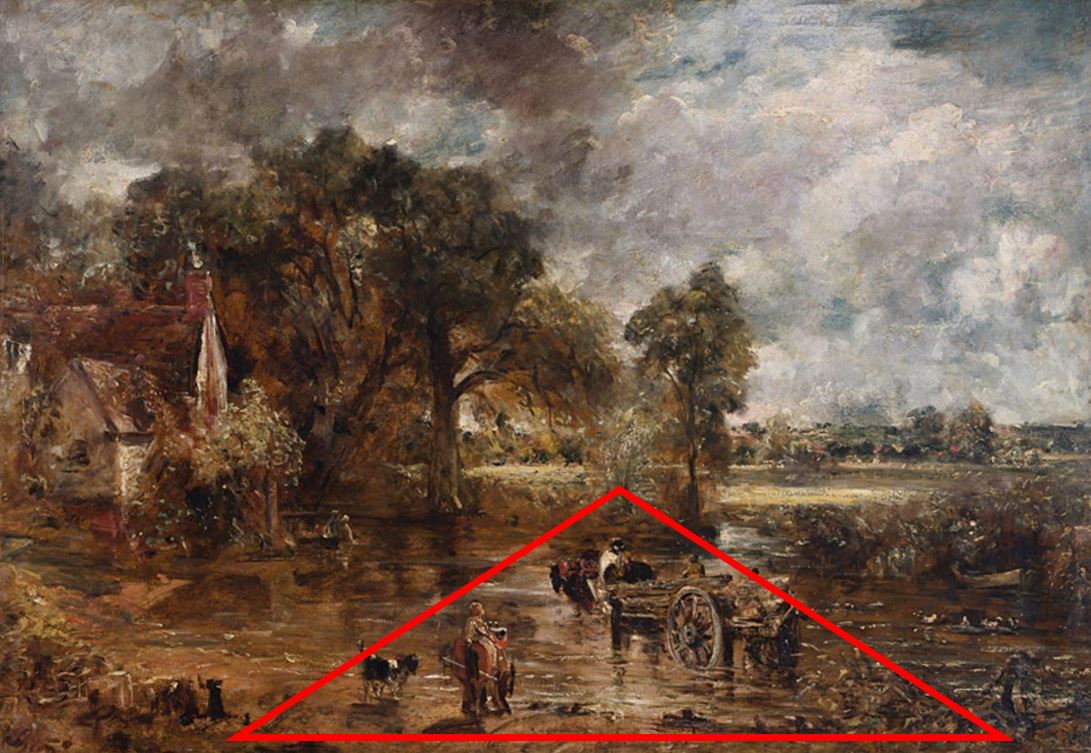
But back to the issue of composition, look at the one big, obvious difference between the sketch and the finished work. The figure of a horse and rider between the dog and the cart has been deleted. Why? Because including it crystallises the dog and cart from being light and almost random elements into becoming a strong central ensemble which dominates the picture. With it in your eye tends to go straight to it and you get distracted into peering closer to make out the precise nature of the figure on a horse (in fact, you have to peer quite closely to realise it’s a horse at all). And all this supersedes or obliterates the sweeping curve, the spiral I’ve described above.

Full-scale study for The Hay Wain by John Constable (about 1821) with added triangle © V&A Images / Victoria and Albert Museum, London

Keep it in and the eye goes straight to these central figures and tries to identify them / make them out, making you tend to overlook the wider composition. Remove it and your eye is freed to step back, to take in the larger compositional sweep, from dark cloud to light, round and down to the meadow, and only slowly and leisurely coming round to the cart. The picture becomes lighter and airier. It breathes.

History of an icon

It’s interesting to learn that John Ruskin, the godfather of mid-Victorian art criticism, really disliked Constable and helped depress his reputation for a generation. It was only later in the nineteenth century that Constable’s reputation bounced back and has remained high ever since.

The curators claim a major aim of the exhibition was to chronicle the rise of Constable from the kind of criticism he received in his lifetime and the active dislike of cultural arbiters in the mid-nineteenth century his current unassailable position as one of Britain’s classic painters. This is a fine ambition so it’s regrettable that the exhibition doesn’t really achieve it.

There are a few wall labels explaining that this or that painting was given to the National Gallery by supporters or, in one case, by his daughter, in this or that year, as if that tells us very much and that’s about it.

There’s a glaring absence of any explanation of what changed in aesthetic theory, in the practice of art, in social attitudes to the landscape, in artistic taste through the middle and later Victorian era to explain Constable’s rise and canonisation. I’d really like to have read this but didn’t see it anywhere.

So in the opening section there’s a 1920s black-and-white photo of Willy Lott’s cottage and we are told that it was extensively restored in the 1920s after a revival of interest in Constable’s paintings – but not why there was a revival of interest in Constable’s paintings. What was sufficiently different in the 1920s from the 1880s or 1860s to spark the investment? What changed and why?

Spoofs and parodies

To end on a lighter note, right at the start of the show, while they’re telling us how The Hay Wain has become an iconic image of the English countryside, the curators include half a dozen examples of how it’s been parodied and pastiched, used in cartoons and adverts for railways (‘Explore Constable country!’).

A striking one is this use of The Hay Wain in a 1929 cartoon bewailing the despoliation of the English countryside by cars and advertising hoardings. People tend to think this is a modern problem but here’s proof that it goes back at least a hundred years!

‘Had Constable lived today’ cartoon in the Daily Express, 2 March 1929, created by the Campaign for the Protection of Rural England © CPRE

There’s the satirical anti-war photomontage by radical anti-war artist Peter Kennard.

More up to date is this photomontage by Cold War Steve, where he’s cut and pasted leading political figures from 2019 into the scene. I like the truck full of dead washing machines but the killer detail is the image of Wayne Rooney riding a jet ski just to its left, so the joke is that this version of the picture should be titled ‘Hey, Wayne!’

The Hay Wain by Cold War Steve (2019) © Cold War Steve


Related links

Related reviews