Catherine Opie: To Be Seen @ the National Portrait Gallery

Self-portrait/Nursing, 2004 © Catherine Opie, courtesy Regen Projects, Los Angeles; Lehmann Maupin, New York, Hong Kong, London, and Seoul; Thomas Dane Gallery

This is a self portrait by Catherine Opie. Born in 1961, Opie is a lesbian and one of America’s leading fine art photographers. For forty years she’s been creating photographic projects concerned with community and identity in the USA. Now the National Portrait Gallery is staging the first major museum exhibition of her work in the UK.

Half way round the show I came across a phrase which offers a handy entry to Opie’s oeuvre: a wall label refers to ‘the politics of visibility’. This was a new phrase for me, so I looked it up:

The politics of visibility is the strategic management, contestation, and control of who and what is seen, heard, or recognized within public, media, and digital spaces. It acts as a form of power that shapes social identities, recognizes marginalized groups, or enforces surveillance and exclusion.

The idea is that the community Opie belongs to – the queer or gay or lesbian community – has historically been unrepresented in Western art, photography, or just mainstream media, and so she has devoted her career to redressing this imbalance, to making her people seen, giving visibility to her community.

According to one online biography, Opie at an early age discovered the work of photographer Lewis Hine, who documented the plight of child labourers at the turn of the 20th century. Inspired by Hine’s images, she requested a camera for her ninth birthday and was given a Kodak Instamatic by her parents. She immediately began photographing her family and neighbourhood and, in a sense, has never stopped.

And hence the title of the exhibition: To Be Seen. As to this self portrait, Opie depicts herself breast-feeding her son Oliver. Her real, scarred and tattooed body proudly reclaims motherhood from depictions of pious devotion, represented through the Madonna and Child. It’s also, let’s face it, an assertion of pride in being big, heavy, as the Yanks say. I think it works in both ways, asserts two kinds of pride. It is, I think, a beautiful image of love and care and tenderness. In many ways it’s the best image in the exhibition, candid, open, unembarrassed and loving.

Projects

Being and Having (1991)

Her first major work, ‘Being and Having’ consists of 13 closely cropped portraits of Opie (as her alter ego, ‘Bo’) and her ‘leather dyke community enacting their moustachioed masculine alter-egos’. They were, apparently, inspired by court painter Hans Holbein. It was her first major artwork setting out to challenge a binary approach to gender identity. Opie says: ‘Being and Having stares right back at you – we’re women occupying a masculine space.’

Self portrait as Bo

Bo, 1994 © Catherine Opie, courtesy Regen Projects, Los Angeles; Lehmann Maupin, New York, Hong Kong, London, and Seoul; Thomas Dane Gallery

A ‘leather dyke community enacting their moustachioed masculine alter-egos’

Installation view of the exhibition Catherine Opie: To Be Seen at the National Portrait Gallery. Photo copyright © David Parry

Portraits (1993–97)

Portraits depicts her friends in the lesbian and gay community in Los Angeles, mixing traditional portrait photography with less traditional subjects.

Divinity Fudge, 1997 © Catherine Opie, courtesy Regen Projects, Los Angeles; Lehmann Maupin, New York, Hong Kong, London, and Seoul; Thomas Dane Gallery

Domestic (1995–98)

In the mid-1990s Opie embarked on an American road trip, traveling 9,000 miles over three and a half months to photograph lesbian couples and families in their homes. ‘Domestic’ was a response to the seminal exhibition ‘Pleasures and Terrors of Domestic Comfort’ at MoMA in 1991, curated by Peter Galassi. In ‘Domestic’ Opie wanted to represent her community, which was absent from the MoMA show. Using an 8 × 10 large format camera, ‘Domestic’ was Opie’s response to the absence of Queer lives in visual representations of home life.

Flipper, Tanya, Chloe & Harriet, San Francisco, California, 1995 ©Catherine Opie, courtesy Regen Projects, Los Angeles; Lehmann Maupin, New York, Hong Kong, London, and Seoul

Surfers (2003)

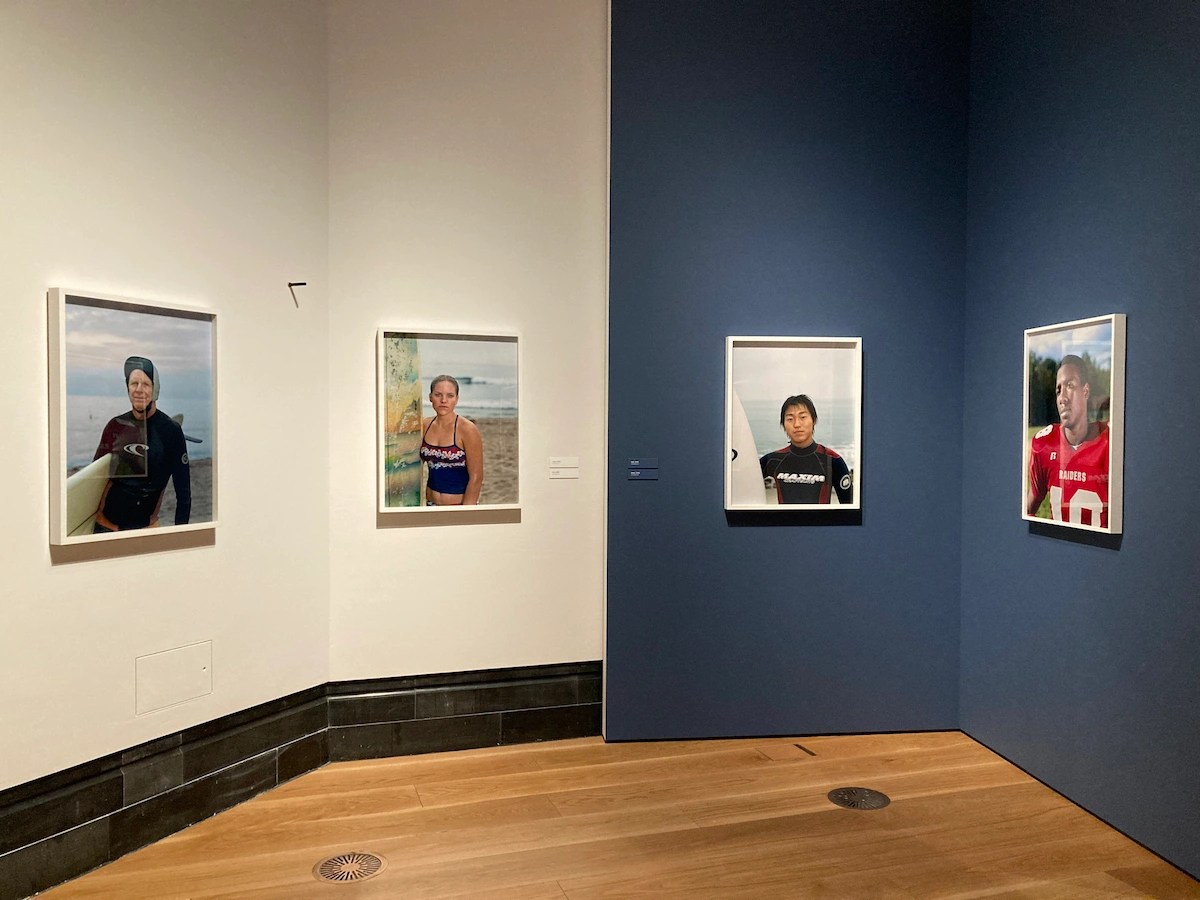
‘Surfers’ depicts the California surfing subculture. Rather than showing them riding waves, Opie portrays her surfers emerging from the sea looking unglamorously wet and cold and dazed – surprisingly British, in fact.

Installation view of Catherine Opie: To Be Seen @ the National Portrait Gallery, showing some of the ‘Surfing’ portraits’ (photo by the author)

In and Around home (2004)

In the early 2000s, Opie explored her Los Angeles neighbourhood and the domestic setting of her home. ‘Oliver in a Tutu’ from the series ‘In and Around Home’ depicts her son in a pink tutu in the kitchen doing laundry. This domestic scene is aligned with Opie’s politics of visibility against the backdrop of the continued homophobia within American culture at the time during the Bush era.

Oliver in a Tutu, 2004 © Catherine Opie, courtesy Regen Projects, Los Angeles; Lehmann Maupin, New York, Hong Kong, London, and Seoul; Thomas Dane Gallery

Doesn’t he look like a sweetheart! What a lovely image of everyday domestic happiness.

Children (2004)

For ‘Children’ Opie returned to the studio and to her signature highly focused portraits, this time of children set against bright solid colour backdrops.

Installation view of Catherine Opie: To Be Seen @ the National Portrait Gallery, showing some of the ‘Children portraits’ (photo by the author)

High School Football (2007-09)

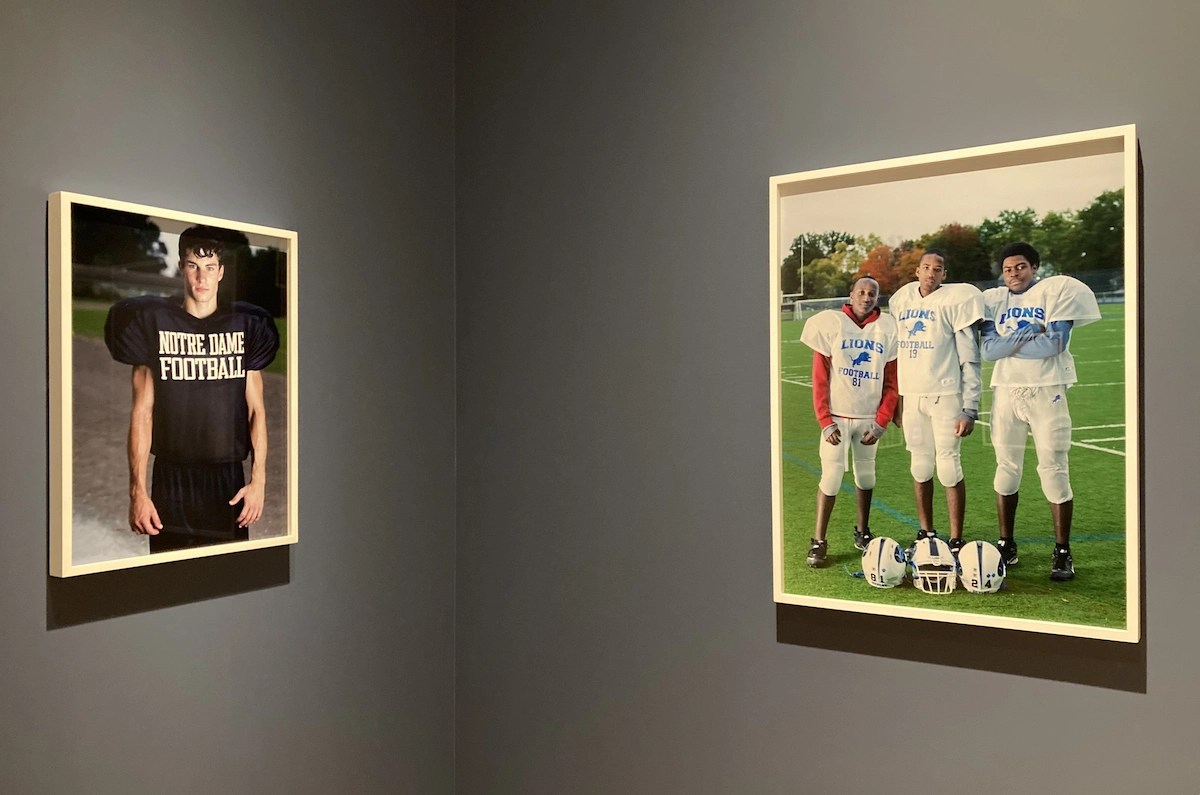
From 2007 to 2009 Opie’s continued her exploration of the American landscape through the specificity of identity as it is played out on high school football fields. Opie made portraits of high school football players across several US states, vulnerable portraits of the young men counter stereotypes of athletic masculinity at a time when the US was engaged in a war with Iraq and Afghanistan.

Installation view of Catherine Opie: To Be Seen @ the National Portrait Gallery, showing some of the ‘American football’ portraits (photo by the author)

Do these images subvert, interrogate or deconstruct masculinity? Ask the marines steaming towards the Gulf of Hormuz.

Girlfriends (2010)

A series of black-and-white portraits (1989-1999) which were first exhibited in 2010), the series continues Opie’s longstanding examination of the history of photography and her community in a different format.

Studio Portraits (2012–2018)

In the 2010s Opie used theatrical lighting against a black velvet backdrop to illuminate masterly and striking portraits. Allegorical elements allude to the political and spiritual concerns of art. They evoke Renaissance and Baroque painting, presenting her subjects in allegorical poses in front of black backgrounds, which remove the individuals from any sense of time or place.

Installation view of Catherine Opie: To Be Seen @ the National Portrait Gallery, showing some of the Baroque Studio Portraits (2012–2018) (photo by the author)

These portraits are characterized by highly staged, theatrical lighting against a black background, intended to create a painterly, intimate, and often allegorical quality. I haven’t mentioned that the exhibition space has been unusually designed into box-shaped rooms and corridors with, as here, the wall colour chosen to offset the images.

Walls, Windows and Blood (2023)

Opie’s photograph of Pope Francis, diminutive at his Vatican window amid the ‘constructed architecture of power’, is drawn from a body of work entitled ‘Walls, Windows and Blood’ (2023), made during a pandemic-era residency at the American Academy in Rome. The title of this portrait of the former head of the Catholic Church is a reference to the delayed papal acknowledgement of the deaths of Canada’s First Nation’s children under the church’s administration. It’s part of a small selection of images from larger locations which includes shots from President Obama’s inauguration, a Boy Scout Jubilee, and others.

Installation view of Catherine Opie: To Be Seen @ the National Portrait Gallery, showing some of the photos she took at the inauguration of President Obama on 20 January 2009 (photo by the author)

Comments

When you read the press material, the online promotion and the wall labels, you are given the impression that Opie is a radical political figure. But when you stroll from photo to photo you come to realise nothing could be further from the truth. Everything is very quiet and homely. Photos of friends, of her house and child, of other children, images of young surfers and football players, documentary images of the Obama inauguration or a handful of other mass events (a Boy Scouts Jubilee, some festival).

The more it went on, the blander it felt. The set of lesbians with moustaches is funny in a 1990s kind of way. The half dozen local children are sweet. The surfers look very wet. The footballers look fit. The friends posing against black backgrounds look very stagey.

But few if any of the images really stood out for me. Compare and contrast the vividly seedy colour photographs of the recently deceased Martin Parr to see what unnerving commentary colour photography is capable of. If you strip away the excited queer rhetoric, most of the Opie images seemed to me, well, OK, proficient enough, quite nice, meh.

In the end I thought the opening image of her breastfeeding her son was the one really standout image, and the one which had the most ‘political’, emotional and visual impact.


Related links

Related reviews

Edwin Austin Abbey: By the Dawn’s Early Light @ the National Gallery

At any one time the National Gallery in London has a number of exhibitions on, some of them big blockbusters with hefty admission fees. but they also have smaller, more niche displays of individual paintings or artists, which are FREE.

Currently, in Room 1 (up the staircase of the original grand entrance, next to the shop) they’ve got just such a display, of a set of related works, the mural and wall decorations created for the Pennsylvania State Capitol building by the now little-known American artist Edwin Austin Abbey.

Compositional study for ‘The Spirit of Light’ lunette in the rotunda of the Pennsylvania State Capitol at Harrisburg (1902 to 1908) by Edwin Austin Abbey. Yale University Art Gallery, Edwin Austin Abbey Memorial Collection

Edwin Austin Abbey (1852 to 1911)

Edwin Austin Abbey was born in Philadelphia, Pennsylvania in 1852. He was of the same generation as John Singer Sargent (1856 to 1925) and in fact Sargent made an attractive portrait of Abbey in chalk and charcoal, which is included in this little show.

Chalk and charcoal portrait of Edwin Austen Abbey by John Singer Sargent at the National Gallery (Yale University Art Gallery, New Haven, Connecticut, Edwin Austin Abbey Memorial Collection)

Murals

The reason Abbey is not as well known as Sargent is that he worked in completely different and less accessible fields. He started his career as a pen-and-ink illustrator of Shakespeare’s plays before turning to easel and in particular mural painting. His first mural commission, begun in 1890, was a cycle for the Boston Public Library on the medieval legend of Galahad’s quest for the Holy Grail.

Meanwhile, in his home state of Pennsylvania, in February 1897 the State Capitol building in Harrisburg was destroyed by a major fire. State officials set about commissioning a modern architect to build a new building on a grand, imposing scale. As the building works proceeded they also decided the building needed grand murals to decorate the interior.

Abbey, as a local boy and with an established track record of doing this kind of thing (in Boston) was a shoo-in and in 1902 he was appointed to paint its vast programme of allegorical and historical murals. And a few aspects of this grand plan are the subject of this exhibition.

Specifically, what we have here in this display is copies of 1) The Apotheosis of Pennsylvania, which was created for the front of the chamber, 2) preparatory studies for a number of lunettes, and 3) a massive circular image, The Hours, which went on its ceiling. I’ll deal with them in this order.

1. The Apotheosis of Pennsylvania

The largest mural Abbey created for the Capitol stands behind the Speaker’s rostrum. It is 35 feet tall and depicts 28 notable Pennsylvanians arranged around allegorical figures representing the state’s history, ideals, and achievements.

Compositional study for ‘The Apotheosis of Pennsylvania’ mural in the House of Representatives Chamber of the Pennsylvania State Capitol at Harrisburg (1902–1911) by Edwin Austin Abbey. Yale University Art Gallery, Edwin Austin Abbey Memorial Collection

As these are murals i.e. fixed in place, the originals are not on display here. Instead the exhibition features a compositional study, in effect a preparatory draft, of the finished work. The curators provide not only the study but a handy guide to key figures, see below.

Guide to key figures in Compositional study for ‘The Apotheosis of Pennsylvania’ mural in the Pennsylvania State Capitol by Edwin Austin Abbey.

They are:

  1. Genius of the State of Pennsylvania
  2. Sir Walter Raleigh (1552-1618) English explorer, writer and statesman
  3. Daniel Boone (1734-1820) American frontiersman
  4. William Penn (1644-1718) Founder of the Province of Pennsylvania
  5. Benjamin Franklin (1706-1790) A Founding Father of the United States
  6. Robert Morris (1734-1806) A Founding Father of the United States

Not only this, but the show includes two full-length preparatory sketches in pastel Abbey did for his figures, namely of Raleigh and Boone. These are impressively realistic in that lovely, almost tangible late-nineteenth century way. Abbey was obviously a phenomenal draftsman.

My wife, more interested in fabrics than history, was impressed by the attention he paid to the characters’ costumes. In fact the wall label accompanying them contains the rather astounding information that, among his other work, Abbey worked as a costume designer for stage plays in London theatres.

Study for the figure of Sir Walter Raleigh in ‘The Apotheosis of Pennsylvania’ mural in the House of Representatives Chamber of the Pennsylvania State Capitol at Harrisburg by Edwin Austin Abbey (about 1907)

2. Studies for lunettes

Speaking of impressive figures studies, the show includes several more for images which were painted into the lunettes of the dome. What is a lunette. It is ‘a crescent or half-moon shaped architectural feature, often a window or decorative panel in a vaulted ceiling or above a door’.

There are lovely, sumptuous, incredibly realistic studies of 1) an extremely muscular topless man (for the figure of Vulcan), 2) of half a dozen white-dressed female figures dancing, for a lunette titled ‘The Spirit of Light’, and 3) a powerful sketch of male steel workers with hammers raised to strike the red hot steel, for the ‘The Spirit of Vulcan, Genius of the Workers in Iron and Steel’ lunette.

Study for ‘The Spirit of Vulcan, Genius of the Workers’ in in the House of Representatives Chamber of the Pennsylvania State Capitol at Harrisburg by Edwin Austin Abbey (about 1907)

The curators tell us that Abbey travelled to Tyneside in 1905 in preparation for his Harrisburg commission. The figures demonstrate the orchestrated effort required to shape metal with hammers at an anvil with perfectly timed, successive blows. Why steel? Because steel production was central to the wealth of Pennsylvania in the early 20th century. Why Tyneside? Because Abbey spent a lot of time in England in the 1890s and 1900s.

3. The Hours

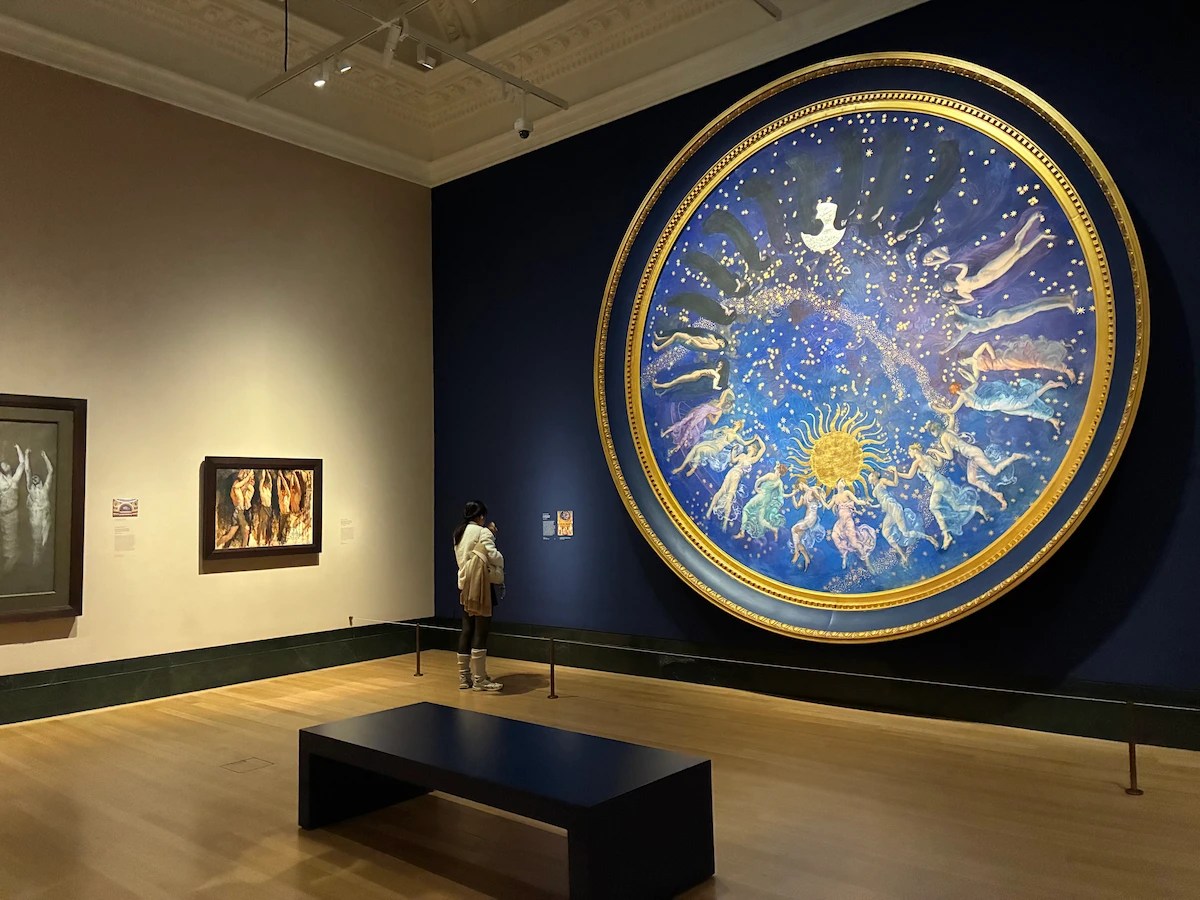
Lastly, to the massive object which dominates the room, a half-scale study or ‘maquette’ for the ceiling mural, ‘The Hours’, which is a striking 12 feet in diameter.

Installation view of ‘Edwin Austin Abbey: By the Dawn’s Early Light’ at the National Gallery, London, showing a preparatory study for the enormous mural, ‘The Hours’ (right) and preparatory sketches for lunettes (left) (photo by the author)

It’s an artistic depiction of the sky imagined over the course of 24 hours, hence the blue background, and images of the moon (at the top) and sun (at the bottom). Around the central axis dance 24 female figures clad in late-Victorian arty dresses, arranged so that they appear to be dancing.

At the top, at dead of night, the figures are blacked out. As they represent the dawning day they become partly visible, until (at the bottom) they are in the bright and highly coloured dress of full day before (as they dance up the left-hand side) they grow paler and increasingly eclipsed by the darkness to which they will return.

Half-scale study for ‘The Hours’ in the Pennsylvania State Capitol by Edwin Austin Abbey (1909 to 1911) (photo by the author)

I’m going to note two things about it:

1. Eurhythmics

One is the beauty of the individual figures themselves. Their faces are only sketchily finished so your attention is on the rhythm of their dancing figures, the variety of their poses and the flow of their light dresses around their bodies. If the anatomy doesn’t completely satisfy the pedantic observer, the effect of rhythm and progression is very effective.

Detail of the half-scale study for ‘The Hours’ in the Pennsylvania State Capitol by Edwin Austin Abbey (1909 to 1911) (photo by the author)

The curators tell us that the loose style of the 24 female figures echoes the innovations of dancers like Isadora Duncan in Abbey’s own time. Their movement is ‘eurythmic’ (flowing and harmonious), a new idea in the early 20th century.

2. Zodiac signs

Second thing is the Zodiac. Oddly this isn’t mentioned in any of the wall labels, and is only apparent when you go right up close to the image and really study it, but dimly sketched behind the dancing figures are the 12 signs of the Zodiac, Aries, Taurus, Gemini, Cancer, Leo, Virgo, Libra, Scorpio, Sagittarius and so on – to be precise, the animals (or human) figures which symbolise the signs. Even once you’ve realised they’re there, they’re quite hard to make out and add a pleasing ‘Where’s Wally’ dimension to your visit. Wife and I spent five minutes trying to identify them all. See if you can spot the image of the ram signifying Aries in this close-up? Pretty easy. Many of the others, a lot less so…

The finished result

The exhibition includes a photo of the murals in situ in the Capitol building, which gives you an adequate enough impression of their context.

The Hours and The Apotheosis of Pennsylvania in situ in the House of Representatives Chamber at the Pennsylvania State Capitol, Harrisburg © Robert Benson Photography

Isn’t it grand? All that gilt ornamentation! But to be honest, in this day and age, I was a bit disappointed that they didn’t have a video of them. Surely it wouldn’t be too much to have made a video panning round the room and examining the ceiling, end wall and lunettes in more detail and in digital quality.

Conclusion

Very enjoyable. Abbey’s draughtsmanship is inspiringly beautiful. Arguably ‘The Hours’ roundel, enormous though it is, is less effective, less memorable, than the individual studies. But this is a very civilised way to spend an hour or so, and it’s FREE.


Related links

Related reviews

The Twenties by Alan Jenkins (1974)

Here was a new generation, shouting the old cries, learning the old creeds, through a reverie of long days and nights; destined finally to go out into that dirty gray turmoil to follow love and pride; a new generation dedicated more than the last to the fear of poverty and the worship of success; grown up to find all Gods dead, all wars fought, all faiths in man shaken….
(F. Scott Fitzgerald, This Side of Paradise, 1920)

The uncertainties of 1919 were over—there seemed little doubt about what was going to happen—America was going on the greatest, gaudiest spree in history and there was going to be plenty to tell about it. The whole golden boom was in the air—its splendid generosities, its outrageous corruptions and the tortuous death struggle of the old America in prohibition.
(F. Scott Fitzgerald, Early Success, 1937)

This is a big old large-format hardback coffee table book from 50 years ago, packed with popular history and overflowing with entertaining trivia about the 1920s. Lots and lots of evocative black-and-white photos and 30 or so so full colour plates from an era long lost.

What makes it different from others of its ilk is that the author, Alan Jenkins, was a kid at the time – he was 6 to 15 during the 1920s – and so the book contains many personal anecdotes and memories, of sports, movies, songs, what people wore, all manner of things. The first sentence sets the scene with ‘I am thirteen…’ describing him among 1920s bric-a-brac. There’s a vivid description of him listening to a home-built radio which used his metal bedframe as an aerial. He remembers seeing the first production of ‘Journey’s End’ when aged 14, and starting to ask his father about the war. He remembers being taken on a school trip to the newly reopened Shakespeare Memorial Theatre to see ‘As You Like It’. These anecdotes could have been annoying but they’re sweet and bring many of these dusty old themes to life.

American Jenkins’ premise is that the 1920s was the decade in which the American way of life invaded Britain as never before – in music, fashion, hairstyles, cosmetics, songs, dances, movies, drinks (cocktails) and much more. This explains why his book freely mixes American and British culture, often in the same paragraph, as if they’re virtually the same thing – while ignoring anywhere else, no France or Germany or everywhere. OK, there’s the occasional mention of Paris but it is overwhelmingly a time capsule of Anglo-Americana.

Factoids

11 November 1920 – the cenotaph in Whitehall unveiled. The body of an unknown soldier was brought to England in a French destroyer, then transported to Westminster accompanied by five admirals, three field marshals, two generals and one air marshal followed by the Royal Family. The idea had been thought up by the Reverend David Railton, Vicar of Margate.

The 1924 Empire Exhibition at Wembley, then on the outskirts of London (the one described by Virginia Woolf), was the occasion of the first radio broadcast by King George V. Intellectual snobs set up the Won’t Go To Wembley (WGTW) association.

1926 General Strike. In Britain there were 5 million Trade Union members out of a total working population of 15 million. Newspapers ceased for nine days. Ad hoc ones were created and distributed by hand, notably Winston Churchill’s British Gazette. The general strike collapsed after nine days. The miners stayed out on strike till August. The last workers went back at Christmas. Given the extreme violence of similar events on the Continent (Weimar Germany, Fascist Italy), it was remarkably peaceful. No-one was killed. Hugh Gaitskell, an undergraduate at Oxford, distributed The British Worker.

When it was over there was a thanksgiving service at Windsor were King George V was overheard telling the Dean: ‘That was a rotten way to run a revolution. I could have done better myself’.

A portrait of Prime Minister Stanley Baldwin, ‘The man who kept his head’, was the Royal Academy’s picture of the year. (A role he was to repeat in his calm handling of the Abdication Crisis exactly ten years later, in 1936.) I can’t find this specific one online but then Baldwin had 78 portraits done.

Invention of the Hunger march, first one in 1920, biggest one in 1929 (the most famous one of all was to be the Jarrow March of October 1936).

The Charleston Invented at the Jungles Casino, in Charleston, South Carolina. A guy called Dan White perfected it. It came to wider attention when included in the New York musical show Runnin’ Wild. It was introduced to dance teachers in Soho in 1925.

Cocktails, America’s most pervasive contribution to European culture before Coca Cola. A distinctive symbol of the 1920s was the bartender in white jacket athletically shaking his cocktail shaker or pouring individual drinks. By 1929 there were about 120 cocktail recipes in circulation. The cocktail cabinet became a fashionable item of decoration along with the phonograph. (At one point Jenkins explains that cocktails proliferated in the States because fancy extras were needed to mask the horrible taste of Prohibition home-made booze.)

The Bright Young Things. Documented in romans a clef like Evelyn Waugh’s Vile Bodies, whose precursor was the now-forgotten ‘Crazy Pavements’ by Beverley Nichols. I looked for this and it seems like you can’t read it online nor buy it anywhere. The classic account of the young generation, which really defined the decade, was Michael Arlen’s 1924 novel The Green Hat. Endless parties with outrageous themes. Recorded by Cecil Beaton.

The Royal Family

The Prince of Wales was a celebrity. He volunteered to fight in the Great War. In 1919 he began extensive travels, the best ambassador the British Empire had. In 1920 he laid the foundation stone for Canberra in Australia. In 1921 he was in India. In 1924 he was in America, meeting and partying. His aide-de-camp was Lord Louis Mountbatten. The Prince was best man at the latter’s wedding in 1922. In that year he became the first royal to be heard on the radio. In 1925 off to Africa.

In 1929 staid old King George V was taken ill so went to stay in Bognor for the air. He recovered and in recognition awarded it the sobriquet Regis. What a ridiculous country.

The Queen (Mary) never made a public speech and was believed never to have used the telephone.

In 1923 the second son, Albert, with his stammer, was married to Lady Elizabeth Bowes-Lyon after a long courtship. It was he, of course who, after the dapper young Prince was forced to abdicate in 1936, was to become king, as George VI. In 1926 the future Queen Elizabeth II was born to Albert and Elizabeth (who was to become the venerated Queen Mother).

Politics

Prime Ministers of Great Britain

  • 1916 to 1922: David Lloyd George, the man who won the war but was never trusted
  • 1923 to 1924: Stanley Baldwin was Conservative Prime Minister: ‘If in doubt, do nothing’
  • 1924: first Labour government under Ramsay MacDonald, a natural gentleman who got on with the aristocracy and accepted a Rolls Royce as a gift
  • 1924 to 1929 Stanley Baldwin again

1924: The Zinoviev letter published by the Daily Mail four days before the election, a blatant forgery claiming to come from Grigory Zinoviev, the head of the Communist International (Comintern) in Moscow, addressed to the Communist Party of Great Britain (CPGB), ordering it to engage in seditious activities. The Mail and other outlets blamed the incumbent Labour government under Ramsay MacDonald for normalising relations with the Soviet Union and in the election the first Labour government was crushed by a strong victory for the Conservative Party. The Mail lying as usual.

Presidents of the USA

  • 1913 to 1921: Woodrow Wilson (Democrat)
  • 1921 to 1923: Warren G. Harding (Republican)
  • 1923 to 1929: Calvin Coolidge (Republican) ‘piety with profit’
  • 1929 to 1933: Herbert Hoover (Republican)

International affairs

The League of Nations was founded on 10 January 1920 by the Paris Peace Conference that ended the First World War.

The Great War was followed by a flurry of treaties designed to clear up the mess left by the collapse of the Austro-Hungarian Empire across eastern Europe and down into the Balkans, and of the Ottoman Empires with its vast territories across the Middle East and North Africa.

1919 – Treaty of Versailles, June 28: imposed harsh terms on Germany, including territorial losses, demilitarization and substantial reparations payments. It also included the War Guilt Clause, which forced Germany to accept responsibility for starting the war.

1919, September 10 – Treaty of Saint-Germain (Austria): dissolved the Austro-Hungarian Empire and created new nations like Austria, Czechoslovakia and Yugoslavia.

1919, November 27 – Treaty of Neuilly (Bulgaria): resulted in Bulgaria losing territory to Greece, Romania, and Yugoslavia.

1920, June 4 – Treaty of Trianon (Hungary): significantly reduced Hungary’s territory and population, transferring land to neighboring countries.

1920 August 20 – Treaty of Sèvres: aimed to partition the Ottoman Empire. However, it was later replaced by the Treaty of Lausanne in 1923, which recognized the Republic of Turkey.

1919 to 1922: Greco-Turkish War

1923: Treaty of Lausanne, ended the conflict between Turkey and the Allies.

1925: The Locarno Pact, or Locarno Treaties, was a 1925 series of agreements between Germany, France, Belgium, Italy, and Great Britain that aimed to secure European borders and promote peace following World War I. Key terms included Germany accepting its western borders with France and Belgium, the permanent demilitarization of the Rhineland, and an agreement for peaceful dispute resolution. The pact also led to Germany’s entry into the League of Nations and was a significant step in improving Germany’s foreign relations at the time.

1928: Kellogg-Briand Pact – officially the General Treaty for Renunciation of War, signed by 62 nations, including Germany, France and the United States, to outlaw war as an instrument of national policy.

Germany

Tasked with paying ruinous debts. The hyper-inflation. 1923 Munich Beerhall Putsch. 1924 the French reoccupy the Ruhr.

  • Weimar reviews

British Empire

The 1924 Empire Exhibition (described in an essay by Virginia Woolf, features in a story by P.G. Wodehouse, features in This Happy Breed by Noel Coward). Occasion of the first radio broadcast by King George V, to some 7 million radio owners. At the opening ceremony (23 April 1924) Edward Elgar conducted Land of Hope and Glory.

1926 Imperial Conference. At the Aldwych, India House and Australia House were built.

India’s educated classes revolted by the stupid Amritsar massacre, 1919. 1922 Mahatma Gandhi locked up for 6 years, but released in 1924. Start of the long slow mismanagement of Indian independence by the British.

The Dominions: Canada and South Africa refused to help the Brits when called on to help with the Chanak crisis.

God and religion

The Great War shook many people’s faith. Britain remained an Anglican country. Smart traditionalists still went to church on Sunday, but many didn’t.

The Scopes trial

The Scopes Trial, also known as the Monkey Trial. In May 1925 The American Civil Liberties Union (ACLU) advertised for a teacher to challenge the state of Tennessee’s Butler Act, which prohibited teaching any theory that denied the biblical account of creation. John T. Scopes, a 24-year-old high school substitute biology teacher in Dayton, Tennessee, agreed to be the test case. He was duly prosecuted and the case went to court. The prosecution secured fundamentalist William Jennings Bryan, a three-time presidential candidate and fundamentalist leader. The defence was led by Clarence Darrow, a famous agnostic defense attorney. The trial lasted from 10 to 21 July, held in a carnival-like atmosphere, the first trial in U.S. history to be broadcast live on national radio.

Darrow had the best of the argument but the issue was simple: had Scope broken the law by teaching a doctrine which denied the Bible account of creation? and the answer was a simple Yes. He was convicted and fined $100.

Elmer Gantry

‘Elmer Gantry’ is a novel by Sinclair Lewis that satirises American fundamentalist and evangelistic Christianity in the shape of a hypocritical tub-thumping revivalist preacher. It was the bestselling novel of 1927.

Spiritualism

Many people wanted to contact the dead men lost in the war. Spiritualism, seances and Ouija boards, satirised in E.F. Benson’s Mapp and Lucia novels and Noel Coward’s Blithe Spirit. Sir Arthur Conan Doyle wasted his energy and reputation after the war defending spiritualism.

Women

UK

1918 – the Representation of the People Act 1918 gave the vote to women over the age of 30 who met certain property qualifications.

1928 – Ten years later, women gained electoral equality with men when the Representation of the People (Equal Franchise) Act 1928 gave women the right to vote on the same terms as men in the UK, lowering the voting age to 21 and eliminating property ownership requirements. This act, which received Royal Assent on July 2, 1928, established full electoral equality between men and women, added about 5 million women to the electorate, and resulted in women becoming a majority of the electorate.

Women now both smoked and applied make-up in public. See the surprise at seeing these surprising developments of a character returning to England in Mrs Dalloway.

Female firsts

Nancy Astor voted Britain’s first woman MP in 1919. She was a teetotaller, prohibitionist and Christian Scientist. Famous one-liners:

Heckler: You have enough brass to make a kettle.
Nancy: And you have enough water in your head to fill it.’

Farmer: How many toes does a pig have?
Nancy: Take off your shoes, man, and count for yourself.

Nancy’s husband owned a 46-bedroom stately home at Cliveden. Their coterie became known as the Cliveden Set.

  • 1920 women awarded degrees for first time at Oxford (they weren’t at Cambridge until 1948!)
  • 1921 women entered higher civil service for first time
  • 1922: Ivy Williams, first woman called to the Bar. Helena Normenton one of the first 9 women barristers
  • 1926: (American) Gertrude Earl swam the Channel
  • Virginia Woolf’s two feminist books: A Room of One’s Own (1929) and Three Guineas (1938)

US

1920: the Nineteenth Amendment to the Constitution gave women the right to vote.

Sex

‘Blondes for weekends, brunettes for keeps.’

‘Petting parties’ had been a thing in the States since around 1916, see the works of F. Scott Fitzgerald.

The term ‘birth control’ had been coined by Mrs Margaret Sanger in 1914. In 1921 she organised the first American birth control conference.

1922: Marie Stopes hired the Queen’s Hall, London for her first meeting about contraception (her book ‘Married Love or Love in Marriage’ had been published in 1918).

By 1928, in the States one divorce for every six marriages.

Fashion

1920s fashion style was characterised by the ‘bob’ haircut and lightweight waistless dresses. The affect was androgynous, boyish as in the model Lee Miller or the fictional heroine Iris Storm.

Bosoms and busts came to be seen as common. Nice girls didn’t have bosoms.

Skirts became shorter. In 1919, women’s skirts were about six inches above ground level, but by 1927 the hems of skirts were up to knee-level. Theorists tried to explain the ever-changing hemline, the funniest theory tried to tie them to the vagaries of the stock market.

1924 the cloche hat appeared. 1925 the Eton crop and ‘shingled’ hair.

In his 1927 book The Glass of Fashion Cecil Beaton said that 1) the new look was a complete revolution in the concept of femininity, and 2) the flapper look had become as standardised as a prison uniform.

The bra came in, replacing corsets. It had been invented by Mary Phelps Jacob in 1914 but only became widespread during the ’20s.

During the war a Swiss had invented rayon which was widely marketed as artificial silk, giving a smooth look to stockings.

The rise to dominance of Coco Chanel in clothes design for modern liberated women; and Elizabeth Arden and Helena Rubinstein in cosmetics. Words like ‘facelift’ and ‘facial’ came in.

For men the Prince of Wales promoted Fair Isle jumpers, everyone stopped wearing top hats and switched to bowlers. Not wearing a hat at all indicated caddishness. Plus-fours came in, particularly for golf. A few daring souls wore polo neck sweaters. Suede shoes were for homosexuals.

It was very common to offer cigarettes from the pack – you had to have a cigarette case. If you had no speciality cigarettes you said, ‘Sorry, they’re only gaspers.’

Long underpants began to disappear but still feature in all those Laurel and Hardy comedies.

The very first zips were only introduced by the B.F. Goodrich Company on their rubber boots and didn’t catch on in the ’20s.

Oxford bags were absurdly wide baggy trousers. ‘Jumper’ was a new word, encompassing jersey and sweater.

Travel

The pound and dollar rode high, particularly compared with European currencies, which enabled British and especially Americans, to travel abroad. Jenkins tells us that a meal at a Paris cafe, including wine, cost 9d i.e 4p. A cocktail at a swanky bar cost 5p.

D.H. Lawrence set off round the world. Yanks like Fitzgerald and Hemingway came to Paris, then on to the South of France. Tens of thousands of their fellow countrymen and women were doing the same. The Lost Generation gathered in Paris bars. The Dome, the Deux Magots, the Rotonde, all became famous.

The French Riviera had for decades been a place the French visited in the winter; only the despised petit bourgeoisie went there in the summer. Before the war Antibes was a sleepy village. But after the war all that changed, very quickly. Gerald and Sara Murphy are usually blamed for discovering it then inviting their Paris American friends, and their hangers-on, and then the fashion photographers, and then the crowds. Sunbathing and swimming in the South of France (see Fiesta and Tender is the Night). Everyone was seen at the smart hotels and the casinos, newly built to cater for the sudden boom.

Skiing: in 1924 Nordic skiing was first featured at the first Winter Olympics in Chamonix, capturing global imagination and sparking tourism. See Hemingway’s stories: Cross Country Snow (1924) and An Alpine Idyll (1927).

Advertising

The 1920s was a pivotal era for advertising, marking the birth of modern consumer culture where advertising exploded through new media like radio and magazines, stimulating economic growth by creating demand for new goods like cars and appliances, and becoming deeply embedded in daily life by selling not just products but lifestyles. The 1920s was the decade when advertising matured from simple announcements in newspapers and on hoardings (which existed far back in the Victorian era) into a sophisticated industry that defined modern consumer culture, as it still does today.

New media, broader reach: Radio became a massive platform, alongside established newspapers, magazines (like the popular Saturday Evening Post), billboards and cinema ads, reaching vast audiences.

Booming economy: Advertising stimulated the post-WWI economic boom by encouraging purchases of new consumer goods, creating a cycle of demand, increased production and rising wages.

Rise of consumerism: Ads sold dreams, associating products with glamour, success, and modern living, transforming buying habits.

Targeting and psychology: Marketers began targeting specific demographics, particularly women as primary household purchasers, using emotional appeals and celebrity endorsements.

Product focus: Key items advertised included automobiles, radios, vacuum cleaners, washing machines, and processed foods, bringing new technologies into homes.

Cultural integration: Advertising became omnipresent, influencing fashion, fads (like Mahjong), and everyday aspirations.

Two distinct leaders in advertising investment were the car industry and the film industry. In America there were the first ads designed to create anxiety and self-consciousness about personal features like bad breath and BO, bad teeth, spots, poor complexion. Once you get started, the list of poor saps you can sucker out of their money is endless. Wolcott Gibbs wrote in the New Yorker:

Advertising is the new giant loudspeaker of Anerican free enterprise, the full-throated blaring horn telling millions what to eat, what to drink and what to wear.

Booze and clubs

In the UK Mrs Kate ‘Ma’ Metrick ran half a dozen nightclubs, including ‘the 43’, patronised by the Prince of Wales. The Embassy Club in Bond Street, Ciro’s. The KitKat Club.

In the US, Prohibition ran from 17 January 1920 to 5 December 1933, resulting in Speakeasies. Organised crime. Al Capone. Chicago gangsters. Not such a stupid policy until Ronald Reagan launched his War on Drugs in 1971. How has that panned out? According to Wikipedia:

In June 2011, the Global Commission on Drug Policy released a critical report, declaring: ‘The global war on drugs has failed, with devastating consequences for individuals and societies around the world’. In 2023, the UN high commissioner for human rights stated that ‘decades of punitive, ‘war on drugs’ strategies had failed to prevent an increasing range and quantity of substances from being produced and consumed’. That year, the annual US federal drug war budget reached $39 billion, with cumulative spending since 1971 estimated at $1 trillion.

History doesn’t occasionally repeat itself, history is unending repetition.

Jazz

Jazz originated in the southern states of the USA. The legal brothels in New Orleans’ famous Storyville district were officially ordered closed by the city council on 12 November 1917. This was a result of pressure from the federal government as the nation entered World War I because the city’s red-light district was located less than five miles from a naval training station, and so was thought to risk the spread of venereal disease among military personnel, plus a desire to promote public morality during wartime. New Orleans’ loss was the nation’s gain as musicians from the city’s bordellos and bars headed off for other sympathetic cities, namely Chicago, where a large community of jazz musicians developed the Chicago sound.

Most jazz musicians were Black Americans and a number of them, such as Louis Armstrong and his Hot Five band (West End Blues) and Bessie Smith, The Empress of the Blues, became very famous. Other Black musicians included: Jo ‘King’ Oliver, James Johnson, Jelly Roll Morton, Coleman Hawkins, Fletcher Henderson, to name just a few.

White jazz musicians: Pee Wee Russell, Mezz Messrow, Eddie Condon, Muggsy Spanier, Bud Freeman, Bix Beiderbecke the eternal adolescent who died at 28. Joe Venuti on jazz violin.

Chicago made jazz more polished. New York became associated with big bands, notably at the Savoy nightclub. Up in middle class Harlem at the Cotton Club, Duke Ellington developed the jungle sound of his big band: Black & Tan Fantasy, The Mooche, Creole Love Call, Cotton Club Stomp.

The remarkable George Gershwin combined jazz syncopation and orchestration with a classical orchestra:

  • 1924: first performance of George Gershwin’s Rhapsody in Blue
  • 1928: An American in Paris

Paul Whiteman was the first to write down transcriptions of his big band and set the mould for big bands which was copied in Britain by Jack Hylton and Jack Payne.

In England in the 1930s, Jenkins recalls the great argument being between devotees of Black and of white jazz – Louis Armstrong, Duke Ellington versus Red Nichols and Bix Beiderbecke. Hard to believe anyone could have favoured the whites over the music’s inventors.

Popular jazz, playing up the entertainment angle, led to enjoyable Fats Waller and embarrassing Cab Calloway e.g. Hi-di-hi, Minnie the Moocher.

F. Scott Fitzgerald crystallised it as the adjective for the decade with his 1922 short story collection ‘Tales of the Jazz Age’, capturing the era’s post-World War I energy, prosperity, and fast-changing morals.

That crashing snob Aldous Huxley dismissed jazz, saying ‘modern popular music is more barbarous than any folk art has been for hundreds of years’. What a plonker. Of Huxley, Jenkins says that in the 1930s he:

found it extremely irritating to be talked down to by this absurdly well-read pedant, parading his learning before me, making me feel inferior.

Hit songs

The 1920s saw a flood of popular classics in the new syncopated style of jazz, inaugurating the Great American Songbook, and its star composers Irving Berlin, George Gershwin and Cole Porter. The immense power of what Noel Coward famously described as the ‘potency of cheap music’, which has never gone away since.

1920

  • ‘Ain’t We Got Fun music by Richard A. Whiting, lyrics by Raymond B. Egan and Gus Kahn. Jenkins calls this ‘the credo of the decade’.

1922

  • Runnin’ Wild by Arthur Harrington Gibbs with lyrics by Joe Grey and Leo Wood
  • Toot, Toot, Tootsie (Goo’ Bye!) music and lyrics by Gus Kahn, Ernie Erdman and Danny Russo
  • Three O’Clock in the Morning by by Julián Robledo, while the lyrics were added later by Dorothy Terriss. Paul Whiteman’s instrumental recording in 1922 became one of the first 20 recordings in history to sell more than 1 million copies. F. Scott Fitzgerald references the song in chapter 6 of ‘The Great Gatsby’, where the song is playing at one of Gatsby’s parties and is used to reflect Daisy’s mood.
  • Tea for Two music by Vincent Youmans, lyrics by Irving Caesar

1923

1924

  • Fascinating Rhythm by George Gershwin in 1924 with lyrics by Ira Gershwin.
  • Oh, Lady Be Good! by George and Ira Gershwin
  • The Man I Love George Gershwin and lyrics by his brother Ira Gershwin
  • Indian Love Call, from Rose-Marie, an operetta-style Broadway musical with music by Rudolf Friml and Herbert Stothart, and book and lyrics by Otto Harbach and Oscar Hammerstein II
  • Me and My Shadow by Irving Berlin

1925

1926

1927

1928

1929

Listening to the original 1920s version of these songs makes them sound very samey. It’s often only the smoother, more professional recordings of the 1930s and ’40s which bring out their individuality and distinctiveness.

Classical music

After the war there was a reaction against heavy expressionism towards a light and brittle neo-classicism.

Britain

  • William Walton: String quartet, piano quartet, Portsmouth Point overture (1925), Belshazzar’s Feast (1931)
  • Constance Lambert: Pomona, Music for Orchestra, Rio Grande
  • Ralph Vaughan Williams: Third Symphony 1922, my favourite classical piece of the decade
  • Frederick Delius: incidental music for Hassan (1923), Three Preludes for piano (1923)

France

  • Darius Milhaud: Socrate, Creation of the World
  • Francois Poulenc: Les Biches
  • Maurice Ravel

Germany

USA

  • Charles Ives
  • Aaron Copland
  • Samuel Barber

Movies

Silent movies and the publicity machine which grew up around them, made Hollywood stars international, an effect which kept on growing through the 1920s. Lillian Gish, Clara Bow the It Girl. Incidentally, the IT in question was invented by popular and saucy novelist Elinor Glyn, who intended something more like charisma than what later came to be called sex appeal. She defined it as:

‘a characteristic that draws all others with magnetic force. With ‘IT’ you win all men if you are a woman–and all women if you are a man. ‘IT’ can be a quality of the mind as well as a physical attraction.’

The rise and rise of Hollywood was accompanied by new professions, like the press agent, public relations managers and the Hollywood correspondent, all still with us, still promoting vast quantities of product.

Male movie stars

Silent comedy was defined and bestridden by Charlie Chaplin, run a close second by Fatty Arbuckle and then Harold Lloyd who became the most popular silent comedy start of the later 1920s.

1924 – The Thief of Baghdad made the most of Douglas Fairbanks’s muscular athleticism.

Rudolph Valentino, an Italian, was very popular and his role in The Sheikh (1921) made him a sex symbol. When he died suddenly in 1926, his fans were grief-stricken. Novelist Beverley Nichols, watching film after film in which Valentino threw women around as if they were sacks of potatoes, kidnapping and ravishing them to the wild excitement of his female fans, speculated that ‘newly liberated’ wanted ‘he-men’ to overpower them; then you can have sex (as you want to) but without feeling any guilt (because it’s all the man’s fault).

John Gilbert. Ronald Colman.

In 1927 ‘talking pictures’ or ‘talkies’ began with Al Jolson in The Jazz Singer.

As soon as sound arrived, so did boosterish adverts for it. ‘All singing, all dancing’ is an idiom meaning ‘full of vitality’. It originated with advertisements for the 1929 musical film ‘The Broadway Melody’ which proclaimed the film to be ‘All talking! All singing! All dancing!’

Female movie stars

The most famous actresses of the time were Mary Pickford (‘the world’s sweetheart’) and Clara Bow, who was marketed as the ‘It Girl’. Bow was probably the biggest embodiment of ‘The Flapper’. Tallulah Bankhead, daughter of Senator Bankhead. Gloria Swanson. Myrna Loy.

The perceived immorality of movies led to the creation of the Hays Code, named after Will H. Hays, the president of the Motion Picture Producers and Distributors of America (MPPDA), which was in force from 1934 to 1968.

Cartoons

Felix the Cat appeared in 1923, Mickey Mouse in 1928.

British stage actors

Gertrude Lawrence, Edith Evans, Anna Neagle. Laurence Olivier’s stage debut 1928.

Celebrities

All famous actors were celebrities but celebrity expanded to include all notable or glamorous people, put into that position by the press (and their press agents). This included the bright young things and eminent society people promoted in Tatler and Vogue e.g. Lady Diana Cooper. Zelda Fitzgerald.

Isidora Duncan. Nancy Cunard. Marion Davies. Josephine Baker ‘the Black Venus’.

Grand Society ladies

Hostesses and lion hunters like The Marchioness of Londonderry, Lady Lavery, the Duchess of Buccleuch, Lady Louis Mountbatten, Lady Ribblesdale formerly Mrs JJ Astor.

Fashionable weddings took place at St Margaret’s, Westminster. See:

Sets

The Cliveden Set

The Cliveden set were an upper-class group of politically influential people active in the 1920s and ’30s. They were in the circle of Nancy Astor, Viscountess Astor, the first female Member of Parliament to take up her seat. The name comes from Cliveden, a stately home in Buckinghamshire that was Astor’s country residence. The ‘Cliveden Set’ tag was coined by Claud Cockburn in his journalism for the communist newspaper The Week. He popularised that this influential upper-class group was pro-Germany and supported the 1930s policy of appeasement towards Nazi Germany. In recent decades this has been comprehensively disproved.

The Bloomsbury Group

The Bloomsbury Group was a group of associated British writers, intellectuals, philosophers and artists in the early 20th century. Among the people involved in the group were Virginia Woolf, John Maynard Keynes, E.M. Forster, Vanessa Bell, and Lytton Strachey. Their works and outlook deeply influenced literature, aesthetics, criticism, and economics, as well as modern attitudes towards feminism, pacifism, and sexuality.

Although popularly thought of as a formal group, it was a loose collective of friends and relatives closely associated with the University of Cambridge for the men and King’s College London for the women, who at one point lived, worked or studied together near Bloomsbury, London. According to Ian Ousby, ‘although its members denied being a group in any formal sense, they were united by an abiding belief in the importance of the arts’, as well as their pacifism, and their experimental, non-conformist attitude to relationships and sex.

Like me, Jenkins never liked them. Their smugness, their self-absorption, their snobbish superiority. Their mediocrity. Jenkins writes:

They seem to me to be Edwardians still revolting against the Victorians instead of true Twenties-rebels reacting against everything. (p.169)

It’s notable that Katherine Mansfield, a very great writer, disliked them for their snobbery and cliqueishness.

The Algonquin Round Table

The Algonquin Round Table was a group of New York City writers, critics, actors, and wits. Gathering initially as part of a practical joke, members of ‘The Vicious Circle’ as they dubbed themselves, met for lunch each day at the Algonquin Hotel from 1919 until roughly 1929. At these luncheons they engaged in wisecracks, wordplay and witticisms that, through the newspaper columns of Round Table members, were disseminated across the country. They developed Crazy Humour which flourished in the movies of the Marx Brothers in the 1930s.

Art deco

Short for the French Arts décoratifs (‘Decorative Arts’) – a style of visual arts, architecture, and product design that first appeared in Paris in the 1910s just before World War I and flourished internationally during the 1920s to early 1930s, through styling and design of the exterior and interior of anything from large structures to small objects, including clothing, fashion, and jewelry. Art Deco influenced the design of almost everything from skyscrapers to cinemas, bridges, ocean liners, trains, cars, trucks, buses, furniture, and everyday objects, including radios and vacuum cleaners.

The name Art Deco came into use after the 1925 Exposition internationale des arts décoratifs et industriels modernes (International Exhibition of Modern Decorative and Industrial Arts) held in Paris. It has its origin in the bold geometric forms of the Vienna Secession and Cubism. From the outset, Art Deco was influenced by the bright colors of Fauvism and the Ballets Russes, and the exoticised styles of art from China, Japan, India, Persia, ancient Egypt, and the Maya. In its time, Art Deco was tagged with other names such as style moderne, Moderne, modernistic, or style contemporain, and it was not recognized as a distinct and homogeneous style.

Jenkins mentions products characteristic of Art Deco including sculpture, vases, ashtrays, cocktail shakers, furniture and decorations.

Architecture

As in every modern period, the decade saw a mix of different architectural styles. Google AI tells me that:

1920s architecture was a dynamic mix of opulent Art Deco, sleek Modernism (Bauhaus / International Style), and nostalgic Period Revivals like Gothic and French styles.

Drilling down:

Art Deco: The quintessential style of the decade, symbolizing glamour, progress, and luxury.
Features: Geometric patterns (zigzags, chevrons), stylized forms, sleek lines, rich materials (chrome, stainless steel, lacquer), and ornamentation inspired by ancient Egypt, exotic cultures, and the machine age (speed, flight).
Examples: Chrysler Building (NYC), Carbide & Carbon Building (Chicago).

Modernism (Bauhaus/International Style): A radical move towards functional, minimalist design, stripped of all Edwardian bourgeois decoration.
Features: Flat roofs, smooth walls, simple geometric forms, large windows, and functional layouts, influenced by German Bauhaus ideals.
Examples: Le Corbusier’s work, Lovell House (Neutra).

Period Revivals: A nostalgic look back at European styles, often mixed with modern elements.
Features: Neo-Gothic (ornate, arched windows, buttresses), Beaux-Arts (classical French/Italian), and Storybook/Tudor styles.
Examples: Tribune Tower (Chicago).

Prairie School (Midwest): A distinctly American style focusing on horizontal lines, integration with landscape, and open plans, evolving from Frank Lloyd Wright’s work.

In architecture Art Deco introduced new materials such as chrome plating, stainless steel, and plastic. In New York, the Empire State Building, Chrysler Building, and other buildings from the 1920s and 1930s are monuments to the style. The largest concentration of Art Deco architecture in the world is in Miami Beach, Florida.

The Florida land boom

The great Florida boom of the 1920s, with real estate mapped out and sold for increasingly ridiculous sums, while huckstering architects concocted every more fantastical buildings. During the decade some 2 million people emigrated to Florida, turning Miami from a town with 30,000 into a city of 300,000.

Addison Cairns Mizner (1872 to 1933) was an American architect whose Mediterranean Revival and Spanish Colonial Revival style interpretations changed the character of southern Florida, where the style is continued by architects and land developers. During the 1920s Mizner was perhaps the best-known living American architect. He transformed Palm Beach, Florida, where most of his houses are located.

Medicine

1921: insulin was discovered by Sir Frederick G Banting, Charles H Best and JJR Macleod at the University of Toronto.

1928: Scottish scientist Alexander Fleming accidentally discovered penicillin, the world’s first antibiotic, by noticing mould (Penicillium) killing bacteria in a contaminated petri dish at St. Mary’s Hospital in London.

Freud

Freud’s reputation spread and became associated with the idea that free love or sex unrepressed and relieved you, removed your ‘complexes’.

Also Adler, the man who invented the inferiority complex which, as Jenkins puts it, was a relatively easy concept to (mis)understand. This explains why it (the inferiority complex) turns up regularly in the crime novels of Agatha Christie and others as a ready-made excuse for the murderer’s behaviour.

Games and fads

  • 1921 – Couê – ‘every day, in every way, I’m getting better and better’
  • 1922 – Mah Jongg
  • 1924 – the first crosswords book
  • 1927 – the rules of contract bridge drafted in New York
  • 1929 – British rules of contract bridge issued by the Portland Club

Contract bridge was the new version and rival of the traditional auction bridge. E.F. Benson gives an amusing explanation of the different in his 1935 novel Lucia’s Progress:

For the last year Contract had waged a deadly war with Auction, but the latter, like the Tishbites in King David’s campaigns, had been exterminated, since Contract gave so much more scope for violent differences of opinion about honour-tricks and declarations and doublings and strong twos and takings-out, which all added spleen and savagery to the game.
(Lucia’s Progress, Chapter 1)

Cars

Car ownership in the UK shot from 186,601 in 1920 to 579,901 in 1925.

Motorbike ownership doubled from 287,739 to 571,552. Many bikes were equipped with pillion seats known as ‘flapper brackets’.

The first petrol station in Britain opened in Aldermaston in 1920.

1920 Brooklands Racing track reopened.

1925 the first hand-operated traffic lights started working at the corner of Bond Street and Piccadilly. 1927 – Wolverhampton was the first British town to have automatic traffic lights.

In the UK the official speed limit throughout the 1920s was 20mph but nobody obeyed it. Similarly, there was no driving test.

Sir Herbert Austin had been knighted for producing guns and aircraft during the war. He established a carworks at Longbridge near Birmingham. 1922 – produced the first people’s car, the Austen Seven selling at £165.

William Morris built his carworks at Cowley, outside Oxford. In 1928 he launched his people’s car, the Morris Minor, retailing at £125.

By 1928 in the States the Big Three motor manufacturers were in place – Ford, Chrysler, General Motors.

In 1929 the world speed record of 231 mph was set on Daytona Beach, Florida.

Ships

Ocean liners once again competed in luxury. ‘Going Cunard is a state of grace’ ran the advertising slogan. The Aquitania, Mauretania, Berengaria.

Trains

It took four days and three nights to cross the States by train.

In Europe it was the era of the Blue Train in France and the Simplon Orient Express both, of course, featuring in Agatha Christie whodunnits (the Mystery of the Blue Train, Murder on the Orient Express).

In Britain The Flying Scotsman came into service in 1923.

Flying

1924 – Imperial Airways was established. Most bits of the Empire could be reached in a series of short hops. Since 1919 there had been regular scheduled flights to Paris, flying at 200 feet, £20 return. (This, also, features in a Christie novel, Death in the Clouds.)

May 20–21, 1927 Charles Lindbergh made the first nonstop flight from New York to Paris in the Spirit of St Louis, a single-propeller plane, a distance of 3,600 miles (5,800 km), flying alone for 33.5 hours. He was 21, an all-American boy. Although not the first transatlantic flight, it was the longest at the time by nearly 2,000 miles (3,200 km), the first solo transatlantic flight, and set a new flight distance world record.

1929 – Dr Hugo Eckener’s Graf Zeppelin flew from New York to Friedrichshaven in 55.5 hours.

Sports

Madison Square Garden was rebuilt in 1925 in order to hold sporting events, such as boxing, ice hockey and basketball.

Tennis was the sport of the decade. ‘Anyone for tennis?’ as in Noel Coward’s play Easy Virtue. Leading players included William Tatem Tilden and Helen Wills.

Golf was the other popular game, as recorded in numerous novels (The Murder on the Links). Bobby Jones from Georgia was a leading amateur champion.

Football: in 1928 the offside rule was brought in.

Baseball: recovering from the the famous scandal of 1919 when 8 members of the White Sox took bribes to throw the series, as featured in The Great Gatsby. 1923 building of the Yankee Stadium. Babe Ruth whose peak year was 1927.

Boxing: Jack Dempsey, heavyweight boxing champion of the world from 1919 to 1926, when he was beaten by Gene Tunney.

Cricket: Jack Hobbs scored record number of centuries. England won the Ashes in 1926 and 1929. The latter test series heralded the arrival of Don Bradman.

Horse-racing: the Derby, the Grand National.

Other popular sports: polo; car racing at Brooklands; dirt track racing; ice rinks; greyhound racing.

Sponsorship: Coca-Cola was the first company to sponsor the Olympic Games, in 1928.

Radio

1920 station KDKA went on the air to describe the 1920 presidential election. 1921 8 more stations. 1922 564. In 1922 $60 million of radio sets sold in US, in 1929 $842 million.

First song about radio in 1922, and in 1923 an entire revue titled ‘London Calling!’ written by Noel Coward.

American radio stations were commercial and there were thousands of them. Little Britain had the British Broadcasting Company, first broadcast on 14 November 1922. In 1923 Britain had 500,000 receiving licences. 1924, over 1 million, by 1927 wireless was in 2.5 million homes.

The first broadcast concert in Britain came from a garden fete in Hampstead in July 1922 when, The Times wrote, the programme consisted of ‘unconsidered trifles of the lightest type’.

In 1927 the BBC changed from the British Broadcasting Company to the British Broadcasting Corporation and adopted the motto ‘Nation shall speak peace unto nation’. Right from the start it was criticised on all sides, for its vulgarity or pomposity, for the upper class voices of the announcers or the ghastly chav accents of some of the entertainers. Jenkins amusingly calls the British public ‘music hating’. It’s certainly a philistine country and he quotes some typically philistine jokes.

Interviewer to Sir Thomas Beecham: Have you ever conducted any Stockhausen?
Beecham: No, but I trod in some once.

John Reith was Scottish, the son of a Presbyterian minister. Jenkins wonders whether his unbending mission to educate and inform stemmed from the fact that he, Reith, never went to university.

Early broadcasters included: Stainless Stephen, John Henry, A.J. Alan, Leslie Lambert, Christopher Stone (very classical-focused disc jockey), Tommy Handley, the Black duo Layton and Johnstone, Wish Wynne, Reginald Foort and other cinema organists.

So far from killing live music, it was the BBC which stepped in to save Sir Henry Wood’s promenade concerts which were on their last legs.

In the States, in 1926 the Radio Corporation of America with General Electric and Westinghouse formed the National Broadcasting Company. In 1927 United Independent Broadcasters and Columbia Phonograph begat the Columbia Broadcasting System.

Notable plays

1921 – The Circle by Somerset Maugham

1922 – East of Suez by Maugham

1923 – Outward Bound by Sutton Vane; Our Betters by Maugham; Saint Joan by Shaw

1924 – The Vortex by Noel Coward

1925 – Easy Virtue, Fallen Angels, Hay Fever by Coward

1926 – The Constant Wife by Maugham

1927 – The Fanatics by Miles Malleson

1928 – The Front Page by by Ben Hecht

1929 – The Sacred Flame by Maugham; Private Lives by Coward; Journey’s End; The Apple Cart by Shaw

Jenkins suggests the unmentionable theme of homosexuality hovered over many of these plays, although that might be a trick of perspective because we now know the two most successful playwrights of the decade (Maugham and Coward) were gay.

But Jenkins makes the point that the typical form of the 1920s was the musical revue and dedicates a chapter to listing and describing them and their star performers, including Fred and Adele Astaire.

Coward and Fitzgerald

Jenkins makes the interesting point that Noel Coward in Britain was what F. Scott Fitzgerald was in the States, the leading ‘participant-observer’, filling newspaper headlines and the new gossip columns as much for their exploits, clothes and interviews as for their works. He jokes that you could hardly open a Society magazine without reading, either in the gossip column or under a photo of a part, ‘… and Mr Noel Coward.’

Literature

Like architecture, a mix of all kinds of styles. The new thing was post-war disillusion and a boom in satire, as in the over-intellectual novels and essays of Aldous Huxley. D.H. Lawrence emerged as the prophet of the natural life. H.G. Wells trundled on peddling visions of a new society. F.Scott Fitzgerald arrived in a blare of publicity defining the Jazz Age. Off to one side were the challenging stream-of-consciousness works of Virginia Woolf and, even more recondite, the huge experimental novel Ulysses by James Joyce. Back among the bestsellers the 1920s saw the start of the Golden Age of crime writing with the advent of Agatha Christie, followed by Dorothy L. Sayers and Margery Allingham. At the bottom of the scale the blunt adventure stories of Bulldog Drummond.

1920 – Women in Love, Limbo, H.G. Wells’s Outline of History, Bulldog Drummond; This Side of Paradise, Flappers and Philosophers, The Age of Innocence,

1921 – Crome Yellow, Mortal Coils, The Trembling of a Leaf: Little Stories of the South Sea Islands

1922 – The Waste Land, Ulysses, Jacob’s Room, Aaron’s Rod, England, My England and Other Stories, The Young Idea; The Beautiful and Damned, Tales of the Jazz Age, Babbitt; Tractatus Logico-Philosophicus; Swann’s Way; Huntingtower

1923 – Antic Hay, The Fox, The Captain’s Doll, The Ladybird, Kangaroo, The Inimitable Jeeves, Men Like Gods

1924 – The Green Hat; Passage To India; Little Mexican and other stories; Within a Budding Grove; Beau Geste; The Three Hostages

1925 – Mrs Dalloway, St Mawr and Other Stories, Those Barren Leaves, The Painted Veil, Carry On Jeeves, Easy Virtue, Hay Fever; The Trial; An American Tragedy, The Great Gatsby, Gentlemen Prefer Blondes; Manhattan Transfer; The Guermantes Way; John Macnab

1926 – The Plumed Serpent, Two or Three Graces, The Casuarina Tree: Six Stories, The Constant Wife, Debits and Credits; Nigger Heaven by Carl Van Vechten, All the Sad Young Men, The Torrents of Spring, The Sun Also Rises; The Decline of the West (in English); Religion and the Rise of Capitalism; The Dancing Floor, The World of William Clissold, Jesting Pilate

1927 – To the Lighthouse, Proper Studies; Cities of the Plain,

1928 – Undertones of War, Orlando: A Biography, Lady Chatterley’s Lover, Point Counter Point, Ashenden: Or the British Agent, The Woman who Rode Away and Other Stories, Decline and Fall, The Open Conspiracy: Blueprints for a World Revolution, All the Conspirators, Mr. Blettsworthy on Rampole Island

1929 – The Good Companions; Private Lives, A Room of One’s Own, Goodbye To All That; Death of a Hero, A Farewell to Arms, All Quiet on the Western Front; The Sound and the Fury; The Captive; The Courts of the Morning

Detective stories

Some 5,000 detective novels were published in the 1920s by around 1,000 authors.

  • H.C. Neile aka Sapper, with his Bulldog Drummond novels
  • Edgar Wallace: author of 150 crime and adventure stories
  • William le Queux
  • E. Philips Oppenheim

Even Winnie the Pooh inventor A.A. Milne got in on the fashion with his The Red House.

In 1929 priest and story writer Father Ronald Knox published his ten commandments of detective fiction. (Mind bogglingly, back in 1926 Father Knox was allowed to broadcast a play on the BBC which claimed to be a live account of revolution breaking out in England, including eye witness descriptions of people being roasted in Trafalgar Square.

Agatha Christie

Dorothy L. Sayers

Margery Allingham

Ellery Queen

  • The Roman Hat Mystery, 1929

Hard-boiled America

Hammett’s novel signalled the advent of a new tone, much harsher, more violent, less secure.

Magazines

Posh

  • Vanity Fair
  • The New Yorker, began weekly publishing in 1925
  • Saturday Evening Post
  • The Smart Set, edited by H.L. Mencken and George Jean Nathan
  • American Mercury, founded 1924 by H.L. Mencken and George Jean Nathan – the Bible of the lost generation, against religion, democracy, the bilge of idealism and the gaping primates

Literary

  • transition edited by Eugene Jolas
  • The Little Review edited by Margaret Anderson and Jane Heap
  • Transatlantic Review edited by Ford Madox Ford
  • The Criterion, edited by T.S. Eliot
  • London Mercury edited by Sir John Squire

UK

  • The Spectator
  • New Statesman
  • Life and Letters
  • The Adelphi
  • Strand magazine, published P.G. Wodehouse
  • Tatler
  • Bystander

Kids comics

  • Magnet
  • Gem
  • 1922 Richmal Crompton began her Just William series

Gossip columns

The modern gossip column was invented in the 1920s by Walter Winchell, who launched the first syndicated gossip column, ‘On Broadway’, in 1929. While precursor society columns existed much earlier, Winchell is credited with creating the format as it’s known today, mixing celebrity, political, and social news with a distinctive, often fearless style.


Credit

‘The Twenties’ by Alan Jenkins was published by William Heinemann in 1974.

Wayne Thiebaud: American Still Life @ the Courtauld Gallery

‘The laureate of the lunch counter.’

I know. Another American artist. And a very old one. The curators tell us that American painter Wayne Thiebaud had his big stylistic breakthrough back in 1961.

Still, according to the Courtauld, Wayne Thiebaud is ‘one of the most original American artists of the 20th century’, ‘one of the major figures of 20th-century American art’ and ‘ one of America’s most beloved artists’, although it’s a little hard to believe from this relatively small (21 paintings, two rooms) but beautifully presented exhibition.

Everyday Americana

Basically Thiebaud’s schtick, his brand, was realising that everyday objects of mid-century American life – bubble gum dispensers, fruit machines, cake counters in diners – could be painted with the same seriousness as the countless vases, flowers, plates of fish and so on painted by the Old Masters of the European tradition – still lifers from Chardin to Cezanne. Why not? As he put it, in a quote you come across several times in the wall labels, ‘Each era produces its own still life.’

In the mid-1950s Wayne was painting displays of food such as you see in delicatessens or butchers shops but, as the first couple of examples in this exhibition demonstrate, in a blurred and murky style which feels like it owes a lot to Francis Bacon and other Holocaust-haunted existentialist painters.

Meat Counter by Wayne Thiebaud (1956) The Kondos Collection

Then he had a Eureka moment. According to the curators:

In 1956 Thiebaud travelled to New York to meet the avant-garde artists working there. Willem de Kooning was especially inspirational and encouraged him to find his own voice and subjects as a modern painter. Back in Sacramento [Thiebaud’s home town], he began painting commonplace objects of American life, largely from memory, and soon crystallised his unique approach, isolating his richly painted subjects against spare backgrounds.

Thiebaud’s big breakthrough was to lighten up and get happy, to paint his subjects 1) with more clarity, accuracy and precision 2) against clean white backgrounds, in order to make them stand out more, in order to make them feel more like exhibits.

Pie Rows by Wayne Thiebaud (1961) Collection of the Wayne Thiebaud Foundation © Wayne Thiebaud/VAGA at ARS, NY and DACS, London 2025. Image: Wayne Thiebaud Foundation

1961 is the key date because it was in that year that he took this body of modern still lifes to New York looking for a gallery to show them.

Having been rejected by almost all of them his last stop was at a gallery run by a young dealer, Allan Stone. Stone understood what he was doing and took him on. The following year, Thiebaud staged his first solo show at the Allan Stone Gallery, which was an overnight success, propelling him into the limelight. Important collectors and institutions, including the Museum of Modern Art, purchased works and the exhibition sold out. His career was set.

Five Hot Dogs by Wayne Thiebaud (1961) Private Collection © Wayne Thiebaud/VAGA at ARS, NY and DACS, London 2025. Image credit: John Janca

Thiebaud’s roots in graphic design

For me the key fact about Thiebaud’s art is that he began his working life as an illustrator and commercial art director. The curators tell us:

Thiebaud lived and worked almost his entire long life in Sacramento, California, and was a longstanding teacher at nearby University of California, Davis. In the 1940s and 1950s, before becoming a painter, he worked as an illustrator, cartoonist and art director, including a summer spent in the animation department of Walt Disney Studios and a role as a graphic designer for the US army as part of his military service during the Second World War.

So he spent years and years honing the ability to present commercial products to best possible advantage. This, it strikes me, has two consequences:

1) At some point he realised: all the effort and creativity devoted to designing adverts and promotions, why not transfer it into the realm of ‘high art’, ‘serious’ art? In a sense his career amounts to making that transfer, that move, from arranging everyday products for commercial photoshoots to arranging everyday products to be painted in a serious, fine art style.

2) It gave him a tremendous ‘eye’. Being a graphic designer means understanding the energy and impact of images within a frame, how to position them, how to create visual effects. Although he was not aiming for advert-level flashiness, nevertheless that eye for a product, a strong fundamental sense of design, underlies all his work.

Three Machines by Wayne Thiebaud (1963) Fine Arts Museums of San Francisco © Wayne Thiebaud/VAGA at ARS, NY and DACS, London 2025. Image: Photograph by Randy Dodson, courtesy of the Fine Arts Museums of San Francisco

Thiebaud and Pop Art

In the same year as his solo show at the Allan Stone Gallery, 1962, Thiebaud (born 1920) was included in two historic shows that established the Pop Art movement, alongside other artists of his generation like Andy Warhol (born 1928) and Roy Lichtenstein (born 1923).

Now on the face of it Thiebaud has the classic profile of a Pop artist: 1) a background in commercial design (like Warhol), 2) a belief in taking the everyday bric-a-brac of American consumer life as a subject for fine art, and 3) a predilection for presenting the objects in a sterile, formalised way, like exhibits. I.e. there are no people in them, there’s nobody serving behind his counters, there’s no crowds in the cake shop, there’s no-one pumping the fruit machines, all his objects are painted as if they’re exhibits in a sterile museum context.

BUT Thiebaud never considered himself part of the movement and the thing which sets him apart is this: most Pop Art rejoices in reproducing its objects on flat canvas, prints or silk screens, flat and slick and clean. By sharp contrast, Thiebaud’s work is painterly almost to the point of exaggeration. What this means is that he laid his paint on with a trowel. One of the main things about going to this gallery rather than just flicking through the images online is that online reproductions make them look and flat and clean whereas in the flesh you immediately realise that all the paintings are made of thick layers of paint laid on very heavily, with the brushstrokes big and heavy and deliberately visible.

Also, to emphasise the effect, instead of self-effacing matt paint, he used high shine gloss paint which, under gallery lighting, really brings out the swirl and contours of his brushstrokes. To be honest, after the first half dozen paintings of cakes, cake counters and cake displays, my mind began to glaze over a little. I found it more interesting to go really close up to the paintings and savour the thick, heavy, super-visible brushstrokes, that’s where the interest seemed to me. I took a number of close-ups to try and capture the effect. Note the thick heavy gloopy brushstrokes and the shiny gloss paint in this one.

Detail of cake by Wayne Thiebaud (photo by the author)

And the raw messiness of the paintwork in this one.

Detail of Cakes by Wayne Thiebaud (1963) (photo by the author)

This is what the critics mean by ‘painterliness’. They mean the deliberate application of the paint so as to leave each brushstroke and the squeezed out ridges between strokes as visible as possible. And it is this deliberate drawing attention to the paintedness of the works which distinguishes him from the cool, ironic and flat surfaces of all the other Pop artists.

Thiebaud and Abstract Expressionism

One last point. Remember how Thiebaud went to New York in 1956? Pop Art didn’t exist then. The dominant art movement was Abstract Expressionism, epitomised by the splat paintings of Jackson Pollock, all highly visible drips and dribbles. And the artist who encouraged him most was Willem de Kooning, a leading light of the Abstract Expressionist movement.

So you could say that Thiebaud’s achievement was to take an Abstract Expressionist sensibility and apply it to Pop Art subject matter.

Thiebaud’s limited subject matter

The curators make a deal out of how Thiebaud realised the everyday objects of American life were worthy of a high art, fine art, classical treatment, the modern-day equivalent of the great still lives of the European tradition, and they reel off a list of his subject matter: ‘quintessential modern American subjects’ such as cream cakes and meringue pies, hot dogs, candy counters, gumball dispensers and pinball machines.

Yes, but it turns out that these subjects fairly quickly pall. Seen one painting of slices of thick gooey iced cakes on a shop counter and, well, it quickly feels like you’ve seen them all. A moment’s thought makes you realise, that if you take the phrase seriously, we are absolutely surrounded by ‘everyday objects’: phones, cookers, fridge and freezers, pots and pans, tables, chairs, sofas, TVs and that’s just in the home, before you get to streets and cars and buses and taxis and advertising hoardings and street signs, phone boxes and letter boxes and so on, and that’s before you get to the huge variety of buildings you see in an urban environment. Cigarette packets. Chewing gum packets. Newspapers.

Some of this was depicted by the Pop artists or American artists of urban life but none of it is in Thiebaud, along with the other really glaring absence in his work, which is of any people. Looking round each of the two rooms it feels like a very, very restricted, self-imposed restriction of subjects. Here’s a complete list of the 21 paintings in the show:

  1. Meat counter (1956-9)
  2. Pinball machine (1956)
  3. Penny machines (1961)
  4. Cold cereal (1961)
  5. Candy counter (1962)
  6. Caged pie (1962)
  7. Pie rows (1961)
  8. Five hot dogs (1961)
  9. Cup of coffee (1961)
  10. Three cones (1964)
  11. Pie counter (1963)
  12. Boston cremes (1962)
  13. Delicatessen counter (1962)
  14. Delicatessen counter (1963)
  15. Candy counter (1969)
  16. Peppermint counter (1963)
  17. Cakes (1963)
  18. Three machines (gumball machines) (1963)
  19. Yo-yos (1963)
  20. Four pinball machines (1962)
  21. Jackpot machine (1962)

As you can see from the number of counters in this list, the smart-alec critic who called Thiebaud the ‘laureate of the lunch counter’ was actually being very accurate.

Mind you, maybe it’s an artificial uniformity created by the curators. One of the wall labels from a late-60s work (Candy counter, 1969) tells us that by the end of the decade ‘Thiebaud’s work extended beyond still life and, during his long career, he was also famed for his figure paintings and cityscapes.’

Ah. OK. None of that is here. Shame. It would probably be optimal to see the cake works in the broader context of the figures and cityscapes, in other words to have a really extensive retrospective of his career. But the gallery visitor can only judge by what is presented by the curators.

Candy Counter by Wayne Thiebaud (1969) Private Collection © Wayne Thiebaud/VAGA at ARS, NY and DACS, London 2025

American graffiti

Nostalgia. Despite all the burning political issues of the day – the Cold War, the spectre of nuclear war, Civil Rights issues and many more – America was in fact enjoying an economic boom. The 1950s saw affluence spread among the middle classes. Thiebaud’s gloopy still lives, especially the many thickly decorated cakes, convey a sense of this new post-war abundance. A kid in the Depression-era 1930s, for young Wayne all these brightly coloured cakes and candies represented boyish joy and freedom.

Now we know that all these cakes and candies have contributed to an epidemic of obesity and heart disease across the western world. Speaking as a man on a low cholesterol diet, I came to feel surfeited and then a little sickened by the sight of all this sugary poison. We know too much.

But looking at these cake counters and fruit machines and gum machines now, and pondering their provenance from the early 1960s, before (for example) the Vietnam War ruined everything, they also feel like exercises in boyish nostalgia, reminiscent of the candy-coloured nostalgia of a movie like George Lucas’s ‘American Graffiti’.

Comparison with Manet

The curators recommend that we compare and contrast Thiebaud’s arrays of treats with an older work in the Courtauld Collection, Edouard Manet’s A Bar at the Folies-Bergère, a painting Thiebaud greatly admired. If you look away from the dominant figure of the barmaid, you realise that this, too, is a depiction of a counter of treats. They’re mainly alcoholic ones in beautifully rendered bottles but seeing it through Thiebaud’s eyes made me notice for the first time the little pile of mandarin oranges in their shiny glass bowl. Yes, you can see the continuity of interests.

A Bar at the Folies-Bergère by Édouard Manet (1882) The Courtauld, London (Samuel Courtauld Trust) © The Courtauld

The most obvious difference is that, whereas the Manet is densely populated with the crowd at a popular bar and features the (rather gawky) interaction between the customer and a barmaid, the Thiebaud paintings on display here contain no human beings at all, not a trace, not in any of them.

Drawings and etchings

There are actually two exhibitions. The one of Thiebaud’s paintings is up in the third floor. A floor below (and easy to miss because of its small doorway) the small gallery devoted to drawings hosts a display of 17 prints and etchings Thiebaud made in the same period (the 1960s). It’s mostly black-and-white prints although four of them have been hand coloured. The display focuses on a portfolio of 17 prints which were published in a 1965 edition titled ‘Delights’.

Two obvious contrasts with the often fairly large paintings in the main display. 1) They’re small, generally A4 size or smaller. 2) They’re flat. They have none of the glossy, gloopy, brushstroke-dominated surface of the paintings. Instead they feel flat and chaste and restrained. Tidy. Sweet (in two senses, given the cakey subject matter).

But they’re almost all of the same very limited topics. Cakes and more cakes, mostly black and white, a few coloured in. An exciting exception is the plate of bacon and eggs.

I sort of liked them, or respected the craftsmanship. In their rather scratchy, sketchy approach they reminded me of the early drawings of David Hockney, which I don’t like very much. The one I liked most was the least characteristic because it was made using graphite i.e. had the warmth and shading of a charcoal drawing, the kind of thing I am more drawn to. It’s a depiction of salt and pepper shakers on a café table. I can’t find it anywhere online so here’s my terrible photo of it.

Installation view of Untitled (Sugar, salt and pepper) by Wayne Thiebaud @ the Courtauld Gallery (photo by the author)

For Thiebaud completists, there’s a display case containing a first edition of Delights, with a list of all the prints it contained, alongside a display of his etching tools.

Display case containing a first edition of ‘Delights’ alongside Wayne Thiebaud’s etching equipment: note his magnifying glasses at centre back @ the Courtauld Gallery (photo by the author)


Related links

Related reviews

Kerry James Marshall: The Histories @ the Royal Academy

This is a massive, probably epoch-making exhibition, but which I found troubling and repelling for reasons I’ll try to explain later, in part 2 of this review. First I’ll try to give you all the information and as many images as I can so that you can make your own mind up.

Kerry James Marshall

Kerry James Marshall is, according to the curators at the Royal Academy, ‘America’s most important artist‘.

This huge exhibition of Marshall’s enormous paintings at the Royal Academy is the largest ever held outside the US and so the first chance for most of us Brits to experience his works in the UK.

Exhibition structure

The exhibition includes 70 works, primarily paintings, as well as examples of the artist’s prints, drawings and sculpture, from museums and private collections across North America and Europe.

It includes a dramatic new series of paintings made especially for the show.

The show marks Marshall’s 70th birthday (born 17 October 1955).

Marshall works in series and cycles. The exhibition brings together 11 groups of works made between 1980 and the present, displayed in 11 galleries.

For your information I’ll give the curators’ wall labels to each of the 11 rooms verbatim, distinguished from my commentary by being indented.

Gallery 1. The Academy

The works in this room feature scenes from art schools, studios and museums – places, like the Royal Academy, where artists study, create and exhibit their work. There is a deep fascination in Western art with the studio as the locus of production and the museum as the repository of wonders. Adding to this tradition, Marshall transforms it by centring Black figures as both producers and consumers.

The painters he depicts are masters of their medium and materials. The model in ‘The Academy’ strikes a pose reminiscent of the American athletes Tommie Smith and John Carlos at the 1968 Summer Olympic Games. On the student painter’s table there is a preparatory sketch of the model as well as a ‘nkisi nkondi’ ‘power figure’. In ‘Untitled (Studio)’, a painter adjusts the position of her model to match the picture in progress.

Untitled by Kerry James Marshall (2009) Yale University Art Gallery © Kerry James Marshall

These works emphasise the decisions artists make in composing and completing their work: whether to paint precisely or loosely, whether to render objects flatly or with more volume, and how to arrange colours. Marshall uses various black pigments to depict skin colours, layering, or placing side by side, ivory black, Mars black and carbon black, mixing in other colours to render black fully chromatic. As he has said, ‘if you say black, you should see black’. While his blacks are complex, Marshall rarely attempts to depict the browns of real skin tones. His figures are at once individual characters and examples of an emphatic Blackness, real and rhetorical, and as such, provoke wider questions about the idea of Black figures in art.

The Academy by Kerry James Marshall (2012) Collection of Dr. Daniel S. Berger © Kerry James Marshall. Image courtesy of the artist and Jack Shainman Gallery, New York

Gallery 2. Invisible Man

Marshall’s family moved from Birmingham, Alabama, to Los Angeles in 1963. In 1965 he visited the Los Angeles County Museum of Art on a school trip. In 1968 he was selected for a summer drawing workshop at the Otis Art Institute, where he first encountered the work of Charles White and committed to becoming a full-time student there after high school. He enrolled at Otis in 1977 and received his BFA in 1978.

The 1970s was a volatile period at Otis, and within the art world in general. Conceptual artists were abandoning painting; some artists associated with the Black Arts Movement were distancing themselves from European art traditions and devoting themselves to political works aimed at uplift and protest.

Not to be deterred, Marshall continued his pursuit of an education dedicated to maximising the knowledge and skills associated with the best results in picture making. When the time was right, these could be put to effective use. That time arrived after he read Ralph Ellison’s 1952 novel ‘Invisible Man’. In the novel, the protagonist feels he is invisible because he is not seen as desirable in American society. This idea inspired Marshall to begin a series of works in which Black figures are set against a dark ground, so that they become almost invisible to the viewer. The first of these was made with egg tempera, a medium strongly associated with Sienese painters like Duccio, and later revised by artists like Ben Shahn.

In this first major cycle of images, Marshall also explored histories of racial stereotypes and caricatures, choosing to render his figures in black paint. From this point on, his figures function rhetorically, raising questions about Black absence and presence both in society and in art history.

Installation view of Kerry James Marshall: The Histories @ the Royal Academy showing two of the invisible man paintings – if you look closely you can see the white teeth and white eyes of the invisible man (photo by the author)

Gallery 3. The Painting of Modern Life 1

The two largest galleries are devoted to Marshall’s ambitiously composed, large-format paintings that record scenes of everyday life in Black America.

In the nineteenth century, French artists like Édouard Manet and Georges Seurat transformed the genre of history painting to render scenes of modern life on an epic scale. Made on unstretched canvases and secured to the wall with grommets, the paintings in this room date from the early to mid-1990s, when Marshall, having relocated to Chicago and settled into a studio, began to make his own paintings of everyday life: children playing, lovers dancing, families enjoying a day in the park.

‘De Style’ (1993), showing a group of Black men in a barber’s shop, was the first work of Marshall’s to be acquired by a museum, and is both an amalgamation of established art historical styles and a monument to Black style.

De Style by Kerry James Marshall (1993) Los Angeles County Museum of Art © Kerry James Marshall. Photo: © Museum Associates/LACMA

A year after completing it, Marshall embarked on the works in his ‘Garden Project’ series, three of which are shown here. These look back to the American public housing projects named ‘Gardens’ whose first residents included families, like Marshall’s own, who had migrated from the South and settled in the north and west of the United States from the 1940s. Made at a time when many housing projects were suffering from a lack of resources, the images convey the hopes of the past and the resilience of residents in the 1990s.

OR:

Deeply influenced by artists such as Edouard Manet, Gustave Caillebotte, Georges Seurat and other painters of modern life, and conscious of the absence of large-scale images of daily life in the work of many Black artists before him, Marshall depicts Black families picnicking in the park, lovers dancing, children playing in communal gardens, and friends hanging out in hair salons, for example in School of Beauty, School of Culture, 2012 (Birmingham Museum of Art, Birmingham (AL)).

Installation view of Kerry James Marshall: The Histories @ the Royal Academy showing three of the Garden Project paintings (photo by the author)

At the centre of this room hangs the vast Knowledge and Wonder, 1995 (Legler Regional Library, Chicago Public Library, Chicago), Marshall’s largest painting to date, exhibited for the first time outside of Chicago.

Knowledge and Wonder by Kerry James Marshall (1995) City of Chicago Public Art Program and the Chicago Public Library, Legler Regional Library © Kerry James Marshall. Photo: Patrick L. Pyszka, City of Chicago

Gallery 4. Middle Passage

The five paintings in this room were made in the early 1990s and constitute Marshall’s first attempt to address the history of the Middle Passage – the treacherous crossing of the Atlantic Ocean, during which many captive Africans died before reaching the slave markets in the Americas. It is a history understood in fragments, and accordingly, instead of making works functioning like costume dramas, Marshall composes paintings with disparate images, motifs and textures, incorporating symbols and diagrams derived from Yoruban religion, Voodoo and other syncretic religions that were practised across the African diaspora as acts of defiance as well as to maintain connections to Africa.

Installation view of Kerry James Marshall: The Histories @ the Royal Academy showing Great America (left) and Plunge (right) (photo by the author)

Before embarking on the series, Marshall completed a group of woodblock prints called ‘African Powers’, imagining six Yoruban orishas – divine spirits or gods.

Installation view of Kerry James Marshall: The Histories @ the Royal Academy showing the six African Powers woodblock prints (photo by the author)

He had also recently worked as the production designer on Julie Dash’s film ‘Daughters of the Dust’ (1991), for which he constructed sets including bottle trees and grave markers that were derived from African religious traditions. The dream-like structure of the film has an affinity with some of the paintings here.

A section bringing together imagined portraits of historically significant Black figures such as Scipio Moorhead and Harriet Tubman, question how historical portraits can be created in the absence of archives and earlier representations of individuals.

Gallery 6. Vignettes

For Marshall, every historical genre and style of painting is ripe for reinvention, and in a long-running open series he has looked back to romance pictures, challenging himself to make serious and layered paintings with apparently light-hearted subject matter. The first ‘Vignette’, dating from 2003, was a landscape in the manner of Henri Rousseau set in an American park, showing a naked couple wearing jewellery related to the Afrocentric movement. In the later ‘Vignettes’, Marshall reworked the compositions of French Rococo artists like Jean-Antoine Watteau and Jean-Honoré Fragonard.

By painting romantic scenes, Marshall produces images of resistance. ‘Breeding’, not marriage, was encouraged by some slave owners as a way of increasing their wealth and workforce.

Vignette #13 by Kerry James Marshall (2008) Susan Manilow Collection © Kerry James Marshall. Image courtesy of the artist and Jack Shainman Gallery, New York

Although the paintings are filled with flowers and lovebirds, the various scenes are marked in other ways by signs of protest, including burning tyres and political flags. Surrounded by pink brushstrokes and presented as dream scenes, the works also raise the question of whether Black couples can really relax in public spaces or if this idea remains an illusion.

Central Hall. Souvenirs

In 1998, Marshall produced a suite of paintings, photographs, sculpture, prints and video for the exhibition ‘Mementos’ at the Renaissance Society in Chicago – four paintings are reunited here for the first time since their debut. The paintings are set in the middle-class houses of Marshall’s friends and relatives. One is the house of his mother-in-law. Decorations in their living rooms included tributes to the assassinated Kennedys and Dr Martin Luther King Jr. The works concern the ways in which the tumultuous decade of the 1960s, marked by unfulfilled optimism and political upheaval, might be commemorated in the 1990s.

Of the four large horizontal-format paintings in the group, the first two, in full colour, memorialise political and activist martyrs, who are silkscreened as a frieze across the top. The other pictures, rendered in grisaille, expand the tribute to recognise the importance of cultural heroes who died between 1959 and 1970, bracketing the 1960s. As well as thinking about glittery greetings cards, Marshall wanted to transform the genre of Renaissance Annunciation paintings, where the archangel Gabriel appears in Mary’s home to tell her she will give birth to Jesus. The angels in these paintings call on us to remember. They appear somewhat exhausted by the process of assessing the unrealised dreams or real achievements of these political protagonists and cultural heroes.

Lecture Room. The Painting of Modern Life 2

In the 2010s Marshall continued to construct powerful scenes of everyday life. The settings were parks, nightclubs, homes, city streets and art galleries. He often reworked arrangements and elements from famous paintings, none more prominently than when he transformed the anamorphic skull in Hans Holbein’s ‘The Ambassadors’ (1533) into a distorted Sleeping Beauty, disturbing the space of a salon in ‘School of Beauty, School of Culture’, a sister work to his earlier barber’s shop painting ‘De Style’.

School of Beauty, School of Culture by Kerry James Marshall (2012) Collection of the Birmingham Museum of Art, Alabama © Kerry James Marshall. Courtesy of the artist and Jack Shainman Gallery, New York. Photo: Sean Pathasema

Some paintings here refer to specific moments from the past, such as the crowning of Gloria Smith as the second Miss Black America at the height of the ‘Black Is Beautiful’ period in 1969.

Others provoke questions about Marshall’s own time: ‘Untitled (Policeman)’ (2015) was made shortly after the beginning of the Black Lives Matter movement when protesters campaigned to ‘defund the police’. Together, these paintings express a wide range of Black experiences of and attitudes towards America, from deep joy to a profound, uneasy ambivalence.

Untitled (Policeman) by Kerry James Marshall (2015) The Museum of Modern Art, New York © Kerry James Marshall. Photo: The Museum of Modern Art, New York/Scala, Florence

Gallery 7. Africa Revisited

Made specifically for this exhibition, the paintings here concern challenging moments in the recorded history of Africa, not often represented by artists. Five of them address the slave trade, showing people kidnapping children, rowing captives in a canoe to buyers out of scene, returning with all kinds of booty, and celebrating their successful trades. As with his previous works, several of these new paintings present confident Black people acting with agency. These figures are shown having sold slaves, driven by their greed for the consumer goods that Europeans supplied in exchange. Another painting depicts the murder of Shaka Zulu by his half-brothers in Zululand in 1828. Together, these paintings disrupt a view of the African past, providing a fuller picture of a complex history.

Installation view of Kerry James Marshall: The Histories @ the Royal Academy showing three of the Africa Revisited paintings (photo by the author)

Two final paintings depict the so-called ‘white queens’ of Africa, Colette Hubert and Ruth Williams, at their weddings to Léopold Senghor, the first president of Senegal, and Seretse Khama, the first president of Botswana. These scenes, showing real unions but with the details reimagined by Marshall, disturb narratives about the post-colonial period on the continent.

Gallery 8. Wake / Gulf Stream

Marshall first showed these two works together in 2003 at the Venice Biennale.

‘Wake’ centres on a black ship on a pedestal that stands for a black sea. While recalling the journey made by enslaved Africans, the work also suggests the growing power of Black cultural expression. Each time it is displayed, Marshall adds more medallions, representing the proliferating achievements of African Americans. The idea of accumulation comes from the ‘nkisi nkondi’, a type of Kongo ‘power figure’ into which users drove iron nails to increase its spiritual potency.

The painting ‘Gulf Stream’ was shown in front of ‘Wake’ in Venice. In it, Marshall revisits a painting by the American artist Winslow Homer, also called ‘The Gulf Stream’ (1899/1906), which featured a shipwrecked Black sailor whose boat is surrounded by sharks. Set off the coast of America in the present day, the friends in Marshall’s yacht here appear to be enjoying their day sailing, but storm clouds are visible on the horizon, indicative of unpredictable times ahead.

Installation view of Kerry James Marshall: The Histories @ the Royal Academy showing Wake (the sculpture on the floor) and Gulf Stream (the painting on the wall) (photo by the author)

‘Wake’ also encompasses ‘black light’ photographs of a slave ship, and plates commemorating the first cargo of twenty Africans brought to America, as well as one for William Tucker, the first person of African origin born in America in around 1624. Marshall represents Tucker with a photograph of himself as a teenager.

Installation view of Kerry James Marshall: The Histories @ the Royal Academy showing the plate from wake commemorating William Tucker but bearing a photo of the artist as a teenager (photo by the author)

Gallery 9. Red Black Green

In the works gathered here, Marshall deploys the colours of the UNIA (Universal Negro Improvement Association) or Pan-African Flag, created by Marcus Garvey in 1920, as well as the imagery and slogans of the Black Panthers from the late 1960s. But rather than straightforwardly celebrating Black Nationalism, Marshall constructs cheeky and layered works that also reference the connected histories of painting and erotica. Artists from Titian to Goya and Manet made famous canvases of reclining nudes. Marshall exchanges their female figures for a Black man who hides his genitals with a flag. Similarly, struck by the lack of Black women in American pin-up magazines, Marshall decided to make his own images.

One of his imagined models here becomes a ‘Black Star’. The painting also references the ‘Black Star Line’ – the shipping company that Marcus Garvey founded in 1919 to encourage commerce with Africa and the voluntary return of Black Americans to the continent. Gripping a star like a ship’s wheel, the woman here looks back like a model in a photoshoot. We are left to ask whether Garvey’s creations are now just useful for making stylish and sexy images, or if his political project remains relevant today.


Pros

1. Visitors The friend I went with pointed out that an unusually large number of the exhibition visitors were Black, and also young. This was noticeable because, no matter how much galleries go on about diversity and inclusivity, most of the exhibitions I go to have few if any Black visitors and are overwhelmingly populated with old white people. So this is Success if you’re trying to attract a younger, more diverse audience.

2. Black art She went on to say that if you’re a little Black girl or boy, and interested in art and go to galleries, it must be alienating or dismaying to see nothing but white faces in all the art works. You might end up feeling art is a White activity for White people. Whereas Marshall’s works clearly rectify that notion and would make you feel that art can very much be a Black interest and activity, after all.

3. Black presence The size of the paintings, their confident mix of classical examples with modern subject matter, their sweeping range over Black history from the dawn of slavery through key moments of American history, up to his numerous portrayals of everyday life in Black communities – all these triumphantly achieve his goal of restoring and emphasising a Black presence in art. So it’s a triumph.

But do you actually like any of it?

That said, she didn’t actually like any of the paintings on display. Usually we play a game of getting to the end of an exhibition, having read all the wall captions and absorbed all the information – then stroll back through the show selecting one key work from each room, and explaining why we like it more than the others.

But in this huge show neither of us saw any one work we liked in any of the rooms (with the possible exception of the six African Powers woodcuts, which I liked, up to a point). Neither of us chose any of the vast paintings because we didn’t really like any of them. We didn’t really enjoy looking at Marshall’s art. Big, colourful, striking, and in a good cause, sure, but…

So I get the point of the works, and they certainly succeed in fulfilling Marshall’s aims and agenda. But I felt alienated and outside all of them. Why? I think it’s for three reasons.

1. Blackness

It’s no use denying that the paintings’ insistence on Black Black Black was a problem for me for the simple reason that I am not Black. I don’t object or dislike the Blackness, I just don’t feel included. It feels like it’s for a different audience than me, which is fine, but explains why I didn’t feel engaged.

What puzzles me is that I really like specifically Black art. The London art gallery devoted to Black art, Autograph ABP, is one of my favourite galleries, and I go out of my way to review its shows. I absolutely loved shows there by:

To name a couple which really stick in my mind. I really liked Mary Sibande‘s brilliant show at Somerset House and who could forget the great Basquiat exhibition at Barbican? And I’ve really liked all the Afro-Futurism things I’ve seen, for example at the Barbican’s science fiction exhibition. So it’s not Black people or Black culture or Black art which troubled me, it’s something else.

2. American cultural imperialism

A big part of my abreaction is because it’s so American. In my opinion, British culture is super-saturated with American cultural products. In my youth we were exposed to a fair amount of Hollywood movies and TV shows, but this has now gone supersize with the explosion of streaming services, Disney, Netflix, Apple TV, HBO and hundreds of others. Then there’s the entire internet itself with its inbuilt bias towards American products and the American worldview. And then there’s American smartphones and social media which most people have willingly invited into their homes to record every aspect of their lives. And now we are about to be taken over by American artificial intelligence getting to know us better than we know ourselves.

In my opinion, the super-saturation of British culture with American products, ideas, technology and discourse ought to be resisted.

Instead of which British cultural curators and gatekeepers fall over themselves to promote American art and culture and movies and TV shows at every opportunity.

And, disappointingly, the same goes for academia where what used to be called Critical Theory has been superseded by various forms of identity theories (feminist theory, queer theory, Black theory, post-colonial theory) almost all imported from America, led by American academics (I was watching a video about Judith Butler recently, queen of Queer Theory) who speak to specifically American history and circumstances.

In my opinion this has two distinct negative consequences:

a) American culture swamps and obliterates British culture

The actual social and political and cultural situation of my country, England, gets swamped and lost in products, discourse and rhetoric which is and sounds American and stems from American history and politics.

So when I see yet another image of Martin Luther King or John fucking Kennedy, I just think, Fuck off. That’s your country, your history, your politics, your problems, you deal with them. I have my own country with its own history, politics and problems to deal with thank you very much.

b) Importing American culture means importing American politics

But there is a horrible historical inevitability here as well. In terms of social and cultural trends, America has often been seen as ahead of Europe; in some sense, America has often been seen as the future. So what do all these social, political and cultural trends get us? What is the shiny hi-tech America which British cultural guardians fall over themselves to promote, with its fabulous Oscars and Taylor Swift and woke activists, heading towards?

Donald Trump. Taken together, all the efforts of American feminists, queer and Black activists have ended up, through the mad irrationality of human society, handing power to an authoritarian moron and his henchmen. Fifty years of earnest American feminism has led up to… the revocation of Roe versus Wade and the ending of the nationwide right to abortion. All the Black Lives Matter calls to defund the police have ended up with… augmented powers for Immigration and Customs Enforcement (ICE) forces which now roam the streets like a semi-fascist militia, kidnapping and deporting people at will.

In other words, so many of these progressive causes in America, in the unique context of American history, politics, culture and society, have not only failed but triggered a huge and horrifying backlash.

My position is simple: I think of myself as left-wing. I support a woman’s right to abortion, I support LGBTQ+ rights, I sympathise with Black activists’ opposition to police brutality, and so on.

But I greatly fear that the wholesale importation of American cultural and political models and discourse into Britain risks triggering exactly the same white, heteronormative, masculine backlash here as has happened in the States, the followers of the new martyr Charlie Kirk. Why would we want to import the hugely conflicted culture wars which have brought America to the brink of some kind of civil war, into our own society?

And in fact it’s happening already. The rise and rise of Reform at the expense of the feeble Labour Party mirrors the rise of Trump’s MAGA movement within the Republican Party at the expense of the feeble Democrats.

It may seem grotesquely unfair to associate Kerry James Marshall with the rise of Donald Trump. All I’m saying is they both come from the same toxic culture. When I saw the images of Martin Luther King and John F. Kennedy I not only experienced a vast weariness with American pop history, but a premonition of how this all ends up.

I don’t want Reform, I don’t want the Conservative Party to adopt the tone and policies of Trump’s MAGA, and, in my opinion, one way to resist the rise of America-style authoritarianism is to insist on the difference between America and Britain. To insist on the specific Britishness of British social and political issues. To stop kowtowing before American cultural products and importing American discourse, with all its toxic resonances, into British culture.

3. The new figurativism

But just as impactful as all the above was that I was dismayed by the style of all these paintings, namely a return to a kind of naive realism, which I found dismaying. In the RA shop was a big expensive book about The New Figurativism. According to Google AI:

The new figurativism refers to the modern resurgence of figurative art, or art depicting recognizable subjects like people, in contemporary times, driven by a desire for greater artistic representation, a reflection of 21st-century realities, and a break from abstract art’s dominance. This movement allows for the exploration of social and personal identity, particularly for traditionally marginalized groups, and features bold, expressive styles often inspired by past movements like Neo-Expressionism.

Return to Representation: It marks a shift back to depicting the human form and recognizable scenes after a long period where abstract art was dominant.

Emphasis on Representation and Identity: A major driving force is a need for greater diversity and the ability to tell authentic stories from various perspectives, including those of people of colour, women, and LGBTQ+ individuals.

Relevance to Current Reality: The genre’s ability to capture and reflect the contemporary world makes it a potent tool for addressing social issues, expressing personal experiences, and engaging with contemporary culture.

Opportunity for Authenticity: It provides a powerful platform for artists to tell their own stories and to represent their communities in a way that abstract art cannot.

So on this definition, Marshall’s work is a prime example of the New Figurativism, both in style and very much in purpose, namely ‘to tell authentic stories from various perspectives, including those of people of colour’, in his concern to ‘represent his community’ and so on. As the Royal Academy curators put it, Marshall certainly:

makes visible those people who were so noticeably absent in the works that came before him.

But to [put my concerns in a nutshell, what is happening here is that woke political concerns are justifying a return to a deeply conservative, retro, anti-modern style of figurative painting. There are a few stylistic glitches and angularities which feebly gesture to the great innovations of the modernists a hundred years ago. But overall, it feels as if most of twentieth century art never happened.

I’ve just visited the van Gogh / Anselm Kiefer exhibition which is also playing here at the Royal Academy. I was thrilled by watching van Gogh develop his visual language and evolve his deployment of oil paint on an almost week-by-week basis; and dazzled at the enormous, thrilling innovations of Kiefer’s huge canvases clotted with surface detritus, stalks and twigs.

Coming from those thrilling and mind-opening innovations to Marshall’s deeply conservative, old-style, backward-looking figurativism felt like a big, big imaginative letdown.

Conclusion

As I said back at the start, Marshall’s art perfectly achieves his stated aim of putting the Black presence front and centre of his work, which has been enthusiastically taken up by galleries and commissions across the States and, I bet, will open doors for Black kids and teenagers and aspiring artists and just sympathetic gallery goers, to realise that they can do this, too, and that they have a voice and presence in the sometimes intimidating realm of ‘Art’. In terms of cultural politics it is an enormous success.

But in terms of actual aesthetics, of the style and value of what you actually see, I feel Marshall’s art represents an enormous step backwards, to a naively realist approach which erases everything I love and value about modern art.

So that’s the fundamental reason why I really didn’t like this exhibition.

Coda: Kerry Marshall and David Hockney

To take the race element out of the equation altogether, I feel the same when I look at David Hockney’s works from last 20 years or so. In the RA shop, next to a book about New Figurativism and umpteen books about Marshall, was a pile of books and merch celebrating Hockney’s dayglo renderings of the Yorkshire Wolds.

I flicked through one particularly enormous coffee table book and was staggered at how many there are, hundreds and hundreds of huge, vivid, simplistic pictures, I wonder if he’s done over a thousand by now, rattling them off on his ipad.

And as I flicked dispiritedly on, I thought: It’s as if the last 100 years or artistic experimentation never happened. A guy with a great eye and a love of bright colours is creating a never-ending stream of entertaining, easy-on-the-eye figurative paintings of a subject he loves; in Hockney’s case, the landscape of his beloved Yorkshire, in Marshall’s case, Black people, history, art and so on – and in both cases I can see that they’re big [both artists produce very big paintings, which is another rather dismaying aspect of contemporary art], bright and confident but… I just don’t like them.

And found myself thinking that this is anodyne, easy-on-the-eye, deeply reactionary, backward-looking anti-art, an art appropriate for an age which has lost any belief in the future and looks back to multiple pasts with a kind of crippling nostalgia, in both content and style.

Untitled (Porch Deck) by Kerry James Marshall (2014) Kravis Collection © Kerry James Marshall. Image courtesy of the artist and David Zwirner, London


Related links

Related reviews

Deutsche Börse Photography Foundation Prize 2025 @ the Photographers’ Gallery

The annual Deutsche Börse Photography Foundation Prize is awarded to the best photography exhibition staged, or the best photography book published, in Europe, in the preceding twelve months. Obviously they start with a long list, then select a short list, from which are chosen four finalists, and it’s the four finalists’ work which features in this annual exhibition at the Photographer’s Gallery. The winner is announced on 15 May and will be awarded a handsome £30,000 prize, with the other finalists each receiving £5,000.

As usual, each of the four photographers are represented by projects or books which usually take a bit of explaining. Each photographer has a room each devoted to their project. This year’s four finalists are (in alphabetical order):

  • Cristina De Middel
  • Rahim Fortune
  • Tarrah Krajnak
  • Lindokuhle Sobekwa

1. Cristina De Middel (b. 1975, Spain)

De Middel’s project is titled ‘Journey to the Centre’. It’s a photographic testament to the migrants who cross Mexico from South America with the aim of getting into the United States. So it starts off from Tapachula, a town on the southern border of Mexico (with Guatemala) and then covers the trail heading north until it reaches the famous Trump wall, just this side of the border, across from an American town with the ironic name of Felicity.

First off what strikes you about Middel’s room is that it is dominated by a massive orange metal frame on which hang some of her images, presumably representing the Trump Wall.

Installation view of ‘Journey to the Centre’ by Cristina De Middel at the Photographers’ Gallery (photo by the author)

Next thing you notice is that the photos are interspersed by what appear to be picture cards from a game I’m not familiar with.

Installation view of ‘Journey to the Centre’ by Cristina De Middel at the Photographers’ Gallery (photo by the author)

When you look closer you see that the images in the cards are recreated or strongly echoed in the photos placed alongside them. So in this installation view the big picture of the sun is echoed on its left by a photo of a woman holding her hand up to protect herself from the sun, while the red figure of El Diablo is echoed on its right by a man wearing a bright red cloak. This parallelism between the big bright cards and Middel’s clear bright photos is much more obvious than the rather more muted and obscure references to the Jules Verne novel.

The card-photo juxtaposition is also, you come to realise, funny.

Next thing you quickly notice is how classically Middel’s photos are framed and composed. The subjects are in the middle, shot very cleanly and crisply in perfect focus, with a nice space all around, giving a classic, almost studio effect, although all of them are clearly shot on location.

Installation view of ‘Journey to the Centre’ by Cristina De Middel at the Photographers’ Gallery (photo by the author)

In this (admittedly not great) installation shot, you can see at the top-left how the single boot, abandoned and half buried in the desert sand, is shot at just the right distance, square on, with plenty of space around it, so that it almost looks like an image from a surreal ad.

Same with the guy apparently preparing to pole vault over Trump’s Wall – the wall itself is framed carefully so that we fully see its continuation into the sea, while the high jumper himself is set as squarely in the middle of the shot as possible.

These are not casual shots. They have all been carefully composed and framed. And it’s the resultant timeless, classic effect which makes them so appealing. As I’ve said, almost every one looks like an ad for something, whether a commercial product or a charity, but all with a kind of classic, commercial perfectness.

Installation view of ‘Journey to the Centre’ by Cristina De Middel at the Photographers’ Gallery (photo by the author)

Finally, as you can see in this installation view, there’s also a display case showing some of the bric-a-brac Middel came across in her pilgrimage across Mexico, abandoned shoes and the like.

It was only after I’d been round the room three or four times that I realised something else, something connected to the advertisement-style finish, which is the absence of people. Certainly about half of the images feature a person, but only one. Whereas of the ten photos hanging on the frame in my first installation view, only one or two of them feature a human being at all, the other eight or nine are bereft of people – stark but beautifully composed and shot images of the desert, of cacti and scrubland, an ancient pyramid, a Welcome tourists sign, a vivid one of a burned-out car, and so on.

Now when I’ve seen news footage of migrants trekking north through Mexico to try and reach the United States, it’s generally been in family groups, sometimes in big crowds. The curators claim that Middel’s work is challenging stereotypes about the migrants who trek across Mexico to reach America, but the impression I had is that she’s more or less erased those migrants in order to be left with consciously poignant images of emptiness and abandonment.

2. Rahim Fortune

From one project about America to another. Rahim Fortune is a young American Black man. His room doesn’t have a big metal frame or any props, just the old-fashioned thing of 30 or so crisp black-and-white photos depicting aspects of Black culture and community from his home state of Texas and the American South.

His project is titled ‘Hardtack’ which requires a word of explanation.

Hardtack is an unleavened bread made with flour, water and salt that was typical of the southern states of America during the Civil War era. Due to its extremely long shelf life, hardtack is long associated with survivalism and land migration. Fortune draws on this as a metaphor for the enduring nature of Black culture and traditions.

All his photos are great, beautifully framed and beautifully shot, classic, very achieved. But, I’m afraid to say, I feel like I’ve seen them all before. Old Black guys who look like they’ve had a hard life, sweet Black bridesmaids dressed in white at a wedding, the Revivalist meeting, the worn old clapperboard Baptist chapels, random people on horseback emphasising the rural backwardness of the region, I feel like I’ve seen them all before.

Praise Dancers in Edna, Texas by Rahim Fortune (2022) © Rahim Fortune

I felt guilty thinking this but then I came across Fortune himself articulating the thought in the three-minute interview he gave the gallery.

Interview with Rahim Fortune

In his own words:

“There’s a lot of baggage that comes with photographing in the American South. There’s so much photographic fog and fodder and it’s a place that’s been so heavily photographed.”

Well, like I say, all his images are beautifully composed and shot, displaying wonderful technique, and I really liked quite a few of them, it’s just that… I feel like I’ve seen many of them, or shots very like them, lots of times before.

Windmill House by Rahim Fortune © Rahim Fortune

And America again! The rules of the competition are that the prize is awarded to an outstanding exhibition held in Europe so why are these finalists from or about America? Are we seriously to believe that no photography exhibition and no photography book by any European photographer merited inclusion?

3. Tarrah Krajnak

This oppressive sense of American cultural dominance continues with the third finalist, Tarrah Krajnak. Krajnak was born in an orphanage in Lima, Peru, in 1979 and adopted by Slovak-Americans. She is now an American citizen who lives and works in Eugene, Oregon, USA. The curators explain that she subverts this and interrogates that, but the one thing she isn’t interrogating is the American cultural dominance of this exhibition.

In the Krajnak room there’s a massive blue painting and a video but the real meat is two series of black and white works on opposite walls. One of them is titled ‘Self-Portrait as Weston’ which needs a word of explanation: in 1977 a book was published collecting together the the best of the stylised studies of the female nude which classic American photographer Edward Weston had made during his long career (1886 to 1958). So Krajnak (an Associate Professor of Photography at the University of Oregon and so well-versed in the canon) had the bright idea of taking photos of herself nude re-enacting the same poses as the classic Weston poses, with the Weston book placed in shot, open to the relevant image she is recreating or pastiching or subverting.

Self-Portrait as Weston #4 by Tarrah Krajnak © Tarrah Krajnak

You can almost hear Krajnak explaining that she is subverting the male gaze and interrogating the male canon and asserting women’s agency. You can feel her saying ‘This is what a real woman looks like’, her own naked body being a realistic, common-or-garden human shape rather than the svelte and sexy women Weston (sexistly) featured in his studies.

Installation view of ‘Self-Portrait as Weston’ by Tarrah Krajnak at the Photographers’ Gallery (photo by the author)

There are 16 of these homages/subversions, all neatly laid out in rows on the bare white gallery wall. You can see how the walls in the photos are grubby and have a developing world vibe, more like Peru or Mexico than the spick and span studios of the University of Oregon.

I also think the prints have been treated in some way to make them appear agèd, maybe this is what the curators mean when they refer to Krajnak’s use of ‘pigment prints’ and other technical processes. I assume this is all an attempt to recreate the atmosphere of the original Weston photos, some of which date from the 1920s and ’30s.

I dare say Krajnak is interrogating the male gaze and subverting the canon of dead white males, asserting her agency and all the other buzzwords of feminist academia, but it seems like a tired trope to me. As recently as a month ago I visited the exhibitions of Mickalene Thomas and Linder who have both, for decades, been depicting half-naked women in a bid to subvert the male gaze and assert female agency and interrogate the canon of white male art and so on. I do get the idea and am pretty bored by it. Subverting the male gaze isn’t nowadays a radical strategy, if it ever was one, but more a well-established genre like photographs of flowers or village fetes.

My wife, a feminist businesswoman, didn’t like the series because of its obvious and formulaic preachiness; she far preferred the other series in the room, ‘Rock, Paper, Sun’ from 2023.

Installation view of ‘Rock, Paper, Sun’ by Tarrah Krajnak at the Photographers’ Gallery (photo by the author)

Also black-and-white images which have been treated or printed to give the effect of age and depth, this is a series of images of Krajnak holding rocks of different shapes, placed next to photos of her notebook in which she’s sketched each rock and described her feelings about it.

My wife particularly liked the idea that if you hold the rocks long enough, they start to talk to you, to communicate their stories. We both liked that very much.

On the third wall was a smaller set which in a sense combines the best of the other two, in that they are again self portraits, of her whole body (though fully dressed, this time) engaging with rocks. They’re lovely images of her curling up and cuddling rocks and boulders.

‘Sister Rock/Rock that Tries to Forget (from Automatic Rocks/Excavation)’ by Tarrah Kjanak (2020) © Tarrah Krajnak

These feel sweet and lovely and genuinely do convey some sense of harmony between humans and the environment. They’re beautiful because they sweetly convey a beautiful sentiment. They’re gentle. They suggest closure and harmony in a way not many of the other images in the show do.

(The rock hugging reminded me a bit of the tree hugging Chipko movement of women from the villages of the Garhwal Hills in the Himalayas in Uttarakhand as photographed by Pamela Singh and featured in the Barbican exhibition RE/SISTERS: A Lens on Gender and Ecology.)

4. Lindokuhle Sobekwa

The fourth and final entrant is not from or about America, which makes a nice change, although it is from another over-familiar country, South Africa. It’s a room devoted to the highly personal project of the South African (male) photographer Lindokuhle Sobekwa titled ‘I carry Her photo with Me’. Like the others, this needs some explanation.

The project began when Sobekwa found a family portrait with his older sister Ziyanda’s face cut out. It remains the only photograph he has of her. One day when the siblings were seven and thirteen, she chased him and he was hit by a car and badly injured. She disappeared hours later, only returning a decade later, ill. By this time Sobekwa had become a photographer. He tried to take her portrait, but stopped when she reacted angrily. Ziyanda died soon after.

Tragic story of a broken family. The display combines family photographs, handwritten notes, sketches and drawings, as well as photos of the wider environment around Sobekwa’s home, to create a scrapbook-like effect which is deeply rooted in his family but reaches out, as it were, to portray the crushing poverty deeply embedded in South African society to this day.

Again, as with the technically perfect images of Rahim Fortune, many of the photos here are wonderful – an old woman labouring a ploughed field in a vast derelict expanse, a dejected Black woman sitting in a shiny bathroom (the poster image for the whole show) and the one I liked best, a middle-aged Black woman in what looks like a shanty shack, reading by candlelight.

From ‘I carry Her photo with Me’ by Lindokuhle Sobekwa

But, well, like the Fortune set, I feel I know the outline of this story, in fact I am over-familiar with it. Apartheid was terrible. Thirty five years after its fall, there’s still crushing poverty in South Africa. None of this is news. I’m sure I’ve seen loads of photojournalism about grim lives in South Africa, in fact all I had to do was look up last year’s Deutsche Börse Photography Foundation Prize to discover that it, also, featured the work of a Black South African photographer chronicling Black poverty, Lebohang Kganye. Maybe there’s a clause in the competition saying there always has to be an entry from South Africa – and that the curators have to mention the world ‘colonialism’ at least once in every exhibition.

Interview with Lindokuhle Sobekwa

Sobekwa’s personal story and the inclusion of many pages from his scrapbooks, complete with scribbled text and rough drawings projected onto one wall, give this room a distinctive flavour – but then I’m sure I’ve seen the inclusion of a photographer’s scrapbooks and notebooks in at least two other photography exhibitions in the past few years.

In fact arguably the most distinctive thing about his room was the very beautiful, calm if slightly sentimental piano music playing in it. This, we learn, was composed specially for the exhibition, ‘Meditations for Ziyanda’ by Nduduzo Makhathini. This lovely lulling music makes the Sobekwa room the nicest one to linger in, although the actual imagery is (deliberately) the most scrappy and fragmented.

Thoughts: Old

If there’s one thing my kids, now in their early 20s, have taught me, it’s that I’m completely out of date. My entire worldview of what is radical or strange, what is politically or culturally important, what music, films, art or photography I like, not only seem out of date to them, but irrelevant to their tastes and concerns and anxieties.

They live in a hyper-digital age where billions of images and videos about everything are available all the time and they are continually adding to the vast pile by sending each other Snapchat, Whatsapp and TikTok images and texts and sounds all the time.

Even the idea of going to an art or photography gallery seems to them like an incredibly out-of-date, Stone Age thing to do. Why bother when all the art you could ever want to see and much more is available at the touch of a finger?

It’s with this in mind that my overall feeling about the show was how old it all seemed, how old and tired and clichéd so many of the images and earnest concerns seemed.

1. Oh the poor migrants trekking across Mexico to smuggle themselves into America, how long has that being going on? I remember liking the Jack Nicholson movie ‘The Border’, about the US border patrol and the misery of migrants trying to cross into rich America, and that dates from 1982.

2. Similarly, I remember protesting against apartheid South Africa as a student, the radical press swimming in images of the poverty-stricken townships, in the 1980s.

3. I grew up in the 1970s amid the backwash of images from the American Civil Rights movement and pictures of poor rural Blacks in the American South abounded in Sunday supplement photo-essays, in books and posters and movies, half a century ago.

4. Hugging trees and rocks may be a little more recent but concern for the environment likewise dates back to the 1970s when Friends of the Earth and Greenpeace and all the others were founded. I’ve always loved the land art of Richard Long, featuring immaculate photos of rocks and boulders similar to the ones in Krajnak’s work, and he started doing that in the late 1960s.

So, completely contrary to the curators’ claim that these works are somehow cutting edge, state-of-the-art and addressing bang up-to-date issues, I felt the exact opposite. All of them seemed to me to be not only 1) addressing issues which were old and familiar before some of these photographers were even born but 2) in a curiously static, classic and old-fashioned aesthetic which also feels very dated.

Where’s the photography which captures the all-enveloping digital realm all of us live in these days, and register the complex effect that’s had on our perceptions of ‘reality’ and value? Not here, not by a long shot. All four photographers here soak us in the warm and comforting ambience of well-worn and familiar and easily assimilable issues, presented in reassuringly familiar styles.

Making America great again

I know I bang on about it but the inclusion of three projects about or America or the American border made me wonder: were there really no photographers from Europe, no European photography projects, no European photography books, covering European subjects, worthy of inclusion among the finalists?

No photography exhibitions anywhere in Europe about the war in Ukraine, about refugees, about the long afterglow of the wars in Yugoslavia, about the rise of right-wing parties in Italy, Germany, about the bombs and gang warfare in Sweden. No stories and no photographers from Europe? Apparently not. America again. And again. And again.

It feels like the curators, despite all their progressive rhetoric, despite all their conscious intentions, despite Donald Trump demonstrating to the whole world that America is nobody’s friend and should be nobody’s icon, and the obvious fact that we need to consciously decouple – politically, militarily and culturally – from a country which chose authoritarian mobster rule, cannot shake off the dead hand of American cultural imperialism.

Who do you think should win?

From what I’ve shown you and what you can see for yourselves on the links I’ve provided, who do you think should win? Obviously they’re all highly accomplished and technically adept. For me it’s a toss-up between Middel’s advert-slick images of the Mexican desert and the humour of juxtaposing her images with those big colourful playing cards – and Krajnak’s images of her hands holding rocks or herself cuddling a big boulder, for their gentleness and sweetness. Tricky choice. Who would you vote for?

Promo video


Related links

Related reviews

Mickalene Thomas: All About Love @ the Hayward Gallery

Mickalene and Linder

A word of explanation. The Hayward Gallery is currently hosting two exhibitions, one of the radical British feminist artist Linder, one of the radical Black queer American feminist artist, Mickalene Thomas. When I got there I mistakenly thought they shared the same main gallery space, with Mickalene downstairs and Linder upstairs. This was my mistake. Although you buy a joint ticket to both of them, the two exhibitions are completely distinct and you enter them by different doors. The Mickalene is situated in the Hayward’s main gallery with its huge rooms, while you enter the Linder by a different entrance into a series of smaller, more intimate rooms along the ground floor. This is a review of the Mickalene Thomas show. I’ve written a separate review of the Linder show.

Mickalene Thomas: All About Love

‘The central place of my work, and my art, is from a loving space’

This is an outstanding exhibition, I heartily recommend it. Mickelene Thomas’s paintings, collages, photomontages, videos and installations start big and become huge, filling the cavernous spaces at the Hayward Gallery with bold colours, delirious patterns, glitter and glamour. And then there’s a soundtrack, a continual loop of chilled soul and jazz classics drifting through the gallery which makes the whole thing a lovely Saturday morning experience. And, for me personally, I got chatting to several of the (female) visitor assistants who answered my questions, drew my attention to all kinds of details, and significantly deepened my understanding and enjoyment of the show (see below).

Afro Goddess Looking Forward by Mickalene Thomas (2015) © Mickalene Thomas

A reproduction like this gives no sense of the scale of the original, which is nearly 3 yards wide and 2 yards high, completely filling a gallery wall, towering over you and, as you get closer, enfolding in its bright, warm, welcoming designs.

Theory or beauty, issues or love

Born in 1971, Thomas is a Black, queer woman and proud as hell of it. This is catnip to the world of straight white women curators who write lots of wall captions claiming that her work subverts all the usual stereotypes (gender, ethnicity, identity), questions social norms, interrogates the blah blah blah. Thomas is well aware of this, and freely draws on the tenets of Black feminist and queer theory. In fact the title of the exhibition derives from bell hooks’ 2000 book ‘All About Love: New Visions’. Thus every wall label sounds like this:

Thomas work challenges societal norms and provides a powerful counter-narrative to mainstream depictions of beauty and identity…

It may well do all of that, and you can certainly immerse yourself in a critical theory-level response to her art – but what that style of writing doesn’t convey is how beautiful her work is. It’s big and bold and stunning and full of LIFE, full of lovely details and full of LOVE. Don’t need no theory to understand that.

Mickalene Thomas biography

From her Wikipedia article:

Mickalene Thomas (born January 28, 1971) is a contemporary African-American visual artist best known as a painter of complex works using rhinestones, acrylic, and enamel. Thomas’s collage work is inspired from popular art histories and movements, including Impressionism, Cubism, Dada, the Harlem Renaissance, and selected works by the Afro-British painter Chris Ofili. Her work draws from Western art history, pop art, and visual culture to examine ideas around femininity, beauty, race, sexuality, and gender.

From the press release:

Thomas is a trailblazer of portraiture and collage, widely renowned for her large-scale paintings of Black women posed against boldly patterned backgrounds embellished with rhinestones. As an artist who fearlessly transcends creative boundaries, her artworks have also adorned album covers (Solange’s EP True, 2013) and emblazoned fashion runways (Dior, 2023).

Love, leisure, and joy

All true, but much nearer the point is the first sentence of the first big wall label:

Mickalene Thomas’s art is an exploration of love, leisure, and joy.

This is certainly the keynote for the works on the ground floor of this two-floor exhibition. They are big and bold and depict friends and lovers and family in a candid, open, vivid and delightful way. Here’s a portrait of her beloved mother, a former fashion model named Sandra Bush, fondly known as Mama Bush.

Mama Bush: (Your Love Keeps Lifting Me) Higher and Higher by Mickalene Thomas (2009) © Mickalene Thomas

Now clearly half a dozen things are going on in this piece so let’s try to unpick them one by one.

Family

Thomas’s paintings depict family, friends and (women) lovers.

‘My gaze is the gaze of a Black woman unapologetically loving other Black women.’

There are some installations based on her childhood home (see below). As you read about this in the wall labels, as you see the sweet furnishings of the family rooms, as your heart rate goes down to match the smooth jazz soundtrack. It all creates a sense of warmth and love.

Based on photos

Thomas’s creative process begins by photographing her muses in a variety of sets created in her Brooklyn studio. These photos then form the basis of paintings in oil, acrylic and enamel paint which are inlaid with lustrous multi-coloured rhinestones. Originally chosen by the artist as affordable substitutes for oil paints, these materials have since become her signature.

Fabrics

After I’d got over the size, and the bold design and colour, and the use of shiny rhinestones, I began to notice the role of fabric and fabric-style patterning in the works. The figures are almost secondary to the dazzling collage of fabrics of starkly clashing colours and designs.

Installation view of Mickalene Thomas ‘All About Love’. ‘Din avec la main dans le miroir et jupe rouge’ (2023). Photo by Mark Blower. Courtesy the artist and the Hayward Gallery

The overall effect is dramatic but each of the works repays going up close to enjoy the detail of each of these fabrics.

Detail from ‘Naughty Girls Need Love Too’ (2009) by Mickalene Thomas in ‘All About Love’ at the Hayward Gallery

As mentioned above, the wall labels overflow with references to queer Black theory, and yet the exhibition can, sort of, be considered an adventure among fabrics. My wife knits, sews, crochets and is fascinated by fabrics and yarns and so, quite oblivious to all the critical theory, spent ages looking very closely at all these fabric designs.

Collage

According to the Tate website:

Collage describes both the technique and the resulting work of art in which pieces of paper, photographs, fabric and other ephemera are arranged and stuck down onto a supporting surface.

Quite clearly, then, the pictures are massive examples of collage in which the photos of friends and family form just the base layer over which she drapes patterned fabrics, cuts and rearranges imagery using the papier collé technique, and studs them with patterns of glittering rhinestones.

‘Collage is how I create form and composition. It’s a way to edit, disrupt, and dismantle – creating a space that is complex, by deconstructing the depth of the field of illusion.’

The wall labels reference a number of influences and even I could see the legacy of Henri Matisse’s cutouts in the more seaweed-shaped designs. But there are plenty of other influences including the Black woman artist Faith Ringgold, whose work we recently saw at the Serpentine Gallery.

The male gaze

‘My gaze is the gaze of a Black woman unapologetically loving other Black women.’

Before we move on to the other rooms, let’s address an issue which cropped up in the opening rooms with their enormous portraits, not least because it is mentioned ten or more times in the wall labels, our old friend The Male Gaze.

This concept crops up in more or less every exhibition about or which includes women artists. It is a standard accompaniment to any women’s art which includes depictions of female figures.

The male gaze was first articulated by British feminist film theorist Laura Mulvey in her 1975 essay, ‘Visual Pleasure and Narrative Cinema’, so it’s 50 years old this year. According to the Wikipedia page:

The male gaze is the act of depicting women and the world in the visual arts and in literature from a masculine, heterosexual perspective that presents and represents women as sexual objects for the pleasure of the heterosexual male viewer… thus reinforcing a patriarchal visual narrative.

With the explosion of feminist and critical theory over the past 50 years, the male gaze is now detected in every medium whenever women are portrayed, in not just classical painting, but advertising, films and TV, social media, all forms of literature, you name it.

I get it and I agree with it. What I don’t understand so readily is how all these paintings of scantily-clad young women, generally exposing their breasts, can be said to subvert the male gaze. Surely – without wanting to – they cater to it.

Portrait of Marie by Mickalene Thomas (2015) © Mickalene Thomas

Now one of the reasons I enjoyed my trip so much was because I got into conversations with several of the (female) visitor assistants, who were extremely knowledgeable and very perceptive. I benefited a lot from their insights.

One of these visitor assistants was giving periodic tours of the exhibition. When she’d finished, genuinely puzzled, I asked her how lots of images of scantily-clad, attractive young women with their boobs out was meant to subvert the male gaze. Speaking as a heterosexual male, they seem to me to encourage the male gaze by playing up to every expectation of women as a) beautiful b) lounging on sofas and beds c) half dressed. The visitor assistant made the following three points:

1. Thomas starts a lot of her works with photographs then paints and assembles collages of materials over them. The relevance of this is that her sitters only pose for a few hours i.e. not for days and days on end. I.e. the relationship between artist is less hierarchical, less dominating and demanding.

2. This lack of a male-female power imbalance extends to collaboration. After discussing a backdrop and a pose and what to wear, the subjects then help decide which poses and shots are best, which ones they feel most comfortable with. So, again, less of a male master and woman servant relationship, more a collaboration of equals, and of women equals.

3. She went on to make the rather more obvious point how so much Western art of the beautiful-woman-half-dressed-on-a-divan type was commissioned by rich men to adorn their walls. Many examples of rich men commissioning titillating images of scantily-clad young women to decorate their homes, or even assemble semi-pornographic collections of them in private rooms, where they could be enjoyed (i.e. leched over) by other creepy men. In all of this the woman model had no control whatsoever but was paid a pittance to be converted into a sex object.

Now I understood all these points, and they deepened my understanding of the concept of the male gaze and how women artists depicting the female body operate in a different atmosphere with different aims, and of Thomas’s anti-male gaze ethic. But the assistant didn’t really address my core point which is… they’re still images of half-naked women. To paraphrase Taylor Swift, ‘Male gazers will malely gaze’ and how, in practical terms, are you gong to stop them?

But maybe I’m misunderstanding. Maybe this isn’t about changing society as a whole (stopping men malely gazing) and a much more limited term, an art world term, restricted to describing certain works by certain women artists.

Women at rest

Another apparent contradiction intrigued me. At several points the commentary deprecated the old male art tradition of showing women lying around on beds or divans, thus creating a sexualised boudoir atmosphere for easily aroused male viewers. There are so many paintings like this in the western tradition that it is a genre unto itself, the Odalisque.

The odalisque not only presents women as sexual objects but plays to the gender stereotype which associates The Male with Activity and The Female with Passivity. Active men doing things, bursting with agency. Utterly passive women lying around half-dressed like pets or sex objects, existing solely to please their male owners.

And that’s bad. OK. I get it. The contradiction comes in as you realise that so many of Thomas’s huge paintings show women, er, lying around on beds or divans, half undressed. Why is it sexism and misogyny when painted by men but the exact same subject, with the exact same visual result, is not only ‘reclaimed’ from the male gaze, but is actively liberating, when painted by a woman? Here’s how the curators put it:

Thomas’ celebratory and glamorous portraits put Black women front and centre. Their poses are restful, but filled with power, meeting our gaze and staring right back with regal force.

Or:

These works centre on repose, rest and leisure which, in Thomas’s handling, are shown to be radical acts.

You can see what the curators are trying to do here – to get round the contradiction by rewriting the terms, by changing the vocabulary, by asserting that these works by a woman artists are different from a male depiction of the same subject. But it does it fit the reality of what you actually see? Here’s one of the most notorious odalisques in western art, Olympia by Édouard Manet (1863).

Olympia by Édouard Manet (1863)

Is Olympia not ‘meeting our gaze and staring right back’? Whether or not with ‘regal force’ is for the viewer to decide, but the ‘meeting our gaze and staring right back’ is an undeniable fact. So the ‘meeting our gaze and staring right back’ does not distinguish Thomas’s works from the male work she is meant to be ‘subverting’. The real difference lies elsewhere.

Is it in a certain spirit of defiance in the expressions of (some of) the women sitters? Something in their pose and their expressions is markedy, definably different from the passive acquiescent expressions of the classic odalisque? Maybe I’m missing something obvious and you can help me. Anyway, I only dwell on it at such length because 1) this type of pose is the core subject matter of all the works on the ground floor, and 2) the make gaze and how Thomas undermines and subverts it is mentioned in more or less every wall label i.e. it’s a central feature of the curators’ commentary.

A Moment’s Pleasure #2 by Mickalene Thomas (2008) © Mickalene Thomas

Living rooms

Moving on, if you know the Hayward, you know that you then walk up a gently sloping ramp to the second main downstairs space. Here there are a few more massive rhinestone paintings, including her reworking of The Sleep, a painting by French artist Gustave Courbet, given the Thomas treatment. (Later on we meet a big bright reworking of Le Déjeuner sur l’herbe by Eduard Manet. What with the visual references to Matisse’s cutouts, we are learning that Thomas has a fondness for modern nineteenth century French art.)

But more dramatically, here you find a couple of big installations. These are mock-ups or reconstructions of family living rooms Thomas remembers from her childhood. They are designed to transport visitors back to domestic settings of the artist’s 1970s and 1980s childhood. On the left is a room from the late 1970s during Thomas’s early childhood in New Jersey, a homage to her late grandmother.

Installation view of ‘I was born to do great things’, room 1, by Mickalene Thomas (2014) Photo by the author

Of these she says:

‘I created domestic settings primarily for fellow Black women – my muses – to spend time and have new experiences in familiar surroundings, perhaps resembling their mother’s or grandmother’s living rooms.’

Inside the installation are two artworks from early in Thomas’s career. The green one at the back is ‘Portrait of Mickalena’, a painted self-portrait in which Thomas performs her childhood alter ego, Quanikah. On the wall on the left is a photographic triptych of her mother from 2003, in which Sandra Bush poses in the style of actor Pam Grier, star of 1970s Blaxploitation cinema

One of the visitor assistants I spoke to was mixed race and she said the rooms triggered warm memories of her childhood. They feel sweet and comfortable and at least part of this is because is this is the source of the mellow soul and jazz music which permeates the ground floor, emanating from a genuine old-school record player and hi fi unit, with ageing record covers by The Supremes and such like, leaning against it at the bottom left.

This hi fi unit is in the second room which recreates a room from Thomas’s teenage years in the 1980s, a completely different vibe from the previous one, this is all shagpile grey carpet and Art Deco lampshades.

Installation view of ‘I was born to do great things’, room 2, by Mickalene Thomas (2014) Photo by the author

As to the curators’ commentary:

‘The living room is where we see black imagination made visual’, writes poet Elizabeth Alexander in The Black Interior. She suggests that the home holds a sacred significance for African Americans who have grappled with the impermanence of place perpetrated by enslavement, segregation and gentrification.

Remember what I was saying about the importance of fabrics, of Thomas collaging together wildly varying and disparate fabrics and patterns? When you look more closely you realise every piece of furniture in room 1 is made of crazy collages of fabrics, patched together, sometimes with very overt stitching. Is this something to do with relative poverty, with having to make do and mend? Or a purely aesthetic statement, in fact it’s a style statement. The visitor assistant I was chatting to made the point that none of the fabrics really ‘go’ with each other and yet, at the same time, because everything is made out of crazy patching, it all, somehow, does go. It makes a Gestalt.

Installation view of ‘I was born to do great things’, room 1, by Mickalene Thomas (2014) Photo by the author

Off to one side of the room is another installation, smaller, dinky, filled with bedroom bric-a-brac, reminding me of my teenage daughter’s bedroom. Takes as a whole the shape is reminiscent of a shrine and it is, in fact, titled Shrine. I’m guessing it is a shrine to her teenage self.

Installation view of Shrine by Mickalene Thomas (2024) Photo by the author

It’s packed with interesting and charming details. There’s a fridge magnet-style motto which reads: ‘I’m not opinionated, I’m just always right.’ Books by Black and queer authors. And I noticed, underneath a classic photo of Black activist Angela Davies, a picture frame which holds a list of names.

Detail of Shrine by Mickalene Thomas (2024) Photo by the author

Recognise the names?

  • Frida Kahlo, the Mexican painter and feminist icon
  • Kara Walker, the contemporary Black political and feminist artist
  • Georgia O’Keefe, woman painter of big bold flowers and scenes of the desert south-western USA

And she’s added her name to the list. Her lineage. Her heroines and herself.

Music

By far the majority of exhibitions I go to are staged in empty, church-like silence, a deadening white-walled sterility as antiseptic as an operating theatre which intimidates visitors into whispering or intimidated silence. The dozen or so sexy, soul music tracks, smooth jazz and soul classics, which play on a loop went a long way to taking the frozen edge off the gallery space and making it a nice place to be.

It made me feel warm and fuzzy about her art, about the rooms she grew up in, about her mum and friends and lovers, it made the whole thing feel warm and welcoming. It made a significant different. Here’s the track list:

Upstairs

Upstairs there are five more rooms, some big, some enormous, more installations, and a wider range of her works, including straight (no pun intended) photography, video installations, and more overtly political works.

The water lilies room

The biggest room features her largest collage to date, an absolutely massive work covering one huge wall (on the left here), in which are embedded ten or more smaller collage pictures. This towers over a lot of plastic rubber plants arranged in a grid pattern on a huge rectangular mirror.

Installation view of La Maison de Monet by Mickalene Thomas at the Hayward Gallery. Photo by the author

I think this is titled ‘La Maison de Monet’ and dates from 2022. In 2011, Thomas took part in a summer residency at Claude Monet’s house and studio located at Giverny, in northern France. Giverny provided Thomas with the opportunity to reflect on Monet’s iconic depictions of gardens and the vibrant domestic spaces that he designed as places of inspiration and leisure. The grid of plastic pot plants represents the famous water lilies in Monet’s garden pond, the lily pond he painted so many times at the end of his life.

On the opposite wall are two more standard-sized works. These are noticeably different from the earlier works in two respects: although they still use jagged-edged collage the elements are mostly plain colour washes instead of intricately decorated fabrics. And no rhinestones. The one on the right reminded me of a record cover from the 1980s, though I can’t remember which one. Can anyone remind me?

Installation view of Mickalene Thomas: All About Love at the Hayward Gallery. Photo by the author

A note on laminated flooring

It was only after I’d strolled around the room and looked at the massive wall collage a few times that I began to appreciate the importance of wood in it. On the left you can see photos of a number of wooden shelving units such as you might find at Habitat, while on the bottom right are black and white photos of what looks like laminated wood flooring. Hold that thought…

The wrestling room

Beyond the water lily room is the wrestling room. Here are half a dozen rhinestone and jagged collage-style images of two Black women in various wrestling poses. To quote the curators:

Thomas created her series of Wrestlers to explore multiple sides of herself. All the figures depicted in the paintings are representations of Thomas, featuring the artist Kalup Linzy as her twin. The paintings reveal only one face – the artist’s. The artist considers the series a form of self-portraiture, embodying internal conflicts between our multiple selves within society.

The figures, locked in an embrace, blur the boundaries between erotic pleasure and pain, struggle and affection, dominance and submission, all expressions of desire. The tiger and zebra print leotards worn by the wrestlers can be seen as a critique of the stereotypical and exploitative portrayals of Black women’s strength and sensuality.

Well, as I’ve said in my comments about the male gaze, does dressing Black women in jungle animal leotards (tiger and zebra) ‘critique’ stereotypes about Black women… or subtly confirm them? You, the viewer, decide.

Installation view of the wresting room at Mickalene Thomas: All About Love at the Hayward Gallery. Photo by the author

I chatted with the visitor assistant about the bean bags. On the two times I visited the room nobody was sitting on them. Remember I mentioned the wooden shelf units and laminated flooring in the previous room? Well look at the walls here! The stripped varnished pine walls make it feel a bit like a shop, quite a clinical vibe.

Also, you only want to throw yourself on a bean bag if there’s something you really want to spend some time looking at and, I hate to say it, but these were probably the weakest set of works in the show.

But the visitor assistant, as so often, pointed out something I hadn’t noticed, which was the colour red. The bean bags are dark red because all the wrestling images who the two figures wrestling on a dark red blanket. Aha! More like interior decorating than art, the bean bags are visually tied in to the surrounding paintings.

Lastly, most visitors to most of the exhibitions I go to are old. Lots of grey-haired old men and women. I imagine no-one was using the bean bags because pretty much every visitor would struggle to get back to their feet. They’re appropriate to a younger crowd at a younger show and with something to really look at. (I vividly remember the beanbags in a projection room at the Victoria and Albert Museum show about So You Say You Want A Revolution, where you plumped down in a bag to watch excerpts from the rock movie, Woodstock.)

‘Me as Muse’

Round the corner from the lily pond room is a smaller installation, visually tied to it by the present of another clump of rubber plants and titled ‘Me as Muse’. It’s a multimedia video installation meaning there’s a bench and you sit on this and face

Installation view of ‘Me as Muse’ (2016) at Mickalene Thomas: All About Love at the Hayward Gallery. Photo by the author

Now what I noticed first about this was the way the bench was made of Thomas’s characteristic patched fabrics. I really liked the bench, vivid and colourful. The wall is covered by a massive montage of mostly black-and-white photos of woods and forest, which are complimented, I suppose, by the rubber plants.

But obviously the centre of attention is the 12 TV monitors. What appears on these screens is a little complicated. The core image is a self portrait of Thomas lying naked on a divan, the classic odalisque pose which prompted all those questions about the male gaze and the history of art and so on, on the ground floor.

What happens then is that different monitors cut to other images, not all at the same time but so that fragments of images are juxtaposed against each other. These other images include two classic odalisque paintings from western art, one by Jean-Auguste-Dominique Ingres, a more modernist one by Amedeo Modigliani. I think the point is to contrast the representation of Black or ‘exotic’ women in classical male art, with the body of a real Black woman (Thomas herself).

This process goes a step further when the monitors show us a photographic image of Sarah Baartman (1789 to 1815), a Khoikhoi woman from southwestern Africa who was displayed in colonial exhibitions across Europe in the 19th century. This obviously deepens things from just being an art history issue to showing its relationship to the wider world and to historic issues of colonialism, dehumanisation and so on.

So far, so very like an A-level exercise in gender and racial politics. Intercut with all this are clips from a BBC interview with Eartha Kitt in which the famous singer (apparently) speaks candidly about the abuse, suffering and racism she experienced throughout her life. This would have been more powerful if I could have heard anything she said. Maybe there were headphones or a QR code to use on my phone or something, but none of the other visitors who were in this area at the same time as me were listening to anything. Then again maybe the images of a Black woman talking but muted and silenced, were – in a presumably unintentional way – more powerful than hearing her words.

And it’s a collage, isn’t it, just in a different format (video instead of picture). Like the paintings, and the furniture, its basic idea is cutting up and juxtaposing elements from strikingly different sources.

This view shows the geographical relationship between the lily pond room and the TV room (in this photo you can see the Modigliani odalisque on the TV screens), and also shows how the rubber plants – and now I look closely, I can see how the use of black and white stripes and squares – bind the two pieces together. In fact it was only when reviewing my own photos that I realised that immediately behind the monitors are photos of… water lilies in a pond! Surely, they must be shots of Monet’s lily pond. In which case the two installations are really tied together.

Installation view of the upstairs rooms at Mickalene Thomas: All About Love at the Hayward Gallery. Photo by the author

Eartha Kitt sings Angelitos Negros

Eartha Kitt crops up in another work, another multiple screen installation just along the corridor. It consists of four much bigger screens, each one divided into three sub-screens. On them we see face shots of several Black women all singing the same song. The singing feels notably non-professional i.e. like you or me singing in the shower, and it sounds like several voices singing together at once though not in any kind of professional unity or harmony.

Installation view of Angelitos Negros by Mickelene Thomas at the Hayward Gallery. Photo by the author

It’s only when you read the wall caption that you realise one of the screens is showing Black singer and actress Eartha Kitt performing her 1953 song Angelitos Negros. In this the singer implores artists to paint Black angels in their religious paintings. ‘You paint all our churches, and fill them with beautiful angels,’ the song laments, ‘but you never do remember, to paint us a Black angel.’ As far as I can tell, in that original video Kitt starts crying so the tone of the music is obviously tearful, if not tragic.

So the other faces and voices are all of Thomas herself singing along. So that explains why there’s a kind of core track which sounds good (Eartha) accompanied by an impassioned by amateur rendition (Mickalene).

What I assume to be several takes of her doing this are cut and pasted into the different channels shown by the monitors, which continually change angle and distance. So it’s yet another example of Thomas’s use of collage, reusing, repurposing, juxtaposing original source material into new combinations.

In a way more striking than the piece itself is the fact that in front of it is something like the living room installations downstairs, a collection of armchairs place on a big carpet, with side tables piled with classics of Black and queer literature.

Installation view of Angelitos Negros by Mickelene Thomas at the Hayward Gallery. Photo by the author

Note 1) the way all the furniture is made of patchwork fabric, like the bench in the other TV room, like the furniture in the two living room installations, echoing the intense use of fabric patterns in her rhinestone paintings. 2) Note the use of fake wood laminated tiles, such as you see in flooring shops, visually linking this to the images of cheap wooden furnishing and flooring in the previous installations. And 3) our old friends, the pot plants, also linking this with the other upper gallery installations. It’s not only paintings that can have recurring motifs, but installations too.

The sly way all these displays are tied together by these motifs is enjoyable to decipher and savour. Clever. Very clever, and fun. In the manner of all good art, you feel all these linkages are saying something, something important and meaningful, but can’t work out what. But that’s fine. Art isn’t a scientific thesis. Hints and echoes and implications are what it’s good at. Very clever. Echoes and re-echoes.

Incidentally, the paintings on the wall in the background of this photo are a departure from everything we’ve seen so far. They’re portraits of people right enough, but painted on big mirrors. In fact here on the upper floor there’s a much greater variety of works, a greater range of paintings plus a corridor of simple (i.e. uncollaged) colour photographs, nicely staged and shot.

A note on James Baldwin

The Black American author James Baldwin (1924 to 1987) is frequently encountered in the art world. Why? Because he’s Black, queer and a writer. I’m not being sarcastic or snarky when I say he ticks all the boxes. We live in a liberal culture which is concerned to tick all the boxes – literally in the case of many organisations’ legally binding commitments to diversity and inclusion. In a thoroughly feminist culture like the art world most straight white men are frowned on and excluded. In a backlash against thousands of years of white heteronormative domination, there is currently a wave of exhibitions by Black artists, and an ever-growing number of exhibitions by queer artists.

Baldwin’s writings often address his challenges with identity. When he came of age in the 1940s a man was meant to be white and manly, Clark Gable or John Wayne. Being Black exposed him to the massive race discrimination in 1940s USA, but being queer made him doubly an outsider, especially in his own Black community which was just as homophobic as the white world, if not more so.

After facing years of everyday racism and homophobia, despite the support of other Black writers who spotted his talent, Baldwin in the end fled America, travelling to France in 1948 where he lived for the rest of his life.

It’s not just that Baldwin ticks the boxes, he’s not just an empty figurehead. It’s that he wrote so eloquently about the challenges and complexities of juggling his multiple identities: American, man, Black, gay.

So it is no surprise that in our times, when progressive politics, art and literature are more than ever before concerned with questions of gender and identity, Baldwin is not just a symbol of these issues, but his often very eloquent expressions of them find themselves being quoted again and again, in texts, in documentaries and in countless exhibitions.

When I visited the contentious Masculinities exhibition at the Barbican, supposedly a comprehensive survey of art from around the world about masculinity, no surprise that the massive quotation written in big letters on the wall right at the start of the exhibition was by Baldwin. Not a British writer, a white writer or a straight writer. To define masculinity, to set the keynote in their huge exhibition about masculinity, the curators chose the writing of a gay Black American man.

Not long ago I was at the Photographer’s Gallery in Soho and discovered quotes from Baldwin being used in their exhibition of queer photos. And here in the Mickalene show, Baldwin is 1) referenced in the wall captions, specifically the one for the Money installation which aligned Baldwin’s flight to France with Mickalene’s stay there 60 years later. 2) In the Shrine and here in this Earth Kitt installation, when there are little piles of books to make the place look more homely, you can bet your house they’ll include works by Baldwin and guess what? They do. 3) And photos of him appear in Thomas’s series celebrating Black politics, ‘Resist’. He’s everywhere.

I’m not mocking. I’m pointing out that particular periods or eras in history are defined by their economic and technological substructure, and the cultures they produce are marked by particular anxieties and means of expression. So that in an era saturated in issues to do with race and gender, it’s almost inevitable that Baldwin’s eloquent descriptions of the interplay of these issues – not that commercially successful in his own time (the 1950s, 60, 70s) – have come into their own. This goes some way to explaining why his words or image keep cropping up in so many exhibitions I visit.

Sorry for this long digression.

The Black Lives Matter room

The last room I arrived at, the room beyond the Eartha Kitt room, is a cul-de-sac, a comparatively small space and the most ‘political’ room. It contains just three works and these are completely unlike the homespun, family-oriented, bright and joyful vibe of the rhinestone works. They all address the dire state of race relations in contemporary America. They’re examples of a series of works gathered under the collective title ‘Resist’, being:

  • Resist #12: Power to the People
  • Resist #6: Say Their Names
  • Resist #7: Guernica detail

Rather than rewrite them, I’ll quote the curators’ own words:

While Thomas’s art is fundamentally and radically political, this recent series of paintings is explicitly so, centring on Civil Rights activism from the 1960s to the present.

The central painting serves as a memorial to Black men and women who have lost their lives at the hands of U.S. law enforcement or while in custody, urging the viewer to remember the names of countless victims.

The two flanking paintings explore the central role of Black women within civil rights activism from the 1960s onwards. Thomas finds echoes of the past in the present, layering archival images from the Civil Rights era with images from recent protests and uprisings related to Black Lives Matter and other social justice movements.

Here’s that central work, the ‘memorial to Black men and women who have lost their lives at the hands of U.S. law enforcement or while in custody’.

Installation view of ‘Say Their Names (Resist #6)’ (2021) by Mickalene Thomas in Mickalene Thomas: All About Love’ at the Hayward Gallery. Photo by the author

If you pull back from the specific names and focus on the dark grey outlines you can see that they echo or in fact repeat the shapes of the animals in Pablo Picasso’s famous painting, Guernica. As in her copies, pastiches of and homages to classic paintings by Ingres, Manet and Modigliani, you can see 1) her fundamental principle of collage at work, cutting and pasting and incorporating materials from other sources into her own art; and 2) in these particular instances, taking classic works from the canon and rewriting them for her own, modern purposes, to address contemporary social and political issues.

This is a very powerful room and you only have to start thinking about the long, dire history of race relations in America, about American slavery, the civil war, the Jim Crow era, the miserable segregation and racism Afro-Americans suffered for most of the twentieth century, the long battles of the Civil Rights Movement, the assassination of Martin Luther King, through various race riots of the 1960, ’70s’, ’80s and up to the present day with its ongoing litany of Black people killed by white cops and the vast numbers of Black men imprisoned in America’s incarceration complex, to feel yourself completely overwhelmed by the scale and horror of this terrible history and these ongoing horrible realities.

All of which has an undermining effect on the smooth jazz vibe of the ground floor, with its atmosphere of proud women and domestic happiness. This small room casts a long shadow over everything which came before it… But then, we are grown-ups and have to deal with the fact that the world is a troubled, complex and riven place. There’s really very little I can do to influence the community policies of most American police forces. But all the more reason to value the love, leisure and joy which she described at the very start of the show and which those first big collages convey so wonderfully.

Take-home

It’s big, colourful, inspiring, inventive, dark and troubling, all at the same time, all in one big complex feast. Go and see it.


Related links

Related reviews

C. Rose Smith: Talking Back to Power @ Autograph

A white cotton shirt

Did you ever buy a new shirt packaged in a card or plastic box and get it home and slowly extricate it from the sales apparatus, taking out the cardboard collar, the chest-stiffener and all the pins, and when you hung it up, it had two big folds running vertically over the chest? Well, this exhibition is about a shirt like that.

Cotton was the central commodity produced by the slave system in the southern states of the USA and one of its talismanic outputs was the neat, clean, white cotton shirt, symbolising affluence, class, cleanliness, a kind of purity.

And yet cotton products like this were built on the forced labour of millions of enslaved Africans, working on huge plantation complexes, Black slaves that grew, cultivated and harvested a crop soaked in misery and exploitation.

The premise

This exhibition-cum-installation by American photographic artist C. Rose Smith opens with just such a brand new white cotton shirt, presented in an antiseptic frame.

White cotton shirt in ‘Talking Back to Power’ by C. Rose Smith at Autograph (photo by the author)

The basis of the exhibition is that Smith undertook a tour of some of the grandest pre-civil war houses and estates in the American South, in Tennessee, South Carolina and Louisiana. She photographed herself inside and outside them, producing stark black-and-white images of herself standing or sitting in fixed, symmetrical poses, wearing nothing but a crisp new white cotton shirt, fresh out of the box and buttoned to the throat, with the collar turned up.

In case you’re wondering, she’s not nude, she’s also wearing light white shorts – but no trousers, slacks, socks or shoes. The shirt is the central focus and symbol.

And there’s no-one else in the photos. They’re not casual shots of tourist attractions in the street style of, say, Ernest Cole (who’s featured in the exhibition downstairs at Autograph), they’re at the other end of the spectrum – extremely formal, organised and posed, the astringency and formality of the images reflecting, but at the same time undermining, the sterile National Trust-style immaculacy of the highly ornamented and decorated interiors.

Untitled no. 55, Nottoway Plantation, White Castle, Louisiana, 2022 by C. Rose Smith, from the series Talking Back to Power. Courtesy the artist © C. Rose Smith

Everything in shot is recorded with great precision and everything, down to the last skirting board and window catchment, paid for by slave labour, by the sweat and degradation of slave men, slave women, slave children, testament to countless slave lives and slave deaths.

Some of the photos are so formal that Smith herself doesn’t even appear in them, they are just black-and-white studies of elaborate interiors or beautifully laid-out gardens with fountains. But even without her in them, her consciousness, the point of view of the modern Black artist, suffuses them, makes them all the more powerful.

The locations

The locations featured are four mansions and one ruined chapel. The exhibition gives quite lengthy historical background about each of them, describing the slave owning or slave trading families which owned them or, in the case of the chapel, the cotton-picking slave community which used it. And then, attached to each location, are five, four, three, two and one photos (as specified below).

I could sub-edit the wall labels but I’m giving them to you as direct quotes (in italics) because the facts are important – stated blankly and factually like this they are, in fact, an important part of the art: they’re one of the two polarities, along with the images, which generate the aesthetic and psychological force of the total installation.

The Nottoway Plantation, White Castle, Louisiana (5 photos)

The Nottoway Plantation house was built by enslaved labourers for John Hampden Randolph in 1859. Facing the Mississippi River, it is the largest plantation house still standing in the Southern United States. The handmade bricks used to build the 4,900m² mansion were baked in kilns by enslaved workers.

Randolph was from one of the wealthiest and most powerful families in 18th-century Virginia. Having grown up on his father’s plantation in Georgia, Randolph eventually owned his own plantation in Louisiana. Through the wealth he amassed from enslaved labour and the cultivation of cotton and sugar, he acquired acres of land in the states of Iowa, Minnesota and Texas. Nottoway Plantation is now a resort destination and tourist attraction.

Untitled no. 51, Nottoway Plantation, White Castle, Louisiana, 2022 by C. Rose Smith from the series Talking Back to Power. Courtesy the artist © C. Rose Smith

Belmont Mansion, Nashville, Tennessee (4 photos)

Belmont Mansion is a stark reminder of the history of forced labour in the American South. Built by enslaved peoples and European immigrants in 1850 for Isaac Franklin and Adelcia Acklen it was the largest home in the state of Tennessee prior to the American Civil War.

Franklin and his business partner, John Armfield, were deeply involved in the slave trade. Their operations extended across several Southern States, and they became the most prolific traffickers of enslaved people: profiting from the sale and separation of families. Following Franklin’s death, Adelcia Acklen continued to benefit from the wealth amassed from exploitation.

Untitled no. 90, Belmont Mansion, Nashville, Tennessee, 2023 by C. Rose Smith, from the series Talking Back to Power. Commissioned by Autograph, London and FotoFest, Houston. Courtesy the artist © C. Rose Smith

Harris-Maginnis House, New Orleans, Louisiana (3 photos)

The Harris-Maginnis House stands as a testament to the ante-bellum (pre-Civil War) era in America, a period marked by both opulence and violence. Built in 1857 in the heart of New Orleans, this mansion was a symbol of the wealth and success of the Maginnis family, who were prominent figures in the cotton industry.

At its peak, the Maginnis cotton mill, one of the largest in the Southern United States, produced a staggering 19 million metres of cotton annually. The prosperity of the mill was built on the labour of enslaved people. They endured gruelling hours in hazardous conditions: many suffered from debilitating lung diseases due to exposure to cotton dust, while others fell victim to tragic accidents while using the machinery, resulting in severe injuries or even death.

New Orleans was at the centre for the buying and selling of enslaved people, profiting from forced labour. The city became a crucial link in the cotton triangle that connected the American South to Britain.

Installation view of the three photos of Rose Smith at Harris-Maginnis House, in ‘Talking Back to Power’ by C. Rose Smith at Autograph (photo by the author)

Joseph Aiken House, Charleston, South Carolina (2 photos)

Joseph Aiken was a prominent cotton merchant based in Charleston, South Carolina. The city was a hub for the cotton industry, which was one of the primary economic drivers of the Southern economy before the American Civil War (1861 to 1865).

In addition to trading in cotton, Aiken had a military career, serving as a Lieutenant in the Confederate Army. Formed by Southern States, the Confederate Army fought to preserve the rights of the institution of slavery.

By 1860 the enslaved population in South Carolina was 402,000. The broader historical context of the American South during the 19th century meant traders, like Aiken, profited immensely from the exploitation and suffering endured by enslaved people, in order to produce lucrative crops like cotton.

Untitled no. 82, Home of Joseph Aiken, Charleston, South Carolina, 2023 by C. Rose Smith, from the series Talking Back to Power. Courtesy the artist © C. Rose Smith

St. Helena Parish, Port Royal, South Carolina (1 photo)

St. Helena’s Parish in Port Royal holds a prominent place in the history of cotton cultivation, particularly for its production of sea island cotton. This unique variety of cotton, also known as ‘black seed’, continues to be highly prized for its long fibres and fine texture, making it one of the rarest and most expensive types of cotton to be produced.

In its early years, the production of sea island cotton increased from 4.5 kilograms in 1790, to 3855 tonnes by 1801. This exponential growth was fuelled by high demand for luxury cotton in England. The remains of the Chapel depicted in this photograph was built in 1740 and bears witness to its history. Constructed from oyster shells and limestone by enslaved people labouring on plantations in the area.
During the peak of cotton cultivation in St. Helena’s Parish, 80% of the island’s population was enslaved. This stark demographic reality underscores the deep connections between cotton production, slavery, and the economic prosperity of the region.

Installation view of ‘Talking Back to Power’ by C. Rose Smith at Autograph, showing her standing in front of St. Helena Parish chapel (photo by the author)

Elements

I use the word ‘installation’ because these are three elements in addition to the photos:

1. The video

In the middle of the far wall is a video screen which shows 2 minutes or so of one of Rose Smith’s classic setups, outside, the camera facing an ornate fountain with a grand mansion (Belmont Mansion) in the background. Rose walks into shot, sits very precisely on the stone rim of the fountain for a minute or so, then gets up and leaves. Like everything about these shots, it is very controlled and disciplined.

Installation view of the video in ‘Talking Back to Power’ by C. Rose Smith at Autograph (photo by the author)

2. The hangings

The second element is that suspended closer towards the centre of the room, but wide enough for you to see the screen between, are two hangings on which are printed two b&w images of mansions.

3. The audio

Attached to the short film is the audio of a bell ringing, the bell chiming at Belmont Mansion, spookily, mournfully, marking the lost years and the ruined lives.

There are no windows in this gallery and the lighting was down low. The net effect of the gloom, and the black-and-white photos, and the slowly swaying wall hangings, and the mournful bell ringing, was to create a spooky Gothic atmosphere.

Installation view of ‘Talking Back to Power’ by C. Rose Smith at Autograph, showing the two hangings suspended from the ceiling with the video on the far wall, between them, and the bench to sit and watch it from.

A haunting

I’m probably overdoing it but, if you let this vibe effect you, it’s possible to see the figure of Rose Smith in her impeccably white shirts almost as a ghost, a still, unmoving, minatory presence – in a reversal of the normal order, a ghost of the present haunting the past.

You can imagine a horror or sci-fi story in which people in these 1850s mansions become aware of a ghostly presence, a Black figure dressed all in white sitting in the corner of a room and the most haunting, most menacing thing about her, is her complete immobility. She doesn’t have to say anything. Just the shimmering, barely perceptible outline of this Black woman dressed in symbolic white is enough to unnerve the houses’ ante-bellum occupants.

Androgynous

Also, I don’t know how to say this without risking offence but part of the power derives from Smith’s appearance. She is not conventionally good looking or feminine or trying to be. Sounds silly but she hasn’t shaved her bare legs, something which is very obvious in some of the photos. In fact so androgynous is her image that until I read the wall label I wasn’t sure whether she was a man or a woman.

This, also, I take to be a conscious aspect of the work. Not only is she tackling the legacy of slavery (in an eerily effective way) but also the legacy of patriarchy when there really was something you could call the patriarchy, when all power in southern society was vested in rich white men and everyone else, all their slave labourers, their staff and their white womenfolk, were utterly subservient to them.

So the directness of her gaze at the camera expresses a number of refusals: a Black artist now lording it in the heartland of white supremacy, invoking – in order to refuse – the absolute subjugation of her people; and a Black woman refusing to conform to the gender stereotypes demanded by Victorian society but also (the bare legs, not the slightest hint of sexuality) by our society, now.

These silent images, done with a formality which echoes their centuries-old surroundings, done with precision and calm, with a blank face and dress and poses excising all sensuality – they silently shout denial and refusal, of all your categories and definitions.

The shirt which will never be clean

All of which means that, by the time you come back to the brand new, out-of-the-box white cotton shirt framed at the start of the exhibition, you don’t see it the same way again. For now it’s come to symbolise the opposite of purity and cleanness; now, behind its clinical white surface, you can sense the blood and sweat and horror of the darkest era of Western history.


Related links

Related reviews

Ernest Cole: A Lens in Exile @ Autograph ABP

Autograph is a small but stylish gallery over towards Shoreditch which specialises in Black photographers. To be precise:

Established in 1988, Autograph’s mission is to champion the work of artists who use photography and film to highlight questions of race, representation, human rights and social justice.

Its exhibitions are consistently excellent and are FREE.

Ernest Cole potted biography

There are two Ernest Cole exhibitions on in London at the moment. A big show at the Photographers’ Gallery in Soho displays nearly 100 photos from his landmark book, ‘A House of Bondage‘. This recorded in unflinching photos and sometimes harrowing documentary prose life for oppressed Blacks in the apartheid South Africa which Cole grew up in.

In 1966 Cole left South Africa with a case full of his negatives. He went to New York where the contacts he’d built up in his five years as a freelance photographer paid off. He showed the work to editors from Magnum Photos who took it up and got him a book publishing deal, and ‘A House of Bondage’ was written and published the following year (1967).

In America

But then he found himself, an outsider, with some but not many contacts, in the relentlessly competitive world of New York photography, magazines, newspapers and so on. So, on the back of the critical and commercial success of ‘Bondage’ he conceived several projects. The Autograph exhibition features quotes from letters Cole wrote and interviews he gave. Several of the letters are to arts funding organisations and in one of them (to the Ford Foundation) he mentions two specific photo projects he  was seeking funding for, ‘The Negro in the Rural South’ and ‘A Study of Negro Life in the City’.

Cole travelled to the South to take photos of poor rural communities but, as far as I can make out, none of these photos have surfaced. For the second project Cole took thousands and thousands of photographs of New York street life, specifically the street life of Harlem, the part of Manhattan Island above 96th Street which was, at the time, almost entirely populated by the Black community. Most are in black and white but about a quarter are in a vibrant but beautifully dated and nostalgic colour.

Harlem, New York City, about 1970 by Ernest Cole © Ernest Cole / Magnum Photos

The rediscovered archive

The introduction to the show comes in the first (small) room. Here we learn from the wall caption that between 1967 and 1972 Cole took an estimated 40,000 photos (!). However, neither the city or rural projects was completed, no book was forthcoming, and Cole released very few of the photos during his lifetime. In the mid-’70s Cole’s life fell into disarray due to illness, he could get no work, he was sometimes reduced to homelessness and lost control of his archive. Surprisingly, despite the highly American provenance of all these images, he spent a lot of time in Sweden where he worked with a photography collective before dropping the medium altogether to take up film-making. He died of cancer back in New York City in February 1990 at the age of just 49.

What’s triggered this revival of interest in his work is that in 2017 a huge trove of his negatives was discovered in a Stockholm bank vault. As a result the Ernest Cole Family Trust was established to publicise and protect his legacy. This helps to explain the impetus behind the recent republication of ‘House of Bondage’ (2022) and the publication, now, finally, of his New York street photos, in a handsome volume titled The True America (2024).

Installation view of ‘Ernest Cole: A Lens in Exile’ at Autograph (photo by Kate Elliott)

‘Photography as a Social Weapon’

In the photo above you can see the small first room through the archway in the middle. In this space are displayed seven photos, the biographical wall label I’ve been quoting from, and a film. The film is a 5-minute clip from a long interview with Cole shot in 1969 and titled ‘Photography as a Social Weapon’. What comes over from this clip first and foremost is what a very charismatic and articulate man he was. But there are two main learnings from the interview:

1. The first is about the model for his vision. Cole tells us that the first ever photobook he got his hands on in South Africa inspired his vision and crystallised what he wanted to achieve. It was ‘People of Moscow’ by Henri Cartier-Bresson and he was inspired by the Frenchman’s way of capturing of the poetry of everyday life.

2. The second is his disillusionment. As he educated himself in South Africa (via a photography correspondence course from England and by meeting artists and musicians) he heard about the United Nations and about the existence of an African-Asian bloc. They’ll save us, he thought; they’ll intervene in South Africa to overthrow the evil apartheid system. But when he arrived in New York he slowly realised that South Africa was just one item on the agenda of its regular meetings, that the same countries stood up and made the same loud criticism of SA, and then the meeting moved onto the next item. Nobody was going to intervene. It was up to Black South Africans to liberate themselves.

And this was part of a broader disillusionment with American society. In the interview he expressed a hope of being liberated from the day-to-day experience of racism which had made life so unbearable in South Africa. But everywhere he went (and the label tells us he visited Chicago, Cleveland, Memphis, Atlanta and Los Angeles, as well as rural areas of the South) he found American Blacks to be poor and oppressed and discriminated against. Eventually he reached the devastating conclusion that Black people in America were no better off than Black people in apartheid South Africa. It was oppression everywhere.

He happened to travel American during the climax of the Civil Rights Movement, in the months either side of the assassination of Martin Luther King (4 April 1968) and in some of the photos captures the way many young Blacks had moved beyond King’s Christian faith in non-violent protest to believing that only direct, and potentially violent, action could liberate them. Hence also one of the best photos, of a proud young Black woman staring unflinchingly into the camera, wearing a lapel badge of herself carrying a submachine gun. Hence the several photos of Black Panthers looking uncompromising.

Black Panthers in the Park, Harlem, New York City 1968 by Ernest Cole © Ernest Cole / Magnum Photos

The main gallery contains 42 photos, 20 in colour and four of them blown up and printed on the wall.  All of them are shots of people in the street, street scenes, a few posed but mostly spontaneous documentary shots. He had such a gift, he had such an eye for capturing people in their variety and humanity. I can’t show them all so will give a verbal summary.

There’s a drunk passed out on the sidewalk, a street vendor selling clams, a smartly dressed Black couple in downtown Manhattan, a kids playing with a hula hoop, another child held by his Dad brandishing a toy popgun. There’s a man wearing a billboard warning against the dangers of Dope!, there’s a couple of guys in African tribal dress sitting on an open-top car obviously going very slowly through a little mob of onlookers and bearing a placard reading ‘Don’t riot. Get wise. Go to Africa.’

In the same spirit there are three or four shots of what appears to be a motorcade of cars carrying placards depicting African leaders, namely Patrice Lumumba of the Congo and Marcus Garvey, the Jamaican politician and activist. As you might expect there are also some very stylish, cool and nattily dressed people: a cool all of woman wearing what I take to be an African outfit in a north African, Muslim style. A very cool dude wearing no shirt, just a loose gold embroidered waistcoat, a loose necktie and a purple hat, smoking a cigar.

Apart from anything else there’s a very strong nostalgic feel about lots of the images. As a boy I watched a range of TV shows from the late ’60s’ and early ’70s which featured not just Black but white hipsters and dudes, everyone wearing shades and cowboy hats and tasselled suede jackets and so on. Many of these photos, putting aside the race issue, evoke nostalgia for the street fashions of half a century ago.

There are hardly any white people in the photos. Two are very negative. One shows a middle-aged businessmen looking contemptuously, maybe angrily, at a Black couple having a snog in the lee of some building work. There’s a highly symbolic shot of a middle-aged Black shoeshine guy on his knees in front of a suited white man who is nonchalantly leafing through a wad of dollar bills – an upsetting emblem of money-colour-power dominating Black poverty and humiliation.

Harlem, New York, 1969 by Ernest Cole © Ernest Cole / Magnum Photos

And nowadays…?

As you walk round, and as you read the wall labels in which Cole described his disillusionment and  growing sense that Blacks are oppressed everywhere, it’s impossible not to ponder the current situation of Black people.

It’s far too big a question for me to handle and, not being Black, my opinion is of questionable use anyway. We now have many Black people in positions of power and position. In the UK not long ago there was a Black Chancellor of the Exchequer and we currently have a Black Foreign Secretary. Black faces are increasingly prominent across public discourse, in the media of TV, film, theatre and art. But how that translates into everyday life, I have no idea. The Guardian reports almost daily of British institutions being called out for institutional racism, racism still (apparently) flourishes in the police, young Black men are five times as likely to be stopped and searched by the cops etc.

I read the news, I watch TV and movies and go to art exhibitions and see more and more Black faces, issues and discussions, but what Black life is like in the UK I haven’t a clue. And that’s just in England, my home country. I couldn’t possibly guess at the situation in the US, except for a) my awareness (like everyone else’s) of the Black Lives Matter movement which sprang up following the murder of George Floyd in May 2020, and b) the fact that all the media I read harp on constantly about ongoing racism and racial injustice in the States.

Anyway, I thought I’d end by mentioning that, in among the many street shots, there are a few more optimistic ones, which depict interracial couples arm-in-arm or hand-in-hand on the New York subway. It’s not much but, in their way, these are the opposite of the standing businessman and the kneeling shoeshine man, these are images of love and equality. If they hardly changed society at large – which, as I’ve just mentioned, appears to remain in many ways horribly unchanged – still, maybe they are images of hope that ordinary people can find their own ways to overcome prejudice and bigotry and to live the lives they want to.

Midtown Manhattan, New York, 1971 by Ernest Cole © Ernest Cole / Magnum Photos


Related links

Related reviews

Revelations by Judy Chicago @ Serpentine North

Judy Chicago is an American art celebrity, a feminist superstar, a ‘trailblazing artist, author, educator, cultural historian’, a godmother of modern American feminist art.

Born Judith Cohen in 1939, Chicago struggled against the patriarchal condescension of the art world in the mid-1960s and eventually made a number of drastic decisions. The most striking was, in 1970, changing her name to adopt the city of her birth, thus erasing the gender-controlling aspects of going by either her father or husband’s names. She assembled collectives of women artists and founded the first feminist art program in the United States at California State University, Fresno.

The Dinner Party

Her most famous work is ‘The Dinner Party’ which she began in 1974 and can be said to summarise many of her concerns and practices.

‘The Dinner Party’ is not a painting or sculpture but an installation made of multiple elements: most obviously it consists of a large triangular table on which are 39 elaborate place settings for 39 mythical and historical famous women such as Sojourner Truth, Eleanor of Aquitaine, Empress Theodora of Byzantium, Virginia Woolf and so on.

So it is 1) an unconventional object, not painting, sculpture or quite installation, 2) setting out to address one of Chicago’s central concerns, which is the erasure and omission of eminent women from history, secular history, religious history, art history, all of it created and written by men.

It’s also a characteristic piece in that it was 3) a collaboration which required a lot of assistance from collaborating artists and assistants. Over the 8 years of its creation some 400 women worked on it, mostly volunteers.

Participants gather in The Dinner Party studio, Santa Monica, CA, 1978. Courtesy the Judy Chicago Visual Archive, Betty Boyd Dettre Library and Research Center, the National Museum of Women in the Arts.

‘The Dinner Party’ is also characteristic in that 4) it confronts women’s sexuality head-on by having all of the 39 plates being vulvar in shape i.e. based on the shape and pattern of a woman’s genitals, a pattern she came to call ‘butterfly-vagina’ imagery. Broadly speaking, this is consists of a vertical oval representing the vaginal opening, with the folds of skin surrounding it (the labia minoria, labia majora and so on [according to the anatomy diagram I’m consulting]) represented in different ways, from folds of fabric to entirely schematic geometric patterns. Each of the 39 plates is a variation on the butterfly-vagina motif but vulvar imagery re-occurs frequently throughout Chicago’s oeuvre.

Hildegarde of Bingen plate line drawing from ‘The Dinner Party’ (1977) by Judy Chicago © Judy Chicago/Artists Rights Society (ARS), New York. Photo © Donald Woodman/ARS, NY Exhibition prints courtesy of the artist

‘The Dinner Party’ is also typical of Chicago’s work 5) in emphasising crafts, such as crockery and the needlework and fabrics which ornament the table, in foregrounding crafts which have traditionally, in the male-dominated art world, been relegated to a position inferior to painting and sculpture.

It is also characteristic in yet another way, in that 6) it went on tour, rather like a rock band, being shown in 16 venues in six countries on three continents to a viewing audience of 15 million. The very fact that the publicity around it emphasises these stats indicates the showbiz, world tour aspect of Chicago’s practice and reputation.

In this exhibition at Serpentine North ‘The Dinner Party’ has an alcove to itself, which, alas, doesn’t show the table itself (which has come to rest as a permanent installation at the Centre for Feminist Art at the Brooklyn Museum, New York) but displays various resources about it. So there are print versions of the designs on each plate, along with early colour studies of the banners used in the finished work and sketchbooks that reveal the working process and components that led up to it. There are three video screens showing interviews with members of the studio, documentary footage and a film that takes visitors on a tour of the work led by Chicago herself.

Installation view of ‘Judy Chicago: Revelations’ at Serpentine North showing the alcove containing sketches and videos relating to ‘the Dinner Party’ © Judy Chicago/Artists Rights Society (ARS), New York. Photo: Jo Underhill. Courtesy Judy Chicago and Serpentine

Maybe the last way in which ‘the Dinner Party’ is characteristic of Chicago’s work is that 7) it was made a long time ago, begun in 1974, half a century ago. Arguably, it speaks to a particular time and place and stage in the development of feminism as an ideology or collection of positions which have been eclipsed and superseded. Far from being occluded from history, nowadays you can’t go into a bookshop, turn on TV or radio, without encountering books, plays, films, documentaries and no end of other information about women in history, science, the arts and every other sphere of human activity. Which doesn’t detract from its power as a concept and a work and as a piece of feminist art history.

It’s interesting to read The Dinner Party Wikipedia article for the contemporary critical response among women critics and artists and then among Black women, to get a feel for how endlessly contentious these subjects are, and how the fiercest opposition often comes, not from the famous Patriarchy, but from members of your own movement.

Atmospheres

Talking of art from a long time ago, the second of Serpentine North’s ‘alcoves’ (or brick-lined passages) is devoted to an even older piece, or concept for multiple pieces, the use of coloured smoke.

Between 1968 and 1974, Chicago explored the male-dominated field of pyrotechnics and carried out a series of immersive, site-specific performances collectively known as ‘Atmospheres’. In these works Chicago moved right outside conventional artistic boundaries to use smoke as a medium to create expansive drawings in space. According to the curators:

Chicago saw ‘Atmospheres’ as a “gesture of liberation” that marked the release of colour previously contained within the “rigid structures” of her drawings and paintings and freed her from societal expectations.

She used smoke machines, fireworks, road flares and dry ice to ‘transform and soften the landscape’ and, crucially, to introduce ‘a feminine impulse into the environment.’ This would later become a central concern.

By their nature ephemeral, Chicago documented the smoke pieces through video and photography which is why a dozen or so photos and several videos projected onto hanging screens record the performances.

Installation view of ‘Judy Chicago: Revelations’ at Serpentine North showing the alcove/passage devoted to ‘Atmospheres’ © Judy Chicago/Artists Rights Society (ARS), New York. Photo: Jo Underhill. Courtesy Judy Chicago and Serpentine

Apparently, 40-plus years later, Chicago was invited to recreate or develop the idea of pyrotechnic art so that alongside the 70s footage there are films of much more recent events where, in what look like big festival-style events, she set off smoke displays and what look like pretty standard firework displays, at night, in American and European cities, to the whoops and cheers of delighted crowds.

Comparing these movies from 2019 and 2020 with the original small-scale, delicate and evocative films from the 1960s shows you how far American or Western culture has fallen, how so much that was novel or strange has been sucked into show business at VIP prices, with little or no space for strange, eccentric, individual gestures and thoughts.

The footage of naked young women painted red and green dancing in the desert holding smoke canisters in their hands are powerful not only because of their youth and beauty, but because their mysterious gestures, designed to invoke women-only rites and rituals, along with the very grainy quality of the old 16mm footage, hark back to a lost age of innocence and optimism.

Then (sweet, amateurish and interesting)

‘Smoke Bodies’ from ‘Women and Smoke’ by Judy Chicago (1972) Fireworks performance performed in the California Desert © Judy Chicago/Artists Rights Society (ARS), New York Photo courtesy of Through the Flower Archives Courtesy of the artist; Salon 94, New York; and Jessica Silverman Gallery, San Francisco

Now (slick, professional and boring)

‘Purple Poem for Miami’ by Judy Chicago (2019) Fireworks performance commissioned by the Institute of Contemporary Art Miami in conjunction with the exhibition Judy ‘Chicago: A Reckoning, 2018 to 2019’© Judy Chicago/Artists Rights Society (ARS), New York Photo © Donald Woodman/ARS, New York Courtesy of the artist; Salon 94, New York; and Jessica Silverman Gallery, San Francisco

‘Turning rebellion into money’ as the Clash predicted, 50 years ago.

Revelations

But despite The Dinner Party’s central place in Chicago’s oeuvre and biography, this exhibition is not about it. The exhibition is titled ‘Revelations’ because this is the title of a book Chicago started working on in the early 70s and added to throughout the period of the creation of ‘The Dinner Party’, but which only now, 50 years later, is finally being published.

The idea is that this book expressed fundamental feminist and religious beliefs which have underpinned Chicago’s practice ever since (at one stage it was titled ‘Revelations of the Goddess’). We are told that only recently has she found the time to revise and complete the book as a kind of illustrated manuscript, a little in the style of William Blake’s self-illustrated books. To quote the blurb:

‘Revelations’ draws on Chicago’s extensive research into goddess worship and women’s history, offering readers a radical retelling of mythological creation and sharing Chicago’s lifelong vision of a just and equitable world.

Installation view of ‘Judy Chicago: Revelations’ at Serpentine North showing a display case containing pages from the illuminated edition of ‘Revelations’ © Judy Chicago/Artists Rights Society (ARS), New York (photo by the author)

Not only did she complete it, but got it published. This exhibition is timed and designed to coincide with the official publication of ‘Revelations’ by quality art publisher Thames & Hudson. Which explains why the show a) displays selected pages from the final book b) is laid out according to the central concepts of feminist theology which Chicago develops in the book and c) of course, copies are stacked high for visitors to buy in the exhibition shop (or on Amazon).

Apparently, if you download the app using the QR code supplied on the wall labels, you can listen to Chicago reading excerpts from the book which vary as you walk around the gallery.

Feminist theology

‘Feminist theology’ I hear you ask? Yes, for although Chicago rejects the patriarchy and man-centric male control of the art world, of politics and the world in general, she nonetheless appears to believe in God.

As far as I could tell, this god is female. God is a woman. In this respect her thinking amounts to a mirror image of male theology: there is a God, but she is a woman and therefore created Woman first and Man simply to be her clumsy helpmate. Crucially – and a point she comes back to again and again – the most fundamental act of creation is female because it is giving birth. Only women give birth, in a shattering and dangerous and exhilarating process which has been both ignored, suppressed, rarely mentioned and never portrayed in patriarchal art. Addressing this glaring omission explains why the exhibition includes series of works addressing God the (Female) Creator and why the entire exhibition opens with a big, a really, really big wide frieze depicting the creation myth according to Judy, complete with text explaining the all-female creation of the universe in cod Biblical phraseology.

Installation view of ‘Judy Chicago: Revelations’ at Serpentine North showing ‘In the Beginning’, her feminist creation myth (1982) © Judy Chicago/Artists Rights Society (ARS), New York (photo by the author)

This focus on the true, female nature of creation also explains why, later in the show, there’s a series of works depicting childbirth – not in realistically messy detail, not in blood-spattered photographs – but stylised into the mythological cartoon style Chicago developed and perfected in the later 1970s and 80s. This series is titled ‘The Birth Project’ and includes a number of finished works alongside preparatory drawings and sketches. Pretty much all of them show the act of birth from the business end, facing directly between a woman’s legs so as to see the parted thighs, the opening vulva and anus, with the breasts like two hills in the distance and, often, no head in sight.

Installation view of ‘Judy Chicago: Revelations’ at Serpentine North showing ‘The Crowning’ (1983) © Judy Chicago/Artists Rights Society (ARS), New York (photo by the author)

The correlation between the female body and landscape is no accident – in this vision, women make the world and so are the landscape.

Evolution from abstract to cartoon style

The exhibition actually starts back before ‘The Dinner Party’ or ‘Atmospheres’ with a set of her earliest works, which are far more conventional drawings on paper consisting of lightly drawn geometric shapes shaded with pastel colours.

These are very soothing and calming. They reminded me a bit of the Hilma af Klimt abstracts shown at Tate Modern last year, or of the visionary drawings of Emma Kunz shown here at the Serpentine 5 years ago but much lighter and less cluttered than either. Simpler, airier. Maybe more like Agnes Martin.

Installation view of ‘Judy Chicago: Revelations’ at Serpentine North showing early drawings from the late 1960s) © Judy Chicago/Artists Rights Society (ARS), New York (photo by the author)

Placed next to them are drawings from just a few years later which demonstrate a far more assertive use of colour, with the structure of the shapes more obviously defined, using bolder colours and with the grading of the colours from intense to pale, creating a more dynamic effect.

Installation view of ‘Judy Chicago: Revelations’ at Serpentine North showing early drawings from the early and mid-1970s © Judy Chicago/Artists Rights Society (ARS), New York (photo by the author)

The curators make the point that the entire exhibition has a strong emphasis on Chicago’s drawings and sketches, maybe half the pieces here are drawings, and this is also the pretext for some quotes by Chicago on the centrality of drawing to her practice, before she gets near to the later, larger, more finished works.

Anyway I’m sharing these early pieces to highlight the next step in her development which is to treat human beings in much the same abstract shadow style, showing only the silhouette emphasised by dark shadowing, and using bold colours which shade away into pastel hues, which has the effect of making the images dynamic and, at the same time, simplified and cartoony.

‘Wrestling with the Shadow for Her Life’ from ‘Shadow Drawings’ (1982) by Judy Chicago © Judy Chicago/Artists Rights Society (ARS), New York; Photo © Donald Woodman/ARS, NY Courtesy of the artist

There are a dozen or so images like this and I liked them, probably because I like cartoons, I like strong defined outlines which is why, for example, I worship Degas. The flexible distorted postures of the human figures also appealed because they reminded me of both Matisse and Picasso who, in different ways, did something similar to the human body, turning it into bendy dancing outlines (for example Matisse’s The Dance, 1910). Probably there’s a strong feminist message to this image, as to all the others, but after a while I stopped reading the wall captions and just enjoyed the pictures.

There’s a subset of these which appear to address how horrible men are, a series titled ‘PowerPlay’ (1982 to 1987) which, as the curators put it, ‘interrogate notions of power, social conditioning, and the construct of masculinity’ – or, as a normal person might put it, are entertainingly comic cartoons.

So, for example, we have an imagine of a muscly man grasping a steering wheel which has morphed out of a version of planet earth which is going up in flames – presumably showing how toxic masculinity has instrumentalised the earth and is driving it down the road to ruin.

There’s a comic image of one of her shadow silhouette man with his willy hanging between his legs, letting rip a flow of yellow pee onto the earth. Yes folks, toxic men pissing all over nature (presumably because women don’t pee or, if they do, it’s in a discreet, non-toxic and environmentally friendly kind of way).

Installation view of ‘Judy Chicago: Revelations’ at Serpentine North showing shadow drawings of toxic men from the early 1980s © Judy Chicago/Artists Rights Society (ARS), New York (photo by the author)

Simplistic images conveying a simplistic message: man bad. Destroy environment. Woman good. Save planet.

The environmental turn

Which goes to show that, like many older artists, half-way through her career Chicago’s work began to incorporate environmental and green concerns. Probably it was there from the start, as the green movement was born around the same time as feminism and was part of the studenty-60s counterculture rebellion climate which Chicago came out of. But whatever the history of her engagement with the issue, this exhibition goes on from the cartoon men to show work in which she consciously focuses on green issues.

One wall holds 13 or so smallish prints, from 2013 and 2014, of endangered animals outlined in white on a jet black background, and each one is given a text, written in Chicago’s characteristic cursive script, pleading with us to save the planet.

‘Stranded’ by Judy Chicago in ‘Judy Chicago: Revelations’ at Serpentine North © Judy Chicago/Artists Rights Society (ARS), New York

These, we are told, are all part of the #CreateArtForEarth campaign which Chicago set up along with the artist Swoon and Jane Fonda (of all people) who, apparently already runs an environmental campaign called Fire Drill Fridays.

Judge for yourself but these images all seemed to me to be, well, er, a little amateurish. At about this point in the exhibition the thought occurred that a lot of Chicago’s mid-period and later art depends quite heavily on the worthiness of the cause as much as, or more than, its aesthetic quality.

A tell-tale indicator of this is the increasing presence – you might say dominance – of text in the images. By the 2010s many, if not most, of the works here contain texts which ‘educate’ – or hector and harangue – the viewer, depending on taste.

Anyway, you too can contribute to #CreateArtForEarth just by posting on social media using the hashtag. You can upload anything, paintings, photos, sculptures, writings, poems, symbols, every little helps, and you can see how this matches the collaborative and co-operational mindset which I pointed out 35 years earlier in the heady ‘Dinner Party’ days.

I don’t want to come over as unduly cynical but as I read all this it did strike me as a prime example of ‘slacktivism’, whose dictionary definition is: ‘the practice of supporting a political or social cause by means such as social media or online petitions, characterized as involving very little effort or commitment.’ Uptick ‘Save the planet’. Like ‘End consumption’. There. That’s my contribution.

Anyway, the shadow cartoon style I highlighted earlier is combined with the environmentalism in one of the most successful pieces here, ‘Rainbow Warrior’ from 1980, named after Greenpeace’s activist ship. Another of her stylised naked women, apparently giving birth to the creatures of the sea. (The ‘rainbow warrior’ is, apparently, an ocean goddess from Inuit mythology, so it’s not just a whimsical image but an ethnographically accurate one.)

‘Rainbow Warrior – for Greenpeace’ by Judy Chicago (1980) in ‘Judy Chicago: Revelations’ at Serpentine North. Collection of Paul and Rhonda Gerson © Judy Chicago/Artists Rights Society (ARS), New York. Photo © Donald Woodman/ARS, New York

Digression: 1930s posters

As I processed all these images of the human form simplified down to stylised silhouettes with the heavy use of shading and often multiple outlines as if echoing or mirroring the central one, plus the use of slogans or good causes – I knew I’d seen something similar before. It took me a while to realise they were reminding me of a certain type of poster from the 1930s, generally depicting armed struggle, the classical examples being from the Spanish Civil War, but sometimes Nazi Germany or Stalin’s USSR.

It tickled me that these images of muscle-bound, toxic male warriors are pretty much the last thing in the world Chicago would want to be associated with, but hopefully you can see the stylistic similarities. Not suggesting any kind of indebtedness, just the visual similarity.

Snapshot from Google Images showing cartoon figures relying on strong outlines, shadow, ‘echoes’ of silhouettes and simple colour palettes

What if women ruled the world?

The exhibition builds up to a finale in the very big, interactive and collaborative piece, ‘What if women ruled the world?’

The main product of this is a massive quilted banner covered in images and text, lots of text. It was a highly collaborative piece. Chicago formulated 10 or so ancillary questions to the main central one, such as [if women ruled the world] ‘Would men and women be equal?’, ‘Would buildings resemble wombs?’ and so on.

Rather mind-bogglingly the first person to answer all 11 questions ‘during a call to action at the ICA Miami in December 2022’ was Nadya Tolokonnikova, founding member of the all-women Russian punk band, Pussy Riot. Her prompt and enthusiastic response resulted in her being recruited by Chicago, an inveterate collaborator, in this new project.

In the end thousands of people replied, from all round the world, and these responses were ‘digitally threaded’ together to create the finished tapestry. Here’s my photo of it in the Serpentine which shows how it is made out of panels. At the centre sits an embroidered portrait-shaped rectangle containing the master question. If you look closely you can see how scattered around the rest of the quilt are long narrow ‘letterbox’ panels, which contain the 10 ancillary questions. And all the rest of the quilt is made up of smaller, letter-shaped panels containing answers contributed by respondents around the world, most of whom are represented by photos of themselves.

Installation view of ‘Judy Chicago: Revelations’ at Serpentine North showing ‘What if women ruled the world?’ © Judy Chicago/Artists Rights Society (ARS), New York (photo by the author)

You can see it in more detail, read more and watch the video, on the dedicated What if women ruled the world? website. (If you hover your cursor over the main image of the quilt it magnifies the individual panels so you can read the contributions and comments woven into it).

The exhibition here at the Serpentine includes, next to the main quilt, a set of decorated prints of each of the questions written out in Chicago’s attractive, cursive script.

A last-minute change

And with that you have completed your tour of the exhibition – laid out in Serpentine’s usual four long narrow galleries and 2 walk-through alcoves – and have arrived back at the massive frieze depicting her mythological depiction of the Female Goddess giving birth to the universe, which greeted us as we walked in the door.

But there is one last wrinkle. On the wall next to the quilt, Chicago has created a piece specially for this show. It uses what had, by the 1980s become her characteristic rainbow palette, using her trademark Prismacolor pens, across which is written a text in her (just as characteristic) cursive hand saying: ‘And God Created Life.’

Beneath this is a normal-sized print depicting God as a hermaphrodite, displaying the primary and secondary characteristics of both a woman and a man (i.e. a vulva and a penis).

Installation view of ‘Judy Chicago: Revelations’ at Serpentine North showing ‘And God Created Life?’ (2023) © Judy Chicago/Artists Rights Society (ARS), New York (photo by the author)

What??? Right next door is the huge frieze saying that God is a woman and created the universe using female techniques, body parts and substances (breast milk becoming rivers etc) and asserting that the fundamental act of creation, suppressed by millennia of patriarchy, is the unique ability of women to give birth. God. Woman. Universe.

But now, according to the curators:

Foregrounding a shift in the artist’s perspective from an inherently female position to an all-encompassing view, the exhibition culminates in ‘And God Created Life’ (2023). This is Chicago’s most recent work included in the exhibition and calls for an expanded and inclusive concept of God, one that is neither distinctly male or female.

Here, right on the very last wall, as it were on the last page of the book, in the last frame of the movie, with no further explanation, Chicago appears to revise and contradict pretty much everything the entire previous 50 years of her art was premised on. After spending 40 years telling us God is a woman now she’s telling us that…maybe our religious thinking should transcend the simplistic binary of male or female, for something less divisive and more inclusive…

It’s a weird curveball to throw right at the very end of the entire show and begs loads of questions which remain completely unanswered.

If you like vexatious questions about feminist mythology, God and the universe you can go away and worry about this puzzling turn of events at length. Or if, like me, you like pretty pictures and enjoy seeing how an artist’s style and ideas change and develop over time, then this a stimulating, often very beautiful, sometimes funny, sometimes a bit meh, but always interesting exhibition – with a mysterious sting in the tail!

‘And God Created Life’ by Judy Chicago (2023) © Judy Chicago/Artists Rights Society (ARS) New York. Photo: © Donald Woodman/ARS, New York. Courtesy of the artist

And like all the shows at the two Serpentine galleries – it’s FREE! Go and enjoy, be inspired and, maybe, a little puzzled.


Related links

Other London exhibitions which featured Chicago

More Serpentine reviews

Feminist reviews