Mickalene Thomas: All About Love @ the Hayward Gallery

Mickalene and Linder

A word of explanation. The Hayward Gallery is currently hosting two exhibitions, one of the radical British feminist artist Linder, one of the radical Black queer American feminist artist, Mickalene Thomas. When I got there I mistakenly thought they shared the same main gallery space, with Mickalene downstairs and Linder upstairs. This was my mistake. Although you buy a joint ticket to both of them, the two exhibitions are completely distinct and you enter them by different doors. The Mickalene is situated in the Hayward’s main gallery with its huge rooms, while you enter the Linder by a different entrance into a series of smaller, more intimate rooms along the ground floor. This is a review of the Mickalene Thomas show. I’ve written a separate review of the Linder show.

Mickalene Thomas: All About Love

‘The central place of my work, and my art, is from a loving space’

This is an outstanding exhibition, I heartily recommend it. Mickelene Thomas’s paintings, collages, photomontages, videos and installations start big and become huge, filling the cavernous spaces at the Hayward Gallery with bold colours, delirious patterns, glitter and glamour. And then there’s a soundtrack, a continual loop of chilled soul and jazz classics drifting through the gallery which makes the whole thing a lovely Saturday morning experience. And, for me personally, I got chatting to several of the (female) visitor assistants who answered my questions, drew my attention to all kinds of details, and significantly deepened my understanding and enjoyment of the show (see below).

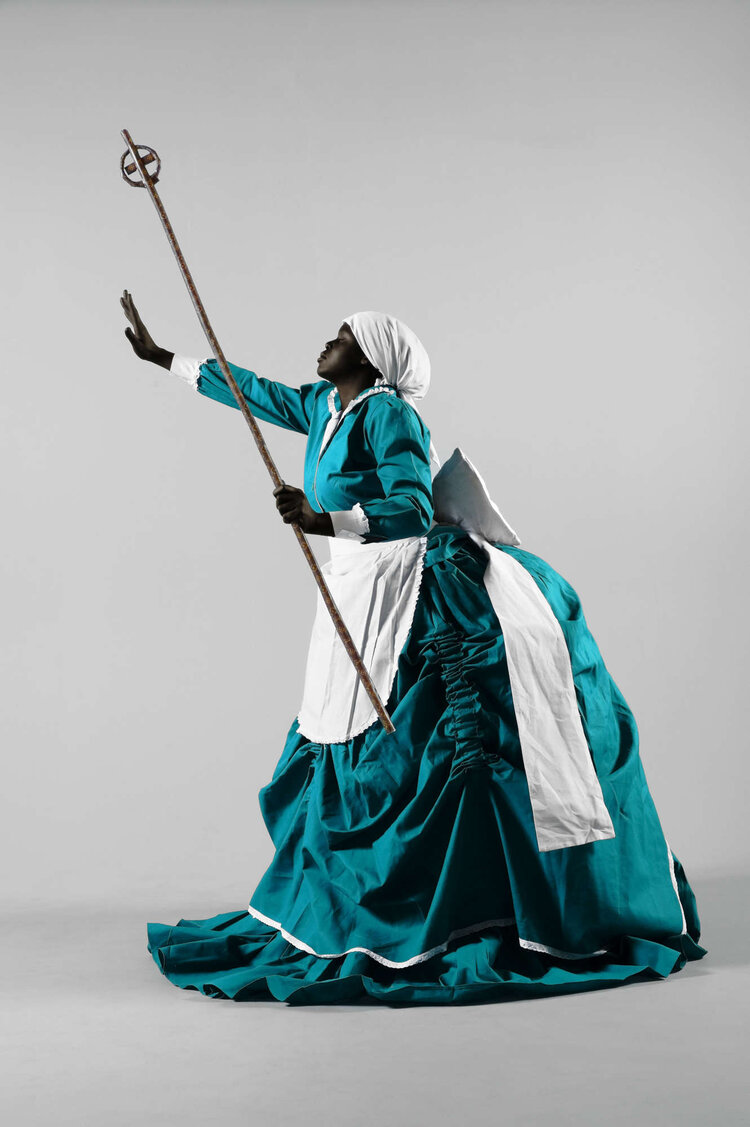
Afro Goddess Looking Forward by Mickalene Thomas (2015) © Mickalene Thomas

A reproduction like this gives no sense of the scale of the original, which is nearly 3 yards wide and 2 yards high, completely filling a gallery wall, towering over you and, as you get closer, enfolding in its bright, warm, welcoming designs.

Theory or beauty, issues or love

Born in 1971, Thomas is a Black, queer woman and proud as hell of it. This is catnip to the world of straight white women curators who write lots of wall captions claiming that her work subverts all the usual stereotypes (gender, ethnicity, identity), questions social norms, interrogates the blah blah blah. Thomas is well aware of this, and freely draws on the tenets of Black feminist and queer theory. In fact the title of the exhibition derives from bell hooks’ 2000 book ‘All About Love: New Visions’. Thus every wall label sounds like this:

Thomas work challenges societal norms and provides a powerful counter-narrative to mainstream depictions of beauty and identity…

It may well do all of that, and you can certainly immerse yourself in a critical theory-level response to her art – but what that style of writing doesn’t convey is how beautiful her work is. It’s big and bold and stunning and full of LIFE, full of lovely details and full of LOVE. Don’t need no theory to understand that.

Mickalene Thomas biography

From her Wikipedia article:

Mickalene Thomas (born January 28, 1971) is a contemporary African-American visual artist best known as a painter of complex works using rhinestones, acrylic, and enamel. Thomas’s collage work is inspired from popular art histories and movements, including Impressionism, Cubism, Dada, the Harlem Renaissance, and selected works by the Afro-British painter Chris Ofili. Her work draws from Western art history, pop art, and visual culture to examine ideas around femininity, beauty, race, sexuality, and gender.

From the press release:

Thomas is a trailblazer of portraiture and collage, widely renowned for her large-scale paintings of Black women posed against boldly patterned backgrounds embellished with rhinestones. As an artist who fearlessly transcends creative boundaries, her artworks have also adorned album covers (Solange’s EP True, 2013) and emblazoned fashion runways (Dior, 2023).

Love, leisure, and joy

All true, but much nearer the point is the first sentence of the first big wall label:

Mickalene Thomas’s art is an exploration of love, leisure, and joy.

This is certainly the keynote for the works on the ground floor of this two-floor exhibition. They are big and bold and depict friends and lovers and family in a candid, open, vivid and delightful way. Here’s a portrait of her beloved mother, a former fashion model named Sandra Bush, fondly known as Mama Bush.

Mama Bush: (Your Love Keeps Lifting Me) Higher and Higher by Mickalene Thomas (2009) © Mickalene Thomas

Now clearly half a dozen things are going on in this piece so let’s try to unpick them one by one.

Family

Thomas’s paintings depict family, friends and (women) lovers.

‘My gaze is the gaze of a Black woman unapologetically loving other Black women.’

There are some installations based on her childhood home (see below). As you read about this in the wall labels, as you see the sweet furnishings of the family rooms, as your heart rate goes down to match the smooth jazz soundtrack. It all creates a sense of warmth and love.

Based on photos

Thomas’s creative process begins by photographing her muses in a variety of sets created in her Brooklyn studio. These photos then form the basis of paintings in oil, acrylic and enamel paint which are inlaid with lustrous multi-coloured rhinestones. Originally chosen by the artist as affordable substitutes for oil paints, these materials have since become her signature.

Fabrics

After I’d got over the size, and the bold design and colour, and the use of shiny rhinestones, I began to notice the role of fabric and fabric-style patterning in the works. The figures are almost secondary to the dazzling collage of fabrics of starkly clashing colours and designs.

Installation view of Mickalene Thomas ‘All About Love’. ‘Din avec la main dans le miroir et jupe rouge’ (2023). Photo by Mark Blower. Courtesy the artist and the Hayward Gallery

The overall effect is dramatic but each of the works repays going up close to enjoy the detail of each of these fabrics.

Detail from ‘Naughty Girls Need Love Too’ (2009) by Mickalene Thomas in ‘All About Love’ at the Hayward Gallery

As mentioned above, the wall labels overflow with references to queer Black theory, and yet the exhibition can, sort of, be considered an adventure among fabrics. My wife knits, sews, crochets and is fascinated by fabrics and yarns and so, quite oblivious to all the critical theory, spent ages looking very closely at all these fabric designs.

Collage

According to the Tate website:

Collage describes both the technique and the resulting work of art in which pieces of paper, photographs, fabric and other ephemera are arranged and stuck down onto a supporting surface.

Quite clearly, then, the pictures are massive examples of collage in which the photos of friends and family form just the base layer over which she drapes patterned fabrics, cuts and rearranges imagery using the papier collé technique, and studs them with patterns of glittering rhinestones.

‘Collage is how I create form and composition. It’s a way to edit, disrupt, and dismantle – creating a space that is complex, by deconstructing the depth of the field of illusion.’

The wall labels reference a number of influences and even I could see the legacy of Henri Matisse’s cutouts in the more seaweed-shaped designs. But there are plenty of other influences including the Black woman artist Faith Ringgold, whose work we recently saw at the Serpentine Gallery.

The male gaze

‘My gaze is the gaze of a Black woman unapologetically loving other Black women.’

Before we move on to the other rooms, let’s address an issue which cropped up in the opening rooms with their enormous portraits, not least because it is mentioned ten or more times in the wall labels, our old friend The Male Gaze.

This concept crops up in more or less every exhibition about or which includes women artists. It is a standard accompaniment to any women’s art which includes depictions of female figures.

The male gaze was first articulated by British feminist film theorist Laura Mulvey in her 1975 essay, ‘Visual Pleasure and Narrative Cinema’, so it’s 50 years old this year. According to the Wikipedia page:

The male gaze is the act of depicting women and the world in the visual arts and in literature from a masculine, heterosexual perspective that presents and represents women as sexual objects for the pleasure of the heterosexual male viewer… thus reinforcing a patriarchal visual narrative.

With the explosion of feminist and critical theory over the past 50 years, the male gaze is now detected in every medium whenever women are portrayed, in not just classical painting, but advertising, films and TV, social media, all forms of literature, you name it.

I get it and I agree with it. What I don’t understand so readily is how all these paintings of scantily-clad young women, generally exposing their breasts, can be said to subvert the male gaze. Surely – without wanting to – they cater to it.

Portrait of Marie by Mickalene Thomas (2015) © Mickalene Thomas

Now one of the reasons I enjoyed my trip so much was because I got into conversations with several of the (female) visitor assistants, who were extremely knowledgeable and very perceptive. I benefited a lot from their insights.

One of these visitor assistants was giving periodic tours of the exhibition. When she’d finished, genuinely puzzled, I asked her how lots of images of scantily-clad, attractive young women with their boobs out was meant to subvert the male gaze. Speaking as a heterosexual male, they seem to me to encourage the male gaze by playing up to every expectation of women as a) beautiful b) lounging on sofas and beds c) half dressed. The visitor assistant made the following three points:

1. Thomas starts a lot of her works with photographs then paints and assembles collages of materials over them. The relevance of this is that her sitters only pose for a few hours i.e. not for days and days on end. I.e. the relationship between artist is less hierarchical, less dominating and demanding.

2. This lack of a male-female power imbalance extends to collaboration. After discussing a backdrop and a pose and what to wear, the subjects then help decide which poses and shots are best, which ones they feel most comfortable with. So, again, less of a male master and woman servant relationship, more a collaboration of equals, and of women equals.

3. She went on to make the rather more obvious point how so much Western art of the beautiful-woman-half-dressed-on-a-divan type was commissioned by rich men to adorn their walls. Many examples of rich men commissioning titillating images of scantily-clad young women to decorate their homes, or even assemble semi-pornographic collections of them in private rooms, where they could be enjoyed (i.e. leched over) by other creepy men. In all of this the woman model had no control whatsoever but was paid a pittance to be converted into a sex object.

Now I understood all these points, and they deepened my understanding of the concept of the male gaze and how women artists depicting the female body operate in a different atmosphere with different aims, and of Thomas’s anti-male gaze ethic. But the assistant didn’t really address my core point which is… they’re still images of half-naked women. To paraphrase Taylor Swift, ‘Male gazers will malely gaze’ and how, in practical terms, are you gong to stop them?

But maybe I’m misunderstanding. Maybe this isn’t about changing society as a whole (stopping men malely gazing) and a much more limited term, an art world term, restricted to describing certain works by certain women artists.

Women at rest

Another apparent contradiction intrigued me. At several points the commentary deprecated the old male art tradition of showing women lying around on beds or divans, thus creating a sexualised boudoir atmosphere for easily aroused male viewers. There are so many paintings like this in the western tradition that it is a genre unto itself, the Odalisque.

The odalisque not only presents women as sexual objects but plays to the gender stereotype which associates The Male with Activity and The Female with Passivity. Active men doing things, bursting with agency. Utterly passive women lying around half-dressed like pets or sex objects, existing solely to please their male owners.

And that’s bad. OK. I get it. The contradiction comes in as you realise that so many of Thomas’s huge paintings show women, er, lying around on beds or divans, half undressed. Why is it sexism and misogyny when painted by men but the exact same subject, with the exact same visual result, is not only ‘reclaimed’ from the male gaze, but is actively liberating, when painted by a woman? Here’s how the curators put it:

Thomas’ celebratory and glamorous portraits put Black women front and centre. Their poses are restful, but filled with power, meeting our gaze and staring right back with regal force.

Or:

These works centre on repose, rest and leisure which, in Thomas’s handling, are shown to be radical acts.

You can see what the curators are trying to do here – to get round the contradiction by rewriting the terms, by changing the vocabulary, by asserting that these works by a woman artists are different from a male depiction of the same subject. But it does it fit the reality of what you actually see? Here’s one of the most notorious odalisques in western art, Olympia by Édouard Manet (1863).

Olympia by Édouard Manet (1863)

Is Olympia not ‘meeting our gaze and staring right back’? Whether or not with ‘regal force’ is for the viewer to decide, but the ‘meeting our gaze and staring right back’ is an undeniable fact. So the ‘meeting our gaze and staring right back’ does not distinguish Thomas’s works from the male work she is meant to be ‘subverting’. The real difference lies elsewhere.

Is it in a certain spirit of defiance in the expressions of (some of) the women sitters? Something in their pose and their expressions is markedy, definably different from the passive acquiescent expressions of the classic odalisque? Maybe I’m missing something obvious and you can help me. Anyway, I only dwell on it at such length because 1) this type of pose is the core subject matter of all the works on the ground floor, and 2) the make gaze and how Thomas undermines and subverts it is mentioned in more or less every wall label i.e. it’s a central feature of the curators’ commentary.

A Moment’s Pleasure #2 by Mickalene Thomas (2008) © Mickalene Thomas

Living rooms

Moving on, if you know the Hayward, you know that you then walk up a gently sloping ramp to the second main downstairs space. Here there are a few more massive rhinestone paintings, including her reworking of The Sleep, a painting by French artist Gustave Courbet, given the Thomas treatment. (Later on we meet a big bright reworking of Le Déjeuner sur l’herbe by Eduard Manet. What with the visual references to Matisse’s cutouts, we are learning that Thomas has a fondness for modern nineteenth century French art.)

But more dramatically, here you find a couple of big installations. These are mock-ups or reconstructions of family living rooms Thomas remembers from her childhood. They are designed to transport visitors back to domestic settings of the artist’s 1970s and 1980s childhood. On the left is a room from the late 1970s during Thomas’s early childhood in New Jersey, a homage to her late grandmother.

Installation view of ‘I was born to do great things’, room 1, by Mickalene Thomas (2014) Photo by the author

Of these she says:

‘I created domestic settings primarily for fellow Black women – my muses – to spend time and have new experiences in familiar surroundings, perhaps resembling their mother’s or grandmother’s living rooms.’

Inside the installation are two artworks from early in Thomas’s career. The green one at the back is ‘Portrait of Mickalena’, a painted self-portrait in which Thomas performs her childhood alter ego, Quanikah. On the wall on the left is a photographic triptych of her mother from 2003, in which Sandra Bush poses in the style of actor Pam Grier, star of 1970s Blaxploitation cinema

One of the visitor assistants I spoke to was mixed race and she said the rooms triggered warm memories of her childhood. They feel sweet and comfortable and at least part of this is because is this is the source of the mellow soul and jazz music which permeates the ground floor, emanating from a genuine old-school record player and hi fi unit, with ageing record covers by The Supremes and such like, leaning against it at the bottom left.

This hi fi unit is in the second room which recreates a room from Thomas’s teenage years in the 1980s, a completely different vibe from the previous one, this is all shagpile grey carpet and Art Deco lampshades.

Installation view of ‘I was born to do great things’, room 2, by Mickalene Thomas (2014) Photo by the author

As to the curators’ commentary:

‘The living room is where we see black imagination made visual’, writes poet Elizabeth Alexander in The Black Interior. She suggests that the home holds a sacred significance for African Americans who have grappled with the impermanence of place perpetrated by enslavement, segregation and gentrification.

Remember what I was saying about the importance of fabrics, of Thomas collaging together wildly varying and disparate fabrics and patterns? When you look more closely you realise every piece of furniture in room 1 is made of crazy collages of fabrics, patched together, sometimes with very overt stitching. Is this something to do with relative poverty, with having to make do and mend? Or a purely aesthetic statement, in fact it’s a style statement. The visitor assistant I was chatting to made the point that none of the fabrics really ‘go’ with each other and yet, at the same time, because everything is made out of crazy patching, it all, somehow, does go. It makes a Gestalt.

Installation view of ‘I was born to do great things’, room 1, by Mickalene Thomas (2014) Photo by the author

Off to one side of the room is another installation, smaller, dinky, filled with bedroom bric-a-brac, reminding me of my teenage daughter’s bedroom. Takes as a whole the shape is reminiscent of a shrine and it is, in fact, titled Shrine. I’m guessing it is a shrine to her teenage self.

Installation view of Shrine by Mickalene Thomas (2024) Photo by the author

It’s packed with interesting and charming details. There’s a fridge magnet-style motto which reads: ‘I’m not opinionated, I’m just always right.’ Books by Black and queer authors. And I noticed, underneath a classic photo of Black activist Angela Davies, a picture frame which holds a list of names.

Detail of Shrine by Mickalene Thomas (2024) Photo by the author

Recognise the names?

  • Frida Kahlo, the Mexican painter and feminist icon
  • Kara Walker, the contemporary Black political and feminist artist
  • Georgia O’Keefe, woman painter of big bold flowers and scenes of the desert south-western USA

And she’s added her name to the list. Her lineage. Her heroines and herself.

Music

By far the majority of exhibitions I go to are staged in empty, church-like silence, a deadening white-walled sterility as antiseptic as an operating theatre which intimidates visitors into whispering or intimidated silence. The dozen or so sexy, soul music tracks, smooth jazz and soul classics, which play on a loop went a long way to taking the frozen edge off the gallery space and making it a nice place to be.

It made me feel warm and fuzzy about her art, about the rooms she grew up in, about her mum and friends and lovers, it made the whole thing feel warm and welcoming. It made a significant different. Here’s the track list:

Upstairs

Upstairs there are five more rooms, some big, some enormous, more installations, and a wider range of her works, including straight (no pun intended) photography, video installations, and more overtly political works.

The water lilies room

The biggest room features her largest collage to date, an absolutely massive work covering one huge wall (on the left here), in which are embedded ten or more smaller collage pictures. This towers over a lot of plastic rubber plants arranged in a grid pattern on a huge rectangular mirror.

Installation view of La Maison de Monet by Mickalene Thomas at the Hayward Gallery. Photo by the author

I think this is titled ‘La Maison de Monet’ and dates from 2022. In 2011, Thomas took part in a summer residency at Claude Monet’s house and studio located at Giverny, in northern France. Giverny provided Thomas with the opportunity to reflect on Monet’s iconic depictions of gardens and the vibrant domestic spaces that he designed as places of inspiration and leisure. The grid of plastic pot plants represents the famous water lilies in Monet’s garden pond, the lily pond he painted so many times at the end of his life.

On the opposite wall are two more standard-sized works. These are noticeably different from the earlier works in two respects: although they still use jagged-edged collage the elements are mostly plain colour washes instead of intricately decorated fabrics. And no rhinestones. The one on the right reminded me of a record cover from the 1980s, though I can’t remember which one. Can anyone remind me?

Installation view of Mickalene Thomas: All About Love at the Hayward Gallery. Photo by the author

A note on laminated flooring

It was only after I’d strolled around the room and looked at the massive wall collage a few times that I began to appreciate the importance of wood in it. On the left you can see photos of a number of wooden shelving units such as you might find at Habitat, while on the bottom right are black and white photos of what looks like laminated wood flooring. Hold that thought…

The wrestling room

Beyond the water lily room is the wrestling room. Here are half a dozen rhinestone and jagged collage-style images of two Black women in various wrestling poses. To quote the curators:

Thomas created her series of Wrestlers to explore multiple sides of herself. All the figures depicted in the paintings are representations of Thomas, featuring the artist Kalup Linzy as her twin. The paintings reveal only one face – the artist’s. The artist considers the series a form of self-portraiture, embodying internal conflicts between our multiple selves within society.

The figures, locked in an embrace, blur the boundaries between erotic pleasure and pain, struggle and affection, dominance and submission, all expressions of desire. The tiger and zebra print leotards worn by the wrestlers can be seen as a critique of the stereotypical and exploitative portrayals of Black women’s strength and sensuality.

Well, as I’ve said in my comments about the male gaze, does dressing Black women in jungle animal leotards (tiger and zebra) ‘critique’ stereotypes about Black women… or subtly confirm them? You, the viewer, decide.

Installation view of the wresting room at Mickalene Thomas: All About Love at the Hayward Gallery. Photo by the author

I chatted with the visitor assistant about the bean bags. On the two times I visited the room nobody was sitting on them. Remember I mentioned the wooden shelf units and laminated flooring in the previous room? Well look at the walls here! The stripped varnished pine walls make it feel a bit like a shop, quite a clinical vibe.

Also, you only want to throw yourself on a bean bag if there’s something you really want to spend some time looking at and, I hate to say it, but these were probably the weakest set of works in the show.

But the visitor assistant, as so often, pointed out something I hadn’t noticed, which was the colour red. The bean bags are dark red because all the wrestling images who the two figures wrestling on a dark red blanket. Aha! More like interior decorating than art, the bean bags are visually tied in to the surrounding paintings.

Lastly, most visitors to most of the exhibitions I go to are old. Lots of grey-haired old men and women. I imagine no-one was using the bean bags because pretty much every visitor would struggle to get back to their feet. They’re appropriate to a younger crowd at a younger show and with something to really look at. (I vividly remember the beanbags in a projection room at the Victoria and Albert Museum show about So You Say You Want A Revolution, where you plumped down in a bag to watch excerpts from the rock movie, Woodstock.)

‘Me as Muse’

Round the corner from the lily pond room is a smaller installation, visually tied to it by the present of another clump of rubber plants and titled ‘Me as Muse’. It’s a multimedia video installation meaning there’s a bench and you sit on this and face

Installation view of ‘Me as Muse’ (2016) at Mickalene Thomas: All About Love at the Hayward Gallery. Photo by the author

Now what I noticed first about this was the way the bench was made of Thomas’s characteristic patched fabrics. I really liked the bench, vivid and colourful. The wall is covered by a massive montage of mostly black-and-white photos of woods and forest, which are complimented, I suppose, by the rubber plants.

But obviously the centre of attention is the 12 TV monitors. What appears on these screens is a little complicated. The core image is a self portrait of Thomas lying naked on a divan, the classic odalisque pose which prompted all those questions about the male gaze and the history of art and so on, on the ground floor.

What happens then is that different monitors cut to other images, not all at the same time but so that fragments of images are juxtaposed against each other. These other images include two classic odalisque paintings from western art, one by Jean-Auguste-Dominique Ingres, a more modernist one by Amedeo Modigliani. I think the point is to contrast the representation of Black or ‘exotic’ women in classical male art, with the body of a real Black woman (Thomas herself).

This process goes a step further when the monitors show us a photographic image of Sarah Baartman (1789 to 1815), a Khoikhoi woman from southwestern Africa who was displayed in colonial exhibitions across Europe in the 19th century. This obviously deepens things from just being an art history issue to showing its relationship to the wider world and to historic issues of colonialism, dehumanisation and so on.

So far, so very like an A-level exercise in gender and racial politics. Intercut with all this are clips from a BBC interview with Eartha Kitt in which the famous singer (apparently) speaks candidly about the abuse, suffering and racism she experienced throughout her life. This would have been more powerful if I could have heard anything she said. Maybe there were headphones or a QR code to use on my phone or something, but none of the other visitors who were in this area at the same time as me were listening to anything. Then again maybe the images of a Black woman talking but muted and silenced, were – in a presumably unintentional way – more powerful than hearing her words.

And it’s a collage, isn’t it, just in a different format (video instead of picture). Like the paintings, and the furniture, its basic idea is cutting up and juxtaposing elements from strikingly different sources.

This view shows the geographical relationship between the lily pond room and the TV room (in this photo you can see the Modigliani odalisque on the TV screens), and also shows how the rubber plants – and now I look closely, I can see how the use of black and white stripes and squares – bind the two pieces together. In fact it was only when reviewing my own photos that I realised that immediately behind the monitors are photos of… water lilies in a pond! Surely, they must be shots of Monet’s lily pond. In which case the two installations are really tied together.

Installation view of the upstairs rooms at Mickalene Thomas: All About Love at the Hayward Gallery. Photo by the author

Eartha Kitt sings Angelitos Negros

Eartha Kitt crops up in another work, another multiple screen installation just along the corridor. It consists of four much bigger screens, each one divided into three sub-screens. On them we see face shots of several Black women all singing the same song. The singing feels notably non-professional i.e. like you or me singing in the shower, and it sounds like several voices singing together at once though not in any kind of professional unity or harmony.

Installation view of Angelitos Negros by Mickelene Thomas at the Hayward Gallery. Photo by the author

It’s only when you read the wall caption that you realise one of the screens is showing Black singer and actress Eartha Kitt performing her 1953 song Angelitos Negros. In this the singer implores artists to paint Black angels in their religious paintings. ‘You paint all our churches, and fill them with beautiful angels,’ the song laments, ‘but you never do remember, to paint us a Black angel.’ As far as I can tell, in that original video Kitt starts crying so the tone of the music is obviously tearful, if not tragic.

So the other faces and voices are all of Thomas herself singing along. So that explains why there’s a kind of core track which sounds good (Eartha) accompanied by an impassioned by amateur rendition (Mickalene).

What I assume to be several takes of her doing this are cut and pasted into the different channels shown by the monitors, which continually change angle and distance. So it’s yet another example of Thomas’s use of collage, reusing, repurposing, juxtaposing original source material into new combinations.

In a way more striking than the piece itself is the fact that in front of it is something like the living room installations downstairs, a collection of armchairs place on a big carpet, with side tables piled with classics of Black and queer literature.

Installation view of Angelitos Negros by Mickelene Thomas at the Hayward Gallery. Photo by the author

Note 1) the way all the furniture is made of patchwork fabric, like the bench in the other TV room, like the furniture in the two living room installations, echoing the intense use of fabric patterns in her rhinestone paintings. 2) Note the use of fake wood laminated tiles, such as you see in flooring shops, visually linking this to the images of cheap wooden furnishing and flooring in the previous installations. And 3) our old friends, the pot plants, also linking this with the other upper gallery installations. It’s not only paintings that can have recurring motifs, but installations too.

The sly way all these displays are tied together by these motifs is enjoyable to decipher and savour. Clever. Very clever, and fun. In the manner of all good art, you feel all these linkages are saying something, something important and meaningful, but can’t work out what. But that’s fine. Art isn’t a scientific thesis. Hints and echoes and implications are what it’s good at. Very clever. Echoes and re-echoes.

Incidentally, the paintings on the wall in the background of this photo are a departure from everything we’ve seen so far. They’re portraits of people right enough, but painted on big mirrors. In fact here on the upper floor there’s a much greater variety of works, a greater range of paintings plus a corridor of simple (i.e. uncollaged) colour photographs, nicely staged and shot.

A note on James Baldwin

The Black American author James Baldwin (1924 to 1987) is frequently encountered in the art world. Why? Because he’s Black, queer and a writer. I’m not being sarcastic or snarky when I say he ticks all the boxes. We live in a liberal culture which is concerned to tick all the boxes – literally in the case of many organisations’ legally binding commitments to diversity and inclusion. In a thoroughly feminist culture like the art world most straight white men are frowned on and excluded. In a backlash against thousands of years of white heteronormative domination, there is currently a wave of exhibitions by Black artists, and an ever-growing number of exhibitions by queer artists.

Baldwin’s writings often address his challenges with identity. When he came of age in the 1940s a man was meant to be white and manly, Clark Gable or John Wayne. Being Black exposed him to the massive race discrimination in 1940s USA, but being queer made him doubly an outsider, especially in his own Black community which was just as homophobic as the white world, if not more so.

After facing years of everyday racism and homophobia, despite the support of other Black writers who spotted his talent, Baldwin in the end fled America, travelling to France in 1948 where he lived for the rest of his life.

It’s not just that Baldwin ticks the boxes, he’s not just an empty figurehead. It’s that he wrote so eloquently about the challenges and complexities of juggling his multiple identities: American, man, Black, gay.

So it is no surprise that in our times, when progressive politics, art and literature are more than ever before concerned with questions of gender and identity, Baldwin is not just a symbol of these issues, but his often very eloquent expressions of them find themselves being quoted again and again, in texts, in documentaries and in countless exhibitions.

When I visited the contentious Masculinities exhibition at the Barbican, supposedly a comprehensive survey of art from around the world about masculinity, no surprise that the massive quotation written in big letters on the wall right at the start of the exhibition was by Baldwin. Not a British writer, a white writer or a straight writer. To define masculinity, to set the keynote in their huge exhibition about masculinity, the curators chose the writing of a gay Black American man.

Not long ago I was at the Photographer’s Gallery in Soho and discovered quotes from Baldwin being used in their exhibition of queer photos. And here in the Mickalene show, Baldwin is 1) referenced in the wall captions, specifically the one for the Money installation which aligned Baldwin’s flight to France with Mickalene’s stay there 60 years later. 2) In the Shrine and here in this Earth Kitt installation, when there are little piles of books to make the place look more homely, you can bet your house they’ll include works by Baldwin and guess what? They do. 3) And photos of him appear in Thomas’s series celebrating Black politics, ‘Resist’. He’s everywhere.

I’m not mocking. I’m pointing out that particular periods or eras in history are defined by their economic and technological substructure, and the cultures they produce are marked by particular anxieties and means of expression. So that in an era saturated in issues to do with race and gender, it’s almost inevitable that Baldwin’s eloquent descriptions of the interplay of these issues – not that commercially successful in his own time (the 1950s, 60, 70s) – have come into their own. This goes some way to explaining why his words or image keep cropping up in so many exhibitions I visit.

Sorry for this long digression.

The Black Lives Matter room

The last room I arrived at, the room beyond the Eartha Kitt room, is a cul-de-sac, a comparatively small space and the most ‘political’ room. It contains just three works and these are completely unlike the homespun, family-oriented, bright and joyful vibe of the rhinestone works. They all address the dire state of race relations in contemporary America. They’re examples of a series of works gathered under the collective title ‘Resist’, being:

  • Resist #12: Power to the People
  • Resist #6: Say Their Names
  • Resist #7: Guernica detail

Rather than rewrite them, I’ll quote the curators’ own words:

While Thomas’s art is fundamentally and radically political, this recent series of paintings is explicitly so, centring on Civil Rights activism from the 1960s to the present.

The central painting serves as a memorial to Black men and women who have lost their lives at the hands of U.S. law enforcement or while in custody, urging the viewer to remember the names of countless victims.

The two flanking paintings explore the central role of Black women within civil rights activism from the 1960s onwards. Thomas finds echoes of the past in the present, layering archival images from the Civil Rights era with images from recent protests and uprisings related to Black Lives Matter and other social justice movements.

Here’s that central work, the ‘memorial to Black men and women who have lost their lives at the hands of U.S. law enforcement or while in custody’.

Installation view of ‘Say Their Names (Resist #6)’ (2021) by Mickalene Thomas in Mickalene Thomas: All About Love’ at the Hayward Gallery. Photo by the author

If you pull back from the specific names and focus on the dark grey outlines you can see that they echo or in fact repeat the shapes of the animals in Pablo Picasso’s famous painting, Guernica. As in her copies, pastiches of and homages to classic paintings by Ingres, Manet and Modigliani, you can see 1) her fundamental principle of collage at work, cutting and pasting and incorporating materials from other sources into her own art; and 2) in these particular instances, taking classic works from the canon and rewriting them for her own, modern purposes, to address contemporary social and political issues.

This is a very powerful room and you only have to start thinking about the long, dire history of race relations in America, about American slavery, the civil war, the Jim Crow era, the miserable segregation and racism Afro-Americans suffered for most of the twentieth century, the long battles of the Civil Rights Movement, the assassination of Martin Luther King, through various race riots of the 1960, ’70s’, ’80s and up to the present day with its ongoing litany of Black people killed by white cops and the vast numbers of Black men imprisoned in America’s incarceration complex, to feel yourself completely overwhelmed by the scale and horror of this terrible history and these ongoing horrible realities.

All of which has an undermining effect on the smooth jazz vibe of the ground floor, with its atmosphere of proud women and domestic happiness. This small room casts a long shadow over everything which came before it… But then, we are grown-ups and have to deal with the fact that the world is a troubled, complex and riven place. There’s really very little I can do to influence the community policies of most American police forces. But all the more reason to value the love, leisure and joy which she described at the very start of the show and which those first big collages convey so wonderfully.

Take-home

It’s big, colourful, inspiring, inventive, dark and troubling, all at the same time, all in one big complex feast. Go and see it.


Related links

Related reviews

Infinite Folds by Barbara Chase-Riboud @ Serpentine North

This is the first UK solo exhibition of American artist, novelist and poet Barbara Chase-Riboud. Born in 1939 in Philadelphia Chase-Riboud now lives and works in Paris. She’s most famous for her sculptures. The exhibition also includes half a dozen works on paper but these are eclipsed by the size, presence and elegance of her big metal-and-fabric sculptures.

Early experiments

Chase-Riboud is a good example of the kind of artist who, when starting out, experiments widely, copying and incorporating elements from contemporaries and predecessors, before they work their way through to a new look and feel, an innovation of their own, and then really hunker down on it, making it their brand, exploring all its ramifications. Francis Bacon worked his way through early experiments to stumble across blurred images of screaming men in claustrophobic spaces and spent the rest of his career mining and exploring this discovery.

And so this beautifully laid out exhibition at the Serpentine North Gallery kicks off with three or four early works, which are biggish sculptures, made of gnarly, clotted metal arranged in skeletal, organic shapes, displaying the influence of Giacometti and other post-war Modernist sculptors.

Walking Angel by Barbara Chase-Riboud (1962) © Barbara Chase-Riboud

These are interesting but are totally eclipsed by the style of work which made her name and dominate her output. In these, cascades of wool, rope, braided fabrics and silk tumble to the ground from eerily sculpted, angular metal forms. Very roughly, and from a distance, they could be taken as lush curtains tumbling down from metallic pelmets.

Installation view of ‘Infinite Folds’ by Barbara Chase-Riboud @ Serpentine North (photo by the author)

It’s only as you approach that you begin to get a number of very strong sense impressions. First of all there’s the dysjunction between the hard cold metal pelmet and the flowing cascading wool and skeins and silk and braid which tumbles from them. Something very powerful and impossible to put into words is happening.

The pelmet

You can consider each of the two elements in isolation, though your attention is torn between them. At the top is the cold metal, itself distorted and twisted into shapes which suggest folds of fabric but somehow angular, forbidding, almost threatening. As you move through the exhibition you see her working through variations and experiments with different shapes and scales and patterns of the ‘pelmet’.

Installation view of ‘Infinite Folds’ by Barbara Chase-Riboud @ Serpentine North (photo by the author)

Clearly, in this example, the metal element takes up more than half the sculpture, is more than merely a ‘pelmet’, is a haunting collocation of fragments and slivers, open to any number of interpretations.

The fabric

The second element, of course, is the cascades of fabric I’ve mentioned. You can see how these are made of long skeins of wool, some punctuated by knots, intermingled with heavily braided and plaited material.

Like the metal ‘pelmets’ I found myself responding to these in different ways. Some looked really soft and welcoming. I could imagine nestling down among the very soft and comfy-looking fabric of the first, black, example, above. Whereas the golden cascades look a bit more ‘formal’ and subtly off-putting. They reminded me of the braids and tassels you get at old-style theatres, which often have plush curtains not only on the stage but sometimes above doors into the main part of the theatre, and the feeling of red plush theatre seats which are sometimes lined with decorated binding.

So I found something ‘theatrical’ in a lot of the works, but other visitors might see and feel something completely different. Whatever the connotations it evokes for you, they have an immensely sensual impression on the mind. You really really want to reach out and touch them, to compare the feel of the stiff cold metal and then the yielding and sensual strands and skeins.

‘Numero Rouge’ by Barbara Chase-Riboud (2021) © Barbara Chase-Riboud (photo by the author)

Colour

There’s black ones and golden ones and bright red ones and chrome ones.

Installation view of ‘Infinite Folds’ by Barbara Chase-Riboud @ Serpentine North (photo by the author)

There are copious wall labels which assign different works to different periods and projects, some with very literary or philosophical or political aims. For example, the red one, two above, titled ‘Numero Rouge’, refers to the way that Chase-Riboud ‘was captivated by the use of the colour in the art and architecture of Beijing’s Forbidden City where architectural features such as roofs and columns are constructed of red tiles or lacquered in red respectively’.

There is also a political, Black Lives Matter thread running through the exhibition, with Chase-Riboud – herself an African American woman – referencing Black icons such as Malcolm X and Josephine Baker. In another sequence she commemorated Sarah Baartman, the Khoikoi woman from southern Africa who was demeaningly put on display in London and Paris in the nineteenth century, under the name of the ‘Hottentot Venus’

But I found the works themselves so powerful that I tended to lose track of which work was meant to be carrying which meaning and just enjoyed studying the ‘formal’ aspects of the sculptures, enjoying them as clever, inventive themes and variations – with the fundamental principle or idea of the dramatic contrast between warm fabric and cold metal running throughout, providing a kind of unifying metaphor.

Installation view of ‘Infinite Folds’ by Barbara Chase-Riboud @ Serpentine North (photo by the author)

Cleopatra

The Serpentine North Gallery consists of a square corridor which runs round two inner rectangular spaces. The main corridor space has smooth white plaster walls. The cut-through spaces have been left with the rough brickwork exposed. One of these cut-throughs contained more looming black ‘pelmet’ works of the standard design.

Installation view of Infinite Folds by Barbara Chase-Riboud @ Serpentine North © Barbara Chase-Riboud 2022. Photo © Jo Underhill, courtesy Serpentine

But the other one houses several pieces which were notable departures from the pelmet motif.

Chase-Riboud has travelled widely, maybe more so than most American artists who tend to be quite parochial (after all, they’ve got a whole continent on their doorstep). And so she has taken inspiration from a wide variety of cultures and traditions. In China she visited the Han Dynasty burial tomb which contained the bodies of Prince Liu Sheng and Princess Dou Wan. Both bodies are encased in traditional burial suits made from delicate jade plaques sewn together with gold wire.

These were the inspiration for a series of works looking distinctively different from the pelmet sculptures. Here Chase-Riboud created works assembled from thousands of bronze squares, intricately sewn together with bronze wire. The series is named after Cleopatra, Queen of Egypt.

‘Cleopatra’s Bed’ by Barbara Chase-Riboud (1997) © Barbara Chase-Riboud (photo by the author)

These have an explicitly feminist aim which I’ll quote in full:

Chase-Riboud evokes the power, energy and desire associated with Cleopatra through objects that seemingly could be found either in her long-lost tomb or within the contents of her home. [The Cleopatra series is part of] Chase-Riboud’s interest in exploring ‘power as wielded by women’.

Another series of works refer to the goddess Shakti, the female consort of the god Shiva, ‘who is said to represent cosmic energy, fertility and female creativity… [in which Chase-Riboud explores] the the interconnectedness of the poetic, spiritual and sexual experience.’ Bearing that in mind, I wondered what this striking piece represents.

Installation view of ‘Infinite Folds’ by Barbara Chase-Riboud @ Serpentine North

Promotional video

Chase-Riboud the writer

Alongside her work as a sculptor, Chase-Riboud has published volumes of poetry, historical fiction and a memoir.

1974 From Memphis & Peking (poetry)
1979 Sally Hemings (novel)
1986 Valide: A Novel of the Harem
1987 Portrait of a Nude Woman as Cleopatra (poetry)
1989 Echo of Lions (novel)
1994 The President’s Daughter (novel)
2003 Hottentot Venus (novel)
2014 Every Time a Knot is Undone, a God is Released (poetry)
2022 The Great Mrs. Elias (novel)
2022 I Always Knew: A Memoir (based on letters she wrote to her mother, Vivian Mae Chase, between 1957 and 1991)


Related links

More Serpentine Gallery reviews

This Is England by Matt Small @ Guildhall Art Gallery

In the small downstairs exhibition room at the Guildhall Art Gallery there hung till recently 27 portraits of the 2022 England football squad (and manager Gareth Southgate) by black artist Matt Small. Simplest way to introduce him and the artworks is the video:

Each portrait is extremely realistic in shape and anatomical features – so accurate in every respect that I thought they must surely be based on blown-up photographs. But then they are very freely coloured, in the manner of much modern painting, in the livid blotchy style which dates back maybe to Lucien Freud and, I suspect, has been taught at art colleges ever since.

Style

As with so much art it is one thing to see a flat image on a screen, as in this review, and quite a different thing to see the art work in the flesh. These works are not, as they appear here, flat and finished – they’re not even in one piece, they are three-dimensional assemblies or mini-sculptures.

Each portrait was painted onto some kind of plywood about half a centimetre thick, and then these were cut out to create silhouetted portraits and then glued or stuck onto the backdrops. And the backdrops aren’t just flat canvas or material. Each backing is made up of triangles of wood of different shapes and sizes, roughly sawn so they have splintered rough edges, roughly painted white so you can see the original wood colour at the edges, and assembled onto the basic base of each portrait so that the assembled triangles create a geometric pattern behind each head.

Apparently these white triangular tessalations are a kind of abstract geometric depiction of the English flag but I didn’t see that at all. Instead it struck me they look like the seams of a modern white leather football.

‘This Is England’ at Guildhall Art Gallery. Can you name all 11 players (manager Gareth Southgate being at the top left)?

If we’re being allegorical, it struck me that the way the roughly finished wooden shapes fit together so neatly symbolises the way the team, often from pretty poor backgrounds, suffering under various disadvantages (rough edges) nonetheless were arranged into patterns and shapes of tremendous beauty.

As to the faces themselves I’ve described how they have a photographic accuracy of shape, especially, for some reason, the eyes, which, in some of them, really do look like photographs until you get up close and see they’re painted like everything else.

The reproductions I’ve seen online don’t convey the impact of the actual paintings. Photos flatten colour and texture and so make them all look similar, they all look like they’ve got jet black hair and dark skin, they all look very samey, the white and the black men alike.

Phil Foden by Matt Small

In the flesh there’s much more variety. As you can see from this individual portrait of Matt Foden, the face is built up through a mosaic of surprisingly garish primary colours, including red, yellow, blue, turquoise and so on. Samey at a distance, the more you approach each individual work, the more vibrant its patchwork of vivid colouring becomes.

Second thing is the physical texture of the paintings. They’re not smooth and flat. Small has left in all the imperfections which come from splashing on pain, including brushmarks, swirls of pain, some kind of oxydising process which has produced discoloured blips and bubbles on virtually every patch.

Some people might regard these as imperfections but this is precisely the kind of record of a work’s production which has always thrilled me, ever since I saw my first Jasper John paintings 50 years ago, with their half-finished canvases and stencilled words saying ‘Fragile’, the sense that a modern painting merges into its surroundings, records and depicts the physical processes which produced it. I suppose they are signifiers of a kind of ‘authenticity’, denoting the hand-made, individual physical effort required to not only pain, but to saw out, assemble and glue together all the elements, as I mentioned above.

It’s a type of art which excites me as much as it did 50 years ago and so, on the crudest, physical, visceral level, I thrilled to the physical presence of these works, almost like being physically close to someone I’m really attracted to. Pretty much none of the physical nature of the works comes over in reproductions so you might be asking yourself what I’m on about. This is why it is still, despite everything, making the effort to try and see works of art in the flesh. It’s almost always a completely different experience from seeing any reproduction, especially on a flat 3-inch square screen of a modern smartphone.

Raheem Stirling by Matt Small

Message

Matt Small, the gallery and everyone involved is at pains to emphasise that the works as a whole have a polemical aim: this is to emphasise that the squad came from a diverse set of backgrounds, and that they not only made history (by making it further in the World Cup than any English team since 1966) and inspired the country through their teamwork and cohesion, but who also took a principled and inspiring stand on ‘equality, inclusivity and racial injustice’.

And this is all true: the team worked together not only on the pitch, supporting young wonder players like Jude Bellingham (aged 19!!!), Bukayo Saka (age 21) and Phil Foden (21) to score magnificent goals, but behaved with tremendous dignity and fluency off the pitch. Some of the after match interviews, young men pushed in front of a camera just minutes after giving their all on the biggest stage in the world, were models of politeness and articulacy.

Then individual stories like the return to form of Marcus Rashford who suffered such cruel abuse as a result of his outstanding efforts with charities to distribute over 21 million meals for children and families who might not otherwise eat – God, what an extraordinary inspiration to the whole country!

The show is accompanied by a few quotes. Gareth Southgate, measuring his words as always, says:

‘We are a team whose diversity and youth represent a modern country.”

But last word goes to Rashford, quoted as saying:

“Look what we can do when we come together.”

These portraits were created in the spring and put on display in the month before the tournament began – but little can Small or the gallery have imagined what genuinely inspiring, nation-uniting people these 27 players would turn out to be, making any English person with a soul burst with pride at these extraordinarily brilliant young men, their skill, their ambition, their commitment, and their embodiment of everything that is good about young, modern, inclusive England.


Related links

The display at the Guildhall Art Gallery has now closed.

Matt Small is represented by JG Contemporary who are planning to show some of the portraits in the National Football Museum in Manchester later this year, and selections may be displayed at other spaces later this year.

Meanwhile you can see other Matt Small artworks at the JG Contemporary Gallery in Chiswick, West London.

The National Theatre in London is going to present a new play about Gareth Southgate and the team, opening on 10 June.

Other Guildhall Art Gallery reviews

Aulos Kapreilios Timotheos, Slave Trader by M.I. Finley (1968)

This blog post started out as simple notes on a short essay by the noted historian of the ancient world, Sir Moses Finley (1912 to 1986) – until I stumbled on the wider context of the essay on the internet, which I then try to summarise.

Aulos Kapreilios Timotheos, Slave Trader

The essay ‘Aulos Kapreilios Timotheos, Slave Trader’ was published in the early 1960s, then included in a slim Pelican paperback collection, ‘Aspects of Antiquity’, published in 1968, which I picked up sometime in the 1980s.

It is far from being a big definitive essay on the huge subject of slavery in antiquity. Rather, it’s a set of meditations which flow from contemplating just one artifact from the ancient world, a seven-feet-high, finely decorated marble tombstone to this man, Aulos Kapreilios Timotheos.

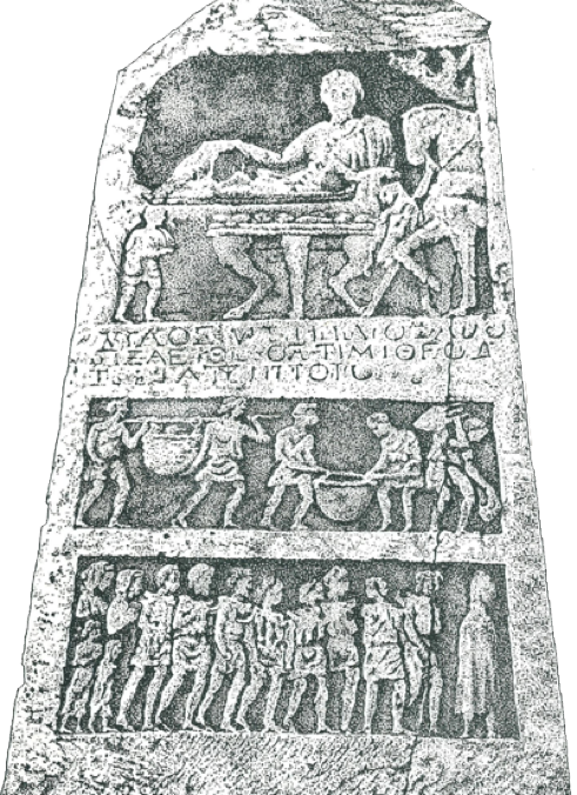
Tombstone of Aulos Kapreilios Timotheos, Slave Trader

The tombstone

This tombstone was found at a town near the border between modern Turkey and Greece. It shows three carved scenes: a typical banquet at the top; a work scene in the middle; and on the bottom, a depiction of 8 slaves, chained together by the neck, being led in single file, accompanied by two women and two children, not chained, preceded by a man who is obviously in charge. Between the top and second row is an inscription in Greek, reading:

Aulos Kapreilios Timotheos, freedman of Aulos, slave trader

Apparently what makes this stone rare and unusual is its blunt candour. In the scattered writings we have from the ancient world slave trading was looked down on, sometimes despised, which is odd because the entire economies of ancient Greece and Rome relied on slaves in enormous numbers. But clearly, the writing classes – the people who left opinions for us to read – were ambivalent about it at best.

The American South

Finley compares and contrasts the situation in the ancient world with that in the Southern United States in the nineteenth century. American slave owners were uneasily aware that the rest of the civilised world had abolished slavery and strongly disapproved of them. Hence their increasingly anxious over-compensating justification of the ‘peculiar institution’.

The ancient Greeks and Romans had no external voice of conscience to upbraid them. The reverse. Everywhere they looked they saw all other societies of their time practising slavery.

The racial justification for slavery

The slave society of the Deep South justified its exploitation with widespread propaganda about the intrinsic inferiority of black people. You don’t read far in any text about the American civil war without coming across southern ideologues using the Bible or any other spurious means they can lay hands on to justify the intrinsic superiority of whites and the intrinsic inferiority of blacks. Plenty of authors and politicians claimed that blacks could only find true happiness in the condition of slavery, blacks are children who need the strong hand of a father etc etc.

So a black person in America could never lose the stigma associated with slavery, even if they were free, even if they lived in the north, ran a business, lived a free life, could never be completely free.

The raceless basis of ancient slavery

The situation was drastically different in the ancient world because slavery wasn’t associated with any particular race or ethnicity. Literally anyone could be enslaved – in Spain, in Gaul, in Greece itself, conquering Roman armies enslaved entire cities of white Caucasians.

The crucial point is that there were no specifically slave races or nationalities. Literally anyone and everyone might be enslaved, and which groups predominated at one time or another depended on politics and war. (p.157)

The association of slavery with skin colour was an invention of the Atlantic slave trade of the 17th and 18th centuries.

Freed names

Back to Aulos – his first two names, Aulos Kapreilio were those of his master, which he took when he was made free, as per Roman custom. Timotheos was his slave name.

Roman slave names

In the early days of slavery Romans gave their slaves names like Marcipor or Lucipor which was simply a contraction of Marcus puer or Lucius puer, puer being Latin for ‘boy’ (hence the English word ‘puerile’, which has come to mean ‘childishly silly and immature’).

From the year of the twin defeats of Carthage and Corinth, 146 BC, the number of slaves began to steadily increase and so they needed more names.

After 146 the empire became unofficially divided into a Latin-speaking West and a Greek-speaking East, and so slave names sometimes indicate a slave’s origins, east or west.

Side

A city on the south coast of Anatolia, became notorious as a slave market. But maybe the epicentre of the ancient slave trade was the island of Delos

The people of Phrygia in central were notorious for selling their own children into captivity. Many slaves from Scythia (the area to the north of the Black Sea) were bought from their own chieftains, captives in their own wars, or children, or simply human levies, like tax, sold at a profit (p.163).

Slave sales

Given the millions of men, women and children who were slaves it is notable that we have just two visual depictions of an actual slave auction. In both of them a male slave stands on a platform while another man, presumably the buyer, lifts his tunic to admire his strong thighs.

The condition of a slave

is to be brought into a new and alien society violently and traumatically; to be torn not only from his homeland but from all the relationships which provide identity and psychological stability, with family, kin, tribe, village, region, gods, customs, dress – everything.

All this is replaced with just one cardinal relationship – with the slave’s male owner who controls not only every aspect of his physical existence, but his mental horizons, the language he has to use, the new religion he has to practice, rules he has to obey – everything.

Slave sexual exploitation

Complete control over the person of slaves meant the master class had unfettered unlimited sexual access to all slaves, male, female, young or old. As I’ve read the chatty odes of Horace or elegiacs of Tibullus, Propertius or Ovid, I have been disturbed again and again by the casual way they talk about being ‘given’ slaves (of either gender) for sexual purposes.

Slave punishments

The most chilling thing for me, though, has been the casual references, in all the Roman literature I’ve read from Plautus onwards, of the horrific punishments slaves could be subject to, starting with whipping and escalating through torture, having limbs deliberately broken, and so on, up to the ultimate punishment of crucifixion.

Finley returns to the attempts of Americans to justify slavery through the intrinsic inferiority of one race and say not only was it not attempted in the ancient world, it was actively disproved by the case of the Greeks.

Greek revenge

After the brutal conquest of the Greek League in 146 BC, over the next few centuries hundreds of thousands of Greek men, women and children were brought back to Italy as slaves. However, in the long term this caused a kind of cultural revolution. The Gauls or Germans might have been considered ‘barbarians’ (they wore trousers, for God’s sake!) but the Greeks were citizens of the culture which had taught the Romans literature, philosophy and architecture. Hard to maintain the fiction that these people were in any way ‘inferior’. On the contrary many of them, while remaining technically ‘slaves’, rose to become secretaries, assistants or teachers to the master’s children.

Manumission

This leads into another important issues, which is manumission, which is the fancy word for freeing your slaves. The Romans became famous among the cultures of the ancient world for freeing their slaves, as reward for loyal service. It was a disconcertingly simple procedure – the owner declaring the slave free, maybe touching them or gently pushing them away, and a state official such as a consul or a praetor touching the slave with a rod called a vindicta and pronouncing him or her to be free.

The slave’s head was shaved and a pileus was placed upon it. The pileus was a brimless felt cap of undyed wool. Based on what we can see in surviving frescos, sculptures, and coins, the pileus ranged from a short cone to a gumdrop shape. It was the identifying garment of a freedman.

Anyway, we know that the rate of manumission became a real problem in Roman society because the emperor Augustus passed laws trying to limit it:

He established maxima on a sliding scale, according to which no one man was allowed to free more than one hundred slaves in his will. (p.158)

Finley points out a notorious contradiction in Roman attitudes to slavery: which is that noted jurists such as Florentinus clearly stated that slavery as an institution was ‘contrary to nature’, that this idea was shared in some of the literature and incorporated into legal codes – and yet it didn’t make any difference to the actual practice.

He instances the moral philosopher Seneca who freely admitted that a slave is a person with a soul like you and me, but from this premise he draws the conclusion that one should live on friendly terms with one’s slaves, dine with them, converse with them etc – everything except actually free them, which seems beyond the scope of his philosophy (p.164).

War

Because, as Finley points out, war was central to the entire institution of slavery and the slave trade.

The ancient world was one of unceasing warfare, and the accepted rule was that the victor had absolute rights over the person and property of the captives, without distinction between soldiers and civilians. (p.159)

Caesar

went to Gaul an impoverished nobleman and returned a multi-millionaire and this was partly because of the huge number of captives he seized and sold into slavery, taking a commission. After he captured the town of the Atuatuci he sold the entire population of 53,000 into lifelong slavery. After the Battle of Alesia in 52 BC he gave one captive to every one of his legionaries.

War slavers

Enormous numbers like this would slow an army down so by Caesar’s time arrangements were in place to have slave traders accompany the army, or meet them at arranged rendezvous, there to buy the newly captured slaves, take them off the commander’s hands, and do with them as he please, tramp them all the way back to Italy or sell them locally.

Maybe the procession on Timotheos’s tombstone depicts such a merchant marching off some of his new merchandise.

Pirates

From a business point of view the problem was the extreme unpredictability of war. Hence the inexorable rise from 150 or so onwards of piracy in the Mediterranean. This wasn’t a case of a few swashbuckling privateers but ‘a complex business network of pirates, kidnappers and slave dealers’, with its headquarters at Side and its main emporium on the Greek island of Delos. Finley quotes the figure I’ve read elsewhere that the docks and warehouses of Delos were extended so that at its peak it turned over as many as 10,000 slaves a day.

(On the subject of scale, Finley says that as early as the 4th century BC the number of slaves working in Athens’s silver mines was probably as high as 30,000.)

Latifundia

The rise and rise of slavery went hand in hand with a crucial socio-economic development in mainland Italy. This was the eradication of the small family farm – the kind of place which Virgil and Horace idolised as the cradle of morality and right living – and its replacement by vast estates or latifundia owned by enormously rich absentee landlords and worked by slave gangs often working in chains.

The servile wars

The scale of the exploitation and the resentment it bred led to the three major slave revolts which escalated so far as to be called ‘wars’, the so-called Servile Wars:

  • First Servile War (135 to 132 BC) in Sicily, led by Eunus, a former slave claiming to be a prophet, and Cleon from Cilicia
  • Second Servile War (104 to 100 BC) in Sicily, led by Athenion and Tryphon
  • Third Servile War (73 to 71 BC) on mainland Italy, led by Spartacus

Training

Specialist skills were in great demand. If a slave could play music, recite poetry, take dictation or any number of other skills then he or she might secure a relatively comfortable lifestyle. Alternatively, slaves could be trained, specially if started young.

Many slaves became masters of crafts and trades; the chain-ganged brute labour of the countryside was matched by highly skilled slaves in more urban settings who worked in potteries or textile mills, on temples and other public works, sometimes performing artistic and delicate work.

The sheer number of slaves present at every level of Roman society, participating in a huge range of activities, suggests the ‘condition’ or psychology of slavery must have been hugely varied, as varied, maybe, as the number of individual slaves.

The end of ancient slavery

Slavery ended not because of any abolitionist movement but because of profound socio-economic changes in the Roman Empire. These slow economic transformations replaced both the ‘chattel slave’ and the free peasant of Virgil and Horace’s dreams, with a new social class, a new type of ‘bondsman’ – the colonus, the adscripticius, who was himself to evolve into the serf.

For the most part. But slavery didn’t disappear from Europe, not even from the Empire. Finley tells us that when the sixth-century emperor Justinian drew up a codification of all existing laws, the issues thrown up by slavery took up more space than any other topic.

The essay in the context of Finley’s career

Online you can read the first page of an essay about Finley and slavery by the American academic, Arnaldo Momigliano. This tells us that Finley had a lifelong interest in the question of slavery in the ancient world and that the present essay repeats some themes and ideas already discussed in his 1958 essay, ‘Was Greek civilisation based on slave labour?’ (itself included in a 1960 collection, ‘Slavery and Classical Antiquity’) and takes its place alongside other papers on the subject gathered in the 1981 volume, ‘Economy and Society in Ancient Greece’.

Apparently, Finley’s ideas about slavery were most fully expressed in the book-length study, ‘Ancient Slavery and Modern Ideology’, published in 1980 (so when he was 68). If you go looking for it on Amazon, you find the latest imprint of the book and discover that it was republished in 1998 with new material by an academic named Brent Shaw.

This volume, ‘Ancient Slavery and Modern Ideology’, isn’t a history of slavery as such, it’s an account of the interpretations succeeding ages have made of slavery in the ancient world, according to each era’s ideologies and principles. In what follows I’m indebted to the excellent review of ‘Ancient Slavery and Modern Ideology’ on Amazon by Richard Mathisen. To be clear, I’m putting Mathisen’s words in italics.

Richard Mathisen’s summary of ‘Ancient Slavery and Modern Ideology’

For Finley, there have been only five genuine slave societies, two ancient (Greece and Rome), and three modern (the Caribbean, Brazil, and the American South).

Historians of ancient societies have always been affected by ideological bias. Classical historians admired Greek and Roman civilisations so they downplayed the ugly aspects of slavery. Christian historians tried to claim that Christianity ended slavery, but it didn’t. Marxist historians wanted to interpret ancient slavery through their lens of class war while anti-Marxist historians took the opposite view.

While ancient slavery had no racial component, modern historians are influenced by racial concerns so that every “new interpretation of slavery has professed to be more anti-racist than the one it replaces.”

Finley’s aim is to trace the distorting effect of each of these ideologies on the history of slavery. Finley explains the emergence of ancient slave societies, which requires three conditions: private ownership of land, commodified systems of production, and a shortage of labour. He considers societal attitudes toward the humanity of slaves and traces the end of slavery as it transitioned into feudalism.

Finley carefully defines slavery, because many examples of forced labour have existed, including Egyptian pyramids, Assyrian and Babylonian empires, Spartan helots, feudal serfs, and indentured servants, but they were not slaves. Indeed, he notes that the most unusual labour system in history is modern free wage labour, with individuals free to move.

This leads to Finley’s real interest. What factors led to ancient slavery? When did it start, when did it end, and why? What aspects of ancient society were part of slavery’s support system? What were the ideological presuppositions of the Greeks and Romans? Why was the legitimacy of slavery never questioned in ancient times, even during slave revolts? Why did slavery exist only in certain areas of Rome, such as Italy and Sicily? Could slavery ever come back again in the modern world, if the necessary conditions seemed to demand it?

When re-issuing Finley’s book, Brent Shaw added a 1981 response by Finley to his critics and a 1979 essay on “Slavery and the Historians.” Shaw himself wrote a 76-page essay updating the slavery debate since 1980.

The vast historiography of a complex subject

All this builds up to quite a complex picture which can be summarised as:

  • during his career Finley wrote a number of essays about slavery in the ancient world
  • his main statement on the subject is a book which describes the changing interpretations of ancient slavery made by the leading ideologies of different eras
  • critics criticised this book
  • Finley wrote an essay addressing these criticisms
  • Brent Shaw added a long essay updating the debate since 1980 (presumably up till 1998, when this new edition was published)

But quite obviously a lot of this is very old. When I skimmed through the passages of ‘Ancient Slavery and Modern Ideology’ available on Amazon, I caught references to the Soviet Union. The idea of describing an aspect of the ancient world as it has been interpreted, reinterpreted and misinterpreted by the leading ideologies of successive ages sounds really interesting, but…1980. Surely I ought to be reading something far more up to date.

And then, when I saw that the Arnaldo Momigliano essay about Finley had been published in a periodical titled ‘Slavery and Abolition: A Journal of Slave and Post-Slave Studies’, my heart sank. Every month or so since the late 1970s this journal has been publishing articles about slavery. By now there must be a mountain of content – and I bet there are other journals on the subject, not to mention the hundreds of thousands of academic papers and tens of thousands of books, and hundreds of conferences which must have been held on the subject. How long would it take to read all the relevant studies, paper and books on the subject? A year? Three years? I’d like to learn and understand more but do I have the time required? Does anyone have the time?


Credit

‘Aulos Kapreilios Timotheos, Slave Trader’ was included in a collection of essays by M.I. Finley titled Aspects of Antiquity, published by Penguin books in 1968. References are to the 1977 Penguin paperback edition.

Related link

Roman reviews

Diversity, or how progressive rhetoric about diversity and the greater representation of women, blacks and Asians masks the ongoing influence of traditional networks of private school and Oxbridge

Polemic – a strong verbal or written attack on someone or something

The British cultural élite is very concerned about ‘diversity’, which means pre-eminently more women and more ethnic minorities.

I’m making the simple point that it does not, on the whole, mean more poor and disadvantaged people, God no.

It still tends to means more ‘people like us’, more people who grew up in well-connected, upper-middle-class homes, went to élite private schools – but now more of them are women, black or Asian.

Same élite education, though. And the same confident, patronising, we-know-best, élite attitudes.

This isn’t an evidence-based analysis, it doesn’t take a serious look at the no doubt increasing diversity in broadcasting and the media.

It’s just a list, and what’s more it is cherry-picked and biased to make my point.

But then this is a polemic, knowingly biased and slanted in order to make a polemical point.

The point I’m making is that the higher ranks of Britain’s media talk a great talk about diversity and inclusion, but in reality the commanding heights of British culture continue to be managed and run by the same kind of upper-middle-class, southern, private-school-educated élite as it always has.

I am fleshing out the points made by John Gray in his numerous essays about the shortcomings of Britain’s progressive classes, as summarised in my last blog post.

It’s symptomatic that Channel 4 has for a very long time prided itself on being progressive, diverse and woke, and yet the three main presenters on its flagship news programme, Channel 4 News – Jon Snow, Matt Frei and Cathy Newman – all went to very expensive private schools, and the latter two both went to Oxford.

I’m not making an in-depth sociological analysis. I’m just rather awed that the annual school fees at Matt Frei and Cathy Newman’s private schools (£41,600 and £40,700 respectively) are far more than the average British annual wage (currently just over £30,000 for the full-time employed).

I’m awed that the children of the very well-off still run so much, or feature so prominently, especially in the arts and broadcasting, despite all the distracting rhetoric they put out about ‘diversity’ and ‘feminism’ and ‘inclusion’.

BBC TODAY PROGRAMME
Mishal Husain – Cobham Hall (boarding fees: £31,500), Cambridge
Martha Kearney – George Watson’s Ladies College (day fees: £13,170), Oxford
Nick Robinson – Cheadle Hulme School (day pupil fees: £12,300), Oxford
Sarah Sands – Kent College, Pembury (boarding fees: £11,500) Goldsmiths, University of London
Justin Webb – Sidcot School (boarding fees: £27,540), London School of Economics,

BBC RADIO WORLD AT ONE
Sarah Anne Louise Montague, Lady Brooke – Blanchelande College (annual fees: £10,800), University of Bristol
Mark Mardell – Epsom College private school (boarding fees: £38,568), University of Kent
Ed Stourton – Ampleforth College (boarding fees: £36,486 per year), Cambridge
Faisal Islam – Manchester Grammar School (annual fees: £13,000), Trinity College Cambridge
Claire Marshall – Blundell’s School (annual fees: £13,000 ), Balliol College, Oxford

BBC ANDREW MARR SHOW
Andrew Marr – Loretto School (annual fees: £36,000), Trinity Hall Cambridge

BBC WOMAN’S HOUR
Emma Barnett
– Manchester High School for Girls (annual fees: £12,200) University of Nottingham
Jane Garvey
 – Merchant Taylors’ Girls’ School, Crosby (annual fees: £11,000), University of Birmingham

THE WORLD TONIGHT
Ritula Shah
– Haberdashers’ Aske’s School for Girls (annual fees: £19,500), University of Warwick

BBC NEWS PRESENTERS
Samira Ahmed
– Wimbledon High School (annual fees: £20,000), St Edmund Hall, Oxford
Anita Anand – Bancroft’s School (annual fees: £19,000), King’s College London
Jo CoburnPolitics Live – North London Collegiate School (annual fees: £21,000), Oxford
Stephanie Flanders
 – former BBC economics editor – St Paul’s Girls’ School (£26,500), Balliol College, Oxford
Fi Glover – St Swithun’s School (annual fees: £34,500), University of Kent
Will Gompertz, BBC arts editor – Bedford School (annual fees: £33,000). Married to the daughter of the Provost of Eton
Roger Harrabin, BBC Environment Analyst – King Henry VIII School (annual fees: £12,000), St Catharine’s College, Cambridge
James Landale, BBC’s diplomatic correspondent – Eton College (fees: £42,600), University of Bristol.
Paddy O’Connell, presenter of Broadcasting House – Gresham’s School (boarding fees: £36,000), University of Aberdeen
Hugh Pym, Health Editor BBC News – Marlborough College (annual fees: £38,000), Christ Church, Oxford
Sophie Raworth – 6 O’Clock News presenter: Putney High, and St Paul’s Girls’ schools (£26,500), Manchester University
Alice Roberts – presenter of Coast – The Red Maids’ School (annual fees: £15,000), University of Wales
David Shukman, science editor of BBC News – Eton (fees: £42,600), Durham University
Norman Smith, BBC Assistant Political Editor – Oundle School (annual fees: £38,000), St Peter’s College, Oxford
Vicki Young, BBC News Chief Political Correspondent – Truro High School for Girls (annual fees: £14,000), New Hall, Cambridge

JOURNALISTS
Katy Balls
, The Spectator magazine – 
Louise Callaghan
Sunday Times Journalist of the Year – UWC Atlantic College (annual fees: £33,000), School of Oriental and African Studies
Melanie Phillips, The Times and BBC – Putney High School (annual fees: £20,000), St Anne’s College, Oxford
Helen Lewis – Deputy Editor of the New Statesman & feminist author – St Mary’s School, Worcester (annual fees: £18,000), St Peter’s College, Oxford
Rachel Sylvester – South Hampstead High School (annual fees: £20,000) Somerville College, Oxford. I just listened to Sylvester on Radio 4 saying the laddish culture at Number 10 is really putting off women voters. According to the Office of National Statistics there are about 23,500,000 women voters in this country. This is what a public school and Oxford education does – gives you the confidence that, like Rachel Sylvester a) you know exactly what tens of millions of people are thinking and b) they are all in complete agreement with your own woke feminist thoughts.

Apparently Lewis is the author of a ‘light-hearted’ Helen’s Law which states that the comments in an online magazine or newspaper under an article about feminism, justify feminism. I would suggest a light-hearted Simon’s Law, which states that the posh, white woman lecturing you about your male ‘privilege’ almost certainly went to an expensive private school and Oxford.

That’s what qualifies her to lecture you about your ‘privilege’. Somehow Helen Lewis has managed to turn progressive values on their head so that, although she had a privileged education at an exclusive private school, then three years at the elite University of Oxford, which gifted her top jobs in London’s political and literary world… you are the one who is supposed to apologise to her for your privilege.

See what this ruling class has done? Reinforced its position at the commanding heights of academia, media and the arts, while at the same time making everyone else feel guilty for merely being white or male or working class.

This is not a discourse of equality. It is a discourse of power and control.

CHANNEL FOUR NEWS
Jon Snow – St Edward’s School in Oxford (boarding fees: £39,500), University of Liverpool
Cathy Newman – Charterhouse (boarding fees: £40,695), Oxford
Matt Frei – Westminster School (boarding fees: £41,600), Oxford
Gary Gibbon – The John Lyon School, Harrow (fees: £19,500), Balliol College, Oxford
Head of Channel 4, Alex Mahon – St Margaret’s School, Edinburgh (annual fees: £20,000), Imperial College London

ITV
Sir Peter Lytton Bazalgette
, Chairman of ITV – Dulwich College (annual fees: £44,400), Fitzwilliam College, Cambridge
Dame Carolyn Julia McCall, Chief Executive of ITV – Catholic girls’ boarding school in Derbyshire, University of Kent
Jeremy Kyle – Reading Blue Coat School (fees: £17,500), University of Surrey
Mary Nightingale – St Margaret’s School, Exeter (fees: £8,500), University of London
The Honourable Robert Peston (son of Lord Peston) – Highgate Wood Secondary School, Oxford
Susannah Reid – Croydon High School (fees: £17,000 per annum), St Paul’s Girls’ School (£26,500), University of Bristol
Ben Shepherd – Chigwell School (boarding fees: £33,000), University of Birmingham

TV PRESENTERS
David Baddiel
– The Haberdashers’ Aske’s Boys’ School in Elstree (annual fees: £21,000), King’s College Cambridge
Clare Balding OBE – Thatcham (annual fees: £39,000), Newnham College, Cambridge
Joan Bakewell
 – Stockport High School for Girls (fees: £12,000), Newnham College, Cambridge
Brian Cox
 – Hulme Grammar School (fees: £11,500), University of Manchester
Anne Robinson – Farnborough Hill Convent school (£15,500)
Hardeep Singh Kohli – St Aloysius’ College, Glasgow (annual fees: £13,500), University of Glasgow
Claudia Winkleman – City of London School for Girls (fees: £25,000), New Hall Cambridge
Lucy Worsley OBE history presenter – Abbey School, Reading, New College, Oxford

COMEDIANS
Hugh Dennis – University College School, London (annual fees: £21,000), St John’s College, Cambridge
Dawn French – St Dunstan’s Abbey School (private), Central School of Speech and Drama
Stephen Fry – Uppingham School, Rutland (annual boarding fees: £39,000), Queens’ College, Cambridge
Hugh LaurieEton College (annual fees: £42,600), Selwyn College Cambridge
David Mitchell – Abingdon School (fees: £40,000), Peterhouse College Cambridge
Steve Punt – Whitgift School (annual boarding fees: £40,000), St Catharine’s College, Cambridge
Jennifer Saunders
 – St Paul’s Girls’ School (fees: £26,500), the Central School of Speech and Drama

ACTORS
Phoebe Waller-Bridge – St Augustine’s Priory (fees: £16,400), DLD College London (boarding fees: £18,000), RADA
Benedict CumberbatchHarrow School (fees: £42,000), London Academy of Music and Dramatic Art
Judi Dench – the Mount School, a Quaker independent secondary school in York (annual fees: £15,500)
Tom Hiddleston – The Dragon School Oxford, Eton College (annual fees: £42,600), Pembroke College, Cambridge
Damien Lewis – Ashdown House Prep School, Eton College (annual fees: £42,600), Guildhall School of Music & Drama
Rosamund Pike – Badminton School in Bristol (annual fees: £17,000), Wadham College, Oxford
Toby Stephens – Seaford College (annual fees: £34,400), London Academy of Music & Dramatic Art
Stephen Mangan – Haileybury and Imperial Service College (annual fees: £36,200) Gonville and Caius College, Cambridge

CELEBRITY VICARS
The Reverend Richard Coles – Wellingborough School (annual fees £16,500), King’s College London
The Reverend Giles Fraser – Uppingham (annual fees: £39,000), Newcastle University

WRITERS
Will Self
– University College School, London (annual fees: £21,000), Exeter College, Oxford

LABOUR PARTY
John McDonnell
– St Joseph’s College, Ipswich (boarding fees: £35,000), Brunel University
Seamus Milne
– former Labour Party Director of Strategy and Communications – Winchester College (annual fees: £41,000), Balliol College Oxford

LIBERAL PARTY
Ed Davey – Nottingham High School (fees: £16,000) (in the year above Labour Shadow Chancellor, Ed Balls), Jesus College, Oxford

GREEN PARTY
Jonathan Bartley – Dulwich College (annual fees: £44,400), London School of Economics
Caroline Lucas – Malvern Girls’ College (annual fees: £37,000), University of Exeter

THE WOMEN’S EQUALITY PARTY
Catherine Mayer co-founder of the WEP – Manchester High School for Girls (fees: £12,000), University of Sussex
Sandi Toksvig co-founder of the WEP – Tormead independent School (fees: £16,000), Girton College, Cambridge

DIGITAL
Martha Lane Fox
– Baroness Lane-Fox of Soho, CBE
– co-founder of LastMinute.com
– on the boards of Twitter, Donmar Warehouse and Chanel
– trustee of The Queens Commonwealth Trust
– previously on the board of Channel 4
– youngest female member of House of Lords 2013
– Chancellor of the Open University 2014
– 2019 named the most influential woman in Britain’s digital sector from the past quarter of a century
Martha Fox is a member of an English landed gentry family seated at Bramham Park.
Education: Westminster School (annual fees: £42,000), Magdalen College, Oxford

For feminists, Martha Lane Fox is a pioneer and a symbol of Women in Tech and public life. For me, she is a classic example of The Establishment, and how it supports and helps its own, using its complex nexus of power and influence – regardless of her gender.

Brent Hoberman CBE – British entrepreneur and co-founder with Martha Lane Fox of Lastminute.com in 1998.
Education: Eton College (annual fees: £42,600), New College Oxford


Three conclusions

1. Oxbridge I say ‘Oxbridge’ but of the 84 figures here who all went to public school, only half, 41, went to Oxbridge.

This post is the opposite of a serious statistical survey, but it suggests that the relentless criticism of Oxford and Cambridge about their lack of diversity (often from eminent figures in politics or the media who themselves went to Oxbridge) is missing the point.

The problem starts way before university, it starts in the network of expensive private preparatory and secondary schools which inculcate in their pupils a superior attitude of confidence and capability, which plug their pupils into extensive networks of power and influence, and prepare them for the Oxbridge entrance exams with a thoroughness and insider knowledge which very few state schools can match.

For example, Clare Balding applied to read law at Christ’s College, Cambridge, but failed her interview. Give up and go to another university? No, because Clare then realised she didn’t want to do law after all, and so her family and school supported her to re-apply to Cambridge – this time to Newnham College – where she did successfully gain admission, second time around.

Which was nice for her, but how many families in the UK can afford to send their children to a £40,000-per-year school? And how many schools in the UK are geared up to support their 6th formers through not one but two full-scale applications to Oxbridge?

In her career at the BBC, Balding has become one of the UK’s best-known lesbian personalities, so on one level it’s easy for her and her supporters to paint her as a rebel, a disruptor of the patriarchy, a role model for LGBT+ people blah blah, and no doubt she is.

But she has also benefited from huge advantages of money, class and power that you and I can’t imagine.

So hammering the lack of ‘diversity’ at Oxford and Cambridge is, in my opinion, blaming the symptom, not the underlying cause.

2. Networks It’s not just about the private schools, it’s also about the extensive family networks with which the professional upper-middle-classes support each other, and which the élite schools confirm and extend.

Tristram Hunt is a textbook example of John Gray’s contention that the Labour Party has for decades been haemorrhaging its working class support, especially in the North of England (read any analysis of the 2019 election results) while at the same time it has slowly turned into the preserve of the pontificating, privileged, southern, private-school-educated, professional class.

Tristram Julian William Hunt, Director of the Victoria and Albert Museum
Well-connected family: son of Julian Hunt (,leader of the Labour Party group on Cambridge City Council and awarded a life peerage as Baron Hunt of Chesterton); grandson of Roland Hunt, a British diplomat; cousin of Virginia Bottomley (former Tory cabinet minister, now Baroness Bottomley of Nettlestone)
Private education: University College School, Hampstead (annual fees: £21,000), Trinity College Cambridge
Committed progressive:
Labour MP for Stoke-on-Trent Central from 2010 to 2017
Social influence: Hunt is a lecturer in modern British History at Queen Mary University of London, has written several history books, presented history programmes on television, is a regular writer for The Guardian and The Observer

Miranda Hart is a good example of a media star (actor, writer, comedian) who is held up by feminists as a role model for women, despite having benefited from extensive family connections and an extremely expensive private education that you and I could only dream of.

Miranda Hart, actor
Well connected family: Her father was commanding officer of HMS Coventry when it was sunk by the Argentinians in the 1982 Falklands conflict. Hart is from an aristocratic background. Hart’s patrilineal great-great-great-great-grandfather was Sir Percival Hart Dyke, 5th Baronet (1767–1846). Her distant cousin, the 10th and present baronet, Sir David Hart Dyke, lives in Canada. One of her first cousins is plant hunter Tom Hart Dyke, creator of the World of Gardens at Lullingstone Castle. Her maternal grandfather was Sir William Luce (1907–1977), Commander-in-Chief and Governor of Aden (1956–60). Her mother’s only sibling is the Lord Luce, a former Conservative minister, later Commander-in-Chief of Gibraltar (1997–2000). Richard’s son, the journalist and author Edward Luce, is one of Miranda Hart’s first cousins. Her great-uncle, the brother of her maternal grandfather, was Admiral Sir David Luce, who served as First Sea Lord. The father of David and William, Miranda Hart’s great-grandfather, was Rear Admiral John Luce. John’s brother, her great-great-uncle, was Major General Sir Richard Harman Luce, who served as Member of Parliament for Derby (1924–29). Her other maternal great-grandfather (through William’s wife Margaret Napier) was Vice Admiral Sir Trevylyan Napier, who was the Commander-in-Chief, America and West Indies Station (1919–20). His wife, Miranda’s great-grandmother, was Mary Elizabeth Culme-Seymour, daughter of Sir Michael Culme-Seymour, 3rd Baronet, Vice-Admiral of the United Kingdom (1901–20). Hart is a fourth cousin, twice removed, of Diana, Princess of Wales.
Private education: Downe House, near Thatcham (annual fees: £39,000), where she was a friend of the sports presenter Clare Balding, who was head girl. University of the West of England, Bristol
Influence ‘Miranda Hart is one of the UK’s best-loved comedians’

Role model? In the sense that she has benefited throughout her life and career from a well-connected, affluent family, and from attending £39,000-per-year schools, yes, she is a perfect feminist role model.

3. Progressive politics is the modern reincarnation of Victorian class superiority So focusing on ‘diversity’, on the ‘representation’ of women and ethnic minorities, while not intrinsically wrong, allows the larger injustice of the fact that 5% of the population benefit from a fantastic education, dazzling facilities and life-enhancing social connections which the other 95% of the population does not enjoy, to just carry on.

Cathy Newman loses no opportunity to flaunt her ‘feminist beliefs’, has authored books about ‘rebel’ women lol, but her secondary school education alone cost at least £250,000 and plugged her into networks of power and influence that you and I can only dream about.

Yet she feels confident to lecture you and me – who never had a fraction of her advantages – about our male privilege and patriarchy and sexism because… that’s what expensive private schools do. They give their pupils the confidence to lord it over the rest of us, convincing them that their values are impeccably, unquestionably correct.

Private school-educated progressives are the modern reincarnation of the Victorian missionaries and Imperial administrators which the private schools were originally set up to churn out by the thousand.

But instead of being sent to farflung colonies to lord it over the natives, today’s loftily superior woke missionaries go on to run the British media and the arts and our political parties and lord it over us.

The instinct to lecture their fellow countrymen (and it is mostly women lecturing men they lecture) from a lofty position of moral rectitude remains exactly the same as it was with their Victorian forebears.

150 years ago the public school elite looked down on the majority of their fellow Brits for being illiterate, uneducated, unchristian, plebs – so unlike their own superior, spiritual souls.

Now their modern reincarnations look down on the majority of their fellow Brits for being racist, sexist, xenophobic, gammon-faced, Brexit-voting chavs – so unlike their own feminist, diverse, woke and politically enlightened selves.

Different age, different issues and different insults.

But the same basic attitude of superior, snobbish elitism. The same conviction of their own utter rectitude. The same patronising disdain for the majority of the actual population of the country they live in.


Related blog postsRachel Sylvester


Mary Sibande @ Somerset House

Mary Sibande (b.1982) is one of South Africa’s most notable contemporary artists, which makes it all the more surprising that this is her first solo exhibition in the UK.

Sibande calls herself a sculptor but she is also a very good photographer. In fact she mainly works with fabric, sewing her own fabric-based sculpture, and the friend I visited the exhibition with described her as a fabulous seamstress – hence, presumably, the show’s title, I Came Apart at the Seams.

For Sibande hit upon an idea early on in her career and has been producing variations on it for over a decade. The idea was to create life-size mannequins of herself, except

  1. imagined as an alter-ego or avatar, who she named Sophie
  2. to pose these sculptures in striking postures and activities
  3. and to dress them in elaborate, sometimes fantastical, almost science-fiction garments

Over the years she’s used this simple-sounding idea to produce some quite simply staggering works of art. I’m amazed she’s not better known and hasn’t been snapped up by one of the major galleries. This is a FREE exhibition at Somerset House so if you’re passing along the Embankment or through Covent Garden it’s well worth making a detour to visit.

Blue

Long Live The Dead Queen (2008 to 2013) was the series in which we first met Sibande’s avatar, Sophie, conceived as a domestic servant – as Sibande’s mother and grandmother were before her. In various iterations Sophie is seen either as a sculpture or in enormous crystal-clear digital photos, transforming her servant costume (in one iteration she is embroidering the Superman logo onto it) in a series of dreams of escaping her lowly status and gender.

I Put A Spell On Me by Mary Sibande (2009)

Purple

Sibande’s next series was titled The Purple Shall Govern (2013 to 2017). In these Sophie is embodied as ‘The Purple Figure’.

The title is a play on words, making two references, mashing up the opening principle of the 1955 Freedom Charter of the African National Congress stated that ‘The People Shall Govern!’ – with the 1989 anti-apartheid Purple Rain protests.

During these, thousands of anti-apartheid protesters marched on the parliament building in Cape Town and the police sprayed the protesters with water cannon marked with purple dye so that they could be identified and arrested later. However, some of the marchers got their hands on the water cannon and turned it back onto the police and authorities, spraying them and thus symbolically equalising everyone.

Anyway, in Sibande’s hands the colour purple is the inspiration for a series of absolutely wild photos and fabric-sculptures, in which the Sophie figure is transfigured into a force of nature out of whose body and clothes and hair, wild dreadlocks or roots or tendrils cascade and explode in a twirling confusion.

A Terrible Beauty is Born (Long Live The Dead Queen series) by Mary Sibande (2013) Copyright the artist

The above is an enormous digital print which is a) of wonderful clarity and precision b) printed onto fabric not paper and hung across one whole wall and c) is totally wild.

The po-faced seriousness of the political commentary on her works – the references to apartheid and this or that protest – in no way prepares you for the wild, crazed, science fiction pullulation of her imaginings.

It is extravagant, operatic – dreams, nightmares or visions on an epic scale and all the more weird and compelling for having been made, created, carefully and time-consumingly sewn out of fabric.

One entire room in the show consists of an absolutely amazing piece of sculpture – the black woman Sophie wrapped in purple fabric, while her hair appears to be exploding backwards into a huge tangled skein which is itself intertwining to form something like the roots of a tree. It is as if the human being is metamorphosing into an awesome, phantasmagorical force of nature.

It’s one of the weirdest and most powerful works of art I’ve ever seen.

A Reversed Retrogress Scene 2 by Mary Sibande (2013)

Red

Sibande’s latest series is titled In The Midst of Chaos There Is Also Opportunity (2017-ongoing). In these Sophie has transformed into ‘The Red Figure’ – red to express the collective disillusionment and anger of many South Africans at the enduring poverty in post-apartheid South Africa.

So blood-red is for anger, but also the power to heal and restore – there’s something of the priestess and healer in the Red Figure. She is sad, she is angry – but she is also empowered by the legacy and memory of all those who gave their lives to overthrow apartheid.

Come, you spirits of the land and the skies by Mary Sibande (2019)

As I say, the commentators, the curators, and Sibande herself, are happy to describe her art in terms of South Africa’s apartheid and post-apartheid history, the struggle for liberation and the long disappointment that came afterwards, and so on.

Maybe that’s where her art starts. But in my opinion where it goes to is somewhere altogether different, somewhere weird, strange and entrancing, to a zone which is disturbing, upsetting, amazing and supremely memorable.

Look closely and you’ll see that Sophie’s eyes, in all her reincarnations, are always closed: she is dreaming, according to the curators, dreaming of freedom and equality etc.

But the way I read it, Sophie is having dreams far bigger than paltry ones about politics and justice – dreams which are far more disruptive and uncontrolled and weird and enthralling, about human nature itself.

A Terrible Beauty and A Reversed Retrogress show humanity morphing into something much bigger and more cosmic than petty concerns about this or that cause or country – in them the purple and red figures are becoming cosmic, entwining with the natural world, seizing power and going beyond the human into an extraordinary new realm of the imagination.


Related links

More Somerset House reviews

Year 3 by Steve McQueen @ Tate Britain

Steve McQueen

The black British artist and film director Steven Rodney McQueen CBE was born 1969 and is probably best known for writing and directing the big budget movie 12 Years a Slave, an adaptation of an 1853 slave narrative memoir for which he won an Oscar.

McQueen won the Turner Prize back in 1999. In 2006, he went to Iraq as an official war artist and the following year presented Queen and Country, a piece that commemorated the deaths of British soldiers who died in the Iraq War by presenting their portraits as sheets of stamps.

So he’s had quite a long, varied and successful career.

Year 3

Now a new exhibition has opened in the big long central atrium of Tate Britain titled Year 3. To art fans bewildered by years of conceptual, or politically correct, or otherwise demanding ‘art’, the idea is disarmingly simple.

McQueen invited every Year 3 pupil in London to have their photograph taken by a team of specially trained Tate photographers. They included children from state primaries, independent schools, faith schools, special schools, pupil referral units and home-educated pupils.

These class photos are brought together into a single large-scale installation, capturing tens of thousands of Year 3 pupils in a milestone year in their development.

All the photo were shot in the same identical style. The teachers were all told to assemble their pupils in the same kind of official photo layout, very prim and formal, with teacher embedded in the middle. The pupils are wearing school uniforms.

Clifton Primary School © Steve McQueen & Tate

The resulting prints are a uniform shape (landscape) and size. And they are hung in rigidly geometric grids, twelve photos high and fifteen wide in such a way as to completely wallpaper the entire Tate atrium.

Portrait of Steve McQueen in Year 3 at Tate Britain © Tate. Photo Jessica McDermott

There are no fewer than 3,000 class photographs depicting 76,000 children, although this represents only two-thirds of London’s year 3 pupils.

There are no name plaques or notes of any kind identifying any of the children or schools. Instead (as one of the Tate ‘visitor assistants’ pointed out to me), right down on the stone skirting board beneath each grid there’s a small number (we were standing next to grid 23 when she explained this). She told me that each school will have been told which grid their school photo is in, and then its grid reference (e.g. grid 23, row 4, 7 from the left).

Tyssen Community Primary School © Steve McQueen & Tate

This, of course, makes a fairly good game: bring your children along your kids who had their photo taken and see if they can find the photo. And so by 11am, as I emerged dazed from the Mark Leckey installation, I found the atrium absolutely packed with parents, buggies and small kids racing round. It was a lovely atmosphere. It’s a great idea. I’m not sure where you go with it, though, after you’ve found your school photo and looked at half a dozen, or a dozen others, or a dozen more…

Year 3 Class Photograph © Steve McQueen & Tate

What is year 3?

I had to google to find out what year 3 actually means:

In schools in England Year 3 is the third year after Reception. It is the third full year of compulsory education, with children being admitted who are aged 7 before 1 September in any given academic year. It is also the first year of Key Stage 2 in which the National Curriculum is taught.

Year 3 kids. They’re small. They’re cute. Looking at the backdrops is mildly interesting, or assessing the schoolteacher included in the photo: over 80% of infant and junior school teachers are female and the photos reflect that. At that age your teacher is the world and the photos made me strain back through the mists of time to remember my year three teacher. Memories.

Since we know that a good deal of a child’s future life chances are established by the age of five, it’s also interesting to compare and contrast the atmosphere, the vibe and appearance of the various groups. I couldn’t help be impressed by the spiffily smart uniforms of some of the schools, and compare them with the rough and ready sweatshirts of other classes.

Alpha Preparatory School © Steve McQueen & Tate

Who knows if these are decisive social and educational factors – I don’t. I’m just pointing out that this was one of the obvious visual elements which your eye is drawn to compare and contrast.

Maybe I’m not getting the sense of optimism and hope the photos are obviously meant to generate. The Artangel website explains that:

Year 3 is considered a milestone year in a child’s development and sense of identity. It’s when children aged 7–8 years old become more conscious of a much bigger world beyond their immediate family. This portrait of London captures that moment of excitement, anticipation and hope. It’s a celebration of the young people who will make London their own, and a meditation on the personal circumstances and social forces that shape all our lives.

Maybe this resonates with many of the young families with small children running all round the Tate atrium who I saw enjoying the exhibition.

Visiting Tate

And there is also an art educational element for the children themselves.

Over the months ahead, pupils featured in the exhibition will be visiting Tate Britain with their schools. As part of this learning experience, pupils will see their photograph up close in dedicated learning spaces around the gallery and take part in activities that explore the exhibition themes.

Sounds like a worthy idea: introducing fairly small children to the world of art and imaginative opportunity. Who could quibble?

Billboards

Running in parallel to the exhibition at Tate Britain, Artangel is staging an outdoor exhibition of the photos i.e. hanging them on no fewer than 600 billboards across all of 33 London boroughs in a rather forlorn attempt to brighten up our shitty city.

Steve McQueen Year 3 billboard at Camden Road, London Borough of Camden. Photo by Theo Christelis

And:

At the end of the exhibition each picture will be returned to the school where the photograph was taken.

Sweet.

The video


Related links

More Tate Britain reviews

Family Values: Polish Photography Now @ Calvert 22 Foundation

Calvert 22 is the foundation and gallery set up to promote art and culture from the former communist countries of Eastern Europe and the USSR.

The foundation as a whole is currently hosting a season titled Family Values: Polish Photography Now, a season of photography and events examining Polish visual culture from the second part of the 20th century through to the present day.

At the centre of the season sits the first exhibition devoted to Polish photography in the UK. The exhibition showcases the work of six photographers who all explore the themes of family and home and often, by implication, the nature of our familiar and social identities.

Zofia Rydet (1911 to 1997)

Having worked as a photographer in communist Poland since the 1950s, and gained some success, with exhibitions held and books published about her work, it was only in 1978, at the relatively advanced age of 67, that Zofia Rydet embarked on the monumental project that was to consume her until she died and to make her name.

She set out to make a photographic portrait of every person in Poland. (The population of Poland in 1978 was 38 million.)

Over the course of twenty years she photographed 20,000 people in their homes, the pace of the project only limited at the end by her increasing physical frailty. The work is known as the Sociological Record (1978 – 1997).

Installation view of photos by Zofia Rydet at Calvert 22

Installation view of photos by Zofia Rydet at Calvert 22

Much admired in Poland, Rydet is only now coming to wide international prominence. Her work – this vast sociological study – has never been seen in the UK before, and it is fascinating.

Most of the photographs were taken in the villages and towns of Podhale, Upper Silesia, and Suwalki. They are almost entirely portraits of children, men, women, couples, families and the elderly shot in their homes amid their familiar belongings.

She cajoled the participants into place and carefully arranged their belongings and possessions around them, subtle indicators of their everyday lives, random objects picked up on holiday or in shops, alongside religious icons and images which (we guess) have a much deeper meaning and power.

Rydet tended to photograph her subjects straight-on, using a wide-angle lens and a flash. The images are static, revealing, and somehow, at the same time, both bleakly realistic but also mysteriously moving.

Couples from the Sociological Record series (1978-1990) by Zofia Rydet. Courtesy The Zofia Rydet Foundation and Museum of Modern Art Warsaw

Couples from the Sociological Record series (1978 to 1990) by Zofia Rydet. Courtesy the Zofia Rydet Foundation and Museum of Modern Art Warsaw

Rydet broke the Sociological Record down into various sub-categories: TV Sets, Women on Doorsteps, Windows and Disappearing Professions. As you might expect, a key theme is The Family, and Rydet systematically photographed the family in all its possible permutations: men, women, children, married couples, teenagers, grandparents, babies, multiple generations simultaneously, the elderly and the infirm.

Children and Young People from the Sociological Record series (1978-1990) by Zofia Rydet. Courtesy The Zofia Rydet Foundation and Museum of Modern Art Warsaw

Children and Young People from the Sociological Record series (1978 to 1990) by Zofia Rydet. Courtesy the Zofia Rydet Foundation and Museum of Modern Art Warsaw

The exhibition features 35 photos – just 35 from 20,000! – which take you across or through at least three barriers:

  1. into a communist country, with all that implies in terms of low standard of living and shoddy consumer goods
  2. into an East European country, specifically conservative Catholic Poland, with its distinctive culture
  3. back to the 1970s and 80s where TV had only just arrived, and plenty of people still lived in cabins with very traditional furnishings
Women from the Sociological Record series (1978 - 1990) by Zofia Rydet. Courtesy The Zofia Rydet Foundation and Museum of Modern Art Warsaw

Women from the Sociological Record series (1978 to 1990) by Zofia Rydet. Courtesy the Zofia Rydet Foundation and Museum of Modern Art Warsaw

Note in this photos the peculiar combination of what looks like an embroidered image of the Polish Pope, John Paul II, hanging on the wall above tacky, blow-up plastic balloons of Hello Kitty and an inflatable telephone. Are these jokes? Or prized possessions of the relatively poor and unsophisticated?

Rydet presents you with loads of deadpan images which invite you, the viewer, to try and puzzle them out. They raise all kinds of questions and thoughts.

Here’s a YouTube video, entirely in Polish which I can’t understand, but which gives a generous sample of stills from Sociological Record.

Józef Robakowski (b.1939)

Józef Robakowski is a leading Polish artist not least because he was one of the first Poles to work with video. In 1981, the year that martial law was imposed in Poland, he was removed from his post as professor at the Film, Television and Theatre State Academy at Łódź.

Forced back on his own resources, Robakowski developed the idea of film-making called ‘personal cinema’. One of the key works in this genre is From My Window which does what it says on the tin. For over 20 years, from 1978 to 2000, Robakowski filmed what he could see out the kitchen window of his apartment.

Film still from From My Window (1978-1999) by Józef Robakowski. Courtesy AK/BRANICKA

Film still from From My Window (1978 to 1999) by Józef Robakowski. Courtesy AK/BRANICKA

Looking down into the square below, Robakowski’s camera records the daily activities of neighbours or passersby, as well as stray cats and dogs. His retreat into the world of the everyday represents a resistance to the conformist values imposed on Polish citizens by the communist regime.

But the film is also, fairly obviously, a kind of ‘alternative surveillance’, carried out not by the state but by a citizen with an acute eye for incident and composition. A different kind of surveillance. One which claims to be non-political and innocent but… can the human eye ever be innocent of intention and control?

Presumably Robakowski shot a lot of footage. It is represented in the exhibition by a 20 minute-long video which is both humdrum and strangely absorbing at the same time. If you slow yourself right down to Robakowski Time, it becomes beguilingly enjoyable.

Aneta Grzeszykowska (b.1974)

Aneta Grzeszykowska has been responsible for a varied and interesting body of photographic work. In Album (2005) she took over 200 photographs from her private family archive and used Photoshop to remove her own figure from each picture. In Untitled Portraits she used Photoshop to create detailed colour photos of people who don’t exist but are creations using Photoshop.

Untitled Film Stills (2006) was a homage to Cindy Sherman’s work of the same title, in which Grzeszykowska took 70 self-portraits, in each one made up and dressed to appear as a female ‘type’, from housewife to ballerina.

Black is a 15-minute video which starts with her naked body, in black and white, against a jet black backdrop, and slowly bits of it are painted or become black, so that bit by bit her whole body is blacked out, leaving last of all her face, and mouth and then – pop! – all gone.

As a cishet man, it would be hypocritical not to mention the pleasure that the sight of a svelte naked young women gives me. It’s noticeable the way that the women artists who make a habit of stripping off generally are young, trim and svelte. ‘Isn’t this kind of counter to everything feminism stands for?’ I asked my woman friend. ‘No, you idiot,’ she replied. ‘The whole point is that the artist is choosing to do this, on her own terms, and thus is empowered by being naked in her own time and space, at her own volition, for her own purposes.’ Still looks a lot like a pinup to me, I grumbled as I walked on.

Grzeszykowska is represented in this exhibition by works from a series titled Negative Book. This is a further working of the ideas of presence and absence obvious in Album, along with the black and white palette from Black.

In Negative Book, Grzeszykowska has taken photos of scenes from family life – from an apparently random selection of ‘ordinary’ families – and printed the negative – a simple strategy which is, nonetheless, quite haunting. But she’s gone a long step further by including herself in each of the photos, as an interloper.

Negative Book #23 by Aneta Grzeszykowska (2012-2013) Courtesy of Raster Gallery, Warsaw

Negative Book #23 by Aneta Grzeszykowska (2012 to 2013) Courtesy of Raster Gallery, Warsaw

But here’s the real distinctive thing about these photos – whereas the ‘families’ and all their surroundings appear in negative, she herself appears in a strange kind of spectral ‘normality’. Her figure has a kind of spectral glow, but isn’t the same kind of ‘negative’ as the other figures. Takes a while to really register this.

Negative Book #46 (2012-2013) by Aneta Grzeszykowska. Courtesy of Raster Gallery, Warsaw

Negative Book #46 (2012 to 2013) by Aneta Grzeszykowska. Courtesy of Raster Gallery, Warsaw

It was only by reading the wall label that I learned that Grzeszykowska achieves the affect by painting herself black and white – so there’s a direct link with the film Black – but painting the white bits of herself black and the black bits of herself white.

Just in case we don’t grasp the verbal explanation there is a handy film showing her doing just that, once again, starting from complete nudity. ‘But…’ I turned to my friend. ‘God, men,’ she rolled her eyes and walked away.

Thus she paints her white body black, her black pubes and nipples and eyebrows white, wears a white wig as a negative of her own black hair, and so on. If there’s anything to notice about it stylistically it’s that the painting is done deliberately roughly, slapdash – not to create a scientifically precise effect.

Image result for Aneta Grzeszykowska negative process

And the final effect? For me, with an imagination saturated in the conflicts of 20th century history, I saw her negative photos as weirdly glowing, as if from the after effects of some great radioactive disaster. The first of the two from Negative Book, with the man holding a child, seemed to me like shots from a weird alien landscape, the first humans on an alien planet.

There’s a slideshow of images from Negative Book on YouTube.

Adam Palenta (b.1976)

Cinematographer and director Adam Palenta is a graduate of the Faculty of Radio and Television at the University of Silesia, the Academy of Fine Arts, now the University of Arts in Poznań and the Dok Pro documentary film programme run by the Wajda School.

He was awarded a Ministry of Culture and National Heritage Młoda Polska (Young Poland) scholarship in 2010 and has received numerous commendations and awards for his work, including the cinematography for the short feature, Don’t Be Afraid of the Dark Room (2009).

He’s represented here by House on its Head. The film shows the family life of Wojciech Zamecznik (1923–1967), an architect, set designer and eminent poster artist, who made an immense archive of black and white home movies of his family life, meetings and trips with friends.

Palenta was given access to this huge archive and edited it together, incorporating graphic works and experimental materials, to complement the documentary material. The film provides not only an interesting perspective on the artist’s everyday life, but also a rare opportunity to watch simple family life in the communist Poland of the 1950s.

You can watch the entire film on YouTube.

Weronika Gęsicka (b.1984)

Gęsicka is a well-established contemporary Polish photographer. She is represented here by a series titled Traces. In her own words:

The project is based on vintage photographs purchased from an image bank. Most of these photos came from American archives from the 1950s and 1960s.

The photos include family scenes, vacation souvenirs, everyday life, all lit, styled and with a slightly washed-out colour palette reminiscent of those ‘Hey honey, I’m home’ 1950s postcards and adverts. Epitomes, in other words, of an idyllic, utopian vision of American suburban life.

Gęsicka has set out to undermine each of them using Photoshop-style technical manipulation, in highly imaginative and often humorous ways. Here is the archetypal American family at prayer before a Thanksgiving (?) Dinner except that… they are fading away.

Untitled #18 from the Traces series by Weronika Gęsicka. Courtesy the artist and Jednostka Gallery

Untitled #18 from the Traces series by Weronika Gęsicka. Courtesy the artist and Jednostka Gallery

In other photos the people, but only the people, have turned into jigsaws, or have wooden structures instead of heads. My friend liked this one best, but all of them are very good, very imaginative, done with perfect style and taste.

Untitled #1 from the Traces series by Weronika Gęsicka. Courtesy the artist and Jednostka Gallery

Untitled #1 from the Traces series by Weronika Gęsicka. Courtesy the artist and Jednostka Gallery

Gęsicka says:

We know nothing of the actual ties between the individuals in the photographs; we can only guess at the truthfulness of their gestures and gazes. Are they actors playing happy families, or real persons whose photos were put up for sale by the image bank?

This question of identity and purpose may well trouble Gęsicka. ‘Identity’ is one of the buzzwords and buzz ideas of contemporary art.

And if you think for a minute, there is also an obvious influence from Surrealist art – the idea of jarring collages reminding me of no end of works by Max Ernst. Or, at least, Gęsicka’s works are highly reminiscent of Surrealist strategies.

But for the casual visitor and viewer, these ideas and connotations can be set aside. Her images work in themselves, refreshingly quirky, odd, and entertaining. It’s tempting to try and make up captions for some of them.

Gęsicka’s website has a gallery of images from the Traces series, and there’s also a YouTube slideshow.

Which one is your favourite?

Aneta Bartos

Nudes

If you do a Google Images search for Aneta Bartos you immediately discover that she’s taken a lot of soft porn or erotic photos. There’s her standing naked over another naked woman, there’s a suite of shots of a naked man holding his (impressively large) erect penis, two naked women on a bed, two naked women in the corner of a dilapidated room, one lying back against the other while the one behind has one arm across the other’s boobs, the other reaching down to cover her crotch, and so on.

Aneta Bartos online is a festival of nudity.

Self portrait by Aneta Bartos

Self-portrait by Aneta Bartos

As with so many women artists who decide to depict themselves naked, as with Aneta Grzeszykowska above, the woman in question is a) young b) thin c) unblemished, unmarked, perfect. Maybe she is asking questions about the border between art and porn but I’d have thought the answer is pretty simple: these photos are horny.

If we try to put sex out of our minds, the most obvious formal aspect of all these photos is their colour palette and setting. They are very brown and yellow, or sepia. There is little or no white light or black shadow. All the light is yellow, all the shadows are brown. And the locations have a consistent style and feel – dingy. Her nude figures are shot on bare beds, in rooms where the plaster or wallpaper is peeling, the opposite of pristine studio sets.

Naked young men and women, shot in pornographic attitudes, in a soft focus, heavily sepia filter.

Bartos’s dad

So much for Bartos’s internet presence. In this exhibition she is represented by half a dozen or so large prints from her project Family Portrait.

I happened to visit at the same time as a gallery official (a press officer?) was showing a journalist round and explaining each of the photographers’ works. She explained that Bartos’s father was a famous body-builder in Poland, who took part in competitions and publicity and tours.

As Bartos pursued her photographic studies, it dawned on both of them that he himself would make a good subject for study. Hence a series apparently titled Dad on her website which depict Papa Bartos in his jock strap, flexing his muscles in locations around the – presumably – family home, which appears to be in the countryside – here he is posing in fields, opening windows, by a railway track, kissing a sheep.

They have distinctive Bartos characteristics i.e. the isolated human subject is not wearing much, the whole palette is a washed out yellowy colour, and – as far as I can tell from the internet – almost all the photos are out of focus, presumably deliberately. The effect is to make the photos seem old and weathered, antiques, as if hazy memories of distant childhood.

Family Portrait

So, finally, to the dozen or so photos on display here: Family Portrait shows another selection of photos of her father (the solo subject of Dad), but this time with Bartos herself in the shots. It is a series of father and daughter photos. Double portraits.

As usual they are done with that very yellow tone, and all just out of focus. But what gives nearly all of them a rather unsettling tone is the way that Bartos is often as scantily clad as her father.

Mr Bartos the body-builder is just continuing to walk around in his jockstrap, as per normal, this we are used to – and in some shots Aneta is only wearing a bikini because, after all, it looks like summer wherever the photos were shot. Is the problem in your head if you find this a slightly salacious photo?

Lody, from the Family Portrait series (2017) by Aneta Bartos

Lody, from the Family Portrait series (2017) by Aneta Bartos

But it wasn’t me, it was the gallery official who pointed out to the journalist that many of the photos do seem to carry an unmistakable sexual or sensual overtone. In this one, a self-portrait with muscley Dad, Bartos doesn’t need to be wearing a bra and panties. The choice of clothes is sending a strong visual message.

From the Family Portrait series (2017) by Aneta Bartos

From the Family Portrait series (2017) by Aneta Bartos

Admittedly, in seven of the 23 photos from the series on her website, Bartos is wearing a traditional Victorian-style dress which completely covers most of her body, and even what is presumably a traditional head scarf, a restrained and ‘folk’ look which creates a completely different vibe. Is she playing the dutiful daughter of traditional Catholic Polish culture?

Scythe, from the Family Portrait series, 2016 by Aneta Bartos

Scythe, from the Family Portrait series, 2016 by Aneta Bartos

In which case, are all the other poses similarly play acting, role playing – in this one a sort of gangster’s moll or drunk hooker to Dad’s looming strong man?

From the Family Portrait series, 2016 by Aneta Bartos

From the Family Portrait series, 2016 by Aneta Bartos

The more you look, the more disconcerted you become. For me, once I’d become completely inured to the sexual element in the photos, I found myself thinking of them as explorations into the power of the photographic image itself.

Bartos is working with constrained subject matter – self-portrait with father – but creates an astonishing range of images with it. All the commentary I’ve read about them focuses – with lumpen inevitability – on the role of the female, on the way she’s playing with ‘gender roles’ within the ‘traditional family’, with ‘society’s tendency to infantilise women’ and so on.

On this reading the overt sexuality of the photographs is a deliberate challenge to patriarchal ideas of fixed roles, of what a father and daughter should be, of traditional boundaries of behaviour or perception. Fine. I get it.

But I thought there was also something deeper going on. It is not just the question, ‘What does this nearly naked man looming out of the shadow towards the bikini babe swigging from a bottle mean?’, or the way that the image undermines ‘traditional’ ideas of decorum between a father and grown-up daughter.

It is the corrosive way that the series of photos cumulatively undermines your faith in your ability to read any photograph – to ever really know what is going on in a photographic image. It was this increasing sense of uncertainty-of-interpretation, this undermining our confidence that we can interpret anything, which I found the really disturbing thing about Aneta Bartos’s work.

From the Family Portrait series, 2016 by Aneta Bartos

From the Family Portrait series, 2016 by Aneta Bartos

Curator

Family Values is curated by Kate Bush.


Related links

The photographers’ websites

Related blog posts (about Polish history)

More photography reviews

Reviews of other Calvert 22 exhibitions

King Solomon’s Mines by Henry Rider Haggard (1885)

Henry Rider Haggard, age 29, was on a train journey with his brother. He was back in England after a five years’ sojourn in South Africa and the two were discussing the merits of Robert Louis Stevenson’s Treasure Island, still wildly popular after its publication in 1883. Henry says, “Oh there’s nothing special about the book, really.” His brother says, “Well I bet you five bob you can’t write something better.” So Henry sat down and wrote King Solomon’s Mines in 12 weeks, for a bet. It was published in 1887 by Cassels, the same firm who had published Treasure Island, and has gone on to become one of the great classics of adventure fiction, and one of the great bestsellers, of all time.

Reading King Solomon’s Mines in 2012 is rewarding on a number of levels:

Identifying with the hero

At the simplest level it’s a boy’s own adventure, full of thrills and spills designed to test and exercise and reassure the white adolescent male reader: the men are strong and heroic; they survive extreme physical tests; they triumph against overwhelming odds; some natives are trustworthy unto death; others are cruel savages who must be tamed; there are no white women (‘petticoats’ as Haggard calls them) to distract our heroes; though there are plenty of ‘preposessing’ and scantily clad African maidens! There is treasure beyond counting! Vicariously, the reader experiences all these excitements, and triumphs and lives.

It is fiction at its most primitive: total identification with the Hero Who Overcomes.

The gang

Except there isn’t just one hero; it is about a gang with attractive attributes distributed among them. Thus the (male) reader can choose whether to identify with Quatermain, experienced, self-deprecating; Henry Curtis, a lion of man, the pick of the white race, a heroic Englishman; Captain Good, a comedy figure, running to fat, wearing his comedy eyeglass, eternally fussing about his clothes and with a weakness for the fairer sex; or the brave and physically superb Zulu, Umbopa. For some reason the combination of the plucky with the comic, and the idea of a small group of heroes, reminds me of Tintin (and also because the plot hinges on our heroes impressing the natives by predicting a solar eclipse, as Tintin does in ‘Prisoners of the Sun‘).

The Plot

On board ship to Durban, South Africa, Quatermain, an ageing but hardy African hunter, is introduced to a giant of a man, Sir Henry Curtis and his ex-navy sidekick Captain Good, who are seeking Curtis’ brother who disappeared into the African interior two years previously in search of a legendary kingdom. Quatermain just happens to have come into possession of a map of the route, years earlier, from a dying Portuguese explorer. And so the three team up and set off, accompanied by some ill-fated Kaffir helpers and the striking Zulu, Umbopa, who is to play a key role in the plot.

Tone and humour

The text isn’t as dated as you’d expect. It is kept fresh by the rhythm and pacing of Haggard’s plot, moving confidently from one tense action scene to another. And it is written in an open, serviceable prose, very unlike the clotted Latinate phrasing of ‘literary’ authors of the time. The prose is frequently adorned with hilariously over-the-top poetic descriptions of the African scenery or 5th form thoughts about the meaning of Life. And Haggard’s good humour (English and self-deprecating and often schoolboyish) comes through in every line:

I shook my head and looked again at the sleeping men, and to my tired and yet excited imagination it seemed as though death had already touched them… All sorts of reflections of this sort passed through my mind – for as I get older I regret to say that a detestable habit of thinking seems to be getting a hold of me – while I stood and stared at those grim yet fantastic lines of warriors sleeping.

‘Curtis,’ I said to Sir Henry, ‘I am in a condition of pitiable funk.’

Not as racist as expected

Haggard’s attitude to Africans is noticeably sympathetic. Early on he says he’s met plenty of blacks who are true gentlemen and plenty of whites who are not – and many overtly heroic deeds are performed by Kaffirs and blacks. One black servant dies very nobly saving Good from a rampaging elephant. And Umbopa the Zulu grows in regal stature throughout the book. When the adventurers come among the lost people of Kikuana land the black natives are highly differentiated; the king Twala may be a sadistic tyrant, the crone Gagoola an uncanny witch, but the maidens who attend them are courteous and beautiful and other leading Kikuaners like Ignosi are honest and valiant. The point is Haggard depicts blacks as variegated individuals, nothing like the appalling racism found among, say, the Boers of the same time and place.

Imperialism of the imagination

Nonetheless, whatever Quatermain’s sympathy for and admiration of native Africans, it is crystal clear that the white Englishmen have an innate superiority over all natives, all women and indeed all other white men. White Englishmen just are naturally superior, why else would the British Empire be the greatest the world had ever seen? Reading this as a white Englishman it is hard to resist the repeated signals in the text as to my superiority. I can smile at its naivety but it still tugs at my imagination. The text flatters me. I can well imagine all women and non-white people finding this pretty tedious, if not offensive. The inscription to the sequel, Allan Quatermain, says it all:

I inscribe this book of adventure to my son ARTHUR JOHN RIDER
HAGGARD in the hope that in days to come he, and many other
boys whom I shall never know, may, in the acts and thoughts of
Allan Quatermain and his companions, as herein recorded,
find something to help him and them to reach to what, with Sir
Henry Curtis, I hold to be the highest rank whereto we can
attain – the state and dignity of English gentlemen.

Women

One stereotype which is conspicuous by its absence is there are no white women at all in the book. Scantily clad African women, yes, but no ‘petticoats’, as Haggard puts it. Presumably this reflected the physical reality of the time – reading Kipling’s frontier stories, there was continual warfare with native tribes and the Zulu Wars in South Africa had only just ended. It’s dangerous frontier territory.

But it’s striking how all the screen versions of KSM do include women, as love interest and as ‘terror-prompts’ ie woman cornered by fierce beast/dinosaur/native who has to be rescued by gallant white hero. What does the addition of the Woman In Peril cliché – not necessary in 1885 but indispensable from the 1920s onwards, up to and including ‘Romancing The Stone’ and Indiana Jones – tell us about the 20th century, and about us?

King Solomon’s Influence

The biggest obstacle to reading the text is the fact that I seemed to have read or seen so much of it before. This book has been copied in scores of other novels, films, TV dramas and comics. What must have been extraordinary incidents to its original audience have been worn smooth by over a century of assimilation. Just one example, the treasure chamber is entered by a massive rising & descending stone door; while our heroes are distracted by the chests full of treasure, the wicked crone Gagool triggers the lowering mechanism in order to trap them; she stabs the (prepossessing) serving maid who has accompanied them to the chamber and makes to escape but the dying maiden grabs her foot and so the crone tries desperately to wriggle free even as the vast doorway slowly descends until it gruesomely (and noisily) squashes her to a pulp.

In how many films and TV dramas have you seen a mechanical doorway inexorably descending as a protagonist tries to slip under it to safety? Was this the first time this trope, this meme, this cliché, was ever used?

Stereotypes

One of the great pleasures of reading ‘King Solomon’s Mines’ is in savouring the gorgeous tapestry of clichés and stereotypes. The whole text is built of clichés. Possibly the text could be represented visually as sets of overlapping boxes or diagrams, each containing a plot or character device. They’re like jigsaw pieces laid out at the start of the text, which are then dovetailed together as the plot unravels, with satisfying clicks. Everything about it seems familiar:

  • the brave band of adventurers
  • the Quest to an Unknown Land
  • the plucky native assistants who one by one are picked off in mishaps
  • our heroes almost dying in the desert ie pushed to the limits of human endurance
  • their sudden arrival in a land of plenty and marvels
  • the mysterious carvings on the mysterious road
  • the way they fool the tall, strong blacks who suddenly surround them that they are gods ‘come from the stars’
  • the cruel leader of the lost tribe (Twala) who suspects they are ordinary men after all

On and on it goes, every element seeming familiar as if from a dream, and in fact from hundreds of films, TV series, comics which I consumed avidly as a boy. If Haggard really is the source of these scores and scores of climactic scenes and sensational scenarios, then he’s one of the most influential writers of all time, his adventure memes a permanent part of the pulp imagination of all of us.

Conclusion

There are so many superficial reasons for objecting to King Solomon’s Mines (the casual racism, the sexism, the violence) that there is, ultimately, no point objecting. Either you buy into the conventions of a genre or you don’t. If you know you’re going to see an adventure movie, don’t be upset if it features strong heroes, cowardly baddies, damsels in distress in exotic foreign locations populated by unreliable locals. The interest is in feeling Haggard shape and develop the stories, stereotypes and clichés which were to help form the popular imagination of our culture. No Allan Quatermain – no Indiana Jones.


Related link

Henry Rider Haggard reviews

Related reviews