Infinite Folds by Barbara Chase-Riboud @ Serpentine North

This is the first UK solo exhibition of American artist, novelist and poet Barbara Chase-Riboud. Born in 1939 in Philadelphia Chase-Riboud now lives and works in Paris. She’s most famous for her sculptures. The exhibition also includes half a dozen works on paper but these are eclipsed by the size, presence and elegance of her big metal-and-fabric sculptures.

Early experiments

Chase-Riboud is a good example of the kind of artist who, when starting out, experiments widely, copying and incorporating elements from contemporaries and predecessors, before they work their way through to a new look and feel, an innovation of their own, and then really hunker down on it, making it their brand, exploring all its ramifications. Francis Bacon worked his way through early experiments to stumble across blurred images of screaming men in claustrophobic spaces and spent the rest of his career mining and exploring this discovery.

And so this beautifully laid out exhibition at the Serpentine North Gallery kicks off with three or four early works, which are biggish sculptures, made of gnarly, clotted metal arranged in skeletal, organic shapes, displaying the influence of Giacometti and other post-war Modernist sculptors.

Walking Angel by Barbara Chase-Riboud (1962) © Barbara Chase-Riboud

These are interesting but are totally eclipsed by the style of work which made her name and dominate her output. In these, cascades of wool, rope, braided fabrics and silk tumble to the ground from eerily sculpted, angular metal forms. Very roughly, and from a distance, they could be taken as lush curtains tumbling down from metallic pelmets.

Installation view of ‘Infinite Folds’ by Barbara Chase-Riboud @ Serpentine North (photo by the author)

It’s only as you approach that you begin to get a number of very strong sense impressions. First of all there’s the dysjunction between the hard cold metal pelmet and the flowing cascading wool and skeins and silk and braid which tumbles from them. Something very powerful and impossible to put into words is happening.

The pelmet

You can consider each of the two elements in isolation, though your attention is torn between them. At the top is the cold metal, itself distorted and twisted into shapes which suggest folds of fabric but somehow angular, forbidding, almost threatening. As you move through the exhibition you see her working through variations and experiments with different shapes and scales and patterns of the ‘pelmet’.

Installation view of ‘Infinite Folds’ by Barbara Chase-Riboud @ Serpentine North (photo by the author)

Clearly, in this example, the metal element takes up more than half the sculpture, is more than merely a ‘pelmet’, is a haunting collocation of fragments and slivers, open to any number of interpretations.

The fabric

The second element, of course, is the cascades of fabric I’ve mentioned. You can see how these are made of long skeins of wool, some punctuated by knots, intermingled with heavily braided and plaited material.

Like the metal ‘pelmets’ I found myself responding to these in different ways. Some looked really soft and welcoming. I could imagine nestling down among the very soft and comfy-looking fabric of the first, black, example, above. Whereas the golden cascades look a bit more ‘formal’ and subtly off-putting. They reminded me of the braids and tassels you get at old-style theatres, which often have plush curtains not only on the stage but sometimes above doors into the main part of the theatre, and the feeling of red plush theatre seats which are sometimes lined with decorated binding.

So I found something ‘theatrical’ in a lot of the works, but other visitors might see and feel something completely different. Whatever the connotations it evokes for you, they have an immensely sensual impression on the mind. You really really want to reach out and touch them, to compare the feel of the stiff cold metal and then the yielding and sensual strands and skeins.

‘Numero Rouge’ by Barbara Chase-Riboud (2021) © Barbara Chase-Riboud (photo by the author)

Colour

There’s black ones and golden ones and bright red ones and chrome ones.

Installation view of ‘Infinite Folds’ by Barbara Chase-Riboud @ Serpentine North (photo by the author)

There are copious wall labels which assign different works to different periods and projects, some with very literary or philosophical or political aims. For example, the red one, two above, titled ‘Numero Rouge’, refers to the way that Chase-Riboud ‘was captivated by the use of the colour in the art and architecture of Beijing’s Forbidden City where architectural features such as roofs and columns are constructed of red tiles or lacquered in red respectively’.

There is also a political, Black Lives Matter thread running through the exhibition, with Chase-Riboud – herself an African American woman – referencing Black icons such as Malcolm X and Josephine Baker. In another sequence she commemorated Sarah Baartman, the Khoikoi woman from southern Africa who was demeaningly put on display in London and Paris in the nineteenth century, under the name of the ‘Hottentot Venus’

But I found the works themselves so powerful that I tended to lose track of which work was meant to be carrying which meaning and just enjoyed studying the ‘formal’ aspects of the sculptures, enjoying them as clever, inventive themes and variations – with the fundamental principle or idea of the dramatic contrast between warm fabric and cold metal running throughout, providing a kind of unifying metaphor.

Installation view of ‘Infinite Folds’ by Barbara Chase-Riboud @ Serpentine North (photo by the author)

Cleopatra

The Serpentine North Gallery consists of a square corridor which runs round two inner rectangular spaces. The main corridor space has smooth white plaster walls. The cut-through spaces have been left with the rough brickwork exposed. One of these cut-throughs contained more looming black ‘pelmet’ works of the standard design.

Installation view of Infinite Folds by Barbara Chase-Riboud @ Serpentine North © Barbara Chase-Riboud 2022. Photo © Jo Underhill, courtesy Serpentine

But the other one houses several pieces which were notable departures from the pelmet motif.

Chase-Riboud has travelled widely, maybe more so than most American artists who tend to be quite parochial (after all, they’ve got a whole continent on their doorstep). And so she has taken inspiration from a wide variety of cultures and traditions. In China she visited the Han Dynasty burial tomb which contained the bodies of Prince Liu Sheng and Princess Dou Wan. Both bodies are encased in traditional burial suits made from delicate jade plaques sewn together with gold wire.

These were the inspiration for a series of works looking distinctively different from the pelmet sculptures. Here Chase-Riboud created works assembled from thousands of bronze squares, intricately sewn together with bronze wire. The series is named after Cleopatra, Queen of Egypt.

‘Cleopatra’s Bed’ by Barbara Chase-Riboud (1997) © Barbara Chase-Riboud (photo by the author)

These have an explicitly feminist aim which I’ll quote in full:

Chase-Riboud evokes the power, energy and desire associated with Cleopatra through objects that seemingly could be found either in her long-lost tomb or within the contents of her home. [The Cleopatra series is part of] Chase-Riboud’s interest in exploring ‘power as wielded by women’.

Another series of works refer to the goddess Shakti, the female consort of the god Shiva, ‘who is said to represent cosmic energy, fertility and female creativity… [in which Chase-Riboud explores] the the interconnectedness of the poetic, spiritual and sexual experience.’ Bearing that in mind, I wondered what this striking piece represents.

Installation view of ‘Infinite Folds’ by Barbara Chase-Riboud @ Serpentine North

Promotional video

Chase-Riboud the writer

Alongside her work as a sculptor, Chase-Riboud has published volumes of poetry, historical fiction and a memoir.

1974 From Memphis & Peking (poetry)
1979 Sally Hemings (novel)
1986 Valide: A Novel of the Harem
1987 Portrait of a Nude Woman as Cleopatra (poetry)
1989 Echo of Lions (novel)
1994 The President’s Daughter (novel)
2003 Hottentot Venus (novel)
2014 Every Time a Knot is Undone, a God is Released (poetry)
2022 The Great Mrs. Elias (novel)
2022 I Always Knew: A Memoir (based on letters she wrote to her mother, Vivian Mae Chase, between 1957 and 1991)


Related links

More Serpentine Gallery reviews

Opus Anglicanum @ the Victoria and Albert Museum

From the 12th to the 15th centuries England had an international reputation for the quality of its luxury embroideries, often referred to as ‘Opus Anglicanum’ (English work).

The Syon Cope (1310-1320) © Victoria and Albert Museum, London

The Syon Cope (1310 to 1320) © Victoria and Albert Museum, London

These luxury embroideries, featuring silk, velvet, gold and silver thread, were designed and woven by craftsmen and women in London, in a neighbourhood close to old St Paul’s cathedral – hanging from the roof in the second room is a sort of enormous rectangular lightshade which bears the names of the men and women embroiderers whose names have come down to us. Early on a display case shows the tools used in the craft and a video shows modern embroiderers at work to explain the process of creation.

Opus Anglicanum was bought by monarchs and churchmen across Europe and in the first room is a map of Europe showing locations where Opus Anglicanum have survived, scattered right across the continent. Hardly any of the secular embroideries – the ones commissioned and worn by kings, aristocrats, knights and so on – have survived, so almost all the examples in the exhibition are religious, vestments i.e. items of clerical clothing, worn by bishops and priests.

 The Syon Cope (detail) (1310-1320 ) © Victoria and Albert Museum, London

The Syon Cope (detail) (1310 to 1320) © Victoria and Albert Museum, London

However the exhibition addresses this lack by including paintings, stained glass, illuminated manuscripts and a number of striking full-length brass rubbings of dead knights, to show what contemporary secular embroidery would have looked like, and also to highlight the overlap in design and motifs between the different media of the times.

 The De Lisle Psalter (detail) (ca. 1320) © The British Library Board

The De Lisle Psalter (detail) (ca. 1320) © The British Library Board

The whole tradition came to an abrupt end with the comprehensive abolition of Catholic ritual, images, relics, statues, church furniture and apparel in Henry VIII’s Reformation in the 1530s. Many of the richest vestments were hidden or chopped up and used as more modest clothing and some of the items on display have been recreated from strips of embroidery which survived the centuries and, in our time, have been re-assembled. A fascinating video shows how this was done for a classic example, the Steeple Aston cope.

The V&A holds the largest collection of these works in the world and the show features works borrowed from across Europe (for example, the Vatican, Toledo cathedral) – so this is a once in a lifetime opportunity to see such a rich collection of medieval embroidered work in one place. It is a sumptuous and rich exhibition, modest in scale, in just six rooms, but full of beautiful works you’d love to be able to touch and run your fingers over (and wear!)

Installation view

Installation view

The exhibition introduced me to terms for ecclesiastical garments I’d never heard of before:

  • armice
  • burse – a flat, square, fabric-covered case in which a folded corporal cloth is carried to and from an altar in church
  • chasuble – an ornate sleeveless outer vestment worn by a Catholic or High Anglican priest when celebrating Mass
  • cope – a large semi-circular garment to be worn in church services.
  • dalmatic – a wide-sleeved long, loose vestment open at the sides, worn by deacons and bishops, and by monarchs at their coronation
  • orphrey – decorative strip that ran along the straight edge of the cope)
  • stole – a priest’s silk vestment worn over the shoulders and hanging down to the knee or below
  • maniple – a vestment formerly worn by a priest celebrating the Eucharist, consisting of a strip hanging from the left arm
  • vestment – a chasuble or other robe worn by the clergy or choristers during services.

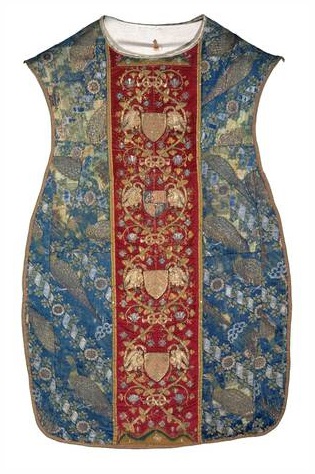
All of them repay close investigation; the more you look, the more you marvel at the fineness of the needlework and detail. For no special reason I ended up loitering by the The Butler-Bowdon Chasuble (1398 to 1420). On reflection I think it’s because there are no people in it. In the central vertical band the coats of arms are supported by swans holding each shield with their beaks. In the blue sections to either side, there are diagonal bands filled with what look like peacocks (?) alternating with floral bands decorated with what look like little white roses and a purple thistle (?).

The Butler-Bowdon Chasuble, 1398 – 1420

The Butler-Bowdon Chasuble, 1398 to 1420

It would have been good to confirm my guesses about these details; the wall labels aren’t as full as they could be, although there are a few large-print booklets available which give a bit more information. Presumably there is more in the book, but what you want is really a detailed explanation of the imagery and iconography of each item. For example, up either side of The Chichester-Constable Chasuble (below) there seems to be pairs of intertwining trunks sprouting leaves – are they vines? And they are punctuated at top and bottom with faces – What of? Demons? Lions? And why?

The Chichester-Constable Chasuble (ca. 1335-45) © 2016 The Metropolitan Museum of Art/Art Resource/Scala, Florence

The Chichester-Constable Chasuble (ca. 1335 to 1345) © 2016 The Metropolitan Museum of Art/Art Resource/Scala, Florence

All the human figures have that sweet medieval look. They are elongated. The top of the body is often swaying backwards with the neck and head bending forwards in a kind of counter-balance. The heads are simple/naive with strongly outlined eyes. Also, as in the example, above, the figures are often holding out their arms and hands in highly stylised positions, clearly pointing towards important incidents or making obviously significant gestures. Someone somewhere must have made a lexicon of these gestures which are clearly important but remain, to the uninstructed viewer, for the most part obscure.

 The Steeple Aston Cope (detail) (1310-40) © Victoria and Albert Museum, London

The Steeple Aston Cope (detail) (1310 to 1340) © Victoria and Albert Museum, London

This installation view of the exhibition shows a faded brown cope to the left, below it a reliquary containing a relic of St Thomas a Becket (looking a bit like a 1930s radio), at the back in the centre a scarlet cope with two stained glass figures above and to the right, with several brown orphreys hanging to the right of them, and in the foreground a case showing three medieval illuminated books demonstrating how similar patterns were used in medieval embroidery and illumination.

Installation view

Installation view

The cases showing how similar decorative motifs were used for secular clothes introduced me to a few new terms for items of clothing worn by knights and their horses:

  • horse trapper – a cloth covering laid over a horse or other animal for protection and decoration also known as a caparison
  • surcoat – a loose robe worn over armour
  • tabard – a sleeveless jerkin consisting only of front and back pieces with a hole for the head
Part of a horse trapper probably made for Edward III’s Court (detail) (1330-40) Photo © RMN-Grand Palais (Musée de Cluny – Musée National du Moyen Âge) / Franck Raux

Part of a horse trapper probably made for Edward III’s Court (detail) (1330 to 1340) Photo © RMN-Grand Palais (Musée de Cluny – Musée National du Moyen Âge) / Franck Raux

This is a rich and wonderful exhibition, full of detail and beauty and, above all, inspiring awe at the thousands of hours of humble patient hand work which went into creating each of these marvellous objects.

Advice

The beauty of the works is partly in the initial impact they make of sumptuousness and size (a cope is a big item of clothing). But mostly in the details and there are three problems here.

1. In something like the Syon Cope (top image in the blog post) I am not really clear what I’m looking for. I know how to read a painting. I don’t know how to read a medieval piece of embroidery. Some kind of guide to what to look for and enjoy in every piece would be extremely helpful.

In this respect the V&A has produced an excellent interactive page explaining details of The Butler-Bowdon Cope. I suppose it’s financially impractical, but in an ideal world every single one of the objects here would have just such a detailed guide to each of the figures, their histories, gestures, postures and meanings.

2. Understandably, the light is quite dim throughout to preserve these old fabrics. Also a lot of the detail is quite small. Not minute, just not very big. Ironically, I have enjoyed examining the detail of the dragons (above) and the angel on horseback playing a lute (three images above) more from these high-resolution photos on the V&A website, than when I was actually looking at them in real life.

My advice would be to read as much as you can about the exhibition on the V&A website and any reviews before you go, so that you’ve got a good idea what you’re going to see and which bits of it you are particularly interested in (the embroidery techniques and fabrics; the religious iconography; the floral and decorative designs; the histories of the noble families who often commissioned the works and whose coats of arms or heraldic symbols are woven into them, etc etc).

And consider taking a magnifying glass or pair of strong glasses so you can really enjoy the delightful details which the size and complexity (and the sheer number) of the designs sometimes obscure.


Related links

More V&A reviews

More medieval reviews