Noel Coward and imagination

Reflections on Noel Coward’s plays ‘Hay Fever’, ‘Private Lives’ and ‘Easy Virtue’.

We live in an age obsessed with gender, vide the ongoing furore about trans women, the ubiquity of feminist discourse, the prominence of LGBTQ+ activism, Pride Week etc etc. It floods the zone.

Much of this has been developed in academia over the past 50 years or slow and slowly spread outwards as graduates in various branches of critical theory progress to become artists, novelists, film-makers or take control of artistic institutions and media channels.

Queer theory

One sub-set of this has been the rise of Queer Studies as a degree subject in academia. According to Google AI:

Queer Studies is an interdisciplinary academic field that examines the social construction of gender and sexuality, challenging traditional and normative categories. It explores the diverse experiences of lesbian, gay, bisexual, transgender, and queer individuals, as well as exploring how gender and sexuality intersect with other social categories like race, class, and ability.

This has led over the last few decades to the application of Queer Theory, with is basic attitude of ‘challenging traditional and normative categories’, to all and every conceivable work of art or literature. Even if the author, artist or the subject aren’t explicitly queer, queer theory (like feminist theory, like structuralist and post-structuralist and semiotic and deconstructionist theory, like all the other critical theories) will find a way.

Coward was gay and since most of his work is about the troubled relations between the sexes, it is relatively easy to apply Queer Theory to all and everything he wrote, deconstructing and rewriting the overt characters and plots in his plays to accommodate the notion that they ‘challenge traditional and normative categories’. Predictably enough, the Wikipedia article on Private Lives feels obliged to include queer theory interpretations of the play:

In a 2005 article, Penny Farfan analyses the play from the point of view of queer theory, arguing that ‘the subversiveness of [Coward’s] sexual identity is reflected in his work’, and that Private Lives questions ‘the conventional gender norms on which compulsory heterosexuality depends’. Positing that the leading characters’ portrayal as equals is evidence in support of this theory, Farfan instances the famous image of [Noel] Coward and [Gertrude] Lawrence as Elyot and Amanda smoking and ‘posing as mirror opposites’… John Lahr in a 1982 study of Coward’s plays writes, ‘Elyot and Amanda’s outrageousness is used to propound the aesthetics of high camp – an essentially homosexual view of the world that justifies detachment.’

So far, so obvious and inevitable, and dated. Note how Lahr’s not very interesting suggestion that the two protagonists dramatise a form of high camp is over 40 years old, and Farfan’s flagging of its ‘subversiveness’ is 20 years old. These are old ideas.

The imaginative versus the dull

For the sake of argument, though, I am positing that the chief binary in his work was not between straight and gay; that Coward was not concerned with ‘questioning conventional gender norms’. That aim, as anyone who reads my art reviews knows, is pretty much the stock, standard and utterly predictable interpretation imposed by all art curators, and countless literary critics, on any artwork which deals even remotely with gender or in any way includes women.

Instead my reading of Coward prioritises what I see as the far more central and fundamental binary in his work, which is that between the Imaginative and the Dull.

Easy Virtue

‘Easy Virtue’ may well subvert this or that gender stereotype (yawn), interrogate this or that patriarchal trope (snore) but what on my reading, what it’s really about is the confrontation between a funny, confident, imaginative woman (Larita) and the appallingly slow, dull, dense and conventional Whittaker family. The play leads up to Larita’s extraordinarily fierce and sustained denunciation of the Whittakers for their narrow-minded, blinkered bigotry and prurient hypocrisy.

Hay Fever

In the same way, in ‘Hay Fever’, the four members of the Bliss family, despite their appalling behaviour, are each dominated by their penchant for imaginative fancies, the son and daughter and husband just as much as the obvious dominating figure, the melodramatic actress Judith. And their actorish imaginativeness, their exaggeration, speaking for effect, and liability to drop into actually acting out scenes from a play, remains almost incomprehensible to their guests (apart, admittedly, for the savvy Myra Arundel, who has their number).

Private Lives

And the same in ‘Private Lives’. A structuralist critic may point to the very neat structuring and mirroring of the plot, whereby the two couples act out almost the same scenes. A queer critic may point to the subversion of heteronormative conventions, or the way the play undermines (indeed blows apart) conventional notions of married fidelity.

But to me the leading binary is between Elyot and Amanda’s imaginative playfulness and the stiff, dim, unimaginativeness of their two new spouses. In fact the two main poles of the play are not so much Elyot and his former spouse, Amanda – but Elyot, given to free-associating whimsy at the drop of a hat, and Victor, who literally doesn’t understand what he’s talking about.

Elyot has a big stand-off scene criticising Victor’s obtuseness, but it’s more effectively left to the secondary figure of Sibyl to pinpoint Victor’s weakness:

VICTOR: Making stupid rotten jokes!
SIBYL: I thought what Elyot said was funny!
VICTOR: Well, all I can think is, is that you must have a very warped sense of humour!
SIBYL: That’s better than having none at all!
VICTOR: I fail to see what humour there is in incessant trivial flippancy!
SIBYL: You couldn’t be flippant if you tried until you were blue in the face!~
VICTOR: I shouldn’t dream of trying!
SIBYL: You must be awfully sad, not to be able to see any fun in anything!

‘It must be awfully sad not to be able to see the fun in anything.’ I take this to be Coward’s central position. He, in his glory years egged on by his collaborator and conspirator Gertrude Lawrence, wanted to have fun, let his imagination run riot, in frolics and fantasies, comic songs, revues and sketches, plays which didn’t care about realism or plausibility in their desire to make an impact and have an effect.

The queer sub-texts are there, often in plain sight. And no doubt he was subverting umpteen different conventions, we know he was because contemporary critics pointed it out: it’s obvious that showing women on the stage smoking, talking smut and getting drunk (‘Fallen Angels’) did breach contemporary conventions; that showing an unnaturally close mother and son (‘The Vortex’) did make a lot of contemporary audiences feel uncomfortable, that revealing a leading character to be a cocaine addict (‘The Vortex’ again) did shock audiences.

Yet to my mind, the fundamental position which underpins these individual assaults on the conventions of his day, was that of the Imaginative against the dull and narrow and conventional and conservative and conformist. On my reading ‘Easy Virtue’, although not one of the most popular and not often revived, is the central play, because all the other subversions the critics list (gender, queer, etc) are subsumed by or encompassed by the much bigger, more fundamental issue of the eternal struggle of the clever and sophisticated and imaginative against all the forces in society which try to keep them down. As Amanda says in ‘Private Lives’:

AMANDA: It wasn’t an innocent girlish heart, it was jagged with sophistication. I’ve always been sophisticated, far too knowing.

That is the problem Coward’s lead characters face: not that they’re straight or gay, but they’re just too damned clever, imaginative and sophisticated for the dull, narrow, hidebound society which surrounds them, is scared of them, and wants to stifle them.

So my contention boils down to this: the gay issue may for all I know have been very big, very important to Coward, and doubtless the plays abound in queer sub-texts often bubbling very close to the surface. But much bigger, much more obvious, much more defining, was his repeated depiction of the triumph of the liberated, unconventional imagination and the defeat of society’s stupid, unimaginative conventions.


Noel Coward reviews

Virginia Woolf’s introduction to Life As We Have Known It (1931)

David Bradshaw’s selection of essays by Virginia Woolf for the Oxford World Classics is divided into four thematic areas.

  1. Reading and Writing
  2. Life-Writing
  3. Women and Fiction
  4. Looking On

This blog post summarises one of the six essays in the third section, ‘Women and Fiction’, titled ‘Memories of a Working Women’s Guild’ (1931). For reference I list all 6 essays in the section. I reviewed the other five in a previous blog post. The essay is an introduction to a volume titled Life as We Have Known It: The Voices of Working-Class Women‘, and it inspired me to go and read the whole book, which I have reviewed separately.

  1. The Feminine Note in Fiction (1905) [book review]
  2. Women Novelists (1918) [book review]
  3. Women and Fiction (1929)
  4. Professions for Women (1931) [a talk]
  5. Memories of a Working Women’s Guild (1931) [introduction to a collection of letters]
  6. Why? (1934) [article for a student magazine]

5. Memories of a Working Women’s Guild (1931: 14 pages)

This is the longest and most complex essay in the section, at 14 pages. Well, maybe not complicated in structure, but complicated in 1) the eccentrically roundabout way in which Woolf addresses the subject matter and her own complicated responses to it, and 2) the multi-text nature of the book she’s introducing.

I’ll try to give a summary overview of the content, and then a description of my changing impressions as I read it through.

Summary

In 1931 Woolf was asked to write a preface to a collection of letters and photos written by members of the English Women’s Co-operative Guild and collected into a book titled Life as We Have Known It By Co-Operative Working Women. The Guild was founded as far back as 1883 and Woolf was commissioned by one of its co-founders, Margaret Llewellyn Davies. The book was to be published by Woolf’s own Hogarth Press, so it was very much an in-house project.

Woolf approaches the commission in a rather roundabout way and most of the introduction feels like a meandering digression. This is because she kicks off by describing two memories.

1) First of all, she casts her mind back to the annual Congress of the Guild she attended as long ago as 1913 and recalls, very vividly, being frustrated and bored. And also alienated by the fact that so many of the women speakers were solid working class and she found, to her dismay, that she had nothing in common with them, not even the language they spoke.

2) This is supplemented by a second memory, of going soon afterwards for a meeting with Davies at the head office of the Guild, in Hampstead, north London. Here Woolf raises the sense she had of being alienated from the predominantly working class membership of the Guild and frustration at not being able to break out of the prison of her class. She wishes the two classes of women could break through the class barriers, and simply share their experiences, talk and exchange experiences and ideas. But she fears that will never happen in her lifetime.

Although I’ve made it sound brisk and logical, that is not at all how it reads. I became quite irritated with Woolf’s alienated, detached self obsession, her inability to care about what any of the social and political issues the speakers at the Congress raised and discussed, her fatal tendency to drift off into her own world, focusing on what colour their dresses are, or inventing completely imaginary home lives for each of the speakers, rather than paying them the elementary respect of listening to what they were saying.

She tells us that it was at this point of the discussion in Hampstead that Davies opened a drawer and indicated the hundreds of letters she’d received from members of the Guild over the years, thanking her for giving them an opportunity to expand their horizons, to meet and talk and learn and gain the confidence to speak up and address political issues.

Woolf was immediately interested to read all these first-hand accounts and Davies promised to send them on but, for whatever reason, never did. Then the War came and a thousand other distractions and then the social confusion of the post-war period. So it was only years later that Davies got round to posting Woolf a big parcel packed with folders containing letters, notes and photographs from working class women, which she went through with fascination.

3) And this provides the third section of this little text, which is only three or four pages long but really vividly summarises the content of loads of those letters, one- or two-sentence summaries of the cramped, exploited, violent lives and abuse so many of these women suffered, for decades, for all their lives. It is shocking and sometimes harrowing evidence. Suddenly this short text bursts into colour, stops being about mimsy Virginia, becomes three-dimensional, acquires a completely different force from the idle, middle-class reveries which preceded it. It’s worth reading for this three-page summary alone.

These, of course, are some of the letters which were then included in the volume which Woolf was asked to write a preface to. Now the whole text comes full circle. Now you realise why she began with the apparently inconsequential and self-obsessed memories of attending the Congress. Crabwise, her introduction approaches the real core of the text – the working women’s experiences – so obliquely that when they arrive, the contrast with Woolf’s leisurely upper class existence – all opera and Shakespeare – is all the more shocking and dramatic.

So was it planned? Was this artful structuring? The self-description as a snobbish, alienated middle-class lady all a ploy to make the working class content, when it comes, more shocking? Or the much simpler result of Woolf’s artless self-absorption? Much the same question could be asked of her novels: to what extent they are artful constructions or, conversely, just the result of her letting her mind drift and then arranging the blizzard of details and sense impressions into a sort of order based grouped into a handful of characters and a vague plot…

Background

From the Yale Review archives is an introduction to this piece which must be out of date but is still useful.

These pages relating to the English Women’s Co-operative Guild are addressed to a former officer of this organization who had placed in Mrs Woolf’s hands a collection of letters written by its members. The Guild, which now has an enrolment of some 70,000 and is the largest association of its kind in England, was founded in 1883 to stimulate the ideas and activities of working women. It holds important annual Congresses, and it is of one of these which met at Manchester, in 1913.

We know the Yale text is out of date because it talks about the Guild in the present tense but we know that the Guild closed in 2016, according to the Co-operative Women’s Guild Wikipedia article.

No prefaces

This text is the Introductory Letter to a social history book called Life as We Have Known It By Co-Operative Working Women published by Woolf’s own Hogarth Press. She was actually invited to write a preface to the book by its editor, the founder of the Guild, Margaret Llewellyn Davies, but refused on principle, the principle being that a book should stand or fall by its content without loads of prefaces and other bric-a-brac surrounding it.

But you also quickly come to suspect it’s because Woolf couldn’t write that kind of thing. She couldn’t gracefully summarise the themes of a book, its content and the achievement of its author, that’s not how her mind worked. Not without subterfuge and artifice.

Instead of directly grappling with the content of the book or the issues it raises about working class women collaborating to improve their lives, Woolf starts by going off at a tangent. With characteristic solipsism, she approaches the book by asking what memories it prompts in her and goes on to share two in particular.

Out of her inability to concentrate, out of her tendency to lose track of what anyone’s saying, out of her tendency to drift off and look out the nearest window, daydreaming and noticing all kinds of inconsequential details, Woolf made a style, a magnificent style, a new approach to narrative which characterises her classic novels Mrs DallowayTo The Lighthouse, The Years and Between The Acts. In the context of essays which are meant to be about something, it can make for a frustrating read.

Scene 1. The 1913 Congress of the English Women’s Co-operative Guild

So Woolf whisks us to a hot June morning in 1913 in Newcastle where she attended a meeting of, presumably (it’s not really made clear) the Women’s Guild. She describes the hall and the people as if in a novel and describes a succession of women who’ve come from all over the country to make their 5-minute speeches. She namechecks the issues of the day:

  • reform of the divorce laws to allow women to petition for divorce
  • taxation of land
  • campaign for a minimum wage
  • the Trades Board Act
  • education of children over 14
  • complete adult suffrage

She namechecks them but, of course, she doesn’t go into them. You have to turn to Bradshaw’s notes at the back of the OUP edition to find out more about any of them. Instead Woolf glories in her superficiality, dwelling on the mustiness of the room and the appearance of the ladies. She candidly admits that all these political issues leave her ‘in her blood and bones, untouched’. And explains why – it’s a matter of class. Woolf isn’t really engaged in any contemporary politics because she is a comfortably off, middle class lady.

If every reform they demand was granted this very instant it would not touch one hair of my comfortably capitalistic head. Hence my interest is merely altruistic. It is thin spread and moon-coloured. There is no life blood or urgency about it. However hard I clap my hands or stamp my feet, there is a hollowness in the sound which betrays me. I am a benevolent spectator. I am irretrievably cut off from the actors. I sit here hypocritically, clapping and stamping, an outcast from the flock. (p.148)

This is the characteristic attitude of all her fictional characters: they all experience the sense of being outsiders, outside the conversations other people are having and, at their most delirious, of being outside their own lives, looking on. You can’t help thinking of her mental illness and repeated mental breakdowns.

Also Woolf is afflicted by a strong sense of what’s the point? None of these women or any of their resolutions will have any impact because it is 1913 and none of them have the vote. This one thought leaves her feeling ‘irritated and depressed’, as well it might, but with the rather more Woolfian threat of ‘boredom and despair’ lurking behind. See how it’s all about her, her and her mental problems?

So Woolf does what she always does and drifts away from the present and daydreams, fantasises, imagines the home life of some of the speakers, of Mrs Giles and Mrs Edwards, imagines the view from their windows (windows, that talismanic Woolfian image). In a pretty patronising tone she imagines what it must be like to be a working class woman, so very different from her own la-di-da habits of ringing up the opera to book tickets or lying in the garden enjoying sensitive reveries of Greece and Italy. Without speaking to a single working class woman she imagines their lives, and her position of irredeemable hauteur and snobbery comes out clearer and clearer.

Here is Virginia Woolf imagining the lives of the working class women of her time.

There were no armchairs, electric light, or hot water laid on in their homes, no Greek hills or Mediterranean bays in their lives. They did not sign a cheque to pay the weekly bills, or order, over the telephone, a cheap but quite adequate seat at the Opera. If they travelled it was on excursion day, with paper bags and hot babies in their arms.

They did not stroll through the house and say, that cover must go to the wash, or those sheets need changing. They plunged their arms in hot water and scrubbed the clothes themselves. In consequence they had thickset muscular bodies. They had large hands; they had the slow emphatic gestures of people who are often stiff and fall tired in a heap on hard-backed chairs.

They touched nothing lightly. They gripped papers and pencils as if they were brooms. Their faces were firm, with heavy folds and deep lines. It seemed as if their muscles were always taut and on the stretch. Their eyes looked as if they were always set on something actual—on saucepans that were boiling over, on children who were getting into mischief.

Their faces never expressed the lighter and more detached emotions that come into play when the mind is perfectly at ease about the present. They were not in the least detached and cosmopolitan. They were indigenous and rooted to one spot. Their very names were like the stones of the fields, common, grey, obscure, docked of all the splendours of association and romance.

Vivid enough, very vivid and persuasive, but at the same time so patronising and privileged. Back to the Congress, where Woolf dismissively reports that there were innumerable more speeches, exchanges of home-made jams and biscuits, songs sung and meals consumed, a new President elected, then it was over and everyone caught their trains home.

Scene 2. At the Hampstead headquarters of the English Women’s Co-operative Guild

If it wasn’t obvious before, it’s really rammed home why this text is called ‘Memories of a Working Women’s Guild’. In another writer’s hands this might involve memories of other people, of what they were like, what they said and what they achieved. In Woolf’s hands everything is always about her and her sensitive perceptions and concerns.

In the inconsequential way which you either find charming or irritating, according to taste, Woolf doesn’t remember the substance of any of the conversations she takes part in at the Hampstead headquarters – instead she remembers that the Guild’s secretary, Miss Kidd, was stout and fierce and dressed in a deep purple dress.

Nowadays, if you’re a man, you’re likely to be criticised for judging women purely on their appearance instead of their character, thoughts and achievements. Yet this is exactly what Woolf does. Lacking the mental ability or interest in what anyone says, it is appearance and quirks which appeal to her most consistently. Presumably she’d have said this is the novelist’s eye. Forget issues. Enjoy characters.

Miss Lillian Harris who, whether it was due to her dress which was coffee-coloured, or to her smile which was serene, or to the ash-tray in which many cigarettes had come amiably to an end, seemed the image of detachment and equanimity.

Had one not known that Miss Harris was to the Congress what the heart is to the remoter veins—that the great engine at Newcastle would not have thumped and throbbed without her—that she had collected and sorted and summoned and arranged that very intricate but orderly assembly of women—she would never have enlightened one.

She had nothing whatever to do—she came to the office because an office is a good place in which to read detective stories—she licked a few stamps and addressed a few envelopes—it was a fad of hers—that was what her manner conveyed. It was Miss Harris who moved the papers off the chairs and got the teacups out of the cupboard. It was she who answered questions about figures and put her hand on the right file of letters infallibly and sat listening, without saying very much, with calm comprehension, to whatever was said. (p.151)

‘She had nothing whatever to do’. Yes. Again Woolf repeats her troubled sense of class superiority to most of these working women.

To expect us, whose minds such as they are, fly free at the end of a short length of capital to tie ourselves down to that narrow plot of acquisitiveness and desire is impossible. We have baths and we have money. Therefore, however much we had sympathised our sympathy was largely fictitious. It was aesthetic sympathy, the sympathy of the eye and of the imagination, not of the heart and nerves.

This turns into a complaint about the way some of the working women who spoke at the Congress imitated and mocked the dainty speech of middle and upper class women. As you can imagine, Virginia didn’t like this, but she comes up with a principled reason. It’s because she found the working class speakers more authentic and real when they stuck to their own voices and concerns and despite the fact that ‘the range of expression is narrower in working women’.

So much does she like this authenticity that she wonders why they want to acquire money and become middle class and so lose the thing they have, their ‘contact with life’, ”facing facts’, ‘the teaching of experience’, call it what you will. Ah the bourgeois fondness for the dignity of labour, as long as it’s other people doing the labouring.

In among all this Woolf makes a claim which is so preposterously privileged it is laugh-out-loud funny, claiming that:

No working man or woman works harder with his hands or is in closer touch with reality than a painter with his brush or a writer with his pen. (p.152)

Yes, her sister, Vanessa, and all the Rogers, Quentins and Duncans in the Bloomsbury Group, they all knew far more about hard work than a coal miner! It’s precisely attitudes like this which gave the group its reputation for high-minded snobbery and condescension. And stupidity.

Woolf is painfully aware of being trapped in her upper-middle-class bubble, what she calls ‘shut up in the confines of the middle classes’. This first part of the essay records all the aspects of embarrassment and boredom and frustration which this plight triggers in her.

She finds many things to admire in ‘them’, these working class women, such as their robust sense of humour, their energy and, especially interesting for Woolf the writer, their way with words, the phrases which Shakespeare would have enjoyed (Woolf and all her characters endlessly invoke Shakespeare, in a thumpingly obvious way, as the absolute peak of poetic expression), their ‘shrewd sayings in the speeches at the Congress which even the weight of a public meeting could not flatten out entirely’ (p.153).

Finally she arrives at the frustrated wish that if only the classes could come together and remove the class barriers between them.

We are condemned to remain forever shut up in the confines of the middle classes wearing tail coats and silk stockings and called Sir or Madam as the case may be, when we are all, in truth, simply Johns and Susans.

And they remain equally deprived. For we have as much to give them as they us—wit and detachment, learning and poetry and all those good gifts which those who have never answered bells or touched their foreheads with their forefingers enjoy by right. But the barrier is impassable.

And nothing perhaps exasperated us more at the Congress (you [Davies] must have noticed at times a certain irritability) than the thought that this force of theirs, this smouldering heat which broke the crust now and then and licked the surface with a hot and fearless flame, is about to break through and melt us together so that life will be richer and books more complex and society will pool its possessions instead of segregating them… but only when we are dead. (p.153)

Which prompts the question, Have class barriers been removed in modern England, 90 years after Woolf wrote this, 112 years after the Guild Congress which prompted it?

My impression is that these class barriers have substantially loosened, are not as absolutely impassable as they were in Woolf’s day, but they still remain. The chavs on the council estate round the corner are a slightly threatening mystery to me as I, with my civil service job and interest in the arts, might be for them. I think. The real point is that I don’t know. To a large extent everybody else is a mystery to me.

And also the entire question of ‘class’ has been ruptured and recast by the huge immigration which has changed the nature of English society over the last twenty years. In 2021 63.2% of London residents identified with an ethnic minority group. People identifying with the White ethnic group are now in a minority in London.

I grew up in an England where the main divide was between the middle and working classes and so leaned towards socialist politics on behalf of the downtrodden. But the advent of progressive or woke politics – the rise and rise feminism, the revelation of a dazzling range of gender identities, alongside the immigration of hundreds of ethnic groups which all retain their ethnic identities and allegiances – has  massively confused the sociology of England and the old politics. No wonder it (the old two-party system) can’t keep up.

In my opinion these sociological changes have permanently fragmented what used to be called the Left, not only here but all across Europe, leading to the rise of right-wing populist parties. I don’t really judge any of these changes, I’m just observing what I consider to be the biggest social and cultural issue of my time, which presses fairly heavily on all of us, and so colours my readings of political or social writings from the past.

Back to Woolf, my point is that her worry about trying to break down barriers between the unknown white working class women and posh white ladies like herself who go to the opera and understand Shakespeare, these concerns now seem quaint and charming. Of historic interest. Like watching an Ealing Comedy. It is an issue from an England which has disappeared.

Her clarion cry to break down the barriers of class between women is fine and inspiring but I don’t know what they’d mean to the Kurdish hairdressers based in the Kurdish barbers I go to; to the till woman at Tesco from Ghana and Mauritius that I always chat to; to the wives of the Albanian builders who put up a new fence for me; to the Somali family or the Afghan family who live in the flats across from my place. Enjoying the blessings of Shakespeare? Most of them can barely speak English. I’m not saying that’s fatal. I’m just saying it restricts the relevance of Woolf’s discourse, these days, to an even tinier, bookish clique than it did in her day.

To summarise, Woolf feels that in this conversation at the Guild headquarters in Hampstead, she tried:

to describe the contradictory and complex feelings which beset the middle-class visitor forced to sit out a congress of working women in silence. (p.154)

Scene 3. The letters themselves

Apparently it was at this point in Woolf’s lament to Davies in the Hampstead headquarters, that Davies opened a drawer and indicated the many letters she had received from working women around the country. Woolf asked to see them but Davies, at that meeting, demurred. It was only years later, after the Great War, that she finally sent Woolf a packet of letters.

And here comes the radical transformation in the content and tone of the piece which I mentioned earlier. The simple unvarnished lives of these staggeringly poor women, the brutal conditions they grew up in, the childhood exploitation, the lives of unremitting labour garnished with the brutality of overseers, fathers and husbands, the horrors of childbirth, the lack of any healthcare, beggars belief.

Yet out of all these terrible stories, Woolf emphasises the positives, praising ‘that inborn energy which no amount of childbirth and washing up can quench’. The women describe lives packed with debilitating toil,  long hours working in fields and factories and domestic service, six days a week, with sometimes only a few hours free time each week, along with the struggle to support husbands, often ill or thrown out of work, and all the time raise numerous children, often going hungry in the process, worn out by stress and continual work, old and ill before their time.

And so, as I mentioned in my summary, the reader at last gets to the nub of the subject, the testimony of these many women and, as I suggested, realises that maybe the self-obsessed vapourings of the first half of the essay are intended as a deliberate contrast with the shocking lives depicted in the letters. Maybe. Or was Woolf that artful? Discuss.

Because of the in-your-face reality of these last few pages, this essay stands head and shoulders above the others. Maybe it’s just my old left-wing leanings being triggered, but I felt the essay only came to life with them and suddenly, from whimsical Woolfian sepia, changed into colour. Woolf, too, is thrilled by what she calls:

the extraordinary vitality of the human spirit. The dauntless energy which no amount of childbirth and washing up can quench

This is all very moving but, unfortunately, Woolf rather undermines herself, and in a characteristic way, which is that she in particular praises the women who made time in their wretched lives to read and to read the classics, which she then goes to the trouble of namechecking for us:

They read Dickens and Scott and Henry George and Bulwer-Lytton and Ella Wheeler Wilcox and Alice Meynell and would like “to get hold of any good history of the French Revolution, not Carlyle’s please,” and B. Russell on China, and William Morris and Shelley and Florence Barclay and Samuel Butler’s Note Books…

All true no doubt, and education begins with reading, but you can’t help feeling there’s something everso narrow about Woolf’s view of life. In her view the good life is reading the books she loves, the books she grew up reading in her father’s library, the same relatively short, restricted list of Great Books, Masterworks of the Spirit etc. Very narrow. Very limited.

Anyway, in the last pages she moves on to praise the work of the Guild and at this point the text morphs more into what you’d expect an introduction to be like, praising the work of the organisation it’s introducing.

It was the Guild that drew to itself all that restless wishing and dreaming. It was the Guild that made a central meeting place where formed and solidified all that was else so scattered and incoherent. The Guild must have given the older women, with their husbands and children, what ‘clean ground’ had been given to the little girl in Bethnal Green, or the view of day breaking over the hills had been to the girls in the hat factory. It gave them in the first place that rarest of all possessions – a room where they could sit down and think, remote from boiling saucepans and crying children… (p.157)

And she goes on to describe the growth of the organisation, its importance as a place where women could meet and share and think and develop their ideas.

And the force that lay behind their speeches was compact of many things—of men with whips, and sick rooms where match boxes are made, of hunger and cold, and many and difficult childbirths, of much scrubbing and washing up, of reading Shelley and William Morris and Samuel Butler, of meetings of the Women’s Guild, and committees and congresses at Manchester and elsewhere.

His final section which actually summarises the letters and the achievements of the Guild is as genuinely inspiring as Three Guineas is excoriating and anger-making. But again Woolf partly undermines what she’s saying, because she feels the (wholly unnecessary) need to pass literary judgement on these stories, lamenting their lack of literary finish like the crustiest of male critics.

The writing lacks detachment and imaginative breadth, even as the women themselves lacked variety and play of feature. Here are no reflections; no view of life as a whole; no attempt to enter into the lives of other people. It is not from the ranks of working class women that the next great poet or novelist will be drawn. (p.158)

It’s not only socially that Woolf was a snob, but in her very narrow, elitist view of Great Art. But she does condescend to comment that some of the accounts have the rude ‘accuracy and clarity’ of Defoe. In the midst of pontificating, she says something very, very symptomatic, she writes:

Writing is a complex art.

But is it? She would like to think so, but much of the great writing is not that complex. Worked over and elaborated, maybe, but not necessarily that complex. And the history of twentieth century literature since her heyday tends to demonstrate a steady simplification and de-complicating of literary writing, until our own day when much ‘literary’ writing is not, sentence by sentence, complex or difficult.

Here as in most of her writings, Woolf is judging others by her own standards and these standards are themselves a kind of aspiration to an ideal made up of a bunch of Victorian writers mashed together, Keats and Shelley and Lamb, into a vague icon of high Poetry and Truth. Her judging of the working class women’s writings says more about Woolf and her narrow idea of Literature than it does about the working class women.

This is characteristic of all her criticism. She doesn’t really engage with the meat and texture of the works under review, she tends to use them as pretexts to sound off about her hobby horses, to repeat her commitment to Poetry and Truth and hold Shakespeare up as the Great Model, time after time.

A Virago classic

I already knew that the book was published by Woolf’s own Hogarth Press, so there was a more than usually close connection between her and the book i.e. she was more than just an admirer of the Guild asked to write something, but the book’s publisher.

From looking on Amazon and Ebay I learned that Life As We Have Known It was one of the first books published by the feminist publishing house, Virago. So there are multiple layers of feminist history at work here: the women’s original personal experiences; the Guild which encouraged them to write about them; the collection of writings itself; the Woolf connection (publishing it and writing the introduction); and the Virago revival of it. It is quite a dense, multi-layered cultural artefact, then.

So I bought and read it and have reviewed the book as a whole, in a separate blog post.


Credit

‘Selected Essays of Virginia Woolf’ was published by Oxford World Classics in 2008. Most though not all of the essays can be found online. David Bradshaw’s introduction to the book can be read on Amazon.

Related links

Related reviews

Three Guineas by Virginia Woolf (1938)

Almost the same daughters ask almost the same brothers for almost the same privileges. Almost the same gentlemen intone the same refusals for almost the same reasons.
(The eternal patriarchy, skewered by Woolf in Three Guineas, page 147)

I think this long essay is Virginia Woolf’s most important book 1) for the subject matter itself 2) because it is a key which explains the attitudes and experiences of so many of the female characters in her novels.

First the basic fact that this long essay or pamphlet was originally conceived as an integral part of an experimental fiction. Wikipedia tells us that:

Although ‘Three Guineas’ is a work of non-fiction, it was initially conceived as a ‘novel–essay’ which would tie up the loose ends left in her earlier work, ‘A Room of One’s Own’ (1928). The book was to alternate between fictive narrative chapters and non-fiction essay chapters, demonstrating Woolf’s views on war and women in both types of writing at once. This unfinished manuscript was published in 1977 as ‘The Pargiters’. When Woolf realised the idea of a ‘novel–essay’ wasn’t working, she separated the two parts. The non-fiction portion became ‘Three Guineas’. The fiction portion became Woolf’s most popular novel during her lifetime, ‘The Years’, which charts social change from 1880 to the year of publication through the lives of the Pargiter family. It was so popular, in fact, that pocket-sized editions of the novel were published for soldiers as leisure reading during World War II.

‘Three Guineas’ is 127 pages long in the 2015 Oxford University Press version, compared to ‘A Room of One’s Own’s 83 pages i.e. half as long again. It is a far more serious, structured and well-argued book than its predecessor. It is also far more mocking and scornful of the many forms of sexism, chauvinism and misogyny current in 1920s and ’30s British society. It is far more angry and, in the final, third, section, far more radical.

Woolf did a lot of reading and research for it. Whereas ‘A Room of One’s Own’ has only a dozen or so footnotes, ‘Three Guineas’ has an entire section at the end devoted to extensive notes, references and quotations which make up 36 tightly printed pages in the OUP edition, some 124 notes in total, some as much as a page long.

These notes are well worth reading, in fact in one way they are more rewarding than the text itself. This is because they are extremely focused and to-the-point, whereas the text tends to demonstrate Woolf’s weaknesses: these include her own deliberate foregrounding of her own amateurishness and haphazard research; her temptation to wander off into lyrical passages, to paint a picture and populate her essays with fictional characters.

Most importantly, the overall premise of the essay (which is that she’s answering a series of letters from people who’ve written asking donations to their causes) and its structure – the way answering a pacifist’s request for her support leads into an extended and impassioned defence of women’s rights – these are sometimes hard to follow and can feel a little cranky. By contrast, her extended footnotes present the range, extent and impact of the anti-women animus of the patriarchy of her day with shocking clarity.

The essay is in three parts. Each part purports to answer a correspondent who’s written to Woolf asking for a donation to a good cause. After very extended, discursive and sometimes baffling arguments, Woolf ends each section by agreeing to give a guinea to their cause, but only on the basis of the conditions which she’s spent the section exploring. There are three parts, three causes and so three guineas. Neat.

Part 1. Women’s education

The master letter which gets the whole thing rolling and to which she returns throughout all three sections is a letter she’s received from a gentleman of her own class, a barrister, writing to ask Woolf ‘how can war be prevented?’

What the unnamed correspondent can’t have expected was that this apparently straightforward question would trigger this vast screed about the historic oppression of women throughout English history, described in such boggling details, and Woolf’s outraged calls for sweeping reform.

To kick off, Woolf explains that you can’t even begin to think about answering this question (‘how can war be prevented?’) until she has considered her place as one of a class and gender in a society which still restricts the education and life opportunities of millions of women like her.

First of all Woolf establishes the completely different ways of approaching and thinking about the issue  taken by men and women, which is caused by the enormous discrepancies in their life experiences. She points out that all the men of their (her and the letter-writer’s) class have enjoyed expensive private educations topped off at the universities of Oxford or Cambridge, whereas both these (private school, Oxbridge) have been denied all through history to all women of her class.

While the men of her class enjoyed what she jokingly refers to as Arthur’s Education Fund (AEF), the daughters were given little if any formal education. Their plight is symbolised by the ethnographer, writer and explorer Mary Kingsley (1862 to 1900) who complained that she received no education whatsoever except a little bit of instruction in German. Woolf quotes a letter:

‘I don’t know if I ever revealed to you the fact that being allowed to learn German was all the paid-for education I ever had. Two thousand pounds was spent on my brother’s…’

(As in ‘A Room of One’s Own’, these initial ideas or quotes, fairly innocuous or random the first time you read them – in this instance the contrast between the fortunes English middle class families lavished on ‘Arthur’s Education Fund’ and the pitiful amount grudgingly spent on Mary Kingsley – will be repeated again and again, until they acquire a kind of mythic status, coming to symbolise the grotesque gender inequalities of English society.)

So – Woolf explains to her correspondent – it’s because of this and countless other differences in upbringing, education and opportunity between the sexes that her response will be different from an educated man’s. She thinks this massive difference in educational opportunities and women’s exclusion from all-male institutions explain why an educated woman’s response to calls for patriotism, and to the patriotic cliché of calling England ‘the home of freedom’, will be very different from a man’s. It’s for the simple reason that most women, through most of English history, have been radically, drastically unfree.

Her correspondent’s suggested ways of opposing war

Woolf tells us that the (unnamed) writer of the letter to her has suggested three ways of opposing war:

  1. sign a letter to the newspapers
  2. join a pacifist society
  3. donate to the society’s funds

These seem laughably ineffectual to us, but Woolf takes them seriously and they in fact provide a structure for the whole essay.

Woolf’s blistering descriptions of the patriarchy

Possibly the main strength of the essay derives not from its sometimes confused, circular and even contradictory arguments (I try to give a critique of these shortcomings at the end of this review), but from Woolf’s vivid depictions of the plight of women, the numerous concrete examples she gives of women’s exclusion from so many elements of a patriarchal society, in the Victorian era through to her own day.

She starts by giving her innocent letter writer a basic explanation of women’s condition in 1930s England.

You [her male interlocutor], of course, could once more take up arms – in Spain, as before in France – in defence of peace. But that presumably is a method that having tried you have rejected. At any rate that method is not open to us; both the Army and the Navy are closed to our sex. We are not allowed to fight. Nor again are we allowed to be members of the Stock Exchange. Thus we can use neither the pressure of force nor the pressure of money. The less direct but still effective weapons which our brothers, as educated men, possess in the diplomatic service, in the Church, are also denied to us. We cannot preach sermons or negotiate treaties. Then again although it is true that we can write articles or send letters to the Press, the control of the Press – the decision what to print, what not to print – is entirely in the hands of your sex. It is true that for the past twenty years we have been admitted to the Civil Service and to the Bar; but our position there is still very precarious and our authority of the slightest. Thus all the weapons with which an educated man can enforce his opinion are either beyond our grasp or so nearly beyond it that even if we used them we could scarcely inflict one scratch. If the men in your profession were to unite in any demand and were to say: ‘If it is not granted we will stop work’, the laws of England would cease to be administered. If the women in your profession said the same thing it would make no difference to the laws of England whatever. Not only are we incomparably weaker than the men of our own class; we are weaker than the women of the working class. If the working women of the country were to say: ‘If you go to war, we will refuse to make munitions or to help in the production of goods,’ the difficulty of war-making would be seriously increased. But if all the daughters of educated men were to down tools tomorrow, nothing essential either to the life or to the war-making of the community would be embarrassed. Our class is the weakest of all the classes in the state. We have no weapon with which to enforce our will.

And:

Your class possesses in its own right and not through marriage practically all the capital, all the land, all the valuables, and all the patronage in England. Our class possesses in its own right and not through marriage practically none of the capital, none of the land, none of the valuables, and none of the patronage in England… Though we see the same world, we see it through different eyes.

Vivid and repeated descriptions of the extent, depth and power of the patriarchy in England.

Within quite a small space are crowded together St Paul’s, the Bank of England, the Mansion House, the massive if funereal battlements of the Law Courts; and on the other side, Westminster Abbey and the Houses of Parliament. There, we say to ourselves, pausing, in this moment of transition on the bridge [where she imagines herself standing], our fathers and brothers have spent their lives. All these hundreds of years they have been mounting those steps, passing in and out of those doors, ascending those pulpits, preaching, money-making, administering justice. It is from this world that the private house (somewhere, roughly speaking, in the West End) has derived its creeds, its laws, its clothes and carpets, its beef and mutton.

And from all of which, all women, through all of English history, have been excluded.

Shortcoming 1. Lack of analysis of the causes of war

However, quite early on you become aware of various shortcomings in her approach. One is that the entire essay is triggered by that question, ‘how can war be prevented?’, but Woolf gives no analysis of the causes for the momentum towards war in the 1930s. No attempt to describe the triumph of fascism in Italy and, especially, Nazism in Germany. She gives no sense of the economic and social causes of the war i.e. the crushing of the German economy after the Great War and the confiscation of so much German territory by the Allies, which undermined the viability of the Weimar Republic and led so many Germans to vote for extreme populist parties offering magical solutions to their impoverishment and humiliation.

War is seen as some great looming threat (which it obviously was in 1938) but her analysis almost entirely omits the fact that the threat comes from abroad, in order to focus on the role of the patriarchy in England. That’s what I meant by saying that her blistering account of women’s suppression sometimes sits oddly with the essay’s nominal subject.

Men, status and silly costumes

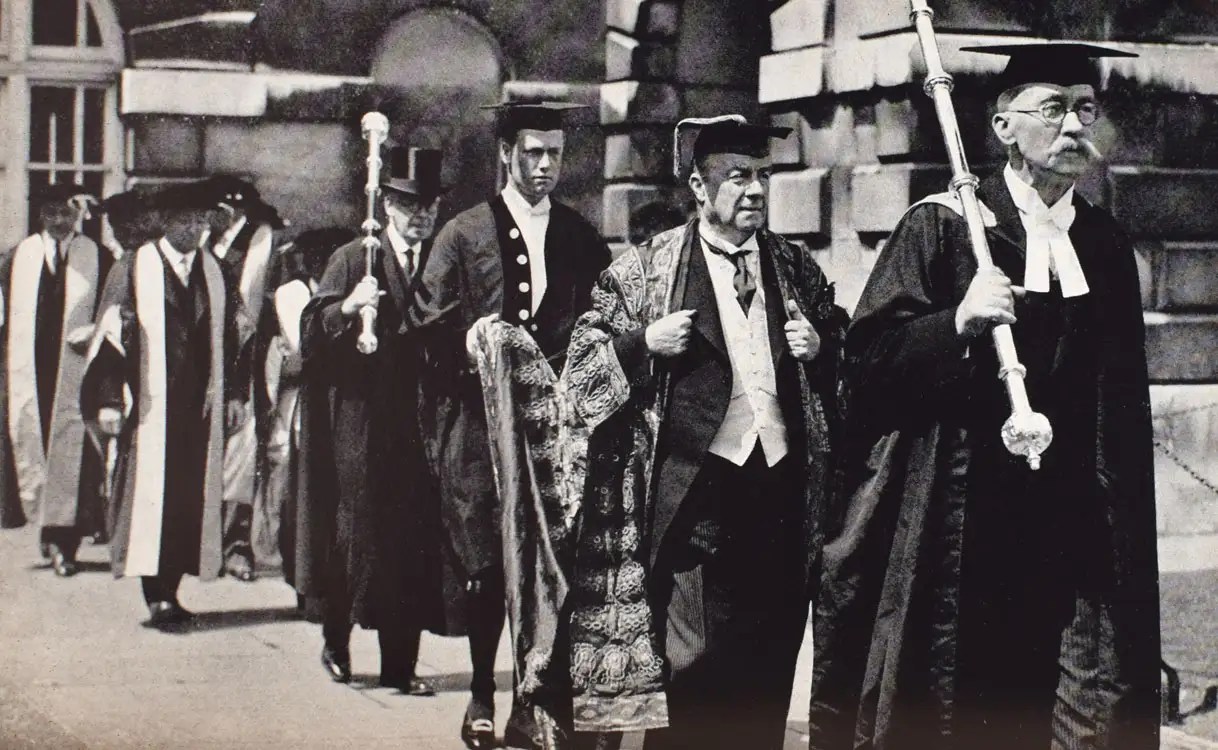
Nothing that intellectual. Instead Woolf digresses into a long and amusing passage about the ludicrous ceremonial outfits which many men wear on formal occasions or as part of their ceremonial roles (judges, Chelsea pensioners, officials in Parliament) and the medals and titles men give each other. In her opinion these are all designed to flaunt their superiority over others. The book includes four contemporary photos of contemporary men dressed in regalia at formal ceremonies and very silly they look, too.

A university procession, from ‘Three Guineas’

She makes a simple point: men down the ages have ridiculed women for being so concerned about their clothes and dress; well, just look at these preposterous old buffers in their wigs and gowns and cloaks and gaiters.

But there’s also a serious point which is germane to her war theme: for she suggests that it is this flaunting of hierarchy and status, this cursed male wish to be superior, which is one of the roots of war. And so she thinks a good way to prevent war would be to attack this cause at the root and refuse to accept honours (as she did) or take part in silly ceremonies (a point developed at length in section 3).

Shortcoming 2. Over-reliance on biography as her primary evidence

The limitations of her education partly explain Woolf’s over-reliance on biography as evidence. She shows little sign of having read much history, economics, science or engineering, philosophy, psychology or sociology – some, but not much, and when she cites history books it’s rarely for the economic or social data.

Instead, what she does rely on to an overwhelming extent is biographies: all the damning evidence she assembles to demonstrate British society’s engrained misogyny and the power of the patriarchy is rarely drawn from history or sociology but relies exclusively on biographies and autobiographies and letters. The phrase you get in so many book titles, ‘Lives and Letters’, sums it up exactly. As an indication of her reliance on biography, here are quotes from just on one page:

  • ‘The witness of biography — that witness which any one who can read English can consult on the shelves of any public library…’
  • ‘Biography proves this in two ways…’
  • ‘Of this, too, there is ample proof in biography…’
  • ‘The study of biography… proves…’
  • ‘Perhaps the greatest testimony to the value of education with which biography provides us is…’
  • ‘You will find, if you consult biography…’

No need to consult facts and figures, assess data, decipher manuscripts, spend years in the archives. Again and again she takes the biography of an eighteenth century bluestocking or a nineteenth century hack writer like Mrs Oliphant off the shelf, and finds and pastes into her narrative their complaints about their limited lives and the dire condition of women in their time, which suit her argument.

(She does mention some histories but, when you look closely you see that she picks out of her historical sources the lives and opinions of her women witnesses: in other words, she selects the biographical elements of history and ignores the statistics, data, political history and so on.)

Late in the essay, rather as she does with her claims to be an amateur, untrained in academic enquiry, she turns an apparent weakness on its head. She tells us that she relies so much on (a very limited view of) history, on biography and newspapers, because they are the only sources of information open to a woman who has been denied a better, higher education, because of her sex; for:

history, biography, and… the daily paper [are] the only evidence that is available to the ‘daughters of educated men’.

Her very lack of scholarly rigour is itself an indictment of the patriarchal oppression which kept her excluded from the higher education her brothers and millions of men had benefited from.

And newspapers

She regards newspapers as ‘history and biography in the raw’. The excellent introduction by Anna Snaith tells us that Woolf kept three scrapbooks in which she gathered evidence for this book. It is striking how many of these snippets and excerpts are taken from newspaper articles or magazines, not the most in-depth kind of research. Newspapers are, by their nature, selective and biased and superficial. They sensationalise in order to sell copies. They are, in other words, the opposite of academic research into history, sociology and so on. This is a weakness in her evidence base.

On the other hand, newspapers are topical and up to date and give her useful snapshot of contemporary opinion – which makes them very interesting for the causal reader, 90 years later. Here’s a sample of the sources, taken from the numbered list of references at the back, which shows the combination of biography and newspaper cuttings which she overwhelmingly relies on as evidence.

  1. ‘Personal Reminiscences of a Great Crusade’ / a cutting from The Herald
  2. a cutting from The Listener / ‘Reflections and Memories’ by Sir John Squire
  3. ‘The Life of Sophia Jex-Blake’ by Margaret Todd
  4. Letter to The Times
  5. Debretts
  6. ‘Life of Sir Ernest Wild, K.C.’ by R.J. Rackham
  7. Lord Baldwin, speech reported in The Times
  8. ‘Life of Charles Gore’ by G.L. Prestige
  9. ‘Life of Sir William Broadbent’ edited by his daughter
  10. ‘The Lost Historian, a Memoir of Sir Sidney Low’ by Desmond Chapman-Huston
  11. ‘Thoughts and Adventures’ by Winston Churchill
  12. Speech at Belfast by Lord Londonderry, reported in The Times

You get the picture: her main sources are lives, letters and newspapers.

The second letter: funding a women’s college

Since the essay is in three parts and the introduction says it addresses three letters, I thought it would be a part per letter, so I was surprised when the second letter pops up at the end of part one. It is from a women-only college writing to ask Woolf to contribute to their fund raising. Anna Snaith’s excellent notes tell us it was a real letter Woolf received from Joan Strachey, Principal of the women-only Newnham College in Cambridge, asking for a donation to renovate the college buildings.

Woolf shows with some doleful quotations and examples, how petty-minded, snobbish and fierce for their stupid rules and regulations the existing (men-only) universities are. She harks back to the notorious incident of being kicked off the grass by the beadle early in ‘A Room of One’s Own’, which clearly still rankles.

Therefore, she replies to this letter that she will consider contributing to a women-only college but only if it is drawn up on a completely different basis from the male colleges. She proceeds to lay out the principles for an experimental college, one which will eschew all competition and exams, be open to the poor, and teach the humanities in a spirit of openness and collaboration:

A place where society was free; not parcelled out into the miserable distinctions of rich and poor, of clever and stupid; but where all the different degrees and kinds of mind, body and soul merit cooperated. Let us then found this new college; this poor college; in which learning is sought for itself; where advertisement is abolished; and there are no degrees; and lectures are not given, and sermons are not preached…

She warns that if the women-only colleges model themselves along male lines, with all the snobbery and competition and status-seeking and petty rankings that entails… those are precisely the kinds of habits of thought, the endless seeking superiority, which create the war mentality and she will not contribute to it.

And no chapels. She is as vehemently against the all-women colleges having chapels as she is violently against the engrained misogyny of the Church of England.

No to teaching English literature

She has a fierce passage execrating the teaching of English literature and its packaging into classes and exams, which she describes as ‘vain and vicious’. This is why Woolf herself refused to accept honorary degrees or prizes, despite being offered many in the later part of her life, and turned down offers to lecture (the exception which proves the rule being the lectures which formed the basis of ‘A Room of One’s Own’).

Woolf explains women’s war patriotism as an escape from domestic oppression

In a wonderfully irrational peroration she thinks that it can only have been delirious joy at being released from the narrow, cramped, uneducated lives forced upon Victorian daughters and spinsters which explained the huge outburst of patriotic enthusiasm among women at the outbreak of the Great War in 1914.

So profound was her unconscious loathing for the education of the private house with its cruelty, its poverty, its hypocrisy, its immorality, its inanity, that she would undertake any task however menial, exercise any fascination however fatal that enabled her to escape. Thus consciously she desired ‘our splendid Empire’; unconsciously she desired our splendid war.

This is splendid rhetoric but it’s a symptomatic of her failure to understand the causes of war, her failure to understand the psychology of crowds and societies embarking on war, her failure to understand genuine feelings of patriotism or national pride which are such big motivators for large numbers of people in any country – in a nutshell, her failure to understand anyone outside her own narrow upper-middle-class milieu.

Shortcoming 3. Ignorance of the wider world

I think her failure to understand the patriotic zeal which accompanied the start of World War One is indicative of her broader failure to understand the range and complexities of human nature, of all human nature across all of society.

Of the narrow little world of upper-middle-class women whose lives are supported by fleets of nameless servants which allow them to pursue their tedious obsession with art and poetry, of this tiny privileged world, she was a brilliant painter.

Of the big wide world, of the thousands of occupations, jobs and livelihoods, in finance, business, economics, trade, law, science, technology and engineering, of the lives of the working classes with their labour in coal mines and iron works, building ships, sailing the oceans, building trains and cars, laying down telegraph cables – in other words, in almost all the wide world and its billions of inhabitants, she has little or no interest and makes no effort to understand.

As an artist, as a writer, it doesn’t matter. Her novels focus on her chosen terrain and are masterpieces. As an essayist, claiming to gather evidence in order to analyse large social issues, it is, to say the least, problematic.

Giving a guinea

Out of this rather convoluted flow of arguments, Woolf concludes that she ought to give a guinea to the building of the women’s college, because it was entrapment in the family home that led so many women to explode with patriotism upon the outbreak of war. Building a college for the public education of the same class will prevent that and so materially contribute to the prevention of war which, if you recall, was the aim proposed right at the start of the essay.

Part 2. The professions

How can we enter the professions and yet remain civilized human beings, human beings who discourage war?

Woolf says a woman like her has only one weapon at her command to use against war, ‘the weapon of independent opinion based upon independent income.’ Now she will try to use this to sway the men in the professions.

The pretext is another letter she has received, from a society supporting women in the professions, asking for another donation, this time to the support of hard-up professional ladies. For Woolf it begs the question why, 20 years after women were admitted to the professions (1919) so few have risen to the top rank and so many are hovering round the bottom.

Woolf’s answers are convoluted and involve replies to other letters and lengthy addresses to her fictional interlocutor, they but boil down to:

  • women have much shorter traditions of thriving in the professions and so lack the centuries-old networks of male patronage and preferral
  • there are no limits to educated men churned out by the public schools and major universities, whereas there are far fewer schools for girls, only four or five colleges for women, and even the numbers admitted to these are severely restricted (only 500 women students were permitted at Cambridge in her day)
  • exams in the professions advantage those who have spent their lives taking exams, i.e. privileged, privately-educated men, and bar women who have (as she shows) vastly less access to private education
  • the nearly universal sexism and misogyny found at all levels of English society

Sexism and misogyny

As mentioned above, the flow of Woolf’s arguments is sometimes hard to follow, especially when it feels like she’s twisting the flow in order to fit her broader feminist critique to fit the essay’s ostensible subject of how to prevent war – but what the essay indisputably does do is powerfully convey the deeply entrenched tentacles of the patriarchy in contemporary 1930s England. She presents a wealth of facts and figures about the systematic prevention of women being educated, getting jobs, entering the professions and so on.

In this second part, the essay builds up into a devastating demonstration of English society’s hair-raising sexism and misogyny. In the main text but especially in the extensive notes which illustrate it, Woolf gives extended quotes from a wide range of men in powerful positions expressing the most hair-raising prejudices and slurs. I can’t give brief quotations, you have to read the notes, and the extended stories she gives, of awful politicians, judges, professionals, writers and commentators taking every opportunity to demean and limit women.

Fascists and Nazis

Woolf cranks up the temperature a lot by comparing several terrible British chauvinists who pontificate that a woman’s place is in the home, with a quote from none other than Adolf Hitler saying the exact same kind of thing.

Herr Hitler and Signor Mussolini have both often in very similar words expressed the opinion that ‘There are two worlds in the life of the nation, the world of men and the world of women’; and proceeded to much the same definition of the duties.

The juxtaposition of the two explains in a flash why Woolf is so resistant to all male talk about patriotism and ‘our country’. In what possible sense is it ‘her country’ when the Archbishop of Canterbury and the editor of the Daily Telegraph hold identical views about women’s place in society as Adolf Hitler? The same point is made in one of the long notes:

‘My husband insists that I call him “Sir”,’ said a woman at the Bristol Police Court yesterday, when she applied for a maintenance order. ‘To keep the peace I have complied with his request,’ she added. ‘I also have to clean his boots, fetch his razor when he shaves, and speak up promptly when he asks me questions.’ In the same issue of the same paper Sir E. F. Fletcher is reported to have ‘urged the House of Commons to stand up to dictators.’ (Daily Herald, 1 August 1926.)

Why, Woolf asks, all this fuss about opposing dictators abroad when every level of British society supports domestic tyrants at home?

Pay for housework

Men work in the public realm and get paid, sometimes a small fortune, often for jobs of dubious worth. Women labour in the home to raise families and manage households and care for the elderly, all unpaid. So: women’s domestic work should be paid.

The work of an archbishop is worth £15,000 a year to the State; the work of a judge is worth £5,000 a year; the work of a permanent secretary is worth £3,000 a year; the work of an army captain, of a sea captain, of a sergeant of dragoons, of a policeman, of a postman – all these works are worth paying out of the taxes, but wives and mothers and daughters who work all day and every day, without whose work the State would collapse and fall to pieces, without whose work your sons, sir, would cease to exist, are paid nothing whatever.

I wonder who first originated this call? Mary Wollstonecraft in ‘A Vindication of the Rights of Woman’ (1792)? Certainly Friedrich Engels mentions it in his 1884 book ‘The Origin of the Family, Private Property and the State’. Anyway, Woolf makes a sustained case for it over many pages, 30 years before the issue was revived by second-wave feminists in the 1970s:

Note: I was a househusband for eight years. I did all the childcare, running children round to nurseries, playgroups, parties, doing all the shopping, cooking and cleaning, changing thousands of nappies, giving bedtime baths and so on, while my wife earned the family income. So I have lived experience of issues like this. It’s this lived experience which feeds into my scepticism about feminism, not as a theory (fine and dandy) but in practice (complicated and compromised). I met plenty of women who were extremely happy to pack in office work and become full-time mums and housewives, who loved looking after their young children, dressing them up, holding parties, dropping them at nurseries or infant school and going to meet girlfriends for lunch or coffee.

Then again, some didn’t. Some felt trapped and needed support, would have welcomed free or cheap childcare, or just wanted to go back to work which they found more fulfilling than hanging round playgrounds or hosting rooms full of screaming kids.

I had many conversations with scores of mums about how the state should provide cheap childcare, or if only companies would allow more flexible work based around school hours, if only housework was recognised and paid for like other forms of work, and so on and so on. Hundreds of conversations on these and related subjects, over years and years.

So my scepticism about feminism is not ideological or temperamental. It’s based on the lived experience of being a housekeeper and child-rearer myself, and talking to hundreds of women in the same situation. The problem is not the top-level slogans and demands, anyone can come up with catchy slogans and carry banners – “Wages for Housework” – it’s figuring out the practical policies and application: where would the money come from? How would it be paid out? Who defines ‘housework’? Like child benefit would it go to anyone caring for a child or be subject to conditions? How would you prove that you do the housework and don’t sub-contract this or that part to cleaners or nannies? etc etc.

The procession

Back to the Woolf on the professions. She gives a vivid description of the processions of all the professions through London’s streets to the centres of law, finance and so on and asks her women readers: do we, in fact, want to be part of this procession? Do we want to do the same jobs but for less pay and more condescension? Or do we want to strike out on our own and lead our lives differently?

The facts… seem to prove that the professions have a certain undeniable effect upon the professors. They make the people who practise them possessive, jealous of any infringement of their rights, and highly combative if anyone dares dispute them. Are we not right then in thinking that if we enter the same professions we shall acquire the same qualities? And do not such qualities lead to war? In another century or so if we practise the professions in the same way, shall we not be just as possessive, just as jealous, just as pugnacious, just as positive as to the verdict of God, Nature, Law and Property as these gentlemen are now?

She gives a number of quotes from lawyers, clerics and politicians complaining they lead a dog’s life, and have sacrificed all their pleasures and family time to their work. Do modern women want to rush into exactly the same kind of wage slavery?

Woolf wonders if we can turn to the lives of nineteenth century women in the professions to help us find a more humane way to have one of these high-powered jobs and live properly? No, because there weren’t any women in the nineteenth century professions. They weren’t allowed. Instead:

We find, between the lines of their husbands’ biographies, so many women practising – but what are we to call the profession that consists in bringing nine or ten children into the world, the profession which consists in running a house, nursing an invalid, visiting the poor and the sick, tending here an old father, there an old mother? – there is no name and there is no pay for that profession; but we find so many mothers, sisters and daughters of educated men practising it in the nineteenth century that we must lump them and their lives together behind their husbands’ and brothers’.

The validity of housework and child-rearing, again, and the long buried, unrecorded of the scores of millions of women who spent their entire lives doing it.

Giving the second guinea

All these arguments have been contained, rather confusingly, in a very long letter replying to the letter she received asking for financial aid for impoverished women professionals. Woolf sums up her position by saying she will send the letter-writer one guinea ‘on condition that you help all properly qualified people, of whatever sex, class or colour, to enter your profession’, and in addition ensure that women:

  • must earn enough to be independent
  • must not prostitute their brain to their profession
  • must refuse all prizes, medals and awards, and be content with obscurity
  • must rid themselves of religious pride, college pride, school pride, family pride, sex pride and those unreal loyalties that spring from them

These are obviously very strict, probably utopian conditions, as with her demand for a completely different type of college which ended section 1. But:

If you agree to these terms then you can join the professions and yet remain uncontaminated by them; you can rid them of their possessiveness, their jealousy, their pugnacity, their greed. You can use them to have a mind of your own and a will of your own. And you can use that mind and will to abolish the inhumanity, the beastliness, the horror, the folly of war.

Antigone saying No to male tyranny

Part two rises to a very powerful invocation of Sophocles’ play, Antigone. Woolf studied this when young and it stayed with her all her life as a powerful story of female resistance to male tyranny. In the era of Hitler and Mussolini it was more than ever relevant. She comes back to it later.

No risk because of exclusion

Woolf ends part 2 with a grand fanfare of irony, saying there is no immediate risk of women professionals losing their souls and working themselves to shreds so long as the laws of England hold their nationality so lightly, prevent them from working in many professions, limit the numbers who can attend university, and ensure that so many women continue to live in the tradition of neglect and contempt, living gruelling lives of unpaid work in dark patriarchal homes.

Part 3. The Outsider Society

The sarcasm and irony which have been present throughout the essay rise to a real anger and bitterness in this, the longest of the three parts.

Woolf reverts back to the original letter she was sent, the one from the unnamed male correspondent asking her how they can prevent a war, and she repeats his three suggestions, namely that we should:

  1. sign a manifesto pledging ourselves ‘to protect culture and intellectual liberty’
  2. join a certain society, devoted to certain measures whose aim is to preserve peace
  3. should subscribe to that society which like the others is in need of funds

Failure of the universities

She addresses these points one by one. First she is satirical about this idea of ‘protecting culture and intellectual liberty’. Isn’t this what the Great Universities have said they were devoting themselves to for centuries, the ones which have been teaching men these values and brutally excluding their sisters and daughters? Is the fact that these values now need such support from society an admission that all those centuries of learning have failed? And if they’ve failed, why should the impoverished, life-opportunity-deprived daughters and sisters suddenly rush to the help of their oppressors?

What is ‘culture and liberty’?

Anyway, what is this ‘culture and liberty’ the letter writer refers to? She knows what it isn’t. Characteristically, she turns to biography and uses the life of an author like Mrs Margaret Oliphant (1828 to 1897) who, after her husband died, churned out meretricious romances to support her children. Was this intellectual liberty? No, this was intellectual prostitution and Woolf angrily takes it as typical of the intellectual prostitution forced on so many women writers and artists who had to sell their souls and prostitute their art because of the patriarchy’s refusal to let them earn a living any other way.

So she mocks the letter writer’s suggestion that women, victims of centuries of repression, should suddenly rush to help the poor privileged men in their time of need. He wants her to join his pacifist society, does he? Well, no. The very word ‘society’ denotes the systematic exclusion of women from education and influence and power and money, so screw society.

The very word ‘society’ sets tolling in memory the dismal bells of a harsh music: shall not, shall not, shall not. You shall not learn; you shall not earn; you shall not own; you shall not – such was the society relationship of brother to sister for many centuries.

The Outsiders Society

She’s not going to join any boys’ club. Instead she proposes setting up a separate organisation, for women of her class and (lack of) education. It would be called The Outsiders Society. It would consist of educated men’s daughters working through their own class and by their own methods for liberty, equality and peace. Members would:

  • not fight
  • not work in munitions factories or nurse the injured
  • not encourage men to go and fight but maintain an attitude of neutrality, as fighting is a ‘sex characteristic which she cannot share’

She rises to real bitterness:

She will find that she has no good reason to ask her brother to fight on her behalf to protect ‘our’ country. ‘”Our country,”‘ she will say, ‘throughout the greater part of its history has treated me as a slave; it has denied me education or any share in its possessions. “Our” country still ceases to be mine if I marry a foreigner. “Our” country denies me the means of protecting myself, forces me to pay others a very large sum annually to protect me, and is so little able, even so, to protect me that Air Raid precautions are written on the wall [i.e. women are defenceless against modern warfare]. Therefore if you insist upon fighting to protect me, or “our” country, let it be understood, soberly and rationally between us, that you are fighting to gratify a sex instinct which I cannot share; to procure benefits which I have not shared and probably will not share; but not to gratify my instincts, or to protect either myself or my country. For,’ the outsider will say, ‘in fact, as a woman, I have no country. As a woman I want no country. As a woman my country is the whole world.’

Wow. Very powerful. Furthermore, The Outsider will cultivate complete indifference to male nonsense about patriotism, war and fighting. On the contrary, she will:

  • take no part in patriotic demonstrations
  • not take part in patriotic praise
  • absent herself from military displays, tournaments, tattoos, prize-givings and all such ceremonies as encourage the desire to impose ‘our’ civilization or ‘our’ dominion upon other people

The idea is that this ‘indifference’ will damp down patriotic fervour in those around her and thus, in a tiny way, help to avoid war.

All this makes a sort of sense. But it feels like twisting logic when Woolf goes on to assert a link between these anti-war steps and the positive demands of her feminist programme. The connection feels tenuous and forced. Because she now switches to say that in order for their opinion or actions to matter, the outsiders must push for a raft of feminist requirements, being:

  • they must earn their own livings
  • they must press for a living wage in their professions
  • they must create new professions in which they can earn a living wage
  • they must press for press for a money wage for the unpaid worker in her own class – the daughters and sisters of educated men
  • they must press for a wage to be paid by the State to the mothers of educated men

Make the state pay for housework

This last is vital because until she has complete financial independence, a wife is dependent on her husband for money and will follow his opinions and men are for war. Therefore, in order to create an influential bloc of educated women who are against war, this class must be given financial, and so intellectual, independence. Women must be paid by the State for their work as mothers.

And she tells her male interlocutor that this step – paying women for their housework – would also liberate husbands, because by sharing the burden of earning an income they would no longer be wage slaves, slaves to the rat race. It would have an enlightening and life-enhancing effect all round.

I gave my thoughts on this proposal earlier. It sounds great, and you can see her logic – that women can only be truly independent and free if they have their own income, separate from their father’s or husband’s – but how would it be implemented in practice?

I’ll just make the additional point that its recurrence here is characteristic of how key themes and suggestions recur throughout the essay, building up power through repetition and echoes, not unlike her technique in her novels.

Outsider demands

But she hasn’t finished with her demands. The Outsiders would:

  • not only earn their own livings but become so expert that their threat to down tools would have power and influence
  • when they have earned enough to live on they would earn no more i.e. not pile up obscene wealth
  • they would reject any profession hostile to freedom such as the arms trade
  • they would refuse to take office in any institution which pretends to respect liberty but actually restricts it, such as Oxford and Cambridge

Outsiders will eschew all the stupid costumes and ceremonies so beloved by men (see the section about silly ceremonials in part 1).

Outsiders will eschew ‘the coarse glare of advertisement and publicity’ and prefer to work in honest obscurity.

The secret society already exists

Wandering into thriller territory, Woolf suggests that this Outsider Society already exists but is secret and underground in its activities. Her very dubious evidence for this far-fetched claim is a clutch of newspaper reports of various women officials making comments against war, opposing arms manufacture and the like. From random quotes and newspaper clippings she based the existence of a secret society operating across English society. Is this an example of her sometimes utopian or far-fetched argumentation – or an example of her dry sense of humour? Difficult to tell.

Against the Church of England

Outsiders will:

  • fearlessly investigate and criticise public institutions they are forced to contribute to, such as the universities, but especially the Church of England
  • by criticizing religion they would attempt to free the religious spirit from its present servitude and would help, if need be, to create a new religion based it might well be upon the New Testament, but, it might well be, very different from the religion now erected upon that basis

Woolf’s attitude to the Church of England had already been indicated in the passage about cited above about Antigone where she writes that ‘Antigone’s five words are worth all the sermons of all the archbishops’, those five Greek words (they total 11 in the English translation) being:

‘Tis not my nature to join in hating, but in loving.’

Pages 196 to 202 give a scathing account of how Jesus Christ’s own admonition that his followers are equal which promised equality between men and women was denied by St Paul, who invented the idea that women must be veiled in church and not speak. This bigotry hardened over the centuries into a church which forbids any positions of power or influence in the most powerful and prestigious organisation in the land, to women.

With the result that the salary of an archbishop is £15,000, the salary of a bishop is £10,000 and the salary of a dean is £3,000. But the salary of a deaconess is £150; and as for the ‘parish worker’, who ‘is called upon to assist in almost every department of parish life’, whose ‘work is exacting and often solitary…’ and who is most likely to be a woman, she is paid from £120 to £150 a year.

It’s a pattern mirrored in all the other professions and walks of life: women excluded from all the prestigious, well-paid higher positions, and forced to undertake the most menial and poorly-paid jobs.

Psychoanalysis, anger and fear

One of Anna Snaith’s excellent notes tells us that ‘Woolf’s brother Adrian [Stephen] and his wife Karin were trained psychoanalysts and were crucial in disseminating Freud’s work in England.’ This is relevant because Woolf quotes at length from the Archbishops’ Commission on the Ministry of Women (1936) and in particular from the appendix written by Professor Grensted, the Nolloth Professor of the Philosophy of the Christian Religion in the University of Oxford.

This professor concluded that there is no reason in theology (Christ’s teachings) why there should not be women priests, but there were strong objections to women priests among the clergy. Digging deeper he uses Freudian terminology to suggest the deep conviction held by many men of men’s superiority and women’s inferiority.

The causes are obscure but the outcome is obvious: that whenever a conversation lights on the topic of equality for women and women holding roles up till now reserved for men, many man become angry and many women become fearful. This imbalance leads women not to raise, mention or discuss the issue which, as a result, goes underground.

The infantile fixation

Woolf takes from Grensted the notion of the ‘infantile fixation’. I didn’t quite understand this and I didn’t see her defining it anywhere. Instead she gives three examples of what she means (taken, inevitably, from biographies), namely the wildly irrational anger and jealousy triggered in three classic Victorian fathers when their daughters asked permission to get married or (worse than that) to get a job. The fathers being:

  • Mr Barrett (father of Elizabeth who wanted to marry the poet Robert Browning)
  • the Reverend Patrick Brontë (father of Charlotte who wanted to marry)
  • Mr Jex-Blake (father of Sophia who was offered a small sum for tutoring mathematics to a friend)

By contrast, to show the impact of a father’s liberality, she gives the story of Mr Leigh Smith. It’s worth quoting at length because the impact is in all the details. Smith had a daughter, Barbara, who he loved.

When Barbara came of age in 1848 he gave her an allowance of £300 a year. The results of that immunity from the infantile fixation were remarkable. For ‘treating her money as a power to do good, one of the first uses to which Barbara put it was educational.’ She founded a school; a school that was open not only to different sexes and different classes, but to different creeds; Roman Catholics, Jews and ‘pupils from families of advanced free thought’ were received in it. ‘It was a most unusual school,’ an outsiders’ school. But that was not all that she attempted upon three hundred a year. One thing led to another. A friend, with her help, started a cooperative evening class for ladies ‘for drawing from an undraped model’. In 1858 only one life class in London was open to ladies. And then a petition was got up to the Royal Academy; its schools were actually, though as so often happens only nominally, opened to women in 1861; next Barbara went into the question of the laws concerning women; so that actually in 1871 married women were allowed to own their property; and finally she helped Miss Davies to found Girton. When we reflect what one father who was immune from infantile fixation could do by allowing one daughter £300 a year we need not wonder that most fathers firmly refused to allow their daughters more than £40 a year with bed and board thrown in.

The difference just one liberal father made. What if all Victorian fathers had been like that.

Sexist science

There follows a passage giving some examples of how even contemporary science is twisted to prove the inferiority of women. To be honest this section is neither very compendious nor persuasive. She doesn’t really go into the most basic accusation against women, that their bodies are designed for childbirth and child-rearing and this explains why their minds are limited to domestic subjects and childish logic. (I’m not saying this, I’m repeating the sexist, misogynist accusation.)

This is a failing but I think reflects the limitations of Woolf’s knowledge and education. Of science she knows next to nothing and so is simply incapable of unpacking all the biological and psychological aspects of woman-hating. She is much more at home in her comfort zone of education and literature, the lives of women writers.

She cites Bertrand Russell pointing out the sheer sadism of much medical science towards women (the medical profession’s reluctance to provide painkillers to women in childbirth) or the twisting of scientific knowledge to justify male superiority – but not as amply as this huge subject demands.

Cleons

Instead she reverts to literature again, and her obsession with Antigone. In the play the oppressive father is Cleon, the archetype for the Victorian paterfamilias and the modern fascist. Here is Cleon speaking dictator-talk:

‘Whomsoever the city may appoint, that man must be obeyed, in little things and great, in just things and unjust… disobedience is the worst of evils… We must support the cause of order, and in no wise suffer a woman to worst us… They must be women, and not range at large. Servants, take them within.’

Order and the oppression of women, Mr Barrett and Mussolini.

The personal and the private

In the essay’s last pages she brings things together by (rightly) saying that she has shown how male tyranny in the personal, domestic realm and in the public realm, are intimately linked:

that the public and the private worlds are inseparably connected; that the tyrannies and servilities of the one are the tyrannies and servilities of the other.

Despite the strangeness of the letter-answering structure and the oddly digressive, rambling flow of the argument, by the end she has presented a devastating barrage of evidence, as well as making a host of demands and suggestions.

The third guinea

So she refuses to sign the form her correspondent had sent her. She refuses to sign up to his society because of her opposition to all such male bodies, but she will send him a guinea to support it.

Their aims are the same, to oppose the tyrants in the name of Justice and Equality and Liberty. But, as this amazing book has explained, as a woman, as the patchily educated ‘daughter of educated men’, as someone with completely different life experiences and, consequently, utterly different perspectives from the male sender of the letter, she shares the same aim but insists that she will try to bring it about using, not the old male forms and words, but new words and new ideas appropriate for women.

Magnificent

For all its faults, ‘Three Guineas’ is a magnificent, powerful and very persuasive piece of work. Her assembly of a very wide range of evidence, facts and figures really bring home the historical endurance, depth and wide range of the legal, financial and cultural oppression of women throughout English history and the stupid, patronising and misogynist attitudes and opinions deployed to maintain that oppression.

The notion of the Outsiders Society is the crystallisation of the massive theme which emerges repeatedly throughout the text, the idea that women – not because of any biological or psychological differences – but purely because of the legal, financial, professional and cultural apartheid they have suffered for centuries, bring to the table a different perspective from men across a whole range of issues.

I think it’s a magnificent example of a polemical essay, of an impassioned political pamphlet.

Criticisms

There are a number of problems or issues with Woolf’s way of arguing. Initially I included them in my review where they occurred but they cluttered up the flow of my review, and gave an unduly negative opinion too early on. I mentioned three earlier on. Here are a few more.

Shortcoming 4. Woolf’s intellectual confusions

Periodically throughout the text Woolf freely admits to own intellectual shortcomings: for example, right at the start she admits being bewildered that there seems to be a wide range of opinions about whether war is good or inevitable. She herself tells us that the more she reads, the more opinions she discovers, the more confused she becomes. But… is that not the point of being an intellectual: to read all the opinions, weigh the evidence, and develop your own line of argument, based on the evidence you uncover and reacting to other people’s arguments?

This activity, intellectual activity, always puzzles and confuses Woolf. In ‘A Room of One’s Own’ there’s the section where she orders up some books in the British Museum and opens them up, expecting to discover The Truth staring her in the face.

Sometimes this is part of her general mocking irony, mocking the pretensions of pretty much all male activity, including the grand Pursuit of Truth. But at other times it can give you the worrying sense that she doesn’t really understand what intellectual enquiry is.

Her intellectual confusion as evidence of her case

In the opening and then at various transition moments, Woolf explicitly tells us that she struggles to marshal the evidence, is embarking on something too big for her abilities, and wonders if she’d be better off abandoning it. After a while I realised that maybe these passages are designed to dramatise the issue of women’s exclusion from formal education by using herself as an example.

Woolf’s brothers went to top private schools and Oxbridge whereas she more or less had to educate herself at home and mostly taught herself by browsing through her father’s extensive library. In other words, every time she shares how confused by the evidence or daunted by the challenge of answering big question she is, she is demonstrating the effect of the grotesquely unequal education of the genders, how women have been the victims of ‘tradition, poverty and ridicule’, and showing the reader how she (and we) are suffering for it.

Maybe that’s why she flaunts her own intellectual limitations so much: the intellectual inability she frequently laments is the result of her exclusion from higher education. It makes her case for her.

Shortcoming 5. Her analysis is restricted to a (relatively) small class

Her lack of real confidence in her own research, and her need to make her feminist points as categorical and powerful as possible, explain why Woolf makes the strategic decision of restricting her analysis to a relatively small class, to women like herself, to ‘the daughters of educated men’, as she describes them. As she puts it:

Our ideology is still so inveterately anthropocentric that it has been necessary to coin this clumsy term – ‘educated man’s daughter’ – to describe the class whose fathers have been educated at public schools and universities. Obviously, if the term ‘bourgeois’ fits her brother, it is grossly incorrect to use it of one who differs so profoundly in the two prime characteristics of the bourgeoisie – capital and environment.

She makes it quite clear on page one that she is only discussing upper-middle-class women, women like herself, women with immaculate manners who are used to managing servants and know which of the many forks and spoons to use at a formal dinner.

In order to avoid the confusions, contradictions and conflicting evidence I mentioned above, in order for her analysis to work, she has to reject the vast majority of the population (the working class and lower classes, of both sexes) and identify her cause with just this numerically small and limited class of posh ladies.

It isn’t just me pointing this out. The Wikipedia article about Three Guineas tells us that the noted academic Q.D. Leavis wrote a scathing review of ‘Three Guineas’ soon after it was published:

She denounces the essay because it is only concerned with ‘the daughters of educated men’, seeing Woolf’s criticisms as irrelevant to most women because her wealth and aristocratic ancestry means she is ‘insulated by class’.

And Anna Snaith’s notes in the Oxford University Press edition tell us that Woolf received letters from working class women readers who complained about being left out of her analysis, notably a long semi-autobiographical one from a working class woman named Agnes Smith.

This is closely related to what I called shortcoming 3, ignorance of the wider world. But it’s also a decision. She found it hard enough gathering the evidence for the sexist discrimination against her own type and class of woman. If she opened it up to the broader middle and working classes she’d never have finished it.

2025: the perils of intersectionality

Many of these criticisms are mentioned in Anna Snaith’s introduction to the Oxford University Press edition. Here she indicates the larger cultural and political problems the essay falls foul of. This is that there are, nowadays, so many grievances, so many groups claiming to be victims, so many communities and identities who feel that they, too, have been subjected to centuries of oppression, that it is hard to focus on just one, and it is especially hard to focus on the group Woolf defines as the ‘daughters of educated men’.

As you read Snaith’s account of Woolf’s life and social circle, with so many friends among England’s political and cultural elite, the idea of her as a persecuted outsider feels more and more ludicrous. She wasn’t a Jew in Hitler’s Germany, a Black in the American South, a kulak in Stalin’s Russia, an Aborigine in Australia, she grew up in a house full of books which she was actively encouraged to read and went on to become a centre of London’s literary and artistic elite.

This doesn’t invalidate any of the points she makes in the book or detract from the essay’s tremendous power. It’s just to say that the struggle for women’s equality takes its place among quite a few other struggles. I’ve a book about the Irish Civil War on my desk and Irish nationalists have quite a story to tell about 1,000 years of British oppression. Her husband was a Jew who had his own story about the legal and financial persecution of Jews. Something similar could be said of England’s Roman Catholics, prevented by law from holding official positions. Or – a group close to my heart – England’s non-conformists, banned by law from holding any positions of authority for 300 years after the civil war. Citizens from India or any of the colonies we ruled for centuries might have a thing or two to say about Britain’s oppression of their peoples and cultures.

Being a modern academic, Snaith is contractually obliged to drag in slavery – the progressive topic par excellence – to her discussion of ‘Three Guineas’, on the rather tenuous basis that guineas were, apparently, first used as currency in the British slave trade. Don’t know what Virginia would have made of that scholarly leap of imagination.

To repeat – this little digression about the modern over-abundance of historical grievances is not entirely my view but simply expanding points made by the book’s editor, Anna Snaith, in her introduction.

All these other issues don’t invalidate any of the points Woolf makes in the book but they place it in a much larger, real world context. If you’re a feminist, you can insist that your cause and your history of oppression is the real one, the big one, the important one and, convinced of your righteousness, overlook or downplay the grievances of all the other groups I’ve mentioned. In a sense, to get anything done, you have to focus on your issues and grievances; nobody can represent the issues of the whole world. You have to pick your battles. And this explains why Woolf realised that, in order to get her book written, she had to concentrate just on relatively privileged upper-middle-class women like herself, on ‘the daughters of educated men’.

Conclusion

It’s a very powerful book. Very. To repeat what I said at the start, from one point of view it may be her most important work. It’s a bit of a struggle, a bit meandering, a bit puzzling in places, her proposals such as for the Outsider Society are a bit eccentric – and yet so many of her main points drive right home, and the evidence gathered in the notes at the end is searing, blistering, eye-opening. It shook this old cynic. It materially changed my views about feminism. I strongly recommend it.


Credit

‘Three Guineas’ by Virginia Woolf was first published by the Hogarth Press in 1938. Page references are to the 2015 Oxford University Press paperback edition, edited and annotated by Anna Snaith, although the text is easily available online.

Related links

Related reviews

A Room of One’s Own by Virginia Woolf (1929)

Literature is impoverished beyond our counting by the doors that have been shut upon women.

A pioneering work of feminism, Virginia Woolf’s long essay, ‘A Room of One’s Own’, was based on two lectures she was invited to deliver at Cambridge University in October 1928 on the subject of ‘Women and Fiction’. In fact the text as we have it was extensively worked over, and is divided into six, not two, sections. In the 1977 Granada paperback edition I own, it is 107 pages long, not quite book length but long for an essay.

Be warned: it gets off to a very, very slow start. Several times I put it down, bored and dismayed by the deliberately whimsical inconsequentiality of the opening section. It only really gets interesting with the start of section 3, about page 40, and from then on contains a steady flow of interesting, sometimes important, insights and ideas.

Section 1. A library, lunch and dinner in Cambridge (20 pages)

Summaries (Wikipedia, the blurb on the back) always quote ‘A Room of One’s Own’s eighth sentence as its most significant message:

A woman must have money and a room of her own if she is to write fiction.

She states this right at the very beginning of the text and then explains that she will try and convey the thought processes which led her to this conclusion. The trouble is that these processes are long-winded, deliberately whimsical and digressive, and slow to get started.

The odd or funny thing about this is that one of the oldest sexist libels against women is that they are incapable of logical, rational thought – and here is what is supposed to be one of the great feminist texts of the century apparently justifying that very libel, going out of its way to demonstrate Woolf’s reluctance to write clearly and logically, and her preference for apparently aimless, subjective rambling. Think I’m exaggerating? Here’s a slab from the second paragraph:

Here then was I (call me Mary Beton, Mary Seton, Mary Carmichael or by any name you please – it is not a matter of any importance) sitting on the banks of a river a week or two ago in fine October weather, lost in thought. That collar I have spoken of [the commission to deliver lectures about] women and fiction, the need of coming to some conclusion on a subject that raises all sorts of prejudices and passions, bowed my head to the ground.

To the right and left bushes of some sort, golden and crimson, glowed with the colour, even it seemed burnt with the heat, of fire. On the further bank the willows wept in perpetual lamentation, their hair about their shoulders. The river reflected whatever it chose of sky and bridge and burning tree, and when the undergraduate had oared his boat through the reflections they closed again, completely, as if he had never been. There one might have sat the clock round lost in thought.

Thought – to call it by a prouder name than it deserved – had let its line down into the stream. It swayed, minute after minute, hither and thither among the reflections and the weeds, letting the water lift it and sink it until – you know the little tug – the sudden conglomeration of an idea at the end of one’s line: and then the cautious hauling of it in, and the careful laying of it out?

Alas, laid on the grass how small, how insignificant this thought of mine looked; the sort of fish that a good fisherman puts back into the water so that it may grow fatter and be one day worth cooking and eating. I will not trouble you with that thought now, though if you look carefully you may find it for yourselves in the course of what I am going to say…

‘I will not trouble you with that thought now…’ Instead she rambles on to describe getting up and setting off walking across the grass. Here she is collared and her train of thought interrupted by an officious college beadle who tells her to keep off the grass and walk on the path. ‘What idea it had been that had sent me so audaciously trespassing I could not now remember’ and she doesn’t tell us.

Something makes her think about the essays of Charles Lamb, and she remembers the one where he comments on seeing a manuscript of the poem Lycidas by John Milton and marvelling that the great work was ever different from how it’s come down to us (from Lamb’s essay ‘Oxford in the Vacation’). Then she remembers that the manuscript of Lycidas is kept in Cambridge, so she sets off to the library where it’s kept (the library of Trinity College, Cambridge). Here she is outraged when a flunky tells here that ‘ladies are only admitted to the library if accompanied by a Fellow of the College or furnished with a letter of introduction.’ She turns away, angry and disgusted.

She hears the organ playing in a chapel, calling people – well, men, old men dressed in fur-trimmed cloaks and college gowns – to a service, which in turn triggers a sort of historical fantasy.

The outside of the chapel remained. As you know, its high domes and pinnacles can be seen, like a sailing-ship always voyaging never arriving, lit up at night and visible for miles, far away across the hills. Once, presumably, this quadrangle with its smooth lawns, its massive buildings and the chapel itself was marsh too, where the grasses waved and the swine rootled. Teams of horses and oxen, I thought, must have hauled the stone in wagons from far countries, and then with infinite labour the grey blocks in whose shade I was now standing were poised in order one on top of another, and then the painters brought their glass for the windows, and the masons were busy for centuries up on that roof with putty and cement, spade and trowel. Every Saturday somebody must have poured gold and silver out of a leathern purse into their ancient fists, for they had their beer and skittles presumably of an evening. An unending stream of gold and silver, I thought, must have flowed into this court perpetually to keep the stones coming and the masons working; to level, to ditch, to dig and to drain. But it was then the age of faith, and money was poured liberally to set these stones on a deep foundation, and when the stones were raised, still more money was poured in from the coffers of kings and queens and great nobles to ensure that hymns should be sung here and scholars taught. Lands were granted; tithes were paid. And when the age of faith was over and the age of reason had come, still the same flow of gold and silver went on; fellowships were founded; lectureships endowed; only the gold and silver flowed now, not from the coffers of the king. but from the chests of merchants and manufacturers, from the purses of men who had made, say, a fortune from industry, and returned, in their wills, a bounteous share of it to endow more chairs, more lectureships, more fellowships in the university where they had learnt their craft. Hence the libraries and laboratories; the observatories; the splendid equipment of costly and delicate instruments which now stands on glass shelves, where centuries ago the grasses waved and the swine rootled. Certainly, as I strolled round the court, the foundation of gold and silver seemed deep enough; the pavement laid solidly over the wild grasses…

You can see how it’s not really discussing the subject of ‘women and fiction’ nor explaining the thinking behind her ‘money and a room of her own’ conclusion.

Then, in the story of her day in Cambridge, it’s time for lunch. She thinks it a shame that traditional fiction rarely describes actual dishes people consume and so she goes out of her way to describe what she had for lunch.

I shall take the liberty to defy that convention and to tell you that the lunch on this occasion began with soles, sunk in a deep dish, over which the college cook had spread a counterpane of the whitest cream, save that it was branded here and there with brown spots like the spots on the flanks of a doe. After that came the partridges, but if this suggests a couple of bald, brown birds on a plate you are mistaken. The partridges, many and various, came with all their retinue of sauces and salads, the sharp and the sweet, each in its order; their potatoes, thin as coins but not so hard; their sprouts, foliated as rosebuds but more succulent. And no sooner had the roast and its retinue been done with than the silent servingman, the Beadle himself perhaps in a milder manifestation, set before us, wreathed in napkins, a confection which rose all sugar from the waves. To call it pudding and so relate it to rice and tapioca would be an insult.

She listens to the civilised talk at the table and feels like something has changed since the war. What is it? Well, poetry.

Before the war at a luncheon party like this people would have said precisely the same things but they would have sounded different, because in those days they were accompanied by a sort of humming noise, not articulate, but musical, exciting, which changed the value of the words themselves. Could one set that humming noise to words? Perhaps with the help of the poets one could. A book lay beside me and, opening it, I turned casually enough to Tennyson.

And she quotes a stanza from Tennyson and then one from Christina Rossetti, the idea being that the rhythms of these poets dictated how people spoke before the war but now, since the war, that rhythm has been lost. The thought makes her laugh out loud but when someone enquires why she’s laughing, rather than confess this rather frivolous idea, she instead points to a Manx cat, a cat without a tail, which she’s seen through a window walking across the college quadrangle. Left alone again, she continues about Tennyson and Rossetti:

What poets, I cried aloud, as one does in the dusk, what poets they were!

The old poets expressed feelings one was familiar with and so one hummed and declaimed them with confidence and happiness. Modern poetry is very different:

But the living poets express a feeling that is actually being made and torn out of us at the moment. One does not recognize it in the first place; often for some reason one fears it; one watches it with keenness and compares it jealously and suspiciously with the old feeling that one knew. Hence the difficulty of modern poetry; and it is because of this difficulty that one cannot remember more than two consecutive lines of any good modern poet.

For ‘the illusion which inspired Tennyson and Christina Rossetti to sing so passionately about the coming of their loves is far rarer now than then.’ Did the old poets sing under the influence of a beautiful illusion? Did the war strip away that illusion and show us the truth of human nature? Ah, what is truth, what is illusion? (the kind of rhetorical question which packs ‘The Waves’). The question sets her thinking, musing and daydreaming as she walks the road towards Headingley and is so distracted that she misses the turning she wanted to take to Fernham [Fernham is a fictional college, an amalgamation of the Cambridge colleges, Newnham and Girton].

Yes indeed, which was truth and which was illusion? I asked myself. What was the truth about these houses, for example, dim and festive now with their red windows in the dusk, but raw and red and squalid, with their sweets and their bootlaces, at nine o’clock in the morning? And the willows and the river and the gardens that run down to the river, vague now with the mist stealing over them, but gold and red in the sunlight – which was the truth, which was the illusion about them? I spare you the twists and turns of my cogitations, for no conclusion was found on the road to Headingley, and I ask you to suppose that I soon found out my mistake about the turning and retraced my steps to Fernham.

‘I spare you the twists and turns of my cogitations…’ she writes, but that, of course, is exactly what she is not doing. Surely any keen young undergraduate who turned up for her lecture (or bought this book) expecting some insight into the subject of women and fiction was expecting more than this. A long self-indulgent account of the author’s rambling day, complete with the full menu of the nice lunch she ate, and her strolling around the city? You might expect the lecture to eventually return to the nominal subject, but the most impressive thing about it is the way it refuses to address the subject at all. Instead she now tells us that her autumn rambling triggered a kind of vision of an autumn garden:

A fancy – that the lilac was shaking its flowers over the garden walls, and the brimstone butterflies were scudding hither and thither, and the dust of the pollen was in the air. A wind blew, from what quarter I know not, but it lifted the half-grown leaves so that there was a flash of silver grey in the air. It was the time between the lights when colours undergo their intensification and purples and golds burn in window-panes like the beat of an excitable heart; when for some reason the beauty of the world revealed and yet soon to perish (here I pushed into the garden, for, unwisely, the door was left open and no beadles seemed about), the beauty of the world which is so soon to perish, has two edges, one of laughter, one of anguish, cutting the heart asunder. The gardens of Fernham lay before me in the spring twilight, wild and open, and in the long grass, sprinkled and carelessly flung, were daffodils and bluebells, not orderly perhaps at the best of times, and now wind-blown and waving as they tugged at their roots. The windows of the building, curved like ships’ windows among generous waves of red brick, changed from lemon to silver under the flight of the quick spring clouds. Somebody was in a hammock, somebody, but in this light they were phantoms only, half guessed, half seen, raced across the grass—would no one stop her?—and then on the terrace, as if popping out to breathe the air, to glance at the garden, came a bent figure, formidable yet humble, with her great forehead and her shabby dress—could it be the famous scholar, could it be J—— H—— herself? [according to the notes, this is Jane Harrison, classical scholar and anthropologist] All was dim, yet intense too, as if the scarf which the dusk had flung over the garden were torn asunder by star or sword – the gash of some terrible reality leaping, as its way is, out of the heart of the spring.

But just when you thought she might be trembling on the brink of saying something clear, logical, rational and useful, she cuts away to… dinner! Yes she is in another college hall stuffing herself with a posh dinner.

Here was my soup. Dinner was being served in the great dining-hall. Far from being spring it was in fact an evening in October. Everybody was assembled in the big dining-room. Dinner was ready. Here was the soup. It was a plain gravy soup. There was nothing to stir the fancy in that. One could have seen through the transparent liquid any pattern that there might have been on the plate itself. But there was no pattern. The plate was plain. Next came beef with its attendant greens and potatoes—a homely trinity, suggesting the rumps of cattle in a muddy market, and sprouts curled and yellowed at the edge, and bargaining and cheapening and women with string bags on Monday morning. There was no reason to complain of human nature’s daily food, seeing that the supply was sufficient and coal-miners doubtless were sitting down to less. Prunes and custard followed. And if anyone complains that prunes, even when mitigated by custard, are an uncharitable vegetable (fruit they are not), stringy as a miser’s heart and exuding a fluid such as might run in misers’ veins who have denied themselves wine and warmth for eighty years and yet not given to the poor, he should reflect that there are people whose charity embraces even the prune. Biscuits and cheese came next, and here the water-jug was liberally passed round, for it is the nature of biscuits to be dry, and these were biscuits to the core. That was all. The meal was over.

To recap, it is one of the oldest sexist libels that women are incapable of abstract, logical thought and instead are limited to either a narcissistic obsession with the minutiae of their own lives, or, at best, with humble domestic topics such as cooking and gardening. In the opening sections of this book it seems as if Woolf is going out of her way to justify the grossest sexist libelling of the female mind? I was genuinely shocked by the self-centred, rambling set of inconsequential impressions and memories with which it opens.

And continues in the same vein. The college guests go back to the room of a friend of hers, a science tutor, where they open wine and gossip (first topic of conversation being someone who’s recently got married, as if she’s deliberately playing to the grossest stereotype of the female mind being continually obsessed with who’s going out with who, getting married to who, getting divorced from who). But this gossip doesn’t hold her and again she drifts off into her own personal fantasy.

A scene of masons on a high roof some five centuries ago. Kings and nobles brought treasure in huge sacks and poured it under the earth. This scene was for ever coming alive in my mind and placing itself by another of lean cows and a muddy market and withered greens and the stringy hearts of old men – these two pictures, disjointed and disconnected and nonsensical as they were, were for ever coming together and combating each other and had me entirely at their mercy. The best course, unless the whole talk was to be distorted, was to expose what was in my mind to the air, when with good luck it would fade and crumble like the head of the dead king when they opened the coffin at Windsor. Briefly, then, I told Miss Seton about the masons who had been all those years on the roof of the chapel, and about the kings and queens and nobles bearing sacks of gold and silver on their shoulders, which they shovelled into the earth; and then how the great financial magnates of our own time came and laid cheques and bonds, I suppose, where the others had laid ingots and rough lumps of gold. All that lies beneath the colleges down there, I said; but this college, where we are now sitting, what lies beneath its gallant red brick and the wild unkempt grasses of the garden? What force is behind that plain china off which we dined, and (here it popped out of my mouth before I could stop it) the beef, the custard and the prunes?

I thought it would go on forever like this but at the very end of the first section the tone does, at last, change and some sort of facts enter. She makes some kind of point. She abruptly describes the immense struggle it took the education pioneers Emily Davis and Barbara Bodichon to raise the money to found the first women’s college in Cambridge, Girton College, which was opened in 1869 (and where the lecture is being given).

And for the first time the essay comes to life and actually addresses the struggle for women’s rights. Woolf quickly lays down the reasons why it was so difficult to raise the money to establish this college for women’s higher education, namely:

1. In the mid-Victorian era women were considered baby factories. Woolf invents a fictional Victorian woman who had no fewer than 13 children, and this was physically exhausting and immensely time consuming. No wonder so many of their foremothers had no time or inclination for business or moneymaking activities of any kind.

2. The law forbade women from owning money or property. Any money they made, by law belonged to their husbands. What motivation was there, then, to set up in business, to found business dynasties and so on when, the moment you married, the entire thing was handed over to your husband? No motivation at all. Demotivation.

After throwing this bombshell of hard fact into her talk, Woolf returns to her earlier musing, meditative mode and describes walking back to the inn she was staying at, pondering the experiences of her day – being chastised by the beadle, being turned away from the library, watching all the crusty old men lining up to enter their church service – and reconsiders it in the light of the point she’s just made about women’s lack of legal and financial rights, ‘thinking of the safety and prosperity of the one sex and of the poverty and insecurity of the other.’

It’s only now that the rather dim reader (i.e. me) can see that there was a pattern to these ramblings after all: that all these ‘trivial’ personal experiences are designed to build up a portrait of a world where women are subject to an infinite number of regulations and restrictions, from the petty to the serious, life-limiting. And so, she wonders, what is the cumulative effect of so many restrictions on women’s minds and on the tradition of women’s writing?

What is the effect of tradition and of the lack of tradition upon the mind of a writer? She doesn’t quite say this but the implication is clear: that male writers benefited from every privilege possible in a patriarchal society, whereas women writers had to fight against a huge battalion of legal, financial, cultural, traditional enemies facing them at every turn.

She isn’t quite that vehement, but the thought is there, implied in everything she’s said. To be honest it was only reading the introduction to the Oxford University Press edition that helped me see that what comes over as a meandering stream of memories and impressions can be stripped down and turned into bullet points which are a list of exclusions which women have been subject to:

  • being told by a man to keep off the grass destroys her train of thought
  • being excluded from the library of the male-only college speaks for itself, a grotesque form of intellectual censorship
  • being excluded from the all-male congregation going into a church service stands for women’s exclusion from organised religion since time immemorial
  • and then something I hadn’t realised at all, the point of giving the menus, of describing what she had for lunch and what for dinner, was to contrast the fancy haute cuisine menu of lunch at the all-male college with the very plain meat and two veg, prunes and custard menu at Girton, the all-women college which struggled so hard to raise the money to be founded and which still lacks the massive endowments of the all-male colleges which, of course, stretch back to the Middle Ages

When rearranged and presented like this it makes for an impressive list and a handy if highly subjective introduction to the theme of how women in England have for centuries been excluded from business, finance, education and learning and culture. And some of these incidents (the officious beadle, the blocking from the library) return throughout the text, becoming leitmotifs and symbols standing for the greater wrongs of the patriarchy, exactly as she made fairly trivial childhood incidents become repeated leitmotifs which gained layers of meaning and emotion, in her experimental novel ‘The Waves’

But this wasn’t at all obvious from actually reading the text: I had to have it explained to me by the introduction to the Oxford University Press edition (by Morag Shiach).

Section 2. The British Museum, the patriarchy, her legacy (14 pages)

Section 2 starts off a little more as you might expect a lecture to, with a little fleet of rhetorical questions:

That visit to Oxbridge and the luncheon and the dinner had started a swarm of questions: Why did men drink wine and women water? Why was one sex so prosperous and the other so poor? What effect has poverty on fiction? What conditions are necessary for the creation of works of art?

Alas, it quickly falls back into Woolf’s facetious style. There is something about her continual irony, sometimes sarcasm, which continually makes you think she isn’t serious. Hedging everything with irony makes everything a playful game which, I suggest, undermines her own cause.

A thousand questions at once suggested themselves. But one needed answers, not questions; and an answer was only to be had by consulting the learned and the unprejudiced, who have removed themselves above the strife of tongue and the confusion of body and issued the result of their reasoning and research in books which are to be found in the British Museum. If truth is not to be found on the shelves of the British Museum, where, I asked myself, picking up a notebook and a pencil, is truth?

I’ve complained of a similarly irritatingly facetious tone in H.G. Wells and E.M. Forster. Maybe it was entertaining in its day, maybe it was the standard and expected style for fiction and essays. But now it comes over as irritating and stupid. Who cares about this silly little aside about ‘truth’? ‘What is truth’ is quite a big question. Writing such silly ironies makes her sound like precisely the stereotype of the superficial woman which she is meant to be at such pains to explode.

Thus provided, thus confident and enquiring, I set out in the pursuit of truth.

What this silly ironising about ‘truth’ really highlights is that Woolf had very little formal education and never studied for a degree. In other words, she doesn’t understand what academic study is. It is silly to think she can sit down for a morning at the British Museum, skim through half a dozen books and come up with The Truth about anything. But she hides her intellectual embarrassment behind these silly petticoat jokes and is very aware of her shortcomings. When the books she orders (almost at random) arrive:

The student who has been trained in research at Oxbridge has no doubt some method of shepherding his question past all distractions till it runs into his answer as a sheep runs into its pen. The student by my side, for instance, who was copying assiduously from a scientific manual, was, I felt sure, extracting pure nuggets of the essential ore every ten minutes or so. His little grunts of satisfaction indicated so much. But if, unfortunately, one has had no training in a university, the question far from being shepherded to its pen flies like a frightened flock hither and thither, helter-skelter, pursued by a whole pack of hounds.

She discovers there’s a huge number of books written by men about women, but hardly any by women about men. Characteristically, she makes a ‘perfectly arbitrary choice of a dozen volumes or so’ and orders them up from the library stacks. (Why does she take every opportunity to emphasise how arbitrary, flighty and superficial she is? It’s like she’s playing into the enemy’s hands at every opportunity. [Or, more subtly, is she demonstrating and embodying an alternative, non-male, non-rational, non-aggrandising way of thinking, letting thoughts wander and digress and reveal their own ‘female’ truths? Discuss])

Similarly, not knowing how to study a subject and not realising it might take more than a morning to research a subject like ‘the oppression of women’ or ‘women in British history’, instead she reads a random selection of books, randomly, and makes random notes in her notebook, which she then proceeds to read out to her audience. She might as well say ‘Look how stupid and badly educated I am.’

Instead of taking careful notes and marshalling them into some semblance of an argument, Woolf admits that she spent half the time doodling the face and figure of a big, hairy bombastic man, an angry professor, the type who writes weighty tomes about the inferiority of women. Then she starts wondering what made this (made-up) figure so angry – was it because his wife had run off with a dashing cavalry officer (‘slim and elegant and dressed in astrakhan’)? Is this frivolous or subtly effective, her turning serious social questions into deliberately frivolous fictions?

In my review of ‘The Waves’, I pointed out how the six characters are never shown interacting with each other, rarely if ever have any dialogue, but instead stand stiffly like actors on a stage, facing the audience and declaiming their solipsistic monologues. This stiff absence of any interaction made me look up the symptoms of Asperger’s Syndrome and discover that they displayed every single one.

Here, the inability to focus, concentrate or develop any train of thought without wandering off into daydreaming or doodling, which Woolf attributes to herself, made me look up the symptoms of attention deficit hyperactivity disorder (ADHD). They are:

  • difficulty paying attention or staying focused
  • being restless or overactive
  • interrupting others or having trouble waiting
  • poor time management
  • being forgetful
  • procrastinating
  • disorganization

It’s hard not to relate at least some of these symptoms to the self-portrait of the forgetful, easily distracted woman incapable of sustained research or thought which emerges from the opening sections of this book.

The patriarchy

Eventually she finds something to say. The one thing all the books she’s skimmed through written by men about women possess is the common tone of anger. Why are so many men angry at women and so quick to put them down? This is an absolutely vast question which invokes psychology, psychoanalysis, sociology and any number of other disciples.

but having briefly mentioned it, Woolf strolls off to find a restaurant to have lunch in. Here a previous diner had left the daily newspaper. She peruses it and finds more than she found in all the books, for she realises just how profoundly England is in the grip of a patriarchy.

The most transient visitor to this planet, I thought, who picked up this paper could not fail to be aware, even from this scattered testimony, that England is under the rule of a patriarchy. Nobody in their senses could fail to detect the dominance of ‘the professor’ [the angry caricature she doodled in the museum]. His was the power and the money and the influence. He was the proprietor of the paper and its editor and sub-editor. He was the Foreign Secretary and the judge. He was the cricketer; he owned the racehorses and the yachts. He was the director of the company that pays two hundred per cent to its shareholders. He left millions to charities and colleges that were ruled by himself…He it is who will acquit or convict the murderer, and hang him, or let him go free. With the exception of the fog he seemed to control everything.

The human (male) need to feel superior

And at last, a third of the way through the book, Woolf starts to say interesting things. She starts from the premise that life is a struggle for most people, that most people need to maintain illusions to make it bearable to carry on. One of the most widespread of these illusions is finding comfort in the idea that, whatever your situation, you are at least superior to some other group of people. A feeling of superiority allows you to maintain the illusion of purpose and achievement in your life.

Woolf speculates that maybe men need to feel superior to women in order to achieve all their great achievements. This explains many things. It explains why, when a woman makes a perfectly valid criticism of some man’s writing or painting or speech or whatever, men tend to over-react, becoming furious. It is because even a small criticism is an attack on the entire psychological system whereby men maintain what they like to think of as their superiority.

This, maybe, is one explanation for the otherwise incomprehensible anger of so many men against women.

Her aunt’s legacy

Then Woolf shares something profound and central to the book and its famous central thesis (‘A woman must have money and a room of her own if she is to write fiction.’)

Around the time (some) women were given the vote (the Representation of the People Act, February 1918) Woolf inherited a legacy from an aunt. It paid £500 a year in perpetuity. Woolf is interesting when she describes how this changed her whole view of the world. Until then she’d had to scrabble for an income via all kinds of menial reviewing jobs, almost all controlled and doled out by men. Now she no longer had to flatter or fear men. She slowly realised that she was completely liberated. Slowly this caused her to reconsider lots of things in society, starting with war itself, all the statues and guff about glory and so on. So much of it seemed like men justifying male behaviour.

The protected sex

The section ends with a new thought, that women have for centuries been ‘the protected sex’. What will happen when the social transformations of the 1920s work their way through, when women are allowed or encouraged to do any job, when women cease to be ‘the protected sex’? Who knows, maybe the fact that women, on average, live longer than men will itself change.

All assumptions founded on the facts observed when women were the protected sex will have disappeared – as, for example (here a squad of soldiers marched down the street), that women and clergymen and gardeners live longer than other people. Remove that protection, expose them to the same exertions and activities, make them soldiers and sailors and engine-drivers and dock labourers, and will not women die off so much younger, so much quicker, than men?

In the event, no. Women have for some decades being doing more and more of the jobs previously restricted to men, but it hasn’t dented the fundamental gender gap in life expectancy.

Life expectancy at birth in the UK in 2020 to 2022 was 78.6 years for males and 82.6 years for females. (Office for National Statistics)

Section 3. Women in history and literature (14 pages)

So she has gotten round to opening up some pretty massive issues (the patriarchy, male control, male anger, male jobs, social and economic changes of the 1920s).

The next section presents, on the face of it, another disappointment. Rather than dig deeper into these sociological issues, it feels like Woolf retreats to her comfort zone to talk about literature. To be precise, her focus suddenly shifts to the question of why there were no women writers during the Golden Age of Queen Elizabeth I?

Powerless in society, powerful in literature

To do so she makes a quick review of women in the literature of the ages and points out the paradox that, although throughout most of history women have been slaves and drudges, pawns in family marriages, entirely at the beck and call of fathers and husbands… yet the classic literature of the ages, all written by men, is thronged with women of dazzling power and agency, from the heroines of the Greek epics and tragedies, through Cleopatra and the strong women of Rome, through the leading figures in Shakespeare, Lady Macbeth, Viola, Portia. Why did societies which fiercely policed and repressed women (for example, ancient Greece) produce toweringly powerful figures of women in literature, poetry and plays?

Woolf relies heavily on the experts of her day and quotes the historian G.M. Trevelyan (1876 to 1962) and the classicist F.L. Lucas (1894 to 1967). It is instructive reading their prose next to hers i.e. theirs is full of intellectual meat and interesting views, whereas hers are much weaker, relying much more on poetic impressions of, for example, characters like Cleopatra, Lady Macbeth and Rosalind. The paradox of Greek women which I just summarised, in fact derives entirely from a man, Lucas.

Lack of knowledge of women in history

Still, she makes one Massive Point: this is that there is a pitiful absence of information about women’s lives before the eighteenth century. She directly addresses her audience of bright young women undergraduates at Girton and asks if none of them can devote their lives to the historical study of women’s lives. It would be fascinating to know if anyone in her audience (or who later read the book) was inspired to do just that.

A joke

Woolf’s works are conspicuous for their almost total lack of humour. There are few if any laughs in ‘Jacob’s Room’, ‘Mrs Dalloway’, ‘To The Lighthouse’, a humorous tone but no actual jokes in ‘Orlando’, and none in ‘The Waves’. She certainly never tells jokes with a witty punchline or outcome, just as she never tells ‘stories’. I’m not saying it’s easy. That’s why really successful comic writers are few and far between. So when something funny crops up it’s worth recording. This made me laugh out loud.

I thought of that old gentleman, who is dead now, but was a bishop, I think, who declared that it was impossible for any woman, past, present, or to come, to have the genius of Shakespeare. He wrote to the papers about it. He also told a lady who applied to him for information that cats do not as a matter of fact go to heaven, though they have, he added, souls of a sort. How much thinking those old gentlemen used to save one! How the borders of ignorance shrank back at their approach! Cats do not go to heaven. Women cannot write the plays of Shakespeare.

Shakespeare’s sister

Anyway, back to the central theme of this section which is the question why there are no women writers from the Golden Age of Elizabethan Literature.

To sketch an answer Woolf rather brilliantly invents a sister for Shakespeare, named Judith, and wonders what her life would have been like. In a nutshell, repressed and stifled at every turn, not sent to school, mocked by her parents, fleeing a loveless engagement by running away to London, where nobody would hire her as an actor let alone a playwright, she ended up becoming mistress to the theatre owner and, driven mad by frustration, killing herself.

How many thousands of other women, born with sparkling gifts and epic potential, Woolf asks, found themselves similarly stifled?

Whenever one reads of a witch being ducked, of a woman possessed by devils, of a wise woman selling herbs, or even of a very remarkable man who had a mother, then I think we are on the track of a lost novelist, a suppressed poet, of some mute and inglorious Jane Austen, some Emily Brontë who dashed her brains out on the moor or mopped and mowed about the highways crazed with the torture that her gift had put her to.

She suggests that many of the poems which have come down to us attributed to ‘Anon’ might well have been written by women given no admittance into the male domain of writing.

Having to use a man’s name

Even into the 19th century it lasted, with authors as big as Currer Bell (Charlotte Brontë), George Eliot (Mary Ann Evans), George Sand (Amantine-Lucile-Aurore Dudevant) being forced to pretend to be men.

Hard for men, impossible for women

Woolf goes on to describe the way that, since the time of Rousseau and his famous Confessions (1782) we have had more and more autobiographies and biographies and editions of the letters of great writers, and if one thing comes over it is how very hard it is to write a masterpiece.

But if hard for men, then impossible for women, who faced a barrage of opposition from everyone they knew, plus from their own personal doubts and hesitations. Any woman foolish enough to try and write was likely to be ‘snubbed, slapped, lectured and exhorted’ and she cites some mind-bogglingly sexist put-downs of women from the likes of Dr Johnson to Oscar Browning to even Desmond McCarthy, a friend of hers.

The history of men’s opposition to women’s emancipation is more interesting perhaps than the story of that emancipation itself.

Shakespeare had no psychological blockers

The thrust of this section is that Shakespeare was so complete a poet in part because he seems to have had no obstacles to encumber his self expression, obviously a debatable theory. She applies it to the many men we know who did struggle to find a room of their own, financial independence, acknowledgement and encouragement, to explain why even their work was often botched and compromised. And then applies the same theory to the majority of women writers, many of whom (she speculates) never got to write a thing, due to the lack of opportunities, the lack of education, and their asphyxiation by a life of endless childbirth, child-rearing, housework and husband tending.

Section 4. Historical women writers (19 pages)

Section 4 continues on where the last section left off, to give half a dozen quotes from the poet Ann Finch, Lady Winchelsea (1661 to 1720) which demonstrate how angry she was at the way women were mocked and held back in her day. Woolf’s point being that this is precisely the kind of psychological snag, the bitterness and resentment, which prevented many women’s self-expression being pure and complete, as in the hypothetical model of Shakespeare’s mind, pure and unblemished by doubt or resentment (in her theory/model).

Woolf goes on to lament that the voluminous writings of Margaret of Newcastle (1623 to 1673), who was never given the education, discipline or support, deteriorated into long rants and screeds. Then she moves on to praise the letters of Dorothy Osborne (1627 to 1695).

Aphra Behn

Next she moves on to (very briefly) discuss the career of Aphra Behn (1640 to 1689), by which point I’d realised that all this is by way of being a pocket review of the earliest English woman authors (it would be nice of this had been explained but rational structuring, ordering and introducing of her material is not, as we’ve seen, Woolf’s strong point).

Behn changed the rules of the game by making a successful living as a woman writer. She could be used as an example by the aspiring women writers of subsequent generations.

All women together ought to let flowers fall upon the tomb of Aphra Behn, which is, most scandalously but rather appropriately, in Westminster Abbey, for it was she who earned them the right to speak their mind.

And so, skipping ahead a bit, by the middle of the eighteenth century there were lots of women authors, churning out bad novels, unreadable poetry and thousands of essays about Shakespeare.

The advent of middle-class women authors

Woolf then alights on another key turning point: at the turn of the nineteenth century, middle class women began to write and she swiftly moves on to consider the Big Four, being: Jane Austen, Charlotte and Emily Bronte, and George Eliot.

Why did they all write novels, when the original motivator for literature was poetry? Because they all lived in the early nineteenth century drawing room, which was a kind of laboratory of character and conversation. Often they had no room of their own (aha) and so actually wrote in the communal living space, in the company of siblings and family and even visitors and guests.

Jane Austen’s perfection

Then she comes back to her theory of the lack of internal, mental, psychological blockage, especially regarding Austen. The anger and bitterness she finds in the 17th century women poets was entirely absent in Jane Austen.

Here was a woman about the year 1800 writing without hate, without bitterness, without fear, without protest, without preaching. That was how Shakespeare wrote, I thought, looking at ‘Antony and Cleopatra’; and when people compare Shakespeare and Jane Austen, they may mean that the minds of both had consumed all impediments; and for that reason we do not know Jane Austen and we do not know Shakespeare, and for that reason Jane Austen pervades every word that she wrote, and so does Shakespeare… Her gift and her circumstances matched each other completely.

Woolf compares Austen with Charlotte Bronte’s character, the governess Jane Eyre, who feels restless and confined and frustrated at wanting to live a larger life, and uses quotes from ‘Jane Eyre’ to indicate the pitiful limitations of these women’s lives.

All those good novels, Villette, Emma, Wuthering Heights, Middlemarch, were written by women without more experience of life than could enter the house of a respectable clergyman; written too in the common sitting-room of that respectable house and by women so poor that they could not afford to buy more than a few quires of paper at a time.

When put like that, it’s an amazing achievement. Woolf contrasts the pitifully restricted domestic experience of George Eliot with the florid adventures in life and love of the young Leo Tolstoy who, as a man, was free to travel widely, join the army, take up any profession. No wonder her (wonderful) novels are so constrained while his encompass the whole world.

Deferring to male values

Woolf makes an interesting point when she says that in so many of these women writers you can feel the subtle or not-so-subtle deferral to male values. Women writers feel they have to justify their subject matter because they are writing about ‘women’s matters’ in a world ruled by patriarchal values and judgements.

It is obvious that the values of women differ very often from the values which have been made by the other sex… yet it is the masculine values that prevail. Speaking crudely, football and sport are ‘important’; the worship of fashion, the buying of clothes ‘trivial’. And these values are inevitably transferred from life to fiction. This is an important book, the critic assumes, because it deals with war. This is an insignificant book because it deals with the feelings of women in a drawing-room. A scene in a battle-field is more important than a scene in a shop — everywhere and much more subtly the difference of value persists.

The whole structure, therefore, of the early nineteenth-century novel was raised, if one was a woman, by a mind which was slightly pulled from the straight, and made to alter its clear vision in deference to external authority. One has only to skim those old forgotten novels and listen to the tone of voice in which they are written to divine that the writer was meeting criticism; she was saying this by way of aggression, or that by way of conciliation. She was admitting that she was ‘only a woman’, or protesting that she was ‘as good as a man’. She met that criticism as her temperament dictated, with docility and diffidence, or with anger and emphasis. It does not matter which it was; she was thinking of something other than the thing itself… She had altered her values in deference to the opinion of others.

Fascinating. A really important insight. All the more impressive the achievement of Jane Austen and Emily Brontë to write as women write, without fear or favour or excusing themselves to men and their male values.

Male and female traditions

Then she devotes a few pages to the idea that male writers have a long tradition of male writers to fall back upon. Not just subjects and treatment but the flow of individual sentences. She quotes a sentence from the early nineteenth century and declares it a man’s sentence, with the weighty rhythms of male concerns. Then says this kind of heavy style was wholly inappropriate for women and what they wanted to say.

Lamb, Browne, Thackeray, Newman, Sterne, Dickens, De Quincey – whoever it may be – never helped a woman yet, though she may have learnt a few tricks of them and adapted them to her use. The weight, the pace, the stride of a man’s mind are too unlike her own for her to lift anything substantial from him successfully

In this respect, Jane Austen perfected sentences for women, ‘devised a perfectly natural, shapely sentence proper for her own use and never departed from it’ which explains why, though she had less genius for writing than Charlotte Brontë, she got infinitely more said.

Shorter books for women?

In the last paragraph of this section she speculates about women’s fiction of the future (much as she speculated about the death gender gap, earlier), and wonders whether women don’t require shorter books than men.

The book has somehow to be adapted to the body, and at a venture one would say that women’s books should be shorter, more concentrated, than those of men, and framed so that they do not need long hours of steady and uninterrupted work. For interruptions there will always be.

Section 5. Mary Carmichael (14 pages)

Mary Carmichael

The most striking feature of Woolf’s day is that women now write as much as men (or nearly) and upon an equally wide range of subject matter. She takes down from her shelf (ostensibly at random, which is her wont) a bang up-to-date novel, Life’s Adventure, or some such title, by Mary Carmichael. (The notes tell me that Mary Carmichael was a pen-name used by the family planning i.e. contraception campaigner, Marie Stopes (1880 to 1958).

At first she considers her style, which is thorny, unlike the flowing Jane Austen. Then the subject matter which she finds interrupted. But then she comes across a sentence which hits her like a hammer, ‘Chloe liked Olivia…’ and this triggers the thoughts which fill the rest of the section. For Woolf reflects how often women, in fiction by both men and women, are defined primarily by contrast with men. The notion that this novel will consider the secret and special tone of friendship between women strikes Woolf as opening a major new epoch in fiction. How much men’s fictions concern deep friendships between men, close bonding going back to classical times (Achilles and Patroclus). How very few are the works which have tackled the subject of friendship between women.

Women’s creativity

Woolf asserts that women have a special type of creativity. Literature has been greatly impoverished for rejecting and ignoring it. As testimony witness the many Great Men who have freely admitted the need of women’s company, the company of wives or close women friends, in order to shed a different perspective on their thoughts and endeavours, to refresh and renew them (she singles out Dr Johnson’s friendship with Hester Thrale).

Women have been trapped indoors by so many societies that interiors, rooms, have a special feminine power undetectable by men.

Departing a little from conventional feminism, maybe, she says it would be a great pity if modern women just started writing like men. It is vital that women maintain their difference.

It would be a thousand pities if women wrote like men, or lived like men, or looked like men, for if two sexes are quite inadequate, considering the vastness and variety of the world, how should we manage with one only? Ought not education to bring out and fortify the differences rather than the similarities? For we have too much likeness as it is…

Women writers like Mary Carmichael should not only record the obscure lives of lower middle class and working women, they also have large scope on reporting on the deficiencies of men. God knows men have been writing libels about women’s imperfections for millennia. Now, with more women writers than ever before, freed to write more candidly than ever before, about the strangeness and peculiarity of men.

The result is bound to be amazingly interesting. Comedy is bound to be enriched. New facts are bound to be discovered.

Woolf concludes, rather patronisingly, that given a room of her own and £500 a year, Mary Carmichael might, in another hundred years, be a decent writer.

Section 6. (17 pages)

Out the window

The pressure drops off. Woolf reverts to her fiction manner. She looks out of the window at busy London and marvels that none of the passersby gave any indication of caring for the plays of Shakespeare or the future of women’s novels. Moments like this make you think very badly of Woolf. She comes across as a simpleton. In the manner of her novels she observes different people doing things and invests them with tremendous significance as if that, just doing that, is the same as writing a story or narrative. When she writes:

The mind is certainly a very mysterious organ, I reflected, drawing my head in from the window, about which nothing whatever is known, though we depend upon it so completely

I felt pity for her shallowness, for her uneducated, unintellectual falling-back on the lamest clichés.

Male and female parts of the mind

She watches a couple meet on the corner of her street and get into a taxi. This leads to a sequence of doodling and pondering in which she wonders whether all of us have a male part and a female part of our minds and that we are at our best when they are integrated and in balance. This echoes Freud’s theory of the fundamental bisexuality of the psyche and Jung’s theories of the ‘anima’ or feminine aspects within a man and the ‘animus’ or masculine aspects within a woman, meaning that every individual contains both masculine and feminine qualities within their unconscious mind, regardless of their gender. Except that both of them were professional psychologists and Woolf is a writer looking out a window and having some random thoughts.

Characteristically, her mind goes to Shakespeare, her go-to author in every situation, who she praises for being genuinely androgynous, containing what she calls the man-womanly and the woman-manly equally.

She makes the rather startling claims that ‘No age can ever have been as stridently sex-conscious as our own’ and blames it on the suffragettes whose sustained campaign against the patriarchy forced millions of men to reflect on their masculinity and rush to defend it.

Masculine writing

She takes down a book written by a contemporary male author and finds it a relief after living with women writers for the past few weeks:

It was delightful to read a man’s writing again. It was so direct, so straightforward after the writing of women. It indicated such freedom of mind, such liberty of person, such confidence in himself. One had a sense of physical well-being in the presence of this well-nourished, well-educated, free mind, which had never been thwarted or opposed, but had had full liberty from birth to stretch itself in whatever way it liked.

But then she slowly realises she doesn’t like something about it. It is the tone of strident self-assertion. He uses ‘I’ at absurd length. The women’s movement has triggered a counter-reaction.

The limitations of modern masculine writing

And she develops this further by considering the writing of Rudyard Kipling and John Galsworthy. The sex awareness she mentioned a moment ago, this means that these modern writers write with just the male part of their minds.

Virility has now become self-conscious—men, that is to say, are now writing only with the male side of their brains. It is a mistake for a woman to read them, for she will inevitably look for something that she will not find.

Shakespeare, Coleridge, they wrote out of a type of mental androgyny: their writings feed both sexes. Modern male writers have become sex-aware and polemically masculine and so their writings leave the female reader cold.

It is not only that they celebrate male virtues, enforce male values and describe the world of men; it is that the emotion with which these books are permeated is to a woman incomprehensible… all their qualities seem to a woman, if one may generalize, crude and immature.

Fascism

In a surprising move – because her works give so little sense of being aware of the wider world, the world outside her privileged flow of sensations and impressions – she suddenly mentions Fascist Italy. In her place and time, October 1928, Fascist Italy is an absurd over-exaggeration of the masculine. It seems like a mad over-reaction to the (relative) modern liberation of women: ‘For one can hardly fail to be impressed in Rome by the sense of unmitigated masculinity.’

A balance

The best writers balance the gender elements in the mind, are man-womanly or woman-manly, approach a state of androgyny.

One must turn back to Shakespeare then, for Shakespeare was androgynous; and so were Keats and Sterne and Cowper and Lamb and Coleridge. Shelley perhaps was sexless. Milton and Ben Jonson had a dash too much of the male in them. So had Wordsworth and Tolstoi. In our time Proust was wholly androgynous, if not perhaps a little too much of a woman.

As you can see, this suffers, like so much older writing about gender, from the kind of essentialism which later feminists like Simone de Beauvoir criticised. Gender essentialism is:

‘the belief that gender is a biological, innate, and unchangeable quality that determines how men and women behave. It’s based on the idea that there are distinct qualities that make men and women different, that women are naturally caring and maternal while men are naturally aggressive and competitive.’

By basing so much of her critique on a very basic belief in masculine and feminine parts of the mind Woolf is, by definition, employing gender stereotypes which more contemporary feminists would (I think) reject.

Coda: addressing criticisms

That’s it. Her presentation is over. She hopes she’s achieved her aim of demonstrating why, in order to write freely, a woman needs an income of £500 a year and a room of her own, preferably one with a lock. She anticipates criticisms:

1. Is she going to appraise the relative merits of male writers and female writers? No. Nothing could be more puerile or pointless.

So long as you write what you wish to write, that is all that matters; and whether it matters for ages or only for hours, nobody can say.

2. Isn’t she being too materialistic with this emphasis on £500 a day? Isn’t the great artist or poet happy to be penniless? No. This also is a puerile delusion. Intellectual achievement depends on financial independence, always has, always ill. Which is also why there have been so few women writers. Because so few women have had the material independence which permitted intellectual achievement.

3. Why this focus on fiction, it sounds hard to write and profoundly unrewarding? This is correct. She advises her audience of young women to write about anything.

I am by no means confining you to fiction. If you would please me—and there are thousands like me—you would write books of travel and adventure, and research and scholarship, and history and biography, and criticism and philosophy and science. By so doing you will certainly profit the art of fiction. For books have a way of influencing each other. Fiction will be much the better for standing cheek by jowl with poetry and philosophy. Moreover, if you consider any great figure of the past, like Sappho, like the Lady Murasaki, like Emily Brontë, you will find that she is an inheritor as well as an originator, and has come into existence because women have come to have the habit of writing naturally; so that even as a prelude to poetry such activity on your part would be invaluable.

All women’s writing, on any topic, supports and enables all other women’s writing. As to the future, be yourselves.

It is much more important to be oneself than anything else.


Thoughts

My main impression from reading Woolf’s long-winded and cumbersome historical entertainment, ‘Orlando’, was the way Woolf completely avoided discussion or even mention of all the political, cultural, economic, social, religious, scientific and technological controversies, discoveries and developments which took place during the 340 or so years which the narrative covers. Instead she fills page after page with her protagonist’s vapourings about love, love and poetry, poetry and truth, poetry and love, truth and love, until you want to bang your head against a brick wall.

On the handful of occasions when she tried to address even subjects close to her own heart, like the literary achievements of the Elizabethan poets (Shakespeare, Marlowe) or the Augustans (Dryden, Pope, Swift) Woolf demonstrated beyond a shadow of a doubt that she had absolutely nothing of any interest to say about any of them. I was, frankly, astonished that this long book, which I’d read so many proud claims about for decades, turned out to be such an intellectual desert. Surely she can do better than this, I thought.

‘A Room of One’s Own’ proves that she could, up to a point. Summaries of the book’s main points don’t really convey the reading experience, which is of being subjected to Woolf’s deliberate whimsy, digression and lack of direction. On one level this book is a long admission of her own intellectual incapacity, epitomise by the ‘scene’ in the British Museum, which reads more like a scene from a novel than any attempt at intellectual research.

It was impossible to make head or tail of it all, I decided, glancing with envy at the reader next door who was making the neatest abstracts, headed often with an A or a B or a C, while my own notebook rioted with the wildest scribble of contradictory jottings. It was distressing, it was bewildering, it was humiliating. Truth had run through my fingers. Every drop had escaped.

So far so strange and clumsy. But once she starts considering the role of the woman writer in history, Woolf suddenly starts making a steady stream of interesting and useful insights. ‘Orlando’ suggested she couldn’t think her way out of a paper bag but this long essay shows that she can… just not in the traditional logical, and maybe ‘male’, style which you might expect.

Then again maybe, just maybe, that is one of her points. She describes Jane Austen as finding the right style for what she wanted to say by simply ignoring the style and weight and rhythms of the male writers who’d come before her. When she says things like that, it’s tempting to think that Woolf was (as usual in her essays) also describing herself – suffering from a lack of education which wasn’t her fault, wounded by the countless rejections and denigrations she had received in her own writing career, battling through to a position where she felt confident sharing her own ideas and perceptions, memories and impressions in her own way, unintimidated by the demands of an aggressively rational, logical patriarchy.

So maybe my negative response to the whimsical indirection of the opening section simply proves that I’m on the opposite team and not sufficiently feminine enough to really grasp the alternative, woman’s way of thinking and perceiving, which Woolf was deliberately and consciously creating. Maybe. As so often with Woolf, you’re left with a kind of teasing ambivalence.

London

As in so many of Woolf’s writings, descriptions of London punctuate the text. As a Londoner, I find descriptions of London endlessly fascinating, for the light they shed on what has changed and what remains the same.

The day, though not actually wet, was dismal, and the streets in the neighbourhood of the Museum were full of open coal-holes, down which sacks were showering; four-wheeled cabs were drawing up and depositing on the pavement corded boxes containing, presumably, the entire wardrobe of some Swiss or Italian family seeking fortune or refuge or some other desirable commodity which is to be found in the boarding-houses of Bloomsbury in the winter. The usual hoarse-voiced men paraded the streets with plants on barrows. Some shouted; others sang. London was like a workshop. London was like a machine.

Windows

Maybe it’s whimsical and inconsequential of me but I can’t help noticing, as I have in the last few Woolf books I’ve read, that her characteristic gesture is to have her characters get up and look out the window. In a book like ‘Jacob’s Room’ this is to escape the sensory overload which comes from engaging with other people. In a more relaxed book like this one, it symbolises dreaminess, pondering, relaxing the mind and letting it drift.

Thus after lunch she sits in the window seat of the college looking into the quad; after dinner she stands at the window and looks out over the domes and towers of Cambridge; the day after visiting the British Museum she looks out the window at the busy streets of London; and then looks out her window on 26 October 1928 and sees the couple get into a taxi.

Daydreaming, pondering, drifting, observing, a woman looking out a window is the stock, standard, emblematic image of Woolf’s work. In fact it becomes such an obvious recurring image that I’ve written a separate blog post about it.

A personal view on the subject

I think it’s unwise to generalise about men or women (or gays or Blacks or any other demographic group). Nowadays, if you blithely stated that ‘All Chinese people are x’, ‘All Black people are y’ or ‘All Muslims are z’, you would get into trouble and might be prosecuted. Anybody writing ‘All women are this’ or ‘All women like that’ or ‘All women do the other’ is likely to get into similar trouble.

My experience, after reading thousands of books, many of them stuffed with misogynist attitudes and sexist tropes, and taking part in endless conversations on the subject, is to back off and leave the whole subject well alone. There is no victory in these kinds of conversations, you can only make yourself look stupid or bigoted. Rarely is the subject discussed dispassionately, with the use of reliable evidence and data; more often people just vent their opinions, prejudices and bigotries on whatever side of the argument they stand. Rarely does the argument end well; more usually all sides dismiss the others as bores, bigots or worse.

Therefore I think we should treat people, and think about people, as individuals, regardless of their ethnicity or gender. I try to take people as they come, assess them as I find them, without prejudging anyone. Some generalisations about groups or concepts is unavoidable in studying and discussing societies and history. But the optimum approach is to restrict yourself to specific, well-defined groups and use only clear and well-defined data. The alternative is the poisonous hatreds into which so much gender-based discourse has now descended, and which I’m trying my best to avoid.


Credit

‘A Room of One’s Own by Virginia Woolf was first published by the Hogarth Press in 1929. Page references are to the 1977 Granada paperback edition, although the text is easily available online.

Related links

Related reviews

The Truth Of Masks: A note on illusion by Oscar Wilde (1889)

‘Moral grounds…are always the last refuge of people who have no sense of beauty.’

The Truth of Masks was first published in the Fortnightly Review in 1889. It is one of the four essays Wilde chose to revise and publish in the volume titled Intentions in 1891.

The premise

Wilde begins by stating that some contemporary critics have criticised the trend for sumptuous productions of Shakespeare which place a pedantic and ‘archaeological’ emphasis on correctness of costume and dress. Wilde says these critics are completely wrong as:

There is absolutely no dramatist of the French, English, or Athenian stage who relies so much for his illusionist effects on the dress of his actors as Shakespeare does himself.

Far from being dismayed by late-Victorian attempts at authentic historical costume:

A dramatist who laid such stress on historical accuracy of fact would have welcomed historical accuracy of costume as a most important adjunct to his illusionist method.

Clothing in Shakespeare’s plays

Wilde lists the many ways dress and costume are important in Shakespeare’s plays:

  • Shakespeare constantly introduces masques and dances for which characters dress up: there is a dance of reapers in rye-straw hats, and of rustics in hairy coats like satyrs; a masque of Amazons, a masque of Russians, and a classical masque
  • Henry VIII features three grand processions with detailed prescriptions for the costumes
  • some Elizabethan critics criticised his costumes for being too realistic
  • but it wasn’t just for appearance’ sake; Shakespeare knew ‘how important costume is as a means of producing certain dramatic effects’; many dramatic moments hinge on the exact costume a character is wearing
  • disguise is a central element of Shakespearian drama; Posthumus, Edgar, Portia, Rosalind, Imogen, Jessica, Julia, Viola, Henry the Eighth, Romeo, Prince Hal, Poins and Falstaff all wear disguises
  • he achieves effects through dramatic changes of costume, as when Macbeth appears in his night-gown as if aroused from sleep, Timon ends his play in rags, Richard flatters the London citizens in a suit shabby armour, or when Prospero throws off his enchanter’s robes and changes to the costume of an Italian Duke
  • even small details of dress, such as the colour of a major-domo’s stockings, the pattern on a wife’s handkerchief, the sleeve of a young soldier, and a fashionable woman’s bonnets, become points of dramatic importance
  • exchanging or squabbling over clothes, such as a master and servant exchanging coats in front of the audience, shipwrecked sailors squabbling over the division of a lot of fine clothes, a tinker dressed up like a duke while drunk
  • big points hinge on tiny elements of dress, such as Desdemona’s handkerchief, Orlando’s blood-stained napkin, Imogen’s bracelet, the ring Duncan sends to Lady Macbeth and Portia’s ring; the climax of Antony’s speech is when he presents Caesar’s blood-stained cloak to the crowd, a great part of King Lear’s dramatic effect is the rags to which the once-great king wanders the heath in a storm
  • he gives directions about the costumes of Perdita, Florizel, Autolycus, the witches in Macbeth, the apothecary in Romeo and Juliet, elaborate descriptions of his fat knight, and a detailed account of the garb Petruchio is to be married in, the children who play at fairies in Windsor Forest are to be dressed in white and green, with green garlands and gilded vizors, Bottom wears homespun, Lysander is distinguished from Oberon by wearing an Athenian dress, Launce has holes in his boots, the Duchess of Gloucester stands in a white sheet with her husband in mourning beside her, the motley of the Fool, the scarlet of the Cardinal, and the French lilies broidered on the English coats are all occasions for jest or taunt in the dialogue
  • Shakespeare uses the costume of his day in metaphors and as the subject of dialogue: characters frequently discuss the absurdities of contemporary fashion, or analyse what other characters are wearing; or in serious mode, discuss how clothes maketh the man, how clothing denotes very precisely a person’s status in Elizabethan society

To summarise: dress and costume were not trivial details for Shakespeare, who understood that costume is a vital part of drama, that clothes denote people’s status and character, that changing clothes denotes comic or tragic upheaval, that even tiny details of costume (a hankie) can have dramatic consequences.

Wilde can’t resist summing all this up in an alliterative epigram:

Of Shakespeare it may be said he was the first to see the dramatic value of doublets, and that a climax may depend on a crinoline.

Wilde goes on to list the costumes included in an inventory of Shakespeare’s company, an impressive array.

He tackles the anti-historical tendency of the critics of his time, by emphasising that the Elizabethan age was itself deeply fascinated in history and in reviving all aspects of the beauty of the ancient world, its architecture, writing and dress. As soon as he discusses history he lapses into empurpled prose, but his point is that:

Archæology to them was not a mere science for the antiquarian; it was a means by which they could touch the dry dust of antiquity into the very breath and beauty of life, and fill with the new wine of romanticism forms that else had been old and outworn.

(N.B. Wilde uses the word ‘archaeology’ and ‘archaeological’ where we would write ‘historical’ – historical research into ancient costumes etc, and ensuring the look and fabric of costumes was historically correct.)

Bringing history to life

Wilde moves from this general observation to make the point that a key element of Renaissance life was processions, which demonstrated social order and hierarchy and status, which towns and cities took a lot of time and money organising, and which they preserved in prints and paintings. In other words, the clothing and outer appearance of people was immensely important to the Elizabethans. And the stage is by far the most effective way of bringing history to life.

The ancient world wakes from its sleep, and history moves as a pageant before our eyes, without obliging us to have recourse to a dictionary or an encyclopædia for the perfection of our enjoyment.

Thus, paying close attention to the historical accuracy of the costumes actors wear is not a trivial matter of academic pedantry, but vital to giving the drama its full meaning and also the most effective way of bringing historical eras to life in front of us. The historical accuracy is what makes the drama live.

Only the foolish called it pedantry, only those who would neither look nor listen spoke of the passion of the play being killed by its paint.

Not only that, but the Renaissance period saw an outburst of interest in other nations’ costumes and traditions.

Europe began to investigate its own clothes, and the amount of books published on national costumes is quite extraordinary.

It wasn’t only academic. Ambassadors and travellers left an increasing number of accounts not only of key diplomatic decisions, but of the appearance, manners, etiquette and dress of foreign courts and foreign lands.

After the departure from England, for instance, of the ambassadors from the Czar, the Sultan and the Prince of Morocco, Henry the Eighth and his friends gave several masques in the strange attire of their visitors. Later on London saw, perhaps too often, the sombre splendour of the Spanish Court, and to Elizabeth came envoys from all lands, whose dress, Shakespeare tells us, had an important influence on English costume.

We have evidence that Shakespeare used these writings, and his own observations of visiting foreigners, to mimic their clothes and style on the stage.

In addition, societies for the first time became interested in the history of their own dress and costumes.

Historical accuracy

Wilde admits that the plays are full of historical anachronisms, a fact which undermines the general drift of his argument that historical fidelity in dress and accoutrements was important to Shakespeare and his contemporaries – but dismisses it by saying the examples are minor and the Bard would no doubt have corrected them if they’d been pointed out.

(Most modern scholars think that historical accuracy just didn’t matter to Shakespeare and his audiences, and that he was far from being the pedantic purist which Wilde implies. All that mattered for Shakespeare was that it worked on the stage and in that moment; he didn’t care what contradictions later scholars would reveal by close study of the texts. The texts were for him, just scripts, aids for presenting a drama.)

But Wilde goes on at length about the historical accuracy of the plays, suggesting that they make a perfect introduction to the history of the peers of England and that Board School children would learn more history from Shakespeare’s plays than from their dull history books.

But he is careful to hedge his points about Shakespeare’s historical accuracy with one big caveat: the Artist can base his art on facts, but is never bound by them.

Of course the æsthetic value of Shakespeare’s plays does not, in the slightest degree, depend on their facts, but on their Truth, and Truth is independent of facts always, inventing or selecting them at pleasure.

Facts are there to embellish, help bring to life, to create the illusion. But the artist remains free to pick and choose them at will.

Thus he takes the example of the cloak of Coriolanus, mentioned by Plutarch in his biography, which goes into some detail about Coriolanus’s peculiar dress:

Shakespeare, in the spirit of the true artist, accepts the facts of the antiquarian and converts them into dramatic and picturesque effects…it is evident from [this example] that, in mounting a play in the accurate costume of the time, according to the best authorities, we are carrying out Shakespeare’s own wishes and method.

The essay concludes with a long passage about specific colours, how to attain them in England, which colours relate to which character, how they appear by the gaslight of a theatre and so on, which contains no ideas but a lot of suggestive detail about the theatre of Wilde’s day.

He makes the point that there ought to be many more dress rehearsals than there currently are, precisely so the actors can feel as at home in their costumes, know how to move and gesture and express themselves in them, as their characters are meant to. All too often modern actors look embarrassed and puzzled in period costume.

Criticism and attitude

Right at the end he makes a wittily paradoxical point, by saying there is much in the essay we have just read that he himself disagrees with. Worth quoting in full:

Not that I agree with everything that I have said in this essay. There is much with which I entirely disagree. The essay simply represents an artistic standpoint, and in æsthetic criticism attitude is everything. For in art there is no such thing as a universal truth. A Truth in art is that whose contradictory is also true. And just as it is only in art-criticism, and through it, that we can apprehend the Platonic theory of ideas, so it is only in art-criticism, and through it, that we can realise Hegel’s system of contraries. The truths of metaphysics are the truths of masks.

That’s a complex interplay of ideas, but I take from it the notion that, since there is no one interpretation of a work of art, or one position regarding art in general – instead, the important thing is at least to adopt a position, an attitude, in order to present a thorough and consistent case, even if you don’t necessarily believe with every element of the case you’ve found yourself making.

I sympathise with that. I often find myself in the same position, arguing points in these blog reviews in order to make them work, while at the same time aware of strong counter-arguments…

Summary

The Truth of Masks is an impressively thorough piece of work. It is remarkably free of the purple prose or swooning over handsome young men you find in other Wilde essays, and instead sticks very much to its subject. It amasses an impressive pile of detailed references to Shakespeare plays, characters and costumes.

And you can see how the whole thesis echoes or reinforces Wilde’s fundamental belief that, in a civilised society, it is the most elaborate and artificial aspects of a culture which are sometimes the deepest and most significant.

A note on race

Maybe worth pointing out that Wilde, like all the other writers of his time, didn’t use the word ‘race’ as we do to denote ethnic groups with an emphasis on skin colour. For him it means something closer to what we’d call ‘nation’ and denotes a national culture. So:

He is even true to the characteristics of race. Hamlet has all the imagination and irresolution of the Northern nations, and the Princess Katharine is as entirely French as the heroine of Divorçons. Harry the Fifth is a pure Englishman, and Othello a true Moor.


Related link

Related reviews

The Critic as Artist, with some remarks upon The Importance of Doing Nothing by Oscar Wilde (1891)

‘The Critic as Artist’ is Oscar Wilde’s longest essay and most extensive statement of his aesthetic philosophy. It is a dialogue in two parts and was one of the four long essays included in the collection titled ‘Intentions’, published on 1 May 1891. It is a revised version of two articles that first appeared in the July and September 1890 issues of ‘The Nineteenth Century’ magazine, which were originally entitled ‘The True Function and Value of Criticism’ which is, arguably, a more accurate and useful title.

When I say ‘essay’ in fact this, like the other works in ‘Intentions’, is consciously experimental in format. It is not an essay in the conventional sense but a dialogue conducted by two well-developed characters, namely Gilbert – who delivers long dogmatic statements about the nature of The Critic and Criticism – to Ernest who asks follow-up questions and generally keeps the narrative moving.

In fact the slow and leisurely opening, with chat about Dvorak and gossip and sharing cigarettes, is more like a novel than a critical essay and it has a setting described as in the stage directions for a play:

Persons: Gilbert and Ernest.
Scene: the library of a house in Piccadilly, overlooking the Green Park.

This long essay moves through a succession of assertions about the central role played by criticism and the critical spirit in society, in culture, in art and life. It could probably be made into a set of bullet points, which it briefly crossed my mind to attempt. Instead in what follows I’m going to try and indicate the flow of the argument via brief summaries, sometimes just a sentence long, of the key points, accompanied by quotations. Wilde states his ideas infinitely better than I could.

Unless otherwise stated, the speaker of each of the quotes is Gilbert, who does the lion’s share of the talking.

Part 1

Victorian artists and critics such as James Abbott McNeill Whistler and Matthew Arnold made a firm distinction between fine art and criticism in which criticism played a subservient and secondary role. Arnold was maybe the first English writer to lay out a comprehensive theory of literature and criticism in the late 1860s and 70s, most notable in his book ‘Culture and Anarchy’ published in 1869.

Wilde sets out not only to question this key distinction but to turn it on its head, proposing that: 1) criticism is itself an art form every bit as valid as the others, and that 2) art in any medium cannot be created without critical intelligence.

Only the critical faculty enables any artistic creation at all.

To put it more fully:

The antithesis between them is entirely arbitrary. Without the critical faculty, there is no artistic creation at all, worthy of the name. You spoke a little while ago of that fine spirit of choice and delicate instinct of selection by which the artist realises life for us, and gives to it a momentary perfection. Well, that spirit of choice, that subtle tact of omission, is really the critical faculty in one of its most characteristic moods, and no one who does not possess this critical faculty can create anything at all in art…

Every century that produces poetry is, so far, an artificial century, and the work that seems to us to be the most natural and simple product of its time is always the result of the most self-conscious effort. Believe me, Ernest, there is no fine art without self-consciousness, and self-consciousness and the critical spirit are one…

And:

An age that has no criticism is either an age in which art is immobile, hieratic, and confined to the reproduction of formal types, or an age that possesses no art at all.

Innovation It is the critical spirit which drives change and innovation in the arts:

There has never been a creative age that has not been critical also. For it is the critical faculty that invents fresh forms. The tendency of creation is to repeat itself. It is to the critical instinct that we owe each new school that springs up, each new mould that art finds ready to its hand.

The artists reproduce either themselves or each other, with wearisome iteration. But criticism is always moving on, and the critic is always developing.

The Greeks had no art critics Ernest (the pedestrian one) is made to deliver the tired old cliché that back in the good old days of the Greeks there were no literary journals and Sunday supplements full of hacks scribbling criticism and this was because the ancients created ab ovo, fresh and new, in the dawn of the world, as the inspiration took them. ‘In the best days of art there were no art-critics” and ‘Why should the artist be troubled by the shrill clamour of criticism?’

The Greeks overflowed with art critics Gilbert replies that this is ignorant rubbish. It was the Greeks who invented the critical spirit. Their entire legacy is one of the critical mind, critically enquiring into philosophy, science, ethics and so on. He gives, as a shining example, the ‘Poetics’ of Aristotle, a masterpiece of critical enquiry. And he associates it especially with the later centuries in Alexandria which was overflowing with critics of all the arts, which:

devoted itself so largely to art-criticism, and [where] we find the artistic temperaments of the day investigating every question of style and manner, discussing the great Academic schools of painting, for instance, such as the school of Sicyon, that sought to preserve the dignified traditions of the antique mode, or the realistic and impressionist schools, that aimed at reproducing actual life, or the elements of ideality in portraiture, or the artistic value of the epic form in an age so modern as theirs, or the proper subject-matter for the artist.

The Greeks invented every form In literature we owe the Greeks everything:

The forms of art have been due to the Greek critical spirit. To it we owe the epic, the lyric, the entire drama in every one of its developments, including burlesque, the idyll, the romantic novel, the novel of adventure, the essay, the dialogue, the oration, the lecture (for which perhaps we should not forgive them) and the epigram, in all the wide meaning of that word.

And:

It is the Greeks who have given us the whole system of art-criticism. Whatever, in fact, is modern in our life we owe to the Greeks. Whatever is an anachronism is due to mediævalism.

Literature is the highest art As that list of genres suggests, Wilde unambiguously considers literature the highest art:

It is the Greeks who have given us the whole system of art-criticism, and how fine their critical instinct was, may be seen from the fact that the material they criticised with most care was, as I have already said, language. For the material that painter or sculptor uses is meagre in comparison with that of words. Words have not merely music as sweet as that of viol and lute, colour as rich and vivid as any that makes lovely for us the canvas of the Venetian or the Spaniard, and plastic form no less sure and certain than that which reveals itself in marble or in bronze, but thought and passion and spirituality are theirs also, are theirs indeed alone. If the Greeks had criticised nothing but language, they would still have been the great art-critics of the world. To know the principles of the highest art is to know the principles of all the arts.

He asserts the superiority of literature over all the arts in a couple of pages which are, indeed, very persuasive. Painting and sculpture can only capture a moment whereas literature captures an entire action and the world of thoughts which accompany it. Which is why all the great characters are primarily literary (he gives an extended summary of the action of The Iliad and then a two-page summary of the entire plot of The Divine Comedy) and painting, sculpture and all the other arts in essence merely illustrate the depth of character which literature alone can capture.

Movement, that problem of the visible arts, can be truly realised by Literature alone. It is Literature that shows us the body in its swiftness and the soul in its unrest.

The artist as individual Echoes of his essay ‘The Soul of Man under Socialism’ which is, in fact, a very extended hymn of praise to the importance of Individualism.

There is no art where there is no style, and no style where there is no unity, and unity is of the individual. No doubt Homer had old ballads and stories to deal with, as Shakespeare had chronicles and plays and novels from which to work, but they were merely his rough material. He took them, and shaped them into song. They become his, because he made them lovely.

The longer one studies life and literature, the more strongly one feels that behind everything that is wonderful stands the individual, and that it is not the moment that makes the man, but the man who creates the age.

Criticism demands infinitely more cultivation than creation does.

As a rule, the critics — I speak, of course, of the higher class, of those in fact who write for the sixpenny papers — are far more cultured than the people whose work they are called upon to review. This is, indeed, only what one would expect, for criticism demands infinitely more cultivation than creation does.

In order to really appreciate something you need to understand the entire history and range of the genre, plus all recent developments. True criticism is extremely demanding.

The second rate are correct to decry criticism because their work, being mediocre, doesn’t merit it.

I am aware that there are many honest workers in painting as well as in literature who object to criticism entirely. They are quite right. Their work stands in no intellectual relation to their age. It brings us no new element of pleasure. It suggests no fresh departure of thought, or passion, or beauty. It should not be spoken of. It should be left to the oblivion that it deserves.

Harder to talk than to do Ernest voices the received accusation against criticism, that it is harder to do – to create art – than it is to talk about art. But in a typically Wildean reversal of received opinion, Gilbert insists the opposite is the case:

More difficult to do a thing than to talk about it? Not at all. That is a gross popular error. It is very much more difficult to talk about a thing than to do it. In the sphere of actual life that is of course obvious. Anybody can make history. Only a great man can write it.

Action is instinctive and stupid Flying in the face of the philistine promotion of instinctive action in, for example, the imperial discourse of the time, Wilde says any fool can act, animals are acting all the time, it is instinctive and requires no intelligence.

There is no mode of action, no form of emotion, that we do not share with the lower animals. It is only by language that we rise above them, or above each other — by language, which is the parent, and not the child, of thought. Action, indeed, is always easy, and when presented to us in its most aggravated, because most continuous form, which I take to be that of real industry, becomes simply the refuge of people who have nothing whatsoever to do. No, Ernest, don’t talk about action. It is a blind thing dependent on external influences, and moved by an impulse of whose nature it is unconscious. It is a thing incomplete in its essence, because limited by accident, and ignorant of its direction, being always at variance with its aim. Its basis is the lack of imagination. It is the last resource of those who know not how to dream.

Against the claims of ‘action’ he sets the aesthetic values of passivity and dream.

Action! What is action? It dies at the moment of its energy. It is a base concession to fact. The world is made by the singer for the dreamer.

To summarise:

When man acts he is a puppet. When he describes he is a poet.

A defence of ‘sin’

What is termed Sin is an essential element of progress. Without it the world would stagnate, or grow old, or become colourless. By its curiosity Sin increases the experience of the race. Through its intensified assertion of individualism, it saves us from monotony of type. In its rejection of the current notions about morality, it is one with the higher ethics.

Attack on the ‘virtues’

Charity, as even those of whose religion it makes a formal part have been compelled to acknowledge, creates a multitude of evils. The mere existence of conscience, that faculty of which people prate so much nowadays, and are so ignorantly proud, is a sign of our imperfect development. It must be merged in instinct before we become fine.

Self-denial is simply a method by which man arrests his progress, and self-sacrifice a survival of the mutilation of the savage, part of that old worship of pain which is so terrible a factor in the history of the world, and which even now makes its victims day by day, and has its altars in the land.

He says the none of us know the full results of our actions and it may be that the saint’s actions lead, ultimately to catastrophe while the acts of the criminal, unexpectedly lead to good. In which case life is a kind of moral chaos.

You can imagine the reaction of the average Victorian bourgeois to seeing his system of values and morality being so comprehensively rubbished.

Criticism is an art

Criticism is itself an art. And just as artistic creation implies the working of the critical faculty, and, indeed, without it cannot be said to exist at all, so Criticism is really creative in the highest sense of the word.

Criticism is independent. It is independent because critical intelligence can be applied to any topic. The critic takes the work he’s criticising and makes something new of it in his criticism.

Criticism is no more to be judged by any low standard of imitation or resemblance than is the work of poet or sculptor. The critic occupies the same relation to the work of art that he criticises as the artist does to the visible world of form and colour, or the unseen world of passion and of thought. He does not even require for the perfection of his art the finest materials. Anything will serve his purpose.

In this respect, its complete freedom from being tied to subject matter as art and literature are, you could argue that criticism is the highest art:

I would say that the highest Criticism, being the purest form of personal impression, is in its way more creative than creation, as it has least reference to any standard external to itself, and is, in fact, its own reason for existing, and, as the Greeks would put it, in itself, and to itself, an end.

Criticism is the quintessence of personality

That is what the highest criticism really is, the record of one’s own soul. It is more fascinating than history, as it is concerned simply with oneself. It is more delightful than philosophy, as its subject is concrete and not abstract, real and not vague. It is the only civilised form of autobiography, as it deals not with the events, but with the thoughts of one’s life; not with life’s physical accidents of deed or circumstance, but with the spiritual moods and imaginative passions of the mind.

[The critic’s] sole aim is to chronicle his own impressions. It is for him that pictures are painted, books written, and marble hewn into form.

Contra Arnold Wilde takes Matthew Arnold to task. Among Arnold’s numerous critical nostrums is the famous line that ‘the proper aim of Criticism is to see the object as in itself it really is’. For Wilde this is 180 degrees wrong.

But this is a very serious error, and takes no cognisance of Criticism’s most perfect form, which is in its essence purely subjective, and seeks to reveal its own secret and not the secret of another.

On the other hand, Arnold wrote that art is ‘a criticism of life’:

Arnold’s definition of literature as a criticism of life was not very felicitous in form, but it showed how keenly he recognised the importance of the critical element in all creative work.

The critic is creative In this scenario, the role of the artist or writer is merely to provide subject matter or fodder for the critic, thus giving the critic ‘a suggestion for some new mood of thought and feeling which he can realise with equal, or perhaps greater, distinction of form’ than the original.

Ruskin and Pater Wilde gives two examples: 1) Ruskin’s sonorous critical writings about Turner which, he says, are at least as much works of art as Turner’s actual paintings. And 2) Walter Pater’s well-known paragraph describing the Mona Lisa which he calls a piece of literature more timeless and full of meaning than the painting itself.

It is for this very reason that the criticism which I have quoted is criticism of the highest kind. It treats the work of art simply as a starting-point for a new creation.

The work is just a trigger for the critic

The meaning of any beautiful created thing is, at least, as much in the soul of him who looks at it, as it was in his soul who wrought it. Nay, it is rather the beholder who lends to the beautiful thing its myriad meanings, and makes it marvellous for us, and sets it in some new relation to the age, so that it becomes a vital portion of our lives…

In fact it’s almost the definition of a work of art, a thing of beauty, that it provides this kind of pretext for the critic to exercise his imagination:

The one characteristic of a beautiful form is that one can put into it whatever one wishes, and see in it whatever one chooses to see; and the Beauty, that gives to creation its universal and æsthetic element, makes the critic a creator in his turn, and whispers of a thousand different things which were not present in the mind of him who carved the statue or painted the panel or graved the gem.

To recap:

ERNEST: But is such work as you have talked about really criticism?
GILBERT: It is the highest Criticism, for it criticises not merely the individual work of art, but Beauty itself, and fills with wonder a form which the artist may have left void, or not understood, or understood incompletely.
ERNEST: The highest Criticism, then, is more creative than creation, and the primary aim of the critic is to see the object as in itself it really is not; that is your theory, I believe?
GILBERT: Yes, that is my theory. To the critic the work of art is simply a suggestion for a new work of his own that need not necessarily bear any obvious resemblance to the thing it criticises.

Coda: criticism of Victorian painting Wilde devotes the final page of part 2 to criticising contemporary Victorian painting for its feeble attempts to match literature in telling a story. Too many Victorian paintings are merely anecdotal and so barely rises above the level of illustrations.

Pictures of this kind are far too intelligible. As a class, they rank with illustrations, and, even considered from this point of view are failures, as they do not stir the imagination, but set definite bounds to it.

He uses it as another opportunity to elevate literature above all the other arts for its ability to capture psychology and development.

The domain of the painter is, as I suggested before, widely different from that of the poet. To the latter belongs life in its full and absolute entirety; not merely the beauty that men look at, but the beauty that men listen to also; not merely the momentary grace of form or the transient gladness of colour, but the whole sphere of feeling, the perfect cycle of thought.

The painter is so far limited that it is only through the mask of the body that he can show us the mystery of the soul; only through conventional images that he can handle ideas; only through its physical equivalents that he can deal with psychology.

And:

Most of our elderly English painters spend their wicked and wasted lives in poaching upon the domain of the poets, marring their motives by clumsy treatment, and striving to render, by visible form or colour, the marvel of what is invisible, the splendour of what is not seen. Their pictures are, as a natural consequence, insufferably tedious. They have degraded the invisible arts into the obvious arts, and the one thing not worth looking at is the obvious.

Wilde doesn’t say it but you can see this as part of the reason so much Victorian art is sentimental. It’s because it provides a quick hit. A sad little girl crying, or a pair of sad lovers moping, this is easy to read and respond to. They are appallingly obvious and therefore, in Wilde’s words, ‘ insufferably tedious’.

Against anecdotal Victorian painting the Critic will:

turn from them to such works as make him brood and dream and fancy, to works that possess the subtle quality of suggestion, and seem to tell one that even from them there is an escape into a wider world.

Instead:

The æsthetic critic rejects these obvious modes of art that have but one message to deliver, and having delivered it become dumb and sterile, and seeks rather for such modes as suggest reverie and mood, and by their imaginative beauty make all interpretations true, and no interpretation final.

So that:

The critic reproduces the work that he criticises in a mode that is never imitative, and part of whose charm may really consist in the rejection of resemblance, and shows us in this way not merely the meaning but also the mystery of Beauty, and, by transforming each art into literature, solves once for all the problem of Art’s unity.

At which point the pair break off for dinner (I told you it opens and closes with the circumstantial details you’d expect of a novella or short story).

Part 2

After dinner Gilbert resumes his long exposition of the role of the Critic. The critic’s role is not to passively ‘explain’ the work, it is to emphasise their own interpretation of the work in order to make the work live, which he explains in unusually florid, gaseous terms.

Yet his object will not always be to explain the work of art. He may seek rather to deepen its mystery, to raise round it, and round its maker, that mist of wonder which is dear to both gods and worshippers alike…He will look upon Art as a goddess whose mystery it is his province to intensify, and whose majesty his privilege to make more marvellous in the eyes of men.

The role of the interpreter He gives the example of a great pianist. Their performance is, of course, of a work by Beethoven or Bach but what everyone freely admits to enjoying is their interpretation of the work, and this leads on to a paradox.

When Rubinstein plays to us the Sonata Appassionata of Beethoven, he gives us not merely Beethoven, but also himself, and so gives us Beethoven absolutely — Beethoven re-interpreted through a rich artistic nature, and made vivid and wonderful to us by a new and intense personality.

Same with actors. If a play is a real work of art there is scope for countless interpretations, all revealing something new and ‘true’ about it.

When a great actor plays Shakespeare we have the same experience. His own individuality becomes a vital part of the interpretation. People sometimes say that actors give us their own Hamlets, and not Shakespeare’s but this is a fallacy… In point of fact, there is no such thing as Shakespeare’s Hamlet. If Hamlet has something of the definiteness of a work of art, he has also all the obscurity that belongs to life. There are as many Hamlets as there are melancholies.

Just like the pianist and actor, in order to bring out the truth of the work, the critic must express themselves.

It is only by intensifying his own personality that the critic can interpret the personality and work of others, and the more strongly this personality enters into the interpretation the more real the interpretation becomes, the more satisfying, the more convincing, and the more true.

The more individual the interpretation, the more ‘true’ To better understand and ‘explain’ others, you must work on yourself.

If you wish to understand others you must intensify your own individualism.

So the stronger and more individual the criticism, the more it brings out the truths, sometimes new truths, about the work.

The necessity of scholarship But don’t think this is easy. It requires deep scholarship, for example:

He who desires to understand Shakespeare truly must understand the relations in which Shakespeare stood to the Renaissance and the Reformation, to the age of Elizabeth and the age of James; he must be familiar with the history of the struggle for supremacy between the old classical forms and the new spirit of romance, between the school of Sidney, and Daniel, and Johnson, and the school of Marlowe and Marlowe’s greater son; he must know the materials that were at Shakespeare’s disposal, and the method in which he used them, and the conditions of theatric presentation in the sixteenth and seventeenth century, their limitations and their opportunities for freedom, and the literary criticism of Shakespeare’s day, its aims and modes and canons; he must study the English language in its progress, and blank or rhymed verse in its various developments; he must study the Greek drama, and the connection between the art of the creator of the Agamemnon and the art of the creator of Macbeth; in a word, he must be able to bind Elizabethan London to the Athens of Pericles, and to learn Shakespeare’s true position in the history of European drama and the drama of the world.

The shortcomings of life Philistines go on about the importance of life, true to life, criticism of life, derived from life, a true life story etc etc. But life is appallingly inartistic.

Life is terribly deficient in form. Its catastrophes happen in the wrong way and to the wrong people. There is a grotesque horror about its comedies, and its tragedies seem to culminate in farce. One is always wounded when one approaches it. Things last either too long, or not long enough.

When one looks back upon the life that was so vivid in its emotional intensity, and filled with such fervent moments of ecstasy or of joy, it all seems to be a dream and an illusion. What are the unreal things, but the passions that once burned one like fire? What are the incredible things, but the things that one has faithfully believed? What are the improbable things? The things that one has done oneself. No, Ernest; life cheats us with shadows, like a puppet-master.

Whereas ‘There is no mood or passion that Art cannot give us’ and ‘are there not books that can make us live more in one single hour than life can make us live in a score of shameful years?’

Dante And to prove it, he gives a page-long summary of Dante’s Divine Comedy.

Art evokes sterile emotions He makes the striking claim that the reason Art is such a refuge for so many people is that it evokes sterile emotions. They aren’t like the destructive emotions of real life. They don’t cripple us. On the contrary we return to ‘King Lear’ of the ‘Divine Comedy’ over and over again for pleasure. Art may evoke emotions in us but they are, in the end, very tame.

Art does not hurt us. The tears that we shed at a play are a type of the exquisite sterile emotions that it is the function of Art to awaken. We weep, but we are not wounded. We grieve, but our grief is not bitter… The sorrow with which Art fills us both purifies and initiates…

All art is immoral He then goes on to make a characteristically provocative claim:

All art is immoral.

Elaborated by mention of the aesthete in his ivory tower:

Is such a mode of life immoral? Yes: all the arts are immoral.

How so? Because society and its needs are the basis of ‘morality’ and society’s most elementary need is for all its members to be productive and homogeneous – whereas art requires 1) a great deal of idle time and 2) to fully understand it, you must cultivate your individuality, your difference, your separateness. Both of which society deprecates.

Society often forgives the criminal; it never forgives the dreamer. The beautiful sterile emotions that art excites in us are hateful in its eyes, and people are completely dominated by the tyranny of this dreadful social ideal…

So he doesn’t mean that art encourages people to murder and adultery: he simply means it is against the cult of business and hard work so (officially) beloved of the Victorians.

In the opinion of society, Contemplation is the gravest sin of which any citizen can be guilty, in the opinion of the highest culture it is the proper occupation of man.

The collective life of the race Rather surprisingly, Wilde has Gilbert assert that the ‘soul’ is the accumulated experiences of the race, the ‘transmission of racial experiences’. Which is why, in the imagination, we can travel so freely to other times and places, as captured in their literature. Because our ‘souls’ contain the library of our ‘racial experiences’ and, the right encouragement i.e. art work, can reveal them to us. Which is why a piece of music, a poem opens doors in our minds to memories and feelings we didn’t even know we had.

Wilde’s definition of the soul Highly influenced by the scientific view of heredity, Wilde’s idea of the soul is wildly at odds with the conventional Victorian Christian ideal:

It is not our own life that we live, but the lives of the dead, and the soul that dwells within us is no single spiritual entity, making us personal and individual, created for our service, and entering into us for our joy. It is something that has dwelt in fearful places, and in ancient sepulchres has made its abode. It is sick with many maladies, and has memories of curious sins. It is wiser than we are, and its wisdom is bitter. It fills us with impossible desires, and makes us follow what we know we cannot gain. One thing, however, Ernest, it can do for us. It can lead us away from surroundings whose beauty is dimmed to us by the mist of familiarity, or whose ignoble ugliness and sordid claims are marring the perfection of our development. It can help us to leave the age in which we were born, and to pass into other ages, and find ourselves not exiled from their air. It can teach us how to escape from our experience, and to realise the experiences of those who are greater than we are.

Which is why we can enter into the experiences described by writers such as Leopardi, Theocritus, Pierre Vidal, of Villon and Shakespeare, Shelley and Keats.

Do you think that it is the imagination that enables us to live these countless lives? Yes: it is the imagination; and the imagination is the result of heredity. It is simply concentrated race-experience.

The race experience contained in the critic

The culture that this transmission of racial experiences makes possible can be made perfect by the critical spirit alone, and indeed may be said to be one with it. For who is the true critic but he who bears within himself the dreams, and ideas, and feelings of myriad generations, and to whom no form of thought is alien, no emotional impulse obscure?

Contemplation

ERNEST: the contemplative life, the life that has for its aim not doing but being, and not being merely, but becoming — that is what the critical spirit can give us. The gods live thus: either brooding over their own perfection, as Aristotle tells us, or, as Epicurus fancied, watching with the calm eyes of the spectator the tragicomedy of the world that they have made. We, too, might live like them, and set ourselves to witness with appropriate emotions the varied scenes that man and nature afford.

What the age calls ‘immoral’

Is such a mode of life immoral? Yes: all the arts are immoral, except those baser forms of sensual or didactic art that seek to excite to action of evil or of good. For action of every kind belongs to the sphere of ethics. The aim of art is simply to create a mood.

England is drowning in men of action and business. It needs more ‘immoral’ dreamers who can see beyond the immediate present and its problems, ‘For the development of the race depends on the development of the individual.’ Thus, the so-called ‘immoral’ artist is the most important man in a society, in terms of moving it forwards.

How philistinism derives from conservative society

The security of society lies in custom and unconscious instinct, and the basis of the stability of society, as a healthy organism, is the complete absence of any intelligence amongst its members. The great majority of people being fully aware of this, rank themselves naturally on the side of that splendid system that elevates them to the dignity of machines, and rage wildly against the intrusion of the intellectual faculty into any question that concerns life…

Subjective and objective He articulates another basic Wilde premise which is that we are most subjective when striving to be at our most objective and vice versa.

Man is least himself when he talks in his own person. Give him a mask, and he will tell you the truth.

Which, of course, links to the long essay about masks in the same volume. He goes on to deliver a devastating abolition of the possibility of objective knowledge, subsuming even science and religion into his cult of the subjective:

To arrive at what one really believes, one must speak through lips different from one’s own. To know the truth one must imagine myriads of falsehoods. For what is Truth? In matters of religion, it is simply the opinion that has survived. In matters of science, it is the ultimate sensation. In matters of art, it is one’s last mood.

Dialogue as a medium for the critic Gilbert gives an extended defence of dialogue as a format or genre, the very format this essay is cast in:

Dialogue, certainly, that wonderful literary form which, from Plato to Lucian, and from Lucian to Giordano Bruno, and from Bruno to that grand old Pagan in whom Carlyle took such delight, the creative critics of the world have always employed, can never lose for the thinker its attraction as a mode of expression.

By its means he can both reveal and conceal himself, and give form to every fancy, and reality to every mood. By its means he can exhibit the object from each point of view, and show it to us in the round, as a sculptor shows us things, gaining in this manner all the richness and reality of effect that comes from those side issues that are suddenly suggested by the central idea in its progress, and really illumine the idea more completely, or from those felicitous after-thoughts that give a fuller completeness to the central scheme, and yet convey something of the delicate charm of chance.

He repeats the notion that Literature, if this wasn’t clear already, is the greatest of the arts:

The ultimate art is literature, and the finest and fullest medium that of words.

Surrendering to the work And reiterates the importance of surrendering to an art work, which had been an important theme in The Soul of Man Under Socialism:

Each form of Art with which we come in contact dominates us for the moment to the exclusion of every other form. We must surrender ourselves absolutely to the work in question, whatever it may be, if we wish to gain its secret. For the time, we must think of nothing else, can think of nothing else, indeed.

The ideal critic What qualities does the true critic require? Ernest suggests some characteristics of the ideal critic which Gilbert enjoys demolishing.

1. Fair? No, the ideal critic is a passionate advocate of whichever work and school he is submitting his mind to at the moment.

2. Sincere? No, ‘Art is a passion, and, in matters of art, Thought is inevitably coloured by emotion, and so is fluid rather than fixed’ and so is continually ‘insincere’.

The true critic will, indeed, always be sincere in his devotion to the principle of beauty, but he will seek for beauty in every age and in each school, and will never suffer himself to be limited to any settled custom of thought or stereotyped mode of looking at things. He will realise himself in many forms, and by a thousand different ways, and will ever be curious of new sensations and fresh points of view. Through constant change, and through constant change alone, he will find his true unity. He will not consent to be the slave of his own opinions.

3. Rational? No, art is, as Plato perceived 2,500 years ago, a form of madness and mania.

A dig at journalism In The Soul of Man Under Socialism Wilde made extensive attacks on contemporary journalism and here repeats his criticism.

I regret it because there is much to be said in favour of modern journalism. 1) By giving us the opinions of the uneducated, it keeps us in touch with the ignorance of the community. 2) By carefully chronicling the current events of contemporary life, it shows us of what very little importance such events really are. 3) By invariably discussing the unnecessary it makes us understand what things are requisite for culture, and what are not.

The artistic qualifications necessary for the true critic ‘A temperament exquisitely susceptible to beauty, and to the various impressions that beauty gives us.’ He cites the passage in Plato which describes the ideal education of Greek youth and summarises that:

The true aim of education was the love of beauty, and that the methods by which education should work were the development of temperament, the cultivation of taste, and the creation of the critical spirit.

Current art Wilde approves of Finally the essay turns to positives and Wilde describes various actual beautiful things. The buildings of Oxford and Cambridge. In art, the Impressionists and a newer school he calls the Archaicistes.

The importance of form rather than ‘inspiration’

He gains his inspiration from form, and from form purely, as an artist should. A real passion would ruin him. Whatever actually occurs is spoiled for art. All bad poetry springs from genuine feeling. To be natural is to be obvious, and to be obvious is to be inartistic.

Yes: Form is everything. It is the secret of life…Start with the worship of form, and there is no secret in art that will not be revealed to you.

Will any artist be influenced by Gilbert’s idea of criticism? Doesn’t matter.

1) The influence of the critic will be the mere fact of his own existence. He will represent the flawless type. In him the culture of the century will see itself realised. You must not ask of him to have any aim other than the perfecting of himself. The demand of the intellect, as has been well said, is simply to feel itself alive.

2) The critic may, indeed, desire to exercise influence; but, if so, he will concern himself not with the individual, but with the age, which he will seek to wake into consciousness, and to make responsive, creating in it new desires and appetites, and lending it his larger vision and his nobler moods.

Surely an artist is the best judge of other artists? No, the reverse.

Indeed, so far from its being true that the artist is the best judge of art, a really great artist can never judge of other people’s work at all, and can hardly, in fact, judge of his own. That very concentration of vision that makes a man an artist, limits by its sheer intensity his faculty of fine appreciation. The energy of creation hurries him blindly on to his own goal.

Characteristically, he uses examples from literature to make the point, the way that Wordsworth, Shelley and Byron all disliked each other’s work and they all disliked Keats.

A truly great artist cannot conceive of life being shown, or beauty fashioned, under any conditions other than those that he has selected.

So, no, artists or writers are not the best judges of other artists or writers. By contrast, only the man who can’t do these things, can appreciate them.

Technique is really personality. That is the reason why the artist cannot teach it, why the pupil cannot learn it, and why the æsthetic critic can understand it. To the great poet, there is only one method of music — his own. To the great painter, there is only one manner of painting — that which he himself employs. The æsthetic critic, and the æsthetic critic alone, can appreciate all forms and modes. It is to him that Art makes her appeal.

The future of criticism In Gilbert’s rather messianic view, the future belongs to criticism. He feels original creative channels are nearly exhausted (a surprisingly suburban bourgeois cliché).

I myself am inclined to think that creation is doomed. It springs from too primitive, too natural an impulse. However this may be, it is certain that the subject-matter at the disposal of creation is always diminishing, while the subject-matter of criticism increases daily.

Surprisingly, he singles out Rudyard Kipling who was, in 1891, the new kid on the block:

As one turns over the pages of his Plain Tales from the Hills [published 1888], one feels as if one were seated under a palm-tree reading life by superb flashes of vulgarity. The bright colours of the bazaars dazzle one’s eyes. The jaded, second-rate Anglo-Indians are in exquisite incongruity with their surroundings. The mere lack of style in the story-teller gives an odd journalistic realism to what he tells us. From the point of view of literature Mr. Kipling is a genius who drops his aspirates. From the point of view of life, he is a reporter who knows vulgarity better than any one has ever known it.

Criticism guides us through the monstrous overload of published books.

Criticism can recreate fragments an entire lost culture from the past.

Only criticism can make us cosmopolitan. All kinds of schemes to achieve peace through sympathy and sentiment have failed.

Criticism will annihilate race-prejudices by insisting upon the unity of the human mind in the variety of its forms. If we are tempted to make war upon another nation, we shall remember that we are seeking to destroy an element of our own culture, and possibly its most important element. As long as war is regarded as wicked, it will always have its fascination. When it is looked upon as vulgar, it will cease to be popular…Intellectual criticism will bind Europe together in bonds far closer than those that can be forged by shopman or sentimentalist. It will give us the peace that springs from understanding.

Darwin Wilde mentions Darwin several times. In The Soul of Man under Socialism Darwin is selected as one of the only three or four people in the entire nineteenth century who have ‘realised the perfection of what was in him’. Here he is singled out as one of the few intellectuals who raised themselves above the squabbling of the age:

The intellect of the race is wasted in the sordid and stupid quarrels of second-rate politicians or third-rate theologians. It was reserved for a man of science to show us the supreme example of that ‘sweet reasonableness’ of which Arnold spoke so wisely, and, alas! to so little effect. The author of The Origin of Species had, at any rate, the philosophic temper.

Sin versus stupidity In a move similar to his reversal of the usual meaning of immorality, Wilde insists:

People cry out against the sinner, yet it is not the sinful, but the stupid, who are our shame. There is no sin except stupidity.

Echoing the famous line from the preface to Dorian Gray that:

There is no such thing as a moral or an immoral book. Books are well written, or badly written.

Aesthetics higher than ethics He was playing with fire, bating such a dogmatically philistine ferociously Christian establishment. But he goes on, giving his enemies more ammunition:

To be good, according to the vulgar standard of goodness, is obviously quite easy. It merely requires a certain amount of sordid terror, a certain lack of imaginative thought, and a certain low passion for middle-class respectability. Æsthetics are higher than ethics. They belong to a more spiritual sphere. To discern the beauty of a thing is the finest point to which we can arrive. Even a colour-sense is more important, in the development of the individual, than a sense of right and wrong. Æsthetics, in fact, are to Ethics in the sphere of conscious civilisation, what, in the sphere of the external world, sexual is to natural selection. Ethics, like natural selection, make existence possible. Æsthetics, like sexual selection, make life lovely and wonderful, fill it with new forms, and give it progress, and variety and change.

To the perfect critic sin is impossible He reaches the threshold of blasphemy and charges through it.

And when we reach the true culture that is our aim, we attain to that perfection of which the saints have dreamed, the perfection of those to whom sin is impossible, not because they make the renunciations of the ascetic, but because they can do everything they wish without hurt to the soul, and can wish for nothing that can do the soul harm, the soul being an entity so divine that it is able to transform into elements of a richer experience, or a finer susceptibility, or a newer mode of thought, acts or passions that with the common would be commonplace, or with the uneducated ignoble, or with the shameful vile.

And then he rises to a kind of Hegelian climax, invoking the ‘World Spirit’.

You have spoken against Criticism as being a sterile thing. The nineteenth century is a turning point in history, simply on account of the work of two men, Darwin and Renan, the one the critic of the Book of Nature, the other the critic of the books of God. Not to recognise this is to miss the meaning of one of the most important eras in the progress of the world. Creation is always behind the age. It is Criticism that leads us. The Critical Spirit and the World-Spirit are one.

Wilde’s own summary

On the last page Wilde has Ernest, Gilbert’s exhausted interlocutor, give his own summary of the long night’s lecture:

ERNEST: You have told me many strange things to-night, Gilbert. You have told me that: 1) it is more difficult to talk about a thing than to do it and that 2) to do nothing at all is the most difficult thing in the world; you have told me that 3) all Art is immoral, and 4) all thought dangerous; that 5) criticism is more creative than creation, and that 6) the highest criticism is that which reveals in the work of Art what the artist had not put there; that it is 7) exactly because a man cannot do a thing that he is the proper judge of it; and 8) that the true critic is unfair, insincere, and not rational. My friend, you are a dreamer.

Completely exhausted, the pair open the curtains of Gilbert’s flat to see that dawn is coming up and the dialogue ends with another moment of fictional colour:

Gilbert: Piccadilly lies at our feet like a long riband of silver. A faint purple mist hangs over the Park, and the shadows of the white houses are purple…

Thoughts

Since at least the expansion of universities and the huge growth in courses teaching literature in the 1950s and 60s, the profession of academic criticism has also exploded. There are nowadays scores of schools of criticism, not least the newcomers feminist theory, post-colonial theory and queer theory, and hundreds of thousands of applications of each critical theory to every available work of literature (and film and TV and everything else) often using the difficult or impenetrable jargon of the trade.

Way back before the great tsunami of critical theory darkened the horizon, Wilde’s essay strikes me as an extremely impressive attempt to convey an entire critical worldview. What impresses is its coherence. It sets out to overturn received opinion on just about everything and so doesn’t make a few hits in a few places, but mounts an impressive attempt to create a total worldview.

Quotable quotes

The English public always feels perfectly at its ease when a mediocrity is talking to it.

Every great man nowadays has his disciples, and it is always Judas who writes the biography.

Meredith is a prose Browning, and so is Browning. He used poetry as a medium for writing in prose.

Even the work of Mr Pater, who is, on the whole, the most perfect master of English prose now creating amongst us, is often far more like a piece of mosaic than a passage in music, and seems, here and there, to lack the true rhythmical life of words and the fine freedom and richness of effect that such rhythmical life produces.

ERNEST: But what is the difference between literature and journalism?
GILBERT: Oh! journalism is unreadable, and literature is not read.

We are born in an age when only the dull are treated seriously, and I live in terror of not being misunderstood.

Education is an admirable thing, but it is well to remember from time to time that nothing that is worth knowing can be taught.

And:

Calm, and self-centred, and complete, the æsthetic critic contemplates life, and no arrow drawn at a venture can pierce between the joints of his harness. He at least is safe. He has discovered how to live.


Related links

Related reviews

Pen, Pencil, And Poison: A study in Green by Oscar Wilde (1891)

Pen, Pencil and Poison is an essay by Oscar Wilde, a witty and provocative summary of the life and career of the notorious Thomas Griffiths Wainewright, who was a painter, essayist, aesthete, literary critic and famous serial killer from the first part of the nineteenth century.

A first version of the essay was published by Frank Harris in the January 1889 edition of The Fortnightly Review. Wilde then revised it for inclusion in the volume of four essays titled Intentions which he intended to use to position himself as a major critic of late Victorian art, literature and theatre, and which was published in May 1891.

(The same year saw the publication of his collection of short stories, Lord Arthur Savile’s Crime and the expanded, book-length version of The Picture of Dorian Gray. The following year the first of his social comedies was produced. Critic. Short story writer. Novelist. Playwright. Within two years Wilde very impressively proved himself the master of all these genres and manoeuvred himself into the centre of London’s literary and intellectual life.)

Thomas Griffiths Wainewright

The story of Thomas Griffiths Wainewright (1794 to 1847) was well known by Wilde’s time and had been written about by a number of authors. The Essays and Criticisms of Wainewright had been published in 1880 and the history of his crimes was used by Charles Dickens as the basis for his story ‘Hunted Down’ and by Edward Bulwer-Lytton for his novel Lucretia. Indeed Wilde’s essay features quotes and memoirs of people who knew or met or read Wainewright, such as Hazlitt, de Quincey, Charles Lamb, with anecdotes about William Blake et al. Even the title isn’t original having been borrowed from Swinburne.

What obviously attracted Wilde was the close connection between art and crime. Wainewright’s letters, writings and memoirs reveal a man of high artistic sensibility and great psychological sensitivity. Yet the same man set about poisoning to death a number of those nearest and dearest to him.

His delicately strung organisation, however indifferent it might have been to inflicting pain on others, was itself most keenly sensitive to pain.

Biography

According to Wilde, Wainewright was born in 1794 in Chiswick. His mother died in childbirth. She was just 21 and followed soon after by the death of his father, so the baby was raised by its grandfather and then uncle.

Right from the start the essay displays the deliberately, comically casual juxtaposition of conventional biography with Wainwright’s activities as a poisoner i.e. the bland phrases of standard biography are interspersed with very casual mention of his murders.

His father did not long survive his young wife, and the little child seems to have been brought up by his grandfather, and, on the death of the latter in 1803, by his uncle George Edward Griffiths, whom he subsequently poisoned.

A similar flippancy underlies Lord Arthur Savile’s Crime and The Canterville Ghost, whose achievements in scaring various Canterville relatives to death or terrifying visitors out of their minds are listed as subjects of great amusement. It is the bluntness of the juxtaposition which achieves the effect.

Wainewright joined the army, buying a commission in 1814, but was too sensitive for the rough vulgarity of barrack life, had a nervous breakdown, was cashiered out, went back to stay with his uncle in a fine house in Turnham Green, and became ever more interested in literature. His maternal grandfather was editor of the Monthly Review and Wainewright had been raised in a bookish intellectual milieu. In 1819 he embarked on a literary career. He wrote essays. He had them published, most often in the London Magazine. Literary figures of the day began to take notice.

Wilde is particularly pleased that Wainewright wrote essays for literary journals under a number of pseudonyms. This plays right into Wilde’s fondness for masks and artificiality.

Janus Weathercock, Egomet Bonmot, and Van Vinkvooms, were some of the grotesque masks under which he choose to hide his seriousness or to reveal his levity. A mask tells us more than a face. These disguises intensified his personality.

Dandy

And Wainewright was a dandy:

Like Disraeli, he determined to startle the town as a dandy, and his beautiful rings, his antique cameo breast-pin, and his pale lemon-coloured kid gloves, were well known, and indeed were regarded by Hazlitt as being the signs of a new manner in literature: while his rich curly hair, fine eyes, and exquisite white hands gave him the dangerous and delightful distinction of being different from others.

Wilde obviously sees him as a precursor to himself:

It is only the Philistine who seeks to estimate a personality by the vulgar test of production. This young dandy sought to be somebody, rather than to do something. He recognised that Life itself is in art, and has its modes of style no less than the arts that seek to express it.

Wilde likes Wainewright because in his writings he cultivated a cult of his own personality, liberally telling his readers not only his views on art, but where he dined and who he met and what they talked about and what he was wearing, very much a precursor to Oscar himself.

Wainewright’s collection

Wilde goes on at length about Wainewright’s collections of beautiful objects from a wide variety of sources, and his writings not only about art in the narrow sense, but about all beautiful things from the past, statues and jewels, rare books and cameos and engravings, he delighted in letting his soul wander among masterpieces in a way Wilde thoroughly approves. The truly beautiful fly free from a particular age and congregate in a timeless imaginarium.

All beautiful things belong to the same age.

Wainewright the artist

Wainewright also painted and sketched to a very high standard. He was trained by John Linnell and Thomas Phillips, he produced a portrait of Lord Byron, made illustrations for the poems of William Chamberlayne, and from 1821 to 1825 exhibited narratives based on literature and music at the Royal Academy. So he had a practitioner’s inside knowledge of the craft when he came to write about art, and Wilde quotes passages which talk in technical terms about colours, design and glazes.

The critic seeks the thing in itself

He approves Wainewright’s aesthetic writings and above all the idea that the critic shouldn’t apply standardised rules to a work, but instead be flexible and respond to the thing as it is.

‘I hold that no work of art can be tried otherwise than by laws deduced from itself: whether or not it be consistent with itself is the question.’

Wainewright’s prose poem responses to art

That said, Wilde admires the way Wainewright responds to art with long prose poems which seek to mimic or replicate their effect in words.

The conception of making a prose poem out of paint is excellent. Much of the best modern literature springs from the same aim. In a very ugly and sensible age, the arts borrow, not from life, but from each other.

Wilde’s approval of Wainewright’s technique of ‘criticising’ a work of art by writing a long florid prose poem based on it explains why so much Victorian writing about art is unpleasantly vague and gaseous. In my opinion it also explains why English taste in art remained so conservative and retarded until well into the twentieth century.

Van Gogh and Gauguin while Wilde was still alive, and then the Fauves, the German Expressionists and the Cubists within a few years of his death, completely tore up the nineteenth century rulebook of art to create all kinds of marvellous new images and sensations which Wilde’s style of limp-wristed prose vaporings were completely inadequate to understanding or explaining.

Wilde sits at the end of a fagged-out tradition. His aestheticism was new in the 1870s but tired by the 1890s. His love of the classical world was merely the exquisite climax of a tradition which had dominated the British education system for a century. Wilde comes at the end of both these traditions, before the turn of the twentieth century ushered in entirely new ways of seeing and thinking. For all his brave talk about The New, praising new sensations in art and life, Wilde revered the past and hadn’t a clue about the revolutionary turn all the arts were about to take. His approach, his whole aesthetic, was a glorious dead end and that’s why he was a back number even before he died.

Wainewright the poisoner

Half-way through the essay which had, up to this point, been a charming stroll through Wainewright’s art criticism, aesthetic stance, prose poetry and delightful collection of rare and precious objects – Wilde turns with a flourish and an ironic smile to the fact that this gorgeous proto-aesthete was also a murderer. In doing so he uses a very characteristic phrase which is worth dwelling on:

However, we must not forget that the cultivated young man who penned these lines, and who was so susceptible to Wordsworthian influences, was also, as I said at the beginning of this memoir, one of the most subtle and secret poisoners of this or any age. How he first became fascinated by this strange sin he does not tell us, and the diary in which he carefully noted the results of his terrible experiments and the methods that he adopted, has unfortunately been lost to us.

The words ‘strange’ and ‘sin’ are very characteristically Wildean. He uses ‘strange’ a lot throughout the essays in Intentions as a buzzword, a key word, a key adjective which indicates the mood of weird, fin-de-siecle mystery Wilde likes to shed around his own personality, the great works of art he reverences and so on. When Wainewright returns to England in 1837, it is very characteristic of Wilde to say he did so because of ‘some strange mad fascination’.

However, on closer examination, there’s often nothing at all ‘strange’ in what he’s describing. Thus there is nothing ‘strange’ about being a murderer.

Something similar with ‘sin’, Wilde enjoys saying that this or that personality or work of art hints at ‘sin’. If you stop and think about it he is stealing a Catholic Christian term and dressing it in the vague, heavy velvet of the Decadence and then attributing it – like his other favourite words ‘strange’, ‘curious’, ‘dangerous’ – to people or actions which, on closer examination, do not merit it. He uses it in a spirit of high symbolist melodrama to conjure an overripe atmosphere but empty of precise meaning.

It is tempting to go along with Wilde’s prose and be carried away into the purple and gold world of luxury objects illuminated by flickering candlelight which phrases like ‘strange sin’ suggest. Except Wainewright was a murderer, pure and simple. Nobody would write about the ‘strange sin’ of Harold Shipman or Fred West. There was nothing either strange or sin-nish about either multiple murderer.

Wainewright’s victims

(This section borrows freely from the Wikipedia article as Wilde’s account is factually incorrect. To give the most obvious example Wilde has Wainewright dying in 1852, whereas it was 1847.)

The key fact to grasp is that, although Wainewright had inherited £5,250 from his grandfather, it was invested at the Bank of England, he was unable to touch the capital and receiving only the dividends of £200 a year. This combined with the income from his journalism was nowhere near enough to maintain the extravagant lifestyle, with the collection of fancy art works Wilde delights in describing, not to mention a wife he’d married in 1817 (when he was 23).

On two occasions he forged the signatures of powers of attorney in order to withdraw the capital from the Bank, the second time leaving his account empty. Now he was in desperate financial straits and it is this which explains the series of murders he now embarked on.

By 1828 the Wainewrights were in severe financial trouble again and forced to move in with the elderly George Griffiths, still living at the Wainewright estate in Chiswick. He died in agony shortly afterwards. and it is suspected Wainewright poisoned him to inherit the property.

Eliza’s mother married again, becoming a Mrs Abercromby, and had two further daughters, Helen and Madalina, before being widowed again. They too moved into the estate, and Mrs Abercromby settled her will in favour of Eliza. She died shortly afterwards. It is strongly suspected he murdered her.

In 1830, he and Eliza insured the life of his sister-in-law Helen with various companies for a sum of £16,000. She died in December of the same year after showing signs of strychnine poisoning. The insurance companies refused to pay and Wainewright fled to Calais in order to escape legal action and his increasingly clamorous debtors. Victorian authors speculate that he also killed his mother-in-law and a Norfolk friend.

In 1837 Wainewright returned to England, was arrested for bank fraud, convicted and deported to Hobart, Van Diemen’s Land, where he spent the last ten years of his life, dying in 1847.

Wilde’s account contains detailed descriptions of further murders, such as the father of a lady friend with whom he was staying in Boulogne and who he is said to have murdered purely to spite the insurance companies.

Wilde’s calculated heartlessness

The tone Wilde describes all this in is deliberately flippant and superficial. He doesn’t take the murders seriously and instead is tempted into characteristic raptures about art and beauty. Thus Helen, his wife’s sister:

was about twenty years of age, a tall graceful girl with fair hair. A very charming red-chalk drawing of her by her brother-in-law is still in existence, and shows how much his style as an artist was influenced by Sir Thomas Lawrence, a painter for whose work he had always entertained a great admiration. De Quincey says that Mrs. Wainewright was not really privy to the murder. Let us hope that she was not. Sin should be solitary, and have no accomplices.

A lot is going on in this passage but the obvious points to me are the way Wilde goes out of his way to be more interested in the painting of Helen done by the murderer than the fact that he murdered her. Making fine art critical comments about the painting are more important than the fact of murder. Wilde’s position is not immoral, as such, but it is a very calculated promotion of Wilde’s ideas that art comes first, art is paramount, that art triumphs over the sordor and messiness of life, that art soars above facts, that art isn’t limited by bourgeois morality and petty notions of right or wrong.

The second obvious point is his use of ‘sin’. As stated above, Wainewright’s acts weren’t really ‘sins’, were they? They were crimes. Accepting the word ‘sin’ is to enter Wilde’s fin-de-siecle world of decadence and ‘strange’ practices. He intends the word ‘sin’ to shimmer with scarlet associations and strange cries in velvet-lined rooms, and yet it comes over as naughty schoolboy. Poisoning someone for the insurance money isn’t a ‘sin’. It’s a crime.

Wilde thought of his encounters with quite a few rent boys as ‘strange’ ‘sins’ and yet they weren’t. He was paying for sex. He was using sex workers. Some of them were under age so nowadays he would be convicted of paedophilia and put on a Sex Offenders Register.

Wilde set himself up to try and redefine how people talked about these things. It was a battle of discourses or lexicons. He tried to persuade his time of the value of ‘strange sin’. The law courts of his time saw a man who practiced and promoted sex crimes.

The provocative heartlessness of Wilde’s stance is crystallised when he quotes Wainewright. When he was in Newgate prison awaiting transportation, his cell became ‘for some time a kind of fashionable lounge’ (doesn’t sound very likely, does it?), one gentleman visitor asked him why he murdered his innocent young sister-in-law:

He shrugged his shoulders and said, ‘Yes; it was a dreadful thing to do, but she had very thick ankles.’

It is very funny in its deliberately heartless way. Wilde moves briskly on, to get back to ‘sin’. He tells us that Wainewright loathed the sea journey to Australia, and tells us why.

Crime in England is rarely the result of sin. It is nearly always the result of starvation. There was probably no one on board in whom he would have found a sympathetic listener, or even a psychologically interesting nature.

This suggests that Wilde is interested not in the sordid ‘crime’ committed by the wretched poor all the time. What interests him about Wainewright is the combination of fantastically refined sensibility with murder. It is Wainewright’s refined sensibility which converts what would be mere ‘crime’ in you and me into ‘sin’. ‘Sin’ is what the refined do; the rest of us merely break the law.

Crime and art

Wilde concludes his essay by speculating about the effect of his crimes on his art. Wainewright was allowed to sketch and paint in the prison colony, completing more than 100 portraits on paper using coloured wash, pencil and ink, and many survive to this day. Wilde says the effect of his crimes (er, ‘sins’) on his art is ‘subtle and suggestive’.

One can fancy an intense personality being created out of sin.

This is obviously the central theme of The Picture of Dorian Gray, the notion that ‘sin’ adds depth and interest to one’s style. Obviously one has to have a refined sensibility and be an artist and critic and writer in order to have a style in the first place and to benefit from these ‘sins’.

He ends with a barrage of opinions against conventional morality, variations on the theme of the superiority of the artist to social norms and standards:

The fact of a man being a poisoner is nothing against his prose. The domestic virtues are not the true basis of art, though they may serve as an excellent advertisement for second-rate artists.

There is no essential incongruity between crime and culture. We cannot rewrite the whole of history for the purpose of gratifying our moral sense of what should be.

This latter is an implicit rebuke to the trend of modern progressive ideology in the humanities which is to pull down statues, ban books and films and plays and art by anyone judged to have transgressed the strict morality of our times. Wilde believes the contrary:

I know that there are many historians, or at least writers on historical subjects, who still think it necessary to apply moral judgments to history, and who distribute their praise or blame with the solemn complacency of a successful schoolmaster. This, however, is a foolish habit, and merely shows that the moral instinct can be brought to such a pitch of perfection that it will make its appearance wherever it is not required. Nobody with the true historical sense ever dreams of blaming Nero, or scolding Tiberius, or censuring Caesar Borgia. These personages have become like the puppets of a play. They may fill us with terror, or horror, or wonder, but they do not harm us. They are not in immediate relation to us. We have nothing to fear from them. They have passed into the sphere of art and science, and neither art nor science knows anything of moral approval or disapproval.

Not in our modern world, in 2024, where moral disapproval is the central occupation of so many critics and commentators, poring over the art and writing of the past in an endless quest for transgressions to call out and cancel, to scold, chastise, disapprove of and, ideally, ban. Wilde would have been horrified.


Related links

Related reviews

The Decay of Lying: An Observation by Oscar Wilde (1891)

‘The aim of the liar is simply to charm, to delight, to give pleasure. He is the very basis of civilized society.’

Originally published as a magazine article in 1889, Wilde substantially rewrote this essay for inclusion in his volume of four long critical essays, Intentions (1891). In De Profundis Wilde refers to it as ‘the first and best of all my dialogues’ (Selected Letters of Oscar Wilde edited by Rupert Hart-Davis, page 157).

The dialogue form

It is in dialogue form, harking back to the Platonic dialogues Wilde would have studied for his Classics degree, and signalling Wilde’s embryonic interest in drama – and his realisation that his ‘ideas’ were maybe less amusing than his taste for paradox, for surprising reversals of expectations, for sudden bon mots and witty phrases – all of which are easier to engineer in dialogue form. Dialogue allows:

  • quick fire interchange
  • one person to develop an idea at length until it is in danger of becoming boring, at which point – the other person interrupts with a deflating remark or a witty summary of the argument so far; this means that:
  • treatment of individual notions can be pages long or made in a throwaway one-liner; and
  • the case of the proponent can itself subjected to irony and satire by the interlocutor – Wilde can parody or ironise his own argument

His earlier essay, The Soul of Man Under Socialism, is a straightforward essay, no dialogue, so Wilde has to go a long distance in his own voice and strains a bit to make a consistent ‘argument’. The digressions and cul-de-sacs are there for all to see. In Lying, as soon as the dramatic lead (Vivian) tires of one line of witty sophistry, his foil (Cyril) can interrupt – not understanding, or pooh-poohing the idea, or asking for clarification, thus neatly ending one line of thought and setting up the next one.

The Argument

All Art is lying, wonderful imaginative lying.

Lying, the telling of beautiful untrue things, is the proper aim of Art.

However, in Wilde’s time more and more artists were determined to drag the ‘real world’ into their art, making it ‘relevant’, addressing ‘issues’ and thus showing a tragic misunderstanding of what Art is and is for, and – the great crime in Wilde’s eyes – destroying their individuality – so that all the writers end up sounding like Parliamentary reports and all the artists end up creating works which are grim and depressing.

Now, everything is changed. Facts are not merely finding a footing place in history, but they are usurping the domain of Fancy, and have invaded the kingdom of Romance. Their chilling touch is over everything. They are vulgarising mankind.

Art is a form of lying, of rejecting the banality of ‘reality’ and creating something marvellous from our imaginations. Wilde must have had notebooks packed with sentences starting ‘Art is…’:

The object of Art is not simple truth but complex beauty.

Art itself is really a form of exaggeration; and selection, which is the very spirit of art, is nothing more than an intensified mode of overemphasis.

The proper school to learn art in is not Life but Art.

Art never expresses anything but itself. This is the principle of my new aesthetics; and it is this, more than that vital connection between form and substance, on which Mr. Pater dwells, that makes music the type of all the arts.

Taking this as his point of departure, the entire essay enjoys contradicting the popular view of the day (Wordsworth, Ruskin, Morris), that we must somehow get ‘back to Nature’, that Nature is a cure for modern industrial society. Quite the opposite:

What Art really reveals to us is Nature’s lack of design, her curious crudities, her extraordinary monotony, her absolutely unfinished condition… Art is our spirited protest, our gallant attempt to teach Nature her proper place. As for the infinite variety of Nature, that is a pure myth. It is not to be found in Nature herself. It resides in the imagination, or fancy, or cultivated blindness of the man who looks at her.

If Nature had been comfortable, mankind would never have invented architecture, and I prefer houses to the open air. In a house we all feel of the proper proportions. Everything is subordinated to us, fashioned for our use and our pleasure. Egotism itself, which is so necessary to a proper sense of human dignity’ is entirely the result of indoor life. Out of doors one becomes abstract and impersonal. One’s individuality absolutely leaves one.

And then Nature is so indifferent, so unappreciative. Whenever I am walking in the park here, I always feel that I am no more to her than the cattle that browse on the slope, or the burdock that blooms in the ditch. Nothing is more evident than that Nature hates Mind.

Provocation 1. The incongruous

Wilde enjoys provoking his reader, which takes at least two forms: one is the witty application of homely phraseology in an unexpected way, to create a humorously incongruous effect.

Nature has good intentions, of course, but, as Aristotle once said, she cannot carry them out…Art is…our gallant attempt to teach Nature her proper place.

A great artist invents a type, and Life tries to copy it, to reproduce it in a popular form, like an enterprising publisher.

Thus, as he endeavours to show his friend Cyril how far lying has decayed, the protagonist Vivian makes a humorous survey of the professions, all on the witty assumption that they are and have been professed liars, so that he is in the witty position of lamenting the decay of lying in professions which most Victorians would assume to have been the bedrock of British honesty and probity:

CYRIL. Lying! I should have thought that our politicians kept up that habit.

VIVIAN. I assure you that they do not. They never rise beyond the level of misrepresentation, and actually condescend to prove, to discuss, to argue [!]…Something may, perhaps, be urged on behalf of the Bar. The mantle of the Sophist has fallen on its members. Their feigned ardours and unreal rhetoric are delightful…They…have been known to wrest from reluctant juries triumphant verdicts of acquittal for their clients, even when those clients, as often happens, were clearly and unmistakably innocent [!]. But they are briefed by the prosaic, and are not ashamed to appeal to precedent. In spite of their endeavours, the truth will out. Newspapers, even, have degenerated. They may now be absolutely relied upon [!]. One feels it as one wades through their columns…

Many a young man starts in life with a natural gift for exaggeration which, if nurtured in congenial and sympathetic surroundings, or by the imitation of the best models, might grow into something really great and wonderful. But, as a rule, he comes to nothing. He either falls into careless habits of accuracy…or takes to frequenting the society of the aged and the well-informed. Both things are equally fatal to his imagination! and in a short time he develops a morbid and unhealthy faculty of truth telling, begins to verify all statements made in his presence, has no hesitation in contradicting people who are much younger than himself, and often ends by writing novels which are so like life that no one can possibly believe in their probability.

Later, he manages to include journalists in his list of the lying professions. The same journalists who would hound him into prison and cackle around his fallen corpse.

Lying for the sake of a monthly salary is of course well known in Fleet Street, and the profession of a political leader writer is not without its advantages. But it is said to be a somewhat dull occupation, and it certainly does not lead to much beyond a kind of ostentatious obscurity.

Provocation 2. Anti-England

Like any man of feeling or imagination, Wilde is depressed by the small-minded, xenophobic, philistine culture of England (something which has always driven our best writers abroad, to escape our stifling conformity and seek out a wider world). An attitude given bite by the fact that he was, of course, Irish and saw himself, as so many literary men of the Modern period (1890s onwards), as an outsider.(1)

Thinking is the most unhealthy thing in the world, and people die of it just as they die of any other disease. Fortunately, in England at any rate, thought is not catching. Our splendid physique as a people is entirely due to our national stupidity.

Nonetheless, one trembles when one reads his casual insults of England and the English. For, as we know, the English were going to have their total and humiliating revenge on Wilde and to drag all his witty paradoxes down into the lowest mud.

A thoughtful young friend of ours once told us that it reminded him of the sort of conversation that goes on at a meat tea in the house of a serious non-comformist family, and we can quite believe it. Indeed it is only in England that such a book could be produced. England is the home of lost ideas.

But in the English Church a man succeeds, not through his capacity for belief but through his capacity for disbelief. Ours is the only church where the sceptic stands at the altar, and where St. Thomas is regarded as the ideal apostle.

The solid stolid British intellect lies in the desert sands like the Sphinx in Flaubert’s marvellous tale, and fantasy La Chimere, dances round it, and calls to it with her false, flute-toned voice.

The contemporary scene

Wilde gives a fascinating summary of the contemporary literary scene, of which he laments: ‘the modern novelist presents us with dull facts under the guise of fiction.’

He is to be found at the Librairie Nationale, or at the British Museum, shamelessly reading up his subject. He has not even the courage of other people’s ideas, but insists on going directly to life for everything’ and ultimately, between encyclopaedias and personal experience, he comes to the ground, having drawn his types from the family circle or from the weekly washerwoman, and having acquired an amount of useful information from which never, even in his most meditative moments, can he thoroughly free himself. The loss that results to literature in general from this false ideal of our time can hardly be overestimated.

In his way Wilde is echoing Robert Louis Stevenson’s essay on Romance, a conscious revolt against the Gradgrindish obsession with facts, a wish to escape, to soar on the wings of free imagination. Although Stevenson is first in line to be criticised:

  • Mr Robert Louis Stevenson… is tainted with this modern vice [of realism]… There is such a thing as robbing a story of its reality by trying to make it too true, and The Black Arrow is so inartistic as not to contain a single anachronism to boast of, while the transformation of Dr. Jekyll reads dangerously like an experiment out of the Lancet.
  • Mr. Rider Haggard, who really has, or had once, the makings of a perfectly magnificent liar, he is now so afraid of being suspected of genius that when he does tell us anything marvellous, he feels bound to invent a personal reminiscence, and to put it into a footnote as a kind of cowardly corroboration.
  • Mr. Henry James writes fiction as if it were a painful duty, and wastes upon mean motives and imperceptible ‘points of view’ his neat literary style, his felicitous phrases, his swift and caustic satire.
  • Mr George Meredith! Who can define him ? His style is chaos illumined by flashes of lightning. As a writer he has mastered everything except language: as a novelist he can do everything, except tell a story: as an artist he is everything, except articulate.
  • Mr. Hall Caine, it is true, aims at the grandiose, but then he writes at the top of his voice. He is so loud that one cannot hear what he says.
  • Mr. James Payn is an adept in the art of concealing what is not worth finding. He hunts down the obvious with the enthusiasm of a shortsighted detective.
  • The horses of Mr. William Black‘s phaeton do not soar towards the sun. They merely frighten the sky at evening into violent chromolithographic effects.
  • Mrs. Oliphant prattles pleasantly about curates, lawn tennis parties, domesticity, and other wearisome things.
  • Mr. Marion Crawford has immolated himself upon the altar of local colour. He is like the lady in the French comedy who keeps talking about ‘le beau ciel d’Italie.’ Besides, he has fallen into a bad habit of uttering moral platitudes. He is always telling us that to be good is to be good, and that to be bad is to be wicked. At times he is almost edifying.
  • ‘Robert Elsmere’ is of course a masterpiece – a masterpiece of the ‘genre ennuyeux,’ the one form of literature that the English people seem to thoroughly enjoy. It is only in England that such a book could be produced.
  • As for that great and daily increasing school of novelists for whom the sun always rises in the East End, the only thing that can be said about them is that they find life crude, and leave it raw.

Wilde prided himself of his knowledge of French culture – their poetry and painting vastly more advanced than their English counterparts. But he is equally as damning of the new French realist school:

  • M. Guy de Maupassant, with his keen mordant irony and his hard vivid style, strips life of the few poor rags that still cover her, and shows us foul sore and festering wound. He writes lurid little tragedies in which everybody is ridiculous; bitter comedies at which one cannot laugh for very tears.
  • M. Zola is determined to show that, if he has not got genius, he can at least be dull. And how well he succeeds!.. The author is perfectly truthful, and describes things exactly as they happen. What more can any moralist desire? We have no sympathy at all with the moral indignation of our time against M. Zola. It is simply the indignation of Tartuffe on being exposed. M. Zola’s characters have their dreary vices, and their drearier virtues. The record of their lives is absolutely without interest. Who cares what happens to them? In literature we require distinction, charm, beauty, and imaginative power. We don’t want to be harrowed and disgusted with an account of the doings of the lower orders.
  • M. Daudet is better. He has wit, a light touch, and an amusing style. But he has lately committed literary suicide… The only real people are the people who never existed, and if a novelist is base enough to go to life for his personages he should at least pretend that they are creations, and not boast of them as copies. The justification of a character in a novel is not that other persons are what they are, but that the author is what he is. Otherwise the novel is not a work of art.
  • What is interesting about people in good society – and M. Bourget rarely moves out of the Faubourg St. Germain, except to come to London – is the mask that each one of them wears, not the reality that lies behind the mask. It is a humiliating confession, but we are all of us made out of the same stuff. In Falstaff there is something of Hamlet, in Hamlet there is not a little of Falstaff. The fat knight has his moods of melancholy, and the young prince his moments of coarse humour. Where we differ from each other is purely in accidentals: in dress, manner, tone of voice, religious opinions, personal appearance, tricks of habit, and the like. The more one analyses people, the more all reasons for analysis disappear. Sooner or later one comes to that dreadful universal thing called human nature. Indeed, as any one who has ever worked among the poor knows only too well, the brotherhood of man is no mere poet’s dream, it is a most depressing and humiliating reality!

But he likes Balzac:

  • Balzac was a most wonderful combination of the artistic temperament with the scientific spirit. The latter he bequeathed to his disciples: the former was entirely his own. The difference between such a book as M. Zola’s L’Assommoir and Balzac’s Illusions Perdues is the difference between unimaginative realism and imaginative reality… A steady course of Balzac reduces our living friends to shadows, and our acquaintances to the shadows of shades. His characters have a kind of fervent fiery-coloured existence. They dominate us, and defy scepticism… But Balzac is no more a realist than Holbein was. He created life, he did not copy it.

Art does not express the world, Good Lord no! It expresses the individuality, the genius, of the artist.

Art should be quite detached, quite useless

Where Morris the Marxist argued that Art in an ideal world would be the results of happy men expressing their creativity, especially in decorating the everyday objects of our lives, so that everything a happy fulfilled worker makes is Art – Wilde the hyper aesthete argues that all Art should be quite useless, quite irrelevant to our everyday lives and concerns: that is its point.

The only beautiful things, as somebody once said, are the things that do not concern us. As long as a thing is useful or necessary to us, or affects us in any way, either for pain or for pleasure, or appeals strongly to our sympathies, or is a vital part of the environment in which we live, it is outside the proper sphere of art. To art’s subject matter we should be more or less indifferent. We should, at any rate, have no preferences, no prejudices, no partisan feeling of any kind…

I do not know anything in the whole history of literature sadder than the artistic career of Charles Reade. He wrote one beautiful book, The Cloister and the Hearth, a book as much above Romola as Romola is above Daniel Deronda, and wasted the rest of his life in a foolish attempt to be modern, to draw public attention to the state of our convict prisons, and the management of our private lunatic asylums. Charles Dickens was depressing enough in all conscience when he tried to arouse our sympathy for the victims of the poor law administration; but Charles Reade, an artist, a scholar, a man with a true sense of beauty, raging and roaring over the abuses of contemporary life like a common pamphleteer or a sensational journalist, is really a sight for the angels to weep over.

Life imitates Art

So far, so plausible. Wilde has moved beyond outraging the bourgeoisie to establish his main point: Art is a wonderful kind of lying which, in his age, was everywhere in danger of being hobbled by the mania for Realism. But the essay goes to another level when Wilde pushes the conceit further to say that, not only is dull and vulgar Life bad for Art, but that Life itself actually copies Art.

Paradox though it may seem, it is none the less true that Life imitates art far more than Art imitates life. We have all seen in our own day in England how a certain curious and fascinating type of beauty, invented and emphasised by two imaginative painters [the Pre-Raphaelites Rossetti and Burne-Jones], has so influenced Life that whenever one goes to a private view or to an artistic salon one sees, here the mystic eyes of Rossetti’s dream, the long ivory throat, the strange squarecut jaw, the loosened shadowy hair that he so ardently loved, there the sweet maidenhood of The Golden Stair, the blossom-like mouth and weary loveliness of the Laus Amoris, the passion-pale face of Andromeda, the thin hands and lithe beauty of the Vivien in Merlin’s Dream.

And it has always been so. A great artist invents a type, and Life tries to copy it, to reproduce it in a popular form, like an enterprising publisher. Neither Holbein nor Vandyck found in England what they have given us. They brought their types with them, and Life, with her keen imitative faculty, set herself to supply the master with models.

As it is with the visible arts, so it is with literature. The most obvious and the vulgarest form in which this is shown is in the case of the silly boys who, after reading the adventures of Jack Sheppard or Dick Turpin, pillage the stalls of unfortunate apple-women, break into sweet shops at night, and alarm old gentlemen who are returning home from the city by leaping out on them in suburban lanes, with black masks and unloaded revolvers… The boy burglar is simply the inevitable result of life’s imitative instinct. He is Fact, occupied as Fact usually is with trying to reproduce Fiction.

And, he goes on:

  • Schopenhauer has analysed the pessimism that characterises modern thought, but Hamlet invented it. The world has become sad because a puppet was once melancholy.
  • The Nihilist, that strange martyr who has no faith, who goes to the stake without enthusiasm, and dies for what he does not believe in, is a purely literary product. He was invented by Tourgenieff, and completed by Dostoieffski.
  • Robespierre came out of the pages of Rousseau as surely as the People’s Palace rose out debris of a novel. Literature always anticipates life. It does not copy it, but moulds it to its purpose.
  • The nineteenth century, as we know it, is largely an invention of Balzac. Our Luciens de Rubempre, our Rastignacs, and De Marsays made their first appearance on the stage of the Comedie Humaine. We are merely carrying out, with footnotes and unnecessary additions, the whim or fancy or creative vision of a great novelist.

Wilde doesn’t say there is a tendency to copy art: he thinks it is an absolute rule:

Life imitates Art far more than Art imitates Life, and I feel sure that if you think seriously about it you will find that it is true. Life holds the mirror up to Art, and either reproduces some strange type imagined by painter or sculptor, or realizes in fact what has been dreamed in fiction. Scientifically speaking, the basis of life – the energy of life, as Aristotle would call it – is simply the desire for expression, and Art is always presenting various forms through which this expression can be attained. Life seizes on them and uses them, even if they be to her own hurt. Young men have committed suicide because Rolla did so, have died by their own hand because by his own hand Werther died. Think of what we owe to the imitation of Christ, of what we owe to the imitation of Caesar.

This anticipates Raymond Chandler’s 1930s comments about his hoodlums and gangsters modeling themselves on the movies, a sentiment echoed by Alistair MacLean in his thrillers of the 1960s, and of what I know of Auden and his circle modelling their posing, the way they lit and held cigarettes, on the movie stars of the 1930s. It seems to me a very persuasive argument indeed that Art gives us the models and then people enthusiastically set about copying them – except that Wilde probably wouldn’t call movies, TV and pop videos Art: but they are what provide contemporary humanity with our models for behaving and talking.

Nature imitates Art

And Wilde’s comic style, his essential humour, combines wonderfully when Vivian is goaded by Cyril to go one step further and suggest that Nature imitates Art – the precise opposite of what most of the nineteenth century has been telling itself:

Where, if not from the Impressionists, do we get those wonderful brown fogs that come creeping down our streets, blurring the gas lamps and changing the houses into monstrous shadows ? To whom, if not to them and their master, do we owe the lovely silver mists that brood over our river, and turn to faint forms of fading grace curved bridge and swaying barge ? The extraordinary change that has taken place in the climate of London during the last ten years is entirely due to this particular school of Art.

Nature is no great mother who has borne us. She is our creation. It is in our brain that she quickens to life. Things are because we see them, and what we see, and how we see it, depends on the Arts that have influenced us.

To look at a thing is very different from seeing a thing. One does not see anything until one sees its beauty. Then, and then only, does it come into existence. At present, people see fogs, not because there are fogs, but because poets and painters have taught them the mysterious loveliness of such effects. There may have been fogs for centuries in London. I dare say there were. But no one saw them, and so we do not know anything about them. They did not exist till Art had invented them.

Now, it must be admitted, fogs are carried to excess. They have become the mere mannerism of a clique, and the exaggerated realism of their method gives dull people bronchitis. Where the cultured catch an effect, the uncultured catch cold.

And so, let us be humane, and invite Art to turn her wonderful eyes elsewhere. She has done so already, indeed. That white quivering sunlight that one sees now in France, with its strange blotches of mauve, and its restless violet shadows, is her latest fancy, and, on the whole, Nature reproduces it quite admirably. Where she used to give us Corots and Daubignys, she gives us now exquisite Monets and entrancing Pisaros. Indeed there are moments, rare, it is true, but still to be observed from time to time, when Nature becomes absolutely modern. Of course she is not always to be relied upon.

The fact is that she is in this unfortunate position. Art creates an incomparable and unique effect, and, having done so, passes on to other things. Nature, upon the other hand, forgetting that imitation can be made the sincerest form of insult, keeps on repeating this effect until we all become absolutely wearied of it. Nobody of any real culture, for instance, ever talks nowadays about the beauty of a sunset. Sunsets are quite old fashioned. They belong to the time when Turner was the last note in art. To admire them is a distinct sign of provincialism of temperament.

But I don’t want to be too hard on Nature… That she imitates Art, I don’t think even her worst enemy would deny now. It is the one thing that keeps her in touch with civilized man.

Art doesn’t reflect its society and times – it creates them

In the same spirit, Wilde rejects another cliché, that Art reflects the society and times it was created in. Wrong, says Wilde; the precise opposite: Art doesn’t reflect: Art creates the style and look of its times.

No great artist ever sees things as they really are. If he did, he would cease to be an artist. Take an example from our own day. I know that you are fond of Japanese things. Now, do you really imagine that the Japanese people, as they are presented to us in art, have any existence ? If you do, you have never understood Japanese art at all. The Japanese people are the deliberate self-conscious creation of certain individual artists. If you set a picture by Hokusai, or Hokkei, or any of the great native painters, beside a real Japanese gentleman or lady, you will see that there is not the slightest resemblance between them. The actual people who live in Japan are not unlike the general run of English people; that is to say, they are extremely commonplace, and have nothing curious or extraordinary about them. In fact the whole of Japan is a pure invention. There is no such country, there are no such people.

The Japanese people are, in fact, simply a mode of style, an exquisite fancy of art. And so, if you desire to see a Japanese effect, you will not behave like a tourist and go to Tokio. On the contrary, you will stay at home, and steep yourself in the work of certain Japanese artists, and then, when you have absorbed the spirit of their style, and caught their imaginative manner of vision, you will go some afternoon and sit in the Park or stroll down Piccadilly, and if you cannot see an absolutely Japanese effect there, you will not see it anywhere.

The fact is that we look back on the ages entirely through the medium of Art, and Art, very fortunately, has never once told us the truth.

A new world

The essay ends, with a witty call for a revival of lying at all levels of society, beginning in the nursery and extending through school and into the higher professions. In a kind of satire on the millennial, revolutionary rhetoric of this decade of revolutionaries and nihilists and anarchists, Wilde looks forward to the overthrow of the present dull world of facts and the rebirth of a wonderful world of lying and imagination:

The solid stolid British intellect may not hear the voice of fantasy now, but surely some day, when we are all bored to death with the commonplace character of modern fiction, it will hearken to her and try to borrow her wings. And when that day dawns, or sunset reddens how joyous we shall all be! Facts will be regarded as discreditable, Truth will be found mourning over her fetters, and Romance, with her temper of wonder, will return to the land.

The very aspect of the world will change to our startled eyes. Out of the sea will rise Behemoth and Leviathan and sail round the high-pooped galleys, as they do on the delightful maps of those ages when books on geography were actually readable. Dragons will wander about the waste places, and the phoenix will soar from her nest of fire into the air. We shall lay our hands upon the basilisk, and see the jewel in the toad’s head. Champing his gilded oats, the Hippogriff will stand in our stalls, and over our heads will float the Blue Bird singing of beautiful and impossible things, of things that are lovely and that never happened, of things that are not and that should be. But before this comes to pass we must cultivate the lost art of Lying.

Three principles

And the essay winds up with some more generalisations from Wilde’s books of sentences about Art.

1. Art never expresses anything but itself. It has an independent life, just as Thought has, and develops purely on its own lines. It is not necessarily realistic in an age of realism, nor spiritual in an age of faith. So far from being the creation of its time, it is usually in direct opposition to it, and the only history that it preserves for us is the history of its own progress.

2. All bad art comes from returning to Life and Nature, and elevating them into ideals. Life and Nature may sometimes be used as part of Art’s rough material, but before they are of any real service to art they must be translated into artistic conventions. The moment Art surrenders its imaginative medium it surrenders everything… It is only the modern that ever becomes old-fashioned. M. Zola sits down to give us a picture of the Second Empire. Who cares for the Second Empire now? It is out of date. Life goes faster than Realism, but Romanticism is always in front of Life.

3. The third doctrine is that Life imitates Art far more than Art imitates Life. This results not merely from Life’s imitative instinct, but from the fact that the self-conscious aim of Life is to find expression, and that Art offers it certain beautiful forms through which it may realize that energy.

It is a revealing moment when Wilde jokingly says that society must return to its ‘lost leader’, the skilled liar. Mostly this is paradoxical wit – but the phrase ‘lost leader’, by 1891, already referred to Charles Stewart Parnell, whose affair with a married woman split the Irish Parliamentary Party of which he was leader, and, arguably, set back the cause of Irish independence by a generation. Wilde’s oblique reference to a man hounded to his death by the British establishment because of his private life has a terrible reverberation for us who know what Wilde’s fate was to be.


Related links

Related reviews

The Soul of Man under Socialism by Oscar Wilde: quotes and commentary

The key thing to grasp about this essay is that, although it’s routinely touted as Wilde’s one engagement with politics, it is not really about politics at all but centred on the more familiar Wildean subject of the cultivation of individualism.

His entire worldview boils down to the need for everyone to throw off the various shackles of society and cultivate their true selves. So Wilde isn’t interested in socialism as it is usually defined – ‘a political and economic theory of social organization which advocates that the means of production, distribution, and exchange should be owned or regulated by the community as a whole.’ His form of socialism means ‘a political and economic theory of social organization which enables the greatest possible development of each citizen, the fullest possible blossoming of their selves.’

Socialism = liberation from others Thus he opens the essay by saying that the chief benefit of socialism would be liberating us from ‘the sordid necessity of living for others’. Throughout history only a handful of men have been able ‘to realise the perfection of what was in him’ (in his century, Darwin, Keats, Renan) but most people are prevented from becoming their true selves by the necessity of living for others. In the nineteenth century this is because of the spectacle of ‘hideous poverty, by hideous ugliness, by hideous starvation’ which surrounds them.

Charity is harmful to giver and receiver alike Thus they embark on charity to alleviate the sufferings of the poor but this is wrong. Charity is wrong. In fact the people who set out to do the most good end up doing the most harm. They are like the ‘good’ slave owners who were kind to their slaves and so prevented the true horror of the system from being more evident and the whole thing being ended earlier.

The state of the poor He gives a paragraph on the state of England’s urban poor, ‘living in fetid dens and fetid rags, and bringing up unhealthy, hunger-pinched children in the midst of impossible and absolutely repulsive surroundings’ and pitifully dependent on the weather i.e. whenever there’s a frost the streets are full of whining beggars and crowds queueing for entry to ‘loathsome’ shelters.

Under Socialism…each member of the society will share in the general prosperity and happiness of the society…

Socialism, Communism, or whatever one chooses to call it, by converting private property into public wealth, and substituting co-operation for competition, will restore society to its proper condition of a thoroughly healthy organism, and insure the material well-being of each member of the community. It will, in fact, give Life its proper basis and its proper environment. But for the full development of Life to its highest mode of perfection, something more is needed. What is needed is Individualism.

Individualism The ideal world will be ideal because it will allow everyone to flourish and develop their own individual uniqueness. Under present conditions quite a few people are well off enough to develop a limited form of individualism.

These are the poets, the philosophers, the men of science, the men of culture – in a word, the real men, the men who have realised themselves, and in whom all Humanity gains a partial realisation.

But, of course, the majority are forced to do the work of beasts of burden, live on the brink of starvation, under the tyranny of want. All this will be abolished by socialism.

Private property At the root of inequality is the concept of private property which is why Socialism is committed to abolishing it. However, Wilde, with typical paradox and wit, points out that private property is not only ruinous for those that don’t have it (i.e. the poor) but is also very deleterious for those that do, the middle and upper classes.

The possession of private property is very often extremely demoralising…It involves endless claims upon one, endless attention to business, endless bother… and that is, of course, one of the reasons why Socialism wants to get rid of the institution.

Why? Because getting it and keeping it, maintaining it and worrying about it, are all distractions from what Wilde sees as the purpose of life, which is to cultivate your individuality. All the duties which come with wealth are a burden. Abolishing private property will free not only the poor but the rich as well.

In praise of the rebellious poor Many of the poor accept high-minded charity quiescently but Wilde is on the side of the rebellious poor, who revolt against their wretched condition and recognise charity as the feeble attempts to plaster over a wicked system which they are.

The best amongst the poor are never grateful. They are ungrateful, discontented, disobedient, and rebellious. They are quite right to be so.

And:

Why should they be grateful for the crumbs that fall from the rich man’s table? They should be seated at the board, and are beginning to know it. As for being discontented, a man who would not be discontented with such surroundings and such a low mode of life would be a perfect brute. Disobedience, in the eyes of anyone who has read history, is man’s original virtue. It is through disobedience that progress has been made, through disobedience and through rebellion.

And:

A poor man who is ungrateful, unthrifty, discontented, and rebellious, is probably a real personality, and has much in him. He is at any rate a healthy protest. As for the virtuous poor, one can pity them, of course, but one cannot possibly admire them. They have made private terms with the enemy, and sold their birthright for very bad pottage. They must also be extraordinarily stupid.

(You can see why after just a few pages of this the average Victorian reader would be outraged. So far he has said he wants to abolish all private property, abolish the distinctions between the classes along with the intricate hierarchy of rank, that he is against that great Victorian institution of philanthropy and in favour of the most rebellious, mutinous and violent type of proletarian protester. Radical scandalous stuff.)

The need for agitators Obviously bourgeois Victorians had a great fear of agitators who would rouse the downtrodden masses from their slumber, hence the vicious laws passed against early attempts to form trade unions, but Wilde, with a typically paradoxical flourish, says that this is precisely why they are so important.

What is said by great employers of labour against agitators is unquestionably true. Agitators are a set of interfering, meddling people, who come down to some perfectly contented class of the community, and sow the seeds of discontent amongst them. That is the reason why agitators are so absolutely necessary. Without them, in our incomplete state, there would be no advance towards civilisation.

American slavery For the second time he cites the example of slavery in America. First time was to claim that the ‘good’ slave owner only made the situation worse by glossing over the true horror of the institution. Now he cites the way slavery was abolished not by the slave owners, and certainly not by the utterly cowed slaves themselves, but by outside agitators, the Abolitionists from the North (starting in high-minded Boston) who entered the slave states from outside and often behaved illegally (he doesn’t explain how but I assume in helping to liberate slaves and transport them to freedom in the North).

Against authoritarian socialism Switching theme a bit he repeats the notion that an authoritarian socialism would defeat the object – well, what he sees as the object of such a social transformation, which is the undoing of all restrictions which prevent people from becoming their true selves.

It is to be regretted that a portion of our community should be practically in slavery, but to propose to solve the problem by enslaving the entire community is childish. Every man must be left quite free to choose his own work. No form of compulsion must be exercised over him.

Unfortunately, as we discovered in the twentieth century, because so many people are opposed to a completely propertyless society the only way a socialist state can be made to work is by imposing it by force and maintaining it via surveillance, spies and prison camps… Anyway he writes this because:

Many of the socialistic views that I have come across seem to me to be tainted with ideas of authority, if not of actual compulsion. Of course, authority and compulsion are out of the question. All association must be quite voluntary.

How individualism will flourish without private property It’s true that:

A few men who have had private means of their own, such as Byron, Shelley, Browning, Victor Hugo, Baudelaire, and others, have been able to realise their personality more or less completely. Not one of these men ever did a single day’s work for hire. They were relieved from poverty. They had an immense advantage.

Will not we lose the lovely productions of such writers if we abolish the system of private property which produced them? No. Because with the advent of propertyless socialism all people will be freed to cultivate their personalities, it will release ‘the great actual Individualism latent and potential in mankind generally’.

How private property destroys individualism 

Private property has crushed true Individualism, and set up an Individualism that is false…It has made gain not growth its aim. So that man thought that the important thing was to have, and did not know that the important thing is to be. The true perfection of man lies, not in what man has, but in what man is.

Private property debars the great mass of the population from becoming individuals by impoverishing and starving them, but it has trammelled the middle and upper classes by persuading them to devote their lives to money, greed, property, wealth and so on. It has persuaded people that the sole purpose of life is to:

accumulate this property, and to go on wearily and tediously accumulating it long after he has got far more than he wants, or can use, or enjoy, or perhaps even know of. Man will kill himself by overwork in order to secure property, and really, considering the enormous advantages that property brings, one is hardly surprised. One’s regret is that society should be constructed on such a basis that man has been forced into a groove in which he cannot freely develop what is wonderful, and fascinating, and delightful in him – in which, in fact, he misses the true pleasure and joy of living.

So abolish the entire system of private property and the relentless competition to acquire it:

With the abolition of private property, then, we shall have true, beautiful, healthy Individualism. Nobody will waste his life in accumulating things, and the symbols for things. One will live. To live is the rarest thing in the world. Most people exist, that is all.

Have we ever seen the full expression of a personality in all human history? No. Rather arbitrarily Wilde selects Julius Caesar and Marcus Aurelius from Roman history, the one the most successful general and statesman of his time the other widely thought to be the model of a philosopher-emperor. But both dragged down and prevented from perfection by their multitudinous cares and duties.

Making a wild and drastic leap forward to his own century, Wilde cites the cases of two poets, Byron and Shelley, more to bring out a new theme which is the opposition of brutish philistine English society to any attempt to cultivate your individuality and become a personality. His characterisation of the two men and poets is shrewd and so worth quoting at length:

Most personalities have been obliged to be rebels. Half their strength has been wasted in friction. Byron’s personality, for instance, was terribly wasted in its battle with the stupidity, and hypocrisy, and Philistinism of the English. Such battles do not always intensify strength: they often exaggerate weakness. Byron was never able to give us what he might have given us. Shelley escaped better. Like Byron, he got out of England as soon as possible. But he was not so well known. If the English had had any idea of what a great poet he really was, they would have fallen on him with tooth and nail, and made his life as unbearable to him as they possibly could. But he was not a remarkable figure in society, and consequently he escaped, to a certain degree. Still, even in Shelley the note of rebellion is sometimes too strong. The note of the perfect personality is not rebellion, but peace.

What is this individualism? Since it underlies his entire worldview, it’s worth giving his definition, in its entirety:

It will be a marvellous thing – the true personality of man – when we see it. It will grow naturally and simply, flowerlike, or as a tree grows. It will not be at discord. It will never argue or dispute. It will not prove things. It will know everything. And yet it will not busy itself about knowledge. It will have wisdom. Its value will not be measured by material things. It will have nothing. And yet it will have everything, and whatever one takes from it, it will still have, so rich will it be. It will not be always meddling with others, or asking them to be like itself. It will love them because they will be different. And yet while it will not meddle with others, it will help all, as a beautiful thing helps us, by being what it is. The personality of man will be very wonderful. It will be as wonderful as the personality of a child.

Christianity Surprisingly, Wilde invokes Christianity in his crusade to promote individualism. This raises obvious issues which I’ll address in a moment. First his argument: First of all he says that men may, or may not, invoke Christianity in their personal development. Straightaway that is denying Christianity the kind of absolute truth which its adherents (most of Victorian society) gave it.

Then he gives a lengthy summary of Christ’s teachings reinterpreted solely in terms of his own ideology of self-development and completely omitting a) any mention of God, creator of the universe and of each of us b) of a soul c) of the redemptive power of the crucifixion, resurrection and of the true believer’s faith that we, ourselves, can be reborn through true faith. In other words, Wilde omits the entire theological side of Christianity and reduces it to little more than an optional accessory in the quest for personal development.

The message of Christ to man was simply ‘Be thyself.’ That is the secret of Christ…When Jesus talks about the poor he simply means personalities, just as when he talks about the rich he simply means people who have not developed their personalities…

And so completely rewrites Jesus’ doctrine, in his own terms:

What Jesus meant, was this. He said to man, ‘You have a wonderful personality. Develop it. Be yourself. Don’t imagine that your perfection lies in accumulating or possessing external things. Your affection is inside of you. If only you could realise that, you would not want to be rich. Ordinary riches can be stolen from a man. Real riches cannot. In the treasury-house of your soul, there are infinitely precious things, that may not be taken from you. And so, try to so shape your life that external things will not harm you. And try also to get rid of personal property. It involves sordid preoccupation, endless industry, continual wrong. Personal property hinders Individualism at every step.’

What Jesus says that man reaches his perfection, not through what he has, not even through what he does, but entirely through what he is. And so the wealthy young man who comes to Jesus is represented as a thoroughly good citizen, who has broken none of the laws of his state, none of the commandments of his religion. He is quite respectable, in the ordinary sense of that extraordinary word. Jesus says to him, ‘You should give up private property. It hinders you from realising your perfection. It is a drag upon you. It is a burden. Your personality does not need it. It is within you, and not outside of you, that you will find what you really are, and what you really want.’

To his own friends he says the same thing. He tells them to be themselves, and not to be always worrying about other things. What do other things matter? Man is complete in himself. When they go into the world, the world will disagree with them. That is inevitable. The world hates Individualism. But that is not to trouble them. They are to be calm and self-centred. If a man takes their cloak, they are to give him their coat, just to show that material things are of no importance. If people abuse them, they are not to answer back. What does it signify? The things people say of a man do not alter a man. He is what he is. Public opinion is of no value whatsoever. Even if people employ actual violence, they are not to be violent in turn. That would be to fall to the same low level.

Above all things, they are not to interfere with other people or judge them in any way. Personality is a very mysterious thing. A man cannot always be estimated by what he does. He may keep the law, and yet be worthless. He may break the law, and yet be fine. He may be bad, without ever doing anything bad. He may commit a sin against society, and yet realise through that sin his true perfection.

You’ve got to be impressed by the way Wilde has assimilated and rethought the most powerful ideology in human history in order to suit his own worldview, subtly realigning all Jesus’ sayings so as to underpin Wilde’s own concerns for personal development and individualism. You can also see how scandalous this would be to your average Victorian. As would…

The end of marriage Many communists and socialists thought of marriage and the family as coercive patriarchal institutions, established to allow the dominance of men over women and forming a kind of model for the domination of the rich over the poor (notably Friedrich Engels in his 1884 work ‘The Origin of the Family, Private Property and the State’). Wilde sympathises with those who wanted to abolish marriage along with private property:

Socialism annihilates family life, for instance. With the abolition of private property, marriage in its present form must disappear. This is part of the programme. Individualism accepts this and makes it fine. It converts the abolition of legal restraint into a form of freedom that will help the full development of personality, and make the love of man and woman more wonderful, more beautiful, and more ennobling.

This he cites Jesus himself as rejecting family life – in the New Testament this is for the sake of following Jesus and becoming closer to God, in Wilde’s reinterpretation it is in order to cultivate the uniqueness of the self:

Jesus knew this. He rejected the claims of family life, although they existed in his day and community in a very marked form. ‘Who is my mother? Who are my brothers?’ he said, when he was told that they wished to speak to him. When one of his followers asked leave to go and bury his father, ‘Let the dead bury the dead,’ was his terrible answer. He would allow no claim whatsoever to be made on personality.

And so Wilde zeroes in on this one aspect of Jesus’ preaching to underpin his own ideology:

And so he who would lead a Christlike life is he who is perfectly and absolutely himself. He may be a great poet, or a great man of science; or a young student at a University, or one who watches sheep upon a moor; or a maker of dramas, like Shakespeare, or a thinker about God, like Spinoza; or a child who plays in a garden, or a fisherman who throws his net into the sea. It does not matter what he is, as long as he realises the perfection of the soul that is within him. All imitation in morals and in life is wrong.

In praise of anarchism The fundamental premise of anarchism as a political belief is that nobody should rule over others, that we all be absolutely free. It’s debatable, then, whether Wilde is really praising socialism or anarchism.

Individualism, then, is what through Socialism we are to attain to. As a natural result the State must give up all idea of government. It must give it up because, as a wise man once said many centuries before Christ, there is such a thing as leaving mankind alone; there is no such thing as governing mankind. All modes of government are failures. Despotism is unjust to everybody, including the despot, who was probably made for better things. Oligarchies are unjust to the many, and ochlocracies are unjust to the few. High hopes were once formed of democracy; but democracy means simply the bludgeoning of the people by the people for the people. It has been found out. I must say that it was high time, for all authority is quite degrading. It degrades those who exercise it, and degrades those over whom it is exercised.

Socialism will bring the end of crime In a wildly utopian extrapolation, Wilde asserts that if you abolish authority i.e. one class or group compelling everyone else to live a certain way, then crime will disappear. This leads him to the counter-intuitive and scandalous thought that it is not crime which requires punishment, but the elaborate set of grotesque punishments which create crime.

The less punishment, the less crime. When there is no punishment at all, crime will either cease to exist, or, if it occurs, will be treated by physicians as a very distressing form of dementia, to be cured by care and kindness.

This utopian claim is based on the notion that all crimes are crime of want and poverty and hunger:

For what are called criminals nowadays are not criminals at all. Starvation, and not sin, is the parent of modern crime. That indeed is the reason why our criminals are, as a class, so absolutely uninteresting from any psychological point of view. They are not marvellous Macbeths and terrible Vautrins. They are merely what ordinary, respectable, commonplace people would be if they had not got enough to eat.

Therefore, create a fair society, where everyone has enough for their needs, and crime will disappear:

When private property is abolished there will be no necessity for crime, no demand for it; it will cease to exist…though a crime may not be against property, it may spring from the misery and rage and depression produced by our wrong system of property-holding, and so, when that system is abolished, will disappear.

Crimes of passion i.e. not incited by poverty and want?

Jealousy, which is an extraordinary source of crime in modern life, is an emotion closely bound up with our conceptions of property, and under Socialism and Individualism will die out. It is remarkable that in communistic tribes jealousy is entirely unknown.

Machines will set men free Up to the present men have been the slaves of the machines they have invented:

Up to the present, man has been, to a certain extent, the slave of machinery, and there is something tragic in the fact that as soon as man had invented a machine to do his work he began to starve. This, however, is, of course, the result of our property system and our system of competition. One man owns a machine which does the work of five hundred men. Five hundred men are, in consequence, thrown out of employment, and, having no work to do, become hungry and take to thieving. The one man secures the produce of the machine and keeps it, and has five hundred times as much as he should have, and probably, which is of much more importance, a great deal more than he really wants.

The role of machinery must be completely rethought:

Were that machine the property of all, every one would benefit by it. It would be an immense advantage to the community. All unintellectual labour, all monotonous, dull labour, all labour that deals with dreadful things, and involves unpleasant conditions, must be done by machinery. Machinery must work for us in coal mines, and do all sanitary services, and be the stoker of steamers, and clean the streets, and run messages on wet days, and do anything that is tedious or distressing.

Thus:

While Humanity will be amusing itself, or enjoying cultivated leisure – which, and not labour, is the aim of man – or making beautiful things, or reading beautiful things, or simply contemplating the world with admiration and delight, machinery will be doing all the necessary and unpleasant work.

Machines will be the new slaves For the third time he cites slavery:

The fact is, that civilisation requires slaves. The Greeks were quite right there. Unless there are slaves to do the ugly, horrible, uninteresting work, culture and contemplation become almost impossible. Human slavery is wrong, insecure, and demoralising. On mechanical slavery, on the slavery of the machine, the future of the world depends.

The role of Art

About half way through the essay it feels as though Wilde has dealt with the organisational, political aspects of the issue of the socialist transformation of society (insofar as he does) and moves onto the subject which really interests him and is the core theme of almost everything he wrote, which is the role of art, the artist and criticism. Thus:

A work of art is the unique result of a unique temperament. Its beauty comes from the fact that the author is what he is. It has nothing to do with the fact that other people want what they want. Indeed, the moment that an artist takes notice of what other people want, and tries to supply the demand, he ceases to be an artist, and becomes a dull or an amusing craftsman, an honest or a dishonest tradesman. He has no further claim to be considered as an artist.

Wilde’s concept of art and his ideology of individualism are intimately linked, two sides of the same coin.

Art is the most intense mode of Individualism that the world has known. I am inclined to say that it is the only real mode of Individualism that the world has known.

The philistine public It is telling that Wilde has barely got going about art before he has to start attacking the philistine (English) public. What he doesn’t directly say but is so obvious from his writings is that his entire conception of art is defined in opposition to the vulgarity of the public.

Art is this intense form of Individualism that makes the public try to exercise over it in an authority that is as immoral as it is ridiculous, and as corrupting as it is contemptible. It is not quite their fault. The public has always, and in every age, been badly brought up. They are continually asking Art to be popular, to please their want of taste, to flatter their absurd vanity, to tell them what they have been told before, to show them what they ought to be tired of seeing, to amuse them when they feel heavy after eating too much, and to distract their thoughts when they are wearied of their own stupidity.

The attempt:

on the part of the community, or the Church, or the Government, to interfere with the individualism of imaginative art…is aggressive, offensive and brutalising.

Which arts escape the public? In England, the arts that have escaped best are the arts in which the public take no interest, such as poetry which it doesn’t read. By contrast the philistine public gets very worked up about the ‘immorality’ of contemporary novels or plays (think of the outcry over the ‘immorality’ of Thomas Hardy’s novel, ‘Jude the Obscure’ which led him to abandon writing novels, or the outcry when Ibsen’s plays were staged in London). Partly this is because:

The one thing that the public dislike is novelty. Any attempt to extend the subject-matter of art is extremely distasteful to the public; and yet the vitality and progress of art depend in a large measure on the continual extension of subject-matter.

The public dislike novelty because they are afraid of it. It represents to them a mode of Individualism, an assertion on the part of the artist that he selects his own subject, and treats it as he chooses. The public are quite right in their attitude. Art is Individualism, and Individualism is a disturbing and disintegrating force. Therein lies its immense value. For what it seeks to disturb is monotony of type, slavery of custom, tyranny of habit, and the reduction of man to the level of a machine.

And he laments the way the general public assimilate then ossify and hollow out the so-called classics:

The acceptance of the classics does a great deal of harm. The uncritical admiration of the Bible and Shakespeare in England is an instance of what I mean. With regard to the Bible, considerations of ecclesiastical authority enter into the matter, so that I need not dwell upon the point. But in the case of Shakespeare it is quite obvious that the public really see neither the beauties nor the defects of his plays. If they saw the beauties, they would not object to the development of the drama; and if they saw the defects, they would not object to the development of the drama either.

The fact is the public make use of the classics of a country as a means of checking the progress of Art. They degrade the classics into authorities. They use them as bludgeons for preventing the free expression of Beauty in new forms. They are always asking a writer why he does not write like somebody else, or a painter why he does not paint like somebody else, quite oblivious of the fact that if either of them did anything of the kind he would cease to be an artist.

A fresh mode of Beauty is absolutely distasteful to them, and whenever it appears they get so angry, and bewildered that they always use two stupid expressions – one is that the work of art is grossly unintelligible, the other, that the work of art is grossly immoral.

What they mean by these words seems to me to be this. When they say a work is grossly unintelligible, they mean that the artist has said or made a beautiful thing that is new; when they describe a work as grossly immoral, they mean that the artist has said or made a beautiful thing that is true. The former expression has reference to style; the latter to subject-matter.

But they probably use the words very vaguely, as an ordinary mob will use ready-made paving-stones. There is not a single real poet or prose-writer of this century, for instance, on whom the British public have not solemnly conferred diplomas of immorality, and these diplomas practically take the place, with us, of what in France, is the formal recognition of an Academy of Letters…

By now you can see that he’s said far less about any particular artist or writer or work of art or literature than he has done about the philistine public. It’s excoriating their stupidity and philistinism which really gets his juices flowing and, you realise, is a vital prerequisite for his entire theory. When he returns to writing about ‘the artist’ he’s curiously thin and unimpassioned:

The true artist is a man who believes absolutely in himself, because he is absolutely himself.

That, in itself, is a bit boring and anodyne and so, as if sensing it, Wilde goes on to define what he means by a passage with much more life which is, as I’ve explained, slagging the public.

The true artist is a man who believes absolutely in himself, because he is absolutely himself. But I can fancy that if an artist produced a work of art in England that immediately on its appearance was recognised by the public, through their medium, which is the public press, as a work that was quite intelligible and highly moral, he would begin to seriously question whether in its creation he had really been himself at all, and consequently whether the work was not quite unworthy of him, and either of a thoroughly second-rate order, or of no artistic value whatsoever.

Morbidity In the same vein, further passages about ‘the artist’ really derive their energy from Wilde starting off by describing how the stupid philistine public use certain boo words to try and categorise and control new art, the examples he gives being how the public describes work it doesn’t understand as ‘morbid’ or ‘unhealthy’ or ‘exotic’. As for ‘morbid’, it gives Wilde the pretext to repeat a central theme of his which is that a work of art is neither morbid nor immoral, exotic nor unhealthy, because the artist stands at one remove from his subject matter and merely deploys it to create effects:

[Morbid] is, of course, a ridiculous word to apply to a work of art. For what is morbidity but a mood of emotion or a mode of thought that one cannot express? The public are all morbid, because the public can never find expression for anything. The artist is never morbid. He expresses everything. He stands outside his subject, and through its medium produces incomparable and artistic effects. To call an artist morbid because he deals with morbidity as his subject-matter is as silly as if one called Shakespeare mad because he wrote ‘King Lear.’

Public attacks make the artist stronger

An artist in England gains something by being attacked. His individuality is intensified. He becomes more completely himself. Of course, the attacks are very gross, very impertinent, and very contemptible. But then no artist expects grace from the vulgar mind, or style from the suburban intellect.

Not least because they are the products of:

that monstrous and ignorant thing that is called Public Opinion, which, bad and well-meaning as it is when it tries to control action, is infamous and of evil meaning when it tries to control Thought or Art.

Healthy versus unhealthy The accusation of ‘unhealthy’ is so frequently made against modern art that Wilde devotes a paragraph to very entertainingly standing the definition on its head:

What is a healthy, or an unhealthy work of art? All terms that one applies to a work of art, provided that one applies them rationally, have reference to either its style or its subject, or to both together. From the point of view of style, a healthy work of art is one whose style recognises the beauty of the material it employs, be that material one of words or of bronze, of colour or of ivory, and uses that beauty as a factor in producing the aesthetic effect. From the point of view of subject, a healthy work of art is one the choice of whose subject is conditioned by the temperament of the artist, and comes directly out of it. In fine, a healthy work of art is one that has both perfection and personality.

Of course, form and substance cannot be separated in a work of art; they are always one. But for purposes of analysis, and setting the wholeness of aesthetic impression aside for a moment, we can intellectually so separate them. An unhealthy work of art, on the other hand, is a work whose style is obvious, old-fashioned, and common, and whose subject is deliberately chosen, not because the artist has any pleasure in it, but because he thinks that the public will pay him for it. In fact, the popular novel that the public calls healthy is always a thoroughly unhealthy production; and what the public call an unhealthy novel is always a beautiful and healthy work of art.

The philistine press and canting journalism As I’ve commented, for several pages Wilde has defined his ideas of individualism and art by contrasting them with the stupidity, shallowness and vulgarity of the general public which is happier in conservatism, conformity and hates anything which is new and beautiful. Now he moves onto the vehicle of their prejudices, and gives a sustained critique of journalism and the press, purveyors of ‘prejudice, stupidity, cant, and twaddle.’ Nowadays ‘We are dominated by Journalism’ and:

In England, Journalism, not, except in a few well-known instances, having been carried to such excesses of brutality [as in America], is still a great factor, a really remarkable power. The tyranny that it proposes to exercise over people’s private lives seems to me to be quite extraordinary. The fact is, that the public have an insatiable curiosity to know everything, except what is worth knowing. Journalism, conscious of this, and having tradesman-like habits, supplies their demands. In centuries before ours the public nailed the ears of journalists to the pump. That was quite hideous. In this century journalists have nailed their own ears to the keyhole. That is much worse. And what aggravates the mischief is that the journalists who are most to blame are not the amusing journalists who write for what are called Society papers. The harm is done by the serious, thoughtful, earnest journalists, who solemnly, as they are doing at present, will drag before the eyes of the public some incident in the private life of a great statesman, of a man who is a leader of political thought as he is a creator of political force, and invite the public to discuss the incident, to exercise authority in the matter, to give their views, and not merely to give their views, but to carry them into action, to dictate to the man upon all other points, to dictate to his party, to dictate to his country; in fact, to make themselves ridiculous, offensive, and harmful.

The private lives of men and women should not be told to the public. The public have nothing to do with them at all. In France they manage these things better. There they do not allow the details of the trials that take place in the divorce courts to be published for the amusement or criticism of the public. All that the public are allowed to know is that the divorce has taken place and was granted on petition of one or other or both of the married parties concerned.

In France, in fact, they limit the journalist, and allow the artist almost perfect freedom. Here we allow absolute freedom to the journalist, and entirely limit the artist. English public opinion, that is to say, tries to constrain and impede and warp the man who makes things that are beautiful in effect, and compels the journalist to retail things that are ugly, or disgusting, or revolting in fact, so that we have the most serious journalists in the world, and the most indecent newspapers.

In praise of Sir Henry Irving Wilde devotes a rare paragraph of unqualified praise, in this case to the great late-Victorian actor-manager Sir Henry Irving. At this point a dash of background from Wikipedia is necessary:

Sir Henry Irving (1838 to 1905) was an English stage actor in the Victorian era, known as an actor-manager because he took complete responsibility for all aspects of productions (supervision of sets, lighting, direction, casting as well as playing the leading roles) for season after season at the West End’s Lyceum Theatre, establishing himself and his company as representative of English classical theatre. In 1895 he became the first actor to be awarded a knighthood, indicating full acceptance of the profession into the higher circles of British society.

In Wilde’s view Irving’s great achievement has been NOT to pander to the lowest common denominator but stay true to his vision as an artist and, slowly slowly, raise the public’s standards.

Had his sole object been to give the public what they wanted, could have produced the commonest plays in the commonest manner, and made as much success and money as a man could possibly desire. But his object was not that. His object was to realise his own perfection as an artist, under certain conditions, and in certain forms of Art. At first he appealed to the few: now he has educated the many. He has created in the public both taste and temperament…I often wonder, however, whether the public understand that that success is entirely due to the fact that he did not accept their standard, but realised his own.

The importance of ‘receptivity’ Why has the public accepted productions of a higher standard at Irving’s theatres than at others? It is a question of receptivity. Antone who encounters a work of art must cultivate receptivity to its qualities.

If a man approaches a work of art with any desire to exercise authority over it and the artist, he approaches it in such a spirit that he cannot receive any artistic impression from it at all. The work of art is to dominate the spectator: the spectator is not to dominate the work of art. The spectator is to be receptive. He is to be the violin on which the master is to play. And the more completely he can suppress his own silly views, his own foolish prejudices, his own absurd ideas of what Art should be, or should not be, the more likely he is to understand and appreciate the work of art in question.

A temperament capable of receiving, through an imaginative medium, and under imaginative conditions, new and beautiful impressions, is the only temperament that can appreciate a work of art.

Receptivity in the theatre Of all the arts, drama is the one which requires most ‘receptivity’. By its nature a play creates mysteries and uncertainties in the first act which the audience has to wait to have resolved. If the audience started shouting at the end of the first act that they don’t understand what’s going on, they would be idiots. Even a London audience knows that it has to wait and see, and so submit to its artistic effect.

The honest man is to sit quietly, and know the delightful emotions of wonder, curiosity, and suspense. He is not to go to the play to lose a vulgar temper. He is to go to the play to realise an artistic temperament. He is to go to the play to gain an artistic temperament. He is not the arbiter of the work of art. He is one who is admitted to contemplate the work of art, and, if the work be fine, to forget in its contemplation the egotism that mars him – the egotism of his ignorance, or the egotism of his information.

In this way drama, or art in general, is ‘elevating’ in that it exposes us to artistic influences – more complicated, subtle new and insightful than our run-of-the-mill thoughts and perceptions – and, as he’s explained earlier, these are not to be judged in terms of the ‘morality’ of the vulgar herd, as ‘healthy’ or ‘unhealthy’, ‘moral’ or ‘immoral’, but purely by aesthetic criteria, of whether the style matches the subject matter, whether the subject matter is adequately elaborated and so on.

Receptivity in the novel Same with the novel:

Popular authority and the recognition of popular authority are fatal.

A true artist takes no notice whatever of the public. The public are to him non-existent. He has no poppied or honeyed cakes through which to give the monster sleep or sustenance. He leaves that to the popular novelist.

Interestingly, Wilde thinks the pre-eminent serious novelist working in the England of his time (essentially the 1880s) was George Meredith:

To him belongs philosophy in fiction. His people not merely live, but they live in thought. One can see them from myriad points of view. They are suggestive. There is soul in them and around them. They are interpretative and symbolic. And he who made them, those wonderful quickly-moving figures, made them for his own pleasure, and has never asked the public what they wanted, has never cared to know what they wanted, has never allowed the public to dictate to him or influence him in any way but has gone on intensifying his own personality, and producing his own individual work. At first none came to him. That did not matter. Then the few came to him. That did not change him. The many have come now. He is still the same. He is an incomparable novelist.

The decorative arts Wilde knew a thing or two about this subject having written extensively about domestic furnishing and been the editor of The Woman’s World magazine from 1887 to 1889. As you might expect, he thinks popular taste is dire. He calls the famous 1851 exhibition held in Joseph Paxton’s Crystal Palace, ‘the Great Exhibition of international vulgarity’ which led to ‘traditions…were so appalling that the houses in which people lived were only fit for blind people to live in.’

Despite much abuse a new generation of artists and designers has, in fact, produced much beautiful work, effecting a ‘revolution in house-decoration and furniture so that ‘it is almost impossible to enter any modern house without seeing some recognition of good taste, some recognition of the value of lovely surroundings, some sign of appreciation of beauty.’ Presumably he’s referring to the Arts and Crafts movement, most associated with William Morris but with many other designers? It’s irritating that he isn’t clearer.

And ironic that we now regard his idea of beautiful furnishings and furniture as extraordinarily dark, overwrought and cluttered. It’s all very well visiting exhibitions of Morris and Arts and Crafts ware but thank God for the Bauhaus and associated movements which led, eventually, maybe only in the 1970s and 80s, to most people decluttering and streamlining their living spaces.

What kind of government should the artist live under?

The form of government that is most suitable to the artist is no government at all. Authority over him and his art is ridiculous. It has been stated that under despotisms artists have produced lovely work. This is not quite so. Artists have visited despots, not as subjects to be tyrannised over, but as wandering wonder-makers, as fascinating vagrant personalities, to be entertained and charmed and suffered to be at peace, and allowed to create. There is this to be said in favour of the despot, that he, being an individual, may have culture, while the mob, being a monster, has none. One who is an Emperor and King may stoop down to pick up a brush for a painter, but when the democracy stoops down it is merely to throw mud. And yet the democracy have not so far to stoop as the emperor. In fact, when they want to throw mud they have not to stoop at all. But there is no necessity to separate the monarch from the mob; all authority is equally bad.

Passages like this show pretty clearly that Wilde wasn’t a socialist so much as an anarchist. Not a socialist government – no government is his utopian ideal.

Three types of despotism The essay feels like it’s running out of steam when Wilde tacks on a consideration of what he considers the three types of despotism, namely despotism of the soul, of the body, and of the soul and body. Despotism of the body was exercised by princes. Some of these, particularly during the Renaissance, were immensely tasteful and commissioned great works, but were always dangerous, and imprisoned, exiled or executed as many artists as the commissioned. Despotism over the soul Wilde associates with the Papacy, where much the same applied i.e. some popes were enlightened patrons but also very dangerous, not just to artists but, via their authority over all thought, to free thinking.

It is an obvious shortcoming of this little overview that it is so limited, based on such limited examples from such a rarefied and precious period i.e. the Renaissance. Modern history ranges over the entire history of all peoples and all times and so makes Wilde’s little nostrums feel like dilettantism.

The Renaissance and Louis XIV Same goes for his other sweeping historical generalisations which are interesting for what they say about him more than for the actual periods:

The Renaissance was great because it sought to solve no social problem, and busied itself not about such things, but suffered the individual to develop freely, beautifully, and naturally, and so had great and individual artists, and great and individual men. One might point out how Louis XIV, by creating the modern state, destroyed the individualism of the artist, and made things monstrous in their monotony of repetition, and contemptible in their conformity to rule.

Wilde is anti-democracy The third tyranny, over body and soul, he attributes to Democracy and the People. Important to point out that Wilde despises democracy as pandering to the lowest common denominator of the vulgar herd.

High hopes were once formed of democracy; but democracy means simply the bludgeoning of the people by the people for the people. It has been found out.

And:

An Emperor and King may stoop down to pick up a brush for a painter, but when the democracy stoops down it is merely to throw mud. And yet the democracy have not so far to stoop as the emperor. In fact, when they want to throw mud they have not to stoop at all.

And:

As for the People…their authority is a thing blind, deaf, hideous, grotesque, tragic, amusing, serious, and obscene. It is impossible for the artist to live with the People. All despots bribe. The people bribe and brutalise. Who told them to exercise authority? They were made to live, to listen, and to love…

So – Wilde is profoundly anti-democratic. His idea of socialism is for it to allow a world of people like him to flourish, to create a world of Oscar Wildes.

Wilde’s view of human nature His generalisations reach their most sweeping when he reveals his fundamental view of human nature: this is that human nature is continually changing and evolving.

It is exactly the existing conditions that one objects to and any scheme that could accept these conditions is wrong and foolish. The conditions will be done away with, and human nature will change. The only thing that one really knows about human nature is that it changes. Change is the one quality we can predicate of it.

(After the catastrophes of the past century, I think most people would agree that, despite superficial changes in technology, underlying human nature is sadly impervious to change but born again in each generation with the same vices and weaknesses.)

More anarchic assumptions

Individualism…does not come to man with any claims upon him at all. It comes naturally and inevitably out of man. It is the point to which all development tends. It is the differentiation to which all organisms grow. It is the perfection that is inherent in every mode of life, and towards which every mode of life quickens.

And so Individualism exercises no compulsion over man. On the contrary, it says to man that he should suffer no compulsion to be exercised over him. It does not try to force people to be good. It knows that people are good when they are let alone. Man will develop Individualism out of himself. Man is now so developing Individualism. To ask whether Individualism is practical is like asking whether Evolution is practical. Evolution is the law of life, and there is no evolution except towards Individualism.

A lovely dream for individuals to dream. Never going to happen. As someone who bases his entire worldview on evolutionary materialism, I can’t help smiling at the fairy tale claim that ‘there is no evolution except towards Individualism.’ This obviously has nothing to do with the science of evolution, but it’s not even true in sociological terms. If the triumph of social media over the past 15 years shows anything it’s that people want to find their tribes and then conform to them, adopt their rules, manners, clothes and attitudes. People are naturally anti-individualist.

Paradoxical definition of affectation Again Wilde uses the accusations of the stupid public as the springboard for some witty inversions of conventional thinking. A man (himself, of course) is criticised for being ‘affected’ if he dresses as he wants to but, claims Wilde, he is merely doing what comes naturally i.e. pleasing himself. What is affected is going out of your way to make sure you dress exactly like everyone else, ‘dressing according to the views of one’s neighbour, whose views, as they are the views of the majority, will probably be extremely stupid.’

True definition of selfishness Or a man is called ‘selfish’ if he:

lives in the manner that seems to him most suitable for the full realisation of his own personality; if, in fact, the primary aim of his life is self-development. But this is the way in which everyone should live. Selfishness is not living as one wishes to live, it is asking others to live as one wishes to live. And unselfishness is letting other people’s lives alone, not interfering with them.

You can see here how Wilde’s Anglo-Saxon version of anarchism is a kind of liberalism without limits, with all the social limits and restrictions and safety guards which John Stuart Mill and his followers wrestled with, at a stroke removed. And as such, completely impractical. But his redefinitions of selfishness and unselfishness are extremely persuasive and attractive:

Selfishness always aims at creating around it an absolute uniformity of type. Unselfishness recognises infinite variety of type as a delightful thing, accepts it, acquiesces in it, enjoys it. It is not selfish to think for oneself. A man who does not think for himself does not think at all. It is grossly selfish to require of ones neighbour that he should think in the same way, and hold the same opinions. Why should he? If he can think, he will probably think differently.

More praise of individualism

Under Individualism people will be quite natural and absolutely unselfish, and will know the meanings of these words, and realise them in their free, beautiful lives.

Nor will men be egotistic as they are now. For the egotist is he who makes claims upon others, and the Individualist will not desire to do that. It will not give him pleasure. When man has realised Individualism, he will also realise sympathy and exercise it freely and spontaneously.

Up to the present man has hardly cultivated sympathy at all. He has merely sympathy with pain, and sympathy with pain is not the highest form of sympathy. All sympathy is fine, but sympathy with suffering is the least fine mode. It is tainted with egotism. It is apt to become morbid. There is in it a certain element of terror for our own safety. We become afraid that we ourselves might be as the leper or as the blind, and that no man would have care of us. It is curiously limiting, too.

One should sympathise with the entirety of life, not with life’s sores and maladies merely, but with life’s joy and beauty and energy and health and freedom.

So Wilde looks forward to a time when 1) socialism has solved the problem of poverty and 2) science has solved the problem of disease. Is this utopian? So be it.

A map of the world that does not include Utopia is not worth even glancing at, for it leaves out the one country at which Humanity is always landing. And when Humanity lands there, it looks out, and, seeing a better country, sets sail. Progress is the realisation of Utopias.

Last thoughts about Christianity As the essay draws to a close Wilde tacks on a further page about individualism and Christianity. If the earlier passage was broadly sympathetic, largely because Wilde rewrote Christ’s message in his own terms, this second passage is a lot more historically accurate and a lot less sympathetic.

Wilde makes the point that ‘Christ made no attempt to reconstruct society’ and draws the questionable conclusion that ‘consequently the Individualism that he preached to man could be realised only through pain or in solitude’.

Christian solitude Taking those early Christians who chose to go and live in the desert, Wilde says that, maybe by being far from the crowd some of them may have expressed their personalities, but they were liable to be a rather ‘impoverished personality’. (This is open to the obvious criticism that these anchorites and monks and cenobites were seeking the opposite of Wilde’s self-expression, were seeking to annihilate their own personalities in order to be closer to God.)

Christian pain No, many more Christians have sought to express themselves through the path of pain. Wilde’s aim here is to draw a sharp distinction between medieval Christianity (bad for individualism) and the Renaissance (good for individualism).

The Medieval world with its obsession with gruesome suffering, with ‘its wild passion for wounding itself, its gashing with knives, and its whipping with rods’, this bloody mediaevalism is the real Christianity, and the mediaeval Christ is the real Christ.

By contrast, the Renaissance dawned upon the world and brought with it the new ideals of the beauty of life and the joy of living. The result was that artists could not understand the Biblical Christ. They painted him as a harmless baby, as a boy playing.

Even when they drew him crucified they drew him as a beautiful God on whom evil men had inflicted suffering. But he did not preoccupy them much. What delighted them was to paint the men and women whom they admired, and to show the loveliness of this lovely earth.

They painted many religious pictures – in fact, they painted far too many, and the monotony of type and motive is wearisome, and was bad for art. It was the result of the authority of the public in art-matters, and is to be deplored. But their soul was not in the subject. Raphael was a great artist when he painted his portrait of the Pope. When he painted his Madonnas and infant Christs, he is not a great artist at all.

No, the Renaissance couldn’t understand the true, medieval Christ, because he was a kind of epitome of pain and human suffering and the Renaissance artists were too full of Italian joie de vivre to understand.

Christ had no message for the Renaissance, which was wonderful because it brought an ideal at variance with his…to find the presentation of the real Christ we must go to mediaeval art. There he is one maimed and marred; one who is not comely to look on, because Beauty is a joy; one who is not in fair raiment, because that may be a joy also: he is a beggar who has a marvellous soul; he is a leper whose soul is divine; he needs neither property nor health; he is a God realising his perfection through pain.

I suppose the contradiction with his earlier passage about Christ is only apparent. It can be explain by saying that the earlier passage, which made Jesus an evangelist for self discovery and self expression, is Wilde’s interpretation of Jesus’s message – while this passage about the medieval and renaissance Jesus are about how he has been portrayed in the history of art which is, I suppose, a different thing.

Russia and pain Right at the end of the essay he extends this thought into a description of contemporary Russian art and literature. (He mentions no names but surely he is thinking of Dostoyevsky and Tolstoy.) Russia’s social system (i.e. the discrepancy between the tiny affluent class and the widespread serfdom and astonishing poverty of the masses) demands that its art be obsessed with pain.

Even now, in some places in the world, the message of Christ is necessary. No one who lived in modern Russia could possibly realise his perfection except by pain. A few Russian artists have realised themselves in Art; in a fiction that is mediaeval in character, because its dominant note is the realisation of men through suffering. But for those who are not artists, and to whom there is no mode of life but the actual life of fact, pain is the only door to perfection. A Russian who lives happily under the present system of government in Russia must either believe that man has no soul, or that, if he has, it is not worth developing. A Nihilist who rejects all authority, because he knows authority to be evil, and welcomes all pain, because through that he realises his personality, is a real Christian. To him the Christian ideal is a true thing.

As history shows, Russia’s addiction to gargantuan suffering, largely self-inflicted, was to be amply demonstrated in the twentieth century. Has it ended yet?

Conclusion With a few deft strokes Wilde brings his essay back from this digression about pain to repeat his generalisations about the brave future, when socialism will have solved the problem of poverty and science solved the problem of pain.

the modern world has schemes. It proposes to do away with poverty and the suffering that it entails. It desires to get rid of pain, and the suffering that pain entails. It trusts to Socialism and to Science as its methods. What it aims at is an Individualism expressing itself through joy. This Individualism will be larger, fuller, lovelier than any Individualism has ever been.

Pain is not the ultimate mode of perfection. It is merely provisional and a protest. It has reference to wrong, unhealthy, unjust surroundings. When the wrong, and the disease, and the injustice are removed, it will have no further place. It will have done its work. It was a great work, but it is almost over. Its sphere lessens every day.

Obviously as wrong as a social prediction could possibly be.

Vision of the future perfection of man

Man has sought to live intensely, fully, perfectly. When he can do so without exercising restraint on others, or suffering it ever, and his activities are all pleasurable to him, he will be saner, healthier, more civilised, more himself.

Pleasure is Nature’s test, her sign of approval. When man is happy, he is in harmony with himself and his environment.

The new Individualism, for whose service Socialism, whether it wills it or not, is working, will be perfect harmony. It will be what the Greeks sought for, but could not, except in Thought, realise completely, because they had slaves, and fed them; it will be what the Renaissance sought for, but could not realise completely except in Art, because they had slaves, and starved them. It will be complete, and through it each man will attain to his perfection.

Thoughts

The most obvious points, for me, are that 1) this essay is very, very long, 2) it is packed with ideas, brilliantly expressed and 3) that it is remarkably consistent, it is the expression of a coherent worldview worked out to some depth and in great detail, taking in a vision of human nature, of history, of different historical epochs, of social change, alongside a coherent attack on the institution of property and its distorting harmful effects on individuals and societies.

It is possible to take issue with numerous aspects of his argument but, insofar as it is not trying to be an essay about evolution or science or economics or history in the scholarly sense, but is more the expression of a particular worldview, it is astonishingly wide-ranging and persuasive. Like the works of art he talks about, there’s not much point quibbling with this or that sweeping generalisation, it’s more a case of submitting to the pace, to the tremendous fluency, and the utopian loveliness of his vision. For the duration of your reading and, therefore, of your submission, his vision of a utopian human nature is beautiful and therefore, in his own terms, as imaginatively true as any work of art.


Related links

Related reviews

The Soul of Man under Socialism by Oscar Wilde (1891)

The proper aim is to try and reconstruct society on such a basis that poverty will be impossible.

Disobedience, in the eyes of anyone who has read history, is man’s original virtue. It is through disobedience that progress has been made, through disobedience and through rebellion.

A map of the world that does not include Utopia is not worth even glancing at…

 A brief recap

Oscar Wilde, born in 1854, made his literary debut with a volume of slender and derivative poems in 1881 (aged 26) which sank without trace. His luck changed when Richard D’Oyly Carte, the English impresario, to promote ‘Patience’, the new Gilbert and Sullivan opera lampooning the fashionable art movement of Aestheticism, contracted Wilde in his capacity as one of London’s leading aesthetes, to undertake a lecture tour to promote the opera in the United States. Wilde sailed to New York, arriving in January 1882. Originally planned to last four months, the tour continued for almost a year owing to its commercial success.

Back in the UK in 1884 Wilde married Constance Lloyd, daughter of a wealthy Queen’s Counsel. In the later 1880s he made a living writing as a jobbing journalist, writing essays, reviews and articles. In the oddest part of his career he edited The Woman’s World magazine from 1887 to 1889 (aged 33 to 35). All the time he cultivated the image of the leading representative of the Aesthetic movement, fashioning himself into one of the London’s most notorious and newsworthy personalities, but he hadn’t actually written anything of lasting value.

Tiring of makepiece journalism, towards the end of the decade Wilde made a renewed effort to transition to being a full-time writer of prose, producing short stories, fairy tales and essays, collected in a series of volumes which, for the first time, enjoyed critical and commercial success:

He also wrote his inspired and fabulous novel, The Picture of Dorian Gray (1890). The Soul of Man Under Socialism, published in 1891, was therefore written at the height of Wilde’s powers as a prose artist just before he embarked on the series of comic dramas which clinched his reputation:

  • Lady Windermere’s Fan (1892)
  • A Woman of No Importance (1893)
  • An Ideal Husband (1894)
  • The Importance of Being Earnest (1895)

The Soul of Man under Socialism

Believe it or not, this essay was written under the influence of the contemporary anarchist philosopher, Peter Kropotkin, whose works Wilde had been reading.

It is foolish to try and extract too sensible, coherent or linear an argument from a Wilde text. His whole purpose is to entertain and delight so that in his works witty paradoxes or bon mots will always take precedence over logic. And sure enough the second half of this long essay wanders a long way from the ostensible topic, so much so that it ceases to be a consideration of socialism, the political platform espoused by (in their very different ways) contemporaries like George Bernard Shaw or William Morris, and becomes a long defence of Wilde’s theory of Individualism.

Socialism, Communism, or whatever one chooses to call it, by converting private property into public wealth, and substituting co-operation for competition, will restore society to its proper condition of a thoroughly healthy organism, and ensure the material well-being of each member of the community. It will, in fact, give Life its proper basis and its proper environment. But for the full development of Life to its highest mode of perfection, something more is needed. What is needed is Individualism.

In the first part, insofar as there is an ‘argument’ in what amounts to Wilde’s only statement on politics, it can be summed up quickly: Capitalism forces men to waste their energy and genius trying to help each other in vain and silly ‘politics’ or pointless ‘charity’. This is because a world based on private property leads to grotesque inequality with super-wealth for a tiny minority and crushing, soul-destroying poverty for the great mass of the population. In a world set free by technology and socialist organisation, everyone would be free to express themselves creatively.

Under Socialism…there will be no people living in fetid dens and fetid rags, and bringing up unhealthy, hunger-pinched children in the midst of impossible and absolutely repulsive surroundings…Each member of the society will share in the general prosperity and happiness of the society, and if a frost comes no one will practically be anything the worse…Socialism itself will be of value simply because it will lead to Individualism.

Wilde the artist and art critic (inevitably) sees Art as the highest form of being, and involvement in creating or appreciating Art as the highest fulfilment of human nature, and these activities derive above all from the singularity of the individual.

A work of art is the unique result of a unique temperament.

Wilde’s vision of socialism is of a society set free from work and drudgery where everyone devotes all their energies to cultivating their ‘unique temperaments’, developing and moulding themselves into the most exquisite works of art possible. It is everyone’s duty to cultivate their individuality. By contrast, anything which prevents this (i.e. the entire ideology of Victorian society, its work ethic, inequality and ideas about Duty and Charity) is bad, and Wilde spends half the essay denigrating Victorian society as much as fantasising about the utopia of individualism.

Arguments for individualism

Socialism itself will be of value simply because it will lead to Individualism.

Under the new conditions Individualism will be far freer, far finer, and far more intensified than it is now. I am not talking of the great imaginatively-realised Individualism of such poets as I have mentioned, but of the great actual Individualism latent and potential in mankind generally.

With the abolition of private property, then, we shall have true, beautiful, healthy Individualism. Nobody will waste his life in accumulating things, and the symbols for things. One will live. To live is the rarest thing in the world. Most people exist, that is all.

In the central part of the essay, at its hinge or transition, Wilde makes a prolonged case for Jesus as the first prophet of Individualism. This is obviously a radical reinterpretation, spangled with Wildean paradox, but it eventually becomes quite convincing, quite as convincing as many of the other sects which have reinterpreted Jesus’ teachings to suit their goals.

Wilde presents a Jesus who is continually emphasising that the kingdom of God is within you and so nothing to do with external possessions, or even actions:

He said to man, ‘You have a wonderful personality. Develop it. Be yourself. Don’t imagine that your perfection lies in accumulating or possessing external things. Your affection is inside of you. If only you could realise that, you would not want to be rich. Ordinary riches can be stolen from a man. Real riches cannot. In the treasury-house of your soul, there are infinitely precious things, that may not be taken from you. And so, try to so shape your life that external things will not harm you. And try also to get rid of personal property. It involves sordid preoccupation, endless industry, continual wrong. Personal property hinders Individualism at every step.’

At moments a straightforward rehash of Jesus’s teachings, at other moments the essay suddenly sheds new light, transforming Jesus into an 1890s Aesthete. This section can’t have made him many friends with the sternly religious late-Victorians, and it would be quoted against him at his trial. Indeed, everything beautiful and inspiring which he wrote would be used against him.

And so he who would lead a Christlike life is he who is perfectly and absolutely himself. He may be a great poet, or a great man of science; or a young student at a University, or one who watches sheep upon a moor; or a maker of dramas, like Shakespeare, or a thinker about God, like Spinoza; or a child who plays in a garden, or a fisherman who throws his net into the sea. It does not matter what he is, as long as he realises the perfection of the soul that is within him.

It is to be noted also that Individualism does not come to man with any sickly cant about duty, which merely means doing what other people want because they want it; or any hideous cant about self-sacrifice, which is merely a survival of savage mutilation. In fact, it does not come to man with any claims upon him at all. It comes naturally and inevitably out of man. It is the point to which all development tends. It is the differentiation to which all organisms grow. It is the perfection that is inherent in every mode of life, and towards which every mode of life quickens. And so Individualism exercises no compulsion over man. On the contrary, it says to man that he should suffer no compulsion to be exercised over him. It does not try to force people to be good. It knows that people are good when they are let alone. Man will develop Individualism out of himself.

‘Sickly cant about duty.’ This feels like a deliberate insult to the Kipling worldview and the administrative ethos of the greatest Empire the world had ever seen. The public school ethos, as perfected during the 19th century, aimed to provide the Empire with fleets of unreflective administrators for whom Duty was paramount, and Duty was above all about suppressing the self, crushing the self, denying the self, in order to do your duty by God and Her Majesty the Queen-Empress. Wilde steadily, unwaveringly rejects this entire ethos in favour of its exact opposite, unrelenting self-absorption.

Knowing what lay ahead for Wilde i.e. his arrest, trial and imprisonment, it is impossible to read his bating of the Establishment of his day without anxiety and sadness.

Against coercion

Wilde repeatedly warns that the whole point of socialism or communism (in his view) is to free people to do as they want and to be themselves. It follows that any sign of compulsion in the movement would risk instituting a new tyranny worse than the current one.

I confess that many of the socialistic views that I have come across seem to me to be tainted with ideas of authority, if not of actual compulsion. Of course, authority and compulsion are out of the question. All association must be quite voluntary. It is only in voluntary associations that man is fine.

[For] all authority is quite degrading. It degrades those who exercise it, and degrades those over whom it is exercised.

No Authoritarian Socialism will do. For while under the present system a very large number of people can lead lives of a certain amount of freedom and expression and happiness, under an industrial-barrack system, or a system of economic tyranny, nobody would be able to have any such freedom at all.

What is needed is Individualism. If the Socialism is Authoritarian; if there are Governments armed with economic power as they are now with political power; if, in a word, we are to have Industrial Tyrannies, then the last state of man will be worse than the first.

People sometimes inquire what form of government is most suitable for an artist to live under. To this question there is only one answer. The form of government that is most suitable to the artist is no government at all. Authority over him and his art is ridiculous…all authority is equally bad.

This could be taken as a shrewd insight and horribly prophetic of the Russian barrack socialism to come, if we gave Wilde the credit of being any kind of political thinker. Except that actually reading the essay makes you realise that he’s not, really. It’s another essay about art, the artist, the critic, the importance of individuality and so on. There is no consideration of economics except to say that ‘machinery’ will set everyone free by doing all the drudge work. There is no consideration of political or social organisation except the utopian claim that everyone will be free to cultivate their inner artist.

William Morris and Oscar Wilde

Both men are more radical than their modern, watered-down reputations suggest. Morris passionately called for a the total overthrow of modern society in a communist revolution. Wilde supported Irish nationalism and signed petitions supporting anarchists. They both fiercely attacked the British Establishment. They both thought the British Empire was ridiculous and immoral. (When Kipling returned to London for the first time as an adult in 1889, this is the kind of ‘treasonous’ literary culture and writing which he found so offensively ignorant and irresponsible and a betrayal of the thousands of men expending their lives in the service of native populations around the world. Which side would you have been on?)

Superficially, the two men’s utopias sound very different: Morris’s utopia, in News from Nowhere, is rural and simple and arts and crafts-y. It in effect calls for a radical simplification of human nature, until everyone is reduced to the level of a pipe-smoking rustic. Wilde’s utopia sounds, at first, as if it lies at the other extreme, overwhelmingly urban, upper-class, cosmopolitan and super-sophisticated.

And yet Wilde – after the Jesus section mentioned above – disconcerts the reader by going on to describe a vision of the future, a vision of a liberated, humanity, a vision which is in its way even more wilfully infantile than Morris’s:

It will be a marvellous thing – the true personality of man – when we see it. It will grow naturally and simply, flowerlike, or as a tree grows. It will not be at discord. It will never argue or dispute. It will not prove things. It will know everything. And yet it will not busy itself about knowledge. It will have wisdom. Its value will not be measured by material things. It will have nothing. And yet it will have everything, and whatever one takes from it, it will still have, so rich will it be. It will not be always meddling with others, or asking them to be like itself. It will love them because they will be different. And yet while it will not meddle with others, it will help all, as a beautiful thing helps us, by being what it is. The personality of man will be very wonderful. It will be as wonderful as the personality of a child.

More art, more individualism

The second half of the essay wanders away from politics altogether to become an extended disquisition on the nature of Individualism and the necessary individualism of the artist. It explains how, as a result of being individualists, all genuine artists must prompt the enmity of the stupid, suburban, philistine English and their lackeys in the popular press, the critics who always want more of the same and never understand the New or the Beautiful. It turns into a sustained attack on English journalism and the destructive impact of ‘Public Opinion’, with a section each on art, literature and the theatre, the decorative arts and so on.

English public opinion, that is to say, tries to constrain and impede and warp the man who makes things that are beautiful in effect, and compels the journalist to retail things that are ugly, or disgusting, or revolting in fact, so that we have the most serious journalists in the world, and the most indecent newspapers.

‘Socialism’ is left quite a long way behind in all this. The essay should really have been called something like ‘The Necessity of Individualism’.

And on reflection I realise this is the weakness in Wilde’s argument (if it is, indeed, an argument rather than a collection of beautifully written witticisms and generalisations about Art). It is that no matter how many times he writes that he is thinking about everyone in society when he urges a philosophy of Individualism, in practice his figure of the Individual is always defined against the hectoring of vile popular journalists, ignorant art critics, bombastic politicians and, behind them all, the vast stupid public, brought up to have the lowest, most degraded taste, and to be the great squid against which the true Individual must struggle to assert himself. In other words his entire mental model of the Individual requires the great majority of the population not to be individuals. His position is unavoidably elitist.

This, as Morris, Shaw and others realised, was not the language of the joiner, the supporter, the member of any political movement they recognised. How to get from a society where a few scattered individuals (like Wilde and his clique) were fortunate enough to be able to truly express themselves, to one where everyone, absolutely everyone, either wants to or can express themselves as exquisite artists and individuals, is a vast leap which Wilde nowhere really explains.

Much as Morris struggled to imagine how society could possibly make the transition from dirty, crowded, polluted Victorian industrialism to the clean and village-based utopia described in News from Nowhere, and can only resort to describing it in the vaguest terms as some kind of great spiritual awakening.

We now know that revolution’s actually come about primarily by social and political breakdown caused by external factors such as famine or war, and then the seizure of power by a well-organised vanguard who grab the mechanism of the state and institute a reign of terror. England 1647. Paris 1792. Petersburg 1917. Tehran 1979. And Wildean individualism, far from flourishing in such circumstances, is always the first thing to go, all ‘artists’ being forced into parroting the Party line or shot or going into exile.

Individualistic socialism of the type Wilde describes at such length is a lovely idea, if completely without any practical basis. But in actual world we inhabit, authoritarian socialism is the version that has always triumphed.

Summary

The Soul of Man under Socialism is often wilful, showy and overly paradoxical. And yet in his disgust at the poverty and misery of so many of his fellow human beings in Victorian England’s grotesquely unfair society and his genuine wish to do something about it – and in his warning against the coercive element in Socialism which threatened to impose a tyranny far worse than the ills it set out to cure – Wilde was bang on the nail.

Then again, it’s quite funny (at his expense) that the injustice Wilde gets most worked up about and describes at greatest length, isn’t the misery of the labouring or unemployed poor (though there are vivid descriptions of them) but the (to Wilde) much more personal injustice of the philistine English public and the appalling Press which directs and feeds their brutish lack of appreciation of what is new or fine in all the arts. That’s what makes him really angry. And it would be the very same press which howled him down during his trial and sentencing.

Still – in his combination of good humour, clever sophistry, lucid style and witty paradoxes, Wilde is a master of the essay form, to be enjoyed and relished for his skill and peerless prose, no matter what he’s writing about.


Related links

Related reviews