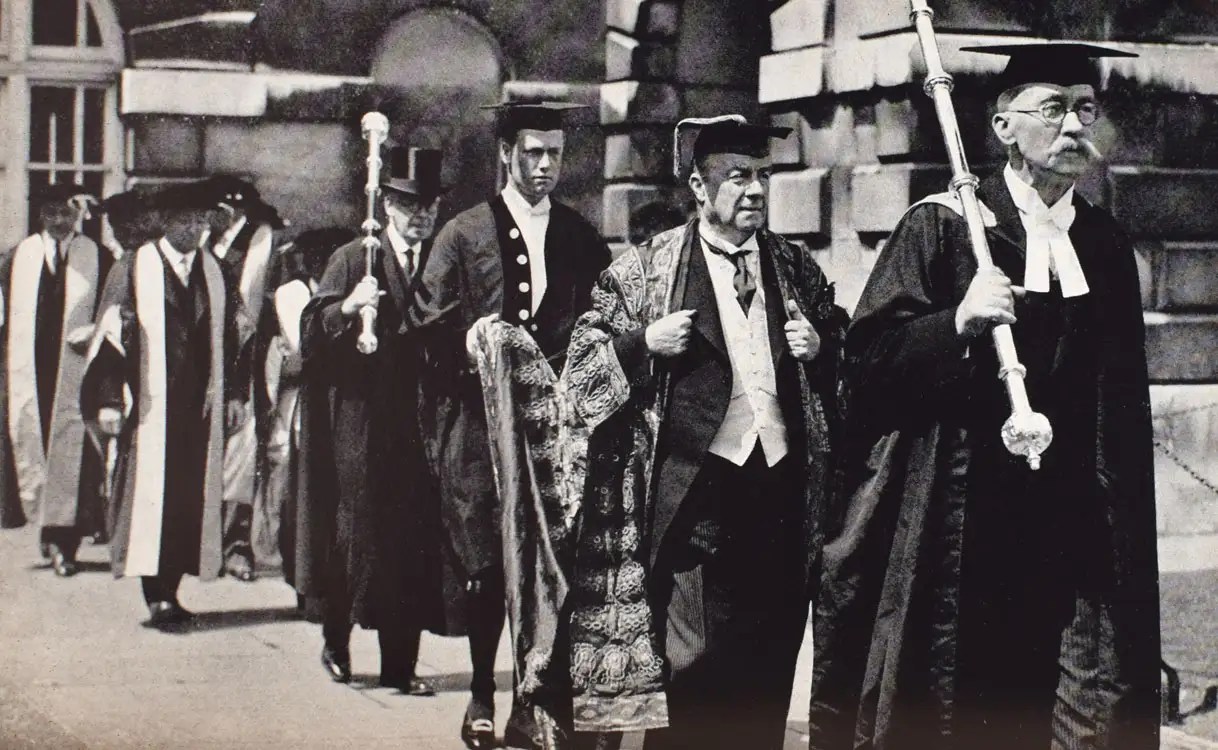
The Murder at the Vicarage by Agatha Christie (1930)

‘My dear young man, you underestimate the detective instinct of village life. In St. Mary Mead everyone knows your most intimate affairs. There is no detective in England equal to a spinster lady of uncertain age with plenty of time on her hands.’
(The vicar, Leonard Clement, explaining village life to Lawrence Redding, the artist, Chapter 4)

‘You must understand that I heard this on the best authority.’ In St. Mary Mead the best authority is always somebody else’s servant.
(Clement’s droll sense of humour, Chapter 25)

‘Anyway, I don’t think Mr Raymond West is so frightfully clever as he pretends to be.’
‘Very few of us are,’ I said. (Chapter 25)

Introducing Miss Marple

This is the first Agatha Christie novel to feature Miss Jane Marple, who would go on to appear in 20 short stories and 11 further novels.

Miss Marple always sees everything. Gardening is as good as a smoke screen, and the habit of observing birds through powerful glasses can always be turned to account.
(Clement, the narrator)

‘Miss Marple may be mistaken.’
‘She never is. That kind of old cat is always right.’
(Griselda on Miss M.)

‘Confound the woman, she couldn’t know more about it if she had committed the murder herself.’ (Chief Constable Melchett)

‘I’m afraid that observing human nature for as long as I have done, one gets not to expect very much from it.’
(The lady herself)

One of the pleasures of this unusually long detective novel is watching Miss Marple grow into the character of ‘Miss Marple’, as Christie gets the bit between her teeth.

Leonard Clement

‘The Murder at the Vicarage’ is a first-person narrative told by Leonard ‘Len’ Clement, the vicar of a little village, St Mary Mead, in the fictional county of Downshire (Chapter 12). Christie obviously had fun striking what you could call a hesitant, mildly disapproving, vicarly tone right from the start.

It is difficult to know quite where to begin this story, but I have fixed my choice on a certain Wednesday at luncheon at the Vicarage. (Opening sentence)

It’s this reasonable, educated but self-deprecating tone and personality which dominate and define the text.

When I got back to the Vicarage I was my usual faded, indeterminate self… (Chapter 26)

‘Faded, indeterminate’ Clement is married to Griselda, younger than him, attractive but flirtatiously playful.

Griselda is nearly twenty years younger than myself. She is most distractingly pretty and quite incapable of taking anything seriously. She is incompetent in every way, and extremely trying to live with. She treats the parish as a kind of huge joke arranged for her amusement. I have endeavoured to form her mind and failed. (Chapter 1)

Years later, Griselda remains proud of seducing the vicar in just 24 hours:

‘I’m everything you most dislike and disapprove of, and yet you couldn’t withstand me!… I make you frightfully uncomfortable and stir you up the wrong way the whole time, and yet you adore me madly.’ (Chapter 1)

Unimpressed with Clement’s staidness and devotion to duty etc, she playfully threatens him with having an affair with the young artist, Lawrence Redding, who’s come to the village and set up his studio in a shed in the vicarage’s grounds, and is painting a portrait of Griselda.

‘You don’t deserve me. You really don’t. I’ll have an affair with the artist. I will — really and truly. And then think of the scandal in the parish.’ (Chapter 1)

Living with Clement and Griselda are his 16-year-old nephew, Dennis, and their brusque and incompetent maid, Mary.

It is repeatedly stated how innocent and unworldly Clement is, so much so that I did wonder whether this was a blind and whether there would turn out to be the same kind of twist as in ‘The Murder of Roger Ackroyd’.

‘Ah! well, sir,’ he said tolerantly, ‘you’re a clergyman. You don’t know half of what goes on.’
(Chapter 17)

‘She has been ill,’ I said mildly.
‘Ill? Fiddlesticks. You’re too unworldly, Mr Clement.’
(Chapter 25)

The murderee

In Chapter 5 Clement comes home to discover the loud and unpopular Colonel Protheroe dead in his (Clement’s) study, shot through the back of the head as he sat at his (Clement’s) writing desk writing a note. Protheroe is the lord of the manor, local magistrate, who lived up at the Old Hall with his daughter, Lettice, and second wife, Anne, and is notorious for his loud-mouthed, boorish insensitivity. So who shot him? And why?

The cast

In the first four chapters leading up to the murder, Christie introduces an impressive number of characters and gives at least five of them plausible motives for committing the murder. Part of this is done by a tea party Griselda arranges for the four village gossips (or ‘old cats’ as Miss Cram calls them), four old ladies one of whom is Miss Marple and from whom she is, to begin with, indistinguishable. Only slowly but steadily does she emerge as a kind of super-sleuth in his own right.

Here’s a complete list of characters. I’ve added M for motive to the characters with obvious motives to kill Colonel Protheroe.

  • Leonard Clement the vicar – the modest, disapproving narrator; ‘Nobody would suspect you of anything, darling,’ said Griselda. ‘You’re so transparently above suspicion’
  • Griselda – Clement’s carefree, playful young wife, who enjoys teasing Clement that she’s being wooed by Lawrence Redding the painter who’s doing her portrait
  • Dennis – Clement’s 16-year-old schoolboy nephew, jokey and playful
  • Mary Adams – their rude maid, a notoriously bad cook
  • Hawes – the new curate, only arrived three weeks ago (suspicious!), has High Church views and fasts on Fridays
  • Colonel Lucius Protheroe – grumpy local squire and JP, opponent of ritual in church (so opposed to Hawes), ‘the kind of man who enjoys making a fuss on every conceivable occasion’. He disapproves of his daughter Lettice posing for the young artist Lawrence Redding in just her bathing suit. According to Griselda both his wife and his daughter are fed up to the back teeth with him. In fact his first wife couldn’t bear him and ran off. As local magistrate he has just sentenced 3 poachers, one of whom swore vengeance.
  • Lettice Protheroe – ‘a pretty girl, very tall and fair and completely vague’. She casually implicates herself when she tells Clement: ‘If only I had some money I’d go away, but without it I can’t. If only father would be decent and die… if he doesn’t want me to want him to die, he shouldn’t be so horrible over money.’ Lettice, in her vague, wishy-washy way, thinks she’s in love with the artist Lawrence Redding. M
  • Mrs Ann Protheroe, the Colonel’s second wife and Lettice’s step-mother. Protheroe married her five years ago. Clement is astonished to enter the artist’s studio one afternoon to discover her in a passionate embrace with the artist Redding. He backs out and a few minutes later she comes to his study to apologise but explain that she’s living a life of perfect misery with Protheroe and is desperate for change. Clement comments: ‘She impressed me now as a very desperate woman, the kind of woman who would stick at nothing once her emotions were aroused. And she was desperately, wildly, madly in love with Lawrence Redding, a man several years younger than herself.’ M
  • Lawrence Redding – handsome 30-year-old artist visiting the village and staying in the vicarage grounds. After dinner at the Vicarage he tells Clement he is sincerely in love with Ann Protheroe, he wants to rescue her from her tyrant husband, and wishes Protheroe were dead: ‘Oh! I didn’t mean I was going to stick him in the back with a knife, though I’d offer my best thanks to anyone else who did so…’ M
  • Mrs Price Ridley – one of the village’s gossipy old ladies, ‘a devout and fussy member of my congregation’
    • Clara, her maid, aged 19
  • Miss Wetherby – another old lady, ‘a mixture of vinegar and gush’
  • Miss Hartnell – another old lady, ‘weather-beaten and jolly and much dreaded by the poor’. ‘It is difficult with Miss Hartnell to know where narrative ends and vituperation begins.’
  • Miss Marple – fourth of the quartet of village ladies, but Clement realises she is sharper than the others and will, of course, go on to a career in the later books and stories. According to Clement she is ‘a white-haired old lady with a gentle, appealing manner’. According to ever-critical Griselda, ‘that terrible Miss Marple’ is ‘the worst cat in the village’. Clement admits that she spies on everyone under cover of birdwatching.
  • Mrs Estelle Lestrange – an outsider, recently arrived in the village, taken a house for the summer, bit mysterious, ‘a cultured woman who knew something of Church history and architecture’
    • ‘She was a very tall woman. Her hair was gold with a tinge of red in it. Her eyebrows and eyelashes were dark, whether by art or by nature I could not decide. If she was, as I thought, made up, it was done very artistically. There was something Sphinxlike about her face when it was in repose and she had the most curious eyes I have ever seen — they were almost golden in shade’
    • ‘She was a curious woman — a woman of very strong magnetic charm’
  • Estelle has some kind of dark secret which she can’t bring herself to reveal to Clement (‘No, I don’t think anyone can help me. But thank you for offering to do so’), who goes away from a visit to her rented cottage thinking: ‘This woman would stick at nothing’. And then we learn that she visited the Colonel on a mysterious errand the day before the murder. Will she turn out to have some hidden connection with Protheroe? M
  • Dr Stone – a well-known archæologist who has recently come to stay at the Blue Boar while he superintends the excavation of an ancient barrow situated on Colonel Protheroe’s property. A ‘bald-headed dull old man’, ‘He was a little man. His head was round and bald, his face was round and rosy, and he beamed at you through very strong glasses he is known to have had a big argument with Protheroe about something to do with his project. Does that make him a suspect? M
  • Dr Stone’s secretary, Miss Gladys Cram – ‘Miss Cram is a healthy young woman of twenty-five, noisy in manner, with a high colour, fine animal spirits and a mouth that always seems to have more than its full share of teeth’. The old ladies (above) disapprove of an unmarried young woman staying in the same inn (the Blue Boar) as Dr Stone, who is married but visiting without his wife. Could they be having an affair? If Stone had anything to do with Protheroe’s death, would Miss Cram protect him?
  • Dr Haydock – local GP, ‘a good fellow, a big, fine, strapping man with an honest, rugged face’, called by Clement as soon as the latter discovers the body in his study.
  • Constable Hurst – village policeman, telephoned by Dr Haydock as soon as the latter ascertains that Protheroe is dead.
  • Inspector Slack – ‘a dark man, restless and energetic in manner, with black eyes that snapped ceaselessly.’ ‘His manner was rude and overbearing in the extreme.’ A ‘conceited ass’ according to Dr Haydock.
  • Colonel Melchett – Chief Constable of the county, ‘a dapper little man with a habit of snorting suddenly and unexpectedly. He has red hair and rather keen bright blue eyes.’ Patronising: ‘There’s a lot of talk. Too many women in this part of the world.’
  • Archer – the poacher Protheroe sentenced to jail and who threatened him with revenge. He has been walking out with Clement’s slovenly maid, Mary. This means that she, the maid Mary, joins the list of possible suspects. M
  • Manning – Protheroe’s chauffeur, ‘a nice lad, not more than twenty-five or six years of age’
  • Dr Roberts – the coroner
  • Cherubim – the village chemist
  • Staff at Old Hall:
    • Mrs Simmons – the housekeeper
    • Mrs Pratt – the cook
    • Rose – a main, ‘a pretty girl of twenty-five’
    • Gladys – the kitchenmaid
  • Mrs Sadler — Hawes’s landlady

As you can see, some are Direct Suspects, having explicitly stated they want Protheroe out of the way, being: his daughter who wants his money; his wife who finds living with him unbearable; Redding who wants him out of the way so he can pursue his affair with Ann Protheroe.

Could Dr Stone be added to this list because of the alleged row he had with Protheroe? He’s not in the same category as the Direct Suspects.

Then there are the Indirect Suspects who have no known connection with Protheroe but are suspicious presences who’ve been behaving oddly, of whom Mrs Lestrange is the leading example.

Details

The reader notices how, in the first four chapters, Christie introduces and sketches an impressive number of characters. Less obvious is the way she introduces lots of circumstantial details. What happens in the novel – as in life, I imagine – is that the moment the murder is discovered, scores of tiny details which had up until that moment been just part of the forgettable stuff of everyday life, suddenly become immensely important.

For example, Protheroe had an appointment to meet the vicar at 6.15 or so but they’d delayed their appointment while chatting in the village high street. Could someone have overheard? Just before 6, Clement was called away to attend Abbott, a parishioner who was dying but when he got there he found the man well, and none of his household had made the call? So who did, presumably to get him away from the vicarage so they could commit the crime?

Similarly, the clock on the study table was knocked over, smashed and stopped at the moment of death, frozen at 6.22pm. But as Clement tries to tell the Inspector, he always keeps it set 15 minutes too fast in a bid to outwit his own tardiness. So much is made of the time and this discrepancy, that I’d bet it turns out to be a vital clue.

And at dinner the evening before, conversation had turned to the subject of guns and Redding the artist had admitted to owning a .25 Mauser pistol, a souvenir from the war. So when the police identify the bullet which killed Protheroe as coming from a Mauser .25 it seems an open and shut case. Especially as in the few minutes before he returned to the vicarage, Clement had encountered Redding just outside the building looking white as a sheet, talking and behaving oddly, then running off.

Next morning everyone discovers that later the evening of the crime, at 10pm, Redding turned himself into the police, handed over the gun and confessed that he did it. So he was charged and locked up, news which travels like wildfire through the village.

But the reader of any detective story knows this is too simple and obvious – and also too early in the story: the real motive is likely to be much more convoluted and the real killer a well-hidden secret.

Anyway, as with my other Christie reviews, I’ll stop my summary here because it’s always at this point that her detective stories metamorphose from a description of events into an increasingly complicated labyrinth of competing theories. Not only do the police have theories about whodunnit, but so do all the main characters – Miss Marple starts her involvement by telling an astonished Clement she can think of no fewer than seven suspects:

‘Quite that, I should think,’ said Miss Marple absently. ‘I expect every one of us suspects someone different.’ (Chapter 26)

And the plot is carefully constructed so that over the next 200 pages or so, a steady trickle of new clues and revelations are released, which disprove some theories, support others, or provide evidence for entirely new ones. As a disgruntled Inspector Slack says, in a phrase which could be the motto of all her books:

‘You can’t get definite proof of anything in this crime! It’s theory, theory, theory.’ (Chapter 25)

And Christie has her characters themselves comment on the depth and complexity of the thing:

‘Do you know, Clement,’ [Colonel Melchett] said suddenly, ‘I’ve a feeling that this is going to turn out a much more intricate and difficult business than any of us think. Dash it all, there’s something behind it.’ (Chapter 12)

And:

‘You know,’ I said to Griselda, ‘I don’t feel we are really at the end of this case yet.’
‘You mean not till someone has really been arrested?’
‘No,’ I said, ‘I didn’t mean that. I mean that there are ramifications, under-currents, that we know nothing about. There are a whole lot of things to clear up before we get at the truth.’ (Chapter 22)

And:

‘To tell you the truth,’ I said, as I fetched her shawl, ‘the whole thing seems to me a bewildering maze.’ (Chapter 26)

Right up till the final revelation which overthrows the whole lot of them in a dazzling denouement.

Maps

To help the reader the text contains a map of the village and a sketch of the vicarage, just some of the fleet of details the narrative is packed with.

Map of St Mary Meads showing the main houses, with the Vicarage slap bang in the middle

And:

Interior of the vicar’s house

It is an entertainment designed to puzzle, tease and amuse the reader. Trying to summarise these convolutions and complexities would be a fool’s errand.

Miss Marple’s approach

Slowly at first, Miss Marple begins to share, in a quiet and understated way, her thoughts about the murder which, as they accumulate through the story, grow into a worldview and a methodology.

Motive and opportunity The basics of all detective work.

‘Motive and opportunity.’ (Chapter 30)

All the facts must be accounted for If anything is not accounted for by your theory, pause it.

‘I know, dear Mr Clement, that there are many ways we prefer to look at things. But one must actually take facts as they are, must one not? And it does not seem to me that the facts bear the interpretation you put upon them.’ (Chapter 6)

‘The point is,’ she said, ‘that one must provide an explanation for everything. Each thing has got to be explained away satisfactorily. If you have a theory that fits every fact — well, then, it must be the right one. But that’s extremely difficult.’ (Chapter 26)

‘One’s own belief — even so strong as to amount to knowledge — is not the same as proof. And unless one has an explanation that will fit all the facts (as I was saying to dear Mr Clement this evening) one cannot advance it with any real conviction.’ (Chapter 30)

‘I thought you were going to say something, my dear. And it is often so much better to let things develop on their own lines.’ (Chapter 6)

Suspect everyone Her spinster scepticism, or cynicism.

‘One never can be quite sure about anyone, can one? At least that’s what I’ve found.’ (Chapter 9)

‘Ah!’ said Miss Marple. ‘But I always find it prudent to suspect everybody just a little. What I say is, you really never know, do you?’ (Chapter 16)

‘But Mrs Clement was completely out of it,’ interrupted Melchett. ‘She returned by the 6.50 train.
‘That’s what she said,’ retorted Miss Marple. ‘One should never go by what people say.’ (Chapter 30)

Intuition

‘That is a very sound way of arriving at the truth. It’s really what people call intuition and make such a fuss about. Intuition is like reading a word without have to spell it out. A child can’t do that because it has had so little experience. But a grown-up person knows the word because they’ve seen it often before.’ (Chapter 11)

Noticing details

They realised, you see, that I am a noticing kind of person… (Chapter 30)

I don’t know whether Miss Marple had any inkling of all this. Very probably she had. Few things are hidden from her. (Chapter 30)

‘It is,’ she said, ‘a Peculiar Thing. Another Peculiar Thing.’ (Chapter 21)

A phrase she repeats several times to describe noteworthy anomalies.

Becoming Miss Marple

On one level the entire novel is about her flexing her wings and growing into the role of ‘Miss Marple’. One by one, she overcomes the scepticism of the men, the vicar being the first to realise her qualities.

I stared at the old lady, feeling an increased respect for her mental powers. (Chapter 11)

I was silent, but I did not agree with him. I was quite sure that Anne Protheroe had had no pistol with her since Miss Marple had said so. Miss Marple is not the type of elderly lady who makes mistakes. She has got an uncanny knack of being always right. (Chapter 12)

For all her fragile appearance, Miss Marple is capable of holding her own with any policeman or Chief Constable in existence. (Chapter 9)

Now how did the woman know that I had been to visit Mrs Lestrange that afternoon? The way she always knows things is uncanny. (Chapter 16)

I have a poor sense of time myself (hence the keeping of my clock fast) and Miss Marple, I should say, has a very acute one. Her clocks keep time to the minute and she herself is rigidly punctual on every occasion. (Chapter 23)

In the art of seeing without being seen, Miss Marple had no rival… (Chapter 23)

Of all the ladies in my congregation, I consider her by far the shrewdest. Not only does she see and hear practically everything that goes on, but she draws amazingly neat and apposite deductions from the facts that come under her notice. (Chapter 26)

There is always some perfectly good and reasonable explanation for Miss Marple’s omniscience… (Chapter 26)

Others’ opinion:

REDDING: You know, old Miss Marple knows a thing or two.
CLEMENT: She is, I believe, rather unpopular on that account. (Chapter 19)

‘She has a powerful imagination and systematically thinks the worst of everyone.’
‘The typical elderly spinster, in fact,’ said Melchett, with a laugh. (Chapter 9)

And the way she deploys her Spinster Cynicism to comic effect against the pompous men.

‘I’m afraid there’s a lot of wickedness in the world. A nice honourable upright soldier like you doesn’t know about these things, Colonel Melchett.’ (Chapter 9)

Triumph

All leading to the final two chapters where Miss Marple turns out to have a sounder grasp of events, character and human psychology than all the male characters put together.

There was something fascinating in Miss Marple’s resumé of the case. She spoke with such certainty that we both felt that this way and in no other could the crime have been committed. (Chapter 30)

Reading her triumph over the pompous cops and obtuse vicar is deeply enjoyable, even thrilling. She triumphs and her character is a triumph. No wonder Christie realised she’d struck gold and would go on to develop the character at length over many years to come.

Sexism

It was a hundred years ago in a country unrecognisable from modern Britain, so you might wonder why I even bother collecting the examples of the male characters’ everyday sexism except that it’s easy and amusing. Bombastic Colonel Melchett is the chief offender:

‘There’s a lot of talk. Too many women in this part of the world.’ (Chapter 7)

Women never like fiddling about with firearms. Arsenic’s more in their line.’ (Chapter 12)

Then there’s rude, dismissive Inspector Slack:

‘Mrs Protheroe acted in an exactly similar fashion, remember, Slack.’
That’s different. She’s a woman, and women act in that silly way. I’m not saying she did it for a moment. She heard he was accused and she trumped up a story. I’m used to that sort of game. You wouldn’t believe the fool things I’ve known women do…’ (Chapter 11)

Women cause a lot of trouble,’ moralised the inspector. (Chapter 25)

Self-important Constable Hurst:

You can’t take any notice of what old ladies say. When they’ve seen something curious, and are waiting all eager like, why, time simply flies for them. And anyway, no lady knows anything about time.’ (Chapter 23)

Even the vicar narrator, otherwise so sympathetic to everyone:

Melchett is a wise man. He knows that when it is a question of an irate middle-aged lady, there is only one thing to be done — to listen to her. When she has said all that she wants to say, there is a chance that she will listen to you. (Chapter 23)

‘Why,” I said, ‘I remember at the time Mrs Protheroe said it wasn’t like her husband’s handwriting at all, and I took no notice.’
‘Really?’
‘I thought it one of those silly remarks women will make.’ (Chapter 27)

Miss Marple herself makes a contribution:

‘My dear Colonel Melchett, you know what young women are nowadays. Not ashamed to show exactly how the creator made them.’ (Chapter 9)

Griselda:

‘I do hate old women — they tell you about their bad legs and sometimes insist on showing them to you.’ (Chapter 17)

Two points. 1) Whenever I read this kind of thing, it reminds me of Virginia Woolf’s powerful feminist tract Three Guineas which gathers an impressive array of evidence testifying to the universality of chauvinist, sexist, patronising, patriarchal attitudes throughout British society.

2) Then again, the entire book is a tissue of clichés and stereotypes (the handsome young artist, the reactionary old colonel, the lonely wife, the alienated daughter, the otherworldly vicar, the conservative chief constable – ‘all this namby-pambyism annoys me. I’m a plain man’ – and so on) so that most of the characters very much espouse, approve and express the received ideas of the day.

a) This makes them recognisable and assimilable by the great majority of readers i.e. they’re not high-falutin’ artists and psychological experimenters like the characters in Joyce or Lawrence or Woolf.

b) At a deeper level, the detective story as a genre requires most if not all of its characters to be stereotyped and predictable in order to function: if they were all unpredictable the thing would be as chaotic and unreadable as real life actually is; but if the majority of the characters are staid, recognisable and predictable it allows the reader to assimilate them, to register them and their values and be alert to the discrepancies and oddities which characterise real clues and (might) indicate the identity of the murderer.

Summary of sexism

‘They’re not doing so badly,’ I said. ‘One of them, at all events, thinks she’s got there.’
‘Our friend, Miss Marple, eh?’
‘Our friend, Miss Marple.’
‘Women like that always think they know everything,’ said Colonel Melchett.
(Chapter 27)

Colonel Melchett’s remark contains the implicit assumption that only men are allowed to think they know everything. Except that in this case, Miss Marple does know everything. She is The Spinster’s Revenge against the everyday chauvinism of men like Colonel Melchett.

Cats

A word means how it is used. Christie is fond of using ‘cat’ to mean gossiping, bitchy woman.

‘I rather like Miss Marple,’ I said. ‘She has, at least, a sense of humour.’
‘She’s the worst cat in the village,’ said Griselda. (Chapter 1)

‘Nasty old cat,’ said Griselda, as soon as the door was closed. (Chapter 3)

CLEMENT: Miss Marple may be mistaken.
GRISELDA: She never is. That kind of old cat is always right. (Chapter 3)

MISS CRAM: A girl wants a bit of life out of office hours, and except for you, Mrs Clement, who is there in the place to talk to except a lot of old cats? (Chapter 10)

‘She’d make a very good mannequin,’ said Griselda. ‘She’s got such a lovely figure.’ There’s nothing of the cat about Griselda. (Chapter 10)

‘Serve the old cat right,’ he [Dennis] exclaimed. ‘She’s got the worst tongue in the place.’ (Chapter 14)

MISS CRAM: Just because one of these gossiping old cats has nothing better to do than look out of her window all night you go and pitch upon me. (Chapter 25)

Shot

While I’m in the business of collecting quotes to make points, I noticed how Christie strategically threads the word ‘shot’ throughout the narrative. Obviously it mostly appears in the literal sense, when referring to the shot that killed Colonel Protheroes – but on a few other occasions it’s slipped in in a metaphorical sense, a few times before the murder takes place to anticipate it and a few times afterwards, giving a slight echoing, ringing repetition, which keeps the idea and sound of the one gunshot subliminally in the reader’s mind.

Proleptic (looking forward):

A ribald rhyme concocted by Dennis shot through my head. (Chapter 2)

That last Parthian shot went home. (Chapter 2)

Analeptic (looking back):

He was pacing up and down nervously, and when I entered the room he started as though he had been shot. (Chapter 24)

Bookish

Every Christie novel I’ve read so far contains multiple ironic, knowing references to the genre the story is in, detective stories:

‘It’s so mysterious, isn’t it, her arriving like this and taking a house down here, and hardly every going outside it? Makes one think of detective stories. You know — “Who was she, the mysterious woman with the pale, beautiful face? What was her past history? Nobody knew. There was something faintly sinister about her.” I believe Dr Haydock knows something about her.’
‘You read too many detective stories, Griselda,’ I observed mildly.
(Chapter 1)

And:

‘If this were only a book,’ he [Lawrence] said gloomily, ‘the old man [Protheroe] would die — and a good riddance to everybody.’ (Chapter 4)

And:

‘I see,’ I said, ‘that you are that favourite character of fiction, the amateur detective. I don’t know that they really hold their own with the professional in real life.’ (Chapter 16)

And:

‘You’ve been reading G. K. Chesterton,’ I said, and Lawrence did not deny it. (Chapter 16)

And:

‘I wonder,’ I said. ‘I think each one of us in his secret heart fancies himself as Sherlock Homes.’ (Chapter 26)

And:

‘I have been reading a lot of American detective stories from the library lately,’ said Miss Marple, ‘hoping to find them helpful.’ (Chapter 27)

And:

‘There is, I believe, an invention called a Maxim silencer. So I gather from detective stories.’ (Chapter 30)

And:

GRISELDA: I was — well, absolutely silly about him [Redding] at one time. I don’t mean I wrote him compromising letters or anything idiotic like they do in books. But I was rather keen on him once. (Chapter 24)

And:

‘I know that in books it is always the most unlikely person. But I never find that rule applies in real life.’ (Chapter 31)

The excitable schoolboy Dennis is a special case:

At Dennis’s age a detective story is one of the best things in life, and to find a real detective story, complete with corpse, waiting on one’s own front doorstep, so to speak, is bound to send a healthy-minded boy into the seventh heaven of enjoyment. (Chapter 6)

So when a murder mystery occurs right on his doorstep, Dennis is delighted:

‘Fancy being right on the spot in a murder case,’ he exclaimed. ‘I’ve always wanted to be right in the midst of one.’ (Chapter 6)

And sets off with a magnifying glass to look for clues which he helpfully gives to Inspector Slack who politely thanks him, pockets them and forgets all about them.

This chimes with the gleeful delight of the two children in ‘The Seven Dials Mystery’ who are thrilled to bits that a real-life murder has been committed at their house. This is a bit more profound than the simple comedy: it’s as if every novel contains a reminder that, although a murder is a tragedy to the victim and those closest to him or her, at even a small remove it’s an exciting relief from routine and boredom, and at one more remove, in the newspapers or other media, it’s just one more item in the news.

All these bookish references are trumped when Miss M’s nephew, Mr Raymond West, arrives on a visit and turns out to be a famous writer.

‘Raymond gets up very late — I think writers often do. He writes very clever books, I believe, though people are not really nearly so unpleasant as he makes out. Clever young men know so little of life, don’t you think?’ (Chapter 17)

The odd thing about him is how little part he plays in the story – after a few scenes and bits of dialogue he more or less disappears. Maybe an indication that Christie introduced just a few more characters, complications and red herrings than the story could actually bear. Who cares? It’s the book’s fecundity, its sense of being full to the brim and then overflowing with characters and sub-plots which makes it so enjoyable.

Butlers

I imagine many scholars will have written papers about Christie’s butlers, valets and servants, such as Poirot’s man, George or the three different butlers in ‘The Seven Dials Mystery’. They are always a comic joy.

A very correct butler opened the door, with just the right amount of gloom in his bearing.
(Chapter 8)

Last word

Last word goes to the irrepressible Miss Marple. Here she is talking to the vicar narrator:

‘I remember a saying of my Great Aunt Fanny’s. I was sixteen at the time and thought it particularly foolish.’
‘Yes?’ I inquired.
‘She used to say: “The young people think the old people are fools; but the old people know the young people are fools!”‘
(Chapter 31)


Credit

‘The Murder at the Vicarage’ by Agatha Christie was published by the Collins Crime Club in 1930.

Related links

Related reviews

  • 1930s reviews

The Secret of Chimneys by Agatha Christie (1925)

‘Oh, damn!’ cried Virginia, jamming down the receiver. It was horrible to be shut up with a dead body and to have no one to speak to.
(Virginia Revel, chapter 8)

‘I’m sorry it were a foreigner,’ said Johnson, with some regret. It made the murder seem less real. Foreigners, Johnson felt, were liable to be shot.
(Constable Johnson, chapter 10)

‘The whole thing’s horribly mysterious.’
(Virginia Revel, chapter 15)

‘I should like to tell you the story of my life,’ he remarked, ‘but it’s going to be rather a busy evening.’
(Anthony, chapter 9)

‘Do you talk?’ asked Bundle. ‘Or are you just strong and silent?’
(Bundle to Anthony, chapter 15)

‘We’ve never had a murder in the house before. Exciting, isn’t it? I’m sorry your character was so completely cleared this morning. I’ve always wanted to meet a murderer and see for myself if they’re as genial and charming as the Sunday papers always say they are.’
(Bundle to Anthony, chapter 15)

‘I find talking to foreigners particularly fatiguing. I think it’s because they’re so polite.’
(Lord Caterham, chapter 16)

Bundle looked at him with lifted eyebrows. ‘Crook stuff?’ she inquired.
(Chapter 22)

‘I never deny anything that amuses me.’
(Anthony, chapter 27)

‘Oh, Anthony,’ cried Virginia. ‘How perfectly screaming!’
(Chapter 30)

International conspiracies

I thought the ridiculous novel ‘The Big Four’ with its plot about a fiendish international crime organisation must be an aberration in Christie’s oeuvre, which I had been led to believe was all about country house murder mysteries but not a bit of it – ‘The Secret of Chimneys’ is also about international intrigue and secret organisations, centres on political events on the other side of Europe and an international criminal master of disguise, not to mention gold hunting in Africa and American undercover detectives, all leading up to an outrageous series of revelations and reversals. And it was followed by a sequel (‘The Seven Dials Mystery’) which is even more preposterous. So half her output in the 1920s has more in common with espionage fiction than sedate murder mysteries.

Synopsis

Anthony Cade’s two tasks

The story starts in faraway Rhodesia. Here a jolly good chap named Anthony Cade is making money as a tour guide for pasty Brits. He bumps into an old pal, James McGrath, who gives him two rather bizarre tasks which both require a bit of backstory.

Count Stylptitch Some time earlier, in Paris, he’d seen a man be set upon by a group of thugs and had gone to his rescue. the man turned out to be Count Stylptitch, a courtier in the court of King Nicholas IV of the fictional country of Herzoslovakia. This country is notorious for its assassinations, and seven years earlier King Nicholas had been assassinated and the country became a republic. Count Stylptitch went into exile in Paris where McGrath happened to save him from a beating.

McGrath forgot about it until a few weeks ago when he received a parcel. It contained the memoirs of this Count Stylptitch and a note to the effect that if he delivered the manuscript to a certain firm of publishers (Messrs. Balderson and Hodgkins) in London on or before October 13, he would receive £1,000. Now McGrath is just about to go on an expedition into the interior of Africa in search of fabled gold mines, a once-in-a-lifetime opportunity, so he asks Anthony a favour. Can he travel back to London, under the name James McGrath, hand over the manuscript to the publishers, and receive the £1,000. How about if he gives him 25%, £250. Anthony is sick of being a tour guide and so says yes.

Dutch Pedro But as if that wasn’t contorted and implausible enough, McGrath gives Anthony a second task. This is also related to a Good Samaritan intervention, for some time earlier, in Uganda, McGrath saw a man drowning in a river, dived in and saved him. Once rescued, this man (derogatorily referred to throughout simply as a ‘Dago’ [‘an insulting and contemptuous term for a person of Italian or Spanish birth or descent’]), although going under the name of Dutch Pedro, gives McGrath the most valuable thing he owns which turns out to be a bundle of love letters written by a married Englishwoman to someone not her husband. The D*** had been blackmailing her and now handed over the letters to McGrath so that he could blackmail her in his turn. The letters don’t contain an address but two clues: at one point they mention a place, a country house called Chimneys.

‘Chimneys?’ [Anthony] said. ‘That’s rather extraordinary.’
‘Why, do you know it?’
‘It’s one of the stately homes of England, my dear James. A place where Kings and Queens go for weekends, and diplomatists forgather and diplome.’

And one of the letters is signed with a name, Virginia Revel.

Right. So McGrath is tasking Anthony with taking both the memoirs and the letters back to England, handing over the memoirs to the nominated publisher, and tracking down and handing the letters back to this lady, Virginia Revel. Right. OK.

International intrigue

The second element in the setup and the reason all the action converges on this country house, Chimneys, is as follows. Oil has recently (and implausibly) been discovered in Herzoslovakia. At the same time the people have become disillusioned with their republican government and many hanker for a return of the monarchy. The British government is prepared to back the return of the nearest relative to the assassinated Nicholas IV to the throne, Prince Michael, in exchange for the new king and his government signing favourable oil concessions to a syndicate of British oil companies. These are represented by a Jewish businessman, Mr Herman Isaacstein (who is described with a wealth of antisemitic tropes and stereotypes).

The current Secretary of State, the permanently anxious and stressed George Lomax, who lives at a country pile named Wyvern Abbey, persuades his friend, the easy-going Lord Caterham, to host an informal meeting of all the people involved in this international plan, at his country house, Chimneys (seven miles from Wyvern). Here’s the tone of humorous Lord Caterham and his daughter:

‘Who wants to be a peer nowadays?’
‘Nobody,’ said Bundle. ‘They’d much rather keep a prosperous public house.’

They want to conceal the meeting’s true nature from a curious world (and the press) and so George asks Lord Caterham to invite other, ‘neutral’ guests to make it look like a genuine country house party. As George explains:

GEORGE: ‘One slip over this Herzoslovakian business and we’re done. It is most important that the Oil concessions should be granted to a British company. You must see that?’
LORD CATERHAM: ‘Of course, of course.’
GEORGE: ‘Prince Michael Obolovitch arrives the end of the week, and the whole thing can be carried through at Chimneys under the guise of a shooting party.’

So all converging on this lovely stately home are:

  • Lord Caterham – owner of Chimneys and reluctant host
  • Lady Eileen ‘Bundle’ Brent – eldest daughter of Lord Caterham
  • The Honourable George Lomax – Foreign Office
  • Bill Eversleigh – Lomax’s secretary
  • Herman Isaacstein – financier of the British oil syndicate
  • Prince Michael Obolovitch of Herzoslovakia –
  • Captain Andrassy – his equerry
  • Hiram P. Fish – collector of first editions, invited to the house party by Lord Caterham
  • Virginia Revel – cousin of George Lomax, daughter of a peer, society beauty and young widow of…
  • Timothy Revel, former British envoy to Herzoslovakia i.e. is familiar with the country and its politics
  • Tredwell – the grey-haired old butler

More about Chimneys:

Clement Edward Alistair Brent, ninth Marquis of Caterham, was a small gentleman, shabbily dressed, and entirely unlike the popular conception of a Marquis. He had faded blue eyes, a thin melancholy nose, and a vague but courteous manner. At one time Secretary of State for Foreign Affairs, he had always bulked largely in the counsels of the Empire, and his country seat, Chimneys, was famous for its hospitality. Ably seconded by his wife, a daughter of the Duke of Perth, history had been made and unmade at informal week-end parties at Chimneys, and there was hardly anyone of note in England—or indeed in Europe—who had not, at one time or another, stayed there.

In London

But before we get to Chimneys, there are some important and ‘exciting’ scenes in London, some to do with Count Stylptitch’s memoirs, some to do with the blackmail letters of Virginia Revel.

The memoirs The thing about the Count’s memoirs is they may contain compromising information or stories about the assassinated king and his court which will wreck the Royalists’ plan of getting back into power. So on his first day back in London, Anthony he is approached by two different Herzoslovakian men who both try to acquire the manuscript. The first is a Count who supports the Royalist faction and offers to outbid the publisher in order to suppress any embarrassing information it might contain. Cade politely but firmly refuses. The second is a member of a revolutionary group, the Comrades of the Red Hand (‘They’re very fond of executing traitors. It has a picturesque element which seems to appeal to them’), who demands that Anthony hand it over at gunpoint. But Anthony is not only frightfully posh (Eton and Oxford) but because of his time in Africa, is lean, fit and can handle himself. So he disarms the man and sends him away.

The publisher McGrath mentioned phones Cade the next day, telling him that a) the situation has become very dangerous, with people contacting them and threatening them against publishing it and b) promising to send their employee, Mr Holmes, to pick up the memoir, which he duly does, takes delivery of the manuscript and hands over a cheque for £1,000. So Anthony thinks he has concluded one of his two tasks successfully.

So he carries out the next stage in his plan, which is to ditch the alias of James McGrath which he has used up to this point in order to get the £1,000 from the publishers. So he checks out of the posh Blitz Hotel where’s he’s been staying (and with that ‘James’ McGrath’ disappears from public records) and gets a taxi to a much cheaper hotel where he checks in under his own name, Anthony Cade.

However, just before he left the Blitz, he received a message brought by a messenger boy. This was written by George Lomax, who says he has only just learned of McGrath’s arrival in Britain with the fateful memoirs, and was begging James McGrath not to hand them over to the publishers until he (McGrath) comes to see him (Lomax) at a country house party being held this weekend at Chimneys.

Well, thinks Anthony laconically, it’s too late to prevent the handing over of the memoirs, and he is no longer ‘James McGrath’, but all this fuss about Chimneys doesn’t half tempt him to travel down to the place and gatecrash this weekend party.

The letters As to the blackmail letters, to go back a bit, the night before he checked out of the Blitz, Anthony awakens to discover one of the hotel waiters he recognises, Giuseppe, has broken into his room and is rummaging through his luggage. They have a fight, which is long enough for Anthony to see his face and hear his Italian accent, but the waiter breaks away and escapes and Anthony then discovers he has taken the packet of letters with him. Anthony suspects the man had been hired by one of the Herzoslovakian factions and took the letters by mistake, imagining a bunch of documents tied up in a bundle must be the famous memoirs.

So on one level this is a tale of two manuscripts, which get mixed up.

Virginia Revel

During these exciting two days Anthony had been trying to track down the ‘Virginia Revel’ mentioned in the letters. He had discovered from the telephone directory that there were six Virginia Revels in the London area and had begun the process of visiting them to identify the correct one.

Now we cut to the experiences of the Virginia Revel who the story is going to increasingly feature. But the important thing to bear in mind is that she is not the Virginia Revel of the letters. She never wrote the letters, she’s got nothing to do with them. She is the wrong Virginia Revel.

But the Italian waiter who stole the bundle from Anthony’s hotel room, having realised their blackmail potential, makes the same mistake as everyone else and approaches her, the wrong Virginia Revel, with a sample letter. He turns up at Virginia’s home and, unaware that she did not write the letters and that her husband is dead, he attempts to blackmail her.

Now here’s the thing about this book, its characters, plot and tone: Virginia immediately realises that she is not the Virginia Revel who wrote the letters but she decides to humour the blackmailer and pretend that she is! Why? For the lolz. For the gagz. To see what it feels like to be blackmailed.

Exactly like Anthony Cade, this Virginia Revel is so confident of her place in English society and the English class system (cousin of George Lomax, daughter of a peer, society beauty and widow of an ambassador) that she treats everything that happens in her life with droll, upper-class confidence, as endless sources of potential amusement. Later, it is said of her that:

Her position was so assured and unassailable that anyone for whom she vouched was accepted as a matter of course. (Chapter 13)

To use the modern phrase, both Virginia and Anthony positively reek of upper class privilege, and it is their cheerful, indomitable, ironic handling of all the aspects of a traditional murder mystery (international intrigue, disguises, dead bodies) which make the book such fun to read.

So on this frivolous impulse Virginia plays the part of a blackmail victim, hands over the petty cash she has in the house and promises to pay him more tomorrow at 6 o’clock. But when she arrives home the next day, after playing tennis (one of the new 1920s sporting fads, along with golf – see The Murder on the Links) she finds this same blackmailer shot dead in her house.

Virginia has a maid, Élise, who she tells to go out on a chore while she ponders what to do next, just as who turns up on her doorstep? The tall confident hero of the book, Anthony Wade. At this point he hasn’t revealed his name and is posing as a member of the unemployed because he’s still sussing out whether Virginia is the Virginia. But she pulls him inside and says she’s got a job for him. Immediately they hit it off with a shared sense of upper class savoir faire and a certain amount of physical attraction, too.

‘This isn’t regular work you’re offering me, I hope?’
A smile hovered for a moment on her lips.
‘It’s very irregular.’
‘Good,’ said the young man in a tone of satisfaction.
(Chapter 8)

Virginia tells him about the body which they both treat with upper-class confidence.

‘There’s a dead man in the next room,’ said Virginia. ‘He’s been murdered, and I don’t know what to do about it.’
She blurted out the words as simply as a child might have done. The young man went up enormously in her estimation by the way he accepted her statement. He might have been used to hearing a similar announcement made every day of his life.
‘Excellent,’ he said, with a trace of enthusiasm. ‘I’ve always wanted to do a bit of amateur detective work.’
(Chapter 8)

When he inspects the corpse, Anthony realises it’s the same waiter who broke into his room at the Blitz and stole the letters. He promises to get rid of the corpse. After all, he’s never disposed of a dead body before and is quite thrilled at the idea, just as Virginia had never been blackmailed before and was up for the lolz.

‘I’ve always wanted to see if I couldn’t conceal a crime with the necessary cunning, but have had a squeamish objection to shedding blood.’
(Chapter 9)

And:

Virginia: ‘It’s really dreadful of me saddling a perfect stranger with a dead body like this.’
‘I like it,’ returned Anthony nonchalantly. ‘If one of my friends, Jimmy McGrath, were here, he’d tell you that anything of this kind suits me down to the ground.’
(Chapter 9)

So Anthony puts the body into one of Virginia’s trunk, then there’s a lot of fol-de-rol about her taking it to a train station and leaving it in left luggage, Anthony collecting it, putting it in his car and driving out of London. Way out in the sticks he dumps the body along a stretch of empty road (on ‘the long stretch of road mid-way between Hounslow and Staines’, not so quiet and unfrequented now!).

Oh yes, there’s an aspect of the murder which puzzled our two posh amateur sleuths which is that the gun which shot the blackmailer was left by his body. Why? And a bigger question: the little gun was engraved with the name of ‘Virginia’!! Had she seen it before? No, she insists. Then what? Why? And of course the bigger question, Who shot him in the first place, and why?

Something else I haven’t mentioned yet, which is that when Virginia first got home from tennis, she discovered that all her servants including the devoted butler, all except Élise the maid, had gone down to Datchet (a small town outside Windsor). What? Turns out she owns a little country place there and from time to time asks her servants to go there and prepare it for her. But not today. Someone else sent the household a telegram to be out, someone who knows all about her household arrangements and habits. But who? And why?

And I also haven’t had space to explain yet, but all this happens on the very afternoon of the day she’s due to go down to Chimneys, for what she thinks, at this stage, will be a jolly country house party. Now when Anthony read the blackmail letters back in Africa, one of the few clues in them was mention of this same country house, Chimneys. And when Anthony rifled through the dead man’s pockets, in the lining of his coat he found a scrap of paper with a fragment of text on it, reading ‘Chimneys 11.45 Thursday.’

The letters mention Chimneys. This scrap of paper mentions Chimneys. Virginia has been invited to Chimneys. So as the pair confer they become increasingly certain that something is going to happen at this place, Chimneys, and during this supposed country house party. But what?

So after disposing of the corpse, as described, Anthony gets back in his ‘battered second-hand Morris Cowley’ and drives north till he comes to the wall surrounding the Chimneys estate. A wall isn’t going to stop out hero, so he climbs over it, walks across the wet grounds, and is just approaching the house itself when he hears a short ring out!

Oh no! Is he too late? Has someone been murdered? Who? And Why? Is Virginia safe? Will Anthony find himself suspected of the murder?

I’ve summarised about the first third of the story. At this point I think that, in the spirit of the thing, I’ll stop my summary. If you want to enjoy the further complications, red herrings and improbable explanations which Christie cooks up in profusion, the entire novel is freely available to read online. Clue:

‘How frightfully exciting,’ commented Bundle. ‘You don’t usually get a murder and a burglary crowded into one week-end.’

The only thing I will say is that, when there is trouble at Chimneys on the fateful weekend (as the reader, by now, strongly expects there will be) it triggers the introduction of the bluff, imperturbable Superintendent Battle of Scotland Yard:

… a squarely built middle-aged man with a face so singularly devoid of expression as to be quite remarkable.
(Chapter 11)

who was to go on and become a recurring character in Christie’s work, appearing in a further four novels. Everyone realises how canny he is in his quiet unassuming way:

But at that moment, the moment when Battle apparently admitted Anthony’s complete absence of complicity in the crime, Anthony felt more than ever the need of being upon his guard. Superintendent Battle was a very astute officer. It would not do to make any slip with Superintendent Battle about.
(Chapter 12)

Antisemitism

I’ve noticed the presence of antisemitic animus on a number of authors of this period, including Saki, D.H. Lawrence and Virginia Woolf. In this novel the antisemitic tropes gather around the figure of the Jewish financier, Mr Herman Isaacstein.

There was one other person in the room, a big man sitting in a chair by the fireplace. He was dressed in very correct English shooting clothes which nevertheless sat strangely upon him. He had a fat yellow face, and black eyes, as impenetrable as those of a cobra. There was a generous curve to the big nose and power in the square lines of the vast jaw.

Earlier Lord Caterham, otherwise a genial old cove, refers to Isaacstein as ‘Mr Ikey Hermanstein’ and then as ‘Nosystein’ (with reference to his big hooked pantomime Jew’s nose) and later to ‘Fat Iky’.

The cobra simile stated in the passage above is repeated later:

His [Isaacstein’s] black eyes were bent upon the detective. More than ever, he reminded Battle of a hooded cobra.

Later:

VIRGINIA: ‘Isaacstein looks foreign enough, Heaven knows.’

The lazy antisemitic tropes surrounding him are unpleasant.

Black

If we’re pointing out slurs, there’s a race-related moment right at the novel’s conclusion when, for a moment, his friends panic that Anthony might have married a black woman!

The Baron retreated a step or two. Dismay overspread his countenance. ‘Something wrong I knew there would be,’ he boomed. ‘Merciful God in Heaven! He has married a black woman in Africa!’
‘Come, come, it’s not so bad as all that,’ said Anthony, laughing. ‘She’s white enough—white all through, bless her.’

The more you reflect on this little exchange, the worse it becomes.

Balkans business

To a very large extent the text is made up of clichés, I think Christie’s claim to novelty at the time must surely have been not so much the subject matter or behaviour of the characters so much as the extraordinary complexity of the twists and turns of the narrative, the laying of countless false clues, and then the dazzling revelations at the end which come as a complete surprise (as they do in this novel).

History of Ruritania

The fictional country of Ruritania is first mentioned in The Prisoner of Zenda. According to the Wikipedia article ‘Nowadays, the term connotes a quaint minor European country’ associated with kings and princes with preposterous names, colourful costumes, in a state of permanent political unrest. The same idea – of the Balkans as the home of a particular type of comic political intrigue – is found all over early 20th century fiction, in various Sherlock Holmes stories, Arnold Bennett’s preposterous comedy thriller the Grand Hotel Babylon, in John Buchan thrillers, through to Tintin whose 1938 adventure ‘King Ottokar’s Sceptre’ is set in the fictional Balkan (i.e. Ruritanian) country of Syldavia, complete with fragile kings and plotting courtiers etc etc.

My point is that The Secret of Chimneys can be added to the list of fictions which use the clichés and tropes of the embattled royal family of a fictional Balkan state to manufacture a popular thriller narrative.

Christie’s bookishness

Not literary references, the opposite: I’m referring to her compulsive need to have the narrator or characters make regular comparisons to the clichés and stereotypes of the cheap thrillers and thousands of other detective novels which clearly infested the world, even by the early 1920s.

About the same height as Mr. Cade, but thickset and not nearly so good-looking. The sort of man one read about in books, who probably kept a saloon.
(Narrator)

‘As they say in books. Guile, George, lots of guile.’
(Virginia)

‘First a blackmailer, and then George in diplomatic difficulties. Will he tell all to the beautiful woman who asks for his confidence so pathetically? No, he will reveal nothing until the last chapter.’
(Virginia)

‘Good heavens!’ cried Virginia. ‘Is this Sherlock Holmes?’
‘No,’ said Anthony regretfully. ‘I’m afraid it’s just plain or garden cheating.’

‘And whatever you may imagine from reading detective stories, doctors aren’t such magicians that they can tell you exactly how many hours a man has been dead.’
(Anthony)

‘I take it that you didn’t meet the murdered man?’
‘No. To put it like a book, he “retired to his own apartments immediately on arrival.”‘
(Anthony and Virginia)

‘Why did you seem so surprised when I mentioned the name of Jimmy McGrath to you yesterday at Pont Street? Had you heard it before?’
‘I had, Sherlock Holmes.’
(Anthony and Virginia, chapter 15)

‘I suspected the French governess, Battle. A: Upon the grounds of her being the most unlikely person, according to the canons of the best fiction
(Anthony, chapter 18)

‘Do you really think this Arsène Lupin fellow is actually among the household now?’ asked Bill, his eyes sparkling. [a reference to the fictional gentleman thief and master of disguise created in 1905 by French writer Maurice Leblanc.] (Chapter 18)

And Christie has Battle deliver a little lecture on the subject.

‘In the meantime,’ said Anthony, ‘I am still the amateur assistant?’
‘That’s it, Mr. Cade.’
‘Watson to your Sherlock, in fact?’
‘Detective stories are mostly bunkum,’ said Battle unemotionally. ‘But they amuse people,’ he added, as an afterthought. ‘And they’re useful sometimes.’
‘In what way?’ asked Anthony curiously.
‘They encourage the universal idea that the police are stupid. When we get an amateur crime, such as a murder, that’s very useful indeed.’

As I’ve said elsewhere, keeping on mentioning how your story is different from cheap thrillers doesn’t really differentiate it, but only signposts the similarities.

That said, maybe I’m missing the point and all these references are in fact just a type of joke – it’s a comedy stopgap to have the characters constantly referring to the clichés of crime novels and detective movies, self consciously mocking their own bravery or actions.

He wriggled into a lurid silk dressing-gown, and picked up a poker. ‘The orthodox weapon,’ he observed. (Bill Eversleigh, chapter 17)

And:

‘What’s this I hear about Virginia bolting off in the middle of the night? She’s not been kidnapped, has she?’
‘Oh, no,’ said Bundle. ‘She left a note pinned to the pincushion in the orthodox fashion.’ (Chapter 27)

And:

‘And don’t scream or faint or anything. I won’t let anyone hurt you.’
‘My hero!’ murmured Virginia.

And:

‘The plot thickens,’ said Anthony lightly.

Comedy

Or just jokes:

‘There’s an extraordinary lot of character in ears, Mr. Cade.’
‘Don’t look so hard at mine, Battle,’ complained Anthony. ‘You make me quite nervous.’

The book is stuffed with comic repartee:

‘I say, Virginia, I do love you so awfully—’
‘Not this morning, Bill. I’m not strong enough. Anyway, I’ve always told you the best people don’t propose before lunch.’

Or:

‘I can’t think,’ said Lord Caterham, ‘why nobody nowadays ever sits still after a meal. It’s a lost art.’

Agatha Christie is by far a more comic writer than Noel Coward ever was. Coward’s plays overflow with rancorous bickering but contain pitifully few really funny bits of repartee. Whereas Christie’s novels overflow with good-humoured comedy everywhere.

‘Half a second,’ said Anthony. “I’ve got a confession to make to you, Virginia. Something that everyone else knows, but that I haven’t yet told you.’
‘I don’t mind how many strange women you’ve loved so long as you don’t tell me about them.’
‘Women!’ said Anthony, with a virtuous air. ‘Women indeed? You ask James here what kind of women I was going about with last time he saw me.’
‘Frumps,’ said Jimmy solemnly. ‘Utter frumps. Not one a day under forty-five.’
‘Thank you, Jimmy,’ said Anthony, ‘you’re a true friend.’

‘I’m taking the Panhard up to town after lunch,’ she remarked. ‘Anyone want a lift? Wouldn’t you like to come, Mr. Cade? We’ll be back by dinner-time.’
‘No, thanks,’ said Anthony. ‘I’m quite happy and busy down here.’
‘The man fears me,’ said Bundle. ‘Either my driving or my fatal fascination! Which is it?’
‘The latter,’ said Anthony. ‘Every time.’

Women’s roles

Besides beauty, she possessed courage and brains.

Noel Coward gets credit for the unabashed modernity of his women characters, who have short hair, wear short skirts, smoke and drink and openly talk about shocking subjects – yet I find exactly the same behaviour in Christie’s young 1920s women. Both Virginia and Bundle are no-nonsense, go-for-it young women who regard old chauvinist attitudes of the fuddy-duddy men around them as ludicrous.

‘Listen to me, Virginia,’ said Bill. ‘This is man’s work—’
‘Don’t be an idiot, Bill.’

They have to put up with no end of sexist generalisations which justify Virginia Woolf’s accusations in her feminist masterpiece Three Guineas.

  • MCGRATH: ‘Like all women, she’d put no date and no address on most of the letters.’
  • LOMAX: ‘Not that I approve of women in politics—St. Stephen’s is ruined, absolutely ruined, nowadays. But woman in her own sphere can do wonders…’

Even that nice Mr Anthony:

‘You’re a very unusual woman,’ said Anthony suddenly, turning and looking at her.
‘Why?’
‘You can refrain from asking questions.’

And are aware that the world they operate in, the culture they move in, is drenched with sexist put-downs:

VIRGINIA: ‘We women are usually supposed to be cats, but at any rate I’d done another woman a good turn this afternoon.’

‘I know,’ said Virginia. ‘Women are so indiscreet! I’ve often heard George say so.’

And Virginia is asked by Lomax to ‘Delilah’ the memoirs out of this man McGrath i.e. to sweet-talk or seduce them out of him – a suggestion she rejects with disgust.

Thus Christie depicts the world of sexist assumptions which her independent women have to operate in. And yet they not only reject sexist generalisations or suggestions to the speaker’s face, more importantly they act with a fearlessness and freedom which completely contradicts the sexist slurs. And they drive like demons, witness Bundle’s crazy driving which sometimes hits the reckless speed of fifty miles an hour!

‘I shouldn’t recommend driving with you as a tonic for nervous old ladies, but personally I’ve enjoyed it. The last time I was in equal danger was when I was charged by a herd of wild elephants.’

‘Tim Revel was bowled over by Virginia—he was Irish, you know, and most attractive, with a genius for expressing himself well. Virginia was quite young—eighteen. She couldn’t go anywhere without seeing Tim in a state of picturesque misery, vowing he’d shoot himself or take to drink if she didn’t marry him. Girls believe these things—or used to—we’ve advanced a lot in the last eight years.’

Class

Of course the fearlessness of the two posh young women, Virginia and Bundle, stems in large part because of their upper-class provenance. Their superb confidence derives from their fearless upbringing. At one point Christie has Superintendent Battle give this definitive formulation:

‘Well, you see, Mr. Cade, most of my work has lain amongst these people. What they call the upper classes, I mean. You see, the majority of people are always wondering what the neighbours will think. But tramps and aristocrats don’t—they just do the first thing that comes into their heads, and they don’t bother to think what anyone thinks of them. I’m not meaning just the idle rich, the people who give big parties, and so on, I mean those that have had it born and bred in them for generations that nobody else’s opinion counts but their own. I’ve always found the upper classes the same—fearless, truthful and sometimes extraordinarily foolish.’

Battle’s methods

Battle’s procedure:

‘It’s rather too soon to have ideas, Mr Isaacstein. I’ve not got beyond asking myself the first question.’
‘What is that?’
‘Oh, it’s always the same. Motive. Who benefits by the death of Prince Michael?’
(Chapter 15)

And:

‘I’m glad of that,’ said Anthony. ‘I’ve a feeling that ever since I met you you’ve been laying little traps for me. On the whole I’ve managed to avoid falling into them, but the strain has been acute.’
Battle smiled grimly.
‘That’s how you get a crook in the end, sir. Keep him on the run, to and fro, turning and twisting. Sooner or later, his nerve goes, and you’ve got him.’

And humour:

‘You’ve got a plan, eh?’
‘I wouldn’t go so far as to say I’ve got a plan. But I’ve got an idea. It’s a very useful thing sometimes, an idea.’

Heightism

A symptom of the pulpy, silly, tongue-in-cheek feel of the whole thing is how many people are commandingly tall:

The hero:

They all admired Mr Cade so much, his tall lean figure, his sun-tanned face, the light-hearted manner with which he settled disputes and cajoled them all into good temper.

And the heroine:

Virginia Revel was just twenty-seven. She was tall and of an exquisite slimness—indeed, a poem might have been written to her slimness, it was so exquisitely proportioned.

And the other heroine:

The door opened and a girl came into the room. She was tall, slim and dark, with an attractive boyish face, and a very determined manner. This was Lady Eileen Brent, commonly known as Bundle, Lord Caterham’s eldest daughter.

The blackmailer:

Anthony observed him more closely. He was a tall man, supple like all waiters, with a clean-shaven, mobile face. An Italian, Anthony thought, not a Frenchman.

The police inspector:

A tall portly man, Inspector Badgworthy, with a heavy regulation tread. Inclined to breathe hard in moments of professional strain.

The American:

On the threshold stood a tall man with black hair neatly parted in the middle, china blue eyes with a particularly innocent expression, and a large placid face.

The dead prince’s aide-de-camp:

He returned shortly accompanied by a tall fair man with high cheek-bones, and very deep-set blue eyes, and an impassivity of countenance which almost rivalled Battle’s.

It is a Photoshopped world of fine physical specimens.

Phrases

revenons à nos moutons = French for ‘Let’s get back to the subject at hand’

A ‘cat’ is, from the context, a gossipy bitch.

Even women like her because she isn’t a bit of a cat.

I think characters in Coward use the word in the same sense and, as we will see, Christie uses it freely in virtually all her early novels.

Marrows

When Anthony talks about retiring the first image that comes into his mind is retiring to a nice place in the country and ‘growing vegetable marrows’. Now this was precisely Poirot’s activity in The Murder of Roger Ackroyd where he threw one of his marrows over the fence of his rented cottage and accidentally hit his neighbour, Dr Sheppard, the extremely unreliable narrator of that story.

The Tube

Couldn’t help laughing out loud when Anthony has a little speech explaining why the single thing which undermined his lifelong belief in equality and democracy was getting on the London Tube.

‘You see, when I was very young, I had democratic ideas. Believed in the purity of ideals, and the equality of all men. I especially disbelieved in Kings and Princes.’
‘And since then?’ asked Battle shrewdly.
‘Oh, since then, I’ve travelled and seen the world. There’s damned little equality going about. Mind you, I still believe in democracy. But you’ve got to force it on people with a strong hand—ram it down their throats. Men don’t want to be brothers—they may some day, but they don’t now. My final belief in the Brotherhood of Man died the day I arrived in London last week, when I observed the people standing in a Tube train resolutely refuse to move up and make room for those who entered. You won’t turn people into angels by appealing to their better natures just yet awhile—but by judicious force you can coerce them into behaving more or less decently to one another to go on with. I still believe in the Brotherhood of Man, but it’s not coming yet awhile. Say another ten thousand years or so. It’s no good being impatient. Evolution is a slow process.’

Well, it’s a hundred years later and the situation is, if anything, worse. The company I work for are forcing us to come back to the office because they apparently think that spending an hour with your face in someone else’s armpit, in hundred degree heat on the Northern Line, twice a day, will miraculously increase their employees’ productivity and creativity.


Credit

‘The Secret of Chimneys’ by Agatha Christie was published in 1925 by William Collins and Son.

Related links

Related reviews

Three Guineas by Virginia Woolf (1938)

Almost the same daughters ask almost the same brothers for almost the same privileges. Almost the same gentlemen intone the same refusals for almost the same reasons.
(The eternal patriarchy, skewered by Woolf in Three Guineas, page 147)

I think this long essay is Virginia Woolf’s most important book 1) for the subject matter itself 2) because it is a key which explains the attitudes and experiences of so many of the female characters in her novels.

First the basic fact that this long essay or pamphlet was originally conceived as an integral part of an experimental fiction. Wikipedia tells us that:

Although ‘Three Guineas’ is a work of non-fiction, it was initially conceived as a ‘novel–essay’ which would tie up the loose ends left in her earlier work, ‘A Room of One’s Own’ (1928). The book was to alternate between fictive narrative chapters and non-fiction essay chapters, demonstrating Woolf’s views on war and women in both types of writing at once. This unfinished manuscript was published in 1977 as ‘The Pargiters’. When Woolf realised the idea of a ‘novel–essay’ wasn’t working, she separated the two parts. The non-fiction portion became ‘Three Guineas’. The fiction portion became Woolf’s most popular novel during her lifetime, ‘The Years’, which charts social change from 1880 to the year of publication through the lives of the Pargiter family. It was so popular, in fact, that pocket-sized editions of the novel were published for soldiers as leisure reading during World War II.

‘Three Guineas’ is 127 pages long in the 2015 Oxford University Press version, compared to ‘A Room of One’s Own’s 83 pages i.e. half as long again. It is a far more serious, structured and well-argued book than its predecessor. It is also far more mocking and scornful of the many forms of sexism, chauvinism and misogyny current in 1920s and ’30s British society. It is far more angry and, in the final, third, section, far more radical.

Woolf did a lot of reading and research for it. Whereas ‘A Room of One’s Own’ has only a dozen or so footnotes, ‘Three Guineas’ has an entire section at the end devoted to extensive notes, references and quotations which make up 36 tightly printed pages in the OUP edition, some 124 notes in total, some as much as a page long.

These notes are well worth reading, in fact in one way they are more rewarding than the text itself. This is because they are extremely focused and to-the-point, whereas the text tends to demonstrate Woolf’s weaknesses: these include her own deliberate foregrounding of her own amateurishness and haphazard research; her temptation to wander off into lyrical passages, to paint a picture and populate her essays with fictional characters.

Most importantly, the overall premise of the essay (which is that she’s answering a series of letters from people who’ve written asking donations to their causes) and its structure – the way answering a pacifist’s request for her support leads into an extended and impassioned defence of women’s rights – these are sometimes hard to follow and can feel a little cranky. By contrast, her extended footnotes present the range, extent and impact of the anti-women animus of the patriarchy of her day with shocking clarity.

The essay is in three parts. Each part purports to answer a correspondent who’s written to Woolf asking for a donation to a good cause. After very extended, discursive and sometimes baffling arguments, Woolf ends each section by agreeing to give a guinea to their cause, but only on the basis of the conditions which she’s spent the section exploring. There are three parts, three causes and so three guineas. Neat.

Part 1. Women’s education

The master letter which gets the whole thing rolling and to which she returns throughout all three sections is a letter she’s received from a gentleman of her own class, a barrister, writing to ask Woolf ‘how can war be prevented?’

What the unnamed correspondent can’t have expected was that this apparently straightforward question would trigger this vast screed about the historic oppression of women throughout English history, described in such boggling details, and Woolf’s outraged calls for sweeping reform.

To kick off, Woolf explains that you can’t even begin to think about answering this question (‘how can war be prevented?’) until she has considered her place as one of a class and gender in a society which still restricts the education and life opportunities of millions of women like her.

First of all Woolf establishes the completely different ways of approaching and thinking about the issue  taken by men and women, which is caused by the enormous discrepancies in their life experiences. She points out that all the men of their (her and the letter-writer’s) class have enjoyed expensive private educations topped off at the universities of Oxford or Cambridge, whereas both these (private school, Oxbridge) have been denied all through history to all women of her class.

While the men of her class enjoyed what she jokingly refers to as Arthur’s Education Fund (AEF), the daughters were given little if any formal education. Their plight is symbolised by the ethnographer, writer and explorer Mary Kingsley (1862 to 1900) who complained that she received no education whatsoever except a little bit of instruction in German. Woolf quotes a letter:

‘I don’t know if I ever revealed to you the fact that being allowed to learn German was all the paid-for education I ever had. Two thousand pounds was spent on my brother’s…’

(As in ‘A Room of One’s Own’, these initial ideas or quotes, fairly innocuous or random the first time you read them – in this instance the contrast between the fortunes English middle class families lavished on ‘Arthur’s Education Fund’ and the pitiful amount grudgingly spent on Mary Kingsley – will be repeated again and again, until they acquire a kind of mythic status, coming to symbolise the grotesque gender inequalities of English society.)

So – Woolf explains to her correspondent – it’s because of this and countless other differences in upbringing, education and opportunity between the sexes that her response will be different from an educated man’s. She thinks this massive difference in educational opportunities and women’s exclusion from all-male institutions explain why an educated woman’s response to calls for patriotism, and to the patriotic cliché of calling England ‘the home of freedom’, will be very different from a man’s. It’s for the simple reason that most women, through most of English history, have been radically, drastically unfree.

Her correspondent’s suggested ways of opposing war

Woolf tells us that the (unnamed) writer of the letter to her has suggested three ways of opposing war:

  1. sign a letter to the newspapers
  2. join a pacifist society
  3. donate to the society’s funds

These seem laughably ineffectual to us, but Woolf takes them seriously and they in fact provide a structure for the whole essay.

Woolf’s blistering descriptions of the patriarchy

Possibly the main strength of the essay derives not from its sometimes confused, circular and even contradictory arguments (I try to give a critique of these shortcomings at the end of this review), but from Woolf’s vivid depictions of the plight of women, the numerous concrete examples she gives of women’s exclusion from so many elements of a patriarchal society, in the Victorian era through to her own day.

She starts by giving her innocent letter writer a basic explanation of women’s condition in 1930s England.

You [her male interlocutor], of course, could once more take up arms – in Spain, as before in France – in defence of peace. But that presumably is a method that having tried you have rejected. At any rate that method is not open to us; both the Army and the Navy are closed to our sex. We are not allowed to fight. Nor again are we allowed to be members of the Stock Exchange. Thus we can use neither the pressure of force nor the pressure of money. The less direct but still effective weapons which our brothers, as educated men, possess in the diplomatic service, in the Church, are also denied to us. We cannot preach sermons or negotiate treaties. Then again although it is true that we can write articles or send letters to the Press, the control of the Press – the decision what to print, what not to print – is entirely in the hands of your sex. It is true that for the past twenty years we have been admitted to the Civil Service and to the Bar; but our position there is still very precarious and our authority of the slightest. Thus all the weapons with which an educated man can enforce his opinion are either beyond our grasp or so nearly beyond it that even if we used them we could scarcely inflict one scratch. If the men in your profession were to unite in any demand and were to say: ‘If it is not granted we will stop work’, the laws of England would cease to be administered. If the women in your profession said the same thing it would make no difference to the laws of England whatever. Not only are we incomparably weaker than the men of our own class; we are weaker than the women of the working class. If the working women of the country were to say: ‘If you go to war, we will refuse to make munitions or to help in the production of goods,’ the difficulty of war-making would be seriously increased. But if all the daughters of educated men were to down tools tomorrow, nothing essential either to the life or to the war-making of the community would be embarrassed. Our class is the weakest of all the classes in the state. We have no weapon with which to enforce our will.

And:

Your class possesses in its own right and not through marriage practically all the capital, all the land, all the valuables, and all the patronage in England. Our class possesses in its own right and not through marriage practically none of the capital, none of the land, none of the valuables, and none of the patronage in England… Though we see the same world, we see it through different eyes.

Vivid and repeated descriptions of the extent, depth and power of the patriarchy in England.

Within quite a small space are crowded together St Paul’s, the Bank of England, the Mansion House, the massive if funereal battlements of the Law Courts; and on the other side, Westminster Abbey and the Houses of Parliament. There, we say to ourselves, pausing, in this moment of transition on the bridge [where she imagines herself standing], our fathers and brothers have spent their lives. All these hundreds of years they have been mounting those steps, passing in and out of those doors, ascending those pulpits, preaching, money-making, administering justice. It is from this world that the private house (somewhere, roughly speaking, in the West End) has derived its creeds, its laws, its clothes and carpets, its beef and mutton.

And from all of which, all women, through all of English history, have been excluded.

Shortcoming 1. Lack of analysis of the causes of war

However, quite early on you become aware of various shortcomings in her approach. One is that the entire essay is triggered by that question, ‘how can war be prevented?’, but Woolf gives no analysis of the causes for the momentum towards war in the 1930s. No attempt to describe the triumph of fascism in Italy and, especially, Nazism in Germany. She gives no sense of the economic and social causes of the war i.e. the crushing of the German economy after the Great War and the confiscation of so much German territory by the Allies, which undermined the viability of the Weimar Republic and led so many Germans to vote for extreme populist parties offering magical solutions to their impoverishment and humiliation.

War is seen as some great looming threat (which it obviously was in 1938) but her analysis almost entirely omits the fact that the threat comes from abroad, in order to focus on the role of the patriarchy in England. That’s what I meant by saying that her blistering account of women’s suppression sometimes sits oddly with the essay’s nominal subject.

Men, status and silly costumes

Nothing that intellectual. Instead Woolf digresses into a long and amusing passage about the ludicrous ceremonial outfits which many men wear on formal occasions or as part of their ceremonial roles (judges, Chelsea pensioners, officials in Parliament) and the medals and titles men give each other. In her opinion these are all designed to flaunt their superiority over others. The book includes four contemporary photos of contemporary men dressed in regalia at formal ceremonies and very silly they look, too.

A university procession, from ‘Three Guineas’

She makes a simple point: men down the ages have ridiculed women for being so concerned about their clothes and dress; well, just look at these preposterous old buffers in their wigs and gowns and cloaks and gaiters.

But there’s also a serious point which is germane to her war theme: for she suggests that it is this flaunting of hierarchy and status, this cursed male wish to be superior, which is one of the roots of war. And so she thinks a good way to prevent war would be to attack this cause at the root and refuse to accept honours (as she did) or take part in silly ceremonies (a point developed at length in section 3).

Shortcoming 2. Over-reliance on biography as her primary evidence

The limitations of her education partly explain Woolf’s over-reliance on biography as evidence. She shows little sign of having read much history, economics, science or engineering, philosophy, psychology or sociology – some, but not much, and when she cites history books it’s rarely for the economic or social data.

Instead, what she does rely on to an overwhelming extent is biographies: all the damning evidence she assembles to demonstrate British society’s engrained misogyny and the power of the patriarchy is rarely drawn from history or sociology but relies exclusively on biographies and autobiographies and letters. The phrase you get in so many book titles, ‘Lives and Letters’, sums it up exactly. As an indication of her reliance on biography, here are quotes from just on one page:

  • ‘The witness of biography — that witness which any one who can read English can consult on the shelves of any public library…’
  • ‘Biography proves this in two ways…’
  • ‘Of this, too, there is ample proof in biography…’
  • ‘The study of biography… proves…’
  • ‘Perhaps the greatest testimony to the value of education with which biography provides us is…’
  • ‘You will find, if you consult biography…’

No need to consult facts and figures, assess data, decipher manuscripts, spend years in the archives. Again and again she takes the biography of an eighteenth century bluestocking or a nineteenth century hack writer like Mrs Oliphant off the shelf, and finds and pastes into her narrative their complaints about their limited lives and the dire condition of women in their time, which suit her argument.

(She does mention some histories but, when you look closely you see that she picks out of her historical sources the lives and opinions of her women witnesses: in other words, she selects the biographical elements of history and ignores the statistics, data, political history and so on.)

Late in the essay, rather as she does with her claims to be an amateur, untrained in academic enquiry, she turns an apparent weakness on its head. She tells us that she relies so much on (a very limited view of) history, on biography and newspapers, because they are the only sources of information open to a woman who has been denied a better, higher education, because of her sex; for:

history, biography, and… the daily paper [are] the only evidence that is available to the ‘daughters of educated men’.

Her very lack of scholarly rigour is itself an indictment of the patriarchal oppression which kept her excluded from the higher education her brothers and millions of men had benefited from.

And newspapers

She regards newspapers as ‘history and biography in the raw’. The excellent introduction by Anna Snaith tells us that Woolf kept three scrapbooks in which she gathered evidence for this book. It is striking how many of these snippets and excerpts are taken from newspaper articles or magazines, not the most in-depth kind of research. Newspapers are, by their nature, selective and biased and superficial. They sensationalise in order to sell copies. They are, in other words, the opposite of academic research into history, sociology and so on. This is a weakness in her evidence base.

On the other hand, newspapers are topical and up to date and give her useful snapshot of contemporary opinion – which makes them very interesting for the causal reader, 90 years later. Here’s a sample of the sources, taken from the numbered list of references at the back, which shows the combination of biography and newspaper cuttings which she overwhelmingly relies on as evidence.

  1. ‘Personal Reminiscences of a Great Crusade’ / a cutting from The Herald
  2. a cutting from The Listener / ‘Reflections and Memories’ by Sir John Squire
  3. ‘The Life of Sophia Jex-Blake’ by Margaret Todd
  4. Letter to The Times
  5. Debretts
  6. ‘Life of Sir Ernest Wild, K.C.’ by R.J. Rackham
  7. Lord Baldwin, speech reported in The Times
  8. ‘Life of Charles Gore’ by G.L. Prestige
  9. ‘Life of Sir William Broadbent’ edited by his daughter
  10. ‘The Lost Historian, a Memoir of Sir Sidney Low’ by Desmond Chapman-Huston
  11. ‘Thoughts and Adventures’ by Winston Churchill
  12. Speech at Belfast by Lord Londonderry, reported in The Times

You get the picture: her main sources are lives, letters and newspapers.

The second letter: funding a women’s college

Since the essay is in three parts and the introduction says it addresses three letters, I thought it would be a part per letter, so I was surprised when the second letter pops up at the end of part one. It is from a women-only college writing to ask Woolf to contribute to their fund raising. Anna Snaith’s excellent notes tell us it was a real letter Woolf received from Joan Strachey, Principal of the women-only Newnham College in Cambridge, asking for a donation to renovate the college buildings.

Woolf shows with some doleful quotations and examples, how petty-minded, snobbish and fierce for their stupid rules and regulations the existing (men-only) universities are. She harks back to the notorious incident of being kicked off the grass by the beadle early in ‘A Room of One’s Own’, which clearly still rankles.

Therefore, she replies to this letter that she will consider contributing to a women-only college but only if it is drawn up on a completely different basis from the male colleges. She proceeds to lay out the principles for an experimental college, one which will eschew all competition and exams, be open to the poor, and teach the humanities in a spirit of openness and collaboration:

A place where society was free; not parcelled out into the miserable distinctions of rich and poor, of clever and stupid; but where all the different degrees and kinds of mind, body and soul merit cooperated. Let us then found this new college; this poor college; in which learning is sought for itself; where advertisement is abolished; and there are no degrees; and lectures are not given, and sermons are not preached…

She warns that if the women-only colleges model themselves along male lines, with all the snobbery and competition and status-seeking and petty rankings that entails… those are precisely the kinds of habits of thought, the endless seeking superiority, which create the war mentality and she will not contribute to it.

And no chapels. She is as vehemently against the all-women colleges having chapels as she is violently against the engrained misogyny of the Church of England.

No to teaching English literature

She has a fierce passage execrating the teaching of English literature and its packaging into classes and exams, which she describes as ‘vain and vicious’. This is why Woolf herself refused to accept honorary degrees or prizes, despite being offered many in the later part of her life, and turned down offers to lecture (the exception which proves the rule being the lectures which formed the basis of ‘A Room of One’s Own’).

Woolf explains women’s war patriotism as an escape from domestic oppression

In a wonderfully irrational peroration she thinks that it can only have been delirious joy at being released from the narrow, cramped, uneducated lives forced upon Victorian daughters and spinsters which explained the huge outburst of patriotic enthusiasm among women at the outbreak of the Great War in 1914.

So profound was her unconscious loathing for the education of the private house with its cruelty, its poverty, its hypocrisy, its immorality, its inanity, that she would undertake any task however menial, exercise any fascination however fatal that enabled her to escape. Thus consciously she desired ‘our splendid Empire’; unconsciously she desired our splendid war.

This is splendid rhetoric but it’s a symptomatic of her failure to understand the causes of war, her failure to understand the psychology of crowds and societies embarking on war, her failure to understand genuine feelings of patriotism or national pride which are such big motivators for large numbers of people in any country – in a nutshell, her failure to understand anyone outside her own narrow upper-middle-class milieu.

Shortcoming 3. Ignorance of the wider world

I think her failure to understand the patriotic zeal which accompanied the start of World War One is indicative of her broader failure to understand the range and complexities of human nature, of all human nature across all of society.

Of the narrow little world of upper-middle-class women whose lives are supported by fleets of nameless servants which allow them to pursue their tedious obsession with art and poetry, of this tiny privileged world, she was a brilliant painter.

Of the big wide world, of the thousands of occupations, jobs and livelihoods, in finance, business, economics, trade, law, science, technology and engineering, of the lives of the working classes with their labour in coal mines and iron works, building ships, sailing the oceans, building trains and cars, laying down telegraph cables – in other words, in almost all the wide world and its billions of inhabitants, she has little or no interest and makes no effort to understand.

As an artist, as a writer, it doesn’t matter. Her novels focus on her chosen terrain and are masterpieces. As an essayist, claiming to gather evidence in order to analyse large social issues, it is, to say the least, problematic.

Giving a guinea

Out of this rather convoluted flow of arguments, Woolf concludes that she ought to give a guinea to the building of the women’s college, because it was entrapment in the family home that led so many women to explode with patriotism upon the outbreak of war. Building a college for the public education of the same class will prevent that and so materially contribute to the prevention of war which, if you recall, was the aim proposed right at the start of the essay.

Part 2. The professions

How can we enter the professions and yet remain civilized human beings, human beings who discourage war?

Woolf says a woman like her has only one weapon at her command to use against war, ‘the weapon of independent opinion based upon independent income.’ Now she will try to use this to sway the men in the professions.

The pretext is another letter she has received, from a society supporting women in the professions, asking for another donation, this time to the support of hard-up professional ladies. For Woolf it begs the question why, 20 years after women were admitted to the professions (1919) so few have risen to the top rank and so many are hovering round the bottom.

Woolf’s answers are convoluted and involve replies to other letters and lengthy addresses to her fictional interlocutor, they but boil down to:

  • women have much shorter traditions of thriving in the professions and so lack the centuries-old networks of male patronage and preferral
  • there are no limits to educated men churned out by the public schools and major universities, whereas there are far fewer schools for girls, only four or five colleges for women, and even the numbers admitted to these are severely restricted (only 500 women students were permitted at Cambridge in her day)
  • exams in the professions advantage those who have spent their lives taking exams, i.e. privileged, privately-educated men, and bar women who have (as she shows) vastly less access to private education
  • the nearly universal sexism and misogyny found at all levels of English society

Sexism and misogyny

As mentioned above, the flow of Woolf’s arguments is sometimes hard to follow, especially when it feels like she’s twisting the flow in order to fit her broader feminist critique to fit the essay’s ostensible subject of how to prevent war – but what the essay indisputably does do is powerfully convey the deeply entrenched tentacles of the patriarchy in contemporary 1930s England. She presents a wealth of facts and figures about the systematic prevention of women being educated, getting jobs, entering the professions and so on.

In this second part, the essay builds up into a devastating demonstration of English society’s hair-raising sexism and misogyny. In the main text but especially in the extensive notes which illustrate it, Woolf gives extended quotes from a wide range of men in powerful positions expressing the most hair-raising prejudices and slurs. I can’t give brief quotations, you have to read the notes, and the extended stories she gives, of awful politicians, judges, professionals, writers and commentators taking every opportunity to demean and limit women.

Fascists and Nazis

Woolf cranks up the temperature a lot by comparing several terrible British chauvinists who pontificate that a woman’s place is in the home, with a quote from none other than Adolf Hitler saying the exact same kind of thing.

Herr Hitler and Signor Mussolini have both often in very similar words expressed the opinion that ‘There are two worlds in the life of the nation, the world of men and the world of women’; and proceeded to much the same definition of the duties.

The juxtaposition of the two explains in a flash why Woolf is so resistant to all male talk about patriotism and ‘our country’. In what possible sense is it ‘her country’ when the Archbishop of Canterbury and the editor of the Daily Telegraph hold identical views about women’s place in society as Adolf Hitler? The same point is made in one of the long notes:

‘My husband insists that I call him “Sir”,’ said a woman at the Bristol Police Court yesterday, when she applied for a maintenance order. ‘To keep the peace I have complied with his request,’ she added. ‘I also have to clean his boots, fetch his razor when he shaves, and speak up promptly when he asks me questions.’ In the same issue of the same paper Sir E. F. Fletcher is reported to have ‘urged the House of Commons to stand up to dictators.’ (Daily Herald, 1 August 1926.)

Why, Woolf asks, all this fuss about opposing dictators abroad when every level of British society supports domestic tyrants at home?

Pay for housework

Men work in the public realm and get paid, sometimes a small fortune, often for jobs of dubious worth. Women labour in the home to raise families and manage households and care for the elderly, all unpaid. So: women’s domestic work should be paid.

The work of an archbishop is worth £15,000 a year to the State; the work of a judge is worth £5,000 a year; the work of a permanent secretary is worth £3,000 a year; the work of an army captain, of a sea captain, of a sergeant of dragoons, of a policeman, of a postman – all these works are worth paying out of the taxes, but wives and mothers and daughters who work all day and every day, without whose work the State would collapse and fall to pieces, without whose work your sons, sir, would cease to exist, are paid nothing whatever.

I wonder who first originated this call? Mary Wollstonecraft in ‘A Vindication of the Rights of Woman’ (1792)? Certainly Friedrich Engels mentions it in his 1884 book ‘The Origin of the Family, Private Property and the State’. Anyway, Woolf makes a sustained case for it over many pages, 30 years before the issue was revived by second-wave feminists in the 1970s:

Note: I was a househusband for eight years. I did all the childcare, running children round to nurseries, playgroups, parties, doing all the shopping, cooking and cleaning, changing thousands of nappies, giving bedtime baths and so on, while my wife earned the family income. So I have lived experience of issues like this. It’s this lived experience which feeds into my scepticism about feminism, not as a theory (fine and dandy) but in practice (complicated and compromised). I met plenty of women who were extremely happy to pack in office work and become full-time mums and housewives, who loved looking after their young children, dressing them up, holding parties, dropping them at nurseries or infant school and going to meet girlfriends for lunch or coffee.

Then again, some didn’t. Some felt trapped and needed support, would have welcomed free or cheap childcare, or just wanted to go back to work which they found more fulfilling than hanging round playgrounds or hosting rooms full of screaming kids.

I had many conversations with scores of mums about how the state should provide cheap childcare, or if only companies would allow more flexible work based around school hours, if only housework was recognised and paid for like other forms of work, and so on and so on. Hundreds of conversations on these and related subjects, over years and years.

So my scepticism about feminism is not ideological or temperamental. It’s based on the lived experience of being a housekeeper and child-rearer myself, and talking to hundreds of women in the same situation. The problem is not the top-level slogans and demands, anyone can come up with catchy slogans and carry banners – “Wages for Housework” – it’s figuring out the practical policies and application: where would the money come from? How would it be paid out? Who defines ‘housework’? Like child benefit would it go to anyone caring for a child or be subject to conditions? How would you prove that you do the housework and don’t sub-contract this or that part to cleaners or nannies? etc etc.

The procession

Back to the Woolf on the professions. She gives a vivid description of the processions of all the professions through London’s streets to the centres of law, finance and so on and asks her women readers: do we, in fact, want to be part of this procession? Do we want to do the same jobs but for less pay and more condescension? Or do we want to strike out on our own and lead our lives differently?

The facts… seem to prove that the professions have a certain undeniable effect upon the professors. They make the people who practise them possessive, jealous of any infringement of their rights, and highly combative if anyone dares dispute them. Are we not right then in thinking that if we enter the same professions we shall acquire the same qualities? And do not such qualities lead to war? In another century or so if we practise the professions in the same way, shall we not be just as possessive, just as jealous, just as pugnacious, just as positive as to the verdict of God, Nature, Law and Property as these gentlemen are now?

She gives a number of quotes from lawyers, clerics and politicians complaining they lead a dog’s life, and have sacrificed all their pleasures and family time to their work. Do modern women want to rush into exactly the same kind of wage slavery?

Woolf wonders if we can turn to the lives of nineteenth century women in the professions to help us find a more humane way to have one of these high-powered jobs and live properly? No, because there weren’t any women in the nineteenth century professions. They weren’t allowed. Instead:

We find, between the lines of their husbands’ biographies, so many women practising – but what are we to call the profession that consists in bringing nine or ten children into the world, the profession which consists in running a house, nursing an invalid, visiting the poor and the sick, tending here an old father, there an old mother? – there is no name and there is no pay for that profession; but we find so many mothers, sisters and daughters of educated men practising it in the nineteenth century that we must lump them and their lives together behind their husbands’ and brothers’.

The validity of housework and child-rearing, again, and the long buried, unrecorded of the scores of millions of women who spent their entire lives doing it.

Giving the second guinea

All these arguments have been contained, rather confusingly, in a very long letter replying to the letter she received asking for financial aid for impoverished women professionals. Woolf sums up her position by saying she will send the letter-writer one guinea ‘on condition that you help all properly qualified people, of whatever sex, class or colour, to enter your profession’, and in addition ensure that women:

  • must earn enough to be independent
  • must not prostitute their brain to their profession
  • must refuse all prizes, medals and awards, and be content with obscurity
  • must rid themselves of religious pride, college pride, school pride, family pride, sex pride and those unreal loyalties that spring from them

These are obviously very strict, probably utopian conditions, as with her demand for a completely different type of college which ended section 1. But:

If you agree to these terms then you can join the professions and yet remain uncontaminated by them; you can rid them of their possessiveness, their jealousy, their pugnacity, their greed. You can use them to have a mind of your own and a will of your own. And you can use that mind and will to abolish the inhumanity, the beastliness, the horror, the folly of war.

Antigone saying No to male tyranny

Part two rises to a very powerful invocation of Sophocles’ play, Antigone. Woolf studied this when young and it stayed with her all her life as a powerful story of female resistance to male tyranny. In the era of Hitler and Mussolini it was more than ever relevant. She comes back to it later.

No risk because of exclusion

Woolf ends part 2 with a grand fanfare of irony, saying there is no immediate risk of women professionals losing their souls and working themselves to shreds so long as the laws of England hold their nationality so lightly, prevent them from working in many professions, limit the numbers who can attend university, and ensure that so many women continue to live in the tradition of neglect and contempt, living gruelling lives of unpaid work in dark patriarchal homes.

Part 3. The Outsider Society

The sarcasm and irony which have been present throughout the essay rise to a real anger and bitterness in this, the longest of the three parts.

Woolf reverts back to the original letter she was sent, the one from the unnamed male correspondent asking her how they can prevent a war, and she repeats his three suggestions, namely that we should:

  1. sign a manifesto pledging ourselves ‘to protect culture and intellectual liberty’
  2. join a certain society, devoted to certain measures whose aim is to preserve peace
  3. should subscribe to that society which like the others is in need of funds

Failure of the universities

She addresses these points one by one. First she is satirical about this idea of ‘protecting culture and intellectual liberty’. Isn’t this what the Great Universities have said they were devoting themselves to for centuries, the ones which have been teaching men these values and brutally excluding their sisters and daughters? Is the fact that these values now need such support from society an admission that all those centuries of learning have failed? And if they’ve failed, why should the impoverished, life-opportunity-deprived daughters and sisters suddenly rush to the help of their oppressors?

What is ‘culture and liberty’?

Anyway, what is this ‘culture and liberty’ the letter writer refers to? She knows what it isn’t. Characteristically, she turns to biography and uses the life of an author like Mrs Margaret Oliphant (1828 to 1897) who, after her husband died, churned out meretricious romances to support her children. Was this intellectual liberty? No, this was intellectual prostitution and Woolf angrily takes it as typical of the intellectual prostitution forced on so many women writers and artists who had to sell their souls and prostitute their art because of the patriarchy’s refusal to let them earn a living any other way.

So she mocks the letter writer’s suggestion that women, victims of centuries of repression, should suddenly rush to help the poor privileged men in their time of need. He wants her to join his pacifist society, does he? Well, no. The very word ‘society’ denotes the systematic exclusion of women from education and influence and power and money, so screw society.

The very word ‘society’ sets tolling in memory the dismal bells of a harsh music: shall not, shall not, shall not. You shall not learn; you shall not earn; you shall not own; you shall not – such was the society relationship of brother to sister for many centuries.

The Outsiders Society

She’s not going to join any boys’ club. Instead she proposes setting up a separate organisation, for women of her class and (lack of) education. It would be called The Outsiders Society. It would consist of educated men’s daughters working through their own class and by their own methods for liberty, equality and peace. Members would:

  • not fight
  • not work in munitions factories or nurse the injured
  • not encourage men to go and fight but maintain an attitude of neutrality, as fighting is a ‘sex characteristic which she cannot share’

She rises to real bitterness:

She will find that she has no good reason to ask her brother to fight on her behalf to protect ‘our’ country. ‘”Our country,”‘ she will say, ‘throughout the greater part of its history has treated me as a slave; it has denied me education or any share in its possessions. “Our” country still ceases to be mine if I marry a foreigner. “Our” country denies me the means of protecting myself, forces me to pay others a very large sum annually to protect me, and is so little able, even so, to protect me that Air Raid precautions are written on the wall [i.e. women are defenceless against modern warfare]. Therefore if you insist upon fighting to protect me, or “our” country, let it be understood, soberly and rationally between us, that you are fighting to gratify a sex instinct which I cannot share; to procure benefits which I have not shared and probably will not share; but not to gratify my instincts, or to protect either myself or my country. For,’ the outsider will say, ‘in fact, as a woman, I have no country. As a woman I want no country. As a woman my country is the whole world.’

Wow. Very powerful. Furthermore, The Outsider will cultivate complete indifference to male nonsense about patriotism, war and fighting. On the contrary, she will:

  • take no part in patriotic demonstrations
  • not take part in patriotic praise
  • absent herself from military displays, tournaments, tattoos, prize-givings and all such ceremonies as encourage the desire to impose ‘our’ civilization or ‘our’ dominion upon other people

The idea is that this ‘indifference’ will damp down patriotic fervour in those around her and thus, in a tiny way, help to avoid war.

All this makes a sort of sense. But it feels like twisting logic when Woolf goes on to assert a link between these anti-war steps and the positive demands of her feminist programme. The connection feels tenuous and forced. Because she now switches to say that in order for their opinion or actions to matter, the outsiders must push for a raft of feminist requirements, being:

  • they must earn their own livings
  • they must press for a living wage in their professions
  • they must create new professions in which they can earn a living wage
  • they must press for press for a money wage for the unpaid worker in her own class – the daughters and sisters of educated men
  • they must press for a wage to be paid by the State to the mothers of educated men

Make the state pay for housework

This last is vital because until she has complete financial independence, a wife is dependent on her husband for money and will follow his opinions and men are for war. Therefore, in order to create an influential bloc of educated women who are against war, this class must be given financial, and so intellectual, independence. Women must be paid by the State for their work as mothers.

And she tells her male interlocutor that this step – paying women for their housework – would also liberate husbands, because by sharing the burden of earning an income they would no longer be wage slaves, slaves to the rat race. It would have an enlightening and life-enhancing effect all round.

I gave my thoughts on this proposal earlier. It sounds great, and you can see her logic – that women can only be truly independent and free if they have their own income, separate from their father’s or husband’s – but how would it be implemented in practice?

I’ll just make the additional point that its recurrence here is characteristic of how key themes and suggestions recur throughout the essay, building up power through repetition and echoes, not unlike her technique in her novels.

Outsider demands

But she hasn’t finished with her demands. The Outsiders would:

  • not only earn their own livings but become so expert that their threat to down tools would have power and influence
  • when they have earned enough to live on they would earn no more i.e. not pile up obscene wealth
  • they would reject any profession hostile to freedom such as the arms trade
  • they would refuse to take office in any institution which pretends to respect liberty but actually restricts it, such as Oxford and Cambridge

Outsiders will eschew all the stupid costumes and ceremonies so beloved by men (see the section about silly ceremonials in part 1).

Outsiders will eschew ‘the coarse glare of advertisement and publicity’ and prefer to work in honest obscurity.

The secret society already exists

Wandering into thriller territory, Woolf suggests that this Outsider Society already exists but is secret and underground in its activities. Her very dubious evidence for this far-fetched claim is a clutch of newspaper reports of various women officials making comments against war, opposing arms manufacture and the like. From random quotes and newspaper clippings she based the existence of a secret society operating across English society. Is this an example of her sometimes utopian or far-fetched argumentation – or an example of her dry sense of humour? Difficult to tell.

Against the Church of England

Outsiders will:

  • fearlessly investigate and criticise public institutions they are forced to contribute to, such as the universities, but especially the Church of England
  • by criticizing religion they would attempt to free the religious spirit from its present servitude and would help, if need be, to create a new religion based it might well be upon the New Testament, but, it might well be, very different from the religion now erected upon that basis

Woolf’s attitude to the Church of England had already been indicated in the passage about cited above about Antigone where she writes that ‘Antigone’s five words are worth all the sermons of all the archbishops’, those five Greek words (they total 11 in the English translation) being:

‘Tis not my nature to join in hating, but in loving.’

Pages 196 to 202 give a scathing account of how Jesus Christ’s own admonition that his followers are equal which promised equality between men and women was denied by St Paul, who invented the idea that women must be veiled in church and not speak. This bigotry hardened over the centuries into a church which forbids any positions of power or influence in the most powerful and prestigious organisation in the land, to women.

With the result that the salary of an archbishop is £15,000, the salary of a bishop is £10,000 and the salary of a dean is £3,000. But the salary of a deaconess is £150; and as for the ‘parish worker’, who ‘is called upon to assist in almost every department of parish life’, whose ‘work is exacting and often solitary…’ and who is most likely to be a woman, she is paid from £120 to £150 a year.

It’s a pattern mirrored in all the other professions and walks of life: women excluded from all the prestigious, well-paid higher positions, and forced to undertake the most menial and poorly-paid jobs.

Psychoanalysis, anger and fear

One of Anna Snaith’s excellent notes tells us that ‘Woolf’s brother Adrian [Stephen] and his wife Karin were trained psychoanalysts and were crucial in disseminating Freud’s work in England.’ This is relevant because Woolf quotes at length from the Archbishops’ Commission on the Ministry of Women (1936) and in particular from the appendix written by Professor Grensted, the Nolloth Professor of the Philosophy of the Christian Religion in the University of Oxford.

This professor concluded that there is no reason in theology (Christ’s teachings) why there should not be women priests, but there were strong objections to women priests among the clergy. Digging deeper he uses Freudian terminology to suggest the deep conviction held by many men of men’s superiority and women’s inferiority.

The causes are obscure but the outcome is obvious: that whenever a conversation lights on the topic of equality for women and women holding roles up till now reserved for men, many man become angry and many women become fearful. This imbalance leads women not to raise, mention or discuss the issue which, as a result, goes underground.

The infantile fixation

Woolf takes from Grensted the notion of the ‘infantile fixation’. I didn’t quite understand this and I didn’t see her defining it anywhere. Instead she gives three examples of what she means (taken, inevitably, from biographies), namely the wildly irrational anger and jealousy triggered in three classic Victorian fathers when their daughters asked permission to get married or (worse than that) to get a job. The fathers being:

  • Mr Barrett (father of Elizabeth who wanted to marry the poet Robert Browning)
  • the Reverend Patrick Brontë (father of Charlotte who wanted to marry)
  • Mr Jex-Blake (father of Sophia who was offered a small sum for tutoring mathematics to a friend)

By contrast, to show the impact of a father’s liberality, she gives the story of Mr Leigh Smith. It’s worth quoting at length because the impact is in all the details. Smith had a daughter, Barbara, who he loved.

When Barbara came of age in 1848 he gave her an allowance of £300 a year. The results of that immunity from the infantile fixation were remarkable. For ‘treating her money as a power to do good, one of the first uses to which Barbara put it was educational.’ She founded a school; a school that was open not only to different sexes and different classes, but to different creeds; Roman Catholics, Jews and ‘pupils from families of advanced free thought’ were received in it. ‘It was a most unusual school,’ an outsiders’ school. But that was not all that she attempted upon three hundred a year. One thing led to another. A friend, with her help, started a cooperative evening class for ladies ‘for drawing from an undraped model’. In 1858 only one life class in London was open to ladies. And then a petition was got up to the Royal Academy; its schools were actually, though as so often happens only nominally, opened to women in 1861; next Barbara went into the question of the laws concerning women; so that actually in 1871 married women were allowed to own their property; and finally she helped Miss Davies to found Girton. When we reflect what one father who was immune from infantile fixation could do by allowing one daughter £300 a year we need not wonder that most fathers firmly refused to allow their daughters more than £40 a year with bed and board thrown in.

The difference just one liberal father made. What if all Victorian fathers had been like that.

Sexist science

There follows a passage giving some examples of how even contemporary science is twisted to prove the inferiority of women. To be honest this section is neither very compendious nor persuasive. She doesn’t really go into the most basic accusation against women, that their bodies are designed for childbirth and child-rearing and this explains why their minds are limited to domestic subjects and childish logic. (I’m not saying this, I’m repeating the sexist, misogynist accusation.)

This is a failing but I think reflects the limitations of Woolf’s knowledge and education. Of science she knows next to nothing and so is simply incapable of unpacking all the biological and psychological aspects of woman-hating. She is much more at home in her comfort zone of education and literature, the lives of women writers.

She cites Bertrand Russell pointing out the sheer sadism of much medical science towards women (the medical profession’s reluctance to provide painkillers to women in childbirth) or the twisting of scientific knowledge to justify male superiority – but not as amply as this huge subject demands.

Cleons

Instead she reverts to literature again, and her obsession with Antigone. In the play the oppressive father is Cleon, the archetype for the Victorian paterfamilias and the modern fascist. Here is Cleon speaking dictator-talk:

‘Whomsoever the city may appoint, that man must be obeyed, in little things and great, in just things and unjust… disobedience is the worst of evils… We must support the cause of order, and in no wise suffer a woman to worst us… They must be women, and not range at large. Servants, take them within.’

Order and the oppression of women, Mr Barrett and Mussolini.

The personal and the private

In the essay’s last pages she brings things together by (rightly) saying that she has shown how male tyranny in the personal, domestic realm and in the public realm, are intimately linked:

that the public and the private worlds are inseparably connected; that the tyrannies and servilities of the one are the tyrannies and servilities of the other.

Despite the strangeness of the letter-answering structure and the oddly digressive, rambling flow of the argument, by the end she has presented a devastating barrage of evidence, as well as making a host of demands and suggestions.

The third guinea

So she refuses to sign the form her correspondent had sent her. She refuses to sign up to his society because of her opposition to all such male bodies, but she will send him a guinea to support it.

Their aims are the same, to oppose the tyrants in the name of Justice and Equality and Liberty. But, as this amazing book has explained, as a woman, as the patchily educated ‘daughter of educated men’, as someone with completely different life experiences and, consequently, utterly different perspectives from the male sender of the letter, she shares the same aim but insists that she will try to bring it about using, not the old male forms and words, but new words and new ideas appropriate for women.

Magnificent

For all its faults, ‘Three Guineas’ is a magnificent, powerful and very persuasive piece of work. Her assembly of a very wide range of evidence, facts and figures really bring home the historical endurance, depth and wide range of the legal, financial and cultural oppression of women throughout English history and the stupid, patronising and misogynist attitudes and opinions deployed to maintain that oppression.

The notion of the Outsiders Society is the crystallisation of the massive theme which emerges repeatedly throughout the text, the idea that women – not because of any biological or psychological differences – but purely because of the legal, financial, professional and cultural apartheid they have suffered for centuries, bring to the table a different perspective from men across a whole range of issues.

I think it’s a magnificent example of a polemical essay, of an impassioned political pamphlet.

Criticisms

There are a number of problems or issues with Woolf’s way of arguing. Initially I included them in my review where they occurred but they cluttered up the flow of my review, and gave an unduly negative opinion too early on. I mentioned three earlier on. Here are a few more.

Shortcoming 4. Woolf’s intellectual confusions

Periodically throughout the text Woolf freely admits to own intellectual shortcomings: for example, right at the start she admits being bewildered that there seems to be a wide range of opinions about whether war is good or inevitable. She herself tells us that the more she reads, the more opinions she discovers, the more confused she becomes. But… is that not the point of being an intellectual: to read all the opinions, weigh the evidence, and develop your own line of argument, based on the evidence you uncover and reacting to other people’s arguments?

This activity, intellectual activity, always puzzles and confuses Woolf. In ‘A Room of One’s Own’ there’s the section where she orders up some books in the British Museum and opens them up, expecting to discover The Truth staring her in the face.

Sometimes this is part of her general mocking irony, mocking the pretensions of pretty much all male activity, including the grand Pursuit of Truth. But at other times it can give you the worrying sense that she doesn’t really understand what intellectual enquiry is.

Her intellectual confusion as evidence of her case

In the opening and then at various transition moments, Woolf explicitly tells us that she struggles to marshal the evidence, is embarking on something too big for her abilities, and wonders if she’d be better off abandoning it. After a while I realised that maybe these passages are designed to dramatise the issue of women’s exclusion from formal education by using herself as an example.

Woolf’s brothers went to top private schools and Oxbridge whereas she more or less had to educate herself at home and mostly taught herself by browsing through her father’s extensive library. In other words, every time she shares how confused by the evidence or daunted by the challenge of answering big question she is, she is demonstrating the effect of the grotesquely unequal education of the genders, how women have been the victims of ‘tradition, poverty and ridicule’, and showing the reader how she (and we) are suffering for it.

Maybe that’s why she flaunts her own intellectual limitations so much: the intellectual inability she frequently laments is the result of her exclusion from higher education. It makes her case for her.

Shortcoming 5. Her analysis is restricted to a (relatively) small class

Her lack of real confidence in her own research, and her need to make her feminist points as categorical and powerful as possible, explain why Woolf makes the strategic decision of restricting her analysis to a relatively small class, to women like herself, to ‘the daughters of educated men’, as she describes them. As she puts it:

Our ideology is still so inveterately anthropocentric that it has been necessary to coin this clumsy term – ‘educated man’s daughter’ – to describe the class whose fathers have been educated at public schools and universities. Obviously, if the term ‘bourgeois’ fits her brother, it is grossly incorrect to use it of one who differs so profoundly in the two prime characteristics of the bourgeoisie – capital and environment.

She makes it quite clear on page one that she is only discussing upper-middle-class women, women like herself, women with immaculate manners who are used to managing servants and know which of the many forks and spoons to use at a formal dinner.

In order to avoid the confusions, contradictions and conflicting evidence I mentioned above, in order for her analysis to work, she has to reject the vast majority of the population (the working class and lower classes, of both sexes) and identify her cause with just this numerically small and limited class of posh ladies.

It isn’t just me pointing this out. The Wikipedia article about Three Guineas tells us that the noted academic Q.D. Leavis wrote a scathing review of ‘Three Guineas’ soon after it was published:

She denounces the essay because it is only concerned with ‘the daughters of educated men’, seeing Woolf’s criticisms as irrelevant to most women because her wealth and aristocratic ancestry means she is ‘insulated by class’.

And Anna Snaith’s notes in the Oxford University Press edition tell us that Woolf received letters from working class women readers who complained about being left out of her analysis, notably a long semi-autobiographical one from a working class woman named Agnes Smith.

This is closely related to what I called shortcoming 3, ignorance of the wider world. But it’s also a decision. She found it hard enough gathering the evidence for the sexist discrimination against her own type and class of woman. If she opened it up to the broader middle and working classes she’d never have finished it.

2025: the perils of intersectionality

Many of these criticisms are mentioned in Anna Snaith’s introduction to the Oxford University Press edition. Here she indicates the larger cultural and political problems the essay falls foul of. This is that there are, nowadays, so many grievances, so many groups claiming to be victims, so many communities and identities who feel that they, too, have been subjected to centuries of oppression, that it is hard to focus on just one, and it is especially hard to focus on the group Woolf defines as the ‘daughters of educated men’.

As you read Snaith’s account of Woolf’s life and social circle, with so many friends among England’s political and cultural elite, the idea of her as a persecuted outsider feels more and more ludicrous. She wasn’t a Jew in Hitler’s Germany, a Black in the American South, a kulak in Stalin’s Russia, an Aborigine in Australia, she grew up in a house full of books which she was actively encouraged to read and went on to become a centre of London’s literary and artistic elite.

This doesn’t invalidate any of the points she makes in the book or detract from the essay’s tremendous power. It’s just to say that the struggle for women’s equality takes its place among quite a few other struggles. I’ve a book about the Irish Civil War on my desk and Irish nationalists have quite a story to tell about 1,000 years of British oppression. Her husband was a Jew who had his own story about the legal and financial persecution of Jews. Something similar could be said of England’s Roman Catholics, prevented by law from holding official positions. Or – a group close to my heart – England’s non-conformists, banned by law from holding any positions of authority for 300 years after the civil war. Citizens from India or any of the colonies we ruled for centuries might have a thing or two to say about Britain’s oppression of their peoples and cultures.

Being a modern academic, Snaith is contractually obliged to drag in slavery – the progressive topic par excellence – to her discussion of ‘Three Guineas’, on the rather tenuous basis that guineas were, apparently, first used as currency in the British slave trade. Don’t know what Virginia would have made of that scholarly leap of imagination.

To repeat – this little digression about the modern over-abundance of historical grievances is not entirely my view but simply expanding points made by the book’s editor, Anna Snaith, in her introduction.

All these other issues don’t invalidate any of the points Woolf makes in the book but they place it in a much larger, real world context. If you’re a feminist, you can insist that your cause and your history of oppression is the real one, the big one, the important one and, convinced of your righteousness, overlook or downplay the grievances of all the other groups I’ve mentioned. In a sense, to get anything done, you have to focus on your issues and grievances; nobody can represent the issues of the whole world. You have to pick your battles. And this explains why Woolf realised that, in order to get her book written, she had to concentrate just on relatively privileged upper-middle-class women like herself, on ‘the daughters of educated men’.

Conclusion

It’s a very powerful book. Very. To repeat what I said at the start, from one point of view it may be her most important work. It’s a bit of a struggle, a bit meandering, a bit puzzling in places, her proposals such as for the Outsider Society are a bit eccentric – and yet so many of her main points drive right home, and the evidence gathered in the notes at the end is searing, blistering, eye-opening. It shook this old cynic. It materially changed my views about feminism. I strongly recommend it.


Credit

‘Three Guineas’ by Virginia Woolf was first published by the Hogarth Press in 1938. Page references are to the 2015 Oxford University Press paperback edition, edited and annotated by Anna Snaith, although the text is easily available online.

Related links

Related reviews

A Room of One’s Own by Virginia Woolf (1929)

Literature is impoverished beyond our counting by the doors that have been shut upon women.

A pioneering work of feminism, Virginia Woolf’s long essay, ‘A Room of One’s Own’, was based on two lectures she was invited to deliver at Cambridge University in October 1928 on the subject of ‘Women and Fiction’. In fact the text as we have it was extensively worked over, and is divided into six, not two, sections. In the 1977 Granada paperback edition I own, it is 107 pages long, not quite book length but long for an essay.

Be warned: it gets off to a very, very slow start. Several times I put it down, bored and dismayed by the deliberately whimsical inconsequentiality of the opening section. It only really gets interesting with the start of section 3, about page 40, and from then on contains a steady flow of interesting, sometimes important, insights and ideas.

Section 1. A library, lunch and dinner in Cambridge (20 pages)

Summaries (Wikipedia, the blurb on the back) always quote ‘A Room of One’s Own’s eighth sentence as its most significant message:

A woman must have money and a room of her own if she is to write fiction.

She states this right at the very beginning of the text and then explains that she will try and convey the thought processes which led her to this conclusion. The trouble is that these processes are long-winded, deliberately whimsical and digressive, and slow to get started.

The odd or funny thing about this is that one of the oldest sexist libels against women is that they are incapable of logical, rational thought – and here is what is supposed to be one of the great feminist texts of the century apparently justifying that very libel, going out of its way to demonstrate Woolf’s reluctance to write clearly and logically, and her preference for apparently aimless, subjective rambling. Think I’m exaggerating? Here’s a slab from the second paragraph:

Here then was I (call me Mary Beton, Mary Seton, Mary Carmichael or by any name you please – it is not a matter of any importance) sitting on the banks of a river a week or two ago in fine October weather, lost in thought. That collar I have spoken of [the commission to deliver lectures about] women and fiction, the need of coming to some conclusion on a subject that raises all sorts of prejudices and passions, bowed my head to the ground.

To the right and left bushes of some sort, golden and crimson, glowed with the colour, even it seemed burnt with the heat, of fire. On the further bank the willows wept in perpetual lamentation, their hair about their shoulders. The river reflected whatever it chose of sky and bridge and burning tree, and when the undergraduate had oared his boat through the reflections they closed again, completely, as if he had never been. There one might have sat the clock round lost in thought.

Thought – to call it by a prouder name than it deserved – had let its line down into the stream. It swayed, minute after minute, hither and thither among the reflections and the weeds, letting the water lift it and sink it until – you know the little tug – the sudden conglomeration of an idea at the end of one’s line: and then the cautious hauling of it in, and the careful laying of it out?

Alas, laid on the grass how small, how insignificant this thought of mine looked; the sort of fish that a good fisherman puts back into the water so that it may grow fatter and be one day worth cooking and eating. I will not trouble you with that thought now, though if you look carefully you may find it for yourselves in the course of what I am going to say…

‘I will not trouble you with that thought now…’ Instead she rambles on to describe getting up and setting off walking across the grass. Here she is collared and her train of thought interrupted by an officious college beadle who tells her to keep off the grass and walk on the path. ‘What idea it had been that had sent me so audaciously trespassing I could not now remember’ and she doesn’t tell us.

Something makes her think about the essays of Charles Lamb, and she remembers the one where he comments on seeing a manuscript of the poem Lycidas by John Milton and marvelling that the great work was ever different from how it’s come down to us (from Lamb’s essay ‘Oxford in the Vacation’). Then she remembers that the manuscript of Lycidas is kept in Cambridge, so she sets off to the library where it’s kept (the library of Trinity College, Cambridge). Here she is outraged when a flunky tells here that ‘ladies are only admitted to the library if accompanied by a Fellow of the College or furnished with a letter of introduction.’ She turns away, angry and disgusted.

She hears the organ playing in a chapel, calling people – well, men, old men dressed in fur-trimmed cloaks and college gowns – to a service, which in turn triggers a sort of historical fantasy.

The outside of the chapel remained. As you know, its high domes and pinnacles can be seen, like a sailing-ship always voyaging never arriving, lit up at night and visible for miles, far away across the hills. Once, presumably, this quadrangle with its smooth lawns, its massive buildings and the chapel itself was marsh too, where the grasses waved and the swine rootled. Teams of horses and oxen, I thought, must have hauled the stone in wagons from far countries, and then with infinite labour the grey blocks in whose shade I was now standing were poised in order one on top of another, and then the painters brought their glass for the windows, and the masons were busy for centuries up on that roof with putty and cement, spade and trowel. Every Saturday somebody must have poured gold and silver out of a leathern purse into their ancient fists, for they had their beer and skittles presumably of an evening. An unending stream of gold and silver, I thought, must have flowed into this court perpetually to keep the stones coming and the masons working; to level, to ditch, to dig and to drain. But it was then the age of faith, and money was poured liberally to set these stones on a deep foundation, and when the stones were raised, still more money was poured in from the coffers of kings and queens and great nobles to ensure that hymns should be sung here and scholars taught. Lands were granted; tithes were paid. And when the age of faith was over and the age of reason had come, still the same flow of gold and silver went on; fellowships were founded; lectureships endowed; only the gold and silver flowed now, not from the coffers of the king. but from the chests of merchants and manufacturers, from the purses of men who had made, say, a fortune from industry, and returned, in their wills, a bounteous share of it to endow more chairs, more lectureships, more fellowships in the university where they had learnt their craft. Hence the libraries and laboratories; the observatories; the splendid equipment of costly and delicate instruments which now stands on glass shelves, where centuries ago the grasses waved and the swine rootled. Certainly, as I strolled round the court, the foundation of gold and silver seemed deep enough; the pavement laid solidly over the wild grasses…

You can see how it’s not really discussing the subject of ‘women and fiction’ nor explaining the thinking behind her ‘money and a room of her own’ conclusion.

Then, in the story of her day in Cambridge, it’s time for lunch. She thinks it a shame that traditional fiction rarely describes actual dishes people consume and so she goes out of her way to describe what she had for lunch.

I shall take the liberty to defy that convention and to tell you that the lunch on this occasion began with soles, sunk in a deep dish, over which the college cook had spread a counterpane of the whitest cream, save that it was branded here and there with brown spots like the spots on the flanks of a doe. After that came the partridges, but if this suggests a couple of bald, brown birds on a plate you are mistaken. The partridges, many and various, came with all their retinue of sauces and salads, the sharp and the sweet, each in its order; their potatoes, thin as coins but not so hard; their sprouts, foliated as rosebuds but more succulent. And no sooner had the roast and its retinue been done with than the silent servingman, the Beadle himself perhaps in a milder manifestation, set before us, wreathed in napkins, a confection which rose all sugar from the waves. To call it pudding and so relate it to rice and tapioca would be an insult.

She listens to the civilised talk at the table and feels like something has changed since the war. What is it? Well, poetry.

Before the war at a luncheon party like this people would have said precisely the same things but they would have sounded different, because in those days they were accompanied by a sort of humming noise, not articulate, but musical, exciting, which changed the value of the words themselves. Could one set that humming noise to words? Perhaps with the help of the poets one could. A book lay beside me and, opening it, I turned casually enough to Tennyson.

And she quotes a stanza from Tennyson and then one from Christina Rossetti, the idea being that the rhythms of these poets dictated how people spoke before the war but now, since the war, that rhythm has been lost. The thought makes her laugh out loud but when someone enquires why she’s laughing, rather than confess this rather frivolous idea, she instead points to a Manx cat, a cat without a tail, which she’s seen through a window walking across the college quadrangle. Left alone again, she continues about Tennyson and Rossetti:

What poets, I cried aloud, as one does in the dusk, what poets they were!

The old poets expressed feelings one was familiar with and so one hummed and declaimed them with confidence and happiness. Modern poetry is very different:

But the living poets express a feeling that is actually being made and torn out of us at the moment. One does not recognize it in the first place; often for some reason one fears it; one watches it with keenness and compares it jealously and suspiciously with the old feeling that one knew. Hence the difficulty of modern poetry; and it is because of this difficulty that one cannot remember more than two consecutive lines of any good modern poet.

For ‘the illusion which inspired Tennyson and Christina Rossetti to sing so passionately about the coming of their loves is far rarer now than then.’ Did the old poets sing under the influence of a beautiful illusion? Did the war strip away that illusion and show us the truth of human nature? Ah, what is truth, what is illusion? (the kind of rhetorical question which packs ‘The Waves’). The question sets her thinking, musing and daydreaming as she walks the road towards Headingley and is so distracted that she misses the turning she wanted to take to Fernham [Fernham is a fictional college, an amalgamation of the Cambridge colleges, Newnham and Girton].

Yes indeed, which was truth and which was illusion? I asked myself. What was the truth about these houses, for example, dim and festive now with their red windows in the dusk, but raw and red and squalid, with their sweets and their bootlaces, at nine o’clock in the morning? And the willows and the river and the gardens that run down to the river, vague now with the mist stealing over them, but gold and red in the sunlight – which was the truth, which was the illusion about them? I spare you the twists and turns of my cogitations, for no conclusion was found on the road to Headingley, and I ask you to suppose that I soon found out my mistake about the turning and retraced my steps to Fernham.

‘I spare you the twists and turns of my cogitations…’ she writes, but that, of course, is exactly what she is not doing. Surely any keen young undergraduate who turned up for her lecture (or bought this book) expecting some insight into the subject of women and fiction was expecting more than this. A long self-indulgent account of the author’s rambling day, complete with the full menu of the nice lunch she ate, and her strolling around the city? You might expect the lecture to eventually return to the nominal subject, but the most impressive thing about it is the way it refuses to address the subject at all. Instead she now tells us that her autumn rambling triggered a kind of vision of an autumn garden:

A fancy – that the lilac was shaking its flowers over the garden walls, and the brimstone butterflies were scudding hither and thither, and the dust of the pollen was in the air. A wind blew, from what quarter I know not, but it lifted the half-grown leaves so that there was a flash of silver grey in the air. It was the time between the lights when colours undergo their intensification and purples and golds burn in window-panes like the beat of an excitable heart; when for some reason the beauty of the world revealed and yet soon to perish (here I pushed into the garden, for, unwisely, the door was left open and no beadles seemed about), the beauty of the world which is so soon to perish, has two edges, one of laughter, one of anguish, cutting the heart asunder. The gardens of Fernham lay before me in the spring twilight, wild and open, and in the long grass, sprinkled and carelessly flung, were daffodils and bluebells, not orderly perhaps at the best of times, and now wind-blown and waving as they tugged at their roots. The windows of the building, curved like ships’ windows among generous waves of red brick, changed from lemon to silver under the flight of the quick spring clouds. Somebody was in a hammock, somebody, but in this light they were phantoms only, half guessed, half seen, raced across the grass—would no one stop her?—and then on the terrace, as if popping out to breathe the air, to glance at the garden, came a bent figure, formidable yet humble, with her great forehead and her shabby dress—could it be the famous scholar, could it be J—— H—— herself? [according to the notes, this is Jane Harrison, classical scholar and anthropologist] All was dim, yet intense too, as if the scarf which the dusk had flung over the garden were torn asunder by star or sword – the gash of some terrible reality leaping, as its way is, out of the heart of the spring.

But just when you thought she might be trembling on the brink of saying something clear, logical, rational and useful, she cuts away to… dinner! Yes she is in another college hall stuffing herself with a posh dinner.

Here was my soup. Dinner was being served in the great dining-hall. Far from being spring it was in fact an evening in October. Everybody was assembled in the big dining-room. Dinner was ready. Here was the soup. It was a plain gravy soup. There was nothing to stir the fancy in that. One could have seen through the transparent liquid any pattern that there might have been on the plate itself. But there was no pattern. The plate was plain. Next came beef with its attendant greens and potatoes—a homely trinity, suggesting the rumps of cattle in a muddy market, and sprouts curled and yellowed at the edge, and bargaining and cheapening and women with string bags on Monday morning. There was no reason to complain of human nature’s daily food, seeing that the supply was sufficient and coal-miners doubtless were sitting down to less. Prunes and custard followed. And if anyone complains that prunes, even when mitigated by custard, are an uncharitable vegetable (fruit they are not), stringy as a miser’s heart and exuding a fluid such as might run in misers’ veins who have denied themselves wine and warmth for eighty years and yet not given to the poor, he should reflect that there are people whose charity embraces even the prune. Biscuits and cheese came next, and here the water-jug was liberally passed round, for it is the nature of biscuits to be dry, and these were biscuits to the core. That was all. The meal was over.

To recap, it is one of the oldest sexist libels that women are incapable of abstract, logical thought and instead are limited to either a narcissistic obsession with the minutiae of their own lives, or, at best, with humble domestic topics such as cooking and gardening. In the opening sections of this book it seems as if Woolf is going out of her way to justify the grossest sexist libelling of the female mind? I was genuinely shocked by the self-centred, rambling set of inconsequential impressions and memories with which it opens.

And continues in the same vein. The college guests go back to the room of a friend of hers, a science tutor, where they open wine and gossip (first topic of conversation being someone who’s recently got married, as if she’s deliberately playing to the grossest stereotype of the female mind being continually obsessed with who’s going out with who, getting married to who, getting divorced from who). But this gossip doesn’t hold her and again she drifts off into her own personal fantasy.

A scene of masons on a high roof some five centuries ago. Kings and nobles brought treasure in huge sacks and poured it under the earth. This scene was for ever coming alive in my mind and placing itself by another of lean cows and a muddy market and withered greens and the stringy hearts of old men – these two pictures, disjointed and disconnected and nonsensical as they were, were for ever coming together and combating each other and had me entirely at their mercy. The best course, unless the whole talk was to be distorted, was to expose what was in my mind to the air, when with good luck it would fade and crumble like the head of the dead king when they opened the coffin at Windsor. Briefly, then, I told Miss Seton about the masons who had been all those years on the roof of the chapel, and about the kings and queens and nobles bearing sacks of gold and silver on their shoulders, which they shovelled into the earth; and then how the great financial magnates of our own time came and laid cheques and bonds, I suppose, where the others had laid ingots and rough lumps of gold. All that lies beneath the colleges down there, I said; but this college, where we are now sitting, what lies beneath its gallant red brick and the wild unkempt grasses of the garden? What force is behind that plain china off which we dined, and (here it popped out of my mouth before I could stop it) the beef, the custard and the prunes?

I thought it would go on forever like this but at the very end of the first section the tone does, at last, change and some sort of facts enter. She makes some kind of point. She abruptly describes the immense struggle it took the education pioneers Emily Davis and Barbara Bodichon to raise the money to found the first women’s college in Cambridge, Girton College, which was opened in 1869 (and where the lecture is being given).

And for the first time the essay comes to life and actually addresses the struggle for women’s rights. Woolf quickly lays down the reasons why it was so difficult to raise the money to establish this college for women’s higher education, namely:

1. In the mid-Victorian era women were considered baby factories. Woolf invents a fictional Victorian woman who had no fewer than 13 children, and this was physically exhausting and immensely time consuming. No wonder so many of their foremothers had no time or inclination for business or moneymaking activities of any kind.

2. The law forbade women from owning money or property. Any money they made, by law belonged to their husbands. What motivation was there, then, to set up in business, to found business dynasties and so on when, the moment you married, the entire thing was handed over to your husband? No motivation at all. Demotivation.

After throwing this bombshell of hard fact into her talk, Woolf returns to her earlier musing, meditative mode and describes walking back to the inn she was staying at, pondering the experiences of her day – being chastised by the beadle, being turned away from the library, watching all the crusty old men lining up to enter their church service – and reconsiders it in the light of the point she’s just made about women’s lack of legal and financial rights, ‘thinking of the safety and prosperity of the one sex and of the poverty and insecurity of the other.’

It’s only now that the rather dim reader (i.e. me) can see that there was a pattern to these ramblings after all: that all these ‘trivial’ personal experiences are designed to build up a portrait of a world where women are subject to an infinite number of regulations and restrictions, from the petty to the serious, life-limiting. And so, she wonders, what is the cumulative effect of so many restrictions on women’s minds and on the tradition of women’s writing?

What is the effect of tradition and of the lack of tradition upon the mind of a writer? She doesn’t quite say this but the implication is clear: that male writers benefited from every privilege possible in a patriarchal society, whereas women writers had to fight against a huge battalion of legal, financial, cultural, traditional enemies facing them at every turn.

She isn’t quite that vehement, but the thought is there, implied in everything she’s said. To be honest it was only reading the introduction to the Oxford University Press edition that helped me see that what comes over as a meandering stream of memories and impressions can be stripped down and turned into bullet points which are a list of exclusions which women have been subject to:

  • being told by a man to keep off the grass destroys her train of thought
  • being excluded from the library of the male-only college speaks for itself, a grotesque form of intellectual censorship
  • being excluded from the all-male congregation going into a church service stands for women’s exclusion from organised religion since time immemorial
  • and then something I hadn’t realised at all, the point of giving the menus, of describing what she had for lunch and what for dinner, was to contrast the fancy haute cuisine menu of lunch at the all-male college with the very plain meat and two veg, prunes and custard menu at Girton, the all-women college which struggled so hard to raise the money to be founded and which still lacks the massive endowments of the all-male colleges which, of course, stretch back to the Middle Ages

When rearranged and presented like this it makes for an impressive list and a handy if highly subjective introduction to the theme of how women in England have for centuries been excluded from business, finance, education and learning and culture. And some of these incidents (the officious beadle, the blocking from the library) return throughout the text, becoming leitmotifs and symbols standing for the greater wrongs of the patriarchy, exactly as she made fairly trivial childhood incidents become repeated leitmotifs which gained layers of meaning and emotion, in her experimental novel ‘The Waves’

But this wasn’t at all obvious from actually reading the text: I had to have it explained to me by the introduction to the Oxford University Press edition (by Morag Shiach).

Section 2. The British Museum, the patriarchy, her legacy (14 pages)

Section 2 starts off a little more as you might expect a lecture to, with a little fleet of rhetorical questions:

That visit to Oxbridge and the luncheon and the dinner had started a swarm of questions: Why did men drink wine and women water? Why was one sex so prosperous and the other so poor? What effect has poverty on fiction? What conditions are necessary for the creation of works of art?

Alas, it quickly falls back into Woolf’s facetious style. There is something about her continual irony, sometimes sarcasm, which continually makes you think she isn’t serious. Hedging everything with irony makes everything a playful game which, I suggest, undermines her own cause.

A thousand questions at once suggested themselves. But one needed answers, not questions; and an answer was only to be had by consulting the learned and the unprejudiced, who have removed themselves above the strife of tongue and the confusion of body and issued the result of their reasoning and research in books which are to be found in the British Museum. If truth is not to be found on the shelves of the British Museum, where, I asked myself, picking up a notebook and a pencil, is truth?

I’ve complained of a similarly irritatingly facetious tone in H.G. Wells and E.M. Forster. Maybe it was entertaining in its day, maybe it was the standard and expected style for fiction and essays. But now it comes over as irritating and stupid. Who cares about this silly little aside about ‘truth’? ‘What is truth’ is quite a big question. Writing such silly ironies makes her sound like precisely the stereotype of the superficial woman which she is meant to be at such pains to explode.

Thus provided, thus confident and enquiring, I set out in the pursuit of truth.

What this silly ironising about ‘truth’ really highlights is that Woolf had very little formal education and never studied for a degree. In other words, she doesn’t understand what academic study is. It is silly to think she can sit down for a morning at the British Museum, skim through half a dozen books and come up with The Truth about anything. But she hides her intellectual embarrassment behind these silly petticoat jokes and is very aware of her shortcomings. When the books she orders (almost at random) arrive:

The student who has been trained in research at Oxbridge has no doubt some method of shepherding his question past all distractions till it runs into his answer as a sheep runs into its pen. The student by my side, for instance, who was copying assiduously from a scientific manual, was, I felt sure, extracting pure nuggets of the essential ore every ten minutes or so. His little grunts of satisfaction indicated so much. But if, unfortunately, one has had no training in a university, the question far from being shepherded to its pen flies like a frightened flock hither and thither, helter-skelter, pursued by a whole pack of hounds.

She discovers there’s a huge number of books written by men about women, but hardly any by women about men. Characteristically, she makes a ‘perfectly arbitrary choice of a dozen volumes or so’ and orders them up from the library stacks. (Why does she take every opportunity to emphasise how arbitrary, flighty and superficial she is? It’s like she’s playing into the enemy’s hands at every opportunity. [Or, more subtly, is she demonstrating and embodying an alternative, non-male, non-rational, non-aggrandising way of thinking, letting thoughts wander and digress and reveal their own ‘female’ truths? Discuss])

Similarly, not knowing how to study a subject and not realising it might take more than a morning to research a subject like ‘the oppression of women’ or ‘women in British history’, instead she reads a random selection of books, randomly, and makes random notes in her notebook, which she then proceeds to read out to her audience. She might as well say ‘Look how stupid and badly educated I am.’

Instead of taking careful notes and marshalling them into some semblance of an argument, Woolf admits that she spent half the time doodling the face and figure of a big, hairy bombastic man, an angry professor, the type who writes weighty tomes about the inferiority of women. Then she starts wondering what made this (made-up) figure so angry – was it because his wife had run off with a dashing cavalry officer (‘slim and elegant and dressed in astrakhan’)? Is this frivolous or subtly effective, her turning serious social questions into deliberately frivolous fictions?

In my review of ‘The Waves’, I pointed out how the six characters are never shown interacting with each other, rarely if ever have any dialogue, but instead stand stiffly like actors on a stage, facing the audience and declaiming their solipsistic monologues. This stiff absence of any interaction made me look up the symptoms of Asperger’s Syndrome and discover that they displayed every single one.

Here, the inability to focus, concentrate or develop any train of thought without wandering off into daydreaming or doodling, which Woolf attributes to herself, made me look up the symptoms of attention deficit hyperactivity disorder (ADHD). They are:

  • difficulty paying attention or staying focused
  • being restless or overactive
  • interrupting others or having trouble waiting
  • poor time management
  • being forgetful
  • procrastinating
  • disorganization

It’s hard not to relate at least some of these symptoms to the self-portrait of the forgetful, easily distracted woman incapable of sustained research or thought which emerges from the opening sections of this book.

The patriarchy

Eventually she finds something to say. The one thing all the books she’s skimmed through written by men about women possess is the common tone of anger. Why are so many men angry at women and so quick to put them down? This is an absolutely vast question which invokes psychology, psychoanalysis, sociology and any number of other disciples.

but having briefly mentioned it, Woolf strolls off to find a restaurant to have lunch in. Here a previous diner had left the daily newspaper. She peruses it and finds more than she found in all the books, for she realises just how profoundly England is in the grip of a patriarchy.

The most transient visitor to this planet, I thought, who picked up this paper could not fail to be aware, even from this scattered testimony, that England is under the rule of a patriarchy. Nobody in their senses could fail to detect the dominance of ‘the professor’ [the angry caricature she doodled in the museum]. His was the power and the money and the influence. He was the proprietor of the paper and its editor and sub-editor. He was the Foreign Secretary and the judge. He was the cricketer; he owned the racehorses and the yachts. He was the director of the company that pays two hundred per cent to its shareholders. He left millions to charities and colleges that were ruled by himself…He it is who will acquit or convict the murderer, and hang him, or let him go free. With the exception of the fog he seemed to control everything.

The human (male) need to feel superior

And at last, a third of the way through the book, Woolf starts to say interesting things. She starts from the premise that life is a struggle for most people, that most people need to maintain illusions to make it bearable to carry on. One of the most widespread of these illusions is finding comfort in the idea that, whatever your situation, you are at least superior to some other group of people. A feeling of superiority allows you to maintain the illusion of purpose and achievement in your life.

Woolf speculates that maybe men need to feel superior to women in order to achieve all their great achievements. This explains many things. It explains why, when a woman makes a perfectly valid criticism of some man’s writing or painting or speech or whatever, men tend to over-react, becoming furious. It is because even a small criticism is an attack on the entire psychological system whereby men maintain what they like to think of as their superiority.

This, maybe, is one explanation for the otherwise incomprehensible anger of so many men against women.

Her aunt’s legacy

Then Woolf shares something profound and central to the book and its famous central thesis (‘A woman must have money and a room of her own if she is to write fiction.’)

Around the time (some) women were given the vote (the Representation of the People Act, February 1918) Woolf inherited a legacy from an aunt. It paid £500 a year in perpetuity. Woolf is interesting when she describes how this changed her whole view of the world. Until then she’d had to scrabble for an income via all kinds of menial reviewing jobs, almost all controlled and doled out by men. Now she no longer had to flatter or fear men. She slowly realised that she was completely liberated. Slowly this caused her to reconsider lots of things in society, starting with war itself, all the statues and guff about glory and so on. So much of it seemed like men justifying male behaviour.

The protected sex

The section ends with a new thought, that women have for centuries been ‘the protected sex’. What will happen when the social transformations of the 1920s work their way through, when women are allowed or encouraged to do any job, when women cease to be ‘the protected sex’? Who knows, maybe the fact that women, on average, live longer than men will itself change.

All assumptions founded on the facts observed when women were the protected sex will have disappeared – as, for example (here a squad of soldiers marched down the street), that women and clergymen and gardeners live longer than other people. Remove that protection, expose them to the same exertions and activities, make them soldiers and sailors and engine-drivers and dock labourers, and will not women die off so much younger, so much quicker, than men?

In the event, no. Women have for some decades being doing more and more of the jobs previously restricted to men, but it hasn’t dented the fundamental gender gap in life expectancy.

Life expectancy at birth in the UK in 2020 to 2022 was 78.6 years for males and 82.6 years for females. (Office for National Statistics)

Section 3. Women in history and literature (14 pages)

So she has gotten round to opening up some pretty massive issues (the patriarchy, male control, male anger, male jobs, social and economic changes of the 1920s).

The next section presents, on the face of it, another disappointment. Rather than dig deeper into these sociological issues, it feels like Woolf retreats to her comfort zone to talk about literature. To be precise, her focus suddenly shifts to the question of why there were no women writers during the Golden Age of Queen Elizabeth I?

Powerless in society, powerful in literature

To do so she makes a quick review of women in the literature of the ages and points out the paradox that, although throughout most of history women have been slaves and drudges, pawns in family marriages, entirely at the beck and call of fathers and husbands… yet the classic literature of the ages, all written by men, is thronged with women of dazzling power and agency, from the heroines of the Greek epics and tragedies, through Cleopatra and the strong women of Rome, through the leading figures in Shakespeare, Lady Macbeth, Viola, Portia. Why did societies which fiercely policed and repressed women (for example, ancient Greece) produce toweringly powerful figures of women in literature, poetry and plays?

Woolf relies heavily on the experts of her day and quotes the historian G.M. Trevelyan (1876 to 1962) and the classicist F.L. Lucas (1894 to 1967). It is instructive reading their prose next to hers i.e. theirs is full of intellectual meat and interesting views, whereas hers are much weaker, relying much more on poetic impressions of, for example, characters like Cleopatra, Lady Macbeth and Rosalind. The paradox of Greek women which I just summarised, in fact derives entirely from a man, Lucas.

Lack of knowledge of women in history

Still, she makes one Massive Point: this is that there is a pitiful absence of information about women’s lives before the eighteenth century. She directly addresses her audience of bright young women undergraduates at Girton and asks if none of them can devote their lives to the historical study of women’s lives. It would be fascinating to know if anyone in her audience (or who later read the book) was inspired to do just that.

A joke

Woolf’s works are conspicuous for their almost total lack of humour. There are few if any laughs in ‘Jacob’s Room’, ‘Mrs Dalloway’, ‘To The Lighthouse’, a humorous tone but no actual jokes in ‘Orlando’, and none in ‘The Waves’. She certainly never tells jokes with a witty punchline or outcome, just as she never tells ‘stories’. I’m not saying it’s easy. That’s why really successful comic writers are few and far between. So when something funny crops up it’s worth recording. This made me laugh out loud.

I thought of that old gentleman, who is dead now, but was a bishop, I think, who declared that it was impossible for any woman, past, present, or to come, to have the genius of Shakespeare. He wrote to the papers about it. He also told a lady who applied to him for information that cats do not as a matter of fact go to heaven, though they have, he added, souls of a sort. How much thinking those old gentlemen used to save one! How the borders of ignorance shrank back at their approach! Cats do not go to heaven. Women cannot write the plays of Shakespeare.

Shakespeare’s sister

Anyway, back to the central theme of this section which is the question why there are no women writers from the Golden Age of Elizabethan Literature.

To sketch an answer Woolf rather brilliantly invents a sister for Shakespeare, named Judith, and wonders what her life would have been like. In a nutshell, repressed and stifled at every turn, not sent to school, mocked by her parents, fleeing a loveless engagement by running away to London, where nobody would hire her as an actor let alone a playwright, she ended up becoming mistress to the theatre owner and, driven mad by frustration, killing herself.

How many thousands of other women, born with sparkling gifts and epic potential, Woolf asks, found themselves similarly stifled?

Whenever one reads of a witch being ducked, of a woman possessed by devils, of a wise woman selling herbs, or even of a very remarkable man who had a mother, then I think we are on the track of a lost novelist, a suppressed poet, of some mute and inglorious Jane Austen, some Emily Brontë who dashed her brains out on the moor or mopped and mowed about the highways crazed with the torture that her gift had put her to.

She suggests that many of the poems which have come down to us attributed to ‘Anon’ might well have been written by women given no admittance into the male domain of writing.

Having to use a man’s name

Even into the 19th century it lasted, with authors as big as Currer Bell (Charlotte Brontë), George Eliot (Mary Ann Evans), George Sand (Amantine-Lucile-Aurore Dudevant) being forced to pretend to be men.

Hard for men, impossible for women

Woolf goes on to describe the way that, since the time of Rousseau and his famous Confessions (1782) we have had more and more autobiographies and biographies and editions of the letters of great writers, and if one thing comes over it is how very hard it is to write a masterpiece.

But if hard for men, then impossible for women, who faced a barrage of opposition from everyone they knew, plus from their own personal doubts and hesitations. Any woman foolish enough to try and write was likely to be ‘snubbed, slapped, lectured and exhorted’ and she cites some mind-bogglingly sexist put-downs of women from the likes of Dr Johnson to Oscar Browning to even Desmond McCarthy, a friend of hers.

The history of men’s opposition to women’s emancipation is more interesting perhaps than the story of that emancipation itself.

Shakespeare had no psychological blockers

The thrust of this section is that Shakespeare was so complete a poet in part because he seems to have had no obstacles to encumber his self expression, obviously a debatable theory. She applies it to the many men we know who did struggle to find a room of their own, financial independence, acknowledgement and encouragement, to explain why even their work was often botched and compromised. And then applies the same theory to the majority of women writers, many of whom (she speculates) never got to write a thing, due to the lack of opportunities, the lack of education, and their asphyxiation by a life of endless childbirth, child-rearing, housework and husband tending.

Section 4. Historical women writers (19 pages)

Section 4 continues on where the last section left off, to give half a dozen quotes from the poet Ann Finch, Lady Winchelsea (1661 to 1720) which demonstrate how angry she was at the way women were mocked and held back in her day. Woolf’s point being that this is precisely the kind of psychological snag, the bitterness and resentment, which prevented many women’s self-expression being pure and complete, as in the hypothetical model of Shakespeare’s mind, pure and unblemished by doubt or resentment (in her theory/model).

Woolf goes on to lament that the voluminous writings of Margaret of Newcastle (1623 to 1673), who was never given the education, discipline or support, deteriorated into long rants and screeds. Then she moves on to praise the letters of Dorothy Osborne (1627 to 1695).

Aphra Behn

Next she moves on to (very briefly) discuss the career of Aphra Behn (1640 to 1689), by which point I’d realised that all this is by way of being a pocket review of the earliest English woman authors (it would be nice of this had been explained but rational structuring, ordering and introducing of her material is not, as we’ve seen, Woolf’s strong point).

Behn changed the rules of the game by making a successful living as a woman writer. She could be used as an example by the aspiring women writers of subsequent generations.

All women together ought to let flowers fall upon the tomb of Aphra Behn, which is, most scandalously but rather appropriately, in Westminster Abbey, for it was she who earned them the right to speak their mind.

And so, skipping ahead a bit, by the middle of the eighteenth century there were lots of women authors, churning out bad novels, unreadable poetry and thousands of essays about Shakespeare.

The advent of middle-class women authors

Woolf then alights on another key turning point: at the turn of the nineteenth century, middle class women began to write and she swiftly moves on to consider the Big Four, being: Jane Austen, Charlotte and Emily Bronte, and George Eliot.

Why did they all write novels, when the original motivator for literature was poetry? Because they all lived in the early nineteenth century drawing room, which was a kind of laboratory of character and conversation. Often they had no room of their own (aha) and so actually wrote in the communal living space, in the company of siblings and family and even visitors and guests.

Jane Austen’s perfection

Then she comes back to her theory of the lack of internal, mental, psychological blockage, especially regarding Austen. The anger and bitterness she finds in the 17th century women poets was entirely absent in Jane Austen.

Here was a woman about the year 1800 writing without hate, without bitterness, without fear, without protest, without preaching. That was how Shakespeare wrote, I thought, looking at ‘Antony and Cleopatra’; and when people compare Shakespeare and Jane Austen, they may mean that the minds of both had consumed all impediments; and for that reason we do not know Jane Austen and we do not know Shakespeare, and for that reason Jane Austen pervades every word that she wrote, and so does Shakespeare… Her gift and her circumstances matched each other completely.

Woolf compares Austen with Charlotte Bronte’s character, the governess Jane Eyre, who feels restless and confined and frustrated at wanting to live a larger life, and uses quotes from ‘Jane Eyre’ to indicate the pitiful limitations of these women’s lives.

All those good novels, Villette, Emma, Wuthering Heights, Middlemarch, were written by women without more experience of life than could enter the house of a respectable clergyman; written too in the common sitting-room of that respectable house and by women so poor that they could not afford to buy more than a few quires of paper at a time.

When put like that, it’s an amazing achievement. Woolf contrasts the pitifully restricted domestic experience of George Eliot with the florid adventures in life and love of the young Leo Tolstoy who, as a man, was free to travel widely, join the army, take up any profession. No wonder her (wonderful) novels are so constrained while his encompass the whole world.

Deferring to male values

Woolf makes an interesting point when she says that in so many of these women writers you can feel the subtle or not-so-subtle deferral to male values. Women writers feel they have to justify their subject matter because they are writing about ‘women’s matters’ in a world ruled by patriarchal values and judgements.

It is obvious that the values of women differ very often from the values which have been made by the other sex… yet it is the masculine values that prevail. Speaking crudely, football and sport are ‘important’; the worship of fashion, the buying of clothes ‘trivial’. And these values are inevitably transferred from life to fiction. This is an important book, the critic assumes, because it deals with war. This is an insignificant book because it deals with the feelings of women in a drawing-room. A scene in a battle-field is more important than a scene in a shop — everywhere and much more subtly the difference of value persists.

The whole structure, therefore, of the early nineteenth-century novel was raised, if one was a woman, by a mind which was slightly pulled from the straight, and made to alter its clear vision in deference to external authority. One has only to skim those old forgotten novels and listen to the tone of voice in which they are written to divine that the writer was meeting criticism; she was saying this by way of aggression, or that by way of conciliation. She was admitting that she was ‘only a woman’, or protesting that she was ‘as good as a man’. She met that criticism as her temperament dictated, with docility and diffidence, or with anger and emphasis. It does not matter which it was; she was thinking of something other than the thing itself… She had altered her values in deference to the opinion of others.

Fascinating. A really important insight. All the more impressive the achievement of Jane Austen and Emily Brontë to write as women write, without fear or favour or excusing themselves to men and their male values.

Male and female traditions

Then she devotes a few pages to the idea that male writers have a long tradition of male writers to fall back upon. Not just subjects and treatment but the flow of individual sentences. She quotes a sentence from the early nineteenth century and declares it a man’s sentence, with the weighty rhythms of male concerns. Then says this kind of heavy style was wholly inappropriate for women and what they wanted to say.

Lamb, Browne, Thackeray, Newman, Sterne, Dickens, De Quincey – whoever it may be – never helped a woman yet, though she may have learnt a few tricks of them and adapted them to her use. The weight, the pace, the stride of a man’s mind are too unlike her own for her to lift anything substantial from him successfully

In this respect, Jane Austen perfected sentences for women, ‘devised a perfectly natural, shapely sentence proper for her own use and never departed from it’ which explains why, though she had less genius for writing than Charlotte Brontë, she got infinitely more said.

Shorter books for women?

In the last paragraph of this section she speculates about women’s fiction of the future (much as she speculated about the death gender gap, earlier), and wonders whether women don’t require shorter books than men.

The book has somehow to be adapted to the body, and at a venture one would say that women’s books should be shorter, more concentrated, than those of men, and framed so that they do not need long hours of steady and uninterrupted work. For interruptions there will always be.

Section 5. Mary Carmichael (14 pages)

Mary Carmichael

The most striking feature of Woolf’s day is that women now write as much as men (or nearly) and upon an equally wide range of subject matter. She takes down from her shelf (ostensibly at random, which is her wont) a bang up-to-date novel, Life’s Adventure, or some such title, by Mary Carmichael. (The notes tell me that Mary Carmichael was a pen-name used by the family planning i.e. contraception campaigner, Marie Stopes (1880 to 1958).

At first she considers her style, which is thorny, unlike the flowing Jane Austen. Then the subject matter which she finds interrupted. But then she comes across a sentence which hits her like a hammer, ‘Chloe liked Olivia…’ and this triggers the thoughts which fill the rest of the section. For Woolf reflects how often women, in fiction by both men and women, are defined primarily by contrast with men. The notion that this novel will consider the secret and special tone of friendship between women strikes Woolf as opening a major new epoch in fiction. How much men’s fictions concern deep friendships between men, close bonding going back to classical times (Achilles and Patroclus). How very few are the works which have tackled the subject of friendship between women.

Women’s creativity

Woolf asserts that women have a special type of creativity. Literature has been greatly impoverished for rejecting and ignoring it. As testimony witness the many Great Men who have freely admitted the need of women’s company, the company of wives or close women friends, in order to shed a different perspective on their thoughts and endeavours, to refresh and renew them (she singles out Dr Johnson’s friendship with Hester Thrale).

Women have been trapped indoors by so many societies that interiors, rooms, have a special feminine power undetectable by men.

Departing a little from conventional feminism, maybe, she says it would be a great pity if modern women just started writing like men. It is vital that women maintain their difference.

It would be a thousand pities if women wrote like men, or lived like men, or looked like men, for if two sexes are quite inadequate, considering the vastness and variety of the world, how should we manage with one only? Ought not education to bring out and fortify the differences rather than the similarities? For we have too much likeness as it is…

Women writers like Mary Carmichael should not only record the obscure lives of lower middle class and working women, they also have large scope on reporting on the deficiencies of men. God knows men have been writing libels about women’s imperfections for millennia. Now, with more women writers than ever before, freed to write more candidly than ever before, about the strangeness and peculiarity of men.

The result is bound to be amazingly interesting. Comedy is bound to be enriched. New facts are bound to be discovered.

Woolf concludes, rather patronisingly, that given a room of her own and £500 a year, Mary Carmichael might, in another hundred years, be a decent writer.

Section 6. (17 pages)

Out the window

The pressure drops off. Woolf reverts to her fiction manner. She looks out of the window at busy London and marvels that none of the passersby gave any indication of caring for the plays of Shakespeare or the future of women’s novels. Moments like this make you think very badly of Woolf. She comes across as a simpleton. In the manner of her novels she observes different people doing things and invests them with tremendous significance as if that, just doing that, is the same as writing a story or narrative. When she writes:

The mind is certainly a very mysterious organ, I reflected, drawing my head in from the window, about which nothing whatever is known, though we depend upon it so completely

I felt pity for her shallowness, for her uneducated, unintellectual falling-back on the lamest clichés.

Male and female parts of the mind

She watches a couple meet on the corner of her street and get into a taxi. This leads to a sequence of doodling and pondering in which she wonders whether all of us have a male part and a female part of our minds and that we are at our best when they are integrated and in balance. This echoes Freud’s theory of the fundamental bisexuality of the psyche and Jung’s theories of the ‘anima’ or feminine aspects within a man and the ‘animus’ or masculine aspects within a woman, meaning that every individual contains both masculine and feminine qualities within their unconscious mind, regardless of their gender. Except that both of them were professional psychologists and Woolf is a writer looking out a window and having some random thoughts.

Characteristically, her mind goes to Shakespeare, her go-to author in every situation, who she praises for being genuinely androgynous, containing what she calls the man-womanly and the woman-manly equally.

She makes the rather startling claims that ‘No age can ever have been as stridently sex-conscious as our own’ and blames it on the suffragettes whose sustained campaign against the patriarchy forced millions of men to reflect on their masculinity and rush to defend it.

Masculine writing

She takes down a book written by a contemporary male author and finds it a relief after living with women writers for the past few weeks:

It was delightful to read a man’s writing again. It was so direct, so straightforward after the writing of women. It indicated such freedom of mind, such liberty of person, such confidence in himself. One had a sense of physical well-being in the presence of this well-nourished, well-educated, free mind, which had never been thwarted or opposed, but had had full liberty from birth to stretch itself in whatever way it liked.

But then she slowly realises she doesn’t like something about it. It is the tone of strident self-assertion. He uses ‘I’ at absurd length. The women’s movement has triggered a counter-reaction.

The limitations of modern masculine writing

And she develops this further by considering the writing of Rudyard Kipling and John Galsworthy. The sex awareness she mentioned a moment ago, this means that these modern writers write with just the male part of their minds.

Virility has now become self-conscious—men, that is to say, are now writing only with the male side of their brains. It is a mistake for a woman to read them, for she will inevitably look for something that she will not find.

Shakespeare, Coleridge, they wrote out of a type of mental androgyny: their writings feed both sexes. Modern male writers have become sex-aware and polemically masculine and so their writings leave the female reader cold.

It is not only that they celebrate male virtues, enforce male values and describe the world of men; it is that the emotion with which these books are permeated is to a woman incomprehensible… all their qualities seem to a woman, if one may generalize, crude and immature.

Fascism

In a surprising move – because her works give so little sense of being aware of the wider world, the world outside her privileged flow of sensations and impressions – she suddenly mentions Fascist Italy. In her place and time, October 1928, Fascist Italy is an absurd over-exaggeration of the masculine. It seems like a mad over-reaction to the (relative) modern liberation of women: ‘For one can hardly fail to be impressed in Rome by the sense of unmitigated masculinity.’

A balance

The best writers balance the gender elements in the mind, are man-womanly or woman-manly, approach a state of androgyny.

One must turn back to Shakespeare then, for Shakespeare was androgynous; and so were Keats and Sterne and Cowper and Lamb and Coleridge. Shelley perhaps was sexless. Milton and Ben Jonson had a dash too much of the male in them. So had Wordsworth and Tolstoi. In our time Proust was wholly androgynous, if not perhaps a little too much of a woman.

As you can see, this suffers, like so much older writing about gender, from the kind of essentialism which later feminists like Simone de Beauvoir criticised. Gender essentialism is:

‘the belief that gender is a biological, innate, and unchangeable quality that determines how men and women behave. It’s based on the idea that there are distinct qualities that make men and women different, that women are naturally caring and maternal while men are naturally aggressive and competitive.’

By basing so much of her critique on a very basic belief in masculine and feminine parts of the mind Woolf is, by definition, employing gender stereotypes which more contemporary feminists would (I think) reject.

Coda: addressing criticisms

That’s it. Her presentation is over. She hopes she’s achieved her aim of demonstrating why, in order to write freely, a woman needs an income of £500 a year and a room of her own, preferably one with a lock. She anticipates criticisms:

1. Is she going to appraise the relative merits of male writers and female writers? No. Nothing could be more puerile or pointless.

So long as you write what you wish to write, that is all that matters; and whether it matters for ages or only for hours, nobody can say.

2. Isn’t she being too materialistic with this emphasis on £500 a day? Isn’t the great artist or poet happy to be penniless? No. This also is a puerile delusion. Intellectual achievement depends on financial independence, always has, always ill. Which is also why there have been so few women writers. Because so few women have had the material independence which permitted intellectual achievement.

3. Why this focus on fiction, it sounds hard to write and profoundly unrewarding? This is correct. She advises her audience of young women to write about anything.

I am by no means confining you to fiction. If you would please me—and there are thousands like me—you would write books of travel and adventure, and research and scholarship, and history and biography, and criticism and philosophy and science. By so doing you will certainly profit the art of fiction. For books have a way of influencing each other. Fiction will be much the better for standing cheek by jowl with poetry and philosophy. Moreover, if you consider any great figure of the past, like Sappho, like the Lady Murasaki, like Emily Brontë, you will find that she is an inheritor as well as an originator, and has come into existence because women have come to have the habit of writing naturally; so that even as a prelude to poetry such activity on your part would be invaluable.

All women’s writing, on any topic, supports and enables all other women’s writing. As to the future, be yourselves.

It is much more important to be oneself than anything else.


Thoughts

My main impression from reading Woolf’s long-winded and cumbersome historical entertainment, ‘Orlando’, was the way Woolf completely avoided discussion or even mention of all the political, cultural, economic, social, religious, scientific and technological controversies, discoveries and developments which took place during the 340 or so years which the narrative covers. Instead she fills page after page with her protagonist’s vapourings about love, love and poetry, poetry and truth, poetry and love, truth and love, until you want to bang your head against a brick wall.

On the handful of occasions when she tried to address even subjects close to her own heart, like the literary achievements of the Elizabethan poets (Shakespeare, Marlowe) or the Augustans (Dryden, Pope, Swift) Woolf demonstrated beyond a shadow of a doubt that she had absolutely nothing of any interest to say about any of them. I was, frankly, astonished that this long book, which I’d read so many proud claims about for decades, turned out to be such an intellectual desert. Surely she can do better than this, I thought.

‘A Room of One’s Own’ proves that she could, up to a point. Summaries of the book’s main points don’t really convey the reading experience, which is of being subjected to Woolf’s deliberate whimsy, digression and lack of direction. On one level this book is a long admission of her own intellectual incapacity, epitomise by the ‘scene’ in the British Museum, which reads more like a scene from a novel than any attempt at intellectual research.

It was impossible to make head or tail of it all, I decided, glancing with envy at the reader next door who was making the neatest abstracts, headed often with an A or a B or a C, while my own notebook rioted with the wildest scribble of contradictory jottings. It was distressing, it was bewildering, it was humiliating. Truth had run through my fingers. Every drop had escaped.

So far so strange and clumsy. But once she starts considering the role of the woman writer in history, Woolf suddenly starts making a steady stream of interesting and useful insights. ‘Orlando’ suggested she couldn’t think her way out of a paper bag but this long essay shows that she can… just not in the traditional logical, and maybe ‘male’, style which you might expect.

Then again maybe, just maybe, that is one of her points. She describes Jane Austen as finding the right style for what she wanted to say by simply ignoring the style and weight and rhythms of the male writers who’d come before her. When she says things like that, it’s tempting to think that Woolf was (as usual in her essays) also describing herself – suffering from a lack of education which wasn’t her fault, wounded by the countless rejections and denigrations she had received in her own writing career, battling through to a position where she felt confident sharing her own ideas and perceptions, memories and impressions in her own way, unintimidated by the demands of an aggressively rational, logical patriarchy.

So maybe my negative response to the whimsical indirection of the opening section simply proves that I’m on the opposite team and not sufficiently feminine enough to really grasp the alternative, woman’s way of thinking and perceiving, which Woolf was deliberately and consciously creating. Maybe. As so often with Woolf, you’re left with a kind of teasing ambivalence.

London

As in so many of Woolf’s writings, descriptions of London punctuate the text. As a Londoner, I find descriptions of London endlessly fascinating, for the light they shed on what has changed and what remains the same.

The day, though not actually wet, was dismal, and the streets in the neighbourhood of the Museum were full of open coal-holes, down which sacks were showering; four-wheeled cabs were drawing up and depositing on the pavement corded boxes containing, presumably, the entire wardrobe of some Swiss or Italian family seeking fortune or refuge or some other desirable commodity which is to be found in the boarding-houses of Bloomsbury in the winter. The usual hoarse-voiced men paraded the streets with plants on barrows. Some shouted; others sang. London was like a workshop. London was like a machine.

Windows

Maybe it’s whimsical and inconsequential of me but I can’t help noticing, as I have in the last few Woolf books I’ve read, that her characteristic gesture is to have her characters get up and look out the window. In a book like ‘Jacob’s Room’ this is to escape the sensory overload which comes from engaging with other people. In a more relaxed book like this one, it symbolises dreaminess, pondering, relaxing the mind and letting it drift.

Thus after lunch she sits in the window seat of the college looking into the quad; after dinner she stands at the window and looks out over the domes and towers of Cambridge; the day after visiting the British Museum she looks out the window at the busy streets of London; and then looks out her window on 26 October 1928 and sees the couple get into a taxi.

Daydreaming, pondering, drifting, observing, a woman looking out a window is the stock, standard, emblematic image of Woolf’s work. In fact it becomes such an obvious recurring image that I’ve written a separate blog post about it.

A personal view on the subject

I think it’s unwise to generalise about men or women (or gays or Blacks or any other demographic group). Nowadays, if you blithely stated that ‘All Chinese people are x’, ‘All Black people are y’ or ‘All Muslims are z’, you would get into trouble and might be prosecuted. Anybody writing ‘All women are this’ or ‘All women like that’ or ‘All women do the other’ is likely to get into similar trouble.

My experience, after reading thousands of books, many of them stuffed with misogynist attitudes and sexist tropes, and taking part in endless conversations on the subject, is to back off and leave the whole subject well alone. There is no victory in these kinds of conversations, you can only make yourself look stupid or bigoted. Rarely is the subject discussed dispassionately, with the use of reliable evidence and data; more often people just vent their opinions, prejudices and bigotries on whatever side of the argument they stand. Rarely does the argument end well; more usually all sides dismiss the others as bores, bigots or worse.

Therefore I think we should treat people, and think about people, as individuals, regardless of their ethnicity or gender. I try to take people as they come, assess them as I find them, without prejudging anyone. Some generalisations about groups or concepts is unavoidable in studying and discussing societies and history. But the optimum approach is to restrict yourself to specific, well-defined groups and use only clear and well-defined data. The alternative is the poisonous hatreds into which so much gender-based discourse has now descended, and which I’m trying my best to avoid.


Credit

‘A Room of One’s Own by Virginia Woolf was first published by the Hogarth Press in 1929. Page references are to the 1977 Granada paperback edition, although the text is easily available online.

Related links

Related reviews