Three Guineas by Virginia Woolf (1938)

Almost the same daughters ask almost the same brothers for almost the same privileges. Almost the same gentlemen intone the same refusals for almost the same reasons.
(The eternal patriarchy, skewered by Woolf in Three Guineas, page 147)

I think this long essay is Virginia Woolf’s most important book 1) for the subject matter itself 2) because it is a key which explains the attitudes and experiences of so many of the female characters in her novels.

First the basic fact that this long essay or pamphlet was originally conceived as an integral part of an experimental fiction. Wikipedia tells us that:

Although ‘Three Guineas’ is a work of non-fiction, it was initially conceived as a ‘novel–essay’ which would tie up the loose ends left in her earlier work, ‘A Room of One’s Own’ (1928). The book was to alternate between fictive narrative chapters and non-fiction essay chapters, demonstrating Woolf’s views on war and women in both types of writing at once. This unfinished manuscript was published in 1977 as ‘The Pargiters’. When Woolf realised the idea of a ‘novel–essay’ wasn’t working, she separated the two parts. The non-fiction portion became ‘Three Guineas’. The fiction portion became Woolf’s most popular novel during her lifetime, ‘The Years’, which charts social change from 1880 to the year of publication through the lives of the Pargiter family. It was so popular, in fact, that pocket-sized editions of the novel were published for soldiers as leisure reading during World War II.

‘Three Guineas’ is 127 pages long in the 2015 Oxford University Press version, compared to ‘A Room of One’s Own’s 83 pages i.e. half as long again. It is a far more serious, structured and well-argued book than its predecessor. It is also far more mocking and scornful of the many forms of sexism, chauvinism and misogyny current in 1920s and ’30s British society. It is far more angry and, in the final, third, section, far more radical.

Woolf did a lot of reading and research for it. Whereas ‘A Room of One’s Own’ has only a dozen or so footnotes, ‘Three Guineas’ has an entire section at the end devoted to extensive notes, references and quotations which make up 36 tightly printed pages in the OUP edition, some 124 notes in total, some as much as a page long.

These notes are well worth reading, in fact in one way they are more rewarding than the text itself. This is because they are extremely focused and to-the-point, whereas the text tends to demonstrate Woolf’s weaknesses: these include her own deliberate foregrounding of her own amateurishness and haphazard research; her temptation to wander off into lyrical passages, to paint a picture and populate her essays with fictional characters.

Most importantly, the overall premise of the essay (which is that she’s answering a series of letters from people who’ve written asking donations to their causes) and its structure – the way answering a pacifist’s request for her support leads into an extended and impassioned defence of women’s rights – these are sometimes hard to follow and can feel a little cranky. By contrast, her extended footnotes present the range, extent and impact of the anti-women animus of the patriarchy of her day with shocking clarity.

The essay is in three parts. Each part purports to answer a correspondent who’s written to Woolf asking for a donation to a good cause. After very extended, discursive and sometimes baffling arguments, Woolf ends each section by agreeing to give a guinea to their cause, but only on the basis of the conditions which she’s spent the section exploring. There are three parts, three causes and so three guineas. Neat.

Part 1. Women’s education

The master letter which gets the whole thing rolling and to which she returns throughout all three sections is a letter she’s received from a gentleman of her own class, a barrister, writing to ask Woolf ‘how can war be prevented?’

What the unnamed correspondent can’t have expected was that this apparently straightforward question would trigger this vast screed about the historic oppression of women throughout English history, described in such boggling details, and Woolf’s outraged calls for sweeping reform.

To kick off, Woolf explains that you can’t even begin to think about answering this question (‘how can war be prevented?’) until she has considered her place as one of a class and gender in a society which still restricts the education and life opportunities of millions of women like her.

First of all Woolf establishes the completely different ways of approaching and thinking about the issue  taken by men and women, which is caused by the enormous discrepancies in their life experiences. She points out that all the men of their (her and the letter-writer’s) class have enjoyed expensive private educations topped off at the universities of Oxford or Cambridge, whereas both these (private school, Oxbridge) have been denied all through history to all women of her class.

While the men of her class enjoyed what she jokingly refers to as Arthur’s Education Fund (AEF), the daughters were given little if any formal education. Their plight is symbolised by the ethnographer, writer and explorer Mary Kingsley (1862 to 1900) who complained that she received no education whatsoever except a little bit of instruction in German. Woolf quotes a letter:

‘I don’t know if I ever revealed to you the fact that being allowed to learn German was all the paid-for education I ever had. Two thousand pounds was spent on my brother’s…’

(As in ‘A Room of One’s Own’, these initial ideas or quotes, fairly innocuous or random the first time you read them – in this instance the contrast between the fortunes English middle class families lavished on ‘Arthur’s Education Fund’ and the pitiful amount grudgingly spent on Mary Kingsley – will be repeated again and again, until they acquire a kind of mythic status, coming to symbolise the grotesque gender inequalities of English society.)

So – Woolf explains to her correspondent – it’s because of this and countless other differences in upbringing, education and opportunity between the sexes that her response will be different from an educated man’s. She thinks this massive difference in educational opportunities and women’s exclusion from all-male institutions explain why an educated woman’s response to calls for patriotism, and to the patriotic cliché of calling England ‘the home of freedom’, will be very different from a man’s. It’s for the simple reason that most women, through most of English history, have been radically, drastically unfree.

Her correspondent’s suggested ways of opposing war

Woolf tells us that the (unnamed) writer of the letter to her has suggested three ways of opposing war:

  1. sign a letter to the newspapers
  2. join a pacifist society
  3. donate to the society’s funds

These seem laughably ineffectual to us, but Woolf takes them seriously and they in fact provide a structure for the whole essay.

Woolf’s blistering descriptions of the patriarchy

Possibly the main strength of the essay derives not from its sometimes confused, circular and even contradictory arguments (I try to give a critique of these shortcomings at the end of this review), but from Woolf’s vivid depictions of the plight of women, the numerous concrete examples she gives of women’s exclusion from so many elements of a patriarchal society, in the Victorian era through to her own day.

She starts by giving her innocent letter writer a basic explanation of women’s condition in 1930s England.

You [her male interlocutor], of course, could once more take up arms – in Spain, as before in France – in defence of peace. But that presumably is a method that having tried you have rejected. At any rate that method is not open to us; both the Army and the Navy are closed to our sex. We are not allowed to fight. Nor again are we allowed to be members of the Stock Exchange. Thus we can use neither the pressure of force nor the pressure of money. The less direct but still effective weapons which our brothers, as educated men, possess in the diplomatic service, in the Church, are also denied to us. We cannot preach sermons or negotiate treaties. Then again although it is true that we can write articles or send letters to the Press, the control of the Press – the decision what to print, what not to print – is entirely in the hands of your sex. It is true that for the past twenty years we have been admitted to the Civil Service and to the Bar; but our position there is still very precarious and our authority of the slightest. Thus all the weapons with which an educated man can enforce his opinion are either beyond our grasp or so nearly beyond it that even if we used them we could scarcely inflict one scratch. If the men in your profession were to unite in any demand and were to say: ‘If it is not granted we will stop work’, the laws of England would cease to be administered. If the women in your profession said the same thing it would make no difference to the laws of England whatever. Not only are we incomparably weaker than the men of our own class; we are weaker than the women of the working class. If the working women of the country were to say: ‘If you go to war, we will refuse to make munitions or to help in the production of goods,’ the difficulty of war-making would be seriously increased. But if all the daughters of educated men were to down tools tomorrow, nothing essential either to the life or to the war-making of the community would be embarrassed. Our class is the weakest of all the classes in the state. We have no weapon with which to enforce our will.

And:

Your class possesses in its own right and not through marriage practically all the capital, all the land, all the valuables, and all the patronage in England. Our class possesses in its own right and not through marriage practically none of the capital, none of the land, none of the valuables, and none of the patronage in England… Though we see the same world, we see it through different eyes.

Vivid and repeated descriptions of the extent, depth and power of the patriarchy in England.

Within quite a small space are crowded together St Paul’s, the Bank of England, the Mansion House, the massive if funereal battlements of the Law Courts; and on the other side, Westminster Abbey and the Houses of Parliament. There, we say to ourselves, pausing, in this moment of transition on the bridge [where she imagines herself standing], our fathers and brothers have spent their lives. All these hundreds of years they have been mounting those steps, passing in and out of those doors, ascending those pulpits, preaching, money-making, administering justice. It is from this world that the private house (somewhere, roughly speaking, in the West End) has derived its creeds, its laws, its clothes and carpets, its beef and mutton.

And from all of which, all women, through all of English history, have been excluded.

Shortcoming 1. Lack of analysis of the causes of war

However, quite early on you become aware of various shortcomings in her approach. One is that the entire essay is triggered by that question, ‘how can war be prevented?’, but Woolf gives no analysis of the causes for the momentum towards war in the 1930s. No attempt to describe the triumph of fascism in Italy and, especially, Nazism in Germany. She gives no sense of the economic and social causes of the war i.e. the crushing of the German economy after the Great War and the confiscation of so much German territory by the Allies, which undermined the viability of the Weimar Republic and led so many Germans to vote for extreme populist parties offering magical solutions to their impoverishment and humiliation.

War is seen as some great looming threat (which it obviously was in 1938) but her analysis almost entirely omits the fact that the threat comes from abroad, in order to focus on the role of the patriarchy in England. That’s what I meant by saying that her blistering account of women’s suppression sometimes sits oddly with the essay’s nominal subject.

Men, status and silly costumes

Nothing that intellectual. Instead Woolf digresses into a long and amusing passage about the ludicrous ceremonial outfits which many men wear on formal occasions or as part of their ceremonial roles (judges, Chelsea pensioners, officials in Parliament) and the medals and titles men give each other. In her opinion these are all designed to flaunt their superiority over others. The book includes four contemporary photos of contemporary men dressed in regalia at formal ceremonies and very silly they look, too.
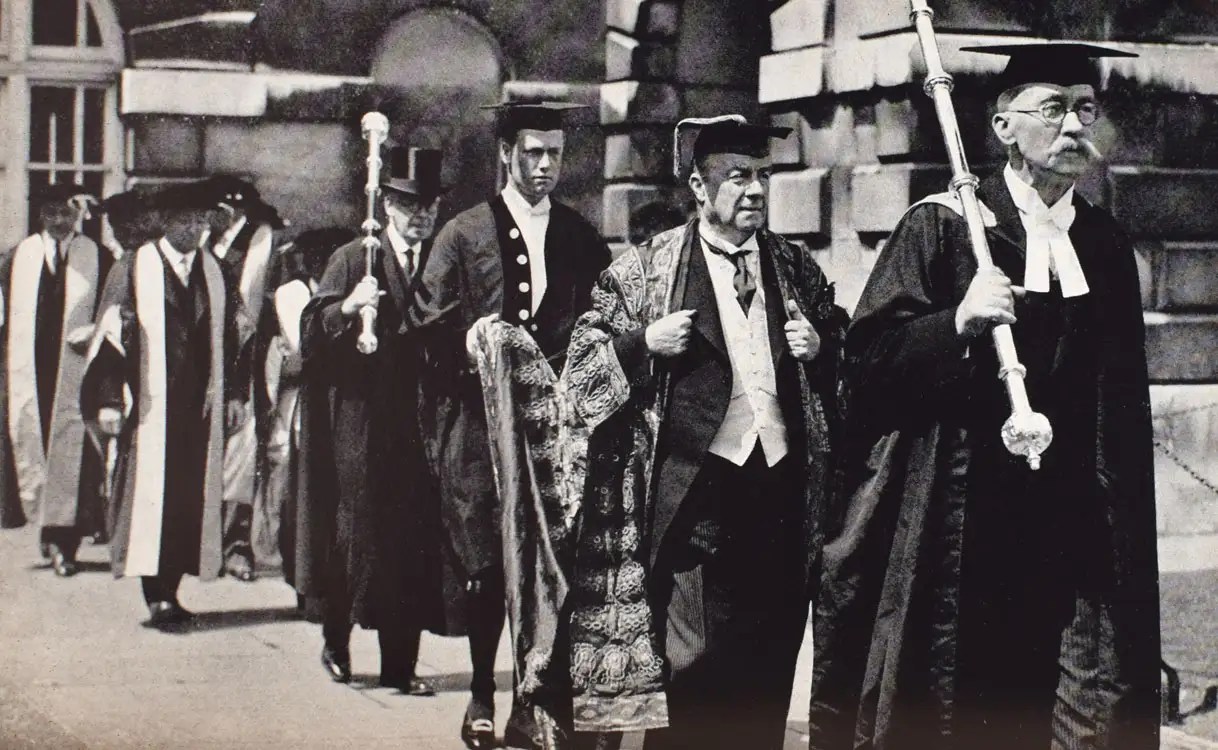
A university procession, from ‘Three Guineas’

She makes a simple point: men down the ages have ridiculed women for being so concerned about their clothes and dress; well, just look at these preposterous old buffers in their wigs and gowns and cloaks and gaiters.

But there’s also a serious point which is germane to her war theme: for she suggests that it is this flaunting of hierarchy and status, this cursed male wish to be superior, which is one of the roots of war. And so she thinks a good way to prevent war would be to attack this cause at the root and refuse to accept honours (as she did) or take part in silly ceremonies (a point developed at length in section 3).

Shortcoming 2. Over-reliance on biography as her primary evidence

The limitations of her education partly explain Woolf’s over-reliance on biography as evidence. She shows little sign of having read much history, economics, science or engineering, philosophy, psychology or sociology – some, but not much, and when she cites history books it’s rarely for the economic or social data.

Instead, what she does rely on to an overwhelming extent is biographies: all the damning evidence she assembles to demonstrate British society’s engrained misogyny and the power of the patriarchy is rarely drawn from history or sociology but relies exclusively on biographies and autobiographies and letters. The phrase you get in so many book titles, ‘Lives and Letters’, sums it up exactly. As an indication of her reliance on biography, here are quotes from just on one page:

  • ‘The witness of biography — that witness which any one who can read English can consult on the shelves of any public library…’
  • ‘Biography proves this in two ways…’
  • ‘Of this, too, there is ample proof in biography…’
  • ‘The study of biography… proves…’
  • ‘Perhaps the greatest testimony to the value of education with which biography provides us is…’
  • ‘You will find, if you consult biography…’

No need to consult facts and figures, assess data, decipher manuscripts, spend years in the archives. Again and again she takes the biography of an eighteenth century bluestocking or a nineteenth century hack writer like Mrs Oliphant off the shelf, and finds and pastes into her narrative their complaints about their limited lives and the dire condition of women in their time, which suit her argument.

(She does mention some histories but, when you look closely you see that she picks out of her historical sources the lives and opinions of her women witnesses: in other words, she selects the biographical elements of history and ignores the statistics, data, political history and so on.)

Late in the essay, rather as she does with her claims to be an amateur, untrained in academic enquiry, she turns an apparent weakness on its head. She tells us that she relies so much on (a very limited view of) history, on biography and newspapers, because they are the only sources of information open to a woman who has been denied a better, higher education, because of her sex; for:

history, biography, and… the daily paper [are] the only evidence that is available to the ‘daughters of educated men’.

Her very lack of scholarly rigour is itself an indictment of the patriarchal oppression which kept her excluded from the higher education her brothers and millions of men had benefited from.

And newspapers

She regards newspapers as ‘history and biography in the raw’. The excellent introduction by Anna Snaith tells us that Woolf kept three scrapbooks in which she gathered evidence for this book. It is striking how many of these snippets and excerpts are taken from newspaper articles or magazines, not the most in-depth kind of research. Newspapers are, by their nature, selective and biased and superficial. They sensationalise in order to sell copies. They are, in other words, the opposite of academic research into history, sociology and so on. This is a weakness in her evidence base.

On the other hand, newspapers are topical and up to date and give her useful snapshot of contemporary opinion – which makes them very interesting for the causal reader, 90 years later. Here’s a sample of the sources, taken from the numbered list of references at the back, which shows the combination of biography and newspaper cuttings which she overwhelmingly relies on as evidence.

  1. ‘Personal Reminiscences of a Great Crusade’ / a cutting from The Herald
  2. a cutting from The Listener / ‘Reflections and Memories’ by Sir John Squire
  3. ‘The Life of Sophia Jex-Blake’ by Margaret Todd
  4. Letter to The Times
  5. Debretts
  6. ‘Life of Sir Ernest Wild, K.C.’ by R.J. Rackham
  7. Lord Baldwin, speech reported in The Times
  8. ‘Life of Charles Gore’ by G.L. Prestige
  9. ‘Life of Sir William Broadbent’ edited by his daughter
  10. ‘The Lost Historian, a Memoir of Sir Sidney Low’ by Desmond Chapman-Huston
  11. ‘Thoughts and Adventures’ by Winston Churchill
  12. Speech at Belfast by Lord Londonderry, reported in The Times

You get the picture: her main sources are lives, letters and newspapers.

The second letter: funding a women’s college

Since the essay is in three parts and the introduction says it addresses three letters, I thought it would be a part per letter, so I was surprised when the second letter pops up at the end of part one. It is from a women-only college writing to ask Woolf to contribute to their fund raising. Anna Snaith’s excellent notes tell us it was a real letter Woolf received from Joan Strachey, Principal of the women-only Newnham College in Cambridge, asking for a donation to renovate the college buildings.

Woolf shows with some doleful quotations and examples, how petty-minded, snobbish and fierce for their stupid rules and regulations the existing (men-only) universities are. She harks back to the notorious incident of being kicked off the grass by the beadle early in ‘A Room of One’s Own’, which clearly still rankles.

Therefore, she replies to this letter that she will consider contributing to a women-only college but only if it is drawn up on a completely different basis from the male colleges. She proceeds to lay out the principles for an experimental college, one which will eschew all competition and exams, be open to the poor, and teach the humanities in a spirit of openness and collaboration:

A place where society was free; not parcelled out into the miserable distinctions of rich and poor, of clever and stupid; but where all the different degrees and kinds of mind, body and soul merit cooperated. Let us then found this new college; this poor college; in which learning is sought for itself; where advertisement is abolished; and there are no degrees; and lectures are not given, and sermons are not preached…

She warns that if the women-only colleges model themselves along male lines, with all the snobbery and competition and status-seeking and petty rankings that entails… those are precisely the kinds of habits of thought, the endless seeking superiority, which create the war mentality and she will not contribute to it.

And no chapels. She is as vehemently against the all-women colleges having chapels as she is violently against the engrained misogyny of the Church of England.

No to teaching English literature

She has a fierce passage execrating the teaching of English literature and its packaging into classes and exams, which she describes as ‘vain and vicious’. This is why Woolf herself refused to accept honorary degrees or prizes, despite being offered many in the later part of her life, and turned down offers to lecture (the exception which proves the rule being the lectures which formed the basis of ‘A Room of One’s Own’).

Woolf explains women’s war patriotism as an escape from domestic oppression

In a wonderfully irrational peroration she thinks that it can only have been delirious joy at being released from the narrow, cramped, uneducated lives forced upon Victorian daughters and spinsters which explained the huge outburst of patriotic enthusiasm among women at the outbreak of the Great War in 1914.

So profound was her unconscious loathing for the education of the private house with its cruelty, its poverty, its hypocrisy, its immorality, its inanity, that she would undertake any task however menial, exercise any fascination however fatal that enabled her to escape. Thus consciously she desired ‘our splendid Empire’; unconsciously she desired our splendid war.

This is splendid rhetoric but it’s a symptomatic of her failure to understand the causes of war, her failure to understand the psychology of crowds and societies embarking on war, her failure to understand genuine feelings of patriotism or national pride which are such big motivators for large numbers of people in any country – in a nutshell, her failure to understand anyone outside her own narrow upper-middle-class milieu.

Shortcoming 3. Ignorance of the wider world

I think her failure to understand the patriotic zeal which accompanied the start of World War One is indicative of her broader failure to understand the range and complexities of human nature, of all human nature across all of society.

Of the narrow little world of upper-middle-class women whose lives are supported by fleets of nameless servants which allow them to pursue their tedious obsession with art and poetry, of this tiny privileged world, she was a brilliant painter.

Of the big wide world, of the thousands of occupations, jobs and livelihoods, in finance, business, economics, trade, law, science, technology and engineering, of the lives of the working classes with their labour in coal mines and iron works, building ships, sailing the oceans, building trains and cars, laying down telegraph cables – in other words, in almost all the wide world and its billions of inhabitants, she has little or no interest and makes no effort to understand.

As an artist, as a writer, it doesn’t matter. Her novels focus on her chosen terrain and are masterpieces. As an essayist, claiming to gather evidence in order to analyse large social issues, it is, to say the least, problematic.

Giving a guinea

Out of this rather convoluted flow of arguments, Woolf concludes that she ought to give a guinea to the building of the women’s college, because it was entrapment in the family home that led so many women to explode with patriotism upon the outbreak of war. Building a college for the public education of the same class will prevent that and so materially contribute to the prevention of war which, if you recall, was the aim proposed right at the start of the essay.

Part 2. The professions

How can we enter the professions and yet remain civilized human beings, human beings who discourage war?

Woolf says a woman like her has only one weapon at her command to use against war, ‘the weapon of independent opinion based upon independent income.’ Now she will try to use this to sway the men in the professions.

The pretext is another letter she has received, from a society supporting women in the professions, asking for another donation, this time to the support of hard-up professional ladies. For Woolf it begs the question why, 20 years after women were admitted to the professions (1919) so few have risen to the top rank and so many are hovering round the bottom.

Woolf’s answers are convoluted and involve replies to other letters and lengthy addresses to her fictional interlocutor, they but boil down to:

  • women have much shorter traditions of thriving in the professions and so lack the centuries-old networks of male patronage and preferral
  • there are no limits to educated men churned out by the public schools and major universities, whereas there are far fewer schools for girls, only four or five colleges for women, and even the numbers admitted to these are severely restricted (only 500 women students were permitted at Cambridge in her day)
  • exams in the professions advantage those who have spent their lives taking exams, i.e. privileged, privately-educated men, and bar women who have (as she shows) vastly less access to private education
  • the nearly universal sexism and misogyny found at all levels of English society

Sexism and misogyny

As mentioned above, the flow of Woolf’s arguments is sometimes hard to follow, especially when it feels like she’s twisting the flow in order to fit her broader feminist critique to fit the essay’s ostensible subject of how to prevent war – but what the essay indisputably does do is powerfully convey the deeply entrenched tentacles of the patriarchy in contemporary 1930s England. She presents a wealth of facts and figures about the systematic prevention of women being educated, getting jobs, entering the professions and so on.

In this second part, the essay builds up into a devastating demonstration of English society’s hair-raising sexism and misogyny. In the main text but especially in the extensive notes which illustrate it, Woolf gives extended quotes from a wide range of men in powerful positions expressing the most hair-raising prejudices and slurs. I can’t give brief quotations, you have to read the notes, and the extended stories she gives, of awful politicians, judges, professionals, writers and commentators taking every opportunity to demean and limit women.

Fascists and Nazis

Woolf cranks up the temperature a lot by comparing several terrible British chauvinists who pontificate that a woman’s place is in the home, with a quote from none other than Adolf Hitler saying the exact same kind of thing.

Herr Hitler and Signor Mussolini have both often in very similar words expressed the opinion that ‘There are two worlds in the life of the nation, the world of men and the world of women’; and proceeded to much the same definition of the duties.

The juxtaposition of the two explains in a flash why Woolf is so resistant to all male talk about patriotism and ‘our country’. In what possible sense is it ‘her country’ when the Archbishop of Canterbury and the editor of the Daily Telegraph hold identical views about women’s place in society as Adolf Hitler? The same point is made in one of the long notes:

‘My husband insists that I call him “Sir”,’ said a woman at the Bristol Police Court yesterday, when she applied for a maintenance order. ‘To keep the peace I have complied with his request,’ she added. ‘I also have to clean his boots, fetch his razor when he shaves, and speak up promptly when he asks me questions.’ In the same issue of the same paper Sir E. F. Fletcher is reported to have ‘urged the House of Commons to stand up to dictators.’ (Daily Herald, 1 August 1926.)

Why, Woolf asks, all this fuss about opposing dictators abroad when every level of British society supports domestic tyrants at home?

Pay for housework

Men work in the public realm and get paid, sometimes a small fortune, often for jobs of dubious worth. Women labour in the home to raise families and manage households and care for the elderly, all unpaid. So: women’s domestic work should be paid.

The work of an archbishop is worth £15,000 a year to the State; the work of a judge is worth £5,000 a year; the work of a permanent secretary is worth £3,000 a year; the work of an army captain, of a sea captain, of a sergeant of dragoons, of a policeman, of a postman – all these works are worth paying out of the taxes, but wives and mothers and daughters who work all day and every day, without whose work the State would collapse and fall to pieces, without whose work your sons, sir, would cease to exist, are paid nothing whatever.

I wonder who first originated this call? Mary Wollstonecraft in ‘A Vindication of the Rights of Woman’ (1792)? Certainly Friedrich Engels mentions it in his 1884 book ‘The Origin of the Family, Private Property and the State’. Anyway, Woolf makes a sustained case for it over many pages, 30 years before the issue was revived by second-wave feminists in the 1970s:

Note: I was a househusband for eight years. I did all the childcare, running children round to nurseries, playgroups, parties, doing all the shopping, cooking and cleaning, changing thousands of nappies, giving bedtime baths and so on, while my wife earned the family income. So I have lived experience of issues like this. It’s this lived experience which feeds into my scepticism about feminism, not as a theory (fine and dandy) but in practice (complicated and compromised). I met plenty of women who were extremely happy to pack in office work and become full-time mums and housewives, who loved looking after their young children, dressing them up, holding parties, dropping them at nurseries or infant school and going to meet girlfriends for lunch or coffee.

Then again, some didn’t. Some felt trapped and needed support, would have welcomed free or cheap childcare, or just wanted to go back to work which they found more fulfilling than hanging round playgrounds or hosting rooms full of screaming kids.

I had many conversations with scores of mums about how the state should provide cheap childcare, or if only companies would allow more flexible work based around school hours, if only housework was recognised and paid for like other forms of work, and so on and so on. Hundreds of conversations on these and related subjects, over years and years.

So my scepticism about feminism is not ideological or temperamental. It’s based on the lived experience of being a housekeeper and child-rearer myself, and talking to hundreds of women in the same situation. The problem is not the top-level slogans and demands, anyone can come up with catchy slogans and carry banners – “Wages for Housework” – it’s figuring out the practical policies and application: where would the money come from? How would it be paid out? Who defines ‘housework’? Like child benefit would it go to anyone caring for a child or be subject to conditions? How would you prove that you do the housework and don’t sub-contract this or that part to cleaners or nannies? etc etc.

The procession

Back to the Woolf on the professions. She gives a vivid description of the processions of all the professions through London’s streets to the centres of law, finance and so on and asks her women readers: do we, in fact, want to be part of this procession? Do we want to do the same jobs but for less pay and more condescension? Or do we want to strike out on our own and lead our lives differently?

The facts… seem to prove that the professions have a certain undeniable effect upon the professors. They make the people who practise them possessive, jealous of any infringement of their rights, and highly combative if anyone dares dispute them. Are we not right then in thinking that if we enter the same professions we shall acquire the same qualities? And do not such qualities lead to war? In another century or so if we practise the professions in the same way, shall we not be just as possessive, just as jealous, just as pugnacious, just as positive as to the verdict of God, Nature, Law and Property as these gentlemen are now?

She gives a number of quotes from lawyers, clerics and politicians complaining they lead a dog’s life, and have sacrificed all their pleasures and family time to their work. Do modern women want to rush into exactly the same kind of wage slavery?

Woolf wonders if we can turn to the lives of nineteenth century women in the professions to help us find a more humane way to have one of these high-powered jobs and live properly? No, because there weren’t any women in the nineteenth century professions. They weren’t allowed. Instead:

We find, between the lines of their husbands’ biographies, so many women practising – but what are we to call the profession that consists in bringing nine or ten children into the world, the profession which consists in running a house, nursing an invalid, visiting the poor and the sick, tending here an old father, there an old mother? – there is no name and there is no pay for that profession; but we find so many mothers, sisters and daughters of educated men practising it in the nineteenth century that we must lump them and their lives together behind their husbands’ and brothers’.

The validity of housework and child-rearing, again, and the long buried, unrecorded of the scores of millions of women who spent their entire lives doing it.

Giving the second guinea

All these arguments have been contained, rather confusingly, in a very long letter replying to the letter she received asking for financial aid for impoverished women professionals. Woolf sums up her position by saying she will send the letter-writer one guinea ‘on condition that you help all properly qualified people, of whatever sex, class or colour, to enter your profession’, and in addition ensure that women:

  • must earn enough to be independent
  • must not prostitute their brain to their profession
  • must refuse all prizes, medals and awards, and be content with obscurity
  • must rid themselves of religious pride, college pride, school pride, family pride, sex pride and those unreal loyalties that spring from them

These are obviously very strict, probably utopian conditions, as with her demand for a completely different type of college which ended section 1. But:

If you agree to these terms then you can join the professions and yet remain uncontaminated by them; you can rid them of their possessiveness, their jealousy, their pugnacity, their greed. You can use them to have a mind of your own and a will of your own. And you can use that mind and will to abolish the inhumanity, the beastliness, the horror, the folly of war.

Antigone saying No to male tyranny

Part two rises to a very powerful invocation of Sophocles’ play, Antigone. Woolf studied this when young and it stayed with her all her life as a powerful story of female resistance to male tyranny. In the era of Hitler and Mussolini it was more than ever relevant. She comes back to it later.

No risk because of exclusion

Woolf ends part 2 with a grand fanfare of irony, saying there is no immediate risk of women professionals losing their souls and working themselves to shreds so long as the laws of England hold their nationality so lightly, prevent them from working in many professions, limit the numbers who can attend university, and ensure that so many women continue to live in the tradition of neglect and contempt, living gruelling lives of unpaid work in dark patriarchal homes.

Part 3. The Outsider Society

The sarcasm and irony which have been present throughout the essay rise to a real anger and bitterness in this, the longest of the three parts.

Woolf reverts back to the original letter she was sent, the one from the unnamed male correspondent asking her how they can prevent a war, and she repeats his three suggestions, namely that we should:

  1. sign a manifesto pledging ourselves ‘to protect culture and intellectual liberty’
  2. join a certain society, devoted to certain measures whose aim is to preserve peace
  3. should subscribe to that society which like the others is in need of funds

Failure of the universities

She addresses these points one by one. First she is satirical about this idea of ‘protecting culture and intellectual liberty’. Isn’t this what the Great Universities have said they were devoting themselves to for centuries, the ones which have been teaching men these values and brutally excluding their sisters and daughters? Is the fact that these values now need such support from society an admission that all those centuries of learning have failed? And if they’ve failed, why should the impoverished, life-opportunity-deprived daughters and sisters suddenly rush to the help of their oppressors?

What is ‘culture and liberty’?

Anyway, what is this ‘culture and liberty’ the letter writer refers to? She knows what it isn’t. Characteristically, she turns to biography and uses the life of an author like Mrs Margaret Oliphant (1828 to 1897) who, after her husband died, churned out meretricious romances to support her children. Was this intellectual liberty? No, this was intellectual prostitution and Woolf angrily takes it as typical of the intellectual prostitution forced on so many women writers and artists who had to sell their souls and prostitute their art because of the patriarchy’s refusal to let them earn a living any other way.

So she mocks the letter writer’s suggestion that women, victims of centuries of repression, should suddenly rush to help the poor privileged men in their time of need. He wants her to join his pacifist society, does he? Well, no. The very word ‘society’ denotes the systematic exclusion of women from education and influence and power and money, so screw society.

The very word ‘society’ sets tolling in memory the dismal bells of a harsh music: shall not, shall not, shall not. You shall not learn; you shall not earn; you shall not own; you shall not – such was the society relationship of brother to sister for many centuries.

The Outsiders Society

She’s not going to join any boys’ club. Instead she proposes setting up a separate organisation, for women of her class and (lack of) education. It would be called The Outsiders Society. It would consist of educated men’s daughters working through their own class and by their own methods for liberty, equality and peace. Members would:

  • not fight
  • not work in munitions factories or nurse the injured
  • not encourage men to go and fight but maintain an attitude of neutrality, as fighting is a ‘sex characteristic which she cannot share’

She rises to real bitterness:

She will find that she has no good reason to ask her brother to fight on her behalf to protect ‘our’ country. ‘”Our country,”‘ she will say, ‘throughout the greater part of its history has treated me as a slave; it has denied me education or any share in its possessions. “Our” country still ceases to be mine if I marry a foreigner. “Our” country denies me the means of protecting myself, forces me to pay others a very large sum annually to protect me, and is so little able, even so, to protect me that Air Raid precautions are written on the wall [i.e. women are defenceless against modern warfare]. Therefore if you insist upon fighting to protect me, or “our” country, let it be understood, soberly and rationally between us, that you are fighting to gratify a sex instinct which I cannot share; to procure benefits which I have not shared and probably will not share; but not to gratify my instincts, or to protect either myself or my country. For,’ the outsider will say, ‘in fact, as a woman, I have no country. As a woman I want no country. As a woman my country is the whole world.’

Wow. Very powerful. Furthermore, The Outsider will cultivate complete indifference to male nonsense about patriotism, war and fighting. On the contrary, she will:

  • take no part in patriotic demonstrations
  • not take part in patriotic praise
  • absent herself from military displays, tournaments, tattoos, prize-givings and all such ceremonies as encourage the desire to impose ‘our’ civilization or ‘our’ dominion upon other people

The idea is that this ‘indifference’ will damp down patriotic fervour in those around her and thus, in a tiny way, help to avoid war.

All this makes a sort of sense. But it feels like twisting logic when Woolf goes on to assert a link between these anti-war steps and the positive demands of her feminist programme. The connection feels tenuous and forced. Because she now switches to say that in order for their opinion or actions to matter, the outsiders must push for a raft of feminist requirements, being:

  • they must earn their own livings
  • they must press for a living wage in their professions
  • they must create new professions in which they can earn a living wage
  • they must press for press for a money wage for the unpaid worker in her own class – the daughters and sisters of educated men
  • they must press for a wage to be paid by the State to the mothers of educated men

Make the state pay for housework

This last is vital because until she has complete financial independence, a wife is dependent on her husband for money and will follow his opinions and men are for war. Therefore, in order to create an influential bloc of educated women who are against war, this class must be given financial, and so intellectual, independence. Women must be paid by the State for their work as mothers.

And she tells her male interlocutor that this step – paying women for their housework – would also liberate husbands, because by sharing the burden of earning an income they would no longer be wage slaves, slaves to the rat race. It would have an enlightening and life-enhancing effect all round.

I gave my thoughts on this proposal earlier. It sounds great, and you can see her logic – that women can only be truly independent and free if they have their own income, separate from their father’s or husband’s – but how would it be implemented in practice?

I’ll just make the additional point that its recurrence here is characteristic of how key themes and suggestions recur throughout the essay, building up power through repetition and echoes, not unlike her technique in her novels.

Outsider demands

But she hasn’t finished with her demands. The Outsiders would:

  • not only earn their own livings but become so expert that their threat to down tools would have power and influence
  • when they have earned enough to live on they would earn no more i.e. not pile up obscene wealth
  • they would reject any profession hostile to freedom such as the arms trade
  • they would refuse to take office in any institution which pretends to respect liberty but actually restricts it, such as Oxford and Cambridge

Outsiders will eschew all the stupid costumes and ceremonies so beloved by men (see the section about silly ceremonials in part 1).

Outsiders will eschew ‘the coarse glare of advertisement and publicity’ and prefer to work in honest obscurity.

The secret society already exists

Wandering into thriller territory, Woolf suggests that this Outsider Society already exists but is secret and underground in its activities. Her very dubious evidence for this far-fetched claim is a clutch of newspaper reports of various women officials making comments against war, opposing arms manufacture and the like. From random quotes and newspaper clippings she based the existence of a secret society operating across English society. Is this an example of her sometimes utopian or far-fetched argumentation – or an example of her dry sense of humour? Difficult to tell.

Against the Church of England

Outsiders will:

  • fearlessly investigate and criticise public institutions they are forced to contribute to, such as the universities, but especially the Church of England
  • by criticizing religion they would attempt to free the religious spirit from its present servitude and would help, if need be, to create a new religion based it might well be upon the New Testament, but, it might well be, very different from the religion now erected upon that basis

Woolf’s attitude to the Church of England had already been indicated in the passage about cited above about Antigone where she writes that ‘Antigone’s five words are worth all the sermons of all the archbishops’, those five Greek words (they total 11 in the English translation) being:

‘Tis not my nature to join in hating, but in loving.’

Pages 196 to 202 give a scathing account of how Jesus Christ’s own admonition that his followers are equal which promised equality between men and women was denied by St Paul, who invented the idea that women must be veiled in church and not speak. This bigotry hardened over the centuries into a church which forbids any positions of power or influence in the most powerful and prestigious organisation in the land, to women.

With the result that the salary of an archbishop is £15,000, the salary of a bishop is £10,000 and the salary of a dean is £3,000. But the salary of a deaconess is £150; and as for the ‘parish worker’, who ‘is called upon to assist in almost every department of parish life’, whose ‘work is exacting and often solitary…’ and who is most likely to be a woman, she is paid from £120 to £150 a year.

It’s a pattern mirrored in all the other professions and walks of life: women excluded from all the prestigious, well-paid higher positions, and forced to undertake the most menial and poorly-paid jobs.

Psychoanalysis, anger and fear

One of Anna Snaith’s excellent notes tells us that ‘Woolf’s brother Adrian [Stephen] and his wife Karin were trained psychoanalysts and were crucial in disseminating Freud’s work in England.’ This is relevant because Woolf quotes at length from the Archbishops’ Commission on the Ministry of Women (1936) and in particular from the appendix written by Professor Grensted, the Nolloth Professor of the Philosophy of the Christian Religion in the University of Oxford.

This professor concluded that there is no reason in theology (Christ’s teachings) why there should not be women priests, but there were strong objections to women priests among the clergy. Digging deeper he uses Freudian terminology to suggest the deep conviction held by many men of men’s superiority and women’s inferiority.

The causes are obscure but the outcome is obvious: that whenever a conversation lights on the topic of equality for women and women holding roles up till now reserved for men, many man become angry and many women become fearful. This imbalance leads women not to raise, mention or discuss the issue which, as a result, goes underground.

The infantile fixation

Woolf takes from Grensted the notion of the ‘infantile fixation’. I didn’t quite understand this and I didn’t see her defining it anywhere. Instead she gives three examples of what she means (taken, inevitably, from biographies), namely the wildly irrational anger and jealousy triggered in three classic Victorian fathers when their daughters asked permission to get married or (worse than that) to get a job. The fathers being:

  • Mr Barrett (father of Elizabeth who wanted to marry the poet Robert Browning)
  • the Reverend Patrick Brontë (father of Charlotte who wanted to marry)
  • Mr Jex-Blake (father of Sophia who was offered a small sum for tutoring mathematics to a friend)

By contrast, to show the impact of a father’s liberality, she gives the story of Mr Leigh Smith. It’s worth quoting at length because the impact is in all the details. Smith had a daughter, Barbara, who he loved.

When Barbara came of age in 1848 he gave her an allowance of £300 a year. The results of that immunity from the infantile fixation were remarkable. For ‘treating her money as a power to do good, one of the first uses to which Barbara put it was educational.’ She founded a school; a school that was open not only to different sexes and different classes, but to different creeds; Roman Catholics, Jews and ‘pupils from families of advanced free thought’ were received in it. ‘It was a most unusual school,’ an outsiders’ school. But that was not all that she attempted upon three hundred a year. One thing led to another. A friend, with her help, started a cooperative evening class for ladies ‘for drawing from an undraped model’. In 1858 only one life class in London was open to ladies. And then a petition was got up to the Royal Academy; its schools were actually, though as so often happens only nominally, opened to women in 1861; next Barbara went into the question of the laws concerning women; so that actually in 1871 married women were allowed to own their property; and finally she helped Miss Davies to found Girton. When we reflect what one father who was immune from infantile fixation could do by allowing one daughter £300 a year we need not wonder that most fathers firmly refused to allow their daughters more than £40 a year with bed and board thrown in.

The difference just one liberal father made. What if all Victorian fathers had been like that.

Sexist science

There follows a passage giving some examples of how even contemporary science is twisted to prove the inferiority of women. To be honest this section is neither very compendious nor persuasive. She doesn’t really go into the most basic accusation against women, that their bodies are designed for childbirth and child-rearing and this explains why their minds are limited to domestic subjects and childish logic. (I’m not saying this, I’m repeating the sexist, misogynist accusation.)

This is a failing but I think reflects the limitations of Woolf’s knowledge and education. Of science she knows next to nothing and so is simply incapable of unpacking all the biological and psychological aspects of woman-hating. She is much more at home in her comfort zone of education and literature, the lives of women writers.

She cites Bertrand Russell pointing out the sheer sadism of much medical science towards women (the medical profession’s reluctance to provide painkillers to women in childbirth) or the twisting of scientific knowledge to justify male superiority – but not as amply as this huge subject demands.

Cleons

Instead she reverts to literature again, and her obsession with Antigone. In the play the oppressive father is Cleon, the archetype for the Victorian paterfamilias and the modern fascist. Here is Cleon speaking dictator-talk:

‘Whomsoever the city may appoint, that man must be obeyed, in little things and great, in just things and unjust… disobedience is the worst of evils… We must support the cause of order, and in no wise suffer a woman to worst us… They must be women, and not range at large. Servants, take them within.’

Order and the oppression of women, Mr Barrett and Mussolini.

The personal and the private

In the essay’s last pages she brings things together by (rightly) saying that she has shown how male tyranny in the personal, domestic realm and in the public realm, are intimately linked:

that the public and the private worlds are inseparably connected; that the tyrannies and servilities of the one are the tyrannies and servilities of the other.

Despite the strangeness of the letter-answering structure and the oddly digressive, rambling flow of the argument, by the end she has presented a devastating barrage of evidence, as well as making a host of demands and suggestions.

The third guinea

So she refuses to sign the form her correspondent had sent her. She refuses to sign up to his society because of her opposition to all such male bodies, but she will send him a guinea to support it.

Their aims are the same, to oppose the tyrants in the name of Justice and Equality and Liberty. But, as this amazing book has explained, as a woman, as the patchily educated ‘daughter of educated men’, as someone with completely different life experiences and, consequently, utterly different perspectives from the male sender of the letter, she shares the same aim but insists that she will try to bring it about using, not the old male forms and words, but new words and new ideas appropriate for women.

Magnificent

For all its faults, ‘Three Guineas’ is a magnificent, powerful and very persuasive piece of work. Her assembly of a very wide range of evidence, facts and figures really bring home the historical endurance, depth and wide range of the legal, financial and cultural oppression of women throughout English history and the stupid, patronising and misogynist attitudes and opinions deployed to maintain that oppression.

The notion of the Outsiders Society is the crystallisation of the massive theme which emerges repeatedly throughout the text, the idea that women – not because of any biological or psychological differences – but purely because of the legal, financial, professional and cultural apartheid they have suffered for centuries, bring to the table a different perspective from men across a whole range of issues.

I think it’s a magnificent example of a polemical essay, of an impassioned political pamphlet.

Criticisms

There are a number of problems or issues with Woolf’s way of arguing. Initially I included them in my review where they occurred but they cluttered up the flow of my review, and gave an unduly negative opinion too early on. I mentioned three earlier on. Here are a few more.

Shortcoming 4. Woolf’s intellectual confusions

Periodically throughout the text Woolf freely admits to own intellectual shortcomings: for example, right at the start she admits being bewildered that there seems to be a wide range of opinions about whether war is good or inevitable. She herself tells us that the more she reads, the more opinions she discovers, the more confused she becomes. But… is that not the point of being an intellectual: to read all the opinions, weigh the evidence, and develop your own line of argument, based on the evidence you uncover and reacting to other people’s arguments?

This activity, intellectual activity, always puzzles and confuses Woolf. In ‘A Room of One’s Own’ there’s the section where she orders up some books in the British Museum and opens them up, expecting to discover The Truth staring her in the face.

Sometimes this is part of her general mocking irony, mocking the pretensions of pretty much all male activity, including the grand Pursuit of Truth. But at other times it can give you the worrying sense that she doesn’t really understand what intellectual enquiry is.

Her intellectual confusion as evidence of her case

In the opening and then at various transition moments, Woolf explicitly tells us that she struggles to marshal the evidence, is embarking on something too big for her abilities, and wonders if she’d be better off abandoning it. After a while I realised that maybe these passages are designed to dramatise the issue of women’s exclusion from formal education by using herself as an example.

Woolf’s brothers went to top private schools and Oxbridge whereas she more or less had to educate herself at home and mostly taught herself by browsing through her father’s extensive library. In other words, every time she shares how confused by the evidence or daunted by the challenge of answering big question she is, she is demonstrating the effect of the grotesquely unequal education of the genders, how women have been the victims of ‘tradition, poverty and ridicule’, and showing the reader how she (and we) are suffering for it.

Maybe that’s why she flaunts her own intellectual limitations so much: the intellectual inability she frequently laments is the result of her exclusion from higher education. It makes her case for her.

Shortcoming 5. Her analysis is restricted to a (relatively) small class

Her lack of real confidence in her own research, and her need to make her feminist points as categorical and powerful as possible, explain why Woolf makes the strategic decision of restricting her analysis to a relatively small class, to women like herself, to ‘the daughters of educated men’, as she describes them. As she puts it:

Our ideology is still so inveterately anthropocentric that it has been necessary to coin this clumsy term – ‘educated man’s daughter’ – to describe the class whose fathers have been educated at public schools and universities. Obviously, if the term ‘bourgeois’ fits her brother, it is grossly incorrect to use it of one who differs so profoundly in the two prime characteristics of the bourgeoisie – capital and environment.

She makes it quite clear on page one that she is only discussing upper-middle-class women, women like herself, women with immaculate manners who are used to managing servants and know which of the many forks and spoons to use at a formal dinner.

In order to avoid the confusions, contradictions and conflicting evidence I mentioned above, in order for her analysis to work, she has to reject the vast majority of the population (the working class and lower classes, of both sexes) and identify her cause with just this numerically small and limited class of posh ladies.

It isn’t just me pointing this out. The Wikipedia article about Three Guineas tells us that the noted academic Q.D. Leavis wrote a scathing review of ‘Three Guineas’ soon after it was published:

She denounces the essay because it is only concerned with ‘the daughters of educated men’, seeing Woolf’s criticisms as irrelevant to most women because her wealth and aristocratic ancestry means she is ‘insulated by class’.

And Anna Snaith’s notes in the Oxford University Press edition tell us that Woolf received letters from working class women readers who complained about being left out of her analysis, notably a long semi-autobiographical one from a working class woman named Agnes Smith.

This is closely related to what I called shortcoming 3, ignorance of the wider world. But it’s also a decision. She found it hard enough gathering the evidence for the sexist discrimination against her own type and class of woman. If she opened it up to the broader middle and working classes she’d never have finished it.

2025: the perils of intersectionality

Many of these criticisms are mentioned in Anna Snaith’s introduction to the Oxford University Press edition. Here she indicates the larger cultural and political problems the essay falls foul of. This is that there are, nowadays, so many grievances, so many groups claiming to be victims, so many communities and identities who feel that they, too, have been subjected to centuries of oppression, that it is hard to focus on just one, and it is especially hard to focus on the group Woolf defines as the ‘daughters of educated men’.

As you read Snaith’s account of Woolf’s life and social circle, with so many friends among England’s political and cultural elite, the idea of her as a persecuted outsider feels more and more ludicrous. She wasn’t a Jew in Hitler’s Germany, a Black in the American South, a kulak in Stalin’s Russia, an Aborigine in Australia, she grew up in a house full of books which she was actively encouraged to read and went on to become a centre of London’s literary and artistic elite.

This doesn’t invalidate any of the points she makes in the book or detract from the essay’s tremendous power. It’s just to say that the struggle for women’s equality takes its place among quite a few other struggles. I’ve a book about the Irish Civil War on my desk and Irish nationalists have quite a story to tell about 1,000 years of British oppression. Her husband was a Jew who had his own story about the legal and financial persecution of Jews. Something similar could be said of England’s Roman Catholics, prevented by law from holding official positions. Or – a group close to my heart – England’s non-conformists, banned by law from holding any positions of authority for 300 years after the civil war. Citizens from India or any of the colonies we ruled for centuries might have a thing or two to say about Britain’s oppression of their peoples and cultures.

Being a modern academic, Snaith is contractually obliged to drag in slavery – the progressive topic par excellence – to her discussion of ‘Three Guineas’, on the rather tenuous basis that guineas were, apparently, first used as currency in the British slave trade. Don’t know what Virginia would have made of that scholarly leap of imagination.

To repeat – this little digression about the modern over-abundance of historical grievances is not entirely my view but simply expanding points made by the book’s editor, Anna Snaith, in her introduction.

All these other issues don’t invalidate any of the points Woolf makes in the book but they place it in a much larger, real world context. If you’re a feminist, you can insist that your cause and your history of oppression is the real one, the big one, the important one and, convinced of your righteousness, overlook or downplay the grievances of all the other groups I’ve mentioned. In a sense, to get anything done, you have to focus on your issues and grievances; nobody can represent the issues of the whole world. You have to pick your battles. And this explains why Woolf realised that, in order to get her book written, she had to concentrate just on relatively privileged upper-middle-class women like herself, on ‘the daughters of educated men’.

Conclusion

It’s a very powerful book. Very. To repeat what I said at the start, from one point of view it may be her most important work. It’s a bit of a struggle, a bit meandering, a bit puzzling in places, her proposals such as for the Outsider Society are a bit eccentric – and yet so many of her main points drive right home, and the evidence gathered in the notes at the end is searing, blistering, eye-opening. It shook this old cynic. It materially changed my views about feminism. I strongly recommend it.


Credit

‘Three Guineas’ by Virginia Woolf was first published by the Hogarth Press in 1938. Page references are to the 2015 Oxford University Press paperback edition, edited and annotated by Anna Snaith, although the text is easily available online.

Related links

Related reviews

The Soul of Man under Socialism by Oscar Wilde: quotes and commentary

The key thing to grasp about this essay is that, although it’s routinely touted as Wilde’s one engagement with politics, it is not really about politics at all but centred on the more familiar Wildean subject of the cultivation of individualism.

His entire worldview boils down to the need for everyone to throw off the various shackles of society and cultivate their true selves. So Wilde isn’t interested in socialism as it is usually defined – ‘a political and economic theory of social organization which advocates that the means of production, distribution, and exchange should be owned or regulated by the community as a whole.’ His form of socialism means ‘a political and economic theory of social organization which enables the greatest possible development of each citizen, the fullest possible blossoming of their selves.’

Socialism = liberation from others Thus he opens the essay by saying that the chief benefit of socialism would be liberating us from ‘the sordid necessity of living for others’. Throughout history only a handful of men have been able ‘to realise the perfection of what was in him’ (in his century, Darwin, Keats, Renan) but most people are prevented from becoming their true selves by the necessity of living for others. In the nineteenth century this is because of the spectacle of ‘hideous poverty, by hideous ugliness, by hideous starvation’ which surrounds them.

Charity is harmful to giver and receiver alike Thus they embark on charity to alleviate the sufferings of the poor but this is wrong. Charity is wrong. In fact the people who set out to do the most good end up doing the most harm. They are like the ‘good’ slave owners who were kind to their slaves and so prevented the true horror of the system from being more evident and the whole thing being ended earlier.

The state of the poor He gives a paragraph on the state of England’s urban poor, ‘living in fetid dens and fetid rags, and bringing up unhealthy, hunger-pinched children in the midst of impossible and absolutely repulsive surroundings’ and pitifully dependent on the weather i.e. whenever there’s a frost the streets are full of whining beggars and crowds queueing for entry to ‘loathsome’ shelters.

Under Socialism…each member of the society will share in the general prosperity and happiness of the society…

Socialism, Communism, or whatever one chooses to call it, by converting private property into public wealth, and substituting co-operation for competition, will restore society to its proper condition of a thoroughly healthy organism, and insure the material well-being of each member of the community. It will, in fact, give Life its proper basis and its proper environment. But for the full development of Life to its highest mode of perfection, something more is needed. What is needed is Individualism.

Individualism The ideal world will be ideal because it will allow everyone to flourish and develop their own individual uniqueness. Under present conditions quite a few people are well off enough to develop a limited form of individualism.

These are the poets, the philosophers, the men of science, the men of culture – in a word, the real men, the men who have realised themselves, and in whom all Humanity gains a partial realisation.

But, of course, the majority are forced to do the work of beasts of burden, live on the brink of starvation, under the tyranny of want. All this will be abolished by socialism.

Private property At the root of inequality is the concept of private property which is why Socialism is committed to abolishing it. However, Wilde, with typical paradox and wit, points out that private property is not only ruinous for those that don’t have it (i.e. the poor) but is also very deleterious for those that do, the middle and upper classes.

The possession of private property is very often extremely demoralising…It involves endless claims upon one, endless attention to business, endless bother… and that is, of course, one of the reasons why Socialism wants to get rid of the institution.

Why? Because getting it and keeping it, maintaining it and worrying about it, are all distractions from what Wilde sees as the purpose of life, which is to cultivate your individuality. All the duties which come with wealth are a burden. Abolishing private property will free not only the poor but the rich as well.

In praise of the rebellious poor Many of the poor accept high-minded charity quiescently but Wilde is on the side of the rebellious poor, who revolt against their wretched condition and recognise charity as the feeble attempts to plaster over a wicked system which they are.

The best amongst the poor are never grateful. They are ungrateful, discontented, disobedient, and rebellious. They are quite right to be so.

And:

Why should they be grateful for the crumbs that fall from the rich man’s table? They should be seated at the board, and are beginning to know it. As for being discontented, a man who would not be discontented with such surroundings and such a low mode of life would be a perfect brute. Disobedience, in the eyes of anyone who has read history, is man’s original virtue. It is through disobedience that progress has been made, through disobedience and through rebellion.

And:

A poor man who is ungrateful, unthrifty, discontented, and rebellious, is probably a real personality, and has much in him. He is at any rate a healthy protest. As for the virtuous poor, one can pity them, of course, but one cannot possibly admire them. They have made private terms with the enemy, and sold their birthright for very bad pottage. They must also be extraordinarily stupid.

(You can see why after just a few pages of this the average Victorian reader would be outraged. So far he has said he wants to abolish all private property, abolish the distinctions between the classes along with the intricate hierarchy of rank, that he is against that great Victorian institution of philanthropy and in favour of the most rebellious, mutinous and violent type of proletarian protester. Radical scandalous stuff.)

The need for agitators Obviously bourgeois Victorians had a great fear of agitators who would rouse the downtrodden masses from their slumber, hence the vicious laws passed against early attempts to form trade unions, but Wilde, with a typically paradoxical flourish, says that this is precisely why they are so important.

What is said by great employers of labour against agitators is unquestionably true. Agitators are a set of interfering, meddling people, who come down to some perfectly contented class of the community, and sow the seeds of discontent amongst them. That is the reason why agitators are so absolutely necessary. Without them, in our incomplete state, there would be no advance towards civilisation.

American slavery For the second time he cites the example of slavery in America. First time was to claim that the ‘good’ slave owner only made the situation worse by glossing over the true horror of the institution. Now he cites the way slavery was abolished not by the slave owners, and certainly not by the utterly cowed slaves themselves, but by outside agitators, the Abolitionists from the North (starting in high-minded Boston) who entered the slave states from outside and often behaved illegally (he doesn’t explain how but I assume in helping to liberate slaves and transport them to freedom in the North).

Against authoritarian socialism Switching theme a bit he repeats the notion that an authoritarian socialism would defeat the object – well, what he sees as the object of such a social transformation, which is the undoing of all restrictions which prevent people from becoming their true selves.

It is to be regretted that a portion of our community should be practically in slavery, but to propose to solve the problem by enslaving the entire community is childish. Every man must be left quite free to choose his own work. No form of compulsion must be exercised over him.

Unfortunately, as we discovered in the twentieth century, because so many people are opposed to a completely propertyless society the only way a socialist state can be made to work is by imposing it by force and maintaining it via surveillance, spies and prison camps… Anyway he writes this because:

Many of the socialistic views that I have come across seem to me to be tainted with ideas of authority, if not of actual compulsion. Of course, authority and compulsion are out of the question. All association must be quite voluntary.

How individualism will flourish without private property It’s true that:

A few men who have had private means of their own, such as Byron, Shelley, Browning, Victor Hugo, Baudelaire, and others, have been able to realise their personality more or less completely. Not one of these men ever did a single day’s work for hire. They were relieved from poverty. They had an immense advantage.

Will not we lose the lovely productions of such writers if we abolish the system of private property which produced them? No. Because with the advent of propertyless socialism all people will be freed to cultivate their personalities, it will release ‘the great actual Individualism latent and potential in mankind generally’.

How private property destroys individualism 

Private property has crushed true Individualism, and set up an Individualism that is false…It has made gain not growth its aim. So that man thought that the important thing was to have, and did not know that the important thing is to be. The true perfection of man lies, not in what man has, but in what man is.

Private property debars the great mass of the population from becoming individuals by impoverishing and starving them, but it has trammelled the middle and upper classes by persuading them to devote their lives to money, greed, property, wealth and so on. It has persuaded people that the sole purpose of life is to:

accumulate this property, and to go on wearily and tediously accumulating it long after he has got far more than he wants, or can use, or enjoy, or perhaps even know of. Man will kill himself by overwork in order to secure property, and really, considering the enormous advantages that property brings, one is hardly surprised. One’s regret is that society should be constructed on such a basis that man has been forced into a groove in which he cannot freely develop what is wonderful, and fascinating, and delightful in him – in which, in fact, he misses the true pleasure and joy of living.

So abolish the entire system of private property and the relentless competition to acquire it:

With the abolition of private property, then, we shall have true, beautiful, healthy Individualism. Nobody will waste his life in accumulating things, and the symbols for things. One will live. To live is the rarest thing in the world. Most people exist, that is all.

Have we ever seen the full expression of a personality in all human history? No. Rather arbitrarily Wilde selects Julius Caesar and Marcus Aurelius from Roman history, the one the most successful general and statesman of his time the other widely thought to be the model of a philosopher-emperor. But both dragged down and prevented from perfection by their multitudinous cares and duties.

Making a wild and drastic leap forward to his own century, Wilde cites the cases of two poets, Byron and Shelley, more to bring out a new theme which is the opposition of brutish philistine English society to any attempt to cultivate your individuality and become a personality. His characterisation of the two men and poets is shrewd and so worth quoting at length:

Most personalities have been obliged to be rebels. Half their strength has been wasted in friction. Byron’s personality, for instance, was terribly wasted in its battle with the stupidity, and hypocrisy, and Philistinism of the English. Such battles do not always intensify strength: they often exaggerate weakness. Byron was never able to give us what he might have given us. Shelley escaped better. Like Byron, he got out of England as soon as possible. But he was not so well known. If the English had had any idea of what a great poet he really was, they would have fallen on him with tooth and nail, and made his life as unbearable to him as they possibly could. But he was not a remarkable figure in society, and consequently he escaped, to a certain degree. Still, even in Shelley the note of rebellion is sometimes too strong. The note of the perfect personality is not rebellion, but peace.

What is this individualism? Since it underlies his entire worldview, it’s worth giving his definition, in its entirety:

It will be a marvellous thing – the true personality of man – when we see it. It will grow naturally and simply, flowerlike, or as a tree grows. It will not be at discord. It will never argue or dispute. It will not prove things. It will know everything. And yet it will not busy itself about knowledge. It will have wisdom. Its value will not be measured by material things. It will have nothing. And yet it will have everything, and whatever one takes from it, it will still have, so rich will it be. It will not be always meddling with others, or asking them to be like itself. It will love them because they will be different. And yet while it will not meddle with others, it will help all, as a beautiful thing helps us, by being what it is. The personality of man will be very wonderful. It will be as wonderful as the personality of a child.

Christianity Surprisingly, Wilde invokes Christianity in his crusade to promote individualism. This raises obvious issues which I’ll address in a moment. First his argument: First of all he says that men may, or may not, invoke Christianity in their personal development. Straightaway that is denying Christianity the kind of absolute truth which its adherents (most of Victorian society) gave it.

Then he gives a lengthy summary of Christ’s teachings reinterpreted solely in terms of his own ideology of self-development and completely omitting a) any mention of God, creator of the universe and of each of us b) of a soul c) of the redemptive power of the crucifixion, resurrection and of the true believer’s faith that we, ourselves, can be reborn through true faith. In other words, Wilde omits the entire theological side of Christianity and reduces it to little more than an optional accessory in the quest for personal development.

The message of Christ to man was simply ‘Be thyself.’ That is the secret of Christ…When Jesus talks about the poor he simply means personalities, just as when he talks about the rich he simply means people who have not developed their personalities…

And so completely rewrites Jesus’ doctrine, in his own terms:

What Jesus meant, was this. He said to man, ‘You have a wonderful personality. Develop it. Be yourself. Don’t imagine that your perfection lies in accumulating or possessing external things. Your affection is inside of you. If only you could realise that, you would not want to be rich. Ordinary riches can be stolen from a man. Real riches cannot. In the treasury-house of your soul, there are infinitely precious things, that may not be taken from you. And so, try to so shape your life that external things will not harm you. And try also to get rid of personal property. It involves sordid preoccupation, endless industry, continual wrong. Personal property hinders Individualism at every step.’

What Jesus says that man reaches his perfection, not through what he has, not even through what he does, but entirely through what he is. And so the wealthy young man who comes to Jesus is represented as a thoroughly good citizen, who has broken none of the laws of his state, none of the commandments of his religion. He is quite respectable, in the ordinary sense of that extraordinary word. Jesus says to him, ‘You should give up private property. It hinders you from realising your perfection. It is a drag upon you. It is a burden. Your personality does not need it. It is within you, and not outside of you, that you will find what you really are, and what you really want.’

To his own friends he says the same thing. He tells them to be themselves, and not to be always worrying about other things. What do other things matter? Man is complete in himself. When they go into the world, the world will disagree with them. That is inevitable. The world hates Individualism. But that is not to trouble them. They are to be calm and self-centred. If a man takes their cloak, they are to give him their coat, just to show that material things are of no importance. If people abuse them, they are not to answer back. What does it signify? The things people say of a man do not alter a man. He is what he is. Public opinion is of no value whatsoever. Even if people employ actual violence, they are not to be violent in turn. That would be to fall to the same low level.

Above all things, they are not to interfere with other people or judge them in any way. Personality is a very mysterious thing. A man cannot always be estimated by what he does. He may keep the law, and yet be worthless. He may break the law, and yet be fine. He may be bad, without ever doing anything bad. He may commit a sin against society, and yet realise through that sin his true perfection.

You’ve got to be impressed by the way Wilde has assimilated and rethought the most powerful ideology in human history in order to suit his own worldview, subtly realigning all Jesus’ sayings so as to underpin Wilde’s own concerns for personal development and individualism. You can also see how scandalous this would be to your average Victorian. As would…

The end of marriage Many communists and socialists thought of marriage and the family as coercive patriarchal institutions, established to allow the dominance of men over women and forming a kind of model for the domination of the rich over the poor (notably Friedrich Engels in his 1884 work ‘The Origin of the Family, Private Property and the State’). Wilde sympathises with those who wanted to abolish marriage along with private property:

Socialism annihilates family life, for instance. With the abolition of private property, marriage in its present form must disappear. This is part of the programme. Individualism accepts this and makes it fine. It converts the abolition of legal restraint into a form of freedom that will help the full development of personality, and make the love of man and woman more wonderful, more beautiful, and more ennobling.

This he cites Jesus himself as rejecting family life – in the New Testament this is for the sake of following Jesus and becoming closer to God, in Wilde’s reinterpretation it is in order to cultivate the uniqueness of the self:

Jesus knew this. He rejected the claims of family life, although they existed in his day and community in a very marked form. ‘Who is my mother? Who are my brothers?’ he said, when he was told that they wished to speak to him. When one of his followers asked leave to go and bury his father, ‘Let the dead bury the dead,’ was his terrible answer. He would allow no claim whatsoever to be made on personality.

And so Wilde zeroes in on this one aspect of Jesus’ preaching to underpin his own ideology:

And so he who would lead a Christlike life is he who is perfectly and absolutely himself. He may be a great poet, or a great man of science; or a young student at a University, or one who watches sheep upon a moor; or a maker of dramas, like Shakespeare, or a thinker about God, like Spinoza; or a child who plays in a garden, or a fisherman who throws his net into the sea. It does not matter what he is, as long as he realises the perfection of the soul that is within him. All imitation in morals and in life is wrong.

In praise of anarchism The fundamental premise of anarchism as a political belief is that nobody should rule over others, that we all be absolutely free. It’s debatable, then, whether Wilde is really praising socialism or anarchism.

Individualism, then, is what through Socialism we are to attain to. As a natural result the State must give up all idea of government. It must give it up because, as a wise man once said many centuries before Christ, there is such a thing as leaving mankind alone; there is no such thing as governing mankind. All modes of government are failures. Despotism is unjust to everybody, including the despot, who was probably made for better things. Oligarchies are unjust to the many, and ochlocracies are unjust to the few. High hopes were once formed of democracy; but democracy means simply the bludgeoning of the people by the people for the people. It has been found out. I must say that it was high time, for all authority is quite degrading. It degrades those who exercise it, and degrades those over whom it is exercised.

Socialism will bring the end of crime In a wildly utopian extrapolation, Wilde asserts that if you abolish authority i.e. one class or group compelling everyone else to live a certain way, then crime will disappear. This leads him to the counter-intuitive and scandalous thought that it is not crime which requires punishment, but the elaborate set of grotesque punishments which create crime.

The less punishment, the less crime. When there is no punishment at all, crime will either cease to exist, or, if it occurs, will be treated by physicians as a very distressing form of dementia, to be cured by care and kindness.

This utopian claim is based on the notion that all crimes are crime of want and poverty and hunger:

For what are called criminals nowadays are not criminals at all. Starvation, and not sin, is the parent of modern crime. That indeed is the reason why our criminals are, as a class, so absolutely uninteresting from any psychological point of view. They are not marvellous Macbeths and terrible Vautrins. They are merely what ordinary, respectable, commonplace people would be if they had not got enough to eat.

Therefore, create a fair society, where everyone has enough for their needs, and crime will disappear:

When private property is abolished there will be no necessity for crime, no demand for it; it will cease to exist…though a crime may not be against property, it may spring from the misery and rage and depression produced by our wrong system of property-holding, and so, when that system is abolished, will disappear.

Crimes of passion i.e. not incited by poverty and want?

Jealousy, which is an extraordinary source of crime in modern life, is an emotion closely bound up with our conceptions of property, and under Socialism and Individualism will die out. It is remarkable that in communistic tribes jealousy is entirely unknown.

Machines will set men free Up to the present men have been the slaves of the machines they have invented:

Up to the present, man has been, to a certain extent, the slave of machinery, and there is something tragic in the fact that as soon as man had invented a machine to do his work he began to starve. This, however, is, of course, the result of our property system and our system of competition. One man owns a machine which does the work of five hundred men. Five hundred men are, in consequence, thrown out of employment, and, having no work to do, become hungry and take to thieving. The one man secures the produce of the machine and keeps it, and has five hundred times as much as he should have, and probably, which is of much more importance, a great deal more than he really wants.

The role of machinery must be completely rethought:

Were that machine the property of all, every one would benefit by it. It would be an immense advantage to the community. All unintellectual labour, all monotonous, dull labour, all labour that deals with dreadful things, and involves unpleasant conditions, must be done by machinery. Machinery must work for us in coal mines, and do all sanitary services, and be the stoker of steamers, and clean the streets, and run messages on wet days, and do anything that is tedious or distressing.

Thus:

While Humanity will be amusing itself, or enjoying cultivated leisure – which, and not labour, is the aim of man – or making beautiful things, or reading beautiful things, or simply contemplating the world with admiration and delight, machinery will be doing all the necessary and unpleasant work.

Machines will be the new slaves For the third time he cites slavery:

The fact is, that civilisation requires slaves. The Greeks were quite right there. Unless there are slaves to do the ugly, horrible, uninteresting work, culture and contemplation become almost impossible. Human slavery is wrong, insecure, and demoralising. On mechanical slavery, on the slavery of the machine, the future of the world depends.

The role of Art

About half way through the essay it feels as though Wilde has dealt with the organisational, political aspects of the issue of the socialist transformation of society (insofar as he does) and moves onto the subject which really interests him and is the core theme of almost everything he wrote, which is the role of art, the artist and criticism. Thus:

A work of art is the unique result of a unique temperament. Its beauty comes from the fact that the author is what he is. It has nothing to do with the fact that other people want what they want. Indeed, the moment that an artist takes notice of what other people want, and tries to supply the demand, he ceases to be an artist, and becomes a dull or an amusing craftsman, an honest or a dishonest tradesman. He has no further claim to be considered as an artist.

Wilde’s concept of art and his ideology of individualism are intimately linked, two sides of the same coin.

Art is the most intense mode of Individualism that the world has known. I am inclined to say that it is the only real mode of Individualism that the world has known.

The philistine public It is telling that Wilde has barely got going about art before he has to start attacking the philistine (English) public. What he doesn’t directly say but is so obvious from his writings is that his entire conception of art is defined in opposition to the vulgarity of the public.

Art is this intense form of Individualism that makes the public try to exercise over it in an authority that is as immoral as it is ridiculous, and as corrupting as it is contemptible. It is not quite their fault. The public has always, and in every age, been badly brought up. They are continually asking Art to be popular, to please their want of taste, to flatter their absurd vanity, to tell them what they have been told before, to show them what they ought to be tired of seeing, to amuse them when they feel heavy after eating too much, and to distract their thoughts when they are wearied of their own stupidity.

The attempt:

on the part of the community, or the Church, or the Government, to interfere with the individualism of imaginative art…is aggressive, offensive and brutalising.

Which arts escape the public? In England, the arts that have escaped best are the arts in which the public take no interest, such as poetry which it doesn’t read. By contrast the philistine public gets very worked up about the ‘immorality’ of contemporary novels or plays (think of the outcry over the ‘immorality’ of Thomas Hardy’s novel, ‘Jude the Obscure’ which led him to abandon writing novels, or the outcry when Ibsen’s plays were staged in London). Partly this is because:

The one thing that the public dislike is novelty. Any attempt to extend the subject-matter of art is extremely distasteful to the public; and yet the vitality and progress of art depend in a large measure on the continual extension of subject-matter.

The public dislike novelty because they are afraid of it. It represents to them a mode of Individualism, an assertion on the part of the artist that he selects his own subject, and treats it as he chooses. The public are quite right in their attitude. Art is Individualism, and Individualism is a disturbing and disintegrating force. Therein lies its immense value. For what it seeks to disturb is monotony of type, slavery of custom, tyranny of habit, and the reduction of man to the level of a machine.

And he laments the way the general public assimilate then ossify and hollow out the so-called classics:

The acceptance of the classics does a great deal of harm. The uncritical admiration of the Bible and Shakespeare in England is an instance of what I mean. With regard to the Bible, considerations of ecclesiastical authority enter into the matter, so that I need not dwell upon the point. But in the case of Shakespeare it is quite obvious that the public really see neither the beauties nor the defects of his plays. If they saw the beauties, they would not object to the development of the drama; and if they saw the defects, they would not object to the development of the drama either.

The fact is the public make use of the classics of a country as a means of checking the progress of Art. They degrade the classics into authorities. They use them as bludgeons for preventing the free expression of Beauty in new forms. They are always asking a writer why he does not write like somebody else, or a painter why he does not paint like somebody else, quite oblivious of the fact that if either of them did anything of the kind he would cease to be an artist.

A fresh mode of Beauty is absolutely distasteful to them, and whenever it appears they get so angry, and bewildered that they always use two stupid expressions – one is that the work of art is grossly unintelligible, the other, that the work of art is grossly immoral.

What they mean by these words seems to me to be this. When they say a work is grossly unintelligible, they mean that the artist has said or made a beautiful thing that is new; when they describe a work as grossly immoral, they mean that the artist has said or made a beautiful thing that is true. The former expression has reference to style; the latter to subject-matter.

But they probably use the words very vaguely, as an ordinary mob will use ready-made paving-stones. There is not a single real poet or prose-writer of this century, for instance, on whom the British public have not solemnly conferred diplomas of immorality, and these diplomas practically take the place, with us, of what in France, is the formal recognition of an Academy of Letters…

By now you can see that he’s said far less about any particular artist or writer or work of art or literature than he has done about the philistine public. It’s excoriating their stupidity and philistinism which really gets his juices flowing and, you realise, is a vital prerequisite for his entire theory. When he returns to writing about ‘the artist’ he’s curiously thin and unimpassioned:

The true artist is a man who believes absolutely in himself, because he is absolutely himself.

That, in itself, is a bit boring and anodyne and so, as if sensing it, Wilde goes on to define what he means by a passage with much more life which is, as I’ve explained, slagging the public.

The true artist is a man who believes absolutely in himself, because he is absolutely himself. But I can fancy that if an artist produced a work of art in England that immediately on its appearance was recognised by the public, through their medium, which is the public press, as a work that was quite intelligible and highly moral, he would begin to seriously question whether in its creation he had really been himself at all, and consequently whether the work was not quite unworthy of him, and either of a thoroughly second-rate order, or of no artistic value whatsoever.

Morbidity In the same vein, further passages about ‘the artist’ really derive their energy from Wilde starting off by describing how the stupid philistine public use certain boo words to try and categorise and control new art, the examples he gives being how the public describes work it doesn’t understand as ‘morbid’ or ‘unhealthy’ or ‘exotic’. As for ‘morbid’, it gives Wilde the pretext to repeat a central theme of his which is that a work of art is neither morbid nor immoral, exotic nor unhealthy, because the artist stands at one remove from his subject matter and merely deploys it to create effects:

[Morbid] is, of course, a ridiculous word to apply to a work of art. For what is morbidity but a mood of emotion or a mode of thought that one cannot express? The public are all morbid, because the public can never find expression for anything. The artist is never morbid. He expresses everything. He stands outside his subject, and through its medium produces incomparable and artistic effects. To call an artist morbid because he deals with morbidity as his subject-matter is as silly as if one called Shakespeare mad because he wrote ‘King Lear.’

Public attacks make the artist stronger

An artist in England gains something by being attacked. His individuality is intensified. He becomes more completely himself. Of course, the attacks are very gross, very impertinent, and very contemptible. But then no artist expects grace from the vulgar mind, or style from the suburban intellect.

Not least because they are the products of:

that monstrous and ignorant thing that is called Public Opinion, which, bad and well-meaning as it is when it tries to control action, is infamous and of evil meaning when it tries to control Thought or Art.

Healthy versus unhealthy The accusation of ‘unhealthy’ is so frequently made against modern art that Wilde devotes a paragraph to very entertainingly standing the definition on its head:

What is a healthy, or an unhealthy work of art? All terms that one applies to a work of art, provided that one applies them rationally, have reference to either its style or its subject, or to both together. From the point of view of style, a healthy work of art is one whose style recognises the beauty of the material it employs, be that material one of words or of bronze, of colour or of ivory, and uses that beauty as a factor in producing the aesthetic effect. From the point of view of subject, a healthy work of art is one the choice of whose subject is conditioned by the temperament of the artist, and comes directly out of it. In fine, a healthy work of art is one that has both perfection and personality.

Of course, form and substance cannot be separated in a work of art; they are always one. But for purposes of analysis, and setting the wholeness of aesthetic impression aside for a moment, we can intellectually so separate them. An unhealthy work of art, on the other hand, is a work whose style is obvious, old-fashioned, and common, and whose subject is deliberately chosen, not because the artist has any pleasure in it, but because he thinks that the public will pay him for it. In fact, the popular novel that the public calls healthy is always a thoroughly unhealthy production; and what the public call an unhealthy novel is always a beautiful and healthy work of art.

The philistine press and canting journalism As I’ve commented, for several pages Wilde has defined his ideas of individualism and art by contrasting them with the stupidity, shallowness and vulgarity of the general public which is happier in conservatism, conformity and hates anything which is new and beautiful. Now he moves onto the vehicle of their prejudices, and gives a sustained critique of journalism and the press, purveyors of ‘prejudice, stupidity, cant, and twaddle.’ Nowadays ‘We are dominated by Journalism’ and:

In England, Journalism, not, except in a few well-known instances, having been carried to such excesses of brutality [as in America], is still a great factor, a really remarkable power. The tyranny that it proposes to exercise over people’s private lives seems to me to be quite extraordinary. The fact is, that the public have an insatiable curiosity to know everything, except what is worth knowing. Journalism, conscious of this, and having tradesman-like habits, supplies their demands. In centuries before ours the public nailed the ears of journalists to the pump. That was quite hideous. In this century journalists have nailed their own ears to the keyhole. That is much worse. And what aggravates the mischief is that the journalists who are most to blame are not the amusing journalists who write for what are called Society papers. The harm is done by the serious, thoughtful, earnest journalists, who solemnly, as they are doing at present, will drag before the eyes of the public some incident in the private life of a great statesman, of a man who is a leader of political thought as he is a creator of political force, and invite the public to discuss the incident, to exercise authority in the matter, to give their views, and not merely to give their views, but to carry them into action, to dictate to the man upon all other points, to dictate to his party, to dictate to his country; in fact, to make themselves ridiculous, offensive, and harmful.

The private lives of men and women should not be told to the public. The public have nothing to do with them at all. In France they manage these things better. There they do not allow the details of the trials that take place in the divorce courts to be published for the amusement or criticism of the public. All that the public are allowed to know is that the divorce has taken place and was granted on petition of one or other or both of the married parties concerned.

In France, in fact, they limit the journalist, and allow the artist almost perfect freedom. Here we allow absolute freedom to the journalist, and entirely limit the artist. English public opinion, that is to say, tries to constrain and impede and warp the man who makes things that are beautiful in effect, and compels the journalist to retail things that are ugly, or disgusting, or revolting in fact, so that we have the most serious journalists in the world, and the most indecent newspapers.

In praise of Sir Henry Irving Wilde devotes a rare paragraph of unqualified praise, in this case to the great late-Victorian actor-manager Sir Henry Irving. At this point a dash of background from Wikipedia is necessary:

Sir Henry Irving (1838 to 1905) was an English stage actor in the Victorian era, known as an actor-manager because he took complete responsibility for all aspects of productions (supervision of sets, lighting, direction, casting as well as playing the leading roles) for season after season at the West End’s Lyceum Theatre, establishing himself and his company as representative of English classical theatre. In 1895 he became the first actor to be awarded a knighthood, indicating full acceptance of the profession into the higher circles of British society.

In Wilde’s view Irving’s great achievement has been NOT to pander to the lowest common denominator but stay true to his vision as an artist and, slowly slowly, raise the public’s standards.

Had his sole object been to give the public what they wanted, could have produced the commonest plays in the commonest manner, and made as much success and money as a man could possibly desire. But his object was not that. His object was to realise his own perfection as an artist, under certain conditions, and in certain forms of Art. At first he appealed to the few: now he has educated the many. He has created in the public both taste and temperament…I often wonder, however, whether the public understand that that success is entirely due to the fact that he did not accept their standard, but realised his own.

The importance of ‘receptivity’ Why has the public accepted productions of a higher standard at Irving’s theatres than at others? It is a question of receptivity. Antone who encounters a work of art must cultivate receptivity to its qualities.

If a man approaches a work of art with any desire to exercise authority over it and the artist, he approaches it in such a spirit that he cannot receive any artistic impression from it at all. The work of art is to dominate the spectator: the spectator is not to dominate the work of art. The spectator is to be receptive. He is to be the violin on which the master is to play. And the more completely he can suppress his own silly views, his own foolish prejudices, his own absurd ideas of what Art should be, or should not be, the more likely he is to understand and appreciate the work of art in question.

A temperament capable of receiving, through an imaginative medium, and under imaginative conditions, new and beautiful impressions, is the only temperament that can appreciate a work of art.

Receptivity in the theatre Of all the arts, drama is the one which requires most ‘receptivity’. By its nature a play creates mysteries and uncertainties in the first act which the audience has to wait to have resolved. If the audience started shouting at the end of the first act that they don’t understand what’s going on, they would be idiots. Even a London audience knows that it has to wait and see, and so submit to its artistic effect.

The honest man is to sit quietly, and know the delightful emotions of wonder, curiosity, and suspense. He is not to go to the play to lose a vulgar temper. He is to go to the play to realise an artistic temperament. He is to go to the play to gain an artistic temperament. He is not the arbiter of the work of art. He is one who is admitted to contemplate the work of art, and, if the work be fine, to forget in its contemplation the egotism that mars him – the egotism of his ignorance, or the egotism of his information.

In this way drama, or art in general, is ‘elevating’ in that it exposes us to artistic influences – more complicated, subtle new and insightful than our run-of-the-mill thoughts and perceptions – and, as he’s explained earlier, these are not to be judged in terms of the ‘morality’ of the vulgar herd, as ‘healthy’ or ‘unhealthy’, ‘moral’ or ‘immoral’, but purely by aesthetic criteria, of whether the style matches the subject matter, whether the subject matter is adequately elaborated and so on.

Receptivity in the novel Same with the novel:

Popular authority and the recognition of popular authority are fatal.

A true artist takes no notice whatever of the public. The public are to him non-existent. He has no poppied or honeyed cakes through which to give the monster sleep or sustenance. He leaves that to the popular novelist.

Interestingly, Wilde thinks the pre-eminent serious novelist working in the England of his time (essentially the 1880s) was George Meredith:

To him belongs philosophy in fiction. His people not merely live, but they live in thought. One can see them from myriad points of view. They are suggestive. There is soul in them and around them. They are interpretative and symbolic. And he who made them, those wonderful quickly-moving figures, made them for his own pleasure, and has never asked the public what they wanted, has never cared to know what they wanted, has never allowed the public to dictate to him or influence him in any way but has gone on intensifying his own personality, and producing his own individual work. At first none came to him. That did not matter. Then the few came to him. That did not change him. The many have come now. He is still the same. He is an incomparable novelist.

The decorative arts Wilde knew a thing or two about this subject having written extensively about domestic furnishing and been the editor of The Woman’s World magazine from 1887 to 1889. As you might expect, he thinks popular taste is dire. He calls the famous 1851 exhibition held in Joseph Paxton’s Crystal Palace, ‘the Great Exhibition of international vulgarity’ which led to ‘traditions…were so appalling that the houses in which people lived were only fit for blind people to live in.’

Despite much abuse a new generation of artists and designers has, in fact, produced much beautiful work, effecting a ‘revolution in house-decoration and furniture so that ‘it is almost impossible to enter any modern house without seeing some recognition of good taste, some recognition of the value of lovely surroundings, some sign of appreciation of beauty.’ Presumably he’s referring to the Arts and Crafts movement, most associated with William Morris but with many other designers? It’s irritating that he isn’t clearer.

And ironic that we now regard his idea of beautiful furnishings and furniture as extraordinarily dark, overwrought and cluttered. It’s all very well visiting exhibitions of Morris and Arts and Crafts ware but thank God for the Bauhaus and associated movements which led, eventually, maybe only in the 1970s and 80s, to most people decluttering and streamlining their living spaces.

What kind of government should the artist live under?

The form of government that is most suitable to the artist is no government at all. Authority over him and his art is ridiculous. It has been stated that under despotisms artists have produced lovely work. This is not quite so. Artists have visited despots, not as subjects to be tyrannised over, but as wandering wonder-makers, as fascinating vagrant personalities, to be entertained and charmed and suffered to be at peace, and allowed to create. There is this to be said in favour of the despot, that he, being an individual, may have culture, while the mob, being a monster, has none. One who is an Emperor and King may stoop down to pick up a brush for a painter, but when the democracy stoops down it is merely to throw mud. And yet the democracy have not so far to stoop as the emperor. In fact, when they want to throw mud they have not to stoop at all. But there is no necessity to separate the monarch from the mob; all authority is equally bad.

Passages like this show pretty clearly that Wilde wasn’t a socialist so much as an anarchist. Not a socialist government – no government is his utopian ideal.

Three types of despotism The essay feels like it’s running out of steam when Wilde tacks on a consideration of what he considers the three types of despotism, namely despotism of the soul, of the body, and of the soul and body. Despotism of the body was exercised by princes. Some of these, particularly during the Renaissance, were immensely tasteful and commissioned great works, but were always dangerous, and imprisoned, exiled or executed as many artists as the commissioned. Despotism over the soul Wilde associates with the Papacy, where much the same applied i.e. some popes were enlightened patrons but also very dangerous, not just to artists but, via their authority over all thought, to free thinking.

It is an obvious shortcoming of this little overview that it is so limited, based on such limited examples from such a rarefied and precious period i.e. the Renaissance. Modern history ranges over the entire history of all peoples and all times and so makes Wilde’s little nostrums feel like dilettantism.

The Renaissance and Louis XIV Same goes for his other sweeping historical generalisations which are interesting for what they say about him more than for the actual periods:

The Renaissance was great because it sought to solve no social problem, and busied itself not about such things, but suffered the individual to develop freely, beautifully, and naturally, and so had great and individual artists, and great and individual men. One might point out how Louis XIV, by creating the modern state, destroyed the individualism of the artist, and made things monstrous in their monotony of repetition, and contemptible in their conformity to rule.

Wilde is anti-democracy The third tyranny, over body and soul, he attributes to Democracy and the People. Important to point out that Wilde despises democracy as pandering to the lowest common denominator of the vulgar herd.

High hopes were once formed of democracy; but democracy means simply the bludgeoning of the people by the people for the people. It has been found out.

And:

An Emperor and King may stoop down to pick up a brush for a painter, but when the democracy stoops down it is merely to throw mud. And yet the democracy have not so far to stoop as the emperor. In fact, when they want to throw mud they have not to stoop at all.

And:

As for the People…their authority is a thing blind, deaf, hideous, grotesque, tragic, amusing, serious, and obscene. It is impossible for the artist to live with the People. All despots bribe. The people bribe and brutalise. Who told them to exercise authority? They were made to live, to listen, and to love…

So – Wilde is profoundly anti-democratic. His idea of socialism is for it to allow a world of people like him to flourish, to create a world of Oscar Wildes.

Wilde’s view of human nature His generalisations reach their most sweeping when he reveals his fundamental view of human nature: this is that human nature is continually changing and evolving.

It is exactly the existing conditions that one objects to and any scheme that could accept these conditions is wrong and foolish. The conditions will be done away with, and human nature will change. The only thing that one really knows about human nature is that it changes. Change is the one quality we can predicate of it.

(After the catastrophes of the past century, I think most people would agree that, despite superficial changes in technology, underlying human nature is sadly impervious to change but born again in each generation with the same vices and weaknesses.)

More anarchic assumptions

Individualism…does not come to man with any claims upon him at all. It comes naturally and inevitably out of man. It is the point to which all development tends. It is the differentiation to which all organisms grow. It is the perfection that is inherent in every mode of life, and towards which every mode of life quickens.

And so Individualism exercises no compulsion over man. On the contrary, it says to man that he should suffer no compulsion to be exercised over him. It does not try to force people to be good. It knows that people are good when they are let alone. Man will develop Individualism out of himself. Man is now so developing Individualism. To ask whether Individualism is practical is like asking whether Evolution is practical. Evolution is the law of life, and there is no evolution except towards Individualism.

A lovely dream for individuals to dream. Never going to happen. As someone who bases his entire worldview on evolutionary materialism, I can’t help smiling at the fairy tale claim that ‘there is no evolution except towards Individualism.’ This obviously has nothing to do with the science of evolution, but it’s not even true in sociological terms. If the triumph of social media over the past 15 years shows anything it’s that people want to find their tribes and then conform to them, adopt their rules, manners, clothes and attitudes. People are naturally anti-individualist.

Paradoxical definition of affectation Again Wilde uses the accusations of the stupid public as the springboard for some witty inversions of conventional thinking. A man (himself, of course) is criticised for being ‘affected’ if he dresses as he wants to but, claims Wilde, he is merely doing what comes naturally i.e. pleasing himself. What is affected is going out of your way to make sure you dress exactly like everyone else, ‘dressing according to the views of one’s neighbour, whose views, as they are the views of the majority, will probably be extremely stupid.’

True definition of selfishness Or a man is called ‘selfish’ if he:

lives in the manner that seems to him most suitable for the full realisation of his own personality; if, in fact, the primary aim of his life is self-development. But this is the way in which everyone should live. Selfishness is not living as one wishes to live, it is asking others to live as one wishes to live. And unselfishness is letting other people’s lives alone, not interfering with them.

You can see here how Wilde’s Anglo-Saxon version of anarchism is a kind of liberalism without limits, with all the social limits and restrictions and safety guards which John Stuart Mill and his followers wrestled with, at a stroke removed. And as such, completely impractical. But his redefinitions of selfishness and unselfishness are extremely persuasive and attractive:

Selfishness always aims at creating around it an absolute uniformity of type. Unselfishness recognises infinite variety of type as a delightful thing, accepts it, acquiesces in it, enjoys it. It is not selfish to think for oneself. A man who does not think for himself does not think at all. It is grossly selfish to require of ones neighbour that he should think in the same way, and hold the same opinions. Why should he? If he can think, he will probably think differently.

More praise of individualism

Under Individualism people will be quite natural and absolutely unselfish, and will know the meanings of these words, and realise them in their free, beautiful lives.

Nor will men be egotistic as they are now. For the egotist is he who makes claims upon others, and the Individualist will not desire to do that. It will not give him pleasure. When man has realised Individualism, he will also realise sympathy and exercise it freely and spontaneously.

Up to the present man has hardly cultivated sympathy at all. He has merely sympathy with pain, and sympathy with pain is not the highest form of sympathy. All sympathy is fine, but sympathy with suffering is the least fine mode. It is tainted with egotism. It is apt to become morbid. There is in it a certain element of terror for our own safety. We become afraid that we ourselves might be as the leper or as the blind, and that no man would have care of us. It is curiously limiting, too.

One should sympathise with the entirety of life, not with life’s sores and maladies merely, but with life’s joy and beauty and energy and health and freedom.

So Wilde looks forward to a time when 1) socialism has solved the problem of poverty and 2) science has solved the problem of disease. Is this utopian? So be it.

A map of the world that does not include Utopia is not worth even glancing at, for it leaves out the one country at which Humanity is always landing. And when Humanity lands there, it looks out, and, seeing a better country, sets sail. Progress is the realisation of Utopias.

Last thoughts about Christianity As the essay draws to a close Wilde tacks on a further page about individualism and Christianity. If the earlier passage was broadly sympathetic, largely because Wilde rewrote Christ’s message in his own terms, this second passage is a lot more historically accurate and a lot less sympathetic.

Wilde makes the point that ‘Christ made no attempt to reconstruct society’ and draws the questionable conclusion that ‘consequently the Individualism that he preached to man could be realised only through pain or in solitude’.

Christian solitude Taking those early Christians who chose to go and live in the desert, Wilde says that, maybe by being far from the crowd some of them may have expressed their personalities, but they were liable to be a rather ‘impoverished personality’. (This is open to the obvious criticism that these anchorites and monks and cenobites were seeking the opposite of Wilde’s self-expression, were seeking to annihilate their own personalities in order to be closer to God.)

Christian pain No, many more Christians have sought to express themselves through the path of pain. Wilde’s aim here is to draw a sharp distinction between medieval Christianity (bad for individualism) and the Renaissance (good for individualism).

The Medieval world with its obsession with gruesome suffering, with ‘its wild passion for wounding itself, its gashing with knives, and its whipping with rods’, this bloody mediaevalism is the real Christianity, and the mediaeval Christ is the real Christ.

By contrast, the Renaissance dawned upon the world and brought with it the new ideals of the beauty of life and the joy of living. The result was that artists could not understand the Biblical Christ. They painted him as a harmless baby, as a boy playing.

Even when they drew him crucified they drew him as a beautiful God on whom evil men had inflicted suffering. But he did not preoccupy them much. What delighted them was to paint the men and women whom they admired, and to show the loveliness of this lovely earth.

They painted many religious pictures – in fact, they painted far too many, and the monotony of type and motive is wearisome, and was bad for art. It was the result of the authority of the public in art-matters, and is to be deplored. But their soul was not in the subject. Raphael was a great artist when he painted his portrait of the Pope. When he painted his Madonnas and infant Christs, he is not a great artist at all.

No, the Renaissance couldn’t understand the true, medieval Christ, because he was a kind of epitome of pain and human suffering and the Renaissance artists were too full of Italian joie de vivre to understand.

Christ had no message for the Renaissance, which was wonderful because it brought an ideal at variance with his…to find the presentation of the real Christ we must go to mediaeval art. There he is one maimed and marred; one who is not comely to look on, because Beauty is a joy; one who is not in fair raiment, because that may be a joy also: he is a beggar who has a marvellous soul; he is a leper whose soul is divine; he needs neither property nor health; he is a God realising his perfection through pain.

I suppose the contradiction with his earlier passage about Christ is only apparent. It can be explain by saying that the earlier passage, which made Jesus an evangelist for self discovery and self expression, is Wilde’s interpretation of Jesus’s message – while this passage about the medieval and renaissance Jesus are about how he has been portrayed in the history of art which is, I suppose, a different thing.

Russia and pain Right at the end of the essay he extends this thought into a description of contemporary Russian art and literature. (He mentions no names but surely he is thinking of Dostoyevsky and Tolstoy.) Russia’s social system (i.e. the discrepancy between the tiny affluent class and the widespread serfdom and astonishing poverty of the masses) demands that its art be obsessed with pain.

Even now, in some places in the world, the message of Christ is necessary. No one who lived in modern Russia could possibly realise his perfection except by pain. A few Russian artists have realised themselves in Art; in a fiction that is mediaeval in character, because its dominant note is the realisation of men through suffering. But for those who are not artists, and to whom there is no mode of life but the actual life of fact, pain is the only door to perfection. A Russian who lives happily under the present system of government in Russia must either believe that man has no soul, or that, if he has, it is not worth developing. A Nihilist who rejects all authority, because he knows authority to be evil, and welcomes all pain, because through that he realises his personality, is a real Christian. To him the Christian ideal is a true thing.

As history shows, Russia’s addiction to gargantuan suffering, largely self-inflicted, was to be amply demonstrated in the twentieth century. Has it ended yet?

Conclusion With a few deft strokes Wilde brings his essay back from this digression about pain to repeat his generalisations about the brave future, when socialism will have solved the problem of poverty and science solved the problem of pain.

the modern world has schemes. It proposes to do away with poverty and the suffering that it entails. It desires to get rid of pain, and the suffering that pain entails. It trusts to Socialism and to Science as its methods. What it aims at is an Individualism expressing itself through joy. This Individualism will be larger, fuller, lovelier than any Individualism has ever been.

Pain is not the ultimate mode of perfection. It is merely provisional and a protest. It has reference to wrong, unhealthy, unjust surroundings. When the wrong, and the disease, and the injustice are removed, it will have no further place. It will have done its work. It was a great work, but it is almost over. Its sphere lessens every day.

Obviously as wrong as a social prediction could possibly be.

Vision of the future perfection of man

Man has sought to live intensely, fully, perfectly. When he can do so without exercising restraint on others, or suffering it ever, and his activities are all pleasurable to him, he will be saner, healthier, more civilised, more himself.

Pleasure is Nature’s test, her sign of approval. When man is happy, he is in harmony with himself and his environment.

The new Individualism, for whose service Socialism, whether it wills it or not, is working, will be perfect harmony. It will be what the Greeks sought for, but could not, except in Thought, realise completely, because they had slaves, and fed them; it will be what the Renaissance sought for, but could not realise completely except in Art, because they had slaves, and starved them. It will be complete, and through it each man will attain to his perfection.

Thoughts

The most obvious points, for me, are that 1) this essay is very, very long, 2) it is packed with ideas, brilliantly expressed and 3) that it is remarkably consistent, it is the expression of a coherent worldview worked out to some depth and in great detail, taking in a vision of human nature, of history, of different historical epochs, of social change, alongside a coherent attack on the institution of property and its distorting harmful effects on individuals and societies.

It is possible to take issue with numerous aspects of his argument but, insofar as it is not trying to be an essay about evolution or science or economics or history in the scholarly sense, but is more the expression of a particular worldview, it is astonishingly wide-ranging and persuasive. Like the works of art he talks about, there’s not much point quibbling with this or that sweeping generalisation, it’s more a case of submitting to the pace, to the tremendous fluency, and the utopian loveliness of his vision. For the duration of your reading and, therefore, of your submission, his vision of a utopian human nature is beautiful and therefore, in his own terms, as imaginatively true as any work of art.


Related links

Related reviews

Marius the Epicurean: his sensations and ideas by Walter Pater (1885)

To-day, starting from the actual details of the divine service, some very lively surmises, though scarcely distinct enough to be thoughts, were moving backwards and forwards in his mind, as the stirring wind had done all day among the trees, and were like the passing of some mysterious influence over all the elements of his nature and experience.
(Marius the Epicurean, chapter 1)

‘The morning for creation,’ he would say; ‘the afternoon for the perfecting labour of the file; the evening for reception – the reception of matter from without one, of other men’s words and thoughts – matter for our own dreams, or the merely mechanic exercise of the brain, brooding thereon silently, in its dark chambers.’
(Marius’s practice as a mature thinker, chapter 24)

‘I wonder, sometimes, in what way man has cajoled himself into the bearing of his burden thus far, seeing how every step in the capacity of apprehension his labour has won for him, from age to age, must needs increase his dejection. It is as if the increase of knowledge were but an increasing revelation of the radical hopelessness of his position.
(Marius in a particularly gloomy mood, chapter 25, the diary chapter)

Marius the Epicurean: his sensations and ideas is a historical and philosophical novel by Walter Pater, written between 1881 and 1884 and published in 1885. It’s an odd, vaporous, dense and difficult book to read.

Walter Pater

Pater was born in 1839 in the East End of London where his father was a doctor. At the age of 14 he was sent to private school in Canterbury. where he was influenced by the soaring beauty of the cathedral and the stylish art criticism of John Ruskin. Aged 19 he went up to Oxford where he took a degree in Literae Humaniores in 1862. Within a few years he began writing essays about poets and artists, including ground-breaking essays about Leonardo da Vinci (1869), Sandro Botticelli (1870) and Michelangelo (1871). He gathered these in his 1873 volume, Studies in the History of the Renaissance.

The Renaissance had a big impact on the literary world because 1) of the length and thoroughness of the essays, and 2) the exquisitely sensitive prose they were written in, prose which delicately describes the psychological impact of interacting with great works of art. The Leonardo essay contains the famous line that the Mona Lisa is ‘older than the rocks among which she sits’.

An essay on ‘The School of Giorgione’, originally published in 1877 and added to the third edition of The Renaissance (in 1888), features Pater’s much-quoted saying that: ‘All art constantly aspires towards the condition of music.’

And the volume ended with a Conclusion describing the swirl of impressions which make up the conscious mind: a drift of perceptions, feelings, thoughts and memories, ‘the passage and dissolution of impressions…unstable, flickering, inconsistent, which burn and are extinguished with our consciousness of them,’ accompanied by a ‘continual vanishing away, that strange, perpetual weaving and unweaving of ourselves’.

Because all our perceptions are in such a constant state of flux, the cultivated person, in order to get the most from life, must learn to discriminate through ‘sharp and eager observation’ between all these perceptions.

The essay leads up to its famous conclusion that the sole purpose of life is to live for the most intense sensations: ‘To burn always with this hard, gemlike flame, to maintain this ecstasy, is success in life.’ The essay suggests that art has no moral or pedagogic content but its sole purpose is to produce passionately intense moments: ‘such wisdom, the poetic passion, the desire of beauty, the love of art for its own sake.’ Art for art’s sake.

Controversy

The astonishing power of this vision gave Pater a cult following among undergraduates at Oxford and young artistically-minded men in London. But by the same token it aroused strong criticism from traditional critics and churchmen, and from the authorities at Oxford. Quite clearly its promotion of a lifestyle of intense individual perceptions flew in the face of Victorian ideals of stern Christian belief, social responsibility and Duty – to God, to the Queen, to the Empire, and so on. Even so liberal and cultured a critic as George Eliot thought the book ‘quite poisonous in its false principles of criticism and false conceptions of life’ (cited in the Introduction to the Penguin edition of Marius, page 20).

Thus, in the later 1870s and early 1880s, Pater’s diaphanous prose and purely hedonistic approach to art came to be quoted and invoked by the new school of Aesthetic artists and poets, many of whom went beyond Pater in championing a form of self-involved aesthetic appreciation of precious objects and works of art which was openly decadent and dangerously homoerotic. But it also sparked strong criticism from literary commentators, churchmen, the authorities at Oxford and parody and ridicule from the sturdier type of undergraduate.

Pater was so unnerved by the controversy which the Conclusion caused that, in the second edition of The Renaissance, published in 1877, he quietly omitted it. And he decided that he could best address the misinterpretation his art essays were being subjected to by changing direction from art criticism to fiction.

Imaginary portraits

In 1878 he published a semi-autobiographical sketch titled ‘Imaginary Portraits 1. The Child in the House’, describing in subtle, willowy prose some of the formative experiences of his own childhood. It was the first of a dozen or so ‘Imaginary Portraits’ he was to write, a genre and name Pater could be said to have invented and in which he came to specialise.

The ‘Imaginary Portraits’ are not stories. There is little or no plot and no dialogue. Instead, they are more like psychological-cum-philosophical meditations, almost always of characters who lived at turning-points in the history of ideas or sensibility. They often focus on ‘misfits’ or men out of kilter with their own times, a heroic ‘outsider’ pose which Pater cultivated and which the Aesthetes copied.

The ‘Imaginary Portraits’ are psychological and philosophical prose poems. They tend to return again and again to the same set of polarities, exploring the tensions between tradition and innovation, intellect and sensation, asceticism and aestheticism, between social values and individual amorality. Subtle though they are, a consistent line emerges warning against the pursuit of extremes in matters intellectual, aesthetic or sensual.

In fact the hazy, slow-moving curls and eddies of his measured, complex prose militate against extremes of any kind, and Pater was increasingly at pains to distance himself from the cruder, shameless hedonism of the Aesthetes who endlessly, and embarrassingly, invoked his name. For example, Pater pointedly wrote a review of Oscar Wilde’s novel The Picture of Dorian Gray in which he disapproved of Wilde’s distortion of Epicureanism, comparing Wilde’s crude and melodramatic formulations with his (Pater’s) far more subtle depictions:

A true Epicureanism aims at a complete though harmonious development of man’s entire organism. To lose the moral sense therefore, for instance the sense of sin and righteousness, as Mr. Wilde’s heroes are bent on doing so speedily, as completely as they can, is…to become less complex, to pass from a higher to a lower degree of development.

Still, it is noticeable that he is defending morality, not for its moral content as such, but in aesthetic-psychological terms, for simply being more complex and interesting.

Marius the Epicurean

Marius the Epicurean is Pater’s attempt at a novel-length version of an ‘Imaginary Portrait’, as he himself explained in a letter to the author Vernon Lee, where he described it as ‘an Imaginary Portrait of a peculiar type of mind in the time of Marcus Aurelius’.

Marius is an entirely fictional character living in the Italy of the Antonine emperors. The novel opens with him a teenager in 161 AD, as the emperor Antoninus Pius is dying and handing over power to his successor, Marcus Aurelius (reigned 161 to 180 AD). The narrative then follows Marius’s life and thoughts for the next 15 years or so, until his untimely early death – he goes to school, meets an older boy who becomes a kind of hero figure, when the latter dies of plague our hero goes to Rome where he is introduced to the emperor, and so on.

Marius is not a novel in the ordinary sense of the word. There are few characters, hardly any plot and little or no dialogue. Marius does age, move from place to place (from his home estate, to school in Pisa, and then to adulthood in Rome) but otherwise the text gently diaphanous exploration of the impressions and, above all, changing ideas, which form and shape the young Marius over the course of these fifteen or so years.

Pater chose the period of the Antonines because he considered it a pivotal moment in history, when Roman culture had reached a kind of peak:

He was certainly fortunate in the time of his coming to Rome. That old pagan world, of which Rome was the flower, had reached its perfection in the things of poetry and art—a perfection which indicated only too surely the eve of decline. As in some vast intellectual museum, all its manifold products were intact and in their places, and with custodians also still extant, duly qualified to appreciate and explain them. And at no period of history had the material Rome itself been better worth seeing.

It was a moment when the pious certainties of the old state and family pagan religion were slowly decaying, and a sometimes bewildering number of other philosophical and religious schools flourished, some very old (all the Greek schools of philosophy), some new to Rome, such as the worship of the Egyptian goddess Isis (whose rites are described in chapter 6), and the whole text concludes with almost all of book 4, chapters 21 to 28, describing Marius’s enchanted encounter with the new eastern religion of Christianity.

So the meandering narrative amounts to the journey of a sensitive pagan mind slowly becoming aware of, then attracted to, but never fully committing to, Christianity.

Anti-Aestheticism

Contrary to the cult of Aestheticism which was luxuriating in languid lilies and rare jewels and precious moments, Pater was at pains to bring out the ascetic and non-sensuous side of his Epicureanism. In the third edition of The Renaissance (1888), published 4 years after Marius, he felt confident enough to reintroduce the notorious ‘Conclusion’, which he had previously suppressed, because, as he himself explained, Marius presented a counterweight to it. Here’s the note he added to the third edition, in full:

This brief ‘Conclusion’ was omitted in the second edition of this book, as I conceived it might possibly mislead some of those young men into whose hands it might fall. On the whole, I have thought it best to reprint it here, with some slight changes which bring it closer to my original meaning. I have dealt more fully in Marius the Epicurean with the thoughts suggested by it.

The novel can, then, be read as the Anti-Conclusion, designed to rebut and refute the dangerous amorality implied by the notorious Conclusion. Which explains why Pater goes out of his way to emphasise the cerebral, ascetic, restrained and pious aspects of Marius’s character – in countless places going to great lengths to deliberately distance himself from his Art for Art’s Sake fans.

This is all established in the first chapter which dwells at length on what a traditionalist young Marius is, a chaste and restrained follower of traditional Roman religion and values, not at all a self-indulgent hedonist. In its swirling gaseous prose the text is studied with keywords designed to reinforce the point:

After the deification of the emperors, we are told, it was considered impious so much as to use any coarse expression in the presence of their images. To Marius the whole of life seemed full of sacred presences, demanding of him a similar collectedness. The severe and archaic religion of the villa, as he conceived it, begot in him a sort of devout circumspection lest he should fall short at any point of the demand upon him of anything in which deity was concerned.

Chapter 1 shows Marius taking part in a traditional Roman religious ceremony with complete piety and devotion:

With the lad Marius, who, as the head of his house, took a leading part in the ceremonies of the day, there was a devout effort to complete this impressive outward silence by that inward tacitness of mind, esteemed so important by religious Romans in the performance of these sacred functions. To him the sustained stillness without seemed really but to be waiting upon that interior, mental condition of preparation or expectancy, for which he was just then intently striving.

Filial duty, chaste, monastic:

Something pensive, spell-bound, and but half real, something cloistral or monastic, as we should say, united to this exquisite order, made the whole place seem to Marius, as it were, sacellum, the peculiar sanctuary, of his mother, who, still in real widowhood, provided the deceased Marius the elder with that secondary sort of life which we can give to the dead, in our intensely realised memory of them

And much more in the same vein. It feels very deliberately the opposite of the breathless sensationalism of the Conclusion. The very last words of part 2 seem deliberately written to echo and refute lines in the Conclusion. In the Conclusion Pater writes that:

To burn always with this hard, gemlike flame, to maintain this ecstasy, is success in life.

In Marius the same sort of sentiment has been comprehensively reworked and become thoroughly moralised. When he visits the amphitheatre and watches the animals being tortured, he realises he is in the presence of real evil i.e. there is a morality deeper and truer than just sensations, and:

Surely evil was a real thing, and the wise man wanting in the sense of it, where, not to have been, by instinctive election, on the right side, was to have failed in life.

Marius and Dorian

I’m sure it’s been done by academics many times but the more you grasp of Marius’s character and purpose, the more you can see him as a kind of anti-Dorian Gray. Or are led to think of Dorian (a later creation: Marius 1885, Dorian 1891) as the anti-Marius. Certainly there is a striking parallelism between them.

It would hardly have been possible to feel more seriously than did Marius in those grave years of his early life. (Chapter 4)

Avoiding the hackneyed subject of Doubt

There is another way of viewing all this. The second half of the nineteenth century was awash with treatises, novels, autobiographies and whatnot all wrestling with the great subject of Religious Doubt, as writers struggled with their loss of Christian faith or worried about the impact of waning Christian faith on social cohesion (see, for example, the agonising of Tennyson in In Memoriam or Matthew Arnold in his prose and poetry).

Marius pulls off the clever trick of turning all this on its head. It is a novel about a sensitive, thoughtful young man who comes to doubt the ancestral religion of his family and country – but it is not Christianity but the old pagan beliefs which he feels slipping away, and which he seeks to replace by more rational, philosophical alternatives, first Epicureanism, then the Stoicism of Marcus Aurelius.

In the final, Christian, chapters, Christianity is depicted not as ageing and declining, as a dwindling Sea of Faith fading away with the ‘long melancholy, long, withdrawing roar’ described by Arnold in Dover Beach. On the contrary, maybe the most startling aspect of the novel is that Marius comes across it as it is on the way up, as it has passed the first wave of martyrs, as it is developing its extended acts of worship which will lead to the Mass, as it is incorporating aspects of the old Jewish religion as well as bits of pagan philosophy, to produce a New System, a new belief, which offers – in the key word Pater uses again and again – hope. It is young, fresh and virile.

So Pater manages an extended meditation on Christianity which not only manages not to be doleful and melancholy but turns all the familiar tropes of sad Victorians losing their faith on their heads. Pater’s description of Christianity is full of vigour and life!

Intertextuality

Smooth and beguilingly complex as Pater’s style is, from a modern point of view he also subjected the novel form to some interesting experiments. The most noticeable of these is the use of other texts which are inserted into the narrative. These range from adaptations of classical and early Christian writings to Marius’s diary and authorial comments. Thus:

  • chapter 5 contains a translation of the story of Cupid and Psyche from Apuleius’s second century text, The Golden Ass
  • chapter 12 contains an extended tissue of quotations from Marcus Aurelius’s Meditations
  • chapter 20 contains a translation of a short prose piece, in Pater’s day thought to be by the Greek humorist, Lucian
  • chapter 22 an excerpt from the early Christian text, The Shepherd of Hermas
  • the longest chapter, 24, consists of a philosophical dialogue by Lucian
  • chapter 26 contains an extended translation from the Church historian, Eusebius

Quotes

On a smaller scale, the text often strays into the form of an essay by the continual referencing Great Writers and Thinkers, not just from Marius’s time and before (particularly Homer and Horace), but from the full history of Western Civilisation up to the time of writing in the 1880s. Thus, without doing a particularly exhaustive survey, I can point to references to Dante, Montaigne, Pascal, Spenser’s Shepheardes Calendar, Goethe and so on scattered through the text. Or take the surprising moment when he hasn’t got far into his description of ancient Rome before he is comparing it to Paris at the time of Louis XIV, and Hadrian’s extensions to Rome to the revival of Gothic architecture in Pater’s own time (chapter 11). Typically, the title of chapter 12, ‘The divinity that doth hedge a king’, is a quote from Hamlet, and so on.

These references to people who died a thousand years or more after the period the narrative is set in, are obviously anachronistic. I wonder if there’s a literary critical term, if not I’ll invent one: anachro-textuality. It has at least three effects:

  1. to momentarily pull you out of the main narrative, and make you regard it from a distance, from the outside
  2. to expand the meaning and resonance of the narrative by referring to the canon of Great Thinkers

Personally, I don’t think Pater was especially in control of this approach. This kind of showing off, name-dropping tags and fragments from canonic authors, had been part of literary criticism since Coleridge or before. William Hazlitt’s essays amount to mosaics of quotes from famous authors, his texts float on a sea of quotations. So rather than being an innovation, Pater’s name-dropping strikes me as being pretty standard procedure for the art and literary criticism of his day.

The third effect, Pater makes explicit in chapter 16, which is where his character and his philosophical dilemmas, shed light on the present day readers:

That age and our own have much in common – many difficulties and hopes. Let the reader pardon me if here and there I seem to be passing from Marius to his modern representatives – from Rome, to Paris or London.

Tourism

This habit of stepping back and regarding his own narrative is evident in another, fairly obvious way: the tour guide. As Marius travels through the Roman countryside to Rome, and then once he is in Rome, there are passages describing how both (countryside and Rome) appeared centuries later, to visitors in Pater’s day. At these moments the text, again, ceases to be a narrative so much as a scaffold for digressions and anachronistic impressions, momentarily invoking the sights one would have seen in Pater’s day.

Twelve o’clock was come before they left the Forum, waiting in a little crowd to hear the Accensus, according to old custom, proclaim the hour of noonday, at the moment when, from the steps of the Senate-house, the sun could be seen standing between the Rostra and the Græcostasis. He exerted for this function a strength of voice, which confirmed in Marius a judgment the modern visitor may share with him, that Roman throats and Roman chests, namely, must, in some peculiar way, be differently constructed from those of other people.

The plague, as we saw when Marius was on his way to Rome, was not to depart till it had done a large part in the formation of the melancholy picturesque of modern Italy—till it had made, or prepared for the making of the Roman Campagna. (chapter 11)

Like the modern visitor to the Capitoline and some other museums, Fronto had been struck, pleasantly struck, by the family likeness among the Antonines. (chapter 13)

Philosophy

Marius is a much more philosophical novel than I expected, frequently verging on turning into a treatise, albeit not as methodical or logical as a philosophical treatise probably ought to be. The use of the novel format allows Pater to structure the philosophical ponderings not according to logic but according to the very well-established structure of the Bildungsroman i.e. a fiction describing the development of a sensitive thoughtful mind, a genre conventionally dated to the publication of Goethe’s Wilhelm Meister’s Apprenticeship 1795.

In turn the Bildungsroman can be thought of as a translation into the third person of the autobiography, specifically the kind of autobiography which focuses on the moral or philosophical growth and development of the author. As a genre, this is much older and goes back at least as far as the Confessions of St Augustine, written about 400 AD.

In terms of its exposition of philosophy, Marius divides into three parts:

  1. Marius’s original Cyrenaicism and how this is deepened by his friendship with Flavian (books 1 and 2)
  2. Marius’s encounter with different styles of Stoicism among the elite of Rome (the 2 distinct styles of Marcus Aurelius and Fronto) (book 3)
  3. Marius’s encounter with Christianity (book 4)

Christianity

Marcus is intrigued by the up-and-coming new religion of the empire but critics then and now have pointed out that he never really engages with it. For Marius, Christianity’s strongest point is the way it is preserving and enhancing the best of the old pagan religion, its sense of piety towards numinous realities i.e. he perceives it mostly in aesthetic terms. He dies before he gets close to the real core of Christian theology – the belief that all mankind fell in the sin of Adam and needs to be redeemed through the willing sacrifice of God’s only son. The crudity of clarity is not what Pater was about.

Barely a novel

It really is not at all what most people would consider a novel, but rather a beautifully meandering saunter through hazily expressed ideas of religious thought and feeling.

A sense of conscious powers external to ourselves, pleased or displeased by the right or wrong conduct of every circumstance of daily life – that conscience, of which the old Roman religion was a formal, habitual recognition, was become in him a powerful current of feeling and observance

The key unit of the book is the paragraph and these are often a page long and built up through sentences which themselves contain swirls and eddies, heavily qualified by subordinate clauses, so that it is liberating and beguiling to abandon yourself to their flow. It is like being lulled into a completely different place from our usual, hurried, instrumental way of thinking, freed to drift with the drifting thoughts and impressions of the hazy protagonist.

Marius’s character

During adolescence Marius develops into a dreamy idealist, in the strict sense of someone who lives in his head and constructs the world through his imagining rather than interacting with it on a pragmatic level.

Thus the boyhood of Marius passed; on the whole, more given to contemplation than to action. Less prosperous in fortune than at an earlier day there had been reason to expect, and animating his solitude, as he read eagerly and intelligently, with the traditions of the past, already he lived much in the realm of the imagination, and became betimes, as he was to continue all through life, something of an idealist, constructing the world for himself in great measure from within, by the exercise of meditative power. A vein of subjective philosophy, with the individual for its standard of all things, there would be always in his intellectual scheme of the world and of conduct, with a certain incapacity wholly to accept other men’s valuations.

PART THE FIRST

1. ‘The Religion of Numa’

In which we are introduced to Marius, a ‘young lad’, whose father has died and left him the man of the house in a modest rural estate, somewhere near Pisa, in the time of the Emperor Antoninus. He is portrayed as sober and pious and respectful of religious tradition. ‘The religion of Numa’ because Numa Pompilius was the second of the seven kings of Rome and ‘many of Rome’s most important religious and political institutions are attributed to him, such as the Roman calendar, Vestal Virgins, the cult of Mars, the cult of Jupiter, the cult of Romulus, and the office of pontifex maximus‘ (Wikipedia).

2. White-Nights

White Nights is a possible translation of the name of Marius’s estate, Ad Vigilias Albas, so this chapter describes its layout and location, and the ‘ceremonial traditions’ which have come down through the ages, part of the pious old Roman religion whose rites Marius is very conscientious in keeping up.

The devotion of the father then had handed on loyally…a certain tradition of life, which came to mean much for the young Marius.

Worth noting that Pater has his young hero be very sensitive to the suffering of animals:

One important principle, of fruit afterwards in his Roman life, that relish for the country fixed deeply in him; in the winters especially, when the sufferings of the animal world became so palpable even to the least observant. It fixed in him a sympathy for all creatures, for the almost human troubles and sicknesses of the flocks, for instance. It was a feeling which had in it something of religious veneration for life as such…

He becomes an intellectual, an idealist (see quote above).

3. Change of Air

Describes an episode from his adolescence when Marius contracts a fever, ‘some boyish sickness’, and is sent to a temple of Aesculapius among the hills of Etruria. This is, of course, an opportunity to reinforce the mood of chaste restraint which surrounded Roman religion, but for Marius to encounter a young priest with whom he has intellectual conversation about Plato and such, another opportunity to preach restraint:

“If thou wouldst have all about thee like the colours of some fresh picture, in a clear light,” so the discourse recommenced after a pause, “be temperate in thy religious notions, in love, in wine, in all things, and of a peaceful heart with thy fellows.”

The net effect of his stay at the temple is to associate physical and mental health, ‘Mens sana in corpore sano’ as the poet Juvenal wrote: ‘a healthy mind in a healthy body’.

All this served, as he understood afterwards in retrospect, at once to strengthen and to purify a certain vein of character in him. Developing the ideal, pre-existent there, of a religious beauty, associated for the future with the exquisite splendour of the temple of Aesculapius, as it dawned upon him on that morning of his first visit – it developed that ideal in connection with a vivid sense of the value of mental and bodily sanity. And this recognition of the beauty, even for the aesthetic sense, of mere bodily health, now acquired, operated afterwards as an influence morally salutary, counteracting the less desirable or hazardous tendencies of some phases of thought, through which he was to pass.

Giving him a solid moral and imaginative foundation. You can see how all this militates against the amoral hedonism of the aesthetes.

It would hardly have been possible to feel more seriously than did Marius in those grave years of his early life.

4. The Tree of Knowledge

The death of Marius’s mother turns ‘seriousness of feeling into a matter of the intelligence’. Marius goes to the sea port of Pisa, beautifully described, to live in the villa of his guardian and rhetorician, to attend school. Here he is introduced to the intellectual sense of the New, the Modern, which came to feel different from the conservative, backward-looking culture he was raised in.

A great friendship develops with an older boy named Flavian, a freedman’s son being put through school by a rich sponsor. Marius transcribes Flavian’s poems. Flavian is like a breathing embodiment ‘his own Cyrenaic philosophy’ whose watchword is:

Trust the eye: Strive to be right always in regard to the concrete experience: Beware of falsifying your impressions.

Flavian introduces him to the Greek satirist, Lucian. Pater expresses the purpose of education:

the chief function of all higher education [is] to impart, the art, namely, of so relieving the ideal or poetic traits, the elements of distinction, in our everyday life—of so exclusively living in them—that the unadorned remainder of it, the mere drift or débris of our days, comes to be as though it were not.

Not as ringing as the Conclusion, but repeating the same idea that the aim is to savour and soak in the ideal traits and elements of distinction in our lives that the other stuff, work, shopping, chores, fades away. Puzzled that he writes ‘relieving’, is that a typo or Victorian variation of ‘reliving’?

5. The Golden Book

Flavian introduces him to what was then a new book by Apuleius, The Golden Ass. The narrator gives a brief summary of the plot, then, surprisingly, includes an extended translation of the story of Cupid and Psyche as it appeared in The Golden Ass – 14 pages or so of translation from the ancient Latin cut & pasted into this Victorian novel. The translation is in a horrible pseudo-archaic style, for example:

And she, erewhile of no strength, the hard purpose of destiny assisting her, is confirmed in force. With lamp plucked forth, knife in hand, she put by her sex; and lo! as the secrets of the bed became manifest, the sweetest and most gentle of all creatures, Love himself, reclined there, in his own proper loveliness!

6. Euphuism

The boys’ reaction to The Golden Ass. For young Marius it becomes the book, the epitome of literary beauty, probably more than it deserved. In Flavian it inspired the wish to be a great writer who would restore the classic elegance and power of Latin:

Latin literature and the Latin tongue were dying of routine and languor; and what was necessary, first of all, was to re-establish the natural and direct relationship between thought and expression, between the sensation and the term, and restore to words their primitive power.

Dense description of Marius and Flavian’s feel for how literature ought to be, drawing parallels with Plato, Cicero, Lucian, Lucretius and the Pervigilium Veneris.

Marius and Flavian attend a ceremony for the goddess Isis, the Isis navigium, namely the launching of a boat full of spices and votive offerings out into Pisa harbour, lavishly described by Pater. They sail out to a spot on the bay which was once an old Greek colony, now abandoned ruins. By the end of the day Flavian has developed a fever.

7. A Pagan End [i.e. death]

Returning from the Roman-Parthian War (161 to 166) Marcus Aurelius brought the plague which Pater describes as spreading quickly throughout Europe, Italy, and devastating entire neighbourhoods.

From his fever-bed Flavian dictates to Marius new stanzas of his work which is to celebrate Venus and the pairing of animals in the lovely spring. Pater describes the style as moving beyond the syllabics of classical Latin verse and foreshadowing the use of rhyme in medieval Latin.

A record of Flavian’s illness, fever, vomiting, moments of lucidity and final decline as Marius holds his hand. Then stands vigil through the night beside his friend’s corpse. Then accompanies Flavian’s corpse to a funeral, where it is burned, and he brings the urn of still warm ashes home.

PART THE SECOND

8. Animula Vagula

The death of his friend destroys the simple religious faith of Marius’s boyhood. He is saved from slipping into mysticism by a native virility of mind, a preference for ‘vigorous intelligence’. He prefers:

poetic beauty in mere clearness of thought, the actually aesthetic charm of a cold austerity of mind.

For Marius the only possible dilemma lay between that old, ancestral Roman religion, now become so incredible to him and the honest action of his own untroubled, unassisted intelligence.

Marius turns 18 but instead of the dreamy, poetic musings which might be expected of a boy of his age, he undertakes ‘severe intellectual meditation’. Marius worries his friends with his earnestness. He drills back before Lucretius and Epicurus to the thinker who was father to them both, Heraclitus.

A complex wordy summary not only of Heraclitus but of the kinds of ways of thought he gave rise to; in Marius Heraclitus’s scepticism about the fixed nature of reality i.e. his insistence that everything is in flux, gave rise, instead of to despair, to a resolve to savour each passing impression in its fullness.

The kind of hedonism Pater says Marius came to believe in is closer to Aristippus of Cyrene than the later Epicurus.

9. New Cyrenaicism

If he could but count upon the present, if a life brief at best could not certainly be shown to conduct one anywhere beyond itself, if men’s highest curiosity was indeed so persistently baffled—then, with the Cyrenaics of all ages, he would at least fill up the measure of that present with vivid sensations – and such intellectual apprehensions, as, in strength and directness and their immediately realised values at the bar of an actual experience, are most like sensations.

‘Hedonism’ is a crude term used by people who don’t understand. The aim is not crude pleasure. In fact the word Pater repeatedly uses is ‘insight’, suggesting a very intellectual type of pleasure, the pleasure of understanding.

Not pleasure, but a general completeness of life, was the practical ideal to which this anti-metaphysical metaphysic really pointed. And towards such a full or complete life, a life of various yet select sensation, the most direct and effective auxiliary must be, in a word, Insight. Liberty of soul, freedom from all partial and misrepresentative doctrine which does but relieve one element in our experience at the cost of another, freedom from all embarrassment alike of regret for the past and of calculation on the future: this would be but preliminary to the real business of education — insight, insight through culture, into all that the present moment holds in trust for us, as we stand so briefly in its presence.

To the phase of reflection through which Marius was then passing, the charge of ‘hedonism’, whatever its true weight might be, was not properly applicable at all. Not pleasure, but fullness of life, and insight as conducting to that fullness — energy, variety, and choice of experience, including noble pain and sorrow even, loves such as those in the exquisite old story of Apuleius, sincere and strenuous forms of the moral life, such as Seneca and Epictetus – whatever form of human life, in short, might be heroic, impassioned, ideal

In this and countless other passages you can hear Pater doggedly denying that he was the godfather of Aestheticism, refuting the criticism that he promoted fleshly sensuality, and repeating again and again that his notion of Cyrenaicism is noble, moral, strenuous and pure.

The sober discretion of his thoughts, his sustained habit of meditation, the sense of those negative conclusions enabling him to concentrate himself, with an absorption so entire, upon what is immediately here and now, gave him a peculiar manner of intellectual confidence…

And not at all gay:

  • A singularly virile consciousness of the realities of life pronounced itself in him
  • Virile apprehension of the true nature of things, of the true nature of one’s own impression, first of all!

At the age of 19 Marius decides to enrol as a student of rhetoric in Rome.

10. On the Way

A former friend of his (dead) father’s had been following Marius’s progress, his scholarly studies and his fine penmanship, and invited him to Rome to become an amanuensis or secretary. Description of his journey from Pisa to Rome. En route he falls in with a strapping young man, Cornelius of the 12th Legion. Their growing friendship is recorded without a word of dialogue, all summarised in descriptive prose.

11. “The Most Religious City in the World”

Marius awakes in the house of his forefathers on the Caelian Hill in Rome and goes strolling through the city with Cornelius. A long languid description of how Rome had become prey to all kinds of foreign religions, encouraged by the new emperor, Marcus Aurelius (came to power 161 AD) who was not only very philosophical, given to philosophical speeches, but also a devotee of countless foreign cults, of which Pater singles out worship of Isis.

12. “The Divinity that Doth Hedge a King”

Marius is a spectator to the return of Marcus Aurelius into Rome from a victorious war on the Danube border, as the emperor, his partner and countless priests and officials process along the Via Sacra to a sacrifice at the Capitol. A close description of Marcus Aurelius’s appearance which emphasises the austerity of ‘this dainty and high-bred Stoic’. And derogatory profile of his younger co-emperor, Lucius Verus, who had become corrupted by luxury in the East.

The narrator states that Aurelius is 45 years old which dates the year to 166 AD.

After religious rites and a feast, Marius describes the long address Aurelius the Stoic emperor gives to the crowd. According to Michael Levey’s notes, this is a collage of quotes from Aurelius’s well-known publication, the Meditations.

The narrator points to the way that the same philosophical premise from Heraclitus, of the eternal changing of everything – ‘The world, within me and without, flows away like a river’ – you can deduce two diametrically opposite conclusions:

  1. Marius’s Cyrenaic Epicureanism: ‘let me make the most of what is here and now’ and throw myself into a world of sense impressions, sensations, and beautiful thoughts; or
  2. Aurelius’s ascetic Stoic rejection of the world of the senses as obviously fake and misleading: ‘The world and the thinker upon it, are consumed like a flame, therefore will I turn away my eyes from vanity: renounce: withdraw myself alike from all affection’

In addition, a pose of lofty dignified detachment was also, obviously, appropriate for the role of emperor of the greatest empire in the world. Hence Aurelius’s elevated, rather scornful version of Stoicism.

The peculiar character of Aurelius, at once a ceremonious polytheist never forgetful of his pontifical calling, and a philosopher whose mystic speculation encircled him with a sort of saintly halo, had restored to his person, without his intending it, something of that divine prerogative, or prestige.

Once again this long-ish (6 pages) tissue of quotations from the Meditations, like the passage from Apuleius, is rendered in a style notably more affected and archaic and quaint than Pater’s narrative voice. Levey says it is the style of Walter Savage Landor. No likee.

“Art thou in love with men’s praises, get thee into the very soul of them, and see!—see what judges they be, even in those matters which concern themselves. Wouldst thou have their praise after death, bethink thee, that they who shall come hereafter, and with whom thou wouldst survive by thy great name, will be but as these, whom here thou hast found so hard to live with. For of a truth, the soul of him who is aflutter upon renown after death, presents not this aright to itself, that of all whose memory he would have each one will likewise very quickly depart, until memory herself be put out, as she journeys on by means of such as are themselves on the wing but for a while, and are extinguished in their turn…”

Identical to the sentiment of Ecclesiastes in the Bible:

Vanity of vanities, saith the Preacher, vanity of vanities! All is vanity.

The chapter ends rather beautifully with Pater describing how night has fallen, it begins to snow, and the emperor is escorted from the Capitol by a sequence of torch bearing lictors, ‘a long stream of moving lights across the white Forum, up the great stairs, to the palace’.

13. The “Mistress and Mother” of Palaces

The spring day on which Marius is introduced to the emperor Marcus Aurelius in his palace, with a long, lavish and adulatory description of the emperor’s character, of the empress Faustina, the royal children, and their tutor, the 80-year-old Stoic philosopher Marcus Cornelius Fronto, the ‘Orator’.

Continuing the practice of extensive quotation (or intertextuality) the chapter contains passages from the letters exchanged between Aurelius and Fronto (which had only been discovered earlier in the nineteenth century). These lead up to a 2-page translation of a fable about Jupiter’s invention of Sleep, from a work by Fronto.

As usual, although the chapter is long, there manages to be not a word of dialogue between Marius and Marcus; instead the narrative relays Marius’s impressions of the imperial household and, more than that, the swirling divagations of Marius’s thoughts, which are all very lush and flattering: ‘How temperate, how tranquillising! what humanity!’

14. Manly Amusement

Marius sees, from outside, the grand ceremony of the wedding of Aurelius’s co-emperor, Lucius Verus, with his elegant slender daughter, Lucilla. In the crowd he bumps into Cornelius, ‘the clear, cold corrective, which the fever of his present life demanded’. Marius compares and contrasts the appearance and personalities of Flavian and Cornelius, and how they have embodied his changing philosophy.

What struck me is how, in a heterosexual Bildungsroman, the text tends to be dominated by the love life of the hero, from early puppy love through to the Grand Amour. The complete absence of woman-love and, instead, the centrality of two young men who Marius has philosophical crushes on, proclaim the text’s homosexuality. But did contemporary readers and critics pick up on this?

Anyway, suddenly the narrative moves on to a grand gladiatorial show at the amphitheatre, paid for by Lucius Verus, who, on his journey back from the Parthian campaign, had picked up the cult of the great goddess of Ephesus, the goddess of hunters.

‘Manly amusement’ is fairly bitter sarcasm. Pater describes the brutal slaughter of huge numbers of wild animals for the baying audience’s entertainments, all very contrary to his and Marius’s fellow feelings for poor, abused animals. It’s an extended and quite angry passage.

In the middle there’s a satirical swipe at the contemporary (Victorian) habit of novel reading, seen as a crutch for feeble imaginations:

For the long shows of the amphitheatre were, so to speak, the novel-reading of that age—a current help provided for sluggish imaginations, in regard, for instance, to grisly accidents, such as might happen to one’s self; but with every facility for comfortable inspection.

Watching Aurelius sit through the entire gruesome bloody display with a detached expression, often turning aside to read or sign documents, revealed to Marius the profound gap between them. He, Marius, has a conscience and is aware of the big difference between good and evil to which the emperor seems oblivious.

Those cruel amusements were, certainly, the sin of blindness, of deadness and stupidity, in the age of Marius…

And Pater turns away from ancient Rome to wonder whether ‘we’ (his Victorian readers) are any better, in their own time, an age still dogged by the slave trade (in Africa) and religious persecution.

PART THE THIRD

15. Stoicism at Court

A few months later the 80-year-old Fronto delivers a lecture on Stoic morality to the court. The problem Marius now faces is that he has built his entire morality to date on the Cyrenaic basis of seeking a life of fine sensations and thoughts; but the experience of the amphitheatre made him realise that morality is real. It’s dawning on him that old-time morality has a power and a truth. The problem is how to admit rules of morality into his thought without undermining it:

with as little logical inconsistency as may be, to find a place for duty and righteousness in his house of thought.

Fronto’s lecture squares the circle by presenting morality not as a set of leaden laws, but on the contrary as a kind of quintessence of good taste and fine manners. Interpreting morality in aesthetic terms. Morality is more like conforming to the Order of the Universe, more in the nature of dancing to the music of the universe. Thus, out of enjoyment of the beauty of fine sensations and thoughts, an epicurean may end up being more moral than the sternest moralist, exercising a more discriminating and sensitive morality. And avoiding immoral conduct not on a moral basis, but out of good taste.

In much the same way, conforming to traditional morality can be rethought to be defined as conforming with the best thoughts of mankind. Or based on the notion of:

the idea of Humanity – of a universal commonwealth of mind, which becomes explicit, and as if incarnate, in a select communion of just men made perfect.

In other words, Fronto is made to make traditional morality and customary behaviour acceptable to potential rebels and outsiders like Marius, by reframing it as joining a kind of aristocracy of thought, of the best that has been spoken and done. Rather than truckling to humdrum bourgeois morality, one would be joining an invisible aristocracy of righteousness. Elects spirits, elect souls. This seems to me, to be making traditional morality palatable by appealing to intellectual snobbery.

But where can Marius find these elect souls:

But where might Marius search for all this, as more than an intellectual abstraction? Where were those elect souls in whom the claim of Humanity became so amiable, winning, persuasive—whose footsteps through the world were so beautiful in the actual order he saw?

I’m guessing in Christian communities.

16. Second Thoughts

The narrator intrudes into the narrative with reflections: he says that we adults know, what young Marius hasn’t grasped, that Cyrenaicism is a philosophy of young people, fired up by hormones, the feel of then sun on their faces, the exuberance of young healthy bodies. It is the ideology of:

the strong young man in all the freshness of thought and feeling, fascinated by the notion of raising his life to the level of a daring theory, while, in the first genial heat of existence, the beauty of the physical world strikes potently upon his wide-open, unwearied senses.

It is the product of the receptive and not the reflective powers of the mind.

The narrator takes us right away from the narrative by saying all this applies now, in modern London, a place where ‘the fresh imagination of a youth to build its “palace of art”‘. All this appears to be addressing the Aesthetic movement Pater was godfather to and which had made him so lamentably notorious, for he goes on to explain that this is all well and good for excitable young people, BUT is, in the end, it is narrow and blinkered, mistaking one era of vivid perception for the whole of life. What this excited philosophy needs is the corrective of an older, more mature wisdom, a wider worldview.

17. Beata Urbs

Back to narrative: The co-emperor Lucius Verus died in 169, en route to renewed fighting with barbarians on the Danube border. Aurelius brings his body back to Rome and sees his corpse lying in state in the Forum. Marius witnesses the subsequent funeral pyre in the Campus Martius and the rackety contrivance whereby a not-very-young eagle was released from a cage, flying upwards so that various witnesses could testify they saw the soul of the deceased mounting to heaven; which was what was required to allow the senate to declare the deceased had become a god.

Marius is summoned a second time to attend the emperor. Walking through the corridor where Caligula was assassinated, he is momentarily overcome by the history of Rome’s tyrants, their insanity and cruelty.

Marius is struck that the palace rooms are mostly empty because Aurelius is auctioning off all its treasures to pay for the military campaign on the Danube. In his empty rooms Aurelius has, momentarily, attained the clarity and simplicity of the philosopher kings described by Plato. His mind has momentarily conflated the real buzzing city of Rome with the ‘city on high’, the ideal city inhabited by ideal beings, the beata urbs, which recurs in his writings. Aurelius has summoned Marius to sort out the imperial manuscripts but we hear little about this, instead pages of Pater’s description of the mind of the philosopher-emperor. Again, rather magically, Aurelius hands over the manuscripts to Marius without a word of dialogue. Did Pater set himself the challenge of writing a dialogue-free novel?

18. “The Ceremony of the Dart”

In many of its followers Stoicism bred a coldness of heart. Not so in Aurelius who had inherited from his mother a sincere belief in the old pagan gods, which warmed his Stoicism, humanised, gave him great human sympathy.

It is 173 AD, a time of anxiety triggered by the threat of invasion and the plague. For seven days the Romans exposed statues of all their gods in the open air and worshipped them every day. Pater describes the weird cults and insistence on bloodshed, on animal sacrifice, on baths in fresh blood, in flagelation.

Only now did I realise that the manuscripts Aurelius has given Marius are of his own writings. Some are factual and statistical (and maybe found their way into the unreliable Historia Augusta which covers this period); others are letters of instruction to his son, the future emperor Commodus. But what strikes Marius is the many texts where Aurelius carries on an endless dialogue with himself about the philosophical perfection he seeks and is always just over the horizon.

Aurelius is like the modern essayist, repeatedly trying to make sense of his own thoughts. The narrator points out that this is a new, mystical, inwardness of spirit, very unlike the external factual activity of the classical mind. It is about the inner self, above all gaining complete mastery of one’s own moods, emotions and thoughts:

Tis in thy power to think as thou wilt:

Moreover, it implies someone or something to have a dialogue with and it is possible this is the Logos, or spark of Divine Mind within man – ‘that eternal reason, which was also his own proper self, with the divine companion, whose tabernacle was in the intelligence of men’.

Marcus Aurelius is a fundamentally sad man using Stoicism to try and buck himself up, and in so doing, the narrator points out, anticipates the rejection of the world and movement to monasticism, the cultivation of the soul, embodied in early medieval Christianity. And yet his austere Stoicism lacks a proper apprehension of evil. Secondly, Aurelius despises the body, cultivates contempt for it. Again, this is contrasted with Cornelius’s reverence for the human body as the temple of the spirit. Lastly, Aurelius seems at times to recommend suicide, giving the body, the proto-corpse, the slip. Marius finds that unforgivable.

There’s a rare bit of plot: as Marius is reading a manuscript roll a letter falls out of it and Marius, thinking he ought to return it to the emperor, rides out to the town in the Campagna where Aurelius is staying, only to come into the imperial palace as there is much fuss because on of the emperor’s children is dying of a sudden infection and Marius sees him hugging the helpless infant, ‘as if he yearned just then for one thing only, to be united, to be absolutely one with it, in its obscure distress.’

19. The Will as Vision

For Aurelius rule is a great sacrifice. Marius sees Aurelius clothed in armour and helped up onto his warhorse, ready to set off to the German wars and is struck by how defeated he looks.

With the emperor departed, Marius settles down into his study of Aurelius’s manuscripts, broken up by rides out into the country. On one of these he has a vision of the entire world as intellect, a world of thought, of which he intermittently partook. This in fact grows out of a conviction that wherever he has gone, there has always been an invisible other accompanying him, with which he shared his thoughts and feelings. What if this is an intuition of the permanent world of intellect which is the real enduring Reality? Suddenly everything fits into place and he sees that he must spend the rest of his life searching for every evidence, every trace or token of this high Ideal as it displays in the actual world of things.

The experience of that fortunate hour, seeming to gather into one central act of vision all the deeper impressions his mind had ever received, did not leave him quite as he had been.

PART THE FOURTH

20. Two Curious Houses—1. Guests [Apuleius]

Cut to ‘some years later’ when the famous writer Apuleius, author of The Golden Ass which had been Marius’s holy book when he as a teenage friend of Flavian, comes to Rome. Marius is invited to supper at the house of an aristocratic poet ‘who loved every sort of superiorities’, sited at Tusculum some distance from Rome and close to the famous (and now ruined) villa of the great Cicero (died about 210 year before, in 43 BC).

Marius describes the elite, literature-loving elite lazing on divans decorated with flowers. Young men perform a dance (The Death of Paris) in light armour, including Commodus, son of the emperor. Then one of them recites The Halcyon, a short prose piece, in Pater’s day thought to be by the Greek humorist, Lucian, in which Socrates is made to mouth conventional sentiments about human limitations.

As usual Apuleius’s presence and character are conveyed not through anything he says, not through any dialogue, but via Marius’s impressions of his presence and tone of voice, thus:

There was a piquancy in his [Apuleius’s] rococo, very African, and as it were perfumed personality, though he was now well-nigh sixty years old, a mixture there of that sort of Platonic spiritualism which can speak of the soul of man as but a sojourner in the prison of the body

As the party breaks up Marius finds himself alone with the great man for a moment and manages to get some serious talk out of him. His position is Platonic Idealism:

It was the Platonic Idealism, as he conceived it, which for him literally animated, and gave him so lively an interest in, this world of the purely outward aspects of men and things.—Did material things, such things as they had had around them all that evening, really need apology for being there, to interest one, at all? Were not all visible objects—the whole material world indeed, according to the consistent testimony of philosophy in many forms—“full of souls”? embarrassed perhaps, partly imprisoned, but still eloquent souls?

So Apuleius takes Plato seriously and claims to be almost able to hear and feel the True Souls of things straining to burst through their mere appearances to the senses. Put like this, Plato’s theory is at one with the extravagant high fashion, the elaborate wigs and fancy clothes of the 2nd century elite. In fact maybe all this philosophising is the discourse of the pampered and well fed.

What really surprised me is that Apuleius speaks. Not Marius’s mother, his tutor, his boyfriend Flavian, his soldier friend Cornelius nor the emperor himself are given any dialogue at all. So it’s a red letter moment when Apuleius speaks, and his three paragraphs are pure philosophy, insisting that there are ‘divine powers of a middle nature who interceded between the timeless immortals and men who die like flies,

‘Through them, all revelations, miracles, magic processes, are effected.’

This is, of course, appropriate for a man (Apuleius) who was accused of witchcraft and whose most famous book features magic spells and rites of initiation into mystery cults. Marius extends Apuleius’s brief explication of Plato’s idea of interceding spirits towards the notion of a hierarchy of spirits or intellect, from inanimate objects, through animals, to man with his soul, up through various spirits to angels, to God himself, the kind of thing I associate with the Hellenistic philosopher, Plotinus, founder of neo-Platonism who, however, cannot appear in this book because he had not yet been born (205 to 270 AD).

21. Two Curious Houses—2. The Church in Cecilia’s House

En route back to Rome from another country house party, Cornelius takes Marius out of their way, through a locked door in a wall into what turns out to be a Christian cemetery where the dear are, of course, interred, as opposed to being incinerated according to traditional Roman practice.

He realises the tombs represent a new kind of hope which doesn’t exist in the pagan world, where death is final. As he wanders the catacombs and tombs Marius can hear sweet singing as by women or children, unlike anything he’s heard before, bespeaking a new kind of piety.

It turns out to be attached to, in the grounds of, a house belonging to none other than (Saint) Cecilia, patron saint of music. Cornelius, clearly a Christian, knows her. As usual there is no dialogue whatsoever, because what matters is that Marius experiences the clear music and hopeful atmosphere as a break from Rome which he started to find oppressive.

Here, it might be, was, if not the cure, yet the solace or anodyne of his great sorrows – of that constitutional sorrowfulness, not peculiar to himself perhaps, but which had made his life certainly like one long ‘disease of the spirit’.

22. ‘The Minor Peace of the Church’

Here begins the sequence of chapters which praise the sweetness and piety and chastity of the early church which Marius now encounters. The key word is hope, an optimism which sharply contrasts with, say, the heavy depression of the emperor Aurelius.

It was Christianity in its humanity, or even its humanism, in its generous hopes for man, its common sense and alacrity of cheerful service, its sympathy with all creatures, its appreciation of beauty and daylight.

He calls the tenor of the church under the Antonines the minor peace of the Church by contrast with the major peace which began under the Christian emperor Constantine (if we’re in about the year 170 and Constantine was converted in 312, that’s about 140 years in the future).

Pater now switches to full-on, pro-Christian mode. The church is hopeful, urbane, moderate, characterised by ‘a cheerful liberty of heart’ and ‘full, fresh faith’, lovely in ‘its comely order’, ‘the elegance of sanctity’, ‘a bold and confident gladness’, ‘her dignifying convictions about human nature’, which are to be realised centuries later by Dante and Giotto, by the great medieval church-builders, by the great ritualists like Saint Gregory, and the masters of sacred music in the middle age.

It stops being a novel altogether and becomes a sort of history, of a very old-fashioned, bookish, belles-lettres type. It is also relentlessly propagandistic, Pater insisting everything in the church was wonderful and moderate and how it expresses the finer nature of man and gave rise to all good art; how any fanaticism, asceticism, destruction of pagan buildings and statues and so on, were the result of ‘fanaticism’ and not of the mild and civilised Christianity he’s talking about. It is, in other words, bad history, because wishful, naive and superficial.

It is also chauvinistic, in the sense that Pater’s gushing over-praise of Christianity leads him to predict that it will one day become the religion of all mankind:

destined, surely! one day, under the sanction of so many ages of human experience, to take exclusive possession of the religious consciousness.

Er, no. Other religions exist, Walter. Islam. Hinduism.

23. Divine Service

Waking early Marius goes to Cecilia’s house and stumbles upon a whole congregation practising an early Christian service, something he’s never seen before and is dazzled at the beauty, the serenity etc, the devotion of the acolytes, the noble gestures of the pontiff, all carried out on a table created by the tome of a recent martyr. The text overflows with praise for the vigorous new young religion which has incorporated everything that is noble and good in the old pagan religions and lifted them to a new level, centred on the figure of Christ:

It was the image of a young man giving up voluntarily, one by one, for the greatest of ends, the greatest gifts; actually parting with himself, above all, with the serenity, the divine serenity, of his own soul; yet from the midst of his desolation crying out upon the greatness of his success, as if foreseeing this very worship.

As he does everywhere else, Pater feels no reluctance to expand what are supposedly Marius’s perceptions of ideas by relating them to the entire further development of western culture, invoking the influence of Saint Francis of Assisi, St Louis of France, the history of Renaissance painting from Giotto to Raphael.

Some critics claim this wandering feel as prophetic of post-modernist freedom, but I’d have thought it is more like standard pre-modernist lack of discipline which allowed authors to digress from a strict adherence to point of view or immediate subject matter, and wander off on whatever hobby horses they felt like indulging.

With Cornelius, in fact, it was nothing less than the joy which Dante apprehended in the blessed spirits of the perfect, the outward semblance of which, like a reflex of physical light upon human faces from “the land which is very far off,” we may trace from Giotto onward to its consummation in the work of Raphael—the serenity, the durable cheerfulness, of those who have been indeed delivered from death, and of which the utmost degree of that famed “blitheness” of the Greeks had been but a transitory gleam, as in careless and wholly superficial youth.

In other words, Pater is more concerned to show off his fine feelings and sensitive appreciation of the history of western art than to stick to the ‘discipline’ of the novel as a form. You could exaggerate only a little and see Marius as a series of philosophical and art-historical essays masquerading as a novel.

24. A Conversation Not Imaginary [Lucian]

The Greek humorist Lucian visits Rome and Marius is his host. Marius takes him to see a famous Stoic philosopher who is, however, out, so they walk on along the Appian Way. Lucian is 60 and an ‘elegant and self-complacent but far from unamiable scepticism, long since brought to perfection, never failed him’.

Lucian asks who are the up-and-coming young scholars of Rome and, as it happens, the young fellow who Marius recommends, one Hermotimus, at that very moment comes walking towards him. So they stop him, introductions are made, then Lucian questions Hermotimus, which turns into an extended dialogue. According to Michael Levey’s notes, this is an abbreviated version of an actual dialogue of Lucian’s, titled Hermotimus.

It starts as a tissue of clichés describing the supposed journey and hopes of a student of philosophy – art is long and life is short, I have a long way to travel to get to the summit of wisdom, the prize of knowledge is worth devoting your life to etc etc with zero actual argumentation. More reminiscent of the little I know of Eastern philosophy, which is more about cultivating a certain state of mind than about logic and argument. Hermotimus describes what he is devoting his life to seeking in rhetoric and figures of speech, rather than logic and argument. The elect he seeks to join enjoy:

‘Wisdom, the absolute goodness and the absolute beauty, with the sure and certain knowledge of all things—how they are. Riches and glory and pleasure – whatsoever belongs to the body – they have cast from them: stripped bare of all that, they mount up, even as Hercules, consumed in the fire, became a god… They whose initiation is entire are subject no longer to anger, fear, desire, regret. Nay! They scarcely feel at all.’

What I took from this long dialogue is that Hermotimus’s ideology is just another form of snobbery and elitism. He wants to join an elect so they can look down on all the little people who let themselves still be ruled by passion, emotion, ignorance of The Truth. So many religious and philosophical systems boil down to wanting to join a gang, become an insider, able to look down on everyone left on the outside, on ‘the vulgar herd’. If Lucian follows Hermotimus on the path to Wisdom:

‘you will learn in no long time your advantage over all other people. They will seem but as children, so far above them will be your thoughts.’

Anyway, within the narrative the point of this extended set-piece dialogue is that Lucian undermines Hermotimus’s confidence that he is on the right way by pointing out that there are no end of philosophers and rhetoricians and wise men infesting the Roman empire, all claiming that their way and their way alone is the Right Way to Wisdom. How can a learner possibly know which one to choose, unless he was already in possession of a good definition of Wisdom. In which case he wouldn’t have to choose. So, a paradox.

Lucian’s calm unrelenting scepticism wears down Hermotimus who is forced to concede that he cannot, in fact, ever be sure that the Stoic way (which he has adopted) is the True Way. He is reduced to tears. He had started out the day happy and confident in his life path and now he is reduced to utter bewilderment.

‘Ah! Lucian, what have you done to me? You have proved my priceless pearl to be but ashes, and all my past labour to have been in vain.’

As the dialogue progresses, the pair enjoy identifying and trapping each other in logical errors, non-sequiturs, unjustified conclusions and so on. If at moments it reads like one of Plato’s dialogues with the tricksy Socrates outwitting his opponent, at others it sounds like a school debating society, with each picking holes in the other’s arguments; or more like the sophists who were paid to teach just this sort of nitpicking and argufying.

The debate ends as abruptly as it began, his people coming to collect Lucian on horseback, the poor disillusioned youth continuing on his way, while Marius walks some more, then turns and heads back to Rome, along the road lined with gloomy cemeteries, and Pater superimposes the incident from the Acts of the Apostles where Jesus appeared to St Paul on this very road, only 130 or so years previously. He doesn’t name the incident, but alludes to it.

The power of the Lucian dialogue makes this a very powerful, standalone chapter but in doing so emphasises the way the entire text is constructed of defined episodes and, as here, quoted texts.

25. Sunt Lacrimae Rerum [which could be renamed the Diary Chapter]

A famous quote from Virgil, sunt lachrimae rerum literally means ‘there are tears in things’ but is often used to mean ‘the tearfulness or sorrow of the world’.

Marius kept a diary, or a ‘conversation with himself’. This chapter consists of various entries. They read like the self-pitying morbidness of a self-centred adolescent, a Goth, an emo:

‘We are constructed for suffering! What proofs of it does but one day afford, if we care to note them, as we go – a whole long chaplet of sorrowful mysteries!’

Marius is afflicted by the sense of all the suffering around him (he gives examples of labourers drudging away, of the children of the poor, of an old lady being led to a workhouse), suffering which, if he gave in to it, would drive him mad. He feels he has failed in love. He feels the need for a greater love to arise in his heart; the recognition that we need more love than we are individually capable of in order to respond adequately to a world of suffering. This is where Jesus comes in, with his infinite capacity for bearing the suffering of the world, and transcending it by his superhuman love, limitless capacity for love, godlike love.

Even if all humans were made perfect, the world itself declines and falls, flowers fade, trees are cut down: ‘there is a certain grief in things as they are’. He is hinting, I think, at the Christian doctrine of the Fall – ‘some inexplicable shortcoming, or misadventure, on the part of nature itself’. It is not just mankind that needs to be redeemed; it is the entire world.

And in the last paragraph he describes an intimation he has that there is someone else, a hidden power, capable of this great redemption, ‘behind this vain show of things’.

Clearly Pater’s aim is to show Marius as a sensitive thoughtful pagan, trembling on the brink of becoming a Christian, intellectually prepared in every way, but stopping short of the personal conviction, the spiritual ‘conversion’, which would finish the job. This ‘trembling’ aspect gives the book a pleasing tantalising feel, far more subtle and powerful than a thorough-going conversion would have been.

But there is a completely different way of reading all this, a Marxist way. At the same time as Pater was writing Marius, Friedrich Engels was preparing his most influential work, ‘Socialism: Utopian and Scientific’. Seen from this Marxist perspective Marius/Pater is a classic example of bourgeois narcissism. He enjoys all the good things of the world, never has to work, is waited on hand and foot by servants and yet is discontent. Every day he witnesses the suffering of the poor, specifically the labouring working classes and their wretched children, and feels guilty and inadequate. He knows something is terribly wrong with the world but hasn’t a clue what to do about it.

In the framework of the narrative (and Pater’s bourgeois Victorian Oxford milieu) the answer remains a personal, selfish one, namely converting to Christianity, becoming a Christian, sharing the love of the redeemer who will save all the world and, to be fair, maybe engaging in the energetic Christian charity work which characterised the Victorians.

But Engels and the international communist movement offered an alternative and communism wasn’t just a continental import. In 1881, the year Pater began Marius, English artist and designer William Morris joined the Social Democratic Federation (SDF) at its inaugural meeting. In 1884, as Pater was finishing Marius, Morris wrote ‘A Summary of the Principles of Socialism’. Believing the Federation wasn’t radical enough, in 1885, the year Pater published Marius, Morris founded the Socialist League and wrote The Manifesto of the Socialist League calling for a communist revolution in Britain.

I’m not saying that Morris’s communism was right; just pointing out that, even at the time, there were other ways of escaping from the ultimately claustrophobic, narrow, guilty world which Marius gives such a strong sense of.

26. The Martyrs

Marius finds himself drawn back more and more to Cecilia’s house with its poetry, intellectual pleasure, above all a generosity and charity utterly lacking from the tone of Marcus Aurelius’s stern Stoic contempt for one’s own or another person’s pain.

One of her children dies and is buried. The Romans cultivated indifference to the fate of children who, after all, died in their thousands. And Marius had laboured long to maintain a ‘philosophical’ detachment from all emotions so as to cultivate his precious thoughts. And yet now he finds himself deeply moved by a compassion which threatens to destabilise his careful equilibrium.

He attends a Christian service at Cecilia’s house and is transported by it, by the expression of a tremendous hope, to be liberated from the sadness and travails involved in all human existence:

It breathed more than ever the spirit of a wonderful hope – of hopes more daring than poor, labouring humanity had ever seriously entertained before…They [the congregation] were still under the influence of an immense gratitude in thinking, even amid their present distress, of the hour of a great deliverance.

But the second part of the chapter brings bad news of Christians who have been martyred by the Roman authorities, on the ultimate orders of his one-time hero Marcus Aurelius. Pater gives it in the form of a letter from the churches of Lyons and Vienne in distant Gaul, and it is in fact an actual early Christian from Eusebius’s ‘Ecclesiastical History’ (published in 325 AD). The passage describes the martyrdoms of Blandina, who remains seraphic despite the worst the Roman torturers could do to her, along with Alexander, the 90-year-old bishop Pothinus, Sanctus the deacon, tortured by having red hot plates applied to his genitals – all rejoicing in their witness and proving ‘that there is nothing fearful, nothing painful, where the love of the Father overcomes’.

Sanctus and Maturus were then thrown to the beasts in the amphitheatre and torn to pieces; Blandina was tied upon a stake for the beasts to maul but they were all overawed by her holiness and backed away. So Blandina is sent back to prison, only to be brought out the next day, and once again tortured for the crowd, alongside a 15-year-old boy, who she inspired by her bravery, till she eventually died, hastening to her death as to a bridal feast:

the enemy himself confessing that no woman had ever borne pain so manifold and great as hers.

This raises a point I like repeating which is that most modern feminists I’ve ever met excoriate ‘the Church’ and all its doings for its repression of women etc; and yet, back at the beginning, the Christian church represented a massive liberation for women. Ancient Roman like ancient Greek women, lived much as women in Saudi Arabia nowadays, confined to their houses, not allowed to leave without a chaperone, the belongings and chattels of their fathers or husbands. Early Christianity offered women an escape from the home, to take part in religious ceremonies, to perform acts of charity, to achieve a sense of personal identity and agency and, as here, to acquire fame and glory in this entirely new form of heroism, the heroic acceptance of torture and death in the name of God.

27. The Triumph of Marcus Aurelius

Not a metaphor but a literal description of the triumph of Marcus Aurelius returning into Rome from victory against German tribes in the Marcommanic Wars. This would have been 176 AD. In one of his characteristic achronicities, Pater has barely started describing it before he makes a great swoop through time to bring in an entire paragraph about Andrea Mantegna (1431 to 1506), Renaissance painter of just such triumphs.

Anyway, the point is that Marius has grown up and finds all the fanfare and splendour of the triumph trashy and vulgar.

Yes! these Romans were a coarse, a vulgar people; and their vulgarities of soul in full evidence here.

Marius sets out to visit Aurelius at his villa in the country, previously home of the pious emperor Antoninus, with a passage describing the countryside as you leave Rome and travel up towards the Apennines. Marius had hoped to petition the emperor to be more humane though I didn’t understand Pater’s meaning – does he mean Marius was going to ask Aurelius to spare the defeated German tribesmen dragged along in chains in the triumph the day before?

In any case, Aurelius already has visitors, a flock of children now being kept in the orphanage established by his wife, Faustina (who had died two years earlier). Marius hears gales of childish laughter coming from the audience room and decides, on balance, not to interrupt the happy scene nor wait. He has to press on with his journey.

This turns out to be a pilgrimage to the old family estate, White-nights, to the old villa and, above all, to the family tomb where his parents ashes were stored in ashes. He is overcome with sad feelings, not least when he sees the urn of a serving boy who was the same age as him when his mother died, placed next to hers, torn out of the world with so much left to see and feel.

With a rush of characteristic self-pity he realises that ‘he is the last of his race’. Maybe Pater the homosexual felt the same; no marry, no kids, end of the line. Anyway, the fictional Marius on the spur decides that he will be the last to visit his family tomb in this way, and orders his workmen to dismantle it and bury all the urns:

to bury all that, deep below the surface, to be remembered only by him.

28. Anima Naturaliter Christiana

Marius spends eight days at the family estate and feels death reaching up out of the ground towards him. Being the last chapter, he reviews his life and realises it has been an existence with almost zero activity, surprised by:

the unbroken placidity of the contemplation in which it had been passed. His own temper, his early theoretic scheme of things, would have pushed him on to movement and adventure. Actually, as circumstances had determined, all its movement had been inward; movement of observation only, or even of pure meditation…

Cornelius comes to stay and they explore the country and villages thereabouts. They are visiting the site of the martyrdom of Saint Hyacinthus, along with some other Christian pilgrims, when there is an earthquake. The population of the town rush out of their houses and, inflamed with panic, and the return of the plague, which they blame on the rebellious Christians, turn into a mob which attacks the small congregation. Some Christians are lynched there and then, but the others taken captive, including Marius and Cornelius.

Word gets around that one of the prisoners is not actually a Christian and Marius, in a moment of high-minded ‘nerve’, tells the warders it is Cornelius who, helped by a large bribe, they set free. Marius then spends days of anxiety wondering when Cornelius will return to free him, Marius. This reminds me of the ending of A Tale of Two Cities and also the play by Terence, when one prisoner sacrifices his freedom in order to secure his best friend’s liberty.

Instead he is shuffled along with the rest of the prisoners on the march to the nearest major town (for the trial), walking in the rain, sleeping in the open like everyone else. Eventually he becomes so ill his warders dump him at the cottage of some poor country peasants. Here he drifts in and out of fever, remembering much, conscious of having sacrificed himself for his friend.

He remembers, not so much everything he’s done as he hasn’t in fact, done very much, but everything he’s thought and felt, and the people who sparked those thoughts and feelings.

the persons, the places, above all, the touching image of Jesus, apprehended dimly through the expressive faces, the crying of the children, in that mysterious drama, with a sudden sense of peace and satisfaction now, which he could not explain to himself.

He feels there is some companion in h is suffering, that he is prepared for some revelation, for some ampler vision, the house of his mind is ready for a new guest. He feels ‘the great hope, that hope against hope, which, as he conceived, had arisen upon the aged world,’ that future generations will enjoy ampler visions, and yet…

In his last lucid moments he feels the peasants who have tended him, have offered him consecrated bread, have anointed his feet and hands with oil and are kneeling by his bedside praying. And after he dies, they bury him in secret, saying Christian prayers for his soul and considering him to have been a martyr to the faith, and yet…

We know that Marius never actually becomes a Christian. He has, after all, never been educated in Christian doctrine. The word crucifixion occurs only once, and that in the passage from Eusebius. The word resurrection occurs nowhere in the text.

It’s pretty obvious that Pater intends Marius to be the type of sensitive, thoughtful pagan who travels through pagan philosophies, discovers Christians and is attracted to their piety and faith and honour, but never, quite, crosses the threshold to actually become a Christian himself.

The fact that the peasants who nurse him and bury him consider him to have been a martyr is a puzzle. On the face of it it’s a mistake and therefore an ironic comment on the credulousness of uneducated Christians which, by implication, begs the question how many other alleged ‘martyrdoms’ celebrated by a pious church might be similar mistakes. Surely Pater didn’t intend it that way, did he?

Marius the solipsist

It’s really the story of a solipsist. Solipsism is defined as ‘the view or theory that the self is all that can be known to exist.’ Marius doesn’t go that far, he’s more a solipsist in the popular sense of the word, meaning immensely self centred. The vision he has at the end of chapter 19 makes the world seem even further off than before crystallises this interpretation.

It confirms my sense that, although his ostensible philosophical position, which Pater takes hundreds of pages to describe in such gassy detail, changes somewhat, from Cyrenaicism to Epicureanism, encountering Stoicism etc – although there may be a slight change in his stated views – there is no change in his fundamental attitude, which is of an immense, overwhelming, stifling self-centredness.

In truth, he had been so closely bent of late on certain very personal interests that the broad current of the world’s doings seemed to have withdrawn into the distance. (Chapter 27)

Although I mentioned that the book is possibly in the genre of the Bildungsoman, this is questionable because it’s questionable whether Marius’s colossal self-centredness ever changes at all. In a way, this may explain why there is almost no dialogue in the entire book – because what people say to him barely registers, barely dents his bullet-proof self-absorption.

At a tangent to this idea is another fairly obvious thought about ‘philosophy’ as a subject or ‘discipline’, which is that there is so much of it, covering more or less every kind of belief or theory or system man has ever devised, that ‘believing’ any particular philosophy is usually a matter of personality rather than argumentation.

Yes! the reception of theory, of hypothesis, of beliefs, did depend a great deal on temperament. They were, so to speak, mere equivalents of temperament.

‘Philosophy’ obviously refers to a vast set of systems of thought, often worked out to mind-numbing levels of logical detail. But at the same time…people generally believe what they want to. For all its claims to Grand Truth, someone’s philosophy is mostly, in the end, a reflection of their personality.

Quotes

Individual quotes from the work show that Pater is a very good prose stylist but, in my opinion, in the end, not great. He has the sensitivity but he doesn’t, in the end have quite the clarity and fluency of style to carry it off. Nothing in the entire wordy text is as quotable as the famous half dozen sentences from the Conclusion

Books

A book, like a person, has its fortunes with one; is lucky or unlucky in the precise moment of its falling in our way, and often by some happy accident counts with us for something more than its independent value. The Metamorphoses of Apuleius, coming to Marius just then, figured for him as indeed The Golden Book: he felt a sort of personal gratitude to its writer, and saw in it doubtless far more than was really there for any other reader. It occupied always a peculiar place in his remembrance, never quite losing its power in frequent return to it for the revival of that first glowing impression.

Self knowledge the basis of good art

A true understanding of one’s self being ever the first condition of genuine style…The happy phrase or sentence was really modelled upon a cleanly finished structure of scrupulous thought.

Last thought

Having struggled to the end of this endless interweaving fabric of philosophical speculations, many quite knotty and demanding, one big thing strikes me. We are the heirs of Darwin, Marx and Freud. When we theorise we do so in a mental universe vastly expanded by modern science – specifically biology and evolutionary theory, DNA, genes etc – a huge world of medical discoveries. Without being conscious of it most people invoke the ideas of depth psychology and therapy invented by Freud, which has split into a thousand varieties of counselling. And we talk about politics and society by the light of social theories which all start with economics and often have a Marxist materialist root, whether the authors realise it or not.

Pater had absolutely none of these things in his mental world and this explains, I think, why Marius the Epicurean feels so gaseous and often difficult to grasp. In the complete absence of modern thought, all he had was the ancient world and classical thinkers to fall back on, and the endlessly subtle distinctions the narrator makes between slightly different versions of Cyrenaicism, Epicureanism, Stoicism, Platonism (vide chapter 24 in which the clever sceptic Lucian destroys the apprentice Stoic, Hermotimus).

These subtleties, along with his application of them to the imaginative world of the early Christians, are difficult to read, rewarding, clever, sometimes moving – but all the time feel like children playing in a sandpit, compared to the vast and vastly different mental world we all now inhabit.


Related links

Related reviews

Occidentalism: A Short History of Anti-Westernism by Ian Buruma and Avishai Margalit (2004)

The dehumanising picture of the West painted by its enemies is what we have called Occidentalism. It is our intention in this book to examine this cluster of prejudices and trace their historical roots.
(Occidentalism: A Short History of Anti-Westernism, page 6)

Some features of Occidentalism

Many groups have queued up to hate ‘the West’ over the past 200 years, for many reasons, claiming that:

  • the West is a purveyor of ‘poisonous materialism’
  • Westernism is a disease of the spirit
  • the Western mind splits human knowledge into soulless specialisms
  • Westernism promotes alienated individualism over communal belonging
  • Western science destroys religious belief and faith
  • Western media are decadent and pornographic
  • Western culture is shallow and materialist so destroys spiritual values
  • Western society is capitalist, greedy, exploitative
  • Westernism is a ‘machine civilisation’ (compared to hand-made rural arts and crafts)
  • resentment / hatred of Western imperialism
  • of Western colonialism
  • of Western (particularly American) global power and selfish foreign policy
  • Western civilisation is associated with huge, degraded, corrupt cities (compared with organic rural life)
  • the West represents ‘rootless cosmopolitanism’ and multiculturalism (compared with homogeneous native traditions)

These are the accusations and stereotypes which the authors set out to analyse and investigate, going much further afield than the contemporary Middle East, and much further back in time than the past few troubled decades, to do so.

The authors

Ian Buruma (born 1951, aged 72) is a Dutch writer and editor who lives and works in the US. Much of his writing has focused on the culture of Asia, particularly that of China and 20th-century Japan.

Avishai Margalit (born 1939, aged 83) is an Israeli professor emeritus in philosophy at the Hebrew University of Jerusalem. From 2006 to 2011 he was George F. Kennan Professor at the Institute for Advanced Study in Princeton.

Both were contributors to The New York Review of Books during the 1990s and in fact this book grew out of an article published in that magazine in 2002, less than 12 months after the 9/11 attacks on New York shook the world of international affairs.

The background: Edward Said’s Orientalism

Buruma and Margalit don’t mention Edward Said in the text but they explicitly state that their concept of ‘Occidentalism’ is conceived as a mirror image of the notion of Orientalism which Said was instrumental in defining and popularising.

The view of the West in Occidentalism is like the worst aspects of its counterpart, Orientalism, which strips its human targets of their humanity. Some Orientalist prejudices made non-Western people seem less than fully adult human beings; they ha the minds of children and could thus be treated as ‘lesser breeds’. Occidentalism is at least as reductive; its bigotry simply turns the Orientalist view upside down. [It reduces] an entire society or civilisation to a mass of soulless, decadent, money-grabbing, rootless, faithless, unfeeling parasites… (p.11)

Prior to Said’s book, Orientalism had been the value-neutral name given to a perfectly respectable academic discipline, the study of the languages, peoples and societies of ‘the East’ (loosely defined as lands from the Middle East to Japan) until Said published his landmark study, Orientalism in 1978.

Orientalism was a long, thorough, polemical attack on the entire discipline, claiming that from its earliest beginnings it 1) drew up a clear unbridgeable distinction between ‘The East’ and ‘The West’, 2) invented stereotypes of ‘the Oriental’, ‘the Arab’, ‘the Muslim’ and 3) attributed to them and their world a shopping list of negative qualities, the stereotypical ‘Oriental’ being lazy, irrational, dominated by a simple-minded religion, corrupt, sensual, and so on.

Orientalism was intended to be a comprehensive demolition of an entire academic field which Said proved by showing that the same mental structures underpinned, and the same demeaning stereotypes and clichés appeared in, almost all Orientalist writing, from the late eighteenth century right up to the present day.

This would all have been fairly academic, in the narrow sense – academics squabbling over the epistemological foundations of a particular academic field – but for the real bite of the book which is its highly political approach.

This has two elements. Firstly Said claims that the entire field of research into the languages, culture, religions, society and so on of ‘the Orient’ enabled and justified imperial control of the region. Knowledge is power, and the ever-more comprehensive and intrusive studies done of the countless peoples, religions and cultures of this vast area enabled Western imperial control over them. Orientalist academic studies served colonial power.

The Palestinian issue

This by itself would have been a fairly controversial conclusion, but there’s a second, really inflammatory element to Said’s critique. This is his attempt to show the discredited assumptions and degrading attitudes of Orientalism played, and continue to play, an important role in determining attitudes across western culture and politics to the Problem of Palestine.

This, as every educated person knows, is one of the most contentious issues in international affairs. In 1917 the British Home Secretary, Arthur Balfour, declared that Britain would support the Jews of Europe in their wish to create a homeland in the Biblical Lands of Palestine. Between the wars increasing numbers of Jewish immigrants fled Europe and settled in Palestine, buying land from its Arab owners. Tensions between incomers and natives erupted into regular bouts of violence which the British authorities, given a ‘mandate’ to run the area after the First World War, struggled to contain. After the Second World War, an exhausted, impoverished Britain tried to hold the ring between increasingly violent Jewish and Arab nationalist political parties and militias, until, in 1948, they effectively gave up and withdrew.

The well-organised and well-armed Jewish settlers promptly declared the existence of the independent state of Israel and the neighbouring Arab countries promptly attacked it, seeking to strangle it at birth. The Israeli army successfully defended its country and amid, much bloodshed, hundreds of thousands of Palestinians fled, or were expelled, into neighbouring countries, especially Jordan.

In 1967 a joint force of Arab countries led by Egypt was mobilising for another attack when Israel launched a lightning pre-emptive strike, crushing the Egyptian army and forcing the Arabs to sign an armistice after just six days. As a result Israel seized the Jordanian-annexed West Bank (including East Jerusalem), and Egypt’s Sinai Peninsula as well as the Egyptian-occupied Gaza Strip.

As many as 325,000 Palestinians and 100,000 Syrians fled or were expelled from the West Bank and the Golan Heights, respectively, creating a humanitarian crisis.

In 1973 the Arabs launched a surprise attack on October 6, the Jewish holy day of Yom Kippur. Once again Israel faced numerically overwhelming forces but fought them off in what was effectively the Third Arab-Israeli War. In the aftermath of the war the Israelis realised that they couldn’t rely on fighting off Arab armies indefinitely, and so they began to put out feelers for some kind of peace treaty, which was to lead to the 1978 Camp David Accords under which Israel return the entire Sinai Peninsula to Egypt.

Orientalist attitudes to the Palestinian problem

The point of this long digression is that Said was a Palestinian. Both his parents were of Palestinian heritage, he was born in Palestine and raised in Egypt, attending English-language schools in Jerusalem and then Alexandria. Said’s father had served with US Army during the Great War and so earned US citizenship so, when he was expelled from his Egyptian private school for being a troublemaker he was sent to a private boarding school in Massachusetts, USA. Thus began his career as an academic in America (in New York).

But as he progressed through the academic hierarchy, as well as his purely academic publications about comparative literature, Said became known for his ‘outspoken’ opinions about the Palestinian issue, namely speaking up for the plight of the hundreds of thousands of Palestinian refugees, calling for the government of Israel to moderate its policies in the occupied territories and so on.

This, as you might have expected in polarised politicised America, drew down on his head the wrath of numerous journalists, commentators, Jewish groups and so on, many of which didn’t refrain from employing exactly the kinds of denigratory stereotypes he had listed in Orientalism against Said himself and the Palestinians he spoke up for.

In the Introduction to Orientalism Said explains that the motivation to write the book was partly driven by his own personal experience of Orientalist tropes. In New York academia he found himself extremely isolated as almost the only Palestinian and Arab working in an academic and publishing environment dominated by white liberals or Jews sympathetic to Israel and its policies.

So his own personal experience of having anti-Arab, anti-Palestinian and anti-Muslim slurs directed at himself, his writings and his opinions was a big motivation behind the years of research and labour of love which Orientalism amounts to.

This explains why the huge book, with its mountains of evidence, all work one way, criticising ‘the West’, Western attitudes, Western academia, Western imperialism, Western racism and so on.

In the Introduction Said explicitly says that he is not interested in exploring ‘the Arab Mind’ or ‘the Islamic World’ and so on. That would have doubled or quadrupled the length of the book, plus which he wasn’t professionally qualified to take on such huge subjects. His interest is solely in a deep investigation of how Western attitudes against ‘the Orient’ were created and proliferated throughout Orientalist studies, fiction and so on.

9/11

A lot happened in the real world between Orientalism‘s publication in 1978 and the publication of Occidentalism in 2002, but in the world of academia, magazines and publishing Said’s critique of Western attitudes had become very widespread among bien-pensant liberals. In the academy and liberal journals Said’s view that ‘the West’ continually sees the Middle East, the Arab world and Islam through simplistic, racist ‘Orientalist’ stereotypes, had become very widely accepted.

The 9/11 attacks on the World Trade Centre in New York, the Pentagon and (possibly) the White House (the fourth plane that came down in Washington) galvanised and transformed the culture, shocking and terrifying people around the Western world. It led numerous commentators and analysts to claim that we had entered a new era of war between ‘the West’ and ‘Islam’ or ‘Islamic terrorism’ or ‘Islamofascism’ etc, an inflammatory rhetoric which translated into actual war when, within a month of the 9/11 attacks, in October 2001, US forces invaded Afghanistan to overthrow the Taliban regime there.

Occidentalism

This is where Buruma and Margalit come in. They readily concede that 9/11, like the First Gulf War before it, led to an explosion throughout the media of just the kind of Orientalist racist stereotypes which Said had dedicated his life to uncovering and critiquing. But they point out that there was a gap in the whole discussion. If ‘the West’ could be accused of deploying Orientalist stereotypes against ‘the East’, ‘the Arab world’ etc, what about the stereotypes of the West which could be found in the media and political and terrorist discourse of the East? Didn’t Arab and Palestinian and Muslim leaders regularly rail against ‘the West’, didn’t an endless stream of news footage show enraged mobs burning the American flag and shouting ‘Down with America’, and wasn’t this anti-western rhetoric routinely associated with a predictable shopping list of negative stereotypes? Short answer, yes.

So what are these anti-Western tropes and where did they come from?

The West and ‘the Modern’

Right at the start Buruma and Margalit made a fundamental conceptual decision which underpins everything that follows: this is to identify anti-Western discourse with anti-Modernism. They argue that when nationalist commentators and activists in the rest of the world attack ‘the West’, they almost always conflate ‘the West’ with every aspect of the modern world which they dislike, despise or fear, everything from industrialisation, secularism, capitalism, rationalism through to cultural products such as pop music and pornography.

What many of the anti-Western nationalist movements of the past 100 or 150 years, whether in India or China or Japan, in the Middle East or across Africa, have in common is that they want to turn the clock back. They dream of an era which preceded the arrival of the West with its monstrous attributes of godless science, nation states, brutal capitalism, cultural hegemony and so on, they dream of an era when their countries were untainted by western influence, untainted by godless capitalism, when everyone lived in small rural communities and shared the same simple faith and devoutness.

At the roots of much anti-Western feeling is a deeper resentment at all these aspects of the modern world and a passionate desire to turn the clock back to simpler, more spiritual times. This leads them to a counter-intuitive conclusion:

Anti-westernism is a western product

The first people to loathe and hate modernism i.e the rise of a secular, godless, liberal, pluralistic society based on industrial capitalism, with the uprooting or rural populations and their herding into monster cities which became sinks of immorality and degeneracy etc, were westerners themselves.

It is one of our contentions that Occidentalism, like capitalism, Marxism, and many other modern isms, was born in Europe before it was transferred to other parts of the world. (p.6, emphasis added)

The main opponents to the birth and spread of industrial capitalist society were inhabitants of that society itself. Marx is the obvious epitome of this trend, but there had been plenty of opponents to the rise of godless rationalism and capitalist industrialisation for generations before him, and loads of theoreticians who tried to cling onto older ideas of pre-industrial societies bound together by a common religion

To put it simply, Western society has, for well over 200 years, contained a large number of intellectuals who fear, hate and loath their own western society, and who have developed an extensive set of concepts and vocabulary to express that hatred in.

Communist anti-westernism

The Bolshevik revolution of 1917 appeared, at a stroke, to validate the enormous, world-reaching rhetoric of Marxist analysis, to prove the inevitable collapse of capitalism and of communist revolution, and the Soviet regime spent the next 70 years energetically spreading its anti-western ideas and rhetoric around the world.

Fascist anti-westernism

But the Bolsheviks triggered an equal and opposite reaction in the extreme nationalist movements which developed into totalitarian fascism in Italy, then Germany and the other European governments who fell prey to authoritarian or fascist regimes between the wars.

And the fascist, anti-modern rhetoric developed by these regimes and their numerous intellectual defenders and propagandists, continued long after the Second World War, helping to justify and underpin semi-fascist military regimes in, for example, Franco’s Spain, Salazar’s Portugal, the Greece of the generals, or right-wing regimes in South America such as Pinochet’s Chile (1973 to 1990) or the military government in Argentina (1976 to 1993).

So this is the most fundamental thing about the book – Buruma and Margalit’s decision to expand its frame of reference faaaar beyond a consideration of anti-western rhetoric in the Middle East, in the Arab world or as expressed by Islamic terrorists like Osama bin Laden, and to turn it into an investigation of anti-Western thought in its widest possible definition.

Scope

In their introduction, on page 11, Buruma and Margalit briefly consider taking a chronological approach to the subject, tracing the origins of anti-western feeling all the way back to the Counter-Reformation, through the Counter-Enlightenment, before exploring the roots of the various types of socialist, communist and fascist opposition to the modern world.

Mercifully, maybe, instead of the kind of exhaustive multi-volume study this would have turned into, they decide to take a thematic approach. They will look at certain key images or symbols of the decadent, greedy, rootless etc West, and sketch out their origins in (mostly) Western discourse. This helps explain why the book is a light and frolicsome 149 pages long, although some of the explication is so dense and compressed that it sometimes feels like longer…

Contents

Accordingly, the text is divided into six chapters. The headings are neat and logical but I found the text they contain often very digressive, in the sense that it hops between quite disparate topics, times and places and then, just as unpredictably, returns to what they were originally discussing. On the upside this means the text is often as interesting for the sidelights or incidental observations it throws out as for the central points.

1. War Against The West

Introduction, as summarised above.

2. The Occidental City

Contrary to received opinion, people who hold strong Occidentalist views tend to be educated, or at least educated enough to be familiar enough with the values of the West to hate them. Taking the view that ‘Western values’ are undermining this or that set of traditional native values requires you to have a pretty good theoretical understanding both of what your native values are, what Western values are, and how the latter is ‘poisoning’ the former.

Far from being a dogma favoured by downtrodden peasants, Occidentalism more often reflects the fears and prejudices of urban intellectuals, who feel displaced in the world of mass commerce. (p.30, emphasis added)

Re. the 9/11 attacks on hi-tech buildings, Osama bin Laden trained as a civil engineer. the ringleader of the hijackers, Mohamed Atta, studied architecture at Cairo University and went on to do a Masters in urban planning at the Hamburg University of Technology. He hated modern architecture. He thought the concrete high-rise buildings built in Cairo and across the region in the 1960s and 1970s ruined the beauty of old neighbourhoods and robbed their people of privacy and dignity.

The tower of Babel

Tall buildings have been a focus of anxieties and symbols of ill omen from at least as long ago as the Bible. The Old Testament or Jewish Bible has barely got going before, in chapter 11, we are told about Nimrod who built the Tower of Babel with a view to making a name for themselves. God and, it appears, his angels, feared what they might do next, so afflicted the workers on it with different languages so they couldn’t understand each other, and then dispersed them across the face of the earth.

I visited New York in the 1980s and went to the top of the South Tower of the World Trade Centre which had an observation deck on the 107th floor and an outdoor viewing platform. It was 1,377 feet above street level. You could feel the building moving under your feet since it was designed to have a certain amount of ‘give’. I have acute vertigo and was terrified.

Cities as sinks of iniquity

Throughout recorded history, cities in every culture have been associated with corruption, greed, exploitation of the poor by the rich, decadence and immorality.

It is a universal story, this clash between old and new, authentic culture and metropolitan chicanery and artifice, country and city. (p.27)

Western sources

Regarding the authors’ focus on western texts, they live down to my expectations. In just the first part of this chapter they quote the Bible, Juvenal, the Goncourt brothers, William Blake (Dark Satanic mills), T.S. Eliot (The Rock), Richard Wagner (despised the frivolity of Paris), Voltaire (admired the liberty of eighteenth century London), Theodor Fontane (disliked London’s materialism), Friedrich Engels (horrified by the poverty of Manchester) and not a single Arab or Muslim voice.

It feels like a fairly obvious sixth form selection of obvious cultural figures (Blake, Eliot, Wagner). I’d so much have preferred an explanation of Islamic traditions about ‘the city’.

Antisemitism

They then move onto antisemitism, long associated with cities, cosmopolitan i.e. non-native culture, money-lending and capitalism etc, citing (again) Eliot, Pierre-Joseph Proudhon, Marx. The Nazis incorporated late-nineteenth century tropes of seeking to escape the city for a healthier life in the country into their fascist propaganda about racial purity, despising a checklist of big capitalism, cosmopolitan crowds, decadence (nightclubs and jazz), corruption of good Aryan women into prostitution and, of course, managed to blame all of this on ‘the Jews’.

A lot of these concerns and the language they were expressed in were picked up by other nativist nationalists, in Japan (about which Buruma knows a lot and which developed its own form of fascism during the 1930s) and in the Arab Middle East, developing its anti-colonial, anti-western rhetoric (many nationalist Arab leaders allied with Nazi Germany on the twin bases that a) my enemy (Britain)’s enemy is my friend and b) shared antisemitism).

Sayyid Qutb

They make a brief mention of Sayyid Qutb (1906 to 1966), widely considered the father of modern Islamic fundamentalism, to address not his writings, but his miserable alienation when he moved to New York to study in the 1940s and was repelled by absolutely everything about American life, its soulless materialism, its obsession with capitalist consumerism, its degraded immorality. Maybe they felt obligated to wedge him in somewhere, but Qutb’s importance to the development of Islamism or Islamic fundamentalism or Islamic terrorism isn’t developed at all. A paragraph on him before swooping back to Europe and…

The French Revolution

Surprisingly, maybe, they then move to the French Revolution. The French Revolution crystallised Enlightenment trends against medieval monarchs and aristocrats, the rule of the Church, traditions of all sorts, which needed to be torn up and thrown away, replaced by the cult of Reason, modern laws for modern enlightened citizens.

Antisemitism was implicit in Christianity from the beginning, with the Jews being blamed for insisting on the crucifixion of Jesus by the earliest Church Fathers. Buruma and Margalit attribute the birth of modern antisemitism to the French Revolution. Traditional upholders of the monarchy, the aristocracy and the Catholic Church were easily persuaded that the whole thing was a Jewish conspiracy, and so was born a whole modern antisemitic way of thinking about the world, which was to flourish and become steadily more toxic in the heart of Europe as the nineteenth century progressed.

The German Volk

Soon after the revolution, France invaded Germany, or the German states. Ideological opposition to the teachings of the French Revolution became mixed up with patriotic fervour. This all happened to the first generation of German Romantics. France came to represent the modern, godless, cosmopolitan city, riddled with over-clever philosophers and money-grubbing Jews, which was trying to conquer and obliterate the values of the Volkisch, spiritual German town, the German landscape of sturdy peasants, wise artisans and soulful poets. The authors cite the German folklorist Gottfried von Herder (1744 to 1803) as an example of this view.

Japan and China struggle to adopt Western culture

But western ideas of democracy, industrialism, capitalism and so forth were undeniably effective. They provided the underpinnings for the astonishing spread of Western imperialism. The question for rulers in countries from Morocco to Japan was which ideas from the West it would be profitable to accept, and which they needed to reject in order to maintain their culture and traditions, protect their nations from ‘spiritual pollution’ i.e. Western liberal ideas. Tricky.

Japan and China in different ways tried to adopt Western techniques without changing the core of their culture. Japan was much more successful, maybe because its centralised administration was stronger: it imported Western industrialisation while managing to keep a strong sense of national culture. By contrast the Chinese political system had become corrupt and inefficient so it failed to import Western industrialisation but instead found itself infected with all kinds of Western ideas about republics and democracy and the individual etc, ideas which led to the overthrow of the monarchy in 1911.

The appeal of Marxism to anti-colonial nationalists

For the central 70 years of the twentieth century many developing countries thought that Marxism offered a way forward. It was modern, industrial, scientific but rejected the soulless materialism, corruption and imperialist mindset of the Western capitalist societies. hence its attraction for many developing countries, especially in the decades after independence in the 1940s and 50s.

Unfortunately it was the dream which failed. The failure of the secular socialist nationalism promoted by the likes of President Nasser of Egypt, Gaddafi in Libya, Saddam in Iraq, Assad in Syria led to a wave of disillusion across the Arab world and opened the cultural space for Islamists who promoted a radical solution, a return to a world before any kind of modernity existed, back to the pure, unsullied, pious and unified world of the early Caliphate.

Mao and the war against the city

The authors devote 4 or 5 pages to Chairman Mao, ruler of China from 1949 to 1976. They see Mao as the biggest exponent in all world history of the war of the country against the city. The corrupt westernised city was epitomised for Chinese communists like Mao by Shanghai, administered by westerners and packed with a cosmopolitanism, capitalism and corruption. Mao thought such places needed to be purged in the name of a peasant communism.

Mao’s promotion of peasant values promised an escape route from Western capitalism, from urban alienation, decadence and corruption, and a return to integrated rural communities, where life and work would have proper, deep human meaning and purpose.

And so during the 1950s he unleashed the Great Leap Forward which involved rounding up and shooting hundreds of thousands of members of the urban bourgeoisie, those who survived being sent to huge rural labour camps. It was, he boomed, in countless speeches, a good thing ‘to exterminate the bourgeoisie and capitalism in China’ (p.42).

The Khmer Rouge 1975 to 1979

This is the mindset which went on to guide the horrific Khmer Rouge regime in Cambodia, 1975 to 1979. Most of Pol Pot’s soldiers were illiterate peasants, often only boys. When they took the capital, Phnom Penh, they were staggered by the wealth, the size, the swarming multinational population, the coffee shops and fleshpots. All these were ruthlessly emptied and its inhabitants either shot on the spot, or dragged off to be tortured, or marched off to labour camps in the countryside. Only by exterminating the urban bourgeoisie could the country be restored to purity and truth and correct living. It was a kind of logical end point of centuries of anti-city rhetoric.

The Taliban 1996

Same with the Taliban, illiterate peasants in flipflops armed with weapons seized from the fleeing Soviets or donated by America. After a ruinous civil war they took the capital of Afghanistan, Kabul, in 1996. First they butchered the leader of the pro-Soviet regime, Mohammad Najibullah, then they banned everything to do with modern life, which they associated with the hated West, in a bid to return society to the ‘purity’ of the earliest days of the Muslim Caliphate.

All music was banned, along with television, soccer, and most forms of socialising. Women had to cover themselves from head to foot and were not allowed out without a chaperone. Kabul was ruled by a six-man shura not one of them from Kabul, not one of them had ever lived in a city.

The Khmer Rouge and the Taliban represented the triumph of ‘authentic’ rural values over the corrupt, decadent modern city.

Germania

The authors then take a characteristic leap in subject, concluding with a page describing a different way of triumphing over the chaotic modern western city: this was to demolish it and build a totalitarian alternative.

Hitler hated Berlin and planned to rebuild it as a totalitarian capital, its alleys and slums replaced by broad boulevards designed for marching armies, its swarming cosmopolitan crowds replaced by the unified adoring Aryan crowd. All the messy attributes of the decadent West – civil liberties, free market economies, democracy, individualism – would be replaced by one Folk, one Reich, one Führer and one Capital City.

The Hitler regime was overthrown before building got very far but other countries have made the experiment. The authors cite Pyongyang, capital of North Korea, as what Germania might have looked like, a neoclassical testament to untrammeled, totalitarian power.

Lastly, they reference the steel and glass cities of coastal China which have mushroomed in the last twenty years, which represent a kind of defiant triumph over the less impressive, shop-soiled cities of the West. We can do it bigger, better and shinier than you, say high rises such as the Burj Khalifa in the United Arab Emirates, Merdeka 118 in Kuala Lumpur, the Shanghai Tower in Shanghai, the Abraj Al-Bait Clock Tower in Mecca, the Ping An International Finance Centre in Seoul and so on.

These are not so much anti-Western, as supra-western, denying old ideas of Western supremacy by outdoing it.

3. Heroes and Merchants

Werner Sombart

This focuses on the roots of Germany’s sustained sense of being different from ‘the West’, which German intellectuals defined as soulless mercantile Britain and godless revolutionary France.

The authors zero in on a book written in 1915 by a German sociologist named Werner Sombart and titled Händler und Helden or Merchants and Heroes. In the book Sombart contrasted the commercial civilisation of Britain and the liberty, equality, fraternity culture of France with the heroic culture of Germany. The Western bourgeois is satisfied with ‘comfort’ (in German Komfortismus) and the soporific sports of the British. By contrast the German welcomes death as the ultimate sacrifice he can make for the Volk.

Similar ideas were shared by the historian Oswald Spengler and the warrior-author Ernst Jünger. Happy happy Germany to have such ideologues of the glory of war. The fundamental trahison des clercs (‘treason of the intellectuals’) is to promote exciting ideas about glory and sacrifice which lead hundreds of thousands of young men to their death. ‘The young must shed their blood,’ write Thomas Abbt (p.58). Other young men, obviously. You need to stay safe in your study in order to produce such intellectual masterworks.

The authors make a direct link between the widespread contempt for bourgeois Komfortismus described by numerous right-wing German intellectuals, and the attitude of the jihadi fighter interviewed early in the 2001 Afghan who said that the Islamists would triumph because ‘You [the West] love life, but we love death’.

Personally, taking a materialist Darwinian evolutionary view of Homo sapiens, it seems unlikely that impatience to make live heroic lives and die in a noble cause, particularly among zealous young men ‘ardent for some desperate glory’, will ever die out. It has been so ubiquitous throughout all human history, in all cultures, that it appears to be hard-wired into the species. I’ve recently read a suite of books about the problems of African society and prominent among them is what to do about disaffected, unemployed youths, hanging round, looking for a cause to redeem their alienated lives…

Military death cults in Japan

The authors go on to trace how German hyper-nationalism and Occidentalism went on to become surprisingly influential in intellectual circles in the Middle East and Japan. The same valuing of a heroic ideal of nationhood which led Hitler to sacrifice an entire generation of German youth, was the one that made the Japanese fight to the death, island by island and send waves of kamikaze pilots in 1944.

Buruma has a counter-intuitive interpretation of Japanese suicide warriors. The phenomenon was considered at the time as being somehow specifically Japanese, but Buruma says the surviving farewell letters of many of the kamikaze pilots (and drivers of the less well-known suicide torpedoes) indicate that most were highly educated students studying the humanities at leading universities, and that a surprising number of them were well read in German literature and philosophy. They dressed up their feelings in tropes about the Samurai and cherry blossom but their fundamental ideas about the diseased decadence of the West and the need for heroic sacrifice are actually Western ideas.

Buruma gives a potted summary of the way Japanese politicians and intellectuals in the mid-nineteenth century cobbled together a patchwork copy of Western intellectual, economic, political, military and religious life, not least in the cobbling together of a state religion, Shinto, which they thought would echo the Christianity which seemed to be such a central part of European life. Ditto the transition of the emperor from a remote and powerless figure in Kyoto, who was moved to Tokyo to become a combination of kaiser, generalissimo, Shinto pope, and highest living deity. People talk (dismissively) about the British inventing many of their ‘traditions’ in the nineteenth century (Christmas trees, the kilt) but the Japanese did the same with knobs on.

Regarding the development of a cult of heroic sacrifice Buruma says an important source was the Imperial Rescript to Soldiers and Sailors of 1882 which the armed forces learned by heart and included a passage commanding the ultimate sacrifice for the emperor.

A practical consequence of this Occidentalism were that, when Western forces surrendered, as at Singapore in 1942, the Japanese viewed surrendering forces as dishonourable cowards who preferred to save their skins rather than fight on to the death i.e. the exact opposite of Japanese martial values.

As a result the Japanese regarded the surrendering British forces as less than human and treated them accordingly, working them to death in brutal labour camps. My best friend at school’s dad was in the army in Burma at the end of the war. He saw the state of soldiers repatriated from the Japanese camps. As a result he refused to have anything Japanese in the house.

The Rashtriya Swayamsevak Sangh

The authors then move on to India for a quick description of the Rashtriya Swayamsevak Sangh (RSS) which means the ‘National Volunteer Organisation’. Founded in 1925 this was a far-right, Hindu nationalist paramilitary organisation which aimed to instil ‘Hindu discipline’ in order to unite the Hindu community and establish a Hindu Rashtra (Hindu nation). Like the Nazis they aimed to create a new society based on racial purity, military discipline and sacrifice.

Osama bin Laden

Then, in this whistlestop tour, we are on to your friend and mine, the demon figure of the first decade of the 21st century, Osama bin Laden. The authors give quotes from an interview bin Laden gave after the 1996 al-Khobar Tower attack in Saudi Arabia. They say the language bin Laded uses of self-sacrifice, of suicide attacks, is emphatically not part of the Islamic mainstream tradition. In mainstream Islam dying in battle against the infidel is what creates justified martyrs; blowing yourself up along with unarmed civilians is something quite different, feared and despised by many Muslims as much as by Westerners.

They slightly contradict themselves by then describing the death cult of the Assassins, created in the 13th century for reasons which are still debated, and the pattern they set for being prepared to die for Islam in taking out an infidel opponent.

Anyway, whatever the precise roots there’s no denying that throughout the nineteenth century Muslim leaders called for jihad against western colonists and their godless capitalism, against their Jewish agents, and against native leaders who had been corrupted by their infidel ways.

Assassination

When I read this I immediately thought of President Anwar Sadat of Egypt. He was assassinated in 1981 by members of Egyptian Islamic Jihad for signing a peace treaty with Israel and instigating a crackdown on Islamic extremists, and so was painted as ‘a traitor to Islam’.

Sadat’s fate raises a general principle of Occidentalism which is that often opponents of the West aren’t actually opposed to the distant West, which they had never visited and of which they knew relatively little, so much as against the westernisers in their own society, political or social leaders who they blame for importing Western secular values. So they kill them.

Historically, the main embodiment of Muslim resistance to westernisation was the Muslim Brotherhood, founded in 1928 with the following manifesto:

‘God is our objective; the Qu’uran is our constitution; the Prophet is our leader; Struggle is our way; and death for the sake of God is our highest aspiration.’

Then, in another leap, the authors tell us that Japanese kamikaze tactics were adopted by the Hezbollah in the Lebanon with the 1983 Beirut barracks bombings which killed 241 US and 58 French military personnel.

Buruma and Margalit wrote this book before the US invaded Iraq in March 2003, an occupation which triggered an epidemic of suicide bombings by Sunni and Shias against the occupying forces.

Weimar

They conclude with a simple but crucial message. The Weimar Republic didn’t die because it was liquidated by Nazis, big business and the Army. It died because too few people were prepared to defend it. See the books on the subject by Peter Gay and Walter Laqueur. Passionate young men from the Right and the Left conspired to attack and undermine it at every opportunity. Nobody stood up for the boring, unromantic business of liberal democratic political life.

4. Mind of the West

Russian anti-westernism

Occidentalists accuse the West of being effective, technologically adroit, economically triumphant, and yet lacking the soul, depth, spirit and godliness which the critics, of course, pride themselves on having. I particularly despise the long tradition in Russian culture of belittling the frivolity and superficiality of France or Britain compared to the Great Russian Soul and its vast capacity for Noble Suffering. Tolstoy. Dostoyevsky. Occidentalists.

Dostoyevsky despised the West because it sought happiness and comfort whereas it should have been seeking salvation. And the route to salvation is via suffering. Only suffering brings wisdom. The West is afraid of suffering. The West can never be wise. Only a people devoted to suffering can be genuinely holy. The Russian soul welcomes and endures great suffering. Thus it is superior to everyone else’s.

Dostoyevsky and the propagandists for Russian suffering prepared the way (or just accurately reported the mindset) of the great Soviet barbarism of the twentieth century, the horrific civil war, the mass famines of Stalin, the huge gulags, total repression of civil society, the incredible death toll of the Great Patriotic War caused by Stalin’s ineptitude (and having massacred all his leading army officers) and Russian military readiness to sacrifice soldiers by the hecatomb in ways the Western Allies couldn’t believe. Still. Spiritual superiority, that’s what counts.

The line continues all the way through to Vladimir Putin. Putin sits in the main line of Russian cultural thought in despising, like Tolstoy, like Dostoyevsky, the decadence of Western liberalism, whose rapid end he has confidently predicted in numerous speeches.

Meanwhile, while he wastes his nation’s resources on a stupid nationalist war, the population of Mother Russia is going into decline as people flee Putin’s dictatorship or just die of ill health due to its wretched health problems.

Russia has the world’s 11th-largest economy but ranks 96th in life expectancy. Life expectancy for Russian men is 67, lower than in North Korea, Syria or Bangladesh. Still. Spiritual superiority, that’s what counts, eh.

The authors spend a long section describing ‘the love affair of Russians with their own soul’ and the achievement of nativist thinkers, loosely termed ‘Slavophiles’.

Anti-westernism’s German roots

In fact, counter-intuitively, Buruma and Margalit attribute Slavophilia, like so much anti-westernism, to German roots, specifically German Romanticism. Humiliated by Napoleon’s victories over them, conscious of their political backwardness (fragmented into scores of little princedom and dukedoms) German intellectuals, in a massive case of sour grapes, said worldly success didn’t matter, what mattered was what was in your soul. They compensated for their economic, social, political backwardness by asserting the supremacy of their spiritual life.

A spectrum

It occurs to me that there was a spectrum in the moving west to east across Europe in the nineteenth century. At the western extreme was Britain, economic powerhouse of the world but almost bereft of genuine art, philosophy or religion (sure it had the oppressive Church of England but this had little or no spiritualist tradition). Then came France, nearly as economically diverse as Britain, a good deal more artistic and philosophical. Then Germany, economically and politically backward but packed with ‘deep’ philosophers and its great musical tradition. Poland, which is never taken account of by anybody in these kinds of surveys. And finally Russia, the most economically and socially backward of European nations and, accordingly, possessed of a self-congratulatory sense of its immense spiritual superiority over everyone else.

In the authors’ view, to be blunt, it’s all the Germans’ fault. Extremely resentful of the military, economic and artistic success of Napoleon’s France, German Romantics compensated for national humiliation by working out the theory of the superior spiritual value of Das Volk and the nobility of dying for it.

Isaiah Berlin on German Romanticism

No less an authority than Isaiah Berlin thought this was the case and, moreover, thought the model the Germans worked out became a template which could be exported to all peoples who feel mocked and humiliated. The template was copied by the Russians during the nineteenth century and, as we’ve seen, adopted by Arab and Indian nationalists between the wars.

Buruma and Margalit summarise Berlin’s model. The German Romantic movement was the Counter-Enlightenment. It valued intuition and spirit over reason and calculation. It preferred heroes to shopkeepers. It looked back to a lost era of national and religious unity and looked forward to its glorious restoration.

On this view Nazism, Japanese fascism and Islamic fundamentalism are all the heirs to the original German Romantic anti-Westernism.

Russian Orthodox Christianity

The authors tell me things about Russian Christianity I didn’t know. They describe the messianic conviction that Moscow is a second Rome and only home to true Christianity. They explain that Russian Orthodox Christianity is far less interested in theology than Greek or Roman Christianity and far more concerned with custom and practice. Icons are more important than intellectual debate.

Intellectualism is suspect. And any kind of change is not needed. The thousand year old tradition of the Russian church suffices. Innovation tends to come from outside, representing threat and betrayal.

The authors give a potted history of Russia, with Peter the Great and Catherine the Great realising they had to import Western technology and ideas. Throughout the nineteenth century Russian intellectuals split into westernising and slavophile parties. They give potted biographies of individual westernisers. And they explain that for these men, the West meant Germany and its succession of Romantic philosophers.

As with Orientalism, all these Russian thinkers worked out their theories and defined themselves against the Other, the Other being a highly simplistic, stereotyped view of The West, a West which was materialistic, godless, mechanical, superficial, divided, corrupt and decadent, which lacked the soulfulness and the unity of people and purpose which characterised Mother Russia.

The triumph of will over reason

One major aspect of Occidentalism is the valorising of will over reason. Timid reason calculates the best course of action, tots up the pros and cons, a shopkeeper mentality. All this contrasts with the will which acts instinctively, in large glorious romantic causes. Following the footsteps of Friedrich Nietzsche, Hitler and the Nazis famously praised the Triumph of the Will over pettifogging rationalism. And so did nineteenth century Russians.

Konstantin Leontiev

The Russian Nietzsche was Konstantin Leontiev (1831 to 1891). He wrote a big book, Russia and Europe, which made a big splash. He was one of hundreds of late-nineteenth century philosophers and commentators who worked up an ‘organic’ theory of history i.e. that societies are like organisms which have a birth, a youth, a maturity and then a decay.

Surprise, surprise, Leontiev thought that the West with its decadent liberal democracy was in the last stages of decay. Exactly what Vladimir Putin thinks today, 150 years later. Continuities like this demonstrate that this is not a rational belief based on evidence, it is a prejudice, an unchanging tenet of anti-western bigotry, of Occidentalism.

The authors end the chapter with a brief history of the word nihilism which came to prominence, in Russia, in Ivan Turgenev’s novel Fathers and Sons. The chapter ends with more evidence of Dostoyevsky’s fanatical hatred of the West and fear that it’s godless, scientistic values were undermining the noble soul of Mother Russia.

5. The Wrath of God [Muslim fundamentalism]

 Buruma and Margalit draw a distinction between religious Occidentalism and secular Occidentalism. 

They say that Islamism is the form Occidentalism is taking in our time. What is new or unique is Islamism’s view that the West is guilty of barbarous idolatry and proceed to explain what this means, starting with a definition of idolatry.

They give a pocket history of the concept of idolatry which stems from the Jewish Bible. Here God is depicted as a jealous husband who is hurt when his Chosen People whore after strange gods. But obviously it has a deeper charge than that. God is also king of the universe, master of creation, source of existence. Denying God is the worst kind of blasphemy imaginable. In the Old Testament numerous kings and rulers are depicted as behaving as if they were as powerful as, or more powerful than, their creator, and demanding the veneration which is due to God.

So idolatry is giving to men the devotions and worship which are due to god. They discuss the meaning of Arab terms such as tajhiljahiliyya and jahili. jahiliyyahas been used to describe the religious ignorance which prevailed in Arabia before the advent of the Prophet Mohammed but also, more metaphorically, as the notion of barbarism, in the same way the ancient Greeks used it to refer to everyone who wasn’t Greek. At school I was told it was a joke term for people whose unGreek languages made them sound like they were saying ba-ba-ba-ba.

To summarise, the use of the term jahiliyya in Islamist discourse can be interpreted as referring to a new barbarism (godless idolatry) which originates from the West and is infecting the Muslim world.

The authors have a digression into the history of Manicheism, first as an actual belief system propounded by the Iranian prophet Mani (216 to 277 AD) then as the strand in most religions which posits an absolute divide between God and Evil. Then they show how ‘evil’ in most religious traditions is associated with the body, with its weakness, tendency to degrade and die, its distracting appetites, worst of which is, as we all know, sex. The body is contrasted with the soul which is taken to be immortal and the part of a human body which can approach or commune with god.

Ali Shari’ati

They discuss Ali Shari’ati (1933 to 1977), an Iranian Shia Muslim revolutionary and opponent of the westernising regime of the Shah. Shari’ati thought the best way for developing countries to fight back against the infection of godless western materialism was by rallying around their religious beliefs and traditions, in his case, Islam. He explicitly linked the influence of the West as encouraging Muslims to idolatry i.e. diverting worship away from God and towards the godless things of man i.e. money, consumer goods.

The industrial revolution made the West rich but it led to what sociologist Max Weber called ‘the disenchantment of the world’. It lost its magic and spirits. It lost God. And so all its goods and products are tainted by this tendency to disenchant and divert men’s worship from God to things. Idolatry.

Sayyid Qutb

The authors tell us about Islamic radical thinkers who fought back against the forces of secularism, for example Muhamed Taleqani in Iran, before returning to Sayyid Qutb, first mentioned in chapter 2.

For Qutb the whole world, from decadent Cairo to New York, was in a state of jahiliyya. He saw the West as a gigantic brothel, steeped in animal lust, greed and selfishness. Human thought, in the West, was ‘given the status of God.’ Material greed, immoral behaviour, inequality and political oppression would end only once the world was ruled by God and by His laws alone. The opportunity to die in a holy war would allow men to overcome selfish ambitions and corrupt oppressors (p.117)

One of the appeals of Islam is its egalitarianism: all men really are equal in the eyes of God in a way they rarely have been in the Christian West, and the Islamic dream is of a society where all men worship God, all laws derive from God, all behaviour is godly, and so it is literally impossible for large disparities in wealth or for corrupt immoral rulers ever to arise.

Qutb is given more space this time around, with a thumbnail biography describing the two years he spent in America to improve his English and which turned him into a West-hating Occidentalist. He also became a ferocious antisemite, literally believing in the famous forgery, The Elders of Zion and the ‘worldwide Jewish conspiracy’ and associating the global nature of finance capital with ‘Jewish bankers’ and so on. Schoolboy antisemitism.

To look at it another way, Qutb thought he was developing an approach which saved the noble and godly in human nature. The West wasn’t just godless, it actively worshipped the things of the body, the West is a cult of physical appetites, valuing food, drink, sex, holidays, fast cars, thus degrading human nature, instead of uplifting it through things of the soul by focusing solely on God. jahiliyya is the culture of animals or, worse, of humans who have thrown away their human attributes in a mad rush to become animals.

So, if Westerners have deliberately denied their humanity and turned themselves into animals, then they can be treated like animals, as worse than sub-humans. It’s this development of a train of thought which led him to consider all Westerners as sub-human which makes Qutb, as Buruma and Margalit out it, ‘the high priest of Occidentalism’ (p.121).

More, the world is in a state of war, between those who seek the righteousness of Islam and the rest. Even Islamic countries have been tainted to some extent by Western or secular innovations, and so jihad must be fought to overthrow idolatrous leaders. This is, obviously enough, an incitement to permanent warfare. You can see why it would appeal to zealous young men disgusted by the West, such as Mohamed Atta and so it explains the never-ending supply of young men prepared to take up arms to defend and assert radical Islam. But it just as easily explains why those societies, Islamic societies, will never be at peace with themselves. Libya, Egypt, Yemen, Syria, Iraq. Permanent war.

Abu-l-A’la Maudadi

Then we are introduced to Abu-l-A’la Maudadi (1903 to 1979) Islamic scholar, Islamist ideologue, Muslim philosopher, jurist, historian, journalist and activist, who is described (on his Wikipedia page) by Wilfred Cantwell Smith as ‘the most systematic thinker of modern Islam’.

The thing about all these Islamic thinkers is it’s hard to remember them because they all appear to have had the same pretty simple idea: Islam needed to reject the corruption of the West, purged of Western corruption, in order to become pure. Then everyone will live happy godly lives.

In practice Maudadi opposed Indian nationalism because it was Hindu, and democracy because it would impose majority Hindu values on Muslims. He said in a speech that anyone who voted would be a traitor to the Prophet and to God. He wanted to revive the early Caliphate (what Islamic fundamentalist doesn’t?).

Maudadid founded the Jamaat I-Islami Party which went on to be influential in the politics of the new country formed at the Partition of India, of Pakistan.

Tawhid and Muhammed Iqbal

Tawhid is the doctrine of the Unity of God. One of its proponents was Muhammed Iqbal (1877 to 1938) writer, philosopher and politician, considered by many to be ‘the spiritual father of Pakistan’. In his view human society should practice unity, harmony and justice in order to reflect the Unity of God. Against this settled social background each individual should be able to develop their individuality or khudi.

So, Buruma and Margalit ask, what was it that made Qutb an Occidentalist and Iqbal not? Partly it was personal psychology; Qutb was overwhelmed and disgusted by everything he experienced in America, whereas Iqbal enjoyed his British education and took a degree at Cambridge.

But basically Iqbal was tolerant. He thought there were many ways to God; the best way is Islam but there might be others for men of good faith. Qutb, by contrast took a fiercely Manichean view: there was the world of Islam and then everything else, which was full of sub-human barbarians. Qutb wrote:

Any society that is not Muslim is jahiliyya

And true believers need to take up jihad to enforce the rule of God in their nations. Permanent war.

Protestantism and liberalism

The authors then shift their ground to explain that the Reformation i.e. rebellion against the grip of the Roman Catholic Church, began the long process whereby religion and the personal sphere were separated out, in the Protestant countries of the West. The separation of church and state. The right to freedom of conscience, of belief, of religion.

And this is anathema to Islamists who insist there is not, there cannot be, a divide between religion and private belief or morality. Everyone must believe and worship the same, follow the same morality. This is why some critics of political Islam liken it to fascism. More accurately it might be likened to totalitarianism. Mussolini said: ‘Everything in the State, nothing outside the State, nothing against the State.’ Swap ‘Islam’ for state. Note the Morality Police in Saudi Arabia and Iran.

Women in Islam

Buruma and Margalit finally get around to the hugely contentious subject of women in Islam. They claim that many Muslims yearn for a return to traditional and community values. Islamic fundamentalism draws its support from a nostalgia for a return to proper Muslim values, which are associated with tradition beliefs and customs.

One of the central areas is the role and behaviour of women because in a patriarchal culture like Islam, the behaviour of women directly reflects on the honour of their menfolk, in a way most of us in the West just don’t understand.

Countless visitors to Muslim countries in the eighteenth and nineteenth centuries observed the strict segregation of the sexes, the way women were completely invisible in many rural communities, or else were covered from head to foot in towns.

They zero in on the issue of the veil. The veil for women appears to have existed way before Islam there are depictions of it in pictures from the first century. Maybe Muslims copied it from the Byzantine Empire. It came to signify that the owner did not do manual labour i.e. became a status symbol.

During the independence struggle in Algeria many women took the veil as a proud assertion of their Islamic heritage and defiance of the French colonialists. But 50 years later, in the era of the Taliban, women are to be covered in what are effect shapeless sacks, completely denying their physicality, the assumption being that the merest glimpse of female flesh will cause an outbreak of ungodly fleshly thinking among surrounding men. In this respect ‘the veil’ is a symbol of a Manichean tension between the Spirit and the Body.

Wisely the authors don’t propose to delve deeper into the symbolism, meaning and all the debates raging around ‘the veil’, as fully explicating the history and then trying to find quotes in the Koran or the hadith to back up all the different opinions would keep us here till Doomsday.

Their book is not about Islamic beliefs and customs, it has the narrower focus of being about Muslim opinions about the West, in this case, Eastern views about Western women.

Islamic fundamentalists (and, the authors emphasise, Orthodox Jews) regard women’s dress and behaviour in the West as little better than prostitutes’. Here we’re back to Sayid Qutb’s opinion that Western immorality isn’t just bad, but degrades human beings to a level lower than animals. Animals don’t know any better, but humans do, and to reject what they know (of God’s demands for respect and morality) means they forfeit their humanity.

Also, in a patriarchal society, a woman is the ‘protected jewel’ in the crown of a man’s honour. Which means that how a man protects and defends his woman is a large part of his honour or identity. And here’s the point: Western men who relate to Western women as if they were just other citizens without any of the respect due to them in a Muslim country, show that they lack even the most basic sense of honour.

Wahhabism and Saudi Arabia

Three packed little pages which describe the alliance in the eighteenth century of fiercely puritanical preacher Muhammad Ibn Abd al-Wahhab and warlord Muhammad Ibn Saud. The warlord adopted the puritanical beliefs of the preacher and together they conquered the Holy Places. Then a lot of history as first the Ottomans and then the British took control of the Saudi peninsula, but by shrewd manoeuvring the family of the Sauds took control of the new kingdom and imposed an extremely fierce version of Islam on their population.

Then came the discovery of oil and these phenomenally strict Puritans found themselves among the richest people in the world. The result, say Buruma and Margalit, is an uneasy form of ‘officially sanctioned hypocrisy’, where the Saudi authorities impose a strict morality in public but live like Roman emperors in the privacy of their own palaces, or in their mansions in London and New York.

Saudi ‘hypocrisy’ would be of limited interest or importance if it weren’t for the fact that in the last decades of the twentieth century the Saudis began to export their form of intolerant Islam. As of 2004 the authors thought that:

Saudi Arabia is now the prime source of fundamentalist, puritanical ideology affecting Muslims everywhere, from North Africa to Indonesia. Oil money is used to promote religious radicalism around the world… (p.136)

That was 20 years ago, the trend has only increased since then, with Saudi involved not only in the Arab Spring uprisings and aftermaths, funding groups in Tunisia, Libya and Egypt, but also bankrolling sides in the ruinous civil wars in Syria and Yemen; and that’s before accounting for their promotion of their particularly virulent purist form of Islam in Muslim countries across North Africa and central Asia and into the Far East, in countries like Indonesia and Malaysia. And part of the package is a virulently anti-Western Occidentalist message.

6. Seeds of Revolution

A 12-page chapter on how the main venom of Occidentalism falls, even more than on distant America, on Israel. Eccentrically, they tackle this vast bottomless subject via a little known, unimportant novel published by the Theodor Herzl (1860 to 1904), the Austro-Hungarian Jewish journalist who was the father of modern political Zionism.

The Encyclopedia Britannica defines Zionism as a Jewish nationalist movement, originating in central and eastern Europe, that had for its goal the creation of a Jewish national state in Palestine, the ancient homeland of the Jews.

The novel was titled Altneuland which was translated into English as ‘The Old New Land’ when it was published in 1902. It’s apparently a huge text but the core of it is a vision of what Palestine will look like twenty years hence i.e. in 1922, after Palestine has been successfully occupied by Jews. The place has become a technological and economic miracle, the previously barren desert blooming, the previously rundown ports now full of cranes and ships, the rundown towns transformed into European-style cities with wide boulevards and cafes. Religion there is some, but hollowed out to become little more than the civic holidays of a mostly secular European culture.

Visitors to this brave new Jewish world marvel at the gleaming cities and high technology but find time to ask the one Arab in the book what he thinks, and he is overjoyed. Palestinian land-owners sold to the Jews for good prices, Palestinians are employed in all the new works, even the poor are lifted up by the rising standard of living. It’s win-win-win.

Of course it didn’t turn out that way and the modern state of Israel has become the number one hate figure for Arab politicians and Islamists throughout the region, a running sore in the Middle East which will, probably, never go away.

Anyway, the authors don’t really scratch the surface of the issue before proceeding to their rather rushed conclusion: this is that most of the nationalist responses to western imperialism borrowed western ideas to fight it with, whether they be the liberty-equality-fraternity of the French Revolution, the scientific positivism of Comte, the communism of Karl Marx, the anti-Enlightenment tropes of the German Romantics.

They move from Margalit’s home territory (Jerusalem/Israel) back to Buruma’s, Japan. He explains how the samurai leaders of Japan who realised in the 1860s that they needed to carry out a wholesale modernisation of their nation did so by importing selected Western ideas but also sparked a nativist nationalist backlash. But even this, although dressed in Japanese costume, borrowed ideas on how to run society from European fascists and the Nazis in particular.

They conclude that no Occidentalist can be free of ideas from the Occident. The modernisation of Japan gave rise to an anti-modern backlash which borrowed ideas and technology of the modern world in their effort to reject it. Same, they suggest, with Islamic fundamentalists. They loathe and fear western materialism, but communicate using laptops and mobile phones.

On almost the last page the authors start discussing the Ba’ath Party, which gained power in post-independence Syria and Iraq, and how it was forged in the 1930s from a combination of nostalgia for a holistic Arab community and ideas taken from European fascism. One of its theoreticians, Sati’ Husri, was a keen student of German Romantic theorists like Fichte and Herder who rejected the French Enlightenment by promoting the notion of the organic, völkisch nation united by blood and soil. This was translated by Husri into the Arab word asabiyya or (Arab) blood solidarity

The end of the book feels rushed and hurried. Only here do they make the big point that Arab ‘nationalist’ leaders have killed far more of their fellow Arabs than all the colonialists and Zionists put together, witness Saddam Hussein and Hafez al-Assad, who everyone thought was a cruel mass murderer until the Syrian civil war broke out in 2011 and we all discovered that his son, Bashar al-Assad, is even viler. Over half a million Arabs have died in the Syrian civil war.

What not to think

 Buruma and Margalit conclude with some very rushed thoughts. For a start they predict that the war against terror will mostly be fought within Arab states, against extremists. 

Secondly, they say the conflict is against a worldwide, loosely affiliated underground movement. (Presumably they mean al-Qaeda, though they don’t say so.)

As to the first prediction, now, in 2023, 20 years after the book was written, we know that America went ahead with its idiotically badly conceived invasion of Iraq, which on the face of it was an invasion by a foreign power, but that this triggered the collapse of Iraq into prolonged civil war and ethnic cleansing. The ‘within states’ thesis was more dramatically proven by the Arab Spring which led to the disintegration of the states of Libya and Syria, turmoil in Egypt, and a cruel civil war in Yemen. Presumably al-Qaeda and all its affiliates wanted to create pure Islamic states or restore the Caliphate, but they’ve turned out to be part of a process which has destabilised and wrecked much of the Arab world. My view is that it’s their culture, they’re their countries, we’ve interfered enough in that part of the world (and too many other parts of the world, too). Let them sort it out.

Buruma and Margalit say we shouldn’t be paralysed by ‘colonial guilt’ but I think we’re way beyond that now. Every time we intervene we make things worse. We turned Iraq into an abattoir. The Yanks spent a trillion dollars in Afghanistan over 20 years and look at it now: still the poorest country in the world and back to being ruled by the Taliban.

The West intervened in Libya to prevent Gaddafi massacring protesters in Benghazi but didn’t follow it through by leading and uniting the opposition which, instead, collapsed into regional factions, so that twelve years later, Libya has no one central government.

Total intervention, as in Iraq or Afghanistan, failed.

Partial intervention, as in Libya, failed.

I suggest the only viable policy is complete non-intervention as the West, in effect, is doing in Syria.

If Arabs and Muslims want to spend decades massacring each other, it’s not so much that we don’t want to intervene, or don’t have a moral duty or whatever to intervene; it’s more that we’ve tried intervening, in different countries in different ways, and almost always we make it worse. Non-intervention seems to me the only responsible policy.

This book was written when the Western world was reeling from the 9/11 attacks which everybody felt turned the world on its axis and introduced a whole new era. There was felt to be an urgent need for commentary and analysis, not least explanations of what Islamic fundamentalism was and why the terrorists hated us so much. This book was an interesting attempt to fill that gap.

By the end, although it contains lots of references to specific writers and theories, it feels somehow rushed and superficial. Buruma and Margalit’s thesis, which they repeat half a dozen times, is that German Romantic writers of the early nineteenth century developed a worldview opposing the rational scientific values of the French Enlightenment and Revolution, and this template for opposing all the forces of ‘modernity’ was then taken up by intellectuals in other countries which resented the way the godless materialism of Britain and France seemed to be destroying traditional values, in countries as far afield as Russia, China, Japan and India, and, in the twentieth century got mixed into the anger, resentment and humiliation of a number of Arab and Muslim theorists and theologians.

Their basic idea is that opposition to the West, and the negative stereotypes which its enemies use to characterise it which the authors call Occidentalism, began in the West and always carries the spoor of its Western origins.

However, it’s a long time since 9/11. Now, in 2023, it feels like a lot of the excitement, paranoia and hyperbole of that era has drained away. The Arab Spring, then the Arab Winter, then the collapse of Libya, Syria and Yemen, changed the landscape. Up till then Arab nationalists and radical Islamists believed that all they had to do was overthrow the ageing dictators who in one way or another had imposed Western ideas (nationalism, socialism, science) onto their peoples, and the purified, communal, traditional Islam of the good old days would rush back in to restore the Caliphate. Instead , when the dictators were overthrown, first in Iraq, then Tunisia, Libya, Egypt, with the vain attempt to do so in Syria, the result wasn’t the Unity of Islam but chaos and massacre.

Al Qaeda affiliates across North Africa continue to terrorise their countrymen but they will never be able to seize power; all they do is create the chaotic conditions in which warlords and mercenaries like the Wagner group thrive (in places like Chad, Mali or the Central African Republic or the wretched failed state of Somalia), while political and military leaders with no principles overthrow each other in naked bids for power, as in the utterly pointless Sudanese Civil War.

Piled onto all this is the relentless degradation of the environment of the Arab world, which is only going to get hotter and hotter, with evermore water shortages and the loss of evermore agricultural and even pasturing land. A lot of the Arab world is going to become a hellish place to live.

So the situation is massively more screwed up than when Buruma and Margalit wrote this book and their scholarly shuffling through tomes by Herder and Fichte, Schelling and Nietzsche, Dostoyevsky and Tolstoy, feels like bookish trip down memory lane. Then again maybe they were right to stick to the library; their treatment of the role of Israel in all this, approached through Theodor Herzl’s novel and a half page description of modern Jerusalem, feels entirely inadequate.

Either way, ahead lies total chaos in which the Occidentalism they describe and define will seem increasingly irrelevant to an Arab world collapsing into endless civil war and social collapse. The West wasn’t behind the Arab Springs, that was what so excited the protesters, they were entirely homemade, of domestic Arab and Muslim origin. But so was the chaos and collapse they brought in their wake, of entirely Arab and Muslim origin. It’s their countries, their people, their problems. We’ve intervened too many times. We shouldn’t get involved.


Credit

Occidentalism: A Short History of Anti-Westernism by Ian Buruma and Avishai Margalit was published in 2004 by Atlantic Books. References are to the 2005 Atlantic Books paperback edition.

Related reviews

The Age of Capital: 1848 to 1875 by Eric Hobsbawm (1975)

The astonishing world-wide expansion of capitalism in the third quarter of the [nineteenth] century…
(The Age of Capital, page 147)

Eric Hobsbawn (1917 to 2012) was one of Britain’s leading historians. A lifelong Marxist, his most famous books are the trilogy covering what he himself termed ‘the long 19th century’, i.e. from the outbreak of the French Revolution in 1789 to the Great War in 1914. These three books are:

  • The Age of Revolution: Europe 1789–1848 (1962)
  • The Age of Capital: 1848–1875 (1975)
  • The Age of Empire: 1875–1914 (1987)

To which he later appended his account of the ‘short’ 20th century, The Age of Extremes: The Short Twentieth Century, 1914 to 1991 (1994).

The Age of Capital: 1848 to 1875

The Age of Capital: 1848 to 1875 does what it says on the tin and provides a dazzlingly panoramic overview of the full economic, political and social events right across Europe and indeed around the world, from the famous year of revolutions (1848) through to his cutoff point 27 years later.

In his preface Hobsbawm says that the end of the era can be taken as 1873, which marked the start of what contemporaries came to call the Great Depression, a decades-long slump in trade and industry which is usually taken to have lasted from 1873 to 1896. Maybe he and the publishers chose the slightly later date of 1875 so as to end it precisely 100 years before the book’s publication date. Certainly nothing specifically important happened in 1875, it’s just a convenient marker.

General response

When I was a student in the 1980s I much preferred Hobsbawm’s rip-roaring and colourful trilogy to his dry economic volume, Industry and Empire: From 1750 to the Present Day (1968). Now the situation is reversed. I like the earlier book because it is more factual, which makes the central proposition of its first part – that the vital spur to the industrial revolution was Britain’s position at the centre of a complex global network of colonies which allowed it to import raw materials from some and export finished products to others at great profit – all the more powerful and persuasive.

By contrast, The Age of Capital is much more overtly a) Marxist and b) rhetorical and, after a while, both these aspects began to seriously detract from my enjoyment.

1. Very dated Marxism

Hobsbawm loses no opportunity to bang on about the bourgeoisie and the proletariat. These are both foreign words, French and German, respectively, and, for me, they began to really stick out from the text. I began to circle them in pencil, along with his other buzzwords, ‘capitalism’ and ‘revolution’, and this helped to visually confirm my sense that some passages of the book are entirely constructed from this dusty Marxist rhetoric. ‘The demands of the bourgeoisie…’, ‘The bourgeois market…’, ‘The business and domestic needs of the bourgeoisie…’, literally hundreds of times.

Back in the 1980s it didn’t stick out so much because a) as a humanities student I moved in an atmosphere permanently coloured with excitable student rhetoric about ‘the revolution’ and the overthrow of ‘capitalism’ and so on, and b) this reflected the rhetoric’s widespread use in the public domain, where you heard a lot more of this sort of terminology coming out of the 1980s Labour Party in the era of the Miners Strike and the Militant Tendency and so on.

But when the Soviet Union collapsed in 1991, all the steam went out of international socialism. Up till then the rhetoric of revolution had a genuine sense of threat or menace – not that there was necessarily going to be a revolution tomorrow, but there had been, and there could be again, and so it felt like some kind of communist revolution was, at the very least, a real, conceptual possibility. And this sense of possibility and threat was reinforced by the number of genuinely communist governments around the world, all 15 Soviet states, all of China, half of Europe, much of south-east Asia, as well as the various Marxist guerrilla groups across Africa and Latin America. It was a rhetoric, a set of ideas and a mindset you couldn’t help engaging with every day if you watched the news or read newspapers.

File:Communist countries 1979-1983.png

Communist countries 1979 to 1983. Source: Wikipedia

These terms had real-world presence and possibilities because they were the official rhetoric of half the governments of the world. The Soviet Union, Chinese or Cuban governments routinely made pronouncements condemning the ‘capitalist countries’, attacking ‘bourgeois liberalism’, criticising ‘western imperialists’ and so on.

Now, decades later, all this has disappeared. Gross injustice there still is, and sporadic outbreaks of left-wing-sounding movements for fairness. But they lack the intellectual cohesion and above all the sense of confidence (and funding) and threat which ‘revolutionary’ movements were given in the 1960s, 70s and 80s by the vast presence and threat of the Soviet Union and the Eastern bloc. John Le Carré’s thrillers had such an impact because behind the small number of spies battling it out there was the real sense that a war might break out, that espionage might play a role in the actual undermining of the West.

What I’m driving at is that Hobsbawm’s relentless focus on the political movements of the workers of his era, of the proletariat and radicals and socialists and so on of the 1860s and 1870s, now looks quaint and dated. Of course 1848 to 1875 was the era of the triumph of capitalism and the response of workers and workers parties and liberals and intellectuals all across Europe was often couched in terms of socialism and even communism, and Karl Marx and Friedrich Engels were alive and organising and writing, yes, of course.

But this book’s relentless focus on the plight of ‘the workers’ and the formation of ‘the proletariat’ is not only obviously biased and parti pris but now, in our post-communist era, comes over as dated and contrived. He was writing in the mid-1970s to a widespread acceptance of very left-wing politics which was common not only among academics but in trade unions and major political parties all across Europe and which has now… vanished.

And comes over as boring. I got bored of the way Hobsbawm casually labels the working classes or the populations of non-western countries as ‘victims’, as if absolutely everyone in 1860s China or Persia or Egypt or Africa were helpless children.

I’m just reading a passage where he lambasts the Victorian bourgeoisie for its ‘prejudices’ but his own worldview is just as riddled with prejudice, clichés and stereotypes – the ‘bourgeoisie’ is always 100% powerful exploiters; everyone else is always 100% helpless ‘victims’; only Karl Marx understood what was going on; the holy quest for ‘revolution’ went into abeyance during these years but was to revive and flourish in the 1880s, hurrah!

He repeats certain phrases, such as ‘bourgeois liberalism’, so many times that they eventually become empty of meaning, little more than slogans and boo words.

‘Here is the hypocrite bourgeois in the bosom of his smug family while the workers slave away in his factory’, BOO!

‘Here are the socialist intellectuals and more educated workers seeking to organise labour and planning for the revolutionary overthrow of bourgeois society and the seizure of the means of production by the workers’, HOORAY!

‘Here are the Great Thinkers of the period, Auguste Comte and Herbert Spencer, whose writings supported raw capitalism, racism and eugenics’, BOO!

‘Here are Karl Mark and Friedrich Engels, noble humanitarians who were the only ones to grasp the scale of the socio-economic changes the industrialised world was undergoing’, HOORAY!

2. Hobsbawm’s superficial treatment prevents understanding

This brings me to the other major flaw in the book which is that it reads to me, now, as so superficial on almost all the specific events it covers, as to be actively misleading.

As a starry-eyed and fairly uneducated student it came as a dazzling revelation to learn just how many huge and momentous events took place during this packed 25-year period. It was my first introduction to the 1848 revolutions and the Paris Commune, to the Taiping Rebellion and the American Civil War and so on, all of which stretched my historical understanding and broadened my perspectives on world history.

However, rereading it now, 30 years later, I think Hobsbawm’s presentation of many of these subjects is so brief and is so skewed by the way he forces everything into his Marxist worldview – everything is shoehorned into the same framework of capitalism and proletariat and bourgeoisie – as to be actively misleading.

Because every event he covers is described in terms of the triumph of the liberal-capitalist bourgeoisie over either their own proletariat or entire foreign nations (for example, China or India) everything ends up sounding very samey. He doesn’t distinguish between the enormous cultural, economic, legal and historical differences between nations – between, for example the ‘bourgeoisie’ of America, Britain and Germany, all very different things – he doesn’t pay attention to the complexities and unexpected turns and ironies which defy Marxism’s neat patterns and limited repertoire of concepts.

This generalising tendency makes a lot of the events of the era sound the same and this actively prevents a proper understanding of history’s complexities and strangeness. It was only when I read specific books on some of the events he describes that I came to really understand the complexity and specificity of events which Hobsbawm, for all his verve and rhetoric, often leaves badly unexplained.

For example, I’ve just read Hobsbawm’s description of the Paris Commune (pages 200 to 202) and am profoundly unimpressed. He skimps on the historical detail or the actual events of the Commune, preferring to give a shallow, teenage account of how much it scared the European bourgeoisie and how they took fright at the sight of workers running their own government etc.

Its [the Commune’s] actual history is overlaid by the enormously powerful myth it generated, both in France itself and (through Karl Marx) in the international socialist movement; a myth which reverberates to this day, notably in the Chinese People’s Republic… If it did not threaten the bourgeois order seriously, it frightened the wits out of it by its mere existence. Its life and death were surrounded by panic and hysteria, especially in the international press, which accused it of instituting communism, expropriating the rich and sharing their wives, terror, wholesale massacre, chaos, anarchy and whatever else haunted the nightmares of the respectable classes – all, needless to say, deliberately plotted by the International. (p.201)

See what I mean by rhetoric? Heavy on rhetoric and references to Marx, the International, communist China, revolution, bourgeois order and so on. But where are the facts in that passage? There aren’t any.

Hobsbawm fails to explain the context of the Franco-Prussian War or the complex sequence of events which led to the declaration of the Commune. He glosses over the way the workers’ government came into being, the disagreements among various factions, the executions of hostages which introduced a note of terror and violence into the situation, which was then amply repaid by the French government forces when they retook Paris arrondissement by arrondissement and the mass executions of communards which followed. I only came to properly appreciate the Commune’s grim complexity when, many decades later, I read The Fall of Paris by Alistair Horne (1965)

Same with the Crimean War, which Hobsbawm dismisses as a notorious fiasco and more or less leaves at that (p.96). It wasn’t until I read The Crimean War by Orlando Figes (2010) a few years ago that I for the first time understood the long-term geopolitical forces at work (namely the Ottoman Empire’s decay and the fierce ambition of Russia to seize the Straits and extend their territory all the way to Constantinople), the complicated sequence of events which led up to the outbreak of war, and the multiple ways in which it was, indeed, a mismanaged disaster.

Same with the American Civil War (pages 170 to 173). Hobsbawn gives a breath-takingly superficial sketch (‘For four years the civil war raged’) and, surprisingly for such a left-wing writer, doesn’t really give slavery its due weight. He is more interested in the way victory for the North was victory for American capitalism, which was the view of Marx himself.

Anyway, it wasn’t until I read James McPherson’s epic history of the American Civil War, decades later, that I really understood the long-term causes of the war, the huge conceptual frameworks within which it took place (I’m still awed at the ambition of some of the southern slavers to create a new and completely separate nation which would include all the Caribbean and most of Central America), the terrible, appalling, mind-searing horrors of slavery, the strong case made by the southern states for secession, and the technological reasons (development of better guns) why it went on so long and caused such immense casualties (620,000 dead).

Here are books on specific events or figures from the period, which I would strongly in preference to Hobsbawm if you really want to fully understand key events from the period:

Same on the domestic front. By limiting his description of British society to concepts of capital, capitalists, bourgeoisie and proletariat, Hobsbawm, in his concern with identifying the structural and economic parallels between all the capitalist nations of the West, loses most of the details which make history, and life, interesting.

I came to this book immediately after reading Richard Shannon’s book, The Crisis of Imperialism, 1865 to 1915 which is a long, sometimes rather turgid, but nonetheless fascinating and detailed analysis of the high politics of Britain during the period, which views them almost entirely in terms of the complicated challenges faced by successive British leaders in trying to keep the various factions in their parties onside while they negotiated the minefields of domestic and international politics. Among other things, Shannon’s book brilliantly conveys the matrix of intellectual and political traditions which politicians like Gladstone and Disraeli sought to harness, and how they both were trying to preserve visions of a past equilibrium or social balance which probably never existed, while the world hurried them relentlessly onwards.

By contrast, Hobsbawm’s account gives you no idea at all of the characters and worldviews of the leading politicians of the day; they are all just representatives of the ‘bourgeoisie’, taken as, for all intents and purposes, identical, whether in America, Britain, France, Germany, Italy and so on. (The one possible exception is Bismarck, who emerges with a very clear political agenda, all of which he achieved, and so impresses Hobsbawm.)

The book’s strengths

Where the book does score, what made its reputation when it was published and has maintained it ever since, is the bravura confidence with which Hobsbawm leaps from one continent to another, mimicking in the structure of his text the phenomenal spread of the industrial revolution and the new capitalist ways of managing production, new social relations, a new economy, and new trading relations, new and unprecedented ways of doing things which spread like wildfire around the world. The first half of the book is crammed with raw facts and statistics about the West’s astonishing feats of industrialisation and engineering. Here are some highlights:

1848, the ‘springtime of peoples’

1848 saw political revolution across Europe. I have summarised these in a review of 1848: Year of Revolution by Mike Rapport (2008). The revolutions of 1848 generated a huge amount of rhetoric, primarily by middle class nationalists and liberals, but also from ideologists for the new ideas of socialism and communism.

But the key thing about the 1848 revolutions and the so-called ‘springtime of peoples’ is that they failed. Within a year, year and a half at most, they had all been crushed. Some political gains were made, serfdom was abolished in Hungary, but broadly speaking, within two years the kings and emperors were back in control.

All except in the most politically unstable country of Europe, France, which overthrew its king, endured three years of unstable democracy and then elected a buffoon, the nephew of Napoleon Bonaparte, to become their emperor, Napoleon III (Napoleon counted his father as Napoleon II, hence the way he named himself the third Napoleon). The French replaced an inept king with a populist buffoon. The left was decisively crushed for nearly 40 years, only reviving in the harsher environment of the 1880s.

The labour movement [across Europe] had not so much been destroyed as decapitated by the failure of the 1848 revolutions and the subsequent decades of economic expansion. (p.133)

Boom years of the 1850s

The 1848 revolutions were bitterly fought, there was a lot of bloodshed which amounted to civil war in some parts of Europe, but apart from the fact that they all failed in their aims of establishing liberal republics, the other key thing about them that Hobsbawm brings out is they were the end of a process, not the beginning.

The 1840s are often referred to as the Hungry Forties because of the malign impact of industrialisation on many populations, combined with a run of bad harvests. BUT 1850 saw all this change, with a sudden industrial boom which lasted most of the rest of the 1850s and a run of good harvests.

With the result that the ‘working class militancy’ so beloved of a Marxist like Hobsbawm fizzled out. Chartism, which had at one point threatened the state in Britain, disappeared and the same with the other movements across Europe. All except for the nationalist movements in Germany and Italy, which were by no means socialist or for the workers. The unification of Germany was brought about by Bismarck, the opposite of a socialist.

1848 gold rush

Much more important for the global economy was the discovery, in the same year, 1848, of gold in California. This is the kind of thing Hobsbawm is good at, because he has the figures at his fingertips to show how dramatically the gold rush drew the Pacific world closer together. An unprecedented number of Chinese crossed the sea to find their fortunes in California, part of the huge influx of migrants who boosted San Francisco’s population from 812 in 1848 to 35,000 just 4 years later (p.79).

Crews of ships docking in San Francisco regularly absconded in their entirety, leaving the wooden ships to rot, many of them eventually being torn up and used as building materials. Such was the pull of gold and the mushroom wealth it created, that fleets and food were attracted up the coast from faraway Chile.

The gold rush also acted as a financial incentive for the completion of the transcontinental railways being built at the time (the line right across America was completed in 1869). Previously California had been cut off by the huge Rocky mountains. Now there was the incentive of gold to complete a transport link to it, allowing the traffic of food from the mid-West.

Globalisation

The gold rush in California (shortly followed by one in Australia) is a good example of one of the overall themes of the book, which is that this era saw the advent of Globalisation.

The interdependence of the world economy could hardly be better demonstrated. (p.79)

Due to the railway, the steamer and the telegraph…the geographical size of the capitalist economy could suddenly multiply as the intensity of its business transactions increased. The entire globe became part of this economy. This creation of a single expanded world is probably the most significant development of our period…for practical purposes an entirely new economic world was added to the old and integrated into it. (p.48)

In this industrial capitalism became a genuine world economy and the globe was therefore transformed from a geographical expression into a constant operational reality. History from now on became world history. (p.63)

No wonder that observers saw the economic world not merely as a single interlocking complex, but as one where each part was sensitive to what happened elsewhere, and through which money, goods and men moved smoothly and with increasing rapidity, according to the irresistible stimuli of supply and demand, gain and loss and with the help of modern technology. (p.82)

…the ever-tightening network of global communications, whose most tangible result was a vast increase in the flow of international exchanges of goods and men… (p.85)

For the historian the great boom of the 1850s marks the foundation of a global industrial economy and a single world history. (p.88)

… the extraordinary widening and deepening  of the world economy which forms the basic theme of world history at this period. (p.207)

Second industrial revolution

There are varying opinions about how many industrial revolutions there were. From Hobsbawm’s accounts here and in Industry and Empire it seems clear the first industrial revolution centred on cotton production, took place in Lancashire, and relied on British dominance of international trade, since 100% of the raw material was imported (from the American South) and a huge percentage was then exported (to Africa and India).

There was a slump in the textile economy in the 1830s and Hobsbawm briefly entertains the counter-factual possibility that the process of industrialisation, which had, after all, only touched a relatively tiny part of the world’s surface, might have sputtered out and died altogether.

But it was saved by a second wave of renewed industrial activity leading to phenomenal growth in production of coal and iron, with accompanying technical innovations, which were catalysed by the new technology connected with the railway (which Hobsbawm tells us Karl Marx thought of as capitalism’s ‘crowning achievement’, p.48).

Railway mania

Hobsbawm explains how the railway mania, at first in Britain, then in other industrialising nations, was driven by financial factors, namely the need for capitalists who had acquired large amounts of capital for something to invest in.

Hobsbawm has some lyrical passages, the kind of thing most readers of this book long remember, describing the astonishing feats of finance and engineering and labour which flung huge lengths of iron railroad across the continents of the world between the 1840s and the 1870s, connecting coasts with hinterlands, linking the world together as never before. Many readers remember Hobsbawm’s awed descriptions of the astonishing achievements of individual railway entrepreneurs such as Thomas Brassey, who at one point was employing 80,000 men on five continents (pages 70 to 73).

Such men thought in continents and oceans. For them the world was a single unit, bound together with rails of iron and steam engines, because the horizons of business were like their dreams, world-wide. (p.74)

He points out that Jules Verne’s famous novel of 1873, Around the World in Eighty Days, was fantastically topical to its time. In effect its protagonist, Phileas Fogg, was testing and showcasing the spread of the new railway technology which had girdled the earth (p.69).

Map of the trip

Map of Philea Fogg’s route in Around the World in Eighty Days by Jules Verne (Map created by Roke. Source: Wikipedia)

The electric telegraph

Even more dramatic than railways was the development of the electric telegraph which Hobsbawm describes in detail on pages 75 to 78. It was the telegraph which created the first and definitive communications revolution. In 1848 you had to wait months for letters to arrive from another continent. By 1875 news could be telegraphed from England to America in minutes. It was a transformation in human relations, perception and psychology.

Hobsbawm goes on to make the interesting point that this globalisation was still very limited and focused on high profit areas and routes. Only a hundred miles from the railway and telegraph, billions of people still lived with more or less feudal technology, the fastest vehicle being the ox-cart.

Right from the beginning the process of globalisation created an even bigger zone of unglobalisation, what is now often called the ‘left behind’. So Phileas Fogg’s famous journey has this additional interpretation, that it was a journey along the frontier between the newly globalised and the still untouched. In the novel Phileas travels a kind of borderline between the deep past and the ever-accelerating future.

Production figures

Britain produced 2.5 million tons of iron in 1850, in 1870 6 million tons, or about half the world’s total. Over the same period world production of coal increased by two and a half times, world output of iron four times. Global steam power increased from an estimated 4 million horsepower in 1850 to 18.5 million HP by 1870. In 1859 2,000 million barrels of oil were produced in the USA, in 1874, 11 million barrels. The book ends with a dozen pages of tables conveying these and many other examples of the explosion in productivity and output, and maps showing the spread of trade routes and emigration movements around the world.

The industrialisation of the German Federation between 1850 and 1870 had major geopolitical implications, creating the industrial might which helped Bismarck win three wars in succession and create a united Germany, which has been a decisive force in Europe ever since (p.56).

World fairs

As their economic system, businesses and military might spread around the world, what Hobsbawm calls the ‘liberal bourgeoisie’ celebrated in a series of world’s fairs, starting with the famous Great Exhibition at the Crystal Palace in London at which no fewer than 14,000 firms exhibited (1851), followed by Paris 1855, London 1862, Paris 1867, Vienna 1873 and Philadelphia 1875 (p.47).

Mass migration

The third quarter of the nineteenth century saw the largest migrations in human history to that point. Between 1846 and 1875 more than 9 million people left Europe, mostly for America (p.228). Between 1851 and 1880 about 5.3 million people left the British Isles (3.5 million to the USA, 1 million to Australia, half a million to Canada).

More subtly, maybe, there was large scale inner migration from the countryside to the new mushroom towns and cities of the industrial revolution, creating vast acreages of appallingly squalid, over-crowded slums without any sanitation, water etc. These were to be the settings for the poverty literature and government reports of the 1880s and 1890s which brought about sweeping changes in town planning at the end of the century and into the 1900s.

The challenge to the developing world

The corollary of the notion that industrial ‘liberal capitalism’ spread its tentacles right around the world during this period, drawing all nations and peoples and places into its ravenous quest for profit, was the challenge this represented to all the non-Western nations and other cultures. Hobsbawn has sections describing the responses of the Ottoman Empire, the world of Islam, the Chinese Empire, the Persian Empire and the Japanese to the growing challenge from what he glibly calls ‘the West’.

His passages on these nations suffer from the same shortcomings I’ve listed above, namely that they are brief and superficial. To really understand what happened in China during this period, I would recommend The Penguin History of Modern China: The Fall and Rise of a Great Power, 1850 to the Present by Jonathan Fenby (2013). For an overview of why the non-Western empires and cultures proved incapable of matching the West’s dynamism, I recommend the outstanding After Tamerlane: The Rise and Fall of Global Empires 1400 to 2000 by John Darwin. For descriptions of the internal crises the transformation sparked, generally leading to the overthrow of the old regimes, in the Ottoman Empire, China, Japan in a controlled way, I would recommend you to find books specifically about those countries.

Wars

It was an era of wars. Which era hasn’t been?

  • The Second Carlist War (1846 to 1849) was a minor Catalan uprising
  • The Taiping Rebellion aka the Taiping Civil War or the Taiping Revolution, 1850 to 1864
  • The Crimean War, October 1853 to February 1856
  • American Civil War, 12 April 1861 to 9 April 1865
  • The Unification of Germany involved:
    • The Second Schleswig War aka Prusso-Danish War Feb to October 1864
    • The Austro-Prussian War or Seven Weeks’ War, June to July 1866
    • The Franco-Prussian War War, 19 July 1870 to 28 January 1871
  • The Unification of Italy involved:
    • The Second Italian War of Independence aka the Austro-Sardinian War, April to 12 July 1859
      (2 months, 2 weeks and 2 days)
    • The Third Italian War of Independence between the Kingdom of Italy and the Austrian Empire, June and August 1866
  • The Paraguayan War aka the War of the Triple Alliance, 1864 to 1870
  • The Third Carlist War, in Spain, 1872 to 1876

Famines

Less newsworthy than wars, less painted, less celebrated, producing fewer statues and medals, but many times more people died in famines than conflicts. As Hobsbawm points out, one of the fundamental differences between the ‘civilised world’ and the rest is that the industrial world can (by and large) feed its populations, whereas the undeveloped world is susceptible to failures of harvest and distribution.

  • 1848: Java ravaged by famine
  • 1849: maybe 14 million died in the Chinese famine
  • 1854 to 1864 as many as 20 million died in prolonged famine in China
  • 1856: one in ten of the population of Orissa died in the famine
  • 1861 to 1872: a fifth the population of Algeria died of starvation
  • 1868 to 1870: up to a third the population of Rajputana
  • 3 and a half million perished in Madras
  • 1871 to 1873: up to 2 million, a third the population of Persia, died of starvation
  • 1876 to 1878: 1 million in Mysore

Hobsbawm tries to reclaim human dignity i.e. give these catastrophes some semblance of meaning, by blaming some of this on the colonial powers (especially the British in India; as a British Marxist he is duty bound to reserve most of his scorn and contempt for the British authorities). But the effect of this list is not to make me ‘blame’ anyone, it just overwhelms me with the misery and suffering most of humanity have experienced throughout most of human history.

American states

In the post-civil war era, America continued to grow, adding states to its roster, having now settled the central issue of the war, which was whether they would be slave states of free states. The North’s victory in 1865 meant they would all be ‘free’ states.

  • Wisconsin became a state in 1848
  • California 1850
  • Minnesota 1858
  • Oregon 1859
  • Kansas 1861
  • West Virginia 1863
  • Nevada 1864
  • Nebraska 1867
  • Russia sold America Alaska 1867
  • Colorado 1876

Colonies

The original European colonial powers were Portugal and Spain. Spain lost control of its colonies in Central and South America in the early 1800s. Portugal hung on longer to a handful of territories in Latin America, a few coastal strips in Africa and Goa in India (p.145). The Dutch created a sizeable foreign empire in the 17th and 18th centuries. The French had ambitions to control North America and India but lost out during the 18th century to the British. So that the nineteenth century belonged to Britain, which ruled the world’s oceans and developed an unprecedented web of international, ocean-carried trade and this, Hobsbawm argues, was the bedrock reason for Britain pioneering the industrial revolution.

In a nutshell, the idea is that a fully developed capitalist system must be continually looking for new markets in order to maintain its growth. Where markets don’t exist in its native country, the system creates needs and markets through advertising. Or it conquers new parts of the world and new populations which it can drag into its mesh of trade and sales, extracting its raw materials at the cheapest cost, and turning them into manufactured items which it sells back to colonial peoples at the maximum profit.

Although there continued to be expeditions and territorial claims during this period, it was really a prelude to the frenzy of imperial conquest which characterised the final quarter of the nineteenth century, and which is the subject of the third book in the trilogy, the sequel to this one, Age of Empire.

In a word

Hobsbawm’s book impressed when it was published, and still does now, with its sheer range and scope, with its blizzard of facts and data, with its rhetorical conjuring of a world for the first time embraced and joined together by new technologies (railway, steamship, telegraph).

But its strength is its weakness, for its breadth means it sacrifices subtlety and insight for dogma, and becomes increasingly bogged down in sweeping generalisations about the wicked bourgeoisie and hypocritical capitalists (‘In general capitalists of the first generation were philistines…’, p.334).

By the end of the book I was sick to death of the sight of the word ‘bourgeois’. Hobsbawm sounds like a fairground toy: put a penny in the slot and watch it jerk to life and start spouting endless slogans about the vicious, hypocritical, exploitative ‘bourgeoisie’, especially in the long and profoundly dim final  sections of the book in which, God help us, an ageing Marxist historian shares his banal and  predictable views about the intellectual and artistic achievements of the period. For example:

  • The novel can be considered the one genre which found it possible to adapt itself to that bourgeois society….p.326
  • When one considers the orgy of building into which a prosperous bourgeois society threw itself…326
  • Few societies have cherished the works of creative genius… more than that of the nineteenth-century bourgeoisie. p.327
  • The demands of the bourgeoisie were individually more modest, collectively far greater. (p.330)
  • The business and domestic needs of the bourgeoisie made the fortunes of plenty of architects… (p.330)
  • The bourgeois market was new only insofar as it was now unusually large and increasingly prosperous. (p.330)
  • We can certainly discover those who, for various reasons, resisted or tried to shock a bourgeois public… (p.332)
  • For bourgeois society [the artist] represented ‘genius’…
  • Bourgeois tourists could now hardly avoid that endless and footsore pilgrimage to the shrines of the arts which is still in progress along the hard floors of the Louvre, Uffizi and San Marco. (p.335)
  • [Artists] did not have to conform to the mores of the normal bourgeois… (p.335)
  • Here again Richard Wagner showed a faultless appreciation of the bourgeois artist. (p.335)
  • Did the bourgeois actually enjoy the arts? (p.335)
  • Aestheticism did not become a bourgeois fashion until the late 1870s and 1880s. (p.336)
  • The bourgeoisie of the mid-nineteenth century was torn by a dilemma which its triumph made even more acute. (p.340)
  • At best the bourgeois version of ‘realism’ was a socially suitable selection… (p.340)
  • [Naturalism] normally implied a conscious political critique of bourgeois society… (p.340)
  • The insatiable demands of the bourgeoisie, and especially the petty-bourgeoisie, for cheap portraits provided the basis of [photography]’s success. (p.341)
  • Torn between the idealism and the realism of the bourgeois world, the realists also rejected photography… (p.342)
  • The Impressionists are important not for their popular subject matter – Sunday outings, popular dances, the townscapes and city scenes of cities, the theatres, race-courses and brothels of the bourgeois society’s half world – but for their innovation of method. (p.344)
  • If science was one basic value of bourgeois society, individualism and competition were others. (p.345)
  • [The birth of the avant-garde] represents the collapse of the attempt to produce an art intellectually consistent with (though often critical of) bourgeois society… (p.346)
  • This breakdown affected the marginal strata of the bourgeois world more than its central core: students and young intellectuals, aspiring writers and artists, the general boheme of those who refused to accept (however temporarily) to adopt the ways of bourgeois respectability… (p.347)
  • [French artists] were united, like the Romantics before 1848, only by a common dislike of the bourgeoisie… (p.348)
  • Until 1848 these spiritual Latin Quarters of bourgeois society had hope of a republic and social revolution…. (p.348)
  • Flaubert’s Sentimental Education (1869) is that story of the hope in the hearts of the world-storming young men of the 1840s and its double disappointment, by the 1848 revolution itself and by the subsequent era in which the bourgeoisie triumphed… (p.348)
  • With the collapse of the dream of 1848 and the victory of the reality of Second Empire France, Bismarckian Germany, Palmerstonian and Gladstonian Britain and the Italy of Victor Emmanuel, the western bourgeois arts starting with painting and poetry therefore bifurcated into those appealing to the mass public and those appealing to a self-defined minority. They were not quite as outlawed by bourgeois society as the mythological history of the avant-garde arts has it… (p.349)
  • [Music] could oppose the bourgeois world only from within, an easy task, since the bourgeois himself was unlikely to recognise when he was being criticised. (p.350)
  • Richard Wagner succeeded…in convincing the most financially solvent cultural authorities and members of the bourgeois public that they themselves belonged to the spiritual elite… (p.350)
  • Prose literature, and especially that characteristic art form of the bourgeois era, the novel, flourished for exactly the opposite reason. (p.350)
  • It would be unfair to confine the discussion of the arts in the age of bourgeois triumph to masters and masterpieces… (p.351)

Eventually, by dint of endless relentless repetition, the word ‘bourgeois’ becomes almost entirely emptied of meaning, and the endless conflating of everything bad, vicious, exploitative, hypocritical and philistine under this one mindless label eventually obliterates all Hobsbawm’s attempts to analyse and shed light. It does the opposite.

He nowhere makes clear that, as the fact that it is a French word implies, this venomous hatred of the ‘bourgeoisie’ had special French origins and significances in a politically unstable country which had a revolution more or less every generation throughout the century. These conditions were very particular and couldn’t be applied in the same way in Germany, Britain let alone America. Tennyson didn’t hate the English ‘bourgeoisie’, Dickens didn’t despise the English ‘bourgeoisie’, as much as their French counterparts, Baudelaire and Flaubert hated the French ‘bourgeoisie’. The hatred, the concept and the cultural context are all French and have never made nearly as much sense in Britain, let alone in America, as Marx learned to his bitter disappointment.

The passages describing the astonishing achievements of entrepreneurs, inventors, engineers and industrial innovators during this period remain thrilling and eye-opening, but they make up a minority of the text. Struggling through the long, doctrinaire Marxist and tediously banal second half is like being trapped in a corner of a party by a slobbering bore who asks you to hang on while he just tells you 20 more reasons why the Victorian bourgeoisie were so despicable. ‘Yes, grandad. I get it.’

The Age of Capital is arguably, in its overall tendency and rigidly doctrinaire interpretations, more a relic of its own time, the right-on, Marxisant 1970s, than a reliable guide to the era it claims to describe.

Ad hominem

On one occasion only have I been in a traditional London gentleman’s club, when a TV producer invited me to lunch at his club, the Garrick. He pointed out a few famous members in the packed dining room, including the distinctive features of the agèd and lanky Hobsbawm over at one of the tables.

It struck me how very English it was that this fire-breathing, ‘radical’, ‘Marxist’ historian enjoyed all the benefits of the English Establishment, membership of top clubs, numerous honours (Companion of Honour, Fellow of the Royal Society of Literature, Fellow of the British Academy and so on), enjoying a tasty lunch at the Garrick before strolling back to the library to pen another excoriating attack on the hypocrisy, philistinism, greed, ruthlessness and cruelty of the ancestors of the jolly chaps he’d just been sitting among, confident that his ‘bourgeois’ publishers would do a good job producing and promoting his next book, that the ‘bourgeois’ bookshops would display and sell it, that the ‘bourgeois’ press would give it glowing reviews, and he would be awarded another chestful of honours by a grateful monarch.

It’s not really even hypocrisy, it’s something odder: that academic communities across the Western world happily employed, paid and promoted humanities academics and writers who systematically castigated their employers, their nations and their histories, and cheerfully proclaimed their allegiance to foreign powers (the USSR, China) who made no secret of their intention to overthrow the West in violent revolution.

Well, history has had its revenge on the Marxist historians. As I slotted Age of Capital back onto my shelf I thought I heard the sound of distant laughter.


Credit

The Age of Capital: 1848 to 1875 by Eric Hobsbawm was published in 1975 by Weidenfeld and Nicholson. All references are to the 1985 Abacus paperback.

Hobsbawm reviews

Related reviews

Currency in Crisis: German emergency money 1914 to 1924 @ the British Museum

We all know about the hyper-inflation which hit post-Great-War Germany in the early 1920s, when people ended up pushing wheelbarrows full of billion-Mark notes around just to buy a loaf of bread, I thought this exhibition would be a mildly interesting display of those notes, but it is something much more interesting, stimulating and fun.

Notgeld

Notgeld is German for ’emergency money’ or ‘necessity money’. During the First World War and afterwards, as the national economy came under increasing strain, many German towns issued their own emergency money, aiming to address shortages of small denomination notes and coins and at a purely local level. Different towns and localities produced works which promoted or referenced their distinctive attractions or products. Designs quickly became sophisticated and the notes became collectible.

The point is that what started out as fugitive ‘money’, designed to be used as the small change of daily life, ended up becoming a hugely varied, inventive and entertaining social history of the period 1914 to 1924.

The British Museum has one of the largest collections of Notgeld in the UK and this exhibition brings together 100 or so examples of Notgeld with really useful wall labels setting the social and economic context and then detailed labels for each of the notes, explaining their design elements.

A 500 mark note made out of silk from Bielefeld. The note included an anti-American and laments the decay of (Christian) morals during the inflation © Trustees of the British Museum

Social issues

There are notes featuring local landmarks, designs which comment on social issues such as the Turnip Notgeld lamenting the disastrous food shortage of 1917. In one design on display an artist included a hidden message, criticising the dire food situation in Germany in the winter of 1917, the so-called ‘Turnip Winter’. Hidden within the seal of the town, the artist included the words ‘sweet hope’ above a picture of a ham, and ‘thus we live’ above an image of a turnip. Images of turnips abounded.

25 pfennig ‘turnip’ Notgeld note from Bielefeld, 1917 © Trustees of the British Museum

Collectible

From 1919, towns made a profit by issuing local Notgeld and ‘selling’ it to collectors all over Germany. The exhibition includes two Notgeld albums of collectors from the 1920s. There were thousands of different designs and even minor villages issued their own Notgeld. The myriad designs give an insight into the turbulent political and cultural life of Germany at the time.

25 Pfennig Notgeld note from Bad Oeynhausen, 1921. The note is commenting on the political strife of the early Weimar Republic © Trustees of the British Museum

Local legends

Many notes show references to local history, fairy tales or legends. For example, one note from Cologne refers to the alleged pact with the devil that a master builder struck to build the city’s grand cathedral. The Harz Mountains are home to legends about witches and notes produced in the area bore the legend: ‘There are witches in every place, but ours are the best!’ Or the series from Pritzwalk telling the story of a local outlaw.

Notgeld from the Harz Mountains, 1921. The note alludes to famous legends about witches in the region © Trustees of the British Museum

Local products

Other advertise local trade and tourism. Take the Köstritz Black beer series promoting black beer from, er, Köstritz, emphasising the beer’s healthful properties. There are notes from Bitterfeld promoting the town’s electrical products, and from Thale promoting its ironworks, notes from Wetzlar showing glass lenses and from Wittgensdorf advertising stockings. Some unusual notes were made out of silk or leather, intended to advertise the local textile and leather industries, at Bielefeld and Pössneck, respectively.

A rare leather 50 million Mark Notgeld from Pößneck, originally coloured with fake gilding

Local holidays

Many feature idealised views of German history and culture. There are romantic travel advertisements, appealing to a people longing to shake off the bitter war years such as the notes printed by a small town near Hamburg promoting itself as ‘a hiker’s paradise’ or the notes from Thuringia promoting it as a skiing destination.

Notgeld issued by the Braunschweig public transport authority, 1921. The image shows a coach travelling in the Harz Mountains, watched by the ‘Wild Man’, a mythological figure © Trustees of the British Museum

Nationalism

There are nationalist notes that demand the return of Germany’s colonies, seized under the Treaty of Versailles, or which promote the image of authoritarian Paul von Hindenburg.

50 pfennig Notgeld note showing Paul von Hindenburg. Hindenburg established himself as a nationalist politician in the post-war period and was elected president in 1925 © Trustees of the British Museum

There are notes castigating war profiteers and then, when the hyper-inflation hit, caricaturing the supposed speculators supposedly responsible for it. Allied to these are the antisemitic notes like the one from Tostedt showing two Jewish speculators hanging from a tree.

Notgeld from Verden, 1921. The note shows how ‘profiteers’ were punished in the middle ages. It was easy for contemporaries to read this as a more or less implicit threat to alleged profiteers of the inflation © Trustees of the British Museum

Politics

There’s a set of notes issued just for the 1921 Social Democratic Party conference in Emden which show portraits of Karl Marx, Friedrich Engels and August Bebel and which were only valid for the duration of the conference. And bitter images of the reparations Germany was forced to pay for years and years after the end of the war and which were the trigger for the 1923 hyper-inflation crisis when France re-occupied the Ruhr industrial region and the German government began printing money to pay workers for going not strike, a strategy which quickly spiralled out of control.

Notgeld from Bitterfeld, 1921. The note depicts a train transporting coal to France as part of the Treaty of Versailles. There is a small Eiffel tower on the left of the note © Trustees of the British Museum

1923 and the hyper-inflation

During the hyperinflation in 1923 Notgeld played a pivotal role as well. As the Reichsbank could not keep up with printing ever new notes, the government allowed towns and even companies to issue their own emergency money with denominations of millions, billions and even trillions of marks, at the height of the inflation. The note with largest denomination in the exhibition is from Duisburg in western Germany, denominating a whopping 50 trillion mark or 50,000,000,000,000.

Strikingly one of the notes on display was designed at the Bauhaus and shows how in this, as everything else, Bauhaus designers sought clarity and function above all else.

1 million mark note from Thuringia (1923) designed by the Bauhaus © Trustees of the British Museum

The notes on display show the hurried character of these emergency currencies, which were often only printed on one side of the paper. At the end of November 1923 the hyperinflation ended with the introduction of the Rentenmark. A less known fact is that the introduction of the Rentenmark was accompanied by a ban on Notgeld, which had contributed enormously to the currency crisis in the first place.

Conclusion

The closer I looked at each individual notes and read up on its story, the more fascinated I became. What a treasure trove of fascinating stories, local history and fabulously inventive design. There are even labels about designers who became famous, such as Franz Jüttner who was a popular cartoonist before the war and went on to design many Notgeld notes in a distinctive comic book style.

This is a small exhibition in tiny exhibition room 69a (on the first floor at the front of the Museum and easy to miss) but I found it absolutely fascinating.


Related links

More British Museum exhibition reviews

Looking Backward 2000 to 1887 by Edward Bellamy (1888)

‘If I were to give you, in one sentence, a key to what may seem the mysteries of our civilisation as compared with that of your age, I should say that it is the fact that the solidarity of the race and the brotherhood of man, which to you were but fine phrases, are, to our thinking and feeling, ties as real and as vital as physical fraternity.’
(Dr Leete in Looking Backward. Chapter 12)

It is 1887. The narrator, Julius West, is full of plans to get a new house built in a stylish part of Boston – a project which is delayed because of almost daily strikes by the workmen – and worrying about his impending marriage to his fiancée.

All this stress exacerbates his insomnia so that, at the end of another trying day, when he retires to the sound-proof, purpose-built, cement-lined cellar he’s had built in his current house to insulate him from all distractions, he sends for the local mesmerist (Dr Pillsbury) who he’s been relying on for some time to help him get off to sleep.

When he wakes up it is to find himself in a strange room. The kindly people around him tell him it is the year 2000 and he has slept in that underground bunker for 113 years, three months and eleven days.

Bellamy spends a little effort conveying West’s disbelief, and then a page or so on his sense of horror and disorientation, but these are mostly gestures. The effort and bulk of the text goes towards the political theory, for the book quickly becomes an immensely thorough vision of The Perfect Society of the Future..

In the few pages devoted to describing life in 1887 the narrator had spent most of his time lamenting ‘the labour problem’. By that he meant that since (what turned out to be) a prolonged economic depression had begun in 1873, the working classes had woken up to their plight, organised unions across all industries, and been striking for better pay, better conditions, shorter working hours and so on, creating a permanent sense of crisis.

Society as giant coach

In an extended metaphor West compares the society of his time to an enormous coach which is being pulled along by thousands of wretched workers, whipped on by those who’ve managed to clamber up into the driving seat at the head of its thousands of companies and corporations.

Right on top of the coach, not doing any work and enjoying the sunshine, are those who’ve acquired or inherited the money to live off the labour of everyone beneath them. As the coach blunders along its muddy track some people fall lower down the coach, ending up pulling on the reins or fall right into the mud and are crushed, while others manage to escape the slavery of pulling, and clamber up the coachwork a bit. But even those at the top live in anxiety lest they fall off. No-one is secure or happy.

Society 2000

As you might expect, society in 2000 appears to have solved these and all the other problems facing society in 1887. The people who’ve revived him – Dr Leete, his wife and daughter – have done so in a private capacity. They were building an extension to their house when they came across the buried concrete bunker, all the rest of West’s property having, apparently, burned down decades earlier. On breaking a hole into it, they discovered West’s perfectly preserved, barely breathing body.

They speculate that Dr Pillsbury must have put West into a trance, but then later that night the house burned down. Everyone assumed West had perished in the fire.

Waking him gently, the father, mother and (inevitably) beautiful daughter, carefully and sympathetically help West to cope with the loss of everything he once knew, and induct him into the secrets of Boston 2000.

Dr Leete explains that the society he has arrived in is one of perfect peace and equality. He then begins the immense lecture about society 2000, an enormous, encyclopedic description of the Perfect Society of the future, which makes up most of the text.

Capitalism has been abolished. The ‘market’ has been abolished. Private enterprise has been abolished. Everything is controlled and managed by the state which represents ‘the nation’. All industry has been nationalised and all production is planned and administered by civil servants. Everyone is supplied with whatever they need by the state.

All citizens are born and raised the same. Everyone pursues education until aged 21 and is educated to the highest level they can attain, and then everyone undertakes three years working as a labourer. During this period people find out what their skills and abilities are, and then opt, at age 24, for the career which best suits their skills, whether it be coal mining or teaching Greek. At that point they join one of the dozen or so ‘armies’ of workers, organised and co-ordinated like one of the armies of 1887, and inspired by the same martial sense of patriotism and duty – but an army devoted to maintaining peace and creating wealth for everyone.

Equality is maintained by making those in unpleasant jobs work relatively short hours for the same rewards as those who work longer hours under more pleasant conditions.

And there is no money. Everyone has a ‘credit card’ and the state pays everyone the same amount every month, regardless of their job. How you ‘spend’ that credit is up to you, but it is all you get every month and there is no way to increase it, because individuals are not allowed to buy or sell or barter anything.

This Perfect Society is, then, a sustained attempt to put into practice the 19th century socialist adage of ‘from everyone according to their ability, to everyone according to their need’ (popularised by Karl Marx in his 1875 Critique of the Gotha Program).

And how did all this come about? Was there a violent revolution to transform the values of Bellamy’s day and to overthrow the vested interests of capitalists and bankers? The opposite, explains Dr Leete.

Friedrich Engels

Now I just happen to have recently read Friedrich Engels’s pamphlet, Socialism: Utopian and Scientific.

In it Engels explains that historical materialism uses the philosophical notion of the dialectic to explain how new social systems arise out of the old. Thus, in Marx and Engels’s view, the late nineteenth century was seeing, out of the anarchy of super-competitive capitalism, thronged with competing companies, the emergence of larger companies, which bought each other up to create cartels of a handful of giant companies, eventually creating monopolies. This, they claimed, appears to be the natural development of capitalism, if left unchecked.

Engels shows how out of this natural development of capitalism, quite naturally and logically emerges state socialism. For already in various Western countries the state had decided to take into state ownership ‘natural monopolies’ such as telegraphy and the Post Office.

Engels explains that, as the other industries (coal, mining, steel, ship-building, railways) also become concentrated in fewer and fewer hands it will become obvious that the state should step in and run these industries as well. In other words, out of the anarchy of capitalism will emerge the order of state socialism – naturally, inevitably.

And that’s exactly what has happened in Bellamy’s version of history. One by one the state took over ownership of every industry until it had taken over all production. And the state, representing all the population, proceeded to reform them in the interests of the whole population, along the lines which Dr Leete is now explaining to West in pedantic detail.

Was there a violent revolution? No, because people had by that stage grasped the trend and seen how efficiently the government managed the other big concerns already in its control. People realised that it made sense. It was all quite painless.

Bellamy loses no opportunity to ram home the contrast between the squalor of his own day and the wonder of the Perfect Society. Not only do Dr Leete and Edith Leete explain things – at great length – but towards the end of the book West is invited to listen to a sermon delivered by one Dr Barton, who has heard about the discovery of the sleeper, and takes it as a peg on which to hang a disquisition about the changes between West’s day and the present.

The revolution

Here is Dr Barton long-windedly describing the glorious revolution which, about a century earlier, overthrew the old order and instituted the Perfect Society.

‘Doubtless it ill beseems one to whom the boon of life in our resplendent age has been vouchsafed to wish his destiny other, and yet I have often thought that I would fain exchange my share in this serene and golden day for a place in that stormy epoch of transition, when heroes burst the barred gate of the future and revealed to the kindling gaze of a hopeless race, in place of the blank wall that had closed its path, a vista of progress whose end, for very excess of light, still dazzles us. Ah, my friends! who will say that to have lived then, when the weakest influence was a lever to whose touch the centuries trembled, was not worth a share even in this era of fruition?

‘You know the story of that last, greatest, and most bloodless of revolutions. In the time of one generation men laid aside the social traditions and practices of barbarians, and assumed a social order worthy of rational and human beings. Ceasing to be predatory in their habits, they became co-workers, and found in fraternity, at once, the science of wealth and happiness. ‘What shall I eat and drink, and wherewithal shall I be clothed?’ stated as a problem beginning and ending in self, had been an anxious and an endless one. But when once it was conceived, not from the individual, but the fraternal standpoint, ‘What shall we eat and drink, and wherewithal shall we be clothed?’—its difficulties vanished.

‘Poverty with servitude had been the result, for the mass of humanity, of attempting to solve the problem of maintenance from the individual standpoint, but no sooner had the nation become the sole capitalist and employer than not alone did plenty replace poverty, but the last vestige of the serfdom of man to man disappeared from earth. Human slavery, so often vainly scotched, at last was killed. The means of subsistence no longer doled out by men to women, by employer to employed, by rich to poor, was distributed from a common stock as among children at the father’s table. It was impossible for a man any longer to use his fellow-men as tools for his own profit. His esteem was the only sort of gain he could thenceforth make out of him. There was no more either arrogance or servility in the relations of human beings to one another. For the first time since the creation every man stood up straight before God. The fear of want and the lust of gain became extinct motives when abundance was assured to all and immoderate possessions made impossible of attainment. There were no more beggars nor almoners. Equity left charity without an occupation. The ten commandments became well nigh obsolete in a world where there was no temptation to theft, no occasion to lie either for fear or favor, no room for envy where all were equal, and little provocation to violence where men were disarmed of power to injure one another. Humanity’s ancient dream of liberty, equality, fraternity, mocked by so many ages, at last was realized.’ (Chapter 26)

You don’t need me to point out the way that, the nearer an author gets to a difficult subject, the more flowery and evasive his language becomes, and that the precise nature of the ‘revolution’ is the touchiest subject of all – and so becomes obscured by the most gaseous verbiage – ‘when heroes burst the barred gate of the future and revealed to the kindling gaze of a hopeless race’ etc.

Here is Dr Leete’s version of the Great Event:

‘It was not till a rearrangement of the industrial and social system on a higher ethical basis, and for the more efficient production of wealth, was recognized as the interest, not of one class, but equally of all classes, of rich and poor, cultured and ignorant, old and young, weak and strong, men and women, that there was any prospect that it would be achieved. Then the national party arose to carry it out by political methods. It probably took that name because its aim was to nationalize the functions of production and distribution. Indeed, it could not well have had any other name, for its purpose was to realize the idea of the nation with a grandeur and completeness never before conceived, not as an association of men for certain merely political functions affecting their happiness only remotely and superficially, but as a family, a vital union, a common life, a mighty heaven-touching tree whose leaves are its people, fed from its veins, and feeding it in turn. The most patriotic of all possible parties, it sought to justify patriotism and raise it from an instinct to a rational devotion, by making the native land truly a father land, a father who kept the people alive and was not merely an idol for which they were expected to die.’ (Chapter 24)

‘A mighty heaven-touching tree whose leaves are its people, fed from its veins, and feeding it in turn’. Hmmm.

Instead of specifics, Bellamy gives us windy rhetoric. Instead of practical human steps, Bellamy gives us poetic visions.

Anyway, by virtue of this bloodless revolution in human society, politicians and political parties have been abolished because the committees which make up ‘the nation’ adjust and control things in the interests of the people, and everyone agrees what those are.

Thus laws and lawyers have been abolished because nine-tenths of 1887 law was about gaining, protecting and disputing property. Now there is no way to gain private property except by spending the monthly credit which everyone receives, now there is no money and no buying or selling or any other way whatsoever of acquiring valuables – there is no need for almost all of the old law.

Even the criminal law has fallen into disuse since nine-tenths of violent crime was robbery or burglary or mugging designed to get money or property. In a society without money, there is no motive for crime.

A platonic dialogue

And so on and so on, for 200 rather wearing pages, Mr West and Dr Leete sit in a room while the former asks dumb questions and the latter wisely and benevolently explains how the Perfect Society works. It often feels like one of Plato’s Socratic dialogues, in the sense that West is simply the straight man who asks the questions – what about the law? what about crime? what about education? – which prompt Dr Leete to roll out another highly detailed and well-thought-out explanation of the Perfect Society.

Hardly anything happens. West accompanies young Edith Leete on a shopping expedition but this is solely so she can explain to him the huge advantages of a planned economy where the state provides everything its citizens require through central production and distribution, thus eliminating competition with the enormous waste of resources spent on advertising, on the artificial creation of different brands and makes, on the countless different shops all offering complicated deals and 0% finance and all the rest of it.

All that has gone.Now you go to the one and only local megastore and buy goods which are available everywhere in the country, at the one fixed price. And it’s all cheap precisely because there are no middlemen and advertisers and so on to raise costs.

Similarly, one evening he goes out for dinner with the Leetes but this is solely a pretext to explain food production and distribution, and the way public food cooked in public restaurants is now cheaper and infinitely better than it was in 1887, while the waiters and so on are simply performing their three-year labouring apprenticeship and are not looked down on as a different class. Dr Leete himself was a waiter for a spell. Everyone is equal and is treated as an equal.

Critique

Painting visions of the future is relatively easy – although Bellamy’s vision becomes more and more compelling due to the obsessive thoroughness with which he describes every conceivable aspect of the Perfect Society – the difficulty with this kind of thing is always explaining how it came into being. This is often the weak spot in the writing of utopias. For example many utopian authors have invoked a catastrophic war to explain how the old world was swept away and the survivors vowed never to make the same mistakes again.

Because it’s the most important, and often the weakest part of a utopian narrative, it’s often the most telling to examine in detail. And this, I think, is the crux of the problem with Engels and Bellamy – the notion they both use that the state somehow, magically, becomes the people.

Notoriously, Engels speculated that the post-revolutionary state would simply ‘wither away’. Once the people had seized the means of production and distribution, once they had overthrown the exploiting bourgeois class, then ‘the state’ – defined as the entity through which the bourgeoisie organised its repression of the people – would simply become unnecessary.

Bellamy and Engels conceive of the state as solely a function of capitalism. Abolish the inequalities of capitalism – abolish ‘the market’, indeed all markets – and the state disappears in a puff of smoke.

Unfortunately, the entire history of the twentieth century has taught us that the state does just the opposite: given half a chance, it doesn’t weaken and fade, it seizes dictatorial power. More accurately, a cabal of cunning, calculating people – Lenin, Mussolini, Hitler – will take advantage of a weakened state to seize absolute power – it happened in Tsarist Russia, in post-war Italy, in Weimar Germany – and then institute absolute control, using all the tools of modern technology and propaganda at their command.

The last hundred years have revealed ‘the state’ to be something more like an arena in which a host of competing interests can just about be brought into alignment, held, contained, managed, with frequent political and economic crises and collapses. We now know that when ‘revolutions’ occur, they do not overthrow the state, but simply entrench a new and generally more oppressive state than the one that preceded it – Russia 1917, China 1949, Iran 1979.

But even more important than the question of how the old regime was overthrown, at the heart of the description of all utopias is a debate over ‘human nature’.

In Looking Backward West asks the obvious question: in order to bring all this about there must have been some kind of revolution in human nature: how did you bring that about?

To which Dr Leete, in his calm, wise, man-of-the-future way, explains that there has been no change in human nature: changing the system people are born into and live under allows real human nature to blossom. People, says Dr Leete, are naturally co-operative and reasonable, if you let them be. The Perfect Society is not a distortion of human nature – it is its final, inevitable, true blossoming.

This is the crux: we in 2018 find this difficult to credit because we have the history of the twentieth century to look back on – an unmitigated catastrophe in which, time after time, in Europe, Asia, Africa, China, South America, people have been shown to be irreducibly committed to pursuing their own personal interests, and then the interests of their family, tribe or kinship group, their community, or region, or class, or ethnic or racial groupings – well before any vague concept of ‘society’.

In my view the real problem with utopias like Bellamy’s or William Morris’s News From Nowhere (published just two years later) is that – although they deny it – they both posit a profound, and impossible change in human nature, albeit not quite the one they often identify and refute.

My central critique of books like this is not economic or political it is psychological, it is to do with the extremely narrow grasp of human psychology which books like this always depict.

My point is that in their books, everyone in society is like them – gentle and well-meaning, middle-class, bookish and detached. It is symptomatic that West wakes up in the house of a doctor, a nice, educated middle class man like himself not, say, in the house of a coal miner or factory worker or street cleaner or sewage engineer.

So many of these utopias are like that. One well-educated, middle-class white man from the present meets another well-educated, middle-class white man from the future and discovers – that they both magically agree about everything!

In a way, what these fantasies do is magic away all the social problems of their day, hide, conceal, gloss over and abolish them. It turns out that two chaps in a book-lined study can solve everything. Which is, of course, what most writers like to think even to this day.

In my opinion most writers have this problem – an inability to really grasp the profound otherness of other people – beginning with the most basic fact that a huge number of people don’t even read books, ever, let alone fairy tales like this – and so never hear about these writers and their fancy plans.

It is symptomatic that when the daughter of the house, fair Edith, wants to cheer West up, she takes him to a library, which contains leather-bound volumes of Dickens, Tennyson, Milton, Wordsworth, Shelley and all the rest of the classics. He is instantly reassured and at home. In a fantasy world of books. Exactly.

The central problem with propertyless socialism

There is no money and so no greed in this future society. Dr Leete says people don’t pass on inheritances because they cannot now convert goods into money, so heirlooms are just so much clutter.

As I read that I thought, but people will still barter and exchange. Why? Because people enjoy it, as my mum used to enjoy going to car boot fairs. And as soon as you have fairs and markets and people bartering and exchanging, you give goods a value, a higher value to some than to others – and people will start collecting, hoarding, exchanging, building up reservoirs of valuable goods, selling them on to the right person at the right time, at a profit – and it all starts over again.

Somehow all these utopias ignore the basic human urges to value things, and to swap and exchange them. My kids are collecting the Lego cards from Sainsburys and are swapping them with friends in the playground. My mum loved going to car boot fairs. My wife likes watching Antiques Road Show which is all about money and value. Maybe these are all ‘tools of the capitalist bourgeois system to keep us enslaved to a money view of the world’. Or maybe they reflect something fundamental in human nature.

This may sound trivial, but whether people had the right to sell goods was the core of the problem Lenin faced in 1921, after the civil wars with the white Russians were more or less finished, and he faced a nation in ruins. Farmers had stopped growing crops because the Red soldiers just commandeered them without paying. Where was their motivation to get up before dawn and slave all day long if the produce was just stolen?

And so Lenin instituted the New Economic Policy, which allowed peasants and farmers to keep some of their produce i.e. not turn it all over to the state, and allowed them to use it or sell it as they saw fit. I.e. Lenin had to buckle to the human need to buy and sell. It was Stalin’s insistence, ten years later, that all agricultural produce was to be taken from the farmers by the state authorities that led to the great famine in the Ukraine which led to some three million people starving to death.

Which all reminds me of the terrifying stories in Anne Applebaum’s book, Iron Curtain, about the lengths communist authorities had to go to in post-war Eastern Europe to ban freelance buying and selling. As soon as a farmer sells eggs from a chicken or milk from a cow which are surplus to the state’s quota, he is laying the basis for capitalismAny display of independent buying and selling had to be banned and severely punished. Applebaum’s accounts of farmers and workers and even schoolchildren, being arrested for what seem to us trivial amounts of marketeering, really ram this point home.

Each and every incident was, to the communist authorities, a crack in the facade which threatened to let capitalism come flooding back, and so destroy the entire socialist society and economy they were building.

In Bellamy’s Perfect Society prices are set by the state, everything is supplied by the state, and you ‘buy’ things based on your fixed monthly income from the state. There is no competition and so no bargains or special offers. We now know that, when something very like this was put into effect in Soviet Russia, the result was the creation of a vast black market where normal human behaviour i.e. bartering, buying and selling for profit, returned and triumphed.

In fact, the several accounts of the last decades of the communist experiment which I’ve read claim that it was only the black market i.e. an unofficial market of bartering and trading everything, raw material, industrial and agricultural produce, which allowed the Soviet Union’s economy to stagger on for as long as it did.

What the Russian experiment, and then its extension into China and Eastern Europe, showed is that the socialist concept of society proposed by Marx, Engels, Bellamy or Morris, can only exist by virtue of an unrelenting war on human nature as it actually is – selfish, stupid, criminal, lazy, greedy, sharp and calculating human nature.

Only by permanent state surveillance, by the complete abolition of free speech and freedom of assembly, by the creation of vast prison camps and gulags, and severe punishments for even voicing anti-socialist sentiments, let alone tiny acts of rebellion such as bartering or selling goods, could ‘socialist societies’ be made to artificially survive, despite all the intrinsic ‘human’ longings of their inhabitants.

And even then it turned out that state planning was inefficient and wasteful, completely failing to produce any of the consumer goods which people cried out for – cars, fridges, TVs, jeans.

Bellamy’s encyclopedic approach

Then again, it’s not necessarily the function of utopias like this to portray a realistic society of the future. Bellamy tries, far more than most authors of utopias, to paint a really persuasive picture of what a Perfect Society would look like. But ‘utopias’ need not be as pedantically systematic as the one he has written; they can also perform the less arduous function of highlighting the absurdities and injustices of our present day society. And here Bellamy, in his slow, steady, thoughtful manner, is very thorough and very effective. His targets include:

  • competition over wages
  • the anarchy of a myriad competing companies
  • the inevitability of regular crises of over-production leading to crashes, banks failing, mass unemployment, starvation and rioting
  • state encouragement for everybody to rip everybody else off
  • the system whereby a lengthy number of middle-men all cream off a percentage before passing products on to the public thereby ensuring most people can’t afford them
  • advertising and hucksterism, which he ridicules – now abolished
  • political parties representing special interests – all gone
  • demagogic lying politicians – rendered redundant by universal altruism
  • rival shops stuffed with salesman motivated by commissions to sell your tat – replaced by one shop selling state-produced goods
  • how greed, luck and accident forced most people into a job or career – rather than his system of allowing people to choose, after long education in the options, the vocation which suits them best
  • having to travel miles to concert halls and sit through tedious stuff before they get to anything you like – in the future ‘telephones’ offer a selection of music piped straight to your home
  • international trade is managed in the same way, by a committee which assigns fixed values to all goods
  • travel is easy, since American ‘credit cards’ are good in South America or Europe
  • when the Leete family take West for a meal, they point out that communal canopies unroll in front of all buildings in case of rain, to protect pedestrians
  • at the meal there is a lengthy diatribe on how the waiter serving them comes from their own class and education and is happy to servile, unlike 1887 when the poor and uneducated were forced into ‘menial’ positions
  • state education is a) extensive, up to age 21, b) designed to draw out a person’s potential
  • sports is compulsory at school in order to create a healthy mind in a healthy body (Chapter 25)
  • women are the equals of men, and all work, apart from short breaks for childbirth and early rearing
  • all the false modesty of courtship has been abolished, replaced by frank and open relationships between the sexes
  • and – with a hint of eugenics – Dr Leete claims that now men and women are free to marry for love instead of for money, as was mostly the case in 1887, this allows the Darwinian process of natural selection to operate unobstructed and it is this which accounts for the fact that the Bostonians of 2000 are so much taller, fitter and healthier than the Bostonians West knew in 1887

All these aspects of contemporary capitalist society come under Bellamy’s persistent, thorough and quietly merciless satire.

Style

A comparison with the science fantasies which H.G. Wells started writing a few years after Looking Backward was published, sheds light on both types of book.

The key thing about Wells’s stories is their speed. One astonishing incident follows another in a mad helter-skelter of dazzling revelations. Wells is heir to the concentrated, punchy adventures – and the pithy, active prose style – of Robert Louis Stevenson, Conan Doyle and Rider Haggard. He takes their fast-moving adventure style and applies it – instead of hunts for treasure in colourful settings or detective sleuthing – to the scientific ideas which he found being discussed by all around him as he studied for his science degree in South Kensington in the late 1880s.

Bellamy couldn’t be more different from Wells. He is slow – very slow. His book is really a slow-paced, thoughtful political treatise, with a few romantic knobs on.

And his prose, also, is slow and stately and ornate, pointing back to the Victorian age as much as Wells’s prose points forward to the twentieth century. Here is Dr Leete giving another version of the crucial moment when the capitalist world of monopolies gave way to one, state monopoly.

‘Early in the last century the evolution was completed by the final consolidation of the entire capital of the nation. The industry and commerce of the country, ceasing to be conducted by a set of irresponsible corporations and syndicates of private persons at their caprice and for their profit, were intrusted to a single syndicate representing the people, to be conducted in the common interest for the common profit. The nation, that is to say, organized as the one great business corporation in which all other corporations were absorbed; it became the one capitalist in the place of all other capitalists, the sole employer, the final monopoly in which all previous and lesser monopolies were swallowed up, a monopoly in the profits and economies of which all citizens shared. The epoch of trusts had ended in The Great Trust.

‘In a word, the people of the United States concluded to assume the conduct of their own business, just as one hundred odd years before they had assumed the conduct of their own government, organizing now for industrial purposes on precisely the same grounds that they had then organized for political purposes. At last, strangely late in the world’s history, the obvious fact was perceived that no business is so essentially the public business as the industry and commerce on which the people’s livelihood depends, and that to entrust it to private persons to be managed for private profit is a folly similar in kind, though vastly greater in magnitude, to that of surrendering the functions of political government to kings and nobles to be conducted for their personal glorification.’ (Chapter 5)

Wordy, isn’t it? You have to slow yourself right down to his speed to really take on board the power of his arguments.

But it’s worth making the effort in order to savour and mull them. It is, for example, a clever rhetorical move on Bellamy’s part to make the American rejection of capitalism around 1900 seem a natural extension of the American rejection of monarchy a century earlier (in the 1775 War of Independence).

And here is Dr Leete explaining why, in the new system, money isn’t needed.

‘When innumerable different and independent persons produced the various things needful to life and comfort, endless exchanges between individuals were requisite in order that they might supply themselves with what they desired. These exchanges constituted trade, and money was essential as their medium. But as soon as the nation became the sole producer of all sorts of commodities, there was no need of exchanges between individuals that they might get what they required. Everything was procurable from one source, and nothing could be procured anywhere else. A system of direct distribution from the national storehouses took the place of trade, and for this money was unnecessary.’

Clever, isn’t it? Clear, rational, sensible… And totally unrelated to the real world.

Epilogue

And then West wakes up and it was all – a dream!

I kid you not. Like the corniest children’s school composition, that is how the book ends. West finds himself being stirred and woken by his (black) manservant to find himself back in bed, in his underground bunker, back in 1887 – and experiences a crushing sense of loss as he realises that the future world he was just getting used to… was all a fantasy.

There then follows by far the most imaginatively powerful passage in the book. West dresses and goes out into the Boston of 1887, walking past the confusion of shops, the bombardment of advertising hoardings, down into the industrial district where noisy, smoky factories are employing children and old women, screwing out of them their life’s blood, all that human effort wasted in violent and unplanned competition to produce useless tat (‘the mad wasting of human labour’), then wandering up to the banking district where he is accosted by his own banker who preens himself on the magnificence of ‘the system’, before walking on into the slums where filthy unemployed men hover on street corners and raddled women offer him their bodies for money.

All the time, in his mind, West is comparing every detail of this squalid, chaotic, miserably unhappy and insecure society with the rational, ordered life in the Perfect Society which he (and the reader) have been so thoroughly soaked in for the preceding 200 pages.

The contrast, for the reader who has followed him this far, between the beauty of what might be, and the disgusting squalor of what is, is genuinely upsetting. It was a clever move to append this section. It is the only part of the book which has any real imaginative power, and that power is fully focused on provoking in the reader the strongest sensations of disgust and revulsion at the wretchedness and misery produced by unfettered capitalism.

From the black doorways and windows of the rookeries on every side came gusts of fetid air. The streets and alleys reeked with the effluvia of a slave ship’s between-decks. As I passed I had glimpses within of pale babies gasping out their lives amid sultry stenches, of hopeless-faced women deformed by hardship, retaining of womanhood no trait save weakness, while from the windows leered girls with brows of brass. Like the starving bands of mongrel curs that infest the streets of Moslem towns, swarms of half-clad brutalized children filled the air with shrieks and curses as they fought and tumbled among the garbage that littered the court-yards.

There was nothing in all this that was new to me. Often had I passed through this part of the city and witnessed its sights with feelings of disgust mingled with a certain philosophical wonder at the extremities mortals will endure and still cling to life. But not alone as regarded the economical follies of this age, but equally as touched its moral abominations, scales had fallen from my eyes since that vision of another century. No more did I look upon the woeful dwellers in this Inferno with a callous curiosity as creatures scarcely human. I saw in them my brothers and sisters, my parents, my children, flesh of my flesh, blood of my blood. The festering mass of human wretchedness about me offended not now my senses merely, but pierced my heart like a knife!

And then – on the last page – there is another, final twist. West wakes again… and is back in the Perfect Society of the future.

His vision of waking and wandering through the Golgotha of Boston in 1887 was itself a dream. He rouses himself hot and sweating. He looks back in horror at the life he led back and the values he unthinkingly accepted. And he is filled with shame, bitter recriminating shame and overwhelming guilt that he did nothing, nothing at all to change and reform the society of his day but acquiesced in his privileged position, enjoyed the wine and the fine women of his class, ignored the poor and brutalised, and didn’t lift a finger to change or improve the world.

The fair Edith appears picking flowers in Dr Leete’s garden and West falls at her feet, puts his face to the earth and weeps bitter tears of regret that he stood by and let so many people suffer so bitterly.

And I confess that, despite all the rational objections to his Perfect Society, and to the rather boring 200 pages which preceded it, these final pages are such an effective accusation of all us middle-class people who stand by and let people endure appalling poverty and suffering, that it brought a tear to my eye, as well.


Related links

To the Finland Station by Edmund Wilson (1940)

Edmund Wilson

Edmund Wilson (1895 to 1972) was one of mid-twentieth century’s great literary journalists and critics. (In her biography of Somerset Maugham, Selina Hastings describes Wilson as being, in 1945, ‘America’s most influential critic’, p.482)

Friends with F. Scott Fitzgerald, Hemingway and many other authors from that generation, he wrote extended essays on the French Symbolist poets, on T.S. Eliot, Proust, James Joyce and the classic Modernists, on Kipling, Charles Dickens, a study of the literature of the Civil War, memoirs of the 1920s and 30s, a book length study of the Dead Sea Scrolls, and much, much more.

Edmund Wilson in 1951

Edmund Wilson in 1951

His style now seems very old-fashioned, a leisurely, bookish approach which was long ago eclipsed by the new professionalism of academia and the blizzard of literary and sociological theory which erupted in the 1960s.

Most of Wilson’s books are not currently in print, and many passages in this book demonstrate the relaxed, belle-lettreist, impressionist approach – often more in love with the sound of its own rolling prose than with conveying any clear information – demonstrate why.

Though Marx has always kept our nose so close to the counting-house and the spindle and the steam hammer and the scutching-mill and the clay-pit and the mine, he always carries with him through the caverns and the wastes of the modern industrial world, cold as those abysses of the sea which the mariner of his ballad scorned as godless, the commands of that ‘eternal God’ who equips him with his undeviating standard for judging earthly things. (p.289)

That said, Wilson was an extremely intelligent man, more of a literary-minded journalist than an academic, capable of synthesising vast amounts of information about historical periods, giving it a literary, bookish spin, and making it accessible and compelling.

Some themes or ideas

To The Finland Station is Wilson’s attempt to understand the Marxist tradition, and its place in the America of his day i.e. the angry left-wing American literary world produced by the Great Depression of the 1930s. He began researching and writing the book in the mid-1930s as well-meaning intellectuals all across America turned to socialism and communism to fix what seemed like a badly, and maybe permanently, broken society.

Like many guilty middle-class intellectuals who lived through the Great Depression, Wilson went through a phase of thinking that capitalism was finished, and that this was the big crisis, long-predicted by Marxists, which would finish it off.

He was simultaneously attracted and repelled by the psychological extremism and religious fervour of communism. Even after actually visiting Russia and seeing for himself the poverty, mismanagement and terror as Stalin’s grip tightened, Wilson couldn’t eradicate this feeling. He tried to analyse its roots by going back to the intellectual origins of socialism – then reading everything he could about Marx and Engels – and so on to Lenin and the Russian Revolution. This book is a kind of diary of his autodidactic project.

The myth of the Dialectic

As Wilson prepared the book he realised that to understand Marx and his generation you need to understand Hegel – and he couldn’t make head or tail of Hegel, as his chapter on ‘The Myth of the Dialectic’ all too clearly reveals. He ends up comparing Hegel’s Dialectic to the Christian notion of the Trinity (Thesis, Antithesis and Synthesis as a kind of modern version of Father, Son and Holy Ghost) in a way that’s superficially clever, but ultimately wrong. To understand Hegel’s importance for Marx and the German thinkers of that generation you should read:

More telling is Wilson’s point that Marx invoked his version of Hegelianism to give a mystical, quasi-religious sense of inevitability, a pseudo-scientific rationale, for what was simply, at bottom, the burning sense of moral outrage (i.e. at poverty and injustice) shared by so many of his contemporaries.

Aesthetics in Marx

A later chapter dwells at length on Capital Volume One, pointing out that it is an aesthetic as much as an economic or political text, before going on to point out the ultimate inaccuracy of Marx’s Labour Theory of Value.

The Labour Theory of Value

Marx thought he had invented a new insight, that the value of a product is the value of ‘the labour invested in it’ – and that because the bourgeois owners of factories only paid their workers the bare minimum to allow them to live, they were thus stealing from the workers the surplus value which the workers had invested in the finished products.

This theory appeared to give concrete economic basis for the moral case made by trade unionists, socialists and their allies that capitalists are thieves. 

The only flaw is that there are quite a few alternative theories of ‘value’ – for example, as I’ve discovered whenever I’ve tried to sell anything on eBay, the ‘value’ of something is only what anyone is prepared to pay for it. In fact ‘value’ turns out to be one of the most tortuously convoluted ideas in economics, deeply imbricated in all sorts of irrational human drives (what is the ‘value’ of a gift your mother gave you, of your first pushbike, and so on?).

Wilson is onto something when he says that both the idea of the ‘Dialectic of History’ and the ‘Labour Theory of Value’ are fine-sounding myths, elaborate intellectual schemas designed to give some kind of objective underpinning to the widespread sense of socialist anger – but neither of which stand up to close scrutiny.

And although socialism or communism are meant to about the working class, Wilson’s book about Marx and Lenin, like so many others of its ilk, is a surprisingly proletarian-free zone, almost entirely concerned with bourgeois intellectuals and their highfalutin’ theories, with almost no sense of the experience of the crushing work regimes of capitalist industry, which were at the heart of the problem.

I’ve worked in a number of factories and warehouses (a Dorothy Perkins clothes warehouse, a credit card factory, the yoghurt potting section of a massive dairy) as well as serving on petrol pumps in the driving rain and working as a dustman in winter so cold the black binliners froze to my fingers. As in so many of these books about the working classes, there is little or nothing about the actual experience of work. The actual experience of actual specific jobs is nowhere described. Everything is generalisations about ‘History’ and ‘Society’ and ‘the Proletariat’ – which may partly explain why all attempts to put Socialism into action have been so ill-fated.

To The Finland Station

Wilson’s book is more like a series of interesting magazine articles about a sequence of oddball left-wing thinkers, often throwing up interesting insights into them and their times, always readable and informative, but lacking any theoretical or real political thrust. The book is divided into three parts.

Part 1. The decline of the bourgeois revolutionary tradition

I was deeply surprised to discover that part one is a detailed survey, not of the pre-Marxist socialist political and economic thinkers – but of the careers of four of France’s great historians and social critics, namely:

  • Jules Michelet (1798-1874) author of a massive history of the French Revolution
  • Ernst Renan (1823-1892) expert on Semitic languages and civilizations, philosopher, historian and writer
  • Hippolyte Taine (1828-1893) critic, historian and proponent of sociological positivism
  • Anatole France (1844-1924) poet, critic, novelist and the most eminent man of letters of his day i.e. the turn of the century and Edwardian period

Why? What’s this got to do with Lenin or Marx? It is only in the very last paragraph of this section that Wilson explains his intention, which has been to follow ‘the tradition of the bourgeois revolution to its disintegration in Anatole France’ (p.68).

Scanning back through the previous 68 pages I think I can see what he means. Sort of.

The idea is that Michelet came from a poor background, taught himself to read and study, and expressed in his sweeping histories a grand Victorian vision of Man engaged in a Struggle for Liberty and Dignity. He was heavily influenced by the memory of the Great Revolution, which he dedicated his life to writing about. Thus Michelet is taken as a type of the post-revolutionary intellectual who espoused a humanist commitment to ‘the people’. He provides a kind of sheet anchor or litmus test for what a humanist socialist should be.

Renan and Taine, in their different ways, moved beyond this humanist revolutionary vision, Renan to produce a debunking theory of Christianity in which Jesus is not at all the son of God but an inspired moral thinker, Taine embracing Science as the great Liberator of human society. Both were disappointed by the failure of the 1848 French Revolution and its ultimate outcome in the repressive Second Empire of Louis-Napoleon.

Anatole France, 20 years younger than Renan and Taine, was a young man during the Franco-Prussian War and the Commune. This turned him completely off revolutionary politics and steered him towards a dandyish appreciation of art and literature. France represents, for Wilson, a disconnection from the political life around him. He continues the trajectory of French intellectuals away from Michelet’s humane engagement.

Anatole France

Anatole France A Corpse

During the 1890s the Symbolist movement in art and literature continued this trajectory, moving the artist even further from ‘the street’, from the deliberately wide-ranging social concerns of a Michelet.

The Paris Dadaists moved even further away from the Michelet ideal, choosing the day of Anatole France’s funeral in 1924 to publish A Corpse, a fierce manifesto excoriating France for representing everything conventional and bourgeois about French culture which they loathed.

And the Dadaists morphed into the Surrealists who proceeded to turn their back completely on politics and the public sphere – turning instead to ‘automatic writing’, to the personal language of dreams, to the writings of people in lunatic asylums.

So Wilson’s point is that between the 1820s and the 1920s the French intellectual bourgeoisie had gone from socialist solidarity with the poor, via sceptical Bible criticism and detached scientific positivism, to dilettantish symbolism, and – in Dada and Surrealism – finally disappeared up its own bum into art school narcissism. It amounts to a complete betrayal of the humanist, socially-conscious tradition.

Now all this may well be true, but:

  1. It would have been good manners of Wilson to have explained that describing all this was his aim at the start of part one, to prepare the reader.
  2. It is odd that, although he takes a literary-critical view of the writings of Michelet, Taine et al, he doesn’t touch on the most famous literary authors of the century – for example, the super-famous novelists Balzac, Flaubert, Maupassant and Zola, to name a few.
  3. And this is all very literary – there is next to nothing about the politics or economics of the era (apart from brief mention of the revolutions of 1830, 1848 and 1870 as they affected his chosen writers). There is no historical, social, economic or political analysis. The whole argument is carried by a commentary on the literary style and worldview of the four authors he’s chosen, with no facts or figures about changing French society, industrialisation, wars, the rise and fall of different political parties, and so on.

So even when you eventually understand what Wilson was trying to do, it still seems a puzzling if not eccentric way to present an overview of bourgeois thought in the 19th century – via a small handful of historians? And why only in France? What happened to Britain or Germany (or Russia or America)?

Having made what he thinks is a useful review of the decline of bourgeois thinking of the 19th century, Wilson moves on to part two, which is a review of the rise of socialist thinking during the 19th century.

Part 2. The origins of socialism through to Karl Marx

You might disagree with his strategy, but can’t deny that Wilson writes in a clear, accessible magazine style. The opening chapters of this section present entertaining thumbnail portraits of the theories and lives of some of the notable pre-Marxist radical thinkers of the early 19th century, men like Babeuf, Saint-Simon, Fourier and Owen.

Wilson’s account of the large number of utopian communities which were set up across America in the first half of the century is particularly entertaining, especially the many ways they all collapsed and failed.

The Mormons

It is striking to come across the Mormons being described as one of the early American utopian communities. They were pretty much the only idealistic community from the era to not only survive but thrive, despite fierce opposition. As Wilson reviews the fate of the various utopian communities set up during the early nineteenth century, it becomes clear that the key to survival was to have a strong second leader to succeed the founding visionary. For example, all the communities which Robert Owen founded failed when he left because they were only held together by his strong charisma (and dictatorial leadership).Hundreds of Fourieresque communities were set up, flourished for a few years, then expired. The Mormons were the exception because when their founder, Joseph Smith, died (he was actually murdered by an angry mob) he was succeeded by an even stronger, better organiser, Brigham Young, who went on to establish their enduring settlement of Utah.

Babeuf

François-Noël Babeuf was a French political agitator during the French Revolution of 1789 who vehemently supported the people and the poor, founding a Society of Equals, calling for complete equality. As the bourgeois class which had done very well out of the overthrow of the king and aristocracy consolidated their gains during the period of the Directory (1795-99) Babeuf’s attacks on it for betraying the principles of the revolution became more outspoken and he was eventually arrested, tried and executed for treason. But his idea of complete equality, of everyone living in communes with little or no property, no hierarchy, everyone working, work being allotted equally, everyone eating the same, was to endure as a central thread of 19th century communism and anarchism.

Robert Owen

ran a cotton factory in Scotland, and focused in his writings the paradox which plenty of contemporaries observed – that the world had experienced a wave of technological inventions which ought to have made everyone better off – and yet everyone could see the unprecedented scale of misery and poverty which they seemed to have brought about.

Karl Marx

Young Karl Marx was just one of many thinkers determined to get to the bottom of this apparent paradox. The difference between Marx and, say, most British thinkers, is that Karl was drilled in the philosophical power of Hegel’s enormous Philosophy of World History.

Marx arrives in chapter five of part two and dominates the next eleven chapters, pages 111 to 339, the core of the book. Wilson gives us a lot of biography. Karl is the cleverest child of his Jewish-convert-to-Christianity father. He rejects advice to become a lawyer, studies Hegel, gets in trouble with the police and starts work as a newspaper editor.

Karl Marx

Karl Marx

Friedrich Engels

Through this newspaper Karl meets Friedrich Engels, who sends him articles to publish. Two years younger, handsome and full of life, Engels is sent by his father to supervise the family factory in Manchester, north-west England. Here Engels is appalled by the staggering immiseration of the urban proletariat, several families packed to a damp basement room in the hurriedly-built shanty towns surrounding Manchester, enslaved 12 hours a day in the noise and dirt of factories and, whenever there was a depression, immediately thrown out of work, whole families begging on the street, boys turning to theft, the girls to prostitution, in order to survive.

And yet when Engels talked to the factory owners – and he was a man of their class, an owner himself – all they saw was profit margins, capital outlay, money to be made to build big mansions in the countryside. Questioned about the lives of their workers, the owners dismissed them as lazy, shiftless, good-for-nothings. Engels was disgusted by their greed, selfishness and philistinism.

Traipsing the streets of the city, shown into the homes of hundreds of workers, awed by the scale of the misery produced by the technological marvels of the industrial revolution, Engels could see no way to reform this society. The only way to change it would be to smash it completely.

The hypocrisy of classical economists

As for contemporary British political and economic writing, it was a con, a sham, a rationalisation and justification of the rapacious capital-owning class. Adam Smith, David Ricardo and the rest of the so-called ‘classical’ economists merely provided long-winded rationalisations of exploitation. Smith said that the free market worked with a kind of ‘hidden hand’, a magic force which united people all over the globe in common enterprises, like the cotton pickers in America who supplied factories in Manchester to manufacture clothes which were then sold in India. Smith predicted that this ‘hidden hand’ of capitalism would, as if by magic, mean that, although everyone in society pursued their own interests, they would ineluctably be brought together by ‘the market’ to work together, to improve the lot of all, to create a balanced and fair society.

Well, Marx, Engels and anyone else with eyes could see that the exact opposite of these predictions had come about. British society circa 1844 was full of outrageous poverty and misery.

Marx meets Engels

These were the thoughts Engels brought when he met Marx in Paris in 1844. His ideas and his practical experience electrified the brilliant polymath and provided Marx with the direction and focus he needed. He set about reading all the British political economists with a view to mastering classical economics and to superseding it.

Although Wilson periodically stops to summarise the development of their thought and give a précis of key works, I was surprised by the extent to which this middle section about Marx was mostly biographical. We learn a lot about the squalid conditions of Marx’s house in Soho, about Engels’s ménage with the Irish working class woman, Mary Burns, and there are entertaining portraits of rival figures like Lassalle and Bakunin.

All this is long on anecdote and very thin on theory or ideas. Wilson tells us a lot more about Lassalle’s love life than the reason why he was an important mid-century socialist leader. I learned much more about Mikhail Bakunin’s family life in Russia than I did about his political theories.

Wilson is at pains to point out on more than one occasion that he has read the entire Marx-Engels correspondence – but makes little more of it than to point out how Engels’s natural good humour struggled to manage Marx’s bitter misanthropy and biting satire.

Friedrich Engels

Friedrich Engels

Swiftian insults

Wilson is happier with literary than with economic or political analysis, with comparing Marx to the great Anglo-Irish satirist Jonathan Swift, than he is trying to explain his roots in either German Hegelianism or economic theory. He repeatedly compares Marx’s misanthropy, outrage and sarcasm to Swift’s – passages which make you realise that bitterly anti-human, savage invective was core to the Marxist project right from the start, flowering in the flaying insults of Lenin and Trotsky, before assuming terrifying dimensions in the show trials and terror rhetoric of Stalinism.

Failures of theory

In the last chapter of the section Marx dies, and Wilson is left to conclude that Marx and Engels’s claim to have created a scientific socialism was anything but. Dialectical Materialism only works if you accept the premises of German idealist philosophy. The Theory of Surplus Labour doesn’t stand up to investigation. Their idea that the violence and cruelty needed to bring about a proletarian revolution will differ in quality from the violence and cruelty of bourgeois repression is naive.

There is in Marx an irreducible discrepancy between the good which he proposes for humanity and the ruthlessness and hatred he inculcates as a means of arriving at it. (p.303)

The idea that, once the revolution is accomplished, the state will ‘wither away’ is pitiful. For Wilson, their thought repeatedly betrays:

the crudity of the psychological motivation which underlies the worldview of Marx (p.295)

the inadequacy of the Marxist conception of human nature (p.298)

In a telling passage Wilson shows how happy Marx was when writing about the simple-minded dichotomy between the big, bad exploiting bourgeoisie versus the hard-done-by but noble proletariat in The Communist Manifesto and to some extent in Capital. But when he came to really engage with the notion of ‘class’, Marx quickly found the real world bewilderingly complicated. In the drafts of the uncompleted later volumes of Capital, only one fragment tries to address the complex issue of class and it peters out after just a page and a half.

Marx dropped the class analysis of society at the moment when he was approaching its real difficulties. (p.296)

Larding their books with quotes from British Parliamentary inquiries into the vile iniquities of industrial capitalism was one thing. Whipping up outrage at extreme poverty is one thing. But Marx and Engels’ failure to really engage with the complexity of modern industrial society reflects the shallowness and the superficiality of their view of human nature. Their political philosophy boils down to:

  • Bourgeois bad
  • Worker good
  • Both formed by capitalist society
  • Overthrow capitalist society, instal communist society, everyone will be good

Why? Because the Dialectic says so, because History says so. Because if you attribute all the vices of human nature to being caused by the ‘capitalist system’, then, by definition, once you have ‘abolished’ the ‘capitalist system’, there will be no human vices.

At which point, despite the hundreds of pages of sophisticated argufying, you have to question validity of the Marxist conception of both the ‘Dialectic’ and of ‘History’ as anything like viable explanations of what we know about human nature.

Marx’s enduring contribution to human understanding was to create a wide-ranging intellectual, economic and cultural framework for the sophisticated analysis of the development and impact of industrial capitalism which can still, in outline, be applied to many societies today.

But the prescriptive part of the theory, the bit which claimed that capitalism would, any day now, give rise inevitably and unstoppably to the overthrow of the capitalist system, well – around you. Look at the device you’re reading this on – the latest in a long line of consumer goods which have enriched the lives of hundreds of millions of ‘ordinary’ people around the world (the telephone, cheap cars, fridges, washing machines, tumble dryers, microwaves, radios, televisions, record players, portable computers, smart phones) invented and perfected under the entirely capitalist system of America which – despite a century of hopeful prophecies by left-wingers – shows no signs of ceasing to be the richest, most advanced and most powerful nation on earth.

As so many people have pointed out, the Great Revolution did not take place in the most advanced capitalist societies – as both Marx and Engels insisted that it inevitably and unstoppably must. Instead it came as, in effect, a political coup carried out in the most backward, least industrialised, most peasant state in Europe, if indeed it is in Europe at all – Russia.

Part 3. Lenin and the Bolsheviks

The final section of 123 pages goes very long on the biography and character of its two main figures, Lenin and Trotsky. (It is strange and eerie that Wilson describes Trotsky throughout in the present tense because, in fact, Trotsky was alive and well, broadcasting and writing articles when Wilson was writing his book. It was only later the same year that To The Finland Station was published, 1940, that Trotsky was assassinated on Stalin’s orders).

Thus I remember more, from Wilson’s account, about Lenin and Trotsky’s personal lives than about their thought. Lenin’s closeness to his elder brother, Alexander, images of them playing chess in their rural house, the devotion of their mother, the family’s devastation when Alexander was arrested for conspiring with fellow students to assassinate the Tsar, Lenin’s exile in Siberia and then wanderings round Europe – all this comes over very vividly.

I was startled to learn that Lenin lived for a while in Tottenham Court Road, where there was a longstanding centre for communist revolutionaries. Wilson also quotes liberally from the memoirs of Lenin’s wife, Nadezhda Krupskaya, about their trials and tribulations.

What comes over is that Lenin was good at lending a sympathetic hearing to working men and women, quick to make friends everywhere he went. Unlike Marx he didn’t bear rancorous grudges. Unlike Marx he didn’t have an extensive library and lard his books with literary references. Lenin was totally focused on the political situation, here and now, on analysing power structures, seizing the day, permanently focused, 24/7 on advancing the revolutionary cause.

Vladimir Ilyich Ulyanov, better known by the alias Lenin

Vladimir Ilyich Ulyanov, better known by the alias Lenin

Hence his 1902 pamphlet What Is To Be Done? Burning Questions of Our Movement addresses the practical problems of the communist movement at that specific moment.

I know a reasonable amount about the Russian Revolution itself. What I know less about and so fascinates me are the dog years between the death of Engels in 1895 and the Great War broke out in 1914. These were the years in which the legacy and meaning of Marxism were fought over by a floating band of revolutionaries, and in the meetings of the Second International, right across Europe, with factions splitting and dividing and reuniting, with leading communists bitterly arguing about how to proceed, about whether there would ever be a workers’ revolution and, if so, where.

Wilson brings out the constant temptation to so-called ‘bourgeois reformism’ i.e. abandoning the hope for a revolutionary transformation of capitalist society, and instead forming a democratic party, campaigning for votes and getting into the national parliament (in Britain, France, Germany, wherever).

This was the position of Edward Bernstein in Germany, who pointed out that the Social Democratic Party was having great success being elected and introducing reforms to benefit the working classes, building on the establishment of a welfare state, old age pensions and so on by Bismarck.

Reformists could also point to the way that the middle classes, far from being removed by the war between monopoly capitalists and an evermore impoverished proletariat, were in fact growing in numbers, that the working classes were better off, that all of society was becoming more ‘bourgeois’ (p.382).

This, we now know, was to be the pattern across all the industrialised countries. A large manufacturing working class, frequently embittered and given to strikes and even the occasional general strike, was to endure well into the 1970s – but the general direction of travel was for the middle classes, middle management, for ‘supervisors’ and white collar workers, to grow – something George Orwell remarks on in his novels of the 1930s.

The vision of an ever-more stark confrontation between super-rich capitalists and a vast army of angry proletariat just didn’t happen.

Lenin was having none of this bourgeois reformism. Wilson calls him the watchdog, the heresy hunter of orthodox Marxism. He turns out pamphlets attacking ‘reformism’ and ‘opportunism’. In Russia he attacks the ‘Populists’, the ‘Legal Marxists’, in books like Materialism and Empirio-Criticism (1908) (p.384).

His 1902 pamphlet What Is To Be Done? Burning Questions of Our Movement attacks Bernstein and bourgeois opportunists. What is to be done is that the working classes can never get beyond trade union level of political activity by themselves – they need to be spurred on by a vanguard of committed professional revolutionaries. People like, ahem, Comrade Lenin himself.

The same thinking was behind the creation of the ‘Bolsheviks’. At the Second Congress of the Social Democrats in summer 1903 some delegates brought forward a motion that the party should let concerned and sympathetic liberals join it. Lenin vehemently opposed the idea, insisting that the party must remain a small, committed vanguard of professional revolutionaries. When it came to a vote Lenin’s view won, and his followers became known as the majority, which is all that Bolsheviki means in Russian, as opposed to the Mensheviki, or minority. But over time, the overtones of majority, the masses, the bigger, greater number, would help the Bolsheviks on a psychological and propaganda level in their forthcoming struggles.

Throughout his thought, Lenin also dwells on the special circumstances of Russia, namely that:

a) 999 in a 1,000 of the population are illiterate peasants
b) even educated intellectuals, liberals and socialists, had been demoralised by centuries of Tsarist autocracy, reinforced by the recent decades of anti-socialist repression (all the revolutionaries had been arrested, spent time in prison even – like Trotsky – long periods in solitary confinement, as well as prolonged stays in Siberia)

The vast gulf in Russian society between a handful of super-educated elite on the one hand, and the enormous number of illiterate peasants sprinkled with a smaller number of illiterate proles in the cities, meant that the only practical way (and Lenin was always practical) to run a revolution was with top-down leadership. Lenin writes quite clearly that Russians will require a dictatorship not only to effect the revolutionary transformation of society, but to educate the peasants and workers as to what that actually means for them.

While even close associates in the communist movement such as Bernstein and Kautsky criticised this approach, while many of them wrote accurate predictions that this approach would lead to dictatorship pure and simple, others, like Trotsky, were energised and excited by the psychological vision of a ruthless and cruel dictatorship. The only thing the Russian people understood was force, and so the revolutionaries must use force, relentlessly. Amid the civil war of 1920 Trotsky found time to write a pamphlet, The Defense of Terrorism, refuting Kautsky’s attacks on the Bolshevik government and defending the shooting of military and political enemies.

What this all shows is how difficult it is for liberals and people with moral scruples to stop revolutionaries who eschew and ignore moral constraints, particularly when it comes to revolutionary violence and terror. The most violent faction almost always wins out.

At the Finland Station

In his chapter on Marx’s Capital Wilson had pointed out (rather inevitably, given his belle-letterist origins) that the book has an aesthetic, as well as political-economic-philosophic aspect – i.e. that Marx had crafted and shaped the subject matter in order to create a psychological effect (namely arousing outrage at the injustices of capitalist exploitation, then channelling this through his pages of economic analysis into the climactic revolutionary call to action).

Wilson’s book is similarly crafted. Having moved back and forth in time between the childhood of Lenin and Trotsky and their actions in the 1920s and 30s, even mentioning Trotsky’s activities in the present day (1940), Wilson goes back in time to conclude the book with a detailed account of Lenin’s train journey.

In April 1917 Lenin and 30 or so supporters were provided with a train by the German Army High Command which took them from exile in Switzerland, across Germany to the Baltic, by ferry boat across to Sweden, and then on another train through Finland, until he finally arrived in St Petersburg in April 1917, into the political turmoil caused by the overthrow of the Tsar and the creation of a very shaky provisional government.

Lenin was welcomed by pompous parliamentarians but it was to the workers and soldiers present that, with typical political insight, he devoted his speeches. He knew that it was in their name and with their help, that his small cadre of professional revolutionaries would seize power and declare the dictatorship of the proletariat. Which is what they finally did in October 1917.

‘All power to the soviets’ would be their catchphrase. Only time would reveal that this meant giving all power to the Bolshevik Party – leading to civil war and famine – and that, a mere 15 years later, it would end with giving all power to Joseph Stalin, one of the greatest mass murderers of all time.


Related links

Related reviews

Marx and Engels

Communism in Russia

Communism in China

Communism in Vietnam

Communism in Germany

Communism in Poland

  • Warsaw 1920 by Adam Zamoyski (2008) How the Polish army stopped the Red Army from conquering Poland and pushing on to foment revolution in Germany.
  • The Captive Mind by Czesław Miłosz (1953) A devastating indictment of the initial appeal and then appalling consequences of communism in Poland: ‘Mass purges in which so many good communists died, the lowering of the living standard of the citizens, the reduction of artists and scholars to the status of yes-men, the extermination of entire national groups…’

Communism in France

Communism in Spain

  • The Battle for Spain by Antony Beevor (2006) Comprehensive account of the Spanish civil war with much detail on how the Stalin-backed communist party put more energy into eliminating its opponents on the left than fighting the fascists, with the result that Franco won.
  • Homage to Catalonia by George Orwell (1938) Orwell’s eye-witness account of how the Stalin-backed Spanish communist party turned on its left-wing allies, specifically the Workers’ Party of Marxist Unification which Orwell was fighting with, leading to street fighting in Barcelona and then mass arrests which Orwell only just managed to escape arrest, before fleeing back to England.

Communism in England