Three Guineas by Virginia Woolf (1938)

Almost the same daughters ask almost the same brothers for almost the same privileges. Almost the same gentlemen intone the same refusals for almost the same reasons.
(The eternal patriarchy, skewered by Woolf in Three Guineas, page 147)

I think this long essay is Virginia Woolf’s most important book 1) for the subject matter itself 2) because it is a key which explains the attitudes and experiences of so many of the female characters in her novels.

First the basic fact that this long essay or pamphlet was originally conceived as an integral part of an experimental fiction. Wikipedia tells us that:

Although ‘Three Guineas’ is a work of non-fiction, it was initially conceived as a ‘novel–essay’ which would tie up the loose ends left in her earlier work, ‘A Room of One’s Own’ (1928). The book was to alternate between fictive narrative chapters and non-fiction essay chapters, demonstrating Woolf’s views on war and women in both types of writing at once. This unfinished manuscript was published in 1977 as ‘The Pargiters’. When Woolf realised the idea of a ‘novel–essay’ wasn’t working, she separated the two parts. The non-fiction portion became ‘Three Guineas’. The fiction portion became Woolf’s most popular novel during her lifetime, ‘The Years’, which charts social change from 1880 to the year of publication through the lives of the Pargiter family. It was so popular, in fact, that pocket-sized editions of the novel were published for soldiers as leisure reading during World War II.

‘Three Guineas’ is 127 pages long in the 2015 Oxford University Press version, compared to ‘A Room of One’s Own’s 83 pages i.e. half as long again. It is a far more serious, structured and well-argued book than its predecessor. It is also far more mocking and scornful of the many forms of sexism, chauvinism and misogyny current in 1920s and ’30s British society. It is far more angry and, in the final, third, section, far more radical.

Woolf did a lot of reading and research for it. Whereas ‘A Room of One’s Own’ has only a dozen or so footnotes, ‘Three Guineas’ has an entire section at the end devoted to extensive notes, references and quotations which make up 36 tightly printed pages in the OUP edition, some 124 notes in total, some as much as a page long.

These notes are well worth reading, in fact in one way they are more rewarding than the text itself. This is because they are extremely focused and to-the-point, whereas the text tends to demonstrate Woolf’s weaknesses: these include her own deliberate foregrounding of her own amateurishness and haphazard research; her temptation to wander off into lyrical passages, to paint a picture and populate her essays with fictional characters.

Most importantly, the overall premise of the essay (which is that she’s answering a series of letters from people who’ve written asking donations to their causes) and its structure – the way answering a pacifist’s request for her support leads into an extended and impassioned defence of women’s rights – these are sometimes hard to follow and can feel a little cranky. By contrast, her extended footnotes present the range, extent and impact of the anti-women animus of the patriarchy of her day with shocking clarity.

The essay is in three parts. Each part purports to answer a correspondent who’s written to Woolf asking for a donation to a good cause. After very extended, discursive and sometimes baffling arguments, Woolf ends each section by agreeing to give a guinea to their cause, but only on the basis of the conditions which she’s spent the section exploring. There are three parts, three causes and so three guineas. Neat.

Part 1. Women’s education

The master letter which gets the whole thing rolling and to which she returns throughout all three sections is a letter she’s received from a gentleman of her own class, a barrister, writing to ask Woolf ‘how can war be prevented?’

What the unnamed correspondent can’t have expected was that this apparently straightforward question would trigger this vast screed about the historic oppression of women throughout English history, described in such boggling details, and Woolf’s outraged calls for sweeping reform.

To kick off, Woolf explains that you can’t even begin to think about answering this question (‘how can war be prevented?’) until she has considered her place as one of a class and gender in a society which still restricts the education and life opportunities of millions of women like her.

First of all Woolf establishes the completely different ways of approaching and thinking about the issue  taken by men and women, which is caused by the enormous discrepancies in their life experiences. She points out that all the men of their (her and the letter-writer’s) class have enjoyed expensive private educations topped off at the universities of Oxford or Cambridge, whereas both these (private school, Oxbridge) have been denied all through history to all women of her class.

While the men of her class enjoyed what she jokingly refers to as Arthur’s Education Fund (AEF), the daughters were given little if any formal education. Their plight is symbolised by the ethnographer, writer and explorer Mary Kingsley (1862 to 1900) who complained that she received no education whatsoever except a little bit of instruction in German. Woolf quotes a letter:

‘I don’t know if I ever revealed to you the fact that being allowed to learn German was all the paid-for education I ever had. Two thousand pounds was spent on my brother’s…’

(As in ‘A Room of One’s Own’, these initial ideas or quotes, fairly innocuous or random the first time you read them – in this instance the contrast between the fortunes English middle class families lavished on ‘Arthur’s Education Fund’ and the pitiful amount grudgingly spent on Mary Kingsley – will be repeated again and again, until they acquire a kind of mythic status, coming to symbolise the grotesque gender inequalities of English society.)

So – Woolf explains to her correspondent – it’s because of this and countless other differences in upbringing, education and opportunity between the sexes that her response will be different from an educated man’s. She thinks this massive difference in educational opportunities and women’s exclusion from all-male institutions explain why an educated woman’s response to calls for patriotism, and to the patriotic cliché of calling England ‘the home of freedom’, will be very different from a man’s. It’s for the simple reason that most women, through most of English history, have been radically, drastically unfree.

Her correspondent’s suggested ways of opposing war

Woolf tells us that the (unnamed) writer of the letter to her has suggested three ways of opposing war:

  1. sign a letter to the newspapers
  2. join a pacifist society
  3. donate to the society’s funds

These seem laughably ineffectual to us, but Woolf takes them seriously and they in fact provide a structure for the whole essay.

Woolf’s blistering descriptions of the patriarchy

Possibly the main strength of the essay derives not from its sometimes confused, circular and even contradictory arguments (I try to give a critique of these shortcomings at the end of this review), but from Woolf’s vivid depictions of the plight of women, the numerous concrete examples she gives of women’s exclusion from so many elements of a patriarchal society, in the Victorian era through to her own day.

She starts by giving her innocent letter writer a basic explanation of women’s condition in 1930s England.

You [her male interlocutor], of course, could once more take up arms – in Spain, as before in France – in defence of peace. But that presumably is a method that having tried you have rejected. At any rate that method is not open to us; both the Army and the Navy are closed to our sex. We are not allowed to fight. Nor again are we allowed to be members of the Stock Exchange. Thus we can use neither the pressure of force nor the pressure of money. The less direct but still effective weapons which our brothers, as educated men, possess in the diplomatic service, in the Church, are also denied to us. We cannot preach sermons or negotiate treaties. Then again although it is true that we can write articles or send letters to the Press, the control of the Press – the decision what to print, what not to print – is entirely in the hands of your sex. It is true that for the past twenty years we have been admitted to the Civil Service and to the Bar; but our position there is still very precarious and our authority of the slightest. Thus all the weapons with which an educated man can enforce his opinion are either beyond our grasp or so nearly beyond it that even if we used them we could scarcely inflict one scratch. If the men in your profession were to unite in any demand and were to say: ‘If it is not granted we will stop work’, the laws of England would cease to be administered. If the women in your profession said the same thing it would make no difference to the laws of England whatever. Not only are we incomparably weaker than the men of our own class; we are weaker than the women of the working class. If the working women of the country were to say: ‘If you go to war, we will refuse to make munitions or to help in the production of goods,’ the difficulty of war-making would be seriously increased. But if all the daughters of educated men were to down tools tomorrow, nothing essential either to the life or to the war-making of the community would be embarrassed. Our class is the weakest of all the classes in the state. We have no weapon with which to enforce our will.

And:

Your class possesses in its own right and not through marriage practically all the capital, all the land, all the valuables, and all the patronage in England. Our class possesses in its own right and not through marriage practically none of the capital, none of the land, none of the valuables, and none of the patronage in England… Though we see the same world, we see it through different eyes.

Vivid and repeated descriptions of the extent, depth and power of the patriarchy in England.

Within quite a small space are crowded together St Paul’s, the Bank of England, the Mansion House, the massive if funereal battlements of the Law Courts; and on the other side, Westminster Abbey and the Houses of Parliament. There, we say to ourselves, pausing, in this moment of transition on the bridge [where she imagines herself standing], our fathers and brothers have spent their lives. All these hundreds of years they have been mounting those steps, passing in and out of those doors, ascending those pulpits, preaching, money-making, administering justice. It is from this world that the private house (somewhere, roughly speaking, in the West End) has derived its creeds, its laws, its clothes and carpets, its beef and mutton.

And from all of which, all women, through all of English history, have been excluded.

Shortcoming 1. Lack of analysis of the causes of war

However, quite early on you become aware of various shortcomings in her approach. One is that the entire essay is triggered by that question, ‘how can war be prevented?’, but Woolf gives no analysis of the causes for the momentum towards war in the 1930s. No attempt to describe the triumph of fascism in Italy and, especially, Nazism in Germany. She gives no sense of the economic and social causes of the war i.e. the crushing of the German economy after the Great War and the confiscation of so much German territory by the Allies, which undermined the viability of the Weimar Republic and led so many Germans to vote for extreme populist parties offering magical solutions to their impoverishment and humiliation.

War is seen as some great looming threat (which it obviously was in 1938) but her analysis almost entirely omits the fact that the threat comes from abroad, in order to focus on the role of the patriarchy in England. That’s what I meant by saying that her blistering account of women’s suppression sometimes sits oddly with the essay’s nominal subject.

Men, status and silly costumes

Nothing that intellectual. Instead Woolf digresses into a long and amusing passage about the ludicrous ceremonial outfits which many men wear on formal occasions or as part of their ceremonial roles (judges, Chelsea pensioners, officials in Parliament) and the medals and titles men give each other. In her opinion these are all designed to flaunt their superiority over others. The book includes four contemporary photos of contemporary men dressed in regalia at formal ceremonies and very silly they look, too.
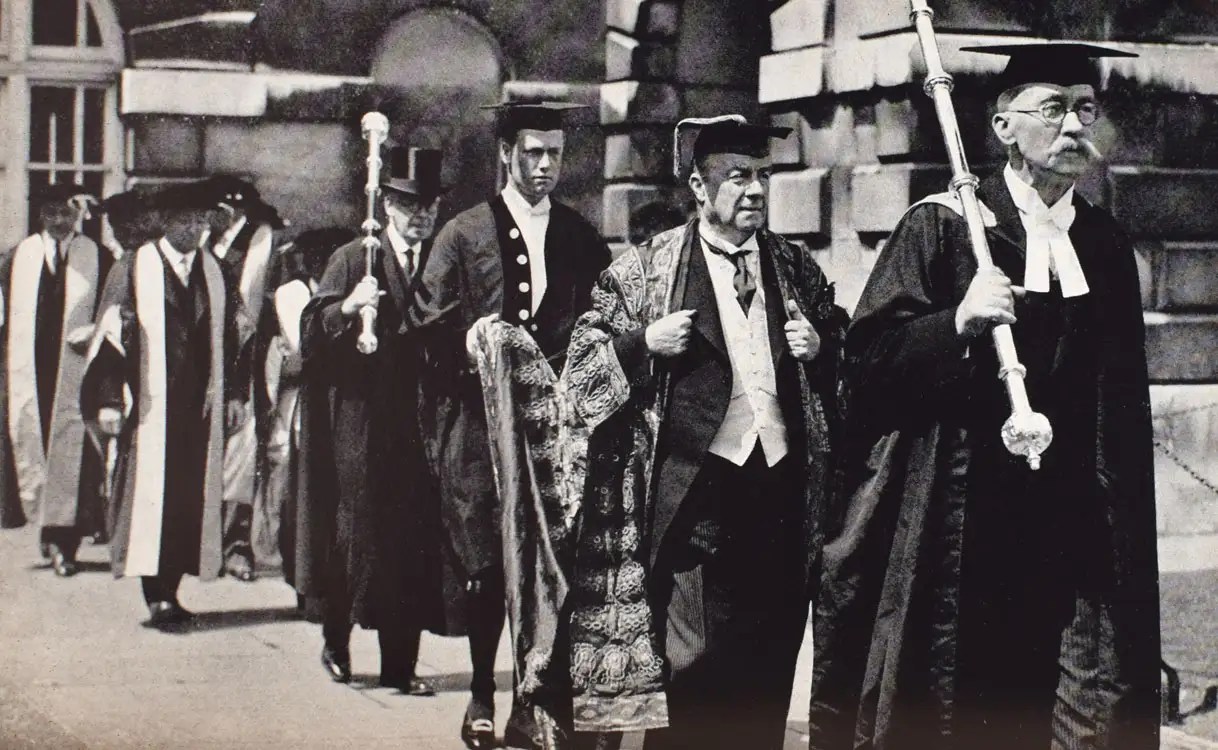
A university procession, from ‘Three Guineas’

She makes a simple point: men down the ages have ridiculed women for being so concerned about their clothes and dress; well, just look at these preposterous old buffers in their wigs and gowns and cloaks and gaiters.

But there’s also a serious point which is germane to her war theme: for she suggests that it is this flaunting of hierarchy and status, this cursed male wish to be superior, which is one of the roots of war. And so she thinks a good way to prevent war would be to attack this cause at the root and refuse to accept honours (as she did) or take part in silly ceremonies (a point developed at length in section 3).

Shortcoming 2. Over-reliance on biography as her primary evidence

The limitations of her education partly explain Woolf’s over-reliance on biography as evidence. She shows little sign of having read much history, economics, science or engineering, philosophy, psychology or sociology – some, but not much, and when she cites history books it’s rarely for the economic or social data.

Instead, what she does rely on to an overwhelming extent is biographies: all the damning evidence she assembles to demonstrate British society’s engrained misogyny and the power of the patriarchy is rarely drawn from history or sociology but relies exclusively on biographies and autobiographies and letters. The phrase you get in so many book titles, ‘Lives and Letters’, sums it up exactly. As an indication of her reliance on biography, here are quotes from just on one page:

  • ‘The witness of biography — that witness which any one who can read English can consult on the shelves of any public library…’
  • ‘Biography proves this in two ways…’
  • ‘Of this, too, there is ample proof in biography…’
  • ‘The study of biography… proves…’
  • ‘Perhaps the greatest testimony to the value of education with which biography provides us is…’
  • ‘You will find, if you consult biography…’

No need to consult facts and figures, assess data, decipher manuscripts, spend years in the archives. Again and again she takes the biography of an eighteenth century bluestocking or a nineteenth century hack writer like Mrs Oliphant off the shelf, and finds and pastes into her narrative their complaints about their limited lives and the dire condition of women in their time, which suit her argument.

(She does mention some histories but, when you look closely you see that she picks out of her historical sources the lives and opinions of her women witnesses: in other words, she selects the biographical elements of history and ignores the statistics, data, political history and so on.)

Late in the essay, rather as she does with her claims to be an amateur, untrained in academic enquiry, she turns an apparent weakness on its head. She tells us that she relies so much on (a very limited view of) history, on biography and newspapers, because they are the only sources of information open to a woman who has been denied a better, higher education, because of her sex; for:

history, biography, and… the daily paper [are] the only evidence that is available to the ‘daughters of educated men’.

Her very lack of scholarly rigour is itself an indictment of the patriarchal oppression which kept her excluded from the higher education her brothers and millions of men had benefited from.

And newspapers

She regards newspapers as ‘history and biography in the raw’. The excellent introduction by Anna Snaith tells us that Woolf kept three scrapbooks in which she gathered evidence for this book. It is striking how many of these snippets and excerpts are taken from newspaper articles or magazines, not the most in-depth kind of research. Newspapers are, by their nature, selective and biased and superficial. They sensationalise in order to sell copies. They are, in other words, the opposite of academic research into history, sociology and so on. This is a weakness in her evidence base.

On the other hand, newspapers are topical and up to date and give her useful snapshot of contemporary opinion – which makes them very interesting for the causal reader, 90 years later. Here’s a sample of the sources, taken from the numbered list of references at the back, which shows the combination of biography and newspaper cuttings which she overwhelmingly relies on as evidence.

  1. ‘Personal Reminiscences of a Great Crusade’ / a cutting from The Herald
  2. a cutting from The Listener / ‘Reflections and Memories’ by Sir John Squire
  3. ‘The Life of Sophia Jex-Blake’ by Margaret Todd
  4. Letter to The Times
  5. Debretts
  6. ‘Life of Sir Ernest Wild, K.C.’ by R.J. Rackham
  7. Lord Baldwin, speech reported in The Times
  8. ‘Life of Charles Gore’ by G.L. Prestige
  9. ‘Life of Sir William Broadbent’ edited by his daughter
  10. ‘The Lost Historian, a Memoir of Sir Sidney Low’ by Desmond Chapman-Huston
  11. ‘Thoughts and Adventures’ by Winston Churchill
  12. Speech at Belfast by Lord Londonderry, reported in The Times

You get the picture: her main sources are lives, letters and newspapers.

The second letter: funding a women’s college

Since the essay is in three parts and the introduction says it addresses three letters, I thought it would be a part per letter, so I was surprised when the second letter pops up at the end of part one. It is from a women-only college writing to ask Woolf to contribute to their fund raising. Anna Snaith’s excellent notes tell us it was a real letter Woolf received from Joan Strachey, Principal of the women-only Newnham College in Cambridge, asking for a donation to renovate the college buildings.

Woolf shows with some doleful quotations and examples, how petty-minded, snobbish and fierce for their stupid rules and regulations the existing (men-only) universities are. She harks back to the notorious incident of being kicked off the grass by the beadle early in ‘A Room of One’s Own’, which clearly still rankles.

Therefore, she replies to this letter that she will consider contributing to a women-only college but only if it is drawn up on a completely different basis from the male colleges. She proceeds to lay out the principles for an experimental college, one which will eschew all competition and exams, be open to the poor, and teach the humanities in a spirit of openness and collaboration:

A place where society was free; not parcelled out into the miserable distinctions of rich and poor, of clever and stupid; but where all the different degrees and kinds of mind, body and soul merit cooperated. Let us then found this new college; this poor college; in which learning is sought for itself; where advertisement is abolished; and there are no degrees; and lectures are not given, and sermons are not preached…

She warns that if the women-only colleges model themselves along male lines, with all the snobbery and competition and status-seeking and petty rankings that entails… those are precisely the kinds of habits of thought, the endless seeking superiority, which create the war mentality and she will not contribute to it.

And no chapels. She is as vehemently against the all-women colleges having chapels as she is violently against the engrained misogyny of the Church of England.

No to teaching English literature

She has a fierce passage execrating the teaching of English literature and its packaging into classes and exams, which she describes as ‘vain and vicious’. This is why Woolf herself refused to accept honorary degrees or prizes, despite being offered many in the later part of her life, and turned down offers to lecture (the exception which proves the rule being the lectures which formed the basis of ‘A Room of One’s Own’).

Woolf explains women’s war patriotism as an escape from domestic oppression

In a wonderfully irrational peroration she thinks that it can only have been delirious joy at being released from the narrow, cramped, uneducated lives forced upon Victorian daughters and spinsters which explained the huge outburst of patriotic enthusiasm among women at the outbreak of the Great War in 1914.

So profound was her unconscious loathing for the education of the private house with its cruelty, its poverty, its hypocrisy, its immorality, its inanity, that she would undertake any task however menial, exercise any fascination however fatal that enabled her to escape. Thus consciously she desired ‘our splendid Empire’; unconsciously she desired our splendid war.

This is splendid rhetoric but it’s a symptomatic of her failure to understand the causes of war, her failure to understand the psychology of crowds and societies embarking on war, her failure to understand genuine feelings of patriotism or national pride which are such big motivators for large numbers of people in any country – in a nutshell, her failure to understand anyone outside her own narrow upper-middle-class milieu.

Shortcoming 3. Ignorance of the wider world

I think her failure to understand the patriotic zeal which accompanied the start of World War One is indicative of her broader failure to understand the range and complexities of human nature, of all human nature across all of society.

Of the narrow little world of upper-middle-class women whose lives are supported by fleets of nameless servants which allow them to pursue their tedious obsession with art and poetry, of this tiny privileged world, she was a brilliant painter.

Of the big wide world, of the thousands of occupations, jobs and livelihoods, in finance, business, economics, trade, law, science, technology and engineering, of the lives of the working classes with their labour in coal mines and iron works, building ships, sailing the oceans, building trains and cars, laying down telegraph cables – in other words, in almost all the wide world and its billions of inhabitants, she has little or no interest and makes no effort to understand.

As an artist, as a writer, it doesn’t matter. Her novels focus on her chosen terrain and are masterpieces. As an essayist, claiming to gather evidence in order to analyse large social issues, it is, to say the least, problematic.

Giving a guinea

Out of this rather convoluted flow of arguments, Woolf concludes that she ought to give a guinea to the building of the women’s college, because it was entrapment in the family home that led so many women to explode with patriotism upon the outbreak of war. Building a college for the public education of the same class will prevent that and so materially contribute to the prevention of war which, if you recall, was the aim proposed right at the start of the essay.

Part 2. The professions

How can we enter the professions and yet remain civilized human beings, human beings who discourage war?

Woolf says a woman like her has only one weapon at her command to use against war, ‘the weapon of independent opinion based upon independent income.’ Now she will try to use this to sway the men in the professions.

The pretext is another letter she has received, from a society supporting women in the professions, asking for another donation, this time to the support of hard-up professional ladies. For Woolf it begs the question why, 20 years after women were admitted to the professions (1919) so few have risen to the top rank and so many are hovering round the bottom.

Woolf’s answers are convoluted and involve replies to other letters and lengthy addresses to her fictional interlocutor, they but boil down to:

  • women have much shorter traditions of thriving in the professions and so lack the centuries-old networks of male patronage and preferral
  • there are no limits to educated men churned out by the public schools and major universities, whereas there are far fewer schools for girls, only four or five colleges for women, and even the numbers admitted to these are severely restricted (only 500 women students were permitted at Cambridge in her day)
  • exams in the professions advantage those who have spent their lives taking exams, i.e. privileged, privately-educated men, and bar women who have (as she shows) vastly less access to private education
  • the nearly universal sexism and misogyny found at all levels of English society

Sexism and misogyny

As mentioned above, the flow of Woolf’s arguments is sometimes hard to follow, especially when it feels like she’s twisting the flow in order to fit her broader feminist critique to fit the essay’s ostensible subject of how to prevent war – but what the essay indisputably does do is powerfully convey the deeply entrenched tentacles of the patriarchy in contemporary 1930s England. She presents a wealth of facts and figures about the systematic prevention of women being educated, getting jobs, entering the professions and so on.

In this second part, the essay builds up into a devastating demonstration of English society’s hair-raising sexism and misogyny. In the main text but especially in the extensive notes which illustrate it, Woolf gives extended quotes from a wide range of men in powerful positions expressing the most hair-raising prejudices and slurs. I can’t give brief quotations, you have to read the notes, and the extended stories she gives, of awful politicians, judges, professionals, writers and commentators taking every opportunity to demean and limit women.

Fascists and Nazis

Woolf cranks up the temperature a lot by comparing several terrible British chauvinists who pontificate that a woman’s place is in the home, with a quote from none other than Adolf Hitler saying the exact same kind of thing.

Herr Hitler and Signor Mussolini have both often in very similar words expressed the opinion that ‘There are two worlds in the life of the nation, the world of men and the world of women’; and proceeded to much the same definition of the duties.

The juxtaposition of the two explains in a flash why Woolf is so resistant to all male talk about patriotism and ‘our country’. In what possible sense is it ‘her country’ when the Archbishop of Canterbury and the editor of the Daily Telegraph hold identical views about women’s place in society as Adolf Hitler? The same point is made in one of the long notes:

‘My husband insists that I call him “Sir”,’ said a woman at the Bristol Police Court yesterday, when she applied for a maintenance order. ‘To keep the peace I have complied with his request,’ she added. ‘I also have to clean his boots, fetch his razor when he shaves, and speak up promptly when he asks me questions.’ In the same issue of the same paper Sir E. F. Fletcher is reported to have ‘urged the House of Commons to stand up to dictators.’ (Daily Herald, 1 August 1926.)

Why, Woolf asks, all this fuss about opposing dictators abroad when every level of British society supports domestic tyrants at home?

Pay for housework

Men work in the public realm and get paid, sometimes a small fortune, often for jobs of dubious worth. Women labour in the home to raise families and manage households and care for the elderly, all unpaid. So: women’s domestic work should be paid.

The work of an archbishop is worth £15,000 a year to the State; the work of a judge is worth £5,000 a year; the work of a permanent secretary is worth £3,000 a year; the work of an army captain, of a sea captain, of a sergeant of dragoons, of a policeman, of a postman – all these works are worth paying out of the taxes, but wives and mothers and daughters who work all day and every day, without whose work the State would collapse and fall to pieces, without whose work your sons, sir, would cease to exist, are paid nothing whatever.

I wonder who first originated this call? Mary Wollstonecraft in ‘A Vindication of the Rights of Woman’ (1792)? Certainly Friedrich Engels mentions it in his 1884 book ‘The Origin of the Family, Private Property and the State’. Anyway, Woolf makes a sustained case for it over many pages, 30 years before the issue was revived by second-wave feminists in the 1970s:

Note: I was a househusband for eight years. I did all the childcare, running children round to nurseries, playgroups, parties, doing all the shopping, cooking and cleaning, changing thousands of nappies, giving bedtime baths and so on, while my wife earned the family income. So I have lived experience of issues like this. It’s this lived experience which feeds into my scepticism about feminism, not as a theory (fine and dandy) but in practice (complicated and compromised). I met plenty of women who were extremely happy to pack in office work and become full-time mums and housewives, who loved looking after their young children, dressing them up, holding parties, dropping them at nurseries or infant school and going to meet girlfriends for lunch or coffee.

Then again, some didn’t. Some felt trapped and needed support, would have welcomed free or cheap childcare, or just wanted to go back to work which they found more fulfilling than hanging round playgrounds or hosting rooms full of screaming kids.

I had many conversations with scores of mums about how the state should provide cheap childcare, or if only companies would allow more flexible work based around school hours, if only housework was recognised and paid for like other forms of work, and so on and so on. Hundreds of conversations on these and related subjects, over years and years.

So my scepticism about feminism is not ideological or temperamental. It’s based on the lived experience of being a housekeeper and child-rearer myself, and talking to hundreds of women in the same situation. The problem is not the top-level slogans and demands, anyone can come up with catchy slogans and carry banners – “Wages for Housework” – it’s figuring out the practical policies and application: where would the money come from? How would it be paid out? Who defines ‘housework’? Like child benefit would it go to anyone caring for a child or be subject to conditions? How would you prove that you do the housework and don’t sub-contract this or that part to cleaners or nannies? etc etc.

The procession

Back to the Woolf on the professions. She gives a vivid description of the processions of all the professions through London’s streets to the centres of law, finance and so on and asks her women readers: do we, in fact, want to be part of this procession? Do we want to do the same jobs but for less pay and more condescension? Or do we want to strike out on our own and lead our lives differently?

The facts… seem to prove that the professions have a certain undeniable effect upon the professors. They make the people who practise them possessive, jealous of any infringement of their rights, and highly combative if anyone dares dispute them. Are we not right then in thinking that if we enter the same professions we shall acquire the same qualities? And do not such qualities lead to war? In another century or so if we practise the professions in the same way, shall we not be just as possessive, just as jealous, just as pugnacious, just as positive as to the verdict of God, Nature, Law and Property as these gentlemen are now?

She gives a number of quotes from lawyers, clerics and politicians complaining they lead a dog’s life, and have sacrificed all their pleasures and family time to their work. Do modern women want to rush into exactly the same kind of wage slavery?

Woolf wonders if we can turn to the lives of nineteenth century women in the professions to help us find a more humane way to have one of these high-powered jobs and live properly? No, because there weren’t any women in the nineteenth century professions. They weren’t allowed. Instead:

We find, between the lines of their husbands’ biographies, so many women practising – but what are we to call the profession that consists in bringing nine or ten children into the world, the profession which consists in running a house, nursing an invalid, visiting the poor and the sick, tending here an old father, there an old mother? – there is no name and there is no pay for that profession; but we find so many mothers, sisters and daughters of educated men practising it in the nineteenth century that we must lump them and their lives together behind their husbands’ and brothers’.

The validity of housework and child-rearing, again, and the long buried, unrecorded of the scores of millions of women who spent their entire lives doing it.

Giving the second guinea

All these arguments have been contained, rather confusingly, in a very long letter replying to the letter she received asking for financial aid for impoverished women professionals. Woolf sums up her position by saying she will send the letter-writer one guinea ‘on condition that you help all properly qualified people, of whatever sex, class or colour, to enter your profession’, and in addition ensure that women:

  • must earn enough to be independent
  • must not prostitute their brain to their profession
  • must refuse all prizes, medals and awards, and be content with obscurity
  • must rid themselves of religious pride, college pride, school pride, family pride, sex pride and those unreal loyalties that spring from them

These are obviously very strict, probably utopian conditions, as with her demand for a completely different type of college which ended section 1. But:

If you agree to these terms then you can join the professions and yet remain uncontaminated by them; you can rid them of their possessiveness, their jealousy, their pugnacity, their greed. You can use them to have a mind of your own and a will of your own. And you can use that mind and will to abolish the inhumanity, the beastliness, the horror, the folly of war.

Antigone saying No to male tyranny

Part two rises to a very powerful invocation of Sophocles’ play, Antigone. Woolf studied this when young and it stayed with her all her life as a powerful story of female resistance to male tyranny. In the era of Hitler and Mussolini it was more than ever relevant. She comes back to it later.

No risk because of exclusion

Woolf ends part 2 with a grand fanfare of irony, saying there is no immediate risk of women professionals losing their souls and working themselves to shreds so long as the laws of England hold their nationality so lightly, prevent them from working in many professions, limit the numbers who can attend university, and ensure that so many women continue to live in the tradition of neglect and contempt, living gruelling lives of unpaid work in dark patriarchal homes.

Part 3. The Outsider Society

The sarcasm and irony which have been present throughout the essay rise to a real anger and bitterness in this, the longest of the three parts.

Woolf reverts back to the original letter she was sent, the one from the unnamed male correspondent asking her how they can prevent a war, and she repeats his three suggestions, namely that we should:

  1. sign a manifesto pledging ourselves ‘to protect culture and intellectual liberty’
  2. join a certain society, devoted to certain measures whose aim is to preserve peace
  3. should subscribe to that society which like the others is in need of funds

Failure of the universities

She addresses these points one by one. First she is satirical about this idea of ‘protecting culture and intellectual liberty’. Isn’t this what the Great Universities have said they were devoting themselves to for centuries, the ones which have been teaching men these values and brutally excluding their sisters and daughters? Is the fact that these values now need such support from society an admission that all those centuries of learning have failed? And if they’ve failed, why should the impoverished, life-opportunity-deprived daughters and sisters suddenly rush to the help of their oppressors?

What is ‘culture and liberty’?

Anyway, what is this ‘culture and liberty’ the letter writer refers to? She knows what it isn’t. Characteristically, she turns to biography and uses the life of an author like Mrs Margaret Oliphant (1828 to 1897) who, after her husband died, churned out meretricious romances to support her children. Was this intellectual liberty? No, this was intellectual prostitution and Woolf angrily takes it as typical of the intellectual prostitution forced on so many women writers and artists who had to sell their souls and prostitute their art because of the patriarchy’s refusal to let them earn a living any other way.

So she mocks the letter writer’s suggestion that women, victims of centuries of repression, should suddenly rush to help the poor privileged men in their time of need. He wants her to join his pacifist society, does he? Well, no. The very word ‘society’ denotes the systematic exclusion of women from education and influence and power and money, so screw society.

The very word ‘society’ sets tolling in memory the dismal bells of a harsh music: shall not, shall not, shall not. You shall not learn; you shall not earn; you shall not own; you shall not – such was the society relationship of brother to sister for many centuries.

The Outsiders Society

She’s not going to join any boys’ club. Instead she proposes setting up a separate organisation, for women of her class and (lack of) education. It would be called The Outsiders Society. It would consist of educated men’s daughters working through their own class and by their own methods for liberty, equality and peace. Members would:

  • not fight
  • not work in munitions factories or nurse the injured
  • not encourage men to go and fight but maintain an attitude of neutrality, as fighting is a ‘sex characteristic which she cannot share’

She rises to real bitterness:

She will find that she has no good reason to ask her brother to fight on her behalf to protect ‘our’ country. ‘”Our country,”‘ she will say, ‘throughout the greater part of its history has treated me as a slave; it has denied me education or any share in its possessions. “Our” country still ceases to be mine if I marry a foreigner. “Our” country denies me the means of protecting myself, forces me to pay others a very large sum annually to protect me, and is so little able, even so, to protect me that Air Raid precautions are written on the wall [i.e. women are defenceless against modern warfare]. Therefore if you insist upon fighting to protect me, or “our” country, let it be understood, soberly and rationally between us, that you are fighting to gratify a sex instinct which I cannot share; to procure benefits which I have not shared and probably will not share; but not to gratify my instincts, or to protect either myself or my country. For,’ the outsider will say, ‘in fact, as a woman, I have no country. As a woman I want no country. As a woman my country is the whole world.’

Wow. Very powerful. Furthermore, The Outsider will cultivate complete indifference to male nonsense about patriotism, war and fighting. On the contrary, she will:

  • take no part in patriotic demonstrations
  • not take part in patriotic praise
  • absent herself from military displays, tournaments, tattoos, prize-givings and all such ceremonies as encourage the desire to impose ‘our’ civilization or ‘our’ dominion upon other people

The idea is that this ‘indifference’ will damp down patriotic fervour in those around her and thus, in a tiny way, help to avoid war.

All this makes a sort of sense. But it feels like twisting logic when Woolf goes on to assert a link between these anti-war steps and the positive demands of her feminist programme. The connection feels tenuous and forced. Because she now switches to say that in order for their opinion or actions to matter, the outsiders must push for a raft of feminist requirements, being:

  • they must earn their own livings
  • they must press for a living wage in their professions
  • they must create new professions in which they can earn a living wage
  • they must press for press for a money wage for the unpaid worker in her own class – the daughters and sisters of educated men
  • they must press for a wage to be paid by the State to the mothers of educated men

Make the state pay for housework

This last is vital because until she has complete financial independence, a wife is dependent on her husband for money and will follow his opinions and men are for war. Therefore, in order to create an influential bloc of educated women who are against war, this class must be given financial, and so intellectual, independence. Women must be paid by the State for their work as mothers.

And she tells her male interlocutor that this step – paying women for their housework – would also liberate husbands, because by sharing the burden of earning an income they would no longer be wage slaves, slaves to the rat race. It would have an enlightening and life-enhancing effect all round.

I gave my thoughts on this proposal earlier. It sounds great, and you can see her logic – that women can only be truly independent and free if they have their own income, separate from their father’s or husband’s – but how would it be implemented in practice?

I’ll just make the additional point that its recurrence here is characteristic of how key themes and suggestions recur throughout the essay, building up power through repetition and echoes, not unlike her technique in her novels.

Outsider demands

But she hasn’t finished with her demands. The Outsiders would:

  • not only earn their own livings but become so expert that their threat to down tools would have power and influence
  • when they have earned enough to live on they would earn no more i.e. not pile up obscene wealth
  • they would reject any profession hostile to freedom such as the arms trade
  • they would refuse to take office in any institution which pretends to respect liberty but actually restricts it, such as Oxford and Cambridge

Outsiders will eschew all the stupid costumes and ceremonies so beloved by men (see the section about silly ceremonials in part 1).

Outsiders will eschew ‘the coarse glare of advertisement and publicity’ and prefer to work in honest obscurity.

The secret society already exists

Wandering into thriller territory, Woolf suggests that this Outsider Society already exists but is secret and underground in its activities. Her very dubious evidence for this far-fetched claim is a clutch of newspaper reports of various women officials making comments against war, opposing arms manufacture and the like. From random quotes and newspaper clippings she based the existence of a secret society operating across English society. Is this an example of her sometimes utopian or far-fetched argumentation – or an example of her dry sense of humour? Difficult to tell.

Against the Church of England

Outsiders will:

  • fearlessly investigate and criticise public institutions they are forced to contribute to, such as the universities, but especially the Church of England
  • by criticizing religion they would attempt to free the religious spirit from its present servitude and would help, if need be, to create a new religion based it might well be upon the New Testament, but, it might well be, very different from the religion now erected upon that basis

Woolf’s attitude to the Church of England had already been indicated in the passage about cited above about Antigone where she writes that ‘Antigone’s five words are worth all the sermons of all the archbishops’, those five Greek words (they total 11 in the English translation) being:

‘Tis not my nature to join in hating, but in loving.’

Pages 196 to 202 give a scathing account of how Jesus Christ’s own admonition that his followers are equal which promised equality between men and women was denied by St Paul, who invented the idea that women must be veiled in church and not speak. This bigotry hardened over the centuries into a church which forbids any positions of power or influence in the most powerful and prestigious organisation in the land, to women.

With the result that the salary of an archbishop is £15,000, the salary of a bishop is £10,000 and the salary of a dean is £3,000. But the salary of a deaconess is £150; and as for the ‘parish worker’, who ‘is called upon to assist in almost every department of parish life’, whose ‘work is exacting and often solitary…’ and who is most likely to be a woman, she is paid from £120 to £150 a year.

It’s a pattern mirrored in all the other professions and walks of life: women excluded from all the prestigious, well-paid higher positions, and forced to undertake the most menial and poorly-paid jobs.

Psychoanalysis, anger and fear

One of Anna Snaith’s excellent notes tells us that ‘Woolf’s brother Adrian [Stephen] and his wife Karin were trained psychoanalysts and were crucial in disseminating Freud’s work in England.’ This is relevant because Woolf quotes at length from the Archbishops’ Commission on the Ministry of Women (1936) and in particular from the appendix written by Professor Grensted, the Nolloth Professor of the Philosophy of the Christian Religion in the University of Oxford.

This professor concluded that there is no reason in theology (Christ’s teachings) why there should not be women priests, but there were strong objections to women priests among the clergy. Digging deeper he uses Freudian terminology to suggest the deep conviction held by many men of men’s superiority and women’s inferiority.

The causes are obscure but the outcome is obvious: that whenever a conversation lights on the topic of equality for women and women holding roles up till now reserved for men, many man become angry and many women become fearful. This imbalance leads women not to raise, mention or discuss the issue which, as a result, goes underground.

The infantile fixation

Woolf takes from Grensted the notion of the ‘infantile fixation’. I didn’t quite understand this and I didn’t see her defining it anywhere. Instead she gives three examples of what she means (taken, inevitably, from biographies), namely the wildly irrational anger and jealousy triggered in three classic Victorian fathers when their daughters asked permission to get married or (worse than that) to get a job. The fathers being:

  • Mr Barrett (father of Elizabeth who wanted to marry the poet Robert Browning)
  • the Reverend Patrick Brontë (father of Charlotte who wanted to marry)
  • Mr Jex-Blake (father of Sophia who was offered a small sum for tutoring mathematics to a friend)

By contrast, to show the impact of a father’s liberality, she gives the story of Mr Leigh Smith. It’s worth quoting at length because the impact is in all the details. Smith had a daughter, Barbara, who he loved.

When Barbara came of age in 1848 he gave her an allowance of £300 a year. The results of that immunity from the infantile fixation were remarkable. For ‘treating her money as a power to do good, one of the first uses to which Barbara put it was educational.’ She founded a school; a school that was open not only to different sexes and different classes, but to different creeds; Roman Catholics, Jews and ‘pupils from families of advanced free thought’ were received in it. ‘It was a most unusual school,’ an outsiders’ school. But that was not all that she attempted upon three hundred a year. One thing led to another. A friend, with her help, started a cooperative evening class for ladies ‘for drawing from an undraped model’. In 1858 only one life class in London was open to ladies. And then a petition was got up to the Royal Academy; its schools were actually, though as so often happens only nominally, opened to women in 1861; next Barbara went into the question of the laws concerning women; so that actually in 1871 married women were allowed to own their property; and finally she helped Miss Davies to found Girton. When we reflect what one father who was immune from infantile fixation could do by allowing one daughter £300 a year we need not wonder that most fathers firmly refused to allow their daughters more than £40 a year with bed and board thrown in.

The difference just one liberal father made. What if all Victorian fathers had been like that.

Sexist science

There follows a passage giving some examples of how even contemporary science is twisted to prove the inferiority of women. To be honest this section is neither very compendious nor persuasive. She doesn’t really go into the most basic accusation against women, that their bodies are designed for childbirth and child-rearing and this explains why their minds are limited to domestic subjects and childish logic. (I’m not saying this, I’m repeating the sexist, misogynist accusation.)

This is a failing but I think reflects the limitations of Woolf’s knowledge and education. Of science she knows next to nothing and so is simply incapable of unpacking all the biological and psychological aspects of woman-hating. She is much more at home in her comfort zone of education and literature, the lives of women writers.

She cites Bertrand Russell pointing out the sheer sadism of much medical science towards women (the medical profession’s reluctance to provide painkillers to women in childbirth) or the twisting of scientific knowledge to justify male superiority – but not as amply as this huge subject demands.

Cleons

Instead she reverts to literature again, and her obsession with Antigone. In the play the oppressive father is Cleon, the archetype for the Victorian paterfamilias and the modern fascist. Here is Cleon speaking dictator-talk:

‘Whomsoever the city may appoint, that man must be obeyed, in little things and great, in just things and unjust… disobedience is the worst of evils… We must support the cause of order, and in no wise suffer a woman to worst us… They must be women, and not range at large. Servants, take them within.’

Order and the oppression of women, Mr Barrett and Mussolini.

The personal and the private

In the essay’s last pages she brings things together by (rightly) saying that she has shown how male tyranny in the personal, domestic realm and in the public realm, are intimately linked:

that the public and the private worlds are inseparably connected; that the tyrannies and servilities of the one are the tyrannies and servilities of the other.

Despite the strangeness of the letter-answering structure and the oddly digressive, rambling flow of the argument, by the end she has presented a devastating barrage of evidence, as well as making a host of demands and suggestions.

The third guinea

So she refuses to sign the form her correspondent had sent her. She refuses to sign up to his society because of her opposition to all such male bodies, but she will send him a guinea to support it.

Their aims are the same, to oppose the tyrants in the name of Justice and Equality and Liberty. But, as this amazing book has explained, as a woman, as the patchily educated ‘daughter of educated men’, as someone with completely different life experiences and, consequently, utterly different perspectives from the male sender of the letter, she shares the same aim but insists that she will try to bring it about using, not the old male forms and words, but new words and new ideas appropriate for women.

Magnificent

For all its faults, ‘Three Guineas’ is a magnificent, powerful and very persuasive piece of work. Her assembly of a very wide range of evidence, facts and figures really bring home the historical endurance, depth and wide range of the legal, financial and cultural oppression of women throughout English history and the stupid, patronising and misogynist attitudes and opinions deployed to maintain that oppression.

The notion of the Outsiders Society is the crystallisation of the massive theme which emerges repeatedly throughout the text, the idea that women – not because of any biological or psychological differences – but purely because of the legal, financial, professional and cultural apartheid they have suffered for centuries, bring to the table a different perspective from men across a whole range of issues.

I think it’s a magnificent example of a polemical essay, of an impassioned political pamphlet.

Criticisms

There are a number of problems or issues with Woolf’s way of arguing. Initially I included them in my review where they occurred but they cluttered up the flow of my review, and gave an unduly negative opinion too early on. I mentioned three earlier on. Here are a few more.

Shortcoming 4. Woolf’s intellectual confusions

Periodically throughout the text Woolf freely admits to own intellectual shortcomings: for example, right at the start she admits being bewildered that there seems to be a wide range of opinions about whether war is good or inevitable. She herself tells us that the more she reads, the more opinions she discovers, the more confused she becomes. But… is that not the point of being an intellectual: to read all the opinions, weigh the evidence, and develop your own line of argument, based on the evidence you uncover and reacting to other people’s arguments?

This activity, intellectual activity, always puzzles and confuses Woolf. In ‘A Room of One’s Own’ there’s the section where she orders up some books in the British Museum and opens them up, expecting to discover The Truth staring her in the face.

Sometimes this is part of her general mocking irony, mocking the pretensions of pretty much all male activity, including the grand Pursuit of Truth. But at other times it can give you the worrying sense that she doesn’t really understand what intellectual enquiry is.

Her intellectual confusion as evidence of her case

In the opening and then at various transition moments, Woolf explicitly tells us that she struggles to marshal the evidence, is embarking on something too big for her abilities, and wonders if she’d be better off abandoning it. After a while I realised that maybe these passages are designed to dramatise the issue of women’s exclusion from formal education by using herself as an example.

Woolf’s brothers went to top private schools and Oxbridge whereas she more or less had to educate herself at home and mostly taught herself by browsing through her father’s extensive library. In other words, every time she shares how confused by the evidence or daunted by the challenge of answering big question she is, she is demonstrating the effect of the grotesquely unequal education of the genders, how women have been the victims of ‘tradition, poverty and ridicule’, and showing the reader how she (and we) are suffering for it.

Maybe that’s why she flaunts her own intellectual limitations so much: the intellectual inability she frequently laments is the result of her exclusion from higher education. It makes her case for her.

Shortcoming 5. Her analysis is restricted to a (relatively) small class

Her lack of real confidence in her own research, and her need to make her feminist points as categorical and powerful as possible, explain why Woolf makes the strategic decision of restricting her analysis to a relatively small class, to women like herself, to ‘the daughters of educated men’, as she describes them. As she puts it:

Our ideology is still so inveterately anthropocentric that it has been necessary to coin this clumsy term – ‘educated man’s daughter’ – to describe the class whose fathers have been educated at public schools and universities. Obviously, if the term ‘bourgeois’ fits her brother, it is grossly incorrect to use it of one who differs so profoundly in the two prime characteristics of the bourgeoisie – capital and environment.

She makes it quite clear on page one that she is only discussing upper-middle-class women, women like herself, women with immaculate manners who are used to managing servants and know which of the many forks and spoons to use at a formal dinner.

In order to avoid the confusions, contradictions and conflicting evidence I mentioned above, in order for her analysis to work, she has to reject the vast majority of the population (the working class and lower classes, of both sexes) and identify her cause with just this numerically small and limited class of posh ladies.

It isn’t just me pointing this out. The Wikipedia article about Three Guineas tells us that the noted academic Q.D. Leavis wrote a scathing review of ‘Three Guineas’ soon after it was published:

She denounces the essay because it is only concerned with ‘the daughters of educated men’, seeing Woolf’s criticisms as irrelevant to most women because her wealth and aristocratic ancestry means she is ‘insulated by class’.

And Anna Snaith’s notes in the Oxford University Press edition tell us that Woolf received letters from working class women readers who complained about being left out of her analysis, notably a long semi-autobiographical one from a working class woman named Agnes Smith.

This is closely related to what I called shortcoming 3, ignorance of the wider world. But it’s also a decision. She found it hard enough gathering the evidence for the sexist discrimination against her own type and class of woman. If she opened it up to the broader middle and working classes she’d never have finished it.

2025: the perils of intersectionality

Many of these criticisms are mentioned in Anna Snaith’s introduction to the Oxford University Press edition. Here she indicates the larger cultural and political problems the essay falls foul of. This is that there are, nowadays, so many grievances, so many groups claiming to be victims, so many communities and identities who feel that they, too, have been subjected to centuries of oppression, that it is hard to focus on just one, and it is especially hard to focus on the group Woolf defines as the ‘daughters of educated men’.

As you read Snaith’s account of Woolf’s life and social circle, with so many friends among England’s political and cultural elite, the idea of her as a persecuted outsider feels more and more ludicrous. She wasn’t a Jew in Hitler’s Germany, a Black in the American South, a kulak in Stalin’s Russia, an Aborigine in Australia, she grew up in a house full of books which she was actively encouraged to read and went on to become a centre of London’s literary and artistic elite.

This doesn’t invalidate any of the points she makes in the book or detract from the essay’s tremendous power. It’s just to say that the struggle for women’s equality takes its place among quite a few other struggles. I’ve a book about the Irish Civil War on my desk and Irish nationalists have quite a story to tell about 1,000 years of British oppression. Her husband was a Jew who had his own story about the legal and financial persecution of Jews. Something similar could be said of England’s Roman Catholics, prevented by law from holding official positions. Or – a group close to my heart – England’s non-conformists, banned by law from holding any positions of authority for 300 years after the civil war. Citizens from India or any of the colonies we ruled for centuries might have a thing or two to say about Britain’s oppression of their peoples and cultures.

Being a modern academic, Snaith is contractually obliged to drag in slavery – the progressive topic par excellence – to her discussion of ‘Three Guineas’, on the rather tenuous basis that guineas were, apparently, first used as currency in the British slave trade. Don’t know what Virginia would have made of that scholarly leap of imagination.

To repeat – this little digression about the modern over-abundance of historical grievances is not entirely my view but simply expanding points made by the book’s editor, Anna Snaith, in her introduction.

All these other issues don’t invalidate any of the points Woolf makes in the book but they place it in a much larger, real world context. If you’re a feminist, you can insist that your cause and your history of oppression is the real one, the big one, the important one and, convinced of your righteousness, overlook or downplay the grievances of all the other groups I’ve mentioned. In a sense, to get anything done, you have to focus on your issues and grievances; nobody can represent the issues of the whole world. You have to pick your battles. And this explains why Woolf realised that, in order to get her book written, she had to concentrate just on relatively privileged upper-middle-class women like herself, on ‘the daughters of educated men’.

Conclusion

It’s a very powerful book. Very. To repeat what I said at the start, from one point of view it may be her most important work. It’s a bit of a struggle, a bit meandering, a bit puzzling in places, her proposals such as for the Outsider Society are a bit eccentric – and yet so many of her main points drive right home, and the evidence gathered in the notes at the end is searing, blistering, eye-opening. It shook this old cynic. It materially changed my views about feminism. I strongly recommend it.


Credit

‘Three Guineas’ by Virginia Woolf was first published by the Hogarth Press in 1938. Page references are to the 2015 Oxford University Press paperback edition, edited and annotated by Anna Snaith, although the text is easily available online.

Related links

Related reviews

Flame Into Being: The Life and Work of D.H. Lawrence by Anthony Burgess (1985)

Man belonged to the cosmos and was fulfilled through his natural instincts, of which love was the greatest.
(Burgess’s summary of Lawrence’s credo, page 62)

Anthony Burgess (1917 to 1993) was a composer, poet, novelist, essayist, librettist, screenwriter, critic, provocateur and media personality. In the 1980s I watched him appear on TV arts programmes and read his numerous book reviews, essays and novels (notably ‘Earthly Powers’, 1980, and ‘The End of the World News’, 1982). He was great fun, an unashamed entertainer. This book is a classic example of his work: opinionated, interesting, drily amusing, sensible, packed with ideas and insights.

Preface

Part of this is because Burgess, like Lawrence, was an outsider. Most 20th century English authors went to private school and Oxbridge and so, whether they were radicals or conservatives, maintained the same kind of tone and worldview, the same manners, the same limited, privileged experience of life in their works. Burgess, as he explains in his preface, grew up in the pub and shop culture of working class Manchester, with little cultural capital and, like Lawrence, largely had to teach himself about literature. And they both married foreign wives and left England to live abroad, Lawrence in his pilgrimage round the world, Burgess to live in Monte Carlo.

That said, Burgess says there are also big differences. Burgess came of an Irish family and was raised a Catholic. This explains his attraction to James Joyce. But also puts him in a different tradition from Lawrence who came from non-conformist stock, proud of his puritanism, attracted to the old pagan gods, son of a miner.

Burgess admires Lawrence’s intransigence and sympathises with his sufferings on behalf of free expression. Lawrence stands for:

that fighting element in the practice of literature without which books are a mere decor or confirmation of the beliefs and prejudices of the ruling class. (p.x)

‘Literature is essentially subversive’ and Lawrence was a leading practitioner of that subversion.

Chapter 1. Lawrence and Myself When Young

Burgess quotes Lawrence’s biographer and critic Richard Aldington saying Joyce and Lawrence are diametrically opposed: Joyce is about being and Lawrence is about becoming.

Stylistically Joyce is drawn to economy and exactness, Lawrence to a diffuseness which looks for what he is trying to say while he is saying it. (p.4)

This strikes me as the single most important aspect of Lawrence’s style as a writer of prose and poetry. His paragraphs feel like they’re being shaped and formed, often reusing the same words and phrases, as you watch. It’s a unique experience of being involved in the writing, as it happens.

His writing does not seem to have emerged, lathed and polished, from the workshop: when we read him we are in that workshop, witnessing a hit-and-miss process of creation in which orthodox faults – prolixity, repetition, apparent absurdity – are idiosyncratic virtues. (p.9)

He is a writer taking chances and trusting that he will be taken seriously.

In the 1910s literature was influenced by the serious scientific predictions of H.G. Wells and George Bernard Shaw with their promotion of Scientific, Rational solutions to society’s ills. Lawrence reacted against all this, despised all politics – maybe all rationality – and spoke for the Natural Man.

The purest exponent of the Natural Man after the Great War was Ernest Hemingway who saw that the complex sentences of Edwardian literature reflected a society and values which had all been exploded. He developed a stripped back, simple and repetitive style which promoted a simplistic code of honour. I like where Burgess says:

It may be that Hemingway’s prose is the biggest stylistic innovation of the century… Hemingway genuinely starts again from scratch. (p.8)

When I was a schoolboy and student, that was my view. From E.M. Forster to Ernest Hemingway was a leap from the 19th into the 20th century and, reading literary books today, they almost all still copy the Hemingway formula: short sentences, simple vocabulary, delete all adjectives and adverbs.

The pre-scientific or irrational in Lawrence made him a genuine primitive man, a pagan. He has a profound feeling for the pagan gods. Even the books set in England contain characters who talk like pagan deities. His people aspire to be naked, and their dialogue is voices from the unconscious, from another realm of experience.

Chapter 2. Beginnings

Lawrence’s father was a miner who worked at Brinsley Colliery, Eastwood, so you might have expected Lawrence’s subject to be squalor, dirt and struggle, for him to have become a proletarian writer. But Eastwood, ten miles north-east of Nottingham, in his day looked out over countryside, and Lawrence chose instead to become a writer of the countryside, flowers and animals.

Lawrence’s parents’ marriage was a warzone. His father was a miner, technically a ‘butty’ or supervisor of a gang of other miners. He was almost illiterate, spelling out the newspaper a word at a time, whereas Lawrence’s mother had been a teacher and clung to the idea that she came of gentle stock. Lawrence was unusually close to his mother – she is the central figure in his first major novel Sons and Lovers, and he was devastated when she died – but, by the same token, he was impressed by his father’s big beefy masculinity and the sodality of the miners.

Lawrence was an amateur painter till he was 20. His surviving paintings are vivid but demonstrate his complete lack of training in perspective or anatomy. Words were different. Poems and prose bent to the force of his imagination with little or no training.

At 17 he went as a pupil-teacher to Ilkeston training centre. At 21 he went to Nottingham University. Aged 23 he went to teach in Croydon. He discovered the ‘English Review’, edited by Ford Madox Hueffer, who ‘had the greatest editorial flair of his time, if not of the century’ and sent in some poems (p.20). Hueffer recognised the boy’s genius, invited him up to tea, introduced him to Ezra Pound. Lawrence showed Hueffer his first novel, ‘The White Peacock’.

Burgess makes a characteristically sweeping statement:

One of the uses of fiction is to affirm the values of the bourgeoisie. (p.24)

Lawrence is ‘this most visual of novelists’. Burgess emphasises the brilliant physical details in so many scenes.

Joyce, by contrast, was an urban man and knew nothing of flowers. Lawrence is the great novelist of flowers.

Snobbishness Lawrence’s mother felt she married down when she married his father. She aspired for her boys, wanted them to climb the social ladder. This is reflected from as early as ‘The Peacock’, with characters saying ‘awfully’ and ‘frightfully’, words never used in the Lawrence household. He was aping his social superiors, he was pitching the narrative at a higher social level.

Chapter 3. The Denial of Life

Lawrence’s second novel, ‘The Trespasser’, was published in 1912. It’s set on the Isle of Wight which was as far abroad as he’d managed to get by that point. The lead character Siegmund, hangs himself. The is the only suicide in Lawrence’s oeuvre.

In 1912 Lawrence eloped with Frieda Richtofen, the wife of his French tutor at Nottingham University, philologist and professor of modern languages, Ernest Weekley. She describes how they fell in love in her memoir, Not I, but the Wind…, how she was forced to abandon her three children when they eloped abroad, ending up in a rented house on Lake Garda in north Italy.

Mr Noon: Lawrence drafted the first part of this novel before the war. It was published as a fragment in 1934. Only 50 years later, in 1984, was the second part, which existed in papers belonging to a friend of Lawrence’s, published. The two halves or parts were first published together in 1984. The second half is quite different from the first. It appears to be a factually accurate and barely fictionalized account of Lawrence and Frieda’s early sexual relations. Burgess makes the point that:

It was common practice for Lawrence to write half a novel, abandon it, and then pick it up again with no great concern for plausible continuity; when in doubt, change your main character’s character, though retaining the name, and make him or her start a new life somewhere, preferably in Italy. (p.33)

This happens in ‘Mr Noon’, ‘The Lost Girl’ and ‘Aaron’s Rod’.

Marriage It is amusing that Lawrence was very fierce for marital fidelity, had a pagan reverence for the union of one man and one woman and yet the partner of his life was secured by wrecking her marriage to Professor Weekley. Also ironic that Frieda was (allegedly) unfaithful to him.

Anywhere Lawrence was one of those rare writers who could write anywhere, even amid noise and distractions. He never had a permanent home and so no book-lined study, was able to be interrupted mid-sentence to meet people or go and do some chore, come back hours later and pick up where he left off. In the relationship with Frieda, he did all the household chores while she lay in bed smoking. He reflected this aspect of himself in the character of Rawdon Lilly in ‘Aaron’s Rod’:

He put on the kettle, and quietly set cups and plates on a tray. The room was clean and cosy and pleasant. He did the cleaning himself, and was as efficient and inobtrusive a housewife as any woman. While the kettle boiled, he sat darning the socks which he had taken off Aaron’s feet when the flautist arrived, and which he had washed. He preferred that no outsider should see him doing these things. Yet he preferred also to do them himself, so that he should be independent of outside aid. (Aaron’s Rod, p.121)

England, My England Soon after eloping, Burgess quotes letters in which Lawrence lambasted the English and England in extreme terms. And yet he remained an Englishman through and through. Richard Aldington amusingly said Lawrence was as English as a wet Sunday in Hull.

Son and Lovers Another joke: given the theme of this novel is a young man’s struggle to break free from the smothering influence of his mother, Frieda playfully suggested it should be titled ‘Sons and Lovers: Or, His Mother’s Darling’. Lawrence was not amused.

Chapter 4. Son and Lover

David Herbert Lawrence was called Bert in the family home. He disliked his first name. After he eloped and became more cosmopolitan he liked his female admirers, starting with Frieda, to call him Lorenzo.

‘Sons and Lovers’ was published in May 1913. Giving its protagonist the French surname Morel is symptomatic of Lawrence’s aspiring cosmopolitanism. Burgess describes it as a ‘florescent, leafy, pullulent’ book (p.50).

Lawrence’s modernism lies not in the formal technique of his novels: they display none of the agonising over technique obvious in Conrad, Ford Madox Ford, James or Joyce. The modernism is in the content for two reasons to do with the characters.

1) His characters’ identities are extraordinarily labile: they change all the time. Not just that, but sometimes they disappear altogether, subsumed into the weather, the moonlight or other settings or environments.

2) All Lawrence’s characters point away from the conventions of normal social life towards primeval depths. They repeatedly sink to, or strip back layers to reveal, the elemental layer of human existence. This is deeper than anything in the history of the novel, deeper even than the Greeks in their tragedies.

Symptomatic that, ‘no strong believer in the solidity of human identities’ Lawrence had a lifelong fondness for charades (p.54). This spilled over into the best poems where he mimics or inhabits a bird, beast or flower to an extraordinary degree.

Masculinity All his life Lawrence kept a reverence for beautiful men, for the beauty of the male body, linking back to the strong nudity of his coal-miner father (stripped to the waist and washing in a tin bath every evening) and the community of tough men he managed.

Chapter 5. Coming Through

Lawrence was ‘arrogant, dogmatic, messianic, inconsistent’ but also loveable. He wasn’t troubled by his own faults or the impression they gave in society because society was a spume, a phantom: reality lay much, much deeper, and chasing, revealing and describing the depths of human experience was his challenge.

Reason Lawrence never understood rational argument, which was a kind of giving-in to the surface, the superficial, instead of seeking the core.

Friendship pattern The success of ‘Sons and Lovers’ introduced him to the upper echelons of English culture and society and inaugurated the rhythm he enacted with almost everyone he met: 1) ingratiating charm; 2) lecturing about eternal depths which they barely understood; 3) bitter rejection and immortalisation as satirised characters in whichever novel he was working on; 4) with the frequent threat of libel action (p.55).

‘Love Poems and Others’ published February 1913. In the summer Lawrence and Frieda returned from Germany to England principally because Frieda wanted to see her three children by Weekley.

In the autumn of 1913 he wrote a good deal of The Rainbow, provisionally titled ‘The Sisters’. In July 1914 Frieda’s divorce came through and the couple came to London to sign the papers, then get married. A few weeks later the Great War erupted and they were trapped in England for four long bitter years.

Chapter 6. Dementia

The Lawrences didn’t have money to pay the lawyers’ fees for the divorce so he was declared bankrupt. In December The Prussian Officer and Other Stories was published. In 1915 the odd story England, My England‘. Lawrence is always unsettling because he says the uncomfortable, inconvenient thing.

In 1915 Lawrence worked on ‘The Sisters’ and decided to divide it in two. He developed the notion of setting up a commune of like-minded artistic people in Cornwall. He tried to recruit Lady Ottoline Morrell for this. He wrote long letters raving about the collapse of British society to poor Bertrand Russell, with whom he was initially very taken before they had a huge falling out. Russell accused him (after his death) of being a proto-fascist.

Lawrence said he rewrote ‘The Rainbow’ about seven times. It was published on 30 September 1915. Just a week later, a negative review in the Daily News triggered outcry at the book’s supposed obscenity. The book was taken to court for breaching obscenity laws. Many witnesses for the prosecution and none for the defence. Lawrence wasn’t called. His publisher, Methuen, meekly apologised, withdrew the book, pulped the remaining copies and paid a fine of ten guineas. Britain’s writers did nothing. The Society of Authors did nothing. That maligned figure, Arnold Bennett, was the sole author to publicly protest (he had already sent the impoverished author a gift of £40).

The impact was to ruin Lawrence’s reputation, livelihood and career. It delayed publication of the second half of the novel, Women In Love, by five years, giving the misleading impression that it is a book of the 1920s, which it very much isn’t.

Burgess, of course, defends ‘The Rainbow’ but even he, in his summary, zeroes in and quotes some of the passages describing sex (in extremely vague and gaseous way). He himself doesn’t convey how much of the novel isn’t about sex at all, but about the tempestuous and primeval emotions of the characters, described in an amazingly impassioned prose.

In my review of The Rainbow I point out that with the arrival of Ursula to young womanhood the novel drastically changes tone, moving out of its kind of primitive pagan rural background and arriving in the modern world of schools and trams. Burgess makes the nice point that this is the ‘Wellsian mode’, the tone of Ann Veronica and Wells’s Edwardian social novels.

Chapter 7. Westward

Lawrence fantasised about setting up a colony of like-minded artists in America, maybe Florida, until the authorities made it clear he couldn’t leave the country. So he settled on Cornwall where he founded an artistic community. Two leading figures were the gifted editor John Middleton Murry and the brilliant New Zealand short story writer, Katherine Mansfield.

Lawrence was at one point so close to Murry that he suggested becoming blood brothers. The quartet shared a cottage for a while but inevitably fell out. Nearly 20 years later Murray was cruelly satirised as the slimy seducer Denis Burlap in Aldous Huxley’s novel ‘Point Counter Point’.

In Cornwall Lawrence revised part two of The Sisters, which came to be titled Women in Love. He finished in November 1916 but could find no publisher. July 1916, his travel book about his time in Italy, Twilight in Italy, was published.

During this period he was summoned to several Army medicals in Bodmin. He was always rejected but found the poking and prodding of his body deeply humiliating. His horrible wartime experiences are dramatised in the long, brilliantly vivid ‘Nightmare’ chapter in ‘Kangaroo’.

Lawrence spoke openly against the madness of the war. His wife was German. On 12 October 1917 local police raided his home and ransacked it for evidence they were spies, signalling to German U-boats with their washing or their late-night lights. No evidence was found but Lawrence was ordered to leave Cornwall.

Lawrence and Frieda went to stay with H.D. in London. He started writing Aaron’s Rod. In November 1917 the poetry collection ‘Look! We Have Come Through’ was published. In 1918 they went to live in Derbyshire. In October ‘New Poems’ came out. As soon as the war finished (November 1918) they set about leaving England but it took a year, until October 1919, before they could get passports.

During this period Lawrence did the reading for his book of criticism, Studies in Classic American Literature, which was eventually published by Thomas Seltzer in the United States in August 1923. It contains essays on Benjamin Franklin, Hector St. John de Crevecoeur, James Fenimore Cooper, Edgar Allan Poe, Nathaniel Hawthorne, Richard Henry Dana Jr., Herman Melville and Walt Whitman. It contributed to establishing Herman Melville as a seminal figure in American literature.

Some critics criticise it for being a rushed, superficial and highly impressionistic study; Burgess calls it ‘a series of jolts and lunges… meant to jolt Americans’ into reading their great authors. He claims it is one of the few books which created an entire new discipline, as it apparently helped jolt Americans into creating course of America literature at their universities.

Chapter 8. Nakedness

Burgess devotes an entire chapter to ‘Women in Love‘ which Burgess considers one of the ten great novels of the century. The central point of the novel is the way the characters are stripped down to their essentials, stripped to their primitive emotional cores which are depicted as bubbling over with extreme emotions, continually changing.

They are not human beings as we expect to meet them either in real life or in fiction. They are close to animals in the discontinuousness of their emotions, with unpredictable shifts of feeling which are always intense… they are capable of great emotional and even physical violence; they seem to have a skin missing. This is the peculiar quality of Women in Love which could as well be called Women in Hate. (p.89)

He outlines the main characters, identifies some of their real-life bases (Rupert Birkin is Lawrence, Hermione Roddice was partly based on Ottoline Morrell, Gudrun bears many of the traits of Katherine Mansfield).

Burgess singles out three big scenes: 1) how the violence of the big half-wild rabbit scene, in which it scratches and draws blood from both Gudrun and Gerald, anticipates the violence of their relationship and his final attempt to murder her.

2) When Ursula comes across Rupert throwing stones at the reflection of the moon in the millpond to try and abolish the power of the feminine moon over him.

3) The naked wrestling scene between Birkin and the mine owner Gerald Crich, which is deeper than homoerotic, far more primal, and its sad incompletion, the way Gerald can’t rise to Birkin’s wishes.

If we are startled by this scene we are merely experiencing the shock that it was Lawrence’s lifelong mission to impart – the shock of meeting [elemental] truths which logic and science… have tried to drive out. (p.96)

Burgess thinks it is a great novel because it is completely new: the novel, as a form, is mostly concerned with people in a social context, it is the quintessentially bourgeois art form, hedged round by manners and etiquette. From Samuel Richardson through Jane Austen to Henry James and E.M. Forster, the most earnest novels had always been about social convention and good manners. Lawrence tears the face off all this and shows his characters as madly irrational complexes of blood and nerves; primal, pagan wild animals: they have a social face (they have jobs and responsibilities) but their private lives are thronged with out-of-control primeval forces, ‘naked primitives’.

He makes the further point that the novel, up to that point, existed to convey a plot, a story. In their different ways Joyce, Lawrence, Hemingway and Ford Madox Ford showed that you could achieve new literary heights by jettisoning the straitjacket of a logical plot and instead showing human reality in a heightened form.

Chapter 9. A Snake and Sardinia

Burgess is dismissive of ‘Aaron’s Rod’, the novel Lawrence began in 1918, set aside, then completed in the spring of 1921. ‘It is a loose improvisation of which not much need be said’ (p.101).

More interesting is The Lost Girl, which he had also abandoned, and now took up and completed. It is a hokey tale in the popular style of Arnold Bennett with lots of authorial buttonholing – ‘Now fancy our two young heroes walking up the steps to the hotel…’ and, being absolutely unthreatening, won a literary prize and £100.

Lawrence and Frieda visited Florence, which he liked. He fancied it a place of manliness and virile statues, now gone to seed and packed with a large expatriate British community of ‘aesthetes’. Some of these are portrayed pretty blatantly in ‘Aaron’s Rod’ leading to accusations of bad manners and caddishness.

They moved on to Sardinia, then to Sicily where they found a cottage where they lived, off and on, for two years. The stay in Sardinia inspired Sea and Sardinia the most charming book Lawrence ever wrote and, in Burgess’s opinion, the best single introduction to his oeuvre.

Chapter 10. The Prophecy is in the Poetry

This chapter covers:

  1. Lawrence’s best book of poems, Birds, Beasts and Flowers
  2. his two works triggered by Freud, Psychoanalysis and the Unconscious and Fantasia of the Unconscious
  3. his final, posthumous work, Apocalypse

Chapter 11. Eastward

1921, year of The Captain’s Doll, in which the captain and his German paramour turn into Lawrence and Frieda, endlessly bickering, with their famously arduous trek up a glacier during which they bickered and argued every inch of the way there and back.

In October 1921 ‘Sea and Sardinia’ was serialised in The Dial magazine and was read by the American socialite Mrs Mabel Dodge Luhan. She was starting an artists’ community in Taos, New Mexico, with the aim of preserving the arts and crafts of the local Indians. She fancied having a writer-in-residence to record the way of life and ‘Sea and Sardinia’ convinced her that D.H. was the man. She wrote offering him free board and lodging and Lawrence bit.

He and Frieda decided to visit America not by crossing the Atlantic but by heading East. They took ship from Naples in February 1922, passed through the Suez Canal arriving at Ceylon in March. He discovered he really hated tropical jungles.

They sailed on to Australia, arriving at Perth at the start of May 1922 and stayed with friends for a fortnight. Staying in a town outside Perth they met Maria Louisa Skinner, a minor writer who was emboldened to show Lawrence her manuscript of a novel. For reasons that puzzle Lawrence scholars to this day, he was inspired to take it up as a collaboration and rewrite it the Lawrence way. It was eventually published as The Boy in the Bush with Skinner credited as co-author. Burgess thinks Lawrence collaborated because Australia made a big impact on him but he simply wasn’t there long enough to pick up the local lore. This manuscript was packed with local lore and just needed the psychological depth which he tried to add.

After just two weeks, they took ship to Sydney. He only stayed here two days (too expensive) before heading to a house 50 kilometres south.

Chapter 12. A Comical-Looking Bloke

Here Lawrence wrote Kangaroo which Burgess calls ‘the strangest but in some ways most satisfying novel of his entire career’ (p.135). It was an improvisation i.e. he set off without having a plot or characters but the book’s slapdash unevenness of tone 1) allows for all kinds of elements, including extended lyrical descriptions of the Australian landscape and 2) creates an overall sense of spontaneity and immediacy which is very appealing.

Kangaroo’s main characters are transparently based on Lawrence and Frieda, being Richard Lovat Somers, an English writer, and his wife Harriet, who has a foreign look. They arrive in Sydney, find a house to rent. The neighbours are a childless couple and the husband, Jack Callcott, explains he’s a member of a secretive authoritarian political movement, the Diggers, who are seeking to overthrow democracy. He introduces Lovat to their leader, a charismatic Jewish lawyer named Ben Cooley and codenamed ‘Kangaroo’.

Burgess points out that the novel is about types of power:

  • there is an entire chapter devoted to the dynamic of Frieda and Lawrence’s marriage, and Lawrence’s preposterous efforts to convince her that she should submit to him as lord and master, which she robustly ridicules
  • the political plot, sort of, about the Diggers and Cooley, although his so-called ideology is disappointingly wishy-washy, all about love of your fellow men, and Colley asks Somers (in several embarrassingly bad scenes) to love him

The plot, such as it is, leads up to a riot at a meeting of the Australian Socialist Party, which is attacked by a phalanx of pseudo-fascist Diggers, complete with gunshots, a bomb being thrown, and Kangaroo being mortally wounded. Burgess points out how all this is prefaced by an extended passage about the nature of the ‘mob’, reminiscent of Freud’s work ‘Group Psychology and the Analysis of the Ego’ which had just come out (in 1921), which Burgess says ‘shows an acuteness worthy of Adolf Hitler’ (p.142). I found it, like most of Lawrence’s attempts to tackle serious political or sociological issues, so wordy, so convoluted, and so embroiled with his personal mythology around the sexes and the deep gods, as to be almost unreadable.

Burgess briskly summarises that Lovat cannot give his allegiance to Kangaroo because the latter’s philosophy of brotherly love is shallow piffle beside Lovat’s deep feeling for the dark gods lying behind everything, deeper than humanity.

In a side note, Burgess picks out one of the final scenes of Lovat walking by moonlight by the seashore as being as magical and symbolic as Burkin throwing stones in the millpond to break the image of the moon in ‘Women in Love’. Lawrence’s novels overflow with wonderful, wonderful nature descriptions.

Chapter 12. Quetzalcoatl

After their Australian sojourn Lawrence and Frieda continued their odyssey east, arrived in San Francisco and took train to the artists’ community at the pueblo town of Taos, New Mexico, in the south-west USA. They had, as you recall, been invited by its owner Mabel Dodge Luhan, the American socialite, who had read Lawrence’s poetry and thought he’d be a perfect fit.

They were found a ranch fifteen or so miles from the town and endured a tough and demanding winter in its very primitive conditions, helped by a couple of Danish artists they sub-let some outhouses to.

By spring 1923 they needed a break and Lawrence took Frieda to Mexico. After some weeks in Mexico City, they headed south west and settled in a house on Lake Chapala. Over the next few years they made three trips in all. Out of them came a long novel, The Plumed Serpent (1926), an epic 462 pages in the Penguin edition, and the travel book, Mornings in Mexico (1927).

Burgess gives a workmanlike summary of ‘The Plumed Serpent’ but doesn’t do this vast, complex, brilliant and ridiculous book justice. He calls it ‘the least liked of Lawrence’s novels and one can see why’. It is humourless, and pontificates, at length, on a subject of little interest to most English readers (a couple of Mexicans leading the rise of the new religion of the old Aztec god Quetzalcoatl ).

One key point I nearly forgot by the time I’d staggered to the end of it, is that it, also, was very obviously written at two different times. The opening chapters are written in a surprisingly pared-back prose, lacking the usual Lawrentian guff, repetition and rhetoric. Almost as if he’d been reading Hemingway (who, however, hadn’t published much yet). Whereas the second half, describing the proponents of the new religion of the old Aztec god Quetzalcoatl is an orgy of half-baked mysticism, pseudo-psychology and tedious ‘hymns’.

Burgess suggests the difference in style is explained by facts on the ground. After 6 months Frieda was fed up of Mexico’s searing heat and (probably) Lawrence’s insistence on her submission to his religious fantasies. So she booked a berth on a ship from New York back to Britain (as the novel’s protagonist Kate Leslie, also does). On the New York quayside they had such an intense argument that they for a while thought the marriage was over.

He travelled west across America, stopping in the young Hollywood, before making it back to Mexico City. Here he completed the novel unrestrained by Frieda’s presence and influence. So you could argue that the first, very restrained and unLawrentian half, with its sensible characters doing believable things, was written under Frieda’s influence; and that the wildly self-indulgent second half, a fantasia of the new religion, accompanied by long poem-hymns he attributes to the new religionists, is Lawrence unleashed.

In real life Lawrence for a while felt he had lost Frieda and that, in her insistence on being free, independent and going her own way (home), she had ‘won’ their endless battle; whereas in the novel, Lawrence has the very strong character Kate Leslie in the end bow and submit to the male principle of her dark native husband. I.e. in the novel Lawrence faked that he’d won. In reality he swallowed his pride, and also took ship to Britain, ending in London where he realised just how much he disliked the English.

In his brisk summary of ‘The Plumed Serpent’ Burgess doesn’t mention the book’s countless breath-takingly beautiful prose descriptions of the Mexican landscape and mood. Equivalents to the wonderful evocation of the Australian landscape in ‘Kangaroo’. In both these novels, for my money, the ‘plot’ is dubious but the sense of place is astonishing.

Burgess thinks ‘there is no less convincing ending in the Lawrence oeuvre’ (p.157) but I found the ending of ‘The Plumed Serpent’ appropriately ambiguous and uncertain. It just stops in mid-conversation as the protagonist, Kate Leslie, rather hopelessly asks the Mexican general she’s married and who wants her to join their religious movement, Cipriano Viedma, to make her stay with him – despite the fact that we’ve seen her pining for Britain and booking a berth on a ship home. It ends on a note of irresolution and ambiguity which, I thought, accurately sums up the Lawrentian protagonist, endlessly conflicted and contradictory and changeable.

Chapter 13. A Spot of Red

In London Frieda and Lawrence became close to the artist (the Right Honourable) Dorothy Brett, and she accompanied them when they sailed back across the Atlantic in March 1924. They travelled from New York to Chicago and then back to Taos. Here Mable Luhan gave the Lawrences 170 acres of land and Lawrence, always surprisingly practical, threw himself (alongside native labourers) into rebuilding the adobe shacks, clearing the irrigation ditches, planting a flower garden.

In this period Lawrence wrote St Mawr. Like so many of Lawrence’s fictions it splits into two distinct parts (England and America), maybe three (London, Shropshire, Texas). The first, longer part portrays the posh, upper-middle-class world Lawrence was now moving in (the miner’s son had come a long, long way in a little over 10 years), set in London mews cottages and posh grand houses.

St Mawr is the name of a horse, a stallion, bought by Mrs Witt, a redoubtable American widow of independent means, for her son-in-law Henry Carrington, so he can join her and her daughter, Louise (Lou), as they go riding in Rotten Row (in Hyde Park) and mingle with London’s elite. Here the nervy, uncontrollable horse causes a scene and is banned as a danger to the public.

The scene then shifts to the West Midlands on the Welsh border, where a posse of posh people go for an extended break and where St Mawr is startled by a snake in the heather and rears backwards, kicking one of the men in the party in the face then rolling onto Henry and crushing his foot.

In part two, the leading figure, Mrs Witt, takes daughter, son-in-law and difficult horse by ship back to America, to the ranch where she grew up and whose profits pay for her pampered lifestyle travelling round Europe (and which explains why she and her daughter like horses).

But they don’t stop here. Lou looks for somewhere isolated where she can be herself and discovers a half-abandoned old ranch in the foothills of the Rocky Mountains and buys it, and persuades her mother to join her and the family retainer, a native American named Phoenix, in rebuilding and furbishing it.

Burgess makes the obvious point that the entire narrative arc of the story follows Lawrence’s recent life, from posh nobs in London, via an excursion into the English countryside, then back to the States, to the dusty desert reminiscent of Taos, and then the final 20 pages are a pretty literal description of the ranch which Mabel Luhan, with great generosity, gave to Lawrence.

Burgess goes on to make the fairly obvious point which I’d completely missed that St Mawr is Lawrence: wounded, angry, liable to lash out. When the horse kicks a nice posh chap in the face up in the Shropshire hills it is Lawrence spitting in the face of the posh people he met in London and claimed to love his work and who he loathed. In fact St Mawr overflows with hatred of just about everyone, as I itemise in my review of it.

According to Burgess, right at the end of 1924 Lawrence travelled with Frieda and Brett back to Mexico. The British vice-consul found them a cottage in Oaxaca and it was here that he completed ‘The Plumed Serpent’, in all its madness.

He also completed the odd book of travel sketches combined with anthropological reportage, ‘Mornings in Mexico’. The book starts out as restrained and observant sketches of his hacienda, his servant, a long walk to a remote village and a description of a market day; but then the second half and the last three or four chapters become more anthropological, describing trips to observe traditional Indian music and dances, and taking it on himself to explain the Indians’ entire animistic worldview. Several of these chapters do not take place in Mexico at all, but in the United States, so the title of the book is pretty misleading.

Here in Oaxaca, in early 1925, Lawrence fell very ill. He went down with malaria but also food poisoning causing diarrhoea. To compound his misery, the region was hit by an earthquake. He was moved to the one decent hotel in Oaxaca. He was left weak and ill. All the old fight went out of him. For years he had written fantasies of subjecting Frieda to his imperious male will. Now he could barely walk and realised how utterly dependent on her he had become.

A doctor in Mexico City diagnosed tuberculosis and told Frieda that Lawrence only had a year or two left to live. When they tried to return to Taos the US immigration officials prevented him, until overridden by a kindly official in the embassy in Mexico City. But only with a 6-month visa.

In the event Lawrence recovered back on the ranch and was fit enough to get involved in all manner of outdoor chores and work. Burgess dwells on his finding a porcupine with cactus needles in its nose and carefully extracting them, which led to one of his many essays about man’s place in nature.

In September 1925 his US visa expired, he travelled to Washington with Frieda, then they caught a liner back across the Atlantic. He kidded himself he’d come back but, of course, he never did. His ranch is now a museum dedicated to him, the D.H. Lawrence ranch.

Lawrence disapproved of the Atlantic – ‘a dismal kind of ocean; it always affects me as the grave of Atlantis’ – although not as much as he disapproved of England.

Chapter 14. Life in Death

Lawrence passed through England en route for the continent. Burgess thinks Italy was Lawrence’s true home and the Mediterranean his proper sea. By the autumn of 1925 they had settled at a place called Spotorno, on the coast just over the border from France. Here he turned 40.

Burgess summarises Lawrence’s life to date: he had travelled right around the world looking for a race unspoiled by western materialism but hadn’t found it. He had hated the tropics (Ceylon), ignored the native people of Australia, seen the corruption and lassitude of the Mexicans, hated America’s Fordist culture, loathed England’s imperial snobbery.

Etruscan Places Now, back in Italy, he persuaded himself he’d found it in the long-extinct and legendary race of the Etruscans. Hence his book Etruscan Places. The Etruscans created a civilisation in west and north-west Italy which reached its height around 500 BC. To Lawrence’s mind they were an example of a primitive people in touch with their sensual pagan selves who were crushed out of existence by the cerebral, law-obsessed, imperialistic Romans.

This is obviously a grotesque distortion of the historical facts since 1) if crushed they were, it was by the Roman Republic, centuries before there was a Roman Empire (see Roman–Etruscan Wars), 2) the Romans were indeed an obsessively militaristic culture but at the same time they also practiced a florid variety of blood-thirsty cults, traditions and ceremonies which you’d have thought Lawrence would have had sympathy for.

But really what Lawrence does is reshape the Etruscans into his own image, as embattled outsiders fighting several types of ‘establishment’. This is why the book opens with an attack on all historians of the ancient world who Lawrence accuses of being in thrall to the glamour of Greece and Rome and downplaying all other cultures.

And, as Burgess points out, when Lawrence was anathematising an empire which crushed scores of native peoples in the name of ‘freedom’ he was also obviously referring to the British Empire, whose subjugation of native peoples around the world Lawrence deplored.

The Man Who Died Burgess devotes 4 pages to a summary of this vivid short story depicting Jesus waking from the dead in his tomb. In the story Jesus stumbles out and takes shelter with a peasant before the several encounters with disciples described in the New Testament.

These encounters are given according to the Biblical sources but we see that the resurrected man who lived them is radically different from the Jesus of the Bible account. For he has thrown off his mission to convert the world to love. He now sees all that as a form of narcissism. Now he will live for the instinctive life within him i.e. become Lawrentian man.

And so in the second half of the story (and, as Burgess points out, so many of Lawrence’s stories and novels fall into two distinct halves) he travels south along the coast. Here he comes to a small domestic temple to the goddess Isis and falls under the spell of its priestess, culminating in their having sex at the pagan altar.

Burgess doesn’t quite bring out how brilliantly vivid and imaginative this story is, with scores of moments of insight, starting with the searing description of what it feels like to rise from the dead – but he correctly points out the other striking thing about it which is – why wasn’t it banned? Why wasn’t Lawrence prosecuted for blasphemy? What kind of story could possibly be more blasphemous? Instead, as we know, the Establishment reserved its fury for his next novel, Lady Chatterley’s Lover. It’s always sex with the philistine, guttersnipe British, who are too thick to notice transgressive ideas.

Chapter 15. A Woman’s Love

‘Lady Chatterley’s Lover’ is a book about fidelity. Lady Constance Chatterley and the gamekeeper Oliver Mellors must be true to each other and what they awaken in each other – a true awakening of their bodies’ sensual and sexual identities – despite the full panoply of opposition society can throw at them: gossip and rumour, social disapproval, censure from her father and sister, the howling anger of his shrewish wife, the cold anger of her husband, and the minefields of the law.

He began it at Scandicci in Italy in October 1926 and over the next two years wrote three versions. Many critics think the shorter first version is best, but it was the longest version which he chose to have privately printed in 1928.

Burgess correctly points out that for a book which supposedly champions free and ecstatic sex, ‘Chatterley’ is embarrassingly limited and ignorant. Lawrence is embarrassingly fixated on the penis, the phallus, on Mellors’s erect penis, and the sex is entirely orientated around his quick phallic penetration of Lady C. There is little or no foreplay and no attention whatsoever is given to Connie’s pleasure or orgasm. She is condemned to find all her pleasure in response to his quick thrusting cock.

As Burgess says, not just any modern westerner with an interest in the subject, but any literate member of the world’s other cultures, readers of Japanese, Chinese or India erotica, would know vastly more than Lawrence describes. Lawrence’s supposed sex set-pieces make us look like an embarrassment on the world stage. ‘Lady Chatterley’s Lover’ only counts as a ‘sexy’ book when set against the narrow, blinkered, strangled, philistine background of early 20th century Anglo-Saxon culture. Compared with the erotic writings of virtually any other tradition, it is pitifully inadequate.

Burgess is critical of it. He thinks Connie isn’t as interesting a female figure as Ursula, Gudrun (who is?) or Kate Leslie, while her desertion of a crippled husband subverts her moral standing. Mellors is less attractive than the gamekeeper in The White Peacock. In my reading, I didn’t like Mellors. He is unnecessarily chippy and shirty with Clifford and, especially with the painter Duncan Forbes who offers to help them out and Mellors rudely dismisses. By the end I didn’t like either of the lovers. My sympathy went out to Mrs Bolton, a battling single mum from the village who comes to be Clifford’s housekeeper and manages to stay sympathetic to all three parties in the love triangle.

Both Lawrence’s US and British publishers refused to publish it. Lawrence had a full version privately printed in Italy and distributed 2,000 copies. Wikipedia describes the fate of various expurgated and pirated editions. Burgess summarises Lawrence’s own account of printing a private edition, as given in ‘A Propos of Lady Chatterley’s Lover’.

The famous 1960 trial came about because Penguin decided to use the text as a test of the recent Obscene Publications Act 1959.

When the jury found against the prosecution i.e. that paperback publication could go ahead, Burgess and other critics like him were relieved because now they were free to discuss the book on its merits and admit the fact that it’s a flawed novel.

Official persecution continued. When he sent the manuscript of his poetry collection ‘Pansies’ to his London publisher, it was intercepted, opened, and alleged ‘obscenities’ cut.

In 1919 the Warren Gallery held an exhibition of Lawrence’s paintings. A surprising 12,000 people paid to see them. They yellow press got wind of the nudity and egged on the police to raid the gallery and confiscate 14 of the pictures. The authorities proposed to destroy the paintings and the book of the exhibition though the gallery owners rounded up some contemporary artists to defend him.

Burgess doesn’t think much of the paintings, says the paintings ascribed to Mark Rampion, the character based on Lawrence in Huxley’s novel Point Counter Point, are better.

Chapter 17. Death in Vence

Burgess dwells on the friendship between Aldous Huxley and Lawrence and he quotes a nice section from an interview given late in life where Huxley says that Lawrence was, above all, happy. Burgess thinks Huxley absorbed enough of the scientific worldview ‘to bring a new intellectual rigour to the novel’. Having just read a load of Huxley’s novels I think this is rubbish. There’s nothing intellectually rigorous about them, my abiding impression is of the endless vapouring gaseous trip about Love and Art gassed by preposterous pseudo-intellectual rentiers. And his later writings about drugs and religion dress up in scientific terminology but are basically spiritualist nonsense.

What comes over from Lawrence’s last months spent dying from tuberculosis was his own foolish denialism, and the complete wretched inadequacy of contemporary medicine. Only antibiotics can treat TB and they hadn’t been discovered/invented yet.

Testimony from various sources suggest that Frieda was worse than useless at looking after Lawrence. She couldn’t cook, turned the kitchen of the villa where he spent his last weeks into a slum. Everything had to be cleaned and tidied by Aldous and especially Maria Huxley who worshipped Lawrence like a god.

We have it on the testimony of Aldous Huxley that, a day or two before he died, Lawrence said of his wife: ‘Frieda, you have killed me.’ The best source for his final days is from the English poet Robert Nichol. He wrote:

Aldous would not repeat such a terrible saying unless he felt it to be true. And he said, ‘I like Frieda in many ways but she is incurably and incredibly stupid – the most maddening woman I think I ever came across. Nevertheless she was the only sort of woman with whom D.H.L. could live. (quoted p.196)

Burgess makes the point that if Lawrence had married little Maria Huxley, she would have been a faithful, efficient, kind wife, creating order and tidiness everywhere, as she did for Huxley – but Lawrence needed chaos. He thrived on the battle of wills, the clash between his domesticity and Frieda’s slovenliness, between his working class background and her aristocratic hauteur, between his English puritanism and her continental sensuality, on her willingness to fight back.

Mind you, these comments shed light on Frieda’s own memoirs, one of the most salient parts of which, for me, was the way she doesn’t actually comment on any of the numerous books he wrote during their 18-year marriage. I thought it was tact. Maybe she was just too stupid, and didn’t try.

He died peacefully in his sleep and was buried at Vence. A year later he was exhumed and shipped over to Taos where Fried built a shrine for him at the ranch.

Burgess calls him ‘the most English of our writers’, is that true? More English than Chaucer, Shakespeare or Dickens? He’s nearer the mark when he says:

The British expect comfort from their writers, and Lawrence offers very little. (p.197)

The tenor of the text and endings of most of his stories offer very little comfort, from the bleak endings of ‘Women in Love’ and ‘The Fox’, to the uncertain ending of ‘The Plumed Serpent’ or the hanging ending of ‘Lady Chatterley’s Lover’ – you go through these great emotional rollercoaster rides reading his stories but then, at the end… what?

Chapter 18. On The Side of Life

Burgess has a half-hearted go at speculating what might have happened if Lawrence had lived longer. Would he have come over to Huxley’s way of seeing i.e. combining all the blood and dark gods stuff with a more rational point of view? Unlikely.

Like most critics, Burgess thinks Lawrence had, in fact, done his best work. Some people think Sons and Lovers is his masterpiece; Burgess thinks it’s Women In Love. But after that it was all slowly downhill, there is a steady diminution in force, he is never so wildly radical again.

Then Burgess adds his own interpretation which is that Lawrence was a professional writer. He could sit down anywhere and bang out letters, stories, essays, poems or continue with a novel. More than most we have to take his oeuvre, across its many genres, as one thing.

Was he a prophet? Burgess acknowledges Lawrence’s writings about power, his dislike of Italian fascism, but his own flirting with power and submission in ‘Kangaroo’ and ‘The Plumed Serpent’. But he doesn’t mention what I think is stronger, which is the sense of doom which dogs Mellors in ‘Lady Chatterley’. Mellor’s conviction that a great crash was coming and the future was going to be very dark proved to be right.

Lawrence would have been dismayed to learn his name is associated in the common culture with sex, with the scandal surrounding Lady Chatterley, with the soft porn movie versions, as a prophet of soft-porn sensuality. There’s nothing soft porn about Lawrence: his writings are hard and rebarbative, they are not relaxing or lulling.

This is Burgess at his weakest. He wanders off into a lengthy consideration of Henry James and his criticism of Tolstoy and Dostoyevsky as he tries to define what ‘life’ means in the context of a novel. But he’s over-thinking it. Think back to reading ‘The Rainbow’: it is the most fantastic depiction of the complexity of human existence, of being a person plonked down amid families, in settlements and cultures, in the natural and man-made worlds, and the endless fizzing popping confusing experience of being alive to all these endless inputs and experiences. Comparisons with Henry James or James Joyce or any other writers are beside the point. Lawrence was the poet laureate of the teeming richness of Life and delves so deep, drilling beneath all conventional notions of identity, taking his characters to primeval, archetypal depths. And his novels inhabit the animals they describe and bring to life the myriads of flowers quite as fully as his human characters, maybe more so.

It seems overblown when Lawrence writes about the ‘cosmos’ but surely Lawrence, more than any other writer, had the right to do so, because he deliberately moved out of all his comfort zones, left England behind, and wrote dazzling evocations of the landscapes, flora and fauna of the Mediterranean, Australia, and the American and Mexican desert. Who cares what Henry James wrote about ‘form’ or why James Joyce deployed such complex symbolical structures – you only have to read any of Lawrence’s descriptions of the Australian outback, of the silver fish in the cold Pacific, of the thunderhead clouds massing over the distant mountains in Mexico, and you realise you are in the presence of a great, great writer, who owned and described more of the world than most of his contemporaries even saw.

Burgessian vocabulary

  • allumeuse = French for ‘tease’
  • hypergamy = the action of marrying or forming a sexual relationship with a person of a superior sociological or educational background (as working class men do with upper class women, as Lawrence men do in a number of his stories: Virgin and Gypsy, Lady Chatterley)
  • prevernal = relating to the early stages of spring, or the end of winter

Credit

Flame Into Being: The Life and Work of D.H. Lawrence by Anthony Burgess was published by William Heinemann in 1985. Page references are to the 1986 Abacus paperback version.

Related reviews

Salome by Oscar Wilde

‘Salomé’ is a one-act tragedy by Oscar Wilde. Wilde wrote it in French and the French version (title ‘Salomé’, with an accent) was published in Paris in 1893. Wilde’s lover, Lord Alfred Douglas, then translated it into English and this version (title ‘Salom’ without the accent) was published in London in 1894.

Setting

The play is set at the time of Jesus in the Roman province of Judaea i.e. around 30 AD and is based on contemporary sources, namely references in the New Testament and the history of Josephus.

John the Baptist – referred to throughout by the archaic name Jokanaan – has been arrested by officers of King Herod. His full historical name was Herod Antipas (21 BC to 39 AD) and he was the son of Herod the Great. Herod Antipas was tetrarch (ruler of a minor principality in the Roman Empire) of Galilee in northern Palestine, and Peraea east of the Jordan River and Dead Sea.

Anyway, this Herod is very aware that:

  1. he only rules with the permission of the Roman emperor who, during Jesus’s ministry, was the Emperor Tiberius (ruled 14 to 37 AD)
  2. he must implement Roman laws and, especially, taxes, while at the same time trying to manage the often restive and even rebellious Jewish population of Judaea

These issues occur in Wilde’s play where a) Herod is made to boast about his friendship with the emperor and admire him despite his gout; and b) to mock the ruler of the neighbouring Roman province, the King of Cappadocia; and c) there is a kind of chorus of Jewish voices heard offstage which periodically interrupt and comment on the action (‘What an uproar! Who are those wild beasts howling?’ ‘The Jews. They are always like that. They are disputing about their religion’) who then accompany Herod and the court onstage half way through the action and carry on an extended digression into the precise status of the Baptist and then of the alleged Messias (as the play spells it) who everyone is talking about.

Herod and Herodias

But all this is just background to the central action of the play which is pretty straightforward. Herod has married Herodias, the wife of his brother (Herod II). Herod had had Herod II arrested and imprisoned for 12 years before he was eventually strangled on his orders. It was John the Baptist’s relentless criticism of these acts as incest and against Jewish law (‘the prophet says that our marriage is not a true marriage, he says that it is a marriage of incest, a marriage that will bring evils’) which prompted Herod to have him arrested. The play is set thus:

A great terrace in the Palace of Herod, set above the banqueting-hall. Some soldiers are leaning over the balcony. To the right there is a gigantic staircase, to the left, at the back, an old cistern surrounded by a wall of green bronze. The moon is shining very brightly.

Improbably and strangely, Herod has got John-Jokanaan imprisoned in this ‘old cistern’. It’s a solution to the dramatic problem Wilde gave himself which is that he wants the voice of Jokanaan, quoting Biblical prophecies and curses, to be able to come in at various points, commenting on the dialogue of Herod and his family, and allowing the latter, in their turn, to execrate Jokanaan. He has to be onstage so as to do this, but at the same time clearly imprisoned and so this rather unconventional ‘cistern’ setup is the solution. This is what Jokanaan sounds like:

The voice of Jokanaan: After me shall come another mightier than I. I am not worthy so much as to unloose the latchet of his shoes. When he cometh, the solitary places shall be glad. They shall blossom like the rose. The eyes of the blind shall see the day, and the ears of the deaf shall be opened. The suckling child shall put his hand upon the dragon’s lair, he shall lead the lions by their manes.

Salome

Anyway, we finally arrive at the character of Salome herself. So Herod and his new wife, Herodias, are in their 40s. Herodias brought to the marriage her daughter by her first husband, the very attractive and nubile (18, 20-year-old?) Salome. So Salome is Herod’s step-daughter. And through the first half of the play it becomes clear that Herod cannot take his eyes off her. He is obviously looking at her in an obsessive if not lascivious way. We know this because the angry, jealous mother, Herodias, comments on it continually. And he’s not the only one. Wilde has the captain of Herod’s guard (‘a young Syrian’) also watching Salome obsessively, despite the warnings of his friend, the page of Herodias, that he shouldn’t.

The core event in the play is that Salome, wandering off from Herod’s dinner party, hears the voice of Jokanaan coming from the cistern and is lazily, sensually intrigued, looks down into its black depths and finds herself perversely, sensuously, cruelly attracted to the dirty ragged figure of Jokanaan in his cistern. She bullies Herod’s captain of the guard, Narraboth, into opening the cistern so that the prophet can emerge, and she can see him and touch him.

Jokanaan appears, denouncing Herodias and her husband. At first frightened by the sight of the holy man, Salome becomes fascinated by him, begging him to let her touch his hair, his skin and kiss his mouth. When she tells him she is Herodias’s daughter he calls her a ‘daughter of Sodom’, tells her to scatter ashes on her head and seek out the Son of Man.

All Salome’s attempts to attract him fail, he swears she will never kiss his mouth, cursing her as the daughter of an adulteress and advising her to seek the Lord.

At this point in a bizarre and excessive event, the young captain of the guard, unable to bear Salome’s desire for another man, fatally stabs himself and falls right between Salome and Jokanaan. What makes it especially bizarre is that Salome ignores this and carries on her futile requests for the Baptist to let her kiss him, ‘Suffer me to kiss thy mouth, Jokanaan’ until the Baptist, in disgust, returns to his cistern.

At which point Herod, Herodias, their courtiers and their Roman guest, Tigellinus, enter from the feast they’ve been having offstage. Herod is struck by the odd appearance of the moon but slips in the blood of the dead captain, correctly seeing this as a bad omen, and indeed the captain’s blood obviously adds to the macabre and decadent atmosphere.

His servants set up the table and feast and Herod invites Salome to come drink some wine or eat some fruit with him, which she refuses. Jokanaan delivers a broadside and Herodias asks Herod why he doesn’t hand the troublesome man over to the Jews who’ve been clamouring for him for 6 months but Herod refuses, maintaining that Jokanaan is a holy man and has seen God.

His words spark a digression, an argument among the Jews attending the court concerning the true nature of God and whether Jokanaan is the reincarnation of the prophet Elias. Others explain to Herod that Jokanaan is describing the advent of the Jewish Messiah and some men from Nazareth describe the miracles of Jesus such as turning water into wine and healing lepers and raising a girl from the dead. Herod approves of healing lepers, that sounds socially useful, but disapproves of raising the dead, that sounds like a bad idea.

Herod: Let them find Him, and tell Him, thus saith Herod the King, ‘I will not suffer Thee to raise the dead!’ To change water into wine, to heal the lepers and the blind. . . . He may do these things if He will. I say nothing against these things. In truth I hold it a kindly deed to heal a leper. But no man shall raise the dead. It would be terrible if the dead came back.

After this digression about Jesus Herod’s attention wanders back to Salome who he’s been staring at and he asks her to dance for him. Salome plays on Herod’s obvious obsession with her and tempts and goads him into promising her anything, all the riches and rare jewels in his treasury, even half of his kingdom, if she will dance for him. Herod, virtually drooling, agrees that he will give her anything she desires and so Salome dances a strange barbaric dance, which Wilde calls The Dance of the Seven Veils. Apparently this is Wilde’s invention and his main contribution to what was, of course, a well-known Bible story.

Having made Herod’s day by performing what, in the productions I’ve seen, is a very sensual and provocative striptease for Herod, she then forces him to fulfil his promise and names her price, which is the head of Jokanaan, for Jokanaan to be executed. Herod is shocked and horrified because, although he’s had Jokanaan arrested:

  1. he is a popular figure, whose religious prophecies have won him a large following and strike a chord with many Jews, many of whom claim he is the reincarnation of Elias the Old Testament prophets – so killing him will alienate many of Herod’s people
  2. Herod himself feels the force of Jokanaan’s integrity and trembles to harm such an obviously holy man who ‘has seen God’
  3. Herod is also uneasily aware of the figure Jokanaan keeps referring to, the Messias (as it is spelt here), the Son of Man, the one who has come to judge the world, and worried what will happen about him if Jokanaan is harmed

Which is why Herod spends a couple of pages listing everything else he will give Salome rather than Jokannan’s head but Salome is absolutely inflexible. Herod agonises but decides a king must keep his promise, especially a promise made in front of the whole court, courtiers and attendants who fill the stage. And so he gives the ring of death to a servant to hand to the Executioner, Namaan (‘a huge Negro’) who goes down into the cistern and chops Jokanaan’s head off. Up from the cistern comes a hand holding a tray on which is the freshly severed head still dripping blood.

Salome takes the tray and delivers a cruel and sensual soliloquy to the head which leads up to her kissing the severed head on the lips. Disgusted, Herod orders his courtiers to pack up the feast and leave the room, dousing the lamps.

The last event of the play is that, as he climbs the staircase to leave, Herod turns and sees Salome holding Jokanaan’s head so close that she has kissed it and now, thoroughly disgusted by the same young woman who, only ten minutes earlier he was lusting after, orders his soldiers to kill her, and the soldiers rush forward and crush her beneath their shields.

Presumably there’s a fair bit of screaming and squelching but this isn’t mentioned in the stage directions for ‘Kill that woman!’ are the play’s last words and the lights go out as they crush Salome to death.

Salome in contemporary literature and art

Wilde had been considering the subject of Salome since his undergraduate days at Oxford when Walter Pater introduced him to Flaubert’s story Hérodias in 1877. The biographer Peter Raby comments that Wilde’s interest had been further stimulated by descriptions of Gustave Moreau’s paintings of Salome as described in Joris-Karl Huysmans’s novel À rebours, by Heinrich Heine’s Atta Troll, Jules Laforgue’s Salomé in his ‘Moralités Légendaires’ and Stéphane Mallarmé’s Hérodiade. Not exactly an obscure subject, then. In fact getting on for being a cliché of the period.

Wilde never saw the play produced. The only performances given in his lifetime were in 1896, by which time he was serving a prison sentence for illegal homosexual activity. The play was first given, in the original French, in a one-off performance on 11 February 1896 by the Théâtre de l’Œuvre company at the Théâtre de la Comédie-Parisienne.

Historically, Wilde’s play was overshadowed by the opera written by Richard Strauss. Strauss’s opera was directly inspired by Wilde’s play which he saw in Berlin in 1902. He began to compose his opera in summer 1903, and completed and premiered it in 1905.

A blunt way of comparing the two is to say that Strauss’s music very powerfully conveys a sense of barbaric decadence, sensuality and depravity, in a way that Wilde’s prose poetry very much doesn’t.

Comments

Hard work

There’s more to comment on and analyse in ‘Salome’ than there is to enjoy. It’s more of a chore to read than the four comedies which are, obviously, worlds away, and this is reflected in its performance history. ‘Salome’ was occasionally performed in private theatres in Britain until given a licence in 1931 to be publicly performed but has never enjoyed a high reputation. It is treated more as an oddity, as a literary work to be read rather than a piece of drama.

Indebtedness

Critics noted at the time and ever since that Wilde’s play:

  • it is heavily indebted to Flaubert’s 1877 story Herodias
  • it echoes and repeats phrases and metaphors from French poets

Thus missing the broader point that it is most heavily indebted of all, like most symbolist works, to its basis in Christian legend and theology, so obvious that it’s often not mentioned.

An English symbolist play

‘Salome’ is a rare instance of an English symbolist play although it is symptomatic that it was written in French and first performed in France. It is heavily indebted to the north European movement of symbolism, and to symbolist drama as epitomised in the very recently completed and performed Axël by French writer Villiers de l’Isle-Adam (1890).

It is symbolist in at least the following ways:

  • the setting is stylised and unnaturalistic
  • the dialogue is not intended to be realistic but is highly formalised, for example the way characters repeat the same lines
  • these lines are themselves often not dramatic in the sense of conveying what characters are thinking or doing, but a) descriptive, designed to convey atmosphere, as in the repeated descriptions of the changing appearance of the moon throughout the play or b) repetition for its own sake to create an incantatory quality, as in the formal repetitions of religious ceremonies for example the Christian liturgy

And it uses potent symbols which are laboriously repeated to create the sense of ominousness and doom.

The moon The changing appearance of the moon (mentioned 31 times), as described by the characters and as demanded by stage directions, is maybe the most obvious one.

Blood Then the importance of blood (mentioned 16 times), very crudely and obviously spilled all over the stage when the young captain, grotesquely, eviscerates himself on stage, referred to again and again in speeches, and then literally brought on a second time when the head of Jokanaan is presented, still dripping with arterial blood.

Wings Less gruesomely, Herod refers repeatedly to hearing the wings (10 times), as if of some giant bird or maybe the angel of death flapping overhead.

White And Wilde obsessively refers to the colour white (16 times).

She is like a princess who has little white doves for feet…She is like the shadow of a white rose in a mirror of silver…Her little white hands are fluttering like doves that fly to their dove-cots. They are like white butterflies. They are just like white butterflies…Thy little feet will be like white doves. They will be like little white flowers that dance upon the trees…

And from Salome’s hymn of lust to Jokanaan:

Thy body is white like the lilies of a field that the mower hath never mowed. Thy body is white like the snows that lie on the mountains of Judaea, and come down into the valleys. The roses in the garden of the Queen of Arabia are not so white as thy body…There is nothing in the world so white as thy body.

Maybe because pure unstained white is rare in nature and so white is a very unnatural colour. And also white hands, feet and flesh were symbols of unnatural purity in a place and time (first century Judaea) where most people would be nut brown by natural complexion, plus being labourers exposed to the sun. It is white rather than gold in the play which denotes rarity and value. And then, again, all this mention of lilywhite skin makes all the more shocking the contrast with the red blood of first the Syrian captain and then Jokanaan.

White was the talismanic colour for the symbolist poet Stéphane Mallarmé who places a white swan at the centre of his 1866 poem about Salome, Hérodiade.

Orientalism

I’ve written a detailed critique (in three parts) of Edward Said’s famous and important book Orientalism which, as long ago as 1978, argued that the academic study of the Muslim Middle East and North Africa, from the late 1700s onwards, provided stereotypes of Eastern decadence, barbarism, laziness, illiteracy and so on, which the imperial powers (mainly Britain and France) then used to justify their rule over the ‘backward’ peoples of the region for nearly 200 years, throughout the nineteenth and first half of the twentieth centuries.

Well, ‘Salome’ is a prime culprit, a classic example of the orientalism Said detected and criticised in so much Victorian literature, ethnography and political discourse. It barely needs to be pointed out how it took whatever Biblical sources existed and transfigured them into an orgy of orientalising stereotypes and clichés, from the lustful ruler to the cruel and sensual young beauty etc etc. The decadent movement sought out images of extravagant luxury, sensuality and cruelty and ‘the Orient’ was a very convenient place to locate them (compare and contrast the use of orientalising tropes in Wilde’s surprisingly violent fairy story, ‘The Fisherman and His Soul‘).

Douglas’s translation

I read ‘Salome’ in the English translation by Wilde’s boy lover, Lord Alfred Douglas, and it is bad. Hopefully the original French is mellifluous and flowing but this English translation is poor. Hardly anywhere does it have the flowing rhythm you associate with Wilde’s prose in his essays and especially in the wonderful fairy stories. The prose here is very run-of-the-mill, sometimes descending into bathetic everyday phrases, sometimes just poor quality, fake Bible tones, or fake Shakespeare, as here with ‘I know not what it means’ and then ‘Of a truth…’

SALOME: I will not stay. I cannot stay. Why does the Tetrarch look at me all the while with his mole’s eyes under his shaking eyelids? It is strange that the husband of my mother looks at me like that. I know not what it means. Of a truth I know it too well.

Douglas’s sparkle-free translation reveals the banality of the technique of repetition which Wilde deployed to try and build up his effects. The opening lines are typical:

THE PAGE OF HERODIAS: Look at the moon. How strange the moon seems! She is like a woman rising from a tomb. She is like a dead woman. One might fancy she was looking for dead things.
THE YOUNG SYRIAN: She has a strange look. She is like a little princess who wears a yellow veil, and whose feet are of silver. She is like a princess who has little white doves for feet. One might fancy she was dancing.
THE PAGE OF HERODIAS: She is like a woman who is dead. She moves very slowly.

Or take the repetition of the colour symbolism in Salome’s long speeches to and about Jokanaan:

SALOME: It is his eyes above all that are terrible. They are like black holes burned by torches in a tapestry of Tyre. They are like the black caverns of Egypt in which the dragons make their lairs. They are like black lakes troubled by fantastic moons

That’s fairly ornate repetition – elsewhere there’s just flat, bucket reiteration:

FIRST SOLDIER: The Tetrarch has a sombre aspect.
SECOND SOLDIER: Yes; he has a sombre aspect.
FIRST SOLDIER: He is looking at something.
SECOND SOLDIER: He is looking at someone.

This phrase (‘He is looking at someone’) is repeated later, just before Salome dances for Herod, with, I thought, little or no dramatic effect.

Maybe in French these repetitions of phrases, words and images work in some mystical incantatory way, but not in English. In English they create not a hieratic, ritualistic atmosphere but a sense of boredom and wasted time. You want to shout, ‘Get on with it.’ Compare and contrast its clunky style with the fluency of The Picture of Dorian Gray which I’ve just read. Here’s the opening paragraph of the novel:

The studio was filled with the rich odour of roses, and when the light summer wind stirred amidst the trees of the garden, there came through the open door the heavy scent of the lilac, or the more delicate perfume of the pink-flowering thorn.

This is fluent and sensuous in a way most of the English version of Salome tries but fails to achieve.

You can see what Wilde’s trying to do by repeating certain images – the changing appearance of the moon, Salome’s tiny hands and feet the image of blood – to give them the archetypal power sought by the symbolists but, in my reading, it doesn’t work. It falls flat.

Only in some of the long speeches of Herod and Salome towards the end do you get a sense of the sensual force I think Wilde must have been looking for. Here’s Salome:

SALOME: Ah, Jokanaan, thou wert the man that I loved alone among men. All other men were hateful to me. But thou wert beautiful! Thy body was a column of ivory set upon feet of silver. It was a garden full of doves and lilies of silver. It was a tower of silver decked with shields of ivory. There was nothing in the world so white as thy body. There was nothing in the world so black as thy hair. In the whole world there was nothing so red as thy mouth. Thy voice was a censer that scattered strange perfumes, and when I looked on thee I heard a strange music.

Looking closely at this passage and pondering why it works where lots of the rest of the play doesn’t, I think it’s because it’s gentle. It is soft and shimmering, passive and sensuous. In this respect it is like the wonderful descriptions of treasures and trees and fireworks which illuminate the lovely fairy tales. But when Wilde tries to be more active, when he tries to convey menace and threat – in Jokanaan’s preaching or, even more, the speeches of lascivious Herod or furious Herodias – they don’t come off. They don’t, in my opinion, have real aggressive feeling behind them and so fall flat.

Maybe ‘Salome’ could be effectively staged but it would require a completely new translation, done by someone with a really good feeling for poetic prose, and probably a completely new adaptation which would modernise its themes of sex and violence for a more explicit age. It remains an anomaly and a problem.

Aubrey Beardsley’s illustrations

It’s probably a well-worn observation that the Aubrey Beardsley illustrations commissioned for the first English edition are head and shoulders above to Douglas’s prose.

Illustration for Oscar Wilde’s Salome by Aubrey Beardsley (1894)

You can see them all, and read the full text, via the link below:


Related links

Related reviews

Pesellino: A Renaissance Master Revealed @ the National Gallery

The Renaissance artist Fancesco Pesellino (about 1422 to 1457) was successful and famous in his day. Whether producing commissions for Florence’s ruling Medici family or working collaboratively with leading artists of the Italian Renaissance, Pesellino’s talents were hugely sought after during his lifetime.

However, Pesellino died young and this, combined with the difficulty of attributing works (many have been attributed to collaborators or to his grandfather, who had the same name) has meant that his legacy has been largely overlooked, making him ‘one of the greatest Renaissance painters that few people have heard of’.

This FREE exhibition at the National Gallery aims to rectify this neglect. It brings together 20 or so of Pesellino’s works across a range of media, including altarpieces, chest decorations, sketches and illuminations.

Central to the exhibition (all held in just one dazzling room) are two masterpieces from the National Gallery collection: the Pistoia Trinity altarpiece (1455 to 1460), and the newly restored ‘Stories of David’ cassone panels (about 1445 to 1455).

The Pistoia Santa Trinità Altarpiece by Francesco Pesellino, Fra Filippo Lippo and Workshop (1455 to 1460) © The National Gallery, London. Royal Collection Trust / © His Majesty King Charles III 2022

The curators write:

The ‘Pistoia Trinity Altarpiece’ is one of only two large-scale altarpieces Pesellino is known to have produced. Left unfinished at his death, it was completed in the workshop of Filippo Lippi, for whom Pesellino had completed a predella for the Novitiate chapel in Santa Croce 15 years earlier and who added the predella, or base. This is the earliest pala (an altarpiece with a single main panel) in the National Gallery.

The altarpiece is an ambitious depiction of the Trinity, the Christian doctrine of one God in three persons, the Father, Son and Holy Spirit (represented as a dove). Pesellino designed and partly painted the main panel. In the 18th century, the altarpiece was sawn up to make independent paintings for sale. Individual pieces arrived in Britain incrementally and were later acquired and reassembled by the National Gallery. The lower right section is a modern reconstruction.

Biography

Francesco di Stefano was born into a family of painters in Florence in about 1422. ‘Pesellino’ is a diminutive of his grandfather’s nickname, Pesello (‘the pea’). His grandfather was a specialist in banners and festive ephemera who taught him the rudiments of painting. Pesellino likely received further training from leading masters in the city. Early in his career, Pesellino often worked in collaboration, both with established painters on major commissions and on smaller projects alongside his peers. By his late twenties he was already undertaking commissions for high-ranking clergy and Florence’s ruling elite.

Pesellino devised lucrative profit-making schemes in partnerships with fellow artists and set his sights
on becoming a specialist in painting altarpieces. The exhibition includes templates of popular subjects he created for other artists to copy, such as the Madonna and child.

His ambitions were cut short in the hot summer of 1457, when Florence was ravaged by plague. He died leaving his most ambitious work to date, the Pistoia Trinity altarpiece, unfinished. It was eventually completed by his elder contemporary and one-time collaborator, Fra Filippo Lippi.

Narrative paintings

The show emphasises Pesellino’s skill at narrative or storytelling in paint. His range is indicated by some of the painting titles (the first four are scenes painted at the base of the Pistoia Santa Trinità Altarpiece, above):

  • Saint Mamas in Prison thrown to the Lions*
  • The Beheading of Saint James the Great*
  • Saint Zeno exorcising the Daughter of the Emperor Gallienus*
  • Saint Jerome and the Lion*
  • The Stigmatism of Saint Francis and Miracle of the Black Leg
  • A Miracle of Saint Silvester

Obviously, most of these paintings are religious in tenor, depicting scenes from the Old Testament, New Testament or Legends of the Saints. An example of the legend category is the striking painting of ‘King Melchior Sailing to the Holy Land’.

King Melchior Sailing to the Holy Land by Francesco Pesellino (1445 to 1450) © Sterling and Francine Clark Art Institute, Williamstown, Massachusetts

The curators explain:

A fleet of vessels carrying colourfully dressed crews navigates an impossibly short stretch of water, the shorelines dotted with walled cities. The seascape is fantastical, but with carefully observed naturalistic details like the foamy spray around the boats and pink undersides of the clouds at sunrise. Enthroned at the stern of the largest ship, Melchior travels to pay homage to the new-born Jesus, bringing a casket of gold. The panel was part of a series Pesellino made in collaboration with other artists. Some of the faces reveal the hand of another painter.

Three things struck me about this painting. One was the childlike clumsiness and lack of perspective. The main ship is much too huge for the tiny bit of sea it’s wedged into, the little rowboat in front of it looks silly, the dog at bottom right is poorly done, the tiny monk hiding in the rock at the bottom is a bit absurd.

Second was the extraordinary simplicity of the landscape: the rocks at the bottom and bottom right, the headlands and hill further up, are ridiculously simplified; they look like the polystyrene rocks from an episode of Star Trek.

But what really his me is how bright and vivid the colours are. The red and yellow striped awnings over the stern of each ship look like children’s sweet wrappers. Almost everyone’s clothes are painted in super-vivid shades of blue, green and red. The whole affect is almost day-glo.

Compare and contrast with a work which has a completely different feel, a diptych (two paintings in adjacent frames) of The Annunciation.

Diptych: The Annunciation by Francesco Pesellino (about 1450 to 1455) The Courtauld, London. Photo by the author

This feels completely different from the Melchior painting: the perspective is accurate and effectively conveys the sense of the colonnade on the left and room on the right. And the realistic depiction of the folds of the angel’s and the virgin’s cloaks. But above all the subtle use of shading, on the cloaks and on the walls (e.g. behind the virgin) give it a completely different feel from the Melchior. It feels warm and intimate and sophisticated.

Illuminations

Off to one side and easy to miss is a set of three beautiful illuminations Pesellino made for a book.

Three illuminations from the De Bellum Poenicum of Silius Italicus by Francesco Pesellino (1447) being: Allegory of Carthage, Mars in a Chariot and Nicholaus V Pontifex-Maximus, courtesy of the State Hermitage Museum St Petersburg, the Biblioteca Marciana Venice, and the State Hermitage Museum, respectively

As the curators explain:

A milestone in Pesellino’s career was the illuminated manuscript he made for Pope Nicholas V. He again worked in collaboration, this time with the established miniaturist Zanobi Strozzi, a fellow Florentine. The partnership was probably a calculated means of advancing his reputation. Together they produced a lavish volume of the Roman poet Silius Italicus’s epic about the Second Punic War (218 to 201 BCE).

Pesellino’s full-page illuminations show allegorical figures, ancient generals, the Roman god Mars and a portrait of Pope Nicholas himself. With their exuberant colour and animated drawing, these miniatures embody his aptitude for grandeur and dynamism on a small scale. They also indicate the heights that Pesellino had reached by the age of just 25. Whether commissioned by Nicholas himself, or perhaps given to him by a member of the Florentine elite, the volume was apparently a successful calling card. Pesellino subsequently received further commissions from the papal court.

Restoration of David

The Pistoia Santa Trinità Altarpiece is the biggest thing in the show – it is huge and dominates the whole room – but it’s not really the centrepiece. That role falls to the two wide, narrow panels depicting the ‘Stories of David.’ In fact, from what I can make out, it’s the recent completion of conservation work on the panels which provided the peg for this whole display.

The Story of David and Goliath: panel 1 by Francesco Pesellino (about 1445 to 1455) © The National Gallery, London

To quote Wikipedia: ‘A cassone or marriage chest is a rich and showy Italian type of chest, which may be inlaid or carved, prepared with gesso ground then painted and gilded.’

Pesellino created two of these cassoni and both are given the full treatment here. They are displayed next to each other along with picture labels which explain the origin and purpose of the paintings, and then identify individual people and elements in each painting.

The panels illustrate the Old Testament story of David and Goliath. The first panel shows three successive episodes in the same frame, something which takes a moment to get used to. Over on the left young David is leaning over to select a stone for his sling. Just right of centre, right of the prancing white horse, he is shooting the sling at big Goliath who dominates the right-hand side. And then in the centre, just below the prancing white horse, is depicted David gruesomely sawing Goliath’s head off.

The second panel shows the triumphant procession of David, accompanied by a boisterous entourage, bearing Goliath’s head back to his local town where he is greeted by elders and a clutch of toothsome young ladies (far right).

The Story of David and Goliath: panel 2 by Francesco Pesellino (about 1445 to 1455) © The National Gallery, London

There are hundreds of talking points but four things stood out for me.

1) How incredibly packed and dense they are, huge crowds, scores of people and animals in all kinds of poses. Their arrangements have dramatic and psychological impact. For example, silly though it sounds, I really liked the scene on the right of panel 2 where half a dozen fresh-faced young men are being welcomed back to the town by a group of lovely young women. They both, young men and women, look so happy, so young and fresh and full of life. It gave me a moment of pure loveliness.

2) As the commentary points out, Pesellino very obviously tested his technical abilities by depicting, especially animals, in unusual poses; hence several horses with their bottoms towards us (for example, next to the fallen Goliath in panel 1) and the dogs facing away from us in panel 2.

3) As regular readers of my blog know I rather dislike the Italian Renaissance. This is based primarily on the feeling the drought-ridden, barren rocky backdrops give me, bereft of plants, flowers or life. I much prefer the contemporaneous art of the Northern Renaissance. A good example of this sterile barrenness is the simple-minded ‘landscape’ of the Melchior painting. By complete contrast, these panels show in great detail the grass everyone is treading on, and that it is sprinkled with flowers. It has the lovely feel for nature I associate with more northern paintings. For this reason alone I loved it.

4) Lastly, the gold! An extraordinary amount of the picture has been painstakingly gilded with gold leaf. Off to one side of the panels is a TV monitor showing a 4-minute video which is hugely instructive. Silent, using close-ups and written captions, it takes you into the secrets which were revealed during the panels’ extensive restoration work. Above everything they showcase the ubiquity in every part of the paintings of gold leaf – X-ray photography shows that about a third of the images is golden. But the video also showcases the astonishing attention to detail given to every feather, every head-dress and countless pieces of armour.  I was dazzled by the use of splashes of tiny dots which create a shimmering highlight on the golden sections.

Pesellino carefully applied gold and silver leaf, sometimes in tiny pieces, to describe items as small as horse shoes. These details were then burnished, incised, punched and sometimes glazed to create shimmering effects.

The display cases feature magnifying glasses to help you pick out the thousand and one details and marvel at the intricacy of the metalwork. Amazing.

Detail from The Story of David and Goliath: panel 2 by Francesco Pesellino. Note 1) the dogs done from an odd perspective 2) young men and women on the right and 3) intricately worked gold everywhere © The National Gallery, London

It’s 50 years since the David panels were displayed side by side like this and it’s a marvel and a delight. They emphatically demonstrate ‘the depth and breadth of Pesellino’s talents as a painter of complex narratives, ceremonial splendour, animals and intricate detail,’ just as the curators claim.

Thoughts

I wasn’t expecting to enjoy loads of religious paintings very much but was entranced. The annunciation and the illuminations are lovely, but I got really absorbed in the David panels, especially after watching the video which opened my eyes to the gilding technique and the amazing detailing throughout. The more you look, the more you see.

Giorgio Vasari, the Renaissance artist and biographer, included Pesellino in his Lives of Artists, writing that, ‘From what we know of him, if he had lived longer, he would have achieved much more than he did’. One of art history’s great might-have-beens.


Related links

More National Gallery reviews

Saint Francis of Assisi @ the National Gallery

‘If you want to be perfect, go, sell what you have and give to the poor’.
Gospel of Matthew, chapter 19, verse 21

Given that it’s free, this exhibition about the life and legacy of Saint Francis of Assisi (1182 to 1226) is surprisingly extensive, stretching over seven rooms packed with paintings, prints and sculptures.

Having sauntered round it twice and read all the wall labels, it dawned on me that it is not really a review of the saint’s life and legacy. There is very little about the historical or theological context of his day, about the state of the papacy and Catholic church at the end of the twelfth and start of the thirteenth century. There’s a sketchy timeline of the saint’s life but not a lot of detail about his teachings and beliefs (he espoused total poverty and valued all aspect of nature as bespeaking the glory of God). There’s not really anything about the impact of the saint’s beliefs on broader Catholic doctrine, and nothing about the complex 800-year history of the Franciscan Order which, a glance at the Wikipedia article suggests, actually consists of several orders, each with a complex history.

The impressive wall frieze at the entrance to the exhibition, made entirely of plastic and artificial materials

From scanning the introduction panels to each room and reading the captions to all the paintings, I learned that:

  • saint Francis was exceptionally pious
  • he emphasised Christ’s teachings about poverty (he came to be known in his time as il poverello)
  • his choice of vocation led to arguments with his father who on several occasions beat him
  • he tamed a ferocious wolf which had been terrorising the inhabitants of the town of Gubbio
  • he wrote a short letter to his friend, Brother Leo
  • he travelled to the Holy Land where, improbably enough, he met the Sultan of Egypt
  • four years before his death the stigmata or the same wounds suffered by Jesus on the cross, appeared on his body, obviously staggering his colleagues
  • towards the end of his life, already ill, he composed a hymn or canticle to the Sun

Not exactly a rich harvest of information, and with little or no historical context. The kind of richly historical exhibition the curators imagine their show to be would be better staged at the British Museum, and would involve a lot more historical documents and context, about church, doctrine, popes etc.

No, what this exhibition really consists of is something distinctly different, which is a review of how saint Francis has been depicted in art from his own time to the present day. If you go expecting to be thoroughly instructed about his life and relevance, I think you’d be sorely disappointed. Instead, I think the way to approach the show is as an excursion, a Cook’s tour, a fascinating stroll through the evolution and changing styles of Western art as represented by works on this one particular subject, this one historical figure.

The show includes over 40 works of art from European and American public and private collections, ranging from medieval painted panels, relic-like objects, medieval manuscripts, paintings, sculptures and even a Marvel comic.

Francis’s theology I could take or leave and mostly left, but what I found engaging was comparing the drastically different means and techniques and conceptualisations of art over pretty much the entire history of western art and featuring works by a who’s who of western art, including Botticelli, Caravaggio, El Greco, Zurbarán, Fra Angelico, Altdorfer, plus a gaggle of 19th and 20th century British artists.

Life of Saint Francis

Quoted from the National Gallery press release:

Francis was born to a prosperous silk merchant. He lived the typical life of a wealthy young man, but his disillusionment with the world around him grew. Events such as his traumatising experience of war, imprisonment, and an extended illness caused him to reassess his life. A mystical vision of Christ in the church of San Damiano and his encounter with a leper were life-changing moments. He renounced all his possessions, inheritance, and patrimony, and embraced the life of a penitent following in the footsteps of Christ, establishing the order of Friars Minor. In 1224 he received the stigmata (wounds that appear on a person’s body in the same places as those made on Christ’s body when he was crucified). These events contributed to the spread of his popularity as a preacher, peacemaker, a champion of the poor, early environmentalist, and social radical. Just two years after his death, in 1226, he was canonised (i.e. made a saint).

Francis’s life and miracles lent themselves to image making and were a great source of inspiration to artists. Apart from those appearing in the New Testament, Francis is probably the most represented saint in the history of art. The popularity of the Franciscan movement grew hand in hand with the rapid spread of imagery – by some of the greatest artists – recounting his likeness and legend. Art historians have estimated that as many as 20,000 images of Francis, not even including those in illuminated manuscripts, might have been made just in the century after his death.

Human nature

The single funniest thing in the show is the fact that although, by the time of his death in 1226, his followers were preaching his message all over Europe, Francis had already resigned the leadership of his order, dismayed by the increasingly worldly and materialistic turn it was taking as it became a pillar of the established Church.

Exactly. All attempts at reforming nature are always defeated by pragmatism and compromise and inertia and then laziness and then greed and institutionalisation and grand churches and rich paintings and rituals and ceremonies and pilgrimages and medals and so on – until the idea of standing quietly listening to the birds is left far, far behind.

13th century

From his native Umbria, Saint Francis’s image spread rapidly to become a global phenomenon. This was helped by the proliferation of biographies written by, among others, Thomas of Celano and Saint Bonaventure. In the 1290s, Giotto and his collaborators painted frescoes in the Upper Church of the Basilica of San Francesco in Assisi recounting the saint’s life, which changed the course of European painting. Many other artists depicted the saint within decades of his death, in that pre-Renaissance style which is so reminiscent of Eastern Orthodox art.

A ‘vita-retable’ is an altarpiece showing a central image of a saint flanked by episodes from his life and posthumous miracles. Here’s one from just 25 after Francis’s death.

Vita-retable of Saint Francis, about 1253 © Photographic archive of the Sacred Convent of S. Francesco in Assisi

Manuscripts

I love medieval manuscripts, for the awesome manual labour that went into them, as symbols of survival through the cataclysms of history, and for the sweet and charming illustrations you often find in them.

The exhibition not only includes some lovely old hand-written medieval books – notably, the ‘Chronica maiora’ of Matthew Paris (from the Parker Library, Corpus Christi, Cambridge) – but the curators have usefully pulled out and blown up some of the illustrations. I liked the curators’ identification of the birds in the illustration at bottom left, as being a crane, a heron, a hawk and some songbirds. What songbirds? Thrushes, maybe?

Details from the Chronica maiora II by Matthew Paris (1240 to 1255) © Parker Library, Corpus Christi College Cambridge (photo by the author)

Franciscans

As the popularity of the Franciscan movement grew, so did the numbers of Friars Minor, as Francis called his followers, who spread across Europe. They established friaries, built ever-larger Franciscan churches and commissioned pictorial decoration that venerated their founder, instigating a flowering of artistic and architectural production in the runup to the Renaissance.

15th century

One of the most celebrated visual biographies of Saint Francis was created by Stefano di Giovanni di Consolo, known as il Sassetta (1392 to 1450). In 1437 he was commissioned to create an altar-piece for the church of San Francesco in Borgo San Sepolcro. The National Gallery owns seven panels from the monumental double-sided altarpiece and devotes a room to displaying them in narrative order (they are missing the eighth panel and centrepiece).

Saint Francis meets a Knight Poorer than Himself (on the left) and Saint Francis’s Vision of the Founding of the Franciscan Order (on the right), from the San Sepolcro Altarpiece by Sassetta (1437 to 1444) © The National Gallery, London

The Counter-Reformation room

The Counter-Reformation was the Catholic Church’s response to the Protestant Reformation of the first half of the 16th century. It began with the Council of Trent (1545 to 1563) and is considered to have lasted through to the end of the European wars of religion in 1648.

The Counter-Reformation sought to redefine Catholic dogma and reform the hierarchy of the Church. It was accompanied by a new strictness of doctrine and organisation, associated with the revival of religious inquisitions in Italy and especially Spain. Spanish spiritualism developed a dark intensity which matched the authoritarian tendency of church and state. Religious painting and architecture achieved new heights of sophistication and were made on a grander scale than ever before, literally designed to awe and impress believers.

And so there’s a room devoted to this style of gloomy, intense and lachrymose religiosity, which includes paintings by masters from the period including Zurbarán, Caravaggio, Murillo and El Greco. I heartily loathed them all. I appreciate the technical mastery of Zurbarán but am repelled by its world of morbid shadows, mortification and self-loathing. Saint Francis loved the sun and the moon and preached to birds and beasts in the sunny Italian countryside. This figure, his face half-hidden, clutching a skull, represents the exact opposite, a world of darkness and death.

Saint Francis in Meditation by Francisco de Zurbarán (1635 to 1639) © The National Gallery, London

When the curators tell us that “approximately 135 paintings of Francis by El Greco and his collaborators survive, reflecting Spanish devotion to the saint” they obviously see this as an achievement, whereas I see it as sinister.

Victorian anecdote painting

There’s a section featuring lovely, detailed, hyper-realistic Victorian paintings of incidents in the life of the saint. These include Saint Francis of Assisi and the Heavenly Melody (1904) by a painter I don’t think I’d heard of before, Frank Cadogan Cowper, who is described as the last Pre-Raphaelite painter; and the much drabber ‘Brother Francis and Brother Sun‘ by Giovanni Costa (1875 to 1885).

The standout work is this detailed, hyper-realistic narrative painting based on the legend of the wolf of Gubbio by French painter Luc Olivier Merson. There’s an entertaining ‘Where’s Wally’ enjoyment to be had from picking out the countless artfully conceived and beautifully painted details.

The Wolf of Gubbio by Luc Olivier Merson (1877) Musée des Beaux-Arts, Lille © RMN-Grand Palais (PBA, Lille) / René-Gabriel Ojeda

Early 20th century

Bonkers but charming, Stanley Spencer is the Milton Jones of English artists. After the Great War (in which he served in the ambulance service) Spencer withdrew to the small village of Cookham on the River Thames, where he painted scenes of everyday life, striking nudes of himself and his wife and lovers, and numerous works showing scenes from Christian narratives, but taking place in the homely, domestic settings of his little hometown. And so here he is, reimagining Saint Francis, looking like the artist’s grandad and wearing his dressing gown and slippers, walking down Cookham High Street accompanied by a very English gaggle of chickens and songbirds.

St Francis and the Birds by Stanley Spencer (1935) Tate, London © Estate of Stanley Spencer. All rights reserved 2023 / Bridgeman Images (photo: Tate)

I’ve walked several times from Maidenhead to Cookham just to visit the Stanley Spencer Gallery there, and gone on pilgrimage to his headstone in Cookham graveyard. I know it’s nowhere near as much of an awesome work of art as the Zurbarán, but I find more of the Franciscan spirit of modesty and love in one work by Spencer than in the entire Counter-Reformation.

Contemporary art

Arguably, the modern works are the most successful, certainly the most striking and take us to a completely different place from the medieval altarpieces. For example, landscape artist Richard Long is represented by three works, A Walk for Saint Francis (2022), River Avon Mud Crescent (2023) and Desert Flowers (1987). In May 2022 Long spent a week in solitude walking and camping on Mount Subasio, the mountain rising above Assisi that provided Francis with an early refuge. ‘A Walk for Saint Francis’ derived from this experience. It is not a painting at all but a circle of words, of phrases, which capture the experience, such as ‘Watching night turn to day’ and ‘Watching the Earth turn’. Whereas ‘River Avon Mud Crescent’ is what it says in the title, a big circle on the wall, suggesting the crescent moon, and made from daubs of mud from the River Avon.

Installation view of Saint Francis of Assisi with ‘River Avon Mud Crescent’ on the left and ‘A Walk for Saint Francis’ on the right (photo by the author)

Oddly, there hadn’t been any sculptures of Francis through the classic eras of Western art. Only in the modern era do we come across not one but two. One is by Antony Gormley and is, typically, a cast of his own body. According to the wall label, it’s based on Giovanni Bellini’s painting ‘Saint Francis in the Desert’, complete with holes in his hands, feet and chest, referencing the tradition of Francis’s stigmata –but, like all Gormley’s sculptures, it is really a kind of everyman figure, this time everyman as devout believer.

Installation view of ‘Untitled (for Francis)’ by Antony Gormley (1985) Tate © Antony Gormley (photo by the author)

Vying with the Gormley for most striking sculpture, is this work, ‘Albero Porta – Cedro’ (‘Door Tree – Cedar’) by Italian artist Giuseppe Penone. Within the old tree, battered by generations of sun and rain and snow, lies concealed the secret inner soul of the tree, its youthful spirit, just as inside each of us cynical old adults still lies the fresh hopeful child of nature. I warmed to this even before the wall caption told me that Penone is a member of the Italian Arte Povera movement who sought to make art out of everyday material (and whose name, of course, echoes the nickname and concerns of il poverello).

Installation view of ‘Door Tree-Cedar ‘by Giuseppe Penone (2012) Gagosian and Marian Goodman Gallery © Giuseppe Penone (photo by the author)

There’s another Arte Povera work, ‘Sacco‘ (Sack) by Alberto Burri (1953), consisting of fragments of coarse hessian sack overlaid on each other and bound in a simple wooden frame. The single red wound gaping through a circle torn in the sacking presumably symbolises Francis’s stigmata but I found it all too realistic and stomach-churning.

There are two striking series of black and white prints. One is a series of lithographs by Arthur Boyd (1965). The Australian Arthur Boyd was living in London when he made 16 lithographs illustrating the life of Francis for an edition of T.S.R. Boase’s biography of the saint.

In a space to itself is an impressive set of black and white woodcuts on paper, made in 2016 by Andrea Büttner and titled ‘Beggars’. Nine hooded figures, reduced to the simplest possible outline of cloth and hands, are shown sitting with their arms outstretched in supplication. A source for the series was a book from 1510 which was, contrary to the spirit of Francis, a warning against dishonest and abusive mendicants. (The photo below, by the way, is from some other exhibition and is not how they’re displayed here.)

Beggars Suite 1 to 9, by Andrea Büttner (2016) © DACS 2023

Elsewhere, Büttner has an interesting big print showing tiers of birds, ‘Vogelpredigt (Sermon to the Birds)‘ which riffs off an altarpiece from Santa Croce, Florence, which was a very early cycle of images depicting the saint’s life.

Mass media

In the final room are some examples of how Francis has been portrayed in 20th century mass media, namely movies and, believe it or not, comics.

Saint Francis movies

A big monitor plays scenes from some of the post-war movies made about Francis, namely:

  • The Flowers of St. Francis (1950) directed by Roberto Rossellini
  • Brother Sun, Sister Moon (1972) directed by Franco Zeffirelli
  • Francesco (1989) directed by Liliana Cavani

Film, as a medium, is the ultimate instrument of consumer capitalism in reducing all facts, narratives and events to the same palatable product, to the same half dozen formulae, shoehorned into the same three-act structure, all loose ends neatly wrapped up in a nice bow in under two hours.

Comic books

The idea for the 1980 Marvel comic ‘Francis, Brother of the Universe’ came from two Franciscans who approached Marvel’s representative in Tokyo. If you think about it, like so many Marvel superheroes, Francis was a seemingly ordinary man with extraordinary capabilities (albeit given from God). The cover art shows a collage of our man in a series of characteristic scenes: preaching as a youth in the marketplace; leading crusaders; thrown before the initially scornful Sultan of Egypt; greeting the sun and the doves of peace; meeting the Pope or some such eminence. Shame they didn’t go on to do the kind of crossover story which Marvel excels at: Saint Francis calms The Hulk. Saint Francis persuades Thor to hand over his hammer and talk to the trees.

Installation view of ‘Francis, Brother of the Universe’ by Marvel Comics (1980) © Disney. All rights reserved (photo by the author)

Saint Clare

A small section of the exhibition is dedicated to Saint Clare (1194 to 1253), one of the first followers of Francis. Following her death, the order she founded was renamed the Order of Saint Clare, commonly referred to today as the Poor Clares. Her/their story is represented in works like:

  • Giovanni da Milano’s ‘Christ and the Virgin Enthroned with Six Saints’ (1350s)
  • Giovanni di Paolo’s ‘Saint Clare Rescuing a Child Mauled by a Wolf’ (1455 to 1460)
  • Josefa de Óbidos’s ‘Nativity Scene with Saint Francis and Saint Clare’ (1647)

Francis’s nature worship

Much is made of Saint Francis’s nature worship. The curators say he believed that nature itself was the mirror of God. He called all creatures his ‘brothers’ and ‘sisters’, preached to the birds and supposedly persuaded a wolf in the Italian town of Gubbio to stop attacking the locals. He saw God reflected in nature. In the hymn he composed – ‘Canticle of the Sun’ – he gives God thanks for Brother Sun, Sister Moon, Brother Wind, Water, Fire, and Earth and they print a full translation of the Canticle on the gallery wall. Here it is in the translation given on the Catholic Agency for Overseas Development website:

Most High, all-powerful, all-good Lord,
all praise is yours, all glory, honour and blessings.
To you alone, Most High, do they belong;
no mortal lips are worthy to pronounce your name.

We praise you, Lord, for all your creatures,
especially for Brother Sun,
who is the day through whom you give us light.
And he is beautiful and radiant with great splendour,
of you Most High, he bears your likeness.

We praise you, Lord, for Sister Moon and the stars,
in the heavens you have made them bright, precious and fair.

We praise you, Lord, for Brothers Wind and Air,
fair and stormy, all weather’s moods,
by which you cherish all that you have made.

We praise you, Lord, for Sister Water,
so useful, humble, precious and pure.

We praise you, Lord, for Brother Fire,
through whom you light the night.
He is beautiful, playful, robust, and strong.

We praise you, Lord, for Sister Earth,
who sustains us
with her fruits, coloured flowers, and herbs.

We praise and bless you, Lord, and give you thanks,
and serve you in all humility.

Surely this is a long way short of pantheism and Nature worship. It is, quite explicitly, the Lord God who Francis is praising – just as any priest of his time would – and the sun and moon and wind and fire and so on are emphatically not praised, or addressed, in their own right, but only insofar as they demonstrate the benevolence and all-powerfulness of the Creator. The feeling for nature is there, but only as a sin-off from the deep worship of the Lord God.

Projecting our values

At several places the curators assert that Francis speaks to us, now, in 2023, of very contemporary ‘concerns’, and list some of these, such as ‘interfaith dialogue’, environmental concern and feminism. They claim that ‘Saint Francis of Assisi continues to be an attractive and inspirational figure for’:

  • both Christians and non-Christians
  • for pacifists and environmentalists
  • for those who clamour for social justice
  • for utopians and revolutionaries
  • for animal lovers
  • for those who work for causes of human solidarity

Or:

Francis’s powerful appeals for peace and human solidarity, his encounter with Islam and his embryonic environmentalism continue to hold great interest. He is considered by many to be a patron saint, or an ally, of causes related to social justice, interreligious dialogue, socialism, feminism, the animal-rights movement and ecology, among others.

The exhibition was co-curated by the Director of the National Gallery, Dr Gabriele Finaldi, who joins in with his variation on the list of Francis’s fabulous qualities:

‘Francis’s spiritual radicalism, his commitment to the poor and human solidarity, his love of God, nature and animals, which we might call embryonic environmentalism as well as his striving for peace between enemies and openness to dialogue with other religions, are themes that still resonate with us today and make him a figure of enormous relevance to our times.’

But it’s my view that all this discourse consists of us projecting our own modern concerns back onto this remote medieval figure. Moreover, all this high-minded projection has the unintended consequence of highlighting how irrelevant Francis is to our modern day.

Poverty No modern Christian believes in God with the same wholeheartedness Francis was capable of. No Christian whatsoever is prepared to sell everything they possess, give all the proceedings to the poor, and become a mendicant beggar for God. Do you know anyone who’s done that? No.

Interfaith Although faith leaders in the West like to talk about dialogue between religions, it’s not clear that happens much on the ground here and, globally, dividing lines between the secular West, Muslim Middle East and Africa, and Hindu India have hardened, with astonishing levels of sectarian violence taking place around the world.

Pacifism Pacifists are irrelevant in an era when Russia has invaded Ukraine and threatens the rest of Europe, while analysts worry about China attacking Taiwan.

Environmentalism is sweet and lovely for the middle classes who can afford to fret about such things and shop at farmers’ markets, but irrelevant to most people who, in recent years, have been struggling to keep a roof over their heads and food on the table, who can’t afford electric cars and have no time to lobby for clean energy. When I worked at a distribution centre a couple of years ago, you should have heard the packers and supervisors yelling abuse at Just Stop Oil activists gluing themselves to the road or tube trains. Meanwhile, every single indicator of environmental wellbeing and climate change is deep in the red and getting worse.

Social justice Francis may have clamoured for social justice, just as millions of the kind and well meaning have done for the 800 years since: but the outcome of all this clamour is that today, in 2023, over a billion people worldwide live on less than a dollar a day, while all western societies are more unequal and unfair than at any time in the last 50 years.

In other words, Francis can, with some justice, be taken as the patron saint of lost causes.

I find the high-falutin’ sentimental sentiments of the wall labels so much cant (defined as ‘sanctimonious talk, typically of a moral, religious, or political nature’) where ‘sanctimonious’ is defined as ‘making a show of being morally superior to other people’. It is a discourse of feel-good bromides, where ‘bromide’ is defined as ‘a trite statement that is intended to soothe or placate’.

The National Gallery was, as usual, packed to overflowing with educated, middle-class people, many of whom were obviously tourists i.e. had travelled long distances, probably in environment-destroying airplanes, and spent a lot of money to be here. Outside the National Gallery I walked past a clutch of filthy dirty, wretched-looking vagrants, sleeping rough with their dogs. I gave each of them a pound. “Clamouring for social justice”, my arse.


Related link

The Book of Imaginary Beings by Jorge Luis Borges (1967)

This is an alphabetical list of fantastical and imaginary beasts from myth and legend, compiled by Borges with the assistance of his friend, Margarita Guerrero, and, to be honest, it’s a bit boring.

The Penguin paperback edition of The Book of Imaginary Beings has three prefaces which, among other things, point out that the collection grew, from 82 pieces in 1957, to 116 in 1967, to 120 in the 1969 edition. It’s an example of the pleasurable way all Borges’s collections – of poems, essays or stories – accumulate additional content over successive editions and, in doing so, hint at the scope for infinite expansion, and the dizzying sense of infinite vistas which lie behind so many of his fictions.

Imaginary beings

Strictly speaking there’s an endless number of imaginary beings since every person in every novel or play ever written is an imaginary being – but, of course, the authors have in mind not imaginary people but imaginary animals, fabulous beasts concocted by human fantasy. They have aimed to create:

a handbook of the strange creatures conceived through time and space by the human imagination

The book was created in collaboration with Borges’s friend Margarita Guerrero, and between them they tell us they had great fun ransacking ‘the maze-like vaults of the Biblioteca Nacional’ in Buenos Aires, scouring through books ancient and modern, fictional and factual, for the profiles of mythical beings from folklore and legend.

One of the conclusions they make in the preface was that it is quite difficult to make up new monsters. Many have tried, but most new-fangled creatures fall by the wayside. For example, Flaubert had a go at making new monsters in the later parts of The Temptation of Saint Anthony, but none of them really stir the imagination. There appear to be some archetypal patterns which just seem to gel with the human imagination, which chime with our deepest fears or desires and so have lasted through the centuries in folklore and myth, and are found across different cultures.

We are as ignorant of the meaning of the dragon as we are of the meaning of the universe, but there is something in the dragon’s image that appeals to the human imagination, and so we find the dragon in quite distinct places and times. It is, so to speak, a necessary monster, not an ephemeral or accidental one, such as the three-headed chimera or the catoblepas.

There are entries for 120 imaginary beasts, arranged in alphabetical order across 142 pages, making an average of 1.2 pages per entry, much shorter even than his short stories, about the same length as the ‘parables’ included in Labyrinths. Where possible, the authors include references to the source documents or texts where they discovered good descriptions of the beast in question.

But book actually references quite a few more than the 120 nominal beasts since many of the entries are portmanteau headings of, for example, the imaginary fauna of Chile (6 beasts); the Fauna of China entry (taken from the T’ai P’ing Kuang Chi) describes 12 imaginary beasts and 3 types of mutant human (people whose hands dangle to the ground or have human bodies but bat wings); the Fauna of America entry describes nine weird and wonderful animals. In other words, the book actually contains names and descriptions of many times 120 beasts, at a rough guess at least three times as many.

Thoughts

This should all be rather wonderful, shouldn’t it? But although it’s often distracting and amusing, The Book of Imaginary Beings almost entirely lacks the sense of wonder and marvel which characterises the extraordinary contents of Labyrinths.

Ultimately, the long list becomes rather wearing and highlights the barrenness of even the most florid creations if they are not brought to life by either a chunky narrative (I mean a narrative long enough for you to become engaged with) or by Borges’s magic touch, his deployment of strange and bizarre ideas to animate them.

Borges’s best stories start with wonderful, mind-dazzling insights and create carapaces of references or narrative around them. These encyclopedia-style articles about fabulous creatures, on the other hand, occasionally gesture towards the strange and illuminating but, by and large, remain not much more than a succession of raw facts.

For example, we learn that the word ‘basilisk’ comes from the Greek meaning ‘little king’, that the fabulous beast it refers to is mentioned in the authors Pliny and Chaucer and Aldrovani, in each of which it has a different appearance; we are given a long excerpt about the basilisk from Lucan’s Pharsalia.

Well, this is all very well and factual, but where are the ideas and eerie insights which make Borges’s ficciones so mind-blowing? Nowhere. The entries read like raw ingredients which are waiting to be cooked by Borges into a dazzling essay… which never materialises. More than that, it’s full of sentences which are uncharacteristically flaccid and banal.

Suggested or stimulated by reflections in mirrors and in water and by twins, the idea of the Double is common to many countries.

Really? In some of his stories this idea comes to dazzling life; in this collection of articles, it lies dead on the page.

A bestiary manqué

You could argue that the whole idea is an updating of the popular medieval genre of the ‘bestiary’. Wikipedia gives a pithy summary of the genre:

A bestiary is a compendium of beasts. Originating in the ancient world, bestiaries were made popular in the Middle Ages in illustrated volumes that described various animals and even rocks. The natural history and illustration of each beast was usually accompanied by a moral lesson.

I think the key is in that final phrase: bestiaries may well have fired the imaginations of their readers, amused and distracted them, but they had a purpose. Indeed, to the medieval mind the whole natural world was full of meaning and so every single creature in it existed to point a moral, to teach humans something (about God, about the Christian life, and so on). Bolstering every anecdote about this or that fabulous animal was a lesson we could all take away and benefit from.

Whereas, being 20th century agnostics and, moreover, of a modernist turn of mind which prefers clipped brevity to Victorian verbosity, the authors write entries which are deliberately brief and understated, and shorn of any moral or reflection, or analysis.

Whereas Borges’s fictions tend to build up to a bombshell insight which can haunt you for days, these entries just end and then you’re onto another item on the list, then another, then another, and after a while the absence of analysis or insight begins to feel like an almost physical lack.

Pictures

Given its static nature as a rather passive list written in often lifeless prose, what this book would really, really have have benefited from would have been being published in a large, coffee table format with an illustration for each monster.

I googled a lot of the entries in the book and immediately began having more fun on the internet, looking at the weird and wonderful illustrations of the beasts – comparing the way the basilisk or chimera or behemoth have depicted through the ages (and in our age which has seen an explosion of fantastical illustrations) than I had in reading Borges and Guerrero’s rather drab texts.

The two-headed Bird Dragon Ouroboros from the Aberdeen bestiary Illuminated manuscript

The two-headed bird-dragon Ouroboros from the Aberdeen bestiary illuminated manuscript

Favourites

On the up-side, here are some things I enjoyed:

I was delighted that The Book of Imaginary Beings contains not one but two entries for made-up creatures in C.S. Lewis’s science fiction novel, Perelandra.

To be reminded of the strange fact that Sleipnir, the horse belonging to Odin, king of the Norse gods, had eight legs.

A Chinese legend has it that the people who lived in mirrors were a different shape and size and kind from the people in this world. Once there were no borders and people could come and go between the real world and the mirror world. Then the mirror people launched an attack on our world but were defeated by the forces of the Yellow Emperor who compelled them to take human form and slavishly ape all the behaviour of people in this world, as if they were simply our reflections. But one day they will rise up and reclaim their freedom (Fauna of Mirrors).

The Hidebehind is always hiding behind something. No matter how many times or whichever way a man turns, it is always behind him, and that’s why nobody has been able to describe it, even though it is credited with having killed and devoured many a lumberjack. The Goofus Bird builds its nest upside down and flies backward, not caring where it’s going, only where it’s been.

At one point Borges lingers on the dogma of the Kabbalists and, for a moment, the real deep Borges appears, the one fascinated by the paradoxes of infinity:

In a book inspired by infinite wisdom, nothing can be left to chance, not even the number of words it contains or the order of the letters; this is what the Kabbalists thought, and they devoted themselves to the task of counting, combining, and permutating the letters of the Scriptures, fired by a desire to penetrate the secrets of God.

A Platonic year is the time required by the sun, the moon, and the five planets to return to their initial position; Tacitus in his Dialogus de Oratoribus calculates this as 12,994 common years.

In the middle of the twelfth century, a forged letter supposedly sent by Prester John, the king of kings, to the Emperor of Byzantium, made its way all over Europe. This epistle, which is a catalogue of wonders, speaks of gigantic ants that dig gold, and of a River of Stones, and of a Sea of Sand with living fish, and of a towering mirror that reflects whatever happens in the kingdom, and of a sceptre carved of a single emerald, and of pebbles that make a man invisible or that light up the night.

Threes

The Greek gods ruled three realms, heaven ruled by Zeus, the sea ruled by Poseidon, and hell ruled by Hades.

In ancient Greek religion the Moirai, called by the Romans the Parcae, known in English as the Fates, were the incarnations of destiny: Clotho (the ‘spinner’), Lachesis (the ‘allotter’) and Atropos (the ‘unturnable’, a metaphor for death).

Cerberus, the huge dog guarding hell, had three heads.

In Norse mythology, the Norns are female beings who rule the destiny of gods and men. In Snorri Sturluson’s interpretation of the Völuspá, there are three main norns, Urðr (Wyrd), Verðandi and Skuld. They are invoked in the three weird sisters who appear in Shakespeare’s Macbeth.

There are many valkyries – choosers of the dead –but tradition names three main ones as Hildr, Þrúðr and Hlökk.

Hinduism has Trimurti (Sanskrit for ‘three forms’) referring to the triad of the three gods Brahma, Vishnu, and Shiva.

The Christian God is a Trinity of God the Father, God the Son and God the Holy Spirit.

Jesus is resurrected on the third day after his crucifixion (counting Good Friday, Saturday and Sunday as days), an event prefigured by the three days the prophet Jonah spent in the belly of the whale.

In The Divine Comedy Dante journeys through the three parts of the afterworld, hell, purgatory and paradise.

According to Moslem tradition, Allah created three different species of intelligent beings: Angels, who are made of light; Jinn (‘Jinnee’ or ‘Genie’ in the singular), who are made of fire; and Men, who are made of earth.

Jinnee or genies grant three wishes.

Humans divide time (if it exists, that is) into the past, the present and the future.

The three billygoats gruff. The three bears. The three little pigs.

Fours

The four horsemen of the apocalypse.

The four gospels of the four evangelists, each one symbolised by an animal: to Matthew a man’s face, Mark the lion; Luke the calf; and John, the eagle.

In Babylon, the prophet Ezekiel saw in a vision four beasts or angels, ‘And every one had four faces, and every one had four wings’ and ‘As for the likeness of their faces, they four had the face of a man, and the face of a lion, on the right side: and they four had the face of an ox on the left side; they four also had the face of an eagle.’

John the Divine in the fourth chapter of Revelations: ‘And before the throne there was a sea of glass like unto crystal: and in the midst of the throne, and round about the throne, were four beasts full of eyes before and behind. And the first beast was like a lion, and the second beast like a calf, and the third beast had a face as a man, and the fourth beast was like a flying eagle. And the four beasts had each of them six wings about him; and they were full of eyes within…’

In the most important of Kabbalistic works, the Zohar or Book of Splendour, we read that these four beasts are called Haniel, Kafziel, Azriel, and Aniel and that they face east, north, south, and west.

Dante stated that every passage of the Bible has a fourfold meaning: the literal, the allegorical, the moral, and the spiritual.

The four corners of the earth. The four points of the compass.

The Greeks divided visible matter into the four elements of fire, earth, air, and water, and attributed the four humours which match them, black bile, yellow bile, phlegm, and blood, themselves the basis of the four temperaments of mankind, choleric, melancholic, phlegmatic and sanguine, respectively.

The four magic animals of Chinese cosmogony.

The four animals of good omen, being the unicorn, the dragon, the phoenix, and the tortoise.

A Borges reading list

This is an incomplete list of the texts most frequently referred to in The Book of Imaginary Beings. Laid out like this you can see how, beyond the respectable tradition of the classics, this is a kind of greatest hits selection of the esoteric and mystical traditions of world literature.

Reflecting on the list of texts, I realised they have one thing in common which is that they are all pre-scientific and non-scientific. Personally, I believe in modern cosmology’s account of the creation of the universe in a big bang, in the weird discoveries of particle physics which account for matter, gravity, light and so on; and, when it comes to life forms, I believe in a purely mechanistic origin for replicating life, and in Darwin’s theory of natural selection as improved by the discovery of the helical structure of DNA in 1953 and the 70 subsequent years of genetic science, to explain why there are, and inevitably have to be, such an enormous variety of life forms on earth.

For me, taken together, all the strands of modern science explain pretty much everything about the world around us and about human nature: why we are why we are, why we think and behave as we do.

None of that is recorded in any of these books. Instead everything in the books listed here amounts to various types of frivolous entertainment and speculation. It could be described as highly decorative rubbish. Homer and the Aeneid may well be the bedrocks of Western literature and Dante one of the central figures of European civilisation but, having lived and worked in the world for over 40 years, I’m well aware that the vast majority of people neither know nor care, and care even less about the more remote and obscure books on this list. They are for the pleasure of antiquaries and lovers of the obscure; people, dear reader, like thee and me.

Ancient world

  • The Epic of Gilgamesh
  • The Iliad and the Odyssey by Homer
  • Hesiod’s Theogony and Book of Days (700 BC)
  • The Old Testament
  • The Tibetan Book of the Dead
  • The Mahābhārata (3rd century BC?)
  • The Argonautica by Apollonius Rhodius (3rd century BC)
  • The Aeneid by Virgil (29 to 19 BC)
  • Metamorphoses or the Books of Transformations by Ovid (8 AD)
  • De Bello Civili or the Pharsalia by Lucan (30 AD?)
  • On the Nature of the Gods by Cicero
  • The Natural History by Pliny the Elder (77 AD)
  • History of the Jewish Wars by Flavius Josephus
  • The New Testament (1st century AD)

Middle Ages

  • Beowulf
  • The Exeter Book (tenth century)
  • The Song of Roland (11th-century)
  • The Poetic Edda (13th century)
  • The Prose Edda (13th century)
  • The Zohar, primary text of the Kabbalists
  • The 1001 Arabian Nights
  • The Golden Legend compiled by Jacobus de Voragine (thirteenth century)
  • The Travels of Marco Polo (1300)
  • The Divine Comedy by Dante Alighieri (1320)
  • Travels of Sir John Mandeville (1360s)
  • Autobiography by Benvenuto Cellini (1563)
  • Orlando Furioso by Ludovico Ariosto (1532)

Early modern

  • The Ingenious Gentleman Don Quixote of La Mancha by Miguel de Cervantes (1605 and 1615)
  • The Anatomy of Melancholy by Robert Burton (1621)
  • Hydriotaphia, Urn Burial, or, a Discourse of the Sepulchral Urns lately found in Norfolk by Sir Thomas Browne (1658)
  • Peter Wilkins by Robert Paltock (1751)
  • The World as Will and Representation (1844) by Arthur Schopenhauer
  • The Temptation of Saint Anthony by Gustave Flaubert (1874)
  • The Golem by Gustav Meyrink (1915)

Would be a challenge, fun and interesting to read all these books, in this order. A nutritious slice through Western civilisation.


Related links

Borges reviews

Europe’s Inner Demons: The Demonization of Christians in Medieval Christendom by Norman Cohn (1975)

Norman Cohn (1915 to 2007) was an English academic historian. In the 1960s he became the head of the Columbus Centre, which was set up and initially financed by Observer editor David Astor to look into the causes of extremism and persecution. As head, Cohn commissioned research and studies from other academics on numerous aspects of persecution, and himself wrote several books on the subject, namely:

  • The Pursuit of the Millennium (1957) which traced the long history of millenial, end-of-the-world cults which, more often than not, seek scapegoats when the Great Awakening or Rapture or whatever they call it fails to happen
  • Cosmos, Chaos and the World to Come: The Ancient Roots of Apocalyptic Faith (1993) which traced millennial religious themes to their sources in ancient civilizations
  • Warrant for Genocide (1966) about the Protocols of the Elders of Zion, an anti-semitic forgery which surfaced in Russia in 1903 and claimed to describe a Jewish conspiracy for world domination

Europe’s Inner Demons is roughly in two halves: what it builds up to is a description of the witch craze and witch trials of early modern Europe and America (i.e. the 1600s and 1700s). But it’s the first half which interests me more. In this Cohn describes the origin and meanings of many of the absurd accusations which were later to be brought against the ‘witches’, following them from their origin in pagan times, through the early medieval period, and climaxing with their deployment in the arrests, torture and execution of the Knights Templar in the early 1300s.

It happens that I’ve just finished reading a book about the Knights Templars, which mentions Cohn’s book, and so I was inspired to read the first half, up to and including the Templars trial.

Cohn shows that:

  • In pre-Christian, pagan Rome writers and authorities attributed inhuman and uncanny activities to minority, outsider groups who they associated with secret societies dedicated to overthrowing the state. Chief among these was the (originally traditional) event of the Bacchanalia, which, originally, was an orgiastic festival celebrating the god Bacchus but, over time, became associated with dark nights, wine and promiscuous sex. Cohn shows how traditional Roman writers came to associate it with darker, anti-social motivations. A fateful link was made between tiny, minority sects who held secretive activities – the worry that these sects were in some way anti-social, dedicated to social revolution – and the attribution to them of increasingly absurd accusations, such as child murder, ritual sacrifice, the drinking of human blood, and deliberately indiscriminate sex – all designed to undermine traditional values and hierarchies and relationships.
  • In the early centuries of Christianity, pagan and Roman writers redirected the tropes they’d developed to blacken the followers of the Bacchanal at the new Eastern religious sect, accusing the Christians of unholy rituals at which they drank the blood of ritually murdered individuals, or engaged in promiscuous sex. Cohn points out that these are easily understandable distortions of a) the Eucharist, where Christians really are enjoined to drink the blood of Christ and b) the Loving Cup or various other references to group love, team love, Christian love, which had a purely Platonic, non-sexual meaning. But not for the accusers and propagandists who scraped the barrel of the human psyche to dredge up all the worst crimes they could think of.
  • Once Christianity had become established (by, say, around 400) the powers-that-be began to persecute Christian heretics and Cohn shows how these heretics now found themselves subject to the same slanders and propaganda as the early Christians had been – dark rumours of midnight masses, perverted rituals, the slaying of a victim whose blood was then drunk and body eaten. And he shows how the ritual victim was all-too-often said to be a baby.

Medieval pessimism

A big-over-arching idea which I found particularly powerful was Cohn’s contention that as the Middle Ages progressed, Christianity – and western culture, such as it was in the early Middle Ages – became more pessimistic.

Going back and reading the early Church Fathers – Tertullian and Justin Martyr and St Jerome and so on – he says you are struck by their conviction that the end of the world is just around the corner and the Day of the Lord is at hand. The early Christians are strong in their faith and happy, burning with conviction that the End is Nigh, that any day now the Lord will return in splendour and all their sufferings will be justified.

However, as the years, then decades, then centuries go by, hopes fade, the Roman Empire is overthrown, societies sink into less advanced forms, the economy collapses, waves of barbarians fight their way across the old imperial lands. And Jesus does not return. By around 1000 AD, medieval culture can be described as depressed. And in its disappointment, it looked with ever-greater desperation for scapegoats.

The atmosphere was changing. Fantasies which in the early Middle Ages had been unknown in western Europe were turning into commonplaces. (p.41)

This is reflected in the rise of the figure and role of Satan and his demons. Cohn has a fascinating chapter (pp.16-34) describing the development of Satan, the Devil. In the Old Testament he is barely mentioned. When bad things happen it is generally because the Old Testament God is wilful and capricious and swayed by his bad moods. Satan does appear in the Book of Job but he is more of a collaborator with God than his enemy; it is Satan who comes up with new ways to persecute Job. It is in the so-called inter-testamentary period – between the last of the accepted books of the Old Testament, written about 300 BC and the first books of the New Testament, written about 50 AD, that Satan undergoes a sweeping change of character. Historians usually attribute this to the influx of Eastern, Zoroastrian and Manichean ideas coming from the Persian Empire in the greater multicultural atmosphere created by the triumph of the Roman Republic and then Empire.

Anyway, in the New Testament, Satan has become a completely new thing, a tormentor and tempter sent to oppose Jesus at every step. Satan’s demons possess innocent people and only Jesus can exorcise them. In the climax of a series of tests, Jesus is made to go out into the wilderness to be confronted and tempted by the Devil in person.

Cohn shows how in the early centuries of the church, saints and holy men were still supposed to be able to drive out demons and Satan’s helpers, merely by revealing the consecrated host or a cross or saying Jesus’ name. But in line with the growth of medieval pessimism, the years from around 1000 AD saw greater and greater anxiety that the Devil was taking over the world which translated into ever-more paranoid fears that secret societies and heresies were flourishing everywhere, dedicated to the overthrow of existing society and to establish the triumph of the Antichrist.

Slowly and steadily, the myth of Devil worship, and the details of how this worship was carried out – by murdering a baby, drinking its blood or its ashes mixed with blood, and then weird rituals to do with black cats (lifting its tail to kiss its anus) – were carefully elaborated by successive generations of highly educated and paranoid Catholic intellectuals.

The stereotype of the Devil-worshipping sect was fully developed, in every detail, by 1100. (p.76)

Heretic hunting and the inquisition

Cohn devoted a chapter to the rise of inquisitions, carefully delineating the difference between secular courts and their power, and the power vested in one-off inquisitors by the pope. He describes the hair-raising campaigns of heretic-hunting inquisitors in Germany and the South of France in the 1200s, notably the egregious Conrad of Marburg appointed inquisitor in central Germany in 1231, or John of Capestrano, appointed heresy inquisitor by the pope in 1418. Already, in 1215 the Lateran Council, by insisting that bishops do everything in their power to suppress heresy on pain of dismissal, had incentivised people across society to come forward with denunciations. Basically a lot of people were tortured into confessing and then burned to death. A lot.

Along the way we learn about the beliefs, the demographics and then the terrible persecutions endured by groups such as:

The Paulicians

A Christian sect which was formed in the 7th century and rejected a good deal of the Old and much of the New Testament, originally associated with Armenia and horribly persecuted by the Byzantine Empire.

The Bogomils

Asect founded in the First Bulgarian Empire by the priest Bogomil during the reign of Tsar Peter I in the 10th century, a form of opposition to the Bulgarian state and the church, they called for a return to what they considered to be early spiritual teaching, rejecting the ecclesiastical hierarchy. Dualists or Gnostics, they believed in a world within the body and a world outside the body, did not use the Christian cross, nor build churches, as they revered their gifted form and considered their body to be the temple, giving rise to many forms of practice to cleanse oneself through purging, fasting, celebrating and dancing.

The Waldensians

Originated in the late twelfth century as the Poor Men of Lyon, a band organized by Peter Waldo, a wealthy merchant who gave away his property around 1173, preaching apostolic poverty as the way to perfection. Waldensian teachings quickly came into conflict with the Catholic Church and by 1215, the Waldensians were declared heretical and subject to intense persecution.

The Fraticelli ‘de opinione’

Members of the Franciscan order of monks who rebelled against its growing worldliness and corruption (St Francis had died in 1226) and tried to return to a really primitive material life, owning literally nothing, and having no food from one day to the next. Declared heretics in the 1400s, Cohn goes into great detail about the trial of leading Fraticelli in 1466.

The Cathars

From the Greek katharoi meaning ‘the pure’, the Cathars were a dualist or gnostic movement which became widespread in Southern Europe between the 12th and 14th centuries. They believed there were two gods, one good, one evil – diametrically opposed to the Catholic church which believes in only one God. The Cathars believed the God of the Old Testament, creator of the physical world, was evil. Cathars thought human spirits were the genderless spirits of angels trapped in the material realm of the evil god, and destined to be reincarnated until they achieved salvation through the consolamentum, when they could return to the benign God of the New Testament.

The self-fulfilling nature of torture

Cohn introduces the reader to each groups’ likely beliefs and social origins, then describes how the secular and religious authorities (i.e. the King of France or Holy Roman Emperor or pope) launched an inquisition, sometimes even called a ‘crusade’, against each of them. (The crusade to exterminate the Cathars in the south of France became known as the Albigensian Crusade, 1209 to 1229).

And then he makes his over-arching point which is that, time and time and time again, the use of torture made ‘heresies’ appear to explode, appear to be held by huge numbers of people, at all levels of society, as innocent victims were roped in and tortured and, quite quickly, would say anything and implicate anyone in order to stop the torture (or, more cruelly, to prevent their family and children being tortured, too).

Yet as soon as they were free to speak in front of secular courts, again and again these supposed ‘heretics’ recanted and said they only confessed to the bizarre rituals, murder, cannibalism and orgies, because they were tortured into saying so.

Cohn shows that there were real heretics i.e. groups who rejected the worldly corruption of the Catholic Church and tried to return to the simple, pure, ascetic life of the early apostles and that, on its own terms, the Church was correct to be concerned about them and to try and bring them back within the fold.

But that the way it did this – by trying to blacken their name by getting members to confess under torture to midnight masses where the Devil appeared in the shape of a black cat, and then a baby was ritually burned to death and its ashes mixed in with wine which all the followers had to drink to assert their membership — all this was fantasy cooked up in the feverish brains of Catholic propagandists and the inquisitors themselves.

What interests Cohn is the way these fantasies became formalised, and turned into part of received opinion, official ‘knowledge’ – not least when a list of these perverse practices was included in a formal papal bull, Vox in Rama, issued in 1233, which included the accusation that the Devil in person attended the midnight covens of the Waldensians and other heretics. In other words, by the early 13th century these absurd fantasies had received official sanction and recognition from the highest religious authorities on earth.

Although each of the heretic-hunting frenzies Cohn describes eventually burned out and stopped – sometimes due to the death or discrediting or, in the case of Conrad of Marburg, the assassination of the lead inquisitor – nonetheless, the period as a whole had established the absurd practices of all heretics and enemies of the Church as accepted, indisputable fact, sanctioned by the pope and the entire church hierarchy.

The crushing of the Knights Templar (pages 79 to 101)

Cohn then goes on to show how precisely the same old tropes, the same accusations of unnatural and blasphemous crimes, were dusted off and dragged out to accuse the Knights Templars, in their trials which lasted from roughly 1307 to 1309. His account is largely the same as Michael Haag’s in The Tragedy of the Templars: The Rise and Fall of the Crusader States namely that the whole farrago of trumped-up accusations was made by King Philip the Fair of France in order to get his hands on the Templars’ vast amounts of gold and land. Its more proximate cause was that Philip wanted to merge the two great crusading orders, the Templars and Knights Hospitallers, into one super-order and then place himself at the head of it in order to lead a mighty new crusade – but that was never very likely to, and indeed never did, happen.

Instead Philip’s loyal bureaucrats pounced, arresting all the Templars on the same day and submitting them to torture to force them to admit to the same litany of crimes: that at the initiation ceremony they were forced to spit on the cross, to kiss their initiator on the lower back, buttocks or mouth, agree to sodomy if requested by a senior brother, and other blasphemous acts such as worshiping a malevolent satanic head.

All the Templars who were tortured signed confessions agreeing this is what they had done – understandable, seeing that the tortures included:

  • having your hands tied behind you, being hauled up via a hook secured to the ceiling, then suddenly released, coming to a stop with a jerk, so that the tendons, muscles and sometimes bones on your shoulders and bones were abruptly torn or shattered
  • having your feet covered in grease and pit in a naked fire, where they roasted until the toe and feet bones fell out of the cooked flesh

As one Templar said, rather than submit to the tortures he would have confessed that he personally murdered Jesus Christ. The sorry saga dragged on for three years because Pope Clement feebly tried to rescue the order which was, theoretically, answerable only to him. But being himself French and a nominee of the French crown, and based in Avignon on French soil, he eventually, feebly acquiesced in the crushing of the order, the confiscation of its wealth and the burning at the stake of its four most senior officers (plus at least a hundred others).

The fate of the Templars is a sorry, sordid tale of greed, corruption and unbelievable cruelty, but for me is one more proof that the nominally Christian Middle Ages were a complicated mixture of genuine religious belief, almost incomprehensible religious fanaticism, alongside staggering cruelty, all underpinned by very recognisable motives of greed and ambition.

More generally, Cohn’s review of how society has tended to demonised outsider groups – from as far back as we have records – sheds sobering light on this permanent tendency of human nature, and shows how even the most ridiculous prejudices and bigotries can be entrenched as established ‘fact’, and then revived as and when needed to persecute the different, the strange, the non-conformist, the helpless. Couldn’t happen now? Well, the career of the fanatical heretic-inquisitor Conrad of Marburg could be usefully compared to that of Senator Joe McCarthy. And in our own time, right now, 2019, we are seeing the revival of all kinds of tropes and stereotypes designed to justify prejudice and persecution. At least we don’t strappado people or burn them to death – but the underlying impulses of human nature haven’t changed one whit.

Some Knights Templar being burned at the stake, illustration in the Chroniques de France ou de St. Denis.


Other medieval reviews