The New Machiavelli by H.G. Wells: introduction by Norman MacKenzie

Norman MacKenzie and his wife wrote a biography of H.G. Wells which was published in 1973. This gives his introduction to this Everyman edition of ‘The New Machiavelli’ an unusual depth and range, so much so that it’s worth summarising his key points in a post separate from one about the novel itself.

Summary of Mackenzie’s introduction

‘The New Machiavelli’ caused Wells more trouble than any other book he wrote.

His regular publisher, Macmillan, had already refused to publish ‘Ann Veronica’ and now refused to publish this, both times on account of their immorality – i.e. their condoning a young woman running off with a married man – with, in this case, the added risk of being libellous.

The risk of libel came in because Wells did another characteristic thing in this book, which was to caricature living people, in this case Beatrice and Sidney Webb, leaders of the Fabian society. (He had already mocked them in ‘Ann Veronica’ whose heroine is taken along to several Fabian meetings and dismayed by the general air of eccentricity and failure.)

As to scandal this was because, to those in the know, the book’s central plot of an older man abandoning his wife to run off with a younger woman was transparently based on Wells’s own affair with the much younger Amber Reeves, who he eloped to Italy with.

In the reviews critics made the by now familiar point that Wells repeatedly used his own life in his novels. He’s referred to as ‘the most autobiographical of novelists’ (New York Tribune). One wit said he was less a novelist than a journalist reporting on himself.

Wells in his autobiography, says it was the last book he took real trouble with in the hope of being accepted as a serious literary writer. He wasn’t and from this book onwards turned increasingly to books devoted to issues and ideas, with less and less interest in plot or character.

Autobiographical writing is relatively easy since all the material is to hand. On the downside, it tends to undermine the strength of other characters in a story, and limit the kinds of scenes you can have to ones which the author has actually experienced.

It also tends to repetition, so that the series of social novels (Love and Mr Lewisham, Kipps, Tono-Bungay, Mr Polly, Ann Veronica) all have a very similar structure or repeat the same basic situations again and again.

In particular, the basic idea of flight, of a man trapped in a loveless marriage running away, recurs in the social novels.

Thus the hero of the book, Richard Remington, is brought up in the same small Kent town as Wells, who even gives him the same list of favourite books when he was a boy.

MacKenzie connects Wells’ autobiographical bent with his immense belief in his own importance. Up to 1914 he kept this reasonably under control but during the war he began to really believe that he was destined to save humanity. Hence his ambitious project to write three big books to educate everyone about a) history b) society and economics and c) science. Hence the outpouring of non-fiction works analysing the failure of society and the need for a world government. Hence, when he did write novels (and he wrote over 40 novels in all), after this one they became more and more vehicles for his (fairly limited) range of ideas.

It’s at this point that MacKenzie digresses to describe Well’s family background and, in particular, the importance of his mother. His mother was a stern and gloomy Christian. MacKenzie claims that the particular flavour of Wells’s end of the world fictions combined with visions of future utopias result from a mashup of his mother’s pessimistic evangelical Christianity and the faith that science can shape the future which he learned at the feet of Thomas Huxley.

MacKenzie says his mother drummed into him visions of hellfire and apocalypse and complete social collapse, before a Last Judgement and the coming of the New Jerusalem and it is the immense power of these boyhood impressions and fears which he channelled so brilliantly into the fiercer of his scientific romances.

MacKenzie claims that evangelical Christians have the concept of a Plan for Salvation and it doesn’t take much to see that Wells spent an enormous amount of energy from the 1890s to the 1940s repeatedly publishing and promoting his Plan for World Salvation. In apocalyptic Christianity the great mass of the people will go down to perdition but God will save his Elect for a life of bliss in the New World. Well, this is the fundamental structure he employed again and again in his fictions, maybe most vividly in ‘The Shape of Things To Come’.

Except that – cross-breeding the Christian substructure with the faith in the new religion of science – Wells’s saved will be a new elite of intellectuals, scientists and social engineers. In ‘Anticipations’ (1901) he calls the elite the New Republicans. In ‘A Modern Utopia’ (1906) he calls them the Samurai. In The Shape of Things To Come he comes clean about the Christian framework and talks about The Reign of The Saints.

MacKenzie briefly references Wells’s flirtation with eugenics (like Peter Kemp in his book about Wells’s imaginative obsessions), quite hair-raising when you read a lot of quotes on the subject altogether, but makes the sensible point that Wells was too much of a rebel and anarchist to endorse anything like a fascist movement, and during the 20s roundly criticised Mussolini and Hitler.

To zero in more closely on this novel, MacKenzie points out that it is a companion piece to Tono-Bungay. TB is an extended look at the world of business, in particular advertising; TNM is set in the world of politics.

The protagonists (George Ponderevo and Richard Remington) are very similar (as all Wells’s protagonists are): men who’ve risen from lowly backgrounds; become famous/rich/successful; feel trapped in arid relationships; in the end fly across the Channel to escape.

Like Lewisham, but in a much more ambitious realm, Remington throws away his chance to reform the politics and society of his time because he cannot restrain his sexual urges/infatuation.

MacKenzie traces this back to the dualism of Wells’s parents, Sarah the symbol of morality, order, repression, and his father the symbol of disorder, indiscipline and erotic gratification.

Macmillan was irked because Wells had promised a book about politics but had delivered yet another one about love and sex, unlucky marriage, the urge to flight, elopement and scandal.

Beatrice Webb recorded in her diary her response to being caricatured in fiction. She was fine about that, even thought it funny, but dwelled on what the book revealed about Wells, namely his shrewd analysis of contemporary society, his bold speeches about fine feeling, and yet his own complete inability to behave ‘decently’. As an attempt to articulate a political philosophy, it was a complete failure, alternating between a vague utopianism and a self-centred cynicism.

Other critics raised questions which have dogged Wells ever since. Were these books literature? (No, clearly not in the league of Joseph Conrad or Henry James). Were they even lighter fiction, in the league of Arnold Bennett and John Galsworthy – or just serial fictionalisations of his life? Given that he worked hard to make himself a public figure, were all his books just adjuncts to his career as social commentator and prophet?

Wells was testy either way. If critics wrote about the ‘issues’ raised in his books, he complained about them ignoring his art and craft; if they dwelled on the literary aspects (character, plot, symbolism) he complained that they were ignoring the burning issues he was raising.

MacKenzie cites a quote from Conrad which I’ve read elsewhere in which Conrad explains why the two of them are operating on quite different levels: ‘The difference between us is fundamental. You don’t care for humanity but think they are to be improved. I love humanity but know they are not.’

Critics objected to the excessive subjectivity of the book, the confessional nature of the first-person narrative, the disloyal mocking of his former Fabian comrades, and the weird fusion of Liberal and Tory philosophy attributed to Remington and like nothing in the real world. (It’s striking that nowhere in the introduction does MacKenzie mention any of the ideas or policies held by the protagonist of a novel supposedly about politics. This is because, as I suggested in my review, the novel isn’t really about politics at all. It’s about sex.)

As to the book’s obsession with sex, some novelists have written books about sex which are clearly literary exercises (Nabokov). But Wells’s obsession with sex all-too-obviously reflected the man himself.

The Times Literary Supplement thought the novel failed to fuse its overflowing ideas, its didactic vision, with the supposed plot i.e. was split.

The Chicago Evening Post thought the book was too true to Wells the man, was too much a candid exposure of his effervescent thoughts, lacked the detachment of art, at the expense of broader more sophisticated truths (i.e. about human nature). The proliferation of personal idées fixes and hobby horses in the novel suggested a man bursting with his own ego.

Critics pointed out a paradox: Remington the character and Wells the author rail against a world characterised by muddle and confusion and yet… the character reacts in a muddled, confused and chaotic manner when it comes to his own life.

Wells and Remington pile up fine words and noble sentiments but lack all precision. It’s gasbaggery and flim.

Henry James kept up a lengthy correspondence with Wells, recognising his imaginative genius but deprecating what he actually wrote. In the long passage MacKenzie quotes, James condemns ‘the autobiographic form’ for putting a premium on ‘the loose, the improvised, the cheap and easy’, letting him get away with an endless series of cheap effects rather than knuckling down to the discipline of subserving everything to the overall form and affect.

MacKenzie’s introduction turns into a couple of pages describing the ongoing dialogue between Wells and James which eventually went sour when James published some essays criticising the approach of the younger generation (Wells, Bennett, Conrad, Hugh Walpole, Compton Mackenzie) as saturating the reader with irrelevant material instead of winnowing and crafting, of squeezing a plump and juicy orange.

Wells replied with an extended satire on James in his strange fiction, ‘Boon’, which is still very funny:

The only living human motives left in the novels of Henry James are a certain avidity, and an entirely superficial curiosity. Even when relations are irregular or when sins are hinted at, you feel that these are merely attitudes taken up, gambits before the game of attainment and over-perception begins…. His people nose out suspicions, hint by hint, link by link. Have you ever known living human beings do that? The thing his novel is about is always there.

It is like a church lit but without a congregation to distract you, with every light and line focused on the high altar. And on the altar, very reverently placed, intensely there, is a dead kitten, an egg-shell, a bit of string…

And the elaborate, copious emptiness of the whole Henry James exploit is only redeemed and made endurable by the elaborate, copious wit. Upon the desert his selection has made, Henry James erects palatial metaphors… The chief fun, the only exercise, in reading Henry James is this clambering over vast metaphors…

Having first made sure that he has scarcely anything left to express, he then sets to work to express it, with an industry, a wealth of intellectual stuff that dwarfs Newton. He spares no resource in the telling of his dead inventions. He brings up every device of language to state and define. Bare verbs he rarely tolerates. He splits his infinitives and fills them up with adverbial stuffing. He presses the passing colloquialism into his service. His vast paragraphs sweat and struggle; they could not sweat and elbow and struggle more if God Himself was the processional meaning to which they sought to come. And all for tales of nothingness… It is leviathan retrieving pebbles. It is a magnificent but painful hippopotamus resolved at any cost, even at the cost of its dignity, upon picking up a pea which has got into a corner of its den. Most things, it insists, are beyond it, but it can, at any rate, modestly, and with an artistic singleness of mind, pick up that pea…

MacKenzie concludes by repeating his point that ‘The New Machiavelli’ was Wells’s last attempt to write a Serious Novel of the type that James or the literary critics approved of. Wells knew it was a failure and resented it. From 1911 onwards he continued to write prolifically but turned his back on literary ambition and increasingly gave way to his messianic belief that he and only he could save a world hurtling towards ruin.


Credit

The New Machiavelli by H.G. Wells was published by Bodley Head in 1911. References are to the 1994 Everyman paperback edition edited by Norman MacKenzie.

Related links

H.G. Wells reviews

Saint Francis of Assisi @ the National Gallery

‘If you want to be perfect, go, sell what you have and give to the poor’.
Gospel of Matthew, chapter 19, verse 21

Given that it’s free, this exhibition about the life and legacy of Saint Francis of Assisi (1182 to 1226) is surprisingly extensive, stretching over seven rooms packed with paintings, prints and sculptures.

Having sauntered round it twice and read all the wall labels, it dawned on me that it is not really a review of the saint’s life and legacy. There is very little about the historical or theological context of his day, about the state of the papacy and Catholic church at the end of the twelfth and start of the thirteenth century. There’s a sketchy timeline of the saint’s life but not a lot of detail about his teachings and beliefs (he espoused total poverty and valued all aspect of nature as bespeaking the glory of God). There’s not really anything about the impact of the saint’s beliefs on broader Catholic doctrine, and nothing about the complex 800-year history of the Franciscan Order which, a glance at the Wikipedia article suggests, actually consists of several orders, each with a complex history.

The impressive wall frieze at the entrance to the exhibition, made entirely of plastic and artificial materials

From scanning the introduction panels to each room and reading the captions to all the paintings, I learned that:

  • saint Francis was exceptionally pious
  • he emphasised Christ’s teachings about poverty (he came to be known in his time as il poverello)
  • his choice of vocation led to arguments with his father who on several occasions beat him
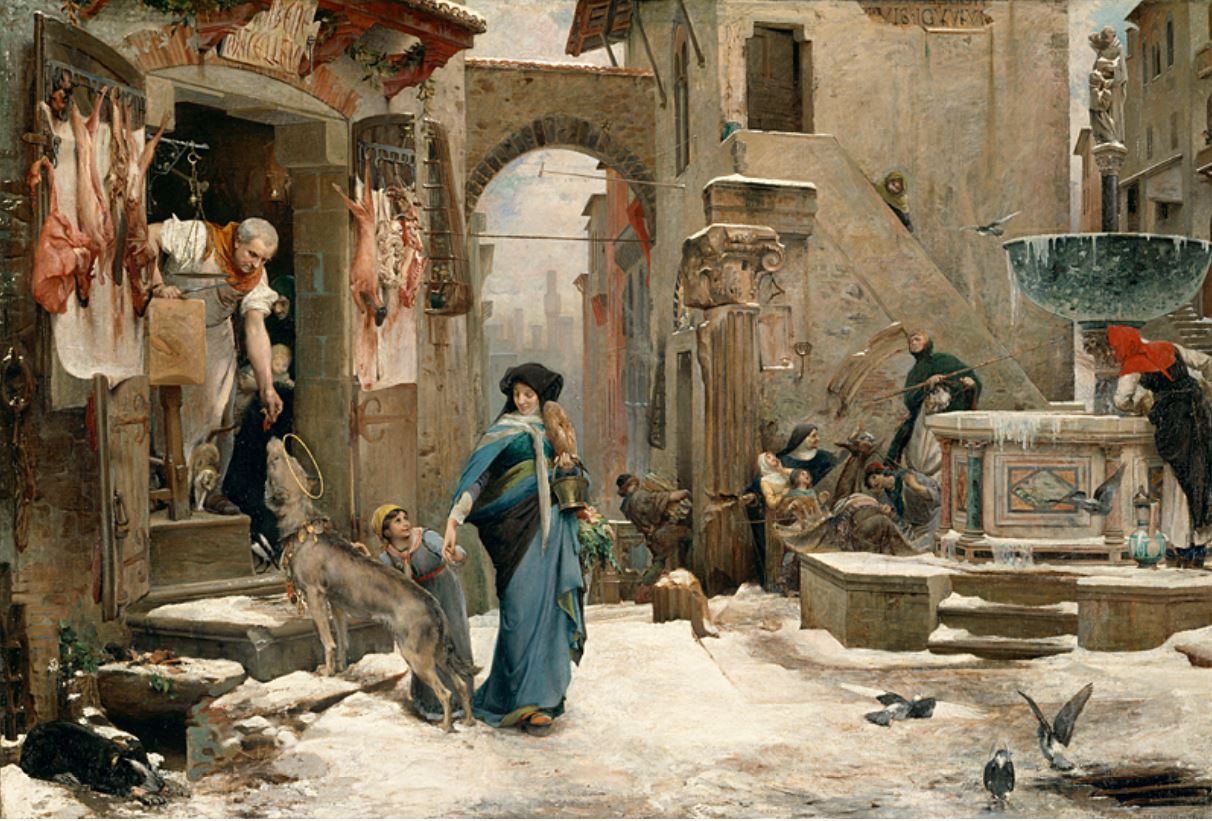
  • he tamed a ferocious wolf which had been terrorising the inhabitants of the town of Gubbio
  • he wrote a short letter to his friend, Brother Leo
  • he travelled to the Holy Land where, improbably enough, he met the Sultan of Egypt
  • four years before his death the stigmata or the same wounds suffered by Jesus on the cross, appeared on his body, obviously staggering his colleagues
  • towards the end of his life, already ill, he composed a hymn or canticle to the Sun

Not exactly a rich harvest of information, and with little or no historical context. The kind of richly historical exhibition the curators imagine their show to be would be better staged at the British Museum, and would involve a lot more historical documents and context, about church, doctrine, popes etc.

No, what this exhibition really consists of is something distinctly different, which is a review of how saint Francis has been depicted in art from his own time to the present day. If you go expecting to be thoroughly instructed about his life and relevance, I think you’d be sorely disappointed. Instead, I think the way to approach the show is as an excursion, a Cook’s tour, a fascinating stroll through the evolution and changing styles of Western art as represented by works on this one particular subject, this one historical figure.

The show includes over 40 works of art from European and American public and private collections, ranging from medieval painted panels, relic-like objects, medieval manuscripts, paintings, sculptures and even a Marvel comic.

Francis’s theology I could take or leave and mostly left, but what I found engaging was comparing the drastically different means and techniques and conceptualisations of art over pretty much the entire history of western art and featuring works by a who’s who of western art, including Botticelli, Caravaggio, El Greco, Zurbarán, Fra Angelico, Altdorfer, plus a gaggle of 19th and 20th century British artists.

Life of Saint Francis

Quoted from the National Gallery press release:

Francis was born to a prosperous silk merchant. He lived the typical life of a wealthy young man, but his disillusionment with the world around him grew. Events such as his traumatising experience of war, imprisonment, and an extended illness caused him to reassess his life. A mystical vision of Christ in the church of San Damiano and his encounter with a leper were life-changing moments. He renounced all his possessions, inheritance, and patrimony, and embraced the life of a penitent following in the footsteps of Christ, establishing the order of Friars Minor. In 1224 he received the stigmata (wounds that appear on a person’s body in the same places as those made on Christ’s body when he was crucified). These events contributed to the spread of his popularity as a preacher, peacemaker, a champion of the poor, early environmentalist, and social radical. Just two years after his death, in 1226, he was canonised (i.e. made a saint).

Francis’s life and miracles lent themselves to image making and were a great source of inspiration to artists. Apart from those appearing in the New Testament, Francis is probably the most represented saint in the history of art. The popularity of the Franciscan movement grew hand in hand with the rapid spread of imagery – by some of the greatest artists – recounting his likeness and legend. Art historians have estimated that as many as 20,000 images of Francis, not even including those in illuminated manuscripts, might have been made just in the century after his death.

Human nature

The single funniest thing in the show is the fact that although, by the time of his death in 1226, his followers were preaching his message all over Europe, Francis had already resigned the leadership of his order, dismayed by the increasingly worldly and materialistic turn it was taking as it became a pillar of the established Church.

Exactly. All attempts at reforming nature are always defeated by pragmatism and compromise and inertia and then laziness and then greed and institutionalisation and grand churches and rich paintings and rituals and ceremonies and pilgrimages and medals and so on – until the idea of standing quietly listening to the birds is left far, far behind.

13th century

From his native Umbria, Saint Francis’s image spread rapidly to become a global phenomenon. This was helped by the proliferation of biographies written by, among others, Thomas of Celano and Saint Bonaventure. In the 1290s, Giotto and his collaborators painted frescoes in the Upper Church of the Basilica of San Francesco in Assisi recounting the saint’s life, which changed the course of European painting. Many other artists depicted the saint within decades of his death, in that pre-Renaissance style which is so reminiscent of Eastern Orthodox art.

A ‘vita-retable’ is an altarpiece showing a central image of a saint flanked by episodes from his life and posthumous miracles. Here’s one from just 25 after Francis’s death.

Vita-retable of Saint Francis, about 1253 © Photographic archive of the Sacred Convent of S. Francesco in Assisi

Manuscripts

I love medieval manuscripts, for the awesome manual labour that went into them, as symbols of survival through the cataclysms of history, and for the sweet and charming illustrations you often find in them.

The exhibition not only includes some lovely old hand-written medieval books – notably, the ‘Chronica maiora’ of Matthew Paris (from the Parker Library, Corpus Christi, Cambridge) – but the curators have usefully pulled out and blown up some of the illustrations. I liked the curators’ identification of the birds in the illustration at bottom left, as being a crane, a heron, a hawk and some songbirds. What songbirds? Thrushes, maybe?

Details from the Chronica maiora II by Matthew Paris (1240 to 1255) © Parker Library, Corpus Christi College Cambridge (photo by the author)

Franciscans

As the popularity of the Franciscan movement grew, so did the numbers of Friars Minor, as Francis called his followers, who spread across Europe. They established friaries, built ever-larger Franciscan churches and commissioned pictorial decoration that venerated their founder, instigating a flowering of artistic and architectural production in the runup to the Renaissance.

15th century

One of the most celebrated visual biographies of Saint Francis was created by Stefano di Giovanni di Consolo, known as il Sassetta (1392 to 1450). In 1437 he was commissioned to create an altar-piece for the church of San Francesco in Borgo San Sepolcro. The National Gallery owns seven panels from the monumental double-sided altarpiece and devotes a room to displaying them in narrative order (they are missing the eighth panel and centrepiece).

Saint Francis meets a Knight Poorer than Himself (on the left) and Saint Francis’s Vision of the Founding of the Franciscan Order (on the right), from the San Sepolcro Altarpiece by Sassetta (1437 to 1444) © The National Gallery, London

The Counter-Reformation room

The Counter-Reformation was the Catholic Church’s response to the Protestant Reformation of the first half of the 16th century. It began with the Council of Trent (1545 to 1563) and is considered to have lasted through to the end of the European wars of religion in 1648.

The Counter-Reformation sought to redefine Catholic dogma and reform the hierarchy of the Church. It was accompanied by a new strictness of doctrine and organisation, associated with the revival of religious inquisitions in Italy and especially Spain. Spanish spiritualism developed a dark intensity which matched the authoritarian tendency of church and state. Religious painting and architecture achieved new heights of sophistication and were made on a grander scale than ever before, literally designed to awe and impress believers.

And so there’s a room devoted to this style of gloomy, intense and lachrymose religiosity, which includes paintings by masters from the period including Zurbarán, Caravaggio, Murillo and El Greco. I heartily loathed them all. I appreciate the technical mastery of Zurbarán but am repelled by its world of morbid shadows, mortification and self-loathing. Saint Francis loved the sun and the moon and preached to birds and beasts in the sunny Italian countryside. This figure, his face half-hidden, clutching a skull, represents the exact opposite, a world of darkness and death.

Saint Francis in Meditation by Francisco de Zurbarán (1635 to 1639) © The National Gallery, London

When the curators tell us that “approximately 135 paintings of Francis by El Greco and his collaborators survive, reflecting Spanish devotion to the saint” they obviously see this as an achievement, whereas I see it as sinister.

Victorian anecdote painting

There’s a section featuring lovely, detailed, hyper-realistic Victorian paintings of incidents in the life of the saint. These include Saint Francis of Assisi and the Heavenly Melody (1904) by a painter I don’t think I’d heard of before, Frank Cadogan Cowper, who is described as the last Pre-Raphaelite painter; and the much drabber ‘Brother Francis and Brother Sun‘ by Giovanni Costa (1875 to 1885).

The standout work is this detailed, hyper-realistic narrative painting based on the legend of the wolf of Gubbio by French painter Luc Olivier Merson. There’s an entertaining ‘Where’s Wally’ enjoyment to be had from picking out the countless artfully conceived and beautifully painted details.

The Wolf of Gubbio by Luc Olivier Merson (1877) Musée des Beaux-Arts, Lille © RMN-Grand Palais (PBA, Lille) / René-Gabriel Ojeda

Early 20th century

Bonkers but charming, Stanley Spencer is the Milton Jones of English artists. After the Great War (in which he served in the ambulance service) Spencer withdrew to the small village of Cookham on the River Thames, where he painted scenes of everyday life, striking nudes of himself and his wife and lovers, and numerous works showing scenes from Christian narratives, but taking place in the homely, domestic settings of his little hometown. And so here he is, reimagining Saint Francis, looking like the artist’s grandad and wearing his dressing gown and slippers, walking down Cookham High Street accompanied by a very English gaggle of chickens and songbirds.

St Francis and the Birds by Stanley Spencer (1935) Tate, London © Estate of Stanley Spencer. All rights reserved 2023 / Bridgeman Images (photo: Tate)

I’ve walked several times from Maidenhead to Cookham just to visit the Stanley Spencer Gallery there, and gone on pilgrimage to his headstone in Cookham graveyard. I know it’s nowhere near as much of an awesome work of art as the Zurbarán, but I find more of the Franciscan spirit of modesty and love in one work by Spencer than in the entire Counter-Reformation.

Contemporary art

Arguably, the modern works are the most successful, certainly the most striking and take us to a completely different place from the medieval altarpieces. For example, landscape artist Richard Long is represented by three works, A Walk for Saint Francis (2022), River Avon Mud Crescent (2023) and Desert Flowers (1987). In May 2022 Long spent a week in solitude walking and camping on Mount Subasio, the mountain rising above Assisi that provided Francis with an early refuge. ‘A Walk for Saint Francis’ derived from this experience. It is not a painting at all but a circle of words, of phrases, which capture the experience, such as ‘Watching night turn to day’ and ‘Watching the Earth turn’. Whereas ‘River Avon Mud Crescent’ is what it says in the title, a big circle on the wall, suggesting the crescent moon, and made from daubs of mud from the River Avon.

Installation view of Saint Francis of Assisi with ‘River Avon Mud Crescent’ on the left and ‘A Walk for Saint Francis’ on the right (photo by the author)

Oddly, there hadn’t been any sculptures of Francis through the classic eras of Western art. Only in the modern era do we come across not one but two. One is by Antony Gormley and is, typically, a cast of his own body. According to the wall label, it’s based on Giovanni Bellini’s painting ‘Saint Francis in the Desert’, complete with holes in his hands, feet and chest, referencing the tradition of Francis’s stigmata –but, like all Gormley’s sculptures, it is really a kind of everyman figure, this time everyman as devout believer.

Installation view of ‘Untitled (for Francis)’ by Antony Gormley (1985) Tate © Antony Gormley (photo by the author)

Vying with the Gormley for most striking sculpture, is this work, ‘Albero Porta – Cedro’ (‘Door Tree – Cedar’) by Italian artist Giuseppe Penone. Within the old tree, battered by generations of sun and rain and snow, lies concealed the secret inner soul of the tree, its youthful spirit, just as inside each of us cynical old adults still lies the fresh hopeful child of nature. I warmed to this even before the wall caption told me that Penone is a member of the Italian Arte Povera movement who sought to make art out of everyday material (and whose name, of course, echoes the nickname and concerns of il poverello).

Installation view of ‘Door Tree-Cedar ‘by Giuseppe Penone (2012) Gagosian and Marian Goodman Gallery © Giuseppe Penone (photo by the author)

There’s another Arte Povera work, ‘Sacco‘ (Sack) by Alberto Burri (1953), consisting of fragments of coarse hessian sack overlaid on each other and bound in a simple wooden frame. The single red wound gaping through a circle torn in the sacking presumably symbolises Francis’s stigmata but I found it all too realistic and stomach-churning.

There are two striking series of black and white prints. One is a series of lithographs by Arthur Boyd (1965). The Australian Arthur Boyd was living in London when he made 16 lithographs illustrating the life of Francis for an edition of T.S.R. Boase’s biography of the saint.

In a space to itself is an impressive set of black and white woodcuts on paper, made in 2016 by Andrea Büttner and titled ‘Beggars’. Nine hooded figures, reduced to the simplest possible outline of cloth and hands, are shown sitting with their arms outstretched in supplication. A source for the series was a book from 1510 which was, contrary to the spirit of Francis, a warning against dishonest and abusive mendicants. (The photo below, by the way, is from some other exhibition and is not how they’re displayed here.)

Beggars Suite 1 to 9, by Andrea Büttner (2016) © DACS 2023

Elsewhere, Büttner has an interesting big print showing tiers of birds, ‘Vogelpredigt (Sermon to the Birds)‘ which riffs off an altarpiece from Santa Croce, Florence, which was a very early cycle of images depicting the saint’s life.

Mass media

In the final room are some examples of how Francis has been portrayed in 20th century mass media, namely movies and, believe it or not, comics.

Saint Francis movies

A big monitor plays scenes from some of the post-war movies made about Francis, namely:

  • The Flowers of St. Francis (1950) directed by Roberto Rossellini
  • Brother Sun, Sister Moon (1972) directed by Franco Zeffirelli
  • Francesco (1989) directed by Liliana Cavani

Film, as a medium, is the ultimate instrument of consumer capitalism in reducing all facts, narratives and events to the same palatable product, to the same half dozen formulae, shoehorned into the same three-act structure, all loose ends neatly wrapped up in a nice bow in under two hours.

Comic books

The idea for the 1980 Marvel comic ‘Francis, Brother of the Universe’ came from two Franciscans who approached Marvel’s representative in Tokyo. If you think about it, like so many Marvel superheroes, Francis was a seemingly ordinary man with extraordinary capabilities (albeit given from God). The cover art shows a collage of our man in a series of characteristic scenes: preaching as a youth in the marketplace; leading crusaders; thrown before the initially scornful Sultan of Egypt; greeting the sun and the doves of peace; meeting the Pope or some such eminence. Shame they didn’t go on to do the kind of crossover story which Marvel excels at: Saint Francis calms The Hulk. Saint Francis persuades Thor to hand over his hammer and talk to the trees.

Installation view of ‘Francis, Brother of the Universe’ by Marvel Comics (1980) © Disney. All rights reserved (photo by the author)

Saint Clare

A small section of the exhibition is dedicated to Saint Clare (1194 to 1253), one of the first followers of Francis. Following her death, the order she founded was renamed the Order of Saint Clare, commonly referred to today as the Poor Clares. Her/their story is represented in works like:

  • Giovanni da Milano’s ‘Christ and the Virgin Enthroned with Six Saints’ (1350s)
  • Giovanni di Paolo’s ‘Saint Clare Rescuing a Child Mauled by a Wolf’ (1455 to 1460)
  • Josefa de Óbidos’s ‘Nativity Scene with Saint Francis and Saint Clare’ (1647)

Francis’s nature worship

Much is made of Saint Francis’s nature worship. The curators say he believed that nature itself was the mirror of God. He called all creatures his ‘brothers’ and ‘sisters’, preached to the birds and supposedly persuaded a wolf in the Italian town of Gubbio to stop attacking the locals. He saw God reflected in nature. In the hymn he composed – ‘Canticle of the Sun’ – he gives God thanks for Brother Sun, Sister Moon, Brother Wind, Water, Fire, and Earth and they print a full translation of the Canticle on the gallery wall. Here it is in the translation given on the Catholic Agency for Overseas Development website:

Most High, all-powerful, all-good Lord,
all praise is yours, all glory, honour and blessings.
To you alone, Most High, do they belong;
no mortal lips are worthy to pronounce your name.

We praise you, Lord, for all your creatures,
especially for Brother Sun,
who is the day through whom you give us light.
And he is beautiful and radiant with great splendour,
of you Most High, he bears your likeness.

We praise you, Lord, for Sister Moon and the stars,
in the heavens you have made them bright, precious and fair.

We praise you, Lord, for Brothers Wind and Air,
fair and stormy, all weather’s moods,
by which you cherish all that you have made.

We praise you, Lord, for Sister Water,
so useful, humble, precious and pure.

We praise you, Lord, for Brother Fire,
through whom you light the night.
He is beautiful, playful, robust, and strong.

We praise you, Lord, for Sister Earth,
who sustains us
with her fruits, coloured flowers, and herbs.

We praise and bless you, Lord, and give you thanks,
and serve you in all humility.

Surely this is a long way short of pantheism and Nature worship. It is, quite explicitly, the Lord God who Francis is praising – just as any priest of his time would – and the sun and moon and wind and fire and so on are emphatically not praised, or addressed, in their own right, but only insofar as they demonstrate the benevolence and all-powerfulness of the Creator. The feeling for nature is there, but only as a sin-off from the deep worship of the Lord God.

Projecting our values

At several places the curators assert that Francis speaks to us, now, in 2023, of very contemporary ‘concerns’, and list some of these, such as ‘interfaith dialogue’, environmental concern and feminism. They claim that ‘Saint Francis of Assisi continues to be an attractive and inspirational figure for’:

  • both Christians and non-Christians
  • for pacifists and environmentalists
  • for those who clamour for social justice
  • for utopians and revolutionaries
  • for animal lovers
  • for those who work for causes of human solidarity

Or:

Francis’s powerful appeals for peace and human solidarity, his encounter with Islam and his embryonic environmentalism continue to hold great interest. He is considered by many to be a patron saint, or an ally, of causes related to social justice, interreligious dialogue, socialism, feminism, the animal-rights movement and ecology, among others.

The exhibition was co-curated by the Director of the National Gallery, Dr Gabriele Finaldi, who joins in with his variation on the list of Francis’s fabulous qualities:

‘Francis’s spiritual radicalism, his commitment to the poor and human solidarity, his love of God, nature and animals, which we might call embryonic environmentalism as well as his striving for peace between enemies and openness to dialogue with other religions, are themes that still resonate with us today and make him a figure of enormous relevance to our times.’

But it’s my view that all this discourse consists of us projecting our own modern concerns back onto this remote medieval figure. Moreover, all this high-minded projection has the unintended consequence of highlighting how irrelevant Francis is to our modern day.

Poverty No modern Christian believes in God with the same wholeheartedness Francis was capable of. No Christian whatsoever is prepared to sell everything they possess, give all the proceedings to the poor, and become a mendicant beggar for God. Do you know anyone who’s done that? No.

Interfaith Although faith leaders in the West like to talk about dialogue between religions, it’s not clear that happens much on the ground here and, globally, dividing lines between the secular West, Muslim Middle East and Africa, and Hindu India have hardened, with astonishing levels of sectarian violence taking place around the world.

Pacifism Pacifists are irrelevant in an era when Russia has invaded Ukraine and threatens the rest of Europe, while analysts worry about China attacking Taiwan.

Environmentalism is sweet and lovely for the middle classes who can afford to fret about such things and shop at farmers’ markets, but irrelevant to most people who, in recent years, have been struggling to keep a roof over their heads and food on the table, who can’t afford electric cars and have no time to lobby for clean energy. When I worked at a distribution centre a couple of years ago, you should have heard the packers and supervisors yelling abuse at Just Stop Oil activists gluing themselves to the road or tube trains. Meanwhile, every single indicator of environmental wellbeing and climate change is deep in the red and getting worse.

Social justice Francis may have clamoured for social justice, just as millions of the kind and well meaning have done for the 800 years since: but the outcome of all this clamour is that today, in 2023, over a billion people worldwide live on less than a dollar a day, while all western societies are more unequal and unfair than at any time in the last 50 years.

In other words, Francis can, with some justice, be taken as the patron saint of lost causes.

I find the high-falutin’ sentimental sentiments of the wall labels so much cant (defined as ‘sanctimonious talk, typically of a moral, religious, or political nature’) where ‘sanctimonious’ is defined as ‘making a show of being morally superior to other people’. It is a discourse of feel-good bromides, where ‘bromide’ is defined as ‘a trite statement that is intended to soothe or placate’.

The National Gallery was, as usual, packed to overflowing with educated, middle-class people, many of whom were obviously tourists i.e. had travelled long distances, probably in environment-destroying airplanes, and spent a lot of money to be here. Outside the National Gallery I walked past a clutch of filthy dirty, wretched-looking vagrants, sleeping rough with their dogs. I gave each of them a pound. “Clamouring for social justice”, my arse.


Related link