Hay Fever by Noel Coward (1925)

JUDITH: You must forgive me for having rather peculiar children.

SOREL: We’re a beastly family, and I hate us… we’ve spent our lives cultivating the Arts and not devoting any time to ordinary conventions and manners and things.

MYRA (furiously): Well, I’m not going to spare your feelings, or anyone else’s. You’re the most infuriating set of hypocrites I’ve ever seen. This house is a complete feather-bed of false emotions—you’re posing, self-centred egotists, and I’m sick to death of you.

SIMON (over his shoulder): Ha, ha!—very funny.

Executive summary

In a country house near Cookham live the Bliss family, father, mother, young adult son and daughter. Without telling the others, they each invite a guest down for the weekend, but behave so selfishly and rudely that after an embarrassing Saturday afternoon, and excruciating Saturday evening, on the Sunday morning all four guests run away while the Blisses are so busy having a massive family row that they don’t notice their departure.

More froth. Having come across the word ‘flippant’ to describe Coward it’s stuck in my mind as the best word to describe his approach. Flippant, sarcastic, lofty, dismissive, it may well have captured the cynicism of the younger generation of upper-middle-class families he portrays, but it makes for tiresome reading.

‘Hay Fever’ is said by some to be Coward’s most perfect comedy. In my opinion a comedy has to be funny, or it at least helps. Coward characters overflow with deliberately silly and frivolous comments which aren’t funny in themselves, but continually signal the facetious flippant mentality which is his schtick.

SOREL: Everybody’s heard of Richard Greatham.
SIMON: How lovely for them.

That strikes me as being schoolboy level and indeed a lot of Coward’s characters behave like children,  like spoiled adolescents, have the psychology of sarcastic teenagers. When Sorel (a young woman) tells  her sarcastic brother, Simon, that she’s invited a guest to come and stay, Richard Greatham, a chap who works in the Foreign Office, Simon says:

SIMON: Will he have the papers with him?
SOREL: What papers?
SIMON (vaguely): Oh, any papers.
SOREL: I wish you’d confine your biting irony to your caricatures, Simon.

Is this biting irony? No, it’s a mildly amusing bit of banter. And this is characteristic of the way all the characters, and by implication the author, talk themselves up, make grandiose gestures out of what are, in reality, very mundane arguments and misunderstandings. Which is why Coward’s plays have this peculiar quality of making quite a big impact at the time and then later, in memory, feel so empty.

Or else the tone is just camply bitchy. When Sorel asks the maid, Clara, whether she’s put flowers in the Japanese room, where he’s going to be put up, Simon, having taken against this chap Greatly, bitchily comments:

SOREL: You haven’t forgotten to put those flowers in the Japanese room?
SIMON: The Japanese room is essentially feminine, and entirely unsuited to the Pet of the Foreign Office.
SOREL: Shut up, Simon.

This could be delivered as camp bitchiness, but is really teenage sarcasm. It’s mildly distracting but not funny. As the play progressed I realised the most important bit was Sorel’s immediate anger. The point of the play is how quick each member of the Bliss family is to get angry with any of the others. Very self-absorbed argumentative family, that’s the point.

Then there’s the comedy of snobbery pure and simple.

SOREL: Clara says Amy’s got toothache.
JUDITH: Poor dear! There’s some oil of cloves in my medicine cupboard. Who is Amy?
SOREL: The scullery-maid, I think.
JUDITH: How extraordinary! She doesn’t look Amy a bit, does she? Much more Flossie.

This is the familiar caricature figure of the loveably out-of-touch parent or posh bourgeois who has no idea about their own servants. Hilarious.

Act 1. Saturday afternoon

All three acts are set in the same scene, the living room of the Blisses’ house at Cookham, in June.

Simon and Sorel are brother and sister (19), young whimsical and self-absorbed. Just like Florence and Nicky Lancaster in The Vortex, they consider themselves ‘abnormal’ and lament how they suffer for their ‘difference’.

SIMON: It’s no use worrying, darling; we see things differently, I suppose, and if people don’t like it they must lump it.

This is just another way of saying they’re special, which is, of course, what all narcissistic self-absorbed people think. And it is, notoriously, what self-involved theatre people, or ‘luvvies’, think about themselves. Different, special – more sensitive, spiritual, artistic and aware than ‘normal’ people.

And theatre audiences who have paid to attend the theatre have made a fairly obvious agreement that they will find the people on stage in some sense ‘special’, participants in a shaped narrative, otherwise why bother going to the theatre at all?

Actors on stage playing actors claiming the narcissistic attention which (some) actors notoriously think due to themselves – it’s like watching a baby or child in an adult body – this genre or trope has entertained audiences for over a century, and Simon and Sorel’s mother Judith is a prime example. She claims to have retired from the stage, though her children suspect it won’t be long before she takes it back up, because of the addiction to feeling special, to being in the limelight and the centre of attention. She tells us she’s invited a friend to stay this weekend, and goes on to explain:

JUDITH: He’s a perfect darling, and madly in love with me—at least, it isn’t me really, it’s my Celebrated Actress glamour—but it gives me a divinely cosy feeling.

An actress on stage describing how wonderful it is to be adored as an actress on stage. This is what the kids call ‘meta’, meaning ‘self-referential, referring to itself or to the conventions of its genre.’ I think Oscar Wilde’s characters, in plays and stories, constantly refer to playing a part, acting a role, posing, but do it as part of a consciously worked-out attitude to life, explained in great depth in his long essays. In Coward it just feels like a trick and a mannerism.

Anyway, brief summary: Simon is allegedly an artist, Sorel is his quick-tempered sister, mother Judith affects the absent-minded self-importance of a Grande Dame of the theatre, and the father, David, hides away in his study finishing his novel.

The four guests they’ve invited arrive, being:

  • Sandy Tyrell, a sporty young chap invited by Judith – ‘He’s a perfect darling, and madly in love with me’
  • Myra Arundel, sexy and strong-minded, invited by Simon – according to Judith ‘She’s far too old for you, and she goes about using Sex as a sort of shrimping net’ and calls her a ‘self-conscious vampire’ or vamp – a word just coming into common usage
  • Richard Greatham, an older man, iron-grey and tall, ‘a frightfully well-known diplomatist’, invited by Sorel
  • Jackie Coryton, small and shingled, ‘a perfectly sweet flapper’ invited by David – ‘she’s an abject fool, but a useful type, and I want to study her a little in domestic surroundings’

The Bliss family have a disconcerting habit of, without warning, dropping into a team performance of plays their mother once performed in. At several points during the weekend they suddenly drop into acting out one of Judith’s great hits, ‘Love’s Whirlwind’ and they’re acting out the climactic scene when the first of the guests arrive.

The guests arrive and are disconcerted to be very cursorily greeted, almost ignored by the Blisses.

MYRA: It’s useless to wait for introductions with the Blisses.

There are various moments of embarrassment. For example Sandy is taken aback when Judith tells him her husband is upstairs. He thought she was a widow. Simon fancies Myra like mad but she’s suave and standoffish. Soon after they’ve arrived urbane Richard and dim Jackie find themselves abandoned by their hosts, and left alone find they have nothing to talk about. Slowly they all realise they’re all there for various types of misunderstanding.

The casual rudeness of the Bliss’s, leaving various guests to work out where to go or try and make conversation, leads up to tea for everyone served by Clara the servant, at which conversation fizzles out as it starts to rain and they’re all stuck indoors with each other.

Act 2. Saturday evening

Everyone’s dressed for dinner. The first half of the act is taken up with an enormous squabble about which party game they should play, with the Blisses snapping at each other while the other guests try to understand what’s going on.

The game breaks up amid recriminations and arguments with David and Judith blaming each other from bringing up the children so badly. The characters break away, David going to his room, the others into the library or out into the garden. This leaves Judith the theatrical mother alone with Richard the mature diplomat and it turns out Richard doesn’t like Sorel at all, it’s Judith he’s in love with. There’s lots of flirting which leads up to him kissing her.

At this she leaps to her feet and melodramatically behaves as if they are having a torrid affair and agonising over how to tell her husband that their life together is over etc. This, I grant you, is very funny. Telling him she needs space to compose herself she pushes Richard out into the garden and preens in the mirror before going into the library. But here she discovers young Sandy the sportsman, who she invited down, locked in an embrace with Sorel.

Once again Judith switches into the role of the betrayed woman, making a Grand Scene.

SOREL: Mother, be natural for a minute.
JUDITH: I don’t know what you mean, Sorel.

Comically, Judith says she will make the Great Sacrifice of giving up Sandy and letting his and Sorel’s love prosper. As soon as she’s swept out, Sorel lights a cigarette and tells Sandy she doesn’t love him. But what about the scene they just had?

SORE: One always plays up to Mother in this house; it’s a sort of unwritten law… her sense of the theatre is always fatal.

They go back into the library leaving the stage empty. This is the setting for the third love scene, this time between the father, David, and wilful Myra. Note how the Blisses are pairing off not with the guests they invited. Musical chairs.

An enormous long scene as they flirt leading up to his taking her hand. She repeatedly tells him to let go and then slaps him. With sixpenny psychology, this leads them to suddenly fall into a passionate clinch. And with arch contrivance, this is precisely when Judith re-enters from her bedroom, coming down the stairs and capturing them in mid-kiss.

Obviously David and Myra are embarrassed but once again this is the pretext for Judith to play the Grande Dame, this time not with a florid burst of hysteria but with quite the opposite, an exaggerated display of Noble Restraint.

JUDITH: Life has dealt me another blow, but I don’t mind.

Cold-eyed Myra sees that this is all part of their family dynamic:

MYRA: You’re both making a mountain out of a mole-hill.

But Judith sweeps on in the part of Noble Self-Sacrificing Wife, saying she will leave the house now it has become too full of painful memories.

JUDITH: October is such a mournful month in England. I think I shall probably go abroad—perhaps a pension somewhere in Italy, with cypresses in the garden. I’ve always loved cypresses.

This is funny, as is the way David completely forgets that he’s supposed to be ‘in love’ with Myra in his admiration for Judith’s performance.

At the height of her display Simon comes running in from the garden and, in the fourth and final reshuffling of the characters’ initial allegiances, announces that he and the brainless flapper Jackie are engaged. And this triggers what, by now I’ve realised, is yet another performance from Judith, this time as The Mother Whose Children Are Growing Up And Leaving Home.

JUDITH (picturesquely): All my chicks leaving the nest. Now I shall only have my memories left. Jackie, come and kiss me.

There’s only one snag, which is that Jackie in no way loves Simon and eventually gets to explain that they had one little kiss then he leapt up and ran off to the house to tell his family. What you realise is that they’re all acting, all the Blisses seize on mundane events and blow them up out of all proportion in order to feed their own sense of the theatrical. Against this Myra is the voice of clear-eyed realism (as Helen is in The Vortex), and angrily tells them the truth:

MYRA: Don’t speak to me—I’ve been working up for this, only every time I opened my mouth I’ve been mowed down by theatrical effects. You haven’t got one sincere or genuine feeling among the lot of you—you’re artificial to the point of lunacy.

So that’s the key to the whole thing. It’s a group portrait of a family who live in their own incestuous over-dramatic theatrical reality.

And to seal the point, as all the characters descend into a huge bickering squabble, Richard the diplomat innocently asks ‘Is this a game’ without realising this is a line from the play the family often perform, ‘Love’s Whirlwind’ and, at a drop of a hat, Judith, Simon and Sorel drop into a performance of the melodramatic final scene while David enthusiastically applauds – leaving the four invited guests puzzled and aghast.

Act 3. Sunday morning

First thing in the morning in the dining room. Clara the servant has set the breakfast things in warming dishes on the side table. One by one the guests come down, Sandy, Jackie, Myra, Richard.

There’s a lot of comic business with Sandy developing hiccups and dim Jackie clumsily trying to help cure them, and then a comic thread where Richard taps the barometer in the hall and it promptly falls off the wall onto the floor and breaks and, mortified, he tries to hide it…

But the thrust of the scene is simple: all four guests agree the Bliss household is a madhouse and they can’t get away soon enough. They agree to pack their bags in a hurry and sneak out to Richard’s car, and this is what they do.

Once they’ve left the Blisses arrive one by one for breakfast. In a minor way they each do something symptomatic of their interests. Judith is gratified to find that she’s mentioned in a newspaper gossip column, Simon has drawn a new caricature which he shows the others to admire, and David comes downstairs excited because he’s completed the last chapter of the novel he’s writing (titled ‘The Sinful Woman’).

Excitedly he starts reading this final chapter to his family. It opens with a description of the heroine (Jane Sefton) driving her car (a Hispano cf Iris Storm’s car in The Green Hat) round Paris. Except that his family interrupt him to point out he’s got the geography of Paris wrong. To be precise they deny that the Rue St. Honoré leads into the Place de la Concorde, while David insists that it does. This escalates into a full-scale shouting match and it is during the family’s flaming argument that their four poor guests, unseen, sneak down the stairs carrying their bags, and out the front door.

The family argument is reaching a climax when the front door slams shut loudly which shuts them up. After a moment’s silence they then fall to criticising their guests and their extraordinary behaviour in leaving without even saying goodbye or thank you.

DAVID: People really do behave in the most extraordinary manner these days…

Thoughts

Taken for what it is, ‘Hay Fever’ is an affable evening’s entertainment, clocking in at an hour and a half, leaving plenty of time for drinks beforehand and supper somewhere nice afterwards. It is a perfect example of theatre as harmless entertainment and part of a charming night out, civilised and amusing.

It’s a kind of standing reproach to all those critics and intellectuals who want theatre to tear the mask off bourgeois society in the manner of Ibsen and Shaw or any of the post 1960s playwrights who see it as their task to question society’s values and address Big Issues. I can see how Coward fans see his work as a welcome antidote to all that, and his frothy emptiness as a statement in its own right.


Related links

Related reviews

Saint Francis of Assisi @ the National Gallery

‘If you want to be perfect, go, sell what you have and give to the poor’.
Gospel of Matthew, chapter 19, verse 21

Given that it’s free, this exhibition about the life and legacy of Saint Francis of Assisi (1182 to 1226) is surprisingly extensive, stretching over seven rooms packed with paintings, prints and sculptures.

Having sauntered round it twice and read all the wall labels, it dawned on me that it is not really a review of the saint’s life and legacy. There is very little about the historical or theological context of his day, about the state of the papacy and Catholic church at the end of the twelfth and start of the thirteenth century. There’s a sketchy timeline of the saint’s life but not a lot of detail about his teachings and beliefs (he espoused total poverty and valued all aspect of nature as bespeaking the glory of God). There’s not really anything about the impact of the saint’s beliefs on broader Catholic doctrine, and nothing about the complex 800-year history of the Franciscan Order which, a glance at the Wikipedia article suggests, actually consists of several orders, each with a complex history.

The impressive wall frieze at the entrance to the exhibition, made entirely of plastic and artificial materials

From scanning the introduction panels to each room and reading the captions to all the paintings, I learned that:

  • saint Francis was exceptionally pious
  • he emphasised Christ’s teachings about poverty (he came to be known in his time as il poverello)
  • his choice of vocation led to arguments with his father who on several occasions beat him
  • he tamed a ferocious wolf which had been terrorising the inhabitants of the town of Gubbio
  • he wrote a short letter to his friend, Brother Leo
  • he travelled to the Holy Land where, improbably enough, he met the Sultan of Egypt
  • four years before his death the stigmata or the same wounds suffered by Jesus on the cross, appeared on his body, obviously staggering his colleagues
  • towards the end of his life, already ill, he composed a hymn or canticle to the Sun

Not exactly a rich harvest of information, and with little or no historical context. The kind of richly historical exhibition the curators imagine their show to be would be better staged at the British Museum, and would involve a lot more historical documents and context, about church, doctrine, popes etc.

No, what this exhibition really consists of is something distinctly different, which is a review of how saint Francis has been depicted in art from his own time to the present day. If you go expecting to be thoroughly instructed about his life and relevance, I think you’d be sorely disappointed. Instead, I think the way to approach the show is as an excursion, a Cook’s tour, a fascinating stroll through the evolution and changing styles of Western art as represented by works on this one particular subject, this one historical figure.

The show includes over 40 works of art from European and American public and private collections, ranging from medieval painted panels, relic-like objects, medieval manuscripts, paintings, sculptures and even a Marvel comic.

Francis’s theology I could take or leave and mostly left, but what I found engaging was comparing the drastically different means and techniques and conceptualisations of art over pretty much the entire history of western art and featuring works by a who’s who of western art, including Botticelli, Caravaggio, El Greco, Zurbarán, Fra Angelico, Altdorfer, plus a gaggle of 19th and 20th century British artists.

Life of Saint Francis

Quoted from the National Gallery press release:

Francis was born to a prosperous silk merchant. He lived the typical life of a wealthy young man, but his disillusionment with the world around him grew. Events such as his traumatising experience of war, imprisonment, and an extended illness caused him to reassess his life. A mystical vision of Christ in the church of San Damiano and his encounter with a leper were life-changing moments. He renounced all his possessions, inheritance, and patrimony, and embraced the life of a penitent following in the footsteps of Christ, establishing the order of Friars Minor. In 1224 he received the stigmata (wounds that appear on a person’s body in the same places as those made on Christ’s body when he was crucified). These events contributed to the spread of his popularity as a preacher, peacemaker, a champion of the poor, early environmentalist, and social radical. Just two years after his death, in 1226, he was canonised (i.e. made a saint).

Francis’s life and miracles lent themselves to image making and were a great source of inspiration to artists. Apart from those appearing in the New Testament, Francis is probably the most represented saint in the history of art. The popularity of the Franciscan movement grew hand in hand with the rapid spread of imagery – by some of the greatest artists – recounting his likeness and legend. Art historians have estimated that as many as 20,000 images of Francis, not even including those in illuminated manuscripts, might have been made just in the century after his death.

Human nature

The single funniest thing in the show is the fact that although, by the time of his death in 1226, his followers were preaching his message all over Europe, Francis had already resigned the leadership of his order, dismayed by the increasingly worldly and materialistic turn it was taking as it became a pillar of the established Church.

Exactly. All attempts at reforming nature are always defeated by pragmatism and compromise and inertia and then laziness and then greed and institutionalisation and grand churches and rich paintings and rituals and ceremonies and pilgrimages and medals and so on – until the idea of standing quietly listening to the birds is left far, far behind.

13th century

From his native Umbria, Saint Francis’s image spread rapidly to become a global phenomenon. This was helped by the proliferation of biographies written by, among others, Thomas of Celano and Saint Bonaventure. In the 1290s, Giotto and his collaborators painted frescoes in the Upper Church of the Basilica of San Francesco in Assisi recounting the saint’s life, which changed the course of European painting. Many other artists depicted the saint within decades of his death, in that pre-Renaissance style which is so reminiscent of Eastern Orthodox art.

A ‘vita-retable’ is an altarpiece showing a central image of a saint flanked by episodes from his life and posthumous miracles. Here’s one from just 25 after Francis’s death.

Vita-retable of Saint Francis, about 1253 © Photographic archive of the Sacred Convent of S. Francesco in Assisi

Manuscripts

I love medieval manuscripts, for the awesome manual labour that went into them, as symbols of survival through the cataclysms of history, and for the sweet and charming illustrations you often find in them.

The exhibition not only includes some lovely old hand-written medieval books – notably, the ‘Chronica maiora’ of Matthew Paris (from the Parker Library, Corpus Christi, Cambridge) – but the curators have usefully pulled out and blown up some of the illustrations. I liked the curators’ identification of the birds in the illustration at bottom left, as being a crane, a heron, a hawk and some songbirds. What songbirds? Thrushes, maybe?

Details from the Chronica maiora II by Matthew Paris (1240 to 1255) © Parker Library, Corpus Christi College Cambridge (photo by the author)

Franciscans

As the popularity of the Franciscan movement grew, so did the numbers of Friars Minor, as Francis called his followers, who spread across Europe. They established friaries, built ever-larger Franciscan churches and commissioned pictorial decoration that venerated their founder, instigating a flowering of artistic and architectural production in the runup to the Renaissance.

15th century

One of the most celebrated visual biographies of Saint Francis was created by Stefano di Giovanni di Consolo, known as il Sassetta (1392 to 1450). In 1437 he was commissioned to create an altar-piece for the church of San Francesco in Borgo San Sepolcro. The National Gallery owns seven panels from the monumental double-sided altarpiece and devotes a room to displaying them in narrative order (they are missing the eighth panel and centrepiece).

Saint Francis meets a Knight Poorer than Himself (on the left) and Saint Francis’s Vision of the Founding of the Franciscan Order (on the right), from the San Sepolcro Altarpiece by Sassetta (1437 to 1444) © The National Gallery, London

The Counter-Reformation room

The Counter-Reformation was the Catholic Church’s response to the Protestant Reformation of the first half of the 16th century. It began with the Council of Trent (1545 to 1563) and is considered to have lasted through to the end of the European wars of religion in 1648.

The Counter-Reformation sought to redefine Catholic dogma and reform the hierarchy of the Church. It was accompanied by a new strictness of doctrine and organisation, associated with the revival of religious inquisitions in Italy and especially Spain. Spanish spiritualism developed a dark intensity which matched the authoritarian tendency of church and state. Religious painting and architecture achieved new heights of sophistication and were made on a grander scale than ever before, literally designed to awe and impress believers.

And so there’s a room devoted to this style of gloomy, intense and lachrymose religiosity, which includes paintings by masters from the period including Zurbarán, Caravaggio, Murillo and El Greco. I heartily loathed them all. I appreciate the technical mastery of Zurbarán but am repelled by its world of morbid shadows, mortification and self-loathing. Saint Francis loved the sun and the moon and preached to birds and beasts in the sunny Italian countryside. This figure, his face half-hidden, clutching a skull, represents the exact opposite, a world of darkness and death.

Saint Francis in Meditation by Francisco de Zurbarán (1635 to 1639) © The National Gallery, London

When the curators tell us that “approximately 135 paintings of Francis by El Greco and his collaborators survive, reflecting Spanish devotion to the saint” they obviously see this as an achievement, whereas I see it as sinister.

Victorian anecdote painting

There’s a section featuring lovely, detailed, hyper-realistic Victorian paintings of incidents in the life of the saint. These include Saint Francis of Assisi and the Heavenly Melody (1904) by a painter I don’t think I’d heard of before, Frank Cadogan Cowper, who is described as the last Pre-Raphaelite painter; and the much drabber ‘Brother Francis and Brother Sun‘ by Giovanni Costa (1875 to 1885).

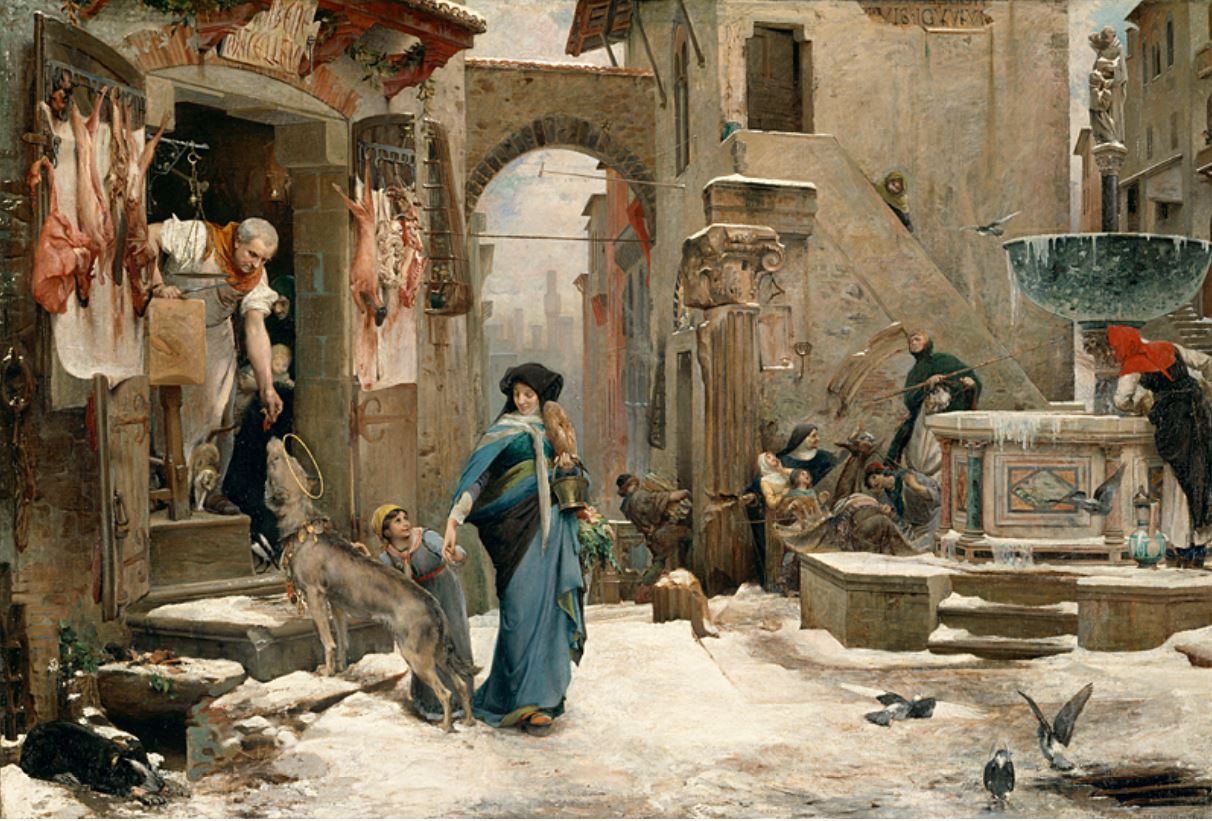
The standout work is this detailed, hyper-realistic narrative painting based on the legend of the wolf of Gubbio by French painter Luc Olivier Merson. There’s an entertaining ‘Where’s Wally’ enjoyment to be had from picking out the countless artfully conceived and beautifully painted details.

The Wolf of Gubbio by Luc Olivier Merson (1877) Musée des Beaux-Arts, Lille © RMN-Grand Palais (PBA, Lille) / René-Gabriel Ojeda

Early 20th century

Bonkers but charming, Stanley Spencer is the Milton Jones of English artists. After the Great War (in which he served in the ambulance service) Spencer withdrew to the small village of Cookham on the River Thames, where he painted scenes of everyday life, striking nudes of himself and his wife and lovers, and numerous works showing scenes from Christian narratives, but taking place in the homely, domestic settings of his little hometown. And so here he is, reimagining Saint Francis, looking like the artist’s grandad and wearing his dressing gown and slippers, walking down Cookham High Street accompanied by a very English gaggle of chickens and songbirds.

St Francis and the Birds by Stanley Spencer (1935) Tate, London © Estate of Stanley Spencer. All rights reserved 2023 / Bridgeman Images (photo: Tate)

I’ve walked several times from Maidenhead to Cookham just to visit the Stanley Spencer Gallery there, and gone on pilgrimage to his headstone in Cookham graveyard. I know it’s nowhere near as much of an awesome work of art as the Zurbarán, but I find more of the Franciscan spirit of modesty and love in one work by Spencer than in the entire Counter-Reformation.

Contemporary art

Arguably, the modern works are the most successful, certainly the most striking and take us to a completely different place from the medieval altarpieces. For example, landscape artist Richard Long is represented by three works, A Walk for Saint Francis (2022), River Avon Mud Crescent (2023) and Desert Flowers (1987). In May 2022 Long spent a week in solitude walking and camping on Mount Subasio, the mountain rising above Assisi that provided Francis with an early refuge. ‘A Walk for Saint Francis’ derived from this experience. It is not a painting at all but a circle of words, of phrases, which capture the experience, such as ‘Watching night turn to day’ and ‘Watching the Earth turn’. Whereas ‘River Avon Mud Crescent’ is what it says in the title, a big circle on the wall, suggesting the crescent moon, and made from daubs of mud from the River Avon.

Installation view of Saint Francis of Assisi with ‘River Avon Mud Crescent’ on the left and ‘A Walk for Saint Francis’ on the right (photo by the author)

Oddly, there hadn’t been any sculptures of Francis through the classic eras of Western art. Only in the modern era do we come across not one but two. One is by Antony Gormley and is, typically, a cast of his own body. According to the wall label, it’s based on Giovanni Bellini’s painting ‘Saint Francis in the Desert’, complete with holes in his hands, feet and chest, referencing the tradition of Francis’s stigmata –but, like all Gormley’s sculptures, it is really a kind of everyman figure, this time everyman as devout believer.

Installation view of ‘Untitled (for Francis)’ by Antony Gormley (1985) Tate © Antony Gormley (photo by the author)

Vying with the Gormley for most striking sculpture, is this work, ‘Albero Porta – Cedro’ (‘Door Tree – Cedar’) by Italian artist Giuseppe Penone. Within the old tree, battered by generations of sun and rain and snow, lies concealed the secret inner soul of the tree, its youthful spirit, just as inside each of us cynical old adults still lies the fresh hopeful child of nature. I warmed to this even before the wall caption told me that Penone is a member of the Italian Arte Povera movement who sought to make art out of everyday material (and whose name, of course, echoes the nickname and concerns of il poverello).

Installation view of ‘Door Tree-Cedar ‘by Giuseppe Penone (2012) Gagosian and Marian Goodman Gallery © Giuseppe Penone (photo by the author)

There’s another Arte Povera work, ‘Sacco‘ (Sack) by Alberto Burri (1953), consisting of fragments of coarse hessian sack overlaid on each other and bound in a simple wooden frame. The single red wound gaping through a circle torn in the sacking presumably symbolises Francis’s stigmata but I found it all too realistic and stomach-churning.

There are two striking series of black and white prints. One is a series of lithographs by Arthur Boyd (1965). The Australian Arthur Boyd was living in London when he made 16 lithographs illustrating the life of Francis for an edition of T.S.R. Boase’s biography of the saint.

In a space to itself is an impressive set of black and white woodcuts on paper, made in 2016 by Andrea Büttner and titled ‘Beggars’. Nine hooded figures, reduced to the simplest possible outline of cloth and hands, are shown sitting with their arms outstretched in supplication. A source for the series was a book from 1510 which was, contrary to the spirit of Francis, a warning against dishonest and abusive mendicants. (The photo below, by the way, is from some other exhibition and is not how they’re displayed here.)

Beggars Suite 1 to 9, by Andrea Büttner (2016) © DACS 2023

Elsewhere, Büttner has an interesting big print showing tiers of birds, ‘Vogelpredigt (Sermon to the Birds)‘ which riffs off an altarpiece from Santa Croce, Florence, which was a very early cycle of images depicting the saint’s life.

Mass media

In the final room are some examples of how Francis has been portrayed in 20th century mass media, namely movies and, believe it or not, comics.

Saint Francis movies

A big monitor plays scenes from some of the post-war movies made about Francis, namely:

  • The Flowers of St. Francis (1950) directed by Roberto Rossellini
  • Brother Sun, Sister Moon (1972) directed by Franco Zeffirelli
  • Francesco (1989) directed by Liliana Cavani

Film, as a medium, is the ultimate instrument of consumer capitalism in reducing all facts, narratives and events to the same palatable product, to the same half dozen formulae, shoehorned into the same three-act structure, all loose ends neatly wrapped up in a nice bow in under two hours.

Comic books

The idea for the 1980 Marvel comic ‘Francis, Brother of the Universe’ came from two Franciscans who approached Marvel’s representative in Tokyo. If you think about it, like so many Marvel superheroes, Francis was a seemingly ordinary man with extraordinary capabilities (albeit given from God). The cover art shows a collage of our man in a series of characteristic scenes: preaching as a youth in the marketplace; leading crusaders; thrown before the initially scornful Sultan of Egypt; greeting the sun and the doves of peace; meeting the Pope or some such eminence. Shame they didn’t go on to do the kind of crossover story which Marvel excels at: Saint Francis calms The Hulk. Saint Francis persuades Thor to hand over his hammer and talk to the trees.

Installation view of ‘Francis, Brother of the Universe’ by Marvel Comics (1980) © Disney. All rights reserved (photo by the author)

Saint Clare

A small section of the exhibition is dedicated to Saint Clare (1194 to 1253), one of the first followers of Francis. Following her death, the order she founded was renamed the Order of Saint Clare, commonly referred to today as the Poor Clares. Her/their story is represented in works like:

  • Giovanni da Milano’s ‘Christ and the Virgin Enthroned with Six Saints’ (1350s)
  • Giovanni di Paolo’s ‘Saint Clare Rescuing a Child Mauled by a Wolf’ (1455 to 1460)
  • Josefa de Óbidos’s ‘Nativity Scene with Saint Francis and Saint Clare’ (1647)

Francis’s nature worship

Much is made of Saint Francis’s nature worship. The curators say he believed that nature itself was the mirror of God. He called all creatures his ‘brothers’ and ‘sisters’, preached to the birds and supposedly persuaded a wolf in the Italian town of Gubbio to stop attacking the locals. He saw God reflected in nature. In the hymn he composed – ‘Canticle of the Sun’ – he gives God thanks for Brother Sun, Sister Moon, Brother Wind, Water, Fire, and Earth and they print a full translation of the Canticle on the gallery wall. Here it is in the translation given on the Catholic Agency for Overseas Development website:

Most High, all-powerful, all-good Lord,
all praise is yours, all glory, honour and blessings.
To you alone, Most High, do they belong;
no mortal lips are worthy to pronounce your name.

We praise you, Lord, for all your creatures,
especially for Brother Sun,
who is the day through whom you give us light.
And he is beautiful and radiant with great splendour,
of you Most High, he bears your likeness.

We praise you, Lord, for Sister Moon and the stars,
in the heavens you have made them bright, precious and fair.

We praise you, Lord, for Brothers Wind and Air,
fair and stormy, all weather’s moods,
by which you cherish all that you have made.

We praise you, Lord, for Sister Water,
so useful, humble, precious and pure.

We praise you, Lord, for Brother Fire,
through whom you light the night.
He is beautiful, playful, robust, and strong.

We praise you, Lord, for Sister Earth,
who sustains us
with her fruits, coloured flowers, and herbs.

We praise and bless you, Lord, and give you thanks,
and serve you in all humility.

Surely this is a long way short of pantheism and Nature worship. It is, quite explicitly, the Lord God who Francis is praising – just as any priest of his time would – and the sun and moon and wind and fire and so on are emphatically not praised, or addressed, in their own right, but only insofar as they demonstrate the benevolence and all-powerfulness of the Creator. The feeling for nature is there, but only as a sin-off from the deep worship of the Lord God.

Projecting our values

At several places the curators assert that Francis speaks to us, now, in 2023, of very contemporary ‘concerns’, and list some of these, such as ‘interfaith dialogue’, environmental concern and feminism. They claim that ‘Saint Francis of Assisi continues to be an attractive and inspirational figure for’:

  • both Christians and non-Christians
  • for pacifists and environmentalists
  • for those who clamour for social justice
  • for utopians and revolutionaries
  • for animal lovers
  • for those who work for causes of human solidarity

Or:

Francis’s powerful appeals for peace and human solidarity, his encounter with Islam and his embryonic environmentalism continue to hold great interest. He is considered by many to be a patron saint, or an ally, of causes related to social justice, interreligious dialogue, socialism, feminism, the animal-rights movement and ecology, among others.

The exhibition was co-curated by the Director of the National Gallery, Dr Gabriele Finaldi, who joins in with his variation on the list of Francis’s fabulous qualities:

‘Francis’s spiritual radicalism, his commitment to the poor and human solidarity, his love of God, nature and animals, which we might call embryonic environmentalism as well as his striving for peace between enemies and openness to dialogue with other religions, are themes that still resonate with us today and make him a figure of enormous relevance to our times.’

But it’s my view that all this discourse consists of us projecting our own modern concerns back onto this remote medieval figure. Moreover, all this high-minded projection has the unintended consequence of highlighting how irrelevant Francis is to our modern day.

Poverty No modern Christian believes in God with the same wholeheartedness Francis was capable of. No Christian whatsoever is prepared to sell everything they possess, give all the proceedings to the poor, and become a mendicant beggar for God. Do you know anyone who’s done that? No.

Interfaith Although faith leaders in the West like to talk about dialogue between religions, it’s not clear that happens much on the ground here and, globally, dividing lines between the secular West, Muslim Middle East and Africa, and Hindu India have hardened, with astonishing levels of sectarian violence taking place around the world.

Pacifism Pacifists are irrelevant in an era when Russia has invaded Ukraine and threatens the rest of Europe, while analysts worry about China attacking Taiwan.

Environmentalism is sweet and lovely for the middle classes who can afford to fret about such things and shop at farmers’ markets, but irrelevant to most people who, in recent years, have been struggling to keep a roof over their heads and food on the table, who can’t afford electric cars and have no time to lobby for clean energy. When I worked at a distribution centre a couple of years ago, you should have heard the packers and supervisors yelling abuse at Just Stop Oil activists gluing themselves to the road or tube trains. Meanwhile, every single indicator of environmental wellbeing and climate change is deep in the red and getting worse.

Social justice Francis may have clamoured for social justice, just as millions of the kind and well meaning have done for the 800 years since: but the outcome of all this clamour is that today, in 2023, over a billion people worldwide live on less than a dollar a day, while all western societies are more unequal and unfair than at any time in the last 50 years.

In other words, Francis can, with some justice, be taken as the patron saint of lost causes.

I find the high-falutin’ sentimental sentiments of the wall labels so much cant (defined as ‘sanctimonious talk, typically of a moral, religious, or political nature’) where ‘sanctimonious’ is defined as ‘making a show of being morally superior to other people’. It is a discourse of feel-good bromides, where ‘bromide’ is defined as ‘a trite statement that is intended to soothe or placate’.

The National Gallery was, as usual, packed to overflowing with educated, middle-class people, many of whom were obviously tourists i.e. had travelled long distances, probably in environment-destroying airplanes, and spent a lot of money to be here. Outside the National Gallery I walked past a clutch of filthy dirty, wretched-looking vagrants, sleeping rough with their dogs. I gave each of them a pound. “Clamouring for social justice”, my arse.


Related link

Three Men in a Boat (To say nothing of the dog) by Jerome K. Jerome (1889)

George said: ‘Let’s go up the river.’ He said we should have fresh air, exercise and quiet; the constant change of scene would occupy our minds (including what there was of Harris’s); and the hard work would give us a good appetite, and make us sleep well.

Three Men in A Boat is routinely included in any list of the funniest books ever written in any language. It describes the lazy dawdling progress of three late-Victorian ‘chaps’ on a 2-week boating holiday up the River Thames from Kingston upon Thames to Oxford and back again. Despite being slapdash in ‘plot’ and very uneven in tone, it was wildly popular upon publication, has sold solidly ever since and been translated into loads of languages. Why?

Guidebook to a new type of activity

One answer is that the book caught the spirit of a moment when commercial activity on the Thames had all but died out, almost the entire barge traffic which dominated it having been decimated by the railway revolution of the 1840s and 1850s. As a result a new fashion had been developing since the 1870s for boating as a leisure activity. In fact at various points the narrator complains about the Thames becoming too busy with pleasure craft, with thousands of skiffs and rowboats and his particular bete noire, the steam pleasure cruiser.

The book was originally conceived as a mixture of history book and tourist guide to cash in on the newish pastime, and quite literally showed ‘how to do it’, with advice on how to hire a boat, what kind to get (our heroes hire ‘a Thames camping skiff’, ‘a double-sculling skiff’), an itinerary with top sights to spot, what to expect, how far to expect to travel each day, with historical notes about Romans and Saxons and kings and queens and the castles and monasteries of each Thames-side settlement.

‘We won’t take a tent,’ suggested George; ‘we will have a boat with a cover. It is ever so much simpler, and more comfortable.’

Admittedly the book as we have it now almost completely submerges this factual information in prolonged comic digressions and humorous sketches, but as a practical guide, it still has a vestigial interest: most of the route, the locks and so on are unchanged and most of the pubs and inns named are still open. Here’s an example of Jerome’s factual but dreamy guidebook style:

From Wallingford up to Dorchester the neighbourhood of the river grows more hilly, varied, and picturesque. Dorchester stands half a mile from the river. It can be reached by paddling up the Thame, if you have a small boat; but the best way is to leave the river at Day’s Lock, and take a walk across the fields. Dorchester is a delightfully peaceful old place, nestling in stillness and silence and drowsiness. Dorchester, like Wallingford, was a city in ancient British times; it was then called Caer Doren, ‘the city on the water.’ In more recent times the Romans formed a great camp here, the fortifications surrounding which now seem like low, even hills. In Saxon days it was the capital of Wessex. It is very old, and it was very strong and great once. Now it sits aside from the stirring world, and nods and dreams.

How to holiday

The second element is it shows you what tone to approach such a holiday in, namely one of humorous self-deprecation. It is not only a guide to the route and its sights, but the mood and manner of insouciant larking around to take on such a holiday.

The book is less of a guidebook than a toolkit of whimsy, humour, comedy, irony, pranks, mishaps and ironic reversals. Reading any passage at random makes you feel lighter and gayer. In fact it is a model, in its simplicity and sustained good humour and sheer fun, of what a modest staycation should be like and, as most of us know to our cost, rarely is.

Humour

This brings us to the third and most obvious element which is the humour, the comedy, and the most striking thing about the book which is how incredibly well the humour has lasted. Much of Three Men in a Boat is still very funny indeed. Jerome manages to turn almost every incident and passing thought into comedy with the power of his whimsy and frivolous invention.

I was hooked from the moment in paragraph three when the narrator describes what a hypochondriac he is, how the minute he reads any advert for a new medicine he becomes convinced he has all the symptoms of the relevant illness, and proceeds to develop this into a comic riff about how he once went to the British Museum to read up on a slight ailment he thought he had, and then found his eye diverted by another entry in the medical encyclopedia and, in the end, ended up reading the entire thing from cover to cover, convinced he had every symptom of every ailment listed in the book, from Ague to Zymosis.

I had walked into that reading-room a happy, healthy man. I crawled out a decrepit wreck.

He doesn’t stop there. His new-found health anxiety led him to pay a worried visit to a doctor friend who sounded him out, discovered where he’d been and what he’d been reading and calmly gave him a prescription for… exercise, fresh air and to stop poking about in subjects he didn’t understand!

The narrative opens on this mood of restless and entirely fictional hypochondria, as the narrator (‘J’) and his two pals meet up for a drink and a pipe, and all agree they need some kind of break, some kind of rest cure… This leads into a comic consideration of all the alternative types of holiday available with the invariable disasters they entail, with a particular lingering taking a sea cruise and a vivid comic description of the prolonged sea sickness it so often leads to… until:

George said: ‘Let’s go up the river.’

They discuss the novel charms of a slow cruise up the River Thames… And off we go. (Actually, as the book progresses, we discover that they have been on quite a few boat trips up the Thames before, but somehow that doesn’t dampen the initial boyish enthusiasm.)

Play acting

And this is another aspect of it: the three chaps in the boat are in a sense playing at being late-Victorian larks. There is a strong element of play-acting, of theatricality, in many of the best scenes and this encourages the reader to take part in the acting.

When I was a student there were chaps who liked to wear boaters and blazers and hire punts on the river. They were acting the part of chaps punting along the willow-strewn river while their lady loves lay back among the pillows, trailing one hand in the river and holding a glass of chilled champagne in the other. It encourages a spirit of acting.

The models of the narrator’s two chums, Harris and George were, in real life, the founder of a London printing business (Harris) and a banker who would go on to become a senior manager in Barclays (George). But not on this trip. On this jolly jaunt they are acting the parts of incompetents and fools larking around.

Male friendship

Which brings us to the chappiness of the chaps, the fact that the book is not only a record of an idyllic trip through an idealised bit of English landscape, but is also an idealised account of male friendship. If only our real friends were as whimsical, funny, amusing and doggedly loyal as the chaps in the boat.

Having gone on various all-male holidays myself, I know that a key element of them is the sense of exaggerating each other’s shortcomings and characteristics. Things always go wrong and the sign of a good holiday, and of a good relationship, is to retain good spirits and a sense of humour whatever happens.

Without wanting to sound too pompous about it, a key element in this kind of practical, camping, outdoors-style venture is the element of forgiveness. If one of you sets the tent up all wrong so that it falls down in the middle of the night in the middle of a rainstorm, it takes a lot of character, and of love, not to get angry but to keep your sense of humour.

One way to manage this is to turn each other into cartoons. I had a couple of friends who went on an epic journey across South America. They had difficult times made worse by drunkenness and general incompetence. They discovered early on that the way to avoid anger and arguments was to treat each other as cartoon caricatures of themselves, so they weren’t criticising each other (which is hurtful) but were attacking each other’s cartoon avatars (which was funny and defused tensions).

In fact they developed a particularly powerful variation on this theme which was to mimic a couple of fictional sports commentators, Brian and Peter, alternating commentary on their real-life activities in wheedling, whining, microphone voices of two fictional

‘In a long career of cocking up travel arrangements, surely this is Dave’s biggest screw-up of all, turning up at the airport a day after their flight had left. Brian.’

‘Thank you, Peter, yes in a lifetime of commentating on drunken Brits fouling up abroad, I think this definitely takes gold medal. It looks like young Dave now has no serious competition for the Most Incompetent Tourist of the Year award which he has, to be fair, put so much effort into winning’.

By turning each other into comic caricatures, male friends can be quite brutally critical about each other, but in a way which defuses tension and increases male bonding.

George and Harris

So the three chaps are not only characters but caricatures, types. Very early in the book we learn that Harris is caricatured as the Lazy One.

Harris said he didn’t think George ought to do anything that would have a tendency to make him sleepier than he always was, as it might be dangerous. He said he didn’t very well understand how George was going to sleep any more than he did now, seeing that there were only twenty-four hours in each day, summer and winter alike; but thought that if he did sleep any more, he might just as well be dead, and so save his board and lodging.

And the drinker.

I wonder now, supposing Harris, say, turned over a new leaf, and became a great and good man, and got to be Prime Minister, and died, if they would put up signs over the public-houses that he had patronised: ‘Harris had a glass of bitter in this house;’ ‘Harris had two of Scotch cold here in the summer of ’88;’ ‘Harris was chucked from here in December, 1886.’

No, there would be too many of them! It would be the houses that he had never entered that would become famous. ‘Only house in South London that Harris never had a drink in!’ The people would flock to it to see what could have been the matter with it.

And the glutton:

Harris said there was nothing like a swim before breakfast to give you an appetite. He said it always gave him an appetite. George said that if it was going to make Harris eat more than Harris ordinarily ate, then he should protest against Harris having a bath at all.

While George is caricatured as Dim, so that everyone can enjoy feigning surprise every time he makes a sensible suggestion (which he does, in fact, all the time; the whole idea of a trip up the river is his, after all). George always knows ‘a little place just round the corner’ which will serve a jolly fine whisky or brandy or whatever the occasion demands. ‘George said he felt thirsty (I never knew George when he didn’t)’.

And ‘J’, the narrator, thinks of himself as the imaginative, soulful one who does all the organising, a contention the other two vehemently deny.

Englishness

A central aspect of Englishness is a kind of dogged incompetence. I have Canadian cousins and I am quietly appalled at how good they are at everything. Their jobs, their cars, their airplane deals, the house on the lake, their camping, their barbecues, they’re just super capable at everything.

By comparison, whenever I try a barbecue the sausages are burned on one side, raw on the other or smell of paraffin; I not only can’t handle the massive armoured cars most people drive around in these days, but they terrify me. Whenever I went camping the inner tent always touched the outer tent so that the rain came through and, generally, dripped precisely on my face or that of my angry partner. I went canoeing once but, although I’m quite confident on water, ended up going round in circles and eventually gave it up in frustration.

In all these respects and more I think of myself as very English, in living a life of quiet frustration, putting up with endless humiliation by shop assistants, local government officials, crooked financial advisers, maladroit tradesmen, pestering insurance salesmen and countless other rip-off merchants, living in a small, over-crowded, angry country run by buffoons, painfully conscious all the time of my own failings and lack of ability.

For a whole year I’ve been meaning to fix the trellis currently leaning against the fence to the fence with battens and screws so I can plant some climbers for it. But in order to do that I need to figure out where to go to buy the wood to make the battens, how to saw them to length, which make of electric screwdriver to buy (battery or cord) and then which size of screws. It is a forest of impenetrable obstacles. I wonder if it’ll ever get done. Can’t help feeling my Canadian cousins would have done it in half an hour and then got on with organising another delicious barbecue.

(I’d written that paragraph, looking out the window at the trellis, before I came across the sequence in chapter 3 of Three Men In A Boat describing at comic length the legendary incompetence of the narrator’s Uncle Podger and the mayhem he causes his entire extended family, the servants and neighbouring shopkeepers in his cack-handed attempts to simply hang a picture on a wall. The inability to do even the simplest household chore reminds me of all Charles Pooter’s domestic accidents in Diary of a Nobody. Both books show that being useless at even the simplest household tasks has been a hallmark of English comedy for at least 130 years.)

Heroic failure is the English way. As no end of commentators have pointed out, the British most remember their military disasters, the Charge of the Light Brigade, the siege of Mafeking, the massacre at Isandlwana, the Somme, Dunkirk and the Blitz. We like it when we’re being hammered. Until very recently our tennis players and our footballers have been notable for their dogged third-rateness (Tim Henman, any England squad since 1970).

American humour tends to be smart and snappy, a festival of fast-talking, wisecracking one-line-merchants from Groucho Marx through Cary Grant in his screwball comedies to Woody Allen. English humour is about fumbling and falling over things: Dad’s Army, Some Mothers Do Ave Em. Ooh Betty. They don’t like it up ’em, Captain Mainwaring. This tone of perplexed failure is perfectly captured in the narrator’s description of bathing in the sea from the start of the book:

It is the same when you go to the sea-side. I always determine—when thinking over the matter in London—that I’ll get up early every morning, and go and have a dip before breakfast, and I religiously pack up a pair of drawers and a bath towel. I always get red bathing drawers. I rather fancy myself in red drawers. They suit my complexion so. But when I get to the sea I don’t feel somehow that I want that early morning bathe nearly so much as I did when I was in town.

On the contrary, I feel more that I want to stop in bed till the last moment, and then come down and have my breakfast. Once or twice virtue has triumphed, and I have got out at six and half-dressed myself, and have taken my drawers and towel, and stumbled dismally off. But I haven’t enjoyed it. They seem to keep a specially cutting east wind, waiting for me, when I go to bathe in the early morning; and they pick out all the three-cornered stones, and put them on the top, and they sharpen up the rocks and cover the points over with a bit of sand so that I can’t see them, and they take the sea and put it two miles out, so that I have to huddle myself up in my arms and hop, shivering, through six inches of water. And when I do get to the sea, it is rough and quite insulting.

English weather

Foreigners often accuse the English of being obsessed with the weather. This is because it is so perverse and unpredictable. Occasionally we do actually have hot summers but my lifetime has been marked by confident predictions of ‘barbecue summers’ which end up being dismal washouts. Not that the English weather’s particularly interesting, it’s rare that you have really hot blue-sky summer days and, where I live in London, we rarely if ever have snow in winter. English weather is usually boring and mundane, lacking vivid extremes, like English culture generally. I read once in the CIA Handbook that for more than 50% of the time the English sky is grey and overcast. I remember it feeling like that during the entire premiership of John Major, 1990 to 1997.

Anyway, any adult English person has had the experience of organising a barbecue or birthday party or wedding reception outdoors in a garden or park or grand mansion only to have it rained off by steady, grey. ‘Rain stopped play’ is one of the commonest terms in cricket. It’s amazing that Wimbledon ever makes it to the final on schedule given the amount of time lost to English summer rain. The gloomy weather is a big part of that heavy-hearted sense of entirely predictable failure and disappointment which is at the heart of the English character.

Hence the national obsession with weather forecasts, on telly, the radio, in all the papers, despite the fact that any rational adult knows the weather forecast is usually wildly wrong. I remember looking at the BBC’s weather forecast for my part of London which told me it was hot and sunny despite the fact that, out the window, at that very minute it was chucking down with rain. As in so many big organisations, reliance technology meant the weather forecasters were relying more on their expensive computer model than looking out the bloody window.

Three Men In A Boat shows you that nothing has changed, the weather forecast was just as rubbish 130 years ago:

I remember a holiday of mine being completely ruined one late autumn by our paying attention to the weather report of the local newspaper. ‘Heavy showers, with thunderstorms, may be expected to-day,’ it would say on Monday, and so we would give up our picnic, and stop indoors all day, waiting for the rain.—And people would pass the house, going off in wagonettes and coaches as jolly and merry as could be, the sun shining out, and not a cloud to be seen.

‘Ah!’ we said, as we stood looking out at them through the window, ‘won’t they come home soaked!’

And we chuckled to think how wet they were going to get, and came back and stirred the fire, and got our books, and arranged our specimens of seaweed and cockle shells. By twelve o’clock, with the sun pouring into the room, the heat became quite oppressive, and we wondered when those heavy showers and occasional thunderstorms were going to begin.

‘Ah! they’ll come in the afternoon, you’ll find,’ we said to each other. ‘Oh, won’t those people get wet. What a lark!’

At one o’clock, the landlady would come in to ask if we weren’t going out, as it seemed such a lovely day.

‘No, no,’ we replied, with a knowing chuckle, ‘not we. We don’t mean to get wet—no, no.’

And when the afternoon was nearly gone, and still there was no sign of rain, we tried to cheer ourselves up with the idea that it would come down all at once, just as the people had started for home, and were out of the reach of any shelter, and that they would thus get more drenched than ever. But not a drop ever fell, and it finished a grand day, and a lovely night after it.

The next morning we would read that it was going to be a ‘warm, fine to set-fair day; much heat;’ and we would dress ourselves in flimsy things, and go out, and, half-an-hour after we had started, it would commence to rain hard, and a bitterly cold wind would spring up, and both would keep on steadily for the whole day, and we would come home with colds and rheumatism all over us, and go to bed.

Voilà the English national characteristics: the complete incompetence of the forecasters, the blithe indifference of the newspapers (or radio or telly) which publish this twaddle day after day, the utter unreliability of official information, the inevitability that whatever you decide to do will be wrong, and the one over-riding certainty of disappointment. A Philip Larkin world.

Hence, the one time our trio of chums need a cab to collect their stuff from the front door and take them to Waterloo station in a hurry the road, which is usually packed with empty cabs hurtling back and forth, is empty. Similarly, when they get to Waterloo they can’t find anyone who knows the platform for the train to Kingston.

Activities the English (in the shape of J, Harris and George) are doomed to fail at

  • going on an ocean cruise – seasickness
  • putting up a tent in the rain – recipe for homicidal rage
  • hanging a picture on a wall – reduce entire family to tears
  • swimming in the sea – cut your feet to ribbons and get half drowned
  • running a train system – it was an over-priced shambles in the 1880s and still is
  • washing their own clothes in the river – disaster
  • rigging up the hoops and canvas over the boat for the night – they manage to get tangled in the cloth and nearly throttled
  • cooking scrambled eggs – J had never heard of this dish before but Harris turns it into a burned mess
  • opening a tin of pineapple with a knife – impossible to do without serious injury
  • finding a room for the night in Datchet – never do this
  • singing a comic song after dinner – Harris should be banned from even trying
  • playing the bagpipes – when a young fellow J knew practiced at home the neighbours called the police and accused him of murdering his family

To say nothing of the dog

I’m not a dog person, but I appreciate that many English people are, and so I can see that the character of the dog Montmorency, a mischievous fox terrier, is a vital component in the story. He brings a warm, snuffling supplement to the human narrative, either getting into mischief or shedding an ironic light on the human shambles, adding the final cherry on the cake to many a comic moment.

Take the scene in chapter 14 where the chaps knock up a supposed Irish stew by combining the leftovers in the party’s food hamper:

I forget the other ingredients, but I know nothing was wasted; and I remember that, towards the end, Montmorency, who had evinced great interest in the proceedings throughout, strolled away with an earnest and thoughtful air, reappearing, a few minutes afterwards, with a dead water-rat in his mouth, which he evidently wished to present as his contribution to the dinner; whether in a sarcastic spirit, or with a genuine desire to assist, I cannot say.

A cat couldn’t do that, add that final comic touch. Any sensible cat would have sloped off long ago to the warm lap of a homely lady happy to stroke and feed it fishy titbits all day. A dog sticks it out through thick and thin, no matter how incompetent his master(s). Mind you, Montmorency is not quite the tail-wagging, faithful hound some people make out.

When first he came to live at my expense, I never thought I should be able to get him to stop long. I used to sit down and look at him, as he sat on the rug and looked up at me, and think: ‘Oh, that dog will never live. He will be snatched up to the bright skies in a chariot, that is what will happen to him.’

But, when I had paid for about a dozen chickens that he had killed; and had dragged him, growling and kicking, by the scruff of his neck, out of a hundred and fourteen street fights; and had had a dead cat brought round for my inspection by an irate female, who called me a murderer; and had been summoned by the man next door but one for having a ferocious dog at large, that had kept him pinned up in his own tool-shed, afraid to venture his nose outside the door for over two hours on a cold night; and had learned that the gardener, unknown to myself, had won thirty shillings by backing him to kill rats against time, then I began to think that maybe they’d let him remain on earth for a bit longer, after all.

To hang about a stable, and collect a gang of the most disreputable dogs to be found in the town, and lead them out to march round the slums to fight other disreputable dogs, is Montmorency’s idea of ‘life’.

And again:

Fox-terriers are born with about four times as much original sin in them as other dogs are, and it will take years and years of patient effort on the part of us Christians to bring about any appreciable reformation in the rowdiness of the fox-terrier nature.

And:

We spent two very pleasant days at Oxford. There are plenty of dogs in the town of Oxford. Montmorency had eleven fights on the first day, and fourteen on the second, and evidently thought he had got to heaven.

The dog is one more prompt for that amused exasperation which is the tone of the book throughout, that resigned tolerance of each other’s foibles (that’s to say inadequacies and incompetence), the cussed obstinacy of the universe, the stupidity of other river users, with the dog thrown in as an additional element of chaos and frustration.

Montmorency’s ambition in life is to get in the way and be sworn at. If he can squirm in anywhere where he particularly is not wanted, and be a perfect nuisance, and make people mad, and have things thrown at his head, then he feels his day has not been wasted.

To get somebody to stumble over him, and curse him steadily for an hour, is his highest aim and object; and, when he has succeeded in accomplishing this, his conceit becomes quite unbearable.

He came and sat down on things, just when they were wanted to be packed; and he laboured under the fixed belief that, whenever Harris or George reached out their hand for anything, it was his cold, damp nose that they wanted. He put his leg into the jam, and he worried the teaspoons, and he pretended that the lemons were rats, and got into the hamper and killed three of them before Harris could land him with the frying-pan.

Harris said I encouraged him. I didn’t encourage him. A dog like that don’t want any encouragement. It’s the natural, original sin that is born in him that makes him do things like that.

Montmorency helping to untangle the tow line

The dog speaks, by the way. It is given a variety of opinions and several passages of dialogue, once with the cat in Marlow High Street, once when it challenges the kettle to a fight. And it’s not the only normally non-speaking entity to be attributed agency. I was particularly taken with the story of his earliest attempt to sail a boat in which he and his friend struggled to even erect the mast and then managed to get themselves completely tangled up in the sail.

The impression on the mind of the sail seemed to be that we were playing at funerals, and that I was the corpse and itself was the winding-sheet. When it found that this was not the idea, it hit me over the head with the boom, and refused to do anything.

Digressions

Three Men In A Boat in a sense consists almost entirely of digressions. It’s as if, having laid out the narrative of what actually happened in its logical order, Jerome then pondered how he could exaggerate every single incident into the most preposterous comic riff possible.

He has a fantastic comic conceit, i.e. the ability to take a simple idea and develop it into a preposterous and fantastical series of exaggerations. Thus when they’re discussing what food to take, they all solemnly agree no cheese, which prompts J to launch a fairly straightforward joke about the way cheese is very smelly.

For lunch, he said, we could have biscuits, cold meat, bread and butter, and jam—but no cheese. Cheese, like oil, makes too much of itself. It wants the whole boat to itself. It goes through the hamper, and gives a cheesy flavour to everything else there. You can’t tell whether you are eating apple-pie or German sausage, or strawberries and cream. It all seems cheese. There is too much odour about cheese.

But this is only the beginning: mention of cheese leads the narrator to remember the time a friend bought some cheeses in Liverpool –

I remember a friend of mine, buying a couple of cheeses at Liverpool. Splendid cheeses they were, ripe and mellow, and with a two hundred horse-power scent about them that might have been warranted to carry three miles, and knock a man over at two hundred yards.

– a story which becomes steadily more inflated and preposterous over the next four pages, as the cheese proceeds to alienate all the passengers in the train back to London, his cab driver who collects him at the station. The wife of the man he transported it for announces she is moving out of her house (and taking the children) until the cheeses are removed, and then the story develops a surreal, almost horror story persistence as the narrator tries dumping the cheeses in a nearby canal only for the barge drivers to insist the smell is making them ill and that he trawls them back up; he next sneaks them into a mortuary, but the coroner complains that he is trying to wake the dead, and the entire, by this stage surreal and absurd fantasy, only comes to an end when he takes them all the way to the coast and buries them deep in the sand, although people can still smell their strong whiff, but (comically) attribute it to ‘bracing’ sea air.

So it’s: 1. a book of wonderful comic digressions, a kind of unscholarly, more mundane version of Tristram Shandy – but also 2. it struck me how extended these digressions are; he rarely stops a comic conceit after a sentence or two when he can carry it on for as many paragraphs as possible.

Look at the four paragraphs about Montmorency’s character quoted above. Jerome could have stopped after the first paragraph, he’s made his point, it’s very funny. But he presses on for another three paragraphs, milking the notion of Montmorency being a serious hindrance to anyone trying to pack a bag to the absolute max.

Or take the extended sequence about the utter rubbishness of weather forecasts which I quoted above. That’s only the beginning. The weather riff then goes on for twice as much again, leading into a prolonged passage about the barometer in a hotel in Oxford which obstinately pointed to ‘Dry weather’ while it was raining so hard the lower part of the town was flooded.

Probably the book’s central quality is the ability of these digressions to take a comic ball and run with it for a really extended period of time, never dropping it, but blowing the original comic balloon up to the size of a zeppelin.

The fantastical

This raises a third point, which is the tendency of many of the jokes to cross a border from the realistic to the ridiculous and then continue on into the positively fantastical. Many if not most of J’s extended anecdotes have this quality of exorbitancy, meaning: ‘exceeding the bounds of custom, propriety, or reason’.

I realised this during the account of their inability to find the right platform at Waterloo for the train to Kingston. At first it is realistic, in the sense that big train stations often are chaotic. Then it becomes enjoyably farcical as porters, officials and even the station master give completely contradictory advice. But then it crosses a borderline from exaggeration into outright fantasy when they find a train driver who’ll take them wherever they want to go for half a crown, so they pay up and this man drives his train to Kingston, without telling the station authorities or any of the passengers aboard apart from our chums.

So we went to the high-level platform, and saw the engine-driver, and asked him if he was going to Kingston. He said he couldn’t say for certain of course, but that he rather thought he was. Anyhow, if he wasn’t the 11.5 for Kingston, he said he was pretty confident he was the 9.32 for Virginia Water, or the 10 a.m. express for the Isle of Wight, or somewhere in that direction, and we should all know when we got there. We slipped half-a-crown into his hand, and begged him to be the 11.5 for Kingston. ‘Nobody will ever know, on this line,’ we said, ‘what you are, or where you’re going. You know the way, you slip off quietly and go to Kingston.’

‘Well, I don’t know, gents,’ replied the noble fellow, ‘but I suppose some train’s got to go to Kingston; and I’ll do it. Gimme the half-crown.”

By this point it’s become as fantastical as a children’s story. You feel it’s only a small hop and skip and a jump from here to the Hogwarts Express. And then the punchline:

We learnt, afterwards, that the train we had come by was really the Exeter mail, and that they had spent hours at Waterloo looking for it and nobody knew what had become of it.

The book is generally described as a heart-warming story of a trio of chaps messing about in a boat. This element of fantastical exaggeration is surprisingly under-reported.

And excess. Here is the narrator descanting at length about the types of people who insist on fencing or chaining off their little bits of the Thames waterfront, or erecting officious noticeboards:

The sight of those notice-boards rouses every evil instinct in my nature. I feel I want to tear each one down, and hammer it over the head of the man who put it up, until I have killed him, and then I would bury him, and put the board up over the grave as a tombstone.

I mentioned these feelings of mine to Harris, and he said he had them worse than that. He said he not only felt he wanted to kill the man who caused the board to be put up, but that he should like to slaughter the whole of his family and all his friends and relations, and then burn down his house. This seemed to me to be going too far, and I said so to Harris; but he answered:

‘Not a bit of it. Serve ’em all jolly well right, and I’d go and sing comic songs on the ruins.’

People associate the book with mellow nostalgia, but I hope I’m showing that it’s quite a lot more extreme and disruptive than that suggests. There’s a surprising amount of this comic excess, talk of murdering and strangling and burning and trampling and so on.

There’s a good microcosm of the process in chapter 12 where in just a few sentences you can follow the thought process going from reasonable to exaggerated to manic.

Maidenhead itself is too snobby to be pleasant. It is the haunt of the river swell and his overdressed female companion. It is the town of showy hotels, patronised chiefly by dudes and ballet girls. It is the witch’s kitchen from which go forth those demons of the river—steam-launches!

(The more I read, the more I realised Jerome isn’t dealing in jokes; he writes entire comic sketches. Although he doesn’t do the deliberate surrealism, the way he carries a comic conceit from the funny onto the exaggerated and then to outlandish conclusions reminds me a bit of Monty Python. It is no surprise to learn that he started his career in the arts, in the theatre, as an actor, and wrote a dozen or so plays alongside his career as a prose writer and magazine editor.)

Purple prose and historical fantasias

This brings us to the last aspect of the book worth noting which is the continual advent, in between the extended comic digressions, of passages of over-ripe purple prose. This comes in two flavours: 1. soppy rustic idylls about nature and 2. historical fantasias when the author presents sub-Walter Scott descriptions of the passage of Good Queen Bess or some such historical personage through whatever historic old town or castle they’re boating past.

The many over-ripe nature passages are clearly written with his tongue firmly in his cheek:

The red sunset threw a mystic light upon the waters, and tinged with fire the towering woods, and made a golden glory of the piled-up clouds. It was an hour of deep enchantment, of ecstatic hope and longing. The little sail stood out against the purple sky, the gloaming lay around us, wrapping the world in rainbow shadows; and, behind us, crept the night.

We seemed like knights of some old legend, sailing across some mystic lake into the unknown realm of twilight, unto the great land of the sunset.

And are nearly always the prelude to an almighty thump of bathos. In this case J experiences this great communing with Nature at its most spiritual just before he steers their boat into a punt full of anglers who proceed to curse and excoriate them in extensive and colourful terms. So the purple passages are, at bottom, another type of joke, a variation on the idea of the extended comic passage.

Although some of them are maybe just meant to be happy, light and evocative, slightly tongue in cheek, but also capturing the beauty of unspoilt countrside.

Down to Cookham, past the Quarry Woods and the meadows, is a lovely reach. Dear old Quarry Woods! with your narrow, climbing paths, and little winding glades, how scented to this hour you seem with memories of sunny summer days! How haunted are your shadowy vistas with the ghosts of laughing faces! how from your whispering leaves there softly fall the voices of long ago!

Like P.G. Wodehouse a couple of generations later, the over-egging of these descriptions is part of their knowing, light, good humour.

2. A good example of his historical fantasias is when the trio reach Runnymede and J gives an extended imagining of Bad King John being forced to meet his rebellious Barons and taken on a barge to the island where he is obliged to sign the historic Magna Carta, all visions of bluff, manly, hearts-of-oak Englishmen.

the heart of King John sinks before the stern faces of the English fighting men, and the arm of King John drops back on to his rein, and he dismounts and takes his seat in the foremost barge. And the Barons follow in, with each mailed hand upon the sword-hilt, and the word is given to let go.

Slowly the heavy, bright-decked barges leave the shore of Runningmede. Slowly against the swift current they work their ponderous way, till, with a low grumble, they grate against the bank of the little island that from this day will bear the name of Magna Charta Island. And King John has stepped upon the shore, and we wait in breathless silence till a great shout cleaves the air, and the great cornerstone in England’s temple of liberty has, now we know, been firmly laid.

Many critics have objected to these passages as disrupting the flow of what they think of as a comic novel and feel ought to remain strictly in character as a Comic Novel. But I have already shown that the text is not as straightforwardly humorous as people think. To my mind both the rural visions and the historical fantasias are natural extensions of Jerome’s tendency to really extended comic fantasy. They are another type of tall tale. They share, along with the comic passages, the tendency to exorbitance, to overstep the bounds of ‘realism’ into fantasy.

Many critics have come down hard on these passages but, personally, I found them amusing and entertaining diversions, a relief from the need to be laughing all the time, so they added to the variety and pacing the text.

Also they have the charm of their time. It’s not as if we, nowadays, in 2021, get to read very much high-minded Victorian patriotic history. Modern historians are devoted to debunking the past and showing what a sexist, racist, slave-ridden society Britain has always been. It’s as pleasant to slip into Jerome’s manly, patriotic visions of English history as it is to pretend, for the duration of the reading, that one is a late-Victorian young buck messing about on the river.

Mock heroic

The mock heroic as a literary genre consists of:

satires or parodies that mock Classical stereotypes of heroes and heroic literature. Typically, mock-heroic works either put a fool in the role of the hero or exaggerate the heroic qualities to such a point that they become absurd.

Obviously Three Men In A Boat isn’t a mock heroic work in this sense but, like much comedy, it uses mock heroic techniques. All I mean by this is two things:

1. As an extension of his habit of slipping into extended historical fantasies, Jerome also slips, often in the space of a sentence, into humorously comparing one or other of his companions or the dog, to heroic historical counterparts; as when Montmorency sees a cat in Marlow High Street:

We were, as I have said, returning from a dip, and half-way up the High Street a cat darted out from one of the houses in front of us, and began to trot across the road. Montmorency gave a cry of joy—the cry of a stern warrior who sees his enemy given over to his hands—the sort of cry Cromwell might have uttered when the Scots came down the hill—and flew after his prey.

He doesn’t say which of Cromwell’s battles he’s referring to, maybe to Cromwell’s decisive victory over them at the battle of Worcester in 1651. But the point is the humour in the vast dysjunction between a dog spying a cat in a road and one of the great battles of British history.

2. My other point is more specifically lexical, meaning specifically about language, and more specifically than that, about quotes. Like many comic authors before and after him, Jerome creates a comic effect by juxtaposing descriptions of his clumsy mates and their scrappy dog with solemn and portentous quotes, the more solemn and portentous the funnier the effect, and what language is more solemn and portentous than quotes from those twin peaks of the English language, Shakespeare and the Bible?

Thus he ends a comic passage about his school days and the unfairness of the way the only boy in his class who loved schoolwork was always ill and off school, whereas J and his mates, who hated schoolwork, always showed disgusting good health no matter how hard they tried to get ill and get days off school – he ends this passage with a mockingly solemn aphorism from the Bible:

Such is life; and we are but as grass that is cut down, and put into the oven…

Although the naughty schoolboy in him can’t help adding a comic and demotic phrase to the end of this quote:

Such is life; and we are but as grass that is cut down, and put into the oven and baked.

You can almost imagine J or one of his friends solemnly intoning these phrases in the persona of a dreary vicar, delivering a wise and learned mock sermon on the subject of Harris falling into a stream or George driven mad with frustration at having a tin of juicy pineapple but no can opener to open it with.

(Compare and contrast with the use of Biblical quotes and phraseology by Jerome’s contemporary, Rudyard Kipling, who was saturated in the Bible, its phrases and rhythms, and aspired to, and sometimes matched, the solemnity of the original, as in Recessional.)

So much for comically inappropriate use of Biblical phraseology, as to Shakespeare, comic characters for centuries have used tags from the Bard out of context in order to heighten a comic moment. Thus when George forgets to wind his watch and wakes in the early hours to see, with panic, that it is a quarter past eight and he needs to be at the office by nine, his response is to repeat in comic mode an exclamation from Hamlet, tragically intense in its original context, but long since watered down to become a comic expostulation:

‘Angels and ministers of grace defend us!’ exclaimed George; ‘and here have I got to be in the City by nine.’

3. As I wrote this I realised that alongside the mock heroic presence of these two reliable old warhorses, the Bible and Shakespeare, in the text, there is a notable absence: there are no Latin tags. Jerome had a surprisingly harsh upbringing in the East End, attending a day school, unlike most of the authors and critics of the time, who enjoyed the blessings of a preparatory school followed by public school followed by Oxford or Cambridge, all of which of course, soaked them in the Classics and explains why later Victorian literature is littered with Latin tags which ‘everyone’ was supposed to understand.

Not so Jerome. The absence of Latin is one of the subtle indicators of the slightly lower class vibe of the text which contemporary critics picked up on and criticised (see section on Demotics, below).

The narrator as raconteur

This wide range of comic effects is possible because the narrator early on establishes his persona as a raconteur, a story-teller and memoirist, which allows him very casually to introduce as many memories and incidents and anecdotes as he wants. The narrator’s tone and voice immediately create a very relaxed, flexible and roomy atmosphere. It’s indicated by the number of passages or sequences which overtly begin as memories and tales:

  • I remember going to the British Museum one day to read up the treatment for some slight ailment of which I had a touch—hay fever, I fancy it was…
  • I remember my brother-in-law going for a short sea trip once…
  • Another fellow I knew went for a week’s voyage round the coast, and, before they started, the steward came to him to ask whether he would pay for each meal as he had it, or arrange beforehand for the whole series…
  • He always reminds me of my poor Uncle Podger…
  • I remember a friend of mine, buying a couple of cheeses at Liverpool…
  • I lived with a man once who used to make me mad that way. He would loll on the sofa and watch me doing things by the hour together…
  • I remember a holiday of mine being completely ruined one late autumn by our paying attention to the weather report of the local newspaper…
  • There was a boy at our school, we used to call him Sandford and Merton…
  • It was my misfortune once to go for a water picnic with two ladies of this kind [fussed about their dresses]. We did have a lively time…
  • One golden morning of a sunny day, I leant against the low stone wall that guarded a little village church, and I smoked, and drank in deep, calm gladness from the sweet, restful scene…
  • Speaking of comic songs and parties, reminds me of a rather curious incident at which I once assisted…
  • I remember being terribly upset once up the river (in a figurative sense, I mean). I was out with a young lady—cousin on my mother’s side…
  • I remember going up once from Staines to Windsor—a stretch of water peculiarly rich in these mechanical monstrosities—with a party containing three ladies of this description…
  • I knew a young fellow once, who was studying to play the bagpipes…
  • I was one of a party who hired an up-river boat one summer, for a few days’ trip….

Some highlights

Passages that stood out for me included:

  • the time Harris not only got lost in the Hampton Court Maze but persuaded a whole load of other people to follow him until they were all lost
  • the time J took some young ladies dressed in the latest fashion for a boat trip and the comedy of their things getting wet and dirty
  • the comic passage about the time he was having a soulful moment in a graveyard which was interrupted by an interfering old man who wanted to show him all the tombs and monuments
  • the extended description of Harris making a complete fool of himself trying to sing a comic song after a dinner party
  • the comic anecdote of the German professor who sang a tragic song about a dying maiden but who two mischievous German students had told the foreign audience was actually a cheerfully comic song so that the foreigners guffawed and tittered all the way through, rendering the professor speechless with anger
  • the notion that the kettle can hear you expressing a wish for tea and so deliberately refuses to boil, so the best thing is to talk loudly about how the last thing you want is tea, then the perishing thing will boil, alright!
  • how, back in good King Henry’s day, the innocent day tripper couldn’t go anywhere without bumping into the bloody king and Ann Boleyn on one of their many snogging trips
  • the procession of our heroes down Marlow High Street after a shopping expedition for food and drink, accompanied by the ‘boys’ of almost every shop in the town, plus random urchins and various stray dogs

by the time we had finished, we had as fine a collection of boys with baskets following us around as heart could desire; and our final march down the middle of the High Street, to the river, must have been as imposing a spectacle as Marlow had seen for many a long day.

Jerome’s demotic tone

Nothing excuses violence of language and coarseness of expression…

Contemporary critics, upper-middle class to a man, tutted about Jerome’s slangy expressions and disapproved of the lower-middle-class character of the protagonists. They disliked their levity, their lack of respect for their elders and betters and authority figures of all types. Nothing is taken seriously, everything is debunked. Education.

I don’t understand German myself. I learned it at school, but forgot every word of it two years after I had left, and have felt much better ever since.

Or the high minded activities of worthy philanthropists.

In the church is a memorial to Mrs. Sarah Hill, who bequeathed 1 pound annually, to be divided at Easter, between two boys and two girls who ‘have never been undutiful to their parents; who have never been known to swear or to tell untruths, to steal, or to break windows.’ Fancy giving up all that for five shillings a year! It is not worth it.

Even the modern reader can, I think, detect moments when Jerome seems to be deliberately using slang expressions for effect:

  • She was nuts on public-houses, was England’s Virgin Queen.
  • For once in a way, we men are able to show our taste in colours, and I think we come out very natty, if you ask me.
  • We—George, Harris, and myself—took a ‘raw ’un’ up with us once last season, and we plied him with the customary stretchers about the wonderful things we had done all the way up. [where ‘stretchers’ seems to mean tall tales or whoppers]

The narrator has a habit of adding ‘like’ at the end of sentences, which is clearly non-orthodox and deliberately put in to make the tone just that bit East End.

  • Neither the beef nor the strawberries and cream seemed happy, either—seemed discontented like.
  • We had had a sail—a good all-round exciting, interesting sail—and now we thought we would have a row, just for a change like.

Equally non-U is the way the tone of many of the passages is surprisingly immoderate.

I never see a steam launch but I feel I should like to lure it to a lonely part of the river, and there, in the silence and the solitude, strangle it.

Take the extended passage about the wretched people who put up loud signs warning boaters from mooring on their river frontages which I quoted above, in which J tells us he’d like to burn down their houses and Harris declares he’d like to slaughter their entire families and sing comic songs on the ruins!

In addition to humorously contemplating murder and arson, the narrator cheerfully confesses to having, as a boy, been a thief, pure and simple:

Having acquired a taste for the water, I did a good deal of rafting in various suburban brickfields—an exercise providing more interest and excitement than might be imagined, especially when you are in the middle of the pond and the proprietor of the materials of which the raft is constructed suddenly appears on the bank, with a big stick in his hand.

And appears to recommend stealing a boat in the here and now:

To those who do contemplate making Oxford their starting-place, I would say, take your own boat—unless, of course, you can take someone else’s without any possible danger of being found out.

And the text contains a number of incitements to actual vandalism, which I can well imagine the property-owning classes and all right-minded critics sharply disapproving of.

Of course the entrance [to the Wargrave cut off the Thames] is studded with posts and chains, and surrounded with notice boards, menacing all kinds of torture, imprisonment, and death to everyone who dares set scull upon its waters—I wonder some of these riparian boors don’t claim the air of the river and threaten everyone with forty shillings fine who breathes it—but the posts and chains a little skill will easily avoid; and as for the boards, you might, if you have five minutes to spare, and there is nobody about, take one or two of them down and throw them into the river.

The three chaps come over as fairly middle class with their ‘drats’ and ‘dashes’ and ‘come on old chap’s so I was surprised when J admits a more working class accent in his circle. He describes going boating with a lady friend and how much it changed her temper for the worst. But it was her accent which surprised me.

‘Oh, drat the man!’ she would exclaim, when some unfortunate sculler would get in her way; ‘why don’t he look where he’s going?’

And it’s a telling detail that J doesn’t like Maidenhead because it is ‘too snobby’ and la-di-dah:

The London Journal duke always has his ‘little place’ at Maidenhead; and the heroine of the three-volume novel always dines there when she goes out on the spree with somebody else’s husband.

To summarise: it’s not as posh as it seems. In fact it’s odd to think a book so entirely associated with Hooray Henries dressed in boaters and blazers, hiring punts and hampers and recreating what they considered to be the book’s ineffably upper class and joshing tone, was ever criticised for its lower class attitude

It is just a comedy, but it’s a good deal more rough, anti-social and subversive than most people remember.

It is an ancient place, Streatley, dating back, like most river-side towns and villages, to British and Saxon times. Goring is not nearly so pretty a little spot to stop at as Streatley, if you have your choice; but it is passing fair enough in its way, and is nearer the railway in case you want to slip off without paying your hotel bill.

What he thought of the nineteenth century

  • some quaint-perched eyrie on the cliffs of Time, from whence the surging waves of the nineteenth century would sound far-off and faint.
  • The sun had got more powerful by the time we had finished breakfast, and the wind had dropped, and it was as lovely a morning as one could desire. Little was in sight to remind us of the nineteenth century.
  • I like to watch an old boatman rowing, especially one who has been hired by the hour. There is something so beautifully calm and restful about his method. It is so free from that fretful haste, that vehement striving, that is every day becoming more and more the bane of nineteenth-century life.
  • Mr. W. Lee—five times Mayor of Abingdon—was, no doubt, a benefactor to his generation, but I hope there are not many of his kind about in this overcrowded nineteenth century.

A purple patch about the river Thames

The river—with the sunlight flashing from its dancing wavelets, gilding gold the grey-green beech-trunks, glinting through the dark, cool wood paths, chasing shadows o’er the shallows, flinging diamonds from the mill-wheels, throwing kisses to the lilies, wantoning with the weirs’ white waters, silvering moss-grown walls and bridges, brightening every tiny townlet, making sweet each lane and meadow, lying tangled in the rushes, peeping, laughing, from each inlet, gleaming gay on many a far sail, making soft the air with glory—is a golden fairy stream.

But the river—chill and weary, with the ceaseless rain-drops falling on its brown and sluggish waters, with a sound as of a woman, weeping low in some dark chamber; while the woods, all dark and silent, shrouded in their mists of vapour, stand like ghosts upon the margin; silent ghosts with eyes reproachful, like the ghosts of evil actions, like the ghosts of friends neglected—is a spirit-haunted water through the land of vain regrets.

He’s fallen in the water

In chapter 13 they moor in a grassy spot for lunch. Harris makes himself comfortable on the loose edge of a little stream, starts to carve the appetising steak pie they’ve brought with them but, before anyone can do anything, the earth gives way and he falls into the stream, emerging moments later from amid the reeds muddy, wet and cross. The steak pie isn’t too happy, either.

The incident itself is fairly funny, but two things make it Jeromian. One is that Harris doesn’t just fall in the water, he vanishes! One minute he’s there, something distracts the other two for a second or so and, when they turn back, Harris has vanished leaving them utterly bewildered! For a moment they are thunderstruck… until they hear a wet groaning coming from the reeds. The book is full of moment like this, not just a bit funny, but extreme, like theatrical coups de grace, like a kind of verbal special effect, which stuns author and reader alike.

The second element is the cod Biblical, mockingly philosophical tone of the narrator as he describes the scene, a tone which marinates the entire book, by assuming a high-falutin’ tone in effect mocking all things earnest and pompous, mocking teachers and vicars and property owners and stationmasters and sextons, mocking Great Writers and Lofty Sentiments; contrasting the Timeless Wisdom of the Books of Books and the Immortal Spirit of Nature with the clumsy reality of three hapless young chaps who keep falling in the water and endlessly fighting.

Harris believes to this day that George and I planned it all beforehand. Thus does unjust suspicion follow even the most blameless for, as the poet says, ‘Who shall escape calumny?’ Who, indeed!

Shakespeare, again.


Related links

Related reviews

Aftermath: Art in the wake of World War One @ Tate Britain

The First World War ended on 11 November 1918. To mark the end of the conflict Tate Britain has been hosting an extensive exhibition devoted to the aftermath of the war as it affected the art of the three main nations of Western Europe – Britain, France and Germany.

Thus there is nothing by artists from, say, Russia, Italy, Austria-Hungary, Turkey, Serbia, Bulgaria, nor from the white colonies, Canada, Australia, New Zealand, nor from America which entered the war in 1917. It is a Western European show of Western European art.

Paths of Glory (1917) by Christopher Richard Wynne Nevinson © IWM

Paths of Glory (1917) by Christopher Richard Wynne Nevinson © IWM

Masterpieces

The show includes a staggering number of masterpieces from the era, interspersed with fascinating works by much less-well-known artists.

For example, room one contains the Rock Drill by Jacob Epstein, possibly my favourite work of art anywhere, by anyone. For me this hard brooding metallic figure contains the secret of the 20th century, and of our technological age.

Torso in Metal from “The Rock Drill” (1913-14) by Jacob Epstein. Tate © The Estate of Jacob Epstein

Torso in Metal from The Rock Drill (1913 to 1914) by Jacob Epstein. Tate © The Estate of Jacob Epstein

Layout

The exhibition is in eight rooms which take you in broad chronological order:

  1. Images of battlefields and ruins, early movies, and memorabilia (helmets, medals, cigarette cases)
  2. The official War memorials of the three featured nations (statues, designs and paintings by conventional artists such as William Orpen and the sculptor Charles Sargeant Jagger)
  3. A room devoted to images of disfigured and maimed soldiers
  4. Dada and Surrealism i.e. the extreme irrationalist response to the war of Swiss, German and French artists – including signature works by George Grosz, Max Ernst, Kurt Schwitters
  5. A room of black and white prints showcasing series of lithographs and woodcuts made by Max Beckman, Käthe Kollwitz, Otto Dix and Georges Rouault
  6. The ‘return to order’ in a revival of nostalgic landscapes in works by Paul Nash and George Clausen, sculptures of sleek femininity by Eric Gill and Aristide Maillol, neo-classical portraiture by Meredith Frampton, and the revival of a strange post-war type of Christian faith in the work of Stanley Spencer and Winifred Knights
  7. Politics and pass-times – divided between gritty depictions of a newly politicised working class by socialist and communist artists, such as The International by Otto Griebel, and a rare opportunity to see an original ‘portfolio’ or pamphlet of lithographs by George Grosz – and on the other hand, depictions of the newly fashionable night-life, the craze for jazz dancing depicted in The Dance Club 1923 by William Patrick Roberts, cabaret clubs of the Weimar Republic, or the Folies Bergère as painted by English artist, Edward Burra
  8. The exhibition ends with brave new world visions of technology, machinery, skyscrapers, Russian constructivist images by El Lissitsky, the geometric paintings of Fernand Leger, and the sleek new design and architecture of the German Bauhaus school

1. Images of the battlefield

First impressionistic indications of the appalling nature of the war. A display case contains an original infantry helmet from each of the three featured nations, one French, one German and one British. Oil paintings of corpses in trenches or hanging on barbed wire. A rare black-and-white-film shot from an airship shows the devastation

2. Memorials

In terms of memorials I don’t think you can do better than Edwin Lutyens’s Cenotaph in Whitehall, arresting in its monolithic abstraction. But the show includes three large memorial sculptures by Charles Sergeant Jagger.

No Man's Land (1919-20) by Charles Sargeant Jagger

No Man’s Land (1919-20) by Charles Sargeant Jagger

3. The disfigured

The room of disfigured servicemen is hard to stay in. The grotesques of Otto Dix and Gorge Grosz are bearable because they have a cartoon savagery and exaggeration which defuses the horror. But the realistic depictions of men with their jaws shot away, half their faces missing, skin folding over where their eyes should be, and so on by artists like Heinrich Hoerle and Conrad Felixmuller, are almost impossible to look at.

Prostitute and Disabled War Veteran, Two Victims of Capitalism by Otto Dix (1923) © Estate of Otto Dix

Prostitute and Disabled War Veteran, Two Victims of Capitalism by Otto Dix (1923) © Estate of Otto Dix

4. Dada and Surrealism

The exhibition takes on a completely different tone when you enter the room of works by Dada and Surrealist artists – although the grotesques of the previous room make you realise how so much of Dada’s strategy of cutting up and collage, of rearranging anodyne images (especially from glossy optimistic magazines and adverts), to create incongruous and grotesque new images, is actually a very reasonable response to the grotesqueness of war and its dismemberments.

Here there are works by Kurt Schwitters, pioneer of cut up and paste art, as well as the stunning painting Celebes by early Surrealist Max Ernst.

Seeing a number of examples of post-war collage – works by Max Ernst, Kurt Schwitters, the English Surrealist Edward Burra and their peers like Hannah Hoch and Rudolf Schlichter all together – brings out the superiority of George Grosz.

It’s probably because I’m a longstanding fan but he seems to me to combine the best eye for design and caricature, with the best feel for how to create a collage of elements cut out from newspapers and magazines.

As well as a good selection of his biting political satires, there is an opportunity to see a reconstruction of the Dada-mannequin he created for the 1920 Berlin Dada exhibition.

Why be sensible? How could you be sensible and take any of the standards and values of the old order seriously? After what they had seen in the trenches? After that old order had brought about Armageddon?

The Petit-Bourgeois Philistine Heartfield Gone Wild. Electro-Mechanical Tatlin Sculpture (1920) by George Grosz © Estate of George Grosz, Princeton, N.J.

The Petit-Bourgeois Philistine Heartfield Gone Wild. Electro-Mechanical Tatlin Sculpture (1920) by George Grosz © Estate of George Grosz, Princeton, N.J.

5. Prints, lithographs, woodcuts

In the print portfolio room it is interesting to compare the style of the four featured artists: Max Beckman was too scratchy and scrappy and cluttered for my taste. The Georges Rouault images are harsh but use shading to create an eerie, gloomy depth, as if done with charcoal.

'Arise, you dead!' (War, plate 54) (1922-27) by Georges Rouault. Fondation Georges Rouault © ADAGCP, Paris and DACS, London

‘Arise, you dead!’ (War, plate 54) (1922 to 1927) by Georges Rouault. Fondation Georges Rouault © ADAGCP, Paris and DACS, London

By contrast Käthe Kollwitz’s series War is made from harsh, stark, pagan woodcuts, which exude a really primeval force. This set is a masterpiece. You can see the continuity from the harsh emotional extremism of pre-war German Expressionism, but here a widely used technique has found its perfect subject. Kollwitz is a great artist. Her images may be the most profound in the show.

The Survivors (1923) by Käthe Kollwitz

The Survivors (1923) by Käthe Kollwitz

6. The return to order

After the physical and metaphysical gloom of the print room, room six is large, well lit and full of images of sweetness and delight. In all kinds of ways the European art world experience a post-war ‘return to order’, a revival of neo-classical technique, in music as much as in painting. It had quite a few distinct strands.

Landscape

One strand was a return to painting idyllic landscapes, represented here by a haycart trundling down a lane by the pre-war artist George Clausen, and a similarly idyllic but more modern treatments of landscape by the brothers Paul and John Nash.

Woman

After the disfigurements of the war and the parade of grotesques in the previous galleries, this one contains a number of images of complete, undisfigured bodies, particularly female bodies, used as celebrations of beauty, fertility, of life. These include the big, primeval statue Humanity by Eric Gill, alongside a more realistic depiction of a naked woman, Venus with a Necklace by Aristide Maillol. After such horror, why not? Why not unashamed celebrations of peace, whole-bodiedness, beauty, youth, fertility – a new hope?

Venus with a Necklace by Aristide Maillol (cast 1930) © Tate

Venus with a Necklace by Aristide Maillol (cast 1930) © Tate

Interestingly, this room contains three or four works by Picasso, portraits of women or a family on a beach, done in a kind of revival of his rose period, with the figures now more full and rounded.

Neue Sachlichkeit

Another strand was the particularly German style known as ‘New Objectivity’ which I’ve written about extensively elsewhere, not least because it was itself sub-divided into a number of strands and styles.

It’s represented here by a signature work from the era, Christian Schad’s half-realistic, half-cartoonish, and wholly haunting self-portrait of 1927.

Self-Portrait (1927) by Christian Schad © Christian Schad Stiftung Aschaffenburg/VG Bild-Kunst, Bonn and DACS, London

Self-Portrait (1927) by Christian Schad © Christian Schad Stiftung Aschaffenburg/VG Bild-Kunst, Bonn and DACS, London

Christianity

Amazingly, after such a cataclysmic disaster, many artists retained their Christian faith, although it emerged in sometimes strange and eccentric new visions.

These are exemplified by the English artists Stanley Spencer, who is represented by one of the many paintings he made setting Christian stories in his native home town of Cookham. And also by the strange and eerie vision of Winifred Knights, here represented by her unsettling vision of the Flood.

The Deluge (1920) by Winifred Knights

The Deluge (1920) by Winifred Knights

Not so long ago I saw a whole load of Knights’ paintings at a retrospective at Dulwich Picture Gallery. Seeing it here makes you realise the link to the stark geometric modernism of someone like Paul Nash. But also to the deliberately naive style of Spencer. It is a kind of Christianity by floodlights.

Portraiture

Separate from these varieties of self-conscious modernism was an entire strand of neo-classical portraiture. A style which had observed and absorbed the entire Modernist revolution from Cezanne onwards, and then reverted to painting exquisitely demure neo-classical portraits, generally of demure and self-contained young women. Exemplified here by Meredith Frampton’s still, posed portrait of Margaret Kelsey.

Marguerite Kelsey by Meredith Frampton (1928) © Tate

Marguerite Kelsey by Meredith Frampton (1928) © Tate

Is this a portrait of refinement and sensibility? Or is there an eerie absence in it, a sense of vacuum? Does it have all the careful self-control of someone recovering from a nervous breakdown?

7. Politics and pastimes

Room seven juxtaposes images of The People, The International and the proletariat – with images of jazz bands and people getting drunk in nightclubs. Which is the real world? The International by the German communist painter Otto Griebel faces off against William Roberts modernist depiction of a jazz nightclub (heavily influenced, I’d have thought, by Wyndham Lewis’s pre-war Vorticism).

The Dance Club (1923) by William Roberts. Leeds Museums and Galleries © Estate of John David Roberts

The Dance Club (1923) by William Roberts. Leeds Museums and Galleries © Estate of John David Roberts

By now it felt as if the exhibition was turning into an overview of artistic trends of the 1920s. A number of the works were painted 10 or 12 years after the end of the war. When does an aftermath stop being an aftermath?

8. Brave new worlds

The last room is devoted to technocratic visions of the machine age. Russian constructivists, French futurists, some of the old Vorticists, all the Bauhaus artists, looked to a future of skyscrapers, chucking out Victorian ideas of design and taste and creating a new, fully twentieth century art, architecture and design.

Fernand Leger perfected a post-cubist style based on brightly coloured geometric shapes suggesting a new machine civilisation, and the exhibition includes footage from the experimental film he made, Ballet Mechanique with music by the fashionably machine-age composer George Antheil. The Russian constructivist El Lissitsky devised an entirely new visual language based on lines and fractured circles. Bauhaus teacher Oskar Schlemmer is represented by an abstract figurine. Oskar Nerlinger evolved from pencil sketches of the war to developing a distinctive style of constructivist illustration featuring stylised views of up to the minute architecture.

Radio Mast, Berlin (1929) by Oskar Nerlinger

Radio Mast, Berlin (1929) by Oskar Nerlinger

Now I like this kind of thing very much indeed but I feel we had wandered quite a long way from the First World War. Much of this last room struck me as having next to nothing to do with the war, or any war, instead being the confident new visual language of the hyper-modern 20s and 30s.

Wandering back through the rooms I realised the exhibition splits into two parts: rooms one to five are unambiguously about war, the horrors of war, trenches and barbed wire and corpses, moving onto war memorials and horrible images of mutilated soldiers, how those disfigurements were taken up into the distortions and fantasies of Dada and Surrealism and then extracted into a kind of quintessence of bleakness in the woodcuts of Kollwitz.

And then part two of the show, rooms 6, 7 and 8 show the extraordinary diversity of forms and style and approaches of post-war art, from nostalgic or semi-modernist landscape, through neo-classical if unnerving portraiture, Christianity by floodlight, from bitterly angry socialist realism to the frivolities of jazz bands and strip clubs, and then onto the Bauhaus and Constructivist embrace of new technologies (radio, fast cars, cruise liners) and new design and photographic languages.

Whether these latter rooms and their contents can be strictly speaking described as the ‘aftermath’ of the Great War is something you can happily spend the rest of the day debating with friends and family.

But there is no doubting that the exhibition brings together a ravishing selection of masterpieces, well-known and less well-known, to create a fascinating overview of the art of the Great War, of the immediate post-war period, and then the explosion of diverse visual styles which took place in the 1920s.

From the po-faced solemnity of:

To the Unknown British Soldier in France (1921-8) by William Orpen © IWM

To the Unknown British Soldier in France (1921-8) by William Orpen © IWM

to the compelling crankiness of:

'Daum' Marries her Pedantic Automaton 'George' in May 1920, John Heartfield is Very Glad of It (1920) by George Grosz © Estate of George Grosz, Princeton, N.J.

‘Daum’ Marries her Pedantic Automaton ‘George’ in May 1920, John Heartfield is Very Glad of It (1920) by George Grosz © Estate of George Grosz, Princeton, N.J.

From the earnest political commitment of:

Demonstration (1930) by Curt Querner. Staatliche Museen zu Berlin, Nationalgalerie © DACS

Demonstration (1930) by Curt Querner. Staatliche Museen zu Berlin, Nationalgalerie © DACS

to the vision of an all-metal brave new technocratic future:

Abstract Figure (1921) by Oskar Schlemmer

Abstract Figure (1921) by Oskar Schlemmer

The promotional video


Related links

Other blog posts about the Great War and its aftermath

Politics and soldiers

Art and design

More Tate Britain reviews

Perspectives on Love @ Stanley Spencer Gallery

‘Every one that loveth is begotten of God, and knoweth God. He that loveth not knoweth not God; for God is love.’

These lines from the gospel of John are inscribed on Stanley Spencer’s gravestone in Cookham cemetery and are the central thread of the current exhibition at the Stanley Spencer Gallery in Cookham.

Stanley Spencer's gravestone, Cookham churchyard

Stanley Spencer’s gravestone, Cookham churchyard

Spencer was born at Fernlea, a Victorian house in Cookham High Street, the tenth child of eleven children born to William Spencer, an organist and music teacher, and his wife, Annie. From these fairly humble beginnings the short, odd, intensely religious boy went on to become one of Britain’s most famous painters, a fellow of the Royal Academy and knighted shortly before his death in 1959.

His early talent was fostered by a local artist, followed by a year at Maidenhead Technical Institute, then in 1908 he went to study at Slade Art School in London where he was one of the “Crisis of Brilliance” generation described in a 2009 book by David Boyd Haycock and at the recent exhibition at Dulwich Picture Gallery.

Although he didn’t live there all his life (apart from service in the Great War he had spells in Hampstead, near Burghclere chapel in Hamshire, in Dorset and so on) Spencer did spend most of his life in his home village which, from his earliest years, had an intense artistic, emotional and religious significance for him. He was a lifelong devout and visionary Christian.

The Stanley Spencer Gallery fittingly occupies the Victorian Methodist chapel where Stan was taken to worship as a child. It holds a large number of paintings, drawings, letters and memorabilia including the battered pram Stanley packed with his paints and brushes and wheeled around the village to his latest location. It’s open every day from 10.30 to 5.30 and admission is £5. (Interior view of the Stanley Spencer Gallery). It consists of one large room hung with paintings and drawings, with a staircase lined with more artworks up one wall to a small gallery. A few cases show objects and mementoes.

Every year the Gallery organises their collection into a themed exhibition. The current exhibition is Perspectives on Love and uses 41 art works to demonstrate the different kinds of love Spencer – and by extension all of us  are capable of. (For the sake of extending the argument I’ve included paintings not in the exhibition; those in the exhibition are in bold.)

Four Loves

1. Love of God

A lifelong and visionary Christian, Spencer notoriously set scenes from the life of Christ in his native Cookham, making the serious point that, if there is a God, he is as much in Cookham High Street as anywhere else; that he is as likely to send his angels to help an old lady who’s slipped on the pavement as to Ezekiel; and, conversely, that the most banal incidents of the everyday contain the seeds of the divine. In one of his essays CS Lewis asks, What is the most holy object in a church? Answer: the person sitting next to you with their immortal soul. It is in this homely Anglican spirit that Spencer painted works like Christ Carrying the Cross (1920), The Last Supper (1920), Veronica Unmasking Christ (1921), The Resurrection, Cookham (1926) or Christ Preaching At Cookham Regatta (unfinished) which dominates one wall of the Spencer Gallery. The more you are in contact with Spencer’s very English Christianity – akin to Blake’s visions of Ezekiel in Lambeth – the more appealing, the more reasonable, and the more loving it becomes.

2. Sexual Love

According to Boyd Haycock the discovery of sex when Spencer married Hilda Carline, aged 33, came as a thunderbolt. His nudes are often grotesque, florid, platefuls of blotchy livid flesh which anticipate Lucien Freud: as in Nude (1935), Double Nude (1937), Patricia Preece (1935), Self Portrait with Patricia Preece (1937) . In the exhibition is the rather repellent Beatitudes of Love: Sociableness (1938), an uncomfortably distorted image which nonetheless, for Spencer obviously represents an ideal of physical and mental intimacy.

3. Love of People

‘The greatest of these is Charity…’ Sarah Tubb and the Heavenly Visitors (1933) records the old lady who thought the appearance of Halley’s comet in 1911 portended the end of the world. It captures Spencer’s charity, his love of really ordinary people, the old ladies of village life. there’s a fine pencil drawing of Mr Francis the Cookham baker, along with a sequence of pencil drawings of ordinary domestic scenes with titles like Shopping, Patricia and Gramophone, Cutting Nails by a Bed. Neighbours (1936) records his sister handing a bunch of tulips over the garden hedge to their next door neighbour. Crossing The Road (1936) records the village tradition of an old man who each day bought a bone from the butchers and was helped by a girl across the High Street to give it to a dog who lived opposite. If you consider what was happening in Spain and Germany in 1936, then a painting like this is a statement about morality, about Christian charity, and about what an ideal world, what Heaven, will look like, a place where people are kind to each other. and, by loving each other, worship their Creator.

4. Love of Nature

The exhibition focuses on people but Spencer painted plenty of landscapes and pictures of the flowers and gardens of Cookham. These tend to be much more naturalistic in style than most of the others; Boyd Hancock calls them potboilers, that Spencer disliked making but which were easier to sell than the more personal religious works. The only work in the exhibition that captures his brilliance at Nature is Patricia at Cockmarsh Hill (1935) where, although the figure in the foreground is subject to characteristic Spencerian distortion, the landscape of yarrow, thistles and (hawthorn?) hedges is faithfully conveyed.

Spencer’s Styles: distortion and anti-naturalism

What is most disconcerting to the casual approacher to Spencer is his use of distortion: all his paintings are figurative – he is not an abstract painter – but almost always with a high degree of stylisation and mannerism.

More than the theme of love, what struck me about these 41 works is what I can categorise as Spencer’s four styles: Naturalistic, Shipbuilding-style social realism, Religious vision, and Grotesque.

1. Naturalistic

When he wanted to (or when he needed to, to make money) Spencer could paint truly marvellous portraits like that of Eric Williams (1954), or of Mr and Mrs Baggett (1956), or the wonderful pencil portrait of his daughter, Shirin Spencer (1947). He could do wonderful scenes like Turk’s Boatyard, Cookham (1931) which looks like a photo, or the famous images of Southwold (1937).

And then there’s the loads of paintings he made of flowers, country views and the gardens and buildings of Cookham, the lots and lots of paintings he made of flowers in the countryside or in the gardens of Cookham – Cookham Rise (1935), or the flowers of Bellrope Meadow (1936), or any of the flowery villagescapes on this blog page.

I didn’t know about the landscape and flower aspect of his oeuvre until visiting the exhibition and discovered there is a whole book – Stanley Spencer and the English Garden – dedicated to it. But these were his potboilers. Paintings he made to sell for large amounts. Brilliant though they are, they weren’t where his heart, his creativity lay. It was an official or public style.

2. Socially acceptable distortion

What I call his Shipbuilding style after the marvellous paintings of shipbuilders on the Clyde he did during the Second World War. Here the figures are stylised, ignoring post renaissance understanding of human anatomy, bodies are arranged into tubular puppets or dolls, generally bending like toys rather than articulated human bodies. But they are generally set in highly detailed backdrops: in the exhibition exemplified by The Garage (1929) – a commission from the Empire Marketing Board – a wonderful picture travelling a long way to see in the flesh; and by the detailed backdrop of Hilda and I at Pond Street (1954) – note the precise clear decorative detail of the carpeting, the sofa, the bookshelves, of the male figures odd harlequin suit. It is the hyper-reality of the background detail which led some critics to say Spencer was continuing the tradition of the pre-Raphaelites.

3. Religious distortion

Most of the paintings people associate with Spencer are probably of the religious and visionary subjects – Christ Carrying the Cross (1920), The Last Supper (1920), The Resurrection, Cookham (1926) or Christ Preaching At Cookham Regatta (unfinished) , paintings which wonderfully combine profound religious conviction with an almost cartoonish simplification of the human form. People in these look like nativity figures made out of cardboard; there is a strange fascination to the way their bodies incline at impossible angles, devoid of all the usual human joints and articulations to become stiff hieratic figures. Spencer loved Giotto. You can see these figures as attempts to paint people as if the Renaissance had never happened. In this exhibition The Last Supper is an example: look at the patterning of the disciples’ legs sticking out from under the table, at the stiffly painted folds of material and the jumble of pale feet.

In fact I would place the Resurrection and Christ Preaching in the Shipbuilding category because of their attention to fine detail. The real religious visions – Christ carrying the Cross, the Last Supper, Veronica – are distinguished by their deliberate absence of detailing, by the post-impressionist use of simple blocks of colour, by stylised wedges of light and shade.

4. Grotesques

Finally, there is a definite category of grotesques: the glaring example in the exhibition is Toasting (1937), subtitled the Beatitudes of Love. Is it a portrait of intimacy? The exhibition guide speculates that the couple have just had sex which makes it even more punishing a picture. Why is the woman’s neck so distorted and elongated? What is happening to the man’s left leg? Or head? Similarly in the would-be cosy At The Chest of Drawers (1936) what is going on with the woman’s shoulders? Or back? Or in Sunbathers at Odney (1935). If we weren’t familiar with Spencer’s loving mentality we could see the naked grotesques as on the way towards Francis Bacon.

We know Spencer could paint a portrait of Eric Williams or his daughter if he wanted to: clearly he doesn’t want to in a whole set of paintings which combine heavily distorted human bodies with, more often than not, very frank nudity. This is his vision; or one of his visions; or one of his styles.


Related links

Other Stanley Spencer-related reviews

More art reviews