Saint Francis of Assisi @ the National Gallery

‘If you want to be perfect, go, sell what you have and give to the poor’.
Gospel of Matthew, chapter 19, verse 21

Given that it’s free, this exhibition about the life and legacy of Saint Francis of Assisi (1182 to 1226) is surprisingly extensive, stretching over seven rooms packed with paintings, prints and sculptures.

Having sauntered round it twice and read all the wall labels, it dawned on me that it is not really a review of the saint’s life and legacy. There is very little about the historical or theological context of his day, about the state of the papacy and Catholic church at the end of the twelfth and start of the thirteenth century. There’s a sketchy timeline of the saint’s life but not a lot of detail about his teachings and beliefs (he espoused total poverty and valued all aspect of nature as bespeaking the glory of God). There’s not really anything about the impact of the saint’s beliefs on broader Catholic doctrine, and nothing about the complex 800-year history of the Franciscan Order which, a glance at the Wikipedia article suggests, actually consists of several orders, each with a complex history.

The impressive wall frieze at the entrance to the exhibition, made entirely of plastic and artificial materials

From scanning the introduction panels to each room and reading the captions to all the paintings, I learned that:

  • saint Francis was exceptionally pious
  • he emphasised Christ’s teachings about poverty (he came to be known in his time as il poverello)
  • his choice of vocation led to arguments with his father who on several occasions beat him
  • he tamed a ferocious wolf which had been terrorising the inhabitants of the town of Gubbio
  • he wrote a short letter to his friend, Brother Leo
  • he travelled to the Holy Land where, improbably enough, he met the Sultan of Egypt
  • four years before his death the stigmata or the same wounds suffered by Jesus on the cross, appeared on his body, obviously staggering his colleagues
  • towards the end of his life, already ill, he composed a hymn or canticle to the Sun

Not exactly a rich harvest of information, and with little or no historical context. The kind of richly historical exhibition the curators imagine their show to be would be better staged at the British Museum, and would involve a lot more historical documents and context, about church, doctrine, popes etc.

No, what this exhibition really consists of is something distinctly different, which is a review of how saint Francis has been depicted in art from his own time to the present day. If you go expecting to be thoroughly instructed about his life and relevance, I think you’d be sorely disappointed. Instead, I think the way to approach the show is as an excursion, a Cook’s tour, a fascinating stroll through the evolution and changing styles of Western art as represented by works on this one particular subject, this one historical figure.

The show includes over 40 works of art from European and American public and private collections, ranging from medieval painted panels, relic-like objects, medieval manuscripts, paintings, sculptures and even a Marvel comic.

Francis’s theology I could take or leave and mostly left, but what I found engaging was comparing the drastically different means and techniques and conceptualisations of art over pretty much the entire history of western art and featuring works by a who’s who of western art, including Botticelli, Caravaggio, El Greco, Zurbarán, Fra Angelico, Altdorfer, plus a gaggle of 19th and 20th century British artists.

Life of Saint Francis

Quoted from the National Gallery press release:

Francis was born to a prosperous silk merchant. He lived the typical life of a wealthy young man, but his disillusionment with the world around him grew. Events such as his traumatising experience of war, imprisonment, and an extended illness caused him to reassess his life. A mystical vision of Christ in the church of San Damiano and his encounter with a leper were life-changing moments. He renounced all his possessions, inheritance, and patrimony, and embraced the life of a penitent following in the footsteps of Christ, establishing the order of Friars Minor. In 1224 he received the stigmata (wounds that appear on a person’s body in the same places as those made on Christ’s body when he was crucified). These events contributed to the spread of his popularity as a preacher, peacemaker, a champion of the poor, early environmentalist, and social radical. Just two years after his death, in 1226, he was canonised (i.e. made a saint).

Francis’s life and miracles lent themselves to image making and were a great source of inspiration to artists. Apart from those appearing in the New Testament, Francis is probably the most represented saint in the history of art. The popularity of the Franciscan movement grew hand in hand with the rapid spread of imagery – by some of the greatest artists – recounting his likeness and legend. Art historians have estimated that as many as 20,000 images of Francis, not even including those in illuminated manuscripts, might have been made just in the century after his death.

Human nature

The single funniest thing in the show is the fact that although, by the time of his death in 1226, his followers were preaching his message all over Europe, Francis had already resigned the leadership of his order, dismayed by the increasingly worldly and materialistic turn it was taking as it became a pillar of the established Church.

Exactly. All attempts at reforming nature are always defeated by pragmatism and compromise and inertia and then laziness and then greed and institutionalisation and grand churches and rich paintings and rituals and ceremonies and pilgrimages and medals and so on – until the idea of standing quietly listening to the birds is left far, far behind.

13th century

From his native Umbria, Saint Francis’s image spread rapidly to become a global phenomenon. This was helped by the proliferation of biographies written by, among others, Thomas of Celano and Saint Bonaventure. In the 1290s, Giotto and his collaborators painted frescoes in the Upper Church of the Basilica of San Francesco in Assisi recounting the saint’s life, which changed the course of European painting. Many other artists depicted the saint within decades of his death, in that pre-Renaissance style which is so reminiscent of Eastern Orthodox art.

A ‘vita-retable’ is an altarpiece showing a central image of a saint flanked by episodes from his life and posthumous miracles. Here’s one from just 25 after Francis’s death.

Vita-retable of Saint Francis, about 1253 © Photographic archive of the Sacred Convent of S. Francesco in Assisi

Manuscripts

I love medieval manuscripts, for the awesome manual labour that went into them, as symbols of survival through the cataclysms of history, and for the sweet and charming illustrations you often find in them.

The exhibition not only includes some lovely old hand-written medieval books – notably, the ‘Chronica maiora’ of Matthew Paris (from the Parker Library, Corpus Christi, Cambridge) – but the curators have usefully pulled out and blown up some of the illustrations. I liked the curators’ identification of the birds in the illustration at bottom left, as being a crane, a heron, a hawk and some songbirds. What songbirds? Thrushes, maybe?

Details from the Chronica maiora II by Matthew Paris (1240 to 1255) © Parker Library, Corpus Christi College Cambridge (photo by the author)

Franciscans

As the popularity of the Franciscan movement grew, so did the numbers of Friars Minor, as Francis called his followers, who spread across Europe. They established friaries, built ever-larger Franciscan churches and commissioned pictorial decoration that venerated their founder, instigating a flowering of artistic and architectural production in the runup to the Renaissance.

15th century

One of the most celebrated visual biographies of Saint Francis was created by Stefano di Giovanni di Consolo, known as il Sassetta (1392 to 1450). In 1437 he was commissioned to create an altar-piece for the church of San Francesco in Borgo San Sepolcro. The National Gallery owns seven panels from the monumental double-sided altarpiece and devotes a room to displaying them in narrative order (they are missing the eighth panel and centrepiece).

Saint Francis meets a Knight Poorer than Himself (on the left) and Saint Francis’s Vision of the Founding of the Franciscan Order (on the right), from the San Sepolcro Altarpiece by Sassetta (1437 to 1444) © The National Gallery, London

The Counter-Reformation room

The Counter-Reformation was the Catholic Church’s response to the Protestant Reformation of the first half of the 16th century. It began with the Council of Trent (1545 to 1563) and is considered to have lasted through to the end of the European wars of religion in 1648.

The Counter-Reformation sought to redefine Catholic dogma and reform the hierarchy of the Church. It was accompanied by a new strictness of doctrine and organisation, associated with the revival of religious inquisitions in Italy and especially Spain. Spanish spiritualism developed a dark intensity which matched the authoritarian tendency of church and state. Religious painting and architecture achieved new heights of sophistication and were made on a grander scale than ever before, literally designed to awe and impress believers.

And so there’s a room devoted to this style of gloomy, intense and lachrymose religiosity, which includes paintings by masters from the period including Zurbarán, Caravaggio, Murillo and El Greco. I heartily loathed them all. I appreciate the technical mastery of Zurbarán but am repelled by its world of morbid shadows, mortification and self-loathing. Saint Francis loved the sun and the moon and preached to birds and beasts in the sunny Italian countryside. This figure, his face half-hidden, clutching a skull, represents the exact opposite, a world of darkness and death.

Saint Francis in Meditation by Francisco de Zurbarán (1635 to 1639) © The National Gallery, London

When the curators tell us that “approximately 135 paintings of Francis by El Greco and his collaborators survive, reflecting Spanish devotion to the saint” they obviously see this as an achievement, whereas I see it as sinister.

Victorian anecdote painting

There’s a section featuring lovely, detailed, hyper-realistic Victorian paintings of incidents in the life of the saint. These include Saint Francis of Assisi and the Heavenly Melody (1904) by a painter I don’t think I’d heard of before, Frank Cadogan Cowper, who is described as the last Pre-Raphaelite painter; and the much drabber ‘Brother Francis and Brother Sun‘ by Giovanni Costa (1875 to 1885).

The standout work is this detailed, hyper-realistic narrative painting based on the legend of the wolf of Gubbio by French painter Luc Olivier Merson. There’s an entertaining ‘Where’s Wally’ enjoyment to be had from picking out the countless artfully conceived and beautifully painted details.
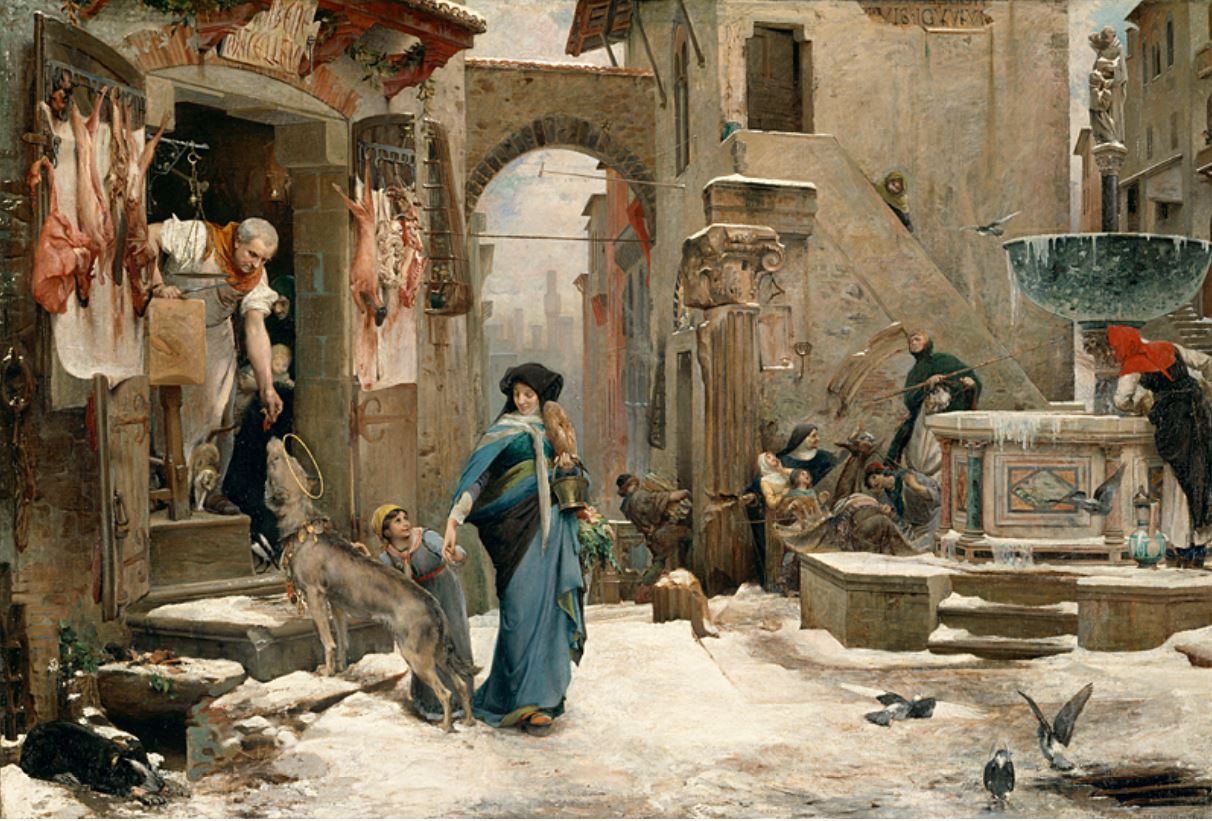
The Wolf of Gubbio by Luc Olivier Merson (1877) Musée des Beaux-Arts, Lille © RMN-Grand Palais (PBA, Lille) / René-Gabriel Ojeda

Early 20th century

Bonkers but charming, Stanley Spencer is the Milton Jones of English artists. After the Great War (in which he served in the ambulance service) Spencer withdrew to the small village of Cookham on the River Thames, where he painted scenes of everyday life, striking nudes of himself and his wife and lovers, and numerous works showing scenes from Christian narratives, but taking place in the homely, domestic settings of his little hometown. And so here he is, reimagining Saint Francis, looking like the artist’s grandad and wearing his dressing gown and slippers, walking down Cookham High Street accompanied by a very English gaggle of chickens and songbirds.

St Francis and the Birds by Stanley Spencer (1935) Tate, London © Estate of Stanley Spencer. All rights reserved 2023 / Bridgeman Images (photo: Tate)

I’ve walked several times from Maidenhead to Cookham just to visit the Stanley Spencer Gallery there, and gone on pilgrimage to his headstone in Cookham graveyard. I know it’s nowhere near as much of an awesome work of art as the Zurbarán, but I find more of the Franciscan spirit of modesty and love in one work by Spencer than in the entire Counter-Reformation.

Contemporary art

Arguably, the modern works are the most successful, certainly the most striking and take us to a completely different place from the medieval altarpieces. For example, landscape artist Richard Long is represented by three works, A Walk for Saint Francis (2022), River Avon Mud Crescent (2023) and Desert Flowers (1987). In May 2022 Long spent a week in solitude walking and camping on Mount Subasio, the mountain rising above Assisi that provided Francis with an early refuge. ‘A Walk for Saint Francis’ derived from this experience. It is not a painting at all but a circle of words, of phrases, which capture the experience, such as ‘Watching night turn to day’ and ‘Watching the Earth turn’. Whereas ‘River Avon Mud Crescent’ is what it says in the title, a big circle on the wall, suggesting the crescent moon, and made from daubs of mud from the River Avon.

Installation view of Saint Francis of Assisi with ‘River Avon Mud Crescent’ on the left and ‘A Walk for Saint Francis’ on the right (photo by the author)

Oddly, there hadn’t been any sculptures of Francis through the classic eras of Western art. Only in the modern era do we come across not one but two. One is by Antony Gormley and is, typically, a cast of his own body. According to the wall label, it’s based on Giovanni Bellini’s painting ‘Saint Francis in the Desert’, complete with holes in his hands, feet and chest, referencing the tradition of Francis’s stigmata –but, like all Gormley’s sculptures, it is really a kind of everyman figure, this time everyman as devout believer.

Installation view of ‘Untitled (for Francis)’ by Antony Gormley (1985) Tate © Antony Gormley (photo by the author)

Vying with the Gormley for most striking sculpture, is this work, ‘Albero Porta – Cedro’ (‘Door Tree – Cedar’) by Italian artist Giuseppe Penone. Within the old tree, battered by generations of sun and rain and snow, lies concealed the secret inner soul of the tree, its youthful spirit, just as inside each of us cynical old adults still lies the fresh hopeful child of nature. I warmed to this even before the wall caption told me that Penone is a member of the Italian Arte Povera movement who sought to make art out of everyday material (and whose name, of course, echoes the nickname and concerns of il poverello).

Installation view of ‘Door Tree-Cedar ‘by Giuseppe Penone (2012) Gagosian and Marian Goodman Gallery © Giuseppe Penone (photo by the author)

There’s another Arte Povera work, ‘Sacco‘ (Sack) by Alberto Burri (1953), consisting of fragments of coarse hessian sack overlaid on each other and bound in a simple wooden frame. The single red wound gaping through a circle torn in the sacking presumably symbolises Francis’s stigmata but I found it all too realistic and stomach-churning.

There are two striking series of black and white prints. One is a series of lithographs by Arthur Boyd (1965). The Australian Arthur Boyd was living in London when he made 16 lithographs illustrating the life of Francis for an edition of T.S.R. Boase’s biography of the saint.

In a space to itself is an impressive set of black and white woodcuts on paper, made in 2016 by Andrea Büttner and titled ‘Beggars’. Nine hooded figures, reduced to the simplest possible outline of cloth and hands, are shown sitting with their arms outstretched in supplication. A source for the series was a book from 1510 which was, contrary to the spirit of Francis, a warning against dishonest and abusive mendicants. (The photo below, by the way, is from some other exhibition and is not how they’re displayed here.)

Beggars Suite 1 to 9, by Andrea Büttner (2016) © DACS 2023

Elsewhere, Büttner has an interesting big print showing tiers of birds, ‘Vogelpredigt (Sermon to the Birds)‘ which riffs off an altarpiece from Santa Croce, Florence, which was a very early cycle of images depicting the saint’s life.

Mass media

In the final room are some examples of how Francis has been portrayed in 20th century mass media, namely movies and, believe it or not, comics.

Saint Francis movies

A big monitor plays scenes from some of the post-war movies made about Francis, namely:

  • The Flowers of St. Francis (1950) directed by Roberto Rossellini
  • Brother Sun, Sister Moon (1972) directed by Franco Zeffirelli
  • Francesco (1989) directed by Liliana Cavani

Film, as a medium, is the ultimate instrument of consumer capitalism in reducing all facts, narratives and events to the same palatable product, to the same half dozen formulae, shoehorned into the same three-act structure, all loose ends neatly wrapped up in a nice bow in under two hours.

Comic books

The idea for the 1980 Marvel comic ‘Francis, Brother of the Universe’ came from two Franciscans who approached Marvel’s representative in Tokyo. If you think about it, like so many Marvel superheroes, Francis was a seemingly ordinary man with extraordinary capabilities (albeit given from God). The cover art shows a collage of our man in a series of characteristic scenes: preaching as a youth in the marketplace; leading crusaders; thrown before the initially scornful Sultan of Egypt; greeting the sun and the doves of peace; meeting the Pope or some such eminence. Shame they didn’t go on to do the kind of crossover story which Marvel excels at: Saint Francis calms The Hulk. Saint Francis persuades Thor to hand over his hammer and talk to the trees.

Installation view of ‘Francis, Brother of the Universe’ by Marvel Comics (1980) © Disney. All rights reserved (photo by the author)

Saint Clare

A small section of the exhibition is dedicated to Saint Clare (1194 to 1253), one of the first followers of Francis. Following her death, the order she founded was renamed the Order of Saint Clare, commonly referred to today as the Poor Clares. Her/their story is represented in works like:

  • Giovanni da Milano’s ‘Christ and the Virgin Enthroned with Six Saints’ (1350s)
  • Giovanni di Paolo’s ‘Saint Clare Rescuing a Child Mauled by a Wolf’ (1455 to 1460)
  • Josefa de Óbidos’s ‘Nativity Scene with Saint Francis and Saint Clare’ (1647)

Francis’s nature worship

Much is made of Saint Francis’s nature worship. The curators say he believed that nature itself was the mirror of God. He called all creatures his ‘brothers’ and ‘sisters’, preached to the birds and supposedly persuaded a wolf in the Italian town of Gubbio to stop attacking the locals. He saw God reflected in nature. In the hymn he composed – ‘Canticle of the Sun’ – he gives God thanks for Brother Sun, Sister Moon, Brother Wind, Water, Fire, and Earth and they print a full translation of the Canticle on the gallery wall. Here it is in the translation given on the Catholic Agency for Overseas Development website:

Most High, all-powerful, all-good Lord,
all praise is yours, all glory, honour and blessings.
To you alone, Most High, do they belong;
no mortal lips are worthy to pronounce your name.

We praise you, Lord, for all your creatures,
especially for Brother Sun,
who is the day through whom you give us light.
And he is beautiful and radiant with great splendour,
of you Most High, he bears your likeness.

We praise you, Lord, for Sister Moon and the stars,
in the heavens you have made them bright, precious and fair.

We praise you, Lord, for Brothers Wind and Air,
fair and stormy, all weather’s moods,
by which you cherish all that you have made.

We praise you, Lord, for Sister Water,
so useful, humble, precious and pure.

We praise you, Lord, for Brother Fire,
through whom you light the night.
He is beautiful, playful, robust, and strong.

We praise you, Lord, for Sister Earth,
who sustains us
with her fruits, coloured flowers, and herbs.

We praise and bless you, Lord, and give you thanks,
and serve you in all humility.

Surely this is a long way short of pantheism and Nature worship. It is, quite explicitly, the Lord God who Francis is praising – just as any priest of his time would – and the sun and moon and wind and fire and so on are emphatically not praised, or addressed, in their own right, but only insofar as they demonstrate the benevolence and all-powerfulness of the Creator. The feeling for nature is there, but only as a sin-off from the deep worship of the Lord God.

Projecting our values

At several places the curators assert that Francis speaks to us, now, in 2023, of very contemporary ‘concerns’, and list some of these, such as ‘interfaith dialogue’, environmental concern and feminism. They claim that ‘Saint Francis of Assisi continues to be an attractive and inspirational figure for’:

  • both Christians and non-Christians
  • for pacifists and environmentalists
  • for those who clamour for social justice
  • for utopians and revolutionaries
  • for animal lovers
  • for those who work for causes of human solidarity

Or:

Francis’s powerful appeals for peace and human solidarity, his encounter with Islam and his embryonic environmentalism continue to hold great interest. He is considered by many to be a patron saint, or an ally, of causes related to social justice, interreligious dialogue, socialism, feminism, the animal-rights movement and ecology, among others.

The exhibition was co-curated by the Director of the National Gallery, Dr Gabriele Finaldi, who joins in with his variation on the list of Francis’s fabulous qualities:

‘Francis’s spiritual radicalism, his commitment to the poor and human solidarity, his love of God, nature and animals, which we might call embryonic environmentalism as well as his striving for peace between enemies and openness to dialogue with other religions, are themes that still resonate with us today and make him a figure of enormous relevance to our times.’

But it’s my view that all this discourse consists of us projecting our own modern concerns back onto this remote medieval figure. Moreover, all this high-minded projection has the unintended consequence of highlighting how irrelevant Francis is to our modern day.

Poverty No modern Christian believes in God with the same wholeheartedness Francis was capable of. No Christian whatsoever is prepared to sell everything they possess, give all the proceedings to the poor, and become a mendicant beggar for God. Do you know anyone who’s done that? No.

Interfaith Although faith leaders in the West like to talk about dialogue between religions, it’s not clear that happens much on the ground here and, globally, dividing lines between the secular West, Muslim Middle East and Africa, and Hindu India have hardened, with astonishing levels of sectarian violence taking place around the world.

Pacifism Pacifists are irrelevant in an era when Russia has invaded Ukraine and threatens the rest of Europe, while analysts worry about China attacking Taiwan.

Environmentalism is sweet and lovely for the middle classes who can afford to fret about such things and shop at farmers’ markets, but irrelevant to most people who, in recent years, have been struggling to keep a roof over their heads and food on the table, who can’t afford electric cars and have no time to lobby for clean energy. When I worked at a distribution centre a couple of years ago, you should have heard the packers and supervisors yelling abuse at Just Stop Oil activists gluing themselves to the road or tube trains. Meanwhile, every single indicator of environmental wellbeing and climate change is deep in the red and getting worse.

Social justice Francis may have clamoured for social justice, just as millions of the kind and well meaning have done for the 800 years since: but the outcome of all this clamour is that today, in 2023, over a billion people worldwide live on less than a dollar a day, while all western societies are more unequal and unfair than at any time in the last 50 years.

In other words, Francis can, with some justice, be taken as the patron saint of lost causes.

I find the high-falutin’ sentimental sentiments of the wall labels so much cant (defined as ‘sanctimonious talk, typically of a moral, religious, or political nature’) where ‘sanctimonious’ is defined as ‘making a show of being morally superior to other people’. It is a discourse of feel-good bromides, where ‘bromide’ is defined as ‘a trite statement that is intended to soothe or placate’.

The National Gallery was, as usual, packed to overflowing with educated, middle-class people, many of whom were obviously tourists i.e. had travelled long distances, probably in environment-destroying airplanes, and spent a lot of money to be here. Outside the National Gallery I walked past a clutch of filthy dirty, wretched-looking vagrants, sleeping rough with their dogs. I gave each of them a pound. “Clamouring for social justice”, my arse.


Related link

A Brief History of Superheroes by Brian J. Robb (2014)

Robb has previously written biographies of Leonardo DiCaprio, Johnny Depp and Brad Pitt. This volume is one of a series titled ‘A brief guide to [or A history of] …’ which includes guides to Stephen King, ghost-hunting, the Roman Empire, Star Wars and any other topics they thought would sell. Written for a popular audience, then.

No illustrations

At 340 pages, including notes and index, it’s quite a long book, but its most obvious feature is that there are no illustrations, none, nada, zip – which is a big drawback seeing as comic books are a largely visual medium. When it gives descriptions of the early artwork for Superman, or how Batman’s look was refined over time, or the visual makeover of many comic book heroes in the 1960s, the reader is crying out for illustrations to show what he’s talking about. But you have to turn to the internet to do your own research…

So the book is solely prose, made up of thumbnail profiles of the writers, artists and publishers who created comic book superheroes, along with a dense account of how they developed and evolved over time.

Superman 1938

Comic Superhero history starts in May 1938 when Superman made his first appearance in Action Comics #1. In other words, Superman is 80 years old this year, in fact this month!

He was the creation of two schoolfriends from Cleveland, Jerry Siegel (writer) and Joe Shuster (artist). Everything before this date is the pre-history of superhero comics; everything afterwards is the complex unfolding of superhero comic history.

Cultural forebears of superheroes

The prehistory is entertaining because Robb (like many others writing on the subject) feels compelled to give a brisk popular history of the wide-ranging role of ‘the hero’ in myth, legend, history and folklore (the word ‘hero’ is itself of Greek derivation).

Thus a man gifted with magic powers to protect his people can be made to include Moses and Aaron and the Biblical hero Samson. It can include the pantheon of Greek gods and mortal heroes like Heracles, Perseus and Theseus. Robb quotes Joseph Campbell on the importance of ‘the Journey’ in numerous ancient stories about heroes, and references the Epic of Gilgamesh, the Odyssey and the Mahabharata as cultural forebears of Batman and Robin. This is both fun and a little pompous.

Folklore forebears of superheroes

More persuasive is the notion of a lineage from more folklore elements of ‘the hero’ through to the popular fictions of the late 19th century. Robin Hood and Dick Turpin are two prime examples. Robin Hood is not only an epitome of schoolboy morality (stealing from the rich to give to the poor) but he wears an early version of the superhero costume: tights and a distinctive cap, all in bright primary colours (Lincoln green with some red thrown in). Dick Turpin concealed his face behind a neckerchief and a pulled-down hat, and wore a cloak or cape.

Pop culture forebears of superheroes

But in fact, historians have no idea what Robin Hood or Dick Turpin wore. The images I’ve described above derive from movies, and it is Hollywood which is probably the prime factor in the origin of the superhero look.

Superheroes didn’t derive from scholarly study of ancient mythology and folklore: they came out of the extraordinary rich, bubbling swamp of popular and pulp culture of the 1920s. If Jerry and Joe knew about Sherlock Holmes or the Scarlet Pimpernel it wasn’t from reading the books about them (Sherlock had debuted in 1887, the Pimpernel in 1905). It was from paying a few cents to sit in the cheap seats of the local movie house, chomping on popcorn and watching the adventure films of a movie star like Douglas Fairbanks, who starred in a movie about Zorro (created 1919, turned into a movie in 1920), Robin Hood (1922) or the Black Pirate (1926).

In a sense superheroes began in the movies before, in our time, returning to the movies.

Like other historians of the subject, Robb pays special attention to characters with dual identities, a standard feature of most comic book superheroes – the classic example being Dr Jekyll and Mr Hyde.

(Although if you stop and think about it for a moment, a dual identity is a basic element of almost all detective, spy and crime fiction of the kind that was growing more and more popular at the end of the 19th century and start of the 20th. Many thousands of detective stories take their time working up to the grand ‘reveal’ of the ‘true identity’ of the criminal, of the dope dealer or jewel thief or murderer etc caught by Sherlock Holmes or any one of the hundreds of copycat detectives invented in the 1890s and 1900s. (See my review of The Shadows of Sherlock Holmes a collection of stories about fictional detectives inspired by Holmes.) Spy stories, are by their very nature, about people concealing their true task and intentions.

Anyway, Robb’s book becomes really interesting when it gets to the extraordinarily dense jungle of popular culture which flowered in the 1890s and then just got denser and denser in the decades that followed, proliferating in penny dreadfuls, shilling shockers, pulp magazines, newspaper supplements and then in the new format of moving pictures and related magazines and merchandising.

Robb dwells on two Edwardian doers of good deeds who hid their true identity:

  • the Scarlet Pimpernel (real name Sir Percy Blakeney) who rescues aristocrats from the guillotine, leaving a calling card with a picture of the pimpernel flower
  • Zorro, who wears a black face mask and cape, protects the poor of California, and leaves a distinctive ‘Z’ carved into various objects with his stylish swordplay

Just as important for a superhero is the fiendish villain, and these were prefigured by – among many – Holmes’s opponent, the ‘Napoleon of crime’, Professor Moriarty, or the diabolical criminal mastermind Fu Manchu (1913).

British hero fiction included John Buchan’s hero Richard Hannay who debuted in 1915, followed by the more thuggish Bulldog Drummond, who appeared in 1920. Lesley Charteris’s crime-fighting hero, the Saint, first appeared in 1928. Biggles the heroic fighter pilot first appeared in 1932. All these heroes were morally unambiguous fighters against Crime and Fiendish Plots.

In America the spread of radio gave rise to a florid variety of heroic fighters against crime: the Shadow, a masked crime-fighting vigilante (1930), the Spider (1933) and Doc Savage (1933), a kind of ‘peak human’, reared to have perfect abilities, who had a base in mid-town Manhattan and a rich armoury of state-of-the-art gadgets, funded by money from a secret Mayan goldmine, to help him fight crime.

In 1936 the Green Hornet, another crime-fighting, masked vigilante was created specially for radio. Also in 1936 appeared The Phantom, who wore a skin-tight bodysuit and a ‘domino’ eye-mask to fight crime.

Off in another part of the rich jungle of popular and pulp culture which exploded around the time of the Great War, was the more unrestrained world of science fiction and fantasy. Important forebears were John Carter of Mars (1912) and Tarzan (1912), both created by Edgar Rice Burroughs, Philip Francis Nowlan’s hero Buck Rogers (1928) and Robert E. Howard’s Conan the Barbarian (1932), soon joined by Alex Raymond’s newspaper strip hero Flash Gordon (1934).

What these numerous figures have in common is that they are modern, pulp versions of ‘the hero’, who always outwit their fiendish opponents after a string of exciting adventures, and that they appear in series or serials: once invented they can appear in almost limitless numbers of adventures (as Conan Doyle, who came to hate his invention, Sherlock Holmes, knew all too well).

By now you might share the feeling I had that the first appearance of Superman in 1938 was maybe not quite the dazzling innovation I thought it was; in fact reading about this proliferation of heroes might make you wonder why it took quite so long to come up with what seems to be the logical conclusion of all these trends.

Robb tells the story of how two teenagers from Cleveland conceived the idea, developed it over many years, were repeatedly rejected by newspapers and comic publishers, and were forced to work on other characters and projects, until finally given their big break in 1938.

I found the two most interesting things about Superman were:

1. His descent not so much from all these detectives and crime fighters, but from the Victorian circus strongman. These popular performers generally wore tights and pants, a figure-hugging suit to highlight their musculature which was strapped in with an impressive belt, and often stylised boots.

Victorian circus strongman, whose shiny boots, tight pants, utility belt and stylised vest all anticipate the 'superhero look'

A Victorian circus strongman, whose shiny boots, tight pants, utility belt and stylised vest all anticipate the ‘superhero look’

2. Jerry Siegel and Joe Shuster sold the exclusive rights to their then-new character, Superman to DC (short for Detective Comics) Publishing for just $130 (split between the two of them). Superman was an instant hit and not only went on to generate hundreds of millions of dollars for the publisher and the film company that eventually bought it, but to inspire an entire genre of superhero fiction across all media.

As they watched this happen Siegel and Shuster continued to work as a comic book writer and illustrator, respectively, but made repeated attempts to sue for a share of the vast revenue generated by their invention. In fact their heirs are still locked in litigation with DC’s parent company, Time Warner, to this day.

The development of the comic strip

Robb gives a brief and fascinating recap of how the comic strip itself evolved. As far back as the record stretches, human beings have always told stories. Bas-relief carvings on Greek and Indian temples capture moments from religious or legendary narratives. (Robb doesn’t mention it but I’d have thought the 12 Stations of the Cross which appear in tens of thousands of Catholic churches are an early example of a story told through snapshots of key moments.) He does mention the use of ‘scroll speech’ in medieval and Renaissance art work, where a scroll unfolds from a figure’s mouth, containing their speech (something I’m familiar with from my readings of the British Civil Wars).

17th century cartoon with speech scroll

17th century Civil War cartoon with speech scroll

Robb says the next step forward was marked by the popular engravings of the 18th century artist William Hogarth, famous for the series of pictures which depict The Rake’s Progress and A Harlot’s Progress. These popular engravings showed the decline of the eponymous rake and harlot with plenty of humorous detail. They gave rise to similar pictorial sequences by Rodolphe Töpfler later in the century, and by the Victorian artist Gustave Doré, among others. Throughout the 19th century Punch in Britain and similar magazines across the Continent used cartoons, often with speech captions, to convey narratives with punch lines.

Capitalist competition creates comics

But all these sometimes dubious historical antecedents are there simply to pave the way for the real start of popular comic books which, as with most things American, came out of ferocious competition to make money.

Starting in 1887 a newspaper war was waged between Joseph Pulitzer and William Randolph Hearst’s newspaper empires. One among many fronts in this war was the innovation of cartoon strips with catchy titles and populist characters. In 1892 The Little Bears was created by Jimmy Swinnerton for Hearst’s San Francisco Examiner, probably the first cartoon strip anywhere which featured regularly recurring characters.

In 1895 Pulitzer debuted a strip titled The Yellow Kid for his paper The New York World, drawn by Richard Felton Outcault, which pioneered the use of speech text to indicate dialogue. In 1897 the paper added a supplement featuring just Outcault’s strips and expanding it to describe an array of characters from the yellow kid’s neighbourhood – titled McFadden’s Row of Flats – and a new term, ‘comic book’, was invented to describe it.

As a direct response to all this, Hearst’s New York Journal commissioned their own strip, The Katzenjammer Kids, created by Rudolph Dirks. Dirks developed Outcault’s device of speech balloons and invented the ‘thought balloon’, indicated by a series of bubbles leading up to the text balloon itself. The same year saw the first use of colour printing (as the name, The Yellow Kid, indicates).

These kind of narrative cartoons featuring recurring characters proved tremendously popular (nicer, after all, than reading the depressing news) and spread like wildfire to every other newspaper which could find a decent illustrator. By 1912 Hearst was devoting an entire page of the New York Daily Journal to comic strips, a feature which became known as the ‘funny pages’, the ‘funny papers’, or simply ‘the funnies’.

It was quickly realised that the strips which appeared during the week could be repackaged into a bumper weekend supplement. Rather than broadsheet size, it made financial and practical sense to publish them in magazine format, which was easier for readers to handle and read. The comic book was born.

Superhero history

So much for the multi-stranded prehistory of the comic superhero.

The publication of Superman in 1938 transformed the landscape, inventing a whole new genre of superhero. From this point onwards Robb’s book becomes a dense and fascinating account of how numerous newspapers and publishers sought to cash in on the fad by creating their own superheroes. He describes the complicated evolution of the two publishing houses which would eventually become known as Marvel and DC, and reading his book gives you a good sense of the difference between them.

Basically, DC owned Superman (1938) and Batman (1939) who spawned hundreds of imitators but managed to remain ahead of the pack. Through the war years the superheroes performed their patriotic duty with a strong sideline in film noir-style violence against all manner of crime or fantasy baddies.

In the 1950s there was a moral backlash against comics, with a nationwide panic in America that they were one of many influences turning teenagers into ‘juvenile delinquents’. This resulted in 1954 in the establishment of The Comics Code Authority (CCA) which forced comic books to abandon much violence and all references to drugs and sex, tending to replace hard 1940s stories with softer, romance elements.

Marvel began existence in 1939 as ‘Timely Publications’, and by the early 1950s was generally known as Atlas Comics. The Marvel branding began 1961 with a rack of superhero titles created by Stan Lee, Jack Kirby, Steve Ditko and others. Robb describes the period 1961-62 as a kind of annus mirabilis, during which Lee oversaw the creation of The Fantastic Four and their nemesis Dr Doom (November 1961), Ant-Man (January 1962), the Incredible Hulk (May 1962), Spider-Man (August 1962), the Mighty Thor (August 1962), Iron Man (March 1963), the Avengers (September 1963) and the X-men (1963).

Even if you think comic books are rubbish, this is by any measure still an incredible outpouring of creativity, the creation of characters which would go on to have multi-billion dollar futures in popular culture.

Although other artists and writers were involved, Stan Lee is commonly associated with this outburst of imagination and the key element of it seems to have been his conviction that superheroes must be flawed – realistic characters who often struggle with their own superpowers. Thus Spider-Man is deeply confused about how to use his skills, the X-Men bicker amongst themselves, the Fantastic Four are riven by rivalries, and the Hulk considers committing suicide he is so upset by the scientific accident which has turned him into a monster.

It was this troubled psychology which set them completely apart from DC’s untroubled hero Superman and made them feel more contemporary than their older cousins (although, admittedly, DC’s Batman is a much darker creation).

In a second nod to contemporary concerns, Lee’s Marvel creations were nearly all connected to contemporary paranoia about the atom bomb and atomic energy. It is radioactivity which messes up the DNA of almost all these superheroes, a paranoia about the potentially damaging impact of modern science which remains relevant right down to the present day.

It is this more ‘modern’ way of conceiving superhero psychology, as well as the more modern concerns about science, which possibly account for the relative success of the Marvel characters in the movies, and the rather staid, static quality of the DC movies.

The difference between the Superman era and the Fantastic Four era is recognised by comic book historians who have divided the past eighty years into a series of ‘ages’.

The golden age of comic books was from 1938 to about 1950, when waning interest in superheroes was capped by the baleful influence of the Comics Code Authority.

The silver age of comic books is dated from DC Comics’ new character Flash, introduced in Showcase #4 in October 1956. This led up to the Marvel outburst in the early 1960s which spawned a great sprawling cast not only of heroes but of baddies and enemies. This era also another important Marvel innovation, which was introducing one set of heroes into the adventures or ‘universe’ of another set. As the 1960s progressed, the interactions of heroes from different narratives became not only more complex in itself, but led to the notion of parallel worlds in which the various characters might have different superpowers, fight each other and even die.

The bronze age of comic books runs from about 1970 to 1985. The bright, Pop optimism of the 1960s turned into a nitty-gritty concern with social ‘issues’, such as the environment, feminism, racism and drugs, along with more realistic depictions of alcoholism, addiction, urban decay and so on.

Alongside the two giants of Marvel and DC there arose a new wave of independent comic book publishers who took a whole new approach to the superhero genre. This was crystallised in the epoch-making Watchmen, written by Alan Moore and illustrated by Dave Gibbons, which set out to deconstruct the entire mythos of superheroes.

Superheroes in movies

Although Robb doesn’t quite make this point, his book ends where it began, with the movies. Not with the distant antecedents of Gilgamesh or Robin Hood, but with the fact that Jerry Siegel and Joe Shuster loved the movies and were influenced by what they saw, by the sight of Douglas Fairbanks swashbuckling his way across the screen and that now, we in our time, queue up to watch the Amazing Spiderman, Thor and Iron Man swing across our multiplex 3D screens.

Poster for Douglas Fairbanks in The Mask of Zorro (1920)

Poster for Douglas Fairbanks in The Mask of Zorro (1920)

Radio Robb’s last few chapters give a bewilderingly dense account of the way superheroes were adapted to other media beyond comic books. Radio was the first, and it’s interesting to learn that radio developed catchphrases, plot lines and even new characters, which hadn’t existed in the original comics but which the comics then co-opted.

Television From the 1950s various television series portrayed superheroes, probably the most memorable being the camp classic Batman of the 1960s.

Animations Movies were slower to adapt superheroes because of the technical challenges of portraying superhero action. It was easier to do this in animations, so there have been scores of animated TV shows and movies about superheroes.

The Modern Age of Superhero Movies starts with Christopher Reeve’s portrayal of Superman in the film of the same name, directed by Richard Donner in 1978. Although the special effects look creaky to the modern eye, they were a quantum step up from all previous attempts and made superhero film-making a real possibility. Three sequels were released, in 1980, 1983 and 1987.

The next benchmark was the pair of Batman movies directed by Tim Burton and starring Michael Keaton. Robb is great on the showbusiness gossip and behind-the-scenes manoeuvring which accompanied these films, for example the way that Keaton, previously known mainly for light comic roles, was widely opposed by comicbook fans, who mounted a campaign to prevent him taking the role. In the event, Burton’s two Batman movies (Batman, 1989 and Batman Returns 1992) were widely seen as a triumph, and made stacks of money ($411 million and $266 million, respectively).

Robb details the ongoing attempts to stage other superhero movies during the 1980s and 90s, which met with mixed success, and a fair share of dazzling flops. Along with most fans he considers the last two Reeve Superman movies (Superman III, 1983 and Superman IV, 1987) and the Val Kilmer and George Clooney Batmen (Batman Forever, 1995, and Batman and Robin, 1997) to be disasters.

The modern age of superhero movies

The Current Age of Superhero Movies was launched with the X-Men directed by Bryan Singer and released in 2000. With an intelligent script, the steadying presence of two top-class British actors (Patrick Stewart and Ian McKellen) and state-of-the-art, computer-generated graphics, X-Men inaugurated the modern age.

It cost a lot to make, but it:

a) made a fortune ($296 million)
b) spawned a host of sequels (there are now no fewer than 10 films in the X-Men series)
c) and led to a number of successful television spin-off series

The X-Men movies played an important role in creating the superhero cultural, film and TV universe that we now inhabit.

This is a list of the main superhero movies of the last 18 years, excluding various flops and failures, with an indication of their costs and revenues.

2000 X-Men ($296 million gross on $75 million budget)
2002 Spider-Man ($821 million on $139 million)
2003 Daredevil ($179 million on $78 million)
2003 X-Men 2 ($407 million on $125 million)
2004 Fantastic Four ($330 million on $100 million)
2004 Spider-Man 2 ($783 million on $200 million)
2005 Batman Begins ($374 million / $150 million)
2006 Superman Returns ($223 million / $223 million)
2006 X-Men: The Last Stand ($459 million / $210 million)
2007 Fantastic Four: Rise of the Silver Surfer ($290 million / $130 million)
2007 Spider-Man 3 ($890 million / $258 million)
2008 Batman: The Dark Knight ($1 BILLION / $185 million)
2008 Iron Man 1 ($585 million / $140 million)
2008 The Incredible Hulk ($263 million / $150 million)
2009 Watchmen ($185 million / $138 million)
2009 X-Men Origins: Wolverine ($373 million / $150 million)
2010 Iron Man 2 ($624 million / $200 million)

2011 Thor ($449 million / $150 million)
2011 X-Men: First Class ($353 million / $160 million)
2011 Captain America: The First Avenger ($370 million / $140 million)
2012 The Amazing Spider-Man ($757 million / $230 million)
2012 Batman: The Dark Knight Rises ($1.08 BILLION / $300 million)
2012 Marvel’s The Avengers ($1.5 BILLION / $220 million)
2013 Iron Man 3 ($1.2 BILLION / $200 million)
2013 Man of Steel ($668 million / $225 million)
2013 Thor: The Dark World ($645 million / $170 million)
2013 The Wolverine ($414 million / $120 million)
2014 The Amazing Spider-Man 2 ($709 million / $293 million)
2014 Captain America: The Winter Soldier ($714 million / $177 million)
2014 Guardians of the Galaxy ($773 million / $232 million)
2014 X-Men: Days of Future Past ($747 million / £205 million)
2015 Ant-Man ($519 million / $142 million)
2015 Avengers: Age of Ultron ($1.4 BILLION / $444 million)
2015 Fantastic Four ($168 million / $155 million)
2016 Captain America: Civil War ($1.15 BILLION / $250 million)
2016 Batman v Superman: Dawn of Justice ($874 million / $300 million)
2016 Deadpool ($783 million / $58 million)
2016 Doctor Strange ($678 milllion / $165 million)
2016 X-Men: Apocalypse ($544 million / $178 million)
2017 Guardians of the Galaxy Vol. 2 ($864 million / $200 million)
2017 Superman: Justice League ($658 million / $300 million)
2017 Spider-Man: Homecoming ($880 million / $175 million)
2017 Thor: Ragnarok ($854 million / $180 million)
2017 Logan ($619 million / $127 million)
2018 Ant-Man and the Wasp
2018 Avengers: Infinity War
2018 Black Panther ($1.334 BILLION / $210 million)
2018 Deadpool 2

Quite a few, aren’t there?

The first superhero movie to gross over a billion dollars was Christopher Nolan’s Batman: The Dark Knight, and six other superhero movies have grossed over a billion since then.

The X-Men movies between them have generated $5 billion.

In 2010 Marvel produced the first in a carefully planned sequence of movies designed to maximise revenue from their stable of characters, and which has become known as the Marvel Cinematic Universe or MCU. This is divided into ‘phases’ of six movies each, the first five of each phase devoted to individual Marvel heroes, the sixth bringing the previous five altogether into a grand finale which ties together plotlines from the previous movies.

As I write we are approaching the end of Phase Three, which has just seen the phenomenal success of Black Panther (phase 3, movie 5) which grossed over $1.3 billion, and paved the way for the sixth in this phase, Avengers: Infinity War which has just opened in the States to the usual mass marketing and hype.

Summary

Despite having no illustrations at all, Robb’s book is an eminently readable and very enjoyable overview of the entire history of the superhero comic book phenomenon, which puts it in the context of expanding popular culture, twentieth century history, and the evolving media of radio, TV and film – all told in a light, accessible prose style with a sure sense of the interesting anecdote and fascinating fact.

Great fun, and a very useful introduction to a cultural phenomenon which is bigger than ever, and set to dominate our movie and TV screens for the foreseeable future.


Related links

Related reviews