Radical Harmony Helene Kröller-Müller’s Neo-Impressionists @ the National Gallery

This is a marvellous, informative, inspiring and illuminating exhibition. There are two interweaving aspects, threads or storylines which can be summed up by the questions:

  1. Who was Helene Kröller-Müller?
  2. What was Neo-Impressionism?

Who was Helene Kröller-Müller?

Helene Kröller-Müller (1869–1939) was one of the early 20th-century’s greatest art collectors. Born in Germany, she was the third child of Emilie Neese and the wealthy industrialist Wilhelm Müller, the founder of Wm H. Müller & Co, a trading company in iron and steel. As a child she was precociously intelligent and was given the best education money could buy.

In 1888 i.e. aged 19, she married the husband chosen for her by her father, one of his managers Anton Kröller, a Dutchman (and as you can see, she chose to amalgamate her maiden name with his), and the couple moved to Rotterdam where he was the Müller & Co branch manager. Just one year later, in 1889, Helene’s father died suddenly and Anton became director of the entire company at the tender age of 27. As his wife, Helene overnight became one of the richest women in the Netherlands.

Helene Kröller-Müller © Kröller-Müller Museum

To begin with Helene concentrated on bearing and raising the couple’s four children. But in 1906 she began (along with her eldest child) to study art under painter Henk Bremmer. Given her fortune, he suggested she not only study but begin collecting artworks. Thus began the process which was to lead to her amassing one of the greatest collections of modern art ever created.

Far ahead of her time, she was one of the first to recognise the genius of van Gogh and eventually owning 90 of his paintings.

But from 1912 she began accumulating what would grow into the greatest single collection of Neo-Impressionist art anywhere, often purchasing directly from the artists.

In 1913, in the tradition of philanthropic multimillionaires, she decided to make her collection available to the public and commissioned the building of a modern art gallery by Belgian Neo-Impressionist turned architect Henry van de Velde (1863 to 1957). With its top-lit, white-walled galleries and later, its white picture frames, the gallery set a new tone and became influential in its own right.

The Kröller-Müller Museum opened in parkland near Otterlo in 1938, a year before Helene’s death. By then, her collection numbered around 11,500 works. And you can still visit it today.

This lovely exhibition features 50 or so Neo-Impressionist paintings from the Kröller-Müller Museum along with some from the National gallery and other UK collections and some from private collections to make up one of the largest exhibitions of Neo-Impressionist painting ever seen in the UK.

What is Neo-Impressionism?

The internet tells us that:

Neo-Impressionism is a style of painting, pioneered by Georges Seurat, that uses a scientific approach to colour by applying small, distinct dots of pure colour to the canvas. These dots are intended to blend in the viewer’s eye when seen from a distance, creating more vibrant and luminous effects than traditional mixing methods. The technique was quickly adopted by a surprising number of other artists, notably a member of the previous generation, the impressionist Camille Pissarro. The technique is often referred to as pointillism.

1. Colour

Seurat’s innovative painting technique had its roots in the well- established theory that opposing colours on the colour wheel – yellow and violet, orange and blue, red and green – make each other appear more vivid when juxtaposed. And at the start the exhibition features a classic colour wheel of the kind Seurat would have been familiar with to demonstrate the theory.

Through experiment and research into scientific and optical theory, Seurat determined that even greater luminosity could be achieved if pure colours remained unmixed and were applied in small touches placed side by side – the dots or points in French that led Neo-Impressionism to be popularly known as Pointillism.

Collioure, the Belltower, Opus 164 by Paul Signac (1887) © Collection Kröller-Müller Museum, Otterlo, the Netherlands. Photographer: Rik Klein Gotink

2. Structure

But this exhibition emphasises that, just as important as colour and dots, was its insistence on form and structure and line.

Neo-Impressionism rejected the spontaneity of Impressionism in favour of a more methodical and formal structure.

The Neo-Impressionists aimed to produce pictures that transcended reality, creating radically simplified compositions that captured the essence of what they aimed to depict, attaining harmony through colour and geometry.

Adopters of neo-impressionism

The movement was introduced to the public in 1886 when Georges Seurat exhibited his work ‘A Sunday on La Grande Jatte‘ at what was to prove the final Impressionist exhibition. If the exhibition heralded the end of Impressionism it heralded the genesis of Neo-Impressionism which was to become one of the first modern pan-European art movements

I knew that a very early adopter of Seurat’s method, who went on to popularise and create masterpieces using it, was Paul Signac (1863 to 1935). Signac worked out that the careful juxtaposition of separate dots of pure colour would fuse in the eye, making the surface of the canvas appear to shimmer and realising how the effect was ideally suited to capturing glowing light in landscape.

But the exhibition also includes works by many others who quickly adopted Seurat’s invention. The artists included in the exhibition are:

  • Georges Seurat
  • Paul Signac
  • Henri-Edmond Cross
  • Anna Boch
  • Maximilien Luce
  • Théo van Rysselberghe
  • Camille Pissarro
  • Jan Toorop
  • Lucien Pissarro
  • Henry van de Velde
  • Georges Lemmen
  • Johan Thorn Prikker

There is also one stunning work by Vincent van Gogh (see below), who was interested in the movement and made his own experiments in juxtaposing dashes of pure colour, but was completely different in his approach – as far from the scientific precision of Seurat and Signac as imaginable.

International spread

One of the early converts, Théo van Rysselberghe (1862 to 1926), invited members of the group to exhibit at the avant-garde artistic society Les XX (The Twenty) in Brussels, prompting the international dissemination of neo-impressionism. Hence the exhibition includes works by French, Belgian and Dutch artists.

Negative criticism

As usual, the critics hated it. One critic declared it was the end of painting as we know it in the sense of finished images with invisible brushstrokes (there’s always one).

Another, subtler, criticism, was that the technique lent itself very well to open air landscapes, especially good at capturing the sense of spacious light you experience by the sea, but was unable to depict the human figure as acutely as traditional painting.

Luminous

The many examples here show that the technique does indeed lend itself to landscapes and especially seascapes. The first and last (seventh) room, each contain half a dozen or more luminous landscapes, which definitely demonstrate the Signac ‘shimmer’, conveying a wonderful sense of light and air, with a popular subject being the Brittany coast.

The Channel of Gravelines, Grand Fort-Philippe by Georges Seurat (1890) © The National Gallery, London

You can see in this painting that the Neo-Impressionists often extended the use of the dot technique beyond the subject itself to decorate the edges of their paintings and even the frames.

Political ideals and ironies

Many of these artists held radical political views. They were anarchists or utopian communists (something which attracted the much older impressionist, Camille Pissarro, who was also an anarchist sympathiser, to support and champion them). Thus the exhibition devotes a room to their supposedly political works.

These are depictions of the lives and landscapes of people perceived to be of the exploited classes, be they rural labourers or urban workers. Most of these are in a pleasingly bucolic setting so have a Thomas Hardy feel. Some are more realistic and evoke Emile Zola’s more gritty Naturalism, like the pair of paintings by Jan Toorop which depict a peasant family preparing for a strike and then (in painting 2) carrying the body of the husband who looks like he’d been killed in the police violence which accompanied the strike.

Morning (after the Strike) by Jan Toorop (1888-90) © Collection Kröller-Müller Museum, Otterlo, the Netherlands. Photographer: Rik Klein Gotink

Anarchists championed the ideal of ‘harmony in autonomy’ in which non-exploitative self-government and harmony with nature were fundamental principles. The artists directly associated political harmony with the harmony they were seeking through their sophisticated colour experiments. Harmony in art was the direct corollary of the harmony in politics which they sought.

The most striking work in this room is also the most ironic. This is The Iron Foundry painted by Maximilien Luce quite late in the movement’s history, in 1899. If you go up close you can see the careful, scientific application of the famous dots. But if you step back, obviously what you see are two things: 1) the dynamic composition, with striking contrast between the areas of darkness and the bright red-white coming off the furnace; and, equally important for the Neo-Impressionists, 2) the lines or patterns created by the men’s leaning or bending figures. Line, outline, angles and composition are as important an element of Neo-Impressionism as the dots.

The Iron Foundry by Maximilien Luce (1899) © Collection Kröller-Müller Museum, Otterlo, the Netherlands. Photographer: Rik Klein Gotink

What’s ironic is the way all these artists railed against big business’s capitalist exploitation of the workers and yet these works were eagerly snapped up by the fabulously wealthy wife of… just such a rich capitalist 🙂 To quote the curators:

Kröller-Müller bought this picture directly from Luce in 1922 and it was without any apparent sense of irony that for many years it hung in the office of her husband, Anton Kröller, who ran the family’s iron ore and shipping business.

Portraits

On the face of it Neo-Impressionist theory militated against the whole concept of individual portraits. The traditional expectation that a portrait should capture a specific likeness lay at odds with the Neo-Impressionist principle that harmony in art should be achieved through a generalised distillation of form.

But it didn’t stop them trying and producing numerous very striking portraits. Théo van Rysselberghe, in particular, made a living from commissions to paint the wealthy, progressively-minded supporters of the new art, and the group’s portraits document the group’s highly cultured and politically engaged patrons, families and friends.

By far the most striking is Théo van Rysselberghe’s full-length portrait of his wife, the writer Maria Monnom standing in their fashionable home.

Portrait de Maria Van Rysselberghe-Monnom by Théo Van Rysselberghe (1892) © Collection Kröller-Müller Museum, Otterlo, the Netherlands

Interestingly, the work drew criticism from fellow members. Despite the picture’s shimmering surface of dots, Van Rysselberghe’s reliance on local (natural) colours, such as the orange of Maria’s dress, led Signac to later criticise his friend’s lack of adherence to the rigours of Neo-Impressionist theory.

Drawings

The portraits room includes striking paintings like the woman in orange and a woman seated at a piano but it also contains a couple of marvellous drawings. These are interesting for showing that the technique worked perfectly well without any colour at all. Here’s a quite dazzling portrait of Jan Toorop by Georges Lemmen done using conté crayons.

Jan Toorop by Georges Lemmen (1886) © Museum de Fundatie, Zwolle en Heino/ Wijhe the Netherlands

Caricature

But the portrait room also crystallised a feeling I had, that all this focus on lines and digging below the visible reality to find the ideal forms, created what I began to think of as simplified, almost cartoonish outlines of people, a noticeable tendency towards caricature in which settings, people and faces are simplified and exaggerated.

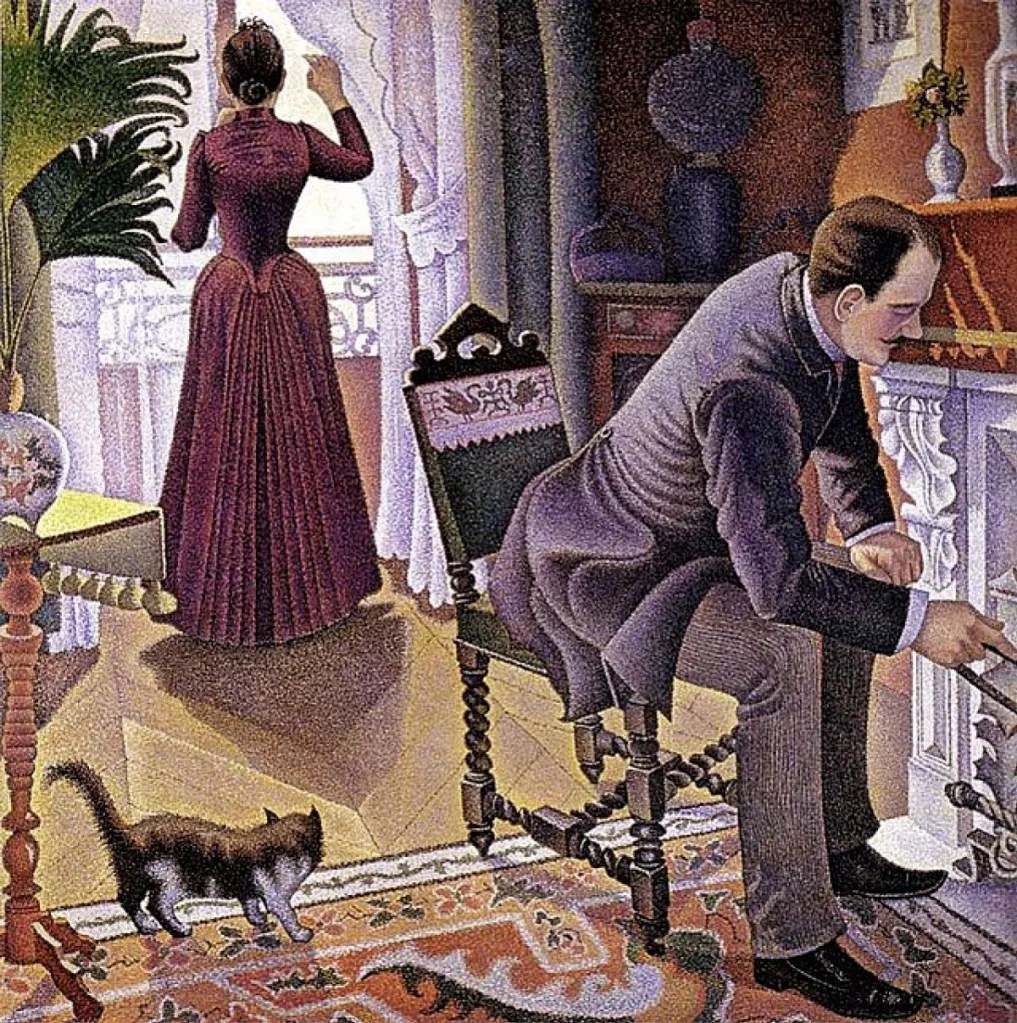
You can maybe see this tendency in the progression of two paintings by Signac in the room which is ostensibly about the painters’ depictions of bourgeois life. Here’s the first one, The Dining Room, completed in 1887.

The dining room, Opus 152 by Paul Signac (1886/1887) © Collection Kröller-Müller Museum, Otterlo, the Netherlands

The curators inform us that Signac used his own grandfather, mother and the family housekeeper as models for this work, and that the piece is a satire on the stifling atmosphere of the typical middle-class suburban household, pointing out how each figure appears entirely self-absorbed, no to say stifled.

This is all true but I’d add that surely the painting also brings out the tendency within the technique of Neo-Impressionism to conceive of humans as forms, as collections of lines and shapes? A tendency which leads them to seem like self-contained, autonomous units which have no interaction – monads, mannequins. And that many of these images have a heavy tendency towards caricature.

All of which is even more true of its sequel, Sunday, completed in 1890. The dot technique is immaculate. And Signac has included in the composition many more firm, defined outlines. But surely this proves my point, that the more defined these lines and form become, the more cartoon-like the overall image.

A Sunday, Opus 201 (1888–90) by Paul Signac. Private collection

Chahut

This tendency comes to a climax in the biggest painting on display here, given more or less its own room and space, the enormous ‘Chahut’ by Seurat from 1890.

Le Chahut by Georges Seurat (1889-90) © Collection Kröller-Müller Museum, Otterlo, the Netherlands

The curators have a lot to say about this, for example that it was one of what he called his toiles de luttes meaning ‘battle canvases’. In other words it was intended to be a provocative rallying cry to his movement, a manifesto pictures. In addition, it is intended to be socially subversive or an attack on late-Victorian sexual morality, in that it depicts the ‘chahut’ or ‘can-can’– then the most risqué dance performed in Parisian café-concerts.

All this is no doubt true but surely the obvious thing about this painting is that it’s a cartoon. It’s left reality far behind in order to become something like an illustration in the funny papers. Surely Seurat’s obsession with form and pattern, instead of taking us towards some deeper spiritual reality, in fact takes us away from reality altogether into a realm of caricature and comic illustrations?

(I’ve just visited the Courtauld Gallery where I saw another egregious example of this tendency, Seurat’s Young Woman Powdering Herself from 1890. This is a comical picture, isn’t it? Surely you can’t possibly take it seriously.)

Ladies on lawns

‘Chahut’ is given centre stage in the exhibition but it is in almost all ways an anomaly, an exception. The next room in the show, the one about depicting the bourgeois world, is far more characteristic. As well as the two Signac interiors I’ve mentioned, there are more classically open-air Neo-Impressionist works. The largest and maybe most representative is ‘In July, Before Noon’ by Théo van Rysselberghe, from the same year as Signac’s cartoon music hall.

In July, before Noon, 1890 by Théo van Rysselberghe © Collection Kröller-Müller Museum, Otterlo, the Netherlands

The strengths and weaknesses of the style are obvious. It is superb at conveying not only the detailed light and shade of a sunny day out of doors in July but there is something about the women’s postures which is oddly formalistic and detached. The woman passing by at the back looks like a robot.

I thought I recognised it and, after some rummaging, confirmed that this image was used for the cover of an Oxford University Press edition of Anton Chekhov’s plays. It perfectly captures the late nineteenth century indolence of middle class ladies, arranged in vast folds of fabric and quietly going about their embroidery or needlework in a sunny French garden. Inside they may be seething with the frustrations of characters from Chekhov or Ibsen, but here, on the surface, all is luminous calm.

Neo-Impressionism and van Gogh

As I mentioned, the show includes one splendid van Gogh painting, ‘The Sower’ from June 1888. We know from his letters than van Gogh was interested by the Neo-Impressionists’ experiments with colour and form but he was never a member of the group, not close. ‘The Sower’ is here partly because, alongside the Neo-Impressionists, Kröller-Müller collected van Goghs. And partly to demonstrate the similarities and differences between them.

The Sower by Vincent van Gogh (June 1888) © Collection Kröller-Müller Museum, Otterlo, the Netherlands. Photographer: Rik Klein Gotink

The similarity lies in the radical simplification of the subject in order to focus on vibrant colour contrasts. Van Gogh juxtaposes all kinds of colours not seen together in nature (for example the insistent blue of the turned soil the sower is scattering his seed onto) in order to create his effects.

The difference is in two aspects of approach. The Neo-Impressionists took a calm, detached, almost scientific approach to their work, whereas all eye-witnesses describe van Gogh attacking his canvases in a fever of inspiration. And whereas the Neo-Impressionists famously used dots or dot-like dashes of pain, van Gogh notoriously squeezed out entire worms of paint onto his brush and applied them with slapdash inspiration. Which explains why the Neo-Impressionists’ canvases are almost flat while van Gogh’s canvases are thickly encrusted with gloops and whorls of paint whipping up from the surface like waves on a stormy sea.

Here’s a close-up of pointillist technique from George Lemmen’s Factories on the Thames from 1892.

Detail from ‘Factories on the Thames’ by George Lemmen (1892) (photo by the author)

And a close-up of van Gogh’s Sower.

Detail from The Sower by Vincent van Gogh (photo by the author)

Spot the difference.

Legacy

Google AI tells me that:

Neo-Impressionism’s legacy lies in its scientific approach to colour and form, which heavily influenced later movements like Fauvism, Cubism, Futurism, and Abstract Expressionism. By using optical science, the movement pioneered a new awareness of colour and laid the groundwork for modernist approaches to the flatness of the canvas and simplified geometric forms. This theoretical language and systematic technique offered a new foundation for artists, bridging the gap between Impressionism and the more radical movements of the 20th century.

Seurat at the Courtauld

If you like Seurat, you might be interested to know that the Courtauld Gallery will be hosting an exhibition about Seurat’s coast painting from February next year.


Related links

Related reviews

Stanisław Wyspiański: Portraits @ the National Portrait Gallery

Drawing to the end of its display is a lovely room at the National Portrait Gallery devoted to the first ever UK exhibition of portraits by the late-Victorian Polish artist Stanisław Wyspiański (1869 to 1907).

Wyspiański was an impressive polymath. He was an interior and furniture designer and conceived monumental schemes for churches and public buildings. He was also a playwright who is often credited with inaugurating modern Polish theatre, during the same period as Ibsen in Norway and Chekhov in Russia.

In his day Poland didn’t actually exist as an independent state and was still partitioned between Prussia, Austria and Russia. The city he grew up in, Krakow, was part of the Austro-Hungarian Empire. So Wyspiański was among the artists and writers seeking to create a new national art based on folk traditions, the Polish language and its distinctive heritage. The Young Poland movement which he belonged to contributed to helping bring about Polish independence in 1918.

Based in Kraków, Wyspiański did much to innovate not only theatre, stage design and architecture, but wrote poems and – the reason we’re here – drew and painted. He worked mainly in pastels, using a characteristically bold black outline to make clear but stylised images which are clearly influenced by a number of late nineteenth century trends, including Art Nouveau, Japanese woodcuts, and the strong stylised moulding of Paul Gauguin.

This stylised and idealised image of his wife, Teodora Pytko, suckling their baby son Staś, watched by his daughters, is one of the most famous portraits in Polish art. In fact the two girls on the left is a doubling of his one daughter, Helenka. The more you look at the face facing us the more she looks like a spooky Symbolist head, hovering amid the stylised foliage.

Maternity by Stanisław Wyspiański (1905) pastel on paper, National Museum in Kraków

The 16 paintings and drawings in this exhibition have been selected to focus on portraits of writers, artists and politicians who Wyspiański knew or worked with. Rather shamefully, they have never been exhibited in the UK before. They all radiate a wonderful charm, sympathetic and intimacy. Here’s a portrait of the actress Władysława Ordon-Sosnowska in theatrical costume.

Portrait of Władysława Ordon-Sosnowska in the role of Krasawica in the drama ‘Bolesław the Bold’ by Stanisław Wyspiański (1093)

There is some overlap with the big exhibition of Edvard Munch portraits recently staged here at the NPG. Munch and Wyspiański were connected through the writer Stanisław Przybyszewski who was a close friend of Munch, a critic of his work, and introduced Wyspiański to Munch’s art in Berlin.

A portrait of Przybyszewski is included in the show, but I’m choosing to share this portrait, of physician, social activist, politician and professor, Julian Nowak, because it highlights Wyspiański’s technique. It’s done with pastel and note the different types of shading he creates. The different hues of the face – the deft combination of brown, orange, red, yellow, grey – are interesting and tangy. But the obviously striking thing is the deliberately rough treatment of Nowak’s black coat which creates a magically vivid and dynamic effect.

Julian Nowak by Stanisław Wyspiański (1904) private collection, on loan to the National Museum in Krakow

Vivid and at the same time precise, isn’t it? In my opinion Wyspiański has a claim to be a more consistently attractive and accurate portrait painter than Munch.

I mentioned his children. Here’s one of the most attractive and charming ones, a portrait of his daughter, Helenka. Note the contrast between the fine detail of the girl’s dress and the rough shading of the background wallpaper. And also the unusual tilted nature of the image, demonstrating the same kind of casual attitude to classical perspective you see in Gauguin or Van Gogh. There’s more table surface in the image than child, and yet this somehow brings out her delicacy and detail all the more.

Little Helen with a Vase by Stanisław Wyspiański (1902)

Summary

I’m afraid I’ve come to reviewing this lovely little exhibition very late and it closes this Saturday. It’s completely FREE so if you’re in central London this week and have half an hour to spare, it’s worth dropping in and savouring these lovely, beautifully drawn and often charming images.


Related links

Related reviews

Easy Virtue: A Play in Three Acts by Noel Coward (1924)

Charles: It’s certainly astonishing how quickly one becomes disillusioned over everything.
(Charles Burleigh voicing the disillusion of the post-war generation)

SARAH: Lari dear, what’s happened?
LARITA: Lots and lots and lots of things.

Immediately, this feels like a different read from The Vortex, Fallen Angels or Hay Fever because the play directions are much longer and more descriptive. They are more like the extensive descriptions of Bernard Shaw which not only describe the scene but give psychological portraits of the characters. Nowhere near as bloated as Shaw, but fuller than the short, sweet introductions to the three works I mentioned.

The action of the play takes place in the hall of Colonel Whittaker’s house in the country.

Executive summary

Young John Whittaker marries Larita, a divorcee and brings her home to live, to the horror of his narrow-minded mother. Three months later, Larita is going out of her mind with boredom and is triggered by the family’s dislike of her into a Nora Helmer-level diatribe against their sexually repressed narrow-mindedness. In the third act, Larita appears at Mrs Whittaker’s big society dance in all her finery, squashes her enemies, promises to one day meet again her few allies, then leaves forever (in her own car, with her own maid).

Author’s intention

According to the Wikipedia article, in his autobiography, ‘Present Indicative’, Coward said that his object in writing ‘Easy Virtue’ was to present a comedy in the structure of a tragedy in order ‘to compare the déclassée woman of to-day with the more flamboyant demi-mondaine of the 1890s’. Like a lot of what Coward said about his own plays, this sounds impressive but is, in the end, not particularly useful in helping you read or respond to the play.

Act 1

In the first part of Act 1 the Whittaker family – affable Colonel James ‘Jim’ Whittaker, strict and easily offended Mrs Whittaker, fat plain religious eldest daughter Marion, and excitable brainless Hilda – await the return of the son, John, who has jilted his jolly nice local fiancée, Sarah Hurst, met someone while staying in the South of France, and married her, all without their ever meeting his bride.

John telegrams to say he’ll be arriving this morning i.e. later in this act. Lots of excited speculation among the daughters, with Mrs Whittaker affecting to be offended by her son’s high-handedness. Several times she refers to what seem to be affairs her husband, the Colonel, has had.

COLONEL: Your mother stood by me through my various lapses from grace with splendid fortitude.

Mrs W doesn’t quite say ‘Men! They’re all the same’ but it’s strongly implied. And emphasised by a minor sub-plot in which we learn that plain eldest humourless daughter, Marion, was jilted by her fiancée, Edgar, who appears to have gone abroad for some time to avoid her. It seems that that was the moment when she discovered she had a religious vocation and was ‘above’ things like love and – ugh – sex!

MRS WHITTAKER: All my life I’ve had to battle and struggle against this sort of thing. First your father—and now John—my only son. It’s breaking my heart.
MARION: We must just put our trust in Divine Providence, dear.

Despite or because of this, the Colonel is the most relaxed and tolerant of the family. Coward makes the traditional connection between being sexually uptight and moralistic intolerance in the opening description of the characters before the play proper has even begun.

Mrs Whittaker, attired in a tweed skirt, shirt-blouse, and a purple knitted sports-coat, is seated at her bureau. She is the type of woman who has the reputation of having been ‘quite lovely’ as a girl. The stern repression of any sex emotions all her life has brought her to middle age with a faulty digestion which doesn’t so much sour her temper as spread it. She views the world with the jaundiced eyes of a woman who subconsciously realizes she has missed something, which means in point of fact that she has missed everything.

Uptight sexuality = sour temper = bitter sense of having missed out.

Hilda phones Sarah to say John’s coming home and she (Sarah) says she’ll pop over to see old John again and meet the new bride, and that she’ll bring one of the guests currently staying at the Hurst family home, a Charles Burleigh.

John finally arrives, says hello to his family, then introduces his new wife, Larita.

She is tall, exquisitely made-up and very beautiful—above everything, she is perfectly calm. Her clothes, because of their simplicity, are obviously violently expensive; she wears a perfect rope of pearls and a small close traveling-hat.

It’s only now that he reveals that this is Larita’s second marriage. Mrs Whittaker primly asks when her first husband died, but Larita airily explains that he didn’t, he divorced her. John has married a divorcee! She goes on to explain that he beat her so she ran away, according to John: ‘He was an absolute devil.’

Mrs Whittaker is profoundly shocked. Her daughters try to explain that nowadays manners are more relaxed, that ‘social barriers are not quite so strongly marked now’ and ‘everybody’s accepted so much more—I mean nobody minds so much about people…’ but to no avail. Her upset comes out in acid remarks which, I suppose, can be played for laughs.

COLONEL: Larita’s an extraordinarily pretty name.
MRS WHITTAKER: Excellent for musical comedy.

Now the playwright arranges entrances and exits. Hilda takes Larita upstairs to the room they’ve prepared for her and Mrs W claims to have a headache and is taken to her room by Marion – which leaves John alone with his father to have a chat. This exchange confirms that Larita is notably older than John and therefore it’s doubtful that they’ll have children. His father gently regrets that the family name will as a consequence expire.

At the end of this little chat John runs upstairs to see his love and the Colonel goes into the library, leaving the stage empty. The (female) servant, Furber, now brings in two arrivals, Sarah Hurst and her guest Charles Burleigh.

  • Sarah is boyish and modern and attractive.
  • Charles is a pleasant-looking man somewhere between thirty and forty.

Sarah asks the servant, Furber, where the family is and he explains their various locations. It immediately becomes obvious that Charles has a satirical sense of humour, which Sarah enjoys trying to quell.

CHARLES: I suppose this is a slightly momentous day in the lives of the Whittakers.
SARAH: Very momentous.
CHARLES: Is your heart wrung with emotion?
SARAH: Don’t be a beast, Charles.

Presumably this is all played for laughs. Sarah explains to him that she and John were never officially engaged and she’s had 3 months to get over the news of being dumped. In fact she genuinely finds the whole thing funny and predicts how funny it will be to observe starchy old Mrs Whittaker’s reaction.

Hilda comes pelting downstairs, greets Sarah, says it’s all too howlingly exciting and insists on dragging her out to the garage because a) she’s got to tell the chauffeur something and b) she can fill Sarah in on all the juicy details on the way.

This is all done to leave Charles alone and feeling embarrassed, doubly so when Larita comes down the stairs. The scene is arranged like this because after some embarrassing small talk they discover that they’ve got a mutual friend in Paris, Cecile de Vriaac, and this opens the floodgates. Larita realises Cecile has shown her photographs which included Charles, they have numerous other friends in common, and they open the latest edition of Tatler which is lying about in the hall, and start swapping the gossip about all their posh pals and their relationships.

Returning to the subject of John, she is able to speak freely to someone her own age and tells Charles she was attracted by John’s youth and ingenuousness. Doesn’t sound like a long-lasting basis for a marriage, does it?

At which point Mrs W, Marion and John come downstairs. Mrs W is even more mortified to discover another stranger in the house (Charles) and getting on like a house on fire with the resented daughter-in-law, Larita. Then Hilda and Sara re-enter. Everyone shakes hands and Furber announces that lunch is served.

Act 2

Three months later, summer. Larita is lazing on the sofa smoking and pretending to read. Mrs Whittaker enters and asks her why she isn’t playing tennis with everyone else. It’s clear they have arrived at a frosty detente. Mrs W is fretting about the big dance she’s organising for tonight (I’m guessing this will be the setting for Act 3 and various revelations!).

MRS WHITTAKER: I’m quite used to all responsibilities of this sort falling on to my shoulders. The children are always utterly inconsiderate. Thank Heaven, I have a talent for organization.[She goes out with a martyred expression.]

John rushes in to fetch a sweater for tennis, he’s playing a match with her. Larita asks him to fetch her a fur coast since she’s cold. No wonder, if you lay around all day indoors. When he’s gone we see that Larita is crying. She is very unhappy.

The Colonel comes in, observes this, and tries to cheer her up by playing a game of bézique farcically badly. She admits that she’s excruciatingly bored. He sympathises and says why doesn’t she suggest to John that they move up to London. Suddenly she bursts out that the whole thing has been a complete failure and runs out. The Colonel lights a cigarette.

Marion comes in fussing about the lanterns they’re setting up for the dance. She notices Larita was reading a book by Proust and calls it ‘silly muck’. There’s a little reprise of the sex theme started in Coward’s description of Mrs W as sexually uptight. Marion, remember, is an earnest Christian, I think a Catholic.

MARION: All French writers are the same—sex, sex—sex. People think too much of all that sort of tosh nowadays, anyhow. After all, there are other things in life.
COLONEL: You mean higher things, don’t you, Marion? much higher?
MARION: I certainly do—and I’m not afraid to admit it.

Marion and Mrs Whittaker, the two bigots, agree how awful Larita is and how she won’t join in the games. Then they both criticise the Colonel for pandering to her and entertaining her. Ghastly man.

The others come in from the tennis and Hilda complains that Larita was making eyes at her partner, Philip (a callow, lanky youth’). The others disappear off, to plan the seating plan or whatnot, as a pretext to leave John alone with Sarah. It becomes clear that he’s not exactly still attracted to her but likes her company, asks her to keep dances for him this evening. He’s surprised that Sarah and Lari get on so well but Sarah explains that Lari is intelligent and so is bored. Being dim himself, John doesn’t understand. Sarah makes a joke of it by saying she’s growing up but John isn’t.

All this banter leads up to John revealing that he still lover her. He realises he wanted staid friendship she offers rather than the rush of cosmopolitan excitement he liked in Lari. Sarah is appalled and tells him to shut up.

Lari re-enters and after some polite chat, Hilda, Sarah and Philip exit to play more tennis, leaving Lari and John alone. if you think of it schematically, we’ve had Lari and the Colonel which made it clear how bored and unhappy Lari is; followed by Sarah and John, showing how unhappy and regretful John is. Now, knowing both their situations, we have John and Lari confronting each other. Or will they?

They really are unsuited. When she makes jokes or ironic remarks he just doesn’t get them and thinks she’s ‘twitting’ him. No real communication is possible and this develops into a real argument. They both accuse the other of stopping loving them and both deny it. What’s interesting to the viewer is that it’s not a case of stopping loving each other so much as that the so-called ‘love’ was really based on a profound mismatch of temperaments and they are only now realising it. The ‘love’ masked it. The fading of the initial infatuation is now revealing it, like the tide going out.

Larita sounds the sexual repression theme again:

LARITA: Marion is gratuitously patronizing.
JOHN: She’s nothing of the sort.
LARITA: Her religious views forbid her to hate me openly.
JOHN: It’s beastly of you to say things like that.
LARITA: I’m losing my temper at last—it’s a good sign.
JOHN: I’m glad you think so.
LARITA: I’ve repressed it for so long, and repression’s bad. Look at Marion.
JOHN: I don’t know what you mean.
LARITA: No—you wouldn’t.

‘Repression’s bad’, can this be attributed solely to Freud’s influence or was it proposed by numerous other outlets to become part of the Zeitgeist? Anyway, Larita speaks her truth:

LARITA: I’ve been watching your passion for me die. I didn’t mind that so much; it was inevitable. Then I waited very anxiously to see if there were any real love and affection behind it—and I’ve seen the little there was slowly crushed out of you by the uplifting atmosphere of your home and family. Whatever I do now doesn’t matter any more—it’s too late… You’re miles away from me already.

This argument goes on for a long time making crystal clear that John doesn’t get Larita at all. When he suggests going away, to Venice or Algeria, she laughs and says they can stay with some friends of hers who she met in New York. This opens up fathoms between them as John realises that he knows next to nothing about her life before they met or her first husband, Francis.

Anyway, somehow – rather implausibly in my view – this long sometimes quite bitter argument circles round to them apologising and forgiving each other. She powders her nose. He kisses her. She tells him to push off back to his damn tennis.

He’s barely exited before Marion enters. Because that’s how theatre works. Theatre is unavoidably stagey.

Marion wants to have a girl-to-girl talk which is, of course, a bad move because she is thick and sexually repressed and religiously bigoted while Larita is a sexually frank woman of the world. the comedy consists in Marion’s extended lack of awareness. She asks Larita to stop leading her father, the Colonel, on, which of course outrages Larita. When Marion goes on to say that she thinks she helped to ‘save’ Edgar from his ‘immoral’ i.e. sexually open, ways, Larita eventually explodes and is just telling Marion what a revolting hypocrite she is when skinny Philip comes in.

Philip tells her that, as well as the twelve guests invited for dinner, ten more will arrive afterwards for the dance, and asks if he can dance with her. Then if he can sit on the sofa beside her. He’s obviously smitten with this exotic creature while Larita just finds him funny.

LARITA: I’m sorry—but you are rather funny.
PHILIP [Gloomy.] Everyone says that.

So Philip is comic relief. Larita mocks him, quoting high-minded phrases we’ve just seen Marion using at her, about living ‘a straight and decent life’. When the boob is thoroughly confused she gets up but Philip grabs her hand preparatory to making some declaration of love. She furiously pulls it back just as Hilda enters through the French windows and sees it. She takes this as confirming everything she thinks about Larita as a flirt, while Larita is infuriated to be surrounded by all these dolts.

Sarah and John enter after finishing their tennis match and Mrs Whittaker comes absent-mindedly downstairs. Sarah grabs Philip’s hand and says they need to go back to her parents’ house to change for dinner.

As they all sit down to tea Hilda drops loads of bitter remarks about Larita and then says she found Larita ‘canoodling’ with Philip on the sofa. Larita is infuriated, the Colonel tells his child to shut up, but Hilda then goes to a book on the shelves and extracts a cutting from the Times and hands it round the whole family.

The bigots (Hilda, Marion, Mrs Whittaker) instantly see it as shame and outrage. The Colonel reads it and says it is nothing to do with them what Larita did before she married John. The bigots say that’s typical, just the kind of thing they’d expect from ‘his sort’.

At this moment Mr Harris arrives, the Cockney workman who’s due to set up the coloured lights in the garden. The point of the scene is that Mrs Whittaker is too distressed to talk to him and Marion is holding and comforting her but Larita briskly tells the little workman exactly where the lights should go (strung between the four trees and decorating the arch), checking with the Colonel who affably confirms. So then Harris goes out to get on with the work.

This makes Mrs Whittaker even more insensate with rage and she boils over when she tells Larita to go to her room like a naughty schoolgirl and Larita says, Certainly not, I haven’t finished my tea yet. In fact she insists on staying and clearing up any misapprehensions. Again there’s a direct stab at Marion, when she says:

MARION: In the face of everything, I’m afraid there’s very little room for misapprehension.
LARITA: Your life is built up on misapprehensions, Marion. You don’t understand or know anything—you blunder about like a lost sheep.

Only now does Larita leak out what was in the newspaper cutting. Apparently it linked her with the suicide of a man she’d spurned, and attributed a long list of lovers to her. She says only two on the list ever actually loved her and the suicide killed himself out of his own weakness. When the Colonel says maybe they ought not to be too hasty in judging Larita, Mrs Whittaker predictably tells him he’s let her down countless times and is doing it again, to which Larita delivers an Author’s Message kind of speech:

LARITA: The Colonel’s not failing you—it’s just as bad for him as for you. You don’t suppose he likes the idea of his only son being tied up to me, after these revelations? But somehow or other, in the face of overwhelming opposition, he’s managed to arrive at a truer sense of values than you could any of you ever understand. He’s not allowed himself to be cluttered up with hypocritical moral codes and false sentiments—he sees things as they are, and tries to make the best of them. He’s tried to make the best of me ever since I’ve been here.

And when Mrs Whittaker calls her a wicked woman:

LARITA: That remark was utterly fatuous and completely mechanical. You didn’t even think before you said it—your brain is so muddled up with false values that you’re incapable of grasping anything in the least real.

She’s turning into Nora Helmer from Ibsen’s A Doll’s House. She goes on to state that she loves John (the only member of the Whittaker family not present) but it’s not working out.

LARITA: Unfortunately—I can see through him –he’s charming and weak and inadequate, and he’s brought me down to the dust.

And then delivers a frontal blast at Marion:

LARITA: It is what I mean—entirely. I’m completely outside the bounds of your understanding—in every way. And yet I know you, Marion, through and through—far better than you know yourself. You’re a pitiful figure, and there are thousands like you—victims of convention and upbringing. All your life you’ve ground down perfectly natural sex impulses, until your mind has become a morass of inhibitions—your repression has run into the usual channel of religious hysteria. You’ve placed physical purity too high and mental purity not high enough, And you’ll be a miserable woman until the end of your days unless you readjust the balance.

Marion stalks into the library and slams the door. Mrs Whittaker retreats upstairs. The Colonel tries to be conciliatory but Larita tells him to be quiet. Hilda rushes over in tears asking to be forgiven, but Lari tells her not to be such ‘a little toad’ so she runs into the garden.

Then, alone on stage, she tries to calm herself, picks up the Proust and lays on the sofa. But she can’t focus and flings the book at a revolting replica statuette of the Venus de Milo, knocking it to the floor where it smashes. I’d have thought it would be quite hard for any actor to achieve this pinpoint book-throwing feat at the end of such an extended passionate set of speeches.

And so the curtain falls on a long and exhausting second act.

Act 3

The dance, of course. Lots of Young People exchanging meaningless banter. We learn that Larita has stayed in her bedroom as Mrs Whittaker commanded her. The guests notice how out of sorts the Whittakers are. Charles makes the obvious point:

CHARLES: They’re a tiresome family.
SARAH: Very.

Which I realised is also true in spades of the Bliss family in ‘Hay Fever’ and the grotesque Lancaster family in ‘The Vortex’. From one point of view these early Coward plays are all about tiresome families. Charles makes the equally obvious point that ‘She’s all wrong here—right out of the picture.’ What puzzles him is why anyone as intelligent as her ever married such a dimwit as John.

Abruptly Charles proposes to Sarah. Now in ten thousand Victorian novels this is the climax of the whole narrative, but here Coward shows his modish 1920s ways by having Sarah laugh, say of course not and then for the pair of them to rationally analyse why it probably wouldn’t work. They’re good friends, they like spending time together, but marriage would kill all that.

SARAH: Marriage would soon kill all that—without the vital spark to keep it going.
CHARLES: Dear, dear, dear. The way you modern young girls talk—it’s shocking, that’s what it is!
SARAH: Never mind, Charles dear, you must move with the times.

In other words they’re positioned here as an intelligent and self-aware contrast with the lack of awareness plaguing John and Larita’s union.

There’s delicious farce when, just as Mrs Whittaker is telling Mrs Hurst, Sarah and Mrs Phillips that Larita is upstairs in bed with a blinding headache and must be allowed to rest, the girl herself appears at the top of the stairs.

(Stairs, especially with a kind of balcony or gallery leading to them, are vital elements in a farce stage. It is from the top of the stairs that Florence Lancaster sees her beau Tom Veryan kissing young Bunty Mainwaring in The Vortex; it’s from the top of the stairs that Judith Bliss sees her husband David kissing sexy Myra Arundel in Hay Fever; and it’s from the top of the stairs that Larita makes her dramatic entrance to the dance in Easy Virtue.)

She is dressed to kill and proceeds to flout all the restrictions placed on her activity and attitude, telling Mrs Whittaker to her face that she was lying about Larita’s headache, telling Marion to get out of her way or she’ll squash her, ordering Johnnie to run off and fetch her champagne.

For people her equal in intelligence and sophistication – Sarah and Charles – she is witty and sociable. When John says she’s over-dressed she tells him to go and dance with someone if he can’t be nice to her.

The Whittaker women go into a little huddle to share their poisonous whispers. Charles is impressed and tells Sarah the end is nigh (he actually says, this is the swan song). John is utterly perplexed. He doesn’t know what’s come over Larita because nobody has told him about the enormous row that afternoon.

After a dance Larita finds herself sitting with Charles and they agree that they have the same kinds of minds and talk the same kind of language. She confesses that marrying John was a huge mistake. Also the most cowardly thing she’s ever done. She was running away. As she puts it in a comic speech:

LARITA: I can look round with a nice clear brain and see absolutely no reason why I should love John. He falls short of every ideal I’ve ever had—he’s not particularly talented or clever; he doesn’t know anything, really; he can’t talk about any of the things I consider it worthwhile to talk about; and, having been to a good school he’s barely educated.

Charles tells her he can bet how this will end (Larita and John divorce) but Larita tells him to shush. All through this dialogue, Bright Young Things are moving backwards and forwards, laughing and drinking and the band is playing. After Charles leaves, young puppy Hugh Petworth comes to ask her to dance but Lari easily spots that he’s been put up to it by his friend for a bet and sends him packing.

Sarah comes over. Lari tells her candidly that she’s leaving tonight, forever. When Lari tells her about the argument this afternoon triggered by Hilda showing her family the Times cutting Sarah tells her Hilda showed it to her three days ago and Sarah made her promise not to share it. The little beast!

She realises John has had enough of her. It was always only calf love. She should never have come. She’s out of place. In their eyes she has shamed their family. best for everyone if she leaves.

Lari tells Sarah to look after John, meaning marry him. She should have and would have if Lari hadn’t come along. Sarah is abashed but says she’ll try. They’re interrupted by John coming in and apologising and asking her to dance. She says she can’t, has a headache, is going back up to bed, then says goodbye in a particularly final way. As John starts to ask what she means, Lari tells Sarah to take him for another dance and thus gets rid of him.

Furber arrives to announce that her car is ready. Her maid, Louise, has packed and loaded all her things and is in the car waiting. Lari takes one last look out the window onto the veranda where the party is in full swing then turns and walks out the front door.

THE END.

Sexual repression

Coward explicitly attributes Mrs Whittaker’s sour temper to her sexual repression. Marion also is severely repressed, and disappointed by her fiancé chucking her, which explains why she has taken to religion, as sublimation and consolation.

With this clearly established it is, then, funny whenever either of them attributes their sourness or strictness to higher morals than the others, as both Mrs W and Marion attempt to do, so we laugh when Marion, with astonishing lack of self awareness, tells Larita:

MARION: No one could be more broad-minded than I am.

It’s funny not only because it signals her complete lack of self awareness, but because it belongs to a type, it confirms her type, she is precisely the kind of obtuse, plain, bigoted person who would have to even say something like that. Indeed the fact that she has to say it disproves it, rather like the joke phrase of our time ‘I’m not a racist but…’ There mere fact that you have to say it…

So the play lines up two teams, the sexually confident and aware ones (Larita, the Colonel, Charles) and the sexually repressed and uptight ones (Mrs Whittaker, Marion).

But the attitude-to-sex binary is reinforced by or part of another binary, between the clever and the stupid: Mrs Whittaker, Marion and John (alas) are stupid, humourless, slow on the uptake, some references, jokes or subjects go clean over their heads; while Larita, the Colonel and Sarah are not only more relaxed about sex but are simply more intelligent.

Greater intelligence = more frank and candid attitude towards sex.

Lower intelligence = sexual intolerance and religious bigotry.

Which is all brought out and made explicit in Larita’s tremendous speeches at the end of Act 2.

Easy virtue

So I suppose that is that the entire play turns out to be about: Larita accusing Mrs Whittaker and Marion of choosing the path of easy virtue. How easy it is to be sanctimonious, superior and self-satisfied with your own moral superbness if you have never lived, never dared or risked anything. What tiny but ‘pure’ lives you will lead.

Compared to Larita who has lived a more full, complicated, difficult and challenging life, with many more moral choices in it, not all of which she has necessarily got right.

But better to live a full if ‘morally compromised’ life, than a long, narrow and frustrated one.

Thoughts

It’s a less well-known Coward play and, apparently, not staged very often, partly because of the large cast in the final act – but I liked it more than the more regularly staged The Vortex, Fallen Angels or Hay Fever. There are some laughs, some sharp ironic moments along the way, but it was the diversity and plausibility of the characters I liked, and their many nicely observed interactions.

All characters in plays have to be broad brush caricatures, they have to be established very quickly for the audience to understand what’s going on – that’s the great drawback of theatre compared with the novel which can explore characters and events with far more subtlety.

And so the figures of the strict and disapproving mother, the more relaxed and sympathetic father, the religious zealot daughter, the jolly hockeysticks daughter, the dim son, the worldly and sophisticated divorcee who makes an unlikely friendship with the clever girl she supplanted – all these are types we instantly recognise from countless other dramas, plays, TV shows, sitcoms, movies and what not.

But I just enjoyed their interplay. I think Coward does it well. The Vortex is madly over-the-top. Hay Fever is a broad and implausible farce (hence its popularity). Fallen Angels is funny in concept but not so much in delivery. Whereas ‘Easy Virtue’ delivers – not laughs – but enjoyably recognisable exchanges in every scene. For example the scene where the Colonel tries to cheer Larita up by offering to play cards badly with her. That felt sweet and plausible.

And then the extraordinary Confrontation Scene at the end of Act 2, with Lari doing her Nora Helmer impression and delivering some home truths to the stiflingly small-minded bourgeois family.

The relaxed, sophisticated bonhomie between Charles and Sarah, the genuine understanding between Charles and Lari, the genuine friendship which springs up between Lari and Sarah… Everything in the Vortex felt, to me, forced and strained. Everything in this play felt plausible and beautifully imagined.

Movies

The play has been made into two movies: a 1928 black-and-white silent version, directed by Alfred Hitchcock.

And a lavish 2008 version starring housewife’s favourite, Colin Firth and glamorous Jessica Biel in the Larita role.


Related links

Related reviews

Hay Fever by Noel Coward (1925)

JUDITH: You must forgive me for having rather peculiar children.

SOREL: We’re a beastly family, and I hate us… we’ve spent our lives cultivating the Arts and not devoting any time to ordinary conventions and manners and things.

MYRA (furiously): Well, I’m not going to spare your feelings, or anyone else’s. You’re the most infuriating set of hypocrites I’ve ever seen. This house is a complete feather-bed of false emotions—you’re posing, self-centred egotists, and I’m sick to death of you.

SIMON (over his shoulder): Ha, ha!—very funny.

Executive summary

In a country house near Cookham live the Bliss family, father, mother, young adult son and daughter. Without telling the others, they each invite a guest down for the weekend, but behave so selfishly and rudely that after an embarrassing Saturday afternoon, and excruciating Saturday evening, on the Sunday morning all four guests run away while the Blisses are so busy having a massive family row that they don’t notice their departure.

More froth. Having come across the word ‘flippant’ to describe Coward it’s stuck in my mind as the best word to describe his approach. Flippant, sarcastic, lofty, dismissive, it may well have captured the cynicism of the younger generation of upper-middle-class families he portrays, but it makes for tiresome reading.

‘Hay Fever’ is said by some to be Coward’s most perfect comedy. In my opinion a comedy has to be funny, or it at least helps. Coward characters overflow with deliberately silly and frivolous comments which aren’t funny in themselves, but continually signal the facetious flippant mentality which is his schtick.

SOREL: Everybody’s heard of Richard Greatham.
SIMON: How lovely for them.

That strikes me as being schoolboy level and indeed a lot of Coward’s characters behave like children,  like spoiled adolescents, have the psychology of sarcastic teenagers. When Sorel (a young woman) tells  her sarcastic brother, Simon, that she’s invited a guest to come and stay, Richard Greatham, a chap who works in the Foreign Office, Simon says:

SIMON: Will he have the papers with him?
SOREL: What papers?
SIMON (vaguely): Oh, any papers.
SOREL: I wish you’d confine your biting irony to your caricatures, Simon.

Is this biting irony? No, it’s a mildly amusing bit of banter. And this is characteristic of the way all the characters, and by implication the author, talk themselves up, make grandiose gestures out of what are, in reality, very mundane arguments and misunderstandings. Which is why Coward’s plays have this peculiar quality of making quite a big impact at the time and then later, in memory, feel so empty.

Or else the tone is just camply bitchy. When Sorel asks the maid, Clara, whether she’s put flowers in the Japanese room, where he’s going to be put up, Simon, having taken against this chap Greatly, bitchily comments:

SOREL: You haven’t forgotten to put those flowers in the Japanese room?
SIMON: The Japanese room is essentially feminine, and entirely unsuited to the Pet of the Foreign Office.
SOREL: Shut up, Simon.

This could be delivered as camp bitchiness, but is really teenage sarcasm. It’s mildly distracting but not funny. As the play progressed I realised the most important bit was Sorel’s immediate anger. The point of the play is how quick each member of the Bliss family is to get angry with any of the others. Very self-absorbed argumentative family, that’s the point.

Then there’s the comedy of snobbery pure and simple.

SOREL: Clara says Amy’s got toothache.
JUDITH: Poor dear! There’s some oil of cloves in my medicine cupboard. Who is Amy?
SOREL: The scullery-maid, I think.
JUDITH: How extraordinary! She doesn’t look Amy a bit, does she? Much more Flossie.

This is the familiar caricature figure of the loveably out-of-touch parent or posh bourgeois who has no idea about their own servants. Hilarious.

Act 1. Saturday afternoon

All three acts are set in the same scene, the living room of the Blisses’ house at Cookham, in June.

Simon and Sorel are brother and sister (19), young whimsical and self-absorbed. Just like Florence and Nicky Lancaster in The Vortex, they consider themselves ‘abnormal’ and lament how they suffer for their ‘difference’.

SIMON: It’s no use worrying, darling; we see things differently, I suppose, and if people don’t like it they must lump it.

This is just another way of saying they’re special, which is, of course, what all narcissistic self-absorbed people think. And it is, notoriously, what self-involved theatre people, or ‘luvvies’, think about themselves. Different, special – more sensitive, spiritual, artistic and aware than ‘normal’ people.

And theatre audiences who have paid to attend the theatre have made a fairly obvious agreement that they will find the people on stage in some sense ‘special’, participants in a shaped narrative, otherwise why bother going to the theatre at all?

Actors on stage playing actors claiming the narcissistic attention which (some) actors notoriously think due to themselves – it’s like watching a baby or child in an adult body – this genre or trope has entertained audiences for over a century, and Simon and Sorel’s mother Judith is a prime example. She claims to have retired from the stage, though her children suspect it won’t be long before she takes it back up, because of the addiction to feeling special, to being in the limelight and the centre of attention. She tells us she’s invited a friend to stay this weekend, and goes on to explain:

JUDITH: He’s a perfect darling, and madly in love with me—at least, it isn’t me really, it’s my Celebrated Actress glamour—but it gives me a divinely cosy feeling.

An actress on stage describing how wonderful it is to be adored as an actress on stage. This is what the kids call ‘meta’, meaning ‘self-referential, referring to itself or to the conventions of its genre.’ I think Oscar Wilde’s characters, in plays and stories, constantly refer to playing a part, acting a role, posing, but do it as part of a consciously worked-out attitude to life, explained in great depth in his long essays. In Coward it just feels like a trick and a mannerism.

Anyway, brief summary: Simon is allegedly an artist, Sorel is his quick-tempered sister, mother Judith affects the absent-minded self-importance of a Grande Dame of the theatre, and the father, David, hides away in his study finishing his novel.

The four guests they’ve invited arrive, being:

  • Sandy Tyrell, a sporty young chap invited by Judith – ‘He’s a perfect darling, and madly in love with me’
  • Myra Arundel, sexy and strong-minded, invited by Simon – according to Judith ‘She’s far too old for you, and she goes about using Sex as a sort of shrimping net’ and calls her a ‘self-conscious vampire’ or vamp – a word just coming into common usage
  • Richard Greatham, an older man, iron-grey and tall, ‘a frightfully well-known diplomatist’, invited by Sorel
  • Jackie Coryton, small and shingled, ‘a perfectly sweet flapper’ invited by David – ‘she’s an abject fool, but a useful type, and I want to study her a little in domestic surroundings’

The Bliss family have a disconcerting habit of, without warning, dropping into a team performance of plays their mother once performed in. At several points during the weekend they suddenly drop into acting out one of Judith’s great hits, ‘Love’s Whirlwind’ and they’re acting out the climactic scene when the first of the guests arrive.

The guests arrive and are disconcerted to be very cursorily greeted, almost ignored by the Blisses.

MYRA: It’s useless to wait for introductions with the Blisses.

There are various moments of embarrassment. For example Sandy is taken aback when Judith tells him her husband is upstairs. He thought she was a widow. Simon fancies Myra like mad but she’s suave and standoffish. Soon after they’ve arrived urbane Richard and dim Jackie find themselves abandoned by their hosts, and left alone find they have nothing to talk about. Slowly they all realise they’re all there for various types of misunderstanding.

The casual rudeness of the Bliss’s, leaving various guests to work out where to go or try and make conversation, leads up to tea for everyone served by Clara the servant, at which conversation fizzles out as it starts to rain and they’re all stuck indoors with each other.

Act 2. Saturday evening

Everyone’s dressed for dinner. The first half of the act is taken up with an enormous squabble about which party game they should play, with the Blisses snapping at each other while the other guests try to understand what’s going on.

The game breaks up amid recriminations and arguments with David and Judith blaming each other from bringing up the children so badly. The characters break away, David going to his room, the others into the library or out into the garden. This leaves Judith the theatrical mother alone with Richard the mature diplomat and it turns out Richard doesn’t like Sorel at all, it’s Judith he’s in love with. There’s lots of flirting which leads up to him kissing her.

At this she leaps to her feet and melodramatically behaves as if they are having a torrid affair and agonising over how to tell her husband that their life together is over etc. This, I grant you, is very funny. Telling him she needs space to compose herself she pushes Richard out into the garden and preens in the mirror before going into the library. But here she discovers young Sandy the sportsman, who she invited down, locked in an embrace with Sorel.

Once again Judith switches into the role of the betrayed woman, making a Grand Scene.

SOREL: Mother, be natural for a minute.
JUDITH: I don’t know what you mean, Sorel.

Comically, Judith says she will make the Great Sacrifice of giving up Sandy and letting his and Sorel’s love prosper. As soon as she’s swept out, Sorel lights a cigarette and tells Sandy she doesn’t love him. But what about the scene they just had?

SORE: One always plays up to Mother in this house; it’s a sort of unwritten law… her sense of the theatre is always fatal.

They go back into the library leaving the stage empty. This is the setting for the third love scene, this time between the father, David, and wilful Myra. Note how the Blisses are pairing off not with the guests they invited. Musical chairs.

An enormous long scene as they flirt leading up to his taking her hand. She repeatedly tells him to let go and then slaps him. With sixpenny psychology, this leads them to suddenly fall into a passionate clinch. And with arch contrivance, this is precisely when Judith re-enters from her bedroom, coming down the stairs and capturing them in mid-kiss.

Obviously David and Myra are embarrassed but once again this is the pretext for Judith to play the Grande Dame, this time not with a florid burst of hysteria but with quite the opposite, an exaggerated display of Noble Restraint.

JUDITH: Life has dealt me another blow, but I don’t mind.

Cold-eyed Myra sees that this is all part of their family dynamic:

MYRA: You’re both making a mountain out of a mole-hill.

But Judith sweeps on in the part of Noble Self-Sacrificing Wife, saying she will leave the house now it has become too full of painful memories.

JUDITH: October is such a mournful month in England. I think I shall probably go abroad—perhaps a pension somewhere in Italy, with cypresses in the garden. I’ve always loved cypresses.

This is funny, as is the way David completely forgets that he’s supposed to be ‘in love’ with Myra in his admiration for Judith’s performance.

At the height of her display Simon comes running in from the garden and, in the fourth and final reshuffling of the characters’ initial allegiances, announces that he and the brainless flapper Jackie are engaged. And this triggers what, by now I’ve realised, is yet another performance from Judith, this time as The Mother Whose Children Are Growing Up And Leaving Home.

JUDITH (picturesquely): All my chicks leaving the nest. Now I shall only have my memories left. Jackie, come and kiss me.

There’s only one snag, which is that Jackie in no way loves Simon and eventually gets to explain that they had one little kiss then he leapt up and ran off to the house to tell his family. What you realise is that they’re all acting, all the Blisses seize on mundane events and blow them up out of all proportion in order to feed their own sense of the theatrical. Against this Myra is the voice of clear-eyed realism (as Helen is in The Vortex), and angrily tells them the truth:

MYRA: Don’t speak to me—I’ve been working up for this, only every time I opened my mouth I’ve been mowed down by theatrical effects. You haven’t got one sincere or genuine feeling among the lot of you—you’re artificial to the point of lunacy.

So that’s the key to the whole thing. It’s a group portrait of a family who live in their own incestuous over-dramatic theatrical reality.

And to seal the point, as all the characters descend into a huge bickering squabble, Richard the diplomat innocently asks ‘Is this a game’ without realising this is a line from the play the family often perform, ‘Love’s Whirlwind’ and, at a drop of a hat, Judith, Simon and Sorel drop into a performance of the melodramatic final scene while David enthusiastically applauds – leaving the four invited guests puzzled and aghast.

Act 3. Sunday morning

First thing in the morning in the dining room. Clara the servant has set the breakfast things in warming dishes on the side table. One by one the guests come down, Sandy, Jackie, Myra, Richard.

There’s a lot of comic business with Sandy developing hiccups and dim Jackie clumsily trying to help cure them, and then a comic thread where Richard taps the barometer in the hall and it promptly falls off the wall onto the floor and breaks and, mortified, he tries to hide it…

But the thrust of the scene is simple: all four guests agree the Bliss household is a madhouse and they can’t get away soon enough. They agree to pack their bags in a hurry and sneak out to Richard’s car, and this is what they do.

Once they’ve left the Blisses arrive one by one for breakfast. In a minor way they each do something symptomatic of their interests. Judith is gratified to find that she’s mentioned in a newspaper gossip column, Simon has drawn a new caricature which he shows the others to admire, and David comes downstairs excited because he’s completed the last chapter of the novel he’s writing (titled ‘The Sinful Woman’).

Excitedly he starts reading this final chapter to his family. It opens with a description of the heroine (Jane Sefton) driving her car (a Hispano cf Iris Storm’s car in The Green Hat) round Paris. Except that his family interrupt him to point out he’s got the geography of Paris wrong. To be precise they deny that the Rue St. Honoré leads into the Place de la Concorde, while David insists that it does. This escalates into a full-scale shouting match and it is during the family’s flaming argument that their four poor guests, unseen, sneak down the stairs carrying their bags, and out the front door.

The family argument is reaching a climax when the front door slams shut loudly which shuts them up. After a moment’s silence they then fall to criticising their guests and their extraordinary behaviour in leaving without even saying goodbye or thank you.

DAVID: People really do behave in the most extraordinary manner these days…

Thoughts

Taken for what it is, ‘Hay Fever’ is an affable evening’s entertainment, clocking in at an hour and a half, leaving plenty of time for drinks beforehand and supper somewhere nice afterwards. It is a perfect example of theatre as harmless entertainment and part of a charming night out, civilised and amusing.

It’s a kind of standing reproach to all those critics and intellectuals who want theatre to tear the mask off bourgeois society in the manner of Ibsen and Shaw or any of the post 1960s playwrights who see it as their task to question society’s values and address Big Issues. I can see how Coward fans see his work as a welcome antidote to all that, and his frothy emptiness as a statement in its own right.


Related links

Related reviews

A Room With A View by E.M Forster (1908)

‘I was hoping that he was nice; I do so always hope that people will be nice.’
(Lucy Honeychurch, the nice young lady at the heart of A Room with A View, page 29)

‘Well, I am no prude.’
(The prudish Miss Bartlett, Lucy’s chaperone, showing the same ironic lack of self-awareness as all the other characters, p.95)

‘Italians, dear, you know,’ said Miss Alan.
(Old Miss Alan expressing the universal disapproval of the people whose country all these Brits are visiting, p.59)

A Room With A View is very much a novel of two parts: the first, more vivid part, set in Florence, the second, more muted part, set in Surrey.

The first thing all the obvious sources (like the blurb on the back of the Penguin edition and the Penguin introduction, the Wikipedia article and Forster’s own Afterword) tell you is that, although this was the third novel Forster published (in 1908), it was the first one he actually wrote, starting it as early as 1901 after a lengthy sightseeing tour of Italy with his mother.

More importantly, as the Afterword tells us, he wrote the first, Italian part of the novel, all of a piece and then stopped, writing his next two novels (‘Where Angels Fear To Tread’ and ‘The Longest Journey’) before returning to write the second, English, part of ‘A Room With A View’.

The gap in writing makes an enormous difference. The Italian half is full of humorous, consequence-free high spirits whereas the second half continues to be moderately humorous but feels slower, more stodgy, and then becomes increasingly programmatic and predictable. It’s very much a novel of two parts and so I’ll review it as two parts.

Apparently, Forster’s working title for the novel was ‘the Lucy book’ and you can see why, as it’s all about young, innocent and virginal Miss Lucy Honeychurch. The cliché is to say the novel describes ‘the awakening’ of Miss Honeychurch, a virginal young woman – just the kind of subject a middle-aged gay man (Forster) would obviously be an expert on.

Part 1. Italy

Cast

Lucy is staying in Florence at the Pension Bertolini with her fussy spinster cousin and chaperone, Miss Charlotte Bartlett. In the pension they meet in quick succession:

Mr Emerson senior, ‘an old man, of heavy build, with a fair, shaven face and large eyes’.

George Emerson, his young handsome son.

The Reverend Beebe, ‘a clergyman whose head was bald and who wore a pair of russet whiskers’. ‘All his life he had loved to study maiden ladies; they were his specialty’ (p.53).

Miss Eleanor Lavish, ‘short, fidgety, and playful as a kitten, though without a kitten’s grace’, a consciously ‘unconventional’ older lady novelist who never lets anyone forget how desperately exciting she is:

‘I have always flown in the face of the conventions all my life.’

Or, as the occupants of the Pension like to say, ‘so original‘ and which, in Forster’s irony, means exactly the opposite. Miss Lavish is at pains to distinguish between herself – unconventional, exciting, creative – and all the other British tourists who she dismisses with breathtaking snobbishness.

‘Look at their figures!’ laughed Miss Lavish. ‘They walk through my Italy like a pair of cows. It’s very naughty of me, but I would like to set an examination paper at Dover, and turn back every tourist who couldn’t pass it.’

And:

‘The narrowness and superficiality of the Anglo-Saxon tourist is nothing less than a menace.’ (p.81)

Making up the numbers in the Pension are two elderly sisters, Miss Teresa and Miss Catharine Alan.

There is a resident Anglican clergyman in Florence, the Reverend Eager. He is short tempered and, like all the British residents of the place, tremendously snobbish about mere ‘tourists’.

The owner of Pension Bertolini, a Cockney lady.

Italians

The unnamed hawker who tries to sell them photos, which the Reverend Eager in his disdain, accidentally rips.

The unnamed driver of the carriage into the hills, characteristically referred to in Greek mythical terms, as Phaethon.

His unnamed girlfriend.

Anti-tourist, anti-Italian snobbery

The snobbery the book depicts and dissects is present right from the start with not only Charlotte and Lucy outraged by Mr Emerson’s intrusion into their conversation, but the disapproving tutting response of everyone else at the dining table.

In the first page you pick up that the Emersons, father and son, are a distinct social notch beneath everyone else and are therefore criticised and sniped at behind their backs by the snobbish ladies. As Miss Bartlett puts it:

‘It is dreadful to be entangled with low-class people.’ (p.92)

The room issue is that Lucy and her chaperone and cousin, Miss Charlotte Bartlett, are upset that they have not been assigned the room with a view they were promised. Overhearing them complain, Emerson father and son gallantly offer to exchange rooms with them. Their rooms have a splendid view which they’re not really appreciating.

There follow various walks around Florence and umpteen conversations in which the characters make snide, subtle criticisms of each other. This is the core of the book, not any particular dramatic event, but Forster’s careful notation of the shifting thoughts and feelings of these blinkered, constrained, painfully conventional, small-minded middle-class snobs.

‘There are some working men whom one would be very willing to see out here in Florence – little as they would make of it.’ (p.74)

Obviously this little gaggle of trippers think that they are different, they are not like the common herd of ‘pension tourists’ (p.71), ‘hot dusty unintelligent tourists’ (p.82) – they have soul, they have feelings, they have insight. When they trot off to all the obvious sights with a guidebook in hand they don’t do it like the vulgar mob, but it in a specially superior way.

‘Stop a minute; let those two people go on, or I shall have to speak to them. I do detest conventional intercourse. Nasty! they are going into the church, too. Oh, the Britisher abroad!’ (p.39)

They’re as dismissive of the Italians as they are of their own countrymen, in fact it’s astonishing just how much these pompous, self-satisfied Philistines dismiss the nation they’ve made such efforts to travel to and study. Specific Italian characters and the Italian nation as a whole are routinely dismissed for all the usual stereotypical reasons.

‘No one has the least idea of privacy in this country.’ (p.54)

‘She said: “Can I have a little ink, please?” But you know what Italians are…

The implication being that Italians are slow and lazy. Here’s the Reverend Beebe’s view (although, admittedly he is being a little satirical at the expense of old Miss Alan):

‘The Italians are a most unpleasant people. They pry everywhere, they see everything, and they know what we want before we know it ourselves. We are at their mercy. They read our thoughts, they foretell our desires. From the cab-driver down to – to Giotto, they turn us inside out, and I resent it. Yet in their heart of hearts they are – how superficial! They have no conception of the intellectual life.’

Here’s Lucy, the sensitive young woman whose spiritual awakening we are meant to warm to:

‘How very odd Italians are!… Mr. Beebe was saying that Italians know everything, but I think they are rather childish.’

And here’s the narrator:

An Italian can never be ignored, least of all when he has a grievance. (p.73)

This latter sentence is describing a hawker of postcards who is pestering another clergyman they meet, the Reverend Mr. Eager, the English chaplain at Florence, and I couldn’t help cheering every time an Italian pestered, tried to sell postcards to, overcharged and generally ripped off this gang of spoilt silly Brits.

Would we nowadays describe this relentless stereotyping of Italians as racist? What did Italians at the time make of these kinds of the countless fictions describing Brits trekking to Italy for the art and being very disappointed by actual Italians? What do they make of them now?

I call the characters philistine because the book goes out of its way to highlight how none of them have any feel whatsoever for real art or beauty but simply carry the Baedeker guide with them everywhere, into every square and every church, so it can tell them which painting is important and which tomb is beautiful and which view is delightful. Forster is explicit that Lucy only likes art she’s heard of and so knows to be important (p.61).

The one possible exception is the lady author Miss Lavish, who loudly deprecates guides and tells Lucy you can only understand the Italian soul through patient observation. But Forster makes it quite clear how trite and shallow her imagination is when she shares with Lucy her plan for her next novel. In a central incident in the novel two Italian men get into a fight over money and one stabs the other, causing Miss Honeychurch to faint. Next day Miss Lavish explains how she will use this incident as the basis of her next novel only she will change the cause of the argument from sordid money to a jealous fight over a beautiful woman ‘which would raise the tone of the tragedy, and at the same time furnish an excellent plot’, and the plot will concern ‘Love, murder, abduction, revenge’. In other words, she plans to transform something hard, violent and alien into melodramatic tripe, according to a set of hackneyed conventions. In case we can’t work this out for ourselves, Forster later has the (admittedly über-snobbish) clergyman Mr Eager describe Miss Lavish as ‘a shoddy lady writer’ (p.80).

Discussing the same incident (the stabbing) Miss Lavish also delivers sentiments of stunning banality, an opinion which was a thumping cliché even at the time:

‘I confess that in Italy my sympathies are not with my own countrymen. It is the neglected Italians who attract me, and whose lives I am going to paint so far as I can. For I repeat and I insist, and I have always held most strongly, that a tragedy such as yesterday’s is not the less tragic because it happened in humble life.’

And then Forster skewers Lucy’s chaperone, Miss Bartlett, when he has her remark of this superficially ‘unconventional’ but in fact trite, philistine woman:

‘She is my idea of a really clever woman,’ said Miss Bartlett. ‘That last remark struck me as so particularly true.’ (p.70)

Received opinion has it that Forster is gently comic about his characters, but beneath the sly humour I felt there was, at times, quite savage satire by which none of his characters are left unskewered.

Pat 1. Plot summary

Chapter 1. The Bertolini

In Florence Lucy and her chaperone Miss Bartlett room at the Pension Bertolini. They are very disappointed 1) that the Pension is run by a Cockney Englishwoman and 2) that they’ve been given rooms on the inside of the Pension facing the central well, which smells and doesn’t have a view. The Emersons, father and son, kindly offer to swap rooms to give the ladies a view despite the disapproval of all the other guests for their lower class intervention.

Lucy and Miss B are surprised to learn that the Reverend Beebe, who they know from back in England where he has a parish at Tunbridge, is also staying. They get to know the elderly sisters Miss Teresa and Miss Catherine Alan. They also meet the outspoken lady novelist Miss Eleanor Lavish with her unstoppable gush of clichés and condescension:

‘Tut, tut! Miss Lucy! I hope we shall soon emancipate you from Baedeker. He does but touch the surface of things. As to the true Italy—he does not even dream of it. The true Italy is only to be found by patient observation!’

‘One doesn’t come to Italy for niceness,’ was the retort, ‘one comes for life!’

‘Buon giorno! Take the word of an old woman, Miss Lucy: you will never repent of a little civility to your inferiors. That is the true democracy.’

Chapter 2. In Santa Croce with No Baedeker

Garrulous Miss Lavish takes Lucy to the church of Santa Croce. On the way they natter about Lucy’s family house back in Surrey (big house, 30 acres). Miss Lavish promises Lucy she doesn’t need a guide book and confiscates her Baedeker, but then darts off to talk to some old Italian, effectively abandoning Lucy, lost in this big barn-like building.

Here she bumps into Mr Emerson who is surprisingly aggressive – he despises religion of all types and insists we should live in the here and now – and candidly explains that his son, George, is unhappy with the universe and could she, Lucy, give him a sympathetic listening and maybe some support. All of which is way beyond Lucy’s comfort zone of middle class chatter (‘the world of rapid talk’) and dumbfounds her.

Chapter 3. Music, Violets, and the Letter “S”

Lucy plays the piano, not to concert standard but well enough, favouring Beethoven. She loves the touch of the keys and always feels emboldened after playing. On a wet afternoon at the Pension she plays the piano. Which reminds the Reverend Beebe of the time he heard her play at a recital and asked to be introduced. He quickly realised that, away from the piano, she is a shallow little creature with nothing to say for herself. Beebe is amused and detached, likes drawing people out and trying to make people happy. He is the nearest thing to a sympathetic character.

Back in the present Lucy, Mr Beebe and old Miss Alan natter and gossip, snobbishly dismissing the Emersons and saying they’ll have to find their own way. Bored and confined, Lucy says she wants to go out for a walk, to the disapproval of Mr Beebe and Miss Alan.

Chapter 4. Fourth Chapter

Forster was gay and his novels are about women. Lucy was recognised in her day, and has been hailed ever since, as a young woman trying to break free of the constraints placed on her sex by Victorian society. But Forster treats the subject in a typically elliptical way. Maybe, to be more accurate, he does so using his lyrical-historical-mythical style. This could be considered a form of euphemism, or a way of raising a subject without really addressing it. No analysis, instead a cloud of allegory.

In chapter 4 Lucy is restless and wants to go out, to experience something big. The biggest thing she can think of is to go for a ride on one of Florence’s electric trams.

This she might not attempt. It was unladylike. Why? Why were most big things unladylike? Charlotte had once explained to her why. It was not that ladies were inferior to men; it was that they were different. Their mission was to inspire others to achievement rather than to achieve themselves. Indirectly, by means of tact and a spotless name, a lady could accomplish much. But if she rushed into the fray herself she would be first censured, then despised, and finally ignored. (p.60)

That is reasonably straightforward, and describes a social view while neatly skewering Miss Bartlett’s worried conventionality. It’s what comes next that is characteristically Forsterian in its lyrical windiness.

There is much that is immortal in this medieval lady. The dragons have gone, and so have the knights, but still she lingers in our midst. She reigned in many an early Victorian castle, and was Queen of much early Victorian song. It is sweet to protect her in the intervals of business, sweet to pay her honour when she has cooked our dinner well. But alas! the creature grows degenerate. In her heart also there are springing up strange desires. She too is enamoured of heavy winds, and vast panoramas, and green expanses of the sea. She has marked the kingdom of this world, how full it is of wealth, and beauty, and war – a radiant crust, built around the central fires, spinning towards the receding heavens. Men, declaring that she inspires them to it, move joyfully over the surface, having the most delightful meetings with other men, happy, not because they are masculine, but because they are alive. Before the show breaks up she would like to drop the august title of the Eternal Woman, and go there as her transitory self.

A lot of words but not very useful, is it? Then Forster comes back to earth to apply all this back to Lucy:

Lucy does not stand for the medieval lady, who was rather an ideal to which she was bidden to lift her eyes when feeling serious. Nor has she any system of revolt. Here and there a restriction annoyed her particularly, and she would transgress it, and perhaps be sorry that she had done so. This afternoon she was peculiarly restive. She would really like to do something of which her well-wishers disapproved. As she might not go on the electric tram, she went to Alinari’s shop. (p.61)

This wandering off into the world of whimsy, of vague windy allegorical visions, is very characteristic of Forster. He does it more usually when invoking the idea of the pagan beauty of Renaissance art and statuary (which he does here in chapter ), and the pagan power of the countryside, sprinkled with references to the god Pan (which he does in the chapter about the picnic in the country).

But I find it a form of evasion. When he comes to a real, knotty social problem Forster turns into Tennyson and flies away from it.

Anyway, thus blocked by convention Lucy goes shopping and buys postcards of classic paintings. It is funny to learn that she calls any example of nudity ‘a pity’, so that Botticelli’s Birth of Venus is great except that the Venus, being ‘a pity’, spoils the picture.

She’s just thinking how bored she is and how she wished something would happen when two men get into an argument, then a fight, then one stabs the other in the chest. She sees blood coming from his mouth then faints. She comes to cradled in George Emerson’s arms, feeling peculiar, gabbling.

But then George behaves just as strangely. They hail a cab to take them to the river and walk a little till George throws something down into the Arno. It was the photographs she’d bought, which were covered in blood. There follows one of those strange scenes in Forster where two ordinary people become the subject of one of his incandescent analyses, limned with purple prose. Forster has invented this incident (the stabbing) is savvy enough to investigate at length the impact it has on his two very different characters. And yet the resulting description is strangely diffuse and disappointing:

She had been in his arms, and he remembered it, just as he remembered the blood on the photographs that she had bought in Alinari’s shop. It was not exactly that a man had died; something had happened to the living: they had come to a situation where character tells, and where childhood enters upon the branching paths of Youth. (p.66)

There’s something persistently obtuse and unreachable in Forster’s attitude. It’s far stranger than his cosy reputation suggests.

Chapter 5. Possibilities of a Pleasant Outing

Next day Lucy accompanies Miss Bartlett as she sets about her chores. They encounter Miss Lavish in the piazza where the stabbing took place, and hear how she intends to transform it into a conventional melodrama. Among her other clichéd views, Charlotte tells Lucy that Miss Lavish ‘has a high opinion of the destiny of woman’.

They bump into Mr Eager, the resident Anglican vicar in Florence. He suggests they all make up a party to go on a picnic into the hills. He has a grand reputation of the being a true connoisseur with entrance to private villas, advanced knowledge of art etc. In reality he poses and spouts Wordsworth and trite truisms about the benefits of nature. Here in chapter 5 we get a distinct sense of Lucy’s ‘development’. The stabbing and something in George’s rescue of her mean she now no longer sees the reverend with the respect she ought to nor Miss Lavish who she begins to suspect of being a fraud.

They have the nearest thing to a quarrel because the Reverend Eager is haughtily critical of Emerson, who was a parishioner of his back in Brixton (!). He drops dark hints and, for the first time in her life, Lucy is irritated and more or less tells him to spit it out, at which Eager declares that Emerson murdered his life. Well, in the eyes of God. In a manner of speaking, and desperately rows back, leading Lucy to think even less of him.

Charlotte buys a gewgaw in the tourist shop they’re all standing in and restores civility and they part. Lucy suddenly realises she is sick of Florence and wants Charlotte to take her to Rome but the other just laughs at the wild suggestion.

Chapter 6. The Reverend Arthur Beebe, the Reverend Cuthbert Eager, Mr Emerson, Mr George Emerson, Miss Eleanor Lavish, Miss Charlotte Bartlett and Miss Lucy Honeychurch Drive Out in Carriages to See a View; Italians Drive Them

They hire two carriages to carry the party. The one with Eager and Lucy in, also has Mr Emerson and is driven by a fiery young Italian who, a little into the journey, insists on stopping to pick up his ‘sister’. He immediately places his arm round her waist and spends the ride trying to kiss her. Mr Eager is facing away from the horses and so doesn’t see this but he drives too fast and the ride is exceedingly bouncy and after one particularly egregious bounce Eager turns round to catch the young couple kissing. The result is a huge fuss, Eager insists they get down, the girl must ride on the other carriage, the driver is told he won’t get a tip. Mr Emerson the atheist criticises Eager for denying Life and Lucy sympathises.

Finally they arrive at the viewpoint up in the hills and there’s some fol-de-rol about trying to find the exact position where the obscure painter Alessio Baldovinett set some of his works. They break up into groups. Miss Lavish and Charlotte want to have a good gossip, specifically a good laugh at the expense of George Emerson because the Reverend Eager asked his profession and George replied ‘the railway’ and so they ladies want to have a good snicker at his expense. So they mount a campaign to get rid of Lucy.

She goes back to the carriages and asks the young Italian to direct her to the clergymen. He guides her through woods till she stumbles out onto a terrace packed with beautiful violets. here is standing handsome sensible young George who sees her emerge from the woods like a nymph, so he steps forward and kisses her.

At that moment Miss Bartlett appears over both of them, shouting her name disapprovingly.

Chapter 7. They Return

It takes a while to round up all the scattered members of the outing for, as Forster characteristically puts it:

Pan had been amongst them – not the great god Pan, who has been buried these two thousand years, but the little god Pan, who presides over social contretemps and unsuccessful picnics. (p.90)

The weather turns, it starts to rain, then there is a terrific explosion as lightning his the stands of the tramline a little in front of them. They spend the journey back loudly discussing how lucky they were to escape. But Lucy is full of contrition over The Kiss and Miss Bartlett (her cousin and chaperone) is kind and supportive.

That night, back at the pension, it rains and rains and they have to socialise till finally Charlotte and Lucy are free to go to their room and discuss what to do about The Situation. Specifically, how are they going to stop George talking about The Kiss? They both regard is as an insult. Miss Bartlett wishes there was a real man in their party, such as her brother, who would defend her honour like a lion.

Charlotte announces that they must leave Florence and travel down to Rome by the first train in the morning (not telling Lucy that she had already given notice). These four or five pages very acutely convey the complex and changing relationship between the older, poorer cousin and the younger but developing young Lucy. Both wish things could go back to the simple affection they had before but know it can’t.

Cunningly Charlotte says it is she who will be blamed for The Disaster, unless of course Lucy doesn’t tell her mother… and so Lucy is manipulated into promising not to tell. Sadly, she is alone in her room when she sees the figure of a man outside. It is young George who got separated from the party and has walked all the way down from the hills. As he comes down the corridor Lucy is tempted to stop him and talk to him but she is nipped by Miss Bartlett who opens her door and in a peremptory tone demands an interview with the George in the drawing room. We can assume she extracts an apology and a promise never to speak of The Insult.

Next morning Charlotte and Lucy depart early for Rome (on what Lucy will later call ‘the flight to Rome’) and the Italian part of the narrative is over.

Part 2. England

Cast

All the English characters from part one, plus:

Cecil Vyse, the major figure in the second part of the novel who, right at its start, proposes to Lucy and is accepted.

Mrs Honeychurch, Lucy’s plump generally good-natured mother.

Frederick Honeychurch, Lucy’s rather dim, decent 19-year-old brother.

Floyd, barely mentioned friend of Freddy’s who comes over to play tennis.

Minnie Beebe, 13-year-old niece of the Reverend Beebe.

Chapter 8. Medieval

We are in the living room at Windy Corner, home of Lucy’s family, the Honeychurches. We find Lucy’s brother, 19-year-old Frederick struggling at his anatomy book (presumably studying to become a doctor) and his mother, writing and rewriting a letter to the Vyses. In Rome Cecil Vyse proposed to Lucy and she turned him down. Now Cecil has travelled to Windy Corner to try again and been successful.

Mr Beebe arrives and wants h is tea but finds himself in a conversation with Cecil Vyse that both find uncomfortable. Beebe greets the new politely but can’t help being disappointed. ‘Medieval’ is an adjective used to describe Cecil’s solid sturdy presence.

Chapter 9. Lucy As a Work of Art

A few days later Mrs Honeychurch invites Lucy and Cecil to a little garden party with some elderly ladies. Some coffee is spilt on Lucy’s dress so she and mother disappear leaving Cecil with the old ladies. They are gone some time and return to find him fuming.

They drive in a carriage round to the hillside village of Summer Street where the local landowner, Sir Harry Otway, has been too slow to act to prevent two ghastly modern villas being built. Tut tut, but he’s bought them both. Now he has to find a tenant for one of them, Cissie Villa. Lucy suggests it’s just the size for the two old ladies she met in Florence, Miss Alan and

Cecil is irritated (we are beginning to realise he is always irritated) by Sir Harry who he takes to be a provincial snob, ‘a hopeless vulgarian’, ‘all that is worst in country life’.

Cecil asks Lucy to come for a walk with him in the woods. He is irritated that she only envisions him in a room, never in the woods, in the wild. In the middle of the woods he asks her to kiss him and she acquiesces and he knows it’s all wrong, from the passive way she lifts her veil to the way his gold pince nez gets squashed between them (p.127).

Chapter 10. Cecil as a Humourist

Lucy’s background. Her father was a solicitor local to Dorking who built the modest house, Windy Corner, as an investment but then liked it and moved in. Over the years wealthier immigrants from London arrived and built bigger houses and accepted the Honeychurches as of their class and rank, which they aren’t. Lucy grew up in this tiny self-reinforcing society.

Lucy and Freddy are playing a children’s game with tennis balls when Cecil arrives. Maliciously, he has arranged tenants for Sir Harry’s villa and it is none other than The Emersons, father and son, who he happened to meet in the National Gallery Renaissance rooms. Lucy initially can’t believe it, then is really upset. Temper temper, thinks supercilious Cecil.

Chapter 11. In Mrs. Vyse’s Well-Appointed Flat

Lucy escapes from the immediate embarrassment of the Emersons moving into the villa at Summer Street by going to stay with her prospective mother-in-law, Mrs Vyse, in her London apartments (Beauchamp Mansions SW). Mrs V, like her son, is aware that Lucy is a notch or two below them in terms of class and polish, so she dreamily repeats to her son: ‘Male her one of us’.

Chapter 12. Twelfth Chapter

While the Emersons are still moving in, the Reverend Beebe and Frederick go to visit them. Old Mr Emerson pontificates about the future of equality which will be a Garden of Eden, which will arrive when we stop despising our bodies. He also believes there will be equality between men and women.

Frederick in his empty-headed way asks George if he wants to come to for a bathe in a remote pool in the woods, which he does and the Reverend Beebe joins them for a frolic. This becomes hysterical games of splashing and chase and rugby until, suddenly, Mrs Honeychurch, Lucy and Cecil come upon them, don’t know where to look, Cecil leads them away, but stumble over Frederick hiding in the bracken, then George appearing shirtless, and so on. Mrs Honeychurch is relaxed and just tells the boys to dry themselves thoroughly.

It is a yet another example of Forster’s sense of the spirit in the woods, the pagan gods, his penchant for seeing the sacred in all aspects of live:

It had been a call to the blood and to the relaxed will, a passing benediction whose influence did not pass, a holiness, a spell, a momentary chalice for youth. (p.152)

Or, more explicitly classical:

The sun rose higher on its journey, guided, not by Phaethon, but by Apollo, competent, unswerving, divine.

Chapter 13. How Miss Bartlett’s Boiler Was So Tiresome

1. Lucy had planned for her meeting with George in all manner of social situations but never in her wildest dreams imagined coming across him half-dressed in the woods, as she just has.

2. Mrs Honeychurch, plump and good tempered, for the first time starts to dislike Cecil when he is supercilious on a visit to a local old lady. Back at home Mrs H complains to Lucy that Cecil winces whenever she talks and is also visibly impatient when Frederick sings one of his comic songs. He’s ashamed of them. Class. Snobbery.

3. To try and distract her from criticising Cecil, Lucy mentions she got a letter from Charlotte and, over dinner, Mrs Honeychurch says she’s going to invite her to come and stay while she’s got the plumbers in to fix the boiler in her house at Tunbridge Wells, despite Lucy’s anxious demurrals. She is petrified Charlotte will tell her mother and Cecil about The Kiss.

Chapter 14. How Lucy Faced the External Situation Bravely

I find Forster’s narrative voice very odd, one minute lightly whimsical, the next moment invoking the gods or Fate. And quite often he deploys an intrusive narrator every bit as button-holing as Henry Fielding or Thackeray, thus:

It is obvious enough for the reader to conclude ‘She loves young Emerson’. A reader in Lucy’s place would not find it obvious. Life is easy to chronicle, but bewildering to practice, and we welcome ‘nerves’ or any other shibboleth that will cloak our personal desire. She loved Cecil; George made her nervous; will the reader explain to her that the phrases should have been reversed? (p.161)

He meets George at a social visit with the vicar and they are both civil to each other. Then Charlotte arrives for her stay, immediately causing trouble by going to the wrong station and, instead of meeting Mrs Honeychurch who’d gone to meet her, taking a separate cab all the way to the house, and then insisting on paying the fare (five shillings, p.162). Fuss and trivia, thinks Cecil, visible above all this ‘stupefying twaddle’ (p.163).

Out on the lawn Charlotte drops her hapless pose and straightaway asks Lucy whether she has told Cecil about The Kiss with George and Lucy, irritably, says No because it was Charlotte who swore her to secrecy that evening back in Florence, for fear, if the story came out, Mrs Honeychurch would drop her for being a terrible chaperone. So first she wanted Lucy to lie, now, months later, she wants her to tell the truth. Exasperated, Lucy demands which is it to be?

More interesting, really, than the rather stereotypical situation (this entire novel is about One Kiss), is Forster’s characteristically intrusive, and playful, narrator.

Lucy thought this rather a good speech. The reader may have detected an unfortunate slip in it. Whether Miss Bartlett detected the slip one cannot say, for it is impossible to penetrate into the minds of elderly people. (166)

Chapter 15. The Disaster Within

The women (Lucy, Charlotte, Miss Honeychurch and Minnie, daughter of the Reverend Beebe) all go to church on Sunday morning, unlike the infidel men, Cecil and Frederick. Their victoria (horse-drawn carriage) parks near the Villa Cissie so Mrs Honeychurch asks to be introduced to old Emerson, who is courteous, and young George who is frank and humorous. Instantly he and plump Mrs Honeychurch get on.

And Lucy rejoices because it is obvious George has never told his father about The Kiss. In the carriage back Lucy rejoices, partly because she is not a trophy he has bragged about. Back at Windy Corner Forster lays it on thicker and thicker that Cecil doesn’t really care about Lucy. His model is feudal, of himself as a guider and moulder. Lucy will never be his equal. She has increasingly realised that he sneers not only at her family but at her, at her cultural inadequacy. Without realising it she is starting to dread their wedding, planned for the following January.

That afternoon George visits, invited by Frederick to play tennis. After much gabbling about how to make up a four, they play and George is surprisingly competitive. Cecil is not good enough to play and, feeling left out, takes the odd action of walking round the court reading out passages from the silly romance he’s reading. Then, afterwards they all sit on the court and Lucy encourages Cecil, visibly irritated with everything, to carry on reading.

Two things: 1) as Cecil reads the preposterous romantic tosh which is set in Florence, Lucy laughingly realises it’s the book Miss Lavish was threatening to write, which she has now managed to do, and get published under the silly pen name of Joseph Emery Prank. But 2), and much more importantly, somehow she has learned about The Kiss on the hill because she has included it in her romance and Cecil now reads this scene aloud to the assembled group, including the two protagonists of the original kiss, Lucy and George. The effect on both of them is electric and it takes all Lucy’s self-control not to betray it.

But how, the reader wonders, can Miss Lavish possibly have known about The Kiss? And then again, this novel itself, A Room With A View is merely another, higher, sort of romance and so does such a far-fetched coincidence matter?

All this leads to a fateful consequence. As they are making their way back to the house, through a patch of bushes, George kisses Lucy again. Just once then they are in sight of the others and he moves away.

Chapter 16. Lying to George

Lucy has ‘developed’ in the six months since the first kiss (in February). She imperiously summons Charlotte and without much difficulty gets her to admit to telling Miss Lavish (who she became thick as thieves with) about The Kiss. She is mortified that Miss Lavish then included it in her novel (although, it is not exactly a unique occurrence, the manly hero and sensitive heroine of a romantic novel having a kiss) but her bad faith and shiftiness make Lucy ‘despise’ her (p.183).

Next, imperious Lucy calls for George (or more accurately, dismisses Frederick from the room where they’re having post-tennis toast) and tells him to leave. In response George delivers an impassioned declaration of love for her which includes a really devastating critique of Cecil’s character as the type of man who needs to control, who likes playing malicious tricks and will never let her be his equal.

But Lucy doesn’t yield, he gets up and leaves the house, walking up the drive. Charlotte leaps to her feet and congratulates Lucy on her bravery. Lucy steps out into the autumn air at the moment that Freddy calls for her and George to rejoin them for another set of tennis. She says George has left so Freddy calls Cecil to make up the four. But Cecil refuses, pompously saying he is a book man. And at that moment Lucy realises he is intolerable and that evening breaks off the engagement.

Chapter 17. Lying to Cecil

Detailed account of the scene where she breaks it off. When Cecil takes it badly it only makes her angry. They are too different. She will never live up to his expectations. He despises her family. Pitifully, it takes this shock to make him see her for the first time as a woman and not some figure out of a painting by Leonardo, and in a spasm makes him realise he really does love her.

By a cruel irony she was drawing out all that was finest in his disposition. (p.191)

Too late. With great dignity Cecil realises she has become a new woman, with new insights and a new voice. For a moment she is distracted into saying she’s not in love with anyone else, when Cecil hadn’t even broached the possibility, angrily saying it’s disgusting when people always accuse a woman ending an engagement of having someone else when she’s doing it ‘for the sake of freedom’. The power of her speech in favour of women’s freedom reminded me very much of Nora Helmer in Ibsen’s play A Doll’s House.

There’s one major difference. ‘A Doll’s House’ ends with the door slamming as Nora leaves to start her new life. By complete contrast, Forster’s intrusive narrator delivers his longest speech and it is entirely, devastatingly, negative.

It did not do to think, nor, for the matter of that, to feel. She gave up trying to understand herself, and joined the vast armies of the benighted, who follow neither the heart nor the brain, and march to their destiny by catch-words. The armies are full of pleasant and pious folk. But they have yielded to the only enemy that matters—the enemy within. They have sinned against passion and truth, and vain will be their strife after virtue. As the years pass, they are censured. Their pleasantry and their piety show cracks, their wit becomes cynicism, their unselfishness hypocrisy; they feel and produce discomfort wherever they go. They have sinned against Eros and against Pallas Athene, and not by any heavenly intervention, but by the ordinary course of nature, those allied deities will be avenged. Lucy entered this army when she pretended to George that she did not love him, and pretended to Cecil that she loved no one. The night received her, as it had received Miss Bartlett thirty years before. (p.194)

Chapter 18. Lying to Mr Beebe, Mrs Honeychurch, Freddy and The Servants

Next morning Mr Beebe cycles up just as the coach is leaving to take Cecil to the station, accompanied by Freddy. They banter about a letter Beebe has received from the Miss Alans saying they’re thinking about going to Greece this coming winter while Cecil listens politely. When Cecil gets in the coach Freddy quickly fills the vicar in that the engagement is off. As the coach pulls away Beebe thumps the saddle of his bike with happiness and thanks the Lord. He knew Cecil and Lucy were mismatched.

In the house Beebe finds everyone discombobulated, Mrs Honeychurch fussing about the dahlias which have been knocked over by the autumn wind. Beebe goes into the living room to find Lucy playing a Mozart sonata and they slowly talk about the engagement, Lucy spelling out that Cecil was too controlling. But when she hears Beebe’s news that the Miss Alans are thinking of going to Athens, she is desperate to join them.

Their conversation is interrupted because Beebe had promised to take Charlotte and his niece, Minnie, up the hill to the Beehive tearooms. Here Charlotte strongly suggests that there is much behind the breaking of the engagement and when she hears of the Athens plan jumps to support it with an enthusiasm Beebe doesn’t understand (because she understands how much Lucy needs to get away from the vicinity of George).

Back at the house Beebe is instrumental in talking Mrs Honeychurch into letting Lucy travel to Greece. Lucy is thrilled. The Reverend Beebe cycles home in the dark and windy autumn night.

Chapter 19. Lying to Mr Emerson

Lucy is in London with her mother making the arrangements to travel to Greece with the Miss Alans. She refuses to tell them about the engagement being broken off because she promised Cecil she would tell no one till she was out of England. She realises she is becoming detached from her mother. In numerous ways she is growing up. They go shopping for guidebooks and such and quarrel and Mrs Honeychurch makes the biting point that Lucy sounds more and more like Miss Bartlett every day. This cuts Lucy to the quick, but is this Forster’s point? Are we meant to take Lucy’s decision not to reciprocate George’s love as a denial of the life force and so the beginning of her journey into warped spinsterhood?

Anyway, the carriage passes the Cissie Villa whose lights are off and their driver (Powell) tells Lucy the Emersons have moved out. They have collected Miss Bartlett along the way but she wants to go to church so they drive there. While her mother and Charlotte go into the church Lucy goes to the rectory to wait for them and is startled to discover that Mr Emerson Senior is there, notably ill and frail from gout.

He explains that he never knew his son was in love with her, but he did notice how he revived and picked up after the incident of the swimming pond, how he determined to live. He apologises that George was so forward but says he raised him to believe in love and life. For a moment, when he describes George as ‘gone under’ Lucy has a panic that George is dead but what Emerson means is his son has sunk into a depression. He no longer wants to live near Lucy and so has found a place in London where he and his father can live.

The conversation touches on her going away to Greece and the old man assumes she means with her husband-to-be. It’s only when Beebe pops in to collect something and check they’re alright here in the warm (outside it’s a cold and windy, rainy night) and mentions that she’s going away with the Miss Alans that the old man realises Cecil isn’t going, which forces her to admit she’s broken off the engagement and then the old man spots it: she’s in love with his son. She must marry him. Love is eternal and must be fulfilled.

Lucy tries to deny it, is angry, then bursts into tears, then the carriage is at the door and she says she is trusted, she has made promises. At which moment Beebe re-enters saying the carriage to take her home is ready and is thunderstruck when Emerson Senior tells him (Beebe) that Lucy loves George, that they love each other. Beebe becomes really serious for the first time in the book and tells her to marry George, turning and walking out.

She is still not certain and Emerson Senior delivers a page-long soliloquy about love being truth, while she cries. He says if George was here and kissed her it would clarify everything so she begs him to kiss her (in a chaste, fatherly way) and Forster’s prose takes flight into a typically lyrical hymn.

He gave her a sense of deities reconciled, a feeling that, in gaining the man she loved, she would gain something for the whole world. Throughout the squalor of her homeward drive – she spoke at once – his salutation remained. He had robbed the body of its taint, the world’s taunts of their sting; he had shown her the holiness of direct desire. She “never exactly understood,” she would say in after years, ‘how he managed to strengthen her. It was as if he had made her see the whole of everything at once.’ (p.225)

‘The holiness of direct desire’, surely that’s the key to the whole thing. I’m always surprised by how much Forster – supposedly poet laureate of maiden aunts – reminds me of D.H. Lawrence, the prophet of unbridled desire. But here, as in all his other books, he praises a pagan, unchristian notion of physical desire and fulfilment.

Chapter 20. The End of the Middle Ages

And so we find George and Lucy who have eloped and are back in the same rooms in the Pension Bertolini, kissing and canoodling and blessing their luck. Lucy tells us that she alienated her family (Frederick and mother) and at a stroke lost the interest of the Reverend Beebe. She optimistically declares that:

‘if we act the truth, the people who really love us are sure to come back to us in the long run.’

Maybe. Alternatively, screw them. Live your own life. The narrative ends with a final twist. Charlotte told Lucy that she had no idea old Mr Emerson was in the rectory living room, but George disputes this. He says his father was napping and awoke to see Charlotte in the doorway turning to leave. What… what if her insistence, on that evening, on going to church was a ploy because she knew Lucy wouldn’t attend but would pass the time in the rectory where she’d seen George’s father… What if, at the last minute, she had set it up for Lucy to encounter George’s father, the only person who could talk her round to her impulsive course of action? What if deep within that dried-up spinster’s bosom still lurked romance and love after all?

At which the narrative ends in another one of Forster’s puffs of pagan smoke:

Youth enwrapped them; the song of Phaethon announced passion requited, love attained. But they were conscious of a love more mysterious than this. The song died away; they heard the river, bearing down the snows of winter into the Mediterranean. (p.230)

Forster’s Afterword: A View With A Room (1958)

Forster lived to be 91. In 1958, 50 years after the novel was first published, he wrote an Afterword to it, wittily or limply (depending on your sense of humour) titled ‘A View With A Room’.

This tells us several facts, notably that the first part, set in Italy, was almost the first sustained passage of fiction he ever wrote, which explains why readers from that day to this feel it is wonderfully light and effervescent and entertaining – but that he then put the manuscript to one side to write two novels, the melodramatic ‘Where Angels Fear To Tread’, and the long, worthy and (in my opinion) very stodgy ‘The Longest Journey’ – before returning to write the second and concluding half of ‘A Room With A View’ – which explains why, despite a handful of zesty scenes (most obviously the naked bathe in the woods) almost all readers feel there is a distinct falling-off in energy and high spirits.

I’d summarise it by saying the highly enjoyable bitchy satire on English snobbery abroad of the first part is replaced by a boring sense that he felt he ought to be writing something earnest and meaningful (about the growth of a young woman’s character) in the second.

In passing, Forster tells us that ‘The Longest Journey’, his stodgiest and least successful novel, is his favourite – presumably because it’s the most obviously autobiographical and so records events and feelings close to Forster’s own heart.

But the most interesting part of the Afterword, and the thing which apparently spurred him to write it, is the bit where he speculates on what would have become of his characters, in the fifty years since it was published. This is surprisingly detailed and also indicates the vast, almost inconceivable technological and cultural distance which separated 1958 from 1908. What vast catastrophes intervened! Here’s what Forster speculated might have happened to his characters:

George and Lucy marry and settle in Highgate. He gets a better job as a clerk in a government office. Cousin Charlotte leaves them some money and they live well until the outbreak of the Great War. George is a conscientious objector and accepted alternative service. Lucy defiantly continued to play Beethoven (Hun music!) on the piano until she was reported at which point Old Mr Emerson gave the police who called round a piece of his mind. At the end of the war they have two girls and a son and move out to Carshalton.

Hopes of moving to Windy Corner disappeared when Mrs Honeychurch died, Freddy inherited and immediately sold it to raise funds for his own growing family. The garden she tended so lovingly was built over.

When the Second World War broke out the pair were living in a flat in Watford. The children had grown up and moved away to their own lives. George enlisted at the ripe old age of 50. He discovered he liked soldiering, and also that he could be unfaithful to Lucy. The flat was bombed and they lost all their belongings.

George was captured in North Africa and imprisoned in an Italian POW camp (like Eric Newby). When the Italian government collapsed George headed north, arriving in Florence and tried to find the pension where the novel is set, but failed. Things change. The houses had been remodelled, extended, merged and renumbered. The View was still there and the Room, probably, too, but impossible to find. Now (1958) they live in peace, George is in his early 70s and Lucy in her late 60s.

As to the lead character in the second part, poor Cecil Vyse, when the first war came, he found his niche working in Intelligence i.e. the secret service.

Forster makes an interesting remark, in passing, as he describes the couple looking to move after the first war:

The characters in my other novels were experiencing similar troubles. Howard’s End is a hunt for a home. India is a Passage for Indians as well as English. No resting-place. (p.232)

Ten million papers must have been written about gender, ethnicity, empire and so on in all the classics of English literature. I wonder if anyone’s written about the search for a home, for a final resting place.

Feminism

The theme of women’s liberation is so obvious in the book that it’s the lead element in the blurb of the Penguin paperback. Quite clearly Lucy is a young woman who outgrows the social, cultural, religious and economic restrictions which hemmed in women in the late Victorian, early Edwardian era.

Emerson Senior and Junior have scattered comments about the equality of women, which they predict will come but only at some vague future time, in some future utopia. But it’s in Lucy’s bitter dissections of Cecil’s controlling personality that we get the strongest expressions of feminism.

‘When we were only acquaintances, you let me be myself, but now you’re always protecting me.’ Her voice swelled. ‘I won’t be protected. I will choose for myself what is ladylike and right. To shield me is an insult. Can’t I be trusted to face the truth but I must get it second-hand through you? A woman’s place! You despise my mother — I know you do — because she’s conventional and bothers over puddings; but, oh goodness!’ — she rose to her feet — ‘conventional, Cecil, you’re that, for you may understand beautiful things, but you don’t know how to use them; and you wrap yourself up in art and books and music, and would try to wrap up me. I won’t be stifled, not by the most glorious music, for people are more glorious, and you hide them from me.’ (p.191)

‘Cecil was very kind indeed; only — I had better tell you the whole truth, since you have heard a little — it was that he is so masterful. I found that he wouldn’t let me go my own way. He would improve me in places where I can’t be improved. Cecil won’t let a woman decide for herself — in fact, he daren’t.’ (p.202)

And much more in the same vein. Cecil is a brilliant account of a certain kind of patronisingly controlling man. Part two is less lyrical and freewheeling than the Florence passages but Cecil’s clever, controlling, limited character makes it just as rewarding.

Does Forster’s pagan lyricism undermine his irony?

Forster’s style of timid irony cannot, I think, co-exist with his moments of pure lyricism. The kind of lyrical passages I’m thinking about are more obvious and sustained in the short stories, where every story contains poetic passages about pagan beauty, the spirit of the woods or countryside, the mystery of the seaside grotto in ‘The Story of the Siren’ and so on. In this novel these moments of pure lyricism don’t occur so often but they do occur, and at key moments.

The Piazza Signoria is too stony to be brilliant. It has no grass, no flowers, no frescoes, no glittering walls of marble or comforting patches of ruddy brick. By an odd chance – unless we believe in a presiding genius of places – the statues that relieve its severity suggest, not the innocence of childhood, nor the glorious bewilderment of youth, but the conscious achievements of maturity. Perseus and Judith, Hercules and Thusnelda, they have done or suffered something, and though they are immortal, immortality has come to them after experience, not before. Here, not only in the solitude of Nature, might a hero meet a goddess, or a heroine a god.

I can see how his subtle demarcation of the changing psychological impact of conversations is part of Forster’s spectrum of sensitivity about moods and feelings and how these can sometimes rise to the level of poetic dithyrambs, passages where the narrator gives vent to a style of lyricism which invokes the pagan gods as if real presences, as in this passage. These moments paint the background to the story, the setting for the English tourists. I can see how, from one angle, it works.

But, for me, these moments also undermine the sense of control present in all the dialogue and much of the descriptive prose. Forster’s irony works precisely because it is so underplayed, very restrained. It concerns very constrained, tightly-wrapped characters revealing themselves through charged conversations. For me, the moments of high lyricism I’m referring to blow wide open the air of restraint and constriction which his dry irony relies on for its affect. Like a stripper arriving at a vicar’s tea party. Like staring at the sun then turning your gaze back to the flowers in a border. After the great efflorescence of the pagan passages it’s difficult to focus back on the subtle details.


Credit

A Room with a View by E.M Forster was published by Edward and Arnold in 1908. References are to the 1982 Penguin paperback edition.

Related links

Related reviews

Preface to Major Barbara by George Bernard Shaw (1905)

I, the dramatist, whose business it is to show the connection between things that seem apart and unrelated in the haphazard order of events in real life…
(Shaw describes his role in the Preface to Major Barbara)

George Bernard Shaw became notorious for the long prefaces he attached to his many plays. The preface to Major Barbara is one of the longest, at 40 pages long! So long it is divided into sections with their own headings. I’d heard so much about Shaw’s prefaces that I was really looking forward to their wit and wisdom, to learning something but this one felt like 40 pages of often dazzling, sometimes incomprehensible, but ultimately pointless rhetoric.

First aid to critics

Shaw has a very poor opinion of British critics and so explains that his preface is so long because he is going to explain the major themes of his play to them and how to think and write about it.

For starters, as a prologue, Shaw takes critics to task who, whenever he tackles a serious subject, accuse him of being influenced by Ibsen or Nietzsche or Schopenhauer or some fancy Continental thinker. Shaw irritably declares that he was much more influenced by little-known British writers such as:

  • the Irish novelist Charles Lever, whose novel ‘A Day’s Ride: A Life’s Romance’ contains the theme of the clash between romantic ideals and harsh reality
  • the amoral antinomianism of Ernest Belfort Bax who defended the positive value of crime
  • Captain Wilson who criticised Christianity for its slave morality who criticised the Sermon on the Mount as a justification of cowardice and servility
  • or the historian Stuart-Glennie who argued that Christianity was invented by white races to subjugate all the other races of the world

The Gospel of Andrew Undershaft

Here beginneth Shaw’s explanation of his play. He tells us that he conceived the character of Andrew Undershaft as a man who has grasped that the greatest human value is to avoid being poor. He picks up the typical middle-class comment ‘Let him [the working man] be poor’ and asks what it means in practice:

It means let him be weak. Let him be ignorant. Let him become a nucleus of disease. Let him be a standing exhibition and example of ugliness and dirt. Let him have rickety children. Let him be cheap and let him drag his fellows down to his price by selling himself to do their work. Let his habitations turn our cities into poisonous congeries of slums. Let his daughters infect our young men with the diseases of the streets and his sons revenge him by turning the nation’s manhood into scrofula, cowardice, cruelty, hypocrisy, political imbecility, and all the other fruits of oppression and malnutrition.

Shaw turns to the play and says he conceived of Undershaft, ‘resolute and clearsighted’, as a man who has grasped the great truth that you ought to do anything, anything at all, to avoid being poor. Against him is contrasted Peter Shirley, a feeble specimen of the weak-willed ‘deserving poor’ who is incapable of bettering himself and always complaining about his lot.

Shaw lambasts high-minded do-gooders like William Morris with his fancy arts and crafts for not grasping the basic fact that most people do not want hand-designed wallpaper or expensive editions of Chaucer, they want more money.

Money is the most important thing in the world. It represents health, strength, honour, generosity and beauty as conspicuously and undeniably as the want of it represents illness, weakness, disgrace, meanness and ugliness.

Thus:

The crying need of the nation is not for better morals, cheaper bread, temperance, liberty, culture, redemption of fallen sisters and erring brothers, nor the grace, love and fellowship of the Trinity, but simply for enough money. And the evil to be attacked is not sin, suffering, greed, priestcraft, kingcraft, demagogy, monopoly, ignorance, drink, war, pestilence, nor any other of the scapegoats which reformers sacrifice, but simply poverty.

The Salvation Army

Critics thought he was mocking the Salvation Army or took Barbara’s view that it should never accept tainted money, but Shaw spends several pages explaining that all money is tainted, none of us can stand all of from the exploitation inherent in our society, and the real life Salvation Army officer who exclaimed that of course they’d accept the donations of a distiller and an arms manufacturer, ‘they would take money from the devil himself and be only too glad to get it out of his hands and into God’s.’ Army officers he quizzed questioned the plausibility of the play not because Mrs Baines accepted the tainted money but because Barbara refused it. The fact that so many playgoers and critics saw her gesture as noble and good indicates how out of touch with ‘the life of the nation’ so many playgoers and critics are.

Barbara’s Return to the Colours

Shaw makes the simple but striking point that fine writing changes nothing, only physical force changes society. It is a truism to claim that Voltaire, Rousseau and the Encyclopedists caused the French Revolution but it’s also wrong. When Voltaire was at the peak of his career, French society only became more repressive and barbaric. The simple truth is that only physical force changes things. Likewise the nineteenth century in Britain had the high-minded writings of its Utilitarians, its Christian Socialists, its Fabians, of Bentham, Mill, Dickens, Ruskin, Carlyle, Butler, Henry George and Morris but they changed nothing. Only strikes and illegal organisation among working men changed anything.

Which is why Shaw finds it extremely significant that the Salvation Army is named and organised as an army, and that its chief campaign is for money. Both of these aspects denote a realism about how society needs to be changed.

Weaknesses of the Salvation Army

That said, he bemoans its Christianity, its ties to arch conservatives and old-school evangelists. This section disappears into squabbles about whether Salvationists do or don’t believe in an afterlife, what kind of afterlife, whether belief in an afterlife robs death of its sting etc, all of which feels like dancing on a pinhead which has been stomped into the ground millions of times over the past two thousand years.

He disapproves their habit of sinners making a grand confession of their previous sinful lives before they saw the light, as this just encourages exaggeration or downright lies. He goes on to attack Christianity (as far as I can make out) claiming that:

the Salvation Army instinctively grasps the central truth of Christianity and discards its central superstition: that central truth being the vanity of revenge and punishment, and that central superstition the salvation of the world by the gibbet.

Who cares. Christianity has no place in modern public life which is, as I write in 2024, more dogged by worries about Judaism and Islam. But it was 120 years ago and the play is about the Salvation Army so Shaw continues with his paradoxical and provocative views:

Forgiveness, absolution, atonement, are figments: punishment is only a pretence of cancelling one crime by another; and you can no more have forgiveness without vindictiveness than you can have a cure without a disease.

You can see how this chimes with his view that imprisoning people for crime is barbaric, simply returning one crime for another. the trouble with all Shaw’s clever demolitions of contemporary social values is it’s hard to make out what he would put in their place. If we don’t lock up rapists and murderers, what should we do with them?

It gets, in my opinion, worse, as Shaw rambles on to talk about super successful millionaire businessmen.

Our commercial millionaires to-day, they begin as brigands: merciless, unscrupulous, dealing out ruin and death and slavery to their competitors and employees, and facing desperately the worst that their competitors can do to them. The history of the English factories, the American trusts, the exploitation of African gold, diamonds, ivory and rubber, outdoes in villainy the worst that has ever been imagined of the buccaneers of the Spanish Main.

We might all agree about the exploitation of Africa, but did English factory owners, mine owners, big businessmen deal out ‘ruin and death and slavery to their competitors and employees’? No, not really. And the unreliable exaggeration of this renders everything which follows flaky and invalid. For he goes on to describe the type of the successful tycoon who believes his own propaganda, writes books of advice, sponsors charitable foundations etc. I guess he’s describing the John D Rockefellers of his age. Would the same apply to our modern leading charitable millionaires, Elton John, David Sainsbury, Dame Janet de Botton, Sigrid Rausing?

Anyway, all this degenerates into the kind of wordy gibberish Shaw is so prone to:

just as our persistent attempts to found political institutions on a basis of social inequality have always produced long periods of destructive friction relieved from time to time by violent explosions of revolution; so the attempt – will Americans please note — to found moral institutions on a basis of moral inequality can lead to nothing but unnatural Reigns of the Saints relieved by licentious Restorations; to Americans who have made divorce a public institution turning the face of Europe into one huge sardonic smile by refusing to stay in the same hotel with a Russian man of genius who has changed wives without the sanction of South Dakota; to grotesque hypocrisy, cruel persecution, and final utter confusion of conventions and compliances with benevolence and respectability.

‘To found moral institutions on a basis of moral inequality’ 1) I don’t quite understand what ‘moral institutions’ are or what ‘moral inequality’ means so 2) I can’t see any way it applies to anything in the real world.

Shaw comes out with sweeping but schoolboy criticisms of society:

Churches are suffered to exist only on condition that they preach submission to the State as at present capitalistically organized.

The police and the military are the instruments by which the rich rob and oppress the poor (on legal and moral principles made for the purpose)…

These sound like the childish nostrums of 1960s radicals who all grew up and went into advertising, silly on so many levels. Would you expect the state religion to preach violent overthrow of the status quo? How would that work? And as we discovered during the Thatcher years, sometimes the greatest opposition to the government’s policy came from senior figures in the Church of England.

As to the police, it is another old chestnut that they oppress the poor but 1) what happens if you defund the police and withdraw any force of law and order from inner cities? Do they become paradises of ‘moral equality’? Nope. Surely the police are the least worst option in terms of trying to curb the evil instincts of so many men. And 2) it is 40 years of neo-liberal economics, with its casualisation of millions of low-paid jobs, the lack of social housing and the demonisation of benefits scroungers which oppress the poor, not cops whizzing round in fancy cars.

Christianity and Anarchism

Thus, according to Shaw, the Salvation Army and all organised religions are placed in a false position until society is comprehensibly restructured. Shaw refers to the Morral Affair without (as is the habit of him and so many of the authors of his age) giving the necessary names or details. The reader has to turn to Wikipedia to find out what he’s on about.

On May 31, 1906, Mateu Morral threw a bomb at King Alfonso XIII’ of Spains car as he returned with Victoria Eugenie from their wedding in Madrid. It was a year to the date following a similar attack on his carriage. The bomb was concealed in a bouquet of flowers. While the King and Queen emerged unscathed, 24 bystanders and soldiers were killed and over 100 more wounded. A British colonel observing the scene compared it to one of war. The bride’s wedding gown was splattered with horse blood.

But Shaw seems to imply that the attack was justified.

The horses alone are innocent of the guilt he is avenging: had he blown all Madrid to atoms with every adult person in it, not one could have escaped the charge of being an accessory, before, at, and after the fact, to poverty and prostitution, to such wholesale massacre of infants as Herod never dreamt of, to plague, pestilence and famine, battle, murder and lingering death – perhaps not one who had not helped, through example, precept, connivance, and even clamour, to teach the dynamiter his well-learnt gospel of hatred and vengeance, by approving every day of sentences of years of imprisonment so infernal in its unnatural stupidity and panic-stricken cruelty, that their advocates can disavow neither the dagger nor the bomb without stripping the mask of justice and humanity from themselves also.

So do I deserve to be blown up by a terrorist bomb because I acquiesce in all the poverty and exploitation to be found in contemporary London? As he continues his narrative, Shaw seems to sympathise with the Madrid newspaper editor who helped the assassin escape, at least temporarily, from the Spanish police, while his bile is especially reserved for public opinion across Europe – ‘the raging fire of malice’ – which was horrified at the mass murder of the bombing.

Maybe Shaw would have approved of 9/11 on the basis of his claim that none of us are innocent? Or, closer to home, of the 7 July 2005 London bombings? That seems to be the logical consequence of his claim that no one who lives in a capitalist society is innocent of the exploitation inherent in capitalism. We all deserve to be blown up.

Sane Conclusions

Shaw continues with his hobbyhorse against the police and against any form of judicial punishment, especially the ‘barbarity’ of imprisonment. Instead he suggests every man is an anarchist when it comes to laws which are against their consciences. At times of great social change, institutions and laws need to change with them but rarely do, end up being 50 years or more out of date with the result that most sane men break them with a clean conscience.

As so many writers of this ilk do, he appeals not to data or facts, but to his own personality:

Here am I, for instance, by class a respectable man, by common sense a hater of waste and disorder, by intellectual constitution legally minded to the verge of pedantry, and by temperament apprehensive and economically disposed to the limit of old-maidishness; yet I am, and have always been, and shall now always be, a revolutionary writer, because our laws make law impossible; our liberties destroy all freedom; our property is organized robbery; our morality is an impudent hypocrisy; our wisdom is administered by inexperienced or malexperienced dupes, our power wielded by cowards and weaklings, and our honor false in all its points. I am an enemy of the existing order for good reasons; but that does not make my attacks any less encouraging or helpful to people who are its enemies for bad reasons. The existing order may shriek that if I tell the truth about it, some foolish person may drive it to become still worse by trying to assassinate it but I cannot help that…

Schoolboy rubbish. Do our ‘liberties destroy all freedom’? No, rubbish. Is property organised robbery? No. Is our morality an impudent hypocrisy? Well, take the general moral agreement that murder is bad, is that some kind of hypocrisy?

It feels intolerably weak, lame and inadequate that all the preceding bombast of this 40-page effusion ends up with this combination of crass exaggeration and egotistical self obsession.

Shaw’s solutions

And his two solutions for all this? Are close to incomprehensible.

First, the daily ceremony of dividing the wealth of the country among its inhabitants shall be so conducted that no crumb shall go to any able-bodied adults who are not producing by their personal exertions not only a full equivalent for what they take, but a surplus sufficient to provide for their superannuation and pay back the debt due for their nurture.

This is nonsense. Nearly half the adult population of Britain is incapable of productive work due to long-term sickness, mental illness, addiction or caring responsibilities for children or others. Next?

The second is that the deliberate infliction of malicious injuries which now goes on under the name of punishment be abandoned; so that the thief, the ruffian, the gambler, and the beggar, may without inhumanity be handed over to the law, and made to understand that a State which is too humane to punish will also be too thrifty to waste the life of honest men in watching or restraining dishonest ones. That is why we do not imprison dogs. We even take our chance of their first bite. But if a dog delights to bark and bite, it goes to the lethal chamber. That seems to me sensible.

To be absolutely clear:

It would be far more sensible to put up with their vices, as we put up with their illnesses, until they give more trouble than they are worth, at which point we should, with many apologies and expressions of sympathy, and some generosity in complying with their last wishes, then, place them in the lethal chamber and get rid of them.

So there are Shaw’s solutions to Britain’s social problems: everyone must be forced to work; any criminal will be tolerated until their behaviour becomes completely unacceptable at which point they will be liquidated. Any goodwill Shaw generated earlier in this grotesque essay surely evaporates at this point. On the last page he explains at length that the churches and Christianity, by offering unlimited redemption, only encourage lowlife criminals or criminal capitalists like Bodger to carry on with their crime indefinitely. The only way to stop it is not endless fol-de-rol of atonement and forgiveness but the iron law of annihilation. To ensure there’s no doubt he repeats his two key points:

We shall never have real moral responsibility until everyone knows 1) that his deeds are irrevocable, and 2) that his life depends on his usefulness.

Is this Swiftian satire or does he mean it? In which case, surely he was a proto-Nazi?


Related links

Bernard Shaw reviews

Candida by George Bernard Shaw

George Bernard Shaw’s early works are problem or issue plays, the trouble being that the problems or issues seem so silly and shallow to us, 130 years later, that it’s hard to care about them very much. Also Shaw just doesn’t have the giant depth of Ibsen or the fierce intensity of Strindberg, the dazzling wit of Wilde or the humanity of Chekhov – so his plays feel, to me, like moderately attractive, wordy rambles.

This one is on that perennial subject, which goes back to the Greeks and still fuels countless soaps and novels today, the Love Triangle. This one is between:

  1. James Morell, a 40-something vicar who works in the East End (his house overlooks Victoria Park)
  2. his wife, 33-year-old Candida
  3. and a pathetic drip of a pimply poet, 18-year-old Eugene Marchbanks, who mistakes teenage ineptitude and shyness for finer feelings, and is convinced that Candida really loves him

As with ‘Arms and the Man’ the supposed narrative, let alone the ‘issues’ the play ‘deals with’ (what does a woman want? what is marriage for? yadda yadda yadda) scarcely ruffled my mind. The most interesting thing about ‘Candida’ is the astonishing detail of Shaw’s set descriptions and stage descriptions.

The play opens with three very densely packed pages, comprising 1,200 words, describing the vicinity and contents of Victoria Park in East London, before zooming in to describe the exterior of Morell’s dwelling place, St. Dominic’s Parsonage. He gives us a minute description of the drawing room which is the set for most of the play before finally alighting, like the camera in an old-fashioned movie, on the male protagonist himself and proceeding to summarise the man Morell, his character and appearance, his career and attitudes, in prose which reads just like a novel. This is just part of this long description:

The Reverend James Mavor Morell is a Christian Socialist clergyman of the Church of England, and an active member of the Guild of St. Matthew and the Christian Social Union. A vigorous, genial, popular man of forty, robust and goodlooking, full of energy, with pleasant, hearty, considerate manners, and a sound, unaffected voice, which he uses with the clean, athletic articulation of a practised orator, and with a wide range and perfect command of expression. He is a first rate clergyman, able to say what he likes to whom he likes, to lecture people without setting himself up against them, to impose his authority on them without humiliating them, and to interfere in their business without impertinence. His well-spring of spiritual enthusiasm and sympathetic emotion has never run dry for a moment: he still eats and sleeps heartily enough to win the daily battle between exhaustion and recuperation triumphantly. Withal, a great baby, pardonably vain of his powers and unconsciously pleased with himself. He has a healthy complexion, a good forehead, with the brows somewhat blunt, and the eyes bright and eager, a mouth resolute, but not particularly well cut, and a substantial nose, with the mobile, spreading nostrils of the dramatic orator, but, like all his features, void of subtlety.

On their first appearances the text stops to give equally as detailed descriptions of the two other main characters, as well as ancillaries such as Morell’s snippy secretary, Miss Proserpine Garnett, and Candida’s comically Cockney father, Mr Burgess.

Mr. Burgess enters unannounced. He is a man of sixty, made coarse and sordid by the compulsory selfishness of petty commerce, and later on softened into sluggish bumptiousness by overfeeding and commercial success. A vulgar, ignorant, guzzling man, offensive and contemptuous to people whose labour is cheap, respectful to wealth and rank, and quite sincere and without rancour or envy in both attitudes. Finding him without talent, the world has offered him no decently paid work except ignoble work, and he has become in consequence, somewhat hoggish. But he has no suspicion of this himself, and honestly regards his commercial prosperity as the inevitable and socially wholesome triumph of the ability, industry, shrewdness and experience in business of a man who in private is easygoing, affectionate and humorously convivial to a fault. Corporeally, he is a podgy man, with a square, clean shaven face and a square beard under his chin; dust coloured, with a patch of grey in the centre, and small watery blue eyes with a plaintively sentimental expression, which he transfers easily to his voice by his habit of pompously intoning his sentences.

What these enormous descriptions convey, I think, is Shaw’s lofty superiority to his own characters. His brisk businesslike dismissal of them then carries in into the stage directions which often subtly mock and undermine them.

And it’s this (on the admittedly slender basis of having read just two of his plays) which gives Shaw’s plays their superficiality. He himself undermines their seriousness at every turn, not with comedy – as in Wilde – but with a kind of robust good-humoured mockery which is rarely actually funny but is facetious and unserious enough to prevent his characters acquiring real gravitas.

Act 1

We are introduced to the reverend Morell and his secretary, Proserpine, also to a young Oxford clergyman Morell has picked up, the Reverend Alexander Mill.

Then his father-in-law Mr Burgess arrives to make it up after they had an argument. Morell lost his temper with Burgess for winning a contract with the council by dint of paying his employees starvation wages. As a result Morell shamed the Guardians out of accepting Burgess’s bid and Burgess was miffed. Now Burgess announces that he’s got most of the work automated and raised the pay of the remaining workers. Morell is briefly overjoyed before Burgess explains that he only did it to win the contract i.e. not out of the kindness of his heart.

Onto this scene enters Morell’s wife Candida, aged 33, who’s arrived home from a trip somewhere. She’s arrived back along with Eugene Marchbanks, a slight, weedy, effeminate, shy, nervous scribbledehoy.

After a bit of politeness, Burgess and Candida exit leaving Morell and Marchbanks by themselves. Dialogue in which Marchbanks manages to massively insult Morell, by telling him all his ideas about life are wrong and that his wife doesn’t love him. Marchbanks is, we are told, a poet who believes all kinds of poetical things about love are true. He phrases them quite persuasively but the nub of the scene is he manages to anger even the kind-hearted tolerant Morell who eventually grabs him by the lapels and shouts at him to leave his house. Comically, it’s at this precise moment that Candida enters and insists that Eugene simply must stay for lunch, mustn’t he, John?

So that’s Act 1 but what impressed me, as usual, was the detail of the dialogue instructions.

(Eugene chafes intolerantly, repudiating the worth of his happiness. Morell, deeply insulted, controls himself with fine forbearance, and continues steadily, with great artistic beauty of delivery.)

MARCHBANKS: (unimpressed and remorseless, his boyish crudity of assertion telling sharply against Morell’s oratory)

MORELL: (redoubling his force of style under the stimulus of his genuine feeling and Eugene’s obduracy).

I’m fascinated by Shaw’s obsessive detailing of every aspect of his characters’ personality, history, gestures and tones of voice, which leaves almost nothing to the interpreter of the actor of the character, the director of the play or the reader.

Act 2

Same scene, later the same day, Eugene and Miss Proserpine. Eugene spills his naive thoughts about love:

MARCHBANKS: All the love in the world is longing to speak; only it dare not, because it is shy, shy, shy. That is the world’s tragedy.

Eugene keeps plugging away at Proserpine until he gets her to admit that she has feelings for Morell and loses her temper with his childish persistence. Which is just the moment when bluff old Mr Burgess enters. He, also, has an argument with Miss P who calls him a fat head – then realises she’s gone too far and repents when the bell goes and she exits.

Burgess tells Eugene he thinks Morell is mad because earlier this morning he called him a ‘scoundrel’. This obviously plays to Eugene’s recent argument with Morell.

Morell enters and Burgess complains that Proserpina called him a fat head. Morell laughs and tells him to forget it. Burgess says (aside) to Eugene, Told you so – mad! The scene is all about manual labour. When Morell says that Candida is filling the lamps both Burgess and Eugene are outraged, Eugene in particular can’t bear to think of her sullying her pretty white hands etc.

In the event Candida enters carrying one of the lamps she just filled which leads to melodramatic wailing from Eugene who says he has the horrors. Burgess comically thinks he’s talking about delirium tremens till Candida clarifies that Eugene is talking about the poetic horrors. Candida drags Eugene off to chop onions, leaving time for Burgess and Proserpine to spat a bit more. P wins and Burgess goes into the garden in a huff.

When Candida returns she makes Morell stop writing and come and sit and talk with her. She tells him the obvious fact that Prosperine is in love with her, just like all his previous secretaries – and the congregations at his church only come because he’s such a damn good sermon giver, a great performer, that it’s better than a play. But none of them believe in God or practice what he tells them.

This all leads to the notion that Morell receives love and adulation from his secretaries and flocks and yet love is desperately wanting for the one person who needs it, Eugene! She goes even further by revealing she knows that Eugene is ready to fall in love with her. Morell is shocked and upset that his wife is attracted to the young man he laid hands on for saying he loved her. Some kind of power is taking Candida away from him.

She goes even further in saying she hopes Eugene finds out about love from a good (kind, noble) woman and doesn’t degrade himself by finding out from a bad, fallen woman. And now she horrifies Morell by saying she would sacrifice her purity and duty for Eugene.

CANDIDA: Ah, James, how little you understand me, to talk of your confidence in my goodness and purity! I would give them both to poor Eugene as willingly as I would give my shawl to a beggar dying of cold, if there were nothing else to restrain me.

Candida’s mockery, and even her phraseology, directly echo Eugene’s, and when she clinches her speech by giving him a mocking kiss, it breaks Morell’s heart. He angrily pushes her away just as Eugene and Burgess re-enter, to be amazed by the couple arguing.

Marchbanks sits on the sofa and Candida goes to cheerily sit next to him but he is scandalised. His says he is upset because he can see how much Candida has hurt Morell.

MARCHBANKS (aside to her). It is your cruelty. I hate cruelty. It is a horrible thing to see one person make another suffer.

Burgess and Marchbanks are remonstrating with Candida when Lexy, Morell’s young assistant enters. He has a message from the Guild of St. Matthew. They have booked a hall and put up posters advertising that Morell will speak to them, but now…he has sent a telegram saying he won’t go and won’t speak.

I didn’t understand the timing of this. If Morell is meant to have had some change of heart because of his argument with Candida, that’s only just happened, and there’s been no time for him to send anyone a telegram. So it must have been a result of his earlier conversation with Eugene, where Eugene attacked his superficial speechifying and said he knew nothing of love.

All the other characters are disconcerted and amazed. Morell always keeps his speaking engagements. And letting a group down on the very evening of his talk is unprecedented. Candida tells him they’ll all come along to support him, they’ll sit on the stage and everything.

At which point Morell calls Miss Prosperine in and tells her to telegraph the Guild of St. Matthew to tell them that he will speak after all. Burgess is reluctant to attend until Morell tells him the chairman is on the Works Committee of the County Council and has some influence in the matter of contracts at which point, with comic effect, he reverses his decision. He’ll require Miss P and Lexy, as well.

But when Candida renews her offer to attend, Morell tells her no: she must stay at home and entertain Eugene. He goes so far as to say he is afraid of Eugene’s criticism and won’t be able to express himself, won’t speak freely if Eugene is watching.

MORELL: I should be afraid to let myself go before Eugene: he is so critical of sermons. (Looking at him.) He knows I am afraid of him: he told me as much this morning. Well, I shall show him how much afraid I am by leaving him here in your custody, Candida.
MARCHBANKS (to himself, with vivid feeling): That’s brave. That’s beautiful.

So…so he’s leaving Candida and Marchbanks alone together as a kind of test… This along with the characterisation of Candida, in fact the central triangle between Morell, Marchbanks and Candida is comprehensible just deeply improbable.

Act 3

Same scene past ten that evening. Eugene has been reading Candida poetry for two hours, ever since Morell left the house. With the result that Candida is slumped in an armchair gazing hypnotised at the tip of a poker she’s holding. Eugene stops reading and asks her what she thinks and has to ask several times to wake her from her trance. He is a bit hurt that she’s hasn’t been listening, she is remorseful.

She asks him to come closer. She is in an armchair and he lies on the hearthrug with his head on her lap. He says he has only one thing to say and repeats her name in an impassioned poetic way, says that repeating her name is like praying. She is kindly but also shrewd and sensible at the same time, asks if praying this prayer makes him happy and he says yes.

I’d have thought all this was advanced flirting and this is just the moment when when Morell comes in and sees them together. When Morell says the others have gone to dine somewhere Candida goes out to tell the maid she can go to bed, leaving Morell alone with Marchbanks.

Morell interrogates Eugene, in effect asking him whether he has seduced his wife, though it’s all expressed more obtusely than that. Eugene says his wife maintained a ‘flaming sword’ between them. The conflict between them is populated by subtle sentiments, clever turns of debate and conflicting interpretations of phrases, but the entire situation seems preposterous. This clergyman is allowing his young guest to see whether he can tempt and seduce his wife away from him…

To put it another way, both of these men dress up the process of falling in love, being in love, being married, maintaining a relationship, in a bluster of metaphors and allusions which are presented as sophisticated dialogue but feel really tiresome. The general idea is Marchbanks speaks in absurdly naive, over-the-top poetic flights of fancy while Morell is the straight man, providing the thumping bathos of reality.

MARCHBANKS (Dreamily): A woman like that has divine insight: she loves our souls, and not our follies and vanities and illusions, or our collars and coats, or any other of the rags and tatters we are rolled up in. (He reflects on this for an instant; then turns intently to question Morell.) What I want to know is how you got past the flaming sword that stopped me.
MORELL (meaningly): Perhaps because I was not interrupted at the end of ten minutes.
MARCHBANKS (taken aback): What!
MORELL: Man can climb to the highest summits; but he cannot dwell there long.
MARCHBANKS: It’s false: there can he dwell for ever and there only. It’s in the other moments that he can find no rest, no sense of the silent glory of life. Where would you have me spend my moments, if not on the summits?

There’s an interlude of broad comedy when Burgess, Lexy and Proserpine stumble into the living room having come from a champagne dinner bought by Burgess, each one a bit tipsy which exaggerates their basic characters.

Anyway, this larking about is a comic interlude before the climax of the play, arrived at in a roundabout, laboured way. This Great Climax is that Morell and Marchbanks both ask Candida to choose between them. Shaw makes a sort of feminist point that Candida finds both of them absurd, finding Marchbanks a pathetic child (sat on the sofa ‘like a guilty schoolboy on his best behaviour’) but just as disappointed by her husband who hesitates to assert that he is ‘master’ of the house.

Both men make set-piece speeches bidding for her love before Candida announces her decision. She says she gives herself to ‘the weaker of the two’. Morell, in his convention, literal way interprets this to mean Marchbanks who throughout the play and in his arguments with Morell has painted himself as a feeble weakling up against strong determined Morell, and I think the audience is intended to go along with this interpretation, too.

However, it is a conceit or gag or ploy. Marchbanks grasps it immediately but Candida has to spell it out to Morell that by this phrase she in fact means him. Then she delivers the Author’s Message which is that Morell only appears strong because all his life he has had other people (mostly women) to support him.

CANDIDA: Ask James’s mother and his three sisters what it cost to save James the trouble of doing anything but be strong and clever and happy. Ask ME what it costs to be James’s mother and three sisters and wife and mother to his children all in one. Ask Prossy and Maria how troublesome the house is even when we have no visitors to help us to slice the onions. Ask the tradesmen who want to worry James and spoil his beautiful sermons who it is that puts them off … I build a castle of comfort and indulgence and love for him, and stand sentinel always to keep little vulgar cares out. I make him master here, though he does not know it…

And once it’s pointed out to him, Morell instantly agrees, with rather sickening Victorian sentimentality.

MORELL (quite overcome, kneeling beside her chair and embracing her with boyish ingenuousness): It’s all true, every word. What I am you have made me with the labour of your hands and the love of your heart! You are my wife, my mother, my sisters: you are the sum of all loving care to me.

Somehow, by some alchemy which might work in the theatre but rings very hollow on the page, Candida’s choice and her explanation transform Marchbanks. Instead of the pathetic weed he’s been for all the play up to now, he is at a stroke transformed into a man. He even sounds like a man:

MARCHBANKS (with the ring of a man’s voice—no longer a boy’s—in the words). I know the hour when it strikes. I am impatient to do what must be done.

He declares that this morning he was 18 whereas now, having gone through whatever process Shaw has in mind, he feels ‘as old as the world’, and the play closes in some kind of climax of Victorian high-mindedness which I’ll quote in full to give you the preposterous pompous flavour:

CANDIDA (going to him, and standing behind him with one hand caressingly on his shoulder): Eighteen! Will you, for my sake, make a little poem out of the two sentences I am going to say to you? And will you promise to repeat it to yourself whenever you think of me?
MARCHBANKS (without moving): Say the sentences.
CANDIDA: When I am thirty, she will be forty-five. When I am sixty, she will be seventy-five.
MARCHBANKS (turning to her): In a hundred years, we shall be the same age. But I have a better secret than that in my heart. Let me go now. The night outside grows impatient.

‘The night outside grows impatient,’ yes.

Thoughts

An Ibsen play moves through a carefully structured series of revelations which shake the audience and the characters’ sense of themselves. Strindberg’s characters torment each other with an intensity which bites the imagination. But Shaw describes his characters in such excruciating detail on their first appearance that he destroys any sense of mystery or surprise as he puts his totally-explained mannequins through the motions.

Long before the end I was exasperated with the footling histrionic Marchbanks, but also immensely frustrated with Morell’s inability to simply kick the cuckoo out of his nest. I think we’re intended to sympathise with Candida, I think she’s meant to be a Modern Woman and a variation on Ibsen’s great Nora Helmer. But she, and the play in general, have absolutely none of Ibsen’s depth. Instead, her insistence on playing up to Marchbanks, her insistence at the end of Act 1 that he stays for lunch even though he and her husband have just come to blows; her toying with him at the start of Act 3, all this just seems wilful and silly and superficial, especially when it becomes plain how much it’s hurting the husband she claims to care for.

All three of them seem to hurt each other but not for the deep reasons of Ibsen or Strindberg but just because Shaw wills it so for our entertainment. The reversal on the penultimate page where Candida proves that Morell is the weaker of the two doesn’t feel like the revelation of a great truth, the solution of an issue we can all relate to, but a cheap gag at the end of a rather tiresome entertainment.


Credit

‘Candida’ by George Bernard Shaw was first staged in 1894 and published in 1898 as part of Shaw’s ‘Plays Pleasant’ volume, which also included ‘Arms and the Man’, ‘You Never Can Tell’, and ‘The Man of Destiny’. I read the 1946 Penguin paperback edition, 1964 reprint.

Related links

Related reviews

The Father by August Strindberg (1887)

NURSE: Why do two people have to torture each other to death?

In the English-speaking world August Strindberg (1849 to 1912) is famous for a handful of plays characterised by intense plots and hysterical characters. But in the introduction to the Oxford World’s Classics edition of ‘Miss Julie and Other Plays’, translator Michael Robinson is at pains to point out that this handful of dramas is just a fraction of the output which makes Strindberg such a major literary figure in his native Sweden.

For a start Strindberg wrote what is widely considered the first modern Swedish novel, ‘The Red Room’ (1879) but he also wrote weighty histories, short stories, poems, essays, scientific studies, sociology, books on occultism and more. At some points he dropped writing altogether and devoted himself to painting, creating at least 117 accredited works which push beyond Victorian realism into an early Expressionism, especially his depictions of stormy seascapes.

Back to the plays, Strindberg wrote more than 60 and in a wide variety of styles or genres, starting with plays about Swedish history and moving onto naturalistic tragedy, monodrama and then, in his later pieces, experimental pieces which anticipate expressionist and surrealist techniques.

The Father

Act 1

This is a play about a very unhappy marriage. Adolf is a middle-aged captain in the cavalry. He lives at home but still has authority over a company of soldiers. Twenty years ago he married Laura, the sister of the parson who he enjoys chatting to. But Adolf and Laura are at daggers drawn. They have been married for 20 years and the marriage has degenerated into outright hatred.

The Captain is extremely rude, brusque and controlling towards her, controlling her movements, monitoring every penny she spends. Slowly it emerges the enmity is rooted in a religious divide. Laura, her mother and the Captain’s old maid, Margret, are all devout Christians. The Captain, on the other hand, is a freethinking atheist. More than that he’s a would-be scientist. He is undertaking serious research into the mineralogy of meteorites using a spectroscope. Typically, his wife misinterprets this as a mad claim that he can see life on other planets through a microscope.

Thus, in conversation with the pastor, the Captain gives vent to venomously misogynist sentiments, claiming it’s like living in a cage full of tigers and:

CAPTAIN: It’s man against woman, all day long, without end… (p.8)

What’s brought the situation to a head is the couple’s furious argument about what to do with their daughter, Bertha, aged 17. Laura wants her to stay in the household, subject to the Christian influence of her, her mother and maid. There’s also talk of indulging Bertha’s alleged talent at painting.

The Captain, on the contrary, wants to get his daughter out of this snakepit of superstition, away from ‘a bunch of ignorant and superstitious women’, to send her to lodge with an atheist lawyer in town, and to have her trained as a schoolteacher.

When a new young doctor arrives, Dr Östermark. Laura has engineered his arrival, having forced the old doctor to retire. Now she makes sure to meet him first and brief him about her husband’s ‘madness’ but the doctor in facts acts as a kind of chorus and intermediary. He hears both sides giving their versions of the story. For example he listens to the Captain complaining that his scientific researches are being hampered because the booksellers he’s sent off to for books he needs haven’t replied. Later the doctor finds out from Laura that she has been intercepting the Captain’s mail and destroying these very letters. So when the captain calls Laura his ‘enemy’ it’s not far from the truth. There really is a war between them.

In a big argument the captain, in his rigid legalistic way, insists that a father has complete and utter control over his child, to which Laura malevolently replies, well, what it Bertha isn’t your child, if I was unfaithful? Then all the captain’s high and mighty legal rights evaporate.

Act 2

He’s so infuriated he goes out for an extended sleigh ride. This gives Laura an evening with the new doctor to turn him against her husband. She tells the doctor it was the captain’s paranoid notion that Bertha isn’t really his own child. She tells him the captain has a track record of worrying about his sanity going back years, and the doctor is taken in by all this and takes her side.

When he still doesn’t return, Laura sets the maid Margret to sit up for him and she’s joined by Bertha who can’t sleep. She asks if it’s true that her father is ill and the maid confirms it, ill in the head. Of course the captain isn’t mentally ill he’s just a strict angry man, but the play shows us all the women in his household ganging up on him.

Margret packs Bertha off to bed and the captain returns from his ride. He goes straight to his photography album to look at photos of him and Bertha. He asks Margret if they look related, him and Berth, and questions the maid about the father of her child. Clearly he’s rattled by Laura’s suggestion that Bertha isn’t his daughter.

The doctor had stayed on to wait for the captain’s return and now they have an intense discussion about the nature of paternity. The captain talks about studies into crossbreeding horses and zebras. The doctor quotes Goethe who apparently said that every man must take the paternity of his children on trust to which the captain immediately responds:

CAPTAIN: Trust? Where a woman’s concerned? That’s risky. (p.30)

And then speechifies about the absurdity of paternity, asking the doctor if the very idea of a father walking along the street hand in hand with his children isn’t somehow absurd. He tells two stories about women he’s met who’s turned out to be immoral and seducible.

CAPTAIN: That’s the danger, you see, their instinct for villainy is quite unconscious. (p.31)

The introduction had mentioned Strindberg’s reputation for misogyny but it’s something else to be subjected to a play, and a character, so devoted to expressing an endless list of accusations against woman.

Anyway the scene with the doctor ends oddly, with an unnatural angularity to it. In fact it’s symptomatic of the way the relations between all the characters are oddly unrelaxed, feel like the speeches of puppets.

DOCTOR: Good night, then, Captain. I’m afraid. I can be of no further use in this case.
CAPTAIN: Are we enemies?
DOCTOR: Far from it. It’s just a pity we can’t be friends. Good night. (p.32)

The doctor exists and the captain goes over to the door and calls Laura in, for he realises she was listening just outside. He tells her he’s been to the post office and discovered that she’s been tampering with his outgoing and incoming mail, and also understands she’s been embarked on a campaign to persuade everyone he’s mad. As I say, the dialogue has a kind of programmatic, schematic aspect to it:

CAPTAIN: I won’t appeal to your feelings, for you don’t have any, that’s your strength. I do, however, appeal to your self-interest.

The scene gets odder for the captain lays out the possibility that all her scheming will actually drive him mad. But she must consider. If he goes mad he will lose his position in the army, then where will she be? If he goes mad he might commit suicide in which case she’ll lose his life insurance.

LAURA: Is this a trap?
CAPTAIN. Of course. It’s up to you whether you walk round it or stick your head in it.

The captain proposes an armistice. His terms are that she frees him from his doubts about Bertha’s parentage: is he the father? And. characteristically, Laura doesn’t respond at all like a real person would, but instead enters into the elaborate fencing, the strategising, as if in a game of chess, about which response suits her aims best.

The captain starts to rant. He compares himself to a slave who has slaved away and ruined his health and all for someone else’s child. He’s served 17 years hard labour in this cruel servitude. He works himself into such a state that he starts crying. He describes himself as a child in his helplessness before her scheming. And Laura walks over and strokes the hair of her poor man-baby and he goes into a kind of trance of remembrance, remembering how, when they married, he was a big tough officer on the parade ground but at home completely capitulated to her will ‘as to a higher, more gifted being’ (p.36).

Laura joins the reverie, describing how she felt like the mother of her man-baby but going on to explain how revolted she felt after sex because the pure mother had degraded herself to become the mistress – Ugh! So he tried to regain her by asserting his masculinity. But, Laura points out, that was his mistake. Again it all has the schematicness of a PowerPoint presentation.

LAURA: Yes but that was your mistake. The mother was your friend, you see, but the woman was your enemy; love between the sexes is a battle. Don’t go thinking I gave myself; I didn’t give, I took – what I wanted. (p.37)

Yes, the captain admits she had total power over him, could bend him to her will, could persuade him that a potato was a peach. But he awoke to his shame and sought to reassert his identity through some great act. But there was no war so it couldn’t be a military exploit. And that’s why he turned to science, hoping to make his name with his discoveries. And that is why her cutting off his letters to the booksellers is such a crime against the core of who he wants to be.

He bluntly asks her, Do you hate me? and she replies yes, when he ‘acts the man’, to which he gives another drastically misogynist reply:

CAPTAIN: It’s like racial hatred. If we really are descended from the apes, at least it must have been from two different species. (p.38)

It is a life or death struggle. At which Laura plays her trump card. She has an incriminating letter a copy of which has been sent to the court. She is going to use it to have him committed. What letter? he says. The one he wrote to the old doctor in which he discussed his fears for his own sanity. And now that he has served his function, he can be dispensed with, he’s no longer needed, as she exits through the door and the enraged captain throws the lighted lantern after her.

Act 3

Act 3 opens in the same living room, that evening. The door out of the room is jammed shit with a door wedged against it. Laura and the nurse are rummaging through the captain’s things. They both refer to the noise of pacing, banging, and then sawing, which they can hear from the room overhead. The implication is that the captain has retreated to (or been locked in?) his room.

The pastor arrives and we witness Laura lying to him as she has lied throughout the play, claiming the captain threw a lighted lamp ‘in her face’ whereas we saw with our own eyes him merely throwing it at the door she was closing after her. Violent, but not as precisely cruelly violent as she describes.

Obviously appalled, the pastor asks what she’s doing and she explains she’s informing all and sundry that the captain’s had a breakdown into madness, starting with his commanding officer in the cavalry. the doctor has sent to the local hospital for a straitjacket.

But remember the pastor is the captain’s friend. More importantly, he’s Laura’s brother and knows what a spoilt, cunning, scheming person she’s been since a girl. Now he directly accuses her of manipulating the situation so she can get her husband committed, take charge of the family money and have Bertha raised the way she wants. He calls her marvellously strong-willed and completely untroubled by a conscience but she gives as good as she gets, demanding, ‘Prove it!’ and of course he can’t.

Enter the new doctor who promptly says a) an assault has been carried out and so it’s entirely Laura’s decision, how she wants to proceed, which will decide whether her husband is sent to prison or an asylum. Under the pastor’s beady gaze she hesitates to condemn the captain so the doctor takes the initiative and says the asylum will be best; even a prison sentence will end and the man would be released to present a renewed threat. From the asylum he will never be released.

The doctor has brought a straitjacket with him and shows Laura, the nurse and pastor how to put it on a patient and buckle it to a chair or sofa. Question is, which one of them will jump the captain from behind and quickly wrap it round him? They all demur at which point very conveniently enters the common soldier Nöjd who’s arrived with a message from the colonel. The doctor is in the middle of asking him to straitjacket the captain when the nurse intervenes. She can’t bear some rough soldier to do it so she’ll do it.

At which moment, with the precision of a well-oiled watch, there’s a knock at the internal door and the captain himself enters.

The captain

He isn’t obviously violent. The reverse, he’s in a very bookish mood. He’s brought a load of books with him to prove his point about the fragility of fatherhood and quotes from the Odyssey and the Bible to the effect that a man can never be totally sure that his children are his own.

The captain goes on a ranting monologue that may well indicate he’s mad. He asks the pastor and the doctor if they’re confident their children are indeed their own and reminds them of a music tutor and lodger, respectively, who their wives might have taken a fancy too, and claims he sees them both going pale, and mockingly says he can see the cuckold’s horns growing on their heads.

When he goes on to say that the one big hope he had to be a scientist has been stolen from him and so his life is now empty and meaningless, I realised he is like Hamlet, and with that realisation wondered if the entire play is a sort of ‘modern’ domestic version of Hamlet, not least in its obsession with ‘true’ fathers. His monologue ends with abandonment:

CAPTAIN: Do what you will with me! I no longer exist! (p.47)

Then doctor and the parson sneak out, solely to allow Bertha to enter and for their to be a twisted father-and-daughter scene. This starts off sensible with him saying he doesn’t care about throwing the lamp at her mother but it descends into what sounds like genuine mania when he rants that she has two souls but must only have one, she must love him with all her soul, she must become one with her.

And deepens when he says he is a cannibal and wants to eat her, compares himself to Saturn who ate his own children. He then makes the Hamlet connection explicit by paraphrasing Shakespeare:

CAPTAIN: To eat or be eaten! That is the question. (p.48)

At which point the captain goes over to a wall with guns on it and takes down a pistol. he quickly discovers the women have removed all the bullets from it. At this moment the nurse enters and leads him like a child away from the wall and sits him in a chair. Then she gets the straitjacket.

She now recites memories from his boyhood, reminding him of the time they had to coax him into handing over a kitchen knife he’d got hold of (and she removes the gun from his grasp) and then how they had to coax him into his shirt by pretending it was made of gold – and while she weaves a spell of memories the captain, as in a trance, allows her to put him into the straitjacket.

Moments later he snaps out of it but it is too late, he is bound and straitened and cannot escape. When he asks why, the nurse replies to stop him killing his child to which he replies – genuinely bonkers now – why not kill her, at least that way she would go to heaven.

At his point Nöjd re-enters. The captain orders him to attack the nurse and free him, but Nöjd can’t, making the sexist point that a man just can’t attack a woman, ‘it’s in a man’s blood, like religion’ (p.50)

Laura enters. Am I your enemy? she asks. You’re all my enemy, the captain replies, every woman he’s ever known: his mother who didn’t want to bear him; his sister who bulled him; the first woman he slept with who gave him venereal disease; his daughter who chose her mother over him; and now her, his wife – all enemies. The captain is given a little rant about how modern love has gone to the dogs.

CAPTAIN: In the old days a man married a wife; now he forms a business partner with a career woman or moves in with a friend. – And then he seduces the partner or rapes the friend. Whatever happened to lovely, healthy sensual love? It died somewhere along the way…(p.51)

As you know, I despise all expressions by any author of the idea that the world is going to the dogs, that the world is, specially and uniquely in their time, going to hell, all morals lost, all values abandoned, modern life bankrupt yadda yadda yadda. All authors since the start of writing have expressed the same whining sentiment. All it does is convey an epic failure of imagination, a complete lack of historical awareness.

But Adolf goes beyond this to express a range of physical hallucinations. these may or may not be true of modern mental illness but they reminded me of the clichés of madness which are used in Elizabethan plays. He says he is trying to fight with shadows. He says his thoughts dissolve into thin air. He says his mind is catching fire and next second says he is cold, so terrible cold.

Laura strokes his hair while the madman remembers how they walked in spring woodlands amid flowers when they first courted. Now everything is lost. Who rules our lives? God, the pious Laura replies. He asks the nurse to lay his tunic over him (he’s lying on the sofa in a straitjacket).

He identifies with Hercules who was wrapped in a poisonous shirt by his deceitful wife. He tries to sit up to spit at the women but collapses back. He asks to lay his head on her breast. When she asks if he’d like to see his child he says he has no child, men can have no children, only women can have children which is why the future belongs to them, and he starts to pray like a child before falling backwards with a cry.

In the short last scene Laura calls in the pastor and the doctor to stand over the captain’s body. The doctor says Adolf has had a heart attack. He’s not dead but he may or may not regain consciousness. The nurse claims he was praying to God when it happened which makes the pastor perk up. The last incident in the play is cute and slick, ending it with a bit of pat symbolism like the punchline of a joke. Bertha comes running onstage:

BERTHA: [enters from the left, runs to her mother] Mother, mother!
LAURA: My child! My own child!
PASTOR: Amen.

The End.

Questions

So what just happened? Was the captain genuinely mentally unstable? Was the letter he wrote to the old doctor actually accurate? Was Laura not inventing any of it? Although we saw her explicitly lie, were her lies based on a true perception of the case?

And was he tipped over the edge, as he appeared to say at the end of Act 3, purely by the doubt Laura raised in his mind about his paternity of Bertha? She described it as a strategy of war, so was it just that one thing, the planting of the seed of doubt, which won the war for Laura?

So was the sustained misogyny of the captain’s attitude a reflection of the author’s own beliefs or, on the contrary, was the whole point that they were the hysterical rantings of an already damaged mind? Was there a conspiracy against him? Or was that the typical paranoid delusions of the mentally ill?

Michael Robinson’s introduction

Robinson is a leading Strindberg scholar having, among other achievements, edited a selected letters and selected essay, and it shows. His introduction and notes are extremely focused, erudite and illuminating. It’s worth buying this edition for the clarity and range of his analysis. From his introduction to ‘The Father’ I took the following points:

Not naturalist Although naturalist in appearance, ‘The Father’ lacks what naturalism meant for Zola or Ibsen. Zola’s method required the detailed description of the characters’ heredity and environment, the studied accumulation of biographical facts about each character which supported Zola and his school’s claims to be replacing fictional flummery with scientific objectivity.

Not Ibsen Nor does this play have much in common with Ibsen, whose plays are characterised by 1) immensely detailed description of the stage set and props, and 2) more importantly, the way a present crisis leads to a series of dramatic revelations about the past.

Present battle Instead ‘The Father’ takes place in a basic set and the past is barely referred to (except to say Laura was a stroppy child and Adolf had a difficult childhood). No, the focus is on something else, on the conflict entirely in the present, of ‘two implacable hostile minds’, bound to each other by desire and hatred. And a conflict which represents the deepest primal conflict, that between the two sexes of Homo sapiens:

LAURA: Love between the sexes is a battle… (p.37)

Indeed, on the question of the characters being epitomes or types, representatives of the two sexes, Robinson quotes from a letter Zola wrote to Strindberg explaining that it was precisely this schematic nature of ‘The Father’ which displeased him.

Soul murder In a review of Ibsen’s Romersholm, Strindberg talked about själamord meaning ‘soul murder’, describing the kind of half-conscious struggle to subjugate and defeat the other, within a destructive relationship. This is exactly what ‘The Father’ is, a battle to the death between Laura and Adolf, which requires none of the sociological detail of Zola or the revelations from the past of an Ibsen. It’s a straight fight taking place in the present.

Contemporary psychology This explains why Strindberg was a great reader of the up-to-the-minute psychology of his day, devouring books by English and French psychiatrists. These (especially the work of Jean-Martin Charcot in hypnosis which was to so influence Freud) reinforced Strindberg’s sense of the suggestibility of the human mind (a strange form of auto-hypnosis occurs at the end of his next play, ‘Miss Julie’). And it is this power we have over each other, the psychological effects we have on each other, and the way this power can be used to devastating effect, which ‘The Father’ dramatises.

Laura doesn’t just win the battle of the sexes, she wins it so comprehensively that she persuades the captain that he no longer exists (p.47).

Comments

Mad farrago, isn’t it? Now, in 2024, we are more sensitive than ever before to all aspects of misogynist and women-hating attitudes, with the result that this entire play feels off-the-scale misogynist, beyond the pale in its toxicity. Even the ‘modern’ introduction is written by a man and dates from 1998, a generation before #metoo. Imagine the articles and papers which must have been written about Strindberg by countless feminist academics over the past 30 years…

I suppose there are two or three reasons to be interested in it. 1) One is the simple historical one of understanding the impact Strindberg had at the time and in the generations of playwrights following him. the history of European drama. All I know is what’s in the introduction to this volume which I’ve summarised above.

2) The translator Michael Robinson, describes it as a relatively ‘realistic play’ but it isn’t, is it? The fencing between Adolf and Laura is entirely artificial. In the combination of precise logic and brutal gender enmity it reminded me of (what I remember of) the tragedies of Jean Racine (1639 to 1699), the logical, almost robotic statement of strategies of hatred and power coolly and calmly discussed between opponents who want to destroy each other. For me it all has a kind of weird, metallic flavour.

3) The extremity of the characters’ hatred leads to dialogue which reads like the purest melodrama. Half the dialogue given to the old maid seems designed solely to promote the claustrophobic atmosphere of doom and disaster:

  • Lord preserve us, whatever will be the end of this!
  • Oh, God have mercy on us all! Where will this end!

Lots of punctuation marks!

4) The child imagery. The play is saturated with it. The old nursemaid remembers caring for Adolf as a child. Laura and the captain remember the early days of their relationship when he was a child in her hands. At various moments when he’s angry with either of them, the captain insists he is not a child but, as has already been established, he has been and maybe in his core still is, a kind of helpless child. the extensive use of child-mother-father-parent imagery creates a complex web of dynamics and tensions, but the central one appears to be that the play’s title is deeply ironic. In many ways, the supposedly dominant, powerful Father turns out to be the most helpless and outwitted character of all.

But of course, this entire idea can easily be interpreted as a form of self-pitying male misogyny.

5) But most of all, I am sick to death of literature about the sex wars. As a man in 2024, I am sick beyond words at the saturation coverage of gender issues everywhere I look: in the art exhibitions I go to, in plays and movies, in documentaries, in TV shows, on the radio, on social media, in all newspapers and magazines, in the coverage of the US presidential election, in the coverage of the Olympics or any sport you care to mention, in the gender awareness courses I take at work, in the conversation of my wife and daughter and all their friends, I almost never get a break from the incessant non-stop discussion of gender issues, almost entirely from the point of view of angry, aggrieved feminists.

So I need a play like this – just one more rock in the Himalayan immensity of misogynist, gender-bating European literature – like I need a hole in the head.


Credit

I read The Father in the Oxford World’s Classics edition of ‘Miss Julie and Other Plays’ translated and introduced by Michael Robinson, and first published in 1998.

Related link

Strindberg reviews

  • The Father (1887)
  • Miss Julie (1888)
  • Dance of Death (1900)
  • The Ghost Sonata (1907)
  • Play reviews

The Master Builder by Henrik Ibsen (1892)

Act 1

The Master Builder in question is Halvard Solness. For years he worked for Knut Brovik but then the tables were turned, Brovik went bankrupt while Solness struck out on his own and established his own thriving business, hiring Brovik, and his son Ragnar, to come and work for him. So Solness is now a vigorous successful man of 40 or so while Brovik is now old and ill and bitter. The play opens with Knut and Ragnar working in Solness’s office and grumblingly revealing all this backstory. Off to one side works pretty young Kaja Fosli, who is Knut’s niece and engaged to Ragnar.

The play opens with Solness returning to the office and confronting Knut who is unhappy. In particular he wants to see his son, Ragnar, get a commission of his own and prove his worth as an architect while Solness is reluctant to let him leave. The crux of the argument is that a young couple have come to Solness asking him to build them a home. Solness in front of Knut and Ragnar dismisses the commission but when Knut then asks if his son can take it up, and mentions that Ragnar has already shown the couple some sketches, Solness reverses his position and says Ragnar can’t do it, he’ll do it.

In the middle of the argument Solness broaches the theme which is to become central to the play, namely his anxiety that a new, younger generation is knocking on the door. Solness worries that he will be forced to get out of the way, make way for younger men (p.272).

Kaja

Back in the main office Knut says he feels ill so Ragnar helps his ailing dad go home. Left by themselves Solness and Kaja reveal that they are in love. Or more precisely, young Kaja is absolutely besotted with the older man. Through slips in his dialogue, Ibsen conveys the sense that Solness is going along with her infatuation, playing up to it (‘I can’t do without you’), but chiefly because he wants Ragnar to stay in his office, and where Kaja is, there Ragnar (her official fiancé) will remain (p.276).

Like most older literature, it’s impossible to imagine modern people behaving like this. The manipulation, yes, but the idea that Ragnar and Kaja have been engaged for five years and Ragnar hasn’t noticed that his beloved is besotted with another man – and that other man is his boss – is implausible.

Anyway, three more characters have to be introduced before we have the full set and the game can begin. First to enter is Solness’s wife, a faded beauty, a tired woman named Aline. We quickly realise that she is alert to whatever’s going on between her husband and his pretty secretary, and that – after she’s popped into the room briefly to say that Dr Herder has called round then leaves – we learn that Kaja, with that woman’s sense, knows that Aline knows and is tortured with anxiety and shame. Solness tries to reassure her and packs her off home.

Dr Herder

Dr Herder is introduced and the women leave the two men alone. In a tactful way Herder tells Solness his wife suspects he’s having an affair and asks if she is justified. Solness replies that his wife’s jealousy is not unjustified but not in the way she thinks. Yes Solness is playing up to Kaja but (our suspicions are confirmed) he’s only doing so to keep Ragnar in his practice, for the young man is extremely talented and useful.

But Solness goes beyond this simple piece of manipulation to tell the doctor something more. When Kaja first presented herself at the practice wanting something or other, as soon as she explained her relationship with Ragnar, Solness saw his opportunity and wished very strongly that she would apply for a job. But he didn’t say it out loud, just wished hard. The funny thing is that she turned up the next morning ready to start work as if he’d offered her the job and yet he never had. Solness himself is puzzled. It’s as if his unspoken wishes made it happen…

Dr Herder is a rational soul and thinks all this is poppycock. Returning to the main point he asks Solness why he hasn’t explained all this to his wife. Once it was explained she’d understand. And again, Solness gives an unexpectedly perverse or spiritual answer. He doesn’t explain the real situation to his wife because he enjoys her being suspicious and jealous of him. He enjoys ‘the mortification of letting Aline do him an injustice’ (p.282).

Again the doctor doesn’t understand him but Solness sweeps on, anyway, to declare that the real problem isn’t that his wife thinks he’s unfaithful, it’s that she thinks he’s mad. And sometimes Solness agrees. Everyone (including the doctor) thinks he’s rich and successful and yet inside he’s consumed with anxiety amounting to fear. he is terrified of being swept away in the deluge of the rising generation.

SOLNESS: The turn is coming. I sense it. I can feel it getting nearer. Somebody or other is going to demand: Make way for me! And then all the others will come storming up, threatening and shouting: Get out of the way! Get out of the way! Yes, just you watch, doctor! One of these days youth is going to come here beating on the door… (p.285)

Hilde

At the height of this slightly unhinged soliloquy there’s a knock on the door and the final character enters, Hilde Wangel. She’s dressed in hiking clothes and 23 and full of life and confidence. Herder remembers that he and Solness met her amid a group of hiking ladies earlier in the summer. Now she’s come back to town on her own, with nothing but the clothes she’s standing in and a hiking pack. Rather presumptuously she asks if she can stay the night and Solness, impressed by her forthrightness, says yes and calls his wife to fix up one of the spare rooms (in fact they have three unused nursery rooms) for her.

The doctor leaves Hilde and Solness alone. First she captivates him with her insouciance – she doesn’t have any money or any plans but laughs at his offer that she come and work for him (‘not likely!’). But then she reminds him that ten years earlier, when he was in his 30s and she was just 13, he had supervised the repair of the church tower in her home town of Lysanger. Once it was completed they held a ceremony, the whole town turned out in formal dress for speeches and so on, Hilde and the other schoolgirls were wearing white dresses, and at the peak Solness climbed to the top of the scaffolding and placed a wreath on the weathercock.

Then there was a big dinner at the town club and then Solness was invited round to Hilde’s father’s house for drinks. And how when he arrived she was the only one in the reception room. And now, she reminds him, he was very kind and said that she looked like a little princess, and how she said your princess, and how Solness played along and said, yes, in ten years time he would return and sweep her off to some exciting foreign land like Spain, carry her off like a troll and make her his princess. And then, Solness claims to have completely forgotten but Hilde now reminds him, that he kissed her. Took her in his arms and bent her backwards and kissed her, several times.

At first Solness angrily denies it while Hilde stands sullenly still and silent but then, in a strange way, he talks himself into believing it, and then asserting it. And what happened next…? Nothing happened next. All the other guests came rushing into the room and that was that, Hilde says grumpily.

But now she reminds him of something else he’s forgotten. The date all this happened was 19 September and today is 19 September. It’s exactly ten years to the day since he made his promise to return and carry her off to an exotic land (p.295). Playfully she raps the table and says, Time’s up! She’s here and she expects to be carried away to a magic kingdom!

A little more realistically she asks whether he’s built any more church towers recently and when he replies no, mostly people’s homes, she asks surely everyone should have towers on their houses and Solness admits that he’s most recently building a house for himself and, yes, it is going to have a tower, and they both rhapsodise for a moment about towers stretching up to the skies.

And we realise we’re not in an exactly realistic kind of play or fiction but in something which has crossed over, somehow, into a fairy tale.

And now, unrealistically, having established this memory-fairy bond between them, Solness shares with Hilde the deep fear he also shared with the doctor, his fear about Youth coming rampaging in and sweeping him away (p.299). This he explains, is why he’s locked himself away and barred the door (he must mean metaphorically, spiritually, because we’ve seen him freely coming and going).

All this is interrupted by first the doctor then Solness’s wife, Aline, entering to say she’s fixed up one of the bedrooms. Both the doctor and Aline are surprised at how intimate Solness and Hilde have become in their absence, signalled by the fact that Solness refers to her as the familiar Hilde, not the formal Miss Wangel which he ought to use seeing as they’ve only met half an hour ago.

But Solness explains to both that he met and knew her a few years ago. ‘Did you now?’ says Aline, raising her eyebrows. It’s clear that she sees Hilde as the latest in a succession of young women attracted to her husband. But Hilde in their last moments alone had asked Solness if she could find some use for her (presumably in his business) and when Solness enthusiastically replied Yes, she clapped her hands with delight. Some kind of pact or agreement has been signed between the anxious middle-aged man and this vivacious symbol of youth.

Act 2

Solness and Alvine alone together in the family home, revealing – no surprise – that they are both bitterly unhappy. We learned in an aside in Act 1 that her parents’ family home burned down 13 or so years ago and this turns out to have devastated Aline. I also think (it’s very elliptical) that either they had children who died young or were unable to have children, either way something about children is a sore point between them. With the result that they live in a house full of secrets and repressed unhappiness (‘The emptiness is dreadful.’)

Solness tries to persuade her that everything will be better once they move into the new house but Aline’s not having it. Nothing will change.

ALINE: Build as much as you will, Halvard – you can never build another home for me! (p.303)

In quick succession Solness reveals two things: he keeps harping on about being mad; but deeper than that, he is oppressed by a crushing sense of guilt towards Aline, even though he’s never knowingly done her any wrong.

Hilde

Into this miserable conversation walks Hilde who stayed last night. Aline is happy to break off the conversation in order to offer to go and buy for Hilde bits and bobs she’ll need. There’s just enough of an exchange between them for Aline to make it quite clear she’s sceptical about Solness’s claim that Hilde is a friend from way (back), using the same dry tone she uses when addressing Kaja. Plainly she thinks he likes to surround himself with adoring young women.

Left alone Hilde and Solness’s conversation is a strange mix of artless chat and intense confession. Hilde looks over the plans recently made by Ragnar which Solness has been reviewing but this leads into her intense declaration that only he, the Master Builder, should be allowed to build anything and, unexpectedly, Solness agrees and admits this is an opinion he has secretly nurtured.

To change the subject he points out the building in scaffolding across the way and Hilde notes the big tower. That’s the new house he’s built for them. And now he’s in confessional mode he tell Hilde (and the audience) the story of his children. Aline bore twin boys. But they were only three weeks old when the house burned down. Nobody was hurt in the fire but the shock and the cold air when she was rescued from the burning house gave Aline a fever. But she insisted on carrying on breast feeding the babies because it was her duty. And so she gave them the fever and they died…

And he points out to her the terrible paradox that, although the fire was the making of him – it allowed him to design and new buildings on the large plot of land freed up by the destruction of the old house and these homes made his reputation – the paradox is that his entire career is built on creating safe, secure homes for families when he, himself, can never again have a family, will never have children, will never know a child’s love.

And he is tortured by an immense guilt, the sense that the more successful he is an architect, the more he builds lovely homes for families, the more he and those around him, somehow, have to pay a price, the terrible thought:

SOLNESS: That all this I somehow have to make up for. Pay for. Not in money, but in human happiness. And not with my own happiness alone but with other people’s too. Don’t you see that, Hilde? That’s the price my status as an artist has cost me — and others. And every single day I have to stand by and watch this price being paid for me anew. Over and over again — endlessly! (p.316)

By now we can see why Solness has repeatedly described himself as mad; this terrible anxiety and guilt are a form of mental illness. And not only that, but he feels guilty that the loss of the boys deprived Aline if her vocation, which was to raise children.

Ragnar

All this angst is interrupted by Ragnar knocking and entering to tell Solness that his father, Knut, is very ill. Ragnar asks him if he can take the message back to his Dad that Solness rates and compliments his drawings. But Solness obstinately refuses to praise them and gets cross when Ragnar persists. Why doesn’t Solness just praise them and tell Ragnar to take the praise to his dying Father? Because he is blocked and obstinate.

Ragnar reluctantly leaves and Hilde tells Solness that was mean and cruel. Their conversation resumes its strange mood. Solness shares a secret, a kind of confession, he says the whole thing came down to a crack in one of the chimneys. He noticed it and meant to do something about it for ages but something held him back. Then he goes into a kind of visionary state to explain that he saw his house being burned down, he imagined it would happen one cold day while he and Aline were out for a ride and the others had banked up the fires ready for their return. He describes it so vividly that Hilde (and the audience) are led to believe this is the route of his guilt, that the fire which led to the death of his children and the ruin of his wife was somehow his fault.

And yet at the last minute he switches tack and says it wasn’t that at all. Turns out the fire started in a cupboard somewhere else, was in no way caused by the leak he didn’t fix. And yet so intensely had he wished for the fire that he is haunted by a sense of guilt he can’t assuage.

But he still hasn’t finished. He goes on to explain his conviction that in order to achieve anything a man needs helpers and servants and, moreover, they must come to him of their own volition. This is what he was trying to explain to Dr Herder who didn’t understand at all but Hilde does understand. She tells him that she felt some strange force or compulsion to come and see him (p.323). Yes, says Solness, we both have the troll inside us.

Floating just above the realm of realism, in the realm of poetic drama, Solness tells Hilde she is like a bird of the forest and she takes the metaphor and sees herself as a powerful bird of prey. Then he switches the image and says, no, she is like the dawn, she is the quality of Youth to which he is endlessly drawn (p.325).

This leads back to the drawings by Ragnar on the table and Solness confesses some more. He admits that Ragnar is a very talented architect and that, given half a chance, he will do to Solness what Solness did to h is father, namely smash him and leave him in the dust. Nonetheless, Hilde makes him come over and sit at the desk with the drawings on and insists that they write some nice comments for Ragnar to show his dying father.

But Solness can’t concentrate and asks Hilde why, if she was obsessed with him she never wrote to him. And why she never visited sooner. And what does she want from him? And she replies, simply, she wants the kingdom which he promised her.

Aline

Mrs Solness enters with various parcels saying she’s done the shopping for Hilde, who thanks her. but she asks her to call in Kaja from the office. Kaja enters very young and intimidated. Hilde gives her Ragnar’s architect’s drawings with Solness’s comments scribbled on them and tells her to run back to Ragnar’s house and give them to him to show his father in his dying hours…

But Kaja’s joy is brutally cut short, when in front of his wife and Hilde, Solness also tells Kaja to tell the Broviks that he has no further use for them, and that goes for her too. She is appalled. He has just fired all three of them. She creeps timidly out. Aline reprimands her husband for being so brutal but goes on, with her usual pointed manner, to say Solness will probably be able to replace her pretty easily…looking at Hilde.

Hilde is not intimidated and larkily says she’d be no use behind a desk, that’s not her style. Solness tells his wife to hurry up and pack their things ready to move into the new house. This very evening they’ll have the topping-off ceremony. And Hilde butts in to ask whether Solness will climb to the top of the tower to place a wreath at the top like he did with the church in her home town. Solness is inspired by the vision and wants to but Aline is horrified and reminds him he gets terrible vertigo, he can’t even bear to go out onto their first floor balcony, he gets dizzy, it would be an accident waiting to happen.

But so bewitched is Solness by Hilde that he says he’ll do it, regardless, anything for his Princess Hilde.

And so on to Act 3 with the audience totally expecting Solness to climb the tower and fall to his death. Will he, won’t he?

Act 3

The third and final act is set outside, on a verandah of their current home but with a view over to the new one, partly swathed in scaffolding. Aline is sunning herself. Hilde comes up onto the verandah bearing flowers from the garden. They get chatting with Hilde obviously buttering Aline up and gaining her confidence enough to talk about the famous fire which burned her family home. She makes the point that it’s the little things whose loss hurts the most, like the nine dollies she’d kept since her childhood.

Enter Dr Herdal, paying a visit. With the three of them there Hilde asks if he’ll be around that evening to watch Solness climb the tower, first the doctor’s heard of it. This triggers panic fear in Aline who begs Hilde to talk her husband out of it. Impulsively Hilde throws her arms round Aline’s neck in the way nobody now does (did they ever or is this a convention from a certain era?) Aline tells the doctor she’d like to talk to him about her husband and they exit.

Followed promptly by Solness entering. Hilde tells him point blank that she wants to leave. She talks openly about them having an affair which hadn’t been explicit before. She says it’s one thing taking the man from someone you don’t know but she’s come to know and like Mrs Solness (in the matter of about 2 days!) and so, no, can’t have an affair with him and wants to leave.

Surprisingly (or maybe not, given Ibsen’s track record of hysterical characters telling each other they can’t live without the other) Solness is devastated: ‘What will happen to me after you’re gone? What will I have left to live for?’ He says Aline is dead inside ‘And here I am, chained alive to this dead woman’ (p.338)

Hilde suddenly outbursts that this life is so stupid, their not daring to reach out and lay hands upon happiness just because someone is standing in the way (i.e. Mrs Solness). But just as quickly they start joking around. Hilde says again that she is like a great forest bird, and (Solness adds) swooping down on her prey, and then Hilde declares she knows what he will build next, it will be a castle! He promised her a kingdom and all kingdoms have castles, don’t they? And they push on further into this fantasy, she telling him he’ll build her the biggest tallest mightiest castle ever, high on a hill and with a ginormous tower. Caught up in her vision, Solness asks for more and she says he will go further, her Master Builder will build her castles in the air.

Ragnar

Enter Ragnar to puncture this vision. He’s brought the wreath, the workmen gave it to him to bring over. Solness says he’ll take charge of the wreath prompting Ragnar to mockingly ask whether he is going to climb to the top of the building. Angrily Solness tells him to go home to tend his father. Too late for that, Ragnar replies, he’s had a stroke and is unconscious. Kaja is tending him. Solness tells him, nonetheless, to push off and go be with his father, and exits, walking off the balcony and over to the other building, holding the wreath.

This gives Ragnar an opportunity to tell Hilde how bitterly angry he is with Solness, for ruining his father’s life, for holding him back and all of this just to…Hilde prompts him … just to be close to Kaja. Hilde’s suspicions that Solness was in a relationship with Kaja are confirmed but she refuses to believe it. Ragnar says Kaja has just recently admitted it, that the Master Builder owns her body and soul, that he controls her thoughts, that she can never be separated from him.

Hilde refuses to believe it and now tells Ragnar her interpretation, which is that Solness only kept Kaja on because doing so kept Ragnar tied to him, stuck in his office. Ragnar admits that has a certain logic and reveals just how much Solness is afraid of him. Hilde demurs. Ragnar says she doesn’t realise yet that the Master Builder’s entire character is based on fear.

Hilde demurs and says her Master Builder is fearless, and repeats her girlhood memory of watching him climb up the tower, brave and fearless. Yes, but that’s the one and only time he ever did it, Ragnar ripostes, he’ll never do it again…

Aline

Enter Aline who asks where Solness is and when the others tell her he’s gone off with the wreath she has a panic attack. She begs Ragnar to go and fetch him back, tell him they have important visitors and so Ragnar trots off.

At which point enter the doctor to tell her that she actually does have some visitors come to see her and also to ask after Solness. Aline and Hilde have a brief exchange wondering whether Solness actually is mad as he keeps telling everyone. Aline and the doctor exit and Solness reappears.

It’s just Solness and Hilde and he confesses something to her (something more, on top of all the other confessions the play’s been full of). This is that when the fire burned down the old house and led to the death of his children, he thought God was calling him to become a master of his craft, to deprive him of all distractions so he could dedicate his life to building churches to His glory.

But then he, Solness, did something impossible. A man terrified of heights and overcome by vertigo, he nonetheless managed to climb to the top of the church tower he’d built (as seen by Hilde, as described half a dozen times already) and when he was up there, he had a word with God. He told God that he intended to be free, to do as he pleased, that never again would he build churches for God but homes for people (p.349). Defiance! Resolution!

But…but then…but now he thinks it was all for nothing. The people he built for didn’t really value their homes, he doesn’t value his achievement. So will he give up building altogether? No, there is one more thing he plans to build and he revisits what they were talking about earlier – castles in the air and tells her he can only do it with her.

Not with anyone else, she asks waspishly. Not with a certain Kaja. Solness is annoyed and, instead of flat out denying it, or explaining he only buttered up Kaja to keep Ragnar, foolishly he makes it a point of principle. He says Hilde must just trust him on this, she must believe in him. She replies she’ll believe in him when she sees him at the top of the tower.

And so Ibsen has manipulated his material round to make this climbing-of-the-tower become a great test his young would-be lover forces Solness to carry out. The tower has become a symbol within the play, symbolising Solness’s determination and something to do with his commitment to Hilde and starting a new life. But towers are also a very ancient symbol, freighted with numerous meanings to do with height and power and achievement, not forgetting the close to God element Solness made explicit in his colloquy with the Creator.

Solness pledges that he will not only climb to the top of the tower but, once there, he will have another conversation with God and this time he will assert his totalm freedom and independence:

SOLNESS: I shall say to him: Hear me, Great and Mighty Lord! Judge me as you will. But henceforth I shall build one thing only, quite the loveliest thing in the whole world…
HILDE: Yes…yes…yes!
SOLNESS: …Build it together with the princess I love…
HILDE: Yes, tell Him that! Tell Him that!
SOLNESS: Yes. And then I shall say to Him: And now I go down to take her in my arms and kiss her…
HILDE:…Many times! Say that!

Long story short: Solness dies. There’s a grand build-up, all the other characters arrive on the balcony (Mrs Solness, Hilde, Ragnar, Dr Heldar) plus some miscellaneous ladies while the set is arranged in such a way that we can see some of the crowd gathering in front of the house.

Mrs Solness is terrified and tells Solness not to do it but he reassures her that he’s just going down among his workmen. There’s an exchange between Ragnar and Hilde where he gives full vent to his frustration. Mrs Solness said how pleased she was that so many of her husband’s old apprentices had turned out to watch, but Ragnar explains it’s because Solness kept them all down, controlled them, cramped their careers, and so they all want to see him fail.

Although lots of other people ooh and aah, the core of the scene is the effect on Hilde. She watches, as in a trance, in a vision, her Master Builder clambers his way to the top of the scaffold where he does, indeed, place the wreath. And then there’s a pause which, as she explains to Ragnar, is Solness talking to God. At last, at last, she sees him ‘great and free‘. She hears a song in the air.

Then they all see Solness plummet to his death amid a wreck of scaffold and planking. But even after someone’s shouted up from the crowd that he’s definitely dead, Hilde still hears and sees the afterwaves of her vision.

HILDE: [with a kind of quiet, bewildered triumph]: But he got right to the top. And I heard harps in the air. [Waves the shawl upwards and shouts with a wild intensity.] My…my…master builder! (p.355)

Comments

Old literature is strange, that’s why I like it. It follows the rules of genres we no longer know, is influenced by the works of colleagues and contemporaries who we’ve forgotten, but most importantly, shows people behaving (we think) according to the social conventions and values of their day, many of which are so remote from us as to come from another planet. The text, the plot, the dialogue veer in and out of comprehension like someone looking through a microscope and fiddling with the focus. Sometimes it’s small details of social convention or behaviour which we find odd but often it’s major plot developments and sometimes the entire conception.

So my response to all the Ibsen plays has been very varied, thrilled, appalled, galvanised, puzzled, disappointed.

To start with the disappointment, it’s striking that three of these four plays end with the dramatic death (or mental collapse) of the protagonist: I associate this kind of melodrama with Chekhov and not in a good way.

Critics refer to the symbolism of the plays. Having just written a note about symbolism I don’t think this is quite the right concept; it’s more that the plays start with strictly plausible realism but then slowly transcend it in order to show us the characters’ psyches; and that these psyches are complex and over-wrought.

But reading these seven Ibsen plays I found the power of the conception, and the power of the conception of the central characters, steamrollers through doubts about verisimilitude, overwhelms quibbles about plausibility. They appear realistic in every detail and yet Ibsen’s plays feel like they take you to the heart of the burning furnace of human nature.


Related links

Ibsen reviews

Drama reviews

  • Play reviews

Hedda Gabler by Henrik Ibsen (1890)

‘Oh I just stand here and shoot into the blue…’
(The insouciant, impulsive and aloof Hedda Gabler, p.199)

‘Hedda Gabler’ is significantly longer than ‘The Doll’s House’ and ‘Ghosts/The Revenants’, four acts instead of three.

Hedda (29) is a brilliant character, an attractive, wilful woman who likes twisting men round her little finger, bored bored bored with the married life she finds herself in, given to sudden unpredictable whims.

She’s the daughter of local notable, General Gabler, who spoiled his little girl. After flirting with most of the eligible men in town she eventually got tired, began to realise her carefree days were over, and let herself be wooed and won by bumbling, naive academic, Jørgen Tesman, partly because it looked like he was about to get an academic position i.e a regular income which would fund her dream lifestyle, but also because he was ‘so pathetically eager to be allowed to support me’ (p.203).

Act 1

The play opens with Tesman and Hedda arriving ‘home’ after a 6-month honeymoon. Sounds great but only a little into the play Hedda confesses to a friend that she was bored off her face the whole time, stuck in small cabins and hotel rooms with an academic whose idea of a good time was visiting local historical archives day after day (p.201).

The ‘happy couple’ are welcomed home by Tesman’s Aunt Julia (his mother and father both being dead) who dotes on Tesman (the only son of her sainted brother Joachim), and by the old family retainer, Berte, who nursed Tesman as a boy.

The house they arrive at has, in fact, only recently been purchased for them while they were away. Tesman and Hedda used to walk past it on the way back from various parties and, for something to fill the boring silence, she told Tesman how much she would like to live there (p.207). Like everything else she says, we later learn she didn’t mean it and in fact loathes it, thinks it smells.

The arrival home scene allows Aunt Julia to share with the audience several bits of backstory. First, the house they’ve bought (and the entire play is set in) used to belong to a Lady Falk. It was purchased by her and her invalid sister, Auntie Rina taking out a mortgage on their annuity. Tesman, the simple honest mug, is overcome with gratitude to them while Hedda couldn’t give a stuff. And all the financials were arranged by family friend, Mr Brack, aged 45.

Lastly, we learn that the reason Tesman was rummaging about in all these archives abroad was to borrow the sources he needs to write his Big Book, on ‘the domestic crafts of medieval Brabant’. Aunt Julia and Berte are everso impressed, Hedda can barely stifle her yawns.

When the aunt and servant agree that Hedda has brought an awful lot of boxes back with her, I thought it might be another story about a spendthrift women like Nora Helmer but although her extravagant dreams are part of her character they’re far from being all of it and the play develops into something entirely different. Hedda is the spider at the centre of a web she’s helped to spin to entrap three men, each of them thinking she loves them, or at least has a special relationship with them.

The play suggests there are two kinds of people: the naive and simple souls who live on the surface of things, who believe in society’s values and morality, and the cynics and manipulators who have seen right through the social conventions to a layer of reality beneath, and act and speak to each other accordingly.

Enter Mrs Thea Elvsted. She is a slight, scared woman. She lives in a house outside of town (on a hill, I think). Hedda intimidates and scares Thea who she used to bully at school – on one famous occasion Hedda threatened to burn young Thea’s hair off.

Now a complicated picture emerges: Thea went up to live at the house on the hill to act as housekeeper for Mr Elvsted some five years ago. Elvsted’s first wife was very poorly and in due course died. In the way of these things, Elvsted then proposed to his housekeeper and Thea married him. Now, in dialogue with Hedda, it emerges that it’s been an empty marriage. Mr E is 20 years older than Thea and they have nothing in common. In fact, Thea reveals that she has run away from her husband, for good.

But there’s more. For the last three years a man named Ejlert Lövborg has been lodging up at Elvert’s. Lövborg was a notorious drunk and ne’er-do-well but after a number of shameful events, he made an effort to reform and ended up boarding at Elvsted’s. Here he has recovered his vocation as a gifted historian and has been working for those three years to write a history book which has just been published to good reviews. Thea was closely involved in helping him write the book and, since her husband was often away (carrying out his duties as the regional administrator), Thea fell in love with the charismatic Lövborg.

Now enters Mr Brack who helped them buy the house, and who tells Hedda and Tesman that Lövborg is a serious rival for the professorship which Tesman had been counting on winning. In other words, Tesman got married and bought the house and borrowed large sums of money on the virtual assurance of the professorship and all this is now thrown into jeopardy. Brack exists, leaving the ‘happy’ couple to process this disastrous news, Tesman trying to be upbeat, Hedda now seeing that she’ll never have the footman and the horse and the social life she was looking forward to but instead will be condemned to a life of unspeakable boredom.

Act 2

A few hours later the Telsman household is visited by Mr Brack. He enters in an unorthodox way by coming up through the garden but he is greeted in an even more unorthodox way because Hedda is standing at the French windows randomly firing off the pistols she inherited from her father (the General) (p.199).

First of all there’s a scene with just Hedda and Brack in which he makes it clear that he has a soft spot for her and she agrees they are in a sort of triangular relationship, the third one being her husband. Every time Tesman steps out of the room Hedda and Brack they start talking about being in a love triangle (Tesman being the third). But in fact we are soon to learn Hedda is at the centre of a triangle whose three points are her dim husband, the predatory operator Brack and her earnest old flame Lövborg.

This is the scene where Hedda explains to Brack how she married Telsman out of boredom, how she lied about liking Lady Falk’s house, but how excruciatingly dull she finds him and his historical researches; in which she says:

I’ve often thought there’s only one thing in the world I’m any good at…Boring myself to death.’ (p.209)

So, less than halfway through the play we have a lot of complicated relationships, histories and cross-currents. The succeeding acts and scenes work through the consequences of all this.

Next thing to happen is that Lövborg himself arrives, entering the scene with Hedda and Brack. He tells them he is a reformed character and also about his next book which is going to be much better than the one just published: it’s going to be about ‘the future course of civilisation’ (p.212). He has brought the manuscript of the book along with a view to maybe reading some excerpts to Tesman.

He also announces that he has no intention of competing against Tesman for the professorship, to the latter’s great relief.

Brack announces that he is holding a bachelor party that evening. Tesman is coming and he invites Lövborg. The latter declines saying he is a reformed character and doesn’t want to be tempted.

Brack and Tesman go into the back room for a little cold punch to prepare for the evening ahead and this leaves Lövborg and Hedda alone for the former to marvel that she’s married such a nincompoop, to remember the days of their (sexless) affair when he used to call round the General’s house. Hedda reveals to Lövborg that she never considered herself ‘in love’ with him; what she saw in him was his stories about a world of debauchery – he was a gateway into a world which she, as a young woman, wasn’t even meant to know about.

Although Hedda indulges this talk it’s only up to a point: as with Brack she is firm that she is not flirting and not going to be unfaithful – ‘No kind of unfaithfulness, I’ll have none of that’ (p.217).

But then she broke it off, she ended their friendship. Why? Because there was danger that talk of debauchery might lead into action. And now we learn that the breakup escalated into an argument during which Hedda got out one of her father (the General)’s pistols and waved it at Lövborg. Lövborg had told the story of the pistols a few times while staying up the hill at Elvsted’s but never named the woman in question and Mrs Elvstead assumed it was a well-known red-haired sex worker in town who Lövborg had a relationship with in his debauched days.

Mrs Elvstead arrives and Hedda tells Lövborg that she’s run away from her husband. Although Mrs Elvstead is a mousey timid figure, Hedda is actually profoundly jealous of her because of her courage (‘Oh if only you knew how destitute I am and you’re allowed to be so rich’, p.227). The word courage is repeated like a motif.

HEDDA: Oh courage, if only one had that…Then life might be liveable, in spite of everything. (p.221)

For her amoral enjoyment of the power, and because she is bored beyond belief, Hedda now takes malicious pleasure in telling Lövborg what Mrs Elvsted, at their earlier meeting, was terrified that Lövborg would start drinking again. Thea is horrified that Hedda has revealed this and Lövborg is upset that she has so little faith in him. Stung, he fills the glass he has up till now left empty and drains it in one. Thea is horrified (p.223).

At this point Brack and Tesman re-enter. Brack renews his invitation to his bachelor party. Earlier Lövborg had refused their kind invitation and said he’d remain her with the two ladies (Hedda and Mrs E) but now he changes his mind and says he will go with them after all. This decision sets in motion the wheels of tragedy.

Hedda and Mrs E say they’ll wait up till Lövborg returns from their drinks and escorts Mrs E to her lodgings (the ones she’s moved into after leaving her husband). After the menfolk exit to their party, the two women are left alone and Hedda explains that, ‘For once in my life I want to feel that I control a human destiny’ (p.226).

In a confused kind of way she imagines that Lövborg will master himself, control himself, and return to them with, as she keeps saying in an oddly haunting phrase, ‘with ‘vine leaves in his hair’ (p.227)

Act 3

Hedda and Thea wake up having fallen asleep on the sofa and chair respectively, to discover that it’s nearly dawn and the menfolk never returned from the party. Thea is petrified that her beloved Lövborg has fallen off the wagon.

Tesman reels in and tells Hedda what happened i.e. they stayed up all night drinking before staggering off to some bar. He tells her that Lövborg’s book is a masterpiece. Then he tells her that in their drunken staggering round town Lövborg dropped his manuscript. Following a bit behind Tesman found it, picked it up and decided not to return it to Lövborg when he was in such a state.

Now two things happen. A letter had arrived a little earlier for Tesman and it’s from Aunt Julle telling him that Aunt Rine is at death’s door. He reads it and decides he has to go straightaway. He’s just getting ready to go out when Brack arrives. In the kerfuffle Hedda takes the famous manuscripts and hides it in her husband’s desk.

Brack tells Hedda about the part of the evening’s shenanigans Tesman doesn’t know about. This is that Lövborg went onto the house of the red-haired demi-monde Mademoiselle Diana. Here he got into a fight because he drunkenly accused them of stealing his manuscript. the police were called and Lövborg was foolish enough to assault some of them. So he’s now in a cell awaiting trial. He has fallen right back to where he came from. he will be persona non grata all over town including in Hedda’s house. Brack admits that this pleases him because he hadn’t wanted Lövborg to insert himself into what he still thinks of as his nice little triangle with Hedda. Hedda smiles: ‘So you want to be the only cock of the yard, is that it?’ With this understanding between them, Brack takes his leave.

And who should walk through the front door or rather force himself than Lövborg himself. Thea had been dozing in the back room and now comes through to greet him with relief. But Lövborg explains that all is lost, he’s been arrested, news of his drunkenness will be all over town etc etc.

But now he is cruel to Thea. She loves him but he announces that he has no more need for her. She was useful to him as amanuensis writing his book but now he has no further need for her. But her life will be empty without her! He brutally tells her she should go back to her husband but she angrily refuses.

Their relationship centred on the book which is a joint venture but now Lövborg lies and says that last night he tore it to pieces and threw it in the fjord. But it was like her child, Mrs Elvsted wails and then, distraught, puts her coat on and staggers out, not knowing where she’ll go.

Nonetheless, when Lövborg says that Thea has broken his courage and his resolve, Hedda is jealous again. It’s Thea who controlled the destiny of a man, not her. Once again the slighter woman has beaten her.

Left alone Lövborg explains that he didn’t destroy the manuscript (and we and Hedda know this) but said he did something worse – he lost it! He is just as distraught as Mrs Elvsted, in fact he rather melodramatically declares he’s just going to put an end to it all (p.245).

Continuing her barely comprehensible theme about wanting to have a significant part in a man’s destiny, and following on from her obsessive vision of Lövborg returning from the party with vine leaves in his hair – Hedda now picks up on his mood and his intention but tells him to do it beautifully.

And she goes to the drawer and gets out one of the pistols, which we’ve seen her brandishing earlier in the play. He recognises it as the one she waved at him when they broke up and miserably says she should have shot him then, all those years ago. To which Hedda is explicit:

HEDDA: Use it now.
LÖVBORG: [Puts the pistol in his breast pocket.] Thank you.
HEDDA: And beautifully, Ejlert Lövborg. Promise me that!

So Ejlert Lövborg leaves with suicide on his mind and Hedda’s gun in his pocket. You’d have thought that would be quite enough for one scene, wouldn’t you? But the act ends with another shocker. For, left by herself, Hedda goes to the desk, takes out Lövborg’s manuscript, opens the door of the stove, and one by one burns all the sheets of the manuscript. All the time muttering that she is burning Lövborg and Thea’s child, burning burning their child.

It reminds us of the memory of Hedda threatening to burn Thea’s hair when they were at school. But it is also disturbingly destructive but, like all fire, eerily compelling at the same time. At a moment like this Ibsen’s imagination, on the face of it entirely realistic, rises to another level of intensity, feels like it breaks through some kind of barrier into a deeper understanding of human nature.

Act 4

It’s the evening of the same day and Hedda is alone. Then Miss Tesman arrives, Jörgen’s aunt, with news of Aunt Rina’s death, soon joined by Jörgen himself. A couple of pages as they process the old lady’s death and Miss Tesman, for a moment, seems to be implying how lovely if she could move in with them and they could all be one family together…

Miss Tesman leaves and Hedda amazes Jörgen by telling him that she’s burnt Lövbor’s manuscript. He can’t understand why she would do such a fantastic thing but she explains she did it for him – it was he who said the book would outshine and outrank him, now it’s gone.

She also seems, I think, in a highly elliptical way, to tell him that she’s pregnant and so now more than ever they need to be sure of his career. Jörgen is delighted and fusses about telling Aunt Julia but Hedda is just disgusted. For a moment she gives way to her conviction that she has fallen into a ghastly farce, wailing that it’s kill her, it’ll kill her (p.251).

In the middle of all this excitement Mrs Elvsted arrives with disconcerting news from her lodgings. Everyone is talking about Lövborg being in some kind of accident. While they’re all wondering how to confirm these rumours enter Mr Brack looking very serious. At first Jörgen, in his simplicity, thinks it must be because he’s heard about his Aunt Rina.

But in fact Brack has come to tell everyone that Lövborg has shot himself and is in hospital. He is not expected to live. The three people he tells all have their different responses. Mrs Elvert is absolutely distraught, beside herself. Jörgen has the ordinary common sense reactions, Oh my goodness, what a terrible thing etc. But Hedda nearly gives away that she knew he intended to kill himself. When she first hears the news she involuntarily says, ‘So soon!’ When Brack says Lövborg shot himself in the chest, instead of being horrified she says, ‘Not the temple? Well, it’s nearly as good’ which puzzles the others though they only half hear her.

Clearly she wants Lövborg to live up to his promise and to die ‘beautifully’ in order to demonstrate that she has some influence over the destiny of others. Now she defiantly tells the others that she admires Lövborg because he had the courage to do something, to ‘settle accounts with himself’ (p.256).

They’re lamenting that his book will be lost forever when Mrs Elvsted surprises them by pulling out of her skirts a notebook. Turns out she kept all the notes for the book she worked on with Lövborg. Jörgen is inspired, partly feeling guilty at 1) taking the manuscript then 2) not handing it back and then 3) that his mad wife burned it – all this makes him tell Mrs Elvsted that they can work together to recreate the book. She is overjoyed as we saw how losing the book had left her bereft as if she’s lost a child. Jörgen for his part grandly announces that he will put his own work in hold while he recreates the great work of his colleague – saying so with a knowing look at Hedda as a rebuke for her action.

So Jörgen takes Mrs Elvsted into the inner room for them to arrange and start poring over the notes, the same inner room Brack and Jörgen had retired to in Act 2, a handy way of leaving the other characters to have a tete-a-tete. In this case it’s Hedda and Brack. Hedda is full of irrational joy that Lövborg lived up to his promise, saying how good it is to know that an act of courage is still possible in this world.

However, Brack swiftly disillusions her. It turns out that the account he’s just given is wrong in lots of ways. For a start Lövborg isn’t in hospital in a critical condition, he’s dead. Second, he didn’t shoot himself at his lodgings but at Mademoiselle Diana’s boudoir. He’d gone back to the scene of his drunken affray, rambling something which none of them understood about them stealing his child, but which the audience understands as a reference to his lost manuscript. Thirdly he wasn’t even shot in the chest, but in the belly.

At all this news Hedda slumps in her chair. So Lövborg’s death was neither noble nor beautiful but ignoble and ugly. Everything she hoped would be beautiful has turned into meanness and farce.

But things get worse. Brack lets Hedda know that he recognised the gun that killed Lövborg. It’s one of hers. There is a risk the police will trace it back to her and she will be taken to court as an accessory. Unless, that is…he keeps quiet. Unless, that is…she makes it worth his while to keep quiet.

HEDDA: And so I am in your power, Mr Brack. From now on I am at your mercy…No, that’s a thought I’ll never endure, never! (p.262)

Hedda goes up and goes over to where (rather improbsbly) Jörgen and Thea are hard at work over the manuscript. They have (conveniently) come out of the second room, claiming it was too dark to work there. So the final passage of Hedda and Brack’s dialogue had been carried out in whispers.

Now Hedda gets up and walks over to Jörgen and Thea. She strokes Thea’s hair in the patronising and possessive way she’s done throughout the play and asks them if they’re getting on. Thea says, yes, it’s almost like the way she used to sit with dear Lövborg. Hedda drily remarks that yes, she can see them developing much the same relationship.

Hedda says she’s feeling tired and her husband absent-mindedly tells her to go into the inner room and have a rest on the sofa. Hedda goes into the room but, on a last impulse, plays a mad piece of music on the piano. Jörgen immediately leaps up and goes and asks her to stop; think of poor Aunt Rina. And Lövborg. ‘And’, Hedda wearily replies, ‘all the rest of them.’

Clearly this was a last mad burst of freedom and self expression but Jörgen’s telling her to be quiet is the straw that breaks the camel’s back. In fact there’s more straws. Tesman cheerfully tells Thea that he’ll get her installed in Aunt Julia’s newly vacant spare room, then he can come over every night and they can work together. There’s no hint of sex in this, Jörgen is too simple and too innocent. But Hedda hears him and calls from the inner room to ask what she’s meant to do left all alone night after night?

Jörgen in his innocence replies that no doubt Mr Brack will be all too happy to come round and keep her company and predatory Brack leans back in his armchair with a big grin and says, Oh yes, only too pleased to keep her company. The walls can hardly have closed in any tighter around Hedda. Her entire future looks like a hell of loneliness and exploitation.

There’s a pistol shot and the others run into the back room to discover that Hedda has shot herself (in the temple, a small but significant detail). Left with no power over others, reduced to a puppet and slave of other people’s wishes (her husband’s to devote himself to his books, Brack’s to blackmail her into God knows what compromises) Hedda asserts her agency one last time in the only way left to her, making for herself the ‘beautiful’ death Lövborg so signally failed to deliver.


Related links

Ibsen reviews

Play reviews

  • Play reviews