Konrad Mägi @ Dulwich Picture Gallery

Konrad Mägi (1878 to 1925) was a pioneer of Estonian modernism. Renowned in his home country for his avant-garde, unique colouristic style, he is widely considered the greatest Estonian artist of his generation. I’d never heard of him before which is why Dulwich Picture Gallery are doing us a service by presenting this, the first major exhibition of Mägi’s works ever held in the UK. The exhibition brings together 61 paintings, mostly landscapes or portraits, many of which have never been seen outside of Estonia.

Norwegian Landscape by Konrad Mägi (1909) Courtesy of the Art Museum of Estonia

Four or five themes come over very strongly:

  1. Different styles Mägi’s style was unstable and variable. The first room contains works done in three or four completely different styles which could be by completely different artists.
  2. Self-taught This was partly because, after a brief spell at art school in St Petersburg, Mägi was largely self-taught. This explains the way other styles and influences appear throughout his career, with successive works showing the influence of Impressionism, Art Nouveau, Symbolism, Pointillism, Post-Impressionism and Expressionism, with some of his later works from the 1920s showing the sudden arrival of cubism in his style.
  3. Heavy All the paintings dark and heavy. Dark blues, dark greens, dark reds predominate. These feel a bit heavy and louring in the flesh but I was surprised how well they reproduce on the posters and postcards in the shop.
  4. Clouds In the fourth and final room I realised the importance of clouds in his paintings: of the 45 landscapes not one has a clear blue sky. Maybe this reflects the climate of Estonia but, in the final room, it also feels connected with his mental illness.
  5. Mental illness Mägi suffered from mental illness throughout his life. As a struggling young artist he lived in poverty and ‘despair’, and was afflicted with recurring feelings of Angst and futility. At the end of his life he suffered a breakdown, started destroying his paintings until students intervened to stop him, and he was admitted to a mental asylum where he died. This knowledge affects your reception, if not of all the works, then certainly the ones in the final, cloud-oppressed paintings.

The show is divided into four rooms, each addressing a specific period or theme.

Room 1. Norwegian landscapes

Room 1 contains 14 paintings on the wall and 3 in a display case. The curators tell us that Mägi started his working life in 1896 when he joined a furniture factory where he specialised in decorative carving, and where he took drawing classes organised for the factory workers. He was athletic, enjoyed wrestling, and co-founded a youth society in 1897 for the improvement of the body and mind.

In 1903, at the age of 24, Mägi decided to study at the Stieglitz Art School in St Petersburg. During this time he encountered numerous exhibitions, museums and visual art. Following the pivotal period after the Revolution in 1905, many Estonian intellectuals travelled abroad to experience other cultures, a trend inspired by the founding of the Noor-Eesti movement (Young Estonia) and their motto ‘Let us remain Estonians, but let us also become Europeans’.

In 1907 he was in Paris, living in great poverty but soaking up the new art movements of the day. But apparently it was only when Mägi scraped together the money to visit Norway in 1908, that his style crystallised, sort of, and he started to produce landscapes which found an audience. Room 1 room contains good examples of these, but also demonstrates the variability of Mägi’s style.

  • There are three or four paintings in a nice impressionist style, notably Field of Flowers with a Little House.
  • There’s the extraordinary Norwegian Landscape with a Pine Tree, which I joked to my wife looked like Mordor from Lord of the Rings but maybe reveals the influence of the great Norwegian painter, Edvard Munch.
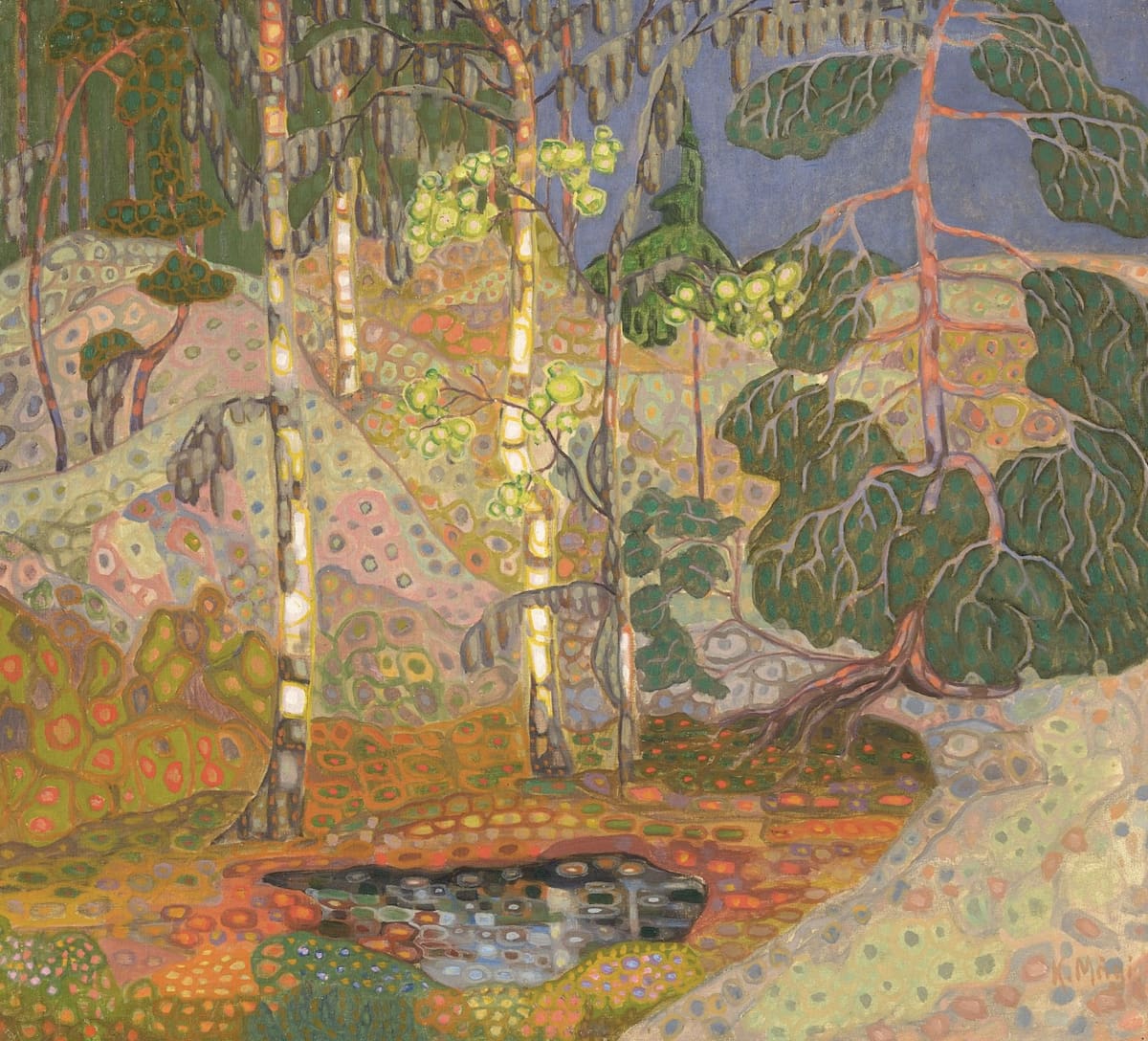
  • The Mordor painting is just the most extreme of the style he developed which combines the garishness of symbolism with the use of blobs of pure colour derived from pointillism. My favourite example was the bog painting (below). It’s figurative in the sense that you can make out the silver birch trees, but what’s happening on the ground isn’t remotely an effort to be realistic, but the use of brightly coloured blobs, lozenges and organic shapes (‘cellular structures’) which are more decorative than realistic. In the flesh, this painting is much more colourful and vibrant than this reproduction.

Norwegian Landscape: Bog Landscape by Konrad Mägi (1908-1910) Courtesy of the Art Museum of Estonia

  • Beside these were more realistic, less abstract landscapes, but still using a big blob pointillist style, such as the Norwegian lake at the top of this review.
  • And then, next door to all these stylised, sort-of-pointillist works, were some landscapes from Norway done in a completely different style, where instead of blobs, the paint has been applied in smooth brushstrokes, so the paintings appear much more traditionally figurative; such as Norwegian Landscape (Winter Landscape).

Room 2. Portraits

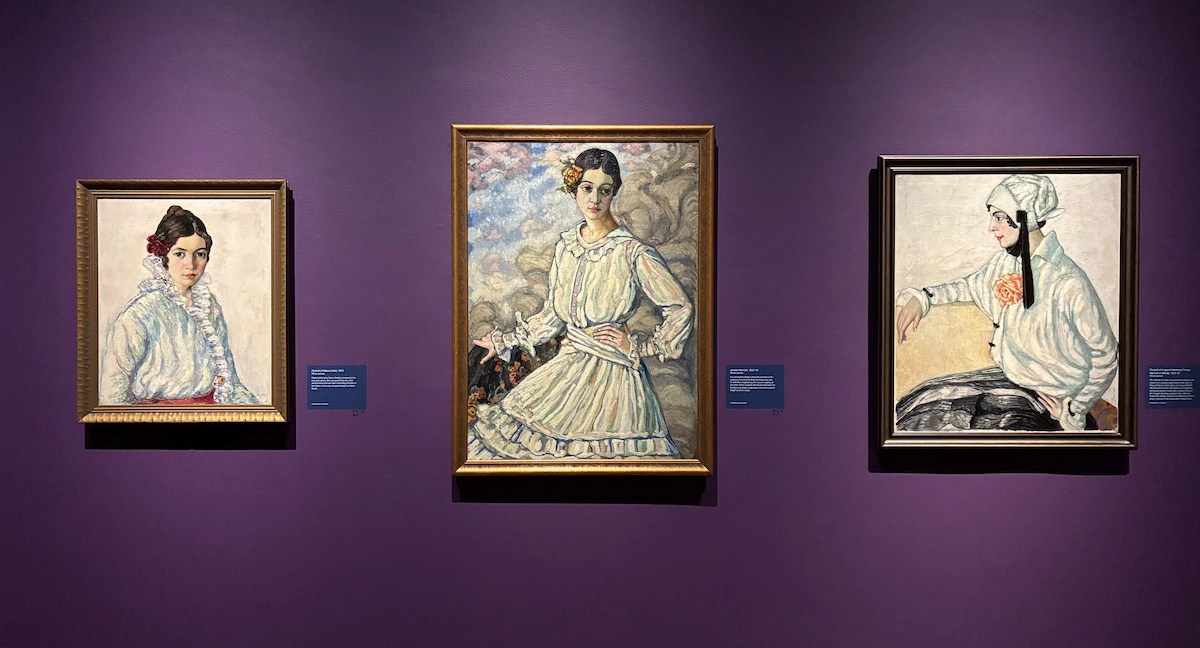
In 1912 Mägi returned to Tartu and, from spring 1913, began accepting portrait commissions for considerable sums of money, largely of wealthy women who were known to him through his cultural and political associations. Room 2 contains 17 of these generally large oil portraits. They showcase a stylised approach to the human face. They’re not unrecognisably distorted as in cubism, just simplified and done with deliberately unnaturalistic colouring. Mostly. But again, there’s a variety of styles. The ones I liked most had a hard angularity and used dark greens and blues to achieve an effect akin to German Expressionism.

Portrait of a Woman by Konrad Mägi (1918–1921) in Konrad Mägi @ Dulwich Picture Gallery

At the other end of the spectrum are some portraits of women whose cartoon, doe-eyed faces seem strangely at odds with the stylised backdrops, such as Portrait of Alvine Käppa from 1919.

Installation view of Konrad Mägi at Dulwich Picture Gallery showing three female portraits (photo by the author)

Somewhere in the middle were maybe the most attractive ones, which combined realistic faces with stylised backgrounds, the outstanding example being another ‘Portrait of a Lady’, below. Note the use of green to indicate shadowing on the skin.

Portrait of a Lady by Konrad Mägi (1916–1917) in Konrad Mägi @ Dulwich Picture Gallery

Room 3. The Baltic

Room 3 contains 16 landscapes from Mägi’s extended stays on the Baltic coast during the summers of 1913 and 1914. The paintings depict the landscape around Saaremaa and Vilsandi and, according to the curators, represented an artistic breakthrough for Mägi. The paintings here are certainly more consistent in style.

As if to demonstrate this, the centrepiece is a rare series by this artist, a set of 6 paintings depicting the same view of the lighthouse at Vilsandi. Three of these show the exact same view at different times towards the end of the day, as the (ever-present) clouds turn deeper shades of pink. the more I looked, the more I liked these three linked works.

Installation view of Konrad Mägi at Dulwich Picture Gallery showing three views of the Vilsandi lighthouse at different times of day (photo by the author)

As to the others, two things struck me:

  1. Lightless Although they are seascapes, and the curators tell us the Estonian coast is flat and open, Mägi’s paintings of it convey very little sense of light. His skies are always full of clouds and the terrain is depicted in thick heavy shapes.
  2. Botany Which is connected to the other thing which is that, although the bits of land he includes are busy with shapes and colours, giving an impression of luxuriant growth – and although the curators tell us that Mägi had an enduring fascination with the unique botanical species of his landscape, including its flora and fauna – there is precious little detail. In the garlands painted by Michaelina Wautier, currently on show at the Royal Academy, I spent some time trying to identify every species of flower. No point trying to do that with Mägi’s coastal paintings which are liberal with elements but all done in his familiar, blobby, stylised manner. Can you identify the plants in this picture?

Vilsandi Motif by Konrad Mägi (1913-14) Courtesy of the Art Museum of Estonia

Room 4. Southern Estonia

The walls of the fourth and final room are painted deep purple and this is an appropriate background for the 11 landscapes on display here, which I found heavy and louring. (I’ve just looked up ‘louring’ to check I’m using it in the right sense. The dictionary defines it as meaning ‘a dark, gloomy, or threatening appearance, usually referring to overcast weather, or a forbidding atmosphere.’ Seems about right.)

The landscapes are from Southern Estonia, from the last decade of his life. Note how the ‘blobby’ technique I’ve mentioned so many times has largely disappeared. Instead the pain is applied more smoothly but several other things are new.

One: the natural elements of the composition (the trees, the bushes, the outline of the lake) are heavily defined in black. Everything has a strong black outline, something I personally, always warm to.

Two: the clouds, the clouds! Look at the swirling, moiling, dark and threatening clouds coming to getcha!

Three: taken together these features indicate how much the landscape is actually an expression of the artist’s inner turmoil. This is the room whose wall label informs us that, after a lifetime struggling against mental illness, in 1924 Mägi suffered some kind of mental collapse and had to be placed in an institution for his own protection. Does that knowledge affect how you feel about this picture?

Lake Kasaritsa by Konrad Mägi (1915-17) Courtesy of the Art Museum of Estonia

As a footnote, not all the 11 works in this final room are as dark and ominous. In fact a couple of them right at the very end work with a much lighter palette and use light square blocks to create a landscape, completely opposite to the heavy, blobby, organic style which dominated so many of his central works. The curators tell us that here, right at the end of his working life, he was experimenting with the kind of Futuro-Cubism which was being used by radical Soviet artists of the 1920s.

Installation view of Konrad Mägi at Dulwich Picture Gallery showing three of the landscapes in the fourth and final room – note the cloud-congested skies (photo by the author)


Related links

Related reviews

Radical Harmony Helene Kröller-Müller’s Neo-Impressionists @ the National Gallery

This is a marvellous, informative, inspiring and illuminating exhibition. There are two interweaving aspects, threads or storylines which can be summed up by the questions:

  1. Who was Helene Kröller-Müller?
  2. What was Neo-Impressionism?

Who was Helene Kröller-Müller?

Helene Kröller-Müller (1869–1939) was one of the early 20th-century’s greatest art collectors. Born in Germany, she was the third child of Emilie Neese and the wealthy industrialist Wilhelm Müller, the founder of Wm H. Müller & Co, a trading company in iron and steel. As a child she was precociously intelligent and was given the best education money could buy.

In 1888 i.e. aged 19, she married the husband chosen for her by her father, one of his managers Anton Kröller, a Dutchman (and as you can see, she chose to amalgamate her maiden name with his), and the couple moved to Rotterdam where he was the Müller & Co branch manager. Just one year later, in 1889, Helene’s father died suddenly and Anton became director of the entire company at the tender age of 27. As his wife, Helene overnight became one of the richest women in the Netherlands.

Helene Kröller-Müller © Kröller-Müller Museum

To begin with Helene concentrated on bearing and raising the couple’s four children. But in 1906 she began (along with her eldest child) to study art under painter Henk Bremmer. Given her fortune, he suggested she not only study but begin collecting artworks. Thus began the process which was to lead to her amassing one of the greatest collections of modern art ever created.

Far ahead of her time, she was one of the first to recognise the genius of van Gogh and eventually owning 90 of his paintings.

But from 1912 she began accumulating what would grow into the greatest single collection of Neo-Impressionist art anywhere, often purchasing directly from the artists.

In 1913, in the tradition of philanthropic multimillionaires, she decided to make her collection available to the public and commissioned the building of a modern art gallery by Belgian Neo-Impressionist turned architect Henry van de Velde (1863 to 1957). With its top-lit, white-walled galleries and later, its white picture frames, the gallery set a new tone and became influential in its own right.

The Kröller-Müller Museum opened in parkland near Otterlo in 1938, a year before Helene’s death. By then, her collection numbered around 11,500 works. And you can still visit it today.

This lovely exhibition features 50 or so Neo-Impressionist paintings from the Kröller-Müller Museum along with some from the National gallery and other UK collections and some from private collections to make up one of the largest exhibitions of Neo-Impressionist painting ever seen in the UK.

What is Neo-Impressionism?

The internet tells us that:

Neo-Impressionism is a style of painting, pioneered by Georges Seurat, that uses a scientific approach to colour by applying small, distinct dots of pure colour to the canvas. These dots are intended to blend in the viewer’s eye when seen from a distance, creating more vibrant and luminous effects than traditional mixing methods. The technique was quickly adopted by a surprising number of other artists, notably a member of the previous generation, the impressionist Camille Pissarro. The technique is often referred to as pointillism.

1. Colour

Seurat’s innovative painting technique had its roots in the well- established theory that opposing colours on the colour wheel – yellow and violet, orange and blue, red and green – make each other appear more vivid when juxtaposed. And at the start the exhibition features a classic colour wheel of the kind Seurat would have been familiar with to demonstrate the theory.

Through experiment and research into scientific and optical theory, Seurat determined that even greater luminosity could be achieved if pure colours remained unmixed and were applied in small touches placed side by side – the dots or points in French that led Neo-Impressionism to be popularly known as Pointillism.

Collioure, the Belltower, Opus 164 by Paul Signac (1887) © Collection Kröller-Müller Museum, Otterlo, the Netherlands. Photographer: Rik Klein Gotink

2. Structure

But this exhibition emphasises that, just as important as colour and dots, was its insistence on form and structure and line.

Neo-Impressionism rejected the spontaneity of Impressionism in favour of a more methodical and formal structure.

The Neo-Impressionists aimed to produce pictures that transcended reality, creating radically simplified compositions that captured the essence of what they aimed to depict, attaining harmony through colour and geometry.

Adopters of neo-impressionism

The movement was introduced to the public in 1886 when Georges Seurat exhibited his work ‘A Sunday on La Grande Jatte‘ at what was to prove the final Impressionist exhibition. If the exhibition heralded the end of Impressionism it heralded the genesis of Neo-Impressionism which was to become one of the first modern pan-European art movements

I knew that a very early adopter of Seurat’s method, who went on to popularise and create masterpieces using it, was Paul Signac (1863 to 1935). Signac worked out that the careful juxtaposition of separate dots of pure colour would fuse in the eye, making the surface of the canvas appear to shimmer and realising how the effect was ideally suited to capturing glowing light in landscape.

But the exhibition also includes works by many others who quickly adopted Seurat’s invention. The artists included in the exhibition are:

  • Georges Seurat
  • Paul Signac
  • Henri-Edmond Cross
  • Anna Boch
  • Maximilien Luce
  • Théo van Rysselberghe
  • Camille Pissarro
  • Jan Toorop
  • Lucien Pissarro
  • Henry van de Velde
  • Georges Lemmen
  • Johan Thorn Prikker

There is also one stunning work by Vincent van Gogh (see below), who was interested in the movement and made his own experiments in juxtaposing dashes of pure colour, but was completely different in his approach – as far from the scientific precision of Seurat and Signac as imaginable.

International spread

One of the early converts, Théo van Rysselberghe (1862 to 1926), invited members of the group to exhibit at the avant-garde artistic society Les XX (The Twenty) in Brussels, prompting the international dissemination of neo-impressionism. Hence the exhibition includes works by French, Belgian and Dutch artists.

Negative criticism

As usual, the critics hated it. One critic declared it was the end of painting as we know it in the sense of finished images with invisible brushstrokes (there’s always one).

Another, subtler, criticism, was that the technique lent itself very well to open air landscapes, especially good at capturing the sense of spacious light you experience by the sea, but was unable to depict the human figure as acutely as traditional painting.

Luminous

The many examples here show that the technique does indeed lend itself to landscapes and especially seascapes. The first and last (seventh) room, each contain half a dozen or more luminous landscapes, which definitely demonstrate the Signac ‘shimmer’, conveying a wonderful sense of light and air, with a popular subject being the Brittany coast.

The Channel of Gravelines, Grand Fort-Philippe by Georges Seurat (1890) © The National Gallery, London

You can see in this painting that the Neo-Impressionists often extended the use of the dot technique beyond the subject itself to decorate the edges of their paintings and even the frames.

Political ideals and ironies

Many of these artists held radical political views. They were anarchists or utopian communists (something which attracted the much older impressionist, Camille Pissarro, who was also an anarchist sympathiser, to support and champion them). Thus the exhibition devotes a room to their supposedly political works.

These are depictions of the lives and landscapes of people perceived to be of the exploited classes, be they rural labourers or urban workers. Most of these are in a pleasingly bucolic setting so have a Thomas Hardy feel. Some are more realistic and evoke Emile Zola’s more gritty Naturalism, like the pair of paintings by Jan Toorop which depict a peasant family preparing for a strike and then (in painting 2) carrying the body of the husband who looks like he’d been killed in the police violence which accompanied the strike.

Morning (after the Strike) by Jan Toorop (1888-90) © Collection Kröller-Müller Museum, Otterlo, the Netherlands. Photographer: Rik Klein Gotink

Anarchists championed the ideal of ‘harmony in autonomy’ in which non-exploitative self-government and harmony with nature were fundamental principles. The artists directly associated political harmony with the harmony they were seeking through their sophisticated colour experiments. Harmony in art was the direct corollary of the harmony in politics which they sought.

The most striking work in this room is also the most ironic. This is The Iron Foundry painted by Maximilien Luce quite late in the movement’s history, in 1899. If you go up close you can see the careful, scientific application of the famous dots. But if you step back, obviously what you see are two things: 1) the dynamic composition, with striking contrast between the areas of darkness and the bright red-white coming off the furnace; and, equally important for the Neo-Impressionists, 2) the lines or patterns created by the men’s leaning or bending figures. Line, outline, angles and composition are as important an element of Neo-Impressionism as the dots.

The Iron Foundry by Maximilien Luce (1899) © Collection Kröller-Müller Museum, Otterlo, the Netherlands. Photographer: Rik Klein Gotink

What’s ironic is the way all these artists railed against big business’s capitalist exploitation of the workers and yet these works were eagerly snapped up by the fabulously wealthy wife of… just such a rich capitalist 🙂 To quote the curators:

Kröller-Müller bought this picture directly from Luce in 1922 and it was without any apparent sense of irony that for many years it hung in the office of her husband, Anton Kröller, who ran the family’s iron ore and shipping business.

Portraits

On the face of it Neo-Impressionist theory militated against the whole concept of individual portraits. The traditional expectation that a portrait should capture a specific likeness lay at odds with the Neo-Impressionist principle that harmony in art should be achieved through a generalised distillation of form.

But it didn’t stop them trying and producing numerous very striking portraits. Théo van Rysselberghe, in particular, made a living from commissions to paint the wealthy, progressively-minded supporters of the new art, and the group’s portraits document the group’s highly cultured and politically engaged patrons, families and friends.

By far the most striking is Théo van Rysselberghe’s full-length portrait of his wife, the writer Maria Monnom standing in their fashionable home.

Portrait de Maria Van Rysselberghe-Monnom by Théo Van Rysselberghe (1892) © Collection Kröller-Müller Museum, Otterlo, the Netherlands

Interestingly, the work drew criticism from fellow members. Despite the picture’s shimmering surface of dots, Van Rysselberghe’s reliance on local (natural) colours, such as the orange of Maria’s dress, led Signac to later criticise his friend’s lack of adherence to the rigours of Neo-Impressionist theory.

Drawings

The portraits room includes striking paintings like the woman in orange and a woman seated at a piano but it also contains a couple of marvellous drawings. These are interesting for showing that the technique worked perfectly well without any colour at all. Here’s a quite dazzling portrait of Jan Toorop by Georges Lemmen done using conté crayons.

Jan Toorop by Georges Lemmen (1886) © Museum de Fundatie, Zwolle en Heino/ Wijhe the Netherlands

Caricature

But the portrait room also crystallised a feeling I had, that all this focus on lines and digging below the visible reality to find the ideal forms, created what I began to think of as simplified, almost cartoonish outlines of people, a noticeable tendency towards caricature in which settings, people and faces are simplified and exaggerated.

You can maybe see this tendency in the progression of two paintings by Signac in the room which is ostensibly about the painters’ depictions of bourgeois life. Here’s the first one, The Dining Room, completed in 1887.

The dining room, Opus 152 by Paul Signac (1886/1887) © Collection Kröller-Müller Museum, Otterlo, the Netherlands

The curators inform us that Signac used his own grandfather, mother and the family housekeeper as models for this work, and that the piece is a satire on the stifling atmosphere of the typical middle-class suburban household, pointing out how each figure appears entirely self-absorbed, no to say stifled.

This is all true but I’d add that surely the painting also brings out the tendency within the technique of Neo-Impressionism to conceive of humans as forms, as collections of lines and shapes? A tendency which leads them to seem like self-contained, autonomous units which have no interaction – monads, mannequins. And that many of these images have a heavy tendency towards caricature.

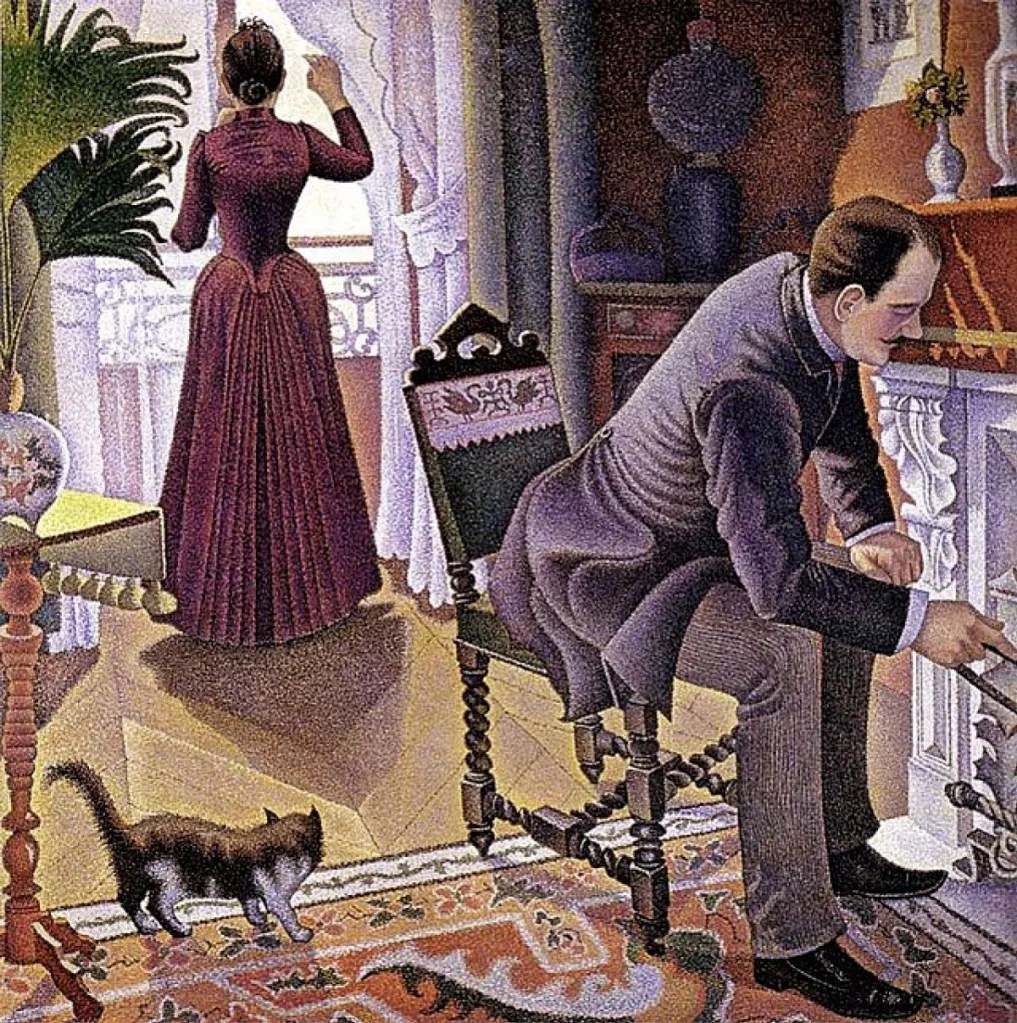
All of which is even more true of its sequel, Sunday, completed in 1890. The dot technique is immaculate. And Signac has included in the composition many more firm, defined outlines. But surely this proves my point, that the more defined these lines and form become, the more cartoon-like the overall image.

A Sunday, Opus 201 (1888–90) by Paul Signac. Private collection

Chahut

This tendency comes to a climax in the biggest painting on display here, given more or less its own room and space, the enormous ‘Chahut’ by Seurat from 1890.

Le Chahut by Georges Seurat (1889-90) © Collection Kröller-Müller Museum, Otterlo, the Netherlands

The curators have a lot to say about this, for example that it was one of what he called his toiles de luttes meaning ‘battle canvases’. In other words it was intended to be a provocative rallying cry to his movement, a manifesto pictures. In addition, it is intended to be socially subversive or an attack on late-Victorian sexual morality, in that it depicts the ‘chahut’ or ‘can-can’– then the most risqué dance performed in Parisian café-concerts.

All this is no doubt true but surely the obvious thing about this painting is that it’s a cartoon. It’s left reality far behind in order to become something like an illustration in the funny papers. Surely Seurat’s obsession with form and pattern, instead of taking us towards some deeper spiritual reality, in fact takes us away from reality altogether into a realm of caricature and comic illustrations?

(I’ve just visited the Courtauld Gallery where I saw another egregious example of this tendency, Seurat’s Young Woman Powdering Herself from 1890. This is a comical picture, isn’t it? Surely you can’t possibly take it seriously.)

Ladies on lawns

‘Chahut’ is given centre stage in the exhibition but it is in almost all ways an anomaly, an exception. The next room in the show, the one about depicting the bourgeois world, is far more characteristic. As well as the two Signac interiors I’ve mentioned, there are more classically open-air Neo-Impressionist works. The largest and maybe most representative is ‘In July, Before Noon’ by Théo van Rysselberghe, from the same year as Signac’s cartoon music hall.

In July, before Noon, 1890 by Théo van Rysselberghe © Collection Kröller-Müller Museum, Otterlo, the Netherlands

The strengths and weaknesses of the style are obvious. It is superb at conveying not only the detailed light and shade of a sunny day out of doors in July but there is something about the women’s postures which is oddly formalistic and detached. The woman passing by at the back looks like a robot.

I thought I recognised it and, after some rummaging, confirmed that this image was used for the cover of an Oxford University Press edition of Anton Chekhov’s plays. It perfectly captures the late nineteenth century indolence of middle class ladies, arranged in vast folds of fabric and quietly going about their embroidery or needlework in a sunny French garden. Inside they may be seething with the frustrations of characters from Chekhov or Ibsen, but here, on the surface, all is luminous calm.

Neo-Impressionism and van Gogh

As I mentioned, the show includes one splendid van Gogh painting, ‘The Sower’ from June 1888. We know from his letters than van Gogh was interested by the Neo-Impressionists’ experiments with colour and form but he was never a member of the group, not close. ‘The Sower’ is here partly because, alongside the Neo-Impressionists, Kröller-Müller collected van Goghs. And partly to demonstrate the similarities and differences between them.

The Sower by Vincent van Gogh (June 1888) © Collection Kröller-Müller Museum, Otterlo, the Netherlands. Photographer: Rik Klein Gotink

The similarity lies in the radical simplification of the subject in order to focus on vibrant colour contrasts. Van Gogh juxtaposes all kinds of colours not seen together in nature (for example the insistent blue of the turned soil the sower is scattering his seed onto) in order to create his effects.

The difference is in two aspects of approach. The Neo-Impressionists took a calm, detached, almost scientific approach to their work, whereas all eye-witnesses describe van Gogh attacking his canvases in a fever of inspiration. And whereas the Neo-Impressionists famously used dots or dot-like dashes of pain, van Gogh notoriously squeezed out entire worms of paint onto his brush and applied them with slapdash inspiration. Which explains why the Neo-Impressionists’ canvases are almost flat while van Gogh’s canvases are thickly encrusted with gloops and whorls of paint whipping up from the surface like waves on a stormy sea.

Here’s a close-up of pointillist technique from George Lemmen’s Factories on the Thames from 1892.

Detail from ‘Factories on the Thames’ by George Lemmen (1892) (photo by the author)

And a close-up of van Gogh’s Sower.

Detail from The Sower by Vincent van Gogh (photo by the author)

Spot the difference.

Legacy

Google AI tells me that:

Neo-Impressionism’s legacy lies in its scientific approach to colour and form, which heavily influenced later movements like Fauvism, Cubism, Futurism, and Abstract Expressionism. By using optical science, the movement pioneered a new awareness of colour and laid the groundwork for modernist approaches to the flatness of the canvas and simplified geometric forms. This theoretical language and systematic technique offered a new foundation for artists, bridging the gap between Impressionism and the more radical movements of the 20th century.

Seurat at the Courtauld

If you like Seurat, you might be interested to know that the Courtauld Gallery will be hosting an exhibition about Seurat’s coast painting from February next year.


Related links

Related reviews

After Impressionism: Inventing Modern Art @ the National Gallery

This is a lavish and deeply enjoyable exhibition portraying the great explosion of creativity in West European painting which took place in the decades between the last Impressionist exhibition in 1886 and the outbreak of the First World War in 1914.

Critics then and now struggled to find a blanket term for the period, as Belinda Thompson explains in her excellent survey of the period, ‘The Post-Impressionists’. The term ‘post-impressionism’ persists because the only thing all these different artists had in common was that they were painting after the great Impressionist breakthrough of the 1860s and 1870s and were clearly influenced by it. Beyond that it’s difficult to generalise, except that they were all experimenting and innovating and following through on the countless possibilities inherent in the act of putting oil paint on canvas.

Mont Sainte-Victoire by Paul Cezanne (1902 to 1906) © Philadelphia Museum of Art

Structure

The exhibition structure is simple: it opens by celebrating the artists who have emerged, in retrospect, as the great gods of the period – Paul Cézanne, Vincent van Gogh, Paul Gauguin – and then examines the influence they had on the younger generations of artists, in the hotbed of modern art, Paris.

Where this exhibition strikes out and is distinctive from many surveys of the period is that it then makes a conscious effort to broaden its scope, geographically, with rooms or sections dedicated to other capital cities where exciting experimentation was taking place, namely Barcelona, Berlin, Brussels and Vienna. The curators point out that there was more cross-fertilisation than ever before due to the steadily increasing numbers of exhibitions and exhibiting societies, illustrated periodicals and commercial dealerships.

For once there isn’t a particularly strong central thread or thesis being propounded in the show, just a lot of wall labels describing art movements and groups and trends in all these different places, and then picture captions going into detail on individual works.

The show is, therefore, in effect, just a feast of fabulous post-impressionist masterpieces, and strolling through it is a quite wonderful, mind-blowing, eye-filling experience.

Specific movements are mentioned along the way (the Nabis, Symbolism, Die Brücke, the Fauves), in passing, but towards the end the show crystallises, as it were, presenting examples of the radical Modernism which supplanted what had come before in the form of works by Picasso, Matisse, and Mondrian.

What characterised post-impressionist art?

Impressionism began the movement away from traditional Salon art which a) depicted high historical or mythological subject matter or b) monumental nudes in c) an intensely figurative realistic manner. Instead the Impressionists were interested not in what was there, but in what we see, which is a different thing, trying to capture the shimmer and play of light.

The post-impressionists continued this departure from the conventional representation of the external world. In a host of different ways they developed non-naturalist visual languages, emphasising shape or pattern or colour which don’t exist in the real world. Some of them were interested in line and form, some became obsessed with colour, some with pattern bringing out the decorative potential of art, some focused on symbols and meanings. Once you walked away from the idea of figurative, realistic depiction of the ‘real world’ a thousand doors opened.

All this was helped by the swift development of photography, with many artists realising that their traditional role as makers of portraits, recorders of events, annotaters of landscapes was being superseded by the new technology. But this was entirely positive: it freed them up to explore the expressive potential of paint on flat surfaces in a thousand new ways.

Artists

With almost 100 works, many lent from institutions abroad and seen in London for the first time, the show features a host of big name artists like Paul Cezanne, Vincent Van Gogh, Edgar Degas, Pablo Picasso, Henri Matisse, Gustav Klimt, Käthe Kollwitz, Sonia Delaunay, Wassily Kandinsky, Piet Mondrian, Edvard Munch. It’s mostly paintings  but there’s a selection of ten or so sculptures carefully chosen to demonstrate innovation in that medium, too (notable sculptures by Rodin, Gauguin and Kollwitz).

I’m going to list the rooms, indicate what they contain i.e. which movements and artists, and then pick personal highlights.

Introduction

The introductory room contains just four works, a painting each by Pierre Puvis de Chavannes and Paul Cezanne, framed by two sculptures by Auguste Rodin (‘Monument to Balzac‘, 1898, and ‘Walking man‘, 1907). Cezanne’s ‘Mont Sainte-Victoire’ (1906) is obviously a greatest hit but after the recent Cezanne exhibitions at Tate Modern and the National Portrait Gallery I’m a bit Cézanned out. The Rodin pieces confirm my very strong dislike; I object to because of the lumbering clumsy size of his works and the crude, horrible unfinished nature. In terms of modern sculpture I like Epstein, Gill and Gaudier-Brzeska, small, smooth, beautiful lines and angles, the opposite of everything Rodin stands for.

Therefore I preferred the Puvis work, ‘The Sacred Grove’ from 1885, although this struck me as a very odd choice, because its idyllic classical setting, figurative approach, use of perspective etc seem completely contrary to everything which follows.

The Sacred Grove, Beloved of the Arts and the Muses by Pierre Puvis de Chavannes (1884) Art Institute of Chicago

Room 2: Cézanne, van Gogh, Degas, Gauguin

Greatest hits from some of Western art’s biggest names. Cezanne is represented by a classic version of The Bathers (1905) where he is transforming human figures, trees and landscape into geometric shapes, leaning rectangles of paint, the semi-abstract human figures having blank masks. You can clearly see the origins of Picasso and Braque’s cubism. A still life of a sugar bowl and apples, plus another of his numerous views of Mont Saint-Victoire.

There are 4 works by Van Gogh: ‘Snow-Covered Field with a Harrow (after Millet)‘ (1890) had the classic van Gogh wavy paint, as did ‘Sunset at Montmajour‘ and ‘Enclosed field with ploughman‘. But I found myself more drawn to ‘Houses in Saintes-Maries-de-la-mer’. Apparently the tight, constricted feel of the composition is a new thing in his style. It was painted in the south of France where the bright light made him realise he could exaggerate colour effects even more than he’d been doing previously.

Houses in Saintes-Maries-de-la-mer by Vincent van Gogh (1890)

An oddity I noticed is that the National Gallery itself owns some outstanding van Gogh masterpieces, such as the chair, and sunflowers and these aren’t in the exhibition. The only reason I can think of is that they’re part of the permanent collection which tourists quite possibly come to London to see and so the curators took the decision to exclude them from the exhibition and keep them on general display.

The caption to his ‘Woman from Arles’, a portrait of the owner of the Café de la Gare in Arles, raises an interesting point. Apparently, when they were sharing a house in the south of France, Gauguin and van Gogh had an ongoing argument about the nature of art: Gauguin argued that the artists is like a priest questing for the spiritual essence of a subject and therefore it was best to paint from memory, distance from the actual object freeing the artist to bring out the essential shapes and colours. Van Gogh, on the contrary, argued it is the artist’s sacred duty to paint what they see, as they see it.

No such scruples with the little selection of Degas works, the biggest example of which is the famous ‘Combing the Hair (Le Coiffure)’, an orgy of reds and oranges. It’s accompanied by a good example of his ballet dancers, ‘Dancers practicing in the foyer’. But my favourite piece was a small but exquisite piece, ‘Woman reading’ (1885).

Femme lisant by Edgar Degas (1883 to 1885)

It’s tightly focused, cropping the figure at the knee. Degas applied layers of pastel over a monotype print

Taken together this room makes a strong case for the dazzling impact these artists had both in Paris and elsewhere in Europe, with their reconsiderations of form, surface and space. The strokes are called ‘gestural’ because they convey the actual strokes by the artists as much as the object. Strong short dark lines make it look as if elements of the image have been stitched together. The use of bold pure colours and highly gestural strokes were very influential on later artists.

Then onto the Gauguin section. I was bowled over. Gauguin strikes me as less covered than Cezanne, van Gogh or Degas, maybe because he is the boldest, most radical, most muscular and controversial of them. He’s represented by a greatest hit, ‘Nevermore’, ‘The Wave’, ‘Fête Gloanec’, ‘The Wave’, ‘The Wine Harvest’ and his expressive ‘primitive’ carving in the circular shape of a totem, ‘The afternoon of a faun’. But it was the huge and amazing ‘Vision of the Sermon (Jacob Wrestling with the Angel)’ which bowled me over.

Vision of the Sermon (Jacob Wrestling with the Angel) by Paul Gauguin (1888) © National Galleries of Scotland, Edinburgh

As per the explanation on the van Gogh caption, you can see how Gauguin has taken real elements, such as peasant women from his native Brittany, a cow, a tree, but placed them in an abstract ‘symbolic’ landscape where the grass is bright orange and perspective is gestured at but mocked or transcended. And, contrary to all traditional rules, the nominal subject, the wrestling match, doesn’t take place at the front and centre of the painting, but is a strange, obscure, garbled struggle happening off in the middle distance.

Degas is more consistently sensually and visually pleasing, but Gauguin is bracing and weird. He is a godfather of the pictorial Symbolism which was a major strand of the 1890s with its concern for Big (if often nebulous) Ideas and a completely non-naturalistic treatment, both combining to convey a strong if indefinable emotion.

Room 3: Different paths

Side by side are placed dark, heavily outlined depictions of the city, and the tremendously light and airy works of the ‘divisionists’ or ‘pointillists’.

Part of the enjoyment of visiting art exhibitions is to test out my own tastes. Over the years my tastes have changed, and are also liable to vary from day to day depending on mood and circumstance (e.g. pressure of work). Something which appears to remain consistent is I am instantly drawn to works with strong outlines. This is part of the reason I like Gauguin over van Gogh and Degas over Cezanne.

So in this room I really liked the works by Emile Bernard and Louis Anquetin with their ‘intensified colour and flattened forms bounded by strong outlines’.

‘Avenue de Clichy: five o’clock in the evening’ by Louis Anquetin (1887)

The strong black lines defining figures or folds of clothes were described by some critics as cloisonné work. According to the curators it anticipates and to some extent influence Gauguin.

By contrast I found the works by pointillists Georges Seurat and Paul Signac pallid and limp. These were ‘Setting sun: sardine fishing’ and ‘Bertaud’s Pine’ by Signac, alongside ‘By the Mediterranean by Henri-Edmond Cross. I know they’re great works in their own right. I understand that they called themselves Neo-Impressionists because they saw themselves as applying ‘scientific’ rigour and analysis to the depiction of sunlight and shade. I appreciate that the pointillists were, surprisingly, associated with workers’ rights and socialism and thought of themselves as depicting a better lighter world for all. But it’s the dark urban night-time visions of Louis Anquetin which pull my daisy.

The Channel of Gravelines, Grand Fort-Philippe by Georges Seurat (1890) © National Gallery, London

Room 4:The Nabis

Beside them are two works showing the highly stylised approach of Toulouse Lautrec, ‘Tristan Bernard at the Vêlodrome Buffalo‘ and ‘The Reader‘. The room contains a partitioned-off section about the Nabis or ‘prophets’. According to Wikipedia, the Nabis were:

a group of young French artists active in Paris from 1888 until 1900, who played a large part in the transition from impressionism and academic art to abstract art, symbolism and the other early movements of modernism. They included Pierre Bonnard, Maurice Denis, Paul Ranson, Édouard Vuillard, Ker-Xavier Roussel, Félix Vallotton, Paul Sérusier and Auguste Cazalis.

The show includes what is commonly thought to be the first ‘Nabis’ painting, ‘Le Bois d’Amour à Pont-Aven or Le Talisman’ of 1888 by Paul Sérusier. You can see why it was widely felt to have pushed painting significantly beyond figurativism into an entirely new place where colour and pattern became the main aim of a painting. Serusier painted it under the supervision and direct encouragement of Gauguin at Pont-Aven in Brittany. This fact and the almost complete abstraction of the work itself had a dramatic impact on his friends back in Paris and helped crystallise the new movement.

‘Le Bois d’Amour à Pont-Aven or Le Talisman’ by Paul Sérusier (1888)

And so the show includes comparable works by other members of the Nabis, including ‘Island and village of Le Pecq‘ and ‘The evening wash by lamplight‘ by Maurice Denis. Nearby there’s a work by Pierre Bonnard, ‘Madame Claude Terrasse and her son Charles‘ (1893). I went to the Bonnard exhibition at Tate Modern back in 2019 and, eventually, overcome my initial dislike to sort of ‘get’ his messy way with colour and pattern but this specimen epitomised that lack of draughtsmanship which I find hard to overcome. Next to it are two pieces by Edouard Vuillard, ‘Figures in an interior: Music‘ (1896), ‘Lugny-Poe‘ (1891) and ‘Lady of Fashion‘ (1892), both of which highlight his interest in pattern and design over strict realism. No likee.

Room 5: New voices – Barcelona and Brussels

By my count there were 6 paintings from Barcelona and 5 from Brussels.

Barcelona

Barcelona is represented by works by Hermenglido Anglada-Camaras, Ramon Casas i Carbo, Santiago Rusiñol I Prats, Isidro Nonell i Monturio and Pablo Picasso. The exhibition goes heavy on the enormous painting by Casas i Carbo, ‘The Automobile’.

The Automobile by Ramón Casas i Carbó (about 1900) © Círculo del Liceo / photo Fotogasull

It’s imposingly big and has a long backstory. Casas, a leading figure in the Barcelona avant-garde, was commissioned to the series of 12 paintings for the private club, Círculo del Liceu in Barcelona, depicting modern musical life. In this one a woman dressed in modern (1900) clothes drives that amazing new invention, the automobile. Casas was one of the first in the city to own a motor car and, of course, the curators point out how ‘radical’ it was to depict a woman driving one. The link to ‘music’? She’s meant to be driving to or from a concert. You can see it in the background on the right. The bold simplicity of the design is said to represent ‘Catalan Modernism’ and to have impressed the young Picasso.

Picasso is represented by an early work, ‘The absinthe drinker‘ and a portrait of ‘Gustave Coquiot‘, Hermenglido Anglada-Camaras by ‘The White Peacock‘ (1904), Isidre Nonell by a tough naturalistic depiction of poverty titled ‘Hardship‘. But I particularly liked the portrait of Modesto Sanchez Ortiz by Santiago Rusiñol, not particularly radical or modernist but just very powerful. Ortiz’ eyes followed me round the room.

Brussels

As to Brussels, the curators tell us it was home to progressive exhibiting societies like The Twenty and The Free Aesthetic which fostered close links with the Paris avant-garde. The Twenty was an exhibition society founded in 1883 by 20 artists who wanted to break away from the conventional art establishment. It was in Brussels that van Gogh made his only sale during his lifetime. The five pieces felt very light and pointillist. They include the decorative and soothing ‘The Scheldt upstream from Antwerp‘ by Theo van Rysselberghe (1892), the political motive behind ‘The eve of the strike‘ by Jan Toorop (1889), and a strikingly pointillist work, ‘Going to church’ by Henry van de Velde (1892). As you can see, although pointillist in technique, it has a much darker, gloomier vibe than the sun-drenched works of Signac and Seurat.

Woman in front of the Church by Henry Van de Velde (1889)

Off in a corner is a single work by the outlier James Ensor, ‘Astonishment of the Mask Wouse‘ (1889). As you can see, Ensor’s art goes beyond satire into the weird and the grotesque.

Room 6: New voices – Vienna and Berlin

In both Vienna and Berlin at the start of the 20th century artists withdrew from the traditional art academies and salon exhibitions and set up breakaway organisations, the Secessions.

Vienna

Dominating the left side of the room are two huge portraits of women by Gustav Klimt in his trademark style, combining a highly realistic sensual face with a luscious depiction of stylised dress and fabric: ‘Hermine Gallia (1904) and ‘Adele Bloch-Bauer II‘ (1912). I loved Klimt when I first discovered him at school but move quickly on to prefer his disciple Egon Schiele and eventually found him too sweet and chocolate box. Also from Vienna is ‘The Artist’s Mother‘ by Broncia Koller-Pinell (1907).

Surprisingly, there are some works by Norwegian depressive Edvard Munch. Why? Because Munch actually exhibited and sold his works in Berlin. The works here show a healthy lack of interest in traditional perspective and preference for pattern and design, but aren’t particularly impressive: ‘Consul Christen Sandberg‘. More characteristic is ‘The death bed‘ (1896). I was interested to learn that Munch eventually had a complete nervous breakdown (in 1908) and that, when he returned to painting, it was in a far looser style and of relatively unemotional landscapes: ‘Cabbage field‘ (1915).

Berlin

I was surprised by this room because so many of the works seemed the opposite of ‘modern’ but surprisingly old fashioned. Thus the two works by Lovis Corinth are, maybe, a bit candid and honest about the female body but they are, nonetheless, female nudes in the time-honoured tradition, without a hint of the stylisation we’ve seen throughout the show up to this point: ‘Perseus and Andromeda‘ (1900).

Nana by Lovis Corinth (1911) St Louis Art Museum

There’s a portrait of historian and philosopher George Brandes by Max Liebermann (1901) and ‘Danae‘ (1895) where I really admired the frank peasant ugliness of the servant, and ‘Children by the Pond: The Garden in Godramstein‘ (1909) by Max Slevogt.

I was surprised by this entire room because it all seemed so reactionary and old fashioned. A glimmer of modernism was given by the sole piece by the great German artist Käthe Kollwitz, not a painting but a tightly conceived sculpture, ‘Pair of Lovers‘ from 1913 to 1915. I’m a huge fan.

Room 7: German Expressionism

The penultimate room is a small one tucked off to the side of the flow of big rooms but it came to me as a huge relief after the retro kitsch of the previous room, a sudden burst of vibrant colour and exciting non-conformity.

Why stick to traditional methods of compositions? Why not use blaring flagrant primary colours! Why bother to cover the whole canvas when leaving blank spots creates a sense of urgency and drama! Bang!!

Many of the works are by members of Die Brücke (The Bridge), a group of German expressionist artists formed in Dresden in 1905. Founding members were Fritz Bleyl, Erich Heckel, Ernst Ludwig Kirchner and Karl Schmidt-Rottluff. What they had in common was interest in primitivist art and expressing extreme emotion through high-keyed colours that were non-naturalistic. God, this is the dog’s bollocks, I thought, what a relief after the stodgy naturalism of the previous room!

Here are splendidly bold and unfettered works by Erich Heckel – ‘The house in Dangast‘ (1908) – and Karl Schmitt-Rottluf – ‘Break in the dyke‘) (1910). I loved Sonia Delaunay’s ‘Jeune Finlandaise’ (1907). In this small room experienced a physical sense of liberation.  This is the real McCoy.

Young Finnish woman by Sonia Delaunay (1907)

It’s significant that this painting captures Delauney on her journey towards pure abstraction which she would achieve a few year later. Part of the thrill of paintings like this is you can feel the future in them, ready to burst through. In the same vein is the National Gallery’s portrait of Charlotte Cuhrt by Max Pechstein (1910).

Two outliers are a portrait by Henri Rousseau (‘Joseph Brum’), whose ‘naive’ self-taught style became very popular in turn of the century Paris where ‘primitivism’ of all kinds was becoming fashionable.

And, off to one, side, the eerie and disturbing ‘Seated girl with a white shirt and standing nude girl’ by Paula Modersohn-Becker (1906).

8: New Terrains

Finally the exhibition closes with a big room drawing together strands which have emerged during the exhibition to date, and pointing forwards to the radical ruptures of Modernism.

Thus there’s a work by Wassily Kandinsky which is well on the way of his journey towards abstraction – ‘Bavarian Village with Field‘ (1908).

There are three paintings by Matisse, highlighting his move towards decoration, colour and pattern:

There are three little works by Piet Mondrian which neatly capture his progression from traditional figurativism in a realistic depiction of a tree by a river bank; to a half-way house, a tree painted in a style influenced by van Gogh’s broad brushstrokes; and finally onto pure abstraction:

In a similar spirit there are four Picassos which capture his progression from deliberate ‘primitivism’ of 1907 on to the invention of cubism in 1911:

But dominating the room is the enormous work ‘The Dance’ by André Derain. Derain was one of the group of Parisian artists who, in a review of a 1905 exhibition, were mockingly called ‘les Fauves’ (which simply means ‘the wild things’) by a Parisian critic and adopted the name as a badge of pride. Other works by Derain are included:

But it’s ‘The Dance’ which dominates the entire room and is your lasting, lingering visual image of it. Wild, high-toned colours, a cheerful disregard for perspective and, in this image in particular, a complete transition to fantasy, fairy-tale, exotic subject matter.

‘The Dance’ by André Derain (1906) Private Collection © ADAGP, Paris and DACS, London 2023

It’s funny but, although the curators started out by claiming there was a great explosion of styles and approaches from the late 1880s onwards, the works chosen for this final room suggest that all along there were in fact just two threads or streams or approaches.

For me the drab colouring and obsessive interest in volumes, hard-edged angles, facets and geometry found in the cubism of Picasso and Braque relates directly back to the exploration of volumes, forms, rectangles and blocks developed by Cézanne. Maybe we can call this the Analytic tradition and define it as stretching from (on one wing) the scientific approach of the Neo-Impressionists and, on the other, the pure, geometric abstraction of Mondrian.

Whereas the wild children’s drawing of brightly coloured figures dancing in the jungle obviously comes from a completely different place, clearly relates directly back to Gauguin’s symbolic exoticism. Maybe we could call this the Expressive tradition. Obviously, it incorporates, in Germany, the Bridge artists who we saw in the previous room, and includes the other Fauves, besides Derain.

Analytical versus expressive. Composition versus colour. Well, that’s the neat and simple pattern which struck me as I came to the end of this brilliant, exhilarating exhibition.


Related links

Related reviews

Nineteenth century France reviews

More National Gallery reviews

Bridget Riley @ Hayward Gallery

This is a major retrospective of the work of the celebrated British artist Bridget Riley (b.1931), covering 70 years of her career, and featuring over 200 works and 50 huge and wonderful paintings.

Movement in Squares by Bridget Riley (1961) Arts Council Collection, Southbank Centre, London © Bridget Riley 2019. All rights reserved

  1. It is a big, bright, light, beautifully arranged exhibition for which they’ve removed walls and partitions to make the gallery space as open and light as possible
  2. What’s not to love? Riley’s paintings are large and joyful, life-affirming, wonderfully inventive and teasing and striking and bold and imaginative works

To shake it up, the exhibition is organised thematically rather than chronologically, in order to draw attention to the interests and themes that recur throughout her oeuvre, themes such as ‘Stripes and Diagonals’. ‘Curves’, ‘Black and White’.

An explorer

As you progress through you learn that Riley is a sort of inventor, or explorer, or analyst, of the effects of pattern and colour on the eye and mind.

This becomes clear in what is chronologically the beginning but has been arranged to be the ‘final’ section of the show (though you can wander round it in any order), and is titled Beginnings.

It includes a large selection of drawings right from the start of her career. Some go as far back as her secondary school, the phenomenally posh Cheltenham Ladies College which she attended after the war. Others are from her time at Goldsmiths College (1949–52) and the Royal College of Art (1952–55).

What we see is a very gifted student doing scores of life studies, nudes, portraits, and some landscapes. She was a good drawer and is quoted as saying drawing remains central to her practice – ‘an enquiry, a way of finding out’. I was particularly captivated by this woman’s head, whose beady features reminded me of Daumier.

But the point of showing the early work is to bring home how she was fascinated by the impact of lines and shapes. There are landscapes with detail filled in, and next to them the same landscape but sketched only as parts of lines, leaving the eye to complete the design and also to fill in the volume. Looking at them you realise how she was restlessly investigating the impact of shapes, patterns and design.

Seurat

The post-impressionist painter Georges Seurat is so important to Riley’s art that he merits a section to himself. Seurat pioneered the use of pointillism i.e. reducing the entire painting to blobs or dabs of colour. The aim was to make the colours vibrate against each other and so to capture the effect of light.

But in doing so Seurat discovered that deploying colour like this – not in the long smooth strokes of traditional painting, but in dots placed next to each other – created a curiously dynamic and energetic image. Riley was early on fascinated by the use of contrasting colours, patterns and sapes to create a completely deceptive sense of volume and depth.

So much so that in 1959 Riley made her own, larger version of Seurat’s classic painting The Bridge at Courbevoie. The aim wasn’t to reproduce it but to get right under the skin of Seurat’s method and vision. She’s quoted as saying:

I believed – and in fact still believe – that looking carefully at paintings is the best training you can have as a young painter.

Copy of Le Pont de Courbevoie by Georges Seurat by Bridget Riley (1959) © Bridget Riley 2019

The subject matter isn’t really the point for either painter. It was the way design and depth and volume and shape could all be created by arranging dots. What came next was a breakthrough.

Black and white

She threw out colour. She chose to concentrate on black and white alone, in order to focus on the perceptual potential of the work – in order to explore the nuts and bolts, the bare bones of perception, to explore what goes on when we look at an image. And the results surprised even her.

Blaze 1 by Bridget Riley (1962) © Bridget Riley 2019

From 1961 to 1965 Riley worked only in black and white, exploring a wide range of visual effects, including many which create optical illusions of depth, of the picture plane folding away from the viewer, or emerging from the canvas, or shimmering.

She said at the time that she began with a basic geometrical shape (square, circle, line) and then ‘put it through its paces’ – subjecting it to systematic distortions and experiments.

She was immediately recognised as an exciting new voice and included in a 1965 collective exhibition, The Responsive Eye at the Museum of Modern Art, New York, which featured many exponents of what was becoming known as Op Art (short for optical illusion art), so she found herself grouped with them, though she has always disavowed connection with the movement.

There are several rooms full of these wonderful optical illusions from the 1960s, many of which look like they could be on a polka-dot mini-skirt modelled by Twiggy.

Coloured lines

Then, in 1967, Riley first introduced colour into her work. Since then, the way that colour behaves and the way that different colours interact has been one of her main concerns.

At the core of colour is a paradox. It is simultaneously one thing and several things – you can never see colour by itself, it is always affected by other colours.

In particular her analysis led her to realise the importance of lines and edges.

A long line of colour, essentially an ‘edge’ without a large volume to carry, is the ideal element to work with this elusive relationship between colour and light.

It’s fascinating to share with her the discovery that colour is inherently unstable. The colours we see are defined by the other colours we see them with. Hence her work in the later 1960s and throughout the 1970s which explored a wide range of effects created by long, apparently straight, ‘edges’ of colour and the way they bleed and reverberate against each other.

Chant 2 by Bridget Riley (1967) © Bridget Riley 2019

May sound improbable but many of these vast collections of coloured strips do shimmer and vibrate against each other. And I realised that some of them created colour-based optical illusions. Lines of only red and green, viewed at the right distance, create additional lines of yellow which, in reality, are just not there. But you can see them, loud and clear.

In the early 1980s she expanded her palette to include more colours. Ra from 1981 is the first of Riley’s large-scale ‘Egyptian palette’ paintings, inspired by the colours found in ancient Egyptian art. You can see how much richer and deeper it is than something thinner like Chant 2. That’s also because she began using oil paint instead of her previous staple of acrylic paint, oil giving a richer and deeper effect.

Ra by Bridget Riley (1981) © Bridget Riley 2019

Curves

Curves were present in some of the early black-and-white paintings such as Kiss (1961) and Current (1964) but very much within the geometric simplicity of those early works.

In the 1970s she reintroduced curves as a compositional element using a limited number of colours that cross over each other in twisted curves, such as Aubade (1975), Clepsydra (1976) and Streak 2 (1979). You can see how these compositions lead logically on from – or certainly derive a strong visual debt to – the edge and line drawings. She has taken the discoveries of the use of multiple coloured parallel lines and subjected them to wave-like undulations.

Some of them, huge affairs hanging on the Hayward’s big white walls, are quite wonderfully hypnotic.

Stripes and diagonals

In the late 1980s a major shift occurred in Riley’s work when she crossed the stripe with a diagonal thrust of colour. The exhibition features four of these large ‘rhomboid’ paintings which create visual effects far more complex than the earlier Op Art or line paintings.

High Sky by Bridget Riley (1991) © Bridget Riley 2019

To be honest, paintings like this felt a long, long way from the works of the 60s and 70s. They had a very different vibe, and I didn’t warm to them as much. The Op Art stuff feels cool and stylish, sleek and slick like the original James Bond Aston Martin.

This feels more… well, how would you describe it? It is a natural progression from the line paintings which they’re exhibited next to but… some kind of line has been crossed into a different visual universe.

Even more so when, in the 1990s, Riley returned to the idea of interlocking curved shapes but combining them with what she had discovered about the power of diagonals to create more complex but also more zoomorphic or relaxed or curved patterns. And gone are the lines. These are experiments with blocks of colour as shapes, or with the way shaped colour effects us.

Painting with Verticals 3 by Bridget Riley (2006) © Bridget Riley 2019

What there was of hard angles and linear energy in the diagonals paintings has now been almost entirely lost. These rhomboid paintings are more… decorative. If they have a visual energy it is much more diffused.

Something about their sheer size and their bright bright colours reminded me of David Hockney’s last decade or more, both displaying a late-in-life love of big big brightly coloured, blocks of patterned or abstract shapes for their own sake. There were references to Matisse and his late-in-life highly-coloured cutouts. Maybe it is a state some artists arrive at after 50 years of painting – a sense of complete freedom.

Dots

And just when you thought she’d earned the right to hang up her brushes, Riley surprised everyone with another drastic change of approach – coloured dots. Black and white dots had featured in the early Op Art works, but now she set out to investigate the impact of using quite large coloured discs arranged in regular patterns.

The result was a large painting titled Cosmos and a series painted on canvas and on walls known as the Measure for Measure series, and the wall painting Messengers which was recently unveiled as a permanent decoration to the Annenberg Court in the National Gallery, just across the river from the Hayward.

It’s not just the shapes – it’s another experiment with colour as Riley deliberately pared back her pallete to just purple, orange and green. Then in 2018 she added turquoise.

Measure for Measure by Bridget Riley (2017)

Inventor and superviser

At some point one of the wall labels casually mentions that from quite early on Riley designed her pieces and then had assistants actually paint them. This professional and rather detached, scientific approach to the work is reinforced by the Beginnings section which, alongside the early drawings, includes quite a lot of studies for the early abstract works, cartoons or preparatory sketches, which are covered in notes and instructions and she suggested moving various blocks of colour around to experiment with the effects.

It’s somehow rather wonderful and inspiring to think of her as this chief, boss, head designer, experimenter, analyst and visual scientist, paying others to actually make the work so that she can continue her alchemical investigations into the visual power and patterns, designs and colour.

What I really really really missed from the exhibition is any summary of her findings. After a lifetime devoted to experimenting with visual effects – what conclusions can she share with us? She’s quite liberally quoted on the wall labels, but generally only in respect of particular works or series. Are there no general conclusions which she could share with us? I’d love to know.

Life enhancing

The Director of Hayward Gallery is quoted as saying that Riley’s work is not just vision-enhancing but life-enhancing’ and that seems to me absolutely right. This is a wonderful, inspiring and deeply enjoyable exhibition by a great and lovely artist.

I’ve managed to get to the end without conveying that some of the art has really genuinely hallucinatory optical illusory power. I found myself walking back and forth in front of a series up on the first floor of the curved line paintings from the late 60s. They really did shimmer and billow as you walked past. Maybe you get a little of it from this image on your screen, but imagine something like this only ten feet tall. It’s transporting!

Cataract 3 by Bridget Riley (1967) © Bridget Riley 2019

Interview

The exhibition was first staged at the Royal Scottish Academy. In this video Bridget Riley is interviewed by Sir John Leighton, Director General of the National Galleries of Scotland.

Curators

Senior Curator Dr Cliff Lauson, with Assistant Curator Sophie Oxenbridge and Curatorial Assistant Alyssa Bacon.


Related links

Other Hayward Gallery reviews

Messengers by Bridget Riley @ the National Gallery

At the moment the National Gallery is forcing visitors to enter through the small Getty entrance to the right of the main portico. You trot up some stairs and go through an airport-style metal detector security, walk past the enormous shop (there are three main shops in the gallery) into the long narrow space called the Annenberg Court, and then have to mount quite a big flight of stairs to reach the main entrance hall.

The stairs are black and are attached to one wall of a large white space. Usually it is painted pure white to create a sense of light and emptiness. Now, however, it has been decorated by leading British artist, Bridget Riley, with a series of large green, beige and grey dots.

Messengers by Bridget Riley. Photo by the author

Messengers by Bridget Riley. Photo by the author

Riley (born in 1931 and a Companion of Honour and a Commander of the Most Excellent Order of the British Empire aka CBE) made her reputation in the 1960s as a leading proponent of Op Art i.e. art interested in exploring all kinds of optical illusions.

The wall labels explain that this work is entitled ‘Messengers’ because Constable referred to clouds as ‘messengers’ in one of his letters. It is deliberately ambiguous so it can also be taken as an allusion to the numerous angels, messengers and bearers of news, that we see in the skies of so many National Gallery pictures.

A more direct influence is the pointillist technique of the French painter George Seurat, famous for large scale pointillist masterpieces such as Bathers at Asnières.

It’s easiest to think of Riley’s dots as a sampling of Seurat’s little dots which have been blown up to huge proportions. When this happens you learn that most of a Seurat painting is made up of the spaces between the coloured dots – just as the ‘solid’ atoms which make up us and everything around us are actually mostly empty space.

Because, in my opinion, what the dots do is emphasise the size and whiteness of the space, bring it out. Previously this was a big white empty space. Now, it has become much more problematic for the eye and mind. The wall label which explains the work suggests that, if you pause (on the landing at the top of the stairs or half way down the stairs) to look at the dotted wall, they will leave after-images on the viewer’s retina that suggest volume and movement.

Maybe. To the number-minded like myself they suggest some kind of pattern. In fact I quickly realised they are painted in broken diagonal lines. If there were a few more of them they’d begin to crystallise into Xs. As it is there are diagonal ‘paths’ between the lines. Can you see any other patterns?

Messengers by Bridget Riley. Photo by the author

Messengers by Bridget Riley. Photo by the author

Anyway, after reading the label and pondering Messengers for a few minutes, I passed on to the Boilly exhibition in Room One of the gallery, across the central hall (and next to another, huge, shop).

When I came back the same way, walking across the old, dark-wood-panelled central hall, I suddenly realised that, approached from this side, the big atrium and Riley’s dots are framed by a characteristically Victorian, huge, dark, oak-framed doorway.

Framed. Just like one of the thousands of Old Master paintings in the rest of the gallery.

Messengers by Bridget Riley. Photo by the author

Messengers by Bridget Riley. Photo by the author

My photo doesn’t really convey it, but to me this framing effect gave the image a lot more bite.

Standing on the stairs beneath the big white open space of the court felt a bit like being on the escalator at any number of modern shopping centres, with a vague sense of a big light space looming over you.

But framed like this, the image had more definition and power.

Also, God knows how many art videos I’ve seen which make a virtue of showing nothing very much happening, and so I found the framing effect almost transformed it into an art video experience.

In a sort of way, for a few minutes, I enjoyed standing there, in line with the centre of the doorway, watching people walk in and out of it, almost all of them busy and purposeful, but a few pausing to lean against the balcony and look out at the dots.

I liked the contrast between the black oak doors, the black outline of the balcony and the (mostly) black clothes that everyone was wearing and the ringing white walls of the Annenberg Court.

I liked the contrast between the complete stasis of the dots, caught/trapped/arranged in their punctured latticework – and the busy, chaotic strutting, strolling, ambling, chatting, pausing and hesitating of the people moving in front of it.


Related links

Reviews of other National Gallery exhibitions

Impressionists by Antonia Cunningham (2001)

This is a small (4½” x 6″) but dense (256 high-gloss pages), handily pocket-sized little overview of the Impressionist movement.

The ten-page introduction by Karen Hurrell is marred by some spectacular errors. In the second paragraph she tells us that Paris was ‘in the throes of the belle epoque‘ when the 19-year-old Monet arrived in town in 1859 – whereas the Belle Époque period is generally dated 1871 to 1914. She tells us that Napoleon Bonaparte had commissioned the extensive redesign of the city  when she means Louis-Napoléon Bonaparte, the great man’s nephew and heir, more commonly known as Napoleon III, who reigned as Emperor of the French from 1852 to 1870.

Thus cautioned to take any other facts in the introduction or the picture captions with a touch of scepticism, nonetheless we learn some basic background facts about the Impressionists:

Monet was inspired by the French landscape painter Eugène Boudin (1824 to 1898)

Success in the art world was defined as acceptance of your work into the biannual exhibition of the Paris Salon

Reputable artists were expected to train at the Académie des Beaux-Arts which was dominated by the classical painter Jean-Auguste-Dominique Ingres (1780 to 1867), who insisted on training in draughtsmanship, copying the Old Masters, using a clear defined line.

Edgar Degas (1834 to 1917) enrolled in the Beaux-Arts as did Pissarro.

Monet attended the Académie Suisse where he met Pissarro, then entered the studio of Charles Gleyre: here he met Pierre-Auguste Renoir (1841 to 1919). Alfred Sisley (1839 to 1899) and Frédéric Bazille (1841 to 1870).

Older than the others and really from a different generation was their inspiration, Édouard Manet (1832 to 1883). He sought academic success in the traditional style, attaining Salon success in 1861.

In 1863 the Salon refused so many contemporary painters that Napoleon III was asked to create a separate show for them, the Salon des Refusés. Manet stole the show with his The lunch on the grass showing a naked woman in the company of two fully dressed contemporary men.

The 1865 Salon show included works by Degas, Manet, Pissarro, Renoir, Berthe Morisot (1841 to 1895).

From 1866 Manet began to frequent the Café Guerbois, and was soon joined by Renoir, Sisley, Caillebotte and Monet, with Degas, Henri Fantin-Latour (1836 to 1904), Paul Cézanne (1839 to 1906) and Pissarro also dropping by, when in town. They became known as the Batignolles Group after the area of Paris the cafe was in.

Paris life of all kinds was disrupted by the catastrophic Franco-Prussian War and then the disastrous rising of communists during the Paris Commune, which was only put down by the official government with great bloodshed and destruction (July 1870 to May 1871). All the artists who could afford to fled the city, many to England and London – an event which was the basis of the Tate Britain exhibition, Impressionists in London.

From April to May 1874 this group held an independent art exhibition in the gallery of the photographer Nadar. The critic Louis Leroy took exception to Monet’s painting Impression: Sunrise (1872), satirising the group’s focus on capturing fleeting impressions of light instead of painting what was there, but the name was taken up by more sympathetic critics and soon became a catch-phrase the artists found themselves lumbered with.

It’s interesting to note that Degas was a driving force behind this and the subsequent Impressionist shows, single-handedly persuading artists to take part. He himself was not really an impressionist, much of his subject matter, for example, being indoors instead of painting out of doors, en plein air, as Impressionist doctrine demanded. Similarly, whereas the other experimented with creating form through colour i.e. using colour alone to suggest shape and form, Degas was to the end of his life a believer in extremely strong, clear, defining lines to create shape and form and texture.

In 1876 the group exhibited again, at the gallery of Paul Durand-Ruel. The role played by Durand-Ruel in sponsoring and financing the Impressionists was chronicled in the national Gallery exhibition, Inventing Impressionism.

There were eight Impressionist exhibitions in total: in 1874, 1876, 1877, 1879, 1880, 1881, 1882, 1886. The eight Impressionist exhibitions

From this point on we begin to follow the differing fortunes and styles of the group:

Monet

developed his mature style in the first half of the 1870s, letting go of any attempt to document reality, instead developing ‘a new vocabulary of painting’ in blobs and dashes of often unmixed primary colours in order to capture the essence of the scene. In 1880 Monet organised a solo show and submitted two works to the Salon. Degas called him a sell-out, but he was trying to distance himself from the group.

Renoir

developed a unique style of portraying the gaiety of contemporary Parisian life in realistic depictions of people dancing and drinking at outdoor cafés, with broad smiles, the whole scene dappled with light. He was to become the most financially successful of the group and you can see why: his uplifting works are popular to this day. In the 1880s he took to nudes and portraits rather than landscapes. He was always interested in people.

Degas

resisted being called an Impressionist – he painted mostly indoor scenes and never abandoned his hard outlines – but certainly was influenced by the Impressionist emphasis on the effect of light captured in loose brushstrokes. During the 1870s he began to produce the hundreds of oil paintings and pastels of ballet dancers which were to be a key subject.

Mary Cassatt (1844 to 1926)

American, Cassatt saw a Degas in a dealer’s window and realised these were her people. She lightened her palette, adopted the modern attitude towards light and exhibited at the successive Impressionist exhibitions.

Sisley

became dependent on Durand-Ruel. When the latter fell on hard times, Sisley and his family led a tough, hard-up, peripatetic life. Arguably he is the only one who never developed but carried on working in the same, pure Impressionist way.

Pissarro and Cézanne became firm friends, painting the same scenes side by side.

Cézanne

Even at the time commentators could see the difference with Cézanne applying paint in broad, heavy brushstrokes, and becoming ever more interested, less by light than by the geometric forms buried in nature, increasingly seeing the world as made of blocks and chunks and rectangles and rhomboids of pure colour – paving the way for Cubism and much modern art. His style diverged from the group just as Impressionism was becoming more accepted, by critics and public. He resigned from the group in 1887.

Neo-impressionism

The name given to the post-impressionist work of Georges Seurat (1859 to 1891), Paul Signac (1863 to 1935) and their followers who used contemporary optical theory to try to take Impressionism to the next level.

Seurat

developed a theory called Divisionism (which he called chromoluminarism) the notion of creating a painting not from fluid brush strokes but from thousands of individual dots of colour. Seurat used contemporary colour theory and detailed colour wheels to work out how to place dots of contrasting colour next to each other in order to create the maximum clarity and luminosity. The better-known technique of pointillism refers just to the use of dots to build up a picture, without the accompanying theory dictating how the dots should be of carefully contrasting colours.

There follow 120 very small, full colour reproductions of key paintings by the main members of the movement (and some more peripheral figures). Each picture is on the right hand page, with text about the title, date, painter and a one-page analysis on the page opposite. Supremely practical and useful to flick through. Here’s a list of the painters and the one or two most striking things I learned:

Eugène Boudin (1)

The landscape painter Monet credited with inspiring him to paint landscapes.

Manet (15)

I love Manet for his striking use of black, for his use of varying shades of white but he is not a totally convincing painter. His two or three masterpieces are exceptions. I struggle with the perspective or placing of figures in Dejeuner sur l’herbe, particularly the woman in the lake who seems bigger and closer than the figures in the foreground and is a giant compared to the rowing boat, and the way the lake water is tilting over to the left. He was awful at painting faces – Inside the cafe, Blonde woman with bare breasts. The body of the Olympia is sensational but her badly modelled head looks stuck on. In 1874 he began experimenting with the Impressionists’ technique i.e. lighter tones and out of doors, not that convincingly (The barge).

Frederic Bazille (2)

Bazille studied with Monet, Renoir and Sisley but on this showing never quit a highly realistic style – Family reunion.

Monet (16)

Without a doubt the god of the movement and the core practitioner of Impressionism, produced hundreds of masterpieces while slowly fascinatingly changing and evolving his technique. The big surprise was an early work, Women in the garden (1867) which shows what a staggeringly good realistic artist he could have been: look at the detail on the dresses! Of all the impressionist works here I was most struck by the modest brilliance of the water and reflections in The bridge at Argenteuil (1874).

Alfred Sisley (6)

The English Impressionist. Always hard up, he persisted in the core Impressionist style. I was struck by Misty morning (1874) and Snow at Louveciennes (1878).

Camille Pissarro (14)

Ten years older than Monet, he quickly took to the Impressionist style (an open-mindedness which led him, in the 1880s, to adopt Seurat’s new invention of pointillism). Pissarro is the only one of the group who exhibited at all 8 Impressionist exhibitions. I was bowled over by Hoar frost (1873). I too have walked muddy country lanes in winter where the ridges of churned up mud are coated with frost and the puddles are iced over, while a weak bright winter sun illuminates the landscape.

Renoir (15)

Everyone knows the depictions of happy Parisians dancing at outdoor cafés under a dappled summer light. Set next to the landscapes of Monet, Sisley and Pissarro you can see straightaway that Renoir was fascinated by the human figure and was an enthusiastic portrayer of faces. I like Dance in the country (1883) for the extremely strong depiction of the man, an amazing depiction of all the shades of black to be found in a man’s black suit and shoes. I was startled to learn that, in the mid-1880s, dissatisfied with Impressionism, he took trips abroad and returned from Italy determined to paint in a more austere classical style. The plait (1884) anticipates 20th century neo-classicism, and is not at all what you associate with Renoir.

Armand Guillaumin (2)

From a working class background, Guillaumin met the others at art school, exhibited in the Salon des Refusés show, but never had a large output.

Edgar Degas (17)

Having visited and revisited the Degas exhibition at the National Gallery, I am convinced Degas was a god of draughtsmanship. It’s interesting that he lobbied hard for the Impressionists and organised the critical first exhibition, but always denied he was one. Skipping over the obvious masterpieces I was struck by the faces, especially the far left face, of The orchestra at the opera (1868). It shows his characteristic bunching up of objects. And the quite fabulous Blue dancers (1897).

Gustave Caillebotte (3)

A naval engineer turned artist. The only link with the Impressionist style I can make out is his frank depiction of contemporary life. But the dabs and rough brushwork, leaving blank canvas, obsession with sunlight and creating form out of colour alone – none of that seems on show here. Street in Paris in the rain (1877). Very striking and distinctive but I’m surprised to find him in the same pages as Sisley or Pissarro.

Berthe Morisot (6)

On the evidence here, painted lots of women in quiet domestic poses. Young girl at the ball (1875). See her 2023 exhibition at the Dulwich Picture Gallery.

Mary Cassatt (5)

More scenes of quiet domestic life, some of which eerily prefigure the same kind of rather bland domestic style of the early 20th century. Young mother sewing (1900)

Paul Cézanne (16)

Yesterday I visited the exhibition of Cézanne Portraits at the National Portrait Gallery, so those 50 or so portraits are ringing in my memory, along with knowledge of how he painted subjects in series, the style he developed of painting in kinds of blocks or slabs of colours, which bring out the geometric implications of his subjects, and his playing with perspective i.e. the three or four components of even a simple portrait will be depicted as if from different points of view, subtly upsetting the composition The smoker (1890). Among the brown portraits and orangey still lifes, a dazzling riot of green stood out, Bridge over the pond (1896) though it, too, is made out of his characteristic blocks of (generally) diagonal brushstrokes, clustered into groups which suggest blocks or ‘chunks’, giving all his mature works that odd ‘monumental’ look, almost as if they’ve been sculpted out of colour more than painted smoothly.

Seurat (2)

Nineteen years younger than Monet (born in 1859 to Monet’s 1840), Seurat was not an Impressionist, but exhibited with them in 1886. His highly intellectual theory of Divisionism divided the group, causing big arguments. Seurat produced some highly distinctive and classic images before dying tragically young, aged 31.

Conclusion

This is a very handy survey, a useful overview of 120 works which remind the reader a) how varied the Impressionists were b) who were the core flag-wavers (Monet, Sisley, Pissarro) c) who were the outriders (Manet, Degas) and above all, d) what scores and scores of wonderful, enduring masterpieces they created.


Nineteenth century France reviews

Paul Klee by Susanna Partsch (1993)

Taschen produce large format art books with high quality colour reproductions. The text is often foreign – I think this one was translated, not always fluently, from German. Who cares. It gives a good brief overview of Klee’s career with lots of full-page colour illustrations.

Early life

Born into a musical family, Klee was a prodigy on the violin who eventually plumped for the visual arts but, in his earlier career, made more from performing in concerts than by selling paintings. (Interestingly he was a conservative in his musical taste, devoted to Bach and Mozart, with no time for Schoenberg and his circle, which is odd considering he became good friends with Kandinsky who knew and had an important correspondence with Schoenberg.)

Paul Klee, photographed in 1911 by Alexander Eliasberg (Wikimedia Commons)

Paul Klee photographed in 1911 by Alexander Eliasberg (Wikimedia Commons)

Die Blaue Reite

Having developed a distinctive early style which combined detailed draughtsmanship of often grotesque and fantastical creatures, Klee was experimenting with a more abstract approach to design and layout of paintings when he was invited to join the Blaue Reite group – including Russians like Wassily Kandinsky and Germans like August Macke and Franz Marc – in 1911. In 1912 he exhibited with them. In those brief years before the War all sorts of influences were exploding across the European art world: in Paris they saw Robert Delaunay experimenting with colour, Picasso and Braque’s cubism ripping up perspective, along with the other post-Impressionist experimenters about to be dubbed the Fauves.

Die Blaue Reite group were interested in the liberation of colour (many of the group produced detailed writings investigating the psychological and aesthetic impact of colours and colour arrangements) and in freedom of inspiration (in art produced by children, primitives, the mentally ill) both of which left traditional Renaissance ideas of figurative representation in a fully-worked out perspective far, far behind.

Epiphany in Tunisia

Klee and Macke along with fellow painter Louis Moilliet visited Tunisia in June 1914 and forever afterwards Klee mythologised this trip as the moment when pure colour took control of his soul, when he realised the power of colour alone in painting.

‘Color possesses me. I don’t have to pursue it. It will possess me always, I know it. That is the meaning of this happy hour: Color and I are one. I am a painter.’

Tunisia, 1914

Tunisia, 1914

The ‘reality’ of the scene is metamorphosing into a matrix of colour possibilities, squares and square-ish blocks of colour, whose sharpish juxtaposition creates a ‘feel’, an affect. In the next few years Klee quickly grasped the opportunities presented by this ‘Move to Abstraction’; henceforth colour and line are to be deployed for their psychological affects, not for any relation they have to an external ‘reality’:

‘Art does not reproduce the visible; rather, it makes visible.’

Colour, tone, shapes, squares, triangles, lines, columns, circles, cones – all will be deployed as experiments, to see what affects they produce on the viewer. From this date stems Klee’s lifelong interest in analysing all the various components which go toward a painting – line, colour, shape, form and so on.  He constantly tried this, that or the other in order to hone his judgment on how to deploy them.

The book very usefully includes paintings by his colleagues on the trip, Macke and Moilliet, allowing us to see how very similar their thinking about colour and design were during this intense period of debate and experiment.

The Great War

The Blaue Reite published one almanac – containing reproductions of art works and key essays on form and colour and spirit – and organised two exhibitions, before the Great War broke out and was a catastrophe for them. Kandinsky was forced to go home to Russia and Macke and Marc were drafted into the German Army, Macke killed in September 1914, Marc at Verdun in 1916. Klee managed to sit out the war in a series of administrative jobs well away from the Front.

Experimentation

Klee had a lifelong dedication to experimenting with technique. According to Wikipedia Klee “worked in many different media – oil paint, watercolor, ink, pastel, etching, and others. He often combined them into one work. He used canvas, burlap, muslin, linen, gauze, cardboard, metal foils, fabric, wallpaper, and newsprint. Klee employed spray paint, knife application, stamping, glazing, and impasto, and mixed media such as oil with watercolor, water color with pen and India ink, and oil with tempera.”

An early example is the technique of ‘oil transfer’ which he developed, which produced a highly characteristic fragmenting the lines of his fantastic doodles, giving them an eerie remoteness, as if degraded images recovered from a remote past or intermittent signals from a distant universe.

They're biting by Paul Klee

They’re biting by Paul Klee (1920)

The German army and navy mutinied at the end of the 1918, the government collapsed and the Kaiser abdicated. In 1919 a Bolshevik republic was declared in Bavaria and Klee volunteered to be art delegate (rather like Daumier volunteering to serve on the Paris Commune, 1871) but it was quickly repressed by the Army and some 500 comunists were gaoled or executed, Klee escaped.

Breakthrough exhibition

The following year, 1920, came Klee’s breakthrough exhibition, in which he exhibited 362 pieces in a wide range of media including oil paint, oil on glass, prints, drawings, plaster casts, sculptures. It made his reputation and the next 20 years he was acknowledged as a major European painter and pioneer.

Of the exhibition and the power of his fantastical draughtsmanship, his colleague Oskar Schlemmer commented: ‘In a minimum of line he can reveal of his wisdom, this is how Buddha draws’.

The Bauhaus

In 1921 Klee was invited to join the Bauhaus where he was to become one of the most respected teachers, teaching a wide range of course, for the next 10 years. His technical experiments continued apace as did his writings leading up to publication of the Pedagogical Notebook in 1925 with its famous opening about taking a line for a walk. Throughout his life he experimented and recorded his technical experiments so that, at his death, he left some 3,000 manuscript pages on art theory.

Fish Magic, 1925

Fish Magic (1925)

Magic squares

Another exhibition of 1923 showed a series which became known as Klee’s ‘magic squares’, for example Architecture, an uncharacteristic palette of purple and yellow, its juxtaposition of rectangles of vivid colours cemented a certain classical ‘look’ of Klee’s. The squares which represent areas of light and shadow, colour and white light in the Tunisia paintings, have now become almost abstract arrangements of colour and tone.

Static-Dynamic Intensification, 1923 Watercolour and transferred printing ink on laid paper with gray and green gouache and black ink mounted on light cardboard 381 x 261 mm Metropolitan Museum of Art, New York

Static-Dynamic Intensification (1923)

But Klee never quite becomes completely abstract. In even the most pure paintings you can, maybe, just about, make out reference to an origin in organic shapes or landscapes. And in most of them there is some kind of reference to observed reality. And others of them happily incorporate human or animal shapes.

Combining the use of squares with his lifelong ability to produce fantastical versions of the human figure, Battlescene from the Seafarer is a lovely hymn to the quirkiness and humour and strangeness of the human imagination.

Battle scene from the comic fantastic opera 'The Seafarer'

Battle scene from the comic fantastic opera ‘The Seafarer’

Surrealist?

In the mid-20s the French intellectual world discovered Klee, especially the Surrealists and, like Picasso and de Chirico, he was adopted as a precursor. The Surrealists associated his dreamlike forms with their own attempts to capture the unconscious via automatic writing or painting. Klee didn’t mind but he never became a party member of the Surrealists.

Portrait of an Equilibrist again shows Klee’s cartoonish imagination, his sense of humour, along with his feel for the arrangement of colour and line. It can be read both as a rudimentary cartoon face, and as an actual stick figure holding a balancing pole weighted with two round red weights. At the bottom left is the ladder the equilibrist used to climb up onto his high wire. Possibly.

Portrait of an Equilibrist

Portrait of an Equilibrist

When the Bauhaus moved to the industrial city of Dessau, Klee and his wife moved into the hypermodern Master’s House designed by Walter Gropius. His studio was described as being like a magician’s lair where multiple canvases were on numerous easels at any one time, and the master magician quietly contemplated them, occasionally stepping forward to paint a detail or finetune the patterns.

From the 1920s come hundreds of images using the oil transfer technique such as Comedy which combines characteristic humorous cartoon-like figures, the oil transfer technique which gives them such a wavering, hesitant finish, and a new technique he experimented with, ‘gradation’, dividing the space into bands and giving the first one layer of paint, the second two layers and so on, thus creating a stylised background, which achieves a sense of depth, but completely different from traditional notions of perspective.

Comedy 1921 Watercolour and oil on paper support: 305 x 454 mm on paper, unique Tate. Purchased 1946

Comedy (1921)

Pointillism

In the late 20s and early 30s he experimented with a form of abstract pointillism and with the shapes and shades he saw on a trip to Egypt. The pointillism is just about the only one of Klee’s styles I don’t like. they are too light without any of the quirky inventiveness of everything else he did.

Clarification, 1932

Clarification (1932)

The Nazis

By 1932 Klee found his teaching duties taking up nearly all his time and so he quit the Bauhaus and moved to a job as professor of Art at Düsseldorf. However, early the next year the Nazis came to power, immediately rounding up communists, socialists, liberals, artist and writers and beginning to persecute Jews. The Bauhaus was closed and Klee fled to Switzerland.

Degenerate Art

In 1937 the Nazis held an exhibition of Degenerate Art which featured 17 pieces by Klee. The Wikipedia article says it all.

Later, bigger

In 1935 his supporters organised a big exhibition at Bern, though Klee insisted it only feature work from the past 5 years, but it was to prove a turning point. In the same year he felt increasingly ill and was diagnosed with an incurable disease. For a few years his legendary productiveness dwindled to a handful of paintings. However, from 1937 he got a second wind and became more prolific than ever.

In this final phase, as his body failed him, Klee painted larger and larger abstracts, the scale becoming larger, the gestures bigger and clearer. The tiny etching-like detail of the 1920s seem a long way behind. For example, the wonderful Forest Witches.

Forest witches (1938)

Forest witches (1938)

Or Blue Night. Not only is this a new, more rough and striking type of design, but Klee continued his experiments with surfaces and media, this one painted on burlap or sacking, a rough grainy surface further textured with plaster. Quite apart from the image itself, all Klee’s work repays really close-up scrutiny to enjoy the highly textured surfaces of the pieces, which adds tremendously to their sense of urgency, modernity and wistful fragility.

Blue Night

Last show and death

In 1940 fans and curators organised a last exhibition in Zurich – Twilight Flowers was among his last works, and a has completely new feel. Who knows where these new impulses would have taken him, but Klee died in June 1940. One of his last paintings is the eerie and moving Outbreak of Fear III.

Outbreak of Fear III (1939)

Outbreak of Fear III (1939)

Tribute

Klee invented a way to be hugely varied within a distinctive style. So many images, each so vivid and inventive and imaginative and stimulating. I much prefer his quiet, unshouty, consistently strange and quirky and funny and vibrant work to Picasso’s or Matisse’s. He lived though the worst years of the century producing countless works of wistful grace and haunting beauty.

Angelus Novus, 1920

Angelus Novus (1920)


Related links

Related reviews