
This is a marvellous, informative, inspiring and illuminating exhibition. There are two interweaving aspects, threads or storylines which can be summed up by the questions:
- Who was Helene Kröller-Müller?
- What was Neo-Impressionism?
Who was Helene Kröller-Müller?
Helene Kröller-Müller (1869–1939) was one of the early 20th-century’s greatest art collectors. Born in Germany, she was the third child of Emilie Neese and the wealthy industrialist Wilhelm Müller, the founder of Wm H. Müller & Co, a trading company in iron and steel. As a child she was precociously intelligent and was given the best education money could buy.
In 1888 i.e. aged 19, she married the husband chosen for her by her father, one of his managers Anton Kröller, a Dutchman (and as you can see, she chose to amalgamate her maiden name with his), and the couple moved to Rotterdam where he was the Müller & Co branch manager. Just one year later, in 1889, Helene’s father died suddenly and Anton became director of the entire company at the tender age of 27. As his wife, Helene overnight became one of the richest women in the Netherlands.

Helene Kröller-Müller © Kröller-Müller Museum
To begin with Helene concentrated on bearing and raising the couple’s four children. But in 1906 she began (along with her eldest child) to study art under painter Henk Bremmer. Given her fortune, he suggested she not only study but begin collecting artworks. Thus began the process which was to lead to her amassing one of the greatest collections of modern art ever created.
Far ahead of her time, she was one of the first to recognise the genius of van Gogh and eventually owning 90 of his paintings.
But from 1912 she began accumulating what would grow into the greatest single collection of Neo-Impressionist art anywhere, often purchasing directly from the artists.
In 1913, in the tradition of philanthropic multimillionaires, she decided to make her collection available to the public and commissioned the building of a modern art gallery by Belgian Neo-Impressionist turned architect Henry van de Velde (1863 to 1957). With its top-lit, white-walled galleries and later, its white picture frames, the gallery set a new tone and became influential in its own right.
The Kröller-Müller Museum opened in parkland near Otterlo in 1938, a year before Helene’s death. By then, her collection numbered around 11,500 works. And you can still visit it today.
This lovely exhibition features 50 or so Neo-Impressionist paintings from the Kröller-Müller Museum along with some from the National gallery and other UK collections and some from private collections to make up one of the largest exhibitions of Neo-Impressionist painting ever seen in the UK.
What is Neo-Impressionism?
The internet tells us that:
Neo-Impressionism is a style of painting, pioneered by Georges Seurat, that uses a scientific approach to colour by applying small, distinct dots of pure colour to the canvas. These dots are intended to blend in the viewer’s eye when seen from a distance, creating more vibrant and luminous effects than traditional mixing methods. The technique was quickly adopted by a surprising number of other artists, notably a member of the previous generation, the impressionist Camille Pissarro. The technique is often referred to as pointillism.
1. Colour
Seurat’s innovative painting technique had its roots in the well- established theory that opposing colours on the colour wheel – yellow and violet, orange and blue, red and green – make each other appear more vivid when juxtaposed. And at the start the exhibition features a classic colour wheel of the kind Seurat would have been familiar with to demonstrate the theory.
Through experiment and research into scientific and optical theory, Seurat determined that even greater luminosity could be achieved if pure colours remained unmixed and were applied in small touches placed side by side – the dots or points in French that led Neo-Impressionism to be popularly known as Pointillism.

Collioure, the Belltower, Opus 164 by Paul Signac (1887) © Collection Kröller-Müller Museum, Otterlo, the Netherlands. Photographer: Rik Klein Gotink
2. Structure
But this exhibition emphasises that, just as important as colour and dots, was its insistence on form and structure and line.
Neo-Impressionism rejected the spontaneity of Impressionism in favour of a more methodical and formal structure.
The Neo-Impressionists aimed to produce pictures that transcended reality, creating radically simplified compositions that captured the essence of what they aimed to depict, attaining harmony through colour and geometry.
Adopters of neo-impressionism
The movement was introduced to the public in 1886 when Georges Seurat exhibited his work ‘A Sunday on La Grande Jatte‘ at what was to prove the final Impressionist exhibition. If the exhibition heralded the end of Impressionism it heralded the genesis of Neo-Impressionism which was to become one of the first modern pan-European art movements
I knew that a very early adopter of Seurat’s method, who went on to popularise and create masterpieces using it, was Paul Signac (1863 to 1935). Signac worked out that the careful juxtaposition of separate dots of pure colour would fuse in the eye, making the surface of the canvas appear to shimmer and realising how the effect was ideally suited to capturing glowing light in landscape.
But the exhibition also includes works by many others who quickly adopted Seurat’s invention. The artists included in the exhibition are:
- Georges Seurat
- Paul Signac
- Henri-Edmond Cross
- Anna Boch
- Maximilien Luce
- Théo van Rysselberghe
- Camille Pissarro
- Jan Toorop
- Lucien Pissarro
- Henry van de Velde
- Georges Lemmen
- Johan Thorn Prikker
There is also one stunning work by Vincent van Gogh (see below), who was interested in the movement and made his own experiments in juxtaposing dashes of pure colour, but was completely different in his approach – as far from the scientific precision of Seurat and Signac as imaginable.
International spread
One of the early converts, Théo van Rysselberghe (1862 to 1926), invited members of the group to exhibit at the avant-garde artistic society Les XX (The Twenty) in Brussels, prompting the international dissemination of neo-impressionism. Hence the exhibition includes works by French, Belgian and Dutch artists.
Negative criticism
As usual, the critics hated it. One critic declared it was the end of painting as we know it in the sense of finished images with invisible brushstrokes (there’s always one).
Another, subtler, criticism, was that the technique lent itself very well to open air landscapes, especially good at capturing the sense of spacious light you experience by the sea, but was unable to depict the human figure as acutely as traditional painting.
Luminous
The many examples here show that the technique does indeed lend itself to landscapes and especially seascapes. The first and last (seventh) room, each contain half a dozen or more luminous landscapes, which definitely demonstrate the Signac ‘shimmer’, conveying a wonderful sense of light and air, with a popular subject being the Brittany coast.

The Channel of Gravelines, Grand Fort-Philippe by Georges Seurat (1890) © The National Gallery, London
You can see in this painting that the Neo-Impressionists often extended the use of the dot technique beyond the subject itself to decorate the edges of their paintings and even the frames.
Political ideals and ironies
Many of these artists held radical political views. They were anarchists or utopian communists (something which attracted the much older impressionist, Camille Pissarro, who was also an anarchist sympathiser, to support and champion them). Thus the exhibition devotes a room to their supposedly political works.
These are depictions of the lives and landscapes of people perceived to be of the exploited classes, be they rural labourers or urban workers. Most of these are in a pleasingly bucolic setting so have a Thomas Hardy feel. Some are more realistic and evoke Emile Zola’s more gritty Naturalism, like the pair of paintings by Jan Toorop which depict a peasant family preparing for a strike and then (in painting 2) carrying the body of the husband who looks like he’d been killed in the police violence which accompanied the strike.

Morning (after the Strike) by Jan Toorop (1888-90) © Collection Kröller-Müller Museum, Otterlo, the Netherlands. Photographer: Rik Klein Gotink
Anarchists championed the ideal of ‘harmony in autonomy’ in which non-exploitative self-government and harmony with nature were fundamental principles. The artists directly associated political harmony with the harmony they were seeking through their sophisticated colour experiments. Harmony in art was the direct corollary of the harmony in politics which they sought.
The most striking work in this room is also the most ironic. This is The Iron Foundry painted by Maximilien Luce quite late in the movement’s history, in 1899. If you go up close you can see the careful, scientific application of the famous dots. But if you step back, obviously what you see are two things: 1) the dynamic composition, with striking contrast between the areas of darkness and the bright red-white coming off the furnace; and, equally important for the Neo-Impressionists, 2) the lines or patterns created by the men’s leaning or bending figures. Line, outline, angles and composition are as important an element of Neo-Impressionism as the dots.

The Iron Foundry by Maximilien Luce (1899) © Collection Kröller-Müller Museum, Otterlo, the Netherlands. Photographer: Rik Klein Gotink
What’s ironic is the way all these artists railed against big business’s capitalist exploitation of the workers and yet these works were eagerly snapped up by the fabulously wealthy wife of… just such a rich capitalist 🙂 To quote the curators:
Kröller-Müller bought this picture directly from Luce in 1922 and it was without any apparent sense of irony that for many years it hung in the office of her husband, Anton Kröller, who ran the family’s iron ore and shipping business.
Portraits
On the face of it Neo-Impressionist theory militated against the whole concept of individual portraits. The traditional expectation that a portrait should capture a specific likeness lay at odds with the Neo-Impressionist principle that harmony in art should be achieved through a generalised distillation of form.
But it didn’t stop them trying and producing numerous very striking portraits. Théo van Rysselberghe, in particular, made a living from commissions to paint the wealthy, progressively-minded supporters of the new art, and the group’s portraits document the group’s highly cultured and politically engaged patrons, families and friends.
By far the most striking is Théo van Rysselberghe’s full-length portrait of his wife, the writer Maria Monnom standing in their fashionable home.

Portrait de Maria Van Rysselberghe-Monnom by Théo Van Rysselberghe (1892) © Collection Kröller-Müller Museum, Otterlo, the Netherlands
Interestingly, the work drew criticism from fellow members. Despite the picture’s shimmering surface of dots, Van Rysselberghe’s reliance on local (natural) colours, such as the orange of Maria’s dress, led Signac to later criticise his friend’s lack of adherence to the rigours of Neo-Impressionist theory.
Drawings
The portraits room includes striking paintings like the woman in orange and a woman seated at a piano but it also contains a couple of marvellous drawings. These are interesting for showing that the technique worked perfectly well without any colour at all. Here’s a quite dazzling portrait of Jan Toorop by Georges Lemmen done using conté crayons.

Jan Toorop by Georges Lemmen (1886) © Museum de Fundatie, Zwolle en Heino/ Wijhe the Netherlands
Caricature
But the portrait room also crystallised a feeling I had, that all this focus on lines and digging below the visible reality to find the ideal forms, created what I began to think of as simplified, almost cartoonish outlines of people, a noticeable tendency towards caricature in which settings, people and faces are simplified and exaggerated.
You can maybe see this tendency in the progression of two paintings by Signac in the room which is ostensibly about the painters’ depictions of bourgeois life. Here’s the first one, The Dining Room, completed in 1887.

The dining room, Opus 152 by Paul Signac (1886/1887) © Collection Kröller-Müller Museum, Otterlo, the Netherlands
The curators inform us that Signac used his own grandfather, mother and the family housekeeper as models for this work, and that the piece is a satire on the stifling atmosphere of the typical middle-class suburban household, pointing out how each figure appears entirely self-absorbed, no to say stifled.
This is all true but I’d add that surely the painting also brings out the tendency within the technique of Neo-Impressionism to conceive of humans as forms, as collections of lines and shapes? A tendency which leads them to seem like self-contained, autonomous units which have no interaction – monads, mannequins. And that many of these images have a heavy tendency towards caricature.
All of which is even more true of its sequel, Sunday, completed in 1890. The dot technique is immaculate. And Signac has included in the composition many more firm, defined outlines. But surely this proves my point, that the more defined these lines and form become, the more cartoon-like the overall image.
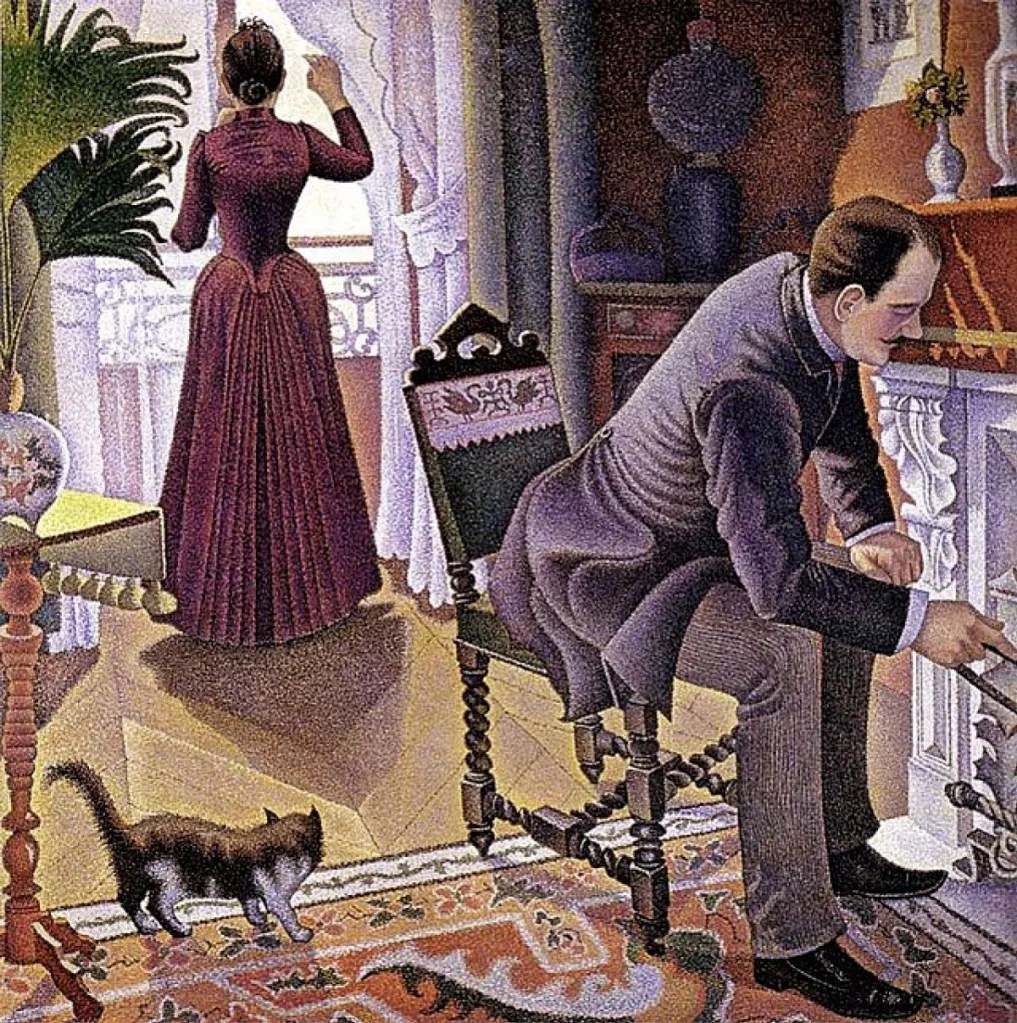
A Sunday, Opus 201 (1888–90) by Paul Signac. Private collection
Chahut
This tendency comes to a climax in the biggest painting on display here, given more or less its own room and space, the enormous ‘Chahut’ by Seurat from 1890.

Le Chahut by Georges Seurat (1889-90) © Collection Kröller-Müller Museum, Otterlo, the Netherlands
The curators have a lot to say about this, for example that it was one of what he called his toiles de luttes meaning ‘battle canvases’. In other words it was intended to be a provocative rallying cry to his movement, a manifesto pictures. In addition, it is intended to be socially subversive or an attack on late-Victorian sexual morality, in that it depicts the ‘chahut’ or ‘can-can’– then the most risqué dance performed in Parisian café-concerts.
All this is no doubt true but surely the obvious thing about this painting is that it’s a cartoon. It’s left reality far behind in order to become something like an illustration in the funny papers. Surely Seurat’s obsession with form and pattern, instead of taking us towards some deeper spiritual reality, in fact takes us away from reality altogether into a realm of caricature and comic illustrations?
(I’ve just visited the Courtauld Gallery where I saw another egregious example of this tendency, Seurat’s Young Woman Powdering Herself from 1890. This is a comical picture, isn’t it? Surely you can’t possibly take it seriously.)
Ladies on lawns
‘Chahut’ is given centre stage in the exhibition but it is in almost all ways an anomaly, an exception. The next room in the show, the one about depicting the bourgeois world, is far more characteristic. As well as the two Signac interiors I’ve mentioned, there are more classically open-air Neo-Impressionist works. The largest and maybe most representative is ‘In July, Before Noon’ by Théo van Rysselberghe, from the same year as Signac’s cartoon music hall.

In July, before Noon, 1890 by Théo van Rysselberghe © Collection Kröller-Müller Museum, Otterlo, the Netherlands
The strengths and weaknesses of the style are obvious. It is superb at conveying not only the detailed light and shade of a sunny day out of doors in July but there is something about the women’s postures which is oddly formalistic and detached. The woman passing by at the back looks like a robot.
I thought I recognised it and, after some rummaging, confirmed that this image was used for the cover of an Oxford University Press edition of Anton Chekhov’s plays. It perfectly captures the late nineteenth century indolence of middle class ladies, arranged in vast folds of fabric and quietly going about their embroidery or needlework in a sunny French garden. Inside they may be seething with the frustrations of characters from Chekhov or Ibsen, but here, on the surface, all is luminous calm.
Neo-Impressionism and van Gogh
As I mentioned, the show includes one splendid van Gogh painting, ‘The Sower’ from June 1888. We know from his letters than van Gogh was interested by the Neo-Impressionists’ experiments with colour and form but he was never a member of the group, not close. ‘The Sower’ is here partly because, alongside the Neo-Impressionists, Kröller-Müller collected van Goghs. And partly to demonstrate the similarities and differences between them.

The Sower by Vincent van Gogh (June 1888) © Collection Kröller-Müller Museum, Otterlo, the Netherlands. Photographer: Rik Klein Gotink
The similarity lies in the radical simplification of the subject in order to focus on vibrant colour contrasts. Van Gogh juxtaposes all kinds of colours not seen together in nature (for example the insistent blue of the turned soil the sower is scattering his seed onto) in order to create his effects.
The difference is in two aspects of approach. The Neo-Impressionists took a calm, detached, almost scientific approach to their work, whereas all eye-witnesses describe van Gogh attacking his canvases in a fever of inspiration. And whereas the Neo-Impressionists famously used dots or dot-like dashes of pain, van Gogh notoriously squeezed out entire worms of paint onto his brush and applied them with slapdash inspiration. Which explains why the Neo-Impressionists’ canvases are almost flat while van Gogh’s canvases are thickly encrusted with gloops and whorls of paint whipping up from the surface like waves on a stormy sea.
Here’s a close-up of pointillist technique from George Lemmen’s Factories on the Thames from 1892.

Detail from ‘Factories on the Thames’ by George Lemmen (1892) (photo by the author)
And a close-up of van Gogh’s Sower.

Detail from The Sower by Vincent van Gogh (photo by the author)
Spot the difference.
Legacy
Google AI tells me that:
Neo-Impressionism’s legacy lies in its scientific approach to colour and form, which heavily influenced later movements like Fauvism, Cubism, Futurism, and Abstract Expressionism. By using optical science, the movement pioneered a new awareness of colour and laid the groundwork for modernist approaches to the flatness of the canvas and simplified geometric forms. This theoretical language and systematic technique offered a new foundation for artists, bridging the gap between Impressionism and the more radical movements of the 20th century.
Seurat at the Courtauld
If you like Seurat, you might be interested to know that the Courtauld Gallery will be hosting an exhibition about Seurat’s coast painting from February next year.
Related links
- Radical Harmony: Helene Kröller-Müller’s Neo-Impressionists continues at the National Gallery until 8 February 2026
- Kröller-Müller Museum website
 Books & Boots