Radical Harmony Helene Kröller-Müller’s Neo-Impressionists @ the National Gallery

This is a marvellous, informative, inspiring and illuminating exhibition. There are two interweaving aspects, threads or storylines which can be summed up by the questions:

  1. Who was Helene Kröller-Müller?
  2. What was Neo-Impressionism?

Who was Helene Kröller-Müller?

Helene Kröller-Müller (1869–1939) was one of the early 20th-century’s greatest art collectors. Born in Germany, she was the third child of Emilie Neese and the wealthy industrialist Wilhelm Müller, the founder of Wm H. Müller & Co, a trading company in iron and steel. As a child she was precociously intelligent and was given the best education money could buy.

In 1888 i.e. aged 19, she married the husband chosen for her by her father, one of his managers Anton Kröller, a Dutchman (and as you can see, she chose to amalgamate her maiden name with his), and the couple moved to Rotterdam where he was the Müller & Co branch manager. Just one year later, in 1889, Helene’s father died suddenly and Anton became director of the entire company at the tender age of 27. As his wife, Helene overnight became one of the richest women in the Netherlands.

Helene Kröller-Müller © Kröller-Müller Museum

To begin with Helene concentrated on bearing and raising the couple’s four children. But in 1906 she began (along with her eldest child) to study art under painter Henk Bremmer. Given her fortune, he suggested she not only study but begin collecting artworks. Thus began the process which was to lead to her amassing one of the greatest collections of modern art ever created.

Far ahead of her time, she was one of the first to recognise the genius of van Gogh and eventually owning 90 of his paintings.

But from 1912 she began accumulating what would grow into the greatest single collection of Neo-Impressionist art anywhere, often purchasing directly from the artists.

In 1913, in the tradition of philanthropic multimillionaires, she decided to make her collection available to the public and commissioned the building of a modern art gallery by Belgian Neo-Impressionist turned architect Henry van de Velde (1863 to 1957). With its top-lit, white-walled galleries and later, its white picture frames, the gallery set a new tone and became influential in its own right.

The Kröller-Müller Museum opened in parkland near Otterlo in 1938, a year before Helene’s death. By then, her collection numbered around 11,500 works. And you can still visit it today.

This lovely exhibition features 50 or so Neo-Impressionist paintings from the Kröller-Müller Museum along with some from the National gallery and other UK collections and some from private collections to make up one of the largest exhibitions of Neo-Impressionist painting ever seen in the UK.

What is Neo-Impressionism?

The internet tells us that:

Neo-Impressionism is a style of painting, pioneered by Georges Seurat, that uses a scientific approach to colour by applying small, distinct dots of pure colour to the canvas. These dots are intended to blend in the viewer’s eye when seen from a distance, creating more vibrant and luminous effects than traditional mixing methods. The technique was quickly adopted by a surprising number of other artists, notably a member of the previous generation, the impressionist Camille Pissarro. The technique is often referred to as pointillism.

1. Colour

Seurat’s innovative painting technique had its roots in the well- established theory that opposing colours on the colour wheel – yellow and violet, orange and blue, red and green – make each other appear more vivid when juxtaposed. And at the start the exhibition features a classic colour wheel of the kind Seurat would have been familiar with to demonstrate the theory.

Through experiment and research into scientific and optical theory, Seurat determined that even greater luminosity could be achieved if pure colours remained unmixed and were applied in small touches placed side by side – the dots or points in French that led Neo-Impressionism to be popularly known as Pointillism.

Collioure, the Belltower, Opus 164 by Paul Signac (1887) © Collection Kröller-Müller Museum, Otterlo, the Netherlands. Photographer: Rik Klein Gotink

2. Structure

But this exhibition emphasises that, just as important as colour and dots, was its insistence on form and structure and line.

Neo-Impressionism rejected the spontaneity of Impressionism in favour of a more methodical and formal structure.

The Neo-Impressionists aimed to produce pictures that transcended reality, creating radically simplified compositions that captured the essence of what they aimed to depict, attaining harmony through colour and geometry.

Adopters of neo-impressionism

The movement was introduced to the public in 1886 when Georges Seurat exhibited his work ‘A Sunday on La Grande Jatte‘ at what was to prove the final Impressionist exhibition. If the exhibition heralded the end of Impressionism it heralded the genesis of Neo-Impressionism which was to become one of the first modern pan-European art movements

I knew that a very early adopter of Seurat’s method, who went on to popularise and create masterpieces using it, was Paul Signac (1863 to 1935). Signac worked out that the careful juxtaposition of separate dots of pure colour would fuse in the eye, making the surface of the canvas appear to shimmer and realising how the effect was ideally suited to capturing glowing light in landscape.

But the exhibition also includes works by many others who quickly adopted Seurat’s invention. The artists included in the exhibition are:

  • Georges Seurat
  • Paul Signac
  • Henri-Edmond Cross
  • Anna Boch
  • Maximilien Luce
  • Théo van Rysselberghe
  • Camille Pissarro
  • Jan Toorop
  • Lucien Pissarro
  • Henry van de Velde
  • Georges Lemmen
  • Johan Thorn Prikker

There is also one stunning work by Vincent van Gogh (see below), who was interested in the movement and made his own experiments in juxtaposing dashes of pure colour, but was completely different in his approach – as far from the scientific precision of Seurat and Signac as imaginable.

International spread

One of the early converts, Théo van Rysselberghe (1862 to 1926), invited members of the group to exhibit at the avant-garde artistic society Les XX (The Twenty) in Brussels, prompting the international dissemination of neo-impressionism. Hence the exhibition includes works by French, Belgian and Dutch artists.

Negative criticism

As usual, the critics hated it. One critic declared it was the end of painting as we know it in the sense of finished images with invisible brushstrokes (there’s always one).

Another, subtler, criticism, was that the technique lent itself very well to open air landscapes, especially good at capturing the sense of spacious light you experience by the sea, but was unable to depict the human figure as acutely as traditional painting.

Luminous

The many examples here show that the technique does indeed lend itself to landscapes and especially seascapes. The first and last (seventh) room, each contain half a dozen or more luminous landscapes, which definitely demonstrate the Signac ‘shimmer’, conveying a wonderful sense of light and air, with a popular subject being the Brittany coast.

The Channel of Gravelines, Grand Fort-Philippe by Georges Seurat (1890) © The National Gallery, London

You can see in this painting that the Neo-Impressionists often extended the use of the dot technique beyond the subject itself to decorate the edges of their paintings and even the frames.

Political ideals and ironies

Many of these artists held radical political views. They were anarchists or utopian communists (something which attracted the much older impressionist, Camille Pissarro, who was also an anarchist sympathiser, to support and champion them). Thus the exhibition devotes a room to their supposedly political works.

These are depictions of the lives and landscapes of people perceived to be of the exploited classes, be they rural labourers or urban workers. Most of these are in a pleasingly bucolic setting so have a Thomas Hardy feel. Some are more realistic and evoke Emile Zola’s more gritty Naturalism, like the pair of paintings by Jan Toorop which depict a peasant family preparing for a strike and then (in painting 2) carrying the body of the husband who looks like he’d been killed in the police violence which accompanied the strike.

Morning (after the Strike) by Jan Toorop (1888-90) © Collection Kröller-Müller Museum, Otterlo, the Netherlands. Photographer: Rik Klein Gotink

Anarchists championed the ideal of ‘harmony in autonomy’ in which non-exploitative self-government and harmony with nature were fundamental principles. The artists directly associated political harmony with the harmony they were seeking through their sophisticated colour experiments. Harmony in art was the direct corollary of the harmony in politics which they sought.

The most striking work in this room is also the most ironic. This is The Iron Foundry painted by Maximilien Luce quite late in the movement’s history, in 1899. If you go up close you can see the careful, scientific application of the famous dots. But if you step back, obviously what you see are two things: 1) the dynamic composition, with striking contrast between the areas of darkness and the bright red-white coming off the furnace; and, equally important for the Neo-Impressionists, 2) the lines or patterns created by the men’s leaning or bending figures. Line, outline, angles and composition are as important an element of Neo-Impressionism as the dots.

The Iron Foundry by Maximilien Luce (1899) © Collection Kröller-Müller Museum, Otterlo, the Netherlands. Photographer: Rik Klein Gotink

What’s ironic is the way all these artists railed against big business’s capitalist exploitation of the workers and yet these works were eagerly snapped up by the fabulously wealthy wife of… just such a rich capitalist 🙂 To quote the curators:

Kröller-Müller bought this picture directly from Luce in 1922 and it was without any apparent sense of irony that for many years it hung in the office of her husband, Anton Kröller, who ran the family’s iron ore and shipping business.

Portraits

On the face of it Neo-Impressionist theory militated against the whole concept of individual portraits. The traditional expectation that a portrait should capture a specific likeness lay at odds with the Neo-Impressionist principle that harmony in art should be achieved through a generalised distillation of form.

But it didn’t stop them trying and producing numerous very striking portraits. Théo van Rysselberghe, in particular, made a living from commissions to paint the wealthy, progressively-minded supporters of the new art, and the group’s portraits document the group’s highly cultured and politically engaged patrons, families and friends.

By far the most striking is Théo van Rysselberghe’s full-length portrait of his wife, the writer Maria Monnom standing in their fashionable home.

Portrait de Maria Van Rysselberghe-Monnom by Théo Van Rysselberghe (1892) © Collection Kröller-Müller Museum, Otterlo, the Netherlands

Interestingly, the work drew criticism from fellow members. Despite the picture’s shimmering surface of dots, Van Rysselberghe’s reliance on local (natural) colours, such as the orange of Maria’s dress, led Signac to later criticise his friend’s lack of adherence to the rigours of Neo-Impressionist theory.

Drawings

The portraits room includes striking paintings like the woman in orange and a woman seated at a piano but it also contains a couple of marvellous drawings. These are interesting for showing that the technique worked perfectly well without any colour at all. Here’s a quite dazzling portrait of Jan Toorop by Georges Lemmen done using conté crayons.

Jan Toorop by Georges Lemmen (1886) © Museum de Fundatie, Zwolle en Heino/ Wijhe the Netherlands

Caricature

But the portrait room also crystallised a feeling I had, that all this focus on lines and digging below the visible reality to find the ideal forms, created what I began to think of as simplified, almost cartoonish outlines of people, a noticeable tendency towards caricature in which settings, people and faces are simplified and exaggerated.

You can maybe see this tendency in the progression of two paintings by Signac in the room which is ostensibly about the painters’ depictions of bourgeois life. Here’s the first one, The Dining Room, completed in 1887.

The dining room, Opus 152 by Paul Signac (1886/1887) © Collection Kröller-Müller Museum, Otterlo, the Netherlands

The curators inform us that Signac used his own grandfather, mother and the family housekeeper as models for this work, and that the piece is a satire on the stifling atmosphere of the typical middle-class suburban household, pointing out how each figure appears entirely self-absorbed, no to say stifled.

This is all true but I’d add that surely the painting also brings out the tendency within the technique of Neo-Impressionism to conceive of humans as forms, as collections of lines and shapes? A tendency which leads them to seem like self-contained, autonomous units which have no interaction – monads, mannequins. And that many of these images have a heavy tendency towards caricature.

All of which is even more true of its sequel, Sunday, completed in 1890. The dot technique is immaculate. And Signac has included in the composition many more firm, defined outlines. But surely this proves my point, that the more defined these lines and form become, the more cartoon-like the overall image.
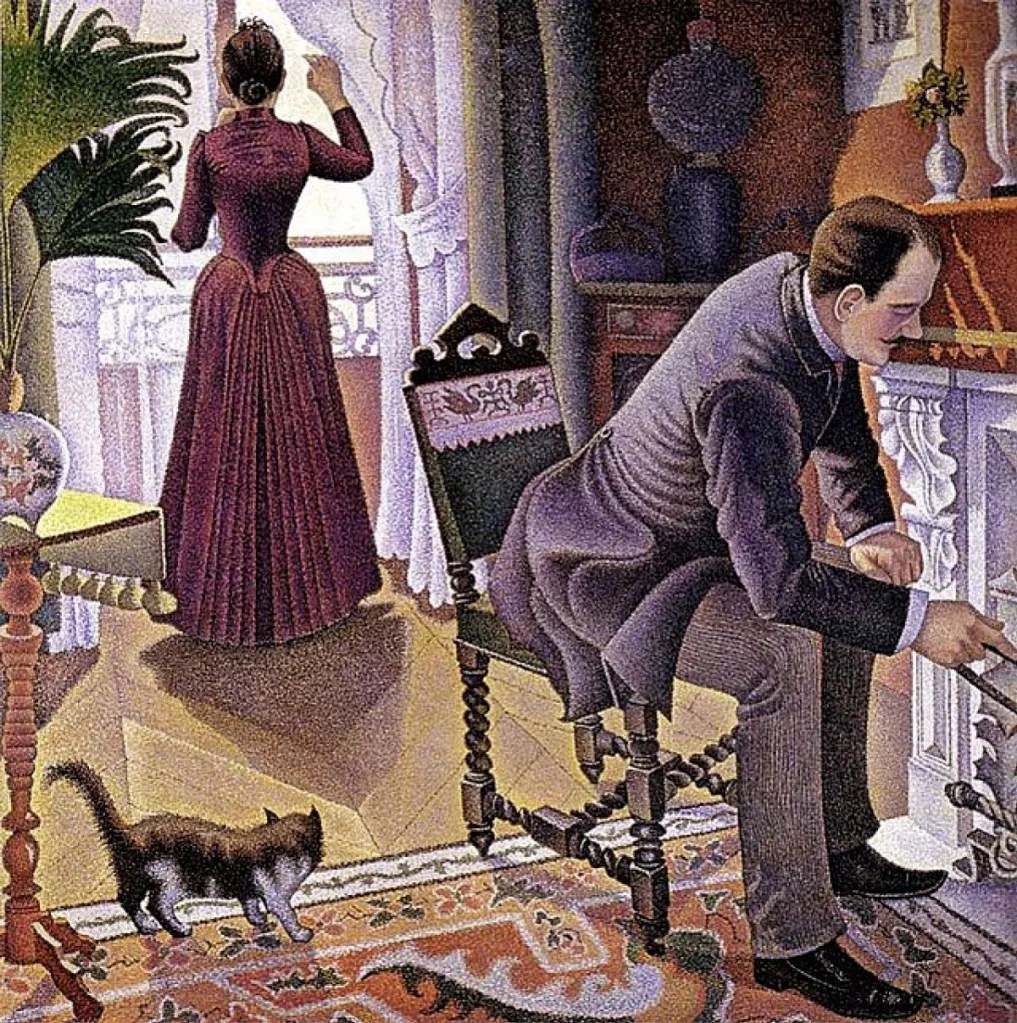
A Sunday, Opus 201 (1888–90) by Paul Signac. Private collection

Chahut

This tendency comes to a climax in the biggest painting on display here, given more or less its own room and space, the enormous ‘Chahut’ by Seurat from 1890.

Le Chahut by Georges Seurat (1889-90) © Collection Kröller-Müller Museum, Otterlo, the Netherlands

The curators have a lot to say about this, for example that it was one of what he called his toiles de luttes meaning ‘battle canvases’. In other words it was intended to be a provocative rallying cry to his movement, a manifesto pictures. In addition, it is intended to be socially subversive or an attack on late-Victorian sexual morality, in that it depicts the ‘chahut’ or ‘can-can’– then the most risqué dance performed in Parisian café-concerts.

All this is no doubt true but surely the obvious thing about this painting is that it’s a cartoon. It’s left reality far behind in order to become something like an illustration in the funny papers. Surely Seurat’s obsession with form and pattern, instead of taking us towards some deeper spiritual reality, in fact takes us away from reality altogether into a realm of caricature and comic illustrations?

(I’ve just visited the Courtauld Gallery where I saw another egregious example of this tendency, Seurat’s Young Woman Powdering Herself from 1890. This is a comical picture, isn’t it? Surely you can’t possibly take it seriously.)

Ladies on lawns

‘Chahut’ is given centre stage in the exhibition but it is in almost all ways an anomaly, an exception. The next room in the show, the one about depicting the bourgeois world, is far more characteristic. As well as the two Signac interiors I’ve mentioned, there are more classically open-air Neo-Impressionist works. The largest and maybe most representative is ‘In July, Before Noon’ by Théo van Rysselberghe, from the same year as Signac’s cartoon music hall.

In July, before Noon, 1890 by Théo van Rysselberghe © Collection Kröller-Müller Museum, Otterlo, the Netherlands

The strengths and weaknesses of the style are obvious. It is superb at conveying not only the detailed light and shade of a sunny day out of doors in July but there is something about the women’s postures which is oddly formalistic and detached. The woman passing by at the back looks like a robot.

I thought I recognised it and, after some rummaging, confirmed that this image was used for the cover of an Oxford University Press edition of Anton Chekhov’s plays. It perfectly captures the late nineteenth century indolence of middle class ladies, arranged in vast folds of fabric and quietly going about their embroidery or needlework in a sunny French garden. Inside they may be seething with the frustrations of characters from Chekhov or Ibsen, but here, on the surface, all is luminous calm.

Neo-Impressionism and van Gogh

As I mentioned, the show includes one splendid van Gogh painting, ‘The Sower’ from June 1888. We know from his letters than van Gogh was interested by the Neo-Impressionists’ experiments with colour and form but he was never a member of the group, not close. ‘The Sower’ is here partly because, alongside the Neo-Impressionists, Kröller-Müller collected van Goghs. And partly to demonstrate the similarities and differences between them.

The Sower by Vincent van Gogh (June 1888) © Collection Kröller-Müller Museum, Otterlo, the Netherlands. Photographer: Rik Klein Gotink

The similarity lies in the radical simplification of the subject in order to focus on vibrant colour contrasts. Van Gogh juxtaposes all kinds of colours not seen together in nature (for example the insistent blue of the turned soil the sower is scattering his seed onto) in order to create his effects.

The difference is in two aspects of approach. The Neo-Impressionists took a calm, detached, almost scientific approach to their work, whereas all eye-witnesses describe van Gogh attacking his canvases in a fever of inspiration. And whereas the Neo-Impressionists famously used dots or dot-like dashes of pain, van Gogh notoriously squeezed out entire worms of paint onto his brush and applied them with slapdash inspiration. Which explains why the Neo-Impressionists’ canvases are almost flat while van Gogh’s canvases are thickly encrusted with gloops and whorls of paint whipping up from the surface like waves on a stormy sea.

Here’s a close-up of pointillist technique from George Lemmen’s Factories on the Thames from 1892.

Detail from ‘Factories on the Thames’ by George Lemmen (1892) (photo by the author)

And a close-up of van Gogh’s Sower.

Detail from The Sower by Vincent van Gogh (photo by the author)

Spot the difference.

Legacy

Google AI tells me that:

Neo-Impressionism’s legacy lies in its scientific approach to colour and form, which heavily influenced later movements like Fauvism, Cubism, Futurism, and Abstract Expressionism. By using optical science, the movement pioneered a new awareness of colour and laid the groundwork for modernist approaches to the flatness of the canvas and simplified geometric forms. This theoretical language and systematic technique offered a new foundation for artists, bridging the gap between Impressionism and the more radical movements of the 20th century.

Seurat at the Courtauld

If you like Seurat, you might be interested to know that the Courtauld Gallery will be hosting an exhibition about Seurat’s coast painting from February next year.


Related links

Related reviews

Impressionists on Paper: Degas to Toulouse-Lautrec @ the Royal Academy

This exhibition in is in the smaller set of three rooms at the back of the Royal Academy building i.e. it’s more of an amiable stroll through three rooms of relatively small drawings, rather than, say, the full-on assault course of the 11 big rooms of the extraordinary Marina Abramović show.

It does what it says on the tin, brings together 80 or so works by all the famous Impressionist and post-Impressionist artists plus quite a few I’d never heard of before, experimenting with different media on paper.

Exhibitions need an aim or project and this one aims to explore how Impressionist and Post-Impressionist artists in late 19th-century France didn’t just use paper works as studies but radically transformed the status of works on paper. Previously, drawings were mostly conceived as preparations for paintings; in the hands of the Impressionists drawings, pastels, watercolours, temperas and gouaches were increasingly perceived as more than just preparatory techniques, and became autonomous works of art, claiming a shared aesthetic with painting.

Dancer Seen from Behind by Edgar Degas (c. 1873). Essence (diluted oil paint) on prepared pink paper. Collection of David Lachenmann

Who are we talking about? The eye-catching famous artists are: Mary Cassatt, Paul Cézanne, Edgar Degas, Paul Gauguin, Eva Gonzalès, Claude Monet, Berthe Morisot, Camille Pissarro, Odilon Redon, Pierre-Auguste Renoir, Georges Seurat, Henri de Toulouse-Lautrec and Vincent van Gogh.

Less well known are the likes of Albert Lebourg, Jacques Emile-Blanche, Armand Guillaumin, Frederico Zandemeneghi.

Impressionists recap

As the curators explain:

The avant-garde artists known as the Impressionists came to prominence during the late 1860s and early 1870s, first exhibiting in Paris as a group in 1874. They shared a concern to depict scenes from everyday life and to address contemporary issues, which encouraged them to challenge traditional attitudes to drawing and seek innovation. Vivid colour, a quick, loose touch, and daring viewpoints, together with a deliberate lack of finish, were their means of capturing the fugitive effects of nature as well as vignettes of modern life.

The portability of drawing materials greatly facilitated direct observation and the recording of scenes on the spot. The eight Impressionist exhibitions, held in Paris between 1874 and 1886, included a large number of works on paper and reflected their shift in status. This was also encouraged by dealers who recognised the economic advantage of exhibiting and selling works on paper.

Cliffs at Etretat: The Needle Rock and Porte d’Aval by Claude Monet (c. 1885). Pastel on wove paper. National Galleries of Scotland

What it’s like

The most striking thing, for me, was how the drawings faithfully echo the style of each artist’s paintings i.e. the way each of the artists have strong signature styles or vision no matter what medium they’re working in.

So you see a hazy landscape of cliffs by the sea and instantly know it’s Monet; charcoal images of ballet dancers posed at striking angles and know its Degas; a round-faced woman’s face smiling at some outdoors dance and know it’s Renoir; a grotesque, angular woman in an urban setting and you know it’s Toulouse-Lautrec; a light and airy landscape made out of cubes and rectangles of colour and you know it’s Cezanne.

So you can play an entertaining game of standing far away from the wall to try and identify the artist by their style, then stroll over to the wall label to find out if you were correct. For example, who would you think this is by?

Portrait de Marie-Thérèse Gaillard by Mary Cassatt (1894) Pastel on paper. Private collection. Photo © 2007 Christie’s Images Limited

In this case it’s a trick question. You might have thought Renoir, from the treatment of the face, but it is in fact by Mary Cassatt. Note the striking difference in finish between the face – expertly and completely rendered – and the clothes, rendered in a completely different, hurried, unfinished style, with the background wall hovering somewhere between the two.

What I liked

The most striking work in room 1 is the Portrait of Madame Henri Wallet by Jacques Emile-Blanche simply because of its size. It’s a John Singer Sargent-style and sized portrait of an elegant society woman, and so stands out in a room full of much smaller, much more hazy and impressionistic images.

Degas sketched and drew things around him so compulsively that his colleagues nicknamed him Monsieur Pencil and, appropriately, there are more works by him in this exhibition than any other  artists, 12 in total, all of which I liked.

I love sketches and drawings, I love art which is half-finished, ghostly, hinting at a half-grasped reality, which is why I’ve always loved Degas’ strange and mysterious Woman at a Window (1871), which used to be tucked away in a side room at the Courtauld Gallery. Here it is presented in all its pregnant mystery and an epitome, for me, of the power of paintings or drawings which are better left unfinished, full of hints and implication.

But I’d forgotten, if I ever knew, about Degas’s friend Frederico Zandemeneghi (1841 to 1917). Zandemeneghi was invited by the Impressionists to exhibit at four of their 8 exhibitions. He was particularly close to Degas. They shared an interest in depicting scenes of modern life featuring women subjects, seen from unconventional viewpoints, often cropping the image unexpectedly, and using vibrant colourful pastels.

This example has several of those characteristics in spades, namely the dramatic cropping which makes the subject feel really close-up and in your face. And the very bright colours, blue, yellow, orange, red, making the most of the range of human sight.

Study of a Woman from Behind by Federico Zandomeneghi (1890 to 1897) Pastel on cardboard. Galleria D’Arte Moderna, Milan. Photo © Comune di Milano

The show is in chronological order, starting with works from the 1870s. Room 2 contains works from the 1880s. The highlight for me was van Gogh’s ‘The Fortifications of Paris with Houses’ from 1887, made from a combination of graphite, chalk, watercolour and gouache. This reproduction in no way conveys the glowing brightness of the original. Then I liked the contrast between the architecturally accurate apartment block on the left and the vague ‘impressionistic’ grass in the foreground. Then I noticed the way the big fortification wall is not made of bricks but of hundreds of vertical dabs of orange and grey. And then I noticed the ghostly couple walking past in the foreground, ghosts of the millions of people who lived and died in the great cities of Europe, leaving barely a trace of chalk on paper. At which point I realised that there’s a kind of spectrum of solidity, from the super-solid apartment blocks on the right, to the more dabbed and impressioned fortifications themselves, and then to the human beings, the least permanent or impactful things in the picture or in history, hundreds of millions of us leaving less trace than walls or buildings.

The Fortifications of Paris with Houses by Vincent van Gogh (1887) Graphite, black chalk, watercolour and gouache on paper. The Whitworth, The University of Manchester. Photo by Michael Pollard

The exhibition concludes in room 3 with works from the 1890s and 1900s, which saw an ever-growing appreciation of works on paper and a proliferation of exhibitions of the medium. There’s a lot more Degas who emerges as probably the strongest and most consistent artist on paper. Off in one corner is a set of quiet, thoughtful, washed-out watercolours by Cézanne from late in his career. At the opposite corner of the room, both literally but also in terms of subject matter is a small set of three vivid, scratchy, angular images of the louche underworld of Montmartre by Toulouse-Lautrec.

But floating above this world of human troubles is the work I liked the best, a classic of what, during the 1890s came to be known as Symbolist art, the wonderful, visionary ‘Ophelia among the flowers’ by Odilon Redon.

Ophelia Among the Flowers by Odilon Redon (1905 to 1908) Pastel. The National Gallery, London

The Impressionists were trying to capture the truths of the modern world, applying light quick touches to capture the fleeting moment. Redon, by complete contrast, sought out ‘the light that never was on land or sea’, depicting images from the inner world of fantasy and dream. So I thought he was pretty out of place in an exhibition of impressionists. But his inclusion makes sense if we forget the exhibition’s main title for a moment and think of it more as a study of the evolution of drawing and painting on paper in France from the 1870s to the 1900s. From that perspective the inclusion of Redon makes sense for his technical prowess. The flowers are obviously the dominant element in the work, but after a while you realise that it’s the peculiar quality of the light in the top middle and right of the image which give it its haunting, apocalyptic quality.

Consequences

According to the curators:

The French avant-garde artists’ interest in drawing and the remarkable range of their production had far-reaching consequences. The hierarchical distinction made between painting and drawing ceased to exist. Freedom of execution and a laissez-faire attitude to materials provided an impetus that allowed the world to be depicted in more imaginative ways, leading to developments in 20th-century art such as Abstract Expressionism.

So as we progress through the works in chronological order, we are not just witnessing the development of visual styles, generally away from figurativism and towards greater abstraction, but the evolution of the medium of drawing itself, as it prepares for the great lift-off of modern art at the start of the twentieth century.

It’s not all masterpieces. Some are not-great early works (for example, by van Gogh or Gauguin) which are of largely scholarly interest, others are wishy-washy landscapes which are a bit meh (Armand Guillaumin). But overall it’s a lovely civilised way to spend an hour, enlivened by a regular stream of masterpieces. It’s worth visiting just to see the 12 Degas works and the 3 or 4 pieces by Frederico Zandemeneghi and the van Gogh. But other visitors will find other works to marvel at and cherish.

Dancers on a Bench by Edgar Degas (around 1898) Pastel on tracing paper © CSG CIC Glasgow Museums Collection


Related links

Related reviews

Inventing Impressionism @ The National Gallery

Popular

This is the biggest exhibition of Impressionist art in London for 20 years. It was packed. There was a long queue well before it opened at 10am and by 11am it was difficult to see the paintings without people in the way.

The commentary, booklet, audioguide and wall panels all emphasised how revolutionary Impressionism was and what a complete break it represented with official French Salon art (all true enough – there was some dull pre-Impressionist art here to compare it with). But nothing really addressed the more obvious point: why is Impressionist art so incredibly popular today? Why are paintings, once ridiculed as the inept daubs of idiots and incompetents, now sold for tens of millions and plastered over countless chocolate box lids, calendars, posters etc?

Is it because: Impressionist art is colourful and naive, it doesn’t require a knowledge of classical myth or history, it doesn’t depict the intimidatingly rich and powerful, and it is mostly set in a generalised rural idyll – sunshine on fields of poppies and ponds full of lilies? Because it is an escape from anything solid, defined, intellectual or demanding?

Pierre-Auguste Renoir Two Sisters (On the Terrace), 1881 Oil on canvas 100.4 x 80.9 cm The Art Institute of Chicago, Mr. and Mrs. Lewis Larned Coburn Memorial Collection 1933.455 © The Art Institute of Chicago, Illinois

Two Sisters (On the Terrace) (1881) by Pierre-Auguste Renoir © The Art Institute of Chicago

Paul Durand-Ruel

The show isn’t actually about Impressionism the art movement: it is about one man – the Paris art dealer Paul Durand-Ruel. A pretty convincing case is made for him being the inventor or godfather of Impressionism, the man who bought up the early works of all the major Impressionists, as well as organising one-man shows for the artists, opening galleries in Paris and later, America, to showcase their works, paying the poorer ones salaries to allow them to work, whose efforts pretty much single-handedly enabled many of the painters to survive and flourish, who helped to create the narrative that Impressionism is the founding movement of Modern Art and who, along the way, invented many of the methods which underpin the modern art market. A really impressive achievement.

Thus the first room features large wall-size photos of Durand-Ruel’s living room in Paris, liberally hung with the great paintings he owned, and the curators have tried to reunite as many of these paintings as possible in order to recreate the scene. Similarly, the last room contains photos of the key 1905 Grafton exhibition in London and, again, the curators have tried to hang a lot of paintings from that exhibition in the same space.

This exhibition is not a history of the theory or practice of Impressionism. It is about how one man more than any other spotted it, identified it, funded and sustained it, marketed and promoted it, defined and made it what we think it is today.

Paul Durand-Ruel and the Modern Art Market

To quote the guide, when Durand-Ruel took over his father’s art dealership in 1865 he immediately began applying the techniques of high finance: he found backers and partners for his purchases, sought exclusivity deals, worked to push up prices at auction and brought his product before the public at carefully staged group and one-man shows.

For example, when he was introduced to Manet in his studio, he bought all the available paintings on the spot – 23 paintings in one day – for 35,000 francs (nearly 40 times the pay of the average French worker). By cornering the market (in admittedly unpopular artists) he realised he could leak them onto the market at inflated prices.

I didn’t like any of the Manets on display here – Moonlight at the Port of Bolougne or The Battle of the USS Kearsarge and the CSS Alabama. The audio commentary itself pointed out there is something wrong with the perspective and details of the still life The SalmonMusic in the Tuileries Gardens (1862) looks, to me, cramped and badly composed, excessively black and, when you look closely, really badly painted.

Edouard Manet, Music in the Tuileries Gardens (1862) The National Gallery, London, Sir Hugh Lane Bequest, 1917 © The National Gallery, London

Music in the Tuileries Gardens (1862) by Edouard Manet © The National Gallery, London

The one-man show

In 1883 Durand-Ruel pioneered the idea of the one-man art show, staging a series of month-long, solo exhibitions by Boudin, Monet, Renoir, Pissarro and Sisley. He ensured they were retrospectives i.e. showed the progression or evolution in the artist’s style, and accompanied the shows with advertising campaigns, provided images for the Press to print and publicise, and hosted lavish private views to encourage wealthy buyers.

Selling the ‘series’

This led naturally to collaboration with Monet on his ‘series’ paintings i.e. when Monet set about painting series of versions of the same subject. One of the first was the Poplar Series, 24 canvases of a set of poplar trees on the bend in the Epte river. In February 1892 Durand-Ruel displayed 15 of them in his gallery, facilitating their critical reception and their sale. Five of Monet’s poplar paintings are brought together here, in one of those recreations beloved of curators.

30 years ago I hitch-hiked to Rouen just to see the facade of the cathedral which Monet had painted in a series of paintings which I worshipped as a schoolboy. The paintings magically capture the imposing Gothic architecture in the differing light of different times of day. But now, all the poplar tree paintings in this exhibition left me cold. Either I’ve changed or this poplar series is just not as good. The reproduction below makes the source painting seem much smoother and more finished than it is in real life. In the flesh all the poplar paintings seemed to me lumpy and bumpy and unconvincing.

Claude Monet, Poplars in the Sun (1891) The National Museum of Western Art, Matsukata Collection, Tokyo P.1959-0152 © National Museum of Western Art, Tokyo

Poplars in the Sun (1891) by Claude Monet © National Museum of Western Art, Tokyo

Apart from all the other factors – could the enduring popularity of the Impressionists have something to do with the fact that the reproductions – in posters, calendars, chocolate boxes, biscuit tin lids etc – render small and smooth and seamless images which, when seen in the flesh, and much much larger, are surprisingly pock-marked and blodgy?

Bad paintings

In fact, the show contains an unusually large number of bad paintings. I certainly learned a lot about Durand-Ruel and the birth of art marketing, but an unintended outcome of the show was to make me feel quite a lot of sympathy for the early critics of Impressionism. Quotes from these poor benighted souls are printed large on the walls and included in the wall panels for our derision: what philistines! How could they not recognise the shimmering wonders of Monet’s water lilies?

Well, because a lot of the recognised masterpieces of Impressionism weren’t created for another 10, 20 or 30 years after the critics wrote these words. All the critics could do was react to the paintings put in front of them in 1872, 1874, 1876 – and, as this exhibition conclusively proves, a lot of these were genuinely poor, in terms of composition and technique.

Even the audioguide admitted that at first glance Green Park, London by Claude Monet looks so bad it might have been painted by a child. Hanging Out The Laundry To Dry (1875) by Berthe Morisot: is this not an amaterush ‘daub’? I thought I was an unquestioning fan of Dégas – the show features the fabulous Miss La La at the Cirque Fernando and a number of so-so ballet studies – but this show revealed how many bad and awkward paintings he made, as well: Horses before the stands may be famous but I find it gawky and unappealing; and surely Peasant Girls Bathing In The Sea At Dusk is just really bad.

Hilaire-Germain-Edgar Degas, Peasant Girls bathing in the Sea at Dusk (1869-75) Private Collection, Ireland © Photo courtesy of the owner

Hilaire-Germain-Edgar Degas, Peasant Girls bathing in the Sea at Dusk (1869 to 1875) Private Collection, Ireland © Photo courtesy of the owner

The final room is dominated by a full length portrait of Eva Gonzalès, herself an artist, by Manet (1870). I’ve been spoilt by recently visiting exhibitions of portraits by John Singer Sargent and beautiful late-Victorian female portraiture at the Leighton House Museum – in comparison with those artists, I thought this was a poor painting

Nineteenth century France reviews

look at the face, the heart of any portrait, look at those bug eyes.

Nonetheless, Eva Gonzalès starred in a ground-breaking exhibition Durand-Ruel organised at the Grafton Galleries in London in 1905. It was curated with his usual entrepreneurial flair, arranged to tell the story of how the movement evolved from tentative early steps, then burst into maturity with masterpieces by Dégas, Morisot, Pissarro, Renoir et al.

The 1905 show had far-reaching influence in this country, helping to popularise the loose sunlit approach to subject matter and style, and establishing Impressionism as the forebear of all Modern Art. I know people who not only loathe Impressionism but hate the way its continuing dominance overshadows far more interesting developments which took place in other European countries, specifically Germany and Scandinavia.

Good paintings

I found a lot of the Impressionist works on display here surprisingly poor. Many of them really did look like the unfinished daubs contemporary critics castigated. But with around 80 paintings on show, there were, of course, plenty of others which are a joy to see.

I think Renoir emerged as the most consistent artist here: he crystallised his vision early on and thereafter poured forth an apparently limitless number of chocolate box people in sunny settings. His Parisians socialising in the open air, his portraits of smiling women and children, his dancing couples, all have an indisputable joie de vivre to them.

Pierre-Auguste Renoir, Dance at Bougival (1883) Museum of Fine Arts, Boston. Picture Fund © 2014 Museum of Fine Arts, Boston

Pierre-Auguste Renoir, Dance at Bougival (1883) © 2014 Museum of Fine Arts, Boston

Impressionism was about taking the train out of Paris to the still-unspoilt suburbs with newly-available tubes of ready-mixed oil paints, and painting in the open air, and so there are a lot of depictions of Paris’s suburbs, maybe touched with slight signs of industrialism, with railway bridges or distant factory chimneys. Not too much, though.

This work by Sisley, daub or not? Does the light airy sunlit feel compensate for the lack of finish and draughtsmanship? Does the blue sky compensate for the bridge looking wonky? I like clear lines and solid draughtsmanship so, for me, No. For other people, who respond to the overall feel and warm impression an image evokes in them, well, Yes.

Sisley, Alfred, The Bridge at Villeneuve-la-Garenne (1872) Lent by The Metropolitan Museum of Art, Gift of Mr. and Mrs. Henry Ittleson Jr., 1964 © The Metropolitan Museum of Art, New York

The Bridge at Villeneuve-la-Garenne (1872) by Alfred Sisley © The Metropolitan Museum of Art, New York

And there were plenty of blurry landscapes by Pissarro or Monet, including several old favourites which are part of the National Gallery’s regular collection, a number depicting London during the artists’ exiles here to escape the catastrophic Franco-Prussian War (1870 to 1871). Easy-going nostalgic reminders of what London looked like in the halcyon fantasy-land these artists created and which so many of us hearken back to.

Camille Pissarro, The Avenue, Sydenham (1871) The National Gallery, London, Bought, 1984 © The National Gallery, London

The Avenue, Sydenham (1871) by Camille Pissarro © The National Gallery, London

What I liked

Ezra Pound said that, at the end of the day, all a critic can do is point at something and say ‘I like that’ and then attempt to explain why. I was surprised how many of the paintings on display here I actively disliked. It was a genuine revelation how poor some of the paintings by all these famous names turn out to be.

More or less the only work I really liked – that I could imagine having in my house and seeing every day – was St Paul’s from the Surrey Side by Charles-François Daubigny (1817 to 1878), a predecessor of the Impressionists. Not a blue-skied escapist landscape but the big bad city under no illusions. Below is a dark and rather misleading reproduction of it; in the flesh it felt deeper and more evocative. It looks forward to Whistler‘s later impressions of London.

Though blurry, though painted en plein air, it still has an underlying accuracy of draughtsmanship and confidence of line which is what I enjoy in art and found missing in so many of the other paintings on show here.

Charles-François Daubigny St Paul's from the Surrey Side (1871-3) Oil on canvasThe National Gallery, London Presented by friends of Mr. J.C.J. Drucker, 1912 © The National Gallery, London

St Paul’s from the Surrey Side (1871 to 1873) by Charles-François Daubigny © The National Gallery, London

Could the success of the Impressionists not only be down to the fact that their paintings reproduce very well across the range of products and channels the twentieth century invented – but that their rivals and predecessors, the official Salon artists’ works, reproduce very badly, often looking as dark and dingy as the misleading reproduction above?

Promotional video


Related links

Reviews

Nineteenth century France reviews

Reviews of other National Gallery exhibitions

French artists during the Franco-Prussian War and the Commune (1870 to 1871)

I have written elsewhere about:

These combined calamities seared the minds of a generation of Frenchmen and marked a watershed in the lives and careers of many of France’s most famous writers, artists and composers. Considering who and how and why is like taking a snapshot of an artistic generation, an X-ray of a nation’s artistic soul:

Victor Hugo (1802 to 1885)

Best-selling author of The Hunchback of Notre-Dame (1831) and Les Misérables (1862), Hugo had spent the Second Empire period (1852 to 1870) in exile in Jersey. Now he returned to be elected a member of the National Assembly, make impassioned speeches, write windy pamphlets and publish bombastic poems. When the Commune was declared, he wisely went back into exile (in Brussels) where he wrote the moving poem, Sur une barricade, on June 11, 1871.

Honoré Daumier (1808 to 1879)

Satirical cartoonist under the Second Empire, Daumier stayed in Paris throughout the siege and continued to publish bitter and highly political images. He was drafted onto Courbet’s Federation of Artists in September 1870, then onto the Commune’s Committee of Artists in April 1871, though never a Communard.

Théophile Gautier (1811 to 1872)

An established poet and critic, Gautier made his way back to Paris upon hearing of the Prussian advance on the capital. He remained with his family there throughout the invasion and the aftermath of the Commune.

Jean Désiré Gustave Courbet (1819 to 1877)

A notorious radical and freethinker, Courbet was the hugely influential ‘Father of Realism’ in Art in France. He established a Federation of Artists when the Empire fell, and went on to set up a Committee of Artists under the Commune. Although he managed to save Paris’ art museums from looting mobs, Courbet was a moving force behind demolishing the Vendôme Column in the square of the same name. Once the Commune was crushed, Courbet was sentenced in September 1871 to six months in prison and a fine of 500 francs. When it was proposed to recreate the Vendôme Column Courbet was condemned to pay the exorbitant costs. He fled to Switzerland where he continued to paint, and died of liver disease just as the cost of the re-erection was settled as 323,091 francs. Surprisingly, he didn’t leave any paintings or sketches of the war or Commune.

Gustave Flaubert (1821 to 1880)

The most famous literary novelist of his day, during the Franco-Prussian War Flaubert’s home was occupied by Prussian soldiers and he suffered a nervous breakdown.

Maxime du Camp (1822 to 1894)

Literary journalist and travel writer, du Camp was elected a member of the French Academy in 1880 mainly due to his history of the Commune, Les Convulsions de Paris (1878 to 1880).

César-Auguste-Jean-Guillaume-Hubert Franck (1822 to 1890)

Organist and composer, Franck and his family suffered during the siege and Commune. Afterwards he was a leader of the movement to create a truly French art, an Ars Gallica which explains the tone of much of his music. In part this was a patriotic reaction against the heaviness of the music of the invader.

Camille Pissarro (1830 to 1903)

At the outbreak of war the painter Pissarro moved his family to Norwood, then a village on the southern edge of London. His early impressionist style did not do well but he met the Paris art dealer Paul Durand-Ruel in London, who helped sell his art for the rest of his life. Durand-Ruel put him in touch with Monet, who was also in London during this period.

(In the spring of 2015 the National Gallery put on a blockbuster exhibition of Impressionist art as a tribute to Paul Durand-Ruel, the man who invented Impressionism.)

Monet and Pissarro both went to see the work of British landscape artists John Constable and JMW Turner, which confirmed their belief that their style of open air painting gave the truest depiction of light and atmosphere, an effect that couldn’t be achieved in the studio alone.

During his stay Pissarro painted scenes at Sydenham and Norwood at a time when they were semi-rural and had only just been connected to London by railways. Twelve oil paintings date from his stay including The Avenue, Sydenham (now in the London National Gallery), Norwood Under the Snow, and Lordship Lane Station.

Pissarro is often credited with inventing Impressionism, the rough use of paint to capture plein air affects. He had produced some 1,500 paintings over the preceding 20 years, works which amounted to documentary evidence of the birth of Impressionism. But, tragically, when he returned to France after the Commune, Pissarro discovered that out of this huge oeuvre, only 40 had survived! The rest had been damaged or destroyed by the soldiers, who used them, among other things, as door mats or to wipe their boots with.

Back in Paris Pissarro got back in contact with the other artists of his generation – Cézanne, Monet, Manet, Renoir and Degas – and helped establish a collective called the ‘Société Anonyme des Artistes, Peintres, Sculpteurs et Graveurs’. In 1874 Pissarro was the driving force behind the group’s first Exhibition, at which the critics ridiculed them for their ‘impressionism’ – and the name stuck.

Edouard Manet (1832 to 1883)

Godfather of the Impressionists, the thirty-eight-year-old Manet was in Paris during the Prussian siege and conscripted to be a member of the National Guard. As soon as the siege ended (in January 1871) he left town. In his absence his friends added his name to the ‘Fédération des artistes’ of the Paris Commune but he stayed away from Paris until after the semaine sanglante. He published some harrowing sketches of scenes from the war.

Edgar Dégas (1834 to 1917)

At the outbreak of the War Dégas enlisted in the National Guard, where his duties left him little time for painting.

Charles-Camille Saint-Saëns (1835 to 1921)

The organist and composer Saint-Saëns was relieved from fighting duty as a favourite of a relative of the Emperor Napoleon III. He fled to London when the Commune took power, as his fame and Society connections made him a possible target. Later that year he co-founded with Romain Bussine the ‘Société Nationale de Musique’ to promote a new and specifically French music. After the fall of the Commune, the Society premiered works by Fauré, César Franck, Édouard Lalo and Saint-Saëns himself, who became a powerful figure in shaping the future of French music.

Émile Zola (1840 to 1892)

Father of literary Realism, Zola published his only historical novel, Le Debacle, about the war, in 1892.

François-Auguste-René Rodin (1840 to 1917)

When the war started Rodin was called up for the National Guard but he was soon released due to his near-sightedness. At the time he was working as a decorative sculptor and, as work dwindled due to the war, he took up an offer of work in Belgium where he lived for the next six years. None of his work refers directly to either the war or Commune.

Claude Monet (1840 to 1926)

On the outbreak of the war Monet and his friend Pissarro fled to England. While there he studied the work of Constable and Turner and met the art dealer Durand-Ruel, who was to become one of the great champions of the Impressionists.

After the Commune had been suppressed (May 1871) Monet went to Holland for a spell, and then returned to France at the end of the year, settling in Argenteuil, a village on the Seine near Paris. The next year he painted Impression, Sunrise (depicting Le Havre) which was shown in the first Impressionist exhibition in 1874. When critics used the title to deride him for his ‘impressionism’, he and his colleagues adopted the term as the name for their movement.

Pierre-Auguste Renoir (1841 to 1919)

During the Commune some Communards found Renoir painting on the banks of the River Seine, thought he was a spy and were about to throw him into the river when one of the most bloodthirsty leaders of the Commune, Raoul Rigault, recognized Renoir as the man who had protected him on an earlier occasion. Rigault intervened and vouched for him. By this slender thread, Renoir was saved to go on to become one of the giants of Impressionism.

Paul Verlaine (1844 to 1896)

At the proclamation of the Third Republic the poet Verlaine joined the 160th battalion of the Garde Nationale, turning Communard on 18 March 1871. He became Head of the Press Bureau of the Central Committee of the Paris Commune. He escaped the deadly street fighting and went into hiding in the Pas-de-Calais. Verlaine returned to Paris in August 1871 and, in September, received the first letter from the boy poet Arthur Rimbaud with whom he was to have his passionate and ill-fated affair.

Gabriel Urbain Fauré (1845 to 1924)

On the outbreak of war Fauré volunteered for military service and saw action at Le Bourget, Champigny and Créteil, for which he was awarded a Croix de Guerre. During the Commune Fauré escaped to Rambouillet where one of his brothers lived, and then travelled to Switzerland, where he took up a teaching post. Though some of his colleagues – including Saint-Saëns, Gounod and Franck – produced elegies and patriotic odes affected by the events, Fauré’s compositions from this period don’t overtly reflect the conflict. However, according to his biographer, his music does acquire ‘a new sombreness, a dark-hued sense of tragedy…evident mainly in his songs of this period including L’Absent, Seule! and La Chanson du pêcheur.’

Guy de Maupassant (1850 to 1893)

On the outbreak of war, 19-year-old Maupassant abandoned his law studies to volunteer for the army. He served first as a private in the field, and was later transferred through his father’s intervention to the quartermaster corps. Many of the short stories he published throughout the 1880s describe brutal or haunting episodes in the war.


Related review