Konrad Mägi @ Dulwich Picture Gallery

Konrad Mägi (1878 to 1925) was a pioneer of Estonian modernism. Renowned in his home country for his avant-garde, unique colouristic style, he is widely considered the greatest Estonian artist of his generation. I’d never heard of him before which is why Dulwich Picture Gallery are doing us a service by presenting this, the first major exhibition of Mägi’s works ever held in the UK. The exhibition brings together 61 paintings, mostly landscapes or portraits, many of which have never been seen outside of Estonia.

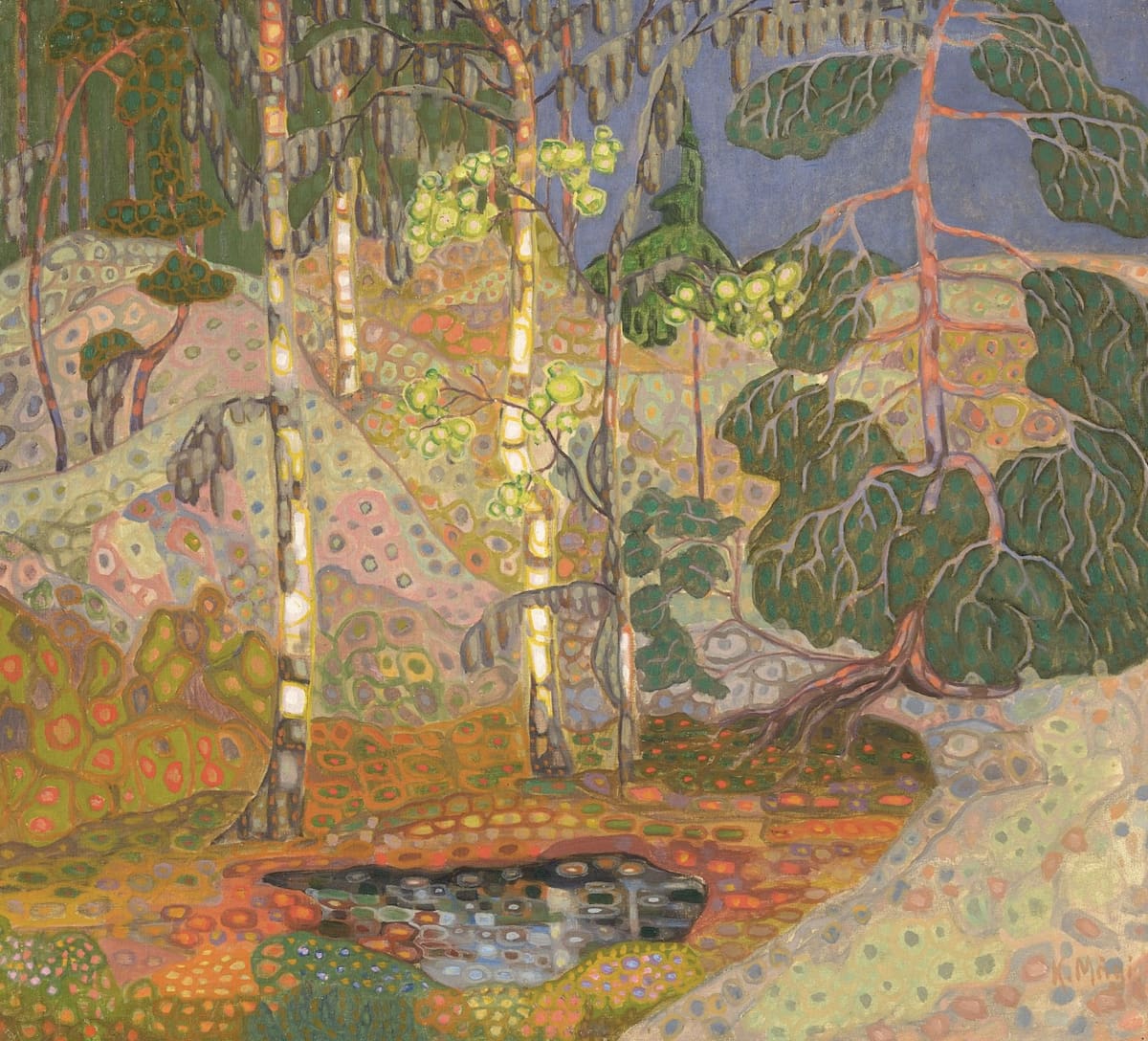
Norwegian Landscape by Konrad Mägi (1909) Courtesy of the Art Museum of Estonia

Four or five themes come over very strongly:

  1. Different styles Mägi’s style was unstable and variable. The first room contains works done in three or four completely different styles which could be by completely different artists.
  2. Self-taught This was partly because, after a brief spell at art school in St Petersburg, Mägi was largely self-taught. This explains the way other styles and influences appear throughout his career, with successive works showing the influence of Impressionism, Art Nouveau, Symbolism, Pointillism, Post-Impressionism and Expressionism, with some of his later works from the 1920s showing the sudden arrival of cubism in his style.
  3. Heavy All the paintings dark and heavy. Dark blues, dark greens, dark reds predominate. These feel a bit heavy and louring in the flesh but I was surprised how well they reproduce on the posters and postcards in the shop.
  4. Clouds In the fourth and final room I realised the importance of clouds in his paintings: of the 45 landscapes not one has a clear blue sky. Maybe this reflects the climate of Estonia but, in the final room, it also feels connected with his mental illness.
  5. Mental illness Mägi suffered from mental illness throughout his life. As a struggling young artist he lived in poverty and ‘despair’, and was afflicted with recurring feelings of Angst and futility. At the end of his life he suffered a breakdown, started destroying his paintings until students intervened to stop him, and he was admitted to a mental asylum where he died. This knowledge affects your reception, if not of all the works, then certainly the ones in the final, cloud-oppressed paintings.

The show is divided into four rooms, each addressing a specific period or theme.

Room 1. Norwegian landscapes

Room 1 contains 14 paintings on the wall and 3 in a display case. The curators tell us that Mägi started his working life in 1896 when he joined a furniture factory where he specialised in decorative carving, and where he took drawing classes organised for the factory workers. He was athletic, enjoyed wrestling, and co-founded a youth society in 1897 for the improvement of the body and mind.

In 1903, at the age of 24, Mägi decided to study at the Stieglitz Art School in St Petersburg. During this time he encountered numerous exhibitions, museums and visual art. Following the pivotal period after the Revolution in 1905, many Estonian intellectuals travelled abroad to experience other cultures, a trend inspired by the founding of the Noor-Eesti movement (Young Estonia) and their motto ‘Let us remain Estonians, but let us also become Europeans’.

In 1907 he was in Paris, living in great poverty but soaking up the new art movements of the day. But apparently it was only when Mägi scraped together the money to visit Norway in 1908, that his style crystallised, sort of, and he started to produce landscapes which found an audience. Room 1 room contains good examples of these, but also demonstrates the variability of Mägi’s style.

  • There are three or four paintings in a nice impressionist style, notably Field of Flowers with a Little House.
  • There’s the extraordinary Norwegian Landscape with a Pine Tree, which I joked to my wife looked like Mordor from Lord of the Rings but maybe reveals the influence of the great Norwegian painter, Edvard Munch.
  • The Mordor painting is just the most extreme of the style he developed which combines the garishness of symbolism with the use of blobs of pure colour derived from pointillism. My favourite example was the bog painting (below). It’s figurative in the sense that you can make out the silver birch trees, but what’s happening on the ground isn’t remotely an effort to be realistic, but the use of brightly coloured blobs, lozenges and organic shapes (‘cellular structures’) which are more decorative than realistic. In the flesh, this painting is much more colourful and vibrant than this reproduction.

Norwegian Landscape: Bog Landscape by Konrad Mägi (1908-1910) Courtesy of the Art Museum of Estonia

  • Beside these were more realistic, less abstract landscapes, but still using a big blob pointillist style, such as the Norwegian lake at the top of this review.
  • And then, next door to all these stylised, sort-of-pointillist works, were some landscapes from Norway done in a completely different style, where instead of blobs, the paint has been applied in smooth brushstrokes, so the paintings appear much more traditionally figurative; such as Norwegian Landscape (Winter Landscape).

Room 2. Portraits

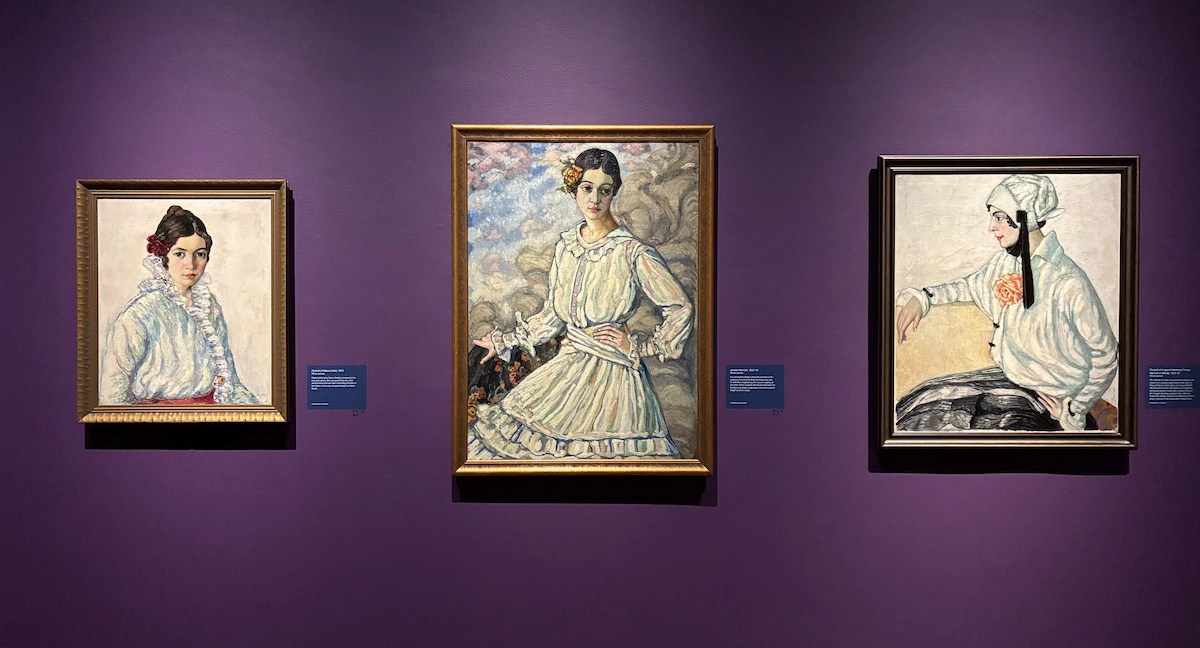
In 1912 Mägi returned to Tartu and, from spring 1913, began accepting portrait commissions for considerable sums of money, largely of wealthy women who were known to him through his cultural and political associations. Room 2 contains 17 of these generally large oil portraits. They showcase a stylised approach to the human face. They’re not unrecognisably distorted as in cubism, just simplified and done with deliberately unnaturalistic colouring. Mostly. But again, there’s a variety of styles. The ones I liked most had a hard angularity and used dark greens and blues to achieve an effect akin to German Expressionism.

Portrait of a Woman by Konrad Mägi (1918–1921) in Konrad Mägi @ Dulwich Picture Gallery

At the other end of the spectrum are some portraits of women whose cartoon, doe-eyed faces seem strangely at odds with the stylised backdrops, such as Portrait of Alvine Käppa from 1919.

Installation view of Konrad Mägi at Dulwich Picture Gallery showing three female portraits (photo by the author)

Somewhere in the middle were maybe the most attractive ones, which combined realistic faces with stylised backgrounds, the outstanding example being another ‘Portrait of a Lady’, below. Note the use of green to indicate shadowing on the skin.

Portrait of a Lady by Konrad Mägi (1916–1917) in Konrad Mägi @ Dulwich Picture Gallery

Room 3. The Baltic

Room 3 contains 16 landscapes from Mägi’s extended stays on the Baltic coast during the summers of 1913 and 1914. The paintings depict the landscape around Saaremaa and Vilsandi and, according to the curators, represented an artistic breakthrough for Mägi. The paintings here are certainly more consistent in style.

As if to demonstrate this, the centrepiece is a rare series by this artist, a set of 6 paintings depicting the same view of the lighthouse at Vilsandi. Three of these show the exact same view at different times towards the end of the day, as the (ever-present) clouds turn deeper shades of pink. the more I looked, the more I liked these three linked works.

Installation view of Konrad Mägi at Dulwich Picture Gallery showing three views of the Vilsandi lighthouse at different times of day (photo by the author)

As to the others, two things struck me:

  1. Lightless Although they are seascapes, and the curators tell us the Estonian coast is flat and open, Mägi’s paintings of it convey very little sense of light. His skies are always full of clouds and the terrain is depicted in thick heavy shapes.
  2. Botany Which is connected to the other thing which is that, although the bits of land he includes are busy with shapes and colours, giving an impression of luxuriant growth – and although the curators tell us that Mägi had an enduring fascination with the unique botanical species of his landscape, including its flora and fauna – there is precious little detail. In the garlands painted by Michaelina Wautier, currently on show at the Royal Academy, I spent some time trying to identify every species of flower. No point trying to do that with Mägi’s coastal paintings which are liberal with elements but all done in his familiar, blobby, stylised manner. Can you identify the plants in this picture?

Vilsandi Motif by Konrad Mägi (1913-14) Courtesy of the Art Museum of Estonia

Room 4. Southern Estonia

The walls of the fourth and final room are painted deep purple and this is an appropriate background for the 11 landscapes on display here, which I found heavy and louring. (I’ve just looked up ‘louring’ to check I’m using it in the right sense. The dictionary defines it as meaning ‘a dark, gloomy, or threatening appearance, usually referring to overcast weather, or a forbidding atmosphere.’ Seems about right.)

The landscapes are from Southern Estonia, from the last decade of his life. Note how the ‘blobby’ technique I’ve mentioned so many times has largely disappeared. Instead the pain is applied more smoothly but several other things are new.

One: the natural elements of the composition (the trees, the bushes, the outline of the lake) are heavily defined in black. Everything has a strong black outline, something I personally, always warm to.

Two: the clouds, the clouds! Look at the swirling, moiling, dark and threatening clouds coming to getcha!

Three: taken together these features indicate how much the landscape is actually an expression of the artist’s inner turmoil. This is the room whose wall label informs us that, after a lifetime struggling against mental illness, in 1924 Mägi suffered some kind of mental collapse and had to be placed in an institution for his own protection. Does that knowledge affect how you feel about this picture?

Lake Kasaritsa by Konrad Mägi (1915-17) Courtesy of the Art Museum of Estonia

As a footnote, not all the 11 works in this final room are as dark and ominous. In fact a couple of them right at the very end work with a much lighter palette and use light square blocks to create a landscape, completely opposite to the heavy, blobby, organic style which dominated so many of his central works. The curators tell us that here, right at the end of his working life, he was experimenting with the kind of Futuro-Cubism which was being used by radical Soviet artists of the 1920s.

Installation view of Konrad Mägi at Dulwich Picture Gallery showing three of the landscapes in the fourth and final room – note the cloud-congested skies (photo by the author)


Related links

Related reviews

The Edwardians by Roy Hattersley (2004)

Executive summary

Half-way through this hefty 600-page popular history, author Roy Hattersley gives a handy little summary of the era under discussion. Most historians agree that:

  • ‘the Edwardian period’ stretches from the death of Queen Victoria in 1901 to the outbreak of the First World War in 1914
  • it was named and typified by its obese jolly king, a sociable hunting, shooting and cigar-smoking man known for his numerous affairs and mistresses, ‘Edward the Caresser’ as Henry James nicknamed him
  • its dominant political figures were:
    • Arthur Balfour (Conservative Prime Minister 1902 to 1905)
    • Herbert Asquith (Liberal Prime Minister 1908 to 1916)
    • young radical firebrand David Lloyd George (driving force behind the People’s Budget, the Parliament Act and the National Insurance Act which laid the foundations for the welfare state)
    • Winston Churchill was on his way up
    • while Joe Chamberlain, associated with jingoism, the Boer War and protectionism (‘imperial preference’), was on the way out
  • it was a decade troubled by explosive social issues such as women’s suffrage, Irish independence, trade union rights and the arrival of the Labour Party as a political force, destined to supersede the Liberals after the war
  • society was transformed by scientific and technological inventions, on the theoretical level the discover of atomic and subatomic particles and Einstein’s theory of relativity, on the technology level, the rise of the motor car, the telephone and wireless, and the first manned airplane flights

There you have it, in a snapshot.

Dating the Edwardian era

Strictly speaking the Edwardian period refers to the reign of King Edward VII, king from the day his mother, Queen Victoria, died (22 January 1901) to the day he passed away (6 May 1910) to be replaced by his son, King George V (reigned 6 May 1910 to 20 January 1936).

However, like pretty much all historians of the period Hattersley stretches the definition of ‘Edwardian’ forwards to include the four years leading up to the Great War (commenced August 1914). And also, because he feels obliged to explain the origins and course of the Boer War (11 October 1899 to 31 May 1902), which was still ongoing when Edward came to the throne and which requires a description of the Jameson Raid (December 1895), Hattersley at various points goes back before his theoretical starting date to explain the deeper origins of this or that issue.

In other words, the dating is quite fluid, not only when it comes to politics but to social history as well, Hattersley reaching, in his chapter on poverty, back to the many reports on the subject published during the 1890s (for example, Charles Booth’s Life and Labour of the People of London 1889 to 1903); or going back to early roots of the suffragette movement which can said to have started in the 1880s; or of the Labour movement, which can be dated all the way back to Henry Hyndman founding Britain’s first left-wing political party, the Democratic Federation, in 1881; or, regarding the Irish Question, having to dig back into the 1880s to describe the secession of the Liberal Unionists who disagreed with Gladstone’s ill-fated policy of Home Rule for Ireland. And so on.

Subverting a straw man

On the cover, on the back, in the blurb and repeatedly within the text, Hattersley and his publishers say this book tackles and refutes the notion that Edwardian England was one long summer of boaters, bathers and village pubs, attacking the notion that the period ‘is often seen as a golden sunlit afternoon, personified by its genial and self-indulgent king’, before the Armageddon of the First World War.

The trouble is that this is what absolutely every book about the Edwardian era claims to do, using the same straw man to assert its novelty and originality. In fact not just histories but anyone who’s read the introduction to novels by H.G. Wells or Arnold Bennett or E.M. Foster reads the same ‘golden summer’ straw man being knocked down in the same way as the author sets out to correct our misconceptions to tell us that the period 1901 to 1914 was in fact crammed with scientific, technological and consumer product innovations and packed with fraught social and political issues, some of which I’ve listed above. It’s the standard trope invoked by all historians of the period.

The book announces its tone of superior gossip with a gorgeous description of Queen Victoria’s funeral (Saturday, 2 February 1901) and then a gossipy portrait of King Edward, his biography, personality and the courtiers and advisers who surrounded him. Initially, I thought maybe the whole thing was going to be a gossipy survey of Edwardian people. It was only on reading further that I realised that each of the 20 chapters, despite their vague and sometimes misleading titles (I’ve added clearer indications of their subject matter in brackets), is devoted to a specific social and political issue and examines each one in some detail.

It’s a romp, it’s a guilty pleasure, it’s good popular history packed to the gills with fascinating factoids – but still, coming to this book from the works of professional historians like Richard Shannon or Eric Hobsbawm is like falling off a cliff in terms of intellectual substance, historical authority and serious analysis.

1. A Cloud Across The Sun (Victoria’s funeral)

Detailed description of the immense and impressive procession of the body of Queen Victoria through London en route to her final resting place in Windsor. The total number of soldiers involved in taking part in or policing the procession was larger than the British Expeditionary Force sent to France at the start of the Great War. Most people were stunned for nobody knew any other monarch than Victoria who had reigned for 63 years. Generations had been brought up to associate the very word ‘Victorian’ with Britain’s world leading position. Her death triggered much soul searching. Educated commentators were uneasily aware that Britain was slipping. America and Germany were overtaking her in terms of industrial output (p.67, 467) and Germany’s Navy Law of 1898 set it on a course to match or exceed the Royal Navy’s firepower (p.15). Imperial anxiety as the old era ended.

2. The Spirit of the Age (Edward’s character)

Edward was 60 when he came to the throne and was (surprisingly) badly prepared for the job. Successive prime ministers (Gladstone, Disraeli) tried to suggest useful jobs and opinions where he could get a feel for the nation he was set to rule but either Victoria or the Prince himself vetoed them.

He had a state income of £100,000. The whole country knew about Edward’s louche reputation. He had been named in a number of scandalous court cases and was well known to enjoy gambling, the horses, yachting and the high life. He was addicted to baccarat. The serious and high-minded (the kind of people who leave written texts such as sermons, newspaper articles, writers’ diaries etc) deplored his character and worried about the moral falling off which his rule would bring. The Marlborough House set.

But the thing about the written records is they tend to preserve the opinions of the worthy, high-minded, literate and concerned and ignore or neglect the opinions of the vast mass of the population who left few if any records. And in this respect, I think a key thing to grasp about the English is that they welcomed Charles II with open arms, and that well-known womaniser, gambler, horse and yacht-racing addict has gone down as arguably the most popular British king ever. So, away from the hand-wringing editorials, there might have been a great portion of the fun-loving proletariat who admired a merry monarch. (Compare and contrast the ongoing popularity of Boris Johnson – inexplicable to liberals and worthy Tories – an adulterer, drinker and shambling liar, but still admired by many for being a bloke you could go down the pub and have a laugh with).

And indeed Hattersley goes on to say that Edward’s much higher profile than his reclusive mother – photos in the press and reports of him opening Parliament or at racing meetings or holidaying in the South of France – associated him with the new taste for leisure and relaxation. Edward epitomised a new age of leisure.

Edward was very fat due to overeating. His chest and waist measured 48 inches. Hattersley gives mind boggling details of a typical royal meal, which usually had at least 14 courses. His coronation had to be postponed to a sudden flaring up of appendicitis and the consequent operation and was eventually held on 9 August 1902.

Edward hated to be alone and was an insatiable socialiser. He was liable to descend on the grand country houses of the aristocracy with little warning, an event which entailed huge disruption. After a string of extra-marital liaisons in 1892 he met Alice Keppel, the daughter of an admiral, and she became his official mistress for the rest of his life.

He was a menace in foreign affairs, acting tactlessly with the touchy Kaiser, but was personally involved in the great diplomatic triumph of his reign, the Entente Cordiale with France, which he did a lot to cement by a personal visit to Paris during which he undertook a lot of engagements with great enthusiasm and was eventually cheered by the French crowds.

Edward revived the state opening of Parliament in all its meretricious pomp and hollow ceremonial, which had been allowed to lapse by his reclusive mother, and which continues to this day, televised to the simpering tones of royal commentators.

3. The Powers Behind the Throne (Edward’s advisers)

When Edward came to the throne Britain was an imperial oligarchy, ruled by groups of aristocratic or mercantile families. Hattersley gives an entertaining tour of the political class, starting with the lingering influence of the Liberal ‘Grand Old Man’ Gladstone who had died in 1898, and the Conservative Lord Salisbury, Prime Minister when Edward acceded, who resigned a year later in July 1902, to be succeeded by his nephew, Arthur Balfour.

The Edwardian Prime Ministers

  • Lord Salisbury (Conservative) 1895 to 1902
  • Arthur James Balfour (Conservative) 1902 to 1905
  • Henry Campbell-Bannerman (Liberal) 1905 to 1908
  • Herbert Henry Asquith (Liberal) 1908 to 1916

(See section on ‘Politicians’, below.) This fusty world of faineant plutocrats was to be shaken up by the two firebrands, Winston Churchill and David Lloyd George.

The chapter morphs into a consideration of Edward’s closest personal advisers, being: Arthur Hardinge, Francis Knollys, Reginald Brett, military adviser Admiral Fisher.

4. The Condition of England

Named after the bestselling analysis of British society published in 1909 by Liberal politician and cabinet minister Charles Masterman.

Masterman copied the method of Matthew Arnold’s Victorian tract, ‘Culture and Anarchy’, by assigning the classes and groups of people in Edwardian England new generic names:

  • the Conquerors (the old aristocracy)
  • the Suburbans (the middle middle-class)
  • the Multitude (the masses)

In the event Hattersley doesn’t dwell on Masterman’s analysis but uses it as a jumping off point for statistics about Britain’s economic decline, her stalling industrial growth, the shrinking of productive agriculture, the reliance on the informal economics of empire. He then goes on to summarise a bevy of reports and surveys which came out during the decade giving hard evidence of the dire poverty of about half the population, especially agricultural workers (‘Social surveys proliferated in Edwardian Britain’, p.74).

Lots of detail about the pay and wages of workers in different sectors, in different parts of the country with special attention to women.

5. Unfinished Business (the Boer War)

Hattersley’s account of the Boer War, with as much or more about its impact on domestic politics i.e. its fractious impact on an already split Liberal Party (because some Liberals were imperialists and some were anti-imperial Radicals). Milner’s miscalculation in thinking the Boers could be intimidated into submitting to Britain. The reasonableness of Paul Kruger’s position in not wanting his small culturally homogeneous country swamped by outsiders who, if given the vote, would support Britain’s policies. The chaotic conduct of the war. The concentration camp policy: in the 13 months between January 1901 and February 1902, to Britain’s eternal shame, 20,000 internees died, mostly women and children. Lloyd George was a rare voice fiercely denouncing the war, while the imperialist Liberals set up something called the Liberal Imperial Council.

6. A Preference for Empire (the tariff campaign)

‘Victory’ in the Boer War cost the British Exchequer some £222 million. This money had to be recouped. Of all UK politicians Joseph Chamberlain was most associated with the war, ‘Joe’s War’. Massively popular after the victory, he now launched a campaign for imperial protectionism i.e. to create a free trade zone between Britain and the white dominions (Canada, Australia, New Zealand, post-Boer War South Africa) and impose tariffs on imports from all other countries.

Hattersley gives his interpretation of the wild enthusiasm which greeted Joe’s campaign: it was widely seen as a cure for what an increasing number of people were realising was Britain’s industrial eclipse.

Manufacture was in decline. The Industrial Revolution had, in reality, ended more than half a century earlier. The consequences of failure to innovate and invest were just working their way through into the economy. Declining industries longed to be protected by a tariff. (p.109)

In 1903 Chamberlain made a big speech for ‘imperial preference’ which was seen as a proclamation that ‘the British Empire must stand together against the world’ (p.109). The government of the day was Conservative, led by Prime Minister Arthur Balfour, but it only had a majority because of its coalition with the Liberal Unionist defectors from the Liberal party. Now the core principle of old school liberalism was the free trade which had made Britain great in the mid-Victorian period.

In fact Hattersley neglects the detail and implications of protectionism to focus on giving an intricate and quite confusing account of the problems Balfour faced keeping his cabinet and his government together, which boiled down to the timing and way of announcing the resignation of various dissidents. Chamberlain resigned because protectionism wasn’t being implemented fast enough but Tory free traders also resigned in opposition to the policy and detestation of the former Liberal Chamberlain’s influence. Balfour dealt with the ongoing crisis with silky subtlety from 1902 to 1905 and then resigned government at the end of 1905. A general election was held in January 1906 and the Liberals stormed home in a landslide. The Liberals were, in fact, deeply divided over various issues, centrally the question of Irish Home Rule, but managed to unite around their anti-protectionism and ran a campaign highlighting the fact that tariffs would raise the cost of food.

Hattersley skimps on this, a key fact brought out in other accounts I’ve read. Instead he is obsessed with the minutiae of what Balfour promised the Duke of Devonshire who upset a trio of colleagues by not resigning alongside them, with details of meetings and dinners and promises and pledges among the Tory elite. No doubt that’s how politics actually works, but this aspect of Hattersley’s account is for politics addicts.

7. Uniting the Nation (social reforms)

Having painted in the background, this is the chapter in which Hattersley gets round to explaining the changes which he’s been claiming were so central to the Edwardian decade. At their core is one thing, a revolution in the political culture of the nation. Victoria’s entire reign was dominated by a laisser-faire philosophy of free trade and unfettered competition and the devil take the hindmost. Classical liberalism thought the state ought to be small and had just two duties, to uphold the law at home and protect from foreign enemies. When it came to the vast majority of the British population which were either poor or very poor or utterly destitute, the almost universal assumption was that their poverty was their own responsibility. Victorian moralists blamed the plight of the poor on their own indigence, immorality, laziness and so on. The only recourse for the poor and unemployed was the workhouse which, since the Poor Law of 1832, was purposely designed to be as inhumane as possible in order to act as a deterrent, and a spur to the indigent poor to try harder.

During the Edwardian decade this political philosophy underwent a swift and amazing revolution. A series of reports by charities and investigators during the 1890s revealed depths of poverty and squalor in all Britain’s cities but also in the countryside that had never been appreciated before. These findings were incorporated into a series of royal commissions which in turn led to a flurry of acts which fundamentally altered the attitude of the state to the poor from judgemental vengeance to support and responsibility.

  • 1902 registration of midwives
  • 1906 Education Act stipulating the supply of school meals
  • a system of medical inspection of schools
  • 1907 borstals were established for young offenders
  • 1908 act made neglect a criminal offence for the first time

Why? The pop history answer is that the Boer War revealed the shocking health of the stunted wretches conscripted from Britain’s slums. Also, the influence of the growing number of Labour MPs, in the 1906 election Labour won 53 seats.

But what really comes over in this chapter is that we were copying Germany which was already decades ahead of us. This was especially true in the area of supporting the unemployed, creating a national insurance tax to pay the unemployed a minimum dole, and creating labour exchanges to help people back into work. Conservatives were persuaded of these lefty measures because they improved the efficiency of the economy as a whole. And far from being radical experiments, Britain copied the tried and tested methods which were already propelling Germany’s economy ahead of ours on every measure. To compete against its rivals, Britain needed a better educated, better fed workforce that wasn’t allowed to rot and lose its skills when laid off by capitalism’s regular slumps. Hence the unemployed workmen’s act and powers to set up labour exchanges (p.130).

It’s startling to learn that a young William Beveridge went to study Germany’s welfare provision in 1905 and was so impressed by what he saw that he brought back to Britain a version of the Bismarckian system which was to form the basis of the hugely influential report published during the war and which, famously, formed the basis of the Welfare State created by the Labour government under Clement Attlee (p.465).

Some of the child and family laws were passed under the Conservatives before 1905, but the working men’s legislation was driven forward by Winston Churchill during his so-called New Liberal phase. Churchill drove forward prison reform, a bill improving conditions in coal mines, a bill limiting the number of hours people could work in shops,

8. Who Shall Rule?

The clash between the old ruling class and the new liberals came to a head in the great constitutional crisis triggered by Lloyd George’s 1909 budget which imposed new taxes on the rich in order to fund old age pensions and welfare policies and which the House of Lords, dominated by rich landowners, promptly rejected. The Liberal government led by Prime Minister Herbert Asquith, First Earl of Oxford, threatened to flood with Lords with Liberal peers while radical firebrand David Lloyd George toured the country giving rabble rousing speeches, backed up by Winston Churchill, still in his fierce new Liberal phase.

Hattersley gives a fairly detailed account of the political machinations, in the middle of which King Edward died (6 May 1910) and was replaced by his son, George V. The Liberals proceeded to win two general elections (in January and December 1910) (admittedly with Labour and Irish Nationalist support) which persuaded the new sovereign, very reluctantly, to accede to Asquith’s threat, which in turn led the Lords to back down and pass Lloyd George’s Budget and the National Insurance Bill.

Hattersley delivers one of those pithy summaries which I remember my history teachers at school used to extract and turn into an essay question, namely: Victoria handed over to her successor the poisoned chalice of the Boer War, and Edward VII handed over to his successor the Peers-versus-the-People crisis.

9. Ourselves Alone (Irish Home Rule)

After decades of frustration among Irish nationalists, the question of Irish Home Rule returned to the agenda in Westminster because, in the 1910 general election called by the Liberal Party to prove their mandate for Lloyd George’s inflammatory budget of 1909, Conservatives and Liberals both won about 270 seats and so the balance of power was held by the Irish Nationalists with their 82 MPs.

It took the sclerotic process of Whitehall to get it together, but the 1912 Home Rule Bill was the price the British Liberals paid the Irish Nationalists for their support in getting the Budget and the act to reform the House of Lords through (p.187).

Hattersley goes back to recap the background. After the fall of its charismatic leader Charles Stewart Parnell 1890, named in a divorce case as an adulterer, the struggle for Irish independence went into abeyance.

‘The era of constitutional possibilities for Irish nationality ended on the day that Charles Stewart Parnell died.’ (Arthur Griffith, quoted on page 182)

Hattersley namechecks the key players and the numerous organisations set up to campaign for home rule, including Michael Davitt and Arthur Griffith (founder of Sinn Fein and editor of The United Irishman), John MacBride and James Connolly, Roger Casement (revealer of the horrors of Belgium’s colony in the Congo and later gun-runner for the IRA), James Larkin (leader of the Irish Transport and General Workers Union), John Redmond (leader of the Nationalist Party in Parliament), Michael Collins, along with the upper class women, Maud Gonne and Constance Gore-Booth, memorialised by the great poet W.B. Yeats.

Ireland was wretchedly badly run by the British, with rural and urban poverty even worse than on the mainland. The nationalist cause was boosted by Britain’s appalling handling of the Boer War, in which another small people was bullied and butchered by an overweening empire.

I read a lot of this stuff as an undergraduate as background to Yeats’s poetry, and periodically over the following years. Rereading it all in detail, I was struck not by the Irish fight for independence which, in a sense, that is simple and logical, like any other colonial struggle against imperial masters. What always impresses me is the strength of the opposing force, the rise of Unionism in Ulster, led by the brilliant and charismatic lawyer, Sir Edward Carson, the hundreds of thousands of northern Protestants who signed petitions, the 100,000 men who joined the proto Ulster army, the mass smuggling in of guns and ammunition, and the acquiescence of senior officers in the British Army in what Churchill bluntly called treason i.e. actions against the express wish of the elected British government and the King (p.188 ff.).

Hattersley shows how the partition of Ireland between an Irish nationalist south and west and a different entity in the Protestant north was originally one of many solutions proposed in the 1910s but slowly became the most favoured, how it was defined in different ways by different factions among the Unionists but within a few years had gained traction as the least bad option.

10. Votes for Women!

Female England awoke during the Edwardian era. (p.81)

Like the Ireland chapter this one goes back a few decades to background events, for example when Millicent Fawcett founded the National Union of Women’s Suffrage Societies in 1887. But the story comes to life when Hattersley gives us biographies of the leading campaigner Emmeline Pankhurst and her daughter Christabel (nicknamed by some papers ‘the Queen of the Mob’).

I knew the suffragettes were violent hooligans who used terrorist techniques (for example, sending letter bombs to leading politicians, p.220) but Hattersley’s account brings out how wilfully violent and destructive they were. Not only throwing bricks and tiles at the Prime Minister and other cabinet members, smashing their windows, vandalising their cars or trying to burn their houses down, slashing paintings in galleries, setting fire to postboxes, rampaging along Oxford Street and Regent Street smashing every shop window with hammers (p.219), spitting at and slapping policemen (p.207), but, when it was discovered some were practicing shooting, it was feared there would be active assassination attempts a la JFK (p.216). They also damaged quite a few works of art.

It was interesting to learn how many of them were lesbians or lived in unorthodox relationships (p.217). It is typical of Hattersley’s enjoyably gossipy approach to learn that the redoubtable Edwardian composer, Ethel Smyth (1858 to 1944), not only went to prison (2 months in Holloway) for smashing the Colonial Secretary’s windows, not only wrote the stirring suffragette anthem, ‘The March of the Women’, but fell passionately in love with (the married) Emmeline P, writing: ‘I knew that before long I would be her slave’ (p.217).

Did you know it was the Daily Mail which coined the word ‘suffragette’ as a term of mockery and abuse but which the activists then adopted with pride and we have used ever since? (p.209)

But the biggest thing that struck me was the reason many Liberal and Labour politicians opposed women’s suffrage wasn’t the principle of the thing, which most approved of – it was fear of its practical consequences.

It had taken decades of fraught negotiation for the existing male electorate to come into being and it still excluded some 5 million men from the vote (always forgotten in this context). Some Labour and Liberals were against women’s suffrage because they knew that the vote would probably, at least at first, only be extended to better-off women who would promptly vote Conservative.

In other words, giving middle-class women the vote (the most feasible strategy) risked destroying radical and progressive politics in Britain for a generation (p.218). It was a cogent and powerful argument, even if making it earned you a slap in the face from Christabel Pankhurst.

In 1912 and ’13 and ’14 bills were drafted to extend the franchise, to which greater or lesser measures of female suffrage were added, and which variously passed or failed in the Commons or in Committee stage but everyone accepted that suffrage was going to happen sooner or later. And then the Great War broke out, putting any further development on the women question – as with Irish independence – on hold but making some sort of solution inevitable once the fighting had finished.

In fact it was before the war ended (in November 1918) that, in January 1918, the Representation of the People Act was passed, giving the vote to men aged over 21, whether or not they owned property, and to women aged over 30 who occupied land or premises with a rateable value above £5, or whose husbands did, thus extending the local government franchise to include women aged over 21 on the same terms as men. As a result of the Act, the male electorate was extended by 5.2 million to 12.9 million and the female electorate went from 0 to 8.5 million, or 2 in 5 adult women.

(It was not until the Representation of the People (Equal Franchise) Act 1928 that women gained full electoral equality with men, the act giving the vote to all women aged over 21, regardless of any property qualification, adding another five million women to the electorate.)

Since 1928 there have been 24 general elections, of which Labour have won 10. From the little research I’ve done, until recently women voters on the whole voted Conservative although that has changed recently (see article on gender divide in general election voting).

11. United We Stand (the trade unions)

The complicated history of trade unions in the Edwardian era. The Taff Vale train dispute case of 1901 recognised trade unions as legal entities but this was the opposite of a Good Thing for it meant that employers could now take trade unions to court if it could be proved that strikes or picketing had adversely affected their business. And not just claim compensation from union funds but sue individual union officials into the bargain (pp.222 to 224).

Hattersley explains that the Trade Union Congress and most unions had regarded politics as peripheral to their core activities of protecting members and campaigning for better pay and conditions, But the potentially crippling implications of the Taff Vale case made them all realise they needed representation in Parliament to defend their interests.

So this chapter traces the earliest history of the Independent Labour Party (founded 1893), the Labour Representation Committee (founded 1900) and its early luminaries, particularly the two key figures of Keir Hardie and Ramsay MacDonald. This leads up to the foundation of the Labour Party proper in 1906, which broke through in that year’s January general election to win 29 seats on 4.8% of the vote (p.234).

Of course Hattersley’s lifelong involvement with the Labour Party, most notably as deputy leader under Neil Kinnock from 1983 to 1992, gives him unprecedented insight into Labour’s traditions and contemporary working. As such it is more than ordinarily interesting when he writes that the party – ‘then, as now, despised theory’, ‘more interested in practice than theory’ – has always been a very soft-left party with little or no theoretical underpinning (p.237).

In fact, the book is sprinkled with asides which sound like the wisdom of practical experience in the field, wry familiarity with the quirks and foibles of Parliamentary politics:

  • [Balfour] took refuge in the expedient employed by uncertain prime ministers down the ages… (p.131)
  • The TUC, always happy to accept half a loaf, was delighted… (p.152)
  • It was a tactic the Tory party was to employ time and time again in an attempt to obstruct the work of elected governments. (p.158)
  • General elections are rarely fought on issues of the parties’ choice… (p.167)
  • Speakers’ judgements on such matters are rarely challenged with success… (p.220)
  • Like so many private members bills it was then buried at the Committee stage and forgotten. (p.231)
  • The new Labour members, euphoric as new members always are… (p.234)
  • The Select Committee Inquiry endorsed the status quo as Select Committee Inquiries often do. (p.282)
  • Select Committees of the House of Commons usually contain one or two Members whose enthusiasm outruns their discretion. (p.457)

Back to the Labour party, it was somehow symbolic that the party’s first leader and Moses, the illegitimate, poorly educated Scotsman, Keir Hardie, made powerful speeches about injustice but knew nothing about economics and had very few practical policies for bringing about the ideal world he depicted in his rousing speeches. Plus ça change…

The detailed series of legal cases which hampered then liberated the Edwardian trade unions, with the explanation of Liberal party support, the advent of the new Labour Party MPs, and the trend for the sometimes very small unions to amalgamate into huge mega-unions based on a specific trade (mining, railwaymen etc) all give a strong sense of a social movement emerging from legal, political and financial weakness, to staking its claim to become a major component of British domestic history for the rest of the century.

12. Useful Members of the Community (education)

It was quite an eye-opener to learn that the central issue in trying to improve education in this country, from 1870s till the 1900s, was religion. To be precise, the majority of schools were run by the Church of England so when any government tried to set up a state-run, nationwide system of primary schools, it had to address two massive problems: 1) the Church of England’s powerful concerns that reforms would mean it losing its influence over the nation’s youth; and 2) the vehement opposition of non-conformists, who strongly objected to Anglican schools being subsidised by their local taxes.

Some non-conformists refused to pay their local taxes under the new system introduced in 1902 and were prepared to go to prison to defend the principle. In fact, the provisions for local authority funding of schools antagonised the large non-conformist community so much that this issue alone goes a long way to explaining why the Tories, who’d brought the Act in, were slaughtered in the 1906 election.

Everyone knew that Britain needed to bring its education system up to the standards of Germany (many British educationists had toured Germany and had realised the German system was way better than ours – just like their industries, businesses, health and welfare systems were streets ahead of ours, p.465). This chapter is a good example of the yawning gulf between political theory and practice; of the way a really simple aim and intention which most of the political class agreed on, could end up requiring endless, torturous negotiations, drafts and redrafts, defeats in the House of Commons and Lords, and so on, before a half-workable compromise finally gets passed.

Just working through the battle of vested interests and the hangover of historic structures and organisations in this one area, education, helps you understand why so many aspects of Britain’s social and economic structure are so compromised, messy, half-cocked and inefficient.

It was also the era when the Workers Education Association was founded (1908), the northern universities received their charters (Birmingham 1900, Manchester and Liverpool 1903, Leeds 1904, Sheffield 1905).

In a parallel stream, the wildly successful Boy Scout movement was founded by General Robert Baden-Powell, hero of the siege of Mafeking, the first camp being on Brownsea Island in 1907. One of the small group of men who founded a movement which they lived to see sweep the world.

13. Ideas Enter the Drawing Room (theatre)

Drawing room drama replaced by theatre of ideas, copying abroad (as usual), in this case Ibsen, and our own provocateur George Bernard Shaw (‘the most famous iconoclast and atheist of his age’, p.370). But first Hattersley conscientiously gives us the owners of London theatres, the price of tickets in London and the provinces, the lives of the great actor managers (Irving) and leading ladies (Ellen Terry, Mrs Patrick Campbell), the quality of middle-brown ‘respectable’ drawing room drama, the advent of musical comedy epitomised by the success of The Merry Widow.

And then the fight against the state censor of plays, the Lord Chamberlain, led by John Galsworthy who, according to Wikipedia:

became known for plays with a social message, reflecting, among other themes, the struggle of workers against exploitation, the use of solitary confinement in prisons, the repression of women, jingoism and the politics and morality of war.

With mention of the plays of Harley Granville-Barker, The Voysey Inheritance and Waste. Throw in the works of George Bernard Shaw and that’s quite a lot of plays about contemporary issues.

But the decade contained the seeds of change. The 1900s saw the first displays of moving pictures and by 1910 buildings had opened devoted to the showing of moving pictures, much more immediate and much cheaper than even the cheapest musical comedy and variety.

14. Literature Comes Home (Edwardian literature)

With the death of Aubrey Beardsley and the imprisonment of Oscar Wilde the Aesthetic Movement petered out. Hattersley quotes Yeats, pre-eminent poet of the Celtic Twilight and then Irish nationalist movement, remarking that around 1900 ‘Everyone got down off their stilts’. The trouble with overviews of the literature by historians or politicians is that they are not professional literary experts, and so they tend to make the obvious points in the obvious ways, writing the same opinions as a thousand other ‘histories of literature’. So: with the end of the Boer War Kipling moved to Britain, settled in Sussex and radically changed his subject matter from tales of the dry and dusty hills of India to stories about England, Puck of Pook’s Hill and the like. The Poet Laureate Alfred Austin and Sir Henry Newbolt supplied a continuation of Kiplingesque patriotic poems but without the subtlety.

If you’re looking for a common thread among the poets it is probably different flavours of patriotism, from Newbolt at the jingo end, through Robert Bridges, GK Chesterton, young Rupert Brooke, and then a flotilla of minor figures, each with one or two anthology poems – Walter de la Mare, John Masefield, poets who would be gathered together in the Georgian anthologies of 1912 and subsequent years.

Hattersley makes the dubiously journalistic claim that one ‘great’ novel was published each year:

1900 – The Way of All Flesh by Butler, Lord Jim by Joseph Conrad

1901 – Kim by Rudyard Kipling

1902 – The Wings of the Dove by Henry James

1903 – The Ambassadors by Henry James

1904 – The Golden Bowl by Henry James, Nostromo by Joseph Conrad

1905 – Where Angels Fear to Tread by EM Foster, Kipps by H.G. Wells

1906 – The Man of Property by John Galsworthy

1907 – The Secret Agent by Joseph Conrad

1908 – The Old Wives Tale by Arnold Bennett, A Room with a View by E.M. Foster

1909 – Tono-Bungay and Ann Veronica by H.G. Wells

1910 – Howard’s End by EM Foster, The History of Mr Polly by H.G. Wells, Clayhanger by Arnold Bennett

The New Woman was a recurring theme in fiction and a flurry of woman writers, admittedly popular writers, such as Maria Corelli, Baroness Orczy, Ethel M Dell, Elinor Glyn, children’s writers Frances Hodgson Burnett, E. Nesbit and Beatrix Potter.

What emerges from Hattersley’s brisk review is a sense of an emerging, educated, intelligent middle class, of the rise and rise of the New Woman, of the lives of working people described with a new seriousness, in Wells and Bennett up to a point, but with sensitivity and insight of genius in the novels of DH Lawrence who emerged just at the end of the period (Sons and Lovers, 1913).

15. The End of Innocence (sport)

With increased leisure time, caused in part by government legislation limiting working hours, went the growth of sport: football, cricket, tennis, athletics, rugby league and union, were all put on a more professional basis, paid, and new stadiums and halls built to accommodate growing crowds. Sport became business. London hosted the 1908 Olympic games. The conflict between gentlemen and players, based on snobbery and a wish to keep the classes distinct i.e. gentlemen unsullied by commerce. The first celebrity sportsmen such as Bob Crompton of Blackburn Rovers and W.G. Grace. The aim of gentlemen, in sport as in every other aspect of life, was to demonstrate ‘effortless superiority’. Contemporary commentary is littered with words like ‘chivalry’ and ‘honour’, words associated with the medieval ruling class. The MCC and other sporting bodies, like the House of Lords, could be relied on to resist the encroachment of commercialisation i.e. working class players being paid, for as long as possible.

Meanwhile in other nations, such as America, sportsmen specialised in one game and practiced intensively, sometimes with the support of a ‘coach’ (p.323). Or the advent of American jockeys who used a new posture, ‘the forward seat’, to win (p.331). In sport, as in industry and commerce Britain’s addiction to amateurism, hobbled by class war, condemned it to long-term mediocrity.

Horse racing has always relied on gambling. In 1906 the government tried to regulate it. In 1908 the sport established a new definition of ‘thoroughbred’, mainly with a view to excluding the threat from American-bred winners.

Surprisingly, given the general chauvinism, women progressed in two sports, gold and tennis, although these remained robustly middle class (as they are to this day). Popular men’s sports, on the other hand, steadily became more working class, football and rugby union being two examples, and boxing, the longest establishment popular sport.

Hunting, of course, remained the preserve of the aristocratic elite, surrounded by all manner of preposterous traditions, like chivalry ultimately dating back to the Norman conquest and subjugation of Saxon serfs. As a Saxon serf I have all my life cordially despised the aristocrats who subtly or not so subtly have asserted their superiority over me, John Buchan’s Lord Leithen, Siegfried Sassoon in his memoirs. No surprise that the resistance to Asquith and Lloyd George’s People’s Budget in the House of Lords was led by fox-hunting aristocrats like Willoughby de Broke (with his floridly Norman name). They were, and are, the class enemy.

So many of these social aspects remind me of what H.G. Wells in Tono-Bungay calls the Bladesover system, the way English society was structured around the grand houses of the landed aristocracy in the 17th and 18th centuries, with a constellation of professions (lawyers, doctors, bankers and brokers) servicing them, and had provided the social, cultural, mental and even geographic structure of Britain up till his own time, the only change being the stepping of new businessmen or financiers into various places as the actual aristocracy became defunct, but everyone working to keeping these archaic structures of thought and ceremonial in place. ‘The new middle class hunters wanted to conform…’ (p.337)

I was forced to play lots of sports at school: I disliked cricket because of the boredom and snobbery, really disliked rugby because of the sadistic pleasure big boys took in stomping everyone else, quite liked hockey because there was little physical contact and some skill, really liked rowing especially sculling because you could disappear down the river on your own; and in breaks played football on the tarmac playground, often with small tennis-sized balls.

16. Gerontius Awakes (art, architecture, music)

Another portmanteau chapter, which is interesting enough but feels like a dutiful ticking of obvious boxes. In 1901 commenced the redesign of the Mall from the statue of Victoria (1901) to Admiralty Arch (1911).

John Singer Sargent was friends with Monet but eschewed foreign experimentalism and made himself the Reynolds (i.e. the highly paid portrait painter of the rich) of his day. Hattersley quotes the avant-garde art critic Roger Fry describing Sargent as: ‘as gentle as a man as he was striking and undistinguished as an illustrator and non-existent as an artist’ (p.358), one of the few moments which ruffles the stolid flow of Hattersley’s dutiful nods to all the obvious greats.

The great composer of the day was Edward Elgar, condemned for ever to be remembered for his Pomp and Circumstance marches, written 1901 to 1907. ‘Land of Hope and Glory’ took music from one of the marches and incorporated words by A. C. Benson in 1902. Notes on Delius, Holst (lots of folk songs, St Paul’s suite 1912), Percy Grainger and the young Vaughan Williams (The Lark Ascending 1914). A little later, in 1916, Hubert Parry would set Jerusalem to music. Celebrations of Englishness comparable to the very English settings of Foster, Wells, Saki, Kipling in Pook’s Hill mode and all those Georgian poets.

Architecture characterised by the Edwardian Baroque. Edwin Lutyens, Giles Gilbert Scott and, in Scotland, Charles Rennie Mackintosh. The influence of Alfred Waterhouse on commissions of large public buildings. The Ritz Hotel. The RAC club in Pall Mall. Royal London House, Finsbury Square. Westminster Cathedral (John F. Bentley).

The garden suburb movement, Ebenezer Howard. Letchworth. Hampstead. the prophets thought it would appeal to all classes but like all high-minded movements it attracted the professional middle classes.

The Camden Town school of art, correlative of Zola’s naturalism. Yuk.

In 1910 Grafton art gallery hosted an exhibition of recent French painting (Gauguin, Matisse) which caused a scandal. The critic Roger Fry could only think to label them all post-impressionists, an unsatisfactory label which has stuck (p.356). It highlighted the philistinism of the ruling class and the sensationalising vulgar sensationalising of the press, led by the Times.

The first Futurist manifesto 1909, the second one 1910. Committed to replicating the machine energy of the age.

17. Would You Believe It? (philosophy and religion)

Summary of G.E. Moore’s Principia Ethica which had such a dynamite impact on the Bloomsbury Group. Hattersley summarises it as claiming that morality is relative, changes according to time and place. This was perceived by the Bloomsburies as a huge liberation from Christian morality which insists that moral values are universal and (incidentally), strict and repressive. Moore gave them a theory which underpinned their already existing practice of passionate friendships and cliques. And non-traditional sexual relations i.e. gays and lesbians and other genders in between. Hattersley tags on a brisk explanation of Bertrand Russell’s work on sets and categories, explaining that both Moore and Russell were anti-Christian. From the heights of academia came an attack on the ideology Oxbridge was invented to guard. Backtracking a bit to The Golden Bough, the pioneering work of anthropology which theorised that all human societies progress from pagan polytheism through monotheism and finally achieve the objective rational thought of science.

The life and extraordinary discoveries of New Zealander Ernest Rutherford i.e. discovering that the atom is not the smallest unit of matter but is itself made up of component parts.

Second half of the chapter is about the Christian churches: the part erection of the Catholic Westminster Cathedral; the divisions in the Church of England between High Church at one end and Modernists seeking to reconcile the creed with all the discoveries of science, at the other; the Methodists and other nonconformists. No mention of Jews, Muslims etc…

18. Hardihood, Endurance and Courage

There were four Polar expeditions during the Edwardian decade. Hattersley describes in detail all four of them: Scott’s first 1902-3, Shackleton’s in 1907-8, Scott’s second in 1910-12, Shackleton’s second 1914.

Scott’s diary and the example of Oates are routinely trotted out as examples of British pluck, but reading any account impresses you more with the bad decisions, bad planning, lack of resources and shambolic amateurishness of the attempt. When you read that some of Scott’s companions questioned the quality of the horses and provisions before they even set sail but decided to defer to their captain and social superiority’s judgement (p.406), you hear the genuine voice of deference to idiots which led Britain to near disaster in the Boer War and to catastrophe in the First World War.

Plus the amazing adventures in Central Asia of Marc Aurel Stein, archaeologist of Buddhism (pages 396 to 397), and Colonel Sir Francis Younghusband’s expedition up from British India to Tibet (394 and 5).

19. Halfpenny Dreadful (newspapers)

Riveting chapter about the explosion of newspapers, magazines and journals at the end of the nineteenth century, and the creation of a particular type of populist paper at the turn of the century, focusing on the career of Alfred Harmsworth, later made 1st Viscount Northcliffe (1865 to 1922), creator of the Daily Mail (in 1896) and the Daily Mirror. His career is set against George Newnes’s creation of Tit-Bits magazine in 1881. Newnes mentored and trained a generation of journalists in what came to be called The New Journalism. Harmsworth was one, another was Cyril Arthur Pearson, who founded the Daily Express in 1900.

Hattersley says there were two types of New Journalism, one which aimed to report politics and the news but in a much more accessible format than the solid wall of prose of The Times; and the other sort which didn’t care about serious news at all and was packed with trivia and celebrities.

How with the outbreak of the Boer War, Harmsworth deliberately made the Daily Mail the newspaper of empire, the jingo paper, taking an attitude of unremitting criticism of the (Conservative) government for its comprehensive mismanagement of the war, thus letting our boys down.

Between 1866 when the Companies Act eased the rules of limited liability and 1914 4,000 newspaper companies were formed in London and the provinces. Between 1900 and 1914 ten evening newspapers tried their luck in London.

I didn’t know the Daily Mirror was set up in 1903 to target women readers, had an all-women staff and a woman editor. It only lasted a year. In the end the chapter is all about Harmsworth and ends with his mounting campaign to warn the government about the dire military and naval threat from Germany. Interestingly, he became obsessed with German interest in the very new technology of flying, which he thought the British Army was ignoring.

20. The Shape of Things To Come (new technologies)

Britain pioneered the canal and the steam railway but was badly behind by the time the two next transport innovations came long, electric trams and motor cars. The Americans and Germans pioneered electric tram cars in the 1850s. It took 50 years for them to appear on British streets. And the Germans, French and Italians were all ahead of us in car design. Where had all the engineers gone? And the investors willing to take a punt?

The 1900 Century Road Race to publicise cars (whose diminished legacy is the annual London to Brighton race). Henry Royce the engineer and Charles Rolls the salesman, a partnership made in heaven. the company went from strength to strength, but Rolls used his share of the profits to invest in airplanes. Lord Northcliffe took up the cause of air flight in The Daily Mail and offered prizes for manned flights across the Channel and from London to Manchester. He was taken for a flight by Orville Wright.

Senior politicians became interested. Louis Bleriot won the prize for crossing the Channel in 1909. Northcliffe arranged a reception at the Savoy and Bleriot’s plane was exhibited at Selfridge’s.

The great race from London to Manchester between plucky Brit Claude Graham-White who, of course, lost to his French rival Louis Paulhan. More competitions followed. Charles Rolls was killed in one (12 July 1910).

Ships: a thorough look at Royal Navy shipbuilding, first the companies and yards around Britain, then the revolutionary introduction of turbine-driven ships in the early 1900s. Commercial liners and the construction of the two huge ships the Mauretania and Lusitania. The Blue Riband competition for crossing the Atlantic fastest. The White Star Line commissions two huge superliners to be named the Olympic and the Titanic. On 14 April 1912 on her maiden voyage the Titanic hit an iceberg in mid-Atlantic and sank, drowning 1,515 people.

The chapter begins to free associate because as it sank, the Titanic sent desperate SOSs out by the newish technology of radio, being picked up by the Carpathia which steamed to the rescue, arriving 80 minutes after Titanic sank and rescuing 700 souls. Impressive technology.

And it leads Hattersley into an account of the scandal of government officials trading in shares on Marconi’s Wireless company as other members of the government were awarding the company the contract to build the Imperial Wireless Chain agreed by the 1911 Imperial Conference. Muck-raking scandal. Accusations of libel. Court cases. Commission of inquiry etc.

Epilogue: The Summer Ends in August

A recap of the very bad personal relationship between Edward VII and his sister’s son (i.e. nephew) Kaiser Wilhelm II, starting with the latter gatecrashing the elaborate ceremonial surrounding the funeral of Victoria. Wilhelm comes over as a tactless idiot, for example the interview insulting Britain he gave to the ‘New York World’ while he was a guest in Britain.

It broadens out to become quite a detailed account of the political, diplomatic and military build up to the outbreak of the Great War, seen exclusively through the prism of British-German relations, and more narrowly still, the erratic, angry, aggrieved behaviour of Wilhelm. It’s a sequence of events, featuring the Entente Cordiale, the naval arms race, the building of the Dreadnoughts, the Agadir and Fashoda crises, and the two Balkan wars, which was drummed into me at school for my history GCSE.

As to one of the most over-determined events in global history, Hattersley’s take is that Germany was determined on war by 1913 i.e. none of it was accidental. Germany had collected almost all her foreign debts while leaving her creditors waiting so that the Bundesbank held record gold reserves. Woodrow Wilson’s emissary to Europe, Colonel House, toured the capitals and reported back that the German Army was determined to attack and conquer France according to the Schlieffen Plan before turning on Russia. According to Hattersley Germany was just waiting for a pretext and the Serbian terrorists supplied it.


Politicians

Tory Prime Minister Arthur Balfour, ‘the most influential Tory in Edwardian England’, was languid and ineffectual, ‘personified the dedicated dilettante’ (p.84).

Joseph Chamberlain was a Unitarian by birth and a troublemaker by nature. (p.255)

Radical Joe Chamberlain banged the drum for a more imperialist foreign policy. He was one of the loudest supporters for the catastrophically mismanaged Boer War (1899 to 1902) in which some 20,000 women and children died in Britain’s concentration camps (p.99; described at length in chapter 5; incompetence p.90).

Chamberlain went on to aggressively support the idea of an imperial customs union, more to bind the empire together than for the economics. The widely reported fact that such a union would almost certainly increase the cost of foodstuffs helped the Conservatives lose the 1906 general election by a landslide (chapter 6: ‘A preference for Empire’).

Two new young stars lead the Liberal government, pro-Boer, anti-imperial, anti-establishment David Lloyd George, and temporary radical Liberal, Winston Churchill.

I was surprised at just how radical Lloyd George was: he told suffragettes that if women had the vote there’d be none of these stupid wars; he declared India would never be properly governed till it was given its independence (p.102).

Issues

Edwardian society was riven by disputes about: the Boer War; imperial tariff reform; the controversial 1902 Education Act; votes for women; Irish Home Rule. The 1906 Liberal government went on, in 1909, to propose a Budget designed to raise taxes on the rich and landowners in order to fund radical social reform, namely the provision of old age pensions, national insurance and unemployment benefit. When the bastion of privilege, the House of Lords, rejected the bill, it led to a constitutional crisis in which the Liberals called and won two elections in 1910, and persuaded King Edward to threaten the Lords with creating hundreds of Liberal peers who would flood the Lords and ensure the budget went through (570, to be precise, p.168) . In order to avoid this outcome the Lords voted reluctantly to pass the budget.

Poverty

If you like social history and poverty porn, chapter 4: ‘The Condition of England’ is entirely devoted to the appalling poverty revealed by the many reports, studies and surveys published during the 1890s and 1900s, which lay behind Lloyd George’s righteous anger and his and Churchill’s radical proposals to improve the lives of the poor. Millions of Britons lived in squalid one-room shacks or tenements, slept in the same beds, didn’t have enough money to feed or clothe themselves. A 1904 report concluded that about a third of all British children went hungry every day.

The theme is renewed in chapter 7: ‘Uniting the nation’, a thorough description of the 1906 Liberal government’s attempts to develop social policies, and includes the fascinating factoid that William Beveridge, the young Oxford social scientist, was sent to Germany to learn what he could about their system of national insurance, unemployment benefit, labour exchanges and so on. Here, as in so many other things, we copied the more advanced Europeans (p.465).

International rivalry

One of the leading anxieties of the age was fear of international competition, economic and military. As anyone with a passing interest in history knows, the Edwardian period was obviously one of increasing rivalry and tension between the great powers of Europe, who developed a network of alliances and pacts which, when triggered by the assassination of the Archduke Ferdinand in Sarajevo on 28 June 1914, fell like dominoes to trigger the First World War.

Whether this sequence of events was ‘inevitable’, whether the war was the inevitable result of commercial and imperial rivalries, or of the alliance system, or of the creation of a large ambitious German state in the centre of Europe, or, on the contrary, was the result of a handful of miscalculations and misunderstandings, the kind of spats which had been defused and managed in the past and could easily have been defused and resolved in this instance, are issues which have kept, and will keep, historians happily occupied till the end of civilisation.

As to the commercial rivalries, it is probably a little less known among the general population than the First World War but, again, anyone with an interest in modern history knows that by around 1900 Britain had been definitively overtaken in terms of production and gross domestic product by its main rivals, Germany and America (pages 67, 109, 465). Only Britain’s ‘invisible’ exports of financial and banking services, largely to the colonies, kept Britain’s balance of payments from being in the red, based on the fact that the pound sterling was the global currency of choice (p.68). That and the large amount of goods we were able to sell to protected colonial markets, the most important of which was India.

It was this commercial anxiety which explains the appeal to many businessmen, politicians and commentators of Joseph Chamberlain’s impassioned campaign for an imperial customs union from 1903 (described at inordinate length in chapter 6: ‘A preference for Empire’). Joe wanted:

to make the empire a worldwide customs union which was held together by bonds of trade as well as the ties of history. (p.111)

Hattersley gives us an eventually mind-numblingly detailed account, not of the policy itself, but of the extraordinarily complicated political manoeuvring it triggered within the Conservative cabinet, 1902 to 1905. All of which proved pretty pointless because tariff reform, like everything else the Tories stood for, was swept away in the Liberal landslide election of January 1906, and soon afterwards Chamberlain himself suffered a crippling stroke (July 1906) and was forced to withdraw from public life.

Speed of change

Like so many historians of this era, Hattersley lists the dramatic advances made in practical technology (electric lights, the early telephone, bicycles, the swift spread of the motor car), in science (X-rays, radioactivity) and theoretical physics (no history of the period is complete without perfunctory reference to the world-shaking theories of Einstein and Freud) without really conveying their social impact. They are listed but not really assessed…

The endurance of deep structural issues

As regular readers of this blog know, one of the things which strikes me most about reading history or old novels is the continual reminder that problems, issues or ideas which we like to think of as new and exciting but have in fact been around for over a century. And the fact that they’ve been around for so long strongly suggests they are somehow hard-wired into the human condition or into the societies we inhabit.

Thus when you read about politicians’ and businessmen’s and commentators’ anxiety about Britain’s technological and industrial failings, and about the poor shape of British education compared to leading rivals on the continent (Germany, the Scandinavian countries) being expressed in 1901, and realise exactly the same sentiments are common now, one hundred and twenty years later, it can’t help but make you wonder whether these kind of issues are too deeply engrained in British society ever to be changed.

This came over when reading the chapter about the challenge facing Edwardian politicians of trying to solve the very widespread and horrifying poverty, ill health and pitiful life expectancy of the poor of their time. The debate about the ‘deserving’ and ‘undeserving’ poor, about whether the poor bear any responsibility for their poverty or are victims of a system which chews them up and spits them out as it requires, about how much financial help the state should give the unemployed, destitute and long-term, sick, what kind of support the unemployed need to get into work, debates about trying to improve basic wages – all these are debates we are still having today. And that, in my opinion, is because we still live under the kind of laissez fair (nowadays called neo-liberal) capitalist economic system that the Edwardians lived under.

This really came into focus when I searched the internet to find out more about ‘The Condition of England’, a searing indictment of Edwardian Britain published in 1909, by Charles Masterman, radical Liberal Party politician and intellectual (discussed by Hattersley on pages 65 and 66).

On the internet I came across an article about it written in 2009 by David Selbourne, ‘political philosopher, social commentator and historian of ideas’, in the New Statesman. Selbourne highlights the issues raised in Masterman’s book solely to reflect on how little has changed in the subsequent 100 years, these issues being:

  • the Edwardian period was one of astonishing technological change (telegraphs, telephones, electricity, bombs and aeroplanes)
  • yet ‘moral progress’ had not kept up with material growth, and the ever-growing wealth of some, their ‘vulgarised plutocracy’, ‘extravagance’ and ‘ostentation’ went hand in hand with gross poverty and ‘monstrous inequality’
  • between the super-rich and the immiserated poor lie what Masterman termed the ‘suburbans’, members of the commercial and business classes, respectable but ‘lacking in ideas’, comfortable in villas with ‘well-trimmed gardens’, perpetually complaining about being ‘over-taxed’, hostile to the Labour Party, objecting to welfare for ‘loafers’ – what Disraeli in the 1870s called ‘villa Toryism’, the basis of the Daily Mail reading class which is still so powerful today
  • Masterman complains that he lived in a society dominated by money, ‘organised on a money basis, with everything else a side-show’; ‘the people in England and America’ are ‘writhing in the grasp of a money power more and more in the hands of enormous corporations’, a complaint you read every day in 2024
  • Masterman sees religion as becoming ‘irrelevant to the business of the day’ which has, probably, been true for decades
  • Masterman sees the institution of the Family ‘breaking in pieces’ under the strain of daily existence
  • Masterman complains about the ‘vacuous vulgarity’ of the ‘cheap and sensational press’ which actively deceives and excites their mass readership, betraying its duty to the truth
  • as for ‘socialism’, Masterman claims there is little real interest in it; whereas the rich may ‘lie awake at night listening fearfully to the tramp of the rising host’, then as now, the ‘people’ has far more pressing issues on its mind: ‘how to get steady work, the iniquities of the “foreigner” and… which football eleven will attain supremacy in some particular league’
  • and the Labour Party? ‘They may perhaps stand for the working man in opinion’, says Masterman, but ‘the majority of them are certainly remote from him in characteristic’, while ‘a Labour leader, if successful, tends to become conservative’
  • Masterman even complains about the ‘strange mediocrity’, the poor quality of British leaders in ‘high positions in church and state’, something I read about in the press almost every day

In other words, Masterman’s analysis of Britain 1909 can appear, at first glance, like an astonishing anticipation of Britain 2021, except that… it isn’t, as I so often insist, an anticipation: It is an indication of how much hasn’t changed in a century and surely a demonstration of the deep economic and social structures which make up England, which are not somehow extraneous to English society, which are not additional extras which can be easily tweaked if only we elected the right politicians – but which make up the fundamental essence of English society and the English character.

Errors

A couple of errors leaped out at me. George Eliot’s novel ‘Middlemarch’ was not published in 1891-2 (p.308) but 1871-2, and General Gordon was not killed in Khartoum in 1865 (p.341) but 1885. The Russian Revolution did not take place in 1916 (p.359). The Christian states of the Balkans did not form a secret alliance in 1914 (p.475) but in 1912 on the eve of the First Balkan War.

Maybe the proofreader had become as overwhelmed with factoids as I felt.

Conclusion

Most of this is familiar – not necessarily a lot of the details, but certainly the general shape of all the issues. The book is packed with information but the reader gets to the very end and discovers that they really haven’t learned that much. The Edwardian decade was an era of rapid social, cultural and technological change and fraught with a number of political crises? Well, which decade of the twentieth century wasn’t?

Gaps

Having made it to the end of this 480-page marathon one glaring omission stood out – the British Empire. There should have been a chapter about the empire, probably divided into white and non-white i.e. a summary of political and economic developments in Canada-Australia-New Zealand; and then ditto for the non-white colonies starting with India (the partition of Bengal, the founding of the Muslim League) and then Africa (for example, the amalgamation of various colonies into Nigeria), maybe others in the Caribbean or elsewhere. The book was only published 20 years ago but already, with our greater than ever awareness of imperial sins, and the relentless multiculturalisation of Britain, this feels like a glaring absence.


Credit

The Edwardians by Roy Hattersley was published by Little Brown in 2004. All references are to the 2007 Abacus paperback edition.

Related reviews

Impressionists on Paper: Degas to Toulouse-Lautrec @ the Royal Academy

This exhibition in is in the smaller set of three rooms at the back of the Royal Academy building i.e. it’s more of an amiable stroll through three rooms of relatively small drawings, rather than, say, the full-on assault course of the 11 big rooms of the extraordinary Marina Abramović show.

It does what it says on the tin, brings together 80 or so works by all the famous Impressionist and post-Impressionist artists plus quite a few I’d never heard of before, experimenting with different media on paper.

Exhibitions need an aim or project and this one aims to explore how Impressionist and Post-Impressionist artists in late 19th-century France didn’t just use paper works as studies but radically transformed the status of works on paper. Previously, drawings were mostly conceived as preparations for paintings; in the hands of the Impressionists drawings, pastels, watercolours, temperas and gouaches were increasingly perceived as more than just preparatory techniques, and became autonomous works of art, claiming a shared aesthetic with painting.

Dancer Seen from Behind by Edgar Degas (c. 1873). Essence (diluted oil paint) on prepared pink paper. Collection of David Lachenmann

Who are we talking about? The eye-catching famous artists are: Mary Cassatt, Paul Cézanne, Edgar Degas, Paul Gauguin, Eva Gonzalès, Claude Monet, Berthe Morisot, Camille Pissarro, Odilon Redon, Pierre-Auguste Renoir, Georges Seurat, Henri de Toulouse-Lautrec and Vincent van Gogh.

Less well known are the likes of Albert Lebourg, Jacques Emile-Blanche, Armand Guillaumin, Frederico Zandemeneghi.

Impressionists recap

As the curators explain:

The avant-garde artists known as the Impressionists came to prominence during the late 1860s and early 1870s, first exhibiting in Paris as a group in 1874. They shared a concern to depict scenes from everyday life and to address contemporary issues, which encouraged them to challenge traditional attitudes to drawing and seek innovation. Vivid colour, a quick, loose touch, and daring viewpoints, together with a deliberate lack of finish, were their means of capturing the fugitive effects of nature as well as vignettes of modern life.

The portability of drawing materials greatly facilitated direct observation and the recording of scenes on the spot. The eight Impressionist exhibitions, held in Paris between 1874 and 1886, included a large number of works on paper and reflected their shift in status. This was also encouraged by dealers who recognised the economic advantage of exhibiting and selling works on paper.

Cliffs at Etretat: The Needle Rock and Porte d’Aval by Claude Monet (c. 1885). Pastel on wove paper. National Galleries of Scotland

What it’s like

The most striking thing, for me, was how the drawings faithfully echo the style of each artist’s paintings i.e. the way each of the artists have strong signature styles or vision no matter what medium they’re working in.

So you see a hazy landscape of cliffs by the sea and instantly know it’s Monet; charcoal images of ballet dancers posed at striking angles and know its Degas; a round-faced woman’s face smiling at some outdoors dance and know it’s Renoir; a grotesque, angular woman in an urban setting and you know it’s Toulouse-Lautrec; a light and airy landscape made out of cubes and rectangles of colour and you know it’s Cezanne.

So you can play an entertaining game of standing far away from the wall to try and identify the artist by their style, then stroll over to the wall label to find out if you were correct. For example, who would you think this is by?

Portrait de Marie-Thérèse Gaillard by Mary Cassatt (1894) Pastel on paper. Private collection. Photo © 2007 Christie’s Images Limited

In this case it’s a trick question. You might have thought Renoir, from the treatment of the face, but it is in fact by Mary Cassatt. Note the striking difference in finish between the face – expertly and completely rendered – and the clothes, rendered in a completely different, hurried, unfinished style, with the background wall hovering somewhere between the two.

What I liked

The most striking work in room 1 is the Portrait of Madame Henri Wallet by Jacques Emile-Blanche simply because of its size. It’s a John Singer Sargent-style and sized portrait of an elegant society woman, and so stands out in a room full of much smaller, much more hazy and impressionistic images.

Degas sketched and drew things around him so compulsively that his colleagues nicknamed him Monsieur Pencil and, appropriately, there are more works by him in this exhibition than any other  artists, 12 in total, all of which I liked.

I love sketches and drawings, I love art which is half-finished, ghostly, hinting at a half-grasped reality, which is why I’ve always loved Degas’ strange and mysterious Woman at a Window (1871), which used to be tucked away in a side room at the Courtauld Gallery. Here it is presented in all its pregnant mystery and an epitome, for me, of the power of paintings or drawings which are better left unfinished, full of hints and implication.

But I’d forgotten, if I ever knew, about Degas’s friend Frederico Zandemeneghi (1841 to 1917). Zandemeneghi was invited by the Impressionists to exhibit at four of their 8 exhibitions. He was particularly close to Degas. They shared an interest in depicting scenes of modern life featuring women subjects, seen from unconventional viewpoints, often cropping the image unexpectedly, and using vibrant colourful pastels.

This example has several of those characteristics in spades, namely the dramatic cropping which makes the subject feel really close-up and in your face. And the very bright colours, blue, yellow, orange, red, making the most of the range of human sight.

Study of a Woman from Behind by Federico Zandomeneghi (1890 to 1897) Pastel on cardboard. Galleria D’Arte Moderna, Milan. Photo © Comune di Milano

The show is in chronological order, starting with works from the 1870s. Room 2 contains works from the 1880s. The highlight for me was van Gogh’s ‘The Fortifications of Paris with Houses’ from 1887, made from a combination of graphite, chalk, watercolour and gouache. This reproduction in no way conveys the glowing brightness of the original. Then I liked the contrast between the architecturally accurate apartment block on the left and the vague ‘impressionistic’ grass in the foreground. Then I noticed the way the big fortification wall is not made of bricks but of hundreds of vertical dabs of orange and grey. And then I noticed the ghostly couple walking past in the foreground, ghosts of the millions of people who lived and died in the great cities of Europe, leaving barely a trace of chalk on paper. At which point I realised that there’s a kind of spectrum of solidity, from the super-solid apartment blocks on the right, to the more dabbed and impressioned fortifications themselves, and then to the human beings, the least permanent or impactful things in the picture or in history, hundreds of millions of us leaving less trace than walls or buildings.

The Fortifications of Paris with Houses by Vincent van Gogh (1887) Graphite, black chalk, watercolour and gouache on paper. The Whitworth, The University of Manchester. Photo by Michael Pollard

The exhibition concludes in room 3 with works from the 1890s and 1900s, which saw an ever-growing appreciation of works on paper and a proliferation of exhibitions of the medium. There’s a lot more Degas who emerges as probably the strongest and most consistent artist on paper. Off in one corner is a set of quiet, thoughtful, washed-out watercolours by Cézanne from late in his career. At the opposite corner of the room, both literally but also in terms of subject matter is a small set of three vivid, scratchy, angular images of the louche underworld of Montmartre by Toulouse-Lautrec.

But floating above this world of human troubles is the work I liked the best, a classic of what, during the 1890s came to be known as Symbolist art, the wonderful, visionary ‘Ophelia among the flowers’ by Odilon Redon.

Ophelia Among the Flowers by Odilon Redon (1905 to 1908) Pastel. The National Gallery, London

The Impressionists were trying to capture the truths of the modern world, applying light quick touches to capture the fleeting moment. Redon, by complete contrast, sought out ‘the light that never was on land or sea’, depicting images from the inner world of fantasy and dream. So I thought he was pretty out of place in an exhibition of impressionists. But his inclusion makes sense if we forget the exhibition’s main title for a moment and think of it more as a study of the evolution of drawing and painting on paper in France from the 1870s to the 1900s. From that perspective the inclusion of Redon makes sense for his technical prowess. The flowers are obviously the dominant element in the work, but after a while you realise that it’s the peculiar quality of the light in the top middle and right of the image which give it its haunting, apocalyptic quality.

Consequences

According to the curators:

The French avant-garde artists’ interest in drawing and the remarkable range of their production had far-reaching consequences. The hierarchical distinction made between painting and drawing ceased to exist. Freedom of execution and a laissez-faire attitude to materials provided an impetus that allowed the world to be depicted in more imaginative ways, leading to developments in 20th-century art such as Abstract Expressionism.

So as we progress through the works in chronological order, we are not just witnessing the development of visual styles, generally away from figurativism and towards greater abstraction, but the evolution of the medium of drawing itself, as it prepares for the great lift-off of modern art at the start of the twentieth century.

It’s not all masterpieces. Some are not-great early works (for example, by van Gogh or Gauguin) which are of largely scholarly interest, others are wishy-washy landscapes which are a bit meh (Armand Guillaumin). But overall it’s a lovely civilised way to spend an hour, enlivened by a regular stream of masterpieces. It’s worth visiting just to see the 12 Degas works and the 3 or 4 pieces by Frederico Zandemeneghi and the van Gogh. But other visitors will find other works to marvel at and cherish.

Dancers on a Bench by Edgar Degas (around 1898) Pastel on tracing paper © CSG CIC Glasgow Museums Collection


Related links

Related reviews

After Impressionism: Inventing Modern Art @ the National Gallery

This is a lavish and deeply enjoyable exhibition portraying the great explosion of creativity in West European painting which took place in the decades between the last Impressionist exhibition in 1886 and the outbreak of the First World War in 1914.

Critics then and now struggled to find a blanket term for the period, as Belinda Thompson explains in her excellent survey of the period, ‘The Post-Impressionists’. The term ‘post-impressionism’ persists because the only thing all these different artists had in common was that they were painting after the great Impressionist breakthrough of the 1860s and 1870s and were clearly influenced by it. Beyond that it’s difficult to generalise, except that they were all experimenting and innovating and following through on the countless possibilities inherent in the act of putting oil paint on canvas.

Mont Sainte-Victoire by Paul Cezanne (1902 to 1906) © Philadelphia Museum of Art

Structure

The exhibition structure is simple: it opens by celebrating the artists who have emerged, in retrospect, as the great gods of the period – Paul Cézanne, Vincent van Gogh, Paul Gauguin – and then examines the influence they had on the younger generations of artists, in the hotbed of modern art, Paris.

Where this exhibition strikes out and is distinctive from many surveys of the period is that it then makes a conscious effort to broaden its scope, geographically, with rooms or sections dedicated to other capital cities where exciting experimentation was taking place, namely Barcelona, Berlin, Brussels and Vienna. The curators point out that there was more cross-fertilisation than ever before due to the steadily increasing numbers of exhibitions and exhibiting societies, illustrated periodicals and commercial dealerships.

For once there isn’t a particularly strong central thread or thesis being propounded in the show, just a lot of wall labels describing art movements and groups and trends in all these different places, and then picture captions going into detail on individual works.

The show is, therefore, in effect, just a feast of fabulous post-impressionist masterpieces, and strolling through it is a quite wonderful, mind-blowing, eye-filling experience.

Specific movements are mentioned along the way (the Nabis, Symbolism, Die Brücke, the Fauves), in passing, but towards the end the show crystallises, as it were, presenting examples of the radical Modernism which supplanted what had come before in the form of works by Picasso, Matisse, and Mondrian.

What characterised post-impressionist art?

Impressionism began the movement away from traditional Salon art which a) depicted high historical or mythological subject matter or b) monumental nudes in c) an intensely figurative realistic manner. Instead the Impressionists were interested not in what was there, but in what we see, which is a different thing, trying to capture the shimmer and play of light.

The post-impressionists continued this departure from the conventional representation of the external world. In a host of different ways they developed non-naturalist visual languages, emphasising shape or pattern or colour which don’t exist in the real world. Some of them were interested in line and form, some became obsessed with colour, some with pattern bringing out the decorative potential of art, some focused on symbols and meanings. Once you walked away from the idea of figurative, realistic depiction of the ‘real world’ a thousand doors opened.

All this was helped by the swift development of photography, with many artists realising that their traditional role as makers of portraits, recorders of events, annotaters of landscapes was being superseded by the new technology. But this was entirely positive: it freed them up to explore the expressive potential of paint on flat surfaces in a thousand new ways.

Artists

With almost 100 works, many lent from institutions abroad and seen in London for the first time, the show features a host of big name artists like Paul Cezanne, Vincent Van Gogh, Edgar Degas, Pablo Picasso, Henri Matisse, Gustav Klimt, Käthe Kollwitz, Sonia Delaunay, Wassily Kandinsky, Piet Mondrian, Edvard Munch. It’s mostly paintings  but there’s a selection of ten or so sculptures carefully chosen to demonstrate innovation in that medium, too (notable sculptures by Rodin, Gauguin and Kollwitz).

I’m going to list the rooms, indicate what they contain i.e. which movements and artists, and then pick personal highlights.

Introduction

The introductory room contains just four works, a painting each by Pierre Puvis de Chavannes and Paul Cezanne, framed by two sculptures by Auguste Rodin (‘Monument to Balzac‘, 1898, and ‘Walking man‘, 1907). Cezanne’s ‘Mont Sainte-Victoire’ (1906) is obviously a greatest hit but after the recent Cezanne exhibitions at Tate Modern and the National Portrait Gallery I’m a bit Cézanned out. The Rodin pieces confirm my very strong dislike; I object to because of the lumbering clumsy size of his works and the crude, horrible unfinished nature. In terms of modern sculpture I like Epstein, Gill and Gaudier-Brzeska, small, smooth, beautiful lines and angles, the opposite of everything Rodin stands for.

Therefore I preferred the Puvis work, ‘The Sacred Grove’ from 1885, although this struck me as a very odd choice, because its idyllic classical setting, figurative approach, use of perspective etc seem completely contrary to everything which follows.

The Sacred Grove, Beloved of the Arts and the Muses by Pierre Puvis de Chavannes (1884) Art Institute of Chicago

Room 2: Cézanne, van Gogh, Degas, Gauguin

Greatest hits from some of Western art’s biggest names. Cezanne is represented by a classic version of The Bathers (1905) where he is transforming human figures, trees and landscape into geometric shapes, leaning rectangles of paint, the semi-abstract human figures having blank masks. You can clearly see the origins of Picasso and Braque’s cubism. A still life of a sugar bowl and apples, plus another of his numerous views of Mont Saint-Victoire.

There are 4 works by Van Gogh: ‘Snow-Covered Field with a Harrow (after Millet)‘ (1890) had the classic van Gogh wavy paint, as did ‘Sunset at Montmajour‘ and ‘Enclosed field with ploughman‘. But I found myself more drawn to ‘Houses in Saintes-Maries-de-la-mer’. Apparently the tight, constricted feel of the composition is a new thing in his style. It was painted in the south of France where the bright light made him realise he could exaggerate colour effects even more than he’d been doing previously.

Houses in Saintes-Maries-de-la-mer by Vincent van Gogh (1890)

An oddity I noticed is that the National Gallery itself owns some outstanding van Gogh masterpieces, such as the chair, and sunflowers and these aren’t in the exhibition. The only reason I can think of is that they’re part of the permanent collection which tourists quite possibly come to London to see and so the curators took the decision to exclude them from the exhibition and keep them on general display.

The caption to his ‘Woman from Arles’, a portrait of the owner of the Café de la Gare in Arles, raises an interesting point. Apparently, when they were sharing a house in the south of France, Gauguin and van Gogh had an ongoing argument about the nature of art: Gauguin argued that the artists is like a priest questing for the spiritual essence of a subject and therefore it was best to paint from memory, distance from the actual object freeing the artist to bring out the essential shapes and colours. Van Gogh, on the contrary, argued it is the artist’s sacred duty to paint what they see, as they see it.

No such scruples with the little selection of Degas works, the biggest example of which is the famous ‘Combing the Hair (Le Coiffure)’, an orgy of reds and oranges. It’s accompanied by a good example of his ballet dancers, ‘Dancers practicing in the foyer’. But my favourite piece was a small but exquisite piece, ‘Woman reading’ (1885).

Femme lisant by Edgar Degas (1883 to 1885)

It’s tightly focused, cropping the figure at the knee. Degas applied layers of pastel over a monotype print

Taken together this room makes a strong case for the dazzling impact these artists had both in Paris and elsewhere in Europe, with their reconsiderations of form, surface and space. The strokes are called ‘gestural’ because they convey the actual strokes by the artists as much as the object. Strong short dark lines make it look as if elements of the image have been stitched together. The use of bold pure colours and highly gestural strokes were very influential on later artists.

Then onto the Gauguin section. I was bowled over. Gauguin strikes me as less covered than Cezanne, van Gogh or Degas, maybe because he is the boldest, most radical, most muscular and controversial of them. He’s represented by a greatest hit, ‘Nevermore’, ‘The Wave’, ‘Fête Gloanec’, ‘The Wave’, ‘The Wine Harvest’ and his expressive ‘primitive’ carving in the circular shape of a totem, ‘The afternoon of a faun’. But it was the huge and amazing ‘Vision of the Sermon (Jacob Wrestling with the Angel)’ which bowled me over.

Vision of the Sermon (Jacob Wrestling with the Angel) by Paul Gauguin (1888) © National Galleries of Scotland, Edinburgh

As per the explanation on the van Gogh caption, you can see how Gauguin has taken real elements, such as peasant women from his native Brittany, a cow, a tree, but placed them in an abstract ‘symbolic’ landscape where the grass is bright orange and perspective is gestured at but mocked or transcended. And, contrary to all traditional rules, the nominal subject, the wrestling match, doesn’t take place at the front and centre of the painting, but is a strange, obscure, garbled struggle happening off in the middle distance.

Degas is more consistently sensually and visually pleasing, but Gauguin is bracing and weird. He is a godfather of the pictorial Symbolism which was a major strand of the 1890s with its concern for Big (if often nebulous) Ideas and a completely non-naturalistic treatment, both combining to convey a strong if indefinable emotion.

Room 3: Different paths

Side by side are placed dark, heavily outlined depictions of the city, and the tremendously light and airy works of the ‘divisionists’ or ‘pointillists’.

Part of the enjoyment of visiting art exhibitions is to test out my own tastes. Over the years my tastes have changed, and are also liable to vary from day to day depending on mood and circumstance (e.g. pressure of work). Something which appears to remain consistent is I am instantly drawn to works with strong outlines. This is part of the reason I like Gauguin over van Gogh and Degas over Cezanne.

So in this room I really liked the works by Emile Bernard and Louis Anquetin with their ‘intensified colour and flattened forms bounded by strong outlines’.

‘Avenue de Clichy: five o’clock in the evening’ by Louis Anquetin (1887)

The strong black lines defining figures or folds of clothes were described by some critics as cloisonné work. According to the curators it anticipates and to some extent influence Gauguin.

By contrast I found the works by pointillists Georges Seurat and Paul Signac pallid and limp. These were ‘Setting sun: sardine fishing’ and ‘Bertaud’s Pine’ by Signac, alongside ‘By the Mediterranean by Henri-Edmond Cross. I know they’re great works in their own right. I understand that they called themselves Neo-Impressionists because they saw themselves as applying ‘scientific’ rigour and analysis to the depiction of sunlight and shade. I appreciate that the pointillists were, surprisingly, associated with workers’ rights and socialism and thought of themselves as depicting a better lighter world for all. But it’s the dark urban night-time visions of Louis Anquetin which pull my daisy.

The Channel of Gravelines, Grand Fort-Philippe by Georges Seurat (1890) © National Gallery, London

Room 4:The Nabis

Beside them are two works showing the highly stylised approach of Toulouse Lautrec, ‘Tristan Bernard at the Vêlodrome Buffalo‘ and ‘The Reader‘. The room contains a partitioned-off section about the Nabis or ‘prophets’. According to Wikipedia, the Nabis were:

a group of young French artists active in Paris from 1888 until 1900, who played a large part in the transition from impressionism and academic art to abstract art, symbolism and the other early movements of modernism. They included Pierre Bonnard, Maurice Denis, Paul Ranson, Édouard Vuillard, Ker-Xavier Roussel, Félix Vallotton, Paul Sérusier and Auguste Cazalis.

The show includes what is commonly thought to be the first ‘Nabis’ painting, ‘Le Bois d’Amour à Pont-Aven or Le Talisman’ of 1888 by Paul Sérusier. You can see why it was widely felt to have pushed painting significantly beyond figurativism into an entirely new place where colour and pattern became the main aim of a painting. Serusier painted it under the supervision and direct encouragement of Gauguin at Pont-Aven in Brittany. This fact and the almost complete abstraction of the work itself had a dramatic impact on his friends back in Paris and helped crystallise the new movement.

‘Le Bois d’Amour à Pont-Aven or Le Talisman’ by Paul Sérusier (1888)

And so the show includes comparable works by other members of the Nabis, including ‘Island and village of Le Pecq‘ and ‘The evening wash by lamplight‘ by Maurice Denis. Nearby there’s a work by Pierre Bonnard, ‘Madame Claude Terrasse and her son Charles‘ (1893). I went to the Bonnard exhibition at Tate Modern back in 2019 and, eventually, overcome my initial dislike to sort of ‘get’ his messy way with colour and pattern but this specimen epitomised that lack of draughtsmanship which I find hard to overcome. Next to it are two pieces by Edouard Vuillard, ‘Figures in an interior: Music‘ (1896), ‘Lugny-Poe‘ (1891) and ‘Lady of Fashion‘ (1892), both of which highlight his interest in pattern and design over strict realism. No likee.

Room 5: New voices – Barcelona and Brussels

By my count there were 6 paintings from Barcelona and 5 from Brussels.

Barcelona

Barcelona is represented by works by Hermenglido Anglada-Camaras, Ramon Casas i Carbo, Santiago Rusiñol I Prats, Isidro Nonell i Monturio and Pablo Picasso. The exhibition goes heavy on the enormous painting by Casas i Carbo, ‘The Automobile’.

The Automobile by Ramón Casas i Carbó (about 1900) © Círculo del Liceo / photo Fotogasull

It’s imposingly big and has a long backstory. Casas, a leading figure in the Barcelona avant-garde, was commissioned to the series of 12 paintings for the private club, Círculo del Liceu in Barcelona, depicting modern musical life. In this one a woman dressed in modern (1900) clothes drives that amazing new invention, the automobile. Casas was one of the first in the city to own a motor car and, of course, the curators point out how ‘radical’ it was to depict a woman driving one. The link to ‘music’? She’s meant to be driving to or from a concert. You can see it in the background on the right. The bold simplicity of the design is said to represent ‘Catalan Modernism’ and to have impressed the young Picasso.

Picasso is represented by an early work, ‘The absinthe drinker‘ and a portrait of ‘Gustave Coquiot‘, Hermenglido Anglada-Camaras by ‘The White Peacock‘ (1904), Isidre Nonell by a tough naturalistic depiction of poverty titled ‘Hardship‘. But I particularly liked the portrait of Modesto Sanchez Ortiz by Santiago Rusiñol, not particularly radical or modernist but just very powerful. Ortiz’ eyes followed me round the room.

Brussels

As to Brussels, the curators tell us it was home to progressive exhibiting societies like The Twenty and The Free Aesthetic which fostered close links with the Paris avant-garde. The Twenty was an exhibition society founded in 1883 by 20 artists who wanted to break away from the conventional art establishment. It was in Brussels that van Gogh made his only sale during his lifetime. The five pieces felt very light and pointillist. They include the decorative and soothing ‘The Scheldt upstream from Antwerp‘ by Theo van Rysselberghe (1892), the political motive behind ‘The eve of the strike‘ by Jan Toorop (1889), and a strikingly pointillist work, ‘Going to church’ by Henry van de Velde (1892). As you can see, although pointillist in technique, it has a much darker, gloomier vibe than the sun-drenched works of Signac and Seurat.

Woman in front of the Church by Henry Van de Velde (1889)

Off in a corner is a single work by the outlier James Ensor, ‘Astonishment of the Mask Wouse‘ (1889). As you can see, Ensor’s art goes beyond satire into the weird and the grotesque.

Room 6: New voices – Vienna and Berlin

In both Vienna and Berlin at the start of the 20th century artists withdrew from the traditional art academies and salon exhibitions and set up breakaway organisations, the Secessions.

Vienna

Dominating the left side of the room are two huge portraits of women by Gustav Klimt in his trademark style, combining a highly realistic sensual face with a luscious depiction of stylised dress and fabric: ‘Hermine Gallia (1904) and ‘Adele Bloch-Bauer II‘ (1912). I loved Klimt when I first discovered him at school but move quickly on to prefer his disciple Egon Schiele and eventually found him too sweet and chocolate box. Also from Vienna is ‘The Artist’s Mother‘ by Broncia Koller-Pinell (1907).

Surprisingly, there are some works by Norwegian depressive Edvard Munch. Why? Because Munch actually exhibited and sold his works in Berlin. The works here show a healthy lack of interest in traditional perspective and preference for pattern and design, but aren’t particularly impressive: ‘Consul Christen Sandberg‘. More characteristic is ‘The death bed‘ (1896). I was interested to learn that Munch eventually had a complete nervous breakdown (in 1908) and that, when he returned to painting, it was in a far looser style and of relatively unemotional landscapes: ‘Cabbage field‘ (1915).

Berlin

I was surprised by this room because so many of the works seemed the opposite of ‘modern’ but surprisingly old fashioned. Thus the two works by Lovis Corinth are, maybe, a bit candid and honest about the female body but they are, nonetheless, female nudes in the time-honoured tradition, without a hint of the stylisation we’ve seen throughout the show up to this point: ‘Perseus and Andromeda‘ (1900).

Nana by Lovis Corinth (1911) St Louis Art Museum

There’s a portrait of historian and philosopher George Brandes by Max Liebermann (1901) and ‘Danae‘ (1895) where I really admired the frank peasant ugliness of the servant, and ‘Children by the Pond: The Garden in Godramstein‘ (1909) by Max Slevogt.

I was surprised by this entire room because it all seemed so reactionary and old fashioned. A glimmer of modernism was given by the sole piece by the great German artist Käthe Kollwitz, not a painting but a tightly conceived sculpture, ‘Pair of Lovers‘ from 1913 to 1915. I’m a huge fan.

Room 7: German Expressionism

The penultimate room is a small one tucked off to the side of the flow of big rooms but it came to me as a huge relief after the retro kitsch of the previous room, a sudden burst of vibrant colour and exciting non-conformity.

Why stick to traditional methods of compositions? Why not use blaring flagrant primary colours! Why bother to cover the whole canvas when leaving blank spots creates a sense of urgency and drama! Bang!!

Many of the works are by members of Die Brücke (The Bridge), a group of German expressionist artists formed in Dresden in 1905. Founding members were Fritz Bleyl, Erich Heckel, Ernst Ludwig Kirchner and Karl Schmidt-Rottluff. What they had in common was interest in primitivist art and expressing extreme emotion through high-keyed colours that were non-naturalistic. God, this is the dog’s bollocks, I thought, what a relief after the stodgy naturalism of the previous room!

Here are splendidly bold and unfettered works by Erich Heckel – ‘The house in Dangast‘ (1908) – and Karl Schmitt-Rottluf – ‘Break in the dyke‘) (1910). I loved Sonia Delaunay’s ‘Jeune Finlandaise’ (1907). In this small room experienced a physical sense of liberation.  This is the real McCoy.

Young Finnish woman by Sonia Delaunay (1907)

It’s significant that this painting captures Delauney on her journey towards pure abstraction which she would achieve a few year later. Part of the thrill of paintings like this is you can feel the future in them, ready to burst through. In the same vein is the National Gallery’s portrait of Charlotte Cuhrt by Max Pechstein (1910).

Two outliers are a portrait by Henri Rousseau (‘Joseph Brum’), whose ‘naive’ self-taught style became very popular in turn of the century Paris where ‘primitivism’ of all kinds was becoming fashionable.

And, off to one, side, the eerie and disturbing ‘Seated girl with a white shirt and standing nude girl’ by Paula Modersohn-Becker (1906).

8: New Terrains

Finally the exhibition closes with a big room drawing together strands which have emerged during the exhibition to date, and pointing forwards to the radical ruptures of Modernism.

Thus there’s a work by Wassily Kandinsky which is well on the way of his journey towards abstraction – ‘Bavarian Village with Field‘ (1908).

There are three paintings by Matisse, highlighting his move towards decoration, colour and pattern:

There are three little works by Piet Mondrian which neatly capture his progression from traditional figurativism in a realistic depiction of a tree by a river bank; to a half-way house, a tree painted in a style influenced by van Gogh’s broad brushstrokes; and finally onto pure abstraction:

In a similar spirit there are four Picassos which capture his progression from deliberate ‘primitivism’ of 1907 on to the invention of cubism in 1911:

But dominating the room is the enormous work ‘The Dance’ by André Derain. Derain was one of the group of Parisian artists who, in a review of a 1905 exhibition, were mockingly called ‘les Fauves’ (which simply means ‘the wild things’) by a Parisian critic and adopted the name as a badge of pride. Other works by Derain are included:

But it’s ‘The Dance’ which dominates the entire room and is your lasting, lingering visual image of it. Wild, high-toned colours, a cheerful disregard for perspective and, in this image in particular, a complete transition to fantasy, fairy-tale, exotic subject matter.

‘The Dance’ by André Derain (1906) Private Collection © ADAGP, Paris and DACS, London 2023

It’s funny but, although the curators started out by claiming there was a great explosion of styles and approaches from the late 1880s onwards, the works chosen for this final room suggest that all along there were in fact just two threads or streams or approaches.

For me the drab colouring and obsessive interest in volumes, hard-edged angles, facets and geometry found in the cubism of Picasso and Braque relates directly back to the exploration of volumes, forms, rectangles and blocks developed by Cézanne. Maybe we can call this the Analytic tradition and define it as stretching from (on one wing) the scientific approach of the Neo-Impressionists and, on the other, the pure, geometric abstraction of Mondrian.

Whereas the wild children’s drawing of brightly coloured figures dancing in the jungle obviously comes from a completely different place, clearly relates directly back to Gauguin’s symbolic exoticism. Maybe we could call this the Expressive tradition. Obviously, it incorporates, in Germany, the Bridge artists who we saw in the previous room, and includes the other Fauves, besides Derain.

Analytical versus expressive. Composition versus colour. Well, that’s the neat and simple pattern which struck me as I came to the end of this brilliant, exhilarating exhibition.


Related links

Related reviews

Nineteenth century France reviews

More National Gallery reviews

Courtauld Impressionists: From Manet to Cézanne @ the National Gallery

Samuel Courtauld

Samuel Courtauld (1876 to 1947) was rich. He was born into the Courtauld family, which, over several generations, had built up a successful fabric company based in Essex. After a good education and trips abroad to study the business, Courtauld took over as general manager in 1908, and then served as chairman from 1921 to 1946. Under his guidance the firm developed and marketed rayon, an artificial fibre and inexpensive silk substitute, growing into a major international company.

Courtauld became interested in art after seeing the Hugh Lane collection on exhibition at the Tate Gallery in 1917. However, his career as a collector only started in 1922 following an exhibition of French art at the Burlington Fine Arts Club. He was particularly taken with the Impressionist and Post-Impressionist paintings, which were still viewed with suspicion in Britain, even in the art establishment. On seeing a Cézanne, he said:

At that moment I felt the magic, and I have felt it in Cézanne’s work ever since.

He decided to become a full time collector and, during the 1920s Courtauld created two collections in parallel:

  1. in 1923 he created a fund, the Courtauld Fund, of £50,000 to acquire modern French paintings for the National Gallery, which worked through a board of trustees and a network of dealers
  2. at the same time, he also bought works for his own private collection which eventually grew to more than seventy works

This latter set, he displayed at the London house he rented for the purpose, Home House, 20 Portman Square.

Courtauld had always shared his passion with his wife, Elizabeth and when she died in 1931, his interest in collecting waned. However, the experience had shown him that there was a need for sophisticated modern art scholarship, and so he worked with other sponsors and partners to found the Courtauld Institute of Art in 1932.

The Courtauld, as it is generally referred to, went from strength to strength. It is now among the most prestigious institutions in the world for the study of the history of art and conservation, and well known for the disproportionate number of directors of major museums drawn from its small body of alumni.

The Courtauld Gallery

The Institute houses the Courtauld Gallery which is like a miniature version of the National Gallery, showcasing masterpieces of Western art from medieval times until the turn of the 20th century. Ever since its inception the Gallery has been renowned for the collection of Impressionist and Post-Impressionist paintings which Samuel Courtauld gave to it 85 years ago.

In autumn 2018 the Courtauld Gallery closed for a major refurbishment. What to do with its priceless art works? It occurred to someone to reunite the French paintings Courtauld gave to his Institute, with the works by the same masters which his trust acquired for the National Gallery back in the 1920s.

Courtauld Impressionists: From Manet to Cézanne

Hence this exhibition. Courtauld Impressionists: From Manet to Cézanne brings together the 26 French masterpieces from the Courtauld Gallery and reunites them with the paintings acquired for the National Trust by the Courtauld Trust back in the 1920s.

The result is three large gallery rooms displaying forty three paintings by twelve master of the period in straightforward chronological order. The artists are:

  1. Daumier
  2. Manet
  3. Monet
  4. Renoir
  5. Pissarro
  6. Seurat
  7. Cézanne
  8. Bonnard
  9. Toulouse-Lautrec
  10. Gauguin
  11. Van Gogh

The exhibition tells two stories at the same time. On the surface this is yet another excuse (or opportunity) to trace the epoch-defining development of French painting from the 1860s to the 1900s, with lengthy wall labels about each of the twelve artists, and how they contributed to Impressionism and what became known, rather unsatisfactorily, as post-Impressionism – and then a wall label for each painting, telling us about the subject matter and treatment.

But each of the wall labels, and the audioguide, also give the stories behind Courtauld’s purchases of each of the paintings. These are sometimes convoluted, often expensive, and sometimes funny. It was intriguing to learn that Vollard, the famous art collector and dealer, who had had his portrait done by Renoir, Pissarro and others, actively wished a representation of himself to be displayed in Britain and so encouraged Courtauld to buy Renoir’s portrait of him. It cost Courtauld a whopping 800,000 francs.

Other anecdotes include the fact that the sketch of Manet’s famous Dejeuner sur l’herbe set him back £10,000, and that Courtauld bought van Gogh’s searing painting of a wheatfield for a mere £3,300, a lot of money at the time – but think what it would fetch now!

Money and philistinism

Although the curators prefer to think of this as a story about Cortauld’s ‘visionary and extraordinarily generous’ approach to art, it is also a story about money. The power of money, the necessity of money, the unavoidable imbrecation of art and money.

And peeping through the chinks in this mostly positive account of one man’s taste, drive and generosity – there is another story about the staggering philistinism of the British. It really is worth reflecting that, in the 1920s and into the 1930s, major British art institutes chose not to buy Impressionist and Post-Impressionist art because they didn’t think it was proper painting.

What barbarism! What philistinism! (That, in case you didn’t realise it, is why so much Modern French art ended up in America; rich Yanks snapped up works which the hoity-toity Brits turned their noses up at).

It is shaming to learn that the National Gallery refused, twice, to buy Degas’s masterpiece Young Spartans Exercising. Courtauld bought it and only 15 years later was it bequested to the National who had, at last, grasped its importance.

Similarly, it is appalling to learn that when the Cézanne self-portrait which Courtauld had acquired was first publicly displayed, in 1934, it had to be glazed to protect it from any attempts to deface and vandalise it!

Greatest hits

The exhibition includes some of the absolute all-time high points of Impressionism and Post-Impressionism, including La Loge by Renoir, Young Spartans Exercising by Degas, Seurat’s immense Bathers at Asnières, Cézanne’s Card PlayersTe Rerioa by Paul Gauguin

Personal favourites

From this treasury, I emerged liking four paintings in particular. This Degas painting of a woman at a window has always been tucked away in a corner when I’ve seen it at the Courtauld Gallery. This has added to its sense of mystery. But what I mainly like about it is the unfinished, dark obscurity of the image. In general, like strong defining black lines, disegno, outlines – and here you can feel Degas’s draughtsmanship performing an piece of magic – caught in the act of making a woman of flesh appear from a sequence of lines and dark colours. Next to it is a classic painting of two ballet dancers on stage, prettier, more finished. But for me, Woman at a window has always had atmosphere.

Woman at a Window (1871-72) by Hilaire-Germain-Edgar Degas © The Samuel Courtauld Trust, The Courtauld Gallery, London

Woman at a Window (1871 to 1872) by Hilaire-Germain-Edgar Degas © The Samuel Courtauld Trust

Talking of pairs, take the corner of the room where the Manet section ends and the Monet section begins. The Monets include a wonderfully light luminescent view of the River Seine titled Autumn Effect at Argenteuil. (Like most Monets it looks far better seen from across the room; the further away the more luminous it becomes.)

Autumn Effect at Argenteuil (1873) by Claude Monet © The Samuel Courtauld Trust, The Courtauld Gallery, London

Autumn Effect at Argenteuil (1873) by Claude Monet © The Samuel Courtauld Trust

Famous though they are, I didn’t like the handful of other Manets on show here. They confirmed my feeling that I don’t like Manet that much, I really do find his paintings scrappy and unfinished, often with errors of draughtsmanship and perspective which annoy me.

Except for this view of the Seine which he painted around the time he got to know Monet and had gone to stay with him at his Seine-side house. Here you can see Manet copying Monet’s use of broken brushstrokes and light, airy palette. But what I like Manet’s river study, why I prefer it to Monet’s, is the intensity of the black – in the ribbon round the woman’s hat, in the shadow of the boats – and the deepness and richness of the blue tone he’s used for the river water, darker, fuller, richer than the light frolicsome Monet. For me, this makes the picture much more biting, punchy, virile.

Which one do you prefer?

Banks of the Seine at Argenteuil (1874) by Edouard Manet, on loan to The Courtauld Gallery from a private collection © The Samuel Courtauld Trust

Banks of the Seine at Argenteuil (1874) by Edouard Manet, on loan to The Courtauld Gallery from a private collection © The Samuel Courtauld Trust

Having established that I like strong blacks, it was no surprise to me that I kept returning to Renoir’s La Loge i.e. the box at the theatre.

In reviews of other Impressionist exhibitions, and books, I’ve already pointed out that it seems to me Renoir established a ‘look’, a style, a brand, early on and stuck to it for most of his career (until, admittedly, he drastically changed in the last decade of his life).

The commentary gives a sophisticated analysis of the picture. It explains that a Paris theatre box was a place to see and be seen. It explains that the woman is on show, knows she is on show, is looking straight at us, putting us right there, maybe in a box opposite, an effect subtly reinforced by the way a) her male companion is busy scanning the crowd with opera glasses, maybe looking for another beautiful woman to ogle at (as we, it is implied, as observing this one) and b) the way the details at the periphery (her hands, the edge of the box) are blurred as if we are looking at her through opera glasses, which blur the edge of vision.

All this is true, but I just like the pattern of her dress, the strong black and white lines – and above all, the porcelain beauty of the woman’s face, pale and perfect. It took me a while to realise that this is because her face is the only part of the composition which is painted smoothly and with great finish – everything else is blurred and unsettling to look at. Whichever detail you zero in on, you end up being pushed back to her perfect face as a point of rest. I find it hypnotic.

The Theatre Box (1874) by Pierre-Auguste Renoir © The Samuel Courtauld Trust

The Theatre Box (1874) by Pierre-Auguste Renoir © The Samuel Courtauld Trust

The three Gauguin paintings on display are important but don’t quite do it for me. I like Gauguin but, for all the talk of the exotic South Seas, the selection here was surprisingly drab, dominated by a worn out brown colour. (Poor Bonnard had a little section next to Gauguin and van Gogh; his two works were knocked completely into the shade by them).

No, the masterpiece of the final room is A Wheatfield, with Cypresses by Vincent van Gogh. Whereas reproductions tend to improve Monet’s Impressionist works (often a bit scrappy when seen close-up), no reproduction can convey the extraordinary turmoil and rhythm and energy of this van Gogh.

It is a revelation, a masterpiece which, for me, towers above all the other masterpieces on show. Being able to go right up to the surface and investigate the complex technique of whirls and splashes of thick oil van Gogh used to create the impression of tumult and dynamism is worth the price of admission by itself. It really is. The closer you get, the more you can see the gaps in the swirling brushstrokes and the raw canvas beneath, can see the way the red blodges at the bottom have been added to the already thick layers of paint to convey poppies. But the extravagance of the impasto, the thick layers of paint used, only adds to the tremendous emotionality of the picture. Viewed in a smoother-out reproduction (as below) it is great, but viewed in the flesh, close-up, it is like being struck by lightning.

A Wheatfield, with Cypresses (1889) by Vincent van Gogh by the Courtauld Fund, 1923 © The National Gallery, London

A Wheatfield, with Cypresses (1889) by Vincent van Gogh. The Courtauld Fund, 1923 © The National Gallery, London

A mystery

You exit the three big gallery rooms which contain these masterpieces into the shop (fridge magnets, books, tote bags etc) and then into room 41, another big National gallery room. This one follows on naturally from the subject matter of the previous exhibition with works by Monet and van Gogh among other turn of the century French artists and then….

You notice that no fewer than eight of the paintings in this room have a label next to them indicating that they, too, were collected by the Courtauld Trust and donated to the National Gallery. They should, in other words, be included in the exhibition. Why aren’t they?

Lack of space? But surely the existing 40 or so paintings could have been shuffled up a bit… or display panels could have been erected in the middle of the rooms, as I’ve seen done at countless exhibitions.

The paintings which are part of the Courtauld bequest but are not included in the Courtauld exhibition include a Monet waterlilies, a view of the St Lazare station in Paris, and van Gogh’s Sunflowers (bought by the Courtauld Fund, 1924) and van Gogh’s chair (bought by the Courtauld Fund, 1924).

If the exhibition aims to bring together all the Courtauld’s Impressionist and Post-Impressionist works in one place… these should without doubt have been included in the exhibition.

Maybe… maybe they’re too famous. Over six million people visit the National Gallery every year. These paintings are among the most popular attractions. Maybe the National Gallery is forbidden to make people pay to see them. Or maybe it was just discretion on the part of the curators, knowing that many people might make the pilgrimage down to London, or from abroad, many to see these treasures… and then be pretty disgruntled to discover they had to pay to see them.

Maybe displaying eight painting which Courtauld bought for the nation outside an exhibition about paintings which Courtauld bought for the nation, was the only solution.

Van Gogh's chair by Vincent van Gogh. Not in the Courtauld Impressionist exhibition, but free to see at the National gallery

Van Gogh’s chair by Vincent van Gogh. Not in the Courtauld Impressionist exhibition, but free to see anytime at the National Gallery

Video

Exhibition curator Anne Robbins talks us through two pivotal works bought by Courtauld, including Manet’s last great masterpiece, ‘A Bar at the Folies-Bergère’.


Related links

Press reviews

Nineteenth century France reviews

Surrealism by Michael Robinson (2005)

This is an almost square, thick, glossy art book (17.1 x 16.1 cm) whose 384 pages – after the brief foreword and introduction – contain nearly 200 colour reproductions of Surrealist works of art. Each work gets a 2-page spread, with the image on the right, the text giving the artist, title, medium and some interpretation, on the left. It’s kind of flip book of Surrealist painting, divided into four sections: Movement overview, Influences, Styles & techniques and Places.

The left-page analyses vary widely in quality, some telling you really insightful things, others little more than recaps of so-and-so’s career or an anecdote behind the picture. There is an obtrusive political correctness in many of them – Robinson is the kind of white man who has to make it quite clear he is on the side of feminists in their struggle against the patriarchy, and regrets the cultural misappropriation of colonial exploiters like Picasso, Matisse and the rest of those awful white men.

Here he is discussing Meret Oppenheim’s Occasional Table (1939):

Occasional table (1939) by Meret Oppenheim

Occasional table (1939) by Meret Oppenheim

In this work Meret Oppenheim continues with a number of Surrealist preoccupations, the most significant of which is the preconception of specific gender roles and stereotyping in a patriarchal society. At first this object may appear as an opulent or even decadent excess of Art Deco design for the bourgeois market, particularly in its use of gold leaf. Oppenheim is, in line with Dada and Surrealist ideals, commenting on bourgeois excesses, as well as on gender stereotypes.

Let’s just stop here and ask if you, the reader, can identify specifically how this work of art is tackling ‘the preconception of specific gender roles and stereotyping in a patriarchal society’. Spotted it? Good. Now, read on:

As a (male) viewer one is drawn to the legs to consider their shape before considering their functionality. There is an obvious parallel here with women being viewed in the same stereotypical manner. The viewer is also being denied access to the rest of the body, emphasised by the flatness and width of the table’s top. (p.224)

So, if I’m reading this correctly, Robinson is claiming that if you are struck by the fact that an ordinary-looking table is being supported by a pair of bird’s legs, this is not because it’s rather unusual and incongruous – in the deliberately disconcerting Surrealist/Dada fashion – it’s because you are always looking at women’s legs and sizing them up, because you are a misogynist member of a patriarchal society guilty of gender stereotyping. Unless you are a woman. In which case you just see a pair of bird’s legs.

Here is Robinson preparing to talk about a work by Wifredo Lam:

At the turn of the nineteenth century many modernists adopted and adapted ritualistic or totemic motifs from Africa, the Indian subcontinent and Oceania – in fact from most places that were European colonies. The use of these misappropriated motifs can be found in the so-called ‘primitive’ aesthetics of Paul Gauguin’s Post-Impressionism, the Cubism of Picasso and Georges Braque, much of German Expressionism and some of the Fauvism of Matisse. However, Surrealism differed in this regard thanks largely to the multi-ethnicity of its group and a genuine interest in anthropology. (p.184)

Will all those white European artists who ‘misappropriated’ motifs from non-European cultures please stay behind after school and write out one hundred times ‘Michael Robinson says I must only use subjects and motifs from European culture and not misappropriate motifs from any other source’. Naughty Picasso. Naughty Matisse.

Your use of non-European motifs is cultural misappropriation; my use of non-European motifs is valid because I have ‘a genuine interest in anthropology’.

Some notes

The sheer number and variety of art and artists in the book tell their own story about the Surrealists’ broad-spectrum dominance of the inter-war period.

First conclusion is there were so many of them – Paul Éluard, Benjamin Péret, René Crevel, Robert Desnos, Jacques Baron, Max Morise, Pierre Naville, Roger Vitrac, Gala Éluard, Max Ernst, Salvador Dalí, Luis Buñuel, Man Ray, Hans Arp, Georges Malkine, Michel Leiris, Georges Limbour, Antonin Artaud, Raymond Queneau, André Masson, Joan Miró, Marcel Duchamp, Jacques Prévert, and Yves Tanguy – just for starters.

Surrealism followed on from Dada, founded in 1916 in Switzerland as a really angry response to the pointless barbarity of the Great War.

By 1920 a lot of former Dadaists had gravitated to Paris and were experimenting with Freud-inspired ideas of accessing or depicting the unconscious via stream-of-consciousness prose or automatic writing. One of them, the bullish, domineering poet André Breton, decided the trouble with Dada was it had been too anarchic, chaotic, unfocused – which had led to its eventual collapse.

Breton decided to form a real movement, not just literary or artistic, but with social and political aims. This led in 1924 to the publication of the first of numerous Surrealist manifestos.

It was primarily a movement of writers – poets and novelists – not artists. Artists came later. Ironic, because now we are soaked in the artists’ imagery and I wonder if anyone reads the old surrealist prose works or could even name any.

And Surrealism was political, designed to undermine and overthrow the existing scheme of things, opposing traditional bourgeois values (kinder, küche, kirche), religion, the rational, the scientific – all the things which, it was claimed, had led Europe into the inferno of the Great War.

Breton conceived of Surrealism as a philosophy and a way of life, as rejecting the stifling repression of bourgeois society, setting free our deep inner selves. It wasn’t just teenage rebellion for its own sake. Breton and many of the others thought that Western society was really seriously crippled and doomed by its steadfast refusal to acknowledge the most vital part of the human being – the unconscious, source of all our creative imaginative urges, which can only be accessed via dreams and other specialised techniques.

Only if we can tap into our unused creativity, into our irrational minds, into the sensual part of our psyche, can we ever hope to change the repressed, uptight, bourgeois, scientific, technocratic society which is leading us to destruction.

You can see why this genuine commitment to radical social change led many Surrealists, as the 1920s turned into the Fascist 1930s, to declare themselves communists, and how this led to numerous splits and bitter quarrels among them.

In the sets of ‘rules for surrealists’ which Breton was prone to drawing up, he declared that surrealist writers and artists (and film-makers and photographers) could work in any medium whatsoever, depicting any subject whatsoever, with only one golden rule – it must come from inside, from the unconscious, from the free imagination untrammeled or restricted by conscious thought or tradition. You could use realistic figures and objects from the real world – but only in the service of the unconscious.

Of the scores of artists connected the movement, probably Dalí and Magritte created the most widely recognized images of Surrealism. Dalí joined the group in 1929 (after his brief abandonment of painting for film and photography) and played a crucial role in establishing a definitive visual style between 1930 and 1935.

Outliers

Assuming we’re all familiar with the usual suspects – Dali, Miro, Ernst, Arp, Magritte, Ray – one of the interesting facets of this book is how widely it casts the net, to include artists never part of the official movement but clearly influenced by it. I enjoyed the inclusion of English artists like Henry Moore, Paul Nash, Edward Wadsworth and, especially, Roland Penrose.

The real pleasure of the book was coming across quite a few artists I’d never heard of before:

Women surrealists

There were quite a few women surrealist artists and it was genuinely interesting to a) learn about them and their work, considered purely as artists b) to learn how many of them really were feminists, how they disliked the bullying male environment created by Breton, how many of them tried to develop an aesthetic which escaped male stereotyping and the sexualising of women’s bodies. From a crowded field I think Dorothea Tanning stood out for me.

Lee Miller was an important muse for many of the male Surrealists. She had an intense affair with the photographer Man Ray, who taught her photography as well as making her the subject of many of his greatest works. Later she married Roland Penrose, the English Surrealist painter. His painting, Bien vise, above, depicts her naked torso. But Miller also painted, created surrealist objects and took surreal photos in her own right (as well as her later, awesome, war photos).

Surrealism and gender

The gender issue with Surrealism strikes me as simple enough: all these men thought they had a duty to express the unconscious; the dominating master and ‘discoverer’ of the unconscious was a man, Sigmund Freud; Freud insisted that the unconscious was drenched in repressed sexuality (only later adding aggression and violence in the form of the Death Wish); which meant that this large and influential group of male artists felt it was their moral and artistic duty to be as frank as possible about sex and sexuality, to be as shocking and provocative as they could be; and so they saturated their works with erotic images and symbols; and, being men, these tended to be images of women, their own objects of desire.

And almost all the women, in one way or another, reacted against this use of women as sex objects, as objects of desire, in male painting, and tried to redress the balance by painting women fully dressed or in poses where they obviously dominate men or as girls on the cusp of adolescence (or abandoned figuration altogether to paint abstracts).

The really interesting biological-anthropological question is about the difference in ‘desire’ which this tends to bring out. Men paint women, but women paint women, too. Everyone seems to take ‘women’ as a fit subject for painting. Very few of the women artists paint pictures of big naked men or fixate on the penis in the same way that men paint countless breasts and vulvas. Why?

Broadly speaking, feminists from de Beauvoir onwards say that gender differences are entirely due to social conditioning; the vast majority of the population and all the biologists and evolutionists I’ve read point out that there are certain unavoidable differences in DNA, physiology and behaviour between males and females of almost every species: why should we be any different?

All that said, I’ve just flicked slowly through the nearly 200 images in this book and only a handful of paintings – about ten – actually depict realistic images of naked women (and some of those are by women, for example, Dorothea Tanning’s Birthday; among the men Paul Delvaux had the most persistent in (admittedly dreamy zombie) naked women, for example, The Sleeping Venus).

If you go looking for naked women to support this thesis, they are in fact surprisingly absent from the classic surrealist images (by Magritte, Dali, Ernst).

Surprise

I had no idea that Desmond Morris, author of the immensely popular Naked Ape/Manwatching books, was an official member of the Birmingham Surrealist group while still an undergraduate studying biology. This work, painted when he was just 21, is immediately pleasing, in colour, design and the formal symmetric arrangement. It also demonstrates the general rule that Surrealism, which set out to turn society upside down, ended up producing charming and delightful images which could safely hang on the walls of any investment banker or corporate lawyer. Art changes nothing.

Conclusion

This book is a useful collection of the classic Surrealist images, but its real value is as a stimulating introduction to a far wider range of less well-known artists.


Credit

Surrealism by Michael Robinson was published by Flametree Published in 2005.

Surrealism reviews

The Return of Sherlock Holmes by Arthur Conan Doyle (1905)

Having killed off Holmes in the 1893 story The Final Problem, Conan Doyle came under intense pressure from fans and publishers to revive him. Finally he did so in 1901 to 1902 serial The Hound of the Baskervilles, though this was set before Holmes’ fictional demise and so doesn’t mention it. And then came these 13 new short stories, published monthly in the Strand magazine from September 1903 to December 1904, and collected in book form in March 1905. In the first of them Conan Doyle bites the bullet and gives his explanation of how Holmes survived his fight with Professor Moriarty at the Reichenbach Falls.

In the ‘real’ world there had been a 10 year gap between the 1893 death story and the 1903 miraculous survival story; in the Holmes universe the gap is just three years, from 1891 when The Final Problem is set until 1894 when the Empty House is set. This period is referred to by Holmes specialists as ‘The Great Hiatus’, and the first story also describes his adventures around the globe during this period.

The 1890s, decade of -isms

I’ve read the 1890s described as the decade of -isms because so many movements began and proliferated then. It was the Yellow Decade, the Mauve Decade, the Naughty Nineties, central decade of the Gilded Age, the fin-de-siècle, the Reckless Decade, and saw the flourishing of symbolism, Art Nouveau, Arts & Crafts, Aestheticism, Art for Art’s Sake, post-Impressionism, neo-Impressionism, the Secession and Jugendstil in the arts. It was the zenith of Imperialism in Britain and the USA (the Spanish-American War 1898). It saw an efflorescence of radical political movements including nihilism, anarchism, communism, socialism, the New Woman and feminism, vegetarianism and so on.

What all this really shows is that the decade marks the beginning of the Modern Period because too much was beginning to happen for anybody to really understand – too many social, economic, political and cultural trends, with international affairs becoming more complicated as new powers arose (America and Japan) and old powers threatened Britain’s hegemony (Germany looming).

Theories of degeneration

Holmes himself is not immune to the siren call of the innumerable theories which the age spawned. As we know, one of the consequences of Darwin placing humans firmly in the Natural World and the product of evolution rather than Divine Creation, was that thinkers galore pondered the possibility that humankind could be actively bred to create a new race of superbeings – an idea that appealed to Nietzsche and H.G. Wells, to name but two – or its disastrous opposite, that the race or individual races were just as capable of being degraded, of collapsing through moral and physical decay. This theory had been immensely popularised by Max Nordau in his gloomy bestseller Degeneration (1896) whose tone is given by this extract:

‘We stand now in the midst of a severe mental epidemic; of a sort of black death of degeneration and hysteria…’

and received garish expression in Bram Stoker’s Gothic fantasy about an invasion of blood-drinking anti-humans from Eastern Europe who corrupted and depraved pure, white virginal damsels – Dracula (1897).

In these troubled times the Holmes stories bring tremendous reassurance, that justice can be brought to the seething underworld of crime and order to the confusion of international affairs by the steely logic of one patriotic, fair-minded, aristocratic superman.

Holmes and the Boer War

The Boer War (1899 to 1902) had given all thinking Britons a profound shock. It was the first time in decades that the British Army had fought white men and, instead of the easy victories we’d come to expect of ‘our boys’ over fuzzy wuzzies and tribesmen, it turned out that British soldiers and British generals were simply no match for the fit, motivated and highly skilled Boers, or of the colonial troops from Australia, New Zealand or Canada who came to our aid. Eventually we won the war, but only after being internationally humiliated.

Interestingly, Conan Doyle and Kipling both responded to the South African debâcle by setting up gun clubs in their neighbourhoods with a view to training the local yeoman up to the standards of the Boers. And in their writings there is an increased emphasis on the importance of good breeding and the danger of its opposite, moral decay.

Thus Kipling’s poem, The Islanders (1902) warns the English that they have become lazy and decadent and will lose their Empire unless they buck up their ideas. Thus Conan Doyle wrote not one but two books, justifying Britain’s conduct of the Boer War (for which patriotic propaganda he was knighted in 1902).

And thus, in a much more implicit way, the Holmes stories after The Hiatus show a keener interest in the subjects of Englishness, of lineage, of noble families either maintaining themselves or degenerating.

The Hound of the Baskervilles a novel about Degeneration

The whole plot of The Hound is a civil war among the Baskerville clan: the upright Sir Henry, nephew of the noble Sir Charles and toughened up by a life in the Anglo-Saxon colonies, is threatened by the grandson of the Sir Charles’s degenerate younger brother Rodger, of part-Spanish (i.e. non Anglo) parentage, now masquerading as the lepidopterist Stapleton, a black-hearted villain who has inherited the degenerate blood of the lecherous libertine Hugo Baskerville. Good blood versus bad blood. Nobility versus degeneracy. And a man toughened and matured by life in the Anglo-Saxon colonies versus a creeping, hypocritical villain brought up in corrupt Latin America.

And so it is that, in the story of his return, we find Holmes speculating on the importance of family and breeding:

There are some trees, Watson, which grow to a certain height, and then suddenly develop some unsightly eccentricity. You will see it often in humans. I have a theory that the individual represents in his development the whole procession of his ancestors, and that such a sudden turn to good or evil stands for some strong influence which came into the line of his pedigree. The person becomes, as it were, the epitome of the history of his own family. (The Adventure of The Empty House)

This post-Boer War anxiety leaks out various ways, including its opposite, the over-enthusiastic patriotism or jingoism which characterised the period and can be defined as ‘excessive bias in judging one’s own country as superior to others’:

‘It is my duty to warn you that it will be used against you,’ cried the inspector, with the magnificent fair play of the British criminal law.

Stereotypes

To some extent these anxieties are the continuation of Victorian stereotypes, but with a new, pseudo-scientific edge. After all, stereotypes of all kinds are the staple of both detective fiction and Victorian melodrama. The Holmes texts are extremely simple-minded in this respect. Can you work out which of the following is a wicked baddy and which is a sterling English goody?

He was blinking in the bright light of the corridor, and peering at us and at the smouldering fire. It was an odious face – crafty, vicious, malignant, with shifty, light-gray eyes and white lashes.
(The Adventure of the Norwood Builder)

He was a fine creature, this man of the old English soil — simple, straight, and gentle, with his great, earnest blue eyes and broad, comely face. His love for his wife and his trust in her shone in his features.
(The Adventure of the Dancing Men)

Or take honest true Captain Croker in The Adventure of the Abbey Grange.

There was a sound upon the stairs, and our door was opened to admit as fine a specimen of manhood as ever passed through it. He was a very tall young man, golden-moustached, blue-eyed, with a skin which had been burned by tropical suns, and a springy step, which showed that the huge frame was as active as it was strong.

Tall, blue eyes, strong and fit from exercise, preferably in the colonies; that is the ideal hero.

Goodies and baddies

There is something reassuring and consoling about Holmes’s knowledge, about his certainty – the world of crime isn’t opaque and murky but clear and obvious to him and, via these stereotypes, it is made childishly simple for us. Tall with blue eyes, good; short or dark-haired, bad.

Superlatives

At the same time, there is something childish, something of the playground, in his confident superlatives; all the people Holmes has to deal with are the best or the worst: Abe Slaney is, apparently, ‘the most dangerous crook in Chicago’. Jack Woodley is the greatest brute and bully in South Africa – a man whose name is a holy terror from Kimberley to Johannesburg. (The Adventure of the Solitary Cyclist). Charles Augustus Milverton is ‘the worst man in London… the king of all the blackmailers.’ ‘Lord Mount-James is one of the richest men in England.’ Sir Eustace Brackenstall is the richest man in Kent. Lady Hilda Trelawney Hope is ‘the most lovely woman in London’. The wickedest man, the noblest woman, the Napoleon of crime etc. A comic strip view of the world.

The abhuman, or humans becoming animals

The Wikipedia article on Degeneration introduced me to the term abhuman:

‘a “Gothic body” or something that is only vestigially human and possibly in the process of becoming something monstrous, such as a vampire or werewolf’

If not quite Gothic monsters, it seems to me that these post Boer War stories are nonetheless haunted by the notion of people, criminals specifically, turning into animals, of the degraded subhuman emerging from the human:

Have you not tethered a young kid under a tree, lain above it with your rifle, and waited for the bait to bring up your tiger? This empty house is my tree, and you are my tiger.
(The Adventure of the Empty House)

It was a long and melancholy vigil, and yet brought with it something of the thrill which the hunter feels when he lies beside the water-pool, and waits for the coming of the thirsty beast of prey. What savage creature was it which might steal upon us out of the darkness? Was it a fierce tiger of crime, which could only be taken fighting hard with flashing fang and claw, or would it prove to be some skulking jackal, dangerous only to the weak and unguarded?
(The Adventure of Black Peter)

Do you feel a creeping, shrinking sensation, Watson, when you stand before the serpents in the Zoo, and see the slithery, gliding, venomous creatures, with their deadly eyes and wicked, flattened faces? Well, that’s how Milverton impresses me. I’ve had to do with fifty murderers in my career, but the worst of them never gave me the repulsion which I have for this fellow.
(The Adventure of Charles Augustus Milverton)

It was evidently taken by a snapshot from a small camera. It represented an alert, sharp-featured simian man, with thick eyebrows and a very peculiar projection of the lower part of the face, like the muzzle of a baboon.
(The Adventure of the Six Napoleons)

Cornucopiousness

As usual, the stories are littered with references to other stories which Watson hasn’t had time to write up, thus continually expanding the Holmes universe and reinforcing the Holmes myth.

The references in this volume include the case of the Ferrers Documents, and the Abergavenny murder (The Adventure of the Priory School). the sudden death of Cardinal Tosca, the case of the canary-trainer, the tragedy of Woodman’s Lee (The Adventure of Black Peter), the Conk-Singleton forgery case (The Adventure of the Six Napoleons), the repulsive story of the red leech and the terrible death of Crosby, the banker, the Addleton tragedy and the singular contents of the ancient British barrow, the famous Smith-Mortimer succession case and the tracking and arrest of Huret, the Boulevard assassin (The Adventure of the Golden Pince-Nez).

The stories

The Adventure of the Empty House (The return of Holmes)

The Honourable Ronald Adair has returned from Australia, where his father is governor of a province, with his mother. He is found shot dead in a sealed room. Holmes proves it was done with a rifle by Colonel Moran who served in India but had gone bad, over a gambling debt.

The Adventure of the Norwood Builder

John Hector McFarlane is framed by the wicked Jonas Oldacre who hated his mother ever since she rejected him for a better man, and therefore faked his own murder in order to frame JHM. Norwood, south London.

The Adventure of the Dancing Men

Hilton Cubitt, fine upstanding Norfolk squire marries an American lady and then mysterious letters and notes start appearing, scaring her. Obviously this a Return of the Repressed type story, sure enough American crook Abe Slaney believes she’s promised to him and there’s a shoot-out in which the upstanding English squire is killed.

The Adventure of the Solitary Cyclist

Violet Smith goes to be housekeeper to a Mr Carruthers near Farnham. Every Saturday she is followed on her way to the train by a solitary cyclist. On the day H&W go down, her trap is empty because she has been kidnapped and forcibly married by wicked Jack Woodley, because she has just become heir to Ralph Smith, who made his fortune in South African gold.

The Adventure of the Priory School

Thorneycroft Huxtable, The Duke of Holdernesse, has allowed his wicked natural son, James, to arrange kidnap his son by the Duchess, Lord Saltire, but hadn’t reckoned on the rascally kidnapper killing the schoolmaster who followed the young heir.

The Adventure of Black Peter

A drunk old sailor and tyrant to his family is found transfixed by a harpoon in his garden shed/workroom in Forest Row, Sussex. Holmes and Watson watch a young man break into the shed and keen young Hoplins arrest him but he claims innocence that his father fled a failing bank with securities on a boat to Norway. He suspects Black Peter’s ship picked him up, murdered him and was selling the securities. Holmes advertises for a harpooner and of the applicants correctly identifies the killer who claims it was self defence.

The Adventure of Charles Augustus Milverton

Client: Lady Eva Blackwell. The worst man in London collects information to blackmail highborn men and women. Holmes and Watson break into his house with a view to retrieving the letters which incriminate their client and, hidden, watch another high-born women assassinate CAM.

The Adventure of the Six Napoleons

Inspector Lestrade arrives at Holmes’s rooms with a case of plaster casts of Napoleon which have been burgled and shattered. On the latest one an Italian is found with his throat cut. Holmes pieces together that Beppo, a savage simian criminal member of the Mafia, stole ‘the famous black pearl of the Borgias’ and, on the run from the cops, stopped by the plaster casting workshop where he worked and quickly embedded the pearl into one of the many casts of Napoleon the factory was producing. Released from prison a year later, he’s systematically tracking down all the casts to recover the pearl.

The Adventure of the Three Students

Hilton Soames, tutor at one of our ancient universities, steps out of his room for a moment while proofing tomorrow’s Greek exam texts, when he returns they’ve been removed along with odd signs. Holmes deduces which of the possible undergraduates did it, and how he was protected by Soames scout who was previously the student’s father’s servant. The whole thing a hymn to Edwardian probity as the undergraduate offers a fulsome apology and goes to take up a job in the Rhodesian police. Empire as refuge, opportunity for a second chance, to redeem oneself.

The Adventure of the Golden Pince-Nez

Inspector Stanley Hopkins arrives with news of the murder of Mr. Willoughby Smith, secretary to Professor Coram of Yoxley Old Place, Kent. Turns out the old professor is a former Nihilist from Tsarist Russia who turned in his comrades and fled to England. His former wife, Anna, followed him here to secure papers which proved her lover was innocent and release him from the salt mines but poor Willoughby intervened and was accidentally stabbed. She kills herself.

The Adventure of the Missing Three-Quarter

This refers to student Godfrey Staunton who abandons the Cambridge rugby team on the eve of the match against Oxford, last seen running off with a bearded man. Trail leads to Cambridge and one Dr Armstrong who is all obstruction until Holmes tracks Staunton to a cottage where he had been called to the bedside of his beautiful but poor-born wife, married and treated in secret because it was against the wishes of his super-rich uncle Lord Mount-James.

The Adventure of the Abbey Grange

Inspector Hopkins calls H&W down to Chiselhurst to Abbey Grange where the horrible drunkard Sir Eustace Brackenstall is dead. His wife was tied up by a local gang of burglars who killed EB and made off with the silver. Except they didn’t Holmes deduces that the entire story was cooked up by honest bluff Captain Croker who loves Mary, Lady Brackenstall, and was in a midnight assignation when Lord B came raving in and they had a fair fight. Holmes tests Croker’s loyalty, then releases him. True to my Empire theme, Mary is Australian, and Capt C a man who has seen service in sun-baked climes.

The Adventure of the Second Stain

The Prime Minister and Minister of Foreign Affairs, no less, require Holmes to find a letter written by an angry foreign leader whose publication could lead to war. It emerges the PM’s wife was being blackmailed and forced to hand over the Diplomatic Letter in exchange for a youthful love letter. Holmes helps her replace it. England is saved! At the end of which, Watson declares Holmes has now retired to the Sussex Downs to keep bees!


Related links

Related reviews