Notes on symbolism and decadence

The coincidence of reading some classics of French symbolism and decadence, followed by the complete works of Oscar Wilde, and visiting Tate Modern’s Expressionist exhibition, made me try to sort out my understanding of these different movements, whose overlap confused even their own practitioners at the time. What I’m trying to untangle is the way that symbolism and the decadence frequently overlap, merge, are hard to tell apart, sometimes both occurring in the same stories or paintings.

Symbolism

Symbolist painting flourished in north European countries with a strong tradition of Catholicism which had been traumatised by industrialisation and the rise of a thrusting philistine bourgeoisie (France and Belgium). It speaks to a late-nineteenth century sense of the loss of Catholic faith and values in a newly modernised society. It is nostalgic for those values, for the deep aspects of human existence which  symbolist writers and artists felt had been lost in the hurly-burly of modern urban life.

Primordial truths

The spokesman for the symbolists, Jean Moréas, wrote that symbolists selected and depicted symbols in order to evoke ‘esoteric primordial truths’ which the contemporary movements of realism, naturalism, impressionism and so on could not reach, truths (about ‘the Ideal’, the esoteric, the occult, about ‘archetypal meanings’) which cannot, in fact, be uttered or expressed using normal language or traditional art.

But although symbolist writers and artists spoke about these symbols as if there was a wide range of them and some symbolists did create image systems which were personal, private, obscure and pregnant with meaning – in practice these ‘deep meanings’ tended to gravitate around one subject – death.

The Death of the Grave Digger by Carlos Schwabe (1895)

Death

Death is the most commonly depicted subject in symbolist paintings, closely followed by related subjects such as the devil, sin, heaven and hell – Christian themes reversioned. Two classic symbolist plays – Axël by Auguste Villiers de l’Isle-Adam (1890) and Maurice Maeterlinck’s Pelléas and Mélisande (1892) – are on the classic subject of Doomed Love, a classic subject of much literature but given a particularly funereal, static and morbid treatment.

Sex

And, of course, sex. It was the era of the femme fatale, tempting men to their doom etc, as painted by artists such as Edvard Munch, Gustav Klimt, Franz von Stuck, Gustave Moreau. This mixture of sexual allure and mortal menace was epitomised by the ubiquitous figure of Salomé (story by Gustave Flaubert [1877], play by Wilde [1891], opera by Richard Strauss [1905]) – both Eve and Salomé, of course, being Biblical-Christian figures.

Sin by Franz von Stuck (1893) The Neue Pinakothek, Munich

Anyway, maybe the central marker of the symbolist movement is that it accepts nature, but selects from nature aspects, images, objects which it then supercharges with significance. Symbolism uses natural imagery but instead of trying to depict it as you see it (as the impressionists did) use it ‘as a means to elevate the viewer to a plane higher than the banal reality of nature itself.’

In style, symbolist paintings are (generally) realistic, often using the highly finished techniques of academic Salon art but to depict symbolic i.e. non-naturalistic situations. OK, you can immediately think of lots of painters this is not true of, such as the archetypal symbolist painter Gustave Moreau, but nonetheless you can see that he is totally figurative in intention and a lot of the symbolists were very traditional in technique, sometimes impressively so.

Isle of the Dead by Arnold Böcklin (1880)

The Decadence

The decadence is superficially very similar to symbolism and can be difficult to disentangle, with its parallel interest in sensual excess and death but, for a start, it is older than symbolism. French poet Charles Baudelaire referred to himself as decadent in the 1857 edition of his influential poetry collection, ‘Les Fleurs du mal’, whereas the symbolists weren’t given their name till Jean Moréas wrote an article about them 30 years later, in 1886 – an article expressly designed to do what I’m trying to do now, clear up the confusion between symbolism and decadence.

(In fact it was only around the same time that the Decadent movement really became a movement –only in 1884 that Joris-Karl Huysmans published what came to be thought of as the ultimate decadent text, his novel Against Nature, in which he lists contemporary poets who he considered ‘decadents’. In the same year critic Maurice Barrès referred to a particular group of writers as Decadents. And it was only in 1886 – same years as Moréas’s article – that Anatole Baju founded the magazine ‘Le Décadent’ in an effort to organize the Decadent movement in a formal way.)

To start with I thought the fundamental difference between the two movements is that whereas symbolism accepts nature in order to select aspects of it to be regarded as ‘symbols’ of higher meanings, decadence rejects nature in preference for the artificial.

The protagonist of Huysmans’s decadent novel, Jean Des Esseintes, locks himself away from the world and embarks on a series of experiments to create completely artificial sounds, smells and sensations. Several times Des Esseintes is given speeches declaring that nature is clapped out, exhausted, and man’s unique gift is to be able to go beyond nature and create artificial objects which are more beautiful than anything in nature.

Artifice was considered by Des Esseintes to be the distinctive mark of human genius. Nature has had her day; she has finally and utterly exhausted the patience of sensitive observers by the revolting uniformity of her landscapes and skyscapes…with her never-ending platitudes the old crone has exhausted the good-humoured admiration of all true artists and the time has surely come for artifice to take her place whenever possible.
(À rebours, chapter 2, Penguin Classics translation by Robert Baldick)

This (amusingly ironic) approach was lifted wholesale by Oscar Wilde who, in essays and in his novel The Picture of Dorian Gray, repeats the basic premise that the highest aim of the human imagination (well, the imaginations of the kind of sensitive exquisites he is concerned with championing) is to create an art which transcends a nature which is stale and boring. As in this famous passage from his 1889 essay The Decay of Lying:

Art creates an incomparable and unique effect, and, having done so, passes on to other things. Nature, upon the other hand, forgetting that imitation can be made the sincerest form of insult, keeps on repeating this effect until we all become absolutely wearied of it. Nobody of any real culture, for instance, ever talks nowadays about the beauty of a sunset. Sunsets are quite old-fashioned. They belong to the time when Turner was the last note in art. To admire them is a distinct sign of provincialism of temperament. Upon the other hand they go on. Yesterday evening Mrs. Arundel insisted on my going to the window, and looking at the glorious sky, as she called it. Of course I had to look at it. She is one of those absurdly pretty Philistines to whom one can deny nothing. And what was it? It was simply a very second-rate Turner, a Turner of a bad period, with all the painter’s worst faults exaggerated and over-emphasised.

Higher meanings (symbolism) or no meaning (decadence)

Actually, as I’ve been researching and writing this note, I’ve realised there’s another key distinction between the two movements, maybe a deeper one than their attitude to nature (accept but supersede versus completely reject): and this is that symbolism believes there are higher or deeper meanings, the decadence thinks there aren’t.

Both movements believe the special, the chosen, the elect, the aesthetes etc are capable of subtler feelings, more complex emotions and finer perceptions than the ghastly herd, which is why their rhetorics so often overlap on this subject, in their descriptions of the psychology of aesthetic pleasure.

Both movements also share, as the previous sentence suggests, the assumption of elitism, that these secrets and meanings (symbolism) and finer sensations and perceptions (decadence) are limited to The Few and completely invisible to the vulgar herd and especially the ghastly philistines of the bourgeoisie.

But whereas the symbolists believe these finer perceptions point to deeper meanings and ‘truths  inherent in the universe (God and heaven and so on), the decadents believe there are no ‘truths’ at all, except the ones which artists and writers create.

For symbolists the symbol and the work are tools or channels towards deeper meanings (although, as noted at the start, these truths have a disappointing habit of turning out to be a kind of watered-down Catholicism, stock stereotyped subjects taken from conventional religion – God, transcendence, sin, redemption and so on. But for decadents, the work is an end in itself. ‘ If there is truth of value, it is purely in the sensual experience of the moment.’

In A rebours Des Esseintes revels in the new scents and mixtures of liqueurs, in new combinations of precious jewels, for their own sake. They don’t point towards any deeper values shimmering behind veil or hidden aspects of ‘the Ideal’. The aesthetic experience is an end in itself, needing no justification. Exquisiteness is its own reward.

And this is very much the attitude you meet in Oscar Wilde. In essays like The Soul of Man Under Socialism (which is really a hymn of praise to Wildean individualism) he depicts the true artist as creating art out of his own personality, regardless of the world in front of him. And in The Critic as Artist, he goes one step further by provocatively asserting the independence of The Critic to write works which can draw their inspiration from the second rate art, or from beyond art altogether, or from nothing at all, just the expression of his own highly developed sensibility.

The highest Criticism, being the purest form of personal impression, is in its way more creative than creation, as it has least reference to any standard external to itself, and is, in fact, its own reason for existing, and, as the Greeks would put it, in itself, and to itself, an end.

Catholicism

Catholic Christianity is always hovering in the background – Catholic because it is the full-blooded, gold and incense and ritual wing of Christianity, as opposed to the bloodless, colourless moralising of Protestantism.

Both symbolism and the Decadence are based on a kind of disappointed Catholic faith, so angry with its disillusion that it turns to childish debaucheries and blasphemies in order to spite its disappointing parent, but permanently unable to escape its parent’s apron strings.

Catholicism colours the classic symbolist play, Villiers de l’Isle-Adam’s Axël whose first act is set in a convent. Huysmans’ classic decadent novel, Against Nature, contains a whole chapter reviewing Catholic literature, as well as references to Catholic paintings and music, the book ends, unexpectedly, with its protagonist’s unironic prayer to God. In the novels Huysmans wrote after ‘Against Nature’, the lead character, Durtal, embarks on a long pilgrimage back to orthodox Catholic belief, reflecting Huysmans’ own journey back to the mothership.

Aubrey Beardsley, the classic illustrator of the decadence in England, converted to Catholicism in March 1897 whereupon he asked his publisher to destroy his trangressive and erotic prints (which his publisher, happily for us, refused to do) before dying of tuberculosis in March 1898.

On his release from prison (19 May 1897) Oscar Wilde wrote to the Society of Jesus requesting a six-month Catholic retreat (which was turned down) and didn’t stop trying to convert until he was finally accepted into the Catholic church on his deathbed (30 November 1900).

Summary

Similarities

Both movements overlapped in being aristocratic and elitist, the symbolists creating secret movements of initiatives and adepts, the decadents more literally depicting society’s elites – aristocrats – as, for example, in all of Oscar Wilde’s plays and his novel.

Both movements gravitated towards the same subjects, namely death and transgressive depictions of sex and sensuality – although the decadents tended to be more literal-mindedly sensual whereas much symbolist art is static and contemplative, a medieval knight contemplating a gravestone etc.

In their fondness for images of death, decay or depraved sexuality, both movements partook of what came to be called the fin-de-siecle mood of ennui, cynicism and pessimism, a tendency towards dark and morbid subjects.

Differences

As to the differences between the movements:

The symbolists 1) depicted nature but in order to make aspects of it symbolical i.e. pointing towards the occult, the Ideal. 2) For them, symbols were channels to deeper meanings which could only be depicted obliquely.

The decadents 1) rejected nature and pursued the artificial, just as 2) they rejected the notion of deeper or higher meanings, the Ideal etc.

The symbolists emphasised dreams and ideals; the Decadents cultivated precious, ornamented or hermetic styles, which explains why they sometimes invoke the concept of ‘art for art’s sake’, a separate movement from earlier in the century.


References

Related reviews

Fiction

Art

Phrases and Philosophies for the Use of the Young by Oscar Wilde (1894)

Factual background

In mid-1891 the poet Lionel Johnson introduced Oscar Wilde to Lord Alfred Douglas, Johnson’s cousin and an undergraduate at Oxford at the time. Friendship turned to intimacy and by 1893 Wilde was infatuated with Douglas. In 1894 Douglas and some Oxford friends founded a journal, The Chameleon.

Wilde had been introduced to these friends and had been involved in the meeting which chose the magazine’s title. To support his young lover’s venture, he contributed a set of 35 witty paradoxes and epigrams, Phrases and Philosophies for the Use of the Young, which he had originally intended for the Saturday Review.

Six months later, in May 1895, Wilde was involved in his two trials and this set of epigrams and his involvement in The Chameleon were brought up and used against Wilde. The Chameleon was, indeed, a magazine conceived as promoting what were called ‘Uranian’ i.e. gay themes. All but two of the thirteen items in the first issue concerned homosexuality. As well as Wilde’s (relatively harmless) epigrams, there were two poems by Douglas, including ‘Two Loves’ which contrasts heterosexual and homosexual love, and refers to gay love by the now-famous phrase ‘the love that dare not speak its name’.

The magazine also included ‘The Priest and the Acolyte’, a short story which describes the sexual affair between an 28-year-old priest and a 14-year-old boy, which ends with their discovery and joint suicide. Because all the items were anonymous, Wilde was charged, in court, with writing this clearly illegal and immoral story when, in reality, he had actually disapproved of its inclusion in the magazine.

(Wilde refers to the way his generous help and support was turned against him, in his long letter De Profundis, page 170 of the Selected Letters of Oscar Wilde, edited by Rupert Hart-Davis, 1979 OUP paperback edition.)

Phrases and Philosophies for the Use of the Young

The first duty in life is to be as artificial as possible. What the second duty is no one has as yet discovered.

Wickedness is a myth invented by good people to account for the curious attractiveness of others.

If the poor only had profiles there would be no difficulty in solving the problem of poverty.

Those who see any difference between soul and body have neither.

A really well-made buttonhole is the only link between Art and Nature.

Religions die when they are proved to be true. Science is the record of dead religions.

The well-bred contradict other people. The wise contradict themselves.

Nothing that actually occurs is of the smallest importance.

Dullness is the coming of age of seriousness.

In all unimportant matters, style, not sincerity, is the essential. In all important matters, style, not sincerity, is the essential.

If one tells the truth, one is sure, sooner or later, to be found out.

Pleasure is the only thing one should live for. Nothing ages like happiness.

It is only by not paying one’s bills that one can hope to live in the memory of the commercial classes.

No crime is vulgar, but all vulgarity is crime. Vulgarity is the conduct of others.

Only the shallow know themselves.

Time is a waste of money.

One should always be a little improbable.

There is a fatality about all good resolutions. They are invariably made too soon.

The only way to atone for being occasionally a little over-dressed is by being always absolutely over-educated.

To be premature is to be perfect.

Any preoccupation with ideas of what is right and wrong in conduct shows an arrested intellectual development.

Ambition is the last refuge of the failure.

A truth ceases to be true when more than one person believes in it.

In examinations the foolish ask questions that the wise cannot answer.

Greek dress was in its essence inartistic. Nothing should reveal the body but the body.

One should either be a work of art, or wear a work of art.

It is only the superficial qualities that last. Man’s deeper nature is soon found out.

Industry is the root of all ugliness.

The ages live in history through their anachronisms.

It is only the gods who taste of death. Apollo has passed away, but Hyacinth, whom men say he slew, lives on. Nero and Narcissus are always with us.

The old believe everything: the middle-aged suspect everything: the young know everything.

The condition of perfection is idleness: the aim of perfection is youth.

Only the great masters of style ever succeed in being obscure.

There is something tragic about the enormous number of young men there are in England at the present moment who start life with perfect profiles, and end by adopting some useful profession.

To love oneself is the beginning of a life-long romance.

Commentary

The most obvious thing about this list of smart epigrams is their similarity to the list of apothegms he added as the Preface to the book version of The Picture of Dorian Gray in 1891. Scholars point out that many of his critical essays began as collections of apothegms which he arranged into a ‘logical’ or at least rhetorical order, and then created prose to link them together. It indicates the way the epigram was the basis of his way of thinking and writing.

As to the content, the epigrams include many variations on familiar Wilde themes, namely that 1. the aim of life is to become an individualist, to be yourself, 2. the most important thing in life, more than all the Victorian shibboleths of sincerity and duty and honour and all the rest of it, is to be stylish and this involves the maximum amount of artifice.

The first duty in life is to be as artificial as possible.

As in the Preface, some are more effective than others. For example, ‘Time is a waste of money’ strikes me as barely worth the ink, whereas ‘One should always be a little improbable’ strikes me as being sly and stylish and true.

Something like ‘Religions die when they are proved to be true. Science is the record of dead religions’ clearly addresses issues of great importance in the late nineteenth century, which not many of us care about these days. Science is clearly science and dominates 21st century society; and if people want to have religious beliefs, that’s fine. But the two no longer clash head-on as they did for so many Victorian and Edwardian social thinkers.

‘The only way to atone for being occasionally a little over-dressed is by being always absolutely over-educated’ has the polished confidence of the product of a good public school and Oxford, and the reference to exams indicates the eternal undergraduate: ‘In examinations the foolish ask questions that the wise cannot answer.’

Wilde studied Classics at Oxford and the late-Victorian aesthetes were obsessed with their suave version of Greek mythology, so there are the usual references to classical myth: ‘It is only the gods who taste of death. Apollo has passed away, but Hyacinth, whom men say he slew, lives on. Nero and Narcissus are always with us.’

It was hardly original in 1894 to lump together industry, factories, serious work, the philistine middle class, bourgeois earnestness and oppose them to the stylishness of the aesthete and dandy. These themes had been developed, in their different ways, by Matthew Arnold and Walter Pater as long ago as the 1870s. High-minded Latin-quoting poets who despised anything which smacked of industry, hard work and earnestness had been around for decades. Wilde’s contribution was to take the attitude to its logical extreme and create an entire worldview, worked out across essays, stories, fairy tales, fiction and plays, going out of his way to mock bourgeois earnestness and turn all its values on their heads.

  • Ambition is the last refuge of the failure.
  • Industry is the root of all ugliness.

And by contrast valuing only the utterly artificial, paradoxical, whimsical and unearnest:

  • The condition of perfection is idleness.

You can see how many of these snappy sayings would appear when read out by an extremely earnest and literal-minded prosecuting lawyer in a Victorian court. Disastrous. Moreover note the second part of the title – ‘for the young‘ and published in an undergraduate magazine. Wilde could hardly have done more to play into the hands of those who accused him of consciously and deliberately setting out to corrupt the nation’s youth.

Having read them half a dozen times, I think the improbable one is my second favourite. My favourite is:

Nothing that actually occurs is of the smallest importance.

I think what Wilde is implying is that the only important things go on in the life of the mind i.e. the imagination, whereas the real world is ultimately trivial. I find that a sympathetic idea. But I take it at a deeper level, too: Nothing really matters. You’re going to die, I’m going to die, our children and grandchildren will die. Things matter for a bit, maybe, while anyone remembers them. But eventually all of us will be compost on an over-heated planet and all these words and the thoughts they record will have disappeared like morning dew, like grains of sand lost in the boiling desert which the earth is destined to become. For the time being, though – enjoy.


Related link

Related reviews


John Hassall @ the Heath Robinson Museum

In the early twentieth century John Hassall was one of Britain’s best known commercial artists. Starting his career in 1895, he quickly developed an impressive reputation as a book illustrator, a humorous cartoonist for postcards and magazines, an art school founder and teacher, a painter in oils, consummate clubman, and a designer of toys, figurines, pottery and nursery decor. But it was through his commercial illustrations, and especially his posters – for travel companies, political causes, theatre and panto, and a host of well-known brands – that he made his name in an age when advertising hoardings were known as ‘the poor man’s art gallery’.

In the course of a hard working career Hassall designed some 600 posters, illustrated some 150 books and much more. By 1905 one magazine could dub him ‘the King of Posters’.

Skegness is SO Bracing – the famous poster featuring the jolly fisherman designed for the East Coast seaside town by artist John Hassall. Hassall was paid £10 (1908)

The small but beautifully formed Heath Robinson Museum up in Pinner is hosting an excellent exhibition showcasing the full range of Hassall’s work, along with loads of photos, caricatures and paintings of the great man at work, and correspondence, brochures and whatnot relating to his many additional activities as art teacher and founder member of the of London Sketch Club and of the Savage Club.

Potted biography

John Hassall was born in Kent in 1868 but, when he left school at 18, art wasn’t his first choice. After twice failing entry to The Royal Military Academy Sandhurst, he emigrated to Manitoba in Canada in 1888 to begin farming with his brother Owen. The exhibition includes some fascinating correspondence describing, and a set of sketches depicting, the tough life of rural Canada, as well as a couple of wonderful illustrations of well wrapped-up children hunting wildlife in the snow (a moose and a walrus).

Boys hunting moose by John Nassall

It was only when one of his illustrations of daily life in Canada was published in the London Graphic magazine that he decided to return to England and try his luck with an artistic career in 1890. On the advice of friends, he went to study on the Continent, first in Antwerp, then in Paris. He met a fellow artist, married and moved back to London in 1894, when a couple of paintings were accepted for the Royal Academy Summer Exhibition.

But it was only in 1895 that he was given an introduction to the firm of David Allen and Sons, leading printers of theatre poster. At the interview he was asked to demonstrate his abilities and quickly knocked out a sketch for a poster of the fashionable hit, The French Maid. He was hired on the spot and, over the next four years, went on to produce almost 600 posters.

Poster promoting Pontings department store in Kensington High Street by John Hassall

The range and variety of posters (and postcards and book illustrations) on display in this exhibition allows you to trace Hassall’s development as a commercial artist, and his deployment of different styles for different purposes.

Early influences

The very earliest posters, including the fully worked-up version of The French Maid design, included here, very clearly demonstrate the influence of the French style of posters. In fact the 1890s was by way of being a golden age of poster art, technological advances in printing allowing for an explosion of colours and styles, exploited by artists like Henri Toulouse-Lautrec and Alphonse Mucha. This in turn triggered a craze among connoisseurs to collect poster art and Hassall had arrived back in London just as the craze arrived with him, partly triggered by a major exhibition in 1894. Here he is, in the early days, very much channeling the elongated, exotic and semi-abstract feel of Alphone Mucha’s Art Nouveau designs.

The Daughters of Babylon by John Hassall 1897

But as the exhibition shows, after just a few years Hassall had moved a long way from his Continental origins and developed his own, very distinctive style. The exhibition curator usefully defines this as consisting of:

  • bold outlines
  • flat colours
  • minimal letting
  • large areas of negative space

which Hassall combined to produce ‘an engagingly cheery style.’

I think that phrase about ‘negative space’ refers to the way that the use of shading to indicate perspective and/or light sources is dropped in order to produce flattened and simplified images. Probably the most extreme example of this is this almost surreal poster promoting the joys of Morecambe. Flat colours, bold outlines, minimal lettering, large areas of negative space. Look how far he’d come from his languid and cluttered, fin-de-siecle, Mucha phase!

Poster promoting Morecambe as a holiday destination by John Hassall

Hassall produced posters promoting a number of seaside destinations, of which the one for Skegness (at top of this review) became iconic. In 1936 the town invited him for a VIP day to celebrate its success and awarded him a vellum certificate, displayed in the exhibition! The town now boasts a statue of the jolly fisherman.

The Skegness poster became so iconic that it is occasionally riffed on by later cartoonists: the exhibition features two examples, including a very funny one by Peter Brooks where the figure of the jolly fisherman is replaced by a swivel-eyed Jeremy Corbyn.

Book illustration

In 1899 Hassall took on his first book illustration project. In total he illustrated some 143 titles, not including jacket and spine designs. As you can imagine, many of these were for children’s books, some for older readers, such as the adventure stories of G.A. Henty, but most collections of fairy tales and nursery rhymes. Making use of flat colours enclosed by thick black lines, his poster style was very adaptable for children’s books, and he produced many volumes of nursery rhymes and fairy stories, such as Mother Goose’s Nursery Rhymes (1909).

Cinderella enters the coach by John Hassall

In 1900 Hassall was commissioned by Laurence and Bullen of Covent Garden to design a range of nursery wallpaper friezes and lithographic prints for children. He produced a frieze of seven prints of children with their toys designed to be mass produced, sold and installed as a literal frieze around nursery walls. They were retailed by Libertys and other upmarket stores. You can see a slideshow of these on the Hillhouse antiques website.

The exhibition points out that J.M. Barrie’s 1904 play, Peter Pan, became an overnight sensation, generating piles of merchandising and spin-offs. As one of the leading illustrators of his day, Hassall contributed to the sensation with a series of six panels illustrating scenes from the play which are, to the modern eye, oddly flat and stylised. They resemble the stark simplifications of his toy friezes and in this particular scene, as Peter enters the children’s bedroom, you can see how it is liberally decorated with examples of Hassall’s own posters and friezes, a pleasing example of self-referentiality. In fact Hassall was deeply involved in the production: he drew the official poster and designed the cover of the programme, which also advertised these large-scale panels for two shillings each (10p in modern money).

Illustrated panel of Peter Pan by John Hassall (1907)

Also magazine covers: by this time his strikingly simple but effective designs made him a popular choice to provide cover illustrations for a wide variety of magazines such as the Scout magazine, and many others, on display here.

Pantomime

Pantomime is a form of theatre for children so his ability with cartoon and caricature was well suited to produce reams of posters for each season’s pantos.

Original antique theatre poster for the Drury Lane production of Babes In The Wood by the playwrights J. Hickory Wood and Arthur Collins. Poster by John Hassall (1907)

In fact the exhibition includes the complete set of 26 illustrations from a book titled The Pantomime ABC projected as a slideshow up on the gallery wall, with humorous and sometimes genuinely funny poems for each letter by Roland Carse.

The Great War

The First World War was actually the busiest time of Hassall’s career. He continued his commercial work but added a whole new stream of patriotic content, ranging from recruitment posters, to illustrations for patriotic pamphlets and songs, as well as personally touring the front in 1915, and working as a special constable.

The war posters are interesting because they feature iron-jawed, cleancut young men who are quite distinct from his commercial cartoon-style work. They’re the clearest proof that he could adapt his style quite drastically to suit the client and the need.

First World War recruitment poster by John Hassall (1916)

There are quite a few of the smaller cartoons, postcards, sheet music, pin badges and so on in a display case, the highlight of which, for me, is a copy of a satirical work he wrote and produced called Ye Berlyn Tapestrie a parody of the Bayeaux Tapestry featuring numerous examples of the perfidy of the beastly Hun.

Something the exhibition doesn’t include is any of the wonderfully realistic oil paintings depicting machines of war which Hassall made during the conflict. In these he applies all his skills he’s acquired over 20 years in the art of clear, striking composition, but infused with a wonderful ability to depict light and shade and depth. Its presence in stunning works like this (not in the exhibition) highlight how very much he excluded all these elements and abilities in his commercial work.

Short Seaplane by John Hassall (1915) The Collection: Art and Archaeology in Lincolnshire (Usher Gallery)

This section of the exhibition also showcases his broadly ‘political’ works, satirical cartoons about contemporary politics. These include a little sequence of cartoons produced in support of the little-known Women’s National Anti-Suffrage League, an excellent cause which I think some brave and foolhardy souls ought to revive in our day.

Anti-suffrage cartoon by John Hassall (1912)

Pick a favourite

I loved all of it, I loved everything I saw. Hassall was a commercial artist who aimed to please, whose works are designed to make the viewer feel good, to associate a positive feeling with the product being sold, whether play or panto, shop or product, book or story – and it works. This is a hugely enjoyable, interesting and uplifting exhibition. I defy any visitor not to come out with a broad smile on their face.

Pick a favourite? Well in the midst of his immense productivity and hard work, Hassall found time to create uncommissioned art works which he submitted to serious exhibitions and competitions. These were generally storybook in style and took as their subject classic moments from English history, such as the morning of the battle of Agincourt.

I found them very appealing because they remind me, I think, of some of the long distant children’s books about history I read when I was very young. They are packed with crowds, soldiers or raiders, they have a rugged Edwardian masculinity and vividness which I really enjoyed. Here’s a photo I took of a detail of the painting ‘The morning before Agincourt’, which was exhibited in 1900. (Apologies for the terrible quality, the exhibition is held in a darkened room and I have a terrible camera. I include it to demonstrate what I mean by the ‘manliness’ of the figures in his ‘serious’ art works.)

Detail from ‘Morning before Agincourt’ by John Hassall (1903)

In these historical paintings Hassall took the opportunity to reintroduce those elements he so rigorously excluded from his commercial work. There is deep perspective, there are complicated crowds instead of a handful of isolated individuals, and, when you look closely, there is a deliberate blurring or mistiness about the faces which gives them a strange dignity, which somehow implies that you are seeing them through a time machine, their faces flickering and blurring through the distance of 500 years. In every way except for the patriotic storybook subject matter, as unlike the minimalist clarity of his posters and commercial work as can be.

Procession by John Hassall (1901)

But if I had to choose one out of all the works on show here, it would be a classic example of Hassall’s commercial poster art, a clear composition, limned with bold black lines in the style of a newspaper cartoon, all background detail kept to a bare minimum in order to focus your eye on the main character which is drawn with affectionate humour.

It’s titled ‘Treasure Trove’ and is an original artwork for a brand of whiskey but, intriguingly, nobody seems to know which one. I think I was partly attracted because the fish look the dead spitting image of the fish which feature in the Tintin adventure, Red Rackham’s Treasure (and because both feature a man in an old-fashioned diving suit). I wonder whether Hergé knew and was influenced by Hassall’s work, by its clarity of composition, solid outlines and blocs of bare or negative space…

Treasure Trove by John Hassall (date unknown)


Related links

More Heath Robinson Museum reviews

Aubrey Beardsley @ Tate Britain

Aubrey Beardsley must be the most distinctive British artist. If you see any of his mature works, they are immediately recognisable and almost always deeply satisfying, their elegance of line and composition emphasised by the stylish use of huge areas of unmediated black or white, and the sophistication of his sensually charged portrayal of the human figure.

The Black Cape, illustration for Oscar Wilde’s Salome (1893) Photo © Tate

This exhibition is a feast of Beardsleiana, bringing together 200 spectacular works to make the largest display of his original drawings in over 50 years and the first exhibition of his work at Tate since 1923.

The wall labels to the fifteen or so sections the exhibition is divided into are available online:

And it contains a detailed timeline of his career. Rather than repeat all that, I’ll just single out what were, for me, the key learnings or best bits.

Key learnings

As he turned 18 and needed a job, Beardsley got a job working in an insurance office which, as you might imagine, he hated. What other early modern ‘great’ worked in an insurance office, created a distinctive body of work, and died of tuberculosis? Franz Kafka

Arts and Crafts

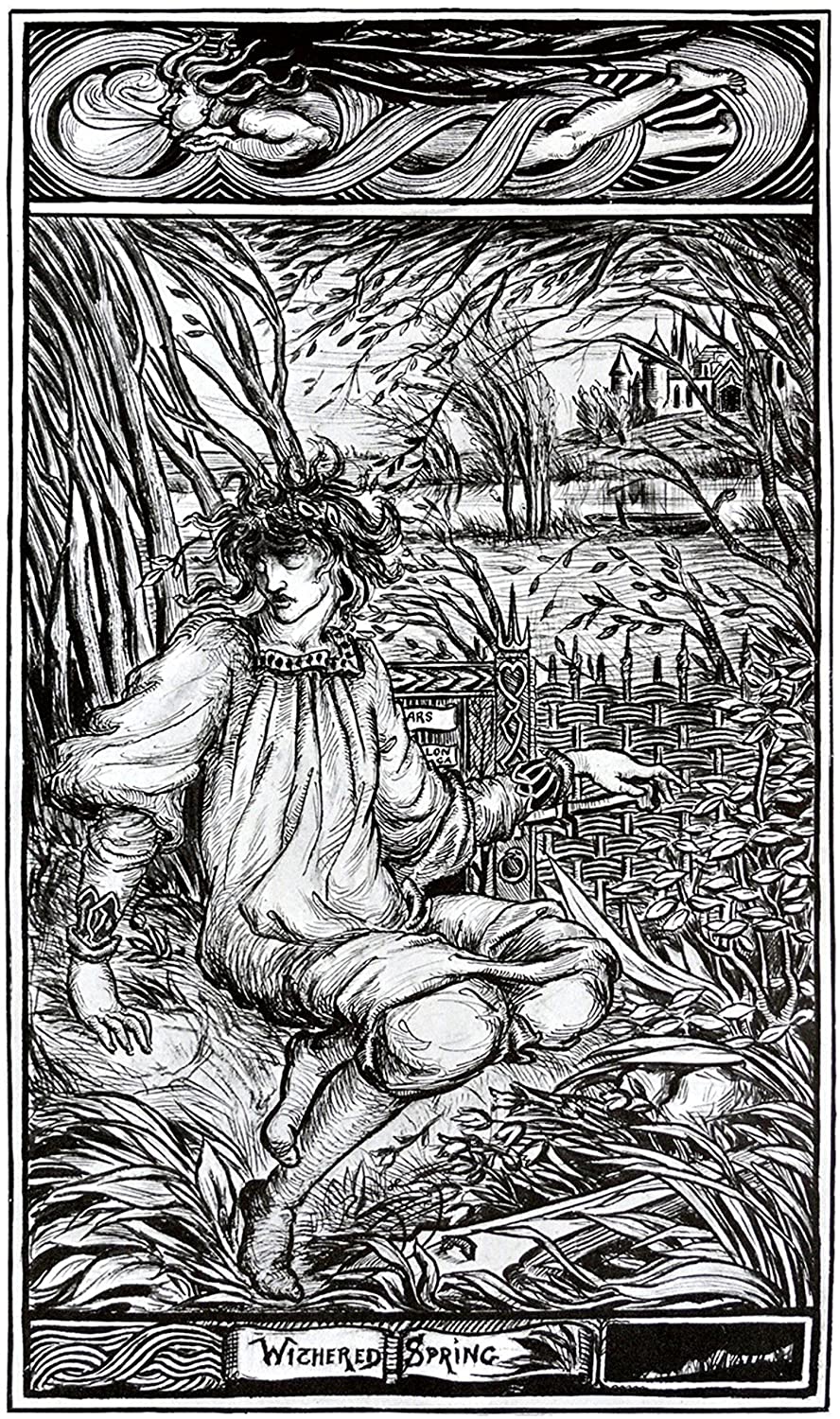
It is interesting to see Beardsley’s tremendous indebtedness to Arts & Crafts ideas of total design, and the importance of intertwining flower and stem motifs. And considering he was only 19!

Withered Spring by Aubrey Beardsley (1891)

Beardsley began his career just as William Morris was producing his luxury designed books from the Kelmscott Press. The curators usefully summarise the elements of a Kelmscott production as:

  • elaborate decorated borders
  • decorated initial letters
  • full page illustration

The hair-line style

The exhibition shows how Beardsley quickly moved from this relatively ‘heavy’ line to move to the extreme opposite, to complex compositions which are covered in a crazy network of super-fine lines. The curators call this his ‘hair line’ style.

How Arthur saw the Questing Beast by Aubrey Beardsley (1893) Victoria and Albert Museum

It is also an early example of Beardsley slipping surreptitious rudeness or irrelevancies into his pictures. At the bottom left of the ‘river bank’, right up against the frame, is the silhouette of an erect penis and scrotum. Towards the top right is a concealed treble clef.

Morte d’Arthur

The picture above is one of the Morte d’Arthur series which made Beardsley’s reputation. He was commissioned to make a hefty 353 illustrations for a new edition of the Morte by publisher J.M. Dent, including full and double-page illustrations, elaborate border designs and numerous small-scale ornamental chapter headings.

However, Beardsley quickly became bored and irked by the subject limitations and began introducing extraneous elements and flights of fancy. Thus the picture above is supposed to be of a medieval knight and a dragon though you wouldn’t really think so. Most disruptive of all is the presence of a pan or satyr from Greek mythology, absolutely nothing to do with medieval legend.

Japanese influence

The exhibition includes one print by Utagawa Kuniyoshi, a lovely coloured woodblock which exemplifies the kind of Japanese influence which impacted European art from the 1870s onwards, and influenced everyone with their:

  • abstract depiction of pictorial space
  • linear intricacy
  • emphasis on flat pattern

Kakemono

kakemono is a Japanese hanging scroll used to display and exhibit paintings and calligraphy inscriptions and designs mounted usually with silk fabric edges on a flexible backing, so that it can be rolled for storage. It is a distinctly different shape from traditional Western portrait shape, and Beardsley was to incorporate it into many later works.

Mantegna

Andrea Mantegna (1431 to 1506) was a key influence for Beardsley. The Italian was famous for his frescos and murals showing parades and processions and groups of people, and Beardsley used ideas and figures and compositions from Mantegna throughout his career. Even in his last accommodation, a hotel room in the south of France, he had a set of photos of works by Mantegna pinned to his wall. Indeed Beardsley produced several Mantegna-style processions, notably The Procession of Joan of Arc which was included as a foldout supplement to the second edition of The Studio magazine in 1892.

Wagnerite

Beardsley was a keen fan of Wagner, attending productions of his operas and illustrating scenes from them. He had ambitions as a writer as well as illustrator and in his last few years worked at a text which was a comic version of the legend of Tannhäuser which Wagner had made into an opera. Given the working title of the Story of Venus and Tannhäuser, excerpts were eventually published in The Savoy magazine under the title Under The Hill, an oddly Hobbit-like title for such a grand Wagnerian subject.

Photo Lineblock

Just as important for the quick evolution of Beardsley’s style was the introduction in the 1890s of the new technology of photo lineblock printing, a photomechanical process. Beardsley was disappointed at the poor reproduction of his washes and shading using this new method, but quickly adapted and made a virtue of leaving large areas of a page completely untouched, others pure black, and ensuring the lines and patterns were crisp and clear. The result is startling.

How la Beale Isoud Wrote to Sir Tristram by Aubrey Beardsley (c.1893) Alessandra and Simon Wilson

In fact this picture is singled out by the curators as exemplifying another of Beardsley’s traits which was his extraordinary ability to assimilate influences and make them his own. Thus the curators point out in this image:

  • Isoud resembles Jane Morris, with the classic pre-Raphaelite jutting chin and mountain of frizzy hair
  • the Germanic form of the desk is borrowed from Albrecht Dürer’s engraving St Jerome in his Study
  • the flattened use of space recalls the influence of Japanese prints
  • whereas the elaborate border of intertwining flower motifs recalls Arts & Crafts designs

Salomé

In 1892 Beardsley made a drawing in response to Salomé, Oscar Wilde’s play, originally written in French and based on the biblical story. Wilde admired the drawing and he and his publisher, John Lane, chose Beardsley to illustrate the English translation of the play. Beardsley produced eighteen designs in total, of which only ten appeared in the first printing of the play. Publisher John Lane suppressed or censored three of Beardsley’s illustrations for their overt sexual references, in particular when female characters’ hands are wandering towards their privates, as if about to masturbate, or unnecessary depictions of the male characters’ phalluses.

The Climax: illustration for Oscar Wilde’s Salome (1893) by Aubrey Beardsley. Photo © Tate

The Yellow Book

The exhibition clarified the timeline around the Yellow Book, and has an entire room devoted to it. Beardsley was made its art editor at its inception in 1894 and contributed the front and back covers for the first five editions. But Beardsley was closely associated with Oscar Wilde (having contributed a suite of illustrations for Wilde’s ‘immoral’ play about Salome), and so soon after Wilde’s arrest in May 1895, Beardsley was fired from the Yellow Book.

On one of the days of his trial, Wilde was seen going into court holding a copy of the Yellow Book and that clinched it for the angry mobs and journalists outside. The offices of the Yellow Book’s publishers, Bodley Head, were attacked by a mob who smashed its windows. In order tonsure the survival of the firm, and its staff, and the continuity of publication of the magazine and all his other titles, publisher John Lane had little choice but to distance himself from Beardsley. The sixth volume, of July 1895, still had the cover and several illustrations by Beardsley but he no longer worked for it. (Later it transpired that Wilde hadn’t been holding a copy of the Yellow Book at all, but a French novel, which tended to be published with yellow covers.)

The Yellow Book Volume I (1894) bound volume. Photo © Tate

It looks as if you can examine every volume of the Yellow Book, all its literary and art contents, online

The room has an example of all five volumes of the Yellow Book that Beardsley was involved with. I’ve read about it ever since I was a teenager at school forty years ago, but I don’t think I’d ever seen a copy before and certainly not six. I’d always envisioned it as magazine-size, but it does indeed look like a hardback book, in size and shape and leather binding.

Beardsley’s work desk

The exhibition includes the very table or desk which Beardsley used during his glory years. Standing a few feet from it, it is hard to imagine that the man produced all these pitch-perfect works without the aid of architects’ tools or computers – just him, a ruler and a pen.

Beardsley’s address

With the money he made from the Salome illustrations and a small legacy Beardsley bought a house at 111 Cambridge Street, Pimlico with his mother and sister, Mabel, to both of whom he remained very close throughout his short life. Only a few hundred yards from Tate Britain where this exhibition is being held…

Oscar Wilde

Wilde was an established writer when he saw the first of Beardsley’s drawings and immediately liked them. He approved the suggestion that Beardsley illustrate the original French version of Salomé and they socialised. So far, so well known. I hadn’t realised that Beardsley satirised Wilde quite so much. There are straightforward lampoons of the increasingly fat and pompous aesthete, but he also slyly slips Wilde’s epicene features into numerous other illustrations, in one giving the moon the eyes and nose of Wilde.

The Woman in the Moon by Aubrey Beardsley (1894)

The Rape of The Lock

This is the title of Alexander Pope’s mock-heroic 18th century satire. I suppose it’s worth clarifying that ‘rape’ in the title doesn’t mean rape in our modern sense, but the older sense of ‘theft’ or stealing away. Thus Pope conceived an extended poem which uses all the devices and machinery of the classical epic to describe how one jaded aristocrat cuts a lock of hair from the head of another jaded aristocrat, and this leads to a feud between their families. Believe it or not this elaborate literary joke extends to five cantos with many extended scenes. Beardsley created nine photo-engravings for an 1896 republication of the poem, five of which are on display here for the first time.

Beardsley had been a fan of 18th century rococo prints, maybe because they – like him – are sophisticated, worldly, stylish and much more open about sexuality than the Victorians. The exhibition shows us some of the original 18th century prints which Beardsley bought at auction in Paris, and then goes on to show all the Pope pictures.

The Dream by Aubrey Beardsley (1896) The J. Paul Getty Museum, Los Angeles

What’s immediately obvious is the that the stark clarity of the Salome illustrations has been abandoned for a much more elaborate style, characterised above all by the stippling that creates a sort of lace doily effect on almost all the fabrics. And look at the patterning of the carpet. A long way from the stark black and white of the Salome illustrations. Many critics thought these his best works as an illustrator.

Posters

The 1890s were the glory decade for poster design in Paris, led by Henri Toulouse-Lautrec and Jules Chéret. I didn’t realise Beardsley produced a number of posters which modified his own style to take on board the need for a) size b) colour.

There’s a room devoted to half a dozen of his posters, none of which match the quality of Lautre or Chéret, and most of which are advertiser’s promotions of new ranges of childrens books or books by women, alongside promotional posters for The Yellow Book and several plays and operas. The section contains the telling quote:

I have no great care for colour, but [in posters] colour is essential.

‘I have no great care for colour’. Worth pondering. And relevant to the one and only oil painting Beardsley is known to have made.

Oil painting

There’s a rare outing for Beardsley’s only oil painting and you can see why – it’s rubbish. His entire style was built around absences, around huge areas of untouched whiteness. Trying to translate that into oil, which specialises in depth and shadow, was a hopeless task.

Porn

After Beardsley was sacked from The Yellow Book, almost the only publisher who would use his drawings was Leonard Smithers. Smithers operated on the fringes of the rare book trade, issuing small, clandestine editions of risqué books with the boast: ‘I will publish the things the others are afraid to touch’. Smithers encouraged Beardsley’s already growing interest in risqué French, Latin and Greek texts and commissioned drawings to illustrate the Satires of the late Roman poet Juvenal and, most famously, Aristophanes’s bawdy satirical play Lysistrata.

In Lysistrata the women of Athens go on a sex strike, refusing to have sex with their menfolk until they stop the ridiculous war against Sparta. Beardsley made eight outrageously sexual illustrations for Smithers’ edition. Among other subjects, this is the set which includes start, beautifully made black and white line drawings of ancient Greeks with humongous erect penises. Maybe if you’re very young or innocent these are ‘shocking’ images, but to the modern viewer they are vaguely reassuring, certainly humorous. The two figures on the right are mildly realistic but it’s the guy on the left who gets the attention, not because of his phallus as such but because the entire character is obviously created for grotesque comedy.

Illustration for Lysistrata by Aubrey Beardsley (1896)

The grotesque

He knew he was attracted to ‘the grotesque’ and there is a wall label which usefully explains the origins of the grotesque in art. Grotesque originally referred to the decoration of grottos, and came to denote the depiction of deliberately hybrid and monstrous forms, which often combined body parts from different animals, like a centaur or mermaid. As the man himself said:

I see everything in a grotesque way. When I go to the theatre, for example, things shape themselves before my eyes just as I draw them. .. They all seem weird and strange to me. Things have always impressed me in this way.

Foetuses

Nobody knows to this day why he drew so many foetuses, either as insets in frames or as characters in the more grotesque illustrations. Maybe it was simply because they are a kind of quintessence of the grotesque.

My favourite

Venus framed by two statues of male gods in the form of herms (a sculpture with a head and perhaps a torso above a plain, usually squared lower section’). I like it because of its formal precision, its symmetry which is, however, broken by the asymmetric sway of Venus’s long dress. I like it because there is no indecency, boobs or penises in sight. Instead there is a sense of genuine menace from the devil eyes of the two herms. And I like it because it is a kind of reversion or revisiting of the Arts & Crafts theme of incredibly ornately interwoven bushes, stems and flowers of (I think) roses. But mostly because it is a pleasingly complete, formal, complex and rather threatening image.

Venus between Terminal Gods (1895) Drawing with india ink by Aubrey Beardsley. The Cecil Higgins Art Gallery, Bedford

Walter Sickert

Almost the best thing in the exhibition is the full-length portrait painting of Beardsley made by the English painter Walter Sickert, after they’d both attended a commemoration ceremony for John Keats. Its sketchy unfinished quality makes it a haunting gesture to the memory of the dandy and artist who died aged just 25.

Aubrey Beardsley by Walter Sickert (1894)

Crucifix

The exhibition includes the last photo of Beardsley, taken in the hotel room in the Hotel Cosmopolitain in Menton where he had gone in search of a warmer dryer climate which would be more favourable to his tuberculosis. The photo shows Beardsley looking tremendously smart in a suit and well-polished shoes opposite a wall on which are pinned reproductions of his beloved Mantegna, and a mantelpiece on which sits a crucifix.

Because although I’ve probably read it numerous times, I’d forgotten that in his last months Beardsley converted to Catholicism. He died holding a crucifix. Just a few days before he died he wrote a letter to Leonard Smithers asking him to destroy all of Beardsley’s risqué images, the Lysistrata illustrations etc. Smithers refused and so they were saved for generations of schoolboys to giggle over.

Who does a deathbed request to destroy his works which its address completely ignored remind you of? Franz Kafka.

Film

There is a room with benches so you can watch Charles Bryant and Alla Nazimova’s 1923 silent movie version of Salomé immediately following the room of Beardsley’s illustrations. For some reason the gallery lights had been left on full power in this room which made it harder to see the image on the screen.

Legacy

The exhibition closes with a sketchy overview of Beardsley’s legacy from his influence on the long sinuous lines of Art Nouveau via a string of now mostly forgotten book illustrators who copied his style (Harry Clarke, Hans Henning Voigt) through the revival of Beardley’s reputation and style which was sparked by a major retrospective of his work at the Victoria and Albert Museum in 1966 which led to the incorporation of Beardsleyesque black and white swirling lines into lots of psychedelic posters and, most famously of all, into the portrait of the four Beatles in the cover art for their LP Revolver.

Portrait of Aubrey Beardsley 1893 by Frederick Evans. Wilson Centre for Photography

This is a long, very thorough, exhaustive and informative exhibition about a truly world class and utterly distinctive English artist.


Related links

More Tate Britain reviews

Edvard Munch: love and angst @ the British Museum

The fin-de-siecle

The last decade of the 19th century is famous for the decadent, dark imagery of its art and literature, and even life. In Imperial Britain this was epitomised by the decadent sexuality associated with the notorious trial of Oscar Wilde and the Yellow Book magazine and the pornographic prints of Aubrey Beardsley. In France there was a reaction against Impressionism which took many forms including the urban posters of Toulouse-Lautrec and the swarthy nudes of Paul Gauguin down in the South Seas. All were well-known and public artists, working in cosmopolitan cities which were the capitals of far-flung empires – London, Paris. They were famous and playing on large stages.

In the other countries of northern Europe, however, one of the most powerful artistic currents was Symbolism.

As the exhibition notes:

Symbolism was a literary and artistic movement that rejected representations of the external world for those of imagination and myth. Symbolists looked inwards in order to represent emotions and ideas.

In Belgium, north Germany and the Scandinavian countries, artists developed a wide range of techniques and styles, but tended to fixate on a handful of themes, namely sex and death. Death awaits with his scythe. Empty boats arrive at forbidding islands. Youths waste away from frustrated love. Beautiful young women turn out to be vampires.

Sex and death and anguish and despair, these are all much more personal, introverted, emotions. Wilde was a flamboyant public personality, Beardsley’s art was defiantly lucid and elegant, both were immensely sophisticated and urbane and cosmopolitan, confident doyens of the largest, richest city in the world.

Whereas much of the fin-de-siecle art from Belgium, Germany, Scandinavia was darker, more personal. Of course they produced urban and sophisticated art as well – the 1890s is characterised by an explosion of diverse art movements – but there was also a big strand of empty lakes and dark pine forests and brooding skies and agonised artist-heroes.

Edvard Munch

Munch is slap bang in the middle of this social and cultural movement. His most famous work is The Scream, which was first made as a painting in 1893 and then turned into a lithograph in 1895 which was reproduced in French and British and American magazines and made his reputation.

The Scream is probably among the top ten most famous images produced by any artist anywhere, and has been parodied and lampooned and reproduced in every medium imaginable (pillow slips and duvet covers, posters, bags, t-shirts). It featured in an episode of The Simpsons, clinching its status as one of the world’s best known art icons. It’s up there with the Mona Lisa.

The Scream (1895) by Edvard Munch. Private Collection, Norway. Photo by Thomas Widerberg

Why is it so powerful? Well:

  1. It is highly stylised and simplified – it barely looks like a human being at all, more like some kind of ghost or spirit of the woods.
  2. The rest of the landscape is drawn with harsh single lines, whose waviness seems to echo the long O of the protagonist’s mouth.
  3. The ‘primitiveness’ of the technique of wood carving – with its thick, heavy ‘crude’ lines – somehow echoes the primalness of the emotional state being described.

The exhibition

This exhibition brings together nearly 50 prints from Norway’s Munch Museum, making this the largest exhibition of Munch’s prints seen in the UK for 45 years.

It also includes sketches, photos and a few oil paintings, not least a big haunting portrait – The Sick Child – of his favourite sister, Johanne Sophie, who died of tuberculosis when she was just 13. These are set alongside works by French and German contemporaries, to present a powerful overview of Munch’s troubled personality, the artistic milieu he moved in, and his extraordinary ability to turn it into powerful images conveying intense, primal human emotions.

Vampire II (1896) by Edvard Munch. The Savings Bank Foundation DNB, on loan to Henie Onstad Kunstsenter, Oslo

Claustrophobic

The exhibition is up in the top gallery in the Rotunda, a relatively small space, which was divided into smallish sections or rooms, the prints hung quite close together on the walls, and the place was packed, rammed, with silver-haired old ladies and gentleman. It was hard to move around. More than once I went to move on from studying a print and found I couldn’t move, with people studying the next-door prints blocking me to left and right and a shuffle of pedestrians blocking any backward movement. Imagine the Tube at rush hour. It was like that.

Possibly, in fact, a good atmosphere to savour Munch’s work. Trapped, claustrophobic, slightly hysterical. it forced me to look up at the quotes from his letters or diaries which have been liberally printed up on the exhibition walls. Just reading these immediately gives you a sense of where Munch was coming from, his personality and the motivation for his art.

For as long as I can remember I have suffered from a deep feeling of anxiety which I have tried to express in my art. (1908)

I was walking along the road with two friends – the sun was setting – suddenly the sky turned blood red – I paused, feeling exhausted – and leaned on the fence – there was blood and tongues of fire above the blue-black fjord and the city – my friends walked on, and I stood there, trembling with anxiety – and I sensed an infinite scream passing through nature. (22 January 1892)

The angels of fear, sorrow, and death stood by my side since the day I was born.

All art, like music, must be created with one’s lifeblood – Art is one’s lifeblood. (1890)

I would not cast off my illness, because there’s much in my art that I owe it.

We do not want pretty pictures to be hung on drawing-room walls. We want… an art that arrests and engages. An art of one’s innermost heart.

Sexual anxiety

There’s plenty more where this came from. The exhibition gives a lot of biographical detail about Munch’s early life, describing the Norwegian capital of Kristiana, how it was connected to the rest of Europe by sea routes, how it was a small provincial town whose every aspect was dominated by the stiflingly respectable Lutheran church, but how young Edvard was attracted to its small bohemian, artistic set of poets and writers and artists, how he conceived a massive sequence of works about love and sex and death which he titled The Frieze of Life:

The Frieze is intended as a poem about life, about love and about death. (1918)

How he travelled to Paris and to Berlin and scandalised respectable opinion with the exhibitions he held there, but created a stir and won admirers for the stark, elemental quality of his woodcuts and prints. (The exhibition includes a map of Europe showing Munch’s extensive travels during the 1890s and 1900s, along with a selection of Munch’s personal postcards and maps.)

We are told Munch was born and brought up in a fiercely religious and conservative bourgeois family which was horrified when he fell in with Kristiania’s bohemian layabouts. These bohos practiced sexual promiscuity, had numerous affairs, and so were plagued by jealousy and infidelity and fights – all exacerbated by the way they drank too much, far too much.

It seemed obvious to me that Munch’s anxiety was caused by the crashing conflict between his extremely repressed bourgeois upbringing and the chaotic and promiscuous circles he moved in as a young man. On the one hand was a young man’s desire and lust, on the other were all the authority figures in his culture (and inside his head) saying even looking at a woman with lust in his heart would lead to instant damnation.

The scores of images he made of women as vampires and weird Gothic presences and looming succubi emerging from the shadows, represent a repeated attempt to confront the epicentre of that clash – sex, embodied – for a heterosexual young man – by sexualised young women. They attracted him like a drug, like heroin but all these compulsive thoughts about them triggered the terror of physical disease – the appalling ravages of syphilis for which there was no cure – along with the certainty of eternal damnation – and all these led to anxious, almost hysterical thoughts, about the only way out, the only way to resolve the endless nightmare of anxiety – and that was release and escape into death, the death which he had seen at such close quarters in the deaths of his beloved mother and sister from tuberculosis.

The obsessiveness of his sexual thoughts, and their violent clash with orthodox Christianity, is most evident in the hugely controversial Madonna, an obviously erotic image to which he blasphemously misapplies the title the Mother of God. When you look closely, you realise that those are sperm swimming round the outside of the frame, and a miserable-looking foetus squatting at the bottom left. Sex versus Religion! It’s amazing he wasn’t arrested for blasphemy and public indecency. In fact his 1892 exhibition in Berlin so scandalised respectable opinion that it was shut down after just a week.

Madonna (1895/1902) by Edvard Munch. Munchmuseet

So Munch’s vampire women aren’t real women, of course they’re not. They are depictions of male anxiety about women, namely the irreconcilable conflict between the demanding, drug-addiction-level lust many young, testosterone-fueled men experience, whether they want to or not – and the feelings of shame about having such strong pornographic feelings and experiences, regret at handling relationships with women badly, and anxiety that you are a failure, as a man and as a decent human being. And terror that – if there is a God – you are going straight to hell for all eternity.

Plus, as the wall labels indicate, there really was a lot of heavy drinking in his circle and by Munch personally, which led to chaotic lifestyles among the bohemian set. Munch became a clinical alcoholic. And this addiction – to alcohol – will, of course, have exacerbated all the psychological problems described above.

Exposure to so many of Munch’s prints – alongside detailed explanations of how he made them, the Norwegian and north European tradition they stem from, and so on – really rubs in the fact that he was a great master of the form. It’s not just The Scream. Lots of the other prints have the same archetypal, primitive power, and the exhibition brings it out by setting Munch’s work beside prime examples by other leading print-makers of the time, in France and Germany (many of which are themselves worth paying the price of admission to see).

The subtle prints

It tends to be the extreme images we are attracted to – The Scream, The Madonna, the numerous vampire women, the worrying image of a pubescent girl sitting on a bed. But some decades ago we crossed a threshold into being able to accept all kinds of erotic and extreme images, so these no longer scandalise and thrill us in the same way they did their initial viewers, although they still provide powerful visual experiences.

But having had a first go around the exhibition taking in these greatest hits, I slowly came to realise there was another layer or area of his work, which is – in a word – more subtle. If the most obvious and impactful of his images are about stress and anxiety mounting to open hysteria – there were also plenty of images which were far more restrained. In which – to point out an obvious difference – the women are wearing clothes.

Instead of vampire women whose kisses are turning into bites, these tend to be of fully dressed, utterly ‘respectable’ late-nineteenth century types, set outdoors, in open air situations where… somehow, through the placing and composition of the figures, a more subtle sense of aloneness and isolation is conveyed. They capture the mood of a couple who are, for some reason, not communicating, each isolated in their brooding thoughts.

The Lonely Ones (1899) by Edvard Munch. Munchmuseet

Like the complex ways relationships between the sexes fail, become blocked and painful in the plays of Munch’s fellow Norwegian, Henrik Ibsen. (Munch, as a leading artist of the day, was acquainted with both Ibsen and the younger playwright, Strindberg. It crossed my mind that if Munch’s more hysterical images can be compared to the highly strung characters in a Strindberg play, the more subdued and unhappy images in some way parallel Ibsen’s couples.)

Having processed the extreme images of vampire women, sex and death in my first go round, on this second pass I warmed to these less blatant images.

I noticed that the naked women images are almost always indoors (as, I suppose, naked women mostly had to be, in his day). But that the more ‘respectable’ and subtle images were all set outside, and often by primal landscapes – namely The Lake and The Forest – the kind of primeval landscape we all associate with Scandinavia and which really was available right on Kristiana’s doorstep.

The exhibition ends with a set of prints which perform variations on his characteristically hunched, half-abstract human figures – characteristically, showing one man and one woman – but in this series hauntingly isolated, leaning on each other or against each other, in postures which don’t look at all sensual but more like the survival techniques of characters from a play by Samuel Beckett.

Towards the Forest II (1897/1915) by Edvard Munch. Munchmuseet

Less striking than the vampires and naked women and girls, I thought these strange, half-abstract, ‘lost souls in the landscape’ images had a kind of purity and haunting quality all their own.

Breakdown and rebirth

It comes as no surprise to learn that in 1908 Munch had a nervous breakdown. His anxiety, compounded by excessive drinking and sometimes fighting, had become acute, and he was experiencing hallucinations and persecution mania. He entered a clinic and underwent a comprehensive detoxification which lasted nearly eight months.

When he left, he was a new man. Well, new-ish. His work became more colourful and less pessimistic and the wider public of Kristiania for the first time began to appreciate his work. Critics were supportive. His paintings sold. Museums started to buy his back catalogue. His life improved in all measurable ways. But in a textbook case of the artist who needs his anxieties and neuroses to produce great works, everything he carved and painted from then on – portraits of rich friends, of the farm he bought, murals for factories – lacked the intensity and archetypal power of his early years.

Years later all that storm and stress and hysteria seemed so distant as almost to be inexplicable.It is typical that, decades later, he told the story of how his famous painting, Vampire II, got its title. He himself had simply titled it Love and Pain. Pretty boring, eh? But Munch’s friend, the critic Stanisław Przybyszewski, and clearly a man with a flair for publicity, described it as ‘a man who has become submissive, and on his neck a biting vampire’s face.’ And, looking back, Munch comments:

It was the time of Ibsen, and if people were really bent on revelling in symbolist eeriness and calling the idyll ‘Vampire’ – why not?

A man in remission from alcoholism and mental illness, the older Munch can be forgiven for not wanting to revive unhappy memories, and for wanting to palm off the idea for lurid titles onto his friends. But the prints themselves, and all his early writings, don’t lie. The later work is interesting and decorative – but it is the unhappy period covered by this exhibition which produced the intense and troubled works which seem to take you right into the heart of the tortured human condition.

Older, wiser and sober. Munch among his paintings at the end of his life

The promotional video


Related links

Related reviews

Klimt / Schiele @ the Royal Academy

This exhibition is much more varied and interesting than the Royal Academy’s promotional material suggests. The main poster shows two female nudes with prominent nipples and, of the eight images further down the page, all but one are nudes, leading you to expect a festival of bottoms and boobs.

There certainly are plenty of nudes in the show, but there’s considerably more to it than that, and it’s the fuller, broader context which makes it so interesting and rewarding.

The pretext

Both Gustav Klimt (born July 1862) and Egon Schiele (born June 1890) died in 1918, Klimt 27 years older and much the more famous and successful figure, having developed a style which combined beautiful draughtsmanship with a fin-de-siecle and semi-symbolist fondness for placing his human figures within two-dimensional sheaths of glittering colours, most famously in 1908’s The Kiss. (Be warned: there is nothing this finished and this glamorous in this exhibition.)

The Kiss by Gustav Klimt (1908)

The Kiss by Gustav Klimt (1908)

Schiele was much under the older man’s influence throughout the 1900s (they first met in 1907) until around May 1910, when he himself realised he had broken through to find his own voice and style – basically Klimt unplugged, the same addiction to the human figure, to sensuous depictions of nudes, but with a ferociously modern, twisted, angular, abrasive sensuality.

To some extent, as the gallery notes make clear, this was the sensuality of poverty. Whereas Klimt ran a successful studio which won public commissions – painting complex ceiling schemes for grand buildings of Vienna’s Ringstraße, did a series of commissions for Vienna’s high society ladies and was married to Austrian fashion designer Emilie Louise Flöge who ran a successful fashion business, and so had access to all manner of sumptuous fabrics, in the latest designs, for his drawings and paintings – Schiele was barely 20 when he hit his stride, and lived in poorly furnished flats with a succession of ‘companions’, most of them even poorer than him, which is why so many of his women are wearing basic kit, stockings, a blouse, and not much else.

To mark the coincidental centenary of their deaths the Royal Academy has arranged to borrow 100 or so portraits, allegories, landscapes and erotic nudes by Klimt and Schiele from the Albertina Museum in Vienna, allowing visitors an amazing opportunity to see these powerful, skilled and stimulating works.

Six rooms

The exhibition is upstairs in the Sackler Wing of the Academy, and is divided into six rooms.

Room 1. Photos, early sketches and the Secession

Photos of Klimt as a middle aged man, in his trademark blue smock, early and very Victorian realist drawings. Next to early photos of Schiele adopting one of his art school poses.

Egon Schiele in Front of the painting ‘Shrines in the Forest’ (1915) by Johannes Fischer

Egon Schiele in Front of the painting ‘Shrines in the Forest’ (1915) by Johannes Fischer

This rooms explains Klimt’s rise to dominance of the Vienna art scene and his leadership of the ‘Secession’ of new young artists set up in 1897. There’s a Secession poster which Klimt designed, with a graceful image of Athena in 1903, next to the bitingly Expressionist picture of the selection board around a table which Schiele created for the 1918 Secession exhibition, after Klimt’s death.

Room 2. Klimt’s drawing process

This room is devoted to several sets or series of drawings Klimt made for grand allegorical projects. In 1894 he was commissioned to create three paintings to decorate the ceiling of the Great Hall of the University of Vienna and chose the subject of Philosophy, Medicine, and Jurisprudence. On display are a series of preparatory drawings for ‘Medicine’ which he conceived as a naked woman floating in space, feet towards us.

In 1902, Klimt finished the Beethoven Frieze for the Fourteenth Vienna Secessionist exhibition, and there are a number of sketches here for female figures. And several preparatory sketches for his 1905 oil painting, Three Ages of Woman, including a strikingly drawn naked middle-aged woman.

Standing older woman in profile (study for three Ages of Woman) by Gustav Klimt (1905)

Standing older woman in profile (study for three Ages of Woman) by Gustav Klimt (1905)

The most obvious thing about all the pieces in this room is none of them are coloured: they are literally just pencil drawings on paper. They allow you to examine and admire Klimt’s technique, and to understand better his interest in the surfaces and folds of the dresses his figures (almost all women) are wearing. But they lack all the exquisite finish and colour and golden luxuriance of his paintings.

It is, therefore, quite a shock and a pleasure to walk into the next room, which is packed with Egon Schiele’s vibrant colourful paintings.

Room 3. Schiele’s drawing process

You immediately notice that all the drawings in this room are coloured, very carefully and fully coloured. And I noticed that the strong angular outlines of Schiele’s figures are emphasised by often being drawn in black crayon as opposed to weak pencil. As if this wasn’t enough some of the most striking figures are outlined with a rough swathe of white gouache, which really makes them leap off the page. Exemplified in this nude.

Female Nude (1910) by Egon Schiele

Female Nude (1910) by Egon Schiele

Female nude also epitomises other Schiele traits:

  • the angularity of the anatomy – look at the painfully pointed hip and shoulderbone
  • the uncomfortableness of the pose – what’s happened to her right arm?
  • the attention to the hand which is long and heavily jointed, looking like a four-legged spider crawling up her side
  • the unashamed bluntness of the loins with their pubic hair
  • and the use of colour not so much to describe as to highlight and bring out the composition

The guide makes a central point:

Schiele frequently used watercolour and gouache in his works on paper, but rarely to create three dimensional modelling. Colour is employed expressively or as a graphic compositional device, similar to Klimt’s division of decorative surface pattern in his paintings.

Not all, but a number of the Klimt sketches in the previous room sketched in the face and body shape merely in order to allow him to create the characteristic series of whorls and geometric shapes across the fabric of women’s skirts and dress which obviously fascinated him. By contrast Schiele’s colours don’t even and smooth out, but create dramatic highlights which leap out of the image.

Not only is the shock of walking into this room like watching colour TV after black and white – it is also by far the most varied in subject matter.

Thus Schiele was arrested in April 1912 when a thirteen-year-old girl who had sought protection in the house he shared with his unmarried partner and model Wally Neuzil, was tracked down by her irate father. He was arrested on charges of seduction and abduction and ended up spending 24 days in Neulenbach prison before the case was dismissed. The exhibition displays five of the drawings and paintings he made during this brief incarceration, one is a full-body self-portrait, but four are of the interior of the prison and his cell. I liked the one of a chair with some handkerchiefs and a green scarf (?) draped over it.

Beside these were two striking and dynamic architectural studies of houses, showing how well Schiele’s strong black lines bring out the architectonics of anything, be it body or building. Alongside these a set of landscapes. I never knew Schiele painted landscapes, they tend to be eclipsed by the explicit nudes.

Field landscape (Kreuzberg near Krumau) 1910 by Egon Schiele

Field landscape (Kreuzberg near Krumau) 1910 by Egon Schiele

This reproduction doesn’t bring out how bright and vivid the greens of the field are. And next to these landscapes was a set of three drawings of chrysanthemums. Again, I had forgotten that Schiele made many flower studies.

White chrysanthemum by Egon Schiele (1910)

White chrysanthemum by Egon Schiele (1910)

Klimt may, for all I know, be the finer artist of the two, but in this exhibition, in this selection of their works hanging side by side, Schiele comes over as vastly more colourful, inventive, varied and dynamic.

Room 4. Klimt portraits

By the 1890s Klimt was a sought-after portrait painter for society ladies. He made his rich women appear tall, statuesque, elegant, often with fashionable dresses buttoned right up to the chin, and a carefully styled bouffant haircut. In the ten or so pencil drawings and sketches for portraits presented here, Klimt is obviously interested in the overall shape and, in some of them, the potential of the dresses to be turned into his trademark fantasias of geometric shapes and mosaics. This approach is exemplified in this study for the sumptuous portrait he eventually painted of Frau Fritza Riedler. Note the absence of eyes. it is the patterns and shapes of the dress which take up most of the space, with just enough outline of face to make it human.

Study for a painting of Fritza Riedler by Gustav Klimt (1904)

Study for a painting of Fritza Riedler by Gustav Klimt (1904)

The curators have artfully hung this eyeless sketch next to a penetrating study by Schiele of his younger sister, Gerti Schiele. You immediately see the difference: the brim of the hat and the ruff around her chest are confidently sketched in, but the rest of the body, for example her right arm, just tapers away. Schiele’s real interest is obviously in the intense black eyes of the sitter, which are staring right out at you.

They are hung right next to each other and looking from one to the other you realise that The Klimt is a design, whereas the Schiele is an intensely felt portrait.

Gerti Schiele by Egon Schiele (1911)

Gerti Schiele by Egon Schiele (1911)

Maybe the difference can be explained in terms of tradecraft – the Klimt sketches were never to be intended to be anything more than preparations, try-outs for what would be the very labour-intensive process of creating finished luxury paintings. By contrast, the Schieles are what they are, not many of them are preparations for paintings, they are pencil, crayon, gouache and watercolour works in their own right.

Maybe there’s a sociological explanation: Klimt could afford to make numerous preparations of expensive works for rich clients; Schiele never became that financially successful, so most of his portraits are of people he knew, models, lovers, friends and family, so they come out of more intimate and close relationships. Maybe that explains why almost all the Schiele knock you for six.

Room 5. Schiele portraits

This is really rammed home in the room devoted to Schiele portraits which, once again, demonstrates his versatility. There are one or two nudes but the emphasis is on his ability to capture the features and character of perfectly respectable, fully dressed citizens of Vienna. There’s a little set of portraits of middle-class men like Heinrich Benesch, the railway inspector who became an important collector of Schiele’s work.

One wall displays a set of portraits of his family, including touching portraits of his sister, his mother and his father-in-law. Set amid these is a staggeringly evocative face of his wife, Edith Harms, who he married in 1914. The guide tells us a bit of gossip about their marriage, namely that nice, middle-class Edith insisted Schiele cut off all contact with his working class mistress and muse, Wally Neuzil. Seems cruel. Needs must. But what remains of Edith is Schiele’s staggeringly evocative portraits of her, like the one featured here. A face, hair, a hand – and an entire personality is before us. It is a staggering testimony to what art can do.

Edith Schiele by Egon Schiele (1917)Edith Schiele by Egon Schiele (1917)

Edith Schiele by Egon Schiele (1917)

Yet another aspect of Schiele’s vision is displayed across two walls of this room – his numerous, inventive and varied self-portraits. Klimt never did a self portrait in his life, Schiele did hundreds. Maybe, again, partly out of poverty. But mostly because, whereas the Symbolist, fin-de-siecle art of the 1890s reached beyond itself to some secret realm trembling on the brink of revelation, the Expressionist art of the 1910s explored the self, and the fracturing of the self, into anguished fragments.

It’s an oddity or irony of the German Expressionists that so many of them considered themselves spiritual leaders, heralding a great spiritual awakening of humanity – and yet, to us, so many of their paintings look hard, heavy and anguished. Same here, with Schiele – the commentary tells us that he identified with Francis of Assissi, wrote about the artist being a spiritual leader, gave his self-portraits titles like ‘redemption’ – and yet to us they seem to anticipate the acute and anguished self-consciousness of the twentieth century, which didn’t decline after Schiele’s death, but achieved new heights of neurotic panic after the Holocaust, the atom bombs and the spread of nihilism and existentialism across mid-century Europe.

It is that tormented self-consciousness which Schiele’s countless experimental self-portraits seem to communicate to us today, not songs about birds.

Nude Self-Portrait, Squatting (1916) by Egon Schiele. Pencil and gouache on packing paper. The Albertina Museum, Vienna

Nude Self-Portrait, Squatting (1916) by Egon Schiele. Pencil and gouache on packing paper. The Albertina Museum, Vienna

By no means all of these self-portraits are nude; the one above is the most naked and explicit. In many others he’s wearing clothes but posing in one of his characteristically agonised, ungainly stylised positions. This angularity prepares us for the last room.

Room 6. Erotic nudes

Bang! the room explodes with some of the most erotic paintings and drawings ever made. They are erotic because they are so candid. You feel like you are in the room, with a good-looking young woman who is happy to share her body with you, no shame, no false modesty, no recriminations. For me, at any rate, it’s this spirit of complete, unashamed, naked complicity which makes them emotionally or psychologically powerful.

Seated Female Nude, Elbows Resting on Right Knee (1914) by Egon Schiele. Graphite and gouache on Japan paper. The Albertina Museum, Vienna

Seated Female Nude, Elbows Resting on Right Knee (1914) by Egon Schiele. Graphite and gouache on Japan paper. The Albertina Museum, Vienna

But having looked carefully at all the works which precede them it is also possible to set aside their erotic charge altogether and consider them as compositions. In this respect the most successful of them vividly bring together features we’ve already noted:

  • the stylised pose, deliberately not classical, not a nude woman carefully standing so as to conceal her loins, but a real woman squatting, lying back with her legs open, gazing at the viewer, completely unembarrassed
  • the angularity of the anatomy – note the weirdly pointed hips, the visible ribs, the jagged angles around the shoulder, the accurate depiction of the lines made by the tendons of the inner thigh just next to the pubic hair, the pointed chin – the human figure as sharp angles
  • the use of colour not to describe naturalistically, but as expressive highlighting – much earlier Klimt had coloured the nipples of his nude paintings, but they were set amid an entire composition of gleaming rich colours: Schiele repeatedly uses the trick of painting the labia, nipples and lips a bright orange colour, on one level highlighting the erogenous zones, but on another making the figures almost into painted puppets, marionettes, an unsettling ambiguity

Note, also, the use of the colour green. By her breast, and armpit, and under her eyes and, the more you look at it, the more you see that Schiele has used that very unhuman colour, green, just touches and flecks of it, which… which do what, exactly? They make this woman’s body look a bit more emaciated than it already is: but the sparingness with which it’s used also makes you look closer, lean in, get drawn in.

Once I started looking, I noticed a very fleeting use of green in many of the nudes, creating just a hint of a kind of heightened, floodlit, hyper-vividness. There’s even green in the self-portrait wearing a yellow waistcoat. I’ve read scores of articles about Schiele and nudes and pornography and the male gaze and so on. It would be interesting to read just one good article about his very sophisticated use of colour.

Schiele’s nudes, hundreds of them, were notorious in his day and now are widely known and admired. I had no idea that Klimt did quite so many nudes and that, in their way, they are more sexually explicit. The wall opposite Schiele’s green-flecked nudes is covered with the detailed pencil drawings Klimt made of nubile young women naked and very blatantly masturbating.

In 1907 Klimt provided fifteen avowedly erotic drawings for a luxury edition of the Roman classic, Lucian’s dialogue of the courtesans. The title of one drawing – shown in the original pencil version and then as an illustration in a copy of the book which is on display here – says it all: Woman reclining with leg raised. She is lying on her back on a bed with one leg pulled up and back by her left arm while she is masturbating with her right hand. Art doesn’t come much more explicit than this. Although even when he’s being as rude as an artist possibly can be, it’s amusing that Klimt can’t stop himself drifting off to think about the decorative spots and patterns on the fabric she’s lying on (her dress? a blanket?)

Reclining nude with leg raised by Gustav Klimt (1907)

Reclining nude with leg raised by Gustav Klimt (1907)

The commentary suggests that, because Klimt’s nude women have their eyes closed they are somehow passive victims of the male gaze, whereas Schiele’s explicit female nudes generally have their eyes open and are often looking straight at the viewer – and so are therefore empowered, have agency etc – an issue of vital concern to female art curators.

I don’t think it’s quite that simple: it’s certainly not that a consistent rule, because some Klimt women have their eyes open and some Schiele women have theirs closed.

In my opinion the scholars are over-explaining something which is more obvious: not only Schiele’s female nudes but the male nudes and most of the fully-dressed portraits as well, are simply more powerfully drawn and more vividly coloured than any of the Klimt drawings on show here.

Klimt’s masturbating women may have their eyes closed, but more importantly (for me, anyway) – although they are just as explicit, in fact in the way they are actively masturbating, they are more explicit than the Schiele – nonetheless, they are drawn with much finer and paler lines, lines which almost fade away into nothingness, as the left leg of the model, above, dwindles from the heft of her buttock and hip down to a small foot which is merely an outline.

In other words, in my opinion, it is not the model, the human being depicted – it is Klimt’s technique or style which is passive and mute. As pencil drawings, the Klimt nudes in this final room are probably better, more accurate draughtsmanship, than the Schiele. But the Schiele erotic nudes, with their strong black outlines, weird angularities, piercing black eyes, and coloured highlights, are incomparably the more powerful and bracing works of art.

Video introduction to Schiele

By Tim Marlow, Artistic Director of the Royal Academy.

//player.vimeo.com/video/298238498


Related links

More Royal Academy reviews

Trilby by George du Maurier (1895)

‘Y a pas d’quoi!’ said Trilby, divesting herself of her basket and putting it, with the pick and lantern, in a corner. ‘Et maintenant, le temps d’absorber une fine de fin sec et je m’la brise. On m’attend à l’Ambassade d’Autriche. Et puis zut! Allez toujours, mes enfants. En avant la boxe!’

Trilby was a publishing and cultural phenomenon. It was the best-selling book of 1894, selling 300,000 copies by the end of the year. Soap, songs, dances, toothpaste, and even the city of Trilby in Florida were all named after the heroine. Trilby boots, shoes, silver scarf pins, parodies, and even sausages flooded the market, and the type of soft felt hat with an indented crown that was worn in the London stage dramatization of the novel, is known to this day as a trilby hat. The plot inspired Gaston Leroux’s 1910 novel Phantom of the Opera and innumerable other works derived from it.

The plot in brief

In outline the plot is simple. We are in the bohemian artistic circles of Paris a generation or so before the book’s publication, so sometime in the late 1850s. An uneducated but strikingly beautiful young woman, Trilby, who works as an artists’ model and also does sewing, charring and other odd jobs, is ‘discovered’, by the tall, creepy Jewish musician, Svengali. He discovers that as a consequence of her sweet innocent nature, Trilby is very easy to hypnotise. So he does, and turns her into a concert-level singer and performer. In the right clothes, tall and statuesque and under his rigid control, Trilby is transformed into a singer of classical music who electrifies audiences all across Europe, making Svengali rich and famous.

The Paris background

Du Maurier was himself an art student in 1850s Paris. He attended the atelier of painter Charles Gleyre where he met talented young artists such as the American James Whistler, Thomas Armstrong (later Director of Art at the South Kensington Museum) and Edward Poynter (later, President of the Royal Academy).

(In fact Whistler recognised a blatant portrait of himself in the character named Jim Silbey when the story was published in magazine instalments, and threatened to sue, forcing Du Maurier and his publishers to remove the character, and an illustration of him, from the published book.)

There were obviously lots of hi-jinks to be had in this high-spirited setting with its boisterous students in the 1850s and a big part of the book’s appeal for 1890s readers was its nostalgia for what was, by then, a bygone era of simpler times.

The fin de siècle reader, disgusted at the thought of such an orgy [of drunkenness] as I have been trying to describe, must remember that it happened in the fifties, when men calling themselves gentlemen, and being called so, still wrenched off door-knockers and came back drunk from the Derby, and even drank too much after dinner before joining the ladies, as is all duly chronicled and set down in John Leech’s immortal pictures of life and character out of Punch.

It seems, from the text, that people (well, men) could get away with a lot more back then.

And it is the most surprising and unexpected thing about the book that this bohemian setting is the dominant theme of the book. It comes as a great surprise to discover that Trilby and Svengali are only really – in terms of time on screen – relatively minor characters in the story.

The first 200 pages (of the 300-page edition I read) are overwhelmingly about, and told from the point of view of, three happy-go-lucky British art students having the time of their lives in Paris.

The setting is the studio rented by these three – nicknamed Taffy, the Laird and Little Billee. They paint away during the week, and host Sunday ‘afternoons’ where all sorts of other artists and musicians come round. They own a variety of exercise equipment, notably several sets of fencing gear, so the Sundays generally involve someone playing the piano, someone singing, a couple of chaps fencing, and a host of others milling among the half-finished paintings, chatting, smoking pipes and cigarettes.

Svengali and his sidekick, Gecko, are initially just two of a gallery of characters who appear at these parties, while Trilby is to start with simply the girl who brings the milk up to the studio every morning. They invite her to take a break and smoke a cigarette while she watches them work, and then she offers to do a bit of cleaning, and then they ask her to model for them and, before you know it, she’s one of the gang, spending many a day with the chaps, cooking and cleaning or smoking and relaxing with them.

There’s a wonderful passage in part one which describes a typical day in the life of a bohemian artist in Paris in the 1850s, which involves strolling round Paris enjoying the sights and stopping at cafés to eat breakfast, lunch and dinner, going to a cabaret, drinking and smoking some more, and generally having a wonderful time. It is all described with high-spirited humour and conviction. Du Maurier lived this life. Lots of it comes over as simple autobiography and memoir, which is what gives it such verisimilitude.

There’s no sex in the book. In terms of release and escapism, I think it was the happy, uplifting portrayal of youthful high spirits in Paris which contributed greatly to its popularity. Some of it reads like a holiday brochure.

England versus France

The opposition or thematic polarity in the book which is most often discussed is that between the pure, virginal, white Trilby and dark, swarthy, Jewish Svengali. White Western virgin women threatened by dark, Eastern, wicked men, a theme expanded in Bram Stoker’s Dracula, published the following year – and in hundreds of thousands of pulp novels and sensational movies from then right up to the present day (the movie Taken was on TV last night in which hard-man Liam Neeson rescues his virginal white daughter from Albanian sex traffickers who are planning to sell her to a rich Arab. Nothing changes.)

Except that for the first 200 pages or so the book isn’t like that at all. We really don’t see Svengali and Trilby together that much. The polarity which dominates the majority of the text is between Britain and France, specifically Paris. Between good, solid, Anglo-Saxon purity and the magic, mystery and ‘immorality’ of legendary, mythical Paris. Innocent Little Billee can’t believe he is here, in Paris, city of poets and artists.

Paris! Paris!! Paris!!!
The very name had always been one to conjure with, whether he thought of it as a mere sound on the lips and in the ear, or as a magical written or printed word for the eye.

Poetic Paris is contrasted throughout with business-like London – as the humorous, dainty, witty Parisian artists we meet are continually contrasted with ‘Taffy’, a six-foot, former British Army officer, taller and stronger (of course) than any mere Continental and who, in the course of numerous anecdotes, knocks them down, breaks up fights, picks up puny Frenchmen and swings them round his head.

Paris is poetry and art and exquisite cuisine. Britain is roast beef, business and the finest army in the world.

And the Frenchness of the story – and du Maurier’s tremendous confidence in this milieu which he knew so well – extends to the language, because a good deal of the book is actually in French.

Lots of the book is in French

Large chunks of the dialogue, and numerous throwaway words and phrases throughout the narrative prose are in French. Du Maurier not only spent his formative student days in Paris, but he had been born and raised there, was perfectly bilingual, and it shows.

‘Tiens! c’est la grande Trilby!’ exclaimed Jules Guinot through his fencing-mask. ‘Comment! t’es déjà debout après hier soir? Avons-nous assez rigolé chez Mathieu, hein? Crénom d’un nom, quelle noce! V’là une crémaillère qui peut se vanter d’être diantrement bien pendue, j’espère! Et la petite santé, c’matin?’
‘Hé, hé! mon vieux,’ answered Trilby. ‘Ça boulotte, apparemment! Et toi? et Victorine? Comment qu’a s’porte à c’t’heure? Elle avait un fier coup d’chasselas! c’est-y jobard, hein? de s’fich ‘paf comme ça d’vant l’monde! Tiens, v’là, Gontran! ça marche-t-y, Gontran, Zouzou d’mon cœur?’
‘Comme sur des roulettes, ma biche!” said Gontran, alias l’Zouzou—a corporal in the Zouaves. “Mais tu t’es donc mise chiffonnière, à présent? T’as fait banqueroute?’
‘Mais-z-oui, mon bon!” she said. “Dame! pas d’veine hier soir! t’as bien vu! Dans la dêche jusqu’aux omoplates, mon pauv’ caporal-sous-off! nom d’un canon – faut bien vivre, s’pas?’

It’s expecting a lot from your average reader to be able to read extended passages of dialogue in pure French. But it’s worse than that. A great deal of this dialogue is in the French slang from the bohemian circles of mid-Victorian Paris, French which is – as the narrator describes it – ‘droll, slangy, piquant, quaint, picturesque’ – in a phrase, ‘French French’.

The book contains all kinds of French dialects. For example, Trilby’s French is highly colloquial. Where the French students speak student slang (‘studio French’), Trilby speaks a more working class dialect of the street. And Svengali murders French with his heavy Germanic accent. And the three British characters all have different French accents which are phonetically transcribed. So there are quite a few different types of French on display. Here’s Trilby:

‘Maïe, aïe! c’est rudement bien tapé, c’te musique-là! Seulement, c’est pas gai, vous savez! Comment q’ça s’appelle?’

Here’s the Laird struggling to speaka da lingo:

‘Voilà l’espayce de hom ker jer swee!’ said the Laird.

Here’s Little Billee, trying to keep up with native Frenchman, the sculptor Durien:

Durien came in and looked over his shoulder, and exclaimed: ‘Tiens! le pied de Trilby! vous avez fait ça d’après nature?’
‘Nong!’
‘De mémoire, alors?’
‘Wee!’
‘Je vous en fais mon compliment! Vous avez eu la main heureuse. Je voudrais bien avoir fait ça, moi! C’est un petit chef-d’œuvre que vous avez fait là—tout bonnement, mon cher! Mais vous élaborez trop. De grâce, n’y touchez plus!’

And:

‘Demang mattang, à votre sairveece!’ said Little Billee, with a courteous bow.

And:

‘Dites donc, l’Anglais?’
‘Kwaw'” said Little Billee.
‘Avez-vous une sœur?”
‘Wee.’
‘Est-ce qu’elle vous ressemble?’
‘Nong.’

And here’s Svengali speaking ungrammatical French with a heavy German accent:

“Sacrepleu! il choue pien, le Checko, hein?’ said Svengali, when they had brought this wonderful double improvisation to a climax and a close. ‘C’est mon élèfe! che le fais chanter sur son fiolon, c’est comme si c’était moi qui chantais! ach! si ch’afais pour teux sous de voix, che serais le bremier chanteur du monte!’

The Oxford University Press paperback edition I read has footnotes translating all this and it’s just as well. Every page of the novel has at least some French on it – raw, colloquial slangy French – and some pages have huge great chunks. How did the original readers manage when the dialogue just switched into pure French?

At last she asked Durien if he knew him.
‘Parbleu! Si je connais Svengali!’
‘Quest-ce que t’en penses?’
‘Quand il sera mort, ça fera une fameuse crapule de moins!’

Possibly an ‘educated’ Briton would have less difficulty with the occasional Latin tags which du Maurier scatters through his text:

  • ‘Quia multum amavit!’
  • et vera incessu patuit dea!
  • Omne ignotum pro magnifico!
  • Par nobile fratrum
  • ex pede Herculem!

But what about the patches of German and Italian, which also appear?

The experience of reading the book is not only to be soaked in the lives and jokes and high spirits of 1850s Bohemian Paris, but to be dropped into extended passages of raw French. This is the melodramatic climax of the entire book, when the conductor of the orchestra at her final concert tells Trilby to sing and, without Svengali, she discovers that she can’t:

The band struck up the opening bars of ‘Ben Bolt’, with which she was announced to make her début.
She still stared – but she didn’t sing – and they played the little symphony three times.
One could hear Monsieur J—— in a hoarse, anxious whisper saying,
‘Mais chantez donc, madame – pour l’amour de Dieu, commencez donc – commencez!’
She turned round with an extraordinary expression of face, and said, ‘Chanter? pourquoi donc voulez-vous que je chante, moi? chanter quoi, alors?’
‘Mais ‘Ben Bolt,’ parbleu – chantez!’
‘Ah – ‘Ben Bolt!’ oui – je connais ça!’
Then the band began again.
And she tried, but failed to begin herself. She turned round and said,
‘Comment diable voulez-vous que je chante avec tout ce train qu’ils font, ces diables de musiciens!’
‘Mais, mon Dieu, madame—qu’est-ce que vous avez donc?’ cried Monsieur J——.
‘J’ai que j’aime mieux chanter sans toute cette satanée musique, parbleu! J’aime mieux chanter toute seule!’
‘Sans musique, alors – mais chantez – chantez!’

At key moments throughout the book you need to be really fluent in French, and several other languages – or to be reading an edition which translates these passages – to have a clue what’s going on.

‘Got sei dank! Ich habe geliebt und gelebet! geliebt und gelebet! geliebt und gelebet! Cristo di Dio…. Sweet sister in heaven…. Ô Dieu de Misère, ayez pitié de nous….’

This brings us to another really dominating aspect of the experience of the text – the pictures.

120 illustrations

Du Maurier was a writer only by accident and at the very end of his life. For most of his career he was a highly successful illustrator for magazines and books.

Born in 1834, du Maurier studied art in Paris, then got a job with Britain’s leading satirical magazine, Punch, in 1865, drawing two cartoons a week. He also did illustrations for popular periodicals such as Harper’s, The Graphic, The Illustrated Times, The Cornhill Magazine and Good Words. He illustrated a number of ‘classic’ novels from the time, including several by Thackeray. It was only after 25 or more years of producing a steady stream of humorous illustrations with comic captions that his failing eyesight drew an end to his artistic career and forced him to consider other options.

In 1891 he reduced his involvement with Punch and, at the suggestion of his good friend Henry James, wrote his first novel Peter Ibbetson, which was a modest success. Trilby was his second novel, published in 1894 and a runaway success beyond anyone’s imagining. He spent the next two years getting increasingly fed up with the demands from commercial interests and the book’s thousands of fans, before he died in 1896, leaving a long unfinished autobiographical novel to be published posthumously.

The fact that he was primarily an artist – and a book illustrator at that – explains why Trilby is stuffed with du Maurier’s own illustrations, some 120 of them by my count. These illustrations, like the ones he’d been doing all his life, portray rather stiff and starchy Victorian people but in situations which convey a sense of warmth and humour.

Here is young ‘Little Billee’ with the taller Taffy and the Laird, distracted from studying Old Masters in the Louvre by the sight of a pretty woman art student. It contains humour at the expense both of the easily distracted young man, as well as something satirical in the ‘saintly’ gaze of the fetching student. The entire setting is gently sent-up.

Among the Old Masters

Among the Old Masters

The presence of illustrations on around half the pages makes it feel like a children’s book, half-reminds you of reading Winnie The Pooh or Professor Branestawm. For the first 50 or 60 pages it doesn’t feel at all serious, which means that when you do finally get to the more ghoulish and creepy scenes with Svengali, it has more the sense of pantomime (‘He’s behind you!’) than full-blooded horror.

Combined with the general student hi-jinks of the early scenes, the good-humoured illustrations also contribute to the book’s entertainment value.

Comedy

Trilby so drips with comedy that it is almost a comic novel. The opening setup describing the three British artists in their studios is hugely funny. Their inability to understand the French spoken around them is gently mocked. In fact throughout the book there is a continual stereotyping of British and French national characteristics which is comparable to the outrageous humour of ‘Allo ‘Allo.

The British are characterised by bluntness, philistinism, bad food, bad weather. In particular there is no end to the gentle raillery of the biggest of the three, big Beefy British warrior, Taffy the Yorkshireman or ‘the Man of Blood’.

A Yorkshireman, by-the-way, called Taffy (and also the Man of Blood, because he was supposed to be distantly related to a baronet) – was more energetically engaged. Bare-armed, and in his shirt and trousers, he was twirling a pair of Indian clubs round his head. His face was flushed, and he was perspiring freely and looked fierce. He was a very big young man, fair, with kind but choleric blue eyes, and the muscles of his brawny arm were strong as iron bands.

For three years he had borne her Majesty’s commission, and had been through the Crimean campaign without a scratch. He would have been one of the famous six hundred in the famous charge at Balaklava but for a sprained ankle (caught playing leapfrog in the trenches), which kept him in hospital on that momentous day. So that he lost his chance of glory or the grave, and this humiliating misadventure had sickened him of soldiering for life, and he never quite got over it. Then, feeling within himself an irresistible vocation for art, he had sold out; and here he was in Paris, hard at work, as we see.

He was good-looking, with straight features; but I regret to say that, besides his heavy plunger’s mustache, he wore an immense pair of drooping auburn whiskers, of the kind that used to be called Piccadilly weepers, and were afterwards affected by Mr. Sothern in Lord Dundreary. It was a fashion to do so then for such of our gilded youth as could afford the time (and the hair); the bigger and fairer the whiskers, the more beautiful was thought the youth! It seems incredible in these days, when even her Majesty’s household brigade go about with smooth cheeks and lips, like priests or play-actors.

He is the Roast Beef of Old England made flesh.

Taffy jumped out of his bath, such a towering figure of righteous Herculean wrath that Svengali was appalled, and fled.

And when the art students at Carrel’s studio attempt to carry out the traditional initiation ceremony on Taffy:

He took up the first rapin that came to hand, and, using him as a kind of club, he swung him about so freely and knocked down so many students and easels and drawing-boards with him, and made such a terrific rumpus, that the whole studio had to cry for ‘pax!’ Then he performed feats of strength of such a surprising kind that the memory of him remained in Carrel’s studio for years, and he became a legend, a tradition, a myth! It is now said (in what still remains of the Quartier Latin) that he was seven feet high, and used to juggle with the massier and model as with a pair of billiard balls, using only his left hand!

But then the entire bohemian world comes in for sustained ribbing. Du Maurier finds it all wonderfully entertaining and he invites you to, as well. Even when Svengali is at his most sinister he never loses the heavy German accent which made him such a figure of fun in the first half of the book and which remains right to the end, well, funny.

Du Maurier as intrusive narrator

Du Maurier intrudes a lot as the first person narrator, either directly or in the mocking persona of ‘the scribe’:

That is the best society, isn’t it? At all events, we are assured it used to be; but that must have been before the present scribe (a meek and somewhat innocent outsider) had been privileged to see it with his own little eye.

The present scribe is no snob. He is a respectably brought-up old Briton of the higher middle-class – at least, he flatters himself so.

And that is the question the present scribe is doing his little best to answer.

The present scribe was not present on that memorable occasion, and has written this inadequate and most incomplete description partly from hearsay and private information, partly from the reports in the contemporary newspapers.

And he also invokes the figure of ‘the reader’, an equally stereotyped source of humour, in the tradition of the 18th century comic novelists and of William Thackeray, so many of whose books du Maurier illustrated.

Of course the sympathetic reader will foresee…

Let the reader have no fear. I will not attempt to describe it.

And that, as the reader has guessed long ago, was big Taffy’s “history.”

Fundamentally this is a comic strategy, making the reader a collaborator in the essentially light-hearted and frivolous occupation of telling a story.

It is ironic that du Maurier was friends with Henry James. James was an avowed opponent of the ‘baggy monster’ novels of the great Victorians, stories told in monthly instalments which wandered all over the place and in which the author kept interrupting, introducing himself, making apologies and generally carrying on.

James spent his career developing infinitely more sophisticated narratives in which he explored the implications of different types of narrator. Trilby is a late-flowering example of everything James hated, more like an episode of the Chris Evans radio show than a work of art, with the effervescent presenter continually popping up and commenting on his own story, taking the mickey out of his readers, of Victorian society, of churchmen, of the French, of novels and of his own ability as a storyteller.

Prose constructed from humorous episodes

There’s another consequence of du Maurier’s origins as a creator of humorous cartoons, which is not so obvious but, I think, quietly ubiquitous.

This is to do with the structure of the humorous cartoons which du Maurier spent the majority of his working life devising.

As a rule these cartoons start with the incredibly realistic scene and setting. There is a wonderfully limned background and then the vividly delineated characters. It is only when you have taken in the substantial amount of visual information the artist is giving you, that the eye progresses to the bottom of the picture, there to discover the humorous caption.

These captions are almost always in dialogue form, in which someone says something and then someone else replies with something ironic or revealing.

Take du Maurier’s most famous cartoon (below). It is breakfast time in the household of a pompous vicar. He has invited a curate (a person who undertakes lowly duties in a parish) to attend. But in his epic condescension, the vicar has given the curate only one egg for breakfast, and a rather old one at that. The pompous vicar says:’ I’m afraid you’ve got a bad egg, Mrs Jones.’ To which the curate, unctuously keen not to offend his boss, replies: ‘Oh no, my lord, I assure you! Parts of it are excellent!’

The effort expended in creating the illustration is phenomenal. The attention to detail! The characterisation of the balding vicar, with his rigid backbone and hook nose and pompous demeanour, wonderfully contrasted with the young curate’s sloping shoulders and eager-to-please neophyte expression.

But just as important to the overall effect are the faces of the two women sitting aloofly at table. And that’s before you explore the wealth of visual detail, all the cutlery on the table, the pictures on the wall, and the presence of both a butler and a maid in the background.

What I’m suggesting is that du Maurier took a technique he had perfected in his cartoons – a wealth of realistic detail treated solely in order to lead up to a boom-boom punchline – and wrote his prose novels the same way. Realistic, if gently mocking depiction, leading up to a boom-boom punchline.

Take the long passage in Part Two (the novel is in eight parts) describing Svengali’s background, and which includes this paragraph. It is long and thorough and detailed and realistic – and it leads up to quite a good joke. Just like one of du Maurier’s cartoons.

He was poor; for in spite of his talent he had not yet made his mark in Paris. His manners may have been accountable for this. He would either fawn or bully, and could be grossly impertinent. He had a kind of cynical humour, which was more offensive than amusing, and always laughed at the wrong thing, at the wrong time, in the wrong place. And his laughter was always derisive and full of malice. And his egotism and conceit were not to be borne; and then he was both tawdry and dirty in his person; more greasily, mattedly unkempt than even a really successful pianist has any right to be, even in the best society.

All these jokes lead in the same direction. Du Maurier mocks the pomposity and pieties of the mid-Victorian middle class.

The example above doesn’t so much mock pianists themselves, as satirise posh society’s fashionable expectations of what they should be, namely dishevelled in appearance in order to stress their ‘Romantic’ sensibility. He mocking the way this idea – that being greasy and dirty equates to sublime artistic talent – is most piously held among the most refined and precious parts of society.

Same goes for the excerpt below. The Victorians, or Victorian journalists, developed the hackneyed phrase and idea that a piece of contemporary art or literature should be chaste and pure enough so as not to risk ‘bringing a blush to the cheek‘ of a young person.

In part of his lengthy description of Trilby, du Maurier goes into an extended riff which gently mocks this whole idea, invoking the non-existent ‘young person’ and the piety of her supposed parents (specifically, the mother).

Trilby had all the virtues but one; but the virtue she lacked (the very one of all that plays the title-role, and gives its generic name to all the rest of that goodly company) was of such a kind that I have found it impossible so to tell her history as to make it quite fit and proper reading for the ubiquitous young person so dear to us all.

Most deeply to my regret. For I had fondly hoped it might one day be said of me that whatever my other literary shortcomings might be, I at least had never penned a line which a pure-minded young British mother might not read aloud to her little blue-eyed babe as it lies sucking its little bottle in its little bassinet.

Fate has willed it otherwise.

Would indeed that I could duly express poor Trilby’s one shortcoming in some not too familiar medium – in Latin or Greek, let us say – lest the young person (in this ubiquitousness of hers, for which Heaven be praised) should happen to pry into these pages when her mother is looking another way.

Latin and Greek are languages the young person should not be taught to understand – seeing that they are highly improper languages, deservedly dead – in which pagan bards who should have known better have sung the filthy loves of their gods and goddesses.

First of all du Maurier laments that his tale is not pure enough to avoid a blush rising to the cheeks of any virginal young person who looked at it. Then he mockingly laments his fate as the author of such a shameful story. Then he moves on to make a joke about how, on this strict criteria, we ought to ban Greek and Latin since they are crammed full of obscenity.

You could sum it up by saying that the spirit of Punch saturates the entire book.

Anglo-Saxon morality

Anyway, this mention of Anglo-Saxon morality brings us back to the plot of the book, which is not at all what I expected.

For the narrative follows neither Trilby nor Svengali. It turns out all to be about Little Billee, the naive and innocent youngest of the trio of British painters in Paris. He is arguably the most gifted and certainly the most sentimental, always ready – as du Maurier mockingly points out – with a tear poised at the edge of his eye, to burst into tears at the slightest provocation.

So it is that Little Billee falls in love with Trilby. When she is posing (dressed) for Taffy, the Laird and Little Billy, she keeps looking up and seeing his eye firmly focused on her face while he neglects his drawing. Once or twice he goes into studios of other artists, especially the training studio of Carrel and, finding Trilby posing nude in front of thirty or so male students, rushes back out, red-faced with shame and mortification.

Slowly Trilby realises that he has ‘fallen in love’ with her. And at the end of a Christmas Day when the other two Brits have staged an epic party for all their Bohemian friends (described with a Dickensian love of the food and with much mocking and ribbing of the hosts and guests) Little Billee takes Trilby to the top of the garret stairs and proposes to her. In fact this turns out to be the nineteenth time he has proposed to her (comedy!) and she, exhausted and worn down, says yes and then runs off in floods of tears.

Without realising it, Little Billee’s naive obsession proves the catastrophe or turning point of the action. For he writes a letter to his mother and sweet virginal sister back in provincial Devon announcing that he is to be married – but instead of joy, this prompts horror in Mrs Bagot (Billee’s real name) who promptly turns up in Paris with her teenage daughter and accompanied by her brother-in-law who is, rather inevitably, a man of the cloth, the Rev. Thomas Bagot.

They represent, in other words, a full frontal, massed assault of Victorian Values at their most strict and narrow and they proceed to interrogate Taffy about this ‘Trilby’. At which he is forced to concede that she is an uneducated model and cleaner. Can you imagine the response of the respectable Mrs Bagot and the reverend? Suffice to say, it is not favourable.

Then, at just the right moment, Trilby walks in (‘just as in a play’ as the author comments, tongue in cheek) and has a Grand Confrontation with her fiance’s mother. Long story short, Trilby a) presents herself with dignity and honour but b) agrees that she must not come between sweet Billee and his family. So she immediately decides break off the engagement and to leave Paris.

Little Billee discovers this, later in the day, from a letter she sends him – and promptly has a nervous breakdown. He has a complete collapse. He is confined to his bed, doctors tend him, it takes weeks to recover, during which Trilby packs her bags and, taking the younger brother she cares for, flees Paris to an unknown destination. When Billee is better, he is helped to a train and back to England, all the way back to the family home in Devon, where he is cared for by his sweet sister and loving mother.

Taffy and the Laird are left devastated that their happy-go-lucky little household has been broken up, and upset about Billee and worried about Trilby.

As a reader who had been very happily amused and entertained up to this point, I was absolutely furious with Mrs Bagot. She is concerned for her son’s future, for his career, for his place in society, and that he should marry a ‘respectable’ woman who will help him climb the ladder. Nonetheless, Billee’s selfish obsession and his mother’s narrow-mindedness bring the happy-go-lucky first half of the novel to a crashing end, and I couldn’t help resenting her for it.

The odd thing is that du Maurier, having spent 150 pages being amusingly indulgent of the student milieu, having reported their drunkenness, their laziness, their slovenliness, the cheap clothes, their outrageous jokes and the easy way they hang round with models who are ‘no better than they should be’ (it is very broadly hinted that Trilby has had a number of lovers) all of a sudden sits up and becomes pious and sentimental on us, himself.

He takes Mrs Bagot’s concerns seriously. When Trilby leaves the studio she glimpses virginal Miss Bagot in the cab waiting outside and is stricken with guilt at besmirching the name of such a family. Later that day, when Billee reads the goodbye letter from Trilby, he collapses in the arms of his mother and sister i.e. he is won over to their side, and du Maurier gives us some surprisingly pious paragraphs about family honour and so on.

Billee in the arms of his sister and mother

Billee in the arms of his sister and mother

When push comes to shove, du Maurier abandons his youthful high-spiritedness and tolerance – and sides with the enemy. It is almost unbelievable that this one event has such seismic consequences for all concerned, and strips the book of its innocence. From now on du Maurier struggles to recover the high-spirited humour of the first half. The reader, rather like Taffy and the Laird, feels a strong ‘sense of desolation and dull bereavement’.

The passage of time

Instead, five years pass. Billee, now William Bagot, continues painting and becomes a success, a name, an artistic ‘lion’, who is invited to salons by rich society ladies, who mixes with the highest society, is mentioned among the great up-and-coming artists and so on. But inside he is cold and empty. He is as polite as is required, but his heart is dead.

It was as though some part of his brain where his affections were seated had been paralyzed, while all the rest of it was as keen and as active as ever. He felt like some poor live bird or beast or reptile, a part of whose cerebrum (or cerebellum, or whatever it is) had been dug out by the vivisector for experimental purposes; and the strongest emotional feeling he seemed capable of was his anxiety and alarm about this curious symptom, and his concern as to whether he ought to mention it or not.

Du Maurier takes us on Billee’s journeys into upper-class society and, more interestingly, for a page or two, out to the East End where he also becomes well known and takes part in evening sing-songs in squalid taverns… an echo of Dorian Gray’s adventures out East.

Du Maurier says it was the breadth of Billee’s human sympathies which underpinned the warmth and humanity of his art. Which is fine, but there was no such painter as William Bagot. And also, throughout the extensive and detailed sections on art, I can’t help thinking that British art of this period grew steadily more isolated from all the trends on the Continent, almost completely oblivious to Impressionism and the myriad types of post-Impressionism, continuing with ever-more dreamy depictions of sad-eyed women by Edward Burne-Jones or the stately, half-naked ladies of ancient Rome by Frederick Leighton, Alma-Tadema or Albert Moore.

Wonderful in their way, but eventually destined to hit the brick wall of European Modern Art and evaporate overnight.

The book contains very long passages about art, about types and theories of mid-Victorian art, about the difference between superficial and profound art, much humour at the expense of the Laird’s endless attempts to paint toreadors accurately (and a typical joke about the fact that, once he actually visits Spain and starts to paint toreadors from life, his paintings immediately stop selling).

But to a post-modern reader it all seems pre-historic. We are told that one of Billee’s most successful paintings is of a sow in a sty being suckled by lots of little pink piglets, handled with:

An ineffable charm of poetry and refinement, of pathos and sympathy and delicate humour combined, an incomparable ease and grace and felicity of workmanship.

This sounds like the sickly sweet animal paintings of Edwin Landseer, and reminds me of the depiction of the artist Basil Hallward in The Picture of Dorian Gray (1891) or Rudyard Kipling’s portrayal of the artist Dick Heldar in The Light That Failed (1891). In none of these three books is there a glimmer of the tsunami of modernism which is about to completely revolutionise the very idea of what art is.

Anyway, rather surprisingly du Maurier describes himself as being present in the story – telling us that he was introduced to the Laird and Taffy when Little Billee brought them to a grand party at the house of millionaire Sir Louis Cornely.

And it is here that they hear, from the lips of a great classical singer, of the spreading reputation of La Svengali, the most beautiful woman singer in the world. This gives rise to discussion among the posh chaps present who have seen the famed singer at various venues around Europe, while Billee, Taffy and the Laird listen in amazement, wondering if it can possibly be the same Svengali they knew all those years ago back in Paris.

Darwinism

The novel takes us up to page 200 with a lengthy passage describing Billee’s return from London, where he had attended this party, back to his family in Devon. His mother has ambitions to marry him to Alice, daughter of the local vicar. She is, indeed, a noble, virtuous, shy, well-mannered and devout young lady, and deeply in love with Billee. Billee goes and sits by the sea, with Alice’s own dog, Trey sitting at his feet (in order to give the whole scene a sentimental resonance. Think of Landseer’s sentimental dog portraits.)

There's No Place Like Home (1842) by Sir Edwin Henry Landseer

There’s No Place Like Home (1842) by Sir Edwin Henry Landseer

Billee would like to please Alice, his mother and his sister, and is sure he could make the lady a good and faithful husband except for one tiny detail… He is an atheist. He is reading On the Origin of Species for the third time and it has demolished his belief in a Christian God. If there is a God, how could he be so cruel and vengeful, flooding the earth, punishing unbelievers, conceiving of Hell?

To round out this scene, as Billee is walking back towards the village, he bumps into Alice’s father, the vicar. The vicar starts questioning Billee about his faith, which church in London he attends and so on, to which Billee has to stumblingly admit that he has no faith and attends no church. By the end of the walk the pair are no longer on speaking terms, and Billee’s engagement to Alice is broken off.

Du Maurier being the satirist that he is, then gives a page-long passage describing the way that this redoubtable pillar of the church (the vicar) in later life came into a small fortune due to acquiring shares in a rising company, and found that the financial independence this gave him allowed him to read widely and, like Billee, to lose his faith. He ends up becoming a Positivist (i.e. a believer in science not religion as the source of truth). The vicar argues with his bishop, loses his post and moves to London where he becomes an atheist lecturer.

So far, so satirical. His daughter, on the other hand, remains sweet and virginal and a devout Anglican. This little homily seems to me to epitomise the split-mind of Victorian men – happy to mock and satirise his fellow middle-class peers v but coming over all pious and sentimental at the sight of a young English lady.

Thus du Maurier was quite relaxed and open about the ‘affairs’ of the many models he described in the French scenes – of Svengali’s one-time girlfriend ‘Mimi la Salope’, and of Trilby herself. But as soon as an English lady – Mrs Bagot – and even more, an English virgin – saintly young Miss Bagot – enter the narrative, all open-minded, relaxed tolerance of permissive living vanishes, and the narrative hits a cold hard wall.

As far as I can tell, for the second half of the 19th century and well into the 20th, this was a common phenomenon. Young, and not so young, men went over to Paris to have ‘adventures’ i.e. casual sex, and then came back to England to act as stern, upright defenders of British sexual morality.

Fake context

You know the movie Forrest Gump where Gump is made to appear at various key moments of history, for example receiving a war medal from President Johnson, the inclusion of real historical events and personages designed to give verisimilitude to the story.

Same here. Du Maurier invokes a number of figures from the worlds of art and music and literature to lend reality to his tale. Regarding Billee’s success as an artist, du Maurier intrudes into the narrative to ask us whether we remember the first great success of Billee’s painting – ‘The Moon-Dial’ – or the great sale at Sotheby’s where his painting fetched a record price? He makes this effort in order to persuade us that Billee is one of the great contemporary British painters (although we all know that he doesn’t exist).

Similarly, after Trilby’s great appearance singing in Paris, du Maurier claims his fictitious character was reviewed by the entirely real figures of Berlioz (who, he says, wrote no fewer than twelve articles about La Svengali) and Théophile Gautier, who is made to write her a poem.

Back to Trilby

These digressions take up about 50 pages of this 300-page book. Only now do we touch back down five more years after the previous events (the vicar and so on).

Little Billee, Taffy and the Laird reunite to go to Paris to see a performance of Trilby under the management of Svengali. First they take a stroll around all their haunts – which gives du Maurier chance to describe how Paris changed in the 1860s due to Baron Haussmann’s famous boulevard-building programme.

They also bump into a raft of former acquaintances from their student days, most of whom have abandoned art. One of the liveliest of them, Dodor, is now working as shop supervisor in a haberdasher’s store and is engaged to the owner’s daughter. Another, l’Zouzou, a soldier who was, to their surprise, related to a grand ducal family, they meet on an outing to the Bois de Boulogne, where he is entertaining his bride-to-be, a very ugly American lady named Miss Lavinia Hunks, and her incredibly wealthy mother. This is all the opportunity for much knowing satire and mockery. Such is life. Sic transit gloria mundi, and other truisms.

Our trio then attend the Paris premiere of Trilby’s singing, which du Maurier describes in pages of detail. The humble milk girl they’d known back in the day who could barely hold a note is now the possessor of the greatest voice the world has ever heard. (In a stroke of creative inspiration du Maurier has her sing mostly cheap trite street songs and nursery rhymes, but with such thrilling passion and expression that there is 15 minutes of standing ovation at the end of her brief concert.)

They go away stunned at the impact her performance has on them. Above all, for the central protagonist of the novel, Little Billee, it seems to unblock the cold channels of his heart. Once again he feels the thrill of passion and is swept up with genuine love for his friends and burning jealousy for the man Trilby has married, no other than her mentor, the tall, swarthy, oleaginous Svengali.

Next day Little Billee pops down to the post office to write and send a letter to his dear mama. Who should be there but Svengali, with a clutch of letters. Svengali notices our hero:

looking small and weak and flurried, and apparently alone; and being an Oriental Israelite Hebrew Jew, he had not been able to resist the temptation of spitting in his face, since he must not throttle him to death.

That ‘Oriental Israelite Hebrew Jew’ is on the face of it, heart-stoppingly offensive and antisemitic. You have to remember that a) plenty of other characters are given the same kind of excessive description based on national stereotypes, especially big strong Anglo-Saxon Taffy – and b) that du Maurier’s style delights in hyperbole and exaggeration and c) that it creates humour by concatenated repetition. So, for example:

As for Trilby, G—, to whom she sat for his Phryne, once told me that the sight of her thus was a thing to melt Sir Galahad, and sober Silenus, and chasten Jove himself – a thing to Quixotize a modern French masher!

Galahad, Silenus, Jove and Don Quixote are all dragged into a short sentence (which also makes a throwaway generalisation about the French) in a classic example of du Maurier’s technique of comic hyperbole, of overdoing it for comic effect.

Or sentimental hyperbole, as when Svengali’s sidekick Gecko describes his devotion to sweet Trilby:

‘Well, that was Trilby, your Trilby! That was my Trilby too – and I loved her as one loves an only love, an only sister, an only child – a gentle martyr on earth, a blessed saint in heaven!’

That’s five descriptive phrases in a row, a glut of descriptors, which are piled up like this in order to satirise the speaker.

Indeed, all the characters, in their dialogue, and the narrator in his prose, are given to overemphasis and repetition. It’s part of what makes the whole thing feel like a Victorian play, crammed with moments of comedy, sentiment, horror and shock by turns.

So I think the purpose of that ‘Hebrew’ sentence is comic rather than insulting. On some level, now lost to us, the unnecessary repetition of ‘Oriental Israelite Hebrew Jew’ was meant to be humorous. As that last clause – ‘since he couldn’t throttle him to death’ – is also typical of the mocking exaggeration du Maurier applies to all his characters.

Anyway, Little Billee fights back and isn’t getting anywhere, when Taffy, who has witnessed the whole episode, steps up to Svengali who, recognising him, cowers in terror. Tall, strong, manly, Anglo-Saxon Taffy takes ‘Oriental Israelite Hebrew Jew’ Svengali by the nose and wags his head from side to side before delivering a stinging open-handed slap. While the manager of the hotel calls for the police, Svengali runs off, and doesn’t bring any charges.

Taffy gives Svengali what for

Taffy gives Svengali what for

This all happens in Paris. Then our trio return to England and to their separate pursuits. Little Billee goes down to Devon again, this time accompanied by Taffy, who turns out to be have connections with the vicar and with the local gentry, and gets taken up by them, the two artists generally making a very favourable impression on the local society and peasants.

Once they have all celebrated a quiet Christmas, Billee and Taffy return to London in order to see Trilby’s London debut. They don’t know that that very afternoon Svengali had been in a brawl with his loyal and devoted lieutenant, Gecko.

Back in those bohemian Sunday afternoon sessions, Gecko had often played violin for Svengali and, as Trilby’s singing career took off, Gecko had continued to be lead violin in the orchestra, whose arrangements Svengali wrote himself.

But all through those years Gecko had grown more and more devoted to Trilby. The encounter with Billee and Taffy had put Svengali on edge and tetchy. Several times during the afternoon’s rehearsals he had criticised Trilby’s singing and, finally, rapped her over the knuckles with his baton.

At which Gecko snapped and leaped at him, stabbing Svengali with a shallow cut on the neck. Gecko is manhandled away, doctors are called who patch up Svengali’s throat but tell him on no account must he conduct this evening in case the wound bursts again.

So that evening, at the grand theatre in London, where are assembled the cream of high society and stretching up away into the gods, everyone who is anyone, Trilby goes to sing with Svengali, for the first time, not conducting, but in a box, though still placed so he can see her.

But when the band strikes up, and the conductor turns to Trilby, the statuesque woman in the expensive ballgown appears dazed and confused. ‘What am I doing here?’ she asks. ‘What do you mean, sing?’ The conductor begs and implores her to perform and so she eventually reluctantly gives in and – gives vent to the tuneless, cracked voice the bohemians remember from all those years earlier.

The shocked audience starts booing. Trilby bursts into tears and is hustled off the stage. It is discovered that Svengali is dead. He died of heart failure in his box and had been sitting there with a rictus grin on his face and black demonic eyes empty of life.

Our heroes – the Laird, Taffy and Billee – swarm backstage and, when Trilby obviously recognises them, the show’s impresario allows them to take her home with them.

They put her up in Billee’s Fitzroy Square rooms. And here the truth comes out. She remembers nothing about the previous five years. Her memory is that she first fled Paris to escape Billee – lived miserably in the countryside for a while then,after her kid brother died, came back to Paris, suicidally depressed and unable to sleep, and came across Svengali somewhere. And he helped her to sleep. And he adored and worshipped her. And they seemed to travel around a lot and she was often tired. That’s all she can remember.

When they explain to her that she is one of the most famous women in Europe, that she is the most famous singer in the world, she laughs and puts them off and says, ‘Get away, nonsense, who are you trying to kid?’ She has no memory at all of her world-conquering career. For the entire time she has been the puppet of Svengali, the master musician and hypnotist.

And now Trilby is drained and broken. Only 23 she looks 30, her skin white and translucent. For the last thirty pages of the book she wastes away and dies. She is surrounded by the three chaps and her maid, and regularly called on by the best doctors money can buy, but they can do nothing.

Du Maurier wrings every last drop of emotion from the situation, making Dickens’s description of the death of Little Nell look like a newsflash. First he gets Mrs Bagot to come all the way from Devon and, upon seeing how nobly Trilby is dying, to realise what a foolish woman she has been and to beg Trilby to forgive her and Trilby begs Mrs B to forgive her and both women collapse in tears v as does the gentle reader.

Mrs B and Trilby have a long conversation about God, death and forgiveness, in which Trilby reveals that the worst thing she ever did in her life was go off for a carriage ride with some admirers and leave her five-year-old brother crying at home. Mrs Bagot cries. Trilby cries. The reader cries.

Then, right at the end, from out of nowhere a packing case is delivered and Trilby unwraps it to discover a fine photographic portrait of Svengali in his Hungarian musicians outfit, staring straight out of the photo. Trilby is lying on a couch, places it on her feet, holding it at full length and then… a strange change comes over her. Svengali’s intense black eyes hypnotise her one last time, from beyond the grave, and she sings the Chopin Impromptu in A flat which was her signature piece, sounds of supernatural beauty which bestil the room and move the listeners to tears.

Then she is gone. Doctors called. Death confirmed. Not a dry eye in the house.

The death of Trilby

The death of Trilby

Postscript

Cut to twenty years later at the Grand Hotel on the Boulevard des Capucines in Paris where Svengali had spat at Billee and Taffy pulled his nose and slapped him.

Taffy is now married to Little Billee’s sister, but alas Little Billee is dead. Trilby’s dying words were ‘Svengali, Svengali, Svengali’ and this prompts the sensitive Billee to have a recurrence of the brain fever which had afflicted him all those years earlier. He sickens, wastes and dies, an ‘early death, his manly, calm, and most beautiful surrender.’

Well, anyway, Taffy and wife have come back to Paris sometime in the 1880s. Once again du Maurier shows off his knowledge of the city as he has the happy couple tour round all his old haunts. But the purpose of this final section is that he takes Mrs Taffy to the theatre and notices, down in the orchestra pit, a grey-haired violinist who looks like Gecko, Svengali’s old assistant.

It is Gecko and Taffy invites him out for a meal. And now, for the first time, we hear the full story and Gecko clarifies, if we had any doubt, that there were two Trilbies: the sweet innocent natural girl – and then the robotic hypnotised singing machine which Svengali and he spent three long years hypnotising and training to sing note by note.

Not only notes but inflections, volume, stress, every element of singing was drilled into her by the painstaking Svengali. Once again Gecko emphasises that Svengali was a musical genius, and had a crystal clear idea of what perfect singing should be, but which most humans fell short of.

But because he exercised complete control over Trilby, he was able to programme her like a robot; and, eventually, after the long years training, control her with the slightest movement of his eyes or his baton.

So these final pages make explicit the theme of the double, the doppelgänger, and suddenly I’m thinking of Jeckyll and Hyde, and the Picture of Dorian Gray and all those Sherlock Holmes stories which are based on people living double lives, the whole late-Victorian fascination with two-sidedness. Trilby the sweet innocent / Trilby the robot.

Gecko says it was horrible to see Trilby turned into an automaton; only on a few occasions in all that time was she truly herself. He leans his head on his arms and weeps. Truly this is not a happy book. Taffy orders Gecko a cab and pours him into it. Then Mr and Mrs Taffy stroll home through the deserted streets of Paris, looking forward to going back to England, back to their quiet little country home and their happy family.

For all its jaunty humour and carefully calibrated irreverence, Trilby ends with a hymn to the pieties of home and family every bit as whole hearted as Tennyson’s great mid-Victorian poem, In Memoriam. It’s final words are characteristically in French, but the sentiment is piously British and Victorian.

Où peut-on être mieux qu’au sein de ta famille?’

Antisemitism

Quite obviously the novel brings together two blatant, popular and enduring stereotypes or topoi: the pure, upstanding, virginal white English woman in jeopardy from a dark, swarthy, threatening foreigner from the East. These are so obvious, and have been written about and criticised so often, that I can’t think of much to add except for a few thoughts about Svengali.

The most striking thing about the Jewish characterisation of Svengali is how breathtakingly in-your-face it is.

Trilby went to see him in his garret, and he played to her, and leered and ogled, and flashed his bold, black, beady Jew’s eyes into hers, and she straightway mentally prostrated herself in reverence and adoration before this dazzling specimen of her race. So that her sordid, mercenary little gutter-draggled soul was filled with the sight and the sound of him, as of a lordly, godlike, shawm-playing, cymbal-banging hero and prophet of the Lord God of Israel – David and Saul in one!

It’s not only Svengali who is described in antisemitic terms. His first attempt to hypnotise someone is:

Mimi la Salope… a dirty, drabby little dolly-mop of a Jewess, a model for the figure.

Du Maurier notes that one of the contemporary music scene’s greatest singers is of Spanish or Sephardi Jewish ancestry:

For Glorioli – the biggest, handsomest, and most distinguished-looking Jew that ever was – one of the Sephardim (one of the Seraphim!) – hailed from Spain, where he was junior partner in the great firm of Moralés, Peralés, Gonzalés & Glorioli, wine-merchants, Malaga. He travelled for his own firm; his wine was good, and he sold much of it in England. But his voice would bring him far more gold in the month he spent here; for his wines have been equalled – even surpassed – but there was no voice like his anywhere in the world, and no more finished singer.

And, surprisingly, the protagonist of the story, Little Billee, is described as having a tincture of Jewish blood in him:

In his [Little Billee’s] winning and handsome face there was just a faint suggestion of some possible very remote Jewish ancestor – just a tinge of that strong, sturdy, irrepressible, indomitable, indelible blood which is of such priceless value in diluted homœopathic doses, like the dry white Spanish wine called montijo, which is not meant to be taken pure; but without a judicious admixture of which no sherry can go round the world and keep its flavour intact; or like the famous bull-dog strain, which is not beautiful in itself; and yet just for lacking a little of the same no greyhound can ever hope to be a champion.

As usual, when you read these kinds of comment in context you realise that they are more complex and multiform than the term ‘antisemitic’ (or ‘racist’ or ‘sexist’) allow. They are just selected examples from a spectrum of comments based on ideas of racial characteristics which we have, by and large, abandoned.

In fact these four examples demonstrate how du Maurier applied racial stereotypes to all his characters, and invoked a wide range of ‘types’. Svengali has all the threatening stereotypes du Maurier can muster heaped on him but Mimi is, by contrast, a hapless victim. Glorioli is characterised as not an Eastern but a Spanish Jew, and therefore is described in different terms from the other two.

And this last paragraph, where he says a drop of Jewish ‘blood’ enhances character doesn’t appear to be an insult but a roundabout form of praise of Jews – albeit based on ideas of ‘race’ or ‘blood’ which we now find abhorrent.

Also, anyone angered or horrified by the cruder descriptions of Svengali must also bear in mind that du Maurier also makes him tall and powerful. He is a big threatening man. And credit is repeatedly given to his unquestioned musical genius. Svengali plays the piano to concert level and is credited with arranging the music for Trilby to sing with great taste and precision.

And, after all, we should remember that Svengali is invited to the heroes’ Sunday afternoon parties. Invited, not banned. Du Maurier is interested in creating a rounded, if objectionable, character. He is a novelist, not a Nazi.

Anyway, this spectrum of opinion about Jews is itself only part of the broader spectrum which includes comments about all manner of races – the French ‘race’ and character is pored over at length, the Americans come in for some ripe satire, at least half the negative characterisation of Svengali derives not from his Jewishness, but from the (arguably more damning) fact that he is German.

He could be very funny, Svengali, though he was German, poor dear!

Let alone the countless mocking descriptions of all aspects of the ‘Anglo-Saxon’ character, some fond, some satirical, some surprisingly patriotic, some openly scathing (about the narrow philistinism of the English bourgeoisie).

The point is that the entire book comes from an completely different way of looking at human nature – in terms of the intrinsic values of identifiable categories called ‘races’ – which tried, throughout the 19th century, to make sense of the diversity of human beings by grouping them into categories.

All ages do this. Our own age – as I’m reminded every time I open a newspaper or turn on the radio – enthusiastically groups humans into categories according to present-day concerns, namely ‘women’ (who all and everywhere need our help), ‘people of colour’ (who need to be more represented in culture and organisations) and Muslims (who are the victims of Islamophobia). Against them are lined up racists, sexists and Islamophobes.

These are just the same kind of sweeping generalisations but, because they belong to our time, we take them for granted – just as much as du Maurier’s readers accepted stereotypes about the English, Scottish, Irish, Welsh, French, Germans and Jews.

Reading du Maurier’s racial generalisations doesn’t offend me. It feels as remote from real life as reading the medieval Catholic literature which damned Jews and Muslims to an eternity in Hell. (There is hair-raisingly antisemitic content in Dante, who also condemned the Prophet Mohammed to a special place in Hell.)

None of that offends me. It is of anthropological and historical interest. I am interested in the cultural system these old categories embodied and elaborated, and the light it sheds on how previous societies created and structured their values. It’s no different from reading contemporary journalism which blames ‘gammons’ for Brexit and ‘angry white men’ for Trump. A lot less harmful because it is so obviously from a vanished era, and it is done with sympathy and humour.

I’m not trying to let du Maurier off the hook. There is a virulence and vehemence about the characterisation of Svengali which I can easily imagine being very offensive to any Jew and indeed any progressive liberal reading it these days.

But on the other hand, he is the baddy. Baddies, in boy adventure stories like this, always are laden with all the negative qualities the writer can muster.They generally are cruel, sadistic bullies, often from the East (reflect on the villains in the James Bond books; plenty of eastern stereotypes, not least about Russia).

Every age tries to make sense of the world by creating stereotyped categories of human beings to populate it with, those on ‘our’ side and those who are ‘against’ us, and then proceeds to vilify and insult those opponents. To imagine that our own society doesn’t do just the same is naive.


Related links

Related reviews

Symbolism by Michael Gibson (1995)

The most striking characteristic of Symbolist artists is their withdrawal into the realm of the imagination. It is the solitude of the dreamer, of one who, marooned on a desert island, tells stories to himself. It is the solipsistic solitude of one who is sure of nothing outside himself.
(Symbolism, page 35)

This is an enormous coffee-table book, some 31.5 cm tall and 25 cm wide. The hardback version I borrowed from the library would break your toes if you dropped it.

Its 227 pages of text contain a cornucopia of richly-coloured reproductions of symbolist paintings, famous and obscure, from right across the continent, with separate chapters focusing on France, Great Britain, Belgium, the Netherlands, Germany, Scandinavia, the Slavic countries, the Mediterranean countries and so on.

The main body of the text is followed by eight pages giving potted biographies of the key symbolist artists, and a handy table of illustrations. All of this textual paraphernalia, as well as the end-covers and the incidental page, are lavishly decorated with the evocative line drawings of Aubrey Beardsley.

It is a beautiful book to have and hold and flip through and relish.

Symbolism was a literary movement

So what is Symbolism? A big question which has stymied many art historians. Gibson approaches the problem from a number of angles. For a start, Symbolism (rather like Surrealism) was a literary movement before it was an artistic one. The Symbolist manifesto published in 1886 was written by a poet, Jean Moréas, and was built around analysis of the poets of the day, not the artists, versifiers such as Paul Verlaine (1844 to 1896) or Stéphane Mallarmé (1842 to 1898). In this article Moréas suggested that these writers were aiming ‘to clothe The Idea in perceptible form.’ In looking for ways to illustrate this point he mentioned the similar aim in several contemporary artists, most notably Gustave Moreau.

OK, but what idea? Well, there were eventually hundreds of symbolist painters and the problem is that pretty much every one of them had a different ‘idea’.

Symbolism against the modern world

Gibson takes a different tack, not wasting ink trying to define the elusive ideal and instead offers a sociological explanation. What almost all the symbolist artists had in common was a rejection of the scientific rationalism and the industrial pragmatism of the age (the late nineteenth century). The social and industrial trends of the time were represented by a writer like Émile Zola, who embraced the modern age in all its dirt and squalor and poverty and drunkenness, developing an approach he called ‘Naturalism’, minutely detailed and carefully documented fictions about life as it really was in late-nineteenth century France, among seamstresses, coalminers, prostitutes and the like. Zola approached his work like a scientific experiment: he thought that, if his books revealed the true state of things, this would enable legislators to improve society and the human lot.

In a similar spirit the influential philosopher Auguste Comte (1798 to 1857) preached a social philosophy called ‘Positivism’, which thought that humanity could use scientific and technological advances to create a new society – a technocratic and utopian ideal which found its fullest expression in the English-speaking world in the scientific utopias of H.G. Wells.

Symbolists hated all this. They thought it was killing off all the mystery and imagination in life. They turned their backs on factories and trams and went in search of the strange, the obscure, the irrational, the mysterious, the barely articulatable.

Symbolism a legacy of lapsed Catholicism

Gibson makes the profound point that symbolism mainly flourished in a) Catholic countries b) that had been transformed by industrialisation. If you had only one of these two factors, no dice. Thus the strongly Catholic countries of the Mediterranean (Spain or Italy) were unaffected because they hadn’t suffered the upheavals of widespread industrialisation. Britain was mostly unaffected because, although blighted by industrialisation, it was not a Catholic country. Combining the two criteria explains why symbolism flourished in the northern Catholic regions of heavily industrialised France, Germany and Belgium.

Gibson explains how the Industrial Revolution, coming later to these countries than to pioneering Britain, seriously disrupted the age-old beliefs, traditions and customs of Roman Catholicism. In particular, huge numbers of the peasant population left the land and flocked to the cities, to become a new industrial proletariat (or fled Europe altogether, emigrating to the United States). In the second half of the nineteenth century Europe saw social disruption and upheaval on an unprecedented scale.

Urban intellectuals in Catholic countries felt that the age-old sense of community and tradition embodied by continent-wide Catholicism had been ruptured and broken. Many lost their faith in the face of such huge social changes, or as a result of the intellectual impact of Darwinism, or the visible triumph of science and technology. But they regretted what they’d lost.

Take ‘The Great Upheaval’ by Henry de Groux (1893). Gibson reads this confusingly cluttered painting as representing the disruption of traditional values in a society undergoing rapid change: note the broken crucifix in the centre-right of the composition.

The Great Upheaval by Henry de Groux (1893)

Symbolism, then, represents the mood right across northern Europe of artists and intellectuals for whom traditional Catholicism had died, but who still dreamed of transcendental values, of a realm of mysteries and hints from ‘the beyond’. As Gibson eloquently puts it, Symbolism is:

the negative imprint of a bygone age rich in symbols, and the expression of yearning and grief at the loss of an increasingly idealised past. (p.24)

Hence the widespread movement among intellectuals to set up clubs, new religious ‘orders’, hermetic societies, cabbalistic cults, to turn to spiritualism, clairvoyance, and a wide range of fin-de-siècle voodoo.

Portrait of Péladan by Alexandre Séon (1891)

Péladan was one of the founders of the mystical Salon de la Rose+Cross which aimed to support Symbolist art. He changed his name to Sâr (or ‘Magus’) Mérodak.

Mention of voodoo prompts the thought that, up till now I’ve made it sound like harmless replacement for lost religious certainties. I haven’t brought out the widespread sense of anxiety and nightmarish fear which also dominates much of Symbolist art, as in this brilliantly terrifying image by the Belgian painter Léon Spilliaert.

Vertigo, magic staircase (1908) by Léon Spilliaert

Symbolism and the femme fatale

There’s a lot of threat in Symbolist paintings. In Monet women innocently walk through fields with parasols, in Renoir women are laughing dancing in sunlit gardens. But in Symbolist paintings women tend to be depicted as extremes, either as muses dreaming of another world or as sexually threatening and voracious demons.

Salome (1909) by Julius Klinger

The Biblical story of Salome who persuades King Herod to have John the Baptist beheaded, haunts the fin-de-siecle era. Wilde wrote a play about it, Strauss an opera, and there are scores of paintings. In most of them Salome represents the femme fatale, the woman who uses her sexual attraction to lure men into dangerous or fatal situations. Dr Freud of Vienna would have said the real terror lying hidden in these paintings was the male castration complex. Surely the idea was never made more explicit than in this painting by Julius Klinger which shows Salome carrying – not the traditional head of John – but a severed set of testicles and penis dripping blood, along with the blood-red knife with which she has just cut severed them.

Why this anxiety? Why, above all, did it present itself in sexual form?

Maybe because Symbolist artists were almost all men (there were several successful women Impressionists –Morisot, Cassat – but no female Symbolists that I can see), and that they were dedicated to exploring the irrational aspects of human nature – and not much is more irrational than people’s sex lives, fantasies, desires and anxieties.

And so these men, psyched up to explore the strange, the fantastical, the edgy the socially taboo – ended up projecting onto the blank canvas of ‘woman’ a florid range of their own longings and fears. The ‘irrational’ is not the friend of feminism. Here is ‘Sin’ (1893) by Franz von Stuck.

‘Sin’ by Franz von Stuck (1893)

The smooth white skin and pink nipples and her mild smile of the alluring half-naked woman almost distract you from the enormous snake draped round her neck, resting on her right boob, and ready to bite off your… your what? (‘Paging Dr Freud’, as they used to say in Hollywood screwball comedies.) A very Catholic image since, after all, the basis of Catholicism is the snake tempting Eve who in turn tempted Adam into the Fall. In this image, Snake and Woman once again tempt the (male) viewer. Anxious male artist speaks to anxious male viewer.

Symbolism and death

If Symbolist art often portrays Woman (with a capital W) as femme fatale, it just as often betrays anxieties about Death (with a capital D). But Death not as most of us will experience it (hooked up to beeping machines in a soulless hospital ward), Death instead encountered like a seductive figure in a folk tale, often handsome and alluring, often female, even sexy.

Not many images in this genre outdo ‘The Tomb of Arnold Bocklin’ by Ferdinand Keller for shimmering morbid atmosphere.

The Tomb of Arnold Bocklin by Ferdinand Keller (1902)

Symbolism and decadence

Fin-de-siècle art is often identified with ‘Decadence’, the cult of etiolated aristocrats reclining on velvet divans in an atmosphere heavy with incense and debauchery, as epitomised in the classic novel, Against Nature by J-K Huysmans.

Gibson sheds light on this, too, by saying the Decadence wasn’t fuelled so much by a sense of decline, as by a resolute opposition to the doctrine of Progress, a subtly different idea. This artistically aristocratic sensibility refused to kow-tow to the vulgar jingoism and gimcrack technical advances of the age (telegraphs, telephones, electric lights, early cinema – how ghastly), remaining nostalgic for the imagined superiority of its ancestors in an imaginary, pre-scientific age.

There are always servants in Decadent literature. From a sociological point of view that is one of their most important features. In fact servants feature in the most famous and much-quoted line from the ‘decadent’ symbolic drama Axël by the French writer Auguste Villiers de l’Isle-Adam, where a typically aloof aristocrat drawls:

‘As to living, our servants will do that for us.’

The Salon de la Rose+Croix

In 1891 the Symbolist Salon de la Rose+Croix published a manifesto in which they declared that Symbolist artists were forbidden to practice historical, patriotic and military painting, all representations of contemporary life, portrait painting, rural scenes, seascapes, orientalism, ‘all animals either domestic or connected with sport’, flowers or fruit. On the plus side, they welcomed mystic ecstasy, the Catholic ideal, and any work based on legend, myth, allegory or dream (p.56). It’s an accurate enough snapshot of the Symbolist mentality.

This sensibility locks itself away from the world, cloistered (a Catholic image) in an ivory tower, waking only at night (Symbolism is as fascinated by night, by shades of darkness, as Impressionism is by sunlight and daytime: yin and yang).

Rejecting science, the exoteric (obvious) and everyday banality, Symbolism retreats into esoteric studies of the past, into alchemy, into the artificial recreation of medieval ‘orders’ (the more artificial, the more delicious), into mesmeric incantations about sin and death and damnation (overlooking the rather more mundane positive elements of Catholicism – charity, good works and so on).

The vast range of Symbolism

The great success of this book is in bringing together a really vast range of works from right across Europe to show how this mood, this urge, this wish for another, stranger, irrational world, took so many weird and wonderful forms, in the paintings of hundreds of European artists.

And it also investigates the shifting borders of Symbolism, where the impulse to ‘clothe the Idea’ shaded off into other schools or movements, be it post-Impressionist abstraction, Expressionist Angst, Art Nouveau decorativeness, or just into something weird, unique and one-off.

The more I read on and the more examples I saw, the more I began to wonder in particular about the border between Symbolism and ‘the Fantastic’. Despite Gibson’s inclusivity, some of the paintings reproduced here look more like illustrations for fantasy novels than grand gestures towards a solemn mystery world. It’s a tricky business, trying to navigate through such a varied plethora of images.

Here, from the hundreds on offer, are the paintings which stood out for me:

Symbolists against nature

Numerous symbolist writers and artists argued that the world of art is radically separate from the so-called ‘real world’. They thought that the Impressionists (who they heartily disliked) were simply striving for a better type of naturalism. Symbolists, on the contrary, wanted next to nothing to do with the yukky real world. As Gibson puts it:

No longer was nature to be studied in the attempt to decipher its divine message. Instead, the artist sought subjects uncanny enough to emancipate imagination from the familiar world and give a voice to neurosis, a form to anxiety, a face, unsettling as it might be to the profoundest dreams. And not the dreams of an individual, but of the community as a whole, the dreams of a culture whose structure was riddled with subterranean fissures. (p.27)

Symbolists found the idea of the total autonomy of the work of art

No following of nature, then, but, in various manifestos, essays, poems and paintings, the Symbolists claimed the total autonomy of art, accountable to no-one but the artist and the imagination of their reader or viewer. Gibson argues that these claims for the complete autonomy of art lie at the root, provide the foundation of, all the later movements of Modernism. Maybe.

Symbolism ended by the Great War

What is certain is that the strange other-worlds of Symbolism came to a grinding halt with the Great War, which tore apart the community of Europe more violently than the Industrial Revolution. The movements which emerged just before and during it – the avant-garde cubists, the violent Futurists, the absurdist Dadaists – all tended to despise wishy-washy spiritualism, all guff about another world. In one way or another they embraced the realities, and excitements, and absurdities, of this one.

Nonetheless, the irrational mood and the imperative to reject the business-like bourgeois world, was revived by the Surrealists (founded in 1924) and it’s easy to identify a continuity of fantastical imagery from the later symbolists through to the Surrealists.

But the Surrealists’ great secret wasn’t other-worldly, it was other-mindly. Their worldview wasn’t underpinned by lapsed Catholic notions of the divine and the demonic. The Surrealists were students of Freud who thought that if they brought the creatures of the unconscious out into the open – via automatic writings and artfully arranged bizarre imagery – they would somehow liberate the world, or at least themselves, from bourgeois constraints.

So much for the theory: but in practice some of the art from the 1920s, and even 1930s, is not that distinguishable from the weirder visions of the 1880s and 1890s.

The conservatism of Symbolism

Reading steadily through the book made me have a thought which Gibson doesn’t articulate, which is that almost all of this art was oddly conservative in technique.

It is overwhelmingly realistic and figurative, in that it portrays human beings (or angels of death or satanic women or whatever), generally painted in a very traditional academic way. There are (as the Rose+Croix wanted) on the whole no landscapes, still lives or history scenes featuring crowds. Instead you get one or two people caught in moments of sombre meaningfulness, but depicted with all the completeness of finish of the most traditional Salon painting.

Hardly any of it is experimental in technique. Not much of it invokes the scattered brush work of a Monet or the unfinished sketchiness of a Degas or the interest in geometric forms of a Cézanne. Nothing in the book is as artistically outrageous as the colour-slashed paintings of the Fauves, of Derain or Vlaminck.

In other words, this art of the strange and the other-worldly comes over as peculiarly conservative. I guess that chimes with the way the belief almost all these artists shared in some kind of otherworld, some meaning or presence deeper than our everyday existence, was profoundly conservative, a nostalgic hearkening back to an imagined era of intellectual and spiritual completeness.

The twentieth century was to blow away both these things – both the belief in some vaporous, misty otherworld, and the traditional 19th century naturalist style which (on the whole) had been used to convey it. Cars and planes, tanks and bombs, were to obliterate the worlds of both tranquil lily ponds and midnight fantasias.


Related reviews

The Return of Sherlock Holmes by Arthur Conan Doyle (1905)

Having killed off Holmes in the 1893 story The Final Problem, Conan Doyle came under intense pressure from fans and publishers to revive him. Finally he did so in 1901 to 1902 serial The Hound of the Baskervilles, though this was set before Holmes’ fictional demise and so doesn’t mention it. And then came these 13 new short stories, published monthly in the Strand magazine from September 1903 to December 1904, and collected in book form in March 1905. In the first of them Conan Doyle bites the bullet and gives his explanation of how Holmes survived his fight with Professor Moriarty at the Reichenbach Falls.

In the ‘real’ world there had been a 10 year gap between the 1893 death story and the 1903 miraculous survival story; in the Holmes universe the gap is just three years, from 1891 when The Final Problem is set until 1894 when the Empty House is set. This period is referred to by Holmes specialists as ‘The Great Hiatus’, and the first story also describes his adventures around the globe during this period.

The 1890s, decade of -isms

I’ve read the 1890s described as the decade of -isms because so many movements began and proliferated then. It was the Yellow Decade, the Mauve Decade, the Naughty Nineties, central decade of the Gilded Age, the fin-de-siècle, the Reckless Decade, and saw the flourishing of symbolism, Art Nouveau, Arts & Crafts, Aestheticism, Art for Art’s Sake, post-Impressionism, neo-Impressionism, the Secession and Jugendstil in the arts. It was the zenith of Imperialism in Britain and the USA (the Spanish-American War 1898). It saw an efflorescence of radical political movements including nihilism, anarchism, communism, socialism, the New Woman and feminism, vegetarianism and so on.

What all this really shows is that the decade marks the beginning of the Modern Period because too much was beginning to happen for anybody to really understand – too many social, economic, political and cultural trends, with international affairs becoming more complicated as new powers arose (America and Japan) and old powers threatened Britain’s hegemony (Germany looming).

Theories of degeneration

Holmes himself is not immune to the siren call of the innumerable theories which the age spawned. As we know, one of the consequences of Darwin placing humans firmly in the Natural World and the product of evolution rather than Divine Creation, was that thinkers galore pondered the possibility that humankind could be actively bred to create a new race of superbeings – an idea that appealed to Nietzsche and H.G. Wells, to name but two – or its disastrous opposite, that the race or individual races were just as capable of being degraded, of collapsing through moral and physical decay. This theory had been immensely popularised by Max Nordau in his gloomy bestseller Degeneration (1896) whose tone is given by this extract:

‘We stand now in the midst of a severe mental epidemic; of a sort of black death of degeneration and hysteria…’

and received garish expression in Bram Stoker’s Gothic fantasy about an invasion of blood-drinking anti-humans from Eastern Europe who corrupted and depraved pure, white virginal damsels – Dracula (1897).

In these troubled times the Holmes stories bring tremendous reassurance, that justice can be brought to the seething underworld of crime and order to the confusion of international affairs by the steely logic of one patriotic, fair-minded, aristocratic superman.

Holmes and the Boer War

The Boer War (1899 to 1902) had given all thinking Britons a profound shock. It was the first time in decades that the British Army had fought white men and, instead of the easy victories we’d come to expect of ‘our boys’ over fuzzy wuzzies and tribesmen, it turned out that British soldiers and British generals were simply no match for the fit, motivated and highly skilled Boers, or of the colonial troops from Australia, New Zealand or Canada who came to our aid. Eventually we won the war, but only after being internationally humiliated.

Interestingly, Conan Doyle and Kipling both responded to the South African debâcle by setting up gun clubs in their neighbourhoods with a view to training the local yeoman up to the standards of the Boers. And in their writings there is an increased emphasis on the importance of good breeding and the danger of its opposite, moral decay.

Thus Kipling’s poem, The Islanders (1902) warns the English that they have become lazy and decadent and will lose their Empire unless they buck up their ideas. Thus Conan Doyle wrote not one but two books, justifying Britain’s conduct of the Boer War (for which patriotic propaganda he was knighted in 1902).

And thus, in a much more implicit way, the Holmes stories after The Hiatus show a keener interest in the subjects of Englishness, of lineage, of noble families either maintaining themselves or degenerating.

The Hound of the Baskervilles a novel about Degeneration

The whole plot of The Hound is a civil war among the Baskerville clan: the upright Sir Henry, nephew of the noble Sir Charles and toughened up by a life in the Anglo-Saxon colonies, is threatened by the grandson of the Sir Charles’s degenerate younger brother Rodger, of part-Spanish (i.e. non Anglo) parentage, now masquerading as the lepidopterist Stapleton, a black-hearted villain who has inherited the degenerate blood of the lecherous libertine Hugo Baskerville. Good blood versus bad blood. Nobility versus degeneracy. And a man toughened and matured by life in the Anglo-Saxon colonies versus a creeping, hypocritical villain brought up in corrupt Latin America.

And so it is that, in the story of his return, we find Holmes speculating on the importance of family and breeding:

There are some trees, Watson, which grow to a certain height, and then suddenly develop some unsightly eccentricity. You will see it often in humans. I have a theory that the individual represents in his development the whole procession of his ancestors, and that such a sudden turn to good or evil stands for some strong influence which came into the line of his pedigree. The person becomes, as it were, the epitome of the history of his own family. (The Adventure of The Empty House)

This post-Boer War anxiety leaks out various ways, including its opposite, the over-enthusiastic patriotism or jingoism which characterised the period and can be defined as ‘excessive bias in judging one’s own country as superior to others’:

‘It is my duty to warn you that it will be used against you,’ cried the inspector, with the magnificent fair play of the British criminal law.

Stereotypes

To some extent these anxieties are the continuation of Victorian stereotypes, but with a new, pseudo-scientific edge. After all, stereotypes of all kinds are the staple of both detective fiction and Victorian melodrama. The Holmes texts are extremely simple-minded in this respect. Can you work out which of the following is a wicked baddy and which is a sterling English goody?

He was blinking in the bright light of the corridor, and peering at us and at the smouldering fire. It was an odious face – crafty, vicious, malignant, with shifty, light-gray eyes and white lashes.
(The Adventure of the Norwood Builder)

He was a fine creature, this man of the old English soil — simple, straight, and gentle, with his great, earnest blue eyes and broad, comely face. His love for his wife and his trust in her shone in his features.
(The Adventure of the Dancing Men)

Or take honest true Captain Croker in The Adventure of the Abbey Grange.

There was a sound upon the stairs, and our door was opened to admit as fine a specimen of manhood as ever passed through it. He was a very tall young man, golden-moustached, blue-eyed, with a skin which had been burned by tropical suns, and a springy step, which showed that the huge frame was as active as it was strong.

Tall, blue eyes, strong and fit from exercise, preferably in the colonies; that is the ideal hero.

Goodies and baddies

There is something reassuring and consoling about Holmes’s knowledge, about his certainty – the world of crime isn’t opaque and murky but clear and obvious to him and, via these stereotypes, it is made childishly simple for us. Tall with blue eyes, good; short or dark-haired, bad.

Superlatives

At the same time, there is something childish, something of the playground, in his confident superlatives; all the people Holmes has to deal with are the best or the worst: Abe Slaney is, apparently, ‘the most dangerous crook in Chicago’. Jack Woodley is the greatest brute and bully in South Africa – a man whose name is a holy terror from Kimberley to Johannesburg. (The Adventure of the Solitary Cyclist). Charles Augustus Milverton is ‘the worst man in London… the king of all the blackmailers.’ ‘Lord Mount-James is one of the richest men in England.’ Sir Eustace Brackenstall is the richest man in Kent. Lady Hilda Trelawney Hope is ‘the most lovely woman in London’. The wickedest man, the noblest woman, the Napoleon of crime etc. A comic strip view of the world.

The abhuman, or humans becoming animals

The Wikipedia article on Degeneration introduced me to the term abhuman:

‘a “Gothic body” or something that is only vestigially human and possibly in the process of becoming something monstrous, such as a vampire or werewolf’

If not quite Gothic monsters, it seems to me that these post Boer War stories are nonetheless haunted by the notion of people, criminals specifically, turning into animals, of the degraded subhuman emerging from the human:

Have you not tethered a young kid under a tree, lain above it with your rifle, and waited for the bait to bring up your tiger? This empty house is my tree, and you are my tiger.
(The Adventure of the Empty House)

It was a long and melancholy vigil, and yet brought with it something of the thrill which the hunter feels when he lies beside the water-pool, and waits for the coming of the thirsty beast of prey. What savage creature was it which might steal upon us out of the darkness? Was it a fierce tiger of crime, which could only be taken fighting hard with flashing fang and claw, or would it prove to be some skulking jackal, dangerous only to the weak and unguarded?
(The Adventure of Black Peter)

Do you feel a creeping, shrinking sensation, Watson, when you stand before the serpents in the Zoo, and see the slithery, gliding, venomous creatures, with their deadly eyes and wicked, flattened faces? Well, that’s how Milverton impresses me. I’ve had to do with fifty murderers in my career, but the worst of them never gave me the repulsion which I have for this fellow.
(The Adventure of Charles Augustus Milverton)

It was evidently taken by a snapshot from a small camera. It represented an alert, sharp-featured simian man, with thick eyebrows and a very peculiar projection of the lower part of the face, like the muzzle of a baboon.
(The Adventure of the Six Napoleons)

Cornucopiousness

As usual, the stories are littered with references to other stories which Watson hasn’t had time to write up, thus continually expanding the Holmes universe and reinforcing the Holmes myth.

The references in this volume include the case of the Ferrers Documents, and the Abergavenny murder (The Adventure of the Priory School). the sudden death of Cardinal Tosca, the case of the canary-trainer, the tragedy of Woodman’s Lee (The Adventure of Black Peter), the Conk-Singleton forgery case (The Adventure of the Six Napoleons), the repulsive story of the red leech and the terrible death of Crosby, the banker, the Addleton tragedy and the singular contents of the ancient British barrow, the famous Smith-Mortimer succession case and the tracking and arrest of Huret, the Boulevard assassin (The Adventure of the Golden Pince-Nez).

The stories

The Adventure of the Empty House (The return of Holmes)

The Honourable Ronald Adair has returned from Australia, where his father is governor of a province, with his mother. He is found shot dead in a sealed room. Holmes proves it was done with a rifle by Colonel Moran who served in India but had gone bad, over a gambling debt.

The Adventure of the Norwood Builder

John Hector McFarlane is framed by the wicked Jonas Oldacre who hated his mother ever since she rejected him for a better man, and therefore faked his own murder in order to frame JHM. Norwood, south London.

The Adventure of the Dancing Men

Hilton Cubitt, fine upstanding Norfolk squire marries an American lady and then mysterious letters and notes start appearing, scaring her. Obviously this a Return of the Repressed type story, sure enough American crook Abe Slaney believes she’s promised to him and there’s a shoot-out in which the upstanding English squire is killed.

The Adventure of the Solitary Cyclist

Violet Smith goes to be housekeeper to a Mr Carruthers near Farnham. Every Saturday she is followed on her way to the train by a solitary cyclist. On the day H&W go down, her trap is empty because she has been kidnapped and forcibly married by wicked Jack Woodley, because she has just become heir to Ralph Smith, who made his fortune in South African gold.

The Adventure of the Priory School

Thorneycroft Huxtable, The Duke of Holdernesse, has allowed his wicked natural son, James, to arrange kidnap his son by the Duchess, Lord Saltire, but hadn’t reckoned on the rascally kidnapper killing the schoolmaster who followed the young heir.

The Adventure of Black Peter

A drunk old sailor and tyrant to his family is found transfixed by a harpoon in his garden shed/workroom in Forest Row, Sussex. Holmes and Watson watch a young man break into the shed and keen young Hoplins arrest him but he claims innocence that his father fled a failing bank with securities on a boat to Norway. He suspects Black Peter’s ship picked him up, murdered him and was selling the securities. Holmes advertises for a harpooner and of the applicants correctly identifies the killer who claims it was self defence.

The Adventure of Charles Augustus Milverton

Client: Lady Eva Blackwell. The worst man in London collects information to blackmail highborn men and women. Holmes and Watson break into his house with a view to retrieving the letters which incriminate their client and, hidden, watch another high-born women assassinate CAM.

The Adventure of the Six Napoleons

Inspector Lestrade arrives at Holmes’s rooms with a case of plaster casts of Napoleon which have been burgled and shattered. On the latest one an Italian is found with his throat cut. Holmes pieces together that Beppo, a savage simian criminal member of the Mafia, stole ‘the famous black pearl of the Borgias’ and, on the run from the cops, stopped by the plaster casting workshop where he worked and quickly embedded the pearl into one of the many casts of Napoleon the factory was producing. Released from prison a year later, he’s systematically tracking down all the casts to recover the pearl.

The Adventure of the Three Students

Hilton Soames, tutor at one of our ancient universities, steps out of his room for a moment while proofing tomorrow’s Greek exam texts, when he returns they’ve been removed along with odd signs. Holmes deduces which of the possible undergraduates did it, and how he was protected by Soames scout who was previously the student’s father’s servant. The whole thing a hymn to Edwardian probity as the undergraduate offers a fulsome apology and goes to take up a job in the Rhodesian police. Empire as refuge, opportunity for a second chance, to redeem oneself.

The Adventure of the Golden Pince-Nez

Inspector Stanley Hopkins arrives with news of the murder of Mr. Willoughby Smith, secretary to Professor Coram of Yoxley Old Place, Kent. Turns out the old professor is a former Nihilist from Tsarist Russia who turned in his comrades and fled to England. His former wife, Anna, followed him here to secure papers which proved her lover was innocent and release him from the salt mines but poor Willoughby intervened and was accidentally stabbed. She kills herself.

The Adventure of the Missing Three-Quarter

This refers to student Godfrey Staunton who abandons the Cambridge rugby team on the eve of the match against Oxford, last seen running off with a bearded man. Trail leads to Cambridge and one Dr Armstrong who is all obstruction until Holmes tracks Staunton to a cottage where he had been called to the bedside of his beautiful but poor-born wife, married and treated in secret because it was against the wishes of his super-rich uncle Lord Mount-James.

The Adventure of the Abbey Grange

Inspector Hopkins calls H&W down to Chiselhurst to Abbey Grange where the horrible drunkard Sir Eustace Brackenstall is dead. His wife was tied up by a local gang of burglars who killed EB and made off with the silver. Except they didn’t Holmes deduces that the entire story was cooked up by honest bluff Captain Croker who loves Mary, Lady Brackenstall, and was in a midnight assignation when Lord B came raving in and they had a fair fight. Holmes tests Croker’s loyalty, then releases him. True to my Empire theme, Mary is Australian, and Capt C a man who has seen service in sun-baked climes.

The Adventure of the Second Stain

The Prime Minister and Minister of Foreign Affairs, no less, require Holmes to find a letter written by an angry foreign leader whose publication could lead to war. It emerges the PM’s wife was being blackmailed and forced to hand over the Diplomatic Letter in exchange for a youthful love letter. Holmes helps her replace it. England is saved! At the end of which, Watson declares Holmes has now retired to the Sussex Downs to keep bees!


Related links

Related reviews

The Adventures of Sherlock Holmes by Arthur Conan Doyle (1892)

The first two Holmes novellas, first published in magazines then in book form, weren’t particularly successful. But the editor of The Strand magazine, George Newnes, saw their potential and commissioned Conan Doyle to write 12 short stories using the Holmes and Watson characters, publishing one a month from July 1891 to June 1892. It was these monthly instalments which began Holmes’s rise to global fame.

A Scandal in Bohemia

Client: The King of Bohemia calls to say he is engaged to an eligible aristocrat but has had an affair with Irene Adler who has photos of them together. Holmes disguises himself as a groom to get the lie of the land, visits her and arranges an elaborate ruse whereby a fire cracker is thrown into the living room and her startled glance at the wall shows Holmes where the safe is. But the next day when he calls to claim them, she has decamped. She is always The Woman.

The Adventure of the Red-Headed League

Client: Jabez Wilson. Jabez is invited to join a league established by an American philanthropist; he is paid to go sit in a room and transcribe the Encyclopedia Britannica. It is an elaborate ruse to get access to his cellar and tunnel into the bank next door.

A Case of Identity

Client: Mary Sutherland, a quiet legatee of a will, becomes engaged to Hosmer Angel at a dance but he mysteriously disappears. Turns out it is none other than her mother’s young second husband trying to swindle her out of her inheritance.

The Boscombe Valley Mystery

Client: Alice Turner. In Herefordshire a landowner has been murdered by Boscombe pool and his son found bloodied and with the weapon. Eventually the richer neighbouring landowner reveals the back story where one was a bandit and one a security guard in Australia. The bandit, John Turner, came back to Blighty to go straight but was haunted by the blackmailing McCarthy who was determined to marry his son to Turner’s daughter, Alice.

The Five Orange Pips

Client: John Openshaw, his uncle Elias returned from the States in the 1860s but has been nervous since receiving an envelope containing 5 orange pips, becoming drunk and paranoid until he is found dead in a pool. Then his brother receives a letter containing five orange pips and instructions to leave ‘the papers’ on the sundial… It is leaders of the Ku Klux Klan coming and going to Britain on sailing ships, posting threats and murdering the unfortunate recipients of the pips.

The Man with the Twisted Lip

Client: Mrs. St. Clair. She glimpses her husband at the window of an opium den, runs upstairs, there is no-one but a raddled addict. The addict is her husband, ashamed to be a City beggar.

The Adventure of the Blue Carbuncle

No client. A goose contains a vast blue jewel. It was stolen by James Ryder in league with a serving girl to the Countess of Morcar, smuggled across London then, in a panic, stuffed down the crop of one of his sister’s geese at her goose farm in Brixton, but then the wrong goose is despatched in a job lot to a pub where it is bought by a man who, drunk, is beset by toughs and drops the goose, which is rescued by a hotel commissionaire who brings it to Holmes!

The Adventure of the Speckled Band

Client: Miss Helen Stoner. Impoverished Dr. Roylott forces Helen Stoner, an heiress, to move into a particular bedroom of his heavily mortgaged ancestral home, Stoke Moran where her sister had mysteriously died, her last words being, ‘The speckled band’. It is a poisonous snake brought back by Roylott from India.

The Adventure of the Engineer’s Thumb

Client: Victor Hatherley. Victor is hired by a German-speaking man to fix a powerful hydraulic device in the country. He quickly realises it is not mining but counterfeiting equipment and makes his escape with the help of a sweet anguished lady but not before the swinish German has hacked off his thumb with a cleaver! He makes his way to Watson who brings him to Holmes…

The Adventure of the Noble Bachelor

Client: Lord Robert St. Simon marries Miss Hatty Doran of San Francisco in a very high society wedding but she disappears from the wedding breakfast. Holmes establishes she has been contacted by her first, American, husband, long thought to be dead and has returned to him.

The Adventure of the Beryl Coronet

Client: Alexander Holder of Streatham, a banker, brings home a priceless coronet but awakes in the night to find his son wrestling with it, half of it snapped off and stolen, his son refuses to say more and is charged. Holmes to the rescue!

The Adventure of the Copper Beeches

Client: Violet Hunter is mysteriously offered a job at very high pay to be a governess, to have her hair cut, wear a blue dress and sit in a window just so every day. She realises there is a locked wing of the house and suspects someone is incarcerated there, and asks Holmes’s advice…

The Sherlock Universe

From the get-go Conan Doyle deploys the simple strategy of having Dr Watson refer to innumerable other cases which Holmes has investigated, but most of them never written up in his case notes or stories. For example, Watson mentions in passing that in 1887 along Holmes was involved in the Adventure of the Paradol Chamber, the Amateur Mendicant Society, the loss of the Sophy Anderson, the adventures of the Grice Patersons, the Camberwell Poisoning, the Tankerville Club Scandal and so on. In The Speckled Band he says that Holmes was involved in now fewer than 70 cases between 1882 and the time of writing (1891).

This multiplicity, this cornucopia of events and cases which Watson conjures up in throwaway references, creates a universe around the adventures which he actually writes up, which 1) helps to give them plausibility and 2) continually reinforces the sense of Holmes’s fame and superhuman abilities.

It is also attractive to a certain type of mentality, a certain type of fan, who loves immersing themselves in the minutiae of the fictional universe, a mentality which in our day extends to a vast range of adaptation and merchandising – the Robert Downey Jnr movies, the Benedict Cumberbatch TV series, the new books and stories, the books about the historical background and wider context, quiz books, the board games and mugs and t-shirts and top trumps sets etc etc.

Literature and quotations

Early on in A Study in Scarlet Watson humorously summarises Holmes’s fields of knowledge and says ‘Literature: Nil’. In fact this is extensively refuted in the texts themselves, where Holmes is very given to sententiously quoting from a wide range of literary sources:

  • In A Study in Scarlet Holmes quotes Boileau: ‘Un sot trouve toujours un plus sot qui l’admire’ (‘A fool always finds a greater fool to admire him’). The very last words of the novella are a quote from Horace: ‘Populus me sibilat, at mihi plaudo / Ipse domi simul ac nummos contemplor in arca’ (‘The public hiss at me, but I cheer myself when in my own house I contemplate the coins in my strong-box’)
  • Almost the last words of The Sign of Four are a quote from Goethe: ‘Schade dass die Natur nur EINEN Mensch aus Dir schuf / Denn zum wuerdigen Mann war und zum Schelmen der Stoff’ (‘Nature, alas, made only one being out of you although there was material for a good man and a rogue’)
  • In The Boscombe Valley Mystery, when bored, Holmes pulls out a pocket edition of Petrarch.
  • In A Case of Identity he quotes the Persian poet Hafiz.
  • In The Red-Headed League he quotes Flaubert writing to George Sand, ‘L’homme c’est rien, l’oeuvre c’est tout’ (‘The man is nothing, the work is everything.’)
  • In The Adventure of the Noble Bachelor he quotes Thoreau.

Apart from Watson being wrong about Holmes’s lack of knowledge of literature, I think these literary quotations demonstrate two key aspects of the texts:

  1. Their sententiousness: Holmes is an extremely didactic character. On one level, the stories consist of Holmes endlessly lecturing, teaching and scolding Watson.
  2. Their multitextuality: the stories are made up of numerous other texts: newspaper reports and adverts, notes, police reports, Holmes’s own files and records, and so on. The stories are pieced together, stitched together like puzzles made of fragments of other texts.

The fin-de-siècle and Oscar Wilde

There are numerous points of contact between the Holmes and the works of Oscar Wilde.

We’ve seen how The Sign of Four was commissioned by the same publisher who commissioned The Picture of Dorian Gray, an indication of 1) how close the London literary scene was and 2) the financial realities underlying the creation of short dramatic stories.

But Holmes also has a lot in common with Wilde’s aristocratic protagonists, Lord Henry Wotton or Lord Arthur Saville. It’s true he is not an exquisite fainéant, a dandy, an aesthete. But he does display plenty of aristocratic disdain for convention, effortless superiority over the laughably incompetent bourgeois police detectives, a lordly indifference to how he is perceived, sang-froid and indifference to personal danger.

Ennui He suffers from the same kind aristocratic ennui (boredom) which drives the Wildean hero into dangerous moral territory. At the end of The Adventure of the Red-Headed League, when Watson admires his deductive skills, Holmes replies:

‘It saved me from ennui,’ he answered, yawning. ‘Alas! I already feel it closing in upon me. My life is spent in one long effort to escape from the commonplaces of existence. These little problems help me to do so.’

Paradox And Holmes is much given to paradoxes: time and again his detective work reveals the strange and telling lying behind the apparently innocent and mundane, or vice versa; and sometimes he summarises his attitude in witty paradoxes which sound just like Wilde:

‘It is, of course, a trifle, but nothing is so important as trifles.’

London the cesspool of Empire

One of the many appealing things about the stories is how Doyle capitalises on London’s position as heart of the greatest empire the world has ever known to bring in characters with backstories from all over the world:

  • The Red-Headed League claims to have been set up by an American millionaire.
  • In The Boscombe Valley Mystery the two fathers made their money in the colonies, in Victoria state, Australia.
  • The Five Orange Pips is about the long reach of the sinister Ku Klux Klan from far away in the American South.
  • In The Adventure of the Speckled Band the ill-fated Dr. Grimesby Roylott has brought his snakes back from India.
  • The Noble Bachelor marries the daughter of an American who made his pile in the California Gold Rush.

And so it goes on, creating a particularly quaint and dated vision of the world when half the map was painted red and the world was run by Anglo-Saxon chaps.

Women

If the chaps are, for the most part, noble Anglo-Saxons, then the women are even more dated, fixed in amber from that period – saintly, innocent, virginal helpmeets, dutiful daughters, and damsels in distress. The image of the concerned and helpless young lady, flushed and panting, caught in a hapless plight and requiring help from Holmes the Master-Male, recurs again and again. Any grown-up would be repelled by this stereotyping, but Holmes isn’t for grown-ups.


Related links

Related reviews