Peter Kennard: Archive of Dissent @ the Whitechapel Gallery

‘Visual attempts to dissect the newspeak that bombards us’
(Peter Kennard in an article about his photomontages)

Chances are you’ve seen one or more of Peter Kennard’s iconic photomontages, particularly during his heyday in the 1980s when the reign of Mrs Thatcher provided the perfect background for his brand of aggressively radical, satirical photomontages, published in a wide variety of left-leaning magazines and newspapers.

‘Protest and Survive’ by Peter Kennard (1980) Tate: Purchased from the artist

Throughout Thatcher’s premiership, and fired by her close partnership with Rocking Ronnie Reagan, there was widespread paranoia on the Left that the world stood on the brink of a catastrophic nuclear war and Kennard’s witty, bleak, mashed-up montages provided a perfect accompaniment to the mood of anxiety among concerned activists everywhere.

‘Haywain with Cruise Missiles’ by Peter Kennard (1980) Tate: Purchased from the artist 2007 © Peter Kennard

Photomontage

Photomontage is the technique of cutting, arranging and gluing together photos (or parts of photos) to make a new image, sometimes with text similarly cut and pasted from newspapers or other sources. As a technique it’s always been associated with politics and satire, from its origins in the Weimar Republic of the 1920s and 30s and the great pioneer of political montages, John Heartfield.

The Meaning of the Hitler Salute: Little man asks for big gifts.

‘The Meaning of the Hitler Salute: Little man asks for big gifts’ by John Heartfield, October 1932

As a student activist in the 196os, Kennard found theoretical underpinnings for photomontage in the critical writings of Marxist thinkers like Walter Benjamin and Bertolt Brecht who promoted photomontage and collage (among other strategies) as ways of puncturing, subverting and questioning the smooth lies of capitalist discourse and bourgeois culture. Indeed, one of newspapers on show here is a Guardian Arts supplement from the 1990s featuring a long essay about Benjamin by James Wood and illustrated by a photomontage of him (Benjamin) by Kennard.

‘Walter Benjamin’ by Peter Kennard (1990) as featured in ‘Archive of Dissent: Peter Kennard’ at the Whitechapel Gallery

Kennard at the Whitechapel

This new exhibition of Kennard’s work includes lots of golden oldies from the 70s, 80s, and 90s, witty, savage, sometimes very bleak visual protests against a world run by rich Western corporations who, in what is probably his central theme, make obscene amounts of money by selling arms, weapons, bombs, guns to disgusting regimes which then use them to repress, murder, massacre their own and neighbouring populations. Champagne-swilling capitalists win – unarmed civilians, women and children lose.

‘Stop’ by Peter Kennard as featured in ‘Archive of Dissent: Peter Kennard’ at the Whitechapel Gallery

However, this exhibition is not by any means a retrospective or dwelling on the past. Two of the three rooms contain very up-to-date works, completed in 2023 or this year, which show Kennard expanding his range in new and interesting ways. Having pondered all this a bit, I think the best way to 1) indicate what the show actually contains and 2) to indicate how the new stuff differs and expands on the old, is simply to describe it room by room.

Room 1

Room 1 is named the Archive Room and contains four elements. First there’s a plain table on which are ten books, publications from Kennard’s career from coffee table blockbusters to smaller, postcard-sized works. You could grab a coffee from the cafe downstairs, sit and browse through these for an interesting half hour or so.

On a shelf round two walls are 17 copies of one of these books – @earth – open to 17 different images.

On another wall is a hinged rack (the kind you see in art gallery shops) of 42 posters of Kennard images ranging from 1979 to 2019, made from photolithography and silkscreen on card.

Lastly, there are piles and piles of newspapers – or at least that’s what I thought they were till I looked closely and realised they are specially printed broadsheet-sized, newspaper-style folded versions of his images, accompanied by smatterings of text, which are FREE and we are encouraged to take away with us.

Installation view of ‘Archive of Dissent: Peter Kennard’ at the Whitechapel Gallery, showing the reading table, copies of @earth open on the shelf and piles and piles of free papers (photo by the author)

Room 2

Barely a room, really just an extension of the same space, the second gallery contains three elements. There is a display case which bears the title ‘Worktop, 1966–2024’ and is, as the name suggests, a junk shop-style collection of the kinds of materials that Kennard collects – magazines, books, photos – plus all manner of equipment used to make the works, such as a tape measure, rulers, paints, knives and tools and so on.

The artist’s bric-a-brac at ‘Archive of Dissent: Peter Kennard’ at the Whitechapel Gallery (photo by the author)

Above the display case are four large framed works titled ‘Stocks’ from 1994. These are four copies of the Financial Times which have been subjected to a dramatic transformation, namely a gaunt, ravaged, black and white arm and hand tearing its way down through the neat columns of stock market prices, in a gesture which manages to convey terrible despair.

©Peter Kennard Newspaper 8 (1994) Carbon toner, oil, charcoal, pastel on newspaper, wood

‘Stock’ by Peter Kennard (1994) as featured in ‘Archive of Dissent: Peter Kennard’ at the Whitechapel Gallery

Opposite these a sort of alcove has been filled with 25 poster-sized blow-ups pf his images to create a little forest of placards, each attached to a wooden post themselves secured in red vices. This is his newest work, created specially for this exhibition, is titled ‘People’s University of the East End’, and there’s a story behind it.

It turns out that the three ‘galleries’ in which the show is held were once part of the former Whitechapel Library (1892 to 2005). At the turn of the twentieth century this was a free resource to the poor inhabitants of the area who would have read books, magazines and newspapers here. Back then it was nicknamed the ‘People’s University of the East End’, hence the title of this installation which, as the curators put it, ‘reflects on the capacity for learning, community and activism in public spaces.’

The exhibition, we learn, was conceived to echo and reflect on this idea of a library, a place where ideas are made available, promoted and circulate. Hence the inclusion of the word Archive in the title of the show, for it brings together not just the images themselves, but includes actual copies of the original newspapers and magazines and posters, as well as the more recent books, in which his images were first published and continue to circulate.

Installation view of ‘People’s University of the East End’ in ‘Archive of Dissent: Peter Kennard’ at the Whitechapel Gallery (photo by the author)

This little copse of placards is quite a neat idea, and contains up-to-date works such as the barbed-wire tree from the civil war in Syria (centre right) and the image of Julian Assange intercut with the American and British flags at the bottom right, but it didn’t pull my daisy, I’m not sure why. In the same way, the notion of the Archive certainly explains the bringing together of all these formats – posters, newspapers, and the vitrine showing his bric-a-brac – but doesn’t really come off, as an idea.

The best bit, I thought, were the shiny red vices supporting the posts, like a little army of red crabs. ‘Red vices’, hmm, that could have been a witty alternative title for the exhibition and the right-on causes Kennard has spent a lifetime supporting…

Anyway, themes from these first two spaces are picked up in the third, biggest and best room of the show.

Room 3: the installations

The first wall of the third and final room displays no fewer than 40 of his classic photomontages, ranging from a piece commenting on British Army brutality in Northern Ireland in 1973 to the Free Julian Assange piece I mentioned above, made in 2023, via one of my favourites, the very funny Maggie Regina from 1983.

Maggie Regina by Peter Kennard (1983) in ‘Archive of Dissent: Peter Kennard’ at the Whitechapel Gallery (photo by the author)

It’s an impressive selection from fifty years of mostly stark and upsetting imagery designed to provoke the viewer into thinking again about the forces of violence and exploitation which underlie our shiny Western world.

But the big thing here is the installations which I think are brilliant. There are four of them and, remember the copies of the Financial Times with the gaunt arm tearing through it in the previous room? – they all rely on newspapers as their central material.

1. Reading Room

The simplest is ‘Reading Room’. Picking up on the Whitechapel Library motif, these are four old two-sided wooden lecterns, the kind that turn-of-the-century readers would have read their newspapers on. Each of them hosts an original edition of a newspaper or magazine where a Kennard work originally appeared. Most of the 8 newspapers in question were copies of the Guardian, the exceptions being two copies of The Workers Press and a vintage copy of the New Musical Express.

Installation view of ‘Reading Room, 1997 to 2024,’ in ‘Archive of Dissent: Peter Kennard’ at the Whitechapel Gallery (photo by the author)

The classic black-and-white photomontages address these issues:

  • 1973 scientists involved in torture (The Workers Press)
  • 1974 British investment in apartheid South Africa (The Workers Press)
  • 1981 nuclear weapons, a skeleton morphing into an atom bomb (New Musical Express)
  • 1989 reunification of East and West Germany (Guardian)
  • 1990 the Whites Only policy of South African apartheid (Guardian)
  • 1990 profile of Walter Benjamin (Guardian)
  • 1991 Gulf War, the attempt to stop Saddam Hussein (Guardian)
  • 1991 a centrefold collection of photomontages (Guardian)

2. World Markets (1997 to 2024)

‘World Markets’ is a set of 16 broadsheet newspaper double-spreads, most if not all from Kennard’s favourite target, the Financial Times, on which he has projected faces intended, presumably, to represent The Poor and Exploited. The aim is to remind us that behind the wall of numbers which is the faster-then-ever, digitally automated stock market, are the lives of the poor and downtrodden who suffer from the ravages of global capitalism.

Installation view of ‘World Markets, 1997 to 2024,’ in ‘Archive of Dissent: Peter Kennard’ at the Whitechapel Gallery (photo by the author)

Both these are straightforward in manner and material. The last two installations represent something completely new because they use electric lights and projections.

3. Double Exposure, 2023

‘Double Exposure’ covers a whole wall. It consists of three rows of 12 Financial Times pages with lights projecting images of war and conflict and poverty onto them. It was made in collaboration with Nigel Brown and is large and imposing. Part of the overall visual impact comes from the complicated spaghetti of electric cabling hanging from each projection and spooling along the floor.

Installation view of ‘Double Exposure’ in ‘Archive of Dissent: Peter Kennard’ at the Whitechapel Gallery (photo by the author)

The dynamic nature of this installation i.e. the lights continually changing, is appealing. And the notion of this magic lantern show revealing the ‘truth’ behind the blank walls of stocks and shares prices on the FT pages is also sort of interesting.

Kennard’s dualistic worldview

‘Double Exposure’ really just brings out the fundamental concept which underlies all Kennard’s work which is that there are two levels of reality – the smooth, plausible, ‘common sense’ world we inhabit, defined and described and promoted in the hegemonic discourse of neo-liberal consumer capitalism, the world of perfect people smiling down at us from advertising hoardings in the streets, on the sides of buses, on the Tube, on TV on our social media, the world of newspapers and TV assuring us that our values and our way of life, our pensions and investments in mega-corporations, are the only rational, practical ways to run the world – and the other world, the Dark Side, where the huge profits which keep the corporations afloat which our pensions and savings are invested in, the world of ‘shiny happy people’ is sustained by the ruthless exploitation of the poor and powerless, of indigenous peoples around the world, of peasants and workers forced to sweat in terrible conditions in Indonesian sweatshops or be psychologically destroyed in China’s suicide factories, and where, above all, the West maintains its hegemonic control of the world’s economic and financial systems through the ruthless elimination of anyone who stands in its way via wars of conquest dressed up as ‘liberation’ or ‘freedom’ – as in the deep need to control the world’s oil supplies which underlay the West’s adventures in the Gulf War and then the Iraq War.

Kennard’s works represent this Two World Hypothesis, this duality, via works which are themselves dualistic or dichotomous, in which (in his classic works) images from two different value systems are made to crash into each other, the startlingness of the disjunction intended to wake us from our complacent slumber.

‘Thatcher Unmasked’ by Peter Kennard (1986) A/POLITICAL

You can see how this duality underlies all his work, from duality of ‘The Haywain with Cruise missiles’ (where the self-deceiving bourgeois dream of some Old Englande is punctured by the modern reality of England being a lunch pad for American nukes) through to the dual image of copies of the Financial Times which have been ripped by the gaunt arm of the global poor (‘Stocks’) or have projected onto them the faces of the global poor (‘World Markets’ and ‘Double Exposure’).

There are, of course, a number of problems with this approach and with the whole radical worldview which underlies it, of which three spring straight to mind.

1. What’s the alternative?

One is, What else do you suggest? Forty years ago I read Class War and Socialist Worker and the kind of publications Kennard’s works appeared in and fondly imagined that the (Western) world could be subjected to a socialist transformation, but the collapse of the Soviet Union and of all the regimes around the world which it supported took all the steam out of those (wildly impractical) hopes and into the vacuum rushed the two flavours of neoliberalism which have ruled the West ever since, the Hard Neoliberalism of the Conservatives and Republicans, of Reagan and Thatcher, or the Soft Neoliberalism of Bill Clinton and Tony Blair, which promised a fairer world and a middle way but still deregulated the financial sector leading to the 2008 crash and enthusiastically promoted the War on Terror and invasion of Iraq, trashing Blair’s reputation forever.

Photo-Op by kennardphillipps (2005) © kennardphillipps

Photo-Op by kennardphillipps (2005) © kennardphillipps

Right up to the present day, activists on the Left are still trying to devise a new economic and social theory on which to base their policies, an ideological vacuum you can clearly see in Keir Starmer’s Labour Party, which is just the British wing of the general bemusement of left-of-centre parties across the West.

Which explains why the Left has so enthusiastically embraced identity politics – it’s an excuse, it’s a fig leaf, it covers for their lack of an economic theory. Certainly feminism and black rights and refugees and Palestine are worthy causes, but in all the Western nations the Left and progressives and activists have clustered round these causes because they don’t know what to do about the economy any more – should we nationalise all the utilities, should the government create an industrial strategy and support native industries?

The Right has won everywhere because it has a clear strategy – reduce the state, privatise everything, neuter trade unions, leave all economic decisions to the market, cut taxes on the rich – which it implements everywhere with total consistency, and has ideological allies in all the media owned by the rich who stand to directly benefit from these policies.

I take the pint that Kennard’s work is satirical commentary and like satire through the ages is under no obligation to propose its own alternative agenda, and yet at some point, during this review of 50 years of political engagement, surely every visitor is going to ask, ‘OK – you hate this universe of exploitation and warmongering – what’s your alternative?’

2. The post-Cold War multipolar world

The second objection to Kennard’s worldview is that it is too western and too parochial. If Reagan and Thatcher deserved mocking in the 1980s how much more so did the totalitarian regimes in Soviet Russia and Communist China?

In this century 9/11 crystallised the threat from radical Islam, a completely new force which entered the world with the 1979 Iranian revolution but none of us were really aware of in the 1980s and 90s (except for those plucky mujahideen Sandy Gall was always reporting on for ITN) and despite the mounting rhythm of Islamic terror attacks.

The point is that the radical or Marxist critique of the West which Kennard’s works seem to embody – his relentless criticism of the British state and army, from Ulster to Basra, and British arms and weapons suppliers making fortunes from murder – has been trumped or eclipsed by forces which are demonstrably more evil and wicked – ISIS in Syria, the Taliban in Afghanistan – and the great arc of instability across North Africa, through the Middle East, Iran-Iraq, up into Syria, countries which were destabilised by the uprisings of the Arab Spring and the chaos, civil wars (Libya, Yemen, Syria) or renewed repression (Egypt) they left in their wake. And of course the horrific Hamas raid on Israel followed by the brutal war on Gaza, with the constant threat of a second front opening against Hizbollah in the Lebanon.

And if you throw in the very real threat to Eastern Europe presented by Putin’s invasion of the Ukraine and the ever-present anxiety about China’s threats to Taiwan, then get a world in which even the most radical Left are hard put to argue that it’s the West who are the biggest threat to peace or the most violent culture or the most repressive regimes.

It’s quite clear to everyone that, even if you want to excoriate Western arms companies and rapacious corporations who are, for example, continuing to supply arms for Israel’s murderous assault on Gaza, the overall values of the West need supporting against the very real enemies threatening it from all sides (including, of course, from within – Trump, Reform and the maniac right of the Conservative Party). As in France, the Left needs to present a united front against the Right which, as I mentioned above, succeeds time and time again because it knows what it wants, in a way the fractured Left all-too-often doesn’t.

In summary, mocking the American and British state, big corporations and warmongering leaders made a lot of sense in the Reagan-Thatcher 1980s, and again in the light of the Bush-Blair Iraq War of 2003 – but now, in 2024, doesn’t feel like an adequate response to a far more complicated, and threatening, world. The iniquity of British arms manufacturers continuing to supply Israel or the Syrian government, profiting from conflict in Yemen or Sudan, remains deplorable.

Union Mask by Peter Kennard (2007) Courtesy the artist

3. How ‘radical’ can any contemporary artist be?

The third objection would be the familiar one levelled at all artists no matter how ‘radical’ or ‘subversive’, which is that their works, across all channels and media, fit smoothly inside the capitalist consumer culture they claim to critique, so smoothly as to have, in practice, zero effect.

The Whitechapel Gallery has a shop which, as always, devotes a section to merchandise from the exhibitions of the moment, in this case books and posters and postcards by Peter Kennard all available at very competitive prices. All artists are as tightly enmeshed in the system they wish to undermine as the richest stockbroker or wickedest arms dealer.

You know the old Leftie joke, ‘If voting changed anything, they’d abolish it’ – same here: Kennard, Banksy, any other political artist you care to mention, don’t change anything at all, so much as provide a kind of backdrop for certain kinds of lives, images certain kinds of student zealots and ageing activists identify with and enjoy looking at.

The richest man I know loves all kinds of art, including ‘radical’ stuff like Kennard, loved political photos in the Elton John photo exhibition, coos as Yoni Shinkobare CBE’s deconstruction of imperial statues and why shouldn’t he? None of them threaten him or his ample investments in the slightest. They’re lifestyle accessories, they’re one more set of consumer items to be flicked through while waiting for a plane or by the pool or in a pokey room in Whitechapel.

The man who made them, Kennard, has to believe in The Cause and is as fiercely committed to making works skewering the evil arms trade as he was 50 years ago, and his consistency and commitment is admirable. But strolling round this exhibition inevitably raises the question whether work like this changes anything at all, even in the minds of visitors who, half an hour later, are browsing in the shop or wedged onto a busy tube train.

4. Boardroom (2023)

The last of the installations in the third room is ‘Boardroom’ which dates from last year. I really liked these works because they use rough, industrial, derelict materials, the kind of thing which always lights my candle. On three big salvaged boards are suspended sheets of (as usual) newsprint. Onto these have been printed anonymous portraits of everyday people, The People, the masses. And onto these are projected the logos of oil and arms companies, of Shell and BP, BAE Systems and many others of the same ilk, the point being, of course, that it’s ordinary people, especially in developing countries, who pay the price for the rapacious exploitation of oil (in the Middle East or Nigeria) and the disgustingly indiscriminate use of weaponry (Syria, Ukraine, Gaza).

Installation view of ‘Boardroom’ in ‘Archive of Dissent: Peter Kennard’ at the Whitechapel Gallery (photo by the author)

Arms and the artist

On reflection, maybe it’s his hatred of state violence which is Kennard’s most consistent subject, from the US bombing of Cambodia and North Vietnam, the British Army’s use of rubber bullets in Northern Ireland in the early 70s, the threat of nuclear apocalypse during the 1980s, the West’s use of devastating firepower against Iraq in 1991 and then again in 2003, and western arms companies continuing to profit from conflicts in Ukraine and Israel.

Maybe, rather than critiquing capitalism per se, it would be more accurate to say that Kennard has spent a lifetime excoriating the ruinous products of Western arms companies and the bellicose leaders who support and encourage the militaristic worldview.

‘Sub-Trump’ by Peter Kennard (2018) Courtesy of the artist and Richard Saltoun Gallery, London, Rome and New York

As an intellectual position, this hatred of companies who profit from selling instruments of death and destruction is more viable than thoughts about overthrowing the entire capitalist system. Who doesn’t agree that we should be feeding starving children rather than building nukes and subs and drones? Except that we live in a world with a Russia in it, where even if Vladimir Putin miraculously dies of a heart attack, chances are he would only be replaced by an even more aggressive Russian nationalist – and a world which also has an increasingly nationalist China in it – not to mention a belligerent Iran which was the main beneficiary of the foolish war in Iraq.

With the result that we live in a world where the defence ministers of every country in NATO are calling for more to be spent on defence budgets in readiness for a war with Russia. Is that wrong? Is Kennard saying European nations should be winding down their defence budgets and sending a signal of passivity to Putin?

You look at Kennard’s powerful images and installations, you are touched by the images of starving children and with one part of your mind you strongly sympathise with criticism of arms companies (and the entire ‘system’) which profits from making and selling weapons of death… and yet… another part of your mind wonders – ‘OK, I get it, arms companies are immoral and wicked… but what would your policy be towards Ukraine and Russia? What would you be advising NATO leaders? Do you think this is the moment to reduce our military capability even further?’

The moral outrage of the works excoriating the killing of the innocent and profiteering from death… clash with a realistic assessment of the warlike world we live in… and so left me, literally, in two minds about all of these works.

New media

Putting their subject matter to one side for a moment, Kennard was keen to emphasise that these latter works – the ones using lights and projections, ‘Double Exposure’ and ‘Boardroom’ – are an interesting new strategy of his, an attempt to deconstruct the whole process of photomontage, the artistic practice which made his name.

I think I understand what he thinks he’s getting at but I’m not sure it’s really true. If you use a narrow definition of photomontage i.e. juxtaposing photographs from different sources on a flat surface to make a new photo image, then yes. But if you use the broader definition I attempted above, of juxtaposing objects from two different value systems (faces of people from the developing world with the sleek markets pages of the Financial Times) then this is fundamentally the same approach, the same way to get an effect.

Putting the idea of ‘deconstruction’ to one side, I still liked these works the best: 1) because I like the industrial paraphernalia of salvaged wood, clips and metal brackets and cabling which they involve, and 2) because they are fresh and new, in technique and aim, when set beside the yellowing montages from the 1970s and ’80s. I found them the most interesting as overall objects or sculptures in the same way that I liked the red vices (novel) more than the protest placards (familiar).

Summary

As you can tell, I’m conflicted. I really liked the photomontages because, in their deliberately scrappy mashed-up appearance, they actually display great visual taste. They’re like classic punk visuals and are almost all impactful and effective images, cousins of the political cartoons from the period, distant relations, maybe, of the savage satire of Gerald Scarfe. Despite being made out of other people’s material, their harsh juxtapositions have an immediately recognisable visual identity, much as you can instantly recognise a Banksy work of graffiti.

And I liked the four installations, and the efforts he’s been making with wood and placards and lights etc to broaden out his practice.

And yet I couldn’t help feeling that, at some level, it all comes from a bygone age. Even his response to the most recent events like the terrible civil war in Syria or the jokey photomontages featuring Donald Trump… they’re good but they signify a style and approach which comes from another era and doesn’t (as I’ve tried to explain) really reflect the complexity of our time, the troubled 2020s.

‘Syria’ by Peter Kennard (2018) Courtesy of the artist and Richard Saltoun Gallery, London, Rome and New York

Or am I being too harsh? Is this a man who has been impressively true to his radical beliefs through half a century of political turmoil and social change, an unflinching critic of corporate greed and political mendacity? As he himself puts it:

‘My art erupts from outrage at the fact that the search for financial profit rules every nook and cranny of our society. Profit masks poverty, racism, war, climate catastrophe and on and on…’Archive of Dissent’ brings together fifty years of work that all attempt to express that anger by ripping through the mask by cutting, tearing, montaging and juxtaposing imagery that we are all bombarded with daily. It shows what lies behind the mask: the victims, the resistance, the human communality saying ‘no’ to corporate and state power. It rails at the waste of lives caused by the trillions spent on manufacturing weapons and the vast profits made by arms companies.’

Is it a good thing that he’s still making images which highlight the violent exploitation lying behind the sleek corporate reports, the environmental destruction which pays for BP bonuses, the murderous blowing up of innocent bodies which underlies the profits of the arms manufacturers named in ‘Boardroom’?

Or is it both at the same time? I was conflicted.

Recommendation

It’s not a big exhibition, it’s not a major exhibition. The first two rooms are small, the second one little more than an alcove. If you’re already a fan you should go in order to see the installations and new pieces, but if you’re not, I’d hesitate to recommend it. You don’t get a lot more of a visual hit than you do from surfing the images on his website.

On balance, I think the wall of images of poor people and babies’ faces projected onto copies of the FT which makes up ‘World Markets’ is worth seeing in the flesh, but as to the rest…well, I’ve given a detailed description of what you see, so you can make your own mind up.

The good old days: a copy of the New Musical Express from 1981 featuring a page-size photomontage by Kennard on the left and reviews of recent gigs by Echo and the Bunnymen and The Cure on the right, on show at ‘Archive of Dissent: Peter Kennard’ at the Whitechapel Gallery (photo by the author)


Related links

Related reviews

John Hassall @ the Heath Robinson Museum

In the early twentieth century John Hassall was one of Britain’s best known commercial artists. Starting his career in 1895, he quickly developed an impressive reputation as a book illustrator, a humorous cartoonist for postcards and magazines, an art school founder and teacher, a painter in oils, consummate clubman, and a designer of toys, figurines, pottery and nursery decor. But it was through his commercial illustrations, and especially his posters – for travel companies, political causes, theatre and panto, and a host of well-known brands – that he made his name in an age when advertising hoardings were known as ‘the poor man’s art gallery’.

In the course of a hard working career Hassall designed some 600 posters, illustrated some 150 books and much more. By 1905 one magazine could dub him ‘the King of Posters’.

Skegness is SO Bracing – the famous poster featuring the jolly fisherman designed for the East Coast seaside town by artist John Hassall. Hassall was paid £10 (1908)

The small but beautifully formed Heath Robinson Museum up in Pinner is hosting an excellent exhibition showcasing the full range of Hassall’s work, along with loads of photos, caricatures and paintings of the great man at work, and correspondence, brochures and whatnot relating to his many additional activities as art teacher and founder member of the of London Sketch Club and of the Savage Club.

Potted biography

John Hassall was born in Kent in 1868 but, when he left school at 18, art wasn’t his first choice. After twice failing entry to The Royal Military Academy Sandhurst, he emigrated to Manitoba in Canada in 1888 to begin farming with his brother Owen. The exhibition includes some fascinating correspondence describing, and a set of sketches depicting, the tough life of rural Canada, as well as a couple of wonderful illustrations of well wrapped-up children hunting wildlife in the snow (a moose and a walrus).

Boys hunting moose by John Nassall

It was only when one of his illustrations of daily life in Canada was published in the London Graphic magazine that he decided to return to England and try his luck with an artistic career in 1890. On the advice of friends, he went to study on the Continent, first in Antwerp, then in Paris. He met a fellow artist, married and moved back to London in 1894, when a couple of paintings were accepted for the Royal Academy Summer Exhibition.

But it was only in 1895 that he was given an introduction to the firm of David Allen and Sons, leading printers of theatre poster. At the interview he was asked to demonstrate his abilities and quickly knocked out a sketch for a poster of the fashionable hit, The French Maid. He was hired on the spot and, over the next four years, went on to produce almost 600 posters.

Poster promoting Pontings department store in Kensington High Street by John Hassall

The range and variety of posters (and postcards and book illustrations) on display in this exhibition allows you to trace Hassall’s development as a commercial artist, and his deployment of different styles for different purposes.

Early influences

The very earliest posters, including the fully worked-up version of The French Maid design, included here, very clearly demonstrate the influence of the French style of posters. In fact the 1890s was by way of being a golden age of poster art, technological advances in printing allowing for an explosion of colours and styles, exploited by artists like Henri Toulouse-Lautrec and Alphonse Mucha. This in turn triggered a craze among connoisseurs to collect poster art and Hassall had arrived back in London just as the craze arrived with him, partly triggered by a major exhibition in 1894. Here he is, in the early days, very much channeling the elongated, exotic and semi-abstract feel of Alphone Mucha’s Art Nouveau designs.

The Daughters of Babylon by John Hassall 1897

But as the exhibition shows, after just a few years Hassall had moved a long way from his Continental origins and developed his own, very distinctive style. The exhibition curator usefully defines this as consisting of:

  • bold outlines
  • flat colours
  • minimal letting
  • large areas of negative space

which Hassall combined to produce ‘an engagingly cheery style.’

I think that phrase about ‘negative space’ refers to the way that the use of shading to indicate perspective and/or light sources is dropped in order to produce flattened and simplified images. Probably the most extreme example of this is this almost surreal poster promoting the joys of Morecambe. Flat colours, bold outlines, minimal lettering, large areas of negative space. Look how far he’d come from his languid and cluttered, fin-de-siecle, Mucha phase!

Poster promoting Morecambe as a holiday destination by John Hassall

Hassall produced posters promoting a number of seaside destinations, of which the one for Skegness (at top of this review) became iconic. In 1936 the town invited him for a VIP day to celebrate its success and awarded him a vellum certificate, displayed in the exhibition! The town now boasts a statue of the jolly fisherman.

The Skegness poster became so iconic that it is occasionally riffed on by later cartoonists: the exhibition features two examples, including a very funny one by Peter Brooks where the figure of the jolly fisherman is replaced by a swivel-eyed Jeremy Corbyn.

Book illustration

In 1899 Hassall took on his first book illustration project. In total he illustrated some 143 titles, not including jacket and spine designs. As you can imagine, many of these were for children’s books, some for older readers, such as the adventure stories of G.A. Henty, but most collections of fairy tales and nursery rhymes. Making use of flat colours enclosed by thick black lines, his poster style was very adaptable for children’s books, and he produced many volumes of nursery rhymes and fairy stories, such as Mother Goose’s Nursery Rhymes (1909).

Cinderella enters the coach by John Hassall

In 1900 Hassall was commissioned by Laurence and Bullen of Covent Garden to design a range of nursery wallpaper friezes and lithographic prints for children. He produced a frieze of seven prints of children with their toys designed to be mass produced, sold and installed as a literal frieze around nursery walls. They were retailed by Libertys and other upmarket stores. You can see a slideshow of these on the Hillhouse antiques website.

The exhibition points out that J.M. Barrie’s 1904 play, Peter Pan, became an overnight sensation, generating piles of merchandising and spin-offs. As one of the leading illustrators of his day, Hassall contributed to the sensation with a series of six panels illustrating scenes from the play which are, to the modern eye, oddly flat and stylised. They resemble the stark simplifications of his toy friezes and in this particular scene, as Peter enters the children’s bedroom, you can see how it is liberally decorated with examples of Hassall’s own posters and friezes, a pleasing example of self-referentiality. In fact Hassall was deeply involved in the production: he drew the official poster and designed the cover of the programme, which also advertised these large-scale panels for two shillings each (10p in modern money).

Illustrated panel of Peter Pan by John Hassall (1907)

Also magazine covers: by this time his strikingly simple but effective designs made him a popular choice to provide cover illustrations for a wide variety of magazines such as the Scout magazine, and many others, on display here.

Pantomime

Pantomime is a form of theatre for children so his ability with cartoon and caricature was well suited to produce reams of posters for each season’s pantos.

Original antique theatre poster for the Drury Lane production of Babes In The Wood by the playwrights J. Hickory Wood and Arthur Collins. Poster by John Hassall (1907)

In fact the exhibition includes the complete set of 26 illustrations from a book titled The Pantomime ABC projected as a slideshow up on the gallery wall, with humorous and sometimes genuinely funny poems for each letter by Roland Carse.

The Great War

The First World War was actually the busiest time of Hassall’s career. He continued his commercial work but added a whole new stream of patriotic content, ranging from recruitment posters, to illustrations for patriotic pamphlets and songs, as well as personally touring the front in 1915, and working as a special constable.

The war posters are interesting because they feature iron-jawed, cleancut young men who are quite distinct from his commercial cartoon-style work. They’re the clearest proof that he could adapt his style quite drastically to suit the client and the need.

First World War recruitment poster by John Hassall (1916)

There are quite a few of the smaller cartoons, postcards, sheet music, pin badges and so on in a display case, the highlight of which, for me, is a copy of a satirical work he wrote and produced called Ye Berlyn Tapestrie a parody of the Bayeaux Tapestry featuring numerous examples of the perfidy of the beastly Hun.

Something the exhibition doesn’t include is any of the wonderfully realistic oil paintings depicting machines of war which Hassall made during the conflict. In these he applies all his skills he’s acquired over 20 years in the art of clear, striking composition, but infused with a wonderful ability to depict light and shade and depth. Its presence in stunning works like this (not in the exhibition) highlight how very much he excluded all these elements and abilities in his commercial work.

Short Seaplane by John Hassall (1915) The Collection: Art and Archaeology in Lincolnshire (Usher Gallery)

This section of the exhibition also showcases his broadly ‘political’ works, satirical cartoons about contemporary politics. These include a little sequence of cartoons produced in support of the little-known Women’s National Anti-Suffrage League, an excellent cause which I think some brave and foolhardy souls ought to revive in our day.

Anti-suffrage cartoon by John Hassall (1912)

Pick a favourite

I loved all of it, I loved everything I saw. Hassall was a commercial artist who aimed to please, whose works are designed to make the viewer feel good, to associate a positive feeling with the product being sold, whether play or panto, shop or product, book or story – and it works. This is a hugely enjoyable, interesting and uplifting exhibition. I defy any visitor not to come out with a broad smile on their face.

Pick a favourite? Well in the midst of his immense productivity and hard work, Hassall found time to create uncommissioned art works which he submitted to serious exhibitions and competitions. These were generally storybook in style and took as their subject classic moments from English history, such as the morning of the battle of Agincourt.

I found them very appealing because they remind me, I think, of some of the long distant children’s books about history I read when I was very young. They are packed with crowds, soldiers or raiders, they have a rugged Edwardian masculinity and vividness which I really enjoyed. Here’s a photo I took of a detail of the painting ‘The morning before Agincourt’, which was exhibited in 1900. (Apologies for the terrible quality, the exhibition is held in a darkened room and I have a terrible camera. I include it to demonstrate what I mean by the ‘manliness’ of the figures in his ‘serious’ art works.)

Detail from ‘Morning before Agincourt’ by John Hassall (1903)

In these historical paintings Hassall took the opportunity to reintroduce those elements he so rigorously excluded from his commercial work. There is deep perspective, there are complicated crowds instead of a handful of isolated individuals, and, when you look closely, there is a deliberate blurring or mistiness about the faces which gives them a strange dignity, which somehow implies that you are seeing them through a time machine, their faces flickering and blurring through the distance of 500 years. In every way except for the patriotic storybook subject matter, as unlike the minimalist clarity of his posters and commercial work as can be.

Procession by John Hassall (1901)

But if I had to choose one out of all the works on show here, it would be a classic example of Hassall’s commercial poster art, a clear composition, limned with bold black lines in the style of a newspaper cartoon, all background detail kept to a bare minimum in order to focus your eye on the main character which is drawn with affectionate humour.

It’s titled ‘Treasure Trove’ and is an original artwork for a brand of whiskey but, intriguingly, nobody seems to know which one. I think I was partly attracted because the fish look the dead spitting image of the fish which feature in the Tintin adventure, Red Rackham’s Treasure (and because both feature a man in an old-fashioned diving suit). I wonder whether Hergé knew and was influenced by Hassall’s work, by its clarity of composition, solid outlines and blocs of bare or negative space…

Treasure Trove by John Hassall (date unknown)


Related links

More Heath Robinson Museum reviews

Aubrey Beardsley @ Tate Britain

Aubrey Beardsley must be the most distinctive British artist. If you see any of his mature works, they are immediately recognisable and almost always deeply satisfying, their elegance of line and composition emphasised by the stylish use of huge areas of unmediated black or white, and the sophistication of his sensually charged portrayal of the human figure.

The Black Cape, illustration for Oscar Wilde’s Salome (1893) Photo © Tate

This exhibition is a feast of Beardsleiana, bringing together 200 spectacular works to make the largest display of his original drawings in over 50 years and the first exhibition of his work at Tate since 1923.

The wall labels to the fifteen or so sections the exhibition is divided into are available online:

And it contains a detailed timeline of his career. Rather than repeat all that, I’ll just single out what were, for me, the key learnings or best bits.

Key learnings

As he turned 18 and needed a job, Beardsley got a job working in an insurance office which, as you might imagine, he hated. What other early modern ‘great’ worked in an insurance office, created a distinctive body of work, and died of tuberculosis? Franz Kafka

Arts and Crafts

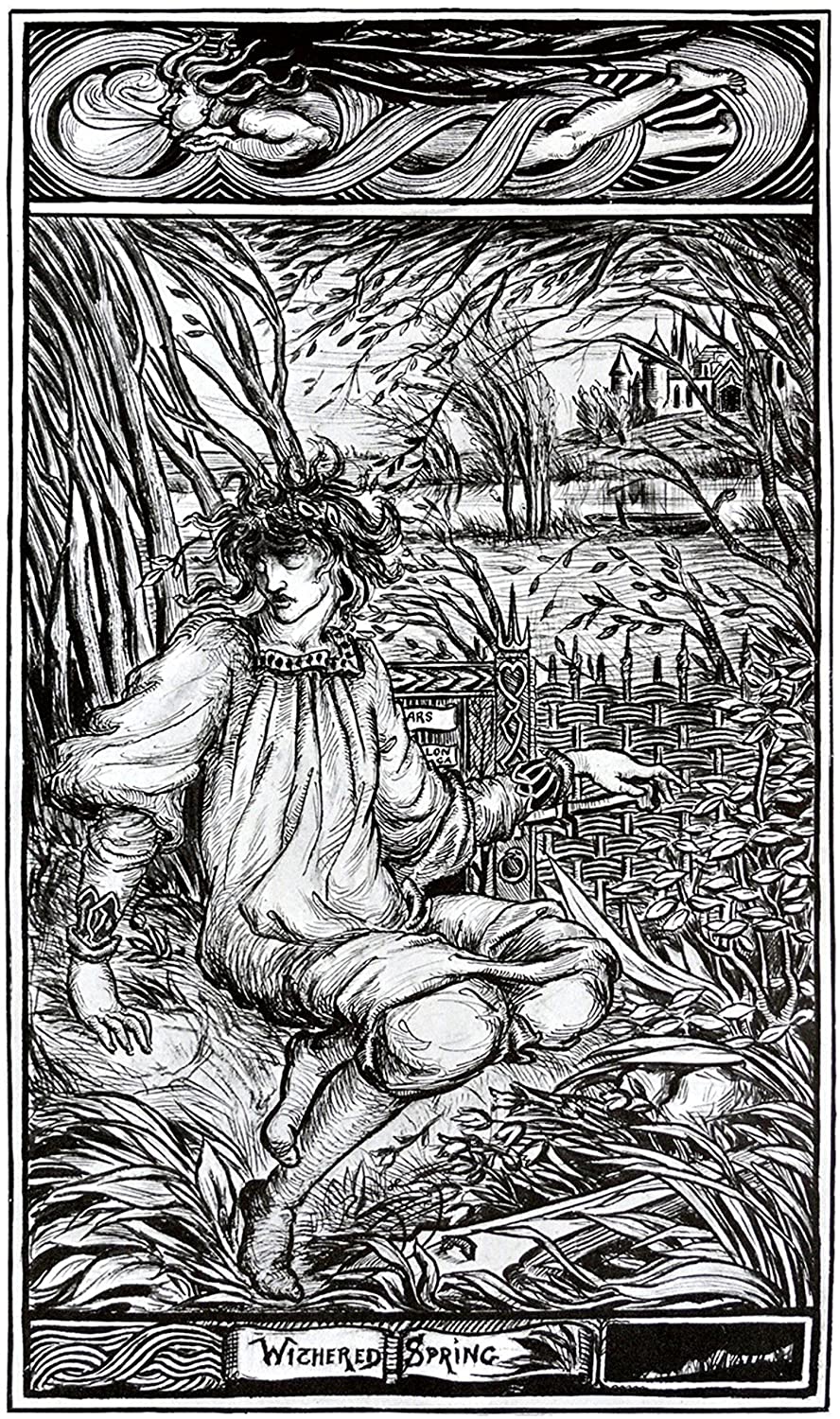
It is interesting to see Beardsley’s tremendous indebtedness to Arts & Crafts ideas of total design, and the importance of intertwining flower and stem motifs. And considering he was only 19!

Withered Spring by Aubrey Beardsley (1891)

Beardsley began his career just as William Morris was producing his luxury designed books from the Kelmscott Press. The curators usefully summarise the elements of a Kelmscott production as:

  • elaborate decorated borders
  • decorated initial letters
  • full page illustration

The hair-line style

The exhibition shows how Beardsley quickly moved from this relatively ‘heavy’ line to move to the extreme opposite, to complex compositions which are covered in a crazy network of super-fine lines. The curators call this his ‘hair line’ style.

How Arthur saw the Questing Beast by Aubrey Beardsley (1893) Victoria and Albert Museum

It is also an early example of Beardsley slipping surreptitious rudeness or irrelevancies into his pictures. At the bottom left of the ‘river bank’, right up against the frame, is the silhouette of an erect penis and scrotum. Towards the top right is a concealed treble clef.

Morte d’Arthur

The picture above is one of the Morte d’Arthur series which made Beardsley’s reputation. He was commissioned to make a hefty 353 illustrations for a new edition of the Morte by publisher J.M. Dent, including full and double-page illustrations, elaborate border designs and numerous small-scale ornamental chapter headings.

However, Beardsley quickly became bored and irked by the subject limitations and began introducing extraneous elements and flights of fancy. Thus the picture above is supposed to be of a medieval knight and a dragon though you wouldn’t really think so. Most disruptive of all is the presence of a pan or satyr from Greek mythology, absolutely nothing to do with medieval legend.

Japanese influence

The exhibition includes one print by Utagawa Kuniyoshi, a lovely coloured woodblock which exemplifies the kind of Japanese influence which impacted European art from the 1870s onwards, and influenced everyone with their:

  • abstract depiction of pictorial space
  • linear intricacy
  • emphasis on flat pattern

Kakemono

kakemono is a Japanese hanging scroll used to display and exhibit paintings and calligraphy inscriptions and designs mounted usually with silk fabric edges on a flexible backing, so that it can be rolled for storage. It is a distinctly different shape from traditional Western portrait shape, and Beardsley was to incorporate it into many later works.

Mantegna

Andrea Mantegna (1431 to 1506) was a key influence for Beardsley. The Italian was famous for his frescos and murals showing parades and processions and groups of people, and Beardsley used ideas and figures and compositions from Mantegna throughout his career. Even in his last accommodation, a hotel room in the south of France, he had a set of photos of works by Mantegna pinned to his wall. Indeed Beardsley produced several Mantegna-style processions, notably The Procession of Joan of Arc which was included as a foldout supplement to the second edition of The Studio magazine in 1892.

Wagnerite

Beardsley was a keen fan of Wagner, attending productions of his operas and illustrating scenes from them. He had ambitions as a writer as well as illustrator and in his last few years worked at a text which was a comic version of the legend of Tannhäuser which Wagner had made into an opera. Given the working title of the Story of Venus and Tannhäuser, excerpts were eventually published in The Savoy magazine under the title Under The Hill, an oddly Hobbit-like title for such a grand Wagnerian subject.

Photo Lineblock

Just as important for the quick evolution of Beardsley’s style was the introduction in the 1890s of the new technology of photo lineblock printing, a photomechanical process. Beardsley was disappointed at the poor reproduction of his washes and shading using this new method, but quickly adapted and made a virtue of leaving large areas of a page completely untouched, others pure black, and ensuring the lines and patterns were crisp and clear. The result is startling.

How la Beale Isoud Wrote to Sir Tristram by Aubrey Beardsley (c.1893) Alessandra and Simon Wilson

In fact this picture is singled out by the curators as exemplifying another of Beardsley’s traits which was his extraordinary ability to assimilate influences and make them his own. Thus the curators point out in this image:

  • Isoud resembles Jane Morris, with the classic pre-Raphaelite jutting chin and mountain of frizzy hair
  • the Germanic form of the desk is borrowed from Albrecht Dürer’s engraving St Jerome in his Study
  • the flattened use of space recalls the influence of Japanese prints
  • whereas the elaborate border of intertwining flower motifs recalls Arts & Crafts designs

Salomé

In 1892 Beardsley made a drawing in response to Salomé, Oscar Wilde’s play, originally written in French and based on the biblical story. Wilde admired the drawing and he and his publisher, John Lane, chose Beardsley to illustrate the English translation of the play. Beardsley produced eighteen designs in total, of which only ten appeared in the first printing of the play. Publisher John Lane suppressed or censored three of Beardsley’s illustrations for their overt sexual references, in particular when female characters’ hands are wandering towards their privates, as if about to masturbate, or unnecessary depictions of the male characters’ phalluses.

The Climax: illustration for Oscar Wilde’s Salome (1893) by Aubrey Beardsley. Photo © Tate

The Yellow Book

The exhibition clarified the timeline around the Yellow Book, and has an entire room devoted to it. Beardsley was made its art editor at its inception in 1894 and contributed the front and back covers for the first five editions. But Beardsley was closely associated with Oscar Wilde (having contributed a suite of illustrations for Wilde’s ‘immoral’ play about Salome), and so soon after Wilde’s arrest in May 1895, Beardsley was fired from the Yellow Book.

On one of the days of his trial, Wilde was seen going into court holding a copy of the Yellow Book and that clinched it for the angry mobs and journalists outside. The offices of the Yellow Book’s publishers, Bodley Head, were attacked by a mob who smashed its windows. In order tonsure the survival of the firm, and its staff, and the continuity of publication of the magazine and all his other titles, publisher John Lane had little choice but to distance himself from Beardsley. The sixth volume, of July 1895, still had the cover and several illustrations by Beardsley but he no longer worked for it. (Later it transpired that Wilde hadn’t been holding a copy of the Yellow Book at all, but a French novel, which tended to be published with yellow covers.)

The Yellow Book Volume I (1894) bound volume. Photo © Tate

It looks as if you can examine every volume of the Yellow Book, all its literary and art contents, online

The room has an example of all five volumes of the Yellow Book that Beardsley was involved with. I’ve read about it ever since I was a teenager at school forty years ago, but I don’t think I’d ever seen a copy before and certainly not six. I’d always envisioned it as magazine-size, but it does indeed look like a hardback book, in size and shape and leather binding.

Beardsley’s work desk

The exhibition includes the very table or desk which Beardsley used during his glory years. Standing a few feet from it, it is hard to imagine that the man produced all these pitch-perfect works without the aid of architects’ tools or computers – just him, a ruler and a pen.

Beardsley’s address

With the money he made from the Salome illustrations and a small legacy Beardsley bought a house at 111 Cambridge Street, Pimlico with his mother and sister, Mabel, to both of whom he remained very close throughout his short life. Only a few hundred yards from Tate Britain where this exhibition is being held…

Oscar Wilde

Wilde was an established writer when he saw the first of Beardsley’s drawings and immediately liked them. He approved the suggestion that Beardsley illustrate the original French version of Salomé and they socialised. So far, so well known. I hadn’t realised that Beardsley satirised Wilde quite so much. There are straightforward lampoons of the increasingly fat and pompous aesthete, but he also slyly slips Wilde’s epicene features into numerous other illustrations, in one giving the moon the eyes and nose of Wilde.

The Woman in the Moon by Aubrey Beardsley (1894)

The Rape of The Lock

This is the title of Alexander Pope’s mock-heroic 18th century satire. I suppose it’s worth clarifying that ‘rape’ in the title doesn’t mean rape in our modern sense, but the older sense of ‘theft’ or stealing away. Thus Pope conceived an extended poem which uses all the devices and machinery of the classical epic to describe how one jaded aristocrat cuts a lock of hair from the head of another jaded aristocrat, and this leads to a feud between their families. Believe it or not this elaborate literary joke extends to five cantos with many extended scenes. Beardsley created nine photo-engravings for an 1896 republication of the poem, five of which are on display here for the first time.

Beardsley had been a fan of 18th century rococo prints, maybe because they – like him – are sophisticated, worldly, stylish and much more open about sexuality than the Victorians. The exhibition shows us some of the original 18th century prints which Beardsley bought at auction in Paris, and then goes on to show all the Pope pictures.

The Dream by Aubrey Beardsley (1896) The J. Paul Getty Museum, Los Angeles

What’s immediately obvious is the that the stark clarity of the Salome illustrations has been abandoned for a much more elaborate style, characterised above all by the stippling that creates a sort of lace doily effect on almost all the fabrics. And look at the patterning of the carpet. A long way from the stark black and white of the Salome illustrations. Many critics thought these his best works as an illustrator.

Posters

The 1890s were the glory decade for poster design in Paris, led by Henri Toulouse-Lautrec and Jules Chéret. I didn’t realise Beardsley produced a number of posters which modified his own style to take on board the need for a) size b) colour.

There’s a room devoted to half a dozen of his posters, none of which match the quality of Lautre or Chéret, and most of which are advertiser’s promotions of new ranges of childrens books or books by women, alongside promotional posters for The Yellow Book and several plays and operas. The section contains the telling quote:

I have no great care for colour, but [in posters] colour is essential.

‘I have no great care for colour’. Worth pondering. And relevant to the one and only oil painting Beardsley is known to have made.

Oil painting

There’s a rare outing for Beardsley’s only oil painting and you can see why – it’s rubbish. His entire style was built around absences, around huge areas of untouched whiteness. Trying to translate that into oil, which specialises in depth and shadow, was a hopeless task.

Porn

After Beardsley was sacked from The Yellow Book, almost the only publisher who would use his drawings was Leonard Smithers. Smithers operated on the fringes of the rare book trade, issuing small, clandestine editions of risqué books with the boast: ‘I will publish the things the others are afraid to touch’. Smithers encouraged Beardsley’s already growing interest in risqué French, Latin and Greek texts and commissioned drawings to illustrate the Satires of the late Roman poet Juvenal and, most famously, Aristophanes’s bawdy satirical play Lysistrata.

In Lysistrata the women of Athens go on a sex strike, refusing to have sex with their menfolk until they stop the ridiculous war against Sparta. Beardsley made eight outrageously sexual illustrations for Smithers’ edition. Among other subjects, this is the set which includes start, beautifully made black and white line drawings of ancient Greeks with humongous erect penises. Maybe if you’re very young or innocent these are ‘shocking’ images, but to the modern viewer they are vaguely reassuring, certainly humorous. The two figures on the right are mildly realistic but it’s the guy on the left who gets the attention, not because of his phallus as such but because the entire character is obviously created for grotesque comedy.

Illustration for Lysistrata by Aubrey Beardsley (1896)

The grotesque

He knew he was attracted to ‘the grotesque’ and there is a wall label which usefully explains the origins of the grotesque in art. Grotesque originally referred to the decoration of grottos, and came to denote the depiction of deliberately hybrid and monstrous forms, which often combined body parts from different animals, like a centaur or mermaid. As the man himself said:

I see everything in a grotesque way. When I go to the theatre, for example, things shape themselves before my eyes just as I draw them. .. They all seem weird and strange to me. Things have always impressed me in this way.

Foetuses

Nobody knows to this day why he drew so many foetuses, either as insets in frames or as characters in the more grotesque illustrations. Maybe it was simply because they are a kind of quintessence of the grotesque.

My favourite

Venus framed by two statues of male gods in the form of herms (a sculpture with a head and perhaps a torso above a plain, usually squared lower section’). I like it because of its formal precision, its symmetry which is, however, broken by the asymmetric sway of Venus’s long dress. I like it because there is no indecency, boobs or penises in sight. Instead there is a sense of genuine menace from the devil eyes of the two herms. And I like it because it is a kind of reversion or revisiting of the Arts & Crafts theme of incredibly ornately interwoven bushes, stems and flowers of (I think) roses. But mostly because it is a pleasingly complete, formal, complex and rather threatening image.

Venus between Terminal Gods (1895) Drawing with india ink by Aubrey Beardsley. The Cecil Higgins Art Gallery, Bedford

Walter Sickert

Almost the best thing in the exhibition is the full-length portrait painting of Beardsley made by the English painter Walter Sickert, after they’d both attended a commemoration ceremony for John Keats. Its sketchy unfinished quality makes it a haunting gesture to the memory of the dandy and artist who died aged just 25.

Aubrey Beardsley by Walter Sickert (1894)

Crucifix

The exhibition includes the last photo of Beardsley, taken in the hotel room in the Hotel Cosmopolitain in Menton where he had gone in search of a warmer dryer climate which would be more favourable to his tuberculosis. The photo shows Beardsley looking tremendously smart in a suit and well-polished shoes opposite a wall on which are pinned reproductions of his beloved Mantegna, and a mantelpiece on which sits a crucifix.

Because although I’ve probably read it numerous times, I’d forgotten that in his last months Beardsley converted to Catholicism. He died holding a crucifix. Just a few days before he died he wrote a letter to Leonard Smithers asking him to destroy all of Beardsley’s risqué images, the Lysistrata illustrations etc. Smithers refused and so they were saved for generations of schoolboys to giggle over.

Who does a deathbed request to destroy his works which its address completely ignored remind you of? Franz Kafka.

Film

There is a room with benches so you can watch Charles Bryant and Alla Nazimova’s 1923 silent movie version of Salomé immediately following the room of Beardsley’s illustrations. For some reason the gallery lights had been left on full power in this room which made it harder to see the image on the screen.

Legacy

The exhibition closes with a sketchy overview of Beardsley’s legacy from his influence on the long sinuous lines of Art Nouveau via a string of now mostly forgotten book illustrators who copied his style (Harry Clarke, Hans Henning Voigt) through the revival of Beardley’s reputation and style which was sparked by a major retrospective of his work at the Victoria and Albert Museum in 1966 which led to the incorporation of Beardsleyesque black and white swirling lines into lots of psychedelic posters and, most famously of all, into the portrait of the four Beatles in the cover art for their LP Revolver.

Portrait of Aubrey Beardsley 1893 by Frederick Evans. Wilson Centre for Photography

This is a long, very thorough, exhaustive and informative exhibition about a truly world class and utterly distinctive English artist.


Related links

More Tate Britain reviews

Art Deco by Alastair Duncan (1988)

Perhaps most significant to the development of a twentieth century aesthetic was the birth in the interwar period of the professional industrial designer… (p.118) In the 1920s commercial art became a bona fide profession which, in turn, gave birth to the graphic artist. (p.150)

This is one of the older volumes from Thames and Hudson’s famous ‘World of Art’ series, famous for its thorough texts but also, alas, for the way most of the illustrations are in black and white (this book has 194 illustrations, but only 44 of them in colour, most of them quite small).

Duncan also wrote the WoA volume on Art Nouveau, which I read recently, and has gone on to write many more books on both these topics, including a huge Definitive Guide to the Decorative Arts of the 1920s and 30s. He knows his onions.

Main points from the introduction

  • Art Deco was the last really luxurious style – people look back to Art Deco and Art Nouveau with nostalgia because they were florid, indulgent and luxurious – since the Second World War all styles have been variations on plain functionalism.
  • Art Deco is not a reaction against Art Nouveau but a continuation of it, in terms of ‘lavish ornamentation, superlative craftsmanship and fine materials’.
  • Received opinion has it that Art Deco started after the war, but Duncan asserts that it had begun earlier, with some indisputable Art Deco pieces made before 1914 or during the war. In fact he boldly suggests that, had there been no war, Art Deco might have flourished, peaked and been over by 1920.
  • Art Deco is hard to define because designers and craftsmen had so many disparate sources to draw on by 1920 – Cubism, Fauvism, Constructivism, Futurism, but also high fashion, motifs from the Orient, tribal Africa, the Ballets Russes, or Egypt, especially after the tomb of Tutankhamen was discovered in 1922.
  • Duncan distinguishes between the decorative styles of the 1920s which were luxurious and ornamented, and of the 1930s, when machine chic became more dominant, lines sleeker, more mechanical. The chapter on metalwork makes this clear with the 1920s work alive with gazelles, flowers and sunbursts, while the 1930s work copies the sleek straight lines of airplanes and steamships. In the architecture chapter he distinguishes between zigzag’ Moderne of the 1920s and the ‘streamline’ Moderne of the 1930s (p.195).
  • There’s also a distinction between the French style (the French continued to lead the field in almost all the decorative art) exuberant and playful, and the style of the rest of Europe and, a little later, America, which was cooler, more functional and intellectual. Throughout the book Duncan refers to the former as Art Deco and the latter as Modernism.
  • To my surprise Duncan asserts that Modernism was born at the moment of Art Deco’s greatest triumph i.e. the famous Exposition Internationale des Arts Décoratifs et Industriels Modernes of 1925. The severe modernist Le Corbusier wrote an article criticising almost all the exhibits for their luxury and foppishness and arguing that true design should be functional, and mass produced so as to be affordable.
  • Duncan contrasts the attenuated flowers and fairy maidens of Art Nouveau with the more severe functionalism of the Munich Werkbund, set up as early as 1907, which sought to integrate design with the reality of machine production. This spartan approach, insistence on modern materials, and mass production to make its objects affordable, underpinned the Bauhaus, established in 1919, whose influence spread slowly, but affected particularly American design during the 1930s, as many Bauhaus teachers fled the Nazis.

So the entire period between the wars can be simplified down to a tension between a French tradition of luxury, embellished and ornamented objects made for rich clients, and a much more severe, modern, functionalist, Bauhaus style intended for mass consumption, with the Bauhaus concern for sleek lines and modern materials gaining ground in the streamlined 1930s.

In reality, the hundreds of designers Duncan mentions hovered between these two poles.

Structure

The book is laid out very logically, indeed with the rather dry logic of an encyclopedia. There are ten chapters:

  1. Furniture
  2. textiles
  3. Ironwork and lighting
  4. Silver, Lacquer and Metalware
  5. Glass
  6. Ceramics
  7. Sculpture
  8. Paintings, Graphics, Posters and Bookbinding
  9. Jewelry
  10. Architecture

Each of the chapters tends to be broken down into a handful of trends or topics. Each of these is then broken down into area or country, so that successive paragraphs begin ‘In America’ or ‘In Belgium’ or ‘In Britain’. And then each of these sections is broken down into a paragraph or so about leading designers or manufacturers. So, for example, the chapter on ceramics is divided into sections on: artist-potters, traditional manufactories, and industrial ceramics; each of these is then sub-divided into countries – France, Germany, America, England; each of these sub-sections then has a paragraph or so about the leading practitioners in each style.

On the up side, the book is encyclopedic in its coverage. On the down side it sometimes feels like reading a glorified list and, particularly when entire paragraphs are made up of lists of the designers who worked for this or that ceramics firm or glass manufacturer, you frequently find your mind going blank and your eye skipping entire paragraphs (one paragraph, on page 51, lists 34 designers of Art Deco rugs).

It’s a shame because whenever Duncan does break out of this encyclopedia structure, whenever he stops to explain something – for example, the background to a particular technique or medium – he is invariably fascinating and authoritative. For example, take his explanation of pâte-de-verre, something I’d never heard of before:

Pâte-de-verre is made of finely crushed pieces of glass ground into a powder mixed with a fluxing agent that facilitates melting. Colouring is achieved by using coloured glass or by adding metallic oxides after the ground glass has been melted into a paste. In paste form, pâte-de-verre is as malleable as clay, and it is modelled by being packed into a mould where it is fused by firing. It can likewise be moulded in several layers or refined by carving after firing. (p.93)

Having myself spent quite a few years being paid to turn a wide variety of information (about medicine, or botany, or VAT) into clear English, I am full of admiration for Duncan’s simple, clear prose. There’s a similar paragraph about silver which, in a short space, brings an entire craft to life.

By virtue of its colour, silver is a ‘dry’ material. To give it life without the use of surface ornament, the 1920s Modernist silversmith had to rely on interplay of light, shadow, and reflection created by contrasting planes and curves. Another way to enrich its monotone colour was by incorporating semiprecious stones, rare woods, ivory and glass. Towards the 1930s, vermeil or gold panels were applied to the surface as an additional means of embellishment. (p.71)

He tells us that the pinnacle of commercial Art Deco sculpture was work done in chryselephantine, combining bronze and ivory, and that the acknowledged master of this genre was Demêtre Chiparus, who made works depicting French ballet and theatre.

Duncan makes the simple but profound point that, in architecture, Art Deco tended to be applied to buildings which had no tradition behind them, to new types of building for the machine age – this explains the prevalence of the Art Deco look in so many power stations, airport buildings, cinemas and swimming pools. Think (in London) Battersea power station (1935), Croydon airport (1928), the Golden Mile of Art Deco factories along the Great West Road at Brentford, Brixton Lido (1937), Charles Holden’s Art Deco Tube stations, and scores of Odeon cinemas across the country.

I liked his wonderfully crisp explanation of costume jewelry.

Costume jewelry differs from fine jewelry in that it is made out of base metals or silver set with marcasite, paste or imitation stones. (p.167)

Now you know. When he’s explaining, he’s wonderful.

Likes and dislikes

To my great surprise I actively disliked most of the objects and art shown in this book. I thought I liked Art Deco, but I didn’t like a lot of this stuff.

Maybe I’m a Bauhaus baby at heart. I consistently preferred the more linear work from the 1930s.

Then it dawned on me that maybe it’s because Duncan doesn’t include much about Art Deco posters (despite having authored a whole book about them). Indeed the section on posters here was remarkably short and with hardly any illustrations (7 pages, 6 pictures).

Similarly, the section on the scores of fashionable magazines and graphic illustrations from the era (Vogue, Vanity Fair, Harper’s Bazaar and countless others) is barely 3 pages long.

There’s nothing at all about movies or photography, either. Maybe this is fair enough since Duncan is an expert in the decorative and applied arts and that’s the focus of the book. Still, Gary Cooper is a masterpiece of Art Deco, with his strong lines ending in beautiful machine-tooled curves (nose and chin), his powerful symmetries – as beautiful as any skyscraper.

Gary Cooper, super duper

Gary Cooper, super duper

French terms

  • animalier – an artist who specializes in the realistic portrayal of animals
  • cabochon –  a gemstone which has been shaped and polished as opposed to faceted
  • éditeur d’art – publisher of art works
  • nécessaire – vanity case for ladies
  • objet d’art – used in English to describe works of art that are not paintings, large or medium-sized sculptures, prints or drawings. It therefore covers a wide range of works, usually small and three-dimensional, of high quality and finish in areas of the decorative arts, such as metalwork items, with or without enamel, small carvings, statuettes and plaquettes in any material, including engraved gems, hardstone carvings, ivory carvings and similar items, non-utilitarian porcelain and glass, and a vast range of objects that would also be classed as antiques (or indeed antiquities), such as small clocks, watches, gold boxes, and sometimes textiles, especially tapestries. Might include books with fine bookbindings.
  • pâte-de-verre – a kiln casting method that literally means ‘paste of glass’
  • pieces uniques – one-off works for rich buyers

Conclusion

In summary, this is an encyclopedic overview of the period with some very useful insights, not least the fundamental distinction between the French ‘high’ Art Deco of the 1920s and the ‘Modernist’ Art Deco of the 1930s (which flourished more in America than Europe). But it is also a rather dry and colourless book, only occasionally coming to life when Duncan gives one of his beautifully lucid technical explanations.

Probably better to invest in a coffee-table volume which has plenty of large illustrations (particularly of the great posters and magazine illustrations) to get a more accessible and exciting feel for the period.


Related links

Frank Brangwyn and the First World War @ William Morris Gallery

Frank Brangwyn

Frank Brangwyn was born of English parents in 1867 in Bruges, where he grew up and acquired a strong feel for the local people and culture, before his parents moved back to England in 1874.

Brangwyn had no formal training as an artist, though his father, an architect, encouraged his artistic leanings. When he was still in his teens he was ‘discovered’ by the artist Arthur Heygate Mackmurdo, who recommended him to the William Morris workshops. Here he proved a keen student and absorbed Morris’s gospel that an artist should seek to beautify all aspects of life.

Brangwyn was a prodigiously talented jack-of-all-trades and began winning competitions and exhibiting as young as 17, going on to build a reputation as not only a painter but the creator and decorator of stained glass, furniture, ceramics, table glassware, buildings and interiors, as a lithographer and book illustrator.

The Great War

At the start of the First World War, more than a million Belgian refugees fled the advancing German armies and some 250,000 came to England – one of the largest groups of refugees this country has ever received. Local relief committees formed all over the country, raising funds for the exiles.

‘Britain’s Call to Arms’ by Frank Branwyn

War posters

Brangwyn almost immediately joined in this relief effort by designing posters aimed at publicising the plight of the refugees and raising money for them. This small exhibition at the William Morris Gallery in Walthamstow, north London, takes its title from a poster he made for the Belgian & Allies Aid League titled, ‘Will you help these sufferers from the war to start a new home: Help is better than sympathy’.

'The Retreat from Antwerp' poster by Frank Brangwyn, lithograph 1915-1916: copyright David Brangwyn

‘The Retreat from Antwerp’ poster by Frank Brangwyn, lithograph 1915-1916: copyright David Brangwyn

Civilian suffering

Brangwyn was so prolific that the style and design of his posters became virtually synonymous with First World War propaganda. Though patriotic in tone they aren’t as sanitised or simplistic as many other WWI posters. The figures aren’t heroic, if anything they are often rather grotesque and gargoyle-like.

As with much popular art of the period the images are made of strong, thick lines, confidently sketched in a bold extrovert style but with an unusual intensity of light and shade, of chiaroscuro, which gives them a tremendous dramatic immediacy.

Brangwyn didn’t become an official War Artist when that scheme was set up, and so never actually visited the Front; his subject was the destruction war wreaked on Belgium’s historic buildings and the suffering of innocent civilians.

The zeppelin raids: the vow of vengeance’, drawn for The Daily Chronicle by Frank Brangwyn

The final blow

Wars tend to get more violent and more pitiless the longer they go on and the longer your enemy stubbornly refuses to give in and surrender. Who, at the start of World War II, would have believed the virtuous Allies capable of firebombing Hamburg or dropping atom bombs on Hiroshima? The Great War is one of the horrible proofs of this rule – by the fourth and final year the mood on both sides was bitter and unforgiving.

This is the background to the most notorious poster, Put strength into the final blow, which depicts an Allied soldier bayoneting a German in the neck. Legend has it that the image was so incendiary that the German Kaiser put a price on Brangwyn’s head – but it was also criticised here in Blighty for its bloodthirstiness.

‘Put strength in the final blow’ by Frank Brangwyn (1918)

Frank Brangwyn at the William Morris Gallery

The exhibition is being held here at the William Morris Gallery because Brangwyn never forgot his debt to the Morris workshop for starting his career. He sympathised with Morris’s visionary aims, that the artist should be a craftsman capable in multiple mediums and should make art to beautify all aspects of life. Thus, when Brangwyn heard that the museum was being set up to promote Morris’s life and work, he donated a number of works to help it get started. As a result the WMG holds the second largest collection of Brangwyn’s work in England, after the British Museum. This explains why numerous other, non-war-related works of his, are hung in other rooms and corridors around the museum, including the wonderful Swans (1921).

Related links

Reviews of William Morris