Konrad Mägi @ Dulwich Picture Gallery

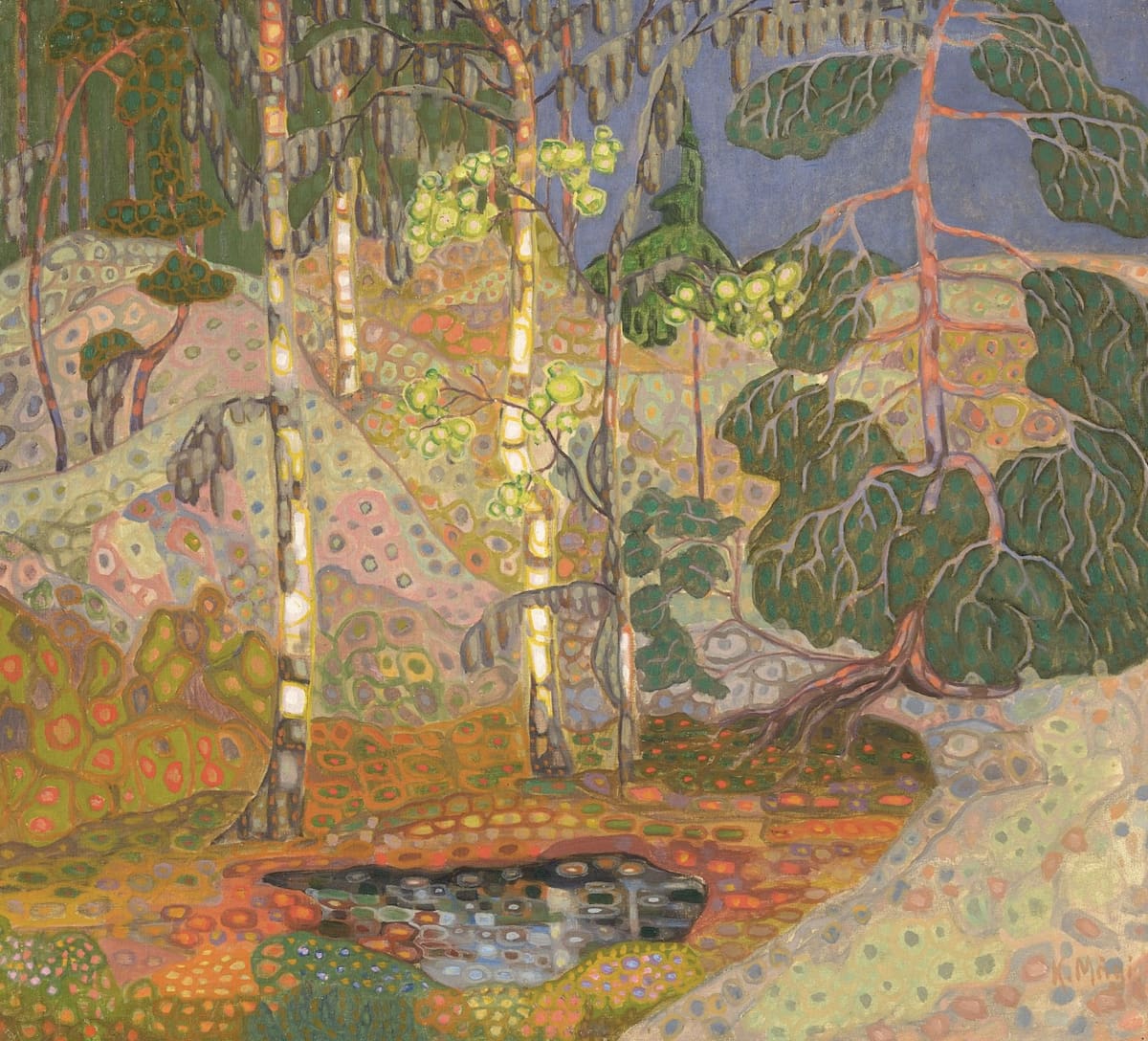
Konrad Mägi (1878 to 1925) was a pioneer of Estonian modernism. Renowned in his home country for his avant-garde, unique colouristic style, he is widely considered the greatest Estonian artist of his generation. I’d never heard of him before which is why Dulwich Picture Gallery are doing us a service by presenting this, the first major exhibition of Mägi’s works ever held in the UK. The exhibition brings together 61 paintings, mostly landscapes or portraits, many of which have never been seen outside of Estonia.

Norwegian Landscape by Konrad Mägi (1909) Courtesy of the Art Museum of Estonia

Four or five themes come over very strongly:

  1. Different styles Mägi’s style was unstable and variable. The first room contains works done in three or four completely different styles which could be by completely different artists.
  2. Self-taught This was partly because, after a brief spell at art school in St Petersburg, Mägi was largely self-taught. This explains the way other styles and influences appear throughout his career, with successive works showing the influence of Impressionism, Art Nouveau, Symbolism, Pointillism, Post-Impressionism and Expressionism, with some of his later works from the 1920s showing the sudden arrival of cubism in his style.
  3. Heavy All the paintings dark and heavy. Dark blues, dark greens, dark reds predominate. These feel a bit heavy and louring in the flesh but I was surprised how well they reproduce on the posters and postcards in the shop.
  4. Clouds In the fourth and final room I realised the importance of clouds in his paintings: of the 45 landscapes not one has a clear blue sky. Maybe this reflects the climate of Estonia but, in the final room, it also feels connected with his mental illness.
  5. Mental illness Mägi suffered from mental illness throughout his life. As a struggling young artist he lived in poverty and ‘despair’, and was afflicted with recurring feelings of Angst and futility. At the end of his life he suffered a breakdown, started destroying his paintings until students intervened to stop him, and he was admitted to a mental asylum where he died. This knowledge affects your reception, if not of all the works, then certainly the ones in the final, cloud-oppressed paintings.

The show is divided into four rooms, each addressing a specific period or theme.

Room 1. Norwegian landscapes

Room 1 contains 14 paintings on the wall and 3 in a display case. The curators tell us that Mägi started his working life in 1896 when he joined a furniture factory where he specialised in decorative carving, and where he took drawing classes organised for the factory workers. He was athletic, enjoyed wrestling, and co-founded a youth society in 1897 for the improvement of the body and mind.

In 1903, at the age of 24, Mägi decided to study at the Stieglitz Art School in St Petersburg. During this time he encountered numerous exhibitions, museums and visual art. Following the pivotal period after the Revolution in 1905, many Estonian intellectuals travelled abroad to experience other cultures, a trend inspired by the founding of the Noor-Eesti movement (Young Estonia) and their motto ‘Let us remain Estonians, but let us also become Europeans’.

In 1907 he was in Paris, living in great poverty but soaking up the new art movements of the day. But apparently it was only when Mägi scraped together the money to visit Norway in 1908, that his style crystallised, sort of, and he started to produce landscapes which found an audience. Room 1 room contains good examples of these, but also demonstrates the variability of Mägi’s style.

  • There are three or four paintings in a nice impressionist style, notably Field of Flowers with a Little House.
  • There’s the extraordinary Norwegian Landscape with a Pine Tree, which I joked to my wife looked like Mordor from Lord of the Rings but maybe reveals the influence of the great Norwegian painter, Edvard Munch.
  • The Mordor painting is just the most extreme of the style he developed which combines the garishness of symbolism with the use of blobs of pure colour derived from pointillism. My favourite example was the bog painting (below). It’s figurative in the sense that you can make out the silver birch trees, but what’s happening on the ground isn’t remotely an effort to be realistic, but the use of brightly coloured blobs, lozenges and organic shapes (‘cellular structures’) which are more decorative than realistic. In the flesh, this painting is much more colourful and vibrant than this reproduction.

Norwegian Landscape: Bog Landscape by Konrad Mägi (1908-1910) Courtesy of the Art Museum of Estonia

  • Beside these were more realistic, less abstract landscapes, but still using a big blob pointillist style, such as the Norwegian lake at the top of this review.
  • And then, next door to all these stylised, sort-of-pointillist works, were some landscapes from Norway done in a completely different style, where instead of blobs, the paint has been applied in smooth brushstrokes, so the paintings appear much more traditionally figurative; such as Norwegian Landscape (Winter Landscape).

Room 2. Portraits

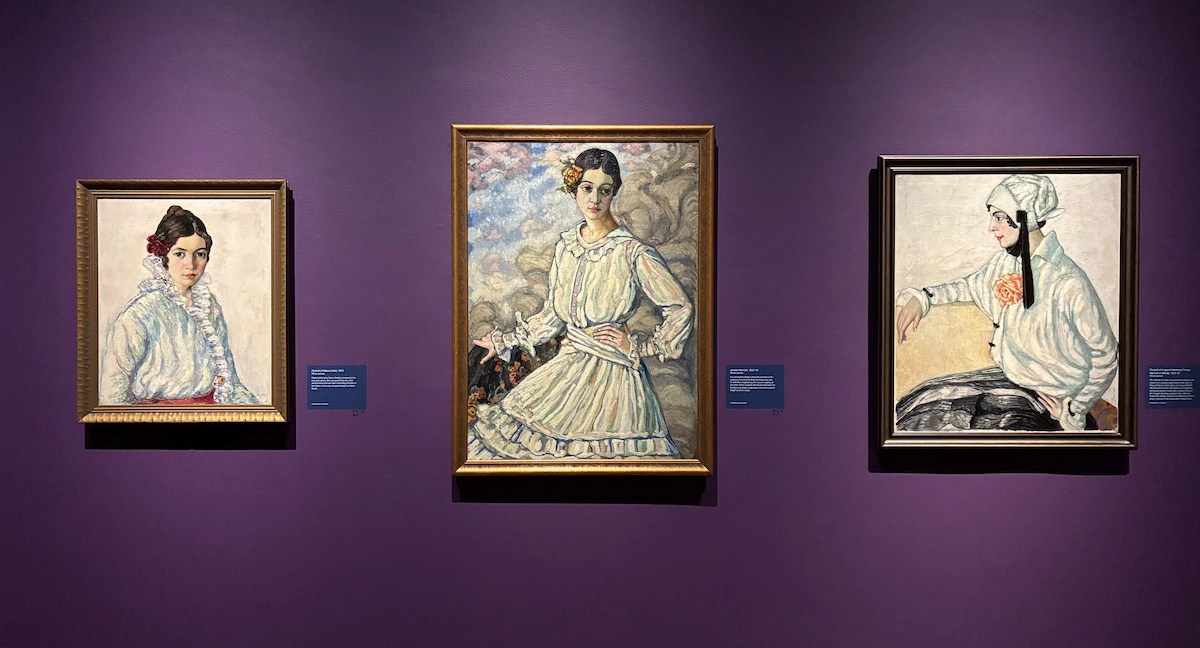
In 1912 Mägi returned to Tartu and, from spring 1913, began accepting portrait commissions for considerable sums of money, largely of wealthy women who were known to him through his cultural and political associations. Room 2 contains 17 of these generally large oil portraits. They showcase a stylised approach to the human face. They’re not unrecognisably distorted as in cubism, just simplified and done with deliberately unnaturalistic colouring. Mostly. But again, there’s a variety of styles. The ones I liked most had a hard angularity and used dark greens and blues to achieve an effect akin to German Expressionism.

Portrait of a Woman by Konrad Mägi (1918–1921) in Konrad Mägi @ Dulwich Picture Gallery

At the other end of the spectrum are some portraits of women whose cartoon, doe-eyed faces seem strangely at odds with the stylised backdrops, such as Portrait of Alvine Käppa from 1919.

Installation view of Konrad Mägi at Dulwich Picture Gallery showing three female portraits (photo by the author)

Somewhere in the middle were maybe the most attractive ones, which combined realistic faces with stylised backgrounds, the outstanding example being another ‘Portrait of a Lady’, below. Note the use of green to indicate shadowing on the skin.

Portrait of a Lady by Konrad Mägi (1916–1917) in Konrad Mägi @ Dulwich Picture Gallery

Room 3. The Baltic

Room 3 contains 16 landscapes from Mägi’s extended stays on the Baltic coast during the summers of 1913 and 1914. The paintings depict the landscape around Saaremaa and Vilsandi and, according to the curators, represented an artistic breakthrough for Mägi. The paintings here are certainly more consistent in style.

As if to demonstrate this, the centrepiece is a rare series by this artist, a set of 6 paintings depicting the same view of the lighthouse at Vilsandi. Three of these show the exact same view at different times towards the end of the day, as the (ever-present) clouds turn deeper shades of pink. the more I looked, the more I liked these three linked works.

Installation view of Konrad Mägi at Dulwich Picture Gallery showing three views of the Vilsandi lighthouse at different times of day (photo by the author)

As to the others, two things struck me:

  1. Lightless Although they are seascapes, and the curators tell us the Estonian coast is flat and open, Mägi’s paintings of it convey very little sense of light. His skies are always full of clouds and the terrain is depicted in thick heavy shapes.
  2. Botany Which is connected to the other thing which is that, although the bits of land he includes are busy with shapes and colours, giving an impression of luxuriant growth – and although the curators tell us that Mägi had an enduring fascination with the unique botanical species of his landscape, including its flora and fauna – there is precious little detail. In the garlands painted by Michaelina Wautier, currently on show at the Royal Academy, I spent some time trying to identify every species of flower. No point trying to do that with Mägi’s coastal paintings which are liberal with elements but all done in his familiar, blobby, stylised manner. Can you identify the plants in this picture?

Vilsandi Motif by Konrad Mägi (1913-14) Courtesy of the Art Museum of Estonia

Room 4. Southern Estonia

The walls of the fourth and final room are painted deep purple and this is an appropriate background for the 11 landscapes on display here, which I found heavy and louring. (I’ve just looked up ‘louring’ to check I’m using it in the right sense. The dictionary defines it as meaning ‘a dark, gloomy, or threatening appearance, usually referring to overcast weather, or a forbidding atmosphere.’ Seems about right.)

The landscapes are from Southern Estonia, from the last decade of his life. Note how the ‘blobby’ technique I’ve mentioned so many times has largely disappeared. Instead the pain is applied more smoothly but several other things are new.

One: the natural elements of the composition (the trees, the bushes, the outline of the lake) are heavily defined in black. Everything has a strong black outline, something I personally, always warm to.

Two: the clouds, the clouds! Look at the swirling, moiling, dark and threatening clouds coming to getcha!

Three: taken together these features indicate how much the landscape is actually an expression of the artist’s inner turmoil. This is the room whose wall label informs us that, after a lifetime struggling against mental illness, in 1924 Mägi suffered some kind of mental collapse and had to be placed in an institution for his own protection. Does that knowledge affect how you feel about this picture?

Lake Kasaritsa by Konrad Mägi (1915-17) Courtesy of the Art Museum of Estonia

As a footnote, not all the 11 works in this final room are as dark and ominous. In fact a couple of them right at the very end work with a much lighter palette and use light square blocks to create a landscape, completely opposite to the heavy, blobby, organic style which dominated so many of his central works. The curators tell us that here, right at the end of his working life, he was experimenting with the kind of Futuro-Cubism which was being used by radical Soviet artists of the 1920s.

Installation view of Konrad Mägi at Dulwich Picture Gallery showing three of the landscapes in the fourth and final room – note the cloud-congested skies (photo by the author)


Related links

Related reviews

Brasil! Brasil! The Birth of Modernism @ the Royal Academy

Executive summary

To be really blunt, my wife said, ‘If this is the best Brazilian art has to offer, you can see why we’ve never heard of it before.’ A proper review needs to be more nuanced and caveated than that, and as you study each of the individual artists, you come to appreciate them more deeply… but it is a not unreasonable thumbnail summary. There are lots of really good works here, easily enough to make it worth visiting, but no one artist that really, really broke through – and many of the works I liked partly because they so clearly showed their European influences and origins.

Because as you read the wall panels, the key point to emerge is that almost all of the artists featured here spent some or a lot of time in Europe studying art – especially in the early part of the show, during the period just before and after the First World War – which is why, in the first half, you are continually seeing paintings which remind you of cubism, the Fauves, German Expressionism, then later on, Art Deco and 1930s socialist realism.

This process of assimilation from European sources was directly addressed in the ‘Anthropophagic Manifesto’ by a writer closely associated with the early Brazilian modernists (and husband of the great Tarsila do Amaral) Oswald de Andrade. The manifesto describes modern Brazilian artists eating and digesting the great European innovations of the early twentieth century, mixing them with local subject matter and non-European traditions to produce a distinctive new hybrid.

Watching the artists’ Western influences and training being remodelled and fused with Brazilian subject matter to create each artist’s personal vision is one of the main interests of the show. (Although important to be clear that some of them never went to study in Europe and so developed their own native or naive style from scratch.)

For what it’s worth, in my opinion Tarsila do Amaral emerges as the artist with the most distinctive and fully formed vision in her own right, closely followed by Lasar Segall and Vicente do Rego Monteiro (see below for all of them).

This is a big exhibition, filling the Royal Academy’s main galleries and yet it doesn’t quite feel like it. Most of the works are relatively modest in scale and, with the exception of a handful of massive paintings and a few large sculptures towards the end, the rows of medium-sized paintings often feel over-awed by the hugeness of the gallery space. I couldn’t help seeing this as a metaphor for the way this often very striking post-colonial art, despite everyone’s best intentions, derived its strength from the series of innovations taking place in the European heartland and, latterly, in America.

Anyway, on to a more detailed review.

Overview

In the early 20th century a new modern art was emerging in Brazil. Starting in the 1910s and continuing through the 1950s, ’60s and ’70s, Brazilian artists adapted contemporary trends, international influences and artistic traditions to create new visual styles informed by the vibrant cultures, identities and landscapes of Brazil.

This exhibition celebrates this 60-year period between 1910 and the 1970s through the stories of ten influential artists. The show reveals the development of their artistic styles and the context in which they were created. It brings together over 130 works to capture the diversity of Brazilian art at the time. The artists are, in (rough) chronological order:

  1. Anita Malfatti (1889 to 1964)
  2. Lasar Segall (1891 to 1957)
  3. Tarsila do Amaral (1886 to 1973)
  4. Vicente do Rego Monteiro (1899 to 1970)
  5. Candido Portinari (1903 to 1962)
  6. Flávio de Carvalho (1899 to 1973)
  7. Djanira (1914 to 1979)
  8. Alfredo Volpi (1896 to 1988)
  9. Rubem Valentim (1922 to 1991)
  10. Geraldo de Barros (1923 to 1998)

The majority of works come from rarely-seen Brazilian private collections, as well as Brazilian public collections, most of which have never been exhibited in the UK. So this is a unique opportunity to see key works by ten of Brazil’s major twentieth century artists brought together in one place, and to get a sense of how pioneers of Brazilian visual culture took their European sources, developed and moulded them for their own purposes.

Brazil: history and ethnicities

1. History

I take a historical view of everything (art, politics, literature) so I liked it being explained right at the start that Brazilian history can be divided into four eras:

  • pre-Colombian i.e. before Europeans arrived
  • colonial (1500 to 1815)
  • Imperial (1815 to 1889)
  • modern since Brazil became a republic in 1889

The original inhabitants of this vast area of north-east South America consisted of numerous tribes and clans with their own languages and religions. The Portuguese explorer Pedro Álvares Cabral, hoping to sail west around the world to India, arrived in the territory that would become Brazil on April 22 1500, claiming the land for the King of Portugal.

2. African slavery

There followed centuries of colonisation and settlement by the Portuguese who first of all enslaved the local inhabitants to work on their ranches and mines, and then set up a transatlantic slave trade importing kidnapped Africans. In 1526 Portuguese mariners carried the first shipload of African slaves to Brazil. Of the 12 million enslaved Africans brought to the New World, almost half – 5.5 million people – were forcibly taken to Brazil as early as 1540 and until the 1860s. Slavery was only abolished in Brazil in May 1888, one year before the country overthrew its imperial regime to become a republic.

3. Mass immigration

The abolition of slavery in 1888 and the expansion of coffee plantations created a demand for labour. Many people internally migrated from the impoverished north-east, but Brazil also became a popular destination for immigrants. In the last decades of the nineteenth century Brazil experienced a surge in immigration, particularly from Europe, with Italians, Portuguese and Spanish immigrants fleeing poverty in their own countries, as well as Jews fleeing pogroms in Russia and Eastern Europe. Between 1872 and 1903 almost two million immigrants arrived in Brazil, increasing the population to around 17 million.

4. Technological change

Like every other country, Brazil (well, the cities and more developed regions) experienced the shock of new technologies, which seemed to follow each other with dizzying speed: the telegraph, the telephone, electrification of street lights and homes, the tram, the motor car.

These four factors explain why, as the twentieth century dawned, many Brazilian intellectuals realised they needed to create new literary and art styles to capture their newly republican, newly modern, newly multicultural society. They had to break away from the stuffiness and formality of the country’s nineteenth century Salon art, with its fondness for bog historical and religious subjects painted with painstaking realism.

Some of the leading figures were women who, like women in all the developed countries, thought women’s art and artists needed promoting. Some came from very poor backgrounds and reckoned the working classes needed to be sympathetically represented in art. And some were of Indigenous extraction and reckoned the original peoples of the land deserved better representation.

A curatorial mistake

The curators make what I think is a very big mistake right at the start of the exhibition. As usual the first room you enter is the octagonally-shaped Central Hall. Now the early wall labels emphasise the heaviness of the country’s nineteenth century art, with its European tastes for academic art and typical subjects such as historical allegories and religious scenes, as approved by Brazil’s own Royal Academy, the Academia Imperial de Belas Artes, which dominated Brazil’s arts and crafts for a century.

In my opinion, the curators would have done well to fill this Central Hall with examples of this stuffy old art, introducing us to the key figures of the old style, showing us massive realist depictions of some important battle and sentimental images of saints turning their tearful eyes towards heaven etc. This would very effectively have indicated what the ten artists in the subsequent galleries were breaking away from and given a better sense of just how radical their artistic revolution was.

Instead, with lamentable solipsism, the curators choose to fill this room by telling us that in November 1944, the Royal Academy of Arts hosted the first and, at that date, largest exhibition of modern Brazilian art in the UK. It was divided into two sections containing 80 paintings and 86 works on paper and was linked to a related exhibition about contemporary Brazilian architecture.

Now this is sort of interesting but only for art historians, and it doesn’t directly shed light on what is to follow. I thought it was a distraction and, as I say, a lost opportunity to provide deeper historical context.

Key historic event: Semana de Arte Moderna 1922

The early presentation of modernist art in Brazil crystallised in the Semana de Arte Moderna (Modern Art Week) that took place in Sao Paolo in 1922. ‘A cultural milestone in Brazil’, the Semana played a crucial role in bringing Brazilian Modernism to public awareness, and is referred to in the introduction and the biographies of the four or five artists who featured in it.

So, to the ten artists. Ten is a lot to take in. I’ll give a thumbnail sketch of each and a work which is either characteristic or exemplifies a theme of the show.

1. Anita Malfatti (1889 to 1964)

Pioneering woman artist who first brought European avant-garde styles (cubism, Fauvism, Expressionism) to Brazil.

  • the first Brazilian artist to introduce European and American forms of Modernism to Brazil
  • born in São Paulo, of Italian and German-American descent, when her father died the family moved to Germany
  • lived in Berlin from 1910 to 1914, attended drawing classes, influenced by German museum collections
  • 1915 moved to continue her education in the United States

Malfatti returned to Brazil in the autumn of 1916 and in December 1917 held the ‘Exposição de pintura moderna Anita Malfatti’ (Anita Malfatti Modern Painting Exhibition) in São Paulo. She must have blown people’s minds. The show was the first to challenge the orthodoxy of academic and Salon art and is now celebrated as the first modernist exhibition in Brazil. You know I mentioned the obvious influence of European pioneers on many of the Brazilians? Well:

First Cubist Nude or The Little Nude by Anita Malfatti (1916) Private collection, Rio de Janeiro

In 1923 Malfatti moved back to Europe, to Paris on a scholarship. She lived in Montparnasse and was mentored by French painter Maurice Denis, exhibiting at the Salon d’Automne in 1927. She returned to São Paulo in 1928 but the days of her experimental and progressive art were behind her.

The wall of her works is mostly portraits in a cubist-modernist style. I really liked two or three of these which leaned more towards German Expressionism in their strident colouring.

Portrait of Oswald by Anita Malfatti (1925) Collection of Hecilda and Sérgio Fadel. Photo by Jaime Acioli © Anita Malfatti

As usual this drab reproduction doesn’t convey the subtlety and vibrancy of the original.

2. Lasar Segall (1891 to 1957)

Colourful, stylised depictions of rural life, lots of green palm tree leaves, until his midlife turn to grimmer subject matter.

  • Jewish, born in 1891 in Vilnius, Lithuania, and so an outsider to a tropical country, to Catholic culture etc
  • 1906: moved to Berlin and studied at the Imperial Academy of Fine Arts of Berlin and Dresden Academy of Fine Arts, where he was exposed to the Expressionist and Neue Sachlichkeit (New Objectivity) movements
  • first visited Brazil in 1913, meeting fellow artists and intellectuals, and exhibiting and selling his work before returning to Europe
  • leading figure of the Dresden Expressionist movement – 1919 set up the Dresden Secession group with Expressionist painter Otto Dix
  • 1923 Segall migrated to São Paulo and was quickly welcomed by modernist artists and writers who saw him as a representative of the European avant-garde
  • 1932, with Anita Malfatti and Tarsila do Amaral, he founded the Sociedade Pró-Arte Moderna (SPAM) in 1932 to promote modern art
  • his work was at times subject to anti-immigrant and anti-Semitic attacks

His early depictions of favelas in a naive style are lovely, really simplified, stylised, semi-abstract. A scholar calls it a tropicalisation of early cubism but surely it’s more readable, less distorted than cubism. For example, Boy with Gecko (1924).

This is the painting which is included in the articles and promo material. Early on you realise that green, numerous shades of green, are a recurring colour in many of these paintings, capturing the distinctive greenness of tropical foliage.

Banana Plantation by Lasar Segall (1927) Collection of the Pinacoteca do Estado de São Paulo. Photo by Isabella Matheus © Lasar Segall

There are half a dozen of these deliberately stylised and naive paintings and then the viewer is brought up short by a very big painting in a completely different style. This is Pogrom from 1937. As the Nazi tyranny proceeded, Segall who had such an attachment to Germany, turned to depicting the horrors being inflicted on his co-religionists.

Pogrom by Lasar Segall (1937)

Note the headstone with Hebrew writing at the bottom left. The curators point out the dove at the top of the work, which indicates, or aspires to, a kind of hope. Ill-placed though, wasn’t it? There was no hope.

After the war Segall’s images became increasingly abstracted in the 1950s, producing a series of paintings featuring forests, brown paintings of vertical lines. These look like a traumatised response to the Holocaust, in the same way that Francis Bacon or Giacometti convey post-war trauma. A bit dazed by ‘Pogrom’, I read these as references to the thick forests of his native Lithuania, where so many Jews were murdered and buried.

3. Tarsila do Amaral (1886 to 1973)

do Amaral is the first painter you feel who develops a really distinctively Brazilian, non-European style, depicting the jungle and village life. Her work is very attractive.

  • pioneering woman artist who developed a distinctively Brazilian modern style
  • daughter of wealthy parents who owned numerous coffee plantations, and so ‘a coffee heiress’
  • private painting lessons then moved to Paris in 1920 to enrol at the Académie Julian, one of the few schools which offered women artists life drawing classes
  • 1922: returned to São Paulo where she formed the Grupo dos Cinco (Group of Five) alongside Anita Malfatti, Mário de Andrade, Menotti Del Picchia and Oswald de Andrade, who became her partner (whose portrait was painted by Anita Malfatti, see above)
  • 1923: she returned to Paris with Oswald where they lived till 1928
  • Tarsila’s art became known for its vibrant colours, simplified forms and distinctly Brazilian themes
  • her 1928 painting Abaporu, a simplified solitary figure with distorted proportions, inspired Oswald to write the ‘Manifesto Antropófago’, which proposed artists engage in “cultural cannibalism” that would metaphorically “devour” wide-ranging influences to create something new and uniquely Brazilianhttps://en.wikipedia.org/wiki/Abaporu
  • 1929: economic crash, she separated from Oswald
  • 1931: held an exhibition in Moscow, returned to Brazil and attended meetings of the Brazilian Communist Party. Paintings from this period, such as ‘Second Class’ (1933), reflect her more socially aware perspective

do Amaral produced the exhibition’s keynote image, the one used on the poster and all the promotional material and you can see why – it’s nice to look at. Pinks and greens and blues, very relaxing. Obviously she has taken a Brazilian jungle scene and utterly transformed it from the old Salon realism, into a series of semi-abstract shapes which are strongly reminiscent of Surrealism.

Lake by Tarsila do Amaral (1928) Collection of Hecilda and Sérgio Fadel. Photo by Jaime Acioli © Tarsila do Amaral S/A

4. Vicente do Rego Monteiro (1899 to 1970)

Big brown stylised Art Deco figures with a strong pre-Colombian flavour.

  • Rego Monteiro was born in the coastal city of Recife in the north-eastern state of Pernambuco
  • 1911 moved to Paris, where he studied drawing and sculpture
  • 1914: at the outbreak of the First World War his family moved back to Brazil, to Rio de Janeiro where he became interested in the culture of the Amazon and started using native themes and motifs into his work
  • 1922: joined the group who organised the famous Semana de Arte Moderna in São Paulo
  • he returned to Paris where he lived for the next decade and thereafter alternated between Paris and Recife

Rego Monteiro’s is arguably the most distinctive of the set. They are highly stylised brown paintings which depict human figures in a style derived from pre-Colombian native traditions.

Archer by Vicente do Rego Monteiro (1925) Courtesy of Almeida and Dale Galeria de Arte. Photo by Sergio Guerini © Vicente do Rego Monteiro

Initially I thought they felt the most free from any European influence – none of the cubism or Expressionism or Surrealism we’ve seen up till now. Until my wife pointed out that they’re Art Deco, with the repetitions and symmetries of the stylised human figures. Yes. Or like the stylised figures in the friezes of Eric Gill.

Before he developed this primitive style, he produced some lovely Art Deco images. The most famous is Tennis from 1928. As Mrs Simon pointed out, this is a rare instance of someone having fun in a painting. Most paintings show portraits of intense intellectuals or hard working peasants or murdered Jews or African-Brazilians working in the fields. People having fun is a rarity in art, which may be why it remains such a minority interest.

5. Candido Portinari (1903 to 1962)

Portinari is something else again. Born the son of Italian immigrants and he grew up in relative poverty on a coffee plantation and had a lifelong concern for the lives of the poor. This led him to a kind of 1930s social realism we haven’t yet seen in the rather elite Group of Five artists we’ve hitherto been learning about.

  • 1918 sent by his parents to Rio de Janeiro where he studied at the Escola Nacional de Belas Artes
  • 1928: won a scholarship to travel Europe in 1928 and spent two years moving around France, England, Italy and Spain, studying the old master
  • on his return determined to paint the hard lives of peasants in the backlands and developed his socialist-realist style

My wife pointed out a common theme of his paintings is the figures have enormous chunky feet. I thought this was a facetious remark, but it is picked up by the curators who state: ‘He enlarges the hands and feet of the coffee-plantation worker to emphasise his connection to the land.’

Coffee Agricultural Worker by Candido Portinari (1934)

A bit of historical background. The 1929 crash in world markets led to the collapse in Brazil of the coffee industry and widespread unemployment, impoverishment. This led to a coup establishing the populist government of Getúlio Vargas. (Vargas served as president of Brazil from 1930 to 1945 and then again from 1951 until 1954. Due to his long and controversial tenure as Brazil’s provisional, constitutional, dictatorial and democratic leader, he is considered by historians as the most influential Brazilian politician of the 20th century.) It was against this troubled economic, social and political background that Portinari copied Picasso’s 1930s style of big chunky figures, but for political effect.

Like his Mexican contemporary Diego Rivera, Portinari created massive public murals depicting the dignity of labour. He collaborated on numerous projects with the modernist architect Oscar Niemeyer. He received various high-profile commissions, including a Rivera-style commission to create huge murals, titled ‘War and Peace’, for the United Nations Headquarters in New York (1952 to 1956). The curators, a tad disappointingly, don’t include even photos of these, but there’s always the internet.

Commissions like this gave Portinari a huge international profile, so that in the mid-century he was widely seen as Brazil’s most important artist.

Portinari had a song written to him, ‘Un Son para Portinari’, regularly performed by the legendary Argentine singer, Mercedes Sosa.

6.Flávio de Carvalho (1899 to 1973)

de Carvalho was a painter, architect, theatre producer and designer, but appears to be mainly remembered as the first performance artist in Brazil.

  • born in Rio de Janeiro into an aristocratic family, raised in São Paulo, studied in Paris, and gained a degree in civil engineering from Durham University (!)
  • as an artist he was largely self-taught, his only formal training being the evening drawing classes he took while at university
  • he returned to Brazil in time to take part in the famous Semana de Arte Moderna of 1922
  • he entered national and international architecture competitions for public buildings with outlandishly ambitious designs, experimented with writing, and designed and staged several avant-garde theatre productions
  • 1933: founding member of the multidisciplinary Clube dos Artistas Modernos (Modern Artists’ Club) which attracted the attention of established modernists including Oswald de Andrade (author of the manifesto, partner of Tarsila do Amaral) who dubbed de Carvalho ‘the Ideal Anthropophagus’
  • his paintings blended Surrealist, Cubist and Expressionist influences
  • 1934: first public exhibition closed down on the grounds of obscenity

I think I liked de Carvalho’s paintings the least of any in the set. Grungy, they gave me the shivers. They reminded me of Graham Sutherland’s art, one of the few modern artists I really dislike, but de Carvalho caught the mood: he was successful and was invited to represent Brazil at the 1950 Venice Biennial.

In stark contrast to all his paintings is a photo recording one of de Carvalho’s several ‘performances’. He started doing these as early as the 1930s. According to Wikipedia, he created:

what he called ‘Experiências’ (experiments), ‘performance art’ before that term was introduced. In 1931, he joined a Catholic Corpus Christi parade in São Paulo, walking in the opposite direction and wearing a cap although removing headgear was considered a necessary sign of respect, driving the crowd to call for his lynching, which he later said was an experiment in crowd psychology. This work, the Experiência n. 2, has come to be understood as an early work of performance art, but it could also be understood in terms of Surrealist provocation that comments on the contested structures of political and religious authority in São Paulo following the Revolution of 1930.

The photo on display here is from 25 years later, when, on 18 October 1956, de Carvalho staged ‘Experiência N.3’, walking through São Paulo in the ‘New Look’ outfit he had designed for men in the tropics, which comprised a skirt, blouse and fishnet stockings, scandalising the crowd who gathered to watch him.

Photo of Experiência N.3’ by Flávio de Carvalho

7. Djanira (1914 to 1979)

Christened Djanira da Motta e Silva (she preferred to be referred to simply as Djanira) was a largely self-taught artist whose simple, dynamic paintings reflected the working class world of her upbringing.

  • born in Avaré, São Paulo, to a working-class family, father was of Indigenous ancestry, her mother the daughter of Austro-Hungarian immigrants
  • throughout her childhood Djanira worked as a seamstress and on a coffee plantation
  • her artistic practice began aged 23 (1937) while recovering from tuberculosis in a sanatorium in São José dos Campos
  • 1939: Djanira settled in the Bohemian neighbourhood of Santa Teresa, Rio de Janeiro, where she established a boarding house where many intellectuals lodged, including Emeric Marcier (1916 to 1990) who taught her the basics of painting
  • the only other formal training Djanira received was through evening classes in drawing
    at a private art school in São Paulo

Her subjects were self- portraits, portraits of people close to her, and the landscapes and everyday life of Rio. Her style, a hybrid of figuration and abstraction, was sometimes described as naïve, a description she rejected: ‘I might be naïve, but my painting is not.’

From 1945 to 1947, Djanira lived in New York, where she met the Surrealist artists Joan Miró and Marc Chagall. During the 1950s she journeyed around Brazil to study its landscapes, peoples, customs and social realities. Notably, she travelled to Bahia, where she experienced the Candomblé religion, and she also lived among the Canela people in Maranhão, which allowed her to reflect on her Indigenous Brazilian heritage. This explains why many of her paintings are accompanied by sociological or anthropological explanations.

Flying a Kite by Djanira (1950) Banco Itaú Collection. Photo by Humberto Pimentel/Itaú Cultural © Instituto Pintora Djanira

All her paintings are in this style. I could see what she was doing, the socio-political and artistic aims of it, but I didn’t warm to them. The best and biggest, one of the biggest works in the show, is ‘Three Orishas’ from 1966. It has a backstory:

Candomblé is an Afro-Brazilian religion of West African origin that combines elements of Yoruba, Fon and Bantu. Enslaved peoples brought the religion to Brazil and it developed in the port city of Salvador, the capital of the state of Bahia. Djanira encapsulates the rituals and beliefs of Candomblé with a triad of Afro-Brazilian deities, from right to left: Yemanjá, a maternal, protective deity; Oxalá, the creator, unusually represented as a woman here; and Oxum, deity of the river and fresh water.

Installation view of ‘Three Orishas’ by Djanira in Brasil! Brasil! The Birth of Modernism @ the Royal Academy. Photo by the author

8. Alfredo Volpi (1896 to 1988)

Volpi was self-taught and a pioneer of pure abstraction.

  • born in Lucca, Italy, his family emigrated to Brazil when he was just two years old
  • grew up in a working-class neighbourhood in São Paulo, and left school at 12 to work as a painter-decorator to support his family
  • never receiving a formal artistic education, Volpi began painting in the 1920s, adapting the materials and techniques of his trade, including preparing his own paints and canvases

Volpi’s early paintings were relatively conventional. He made landscapes and genre scenes alongside a group of other self-taught artists on weekend trips to the countryside, including to the seaside fishing village of Itanhaém.

His style changed significantly in the 1940s, when he turned his attention to urban scenes and began to work with egg tempera instead of oil paint. Some of them are naive and stylised depictions of buildings, such as the many paintings he titled Facade. These alternated with completely abstract works based on repeated geometric patterns.

Untitled by Alfredo Volpi (1950) Daniela and Alfredo Villela Collection. Photo by Jaime Acioli © Alfredo Volpi

His work became increasingly abstracted, taking architectural elements including apartment blocks, windows and roof tiles, and simplifying them to bold geometric shapes with a flat use of vibrant colour, reflecting the vitality and life of the cities he portrayed.

Volpi received widespread recognition during his lifetime; he was joint winner of the prestigious São Paulo Biennial Prize in 1953. He aligned himself with no particular art movement but followed artistic developments both in Brazil and Europe. He was responsible for introducing a generation of Brazilian artists to the work of Swiss-German artist Paul Klee (1879 to 1940) who emerges as an influence on the following two artists, as well.

Today his work is understood as a bridge between Brazil’s earlier modernists and the Concrete Art movement of the later twentieth century, which emphasised geometric abstraction, see Geraldo de Barros, below.

9. Rubem Valentim (1922 to 1991)

Lovely, Klee-like, colourful abstract paintings and sculptures.

  • born in Salvador, in the north-eastern state of Bahia, Rubem Valentim grew up in a region deeply influenced by spirituality, both Roman Catholicism and Candomblé, a religion rooted in West African beliefs, that would profoundly shape his art
  • Valentim initially trained in dentistry, but left the profession by the late 1940s to pursue painting
  • early work adopted the social-realism popular among local artists, but by the 1950s he began to develop his own distinct visual language
  • this geometric abstract style synthesised African symbols, particularly those associated with Candomblé, with modernist forms
  • his works came to feature vibrant colours and structured arrangements of symbols, evoking sacred Afro-Brazilian totems and spiritual iconography

The charming home-made quality of Valentim’s abstract paintings reminded me of Paul Klee, geometric shapes strung together on straight lines like kebabs. Here’s what I mean.

Installation view of Brasil! Brasil! The Birth of Modernism @ the Royal Academy showing Untitled (1962) by Valentim Rubem. Photo by the author

The paintings are complemented by four or five big sculptures which repeat the technique of abstract symmetrical designs.

Installation view of Brasil! Brasil! The Birth of Modernism @ the Royal Academy showing a painting and two reliefs by Valentim Rubem. Photo by the author

By the 1960s, Valentim had gained national and international recognition and took part in the São Paulo Biennial, the Venice Biennale, and the First World Festival of Black Arts in Senegal, which helped to cement his reputation as a leading voice in Brazilian art.

Calling himself an ‘artist-priest’, Valentim infused his works with powerful cultural significance as a means of preserving and celebrating African identity in Brazil.

In 1976 he wrote ‘Manifesto ainda que tardio’ (‘A Manifesto, Albeit Late’) in which he advocated for recognition of African cultural heritage as a vital part of Brazilian identity, challenged Eurocentric artistic norms, and promoted a greater cultural synthesis: ‘The Afro- Amerindian-Northeastern-Brazilian iconology is alive… and we must drink in it with lucidity and great love.’

We have come a long way from Malfatti and do Amaral bravely importing cubist or Expressionist motifs.

10. Geraldo de Barros (1923 to 1998)

Right at the end of the exhibition there comes a sharp change in format. All nine of the preceding artists had been painters. Suddenly there’s a wall of black and white photos, clever modernist studies in sharp angles and abstract shapes made by things like rooftops and telegraph wires, shot from high up or low down to emphasise their geometric shapes, or multiple exposures overlaying different perspectives of stark industrial artefacts (railway stations, electricity pylons). de Barros has his own website which includes a page of these photos under the title ‘Fotoformas’.

Here’s a thumbnail bio:

  • de Barros born in a small town in the state of São Paulo; shortly afterwards his family moved to the state capital
  • his interest in art began in 1941, and for several years he juggled working in a bank with studying for a degree in economics and taking art classes at the Associação Paulista de Belas Artes (São Paulo Association of Fine Arts)
  • de Barros soon found himself drawn to abstraction
  • in 1946 de Barros acquired his first camera and soon focused his artistic energies on photography
  • his approach was highly experimental, employing techniques such as photomontage, multiple exposures and physical interventions on negatives to explore the medium’s conceptual potential
  • by 1949 he was invited to set up the Museu de Arte de São Paulo’s photographic lab, and it was there in 1950 that he held the influential solo exhibition ‘Fotoforma’

All the photos on display here are really good in their way, although they reminded me of other modernist photographic experiments from the 1920s and ’30s, specifically the Bauhaus photos of Constructivist artist László Moholy-Nagy.

But the de Barros wall also featured a series of small quirky paintings which look exactly like Paul Klee paintings. He was well aware of the influence. One of photos is titled ‘Homage to Paul Klee’. I really liked Port View which I can see on the internet but can’t open as a separate image. Here it is in Google Images.

So he produced lovely Paul Klee-esque paintings, as well as a striking body of semi-abstract, modernist photographs. But it’s actually as a founded or pure abstraction in Brazil that he’s remembered.

  • 1951: a scholarship from the French government enabled de Barros to spend a year
    studying in Europe
  • on his return he founded the Grupo Ruptura (Rupture Group) which championed geometric abstraction as a means of transforming society, overcoming limits of language, geography and nationality
  • these ideas became cornerstones of Brazil’s Concrete Art movement

Arrangement of Three Similar Shapes within a Circle by Geraldo de Barros (1953) Collection Lenora and Fabiana de Barros. Courtesy Luciana Brito Galeria, São Paulo. Photo by Gustavo Scatena, Imagem Paulista © Geraldo de Barros

de Barro’s progressive approach extended to furniture design, marrying technical innovations with a Concrete aesthetic.

In 1954 he co-founded Unilabor, a cooperative that sought to merge modernist principles with accessible, affordable production and was in production until 1961. There’s a page devoted to Unilabor on his website.

In 1964 he founded a new furniture company, Hobjeto. This was a more commercial operation and it’s interesting to compare the 1950s Unilabor designs with the bolder, more colourful 1960s Hobjeto designs.

His output continued until his retirement in 1989. In terms of his range, from fine art to commercial furniture design, de Barros was obviously a major cultural influence.

The Klee connection

The three final artists in the show – Alfredo Volpi, Rubem Valentim and Geraldo de Barro – produced works that look very like Paul Klee paintings and watercolours, and even namecheck Klee directly.

It was intriguing, then, to read, on the credits label right at the end of the show, that this exhibition was organised by the Zentrum Paul Klee in Bern. Not contributed to, but organised by. Did that influence the selection of artists in this show? Were they chosen deliberately to reflect Klee’s influence? Or because the Zentrum just happens to own a lot of Brazilian art? At the time of writing, não sei.


Related links

Related reviews

In the Eye of the Storm Modernism in Ukraine, 1900 to 1930s @ the Royal Academy

This is a thrilling, surprising, enchanting and worthwhile exhibition for four reasons:

One, although it is the most comprehensive UK exhibition ever devoted to modern art in Ukraine, it is still relatively small, with just 65 works. This gives you time to explore the whole thing, read all the captions, and then stroll back and forth focusing in on the ones you really like and/or discovering ones you didn’t really notice in your first go round. I.e. you can soak in it.

Two, most of us know nothing about Ukrainian art (or history) which means we come with few expectations. Entering an exhibition of Monet or Abstract Expressionism etc I’ve a) a good idea what to expect and b) feel a bit of pressure to live up to these Great Works. But I had no or low expectations for this show, and complete ignorance as to who the Ukrainian artists would be, and the result was that I was surprised and delighted by lots and lots of lovely paintings, drawings, theatre design, collage and (two) sculptures. Delight and surprise.

Three Female Figures by Alexandra Exter (1909-10) National Art Museum of Ukraine

Three, the period of art under review, the 1900s through to the mid-1930s, was the heyday of modernism. Ukrainian artists of these generations were fully aware of the modernist trends elsewhere in Europe (Germany, France, Italy, England) and copied and incorporated and innovated around the various movements of cubism, futurism, constructivism, simultanism, Orphism so it’s packed with works in these styles and, as this is probably my favourite period of art, what’s not to love?

Four, as doesn’t need much explanation, this is show in a good cause. We all support the Ukrainian people and Ukrainian army in their struggle against brutal Russian aggression. Simply getting them out of the country to England, presumably makes them safe. And 10% of the price of the exhibition’s handsome catalogues goes to the National Art Museum of Ukraine.

Brief history of Ukrainian art 1900 to 1935

Modernism in Ukraine unfolded against a complicated socio-political backdrop.

Geopolitically, Ukraine had for centuries been a borderland, with its territory divided between various empires and its people not perceived as a single nation until the late nineteenth century. Until the outbreak of the First World War the territory of Ukraine was divided between the Russian and Austro-Hungarian empires.

When the Russian Empire collapsed in 1917 Ukrainian nationalists declared independence. When the Austro-Hungarian Empire collapsed at the end of the war, Ukrainian politicians seized back control of traditional Ukrainian land from that, too. And so Ukraine declared itself an independent republic (the Ukrainian People’s Republic) in 1918 and excited nationalists set up the Ukrainian Academy of Art, the first institution of higher art education in Ukraine.

However, the Russian Bolsheviks proceeded to invade, which led to four years of brutal civil war (1918 to 1921). The Bolsheviks won and proceeded to absorb the Ukrainian lands into the new Soviet Union.

As far as art went, in the first phase the newly independent Ukrainians had set up the Ukrainian Academy of Art. However, in 1924, after conquest by the Soviets, this was turned into Kyiv Art Institute. For the rest of the 1920s the Soviet masters promoted a policy of Ukrainisation’, an ideological concession to appease local national sentiment.

Then, at the start of the 1930s, the Bolsheviks, now firmly controlled by Stalin, announced the new doctrine of Socialist Realism. All forms of modernism and experiment were denounced as ‘bourgeois formalism’. Artists and designers were rounded up in their hundreds, shipped off to prison and murdered. It was the Russian way.

And so the story of modernist Ukrainian art came to a dead halt in the gulag and the execution chamber. Obviously its art continue, but in the heroic Socialist Realist style and then came the Second World War and it was a whole new thing. Which is why the exhibition stops here.

The show is divided into seven sections, each fairly manageable (the last one only has three paintings in it) and they are:

1. Introduction

Emphasises Ukraine’s troubled history but especially the way it included diverse ethnicities, namely Ukrainian, Polish, Russian and Jewish communities.

Carousel by Davyd Burliuk (1921) National Art Museum of Ukraine © The Burliuk Foundation

This is a brilliantly vivid painting by Davyd Burliuk which features in much of the exhibition’s publicity. I was surprised to find it is quite small, probably not two feet wide. And the other thing is how the surface is clotted with thick lumps of paint, a physicality I always find exciting in modern art.

Compare and contrast with Merry-Go-Round by the English artist Mark Gertler, painted in 1916. Stylistically they have nothing in common, I was just struck by the common subject matter. Stylistically, this has more in common with some of the more over-vivid paintings of the Blue Rider artists in Munich.

2. Cubo-Futurism

Young Ukrainian artists were plugged into the trans-European excitement caused by the modern breakthrough in art, not least because, as a subject people no Ukrainian city was allowed to have its own art academy. As a result aspiring artists had to move elsewhere to complete their studies and travelled to all the other art capitals of Europe. Thus they learned on the spot about movements such as the Fauves in France, the Blue Rider in Germany, the fragmentation and geometric shapes of cubism in Paris, the energy and movement of Futurism in Italy, and so on, and began experimenting with all these new visual languages. New ways of thinking about art as abstract, patterns and shapes, bold unnatural colours.

Composition (Genova) by Alexandra Exter (1912) Alex Lachmann Collection

I was surprised to see a work by Sonia Delaunay, well-known in her Paris incarnation but included here because she was born in Ukraine, originally named Sofia or Sarah Stern.

The curators talk repeatedly about the influence of Ukrainian folk and decorative art but, to be honest, this isn’t particularly evident in the first, modernist, room where the works mainly look like the local version of the cubo-futurisms sweeping the continent.

  • Alexandra Exter
  • Davyd Burliuk
  • Oleksandr Bohomazov
  • Vadym Meller
  • Volodymyr Burliuk
  • Alexander Archipenko

The standout piece for me in his section wasn’t a painting but a wonderfully smooth vibrant sculpture of a nude, Flat Torso, by Alexander Archipenko which combines Epstein abstraction with Art Deco sensuality. It’s more captivating than this reproduction makes it look.

Flat Torso by Alexander Archipenko (1914) Sladmore, London © Kendzia © Estate of Alexander Archipenko / ARS, NY and DACS, London 2024

3. Theatre

Explores the role of theatre design as one of the most vigorous expressions of modernism in Ukraine. This section has the most images in it, 20 or so costume and set designs drawn by Ukrainian artists involved with the First Taras Shevchenko State Theatre, the Kozelets Theatrez, the Youth Theatre and so on. They’re in a variety of modernist styles but lots of these are charming and entertaining, many made me smile.

Two figures stand out as leaders in the new theatre: Alexandra Exter and Les Kurbas. Exter’s pioneering theatre designs translated Cubist and Futurist principles into scenography. In 1918, she opened a private studio in Kyiv with a separate course on stage design and among her students were some of the most acclaimed theatre designers of the next generation including Anatol Petrytskyi and Oleksandr Khvostenko-Khvostov. Here’s one of Vadym Meller’s costumes for Bronislava Nijinska’s dance performances.

Sketch of the ‘Masks’ choreography for Bronislava Nijinska’s School of Movements, Kyiv by Vadym Meller (1919) © Vadym Meller

I really liked Anatol Petrytskyi’s series of constructivist costume designs, like a modernist Tweedledum and Tweedledee, Constructivism being ‘a functional, abstract art that rejected decoration and used industrial materials.’ I particularly liked Oleksandr Khvostenko- Khvostov’s guards for the opera A love for three oranges, with their geometric step and their fine curly moustaches.

Here’s an article which includes a representative selection.

  • Alexandra Exter
  • Les Kurbas
  • Anatol Petrytskyi
  • Oleksandr Khvostenko-Khvostov
  • Vadym Meller
  • Vasyl Yermilov

4. Kultur Lige

The organisation Kultur Lige (the Cultural League) was founded in Kyiv in 1918 to promote the development of contemporary Jewish–Yiddish culture. It operated within a unique socio-political context shaped by the independent Ukrainian People’s Republic, led by the short-lived government of the Central Rada (Council) that recognized the multicultural and multilingual nature of Ukraine’s society. It brought together young Jewish artists such as El Lissitzky, Issakhar Ber Ryback and Sarah Shor, to foster a synthesis of the Jewish artistic tradition and the European avant-garde. The Kultur Lige ceased to exist by the mid-1920s following growing pressure from the Soviet regime.

In this section I very much liked ‘Horse Riders’ by Sarah Shor (1897–1981). It’s not just the vibrant blue and the name which relates it to The Blue Rider artists but the almost complete abstraction which still feels like it’s sourced in something in the real world. That duality is part of what gives it its tremendous energy.

Horse Riders by Sarah Shor (late 1910s) © Sarah Shor, Alex Lachmann Collection

The curators say it ‘captures the optimism of the new age, while reworking Jewish artistic traditions’. I can see how ‘optimism’ might be encoded in the dynamic rearing abstract structures, as for the architecture of a brave new world. The ‘Jewish artistic traditions’ not so obvious, to me at any rate.

  • Issakhar Ber Ryback
  • El Lissitzky
  • Sarah Shor
  • Marko Epshtein

5. Ukraine under the Soviets

After nearly five years of the bloody Ukrainian War of Independence (1917 to 1921), the Bolshevik Red Army defeated the national Ukrainian forces, and the Ukrainian Socialist Soviet Republic was established with Kharkiv as its capital.

In 1923, the Soviet authorities introduced the policy of ‘Ukrainisation’, an ideological concession to appease local national sentiment. This policy allowed for a level of cultural autonomy in the Republic, enabling the development of the Ukrainian language and culture. For the next decade, Ukrainian intelligentsia participated in the ambitious project of creating a new cultural identity that was both Ukrainian and Soviet.

During this period, Mykhailo Boichuk’s studio of monumental art emerged as the leading artistic group in Soviet Ukraine. Its members, known as ‘the Boichukists’, completed state commissions to create murals for public spaces and buildings. The school was short-lived, however. Labelled ‘Ukrainian bourgeois nationalists’, Boichuk and a close circle of his associates were executed during the Stalinist purges of the 1930s, with most of their public art subsequently destroyed. The Russian way. If it’s a neighbour, invade it. If they’re making art or literature you don’t understand, lock them up and execute them.

This room contained depictions of peasants – farming, apple trees, swineherds with their pigs – done not in a bracing modernist but in a folk naive style, that I found boring.

Women under the Apple Tree by Tymofii Boichuk (1920) National Art Museum of Ukraine

However, next to these were works by Vasyl Yermilov which I loved. I love the use of industrial materials like the copper here, and moulded into such an incredibly evocative shape, it was then also painted. It feels completely novel and wonderfully inventive.

Self-Portrait by Vasyl Yermilov (1922) Alex Lachmann Collection

Yermilov was extremely versatile and worked on propaganda art that combined agitational imagery with Ukrainian decorative traditions. There’s a great set of designs with a chessboard background he made for the Chess Room at the Central Red Army Club, Kharkiv. And alongside them, are some great constructivist magazine covers, featuring a modernist typeface he created for the Ukrainian script. Good man.

  • Anatol Petrytskyi
  • Mykhailo Boichuk
  • Mykola Kasperovych
  • Tymofii Boichuk
  • Ivan Padalka
  • Kyrylo Hvozdyk

6. Kyiv Art Institute

Soon after independence the Ukrainians had set up the Ukrainian Academy of Art, the first institution of higher art education in Ukraine’s history. However, once the Bolsheviks had conquered Ukraine, and in order to conform to the Soviet system of higher education, the Academy was restructured into the Kyiv Art Institute. The Institute became one of the USSR’s leading art schools. It also hired instructors from across the Soviet Union so that such progressive and well-known artists as Kazymyr Malevych, Viktor Palmov and Vladimir Tatlin joining its faculty.

The two works which grew and grew on me each time I came back to look again, are both by Viktor Palmov. From 1921 there’s his catchily cartoon-like group portrait. It’s big and a peculiar bend of naturalism and abstraction, with an odd colour palette i.e. the acid greens and yellows of the face on the right. Like the Burliuk it, also, has gobs and snags of oil paint sticking up from the surface in the semi-industrial way I always like.

Group Portrait by Viktor Palmov (1921) National Art Museum of Ukraine

His other painting is the big propagandist 1 May from the end of the decade (1929). Again with the vivid palette, dominated, now, by that vivid green, with secondary patches of yellow. And these big swathes of colour contrasted with the cartoon outline of, presumably, figures at a political rally, with anecdotes of a mother and child and two lovers at the bottom.

May the 1st by Viktor Palmov (1929) National Art Museum of Ukraine

Strange, isn’t it? The more times I looked the more I became entranced. I noticed the white bicycle at the bottom. And then I wondered why the worker standing in the middle left has his buttocks outlined quite so clearly in light green – which made me smile.

On the basis of these two works Palmov emerges as maybe my favourite artist in the show, alongside the more understandable constructivist Yermilov. Then again, Anatol Petrytskyi. Hmm. Tricky.

  • Viktor Palmov
  • Kazymyr Malevych
  • Oleksandr Bohomazov
  • Anatol Petrytskyi
  • Manuil Shekhtman
  • Vasyl Sedliar

The curators go big on the work of Oleksandr Bohomazov who taught at the Kyiv Art Institute from 1922 until 1930, when he died from tuberculosis. His final major work was intended to be a three-part cycle depicting the labour of sawyers, for which he completed two canvases – ‘Sharpening the Saws’ and ‘Sawyers at Work’. While retaining experimentation in the use of vivid, hyper-bright colour and the geometrised background, Bohomazov returns to figuration to make his art more accessible to a broader, proletarian audience. Fair enough, but I didn’t really like it. To make a punning reference to the saws, it didn’t have enough ‘edge’ for me.

Sharpening the Saws by Oleksandr Bohomazov (1927) National Art Museum of Ukraine

No, the other standout work in this room if Big Paintings, was The Invalids by Anatol Petrytskyi. We’ve already met Petrytskyi through his attractive constructivist theatre designs in the ‘Theatre’ section, and his excellent soft-cubist Portrait of Mykhail Semenko in the ‘Ukraine under the Soviets’ section. Here he appears in a new guise, with a monumental paintings, maybe three yards wide, in the kind of stylised realism which resurfaced as the modernist tide withdrew.

The Invalids by Anatol Petrytskyi (1924) National Art Museum of Ukraine

This reproduction is too bright and colourful, the original is more sombre. And it’s big, really big. The result is that the blotched hands and feet of these people really stand out and slowly, the faintly abstract angularity of their bodies and postures began, for me, to dominate the room. The mottled fleshtones reminded me of Lucien Freud. The depth and sombreness of the (original) colouring gives it real pathos.

7. The Last Generation

Just three big, big oil paintings by Oleksandr Syrotenko, Kostiantyn Yeleva and Semen Yoffe. The Yeleva is the most striking with its very 1930s worship of The Aeroplane going on in the background (plane at top right, windsock at bottom left), but obviously the great big mug of a Hero of Soviet Labour in the foreground.

Portrait by Kostiantyn Yeleva (late 1920s) National Art Museum of Ukraine

The last wall caption is tragic:

The policy of ‘ukrainizatsiia’ was curtailed in the 1930s amidst purges of the Ukrainian intelligentsia. Hundreds of writers, theatre directors and artists, including Mykhailo Boichuk, Mykola Kasperovych, Les Kurbas, Ivan Padalka, Mykhail Semenko and Vasyl Sedliar, were labelled as ‘bourgeois nationalists’ and executed. Many more were imprisoned and sent to labour camps. Manuscripts, books and artworks were destroyed. Murals were overpainted or scraped off walls. Canvases that were not destroyed were sent to secret repositories.

The great Russian soul in action.

And they end with a rationale for the entire exhibition which, arguably, should have been at the start:

In the 1960s and 1970s, Western countries rediscovered the revolutionary art of the late Russian Empire and early Soviet period. Since then, artists born or living in Ukraine have been considered under the catch-all mono-ethnic term ‘Russian avant-garde’, yet their artistic experimentation was integral to the development of Ukrainian culture. ‘In the Eye of the Storm’ seeks to contribute to evolving scholarship around this historical oversight, highlighting the complicated and little-known story of modernism in Ukraine, as well as its many links to European culture.

So the exhibition represents not only a collection of very good, charming, funny, inspiring, beautiful art, but also sets out to rewrite the art history books. Who knows what the outcome of the current war will be (a ceasefire line somewhere inside Eastern Ukraine?). Meanwhile this is a really good exhibition, full of wonderful surprises and really good works, and all in a noble cause.

Gaps and absences

You know what isn’t depicted in any of these images? War and famine. The curators tell us about the Soviet invasion of Ukraine and the ruinous civil war which ensued and yet…there are no images at all of this conflict, nor of the Great War which preceded it. Maybe paintings were made of these events but, I’m guessing, maybe in the older, realist style which is outside the scope of this show and explains, maybe, why they’re not included. Feels like a glaring omission, though.


Related links

Press reviews

Related reviews

The Beaten Path by Bob Dylan @ Castle Fine Art

I suppose I’m quite a Bob Dylan fan. I’ve got most of his albums and have seen him perform three times (in London), I’ve read half a dozen books about him and have three or four of the ever-expanding Bootleg series (27 box sets and counting).

I knew that Dylan had been a painter for almost as long as a singer and that the cover art of several of his numerous albums feature his own paintings, namely Self Portrait (1970) and Planet Waves (1974). But I was surprised, cutting along New Row towards Covent Garden a few weeks ago, to walk past the Castle Fine Art shop and see that the entire front window was showcasing art works from Dylan’s latest ‘collection’.

Castle Fine Arts specialises in representing a number of celebrity artists, including Dylan, Ronnie Wood and Johnny Depp. The Covent Garden branch is just one of three Castle Fine Art galleries in central London, and a total of 40 around the UK.

To see the Bobworks you had to go to the downstairs gallery, which was until recently dedicated to displaying and selling copies of this latest collection.

Installation view of ‘The Beaten Path’ by Bob Dylan at Castle Fine Art, Covent Garden

The works are a set of six limited edition prints of original paintings which are themselves part of the larger ‘The Beaten Path’ series and signed by the artist. As you can see, they are vivid and brightly coloured but at the same time pleasingly rough-and-ready depictions of iconic American scenes, namely the open road, motels and bars, the Golden Gate Bridge and more.

‘Terminal Bar’ by Bob Dylan courtesy of Bob Dylan/Halcyon Galleries

He’s come a long way since the (haunting) self portrait for ‘Self Portrait’ (which, according to an interview cited in the Wikipedia article, he knocked off in five minutes) or the quirky cover art for ‘Planet Waves’. The roughness, irregularity and weirdness of the latter was, for me, tied up with the ‘back to the roots’ and sometimes haunting feel of the music on that album (for example, Going, going gone, the traumatising Dirge, or the brilliantly ragged, troubled Wedding song).

Well, as you can see Dylan’s technique is quite massively more advanced than 50 years ago, in fact some of the works are staggeringly realistic, with an impressive creation of depth and perspective, as in the fog obscuring the top parts of the Golden Gate Bridge.

‘Golden Gate Bridge’ by Bob Dylan courtesy of Bob Dylan/Halcyon Galleries

Dylan himself is quoted as saying:

“The common theme of these works is how you see the American landscape while crisscrossing the land and seeing it for what it’s worth. Staying out of the mainstream and travelling the back roads, free born style.

“My idea was to keep things simple, only dealing with what is externally visible. These paintings are up-to-the-moment realism – archaic, most static, but quivering in appearance. They contradict the modern world.”

I’m not sure this is really true. The Golden Gate Bridge and Brooklyn Bridge are hardly ‘back roads’, they’re iconic images of the USA which feature in countless tourist brochures and glossy movies. The second paragraph is a slice of the impressionistic prose which he has written ever since those stream-of-consciousness early LP covers through to his first book of memoirs, Chronicles Volume 1 (2004), featuring the deployment of unexpected vocabulary (‘archaic’) etc. I don’t think it quite comes off here.

Also, the quote comes over as Dylan trying to hang on to his ragged, rebel, hobo image of himself, and this is in stark contrast with the works themselves, which are slickly packaged products. If the paintings are surprisingly bright and vivid, so too are the prices. A beautifully framed copy of one of these works will set you back a cool £2,950, the entire set in nice plain wood frames costs a tidy £14,950. You don’t need a weatherman to know that’s pretty pricey.

‘Omaha Rain’ by Bob Dylan courtesy of Bob Dylan/Halcyon Galleries

In the original display there were more than just 6 paintings on display here, there were at least as many again from other series, so maybe 15 or so to spend half an hour checking out, enjoying and comparing.

The books

In a way the biggest surprise to me wasn’t these vivid colourful paintings but the books, enormous heavy coffee table books devoted to all his previous series of works. Flicking through the pages of some of these very heavy, glossy hardback productions I began to realise that His Bobness’s output isn’t a minor hobby but the result of prodigious and sustained productivity for decades. There’s loads of these books containing hundreds of paintings, many of them astonishingly finished and evocative images of all aspects of Americana.

‘Pink Motel’ by Bob Dylan courtesy of Bob Dylan/Halcyon Galleries

None of the 6 foregrounded in this sale happen to feature human beings which I thought, at first, was a conscious choice, but in the books I saw that hundreds of others do, depicting quite stunningly realistic images of people in bars, clubs, the street and so on.

Thoughts

Having recovered from the surprise of realising that Dylan painted a) so well and b) so much, I settled down to mull them over. I think it’s pretty obvious that these artefacts are nice decorations for yuppies who fancy themselves as cool, maybe the perfect gift for the ageing finance exec who has a collection of expensive guitars in his music room.

Although much more consciously rough around the edges, they reminded me a bit of the paintings of Jack Vettriano, much looked-down on by artists and critics because they are so obviously shallow, superficial products designed to appeal to unsophisticated tastes. Dylan’s art, although coming from a different place and consciously lacking the smooth finish of the Scotsman’s paintings, is in its way even more showy, bright and supremely assimilable.

The way that they’re prints, nicely framed and ready to pop up on your wall, made me think of Ikea where they wouldn’t be out of place, bright and bold and completely unchallenging.

Thinking about it for the half hour it took to examine the paintings and leaf through the (big, heavy) books I realised I miss the quirkiness of the cover of Self Portrait – much more powerful if, admittedly, in a turn of the century proto-cubist sort of way – or of Planet Waves, which has a similar ‘primitive’, early Picasso vibe (the Picasso of Les Demoiselles d’Avignon).

Both of those feel, to me, genuinely weird and do have something uncannily ‘archaic’ about them, to use Dylan’s own word. By contrast, for me, the modern suite is impressive, slick and empty, with only occasional flickers of life, like a lot of Dylan’s later music.

Time marches on

Since I visited and wrote this review a few weeks ago the gallery has moved things around. The Bob Dylan display has been moved into the back gallery, and the downstairs space is now devoted to works by a clutch of celebrity artists: four paintings by Johnny Depp from his spooky Bunnyman series (accompanied by a video interview with Depp about the series’ origins and showing him at work actually creating them), an OK portrait of Mick Jagger by Ronnie Wood, one big work by James McQueen, and a single print in the corner by Andy Warhol.

But worry not: if you like the Dylan works I’ve described, you can see many more Dylan prints at the Halcyon Gallery in New Bond Street.

Last call

Despite all the art critics who make a living talking about art’s subversive, revolutionary purpose, a shop like this (or, in a different register, the Royal Academy’s summer exhibition) make it perfectly clear that art, like the music of Dylan or Jagger, although you can attribute to them any kind of meaning or emotion you care to, are ultimately about selling stuff, about shifting units.


Related links

Hilma af Klint and Piet Mondrian @ Tate Modern

‘Nature or, that which I see, inspires me, puts me, as with any painter, in an emotional state so that an urge comes about to make something, but I want to come as close as possible to the truth and abstract everything from that…’
(Piet Mondrian, 1914)

‘The more we discover the wonders of nature, the more we become aware of ourselves.’
(Hilma af Klint, 1917)

Mondrian is obviously one of the masters of modern art; most educated people would immediately recognise one of his characteristic abstract paintings. By contrast, Hilma af Klint is a lot less well-known. What they have in common, though, was that they both journeyed from late-Victorian figurative i.e. realistic art, to abstraction, albeit completely different styles of abstraction. And, as with so many pioneers of abstraction, they developed their modern abstract styles in response to surprisingly old-fashioned spiritual motivations, to deeply-held mystical and Theosophical beliefs about Nature and Truth which this excellent exhibition explores in great detail.

I didn’t expect to like this exhibition that much and, from the publicity photos had taken a little against af Klint. How wrong I was! This is a brilliant exhibition – af Klint emerges as a huge artist in her own right – and, above all, I had no idea that two artists could have produced such a range and variety of styles. There are so many different types of painting to savour and enjoy.

Landscape painters

Hilma af Klint (1862 to 1944) and Piet Mondrian (1872 to 1944) began their careers as academically trained landscape painters in the late nineteenth century, before developing radically new models of painting in the twentieth century. Although they did not know each other – or of the other’s work – the exhibition shows how they began their careers very firmly rooted in naturalistic depictions of the natural world, and how they slowly, steadily took different but parallel paths away from these roots to arrive at highly stylised abstraction.

‘The Gein: Trees along the water’ by Piet Mondrian (c.1905) Kunstmuseum Den Haag

Flowers and trees

Both artists spent a lot of time painting flowers. Room three devotes a whole wall to displaying 20 wonderfully accurate botanical watercolours done by af Klint, the kind of thing which still illustrates guides to wildflowers I’ve bought recently.

Botanical drawing by Hilma af Klint (c.1890) Courtesy of The Hilma af Klint Foundation

Marvellous, isn’t it? A whole wall of lovely paintings of buttercups, nasturtiums, stonecrop, thistle, saxifrage, apple blossom and many more. I wanted to buy the entire wall and take it home with me.

Installation view of ‘Hilma af Klint and Piet Mondrian’ at Tate Modern, showing the wall of botanical paintings by af Klint (photo by the author)

On the opposite wall are 15 flower paintings by Mondrian which are more full-bodied and intense. According to the curators:

Many of these paintings and drawings of flowers that Mondrian made in 1908 to 1909 are full of symbolism, mainly relating to Theosophy. Shortly afterwards, he moved away from symbolist representations, but continued to portray flowers until his death, selling them for income at times of financial difficulty. He repeatedly returned to the same varieties, such as chrysanthemums and arum lilies.

Some of these are really standout pieces. Take this stunning amaryllis.

‘Red amaryllis with blue background’ by Piet Mondrian (1909 to 1910) Private Collection

After staring at it for some time I realised I really liked the depiction of the bottle the flower is standing, a beautifully pure and evocative rendition, almost a piece of 1960s Pop Art.

The Ether

During their careers, new technologies such as the microscope, X-ray radiography and photography were challenging human perception. The evidence of worlds invisible to the human eye catalysed shifts across science, spirituality and the arts. These discoveries in the sciences meshed with slightly earlier schools of thought, especially the theories of Theosophy. The Theosophy Society was founded in 1875 its chief thinker, Helena Blavatsky, published works developing the theory during the 1880s and 90s.

The exhibition devotes an entire room to exploring various aspects of Theosophical belief and its impact on our two artists, and it wasn’t a peripheral impact: in 1904, af Klint joined the Stockholm lodge of the Theosophical Society and Mondrian Amsterdam Lodge in 1909. A central belief, which meshed with the science of the time, was that all living things are connected by an invisible, imperceiveable force, which they called ‘the ether’, and that’s why this gallery has been called The Ether.

One among many aspects of this was an anthropomorphised version of Darwin’s theory of evolution which lent it a spiritual aspect, optimistically hoping that all life forms were evolving and yearning towards higher spiritual truths. Hence af Klint’s series titled ‘Evolution’. Here you can see how zoomorphic shapes and botanical motifs have been simplified and stylised to form the basis of complex but abstract designs.

‘The Evolution, The WUS/Seven-Pointed Star Series, Group VI, Number 15’ by Hilma af Klint (1908) Courtesy of The Hilma af Klint Foundation

This spiritualised version of evolution attracted many writers, artists and thinkers at the turn of the century. The Great War had yet to dent, or demolish, people’s romantic faith in progress and improvement. Mondrian gave the title to a strikingly different kind of work, one depicting three highly stylised female forms.

‘Evolution’ by Piet Mondrian (1911) Kunstmuseum Den Haag – bequest Salomon B. Slijper. X83910

Mondrian wrote of this painting: ‘It’s not so bad, but I’m not there yet.’ The figures represent the stages in evolution from the physical to the spiritual realm, as promoted in Theosophy. The triangular nipples and navels of the women, which point upwards and downwards, symbolise their spiritual and earthly orientation. The central figure embodies the fulfilment of the evolutionary process, to the spiritual realm. The flowers on the left panel are symbols of purity, while those on the right symbolise tragic suffering.

Incidentally, among many other treasures in the Ether Room is the surprising inclusion of four small paintings by the famous psychotherapist and guru Carl Jung. To quote the curators:

Carl Jung’s Liber Novus is now known as ‘The Red Book’, due to the colour of its cover. It is not certain that he ever intended to publish this account and interpretation of his years of personal crisis between 1913 and 1916. The book is full of illustrations combining symbols from various religions, such as mandalas and trees encased in egg-like forms that resonate with af Klint’s work. It is regarded as the seed of the analytical psychology Jung would later develop, in which the conscious and unconscious are assimilated into the whole personality.

The four works by Jung are surprisingly powerful and certainly fit right in, in this context.

Illustration from Carl Jung’s Red Book © The Foundation of the Works of C.G. Jung

Abstraction 1. The impact of cubism

How did Mondrian arrive at his final style? In stages. He travelled to Paris in 1911 and was immediately galvanised by cubism which he reinterpreted with a spiritualist slant. He began reworking drawings and paintings of trees in the new style. the catalogue has a nifty quote from Guillaume Apollinaire assessing a small show of Mondrian’s drawing attention to the obvious cubist influence, but cannily predicting that Mondrian was using it for other ends and would probably develop his own version.

There are many cubist-era works by Mondrian on show. Here you can see cubism hitting his naturalistic depictions of flowers and trees like a freight train, taking it somewhere completely new.

‘Grey tree’ by Piet Mondrian (1911) Kunstmuseum Den Haag

The exhibition includes examples of the many interim steps, fascinating and often beguiling abstracts in their own right, which move towards this, six years later, in the midst of the Great War, when the discrete elements of the earlier paintings have become solidified into blocks, blocks of abstract colour, floating against an empty background (or a background flooded with invisible ether, which joins the disparate entities?)

‘Composition in colour B’ by Piet Mondrian (1917) Collection Kröller-Müller Museum, Otterlo, the Netherlands

Abstraction 2. Mondrian reaches his mature style

‘By the unification of architecture, sculpture and painting a new plastic reality will be created.’ (Piet Mondrian, 1917)

Around 1920 everything came together in the new style of rectangular grids separated by thick straight black lines, a visual language of ‘pure relationships’ which he called ‘neo-plasticism’. These paintings abandoned any form of symbolism as they become irregular grids. He set out to reduce painting to its basic principles, removing individual aspects (which he called ‘tragic’) to express the ‘universal’.

In 1921 he published an essay titled ‘Le Néo-Plasticisme: Principe général de l’équivalence plastique’ which explains neo-plasticism as an approach to representing the ‘universal’ through balancing oppositions of the most basic elements of painting: position, size and colour.

‘Composition with Red, Black, Yellow, Blue and Grey’ by Piet Mondrian (1921) Kunstmuseum Den Haag

Mondrian believed that neo-plastic principles were destined to define the world around us. Some critics described the paintings as having ‘jazz rhythms’ and I’ve seen modern jazz album covers with Mondrians on them, both of them expressing something about the clean pure and yet somehow dynamic lines of modernity. The Tate bookshop includes ‘The Afterlife of Piet Mondrian’ by Nancy Troy which looks interesting, an examination of how the Mondrian style was curated, copied and publicised, of how ‘the popular appeal of Mondrian’s instantly recognizable style in fashion, graphic design, and a vast array of consumer commodities’.

One room is devoted to Mondrian’s mature style and there’s a very noticeable difference between the works from the 1920s and 30s. In both the works from the 1920s, not all the lines extend to the very edge of the canvas. Petty detail though this may seem, it makes a lot of difference, because in the next space are three classic Mondrians from the 1930s and in each instance the black lines do extend all the way to the edge. Trivial though it sounds, they look more complete, more finished, more total.

It’s a mystery to me and something the curators don’t address which is how come such rigid geometric shapes are so very pleasing to the eye and mind. they feel calming, deep, completing in a way which is hard to convey. Mondrian himself commented:

‘Vertical and horizontal lines are the expression of two opposing forces; they exist everywhere and dominate everything; their reciprocal action constitutes “life”. I recognised that the equilibrium of any particular aspect of nature rests on the equivalence of its opposites.’ (Piet Mondrian, 1937)

Not sure that helps explain why this look immediately struck everyone as clean and classic and has remained so for 80 years.

Abstraction 3. The Ten Largest

‘My mission, if it succeeds, is of great significance to humankind. For I am able to describe the path of the soul from the beginning of the spectacle of life to its end.’ (Hilma af Klint, 1917)

I thought the climax of Mondrian’s development in those three classic works from the 1930s, presented in a clean white rectangular space, would be difficult, but in the event the curators completely trump them with the last room in the exhibition. This is devoted to a set of ten enormous, huge and overwhelming canvases by af Klint, titled ‘The Ten Largest’.

The Ten Largest, Group IV, Number 7, Adulthood by Hilma af Klint (1907) Courtesy of The Hilma af Klint Foundation

These ten huge paintings represent the stages of life, with two each representing Childhood, two devoted to Youth, four to Adulthood, and the final pair to Old Age. I thought I wouldn’t like these at all but, somehow, the preceding nine rooms, showing the slow development of her style, explaining the mystical and spiritual beliefs behind it, had softened me up and prepared me. I thought they were magnificent.

The Ten Largest, Group IV, Number 3, Youth by Hilma af Klint (1907) Courtesy of The Hilma af Klint Foundation

‘The Ten Largest’ are part of ‘The Paintings for The Temple’, a body of works af Klint believed was commissioned by her spiritual guides (we have learned about her spiritual guides throughout the show). Af Klint dreamed of building a temple in the form of a spiral where her paintings could be hung together as a ‘beautiful wall covering’. To ascend through the temple would mean moving towards a higher state of being.

Installation view of ‘Hilma af Klint and Piet Mondrian: Forms of Life’ at Tate Modern showing two of the four Adulthood works.  Photo: Tate (Jai Monaghan)

It took me a while to realise that the four ages are colour coded: the Childhood pair have a lovely deep blue background, the two Childhood works have an orange background, the four Adulthood paintings the lilac colour you can see in the photo above, and the final Old Age pair have a pink background. Then I realised that the colour in each set fades and becomes paler in the second or later work in each set, as if that era’s virility fades as it prepares to transmute to the next stage of life. None of that, none of the richness or intensity of the colour, and the dramatic sense of their changing hues, comes over in these photographs.

Installation view of ‘Hilma af Klint and Piet Mondrian: Forms of Life’ at Tate Modern showing, from left to right, the second Childhood (blue), the two Youth (orange) and the four Adulthood (lilac) paintings. Photo: Tate (Jai Monaghan)

As you can see each painting consists of arrangements of completely abstract designs and patterns and yet, slowly, as you study them, you realise certain motifs recur in each set, giving them a thematic unity.

I spent a lot of time wondering why the final two paintings, the Old Age set, were the ones with the most conspicuous use of symmetry. Is it because, after the storms of life, your knowledge settles into a balanced wisdom?

And the even more puzzling fact that the very last painting is the only one to contain  a square or rectangular feature, namely a grid of squares like a chessboard. Is it because the swirling zoomorphic shapes of active life give way, in one’s last years, to a harder, adamantine, inflexible knowledge?

The Ten Largest, Group IV, Number 10, Old Age by Hilma af Klint (1907) Courtesy of The Hilma af Klint Foundation

Almost certainly not, but I was beguiled. I found myself walking round, sitting and staring, getting up and reviewing them slowly, again and again. I couldn’t tear myself away, an experience I’ve had with only a few other exhibitions – I remember not wanting to leave a room full of Monet paintings of the River Thames years ago. Same here. I found this final room completely absorbing, entrancing and didn’t want to leave.

There’s lots and lots of lovely paintings, in an amazingly wide range of styles, sizes, and intentions, throughout this wonderful show. But this final room is worth the admission price by itself.

The video


Related links

More Tate Modern reviews

After Impressionism: Inventing Modern Art @ the National Gallery

This is a lavish and deeply enjoyable exhibition portraying the great explosion of creativity in West European painting which took place in the decades between the last Impressionist exhibition in 1886 and the outbreak of the First World War in 1914.

Critics then and now struggled to find a blanket term for the period, as Belinda Thompson explains in her excellent survey of the period, ‘The Post-Impressionists’. The term ‘post-impressionism’ persists because the only thing all these different artists had in common was that they were painting after the great Impressionist breakthrough of the 1860s and 1870s and were clearly influenced by it. Beyond that it’s difficult to generalise, except that they were all experimenting and innovating and following through on the countless possibilities inherent in the act of putting oil paint on canvas.

Mont Sainte-Victoire by Paul Cezanne (1902 to 1906) © Philadelphia Museum of Art

Structure

The exhibition structure is simple: it opens by celebrating the artists who have emerged, in retrospect, as the great gods of the period – Paul Cézanne, Vincent van Gogh, Paul Gauguin – and then examines the influence they had on the younger generations of artists, in the hotbed of modern art, Paris.

Where this exhibition strikes out and is distinctive from many surveys of the period is that it then makes a conscious effort to broaden its scope, geographically, with rooms or sections dedicated to other capital cities where exciting experimentation was taking place, namely Barcelona, Berlin, Brussels and Vienna. The curators point out that there was more cross-fertilisation than ever before due to the steadily increasing numbers of exhibitions and exhibiting societies, illustrated periodicals and commercial dealerships.

For once there isn’t a particularly strong central thread or thesis being propounded in the show, just a lot of wall labels describing art movements and groups and trends in all these different places, and then picture captions going into detail on individual works.

The show is, therefore, in effect, just a feast of fabulous post-impressionist masterpieces, and strolling through it is a quite wonderful, mind-blowing, eye-filling experience.

Specific movements are mentioned along the way (the Nabis, Symbolism, Die Brücke, the Fauves), in passing, but towards the end the show crystallises, as it were, presenting examples of the radical Modernism which supplanted what had come before in the form of works by Picasso, Matisse, and Mondrian.

What characterised post-impressionist art?

Impressionism began the movement away from traditional Salon art which a) depicted high historical or mythological subject matter or b) monumental nudes in c) an intensely figurative realistic manner. Instead the Impressionists were interested not in what was there, but in what we see, which is a different thing, trying to capture the shimmer and play of light.

The post-impressionists continued this departure from the conventional representation of the external world. In a host of different ways they developed non-naturalist visual languages, emphasising shape or pattern or colour which don’t exist in the real world. Some of them were interested in line and form, some became obsessed with colour, some with pattern bringing out the decorative potential of art, some focused on symbols and meanings. Once you walked away from the idea of figurative, realistic depiction of the ‘real world’ a thousand doors opened.

All this was helped by the swift development of photography, with many artists realising that their traditional role as makers of portraits, recorders of events, annotaters of landscapes was being superseded by the new technology. But this was entirely positive: it freed them up to explore the expressive potential of paint on flat surfaces in a thousand new ways.

Artists

With almost 100 works, many lent from institutions abroad and seen in London for the first time, the show features a host of big name artists like Paul Cezanne, Vincent Van Gogh, Edgar Degas, Pablo Picasso, Henri Matisse, Gustav Klimt, Käthe Kollwitz, Sonia Delaunay, Wassily Kandinsky, Piet Mondrian, Edvard Munch. It’s mostly paintings  but there’s a selection of ten or so sculptures carefully chosen to demonstrate innovation in that medium, too (notable sculptures by Rodin, Gauguin and Kollwitz).

I’m going to list the rooms, indicate what they contain i.e. which movements and artists, and then pick personal highlights.

Introduction

The introductory room contains just four works, a painting each by Pierre Puvis de Chavannes and Paul Cezanne, framed by two sculptures by Auguste Rodin (‘Monument to Balzac‘, 1898, and ‘Walking man‘, 1907). Cezanne’s ‘Mont Sainte-Victoire’ (1906) is obviously a greatest hit but after the recent Cezanne exhibitions at Tate Modern and the National Portrait Gallery I’m a bit Cézanned out. The Rodin pieces confirm my very strong dislike; I object to because of the lumbering clumsy size of his works and the crude, horrible unfinished nature. In terms of modern sculpture I like Epstein, Gill and Gaudier-Brzeska, small, smooth, beautiful lines and angles, the opposite of everything Rodin stands for.

Therefore I preferred the Puvis work, ‘The Sacred Grove’ from 1885, although this struck me as a very odd choice, because its idyllic classical setting, figurative approach, use of perspective etc seem completely contrary to everything which follows.

The Sacred Grove, Beloved of the Arts and the Muses by Pierre Puvis de Chavannes (1884) Art Institute of Chicago

Room 2: Cézanne, van Gogh, Degas, Gauguin

Greatest hits from some of Western art’s biggest names. Cezanne is represented by a classic version of The Bathers (1905) where he is transforming human figures, trees and landscape into geometric shapes, leaning rectangles of paint, the semi-abstract human figures having blank masks. You can clearly see the origins of Picasso and Braque’s cubism. A still life of a sugar bowl and apples, plus another of his numerous views of Mont Saint-Victoire.

There are 4 works by Van Gogh: ‘Snow-Covered Field with a Harrow (after Millet)‘ (1890) had the classic van Gogh wavy paint, as did ‘Sunset at Montmajour‘ and ‘Enclosed field with ploughman‘. But I found myself more drawn to ‘Houses in Saintes-Maries-de-la-mer’. Apparently the tight, constricted feel of the composition is a new thing in his style. It was painted in the south of France where the bright light made him realise he could exaggerate colour effects even more than he’d been doing previously.

Houses in Saintes-Maries-de-la-mer by Vincent van Gogh (1890)

An oddity I noticed is that the National Gallery itself owns some outstanding van Gogh masterpieces, such as the chair, and sunflowers and these aren’t in the exhibition. The only reason I can think of is that they’re part of the permanent collection which tourists quite possibly come to London to see and so the curators took the decision to exclude them from the exhibition and keep them on general display.

The caption to his ‘Woman from Arles’, a portrait of the owner of the Café de la Gare in Arles, raises an interesting point. Apparently, when they were sharing a house in the south of France, Gauguin and van Gogh had an ongoing argument about the nature of art: Gauguin argued that the artists is like a priest questing for the spiritual essence of a subject and therefore it was best to paint from memory, distance from the actual object freeing the artist to bring out the essential shapes and colours. Van Gogh, on the contrary, argued it is the artist’s sacred duty to paint what they see, as they see it.

No such scruples with the little selection of Degas works, the biggest example of which is the famous ‘Combing the Hair (Le Coiffure)’, an orgy of reds and oranges. It’s accompanied by a good example of his ballet dancers, ‘Dancers practicing in the foyer’. But my favourite piece was a small but exquisite piece, ‘Woman reading’ (1885).

Femme lisant by Edgar Degas (1883 to 1885)

It’s tightly focused, cropping the figure at the knee. Degas applied layers of pastel over a monotype print

Taken together this room makes a strong case for the dazzling impact these artists had both in Paris and elsewhere in Europe, with their reconsiderations of form, surface and space. The strokes are called ‘gestural’ because they convey the actual strokes by the artists as much as the object. Strong short dark lines make it look as if elements of the image have been stitched together. The use of bold pure colours and highly gestural strokes were very influential on later artists.

Then onto the Gauguin section. I was bowled over. Gauguin strikes me as less covered than Cezanne, van Gogh or Degas, maybe because he is the boldest, most radical, most muscular and controversial of them. He’s represented by a greatest hit, ‘Nevermore’, ‘The Wave’, ‘Fête Gloanec’, ‘The Wave’, ‘The Wine Harvest’ and his expressive ‘primitive’ carving in the circular shape of a totem, ‘The afternoon of a faun’. But it was the huge and amazing ‘Vision of the Sermon (Jacob Wrestling with the Angel)’ which bowled me over.

Vision of the Sermon (Jacob Wrestling with the Angel) by Paul Gauguin (1888) © National Galleries of Scotland, Edinburgh

As per the explanation on the van Gogh caption, you can see how Gauguin has taken real elements, such as peasant women from his native Brittany, a cow, a tree, but placed them in an abstract ‘symbolic’ landscape where the grass is bright orange and perspective is gestured at but mocked or transcended. And, contrary to all traditional rules, the nominal subject, the wrestling match, doesn’t take place at the front and centre of the painting, but is a strange, obscure, garbled struggle happening off in the middle distance.

Degas is more consistently sensually and visually pleasing, but Gauguin is bracing and weird. He is a godfather of the pictorial Symbolism which was a major strand of the 1890s with its concern for Big (if often nebulous) Ideas and a completely non-naturalistic treatment, both combining to convey a strong if indefinable emotion.

Room 3: Different paths

Side by side are placed dark, heavily outlined depictions of the city, and the tremendously light and airy works of the ‘divisionists’ or ‘pointillists’.

Part of the enjoyment of visiting art exhibitions is to test out my own tastes. Over the years my tastes have changed, and are also liable to vary from day to day depending on mood and circumstance (e.g. pressure of work). Something which appears to remain consistent is I am instantly drawn to works with strong outlines. This is part of the reason I like Gauguin over van Gogh and Degas over Cezanne.

So in this room I really liked the works by Emile Bernard and Louis Anquetin with their ‘intensified colour and flattened forms bounded by strong outlines’.

‘Avenue de Clichy: five o’clock in the evening’ by Louis Anquetin (1887)

The strong black lines defining figures or folds of clothes were described by some critics as cloisonné work. According to the curators it anticipates and to some extent influence Gauguin.

By contrast I found the works by pointillists Georges Seurat and Paul Signac pallid and limp. These were ‘Setting sun: sardine fishing’ and ‘Bertaud’s Pine’ by Signac, alongside ‘By the Mediterranean by Henri-Edmond Cross. I know they’re great works in their own right. I understand that they called themselves Neo-Impressionists because they saw themselves as applying ‘scientific’ rigour and analysis to the depiction of sunlight and shade. I appreciate that the pointillists were, surprisingly, associated with workers’ rights and socialism and thought of themselves as depicting a better lighter world for all. But it’s the dark urban night-time visions of Louis Anquetin which pull my daisy.

The Channel of Gravelines, Grand Fort-Philippe by Georges Seurat (1890) © National Gallery, London

Room 4:The Nabis

Beside them are two works showing the highly stylised approach of Toulouse Lautrec, ‘Tristan Bernard at the Vêlodrome Buffalo‘ and ‘The Reader‘. The room contains a partitioned-off section about the Nabis or ‘prophets’. According to Wikipedia, the Nabis were:

a group of young French artists active in Paris from 1888 until 1900, who played a large part in the transition from impressionism and academic art to abstract art, symbolism and the other early movements of modernism. They included Pierre Bonnard, Maurice Denis, Paul Ranson, Édouard Vuillard, Ker-Xavier Roussel, Félix Vallotton, Paul Sérusier and Auguste Cazalis.

The show includes what is commonly thought to be the first ‘Nabis’ painting, ‘Le Bois d’Amour à Pont-Aven or Le Talisman’ of 1888 by Paul Sérusier. You can see why it was widely felt to have pushed painting significantly beyond figurativism into an entirely new place where colour and pattern became the main aim of a painting. Serusier painted it under the supervision and direct encouragement of Gauguin at Pont-Aven in Brittany. This fact and the almost complete abstraction of the work itself had a dramatic impact on his friends back in Paris and helped crystallise the new movement.

‘Le Bois d’Amour à Pont-Aven or Le Talisman’ by Paul Sérusier (1888)

And so the show includes comparable works by other members of the Nabis, including ‘Island and village of Le Pecq‘ and ‘The evening wash by lamplight‘ by Maurice Denis. Nearby there’s a work by Pierre Bonnard, ‘Madame Claude Terrasse and her son Charles‘ (1893). I went to the Bonnard exhibition at Tate Modern back in 2019 and, eventually, overcome my initial dislike to sort of ‘get’ his messy way with colour and pattern but this specimen epitomised that lack of draughtsmanship which I find hard to overcome. Next to it are two pieces by Edouard Vuillard, ‘Figures in an interior: Music‘ (1896), ‘Lugny-Poe‘ (1891) and ‘Lady of Fashion‘ (1892), both of which highlight his interest in pattern and design over strict realism. No likee.

Room 5: New voices – Barcelona and Brussels

By my count there were 6 paintings from Barcelona and 5 from Brussels.

Barcelona

Barcelona is represented by works by Hermenglido Anglada-Camaras, Ramon Casas i Carbo, Santiago Rusiñol I Prats, Isidro Nonell i Monturio and Pablo Picasso. The exhibition goes heavy on the enormous painting by Casas i Carbo, ‘The Automobile’.

The Automobile by Ramón Casas i Carbó (about 1900) © Círculo del Liceo / photo Fotogasull

It’s imposingly big and has a long backstory. Casas, a leading figure in the Barcelona avant-garde, was commissioned to the series of 12 paintings for the private club, Círculo del Liceu in Barcelona, depicting modern musical life. In this one a woman dressed in modern (1900) clothes drives that amazing new invention, the automobile. Casas was one of the first in the city to own a motor car and, of course, the curators point out how ‘radical’ it was to depict a woman driving one. The link to ‘music’? She’s meant to be driving to or from a concert. You can see it in the background on the right. The bold simplicity of the design is said to represent ‘Catalan Modernism’ and to have impressed the young Picasso.

Picasso is represented by an early work, ‘The absinthe drinker‘ and a portrait of ‘Gustave Coquiot‘, Hermenglido Anglada-Camaras by ‘The White Peacock‘ (1904), Isidre Nonell by a tough naturalistic depiction of poverty titled ‘Hardship‘. But I particularly liked the portrait of Modesto Sanchez Ortiz by Santiago Rusiñol, not particularly radical or modernist but just very powerful. Ortiz’ eyes followed me round the room.

Brussels

As to Brussels, the curators tell us it was home to progressive exhibiting societies like The Twenty and The Free Aesthetic which fostered close links with the Paris avant-garde. The Twenty was an exhibition society founded in 1883 by 20 artists who wanted to break away from the conventional art establishment. It was in Brussels that van Gogh made his only sale during his lifetime. The five pieces felt very light and pointillist. They include the decorative and soothing ‘The Scheldt upstream from Antwerp‘ by Theo van Rysselberghe (1892), the political motive behind ‘The eve of the strike‘ by Jan Toorop (1889), and a strikingly pointillist work, ‘Going to church’ by Henry van de Velde (1892). As you can see, although pointillist in technique, it has a much darker, gloomier vibe than the sun-drenched works of Signac and Seurat.

Woman in front of the Church by Henry Van de Velde (1889)

Off in a corner is a single work by the outlier James Ensor, ‘Astonishment of the Mask Wouse‘ (1889). As you can see, Ensor’s art goes beyond satire into the weird and the grotesque.

Room 6: New voices – Vienna and Berlin

In both Vienna and Berlin at the start of the 20th century artists withdrew from the traditional art academies and salon exhibitions and set up breakaway organisations, the Secessions.

Vienna

Dominating the left side of the room are two huge portraits of women by Gustav Klimt in his trademark style, combining a highly realistic sensual face with a luscious depiction of stylised dress and fabric: ‘Hermine Gallia (1904) and ‘Adele Bloch-Bauer II‘ (1912). I loved Klimt when I first discovered him at school but move quickly on to prefer his disciple Egon Schiele and eventually found him too sweet and chocolate box. Also from Vienna is ‘The Artist’s Mother‘ by Broncia Koller-Pinell (1907).

Surprisingly, there are some works by Norwegian depressive Edvard Munch. Why? Because Munch actually exhibited and sold his works in Berlin. The works here show a healthy lack of interest in traditional perspective and preference for pattern and design, but aren’t particularly impressive: ‘Consul Christen Sandberg‘. More characteristic is ‘The death bed‘ (1896). I was interested to learn that Munch eventually had a complete nervous breakdown (in 1908) and that, when he returned to painting, it was in a far looser style and of relatively unemotional landscapes: ‘Cabbage field‘ (1915).

Berlin

I was surprised by this room because so many of the works seemed the opposite of ‘modern’ but surprisingly old fashioned. Thus the two works by Lovis Corinth are, maybe, a bit candid and honest about the female body but they are, nonetheless, female nudes in the time-honoured tradition, without a hint of the stylisation we’ve seen throughout the show up to this point: ‘Perseus and Andromeda‘ (1900).

Nana by Lovis Corinth (1911) St Louis Art Museum

There’s a portrait of historian and philosopher George Brandes by Max Liebermann (1901) and ‘Danae‘ (1895) where I really admired the frank peasant ugliness of the servant, and ‘Children by the Pond: The Garden in Godramstein‘ (1909) by Max Slevogt.

I was surprised by this entire room because it all seemed so reactionary and old fashioned. A glimmer of modernism was given by the sole piece by the great German artist Käthe Kollwitz, not a painting but a tightly conceived sculpture, ‘Pair of Lovers‘ from 1913 to 1915. I’m a huge fan.

Room 7: German Expressionism

The penultimate room is a small one tucked off to the side of the flow of big rooms but it came to me as a huge relief after the retro kitsch of the previous room, a sudden burst of vibrant colour and exciting non-conformity.

Why stick to traditional methods of compositions? Why not use blaring flagrant primary colours! Why bother to cover the whole canvas when leaving blank spots creates a sense of urgency and drama! Bang!!

Many of the works are by members of Die Brücke (The Bridge), a group of German expressionist artists formed in Dresden in 1905. Founding members were Fritz Bleyl, Erich Heckel, Ernst Ludwig Kirchner and Karl Schmidt-Rottluff. What they had in common was interest in primitivist art and expressing extreme emotion through high-keyed colours that were non-naturalistic. God, this is the dog’s bollocks, I thought, what a relief after the stodgy naturalism of the previous room!

Here are splendidly bold and unfettered works by Erich Heckel – ‘The house in Dangast‘ (1908) – and Karl Schmitt-Rottluf – ‘Break in the dyke‘) (1910). I loved Sonia Delaunay’s ‘Jeune Finlandaise’ (1907). In this small room experienced a physical sense of liberation.  This is the real McCoy.

Young Finnish woman by Sonia Delaunay (1907)

It’s significant that this painting captures Delauney on her journey towards pure abstraction which she would achieve a few year later. Part of the thrill of paintings like this is you can feel the future in them, ready to burst through. In the same vein is the National Gallery’s portrait of Charlotte Cuhrt by Max Pechstein (1910).

Two outliers are a portrait by Henri Rousseau (‘Joseph Brum’), whose ‘naive’ self-taught style became very popular in turn of the century Paris where ‘primitivism’ of all kinds was becoming fashionable.

And, off to one, side, the eerie and disturbing ‘Seated girl with a white shirt and standing nude girl’ by Paula Modersohn-Becker (1906).

8: New Terrains

Finally the exhibition closes with a big room drawing together strands which have emerged during the exhibition to date, and pointing forwards to the radical ruptures of Modernism.

Thus there’s a work by Wassily Kandinsky which is well on the way of his journey towards abstraction – ‘Bavarian Village with Field‘ (1908).

There are three paintings by Matisse, highlighting his move towards decoration, colour and pattern:

There are three little works by Piet Mondrian which neatly capture his progression from traditional figurativism in a realistic depiction of a tree by a river bank; to a half-way house, a tree painted in a style influenced by van Gogh’s broad brushstrokes; and finally onto pure abstraction:

In a similar spirit there are four Picassos which capture his progression from deliberate ‘primitivism’ of 1907 on to the invention of cubism in 1911:

But dominating the room is the enormous work ‘The Dance’ by André Derain. Derain was one of the group of Parisian artists who, in a review of a 1905 exhibition, were mockingly called ‘les Fauves’ (which simply means ‘the wild things’) by a Parisian critic and adopted the name as a badge of pride. Other works by Derain are included:

But it’s ‘The Dance’ which dominates the entire room and is your lasting, lingering visual image of it. Wild, high-toned colours, a cheerful disregard for perspective and, in this image in particular, a complete transition to fantasy, fairy-tale, exotic subject matter.

‘The Dance’ by André Derain (1906) Private Collection © ADAGP, Paris and DACS, London 2023

It’s funny but, although the curators started out by claiming there was a great explosion of styles and approaches from the late 1880s onwards, the works chosen for this final room suggest that all along there were in fact just two threads or streams or approaches.

For me the drab colouring and obsessive interest in volumes, hard-edged angles, facets and geometry found in the cubism of Picasso and Braque relates directly back to the exploration of volumes, forms, rectangles and blocks developed by Cézanne. Maybe we can call this the Analytic tradition and define it as stretching from (on one wing) the scientific approach of the Neo-Impressionists and, on the other, the pure, geometric abstraction of Mondrian.

Whereas the wild children’s drawing of brightly coloured figures dancing in the jungle obviously comes from a completely different place, clearly relates directly back to Gauguin’s symbolic exoticism. Maybe we could call this the Expressive tradition. Obviously, it incorporates, in Germany, the Bridge artists who we saw in the previous room, and includes the other Fauves, besides Derain.

Analytical versus expressive. Composition versus colour. Well, that’s the neat and simple pattern which struck me as I came to the end of this brilliant, exhilarating exhibition.


Related links

Related reviews

Nineteenth century France reviews

More National Gallery reviews

Cezanne @ Tate Modern

This is a massive, encyclopedic exhibition of paintings, watercolours and drawings by the legendary, pivotal, hugely influential French artist, Paul Cezanne. It brings together around 80 carefully selected works from collections in Europe, Asia, North and South America, to give UK audiences a ‘once-in-a-generation’ opportunity to explore the breadth of Cezanne’s career. When it opened last October it was one of the events of the season, and even now, in its last weeks, it’s absolutely packed out. I had to queue to read the captions to each painting.

Self portrait

Here’s the man himself in a strikingly whorly, blotchy early work, which suggests right from the get-go his somewhat cavalier approach to realism i.e. not that bothered. Clearly what’s interesting him is not any concern to create a photographic or super-accurate likeness, but the potential of paint and the act of painting. The background is trippy enough but it’s really the use of the large, almost slapdash brushstrokes to construct his face and, in particular, his coat, which are so distinctive and, if you like this kind of approach, so thrilling.

Portrait of the Artist with Pink Background by Paul Cezanne (1875) Paris, Musée d’Orsay

Importance

Cezanne is the link between the impressionists and the cubists. He represents the last gasp of realistic, figurative art before the arrival of umpteen types of semi-abstract or avant-garde starting in the 1900s.

What made Cezanne so influential was his slow, steady departure from strict realism towards something else. Slowly his paintings became, not more abstract exactly, but revealed the abstract possibilities implicit in the art of depicting the world, in oil paint, on canvas.

The perspective of the paintings drifts out of ‘true’, becomes unkiltered. The objects are depicted with great intensity, but not photographic accuracy. He never stopped painting things in the real world – real world subjects – but to a greater or lesser extent, his works point or hint or move beyond realism, to the purely painterly possibilities inherent in painting.

His restless experimentation was a source of inspiration to countless artists who followed him. Towards the end of the exhibition there’s a section focusing on just this which includes a quote from Matisse saying that, in his darkest days, when he was filled with doubt about the experiments he was making with colour and design, he thought of Cezanne, and thought: ‘If Cezanne is right, then I am right.’

1. Experiments in form

There are quite a few reasons for Cezanne’s importance of which I’ll select two. The most obvious one is his endless experiments with shape and form. Possibly he was not a great painter to begin with, not in the sense of conveying the photographic accuracy of conventional nineteenth century salon art. So right from the start he wasn’t distracted by attempting to do what he was not temperamentally designed to, instead he was free to experiment. And so he developed a technique of working with patches of paint, blurred blocks of colour, swathes of paint, to achieve his effects.

This approach is present in all his works but comes out more vividly in some than others. Some of the later studies of Mont St Victoire really bring it out, as do his many paintings of outdoor bathers.

The François Zola Dam (Mountains in Provence) by Paul Cezanne (1877 to 1878) Amgueddfa Cymru/National Museum of Wales

In these paintings you can see the ‘real world’ in the process of being reduced to geometric shapes, mostly rectangles, with cones and triangles. Not neat and precise, this is before modern art existed… but in his paintings you can see the whole visible world metamorphosing into blocks and slabs of brushwork.

In his numerous studies of the landscape around Mont Saint Victoire, it’s as if some deeper secret, implicit in the view, in the landscape, is struggling to get out.

Deploying the same metaphor from another angle, in his later paintings you can see cubism struggling to break be born, you can see the future of twentieth century painting struggling to emerge from the chrysalis of Cezanne’s style. His paintings bulge with the weight of the future.

2. Experiments in colour

But a painting is not just shapes and composition, of course, it is also colour. This exhibition goes into considerable detail about Cezanne’s use of colour, in fact one gallery has a glass display case devoted to the subject. It includes some of the great man’s actual palettes, covered in oil paint. There’s an X-ray photo of a painting, an example of an abandoned canvas, both of which demonstrate his extensive reworking of motifs and application of layer after layer of paint. Fascinating insight into his working practice.

The case it also contains copies of memoirs of Cezanne by the famous collector Ambroise Vollard, and fellow painters Pissarro and Bonnard. The Bonnard book is open to a chapter he devoted to describing Cezanne’s use of colour. Here we learn that Cezanne used a distinctive palette. He mixed many of his own paints himself. This explains the very bright oranges, reds and greens (‘the emerald greens, brilliant red vermilions and iron-based earth pigments’) which you see throughout his works, especially in the still lifes of apples.

Still Life with Apples by Paul Cezanne (1893 to 1894) The J. Paul Getty Museum

In particular Cezanne was obsessed with the colour blue. Bonnard tells us Cezanne developed no fewer than 16 shades of blue. The gallery about colour (little more than a corridor) leads into a big room displaying a dozen or so of his landscapes/views of Mont Saint Victoire and, once you’ve been alerted to the importance of blue in his palette, you do start noticing that it dominates or underpins or anchors the tonality of many of the paintings.

Seated Man by Paul Cezanne (1905 to 1906) © Museo Nacional Thyssen-Bornemisza, Madrid

I’m not sure I totally follow, but the curators point out that blue has a flattening effect on a composition, well, in the way Cezanne uses it. And this plays into his evolving interest in the canvas as the stage for the drama of painting and composition, a theatre of colours, as much as a depiction of anything IRL (in real life).

(Incidentally, note the enormous gulf in style between the mostly realistic apples of 1894 and the semi-abstraction of the seated man of 1906. See what I mean about modern art teetering on breaking through?

A personal view

Five years ago in 2017 I went to the exhibition of Cezanne portraits at the National Portrait Gallery. I wrote quite a detailed review, giving a summary of Cezanne’s life, career, artistic aims. o be honest, I was all Cezanned out. Therefore, my approach to this huge exhibition (abetted by the way it was jam packed) was not to try and read and process every wall caption, but to float.

I read the wall labels, thought about the ideas, but mainly floated among the images, considering them in a non-rational way, responding to light and shape, pattern and composition, colour and intensity. From a purely visual point of view I found many of the portraits clunky and alien (as I did at the Portrait Gallery show), I found many of the landscapes bleached out (as the South of France obviously is). Pretty. A bit fey.

Sous-Bois by Paul Cezanne (1894) Los Angeles County Museum of Art

Maybe it was my chilly northern soul, maybe the slightly harassed mood I was in, but I found myself most attracted to a couple of the super-saturated, intensely coloured depictions of Mont St Victoire, the deep emerald green colour rich as a jewel.

Mont Sainte-Victoire by Paul Cezanne (1902 to 1906) Philadelphia Museum of Art

Dark and intense. And the intensity of the palette is matched by the extent of the semi-abstraction. I mean I not only liked the dark colours, I liked the sense that the world was transforming into a panorama of abstract shapes. The two forces – intense palette, incipient abstraction – create a tremendously dynamic, thrilling image.

Geology

The curators make one interesting point about the Mont Saint Victoire paintings which I’d never heard before and this is about the importance of geology. Cezanne didn’t stop at appearances and a fine view. He set out to learn about the geography and geology of the mountain ridge (which is what the Mont is) from his childhood friend, the naturalist Antoine Fortuné Marion. This deep understanding of the different strata, rock types, their colours and textures, informed both the composition and colouring of his many, many studies of the ridge. The curators go on to suggest that this created ‘a new sort of landscape’, one that engaged quite literally more deeply with the terrain than most other landscape painters had ever done.

And the go on to make a really powerful suggestion. The impressionists set out to capture the unique quality of light of each passing, evanescent moment (Monet’s facades of Rouen cathedral at different times of day, the waterlilies in different light). Whereas in Cezanne’s Mont Saint Victoire paintings (or at least some of them), he is dong the exact opposite. Rather than the ever-changing surfaces of things, he is delving down into the deep, unchanging, geological strata. Instead of capturing the fleeting moment, he is trying to convey the strength and might of geological timelessness.

This interpretation is evident in one particular painting, ‘Mont Sainte-Victoire seen from the Bibemus Quarry’, which, by virtue of depicting a quarry, depicts precisely the rich orange rock which lies beneath the surface landscape. It exposes the bare bones, the skeleton, the foundations of the subject, in much the same way that the later bathers pictures seem to be delving into the geometric foundation or basis of human figures and their arrangement (see below).

The picture’s vibrant orange, tan and sand colours are a) very Cezanne b) reminded me of photos you see of the Australian Outback, Ayers Rock and so on.

Mont Sainte-Victoire seen from the Bibemus Quarry, 1897

Scope of the exhibition

The exhibition is roughly speaking in two halves. The first half is biographical and chronological. It looks at Cezanne in the context of his time, exploring his life, relationships and the creative circle that surrounded him. For example, friendship with the painter Pissarro, and partnership with his childhood friend, the gritty Naturalistic novelist Zola, who shared a common goal of trying to convey a new, unvarnished depiction of ‘reality’.

The second half arranges groups of paintings by theme, notably his three most famous subjects, still lifes of apples, scenes of Mont Saint Victoire (the great mountain overlooking Aix-en-Provence in the south of France), and his studies of nude bathers bathing at ponds and lakes out of doors.

Apples

The curators quote Cezanne as saying: ‘With an apple, I will astonish Paris’. When he left his native Aix-en-Provence for the French capital in his 20s, this is precisely what his rough and ready still lifes of fruit did. They didn’t find buyers and he failed to take the capital by storm as he had hoped. But his free way of depicting such an obvious, everyday subject, where the interest and the energy is in the technique, was to prove hugely influential.

The Basket of Apples by Paul Cezanne (c. 1893) The Art Institute of Chicago

The human figure

Cezanne was shy of using models in a studio. There’s an early work, a portrait of a black man named Scipio (1868). I can see the appeal of the novel way of dealing fabric and colour, but I don’t really like it. And another study, from nearly twenty years later.

The Bather by Paul Cezanne (1885) New York Museum of Modern Art (MoMA)

Don’t know about you, but I’m not impressed. The use of slabby tints of colour, yes. But I actively enjoy anatomically accurate depictions of the human body (or any other organism), even if sketchy or shadowy, in the manner of, say, Degas – and so this study portrait of a posed model (the exhibition includes the source photo of the model posing in Cezanne’s studio) feels just disappointingly poor.

The bathers

It does, however, shed light on one of the biggest motifs in Cezanne’s work, which is the image of naked bathers, adult humans who have stripped off to swim in a pool or lake in the country. He painted scores of images of this subject and the exhibition features about ten of them, including various studies, to show the different perspectives, treatments and coloration he used on each variation on the theme.

Bathers by Paul Cezanne (1874 to 1875) The Metropolitan Museum of Art, New York

The point is that, as in other areas, you feel that Cezanne is making a virtue of his shortcomings. Why should he paint the human nude with anatomical accuracy? It’s not as if that hadn’t already been done tens of thousands of times in the past three centuries (for some reason the many, many nudes of Jean Auguste Dominique Ingres spring to mind).

No, instead he focused on doing what God appears to have put him on earth to do, which is to produce a completely new way of seeing the human body. These aren’t people. These are patterns of paint on a canvas. As such, why be afraid? Why not rework the image again and again, each time digging deeper into the underlying scaffold of the shapes, its compositional rationale, pushing it closer and closer towards abstraction, revealing some kind of truths about people, about landscape and about painting, at the same time.

It was this sense, that Cezanne had demonstrated something new, not in the narrow idea of a ‘style’, but the deeper sense of opening up the possibilities of what it means to paint at all, that inspired so many artists of the next generation. The most famous version of the Bathers is the huge one, and the most abstract treatment, on loan from the London National Gallery.

Bathers by Paul Cezanne (1894 to 1905) The National Gallery

Only a few years later, in 1907, the painters Pablo Picasso and Georges Braque would move one step beyond this approach to invent what came to be called ‘cubism’, the conscious and deliberate depiction of the geometric shapes lying underneath – not ‘reality’ exactly – but the way reality is conceived and created in the act of applying paint to canvas. They, like so many artists of their generation, acknowledged Cezanne as the man who opened the door.

The promotional video


Related links

Nineteenth century France reviews

More Tate Modern reviews

Objects of Desire: Surrealism and Design 1924 to today @ the Design Museum

SURREALISM. Noun: Pure psychic automatism by which it is intended to express, either verbally or in writing, or otherwise, the true function of thought. Thought dictated in the absence of all control exerted by reason, and outside all aesthetic or moral considerations.
(First Manifesto of Surrealism, 1924)

Surrealism is not a new or better means of expression, not even a metaphysic of poetry; it is a means of total liberation of the mind.
(Surrealist declaration, January 1925)

Introduction to surrealism

Surrealism is ‘a philosophical and artistic approach which violently rejects the notion of the Rational Mind and all its works’. For Surrealists, the True Mind, true human nature – ‘the true function of thought’ – is profoundly irrational.

The Surrealists thought the Rational Mind formed the basis of ‘bourgeois’ society, with its moral and sexual repressiveness, its worship of work and money, its fetishisation of capitalist greed, which had led both to the stifling conformity of Western society and to a series of petty wars over colonies which had themselves led up to the unprecedented calamity of the First World War.

In the Surrealists’ opinion, this entire mindset had proved to be a ghastly mistake. The Surrealists thought that we had to reject it lock, stock and barrel by returning to the pure roots of human nature in the fundamentally irrational nature of the human mind, liberating thought from all censorship and superficial, petty morality, seeking to capture ‘the true function of thought’ and creativity through the exploration of the fortuitous and the uncontrolled, the random and the unexpected, through dreams and coincidences.

The first Surrealist magazine was titled La Révolution surréaliste (1924 to 1929) not because it espoused a communist political line, but because it proposed that Surrealist writing and art would, by its radical dysjunctions and unexpectednesses, reveal to readers and viewers the true nature of unbounded thought and lead to a great social transformation.

Cadeau by Man Ray

Massive show, massive space

This is a huge exhibition containing nearly 350 objects, an overwhelming number, a flood of objects and information in the related wall captions.

Also, the exhibition space itself is big and capacious. Roomy. This allows for the display of lots of large objects, namely furniture, lots and lots of chairs and several striking sofas, mannekins wearing dresses, some enormous sculptures and so on. Not so many tables because tables tend to be enormous, but three or four petite coffee tables or tea tables.

Gae Aulenti by Tour (1993) Manufactured by FontanaArte, Glass; bicycle wheels. Vitra Design Museum

Of course this is because this is an exhibition about design rather than art or sculpture as such. The exhibition is about how the design of objects was impacted by the Surrealist approach and ‘look’ and style and fashion. Hence the need for more than paintings and photos (though there are plenty of these); of designed products.

Chronological

Surrealism was, for its first five years or so, from 1924 to 1929, a writers’ movement, led by the self-appointed pope or bully of Surrealism, André Breton. Only in 1929 when the Catalan Wunderkind Salvador Dalí joined it, did the visual arts come to play a more important role and, eventually, dominate the movement and people’s ideas about it.

The show, like almost all exhibitions, is chronological in structure covering nearly a century of Surrealism from the earliest automatic writing to its most recent manifestation in using artificial intelligence to create artworks.

Thus we start with Surrealism’s first writings and manifestos, and then the outburst of Surreal artworks in the 1930s led by Dalí but with scores of other visual artists, and there were so many of them – Hans Arp, Hans Bellmer, Brassaï, Giorgio de Chirico, Salvador Dalí, Paul Delvaux, Max Ernst, Alberto Giacometti, Paul Klee, Wifredo Lam, René Magritte, André Masson, Joan Miró, Meret Oppenheim, Pablo Picasso, Man Ray, Yves Tanguy and many more.

The strangeness of objects

The exhibition is divided into themes and begins with the importance of everyday objects. Surrealism took the revolutionary approach of investing the most everyday of everyday objects with an aura of mystery and strangeness.

.It starts with an examination of Surrealism’s beginnings from the 1920s and considers the crucial role that Everyday objects and interiors were embraced by the movement’s early protagonists, as artists sought to capture the aura or mysterious side of ordinary household objects. Cubism had looked at everyday objects – café table, newspaper, bottle of wine – from multiple angles. Surrealism looked at them from a sur-real angle, attributing them volumes of meaning never dreamed of by ordinary people, setting them in weird juxtapositions to jar us out of our everyday doze and jerk us into awareness of the strangeness of being alive and moving through this world of images and symbols.

What could be more normal and everyday than an apple, a businessman and a cloudy sky? Or, in the way René Magritte deploys them, more disturbing?

The Son of Man by Rene Magritte (1946)

The Son of Man by René Magritte (1946)

These ideas took a while to be developed and fully expressed. It was only the ‘Second Surrealist Manifesto’ of 1929 that introduced the notion of ‘the Surreal object’ – using art or writing to reveal ‘the remarkable symbolic life of quite ordinary, mundane objects’. This inspired artists including Dalí, Magritte, Meret Oppenheim and Man Ray to experiment with an entirely new form of sculpture, by creating absurd objects from found materials and items, revealing the bizarre potential of the everyday.

Object by Meret Oppenheim (1936)

This is the point of Marcel Duchamp’s famous ‘readymades’, objects he noticed amid the bric-a-brac of ordinary life and carefully selected to be placed within a gallery setting, in an exhibition in a gallery, where they acquired completely new resonances, the cheapest of mass-manufactured objects acquiring a holy aura, its entirely practical aspects magically converted into profound and mysterious statements about shape and dynamism and meaning.

Bottle Rack (Porte-Bouteilles) by Marcel Duchamp (1914/1959)

He was to some extent mocking the idea of ‘art’ and ‘the gallery’; but he was also discovering the numinous in the quotidien which was to inspire artists ever since. But this gesture also, as the curators pithily point out, prioritised concept over craft and conceptual art has been with us ever since.

Paintings

There are cases containing manifestos and magazines, key works by Breton such as Amour fou.

There are early paintings by Dalí, Le Corbusier (who was a painter before he became an architect), the mysterious desertscapes of Yves Tanguy, a couple of weird paintings by the English artist, Leonora Carrington who came on the scene a bit later, in the 1940s.

The Old Maids by Leonora Carrington (1947) © Estate of Leonora Carrington / ARS, NY and DACS, London 2022

Photos

There are lots of photos, maybe a hundred photos, performing its two functions, as documentary record and as artwork.

Among the documents are scads of photos of the founders and early protagonists, Breton and his Parisian colleagues, then the artists. There’s records of the famous 1936 Surrealism exhibition in London, of the Surrealist pavilion (the Dream of Venus’) Dalí created for the World Fair in 1939, and so on. There’s Max Ernst at home in his apartment surrounded by African and Oceanic masks and artefacts (a lovely photo by Hermann Landshoff). And so on.

In the section about ‘sex and desire’ (every art exhibition has to have a section about sex and desire) there’s a suite of photos of Surrealists cross-dressing or being deliberately androgynous, for example photos of Marcel Duchamp dressing as his female alter ego, Rrose Sélavy, in 1921, and Claude Cahun’s calculatedly androgynous photographic self-portraits, from 1928.

There are photos of works of art, such as the still-disturbing fetishistic mannekins created by Hans Bellmer, or the room full of a mile of string created by Marcel Duchamp for a 1942 exhibition in New York.

And there are photos which are works of art, such as pretty much anything by the genius Man Ray (born Emmanuel Radnitzky in 1890 in New York but who changed his name and moved to Paris where he spent most of his career).

Le Violon d’Ingres by Man Ray (1924) © Man Ray 2015 Trust/DACS, London 2022

Films

There are four or five films. There are early black and white silent Surrealist films, such as Entre’Acte by Rene Clair (1924), winningly described by the director as ‘visual babblings’.

Oddly, they didn’t have clips from the most super-famous experimental movies by Bunuel, Luis Buñuel’s ‘subversive’ early films Un Chien Andalou and L’Age d’Or.

Later in the show there’s a few art films from a generation later:

And a much later film by an African director:

But dominating one wall, not least because it has a loud musical soundtrack, is a screen showing Destino, a short Surrealist animated film which was an unlikely collaboration between Dalí and Walt Disney. It tells the love story of Chronos – the personification of time – and a shapeshifting woman. In fact the movie was never completed because war work took precedence, and the project was only revived in the 1990s when Disney animators competed it according to the original sketches and scenario.

The significance of the film is its indication of Dalí’s success and name recognition in the USA by the 1940s, and the way in which what, on the face of it, are a sequence of nonsensical absurd events, have been assimilated enough for a mainstream producer like Walt Disney to agree to it.

Partly this is down to the instant recognition of a relatively small number of surreal images associated with Dalí. The short 7-minute animation is a collection of greatest hits such as the desert landscape setting, melting clocks, ants appearing out of cracks, human faces or bodies moving into trompe l’oeil settings to cleverly morph into something else.

Also in America during the war, Dalí designed shop windows for the Bonwit Teller department story. Frederick Kiesler designed a new gallery for rich art collector Peggy Guggenheim in a Surrealist style with curving walls. Emerging designers like Ray Eames and Isamu Noguchi used the zoomorphic curves found in Surrealism to design more moulded products, such as chairs (Eames) and a chess table and baby monitor (Noguchi).

Was it during the war, when so many European artists were exiled in America, that Surrealism’s pre-war radicalism was neutralised and converted into one more among many styles and fashions?

Sculpture

There are some sculptures, especially from the early period, but not many and this is because of the focus of the exhibition which is not on art, per se, but on design. Therefore, instead of abstract art sculptures, what the rooms are full of is designed furniture.

Classic Surrealist furniture

If the 1930s was the decade when there was an explosion of Surrealist art and the movement broke through into the general consciousness via a series of well-publicised exhibitions (and carefully staged scandals and press events, such as Dalí attending the opening of the London exhibition wearing a deep-sea diver’s outfit) it was in the 1940s that designers began to incorporate elements of the style into their work.

The Surrealists themselves had led the way. If they started out by invoking the weirdness of everyday objects and thoroughly explored this in paintings, sculptures and photos throughout the 1930s, some had applied their deliberately, provocatively bizarre way of seeing to create bizarre household objects, tables, chairs, lamps.

The most florid early examples come from the joint venture between Dalí and the English collector and patron, Edward James. James had Dalí create an entirely Surrealist interior for his home at Monkton House, West Dean in Sussex, notably the famous sofa designed in a cartoon imitation of the lips of Hollywood actress Mae West.

Mae West’s Lips sofa by Salvador Dalí and Edward James (c. 1938) Royal Pavilion & Museums Trust, Brighton and Hove. © Salvador Dalí, Fundació Gala-Salvador Dalí, DACS 2022

Also on display is the famous lobster telephone, alongside less well-known objects such as the standard lamp made out of brass casts of a stack of champagne glasses (which ‘subverts’ the Victorian notion of a standard lamp); and, most obviously humorous, a carpet with human footprints cut out of it. These, we are told, were the footprints of his wife, the dancer Tilly Losch. When Tilly danced right out of his life, James commissioned a new carpet with the footprints of his dog in it, the dog making, he dryly remarked, ‘a more faithful friend’.

Other rich people commissioned Surrealist interiors:

  • Swiss architect Le Corbusier was commissioned by eccentric millionaire Carlos de Beistegui to design his Paris apartment in a style which combined fantastical elements with clean cut modern lines
  • clean Le Corbusier-designed furniture was included in Dali’s house in Portlligat, Spain
  • aristocrats Charles and Marie-Laure de Noailles commissioned Man Ray to shoot a Surrealist film at their modernist pad on the Riviera

By the late 1930s the new surreal style of interior design had been given a name, Fantasy Modernism.

This suite of objects amount to some of the greatest hits of first wave surrealism but they weren’t alone. Meret Oppenheim produced equally imaginative and talismanic sets of surreal objects such as the fur cup and saucer mentioned above, and her birds-leg tables.

Occasional table (1939) by Meret Oppenheim

Occasional table (1939) by Meret Oppenheim

Modern Surrealist furniture

Once you turn the corner into the post-war period, you encounter two big rooms full of more contemporary interpretations of surrealist furniture, by designers from the 1960s, 70s, 80s and through on to the present day. These include lamps, chandeliers, some tables, but above all a lot of weird, wacky, and humorous chairs.

Hand Chair by Pedro Friedeberg (about 1962; this version 1965) Vitra Design Museum

I find it very revealing that this chair started life as a throwaway, joking remark of Friedeberg’s to a carpenter. He thought it would be funny to try and make a chair shaped on a human hand. For me this little anecdote is symptomatic of the way Surrealism stopped being subversive and became a type of visual joke, more like a branch of comedy than an art movement.

There’s:

  • a chair made out of burned carbon i.e. has been burned to a crisp – Smoke Thonet chair number 209 by Maarten Baas (2019)
  • Capitello chair by Studio65, a chair shaped like the capital of a classical column only made of comfy styrofoam instead of marble
  • Ruth Francken’s Man Chair (1971), shaped like a man’s body, the legs the shape of real legs, the arms effigies of two real arms
  • a chair made out of two thick jagged slabs of grass held together by thick steel springs
  • La Momma, a feminist piece by Gaetano Pesce (1973), the ball and chain referencing the oppression of women in a patriarchal society
  • Due Più by Nanda Vigo (1971)
  • Conquest by Nina Saunders (2017)

There’s a chair by Sara Lucas, characteristically lowering the tone (not necessarily a bad thing) with its two boobs made of lots of cigarettes glued together. What I noticed was a) that’s a really basic, anonymous, institutional chair, the kind you get at a school or college, and b) the cigarettes are really nicely arranged, not just bodged together but arranged in a neat concentric circles which bring out what a visually pleasing thing a cigarette is, with its nice alternation between white tube and sandy brown filter; the brown matching the wood brown of the chair seat and back i.e. it’s a funny gag, ha ha, but it’s also a nice ensemble to look at, aesthetically.

Cigarette Tits [Idealized Smokers Chest II] by Sarah Lucas (1999) © Sarah Lucas. Courtesy of Sadie Coles HQ, London

Picking up on the sofa theme set by Mae West, there’s a bang up-to-date piece, wherein a classic Chesterfield sofa, covered in trademark buttons, has been ‘released’, set free, and ‘melted’ out of shape and over the floor, in the manner of Dali’s melting watches – Pools and Poof! by Robert Stadler (2019).

There are several chandeliers, including this striking piece by Ingo Maurer. It immediately made me think of Cornelia Parker‘s famous exploding works, and made me wonder which came first.

Porca Miseria by Ingo Maurer (2019 edition of 1994 design) Vitra Design Museum

And dominating one of the rooms, a life-sized model of a horse, cast in black plastic and with an everyday lamp coming out of its head.

Horse Lamp by Front Design (2006), manufactured by Moooi BV, Breda /Niederlande, Plastic; metal. Vitra Design Museum

When you learn that this comes in a suite of animal furniture including a rabbit lamp and a pig table, you realise the original impulse has become washed out into a kind of homely humour. It’s become about as ‘radical’ as Ikea.

Fashion

One of the most high profile aspects of design is fashion, which holds shows around the world on an annual basis at which dress and clothes designers compete feverishly to outdo each other with new and outlandish ways to ornament the (tall, skinny) female body.

The world of Surrealism overlapped the vast ocean of fashion design, events and, above all, magazines, from the start of the 1930s when, as I’ve described, the visual side of the movement took over from the purely literary.

Thus several surrealist artists also worked as fashion photographers, including Lee Miller and Man Ray. Some, like Dalí and de Chirico, created covers for fashion magazines such as Vogue (some are included here). The exhibition includes fashion photographs and vintage copies of fashion magazines to highlight these connections

Dalí’s collaboration with the French fashion designer Elsa Schiaparelli (who set up her haute couture house in 1927) resulted in several ground-breaking designs. Their first collaborative piece, the Telephone Dial Powder Compact of 1935, became very popular and was copied and bootlegged for the mass market.

Over in a side room is a dais with five shop-window mannekins sporting classic surrealist designs. One applies Schiaparelli’s signature pink to a minidress contoured to look like the chest and stomach of a very buff man. Another is a modern reworking of iconic Skeleton Dress. There’s a dress by contemporary designer Mary Katrantzou which, when you look closely, uses elements of a typewriter.

Typewriter’ Printed Silk Dress by Mary Katrantzou (2018) Courtesy of Mary Katrantzou

Alongside other designs by Maria Grazia Chuiri, Christian Dior, Iris van Herpen and emerging Afro-surrealist inspired fashion designer Yasmina Atta.

These are funny conceits well executed but I couldn’t help thinking they’ve reduced Surrealism to a gag, a gif, a meme, a one-liner. ‘Did you see the typewriter dress?’ ‘Yes, Wasn’t it funny?’

Generally, by the time something reaches the world of fashion its disruptive energy has, by definition. been neutered, for example punk. Nothing is disturbed. Everything remains in place, but with lolz for a million Zoolander clones.

From communism to consumerism

At around this point in the exhibition, where I encountered the absorption of the Surrealist impulse into the world of international jet-setting fashion, I began to have my doubts.

Breton wanted Surrealism to trigger a genuine revolution in society and perception. He thought bourgeois society could be smashed apart by ripping a great tear through reality and letting out deeper realities. He talked about ‘convulsive beauty’, he wanted a kind of stricken, epileptic aesthetic.

Breton and many other Surrealists became card-carrying communists during the wartorn 1930s. Their movement was a protest against a bourgeois industrial society which had reached the end of its useful life and needed to be torn down to create a free-er, fairer world.

Ironic, then to see the entire movement, the impetus for revolutionary change, utterly absorbed, neutralised, defanged, neutered and then absorbed into the world of the international haute bourgeoisie in the form of high fashion. For me high fashion is the acme of consumer capitalism with its relentless drive for novelty and new product to keep the profits rolling in.

Fashion is not only a forward post of consumer capitalism but at the cutting edge of unnecessary consumption, the epitome of built-in obsolescence whereby you simply have to buy this season’s must-have items and junk last year’s hideously out of date clothes, handbags etc. Epitome of the compulsive need to keep up, to buy the new thing, which we now know, without any ambiguity, is using up the earth’s finite resources and destroying the planet.

Nothing I say, do or write can dent the huge power of the destructive urge to buy buy buy ever-new stuff, but I despise it and, in a way, fear it, this hysterical need to use up all the planet’s resources in the neurotic pursuit of novelty. What will our grandchildren make of the urge to fly round the world from fashion show to fashion show, seeking endless novelty, encouraging the throwing away and junking of what we have, burning up the planet at an ever-increasing rate.

Is Surrealism dated?

Putting aside my antipathy to the world of fashion, by the end of the exhibition the plethora of objects had raised another, pretty basic question, which is: Does any of this shock and surprise any more, cause the kind of frisson of fear, unnerve the viewer, let the unconscious erupt from the conscious mind with shocking force etc, as the Breton’s manifestos hoped it would?

The short answer is, of course: No. No, it doesn’t. Surely Surrealism has been completely assimilated into our bourgeois, neo-liberal, consumer capitalist society. The famous icons, the lobster phone, the Mae West sofa, every painting by Dali, these have been around for nearly 90 years, and you see images of them in any number of art books or postcards in what my kids call bougie (pronounced ‘boozhee’) shops.

Take the series of plates by Piero Fornasetti which run variations on a wonderfully blank, idealised portrait of the Victorian opera singer Lina Cavalieri. I suppose if you were actually eating off one of these, then it might give you a frisson to scrape away at the mashed potato and slowly reveal an eye looking at you. But as an image and idea I feel I’ve seen this hundreds of times and, indeed, almost 400 variations exist, of which seven are on display in an appealing little set hanging on the wall.

Wall plates no. 116 from the series Tema e Variazioni by Piero Fornasetti (after 1950) Fornasetti Archive

In other words, surely most Surrealist art, these days, instead of conveying ‘the shock of the new’ is the precise opposite – reassuring and familiar. We smile or laugh when we see the lobster phone and go ‘oh yes’ with a pleasant feeling of recognition.

Art changes nothing. All art is swiftly assimilated into bourgeois society and loses the ability to shock or even make the viewer think. The simple act of being displayed in a gallery neutralises art, makes it into a mental commodity, to be discussed in highbrow conversations or namedropped to make you seem swanky. Or into an actual commodity, which can be safely hung on the walls of any investment banker or corporate lawyer, or bought by Arab or Russian billionaires and salted away in a vault in Switzerland as part of their diversified investment portfolio.

Thus, for example, the exhibition includes black and white photos recording the Surrealist display Dali created for the 1939 New York World’s Fair. Apparently you entered the suite of bizarrely decorated rooms by walking between models of a woman’s open legs and through a wall-sized vulva into a ‘womb’ containing a predictable congeries of Freudian imagery, complete with numerous scantily clad models arranged in alcoves or sprawling on a bed amid unlikely ‘Surreal’ bric a brac. Looking at these photos now, they seem like a standard chorus girl show with added lobsters.

A lot of the exhibition, in other words, feels warm and nostalgic, pretty much the opposite of what Breton et al originally had in mind.

Up-to-date exhibits

The curators promise, and the exhibition title indicates, a review from the 1920s up to the present day i.e. covering just about a century of Surrealism, and nearly a third of the objects on show are from the past 50 years.

Thus there are a lot of works from more recent times, the 80s, 90s, noughties, generally by artists I’d never heard of. This is particularly true of the big items of furniture, mostly chairs, which dominate the last few rooms or sections of the show, including:

  • Gae Aulenti’s Tour (1993), a table made from a glass top supported by four bicycle wheels set in chrome forks
  • Jasper Morrison’s ‘readymade’ Handlebar Table (1982)
  • Roberto Matta’s amusing MagriTTA Chair, a sofa style chair which is filled with an enormous green apple, obviously a nod to Magritte’s apple paintings
  • the cartoon chair of Fernando and Humberto Campana from 2007, a basic wide-angle modernistic chair which is then infested with cuddly toys based on Disney characters
  • Sella (1957), by brothers Achille and Pier Giacomo Castiglioni, which is composed of a bicycle saddle mounted on a post fixed into a hemispherical base, blurring the boundary between furniture and art
  • video of how contemporary designers Ronan and Erwan Bouroullec use an intuitive, automatic drawing process to discover new imagery and forms
  • sketch furniture which is created using motion capture cameras to capture the movements of a designer’s hand in the air, save this as a digital file and then use 3D printing technology to print out the object the designer originally sketched out in the air; there’s a video of the process and an actual life-sized chair designed and created using this approach

Or simpler things, Surrealist objects like this absurdist hairbrush spouting hair, worthy of Magritte.

Beauty Hairbrush by BLESS (2019 edition of 1999 design) Vitra Design Museum

Maybe I’m being unfair, maybe I lack taste or sympathy, but I found most of the works in the second half of the show, from the 1960s onwards, far less engaging than the material from the first, classic, era. Take three examples from towards the end of the exhibition.

Björk

The famous musician, composer, performer, singer, songwriter etc Björk, is represented by videos of three fairly recent tracks. Visitors pop on swish earphones and listen to the track while you watch the video. They are:

Well, they’re very well made indeed, both the music and the videos – deliberately different, eschewing visual and musical clichés, consciously innovative and imaginative. And yet…and yet…Björk Guðmundsdóttir, born in 1965, has been Björking for 40 years now (her first single was in 1983). She has become a byword in the pop/fashion/music video businesses for her wildly inventive outfits and compellingly original videos etc. Her oeuvre demonstrates the strengths and weaknesses of being a lifelong innovator in pop music. But whatever you think of her exactly, she doesn’t tear the veil of bourgeois convention from the world because thousands of pop and rock musicians and video makers have been doing similar or comparable things for decades.

Tilda Swinton

Over by the fashion mannekins are some photos of famous and award-winning actress Tilda Swinton wearing some bizarre / surreal jewellery.

Same as with Björk, Tilda, born in 1960, feels over familiar. She has been doing her brave androgynous schtick since she first appeared in Derek Jarman’s films in the mid-1980s i.e for nearly 40 years. Far from disturbing me, tearing the veil from my mad unconscious urges, Tim Walker’s photos of Swinton looked like standard Sunday supplement fashion shoot any time in the past 30 years, just with a particularly ‘arty’ kink.

Sarah Lucas

I went to the original Sensation exhibition at the Royal Academy of Arts back in 1997 and it was a genuinely transformative experience, to see so much vibrantly exciting and innovative artworks, all by a young generation of artists reflecting the ‘modern’ world, all in one place. But it’s been some time now since Damian Hirst’s sharks in a glass tank stopped being subversive or world-shattering and became a kind of joke, common enough knowledge to be used in popular cartoons.

Sarah Lucas never reached Hirst-like levels of fame and notoriety, because she kept (I think) her visual metaphors to a much more modest scale and her works reek of laddish, pub culture, and schoolboy (or girl) jokes. Hence her cheap and cheerful work, Cigarette Tits.

Cigarette Tits by Sarah Lucas (1999)

Compare and contrast with Lucas’s fried eggs t-shirt which has become a popular postcard in the kind of bougie shops I mentioned earlier.

When has an art movement run its course?

This all raises the question: when do you recognise that – or admit that – a style has run its course, is worn out, has become pedestrian – has, in fact, become a cliché?

It’s a more relevant question for Surrealism than maybe any other art movement in history because Surrealism set out to be more shockingly subversive than any other art movement in history (with the possible exception, I suppose, of its parent, Dada).

So where are you, what are you to make of it, when the most deliberately bourgeois-bating, consciously ‘subversive’ art movement of the 20th century has long since arrived on the front of colour supplements, inspires high fashion dresses, is reduced to jokes and cartoons, has been done to death in TV, movies, comedy, in every channel of output, only to feature in calm and sedate and scholarly exhibitions like this one?

The curator’s view

Kathryn Johnson, the exhibition’s main curator, optimistically claims that:

“If you think Surrealism fizzled out in the 1960s, think again. This exhibition shows that it is still alive and well and that it never really went away. The early Surrealists were survivors of the First World War and the 1918 influenza pandemic, and their art was in part a reaction to those horrors. Today, in the context of dizzying technological change, war and another global pandemic, Surrealism’s spirit feels more alive than ever in contemporary design.”

Hmm. Are we in the midst of dizzying technological change? I mean, isn’t your laptop this year, or your smartphone, pretty much like the one you had one or five years ago? Maybe you can do a few more tricks on it, but isn’t it basically the same? And did the COVID-19 pandemic produce shattering changes in social structure and values? Not really. I don’t think so. And has the war in Ukraine turned Britain upside down, decimated a generation of young men, traumatised the western world? No, not really, not at all.

Like all curators, Johnson is paid to make the most powerful possible case for her show, and you can see how she’s roping in these adventitious historical events to try and do so, but…she doesn’t persuade me.

Did Surrealism have any impact on twentieth century design?

For the entire time I was at the gallery I was beguiled by the objects on display and spent all my mental energy reading the main wall labels, and then the many captions for each of the individual pieces. A labour of love or a fool’s errand, depending on your point of view.

It was only on the Tube home that something really struck me. The curators claim that Surrealism had a major impact on 20th century design but I’m not sure they prove it in this exhibition. They have gathered nearly 350 Surrealist exhibits, hundreds of which demonstrate how striking and powerful individual Surrealist objects, furniture, photos, films and so on can be. No doubt about it.

But whether Surrealist principles, the Surrealist aesthetic, actually impacted the broad range of 20th century design, that’s a lot less clear and the more I thought about it the less plausible it seemed.

Sure there were striking Surrealist chairs and lamps and chandeliers and some ‘Surreal dresses’, but…these are all one-offs. No-one is going to buy the melted Chesterfield sofa or the chair made out of two jagged slabs of glass, or the lamp sticking out of a horse (well, one or two wealthy people might).

My point is that pretty much all the designed objects in the show are one-offs, inspiring, amusing luxury artefacts or art objects, but…could any of them be mass produced and sold in significant numbers? Not really (the one notable exception is the Fornasetti plates, which have been mass produced).

The fad for adding Surreal elements to interior design was christened ‘Fantasy Modernism’ in the late 1930s, but how many homes did it every apply to? The curators name four. Not a large number, is it?

Compare and contrast with the impact of Art Nouveau or Art Deco. A glance at articles about them show that they mainly existed as styles of design: of lovely stained glass and furniture for cafes and restaurants for Art Nouveau; as an entire look in the 1930s which affected everything from blocks of flats to ocean liners.

Or take the impact of the Bauhaus. Without a shadow of a doubt the Bauhaus aesthetic of stripping away Victorian decoration to reveal the clean, geometric functional lines of everything from teapots to high rise buildings massively influenced mid-20th century design of everything, having a world-changing impact on, for example, the design of buildings all around the world for 50 years or so, from the 1930s to the 1980s. Nobody can doubt the profound impact the Bauhaus’s design principles had on all aspects of twentieth century design.

But Surrealism’s impact on design? Look around you. Is anything you can see in your house – interior design, table, chairs, sofa, workbench, laptop, sink, kettle, cups, or outside, the design of cars or bikes or buildings – does anything anywhere around you betray the slightest impact of the Surrealist impulse to yoke together the bizarre and the weird and the absurd? I don’t really think so.

Sure, there are a lot of Surreal works of art. Certainly a contemporary photographer or fashion designer can invoke or reference some aspects of the visual language worked out by Surrealist painters and photographers all those years ago. Movies can have Surreal dream sequences etc. But design? Mass market, mass produced, widely available objects which everyone could have in their house, mass produced styles of car design or architecture? No. Not at all.

Is the entire concept of design the opposite of Surrealism?

There’s a related point: designing anything and then converting the design into an actual object, especially an object produced through industrial manufacturing, obviously takes a lot of time, effort, precision of design and co-ordination of the manufacturing process.

Surrealism was committed to automatic writing, bizarre juxtapositions, spontaneous eruptions of the unconscious, savage breaks in reality. How could the weird, dissociative effects aimed at by Surrealism be reconciled with the careful calculation required of designing anything?

I wonder whether, by bombarding the visitor with 350 examples of Surrealist art works, photos, magazine covers, sculptures, paintings and so on, the curators somehow dodge the central point at issue. ‘Objects of Desire: Surrealism and Design 1924 to Today’ is a magnificent assembly of Surrealist works in all formats, and includes a lot of interesting, intriguing and amusing pieces from its origins right up to the present day. But does it make its case for the widespread influence of the Surrealist way of thinking on 20th century design. I was left wondering…

Top ten exhibits

The curators made a handy selection of top ten items. I might as well share it with you.

1. Lobster telephone by Salvador Dalí

One of the exhibition’s most iconic works and a key moment in Surrealism’s transition from art to design. Dalí designed it for the collector Edward James, and in the show it is positioned next to a Mae West sofa to bring to mind an image of James’ wild interiors. It is a fully functioning telephone, designed to give the impression that its user is kissing the lobster when speaking into the receiver. Dalí saw both lobsters and telephones as erotic objects, and his first designs for this object were titled the ‘Aphrodisiac Telephone.’

Lobster Telephone by Salvador Dalí (1938) Photo West Dean College of Arts and Conservation. © Salvador Dalí, Fundació Gala-Salvador Dalí, DACS 2022

2. Destino by Salvador Dalí

The cartoon animation collaboration with Walt Disney described above.

3. Porte-Bouteilles by Duchamp

A 1964 re-edition of Duchamp’s 1914 original Porte-Bouteilles or bottle rack. A ready-made sculpture, the original was bought at a department store in Paris. Duchamp didn’t think to keep it, and it was only when the piece became famous later on that he got an identical rack from the same store and remade it. Placing this mass-produced, industrial object in an artistic context was a hugely important gesture. It emphasised concept over craft, one of several gestures by Duchamp which in effect created ‘conceptual art’ which has been hugely influential ever since.

Bottle rack by Marcel Duchamp

4. Look 6 Haute Couture by Schiaparelli

Maison Schiaparelli’s shocking pink dress features a trompe-l’œil pattern embroidered by glass tubes, following the contours of a muscular (male?) body. This silhouette is echoed across Maison Schiaparelli’s Spring Summer 21 collection, and is modelled on Elsa Schiaparelli’s 1930s wooden mannequins – a pair called Pascal and Pascaline – that she showed in her shop window in Paris.

Look 6 Haute Couture by Schiaparelli (Spring/Summer 2021) Courtesy of Schiaparelli

5. Hay by Najla El Zein

Created by contemporary designer and sculptor El Zein, this is a piece of porcelain with hay inserted into the holes it to give the impression that it is growing out of the stone. Part of a series called ‘Sensorial Brushes’, this work plays with the transition between familiar and unfamiliar. El Zein’s imaginative use of materials, and the call to her audience to experience the world differently, places her firmly within the Surrealist canon.

6. Fur bracelet by Méret Oppenheim

Méret Oppenheim designed a fur-covered bracelet for Elsa Schiaparelli and reportedly wore the prototype when meeting up with fellow artists Pablo Picasso and Dora Maar at a Parisian café. They played with the idea that anything might be covered in fur, and Oppenheim soon afterwards created her widely celebrated Surrealist work ‘Luncheon in Fur / Object’ – a fur covered cup and saucer (see above) which ‘disrupts expectations’ by combining the domestic with the uncanny.

Fur bracelet by Meret Oppenheim

7. Cadeau by Man Ray

One of the first works you see in the show is called ‘Cadeau’ or ‘Gift’ by Man Ray. The story goes that Man Ray was on his way to one of the first Surrealist exhibitions in 1921 and needed to make a piece on the hoof to show. He went into an ironmonger and bought a flat iron and some nails, before proceeding to stick the nails to the flat iron with glue. Not only does it make the iron completely dysfunctional, it also has this aggressive, proto-punk edge. Instead of being a domestic tool for pressing clothes neatly, it becomes a weapon that could rip your clothes.

Cadeau by Man Ray

8. Sketch Chair by Front Studio

This ‘Sketch Chair’ is designed by literally sketching in mid-air with hand gestures. These gestures are captured using motion capture technology, then translated into 3D printed works. The 3D form captures the spontaneity and messiness of human movement in a functional piece of furniture.

It connects with Picasso’s light drawings, photographed by Gjon Mili, from 1949, shown in a photograph beside the Sketch Chair.

9. Photographs by Tim Walker

Tim Walker is known for using Surrealist imagery in his fashion photography. Both photographs in the exhibition featuring Tilda Swinton as a model are from a shoot for W magazine titled ‘Stranger than Paradise’. Walker and Swinton went to Mexico, to the architectural folly La Pazas, created by Edward James – the man who commissioned the lobster telephone and Mae West Lips sofa from Dalí.

They used the folly as a set for a fashion shoot inspired by Surrealist artists, referencing works by painters like Leonora Carrington and Leonor Fini. In the exhibition the photos are placed next to original paintings by Carrington (‘The old maids’, ‘The house opposite’) and Fini. Walker’s photography also features jewellery by Vicki Beamon, namely jewel-encrusted lips reminiscent of Dalí imagery.

10. Kosmos in Blue collection by Yasmina Atta

Working in the spirit of the rapidly expanding Afrosurrealist movement, Yasmina Atta’s Kosmos in Blue – from her graduate collection – derives from the confluence of different cultures, including the designer’s Nigerian heritage and her interest in Japanese manga and Gundam girls.

The piece on display here is a set of embellished leather wings that move intermittently. The foam harness attaching the wings to the wearer’s body has an intentionally DIY-feel, as it was made in Atta’s studio over COVID lockdown when her access to materials was limited. She wanted the final product to reflect this experience of constriction, and as a result the wings represent a more personal and ready-made brand of couture.


Related links

Other Design Museum review

Mercier and Camier by Samuel Beckett (1946)

‘What are you musing on, Mercier?’
‘On the horror of existence, confusedly,’ said Mercier.
‘What about a drink?’ said Camier.

After writing a series of experimental texts in English during the 1930s, Mercier et Camier was Beckett’s first attempt at an extended prose piece in French. He wrote it in 1946, while he was living in France after the end of the Second World War. It comes between Watt, which Beckett wrote in the last few years of the war, and directly before the three huge experimental ‘novels’ or texts which became known as The Beckett TrilogyMolloy (1951), Malone Dies (1951) and The Unnamable (1953).

Watt was long, experimental and – ultimately, for its author – unsatisfactory; who knows how to describe what it is for its readers.

Mercier and Camier is a lot shorter but Beckett found it even more unsatisfactory, which is why he refused to publish it in its original French until 1970. It only appeared in English in 1974, in Beckett’s own translation, in which he took the opportunity to make substantial alterations to the original text and to ‘reshape’ it from French to English. That’s the translation I read.

Structure

The Calder and Boyar edition I read is just 123 pages long. It is divided into eight chapters and every pair of chapters is followed by a ‘summary of two preceding chapters’ as in a school textbook.

The prose is lucid but highly mannered. A lot of it is similar to Murphy and Watt, not in style but in that it is writing about writing, writing whose main energy comes from taking the mickey out of traditional writing, that plays with the style of official reports, mixes in everyday phrases or clichés, and so on. It is not very interested in describing the world ‘out there’ but has made a nice safe warm space inside the head, playing with phrases. The general idea is that Mercier and Camier are a pair of vagabonds who intend to leave the city on a journey and Beckett introduces it thus:

Physically it was fairly easy going, without seas or frontiers to be crossed, through regions untormented on the whole, if desolate in parts. Mercier and Camier did not remove from home, they had that great good fortune. They did not have to face, with greater or less success, outlandish ways, tongues, laws, skies, foods, in surroundings little resembling those to which first childhood, then boyhood, then manhood had inured them. The weather, though often inclement (but they knew no better), never exceeded the limits of the temperate, that is to say of what could still be borne, without danger if not without discomfort, by the average native fittingly clad and shod. With regard to money, if it did not run to first class transport or the palatial hotel, still there was enough to keep them going, to and fro, without recourse to alms. It may be said therefore that in this respect too they were fortunate, up to a point. They had to struggle, but less than many must, less perhaps than most of those who venture forth, driven by a need now clear and now obscure.

‘Physically it was fairly easy going… The weather never exceeded the limits of the temperate… With regard to money…’ These sound like phrases from an official report, as does ‘It may be aid that…’

The style goes on to change and pull in other registers and mannerisms, playing with various learned tropes and techniques, but it is more often than not more interested in writing, in the possibilities of types and styles of writing, than in depicting any kind of ‘reality’.

Similarly, the dialogue is more often than not about the dialogue – characters speak about the act of speaking ‘did you say that?’ ‘did i say what?’ ‘did you say what you just said?’ ‘i don’t know, did i just say something?’ – played for laughs, played as a solemn game indicating the difficulties of even the most basic communication, rather than the kind of dialogue you find in most ‘normal’ novels.

More than anything else, unlike the monolithic solid blocks of prose found in The Beckett Trilogy, the pages look like a normal novel, divided up into short, sensible paragraphs which flag up new bits of dialogue or action or description in the traditional manner.

The shortness of the text, the use of short chapters, the breathing space provided by the end of chapter summaries, and the layout of the individual pages, all make Mercier and Camier feel like the most readable novel-style book Beckett ever wrote.

Repetition, absurdity and comedy

We are in an unnamed city. Mercier and Camier meet at their rendezvous point, though not before some misunderstanding. Mercier is first to arrive but gets bored waiting so goes for a stroll. Camier arrives ten minutes later so he goes for a stroll a few minutes before Camier gets back. Camier gets bored waiting then goes for a stroll just a few minutes before Mercier returns to the rendezvous point, hangs about a bit then goes for a stroll, and a few minutes later Camier returns to the rendezvous point, and tuts about where his friend can be, before going off for a stroll.. Repetition is at the core of Beckett’s technique, repetitions with slight variations which quickly build up into monstrous tables of permutations, as we have just seen in the numerous examples given in Watt. Beckett invests sufficient energy in this obsessive schedule of mistimed arrivals that he bothers to give us a table describing it.

In the introduction to Watt, Beckett scholar Chris Ackerley says Beckett is satirising the philosopher René Descartes’ notion that a comprehensive enumeration of what philosophers called the ‘accidents’ of a thing will eventually give you ‘understanding’ of the thing, whereas Beckett’s satirical deployment of this technique is designed to prove that the more you enumerate something, the further you in fact become from understanding it, you just become more bewildered.

In this format, this kind of mathematical precision which can be converted into a timetable is obviously a kind of satire on the timetabled way most of us live our lives, with mobile phones and meeting-reminding programs converting the endless flux of reality into bite-sized five-minute chunks.

But there is also something very powerful and uncanny about repetition. Repeat a word numerous times and it quickly starts to lose meaning and become absurd. Repeat a precise action numerous times and the same. It is as if repetition takes us out of the everyday. Transcendental meditators are instructed to repeat their mantra thousands of times to take them into an other-worldly state. Closer to Beckett’s Ireland, Roman Catholics have series of prayers to repeat as penances or on numerous other formalised occasions.

Repetition of drills with weapons make soldiers proficient, repetitive exercise improves athletes’ performance, makes difficult moves automatic, practice makes perfect. All this is true of the physical world. But in the world of language, repetition doesn’t make perfect or battle ready or match fit. Something different happens.

In Beckett’s hands, repetition can become obsessively patterned – as in the timetable of Mercier and Camier missing each other described above – in which case it reduces humans to automata, like buses meeting or missing a schedule, or the figures which come out of cuckoo clocks on the hour.

Or it can be funny, like two gentlemen bowing and taking their hats off to each other in an indefinite cycle of politeness.

Or it can open the door into Absurdity – highlighting the pointlessness of doing the same things or saying the same things over and over and nothing ever changing.

It is in this respect that Mercier and Camier anticipates Waiting For Godot, in that it is a text interested in repetition and a kind of formal patterning of actions and dialogue, but – crucially – enacted by two protagonists.

In the most intense moments (I say moments, in fact reading them takes hours) of The Beckett Trilogy what you have is one voice giving a running, stream-of-consciousness account of its bewilderment and misery and sense of utter crushing futility – which is what makes reading them, especially The Unnameable such a gruelling experience.

But when you have two characters, even if they’re predisposed to be miserable and depressed, for a man of Beckett’s sly humour, the temptation is to poke fun at his own seriousness, the temptation is to have one character deliver a long speech about the meaninglessness of existence… and then have the other character point out he’s sitting on his hat. Or his shoelaces have come undone, he might trip and do himself a mischief etc. Thus:

‘What are you musing on, Mercier?’
‘On the horror of existence, confusedly,’ said Mercier.
‘What about a drink?’ said Camier.

In other words, just the decision to have two characters opens up the possibility of counterpointing the misery of The Unnameable with a world of slapstick, pratfalls and bathos. And it’s in this respect that Mercier and Camier feels like a dry run for Waiting For Godot.

Aspects of style

Having finally met up, Mercier and Camier embrace just as the heavens open and it starts to tip down. They run into a shelter, still embracing.

Obscenity

Still embracing? Two dogs run into the shelter and start copulating furiously, making Mercier and Camier realise they they also are still embracing. Are they gay? Or straight friends caught in an embarrassingly inappropriate moment? Is Beckett pulling the reader’s leg or tweaking the censor’s nose?

The pair continue to regard the copulating dogs, Camier wonders why they’re still plugged together and Mercier gives a wearied / cynical explanation:

What would you? said Mercier. The ecstasy is past, they yearn to part, to go and piss against a post or eat a morsel of shit, but cannot. So they turn their backs on each other. You’d do as much, if you were they.

A moment later Camier asks if they can sit down as he feels ‘all sucked off’. That is not a usual expression for ‘tired’, it is easier to interpret as a sexual expression. Later the ranger tells the dogs to bugger off. Mercier remarks that the ranger was a hero in the mud of flanders during the Great War while he and Camier were ‘high and dry, masturbating full pelt without fear of interruption…’ In chapter two Mercier says ‘fuck thee’. In chapter 4 Camier mildly remarks: ‘Cunts we may be…’ In chapter 6 Mercier remembers his wife, not very fondly, Toffana, making love to whom was ‘like fucking a quag’.

So why is Beckett dwelling on piss, shit and blowjobs, masturbation, buggery fucks and cunts?

Is it another way of ridiculing the high-mindedness of the Rationalist tradition in Western philosophy (as the satires on Descartes’ method are in Watt?) Or a poke in the eye for anyone who thinks human existence is noble and spiritual? Or was it in the spirit of many other mid-century literary rebels who thought writing ‘shit’ and ‘piss’ was a blow against the Establishment / capitalist system / patriarchy?

Beckett prefers ideas and categories to description

The sounds of the city intrude:

On all hands already the workers were at it again, the air waxed loud with cries of pleasure and pain and with the urbaner notes of those for whom life had exhausted its surprises, as well on the minus side as on the plus. Things too were getting ponderously under way. It was in vain the rain poured down, the whole business was starting again with apparently no less ardour than if the sky had been a cloudless blue.

Dickens or Balzac or maybe E.M. Foster or Virginia Woolf would have given us a world of detail, listing occupations and activities of the city coming to life. In his compendious Modernist classic, Berlin Alexanderplatz, the German novelist, Alfred Döblin, used a blitz of collages and quotes from newspapers, adverts and billboards to convey the over-abundant sensual stimulation of the modern city.

But Beckett’s description is a good example of the way he isn’t at all interested in that notion of urban life and colour – his imagination always generalises, moves to the philosophical categories and ideas underlying any situation, and then plays with these and the language they’re cast in. Ignores the sensuous specific for the ideas and possibilities latent in the language of ideas. It’s this which makes so much of his writing seem grey and abstract – because it is.

Dialogue as experiments with the idea of dialogue

Similarly, the dialogue barely refers to events or things, or only the bare minimum required to make sense. Most of the dialogue is about the nature of dialogue, it is playing with the notion of dialogue and what is concealed or implied in it.

No big ideas, no Freudian sub-texts or subtle implications, it isn’t that purposive. Beckett is just tinkering with fragments of dialogue, arranging and re-arranging them at angles to each other, to see what happens, to see what effects are created. It is like cubism. Picasso and Braque in their cubist paintings depicted really banal everyday objects – tables with newspapers, a bottle of wine and some apples on it. The revolution wasn’t in the subject matter which was as banal as can be. It was in the radical experiment of seeing the same thing from different angles.

So just as cubism takes everyday subject matter and subjects it to multiple perspectives and styles, so Beckett’s dialogue takes mundane chatter and subjects it to multiple perspectives and styles. That, I think, is the spirit to approach lots of the dialogue in Beckett. It is, at best, tangential or inconsequential, random, but it also plays with registers or tones. Characters speak to each other in the style of official reports or philosophical textbooks, the exact opposite of the casual slang or jokey tone most people use in conversations:

We shall never know, said Camier, at what hour we arranged to meet today, so let us drop the subject.
In all this confusion one thing alone is sure, said Mercier, and that is that we met at ten to ten, at the same time as the hands, or rather a moment later.
There is that to be thankful for, said Camier.
The rain had not yet begun, said Mercier.
The morning fervour was intact, said Camier.
Don’t lose our agenda, said Mercier.

So it is a kind of verbal satirical cubism. And once you adapt to its arch stylisation, it can become very funny.

Who owns them dogs? said the ranger.
I don’t see how we can stay, said Camier.
Can it I wonder be the fillip we needed, to get us moving? said Mercier.

And one reason this novel feels so pacey, so unlike the concrete blocks of the Trilogy is because so much of it consists of this slightly surreal, slightly deranged, stylised and often very funny dialogue.

What is more, said Mercier, we have still thought to take, before it is too late.
Thought to take? said Camier.
Those were my words, said Mercier.
I thought all thought was taken, said Camier, and all in order.
All is not, said Mercier.

Tramps discussing Descartes, with half an eye on Laurel and Hardy:

Is thought now taken, said Camier, and all in order?
No, said Mercier.
Will all ever be? said Camier.
I believe so, said Mercier, yes, I believe, not firmly, no, but I believe, yes, the day is coming when all will be in order, at last.
That will be delightful, said Camier.
Let us hope so, said Mercier

The plot

Chapter 1

They are in the Place Satin-Ruth which is dominated by an ancient copper beech, on which a French Field Marshall several centuries earlier had once pinned a label. They are sheltering from the rain in a shelter. A ‘ranger’ sticks his head in and asks if this is their bicycle. They discuss, in their oblique pseudo-philosophical way, the journey ahead. Rather magically night begins to fall. They must have spent the entire day there. They enumerate their belongings (the sack, the umbrella, the raincoat), exit the shelter, pick up the bicycle and push it away, under the watchful eyes of the ranger, who curses them on their way.

Chapter 2

The pair push their bicycle through the busy urban throng.

I’m cold, said Camier.
It was indeed cold.
It is indeed cold, said Mercier

They repair to a pub. Landlord says no bikes so they chain theirs to the railings. Drink for some time and discuss their situation. Decide to press on, go outside, pick up the bike, resume their walk. At a crossroads don’t know which way to go so let the umbrella decide by letting it fall. It points to the left. They see a man in a frock coat walking ahead of them.They both hear the sound of a mixed choir. Then it dawns on them to actually use the umbrella against the pouring rain, but neither of them can get it open, Mercier smashes it to the ground and says ‘fuck thee’ to Camier.

They arrive at Helen’s and notice the grand carpet and the white cockatoo. Helen suddenly appears in the text, with no introduction or explanation, offering them the couch or the bed. Mercier says he will sleep with none. Then:

A nice little suck-off, said Camier, not too prolonged, by all means, but nothing more.
Terminated, said Helen, the nice little suck-offs but nothing more.

Does this mean Helen is a sex worker, and Camier is agreeing to a nice blowjob. By ‘terminated’ does Helen mean she is agreeing to the deal i.e. payment for two blowjobs ‘but nothing more’ i.e. no penetration.

One paragraph later they are ‘back in the street’, the entire night having, apparently, passed. They’re a little way down the road from Helen’s when the pouring rain makes them take shelter in an archway. They realise they’ve mislaid the sack. They enumerate what was in it. Enumerating things is one of Beckett’s most basic techniques.

Camier realises he is hungry and steps out from the archway to go to a shop. Mercier is stricken with anxiety and begs him to come back. Camier relents for a moment but then steps boldly out in the rain to find sustenance.

In his absence Mercier looks up to see a little boy and a little girl standing in the rain, who call him Papa! He shouts ‘fuck off out of here!’ at them and chases them away.

Camier returns and places a cream horn in Mercier’s hand. Mercier squeezes it uncomprehendingly till the cream spills out, and then doubles over in misery, weeping, says he’ll start crawling (as so many Beckett characters end up doing, sooner or later).

Mercier’s mood of misery and futility is interrupted by the sound of a screech of brakes and a crash. They run out into the street and see a fat woman who’s been run over, is lying amid the wreckage of her skirts, with blood flowing. Soon a crowd blocks their view (as crowds are always attracted to car accidents, as described in J.G. Ballard’s novel Crash).

Pepped up by this sight, Mercier feels like a new man, and they resume their journey.

The text is then punctuated by one of the summaries of the content so far. I’ll give the summary of chapter 1.

Summary of two preceding chapters
I
Outset.
Meeting of Mercier and Camier.
Saint Ruth Square.
The beech.
The rain.
The shelter.
The dogs.
Distress of Camier.
The ranger.
The bicycle.
Words with the ranger.
Mercier and Camier confer.
Results of this conference.
Bright too late.
The bell.
Mercier and Camier set out.

Chapter 3

Opens with a macabre first-person account by a narrator who says his parents died in a train crash when he was soon after he was 13 and he was placed with farmers who made him work hard at all sorts of manual tasks, but he turned out – gruesomely – to excel, from the age of 15, at ‘the slaughter of little lambs, calves, kids and porklings and the emasculation of little bullocks, rams, billy goats and piglets’, and smothering geese. At the age of 19 or 20, having got a milkmaid pregnant, he ran away, after setting fire to the barns, granaries and stables. That was 50 years ago (i.e. like so many Beckett narrators, he is now ancient and decrepit).

Only then, at the end of this monologue do we realise that the absence of speech marks Beckett’s deploys throughout the book has, in this instance, fooled us. This isn’t first-person narration, it is the monologue of an old codger in the compartment of the train Mercier and Camier are on. It is a sly, humorous sleight of hand.

The train stops but Mercier and Camier are too slow to get off and relieve themselves of the old man’s company and so, as the train starts up again, so does his monologue, this time a feverish garble which seems to be about whoring and womanising. The train stops at another stop and he gets off, now identified as Mr Madden, ‘He wore gaiters, a yellow block-hat and a rusty frock-coat reaching down to his knees.’ The comic dialogue between our hapless duo resumes. Mercier complains that Camier has booked them onto the stopping train, the slow train south of our Dublin (which was known in those days as the slow and easy):

I knew it, said Mercier. I’ve been shamefully abused. I’d throw myself out of the window if I wasn’t afraid I might sprain my ankle.

Camier says they’ll get down at the next stop and next thing they are in the little settlement surrounding the next station without any description of the train having stopped or them having alighted. The text is full of continual sly jokes like that, or casual underminings of the conventions of fiction. Elsewhere he undermines his own sentences even as he writes them:

It’s … snug, said the man, there is no other word. Patrick! he cried. But there was another word, for he added, in a tone of tentative complicity, whatever that sounds like, It’s … gemütlich.

The narrator uses a description and immediately wonders what the description can mean. The man speaking is an inn-keeper, greeting our travellers, while yelling over his shoulder for Patrick, presumably a servant. Mercier says that he has seen this man in his dreams. A page later we learn he is named Mr Gall, which reminds us of the Mr Gall the piano tuner who prompted a crisis of epistemology in Watt in the eponymous novel.

It is fair day. The farmers have brought their goods and animals to market. The beasts are stuffed in their pens. The narrator describes the farmers as grasping their ‘pricks through the stuff of their pockets’. Mercier summons the manager, they ask for several items off the menu which are all sold out. Camier says his friend Mercier is ‘out on his feet’, is it alright if they take a room for a rest, the manager agrees and our couple go upstairs.

One of the farmers comes over, is greeted by the manager as Mr Graves (which reminds us of Mr Graves the gardener in Watt) and comments the departed pair are ‘a nice pair’ and asks Mr Gall where he got used to such. Is the implication (once again) they Mercier and Camier are gay, and the farmer and manager think they’ve gone upstairs for sex?

Mr Gall appears to change his name and becomes Mr Gast, as the farmers depart and he is suddenly looking out onto a little medieval square, as if in a science fiction or horror story. The barman comes up and describes our pair as: ‘the long hank with the beard [and] the little fat one…’

Mr Gast pops out to find out what’s become of the absent Patrick, and is back a moment later, telling the barman he (Patrick) has died. His penultimate words were for a pint. Mr Gast calls for Teresa who is, fortunately, still alive and she comes out of the loo, a buxom wench carrying a big tray.

A rough tough man enters the bar in his hobnail boots, it is Mr Conaire, explains he’s escaped what he calls ‘the core of the metropolitan gas-chamber’, glimpses buxom Teresa, glances at the barkeeper, who is now named George. Mr Conaire asks the way to the ‘convenience’ and manages to brush against Teresa’s buxomness. Mr Gast has another vision, the present disappears as he sees a distant vista, a desolate moor with a single winding track and a solitary figure…

Mr Conaire reappears from the convenience having had a difficult time of it. Maybe he has constipation. He flirts more with Teresa then says he has an appointment to meet F.X. Camier, private investigator, and gives a description of Camier – ‘Small and fat… red face, scant hair, four chins, protruding paunch, bandy legs, beady pig eyes’ – which George complements with a description of Mercier – ‘A big bony hank with a beard… hardly able to stand, wicked expression’.

George goes up to their room to get them, but discovers Mercier and Camier asleep  and snoring, hand in hand on the floor of the hotel room.

Chapter 4

Our heroes are in the open countryside, not a house in sight, on a bank overlooking a wide field, inhabited only by a goat. But it isn’t a Shakespeare paradise, it is a wintry, cold and gloomy, damp Irish field, the sun is ‘a raw pale blotch’ in the cloudy sky. Camier complains he can feel the cold creeping up his crack. Mercier shares his method of keeping happy, which is to focus on parts of the body which do not hurt.

What shall they do? Camier suggests they need to go back into the town to find the sack, the sack they seem to have misplaced after they left Helen’s place. But maybe the sack itself isn’t the cause or the reason for their sense of want. The sack itself will not supply the truth. Maybe it is some aspect of the sack, as of the bicycle or the umbrella. Camier is disquisiting further on the nature of when Mercier interrupts him to tell him about the dream he had last night, in which his grandmother was carrying her own breasts by their nipples.

Camier loses his temper. Have they not made a solemn vow, ‘No dreams or quotes at any price.’ Camier is dispatched to get provisions from the town, swaggering there on his stumpy legs, while Mercier is left to decide in which direction to collapse.

The text cuts with no explanation to Camier being at the bar in the pub ordering a round of five sandwiches off George and introducing himself to Conaire. Mr Conaire shares a very Beckettian vision of entropy:

Yesterday cakes, today sandwiches, tomorrow crusts and Thursday stones.

We discover he spent the entire previous evening waiting for Camier to appear and fell asleep on a couch. When he woke up in the morning our couple had moved on. Camier is sublimely indifferent and leaves with his sandwiches. Mr Conaire goes for a crap. Mr Gast is absent, picking snowdrops for Patrick’s sheaf. Teresa also is absent.

Back with Mercier, Camier feeds him a sandwich but Mercier throws up. They stagger to their feet and realise they have to press on. Somewhere. For some reason. There’s a page or two of debate about whether to leave the tattered old raincoat where it is, which they do, then lament that they have. They totter back towards the railway station.

Summary of chapters 3 and 4

Chapter 5

They arrive back at the town on Sunday night. Knowing no better, they make their way to Helen’s who lets them stay and presents them with the umbrella, restored to full function. They appear to spend the evening making love, or entwining their naked bodies. So they are gay. Next afternoon they set off for their destination (we are not told what that is), and stop into a pub to wait for dark. And discuss at length and come to Great Conclusions:

1. The lack of money is an evil. But it can turn to a good.
2. What is lost is lost.
3. The bicycle is a great good. But it can turn nasty, if ill employed.
4. There is food for thought in being down and out.
5. There are two needs: the need you have and the need to have it.
6. Intuition leads to many a folly.
7. That which the soul spews forth is never lost.
8. Pockets daily emptier of their last resources are enough to break the stoutest resolution.
9. The male trouser has got stuck in a rut, particularly the fly which should be transferred to the crotch and designed to open trapwise, permitting the testes, regardless of the whole sordid business of micturition, to take the air unobserved. The drawers should of course be transfigured in consequence.
10. Contrary to a prevalent opinion, there are places in nature from which God would appear to be absent.
11. What would one do without women? Explore other channels.
12. Soul: another four-letter word.
13. What can be said of life not already said? Many things. That its arse is a rotten shot, for example.

Beckett loves a list. Our heroes decide to postpone decisive action till the following day and return to Helen’s place to kip. Next morning they set out bravely, not forgetting the umbrella. In fact it’s more like a parasol. Mercier tells Camier he bought it at Khan’s, which appears to be a pawnshop. Camier says it appears to have been manufactured in 1900, the year of the siege of Ladysmith during the Boer War. Camier gives such a vivid description of the siege, that they might have been there as young men.

Now both try and fail to open the wretched thing. Camier disappears back up the stairs (presumably of Helen’s place). Mercier takes advantage of his absence to walk on and enters a Joycean stream of consciousness phantasmagoria of thoughts and impressions about time and passersby. His path crosses an old man, he sees a man guiding a donkey, and urchins playing at marbles in the street, he rattles chains with his big stick, as he staggers senilely on.

Chapter 6

Evening of the same day. Camier is in a pub. Another pub. It is packed with dockers and sailors, a fug or smoke and beer fumes. He closes his eyes and spends two pages imagining Mercier arriving. When he opens them, Mercier has arrived, causing a momentary lull in the male fug of conversation.

They enter an obscure and highly stylised conversation. Where is the umbrella? When Camier was helping Helen, his hand slipped – he explains, as if that explains anything. Is it a sexual reference. Meanwhile the bicycle they left chained to the railings has, with Beckettian entropy, disintegrated, having lost wheels, saddle, bell and carrier, though not, intriguingly, its pump.

They set off into the dark night, supporting each other, though neither knows whither or why. They struggle to speak, Camier wants to ask questions but Mercier explains he has used up all his answers. What happened to the sack? They go into a narrow alleyway. Neither of them can remember how to describe walking. It becomes more than ever like Godot.

Where are we going? said Camier.
Shall I never shake you off? said Mercier.
Do you not know where we are going? said Camier.
What does it matter, said Mercier, where we are going? We are going, that’s enough.
No need to shout, said Camier.

Even the fresh line for each bit of dialogue looks like a play. They end up walking back and forth along this dark alleyway wondering where they’re going, and why, and why in each other’s company. They smell kips which appears to mean the perfume from a brothel. They ask a policeman if there’s a brothel and when he says they should be ashamed at their age, says it’s all they’ve got left. That and masturbation. So are they solidly heterosexual?

The officer arrests them and turns up Camier’s arm and smacks him. He’s about to blow his whistle when Mercier kicks him in the balls and the officer releases Camier, falling to the ground. This gets extremely unpleasant, for Camier seizes the officer’s truncheon and starts beating him round the head, they pull his cape over his head and beat some more, the impression of the head being of a boiled egg without it shell. Seems they’ve murdered him. They run along the alley into a square, across it and into a narrow street, and decide it is best to go back to Helen’s place.

Summary of chapters 5 and 6

Chapter 7

Descriptive passage of open moorland, heather, mountains looming, lights of city in distance, lights of harbour reflected in the sea. Presumably the countryside surrounding Beckett’s family home in Foxrock. Lucky bugger.

Mercier and Camier are making their way across this wild landscape. They have cut themselves cudgels to clear the undergrowth. They spy a wooden cross of a nationalist’s grave and head towards it but lose their thread. Start wondering if there are worms in turf. Feel something spectral is surrounding them.

Night is coming. It gets dark. They do not think they can walk any further (‘if you can call it walking’). They cannot see each other. They totter. They fall in the dark, in the bog, and help each other get up. Eventually. They finally make it to some ruins they’d spied, and collapse. And ‘their hands were freed to go about their old business’. Is that masturbation? And the text mentions their ‘customary cleavings’. Gay sex?

The narrator says the text could end here, frankly. But there is no end. There are never endings.

Here would be the place to make an end. After all it is the end. But there is still day, day after day, afterlife all life long, the dust of all that is dead and buried rising, eddying, settling, burying again. So let him wake, Mercier, Camier…

This is the utterly exhausted, bleak voice of the Beckett Trilogy. They waken separately, stumble out the ruins, each thinking the other has abandoned him, barely able to see in the dark, indistinguishable footfalls, they are heading back to town, of course, because that is what they do as soon as they have left town, their endless itinerary. They come to a fork in the road, Camier takes one road but when Mercier comes up to the fork, he cannot see his compadre and so takes the other. The text has ceased to be light and funny. It is weighed down with the full concrete futility of the books to come.

Such roughly must have been the course of events. The earth dragged on into the light, the brief interminable light.

Chapter 8

‘That’s it’, the text sinks into Beckett despair at the exhausting business of getting up, washing, dressing and all the rest of it, God, the endless waiting for death, dragging on, the dead and unburied with the dying, and the pathetic illusion of life (and so on and so on).

Camier leaves a house. He is an old frail man now, unable to walk without a stick, head on his chest. He is in some street when a heavy hand falls on his shoulder. A big man says he knows him, watched his mother change his diapers, introduces himself as Watt, and says he wishes to introduce him to a Mr Mercier, standing just along the pavement. Watt, says Camier. I knew a fellow named Murphy, died in mysterious circumstances.

Watt takes the two men imperiously by the arms and half drags them along the pavement, they are walking into the sunset (!) – until a police officer blocks their way. Watt defies the police officer, grabs the pair round the waist and hauls them further along the pavement. They collapse into a bar (as men so often do in these stories).

Watt orders whiskey all round. In an obscure roundabout way Mercier and Camier warm up and begin to regard each other in the old friendly way. Suddenly Watt bangs the table loudly and shouts, ‘Bugger life!’ The landlord comes over and angrily tells them to leave. Mercier and Camier go into a perfectly co-ordinated and comic turn, claiming that poor Watt has just lost his darling baby, his wife is at home in paroxysms of grief, they have brought Watt out to console him, could they just have another round and everything will be alright, honest your honour!

They call Watt daddy (despite being decrepitly old themselves). This last section contains a number of mocking anti-religious references, for example, the narrator tells us most of the pub’s clientele are butchers who have been made mild by the blood of the lambs. Ha ha. This undergraduate wit is common in Joyce and, alas, lives on in Beckett, lowering the tone or, more precisely, thinning the texture. Like the fondness for including swearwords in the story. Alright, but… it lets the reader off the hook. It stops being demanding. Swearwords are as easy-to-read, as assimilable as the sentimental clichés he so mocks. They’re just another type of cliché.

The landlord backs down and serves them their second round of drinks. Mercier goes to the window and looks out. The colours of heaven were not quite spent. He resumes his seat and Camier has begun to reminisce about what he remembers of their travels (the goat in the field, Mr Madden who gave the intense soliloquy about being a beast-slaughterer at the start of chapter 3) when Watt starts from his apparent sleep, seizes Camier’s stick and brings it crashing down on the table next to them, at which sits a man with side whiskers quietly reading his paper and sipping his pint. The stick breaks, the table top shatters, the man falls backwards in his chair (still holding his newspaper). Watt flings the shattered stick behind the bar where it brings down a number of glasses and bottles, then bawls:

‘Fuck life!’

Mercier and Camier bolt for the door. From just outside they listen to the uproar within. They both hear someone in the pub shout ‘Up Quin!’ Only those of us who have read the notes for Beckett’s novel, Watt, know that in its early drafts the protagonist was called Quin. Sol that’s quite an obscure reference there, Sam.

Mercier invites Camier for a last pint at another pub. Camier says no but ends up walking with him part of the way home. They reminisce in a fragmentary way about their adventures. Mercier starts crying. The houses grow more sparse. Suddenly space gapes and the earth vanishes but… all it means is they’ve climbed a small, picturesque bridge over the canal. It is gently raining.

High above the horizon the clouds were fraying out in long black strands, fine as weepers’ tresses. Nature at her most thoughtful.

It’s one of those rare moments when Beckett displays an old-fashioned notion of poetic sensibility. They sit on a bench, two old men. Mercier tells Camier to look north, beyond the stars. He seems to be pointing out… stars… flowers…? Camier refers to them as the Blessed Isles? This is obscure. Then, with characteristic bathos, he points out the grim pile of the hospital for skin diseases.

Camier goes to the edge of the canal. I think it is implied he is having a pee. Then returns to the bench. Mercier reminds Camier of the parrot at Helen’s. He has a feeling the parrot is dead. Camier says it’s time to go. Says, Goodbye Mercier. Alone, Mercier watches ‘the sky go out’ and hears all the little sounds which have been hidden from him by the long day.

… human murmurs for example, and the rain on the water.

So this final passage is unexpectedly poignant. 1. This thread of (possibly sentimental) feeling, along with 2. the shortness of the book 3. its conventional division into chapters and into paragraphs of clearly signposted action and snappy dialogue, and 4. the humour of much of the exchanges – yes, Mercier and Camier is definitely Beckett’s most accessible novel.


Related links

Samuel Beckett’s works

An asterisk indicates that a work was included in the Beckett on Film project, which set out to make films of all 19 of Beckett’s stage plays using leading actors and directors. The set of 19 films was released in 2002 and most of them can be watched on YouTube.

The Second World War 1939 to 1945

*Waiting For Godot 1953 Play

Awarded the Nobel Prize for Literature 1969

Natalia Goncharova @ Tate Modern

This is the UK’s first ever retrospective of the Russian avant-garde artist Natalia Goncharova. It’s huge, bringing together over 160 international loans which rarely travel, including works from Russia’s State Tretyakov Gallery which houses the largest collection of Goncharova’s work.

The exhibition is imaginatively laid out with some lovely rooms, and it certainly gives you a good sense of her range of styles, not only in painting, but in lithographs, fashion and costume design, especially for modern ballet, posters, pamphlets and much more. But it also leaves you with a few nagging questions…

Peasants Picking Apples by Natalia Goncharova (1911) State Tretyakov Gallery, Moscow © ADAGP, Paris and DACS, London 2019

Fabric design

Goncharova was born in Russia in 1881. She grew up on her family’s country estates in Tula province, 200 miles from Moscow. Her family were impoverished aristocrats who made their fortune through textiles, in fact the name of Goncharova’s family estate, Polotnianyi Zavod, means ‘cloth factory’. From early childhood, Goncharova witnessed the rhythms the farmers’ lives – working the land, planting and harvesting – and also became deeply familiar with all the stages of textile production, from shearing sheep to weaving, washing and decorating the fabric.

Hence two threads to her artistic practice:

  1. fabric design, which ran through the 1910s and led to her wonderful designs for the Ballets Russes in the 1920s and 30s, as well as commissions from fashion houses
  2. a profound feel for the rhythms of agricultural labour, which she depicted in a number of early paintings (like Peasants picking apples, above)

The first room epitomises both threads with several paintings showing agricultural labourers, in a highly modernist style, alongside a display case containing an example of the kind of traditional costume worn by the peasant women on Goncharova’s estate.

Installation view of Natalia Goncharova at Tate Modern

Cubo-futurism

What comes over is Goncharova’s very quick artistic development from about 1908, when she was doing stylised but essentially traditional paintings of peasant subjects, to 1911 when she had transformed herself into one of the leading lights of the Moscow avant-garde.

Her swift development was helped by two Moscow industrialists – Ivan Morozov and Sergei Shchukin – who had built up extensive art collections of leading European artists such as Cézanne, Gauguin, Picasso and Derain, and made their collections accessible to the public. These French works had an electrifying effect on young Russian avant-garde artists, which was accentuated by news of the new movement of Italian Futurism, which they could read about in international art magazines.

Goncharova swallowed both influences whole and became the leader of what contemporaries came to call Russian ‘cubo-futurism’. Various contemporaries are quoted commenting that she was the leader of the younger generation, not only in painting, but in self-presentation, creating an avant-garde ‘look’, as well as happenings, given walking through Moscow’s streets wearing stylised tribal markings on her face, or involved in volumes of avant-garde poetry published just before the Great War.

A work like Linen from 1913 seems to be a straight copy of Picasso-style cubism, cutting up an everyday domestic scene into fragments and pasting in some text, as if from a newspaper or advertising hoarding. The main differences from a cubist work by Picasso or Braques is that the text is in Russian, and the bright blue is completely unlike the cubist palette of browns and greys.

Linen (1913) by Natalia Goncharova. Tate © ADAGP, Paris and DACS, London 2019

The 1913 exhibition and ‘everythingism’

This exhibition feels logical and well designed, and features at least two particularly striking rooms. The first one is dedicated to recreating the landmark retrospective Goncharova was given in September 1913 at the Mikhailova Art Salon in Moscow. The 19193 show included more than 800 works (!) and was the most ambitious exhibition given to any Russian avant-garde artist up to that date. Goncharova was thirty-two years old.

The curators have brought together thirty big paintings which featured in the 1913 show and created a central column in the style of those circular bulletin boards you get in Paris, on which they have plastered copies of some of the posters and reviews of the original exhibition.

Here we learn that Goncharova’s fellow artist and long-time partner, Mikhail Larionov, invented the term ‘everythingism’ to describe her openness to diverse styles and sources, the way her paintings invoke all kinds of sources from the folk designs of her family farm, through to the latest ideas from Paris and Rome.

Thus the thing which comes over from the 30 or so works in this room is their tremendous diversity. There’s a striking female nude which reminded me of something similar by Matisse, there’s a pipe smoker at a table, a motif familiar from Cézanne, there’s a surprising work which looks like a dappled impressionist painting. It really is a little bit of everything and so ‘everythingism’ seems an accurate label.

You could claim this is as a positive achievement, indeed one of the wall labels praised the lack of ‘hierarchy’ in Goncharova’s diverse styles and I understood what they were getting at. There was the implication that it is somehow masculine to want to be the leader of the avant-garde, at the cutting edge, always one step ahead: and somehow a slave of capitalist or consumer culture to need to create a unique brand or style.

By contrast, Goncharova is praised for her more easygoing, unmasculine and uncapitalist stance – allowing herself to be open and receptive to all kinds of visual approaches, mixing Cézanne with Russian icons, or cubism with peasant designs, or futurism as applied to distinctly Russian cityscapes. She was presented as ‘a universal artist’.

You can see how, at the time, she seemed to contemporaries to be a one-woman explosion of all the latest visual breakthroughs and trends because she was covering so much territory.

The drawback of this approach is that Goncharova risks, in retrospect, appearing to be a Jill of all trades but a mistress of none. Lots of the works in this room were interesting but you found yourself thinking, ah, that’s the cubist influence, that’s the futurism, that’s a touch of Cézanne, and so on. They all had her mark, but not so many seemed entirely her, if that makes sense.

For me the most distinctive work in the room was the series of paintings she called Harvest, which was originally made up of nine large works which were designed to be hung together. Two have gone missing but Tate have hung the other seven together on one wall and the effect is stunning.

Harvest: Angels Throwing Stones on the City (1911) by Natalia Goncharova. State Tretyakov Gallery, Moscow © ADAGP, Paris and DACS, London 2019

The palette of red, orange and tan runs across all seven paintings and gives them a tremendous visual unity. Also note the highly stylised, almost child-like depiction of the human figure, with simplified arms and legs and big simple eyes. The same big wide white eyes with huge jet black irises which appear in Peasants picking apples. This is maybe her core visual style.

Harvest uses Christian motifs. It was inspired by popular prints and the frescoes in Russian cathedrals and takes its images from the Book of Revelation in which the end of the world is presented as a symbolic harvest with the grapes of human souls being gathered and thrown into the winepress of God’s anger.

All in all, surprisingly religious, unironically religious, for an avant-garde artist. It comes as no surprise to discover that room six of the exhibition is devoted to just her religious paintings, featuring half a dozen enormous works she did on Christian subjects, notably four tall narrow full-length portraits of the four evangelists. I can see the way she has applied her distinctive cubo-futurist style to a very traditional Russian subject – I note her characteristic way with big white eyes – but I didn’t really warm to them.

The Four Evangelists by Natalia Goncharova (1911)

Fashion and design

Room four picks up the theme of Goncharova the fashion designer, showing work commissioned from her by the couturier to the Imperial court, Nadezhda Lamanova, in 1911 to 1912. This room also includes work commissioned from Goncharova after the war by Marie Cuttoli, whose design house Myrbor showcased carpets and fashion designs by famous contemporary artists.

There’s a series of sketches from the 1920s, haute couture-style sketches which make the women subjects look as tubular as a Fairy Liquid bottle, with no hips or waist or bust, which were utterly unlike her modernist paintings, and looked more or less like any other fashion sketches for stick-thin flappers from the Jazz Age.

But on the opposite wall was a piece which I thought might be my favourite from the whole show, a study Goncharova did for a textile design in the later 1920s. I loved the vibrancy of the colours and the primitiveness of the design. In fact it’s only one of a series she did using bird motifs but, to me, it was a standout piece.

Design with birds and flowers: Study for textile design for House of Myrbor 1925 to 1928 by Natalia Goncharova. State Tretyakov Gallery, Moscow © ADAGP, Paris and DACS, London 2019

The Great War

In April 1914, Goncharova and Larionov were invited to Paris by the famous ballet impresario Sergei Diaghilev to work on designs for his opera-ballet The Golden Cockerel. This was presented in Paris to great acclaim and the pair followed it up with an exhibition. But then the Great War broke out, and both were forced to return to Moscow. Larionov was called up for military service and sent to the front line, was wounded within weeks and invalided out of the army.

Goncharova responded to the crisis by creating a series of prints titled Mystical Images of War which brought together symbols Britain, France and Russia together with images from the Book of Revelation and Russian medieval verse. They use her trademark stylisation of the human face and eyes, and throw in the religious iconography which we’ve by now realised was a big part of her psyche.

The fourteen or so prints on display in room five are a really interesting mix of modern warfare and traditional Orthodox iconography, featuring angels wrestling biplanes, the Virgin Mary mourning fallen soldiers, and the Pale Horse from the Apocalypse. She chose to create prints in order to reach a broad popular audience with what are, essentially, patriotic rallying cries, which also feature patriotic heroes who defended Mother Russia against invaders.

‘Angels and Aeroplanes’ from Mystical Images of War by Natalia Goncharova (1914) © ADAGP, Paris and DACS, London 2019

Books and photos

Room seven is a narrow corridor between the conventionally-shaped rooms six and eight. As in other exhibitions, this corridor makes a good space not to hang works of art, but to place books, pamphlets, photos, prints and posters related to the artist under review, in the long rack of display cases lining the wall.

For this exhibition the curators have displayed artist manifestos, exhibition catalogues and a number of books of poetry which Goncharova was involved in writing or designing or illustrating. The later part of the case displays the ephemera she produced for a series of artists’ balls in Paris, including posters, tickets and programmes. There’s a speaker on the wall from which comes a Russian voice reciting some of the avant-garde poetry included in the pamphlets on display. (It is, apparently zaum or ‘transrational’ poetry, from ‘World Backwards’ by Alexey Kruchenykh and Velimir Khlebnikov, and Vzorval or ‘Explodity’ also by Kruchenykh.)

Cubo-futurism

Room eight is devoted to another series of cubo-futurist works, highlighting classic Modernist-style depictions of factories and machines and cars and bicycles, all those implements of power and speed which were fetishised by the Italian founder of Futurism, Marinetti.

There are some great pieces here, classic Futurist depictions of machines and factories, a big painting of a bicyclist, another titled Aeroplane over a Train, and a vivid depiction of rowers on the river (which reminded me of the similar treatment given the same subject by Cyril Powers, the British printmaker, twenty years later, as featured in the current exhibition of the Grosvenor School of Modern Art at Dulwich Picture Gallery).

Cyclist (1913) by Natalia Goncharova (1881 to 1962) State Russian Museum © ADAGP, Paris and DACS, London 2019

Admirable though many of these paintings were, I began to be nagged or puzzled by something. Usually in a major retrospective, you are shown samples of the artist’s work throughout their career. Goncharova was established as a leader of the Russian avant-garde by the time of her huge exhibition in 1913, and lived on until 1962, producing works well into the 1950s.

So where are they? Where are all the later works? Here we are in room eight of ten and we are still… only at 1913?

The first eight rooms of this ten-room survey have all hovered around the years 1910 to 1914. Nowhere does the exhibition say so explicitly, but are we to conclude from this lack of later content that her golden years were a brilliant but brief period, from 1911 to 1914 or 1915?

Goncharova in Paris

Only in this, the ninth and penultimate room, do we learn what happened to Goncharova as a result of the Russian Revolution, namely that she and Larionov were on a tour with Diaghilev’s Ballets Russes through Switzerland, Italy and Spain when the October Revolution broke out. The revolution, and then the civil war, prevented them from returning home, and in 1919 Goncharova moved into a flat in Paris that would remain her home for the rest of her life.

This penultimate room contains half a dozen works from the 1920s during which Goncharova received more commissions for ballet costume, some from fashion houses (as mentioned earlier) and a few funky commissions for interior design, including an impressive painted screen made in 1928 for the American patron Rue Winterbotham Carpenter. She did the interior designs for the Paris house of Serge Koussevitsky, exploring the motif of the Spanish Lady on a monumental scale.

When she had accompanied the Ballet Russe in Spain, Goncharova had become fascinated by the clothes of the Spanish women she saw, and ‘the Spanish woman’ became a recurring motif in her inter-war years, maybe because the vividness and ethnic distinctiveness of the outfits reminded her of the Russian peasant look she knew so well.

By far the most impressive work was a huge abstract work titled Bathers from 1922. It is immense, at least fifteen feet across, and reminded me of all kinds of other modernist abstract painters though I couldn’t quite put my fingers on who. First time it’s ever been exhibited in the UK and a coup for the exhibition organisers.

Bathers by Natalia Goncharova (1922)

Ballet designs

Anyway, the point remains – why isn’t there more of her work from the 1920s, 30s, 40s and 50s? You might have expected the last room in the show to cover the later part of her career but, instead, the exhibition takes an unexpected detour to make this final room, arguably the best in the exhibition.

It is a big space which has been specially darkened to create an atmospheric setting in which to review Goncharova’s work for the ballet and the theatre. Lining the walls are drawings and sketches for costumes Goncharova designed for productions of The Golden Cockerel (Rimsky-Korsakoff) and Les Noces (Stravinsky). There are some videos of her costumes and backdrops being used in revivals of the ballets, The Golden Cockerel footage is a silent but colour film of a production dressed in Goncharova’s costumes which toured Australia in the late 1930s.

But the highlights of the room are four or five of the actual costumes themselves, the costumes Goncharova designed for these classic ballet productions, which are featured in display cases around the room. They are all wonderfully bright and imaginative, drawing on the (to us) exotic and fanciful traditions of Russian legend and folklore.

Theatre costume for Sadko (1916) by Natalia Goncharova. Victoria and Albert Museum, London © ADAGP, Paris and DACS, London 2019

And, last but not least, the room is filled with music, with clips from the famous ballet scores in question, wonderful Russian melodies filling the air as you stroll from wonderful costume to fascinating set designs, or stop to watch footage of actual performances using Goncharova’s colourful and vivid costumes.

The music, the darkened atmosphere, the videos of performances, and the glass cases of costumes – all make this room completely unlike the previous nine and a very evocative space to be in.

Summary

This is a major exhibition by a leading Russian artist who, for a period before the Great War, epitomised the avant-garde for her compatriots. She produced a lot of striking paintings, as well as pioneering designs for ballet costumes and sets, and a wealth of prints and posters and pamphlets and poetry books.

And yet I was left with two nagging questions: first, from such a profusion of images and designs, not that much really rang my bell. A lot of it was striking and thought-provoking and interesting – but possibly only the design with birds and flowers really set me alight.

The stylised human figures with those big eyes is the nearest Goncharova comes to having a recognisable ‘look’ and I liked it, but only up to a point. I actively disliked its application to the icons and evangelists and wasn’t, at the end of the day, that taken with the Great War prints, either.

Comparison with Käthe Kollwitz

Great War prints by a woman artist made me think of the epic prints created by the German woman artist Käthe Kollwitz. These are infinitely more powerful. Comparing the two made me think that maybe Goncharova was held back by her attachment to the Russian Orthodox tradition and its Christian iconography. Kollwitz, by contrast, has broken free of all traditional or religious straitjackets in order to create spartan images of humanity under stress which still speak to us today with horrifying force.

The Survivors by Käthe Kollwitz (1923)

Then again, maybe I’m comparing apples and oranges. Goncharova’s works were created at the very start of the war, when it was thought of as a religious crusade, and everyone thought it would be over by Christmas. Whereas Kollwitz’s haunting images were made nearly ten years later after not only bitter defeat, but collapse of the German state and descent into semi-civil war. So it’s not a fair comparison at all. But you can see why, if you set the two side by side – as we latecomers a hundred years later are able to – Kollwitz’s images are vital, a necessary record of a horrifying period; whereas Goncharova’s are an interesting and nice inclusion in a retrospective of her work, but have nowhere near the same importance or force.

Where is the later work?

And second, where was the work from the later years? Are we to deduce from its almost complete absence from this exhibition, that the curators consider Goncharova’s work from the 1930s, 40s and 50s to be poor or sub-standard? Or is it for some reason hard to borrow and assemble for an exhibition like this?

As far as I could see, the only work dating from either the 1940s or 1950s was one medium-size set design for Stravinsky’s ballet The Firebird, which Goncharova drew in 1954.

Set design for the final scene of The Firebird by Natalia Goncharova (1954) Victoria and Albert Museum, London © ADAGP, Paris and DACS, London 2019

I thought this was brilliant, vivid and fun, in a completely different style from everything which preceded it, like a highly stylised illustration for a children’s book. So is this what Goncharova’s work from the 1950s looked like?

Having devoted eight or so rooms to going over with a fine tooth comb the intricacies of her output from 1911 to 1915 or so, it’s a shame we didn’t get at least one room telling us what happened to her style in the entire last thirty years of her career.

Video

‘Visiting London Guide’ produce handy two-minute video surveys of all London’s major exhibitions. I include them in my blog because they give you an immediate sense of what the exhibition looks like.


Related links

More Tate Modern reviews