Preface to Major Barbara by George Bernard Shaw (1905)

I, the dramatist, whose business it is to show the connection between things that seem apart and unrelated in the haphazard order of events in real life…
(Shaw describes his role in the Preface to Major Barbara)

George Bernard Shaw became notorious for the long prefaces he attached to his many plays. The preface to Major Barbara is one of the longest, at 40 pages long! So long it is divided into sections with their own headings. I’d heard so much about Shaw’s prefaces that I was really looking forward to their wit and wisdom, to learning something but this one felt like 40 pages of often dazzling, sometimes incomprehensible, but ultimately pointless rhetoric.

First aid to critics

Shaw has a very poor opinion of British critics and so explains that his preface is so long because he is going to explain the major themes of his play to them and how to think and write about it.

For starters, as a prologue, Shaw takes critics to task who, whenever he tackles a serious subject, accuse him of being influenced by Ibsen or Nietzsche or Schopenhauer or some fancy Continental thinker. Shaw irritably declares that he was much more influenced by little-known British writers such as:

  • the Irish novelist Charles Lever, whose novel ‘A Day’s Ride: A Life’s Romance’ contains the theme of the clash between romantic ideals and harsh reality
  • the amoral antinomianism of Ernest Belfort Bax who defended the positive value of crime
  • Captain Wilson who criticised Christianity for its slave morality who criticised the Sermon on the Mount as a justification of cowardice and servility
  • or the historian Stuart-Glennie who argued that Christianity was invented by white races to subjugate all the other races of the world

The Gospel of Andrew Undershaft

Here beginneth Shaw’s explanation of his play. He tells us that he conceived the character of Andrew Undershaft as a man who has grasped that the greatest human value is to avoid being poor. He picks up the typical middle-class comment ‘Let him [the working man] be poor’ and asks what it means in practice:

It means let him be weak. Let him be ignorant. Let him become a nucleus of disease. Let him be a standing exhibition and example of ugliness and dirt. Let him have rickety children. Let him be cheap and let him drag his fellows down to his price by selling himself to do their work. Let his habitations turn our cities into poisonous congeries of slums. Let his daughters infect our young men with the diseases of the streets and his sons revenge him by turning the nation’s manhood into scrofula, cowardice, cruelty, hypocrisy, political imbecility, and all the other fruits of oppression and malnutrition.

Shaw turns to the play and says he conceived of Undershaft, ‘resolute and clearsighted’, as a man who has grasped the great truth that you ought to do anything, anything at all, to avoid being poor. Against him is contrasted Peter Shirley, a feeble specimen of the weak-willed ‘deserving poor’ who is incapable of bettering himself and always complaining about his lot.

Shaw lambasts high-minded do-gooders like William Morris with his fancy arts and crafts for not grasping the basic fact that most people do not want hand-designed wallpaper or expensive editions of Chaucer, they want more money.

Money is the most important thing in the world. It represents health, strength, honour, generosity and beauty as conspicuously and undeniably as the want of it represents illness, weakness, disgrace, meanness and ugliness.

Thus:

The crying need of the nation is not for better morals, cheaper bread, temperance, liberty, culture, redemption of fallen sisters and erring brothers, nor the grace, love and fellowship of the Trinity, but simply for enough money. And the evil to be attacked is not sin, suffering, greed, priestcraft, kingcraft, demagogy, monopoly, ignorance, drink, war, pestilence, nor any other of the scapegoats which reformers sacrifice, but simply poverty.

The Salvation Army

Critics thought he was mocking the Salvation Army or took Barbara’s view that it should never accept tainted money, but Shaw spends several pages explaining that all money is tainted, none of us can stand all of from the exploitation inherent in our society, and the real life Salvation Army officer who exclaimed that of course they’d accept the donations of a distiller and an arms manufacturer, ‘they would take money from the devil himself and be only too glad to get it out of his hands and into God’s.’ Army officers he quizzed questioned the plausibility of the play not because Mrs Baines accepted the tainted money but because Barbara refused it. The fact that so many playgoers and critics saw her gesture as noble and good indicates how out of touch with ‘the life of the nation’ so many playgoers and critics are.

Barbara’s Return to the Colours

Shaw makes the simple but striking point that fine writing changes nothing, only physical force changes society. It is a truism to claim that Voltaire, Rousseau and the Encyclopedists caused the French Revolution but it’s also wrong. When Voltaire was at the peak of his career, French society only became more repressive and barbaric. The simple truth is that only physical force changes things. Likewise the nineteenth century in Britain had the high-minded writings of its Utilitarians, its Christian Socialists, its Fabians, of Bentham, Mill, Dickens, Ruskin, Carlyle, Butler, Henry George and Morris but they changed nothing. Only strikes and illegal organisation among working men changed anything.

Which is why Shaw finds it extremely significant that the Salvation Army is named and organised as an army, and that its chief campaign is for money. Both of these aspects denote a realism about how society needs to be changed.

Weaknesses of the Salvation Army

That said, he bemoans its Christianity, its ties to arch conservatives and old-school evangelists. This section disappears into squabbles about whether Salvationists do or don’t believe in an afterlife, what kind of afterlife, whether belief in an afterlife robs death of its sting etc, all of which feels like dancing on a pinhead which has been stomped into the ground millions of times over the past two thousand years.

He disapproves their habit of sinners making a grand confession of their previous sinful lives before they saw the light, as this just encourages exaggeration or downright lies. He goes on to attack Christianity (as far as I can make out) claiming that:

the Salvation Army instinctively grasps the central truth of Christianity and discards its central superstition: that central truth being the vanity of revenge and punishment, and that central superstition the salvation of the world by the gibbet.

Who cares. Christianity has no place in modern public life which is, as I write in 2024, more dogged by worries about Judaism and Islam. But it was 120 years ago and the play is about the Salvation Army so Shaw continues with his paradoxical and provocative views:

Forgiveness, absolution, atonement, are figments: punishment is only a pretence of cancelling one crime by another; and you can no more have forgiveness without vindictiveness than you can have a cure without a disease.

You can see how this chimes with his view that imprisoning people for crime is barbaric, simply returning one crime for another. the trouble with all Shaw’s clever demolitions of contemporary social values is it’s hard to make out what he would put in their place. If we don’t lock up rapists and murderers, what should we do with them?

It gets, in my opinion, worse, as Shaw rambles on to talk about super successful millionaire businessmen.

Our commercial millionaires to-day, they begin as brigands: merciless, unscrupulous, dealing out ruin and death and slavery to their competitors and employees, and facing desperately the worst that their competitors can do to them. The history of the English factories, the American trusts, the exploitation of African gold, diamonds, ivory and rubber, outdoes in villainy the worst that has ever been imagined of the buccaneers of the Spanish Main.

We might all agree about the exploitation of Africa, but did English factory owners, mine owners, big businessmen deal out ‘ruin and death and slavery to their competitors and employees’? No, not really. And the unreliable exaggeration of this renders everything which follows flaky and invalid. For he goes on to describe the type of the successful tycoon who believes his own propaganda, writes books of advice, sponsors charitable foundations etc. I guess he’s describing the John D Rockefellers of his age. Would the same apply to our modern leading charitable millionaires, Elton John, David Sainsbury, Dame Janet de Botton, Sigrid Rausing?

Anyway, all this degenerates into the kind of wordy gibberish Shaw is so prone to:

just as our persistent attempts to found political institutions on a basis of social inequality have always produced long periods of destructive friction relieved from time to time by violent explosions of revolution; so the attempt – will Americans please note — to found moral institutions on a basis of moral inequality can lead to nothing but unnatural Reigns of the Saints relieved by licentious Restorations; to Americans who have made divorce a public institution turning the face of Europe into one huge sardonic smile by refusing to stay in the same hotel with a Russian man of genius who has changed wives without the sanction of South Dakota; to grotesque hypocrisy, cruel persecution, and final utter confusion of conventions and compliances with benevolence and respectability.

‘To found moral institutions on a basis of moral inequality’ 1) I don’t quite understand what ‘moral institutions’ are or what ‘moral inequality’ means so 2) I can’t see any way it applies to anything in the real world.

Shaw comes out with sweeping but schoolboy criticisms of society:

Churches are suffered to exist only on condition that they preach submission to the State as at present capitalistically organized.

The police and the military are the instruments by which the rich rob and oppress the poor (on legal and moral principles made for the purpose)…

These sound like the childish nostrums of 1960s radicals who all grew up and went into advertising, silly on so many levels. Would you expect the state religion to preach violent overthrow of the status quo? How would that work? And as we discovered during the Thatcher years, sometimes the greatest opposition to the government’s policy came from senior figures in the Church of England.

As to the police, it is another old chestnut that they oppress the poor but 1) what happens if you defund the police and withdraw any force of law and order from inner cities? Do they become paradises of ‘moral equality’? Nope. Surely the police are the least worst option in terms of trying to curb the evil instincts of so many men. And 2) it is 40 years of neo-liberal economics, with its casualisation of millions of low-paid jobs, the lack of social housing and the demonisation of benefits scroungers which oppress the poor, not cops whizzing round in fancy cars.

Christianity and Anarchism

Thus, according to Shaw, the Salvation Army and all organised religions are placed in a false position until society is comprehensibly restructured. Shaw refers to the Morral Affair without (as is the habit of him and so many of the authors of his age) giving the necessary names or details. The reader has to turn to Wikipedia to find out what he’s on about.

On May 31, 1906, Mateu Morral threw a bomb at King Alfonso XIII’ of Spains car as he returned with Victoria Eugenie from their wedding in Madrid. It was a year to the date following a similar attack on his carriage. The bomb was concealed in a bouquet of flowers. While the King and Queen emerged unscathed, 24 bystanders and soldiers were killed and over 100 more wounded. A British colonel observing the scene compared it to one of war. The bride’s wedding gown was splattered with horse blood.

But Shaw seems to imply that the attack was justified.

The horses alone are innocent of the guilt he is avenging: had he blown all Madrid to atoms with every adult person in it, not one could have escaped the charge of being an accessory, before, at, and after the fact, to poverty and prostitution, to such wholesale massacre of infants as Herod never dreamt of, to plague, pestilence and famine, battle, murder and lingering death – perhaps not one who had not helped, through example, precept, connivance, and even clamour, to teach the dynamiter his well-learnt gospel of hatred and vengeance, by approving every day of sentences of years of imprisonment so infernal in its unnatural stupidity and panic-stricken cruelty, that their advocates can disavow neither the dagger nor the bomb without stripping the mask of justice and humanity from themselves also.

So do I deserve to be blown up by a terrorist bomb because I acquiesce in all the poverty and exploitation to be found in contemporary London? As he continues his narrative, Shaw seems to sympathise with the Madrid newspaper editor who helped the assassin escape, at least temporarily, from the Spanish police, while his bile is especially reserved for public opinion across Europe – ‘the raging fire of malice’ – which was horrified at the mass murder of the bombing.

Maybe Shaw would have approved of 9/11 on the basis of his claim that none of us are innocent? Or, closer to home, of the 7 July 2005 London bombings? That seems to be the logical consequence of his claim that no one who lives in a capitalist society is innocent of the exploitation inherent in capitalism. We all deserve to be blown up.

Sane Conclusions

Shaw continues with his hobbyhorse against the police and against any form of judicial punishment, especially the ‘barbarity’ of imprisonment. Instead he suggests every man is an anarchist when it comes to laws which are against their consciences. At times of great social change, institutions and laws need to change with them but rarely do, end up being 50 years or more out of date with the result that most sane men break them with a clean conscience.

As so many writers of this ilk do, he appeals not to data or facts, but to his own personality:

Here am I, for instance, by class a respectable man, by common sense a hater of waste and disorder, by intellectual constitution legally minded to the verge of pedantry, and by temperament apprehensive and economically disposed to the limit of old-maidishness; yet I am, and have always been, and shall now always be, a revolutionary writer, because our laws make law impossible; our liberties destroy all freedom; our property is organized robbery; our morality is an impudent hypocrisy; our wisdom is administered by inexperienced or malexperienced dupes, our power wielded by cowards and weaklings, and our honor false in all its points. I am an enemy of the existing order for good reasons; but that does not make my attacks any less encouraging or helpful to people who are its enemies for bad reasons. The existing order may shriek that if I tell the truth about it, some foolish person may drive it to become still worse by trying to assassinate it but I cannot help that…

Schoolboy rubbish. Do our ‘liberties destroy all freedom’? No, rubbish. Is property organised robbery? No. Is our morality an impudent hypocrisy? Well, take the general moral agreement that murder is bad, is that some kind of hypocrisy?

It feels intolerably weak, lame and inadequate that all the preceding bombast of this 40-page effusion ends up with this combination of crass exaggeration and egotistical self obsession.

Shaw’s solutions

And his two solutions for all this? Are close to incomprehensible.

First, the daily ceremony of dividing the wealth of the country among its inhabitants shall be so conducted that no crumb shall go to any able-bodied adults who are not producing by their personal exertions not only a full equivalent for what they take, but a surplus sufficient to provide for their superannuation and pay back the debt due for their nurture.

This is nonsense. Nearly half the adult population of Britain is incapable of productive work due to long-term sickness, mental illness, addiction or caring responsibilities for children or others. Next?

The second is that the deliberate infliction of malicious injuries which now goes on under the name of punishment be abandoned; so that the thief, the ruffian, the gambler, and the beggar, may without inhumanity be handed over to the law, and made to understand that a State which is too humane to punish will also be too thrifty to waste the life of honest men in watching or restraining dishonest ones. That is why we do not imprison dogs. We even take our chance of their first bite. But if a dog delights to bark and bite, it goes to the lethal chamber. That seems to me sensible.

To be absolutely clear:

It would be far more sensible to put up with their vices, as we put up with their illnesses, until they give more trouble than they are worth, at which point we should, with many apologies and expressions of sympathy, and some generosity in complying with their last wishes, then, place them in the lethal chamber and get rid of them.

So there are Shaw’s solutions to Britain’s social problems: everyone must be forced to work; any criminal will be tolerated until their behaviour becomes completely unacceptable at which point they will be liquidated. Any goodwill Shaw generated earlier in this grotesque essay surely evaporates at this point. On the last page he explains at length that the churches and Christianity, by offering unlimited redemption, only encourage lowlife criminals or criminal capitalists like Bodger to carry on with their crime indefinitely. The only way to stop it is not endless fol-de-rol of atonement and forgiveness but the iron law of annihilation. To ensure there’s no doubt he repeats his two key points:

We shall never have real moral responsibility until everyone knows 1) that his deeds are irrevocable, and 2) that his life depends on his usefulness.

Is this Swiftian satire or does he mean it? In which case, surely he was a proto-Nazi?


Related links

Bernard Shaw reviews

In the Eye of the Storm Modernism in Ukraine, 1900 to 1930s @ the Royal Academy

This is a thrilling, surprising, enchanting and worthwhile exhibition for four reasons:

One, although it is the most comprehensive UK exhibition ever devoted to modern art in Ukraine, it is still relatively small, with just 65 works. This gives you time to explore the whole thing, read all the captions, and then stroll back and forth focusing in on the ones you really like and/or discovering ones you didn’t really notice in your first go round. I.e. you can soak in it.

Two, most of us know nothing about Ukrainian art (or history) which means we come with few expectations. Entering an exhibition of Monet or Abstract Expressionism etc I’ve a) a good idea what to expect and b) feel a bit of pressure to live up to these Great Works. But I had no or low expectations for this show, and complete ignorance as to who the Ukrainian artists would be, and the result was that I was surprised and delighted by lots and lots of lovely paintings, drawings, theatre design, collage and (two) sculptures. Delight and surprise.

Three Female Figures by Alexandra Exter (1909-10) National Art Museum of Ukraine

Three, the period of art under review, the 1900s through to the mid-1930s, was the heyday of modernism. Ukrainian artists of these generations were fully aware of the modernist trends elsewhere in Europe (Germany, France, Italy, England) and copied and incorporated and innovated around the various movements of cubism, futurism, constructivism, simultanism, Orphism so it’s packed with works in these styles and, as this is probably my favourite period of art, what’s not to love?

Four, as doesn’t need much explanation, this is show in a good cause. We all support the Ukrainian people and Ukrainian army in their struggle against brutal Russian aggression. Simply getting them out of the country to England, presumably makes them safe. And 10% of the price of the exhibition’s handsome catalogues goes to the National Art Museum of Ukraine.

Brief history of Ukrainian art 1900 to 1935

Modernism in Ukraine unfolded against a complicated socio-political backdrop.

Geopolitically, Ukraine had for centuries been a borderland, with its territory divided between various empires and its people not perceived as a single nation until the late nineteenth century. Until the outbreak of the First World War the territory of Ukraine was divided between the Russian and Austro-Hungarian empires.

When the Russian Empire collapsed in 1917 Ukrainian nationalists declared independence. When the Austro-Hungarian Empire collapsed at the end of the war, Ukrainian politicians seized back control of traditional Ukrainian land from that, too. And so Ukraine declared itself an independent republic (the Ukrainian People’s Republic) in 1918 and excited nationalists set up the Ukrainian Academy of Art, the first institution of higher art education in Ukraine.

However, the Russian Bolsheviks proceeded to invade, which led to four years of brutal civil war (1918 to 1921). The Bolsheviks won and proceeded to absorb the Ukrainian lands into the new Soviet Union.

As far as art went, in the first phase the newly independent Ukrainians had set up the Ukrainian Academy of Art. However, in 1924, after conquest by the Soviets, this was turned into Kyiv Art Institute. For the rest of the 1920s the Soviet masters promoted a policy of Ukrainisation’, an ideological concession to appease local national sentiment.

Then, at the start of the 1930s, the Bolsheviks, now firmly controlled by Stalin, announced the new doctrine of Socialist Realism. All forms of modernism and experiment were denounced as ‘bourgeois formalism’. Artists and designers were rounded up in their hundreds, shipped off to prison and murdered. It was the Russian way.

And so the story of modernist Ukrainian art came to a dead halt in the gulag and the execution chamber. Obviously its art continue, but in the heroic Socialist Realist style and then came the Second World War and it was a whole new thing. Which is why the exhibition stops here.

The show is divided into seven sections, each fairly manageable (the last one only has three paintings in it) and they are:

1. Introduction

Emphasises Ukraine’s troubled history but especially the way it included diverse ethnicities, namely Ukrainian, Polish, Russian and Jewish communities.

Carousel by Davyd Burliuk (1921) National Art Museum of Ukraine © The Burliuk Foundation

This is a brilliantly vivid painting by Davyd Burliuk which features in much of the exhibition’s publicity. I was surprised to find it is quite small, probably not two feet wide. And the other thing is how the surface is clotted with thick lumps of paint, a physicality I always find exciting in modern art.

Compare and contrast with Merry-Go-Round by the English artist Mark Gertler, painted in 1916. Stylistically they have nothing in common, I was just struck by the common subject matter. Stylistically, this has more in common with some of the more over-vivid paintings of the Blue Rider artists in Munich.

2. Cubo-Futurism

Young Ukrainian artists were plugged into the trans-European excitement caused by the modern breakthrough in art, not least because, as a subject people no Ukrainian city was allowed to have its own art academy. As a result aspiring artists had to move elsewhere to complete their studies and travelled to all the other art capitals of Europe. Thus they learned on the spot about movements such as the Fauves in France, the Blue Rider in Germany, the fragmentation and geometric shapes of cubism in Paris, the energy and movement of Futurism in Italy, and so on, and began experimenting with all these new visual languages. New ways of thinking about art as abstract, patterns and shapes, bold unnatural colours.

Composition (Genova) by Alexandra Exter (1912) Alex Lachmann Collection

I was surprised to see a work by Sonia Delaunay, well-known in her Paris incarnation but included here because she was born in Ukraine, originally named Sofia or Sarah Stern.

The curators talk repeatedly about the influence of Ukrainian folk and decorative art but, to be honest, this isn’t particularly evident in the first, modernist, room where the works mainly look like the local version of the cubo-futurisms sweeping the continent.

  • Alexandra Exter
  • Davyd Burliuk
  • Oleksandr Bohomazov
  • Vadym Meller
  • Volodymyr Burliuk
  • Alexander Archipenko

The standout piece for me in his section wasn’t a painting but a wonderfully smooth vibrant sculpture of a nude, Flat Torso, by Alexander Archipenko which combines Epstein abstraction with Art Deco sensuality. It’s more captivating than this reproduction makes it look.

Flat Torso by Alexander Archipenko (1914) Sladmore, London © Kendzia © Estate of Alexander Archipenko / ARS, NY and DACS, London 2024

3. Theatre

Explores the role of theatre design as one of the most vigorous expressions of modernism in Ukraine. This section has the most images in it, 20 or so costume and set designs drawn by Ukrainian artists involved with the First Taras Shevchenko State Theatre, the Kozelets Theatrez, the Youth Theatre and so on. They’re in a variety of modernist styles but lots of these are charming and entertaining, many made me smile.

Two figures stand out as leaders in the new theatre: Alexandra Exter and Les Kurbas. Exter’s pioneering theatre designs translated Cubist and Futurist principles into scenography. In 1918, she opened a private studio in Kyiv with a separate course on stage design and among her students were some of the most acclaimed theatre designers of the next generation including Anatol Petrytskyi and Oleksandr Khvostenko-Khvostov. Here’s one of Vadym Meller’s costumes for Bronislava Nijinska’s dance performances.

Sketch of the ‘Masks’ choreography for Bronislava Nijinska’s School of Movements, Kyiv by Vadym Meller (1919) © Vadym Meller

I really liked Anatol Petrytskyi’s series of constructivist costume designs, like a modernist Tweedledum and Tweedledee, Constructivism being ‘a functional, abstract art that rejected decoration and used industrial materials.’ I particularly liked Oleksandr Khvostenko- Khvostov’s guards for the opera A love for three oranges, with their geometric step and their fine curly moustaches.

Here’s an article which includes a representative selection.

  • Alexandra Exter
  • Les Kurbas
  • Anatol Petrytskyi
  • Oleksandr Khvostenko-Khvostov
  • Vadym Meller
  • Vasyl Yermilov

4. Kultur Lige

The organisation Kultur Lige (the Cultural League) was founded in Kyiv in 1918 to promote the development of contemporary Jewish–Yiddish culture. It operated within a unique socio-political context shaped by the independent Ukrainian People’s Republic, led by the short-lived government of the Central Rada (Council) that recognized the multicultural and multilingual nature of Ukraine’s society. It brought together young Jewish artists such as El Lissitzky, Issakhar Ber Ryback and Sarah Shor, to foster a synthesis of the Jewish artistic tradition and the European avant-garde. The Kultur Lige ceased to exist by the mid-1920s following growing pressure from the Soviet regime.

In this section I very much liked ‘Horse Riders’ by Sarah Shor (1897–1981). It’s not just the vibrant blue and the name which relates it to The Blue Rider artists but the almost complete abstraction which still feels like it’s sourced in something in the real world. That duality is part of what gives it its tremendous energy.

Horse Riders by Sarah Shor (late 1910s) © Sarah Shor, Alex Lachmann Collection

The curators say it ‘captures the optimism of the new age, while reworking Jewish artistic traditions’. I can see how ‘optimism’ might be encoded in the dynamic rearing abstract structures, as for the architecture of a brave new world. The ‘Jewish artistic traditions’ not so obvious, to me at any rate.

  • Issakhar Ber Ryback
  • El Lissitzky
  • Sarah Shor
  • Marko Epshtein

5. Ukraine under the Soviets

After nearly five years of the bloody Ukrainian War of Independence (1917 to 1921), the Bolshevik Red Army defeated the national Ukrainian forces, and the Ukrainian Socialist Soviet Republic was established with Kharkiv as its capital.

In 1923, the Soviet authorities introduced the policy of ‘Ukrainisation’, an ideological concession to appease local national sentiment. This policy allowed for a level of cultural autonomy in the Republic, enabling the development of the Ukrainian language and culture. For the next decade, Ukrainian intelligentsia participated in the ambitious project of creating a new cultural identity that was both Ukrainian and Soviet.

During this period, Mykhailo Boichuk’s studio of monumental art emerged as the leading artistic group in Soviet Ukraine. Its members, known as ‘the Boichukists’, completed state commissions to create murals for public spaces and buildings. The school was short-lived, however. Labelled ‘Ukrainian bourgeois nationalists’, Boichuk and a close circle of his associates were executed during the Stalinist purges of the 1930s, with most of their public art subsequently destroyed. The Russian way. If it’s a neighbour, invade it. If they’re making art or literature you don’t understand, lock them up and execute them.

This room contained depictions of peasants – farming, apple trees, swineherds with their pigs – done not in a bracing modernist but in a folk naive style, that I found boring.

Women under the Apple Tree by Tymofii Boichuk (1920) National Art Museum of Ukraine

However, next to these were works by Vasyl Yermilov which I loved. I love the use of industrial materials like the copper here, and moulded into such an incredibly evocative shape, it was then also painted. It feels completely novel and wonderfully inventive.

Self-Portrait by Vasyl Yermilov (1922) Alex Lachmann Collection

Yermilov was extremely versatile and worked on propaganda art that combined agitational imagery with Ukrainian decorative traditions. There’s a great set of designs with a chessboard background he made for the Chess Room at the Central Red Army Club, Kharkiv. And alongside them, are some great constructivist magazine covers, featuring a modernist typeface he created for the Ukrainian script. Good man.

  • Anatol Petrytskyi
  • Mykhailo Boichuk
  • Mykola Kasperovych
  • Tymofii Boichuk
  • Ivan Padalka
  • Kyrylo Hvozdyk

6. Kyiv Art Institute

Soon after independence the Ukrainians had set up the Ukrainian Academy of Art, the first institution of higher art education in Ukraine’s history. However, once the Bolsheviks had conquered Ukraine, and in order to conform to the Soviet system of higher education, the Academy was restructured into the Kyiv Art Institute. The Institute became one of the USSR’s leading art schools. It also hired instructors from across the Soviet Union so that such progressive and well-known artists as Kazymyr Malevych, Viktor Palmov and Vladimir Tatlin joining its faculty.

The two works which grew and grew on me each time I came back to look again, are both by Viktor Palmov. From 1921 there’s his catchily cartoon-like group portrait. It’s big and a peculiar bend of naturalism and abstraction, with an odd colour palette i.e. the acid greens and yellows of the face on the right. Like the Burliuk it, also, has gobs and snags of oil paint sticking up from the surface in the semi-industrial way I always like.

Group Portrait by Viktor Palmov (1921) National Art Museum of Ukraine

His other painting is the big propagandist 1 May from the end of the decade (1929). Again with the vivid palette, dominated, now, by that vivid green, with secondary patches of yellow. And these big swathes of colour contrasted with the cartoon outline of, presumably, figures at a political rally, with anecdotes of a mother and child and two lovers at the bottom.

May the 1st by Viktor Palmov (1929) National Art Museum of Ukraine

Strange, isn’t it? The more times I looked the more I became entranced. I noticed the white bicycle at the bottom. And then I wondered why the worker standing in the middle left has his buttocks outlined quite so clearly in light green – which made me smile.

On the basis of these two works Palmov emerges as maybe my favourite artist in the show, alongside the more understandable constructivist Yermilov. Then again, Anatol Petrytskyi. Hmm. Tricky.

  • Viktor Palmov
  • Kazymyr Malevych
  • Oleksandr Bohomazov
  • Anatol Petrytskyi
  • Manuil Shekhtman
  • Vasyl Sedliar

The curators go big on the work of Oleksandr Bohomazov who taught at the Kyiv Art Institute from 1922 until 1930, when he died from tuberculosis. His final major work was intended to be a three-part cycle depicting the labour of sawyers, for which he completed two canvases – ‘Sharpening the Saws’ and ‘Sawyers at Work’. While retaining experimentation in the use of vivid, hyper-bright colour and the geometrised background, Bohomazov returns to figuration to make his art more accessible to a broader, proletarian audience. Fair enough, but I didn’t really like it. To make a punning reference to the saws, it didn’t have enough ‘edge’ for me.

Sharpening the Saws by Oleksandr Bohomazov (1927) National Art Museum of Ukraine

No, the other standout work in this room if Big Paintings, was The Invalids by Anatol Petrytskyi. We’ve already met Petrytskyi through his attractive constructivist theatre designs in the ‘Theatre’ section, and his excellent soft-cubist Portrait of Mykhail Semenko in the ‘Ukraine under the Soviets’ section. Here he appears in a new guise, with a monumental paintings, maybe three yards wide, in the kind of stylised realism which resurfaced as the modernist tide withdrew.

The Invalids by Anatol Petrytskyi (1924) National Art Museum of Ukraine

This reproduction is too bright and colourful, the original is more sombre. And it’s big, really big. The result is that the blotched hands and feet of these people really stand out and slowly, the faintly abstract angularity of their bodies and postures began, for me, to dominate the room. The mottled fleshtones reminded me of Lucien Freud. The depth and sombreness of the (original) colouring gives it real pathos.

7. The Last Generation

Just three big, big oil paintings by Oleksandr Syrotenko, Kostiantyn Yeleva and Semen Yoffe. The Yeleva is the most striking with its very 1930s worship of The Aeroplane going on in the background (plane at top right, windsock at bottom left), but obviously the great big mug of a Hero of Soviet Labour in the foreground.

Portrait by Kostiantyn Yeleva (late 1920s) National Art Museum of Ukraine

The last wall caption is tragic:

The policy of ‘ukrainizatsiia’ was curtailed in the 1930s amidst purges of the Ukrainian intelligentsia. Hundreds of writers, theatre directors and artists, including Mykhailo Boichuk, Mykola Kasperovych, Les Kurbas, Ivan Padalka, Mykhail Semenko and Vasyl Sedliar, were labelled as ‘bourgeois nationalists’ and executed. Many more were imprisoned and sent to labour camps. Manuscripts, books and artworks were destroyed. Murals were overpainted or scraped off walls. Canvases that were not destroyed were sent to secret repositories.

The great Russian soul in action.

And they end with a rationale for the entire exhibition which, arguably, should have been at the start:

In the 1960s and 1970s, Western countries rediscovered the revolutionary art of the late Russian Empire and early Soviet period. Since then, artists born or living in Ukraine have been considered under the catch-all mono-ethnic term ‘Russian avant-garde’, yet their artistic experimentation was integral to the development of Ukrainian culture. ‘In the Eye of the Storm’ seeks to contribute to evolving scholarship around this historical oversight, highlighting the complicated and little-known story of modernism in Ukraine, as well as its many links to European culture.

So the exhibition represents not only a collection of very good, charming, funny, inspiring, beautiful art, but also sets out to rewrite the art history books. Who knows what the outcome of the current war will be (a ceasefire line somewhere inside Eastern Ukraine?). Meanwhile this is a really good exhibition, full of wonderful surprises and really good works, and all in a noble cause.

Gaps and absences

You know what isn’t depicted in any of these images? War and famine. The curators tell us about the Soviet invasion of Ukraine and the ruinous civil war which ensued and yet…there are no images at all of this conflict, nor of the Great War which preceded it. Maybe paintings were made of these events but, I’m guessing, maybe in the older, realist style which is outside the scope of this show and explains, maybe, why they’re not included. Feels like a glaring omission, though.


Related links

Press reviews

Related reviews

Rubens and Women @ Dulwich Picture Gallery

This is a stunning exhibition bringing together over 40 paintings by one of the most famous names from the classic period of western art, Peter Paul Rubens (1577 to 1640). It brings together masterpieces from international and private collections, many of which are appearing in the UK for the first time i.e. it represents a unique opportunity for lovers of classic Old Master art. There are some really stunning paintings and a suite of exquisitely crafted chalk drawings on display. It is a feast for the eyes and mind and imagination.

Questioning the Rubenesque

However, it cannot be emphasised too strongly that it is very much a themed exhibition. It really is about Rubens and women.

The stereotypical view of Rubens is as a painter of ample, fleshly, nude women, hence the adjective ‘Rubenesque’, which the Collins dictionary defines as:

‘of, characteristic of, or like the art of Rubens; colourful, sensual, opulent, etc. 2. full and shapely; voluptuous; said of a woman’s figure.’

This exhibition very much sets out to question that stereotype and to show that Rubens painted a much broader range of female characters, in a far greater range of postures, poses and compositions, than the stereotype suggests. Which explains why the poster for the show is very much not of a plump scantily clad woman but of the impeccably buttoned-up Marchesa Maria Serra Pallavicino (see below).

Strong independent women

Not only that but, in line with contemporary feminist ideology, the exhibition is keen to emphasise that many of these women were far from being passive victims of the male gaze, but in all kinds of ways were, in real life, and in the iconography of the paintings, strong independent women possessed of that key quality of feminist theory, agency.

Portrait of a Lady (about 1625) by Peter Paul Rubens. Courtesy Dulwich Picture Gallery

Thus almost all the 40 or so pictures here are of women, with men playing only peripheral or negligible roles, if they appear at all.

There are paintings of women members of his family, rich influential female patrons, lovely chalk sketches of naked women, key women figures from Christian iconography, and the show builds to a tremendous climax with a final room showing four enormous oil paintings of women figures from classical mythology.

There are some men in some of the paintings, but they are always playing a secondary or negligible role. In the words of the press release:

‘The exhibition will be the first to challenge the popular assumption that Rubens painted only one type of woman, providing instead a more nuanced view of the artist who painted more portraits of his wives and children than almost any other, even Rembrandt. The exhibition reveals the varied and important place occupied by women, both real and imagined, in his world.’

Rubens’ changing style

In a more specialist, art history kind of way:

‘A further theme follows the evolution of the female nude in Rubens’s art. It demonstrates how Rubens’s early nudes were quite different in style from those he became famous for, tracing how he arrived at his preferred form through an engagement with sculpture, careful study of antique models and observation from life.’

Room 1. Introduction

Room one contains eight wonderful oil paintings. One is an early self portrait to introduce the man himself, and then, in line with the exhibition theme, seven portraits of women. First, some historical background:

‘Early in his career Rubens realised that his extraordinary ability to paint portraits could open doors. In May 1600, aged 22, he left Antwerp for Italy, where he stayed until 1608, employed by Vincenzo I Gonzaga, Duke of Mantua. This position afforded him opportunities to travel to Spain, Venice, Florence, Rome and to Genoa, where his qualities as a portraitist became fully apparent. Rubens’s dazzling and innovative portraits of noblewomen revolutionised the genre and cemented his relationships with wealthy and powerful patrons.’

The first room is dominated by an enormous, sumptuous and commanding full-length portrait of the Marchesa Maria Serra Pallavicino. No reproduction can convey the scintillating, dazzling richness of the oil paint which makes up this awesome, luxury portrait. It is deliberately placed to dominate the first room and announce Rubens’s supreme skill as a painter of power, money and women.

Marchesa Maria Serra Pallavicino by Peter Paul Rubens (1606) National Trust Collections, Kingston Lacy (The Bankes Collection)

Once you’ve gotten over the visual shock of this huge masterpiece, you can move on to process the six other paintings of women. There’s a further portrait of a powerful woman, Isabel Clara Eugenia, Infanta of Spain, though depicted in the outfit of a nun, a member of the Order of Poor Clares, reminding us that this was the period of heightened Catholic religiosity referred to as the Counter Reformation.

There’s a series of portraits of ‘unknown women’, resplendent in 17th century dresses, whose luxury fabrics are depicted with loving precision, obviously well-off though not aristocrats.

But maybe the most affecting paintings is the set of ‘intimate’ portraits depicting Rubens’ family, namely his first wife Isabella Brant (1591 to 1626) and eldest daughter, Clara Serena (1611 to 1623), both of whom died relatively young, his daughter at just 12.

Clara Serena Rubens, the Artist’s Daughter by (1620 to 1623) Private Collection

Room 2. Figuring Faith

The second room is a long corridor shape and contains paintings and drawings of a religious nature. Working for the Catholic rulers of Antwerp, Rubens was commissioned to create works designed to promote the Counter-Reformation, the Europe-wide movement to revive and reinvigorate Catholic faith, theology, institutions, and project the power of the Catholic monarchs who defended it.

However, in line with the exhibition’s theme of women, the 20 or so works on display here are for the most part not huge, grand, overpowering and religiose images; most of them are relatively modest in scale but what they do have in common is the curators’ wish to foreground Rubens’s treatment of women in the Christian stories.

The Virgin in Adoration before the Christ Child by Peter Paul Rubens (1616 to 1619) KBC Bank, Antwerp, Museum Snyders & Rockox House

It is quite drily funny how, no matter what the subject depicted, the curators insist that the female figures in them are the real stars, the real centres of attention, exercising agency and power in the way every 21st century feminist would approve of.

There’s a wall-sized digital print of an adoration of the Virgin, printed out and plastered on the wall, in which the Virgin is quite obviously receiving her dues from an array of grovelling men.

In a depiction of the Flight into Egypt, it is Mary who taking the ‘heroic’ role of protecting the baby Jesus.

‘Despite the sense of foreboding, and the shadowy rider visible on the horizon, Mary radiates calm.’

There’s an Ascension of Mary which features lots of men in 17th century clerical dress (actually the apostles) but all they can do is stare upwards in amazement at the Virgin taking off into the sky.

There’s two long narrow portrayals of women accompanied by skinny clerics and these turn out to be portraits of two women saints, Walburga and Catherine of Alexandria, strong independent saints.

There’s a study of Saint Barbara fleeing from her father, who has his sword drawn ready to kill her. Typical toxic patriarchy.

By now seeing everything through the eyes of the curators what we notice in a depiction of the ‘The Lamentation’ is that:

‘it is the women who model how we are to respond to this heart-breaking sight. Gazing at Christ, Mary Magdalen pulls at her hair in distress. The Virgin cradles Christ’s body and tenderly closes his eyes. At his feet are The Three Maries (Holy Women from the Bible).’

And at the centre of all this fuss, a dead white man, the best kind.

The Lamentation by Peter Paul Rubens (1614) Kunsthistorisches Museum Vienna, Gemäldegalerie

Denying the Rubenesque

The curators are at pains to emphasise that Rubens’ women are no more voluptuous than those of his predecessors. They are simply more life-like, their skin more convincingly elastic and believably warm. Rubens’ nudes aren’t plumper or more fleshly, they insist, just better painted.

It’s an interesting claim, and I suppose you couldn’t assess it for yourself without reviewing hundreds more works by Rubens and as many by his contemporaries. But the evidence of your eyes tends to suggest that the most striking of Rubens’ women, the climax of his development as displayed in the stunning final room, are chubby, well covered, however you want to express it. See room 4, below.

Room 3. Stone Made Flesh

‘The female nude was a subject of fascination and constant evolution within Rubens’s art. In Italy, Rubens intensively studied ancient sculptures, memorising their forms and postures. He also drew on the Renaissance artist Michelangelo who was similarly informed by ancient art. Recording observations in his notebook, Rubens devised a new type of vigorous, monumental, female nude.’

This room is the most scholarly of the three, an exploration of how Rubens’ modelling of the female figure evolved, especially after a visit to Rome early in his career. This includes a series of studies, finished paintings, a classical marble sculpture, a silverware design, sketches of classical statues, and one large finished oil painting, of Adam and Eve, to demonstrate his early handling of the female nude – all demonstrating his changing approach.

‘Rubens’s nudes became increasingly dynamic and lifelike throughout the 1620s and 1630s.’

All of these works are relatively small and require quite a bit more study and historical knowledge than the bigger, more attractive, finished oil paintings, certainly for an amateur like me.

Alongside these scholarly specimens are eight or so lovely chalk studies of female nudes. I love chalk or charcoal sketches of nudes, male or female. After all these years I still find something magical in the way the human form and shape, the lifeliness of a human body, its warmth and shape, the beauty and pathos of the bare forked animal, can be conveyed by lines of chalk on flat paper when crafted by a master.

All of them were, obviously, really good, but one in particular stood out for me and, despite the blare of the bigger, finished paintings, might have been my favourite thing in the show. After I’ve finished walking slowly through an exhibition, weighed down by the duty of reading the wall captions, I always turn around and walk back, liberated from facts and figures and free to like whatever takes my fancy.

I often play a game where I ask myself, if I can choose just one work from each room, which would it be? This is the one work I’d want to own from the whole exhibition. Scholars think it might be a study for Mary Magdelene, maybe leaning down to wash the feet of Jesus.

What grabbed me is the immense skill of the shading and cross-hatching, the use of black and white chalk, leaving most of the surface untouched and so parchment colour standing in for fleshtone, and how this technique, this skill, can make a person of flesh and blood appear in front of you. The depiction of her lower back, the curve of her bottom, the shading of the thighs and the shadow where her calves are tucking up under her thighs, the creases in the sole of her foot, the five little pinkies. The delicacy, the skill and the exactitude never cease to pluck my heart, make me gasp.

Study for Mary Magdalen by Peter Paul Rubens (1610s) British Museum, London

Room 4. Goddesses of Peace and Plenty

In line with their feminist slant the curators emphasise that:

‘The women Rubens depicts are not simply passive figures to be observed but active agents of their own destiny. Nowhere is this clearer than in the dramatic mythological narratives that he loved to paint. Inspired by the Renaissance paintings of Titian and the ancient stories of Ovid and Virgil, in these scenes the goddesses Venus, Juno and Diana are presented as strong and intelligent. It is no coincidence that Rubens’s depictions of powerful, peace-making women were created at a time when his homeland was ravaged by the Eighty Years’ War (1568 to 1648).’

Hence it is that the fourth and final room contains four huge and awe-inspiring paintings with mythological themes and reputedly depicting these active agents of their own destiny, namely:

  • Venus, Mars and Cupid (c. 1614) from Dulwich Picture Gallery’s own collection
  • Diana Returning from the Hunt (1615) from Staatliche Kunstsammlungen Dresden
  • The Birth of the Milky Way (1636 to 1638) from the Museo del Prado, Madrid, on display in the UK for the first time
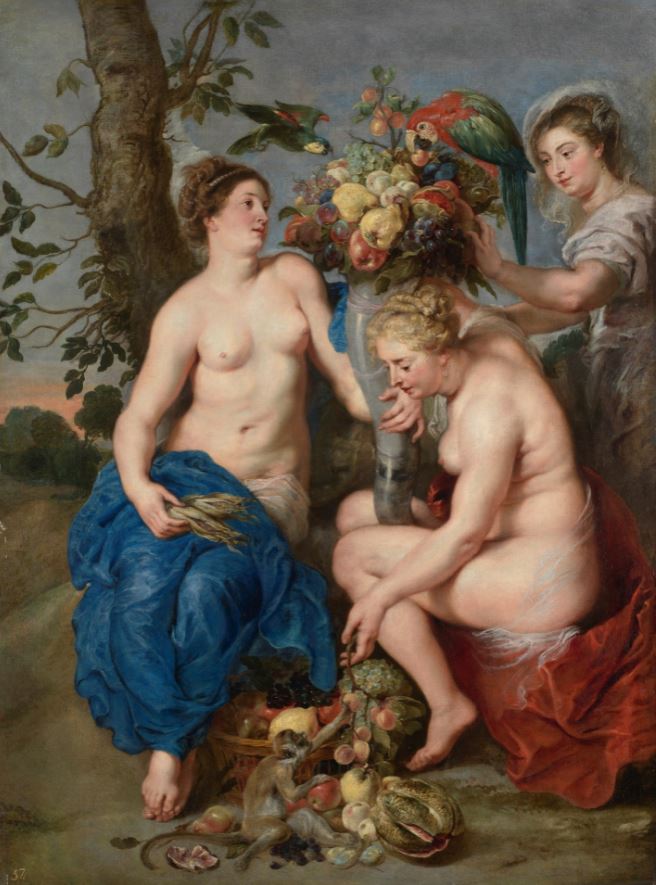
  • Three Nymphs with a Cornucopia (1625 to 1628) Museo Nacional del Prado, Madrid

The thing is that, although the curators try their best to claim that these women are not subject to the male gaze, but are strong independent women overflowing with agency, that’s not really how they actually look.

In my opinion this one, ‘Three Nymphs with a Cornucopia’ can be taken as a test case. It depicts the horn of plenty overflowing with the good things of life, namely a grocer’s shop full of ripe plump juicy fruit, so ripe and juicy that it has attracted the attention of scavenging parrots and a cheeky monkey, to add drama and narrative to a classical allegorical scene.

Is it just me or are the two naked women depicted as extensions of this vision of youthful fertile juicy fruitfulness?

I think they are. Far from asserting anyone’s agency, I’d have thought this picture epitomises the reverse: surely these women are totally objectified, depicted  in all their youthful sexiness as direct extensions of the world of fruit and fecundity.

This is one of eight paintings Rubens took to Spain as a gift from his patron, the Archduchess Isabel Clara Eugenia, to King Philip IV, to butter him up. Made by a man to flatter a king, far from being a rebuttal it strikes me as being a kind of triumph of the male gaze – sexy topless fruitful babes designed to decorate on the walls of the most powerful man in Europe.

Three Nymphs with a Cornucopia by Peter Paul Rubens (1625 to 1628) Museo Nacional del Prado, Madrid

More interesting to me, more persuasive and touching, is the information that Juno, in this huge representation of ‘The Birth of the Milky Way’ resembles Helena Fourment, Rubens’s second wife.

According to the curators, it is thought that his happy second marriage to Helene inspired his increasingly sensuous presentation of women during the 1630s. That seems to me a plausible and happy explanation of the plump sensuality of the nudes he painted in his final decade, just as Rembrandt’s love for his wife shine through his later paintings. I’m not sure anybody portrayed in a painting, male or female, has any ‘agency’. In my opinion they’re all trapped by composition, design, treatment, by the artist’s aims and whims, and all subject to the human gaze of us, centuries later, completely cut off from the value systems in which these works were created.

But paintings very much can convey tenderness and love. And that’s what I found in this small room full of magnificent works of art. The milk of human kindness. Motherly love. The pure, naked, redemptive love we all wish, deep down, we could recapture.

The Birth of the Milky Way by Peter Paul Rubens (1636 to 1638) © Photographic Archive, Museo Nacional del Prado, Madrid

Happily ever after

In fact this final wall caption made me realise that mention of Rubens’ second wife had been seeded throughout the show, starting with early mention of how, after the early death of his first wife, in 1630 Rubens married his second and much younger wife, Helena Fourment (1614 to 1673).

‘Their blissful marital state in the final decade of his life, during which time they had five children, provided a wellspring of love and an increased interest in sensual mythological themes.’

In a world afflicted with terrible pain and suffering it cheered me up to learn that this great artist was blessed with a long, happy, rewarding marriage. Good for him! And these images, painted late in his life, at the peak of his experience of art and life, however others may wish to interpret them, struck me as wonderfully accepting celebrations of beauty, humanity and love.

Rubens among his peers

I was struck by a quote from co-curator Dr Ben van Beneden which gives a pithy summary of three of Western Art’s Golden Greats:

‘If Raphael endowed his female figures with grace, and Titian with beauty, Rubens gave them veracity, energy and soul.’

Strong independent parrots

I noticed that one of the most powerful paintings in the final room, the Cornucopia, featured some beautifully vivid parrots pecking away at the fruit flowing from the horn, and this reminded me that the awesome painting of the Marchesa Maria Serra Pallavicino in the first room also features a parrot perched on her grand chair and bending down, twisting its neck in that inquisitive parrot way.

It occurred to me that maybe Dulwich’s next exhibition should be about ‘Parrots in Painting’. It could bring together depictions of a variety of strong, independent parrots who resist the human gaze to insist on their psittacine agency.

The video


Related links

Related reviews

Sorolla: Spanish Master of Light @ the National Gallery

This is the first UK exhibition in over a century of the painter who came to be known as ‘Spain’s Impressionist’, Joaquín Sorolla y Bastida.

The 58 works on show have been loaned from Spanish and private collections to present the most complete exhibition of his paintings outside Spain so this is a unique opportunity to see, enjoy and judge for yourself. (A third of the works are on loan from the Museo Sorolla, ‘one of Madrid’s most dazzling small museums, which occupies the house and garden Sorolla designed and built for his family’. So next time you’re in Madrid…)

Sewing the Sail (Cosiendo la vela), 1896

Almost immediately you can see why Sorolla is known as ‘the master of light’. Room two contains what is surely the most impressive painting here, Sewing the Sail, which is a miracle of evocation. You can feel the harsh Mediterranean sun, you can hear the distant susurration of the sea and the laughing chatter of the women as they work, you can smell the scents from the profusion of flowers in baskets and jars.

It is also a big painting, an enormous painting, which takes up most of one wall. You are immersed in the visual experience. Of all the paintings here this was the hardest to tear yourself away from.

But the exhibition brings together works in an impressive variety of genres, large and small. Sorolla was prolific, leaving at his death over a thousand paintings and several thousand drawings and sketches. The exhibition displays a selection of works including vivid seascapes and bather scenes, studies of architecture and formal gardens, many of the portraits from which he made a lucrative living, a whole room of social conscience paintings, and some of the images he prepared for a vast mural depicting Spanish regional customs and dress.

The Return from Fishing (La vuelta de la pesca), 1894

Room 1. Early works and wife

The first room includes an arresting self-portrait of a man determined to make his way in the world. There are portraits of Sorolla’s wife, Clotilde, as well as his daughters María and Elena, and son Joaquín, who became the Museo Sorolla’s first director.

Sorolla married Clotilde, the daughter of his first major patron, in 1888. She remained his favourite model and, in his many portraits, barely appears to age over the decades. The strong family connection resonates with the painting of a rose bush from Sorolla’s house which, legend has it, withered when the artist passed away and wilted away entirely when Clotilde died.

But the room is dominated by this expressive nude of his wife.

Female Nude (1902) by Joaquín Sorolla. Private Collection. Photo Joaquín Cortés

Three things. 1. He is showing off his skill with oil paint. Look at the shimmer and the shadows and the numerous different shades of pink of the presumably silk sheet she is lying on. 2. He was consciously chanelling the Rokeby Venus, a masterpiece by probably the most eminent Spanish painter Diego Velázquez. Sorolla set himself up as Velázquez’s modern heir and incarnation and, like Velázquez, cultivated a wide circle of rich aristocratic patrons until he reached the social pinnacle of being commissioned to paint a portrait of the Spanish king..

3. How very, very traditional it is. By 1902 the Impressionists had been at it for 30 years, and we had had a decade or more of post-Impressionism, Gauguin, van Gogh and so on and were teetering on the brink of the Fauves with their mad garish daubs of vibrant colour. Not in Sorolla’s world. One of the features of the early rooms is the number of international exhibitions Sorolla sent his work to, and the number of prizes he won, in Madrid, Paris, all over Europe. This is the height of late-Victorian Salon art. Sorolla represents everything modern painting set out to overthrow.

Room 2. Social conscience

Sorolla trained in Valencia and studied in Madrid and Rome. He first won an international reputation for major works tackling social subjects. The second room focuses on the 1890s, when Spain witnessed a period of social unrest as well as the final collapse of its overseas empire.

During this period Sorolla launched his career with a series of monumental canvases depicting the realities and hardships of Spanish life. His first great success was Another Marguerite! which depicted a woman arrested for murdering her child and won great acclaim when it was exhibited in Madrid in 1892.

From there, Sorolla set about gaining an international reputation by sending his pictures to exhibitions across Europe. While Sorolla largely moved away from socially engaged subjects after 1900, the pictures had a lasting impact on the next generation of Spanish painter.

And They Still Say Fish is Expensive! (¡Y aún dicen que el pescado es caro!), 1894

Many of them are wonderful but they feel very old. A painting like this reminds me of the British artist Sir Luke Fildes who was painting grittily realistic depictions of working class life in the 1870s.

Room 3. Portraits

The third room shows how Sorolla positioned himself as the heir to the tradition of Spanish artists such as Velázquez and Goya, whose works he closely studied at the Prado in Madrid.

In his portraits, Sorolla often adopted their distinctive palette of blacks, greys and creams. He also sought to achieve the same psychological penetration and sense of human presence for which both painters were famous.

Lucrecia Arana and Her Son (Lucrecia Arana y su hijo), 1906

I wasn’t convinced. Like all his works I began to realise that they make a better effect the further back you stand. But I still found the three faces in this double portrait unsatisfactory. The boy’s face looks like the black eyed boys you seen in the countless kitsch paintings you can buy in sunny markets and harbours around the Mediterranean. The woman just looks flat and ugly, and the image of the painter at work in the mirror isn’t exactly inspiring.

Many of the portraits are large, portrait-shaped depictions of the grand and rich and naturally invite comparison with one of the most successful portrait painters in Europe at the time, the American John Singer Sargent who based himself in London. Here’s a characteristic Sargent joint portrait from the period.

Lady Adele Meyer and her children (1896) by John Singer Sargent

In my opinion the Sargent is better. It captures the expressions on all three faces with a kind of dainty realism, and the fabric of the woman’s dress, the son’s velvet suit and, above all, of the antique sofa she’s sitting on – all of these seem to me to be caught with a kind of shimmering accuracy which Sorolla can’t match.

Room 4. The beach and sunlight

Room Four celebrates Sorolla’s love of sunlight and the sea. Having grown up by the coast in Valencia, Sorolla began after 1900 to create a substantial body of work, painted out of doors, documenting the mixture of leisure and work he witnessed on beaches close to Valencia and further down the coast at Jávea. These scenes proved hugely popular especially in the United States.

Running along the Beach, Valencia (1908) by Joaquín Sorolla © Museo de Bellas Artes de Asturias. Col. Pedro Masaveu

The audioguide is very thorough and comprehensive and includes several photos showing Sorolla at work on the beach, a) wearing an amazingly thick, heavy, conventional set of clothes (waistcoat, hat) in what must have been sweltering conditions b) with his canvas protected by a windbreak and the easel held down with an elaborate system of ropes and heavy stones.

In my opinion these paintings are wonderfully evocative but tread a fine line just this side of kitsch. On the one hand the use of colours in a painting like Boys on the beach is masterful – the commentary highlighted how he creates shadow out of colours, not using black, but looking at the composition as a whole I was struck by how he captures the many colours of sand, caused by the changing depths of sea water and light refracted through it.

Boys on the Beach (Chicos en la playa), 1909

But some of them topple into kitsch and once I’d though of Jack Vettriano’s immensely popular paintings of people on beaches, I couldn’t get them out of my mind. I found it hard not to see the Athena Posters aspect of many of these beach works.

Mad Dogs by Jack Vettriano

Mad Dogs by Jack Vettriano

Compared to the threatening new style of the Fauves or the Cubism which was just being invented by Picasso and Braques, yes, I can well imagine that American millionaires bought this kind of thing by the yard.

Room 5. Studies for the mural

In 1911 Sorolla was commissioned by the Hispanic Society of America in New York to create a vast mural-like series of paintings entitled Vision of Spain.

As preparation Sorolla travelled extensively through Spain, documenting the country’s regional dress, occupations, and traditions. Local people, often provided by Sorolla with costumes and props, were depicted in situ in works which were painted between 1911 and 1919.

The exhibition includes four large-scale preparatory studies for Vision of Spain demonstrating the intensity with which the artist engaged in Spanish folk tradition. Sorolla also painted the landscapes in these regions which he then incorporated in the Hispanic Society paintings.

Bride from Lagartera (1912) by Joaquín Sorolla © Museo Sorolla, Madrid

Three things:

1. The audioguide explains that, because the subjects were not professional models, they had to be painted quickly. The audioguide emphasises a) the terrific skill this required b) the way the paint was applied very quickly, often direct from the tube, in squiggles across the surface, and it’s true, if you get up close the pictures become almost abstract and, the guide suggests, exercises in pure painterliness.

2. They’re not very good, though, are they? They are not a patch on the huge realist works from the start of the exhibition, from the 1890s and, even allowing for the fact that they were rushed and are only preparatory works, still, the overall effect is negative.

3. Shame there weren’t more big colour photos of the finished mural. This does look very impressive but was only available as tiny black and white photos on the screen of the ipod-sized audioguide. Shame.

Room 6. Landscape and gardens

The sixth room of the exhibition is devoted to Sorolla’s views of landscapes and gardens. From a panoramic vista of the barren mountains of the Sierra Nevada glowing in evening light to the medieval towers of Burgos Cathedral under snow, Sorolla had a gift for finding the viewpoint to best communicate the atmosphere and character of a setting.

On several visits to the south, he recorded the country’s heritage in views of the gardens of the Alcázar in Seville and the Alhambra in Granada. None of these paintings pulled my daisy as much as the big realist works in room two or some of the sunlight beach scenes.

Reflections in a Fountain (Reflejos de una fuente), 1908

Room 7. Family

The final room highlights Sorolla’s fascination with depicting his family in large canvases painted out of doors such as Strolling along the Seashore (1909) and The Siesta (1911).

These works are twenty years on from Another Marguerite! and And They Still Say Fish is Expensive! and Sewing the Sail, and in The Siesta in particular you can see him really exploring the possibilities of oil painting, but in a landscape saturated with light. The Impressionists often painted fog or snow, for the German Expressionists it was always stormy night-time, but for Sorolla – even when he is at his most experimental, verging on abstraction – it is always bright and dazzlingly sunny.

The Siesta (1911) by Joaquín Sorolla © Museo Sorolla, Madrid

The Siesta (1911) by Joaquín Sorolla © Museo Sorolla, Madrid

Conclusion

In June 1920 Sorolla suffered a stroke in the middle of painting a portrait which paralysed him down one side, effectively ending his career, and died on the 10th August 1923.

The downstairs exhibition space at the National Gallery includes a comfy little cinema where they were showing a fifteen-minute documentary about Sorolla, complete with extensive explanations from the show’s curator, Christopher Riopelle.

From this we learn that he was given a state funeral, as befitted the official portraitist of the king and the royal family, and one of the last public painters working in the great European tradition, before Modernism swept all that way forever.

Having walked around it a couple of times and listened to the audioguide, I couldn’t help making continual comparisons to the social realist paintings of a Luke Fildes or the much finer portraits of Singer Sargent and, on the couple of occasions Sorolla does statuesque women in bathing suits, I was immediately reminded of the much more precise and lustrous paintings of the late-Victorian Olympians like Lawrence Alma-Tadema.

But… some of the large scale paintings, notably Sewing the Sail, are really stunning, eye-opening exercise in the overwhelming power of painting, and many of the details of the beach and sunlight paintings are wonderful – there’s a way he has of capturing the fading sunlight as it’s thrown across rocks which reminds you of all the Mediterranean holidays you’ve ever had.

And his use of colour, his juxtaposition of shades and hues to create subtle visual effects, is often dazzling. The more you look, the more absorbed you become. The curator claims that ‘No one before or since has painted Mediterranean sunlight like Sorolla’ and this may well be true.

Young Fisherman, Valencia (1904) by Joaquín Sorolla. Private Collection © Photo Laura Cohen

Videos

Review by Visiting London Guide.

Curator’s introduction by Christopher Riopelle.


Related links

Reviews of other National Gallery exhibitions

Dreaming With His Eyes Open: A Life of Diego Rivera by Patrick Marnham (1998)

My father was a storyteller and he invented new episodes of his past every day.
(Diego Rivera’s daughter, Guadalupe)

This is a hugely enjoyable romp through the life of Mexico’s most famous artist, the massive, myth-making Marxist muralist Diego Rivera. In his own autobiography My Art, My Life, Rivera made up all sorts of tall stories and whopping fibs about his ancestors, childhood and young manhood. He then collaborated with his first biographer, friend and fan Bertram David Wolfe, to produce an ‘official’ biography (published in 1963) in which he continued to perpetrate all sorts of fantastical stories.

Instead of boringly trying to tell fact from fiction, Marnham enters into the spirit of Rivera’s imagination and, maybe, of Mexico more generally. The opening chapter is a wonderful description of Marnham’s own visit to Rivera’s home town during the famous Day of the Dead festival, in which he really brings out the garish, fantastical and improbable nature of Mexican culture – a far far better introduction to Rivera’s world than a simple recital of the biographical facts.

Mexico appears throughout the book in three aspects:

  • via its turbulent and violent politics
  • in its exotic landscape, brilliant sky, sharp cacti and brilliantly-coloured parrots
  • and its troubled racial heritage

As to the whoppers – where Rivera insisted that by age 11 he had devised a war machine so impressive that the Mexican Army wanted to make him a general, or that he spent the years 1910 and 1911 fighting with Zapata’s rebels, or that he began to study medicine, and after anatomy lessons he and fellow students used to cook and eat the body parts – Marnham gently points out that, aged 11, Rivera appears to have been a precocious but altogether dutiful schoolboy, while in 1910/11 he spent the winter organising a successful exhibition of his work and the spring in a small town south of Mexico City worrying about his career and longing for his Russian girlfriend back in Paris.

First half: Apprenticeships 1886 to 1921

The most interesting aspect of the first half of his career is the long time it took Rivera to find his voice. Born in 1886 to a minor official in the provincial city of Guanajuato, young Diego’s proficiency at drawing was noticed at school. The family moved to Mexico City and his parents got him into the prestigious San Carlos Academy of Fine Arts, when he was just 11 years old. In 1906 i.e. aged 19, he won a scholarship to study abroad and took a ship to Spain, settling in Madrid, where he met the city’s bohemian artists and studied the classics, Velasquez and El Greco, who he particularly revered.

But the real intellectual and artistic action in Spain was taking place in Barcelona (where young Picasso had only recently been studying), the only Spanish city in touch with the fast-moving art trends in northern Europe.

So it was only when Rivera went to Paris in 1909 that he was first exposed to Cézanne and the Impressionists and even then, they didn’t at first have much impact. After a trip to London where he saw Turner, his painting becomes more misty and dreamy, but it was only in 1913 that he began to ‘catch up’, for the first time grasping the importance of the Cubism, which had already been around for a few years. For the next four years Diego painted in nothing but the Cubist idiom, becoming a well-known face in the artistic quarter of Montparnasse, a friend of Picasso, and a fully paid-up member of the avant-garde – all mistresses, models and drinking late into the night.

Marnham’s account of these years is interesting for a number of reasons. It sheds light on how a gifted provincial could happily plough a traditional academic furrow right up until 1910, blithely ignorant of what we now take to be all the important trends of Modern Art. And it is a compellingly gossipy account of the artistic world of the time.

I liked the fact that, in this world of bohemian artists, whenever a ‘friend’ visited, all the artists turned their works to the wall before opening the door. The artistic community – which included not only Picasso, but Gris, Mondrian, Chagall, Derain, Vlaminck, Duchamp – was intensely competitive and also intensely plagiaristic. Picasso, in particular, was notorious for copying everything he saw, and doing it better.

Food was so cheap in the little cafés which sprang up to cater to the bohemians that the Fauvists Derain and Vlaminck invented a game which was to eat everything on the cafe menu – in one sitting! Whoever gave up, to full to carry on, had to pay the bill. On one occasion Vlaminck ate his way through every dish on a café menu, twice!

Rivera’s transition from traditional academic style to cubism can be seen in the ‘Paintings’ section of the Wikipedia gallery of his art. First half is all homely realism and landscapes, then Boom! a dozen or so hard-core cubist works.

Rivera returned to Mexico in October 1910 and stayed for 6 months, though he did not, as he later claimed, help the Mexican revolutionary bandit leader Zapata hold up trains. He simply wanted to see his family and friends again.

But upon arrival, he discovered that he was relatively famous. His study in Madrid and Paris had all been paid for by a state scholarship awarded by the government of the corrupt old dictator, Porfirio Diaz and, to justify it, Diego had had to send back regular samples of his work. These confirmed his talent and the Ministry of Culture had organised an exhibition devoted to Rivera’s work which opened on 20 November 1910, soon after his return, to quite a lot of fanfare, with positive press coverage.

As it happens, this was exactly the same day that the Liberal politician Francisco Madero crossed the Rio Grande from America into northern Mexico and called for an uprising to overthrow the Diaz government, thus beginning the ‘Mexican Revolution’.

In his autobiography Rivera would later claim that he was a rebel against the government and came back to Mexico to help Emiliano Zapata’s uprising. The truth was pretty much the opposite. His ongoing stay in Madrid and then Paris was sponsored by Diaz’s reactionary government. He never met or went anywhere near Zapata, instead supervising his art exhibition in Mexico City and spending time with his family, before going to a quiet city south of the capital to paint. He was, in Marnham’s cutting phrase, ‘a pampered favourite’ of the regime (p.77)

In the spring of 1911 Rivera returned to Paris with its cubism, its artistic squabbles, and where he had established himself with his Russian mistress. Not being a European, Rivera was able to sit out the First World War (rather like his fellow Hispanic, Picasso) while almost all their European friends were dragged into the mincing machine, many of them getting killed.

Of minor interest to most Europeans, the so-called Mexican Revolution staggered on, a combination of complicated political machinations at the centre, with a seemingly endless series of raids, skirmishes, battles and massacres in scattered areas round the country.

Earlier in the book, Marnham gives a very good description of Mexico in the last days of Diaz’ rule, ‘a system of social injustice and tyranny’. He gives a particularly harrowing summary of the out-and-out slavery practiced in the southern states, and the scale of the rural poverty, as exposed by the journalist John Kenneth Turner in his 1913 book Barbarous Mexico (pp. 36-40).

Now, as the Revolution turned into a bloody civil war between rival factions, in 1915 and 1916, Rivera began to develop an interest in it, even as his sophisticated European friends dismissed it. Marnham himself gives a jokey summary of the apparently endless sequence of coups and putsches:

Diaz was exiled by Modera who was murdered by Huerta who was exiled by Carranza who murdered Zapata before being himself murdered by Obregón. (p.122)

Obregón himself being murdered a few years later…

Rivera’s Russian communist friend, Ilya Ehrenburg, dismissed the whole thing as ‘the childish anarchism of Mexican shepherds’ – but to the Mexicans it mattered immensely and resonates to this day.

Rivera spent a long time in Europe, 1907 to 1921, 14 years, during which he progressed from being a talented traditionalist and established himself at the heart of the modern movement with his distinctive and powerful brand of cubism. Some of the cubist works showcased in the Wikipedia gallery are really brilliant.

But all good things come to an end. Partly because of personal fallings-out, partly because it was ceasing to sell so well, Rivera dropped cubism abruptly in 1918, reverting to a smudgy realist style derived from Cézanne.

Then he met the intellectual art critic and historian Elie Faure who insisted that the era of the individual artist was over, and that a new era of public art was beginning. Faure’s arguments seemed to be backed up by history. Both the First World War and the Russian Revolution had brought the whole meaning and purpose of art into question and the latter, especially, had given a huge boost to the notion of Art for the People.

It was with these radical new thoughts in mind that Diego finally got round to completing the Grand Tour of Europe which his grant from the Mexican government had been intended to fund. off he went to Italy, slowly crawling from one hilltop town to the next, painstakingly copying and studying the frescos of the Quattrocento masters. Here was art for the people, public art in chapels and churches, art which any peasant could relate to, clear, forceful depictions of the lives of Jesus and the apostles and the saints. Messages on walls.

Second half: Murals 1921 to 1933

The Mexican Revolution was declared over in 1920, with the flight and murder of President Carranza and the inauguration of his successor President Obregón. A new Minister of Culture, José Vasconcelos, was convinced that Mexico needed to be rebuilt and modernised, starting with new schools, colleges and universities. These buildings needed to be decorated with inspiring and uplifting murals. As Mexico’s most famous living artist, Diego had been contacted by Vasconcelos in 1919, and his talk of murals came at just the same time that Elie Faure was talking to Diego about public art and just as Diego concluded his painstaking studies of Renaissance frescos in Italy.

In 1921 Rivera returned to Mexico and was straightaway given two of the most important mural commissions he was ever to receive, at the National Preparatory School (la Escuela Prepatorio), and then a huge series at the new Ministry of Education.

At the same time Diego evinced a new-found political consciousness. He not only joined the Mexican Communist Party but set up a Union of Technical Workers, Painters and Sculptors. From now on there are three main strands in his life:

  1. the murals
  2. the Communist Party
  3. his many women

Diego’s women

Rivera was a Mexican man. The patriarchal spirit of machismo was as natural as the air he breathed. Frank McLynn, in his book about the Mexican Revolution, gives lengthy descriptions of Pancho Villa and Emiliano Zapata’s complex love lives (basically, they both kept extraordinary strings of women, lovers, mistresses and multiple wives). Diego was a man in the same mould, albeit without the horses and guns. More or less every model that came near him seems to have been propositioned, with the result that he left a trail of mistresses, ‘wives’ and children in his turbulent wake.

Europe

1911 ‘married’ to Angelina Beloff, mother of a son, also named Diego (1916–1918)
1918 affair with Maria Vorobieff-Stebelska, aka ‘Marevna’, mother of a daughter named Marika in 1919, whom he never saw or supported

Mexico

1922 to 1926 Diego married Guadalupe Marin, who was to be the mother of his two daughters, Ruth and Guadalupe; she modelled for some of the nudes in his early murals
– affair with a Cuban woman
– possible affair with Guadalupe’s sister
– affair with Tina Modotti, who modelled for five nudes in the Chapingo murals including ‘Earth enslaved’, ‘Germination’, ‘Virgin earth’ 1926-7
1928 – seduced ‘a stream of young women’
1929 marries Frida Kahlo, who goes on to have a string of miscarriages and abortions
– three-year affair with Frida’s sister, Cristina, 1934-7
1940 divorces Frida – starts affair with Charlie Chaplin’s wife, Paulette Goddard
– affair with painter Irene Bohus
December 1940 remarries Frida in San Francisco
1954 marries Emma Hurtado
– affair with Dolores Olmedo

Diego’s murals

Making frescos is a tricky business, as Marnham explains in some detail – and Rivera’s early work was marred by technical and compositional shortcomings. But he had always worked hard and dedicatedly and now he set out to practice, study and learn.

Vasconcelos was convinced that post-revolutionary Mexico required ‘modernisation’, which meant big new infrastructure projects – railways with big stations, factories, schools, universities – and that all these needed to be filled with inspiring, uplifting, patriotic ‘art for the people’.

The National Preparatory School, and then a huge series at the new Ministry of Education, took several years to complete from 1922 to 1926 and beyond. He was convinced – as Marnham reductively puts it – that he could change the world by painting walls.

There was a hiatus while he went to Moscow 1927 to 1928.

There is an unavoidable paradox, much commented on at the time and ever since, that some of Diego’s greatest socialist murals were painted in America, land of the capitalists.

In 1929 he received a commission to decorate the walls of a hacienda at Cuernevaca (in Mexico) from the U.S. Ambassador, Dwight Morrow. Following this, Diego went to San Francisco to paint murals at the San Francisco Stock Exchange (!) and the San Francisco School of Arts.

His argument in his own defence was always that he was bringing the Communist message to the capitalist masses – but there’s no doubt that these commissions also meant money money money. Fame and money.

In 1931 Diego helped organise a one-man retrospective at New York’s new Museum of Modern Art (founded in 1929) which was a great popular success. Marnham is amusingly sarcastic about this event, listing the names of the umpteen super-rich, American multi-millionaires who flocked to the show and wanted to be photographed with the ‘notorious Mexican Communist’. ‘Twas ever thus. Radical chic. Champagne socialism.

As a result of all this publicity, Diego was then invited by Edsel Ford, son of the famous Henry, to do some murals at the company’s massive car factory in Michigan. Diego put in a vast amount of time studying the plant and all its processes with the result that the two massive murals painted on opposite sides of a big, skylit hall are arguably among the greatest murals ever painted, anywhere. Stunningly dynamic and exciting and beautifully composed.

North wall of Diego Rivera's Detroit Murals (1933)

North wall of Diego Rivera’s Detroit Murals (1933)

Everything was going swimmingly until the next commission – to do a mural in the foyer of the enormous new Rockefeller Building in New York – went badly wrong.

Diego changed the design several times, to the annoyance of the strict and demanding architects, but when he painted the face of Lenin, not in the original sketches, into the mural the architects reacted promptly and ejected him from the building.

A great furore was stirred up by the press with pro and anti Rivera factions interviewed at length, but it marked the abrupt end of commissions (and money) in America. What was to have been his next commission, to paint murals for General Motors at the Chicago World Fair, was cancelled.

Diego was forced, very reluctantly, to go back to Mexico in 1934, back to ‘the landscape of nightmares’ as he called it. Marnham makes clear that he loved America, its size, inventiveness, openness, freedom and wealth – and was angry at having to go back to the land of peasants and murderous politicians.

Diego was ill for much of 1934, and started an affair with Frida Kahlo’s sister. Towards the end of the year he felt well enough to do a mural for the Palacio de Bellas Artes. In 1935 he resumed work on new rooms of the National Palace, a project he had abandoned when he set off for America. He made the decision to depict current Mexican politicians and portray the current mood of corruption. That was a bad idea. They caused so much offence to the powers that be that, once the murals were finished, the Mexican government didn’t give him another commission for six years and he was replaced as official government muralist by José Clemente Orosco.

He did a set of four panels for the Hotel Reforma in Mexico City, but the owner was offended by their blatant anti-Americanism (given that most of his guests were rich Americans) so he took them down and they were never again displayed in Diego’s lifetime.

Thus he found himself being more or less forced out of mural painting – and forced back into painting the kind of oil canvases which, paradoxically, were always far more profitable than his murals. They were relatively quick and easy to do (compared to the back-breaking effort of the murals) and so for the next five years Diego concentrated on politics.

Diego’s politics

Diego’s politics seem to be strangely intangible and were certainly changeable. He lived in a fantasy world, was a great storyteller, and Lenin and Marx seem to have entered his huge imaginarium as yet another set of characters alongside Montezuma, Cortes and Zapata.

Having joined the Mexican Communist Party in 1922 but left it in 1925. He went on an ill-fated trip to Moscow in 1927-8, arriving just as Stalin was beginning to exert his power and the campaign against Trotsky was getting into full swing. During his visit he made some tactless criticisms of the Party and so was asked by the Soviet authorities to leave.

Enter Trotsky

A decade later, stymied in his artistic career, Diego joined the International Communist League, a separate organisation from the Communist Party, which was affiliated to Trotsky’s Fourth International. He wanted to be a Communist, but not a Stalinist.

Trotsky had been exiled from the Soviet Union in 1929. For the next 8 years he wandered as an exile, with spells in Turkey, France and Norway. As this last refuge became increasingly difficult, Diego gave his support to a suggestion by Mexican intellectuals that Trotsky be given refuge in Mexico. They persuaded the reluctant Mexican government to give him safe haven at Diego’s home in Mexico City.

Trotsky lived with Diego and Frida for two years, Diego providing him with every help and resource, taking him on long tours of the country (at one point in the company of the godfather of Surrealism, André Breton, who also stayed at the Casa Azula).

Diego wasn’t a political thinker. In Russia in 1927 he had begun to realise the dictatorial turn which Soviet communism was taking, and the point was rammed home for even the most simple-minded by the simultaneous collapse of the Communist Left in the Spanish Civil War (where Stalin’s commissars, secret police and assassins spent more time torturing and killing the other left-wing forces than combating the common enemy, Franco) and then by the outrageous Moscow Show Trials of 1936-38.

Marnham’s account of all this is very interesting; he writes in a wonderfully clear, sensible, entertaining style, with a persistent dry humour.

Anyway, the idyll with Trotsky came to a grinding halt when Diego discovered that Frida had been having an affair with him. She was 30, Trotsky was 58. (One of the revelations of this book is the number of affairs Frida Kahlo had, with both men and women. She had affairs with at least 11 men between summer 1935 and autumn 1940.)

In fact Diego had put himself in some danger by hosting Trotsky. We now know that Stalin commissioned no fewer than three NKVD hit squads to track Trotsky down and kill him. After Diego kicked Trotsky out of the Blue House (the home he shared with Kahlo), the ailing Communist, along with wife and bodyguards, were fixed up in a house only a few hundred yards away.

It was here that Trotsky was subject to a horrifying attack by an armed gang led by – bizarrely – one of Mexico’s other leading mural painters – David Alfaro Siqueiros – who burst into the villa and fired 173 shots into the bedroom. Amazingly, the gunmen managed to miss Trotsky who took shelter under the bed with his wife. Siqueiros went on the run.

Having read 400 pages of Frank McLynn’s biography of the endlessly violent Mexican Revolution, I was not at all surprised: McLynn shows that this was the routine method for handling political disagreements in Mexico.

A second assassination attempt was made in August, when Ramón Mercader, also hired by the NKVD, inveigled his way past Trotsky’s security men and, as the great man leaned down to read a letter Mercader had handed him, attacked Trotsky with a small ice-pick he had smuggled into the house. Amazingly, this failed to kill Trotsky who fought back, and his guards burst in to find the two men rolling round on the floor. The guards nearly killed Mercader but Trotsky told them to spare him. Then the great man was taken off to hospital where he died a day later.

After Trotsky

Deeply wounded by Frida’s affair with the old Bolshevik, Trotsky’s murder led Diego a) to forgive her b) to flee to America, specifically to San Francisco where he’d received a commission to do a big mural on the theme of Pan America.

Also, a new president had taken office in Mexico with the result that the unofficial ban on Rivera was lifted. He returned to his home country and, in 1940, began a series of murals at the National Palace. There were eleven panels in all, running around the first floor gallery of the central courtyard. They took Rivera, off and on, nine years to complete and weren’t finished till 1951. They bring to the fore his lifelong engagement with a central issue of Mexican identity? Are Mexicans Aztec Indians? Or Spanish? Or half-breeds? Who are the Mexicans? What is the nation and its true heritage?

Diego and Frida

Surprisingly, Marnham deals with the last 15 or so years of Diego’s life (he died in 1957) very scantily. Rivera painted numerous more murals but Marnham barely mentions them. Instead Marnham devotes his final pages to developing a theory about the psycho-sexual relationship between Frida and Diego, trying to tease sense out of their complicated mutual mythomania.

He starts from the fact that Frida’s illness limited her mobility and made her a world-class invalid. This she dramatised in a wide range of paintings depicting her various miscarriages, abortions, corsets, operations, prosthetic legs and other physical ailments.

But overlaid on almost all of Frida’s paintings was her unhappiness about Diego’s infidelity, especially with her own sister… In reality she seems to have had scads of affairs with lots of men and quite a few women but this doesn’t come over from her art, which presents her as a a pure victim.

And yet she was a powerful victim. Biographical accounts and some of the paintings strongly suggest that, although he boasted and bragged of his own countless affairs and ‘conquests’, in the privacy of their relationship, Diego could become the reverse of the macho Mexican male – he became Frida’s ‘baby’, the baby she was never able to have. Apparently, Frida often gave Diego baths, and maybe powdered and diapered him. Many women dismiss men as big babies: it can be a consolation for their (women’s) powerlessness. But it can also be true. Men can be big babies.

Then again Marnham quotes a startling occasion when Diego said he loved women so much that sometimes he thought he was a lesbian. And Frida apparently poked fun at his massive, woman-sized breasts.

Marnham shows how their early childhoods had much in common: both had close siblings who died young and haunted their imaginations; both fantasised about belonging to peasant Indian parents, not to their boring white European ones. And so both egged each other on to mythologise their very mixed feelings for their vexing country.

I was particularly struck to discover that, during their various separations, Frida completely abandoned her ornate ‘look’, the carefully constructed colourful dresses, and earrings and head-dresses which she largely copied from the native women of the Tehuana peninsula. According to Marnham, when the couple divorced in 1940, Frida promptly cut her hair, wore Western clothes and flew to New York to stay with friends, looking like a crop-haired, European lesbian.

The conclusion seems to be that her self-fashioning into a kind of mythological creature incorporating native dress and symbolism – and his murals, which obsess about the native inheritance of Mexico – were both ingredients in a psychological-sexual-artistic nexus/vortex/chamber of wonders which they jointly created.

Their mutual infidelities upset the other, but they also found that they just couldn’t live apart. Sex between them may have stopped but the intensity of the psychological and artistic world they had created together couldn’t be even faintly recreated with other partners.

It was obviously very complicated but in its complexity prompted the core of the artworks, in particular the endless reworking of her own image which have made Frida more and more famous, probably better known these days than her obese husband.

Looking for one narrative through all this – especially a white, western, feminist narrative – strikes me as striving for a spurious clarity, where the whole point was the hazy, messy, creativity of very non-academic, non-Western, non-judgmental, very Mexican myth-making.

Same with the politics. In her last years Frida became a zealous Stalinist. This despite the Moscow Show Trials, Stalin’s alliance with Hitler and everything Trotsky had told them from his unparalleled first-hand experience of the corrupt dictatorship Stalin was creating. None of that mattered.

Because Marx, Engels, Lenin and Stalin were part of her personal and artistic mythology. Just as Diego – more objective, more interested in the external world than Frida – experimented endlessly with the theme of the Spanish conquest, fascinated by his Aztec forbears, and endlessly tormented by the meaning of being Mexican. Is being Mexican to value the European heritage, or despise it? Should you side with the defeated Indians, or leap forwards to a future of factories and communist state ownership? Even when – as Diego knew only too well – most of the Indian peasants he claimed to be speaking for, and ‘liberating’ in his murals, in fact clung to village traditions and above all to their Roman Catholic faith, were, in other words, among the most reactionary elements in Mexican society.

Neither of them wrote clear, logical works of politics and philosophy. They both created fantasias into which their devotees and critics can read what they will. That, in my opinion, is how art works. It opens up spaces and possibilities for the imagination.

Two deaths

On 13 July 1954 Frida died, probably from an overdose of painkillers. A few months later, one of Diego’s repeated attempts to rejoin the Mexican Communist Party was successful.

He embarked on his last set of murals. In 1954 he married his art dealer, Emma Hurtado. Everyone says that after Frida’s death, he aged suddenly and dramatically. Before the year was out he was having an affair with Dolores Olmedo who had been friends with Frida, was her executrix, and was also the principal collector of Diego’s easel paintings.

So, as Marnham summarises the situation in his customarily intelligent, amused and dry style – Diego was married his deceased wife’s art dealer while simultaneously having an affair with her principal customer.

In September 1957 Diego had a stroke and in December of the same year died of heart failure. He left an autobiography, My Life, My Art, full of scandalous lies and tall tales, and a world of wonder in his intoxicating, myth-making, strange and inspiring murals.

Dream of a Sunday Afternoon in Alameda Park by Diego Rivera (1947)

Dream of a Sunday Afternoon in Alameda Park by Diego Rivera (1947)


Related link

Mexico reviews (including more Diego and Frida reviews)