Frans Hals @ the National Gallery

This the largest exhibition devoted to the paintings of Dutch master Frans Hals to be held in the UK for more than thirty years and it is a joy from start to finish.

The Lute Player by Frans Hals (before 1623) © RMN-Grand Palais (Musée du Louvre) / Mathieu Rabeau

Wall label:

This painting of a carefree lute player in a jester’s costume is one of Hals’s earliest and most successful half-length genre paintings. Unusually, Hals depicted him as seen from below, a vantage point he normally reserved for some of his commissioned portraits. The young man’s sideway glance, cheeky smile, tousled hair and lopsided hat convey a moment of suspended animation. Freely applied brushstrokes enhance the painting’s sense of liveliness and spontaneity.

Joie de vivre

Joy is the key word, along with fun, humour, life and laughter. Hals is the painter par excellence of the enjoyment of life. Eschewing all the other genres of painting, Hals concentrated on the art of portraiture. His master and teacher, Karel van Mander, was a specialist in big works depicting scenes from the Bible and thought portraits were a peripheral, trivial sideline unworthy of a real artist. But his pupil was to prove him wrong and to establish portraiture as the basis of an entire career.

This exhibition demonstrates that portraits themselves come in a variety of types or genres. There are:

  • formal portraits showing men of business and of importance in the community
  • informal portraits catching people in moments of relaxation
  • husband and wife portraits which themselves come in two flavours, either 2 individual works designed to be hung side by side or double portraits with the couple in one composition
  • group portraits of, say, the elders of a church, the directors of a company, regents of almshouses or, as here, of local civic guards
  • fictional portraits of character types such as the drunk, the buffoon and so on
  • tender intimate portraits of family, children and friends

So ‘the portrait’ is a much larger and more varied genre than you would at first think, and this exhibition brings together brilliant examples of all these sub-genres by one of western art’s greatest masters of the form.

Willem van Heythuysen Seated in a Chair by Frans Hals (about 1638) © Private Collection. Courtesy Richard Nagy Ltd, London

Wall label:

The wealthy cloth merchant Willem van Heythuysen commissioned this small picture more than a decade after he posed for one of Hals’s largest portraits (on show in the second room). Hals depicted him nonchalantly tipping back his chair – a highly unconventional pose. His direct gaze and the riding whip in his hand add to the sense of tension. Van Heythuysen hung the portrait in a private room in his Haarlem residence.

Frans Hals (1582 to 1666)

Frans Hals was born in Antwerp in Flanders but worked for most of his life in Haarlem, a Dutch commercial city overshadowed by Amsterdam.

Not long after the fall of Antwerp to the Spanish in 1585, as part of the 80 Years War, the Hals family moved to Haarlem in the northern Netherlands. In 1610 Hals enrolled in Haarlem’s Guild of St Luke in order to set up shop as a painter. His skill as a portraitist earned him many commissions from wealthy individuals, married couples, families and militia companies.

Hals’s lifetime was marked by plagues, war and religious controversies but none of that is in this exhibition, none of it intrudes on the stream of joyful, characterful portraits, on the life of people, rich people, businessmen, husbands and wives, drunks, city militias, jokers, entertainers and naughty children.

The Rommel-Pot Player by Frans Hals (1618 to 1622) © Kimbell Art Museum, Fort Worth, Texas

Wall label:

Laughing children offer coins to a cheerful busker, delighting in the dreadful sounds produced by his ‘rommel-pot’ (a pig’s bladder stretched over a jug). Wearing a fool’s foxtail, the man performs at Shrovetide, a time of merry-making before the fasting of Lent. This early genre painting reveals Hals’s extraordinary talent for characterisation and portraying laughter convincingly – especially that of children. The Rommel-Pot Player became one of the artist’s most popular paintings and was frequently copied.

Northern soul

If you’ve read any of my other art reviews you’ll know that I’m biased against the Italian Renaissance, which I find barren, sterile and humourless, and in favour of the Northern Renaissance, which I find full of life, humour and lovely touches.

The early Renaissance rooms at the National Gallery alternate between Italian and northern (German and Flemish) art, the former all hot, harsh, rocky landscapes with humourless Madonnas, the latter lush fields covered in daisies and sweet flowers, smiling ladies with ornate hairdos, quirky characterful northern portraits. I prefer Quentin Matsys to Botticelli.

For me Hals is a continuation of that northern spirit. Instead of sleek beautiful Italians who are all planning how to poison each other or dream of mortifying themselves for Jesus, Hals portrays ugly, jovial, boisterous northerners shouting for more wine, about to tell a particularly rude joke or burst into song. His people are so obviously having fun that it’s impossible not to be carried away by their bonhomie.

Portrait of a Man, possibly Nicolaes Pietersz Duyst van Voorhout by Frans Hals (1636 to 1638) © The Metropolitan Museum of Art, New York

Wall label:

The confident pose of this man echoes that of ‘The Laughing Cavalier’, painted more than a decade earlier. It also repeats that picture’s low viewpoint so that the sitter appears to tower over us. Hals rendered The Laughing Cavalier’s decorated outfit fairly precisely, but here he evokes the sheen of the sitter’s satin jacket through wonderfully free handling of the brush.

Quick technique

As far as scholars can tell Hals never made preliminary sketches, he just dived straight in, working alla prima which means applying paint onto previous layers of still-wet paint in a single session, layer over layer, with quick confident brushstrokes.

On the plus side this quick expressive style adds to the sense of vigour and joie de vivre in his sitters. On the downside sometimes it leads to a wonkiness about the features of his people but you’re never quite sure whether that’s down his painterly shortcomings or because many of his sitters were a bit wonky in that ugly north European way.

Young Woman (‘La Bohémienne’) by Frans Hals (about 1632) © RMN-Grand Palais (musée du Louvre) / Jean-Gilles Berizzi

Of this saucy woman the curators write:

The young woman gazes sassily to the side, her smile revealing her teeth. Most 17th-century Dutch viewers would have seen her expression as improper for a woman, indicating lack of refinement or even immorality. Her low-cut blouse suggests that she is a sex worker. This striking painting may have originally been intended for a brothel, where clients could sometimes choose from portraits of the women working there.

Laughter and joviality

When you see a painting or photograph of someone smiling or laughing I think most of us have a tendency to respond positively, maybe to smile along with the image, sometimes unconsciously. When you see a whole series of people laughing, joking, smiling and enjoying life, I think it has a cumulatively positive effect. The more I strolled around this exhibition, reading the wall labels about his friends, families, various bigwigs of Haarlem who Hals depicted in his brisk jovial style, the happier I became. I left the exhibition with a song in my heart.

The curators make the simple point that it’s hard enough to capture the likeness of someone in coloured oil brushed onto a flat canvas, but it’s fiendishly difficult to capture people laughing. All too often the attempt results in people who look like freaks or grotesques which is why so few big name artists ever attempted it. Hals is one of the few artists in all art history to successfully depict people having fun, a major part of human existence which is surprisingly absent from so much art. As the curators put it:

Hals was one of the very few artists throughout the history of Western painting who successfully managed to paint people smiling and laughing; a challenge shunned by most painters because it was so difficult.

His most famous work, ‘The Laughing Cavalier’, is a classic example of this ability although, a moment’s study makes you realise the man is not in fact laughing at all, instead has the ghost of a knowing debonaire smile on his lips, the old dog.

The Laughing Cavalier by Frans Hals (1624) © The Wallace Collection, London

Wall label:

The identity of the smiling (rather than laughing) man depicted in what is arguably Hals’s most famous portrait is not known to us. Its curious title was coined in 19th­ century England. His luxuriously decorated clothes suggest he was probably a bachelor. Married men tended to dress more soberly. With the man’s hand-on-hip pose, Hals generates a palpable sense of depth.

1. Early works

Between 1601 and 1603 Hals was apprenticed to Karel van Mander, the artist, biographer and art theorist. In 1610, Hals became a member of the painters’ guild of Haarlem and quickly became the most sought after portrait painter in the city. None of Hals’s early works survive. Instead he bursts on the scene aged 28 with a fully finished and marvellous style. Straightaway he is not just portraying people but giving you a vivid sense of their living presence, as in early paintings such as ‘Portrait of Catharina Hooft with her nurse’, about 1620.

Portrait of Catharina Hooft with her Nurse by Frans Hals (1619 to 1620) Staatliche Museen zu Berlin, Gemäldegalerie. Photo: Jörg P. Anders

2. Portraiture into art

In Hals’s time, portraits had a dynastic function. They preserved the sitter’s place within the family line for posterity. Portraits also expressed status and wealth, often derived through the Dutch Republic’s colonial empire. This room explores how Hals’s fresh, energetic approach allowed him to transform portraiture from a merely functional genre into an expressive, imaginative art form. This was aided by his extraordinarily free, confident brushwork. Most of the paintings are of individual sitters but it also contains two big group portraits of militias.

Officers of the St George Civic Guard, Haarlem by Frans Hals (1627) © Frans Hals Museum

I find their studied theatrical poses funny e.g. the guy on the right holding out his hand as if to burst into song. It takes a moment to notice that the third sitting from the right is turning his wineglass upside down, ‘More wine, waiter!’ while to his right and the other side of the table a fellow is mashing a lemon in his right hand, squeezing the juice onto a plate of fresh oysters. These are meant to be the respectable members of a responsibly civic guard and yet it looks like a frat party. And the faces! How distinctive and characterful each one is. The curators write:

In Holland, wealthy male citizens often served as officers in their city’s voluntary guards. Earlier group portraits of such militias tended to be formal and static. Hals infused the genre with life, capturing his sitters’ characters and relationships. Hals’s militia group portraits proved popular – he painted six between 1616 and 1639.

3. Invented characters

Portrait commissions for wealthy sitters required a certain decorum. In his scenes featuring ordinary people of the 1620s and 1630s Hals allowed himself more freedom. In many of these works his brushwork becomes even more rough and vigorous.

Hals depicted social ‘types’ with individualised traits, blending elements of portraiture, expressive head studies and ‘genre’ subjects from everyday life. The genre pictures show how Hals engaged with subjects that were popular in Rederijkerskamers (Chambers of Rhetoric), dramatic societies whose performances and poetry featured outlandish characters and imagery.

His characters include merry musicians, laughing fools and rowdy drinkers. He based these on real people, possibly even his own children, as well as on stock characters from satirical plays. Hals himself was a member of a chamber of rhetoric that staged such performances.

The Merry Lute Player by Frans Hals (1624 to 1628) Guildhall Art Gallery, City of London Corporation © Harold Samuel Collection, Mansion House, City of London

Wall label:

Musicians seen up close were already popular subjects when Hals painted this lute player. But he made the motif his own through more plausibly animated characterisations. This merry youth has put down his lute to raise his glass in a spirited toast. Hals has expertly captured the way light reflects on different surf aces, including the glass, the wooden lute and the boy’s sleeves.

Loose brushwork

The exhibition refers continually to Hals’s loose expressive brushwork and this is very evident in every painting. But it’s difficult to judge how this compares with his contemporaries’ practice until you come to a massive painting in this room. This is ‘Young Woman with a Display of Fruit and Vegetables’ and what’s interesting is that Hals only painted the human figure, everything else was done by noted still life painter Claes van Heussen.

Young Woman with a Display of Fruit and Vegetables by Frans Hals and Claes van Heussen (1630) © Courtesy the owner. Photo: The National Gallery, London

The trouble with online reproductions like this is that you can’t make out what is immediately obvious when you see this huge picture (2 metres wide by 1.5 metres high) in the flesh, which is the complete difference in technique between the woman and the fruits. Her face, her clothes, her hands are all done with free vigorous loose brushstrokes and these are in striking contrast with all the fruit, the vegetables, the barrels and baskets and so on, which are painted with microscopic pedantic precision, striving as much as possible for photographic accuracy.

This one painting makes abundantly clear the difference in technique between Hals and other contemporary artists.

4. Family ties

Hals’s sensitivity to personality and presence made him a brilliant observer of relationships. Only one double portrait by Hals survives. This relaxed and intimate work probably represents Isaac Abrahamsz Massa and his wife Beatrix van der Laen. Hals and Massa were friends and Massa is represented in two other portraits on show here.

Portrait of a couple, probably Isaac Abrahamsz Massa and Beatrix van der Laen by Frans Hals (about 1622) © Rijksmuseum, Amsterdam

Wall label:

Few artists can represent nonchalance as well as Hals. The laid-back poses of this couple suggest they are completely at ease with each other. Hals brilliantly captured the casual way the woman rests her hand on her husband’s arm, smiling at us disarmingly.

A large part of his oeuvre consists of pendant – or paired – portraits of couples. Many have been separated over time but pendants are best understood and enjoyed as a single work of art. The exhibition reunites two sets of pendant portraits which have not been seen together in living memory (i.e. Fran ois Wouters and his second wife, Susanna Baillij; and pendant portraits of Tieleman Roosterman and Catharina Brugman).

Occasionally Hals painted an entire family. As with the group portraits of militia guards in the second room, Hals managed complex composition with an air of deceptive ease. The care taken to arrange the sitters is disguised by an overall impression of brisk brushwork and relaxed expressions.

Family Group in a Landscape by Frans Hals (1645 to 1648) © Museo Nacional Thyssen-Bornemisza, Madrid

Wall label:

A symphony of zigzagging brushstrokes, this portrait of an unidentified family centres on the parents. Their eyes are locked in a tender gaze, their joined hands symbolising loyalty and devotion. The daughter looks on while the son and the Black boy look directly at the viewer. The latter’s role in the family is unclear. Forced servitude was illegal on Dutch soil, but he may have been brought to the country as a result of the Dutch Republic’s involvement in the transatlantic slave trade. European artists in this period often depicted Black people with generic facial features, but here Hals presents the young man’s distinct personality, portraying him with dignity and humanity.

5. Up close

This small room displays half a dozen miniature masterpieces. Best known for his large works on canvas, Hals also painted on a much smaller scale throughout his career. He preferred to paint these smaller works on a smooth surface, usually a wooden panel. Using smaller brushes, Hals employed the same free and expressive technique as in his larger works.

These small portraits make for a more intimate viewing experience. Some will have been intended for the private quarters of a sitter’s residence, to be seen only by family and close friends. Others – mainly of scholars and clergymen – were copied to scale by Haarlem’s most prominent printmakers. The resulting engravings would be used to illustrate books or to circulate the sitter’s likeness. The two standout pieces in this room, for me, were the pendant pair of children making music. These really display loose brushwork to create a terrific sense of immediacy.

Girl singing, Boy playing the Violin by Frans Hals (1625 to 1630) © Virginia Museum of Fine Arts

Wall label:

These jewel-like pendants celebrate the delights of music. The girl looks down, reading from her song book and tapping her hand to the beat, whereas the boy looks up while playing the violin. These may be the ‘two square portraits of the children of Hals’ mentioned in an inventory of 1644. A Haarlem resident who knew Hals’s children recalled that they were fervent musicians.

6. Late work

In his late work Hals’s painting technique enters its bravest phase. He was around 80 years old when he painted some of the works in this room. At that age the human eye rarely sees as clearly as it once did, but we should not attribute Hals’s late style to diminishing eyesight. His tendency towards an ever-bolder application of paint was a deliberate artistic choice.

The later 17th century saw a general trend towards a smooth style in Dutch painting, think Vermeer. But Hals resolved to pursue his own methods. And as this room attests, there were patrons who preferred his dynamic brushwork and powerful characterisation over what was fashionable.

Like Titian before him, and Rembrandt around the same time, Hals must have decided that a bold – even rough – painting style was a fitting culmination of his lifelong practice.

Here you can really see his brushwork become free and open. Some details made me think of the deliberately rough brushwork of Cézanne or the Impressionists from 200 years later, and the curators tell us that Hals, whose reputation had sunk low, was revived and praised by Impressionist painters, especially Manet.

Probably the single work where you see it most is the Portrait of Jasper Schade. If you scan back through the pictures I’ve included you can see the extravagant attention Hals paid to the details of fabric in his portraits of the lute player, Willem van Heythuysen, Nicolaes Pietersz Duyst van Voorhout, the laughing cavalier or the extraordinary detailed depiction of the gold pattern on the dress of the baby held by Catharina Hooft. Compare the fabrics in all those paintings with the treatment of the jacket worn by Jasper Schade – it really is just a blizzard of white and grey zigzags, completely quick and cursory compared to all those earlier works.

Portrait of Jasper Schade by Frans Hals (1645) © National Gallery Prague

Wall label:

This portrait suggests that Jasper Schade was extremely concerned with looking fashionable. We know from contemporary sources that he had a reputation for spending excessive amounts on his clothes. Throughout his spectacular taffeta jacket, but especially in the sleeve, we can delight in Hals’s brush dancing over the surface of the picture. Tracing each rapid stroke with our eyes probably takes about as long as it took Hals to paint them.

Less obviously rough and ready, my favourite work in the final room is this portrait of a stern, sturdy north European burgher who reminds me of Oliver Cromwell. The loose brushstrokes the curators are talking about are less obvious here, though visible if you peer in close to examine his huge white cuff or the strips of fabric hanging from his belt. Unlike the theme of joking, bantering, laughing joie de vivre which I’ve emphasised to far, it was this guy’s brooding intense stare which stuck with me as I left this wonderful life-enhancing exhibition.

Portrait of a Man by Frans Hals (early 1650s) © The Metropolitan Museum of Art, New York

Dutch trio

Hals’s life almost exactly matched what is now called the Dutch Golden Age:

The Dutch Golden Age was a period in the history of the Netherlands, roughly spanning the era from 1588 to 1672, in which Dutch trade, science, and art and the Dutch military were among the most acclaimed in the world. (Google Arts)

He is generally considered one of the trio of great Dutch artists, alongside his younger contemporaries Rembrandt (1606 to 1669) and Vermeer (1632 to 1675).

I’ve read comments sagely pointing out that he’s probably the least of this trio: Rembrandt beats him for his extraordinary handling of chiaroscuro which gestures towards a deeper humanity and a more mysterious spirituality than Hals ever reaches; and Vermeer’s silent interiors take us to a completely alternative universe of stillness and exquisite perceptions.

But still, there is also room in art for lolz and bantz, for the rumbustious enjoyment of life, for squeezing lemon juice onto the oysters and shouting for another bottle of wine. And Hals is the poet par excellence of that smiling, joking, jostling love of life.


Related link

  • Frans Hals continues at the National Gallery until 21 January 2024

Related reviews

Rubens and Women @ Dulwich Picture Gallery

This is a stunning exhibition bringing together over 40 paintings by one of the most famous names from the classic period of western art, Peter Paul Rubens (1577 to 1640). It brings together masterpieces from international and private collections, many of which are appearing in the UK for the first time i.e. it represents a unique opportunity for lovers of classic Old Master art. There are some really stunning paintings and a suite of exquisitely crafted chalk drawings on display. It is a feast for the eyes and mind and imagination.

Questioning the Rubenesque

However, it cannot be emphasised too strongly that it is very much a themed exhibition. It really is about Rubens and women.

The stereotypical view of Rubens is as a painter of ample, fleshly, nude women, hence the adjective ‘Rubenesque’, which the Collins dictionary defines as:

‘of, characteristic of, or like the art of Rubens; colourful, sensual, opulent, etc. 2. full and shapely; voluptuous; said of a woman’s figure.’

This exhibition very much sets out to question that stereotype and to show that Rubens painted a much broader range of female characters, in a far greater range of postures, poses and compositions, than the stereotype suggests. Which explains why the poster for the show is very much not of a plump scantily clad woman but of the impeccably buttoned-up Marchesa Maria Serra Pallavicino (see below).

Strong independent women

Not only that but, in line with contemporary feminist ideology, the exhibition is keen to emphasise that many of these women were far from being passive victims of the male gaze, but in all kinds of ways were, in real life, and in the iconography of the paintings, strong independent women possessed of that key quality of feminist theory, agency.

Portrait of a Lady (about 1625) by Peter Paul Rubens. Courtesy Dulwich Picture Gallery

Thus almost all the 40 or so pictures here are of women, with men playing only peripheral or negligible roles, if they appear at all.

There are paintings of women members of his family, rich influential female patrons, lovely chalk sketches of naked women, key women figures from Christian iconography, and the show builds to a tremendous climax with a final room showing four enormous oil paintings of women figures from classical mythology.

There are some men in some of the paintings, but they are always playing a secondary or negligible role. In the words of the press release:

‘The exhibition will be the first to challenge the popular assumption that Rubens painted only one type of woman, providing instead a more nuanced view of the artist who painted more portraits of his wives and children than almost any other, even Rembrandt. The exhibition reveals the varied and important place occupied by women, both real and imagined, in his world.’

Rubens’ changing style

In a more specialist, art history kind of way:

‘A further theme follows the evolution of the female nude in Rubens’s art. It demonstrates how Rubens’s early nudes were quite different in style from those he became famous for, tracing how he arrived at his preferred form through an engagement with sculpture, careful study of antique models and observation from life.’

Room 1. Introduction

Room one contains eight wonderful oil paintings. One is an early self portrait to introduce the man himself, and then, in line with the exhibition theme, seven portraits of women. First, some historical background:

‘Early in his career Rubens realised that his extraordinary ability to paint portraits could open doors. In May 1600, aged 22, he left Antwerp for Italy, where he stayed until 1608, employed by Vincenzo I Gonzaga, Duke of Mantua. This position afforded him opportunities to travel to Spain, Venice, Florence, Rome and to Genoa, where his qualities as a portraitist became fully apparent. Rubens’s dazzling and innovative portraits of noblewomen revolutionised the genre and cemented his relationships with wealthy and powerful patrons.’

The first room is dominated by an enormous, sumptuous and commanding full-length portrait of the Marchesa Maria Serra Pallavicino. No reproduction can convey the scintillating, dazzling richness of the oil paint which makes up this awesome, luxury portrait. It is deliberately placed to dominate the first room and announce Rubens’s supreme skill as a painter of power, money and women.

Marchesa Maria Serra Pallavicino by Peter Paul Rubens (1606) National Trust Collections, Kingston Lacy (The Bankes Collection)

Once you’ve gotten over the visual shock of this huge masterpiece, you can move on to process the six other paintings of women. There’s a further portrait of a powerful woman, Isabel Clara Eugenia, Infanta of Spain, though depicted in the outfit of a nun, a member of the Order of Poor Clares, reminding us that this was the period of heightened Catholic religiosity referred to as the Counter Reformation.

There’s a series of portraits of ‘unknown women’, resplendent in 17th century dresses, whose luxury fabrics are depicted with loving precision, obviously well-off though not aristocrats.

But maybe the most affecting paintings is the set of ‘intimate’ portraits depicting Rubens’ family, namely his first wife Isabella Brant (1591 to 1626) and eldest daughter, Clara Serena (1611 to 1623), both of whom died relatively young, his daughter at just 12.

Clara Serena Rubens, the Artist’s Daughter by (1620 to 1623) Private Collection

Room 2. Figuring Faith

The second room is a long corridor shape and contains paintings and drawings of a religious nature. Working for the Catholic rulers of Antwerp, Rubens was commissioned to create works designed to promote the Counter-Reformation, the Europe-wide movement to revive and reinvigorate Catholic faith, theology, institutions, and project the power of the Catholic monarchs who defended it.

However, in line with the exhibition’s theme of women, the 20 or so works on display here are for the most part not huge, grand, overpowering and religiose images; most of them are relatively modest in scale but what they do have in common is the curators’ wish to foreground Rubens’s treatment of women in the Christian stories.

The Virgin in Adoration before the Christ Child by Peter Paul Rubens (1616 to 1619) KBC Bank, Antwerp, Museum Snyders & Rockox House

It is quite drily funny how, no matter what the subject depicted, the curators insist that the female figures in them are the real stars, the real centres of attention, exercising agency and power in the way every 21st century feminist would approve of.

There’s a wall-sized digital print of an adoration of the Virgin, printed out and plastered on the wall, in which the Virgin is quite obviously receiving her dues from an array of grovelling men.

In a depiction of the Flight into Egypt, it is Mary who taking the ‘heroic’ role of protecting the baby Jesus.

‘Despite the sense of foreboding, and the shadowy rider visible on the horizon, Mary radiates calm.’

There’s an Ascension of Mary which features lots of men in 17th century clerical dress (actually the apostles) but all they can do is stare upwards in amazement at the Virgin taking off into the sky.

There’s two long narrow portrayals of women accompanied by skinny clerics and these turn out to be portraits of two women saints, Walburga and Catherine of Alexandria, strong independent saints.

There’s a study of Saint Barbara fleeing from her father, who has his sword drawn ready to kill her. Typical toxic patriarchy.

By now seeing everything through the eyes of the curators what we notice in a depiction of the ‘The Lamentation’ is that:

‘it is the women who model how we are to respond to this heart-breaking sight. Gazing at Christ, Mary Magdalen pulls at her hair in distress. The Virgin cradles Christ’s body and tenderly closes his eyes. At his feet are The Three Maries (Holy Women from the Bible).’

And at the centre of all this fuss, a dead white man, the best kind.

The Lamentation by Peter Paul Rubens (1614) Kunsthistorisches Museum Vienna, Gemäldegalerie

Denying the Rubenesque

The curators are at pains to emphasise that Rubens’ women are no more voluptuous than those of his predecessors. They are simply more life-like, their skin more convincingly elastic and believably warm. Rubens’ nudes aren’t plumper or more fleshly, they insist, just better painted.

It’s an interesting claim, and I suppose you couldn’t assess it for yourself without reviewing hundreds more works by Rubens and as many by his contemporaries. But the evidence of your eyes tends to suggest that the most striking of Rubens’ women, the climax of his development as displayed in the stunning final room, are chubby, well covered, however you want to express it. See room 4, below.

Room 3. Stone Made Flesh

‘The female nude was a subject of fascination and constant evolution within Rubens’s art. In Italy, Rubens intensively studied ancient sculptures, memorising their forms and postures. He also drew on the Renaissance artist Michelangelo who was similarly informed by ancient art. Recording observations in his notebook, Rubens devised a new type of vigorous, monumental, female nude.’

This room is the most scholarly of the three, an exploration of how Rubens’ modelling of the female figure evolved, especially after a visit to Rome early in his career. This includes a series of studies, finished paintings, a classical marble sculpture, a silverware design, sketches of classical statues, and one large finished oil painting, of Adam and Eve, to demonstrate his early handling of the female nude – all demonstrating his changing approach.

‘Rubens’s nudes became increasingly dynamic and lifelike throughout the 1620s and 1630s.’

All of these works are relatively small and require quite a bit more study and historical knowledge than the bigger, more attractive, finished oil paintings, certainly for an amateur like me.

Alongside these scholarly specimens are eight or so lovely chalk studies of female nudes. I love chalk or charcoal sketches of nudes, male or female. After all these years I still find something magical in the way the human form and shape, the lifeliness of a human body, its warmth and shape, the beauty and pathos of the bare forked animal, can be conveyed by lines of chalk on flat paper when crafted by a master.

All of them were, obviously, really good, but one in particular stood out for me and, despite the blare of the bigger, finished paintings, might have been my favourite thing in the show. After I’ve finished walking slowly through an exhibition, weighed down by the duty of reading the wall captions, I always turn around and walk back, liberated from facts and figures and free to like whatever takes my fancy.

I often play a game where I ask myself, if I can choose just one work from each room, which would it be? This is the one work I’d want to own from the whole exhibition. Scholars think it might be a study for Mary Magdelene, maybe leaning down to wash the feet of Jesus.

What grabbed me is the immense skill of the shading and cross-hatching, the use of black and white chalk, leaving most of the surface untouched and so parchment colour standing in for fleshtone, and how this technique, this skill, can make a person of flesh and blood appear in front of you. The depiction of her lower back, the curve of her bottom, the shading of the thighs and the shadow where her calves are tucking up under her thighs, the creases in the sole of her foot, the five little pinkies. The delicacy, the skill and the exactitude never cease to pluck my heart, make me gasp.

Study for Mary Magdalen by Peter Paul Rubens (1610s) British Museum, London

Room 4. Goddesses of Peace and Plenty

In line with their feminist slant the curators emphasise that:

‘The women Rubens depicts are not simply passive figures to be observed but active agents of their own destiny. Nowhere is this clearer than in the dramatic mythological narratives that he loved to paint. Inspired by the Renaissance paintings of Titian and the ancient stories of Ovid and Virgil, in these scenes the goddesses Venus, Juno and Diana are presented as strong and intelligent. It is no coincidence that Rubens’s depictions of powerful, peace-making women were created at a time when his homeland was ravaged by the Eighty Years’ War (1568 to 1648).’

Hence it is that the fourth and final room contains four huge and awe-inspiring paintings with mythological themes and reputedly depicting these active agents of their own destiny, namely:

  • Venus, Mars and Cupid (c. 1614) from Dulwich Picture Gallery’s own collection
  • Diana Returning from the Hunt (1615) from Staatliche Kunstsammlungen Dresden
  • The Birth of the Milky Way (1636 to 1638) from the Museo del Prado, Madrid, on display in the UK for the first time
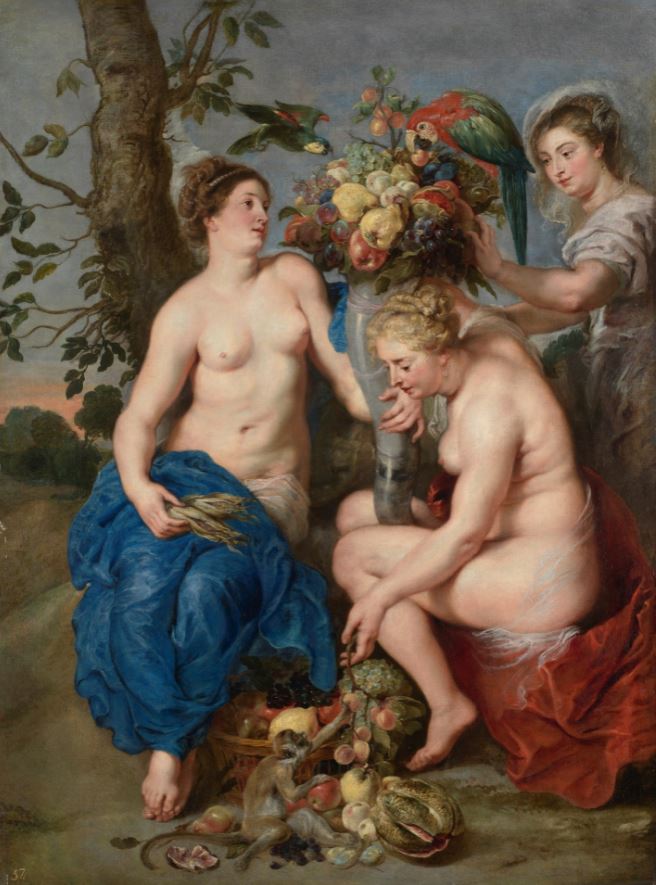
  • Three Nymphs with a Cornucopia (1625 to 1628) Museo Nacional del Prado, Madrid

The thing is that, although the curators try their best to claim that these women are not subject to the male gaze, but are strong independent women overflowing with agency, that’s not really how they actually look.

In my opinion this one, ‘Three Nymphs with a Cornucopia’ can be taken as a test case. It depicts the horn of plenty overflowing with the good things of life, namely a grocer’s shop full of ripe plump juicy fruit, so ripe and juicy that it has attracted the attention of scavenging parrots and a cheeky monkey, to add drama and narrative to a classical allegorical scene.

Is it just me or are the two naked women depicted as extensions of this vision of youthful fertile juicy fruitfulness?

I think they are. Far from asserting anyone’s agency, I’d have thought this picture epitomises the reverse: surely these women are totally objectified, depicted  in all their youthful sexiness as direct extensions of the world of fruit and fecundity.

This is one of eight paintings Rubens took to Spain as a gift from his patron, the Archduchess Isabel Clara Eugenia, to King Philip IV, to butter him up. Made by a man to flatter a king, far from being a rebuttal it strikes me as being a kind of triumph of the male gaze – sexy topless fruitful babes designed to decorate on the walls of the most powerful man in Europe.

Three Nymphs with a Cornucopia by Peter Paul Rubens (1625 to 1628) Museo Nacional del Prado, Madrid

More interesting to me, more persuasive and touching, is the information that Juno, in this huge representation of ‘The Birth of the Milky Way’ resembles Helena Fourment, Rubens’s second wife.

According to the curators, it is thought that his happy second marriage to Helene inspired his increasingly sensuous presentation of women during the 1630s. That seems to me a plausible and happy explanation of the plump sensuality of the nudes he painted in his final decade, just as Rembrandt’s love for his wife shine through his later paintings. I’m not sure anybody portrayed in a painting, male or female, has any ‘agency’. In my opinion they’re all trapped by composition, design, treatment, by the artist’s aims and whims, and all subject to the human gaze of us, centuries later, completely cut off from the value systems in which these works were created.

But paintings very much can convey tenderness and love. And that’s what I found in this small room full of magnificent works of art. The milk of human kindness. Motherly love. The pure, naked, redemptive love we all wish, deep down, we could recapture.

The Birth of the Milky Way by Peter Paul Rubens (1636 to 1638) © Photographic Archive, Museo Nacional del Prado, Madrid

Happily ever after

In fact this final wall caption made me realise that mention of Rubens’ second wife had been seeded throughout the show, starting with early mention of how, after the early death of his first wife, in 1630 Rubens married his second and much younger wife, Helena Fourment (1614 to 1673).

‘Their blissful marital state in the final decade of his life, during which time they had five children, provided a wellspring of love and an increased interest in sensual mythological themes.’

In a world afflicted with terrible pain and suffering it cheered me up to learn that this great artist was blessed with a long, happy, rewarding marriage. Good for him! And these images, painted late in his life, at the peak of his experience of art and life, however others may wish to interpret them, struck me as wonderfully accepting celebrations of beauty, humanity and love.

Rubens among his peers

I was struck by a quote from co-curator Dr Ben van Beneden which gives a pithy summary of three of Western Art’s Golden Greats:

‘If Raphael endowed his female figures with grace, and Titian with beauty, Rubens gave them veracity, energy and soul.’

Strong independent parrots

I noticed that one of the most powerful paintings in the final room, the Cornucopia, featured some beautifully vivid parrots pecking away at the fruit flowing from the horn, and this reminded me that the awesome painting of the Marchesa Maria Serra Pallavicino in the first room also features a parrot perched on her grand chair and bending down, twisting its neck in that inquisitive parrot way.

It occurred to me that maybe Dulwich’s next exhibition should be about ‘Parrots in Painting’. It could bring together depictions of a variety of strong, independent parrots who resist the human gaze to insist on their psittacine agency.

The video


Related links

Related reviews

The Ugly Duchess: Beauty and Satire in the Renaissance @ the National Gallery

‘The Ugly Duchess: Beauty and Satire in the Renaissance’ is a one-room, free display at the National Gallery in London. Go in the main entrance, up the stairs to the mezzanine level, then turn right and up more stairs to room 46.

It’s amazing how much you can cram into one room in a gallery, in this case ten or so paintings, 4 or 5 drawings and several sculptures which, taken together, open up whole imaginative worlds and intellectual vistas. Amazing how much you can extrapolate from one work of art, about an entire era’s attitudes to men and women, ageing, its sense of humour, its fear of the supernatural.

The Ugly Duchess

It all starts by considering one of the best-known faces in the National Gallery: Quinten Massys’s early 16th-century depiction of an old woman, popularly known as ‘The Ugly Duchess’. Made in Antwerp in about 1513, it is an extremely striking image.

An Old Woman (‘The Ugly Duchess’), about 1513 by Quinten Massys © Photo: The National Gallery, London

Ugly

Quite obviously this is an exaggerated and grotesque caricature. Focusing just on the features, you’d have thought it was the face of an old man, but the closer you look you realise all kinds of things are going on in this picture. The most obvious element is probably the woman’s mannish, ugly face but you quickly move o to notice the very low-cut dress revealing her ample but wrinkled bosom.

It’s obviously a satire or caricature of the stock standard Renaissance portrait, which, of course, showed the sitter to best advantage, flattering them by smoothing out wrinkles and omitting blemishes. Quite obviously this painting is doing the exact opposite, packing in as many unflattering details as possible – big ears, stubby nose, disappeared lips, as many wrinkles as the human neck can cope with, a huge expanse of neck and bosom revealing the mannish solidity of her shoulders and the wrinkled bust.

The ‘philtrum’ is the technical name for the groove which runs between nose and lips, but it’s not only this which is long but the entire space or stretch of face from nose to mouth which is as huge as possible, almost giving her the prognathous appearance of a chimpanzee.

So there’s an implicit contrast with the genre of the standard Renaissance flattering portrait. But there’s another contrast worth mentioning, which is the contrast between the gargoyle grotesqueness of the face and body and the immaculately naturalistic detailing of the headdress and cascading wimple.

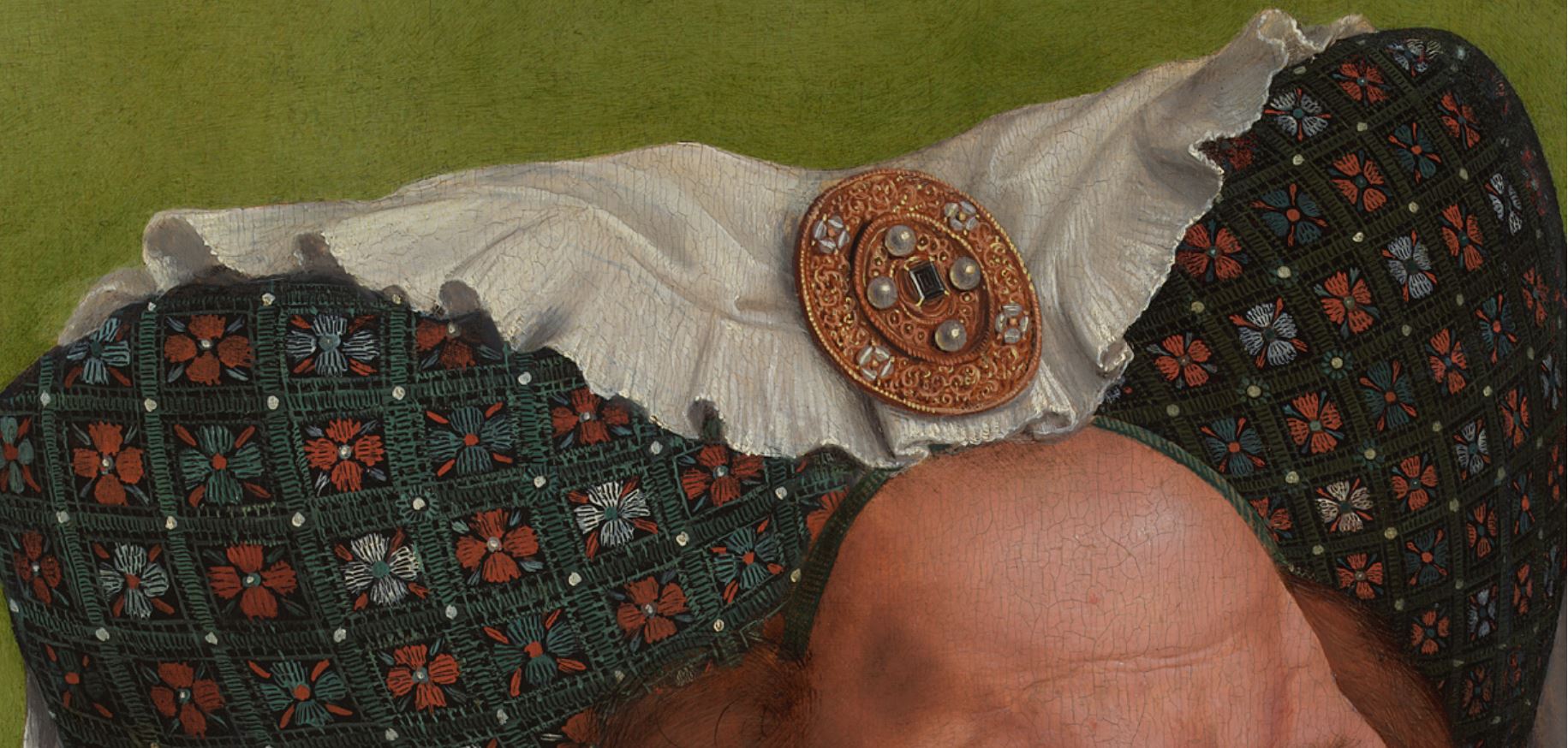
Detail of An Old Woman (‘The Ugly Duchess’), about 1513 by Quinten Massys © Photo: The National Gallery, London

Seeing a painting like this in the flesh allows you to go right up to it and marvel at the extreme detailing of the fabric of the headdress – you can virtually see each thread of the fabric, the detail of each one of the embroidered flowers; to marvel at the intricate working of the diadem or broach including the glints of light on the lovingly crafted pearls – which are, when you look really closely, echoed by the pearls studding the ring she’s wearing on her right forefinger.

So, to put it crudely, there’s another contrast at work here, between the deliberate grotesqueness of the face and the breath-taking filigree detail of the setting (headdress, broach, and amazing depiction of light and shade in the folds of the linen wimple).

Talking of her finger, there’s one last relevant detail which is the flower. In her right hand, between finger and thumb, she is delicately holding the flower of a rose which hasn’t yet opened. This is a traditional symbol of budding love i.e. a visual signal appropriate for a very young woman, a teenage virginal girl. Here it works as another element emphasising the grotesqueness of the portrait and satirising the entire genre.

Her husband

Mention of the rose leads us to the next factor, which is her partner. The exhibition has obtained on loan from a private collection in America the painting which originally partnered the duchess, namely Massys’s portrait of an old man.

An Old Man, about 1513 by Quinten Massys. Photo © Evan Read, Department of Paintings Conservation, The Metropolitan Museum of Art

Sexism and unfairness

Now, you don’t have to be an art scholar to notice that, although it isn’t exactly flattering, although he too has a lugubrious nose and plentiful wrinkles, the husband portrait isn’t in the same class of grotesque as the old woman. Feminists interpret this as unfairness: why is the old man acceptable but the old woman grotesque?

One way of answering this is to say, with feminists, that Western society has always been sexist and patriarchal, with continuous misogynist tendencies. That age in women was treated far more harshly, seen as far more negative, than in men, and that an older man’s efforts to dress well and make the most of himself was respected whereas the same behaviour in an older woman was derided.

Artistic licence

But there’s another way of thinking about the issue, regarded as an artistic problem or genre. This is that ‘the old woman’, as subject, afforded Renaissance painters opportunities for invention, play and satire that portraits of more ‘normal’ people didn’t allow. As the curators put it, the ‘unruly bodies’ of older women, no longer smooth and supple as in standardised models of beauty, can be seen as metaphors for social disorder, for the topsy-turvey world which attracted medieval and Renaissance culture as much as its hierarchies of order.

There is undeniable joy in beholding ‘the Ugly Duchess’ trample beauty standards, social conventions and gender expectations.

Flower and fur

Back to the husband, and art scholars debate whether the posture of his right hand is politely rejecting the budding rose which the duchess is offering him.

Away and above these debates about symbolism is a simpler fact about this work which is the amazing depiction of the fur around his neck. Again it isn’t so clear in a reproduction, but in the flesh, standing in front of the actual painting, you can really see the difference between the depiction of the fur lining his coat and what appears to be the black velvet of the coat itself. it’s stunningly sensual and alive.

Contemporary couples

There’s a number of reasons why I strongly prefer the art of the Northern Renaissance to the Italian Renaissance. One is the rocky barrenness of the settings of so many Italian paintings, compared with the lush grass, flowers and verdure of northern paintings. I like the flowers and animals, the little rabbits and whatnot you tend to get in the background of northern Renaissance art.

Portraits like this don’t have animals and pastures in them, but they exemplify two other aspects of northern art I like. One is the extraordinary fine detailing of fabric, embroidery, jewellery and so on. The other is the ugliness of the people. Italian Renaissance paintings capture the handsomeness of Italian people, but I live in grotty northern Europe among people who are, by and large, not fashion models. Therefore I like the frank depiction of non-beautiful people. The exhibition gives an example of an older couple by a contemporary of Massys, Jan Gossaert.

An Elderly Couple, about 1520 by Jan Gossaert © The National Gallery, London

It’s hard to think your way into the mindset of the man on the left who probably paid a lot for this painting and was presumably, happy enough to pay for this pretty unflattering depiction. It bespeaks a mindset different from the Italian Renaissance, one which prioritises honesty at all costs. For me it’s something to do with the northern Protestant, or even Puritan, spirit. Truth over gloss. Epitomised by the arch Puritan Oliver Cromwell telling his portrait painter to depict him ‘warts and all’. It is the humanist tradition, accepting of human weakness, frailty and imperfection.

As to its relevance to the Ugly Duchess, this painting epitomises some of the conventions of double portraits which the Duchess flouts. The older woman is modestly dressed (her clothes covering her up to the neck). Her eyes are modestly cast down. And, crucially, she is standing behind and on the left side of her husband.

Left and right

In double portraits of couples like this, it was the convention to depict the man standing on the right, the hierarchically superior position, our left as we look at it. Therefore the duchess’s position on the right hand side of her husband (in the world of the picture) is another way in which the composition subverts or mocks conventional standards of portraiture.

Leonardo, the source

But talking of the Italian Renaissance links to the rather surprising presence of Leonardo da Vinci in the exhibition. Why? Because among his multifarious other interests, Leonardo had a well-attested interest in ‘the grotesque’. His notebooks contain page after page filled with sketches of a spectrum of non-attractive people, ranging from old and gnarly, through ‘ugly’ people and then beyond the bounds of plausibility to monsters who could have come from the island of Dr Moreau.

Grotesque caricature heads of five men and two women by Leonardo da Vinci © The Trustees of the British Museum

Leonardo’s grotesques were surprisingly popular. Many copies were made of his sketches and distributed around art workshops all over Europe. Thus Massys’s image, which I take to be quintessentially north European, turns out to derive almost directly from a sketch by the quintessentially Italian artist, Leonardo.

The debt owed by Massys to Leonardo isn’t trivial. Although the Leonardo original has disappeared, the exhibition includes copies of a Leonardo grotesque woman which, as you can see, are the direct source of Massys’s painting. Hardly anything about the Massys version is original except precisely the aspects I like, the fantastic detailing.

Bust of a grotesque old woman (1510 to 1520) by Francesco Melzi, after Leonardo. Royal Collection Trust © His Majesty King Charles III 2023

May – December couples

Western societies have often found the notion of the old and decrepit vaunting their attractiveness and flirting as if they’re still teenagers worthy of satire. ‘Mutton dressed as lamb’, as the proverbial saying has it. In fact, like everything else, the Middle Ages codified this into a genre, calling it the May-December relationship. To my surprise, a few seconds on Google show me that this term is still widely used to describe:

‘an amorous relationship between two people with a considerable age difference. The months symbolize the seasons, with spring representing youth and winter representing old age.’

In medieval art and literature the unequal relationship of an older man and a younger woman was often mocked (as, maybe, in our day, the marriage between Rupert Murdoch at the age of 85 to former model, Jerry Hall, or the references I keep reading about Leonardo de Caprio’s alleged penchant for much younger girlfriends). Less often described (and mocked) was the pairing of an older woman and a younger man (in our day and age, often referred to as a toy boy’). In medieval literature Chaucer’s Wife of Bath is one such older woman who takes a young male lover for explicitly sexual reasons.

Mention of the theme, as a popular one of the day, allows the curators to include a visual illustration, The Unequal Couple by by Israhel van Meckenem which shows an older woman (left) being cosied up to by a handsome young blade. The way he is reaching out to touch the bag of coins she is jealously guarding very heavily conveys the satirical thrust of the picture, that this kind of relationship is ‘against nature’ and could only exist because the May partner wants to get their hands on December’s money.

The Unequal Couple, about 1490 by Israhel van Meckenem, after the Master of the Housebook © Ashmolean Museum, University of Oxford

Feminist interpretation

You won’t be surprised to learn that there is a revisionist feminist interpretation of the painting. Feminist art scholars agree that it can be read as a cruel joke in which the viewer is invited to laugh at this woman’s pathetic attempts to appear young and sexy, so we are being invited to mock her implied self-delusion.

But there is an alternative way to read the painting, which is as depicting an old woman who refuses to accept either the biological facts of aging or the social conventions which define what a woman, of any age, may or may not wear, and how she may or may not think of herself. If she regards herself as a winsome beauty, shyly offering her man a symbol of her budding love, then…why not?

To echo what I wrote above, a feminist interpretation sees a duchess who is also subversive of standard notions of beauty, defiantly flouting the conventions of her day.

Witches

But old women have been, for much of recorded history, quite ambivalent figures. (In fact, arguably any category of human being can be ambivalent. A young man may be smooth and debonair like Romeo or a thuggish killer like Edmund in King Lear. Humans have many sides, stereotypes, avatars, expectations.)

Anyway, old women have can be mocked for their pretensions (as the duchess appears to be) respected for their wisdom or even feared as uncanny figures. This fear can go to the extreme of thinking they have uncanny supernatural powers, in other words, are witches.

And it’s in order to highlight the similarities and differences in Renaissance iconography of older women – between an old woman satirised and an old woman feared – that the display includes an iconic image of a witch, made by Albrecht Dürer around the same time as Massys was doing his entertaining grotesque.

A Witch Riding Backwards on a Goat, about 1500 by Albrecht Dürer © Victoria and Albert Museum, London

As with most Dürer this image is packed with symbolism representing the inversion of traditional values and decorum. The woman is naked but not in the sexy manner of Renaissance nudes; the naked body of an older woman is seen as repellent and disgusting. The broom between her legs and her grip on a goat’s horn suggest the uncontrolled and inappropriate nature of lust in an older woman. She is rising the goat backwards but her hair is flowing in the wrong direction, into rather than with the wind. It is an image of reversal and chaos. Whereas the Massys painting was made for comedy and entertainment, the Dürer takes some of the same themes and treats them with horror, repulsion and fear.

Alice

Even this inclusion of witches hasn’t exhausted the ramifications and connections unravelling from this one painting. I think I knew but had forgotten an important fact about it which is that Massys’s portrait directly inspired the figure of the Duchess in ‘Alice in Wonderland’, as portrayed in Sir John Tenniel’s classic illustrations.

Alice, the Duchess, and the Baby by Sir John Tenniel (1865)

Here, in a sense, the Ugly Duchess found her spiritual home. As a painting she was only available for centuries to a handful of viewers. Even hung up in the National Gallery she was only seen by a small number of people. But as published in the Alice books and very widely distributed, she entered a kind of rogues’ gallery of all the other fantastical characters dreamed up by Lewis Carroll. Beyond fear or ridicule she is transformed into an object of pure, delightful entertainment.

Video

In this 10 minute long video National Gallery restorer Britta New discusses the conservation treatment of ‘The Ugly Duchess’, describing discoveries made during the conservation process, and the painting’s connection to sketches by Leonardo da Vinci and John Tenniel’s illustrations.


Related links

More National Gallery reviews

King Leopold’s Ghost by Adam Hochschild (1998) – part three

‘To gather rubber in the district… one must cut off hands, noses and ears.’
(Charles Lemaire, Belgian commissioner of the Equator District of the Congo Free State)

William Sheppard

Following his coverage of the black American Baptist minister George Washington Williams, who was appalled by what he witnessed in the Congo in 1890 and wrote an open letter of protest to the Belgian king, Leopold II, Hochschild goes on to describes the career of another black pioneer.

This is William Sheppard, a Baptist minister born in Virginia in 1865, who was sent by the Southern Baptists to the Free State, thus becoming the first black American missionary to the Congo. Hochschild emphasises that the church hierarchy ensured he was supervised every step of the way by a white superior, how it was the white man who actually met Leopold in Belgium while Shepherd was excluded, but how it was Shepherd who built up the mission on the river Kasai. Here he won the respect of the local BaKuba tribe whose language he was the only missionary to bother to learn, by his hard work and sympathetic understanding of their lives. They nicknamed him Mundéle Ndom, meaning ‘the black white man’.

Sheppard was the first Westerner to reach the Kuba capital, Ifuca, whose king usually ordered any outsider to be beheaded. But because he was black and spoke some BaKuba Sheppard was allowed to keep his head and stayed for four months, making detailed ethnographical records of their culture, art and religion (‘The Kuba are among Africa’s greatest artists,’ p.156). When he presented his findings to the Royal Geographic Society in London he was made a fellow, and back in the states presented the President with Kuba artefacts.

(Hochschild also mentions the spangling fact that Shepherd’s arrival at the mouth of the Congo coincided exactly with that of Joseph Conrad who was taking up the position of steamboat captain, and that Shepherd’s diary contains numerous references to the gentlemanly bearing of the exiled Pole who he spent some weeks with (p.154).)

Leopold’s grand plans

Leopold had impractically megalomaniac ambitions. He dreamed of linking his Congo possessions with the upper Nile and leasing Uganda from the British, both ideas gently rejected by Prime Minister Gladstone. He suggested raising a Congolese army to protect the Armenians who were being massacred by the Turks. When there was disturbance in Crete he offered Congolese troops as peacekeepers. His cousin, Queen Victoria’ thought Leopold was becoming delusional (p.168). But about one thing he was never deluded: maximising profit from his personal fiefdom in the Congo.

The rubber terror

‘Botofé bo le iwa!’, meaning ‘Rubber is Death!’ — Congo Proverb

Initially Leopold wanted to colonise the Congo because of ivory. As Frank McLynn makes clear in his chapter on the subject in Hearts of Darkness, ivory was the most valuable product of central Africa next to slaves, and the two trades were inextricably intertwined. Arab slavers destroyed native villages not only to enslave their women (killing most of the men) but also to loot the reserves of ivory many villages held, and use the newly acquired slaves to carry the plundered ivory the hundreds of miles to the coast.

It was the invention of the pneumatic tyre by John Dunlop, who set up the company of the same name in 1890, which made bicycling significantly more comfortable than before, which led to the outbreak of the ‘bicycling craze’ and which then led to a sudden spike in demand for rubber, that Leopold realised he was sitting on a goldmine, and that the farming of rubber from the huge rubber vines which twined up trees in the tropical rainforest almost overnight became a very profitable business (p.158). The West’s appetite for rubber grew for use not only in pneumatic tyres for bicycles and then cars, but for a myriad other uses, for example as insulation on electrical cabling which was undergoing an explosion of use around the world.

It is about this point, exactly half way through the book, and after a fair amount of relatively ‘ordinary’ historical and biographical stuff about Leopold and Stanley and so on, that the text takes a very dark turn and the reader is now plunged into the world of disgusting terror, massacre and mutilation created by the authorities who ran Leopold’s Congo Free State.

Force Publique officials were ordered to fulfil rubber quotas. They did this by kidnapping wives or children of villagers and threatening to mutilate or kill their hostages unless villagers handed in the correct and very onerous quotas of rubber. Natives who resisted were beaten, tortured, mutilated and murdered, had their families held hostage, their wives and daughters raped, or their houses and villages burned. If villages failed to fulfil the quota or showed any resistance, they were burned to the ground. The British traveller Ewart S. Grogan, crossing northeastern Congo, wrote: ‘Every village has been burned to the ground, and as I fled from the country I saw skeletons, skeletons everywhere’ (p.230). The Belgians turned Congo into a charnel house.

Most of the food the locals grew was confiscated by European officials leading to poor diet or starvation in many areas. State official Léon Féviez explained to a visiting official that when the local village didn’t supply enough fish and manioc to feed his troops he had a hundred of them beheaded. After that the villagers supplied sufficient food alright, even at the cost of themselves starving (p.166).

The incursions of black troops from one area into another spread diseases many had never previously been exposed to. Smallpox was carried from the coast where it was endemic, inland to populations who had no resistance to it. Worse was sleeping sickness, which is estimated to have killed half a million Congolese in 1901 alone (p.231).

The net effect of all these factors was a collapse in population. Missionaries and travellers through the Congo spoke again and again of entire regions laid waste and depopulated.

Hochschild singles out four factors and then gives copious evidence for each of them, being:

  • Murder
  • Starvation, exhaustion and exposure
  • Disease
  • Plummeting birth rate

The Reverend A.E. Scrivener was just one of many eye witnesses:

Lying about in the grass within a few yards of the house I was occupying were a number of human bones, in some cases complete skeletons. I counted 36 skulls, and saw many sets of bones from which the skull was missing. I called some of the men and asked the meaning of it. ‘When the rubber palaver began,’ said one, ‘the soldiers shot so many we grew tired of burying, and very often we were not allowed to bury and so just dragged the bodies out into the grass and left them.’

There was no census before Leopold’s murderous regime began but the best estimate is that 10 million Congolese lost their lives. This is based on the fact that in areas where population was known, it fell by a half between 1890 and 1910. Since the first detailed population estimate, in 1924, estimated the current population at around ten million, and most experts estimated that it was half the original number, that gives you some 10 million victims of Leopold’s regime, directly murdered or killed by overwork, famine or disease. (In fact at the end of the book, Hochschild devotes a passage to the estimates of modern demographers, who also agree with the 10 million figure.) More, in other words, than the Nazi Holocaust.

Chopping off Africans’ hands

Hands were used as proof that villages had been punished for failing to fulfil their quotas or rebelling. Force Publique soldiers had to prove that every bullet they were issued with was used to kill a villager (and not going off on hunting expeditions) by bringing in a hand for every bullet fired. Hands became a form of proof of discipline. Many soldiers couldn’t be bothered to wait for all the rubber to be counted and just hacked off a few hands at random to impress their superiors with how zealous they were.

But cutting off hands was also a form of punishment and incentive. Hostages – women and children –had their hands cut off unless their menfolk brought in the required quota of rubber. Some villagers, in desperation, instead of slicing a rubber vine and patiently waiting for the drops of sap to ooze out of it, were so panic-stricken that they cut down the entire vine and squeezed every drop of rubber out of it. This killed the vine rendering it unavailable for future use and so in turn was punished by the authorities, in the form which was now becoming universal – the men or their womenfolk or children having their hands cut off. Hochschild quotes scores of officials and soldiers who boasted about how many hands they collected per day.

‘Many fled and some were mutilated. I myself saw a man at Likange who had had both his hands cut off. Sometimes they cut them at the wrist, sometimes farther up . . . with a machete.’

In some military units there was a job, ‘keeper of the hands’ (p.165). Some units smoked severed hands over fires in order to keep them as decorations to hang on poles or over doors as a constant reminder to the locals of what even the slightest infringement would trigger.

Bestand:MutilatedChildrenFromCongo.jpg - Wikipedia

Mutilated Congolese children and adults. Photos taken between 1900 and 1905 by the English missionary Alice Seeley Harris

Hochschild brings out how atrocity acquires a momentum of its own. As in the Nazi genocide or the Soviet labour camps, cruelty and sadism, once permitted, become endemic. Thus René de Permentier, a Force Publique officer in the Equator district, had all the trees and bushes around his house cut down so he could use passing Africans as target practice for his rifle. If he found so much as a stray leaf in the courtyard swept by women prisoners he had one of them beheaded. If he found a forest path poorly maintained, he ordered a child in a local village executed. That kind of megalomaniac momentum.

Two Force Publique officers ordered a man hung by his feet and a fire lit underneath so he was cooked to death. Morel quoted a message from district commissioner Jules Jacques telling his underlings to warn the locals that if they cut down another vine he will exterminate them to the last man (quoted page 229). As the Reverend Scrivener testified:

A man bringing rather under the proper amount [of rubber to a collecting post], the white-man flies into a rage and seizing a rifle from one of the guards shoots him dead on the spot. Very rarely did rubber come but one or more were shot in that way at the door of the store.

There are hundreds of examples of this kind of psychopathic behaviour. Late in the book Hochschild says speakers of the Mongo language refer to the period as lokeli, the overwhelming (p.300).

Edmund Dene Morel

We know so much about the evil practices of Leopold’s state because of the obsessive work of one man, Edmund Dene Morel, who became a one-man international human rights dynamo.

In the late 1890s Morel was a relatively lowly clerk working for the Liverpool-based trading company Elder Dempster (p.177). He began travelling back and forth across the Channel as his company’s liaison with officials of the Congo Free State. Slowly he began to realise something was wrong. Hochschild attributes his revelation to three elements which he saw or, as a clerk handling the official paperwork for the cargoes, was able to calculate for himself while spending time at the State’s docks in Antwerp:

  1. He learned that huge amounts of arms and ammunition were being shipped to the Congo along with surprising amounts of chains and shackles. Why?
  2. The amount of ivory and rubber brought back by the ships greatly exceeded the amount stated on the manifests and paperwork. Someone was creaming off millions in profit. Who?
  3. Over 80% of the goods being shipped to the Congo were remote from trade purposes. In other words, a huge amount of goods were being brought out but very little was going in to pay for them. So how was this wealth of ivory and rubber being generated. Dene realised there could be only one explanation: slave labour.

‘These figures told their own story…Forced labour of a terrible and continuous kind could alone explain such unheard-of profits…forced labour in which the Congo government was the immediate beneficiary; forced labour directed by the closest associates of the king.’ (Morel, quoted page 180)

He called it: ‘the most gigantic fraud and wickedness that our generation has known’ (p.206).

Morel made his fears known to his superiors who told him to keep quiet. The Free State was a major client of Elder Dempster’s. They tried to coerce him into keeping silent. The company offered him a pay rise, then the role of highly paid consultant. Free State officials in Brussels stopped talking to him. He refused all bribes and insisted on speaking out.

Eventually, in 1901, Morel quit Elder Dempster and, after pondering what to do, set up a newspaper, the West Africa Mail in 1903, backed by philanthropic sponsors. It consisted of Morel’s articles, letters from missionaries, maps, cartoons, and pictures. Morel didn’t hold back:

‘Blood is smeared all over the Congo State, its history is blood-stained, its deeds are bloody, the edifice it has reared is cemented in blood—the blood of unfortunate negroes, spilled freely with the most sordid of all motives, monetary gain.’

Morel intended the West Africa Mail to publish everything he knew about the Congo and encouraged all-comers to send him their reports about ‘the shootings, shackles, beheadings, mutilations and kidnappings of a slave labour system’ they witnessed – and they did, in increasing numbers (p.270).

Morel tapped into the resources of existing anti-slavery organisations, namely the Anti-Slavery Society and the Aborigenes Protection Society, as well as roping in influential figures such as the politician Sir Charles Dilke and the author Mary Kingsley. He became a writing phenomenon, working 16 or even 18 hours a day to produce books, speeches, articles and pamphlets about the Congo (p.209). In the first six months of 1906 alone, he wrote 3,700 letters (p.214).

Morel requested information from all and any sources, and developed a remarkable knack for getting inside information from all kinds of people, not only missionaries and travellers in the region, but dissident military officers such as Raymond de Grez, who secretly fed him reports and statistics for many years, as well as people involved in the various shipping companies and testimony from their agents in-country, such as the American business agent Edgar Canisius (p.192).

The more Morel’s reputation grew as the doughty opponent of the evil being perpetrated in the Congo, the more people knew he was the man to slip confidential information (p.188).

It snowballed into a vast publicity campaign, featuring hundreds of public meetings, thousands of letters, he received thousands of letters full of facts and figures which Morel was then able to use in his articles or feed to sympathetic journalists and politicians.

With the aid of the charities and sympathetic politicians Morel secured a debate in the House of Commons which was held on 20 May 1903. At its conclusion the British Parliament passed a resolution to allow the British government to negotiate with the other Great Powers over the matter, avowing that the native Congolese ‘should be governed with humanity’ and, incidentally, noting that ‘great gratitude was due’ to Morel for creating public awareness (p.194). It was a truly impressive achievement. As Hochschild summarises:

Almost never has one man, possessed of no wealth, title of government post, caused so much trouble for the governments of several major countries. (p.209)

Pamphlets were followed by excoriating books, namely:

  • Affairs of West Africa (1902)
  • The British Case in French Congo (1903)
  • King Leopold’s Rule in Africa (1904)
  • Red Rubber – The story of the rubber slave trade that flourished in Congo in the year of grace 1906 (1906)
  • Great Britain and the Congo: the Pillage of the Congo Basin

When I read the title of Red Rubber I immediately saw the link with the campaign against ‘blood diamonds’ originating in Africa under war-torn or oppressive conditions from much the same region of Africa, in our own time.

Roger Casement

The Parliamentary debate directly affected another major figure. Parliament set up a commission to investigate the accusations and ordered the British consul to the Congo, Roger Casement, to go in-country to find out more.

Casement evaded the beady eye of Leopold’s officials, paid his own way and independently interviewed missionaries, natives, riverboat captains, and railroad workers. He then wrote up and submitted to Parliament a report containing 39 pages of testimony and a 23-page index of facts, what has been called ‘the most damning exposure ever of exploitation in Africa’. Morel published the ‘Casement Report’ in full in the West Africa Mail and it was picked up and syndicated around the world.

Hochschild devotes a chapter to Casement who is a fascinating figure in his own right, not least because of his principled but ill-fated support for Irish independence a decade later. (Unfortunately, no modern biographer can abstain from prying into the sex lives of their subject, and so we learn quite a lot about the fact that Casement was gay and kept a detailed log of his sexual encounters wherever he went, with Europeans or Africans. Great – and utterly beside the point.)

When they met they instantly clicked. Both respected each other’s fierce integrity and utter devotion to exposing the evil of Leopold’s regime. Casement was a government employee and so had to go where his superiors sent him, but they kept in touch and he offered Morel important confirmation and moral support, becoming a vital colleague and sounding board for Morel’s campaigns. Morel nicknamed him the Tiger; Casement called Morel the Bulldog (p.207). Chaps.

Congo Reform Association (CRA)

Casement and Morel met again, in Dublin, and agreed that it needed more than a newspaper to bring about the change needed. Casement convinced Morel they needed to set up an organisation and so in November 1903 Dene announced the establishment of the Congo Reform Association (CRA) with a founding manifesto filled with names of the great and good and calling for ‘just and humane treatment of the inhabitants of the Congo State, and restoration of the rights to the land and of their individual freedom’.

An American branch was quickly set up which garnered support from such notables as Mark Twain, Booker T. Washington and W. E. B. Du Bois. Twain was motivated to write a pamphlet, King Leopold’s Soliloquy: A defence of his Congo rule, in 1905, a satirical portrayal of Leopold as a self-pitying old man rambling on, making feeble excuses for the blood on his hands:

‘They burst out and call me “the king with ten million murders on his soul”.’

(It’s interesting that, even at this early point, the figure of 10 million dead was widely accepted. It’s a suspiciously round figure, isn’t it, but one Hochschild backs up with expert testimony at the end of his book)

Illustration from King Leopold’s Soliloquy by Mark Twain (1905)

Arthur Conan Doyle was inspired by his indignation to write The Crime of the Congo in 1908, while Joseph Conrad, in addition to the world famous novella about Leopold’s Congo, Heart of Darkness, co-wrote a novel with Ford Madox Ford, The Inheritors, which contains a devastating parody of Leopold’s greed and mendaciousness and personal oddities (p.257).

In 1904 Morel visited America, meeting with the President and members of Congress, before addressing large audiences around the nation. It took a while for the American campaign to gain traction, but in 1906 public pressure forced Congress to take a stand against Leopold and demand an end to the Congo Free State.

Alice Seeley Harris

Wife of the Reverend John Harris and a Baptist missionary in her own right, it was Alice Seeley Harris who took most of the photos of mutilated Africans which Morel distributed so widely and had such a devastating effect.

The couple had witnessed at first hand numerous atrocities, joined the Congo Reform Association and threw themselves into public activity. One or other of them made over 600 speeches in their first two years with the CRA, displaying implements like the shackles used to chain Congolese and the feared chicotte or whip made of hippopotamus hide, which was used to punish Africans who failed to meet their quotas and sometimes whip them to death (pages 120 and 216). Eventually John and Alice’s activism led to them running the newly combined Anti-Slavery and Aborigenes Protection Society (p.273).

Herbert Strang

The impact of the campaign spread far and wide. Hochschild mentions a British boys’ adventure writer, Herbert Strang, who wrote an adventure story set in the beastly Congo where a stout-hearted English teenager saves the day, titled Samba: A Story of the Rubber Slaves of the Congo. The preface he wrote to his novel is long but gives a fascinating insight into how the issue was seen at the time (1908).

Nearly a generation has passed since King Leopold was entrusted by the great Powers with the sovereignty of the Congo Free State. The conscience of Christendom had been shocked by the stories, brought back by Stanley and other travellers, of Arab slave raids on the Upper Congo; King Leopold, coming forward with the strongest assurances of philanthropic motive, was welcomed as the champion of the negro, who should bring peace and the highest blessings of civilization to the vast territory thus placed under his sway. For many succeeding years it was supposed that this work of deliverance, of regeneration, was being prosecuted with all diligence; the power of the slave traders was broken, towns were built, roads made, railways opened—none of the outward signs of material progress were wanting.

But of late the civilized world has been horrified to find that this imposing structure has been cemented with the life blood of the Congo races; that the material improvements to which the administrators of Congoland can point, have been purchased by an appalling amount of suffering inflicted upon the hapless negroes. The collection of rubber, on which the whole fabric of Congo finance rests, involves a disregard of liberty, an indifference to suffering, a destruction of human life, almost inconceivable. Those who best know the country estimate that the population is annually reduced, under King Leopold’s rule, by at least a hundred thousand. No great war, no famine, no pestilence in the world’s history has been so merciless a scourge as civilization in Congoland.

Yet owing to mutual jealousies, the Powers are slow to take action, and while they hesitate to intervene, the population of this great region, nearly as large as Europe, is fast disappearing.

It has been my aim in this book to show, within necessary limitations, what the effect of the white man’s rule has been.

If any reader should be tempted to imagine that the picture here drawn is overcoloured, I would commend him to the publications issued by Mr E. D. Morel and his co-workers of the Congo Reform Association, with every confidence that the cause of the Congo native will thereby gain a new adherent.

I must express my very great thanks to the Rev. J. H. Harris and Mrs. Harris, who have spent several years on the Upper Congo, for their kindness in reading the manuscript and revising the proofs of this book, and for many most helpful suggestions and criticisms.

By this point the atrocities were so widely known that Leopold had become associated with severed hands and blood in large parts of the press. Countless caricatures in European and American magazines satirised him as a mass murderer, his hands or beard dripping with blood while he hugged his sacks full of blood money (p.222).

Leopold II's Heart of Darkness, by David White | Open History Society

When Leopold’s second wife bore his second child, it was born with a withered hand and Punch magazine published a cartoon with the caption Vengeance from on high. Harsh but an indication of how universally he was despised.

What did Leopold spend his blood money on?

And how did Leopold spend the huge personal wealth he accrued from all this forced labour, slavery, murder and extortion? On grandiose building schemes and his teenage mistress.

1. Buildings

Leopold invested a huge amount of his blood money on buying, building or renovating grand properties. Wikipedia gives a handy summary of a subject which is spread across numerous passages in Hochschild’s book:

The public buildings were mainly in Brussels, Ostend and Antwerp, and include the Hippodrome Wellington racetrack, the Royal Galleries and Maria Hendrikapark in Ostend; the Royal Museum for Central Africa and its surrounding park in Tervuren; the Cinquantenaire park, triumphal arch and complex, and the Duden Park in Brussels, and the 1895–1905 Antwerpen-Centraal railway station.

In addition to his public works, Leopold acquired and built numerous private properties for himself inside and outside Belgium. He expanded the grounds of the Royal Castle of Laeken [one of Europe’s most luxurious royal homes] and built the Royal Greenhouses, the Japanese Tower and the Chinese Pavilion near the palace. In the Ardennes his domains consisted of 6,700 hectares (17,000 acres) of forests and agricultural lands and the châteaux of Ardenne, Ciergnon, Fenffe, Villers-sur-Lesse and Ferage. He also built important country estates on the French Riviera, including the Villa des Cèdres and its botanical garden and the Villa Leopolda.

(In a picquant footnote, Hochschild tells us that one of Leopold’s many villas on the Cote d’Azur was  subsequently bought by the English writer, Somerset Maugham, p.276.)

Hochschild contrasts these extravagant building projects with the many, many, many African homes and villages and entire regions which his officers laid waste and burned to the ground.

2. Caroline Lacroix

Leopold had married Marie Henriette of Austria, a cousin of Emperor Franz Joseph I of Austria and grand-daughter of the Holy Roman Emperor Leopold II, on 22 August 1853 in Brussels. She was popular with the Belgians, was an artist and accomplished horsewoman, and the marriage produced four children. However, the couple became estranged and ended up living apart, Marie settling in the town of Spa where she lived till her death in 1902.

Meanwhile, Hochschild tells us, Leopold became a regular customer at high class brothels which specialised in young and very young girls, preferably virgins. Still, it comes as a bit of a surprise when Hochschild tells us that in 1899, in his 65th year, Leopold took as a mistress Caroline Lacroix, a 16-year-old French prostitute, and that they were to stay together for the next decade until his death.

It was on Caroline that a lot of the blood money from the Congo was lavished, in the form of cash, bonds raised against the Congo Free State government, castles and villas and dresses and makeup and holidays. Throughout this period they were unmarried, so Caroline was in effect his teenage mistress and became unpopular with the Belgian public and made Leopold even more of a figure of fun and contempt among international critics and cartoonists.

File:Your Majesty! at your age....jpg - Wikipedia

The priest is saying: ‘O sire! At your age!’ to which Leopold replies: ‘You should try it yourself!’

Leopold finally married Caroline in a Catholic ceremony just five days before his death, on 17 December 1909, aged 74. He left her a huge fortune but their failure to perform a civil ceremony rendered the marriage invalid under Belgian law and the Belgian government tried its best to seize all the king’s assets and fortune, giving rise to a jamboree for lawyers. Despite legal wrangles it is likely that she managed to spirit away $7 million, maybe more.

The Vatican recognised their wedding though, and Catholic priests were with him till the end. It is nauseating to read how the Catholic church stayed staunchly loyal to Leopold despite the most disgusting revelations, whereas a large number of the truth-tellers and reports were Protestant missionaries. A classic example of the stark contrast between the generally servile subservience of Catholic officials and the outspoken truth-telling of Protestant clerics, especially of non-conformists such as Baptists and the ever-principled Quakers. (You should read Hochschild’s wonderful account of the campaign to abolish slavery to be moved to tears by the hard work of the non-conformists and especially the Quakers in devoting their entire lives to ending slavery.)

When Leopold first heard about her, Caroline had been the mistress and sometime prostitute of Antoine-Emmanuel Durrieux, a former officer in the French army. It is somehow pleasing to learn that she tried to keep up a surreptitious relationship with Durrieux throughout her time with Leopold and that, seven months after the old monster died, she married Durrieux. Ah. True love.

In 1937 she published her memoirs, A Commoner Married a King: As Told by Baroness De Vaughan to Paul Faure. It is a classic example of the logocentrism of the West, in the sense that the doctored and sentimental memoirs of a royal prostitute are preserved for all time for scholars to pore over, analyse and re-analyse, while the lives and experiences of the ten million or so Congolese murdered, mutilated and starved to death – apart from a handful of testimonies recorded in the Casement Report and a few other public enquiries – are nowhere, nothing, vanished as if they had never been.

Leopold’s death and the end of the Congo Free State

The real question, reading all this horror, is why, despite widespread knowledge of the appalling atrocities, little or no steps were taken against him and nothing changed for so long. Leopold’s personal rule over his Congo Free State lasted 23 years, from 1885 to 1908.

The decisive step was getting the US government to switch its policy from indifference to Congo to active hostility, and this coincided with a massive newspaper revelation about the extent of Leopold’s behind-the-scenes bribery and manipulation of US government ministers, agencies and media.

The American change of heart crystallised with the hostility of the British government and, indeed, of a decisive majority in the Belgian government itself, and in Belgian popular opinion, to make Leopold realise the game was up and he agreed to hand over the running of the Congo Free State to the Belgian government so that it could become a ‘proper’ colony, subject to scrutiny in the press and by third parties.

Still, the canny old miser and manipulator insisted on selling the Congo to the Belgian government and drove a very hard bargain, emerging tens of millions of francs better off. In the end a compromise was reached whereby Leopold was paid $10 million and a further $9 million was assigned to his various grandiose vanity projects across Belgium as ‘compensation’ for losses which in reality he had never incurred.

And so, after months of wrangling, in November 1908 the Congo was handed over from Leopold’s personal control to the Belgian state (p.259). In August 1908 his closest officials spent a week non-stop burning all the official records of the Congo Free State, destroying all the evidence of malfeasance committed during his rule. Nonetheless, because of Morel and his many contributors, a sizeable amount of documentary evidence remained in the public domain.

As you might expect, conditions improved somewhat but most of the Belgian officials running the place stayed in post, the Force Publique didn’t even bother to change its name (p.271) and the basic economic imperatives – to maximise revenue from rubber – meant that, in practice, the living conditions of most Congolese continued to be wretched and brutalised. Thirteen months after handing over the Congo to the Belgian government, Leopold was dead, surely one of the most infamous brutes in recorded history.

Reluctantly, knowing that many abuses would continue to take place, Morel had to concede that, with the arch villain dead, many supporters of the CRA at home and abroad thought the job had been done and the fire had gone out of the campaign. In 1913 he held a last meeting of the Congo Reform Association then dissolved it. It had lasted from 1904 to 1913 and was, in Hochschild’s view, ‘the most important and sustained crusade of its sort between the Abolitionism of the early and middle nineteenth century and the worldwide boycott and embargo against apartheid-era South Africa in the 1970s and 1980s’ (p.277).

Arthur Conan Doyle, a late convert who became a very enthusiastic supporter of the cause, described the management of the Congo in his pamphlet The Crime of the Congo as ‘the greatest crime which has ever been committed in the history of the world’ (quoted on page 271).

The fact that there are statues and plaques in Belgium to this day commemorating Leopold for his humanitarian deeds and philanthropy is beyond grotesque.

The documentary

In 2006 a documentary was released, based on this book and with the same title, King Leopold’s Ghost, directed by Pippa Scott and narrated by Don Cheadle.

Credit

King Leopold’s Ghost: A Story of Greed, Terror and Heroism in Colonial Africa by Adam Hochschild was published by Mariner Books in 1998. All references are to the 2012 Pan paperback edition.


Africa-related reviews

History

Fictions set wholly or partly in Africa

Exhibitions about Africa

Landseer’s The Monarch of the Glen @ the National Gallery

The National Gallery uses room 1 to focus on particular works. (To get there go into the main Trafalgar Square entrance of the gallery, then turn immediate left up the steps, and left again at the landing). These exhibitions, small and thoughtful, are always free.

At the moment they’re displaying one of the world’s best-known animal paintings, Edwin Landseer’s The Monarch of the Glen, alongside fourteen other paintings and drawings, to set the picture in the context of Landseer’s own technical and psychological development, showing how he developed his distinctive approach to the representation of the stag as hero.

The Monarch of the Glen (1851) by Edwin Landseer © National Galleries of Scotland

The Monarch of the Glen (1851) by Edwin Landseer © National Galleries of Scotland

The double doors take up most on one wall so there are in effect three walls in the room:

  • the left-hand wall indicates some of the intellectual and artistic preparation
  • straight ahead is the monarch himself, magnificent, flanked by two other Landseer oil paintings of stags
  • the right-hand wall is devoted to the lion sculptures in Trafalgar Square

1. Preparation

Landseer (1802 to 1873) was one of the most famous and successful artists of his time. Immense painterly talent, charm and good looks helped Landseer achieve early success and he was knighted by Queen Victoria in 1850. I didn’t know that, even this young, he was struggling with alcoholism and mental illness.

Landseer had a deep knowledge of earlier painters, such as Rubens, and experimented with large scale complex compositions in the style of the Old Master.

The half dozen drawings and paintings here include a copy of the head of Christ on the Cross, taken from a painting by Rubens. In 1840 Landseer had had a breakdown, and, for his recovery, his doctors suggested a change of scene, so he went on the tour of Europe. He made this very evocative copy on a visit to Antwerp. We know that Rubens compositions lay behind some of Landseer’s earliest representations of horses and dogs, but the head of Christ powerfully introduces the idea of nobility and sacrifice. More, the Rubens Christ suggests a vision of a lone animal struggling against a hostile universe.

Christ on the Cross after Rubens (1840s) by Edwin Landseer. Royal Collection Trust © Her Majesty Queen Elizabeth II

Christ on the Cross after Rubens (1840s) by Edwin Landseer. Royal Collection Trust © Her Majesty Queen Elizabeth II

Unexpectedly, there’s a drawing by George Stubbs, with a story behind it. Stubbs (1724 to 1806) was of course the great painter of horses. In the 1750s he made hundreds of detailed anatomical drawings of horses for his revolutionary book, The Anatomy of Horses, published in 1766. Amazingly, Landseer acquired the entire collection in around 1817 (i.e. still a boy) and they provided crucial inspiration for the young Landseer’s own studies of animal anatomy.

Next to it is a detailed (and rather gruesome) study by Landseer of the flayed leg of a dog. This kind of detailed study of the weaving of muscle and tendon over bone was and is still referred to as an écorché. This is just one of countless écorchés which Landseer made the better to understand the anatomy of the animals he wanted to pain.

Nearby a pencil study of a dead stag combines some of these themes, Landseer’s staggering draughtmanship, based on detailed study of anatomy, underpinned by profound pathos at the fate of a noble animal cruelly, tragically struck down.

A Dead Stag by Edwin Landseer. Black and white chalk on paper © National Galleries of Scotland

A Dead Stag by Edwin Landseer © National Galleries of Scotland

2. Monarch and other stags

The Monarch of the Glen is hung on the wall facing the visitor, flanked by two other paintings featuring stags. It is by far Landseer’s most famous painting and one of the most famous paintings of an animal in the world.

It was undertaken for the Parliamentary Fine Arts Commission as one of three paintings showing ‘the chase’ i.e. hunting deer. It was originally commissioned to hang above panelling in the dining room of the House of Lords. What a grand location, a constant reminder to the Lords of their nobility and the striking scenery of one of the constituent parts of Great Britain! However, in a typically British fashion, when the time came to pay, the House of Commons refused to grant the £150 promised for the commission, and so the painting went on public sale in the National Gallery and was sold to a private owner. Since then it has passed through about ten sets of hands before the Scottish National Gallery successfully ran a public campaign to buy it for £4 million from the British multinational alcoholic beverages company, Diageo.

The Monarch of the Glen (1851) by Edwin Landseer © National Galleries of Scotland

The Monarch of the Glen (1851) by Edwin Landseer © National Galleries of Scotland

It was intended to be hung above head height. In other words we are looking up, while the stag is painted serenely looking over our heads into an imagined distance.

Knowing what we now do about Landseer’s mental problems and having Rubens’ Christ fresh in our minds we at least understand Landseer’s intention, if it is in practice difficult to put into words, of conveying the idea of nobility, the idea of a kind of superior spirituality which retains its dignity even in a hostile world.

The commentary points out how Landseer gives tints of light to the tips of the stag’s antlers. This subtly conveys the idea of a band of sunlight breaking through clouds to reflect on the antlers, which we cannot see but which the stag can. It sees the view our backs to. It sees – and knows something which we cannot.

There’s a lot more to be said, about the fantastic painting of the deer’s skin and pelt and fur, the way Landseer captures its variations and shimmer – and of course about the violet colouring of the distant crags, a bringing to perfection of the romantic vision of the Scottish Highlands which was to become iconic.

It comes, then, as an amusing surprise to discover that Landseer painted the entire picture in his studio in St John’s Wood where he kept an extensive menagerie, including deer. And he had, of course, been undertaking regular trips to Scotland, sketching and painting, since 1824,

3. Lions

In 1858 Landseer accepted a prestigious commission to create four sculptures of lions to flank Nelson’s column, directly outside the National Gallery, in Trafalgar Square, completing William Railton’s original design for the monument. Landseer’s appointment proved controversial because he was not a sculptor, however his widespread fame as a painter of animals outweighed reservations.

Landseer prepared by, among other things, spending several years doing detailed drawings of the lions at London Zoo. This all contains four drawings and oil sketches, plus a portrait of Landseer working on the actual sculptures in his studio. This is one of two large oil sketches that Landseer made at the London Zoological Gardens which wonderfully captures the menace and power of a pacing lion.

Study of a Lion (about 1862) by Edwin Landseer © Tate, London

Study of a Lion (about 1862) by Edwin Landseer © Tate, London

There are several more sketches and the painting of him working on one of the clay sculptures which were then cast in bronze, done by John Ballantyne.

it was not immediately obvious why four pictures of lions were in an exhibition devoted to the Monarch of the Glen, except that they are further proof of Landseer’s stunning skill at painting animals and the even simpler fact that the results are there for all visitors to go and visit, after they’ve exited the gallery into the square outside.

Curators talk

I really praise the National Gallery for not only hosting extended talks or lectures or discussions about their exhibitions, but for going to the trouble of filming them and posting them on YouTube.

If you have the time, this is a really good way to enter the world of the art or exhibition being discussed.

Here are Susan Foister, curator of Landseer’s The Monarch of the Glen, and Daniel F. Herrmann, National Gallery curator, discussing the Landseer display.


Related links

Reviews of other National Gallery exhibitions