Unsilenced: Sexual Violence in Conflict @ the Imperial War Museum

This exhibition includes cases of rape, sexual humiliation, torture and child abuse in conflict. Imperial War Museum advises that this exhibition is only suitable for those aged 16 or over.

This is a really important exhibition on a very important subject. Most exhibitions stimulate or entertain me but this one significantly changed my understanding and attitude towards a horrific and ongoing crisis.

‘Unsilenced: Sexual Violence in Conflict’ is the UK’s first major exhibition dedicated to describing, analysing and understanding sexual violence in conflict. It includes 162 objects which illustrate all aspects of the issue, from wartime propaganda posters to testimonies from women victims from the First and Second World wars, as well as more recent conflicts such as Yugoslavia, Darfur and Congo, Gaza and Ukraine.

Expert views

The first and last galleries house no objects, just video screens which feature interviews with experts in the field. In the first room they introduce key facts and concepts around sexual violence in conflict, including the term itself and its definition, what it means, who perpetrates it, and who the victims are. In the final room, the same experts suggest ways to bring about change. These experts are:

  • Charu Lata Hogg – founder and Executive Director of All Survivors Project
  • Dr Zeynep Kaya – Lecturer in International Relations, University of Sheffield
  • Dr Paul Kirby – Queen Mary University
  • Christina Lamb – Sunday Times journalist and author of ‘Our Bodies, Their Battlefield: What War Does to Women’
  • Sarah Sands – journalist and former Chair of the G7 Gender Equality Advisory Council

Why sexual violence in conflict has gone unreported

According to the experts, sexual violence has accompanied conflict and war for as long as we have records.

Wherever conflict erupts, sexual violence is present.
(Sara Bowcutt, Women for Women International)

For most of history it has been repressed and unrecorded, for numerous reasons.

  • Until the advent of photography and, nowadays, smartphones and social media, it’s been difficult to document and record.
  • This has led to sexual violence being under-reported at the time and so all but ignored in official records and historical accounts.
  • Perpetrators and the bodies they serve in (armies, militias, informal groups), wanting to preserve their ‘honour’ and prestige, suppress information.
  • But victims, families of victims, their communities and wider societies sometimes cover it up because of the ‘shame’ and social stigma attached.

But there are other occasions when sexual violence is the opposite of hushed up, when it is used to terrorise and demoralise civilian populations, with a view to depriving fighting forces of support or bringing pressure on them to surrender and end the abuse of their civilian communities. This was practiced in Darfur and more recently by Russian forces in occupied areas of Ukraine. In these situations incidents of sexual violence are widely advertised – but the challenge remains the same: of identifying the exact perpetrators, and trying to establish who in the chain of command gave authorisation for it. This can be frustratingly difficult to achieve.

Why it’s important to discuss sexual violence in conflict

The stance of this exhibition is that the subject must be directly addressed, discussed and aired, for a number of reasons:

  • Allowing victims to speak allows the crimes to be documented and so evidence gathered for legal proceedings.
  • But it also allows for something equally important, which is for the victims’ voices to be heard, their ordeals to be recognised, and so some kind of closure to be achieved.
  • Legitimating speech on the subject also helps to overcome social taboos around shame and keeping silent, which obtain in many if not most societies.
  • So: speaking out both helps victims recover and contributes documentary evidence to investigations and trials.

As a survivor explains:

‘To leave a little bit of what I had behind, that affected me, you don’t forget it but you learn to live with it, and by talking you take off a weight, a stigma, so I leave relaxed, free and happy.’

Four charities

With these aims in mind in mind, the penultimate room focuses on the ongoing work of four NGOs working in the field of sexual violence in conflict, namely:

  • Women for Women International
  • All Survivors Project
  • Free Yezidi Foundation
  • Waging Peace

There’s a panel on each of these organisations, alongside photos of the work they do, and moving testimonials from victims who have benefited hugely from being listened to and validated. As one of them wrote:

‘We all want to mean something to someone, that we matter. That we’re important.’

These testimonies are accompanied by objects:

  • a traditional cloth toub titled ‘Peace by Piece’, created by Sudanese women affected by the war in collaboration with Waging Peace
  • a handmade animal toy created by women through Free Yezidi Foundation’s programme to empower women through training, job opportunities and income generation
  • policy and testimony from All Survivors Project, the only international NGO dedicated to addressing acts of sexual violence in conflict against men and boys

Installation view of Unsilenced: Sexual Violence in Conflict @ the Imperial War Museum showing panels explaining the work of three of the four featured NGOs, including written and spoken testimony (via the headphones) © Imperial War Museum

Why an exhibition like this is part of the solution

Having explained all these processes you can see why an exhibition like this fits into the process of solution, by 1) documenting and recording abuses 2) allowing victims’ voices to be heard 3) increasing public awareness and understanding 4) making it easier to discuss abuses and, potentially, identify and target the patterns of behaviour which underpin or lead to sexual violence: the underlying attitudes which have made it ‘acceptable’ or ignorable in the past.

I would say that two major threads or themes run through the exhibition, one about gender, the other about justice.

Gender norms

Charu Lata Hogg is the most feminist or deploys the most academic feminist point of view. All I mean by this is that in her interviews she talks liberally about toxic masculinity and the patriarchy, two phrases which don’t appear in any of the other interviewees.

Hogg claims that sexual violence in conflict does not take place in a vacuum. It follows logically from the gender stereotyping widespread in peacetime society and then promoted in much wartime propaganda. She sees sexual violence in conflict as arising directly from ‘toxic gender norms’ i.e. the widespread perception in so many societies which associates masculinity with strength, power, dominance and violence, and women with passivity, domesticity, secondariness and victimhood.

This is why the first room of the exhibition, immediately after the introductory videos, is devoted to an impressively large number of images, posters and propaganda leaflets etc, from the First and Second World wars but also other conflicts, which play up to these gender stereotypes. They shows women as sexy spies, seducers, security risks, with a whole fleet of striking leaflets designed to be dropped over enemy troops depicting their beloveds back home having sex with non-combatants while they’re living in misery and fear at the front.

Installation view of Unsilenced: Sexual Violence in Conflict @ the Imperial War Museum showing posters promoting gender stereotyping in wartime © Imperial War Museum

In other words, the exhibition argues that the widespread deployment of sexual and gender stereotyping in peacetime society feeds into the propaganda accompanying a conflict, and both lay the foundation for the sexual violence which then occurs in the conflict itself.

In the final room of videos which addresses possible solutions, Hogg returns to this theme and says the only way forward is to target the patriarchy, to target ‘toxic gender norms’ and target ‘the patriarchal seeds’ that establish these gender stereotypes at such an early age, and so ubiquitously, that when conflict arises, men act accordingly, i.e. abuse the exaggerated positions of power which conflict gives them in order to rape, enslave, terrorise, mutilate and murder the vulnerable i.e. mostly (but not only) women.

You can see that this approach has a number of weaknesses. 1) It’s problematic knowing exactly what you mean by ‘patriarchy’ and ‘patriarchal seeds’; in a general way probably everyone could agree with the idea that, despite half a century of feminism, it’s still ‘a man’s world’, but can you be more specific? 2) ‘Targeting the patriarchy’ sounds fine as a slogan but, like ‘levelling up’ or ‘Make America Great Again’, the challenge is in formulating concrete proposals to make this happen.

3) But surely the biggest problem is that if you tie sexual violence in conflict to every type of gender stereotyping across all of society, and claim that you won’t be able to end the violence until you’ve ended all gender stereotyping, this means you’re going to be waiting a very long time. It is, in other words, a utopian wish rather than a practical solution.

Justice

This is why I was more attracted by Christina Lamb’s contribution in the final video room which discusses the way forward. Lamb says the solution is simple: hold the perpetrators to account. Encourage and support victims to speak out (as per the work of the NGOs listed above). Document the crimes. Empower international bodies such as the United Nations’ International Court of Justice to set up courts of enquiry into specific conflicts. Gather evidence, name names, and bring individuals to justice.

Although this has proven dismayingly difficult in practice, it is at least a practical agenda, and it harmonises with work already going on i.e. it can be based on the speaking out supported by the NGOs and also helps to validate the accounts of victims, make them feel that they’re not being ignored.

In this practical area of justice progress has been made over the last 30 years or so, which the exhibition describes.

Timeline

1919 Commission of Responsibilities established with rape near the top of the list of 32 war crimes.

1946 but at the war crimes tribunals at Nuremberg and Tokyo not a single prosecution for sexual violence.

1949 Geneva Convention, Article 27:

Women shall be especially protected against any attack on their honour, in particular against rape, enforced prostitution, or any form of indecent assault.

1993 International Criminal Tribunal for the former Yugoslavia (ICTY):

Men and women came forward to recount evils beyond imagining – women and girls locked up in schools and suffering repeated anal, oral and vaginal rape, people having their tongues cut off, or being burned alive as human torches as they ‘screamed like cats’ (p.160)

1994 International Criminal Tribunal for Rwanda (ICTR) established in Arusha in Tanzania and for the first time recognises rape as an instrument of genocide to be prosecuted as a war crime.

1998 First conviction for rape as a war crime.

1998 The Rome Statute, which established the International Criminal Court, defined rape as a war crime.

2000 UN Security Council Resolution 1325 is the first formal and legal document from the Security Council that required parties in a conflict to prevent violations of women’s rights, to support women’s participation in peace negotiations and in post-conflict reconstruction, and to protect women and girls from wartime sexual violence.

2008 UN Security Council passed Resolution 2008 stating that ‘rape and other forms of sexual violence can constitute war crimes, crimes against humanity or a constitutive act with respect to genocide’.

2009 Establishment of the office of the Special Representative of the UN Secretary General on Sexual Violence in Conflict.

2019 First conviction by the International Criminal Court for rape in wartime.

2019 Report of the UN Special Representative listed 19 countries where women are being raped in war, by 12 armies and police forces and 41 non-state actors.

Reconciliation

The comfort women

But it’s not only justice in the sense of arresting and charging individuals. Only by acknowledging the existence of sexual violence can any progress be made towards broader reconciliation.

The most striking example, and also an example of how difficult this is in practice, is probably the case of the ‘comfort women’ of south-east Asia. Before and during the Second World War the Japanese Army forced hundreds of thousands of women and girls into sexual slavery. They came from many different nationalities but the large majority were from Korea.

The exhibition describes the Wednesday demonstration, more fully the ‘Wednesday Demonstration demanding that Japan redress the Comfort Women problems’, which began to assemble outside the Japanese embassy in Seoul at noon on Wednesdays in 1992. Japan claims to have made a formal apology for the scandal and to have offered reparations but the wrangle goes on about precise details.

Meanwhile, the Koreans have erected several statues in memory of the comfort women, one outside the Japanese embassy in Seoul, another in front of the Japanese consulate in the southern port city of Busan. Here’s a newspaper article about it. The exhibition includes a miniature reproduction of this statue with an explanation of its symbolism.

Installation view of Unsilenced: Sexual Violence in Conflict @ the Imperial War Museum showing a tiny replica of the Korean Sonyeosang or statue of peace, and the panel explaining its symbolism © Imperial War Museum

My overview

I asked at the museum Information desk but there is, regrettably, no catalogue for the exhibition, so I intend to provide a public service and give a fairly thorough breakdown of its content. It is in six rooms. The headings are the titles of each room, the bullet points are sub-sections within each room.

1. Prologue

Video clips of the experts addressing the following questions:

  • What is sexual violence in conflict?
  • Who is affected by sexual violence in conflict? Mostly women but some men and boys, particularly homosexuals
  • Who are the perpetrators? Armies, militias, military police, armed bands
  • Does sexual violence in conflict still happen today? Yes, widespread in current conflicts including Ukraine, Sudan
  • Why are we talking about this now? It is bad now but with the stresses and displacements of climate change is only likely to get worse

2. Structures and representations

  • Wartime presentations: sexist imagery and propaganda (see photo, above) including a couple of unintentionally hilarious films from the 1940s informing soldiers about the risks of sexually transmitted infections
  • Power and accountability:

3. Acts and manifestations

  • Mass incidents:
    • Red Army: the mass rapes carried out by the Red Army as it fought its way across Germany at the end of the Second World War; Stalin notoriously commenting that he could understand why battle-scarred soldiers would want to have some ‘fun’ with enemy women; over 2 million German women were abused, leading to death and serious injury, infections and suicide
    • ISIS: in 2014 Islamic State authorities organised the enslavement and mass sexual abuse of Yazidi women and girls: the exhibition includes the guidelines ISIS published for its soldiers on how to capture and treat sex slaves
  • Power imbalance: the little-known stories of sexual abuse of evacuees, particularly children, including in Britain during the Second World War
  • Sexual humiliation and torture:
    • Abu Ghraib: the show includes the New Yorker magazine article by Seymour Hersh detailing the shocking abuse of inmates at Abu Ghraib prison in Iraq in 2003
    • les tondues: French women who, at the liberation of villages, towns and cities, were seized, displayed and had their hair shaven off as a form of punishment and social condemnation for alleged collaboration with the German occupiers – the show includes documentary photos of tondues taken by Lee Miller

Installation view of Unsilenced: Sexual Violence in Conflict @ the Imperial War Museum showing, on the wall on the right, the section about comfort women; on the wall in the middle evidence of the ISIS mass enslavement of Yazidi women; and in the glass cases letters and memoirs from child evacuees who were sexually abused © Imperial War Museum

4. Justice and reconciliation

  • Legal justice: history of attempts to set up courts and tribunals starting with the first arrest warrants for rape issued by the Yugoslavia tribunal in 1993; in 1998 the International Criminal Court recognised sexual violence in conflict as a crime against humanity
  • Children born of sexual violence in conflict: the work of TRIAL International and The Forgotten Children of War Association and how it took until 2022 for Bosnia and Herzegovina to acknowledge children born as a result of sexual violence during the Bosnian War 1992–1995 as civilian victims of war

5. Rebuilding

As described, a panel apiece on the four charities:

  • Women for Women International
  • All Survivors Project
  • Free Yezidi Foundation
  • Waging Peace

6. Final thoughts

Video room with the five experts listed above giving their thoughts on the following topics:

  • How are attitudes towards sexual violence in conflict changing?
  • Why is it important to listen to victims and survivors?
  • What does justice look like for victims and survivors?
  • How can we create change?

Installation view of Unsilenced: Sexual Violence in Conflict @ the Imperial War Museum showing the videos of expert opinion (photo by the author)

Niggles

On 2 November the exhibition ends and will be dismantled. Why? Surely an exhibition on such an important and universal subject as this should become a permanent display. Not least if it’s true, as the curators claim, that sexual conflict has always been a part of war and continues to be, right up to the present day. Well then, shouldn’t a key element of conflict be addressed in a permanent display in Britain’s leading museum of war and conflict?

In the same spirit, why is there no catalogue of the exhibition? I’ve been to hundreds of exhibitions, and even the most trashy or superficial have usually been accompanied by catalogues or brochures. Surely an important exhibition on such an important subject warrants a permanent documentary record.

Poster created by the Mansudae Art Studio, Pyongyang. The text, in Korean, can be translated as: ‘No! Rid the twenty-first century of sexual violence!’


Related links

Support

At the end of the exhibition, there’s a list of support groups. For public information, I include it here:

Related reviews

Ernest Cole: A Lens in Exile @ Autograph ABP

Autograph is a small but stylish gallery over towards Shoreditch which specialises in Black photographers. To be precise:

Established in 1988, Autograph’s mission is to champion the work of artists who use photography and film to highlight questions of race, representation, human rights and social justice.

Its exhibitions are consistently excellent and are FREE.

Ernest Cole potted biography

There are two Ernest Cole exhibitions on in London at the moment. A big show at the Photographers’ Gallery in Soho displays nearly 100 photos from his landmark book, ‘A House of Bondage‘. This recorded in unflinching photos and sometimes harrowing documentary prose life for oppressed Blacks in the apartheid South Africa which Cole grew up in.

In 1966 Cole left South Africa with a case full of his negatives. He went to New York where the contacts he’d built up in his five years as a freelance photographer paid off. He showed the work to editors from Magnum Photos who took it up and got him a book publishing deal, and ‘A House of Bondage’ was written and published the following year (1967).

In America

But then he found himself, an outsider, with some but not many contacts, in the relentlessly competitive world of New York photography, magazines, newspapers and so on. So, on the back of the critical and commercial success of ‘Bondage’ he conceived several projects. The Autograph exhibition features quotes from letters Cole wrote and interviews he gave. Several of the letters are to arts funding organisations and in one of them (to the Ford Foundation) he mentions two specific photo projects he  was seeking funding for, ‘The Negro in the Rural South’ and ‘A Study of Negro Life in the City’.

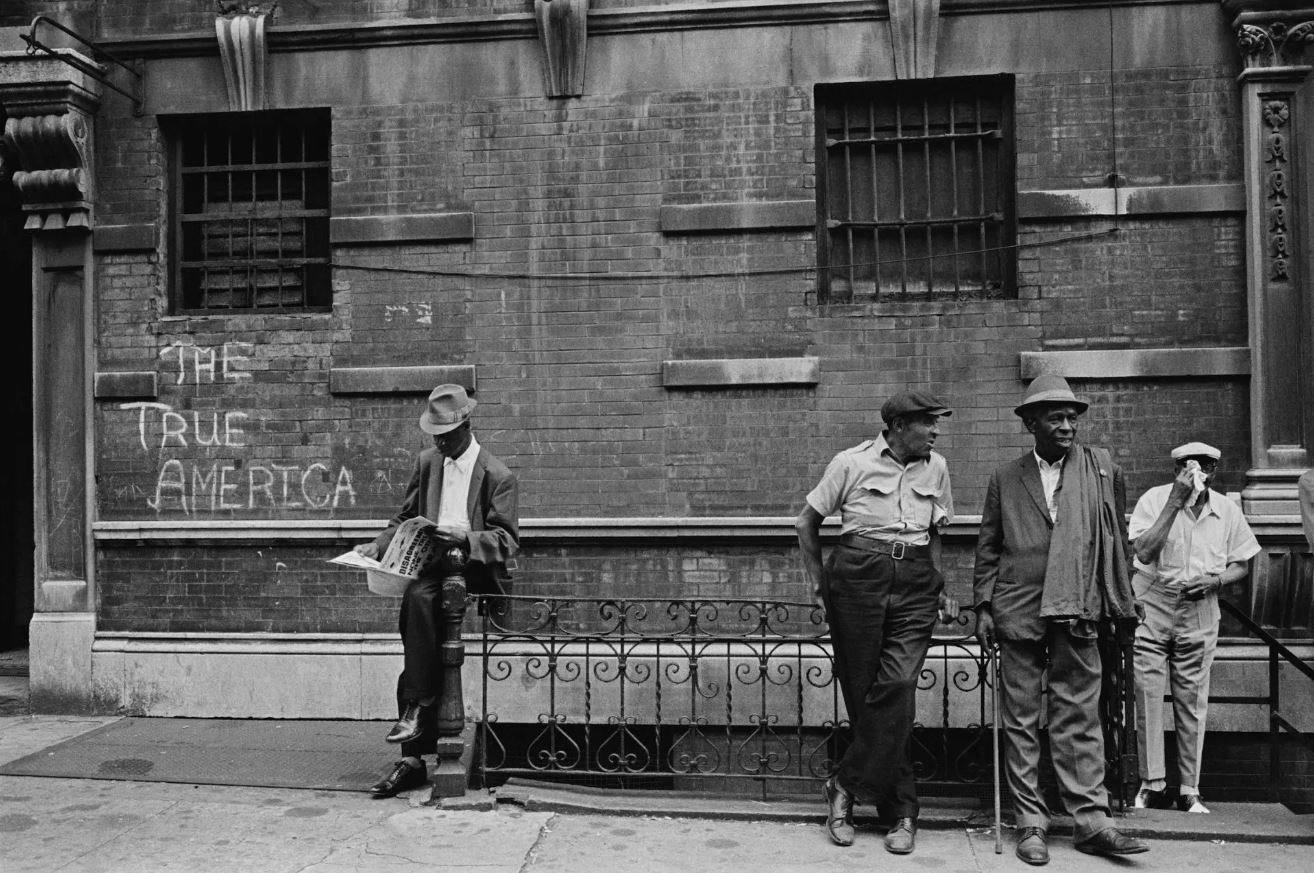
Cole travelled to the South to take photos of poor rural communities but, as far as I can make out, none of these photos have surfaced. For the second project Cole took thousands and thousands of photographs of New York street life, specifically the street life of Harlem, the part of Manhattan Island above 96th Street which was, at the time, almost entirely populated by the Black community. Most are in black and white but about a quarter are in a vibrant but beautifully dated and nostalgic colour.

Harlem, New York City, about 1970 by Ernest Cole © Ernest Cole / Magnum Photos

The rediscovered archive

The introduction to the show comes in the first (small) room. Here we learn from the wall caption that between 1967 and 1972 Cole took an estimated 40,000 photos (!). However, neither the city or rural projects was completed, no book was forthcoming, and Cole released very few of the photos during his lifetime. In the mid-’70s Cole’s life fell into disarray due to illness, he could get no work, he was sometimes reduced to homelessness and lost control of his archive. Surprisingly, despite the highly American provenance of all these images, he spent a lot of time in Sweden where he worked with a photography collective before dropping the medium altogether to take up film-making. He died of cancer back in New York City in February 1990 at the age of just 49.

What’s triggered this revival of interest in his work is that in 2017 a huge trove of his negatives was discovered in a Stockholm bank vault. As a result the Ernest Cole Family Trust was established to publicise and protect his legacy. This helps to explain the impetus behind the recent republication of ‘House of Bondage’ (2022) and the publication, now, finally, of his New York street photos, in a handsome volume titled The True America (2024).

Installation view of ‘Ernest Cole: A Lens in Exile’ at Autograph (photo by Kate Elliott)

‘Photography as a Social Weapon’

In the photo above you can see the small first room through the archway in the middle. In this space are displayed seven photos, the biographical wall label I’ve been quoting from, and a film. The film is a 5-minute clip from a long interview with Cole shot in 1969 and titled ‘Photography as a Social Weapon’. What comes over from this clip first and foremost is what a very charismatic and articulate man he was. But there are two main learnings from the interview:

1. The first is about the model for his vision. Cole tells us that the first ever photobook he got his hands on in South Africa inspired his vision and crystallised what he wanted to achieve. It was ‘People of Moscow’ by Henri Cartier-Bresson and he was inspired by the Frenchman’s way of capturing of the poetry of everyday life.

2. The second is his disillusionment. As he educated himself in South Africa (via a photography correspondence course from England and by meeting artists and musicians) he heard about the United Nations and about the existence of an African-Asian bloc. They’ll save us, he thought; they’ll intervene in South Africa to overthrow the evil apartheid system. But when he arrived in New York he slowly realised that South Africa was just one item on the agenda of its regular meetings, that the same countries stood up and made the same loud criticism of SA, and then the meeting moved onto the next item. Nobody was going to intervene. It was up to Black South Africans to liberate themselves.

And this was part of a broader disillusionment with American society. In the interview he expressed a hope of being liberated from the day-to-day experience of racism which had made life so unbearable in South Africa. But everywhere he went (and the label tells us he visited Chicago, Cleveland, Memphis, Atlanta and Los Angeles, as well as rural areas of the South) he found American Blacks to be poor and oppressed and discriminated against. Eventually he reached the devastating conclusion that Black people in America were no better off than Black people in apartheid South Africa. It was oppression everywhere.

He happened to travel American during the climax of the Civil Rights Movement, in the months either side of the assassination of Martin Luther King (4 April 1968) and in some of the photos captures the way many young Blacks had moved beyond King’s Christian faith in non-violent protest to believing that only direct, and potentially violent, action could liberate them. Hence also one of the best photos, of a proud young Black woman staring unflinchingly into the camera, wearing a lapel badge of herself carrying a submachine gun. Hence the several photos of Black Panthers looking uncompromising.

Black Panthers in the Park, Harlem, New York City 1968 by Ernest Cole © Ernest Cole / Magnum Photos

The main gallery contains 42 photos, 20 in colour and four of them blown up and printed on the wall.  All of them are shots of people in the street, street scenes, a few posed but mostly spontaneous documentary shots. He had such a gift, he had such an eye for capturing people in their variety and humanity. I can’t show them all so will give a verbal summary.

There’s a drunk passed out on the sidewalk, a street vendor selling clams, a smartly dressed Black couple in downtown Manhattan, a kids playing with a hula hoop, another child held by his Dad brandishing a toy popgun. There’s a man wearing a billboard warning against the dangers of Dope!, there’s a couple of guys in African tribal dress sitting on an open-top car obviously going very slowly through a little mob of onlookers and bearing a placard reading ‘Don’t riot. Get wise. Go to Africa.’

In the same spirit there are three or four shots of what appears to be a motorcade of cars carrying placards depicting African leaders, namely Patrice Lumumba of the Congo and Marcus Garvey, the Jamaican politician and activist. As you might expect there are also some very stylish, cool and nattily dressed people: a cool all of woman wearing what I take to be an African outfit in a north African, Muslim style. A very cool dude wearing no shirt, just a loose gold embroidered waistcoat, a loose necktie and a purple hat, smoking a cigar.

Apart from anything else there’s a very strong nostalgic feel about lots of the images. As a boy I watched a range of TV shows from the late ’60s’ and early ’70s which featured not just Black but white hipsters and dudes, everyone wearing shades and cowboy hats and tasselled suede jackets and so on. Many of these photos, putting aside the race issue, evoke nostalgia for the street fashions of half a century ago.

There are hardly any white people in the photos. Two are very negative. One shows a middle-aged businessmen looking contemptuously, maybe angrily, at a Black couple having a snog in the lee of some building work. There’s a highly symbolic shot of a middle-aged Black shoeshine guy on his knees in front of a suited white man who is nonchalantly leafing through a wad of dollar bills – an upsetting emblem of money-colour-power dominating Black poverty and humiliation.

Harlem, New York, 1969 by Ernest Cole © Ernest Cole / Magnum Photos

And nowadays…?

As you walk round, and as you read the wall labels in which Cole described his disillusionment and  growing sense that Blacks are oppressed everywhere, it’s impossible not to ponder the current situation of Black people.

It’s far too big a question for me to handle and, not being Black, my opinion is of questionable use anyway. We now have many Black people in positions of power and position. In the UK not long ago there was a Black Chancellor of the Exchequer and we currently have a Black Foreign Secretary. Black faces are increasingly prominent across public discourse, in the media of TV, film, theatre and art. But how that translates into everyday life, I have no idea. The Guardian reports almost daily of British institutions being called out for institutional racism, racism still (apparently) flourishes in the police, young Black men are five times as likely to be stopped and searched by the cops etc.

I read the news, I watch TV and movies and go to art exhibitions and see more and more Black faces, issues and discussions, but what Black life is like in the UK I haven’t a clue. And that’s just in England, my home country. I couldn’t possibly guess at the situation in the US, except for a) my awareness (like everyone else’s) of the Black Lives Matter movement which sprang up following the murder of George Floyd in May 2020, and b) the fact that all the media I read harp on constantly about ongoing racism and racial injustice in the States.

Anyway, I thought I’d end by mentioning that, in among the many street shots, there are a few more optimistic ones, which depict interracial couples arm-in-arm or hand-in-hand on the New York subway. It’s not much but, in their way, these are the opposite of the standing businessman and the kneeling shoeshine man, these are images of love and equality. If they hardly changed society at large – which, as I’ve just mentioned, appears to remain in many ways horribly unchanged – still, maybe they are images of hope that ordinary people can find their own ways to overcome prejudice and bigotry and to live the lives they want to.

Midtown Manhattan, New York, 1971 by Ernest Cole © Ernest Cole / Magnum Photos


Related links

Related reviews

Extraction/Abstraction by Edward Burtynsky @ the Saatchi Gallery

This is an epic, awesome exhibition, maybe the best exhibition currently on in London, certainly the most visually stunning one I’ve been to this year. It is not just a ‘photography exhibition’ but a display of masterpieces by a photographer of genius.

Typically awesome aerial photograph of Thjorsá River #1, Iceland (2012) photo © Edward Burtynsky. Courtesy Flowers Gallery, London

Largest ever Burtynsky exhibition

It is the largest exhibition ever mounted of the work of world-renowned photographic artist, Edward Burtynsky. Born in Canada in 1955, Burtynsky has spent over 40 years documenting the generally ruinous impact of human industry around the planet, in series of projects focused on environment-changing human activities such as mining, oil production, agriculture and so on.

Nickel Tailings #34, Sudbury, Ontario, Canada (1996) photo © Edward Burtynsky. Courtesy Flowers Gallery, London

It’s a big exhibition in every sense. They’ve brought together 94 of Burtynsky’s large-format photographs and the thing to grasp is that his photos are not just big, they’re massive, huge, enormous. You can only fit so many of these monsters into one space so the show is spread across 6 big galleries over two floors.

Uralkali Potash Mine #1, Berezniki, Russia (2017) photo © Edward Burtynsky. Courtesy Flowers Gallery, London

In addition to the 80 or so enormous digital prints there are 13 high-resolution murals i.e. photos blown up to cover entire walls, which overawe you with their scale and then draw you in to study the incredibly fine digital detailing.

Example of a wall-size ‘mural’ photo at ‘Burtynsky: Extraction/Abstraction’ giving a sense of the size of the ‘mural’ photos. Photo © Justin Piperger (2024) Image courtesy of the Saatchi Gallery, London

Factual captions

Each photo comes with a fact-packed wall label which explains the human activity we’re looking at. Often curatorial wall labels are barely worth reading or contain tiresome lectures from the curators about the tired old subjects of race or gender. By complete contrast, the wall labels in this exhibition are head and shoulders above the usual ruck because every one tells a fascinating story and gives you the hard facts without moralising. The facts are enough.

So, for example, the piece below is an aerial photo taken just outside the Atlantic port city of Cadiz in south-west Spain. The city is surrounded by salt marshes which once brought prosperity to the region by making it a major producer of sea salt. Snaking through the salt marshes are streams of turquoise sea water. Around these are a complex series of ridges which divide the marshes into ‘fields’ where salt can be harvested, some of which date from 1,200 BC. At the start of the 20th century some 160 artisanal sea salt producers worked these salt pans, now it’s down to just a handful.

Salinas #2, Cádiz, Spain (2013) photo © Edward Burtynsky. Courtesy Flowers Gallery, London

Extraction and the environment

It is a highly environmentalist exhibition (where environmentalist is defined as ‘concerned with or advocating the protection of the environment.’) Almost all the pieces show the catastrophic impact of human activity on the natural world, each image accompanied by fascinating, often profoundly dismaying information. Because every exhibition needs organising principles, the pictures, and so the accompanying information captions, are divided into themes, being:

  • Agriculture
  • Extraction
  • Manufacturing and infrastructure
  • Waste

The facts described in the picture captions are often mind-boggling. For example, there’s a photo of a vast array of plastic greenhouses in Ziway, Ethiopia, which covers an enormous 450 hectares in total. Up to 4 million roses are cut and shipped each day from here, almost all destined for the European market, where unknowing consumers buy bunches of Ethiopian-grown roses for their impressionable partners, both heedless of the enormous environmental cost behind every one of them.

Or take the wall label introducing the gallery devoted to Agriculture. This tells us that there are over 8 billion people on the planet and we all need to eat, preferably several meals a day. Approximately 75% of the global population eats meat, which corresponds to roughly 23 billion animals kept as livestock. Adding up all the people, livestock and, of course, pets, global agriculture must feed over 31 billion hungry creatures every day.

Creating enough agricultural land to cater to this vast, relentless need is the cause of endless environmental catastrophe:

  • mass cutting down of ancient forests
  • devastation of biodiversity
  • depletion of one-off resources such as aquifers
  • leaching of toxic pesticides and fertilisers into the water supplies
  • constant emission of greenhouse gases at every step of production, processing and transport

Abstraction

So far, so environmentalist. But there’s another whole layer to the exhibition and to Burtynsky’s practice, which is indicated in the exhibition title (Extraction/Abstraction) and underpins much of his work. This is that, from the early days of his career he came to realise that large-scale photographs of landscapes, taken from high vantage points like mountains or from helicopters or drones, often look very like the abstract art produced by the various movements of abstract art in the twentieth century, from Paul Klee teaching at the Bauhaus in the 1920s to Jackson Pollock getting drunk in New Jersey in the 1950s.

Installation view of ‘Burtynsky: Extraction/Abstraction’ showing two works which look like mid-20th century abstract paintings but are in fact 21st century aerial photos of the Texas panhandle. Photo by the author

The curators have some characteristically clear and intelligent things to say about this:

Abstract art emerged in the early twentieth century as a radical break with the old ways of making pictures. Rather than depicting recognisable figures, objects or landscapes, abstract painting explores form, texture and colour for their own sakes.

Over the same period industrial agriculture, mass production, surface mining and the internal combustion engine also emerged, changing our way of life forever. Today technology is rapidly propelling us into the future in every sector…

While modern artists invented new expressive and emotional languages, modern engineers, technicians and industrialists were developing a new reality, divorced from the ancient ways of being, alien to the natural world and wholly unsustainable.

Among the appealing elements of Burtynsky’s thrilling photos is his invocation of and toying with the conventions of abstract art. Many of his photos can be appreciated for their abstract beauty first, before we delve further into the ruined landscapes and human toil which lies behind them.

And it’s true. Look at the photos I’ve included so far in this review and you can see how the vivid, colourful landscapes often approach or fully appear as abstract designs. To be honest, this turns out to be more true of the first floor of works, less true of the second floor which depicts more ‘realistic’ scenes, such as vast waste mountains in Nigeria, the world’s biggest dump of used tyres in America, dehumanisingly vast factories in China and Bangladesh, and so on.

So this abstract aspect is not to be found in all of his works, but the abstract qualities which are to the fore in the early rooms continue to haunt the later, more realistic works, appearing round their edges so to speak, hinting at the deeper, unexpressed patterns and subtle regularities which emerge from the chaos of human activity.

Oil Bunkering #9, Niger Delta, Nigeria (2016) Photo © Edward Burtynsky. Courtesy Flowers Gallery, London

‘In the Wake of Progress’

In between the two floors of big stunning photographs, on a mezzanine floor, is a large room which has been blacked out in order to host what the curators call an augmented reality (AR) experience but you and I might think of as an old-fashioned film, the gimmick being that it is divided into three separate screens alongside each other, sometimes depicting the same subject, sometimes showing different angles of the same thing, sometimes changing and moving on before the other two screens can catch up, a dynamic triptych. It is a musical and rhythmic way of presenting moving images.

Installation view of ‘In the Wake of Progress’ showing on three screens at ‘Burtynsky: Extraction/Abstraction’ showing the viewing room for ‘In the Wake of Progress’. Photo © Justin Piperger (2024) Image courtesy of the Saatchi Gallery, London

The film is titled ‘In the Wake of Progress’ and, as the name suggests, shows the vast wake of destruction and dehumanisation left by the unstoppable exploitation of the planet’s natural resources. Unusually for me, I sat and watched the entire half-hour thing through in its entirety. It is an absolutely stunning, commentary-free, wordless series of beautifully shot sequences depicting the same kinds of scenes we’ve seen in the photos, devastation, waste and pollution everywhere.

It starts with four or five minutes of a static shot in an unspoiled northern forest (as captured in the photo above), all moss-covered trees and hovering insects, calming the viewer and lulling us into a false sense of security (it was actually shot in a place called Avatar Grove on Vancouver island, British Columbia, Canada).

But then the destruction commences, with shots of forests much like this being logged and reduced to muddy bare hillsides; vast numbers of logs being floated downriver to huge lumber yards; and on to open cast mining; dynamiting rocks in quarries; oil spills rainbowing rivers; vast dumps of rusting oil cans, plastic phones, used tyres; terrifyingly huge inhuman factories; oil production; vast megacities criss-crossed by urban freeways choked with traffic – a bombardment of images of human destructiveness.

The promotional material makes much of the fact that the film and music were created with the help of ‘legendary’ Canadian music producer Bob Ezrin. I thought this phrasing was a tad counter-productive and made it sound like a self-congratulatory speech at the Oscars (‘And now ladies and gentleman,  the one and only, the legendary music producer, Boooob Ezrin!‘). The wall label also explains that the haunting wordless vocals which thread through the soundtrack are by ‘award-winning Cree Métis artist iskwē’, which is interesting enough, I suppose.

But the single most obvious thing about ‘In the Wake of Progress’ is how very similar it is, in visual themes and in even the repetitive, arpeggio-heavy soundtrack, to the great 1982 film Koyaanisqatsi, by ‘legendary’ director Godfrey Reggio, with music by ‘legendary’ minimalist composer Philip Glass. All it needed was the slow-motion sequence of Las Vegas casino workers and it would have become virtually the same film.

My point is nothing about plagiarism or anything like that, in fact I have two points. 1) What the similarity of both films suggest is that if you set off with the aim of depicting mankind’s destruction of the natural world, you’re going to end up shooting the same kinds of sequences (open cast mining, oil production, hyper-highways in mega-cities) i.e. there will be an inevitable sameyness about films like this because they are covering the same subject.

Secondly 2) the two films were produced and released exactly forty years apart (1982, 2022). Me and my like-minded liberal friends were obsessed with Koyaanisqatsi – I went to see it in the cinema at least five times when it came out. Being young, we thought immensely powerful cultural products like this would change the world and bring its rulers to their senses. Now, being old, I know that’s never going to happen. Films like this are nice to look at, trigger strong emotions, and change absolutely nothing.

Burtynsky the technological innovator

For photography buffs there’s a section of the show devoted to listing and explaining Burtynsky’s technical innovations. It turns out that he has not only adapted to the huge changes which have taken place in the technical side of photography over the past 40 years (the arrival of digital technology revolutionising everything) but has often been at the forefront of that innovation – working with the technical teams who accompany him on his projects to develop engineering and design solutions to the challenges of creating such huge photos, often taken from a great height.

This latter fact (height) explains the presence of not one but several drones in the display case, along with interesting explanations of how his engineers have changed and adapted them to fly stably and horizontally, while carrying ever-more powerful digital cameras.

Installation view of ‘Burtynsky: Extraction/Abstraction’ showing the display case of cameras and drones used by Burtynsky over the years. Photo © Justin Piperger (2024) Image courtesy of the Saatchi Gallery, London

In the photo above, on the wall on the right you can see a timeline of Burtynsky’s projects, starting with the earliest while he was still at Ryerson Polytechnic (1979 to 1981) and then listing each of his major projects and publications, year by year, with a paragraph or so detailing what technical innovations he brought to each of them.

Self overcoming

Years ago I read half a dozen books by the German philosopher Friedrich Nietzsche. I wouldn’t pretend to be any kind of expert but my understanding is that a fundamental principle of Nietzsche’s philosophy is the notion of ‘self overcoming’. It’s the idea that in order to become who you want to be, you first need to overcome who you are. In order to realise your full potential, you must consciously conquer the aspects of your character and mind which limit and hold you back.

So far, so much like a Californian self-help video. Where Nietzsche pushes on is in holding the view that most of us are held back from a full understanding of the world we live in by a whole network of conventional thinking, commonplace morality, sentimental attitudes, wishful thinking, moral cowardice and intellectual weakness. In a thousand ways we hide from the truth of who we are and what we are doing.

Nietzsche said we should face the truth about ourselves and embrace it no matter how negative and destructive it may appear. Only by embracing the totality of our real natures can we live in truth.

Well, OK, then. All the facts indicate that we are destroying the planet, wrecking every ecosystem we’ve ever encountered and exterminating our fellow life forms at an unprecedented rate – and, following Nietzsche, I think we should embrace the fact. We should fully admit to being world killers and planet destroyers. We should own it and admit to being the nature-hating, species-exterminating, habitat-trashing creatures that all the evidence suggests we are.

In my opinion most people, especially in the pampered West, live in complete denial about what monsters the human race are – as my recent reviews of modern African or Middle Eastern history show time and time again, or the situation in Ukraine or Gaza demonstrate beyond dispute – we are planet-destroying locusts but locusts with machine guns and nukes, committed to the devastation of the planet and the mass killing of our own species.

I would rather it isn’t so, but it is so and any attempt to deal with the situation must start by acknowledging this truth. This position explains why, for me, the only weak point in the exhibition was where Burtynsky, disappointingly, joined in with the chorus of trite truisms, the sentimental bromides, and the wilful optimism of the wishy-washy liberal who still has hope:

‘I have spent over 40 years bearing witness to how modern civilization has dramatically transformed our planet. At this time, the awareness of these issues presented by my large format images has never felt more urgent… I hope the exhibition experience will continue to provide inflection points for diverse conversations on these issues and move us all to a place of positive action.’

‘Diverse conversations’ – does he really think ‘diverse conversations’, at dinner parties, down the pub or on social media, even at high-level gatherings like the COP conferences, are going to make a blind bit of difference to anything, because they absolutely aren’t and it’s disappointing that an artist who’s made such original art out of the disaster, still holds such weakly conventional opinions about it.

‘Add your thoughts to the conversation’

In the spirit of sentimental optimism which I’ve just explained why I despise, the exhibition contains two big blackboards with cups of white chalk sticks, and encourages us to write uplifting messages on the boards and ‘add your thoughts to the conversation’. Examples included: ‘Turn your phone off now’, ‘It’s easy to be green,’ ‘Be nice to the environment’ and other such gift card slogans. True to my blunt Nietzschean approach, I wrote ‘Exterminate all the brutes’.

To anybody who doesn’t get the reference, these are the words scrawled at the end of the high-minded missionary pamphlet written by the deranged colonial ivory agent, Kurtz, in Joseph Conrad’s novella ‘Heart of Darkness’. I wrote it in a spirit of Swiftian satire, for in the novel Kurtz has been driven completely mad by the sub-human savagery he encountered in the heart of the Congo, which he has assimilated and then taken to a whole new level of nihilistic destructiveness. He started out with the highest aims of bringing ‘civilisation’ to the heart of Africa and ended up with a mad vision of killing every one of the local people.

Everything I’ve read about the Congo backs up Kurtz’s feelings about the human race. If in any doubt you should make a study the Rwanda genocide and its aftermath in the two Congo wars and the Great War of Africa, which, even after the loss of up to 5 million lives, in eastern Congo lingers on to this day. And what lay behind this series of disasters? Greed to rape Congo of its natural resources.

First it was white Europeans enslaving, mutilating and massacring Africans in order to extract Congo’s vast rubber production; but then it was Africans looting, impoverishing, massacring and murdering each other in order to loot Congo’s other, mineral, resources. The colours of the skin and the names of the rulers (Leopold, Lumumba, Mobutu, Kabila), the ideologies they used to justify themselves (Christianity, communism, pan-Africanism, capitalism), all changed with the passing decades, but one constant remained the same: the murderous, nature-killing intensity of human greed. Vast wars were fought, immense human suffering caused, and large areas of the country ravaged by man’s endless quest for the blood diamonds, copper, gold and the rare metals which the world needs to carry on its course of untrammeled consumption.

Which is why bromides like ‘Save Earth, Save Life!’, ‘Protect Our Planet, Preserve Our Future’ and ‘There is no planet B’ seem to me wholly inadequate to capture the brutal truth of the world we live in, the terrible violence man deals out to man every day (and worse to unprotected women and children), the appalling misery endured by the slaves who produce the components of our luxury goods, the daily murder of tens of millions of dumb animals so we can eat them, and the relentless degradation of every ecosystem on the planet.

Hence the saeva indignatio of my crayoned comment, scrawled across the blackboard in the same way that Kurtz, driven mad by seeing into the complete darkness of the human heart, ended his utopian pamphlet with the most nihilistic comment he could conceive of – ‘Exterminate all the brutes’ – a comment less on the natives of Congo than on the shallow, inadequate Christian ‘civilisation’ he was meant to be representing.

(The phrase saeva indignatio popped into my memory at this point and prompted me to look it up. It is Latin for ‘savage indignation’ and is a phrase used in the Latin epitaph of the great 18th century satirist Jonathan Swift, to denote his ‘intense feeling of contemptuous anger at human folly’.

So that’s what I wrote on the blackboard of this powerful, terrifying exhibition, and why – the last words of a deranged idealist, quoted to express my ‘intense feeling of contemptuous anger at human folly’.)

The merch irony

A last point about those exhibition blackboards: the way children, or those with a childlike understanding of the world, had covered them with infant-school slogans like ‘End consumerism’ and ‘Just stop buying stuff’ meant I couldn’t help laughing out loud when this breath-taking exhibition shunted me out, at the end, into the huge, clean and well-stocked Saatchi Gallery shop, a big room overflowing with classy merchandise and shiny products.

Here, as at all art exhibitions, you can find a range of posters and postcards and bags and books relating to the exhibition, which all lead up to a collectable box set of stylishly produced Burtynksy books and memorabilia. This will set back the well-heeled art fan a tidy £15,000.

As I reeled from the cognitive dissonance between everything I’d just been seeing and reading, between all those high-minded ‘green’ sentiments on the blackboards, and this riot of unashamed consumerism – a posh couple sauntered by and stopped at the pile of exhibition catalogues (a snip at £38). ‘Oh my God,’ gushed the young lady, flicking through the pictures of ruination made beautiful, ‘this would make such a fabulous coffee table book!’

And there, in a nutshell, you have it. Middle-class people queuing up to buy postcards, t-shirts, tote bags, fridge magnets, mobiles, videos and earnest books all advocating the end of the consumerism. Swift would be looking on, nodding and chuckling.

Thoughts

This is an awesome, amazing, must-see exhibition for at least four reasons:

1) Every single photo is a masterpiece. Each one of them is breath-takingly beautiful.

2) Each photo is accompanied by short but hugely informative wall captions which are all fascinating in their own right but also build up into an astonishingly encyclopedic overview of all types of human activity around the planet – hugely interesting and mercifully devoid of the moralistic hectoring you are subjected to at so many other exhibitions.

3) It is about the most important subject on earth, which is the way we humans are destroying it.

4) Unlike most art films, ‘In the Wake of Progress’, is a powerful, thrilling, devastating, hopeless, exhilarating watch.

I emerged reeling. I wanted to shake someone’s hand for organising such an overwhelming experience and bow down before Burtynsky’s awesome genius. ‘Extraction/Abstraction’ is quite brilliant.

Our hero at work on location in Belridge, California, site of hundreds of small oil wells (2003) Photo by Noah Weinzweig, courtesy of the Studio of Edward Burtynsky


Related links

Environment-related reviews

Exhibitions

Books

Freight Dogs by Giles Foden (2021)

It takes much mental energy just to shackle himself to the present moment.
(Manu, central protagonist of Freight Dogs, page 322)

This is Giles Foden’s sixth and most recent novel. It’s a substantial work, weighing in at 400 pages. Like his first four novels it’s set in Africa and is based around fraught, politically and historically significant events. The first four were set during, respectively:

  • the evil rule of Idi Amin (The Last King of Scotland)
  • one of the main sieges of the Boer War (Ladysmith)
  • the 1998 embassy bombing in Dar es Salaam (Zanzibar)
  • the Anglo-German naval conflict on Lake Tanganyika during World War One (Mimi and Toutou Go Forth)

This one is set in Rwanda in 1996 i.e. two years after the Rwandan genocide (April 1994 to July 1994), just as the invasion of Congo by Rwanda and Uganda, the so-called First Congo War, is about to take place, and then follows the protagonist over the following six fraught, violent years in Congo’s history.

The plot centres on Manu (diminutive of Immanuel) Kwizera, son of a peasant family living on the Zaire side of the border with Rwanda (near the village of Pendele in North Kivu). Manu is a Munyamulenge i.e. a member with his family of the Banyamulenge, ethnic Tutsis who came into the South Kivu province of Congo from Rwanda between one and two centuries ago and considered themselves settled Congolese until North and South Kivu became ethnically polarised as a result of the genocide and also of Congo’s president, Mobutu, stirring up trouble, portraying them as alien immigrants and a threat to the majority Hutu population.

Manu has been lucky enough to be sent to a Catholic boarding school in the provincial capital Bukavu, which is where the story opens. The story follows him as he is caught up in the snowballing violence in the aftermath of the genocide then invasion.

‘Freight dogs’ is the rather flattering slang phrase which freelance pilots of freight planes jokily apply to themselves (p.59):

‘That’s the kind of risk-taking people we crazy freight dogs are!’ (p.75).

The bulk of the story describes how Manu wangles his way from endangered peasant into the world of these cargo pilots, running guns and whatever else is required between militias, armies and guerrillas, for the fee of gold or diamonds or whatever other loot they can bargain for.

The book is divided into six parts. [I’ve added the text in square brackets.]

  1. The Aftermath: June to November 1996 [of the Rwanda genocide]
  2. Seven to Heaven: November 1996 to May 1997 [the First Congo War]
  3. The Interbellum: June 1997 to August 1998 [between the two Congo wars]
  4. Fighting Fire, Treading Water: August 1998 to February 2002 [the Second Congo War]
  5. The Lights of Europe: March 2004 to December 2006 [Amsterdam and Belgium]
  6. The Deconfliction Zone: January 2007 [back in Uganda]

I didn’t like this book, for the following reasons:

1. History and footnotes

The novel is hag-ridden by the history. I’ve just read two very detailed histories of Rwanda (by Gerard Prunier and Michela Wrong) and Foden’s novel, at least to begin with, feels like a clumsy rehash of all the key facts, it feels like a Wikipedia article listing all the events from 1994 to 1996, with a very light skin of fiction laid over it.

Foden has so much factual research to cram into the text, especially at the start as he rushes to give the complicated backdrop to the genocide then to the first Congo War, that I was surprised he didn’t add it as footnotes. In fact very often it feels like footnotes:

This figure looked like a large bag of milk (milk is often served in bags in this part of Africa). (p.41)

The Lendu are the other ethnic group around Bunia, historically in violent conflict with the Hema over land usage. (p.136)

Take the scores of times Foden gives encyclopedia-style backgrounders on the major towns and cities of Congo, on ethnic groups, on colonial history, on the ongoing relations between Uganda, Rwanda and Zaire, on the origin of various guerrilla groups and so on.

Or when Foden just includes newspaper cuttings to convey the world of politics and fast moving events (p.110) or cites an old colonial-era work on Bantu mythology (p.179) or characters overhear radio news bulletins which handily update us on the developing political background.

Or the factual backgrounders on non-war-related subjects, such as the extended passage about East Congo volcanoes, or the migration of crested cranes, national bird of Uganda (p.253).

Or the very staged scene where Manu walks around the Belgian Royal Museum of Africa, staggered by its artificiality and lies, itself a flimsy pretext for shoehorning in some of the facts about the atrocious rule of Leopold II (p.305).

Or the extended sequence describing what it’s like to work in an abattoir. Or the different breeds of African cow. Or how to run a potato farm. Not to mention the technical details about flying a plane which recur throughout the story. The book is just overflowing with often only partially-digested background research.

You know the expression, ‘show don’t tell’. Well, fairly regularly Foden tells, he tells you what’s happening and what to think about it:

As Cogan [the pilot] fiddles with a lever…Manu is already reinventing, becoming someone else, despite constantly thinking back to the someone he was before. (p.58)

At moments it’s like reading the SparkNotes of a novel alongside the novel itself and, after a while, realising you prefer the Notes. They’re better written and get to the point faster.

The narrator or the characters are often fully aware of the exact nature of events and their significance, as they occur, in a way nobody in real life is. The characters anachronistically show the benefits of much later knowledge, but at the time of the original events.

For example, for the last fifteen years or so there’s been a growing awareness among western commentators that the RPF regime of President Paul Kagame is a repressive security state, which carried out atrocities against unarmed Hutu and Congolese civilians right from the start (i.e. 1996). See Michela Wrong’s devastating indictment, Do Not Disturb. But even a liberal sceptic like Wrong admits that for years and years after the genocide she believed the RPF line that they were knights in shining armour who ended the genocide and sought only to kill those responsible for it, during their invasion of Congo. Only slowly did the modern view of events and the very negative view of Kagame’s RPF emerge.

But Foden gives Manu this clear-eyed and authoritative opinion early on in the book. You could argue that that’s because he’s seen RPF troops carrying out terrible massacres but it’s more than that. Manu is a teenage peasant with only a superficial education caught up in terrible and confusing events – but he is given thoughts appropriate to a mature academic commentator, many years his senior, and with the benefit of the subsequent 25 years of history, research and revision.

Manu says nothing, knowing well enough by now about the grinding machine that’s not just Rusyo, but the whole security apparatus of the Rwandan state. (p.93)

How can some peasant brought up on a rural farm possibly know about ‘the whole security apparatus of the Rwandan state’? That’s not the voice of a confused character caught up in bewildering events but of Foden the history buff, benefiting from decades of hindsight and calm detached analysis, projecting  his perspective back onto his character for the benefit of the reader.

It feels like Foden is keen to show the reader that he holds the latest (very negative) opinion of Kagame and the RPF, he is itching to convey this information, and so he has his cipher, Manu, think it – completely inappropriately for someone caught up in the middle of events, with no knowledge of how they’re going to pan out.

This is what I mean by saying that the novel is hag-ridden by the history. The history comes first, drives the events, provides the scaffold of the book – and the characters are made to twist and bend to illustrate the history, to come out, on every page, with dialogue and speeches whose sole purpose is to explain the latest developments, always with the benefit of 20/20 hindsight, rather than express their psychologies or opinions.

The characters feel like puppets manipulated to dramatise a series of historical events which are far larger than them. This historical hindsight sometimes comes right out into the open. For example, the occasion when Manu hears a reporter on the radio saying the AFDL has taken Kinshasa and Kabila is now president:

He doesn’t say the First Congo War is over because he doesn’t know it’s the first yet but that’s what it is (p.153)

This is the tone of Foden the intrusive narrator emerging as puppet-master or, more precisely, omniscient knower of the historical record, beneficiary of 20 years of hindsight, ensuring that the historical record comes first, is the pre-eminent aspect of the narrative, and the so-called ‘characters’, with their necessarily limited knowledge, come a poor second,

All these history lessons and the frequent authorial nudges telling you what to think and how to interpret things feel claustrophobic, like being cornered by a drunk at a party who’s going to set you straight about the state of the world.

Examples of raw historical background shoehorned into the text or delivered as dialogue

Factual explanations of the complicated background and course of the two Congo wars are continually described in the narration or, more often, in stagey dialogue where characters talk to each other as if they’re quoting from one of Gérard Pruner’s books on the subject.

‘Mai-Mai,’ Cogan says casually, referring to the guerrilla units that have formed to protect local villages from the RPA and Ugandans and FAZ alike. (p.138)

I started keeping a record of pages which contain this kind of factual or explanatory content around page 135 and quickly realised that there’s some on almost every page:

  • 130: Foden explains how Nelson Mandela tried to broker a deal between Kabila and Mobutu
  • 135: Foden explains the behaviour of the Mai-Mai, for example massacring an entire village on the Massif d’Tombwe
  • 136: Foden explains the conflict between the Hema and the Lendu about land ownership around Bunia
  • 138: Foden explains the Mai-Mai, ultra-patriotic Congolese militias committed to defending local populations against all incomers
  • 139: Foden describes how city after city falls to the AFDL, until Kinshasa is taken and Kabila named president
  • 142: Foden describes Mobutu’s palace at Gbadolite, the Division Spéciale Présidentielle, Mobutu exiting in a Russian plane, the abandoned DSP angrily fire on the plane then loot and trash the palace (16 May 1997)
  • 149: Foden gives a history of Karonga as a slave trading centre, history of British Nyasaland, Cecil Rhodes, African Lakes Company
  • 150: Foden gives anecdotes about Hastings Banda
  • 153: Foden describes the flavour of the new Kabila regime e.g. corrupt mineral deals and banyamulenge horse-whipping the locals
  • 164: Foden describes Kabila’s unreliable performance of his presidential duties
  • 168: Foden explains how diamonds, gold and coltan are becoming the new minerals to smuggle
  • 173 to 176, and 181 to 183: Foden gives extended explanations of East Congo volcanoes, their behaviour, definitions of ‘active’, ‘dormant’ etc
  • 199: Foden describes the proliferation of rebels groups in the east, Kabila’s erratic behaviour, alienation of his Rwandan and Ugandan backers
  • 222 to 226: Foden describes the shooting down of the plane carrying Hutu president of Rwanda Juvénal Habyarimana which triggered the Rwandan genocide, the role of the SAM anti-aircraft missile, the growing rift between the Rwandan and Ugandan armies
  • 229: Foden explains how Kabila called for all Rwandan and Ugandan forces to leave Congo ( 27 July 1998)
  • 231: Foden explains how the Rwandans and Ugandans reinvaded Congo to overthrow Kabila, thus triggering the Second Congo War
  • 235 to 248: Foden gives an extended description of Manu among the pilots hijacked into flying RPA forces to Kitona airport, west of Kinshasa, then his extended forced service during first part of Second Congo War
  • 255: Foden explains the proliferation of militias in eastern Congo
  • 258: Foden describes the assassination of Laurent-Désiré Kabila, 16 January 2001, and summarises the conspiracy theories about who shot him and why
  • 266: Foden explains the failure of various peace treaties to end the second Congo war
  • 280: Foden describes the street battles between Rwandan and Uganda forces in Kisangani

On almost every page the reader is bombarded with undigested chunks of historical background information.

2. Convenient coincidences

Related to this forced feeling, is the Zelig aspect of the narrative whereby the protagonist, Manu, just happens to be present at pretty much all the key events in Congo from the start of the narrative in 1996, onwards. The book shares this quality with The Last King of Scotland whose protagonist kept on being at the right place at the right time, meeting all the key players in a series of lucky coincidences which started off by being exciting, then began to be a bit too convenient, and then toppled over into feeling ludicrous and/or horrifically hallucinatory, according to taste.

Same here. When Manu is saved from murderous FAZ soldiers by a squad of AFDL fighters, it isn’t any old troop but the one led by Laurent-Désiré Kabila, the man handpicked by Rwanda and Uganda to lead the assault into Congo and who was, eventually, to replace Mobutu as president of Congo (p.29).

Later Manu will witness or hear about all the key turning points in the two Congo wars. In a striking scene he and two fellow fright dogs will be present when President Mobutu takes off from the private runway at his vast jungle palace, heading into exile, and confront his enraged troops as they loot the palace. In this respect – the hero being there at key moments, eye witness to historical turning points – it’s very like Last King but without the slowly mounting horror which makes Last King such an intense and, eventually, hallucinatory read.

The main thing about life in the real world is how random most of it is. Foden’s fictions are contrived so that they introduce us to all the key players in a certain set of historical events and stretch the concept of coincidence to snapping point.

I know that Foden’s novels are intended to be serious thrillers and they are certainly ‘serious’ in two senses, 1) that they lack any humour or warmth, and 2) they deal with horrifyingly violent events. And yet when it is revealed that one of the crates of contraband gold which Cogan and Manu pinched from a consignment and buried in secret contains, in fact, not gold but the rocket launcher which shot down Juvénal Habyarimana’s plane and so triggered the Rwanda genocide I burst out laughing, tickled by Foden’s chutzpah in making his hero or colleagues witnesses to every single one of the key events in the historical period.

The coincidences pile up when Foden has Manu among the commercial pilots whose planes are hijacked to fly RPA forces to Kitona airport in the bold but ultimately unsuccessful attempt to unseat Kabila, I was beyond laughing and just marvelled at the way the novel is entirely based on the history, a reskinning of the events in a light covering of ‘fiction’, and Manu, the central character, for all the effort Foden puts in to try and make his feelings believable, little more than a cipher.

In the final scenes, where Manu is absolutely down on his luck, impoverished and immiserated in racist Belgium, the sudden appearance of the old freight dog, Papa, to save and rescue him is presumably meant to be a sensible event but, in my mind prompted the image of the Monty Python cartoon of the clouds opening and angels blowing trumpets. Beyond ludicrous. A fairy tale.

3. The central figure is a cipher

The central character, Manu, isn’t very interesting. He doesn’t have interesting thoughts, he doesn’t have much to say for himself, he’s more of a cipher or front man pasted on top of what often feels like a factual summary of Rwanda’s recent history. ‘Sometimes he hates his own passivity’ (p.227). Exactly. A cork bobbing on the ocean has more character. It doesn’t help that he uses white western and old fashioned diction like ‘assuaged’ and ‘deems’ and ‘presages’. I don’t know exactly what a survivor of the Congo wars would sound like but almost certainly not like a middle-aged, English, public school author.

4. Awkward prose style

Foden’s prose style is really weird. It’s always been unstable: in King of Scotland there were some odd passages and chapters; Ladysmith and Mimi and Toutou use old-fashioned mannerisms and word order but I thought maybe these were tailored to the century-old settings, but they recur here, plus new oddities of phraseology, which I found disrupted my reading on every page.

Foden’s accounts and interpretations of post-genocide Rwandan history didn’t interest me very much because I’ve just read two much better, more thorough and professional accounts – and I wasn’t that interested in the main characters as characters – so the thing that ended up interesting me most in the book was Foden’s weird style.

1. The awkward preposition

There’s his dogged insistence on avoiding a ‘dangling preposition’ (ending a sentence with a preposition) which makes him put propositions in the middle of sentences, thus creating all sorts of unnatural contortions – maybe my obsession with this is irrational but it really bugs me:

  • He looks exactly the sort of business-inclined person of whom her evidently prosperous parents would approve. (p.71)
  • The demons which have been flitting in his head since the incident with the archbishop and Don Javier, for which he does not know whether he was to blame or not. (p.50)
  • Manu reads the grease-stained page of newspaper in which his Rolex came. (p.109)

See how the obsession with not ending a sentence with a proposition leads him into all kinds of unnatural contortions. He prefers to use ‘of which’ as a connector:

  • The bigger picture of which their actions that day had played a part… (p.37)
  • Birds flitted between mossy branches as they ascended what seemed like a vast flight of basalt-black stairs, finally reaching the flat top of a mountain range, the expanse of which seemed to fill the cavern of the sky. (p.29)
  • In the back of this first car, the metal of which was punctured with bullet holes…

I don’t know why this bugged me so much, but I’d have thought it would be more natural and fluent to just write ‘whose’ – ‘whose expanse seemed to fill…’, ‘whose bodywork was punctured with bullet holes’ etc.

  • Are they faux amis, like those of which Don Javier used to speak in another context of translation… (p.147)

I looked this whole issue of dangling or hanging prepositions up online and came across the joke sentence allegedly written by Winston Churchill to highlight how stupid this ‘rule’ is and what ridiculous distortions it leads you into once you set off down this road:

“That is the type of arrant pedantry up with which I shall not put.”

The aversion to ending a sentence with a proposition is very old fashioned and formal and so sits oddly with other elements in the text, which are trying to be cool, woke and up to date.

  • They descend through the dense green, amid which the dirt road winds like a slalom course (p.187)
  • The sky is filled with just such a gas-laden plume of which she once warned him. (p.265)
  • With visibility reduced, he has to rely on his instruments, with which electrical discharges in the gas cloud are in any case interfering. (p.265)
  • He gathers up his few clothes and belongings, making a pile on the bed, before going back out to the kitchen and finding a bag in which to put them. (p.208)
  • It’s a different prison from that in which Aisha is being held (p.216)

Why not the simpler easier to read ‘a bag to put them in’ or ‘the one Aisha is being held in’ or ‘which she warned him about’? It sounds trivial, but these sentences, rearranged into unnatural contortions in order to avoid ending with a preposition, occur on every page and help set the tone of Foden’s stilted, awkward prose.

  • What Manu notices are the black plastic parts of the recording device that he stole from the journalist outside the court, about which he’d totally forgotten. (p.375)
  • Afterwards, Manu’s hand is still gripping the banister, static hissing in the ear to which his other hand continues to hold the phone. (p.376)

2. Odd phrasing

Anyway, this specific issue aside, there’s plenty of just plain odd phraseology:

Recognition [the name of a character] turned the radio off at this point, falling into slumbers. (p.38)

Recognition looked on as the second beating Manu then suffered was conducted. (p.42)

Manu got up, supposing to make his way to the docks as instructed. (p.43)

He was at a moment of limits, tripping over kerbs and broken parts of buildings destroyed by munitions (p.43)

All this apparent cogitation was in truth too unwilled to be a called a decision. (p.44)

While he’s enumerating the options, the pilot door of the plane opens. (p.51)

He’s embarrassed, almost ashamed that he’s been making too much of things that some of them, with no better a history than his own…are facing down with equanimity. (p.108)

He drinks so much, in fact, that he loses track of the liquid courage for his future (p.159)

Not long later, reckoning that they are safe now… (p.195)

All that stuff he [Cogan] liked to sing, by turns bright and breezy, mournful and melancholy, whatever the weather outside the cockpit, reports on which the Texan told him not to trust. (p.219)

Seeing even worse atrocities than those committed against the women of Boma, Manu realises that there’s always something worse than what he thought was the worst before. (p.242)

One Monday morning further on in this period of steadfast resolution (p.256)

What I have learned is not to judge so quickly, as the moment oneself is to be judged is always about to arrive. (p.275)

But this animal at the Expo is much older a beast than even Joséphine would be now. (p.353)

‘I’m so sorry,’ says Manu, pulling himself jerkily back into joint and wondering if this bizarre episode is a conclusive rupture with the past that has been plaguing him. (p.355)

Now the breath in the old man’s chest is slowing stint by stint, as his illness comes to a terminus. (p.372)

As for Anke, he has (against his own past conjecture) almost forgotten her… (p.382)

A faint smell of piss wafted over from the latrine and Manu saw the financier’s nostrils mushroom – ever so widely, as if the pleasant occasion of a meal had been robbed away in some still greater larceny than this basic reminder of other facts of the body besides ingestion. (p.395)

The sun was pouring out its almost last tot of light, making the air tremble, like Cogan’s hands sometimes did… (p.397)

The prose consistently feels as if it’s written by someone whose first language is not English, someone who is struggling against mighty odds to express themselves in an unfamiliar language. It’s not the occasional oddity – the contorted sentence structure, the weird phrasing, they’re in every paragraph on every page.

3. Intrusive narrator

Sometimes the narrator intrudes into his own sentences to comment on the action, like an eighteenth century narrator, like Henry Fielding, or a moralising Victorian author:

In this moment, he wonders if he has become abhorrent to her and that this chance of love, perhaps his only chance (as he then presumes; fatal error of all disappointed in love!) has been blown entirely (p.312)

The clash between this very old tactic, the strange Victorian phraseology (‘fatal error of all disappointed in love!’) and then the slangy modern American phrase (‘has been blown’) create a really weird disjunctive effect.

4. The continuous present

Now I’ve started, there’s another aspect of Foden’s prose which is really distinctive and equally unsettling, which is his fondness for sentences with multiple clauses, at least one of which refers to ongoing events by using the present participle. These examples demonstrate what I mean:

  • Manu also supposes, continuing to walk along, that he ought to inform Cogan’s ex-wife and son. (p.220)
  • A black Mercedes pulls up alongside him. For a second, his reflection sliding along its wing, it’s like he’s back in Lubumbashi. (p.220)
  • He decides, it being Christmas Day, that he will go to Mass again (p.253)

This is odd and unnatural word order. It would be more natural to write ‘As he walked, Manu realised that he probably ought to…’ or ‘For a second his reflection slid along the wing of the car, reminding him of…’ But Foden is really addicted to this unnatural, cluttered way of writing; an example occurs in more or less every paragraph, the text is saturated with them.

5. Having

There’s a kind of logical extension of the previous habit, which is to use the present participle ‘having’ to indicate an event which has taken place before the one being described in the sentence. So instead of describing the events in simple chronological order thus: ‘Manu opened the door and walked into the room’, Foden always prefers to complicate things by starting in the present, cutting back to an action which has just been completed in a subordinate clause, before returning to the present action for the second half of the sentence – ‘Manu walked, having opened the door, into the room’.

  • They get out of the vehicle, Faithful having grabbed the drawer from Manu’s lap as they stopped. (p.222)
  • Stinking, having not been able to wash properly for weeks, he just wants to go home. (p.242)
  • Maquela’s over the border in Angola – nominally enemy territory, since the Angolan government, having been on the Rwandan side in the first war, are now aligned with Kabila and Zimbabwe. (p.245)

I suppose some readers might like this embroilment of the prose, this mixing up. But to me it felt like listening to a story told by someone with a stutter. The awkward phrasing, the stilted structuring continually distracted my attention.

It’s not grammatically incorrect, not incomprehensible, just strangely off and, along with the preposition-phobic sentences and the consistently strange phrasing, these oddities all build up into a sustained sense of awkwardness everywhere in Foden’s prose.

I suppose these odd phrases, these unwieldy sentences, could be a conscious effort to convey the difference of Manu’s African culture and the fact that he doesn’t speak or think in English. Maybe. Maybe that’s the aim, but I wasn’t convinced and, whatever the motivation, it’s just not very enjoyable to read this spavined prose. It was so distracting I wanted to stop reading the book after 50 pages but forced myself to go on to the end, less and less interested in the plot, more and more entranced by the strangeness of Foden’s prose.

6. Poor proofreading

It’s not helped by quite a few typos and proofreading mistakes, which made me think the proofreaders were sometimes as puzzled by Foden’s prose peculiarities as I was. Can you spot the mistake in this sentence?

Later he’ll hear how Phiri landed the Boeing, every second expecting it (as now Manu also expects) the Cargomaster to be brought down by a MANPAD. (p.238)

Which I think should be:

Later he’ll hear how Phiri landed the Boeing, every second expecting it (as now Manu also expects the Cargomaster) to be brought down by a MANPAD. (p.238)

The plot

Manu has barely returned from boarding school to the family farm before a squad of Zaire Armed Forces (AZF) soldiers drive up and murder his family, raping his mother and sister first, garrotting his father in an attempt to find out where the family treasure is buried.

Manu has a rope tied round his neck and is being led away when the AZF force is itself ambushed by Alliance of Democratic Forces for the Liberation of Congo (AFDL) troops led by none other than Laurent-Désiré Kabila (this is the first of many improbable coincidences for Kabila is to go on to become the newt president of Congo).

Kabila gives Manu a gun and invites him to shoot dead the man who just killed his father but Manu, being the hero of a western fiction instead of a real person, can’t and doesn’t. Kabila is impressed and lets the AZF soldier in question run off into the jungle

Manu is then pressed into the AFDL and taken with other soldiers down to the Hutu refugee camps right on the border with Rwanda. Here Foden follows the modern view that the AFDL and the Rwandan Patriotic Force (RPF) carried out a mini version of the Rwanda genocide only this time it was Tutsis massacring Hutu men, women and children. Manu watches horrible killings.

In the marketplace of the town of Nyamwera he takes part in the torture and shooting of a) archbishop Christophe Munzihirwa, who had occasionally visited his Catholic boarding school, and b) his favourite teacher, Don Javia Mendia. It happens because the sadistic AFDL officer, Major Rusyo, made him shoot at a car approaching their convoy, it was only after they’d done so that the wounded archbishop staggered out and they discovered Don Javia dead inside. The AFDL troops then stabbed the archbishops with bayonets and ordered at gunpoint Manu to join in, which he misinterpreted to mean fire his rifle, which may or may not have actually hit the archbishop, who the other soldiers proceeded to finish off anyway.

Because Manu is such a cipher there’s no sense of how these opening 40 or so pages packed with horrific incidents affects him. You’d have thought he’d be catatonic with shock but there’s no attempt to convey shock, PTSD or psychosis, instead he remains the blank cipher used to shuffle the narrative along.

Supervising his induction into the AFDL is a brutal boy his own age, named Recognition. After receiving a number of brutal beatings from him, Manu manages to slip away from the AFDL camp and embarks on a long trek back to his farm. Here he buries the body of his mother and then sets off stumbling through the jungle in the direction of Uganda, which he hopes will be safe.

After some days in the jungle Manu stumbles across an airfield at Rutshuru on the border between Congo and Uganda, and witnesses black soldiers doing some kind of deal with the fat scruffy white pilot of a small cargo plane.

When the soldiers drive off, Manu stumbles into the light of the arc lamps (it’s night) and, after initially scaring the pilot, they get chatting. The pilot’s name is Norm Cogan and he’s a scruffy, disreputable, jobbing ‘freight dog’. His last assistant did a runner, so he asks Manu if he’d like the job of being his fixer (p.55). Next thing Manu’s washing and scrubbing stuff then getting into the plane and they fly from the edge of Congo to the airport at Entebbe, Uganda.

Norm then drives Manu to the bar he owns, The Passenger, run by his bad-tempered wife, Aisha, where he introduces Manu to his fellow ‘freight dogs’:

  • Aisha, the bad-tempered African owner of the bar
  • Gerry Magero from Kenya
  • Max Chénal from Belgium, former priest, a ‘tight-faced old man in oversized specs’, known as ‘Papa’
  • Evgeny Blok from Russia, muscular, moustachioed (p.81)

These guys are national stereotypes on the same kind of level as the foreign characters in cheesy movie adaptations of ‘Death on the Nile’ or ‘Murder on the Orient Express’. Cogan is the worst. In the same way that the chunks of history are shoehorned into the narrative, Cogan’s America-ness is rammed home every time he opens his mouth.

He says things like: ‘Kabila’s cockamamy outfit’, ‘that went down the swanee’, ‘my momma used to say’, ‘nothing sticks forever kid’, ‘go the whole nine yards’, ‘we done fell in love’, ‘fuckedy freak show, here we go’, ‘hold on to your hat, kid’, ‘we’re all yappedy doo-dah now’, ‘what’s the matter kid?’ ‘hot diggety, she looked good!’, ‘the one’s a biggee’, ‘shit’s about to hit the fan’. He is, in other words, a dictionary of Yankee clichés. He sounds like a character out of Indiana Jones.

For no particular reason these tough old guys decide to adopt Manu and teach him how to fly, start giving him lessons, buy him a flyer’s licence, a pilot’s uniform, training manuals, flight bag etc. He’s still only 19.

So Manu goes on seven or eight trips with Cogan and Evgeny, studies the manuals, and eventually gets his pilot’s licence. On one of these trips we see Cogan landing at a remote base in the middle of carrying a cargo of gold, and getting Manu to help bury one of the crates, allegedly with the help of the trip’s sponsor, Major Faithful.

Part 3. The Interbellum: June 1997 to August 1998

A chapter where Manu does a purely civilian job, unconnected with the war, namely ferrying a Belgian expert in volcanoes, an attractive young blonde (is there any other kind of expert in volcanoes?), Anke Desseaux, around the volcanoes of the Great Lakes.

Until their jeep (driven by a hired driver) is ambushed by a small crew led by none other than Manu’s old comrade, Recognition. Recognition explains he’s gone AWOL from the ADFL and is trying to set up a Tutsi militia to protect their own kind, here in East Congo.

Manu wrestles his machine gun off him, shoots dead the two other guerrillas in the ambush, shoots Recognition in the leg and would have finished him off if only Anke had started to come round from being knocked out.

So Manu knocks Recognition out with the rifle butt, hauls Anke into the jeep, recovers her belongings, and drives down the mountain to a town, sees doctor, checks into hotel, she cleans up, sleeps, next day demands to be taken to the nearest airport to catch the next flight to Europe.

(Given that the last section of the book is titled ‘The lights of Europe’ I’d be surprised if Manu doesn’t end up fleeing to Europe and looking Anke up. She will either be pleased and they resume their affair, or engaged or married to someone else, leaving Manu bereft. Either option will feel equally as clichéd.)

Talking of women, Manu spends time on the beaches of Lake Victoria and several times spies a beautiful woman sashaying across the sand, dipping into the lake etc and eventually plucks up the guts to talk to her. Her name is Edith.

Much later, on one of his trips with Cogan, into the jungle to ferry around crates of gold or ammunition, Manu is astonished to discover, amid the sprawling army base full of drunk or stoned soldiers, this very same Edith! Turns out she is the daughter of the Major Faithful they’re doing this trip for. (Manu may be surprised but any reader of Foden is used to his routine deployment of far-fetched coincidences.)

Even more far-fetched than Manu meeting Edith in the middle of nowhere, is the way she comes on strong to him, takes him to a hut, and makes him have modern sex with her (by modern I mean not just penetration but, after he’s climaxed, insisting on him stroking and masturbating her till she comes, too.)

Next morning he’s woken by Cogan and hustled off to finalise the cargo and fly off, his emotions understandably still reeling from this intense and unexpected rumble in the jungle.

Time marches on. Of the cadre of freight dog pilots, Papa quits and goes back to Belgium (after making a half-hearted attempt to chat up Manu, who only then realises he’s gay); Evgeny moves to Dubai, safer business and good schools for his kids).

And Cogan is shot dead, Manu (in another of those far-fetched coincidences) happening to drive by Cogan’s car crashed in a ditch to find the fat American still alive though bleeding profusely. Manu takes him to the local hospital which is closed and barred to new admissions (because they gunshot wounds generally deriving from gangland shootings which sometimes follow their victims into the hospital). Thus Cogan bleeds to death in his car before a doctor belatedly comes out from the hospital to see him.

A little before this Manu had arrived back at The Passenger (the freight dogs’ bar) where he’s still kipping in the spare room Cogan gave him, finding it locked climbs in through the back window and thus overhears Aisha complaining about Cogan being a) bad in bed b) serially unfaithful c) frittering away all the earnings of his freight company. Gerry reassures her that he won’t have to put up with Cogan much longer, then the pair have sex right there in the bar while Manu watches through a crack in the door.

Anyway, this explains why, upon Cogan’s death, Gerry and Aisha are arrested by the police, who turn up recordings of them plotting to kill Cogan (because the cops had been making recordings of an illegal drug baron who Gerry, it turns out, had been doing flights for).

As he lay dying one of the last things Cogan told Manu is that he’s made a new will, leaving everything to Manu i.e. 1) the bar, 2) his freight business, Normanair.

So by about half way through the story, Manu’s mentor, Cogan, has disappeared, and so have the other flight dogs Papa, Evgeny and Gerry, leaving him qualified enough to carry on the freight business, but lonely.

As a resident of Entebbe/Kampala, we’ve accompanied Manu on trips to see the nightlife, to various bars and entertainments, and learned that he got friendly with some guys (David and Matthias) who’d set up a dance troupe but were worried about the financial insecurity of the dance world, so Manu has the bright idea of hiring them as manager and barmen at The Passenger.

Part 4. Fighting Fire, Treading Water: August 1998 to February 2002

Things are just settling down when the Second Congo War kicks off and Manu finds himself just one of half a dozen commercial pilots who are held at gunpoint at the airport by his nemesis, Major Rusyo, who forces them to fly RPA troops to Kitongo, the airport on the far west of Congo, which the RPA plan to use as a base to overthrow the now out-of-favour Kabila.

But this dashing plan is foiled when the Angolan army come in to support Kabila and prevent a quick surgical coup. It was the Angolan government’s decision which triggers the long, drawn-out struggle of the Second Congo War which mutates into the Great War of Africa, which becomes bogged down in fighting between multiplying militias, guerrilla groups, warlords and so on, in a kaleidoscope of conflict.

Manu tries to duck out of all this but is conscripted at gunpoint by Rusyo, and spends months in an increasingly feverish blur of stress, lack of sleep and amphetamines, running guns and ammo into Congo and taking out all manner of goods – gold, coltan, diamonds, coffee, even train rolling stock. The RPA’s excuse of overthrowing Kabila to install a democratic government wears thin: Manu realises it is just looting, pure and simple.

After these months the Angolan troops close in on the airport the RPA have been using, at N’djili. The Angolans fire anti-aircraft missile at him which he only just dodges using a shake and roll technique  which Cogan taught him.

Manu lands at a jungle airstrip, Maquela do Zombo, in UNITA-held north Angola, where he is trapped with the RPA for four months. Only on 23 December 1998 does he finally get to fly out, carrying as many RPA men and munitions as possible as Angolan government forces once again close in.

Time passes. The war unravels into chaos. Manu keeps completely out of it, spending two years doing clean commercial flights, ferrying tourists to see gorillas or sunbathe in Zanzibar. David and Matthias prove honest employees, turning The Passenger into a popular profitable bar.

Suddenly it’s early 2002 and Anke Desseux rings him up saying she wants to hire him to take her back to the volcano which her instruments tell her, may be about to blow. The flight is a disaster. Plumes of smoke and rivers of lava rolling down the side, burning towns, into Lake Kivu. Worse the acid fumes strip the paint off the outside of the plane and damage the windscreen. They barely make it back to Entebbe in one piece and Manu is furious at the damage to his one and only airplane.

He drives her to hotel, they both freshen up, sit sulking in the bar, eventually she gets him to spill the story of his life, all its many traumas, she takes him back to her hotel room and they have championship sex, twice. (As young healthy men and women protagonists of airport thrillers generally do, compare tall, handsome skindiver Nick Karolides and young attractive diplomat Miranda Powers in Zanzibar. When he tells us that Anke’s bare breasts are ‘lightly freckled’ you think, of course they are. That’s the kind of book this is: the history is true and horrifying but almost the entire fictional content is riddled with clichés.)

Next day Anke has to fly back to Belgium, of course and, of course, they have an emotional parting at the airport and, of course, Manu drives back to his apartment feeling abandoned, alone, again.

Part 5. The Lights of Europe: March 2004 to December 2006

Very abruptly it’s two years later, years of calm business flights as Manu slowly expands the company. Then Brigadier Faithful calls him to his office and asks him to go and fetch the buried crate containing the incriminating anti-aircraft firer. He will pay him $80,000 plus costs to dig it up, load it on board and fly it to Amsterdam where it will be handed over to a government enquiry. Why? Because the Ugandans, whose army Faithful is in, want to get back at the Rwandans who are systematically undermining them, backing anti-Uganda militias etc, by revealing that it was the RPA which shot down Habyarimana’s plane.

So Manu flies to the place in the jungle where he and Cogan buried it, digs it up and flies to Amsterdam and hands it over to the academic (who is probably a spy).

But then Manu is flabbergasted to be arrested! Turns out he’s wanted on an Interpol warrant for the murder of Don Javier and the Archbishop all those years ago in Nyamwera. Turns out an NGO has been pursuing murders of Spanish citizens and, having done the Franco regime and various South American governments, is now turning its attention to the murder of Spanish citizens in Africa.

The accusations are desperately unfair but then it turns out that the main witness against him is none other than Recognition, the comrade who forced him to perform these very deeds, and has now, bizarrely, become a Catholic friar in the monastery base of the NGO which is bringing all these accusations. Triggering in Manu a recurrence of the existential crises of doubt and personality which have dogged him throughout the narrative.

Standing there in the dock in his prison shows, he begins to think of himself as barely alive. (p.289)

Manu’s lawyer takes him outside the court for a cigarette (guarded by a security guard). A court journalist comes over and, in a mad moment, Manu grabs the journalist, puts the sim car of his phone to his jugular, forces the cop and lawyer to lie on the ground, gets the keys to the handcuffs he’s wearing, then runs off.

In the busy city streets he comes across a protest march, something about Palestine and Israel, blends in and marches along for bit, skips into a subway, gets away. A few hours later he’s on a train to Brussels courtesy the cash in the journalist’s wallet.

After a few days on the road he looks like any other hobo African immigrant. There’s a very staged and contrived scene where he wanders round the Royal Museum of Africa in Brussels, comparing the staged dioramas to the Congo he grew up in. Colonial fiction versus lived reality, imperialist lies etc.

Obviously he’s schlepped all this way to see Anke. (I knew from the moment they first met, had their violent visit to the volcano, then she scarpered back to Europe, that she would play a central role in the book’s final section.) When he finally gets to Anke’s office he is horrified to discover that she doesn’t retain the high idealised feelings for him that he has for her. It was only one night, years ago.

When she hesitantly tells Manu that she’s engaged to be married (p.313) I burst out laughing. That’s what I predicted 100 pages earlier. It felt as old and clichéd as a Thomas Hardy novel.

If she will not love him of her own accord, there is nothing, absolutely nothing, he can do that will convince her to do so. (p.315)

God, I wish this novel had just stopped on page 300 at the end of the second Congo War. Though it undermined the fiction, I quite enjoyed being harassed by the history. Now the reader is going to be hectored by Hardy for the last 100 pages.

Manu had put all his hopes on Anke helping him but she had screamed and threatened to call the police. So he goes to the African quarter of Brussels. Fellow Congolese recommend a hostel. It’s filthy and kept by a slimy predatory gay man who shows Manu to a disgustingly dirty room. He’s advised to get a job in an abattoir and there follows an extended, stomach-churning description of jobs in an abattoir which reads like the transcription of a research visit Foden made to one.

Woke ideology

Earlier, in the court scenes, Manu had raised the spectre of racism. On the run he encountered racist glances. In the Museum of Africa he was forced to think about colonialism. In the abattoir the supervisor showing him round makes the ‘racist’ comment that many of the African workers he has to supervise are lazy.

Part 5 is the woke part of the book, the part where Foden shows his white readers what white Europe looks like to a black outsider, a man unjustly accused and on the run, a victim of western imperialism and racism. Hmm. So maybe the reader isn’t going to be hectored by Hardy so much as worn down by woke.

Foden is the kind of liberal white man who went to an English public school, then Cambridge, and writes books attacking his own class and country. One of the characters in the immigrants’ hostel is a Somali whose village was bombarded by the Royal Navy, killing the rest of his family. This character says the Royal Navy is worse than the Russians.

‘Everyone should know that British people are thugs underneath, even as they pretend to be gentlemen on top. Only the Russians are worse. No! In some ways they are better, because at least they don’t pretend.’ (p.328)

Later Manu is made to equate the behaviour of the British Army with that of the RPA which, as we’ve seen, rapes, kills, tortures, massacres and loots wherever it goes:

…the horrors that happen when soldiers, English or Rwandan or whatever, invade a place, wrapping their their violence in necessity or duty or honour. (p.343)

This made me despise Foden and turn dislike of this badly written, cliché-ridden farrago into contempt. It’s his kind of superior, upper-class, woke anti-patriotism which has contributed to the decline of the Labour Party, the loss of its working class voters, the defection of the Red Wall to the Tories, the election of Boris Johnson and Brexit. It’s the kind of liberal literary superiority which has led to the rise of the right across Europe, to populist authoritarians who appeal to working class or lower-middle-class voters who feel they and their values, their patriotism, their support for their armed services and, very often their actual military service, are being attacked, dismissed, and ridiculed by a metropolitan elite of smug, superior, arrogant, public school tossers. Well, look no further. Voici le trahison des clercs.

Part 5 of the book turns into a festival of wokeness, a sequence of opportunities for Foden to highlight how racist Europeans are, how stupid and patronising (pages 377 and 378), especially farmers, they’re all racists, apparently (p.383).

As Carol Midgley has written, ‘The white working class seems to be the one group in society that it is still acceptable to sneer at, ridicule, even incite hatred against’ which is precisely what Foden does, by depicting the rough Belgian hostel keepers and the Belgian farmers visiting the Expo as unreconstructed ‘racists’, Papa’s farmer neighbours and the German tourists who pay to go on his tours of Great War battlegrounds, as racists, all racists, racists to a man.

Because what’s really harming Africa isn’t multinational corporations conspiring with corrupt leaders to loot their countries and keep their populations in crushing poverty, or the personal rivalries of military leaders vying for complete control (see the civil war in Sudan, the coup in Niger) – it’s definitely the owners of crappy refugee hostels and European farmers having ‘racist’ attitudes.

What makes me cross is not the race issue, it’s the classism. All the characters Foden creates in order to describe them as ‘racist’ are working class. Foden, as noted, went to one of the nobbiest private schools in Britain. So, for me, it’s not about racism; it’s an upper class white private schoolboy flaunting his woke credentials by denigrating working class oiks.

If you believe the British Army can be casually compared to the Rwandan Patriotic Front which spent years massacring up to 400,000 mostly unarmed civilians, systematically looting an entire country and triggering a war in which up to 5 million people died, mostly of starvation and disease, then this is the book for you.

Final stupid coincidence

Why am I going on about racist farmers? Manu is selected by the abattoir to represent the company at an industrial expo devoted to the meat industry. In the event no one’s interested in watching him preparing sausages so he packs up early and wanders around the other exhibits. He is overcome by pages of maudlin sentimental longing for his simple innocent life as a farmer’s son.

Anyway, being a cow farmer at heart explains why, when Manu sees a stand devoted to Ugandan cattle, he breaks down and cries. At which the raggedy horned cow which is the chief exhibit, in a piece of typically heavy-handed Foden symbolism, drops down dead. Almost as if the cow symbolises Manu’s boyhood hopes and dreams! (Remember what I said about the book being more like the SparksNotes outline of a novel than an actual novel, coming ready equipped with its own interpretative framework.)

In the final Ridiculously Unlikely Coincidence of the book, who should come round the corner as Manu is experiencing the latest and deepest of his psychological breakdowns, than Papa, the elderly gay pilot from the good old days back in Uganda!

Papa is appalled that Manu has fallen on such hard times and promptly takes Manu away from the Expo, helps him quit his job at the abattoir, check out of the slummy hostel, and takes him to stay in his lovely farm in the country. Saved by his fairy godmother, panto style.

Manu spends 6 months learning about potato farming i.e. Foden regurgitates all the research he’s done on the subject, just as the abattoir chapter felt like a big gobbet of factual research about abattoirs, skimpily rearranged into something resembling ‘fiction’.

Papa continues to be his fairy godmother, adopting Manu who takes a false Belgian name, Adamu Chénal. Another false identity. Then Manu learns that Papa is dying of AIDS. In his last few days Papa arranges where he wants to be buried, then informs Manu he’s leaving the farm to him. And the old Dakota plane he’s been patching up in a barn.

So this is the second set of gifts from white men which have transformed Manu’s fortunes, first Cogan’s freight company and bar, now Papa’s farm and plane. For a man who complains about white racism, he’s had nothing but life-changing gifts from white people. Maybe, in this respect, Manu is an allegory of Africa, which has received over $1.2 trillion in aid but still wants more, much more, for the indefinite future.

Tom Burgis’s book The Looting Machine explains in great detail how African elites steal foreign aid, loot their own countries, and live in luxury while their populations starve in the streets. But the implication of Foden’s narrative is that, because they’re Africans massacring each other, at least they aren’t committing the real crime here, which is making ‘racist’ remarks.

There’s a few more digs at the British authorities by this British author so keen to do down his own country (p.379), before Manu finally gets his licenses and permissions and whatnot and, with wild improbability, flies Papa’s old Dakota back to Uganda.

Part 6. The Deconfliction Zone: January 2007 [back in Uganda]

Happy endings all round. Papa’s old plane didn’t actually make it all the way to Entebbe but crash landed on a hillside outside Mbarara, south-west Uganda, and so Manu sets up shop here, planting European potatoes in adjacent farmland he buys and converting the wrecked plane into a restaurant for tourists (the ones he so liberally accused of being racist in the previous section). But Manu’s happy to take white people’s money, as he was happy to be gifted their bars and businesses and farms and planes throughout the narrative.

And Edith, the Brigadier’s daughter who he had championship sex with in the jungle that time, she hears he’s back in the country, seeks him out, they renew their affair, they’re going to get married. Disney happy ending. The Lion King. Hakuna Matata!

Big Theme: Identity

The book’s big theme is Identity. We know this because Foden lays it on with a trowel every couple of pages and there’s a big sign saying Author’s Message next to each one.

The topic of identity has been done to death, and then far beyond, in hundreds of art exhibitions, novels, plays, movies, TV shows, millions of articles, thousands of charities and so on. It is the Topic of Our Time, what with the political brouhaha surrounding immigrants and refugees, what with young people confused about their genders all wondering who they are, who they’re meant to be, what with the nations of the West undergoing a snowstorm of cultural crises. Here are some of the ways Identity is central to the novel’s conception:

– The Rwanda civil war, the genocide and the Congo wars were all about ethnic identity, on a massive scale. Manu is a Tutsi among predominantly Hutu populations, heir to ethnic strife and then victim of ethnic massacres.

– Manu struggles to maintain a sort of Catholic identity in the face of the horror of the world (he wants to attend a Christmas Day service). But he is caught between the rituals of European Catholicism and African tradition – we see him undergoing a traditional coming-of-age ceremony in the jungle.

– Working for the white man (Norman Cogan) offers an escape from these tangled ethnic conflicts but at the cost of making Manu very conscious of being a black man working in a predominantly white industry.

– On trial in Amsterdam Manu realises the enormous gulf between the real life person and the cardboard cutout concocted by the legal system.

– Traipsing through the Belgian countryside Manu swaps the specificity of his identity as head of Normair for the generic identity of black tramp, ‘just another African migrant’ (p.303).

– Manu has built up his night with Anka into a Great Amour so he is devastated to learn that she thinks of it as only a one-night stand with a bit of exotic and now, back in Europe, has slotted back into engagement and marriage with a respectable white fiancé. It knocks Manu’s sense of the value or validity of his own experience.

– Manu adopts a fake identity when he is adopted as Papa’s son, yet another identity to live up to, to perform.

So there’s at least half a dozen embodiments or enactments of the Issue of Identity to ponder and unpack.

A-level English exam question

Discuss the theme of identity in the novel Freight Dogs by Giles Foden.

Essay length: 5,000 words maximum.

Deadline: end of first term.

Refer to the useful quotes on pages 58, 60, 97, 98, 107, 111, 151, 205, 287, 303, 361, 390 and the following:

The person who flew through the sky is resisting being reduced back to an older form: that of one who must identify as Tutsi or sub-Tutsi (p.97)

Later that night, lying in his own loaned RPF tent and sleeping bag, desperate for the morning and the return to Entebbe, Manu fiddles with the threads of his own frayed identity… He must simply be a freight dog now, just like Cogan said. That’s my group, that’s my team, that’s the badge I must wear. (p.98)

He’s trying to hold on to his new pilot persona…his new role as a pilot (p.100)

Somehow, he knows, he must become more deeply his own person, find solidarity in himself… (p.131)

He wonders, as he tries to sleep, if there’s a way he can similarly be both, can stay among the freight dogs but be clean of their sins? (p.205)

Another morning in this period of his failing to become the person he wants to be, now that he’s truly on his own and there’s nobody to imitate. (p.230)

Conclusions

Pros

If you’re going to write a novel about the Congo wars, having a commercial freight pilot as a central character is a very clever idea because, as the narrative makes abundantly clear, all these wars involved the aerial transport of weapons and munitions into war zones, and contraband loot out of them. Plus it means you can rope in specific incidents, such as the hijacking of commercial planes by the RPA to fly them to Kitona airport, in the early part of the Second Congo War. If you’re going to have one protagonist navigate through this complicated sequence of events, then having him be a pilot is a smart move.

Cons

A novel is not made ‘serious’ by being a) completely humourlesss or b) by simply by treating ‘serious’ subjects or c) by having lots of harrowing violence in it. So do umpteen cheap films and crappy documentaries. A novel is made ‘serious’ by the integrity of its conception, the depth of its characterisation, and the integrity of its prose style. I’m afraid Freight Dogs, for me, failed on all three counts.


Credit

Freight Dogs by Giles Foden was published in 2021 by Weidenfeld and Nicholson. References are to the 2022 paperback edition.

Giles Foden reviews

Africa reviews

The White Man’s Burden: Why the West’s Efforts to Aid the Rest Have Done So Much Ill and So Little Good by William Easterly (2006)

This book will offer plenty more suggestions for experimental improvements to Western assistance, but don’t expect a Big Plan to reform foreign aid. The only Big Plan is to discontinue the Big Plans. The only Big Answer is that there is no Big Answer.
(The White Man’s Burden, page 26)

The dynamism of the poor at the bottom has much more potential than plans at the top.
(p.94)

William Easterly (born 1957) is an American economist, specialising in economic development. He is a professor of economics at New York University, joint with Africa House, and co-director of NYU’s Development Research Institute. Surprisingly for an American academic, he’s only written three books, all of them about development economics.

  • The Elusive Quest for Growth: Economists’ Adventures and Misadventures in the Tropics (2001)
  • The White Man’s Burden: Why the West’s Efforts to Aid the Rest Have Done So Much Ill and So Little Good (2006)
  • The Tyranny of Experts: Economists, Dictators, and the Forgotten Rights of the Poor (2014)

This was the second one and established him, as the title suggests, as a robust critic of the entire ideology of western aid to the developing world.

Background

Right at the end of 2005 the doyen of US development economists, Jeffrey Sachs, wrote a book called ‘The End of Poverty’, an optimistic clarion call whose introduction by globally famous rock singer Bono helped propel it into the bestseller list. The book was timed to precede the G8 conference and summit held in Scotland in July 2005. The G8 leaders pledged to double 2004 levels of aid to poor nations from $25 billion to $50 billion by 2010, with half the money going to Africa

This book by William Easterly is by way of being a refutation of Sachs’s one. Very crudely, Sachs said we must give more aid, lots more aid to Africa – and Easterly says ‘oh no we shouldn’t’.

Easterly thinks the messianic save-the-world attitude of people like Sachs is perilously close to the old colonial assumption that We Know Best what to do for the natives.

Right at the start of the book he distinguishes between two types of foreign aid donors: ‘Planners’, who believe in imposing generalised, top-down, big plans on poor countries, and ‘Searchers’, who look for bottom-up solutions to specific needs. Planners are portrayed as utopian romantics while Searchers are more realistic because they focus on piecemeal interventions.

Planners and Searchers

The basic binary or dichotomy idea is repeated countless times:

Planners announce good intentions but don’t motivate anyone to carry them out; Searchers find things that work and get some reward.

Planners raise expectations but take no responsibility for meeting them; Searchers accept responsibility for their actions.

Planners determine what to supply; Searchers find out what is in demand.

Planners apply global blueprints; Searchers adapt to local conditions.

Planners at the top lack knowledge of the bottom; Searchers find out what the reality is at the bottom.

Planners never hear whether the planned got what it needed; Searchers find out if the customer is satisfied.

A Planner thinks he already knows the answers; he thinks of poverty as a technical engineering problem that his answers will solve. A Searcher admits he doesn’t know the answers in advance; he believes that poverty is a complicated tangle of political, social, historical, institutional, and technological factors. A Searcher hopes to find answers to individual problems only by trial and error experimentation.

A Planner believes outsiders know enough to impose solutions. A Searcher believes only insiders have enough knowledge to find solutions, and that most solutions must be homegrown.

Searchers have better incentives and better results.

Searchers could find ways to make a specific task—such as getting medicines to dying children—work if they could concentrate on that task instead of on Big Plans. They could test whether a specific task had a high payoff for the poor, get rewarded for achieving high payoffs, and be accountable for failure if the task didn’t work.

Foreign aid has been dominated by the Planners.

The War on Terror

The new military interventions are similar to the military interventions of the cold war, while the neo-imperialist fantasies are similar to old-time colonial fantasies.

Military intervention in and occupation of a developing country show a classic Planner’s mentality: applying a simplistic external answer from the West to a complex internal problem in a non-western country. Iraq. Afghanistan.

The aid-financed Big Push is similar to the rationale behind the invasion of Iraq = we in the West know best, we’re going to show you how to run your country. With all the disastrous consequences Easterly’s book predicts for top down, Planner solutions.

Politico-philosophical traditions

Early on Easterly claims that his binary reflects the most basic one in politics, between Utopian revolutionaries and pragmatic reformers. The French Revolution epitomises the first, with its grand Plan to introduce liberty, equality and fraternity. Edmund Burke, father of modern conservatism, epitomises the latter, believing society is best improved by targeting specific identifiable abuses and implementing limited, focused solutions. Ad hoc reforms.

In practice, the latter is how all western democracies work, overflowing with Acts and Bills and Laws fixing this, that or the other issue unaddressed by the vast quantities of previous legislation on the subject. Incremental, reformist.

Capitalism versus communism

And then he related it to another world-size binary, that between capitalism and communism.

Communists believed top-down Big Planning would deliver utopia. Capitalists believe in bottom-up, ad hoc solutions, called businesses, markets. Following on from this is his description of the often overlooked but vital quality of economic freedom which we in the West enjoy without really being aware of it.

Economic freedom is one of mankind’s most underrated inventions, much less publicised than its cousin political freedom. Economic freedom just means unrestricted rights to produce, buy, and sell. Each of us can choose the things we want and not have somebody else decide what is best for us. We can also freely choose what we are going to sell and what occupation to choose, based on our inside knowledge of what we are best at and most like doing.

Easterly overflows with fluent, articulate ways of expressing really big ideas.

The conditions for markets

Property rights, contract enforcement, rule of law, corporate accountability.

On one level, as Easterly makes abundantly clear, he is defending free market capitalist solutions to poverty. But it’s more than that, because he is very well aware that free market capitalism, pure and simple, far from delivers utopia – witness America, the most capitalist society on earth and also the most inequitable (not to mention its vast prison population and violent crime levels).

No, once he’s delivered his broadside against Planners and for Searchers, against communism and for capitalism, Easterly very interestingly goes on to describe the complex matrix of prerequisites necessary for a functioning market and productive economy and the many, many ways these can fall short, be corrupted or undermined.

To put it another way, Easterly launches into a sequence of explanations of what is required to make democratic capitalist society work and these turn out to be numerous and complicated.

No cheating

There are a myriad ways for people to cheat each other in market exchanges. The avoidance of cheating requires a certain amount of social capital or, to put it more simply, trust. He cites studies which have shown a correlation between income and trust i.e. better off people are more trustworthy; poor people are likely to cheat. Hence well off, equal societies like the Scandinavian countries have high median incomes and very high levels of trust. By comparison Mexico is a ‘low trust’ country.

Social norms also seem to be stronger among rich people than among poor people, as a rich person loses more economic opportunities and income from social disgrace.

In better off countries people can rely on the law to enforce norms of honesty although, as anyone knows who’s been to law, it is still i) very expensive ii) tardy and slow iii) has an element of randomness involved, principally in the quality of your solicitor or barrister.

The poorer the country, the less able the majority of citizens are to go to law, and the more likely aspects of corruption will creep in.

Trust networks

There are two tried and tested ways to ensure standards of trust and honesty, working within family or ethnic groups. Family is obvious and the basis of networks of trade and business around the world. Within many societies specialisation in trading is particularly prominent in minority ethnic groups.

In pre-industrial Europe, it was the Jews. In East Africa, it’s the Indians. (Indians own almost all businesses in Kenya, although they make up only 1 percent of the population.) In West Africa, it is the Lebanese. In southern Africa, it is whites and Indians. Among indigenous African groups, often one dominates trading—the Bamileke in Cameroon, the Luba in the Democratic Republic of the Congo, the Hausa in West Africa, the Igbo in Nigeria, and the Serahule in the Gambia. In Southeast Asia, the overseas Chinese (the “bamboo network”) play this role.

It’s overflowing with concepts like this which he illustrates with detailed and fascinating examples, which entertain and shed light, expanding your understanding of the world we live in.

Mafias

Unfortunately, the down side of strong ethnic networks is they often have their own systems of enforcement, which easily slip into intimidation. The mafia we know about, also the triads which figure largely in Chinese business networks. Drug lords in Jamaica, the farflung Russian mafia. Most societies have criminal networks which enforce their own systems of justice, outside official systems.

Property rights

If you own property you can mortgage it or borrow against it to raise money to invest in business. My shaky understanding of the rise of western capitalism is that we pioneered unique and innovative concepts of property, developed over centuries of adaptation and common law, which enabled the development of the money-making machine we call capitalism.

One aspect of this was the invention of the limited liability company and the corporation, a type of entity. Obviously this takes you into a vast area of history of the evolution of companies, company law, and company law-breaking. Easterly gives some examples but doesn’t go into detail because all he needs is to demonstrate his basis thesis, that:

Property law in the United States, as with many other kinds of law, evolved as piecemeal solutions to deal with particular problems as they arose.

Meanwhile, ‘Poorer societies define land ownership more by oral tradition, customary arrangements, or informal community agreement than by formal titles’. He gives a detailed description of land ‘ownership’, among the Luo tribe in western Kenya.

The traditional system among the Luo was a complicated maze of swapping plots among kin and seasonal exchanges of land for labor and livestock. There were both individual and family rights in cultivated fields and free-grazing rights for the community after the harvest. Each household’s claim to land included many plots of different soils and terrains, on which many different crops grew – not a bad system with which to diversify risk in an uncertain climate. The traditional land patron (weg lowo) would often give temporary land rights to the client (jodak). There were seasonal exchanges of ploughs and draft animals for land, or land for labour.

These may work in the context of their cultures but not many of them approach the objectivity and impersonality found in western concepts of property and companies. It’s small-time, localised.

Britain versus France

Interpreting everything in the light of his binary he applies it to the European traditions of law which he divides into two opposites. Britain good:

The common-law tradition originated in England and spread to British colonies. In this tradition, judges are independent professionals who make rulings on cases based on precedents from similar cases. The principles of the law evolve in response to practical realities, and can be adapted to new situations as they arise.

France bad:

The modern civil-law tradition originated under Napoleon, in France, and spread to French and Spanish colonies. (Spain was under the control of Napoleon at the time.) In this tradition, laws are written from the top down by the legislature to cover every possible situation. Judges are glorified clerks just applying the written law. This system of law lacks bottom-up feedback of the common law that comes from having cases determine law. As a result, the law is less well adapted to reality on the ground and has trouble adapting to new situations as technology and society change.

So:

The United States, Australia, Canada, New Zealand, Pakistan and Uganda are examples of former British colonies that have well-developed property rights protection for their level of income. Algeria, Colombia, Haiti, and Nicaragua are examples of former French or Spanish colonies that have poor property rights protection for their level of income.

Surely Easterly could add in the whole of South America, repeating the centuries-old comparison between the poverty and political instability of the Hispanic south and central America and the (relative) stability and astounding economic success of Anglophone North America. (In fact he rolls on into a section on the dire financial mismanagement of Mexico in the 1990s and makes very interesting points about the limitations of Latin American societies and economies throughout the book.)

The failure to westernise Russia

At the collapse of communism in Russia, in 1991, scads of western economists and consultants descended on Moscow with the aim of showing them commies how it’s done and helping them transition to western-style democracy and capitalism in one ‘Big Push’. Planner behaviour par excellence.

One example of how not to do it is having Western lawyers and accountants rewrite the legal code overnight from the top down, as the West tried in Eastern Europe after 1990. In Eastern Europe, chief recipients of foreign aid were the Big Six accounting firms in the West. 43 who drafted new laws for Eastern Europe and trained thousands of locals in Western law. Eastern European legislatures passed the Western-drafted laws, satisfying aid conditions for the West, but the new laws on paper had little effect on actual rules of conduct.

You can pass all the laws you like for the establishment of democracy and free markets but if the population they’re imposed on has no experience of either they will continue to behave according to the old ways, via networks of identity and obligation, through widespread ‘corruption’ and nepotism i.e. favouring family, tribe, clan, ethnicity and religious group first. Economic theorist Avinash Dixit’s research:

may help explain why the transition from communism to capitalism in the former Soviet Union was such a disaster, and why market reforms in Latin America and Africa were disappointing. Even with severely distorted markets, the participants had formed networks of mutual trades and obligations that made the system functional at some level. Trying to change the rules all at once with the rapid introduction of free markets disrupted the old ties, while the new formal institutions were still too weak to make free markets work well.

The Russian people, especially managers of businesses and state industries, carried on ignoring the new capitalist rules in much the same way as they had ignored and circumvented the old communist rules. The Russian economy continued to be ineffective and corrupt. What keeps the Russian economy afloat is its huge reserves of oil and gas. In its dependence on a handful of basic commodities to sell to the rest of the world Russia is more like the petrostates of the Middle East and Africa than like a diversified, productive western economy.

Bad government

Anybody who wants to know about bad government in developing countries, particularly in Africa, should look no further than The Looting Machine by Tom Burgis (2015) and Dictatorland: The Men Who Stole Africa by Paul Kenyon (2018).

Democracy works, but imposing democracy from the outside doesn’t.

Trying to impose it quickly failed in Russia, failed in Iraq, failed in most Arab countries after the Arab Spring, and has failed in most African countries where it has been imposed.

This is because democracy doesn’t start with elections every four or five years, but is the end point of a long, complex evolution of social norms and standards of behaviour. These standards are still undermined and not adhered to in many western countries; look at shameful recent events in the UK and America i.e. the Trump presidency and the hilarious incompetence of the Conservative Party. ‘Democracy’ is a kind of Platonic ideal which no individual country actually lives up to.

It is awfully hard to get democracy working well (p.128)

Thus the development of democracy, like that of free markets, in Easterly’s view, is something that evolves slowly over decades, centuries, to address specific social needs.

Just like markets, the functioning of democracy depends on the slow and bottom-up evolution of rules of fair play.

Democracy is an intricate set of arrangements that is far more than just holding elections.

Social norms may be the most difficult part of building a democracy – many poor countries are far from such norms. A staple of elections in many poor countries is to harass and intimidate the opposition so that they don’t vote.

What his account hints at but never quite states is that democracy might just never be the appropriate form of rule for most countries in the world. He hints as much in the section about oligarchies which explains that oligarchies i.e. the rule of a small class, generally a wealthy elite, will be economically effective for a certain period but will inevitably lead to stagnation. At some point an oligarchy realises that it has to make concessions to democracy i.e. the people, the majority of the population, in order to allow change and development, often driven by changing technologies and new economic patterns. Oligarchies stagnate and eventually acknowledge the need for change but the crux of the matter is the terms on which the oligarchy will concede power to the demos. The basis one is that it doesn’t want to give away too much of its power and too much of its money.

This explains the history of South America. All those countries were settled on the Spanish model of economic inequality – silver mines which required huge peasant labour, sugar plantations which required huge slave workforces, vast latifundia worked by big peasant workforces, with a small oppressed proletariat in the cities. A century or more of this established rule by a landed elite, that is their social model or norm.

Perpetual oligarchy is more likely in unequal agrarian or mineral societies than in more equal industrial societies, as Latin America demonstrated for most of the nineteenth and twentieth centuries. (p.109)

But societies, technology, cultures and economies change and so Latin American societies see the recurrent pattern of repressive rule by an elite, which is eventually overthrown in a violent revolution which gives hope to the majority of social change and economic redistribution, which the oligarchies permit, up to a point, at which there is a violent counter-revolution i.e. military coup.

The Mexican revolution typifies one part of this see-saw, being a broad social rebellion against the entrenched rule of a narrow elite. The military coup against Allende in Chile represents the opposite end of the cycle, as the forces of money and privilege stepped in when Allende threatened to take away their money and power. South America’s challenge is getting beyond these violent mood swings to achieve the kind of middle class, social democrat stability epitomised by the Scandinavian countries, but this will always be hampered by the legacy of a large, poor, rural peasant class and, these days, by the huge numbers of the poor in the countries’ teeming slums.

Security from violence

This, of course, is a prerequisite for the development of any economy. Western aid will not do much good in a country mired in civil war. Violence is part of the human condition, well, the male human condition. One of the key causes of conflict in the past 70 years since the war has, of course, been ethnic, religious or tribal difference. All the conditions listed above for the development of either markets or democracy are void if your country is mired in conflict, worst of all a civil war.

Reasons why good government may not take hold

  • conflict
  • elite manipulation of the rules of the political game
  • landed wealth
  • weak social norms
  • the curse of natural resources
  • high inequality
  • corruption
  • ethnic nationalism and hatreds

Part 2. Aid in practice

What I’ve summarised so far is ‘Part 1: Why Planners cannot bring Prosperity’. Part 2 of the book, titled ‘Acting out the burden’ applies these ideas to the actual practice of administering foreign aid, finding the same sorts of conclusions. Easterly very frankly describes himself as one of the hordes of bureaucrats the by-now bloated aid industry:

We bureaucracies will devote effort more to activities that are more observable and less to activities that are less observable. By the same token, we bureaucrats will perform better when we have tangible, measurable goals, and less well when we have vague, ill-defined dreams. We will perform better when there is a clear link from effort to results, and less well when results reflect many factors besides effort. We will perform better when we have fewer objectives, and worse when we have many objectives. We will perform better when we specialize in particular solvable problems, and less well when we try to achieve utopian goals. We will perform better when there is more information about what the customers want, and less well when there is confusion about such wants. We will perform better when agents at the bottom are motivated and accountable, and less well when everything is up to the managers at the top. (p.157)

You need to set narrow, achievable targets. You need to listen to feedback from your customers, the poor.

Aid agencies are rewarded for setting goals, not for achieving them. Aid agencies and transnational organisations publish plethoras of reports every year. Incestuous and narcissistic these reports rarely feature the voices of the poor in the developing world. Instead they proliferate aims and goals and targets like bunnies, the vaguer the better. It actually has a name: ‘goal proliferation’.

The UN Millennium Project developed a framework in 2005 with the help of 250 development experts, commissioning thirteen reports from ten task forces. All this helped the project to come up with its framework, with its eighteen indicative targets for the eight MDGs, its ten key recommendations (which are actually thirty-six recommendations when you count all the bullet points), “a bold, needs-based, goal-oriented investment framework over 10 years,” seventeen Quick Wins to be done immediately, seven “main investment and policy clusters,” and ten problems to be solved in the international aid system. (p.164)

Western countries all too often make aid conditional on the promise it will be spent on donor country products and services. Or dependent on the recipient country’s aid in, for example, the War on Terror.

Chapter 6. Bailing out the Poor

A chapter describing the origins, aims and achievements of the World Bank and the International Monetary Fund.

The IMF needs to shed its excessive self-confidence that it knows in detail what is best for the poor, based on an analysis of the whole economy that shares the presumptions of utopian planning.

Easterly uses a fair amount of data and graphs. Here he assembles data showing that countries the IMF and World Bank have heavy involvement in tend to have disastrous political and economic records. Of course, you could argue this is because it’s precisely struggling or failing states which they ought to get involved in.

Chapter 7. The Healers: Triumph and Tragedy

A chapter on AIDS which, like everything else he discusses, Easterly fits into the terms of his primal binary:

The breakdown of the aid system on AIDS…reflects how out of touch were the Planners at the top with the tragedy at the bottom, another sign of the weak power of the intended beneficiaries. It shows how ineffective Planners are at making foreign aid work. (p.213)

Among a blizzard of facts it contains the riveting statistic that money spent educating prostitutes to be hygienic and insist on condoms can save between 100 and a thousand times more lives than money spent on (very expensive) retroviral drugs once people have contracted HIV (p.227) and both are eclipsed by oral rehydration therapy which can save babies dying of diarrhea or vaccinating against measles.

Aid, like all political-economics, is about choices and trade-offs. Easterly thinks western governments and aid agencies are unduly influenced by high profile, image-led, televisable results, what he calls ‘the bias towards observability’ (p.322). Thus a statistic like ‘number of retroviral drugs sent to Uganda to treat x number of AIDS patients’ eclipses ‘number of children vaccinated against measles thus preventing a measles outbreak and saving an unknown number of children’.

Part 3. The White Man’s Army

When I worked on Channel 4’s international affairs programme I met pundits and theorists who discussed the need for a new imperialism i.e. many developing countries just can’t run themselves and that was in the late 1980s, over 30 years ago.

A decade later it had become a fashionable idea. In Empire Lite (2003) Michael Ignatieff said the West needed to have the courage of its convictions and take control of failing states for the good of their citizens. In Colossus (2004) Niall Ferguson says America should face up to its position as sole superpower and formalise its financial and military control, claiming that there is:

‘such a thing as liberal imperialism and that on balance it was a good thing…in many cases of economic ‘backwardness,’ a liberal empire can do better than a nation-state.’

Senior British diplomat Robert Cooper wrote an article advocating for more western intervention in failing states, thinking which influenced Tony Blair’s famous Chicago speech, a set of ideas which explain his enthusiastic support of George Bush’s plan to invade Iraq and overthrow the evil dictator Saddam Hussein.

Leaving aside the vast culture wars-style furore this would cause, there’s a simpler problem with this superficially attractive idea, which is that the Iraq fiasco proved that the West isn’t, in fact, up to the job.

One reason for this is clearly stated by Rory Stewart and various other commentators on the Iraq and Afghan debacles, namely that the old imperial powers were in it for the long term. Their administrators stayed for decades, got to know and love the local languages and cultures, probably exploited the locals and their resources, but also built schools, roads, railways, abolished slavery, tried to help women (banned suttee etc).

The commentators and analysts he cites talk about ‘postmodern imperialism’. Whatever it’s called, it reeks of the same top down, Planner mentality which came to ruin in Iraq and no just ruin, but laughable, ridiculous ruin.

As he says:

One thing today’s nation-builders could learn from their colonial predecessors: once you get in, it’s very hard to constructively get out.

See America’s 20 year, one-trillion-dollar involvement in Afghanistan which reverted to Taliban rule before the last US troops had even left.

I found Easterly’s chapter on the legacy of European colonialism fascinating because its focus is on colonial incompetence rather than malice. The imperialists undermined traditional societies, imposed outside rulers, exacerbated tribal rivalries and drew preposterous borders mainly out of ignorance and stupidity. His detailed examples of blundering interference, destroying local cultures and rulers, embedding conflicts many of which are still with us today, are far more powerful and shaming than the  cheap and easy blanket accusation of ‘racism’.

This emphasis is, of course, because Easterly wants to draw the comparison with modern-day aid agencies, western governments, NGOs and so on who he accuses of comparable amounts of ignorance and outside interference ignoring the wishes and complex realities of the natives. So he presents an entertaining survey of imperial mistakes and cock-ups.

There are three different ways that Western mischief contributed to present day grief in the Rest. 1) First, the West gave territory to one group that a different group already believed it possessed. 2) Second, the West drew boundary lines splitting an ethnic group into two or more parts across nations, frustrating nationalist ambitions of that group and creating ethnic minority problems in two or more resulting nations. 3) Third, the West combined into a single nation two or more groups that were historical enemies.

He describes a detailed analysis he did with academic colleagues. They examined the percentage of the population that belongs to ethnic groups that the borders split between adjacent countries.

Former colonies with a high share of partitioned peoples do worse today on democracy, government service delivery, rule of law, and corruption. Highly partitioned countries do worse on infant mortality, illiteracy, and specific public services such as immunisation against measles, immunisation for diphtheria-pertussis-tetanus, and supply of clean water.

They then did something interesting and amusing, which is calculate a value for how wiggly a state’s borders are, on the assumption that long straight borders indicate they were drawn on a map by ignorant colonial bureaucrats, whereas wiggly borders indicate older or more ethnically aligned borders.

We found that artificially straight borders were statistically associated with less democracy, higher infant mortality, more illiteracy, less childhood immunisation, and less access to clean water – all measured today. The straight hand of the colonial mapmaker is discernible in development outcomes many decades later.

Easterly gives extended descriptions of Congo, Palestine and the broader Middle East (Syria, Iraq), India and Sudan, in each case going into much detail to show how ruinous western involvement in each country was.

Chapter 9. Invading the Poor

This brings us up to date with the US invasion of Iraq in 2003 and then the Coalition Provisional Authority’s attempt to turn Iraq overnight into a free market capitalist system. Cheerleader of neo-liberal capitalism and post-modern imperialism, Niall Ferguson, is quoted again:

The United States should be devoting a larger percentage of its vast resources to making the world safe for capitalism and democracy…the proper role of an imperial America is to establish these institutions where they are lacking, if necessary…by military force…Imposing democracy on all the world’s “rogue states” would not push the U.S. defence budget much above 5 percent of GDP. There is also an economic argument for doing so, as establishing the rule of law in such countries would pay a long-run dividend as their trade revived and expanded…

But Easterly then goes back before the Iraq adventure, back before the fall of communism to look at two case studies of American intervention during the Cold War, in Nicaragua and Angola, a country of ‘spectacular misery’ (p.277). He demonstrates how the West and America in particular never really understood the local history, culture and political dynamics of either country, and how their interventions (supporting the murderous Contra opposition to the communist Sandanista government in Nicaragua, and the psychopath Jonas Savimbi against the Marxist MPLA government in Angola) resulted in decades of misery, extreme violence, unnecessary deaths and economic ruin.

This is yet another area where the Planners’ utopian goals—universal peace, democracy, human rights, and prosperity—substitute for modest tasks that may be more doable by Searchers, such as rescuing innocent civilians from murderous attacks.

So, to summarise:

The pre-cold war, cold war, and post-cold war record on intervening militarily to promote the more ambitious goals of political and economic development yields a cautionary lesson – don’t.

Chapter 10. Homegrown development

By contrast with the sorry record of weak states created by uninformed western bureaucrats, ruled by colonial exploiters and then abandoned to their fate in the 1960s, Easterly contrasts a series of nations which have done very well economically, rising to and sometimes superseding western levels of economic development and which were never colonised. The highest per capita growth rates in the world 1980 to 2002 were enjoyed by South Korea, China, Taiwan, Singapore and Thailand. What they have in common is they were never colonised but also, more Easterly’s point, found their own paths to economic success and had little or no western aid and intervention.

Most of the recent success in the world economy is happening in Eastern and Southern Asia, not as a result of some global plan to end poverty but for homegrown reasons.

Whereas the bottom ten countries in the per capita growth league are all in Africa, are all former colonies, are all the recipients of massive amounts of western aid, which doesn’t seem to have helped them at all.

He has sections about two of the home-grown high-growth success stories, Singapore and Hong Kong, analysing the reasons for their success. Both were, in fact, British colonies but, crucially, ones where the British authorities were wise enough to leave the local merchants and businessmen to their own devices.

He then goes on to the two giants of Asia, China and India. China’s story is simple. It stopped being a backward country, and took a huge leap forward as soon as the ruling communist party replaced Mao’s repressive, ruinous tyranny with measured, controlled form of Chinese-style capitalism.

In the mid-2000s I worked at the UK Department for International Development for 18 months. On the first day, as I was being shown round, my guide made the frank and disconcerting point that over the past 20 years nearly half a billion people had been lifted out of poverty and it was absolutely nothing to do with western aid; it was entirely down to China adopting capitalism.

You could argue that China has developed a strange hybrid version of capitalism:

It is an unconventional homegrown success, failing to follow any Western blueprint for how to be modern. It combines lack of property rights with free markets, Communist Party dictatorship with feedback on local public services, and municipal state enterprises with private ones. (p.310)

But that plays right into Easterly’s thesis, which is that each country has to work out its own way to economic success, precisely by not having identikit western models (à la World Bank and IMF) forced on them.

After China and India, Easterly gives us 3 or 4 page summaries of the success of Turkey, Botswana and, surprisingly, Chile. I quote his conclusion at length because it’s an important, succinct summary of his position.

The success of Japan, China, the East Asian Tigers, India, Turkey, Botswana, and Chile is turning into a comic relic the arrogance of the West. Americans and Western Europeans will one day realise that they are not, after all, the saviours of ‘the Rest.’

Even when the West fails to ‘develop’ the Rest, the Rest develops itself. The great bulk of development success in the Rest comes from self-reliant, exploratory efforts, and the borrowing of ideas, institutions, and technology from the West only when it suits the Rest to do so.

Again, the success stories do not give any simple blueprint for imitation. Their main unifying theme is that all of them subjected their development searching to a market test, using a combination of domestic and export markets. Using the market for feedback and accountability seems to be necessary for success. But we have seen in chapter 3 that creating free markets is itself difficult, and the success stories certainly don’t all fit some pristine laissez-faire ideal.

We know that gross violations of free markets and brutal self-aggrandizing autocrats usually preclude success. Beyond that breathtakingly obvious point, there is no automatic formula for success, only many political and economic Searchers looking for piecemeal improvements that overcome the many obstacles described in chapters 3 and 4.

Bottom-up, diverse, culture-specific, exploratory, open-minded, experimental, market-driven, are the characteristics of economic success in developing countries. Piecemeal solutions to defined problems. NOT the top-down, highly planned, centralised, vague and unspecific utopian visions of western aid donors.

Chapter 11. The Future of Western Assistance

When you are in a hole, the top priority is to stop digging. Discard your patronising confidence that you know how to solve other people’s problems better than they do. Don’t try to fix governments or societies. Don’t invade other countries, or send arms to one of the brutal armies in a civil war. End conditionality. Stop wasting our time with summits and frameworks. Give up on sweeping and naive institutional reform schemes. The aim should be to make individuals better off, not to transform governments or societies.

Aid cannot achieve the end of poverty. Only homegrown development based on the dynamism of individuals and firms in free markets can do that. Shorn of the impossible task of general economic development, aid can achieve much more than it is achieving now to relieve the sufferings of the poor.

Put the focus back where it belongs: get the poorest people in the world such obvious goods as the vaccines, the antibiotics, the food supplements, the improved seeds, the fertilizer, the roads, the boreholes, the water pipes, the textbooks, and the nurses. This is not making the poor dependent on handouts; it is giving the poorest people the health, nutrition, education, and other inputs that raise the payoff to their own efforts to better their lives.

He then gives examples of ground-up, localised interventions which have improved the lives of poor people, especially children, in Mexico, Kenya and India. He does a survey of small-scale interventions and also new methods of evaluation which he thinks could be replicated. Then a list of 6 basic principles which, again, I quote in their entirety so as to share the ideas and knowledge:

  1. Have aid agents individually accountable for individual, feasible areas for action that help poor people lift themselves up.
  2. Let those agents search for what works, based on past experience in their area.
  3. Experiment, based on the results of the search.
  4. Evaluate, based on feedback from the intended beneficiaries and scientific testing.
  5. Reward success and penalize failure. Get more money to interventions that are working, and take money away from interventions that are not working. Each aid agent should explore and specialize further in the direction of what they prove good at doing.
  6. Make sure incentives in (5) are strong enough to do more of what works, then repeat step (4). If action fails, make sure incentives in (5) are strong enough to send the agent back to step (1). If the agent keeps failing, get a new one.

And a restatement of his core position:

Aid won’t make poverty history, which Western aid efforts cannot possibly do. Only the self-reliant efforts of poor people and poor societies themselves can end poverty, borrowing ideas and institutions from the West when it suits them to do so. But aid that concentrates on feasible tasks will alleviate the sufferings of many desperate people in the meantime. Isn’t that enough?

If we can’t sort our own countries out, how can we expect to sort out other peoples’?

Since the turn of the century inequality has increased in all western countries, as the rich get richer, public services collapse, and the middle and working classes get poorer.

If we cannot ‘abolish poverty’ in our own countries, what kind of deluded hubris makes us think we can solve it in countries completely unlike ours, with wildly different cultures and traditions?

The fallacy is to assume that because I have studied and lived in a society that somehow wound up with prosperity and peace, I know enough to plan for other societies to have prosperity and peace.

Western social scientists don’t begin to comprehend fully the complex process of state formation and rule of law in the West, so they shouldn’t be too quick to predict how it will work anywhere else.

The rules that make markets work reflect a complex bottom-up search for social norms, networks of relationships, and formal laws and institutions that have the most payoff.

To make things worse, these norms, networks, and institutions change in response to changed circumstances and their own past history. Political philosophers such as Burke, Popper, and Hayek had the key insight that this social interplay was so complex that a top-down reform that tried to change all the rules at once could make things worse rather than better.

In the section titled ‘You can’t plan a market’, he writes:

Introducing free markets from the top down is not so simple. It overlooks the long sequence of choices, institutions, and innovations that have allowed free markets to develop in the rich Western economies.

Markets everywhere emerge in an unplanned, spontaneous way, adapting to local traditions and circumstances, and not through reforms designed by outsiders. The free market depends on the bottom-up emergence of complex institutions and social norms that are difficult for outsiders to understand, much less change…Planners underestimated how difficult it is to get markets working in a socially beneficial way.

But, as Easterly indicates, the arrogance never stops, and each new generation of politicians wants to strut and swank upon the world stage, and pledge billions to ‘aid’ and ‘poverty reduction’, commissioning the same kinds of Grand Plan, which will spend hundreds of millions on western consultants and experts and advisers and banks and planners with, in the end, little or no permanent effect on most of the inhabitants of the poorest countries.

Conclusion about the book

It might be 15 years old but ‘The White Man’s Burden’ is like an encyclopedia of ideas and arguments, every page exploding with explanations and concepts told in a clear, punchy, often humorous style. It’s hugely enjoyable and massively enlightening.

Thoughts about the West

Easterly’s book, written in 2004 and 2005, comes from a position of confident superiority – I mean it takes for granted that the West is rich and has an obligation to sort out ‘the Rest’ i.e. the Third World, the developing world or the Global South, whatever the latest term is for the poorest countries.

But nearly 20 years later it feels to me like the whole picture has changed. I can’t speak for America but the fact that Donald Trump might be re-elected president tells you all you need to know about the state of its ‘democracy’ and its deeply divided society.

But as for the country I live in, Britain no longer feels like a rich country. For thirteen years it has been mismanaged by a Conservative party in thrall to the neoliberal mirage that Britain can ever be like America, that – if only the state could be reduced to a bare minimum, all state-provided services slashed to the bone, personal and corporate taxes significantly cut – then the British people’s inner capitalist would be set free, Free Enterprise would flourish and Britain would become a high-education, high-tech, 21st century economy like the Asian Tigers (Hong Kong, Singapore, South Korea, and Taiwan).

In pursuit of this grandiose delusion the Conservative Party has undermined all Britain’s social services,  sold off our utilities, privatised state industries, making Britain a poorer, dirtier, more polluted and miserable place for most of its inhabitants to live in, with most public services on the verge of collapse (English town halls face unprecedented rise in bankruptcies, council leaders warn).

Easterly takes it for granted that the West is rich and will continue to be rich, and is democratic and will continue to be democratic, so that we can continue to intervene in other countries from a position of stable superiority. But what if this assumption is wrong?

Easterly’s book amounts to a long list of all the elements which need to be in place to secure wealth and democracy and, the longer the list went on, the more nervous I became about its viability. Democracy seems so unnatural, so against human nature, requires such a concerted effort to maintain and, in the 15 years since the book was published, so many forces have arisen, within western countries themselves and her enemies abroad (Russia, to some extent China), which seek to actively undermine it, not least the forces of the authoritarian, nationalist right.

And then there’s global warming. Severe weather conditions are coming which threaten to permanently damage food and water supplies, make parts of the planet uninhabitable and uproot billions.

The net effect of this book was to terrify me at the fragility and uncertainty of western wealth and democracy. What if Vladimir Putin is correct and liberal democracy is doomed? Personally, I don’t think  he is, Putin said that for propaganda effect. On the other hand, it’s fairly clear that liberal democracy is in trouble. Easterly’s book is nominally about our obligation to save the poorest countries in the world. But what if we can’t even save ourselves?


Credit

The White Man’s Burden: Why the West’s Efforts to Aid the Rest Have Done So Much Ill and So Little Good by William Easterly was published by Penguin Books in 2006. All references are to the 2007 Oxford University Press paperback.

Related links

More Africa reviews

The Bottom Billion: Why the Poorest Countries are Failing and What Can Be Done About It by Paul Collier (2007)

Catching up is about radically raising growth in the countries now at the bottom…This book sets out an [aid] agenda for the G8 that would be effective.
(The Bottom Billion, pages 12 and 13)

Sir Paul Collier, Commander of the British Empire (CBE) and Fellow of the British Academy (FBA) is a British development economist who is currently Professor of Economics and Public Policy in the Blavatnik School of Government in Oxford. He’s the author of nine books tackling big global issues like migration, refugees and the future of capitalism.

The Bottom Billion was his second book, written expressly to inform and advise politicians attending the 2007 G8 meeting in Germany, which is why the final chapter is titled ‘An agenda for action’ (pages 175 to 192).

Collier asserts that while a billion or so people live in developed countries, and 5 or so billion live in developing countries many of which have flourished in the 1980s and 90s, a hard core of impoverished people live in countries whose economies have stubbornly refused to grow, despite western aid, loans and advice. He reckons there are about 58 of these countries (p.7), home to 980 million people or, by the time we’re reading his book, over a billion (p.6). If everyone else is doing relatively OK then, if the G8’s ambition is to ‘abolish poverty’, it is to these 60 or so failing countries and ‘the bottom billion’ that attention needs to be focused.

To help do this Collier has developed the theory that these countries are being held back by a number of key development traps and these are what need to be addressed. Collier claims there are four of these:

1. The Conflict Trap

Contrary to received opinion, Collier thinks that civil wars do not correlate with rebel grievances, political repression, ethnic strife or colonial legacy. Instead he finds strong links to: low income, low growth and reliance on the export of primary commodities.

Civil wars last a long time: the average international war lasts six months, civil wars last at least ten times as long, and are likely to recur or break out again. This is because the longer a civil conflict drags on, the more deeply established the players become that profit from the conflict, making them harder and harder to end. Only about half the countries which resolve a civil war manage to go a decade without conflict breaking out again (p.27).

A typical civil war costs its country and its neighbours $64 billion. After civil wars conclude homicide rates generally increase as people inured to violence carry it out unilaterally.

It’s not just civil wars, coups are also correlated with low income and low growth (p.36).

2. The Natural Resources Trap

Countries that are rich in natural resources are paradoxically usually worse off than countries that are not, for a number of reasons:

  • governments that rely on extractive resources (oil, gas, gold, diamonds, iron, copper) tend to become anti-democratic rentier states
  • being home to abundant natural resources can lead to Dutch disease, where reliance on one resource leads to neglect of all other aspects of the economy, a failure to diversity and develop their economies which results, long term, in low or zero growth (p.39)
  • because rentier governments make most of their income from (often corrupt) deals with western multinational corporations, they have little need for taxes from the general population, and so the taxation-with-representation model which underpins most western nations simply doesn’t apply; rich governments can afford to ignore their populations
  • an accompaniment of responsible government is checks and balances; these tend to be absent in resource-rich, low growth countries
  • in other words, resource-rich poor countries tend to evolve terrible governments of kleptocrats, Angola, Congo, Nigeria

3. Landlocked with Bad Neighbours

Around 30% of Africa’s population lives in landlocked, resources-scarce countries (p.57).

Countries with coastlines can trade with the world, while landlocked countries can only trade with their neighbours, and that depends on having decent transport infrastructure. Landlocked countries with poor infrastructure connections to their neighbours therefore have a limited market for their goods. And they may have bad i.e. predatory or unco-operative governments. What can a poor landlocked country do?

  1. Increase neighbourhood growth spillovers
  2. Improve neighbours’ economic policies
  3. Improve coastal access
  4. Become a haven for the region
  5. Don’t be air-locked or e-locked
  6. Encourage remittances
  7. Create a transparent and investor-friendly environment for resource prospecting
  8. Rural development – the single biggest problem is here is the subsidies the West and Japan pay their farmers
  9. Try to attract aid

4. Bad Governance in a Small Country

The kind of terrible governance which has characterised so many African nations since independence can destroy an economy with alarming speed. Think of the ruination of Congo by Mobutu. It’s doubtful if economic growth anywhere can exceed 10%. But someone like Robert Mugabe can run his country into the ground in under a decade. The smaller the population, the less inertia there is to prevent ruinous plans.

This chapter is highly technical with Collier explaining and defining criteria he uses to create technical reports on, among other things, what he calls ‘failing states’ (p.68) then defining what ‘turnaround’ would mean and what ‘sustained’ would mean (at least five years’ improvement; p.70). All these chapters read like summaries of pretty technical academic papers because that’s often exactly what they are.

Their study showed that a country was more likely to achieve a sustained turnaround: 1) the larger its population 2) the better educated its population 3) if it had recently emerged from a civil war.

Disappointingly whether it was or wasn’t a democracy seemed immaterial.

Solutions

Let me clear: we cannot rescue them. The societies of the bottom billion can only be rescued from within. (p.96)

Each of these countries contains honest, educated people working for reform and improvement. Collier calls them ‘heroes’. We need to help these heroes by clearing away the obstacles to their work. At our end this will require:

  1. aid ministries in Western countries to be given much more importance and money
  2. aid policies to be better co-ordinated across all government departments
  3. Western governments to work more closely together to produce a co-ordinated Western approach to making poverty history

But then he moves on to four specific areas of improvement, many of which easy to state but will require entrenched institutions such as aid agencies and government departments, to change established practices and assumptions. Each of them gets a chapter explaining in detail:

Aid To The Rescue

He marshals pretty sceptical arguments and data about aid, lots of stories of aid’s ineffectiveness, corruption, theft, the uselessness of aid agencies and so on. He says things are improving, which is what they always say. Above 16% of GDP aid stops being effective. There are numerous different types of foreign aid. He considers in particular aid as incentive, aid as skills and aid as reinforcement.

Aid agencies should be concentrated in the most difficult environments and accept more risk p.116 the sequence

Military Intervention

Despite the terrible reputation Western military intervention has acquired because of Iraq, Collier still believes it has a role to play in improving the lot of the Bottom Billion, in fact three roles: restoration of order, maintaining postconflict peace and preventing coups (p.124).

On the whole appropriate military interventions, such as the quick, cheap, effective British one in Sierra Leone, should be encouraged, especially to guarantee democratic governments against coups (so we should back military intervention in Niger).

If only the European Union was prepared to use the Rapid Reaction Force it has set up with such a fanfare it might be possible to ‘make coups history’ by intervening quickly and decisively to reverse them, certainly easier than ‘making poverty history’ (p.131).

External forces are needed to keep the peace in postconflict situations because high government spending on the military is associated with greater risk of war breaking out again. External forces will have to come in and keep the peace for at least 10 years (p.133).

Laws and Charters

International charters are needed to encourage good governance and provide examples. Collier proposes five:

  1. A charter for natural resource revenues: a very persuasive call for international charters to set standards of transparency, especially in the extractive industries
  2. A charter for democracy: ‘Elections determine who is in power, but they do not determine how power is used’ (p.147). Actual elections are the showbiz side of democracy but much more important is the introduction of democratic checks and balances into corrupt countries. This takes time, planning and support.
  3. A charter for budget transparency: the story of Emmanuel Tumusiime-Mutebile and alerting the local media (p.150)
  4. A charter for postconflict situations
  5. A charter for investment

Trade Policy: Western trade policy needs to encourage free trade and give preferential access to exports from Bottom Billion countries

Academic disputes

The uninitiated might think that academics are paid to find answers to problems and establish the truth. But the academic world, now more than ever, puts academics under tremendous pressure to compete, to publish scads of papers and books, to continually come up with something new, in order to justify their tenure and their research grants. And the best way to do this is not to come up with solutions but to continually problematise issues, finding new things to disagree about.

Hence why in History each new historian has to establish their reputation by rubbishing everyone who came before them and claiming to have found the real reason why X happened, or for the first time the true story can be told, or, in one of the clichés of our time, to be giving voices to the previously unheard, overlooked, suppressed etc.

Hence why in Literary Studies, every single work of literature from the last two and a half thousand years has to be reread and reinterpreted in light of the newish frameworks of feminism and race, post-colonial studies and, the newest kid on the block, queer studies.

Which is why second-wave feminism of the 1960s (white, horribly middle-class) had to be refuted by the 1990s generation of third-wave feminists, who claimed to be reclaiming feminism for non-white and working class people. Who were themselves supplanted around 2009 by fourth-wave feminists, who make much more agile use of digital technology i.e. social media, while insisting all previous feminism didn’t take into account modern ideas of gender fluidity.

And so it goes on, wave after wave of thinkers claiming that their new interpretation is the right one, the revelation, the radical new discovery – until the next wave comes along and proves it wasn’t inclusive or diverse enough. Same in the language arts, the performing arts, the visual arts: in all the humanities academia is a kind of machine for generating ever-new waves of ideology and discourse.

Academic disputes in the aid sector

Anyway, when we come to Development Economics, to the world of development aid and foreign aid and aid policy, exactly the same thing applies. This is that, instead of there being broad agreement about what needs to be done, there is, instead, a surprising amount of disagreement about what should be done.

Why? Because academics are paid to disagree; they make their names and careers by rebutting, disputing and overthrowing previously accepted nostrums, the old ideas which have so signally failed, proposing new solutions based on new evidence, new studies etc etc.

And this lack of disagreement is, of course, notoriously endemic in the field of economics which, unlike art criticism or literary theory, directly affects the fate of nations and the wellbeing or otherwise of hundreds of millions of people who suffer the consequences of economists’ bickering and misrule.

The American economist J.K. Galbraith was a fund of witty criticisms of his own field of study. ‘If you laid all the economists in the world in a straight line, head to toe, they still wouldn’t reach a conclusion’ was one of his gags, although his best one might be: ‘The only purpose of economic forecasting is to make astrology look respectable.’

Which is why, arguably, the most interesting part of Collier’s book is not the ostensible Key Points, outlined above, which could be conveyed in five or six PowerPoint slides. It’s the sidelights and sideswipes, in which Collier defends his position against his opponents in a range of debates I didn’t even know existed.

These shed light on the tangled undergrowth of development economic thinking and begin to explain why leaders of Western countries do not give it the prominence Collier, naturally enough, wants his field to have. Why would they, when the so-called experts can barely agree among themselves?

Academic disputes about ‘growth’

Take the simple idea of growth. What could be more uncontroversial than the idea that the world’s poorest nations need to grow their way out of poverty by developing their economies. And yet in a couple of pages, before his book has really got started (pages 11 and 12), Collier sketches out the profound disagreements development economist have about this.

He tells us that many non-governmental organisations (NGOs) are deeply unhappy with the entire concept of ‘growth’, presumably (although he isn’t explicit about this) because they associate it with unbridled capitalism, the Washington Consensus, the creation of a third world middle class and the ongoing abandonment of the poor.

This, he explains, is why nowadays organisations put adjectives before the word ‘growth’, things like ‘sustainable pro-poor growth’ to distinguish their kind of growth from naughty nasty capitalist growth (p.11).

Collier has no time for this. He enjoys telling us that while he was directing the World Bank’s Research Department (swank) the most controversial paper they published was titled ‘Growth Is Good For The Poor’. To you and me that might appear a pretty uncontroversial statement but NGOs’ hated it and the president of the World Bank rang up to express his concern.

What emerges is that Collier sees himself sitting in the middle of a spectrum of beliefs. To the left of him are often quite left-wing development charities which are ‘suspicious’ (p.11) of talk about growth because of its red-blooded, Thatcherite connotations. The ‘sustainable pro-poor’ guys. In the world of economic theory, the leading figure of this wing is American economist Jeffrey Sachs, a strong proponent of large-scale aid to the developing world.

To the right of Collier are the aid sceptics, right-wingers who think well-meaning foreign intervention often makes things worse. Countries have to sort themselves out and find their own way. The American economist William Easterly is, apparently, the leading figure on this wing, as the title of his book ‘The White Man’s Burden: Why the West’s Efforts to Aid the Rest Have Done So Much Ill and So Little Good’ (2006), makes abundantly clear.

Easterly’s arguments are repeated and updated by someone like Dambisa Moyo and her 2010 book ‘Dead Aid: Why aid is not working and how there is another way for Africa’. Moyo is black and a woman so scores double on the diversity-counter and has been showered with praise by the worried white establishment (in 2022 she was awarded a life peerage, becoming Baroness Moyo of Knightsbridge). But, at the end of the day, she is yet one more American-educated development economist to enter the endless battlefield of development economics.

Anyway, amid all this argumentation, Collier is at pains to position himself in a nominal ‘centre’: definitely rejecting left-wing beliefs (he is scathing about anyone who offers Cuba as a model for other developing countries to follow) but at the same time rejecting the All Aid Is Bad school (p.191).

Early on he offers a common sense summary of what he’s aiming for, a goal he hopes everyone can rally round:

To my mind, development is about giving hope to ordinary people that their children will live in a society that has caught up with the rest of the world. (p.12)

Reading this book made me realise that feel-good sentiments like that are so common in this area, and drop so glibly from the lips of politicians, precisely because they don’t really say anything. Because as soon as you start to be more specific, the squabbling starts.

Supporting girls and women

This atmosphere of continual argument and debate in development economics explains why the debate has moved away from ‘growth’ (wrongly, in Colliers view) towards more ‘safe’ subjects. This, for example, explains why all the squabbling parties can be brought back together around uncontroversial rallying cries such as ‘helping girls and women in the developing world’.

Who could possibly disagree? Who would dare to disagree? It’s a worthy cause, of course, as Collier emphasises (p.11) but also one which papers over the yawning cracks which divide development economists. Framing the debate in terms of helping ‘vulnerable women’ and ‘supporting girls’ etc is all very admirable:

But continues to evade the much harder discussion about the best way to provide foreign aid, or, as per Easterly and Moyo, whether the West should give aid at all.

Academic in tone

The Bottom Billion is very academic in tone, in the bad sense. Chapter 1 is about ‘conflict’, which you might have thought would be a big juicy topic. Instead Collier focuses in on the minutiae of a research paper he did with one of his graduate students, Anke Hoeffler.

He explains that they decided to take a very narrow approach and see if they could measure whether the outbreak of civil wars was related to income and GDP. They were quickly presented with the problem of how to define a civil war so, he explains, they adopted the definition of ‘civil war’ developed by scholars at the University of Michigan, which is an expert in this field.

Then, of course, there are problems with getting reliable data about GDP, average income and so on from the poorest countries which are, by definition, often in a state of chaos.

And then he complains that some fellow academics objected to this entire data-driven analysis. These critics come from the left, from ‘the politicised end of the academic world’ (p.19), who Collier has taken the time to criticise half a dozen times by just page 19.

Not all theorists of civil war have based their work on empirical data. Some social scientists, particularly the most politically engaged, know what they want to see in civil war and duly see it. (p.20)

See what I mean by ‘academic’?

1) Instead of treating the subject in a broad and insightful way, he is instead effectively summarising one very specific paper he co-authored.

2) He tells you as much about fellow academics who objected to his approach as he does about the results.

3) And his summary is littered with snarky jibes against Western Marxists, left-wing NGOs, the politically correct media and so on, sarcastic asides which I quickly came to dislike.

(For example, Collier attributes the over-emphasis on the urgency of the West giving aid entirely to ‘the left’ and its narrative of atoning for the sins of colonialism, in what he considers a blinkered, moralistic view which actively hampers the kind of aid and support we can and ought to give, p.123.)

Economic statistics

As an economist Collier prides himself on eschewing historical, political or sociological explanations for poverty or war. The trouble is that, as he explains how he and his post-grad assistants beavered away to define the data and stats they needed to generate their conclusions, the more artificial and contingent they appear. By the time he gets to the conclusions he’s so proud of, I found them unconvincing and also weirdly irrelevant.

For example, after a lot of number crunching, he tells us that poor countries are more likely to see civil wars which we could have worked out for ourselves. But then that a typical low-income country faces a 14% risk of civil war in any given five-year period. Each percentage of economic growth knocks a percentage off the risk, so a country with a growth rate of 3% has a risk of civil war of 14% – 3% = 11%.

This is just the first of many mentions of projects his graduate students are working on or that he collaborated on with his peers. An awful lot of the book consists of summaries of research undertaken by Collier or his research students or colleagues (Lisa Chauvet, Anke Hoeffler, Stefan Dercon, Steve O’Connell, Catherine Pattillo, Jan Gunning, David Dollar, Tony Venables) and there is an appendix at the end devoted to just these research papers, titled ‘Research on which this book is based’.

Underpinning the book are a mass of technical papers published in professional journals. (Preface, p.xii)

Collier’s unique selling point is that, once he has defined his problem, he works with students and colleagues to find ways to try to apply measurable data to them. He shares his working out with us because that’s how a good academic operates. It allows others to critique his methodology or results with precision.

In addition, Collier explicitly states in his Preface that he goes into such detail about who he worked with and how they developed the concepts and definitions for their research because the book has an aim over and above framing issues and recommendations for development aid: it is to give us lay readers a sense of what it’s like to do development economics, a sense of the buzz you get from framing questions then figuring out ways to answer them:

Although this is not a book about research, I hope that along the way you will get some of the flavour of how modern research is done, and a sense of the thrill that comes from cracking intractable questions. (Preface, p.xiii)

But as well as often being pretty boring, it gives an unfortunate impression of being very, well, narrow. Instead of ranging across the whole field it reads more like the annual summary of research done by a particular department at a particular university. It feels oddly parochial.

Reasons not to be cheerful

For a guy who’s trying to come up with practical solutions, Collier shares a lot of very gloomy conclusions to his research.

– Assuming even an optimistic rate of economic growth, he estimates that ruined countries like the Congo will take something like fifty years to get back to the standard of living they enjoyed at independence in 1960.

– Resource-poor landlocked countries are going to be reliant on aid for a very, very long time. He is so pessimistic about their prospects that twice he says they should never really have been created as separate countries. Mali, Niger, Chad, Central African Republic – these countries are going to be dirt poor forever (p.107).

– Capital flight. He and his team researched long and hard to uncover the headline fact that in 1998, after decades of military rule, some $100 billion had been smuggled out of Africa by its elite and was held abroad, money which should, of course, have been used to invest in infrastructure, agriculture and so on, but had simply been stolen by its rulers. Instead of investing in their own countries, rich Africans invest their money abroad.

– Paralleling capital flight is human capital flight. Educated people leave poor countries because they have better life chances abroad. And the better your qualifications the more likely you can enter a Western country. And once one of you is in, you can bring other family members. Thus human flight disproportionately impacts the educated classes, which obviously keeps poor nations stuck in the poverty trap.

The countries of the bottom billion are already desperately short of qualified people and the situation is likely to get worse. (p.94)

– A really big reason for gloom is that his research shows that the main way to grow your economy is to attract inward commercial investment. The way to do that is to be a large country with political stability and a reasonably well educated workforce. These are the reasons why first China then India dragged themselves out of poverty in the 1990s and 2000s.

China in particular grew at an incredible rate partly because of what economists call ‘economies of agglomeration’ (p.82) meaning that you build up a well-enough educated workforce that can move easily between different firms or factories in the same sector. There are tens of thousands of foreign firms in China and tens of millions of workers educated and experienced enough to move between them.

Compare the economies of agglomeration in China with the bottom billion countries where a) there are few if any foreign firms and so b) an entire generation of workers with no experience of what is required to work in a foreign-owned factory or warehouse e.g. be clean, turn up on time day after day, literate enough to do the work, prepared to put in the hours.

So who wants to be the first Western investor to risk investing millions in a country with no educated workforce, no transport infrastructure, and corrupt rulers who are likely to overthrow each other in a chaos-creating coup at the drop of a hat? See the recent upset among the rulers of Sudan. Nobody.

Critiques

William Easterly’s criticism

William Easterly is another development economist but this time from the right-wing of the political spectrum and a deep-dyed aid sceptic. This explains why his most famous book is titled ‘The White Man’s Burden: Why the West’s Efforts to Aid the Rest Have Done So Much Ill and So Little Good’ (2006) and explains why Easterly makes numerous criticisms of Collier. He starts by claiming that Collier’s strategy of attributing the poverty of the poorest countries to just four causes or ‘traps’ is completely inadequate. The world is much more complicated than that.

Easterly says Collier doesn’t take into account a number of other pretty obvious factors – such as the colonial legacy i.e. the template of the elite rule of land, resources and government which post-independence local rulers simply copied; or the disruptive impact of tribalism. He adds many others and develops his critique of Collier from there.

Lies, damned lies and statistics

All Collier’s conclusions derive from data and statistical analysis and the trouble with data and statistics is, notoriously, that you can make them mean anything you want to. Even an utterly honest, unbiased attempt to use data faces a host of problems which Collier, to give him his due, owns up to and describes in detail. These include:

  • sourcing the data in the first place: it rarely presents itself clean and complete as you wish, but has to be hunted down, sought in different organisations, or formats, or with different taxonomies, or purposes so that you have to manipulate it, ‘clean’ it, repurpose it
  • or it’s just not available and has to be guessed or ‘extrapolated’ from similar datasets elsewhere
  • Collier repeatedly explains how they had to choose how to define concepts such as ‘success’, ‘turnaround’, even ‘civil war’ and ‘growth’; the more he does so, the more contingent and – not quite arbitrary, but – flaky many of his central premises come to seem

Collier, to his great credit, shows all his working out, but the more he explains, the more rickety and bodged together his working appears. I’m sure he and all his collaborators did the best possible job but his candour about the challenges they faced getting hold of and then working with the data on which his entire approach relies, slowly undermines your trust in many of his findings. And since the entire edifice is based on these findings, well…

Fifteen years later

History doesn’t stop, Time marches on. Has poverty been abolished? Have we made poverty history? Have we lifted the bottom billion out of poverty? No, no and no.

Also, ‘Events, dear boy’. Since this book was published in 2008 we’ve had the financial crash of 2008 leading to a decade of austerity, the huge political disruption caused by Brexit, the COVID lockdowns, and now the war in Ukraine. All good excuses for focusing our energies elsewhere.

I don’t know whether Collier’s recommendations were adopted by the G8 or the British government or the UN, but I doubt it and I doubt they ever will be. Look at the umpteen reports about climate change, overflowing with recommendations. Some policies are being implemented in Western and developing nations, but is it enough? No. The sample of reviews of the book I’ve read all say it was ‘very influential’ and it may well have changed a lot of thinking and speeches and papers and research and so on in the vast papermill and huge bureaucracy of the aid industry.

But were any of his policies actually implemented? It would be lovely if Collier wrote another book (or article) assessing the book 15 years on: telling us which policies, if any, were adopted, and by whom, and what difference they made, if any. Come on, Paul.

TED talk

Sir Paul gave a TED talk summarising his book:


Credit

The Bottom Billion: Why the Poorest Countries are Failing and What Can Be Done About It by Paul Collier was published as an Oxford University Press paperback in 2008.

Related link

More Africa reviews

Do Not Disturb: The Story of a Political Murder and an African Regime Gone Bad by Michela Wrong (2021)

‘Paul Kagame is without doubt the most ruthless politician operating in Africa today.’
(US Ambassador to Uganda, Johnnie Carson, quoted on page 321)

‘The entire country is a spying machine.’
(exiled Rwandan economist David Himbara, quoted on page 422)

This is a major, comprehensive and blistering attack on a contemporary African regime.

In a nutshell, the West and the international community for many years regarded the Tutsi-dominated Rwandan Patriotic Front (RPF) as heroes for invading Rwanda and bringing to a halt the 1994 genocide of Tutsis being carried out by the psychopathic Rwandan government dominated by advocates of the extremist Hutu Power ideology.

Not only that, but the RPF and its leading figure – tall, ascetic intellectual Paul Kagame – were also praised for going on to invade eastern Congo where they 1) sorted out the problem of the massive refugee camps holding over 2 million Rwandans refugees where the Hutu genocidalists were regrouping, and then 2) pressing this invasion on to the capital of Congo, Kinshasa, where they overthrew the rotten old dictator, Mobutu Sese Seko in 1997.

In the years that followed the West, the UN and the international community fell over themselves to lavish aid on Rwanda and fête its intense, driven president, Kagame, who presided over a peaceful multi-ethnic government and promoted his intention of turning Rwanda into a highly educated, high-tech economy, ‘the Singapore of Africa’.

For many years Financial Times and Reuters journalist Michela Wrong went along with this version of events and this highly favourable view of Kagame, ignoring the rumours and scattered reports which threw doubt on this image. Now she realises she was completely wrong. She has completely changed her tune.

This book is a comprehensive rubbishing of the historical record of Rwandan Patriotic Front (the political wing), the Rwandan Patriotic Army (the military wing) and President Kagame himself. It’s what Sun editor Kelvin Mackenzie used to call a monstering, an exhaustive, scathing demolition of all the RPF’s claims; an indictment of its behaviour before, during and after the genocide; and a terrifying depiction of a paranoid, controlling, vindictive and murderous regime, which is still in power, still holding its population in a climate of fear, and extending the threat of assassination to exiles and dissidents around the world. Here are the key points.

Wrong’s indictment

The 1990 RPF invasion of Rwanda was naive and destructive. Having contributed up to a quarter of the rebel army which brought Marxist leader Yoweri Museveni to power in neighbouring Uganda in 1985, long-term Tutsi emigrants from Rwanda and children of the refugees from anti-Tutsi pogroms conceived the idea of invading Rwanda and reclaiming their heritage.

This was a mistake. The Rwanda they wanted to return to, the ones their parents told them about, no longer existed. Instead, the invasion revived all the paranoid fears of the Hutu majority (Hutus make up 85%, Tutsis 14% of Rwanda’s population) that these violent invaders wanted to return Rwanda to the bad old days when a Tutsi monarchy and aristocracy lorded it over a subjugated Hutu peasantry. This paranoia was egged on by media outlets including Radio Télévision Libre des Milles Collines which was to play such a key role during the actual genocide (p.228).

The conventional view is that the Tutsi exiles just wanted to reclaim their heritage. The revisionist view is that the RPF invasion wasn’t about reclaiming anything, they wanted to seize absolute power, which is why the invasion marked the start of a four-year civil war, throwing the entire country into a state of crisis and edginess.

In other words, far from invading to stop the genocide in 1994, the RPF invasion in 1990 created the hysterical paranoid environment in which the genocide could take place.

The RPF made lots of mistakes from the start. First off was something which remains a mystery to this day, which is the unexplained death of their most charismatic leader, Fred Rwigyema. Wrong considers the two main versions of his death, plus the numerous minor variations, in great detail, but doesn’t come to a definite conclusion (pages 207 to 213). A few weeks later two other RPF leaders, Peter Bayingana and Chris Bunyenyezi, were dead.

These unexplained deaths paved the way for the rise of Paul Kagame. Kagame was out of the country at the time, undertaking, of all things, a training course at Fort Leavenworth in the USA, so he is generally exonerated of these unexplained deaths, but they were very convenient, as was his swift elevation to strategic leader on his hurried return to the rebels base.

Anyway, these deaths were indicative of the failure of the RPF’s initial incursion into Rwanda. Not only did they meet stiff resistance from the Rwandan army but were dismayed to discover how much the ordinary Hutu peasants feared and disliked them.

The conventional story is that Kagame was a military genius who led the battered remnants of the RPF into the remote Virunga mountains where they regrouped and studied guerrilla tactics. Wrong’s debunking version is that most of these decisions were taken by people lower in command and that Kagame’s main contribution, then as right through to the present day, was to instil a regime of fear.

Ugandan journalist Sheila Kawamara, a frequent visitor to Mulindi (RPF headquarters), registered the staff changes taking place. ‘We heard about a policy of extermination of all the officers who had supported Fred. When you were with them you could sense this climate of fear. Those who were more ruthless rose through the ranks at that stage.’ (p.229)

Wrong goes out of her way to quote contemporaries, former members of the RPF, eye witnesses, who one and all testify that Kagame was a controlling, spiteful, sadistic man who used terror to control all around him.

In the revisionist version the holed-up-in-the-mountains phase is transformed from a glamorous Che Guevara idyll into a death camp where hundreds of new recruits would be taken off and killed in the middle of the night for the slightest reasons, sometimes simply because they spoke French which the Anglophone Ugandan Tutsis suspected. Wrong dwells on the way the kafuni or common farmer’s hoe was the weapon of choice used to kill suspects and undesirables.

When the RPF did come down out of the mountains in 1991 and fought their way through north Rwanda to within 50k of the capital, Kigali, it was not only the official Rwandan army they fought but many of the Hutu peasants whose land they passed through. Upset to discover the peasants didn’t welcome them with open arms, the Tutsi RPF got used to massacring entire Hutu villages if it was convenient. The accounts of massacres are disputed but no-one disputes that Hutu peasants retreated before the advancing PDF forces. Eventually as many as 950,000 people were uprooted by the RPF invasion and turned into internal refugees, 15% of the population (p.230).

The RPF’s advance, the civil war as a whole, was suspended by the Arusha Accords of August 1993 which gave the RPF representation in a new national government.

Then Wrong makes her biggest accusation, which is that it was the Kagame-led RPF, and not Hutu Power extremists in his own government, who shot down the plane carrying Hutu president Juvénal Habyarimana. This was the trigger for the genocide which followed and which commended within minutes of news of the plane crash.

The shooting down of the plane carrying the Hutu president was the trigger for the start of the genocide so it’s always been a deeply contested event. It’s the ‘Who Shot JFK?’ of Central Africa. Amid hundreds of theories, three main ones:

  1. White men did it, either Belgians, French or Americans. But why?
  2. Conventional explanation: Hutu Power hardliners within the government did it because they feared Habyarimana was giving too much away by signing the Arusha Accords, and had the extermination plans ready to go.
  3. Revisionist explanation: the RPF did it because they knew the elections demanded by the Arusha Accords would consolidate Habyarimana’s government in power, whereas chaos and confusion would allow them to continue their military conquest and seize power.

As you’d expect, Wrong leans heavily towards theory 3, assembling a raft of evidence but, more to her style, numerous interviewees who all claimed the RPF and Kagame planned it. Western investigators charged the RPF with it throughout the 2000s, for example in 2006 a French judge accused Kagame and his allies of then shooting down. Then in 2011 a leading RPF exile, Theogene Rudasingwa, from 2000 to 2004 Chief of Staff to Kagame, posted a frank admission of the RPF’s guilt on Facebook (p.375). In 2012 another former RPF top gun, General Kayumba, went public with the accusation. In 2013 ex-RPF intelligence officer Jean-Marie Micombero joined the chorus (p.376). In 2014 the BBC broadcast a documentary, Rwanda’s Untold Story, which contained the accusation.

So, again, Wrong’s pressing of RPF guilt is not exactly new, and nowhere does Wrong find a smoking gun. Like the controversy around JFK it will rumble on forever.

There’s no doubt that Hutu Power ideologues had a fully worked-out plan for exterminating the country’s Tutsi population in its entirety, and were responsible for passing orders and instructions for mass murder down through the chain of command to the remotest parishes. But Wrong’s accusation is that:

  1. the RPF invasion created the unstable, feverish atmosphere in which many, maybe most of the Hutu population felt threatened by a Tutsi takeover
  2. and that the RPF was responsible for downing the plane and so triggering the genocide

The conventional view is that the plane shooting and the abrupt start of the genocide triggered the RPF to restart their paused invasion and that they swept through the country in order to stop the genocide. Wrong counters that the actual route of the RPF was calculated not on the basis of saving Tutsi lives but purely with a view to securing power (p.242). The notion that the RPF heroically intervened to stop the genocide is treated as a joke by one of the RPF’s own diplomats (p.350).

The conventional view is that the RPF established law and order wherever they went and protected what Hutus remained, like the conquering allied forces established law and order in 1945. The revisionist view is that on the contrary, wherever they went the RPF massacred Hutu communities but that these massacres went unrecorded or unreported in the context of the wider holocaust.

The conventional view is that the RPF begged for outside help. The revisionist view is that when the UN discussed reinforcing its small demoralised force in Kigali the RPF objected, repeatedly claiming that all the Tutsis were dead and the genocide over. This was because they knew a major UN intervention would end up preserving the existing Hutu regime, albeit with new leadership, whereas the RPF was set on securing complete military control. In other words, senior RPF figures were prepared to let the killing go on and tens of thousands more Tutsis to die, if it meant securing power (p.243).

The conventional view is that once the RPF had secured control of the entire country, Kagame then established an enlightened government of national unity in Kigali, ensuring key posts went to Hutus to ensure balance and trust. The revisionist view is this was the case for a very limited period, 12 months at most, into 1995, before these Hutu ministers started being sacked or forced to quit, in all instances replaced not just by Tutsis but by Tutsis loyal to Kagame personally (p.251).

The conventional view is that this enlightened RPF government then begged the international community and the UN to do something about the Hutu genocidalists who had taken refuge in the huge Hutu refugee camps just across the border in eastern Congo, repeatedly asked the West to intervene but, eventually, being goaded beyond endurance by Hutu militias crossing the border and carrying out little village massacres, reluctantly invaded into eastern Congo, killing the genocidalists and shepherding the 2 million or so Hutu refugees back into their own country.

The revisionist view is that the RPF planned to invade Congo all along.

The revisionist view is that, in the process, the RPF themselves carried out numerous massacres of Hutu civilians, men, women and children. In fact some scholars estimate the total number killed at 300,000, well on the way to matching the 800,000 killed in the genocide.

The conventional view is that the RPF wanted the Hutu refugees to return to Rwanda and to their abandoned properties, guaranteeing them safety if they did so. The revisionist view is that in the meantime tens of thousands of Tutsi exiles returned to the country and seized vacant Hutu properties, farms and houses, urban businesses, thus feeding into the Hutu narratives of conquest and grievance (pages 260, 270, 285).

The conventional view is that the genocide was a one-off event with a datable beginning and ending (7 April to 15 July 1994). The revisionist view is that the genocide was just a kind of wild upsurge in an environment where ethnic killing had been going on as far back as the overthrow of the Tutsi monarchy in 1959, with the most recent surge starting not in April 1994 but with the initial invasion of the RPF in October 1990.

‘The troubles between Hutus and Tutsis didn’t start in 1994. The genocide was part of a process which began much much earlier.’ (Robert Higiro, quoted on p.269)

And continuing long after. The conventional view is that the RPF brought peace. The revisionist view is that massacres within Rwanda, and then in Congo, continued on after the genocide.

Wrong details important evidence suggesting an RPF policy of systematic violence and intimidation which carried on after the genocide, but which was hushed up or downplayed at the time:

  • the Gersony Report (pages 269 to 271)
  • the Kibeho massacre (p.273)

The conventional view is that the RPF pursuit of genocidalists who fled west slowly, reluctantly changed a temporary incursion into eastern Congo into a campaign to carry on west as far as the capital, Kinshasa, and overthrow rotten old Mobutu, installing a nice new democratic regime, much to the applause of the west.

The revisionist view is that the RPF invasion of Congo 1) continued to be marked by RPF massacres, now not only of defenceless Hutus but often of Congo civilians too, 2) overthrowing Mobutu had always been the core aim of Kagame (and his ally, Uganda’s Museveni). Gérard Prunier calls it the first imperialist invasion by one African country of another, a sentiment echoed here by Polish journalist, Hrvoje Hranski:

‘They were colonisers, pure and simple, but we were sympathetic.’ (quoted page 301)

On this reading it was not just an incursion to stabilise a border region but a deliberate attempt to establish colonial control over an entire country, to take over Congo via Kagame and Museveni’s puppet ruler, Laurent-Désiré Kabila. Wrong quotes her hero Patrick Karegeya as saying:

‘We weren’t looking for a rebel leader. We just needed someone to make the whole operation look Congolese.’ (p.297)

The RPF atrocities inside Rwanda were difficult to document in the chaos of the genocide, but there were many more witnesses to their behaviour in Congo. In 2010 the UN brought out a 550-page report which ‘detailed 617 separate incidents in which Hutu refugees were bludgeoned, macheted, bayoneted, shot or burned to death’ (p.300).

By 1998 Mobutu was overthrown, Kabila was installed as puppet ruler of Congo, the Hutu refugee camps had been emptied, and the prolonged security crisis was over. In February Kagame was elected RPF chairman, to go alongside his posts of Minister for War and Vice President.

The RPF regime claimed that relations only deteriorated with Kabila when he began reaching out to remnants of the Hutu regime and the Interahamwe. The revisionist view is that relations deteriorated when Kabila began ruling for himself and kicked his Rwandan advisers out of Congo. It was then that Rwanda and Uganda began planning a second invasion and only then that Kabila reached out to the genocidalists as a desperate resort.

In April 2000 Kagame arrived at the acme of power, being elected president (p.319). The Rwanda-Uganda alliance completely collapsed and the two armies fought a vicious urban battle in Kisingani. Kabila made the mistake of abandoning his child warriors, even ordering them to shoot fallen comrades. Thus it was an aggrieved former child soldier, Rashidi Kasereka, who shot him at point blank range in the presidential palace. Later, Wrong claims that Patrick freely admitted that Rwandan intelligence were behind the assassination (p.323).

By the time the Ugandans and Rwandans fell out, many of the journalists who’d been sympathetic to the RFP had fallen out of love with them. What had started as an attempt to hunt down the genocidalists had turned into a naked grab of land and resources. Wrong gives a fascinating account of Rwanda and Uganda’s blatant looting of Congo’s resources and then moving to the ‘active extraction’ phase i.e. controlling the mines, the extraction and export of precious minerals (p.328).

It was a great revelation and shock to the regime’s western supporters when a UN report revealed that this systematic looting and theft was carried out by a Rwandan state body called the Congo Desk (p.329). And guess who was in charge of the Congo Desk? The Zelig of central Africa, Patrick Karegeya.

When it was set up the RPF devised a solemn oath of loyalty which all members had to sear. By the end of the Second Congo War, this had mutated into a mafia with its oath of Omertà i.e., you talk, you die (p.331).

After the war

Kagame has been able to string along and play the international community and western donors (chief amongst whom is the UK) for several reasons:

  • the conventional view is that Kagame is a visionary New African Leader, committed to democracy and developing Rwanda into a modern, high education, hi-tech nation, ‘the Singapore of Africa’
  • western guilt about not doing enough to prevent the genocide, particularly afflicted Bill Clinton and Tony Blair

Clinton later delivered fulsome apologies for America’s failure to act quickly enough or acknowledge the killings amounted to a genocide.

The revisionist view is that throughout the post-genocide period and right up to the present day, Kagame, far from being a western-style democrat and visionary, was establishing a terrifying surveillance dictatorship.

Precisely how he did that is revealed by the central thread of the book, the life, career and murder of Colonel Patrick Karegeya.

Patrick Karegeya as central theme

This summary gives the impression that the book is a logical or chronological account of the historical events but it isn’t, at least not to start with. The first hundred pages are something completely different.

Wrong opens her narrative, and thereafter uses as a repeated reference point, the murder of Patrick Karegeya, former head of external intelligence in the RPF regime and, at one time, a key member of Kagame’s close-knit RPF elite. The idea is that Karegeya was murdered because he had become a critic, and then an outspoken critic, of Kagame and, in 2010, helped set up an alternative Rwandan political party, the Rwanda National Congress (RNC).

Karegeya was murdered on New Year’s Eve 2013 in a room at the Michelangelo Hotel in the Johannesberg suburb of Sandton. But Wrong doesn’t just give an extended description and forensic analysis of the days and weeks leading up to the murder, then of the crime scene and the probable cause of events. Three things:

1. Wrong interviews everyone who ever knew Patrick Karegeya – his wife, his mother, his children, his friends from school days, his colleagues in the RPF, and those who joined him in exile and set up the RNC. And not once, but repeatedly.* Their eye witness accounts of Karegeya’s life and personality and career are quoted very liberally on every page. In fact we learn that Wrong met and got friendly with and interviewed Karegeya on numerous occasions from 1994 till his death. There’s so much about him that the first hundred pages or so of this book amount to almost a biography of the man, but also, there’s so many memories of him at home with his family, at bars laughing and chatting, so many of which are Wrong’s own memories, that at many points it feels like a personal tribute.

This would probably be my main criticism of the book. What with the tearful testimony of his loving wife, his adoring daughters, his admiring colleagues and the often gushing testimony of lots of other journalists who met and liked Karageya, quite regularly the book is in danger of turning into a hagiography. I was struck when she described a 5-page personal statement he wrote out for his daughter’s application for US citizenship as ‘precious’ (p.304). What, like the Turin Shroud or the Rosetta Stone? The tone of voice often verges on the gushing:

  • Someone with a bigger ego might have staged a sustained sulk. Not Patrick. (p.352)
  • And so, mulish, steadfast, defiant, Patrick served out his sentence [in prison] (p.361)

When Patrick is reduced to shaking rage by a journalist accusing the RPF of shooting down Habyarimana’s plane, his anger is explained away because he is under pressure to nobble the International Criminal Tribunal for Rwanda (p.369). When a journalist jokily asked why Kagame won the 2003 election with ‘only’ 95% of the vote and Patrick threatens to have a journalist killed next time he visits Rwanda, this is excused as a joke (p.348)

But the man was a killer. He was head of RPF intelligence all through the 1990 invasion and civil war, through the genocide. He was paid to deceive journalists and the international community about the RPF’s own massacres and their ulterior motives in invading Congo, paid to lie to the world’s press about the failed attempt to capture Congo with Rwandan troops flown into the Kitona airport near Kinshasa (p.312). He continued to justify the regime even as he knew it was committing mass murder, charming and schmoozing foreign journalists while more and more RPF comrades were assassinated, fled the country or were thrown in prison.

He was ‘implicated up to the hilt’ (p.342). He was a highly paid part of the killing machine, and was rewarded with a big house, lots of cars, a jetsetting lifestyle, plasma TV when they were an unheard-of luxury, his kids sent to private school in South Africa or America, his wife forgiving him his multiple sexual partners (‘all part of the job’), liked for his high-living and charm by even the most sceptical journalists. So while we read another tearful tribute from his loving wife, my criticism of the book would be that Wrong lets Karegeya off very lightly and regularly risks sentimentalising him.

2. Anyway, amid the great sea of blood which was 1990s Rwanda, why such extravagant focus on just one man, when well over a million men, women and children died in terror or misery as a direct result of the actions of the government of which he was a key member and which he assiduously defended for so long?

Because Wrong uses her super-detailed profile of Karegeya as a tool, as a way into exploring the world of fear and paranoia which political exiles from the Kagame regime work under. And once this is established, Karegeya’s entire career becomes a scaffold or structure on which to hang a historical account of the RPF, going right back to its roots in the Rwandan Tutsi emigre or refugee communities in Uganda in the 1980s.

Rhus, in Wrong’s hands, Patrick emerges as a kind of Zelig figure, popping up at all the right places. He was the lynchpin middle-man between Kagame’s government and all manner of outsiders, whether journalists or NGOs or UN leaders, or heads of intelligence from neighbouring countries. He played a key role in the First Congo War, accompanying the clumsy tactless Kabila everywhere, acting as his press and PR supervisor, the central liaison between Kabila and Kagame, as well as liaising with all the governments in the coalition which had invaded Congo (p.301).

3. It dawned on me that ‘Patrick’, as he is referred to pretty quickly and then throughout, has another key advantage for a journalist like Wrong. People were prepared to talk about him. Half way through the book it dawned on me that Patrick’s story gives Wrong far more access to events than if she had chosen the more conventional route of writing a biography of Kagame. Kagame doesn’t talk, his friends and family don’t talk, lots of people interviewed, even the ones who worked closely with him, said they never really knew what was going on in his head. By contrast, Patrick was famously outgoing, chatty, had hundreds of friends and acquaintances, all of whom were happy to go on the record for this book. Their collective memories and anecdotes are far more free and effective at building up a kind of collage history of the RPF then any attempt at a biography at the notoriously tight-lipped Kagame could ever have been.

In other words, the more the book progresses, the more you realise what a clever strategic move it was to make Patrick the star and use him to shed light on the entire regime and Rwandan history from the 1980s right up to the present day.

After the Second Congo War drew to an ignominious close in 2002, Wrong’s narrative reverts, for the book’s last 100 pages, to the approach of the first hundred i.e. using a detailed look at Patrick’s career, his growing misgivings, how he was sidelined by Kagame, with extensive quotes from friends, family, colleagues, journalists and commentators, to shed light on Kagame’s growing paranoia and vindictiveness, and the slow enmeshment of the regime in more and more assassinations, scandals and accusations.

* Interviewees

In fact the book is jam packed with interviewees, its main feature, as a text, is the number of quotes on every page. Wrong must have put in what feels like thousands of hours of interviewing and annotating, then careful selection and ordering of hundreds and hundreds of quotes. At one point Wrong lists the types of people she interviewed for this book, which extends far beyond the friends and family of Patrick Karegeya. She lists: ‘serving and dissident members of the RPF, Rwandan and western journalists, diplomats, intelligence officers and military attachés’ (p.341).

Mossad assassination technique

Karegeya not only defected from the RPF but, in exile, set up the RCN. The implication of the whole book is that this kind of thing is not permitted by the tightly-controlled and vengeful Kagame regime, so he was targeted and assassinated using methods perfected by the Israeli security service, Mossad.

What is this Mossad assassination technique? Have your target approached by someone they know and trust, in this case a friend of the family. Make appointment for drinks and a chat in their hotel room. Let in two strangers, one of whom holds everyone up at gunpoint, while the other injects the target with a quick-acting tranquiliser. Then one assassin holds a pillow or towel over the target’s face, while the other strangles him with rope. The point of all this is it is completely silent, causing no fuss or attention. Then quietly leave the room, careful to leave a ‘Do not disturb’ sign on the door, check out of your own hotel, drive to the nearest airport, and be far away by the time anyone realises anything is wrong (p.29).

Do not disturb. The book is named after the sign the killers hung on Karebeya’s hotel door. But is also a wider indictment of the wish of western donors, the international community and Rwanda’s supporters, even up to the present day, not to rock the boat, not to reveal uncomfortable truths, not to ask difficult questions, not to disturb.

One among many state-sponsored murders

General Kayumba Nyamwasa

Wrong gives a similarly detailed account of the attempted assassination of former General Kayumba Nyamwasa. Nyamwasa had been Chief of Staff of the Rwandan Army as well as head of Rwandan intelligence from 1998 to 2002 i.e. during the Second Congo War. He became increasingly critical of Kagame’s authoritarianism until he fled into exile in South Africa. Wrong describes the bungled attempt to shoot him in his car on 19 June 2010. This attack crystallised the General’s decision to join with Karagey and others to found the opposition Rwanda National Congress in December 2010 (p.69).

Seth Sendashonga

Wrong devotes an entire chapter to the career of moderate Hutu Seth Sendashonga, recruited into the RPF government with lots of promises of reconciliation, then witnessing the Tutsis takeover of everything, the scales falling from his eyes with the notorious massacre of unarmed Hutus at the Kibeho refugee camp. Soon afterwards he quit the government, then left Rwanda, going into exile. Two years later he was shot dead by assassins (p.277).

No other nation in Central or East Africa has witnessed an exodus of former insiders to rival Rwanda’s and their flight speaks volumes for an entire political class’s understanding of the regime’s capacity for violence. (p.277)

Other examples

  • Rwandan diplomat Alphonse Mbayire was recalled to Kigali and a month later a soldier with a grudge shot him twenty times
  • David Kiwanuka’s body was found in a car trunk in Nairobi, shot in the head (p.280)
  • Assiel Kabera, President Bizimungu’s adviser, assassinated (p.318)

Wikipedia:

She gives more examples and details of Rwanda’s policy of overseas assassination (p.432). Many more  opponents simply fled, becoming exiles like Patrick. The general name for the several escape routes from the country was ‘taking the subway‘ (p.318).

Wrong has two long sections devoted to detailed description of two separate assassination conspiracies where the middlemen hired to cosy up to the targets in preparation for hits admitted to the targets what was going on. This resulted in the targets taping the numerous phone calls from the minders back in Kigali to their agents in the field. Wrong explains the setups, introduces the characters, and quotes from the incriminating tapes, which in both cases were handed over to the local police as well as key western embassies, the FBI and so on (pages 395 to 401).

These cases amount to powerful evidence that the Kagame regime operates extensive assassination projects and teams to eliminate dissident and ex-RPF officials.

Buyer’s remorse

This book, then, is a case of buyer’s remorse, or an example of a western liberal fan of a third world political party, government and its leader, slowly coming to realise she’s been had.

The enthusiastic support of the West, and especially Western journalists, for an underdog rebel militia with a noble cause fighting a brutal stronger power reminds me of the decade I spent watching BBC and ITV journalists on location with the mujahideen in the remote mountains of Afghanistan, singing the praises of these plucky Davids fighting the Soviet Goliath. Only after the Soviets left and the country collapsed into a ruinous civil war from whose ashes arose the Taliban did those western journalists reconsider their decade of enthusiastic support for Islamic extremists.

Wrong has form here because her book about Eritrea’s long war for independence describes how western journalists such as herself were entranced by the commitment of the rebel Eritrean Liberation Front (ELF), young zealots who built an entire town in mountain caves, had daily education and self-criticism sessions in the best Maoist fashion.

Wrong says these western journalists wrote glowing accounts and counted themselves as ‘true believers’ in the cause. But, as so often happens, when the ELF zealots finally won independence and came to power, the intensity of their commitment and the harsh judgement of anyone in any way questioning the Party morphed into the paranoid dictatorship of ELF leader, Isaias Afwerki. Afwerki has been president of Eritrea for thirty years, during which he has turned it into one of the most repressive one-party states in the world, and all those ‘true believers’ and western supporters from back in the 80s…not so vocal now…

The moral of the story? It’s easy to be persuaded that one side in a foreign war, particularly if they’re the cool rebel underdogs, is standing up for justice and freedom, young and inspiring in their commitment and readiness to make the ultimate sacrifice etc. Wrong herself describes this psychological tendency as ‘the storyteller’s need to identify Good Guys and Bad Guys’ (p.299), the tendency I’ve ascribed to the influence of Hollywood movies on American foreign policy, especially in Afghanistan and Iraq.

But wars are never simple. War is always brutal. All sides in a war are compromised. The Good Guys-Bad Guys dichotomy comes from the Second World War when the Nazis unambiguously were Very Bad Guys. But most wars since haven’t had the same moral clarity. In general there are no Good Guys, just less absolutely appalling guys. That kind of childish moral simplicity has to be left behind in order to engage with the horrible, cynical complexities of the real world. The moral of the story is – don’t take sides in foreign wars. Gaza-Israel.

Disillusion with the RPF regime is not new

Disillusion may be new to Wrong but not to many other commentators.

  • In 2008 the Economist questioned received opinion about Kagame.
  • In 2010 the UN brought out a 550-page report which ‘detailed 617 separate incidents in which Hutu refugees were bludgeoned, macheted, bayoneted, shot or burned to death’ by the RPF (p.300).
  • A 2011 article by Human Rights Watch lays out the case against Kagame.
  • A 2012 article in the Guardian observed that America was having second thoughts about supporting the Kagame regime and predicted that Britain would, too.

The HRW article gives the tone of the revisionist, critical point of view. The author is phoned by a journalist enquiring into the UK’s ongoing support of the RPF regime in Rwanda, ‘a fragile country ruled by fear’:

We began by talking about the 2010 elections, in which President Paul Kagame was re-elected with 93% of the vote after three opposition parties had been excluded from the race; one opposition leader had been imprisoned; another opposition party member and an independent journalist were murdered; and a prominent government opponent narrowly escaped assassination in exile.

(Wrong describes the sinister and farcical events surrounding the same election on pages 67 to 68).

In other words, Wrong’s book isn’t a drastically new and stunning revision. Specialist reports and general opinion (of the specialists who care about the subject) have been heading in this direction for 15 years or more. What Wrong’s book does is pull together all the evidence, rewrite the history in the most damning way possible and, above all, use hundreds and hundreds of quotes from eye witnesses, from interviewees who were in at the formation of the RPF, of its successes in Uganda, its 1990 invasion, its role during and after the genocide, candid interviews with people who’ve worked closely with Paul Kagame and the regime’s other leading figures – to build up into an extraordinarily powerful, thorough and blistering indictment.

In the last hundred pages the comparison Wrong keeps reaching for is Stalin, a megalomaniac who spent all his time scheming, playing subordinates off against each other, organising random arrests, holding show trials, issuing random periods of imprisonment to anyone he even suspected of holding independent opinions, then demanding complete obeisance, ritual humiliation (pages 343 (Beria) and 356).

By the end of the book the reader is left thinking that Paul Kagame is the devil in human form:

The ultimate class freak has created a state in his own image: introverted, suspicious, unaccountable and a prey to sudden violence. (p.418)

The last few chapters

The last few chapters address more recent events:

Chapter 18: Do not disturb

Explains in detail why ‘the West’, ‘the international community’ and foreign donors continue to support and donate generously to Rwanda, despite the mountain of evidence about its wicked ways. 1) Residual guilt, even after all these years, about letting the genocide happen. 2) Generalised guilt of Western governments that the terrible plight of Africa continues to stem from the European colonial era (p.383).

Above all 3) the Kagame regime has brought peace and stability to Rwanda, and its defenders, such as former DFID minister Andrew Mitchell, emphasise that this is the first requirement of any government and so how, in that part of the world, it is to be supported (compare and contrast South Sudan’s recent collapse into ruinous civil war).

On many of the metrics used by western governments and international institutions, the Kagame regime has been a remarkable success, notching up unprecedented economic growth lifting one million Rwandans out of poverty between 2008 and 2011, improvements in metrics in public health and education, support for gender issues (for example, in 2010 64% of Parliamentary MPs were women) and so on.

Diplomatically speaking, Kagame has successfully positioned himself as maybe Africa’s most high profile statesman. In 2014 Kigali hosted the African Development Bank’s annual general meeting. In 2016 the World Economic Forum chose it for an ‘African Davos’. The 2022 Commonwealth Heads of Government Meeting (CHOGM) was held in Kigali.

So the continued support of western donors is explained by the way they focus on these positive achievements. And so the World Bank has invested more than $4 billion in Rwanda since the genocide (p.430) and the British government has given the Rwandans £200 million without, so far, sending a single refugee there.

Chapter 19: Song of the stool pigeon

The chapter explaining the setups, introduces the characters, and quotes from the incriminating tape recordings made of senior figures in Rwandan intelligence recruiting then managing Rwandan emigres into assassinating outspoken critics in exile (pages 395 to 401). And the disappointing lack of response from western agencies and governments when presented with this evidence.

Chapter 20: The inquest

The long delay of the South African authorities in carrying out a proper investigation of or inquest on Patrick’s murder, the implication being they were leaned on by Rwanda. Progress only came when the case was taken up by campaigning lawyer Gerrie Nel of not-for-profit AfriForum leading to an inquest in 2019. Complex machinations amid which the South African state prosecutor justifies the decision not to prosecute those suspected of murdering Patrick because of the ties that exist between them and the Kigali regime (p.412). In August a verdict of death by strangulation i.e. murder, was returned.

The lost leader

The critics, obviously, say that all the achievements catalogued in chapter 18 (if they’re even true) could just as well have been achieved without the creation of a Stalin-level surveillance state and climate of fear based on arbitrary arrests, imprisonment and murder of political opponents.

You can see why so many of them still mourn the unexplained death of charismatic, caring Fred Rwigyema right back in 1990, the ‘lost leader’ that so many weave legends around. Wrong ends her book with a visit to her hero, Patrick’s, grave, but the very last paragraphs are a hymn to beautiful, innocent Fred, inexplicably dead before the civil war let alone the genocide took place, the lost leader so many dissident Rwandans mourn.

But that was 33 years ago, and we are where we are.

Thoughts

I know I should care about the minutiae of every one of the killings and assassinations, the tape recordings, precisely which RPF heavweight was implicated in which massacres or killings, but after a while it’s difficult to follow all the details. The overall impression is of a dazzling, long, immensely researched revelation of the RPF’s corruption and brutality.

But, when you put it like that, corruption and brutality, it sounds uncannily like most of the other African regimes I’ve been reading about for the last few years. Which African nation in the 60 years since independence has not had at least one murderous dictator, at least one civil war, elements of pogrom and massacre?

That’s a fairly trite thought but it leads onto a more interesting one which is how, stepping back, you can see how the uniqueness of the Rwandan genocide has dazzled many commentators and politicians into thinking Rwanda stands outside history, a special and unique case.

Wrong highlights (as does Prunier and other commentators) how lingering guilt about their inactivity during the genocide has led international bodies and western nations to give Kagame the benefit of the doubt despite the, by now, tsunami of evidence about the regime’s malfeasance.

Not unlike Israel, the Rwandan government has used the unspeakably horrific crime at the centre of its modern history to overawe commentators and silence critics (Wrong makes this point numerous times), to obscure the more everyday oppressions and dubious policies which are the stuff of most governments.

But considering the Rwandan genocide as a somehow one-off, unique, unparalleled and inexplicable mystery – as writers at the time like Fergal Keane and Philip Gourevitch did – removes it from history, erases the troubled history which led up to it; which, of course, explains it; and the continuum of  wars and further atrocities which has followed on from it. Focusing solely on the genocide in effect helps prop up a dictator and a terrifyingly repressive regime.

Overpopulation

A leitmotiv of the narrative is how packed, cramped and overpopulated Rwanda was and still is (pages 238, 293, 417). Wrong claims it was and is Africa’s most crowded country (p.239, 280). In an economy based on agriculture you either own enough land to make a living farming or you don’t. Every inch of fertile land is staked out and assigned so, in order to acquire more land you must dispossess someone else.

Decades of land shortage have reduced agriculture to a grim battle for survival. (p.417)

If you learn of an invasion by the enemy tribe that is driving people like you off the land, then your natural reaction will be to fear for yourself, your land, your family and, if ordered by the government and the local authorities, be prepared to kill in order to protect your own.

I wonder if, in a way, the overpopulation of Rwanda and the demented, pest-control killing of the genocide is an allegory of our species – or maybe a vision of its future, packed like rats into a limited space, driven by mounting crises into hysterical psychopathy, the mass murder of our neighbours, quickly, before they murder us.

Day after day I read in the liberal press hand-wringing articles about the apparently unstoppable rise of authoritarian regimes around the world (China, Russia, India, Brazil) and right-wing anti-immigrant parties across Europe (in Germany, Italy, France, Holland).

Liberal commentators are at a loss to explain these phenomena but I wonder if there’s a simple explanation. There are too many of us, us humans, and we are turning against ourselves like rats in dungeon.


Credit

Do Not Disturb: The Story of a Political Murder and an African Regime Gone Bad by Michela Wrong was published in March 2021 by Fourth Estate. References are to the 2022 4th Estate paperback edition.

Recent Rwanda news

Michela Wrong reviews

African reviews

Africa’s World War: Congo, the Rwandan Genocide and the Making of a Continental Catastrophe by Gérard Prunier (2009)

The most murderous conflict since World War Two.
(Africa’s World War, page 352)

‘The incompetence of most [Congolese] politicians is only rivalled by their determination to keep their privileges.’
(French ambassador Raymond Césaire, describing the chaos of Congo-Brazzaville in 1995, page 169)

This is said to be the definitive book on the subject and it feels like it, a large-format, massive, heavy Oxford University Press edition, printed on beautiful high quality paper. It’s surrounded by impressive scholarly apparatus consisting of:

  • a glossary of African terms (49 entries)
  • 4 maps
  • an impressively long list of acronyms (11 pages, 161 entries)
  • extensive notes (99 pages)
  • a huge bibliography (45 pages including not only books and articles, but reports from numerous official bodies and charities, plus films and works of fiction)
  • a long index

The great war

I’ve summarised the war, with maps, in my review of the relevant section of David Van Reybrouck’s great book, Congo: the epic history of a people. This is the briefest I can get it:

  • Rwandan Tutsis driven by low-level pogroms had fled during the 1980s into neighbouring Uganda
  • some of these served in the insurgent army of Yoweri Museveni during the Ugandan Bush War and helped him overthrow the dictatorial rule of Milton Obote in 1985
  • emboldened by their experience, some of these Tutsi exiles set up the Rwandan Patriotic Front (RPF)
  • in 1990 the RPF began small-scale incursions into northern Rwanda, fighting the army of the Hutu-majority government of Juvénal Habyarimana
  • after 4 years of civil war the parties were brought to a peace accord which Habyarimana signed and was about to implement when a plane carrying him was shot down in mysterious circumstances; most people think it was shot down by elements in the Hutu army and government which a) rejected the peace deal with the RPF b) wanted to implement the genocidal policy of the so-called Hutu Power group, which said that Rwanda would never be at peace until the Tutsis (about 15% of the population) were exterminated
  • they organised the Rwanda genocide, 7 April to 15 July 1994
  • as soon as the genocide started, the RPF recommenced military action, and successfully defeated the Hutu government forces, driving them into the south and west of the country and then over the border into Zaire
  • but it wasn’t just the Hutu leaders who fled; as cover and part of their ideological program, they forced up to 2 million Hutu civilians to flee, too, terrifying them with rumours of Tutsi massacres
  • having completely failed to prevent the genocide or halt it as it was carried out, the international community now over-compensated by flooding the refugee camps with aid
  • however aid agencies, UN officials etc quickly realised these vast camps were completely in the control of the extremist Hutu leaders and génocidaires
  • the génocidaires used some of the western aid to rearm and regroup and, as soon as possible, began raids back across the border into Rwanda, killing Tutsis and Hutu they accused of being collaborators
  • they also attacked, and caused others to attack, the Banyamulenge, ethnic Tutsis living in eastern Congo, particularly the province of South Kivu
  • the new Rwandan government of national unity which had been set up after the RPF victory protested loud and long about this anti-Tutsi violence and asked ‘the international community’ to stop it and properly police the camps but to no avail
  • eventually, the RPF, along with forces from neighbouring Uganda, invaded Zaire and seized the camps; they a) forced the hundreds of thousands of Hutu refugees to return to Rwanda and b) pursued the génocidaires who, reasonably enough, fled deeper into Zaire, often taking large groups of refugees with them as cover
  • before the RPF embarked on their campaign they and their Ugandan allies realised ‘the international community’ would react badly to a straightforward invasion and so came up with the plan of covering their actions by using a native, Congolese rebel group and their leader, as a front man for the invasion, to make ‘a foreign invasion look like a national rebellion’ (p.115)
  • the figure they chose was Laurent-Désiré Kabila, not very effective leader of the People’s Revolutionary Party (PRP), who in reality spent most of his time smuggling gold and running a brothel
  • so the Alliance of Democratic Forces for the Liberation of Congo (AFDL) was invented, with Kabila as its supposed leader; Prunier remarks that Kabila’s subservience to ‘the tall ones’ (as everyone called the Tutsis) earned him the Swahili nickname Ndiyo bwana, meaning ‘yes sir’ (p.124) (cf David van Reybrouck’s account, ‘Congo: The Epic History of a People’, p.418)
  • as the RPF-led alliance forces experienced success which surprised even them, the idea developed to permanently cut off Zaire’s support for Hutu extremists by the simple expedient of overthrowing its long-standing President, Mobutu Sese Seko, who had been friends with Habyarimana and had supported the Hutu génocidaires running the camp
  • and so the border incursion developed into a full-scale march on the capital of Zaire, Kinshasa, which Mobutu and his cronies fled in panic (16 May 1997) and where Kabila, much to his own surprise, was installed as third president of independent Congo (which now changed its name back from Zaire to Democratic Republic of Congo)
  • Prunier says this incursion could be seen as the first postcolonial imperial conquest of one African country (Zaire) by another (Rwanda), ‘the first case of clear-cut African imperialism’ (p.333)
  • the period from the invasion to the new regime became known as the First Congo War (October 1996 to May 1997)
  • trouble was Kabila found himself in a tricky position: he had to please his Rwanda-Uganda masters who had put him in power, but he now had all the political factions and the general population of Congo to please as well
  • to please these new constituencies, in July 1998, Kabila ordered all Rwandan and Ugandan forces to leave Congo, they were widely perceived as an invading and occupying force (p.178)
  • but Kabila’s masters back in Kigali (capital of Rwanda) and Kampala (capital of Uganda) were understandably miffed at their puppet’s ingratitude and so they launched a second invasion, this time to overthrow Kabila
  • Prunier explains that it was support from Angola and Zimbabwe which saved Kabila’s ramshackle regime, along with some support from Sudan, Libya and Chad;
  • it was this second incursion which came to be known as the Second Congo War, which commenced in August 1998 but which then unravelled into a wider conflict, eventually drawing in forces from half a dozen other African countries, and degenerating into the armed chaos which came to be known as the Great War of Africa, which dragged on until (supposedly) ended by peace treaties in July 2003, a five-year war in which some 350,000 people died in fighting and as many as 5 million died from massacres, disease and famine
  • and it is this, the Great War of Africa, whose complex origins and tangled course that this book sets out to explain

Prunier’s critical attitude

I associate serious history with a serious, professional tone so I was surprised from the start by Prunier’s tone of blistering cynicism and withering criticism, above all of the ‘so-called’ international community, in particular of the West and the ‘so-called’ international community, which he sees as behaving with stunning ineptitude at every stage of the crisis:

  • ‘Western incompetence and vacillation’ (p.23)
  • western ‘guilt, ineptitude’
  • ‘the Western world reacted with stunned incompetence’
  • ‘the West…was caught napping at every turn’ (p.24)
  • ‘nobody in the international community had done anything to stop the genocide (p.33)
  • ‘the utter spinelessness of the international community before, during and after the genocide’ (p.35)
  • ‘the cowardice of the international community’ (p.35)
  • ‘stunned impotence of the international community in the face of violence’ (p.38)
  • ‘of course the international community remained totally passive’ (p.57)
  • ‘the international community did not understand the nature of the problem’ (p.225)
  • ‘the United Nations, that supposed repository of the world’s conscience…frantically doing nothing and avoiding any responsibility in the third and last genocide of the twentieth century…’ (p.331)

Humanitarian aid instead of political solutions

Prunier blames the spiral down to war on the international community’s failure to address the political causes of the Rwanda civil war, then the genocide in Rwanda, then the refugee crisis in Zaire, then the armed invasion of Congo. In all instances the West preferred to offer humanitarian solutions i.e. to send in the aid agencies and NGOs, but consistently ignored the political roots of the crisis. Sending loads of tents and emergency food is easier than trying to address the political problems. And so the fundamental political issues were left unresolved, festered and spread.

The international community rushed into humanitarian aid with guilty relief, never-too-late-to-do-good, thus greatly helping the perpetrators of the very crimes it had done nothing to stop. (p.30)

And:

‘The West treated what was essentially a political problem as a humanitarian crisis.’ (p.58)

cf p.347.

Critical of the RPF

Prunier is far more critical of Paul Kagame’s RPF than other accounts I’ve read, accusing the regime of developing into a dictatorship, and of its military wing, the Rwandan Patriotic Army (RPA) of carrying out numerous massacres of Hutus in Congo.

Prunier explains this by going back to the RPF’s origins in Uganda in the 1980s to describe the atmosphere of violence in which it was born and flourished a) fleeing anti-Tutsi pogroms in Rwanda and then b) getting caught up in Uganda’s Bush War. When the Rwandan exiles helped Museveni win this war and come to power, it clinched their experience that disciplined violence works.

Prunier goes on to describe the RPA’s violent ethos more unforgivingly than other accounts. In particular he is at pains to emphasise, right from the start, that as it fought its way across Rwanda during the genocide, the RPA a) carried out its own massacres of Hutus and b) didn’t plan its campaign in order to stop the violence i.e. target the worst areas, but was more focused on eliminated the Rwandan army and securing complete control of the country.

He discusses the report drawn up by Robert Gersony for the UN which conclusively proved the RPA was carrying out massacres of its own and claims this report was suppressed by the UN and western nations (pages 31 and 350) because of its accusations against a force the West was championing as a solution to the genocide. The report was suppressed and Gersony was instructed to never discuss the findings, and has kept silent to this day. We are in the world of conspiracy theory. Mind you, it fits Prunier’s withering view of the United Nations generally:

  • As to the UN human rights operation, it was a sad joke. (p.18)
  • [The United Nations Assistance Mission for Rwanda was] despised by everybody in Rwanda as the embodiment of arrogant powerlessness. (p.33)

A key event was the Kibeho massacre, April 1995, in which up to 4,000 refugees were killed by RPA soldiers. Prunier describes it in detail and how it led to the collapse of the government of national unity which had been running Rwanda since the RPF victory. He draws the same jaded conclusion which he applies to the genocide and then the invasion of Congo as a whole:

Non-treatment of the consequences of genocide, well-meaning but politically blind humanitarianism, RPF resolve to ‘solve the problem’ by force, stunned impotence of the international community in the face of violence, and, finally, a hypocritical denial that anything much had happened.

It was one of what Prunier calls ‘massive human rights violations’ by the RPA (p.126). Much worse were the mass killings in and around the refugee camps in November 1996. Prunier cites the report of Father Laurent Balas (p.124) and of Roberto Garreton, the UN Special Rapporteur on the situation of human rights whose work was blocked by Kigali (p.157). At the end of the chapter dealing with the Alliance’s swift advances through Congo, and accusations of widespread massacre, Prunier calculates that as many as 300,000 of the refugees disappeared, died of starvation, disease, lost in the jungle or were murdered by RPA forces (p.148).

(Cf David van Reybrouck’s account of the RPF carrying out ‘ethnic cleansing’ and ‘massive carnage’, ‘Congo: The Epic History of a People’, pages 423 to 425, where he estimates that between two to three hundred thousand Hutus were murdered.)

Very broadly speaking, the idea is that ‘the West’, specifically America but others too, tried to downplay the massacres out of a) guilt at letting the genocide take place and b) the wish to believe that a clean, democratic new regime existed in Kigali. The massacres were embarrassing. It left the UN and others on a hook, not knowing how to react: so they consistently downplayed them (p.159).

Prunier makes this point, that Western guilt over having stood by and done nothing to stop the genocide, explains why the West gave large amounts of aid to Rwanda even as it was fighting an extensive war, and obstinately overlooked all evidence that RPF forces were carrying out large-scale massacres of their own (e.g. pages 246, 273). Rwanda was able, for years, to ‘surf’ on western guilt (pages 266, 350, 351).

And Prunier details the internal developments in Rwanda, namely the persecution of critics and the inevitable rise to power of Paul Kagame at the head of ‘a dictatorial minority government’ (p.273), his:

ruthless determination, his capacity to fine-tune white guilt as a conductor directs an orchestra’ (p.332)

and his creation of ‘an airtight authoritarian state’ (p.294).

[The enthusiastic support of the West, and especially Western journalists, for an underdog rebel militia with a noble cause fighting a brutal stronger power reminds me of the decade I spent watching BBC and ITV journalists in Afghanistan with the mujahideen singing the praises of these plucky Davids fighting the Soviet Goliath. Only after the Soviets left and the country plunged into civil war from which arose the Taliban were those western journalists forced to change their tune. Moral of the story: don’t take sides in foreign wars; neither side is ever as squeaky clean as we childishly wish them to be. All sides in a war are compromised.]

Encyclopedic complexity

As early as page 40 the text has got so complicated that it becomes difficult to follow. Everything Prunier describes he does so in immense, encyclopedic detail. The events in Rwanda I have a rough handle on, having read half a dozen accounts. I found it more challenging to read his long, detailed explanation of the civil war in neighbouring Burundi, his examination of the political and ethnic roots going back to the colonial period, starting with the fact that there were four different Hutu guerrilla groups, moving through dense complexity to the killing of Burundi president (Hutu) Cyprien Ntaryamira by Tutsis soldiers in an attempted coup in April 1994.

A contemporary journalist summed up the resulting situation in a quote I include not so much to clarify but as an example of the sheer number of entities the reader has to get clear in their heads, along with their changing motivations and policies.

The present situation in Burundi is largely a result of Zairean support for PALI-PEHUTU and CNDD. The final attack on Burundi would be a catastrophe for Rwanda because the plan is to allow Nyangoma to take power in Bujumbura and to bring the Interahamwe back in Rwanda. (quoted page 68)

Even more so his hyper-detailed explanation of the complex ethnic situations in the eastern Congo provinces of North and South Kivu, which also have long, very complicated ethnic histories. You’d have thought it would be difficult for anyone else to ever go into as much detail or display such scary erudition as Prunier. The situation in the Kivus is important because they form Congo’s border with Rwanda and therefore played a key role in the escalating crisis which eventually led to the Rwandan invasion, but the histories of ethnic rivalries, conflict, massacres, numerous parties and militias – for example the key role played by the Banyamulenge – are mind boggling.

And then he has a chapter titled ‘The Congo basin, its interlopers and its onlookers’ (pages 73 to 112). This is where Prunier slowly and painstakingly goes round all the countries which border Congo and explains why many of them were already infiltrating armed forces across its borders or through its territory in order to achieve a kaleidoscope of military and political goals. Featured countries include Congo and Rwanda (obvz), Uganda, Sudan, Tanzania and Angola, each of which themselves hosted complex civil wars, generally going back decades, as far as independence.

A feature of all these conflicts is the extraordinary number of military groups they give rise to, all of which have grand titles and imposing acronyms, hence the 161 acronyms listed at the start of the book. I found myself referring back to it on every page. Just the 5-page backgrounder on Congo includes:

  • Mobutu’s Mouvement Populaire de la Révolution (MPR)
  • Étienne Tshisekedi’s Union for Democracy and Social Progress (UDPS)
  • the Conférence nationale souveraine (CNS) set up in 1990
  • replaced by the Haut Conseil de la République-Parlement de Transition (HCR-PT)
  • the FAZ or Forces Armées Zaïroises

By about page 75 the book was feeling less a history than a degree course in the history, politics, ethnography and sociology of half a continent. I think you’d have to read it at least twice, probably three or four times, stopping to consult histories of all the other countries mentioned, to stand a chance of getting your degree.

I particularly enjoyed the background sections on countries we don’t hear so much about in post-imperial Britain, such as Angola and, even more so, the Francophonie countries which you rarely read about, Central African Republic, Chad and Congo-Brazzaville.

Initially, I was surprised at the jaded bitterness of Prunier’s tone but after a while I began to realise that only the blackest of black humour can do justice to a continent whose rules have spent 60 years doing their damnedest to utterly destroy.

Angola is a much richer country than either the Sudan or Uganda, which allowed its process of national destruction to be carried out with an impressive array of military means quite unknown in other parts of the continent, apart from Ethiopia. (p.88)

The guts of the war are described in a chapter graphically titled ‘Sinking into the quagmire’. It’s challenging keeping track of all the state-backed militias and armed forces, but when these start splintering and fighting amongst themselves, it becomes almost too complex to understand. On page 201 Prunier humorously asks whether his exasperated reader is ready to give up, and he’s got a point:

Does the reader at this point want to throw in the towel and give up on the ethnopolitical complexities of the region? I would not blame him, although I can assure him that I am honestly trying to simplify the picture. (p.201)

The importance of Angola

The single biggest cause of the Great War of Africa is that Eduardo dos Santos’s MPLA government in Angola went to the defence of Laurent-Désiré Kabila’s regime in Kinshasa.

I’ve explained how Kabila was installed as a puppet ruler by the alliance of Rwanda and Uganda to replace Mobutu, who both countries wanted removed from power, but how, after a year, he then turned on his own backers and ordered all Rwandan and Ugandan forces out of the country. And how this triggered those two countries to make a second invasion and remove Kabila.

For a start, Prunier adds much more detail to the story by explaining that Kabila was a terrible leader, stuck in a Marxist timewarp from the 1960s, but also just shambolic, chaotic and unpredictable, managing to insult or irritate all the neighbouring regimes and running his own one in a deeply unpredictable way, arresting his own ministers on a whim etc. So when Rwanda-Uganda began their second incursion to remove him many were keen.

Kabila had sacked his (Rwandan) chief of the army staff, James Kabarebe, who returned to the east of the country and, in Goma, hijacked three commercial freight planes, filled them with RPA troops, and flew them to the government base of Kitona on the Atlantic coast where they quickly turned Kabila troops to their side. Towns around Kitona fell, as did the diamond centre of Kisangani. The rebels seized the Inga hydroelectric station that provided power to Kinshasa as well as the port of Matadi through which most of Kinshasa’s food passed. In other words, Kabila’s regime looked doomed.

Then Angola intervened to save it. Why? The answer has to do with conditions inside Angola. The Movimento Popular de Libertação de Angola (MPLA) government based the capital Luanda had been fighting a civil war against Jonas Savimbi’s UNITA (União Nacional para a Independência Total de Angola) since independence in 1975. In 1994 the Lusaka protocol tried to broker a ceasefire and in 1995 UN peacekeepers arrived. But Prunier explains in detail why, by 1998, the truce had broken down and fighting began again.

The point is that the MPLA had, originally, in the 1970s, been a Marxist movement and Savimbi had presented himself as a business-friendly ally of the West, meaning America. In the simple binary of the Cold War, the MPLA were supported by the Soviet Union and the Cubans, UNITA by America and South Africa. And because Mobutu, ruler of Zaire/Congo, was also a creature of the CIA, supported by America, Mobutu had, for 15 years or more, offered UNITA bases and sanctuary in south Congo/Zaire.

Therefore, as Rwandan forces and Congolese forces backed by Rwanda closed in on Kabila’s regime, the MPLA, after some delay, finally gambled that supporting Kabila and having the gratitude of his weak regime, would guarantee that he would not support the MPLA’s enemy, UNITA. Angola threw itself behind Kabila as part of its ongoing civil war. And the key fact? Angola had one of the largest economies in Africa, based on its huge oil wealth. It had lots of planes, helicopters and a well-trained battle-hardened army, which it now sent to start supporting Kabila. The MPLA’s support for Kabila ensured he would stay in power and that the war would continue for three long, bloody, increasingly chaotic years.

Five layers of conflict

Prunier suggests the war had five layers (pages 201 to 203):

Layer 1: Core conflict: the RPF regime in Rwanda trying, with partner Uganda, to overthrow the puppet ruler, Kabila, who they’d installed.

Layer 2: Powerful players: Angola, Zimbabwe, with Namibia along for the ride, who had no interest in the Hutu-Tutsi conflict but wanted Kabila to remain in power (for Angola, to prevent UNITA taking refuge in Congo; for Zimbabwe, to continue mineral contracts made with Kabila; Namibia just went along with its big powerful neighbour, Angola).

Layer 3: Secondary actors: Libya, Chad, the Sudan, no interest in Congo but it was a zone to sort out relations between themselves and core players, mostly Uganda, which was more or less at war with Sudan.

Layer 4: bordering countries: Burundi which sent a small number of soldiers into the conflict; Central African Republic which tried to stay out.

Layer 5: South Africa: had no military or political interest and never sent troops to the war, but had a strong economic motive in infiltrating the economy of collapsing Zimbabwe and consolidating its hold on Congo’s huge mineral reserves so, on the whole, supported the rebels as being more desperate to turn the assets (mines etc) into cash i.e. let South Africa get bargains. This changed when Joseph Kabila came to power and, unlike his father, let it be known that he was open to business. South African banks and mining corporations suddenly packed his diary (p.262).

From all this you can see why Prunier calls it:

a war fought among foreigners on Congolese territory for reasons of their own. (p.274)

The shift to economic motivation

Why did so many of the countries neighbouring Congo get involved in the conflict? Prunier explains the motivation in the chapter titled ‘The Congo basin, its interlopers and its onlookers’ (pages 73 to 112). This has the added benefit of giving fascinating brief profiles of the countries involved, from Congo itself, through Angola, Zimbabwe, Namibia, Congo-Brazzaville and so on.

Then there are the two increasingly mind-boggling chapters describing the chaotic conflict itself, ‘A continental war’ (181 to 226) and ‘Sinking into the quagmire’ (227 to 255).

He makes a vital point: the war might have started out from geopolitical considerations but as it went on it became increasingly economic i.e. about seizing Congo’s mineral resources:

What mattered more and more as the war went on were the economic interests. (p.234)

And this had a big military-strategic consequence. The first war had been fought to overthrow Mobutu and gain control of the country, so the key battlezone, the target, had been the capital, Kinshasa. But in the Great War the motivation increasingly became to seize Congo’s assets and so the target areas were provinces like Kasai and Katanga, in which the warring parties disintegrated into ever-smaller entities, sometimes fighting over just one mine. These had nominal ties with other groups in other areas, or with various outside parties, then again often went independent. Hence the unravelling complexity of the conflict which eventually nobody understood or could contain.

A useful recap

In the chapter describing the beginning of the end, ‘Not with a bang but with a whimper’, he gives a useful recap of why they got involved in 1998 and what had changed by 2001 to make many want to withdraw. In other words, why did the war ramify out so disastrously in 1998, and what allowed it to be dragged to an end in 2001/2? Here’s a list of key intervening countries, giving their initial motivation and what changed:

Kabila supporters

Angola supported Kabila to ensure Congo wouldn’t give safe havens for UNITA. In 1998 Savimbi was still a threat. But by 2001 he was a spent force, militarily and financially, struggling to survive. The MPLA had achieved its aims.

Zimbabwe had allied with Kabila in order to protect the investments and commercial deals it had made with him on his rise to power, and also to block South Africa’s slow rise to economic dominance of the whole of southern Africa. By 2001 Zimbabwe’s economic plight had significantly worsened while South Africa’s commercial ascent continued unhindered, and Mugabe was coming under increasing internal pressure. While peasants starved Mugabe was blowing tens of millions of dollars on an unpopular war. Time to pull out.

Namibia had supported Kabila at the bidding of South Africa and Zimbabwe, but the latter was pulling out and the former never committed men or resources.

Anti-Kabila

Burundi a minor player, had always been most concerned with securing its Congo border and never taken part in the wider invasions.

Uganda was under strong donor pressure to reduce its military budget if it wanted to continue receiving Western aid. Senior members of the army and the regime had done very well out of the war, not least from illegal smuggling of diamonds, gold etc. But Uganda never had the urgent internal political pressure to sort out the Hutu / génocidaire issue that Rwanda did.

In addition, one aspect of the general chaos was the slow falling-out of Uganda and Rwanda. Museveni came to really dislike Kagami’s ‘arrogance’ (p.241). Their forces ended up coming to blows, specifically in several different episodes of street fighting in Congo’s main north-eastern city, Kisangani (p.242). This queered the relationship between Uganda and Rwanda.

Rwanda By 2001 the international situation had changed. The Clinton administration, crippled with guilt, had passively supported Rwanda and been accused of fine rhetoric about a New Africa but no practical follow-through (p.338). However, George W. Bush’s new US administration commenced on 1 January 2001 and took a much tougher line on Rwanda, condemning its ‘grave human rights violations’ (p.266).

By the start of 2002 all the main parties had reached the same conclusion: withdrawal was a certainty, it was just a matter of agreeing schedules (p.267).

Laurent Kabila’s assassination

Arguably, the single most important event – certainly the easiest to grasp because one very specific event – was the assassination of the man at the centre of the conflict, Laurent Kabila, on 16 January 2001. He was shot at point blank range in his office by one of his bodyguards.

Now, since he was the man at the centre of a huge and ruinous war, conspiracy theories have abounded. It’s a kind of African version of Who Killed JFK? The (fairly) straightforward answer is that, while running his guerrilla group out east Kabila recruited lots of boys, young boys, thousands of them, called kodogo (‘little ones’). Kabila trained them to become fighters, and they in turn looked up to him as their Father or Mzee, Swahili for ‘elder’. But once in power he betrayed them. In lots of ways, which Prunier details. He let some be massacred, some ended up on opposing sides and fighting each other. The bodyguard was one of these former boy soldiers.

Then again, Prunier thoroughly describes all the other conspiracy theories, which wander off into huge conspiracies, involving enemy countries, the CIA, the Rwandans, or the dark and shadowy forces which lots of people like to think are behind any disaster or assassination. The likeliest is that Kabila had done a deal with the MPLA’s enemy, UNITA, to smuggle diamonds through northern Angola.

135 people were arrested, tried and convicted, some given the death penalty although no-one, in the end, was executed (pages 249 to 255).

(cf van Reybrouck’s account, ‘Congo: The Epic History of a People’, pages 465 to 466.)

The key point is that, after a few days of confusion, the senior figures in the administration decided a compromise candidate who everyone could agree on temporarily was Kabila’s son, Joseph, a shy taciturn man who had, however, been moved by his father through the ranks until he was number two in the Congo army, and had helped with various diplomatic and administrative tasks.

In the event Joseph Kabila was to prove a very shrewd operator, the complete opposite of his chaotic unpredictable father. He outwitted all his superiors and peers, serving as president of Congo from January 2001 to January 2019.

From the point of view of the Great War, he was open to savvy negotiations and deals, and it was this new spirit of compromise and negotiation, combined with the war weariness of the key allies, namely Angola, which allowed the war to stumble to an end, sort of. Well, certainly for a peace treaty to be signed in 2002.

Peace, or conflict control

Prunier gives a fascinating summary of the year-long negotiations which eventually, reluctantly, ended with the signing of an inclusive peace treaty on 17 December 2002. Prunier humorously quotes a commentator who wrote that the deal offered the Congolese people the show of a government which was really made up of:

‘a coalition of people who looted their own country, predatory rebels and corrupt civil servants.’ (quoted page 277)

By the time of the treaty maybe 3.5 million people had died, 90% from the collateral effects of war. Agriculture had collapsed. 64% of the population was underfed. Maybe 33% were malnourished (p.278).

Massacre

Three days after Kabila’s murder Ngiti and Lenu warriors attacked Bunia, killing about one hundred Hema. The next day the Hema militia took revenge on Lendu civilians, killing about 25. (p.281)

Hardest to keep track of is the number of Africans killed by Africans. Every one of the 364 pages records Africans murdering other Africans, generally armed men killing defenceless civilians. A continent-wide abattoir. Thus in Prunier’s fascinating background to Angola‘s involvement in the war (pages 88 to 99), he describes the failed democratic elections of 1992 which led to panic on the streets of Luanda where MPLA soldiers killed about 1,500 UNITA soldiers and cadres (p.96). When UNITA took the strategic oil town of Soyo, the fall of the city was blamed on the Bakongo tribe and so about 1,000 unarmed Bakongo civilians were massacred in the streets of Luanda, Bloody Friday (p.97).

There’s killing on every page. The suffering of the population of Congo is beyond words. For the most part Prunier lets the facts of massacre after massacre convey the enormity of the horror to the reader.

In the period October 1992 and December 1993 the UN estimated civilian deaths at 450,000 to 500,000. In mid-1993, the UN counted about 1,000 war-related deaths per day. (Tufts University mass atrocities website)

Towards the end of the book he cites research by the US International Rescue Committee which suggested that between August 1998 and April 2000 there were some 1.7 million excess deaths in Congo (p.242). Of these only around 200,000 were directly due to fighting, the rest being due to:

  • frequent forced population displacement
  • overexposure to the elements
  • near collapse of the health system
  • disease
  • impossibility to carrying out agriculture, obviously leading to starvation
  • plain despair

(p.242, cf p.338).

Your life in their hands. 2015 photo of Democratic Forces for the Liberation of Rwanda (FDLR) fighters. The FDLR is the latest iteration of Rwandan Hutu army and Iterahamwe militia génocidaires who fled Rwanda in 1994, plus other Hutus who’ve signed up since. Gang rape and mass murder a speciality.

The colonial borders

Prunier calls his final chapter ‘Groping for meaning’. You can draw all kinds of conclusions. The one that impressed itself on me was the old chestnut about Africa’s colonial borders. More than any other book about Africa this one shows how the borders the colonial powers drew had little or nothing to do with tribes on the ground and how most Africans’ sense of identity, especially in rural areas i.e. most of the continent, remained based on tribe, clan, religion and family, complex multi-levelled identities, with ‘nationality’ an evanescent Western invention (p.360).

This really reinforces Prunier’s criticism that western models don’t work on ‘nations’ which are nothing like the western concept of a ‘nation’. If the traditional definition of a ‘state’ is an entity which has a monopoly of legitimate violence over a defined territory, then Congo isn’t a state at all, as there were and still are areas where numerous other groups carry out systematic violence (p.305). As you read this:

‘There are more than 120 different armed groups active in the eastern Democratic Republic of Congo’ (Kivu conflict Wikipedia article)

Just because an African leader wears a suit and tie and has a ‘cabinet’ made of ‘ministers’, Western leaders and bankers shake his hand and think he’s like them, has the same mindset, comes from the same background, is managing the same kinds of problems. But they’re really not. African leaders are trying to run ‘states’ which often barely exist or only exist in patches, across territories which aren’t states in the way we in the West are used to them, lacking infrastructure, modern economies, integrated populations, a high level of education and so on.

Hence the repeated point Prunier makes about the ‘reality gap’ between the fine words of the international community – the lovingly worked-out details of various peace accords, with their withdrawal of forces and integration of troops and civil society and so on – and the generally chaotic, anarchic, often incomprehensible situations on the ground (p.225).

One aspect of this is the point I made at length in my reviews of books about the West’s attempts to impose ‘democracy’ in Iraq and Afghanistan, which is that the attempts revealed the complete lack of understanding, in the West, of what democracy actually is, where it came from, and what sustains it, in the advanced, economically developed nations.

Democracy as a form of government presupposes a certain degree of social integration, the existence of a political class with some concept of the national interest, and a minimum of economic development (p.xxxii)

All of which are as absent in a country like Congo as they are in Iraq and Afghanistan, probably most of the Middle East and Africa. Lacking the social and economic prerequisites for full democracy, undeveloped countries tend to adopt democratic window dressing, which conceals simple power grabs by ethnic or religious or tribal groups. Thus Prunier commenting that, ahead of the first free elections in Congo in 2006, dozens of new political parties sprang up across the country, but that:

These were parties in name only, since they were mostly tribal or regional gatherings around the name of one or two well-known local politicians. (p.309)

With the recurring result that as and when governments are formed, they are more often than not little more than:

a coagulation of groups operating out of completely mercenary interests (p.315)

(Prunier explains the arbitrary nature of the borders right at the start, pages xxix to xxx, and then gives a concentrated summary along with the characteristics of weak states and strong tribal identities which will plague Africa for the foreseeable future, on pages 360 to 362.)

The Kivus

Throughout the narrative it becomes ever clearer that the hotspot, the trouble spot, the recurring source of conflict, is the two small territories known as the Kivus, North and South Kivu, both of which have complex ethnic, political and military conflicts. This troubled little area turned out to be the hardest to fully pacify after the 2002 peace agreement, then trouble flared up all over again in the mid-2000s which had to be fought to a standstill by UN and government forces.

At the time of writing the Kivu conflict constitutes the largest UN peacekeeping mission anywhere in the world, deploying some 21,000 soldiers.

Will the war happen again?

No. The conditions were unique, being:

  • the flight of the génocidaires and the refugees into eastern Congo provided a one-off motivation for the RPF government to invade, repatriate the refugees and wipe out the remaining génocidaires
  • – that whole crisis situation has disappeared
  • instead it turned into a mission to overturn the decrepit dictator Mobutu and then, in the sequel, to overthrow the unpopular puppet ruler Kabila – but Congo has had much more stable and effective leaders for 20 years
  • guilt over their role in the Rwanda genocide meant the West and the UN turned a blind eye to the RPF’s abuses and massacres – that wouldn’t happen again, indeed already with the arrival of the George W. Bush administration in 2001 the RPF had to start moderating its behaviour
  • but the key thing that turned it into a continental war was the decision by Angola to intervene and support Laurent Kabila in order to prevent their enemy, Jonas Savimbi’s UNITA, from using southern Congo as a base: but Savimbi died 20 years ago and the civil war ended with him, all parties are concerned with maintaining their grip on power and corrupt money, and any kind of war would only jeopardise that

So Congo will, like most African nations, continue to be a weak state for the foreseeable future; and violence may flare up in some its territory, especially the ever-troublesome Kivus. But a war on the same scale is extremely unlikely to be repeated. it was the result of one-off geopolitical forces which won’t recur.

Further issues

France’s shame

France sees all foreign affairs as a conspiracy of the Anglophone countries (mostly America and Britain) to undermine French glory and the superiority of French culture. Therefore, the French government stood by the genocidal Hutu regime in Rwanda even as the genocide was underway because they spoke French and the incoming Tutu forces, the Rwandan Patriotic Front, having been raised in former British colony Uganda, spoke English. Simple as that. The French supported the third great genocide of the twentieth century because its perpetrators spoke French (pages 341 to 343).

Viewing the war through European paradigms i.e. the Holocaust

The West could understand the genocide because they viewed it through the prism of European history and the Holocaust. This led to the tendency to blindly support the RPF, to regard the Tutsi regime as black Israelis, as a people who had suffered an appalling crime and so could be forgiven any behaviour in retaliation. The West tended not to understand the Congo conflict in its own right, for what it was, an imperialist attack by one African country (Rwanda) on another (Congo) which drew in a range of neighbouring countries who used the Congo as a battleground to fight their own conflicts (predominantly Angola).

Genocide narrative easy; Congo war narrative hard, complicated, sometimes impenetrable. Hence a) prolonged support for Rwanda and Kagame, whatever they did, b) long, long delay getting to grips with the political issues underlying the war.

Good guys

As remarked in my reviews about Iraq and Afghanistan, American foreign policy is plagued by a Hollywood simple-mindedness or regarding all foreign situations in terms of the good guys and the bad guys, consistently failing to understand complexities and shades of grey (p.340). Prunier sees this tendency to simplify situations and players into good guys/bad guys as distinctively American (p.357).


Credit

Africa’s World War: Congo, the Rwandan Genocide and the Making of a Continental Catastrophe by Gérard Prunier was published by Oxford University Press in 2009. All references are to the 2010 OUP paperback edition.

More Africa reviews

The Looting Machine by Tom Burgis (2015)

The looting machine: the alliance between shadow governments and the resource industry that tramples over the people who live where oil and minerals are found.
(The Looting Machine, page 158)

Burgis is a reporter for the Financial Times. In his acknowledgements, he thanks numerous other writers and editors from the FT and, indeed, The Looting Machine, despite its lurid title, has the feel of an extended Financial Times special report, one about corruption all across Africa. There are attempts at ‘colour’ i.e. descriptions of places (luxury hotels in Luanda, open cast mining in Congo) but for the most part it’s facts and figures, names and details of contracts and, volumes of oil or iron and, everywhere, amounts of money money money. Which makes sense as it’s a book-length investigation of how so many African ‘leaders’ have stolen money, scores of billions of dollars, belonging to their countries and peoples.

Many of the ideas – about the nature of Africa’s resource-based, rentier states – are familiar but what distinguishes Burgis’s book is the detailed research he has done to unearth and record the names of (some of the) companies and individuals who are responsible for looting Africa’s wealth. Other books talk about the leader of an African nation ‘and his circle’ or ‘the elite’ in general terms, whereas Burgis names names, identifying the right-hand men of dictators in Congo, Nigeria, Angola, and delves into the shady companies and crooked deals they do. By ‘crooked’ I mean deals whereby corrupt governments sell their mineral resources in such a way as to cream off huge amounts for themselves, at the expense of official government coffers, let alone the needs of their populations, while also conniving in the anti-transparency, profiteering practices of the multinational corporations they’re in bed with.

21st century Africa

What really comes over is that my thinking about Africa is out of date. It’s all very well rehashing the standard old complaints about imperialism and the scramble for Africa and the wicked colonial regimes and the arbitrary borders they imposed which split up tribes and forced completely dissimilar peoples together. Or telling off ‘the West’ and ‘western governments’ for not holding African governments to account or not supporting democracy enough or giving enough aid to help women and girls etc etc, in the style of Michela Wrong or Tim Butcher: the West must do this, that and the other, do more to blah blah…

What comes over is that all those old issues, true as they are, have been superseded by the new world, the 21st century. In the new Africa:

  1. A lot of this is a lost cause; the power structures of crony capitalism, patronage politics and kleptocracy have been in place for over 60 years. It’s going to take more than a UN resolution or ‘the West’ stamping its feet to change the culture of places like Nigeria or Angola at this late stage. They are what they are. So-called elections just replace one faction of the elite with a different faction. The kleptocracy is firmly in place.
  2. China and Russia. The complaints of writers like Butcher and Wrong and hundreds like them, that the West needs to be doing ‘more’, tend to ignore the reality on the ground that Russia, via the notorious Wagner group, have an ever-increasing military presence, especially in the Sahel region of Africa; and much the bigger reality that China is emerging as a decisive economic player all across the continent.

Concepts and categories

Over the past 60 years social scientists, political theorists and economists have gone over the reasons for Africa’s failure again and again. The same basic ideas recur and reappear under different headings or from different perspectives. They build up like a collage of overlapping ideas or terms. Here are some key ones which overlap and mesh together to form the conceptual foundations of Burgis’s critique:

Resource state

A state most of whose revenue comes from one or a handful of raw resources which it sells abroad, generally via multinational corporations. The completely undemocratic closed nature of these kinds of deals makes them a perfect site for kickbacks, bribes, finders’ fees, various ‘taxes’ and numerous other ways for the small elite controlling the state to cream off huge amounts into their personal bank accounts.

Resource economy

An economy heavily slanted towards the production of raw resources (oil, gas, copper, gold) which fails to diversity or invest in other sectors, for example agriculture or manufacturing. Burgis’s chapter about Nigeria is, a little surprisingly, less about the obvious corruption and wealth generated by Nigeria’s huge oil industry/resources, than a sad review of the collapse of its once-thriving textiles industry.

By half way through the book Burgis lets his anger and disgust shine through. He doesn’t refer to the president of Nigeria as the president of Nigeria but as ‘captain of Nigeria’s looting machine’ (p.201).

Shadow economy

A shadow economy includes all economic activities which are hidden from official state or international authorities for monetary, regulatory and institutional reasons. Monetary reasons include avoiding paying taxes. Institutional reasons include hiding from the general population, opposition politicians, the media, regulators, and donor governments, the extent to which you’re running a huge illegal economy.

Shadow state

A state in which the over, official forms of government are not where the real power lies. In a shadow state real power inheres in small personal networks among the elite. Shadow states are characterised by the corrupt distribution of state contracts among this elite, who may also have alliances with powerbrokers in the army or security services.

The personal state

State in which there is no distinction between the president or ruler, and state structures, especially when it comes to budget and bank accounts (p.27). Thus Mobutu of Zaire had revenue from all kinds of ‘state’ contracts, deals, taxes and so on, paid directly into his personal bank accounts and spent it as if it was his money, and so did his cronies. Money which should have been running the state, for example paying the police or maintaining the infrastructure, was instead spent building his palace in the jungle, buying swanky cars and top-end real estate in Paris and the South of France.

Kleptocracy

Where the ruler, his family and cronies, simply steal state money, usually on an epic scale.

In 2002 UN investigators appointed to study the illegal exploitation of Congo’s resources [identified] an ‘elite network’ of Congolese and Zimbabwean officials who were orchestrating the plunder of Congolese minerals under cover of war. ‘This network has transferred ownership of at least $5 billion of assets from the state mining sector to private companies under its control in the last three years with no compensation or benefit for the state or treasury of the Democratic Republic of Congo.’ (p.37)

Result: the disappearing roads, the vanished railway network, hospitals without medicines, abandoned schools and general collapse of Congo, as reported by Tim Butcher in Blood River. Burgis gives the details of a particular series of deals between the Congo state and private companies which, he claims, lost the state $1.36 billion in the 2 years between 2010 and 2012, more money than it received from humanitarian aid over the same period (p.52).

As Burgis gets more angry, he becomes more entertainingly abusive. These countries are not run by a ruling class but by a ‘looting class’ (p.203). Thus Nigerian analyst Clement Nwankwo describes the country’s largest political party, the People’s Democratic Party (PDP) as ‘not a political party. It’s a platform to seize power and then share the resultant booty’ (p.203).

Cryptocracy

A form of government where the real leaders are hidden, or simply unknown. Overlaps with the universe of conspiracy theories where people believe there are hidden global or national conspiracies. In our context all it means is that sometimes the real movers and shakers, powerbrokers and big money men, work behind the scenes, anonymously.

Petrostate

A petrostate or oil state is a country whose economy is heavily dependent on the extraction and export of oil or natural gas. Merely producing oil and gas does not make a country a petrostate; Norway, Canada, and America are major oil producers but also have diversified economies. Petrostates do not have diversified economies, they rely on oil & gas exports for a large part of state revenue, which results in political and economic power becoming concentrated in the hands of an elite, and the spread of unaccountable corruption.

Take Angola where the elite are referred to as the Futungo, a few hundred closely connected families, named after Futungo da Belas, the old presidential palace (p.10). Oil accounts for 98% of Angola’s exports and about 75% of government income, and yet it provides just 1% of employment (p.13).

Or Nigeria where oil was discovered in the Niger delta in 1956 and the enormous wealth it generates for a small elite has ruined the country for 60 years. Oil accounts for 80% of Nigerian government revenue (p.63).

As a political economy took hold that was based on embezzlement and manipulating public office for private gain, government contracts for the upkeep of public goods that support industrialisation – a functioning electricity system among them – were diverted to the cronies of the rulers of the day. The patter was the same [in Nigeria] as in Angola or Congo: the more the non-oil economy withered, the greater the impulse to embezzle, perpetuating the cycle of looting. (p.76)

A petrostate is run by petropolitics which simply equate high office with theft (p.77).

A country where the ruler entrenches power in himself and his clique, using authoritarian security forces against any form of protest, is called a petro-dictatorship. The extreme brutality of the Equatorial Guinea regime is a good example. At one point Burgis coins the phrase petro-nightmare to describe Nigeria’s descent into corruptions and coups.

(Venezuela is another example of a petrostate, along with Ecuador, Indonesia, Iran, Kazakhstan, Mexico, Oman, Qatar, Russia, Saudi Arabia and the United Arab Emirates – but I can only cope with one continent at a time.)

Rentier state

A term coined by political scientists Hazem Beblawi and Giacomo Luciani, denoting countries which have undue reliance on one or several sources of rents such as mineral resources, notably oil and gas.

Rentier states derive most of their income from the extraction, processing and shipping of these resources. Government in a rentier state relies overwhelmingly on income from these industries and not on other sources of income such as general taxation. Therefore rentier states aren’t beholden to their populations but are characterised by autocratic paternalism. The media is commonly highly censored meaning that government and corporate corruption and institutional inefficiencies are easily concealed. From an economist’s point of view, this secrecy encourages inefficiencies and lack of competition, which tend to undermine the welfare, creativity, freedoms, and human development of their peoples. Reliance on one or a handful of commodities for national income means rentier states are vulnerable if commodity prices fall, if global demands falls, or when their resources are depleted.

Dutch disease

In the 1970s Holland discovered oil offshore and began drilling, extracting and refining it with great profits. Everyone was puzzled, then, when the Dutch economy as a whole fell into recession. Analysis showed that when a country comes to rely heavily on one or a handful of raw resources, it has a distorting and damaging effect on the rest of the economy, especially manufacturing and agriculture. Strong oil & gas exports drive up the value of the currency, making imports cheaper and exports more expensive (pages 69 to 70).

Thus Nigeria’s textile industry has been devastated because, when the currency rose on the back of the oil boom, it became cheaper to import cheap Chinese knock-offs of Nigerian fabrics than to make them themselves. In the mid-1980s it had 175 textile mills, now it has 25.

It is safe to say that the destruction of the Nigerian textile industry has blighted millions of lives. (p.65).

Over-investment in these industries at the expense of other sectors, such as manufacturing and agriculture, can hurt economic growth and competitiveness. Unless you make a conscious effort to support and encourage other aspects of the economy, a raw resource boom will tend to damage it. According to a 2003 World Bank report:

Between 1960 and 2000 poor countries that were rich in natural resources grew two to three times more slowly than those that were not. Over that period , of forty-five countries that failed to sustain economic growth, all but six were heavily dependent on oil or mining. (p.157)

Another bad effect is that undiversified reliance on oil and gas industries can cause political and economic crises when the price of oil drops. The entire system comes to a halt.

Resource curse

Research from the 70s, 80s and 90s all confirm the theory that countries with an abundance of natural resources (such as fossil fuels and certain minerals) tend to have less economic growth, less democracy, and worse development outcomes, than countries with fewer natural resources.

Research shows that oil wealth lowers levels of democracy and strengthens autocratic rule because political leaders in oil-rich countries refuse democratic development because they will have more to give up from losing power. Similarly, political leaders of oil-rich countries refuse democratic development because the political elite collects the revenues from the oil export and use the money for cementing its political, economic, and social power by controlling government and its bureaucracy.

No taxation, no democracy

In Western democracies governments regularly have to consult electors because we’re the ones who fund them. In a resource state or petrostate, most of the government’s income comes from licensing deals and rake-offs from refiners. The regime doesn’t get its money from the people so doesn’t care what happens to them or what they think. The rallying cry of the American revolutionaries in 1776 was ‘No taxation without representation’, well the population of a resource state doesn’t pay much tax and it gets no representation. Not relying on the people for its revenue, the government doesn’t care what they think (p.73).

Elections are the last thing the elite wants because it will disrupt the deals and contracts done with Western extractors and multinationals. The Nigerian government gets just 4% of its income from general taxation but about 70% from oil and gas revenues (p.73).

In a resource economy politics degrades down to different factions of the elite fighting for the loot, behaviour which encourages everyone at all levels of society to think and behave the same. High office becomes universally accepted as the opportunity not to serve but to steal (p.74).

Patronage politics

Patronage politics is the use of state resources to reward individuals for their electoral support. It is a type of corruption or favouritism in which a party in power rewards groups, families or ethnicities for their electoral support using illegal gifts or fraudulently awarded appointments or government contracts. There is a further consequence: patronage politics attracts crooks.

Crony capitalism

an economic system in which individuals and businesses with political connections and influence are favoured (as through tax breaks, grants, and other forms of government assistance) in ways seen as suppressing open competition in a free market. an economic system in which family members and friends of government officials and business leaders are given unfair advantages in the form of jobs, loans, etc.

A good example is the Futungo cabal of linked cronies who run Angola under the presidency of José Eduardo dos Santos, president from 1979 to 2017, whose daughter, Isabel dos Santos (born 1973), was Africa’s first woman billionaire and at one time the richest woman in Africa (p.10). The triumph of feminism? Not really. It’s deeply funny that this epitome of crony capitalism and kleptocracy was one of the BBC’s 100 women of 2015, so desperate are organisations like the BBC to fall over themselves to promote women, and especially black women (score double) even if it turns out that they’re world class crooks.

Or take Equatorial Guinea, continuing to enjoy relentless exploitation at the hands of its ruling family, relatives and cronies, led by President Teodoro Obiang Nguema, the longest serving leader in the world, in power ever since 1979 when he overthrew his evil uncle, Francisco Macías Nguema. In Equatorial Guinea, oil accounts for 75% of GDP, 98% of exports and 90% of government revenue. It is a classic petrostate. Burgis enjoys telling us that the dictator’s son, Teodorin Obiang, officially receives only a modest salary for the various ministerial posts he’s held, so it must be from some other source that he has been able to buy a $30 million mansion in Malibu, properties in Cape Town and the Avenue Foch in Paris (the avenue of kleptocrats), a fleet of Ferraris and Rolls Royces, a Gulf jetstream, paintings by Renoir and Matisse, and one of Michael Jackson’s jewel-encrusted gloves – while the majority of the population live in poverty or extreme poverty, with a life expectancy of 51 (p.212).

Terrible leadership

Chinua Achebe  fingered the terrible quality of African leadership as the continent’s key problem, as long ago as 1983, 40 years ago:

The trouble with Nigeria is simply and squarely a failure of leadership. There is nothing basically wrong with the Nigerian character. There is nothing wrong with the Nigerian land or water or air or anything else. The Nigerian problem is the unwillingness or inability of its leaders to rise to the responsibility, to the challenge of personal example which are the hallmarks of true leadership.’ (p.207)

Contractocracy

Government of contractors, by contractors, for contractors.

Law of the roadblock

Burgis appears to have invented this after being stopped and shaken down at countless roadblocks in numerous African countries. When the economy fails, and in particular when the police don’t get paid, they (or armed citizens) set up roadblocks and fleece drivers. Roadblocks demanding baksheesh are a telltale sign of a political system which has abandoned the wellbeing of the broader population (p.59).

China

The last 20 years have witnessed China’s ever-increasing involvement in Africa because African countries have a high concentration of vital raw resources, and China’s economy has grown at an extraordinary rate. Between the early 1990s and 2010 China’s share of world consumption of refined metals went from 5% to 45% and its oil consumption increased fivefold. In 2012 China’s economy was eight times bigger than it had been in 2002 (p.81).

In 2002 China’s trade with Africa was worth $13 billion a year; in 2012 it was worth $180 billion. Two-thirds of China’s imports from Africa were oil, the rest was other raw materials. As Burgis puts it: ‘The fates of the world’s most populous nation and the planet’s poorest continent have become wedded’ (p.86).

China spends two-thirds of its global outlay on foreign corporate acquisitions in the resources sector. Between 2009 and 2012 Chinese state-owned groups spent $23 billion buying Western companies with African resource assets that stretched from Sierra Leone to South Africa (p.143).

Many of China’s earliest deals were done with the petrostate Angola, where it developed the so-called ‘Angola model’. This is where China makes the country a big loan, generally billions of dollars, at low interest rates ostensibly for the country to develop its infrastructure (water, rods, dams, electricity, roads). These projects are then carried out by Chinese corporations employing Chinese engineers, managers and workers. And the country pays back the ‘loan’ in the form of raw materials, oil etc. Obviously, at every step of the process there is scope for the African country’s elite to cream off tens, sometimes hundreds of millions of dollars for themselves. If Western countries, the UN, NGOs etc cry foul, then China and Angola (still nominally run by a Marxist-Leninist party) can dismiss their criticisms with the ad hominem catchcries of imperialism, and colonialism, and racism, and white supremacy etc while the elites of both countries get rich and the people of Angola starve in the streets. (As of 2022, about half of the population of Angola lives in ‘extreme poverty’, while the families who make up the Futungo are among the richest in the world vide Isabel dos Santos.)

Those who defend China’s involvement in Africa say China has built more infrastructure (roads, dams, airports) than the colonial powers did during the entire colonial period. Critics criticise China for doing business with dictators and opaque regimes but, you could argue, ‘the West’ a) did that for years, in fact b) put many of those dictators in place, and c) has been trying to make Africa’s nations more democratic for decades with pitiful success.

So maybe the best policy is just to crack on and build the infrastructure no matter who you deal with. Maybe building the infrastructure which will encourage African nations to develop and industrialise will also, in time, lead to the kind of empowerment and political openness which the western way has so signally failed to create.

The looting machine

As you read through the book you come to realise that Burgis’s account is very much focused on the damage mineral resources, notably gold and uranium, but above everything else, oil, have done to Africa – specifically, how scores of billions of raw materials have been extracted from Africa in a process which has somehow, almost magically, left most of its people worse off than when they gained independence in the 1960s. It’s this that he means when he refers to a looting machine. The machine consists of a number of interlocking past, including:

1. Corrupt rulers

Fairly obvious, and covered in the sections above.

2. How the World Bank and IMF screw Africa

The World Bank and the International Monetary Fund (IMF) were set up at the end of the Second World War. The World Bank’s ostensible aim is to promote long-term economic development and poverty reduction – its official name was the International Bank for Reconstruction and Development – while the IMF was set up to ensure the stability of the global economic system.

In reality both institutions have a long and shameful history of forcing neo-liberal, ultra-capitalist solutions on developing countries, policies which have often plunged them into deeper crisis than they were already in, and actively impoverished their populations.

This is because they enforce what has long been called ‘The Washington Consensus’, the belief that, in order to thrive, all economies must follow the same strict, narrow economic and fiscal model, namely: cut taxes, cut government spending, privatise state-owned industries, scrap protectionism, open your markets to international investment and you’ll be rich. These are the strict and always unpopular terms which come attached to any World Bank loan.

Except all too often they don’t work. Put it another way: if they worked as well as the Bank and IMF claim, surely Africa would be rich by now, when it’s clearly not. In practice, Burgis claims that even if you followed Washington Consensus policies to the letter, all they do is balance the books and solve temporary budget crises: they don’t provide any guidance for the long-term development of whole economies. Compare and contrast the policies of the so-called Asian Tigers (the high-growth economies of Hong Kong, Singapore, South Korea, and Taiwan) which thrived in the 1950s and 60s. In complete contradiction to World Bank advice, these countries implemented protectionism to protect their fledgling industrial sectors, and had a high degree of state involvement, funding and planning in all aspects of their economies.

Instead, the two institutions tended to force African nations that needed their help to open their economies to the vulture forces of ‘the global market’ at exactly the time as 50 or so other struggling Third World countries were doing the same thing, all wrecking their welfare states, cutting spending to the bone and offering cut-price resource extraction deals to the world’s multinational corporations, circling like vultures.

Burgis devotes several pages to describing the Extractive Industries Review (EIR), an independent enquiry which the World Bank commissioned into its funding of the extractive industries (i.e. mining) in 2001:

The review was headed by [Indonesian economist Emil] Salim. Salim held consultations with a wide range of stakeholders in 2002 and 2003. The EIR recommendations were published in January 2004 in a final report entitled ‘Striking a Better Balance’. The report concluded that fossil fuel and mining projects do not alleviate poverty and recommended that World Bank involvement with these sectors be phased out by 2008 to be replaced by investment in renewable energy and clean energy. (Wikipedia)

In Burgis’s view, the World Bank carefully considered Salim’s recommendations, spent 9 months coming up with a lengthy reply, and then ignored them all.

It was not just the World Bank that found its influence in Africa’s resource states diminished. The IMF, its sister organisation charged with maintaining the stability of the world financial system, already had a bad reputation in Africa, with reformers and kleptocrats alike, for imposing the strictures of the Washington Consensus, under which African states had become test tubes for the unfettered free-market philosophy that would also beget the subprime crisis and subsequent near-collapse of the western banking system. Emil Salim’s review of the World Bank’s record in the oil and mining industries reported that, in the cases it had studied, ‘the IMF’s approach to the extractive sectors was mainly one that promoted aggressive privatisation of significant mining and hydrocarbon assets for short-term financing of the [government’s budget] deficit. This did nothing to ensure the creation of competition, efficiency gains, development of a domestic private sector, or environmentally and socially sound development strategies for the extractive sectors.’ (p.171)

3. How multinational corporations screw Africa

Arguably this is the core of the entire book, Burgis’s detailed investigations of the various ways multinational corporations screw African countries. I found the details sometimes hard to follow, and hard to see the difference between the legal world of business contacts and paying people finders’ fees or introductory fees (legal) and the illegal world of bribes and payoffs. But it’s much more than that:

a) Opaque deals which are never published, are inaccessible to researchers or citizens, deliberately designed to be inaccessible so as to allow bribery and kickbacks to the ruling elite.

b) The whole world of offshore accounting and tax havens whose sole reason for existing is to allow crooked governments, crooked organisations, crooked multinationals and crooked individuals to hide their financial dealings and loot from the scrutiny of tax officials and enforcement agencies.

c) Crooked governments finding themselves coerced by cartels of, for example, oil extraction companies into agreeing low rents, taxes and percentages i.e. the companies demand much lower rates of tax per barrel or tonne of precious metal, than are paid on other continents (South America or Asia). They can do this because so many African countries hover on the permanent brink of bankruptcy and so are desperate for deals and cash now, even if it means they get ripped off.

d) Cost distribution. This covers a range of tax dodges, and refers to the way transnational corporations are able to move their profits around to different countries so as to minimise their tax liabilities, or to offset profits in one country against losses or costs in another. Clever accounting means huge multinational corporations make it look like they made next to no profit and so pay little or no tax. Starbucks and Amazon have made this strategy common knowledge, but it’s one of the reasons African countries were handing over billions of dollars worth of resources to multinational corporations which made huge profits for their executives and shareholders, while the host nations remained poor and undeveloped.

The empires of colonial Europe and the Cold War superpowers have given way to a new form of domination over the continent that serves as the mine of the world – new empires controlled not by nations but by alliances of unaccountable African rulers governing through shadow states, middle-men who connect them to the global resource economy, and multinational companies from the West and the East that cloak their corruption in corporate secrecy. (p.244)

Given the comprehensive screwing so many African countries have received at the hands of Western companies and institutions, you can see why China’s ask-no-questions, get-on-and-build-it approach presents an attractive alternative.

Some numbers

In 2011 the IMF determined that the discrepancy between the amount Angola ought to have made from its huge oil sales and the amount which actually went into government accounts was $32 billion (p.173).

In 2012 Shell’s revenue was $242 billion. Shell’s chief executive, Peter Voser, was paid $16.5 million (p.194).

In 2014 reforming banker Lamido Sanusi estimated that corruption at Nigeria’s national oil company, NNPC, was robbing the national treasury of $1 billion per month (p.205) – and yet western countries give Nigeria aid, despite the fact that the amounts Nigerian politicians steal from the state purse could match western aid hundreds of times over.

Islamist violence

All this corruption keeps African states backward. It prevents the development of industry and infrastructure and trade. It creates the prevention of jobs and thus ensures that the new generations of young men have few if any prospects. It promotes grotesque inequalities between the rich elite, and the rich in towns and cities, and the poor everywhere but especially in the country. So lots of unemployed men with no future and a burning sense of grievance.

What I’ve learned to call the bayaye. (The word and concept bayaye are explored in ‘The Shadow of The Sun: My African Life’ by Ryszard Kapuściński and ‘The World’s Most Dangerous Place: Inside the Outlaw State of Somalia’ by James Fergusson).

Fifty years ago they were ripe to join Marxist revolutionary organisations which fought brutal insurgencies to overthrow dictators, western capitalism and install utopian communist societies. Now they join violent Islamist insurgencies which promise to overthrow dictators, western values and install utopian Islamic societies run by Sharia law. Al-Shabab. Boko Haram. Al Qaeda in the Maghreb. Islamic State. According to Sanusi:

‘There’s a clear, direct link between the uneven distribution of resources and the rise in violence.’ (p.206)

‘The region’s idle young men…were ready recruits.’ The young men problem, again, as described in Somalia.

Thought

These kinds of problems are so widespread – Transparency International report that “155 countries have made no significant progress against corruption or have declined since 2012” – that you can’t help wondering whether it is the natural state of affairs. Maybe this is what human beings, and the societies they construct, are just like.

So often the descriptions of modern African shadow states, run by a small cabal who control vast sums of money and run the country by paying off interest groups, tribes, regional leaders and so on – they sound like Dark Age warlords who emerge from wars to control territories, have first dibs on treasure, loot and women, then parcel out the loot to their lieutenants. It sound so primeval, it sounds like the kind of organisation of human groups which has occurred in one form or another throughout history, across all continents.

So maybe it’s the natural state of human societies? And maybe it’s we in the ‘Western’ democracies – we with our obsession with ‘fair’ and ‘democratic’ politics, our reliable civil services, our independent judiciaries, our complex civil societies diffusing centres of power across thousands of scattered nodes, with our ideas of being rewarded for hard work, our concepts of meritocracy – maybe it’s we who are the oddities, the exceptions, the unusual societies which need explaining?

Why give aid?

I don’t really see why we should give aid to any African country given the facts that many of them have enough natural resources to pay for their own development if only their rulers hadn’t a) stolen it or b) signed it over to rapacious extraction companies; and b) those countries which have few resources have already received tens of billions of dollars of aid which corrupt rulers have either i) stolen, ii) spent on huge amounts of arms (vide Ethiopia’s Marxist leaders building up the largest army in Africa while its population died of starvation) iii) wasted on badly conceived megaprojects which turned out to be white elephants / enormous wastes of money.

As the t-shirt slogan says, the definition of insanity is doing the same thing over and over and expecting different results.

 The argument against violence

Burgis reports from the town of Jos in Nigeria where a terrible massacre of villagers was carried out, men, women and children hacked to pieces or burned alive. The antagonists portrayed it as part of the ongoing ‘war’ between Muslims from the north and Christians from the south. But Burgis talks to a local priest, Ignatius Kaigama, who makes a simple point I don’t remember reading before, which is: God is not such a weakling that he needs you to kill in his name (p.188). You do not need to kill anyone in the name of God or Allah or Brahma. If God wanted people killed, don’t you think he’s able to do that for himself? In other words, anyone who kills ‘in the name of God’ is admitting that their idea of God is  of a weakling who needs human help. Anyone who kills in the name of God, thinks God is weak. In other words, they are the ones who blaspheme and insult God, by implying that he needs human help.

Vagabond In Power by Nneka


Credit

The Looting Machine by Tom Burgis was first published by William Collins in 2015. References are to the 2015 paperback edition.

More Africa reviews

Dictatorland: The Men Who Stole Africa by Paul Kenyon (2018)

I very much enjoyed this book and highly recommend it – but it is not at all what I expected. With the title ‘Dictatorland’ and a photo of an African dictator on the cover, I expected it to be an entertaining romp through the careers of Africa’s most notable dictators and kleptocrats, and it certainly contains that element, with chapters describing the rise to power of the following notable crooks and dictators:

  • Mobutu Sese Seko (Congo)
  • Robert Mugabe (Zimbabwe)
  • Muammar Gaddafi (Libya)
  • Sani Abacha (Nigeria)
  • Francisco Macías and Teodoro Obiang (Equatorial Guinea)
  • Félix Houphouët-Boigny (Ivory Coast)
  • Isaias Afwerki (Eritrea)

Kenyon gives potted biographies consisting of short, punchy sections, scenes depicting the origins, education and early years of each baddie, their early involvement with their country’s independence movements or army (training ground for most dictators) or with a nationalist guerrilla movement.

Then he moves on to gruesome snapshots from their years in power, their madcap schemes (Mobutu’s Versailles-sized palace and Houphouët-Boigny’s basilica in the deep jungle vie for winner of the most expensive African folly) – descriptions of their secret police and torture chambers (Equatorial Guinea’s Macías Nguema is estimated to have had up to a quarter of the entire population of his country executed, making him ‘one of the most brutal dictators in history’) – and then on to the inevitable economic collapse, and their final overthrow, leaving a country in ruins.

In telling these stories Kenyon gives excellent backgrounders on the colonisation of the relevant country; the behaviour of its colonial government; the rise of nationalist agitation during the 1950s; the fraught political manoeuvres around independence, and so on.

All these profiles and pocket histories are clear and authoritative. They make for an immensely enjoyable read which conveys a lot of historical information with a sure, light touch.

The geological context

BUT there is one more crucial aspect of the book which I hadn’t expected at all; this is that Kenyon places the careers of all his dictators within a broader, what you could call, geological context. The entire book starts not with the this or that imperial conquest of this or that part of Africa, as you might expect, but with a description of the earliest ancestor of the genus Homo which has so far been found in Africa, the so-called specimen LD 350-1.

The point is that this introduces a deep historical perspective, far deeper than the past century or so of political history, a deep perspective from which Kenyon describes the geological history of Africa, and in particular the origin of the high value minerals and resources which were to play such an important part in modern Africa’s history, namely copper, diamonds, gold and then oil.

So, for example, he tells us about the discovery of the enormous stands of diamonds in southern Africa which caused the white invaders to seize the land from its black African inhabitants, and then to start fighting among themselves. He tells us the origin of the de Beers company and why the Kimberly region got its name, none of which I knew before.

This ‘geological perspective’ provides a deeper historical context for the actions of all the imperial conquerors, the colonial administrators, and then the newly independent black African leaders. It shows how they all tended to be dazzled by, fall victim to, act on the basis of, lust for Africa’s mineral wealth.

This perspective explains why the first few years of Congo’s independence era were characterised by civil war when the mineral-rich province of Katanga tried to secede from the nation (with the help of the Belgian government which wanted to hang on to its copper and diamond industries). It helps you understand how the Great War of Africa (1998 to 2002) developed into a struggle between numerous factions and foreign armies to seize parts of the country rich in minerals (diamonds, copper, gold, cobalt).

In the same vein, chapter three isn’t about a dictator at all but consists of an extended, and very readable, history of the rise of oil as the central fuel of the twentieth century. Kenyon gives the history of oil discoveries, first of all in Persia, then in Saudi Arabia and the other Gulf states, in the 1920s and 30s, the controlling role played by Britain – which still owned or ran many of those places – alongside the growing power of America and how, by contrast, for decades, no oil companies thought Africa would yield oil deposits.

The oil chapter introduces us to a number of white, European oil prospectors, from back in the glory days of prospecting, the 1950s. We meet more of them than we do Africans, especially the ones Kenyon has tracked down and interviewed, old white men in their 80s (men like Dave Kingston, Rex Brown, David Orser) who still remember the excitement of the primitive conditions they worked under in the deserts of Libya or the malarial swamps of the Niger Delta.

The point is that a lot of those early prospectors and the oil companies they worked for (BP, Shell, Esso) were dead wrong about Africa: certain parts of it turned out to be sitting on top of vast oceans of oil, starting with Nigeria, where oil was struck in 1956, and then in Libya in 1959, then offshore Angola.

But the deep political-historical point is that, just as the so-called winds of political change were sweeping through Africa, many if not most places on the continent were about to undergo a sweeping economic change which would see their entire economies becoming orientated around a handful of commodities, commodities which the West would not only discover and develop, but do everything in their power to keep their sweaty hands on.

The dictators didn’t plan it, but they came to power just as a handful of commodities emerged as the dominant factor in their countries’ economies and the key importance of this is that an industry like gold or copper or oil is a) highly centralised and b) generates fantastic wealth.

The coincidence of mineral discoveries with independence gave the dictators immense personal control about which foreign companies were awarded contracts and licences to mine and extract the resources, and taught the dictators how to cream off for themselves and their families, hangers-on and clients, truly vast fortunes, billions and billions of dollars.

To put it another way: although nobody understood it at the time, the mineralisation of the economies of so many African nations was to create and entrench the rule of dictators and elites who acquired obscene wealth, while their nations’ infrastructures fell to pieces and their populations starved in the streets.

Many resource-rich African nations were to turn into rentier states (p.225), a rentier state being ‘a state which derives all or a substantial portion of its national revenues from the rent paid by foreign individuals, concerns or governments…With virtually no taxes citizens are less demanding and politically engaged and the income from rents negates the need for economic development… Instead, the government essentially ‘bribes’ the citizenry with extensive social welfare programs, becoming an allocation or distributive state…In the words of Noah Feldman in his book After Jihad, “no fiscal connection between the government and the people. The government has only to keep its people in line so that they do not overthrow it and start collecting the oil rents themselves.”‘ (Wikipedia).

Dictators like Mobutu or the successive rulers of Nigeria dealt solely and exclusively with multinational corporations dealing in oil, copper, diamond or gold, raking in fortunes from licensing fees and a cut of the profits.

With this guaranteed income the rulers of rentier states do not need to consult the population (no need for pesky elections) because their administrations aren’t reliant on taxation the way ‘normal’ western states are; with a guaranteed income not reliant on elections or representative assemblies of any kind, billionaire dictators become ever-more detached from conditions in their countries which they let go to rack and ruin. They can spend a fortune on building up a state-of-the-art military and still earn enough in corrupt rake-offs to build a palace in the jungle and hire Concorde to fly in ice cream from Paris (as Mobutu did) or build the biggest most expensive folly in Africa (as Félix Houphouët-Boigny did), while their populations see their standard of living collapse, prices hit by hyper-inflation, food become rarer, drinking water unavailable, and ultimately starve.

Back to Kenyon’s book, so it’s only after this long disquisition on the early history of oil exploration in chapter 3, that Kenyon returns to his ostensible subject, the dictators, in chapter 4. This gives an excellent summary of the 1969 Libyan coup staged by the Free Officers Movement which overthrew King Idris (friend to the West), and which installed what was supposedly a free socialist society, but which quite quickly came to be dominated by Colonel Gaddafi and became more and more authoritarian – spies and eavesdroppers in all public places, midnight arrest, torture and imprisonment without trial, the usual stuff. The point being, he was able to do pretty much what he wanted, set up a security state, claim to have invented a whole new political philosophy, and provide training bases for terrorist groups from around the world, because of the vast oil revenues his government acquired year after year without lifting a finger.

I expected a book titled ‘Dictators’ to consist of maybe a chapter each about Africa’s top ten dictators, amounting to an ‘Observer I Spy Book of African Dictators’ – but although that is, obviously, the ostensible subject, it’s not really the core of the text. It’s this geological or mineralogical context which is, arguably, the book’s most distinctive feature.

Contents

The book is divided into the following parts:

Part One: Gold and Diamonds

Part Two: Oil

Part Three: Chocolate

Part Four: Modern Slavery

Cocoa

Clearly the topic of chocolate doesn’t quite fit into my initial suggestion that the book has a ‘geological’ or ‘mineralogical’ perspective. Chocolate is very much about geography, as I learned from Kenyon’s typically clear and interesting description, which explains that cocoa bean trees only grow in very restricted latitudes, in the right kind of tropical forest. The plant originated in South America but was experimentally introduced into Africa by Europeans, and nowadays Côte d’Ivoire and Ghana are by far the two largest cocoa growing countries, accounting for over 60 % of global cocoa production.

Which is why, after chapter 7 introducing and explaining the history and development of cocoa in Africa, chapter 8 of the book focuses in on Côte d’Ivoire and the notorious figure of Félix Houphouët-Boigny who started out as a mild-mannered doctor, union leader, and cocoa planter himself, before winning election to the French Assembly and then becoming Ivory Coast’s first president, a position he held from 1960 to his death in 1993, making him the longest-serving leader in Africa’s history (a record subsequently beaten by Robert Mugabe, ruler of Zimbabwe from 1980 to 2017). So a chapter about a dictator, alright; but placed in the broader context of a history of the relevant basic resource.

Anyway, chocolate is obviously not a mineral, which left me a little stumped at how to give an overall summary of the book’s perspective. ‘A resource-based history of some dictatorial African rulers’? ‘A commodities-based explanation of African tyrants’? Not exactly catchy, are they? I can see why Kenyon’s publishers will have struggled to come up with a title capturing what it’s taken me three or four paragraphs to explain and how ‘Dictatorland’, although very catchy, doesn’t begin to convey this historical and resource-led backgrounding which I’ve been banging on about.

So: the book is not at all what I was expecting because its focus on precious resources makes it much more interesting, and much more penetrating, than just another purely political history would have done.

Lots of context, not so much analysis

A reviewer on Amazon points out that, entertaining and well told though the dictators’ stories are, the book lacks any kind of political or intellectual analysis.

Well, yes and no. Kenyon has no ideological axe to grind and amid his many anecdotes, his stories about oil, independence struggles, his very readable accounts of the early days and triumphant rises of his dictators, it’s true that there’s little or no effort to question or dig deeper.

If you compare him with Michael Ignatieff’s books about international affairs, the latter uses examples and interviews to make searching points about the nature of nationalism and society which I found immensely illuminating and useful. There’s nothing or not much like that here. Kenyon tells his stories, describes key scenes from each country’s history, interviews survivors from those times, very well and very readably, and that tends to be your lot.

The Amazon reviewer wanted answers to more theoretical questions like: Why has post-independence Africa been such a disaster? What is it in African culture which makes Africans incapable of ruling themselves? Is democracy impossible in Africa and if so, why? Kenyon never asks those kinds of questions. He’s a descriptive not an analytical writer.

Except that, arguably, the mineralogical and resource-focused context is his theory, his analysis, his explanation. His mineral and resource-based perspective in fact goes a long way to presenting an explanation which underpins many of Africa’s troubles, and which, although it may be familiar to experts, I hadn’t come across in the dozen or so other books about Africa which I’ve read or not, I think, considered in such detail.

His short reference to ‘rentier states’, so brief it doesn’t merit inclusion in the book’s index, is a mighty key which unlocks not just the behaviour, but the tendency to total corruption, and the longevity which characterised so many of the dictators.

That first generation of dictators, coming to power in the early 1960s, is now routinely vilified, but their longevity did ensure stability of sorts. Since their overthrows, whether in the 90s (Houphouët-Boigny), in the Arab Spring (Gaddafi) or later (Mugabe in 2017), their countries have often got even worse and the resource perspective explains why: it’s because the dictators weren’t followed by ‘democracy’ in any sense we in the West understand. The demise of the dictators resulted in the eruption of multiple groups, parties and leaders, including the ever-intrusive armies, who themselves set about squabbling for control of the narrow range of commodities which generate such obscene wealth.

The West and the aid organisations have been fighting a battle for over 50 years to persuade the ruling classes of African countries to give a damn about their populations, to invest in infrastructure, industry and agriculture, to make long-term plans to develop the country as a whole and thus remove their populations from poverty. Meanwhile the elites themselves have been engaged in often cut-throat competition to fight their way to the seat of absolute power which the first generation of post-independence rulers showed is the pathway to unimaginable wealth, power and prestige.

This deep economic and political conflict is still at work in many African countries to this day, it’s arguably the key to understanding African affairs, and Kenyon’s excellent, hugely readable, enjoyable and illuminating book really helps to explain why.

Let the facts speak for themselves

There’s one other really strong aspect to Kenyon’s narrative which I want to emphasise. This is his admirable ability to let the facts speak for themselves.

The last two books about Africa I’ve read – ‘I Didn’t Do It For You: How The World Used and Abused A Small African Nation’ by Michela Wrong and ‘Blood River: A Journey To Africa’s Broken Heart’ by Tim Butcher – are both excellent in their ways, but irritated me because the authors banged on and on about the evils of imperialism and the racism of the colonial administrations, throwing these terms of abuse around on every page, repeating the same old accusations in the same old clichéd phrases, all the while generally downplaying the role of modern African rulers in Africa’s woes.

In my Wrong review I pointed out that simply venting the opinion that the colonial regimes were racist and exploitative, and insistently blaming ‘the West’ for everything that ever went wrong in Eritrea, soon becomes boring, irritating and, eventually, counter-productive.

By complete contrast Kenyon’s text is studded with facts, gives the facts, just the facts. For example, the opening chapter about diamonds states the facts about how the imperialists in the 1880s and 1890s stole the land from its native owners, in the Congo, in Rhodesia, in stark, straight, factual terms which really bring home the inexcusable iniquity of their behaviour.

Kenyon gives the facts about how local chieftains and rulers were swindled out of their land by crooked legal documents they didn’t understand, or simply driven off it at gunpoint; how Africans were corralled into small, unhealthy, infertile areas, while the whites stole all the best agricultural land (notably in Kenya and Rhodesia), or any land which showed signs of gold, copper or diamonds (South Africa in particular).

In the chapter about Mugabe Kenyon describes the surreal maze of passes and identity cards and papers which the British colonial authorities in what was Southern Rhodesia demanded that every African needed just to get around, just to walk down the street, how they had to step off the pavement if white people were walking towards them, how the slightest infringement of this world of rules triggered shouted abuse, beatings or arbitrary arrest.

In other words, Kenyon’s simple statements of the facts of imperial conquest, imperial land grabbing, imperial hypocrisy, imperial greed, the imposition of deliberately discriminatory, deliberately demeaning and humiliating regulations, at every level and every minute of an Africans’ life, is infinitely more powerful than Wrong or Butcher’s more generalised sloganeering about ‘racism’ or ‘the West’.

I don’t think Kenyon anywhere in the book uses the word ‘racist’ because he doesn’t have to. Kenyon’s plain, lucid stating of the facts of each of these issues does the same job but infinitely better; makes you quiver with anger, shrivel with embarrassment, and totally understand the rage and the impatience for freedom which drove agitators like Lumumba and Mugabe.

And this is another reason why I think this is an excellent book.

Eritrea

The very last chapter demonstrates Kenyon’s strengths and weaknesses. It gives a good account of the rise to tyranny of Isaias Afwerki, the man who rose steadily through the ranks of the Eritrean People’s Liberation Front (EPLF) to lead them to victory in the bitter 30-year-long war against Ethiopia, which finally came to an end in May 1991, with Ethiopia’s granting of Eritrea’s independence.

Kenyon tells the same story as Michela Wrong does in her long, digressive book ‘I Didn’t Do It For You’ in literally one-tenth of the space (one 44-page chapter versus Wrong’s 432 pages). Moreover, Kenyon’s account is more up to date, Wrong, published in 2005, hoping Afwerki’s regime might be overthrown or soften, Kenyon, published in 2018, giving the bad news that Afwerki’s regime not only didn’t soften but has become steadily more harsh and repressive.

Since independence Eritrea has had no elections, no constitution, no free press or media. It is almost impossible to gain entry to report on it. Eritrea commonly competes with North Korea as least free country in the world.

Also, Kenyon is balanced. Michela Wrong, as I’ve mentioned, comes over as very biased, repeating whenever she can the strongest criticisms of western nations like Italy, Britain and the West, very slow to blame anyone else (such as the brutal Derg regime in Ethiopia or its Soviet suppliers or the vile Afwerki), very slow to concede that the colonial period brought any benefits.

Kenyon, by contrast, feels fair and balanced. He clearly states that Mussolini’s invasion of Ethiopia was imperialism at its most brutal, involving poison gassing of entire villages; but that the Fascist regime did then set about building roads and harbour facilities and wide boulevards and a modern infrastructure. Similarly, he mentions that the Brits asset stripped the country after they’d won it from Italy in 1940 but also introduced democracy, a free press and trade unions. In other words, he shows that the imperial legacy was mixed.

Something also emerges from Kenyon’s account which doesn’t so much from Wrong’s, which is the importance of the visit by Afwerki and a few other EFPL leaders to Maoist China in the mid-1960s. They arrived in the middle of the so-called Cultural Revolution and were very impressed by the zeal and sense of embattled virtue of the young Red Guards who rounded up the entire bourgeoisie and shunted intellectuals off to the country to work alongside peasants.

This more than anything explains how Afwerki went from being a hero of the independence struggle to one of the most repressive dictators in the world – because he knows no better. All he knows is The Struggle, and so he imagines himself surrounded by conspirators, a paranoia which is occasionally proven true because people have, understandably enough, conspired to overthrow him, and then was confirmed when was broke out anew with Ethiopia in 1998, and then 9/11 confirmed the rising threat from Islamists in the country, and then the civil war between Tigrayans from the north fighting against the Ethiopian government and so, you can see it from his point of view: there is constant struggle; the revolution is in continual jeopardy; only one man can save the revolution and save his country, and that’s why he can’t afford to hold elections. What if Islamists, if regional separatists, if rebels or traitors were elected? No, of course not. Only one man can save the nation, and he has to carry on his embattled lonely duty for as long as it takes.

And so another African dictator is born.

Wrong spends 400 pages trying to persuade us that it was Italy, Britain and the wicked West who are responsible for Eritrea’s current plight. In Kenyon’s account, both imperial nations were guilty of bad or atrocious acts, and the UN of foolish ones, but the real responsibility falls on Afwerki’s Maoist indoctrination, the man’s personal paranoia and delusions of destiny.

(The same goes, in spades, for the career of Paul Kagame who’s been at the heart of Rwandan Political Front (RPF) activity since the late 1980s and, like Afwerki, brought the paranoid style developed when the RPF was a small outfit hiding out in the mountains into office into general government when the RPF seized power in 1994, where this anxious guerrilla mindset has blossomed into intolerance of any dissent, arbitrary arrest, imprisonment and execution worthy of Stalin or North Korea. See ‘Do Not Disturb’, the breath-taking indictment of the Rwanda regime, by Michela Wrong.)


Credit

Dictatorland: The Men Who Stole Africa by Paul Kenyon was published in 2018 by Head of Zeus Ltd. References are to the 2018 Apollo paperback edition.

More Africa reviews