To Step Aside by Noel Coward (1939)

He felt a strong urge – as indeed who doesn’t? – to write a really good modern novel.
(Of Aubrey Dakers in ‘The Wooden Madonna’)

‘It’s a queer world and no mistake.’
(Aunt Tittie)

‘To Step Aside’ is a collection of seven short stories by Noël Coward, published in 1939. They aren’t great literature, meaning they aren’t notable for style or psychological depth, but they are entertaining enough – amusing, sad, wry, droll – oddly memorable and written in an attractively brisk, crisp, plain style.

List of stories

  1. The Wooden Madonna
  2. Traveller’s Joy
  3. Aunt Tittie
  4. What Mad Pursuit?
  5. Cheap Excursion
  6. The Kindness of Mrs Radcliffe
  7. Nature Study

Prose style

A commenter on GoodReads said she loved Coward’s ‘elegant’ style but that’s a classic example of people reading what they think ought to be there, based on the author’s reputation, rather than what’s in front of their eyes. In fact I found Coward’s prose more notable for its blank lack of style – the prose’s deliberate minimalism, the sense of looking at scenes through a pane of glass, reminded me of Christopher Isherwood.

Here’s an example of what I mean, from ‘Aunt Tittie’, describing Aunt Tittie’s arrival at a Spanish hospital:

Eventually we got to a very quiet ward with only a few beds occupied. A Sister of Mercy was sitting reading at a table with a shaded lamp on it. She got up when we came in. ‘Then the doctor took me downstairs to the waiting-room and said that he was afraid Aunt Tittie had a very bad appendix but that he was going to give her a thorough examination and make sure and that I’d better go home and come back in the morning. I said I’d rather stay in case Aunt Tittie wanted me, so he said ‘very well’ and left me. I lay on a bench all night and slept part of the time. In the early morning two cleaners came in and clattered about with pails.

See what I mean by minimalist and functional? It’s closer to the conscious minimalism of an Ernest Hemingway than the zippy, flippant style of Coward’s famous plays, and all the better for it.

‘To step aside’

The title of the book sounds innocuous enough but in fact contains a strong moral message. It is a quotation from a poem by Robert Burns, ‘Address to the Unco Guid, Or the Rigidly Righteous’, which is available online in the original Scots and an English translation:

The poem is an attack on the showily religious and morally self-righteous for being quick to judge anybody less high-minded and fortunate than themselves. The relevant lines are:

Then gently scan your brother man,
Still gentler sister woman;
Though they may go a little wrong,
To step aside is human…

In other words, the exact same message as the famous couplet from Alexander Pope’s 1711 poem, An Essay on Criticism:

Good-nature and good sense must ever join;
To err is human, to forgive, divine.
(Part 2, lines 424 to 425)

The Burns poem concludes:

Who made the heart, it is He alone
Decidedly can try us:
He knows each chord, its various tone,
Each spring, its various bias:
Then at the balance let us be mute,
We never can adjust it;
What is done we partly may compute,
But know not what is resisted.

These are ancient sentiments. The Pope is a literal translation of a well-known Latin tag from ancient Rome, ‘Errare humanum est’, while the idea that God alone knows the secrets of each soul and therefore we shouldn’t judge anyone else, is expressed by Jesus Christ in several places: ‘Judge not, lest ye be judged’ (Matthew 7:1) which is itself linked to ‘Let he who is without sin cast the first stone’ (John 8:1-11 ).

None of which has, of course, stopped the Christian authorities in every country where they had power from being ferociously judgemental – from banning, censoring, persecuting, imprisoning and burning alive anybody who departed from its narrow definitions of ‘normality’ and permissible thought, speech and action.

Coward’s mother was a devout Christian but Noel from his earliest boyhood thought the entire thing was ridiculous, and all his famous plays are mockeries of conventional, narrow and bigoted morality, and spirited defences of non-conformity, defiance and free living. Good for him.

1. The Wooden Madonna (17 pages)

Comic story of a naive young man in Switzerland convinced he is surrounded by spies who fails to recognise a real spy who uses him as an unwitting courier.

Aubrey Dakers, 27, is a former antique shop owner. We get a lot of backstory about his time running this shop with his partner Maurice. They do this very happily for 6 years until a series of unfortunate events puts an end to their happy life, being: 1) a titled lady opens a smarter boutique next door; 2) a fire in the basement destroys a number of their finest treasures; 3) Maurice gets pneumonia and has to go on an extended holiday; and 4) returns with a new Russia lover, announces he’s fed up with his current life, and promptly leaves for America.

Suddenly without a job Aubrey succumbs to a lifelong ambition and writes a play, a very obvious comical play, which a nice young man from Hounslow is persuaded to stage in the local theatre. To everyone’s surprise it becomes a smash hit success and promptly transfers to the West End, its success prompting giddy comparisons of young Aubrey to successful playwriting contemporaries such as Somerset Maugham and a certain Noel Coward.

At first being taken up by the worlds of the theatre and smart London society are exhilarating but after a year Aubrey is feeling the strain, especially the increasingly pressing need to follow up his dazzling success with something equally as dazzling. His new literary agent suggests he should try a novel rather than another play.

He felt a strong urge – as indeed who doesn’t? – to write a really good modern novel.

And so the narrative proper opens as Aubrey arrives in Switzerland, at a quiet hotel where he’s come for a rest cure and to try and figure out his next move. But barely has he unpacked and gone down to the bar than he is buttonholed Edmundson who he goes to great lengths to avoid but keeps turning up, following him, insisting on drinking and dining with him.

Now here’s the joke, the gag, the centre of the story: on the ship and the trains to Switzerland, Aubrey is consciously trying to be a novelist, closely observing everyone around him, his fellow passengers and crew and so on. His agent tells him to copy Somerset Maugham and so Aubrey, with comic earnestness, tries to be like Somerset Maugham, looking for mystery and secret passions everywhere. He takes to heart Maugham’s brilliant collection of spy short stories Ashenden, and looks for intrigue in everyone he meets. The one person he doesn’t look for it in is this tedious fellow Edmundson who keeps buttonholing at the bar, inviting himself to dine with Aubrey, telling endless boring yarns. And yet Edmundson is a spy. That’s the gag. He’s insistently buttonholing Aubrey because he’s going to use him.

Sure enough Aubrey can’t stand him so much that he announces he’s moving on, travelling on to Italy, to Venice. Edmundson asks if he can come with and when told no, insists on buying Aubrey a present from an antique shop they happen to be walking past at the time. It’s a wooden madonna, hence the title of the story and Edmundson forces it onto Aubrey, despite the latter’s misgivings.

Eventually, in a bid to escape him, Aubrey abruptly leaves his hotel and takes a sleeper train to Venice. In the middle of the night he wakes to find someone leaning over his bed and sleepily assumes it’s the ticket inspector. In the morning he wakes to find everything as it should be except that when he picks up the madonna it’s head drops off and he discovers the body is hollow. How odd! What he doesn’t realise but the reader does, is that Edmundson somehow inserted something valuable into the hollow statue, used Aubrey as an unwitting mule to carry it across the border into Italy, where it was opened and the secret contents retrieved by the mysterious figure in the night.

2. Traveller’s Joy (8 pages)

Portrait of a tired old actor and his sad affair with his middle-aged deformed landlady.

Herbert Darrell is a faded old actor, eking out his days at some provincial Theatre Royal. He lives in a room in a house which backs on to the dressing rooms, so he can see into his room when he’s making up. He has a ritual of slowly drinking a pint of Guinness as he applies his slap, and then drinking a few more while he’s waiting in the wings for his scenes. Sounds like an alky. In the early 1900s he was acclaimed as one of the great stage lovers of his time. That was 30 years ago. Now it’s 1934 and he’s old.

The story describes the sense of failure that afflicts him sometimes, in the early hours. Bad notices, being dropped from parts, consciousness of failure which sends him running to the nearest pub.

And moves on to describe the owner of the boarding house, Miss Bramble, in her 40s, who has a humped back and spindly little legs. He likes to reminisce about his many loves, recalling their bedrooms, the beds and furnishings, the funny little sounds they made, Julia Deacon, Marion Cressal, Minnie who he married.

It was while married to Minnie that his career began to go on the skids, his last part in the West End, coming home early from a party to find Minnie in bed with someone else.

At 7am on Sunday the alarm wakens Miss Bramble. Coward devotes a lot of time to a detailed description of what she sees when she opens her eyes, her sad bedroom. It is implied that she slept with Herbert Darrell the night before, before coming back to her bedroom. Apparently they have a routine where she gets up and makes his breakfast and takes it into his room as if nothing had happened.

She boils his egg and makes some toast and totters up to his second floor room but then puts the tray down and stares out the window at the churchyard not far away and feels sad how her aunt, whose house this used to be, would disapprove of how she’d let herself be seduced by a sad old has-been actor.

3. Aunt Tittie (27 pages)

Charming fictionalised account of young Noel’s induction into theatre life, but transposed from London to Edwardian Paris and beyond, full of bright colours until it ends in tragedy.

First-person narrative by a boy named Julian describing his ramshackle boyhood in south London. His mother, Amanda, had him out of wedlock and died in childbirth, at which point he passed to the care of his two aunts, Aunt Christina and Aunt Titania, the Aunt Tittie of the title.

The two women are diametrically opposite characters, Christina is a religious bigot while Titania is more free-spirited. Julian lives under the religious tyranny of Aunt Christina for years and records significant incidents from his boyhood and early adolescence. At last she dies, a sudden attack of pneumonia. Aunt Tittie’s estranged husband, Jumbo, takes him in for a day or two, thus giving a vivid insight into his life as a stage performer, before packing him off on the boat train to his Aunt Tittie in Paris.

And it’s here, after this very enjoyable pen portrait of an Edwardian boy’s upbringing, that the story really starts. For Julian discovers that his aunt works as an entertainer in a rough Paris club, the Café Bardac, populated by prostitutes male and female. She doesn’t have much money and so moves to get the club owner to pay the boy to become an assistant in her act with her partner Mattie Gibbons. Enough time is spent on all this for us to be introduced to all aspects of a cheap performer’s life in such a place, including the revelation that Aunt Tittie allows the club owner, Monsieur Claude, to take liberties with her.

But then one drunken night Tittie has a massive fight with Mattie which results in blows and blood and throwing up and next day she packs up and leaves. This inaugurates an epic odyssey across the continent of Europe and even across the sea to Algiers, which last for years and years, as kind Aunt Tittie gets jobs at numerous clubs in numerous cities, always on the lookout to hook up with a man who’ll look after her, which she succeeds in doing with a married man, Mr Wheeler – till his wife tracks him down and drags him home – and, elsewhere, with a rich old boy who keeps them in wine and roses for a while before he dies.

All this goes on for 6 long years packed with colour and incident, from Julian’s 11th to his 17th birthday, until there’s a disaster at a theatre they’re playing in Barcelona. It catches fire while a conjuror is doing a trick onstage, with the woman he’s going to ‘saw in half’ trapped in her cabinet. Julian runs round to find Tittie and they flee through the flames and smoke and screaming crowds, though she gets knocked to the floor and kicked by a fleeing stagehand.

It’s a disaster in which they lose much of their belongings but much worse, it exacerbates the pain Tittie’s had in her side for some time. Julian gets her to a hospital where the doctors find she has a burst appendix which has infected her abdomen. They put her on painkillers, she drifts in and out of consciousness, and then dies, leaving Julian, aged 17, all alone in the world.

There’s nothing modernist or avant-garde or experimental about the story at all. It’s just a rather exaggerated but straight-talking account of this fictitious boy’s life. And yet the feeling between him and his aunt, the closeness, her protectiveness, her honesty and love for him, all this come over and make it very memorable.

4. What Mad Pursuit? (39 pages)

Very funny satire about a successful English novelist, Evan Lorrimer, who travels to New York to start a series of lectures to promote his latest work.

At a penthouse party given by his American publisher, he meets a sensible-sounding American woman, Louise Steinhauser, who asks if he’d like to come and stay at her place in the country, with her and her husband, Bonwit Steinhauser, far from the city, with only one other guest, it’ll be lovely and quiet and he can rest and prepare for his lectures. Evan needs complete peace and quiet to do his work, in fact he makes a fetish of having the full eight hours sleep back in England, and so is easily persuaded and accepts a lift from the party to their tranquil house by the sea.

The comedy comes in when it turns out that this woman, Louise’s, idea of a quiet weekend is inviting loads of friends for lunch, preceded by umpteen cocktails, then insists they all pile into several cars and drive over to some neighbours who have even more guests staying, and many more drinks, until Evan is completely plastered and completely bewildered by the sheer number of strangers he’s being introduced to and their insistence that he join them in one more drink, play any number of games, strip and come swimming in an indoor swimming pool, and in general drive him to the edge of a nervous breakdown.

It’s a humorous and sometimes very funny depiction of that time-honoured subject, the innocent Englishman at sea in America.

Incidentally, the title is a literary quotation, from John Keats’s 1819 poem, ‘Ode to a Grecian Urn’, where he describes the scenes of ancient Greece painted on the side of the Greek urn.

What leaf-fring’d legend haunts about thy shape
Of deities or mortals, or of both,
In Tempe or the dales of Arcady?
What men or gods are these? What maidens loth?
What mad pursuit? What struggle to escape?
What pipes and timbrels? What wild ecstasy?

‘What struggle to escape’ is particularly relevant, given Evan’s increasingly desperate attempts to escape the never-ending party which climax with him finally making it back to his allotted bedroom only to find another party guest strewn unconscious across it, at which point he thinks he might go mad with frustration.

Eventually he realises he must leave the madhouse and sneaks out in the middle of the night and walks through the snow, getting lost in the unfamiliar country but picked up by an early morning milkman and taken to the nearest train station and so, finally, exhausted and chastened, back to his hotel in Manhattan where he discovers, amongst his mail… a very polite offer from a lady fan in Chicago, that when he comes to lecture there. he is welcome to stay at her house, which is well outside the city and lovely and peaceful…

5. Cheap Excursion (13 pages)

A powerful journey into the nerve-racked anxious mind of famous actress Diana Reed, just reaching the dangerous age of 40, outwardly successful but lonely and unhappy. Right from the start we learn that she is having an affair with Jimmy the assistant stage-manager and is ashamed of it. It is portrayed as something she can’t help, which she’s ashamed of and desperate to keep from the rest of the cast because then word will spread throughout theatreland and her reputation will be in tatters.

The entire piece is set one evening after a performance, showing Diana arriving home at her flat, and consumed with anxiety, hoping Jimmy will ring, bitterly disappointed when the phone rings and she answers it but it’s just friends. Eventually so on edge that she decides she has to go and see him, at his digs over on the Strand, so she gets a taxi there and makes a complete fool of herself, working herself up into near hysteria, walking towards his flat but then horrified to see two of the other actors from the production she’s in walking towards her along the Strand and so ducking into a shop and in a blind panic buying the first thing she sees.

It is a persuasive study in nerves and anxiety and Coward conveys this by his precise attention to details, the kinds of details which reveal a person’s life or mind or habits:

Someone had once told her that if you sat still as death with your hands relaxed, all the vitality ran out of the ends of your fingers and your nerves stopped being strained and tied up in knots. The frigidaire in the kitchen suddenly gave a little click and started whirring. She stared at various things in the room, as though by concentrating, identifying herself with them she could become part of them and not feel so alone. The pickled wood Steinway with a pile of highly-coloured American tunes on it; the low table in front of the fire with last week’s Sketch and Bystander, and the week before last’s New Yorker, symmetrically arranged with this morning’s Daily Telegraph folded neatly on top; the Chinese horse on the mantelpiece, very aloof and graceful with its front hoof raised as though it were just about to stamp on something small and insignificant.

After getting a cab to his place, then abandoning it and getting a cab back towards Regent Street, she thinks she sees him walking along the pavement, leaps out and chases him into the Haymarket but a fraction before the grabs his arm he turns to look at her and it’s not Jimmy at all. She almost bursts into tears and realises she is overwrought but nonetheless heads back to his flat at the Adelphi but the lights are off there’s no-one home, so she takes to walking back and forth and sets herself a number of circuits before she’ll finally leave. Twenty pacings, back and forth. And she’s just about to finish and in a funny way has almost forgotten Jimmy when he turns the corner and she comes face to face with him.

So it’s Diana’s mad odyssey across central London which is the ‘excursion’ of the title. And the piece is a strange story of very everyday obsession, not Poe or anything baroque or extreme, just a middle-aged woman going almost out of her mind with frustrated love and anxiety.

6. The Kindness of Mrs Radcliffe (48 pages)

Mrs Radcliffe is 60-something and a religious prig and bigot. She is the worst kind of self-righteous moraliser, the kind who thinks of themselves as being especially sensitive and forgiving, while in reality being hard and small-minded and intolerant. She is always so ready to forgive those around her who aren’t lucky enough to be as kind and sympathetic and imaginative and artistic and moral as she is, the poor things! She is a martyr to her fine feelings.

It was, she reflected without bitterness, inevitable that a woman of her temperament should feel things more keenly, with more poignance than ordinary people. It was one of the penalties of being highly strung. After all, that awareness of beauty, that unique sensitiveness to the finer things of life, had to be paid for.

It’s not so much a story as a day in the life.

Mildred First she loses her temper at the orphan, resentful clumsy Mildred, who she’s taken into her home to become her maid when the latter spills the cooked breakfast she’s brought her onto the bedroom floor.

Matron Then she takes the train into London to see her semi-estranged grown-up daughter, but stops off at the orphanage she’s a vice-chairman of, to have a flaring argument with its matron, who she leaves in tears.

Marjorie and Cecil This daughter, Marjorie, ran off to marry a most unsuitable young man, Cecil who, although very handsome, is a complete failure of an artist, having sold one painting in the last 18 months. The couple live in a small house entirely funded by Mrs Radcliffe’s husband, Stanley.

An uncomfortable lunch (badly prepared and cooked) leads into a full-scale argument. Mrs R thinks it behoves her to tell Cecil some home truths i.e. isn’t it time he got a proper job? which in turn triggers Marjorie to tell her mother just what she thinks of her. At which point Cecil is wise enough to step in and shush her but then politely escort Mrs R off the premises.

Marion She has one more appointment, to meet a friend, Marion, at Harrods and walks there steaming with rage and resentment of her rude, unmannerly, ungrateful daughter. (With all these people – Mildred, Matron, Marjorie – Coward gives us quite a lot of backstory, which explains why this is the longest story in the collection.)

The Marion section describes how she and Mrs Radcliffe met at school when they were plain Adela Wyecroft and Marion Kershaw, the latter weak and silly and hero-worshipping tough Adela, star of the school lacrosse team. Now they meet in Harrods, wander round Knightsbridge when Marion remembers she promised to take Mrs R to the shop of a friend of hers, who turns out to be a wan and mousey loser, Maud Fearnley.

Maud Here Mrs R conceives the notion that Marion has brought her to this sad woman’s shop to get a commission and when she tries on a hat that actually does suit her very well, and spots feeble Maud giving Marion a triumphant glance, she becomes convinced of it and denounces the pair for setting her up like this. Of course she is completely wrong, mortally offends her old friend and reduces Miss Fearnley to tears but doesn’t give a damn and stalks haughtily out of the shop.

Lady Elizabeth Next scene is set in Hyde Park where she is sitting quietly reflecting on the perfidy of her friends and how difficult it is to be such a rarefied, sensitive and spiritual person, when a posh lady comes and sits on the bench opposite, who she recognises with a start to be Lady Elizabeth Vale.

Now Mrs Radcliffe is a snob, as we know from an earlier incident when a rough working class family insisted on invading her first class compartment on the train up to London until she intimidated them into getting out at the next stop. And so now we are treated to Mrs R’s having a comically pompous fantasy, as she imagines some charming little incident such as a little child falling over and Mrs R leaping to sweetly pick them up and dust them off, and how this earns the respect of Lady Elizabeth who just has to thank her, and who invites her for dinner and how they become firm friends and how this allows Mrs Radcliffe to everso casually show off her acquaintance with such refined company to the other female members of the orphanage committee, with whom she has a fierce but suppressed rivalry.

In the event there is comic bathos, because of a sweet little child to help Mrs R suddenly realises a smelly, ragged old beggarwoman has arrived at her bench wheedling for money. By the time she’s given this human wreck half a crown and got rid of her, Lady Elizabeth has risen and walked away without sparing her a second glance. Damn!

Dinner At the start of the story Mrs R had argued with her husband because he insisted on inviting a couple he likes to the dinner that evening which Mrs R had invited another couple to. Cut to after the dinner (which mostly went OK, apart from Mildred spilling custard on Mrs Duke’s dress) and the guests have departed, as Mrs R changes into her nightwear, puts curlers in her hair and face cream on, thinking her usual captious, uncharitable thoughts about the evening’s guests.

Stanley’s reproach Her husband appears. She expects him to kiss her goodnight and then go to his own room but to her surprise he tells her off for talking all the time one of the guests, Miss Layton, was playing the piano. She noticed and it upset her and made her cry.

Miss Layton we know is just the last of a list of people Mrs R has made cry today, starting with Mildred and including Matron, Marjorie, Marion and Maud. (I assume it’s a joke that their names all start with M.)

Mrs R now calls her husband idiotic, and he replies he may be idiotic but at least he’s not unkind and exits, slamming the door on the way out.

Mrs Radcliffe is left, not for the first time, trembling with fury. Oh! How everyone has had it in for her today! She kneels to pray to the good Lord but it takes her some time to get into the right frame of mind. But then she remembers giving half a crown to the beggar woman earlier in the day and that (although we saw that it was largely motivated by a snobbish desire to suck up to a watching aristocrat) reassures her that she is a kind woman, no matter what anyone says.

Coward and Christianity

Coward loathed organised religion, religious cant and moralistic humbug, all of which are repeatedly mocked by the smart young protagonists of his subversive 1920s plays. Rather than a head-on critique of Christian pride and hypocrisy, this story dramatises it in the shape of the sanctimonious and pompous believer Mrs Radcliffe, who makes everyone around her unhappy, with her bullying and superiority and snobbery, and yet has erected around herself an impenetrable wall of Christian bigotry which makes her incapable of even seeing the misery she causes wherever she goes.

This is a story and a character to be referenced whenever anyone is discussing Coward’s skewering of conventional ‘morality’ in his radical plays.

Mrs R and Mrs D

Mrs Radcliffe’s snobbery, self-righteous high-mindedness and lack of humour, combined with all this rambling round central London and episodic encounters, specifically sitting on a bench in the park, all these elements reminded me very much of Virginia Woolf’s Mrs Dalloway but with all that book’s consciously experimental avant-gardeness completely removed.

7. Nature Study (19 pages)

1

The unnamed first-person narrator is a playwright and writer on a cruise liner returning from the East towards the Suez Canal and the Med. One of the loudest of his fellow passengers is a Major Cartwright returning from India. When most of his cronies get off at Marseilles, Cartwright is at a loose end and buttonholes the narrator who is too kind to say no and so gets lumbered with this windy old bore.

At one point Cartwright invites the narrator to look through his old photo albums and there, amid pictures of huntin’, shootin’ and fishin’ parties, he spots someone he knows, Ellsworthy Ponsonby. Cartwright is excited to learn they have a mutual acquaintance and tells the narrator about meeting Ponsonby and being shown his fantastically luxurious yacht, out East, near Java. But he’d barely been shown round the yacht than Ponsonby told him the great tragedy of his life, that his adored wife left him for his chauffeur, and burst into tears. Damn sad thing!

2

At which point the narrative cuts suddenly, cuts back into the past to tell the story of how young Ponsonby met his wife-to-be, the fresh and lively Jennifer Hyde in a smart hotel in Italy just after the war. She is there with cousins and her aunt, he is there with his hawk-like scheming mother who, after doing research into Jennifer’s background, contrived to bring them together. They’ve just had some nice lunches and walks together when Ponsonby’s mother suddenly died.

3

The scene then cuts, just as abruptly, to 1933 when the narrator meets her, in the gambling rooms at Monte Carlo. The narrator reveals a very world-weary soul, familiar with all the best resorts in Europe and on familiar terms with all the best people, in fact bored of them. He hails Jennifer, gambles with her a bit, shares a drink, asks after Ponsonby (who he doesn’t like) who, she tells him, is away in Taormina. Suddenly, from her sharp movements and her overloud laugh, he realises she is wretched.

He remember back to when he first met her, young and fresh, in 1920 or 1921, just married to her rich American, and ponders how she has changed. He’s walking back to his hotel when a little Baby Fiat comes to a screeching halt right by him and it’s Jennifer. She tells him to jump in and drives him to his hotel but then, when they’ve parked, bursts into tears. He hugs her and tries to cheer her up and suggests they drive up to a local beauty spot and she tells him all about it.

Here, sitting by the woods and looking out over Cape Ferrat and the sea, she recapitulates her meeting with Ponsonby, how his mother schemed to bring them together then, when she died suddenly, how Ponsonby went to pieces and clung on to Jennifer who didn’t know what to do. She was only 19. He invited her for a long walk by the sea and spent hours telling her about himself, about how lonely and confused he was, about his teenage conversion to Catholicism and how he’d been offered a role in the Church by the family priest but it didn’t feel right, and how difficult life was for people like him, for ‘misfits’, on and on about all his problems, and then he asked her to marry him. They’d only known each other a week. And like a fool, she agreed. Why? Out of a naive sense of duty, she felt she was doing her good deed for the day, so they were quickly married in a registry office in Nice.

And then the problems began. His family disapproved. They had to eat humble pie and have a proper Catholic wedding in Boston. Some of his relatives were unpleasant. Sex turned out to be a big disappointment. He took her round the world, sure enough, to loads of glamorous destinations, but because things weren’t right with them, nothing was enjoyable. And so to her meeting with the narrator in London, by which time she’d already become experienced and hardened.

Because she had discovered that Ponsonby, despite all his money and perfect manners, was ‘mean, prurient, sulky and pettishly tyrannical almost to a point of mania’. By contrast Jennifer says, being much more innocent, and poor, and a woman, she prefers naturalness and kindness. Ponsonby and his kind are expert at identifying ancient paintings or sculptures as being of this type or that school, but:

‘I don’t believe it’s enough, all that preoccupation with the dead and done with, when there’s living life all round you and sudden, lovely unexpected moments to be aware of. Sudden loving gestures from other people, without motives, nothing to do with being rich or poor or talented or cultured, just our old friend human nature at its best. That’s the sort of beauty worth searching for; it may sound pompous, but I know what I mean. That’s the sort of beauty-lover that counts. I am right, aren’t I?’

This is placed in the mouth of a fictional character but it repeats the carpe diem theme repeated throughout the plays, and the worldview which is against stifling convention and in favour of life life life, as evidenced in a story like ‘Aunt Tittie’.

Anyway, the marriage deteriorated steadily, climaxing in some unpleasantness in New York wherein Ponsonby was blackmailed. Jennifer claims not to know the details but says she was forced to tell all kinds of lies (is this a hint that Ponsonby is gay? ‘He distrusted me, principally I think because I was a woman’?).

They sailed for Europe to get away from it all but he became steadily sarcastic and insulting, both in private and in public. Finally in Paris they had a blazing row. She told him she wanted a divorce but he went berserk, pointing out they were both Catholics so it was impossible. At which she told him what he really thought of him, that he was a terrified spoilt little boy who had used his mother and Catholicism as shields against the world. She stormed out and fled to London. He followed her and begged for her to return etc etc.

And this brings her up to date. This is her life, now. Ponsonby goes off now and then and does his own thing for a while, then comes back and they then entertain in Paris, or undertake Mediterranean holidays or cruises or whatnot, like everyone on their wealth bracket.

And that’s about it. They walk back to the car and, as dawn breaks, she drops him back at his hotel. On the way she says she’s thought about having an affair but never found anyone worth the risk and sacrifice. She’s everso grateful to him for having listened to her etc, gives him a nice peck on the cheek, and drives off.

4

And so the story cuts back to the present, four years after that conversation by the sea, and the narrator is sitting next to Major Cartwright with his photo album still open and he’s still in mid-stream, telling the narrator how Jennifer ran off with the chauffeur and how poor Ponsonby was gutted by it. Except that now we have a vastly bigger sense of who Ponsonby and Jennifer both were and why their marriage failed. And the narrator’s ghostly role as witness of various parts of the story. Very similar in structure and feel to many Somerset Maugham stories.

The final scene is simple. Cartwright packs away his photo albums and the two chaps go up on deck. It’s night-time, they see of a lighthouse on the French coast. The Major calls a steward for drinks. He says he can’t forget the memory of poor Ponsonby breaking down in tears. And imagine, he says, leaning forward, running off with a chap’s chauffeur! And the payoff, if that’s what it is, is the narrator quietly pointing out that that – i.e. the social humiliation – is what Ponsonby was really crying about.

The structure of the tale, with its big flashback in the middle, is hardly original, but it just worked very well, and I found this a deeply satisfying story, of its type.

Philip Hoare

In his excellent 1995 biography of Coward, Philip Hoare opines that the stories consistently succeed because the scene-setting and the characters are so well observed. The plots are less substantial. ‘The effect is all’ (Hoare, p.289).

Thought

In his own way, Coward’s insistence that there is no God and so we have to live for the moment and damn all the stupid restrictions of society, the way  his characters flout traditional morality and the narrow conventional lives so many people lead and want to impose on others, in order to live, now, to the maximum, to rejoice in the day – well, surprisingly maybe, I can see a secret brotherhood between the flippant, superficial, snobbish, gay Noel Coward and the aggressively heterosexual, anti-high society, anti-fashion and anti-jazz prophet of sex and the spontaneous life, D.H. Lawrence. In their different ways, both defied their native society and promoted life life life. And both could only do so, by moving abroad.


Related links

Related reviews

Ernest Cole: A Lens in Exile @ Autograph ABP

Autograph is a small but stylish gallery over towards Shoreditch which specialises in Black photographers. To be precise:

Established in 1988, Autograph’s mission is to champion the work of artists who use photography and film to highlight questions of race, representation, human rights and social justice.

Its exhibitions are consistently excellent and are FREE.

Ernest Cole potted biography

There are two Ernest Cole exhibitions on in London at the moment. A big show at the Photographers’ Gallery in Soho displays nearly 100 photos from his landmark book, ‘A House of Bondage‘. This recorded in unflinching photos and sometimes harrowing documentary prose life for oppressed Blacks in the apartheid South Africa which Cole grew up in.

In 1966 Cole left South Africa with a case full of his negatives. He went to New York where the contacts he’d built up in his five years as a freelance photographer paid off. He showed the work to editors from Magnum Photos who took it up and got him a book publishing deal, and ‘A House of Bondage’ was written and published the following year (1967).

In America

But then he found himself, an outsider, with some but not many contacts, in the relentlessly competitive world of New York photography, magazines, newspapers and so on. So, on the back of the critical and commercial success of ‘Bondage’ he conceived several projects. The Autograph exhibition features quotes from letters Cole wrote and interviews he gave. Several of the letters are to arts funding organisations and in one of them (to the Ford Foundation) he mentions two specific photo projects he  was seeking funding for, ‘The Negro in the Rural South’ and ‘A Study of Negro Life in the City’.

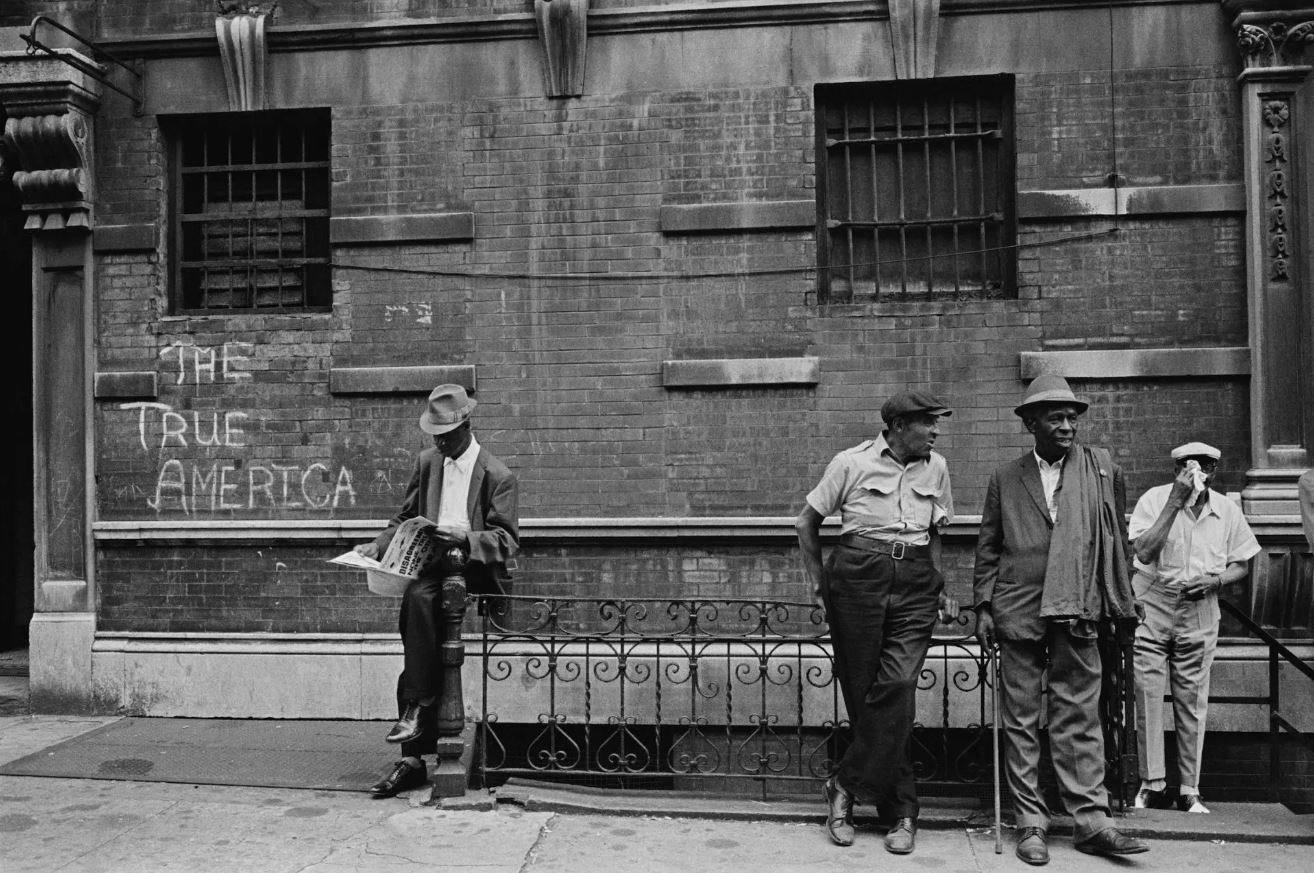
Cole travelled to the South to take photos of poor rural communities but, as far as I can make out, none of these photos have surfaced. For the second project Cole took thousands and thousands of photographs of New York street life, specifically the street life of Harlem, the part of Manhattan Island above 96th Street which was, at the time, almost entirely populated by the Black community. Most are in black and white but about a quarter are in a vibrant but beautifully dated and nostalgic colour.

Harlem, New York City, about 1970 by Ernest Cole © Ernest Cole / Magnum Photos

The rediscovered archive

The introduction to the show comes in the first (small) room. Here we learn from the wall caption that between 1967 and 1972 Cole took an estimated 40,000 photos (!). However, neither the city or rural projects was completed, no book was forthcoming, and Cole released very few of the photos during his lifetime. In the mid-’70s Cole’s life fell into disarray due to illness, he could get no work, he was sometimes reduced to homelessness and lost control of his archive. Surprisingly, despite the highly American provenance of all these images, he spent a lot of time in Sweden where he worked with a photography collective before dropping the medium altogether to take up film-making. He died of cancer back in New York City in February 1990 at the age of just 49.

What’s triggered this revival of interest in his work is that in 2017 a huge trove of his negatives was discovered in a Stockholm bank vault. As a result the Ernest Cole Family Trust was established to publicise and protect his legacy. This helps to explain the impetus behind the recent republication of ‘House of Bondage’ (2022) and the publication, now, finally, of his New York street photos, in a handsome volume titled The True America (2024).

Installation view of ‘Ernest Cole: A Lens in Exile’ at Autograph (photo by Kate Elliott)

‘Photography as a Social Weapon’

In the photo above you can see the small first room through the archway in the middle. In this space are displayed seven photos, the biographical wall label I’ve been quoting from, and a film. The film is a 5-minute clip from a long interview with Cole shot in 1969 and titled ‘Photography as a Social Weapon’. What comes over from this clip first and foremost is what a very charismatic and articulate man he was. But there are two main learnings from the interview:

1. The first is about the model for his vision. Cole tells us that the first ever photobook he got his hands on in South Africa inspired his vision and crystallised what he wanted to achieve. It was ‘People of Moscow’ by Henri Cartier-Bresson and he was inspired by the Frenchman’s way of capturing of the poetry of everyday life.

2. The second is his disillusionment. As he educated himself in South Africa (via a photography correspondence course from England and by meeting artists and musicians) he heard about the United Nations and about the existence of an African-Asian bloc. They’ll save us, he thought; they’ll intervene in South Africa to overthrow the evil apartheid system. But when he arrived in New York he slowly realised that South Africa was just one item on the agenda of its regular meetings, that the same countries stood up and made the same loud criticism of SA, and then the meeting moved onto the next item. Nobody was going to intervene. It was up to Black South Africans to liberate themselves.

And this was part of a broader disillusionment with American society. In the interview he expressed a hope of being liberated from the day-to-day experience of racism which had made life so unbearable in South Africa. But everywhere he went (and the label tells us he visited Chicago, Cleveland, Memphis, Atlanta and Los Angeles, as well as rural areas of the South) he found American Blacks to be poor and oppressed and discriminated against. Eventually he reached the devastating conclusion that Black people in America were no better off than Black people in apartheid South Africa. It was oppression everywhere.

He happened to travel American during the climax of the Civil Rights Movement, in the months either side of the assassination of Martin Luther King (4 April 1968) and in some of the photos captures the way many young Blacks had moved beyond King’s Christian faith in non-violent protest to believing that only direct, and potentially violent, action could liberate them. Hence also one of the best photos, of a proud young Black woman staring unflinchingly into the camera, wearing a lapel badge of herself carrying a submachine gun. Hence the several photos of Black Panthers looking uncompromising.

Black Panthers in the Park, Harlem, New York City 1968 by Ernest Cole © Ernest Cole / Magnum Photos

The main gallery contains 42 photos, 20 in colour and four of them blown up and printed on the wall.  All of them are shots of people in the street, street scenes, a few posed but mostly spontaneous documentary shots. He had such a gift, he had such an eye for capturing people in their variety and humanity. I can’t show them all so will give a verbal summary.

There’s a drunk passed out on the sidewalk, a street vendor selling clams, a smartly dressed Black couple in downtown Manhattan, a kids playing with a hula hoop, another child held by his Dad brandishing a toy popgun. There’s a man wearing a billboard warning against the dangers of Dope!, there’s a couple of guys in African tribal dress sitting on an open-top car obviously going very slowly through a little mob of onlookers and bearing a placard reading ‘Don’t riot. Get wise. Go to Africa.’

In the same spirit there are three or four shots of what appears to be a motorcade of cars carrying placards depicting African leaders, namely Patrice Lumumba of the Congo and Marcus Garvey, the Jamaican politician and activist. As you might expect there are also some very stylish, cool and nattily dressed people: a cool all of woman wearing what I take to be an African outfit in a north African, Muslim style. A very cool dude wearing no shirt, just a loose gold embroidered waistcoat, a loose necktie and a purple hat, smoking a cigar.

Apart from anything else there’s a very strong nostalgic feel about lots of the images. As a boy I watched a range of TV shows from the late ’60s’ and early ’70s which featured not just Black but white hipsters and dudes, everyone wearing shades and cowboy hats and tasselled suede jackets and so on. Many of these photos, putting aside the race issue, evoke nostalgia for the street fashions of half a century ago.

There are hardly any white people in the photos. Two are very negative. One shows a middle-aged businessmen looking contemptuously, maybe angrily, at a Black couple having a snog in the lee of some building work. There’s a highly symbolic shot of a middle-aged Black shoeshine guy on his knees in front of a suited white man who is nonchalantly leafing through a wad of dollar bills – an upsetting emblem of money-colour-power dominating Black poverty and humiliation.

Harlem, New York, 1969 by Ernest Cole © Ernest Cole / Magnum Photos

And nowadays…?

As you walk round, and as you read the wall labels in which Cole described his disillusionment and  growing sense that Blacks are oppressed everywhere, it’s impossible not to ponder the current situation of Black people.

It’s far too big a question for me to handle and, not being Black, my opinion is of questionable use anyway. We now have many Black people in positions of power and position. In the UK not long ago there was a Black Chancellor of the Exchequer and we currently have a Black Foreign Secretary. Black faces are increasingly prominent across public discourse, in the media of TV, film, theatre and art. But how that translates into everyday life, I have no idea. The Guardian reports almost daily of British institutions being called out for institutional racism, racism still (apparently) flourishes in the police, young Black men are five times as likely to be stopped and searched by the cops etc.

I read the news, I watch TV and movies and go to art exhibitions and see more and more Black faces, issues and discussions, but what Black life is like in the UK I haven’t a clue. And that’s just in England, my home country. I couldn’t possibly guess at the situation in the US, except for a) my awareness (like everyone else’s) of the Black Lives Matter movement which sprang up following the murder of George Floyd in May 2020, and b) the fact that all the media I read harp on constantly about ongoing racism and racial injustice in the States.

Anyway, I thought I’d end by mentioning that, in among the many street shots, there are a few more optimistic ones, which depict interracial couples arm-in-arm or hand-in-hand on the New York subway. It’s not much but, in their way, these are the opposite of the standing businessman and the kneeling shoeshine man, these are images of love and equality. If they hardly changed society at large – which, as I’ve just mentioned, appears to remain in many ways horribly unchanged – still, maybe they are images of hope that ordinary people can find their own ways to overcome prejudice and bigotry and to live the lives they want to.

Midtown Manhattan, New York, 1971 by Ernest Cole © Ernest Cole / Magnum Photos


Related links

Related reviews

Yoko Ono: Music Of The Mind @a Tate Modern

‘The only sound that exists to me is the sound of the mind. My works are only to induce music of the mind in people…In the mind-world, things spread out and go beyond time.’

This is a big retrospective of the career of trailblazing conceptual artist Yoko Ono (b.1933):

the UK’s largest exhibition celebrating key moments in Ono’s ground-breaking, influential and multidisciplinary career, from the mid-1950s to the present day.

Featuring over 200 works including instruction pieces, scores, installations, films, music and photography. (In the review blow, indented text is a direct quote from the curators’ wall labels.)

Obviously most people have heard of Ono because of her involvement with one of the great pop and rock icons of the last 60 years, John Lennon, and the central part of the exhibition indeed covers their marriage, peace projects and join musical efforts in some detail.

But the point is that well before Yoko met Lennon (at the Indica Gallery in London on 7 November 1966) she was an established conceptual artist, on equal terms with members of the Japanese, American and British avant-garde, and she continued her artistic activity during and after the Lennon years (1967 to 1980) and has continued to produce stimulating and interesting work right up to the present day, as the exhibition amply demonstrates.

Wish tree

The tone is set before you enter the exhibition proper by a wish tree. These are olive trees with bits of car with string nearby and a box of pens. So you’re asked to write your wish on the piece of card and tie it to the tree. I wished my daughter health and happiness. What would you wish for?

Installation view of ‘Wish Trees for London, 2024’ at Yoko Ono: Music of the Mind at Tate Modern, London. Photo © Tate (Reece Straw)

Ono has been installing variations of the Wish Tree around the world since 1996 and over 2 million wishes have been collected, expressed, wished.

The 1950s

In 1956, aged 23, Ono moved to New York City, eloping with Japanese composer and pianist Toshi Ichiyanagi (1933 to 2022). In 1960, she began renting a loft at 112 Chambers Street in Lower Manhattan. Ono and composer La Monte Young (born 1935) programmed concerts and events there, providing a forum for artists, musicians, dancers and poets. Ono performed in other artists’ concerts and installed her instruction-based paintings for the first time.

After university in Japan, Ono moved to New York where she became part of the city’s avant-garde art scene with impressive speed. There are black-and-white photos of her hanging out in New York lofts with avant-garde luminaries such as John Cage, Robert Rauschenberg, David Tudor and La Monte Young.

Conceptual art can be easily defined as ‘art in which the idea or concept presented by the artist is considered more important than its appearance or execution’. This is amply demonstrated by the work which fills room 1 and is titled ‘Lighting Piece. This consists, first and foremost, of instructions for a very simple action: ‘Light a match and watch till it goes out’.

Like most of her instructions ‘Lighting Piece’ is wonderfully light and simple. I don’t think the curators make a big deal out of it, but it felt to me that this lightness is very connected with Japan’s Buddhism tradition, ‘Imagine the sound of one hand clapping’ or ‘If a tree falls in a forest and no one is around to hear it, does it make a sound?’ – those kinds of things. But hers are wonderfully light and original.

Just as characteristic is the way that ‘Lighting Piece’ actually consists of not one but three elements: the original instruction, a performance and a film. Because not only did an unknown number of people follow the written instructions, but one man filmed it. Hence ‘Film Number 1 (MATCH)’ / Fluxfilm Number 14 (1966).

Under Ono’s direction, photographer Peter Moore captured the striking of a match using a high-speed camera, shooting at 2,000 frames per second. Played back at the standard rate of 24 frames per second, the action unfolds in super slow motion, taking 5 minutes and 4 seconds.

It’s one thing seeing it on a little screen, here, quite another watching it projected onto a whole wall.

[A few days later I was reading Walter Benjamin’s collection of essays and came across this quotation from Paul Valéry which seems apt: ‘The invention of the match around the middle of the nineteenth century brought forth a number of innovations which have one thing in common: one abrupt movement of the hand triggers a process of many steps.’]

If you find this idea and film funny or entrancing or calming and meditative, then you’ll love the rest of the exhibition.

In July 1961, Ono’s first solo exhibition opened at AG Gallery in Manhattan. ‘Paintings & Drawings by Yoko Ono’ included more than fifteen Instruction Paintings which were realised through the participation of the artist, visitors or the environment.

There are 200 pieces so I can’t list them all. Another characteristic piece is ‘Painting to Be Stepped On’ (1961), a piece of fabric covered in paint and placed on the floor so that visitors can…step on it. In a similar vein a piece of painted fabric on the floor with a plastic bottle full of water suspended above it with a very very tiny leak. Every now and then a drop of water falls onto the fabric below and you are invited to watch the dark stain of the moisture very slowly spread across the fabric (Waterdrop Painting, 1961).

Early music

Alongside her exhibitions in New York and Tokyo, Ono staged concerts and events. These included periods of complete darkness, electronic sounds and performers with contact microphones taped to their bodies. She brought an element of the absurd and irreverent to her concerts in New York by intermittently playing the amplified sounds of a flushing toilet. Ono titled this work Toilet Piece. Her concerts in Tokyo included The Pulse, in which performers made sounds while tackling mathematical problems on stage, and Audience Piece to La Monte Young, where performers stared at the audience until the audience left.

Instructions for paintings (1961-2)

A list of 20 or so small cards arranged along one wall on which are typed typical instructions.

To avoid the emotion of her own handwriting, and unable to acquire a Japanese typewriter, the instructions were neatly handwritten in Japanese by Ono’s husband Toshi Ichiyanagi. They were shown in the lobby outside Ono’s first concert in Japan in 1962.

My favourite was ‘Waterdrop painting’:

Let water drop.
Place a stone under it.
The painting ends when a hole is drilled in the stone with the drops.
You may change the frequency of the waterdrop to your taste.
You may use beer, wine, ink, blood, etc. instead of water.
You may use typewriter, shoes, dress, etc. instead of stone.

I liked the way it starts out being fairly clear and categorical and then deconstructs itself as you read on until, in the last sentence, all the specificness vanishes into air.

Strip tease

In New York in 1964, Ono held a farewell concert entitled Strip Tease Show, featuring Cut Piece, Bag Piece and Striptease for Three. To ‘strip’, she explains, means ‘not to reveal to others’ but to ‘discover something hidden in humans’ and a ‘stripping of the mind’.

In ‘Striptease for Three’ three chairs are placed onstage and remain there for the audience to stare at until either the curtain was drawn or the chairs removed. The exhibition features three chairs arranged on a dais to recreate the moment.

Installation view of ‘Striptease for Three’ at Yoko Ono: Music of the Mind at Tate Modern (photo by the author)

Cut piece (1964)

This one gained notoriety because of the element salaciousness. Ono sat onstage and invited members of the audience to come up and, using the scissors provided, to cut away her clothes. There’s a video of one performance.

(This reminded me of the retrospective of Serbian conceptual artist Marina Abramović held at the Royal Academy last year, and the work she titled ‘Rhythm 0’. In this Abramović presented herself as an object to be acted upon. She stood motionless for eight hours alongside a table of 72 implements capable of being used for pain or pleasure, for the public to use on her as they wished. I wondered if they were contemporaneous but the Abramović piece is from 1974, so Ono is by far the pioneer.)

Bag piece

In the same room visitors are encouraged to perform ‘Bag Piece’. On the wall are hanging half a dozen black bags and you are invited to take your shoes off and have the gallery assistant put one of these big black fabric bags over you, covering your entire body. Then you can do what you like which, in my case, was make as many funny shapes with your arms and legs as you could think of.

Installation view of ‘Bag Piece’ at Yoko Ono: Music of the Mind at Tate Modern (photo by the author’s friend)

Painting to Shake Hands (concept 1961, first realised 1962)

Drill a hole in a canvas and put your hand out from behind.
Receive your guests in that position.
Shake hands and converse with hands.

In case I haven’t mentioned it before, a central part of the show or experience is that it’s funny. Lots of the instructions make you smile and the interactive activities make you laugh. In the next room is a big fabric freestanding in the middle of the room and she’s punched a hole through it. The idea is you put your hand through it and shake hands with someone on the other side without being able to see who they are. While I was watching a youngish coupe did this, smiling and fumbling, and then two fairly young kids had a go, squealing and giggling as they played with each other’s outstretched arms and hands. It’s fun.

Shadow Piece (concept 1963, first performed 1966)

Put your shadows together until they become one.

As is the piece behind it where a simple light projector is pointing at a wall with a whiteboard on it, next to it a box of felt tip pens. The idea is that you pose midway between light and board and so create a shadow silhouette and someone else draws round your shadow. Having had a go I can tell you that it turns out to be really challenging to hold a completely still pose long enough for someone else to draw round your silhouette…a comment on the restless movement and activity of us all, of life.

Grapefruit

During this period, Ono met and married US filmmaker Anthony Cox (born 1937). Between 1963 and 1967, Cox helped produce and promote Ono’s activities in Tokyo, New York and London.

Ono and Cox’s daughter, Kyoko, was born in Tokyo in 1963. During this time, Ono continued creating instructions and performed some of them in public. In 1964, she published Grapefruit through her own imprint, Wunternaum Press. It includes more than 200 instructions divided into five sections: music, painting, event, poetry and object. Each instruction is dated by the year of its conception, from 1953 to 1964.

Grapefruit is, apparently, considered a cornerstone of conceptual art so there is a fair bit of documentation around it, typescripts, notes etc, as well as a series of the actual instructions. These are very short, somewhere between a poem (not unlike the Japanese haiku in that they are designed to be meditated on. At the same time they are like very small musical scores, in that they are designed to be performed. Except that, being ‘conceptual’, many of them can only be performed in the mind. Which brings us back to the idea of a poem.

You can still buy Grapefruit online.

Records of interventions

there are records of lots and lots more interventions and activities, such as, in Tokyo during the 1964 Olympic Games, leaving random roses on cafe chairs, on the pavement , on parked mopeds. Or selling shards of broken milk bottles in Tokyo, each labelled with a date and time to represent a future morning.

Painting to Hammer a Nail (concept 1961, first realised 1966)

Another piece that visitors can interact with is hammering a nail into a board.

Hammer a nail into a mirror, a piece of glass, a canvas, wood or metal every morning.
Also, pick up a hair that came off when you combed in the morning and tie it around the hammered nail.
The painting ends when the surface is covered with nails.

This was the piece over which Ono and Lennon bonded. It was included in the exhibition ‘Unfinished Paintings & Objects by Yoko Ono’ held at the Indica Gallery in London in 1967. The gallery was a cultural hub run by artist John Dunbar, which attracted figures in the worlds of art, literature and popular music. Dunbar introduced Ono to Lennon who proceeded to offer her an imaginary five shillings to hammer an imaginary nail into the board. Ono later said, ‘I met a guy who plays the same game I played.’

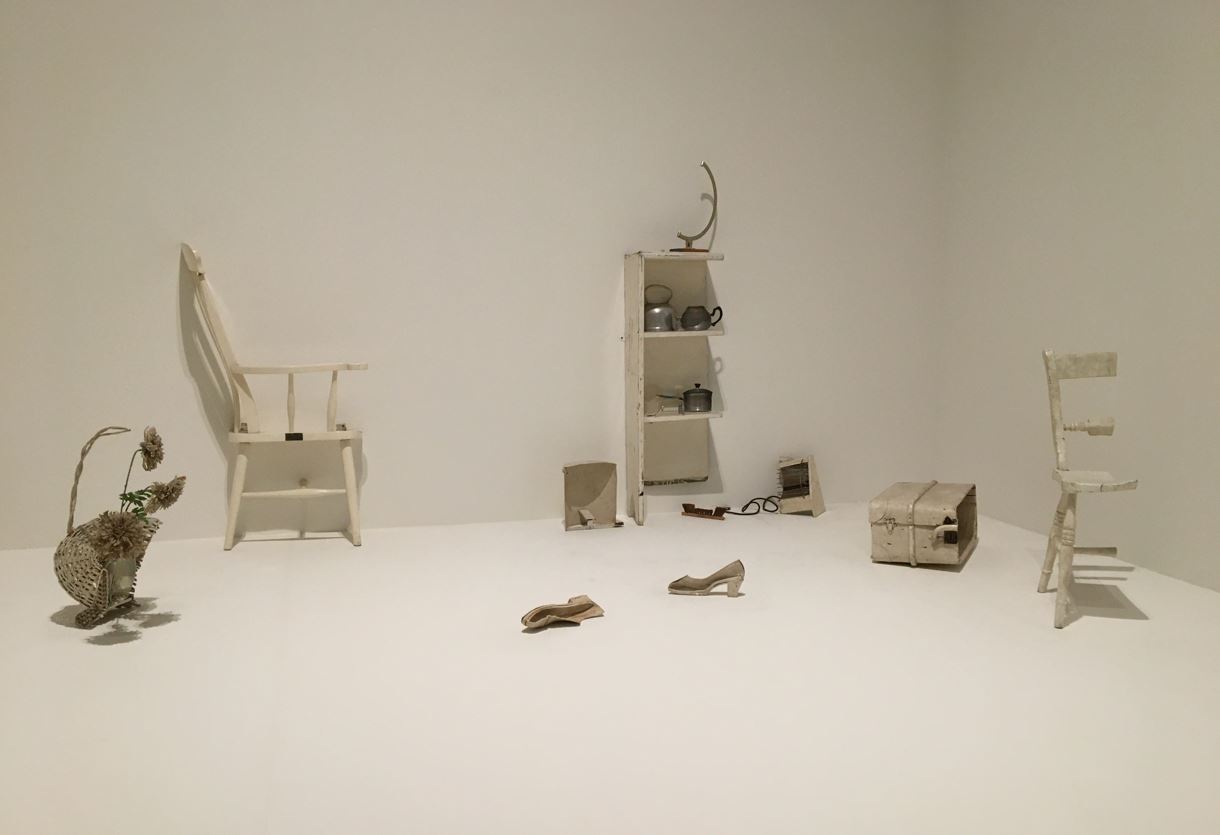
With the entry of Lennon onto the scene everything changes. There are a few more independent pieces, such as the amusing Half-A-Room (1967), 29 domestic objects cut in half and painted white, which is recreated in its entirety here.

Installation view of ‘Half a Room’ at Yoko Ono: Music of the Mind at Tate Modern (photo by the author)

Or ‘Lion Wrapping Event’, a 26 minute film of wrapping one of the lions in Trafalgar Square in fabric. Or For ‘Promise Piece’ where she smashed a vase with a hammer, inviting audience members to take a piece and promise to return in 10 years to put it back together.

Or Film Number 4 (Bottoms) which edits together close-ups of 200 wobbly bare bottoms. In fact it feature the bottoms of lots of members of the London art scene of the time and features snatches of conversation between Ono and her then husband Anthony Cox.

The film was refused a certificate by the British Board of Film Censors and there’s photos of Ono protesting outside their offices, ‘It’s just part of the human anatomy, there’s nothing rude or sexy about them’ – the touching belief of 1960s idealists that getting naked would solve all the world’s problems from ending the war in Vietnam to abolishing sexism.

But the focus of the next few spaces is the John and Yoko collaboration which became such a big deal from about 1969 onwards.

The late 60s/early 70s peace and politics

A dream you dream alone is only a dream.
A dream you dream together is reality.

One area is devoted to their highly publicised peace projects. There’s a case showing how, on 15 June 1968, the couple planted acorns in the ruins of Coventry Cathedral – famously gutted by German bombing – one person facing east and one facing west to symbolise unity across the world.

In 1969, following their wedding on 20 March, the couple posted an acorn to 96 world leaders, asking each recipient to plant their own acorn for peace. The display case here includes formal replies from three leaders being the King of Malaysia, Prime Minister Golda Meir of Israel and the President of South Africa. They’re all polite but the South African president Jim Fouché wins by promising to plant the acorns on his farm. I wonder if they did. I wonder if they grew. I wonder if they’re still there.

Bed peace

One alcove is dominated by an hour-long film made of the couple’s famous publicity stunt, ‘Bed Peace’. The couple hired a room at the Amsterdam Hilton Hotel in March 1969, immediately after their wedding, and invited the world’s press to come and interview them, during which they, of course, promoted their cause of world peace.

Three months later they staged another bed-in at the Queen Elizabeth Hotel in Montreal from 26 May to 2 June and were more prepared this time. They made sure to be attended by celebrity fans and hangers-on and Lennon had written a song, which he performed live and was recorded, ‘Give Peace a Chance’. Tidied up in the studio and released, it quickly became an anthem of the huge anti-Vietnam War protest movement, being sung by a quarter of a million demonstrators against the Vietnam War in Washington, DC, on 15 November 1969.

In December the couple paid for billboards in 10 cities around the world which declared, in the national language, ‘War Is Over! If You Want It’ and there’s a striking photo of one of these on a billboard in Piccadilly Circus.

‘War is Over! (if you want it)’ poster on Shaftesbury Avenue 23 December 1969 as shown in Yoko Ono: Music of the Mind at Tate Modern (Photo by Evening Standard/Hulton Archive/Getty Images)

(I was struck not by the peace poster but by the cinema hoardings for the films ‘The Lion in Winter’ and ‘On Her Majesty’s Secret Service’ – great month for films!)

Two things:

  1. You can see how the concept and even the name Bed Piece follows on perfectly from all Ono’s previous concept pieces of the 1960s, being the performance of a simple concept (‘Get in bed and wish for peace. Invite the world’s press to watch you’)
  2. How Yoko was now operating in a completely different realm. These weren’t small exhibitions in out-of-the-way art galleries, but statements made in the full glare of the world’s media, this was a completely new stage.

This exhibition devotes an alcove to showing on a wall-sized screen the film which was made of the Montreal bed-in, ‘Bed peace’ (1969) a 16mm film lasting 1 hour 10 minutes, directed by John and Yoko and filmed by Nic Knowland. This appears to be available in its entirety online, so make your own mind up. As usual, seeing it projected on a whole wall is quite a lot more immersive and absorbing than watching it on a computer (or phone).

Yoko Ono’s music

Ono’s involvement with Lennon brought her into the orbit of the music business with mixed results. Previously she had been involved in highly avant-garde music making, working with the conceptual composer John Cage and his pianist David Tudor, staging performances which often included music, or the concept of music, or sounds of various kinds, and so on.

Now she was thrown into the orbit of maybe the most famous pop start in the world (jostling alongside Elvis and Bob Dylan).

The results are very mixed and surprisingly copious. Lennon created a pickup band in New York which they called the Plastic Ono Band which played gigs and benefits in New York at the end of the 1960s and early 70s. In lots of these Yoko added her trademark caterwauling-crying-screeching sounds which can be hard to listen to, especially when set in a fairly traditional rock context. As a student I had all the Lennon albums and couldn’t help skipping over Ono’s screechy bits. See if you can listen to this track all the way to the end. If you like it, there’s plenty more along the same lines.

There are headphones for visitors to listen to some of these concerts and in among the Plastic Ono tracks there’s a recording of her practicing for a gig with Ornette Coleman, the godfather of avant-garde jazz. Now this is interesting. Yoko makes vocal sounds and Coleman picks them up and echoes them on the soprano sax, with a band which is used to playing highly irregular improvised rhythms. I couldn’t help thinking that Ono’s entire approach to vocalising was best suited for this kind of avant-garde jazz setting rather than the limited formulas of rock music.

Anyway, that’s only the introduction, an appetiser, as it were to Ono’s musical career. Because the exhibition features an alcove whose wall is covered with old-fashioned LP covers of every album she’s ever made and it’s an impressive number, somewhere between 20 and 30 I’d guesstimate. The alcove contains seven or eight (very comfy) chairs each with headphones next to it and an interactive screen with a menu of all her albums and then of individual tracks (not every track – 3 or 4 from each album) and you are encouraged to make yourself comfortable and listen a selection of her music from the past 50 years.

Lennon retires

Probably most (middle-aged) people know the story that, after the breakup of the Beatles Lennon produced 6 solo albums but by the mid-1970s had had enough of the music business. Also Yoko finally gave birth after a series of miscarriage, to the boy they named Sean, in October 1975. So Lennon formally announced his retirement from the music business, turned his back on all of that and became a househusband in their New York apartment.

Double Fantasy

Again as most people probably know, Lennon then surprised everyone by, after five years of complete silence, suddenly releasing a brand new album of music in 1980, Double Fantasy.

Three points:

1. According to the Wikipedia article Lennon lacked confidence about the songs and arrangements, feeling he’d lost touch with the whole music scene. He was not wrong. As an ageing fan I was delighted by the appearance of Double Fantasy but it felt instantly nostalgic. It was music from another time, from the previous generation. Music fashions had continued to move as fast as they had in Lennon’s heyday in the 1960s, with glam rock flowering alongside disco, followed by punk, post-punk, synthpop and new Romanticism, and the new genres of Industrial and Goth being defined just as Lennon’s album was released.

It felt like a message from your mum and dad, from a happily married couple enjoying a second honeymoon – which was nice but nothing to do with the exciting young life you were leading. One of the critics called it ‘studio rock’, average material lifted by being performed by top session musicians and expertly produced and utterly soulless.

2. Double Fantasy carefully alternated songs by Lennon with tracks by Ono. Here’s a typical Ono track. Is she having an orgasm at the end?

3. The reason for dwelling on all this is that Double Fantasy is, in effect, the doorway, the gateway into the rest of Ono’s career and the ten or so albums which followed (as well as eight compilation and remix albums). Hence the wall covered in album covers, hence the chairs and headphones.

Yoko’s post-Lennon music career

I listened to a couple of tracks from the five or six albums following Double Wedding and didn’t like any of them. They all feature 1) heavy-handed over-production, with thumping drums and obsolete rock guitar of the worst kind; 2) her would-be poetic lyrics which are, in fact, tritely autobiographical – compare and contrast with any Dylan lyric; 3) her weak voice. If you like it, fine, but her music was never popular, in any sense.

Summary

The point is that for the first time in the exhibition, it felt like Yoko had fallen behind the times. In 1955, 1960 or 1965 she was out ahead of the curve, inventing ideas, methods, events, happenings, stagings, films and performances which stretched and defined the meaning of all those forms and of ‘concept art’. The peace activism with Lennon also set the tone of those last years of the 1960s, moved the avant-garde into the world of tabloid newspapers and TV, invented a new form of art-media-political performance and spectacle.

But by 1980 all that feels long over. And to focus on the music, she committed herself to the most deeply unexperimental, dead and dinosaur kind of Adult Orientated Rock, Dad Rock complete with thumping 1980s drums and air guitar solos. So unimaginative, uninnovative and unlistenable-to that I found the tracks I listened to were embarrassing.

But there’s no accounting for taste. I was astonished to read the curators’ take on her musical career.

Known for her ground-breaking early work and use of experimental vocalising techniques Ono is also recognised as one of the most prolific songwriters of the last century. This playlist highlight’s Ono’s output as a singer songwriter in more conventional pop-rock and electronic structures. It also includes collaborations with other musicians on remixes of her own music.

Then again, to be slightly cynical, this exhibition was obviously staged with Ono’s active support and maybe she sees her musical career as valid and important and worthwhile as her artistic work and so insisted it was included.

Hiatus and modern reprise

As far as I could tell there’s nothing here from most of the 1980s or 1990s. At some point in the 1970s the wave she’d helped to create and had surfed so skilfully from about 1955 to, maybe, 1975, hit the beach and expired. So, as far as I could tell, there’s a big chronological gap in the works here.

And then, in the final couple of exhibition spaces, Ono’s career revives with a new kind of work from the late 1990s. They are far fewer, bigger and far more professionally produced than the charmingly rackety, black and white, home-made experiments and happenings from the 60s and 70s.

They are recognisably high concept art works but executed with the high professional finish of advertising campaigns. Thus:

Helmets (Pieces of Sky)

Take a piece of the sky.
Know that we are all
Part of each other.

This consists of 15 or so World War Two German helmets suspended upside-down from the ceiling, and each one contains pieces from a jigsaw of blue sky and clouds. Visitors are encouraged to take a few pieces of the sky home with them. Personally, I’d have liked to make the jigsaw, asking other visitors who were interested to upend all the pieces onto the floor and then trying to make the sky together. But maybe a bit too subversive and participatory for more sleek and slick late-period Ono.

Helmets (Pieces of Sky) by Yoko Ono (2001) from ‘Between The Sky and My Head’ at Baltic Centre For Contemporary Art, Gateshead, 2008. Photo © Baltic Centre for Contemporary Art

There are some abstract paintings and a series of drawings she’s made in a kind of pointillist style, putting dots on paper as doodles which slowly take shape. They’re quite nice.

Add Colour (Refugee Boat) (concept 1960, execution 2024)

Just blue like the ocean.

By far the most dramatic piece is the entire room dedicated to the refugee boat. This was pure white and place in a nicely boat-sized room painted pure white when the exhibition opened. And there’s a table with a couple of trays of felt-tipped pens, white, blue and darker blue. And visitors are invited to draw or write whatever they want.

Before

‘Add Colour (Refugee Boat)’ by Yoko Ono at ‘Yoko Ono: Music of the Mind’ at Tate Modern, London, 2024. Photo by Reece Straw © Tate

After

‘Add Colour (Refugee Boat)’ by Yoko Ono (concept 1960, execution 2024) at ‘Yoko Ono: Music of the Mind’ at Tate Modern, London, 2024 (photo by the author)

As the curators put it:

Ono invites us to consider the impact collective action can have. The work encapsulates her belief in human agency and her understanding that ‘we are sharing this world’ and sharing our responsibility for it.

What struck me was rather different from this intention, which is how samey people are. For a start we’re all about the same height which explains why the band of wall about five feet high has been overwritten so much as to become an indecipherable sprawl of deep blue. If there are any individual messages there, they’re hard to read. More legible are things written or drawn ether lower down or, especially, higher up.

but people aren’t very original, either. As you can see the biggest single message is an enormous FREE PALESTINE and there are various other expressions of support for Gaza etc scrawled throughout. Then there are lots and lots of messages about love and hope and the planet and hope and love etc.

The problem with the notion of ‘human agency’ is that when you get a lot of these human agents together they generally behave in highly predictable and formulaic ways. That’s what the epidemiology or actuarial science, social media algorithms and AI are based on. I’m sorry to be the one to say it but all the evidence suggests that the notion of ‘human agency’ Ono is promoting is grossly over-rated.

My Mommy Is Beautiful (1997)

Write your thoughts of your mother.
Or pin a photograph of her to the canvas.

The same kind of participatory invitation is at play in the penultimate piece in the show, another invitation for visitors to write a message. So there’s a trestle table piled with cards, as for the Wish Tree, and a tray of pens, and we are invited to write a message or thought about our mothers and tape them to the wall which is, of course, absolutely festooned.

What the visitor doesn’t at first realise is that suspended from the ceiling in this space are a set of photographs of breasts and vulva.

Installation view of ‘My Mommy is Beautiful’ looking up at the photos suspended from the ceiling at Yoko Ono: Music of the Mind at Tate Modern (photo by the author)

Why?

Suspended at height, a series of photographs embody Ono’s humour and humanity. She comments: “One has to look up at the vagina and the breasts on the ceiling – rather like looking up at your mom’s body when you are a baby.”

Once again, as with the Wish Tree and Refugee Boat, the sentiments written by visitors are overwhelming predictable and sentimental (‘I love you Mum’, ‘I never appreciated you Mum’) alongside some occasionally impressive drawings. Purely as relief from the Clinton Cards cloying messages, I liked the one that read ‘My mother was a selfish bitch’, which felt like a rare bit of honesty and truth.

Whisper

If there was any doubt about the importance Ono gives to her musical career this is put to bed by the fact that the very last piece in the show is a music performance. It’s a ten-minute film of her performing at the Sydney Opera House on 17 November 2013. It doesn’t appear to be available online, which is a shame because it showed how the technology had caught up with her style. What I mean was that her voice was looped so whether breathing, sighing, moaning, wailing or screaming, she could play off the looped repetition of herself, and this was interesting (up to a point). Just her experimenting with her voice was good because it had range and variety.

However, go on YouTube and you can find loads of her performances in a rock context which, as I’ve explained, feel reactionary and backward-looking. In the past 50 years popular music has gone through an unbelievable series of fashions, changes and evolutions but not in Yokoworld. In Yokoworld it’s still 1971 and that’s why in something like this performance with her and John’s son Sean on guitar, it feels embarrassingly like watching someone’s home video. Embarrassingly bad…

Summary

This is an excellent exhibition which gives a really good overview of an amazing career. The first half of the show (1955 to 1967) is fascinating, funny, light and inspiring in a charmingly ramshackle home-made video, home publishing kind of way. All those Zen instructions are genuinely mind-opening and smiley.

The Lennon interlude is highly redolent of the late 60s, the Beatles late period and all of that, just as it all began to fall apart.

The wall of Ono albums you can, if you like, just read about and skip, unless you want to hear lots of 1980s AOR, all big shoulder pads and synth drums backing weedy voice and run-of-the-mill lyrics.

And then, after a big gap, there’s the final handful of works – the big ones like the helmets, ship and Mommy wall, and the more discreet series of drawings and paintings which are easy to overlook but quite nice…

What a life! What a career! But also what a fascinating review of the parabola of ‘art’ in the second half of the 20th century, from the genuine avant-garde staging of silly performances in dingy lofts and obscure galleries, then getting involved with the Swinging Sixties drugs and hedonism and fake revolution, then lingering on into the cocaine addiction and bad clothes of the depressed 70s, then justifiably falling silent and then…returning in the form of highly produced, highly finished, slick presentations.

Recognisably the same motivation and the same ‘political’ messages (peace, I love you all) but slickly packaged for the cable TV, then internet, and now social media ages. Clever, slick, virtue signalling which we have discovered, alas, changes nothing because it’s preaching to the converted – to like-minded liberal gallery goers who write ‘Help the refugees’ and ‘I love you mummy’ on gallery walls, while outside, in the real world…

In a way art galleries are safe spaces for certain kinds of like-minded, sentimental liberals who can huddle together and agree that, if only the world thought like us, it would be such a better place. But it isn’t. Trump. Putin. Xi Jinping.


Related links

Related reviews

Lee Krasner: Living Colour @ Barbican Art

‘I like a canvas to breathe and be alive. Be alive is the point.’ Lee Krasner

On 11 ‎August 1956 the world-famous artist and leader of the school of Abstract Expressionism, Jackson Pollock, crashed his Oldsmobile convertible while driving drunk. His wife of 11 years, Lee Krasner, also an accomplished artist, heard the news while away in Europe, and hurried home to New York to sort out the arrangements for his funeral and Pollock’s affairs.

Lee Krasner at the WPA Pier, New York City, where she was working on a WPA commission (about 1940) Photo by Fred Prater

She moves into the big barn

Ten years earlier, and soon after marrying (in 1945), the couple had moved to the Springs area of East Hampton on the south shore of Long Island, and bought a wood-frame house and barn, which they converted into studios.

Of the buildings at their disposal, Pollock had early on nabbed the biggest available space – the barn – as a studio, and it was here that he created many of the masterpieces that made his name in the later 1940s and early 1950s. Sometime in 1957, the year after his death, Krasner moved Pollock’s paints and equipment out of the big barn and her own stuff in, and began to paint in the largest space she’d ever had at her disposal.

The result is a decade’s worth of quite extraordinarily powerful and enormous abstract paintings which make up the core of the major retrospective of Lee Krasner’s art, which is currently being held at the Barbican Centre in London. They are absolutely stunning. Breathtaking. Wonderful. Huge!

Installation view of Another Storm (1963) by Lee Krasner at the Barbican. Photo by the author

A light and airy space

For this exhibition the Barbican has removed some of the partitions which usually divide up the main ground floor exhibition space, and also removed some of the temporary walls which previously concealed wall-sized windows in the exhibition shop and at the end of the main gallery. The combined effect of this decluttering is to make the big central space (technically ‘room 10’ of the exhibition) feel long and bright and airy. From the moment you arrive at the ticket desk, the new lighter, brighter space feels like the perfect environment in which to hang Krasner’s huge and awe-inspiring works.

It is a genuinely uplifting and life-affirming experience to wander among these paintings, I felt like a mortal wandering dazzled through a mansion of the gods.

Siren by Lee Krasner (1966) Hirshhorn Museum and Sculpture Garden, Smithsonian Institution © The Pollock-Krasner Foundation. Photo by Cathy Carver

Her early years in self portraits

The exhibition is arranged in broadly chronological order, and you are directed to start on the upper floor of the Barbican galleries, which houses eight living-room-sized spaces. These eight rooms take us from Krasner’s birth, in 1908, in New York, into a family of Orthodox Jewish Russian émigrés, and onto the early art school training she got (at the Women’s Art School at Cooper’s Union, Art Students League, National Academy of design. From her student days there’s a room of self-portraits in oil, which are OK.

Nudes classical and modern

After the Wall Street Crash of 1929 (when she was 21) Krasner began training as a teacher and attended life school classes. On one wall of room four are the extremely accomplished nude studies she did in the style of the Renaissance Masters in 1933 – very accomplished, very traditional. On the opposite wall is a selection of charcoal nudes she did just six years later, in 1939, which are completely different in style, riven by big abstract angular lines, showing a complete assimilation of European modernist trends.

By 1942 she was a respected member of New York’s artistic community. She had been included in an exhibition of contemporary painting in New York alongside friends Willem de Kooning and Stuart French. Piet Mondrian admired her work. As a result she was given a number of commissions by President Roosevelt’s Public Works of Art Project, including a job to oversee the design and execution of twenty department-store window displays in Manhattan advertising war training courses. She adopted a cut-up-and-paste collage approach, and room five shows blow-ups of photos of these wartime artworks. Well, sort of interesting as a) social history b) if you really a completist looking for evidence of every step of her artistic development.

The Little Images

She knew most of the exhibitors in that 1942 show except one, a guy named Jackson Pollock, so she dropped round to his Greenwich Village studio to seek him out and say hi. One thing led to another and they were married in 1945. They moved to the farm on Long Island and, in the winter of 1947, Krasner embarked on what became known as the ‘Little Images’ series, abstract paintings made up of tightly meshed squares and shapes which some critics described as ‘hieroglyphic’. Rooms one and two kick off the show with some fine examples of these ‘Little Images’ and it’s amazing what a variety of design and visual effect you can achieve from such a seemingly simple premise.

Composition (1949) by Lee Krasner © Philadelphia Museum of Art

The collage paintings

Krasner was given her first one-woman show at the Betty Parsons Gallery in October 1951. The work didn’t sell and, although she began a new series soon afterwards, she quickly became despondent and ended up tearing some of the new work to shreds in frustration.

Weeks later, returning to the studio, she realised that the torn strips lying about on the floor got her juices flowing. Quickly she began incorporating them into a new series of collages. She layered pieces of fabric over the paintings shown at the Betty Parsons show, adding pieces of burlap, torn newspaper, heavy photographic paper and some of Pollock’s discarded drawings. The resulting ‘collage paintings’ were exhibited in another gallery show in 1955, and there are several rooms of them on display here.

Blue Level (1955) by Lee Krasner © The Pollock-Krasner Foundation. Photo by Diego Flores

Strikingly different from the ‘Little Images’, aren’t they? The very tightly-wound hieroglyphs of the Images are completely different from the violently torn strips of the collages.

Prophecies

In the summer of 1956 Krasner began work on a new series. The dominant tone of pink made me think of human flesh and nudes, but nudes severely chopped up and filtered via Demoiselles d’Avigon-era Picasso.

The first example of this new style was on Krasner’s easel when she left for France that summer. In the first half of their marriage, her husband’s career had gone from strength to strength, peaking around 1951, as he became world famous for his ‘drip paintings’, getting on the front cover of Time magazine, promoted by the American government as a home-grown genius, snapped up by collectors. But when, after 1951, Pollock tried to change this winning formula, he met with incomprehension and sales slumped. Pollock lost confidence, his drinking increased, he began an affair, which Krasner knew about, in early ’56.

That was the troubled background to the first of these flesh paintings and then – mid-way through her visit to Europe, she got the call that he had died in the car crash. Just weeks after the funeral, Krasner returned to the style and quickly made three more big, torn-up flesh paintings which she titled Prophecy, Birth, Embrace and Three In Two.

In the last room of the first floor of the exhibition, these four paintings are reunited, one hanging on each of the four walls, and it is impossible not to be powerfully affected by their eerie, agonised power.

Prophecy (1956) by Lee Krasner © The Pollock-Krasner Foundation. Courtesy Kasmin Gallery, New York. Photo by Christopher Stach

The night journeys

So Jackson dies and Lee moves into the big barn studio and she is afflicted with insomnia and can only work at night, and she decides not to use any colour in her new paintings because she prefers to judge colours by daylight – and so, from the late 1950s, Krasner began to make a series of paintings combining just black and umber and creamy white onto huge, unstretched canvases.

Wow! These are great swirling, turd-coloured pieces, full of energy and despair. A poet friend of hers labelled them ‘Night Journeys’ and to follow any of the angled, curved or circular lines which strike across the surface is, indeed, to go on a churning, bitter journey though a landscape in torment.

Polar Stampede (1960) by Lee Krasner. Doris and Donald Fisher Collection, San Francisco MoMA © The Pollock-Krasner Foundation. Courtesy Kasmin Gallery, New York.

Krasner exhibited these big brown works in 1960 and 1962 to critical praise, and half a dozen of them dominate the first half of the enormous ground floor space in this show. You can stand in front of them, or there are benches where you can sit down, meditate on them, and be drawn into their drama and action.

Primary series

But the jewel in the crown is the Primary series. In the early 1960s Krasner replaced umber with a range of vivid primary colours. When she broke her right arm in a fall, she taught herself to work with her left, squirting paint directly from the tube, using her right hand to guide the movements.

Critics often use the word ‘gesture’ or ‘gestural’ but in this case it really is justified. As you follow the great sweeping arcs and patterns of paint, and note their dribbles and dynamic interactions, you can almost feel and see the great sweeps of the arm they must have required, the leaning of the whole body, the straining, the movement from one zone of focus to the next. They are extraordinarily vibrant and exciting paintings.

Icarus (1964) by Lee Krasner. Thomson Family Collection, New York © The Pollock-Krasner Foundation. Courtesy Kasmin Gallery, New York. Photo by Diego Flores

I couldn’t get enough of these paintings. I wandered up and down the central room, enjoying all the views of the works offset against each other, glimpsed behind the one central supporting wall of the main exhibition space, addressed front on, strolled past, studied up close, looked at from the other side of the room.

Wow! What a space, and what works of staggering brilliance to fill them with!

Later works

The Umber paintings and the Primary series cover the decade from the late 50s to the late 60s. What a brilliant decade it was for her.

Then, in 1968 Krasner discovered a stash of handmade paper in the farmhouse, and decided to make a new series of works, on a much, much, much smaller scale. She decided to experiment by making each of these small, crafted works from just one or two pigments. A dozen or so of them are in a room off to one side (room 11).

They require a completely different way of looking. Much more conventional in size they require the viewer to step forwards and examine the detail, rather than step back and admire the scale, as with the Primary series.

The dozen or so examples on display here are all lovely – free-spirited dances of colour, and interplays of defined brushstrokes against broader washes, all given a wonderful background texture by virtue of the expensive paper they’re painted on.

Untitled (1969) by Lee Krasner © The Pollock-Krasner Foundation. Courtesy Kasmin Gallery, New York

In the early 1970s, Krasner made a significant step change in style. Still completely abstract, her works changed from soft biomorphic shapes to hard-edged abstract forms. I found them a shock to the system after the huge works in the central hall.

I liked even less the works in the final room, dating from 1974. In that year she stumbled across a portfolio of work from her art school days, the kind of angular nude studies which we saw examples of way back in room four.

Now Krasner took a pair of scissors to these early studies and cut them up into jagged shapes. Most of the source material was black and white drawings, but she interspersed some coloured strips into the collages, and also left other areas blank, apparently ‘echoing the empty space around the nude model’ which had served as the subject for many of the original drawings.

They were exhibited in 1977 under the title Eleven Ways To Use The Words To See. I didn’t warm to them.

Imperative (1976) by Lee Krasner © The Pollock-Krasner Foundation. Courtesy National Gallery of Art, Washington D.C.

No, I went back up to the first floor and walked back through the eight rooms soaking up the evolution of those early works and admiring, in particular, the ‘Little Images’ series. And I revisited the rooms holding these later 1970s works, trying to give them the benefit of the doubt – but all the time I just wanted to go back into the massive main gallery space and be swept off my feet and ravished all over again by the huge, vibrant, dancing works of the 1960s.

Summary

This is the first European retrospective of Lee Krasner’s career for over 50 years. It brings together nearly 100 works from some 50 galleries, institutions and private collections. It must have been a labour of love to assemble them all, and was totally worth it.

The exhibition ends with a 15-minute video made up from various interviews with Krasner towards the end of her life. She was one tough lady, and she told it like it was, still, in her 70s, harbouring a bitter resentment at the sexism of the New York art world which she had to combat all her career.

If you start reading up about her life you quickly find people claiming that, far from being overshadowed by her famous husband, Krasner was in fact the driving force behind his career. And, from some of the interviews, you get the impression that, having seen what really high-profile high pressure publicity did to an artist (Pollock), she was quite content to avoid that level of scrutiny, and just get on with what she loved doing.

The publicity material accompanying the exhibition quotes the playwright Edward Albee commenting at her memorial at the Metropolitan Museum of Art, that in both her life and her work, Krasner ‘looked you straight in the eye, and you dared not flinch’.

That seems a perfect description of both a tough lady, and of her extraordinarily resolute, exuberant and unsentimental art.

A short film about Lee Krasner


Related links

Other Barbican reviews

Jailbird by Kurt Vonnegut (1979)

The most embarrassing thing to me about this autobiography, surely, is its unbroken chain of proofs that I was never a serious man. I have been in a lot of trouble over the years, but that was all accidental. Never have I risked my life, or even my comfort, in the service of mankind. Shame on me. (p.178)

This is Vonnegut’s ninth novel, published 27 years after his first, Player Piano (1952).

A hell of a lot had happened in those years – most of the 1950s, the entire 1960s and most of the 1970s – sex and drugs and rock and roll, the swinging sixties, hippies, glam rock, prog rock, punk – the Vietnam War with all its student protests segueing into the Killing Fields in Cambodia, the assassination of the Kennedys and Martin Luther King, the Civil Rights Movement morphing into the Black Panthers and Black Power, the entire Space Age from Sputnik through the moon landings to the Space Shuttle, the oil crisis, Watergate and the discrediting of the American presidency.

Reading Vonnegut’s novels in sequence is like following him and his country on an enormous bender, and then waking up dazed and incredibly hungover the morning after.

A return to sobriety

That’s how reading Jailbird feels (at first, anyway). In comparison with the freaky experimentalism of Slaughterhouse-Five (1969) and of his most fragmented and experimental novel, Breakfast of Champions (1973) which comes complete with Vonnegut’s own illustrations – and unlike the knackered sci-fi of the dystopian novel Slapstick (1976), Jailbird seems like a return to sobriety and convention.

For example, unlike those three novels whose texts are split up into fragmented sections and paragraphs by asterisks or arrows, garnished with illustrations, packed with digressions, including the author’s speculations about his own characters – Jailbird is visually a return to convention, the prose arranged without gimmicks into consecutive paragraphs, themselves grouped into 23 normal-length chapters (unlike the page or half-page-long chapters of its predecessors). Jailbird looks like a normal book.

The long preface

And it does indeed turn out to be a much more conventional read, in tone, mood and style. This is signalled by the thirty-page-long preface.

Vonnegut hadn’t been shy of writing prefaces to his novels which, as the 1960s turned into the ’70s, had contained more and more personal, almost intimate, information (for example, about his mother’s suicide and his own depression).

In striking contrast to the ‘letting it all hang out’ approach of those introductions, the introduction to 1979’s Jailbird is strikingly serious and earnest. In tones close to that of a history book or journalistic feature, it recounts the story of the Cuyahoga Bridge Massacre, in which, in 1894, peaceful and mostly female protesters outside an iron works which had laid off their menfolk for rejecting a pay cut, were shot down by freelance ‘security men’ brought in from outside the state.

The link to the rest of the book is that one of the sons of the brutal Scottish immigrant who owned the iron works – Daniel McCone – who was, therefore, responsible for the massacre, is Alexander Hamilton McCone. Well-meaning and well educated, Alexander had tried to intervene to break up the protest but was forced to watch the massacre take place, nonetheless.

This results in him withdrawing to live as a traumatised recluse cut off from society, from even his own wife and daughter, by an extreme stammer. His only company is a young boy, Walter F. Starbuck, the son of the McCone family’s cook and chauffeur. In return for keeping him company, Alexander promises to send the lad to Harvard when he grows up. And Jailbird turns out to be the story of Walter F. Starbuck’s life, as told by himself.

First-person memoir

In this respect it is like the first-person memoirs which make up Mother Night, Cat’s Cradle and Slapstick. In all of these an ageing man (Starbuck is 66 at the time of writing this book, p.47) looks back over his life from a current situation in which it is drawing to an end. Use of this retrospective point of view means the narrative can jump around from scene to scene, can set up expectations of the future, can signpost major incidents coming up numerous times before actually getting round to describing them.

And it leaves the narrator free to lard the text with his own comments, thoughts and interpretations, something Vonnegut was very inclined to do in those earlier books.

So to begin at the beginning, this memoir or biography is being written by Walter F. Starbuck.

Right on the first page he gives us the straightforward chronology of his life (just as Vonnegut did with the life of Billy Pilgrim on page one of Slaughterhouse-Five). Starbuck was born in 1913, went to Harvard in 1931, got his first government job in 1938. In 1945 he was sent to Germany ‘to oversee the feeding and housing of the American, British, French, and Russian delegations to the War Crimes Trials’ (p.51) and ends up spending four years in Germany.

In 1946 he married a Jewish translator he met in Germany and quickly had a son from whom he is estranged. In 1953 he was sacked from the federal government and ended up helping his wife with her interior decoration company throughout the 1960s. In 1970 he was offered a job in the Nixon White House, and in 1975 tried and convicted of involvement in the Watergate conspiracies, followed by early release from prison in 1977.

Somewhere in the blurbs for the book it says that this is Vonnegut’s Watergate novel but that is wildly misleading. That makes you think you’re going to be taken into the labyrinthine complexities of the Watergate conspiracies, meet the various bad guys in the Nixon administration, maybe there will be some thriller-style suspense and uncovering of new evidence. Imagine how exciting a write like Robert Harris would make a thriller about Watergate.

But nothing could be further from this book. Jailbird is neither thrilling nor exciting, it is weird and – the temptation is to say ‘surreal’, but really it is nonsensical in the Edward Lear sense of putting nonsensical, non-sequitur and bizarre ideas together to see what effect they give.

RAMJAC Corps

Thus throughout the book we keep hearing that almost any company you can think of is being bought up by the huge and anonymous RAMJAC Corporation. It is only at the end of the book that we realise RAMJAC is run by one of Starbuck’s old girlfriends, in fact one of the only four women he’s ever loved, Mary Kathleen O’Looney. She lives as a bag lady on the streets of New York, wearing enormous black trainers in which she keeps all her legal documentation, and carrying six stuffed filthy bags around. She stinks, her hair is falling out and she is physically disgusting as Starbuck discovers the day after he is released from prison and a friend hails him in the street.

O’Looney hears his name, grabs hold of his hand, refuses to let go, and takes him down into her secret hideaway in a disused train station beneath Manhattan (to be precise, an abandoned locomotive repair shop beneath Grand Central Station). She reveals that she is the CEO of RAMJAC Corp and sends instructions by mail to the lawyer who administers her wishes under the pseudonym of Mrs Jack Graham. These are verified by including fingerprints of all her fingers and thumbs. This means that criminals who have learned about this system, try to kidnap her and cut off her hands in order to use the fingerprints to steal her money. This is not as paranoid as it sounds: one time she was staying in a hotel suite in Nicaragua waited on only by Mormons, the only people she trusts. She met a woman whose husband had just died of amoebic dysentry and put her up in her rooms, while she (Mary) went to make arrangements to ship the body home.

When she came back the Mormon had been murdered – and both her hands cut off and stolen (p.217).

In the couple of days after being released from prison Starbuck receives kindly treatment from a number of people – a prison guard, the chauffeur who brings him into Manhattan, a waiter at a restaurant, the owner of a deep fat frying joint, and so on.

Chatting to the disgusting, half-bald, filthy O’Looney he mentions their names only to have her straightaway write a letter to her executive lawyer, Arpad Leen, instructing that these eight people (including Starbuck himself) be immediately made Vice Presidents of various divisions of RAMJAC Corps, and that’s how the book ends, with a party attended by this random selection of eight guys who now find themselves executives in a massive American corporation.

Starbuck himself ends up as Executive Vice-President of the Down Home Records Division of the RAMJAC Corporation, along with Clyde Carter the prison guard, Cleveland Lawes the limousine driver, Dr Israel Edel the night clerk at the Arapahoe Hotel, Frank Ubriaco owner of the Coffee Shop who once deep-fat-fried his own hand when his expensive watch fell off into the fryer and on impulse he reached in to get it – all Vice presidents of one bit or another of the multinational corporation.

Hopefully, this summary of the RAMJAC/O’Looney thread of the novel shows you that this is not a book about Watergate, nor a thriller, nor really a conventional novel at all.

Satire or ridicule?

And it’s not really a satire on corporate America. A satire usually aims to undermine its target by making accurate, insightful hits on it. Inventing the idea that the most powerful corporation in America is run by a baglady hiding out in a derelict station under Manhattan isn’t really satirising corporate America, it is ridiculing it. This book – maybe all Vonnegut’s books – are less satires than ridicules.

In his view the whole world is so absurd and nonsensical that ridiculing it is the only rational response – including ridiculing the very idea of being a writer and writing novels (which is why I think I like Breakfast of Champions best of the seven novels I’ve read). There is no subtlety or insight to it.

I will say further, as an officer of an enormous international conglomerate, that nobody who is doing well in this economy ever even wonders what is really going on.
We are chimpanzees. We are orangutans. (p.123)

This is not satire. It is the despairing ridicule of a man who has given up trying to understand.

Watergate

The Watergate theme, such as it is, is limited to the following. Starbuck tells us that back in the 1950s he was called on to testify about communists in government. Before the famous House Un-American Activities Committee Starbuck lists a number of colleagues who he knows were communists in the 1930s buthave changed their views and present no threat to the American people. Among these he mistakenly includes a colleague named Leland Clewes. Clewes in fact had never been a communist and tries to clear his name.

Starbuck explains that the young assistant to Senator Joe McCarthy, one Richard Milhous Nixon, then spends two years hounding and investigating Clewes and eventually getting him convicted and sent to jail. This drew Nixon into the public eye. In a roundabout way, then, Starbuck takes the blame for having made Nixon’s career. This is why, a long time later, Starbuck finds himself offered a job at the Nixon White House. Nixon one day remembered his name, asked his aides what Starbuck was doing, wondered if he’d accept a lowly job.

This nothing job is ‘President’s special advisor on youth affairs’ (p.46). Starbuck was given a windowless room in the basement of the White House (‘a sub-basement in the Executive Office Building’), from where he churned out some 200 reports over five years about youth activities, none of which were ever read by anyone. Salary: $36,000 pa.

Starbuck’s sole connection with any of the Watergate conspiracy was twofold. Throughout his time there he could hear people stomping about upstairs. One day he coughed loudly and immediately there was a rumpus down the stairs and a couple of senior staffers burst in demanding to know whether he’d been listening in on their conversations. They then tested the soundproofing, with one of them shouting and swearing upstairs, while another one stood in Starbuck’s office until he was satisfied that even shouting didn’t travel through the floorboards and he could never have heard anything.

And then, in 1975, when police came to search the White House, some of the guilty staffers came rushing downstairs with several crates packed with cash. These were illegal donations to Nixon’s re-election campaign, which they thought they could stash in Starbuck’s out-of-the-way office. But the cops searched even down here, found it, arrested Starbuck, and that was what he was tried and convicted and sent to gaol for, conspiracy to hide, defraud, illegal contributions etc.

So you see, the book offers little or no insight into Watergate or Nixon, or the intricacies of the conspiracy. There is one scene where Starbuck attends a meeting of the entire cabinet, seated far away, the lowest of the low, and chain smoking so much that Nixon makes a joke about him – that is Starbuck’s one and only encounter and anecdote about Nixon (pages 61 to 62). He takes the opportunity to name a number of the men around the table who would end up in prison. But it isn’t an insight or exploration or explanation of the Nixon White House. It is one joke and a list of names.

It’s more as if Starbuck is an innocent bystander, an inoffensive drone right on the periphery of the administration who gets sent to prison because the bad guys stashed some hot money in his office and he was too dutiful to reveal their names. This could have been the basis of a comedy if the rest of the book wasn’t so weird and nonsensical, and about so much else.

Ruth

For example, there is much more about is wife Ruth, her history, how they met and their life together, than there is about politics. Jewish, Ruth had been hidden for the first part of the war, but then discovered and sent to a concentration camp which she survived to be liberated by the Americans. Starbuck met her only hours after she had been requisitioned by an American army unit which needed a translator at a checkpoint. Starbuck himself requisitioned her, took her to a good hotel, fed her up, and employed her as a translator for his work with the War Trials. He takes ten or so pages to describe their work together in some detail, to paint a picture of her earnest pessimism, and the determination with which she sets up an interior design company once they return to American in 1949.

Kilgore Trout

Trout was, by this stage, a well known recurrent figure in Vonnegut’s fiction, maybe his most eminent creation, having appeared in Breakfast of Champions, God Bless You Mr. Rosewater, and Slaughterhouse-Five. In Champions he is one of the two major protagonists and we learn a lot about his life. We had come to believe he is definitely a ‘real person’. So it comes as a surprise in Jailbird to learn that Trout is in fact one of the pseudonyms of a fellow prison at the gaol where Starbuck serves his two year sentence, in fact the only ‘lifer’ in the Federal Minimum Security Adult Correctional Facility near Finletter Air Force Base, Georgia. His real name is Dr Robert Fender and he has a doctorate in veterinary science. While in prison, Fender also writes science fiction novels under another pseudonym, Frank X. Barlow (p.67).

I have interpreted the way Trout’s character changes in different novels as an example of Vonnegut’s use of ‘unreliable narrators’, but I think it’s far bigger than that. If we agree that Vonnegut’s strategy goes far beyond ‘satire’ into the realm I’ve described as ‘ridicule’, then Jailbird‘s revealing that Kilgore Trout in fact doesn’t exist, is another example of Vonnegut’s full-spectrum ridiculing of all stable and sensible ideas about fiction. It is an example of his ‘nonsense’ approach to fiction.

One strategy Vonnegut retains from earlier books, especially Breakfast of Champions, is that the narrator summarises entire novels or stories by Trout. The result is that, instead of having to read an entire Trout novel, you can simply read the narrator’s one or two-page summaries, which are much zippier, funnier or wackier.

There are other echoes of earlier techniques as well. You know I said that Jailbird looks more conventional in the sense that the prose is arranged into consecutive paragraphs and the chapters are a sensible length (unlike all three of his previous novels). But there are hangovers from the mad books: he still redeploys the catchphrase. In Slaughterhouse many paragraphs or anecdotes ended with the phrase ‘So it goes’. Here it is ‘And so on’.

Similarly, it doesn’t happen often, but every now and then Vonnegut just inserts a one-word paragraph saying ‘Peace’. Just to remind us that the same wacky nonsensicalist of the earlier experimental books is still there, lurking.

And the spirit of the nonsensicalist emerges more and more as the book progresses. There is an extended description of the night in 1931 he took the ‘Yankee clock heiress’ Sarah Wyatt to dinner at the swanky Hotel Arapahoe in Manhattan. Partly because he remembers it all when, having just been released from prison in 1977, Starbuck returns to the same hotel to see it much reduced, shabby and dingy and half boarded up. In fact, the receptionist tells him, the entire area where the restaurant used to be has been converted into a porn movie cinema which specialises in gay porn, many of the movies climaxing with scenes of anal fisting, something which, unsurprisingly, shocks and horrifies the narrator (p.130).

When he expresses an opinion, Starbuck just sounds dazed at what his country has come to.

Mary Kathleen O’Looney wasn’t the only shopping-bag lady in the United States of America. There were tens of thousands of them in major cities throughout the country. Ragged regiments of them had been produced accidentally, and to no imaginable purpose, by the great engine of the economy. Another part of the machine was spitting out unrepentant murderers ten years old, and dope fiends, and child batterers and many other bad things. People claimed to be investigating. Unspecified repairs were to be made at some future time. (p.151)

Sacco and Vanzetti

Vonnegut had obviously been thinking, or reading, about the celebrated case of the Italian-born American anarchists Sacco and Vanzetti who were controversially convicted of murdering a guard and a paymaster during the April 15, 1920 armed robbery of the Slater and Morrill Shoe Company in Braintree, Massachusetts. They were both executed in the electric chair just after midnight on August 23, 1927.

Vonnegut refers to them in the preface to the book, and the preface ends with a quote from Nicola Sacco writing to his 13-year-old son Dante, a quote which went on to be turned into a song, and rallying cry for the Socialist cause in America.

Help the weak ones that cry for help, help the prosecuted and the victim, because they are your better friends; they are the comrades that fight and fall as your father and Bartolo fought and fell yesterday for the conquest of the joy of freedom for all the poor workers. In this struggle of life you will find more love and you will be loved.

Towards the end of the book, the narrative stops altogether while Vonnegut gives an extended summary of the events surrounding the supposed crimes, trial and execution of the pair. This chimes with the fact that Starbuck, although a Harvard man, was himself a student activist, and an actual member of the communist party.

This is par for the course in Vonnegut’s novels all of which contain large chunks of random subject matter thrown in from all sides. It’s part of what makes them surprisingly chewy and dense.

But it’s difficult to reconcile this apparent earnestness about Sacco and Vanzetti and the anarchist / socialist cause – the totally straight description of the 1894 Cuyahoga Bridge Massacre (fictional, although based on similar worker killings which took place around that time), and descriptions of Starbuck’s own student activism (it was while editing a communist student paper at Harvard that he first met the beautiful and idealistic Mary Kathleen O’Toole) – with the helpless nonsensicality of the main plot i.e. the way a ruined baglady turns out to be running the largest corporation in America. It doesn’t cohere. It’a as if they’re from different worlds – the serious, and the utterly nonsensical.

The nonsense is entertaining and sometimes funny but the trouble is it makes all his ‘serious’ criticisms of America or war or capitalism tremendously easy to ignore, take with a pinch of salt, and dismiss.

Epilogue

In the epilogue Starbuck describes how, soon after being made Executive Vice-President of the Down Home Records Division of the RAMJAC Corporation, he goes to see Mary Kathleen O’Looney in her secret base under grand Central Station and discovers her in a very poor way. In fact she dies in his arms. The epilogue then describes how Starbuck disposes of her body secretly and doesn’t tell anyone. RAMJAC Corporation continues for another two years before the discovery of its CEO’s demise is finally made. At which point Starbuck is taken to court once again, and convicted of not reporting her death, fraud etc.

The book ends with a party given for him by all the other vice-presidents, which has the effect of tying up any loose strands of the ‘plot’, before he is scheduled to be sent back to the slammer. And that is the story of this inveterate jailbird.


Kurt Vonnegut reviews

Slapstick by Kurt Vonnegut Jnr (1976)

This is a really weird story, a madly disorientating story about twin freaks, a future dystopia, shrinking Chinese and communication with the afterlife.

The main story (pp.15-170) is narrated by the two-metre tall man, christened Wilbur Rockefeller Swain but now known as Dr Wilbur Daffodil-II Swain.

It is a morbid and depressing story. Swain is just coming up to his 101st birthday. He lives amid the ruins of New York. The rest of America has been depopulated by Albanian Flu (p.33), but New York had a special plague of its own, known as the Green Plague. Now it is almost empty, with only Swain and a handful or relatives and friends living in the overgrown ruins. To survivors on the mainland it is known only as ‘the Island of Death’.

So Slapstick is a post-apocalypse story.

As so often in fictional memoirs, two timelines run in parallel 1. The ‘present’ in which the narrator wakes up and potters round and we are introduced to the main characteristics of the post-apocalyptic world. Thus Swain starts each chapter with a bit of gossip about his current companions, his emaciated though pregnant grand-daughter Melody, and her husband Isidore, or about their best friend Vera Chipmunk-5 Zappa who keeps a farm worked by ‘slaves’.

Before 2. returning to a conventional chronological account which begins with the birth of him and his twin sister, follows them through their early life, and on to the series of events which led up to the disaster.

Vonnegut uses Vonnegutian tricks such as:

  • The entire text is broken up into very short sections, sometimes a few paragraphs, but sometimes just a few words, all divided by three asterisks in the centre of the page, creating the sense that the whole book is made of fragments glued together, a suitable feel, maybe, for post-apocalyptic fragments.
  • And just as the catchphrase ‘So it goes’ appeared on every page of Slaughterhouse-Five and ‘And so on’ capped every anecdote in Breakfast of Champions, so almost every bit of prose which tells a significant story or anecdote in this book is capped with ‘Hi ho’. At one point the narrator says he must go back through the book and delete all the ‘Hi ho’s’. Which he follows with another Hi ho. Hi ho. I think it is safe to say this use of ironically off-hand taglines has become a mannerism.

From his birth up to the age of 15, Wilbur and his twin sister, Eliza Mellon Swain, pretend to be drooling idiots. In fact they are geniuses, especially if they physically touch their heads together. When they do this they share a joint super-intelligence. But for 15 years all they do is pretend to be retards, and are locked by their parents in their posh Boston home. (They are from a super-rich family.)

This is every bit as weird as it sounds. On their fifteenth birthdays, they overhear their parents discussing sending them to separate homes and so make the startling announcement that they are not brain damaged but the reverse – hyper-intelligent and articulate young people.

This shocks their parents even more, who promptly call in a high-powered women psychiatrist who, vindictively knowing the damage it will cause them, recommends they be separated, declaring Wilbur is the clever one and Eliza is the defect.

So Wilbur is packed off to medical school and becomes a successful pediatrician, while Eliza goes to rot in a home for the mentally defective.

Cut to about ten years later when Wilbur is confronted by Eliza, who has been sprung from the home by a money-grabbing lawyer on the news that their parents have died. She is a wreck, distraught and determined on revenge as she confronts him at his grand mansion. But the moment they actually make physical contact, the old telepathic communication is revived and they have a five-day long orgy during which they tie up all the servants.

Maybe this whole plotline is intended as satirical but it comes over as a kind of poor man’s Philip K. Dick, with its dwelling on identity and reality, and sick obsession with a dead sibling (both Dick and Vonnegut had dead sisters).

Meanwhile, in the background of the story, we learn that oil has been running low, and that American science and technology has stagnated. The sky has turned yellow because of gases released by underarm deodorants. The Chinese are making all kinds of new discoveries. The West is collapsing. Americans are becoming more lonely.

Eliza takes her cut of Swain’s estate and goes to Macchu Picchu. Why? Because it

was then becoming a haven for rich people and their parasites, people fleeing social reforms and economic declines, not just in America, but in all parts of the world. (p.93)

An absurdist theme which runs through the book is that the Chinese, as part of their transformation into top economic power in the world, undertake a programme of miniaturising human beings. There are so many of them, they can only survive if they get smaller.

Thus it is that a lot later in the book, Swain is visited by the Chinese ambassador who is only a few inches tall (the size of Wilbur’s thumb, p.101). Piling absurdity on absurdity, he is named Fu Manchu. He asks Swain to take him to the family mausoleum in which are hidden the various writings Swain and Eliza did when their heads were together and they were a super-genius. Swain doesn’t understand why, but some of these writings are of immense importance to the Chinese – now the leading scientific and technological country in the world.

A second major idea has to do with gravity. When Swain describes life in post-apocalyptic America, he has dropped hints about there being a problem with gravity, that it varies from day to day like the weather, with some days of heavy gravity, some of light. This is, apparently, caused by scientific experiments by the Chinese, though by this stage nobody in America understands what or how or has the power to stop it.

The first time gravity changes is on the day Swain picks up a telegram at his local post office which tells him that Eliza is dead, crushed under an avalanche on Mars (p.106). Mars? Yes she had tipped off the Chinese about the secret documents hidden in the mausoleum and, as a reward, was transported to the new Chinese colony on Mars. Ill-fatedly, as it turns out.

As he walks out onto the steps outside his local post office, gravity changes – for just a minute or so it is doubled, quintupled, and Wilbur falls through the wooden steps he’s standing on, people fall through ladders, chairs, and flimsy flooring. Bridges and tall buildings collapse, elevators plummet to the ground and so on.

The Gravity Shift only lasts a minute or so but undermines the confidence of Americans even more than the failing oil supply and yellow sky.

It is against this backdrop of America’s economic, scientific and political decline, that Swain runs for president on a platform of radically reorganising society. He decides the problem with Americans is they are lonely and isolated. He comes up with a scheme whereby all Americans will be given new middle names by computer. The number of names will be calculated so that each new ‘family’ has about 10,000 members. I.e. if something happens to you there will be 9,999 other ‘family members’ you can call on.

He runs for senator, then president, on the slogan of ‘Lonesome no more’ – which is the sub-title of this book (p.112).

It is hard not to think that this plotline – the satire on American loneliness – is a separate short story or plot idea which Vonnegut has bolted onto the weird story of two twin giants who are cruelly separated. Chucking in Chinese miniaturisation, and the notion that the Earth’s gravity can be played with, as additional sweeties.

By this stage we learn that, because of the end of oil and technology, America has collapsed as a political entity. There are no more printing presses, no more radio or TV – because there is no more fuel (p.117). it has been replaced by warlords which control territories like Michigan or Dakota – hence the King of Michigan, the Great Lake pirates, and other satirical names the narrator casually mentions in passing.

(In a satirical touch, the only way to power the computer which doles out new middle names to the population of America, is by systematically burning all the paper archives in the White House and Congress.)

(In another satirical touch he throws in the fact that the new religion which the general crisis gives rise to is the Church of Jesus Christ the Kidnapped.)

Also, by this stage, Wilbur tells us he has become addicted to some kind of tranquiliser named tri-benzo-Deportamil, which helps him to cope with all the ups and downs of his life with equanimity.

Vonnegut devotes an extensive passage to describing his happiness at visiting a lodge of his own ‘family’, the Daffodils, in Indiana, how kind and welcoming they are. And to explaining how his successful family plan meshes or overlaps with the numerous small wars which the King of Michigan and so on are fighting against each other.

In fact there is a satirical scene where Swain is summoned by the grandiose young King of Michigan who wishes him to solemnly sign a document reversing the famous Louisiana Purchase of 1803 and handing over rule of what was then the vast territory in the centre of the USA over the king. Fine, thinks Swain, and signs.

Epilogue

At this point the memoir written by Wilbur Swain comes to an abrupt end. It is succeeded by an epilogue tying up loose ends.

This takes the story from the meeting with the King of Michigan to his death.

Swain had been contacted by a woman who had discovered a way of contacting the dead. An old farmer arranged a bucket and antique pipe in just such a way atop a defunct particle accelerator (no more electricity; hadn’t worked for years) and, to his surprise, began hearing voices out of the pipe.

Swain, still nominally president although now with few if any powers over a disintegrated country, is told about this and invited to try it. He manages to get through to his sister Eliza, who tells him the afterlife is dreadful. Swain can hear a babble of people coughing, shouting and farting in the background. Eliza says the afterlife is like a badly managed Turkey Farm. She begs him to die and join her. The device for communicating with the dead is known as ‘the Hooligan’ after the name of the farmer who accidentally created it. (p.160-164)

Convinced that she needs his help, and in a hurry to die, Swain persuades the pilot of the helicopter (Captain Bernard O’Hare – sharp-eyed Vonnegut readers might remember that Bernard O’Hare plays an important role in his 1962 novel Mother Night) which flew him to the Daffodil reunion in Indiana (and is himself a member of the Daffodil family) to fly him to Manhattan, long since known as ‘the Island of Death’ because of the mysterious epidemic which wiped out almost its entire population.

Hovering over the empty, overgrown avenues, Swain climbs down a rope ladder and onto the balcony of the Empire State Building, whose staircase he proceeds to walk down. But instead of quickly dying, in the ruined lobby of the building Swain is kidnapped by some ‘Raspberries’ a really primitive clan of humans who live by eating nuts, and berries and whatever they can forage.

As it happens these people have unwittingly stumbled on an antidote to the Green Death, namely fish from the rivers either side of Manhattan which are so polluted that some of the rare chemicals in them act as antidotes.

Now the narrator now tells us that the flu which killed everyone was caused by an invasion of microscopic Martians, whose invasion was repelled by antibodies in the systems of the survivors (p.163). While the Green Death was caused by microscopic Chinese floating through the air who were peace-loving but were invariably fatal to normal-sized human who inhaled or ingested them (p.164).

Swain proceeds to live on derelict Manhattan for a very, very long time. Back around the time when he used the Hooligan and sold Louisiana to the King of Michigan, his last few pills of tri-benzo-Deportamil ran out and he went mental. He had to be tied down for five days in the farmhouse, but managed – in the impossible way characteristic of this narrative – to have sex and impregnate the wife of the old farmer.

She had a son.

He had a daughter, who was packed off to join the seraglio of the King of Michigan who was, by this time, a disgusting old man.  She managed to escape and set off East towards New York to try and track down the mythical grandfather her dad had told her about. Her name is Melody Oriole-2. She was helped along the odyssey by strangers who gave her a baby pram, a candlestick, a compass and an umbrella. And one who rowed her across to the Island of Death.

And that’s how Swain was reunited with his grand-daughter and came to be chatting about her at the start of the book’s 49 chapters. He has his drunken 102nd birthday, organised for him by his old friend Vera Chipmunk-5 Zappa, and drops dead.

Thoughts

It’s a short book (170 pages) but with enough ideas in it to blow anyone’s mind.

Whether any of them – plausible, fantastical, surreal, satirical – are any good, was hard to tell. I was so dazed by the relentless nonsensicality of much of the narrative that it was difficult to take a view. Is it a farrago of rubbish, which a summary of the plot might lead you to think? Or, as a friend of mine who’s a Vonnegut fan thinks, one of his best books?

I couldn’t work out whether the four or five hours it took me to read it were time well spent or not.

I think it feels to me like a last hurrah of the absurdist approach, and typographical experimentation, which Vonnegut launched in Slaughterhouse-Five and brought to a climax in Breakfast of Champions. But then Cat’s Cradle which preceded both also has an end-of-the-world, post-apocalyptic setting. In fact, both books consist of the memoir of one of the few people who survived the end of the world.

But when I saw how his next novel, Jailbird, reverts to a much more conventional layout and prose style, and to realistic subject matter, this adds to the sense that Slapstick is like the fagged-out hangover of the absurdist approach which characterised its three predecessors.


Related links

Kurt Vonnegut reviews

Other science fiction reviews

1888 Looking Backward 2000-1887 by Edward Bellamy – Julian West wakes up in the year 2000 to discover a peaceful revolution has ushered in a society of state planning, equality and contentment
1890 News from Nowhere by William Morris – waking from a long sleep, William Guest is shown round a London transformed into villages of contented craftsmen

1895 The Time Machine by H.G. Wells – the unnamed inventor and time traveller tells his dinner party guests the story of his adventure among the Eloi and the Morlocks in the year 802,701
1896 The Island of Doctor Moreau by H.G. Wells – Edward Prendick is stranded on a remote island where he discovers the ‘owner’, Dr Gustave Moreau, is experimentally creating human-animal hybrids
1897 The Invisible Man by H.G. Wells – an embittered young scientist, Griffin, makes himself invisible, starting with comic capers in a Sussex village, and ending with demented murders
1898 The War of the Worlds – the Martians invade earth
1899 When The Sleeper Wakes/The Sleeper Wakes by H.G. Wells – Graham awakes in the year 2100 to find himself at the centre of a revolution to overthrow the repressive society of the future
1899 A Story of the Days To Come by H.G. Wells – set in the same future London as The Sleeper Wakes, Denton and Elizabeth defy her wealthy family in order to marry, fall into poverty, and experience life as serfs in the Underground city run by the sinister Labour Corps

1901 The First Men in the Moon by H.G. Wells – Mr Bedford and Mr Cavor use the invention of ‘Cavorite’ to fly to the moon and discover the underground civilisation of the Selenites
1904 The Food of the Gods and How It Came to Earth by H.G. Wells – scientists invent a compound which makes plants, animals and humans grow to giant size, prompting giant humans to rebel against the ‘little people’
1905 With the Night Mail by Rudyard Kipling – it is 2000 and the narrator accompanies a GPO airship across the Atlantic
1906 In the Days of the Comet by H.G. Wells – a comet passes through earth’s atmosphere and brings about ‘the Great Change’, inaugurating an era of wisdom and fairness, as told by narrator Willie Leadford
1908 The War in the Air by H.G. Wells – Bert Smallways, a bicycle-repairman from Kent, gets caught up in the outbreak of the war in the air which brings Western civilisation to an end
1909 The Machine Stops by E.M. Foster – people of the future live in underground cells regulated by ‘the Machine’ until one of them rebels

1912 The Lost World by Sir Arthur Conan Doyle – Professor Challenger leads an expedition to a plateau in the Amazon rainforest where prehistoric animals still exist
1912 As Easy as ABC by Rudyard Kipling – set in 2065 in a world characterised by isolation and privacy, forces from the ABC are sent to suppress an outbreak of ‘crowdism’
1913 The Horror of the Heights by Arthur Conan Doyle – airman Captain Joyce-Armstrong flies higher than anyone before him and discovers the upper atmosphere is inhabited by vast jellyfish-like monsters
1914 The World Set Free by H.G. Wells – A history of the future in which the devastation of an atomic war leads to the creation of a World Government, told via a number of characters who are central to the change
1918 The Land That Time Forgot by Edgar Rice Burroughs – a trilogy of pulp novellas in which all-American heroes battle ape-men and dinosaurs on a lost island in the Antarctic

1921 We by Evgeny Zamyatin – like everyone else in the dystopian future of OneState, D-503 lives life according to the Table of Hours, until I-330 wakens him to the truth
1925 Heart of a Dog by Mikhail Bulgakov – a Moscow scientist transplants the testicles and pituitary gland of a dead tramp into the body of a stray dog, with disastrous consequences
1927 The Maracot Deep by Arthur Conan Doyle – a scientist, engineer and a hero are trying out a new bathysphere when the wire snaps and they hurtle to the bottom of the sea, there to discover…

1930 Last and First Men by Olaf Stapledon – mind-boggling ‘history’ of the future of mankind over the next two billion years
1938 Out of the Silent Planet by C.S. Lewis – baddies Devine and Weston kidnap Ransom and take him in their spherical spaceship to Malacandra aka Mars,

1943 Perelandra (Voyage to Venus) by C.S. Lewis – Ransom is sent to Perelandra aka Venus, to prevent a second temptation by the Devil and the fall of the planet’s new young inhabitants
1945 That Hideous Strength: A Modern Fairy-Tale for Grown-ups by C.S. Lewis– Ransom assembles a motley crew to combat the rise of an evil corporation which is seeking to overthrow mankind
1949 Nineteen Eighty-Four by George Orwell – after a nuclear war, inhabitants of ruined London are divided into the sheep-like ‘proles’ and members of the Party who are kept under unremitting surveillance

1950 I, Robot by Isaac Asimov – nine short stories about ‘positronic’ robots, which chart their rise from dumb playmates to controllers of humanity’s destiny
1950 The Martian Chronicles – 13 short stories with 13 linking passages loosely describing mankind’s colonisation of Mars, featuring strange, dreamlike encounters with Martians
1951 Foundation by Isaac Asimov – the first five stories telling the rise of the Foundation created by psychohistorian Hari Seldon to preserve civilisation during the collapse of the Galactic Empire
1951 The Illustrated Man – eighteen short stories which use the future, Mars and Venus as settings for what are essentially earth-bound tales of fantasy and horror
1952 Foundation and Empire by Isaac Asimov – two long stories which continue the future history of the Foundation set up by psychohistorian Hari Seldon as it faces attack by an Imperial general, and then the menace of the mysterious mutant known only as ‘the Mule’
1953 Second Foundation by Isaac Asimov – concluding part of the ‘trilogy’ describing the attempt to preserve civilisation after the collapse of the Galactic Empire
1953 Earthman, Come Home by James Blish – the adventures of New York City, a self-contained space city which wanders the galaxy 2,000 years hence powered by spindizzy technology
1953 Fahrenheit 451 by Ray Bradbury – a masterpiece, a terrifying anticipation of a future when books are banned and professional firemen are paid to track down stashes of forbidden books and burn them
1953 Childhood’s End by Arthur C. Clarke a thrilling narrative involving the ‘Overlords’ who arrive from space to supervise mankind’s transition to the next stage in its evolution
1954 The Caves of Steel by Isaac Asimov – set 3,000 years in the future when humans have separated into ‘Spacers’ who have colonised 50 other planets, and the overpopulated earth whose inhabitants live in enclosed cities or ‘caves of steel’, and introducing detective Elijah Baley to solve a murder mystery
1956 The Naked Sun by Isaac Asimov – 3,000 years in the future detective Elijah Baley returns, with his robot sidekick, R. Daneel Olivaw, to solve a murder mystery on the remote planet of Solaria
1956 They Shall Have Stars by James Blish – explains the invention – in the near future – of the anti-death drugs and the spindizzy technology which allow the human race to colonise the galaxy
1959 The Triumph of Time by James Blish – concluding story of Blish’s Okie tetralogy in which Amalfi and his friends are present at the end of the universe

1961 A Fall of Moondust by Arthur C. Clarke a pleasure tourbus on the moon is sucked down into a sink of moondust, sparking a race against time to rescue the trapped crew and passengers
1962 A Life For The Stars by James Blish – third in the Okie series about cities which can fly through space, focusing on the coming of age of kidnapped earther, young Crispin DeFord, aboard New York
1962 The Man in the High Castle by Philip K. Dick In an alternative future America lost the Second World War and has been partitioned between Japan and Nazi Germany. The narrative follows a motley crew of characters including a dealer in antique Americana, a German spy who warns a Japanese official about a looming surprise German attack, and a woman determined to track down the reclusive author of a hit book which describes an alternative future in which America won the Second World War
1968 2001: A Space Odyssey a panoramic narrative which starts with aliens stimulating evolution among the first ape-men and ends with a spaceman being transformed into galactic consciousness
1968 Do Androids Dream of Electric Sheep? by Philip K. Dick In 1992 androids are almost indistinguishable from humans except by trained bounty hunters like Rick Deckard who is paid to track down and ‘retire’ escaped andys
1969 Ubik by Philip K. Dick In 1992 the world is threatened by mutants with psionic powers who are combated by ‘inertials’. The novel focuses on the weird alternative world experienced by a group of inertials after a catastrophe on the moon

1971 Mutant 59: The Plastic Eater by Kit Pedler and Gerry Davis – a genetically engineered bacterium starts eating the world’s plastic
1973 Rendezvous With Rama by Arthur C. Clarke – in 2031 a 50-kilometre long object of alien origin enters the solar system, so the crew of the spaceship Endeavour are sent to explore it
1974 Flow My Tears, The Policeman Said by Philip K. Dick – America after the Second World War is a police state but the story is about popular TV host Jason Taverner who is plunged into an alternative version of this world where he is no longer a rich entertainer but down on the streets among the ‘ordinaries’ and on the run from the police. Why? And how can he get back to his storyline?

1981 The Golden Age of Science Fiction edited by Kingsley Amis – 17 classic sci-fi stories from what Amis considers the Golden Era of the genre, namely the 1950s
1982 2010: Odyssey Two by Arthur C. Clarke – Heywood Floyd joins a Russian spaceship on a two-year journey to Jupiter to a) reclaim the abandoned Discovery and b) investigate the enormous monolith on Japetus
1987 2061: Odyssey Three by Arthur C. Clarke* – Spaceship Galaxy is hijacked and forced to land on Europa, a moon of the former Jupiter, but the thriller aspects are only pretexts for Clarke’s wonderful descriptions of landing on Halley’s Comet and the evolution of wild and unexpected new forms of life on Europa

The Hard Way by Lee Child (2006)

‘Very tall, heavily built, like a real brawler. He’s in his late thirties or early forties. Short fair hair, blue eyes.’ (Patti Joseph’s description of Reacher, p.91)

You remember the way episodes of Friends were titled ‘The one with…’ and then specified the core element of that week’s show. You can do the same with the 22 Jack Reacher novels. This is the one where Jack is hired to solve a kidnapping, which turns out to be much more complicated than it seems, and takes him from the streets of New York to a farm in Norfolk.

The café He is sitting in a café in New York when he sees a guy cross the street, get into a Merc and drive off. Nothing special in that. Next morning he’s at the same café when he’s approached by a tough-looking man and persuaded to come with him to meet his boss, Mr Lane. Turns out Mr Lane’s wife has been kidnapped, the kidnappers demanded a million in cash to be left in a car at that location. Lane agreed, had one of his people fill a bag with a million, put it in the boot of the car and drive it to the arranged drop zone. This was the car which Reacher had watched the kidnapper cross the street, get into and drive away. Without knowing it or intending to be, Reacher is a key witness.

The mercenaries Reacher tells them what he knows. ‘Them’? Yes, Lane runs a group of mercenaries (‘a private military corporation’, p.450) tough ex-Army, ex-Marines, U.S. Navy SEALs, British SAS etc. In fact, Reacher analyses their plight so logically and compellingly that Lane hires him on the spot to be a consultant to help manage the situation.

But there is, of course, more to the situation than meets the eye. It takes about 450 pages for Reacher to nail the real story, pages during which he, as usual:

  • acquires a small circle of helpers and supporters
  • who just happen to have privileged access to FBI/Army/Homeland Security sources
  • and manages to wangle financial backing to pay for the endless taxis and trains and planes he needs to take

Not the first time Firstly, it turns out this is the second time a Lane wife has been kidnapped. His first wife, Anne, was kidnapped five years earlier and, although Lane paid the ransom, was found shot dead in New Jersey.

The Dakota Building Reacher quickly discovers that some people suspect the first kidnap was a front, a put-up job. Lane’s base is the famous Dakota Building, next to Central Park, where John Lennon lived and outside which he was shot (Yoko Ono and her bodyguards make a small appearance in the book, walking past Reacher in the lobby).

Patti Joseph Outside the building he is approached by the first wife’s sister, Patti. She is convinced the first kidnap was a sham, and that Lane had her sister murdered. As the book progresses Reacher uncovers the evidence to prove this is true. He discovers that Lane had instructed a member of his inner circle, Knight, who usually drove his wife around, to return to base and tell everyone he’d dropped her off shopping as usual – but in fact to take her out to New Jersey and shoot her. Then paid someone to fake the ransom calls.

Lane had his first wife murdered Why? The first Mrs Lane had come to realise that Lane was a psychopath, and had told him she wanted to leave him. Which hurt his ego so much he had her eliminated. Although Knight – who knew all this – was loyal to his boss, on the mercenaries’ next job – to defend the government of Burkina Faso in Africa, from rebels – Lane contrived a situation whereby he ordered Knight and his best friend among the mercenaries, Hobart, to hold a forward post against the advancing army. Lane then ordered his main force to retreat, abandoning Knight and Hobart to the African rebel soldiers. The aim was to ensure that Knight was killed and along with him the evidence of his wife’s murder. Hobart was just collateral damage.

Detective Brewer The first wife’s sister, Patti Joseph, tells Reacher all this. She has been keeping a close watch on the Dakota Building for years, photographing who goes in and out, keeping a log of the movements of all of Lane’s central circle of mercs, for years. Is that obsessive or is she onto something? She phones in her results to a NYPD detective named Brewer. When Reacher meets Brewer the latter admits that he humours Patti, partly because something might come of her efforts, mostly because she’s a pretty chick.

FBI agent Pauling Turns out that Brewer passes on Patti’s observations to a third party, Lauren Pauling, an ex-FBI agent who was part of the original FBI investigation of the kidnapping of Lane’s first wife and has felt oppressed by guilt for five years that her and her colleagues screwed up the investigation and allowed the first wife to be killed. She is still interested in the case because she hopes evidence will surface to prove that it was Lane who killed the first wife, and not the kidnappers who did it, because that would get the FBI and the cops off the hook for bungling the case.

So who is carrying out the current kidnapping, five years later, of the second Mrs Lane, Kate Lane, a tall, slender, blonde, beautiful model, and her daughter by a previous marriage, Jade (also ‘a truly beautiful child’, p.424)?

Pauling becomes Reacher’s sidekick Reacher develops a close working relationship with Pauling, now a freelance investigator. She has a useful contact in the Homeland Security administration (they always do). Pauling becomes the person Reacher bounces his theories and ideas off, and who accompanies him on his investigations around New York.

Investigations They investigate the house where the kidnapper insisted the keys to each of the cars containing ransom money be dropped through the letterbox. It turns out to be empty. After clever detective work the pair track down the apartment the kidnapper used to oversee the dropping off place for the ransoms. They then manage to locate the apartment where Kate and Jade were kept hostage – though it’s now empty.

The man who doesn’t speak For a long middle stretch of the book, based on eye-witness accounts of neighbours and people who sold the kidnapper bits of furniture, they establish his appearance (non-descript white male) but the standout fact is that he never talks. From several hints they develop the theory that the kidnapper can’t talk and from descriptions of what’s happened to other white mercenaries captures in Africa, they speculate this may be because his tongue was cut out by the rebels.

Africa They think the kidnapper was one of the two men Lane abandoned in Burkina Faso – Hobart or Knight. Using Pauling’s contacts in Homeland Security to identify people who’ve flown back from Africa recently, and then another contact with access to all kinds of security databases, they track down the apartment of Hobart’s sister, which turns out to be conveniently close to the café and to the ransom-money-dropping-off point in Downtown Manhattan.

There’s a very tense moment when they break into the shabby apartment building where Hobart’s sister lives, and climb the squeaking stairs, at pains to be silent in case the kidnapper they’re seeking hears them, and has time to harm or shoot his hostages, Kate and Jade.

Hobart So the reader is surprised and shocked when they kick open the apartment door and find …. a washed-out shabby woman, Hobart’s sister, making soup, and that Hobart himself is a limbless cripple propped up on the sofa.

It is Hobart, he was a member of Lane’s mercenary gang, he was abandoned by Lane, he was captured by the rebel African soldiers. He was held captive for five long years during which he barely survived the starvation and disease and, once a year, they brought him and other prisoners out of their cells into an arena of baying warriors, and asked whether they wanted their left hand, right hand, left foot, or right foot to be hacked off with a machete – and whether they then wanted the stump seared in boiling tar, or left to bleed out.

Which explains why Hobart is in his pitiful state, without feet or hands, a wretched withered stump of a man. Hobart is clearly not the kidnapper, or the man who rented the apartments or who Reacher saw drive away the ransom car right at the start.

But he does confirm that his fellow merc and prisoner, Knight, did carry out the execution of Lane’s first wife, under Lane’s instructions, then helped the fiction that it was a kidnap. So that part of Patti’s story is correct.

Reacher and Pauling have sex Later that night, Pauling expresses to Reacher what a vast relief it is to her, to have confirmed that it was not her professional screw-up which had led to the first wife’s death. The wife was dead before the FBI was even contacted. To celebrate, she and Reacher have his usual athletic, fighting-with-a-bear, championship sex.

She is now his lover, as well as his close associate in the investigation.

The Taylor theory The book sprinkles more dead ends and deliberate false trails for Reacher (and the reader) to work through -, but the main focus of their investigation now shifts to Taylor. This man was in Lane’s inner circle of mercenaries, and was the guy who drove Kate Lane to Bloomingdale’s on the day of the kidnapping. The assumption had been that he was killed almost immediately by someone who got into the stationary car and pointed a gun at the women, forced Taylor to drive wherever they wanted him to go and then killed him.

Child has planted this false version of events in our minds by having Reacher ask not one but two of Lane’s mercs to speculate how they think the kidnapping went down, and both think it happened like that. This version of events had also been confirmed when Pauling’s cop contact, Brewer, told her that the body of a white man had been found floating off a dock in mid-town Manhattan.

Now Pauling and Reacher revisit this story and the first thing they establish is that the ‘floater’ is not Taylor. Wrong height to begin with. Taylor is still alive.

So now Pauling and Reacher develop the theory that Kate and Jade were kidnapped by a disgruntled member of Lane’s inner circle, Taylor, the very driver entrusted with their safety. He pulled out a gun, told her and Jade to shut up, drove them to a safe house, tied them up, made the ransom phone calls and picked up the money. Taylor will have needed an associate, so Reacher and Pauling spend a lot of time thinking through who that could be.

Reacher and Lane In case I haven’t made it clear, all this time – throughout this entire process – Reacher is still nominally under contract to Lane to find the kidnappers. At that first meeting in the Dakota Building, Lane offered Reacher a payment of $25,000 to find Kate and the kidnapper. Reacher is free to go off and roam the city, make his own investigations, contact whoever he likes – but periodically he has to go back to Lane’s apartment, filled with half a dozen surly mercs, and update the boss on progress.

Thus Reacher is sitting with the others when the ransom demand phone calls come through to Len’s apartment. He sits with the others when the second call comes through asking for confirmation that Lane has the cash, and then giving details of the pickup. And then he sits in suspense with the others waiting for a confirmation call that the money has been received, and – hopefully – that Kate is going to be released.

The character of Lane and the mercs Since the kidnapper ends up calling for three separate payments, there are three of these very tense scenes. They also gives Reacher plenty of time to get to know Lane, to witness his psychotic rages, and to see the hold he has over the other mercs. These are strong, well-trained men but each of them, in fact, was a failure in the military, in various ways in need of being led, and prepared to do anything for The Boss.

When there is no call-back after the third and final payment is made, Reacher along with the others begins to fear the worst. That the kidnapper has killed the girls and fled. Child reiterates this idea again and again, having Reacher emphasise that, in his experience, the majority of kidnappings end in the murder of the victims, and that the first 24 hours are key. Every hour after that increases the likelihood of failure.

A bounty on Taylor As the truth sinks in that the girls are probably dead, Lane increases the bounty he will pay Reacher to $1 million. Since he has kept Lane informed of his investigations up to the dismissal of Knight and Hobart as suspects, Lane, Reacher, Pauling and the reader all now think the kidnapping was carried out by Taylor the driver, who faked his own death, held the women hostage in Downtown Manhattan, collected the money three times, killed them, and has now absconded.

Reacher now clicks into Revenge Mode. He knows Lane is a louse, a psychopath who probably had his first wife murdered and abandoned his men to terrible fates in Africa. So he’s not doing it for Lane. He vows to track down Taylor for the sake of the women, for Kate and Jade. In the apartment they have now identified as Taylor’s, which they found empty and abandoned, Reacher noticed one of the speed dial phone numbers was to a number in Britain. He guesses it’s of a close relative.

The novel moves to England

All this has taken about 350 pages. For the last 150 pages of the novel the setting switches to England, for 20 or so pages to London, but then on to rural Norfolk, where Pauling and Reacher track Taylor down to his sister’s farm.

We know that Child – real name James Grant – is himself English. We know that he lives in New York, so we can guess that the extremely detailed descriptions of Reacher and Pauling’s investigative walks around Downtown Manhattan reflect Child’s own detailed knowledge of the area.

It adds a different, not exactly literary but psychological element – maybe a hint of tongue-in-cheek – to the English section of the book, to know that Child is himself English, but pretending to write as an American. So every description in this section is written by an Englishman masquerading as an American writing about a fictional American trying to pretend to fit in with the local Brits.

Thus Child’s description of Reacher walking into a rural pub in Norfolk is layered with ironies, as the Englishman Child imagines what it would be like for an American like Reacher to walk into a pub, and then to try and remember his own (Reacher’s own) days in the U.S. Army when he was stationed in England. All this results in Reacher ordering ‘a pint of best’ while his New York colleague and lover, Pauling, is made to point out all the quaint quirks and oddities of English life.

(The two most notable of these are that a) all the streets are absolutely festooned with signs and painted symbols giving instructions about every element of your driving, ‘the nanny state in action’ and b) London is a vast octopus extending its tendrils into the country for miles and miles, making it impossible to get into or out of at any speed. Both true enough.)

Reacher has been promised $1 million if he can deliver Taylor to Lane. Through British police contacts Reacher and Pauling track down Taylor, confirming he took a flight from New York JFK, arrived at Heathrow and then – using a different line of investigation – establish the whereabouts of his sister.

How? Using the speed dial phone number Reacher had noticed in Taylor’s New York apartment. This locates Taylor’s sister to a farm in Norfolk. Reacher and Pauling hire a car and drive there, locate the village, and the farm, and park in the early morning with binoculars, waiting for Taylor, his sister, her husband and little girl to exit the farmhouse, which they conveniently do a few hours later.

Reacher had already alerted Lane that he has confirmed that Taylor is in England, and so Lane and his crew are en route on a transatlantic flight. Sighting and identity confirmed, Reacher and Pauling drive back to London to meet Lane and his goons in the Park Lane hotel.

Lane doesn’t just want to kill Taylor. He explains how he is going to torture him slowly to death. Reacher is revolted by the psychopath, as ever. A few seats away in the lobby of the hotel, a mother is trying to quiet down her restless squabbling kids. One of them throws an old doll at her brother, which misses and skids across the floor, hitting Reacher’s foot. He looks down at it and has a blinding revelation.

The twist

In a flash Reacher realises what has been wrong with the investigation all along. In a blinding moment he realises he has made a seismic error of judgement and that his entire understanding of the case is not only wrong, but catastrophically wrong.

Why? What vital clues have he and Pauling (and the reader) missed in the last 400 pages? What can it be which totally transforms the situation? Why does he excuse himself from Lane for a moment, walk as if to the toilets, but instead hurtle down into the underground car park, call Pauling to meet him, jump into the hire car, and then drive like a maniac all the way back to Norfolk?

What is the real secret behind the kidnapping of Kate and Jade Lane?

That would be telling. It’s an expertly constructed book with many twists and false trails, tense moments, and sudden surprises. I read it in a day. Take it on your next long train or plane trip or to read by a pool. It is gripping, intelligent and – in much of its factual research (about mercenaries, about the coup in Africa) informative.


Credit

All quotes from the 2011 paperback edition of The Hard Way by Lee Child, first published in 2006 by Bantam Press.

Reviews of other Jack Reacher novels

Almost a Miracle: The American Victory in the War of Independence by John Ferling (2007)

‘We are now launching into a wide and boundless field, puzzled with mazes and o’erspread with difficulties.’
George Washington, autumn 1779

At 680 larger-than-usual pages, this is a very long, very thorough and very heavy book.

I bought it under the misapprehension that it would explain the economic and political background to the American War of Independence, which was a mistake. Almost a Miracle is a highly detailed account of the arguments about military strategy conducted by both sides in the war, and of the actual battles fought during the war.

In this respect its focus on the nitty-gritty of military engagements large and small follows straight on from the couple of books I recently read about its immediate predecessor, the Seven Years War:

The Seven Years War (1756 to 1763)

Put simply, the result of the Seven Years War was that the British Army and its colonial and Indian allies won Canada from the French, seizing its key city, Quebec, and expelling the French from their would-be North American empire. Thus ensuring that America would be an English-speaking nation.

Britain won because:

  1. the British government threw many more men and resources at the war than the French
  2. the British colonists far outnumbered the French, 1.2 million Brits compared to 55,000 French

But the British government, led by William Pitt, had to borrow a lot of money to pay for these military campaigns and, as soon as the Seven Years War ended with the Treaty of Paris in 1763, lost no time in trying to recoup their money from the colonists. A range of new taxes were introduced – via the Sugar Act, the Stamp Act and the Townshend Revenue Act – and existing taxes were collected more stringently.

The colonists didn’t like new taxes

The colonists didn’t like it. There was a long, steady rumble of complaint from the moment the new taxes were introduced in 1763 to the outbreak of war in 1775. A spectrum of dissenting opinion emerged among the colonists, from:

  • radicals like John Adams, who early grasped the need for complete independence from Britain
  • moderates, who accepted British rule but wanted the taxes lightened or lifted
  • Loyalists or so-called ‘Tories’, who accepted everything the British government demanded on the basis that they were loyal subjects of His Majesty and His Majesty’s government

Key way stations along the road to war were:

  • 1768 – the arrival of British troops in Boston, the most important port (and largest city) in the colonies, to support the collection of taxes
  • 5 March 1770 – ‘the Boston Massacre’, when an angry mob surrounded the British customs building, someone let off a shot, the soldiers panicked and killed five colonials
  • the 1773 Tea Act which aimed to promote tea from India in America and led to ‘the Boston Tea Party’ of 16 December, when American patriots disguised as Mohawk Indians dumped £9,000 of East India Company tea into the Boston harbour
  • the four ‘Intolerable Acts’ passed by the British Parliament in May and June 1774, which stripped Massachusetts of self-government and judicial independence following the Boston Tea Party
  • the first Continental Congress in September 1774 when delegates were sent from all 13 colonies to the town hall in Philadelphia to discuss their response to the Intolerable Acts

Although critics of Lord North’s administration in the British Houses of Parliament fiercely criticised many of the British measures, although many British politicians spoke and wrote pamphlets in favour of greater moderation and understanding of the Americans, and although most of the American politicians were themselves conservative and favoured reconciliation with Britain – nonetheless, reading any timeline of the build-up to war gives an overwhelming sense of inevitability – of the Titanic steaming unstoppably towards the iceberg.

The two points of view were just irreconcilable:

  • The British king and his ministry thought they had spent a fortune, and lost a lot of men, defending colonists who paid only a fraction of the taxes which their cousins in Britain paid: it was time they coughed up.
  • The Americans thought victory in what they called ‘the French and Indian War’ had owed a lot to their own men and blood; they didn’t owe anyone anything. Plus, they had all grown up paying minimal taxes and so were outraged when the London government started imposing all kinds of new taxes and tolls on them and their imports.

American resentment crystallised into the expression ‘no taxes without representation’, meaning they refused to pay taxes imposed on them by a legislature 3,000 miles away, in which they had no say.

Because the outcome is so well-known, and because the extremists on both sides (especially the American patriots, John Adams, Benjamin Franklin, Thomas Jefferson and George Washington) went on to become such household names, it is most interesting to read about the moderates on both sides, those advocating for peace and compromise.

I learned that the Loyalist members of Congress got together an Olive Branch Petition to send to George III. Their belief that America could quite easily remain within the British Empire, with just a few tweaks and adjustments, have – like the rational, carefully argued opinions of so many moderates throughout history – disappeared from view.

Studying them carefully – putting yourself in their place and trying out their arguments – gives you insights into the fate of moderates in so many revolutions – the French or Russian ones, to name the big two; and by extension, helps you to understand the fate of moderates in modern political situations (America, Turkey, Britain, Iran).

The American War of Independence

This book, by its sheer length and the staggering accumulation of detail, really brings home that the American War of Independence was much longer than you tend to imagine – from first skirmishes to final peace treaty it lasted a surprising eight and a half years, from 19 April 1775 to 3 September 1783.

What should the Americans do?

I think the single most striking learning is that both sides didn’t know what to do or how to fight the war, an uncertainty which persisted right to the end.

Hostilities broke out because the British garrison in Boston was sent in April 1775 to confiscate munitions which Patriot militias had been building up in the towns and villages of Massachusetts.

Patriot spies got wind of this and set off on horseback to warn the militias, who were therefore armed and prepared by the time the 700 or so British soldiers reached the small towns of Lexington and Concord. Small engagements broke out at both places, before the British regulars were reinforced and marched together back to the safety of Boston, shot and sniped at all the way. Their blood up, the local militias rallied across Massachusetts and set up a siege of Boston. The war had, in effect, begun.

On June 14 1775 the Continental Congress voted to create the Continental Army and voted George Washington its commander-in-chief. When news of all this arrived back to London, the government sent a British Army force across the Atlantic under the command of General Howe. It was war.

But what should both sides do next? The biggest learning from the book is that both sides effectively made it up as they went along. I’m used to the Great War where the Allied aim was to defeat Germany on the Western Front, and the Second World War where the Allies demanded the unconditional surrender of Germany and Japan.

In both wars there were clear ‘fronts’ where the enemies fought, with the Allies pushing the Germans back from the Western Front in the Great War, with the Allies crushing Germany from east and west in the Second War, and pushing Japan back across Pacific islands towards her homeland in the East.

But in this war, where was the American homeland? Where could a knock-out blow be delivered?

And what did the Americans aim to achieve? Was it best to meet the British Army in a head-on, traditional-style battle and defeat it? When you put it like that, you see how unlikely it was that an army made of volunteers who’d spent most of their lives working on farms, with officers and NCOs having been appointed just a few weeks earlier, would be able to defeat the well-armed, well-drilled professional Brits.

So the Americans tended to seek smaller engagements where they had the advantage of surprise and knowledge of the territory – or otherwise they just retreated.

Washington early informed Congress that his would be a war of ‘posts’ (p.136) meaning small specific engagements, and that he would adopt the withdraw-and-fight-another-day tactics of the famous Roman general, Fabius Cunctator.

But not everyone agreed with Washington, and his headquarters was always riven by factions of officers arguing fiercely about strategy. It is the merit of a military history on this scale that it makes it quite clear that the American military command was permanently rife with debates and arguments, sometimes quite bitterly, about what to do, where to strike, when to pull back.

And, as it became clear that the war wouldn’t be over by Christmas, there were fierce and partisan arguments in Congress.

Not only were there divisions about how to fight but, more importantly, where. Were there ‘key colonies’ or areas which must not be ceded to enemy at any cost – and, if so, where? Was it vital to hold Boston, or to retire if the army was imperiled? Ditto New York: should Washington’s army defend New York come what may or, again, make a tactical withdrawal in the face of superior British forces, and live to fight another day?

What should the British do?

But while the Patriot side was riven by indecision and infighting about where to defend, where to retreat, and how much of a big battle to engage in, it was, if anything worse, on the British side.

In particular, there was a fundamental division between those who thought the British should fight with no quarter, ravaging and destroying the land as they went – as the Union army was to do in the Civil War – giving the retreating army nowhere to hide and wearing down the enemy’s agricultural infrastructure, teaching them who was boss – and others who thought that the only practical policy was to fight a civilised and limited war, in order to win the hearts and minds of men who were after all, in a sense, our cousins.

This is one of the main big learnings of the book –  that the men in charge of the British war effort hesitated and prevaricated over and over again, especially General William Howe, general in command of British forces from 1775 to 1777.

At several key moments, for example when he had cornered the American Army in New York, Howe hesitated to push his advantage – and so let the Americans escape.

Great Britain’s last best chance to destroy the Continental army and crush the American rebellion occurred in September 1776, but the opportunity slipped away through a series of monumental mistakes. (p.139)

Howe had been an MP in the Commons during the build-up to war, and had voted for conciliation and compromise with the rebels. While the hawks called for a slash and burn policy, Howe appears to have thought that the Americans were misled by a handful of fanatics and that, if only they could be dealt a bloody nose, the Congress and most of the population would suddenly realise the error of their ways, put down their weapons, and accede to His Majesty’s very reasonable demands.

So although Howe defeated Washington in a series of encounters designed to drive him out of New York, he deliberately let slip a couple of sitting duck opportunities to surround and annihilate his opponent. History remembers Washington as a great general but he was fighting an opponent who was reluctant to really comprehensively defeat him.

Indecisive battles

And so both the British and the Americans hesitated among a variety of choices before embarking on anything coherent enough to be termed a ‘campaign’. What is then notable is how many of these campaigns failed – it seems to the untutored reader to have been a war of failures rather than successes.

Thus the engagements at Lexington and Concord led the Americans to besiege Boston, which sounds like a big bold thing to do. But General Howe threatened to burn the city to the ground unless he was allowed to sail away unscathed, the Americans reluctantly gave in, and Howe sailed off with all his men. Hardly a victory.

Similarly, the Americans launched a twin-pronged campaign to capture Quebec and therefore Canada, from the British, with Major General Richard Montgomery capturing forts up Lake Champlain while Major General Benedict Arnold led a force through the wilds of Maine, to join up in front of Quebec City.

The section describing the appalling sufferings of Arnold’s men as they hacked their way through swamp and forest, drowned in makeshift rafts on rapids, and began to starve, before finally blundering into the settled territory in Canada, is the most imaginatively gripping part of the whole book, reading like a gruesome novel of backwoods survival.

But the military point is that both the American forces were so weakened by the time they arrived and commenced the Battle of Quebec that their attack was a complete failure. Montgomery was killed and Arnold badly wounded in the assault on the city, before the survivors were forced to regroup and retrace their way back to America.

It had been ‘a calamity of epic proportions’ (p.111).

Similarly, Howe launched a great campaign to take New York City from Washington’s army ,and this involved a whole series of engagements as Washington slowly withdrew back through Long Island, then up Manhattan, and over into new Jersey. But the real story is that Howe missed several glaring opportunities to surround and exterminate Washington’s army, letting it live on.

Similarly, much is made of the Battle of Saratoga, a supposedly great victory by the Americans in October 1777. But when you read about it in as much detail as Ferling supplies, you first of all realise that it wasn’t a battle at all. British General Burgoyne had led an army down from British Canada, hoping to link up with General Howe’s army from New York, and another one coming east from Lake Ontario. Neither turned up and Ferling’s account shows how Burgoyne’s force was steadily weakened and depleted by small engagements along the way, loss of food and supplies, the necessity of leaving detachments to guard all the little forts he captured on the way south and so on and so on. So that by the time Burgoyne’s weakened force approached the American stronghold of Albany, at the northernmost point of the River Hudson, his depleted forces were perilously short of ammunition and supplies. Eventually Burgoyne’s force was surrounded by outnumbering American forces and he surrendered. There was no battle.

A lot of American mythology surrounds the Battle of Trenton, when Washington led his forces across the half-frozen River Delaware to take by surprise detachments of German mercenaries stationed in the small town of Trenton, who were outliers of Howe’s larger British Army stationed in New Jersey.

Yes, it was a daring pre-dawn raid, yes it caught the Hessians completely unprepared, and yes it led to the capture of almost all of them (22 killed, compared with just 2 dead on the American side).

But its importance was far more psychological than military. The Americans had done nothing but retreat from New York for six months. Trenton wasn’t a victory at all, it just showed that the Americans weren’t completely beaten and still had some kick left in them. Trenton stemmed the tide of defections and desertions from the Patriot army and showed sceptics at home and abroad that American troops could win something. But it didn’t gain much ground or defeat a major British force.

There is much more like this. Ferling quotes lots of contemporary eye-witness testimony to give really impactful accounts of the endless marching, of long gruelling campaigns like Arnold’s trek north or Burgoyne’s trek south, of the endless arguments at British and American HQ – which make up the majority of the text.

The suffering and hardships, the climatic extremes, the lack of food and shelter, are quite difficult to read sometimes. I was particularly struck by the way many of the Continental soldiers had no shoes or footwear of any sort. On numerous marches their fellow soldiers followed the blood from bleeding feet left in the snow or mud. In fact, the two Patriots who died at Trenton died from advanced frostbite, and thousands of American soldiers lost toes and feet due to lack of basic footwear.

Skirmishing aside, really large full-scale battles didn’t happen that often, but when they do Ferling’s accounts are appropriately gory and bloodthirsty, over and again bringing out how war amounts to the frenzied butchering and dismembering, skewering, hacking and eviscerating of human bodies.

War in the south

By 1779 and 1780 Washington was in despair because he didn’t know what to do next. Ferling makes it clear that right up to the last moments of the war, Washington was fixated, obsessed, with returning to fight a big battle for New York – despite the fact that the Americans never had enough men to retake it against Britain’s well-entrenched forces.

That or maybe another stab at taking Canada from the British – another phantasm which haunted American military minds, despite the catastrophe of the Arnold campaign.

Washington’s obsession with the north meant that he missed the region where the war was eventually won, which was in the southern states. About half way through the book Ferling switches focus from New England, New York and Pennsylvania, to the southern states of Maryland, North and South Carolina and Georgia.

This second half feels different from the first half for two reasons: the French had got involved, and there was a lot more guerrilla and partisan fighting.

France and world war

American representatives had been in Paris since before the start of the war, negotiating trade deals etc. Once conflict broke out, Ferling devotes sections to describing in detail the lengthy negotiations between American representatives and the French government, with the former trying to persuade the latter to join in and support the revolution.

Both sides had many considerations to weigh up: some Americans worried that any victory with the help of the French would mean handing over territory in North America to them – maybe they’d want Canada back, and so become a threat to the young country from the north; or maybe the French would demand the rights to Louisiana (at that point all the land along both sides of the Mississippi) and would thus block any further American expansion to the west. Risky.

Other Patriots worried that any even-handed military alliance with the French might mean that Americans would get dragged into France’s endless wars in Europe: having begun a war to get free of entanglements with Britain and her power politics on the Continent, the Americans might find themselves ending up worse off than they began.

Many on the French side weren’t that thrilled either, and the French minister who managed the war, Charles Gravier de Vergennes, was presented with a sequence of obstacles, opposition and unexpected dilemmas which Ferling presents with great clarity.

I had no idea that, once the French had overtly allied with the Americans in 1778, they again began planning for one of their many attempts to invade England, and sent privateers to board and confiscate British shipping.

In the event, massive French loans to America enabled Congress to feed and clothe and supply its armies, and the fleet France sent turned out to play a vital role in ‘victory’. The Americans couldn’t have won their ‘freedom’ if it hadn’t been for French support.

War in the South

As 1780 dawned the British were as puzzled as the Americans about what to do next. A series of events led the British to conceive of mounting a ‘Southern strategy’ and General Henry Clinton (who had succeeded the indecisive General Howe in 1778) despatched General Charles Cornwallis to raise Loyalist forces across the south.

Cornwallis did attract Loyalist forces and – as Ferling brings out throughout his book – substantial numbers of slaves defected and/or ran away from their southern plantations to join the British forces who promised them their freedom.

But it was never enough. Loyalist support was defeated at the Battle of Kings Mountain (October 1780), and the British Legion, a cavalry force led by swashbuckling Banastre Tarleton, was defeated at the Battle of Cowpens (January 1781).

Cornwallis marched into North Carolina, gambling on a Loyalist uprising but it never materialised. He was shadowed by the American general Nathanael Greene, who dominates the American side of the story for this whole southern campaign and emerges (from my amateur perspective) as a much more energetic, successful and important American general than Washington, who spent all these last few years holed up in the north, vainly fantasising about recapturing New York.

It was very typical of this prolonged and indecisive war that a key engagement was the Battle of Guilford Courthouse on 15 March 1781, where Cornwallis’s army beat Greene, but suffered large casualties in the process. As in so many battles of the American War of Independence, Cornwallis held the field but the other side had won.

Because it wasn’t a war of decisive victories; it was a war of attrition where the winner was the one who could wear down the other side. This describes the American failure at Quebec and the British failure at Saratoga – and that is how the war finally ended.

British surrender

In 1781 the French arranged to send a significant fleet to the Americas. In fact it went first to the West Indies to secure French territories there, before asking its American allies where along the coastline it should be sent.

This prompted feverish debate among the Americans and their French allies about whether the French fleet should be sent to New York to revive Washington’s endless dreams of recapturing the city. But in the end it went to Virginia, partly under the influence of the French officer Lafayette, who had been fighting alongside the Americans almost from the start, and was now embedded in Greene’s southern army.

Before he left North Carolina for Virginia, Cornwallis had been receiving confused orders from his commander-in-chief, Clinton, holed up in New York. At some moments Clinton asked him to come all the way back north to help protect the city, but in other despatches ordered him to stay where he was. The one clear message that emerged from this confusion was that Cornwallis should hunker down in a coastal port and await the Royal Navy.

So Cornwallis marched to Yorktown on the Virginia coast, built outworks, prepared for a siege and awaited relief. But it never came. Instead the French fleet arrived and Nathanael Greene’s army was joined by a steady flow of Continental soldiers and militias from all across the south, who were able to block off all Cornwallis’s escape routes.

As so often during the narrative, there were several windows of opportunity when Cornwallis could have escaped the siege and fled north, or embarked at least some of his forces across the Cooper river to land east of the city.

But he had been ordered to await the Royal Navy and await them he did until it was too late, he was completely surrounded and, with food beginning to run short – giving in to reality – Cornwallis surrendered his army on 17 October 1781.

The British give up

It cannot be emphasised too much that the Americans did not win the American war of Independence through a battle. They simply surrounded a British army which had let itself be taken by a series of accidents and bad judgements, and which decided to surrender.

And the Americans couldn’t have done it without the French naval force which blockaded Yorktown, thus preventing any hopes of relieving supplies or escape.

When news of this disaster arrived back in London in late November 1781 the British government… gave up. The British still had 30,000 troops garrisoned in New York, Charleston, and Savannah, could have recruited more, and the war could have been prosecuted for another six years, if anyone had wanted to. But enough of the ruling classes were fed up with the loss of men and money to make it untenable.

Although the vote in Britain was limited to a tiny percentage of male property owners, nonetheless Britain was a democracy of sorts, and on 27 February 1782, the House of Commons voted against further war in America by 19 votes. The minister responsible for conducting the war, Lord Germain, was dismissed and a vote of no confidence was passed against Lord North, who had led the government throughout. A new government led by the Whig party came to power and immediately opened negotiations for peace. So it goes.

Conclusions

I’d never read an account of the American War of Independence before. It was a real eye-opener. There was:

1. Lack of focus

As both sides racked their brains to decide what they were trying to do

2. Lack of fighting

Especially in 1779 and 1780 long periods passed with no fighting at all – I think Washington didn’t see any action at all in the final two years of the war

I was really, really struck by the way that a handful of events from the first months of the war have become so mythical that even I have heard of them – Paul Revere’s Ride from Boston to warn the Patriots that the British were coming; the first shot fired at Concord which inspired Emerson’s poem:

By the rude bridge that arched the flood,
Their flag to April’s breeze unfurled,
Here once the embattled farmers stood,
And fired the shot heard round the world.

And the Battle of Bunker Hill outside Boston.

But all these happened within the first few months of the war. American mythology dwells on these early, idealistic, and entirely positive events, and then – the following six years of failure and stalemate, well… you hear a lot less about them.

The exception is Washington’s night-time crossing of the Delaware river, ferrying his army across to launch his surprise dawn attack on Trenton, because it was a daring, dashing undertaking and it inspired a number of heroic paintings depicting the scene.

Washington Crossing the Delaware (1851) by Emanuel Gottlieb Leutze

Washington Crossing the Delaware (1851) by Emanuel Gottlieb Leutze

But it’s as if the events of those first few months have become super-iconic, overflowing with revolutionary zeal and idealism and then…. as with all wars, when it wasn’t over by Christmas and in fact dragged on for six long, gruelling years more, during which thousands of men died, thousands of citizens’ lives were destroyed by marauding militias or Indians, and the entire economy of America was undermined by a lack of supplies which led to galloping inflation, well… you don’t hear much about that.

Ferling’s long, detailed account shows the gruelling reality which lay behind the handful of mythical highlights which we remember.

3. Lack of inevitability

Again, I am used to the kind of war where ‘the tide turns’ and the Germans start to be defeated on the Western front or the Japanese are fought back across the Pacific, so that the conclusions of World Wars One and Two possess a grinding sense of inevitability.

But there was no decisive ‘turning point’ in this war and the end, when it comes, is oddly anti-climactic, almost an accident. Oh well. We’re surrounded. Better surrender, chaps.

This sense of contingency is heightened by the way Ferling, at all points, investigates very thoroughly all the arguments and logics underpinning everyone’s strategies. There was no inevitability to Cornwallis deciding to invade Virginia or deciding to retreat to Yorktown – in fact, historians to this day struggle to account for it.

Indeed, for the last few years of the war, there was a mounting sense that either side might sue for international arbitration. This had happened in previous wars, where mediators such as Russia or Prussia were invited to arbitrate between warring sides in European conflicts.

As 1781 dawned, all sides – American, French and British – were fed up with the war and wanted it to end somehow, but the Americans in particular lived in fear that an international peace treaty might be imposed on them, and that – as was traditional – territory would be allotted to whoever held it when the deal was signed.

This wish to hold on to territory partly explains why commander-in-chief Clinton was reluctant to leave New York, which would be a jewel in the crown if Britain was allowed to retain it, and also explains Cornwallis’s energetic attempts to clear the southern states of rebels, and to raise Loyalist forces to keep them secure.

If peace suddenly broke out, they would have been retained by the British Empire.

Ferling brings out how this nightmare scenario kept men like Washington and John Adams awake at night – the notion that after six years of sacrifice, and watching the American economy go to hell, the Patriots might end up rewarded only with the New England states, and Pennsylvania and New Jersey, while New York state (which extends north to the border with Canada) and the entire south would be retained by Britain.

Worse, if the French insisted on reclaiming Louisiana, the new American republic would be surrounded on all sides by enemies and barriers.

It was not to be – but it might have been – and it is one of the many pleasures of Ferling’s long and exhaustingly thorough account, that the reader develops a real sense of just how contingent and arbitrary this shattering war and, by extension, all human affairs, really are.

The Battle of Bunker Hill, June 17, 1775 by Howard Pyle (1897)

The Battle of Bunker Hill, June 17, 1775 by Howard Pyle (1897)


Related links

More eighteenth century reviews

John Ferling’s descriptions of days in the American War of Independence

What are days for?
Days are where we live.
They come, they wake us
Time and time over.
They are to be happy in:
Where can we live but days?

Ah, solving that question
Brings the priest and the doctor
In their long coats
Running over the fields.

Days by Philip Larkin

The historian’s problem with days

Historians deal with periods of time. Since these are generally longer than a few hours, they can or have to be measured in days, days which make up weeks, months, years and sometimes centuries. Nonetheless, when it comes to recording key events (births, marriages, deaths, battles, treaties), historians, like the rest of us, tend to think of them as happening on specific days. D-Day. Independence Day. Days are what we attach meaning to. Days are where we live.

How can you distinguish and separate out all the days which make up all of human history? How can you convey the passage of time, the passage of days, how can you make it more than a colourless recitation of numbers and dates?

Take the American War of Independence. There is debate both about when the war both started and when it ended. The consensus view is that hostilities began on April 19, 1775, when British regular forces tried to arrest rebel leaders in the Massachusetts villages of Concord and Lexington. This sparked skirmishes with Patriot militiamen, which escalated into a running battle as the British soldiers were forced to retreat back to their stronghold in Boston.

And, officially, the war ended with the Treaty of Paris, signed on September 3, 1783 – although after the British lost the siege of Yorktown in October of 1781 they decided not to continue hostilities and there was no full scale fighting after that date.

So, officially, the American War of Independence lasted about eight years and five months, ‘one hundred and four blood-drenched months’ – some 3,000 days to demarcate and distinguish. How do you make the key ones stand out?

John Ferling’s feel for days

A little way into John Ferling’s long and minutely-detailed military history of the American War of Independence, I began to notice how much attention he pays to the weather and to the quality of important days.

Much of Ferling’s content is as dry and factual as any other historian’s, but he consistently slips in little descriptive phrases designed to convey the specificity of important days. He is particularly fond of the crepuscular hours – of dawn or nightfall – the hours when the world seems more pregnant with meaning and possibility than usual.

  • The brilliant midday sun stood high in the sky over Pell’s Point, transforming the bite of dawn into a comfortable fall day. (p.9)
  • First light came at 4am on this historic day. Thirty minutes later, with streaks of orange and purple visible in the eastern sky, an advance party – six companies totalling 238 men – reached Lexington Common… (p.30)
  • As darkness gathered on September 12 [1775], twenty four hours after their departure from Newburyport, the last of the eleven vessels in Arnold’s armada reached Gardinerstown, Maine, a tiny village with a shipyard some thirty miles up the Kennebec. (p.90)
  • By around 7am, with day breaking under a grey snowy sky, the battle [of Quebec] was over and the Americans who could do so were on the retreat back to the Plains of Abraham, leaving their dead and wounded behind. (p.98)
  • As the dark stain of night gathered over Long Island, Howe, together with Clinton and guided by three Loyalists, set out with half his army over a maze of back roads leading toward the Jamaica Pass eight miles away. (26 August 1776, p.133)
  • When night tightened over Brooklyn, and the black storm clouds obscured the moon, the boats, manned by two Massachusetts regiments under Colonel Glover, and consisting almost exclusively of experienced mariners, were brought across the East River. [Washington’s army flee Long Island for Manhattan after their crushing defeat on 26 August 1776, p.136]
  • As the slanting shadows of late afternoon gathered, [General Howe] decided to wait until morning before launching his frontal attack. (p.147)
  • The British reached Hackensack on November 22 [1776]. The American army had departed twenty-four hours earlier, continuing to move to the west, crossing the Passaic River into Acquackononck Landing (modern Passaic), as the pale sun of the late day glinted off the water. (p.164)
  • The crossing out of New Jersey [by the retreating American army] began immediately and continued through the sullen night under an eerie orange-yellow illumination provided by giant fires  built on the shores, making for what a Pennsylvanian militiaman thought was ‘rather the appearance of Hell than any earthly scene.’ (p.170)

Ferling’s descriptions are like paintings, aren’t they, although paintings from a later era. Ferling brings an essentially romantic sensibility to what was still a pre-Romantic, eighteenth century world.

  • To preserve secrecy [for their surprise attack on German mercenary forces at Trenton], the Americans could not stir until darkness gathered, leaving much to be accomplished in a short period before morning light streaked the eastern sky. (p.176)
  • Washington had divided his forces about three miles west of Trenton. Greene led a division along the northern road to the village. It consisted largely of veterans of the long retreat across New Jersey. Sullivan, who for the most part commanded the men that Lee had brought down from New York, proceeded along a southerly artery near the river, the frozen breath of men and horses visible in the early morning light. (p.177)
  • Time and again the Americans ambushed the British, waging time-consuming firefights before melting away to take up new positions further down the road, from which they opened up yet again on their prey. At one juncture, rebel pickets tied down the enemy for two precious hours. When the lead elements in Cornwallis’s force finally reached the [river] Assunpink, the long, sloping black shadows of late day swaddled the landscape. (p.182)
  • The last lonely streaks of daylight slanted through the leafless trees as the Continental army entered Morristown, New Jersey, on January 6. 1777. (p.204)
  • [General St Clair] ordered the withdrawal [of the American army from Fort Ticonderoga] to begin in the wee small hours of the morning, when the landscape, under a new moon, would be shrouded in sooty darkness. (p.220)
  • The surrender of 5,895 men [after the British General Burgoyne’s ill-fated march south from Canada to the river Hudson ended in total defeat] took time, more than four hours. When the last man had departed the field of surrender, [American General] Gates hosted an outdoor dinner on this sun-soft autumn afternoon for Burgoyne and his brigade and regimental commanders… When the meal was done, and the shadows of late day stretched over the idyllic fields that recently had witnessed untold agony, the British and German officers stood, stiffly said their goodbyes, mounted their horses, and rode off to join their men in the march to Boston and an uncertain future. (p.241)

Ferling is careful to give a pen portrait of each of the many military leaders who appear in these pages, the generals and brigadiers and colonels on both sides. We are told the biography and character of scores of leading military men. But it is to the weather, the light and the mood of key days, that he pays particular attention.

Sometimes his description of the light is more persuasive than his description of the people.

  • The men gathered early under a soft linen-blue sky and marched smartly to their designated spots where they stood in the delectable sunshine listening as the summary of the treaties [with new ally, France] were read out… (p.294)
  • After fighting for three hours or more in ‘weather… almost too hot to live in’, as one American soldier put it, the British abandoned their bloody charges and for two final hours, until 6pm, when the evening’s cooling shadows swaddled the bloody landscape, the battle morphed into an artillery duel. (p.306)
  • Three days later, in the pale sunshine of winter, the bulk of the British invasion force entered Richmond unopposed. (p.478)
  • About 5.30am in the last throes of the dark, starry night, [Tarleton’s cavalry] splashed across muddy Macedonia Creek to the cups of Cowpens. As they began to organise in the still, cold darkness – the temperature was in the low to mid-twenties – the first low purple of day glazed the eastern sky. (p.483)
  • Around noon on March 15, a gloriously cool day, the rebels heard, then spotted, the first column of red-clad soldiers as it emerged through a cuff of leafless trees and marched grandly up New Garden Road, awash with the soft, spring sun… (p.497)
  • Washington got all that he wanted [from the French delegates in March 1781] and at sunset on March 8, as he and Rochambeau stood shoulder to shoulder on the cold wind-swept shore watching, the [French] squadron sailed off into the gathering darkness. (p.502)

Romantic descriptions, romantic paintings

Ferling includes some 40 paintings and illustrations in the book. When I came to analyse them I realised that only four are illustrations of actual battles – a few are technical pictures of contemporary ships, but the great majority, over 30, are portraits of the many military men and political leaders on both sides – emphasising the care he takes to give portraits of all the key military leaders.

But then I noticed that, whereas the military portraits are all contemporary i.e. drawn or painted from life in the 1770s and 1780s, the battle pictures are from over a century later, painted at the height of late-Victorian realism (1898, 1903, 1898), in the style of boys’ adventure stories — almost as if the history had to wait for a sufficiently ‘manly’ painting style to develop to depict the tough heroism of those days.

Burgoyne's surrender at Saratoga by artist Percy Moran (1911)

Burgoyne’s surrender at Saratoga by artist Percy Moran (1911)

Or as if only paintings in the late-Victorian style can match Ferling’s own romantic feel for the weather, for the mood, for the changing light, for the fogs and blazing sunshine, for the first dawns and the quick-falling nights with which his enthralling account is laced.

He rode through the afternoon and most of the following day, one of the last soldiers yet on the road home from this war. At last, as the sun hung red and low in the sky on Christmas Eve, George Washington, private citizen, emerged through the bare trees and onto the path that led to the front door of Mount Vernon. The War of Independence was truly at an end. (p.561)

Ferling has a stylish, highly descriptive, and memorable way with the days of the American War of Independence.


Related links

Other posts about American history

Abstract Expressionism edited by David Anfam (2016)

This is the catalogue or book of the 2016 Royal Academy exhibition of Abstract Expressionism – ‘arguably the most significant movement of the twentieth century’ (Christopher Le Brun) – the first large retrospective in this country since 1959.

It’s a massive hardback book, 320 pages long, and containing:

  • four long essays – by exhibition curator David Anfam, Susan Davidson, Jeremy Lewison, Carter Ratcliff
  • a twenty-page chronology of the movement
  • followed by 200 pages of illustrations of paintings and sculptures, then a further section of watercolours and sketches, and then key photographs from the era

Several thoughts arise from a slow careful perusal of this enormous tome.

Earlier than realised

Although I associate it with the 1950s, and the style did indeed dominate that decade, the creation, labelling, and publicising of Abstract Expressionism all happened in the 1940s. It was as early as 1946 that the art critic Robert Coates, writing in The New Yorker, first used the term ‘Abstract Expressionism’, perceptively describing how the new school took the anti-figurative aesthetic of modernist French and Dutch artists but combined it with the emotional intensity of the German Expressionists.

It was even earlier, in 1943, that Jackson Pollock was talent spotted by the rich heiress Peggy Guggenheim, signed up to her gallery and given his first one-man exhibition, invited to paint a mural in the entrance to her New York apartment (Mural – ‘the first outstanding large-scale painterly abstraction ever created in America’, p.33). This was seen by umpteen influential visitors including the critic Clement Greenberg who promptly wrote an article declaring Pollock ‘the greatest painter this country had produced.’ To step back a bit, this was all happening in the same year as the Battle of Stalingrad i.e. the first decisive defeat of Nazi Germany, and the Allied invasion of Italy. The Second World War hadn’t even finished yet. Nobody knew about the Holocaust.

It was still only in the 1940s that Abstract Expressionism was reaching a mass audience – August 8, 1949 to be precise – when Pollock was given a four-page spread in Life magazine that asked, ‘Is he the greatest living painter in the United States?’ and which projected him to nationwide superstar-artist fame. The next year he dropped his trademark ‘drip’ technique, which in fact only lasted the short period from 1947 to 1950, in order to explore new styles. Neither the critics nor buyers were interested. They wanted more drips. ‘Play us the old songs, Jackson.’ Given the pressures and the spotlight, it’s surprising that he soldiered on till 1956 before dying in a drunken car crash which might have been suicide.

This all lends support to the revisionist view of Stephen Polcari, that the Abstract Expressionists were not responding to the crises of the Cold War – though that is how they were marketed and perceived at the time – but in fact had their roots in the social, economic, and political crises of the 1930s, when they were all impressionable young men. If they shared a tragic sense it was shaped by the Great Depression, the rise of Fascism, the war in Spain and then the descent into darkness of the entire continent whence ‘civilisation’ supposedly originated.

It was well before the Cold War and the A-Bomb, way back in 1943 that Rothko and Gottlieb wrote a letter published in the New York Times which expressed the kind of doom-laden intensity which all the AEs seem to have shared, asserting that:

the subject matter is crucial and only that subject matter is valid which is tragic and timeless. (quoted p.21)

Is Abstract Expressionism a good label?

As usual with many art ‘movements’, many of the key players weren’t particularly happy with the label imposed on them – Abstract Expressionism – and others went the rounds, like ‘the New York school’ or ‘Tenth Street painters’. But AE stuck. They never produced a manifesto or exhibited together, and there’s no one photo with the main players together. But people – curators, collectors, galleries, journalists, and us – the poor uninformed public – we all need labels to hang on to, especially in the middle of the century when art movements came and went with such dizzying rapidity.

And the artists certainly all knew each other, lived in the same area of Downtown Manhattan, hung around in the same taverns and bars, and were subject to the same washes of influence as America experienced the Depression, the great influx of refugee artists from the Nazis, reacted (in different ways) against the naive nationalist art of the 1930s, against Regionalism and Social realism, but engaged in highly individual struggles to find a new idiom, new ways of seeing and doing art.

The paintings

This brings us to the actual art and the obvious conclusion that the mature styles of the four or five main players were very different and extremely distinctive. There were a lot of second string artists floating around, who produced good work or influenced the Big Boys in one way or another – and the generous selection in the RA exhibition and this book goes out of its way to include works by Adolph Gottlieb, Richard Pousette-Dart, William Baziotes, Joan Mitchell, Conrad Marca-Relli, Jack Tworkov, Milton Resnick, some 20 artists in all.

But leafing through the beautiful reproductions, again and again the works of five key names stood out for me, emerging as titans above the crowd. (In essay four, the gallery owner Betty Parsons who played a key role in promoting AE, is quoted describing Pollock, Rothko, Still and Newman as ‘the Four Horsemen’.)

A word about aesthetics

It’s challenging and entertaining to try and put into words what it is that makes some paintings canonical and some redundant or not-quite-there. The latter phrase gives a clue to my approach. I find that, for most art or museum objects I see, some give the sense of being finished and completely themselves. Thus among my favourite works of art anywhere are the Benin bronzes at the British Museum. They seem to me to have set out to do something and to do it perfectly and completely. They are completely themselves, impossible to alter or improve. Similarly, the famous helmet from Sutton Hoo completely (ominously, threateningly) says what it sets out to, bespeaks an entire world and civilisation.

So if I have any aesthetic theory it is not the application of any external guidelines of beauty, requiring a work of art to conform to this, that or the other rule. It is something to do with a work coming entirely into its own, its own space and design. Having suggested a certain form or subject or shape, then delivering on that idea, completely. Fulfilling its premises.

Jackson Pollock (1912 – 1956)

Pollock’s best drip paintings dominate the era and all his contemporaries as clearly as Andy Warhol dominated Pop Art. Possibly others were better artists, showed more consistent artistic development and certainly others have their fans and devotees – but nobody can deny Pollock and Warhol’s works are immediately recognisable not just as art, but as icons of a particular period and place.

And, in my opinion, they fulfil my theory of completeneness – that an artist has a moment when they crystallise a signature style by fully developing the tendencies implicit in their approach (as discerned in their earlier developing works).

Thus it is very obvious that there is a long run-up of pre-drip Pollock (Male and Female 1942, Eyes in the heat 1946) as he groped his way in the dark from works whose size and shape was influence by his mentor, Thomas Hart Benton the mural-maker, but whose content is often dominated by Guernica-period Picasso — and there is a hangover of post-drip Pollock (when he experimented for a while with just black – Number 7, 1952). Both of them are interesting, but so-so.

But then there is drip PollockBlue Poles (1952) is a masterpiece, a completely immersive experience, as completely itself as the huge lily ponds of Monet. Immersive because it is vast and its size is an important factor. After splatting the surface with a preliminary network of black, white, yellow and red loops, Pollock used the edge of a plank dunked in blue paint to create the eight poles. Like Matisse’s dancing cutouts, this is an example of perfect taste, perfectly ‘getting’ the possibility of a visual rhythm. It isn’t classical or symmetrical or figurative of anything – it is a pure design which, for some reason to do with perceptual psychology, just works. Close up you can appreciate the extraordinary lacework of other colours dripped across the canvas, trademark yellow, red and whites, to create a dense tapestry weave of texture and colour. It is entirely itself. It is a summation of everything implicit in the drip approach to painting. And it is this sense of completing all the potential of the method which gives it its thrilling excitement, which makes it a masterpiece, and also a ‘classic’ of this style.

Along with works like Summertime (1948) and Number 4 (1949) these seem complete expressions of what they’re meant to be, of a certain Gestalt. Once you’ve thought of dripping raw paint across the canvas, then it turns out that certain levels of complete coverage and a certain level of complexity of the interlinking lines is somehow optimum, others less so. Too much and it is just mess; too little and it looks empty. At his peak Pollock produced a string of works which experiment with colours, shape of canvas and so on, but which all display an innate feel for just how to do this kind of painting.

Mark Rothko (1903 – 1970)

Rothko, also, is up there in the recognisability stakes in the sense that his final, achieved style is instantly distinctive. He too struggled to find his way from a sort of blocky blurry realism (Interior, 1936) on a journey via a completely different look in a work like Gethsemane (1944), which looks like washed-out surrealism, before coming to the brink of his mature style with experiments in big blotches of soft-edged colour (No.18 1948, Violet, Black, orange, Yellow on White and Red, 1949).

But then – bang! – he hits it, he finds his voice, he claims his brand, he crystallises his vision, he stumbles upon the formula of big rectangular blocks of shimmering colours which will last the rest of his life, what Anfam calls his ‘chromatic mirages’ (p.21).

Rothko left the murals he’d prepared for the restaurant in the new Seagram building to London’s Tate Gallery. There’s a darkened room containing all of them in Tate Modern and you can sit staring into them for hours. Critics saw in them the same kind of existentialist anxiety (all those massive blocks terrifying threatening the viewer, all the anxiety of those unknown fraying edges) that they saw in Pollock — but these days they are more like aids to calm reflection and meditation, and the audioguide plays very quiet meditative music by American experimental composer Morton Feldman. From Cold War angst to post-modern pleasure.

But however you read them, there’s no denying that Rothko stumbled upon (worked his way through to) an entirely new way of conceiving of coloured paint on canvas, a discovery and a formula – and then spent twenty years working through hundreds of variations, exploring and stumbling across further discoveries. Big, bright, abstract, moody. And a world away from Pollock’s splats. the casual viewer could be forgiven for asking how the two could ever be bracketed together, where the one is very much about the dynamic power of vibrantly interlacing lines and the other is very much about the calming meditative effect of enormous blocks of shimmering colour.

Clyfford Still (1904 – 1980)

The much-told story about Still is that he was prickly and difficult, went his own way, argued with all the other AEs, in the early 1950s terminated his contract with a commercial gallery and ended up neither exhibiting nor selling any of his pieces, but working away steadily in provincial obscurity in Maryland. He died in possession of 95% of everything he’d ever painted and made a will leaving his life’s work to whichever organisation could create a museum dedicated to housing and showing it. After numerous negotiations this turned out to be the City of Denver and it was only in 2011 that there finally opened a museum dedicated to Still, and that this vast reservoir of work was made available to critics and the public. In the short time since then his reputation has undergone a major revaluation and the room devoted to his work at the Royal Academy exhibition was, arguably, even more impactful then the displays of Pollock and Rothko. Still was a revelation.

Like the others, Still took a long journey, and his early work is represented by another semi-figurative work from the 30s, PH-726 (1936). But by 1944 he has stumbled upon his formula – sharp rips or tears against solid fields of colour, PH-235 (1944), all done in a really thick impasto or thick layer of paint which adds to the sense of presence and impact.

What are they? Wikipedia says his mature works ‘recall natural forms and natural phenomena at their most intense and mysterious; ancient stalagmites, caverns, foliage, seen both in darkness and in light lend poetic richness and depth to his work.’ Because the commentary goes heavy on his upbringing in the mid-West and of the associations of Denver, Colorado, I saw in several of them the pattern of cattle hides, the tans and blacks and beiges which you see in some Indian art, teepees, shields. Just a fancy.

Barnett Newman (1905 – 1970)

Newman had his first one-man show in 1948, the year he broke through to his mature style with the Onement series. Again, his was a long journey out of 1930s figurativism, until he made a discovery / stumbled across an idea / achieved a mature style (delete as applicable), creating what Anfam calls his ‘transcendent spatial continuums’ (p.21). Once he’d found it, repeated it through countless iterations.

A classic Barnett Newman has a vertical line – or ‘zip’ as he himself called them – dividing a field of colour – initially drab colour but becoming brighter and brighter as the 1950s progressed. The zip defines the picture plane, separates the composition yet binds it together, sunders it yet gives it a weird tremulous unity.

Why does it work? I’d give good money to read an analysis by a psychologist or expert in the psychology of perception, of shapes and colours, who could explain the effect they have on the mind of the viewer.

According to this book, among the big-name AEs, Newman was rather overlooked in favour of the brasher bolder works of his peers. Also, Pollock and Still, to name two, used highly expressive brushwork and thick or spattered layers of paint. Standing close you can see the thick clots of oil on the surface. Newman’s paintwork is flat and restrained. In fact his colourfulness and geometric designs link him more to the school of ‘post-painterly abstraction’ which emerged in the 1960s and are almost connected to the cool understatement of minimalism.

Franz Kline (1910 – 1962)

Kline’s breakthrough moment is much mythologised. Working as a commercial illustrator in New York while struggling to work his way towards some kind of abstract language, Kline was visited by Willem de Kooning who suggested he use a projector to blow up & project his complicated paintings onto the wall and then select small details to reproduce as full scale canvases. Taking this insight, Kline quickly worked out a style of broad black brushstrokes on white, which continually seem to gesture towards something yet are abstract. Are they fragments of larger designs and shapes? Or references to Japanese calligraphy (which Kline always denied)? Or dramatic actions in themselves?

Like all the other AEs, Kline’s work is big, really really BIG. Whatever the differences in style and approach, the AEs had this one thing in common – their work is huge and immersive. (A sign at Barnett Newman’s second exhibition at the Betty Parson’s Gallery in May 1951 actually requested visitors to stand close up to the picture; visitors had been requested to do the same at the Pollock exhibition which immediately preceded it – p.93.)

Kline is further evidence for my theory that artists often reach a recognisable defining style and produce a number of works which somehow express the quintessence of their voice or vision, only after a journey upwards and, alas, sometimes a later decline or wandering away… Having perfected the black and white calligraphy style – so instantly recognisable – by the time he was just 40, after a while at the top of his game, Kline had nowhere to go except back into colour, and these later colour works, although fine in their own way, represent a really noticeable falling away of the energy which the stark black-and-white contrasts produced. For some reason this style looks terribly dated, very late 50s early 60s, whereas the black and white calligraphic works look timeless to me.

Willem de Kooning (1904 – 1997)

De Kooning is the one big AE I couldn’t get on with at all, and the more I saw the more I disliked his stuff. Partly because I think he never did develop a defined style. To me, all of his stuff looks like messy sketches on the way towards something better, they all look like the dispensable journey works on the way to… nowhere. The same horrible messy scrawl effect is his one signature effect.

All the other AEs strike me as having a purpose, a direction. Pollock’s works are far more artful than they appear, Rothko’s are careful experiments, Newman achieved a kind of classic restraint and Still’s jagged compositions are unerringly ‘right’, conveying something much bigger than the images seem to warrant.

Only de Kooning’s works, out of the whole show and this long book, consistently look to me like a slapdash mess, a dog’s dinner, victims of what Anfam calls his ‘lacerating sweeps’ (p.21). And the series of depictions of women  – his ‘wrenching engagements with the female sex’ (Anfam, p.22) – which are often singled out by the critics for praise, to me could hardly be uglier and more repellent if they tried.

Adolph Gottlieb (1903 – 1974)

Apparently Gottlieb is perceived as a second string AE, his career weaving through a series of styles, including surrealism in the 1930s, a spell in the Arizona desert simplifying images to a primal essence, and the development of ‘pictographs’ representing psychologically charged shapes and patterns. It was as late as 1956 that he developed the ‘burst’ style, dividing the canvas into two halves, with a round sun-like object above and a busy earth-like mass below – creating a dialectic between calm and busy, with the use of bright colours to interfere and resonate.

Hundreds of bursts resulted and I can see why critics looking for world-shattering angst and grand existentialist statements might deprecate them, but I like him for devising a new ‘look’ and then producing fascinating variations on it.

Neglected women

One of the most pressing concerns of our times, in the arts and elsewhere, is restoring the reputations, the overlooked achievements and untold stories, of neglected woman. Four women artists worked in and around Abstract Expressionism and are included here:

Janet Sobel (1894 – 1968) began painting at the mature age of 43 when her son left home leaving behind his copious art materials. She progressed from figurative paintings featuring dreamy rather Chagall-like faces enmeshed in zoomorphic patterns, through to pure abstraction and eventually the technique of dripping paint. Some scholars claim it was Sobel who arrived at the drip technique before Jackson. That’s one for the scholars. All her works have a lightness. Maybe it was the light decorative effect as opposed to the Big Boys’ existentialist histrionics more than the fact she was a woman which wrote her out of the story for so long.

Lee Krasner (1908 – 1984) Krasner evolved through a series of styles. During the heyday of the AEs she tended to be overlooked by virtue of the fact that she was married to the top dog, Jackson Pollock. But the works included here show she had a related but distinct vision of her own.

Just living with Jackson sounds like a demanding job, but creating alongside him, in a related but clearly distinctive style, is little less than heroic. The next two are to one side for the simple reason that they were of a younger generation

Joan Mitchell (1925 – 1992) You can see the importance of the gesture but, a little like de Kooning, I don’t see it going anywhere.

They’re big, one of the simplest criteria for being an abstract expressionist. But arriving at Salut Tom at the end of the exhibition felt like we’d moved a long way from late-40s existentialism into a brighter more decorative world. Same style, different world.

Helen Frankenthaler (1928 – 2011) She painted onto unprimed canvas so that the paint soaked into it, thus creating a very flat surface.

Peggy and Betty

The fourth essay in the book is in many ways the most interesting, telling the complementary stories of two hugely important gallery owners who promoted the work of the Abstract Expressionists from the first – the Jewish millionairess Peggy Guggenheim and the scion of a wealthy WASP family, Betty Parsons. Peggy lived in Paris between the wars, becoming fantastically well-connected among the city’s avant-garde, arranging exhibitions and starting her own staggering collection, before fleeing ahead of the Nazi invasion in 1940, back to New York, where in 1942 she set up The Art of This Century Gallery.

Like Peggy, only without the millions, Betty went to live in Paris, where she herself pursued a career as an artist, taking lessons, before losing her money in the Wall Street Crash and being forced back to the States, to teach, and then to work in commercial galleries. She learned the trade, becoming popular among artists for her good taste and business sense (i.e. selling their pictures and making them money). In 1945 she set up the Betty Parsons Gallery which ran till her death in 1982. When Guggenheim returned to Paris after the war, Parsons took on many of ‘her’ artists, and the article turns into an impressive roster of the exhibitions she put on for one after another of all the key artists of the time, working hard to promote them and get them sales.

The essay is a fascinating insight not only into the achievements of these two vital women, but into the art world in general. It’s shocking to learn how little the artists sold at these shows – they’d display a dozen or 16 new works, for between $250 and $1,400 – and quite frequently none would sell at all. Or only small watercolours would sell to what turn out to be friends of the artist or the gallery owner herself. Works which now fetch tens of millions of dollars at auction.

In a fascinating detail, the book mentions several times that one problem was the paintings’ sheer scale: it was one thing to create a fourteen foot square canvas in the space of a half derelict loft-cum-studio, quite another thing to expect even quite rich people in New York to find enough wall space to hang it, back in the cluttered 1940s and 1950s. It was only well into the 1960s and more so in the 1970s that ideas of interior design changed significantly, that clutter was thrown out and rooms knocked together to create large airy spaces, often painted white, in which the vast canvases of the Abstract Expressionists suddenly made sense.

But by this point the AEs were up against the equally large creations of Post-painterly Abstraction, Pop Art, Op Art, Minimalism and so on and New York was established as the centre of a fast-moving, big money art culture.


Related links

Reviews of other American art exhibitions and books