
‘The only sound that exists to me is the sound of the mind. My works are only to induce music of the mind in people…In the mind-world, things spread out and go beyond time.’
This is a big retrospective of the career of trailblazing conceptual artist Yoko Ono (b.1933):
the UK’s largest exhibition celebrating key moments in Ono’s ground-breaking, influential and multidisciplinary career, from the mid-1950s to the present day.
Featuring over 200 works including instruction pieces, scores, installations, films, music and photography. (In the review blow, indented text is a direct quote from the curators’ wall labels.)
Obviously most people have heard of Ono because of her involvement with one of the great pop and rock icons of the last 60 years, John Lennon, and the central part of the exhibition indeed covers their marriage, peace projects and join musical efforts in some detail.
But the point is that well before Yoko met Lennon (at the Indica Gallery in London on 7 November 1966) she was an established conceptual artist, on equal terms with members of the Japanese, American and British avant-garde, and she continued her artistic activity during and after the Lennon years (1967 to 1980) and has continued to produce stimulating and interesting work right up to the present day, as the exhibition amply demonstrates.
Wish tree
The tone is set before you enter the exhibition proper by a wish tree. These are olive trees with bits of car with string nearby and a box of pens. So you’re asked to write your wish on the piece of card and tie it to the tree. I wished my daughter health and happiness. What would you wish for?

Installation view of ‘Wish Trees for London, 2024’ at Yoko Ono: Music of the Mind at Tate Modern, London. Photo © Tate (Reece Straw)
Ono has been installing variations of the Wish Tree around the world since 1996 and over 2 million wishes have been collected, expressed, wished.
The 1950s
In 1956, aged 23, Ono moved to New York City, eloping with Japanese composer and pianist Toshi Ichiyanagi (1933 to 2022). In 1960, she began renting a loft at 112 Chambers Street in Lower Manhattan. Ono and composer La Monte Young (born 1935) programmed concerts and events there, providing a forum for artists, musicians, dancers and poets. Ono performed in other artists’ concerts and installed her instruction-based paintings for the first time.
After university in Japan, Ono moved to New York where she became part of the city’s avant-garde art scene with impressive speed. There are black-and-white photos of her hanging out in New York lofts with avant-garde luminaries such as John Cage, Robert Rauschenberg, David Tudor and La Monte Young.
Conceptual art can be easily defined as ‘art in which the idea or concept presented by the artist is considered more important than its appearance or execution’. This is amply demonstrated by the work which fills room 1 and is titled ‘Lighting Piece. This consists, first and foremost, of instructions for a very simple action: ‘Light a match and watch till it goes out’.
Like most of her instructions ‘Lighting Piece’ is wonderfully light and simple. I don’t think the curators make a big deal out of it, but it felt to me that this lightness is very connected with Japan’s Buddhism tradition, ‘Imagine the sound of one hand clapping’ or ‘If a tree falls in a forest and no one is around to hear it, does it make a sound?’ – those kinds of things. But hers are wonderfully light and original.
Just as characteristic is the way that ‘Lighting Piece’ actually consists of not one but three elements: the original instruction, a performance and a film. Because not only did an unknown number of people follow the written instructions, but one man filmed it. Hence ‘Film Number 1 (MATCH)’ / Fluxfilm Number 14 (1966).
Under Ono’s direction, photographer Peter Moore captured the striking of a match using a high-speed camera, shooting at 2,000 frames per second. Played back at the standard rate of 24 frames per second, the action unfolds in super slow motion, taking 5 minutes and 4 seconds.
It’s one thing seeing it on a little screen, here, quite another watching it projected onto a whole wall.
[A few days later I was reading Walter Benjamin’s collection of essays and came across this quotation from Paul Valéry which seems apt: ‘The invention of the match around the middle of the nineteenth century brought forth a number of innovations which have one thing in common: one abrupt movement of the hand triggers a process of many steps.’]
If you find this idea and film funny or entrancing or calming and meditative, then you’ll love the rest of the exhibition.
In July 1961, Ono’s first solo exhibition opened at AG Gallery in Manhattan. ‘Paintings & Drawings by Yoko Ono’ included more than fifteen Instruction Paintings which were realised through the participation of the artist, visitors or the environment.
There are 200 pieces so I can’t list them all. Another characteristic piece is ‘Painting to Be Stepped On’ (1961), a piece of fabric covered in paint and placed on the floor so that visitors can…step on it. In a similar vein a piece of painted fabric on the floor with a plastic bottle full of water suspended above it with a very very tiny leak. Every now and then a drop of water falls onto the fabric below and you are invited to watch the dark stain of the moisture very slowly spread across the fabric (Waterdrop Painting, 1961).
Early music
Alongside her exhibitions in New York and Tokyo, Ono staged concerts and events. These included periods of complete darkness, electronic sounds and performers with contact microphones taped to their bodies. She brought an element of the absurd and irreverent to her concerts in New York by intermittently playing the amplified sounds of a flushing toilet. Ono titled this work Toilet Piece. Her concerts in Tokyo included The Pulse, in which performers made sounds while tackling mathematical problems on stage, and Audience Piece to La Monte Young, where performers stared at the audience until the audience left.
Instructions for paintings (1961-2)
A list of 20 or so small cards arranged along one wall on which are typed typical instructions.
To avoid the emotion of her own handwriting, and unable to acquire a Japanese typewriter, the instructions were neatly handwritten in Japanese by Ono’s husband Toshi Ichiyanagi. They were shown in the lobby outside Ono’s first concert in Japan in 1962.
My favourite was ‘Waterdrop painting’:
Let water drop.
Place a stone under it.
The painting ends when a hole is drilled in the stone with the drops.
You may change the frequency of the waterdrop to your taste.
You may use beer, wine, ink, blood, etc. instead of water.
You may use typewriter, shoes, dress, etc. instead of stone.
I liked the way it starts out being fairly clear and categorical and then deconstructs itself as you read on until, in the last sentence, all the specificness vanishes into air.
Strip tease
In New York in 1964, Ono held a farewell concert entitled Strip Tease Show, featuring Cut Piece, Bag Piece and Striptease for Three. To ‘strip’, she explains, means ‘not to reveal to others’ but to ‘discover something hidden in humans’ and a ‘stripping of the mind’.
In ‘Striptease for Three’ three chairs are placed onstage and remain there for the audience to stare at until either the curtain was drawn or the chairs removed. The exhibition features three chairs arranged on a dais to recreate the moment.

Installation view of ‘Striptease for Three’ at Yoko Ono: Music of the Mind at Tate Modern (photo by the author)
Cut piece (1964)
This one gained notoriety because of the element salaciousness. Ono sat onstage and invited members of the audience to come up and, using the scissors provided, to cut away her clothes. There’s a video of one performance.
(This reminded me of the retrospective of Serbian conceptual artist Marina Abramović held at the Royal Academy last year, and the work she titled ‘Rhythm 0’. In this Abramović presented herself as an object to be acted upon. She stood motionless for eight hours alongside a table of 72 implements capable of being used for pain or pleasure, for the public to use on her as they wished. I wondered if they were contemporaneous but the Abramović piece is from 1974, so Ono is by far the pioneer.)
Bag piece
In the same room visitors are encouraged to perform ‘Bag Piece’. On the wall are hanging half a dozen black bags and you are invited to take your shoes off and have the gallery assistant put one of these big black fabric bags over you, covering your entire body. Then you can do what you like which, in my case, was make as many funny shapes with your arms and legs as you could think of.

Installation view of ‘Bag Piece’ at Yoko Ono: Music of the Mind at Tate Modern (photo by the author’s friend)
Painting to Shake Hands (concept 1961, first realised 1962)
Drill a hole in a canvas and put your hand out from behind.
Receive your guests in that position.
Shake hands and converse with hands.
In case I haven’t mentioned it before, a central part of the show or experience is that it’s funny. Lots of the instructions make you smile and the interactive activities make you laugh. In the next room is a big fabric freestanding in the middle of the room and she’s punched a hole through it. The idea is you put your hand through it and shake hands with someone on the other side without being able to see who they are. While I was watching a youngish coupe did this, smiling and fumbling, and then two fairly young kids had a go, squealing and giggling as they played with each other’s outstretched arms and hands. It’s fun.
Shadow Piece (concept 1963, first performed 1966)
Put your shadows together until they become one.
As is the piece behind it where a simple light projector is pointing at a wall with a whiteboard on it, next to it a box of felt tip pens. The idea is that you pose midway between light and board and so create a shadow silhouette and someone else draws round your shadow. Having had a go I can tell you that it turns out to be really challenging to hold a completely still pose long enough for someone else to draw round your silhouette…a comment on the restless movement and activity of us all, of life.
Grapefruit
During this period, Ono met and married US filmmaker Anthony Cox (born 1937). Between 1963 and 1967, Cox helped produce and promote Ono’s activities in Tokyo, New York and London.
Ono and Cox’s daughter, Kyoko, was born in Tokyo in 1963. During this time, Ono continued creating instructions and performed some of them in public. In 1964, she published Grapefruit through her own imprint, Wunternaum Press. It includes more than 200 instructions divided into five sections: music, painting, event, poetry and object. Each instruction is dated by the year of its conception, from 1953 to 1964.
Grapefruit is, apparently, considered a cornerstone of conceptual art so there is a fair bit of documentation around it, typescripts, notes etc, as well as a series of the actual instructions. These are very short, somewhere between a poem (not unlike the Japanese haiku in that they are designed to be meditated on. At the same time they are like very small musical scores, in that they are designed to be performed. Except that, being ‘conceptual’, many of them can only be performed in the mind. Which brings us back to the idea of a poem.
You can still buy Grapefruit online.
Records of interventions
there are records of lots and lots more interventions and activities, such as, in Tokyo during the 1964 Olympic Games, leaving random roses on cafe chairs, on the pavement , on parked mopeds. Or selling shards of broken milk bottles in Tokyo, each labelled with a date and time to represent a future morning.
Painting to Hammer a Nail (concept 1961, first realised 1966)
Another piece that visitors can interact with is hammering a nail into a board.
Hammer a nail into a mirror, a piece of glass, a canvas, wood or metal every morning.
Also, pick up a hair that came off when you combed in the morning and tie it around the hammered nail.
The painting ends when the surface is covered with nails.
This was the piece over which Ono and Lennon bonded. It was included in the exhibition ‘Unfinished Paintings & Objects by Yoko Ono’ held at the Indica Gallery in London in 1967. The gallery was a cultural hub run by artist John Dunbar, which attracted figures in the worlds of art, literature and popular music. Dunbar introduced Ono to Lennon who proceeded to offer her an imaginary five shillings to hammer an imaginary nail into the board. Ono later said, ‘I met a guy who plays the same game I played.’
With the entry of Lennon onto the scene everything changes. There are a few more independent pieces, such as the amusing Half-A-Room (1967), 29 domestic objects cut in half and painted white, which is recreated in its entirety here.
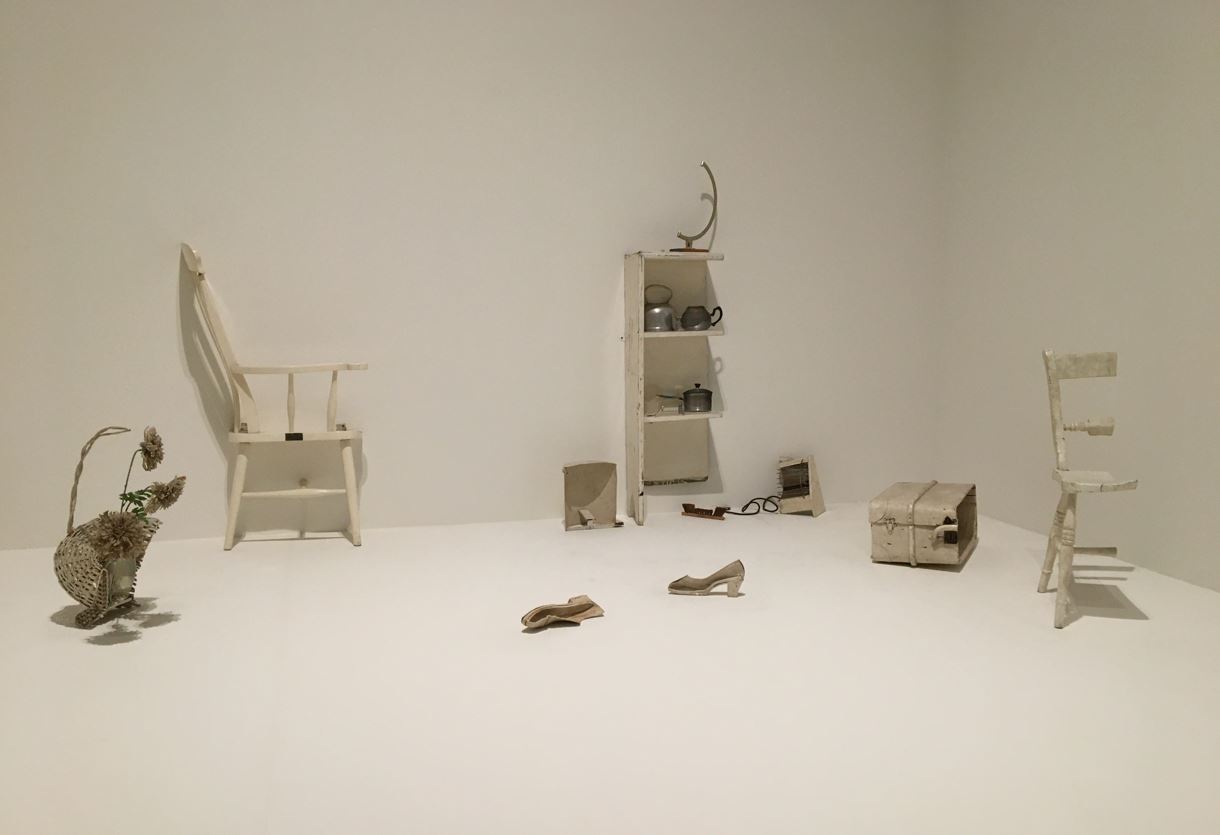
Installation view of ‘Half a Room’ at Yoko Ono: Music of the Mind at Tate Modern (photo by the author)
Or ‘Lion Wrapping Event’, a 26 minute film of wrapping one of the lions in Trafalgar Square in fabric. Or For ‘Promise Piece’ where she smashed a vase with a hammer, inviting audience members to take a piece and promise to return in 10 years to put it back together.
Or Film Number 4 (Bottoms) which edits together close-ups of 200 wobbly bare bottoms. In fact it feature the bottoms of lots of members of the London art scene of the time and features snatches of conversation between Ono and her then husband Anthony Cox.
The film was refused a certificate by the British Board of Film Censors and there’s photos of Ono protesting outside their offices, ‘It’s just part of the human anatomy, there’s nothing rude or sexy about them’ – the touching belief of 1960s idealists that getting naked would solve all the world’s problems from ending the war in Vietnam to abolishing sexism.
But the focus of the next few spaces is the John and Yoko collaboration which became such a big deal from about 1969 onwards.
The late 60s/early 70s peace and politics
A dream you dream alone is only a dream.
A dream you dream together is reality.
One area is devoted to their highly publicised peace projects. There’s a case showing how, on 15 June 1968, the couple planted acorns in the ruins of Coventry Cathedral – famously gutted by German bombing – one person facing east and one facing west to symbolise unity across the world.
In 1969, following their wedding on 20 March, the couple posted an acorn to 96 world leaders, asking each recipient to plant their own acorn for peace. The display case here includes formal replies from three leaders being the King of Malaysia, Prime Minister Golda Meir of Israel and the President of South Africa. They’re all polite but the South African president Jim Fouché wins by promising to plant the acorns on his farm. I wonder if they did. I wonder if they grew. I wonder if they’re still there.
Bed peace
One alcove is dominated by an hour-long film made of the couple’s famous publicity stunt, ‘Bed Peace’. The couple hired a room at the Amsterdam Hilton Hotel in March 1969, immediately after their wedding, and invited the world’s press to come and interview them, during which they, of course, promoted their cause of world peace.
Three months later they staged another bed-in at the Queen Elizabeth Hotel in Montreal from 26 May to 2 June and were more prepared this time. They made sure to be attended by celebrity fans and hangers-on and Lennon had written a song, which he performed live and was recorded, ‘Give Peace a Chance’. Tidied up in the studio and released, it quickly became an anthem of the huge anti-Vietnam War protest movement, being sung by a quarter of a million demonstrators against the Vietnam War in Washington, DC, on 15 November 1969.
In December the couple paid for billboards in 10 cities around the world which declared, in the national language, ‘War Is Over! If You Want It’ and there’s a striking photo of one of these on a billboard in Piccadilly Circus.

‘War is Over! (if you want it)’ poster on Shaftesbury Avenue 23 December 1969 as shown in Yoko Ono: Music of the Mind at Tate Modern (Photo by Evening Standard/Hulton Archive/Getty Images)
(I was struck not by the peace poster but by the cinema hoardings for the films ‘The Lion in Winter’ and ‘On Her Majesty’s Secret Service’ – great month for films!)
Two things:
- You can see how the concept and even the name Bed Piece follows on perfectly from all Ono’s previous concept pieces of the 1960s, being the performance of a simple concept (‘Get in bed and wish for peace. Invite the world’s press to watch you’)
- How Yoko was now operating in a completely different realm. These weren’t small exhibitions in out-of-the-way art galleries, but statements made in the full glare of the world’s media, this was a completely new stage.
This exhibition devotes an alcove to showing on a wall-sized screen the film which was made of the Montreal bed-in, ‘Bed peace’ (1969) a 16mm film lasting 1 hour 10 minutes, directed by John and Yoko and filmed by Nic Knowland. This appears to be available in its entirety online, so make your own mind up. As usual, seeing it projected on a whole wall is quite a lot more immersive and absorbing than watching it on a computer (or phone).
Yoko Ono’s music
Ono’s involvement with Lennon brought her into the orbit of the music business with mixed results. Previously she had been involved in highly avant-garde music making, working with the conceptual composer John Cage and his pianist David Tudor, staging performances which often included music, or the concept of music, or sounds of various kinds, and so on.
Now she was thrown into the orbit of maybe the most famous pop start in the world (jostling alongside Elvis and Bob Dylan).
The results are very mixed and surprisingly copious. Lennon created a pickup band in New York which they called the Plastic Ono Band which played gigs and benefits in New York at the end of the 1960s and early 70s. In lots of these Yoko added her trademark caterwauling-crying-screeching sounds which can be hard to listen to, especially when set in a fairly traditional rock context. As a student I had all the Lennon albums and couldn’t help skipping over Ono’s screechy bits. See if you can listen to this track all the way to the end. If you like it, there’s plenty more along the same lines.
There are headphones for visitors to listen to some of these concerts and in among the Plastic Ono tracks there’s a recording of her practicing for a gig with Ornette Coleman, the godfather of avant-garde jazz. Now this is interesting. Yoko makes vocal sounds and Coleman picks them up and echoes them on the soprano sax, with a band which is used to playing highly irregular improvised rhythms. I couldn’t help thinking that Ono’s entire approach to vocalising was best suited for this kind of avant-garde jazz setting rather than the limited formulas of rock music.
Anyway, that’s only the introduction, an appetiser, as it were to Ono’s musical career. Because the exhibition features an alcove whose wall is covered with old-fashioned LP covers of every album she’s ever made and it’s an impressive number, somewhere between 20 and 30 I’d guesstimate. The alcove contains seven or eight (very comfy) chairs each with headphones next to it and an interactive screen with a menu of all her albums and then of individual tracks (not every track – 3 or 4 from each album) and you are encouraged to make yourself comfortable and listen a selection of her music from the past 50 years.
Lennon retires
Probably most (middle-aged) people know the story that, after the breakup of the Beatles Lennon produced 6 solo albums but by the mid-1970s had had enough of the music business. Also Yoko finally gave birth after a series of miscarriage, to the boy they named Sean, in October 1975. So Lennon formally announced his retirement from the music business, turned his back on all of that and became a househusband in their New York apartment.
Double Fantasy
Again as most people probably know, Lennon then surprised everyone by, after five years of complete silence, suddenly releasing a brand new album of music in 1980, Double Fantasy.
Three points:
1. According to the Wikipedia article Lennon lacked confidence about the songs and arrangements, feeling he’d lost touch with the whole music scene. He was not wrong. As an ageing fan I was delighted by the appearance of Double Fantasy but it felt instantly nostalgic. It was music from another time, from the previous generation. Music fashions had continued to move as fast as they had in Lennon’s heyday in the 1960s, with glam rock flowering alongside disco, followed by punk, post-punk, synthpop and new Romanticism, and the new genres of Industrial and Goth being defined just as Lennon’s album was released.
It felt like a message from your mum and dad, from a happily married couple enjoying a second honeymoon – which was nice but nothing to do with the exciting young life you were leading. One of the critics called it ‘studio rock’, average material lifted by being performed by top session musicians and expertly produced and utterly soulless.
2. Double Fantasy carefully alternated songs by Lennon with tracks by Ono. Here’s a typical Ono track. Is she having an orgasm at the end?
3. The reason for dwelling on all this is that Double Fantasy is, in effect, the doorway, the gateway into the rest of Ono’s career and the ten or so albums which followed (as well as eight compilation and remix albums). Hence the wall covered in album covers, hence the chairs and headphones.
Yoko’s post-Lennon music career
I listened to a couple of tracks from the five or six albums following Double Wedding and didn’t like any of them. They all feature 1) heavy-handed over-production, with thumping drums and obsolete rock guitar of the worst kind; 2) her would-be poetic lyrics which are, in fact, tritely autobiographical – compare and contrast with any Dylan lyric; 3) her weak voice. If you like it, fine, but her music was never popular, in any sense.
Summary
The point is that for the first time in the exhibition, it felt like Yoko had fallen behind the times. In 1955, 1960 or 1965 she was out ahead of the curve, inventing ideas, methods, events, happenings, stagings, films and performances which stretched and defined the meaning of all those forms and of ‘concept art’. The peace activism with Lennon also set the tone of those last years of the 1960s, moved the avant-garde into the world of tabloid newspapers and TV, invented a new form of art-media-political performance and spectacle.
But by 1980 all that feels long over. And to focus on the music, she committed herself to the most deeply unexperimental, dead and dinosaur kind of Adult Orientated Rock, Dad Rock complete with thumping 1980s drums and air guitar solos. So unimaginative, uninnovative and unlistenable-to that I found the tracks I listened to were embarrassing.
But there’s no accounting for taste. I was astonished to read the curators’ take on her musical career.
Known for her ground-breaking early work and use of experimental vocalising techniques Ono is also recognised as one of the most prolific songwriters of the last century. This playlist highlight’s Ono’s output as a singer songwriter in more conventional pop-rock and electronic structures. It also includes collaborations with other musicians on remixes of her own music.
Then again, to be slightly cynical, this exhibition was obviously staged with Ono’s active support and maybe she sees her musical career as valid and important and worthwhile as her artistic work and so insisted it was included.
Hiatus and modern reprise
As far as I could tell there’s nothing here from most of the 1980s or 1990s. At some point in the 1970s the wave she’d helped to create and had surfed so skilfully from about 1955 to, maybe, 1975, hit the beach and expired. So, as far as I could tell, there’s a big chronological gap in the works here.
And then, in the final couple of exhibition spaces, Ono’s career revives with a new kind of work from the late 1990s. They are far fewer, bigger and far more professionally produced than the charmingly rackety, black and white, home-made experiments and happenings from the 60s and 70s.
They are recognisably high concept art works but executed with the high professional finish of advertising campaigns. Thus:
Helmets (Pieces of Sky)
Take a piece of the sky.
Know that we are all
Part of each other.
This consists of 15 or so World War Two German helmets suspended upside-down from the ceiling, and each one contains pieces from a jigsaw of blue sky and clouds. Visitors are encouraged to take a few pieces of the sky home with them. Personally, I’d have liked to make the jigsaw, asking other visitors who were interested to upend all the pieces onto the floor and then trying to make the sky together. But maybe a bit too subversive and participatory for more sleek and slick late-period Ono.

Helmets (Pieces of Sky) by Yoko Ono (2001) from ‘Between The Sky and My Head’ at Baltic Centre For Contemporary Art, Gateshead, 2008. Photo © Baltic Centre for Contemporary Art
There are some abstract paintings and a series of drawings she’s made in a kind of pointillist style, putting dots on paper as doodles which slowly take shape. They’re quite nice.
Add Colour (Refugee Boat) (concept 1960, execution 2024)
Just blue like the ocean.
By far the most dramatic piece is the entire room dedicated to the refugee boat. This was pure white and place in a nicely boat-sized room painted pure white when the exhibition opened. And there’s a table with a couple of trays of felt-tipped pens, white, blue and darker blue. And visitors are invited to draw or write whatever they want.
Before

‘Add Colour (Refugee Boat)’ by Yoko Ono at ‘Yoko Ono: Music of the Mind’ at Tate Modern, London, 2024. Photo by Reece Straw © Tate
After

‘Add Colour (Refugee Boat)’ by Yoko Ono (concept 1960, execution 2024) at ‘Yoko Ono: Music of the Mind’ at Tate Modern, London, 2024 (photo by the author)
As the curators put it:
Ono invites us to consider the impact collective action can have. The work encapsulates her belief in human agency and her understanding that ‘we are sharing this world’ and sharing our responsibility for it.
What struck me was rather different from this intention, which is how samey people are. For a start we’re all about the same height which explains why the band of wall about five feet high has been overwritten so much as to become an indecipherable sprawl of deep blue. If there are any individual messages there, they’re hard to read. More legible are things written or drawn ether lower down or, especially, higher up.
but people aren’t very original, either. As you can see the biggest single message is an enormous FREE PALESTINE and there are various other expressions of support for Gaza etc scrawled throughout. Then there are lots and lots of messages about love and hope and the planet and hope and love etc.
The problem with the notion of ‘human agency’ is that when you get a lot of these human agents together they generally behave in highly predictable and formulaic ways. That’s what the epidemiology or actuarial science, social media algorithms and AI are based on. I’m sorry to be the one to say it but all the evidence suggests that the notion of ‘human agency’ Ono is promoting is grossly over-rated.
My Mommy Is Beautiful (1997)
Write your thoughts of your mother.
Or pin a photograph of her to the canvas.
The same kind of participatory invitation is at play in the penultimate piece in the show, another invitation for visitors to write a message. So there’s a trestle table piled with cards, as for the Wish Tree, and a tray of pens, and we are invited to write a message or thought about our mothers and tape them to the wall which is, of course, absolutely festooned.
What the visitor doesn’t at first realise is that suspended from the ceiling in this space are a set of photographs of breasts and vulva.

Installation view of ‘My Mommy is Beautiful’ looking up at the photos suspended from the ceiling at Yoko Ono: Music of the Mind at Tate Modern (photo by the author)
Why?
Suspended at height, a series of photographs embody Ono’s humour and humanity. She comments: “One has to look up at the vagina and the breasts on the ceiling – rather like looking up at your mom’s body when you are a baby.”
Once again, as with the Wish Tree and Refugee Boat, the sentiments written by visitors are overwhelming predictable and sentimental (‘I love you Mum’, ‘I never appreciated you Mum’) alongside some occasionally impressive drawings. Purely as relief from the Clinton Cards cloying messages, I liked the one that read ‘My mother was a selfish bitch’, which felt like a rare bit of honesty and truth.
Whisper
If there was any doubt about the importance Ono gives to her musical career this is put to bed by the fact that the very last piece in the show is a music performance. It’s a ten-minute film of her performing at the Sydney Opera House on 17 November 2013. It doesn’t appear to be available online, which is a shame because it showed how the technology had caught up with her style. What I mean was that her voice was looped so whether breathing, sighing, moaning, wailing or screaming, she could play off the looped repetition of herself, and this was interesting (up to a point). Just her experimenting with her voice was good because it had range and variety.
However, go on YouTube and you can find loads of her performances in a rock context which, as I’ve explained, feel reactionary and backward-looking. In the past 50 years popular music has gone through an unbelievable series of fashions, changes and evolutions but not in Yokoworld. In Yokoworld it’s still 1971 and that’s why in something like this performance with her and John’s son Sean on guitar, it feels embarrassingly like watching someone’s home video. Embarrassingly bad…
Summary
This is an excellent exhibition which gives a really good overview of an amazing career. The first half of the show (1955 to 1967) is fascinating, funny, light and inspiring in a charmingly ramshackle home-made video, home publishing kind of way. All those Zen instructions are genuinely mind-opening and smiley.
The Lennon interlude is highly redolent of the late 60s, the Beatles late period and all of that, just as it all began to fall apart.
The wall of Ono albums you can, if you like, just read about and skip, unless you want to hear lots of 1980s AOR, all big shoulder pads and synth drums backing weedy voice and run-of-the-mill lyrics.
And then, after a big gap, there’s the final handful of works – the big ones like the helmets, ship and Mommy wall, and the more discreet series of drawings and paintings which are easy to overlook but quite nice…
What a life! What a career! But also what a fascinating review of the parabola of ‘art’ in the second half of the 20th century, from the genuine avant-garde staging of silly performances in dingy lofts and obscure galleries, then getting involved with the Swinging Sixties drugs and hedonism and fake revolution, then lingering on into the cocaine addiction and bad clothes of the depressed 70s, then justifiably falling silent and then…returning in the form of highly produced, highly finished, slick presentations.
Recognisably the same motivation and the same ‘political’ messages (peace, I love you all) but slickly packaged for the cable TV, then internet, and now social media ages. Clever, slick, virtue signalling which we have discovered, alas, changes nothing because it’s preaching to the converted – to like-minded liberal gallery goers who write ‘Help the refugees’ and ‘I love you mummy’ on gallery walls, while outside, in the real world…
In a way art galleries are safe spaces for certain kinds of like-minded, sentimental liberals who can huddle together and agree that, if only the world thought like us, it would be such a better place. But it isn’t. Trump. Putin. Xi Jinping.
Related links
- Yoko Ono: Music Of The Mind continues at Tate Modern until 1 September 2024
- Tate’s Yoko Ono page
- Download the large print guide i.e. all the wall captions


 Books & Boots