Chiharu Shiota: Threads of Life @ the Hayward Gallery

‘Everyone’s different. Everyone’s connected.’
(Chiharu Shiota)

‘While we live our lives separately, we are, at the same time, deeply connected’

This is a weird and wonderful, beguiling and genuinely ‘immersive’ exhibition. Japanese artist Chiharu Shiota was born in Osaka in 1972 but has lived and worked in Berlin, Germany since 1996. ‘Threads of Life’ is her first major solo exhibition in a London public gallery. As a retrospective it includes examples of:

  • drawings
  • early performance videos
  • photographs

But the blockbuster items are the three big gallery-sized installations in which thousands of yards of woollen thread have been intricately woven into dazzling webs and cocoons, strange disorientating mazes which eerily incorporate everyday objects such as shoes, keys, beds, chairs and dresses. The show includes other, less dramatic works, but let’s look at the three big showstoppers first.

1. Threads of Life (2026)

‘Threads that bind us to life, to others, the complex ties that not only bind us to one another and to the world, but also to the memories that are always shaping the cycle of life. networks of relationships and meaning…’

In the Hayward’s biggest upstairs gallery, thousands of yards of bright red wool have been intertwined to create an enormously complicated web of fine filaments covering the whole ceiling and coming down the walls of this big gallery, and from this mesh dangle what the visitor assistant told me is no fewer than 20,000 old keys. And there, abandoned in the middle of this strange entanglement, is the frame of an old wooden, double door, set partly open.

Installation view of Chiharu Shiota at the Hayward Gallery showing the largest installation, ‘Threads of Life’ (photo by the author)

Curators talk a lot about ‘immersive experiences’ but because it comes down from the ceiling at you, and covers the walls and intrudes onto the floorspace it really did feel ‘immersive’. Also the sheer redness, unadulterated, uninterrupted, unrelieved red, the gallery lights shining through the intricate web and turning everything red, red, red. It felt like something urgent and important was happening. What does Shiota herself say?

‘I believe that people are connected by an invisible thread. Some call this ‘the red string of fate,’ but I use red thread because it also resembles the colour of blood. Like threads, human relationships can be tight, loose, dense, cut, or knotted…’

And the keys? Twenty thousand rusty old, second-hand worn keys. What do they symbolise except 20,000 precious locations, places people wanted to keep secure and private – homes, rooms, cupboards, trunks and boxes, safe spaces, protected spaces, locations of experiences and memories and values. And now deracinated, removed from their sources and meanings, from their previous owners, and now dangling from blood red skeins. Why?

Installation view of Chiharu Shiota at the Hayward Gallery showing some of the 20,000 keys hanging by intricate webs of red thread from the ceiling (photo by the author)

And the doors, the double doors, ajar enough for visitors to walk through – what are you walking into? And out of? What happens when you walk through the door? As when Alice stepped through the looking glass. Doors can mark the boundary between the public and private, the known and unknown, the past and the future. Interestingly, lot of visitors were walking round and round the room but very few walking through the obvious opening, as if daunted. Unafraid, I walked self-consciously through the parted portals and nothing happened… or did it?

Installation view of Chiharu Shiota at the Hayward Gallery showing the open doors at the centre of ‘Threads of Life’ (photo by the author)

Another thing: these doors had a lock so the obvious questions arises: which of the 20,000 keys unlocked these doors? As in a fairy story, as in a fable. If I’d been visiting with my young children I’d have asked them to suggest which key was The Key, the Key To The Door and set them off hunting. As Shiota puts it:

‘Although each of our lives is different, we all hold a key in our hands, and with that key, you feel anything is possible. It secures your home, but it can also open the door to new opportunities. My work offers the chance to experience something different from ordinary life: the chance to enter another realm and see the red threads that are invisible in the [real] world, but are impossible to live without.’

2. Letters of Thanks (2026)

Into the next gallery and a variation on the theme: instead of tangled skeins we have thousands of small-gauge ropes , dyed the identical same primary red as in the key room, but this time hanging directly down from the high ceiling until just above the floor. But once again that’s not all, there is another component: as the key room enmeshed thousands of keys, so these hanging threads are interspersed with hundreds and hundreds of sheets of paper, folding, curled, suspended in mid-flutter, frozen in space and time as they appear to fall from the white ceiling.

Installation view of Chiharu Shiota at the Hayward Gallery showing ‘Letters of Thanks’ (photo by the author)

What are they? Thank you letters. Shiota tells us that she wanted to convey her gratitude to her father, who worked so hard for his family but fond it easiest to do in a letter and this prompted thoughts about how it’s often easiest to bare deep emotions in the objective form of writing than by saying them.

And so the genesis of this iterative work: every time the work is exhibited, Shiota invites people to share their own thank you letters, and she proceeds to embed them in the next iteration. This the work includes, in tumbling mid-flight, letters from Brazil, Austria, Germany, Denmark, Japan, and now London.

And clearly the cosmopolitan nature of contemporary art, and Shiota’s many destinations, themselves weave a kind of invisible web of connections. You can imagine a thread following the airplanes she takes round the world, weaving red threads round the globe. And then you could kind of dig deeper, look closer, and imagine the hundreds, probably thousands of thank you letters she’s received and embedded in the work, and the myriad connections those make out to their loved ones, parents, partners, children and so on. Macro and micro meshes.

This exhibition reflects the often-hidden connections between us, with each thread becoming a trace of our shared existence, weaving visible forms from the invisible threads of life. Through my work, I try to make sense of life and its uncertainties; each installation has grown from personal experiences, such as losing my father, facing death and questioning what it means to be human. With this exhibition, I want to highlight the marvellous aspects of ordinary existence.’

3. During Sleep (2026)

The third blockbuster installation is in another big gallery space and consists of half a dozen basic metal beds, such as you might find in an army barracks, laid out in an orderly pattern so you can walk up one aisle, round the end and back out of the gallery – but the point is that these banal objects are enmeshed in an even more invasive, consuming cocoon of thousands and thousands of internetted threads, this time coloured minatory black.

Installation view of Chiharu Shiota at the Hayward Gallery showing ‘During Sleep’ (photo by the author)

The red key room felt wonderful, liberating and life-enhancing whereas, presumably because of the colour black, and the stark contrast between the black thread and the white sheets and pillows and metal frames of the bed – black and white – this space felt both colder and more claustrophobic and downright spooky. Shiota provides a detailed explanation:

‘When I moved to Germany I moved nine times in three years. Every time I changed where I slept, I’d wake up unable to recognise where I was. While sitting in bed, I picked up some yarn and started weaving it around my body, desperate to create a space of my own. It was like painting in the air. The black threads enveloped the bed just like a cocoon.’

So for her the thing appears to have a comforting, protective motivation but I must say it worked the opposite for me. I am scared of spiders and this made me feel like I was entering an enormous spider’s web with a barely suppressed feeling of panic that somewhere, lurking just out of sight, must be an enormous spider. It reminded me of the horrible scene in ‘Lord of the Rings’ where Frodo and Sam find themselves in the pitch black caves of the giant spider, Shelob, monster of nightmares. Or other old-timers like me might remember the famous Dr Who episode from the 1960s where a monster takes over the London Underground and spins a horrifying cocoon of sticky webs which trap its victims.

Well, Shiota’s aim is nothing like that. She goes on to explain that, as part of the exhibition, on certain days, performers are going to get into the beds and lie there for a time, impressing the beds with their weight and shape and warmth.

‘At certain times during the exhibition, performers sleep in the beds. I like the shape of the sheets after someone has slept in them. Each person leaves a different one and I can see their former existence in those traces. A sleeping person occupies the gap between dreaming and reality. To me, death might be the perfect sleep. It represents a new state of existence within the cycle of life, one that moves towards a larger universe.’

Very restful, calm and civilised. I could see the outlines in the beds and sheets where these performers had already slept and I understand the intention. Shiota intends the work to depict a kind of haunting of the real world by ghostly absences. But I couldn’t get past my own sense of uncanny, spooky and barely-suppressed horror.

Installation view of Chiharu Shiota at the Hayward Gallery showing ‘During Sleep’ (photo by the author)

Another web work

State of Being (Dress) (2025)

Between the huge key room and the narrow dangling help note room is what looks like a vitrine, large enough to hold what looks like a white wedding dress, but engulfed in an amazingly intricate web of black thread. Again, total black against total white. Maybe white purity occluded by the thousand striations of real life. Or the purity of the dram world or ideal life, imprisoned in ten thousand compromises and preventions.

Installation view of Chiharu Shiota at the Hayward Gallery showing ‘State of being: Dress’ (photo by the author)

As usual my response is more intense (and negative) than Shiota’s etherial intention:

‘In my work, I use found objects that I come across in my daily life. These items represent an absent person whose story I can never truly know, yet they help me feel connected to universal human experiences. Clothing, in particular, reflects this idea. When we wear our clothes, the fabric accumulates our feelings and memories. It is like a second skin. In the absence of the body, a shell of our existence remains – a state of our being. Piling up layer upon layer of threads creates the entirety of the universe bound within this framed space. When I can no longer trace a single line with my eye, the sculpture is complete. At that point, I feel as if I am able to glimpse what lies beyond, and touch the truth.’

Non-web works

These four web-and-thread works are all relatively recent. As you proceed into the exhibition you go back in time to earlier works from Shiota’s career, specifically to three earlier and non-thread-based pieces.

Video: Wall (2010)

On the stairs to the upstairs gallery you come across a video screen showing all 3 minutes and 39 seconds of ‘Wall’. In this video 38-year-old Shiota is lying naked on a white floor and is covered with a spaghetti tangle of white plastic tubing. As the video proceeds in flickering time-lapse jumps, we discover the tubes are hollow because one by one they fill with a red liquid, red the colour of blood, slowly spurting through all the tubes until a tangle of white tubes has become a tangle of red ones.

Installation view of Chiharu Shiota at the Hayward Gallery showing ‘Wall’ (photo by the author)

Surprisingly, this started from a meditation on the concept of walls:

‘I had wanted to create a work around the theme of walls for a long time. I took photographs of the Berlin Wall and the Western Wall in Jerusalem, but I decided to focus instead on the ‘walls’ within our bloodstream: family, nationality, religion, and other boundaries to do with the human condition. These walls give us comfort and a sense of identity, yet they can also strangle us. In Wall, my body is entangled in red tubes resembling blood vessels, as if the body has been turned inside out, revealing everything that is carried in our blood on the outside.’

I haven’t yet mentioned that there is an audio track on the film which is a slow human heartbeat:

‘The heartbeat of a fetus inside the womb forms the soundtrack, encapsulating my sense of the many things I have experienced over the years – such as illness, pregnancy, miscarriage, and childbirth.’

Try and Go Home (1997)

This feels very basic and entry-level compared to the mature sophistication of the web works. It simply consists of six black and white photos depicting a performance. According to her own account, Shiota moved to Germany in 1996 and enrolled in the University of Fine Arts in Hamburg. Here she took a course with performance artist Marina Abramović who told them to write down one word. ‘Japan’ immediately came to Shiota’s mind.

Her account then jumps to the idea that she went out to the countryside and dug a hollow in the ground. She proceeded to take off all her clothes and performed the attempt to crawl back to the place she wanted to go home to. Again and again she tried, again and again she couldn’t get very far into the cave and rolled back down the slope, obviously becoming more dirty and muddy with every attempt.

Which is why the exhibition presents us with these six photos, presumably taken by a colleague and partner in the performance, of her naked body in various parts of the burrow-and-roll process.

Installation view of Chiharu Shiota at the Hayward Gallery showing six photos from ‘Try and Go Home’ (photo by the author)

This is so far removed from the webworks as to feel like the works of a completely different artist. On the other hand, it is obviously linked to the video by Shiota’s willingness to get naked, to photograph and film herself naked, and to display herself naked in a public gallery for tens of thousands of visitors to look at. Make of that what you will.

The Trainee (2023 to 2024)

Much more recent is another work which, initially, seems completely unrelated to the web works. In the early 2020s Shiota was asked to create illustrations for a novel. Yoko Tawada’s novel ‘The Trainee’ is set in Germany in the 1980s and follows a young woman who works at a book distribution company. It draws from Yoko’s own experience of moving to Germany around the same time, where she felt like she was starting a second life.

The novel was serialised in the Japanese newspaper Yomiuri Shimbun and Shiota created pictures to accompany its daily publication. It was a case of trial and error. Her first illustrations derived from underlining words and transforming them into pictures but when she saw them in print they felt too dark. So she developed a new approach which was to use coloured wrapping and origami paper and interweave them with her trademark red thread. Aha! Return of the threads!

The final result was nearly 400 watercolour and charcoal drawings and collages, each stitched with her signature red threads and they are all exhibited here in one wall-length display.

Installation view of Chiharu Shiota: Threads of Life. Drawings for Yoko Tawada’s Praktikantin (The Trainee) Photo by Mark Blower. Courtesy of the Hayward Gallery © DACS, London, 2026 and Chiharu Shiota

To be honest, I was still so dazzled by the big web rooms that I found it difficult to readjust my sense of scale and response to these relatively small and detailed works. Especially as I had no idea what the plot of the novel was that they’re illustrating. And especially since there are so many of them. To my mind they required a completely different sense of scale and attention than the big web rooms which had completely bowled me over.

Video of Shiota at work and explaining


Related links

Related reviews

Yoko Ono: Music Of The Mind @a Tate Modern

‘The only sound that exists to me is the sound of the mind. My works are only to induce music of the mind in people…In the mind-world, things spread out and go beyond time.’

This is a big retrospective of the career of trailblazing conceptual artist Yoko Ono (b.1933):

the UK’s largest exhibition celebrating key moments in Ono’s ground-breaking, influential and multidisciplinary career, from the mid-1950s to the present day.

Featuring over 200 works including instruction pieces, scores, installations, films, music and photography. (In the review blow, indented text is a direct quote from the curators’ wall labels.)

Obviously most people have heard of Ono because of her involvement with one of the great pop and rock icons of the last 60 years, John Lennon, and the central part of the exhibition indeed covers their marriage, peace projects and join musical efforts in some detail.

But the point is that well before Yoko met Lennon (at the Indica Gallery in London on 7 November 1966) she was an established conceptual artist, on equal terms with members of the Japanese, American and British avant-garde, and she continued her artistic activity during and after the Lennon years (1967 to 1980) and has continued to produce stimulating and interesting work right up to the present day, as the exhibition amply demonstrates.

Wish tree

The tone is set before you enter the exhibition proper by a wish tree. These are olive trees with bits of car with string nearby and a box of pens. So you’re asked to write your wish on the piece of card and tie it to the tree. I wished my daughter health and happiness. What would you wish for?

Installation view of ‘Wish Trees for London, 2024’ at Yoko Ono: Music of the Mind at Tate Modern, London. Photo © Tate (Reece Straw)

Ono has been installing variations of the Wish Tree around the world since 1996 and over 2 million wishes have been collected, expressed, wished.

The 1950s

In 1956, aged 23, Ono moved to New York City, eloping with Japanese composer and pianist Toshi Ichiyanagi (1933 to 2022). In 1960, she began renting a loft at 112 Chambers Street in Lower Manhattan. Ono and composer La Monte Young (born 1935) programmed concerts and events there, providing a forum for artists, musicians, dancers and poets. Ono performed in other artists’ concerts and installed her instruction-based paintings for the first time.

After university in Japan, Ono moved to New York where she became part of the city’s avant-garde art scene with impressive speed. There are black-and-white photos of her hanging out in New York lofts with avant-garde luminaries such as John Cage, Robert Rauschenberg, David Tudor and La Monte Young.

Conceptual art can be easily defined as ‘art in which the idea or concept presented by the artist is considered more important than its appearance or execution’. This is amply demonstrated by the work which fills room 1 and is titled ‘Lighting Piece. This consists, first and foremost, of instructions for a very simple action: ‘Light a match and watch till it goes out’.

Like most of her instructions ‘Lighting Piece’ is wonderfully light and simple. I don’t think the curators make a big deal out of it, but it felt to me that this lightness is very connected with Japan’s Buddhism tradition, ‘Imagine the sound of one hand clapping’ or ‘If a tree falls in a forest and no one is around to hear it, does it make a sound?’ – those kinds of things. But hers are wonderfully light and original.

Just as characteristic is the way that ‘Lighting Piece’ actually consists of not one but three elements: the original instruction, a performance and a film. Because not only did an unknown number of people follow the written instructions, but one man filmed it. Hence ‘Film Number 1 (MATCH)’ / Fluxfilm Number 14 (1966).

Under Ono’s direction, photographer Peter Moore captured the striking of a match using a high-speed camera, shooting at 2,000 frames per second. Played back at the standard rate of 24 frames per second, the action unfolds in super slow motion, taking 5 minutes and 4 seconds.

It’s one thing seeing it on a little screen, here, quite another watching it projected onto a whole wall.

[A few days later I was reading Walter Benjamin’s collection of essays and came across this quotation from Paul Valéry which seems apt: ‘The invention of the match around the middle of the nineteenth century brought forth a number of innovations which have one thing in common: one abrupt movement of the hand triggers a process of many steps.’]

If you find this idea and film funny or entrancing or calming and meditative, then you’ll love the rest of the exhibition.

In July 1961, Ono’s first solo exhibition opened at AG Gallery in Manhattan. ‘Paintings & Drawings by Yoko Ono’ included more than fifteen Instruction Paintings which were realised through the participation of the artist, visitors or the environment.

There are 200 pieces so I can’t list them all. Another characteristic piece is ‘Painting to Be Stepped On’ (1961), a piece of fabric covered in paint and placed on the floor so that visitors can…step on it. In a similar vein a piece of painted fabric on the floor with a plastic bottle full of water suspended above it with a very very tiny leak. Every now and then a drop of water falls onto the fabric below and you are invited to watch the dark stain of the moisture very slowly spread across the fabric (Waterdrop Painting, 1961).

Early music

Alongside her exhibitions in New York and Tokyo, Ono staged concerts and events. These included periods of complete darkness, electronic sounds and performers with contact microphones taped to their bodies. She brought an element of the absurd and irreverent to her concerts in New York by intermittently playing the amplified sounds of a flushing toilet. Ono titled this work Toilet Piece. Her concerts in Tokyo included The Pulse, in which performers made sounds while tackling mathematical problems on stage, and Audience Piece to La Monte Young, where performers stared at the audience until the audience left.

Instructions for paintings (1961-2)

A list of 20 or so small cards arranged along one wall on which are typed typical instructions.

To avoid the emotion of her own handwriting, and unable to acquire a Japanese typewriter, the instructions were neatly handwritten in Japanese by Ono’s husband Toshi Ichiyanagi. They were shown in the lobby outside Ono’s first concert in Japan in 1962.

My favourite was ‘Waterdrop painting’:

Let water drop.
Place a stone under it.
The painting ends when a hole is drilled in the stone with the drops.
You may change the frequency of the waterdrop to your taste.
You may use beer, wine, ink, blood, etc. instead of water.
You may use typewriter, shoes, dress, etc. instead of stone.

I liked the way it starts out being fairly clear and categorical and then deconstructs itself as you read on until, in the last sentence, all the specificness vanishes into air.

Strip tease

In New York in 1964, Ono held a farewell concert entitled Strip Tease Show, featuring Cut Piece, Bag Piece and Striptease for Three. To ‘strip’, she explains, means ‘not to reveal to others’ but to ‘discover something hidden in humans’ and a ‘stripping of the mind’.

In ‘Striptease for Three’ three chairs are placed onstage and remain there for the audience to stare at until either the curtain was drawn or the chairs removed. The exhibition features three chairs arranged on a dais to recreate the moment.

Installation view of ‘Striptease for Three’ at Yoko Ono: Music of the Mind at Tate Modern (photo by the author)

Cut piece (1964)

This one gained notoriety because of the element salaciousness. Ono sat onstage and invited members of the audience to come up and, using the scissors provided, to cut away her clothes. There’s a video of one performance.

(This reminded me of the retrospective of Serbian conceptual artist Marina Abramović held at the Royal Academy last year, and the work she titled ‘Rhythm 0’. In this Abramović presented herself as an object to be acted upon. She stood motionless for eight hours alongside a table of 72 implements capable of being used for pain or pleasure, for the public to use on her as they wished. I wondered if they were contemporaneous but the Abramović piece is from 1974, so Ono is by far the pioneer.)

Bag piece

In the same room visitors are encouraged to perform ‘Bag Piece’. On the wall are hanging half a dozen black bags and you are invited to take your shoes off and have the gallery assistant put one of these big black fabric bags over you, covering your entire body. Then you can do what you like which, in my case, was make as many funny shapes with your arms and legs as you could think of.

Installation view of ‘Bag Piece’ at Yoko Ono: Music of the Mind at Tate Modern (photo by the author’s friend)

Painting to Shake Hands (concept 1961, first realised 1962)

Drill a hole in a canvas and put your hand out from behind.
Receive your guests in that position.
Shake hands and converse with hands.

In case I haven’t mentioned it before, a central part of the show or experience is that it’s funny. Lots of the instructions make you smile and the interactive activities make you laugh. In the next room is a big fabric freestanding in the middle of the room and she’s punched a hole through it. The idea is you put your hand through it and shake hands with someone on the other side without being able to see who they are. While I was watching a youngish coupe did this, smiling and fumbling, and then two fairly young kids had a go, squealing and giggling as they played with each other’s outstretched arms and hands. It’s fun.

Shadow Piece (concept 1963, first performed 1966)

Put your shadows together until they become one.

As is the piece behind it where a simple light projector is pointing at a wall with a whiteboard on it, next to it a box of felt tip pens. The idea is that you pose midway between light and board and so create a shadow silhouette and someone else draws round your shadow. Having had a go I can tell you that it turns out to be really challenging to hold a completely still pose long enough for someone else to draw round your silhouette…a comment on the restless movement and activity of us all, of life.

Grapefruit

During this period, Ono met and married US filmmaker Anthony Cox (born 1937). Between 1963 and 1967, Cox helped produce and promote Ono’s activities in Tokyo, New York and London.

Ono and Cox’s daughter, Kyoko, was born in Tokyo in 1963. During this time, Ono continued creating instructions and performed some of them in public. In 1964, she published Grapefruit through her own imprint, Wunternaum Press. It includes more than 200 instructions divided into five sections: music, painting, event, poetry and object. Each instruction is dated by the year of its conception, from 1953 to 1964.

Grapefruit is, apparently, considered a cornerstone of conceptual art so there is a fair bit of documentation around it, typescripts, notes etc, as well as a series of the actual instructions. These are very short, somewhere between a poem (not unlike the Japanese haiku in that they are designed to be meditated on. At the same time they are like very small musical scores, in that they are designed to be performed. Except that, being ‘conceptual’, many of them can only be performed in the mind. Which brings us back to the idea of a poem.

You can still buy Grapefruit online.

Records of interventions

there are records of lots and lots more interventions and activities, such as, in Tokyo during the 1964 Olympic Games, leaving random roses on cafe chairs, on the pavement , on parked mopeds. Or selling shards of broken milk bottles in Tokyo, each labelled with a date and time to represent a future morning.

Painting to Hammer a Nail (concept 1961, first realised 1966)

Another piece that visitors can interact with is hammering a nail into a board.

Hammer a nail into a mirror, a piece of glass, a canvas, wood or metal every morning.
Also, pick up a hair that came off when you combed in the morning and tie it around the hammered nail.
The painting ends when the surface is covered with nails.

This was the piece over which Ono and Lennon bonded. It was included in the exhibition ‘Unfinished Paintings & Objects by Yoko Ono’ held at the Indica Gallery in London in 1967. The gallery was a cultural hub run by artist John Dunbar, which attracted figures in the worlds of art, literature and popular music. Dunbar introduced Ono to Lennon who proceeded to offer her an imaginary five shillings to hammer an imaginary nail into the board. Ono later said, ‘I met a guy who plays the same game I played.’

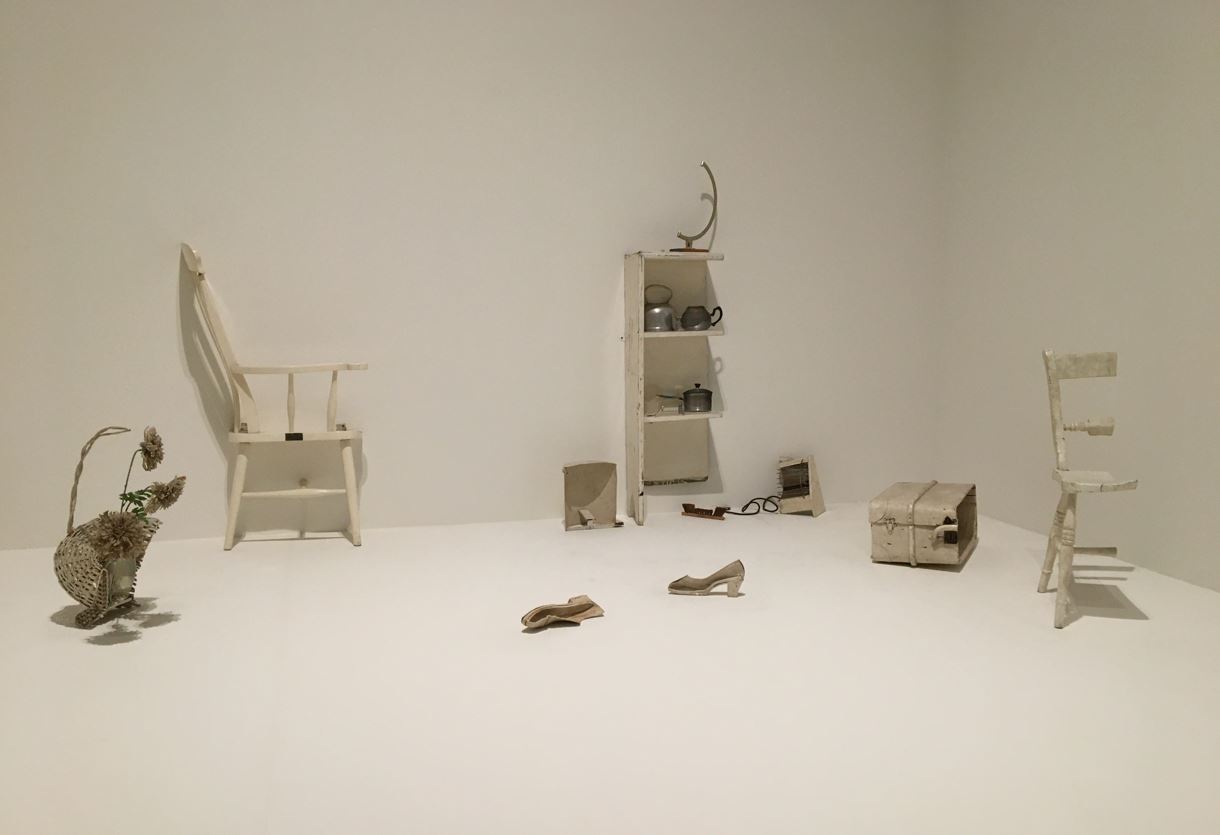
With the entry of Lennon onto the scene everything changes. There are a few more independent pieces, such as the amusing Half-A-Room (1967), 29 domestic objects cut in half and painted white, which is recreated in its entirety here.

Installation view of ‘Half a Room’ at Yoko Ono: Music of the Mind at Tate Modern (photo by the author)

Or ‘Lion Wrapping Event’, a 26 minute film of wrapping one of the lions in Trafalgar Square in fabric. Or For ‘Promise Piece’ where she smashed a vase with a hammer, inviting audience members to take a piece and promise to return in 10 years to put it back together.

Or Film Number 4 (Bottoms) which edits together close-ups of 200 wobbly bare bottoms. In fact it feature the bottoms of lots of members of the London art scene of the time and features snatches of conversation between Ono and her then husband Anthony Cox.

The film was refused a certificate by the British Board of Film Censors and there’s photos of Ono protesting outside their offices, ‘It’s just part of the human anatomy, there’s nothing rude or sexy about them’ – the touching belief of 1960s idealists that getting naked would solve all the world’s problems from ending the war in Vietnam to abolishing sexism.

But the focus of the next few spaces is the John and Yoko collaboration which became such a big deal from about 1969 onwards.

The late 60s/early 70s peace and politics

A dream you dream alone is only a dream.
A dream you dream together is reality.

One area is devoted to their highly publicised peace projects. There’s a case showing how, on 15 June 1968, the couple planted acorns in the ruins of Coventry Cathedral – famously gutted by German bombing – one person facing east and one facing west to symbolise unity across the world.

In 1969, following their wedding on 20 March, the couple posted an acorn to 96 world leaders, asking each recipient to plant their own acorn for peace. The display case here includes formal replies from three leaders being the King of Malaysia, Prime Minister Golda Meir of Israel and the President of South Africa. They’re all polite but the South African president Jim Fouché wins by promising to plant the acorns on his farm. I wonder if they did. I wonder if they grew. I wonder if they’re still there.

Bed peace

One alcove is dominated by an hour-long film made of the couple’s famous publicity stunt, ‘Bed Peace’. The couple hired a room at the Amsterdam Hilton Hotel in March 1969, immediately after their wedding, and invited the world’s press to come and interview them, during which they, of course, promoted their cause of world peace.

Three months later they staged another bed-in at the Queen Elizabeth Hotel in Montreal from 26 May to 2 June and were more prepared this time. They made sure to be attended by celebrity fans and hangers-on and Lennon had written a song, which he performed live and was recorded, ‘Give Peace a Chance’. Tidied up in the studio and released, it quickly became an anthem of the huge anti-Vietnam War protest movement, being sung by a quarter of a million demonstrators against the Vietnam War in Washington, DC, on 15 November 1969.

In December the couple paid for billboards in 10 cities around the world which declared, in the national language, ‘War Is Over! If You Want It’ and there’s a striking photo of one of these on a billboard in Piccadilly Circus.

‘War is Over! (if you want it)’ poster on Shaftesbury Avenue 23 December 1969 as shown in Yoko Ono: Music of the Mind at Tate Modern (Photo by Evening Standard/Hulton Archive/Getty Images)

(I was struck not by the peace poster but by the cinema hoardings for the films ‘The Lion in Winter’ and ‘On Her Majesty’s Secret Service’ – great month for films!)

Two things:

  1. You can see how the concept and even the name Bed Piece follows on perfectly from all Ono’s previous concept pieces of the 1960s, being the performance of a simple concept (‘Get in bed and wish for peace. Invite the world’s press to watch you’)
  2. How Yoko was now operating in a completely different realm. These weren’t small exhibitions in out-of-the-way art galleries, but statements made in the full glare of the world’s media, this was a completely new stage.

This exhibition devotes an alcove to showing on a wall-sized screen the film which was made of the Montreal bed-in, ‘Bed peace’ (1969) a 16mm film lasting 1 hour 10 minutes, directed by John and Yoko and filmed by Nic Knowland. This appears to be available in its entirety online, so make your own mind up. As usual, seeing it projected on a whole wall is quite a lot more immersive and absorbing than watching it on a computer (or phone).

Yoko Ono’s music

Ono’s involvement with Lennon brought her into the orbit of the music business with mixed results. Previously she had been involved in highly avant-garde music making, working with the conceptual composer John Cage and his pianist David Tudor, staging performances which often included music, or the concept of music, or sounds of various kinds, and so on.

Now she was thrown into the orbit of maybe the most famous pop start in the world (jostling alongside Elvis and Bob Dylan).

The results are very mixed and surprisingly copious. Lennon created a pickup band in New York which they called the Plastic Ono Band which played gigs and benefits in New York at the end of the 1960s and early 70s. In lots of these Yoko added her trademark caterwauling-crying-screeching sounds which can be hard to listen to, especially when set in a fairly traditional rock context. As a student I had all the Lennon albums and couldn’t help skipping over Ono’s screechy bits. See if you can listen to this track all the way to the end. If you like it, there’s plenty more along the same lines.

There are headphones for visitors to listen to some of these concerts and in among the Plastic Ono tracks there’s a recording of her practicing for a gig with Ornette Coleman, the godfather of avant-garde jazz. Now this is interesting. Yoko makes vocal sounds and Coleman picks them up and echoes them on the soprano sax, with a band which is used to playing highly irregular improvised rhythms. I couldn’t help thinking that Ono’s entire approach to vocalising was best suited for this kind of avant-garde jazz setting rather than the limited formulas of rock music.

Anyway, that’s only the introduction, an appetiser, as it were to Ono’s musical career. Because the exhibition features an alcove whose wall is covered with old-fashioned LP covers of every album she’s ever made and it’s an impressive number, somewhere between 20 and 30 I’d guesstimate. The alcove contains seven or eight (very comfy) chairs each with headphones next to it and an interactive screen with a menu of all her albums and then of individual tracks (not every track – 3 or 4 from each album) and you are encouraged to make yourself comfortable and listen a selection of her music from the past 50 years.

Lennon retires

Probably most (middle-aged) people know the story that, after the breakup of the Beatles Lennon produced 6 solo albums but by the mid-1970s had had enough of the music business. Also Yoko finally gave birth after a series of miscarriage, to the boy they named Sean, in October 1975. So Lennon formally announced his retirement from the music business, turned his back on all of that and became a househusband in their New York apartment.

Double Fantasy

Again as most people probably know, Lennon then surprised everyone by, after five years of complete silence, suddenly releasing a brand new album of music in 1980, Double Fantasy.

Three points:

1. According to the Wikipedia article Lennon lacked confidence about the songs and arrangements, feeling he’d lost touch with the whole music scene. He was not wrong. As an ageing fan I was delighted by the appearance of Double Fantasy but it felt instantly nostalgic. It was music from another time, from the previous generation. Music fashions had continued to move as fast as they had in Lennon’s heyday in the 1960s, with glam rock flowering alongside disco, followed by punk, post-punk, synthpop and new Romanticism, and the new genres of Industrial and Goth being defined just as Lennon’s album was released.

It felt like a message from your mum and dad, from a happily married couple enjoying a second honeymoon – which was nice but nothing to do with the exciting young life you were leading. One of the critics called it ‘studio rock’, average material lifted by being performed by top session musicians and expertly produced and utterly soulless.

2. Double Fantasy carefully alternated songs by Lennon with tracks by Ono. Here’s a typical Ono track. Is she having an orgasm at the end?

3. The reason for dwelling on all this is that Double Fantasy is, in effect, the doorway, the gateway into the rest of Ono’s career and the ten or so albums which followed (as well as eight compilation and remix albums). Hence the wall covered in album covers, hence the chairs and headphones.

Yoko’s post-Lennon music career

I listened to a couple of tracks from the five or six albums following Double Wedding and didn’t like any of them. They all feature 1) heavy-handed over-production, with thumping drums and obsolete rock guitar of the worst kind; 2) her would-be poetic lyrics which are, in fact, tritely autobiographical – compare and contrast with any Dylan lyric; 3) her weak voice. If you like it, fine, but her music was never popular, in any sense.

Summary

The point is that for the first time in the exhibition, it felt like Yoko had fallen behind the times. In 1955, 1960 or 1965 she was out ahead of the curve, inventing ideas, methods, events, happenings, stagings, films and performances which stretched and defined the meaning of all those forms and of ‘concept art’. The peace activism with Lennon also set the tone of those last years of the 1960s, moved the avant-garde into the world of tabloid newspapers and TV, invented a new form of art-media-political performance and spectacle.

But by 1980 all that feels long over. And to focus on the music, she committed herself to the most deeply unexperimental, dead and dinosaur kind of Adult Orientated Rock, Dad Rock complete with thumping 1980s drums and air guitar solos. So unimaginative, uninnovative and unlistenable-to that I found the tracks I listened to were embarrassing.

But there’s no accounting for taste. I was astonished to read the curators’ take on her musical career.

Known for her ground-breaking early work and use of experimental vocalising techniques Ono is also recognised as one of the most prolific songwriters of the last century. This playlist highlight’s Ono’s output as a singer songwriter in more conventional pop-rock and electronic structures. It also includes collaborations with other musicians on remixes of her own music.

Then again, to be slightly cynical, this exhibition was obviously staged with Ono’s active support and maybe she sees her musical career as valid and important and worthwhile as her artistic work and so insisted it was included.

Hiatus and modern reprise

As far as I could tell there’s nothing here from most of the 1980s or 1990s. At some point in the 1970s the wave she’d helped to create and had surfed so skilfully from about 1955 to, maybe, 1975, hit the beach and expired. So, as far as I could tell, there’s a big chronological gap in the works here.

And then, in the final couple of exhibition spaces, Ono’s career revives with a new kind of work from the late 1990s. They are far fewer, bigger and far more professionally produced than the charmingly rackety, black and white, home-made experiments and happenings from the 60s and 70s.

They are recognisably high concept art works but executed with the high professional finish of advertising campaigns. Thus:

Helmets (Pieces of Sky)

Take a piece of the sky.
Know that we are all
Part of each other.

This consists of 15 or so World War Two German helmets suspended upside-down from the ceiling, and each one contains pieces from a jigsaw of blue sky and clouds. Visitors are encouraged to take a few pieces of the sky home with them. Personally, I’d have liked to make the jigsaw, asking other visitors who were interested to upend all the pieces onto the floor and then trying to make the sky together. But maybe a bit too subversive and participatory for more sleek and slick late-period Ono.

Helmets (Pieces of Sky) by Yoko Ono (2001) from ‘Between The Sky and My Head’ at Baltic Centre For Contemporary Art, Gateshead, 2008. Photo © Baltic Centre for Contemporary Art

There are some abstract paintings and a series of drawings she’s made in a kind of pointillist style, putting dots on paper as doodles which slowly take shape. They’re quite nice.

Add Colour (Refugee Boat) (concept 1960, execution 2024)

Just blue like the ocean.

By far the most dramatic piece is the entire room dedicated to the refugee boat. This was pure white and place in a nicely boat-sized room painted pure white when the exhibition opened. And there’s a table with a couple of trays of felt-tipped pens, white, blue and darker blue. And visitors are invited to draw or write whatever they want.

Before

‘Add Colour (Refugee Boat)’ by Yoko Ono at ‘Yoko Ono: Music of the Mind’ at Tate Modern, London, 2024. Photo by Reece Straw © Tate

After

‘Add Colour (Refugee Boat)’ by Yoko Ono (concept 1960, execution 2024) at ‘Yoko Ono: Music of the Mind’ at Tate Modern, London, 2024 (photo by the author)

As the curators put it:

Ono invites us to consider the impact collective action can have. The work encapsulates her belief in human agency and her understanding that ‘we are sharing this world’ and sharing our responsibility for it.

What struck me was rather different from this intention, which is how samey people are. For a start we’re all about the same height which explains why the band of wall about five feet high has been overwritten so much as to become an indecipherable sprawl of deep blue. If there are any individual messages there, they’re hard to read. More legible are things written or drawn ether lower down or, especially, higher up.

but people aren’t very original, either. As you can see the biggest single message is an enormous FREE PALESTINE and there are various other expressions of support for Gaza etc scrawled throughout. Then there are lots and lots of messages about love and hope and the planet and hope and love etc.

The problem with the notion of ‘human agency’ is that when you get a lot of these human agents together they generally behave in highly predictable and formulaic ways. That’s what the epidemiology or actuarial science, social media algorithms and AI are based on. I’m sorry to be the one to say it but all the evidence suggests that the notion of ‘human agency’ Ono is promoting is grossly over-rated.

My Mommy Is Beautiful (1997)

Write your thoughts of your mother.
Or pin a photograph of her to the canvas.

The same kind of participatory invitation is at play in the penultimate piece in the show, another invitation for visitors to write a message. So there’s a trestle table piled with cards, as for the Wish Tree, and a tray of pens, and we are invited to write a message or thought about our mothers and tape them to the wall which is, of course, absolutely festooned.

What the visitor doesn’t at first realise is that suspended from the ceiling in this space are a set of photographs of breasts and vulva.

Installation view of ‘My Mommy is Beautiful’ looking up at the photos suspended from the ceiling at Yoko Ono: Music of the Mind at Tate Modern (photo by the author)

Why?

Suspended at height, a series of photographs embody Ono’s humour and humanity. She comments: “One has to look up at the vagina and the breasts on the ceiling – rather like looking up at your mom’s body when you are a baby.”

Once again, as with the Wish Tree and Refugee Boat, the sentiments written by visitors are overwhelming predictable and sentimental (‘I love you Mum’, ‘I never appreciated you Mum’) alongside some occasionally impressive drawings. Purely as relief from the Clinton Cards cloying messages, I liked the one that read ‘My mother was a selfish bitch’, which felt like a rare bit of honesty and truth.

Whisper

If there was any doubt about the importance Ono gives to her musical career this is put to bed by the fact that the very last piece in the show is a music performance. It’s a ten-minute film of her performing at the Sydney Opera House on 17 November 2013. It doesn’t appear to be available online, which is a shame because it showed how the technology had caught up with her style. What I mean was that her voice was looped so whether breathing, sighing, moaning, wailing or screaming, she could play off the looped repetition of herself, and this was interesting (up to a point). Just her experimenting with her voice was good because it had range and variety.

However, go on YouTube and you can find loads of her performances in a rock context which, as I’ve explained, feel reactionary and backward-looking. In the past 50 years popular music has gone through an unbelievable series of fashions, changes and evolutions but not in Yokoworld. In Yokoworld it’s still 1971 and that’s why in something like this performance with her and John’s son Sean on guitar, it feels embarrassingly like watching someone’s home video. Embarrassingly bad…

Summary

This is an excellent exhibition which gives a really good overview of an amazing career. The first half of the show (1955 to 1967) is fascinating, funny, light and inspiring in a charmingly ramshackle home-made video, home publishing kind of way. All those Zen instructions are genuinely mind-opening and smiley.

The Lennon interlude is highly redolent of the late 60s, the Beatles late period and all of that, just as it all began to fall apart.

The wall of Ono albums you can, if you like, just read about and skip, unless you want to hear lots of 1980s AOR, all big shoulder pads and synth drums backing weedy voice and run-of-the-mill lyrics.

And then, after a big gap, there’s the final handful of works – the big ones like the helmets, ship and Mommy wall, and the more discreet series of drawings and paintings which are easy to overlook but quite nice…

What a life! What a career! But also what a fascinating review of the parabola of ‘art’ in the second half of the 20th century, from the genuine avant-garde staging of silly performances in dingy lofts and obscure galleries, then getting involved with the Swinging Sixties drugs and hedonism and fake revolution, then lingering on into the cocaine addiction and bad clothes of the depressed 70s, then justifiably falling silent and then…returning in the form of highly produced, highly finished, slick presentations.

Recognisably the same motivation and the same ‘political’ messages (peace, I love you all) but slickly packaged for the cable TV, then internet, and now social media ages. Clever, slick, virtue signalling which we have discovered, alas, changes nothing because it’s preaching to the converted – to like-minded liberal gallery goers who write ‘Help the refugees’ and ‘I love you mummy’ on gallery walls, while outside, in the real world…

In a way art galleries are safe spaces for certain kinds of like-minded, sentimental liberals who can huddle together and agree that, if only the world thought like us, it would be such a better place. But it isn’t. Trump. Putin. Xi Jinping.


Related links

Related reviews

Marina Abramović @ the Royal Academy

This is an amazing exhibition by an extraordinary artist.

Marina Abramović is one of the most famous performance artists in the world. This major retrospective, filling all 11 rooms of the Royal Academy’s main exhibition space, takes you on a rollercoaster ride through her extraordinarily prolific, disruptive, endlessly inventive career and works.

Door into Marina Abramović at the Royal Academy. Photo by the author

Early years

Abramović was born in 1946 in Belgrade, then freshly liberated from Nazi occupation and the capital of newly communist Yugoslavia (now, of course, the capital of Serbia). There is a room devoted to her interaction with communism which we’ll come to later.

From 1965 to 1972 Abramović studied as an academic painter in Belgrade and Zagreb. However, towards the end of that period, she began to engage with the era’s radical political and artistic ideas which expanded the definition of art far beyond traditional media such as painting and sculpture. In the early 1970s she began to create work which would help define and shape the emerging genre of performance art.

What is performance art?

According to Wikipedia:

Performance art is an artwork or art exhibition created through actions executed by the artist or other participants. It may be witnessed live or through documentation, spontaneously developed or written, and is traditionally presented to a public in a fine art context in an interdisciplinary mode.

By definition, for most performance art you had to be there to experience the full thing, very similar to theatre. But it can, of course, be recorded in writing, photographs or video. The exhibition proceeds in more or less chronological order through Abramović’s career, using just such media i.e. video, photo and writings, to convey her numerous performances and activities, along with documentation and the props, or recreation of props, used in various performances.

Re-enactments

One of the exhibition’s huge attractions is that is also includes re-enactments of four of her most iconic pieces. These are being reperformed in the UK by performance artists live in the Academy galleries, for the first time. These live performances are reperformed by performance artists trained at the institute Abramović set up for the purpose, the Marina Abramović Institute. They are:

  • Imponderabilia (1977) approximately 1 hour per performance
  • Nude with Skeleton (2002) approximately 2 hours per performance
  • Luminosity (1997) approximately 30 minutes per performance
  • The House with the Ocean View (2002) performed continuously over 12 days, 24 hours per day

Stillness and endurance

What set Abramović apart from the beginning was her practice of taking everyday actions and turning them into strange and disturbing rituals through stillness and endurance. She pioneered using the live body in her work and has consistently tested the limits of her own physical and mental tolerance.

A lot of performance art is very confrontational, lots of shouting and dancing about, but what Abramović’s version confronts you with, above all, is the spectacle of her endurance. Most of her performances are very passive. If you were expecting wild dancing, gesticulation, recital, verbalising, forget it. All four of the performances put on here, and may of the others recorded on video, are about complete stillness. She holds the same pose for hours. But her ability to persist in ritualised positions raises all kinds of thoughts in the mind of the spectator – about human endurance, female endurance, and her personal endurance.

Endurance

For example, I found one of the most moving pieces a recent film projected on the wall of Abramović standing in a grimly derelict kitchen, dressed in a Victorian-style black dress, holding a bowl of milk which is full up to the brim. Standing stock still, without moving.

That’s all. But, of course, as the minutes tick by, this simple pose becomes steadily harder to maintain as her muscles protest at the rictus position, start quivering, then shaking which, of course, spills the white milk down the front of her dark dress, at first in small drops, then bigger drips.

This is clearly a video someone has taken of the original video, which explains the wobbly camera and zooming in and out. Still, it conveys the experience:

I can’t really put into words why I found this so staggeringly moving and poignant. So simple, so brilliant,  saying something haunting about the human condition, the poverty of so many mundane human tasks, the pitifulness of human vulnerability.

Here’s a description of the fuller context from the Fondation Louis Vuitton website:

‘Carrying the Milk’ was filmed in the abandoned kitchen of the Laboral University of Gijón (Asturias, Spain) which was originally built to be an orphanage. In this self-portrait as a foster mother, the artist, austere and dressed in black, in the monastic setting of this time-ravaged kitchen, ‘religiously’ holds a container of milk. Despite an apparent stillness and a mind inhabited by action, the artist trembles, gradually spilling the white liquid on her long black dress. The milk references the initial purpose of the place, and the kitchen resembles that of her pious grandmother, where family life took place. With the addition of a mystical reference – the performances of ‘The Kitchen’ series are inspired by the life of Saint Teresa of Avila – and her contemplative nature, Marina Abramović explores the precarious balance between body and spirit, considering her work as a form of spiritual purification.

Confrontations

One of her most famous early works was ‘Rhythm 0’ from 1974. In this Abramović presented herself as an object to be acted upon. She stood motionless for eight hours alongside a table of 72 implements capable of being used for pain or pleasure, for the public to use on her as they wished.

Initially hesitant, some audience members became increasingly violent, stripping Abramović to the waist, cutting her skin, and even holding a gun to her neck. When the performance ended and Abramović moved, the public fled the galleries. The trauma of the experience turned part of the artist’s hair white.

Recreation of the trestle table covered with (scary) implements which Abramović invited gallery visitors to apply to her in ‘Rhythm 0’ (1974), with video footage projected on the wall behind. Photo by the author

What does that tell us about human nature, not just the audience’s which became steadily more abusive, but about Abramović’s for conceiving and then putting up with the performance? And then our attitude, 50 years later, comfortable gallery goes watching this ritual of degradation? Strange eddies of disturbing thoughts…

Forty later she performed ‘The Artist is Present’ at the Museum of Modern Art in New York. She set up a table in the atrium and sat at it every day for three months. Members of the public were invited to sit silently opposite the artist for a duration of their choosing, their gazes meeting. The faces of both the audience members and Abramović herelf were filmed and photographed during the process. The footage indicates how much the experience challenged, discomfited and disturbed the visitors, sitting in the hot chair, forced into an intense one-on-one human confrontation but with none of the talking, greeting, etiquette and gesturing which normally defuses and manages such a situation. Instead the intense confrontation of human and human, triggering really deep feelings of disquiet and anxiety.

Installation view of ‘The Artist is Present’ showing a bank of stills of Abramović juxtaposed with stills of the many gallery visitors who sat opposite her. Photo by the author.

Imponderable

Several of the staged reperformances involve nudity (real live naked people!) in the gallery. The most famous one, and the most interactive, is the work titled ‘Imponderabilia’. This is an extremely simple but devastatingly effective idea. Have two naked people stand on either side of a narrow doorway so that visitors to the gallery are forced to squeeze between their naked bodies. Here’s a record of the original performance from 1977, featuring Marina and her performance partner Ulay.

Imponderabilia by Ulay / Marina Abramović (1977) Galleria Communale d’Arte Moderna, Bologna. Courtesy of the Marina Abramović Archives © Ulay / Marina Abramović

And here it is recreated now, in 2023, at the Royal Academy by some of the performers from the Marina Abramović Institute.

Installation view of ‘Imponderabilia’ by Marina Abramović (1977/2023) Live performance by Agata Flaminika and Kam Wan. Courtesy of the Marina Abramović Archives © Marina Abramović. Photo © Royal Academy of Arts, London / David Parry

I went through it, twice. You can’t go through facing forwards, you have to face one or other of the naked people. The friend I went with was amused to see whether I would face the boobs or the willy. Both times I faced the man to avoid the slightest accusation of wanting to brush against bare boobs.

In the event, this teenage question of embarrassment is irrelevant because it turns out to be a really intense, highly charged experience. It’s impossible to put into words but I felt a tremendous bolt of embarrassment, self consciousness, physical awareness, strangeness, which seized me for the 3 or 4 seconds it took to squeeze through.

Usually I go through an exhibition in a fairly sober, unruffled, detached mode and mostly react to works intellectually and clinically. But I was really disturbed by this brief experience. I loitered just past the door for a few minutes trying to figure out what just happened to me, almost feeling the need to sit down and recover. So did a middle-aged woman who came through me after me, and we both tried to put it into words but couldn’t, perplexed and disturbed.

Nudity

There’s one other nude performance in the show. In ‘Nude with Skeleton’ (2002) a naked woman lies on a dais or platform and two white-clothed assistants carefully position a full-length human skeleton on her body, then walk away. Then we, the audience, watch a naked woman quietly breathing, with every breath the white skeleton rising and falling. What is going on?

Installation view of ‘Nude with Skeleton’ (2002/2005/2023) Live performance by Madinah Farhannah Thompson. Courtesy of the Marina Abramović Archives and Galerie Krinzinger © Marina Abramović. Photo © Royal Academy of Arts, London / David Parry

The question of nudity is worth discussing a bit. I live in England, a notoriously tightly wrapped, prudish society with a surprising amount of embarrassment around nudity and boobs in particular (page 3, the media’s obsession with side boob, under boob etc). So you have to address that in your mind and try to park it i.e. eliminate the prurient part of your reaction. Because clearly nudity is about something else, it’s about the human body in a completely open, exposed, vulnerable state. As I approached the two naked people my overwhelming feeling was how small they were, how open and defenceless. For a moment I was overcome with compassion for poor struggling humanity, its weakness and helplessness. No wonder so many people believe in God, surely this isn’t all there is, this poor bare forked animal.

But in a piece like the skeleton work you can see how nudity is appropriate because it very much is about the body, and the skeleton within us all, to which we will return. In other words, you can argue that nudity is appropriate when the subject matter is the human body, in the door piece, the skeleton piece.

As a general rule, it’s arguable that you have understood a work (of art or literature or whatever) when you are able to see round it enough to criticise it. What I’m driving at is that, although nudity may be appropriate in many works, you can question whether it’s necessary for all of them. There’s a film in the Communist room where Abramović starts off in a white doctor’s coat declaiming a speech to camera and something about her tightly wrapped hair and her stiletto shoes and the fact you couldn’t see a dress under the coat made me suspect she was about to strip off. I bet my friend she would and, after five or so minutes of talk, she did, indeed, take off the white coat to reveal a sheer black negligée in which she proceeded to do a very energetic folk (gypsy) dance, her boobs bouncing all over the place.

I didn’t find it erotic, I found it funny because it felt so predictable. It had the heavy logic of ten million soft porn movies and so it wasn’t surprising, unexpected or engaging. (It wasn’t total nudity, either, just to be clear.)

I think what I’m trying to say is that a focus on the body, the female body, and on the naked female body, can be surprising, inventive, confrontational, disorientating and creative. But it can also become a mannerism, a quick way of getting a reaction, a shock tactic.

So, back to the ‘Nude with Skeleton’ performance, the room it happened in was dark and packed, with many people sitting on the floor, like an infants’ school play, but what was chiefly interesting was watching the white-coated assistants trying to balance a skeleton on a naked person. This was trickier than it sounds because the naked person kept breathing, bits of their body moving up and down, so that bits of the skeleton kept slipping off the smooth skin. It was like watching someone setting up a tricky window display.

Once the white-coated assistants had finished and walked away and there was just a naked person lying under a skeleton, all the drama disappeared and the watchers stood up, stretched, looked around and walked away. Being a few yards away from a naked women felt surprisingly, well, meh… That also was odd, strange, worth pondering…

Collaborating with Ulay

‘Imponderabilia’ is just one of many many performances Abramović staged with German artist Ulay, real name Frank Uwe Laysiepen. They met in 1975 and Ulay was, for a decade or more, her partner in performance and life. One particularly big room features multiple screens on which are projected half a dozen black-and-white films from the 1970s in which they staged various interactions.

The curators blandly comment that these films ‘explore male and female dualities’ but you feel quite a massive amount more than that is going on, something profound, deep and searching about human nature, the human predicament, human limits.

In one they are standing facing each other and take it in turns to shout at the top of their lungs for a single breath. This feels very 70s, very primal scream therapy. On the screen next to it they are involved in a deep French kiss.

Shouting then snogging: installation view of some of the videos made by Marina Abramović and Ulay. Photo by the author

On the wall is a set of prints showing them facing away from each other but linked by their long hair which is plaited together into a Gordian knot.

In a particularly intense video, ‘Rest Energy’ – obviously more recent as it’s in colour (1980) – they pair stand with Ulay holding the feather end of an arrow strung in a bow while Marina grips the wooden bow itself and slowly leans back away from him, thus creating a greater and greater tension, with the arrow all the while pointing at her body. If he fumbled or slipped, the arrow would shoot through her neck. The ultimate trust exercise. As I watched I could feel my body tensing up and my breathing becoming more anxious.

The ultimate trust exercise: installation view of the Marina Abramović exhibition at the Royal Academy of Arts, London © Marina Abramović. Photo © Royal Academy of Arts, London / David Parry

The couple split up in 1989, in fact during one of their largest-scale performances.

Walking the Great Wall

For in the next room we learn that Abramović and Ulay set off to walk from opposite ends of the Great Wall of China, intending to meet somewhere in the middle and get married (!). In the event, by the time they actually met, after some 90 days of solo walking, they realised their relationship and their period of working together was over. This room displays film footage of each performer walking, titled ‘The Lovers, Great Wall Walk’ (1988), which leads up to a ritualised separation.

But that’s arguably the least interesting thing in the room. During the walk Abramović became fascinated by all things related to the wall, learning that it was built along the earth’s energy lines, reading up on Chinese and Tibetan medicine. She had become conscious of passing over stones that held vast quantities of geological and human energy.

One tangible output of this was a set of huge prints which seem to be a sort of brass rubbing of different parts of the wall, in different styles and patterns. These were just really lovely to look at, interesting to see the very wide range of brickwork involved, but also beautiful to look at as abstract patterns and designs.

Installation view of ‘The Lovers, Great Wall Walk, Wall Rubbings’ by Marina Abramović (1988) Photo by the author

The room also features urns in two media. There are two big black urns, one shiny, one with a dull matt finish which, apparently, symbolise Ulay and Abramović and, more generally, the male and female principles – titled ‘The Sun, The Moon’ (1987) . According to the curators:

They speak to themes of the duality and symbiosis present in many of the couple’s works, yet also marked the breakdown of their artistic and personal connections. Abramović realised: ‘The vases represented us and our inability to perform together anymore.’

They are big and black and a pleasant shape. Nice things to look at.

Installation view of the urns, the urn prints and the Great Wall of China rubbings © Marina Abramović. Photo © Royal Academy of Arts, London / David Parry

But they’re given an extra dimension by a set of big prints of urns on the wall behind them, three urns and a scarf, titled ‘Modus Vivendi: Urn 1, Urn 2, Veil, Urn 3’. Like the brick rubbings and the two urns this doesn’t seem to have much to do with performance in any way. They’re just beautiful and beguiling images, lovely pastel colours, shimmering asymmetrical images, and a pleasing sense that they’re made on rough-hewn parchment adding to a sort of rough-hewn ethnic finish.

Installation view of Urn prints by Marina Abramović. Photo by the author

Video

Here’s an excerpt from what looks like a longer video about Abramović and Ulay’s relationship which, alas, makes them sound like everybody else, but does include some footage of the bow and arrow performance, of their earlier confrontational performances (mutual slapping) then goes heavy on the ill-fated Wall of China walk.

The Communist Body

This room brings together works about or referencing Abramović’s origins in the communist state of the former Yugoslavia. Communism was obviously a repressive system but it did preserve peace and security among the Balkans’ squabbling nationalities, a situation which swiftly broke down into brutal internecine wars with the collapse of Yugoslavia in 1991.

Abramović’s parents Danica Rosić and Vojin Abramović had been partisan fighters in the Second World War. Celebrated as heroes they were rewarded with coveted state jobs. The strictures of communist ideology – from extreme physical discipline to restricted freedom of speech – shaped Abramović’s early years and her subsequent formation as an artist.

The five-pointed communist star appears in many early pieces, as she explored communist ideology and its impact on herself and others. In ‘Rhythm 5’ (1974), this took the form of a wooden structure which was set alight as she lay within it. The resultant dense smoke was suffocating and caused the artist to faint.

Installation view of the long panel displaying photos of the performance of ‘Rhythm 5’ by Marina Abramović. Photo by the author

The following year she incised a star into her abdomen as part of the performance ‘Lips of Thomas’, leaving behind an indelible scar on her body. Abramović left Belgrade in 1976 but continued to feel a close tie to the region.

Balkan Baroque

Obviously she was affected when, from 1991 onwards, her native country collapsed into a series of interlocking civil wars marked by astonishing brutality. At the Venice Biennale in 1997 she presented ‘Balkan Baroque’, a complex and multifaceted reflection on her homeland.

This consisted of two elements, videos and an activity. On the wall were projected three videos, in the centre a film of Abramović dressed in the white coat of a doctor and reciting a folk story about a rat catcher, before taking off her coat to reveal herself as (in her own words) ‘a sexy dancer’ who proceeds to dance the Hungarian Czardas. In smaller projections to left and right of her film of her father and her mother, filmed in a series of static poses reacting to the narrative and then the dance, the father ending up with a pistol in his hands, the mother at first showing empty hands and then with crossed hands on her eyes.

Meanwhile, part two of the piece was Abramović herself sitting amid a huge pile of animal bones fresh from the abattoir and slippery with blood and gristle, and attempting to wash and clean it. In her own words:

It was summer in Venice, very, very hot and after a few days already worms start coming out of the bones. And the smell was unbearable. The whole idea that by washing bones and trying to scrub the blood, is impossible. You can’t wash the blood from your hands as you can’t wash the shame from the war. But also it was important to transcend it, that can be used, this image, for any war, anywhere in the world. So to become from personal there can be universal.

The video is here, in the Royal Academy but, regrettably, the pile of bones on display is antiseptically clean and dry and no woman is sitting amid them desperately trying to wash the blood off herself. British Health and Safety regulations. Shame. Rotting bloody bones would have freaked everyone out.

‘Balkan Baroque’ by Marina Abramović,, a 4-day performance at XLVIII Venice Biennale (June 1997). Courtesy of the Marina Abramović Archives © Marina Abramović

The Hero

Three years later, Abramović’s father, Vojin Abramović, passed away. In memory of him she created ‘The Hero’. This consists of two elements: 1) a big projection of a black-and-white shot of her sitting – characteristically stationary – on a white horse, holding a white flag flapping in the wind to the accompaniment of an elegiac arrangement of the Yugoslavian national anthem. And 2) a display case in front of it showing a collection of memorabilia, army membership and medals and so on associated with her father.

Installation view of ‘The Hero’ by Marina Abramović (2001) showing the film and the display case devoted to her father. Courtesy of the Marina Abramović Archives and Luciana Brito Galeria © Marina Abramović. Photo © Royal Academy of Arts, London / David Parry

To my irritation I learn that this film was displayed on a hoarding in Piccadilly Circus as recently as last year but I managed to miss it:

Surprisingly, this isn’t an ironic reference to heroes and heroism. She genuinely means it. In fact the piece is accompanied by a Heroes’ Manifesto:

Heroes should not lie to themselves or others
Heroes should not make themselves into an idol
Heroes should look deep inside themselves for inspiration
The deeper they look inside themselves, the more universal they become
Heroes are universe
Heroes are universe
Heroes are universe
Heroes create their own symbols
Symbols are the Heroes’ language
The language must then be translated
Sometimes it is difficult to find the key
Heroes have to understand silence
Heroes have to create a space for silence to enter their soul
Silence is like an island in the middle of a turbulent ocean
Heroes must make time for the long periods of solitude
Solitude is extremely important
Away from home
Away from family
Away from friends
Heroes should have more and more of less and less
Heroes should have friends that lift their spirit
Heroes have to learn to forgive
Heroes have to be aware of their own mortality
For the Heroes, it is not only important how they live their life but also how they die
Heroes should die consciously, without anger, without fear

If we wanted, we could pause here and reflect on the disastrous impact of Serb nationalism on the Balkans in the 1990s, the atrocities committed by the Serbian Army and paramilitaries (documented in, for example, books by Anthony Loyd and Michael Ignatieff), the 1,425 day-long siege of Sarajevo by the Yugoslav/Serbian Army, and so on. It seems odd, and maybe distasteful, to create such an unironic image. The way it’s placed next to the Balkan Baroque mound of bones suggests the progression from heroic nationalist rhetoric to villages full of butchered peasants.

Doors

To quote the curators:

Every day we move without thinking through a series of thresholds, each ushering us between different experiences and states of being. Throughout cultures, portals have also been understood as symbolic sites of passage between good and evil, darkness and light, paradise and hell, life and death. Building on her earlier ‘Transitory Objects’, Abramović has created numerous works that give representation to transition and transformation. ‘The portal, for me, is really about a changed state of consciousness. It’s about how to access different temporal dimensions from the cosmic to the earthly.’

Hence this portal adorned with illuminated crystals. This was first displayed at the Modern Art Museum in Oxford, whose website provides further details:

A 297cm-tall portal adorned with 190 selenite crystals jutting out from each internal side. Selenite is a variety of gypsum with properties that conduct light and act as a natural optic fiber. A custom-made circuit of LED panels transmits light through the crystals, which emerges from the absorbant black-painted steel structure. This creates a portal with an intensely illuminated centre.

Portal (2022) by Marina Abramović. Photo by the author.

Four crosses

In the main atrium space of the galleries are arrange four enormous crosses made up of still photos of the artist pulling a wide variety of faces (2019). In their positioning, leaning out from the walls, they reference the language of Slavic icons and I couldn’t help thinking that, quite obviously, she’s replaced the figure of  the crucified Christ, Son of God, with herself, an act, you might think, of quite staggering narcissism and which reflects back through the entire show the thread of self-promoting exhibitionism which is part and parcel of performance art. Here I am. I am a work of art.

One of the Four Crosses by Marina Abramović (2019) Photo by the author

Alternatively, you could give it a feminist interpretation, saying the idealised figure of a dead man representing the dead hand of patriarchal religion has been replaced by the reality of a living woman in all her emotional messiness and reality.

Or split the difference with an ungendered, humanist interpretation, that an idealised religious figure designed to take our thoughts away from this world has been replaced by a real live human being in all her emotional complexity and predicaments.

The House with the Ocean View

The exhibition concludes with an enormous installation, the reperformance of ‘The House with the Ocean View’. This involves a mockup of two floors of an apartment with 3 rooms on the first floor and open to the viewing public like rooms in a doll’s house when the front has been opened.

First performed by Abramović in 2002, she lived continuously for 12 days in this ‘home’ of only three spaces in the Sean Kelly Gallery in New York. Abramović fasted by only drinking water, while converting the most basic functions of living into rituals. Audiences were invited to witness it on the condition that they didn’t speak. Held a year after 9/11, the work, according to the curators, ‘created a collective vigil’. Maybe. Or maybe it was an odd, strangely engaging, slightly bewildering, boring and yet hypnotic experience…

Interactive fun

The Chinese adventure was her first time not performing directly in front of an audience. After the relationship with Ulay broke down she had to start again. Part of this was thinking about pieces which still interact with the audience but without the presence of the artist. Hence her series of ‘Transitory Objects For Human Use’. These are objects designed to make the audience the central participant of the artwork without requiring the presence of the artist. According to the curators:

Rather than sculptures or items of furniture, the ‘Transitory Objects’ act as tools allowing viewers to access the energy and curative power of the crystals and metal that form them, based on traditional Chinese medicine’s correspondences between minerals and parts of the body.

In practice these are a series of green metallic head rests, seats and stands stuck onto the wall of the gallery and visitors are encouraged to interact with them – standing on podiums, resting your forehead against head rests, sitting astride the metal chairs. Maybe visitors felt ‘traditional Chinese medicine’s correspondences between minerals and parts of the body’ but these provided posing and photo opportunities for scores of gallery goers queuing up to strike a pose and tell their friends all about it on Snapchat, Instagram and TikTok.

Installation view of ‘White Dragon’ by Marina Abramović (1989) Courtesy of the Marina Abramović Archives © Marina Abramović. Photo © Royal Academy of Arts, London / David Parry

Masks

Along the wall of the room with the woman lying under a skeleton is a series of works which, when you look at them, seem to be prints of the iconic images of Abramović pulling faces. It’s only when you approach them sideways that you realise these are 3-D sculptures, with the faces cut into successive layers of alabaster.

These are ‘Five Stages of Maya Dance’ (2013/2016) in which she performed to camera the extremes of human expression and then the photographs were carved in negative relief on alabaster slabs:

turning them into performative sculptural objects that memorialise the artist’s performance yet transform into rough stone when approached.

An entertaining 3-D optical illusion. One more wonder, delight and entertainment in a brilliant exhibition.

‘Five Stages of Maya Dance’ by Marina Abramović. Left: one of the sculptures face-on. Right: the series of five sculptures from the side. Photo by the author.

Conclusion

I have commented on barely half the works on display. It’s a massive, mighty exhibition. Amazing. Mind blowing. An extraordinary body of work which helped define and shape performance art for its 50 year history, and continues to amaze and challenge and disturb and impress and inspire. Epic. Must see. Best exhibition in London.


Related links

More Royal Academy reviews

Sense Sound/Sound Sense: Fluxus Music, Scores and Records in the Luigi Bonotto Collection @ the Whitechapel Gallery

Fluxus

Fluxus was an international, interdisciplinary community of artists, composers, designers and poets during the 1960s and 1970s who engaged in experimental art performances which emphasized the artistic process over the finished product.

The word Fluxus literally means ‘flow’ and all the artists associated with it were more interested in the process, in interaction rather than a stable polished final product. As such they are associated with performance art – you really had to be there! – or conceptual art which only required thinking about, no finished product necessary.

It was a very loose international association which stretched beyond artists to include musicians, composers, performers, poets, dancers, anyone who was prepared to have a go at experimental performance which, in the later 1960s and through the early 1970s, was a lot of extrovert creative types from John Cage and his Black Mountain College colleagues through to Yoko Ono and friends in Japan.

Display case of records, musical scores, magazine articles and photos at Sense Sound/Sound Sense: Fluxus Music, Scores and Records in the Luigi Bonotto Collection at the Whitechapel Gallery. Photo by the author

Luigi Bonotto and the Bonotto Foundation

This is a FREE one-room display of Fluxus-related objects from the collection of Luigi Bonotto. Who he?

Luigi Bonotto was an Italian businessman who made his money from a textile factory and business in Molvena. He became involved with contemporary art in the 1960s and hosted a series of events by Fluxus artists at this home. Here, artists met each other, planned and created new works which Bonotto took it upon himself to document and record.

Gradually Bonotto set out to keep the work of the artists of Fluxus and Experimental Poetry alive, and dedicated his life to preserving, cataloguing, and promoting their poetry, music, and work.

Forty years later the collection has grown to house over 15,000 documents, often given by the artists themselves, a unique archive with which to study the creative processes, relations and collaborations between the artists. It is now housed in the Luigi Bonotto Foundation which, of course, has its own website.

Sense Sound/Sound Sense

So, after all that explanation, what about the display? Well, it’s like an interesting old junk shop, with display cases showing magazines and photos, a number of fairly big objects, rows of old, long player vinyl records, and some music stands holding iconic Fluxus-related scores such as John Cage‘s iconic 4’33”.

Cage’s ideas about ‘preparing’ a piano by placing nuts and bolts and other impediments among the strings were taken up by a wide variety of followers.

George Brecht (1926 to 2008)

In one of his iconic works Incidental Music, gave musicians a list of ways to interact with a grand piano such as opening the piano and stacking wooden blocks inside the instrument until one falls and creates a noise, or by dropping dried beans onto the keys. Here’s the complete ‘score’, obviously in fact a set of instructions.

Incidental Music by George Brecht (1961) Courtesy of Fondazione Bonotto © George Brecht

Dick Higgins

Higgins had the idea of creating a musical score by firing machine guns at it. Here’s the resulting score and the electronic thingy at the side included headphones so you could listen to the result. Note the written text at bottom left. As so often with conceptual art, it takes longer to read about than it takes to look at.

Installation view of Sense Sound/Sound Sense: Fluxus Music, Scores and Records showing Symphony 245 by Dick Higgins (1981) Photo by the author

Takehisa Kusugi

Kusugi’s score Musical Piece set a new standard of simplicity: simply place the piece of paper these instructions are written on against your ear and rub. That’s it.

Elsewhere there was a piece of music made up of recorded birdsong placed on a loop, quite a funny big cartoon of a man playing flute and out the end of it dripping spittle which was collected in a jar.

Probably the most striking artifact is this missile titled Bomb Cello by Charlotte Moorman.

Installation view of Sense Sound/Sound Sense: Fluxus Music, Scores and Records in the Luigi Bonotto Collection at the Whitechapel Gallery.

Charlotte was a classically trained cellist who teamed up with Fluxus artist Nam June Paik (who recently had an enormous retrospective show at Tate Modern) to create all manner of happenings and wacky performances. She performed naked or wearing a range of outfits, she played a man i.e. had a man sit in front of her while she went through the motions of playing a cello, and did the same to a TV and to a stack of TVs, in various performances.

The photo above captures Charlotte in the process of ‘playing’ a naked man, a performance titled Human Cello (1965). But it was Charlotte herself who designed the bomb cello standing next to it, which has strings, keys and a bow attached.

On the right in the picture is an artifact titled Composition for a record player and five musicians, with the toy musical instruments usefully attached. You get the idea.

Installation view of Sense Sound/Sound Sense: Fluxus Music, Scores and Records in the Luigi Bonotto Collection at the Whitechapel Gallery.

There are lots of LPs, sheet music, photos and magazine articles and wall labels and headphones so you can listen to the wackier compositions to your heart’s delight and study numerous other ‘scores’ for performances, as well as smashed up, fragmented or otherwise twisted and reinterpreted musical objects, like Claes Oldenburg’s drumkit made out of drooping, sagging sewn fabric. Or a violin case filled with lighted candles and titled A Little Night Music.

A Little Night Music by Marchetti Walter

As mad old Uncle Ian used to say: ‘Why not?’


Related links

More Whitechapel Gallery reviews

Lee Bul: Crashing @ Hayward Gallery

This is a major retrospective of the art of the (female) Korean artist Lee Bul, born in 1964 and still going strong, so something of a mid-career snapshot. It brings together over 100 works in the five enormous exhibition rooms of Hayward Gallery, plus some work located outside.

Installation view of Lee Bul: Crashing at Hayward Gallery © Lee Bul 2018. Photo by Linda Nylind

Installation view of Lee Bul: Crashing showing Monster Pink (left) and Civitas Solis II (in the background) © Lee Bul 2018. Photo by Linda Nylind

Oh for a life of Sensations rather than of Thoughts!

As you walk into room one, you immediately realise that much of Lee’s art is big, involving costumes, installations, mannequins and dummies.

You also realise that it is done to a high degree of finish. Everything looks very professional and seamless. It comes as no surprise to learn that much of her recent work is conceived by her but created by a studio of craftspeople and technicians.

I’m always a little envious of my teenage kids. When they come to art exhibitions like this, they roam at will, attracted by whatever is big and brash, rarely bothering with the boring wall labels or grown-up ‘issues’, enjoying things purely for what they look like and how much fun they are. They would certainly find lots to admire here, from the point of view of the spectacular and dramatic.

Monster Pink, pictured above, is accompanied by Monster White both of which look like assemblages of wriggling worms, like some mutant aliens from Dr Who. The same sci-fi vibe attaches to what look like fragments of space suits dangling from the ceiling. On closer examination you can see that these are life-size depictions of the human body in the style of Japanese manga comics, in which both men and women have sleek, perfect bodies, often encased in futuristic body armour.

Lee has produced dismembered versions of these, half a sleek, armoured torso, or combinations of limbs and extremities, moulded into striking but disconcerting fragments of mannequins. Soft pink sacks hang next to sleek machine-tooled silhouettes.

Installation view of Lee Bul at Hayward Gallery (photo by the author)

Installation view of Lee Bul at Hayward Gallery showing Cyborg WI on the left (photo by the author)

Up the concrete ramp, in room three, there’s what seems to be a model of a futuristic city, held up by thin scaffolding, some kind of hyper-freeway emerging from a tall plastic mountain, complete with a massive neon sign clicking on and off.

Installation view of Lee Bul at Hayward Gallery (photo by the author)

Installation view of Lee Bul at Hayward Gallery showing Mon grand récit – Weep into stones… (2005) Photo by the author

Nearby is a big ‘cave’ made of shiny plastic, with a ‘door’ to go in through, a ‘window’ to look out of, and walls decorated with a mosaic of mirror fragments.

Installation view of Lee Bul at Hayward Gallery (photo by the author)

Installation view of Lee Bul at Hayward Gallery showing Bunker (M. Bakhtin) (photo by the author)

Best of all, from an excitable teenager’s point of view, are two big transport machines.

Downstairs in long, low room two, is what appears to be a space-age hovercar not unlike the one Luke Skywalker and Obi-Wan Kenobi use to go to the city of Mos Eisley to look for Han Solo in the first Star Wars movie.

Installation view of Lee Bul at Hayward Gallery (photo by the author)

Installation view of Lee Bul at Hayward Gallery showing Live Forever III (photo by the author)

To my amazement, visitors are actually encouraged to get into this device (once they’ve slipped on some protective plastic bags to go over their shoes). As I was saying to myself the immortal line ‘These are not the droids you’re looking for’, the gallery assistant lowered the roof and sealed me in.

You’re forced to lie quite low in the beautifully upholstered leather chair and watch a TV monitor placed right in front of you. If only I could have flicked the ignition, heard the engine roar, made a secret tunnel door open up and slid down a chute into the nearby River Thames to begin a high-speed boat chase against the baddies who’d just blown up the MI6 building.

Alas, all that actually happens is that the screen hanging in front of your face plays tacky Korean karaoke videos. You’re invited to put on headphones, pick up the handy microphone and join in which I was far too intimidated to do.

Finally, up the Hayward’s heavy concrete stairwell to gallery four where a) the entire floor has been covered in futuristic reflective silver plastic, giving it a Dr Who-TV set appearance, and b) and in which floats one of Lee Bul’s most iconic works, a huge model of a zeppelin made from shiny reflective silver foil.

Installation view of Lee Bul showing Willing To Be Vulnerable - Metalized Balloon (2015-2016) at Hayward Gallery © Lee Bul 2018. Photo: Linda Nylind

Installation view of Lee Bul showing Willing To Be Vulnerable: Metalized Balloon (2015 to 2016) at Hayward Gallery © Lee Bul 2018. Photo by Linda Nylind

And thus the native hue of resolution is sicklied o’er with the pale cast of thought…

My son, a big fan of manga, animé, graphic novels and sci-fi, would have loved all this, consumed purely as spectacle, as weird and wonderful objects of fantasy and imagination.

However, art is rarely this simple or free. The artists themselves, and certainly their curators and critics, are all too ready to catch the butterfly of fantasy in a net of explanations, drag it back down to earth, and pin it to a board next to all the other specimens in their collection. For example, when you look up the Wikipedia article about Lee, it begins:

Lee’s work questions patriarchal authority and the marginalization of women by revealing ideologies that permeate our cultural and political spheres

firmly dragging Lee’s art into contemporary art discourse with its all-too-familiar obsessions of gender, race, ideology and politics.

The free exhibition handout and the wall labels are where you go for more information about Lee, and they certainly are extremely informative and illuminating. In addition, there are two timelines printed on walls – one telling the history of South Korea since the 1950-53 war to the present, and one describing the development of modern art in Korea from the time of Lee’s birth (1964) to the present day, with a special emphasis on women’s art and issues.

All very interesting, but the more you read, the more you become weighed down by interpretations of art which see it all in terms of ponderous ‘issues’ – of ‘challenges’ and ‘subversions’ and ‘questionings’ – the more it feels like you are sitting through a dreary two-hour-long sociology lecture.

Korea

The South Korea Lee was born into was ruled by a right-wing dictator who had come to power in a military coup, General Park Chung-hee, who ruled with an iron fist from 1963 to 1979. Park inaugurated a series of five year plans designed to modernise Korean society and the economy at breakneck speed.

But Lee’s parents were left-wing dissidents and, although they weren’t arrested, were subjected to harassment, periodic house searches, banned from government employment and hassled into keeping on the move, never settling long in one place.

Thus Lee’s childhood memories are of often cold and bleak makeshift homes and the oppressiveness of the authorities set against a vista of brave new towns, cities, motorways and buildings built quickly of shoddy cement, destined soon to crumble and become seedy and derelict.

The failure of utopias

Amidst all the other ‘issues’ addressed in the art, it was this latter notion – the failure of utopianism – which interested me most. It seems to me that we are currently living through just such an epoch of failure, the slow-motion failure of the dream of a digital future.

Having worked in four British government departments or agencies on their websites and IT projects for the past eight years I have seen all manner of cock-ups and mismanagement – the collapse of the unified NHS project, the likely failure of the system for Universal Credit which was launched in 2010 and still doesn’t work properly, let alone the regular bank failures like the recent TSB collapse. All this before you consider the sinister implications of the recent Facebook-Cambridge Analytica-U.S. Presidential elections debacle.

I have also observed the negative impact of phones and laptops on my own children i.e. they have both become phone addicts. As a result of all this I have very strong, and generally negative, opinions about ‘the Digital Future’.

That’s why I warmed to this aspect of the work of Chinese art superstar, Ai Weiwei, as displayed at the 2015 Royal Academy retrospective of his work. Twitter, Facebook and all the rest of them sell themselves as agents of ‘liberation’ whereas they are, quite obviously in my opinion, implements of a new kind of surveillance society, instruments of turbo-charged consumerism, and the tools of Russian hackers and any number of other unknown forces.

Yet people love them, ignore the scandals, can’t give up their phones or Facebook accounts, and big corporation, banks and governments carry on piling all their services online as if nothing could possibly go wrong with this technology.

With all this in mind I was surprised that there was no mention anywhere of the digital utopia, of digital technology, of phones and screens and big data anywhere in this big exhibition. Instead the utopias Lee Bul is concerned with seemed to me very dated. People wearing futuristic (manga) outfits or living in futuristic cities – this all seemed very Flash Gordon to me, very old tech, a very 1950s and 60s definition of what the future is going to look like.

This feeling that her art is very retro in its vision was crystallised by one of her most iconic works, which was a star feature of the 20th Sydney Biennale in 2016 – the enormous foil zeppelin – Willing To Be Vulnerable: Metalized Balloon.

I’m perfectly aware that the Hindenburg Zeppelin is an enduring symbol of technological hubris and disaster – that it burst into flames and crashed to the ground in 1937. I’ve seen the black and white film footage many times, I’ve even watched the terrible 1975 disaster movie they made about it.

Willing To Be Vulnerable is one of Lee’s most recent works and yet… isn’t it a very old reference to a long-ago event. It would be like discussing the rise of right-wing populism by reference to Adolf Hitler (German Chancellor when the Hindenburg crashed). It’s a plausible reference, sort of, but it’s not very up to date, is it? It’s not where we are now.

And then again, it isn’t even a detailed or accurate model of the Hindenburg. It’s just a big shiny balloon. An awesomely big shiny balloon. My kids would love it. I couldn’t really see it interrogating or questioning anything.

Architecture

The grandiose rhetoric of Korean President Park Chung-hee’s regime, and its relative failure to build the utopia it promised, also explain the strong theme of architecture throughout the exhibition.

When you look closer, you realise that the big model of the kind-of super highway emerging from a phallic mountain – Mon grand récit – Weep into stones… – pictured above, is accompanied by a series of paintings and sketches on the walls showing aspects of architecture, visions and fantasies of architecture which come to ruin.

They are subtler, quieter work which would be easy to overlook in the first impact of all the big models and installations. I particularly liked one collage painting which gives an impression of some kind of disaster involving a glass and chrome skyscraper. The idea – urban apocalypse, skyscrapers in ruins – has been done thousands of times – but I admired the layout and design of it, the shape of the main image with its ‘feeler’-like hairs at the left, and the way the small fragment floats freely above it.

Untitled (Willing to be vulnerable - Velvet #6 DDRG240C) 2017 by Lee Bul

Untitled (Willing to be vulnerable: Velvet #6 DDRG240C) 2017 by Lee Bul

Political criticism

Again, it’s only if you read the wall labels and exhibition guide quite carefully that you realise there is a thread of political satire running through the show. In room one, in between the more striking cyborgs hanging from the ceiling, are a couple of small mannequin models of President Park, naked, in full anatomical detail (reminiscent in the way they’re less than life size and so somehow feeble and vulnerable, of Ron Mueck’s mannequins of his naked dead dad, back in the 1997 Sensation exhibition).

Next to the ‘bat cave’ installation (Bunker), which I described above, is what at first seems like an enormous ‘rock’, made out of some kind of plastic. It’s titled Thaw and if you look closer you just about see another model of President Park, wearing his trademark dark sunglasses, as if he’s been frozen in ice in some alternative science fiction history, and is only waiting to thaw out and rise again…

Thaw (2007) by Lee Bul

Thaw (2007) by Lee Bul

Next to this is a very big installation of a bath. Unusually, you are allowed to walk across the tiled floor which makes up a good part of the installation, towards the bath itself – a big rectangular affair as if in a sauna or maybe in the bath rooms of some kind of collective housing – to discover that it is ringed with what looks like white meringue tips, and that the bath itself is full of black ink.

This is Heaven and Hell and without the exhibition guide there’s no way you’d be able to guess that it commemorates Park Jong-chul, a student protester who was tortured and killed by the South Korean security services in a bathtub in 1987.

Installation view of Lee Bul at Hayward Gallery showing Heaven and Hell (1987) Photo by the author

Installation view of Lee Bul at Hayward Gallery showing Heaven and Hell (1987) Photo by the author

Thinking about political art, Peter Kennard’s blistering photomontages flaying political leaders such as Mrs Thatcher, Ronald Reagan and Tony Blair come to mind, for example the enormous photomontage of Tony Blair plastered with images of atrocities from the Iraq War which was on display at the recent Age of Terror exhibition at the Imperial war Museum.

Installation view of Age of Terror at Imperial War Museum London showing Head of State by Cat Phillipps and Peter Kennard, with a marble sculpture of a CCTV camera by Ai Weiwei

Installation view of Age of Terror at Imperial War Museum London showing Head of State, a photomontage by Cat Phillipps and Peter Kennard, and a marble sculpture of a CCTV camera by Ai Weiwei

There is nothing that overt or emotional here. Everything is much more controlled, inflected, allusive. Given that Lee Bul is sometimes referred to as a ‘political’ artist, there’s nothing at all that – for me anyway – packed any kind of real political punch.

Women’s bodies / desire

With a certain inevitability, what the exhibition probably showcases most consistently is Lee Bul’s identity as a woman artist coming from a society which was extremely repressive, not only of political dissent, but of any form of feminism or gender politics.

The historical timeline tells us that a women’s movement only got going in Korea in the later 1980s and that Lee Bul was an enthusiastic part of it. It tells us that her earliest work went beyond sculpture to explore the possibilities of performance art.

Thus room two contains six screens on which we see some of Lee’s performances – ‘provocative performance works involving her own body’, as the commentary describes them – which she carried out between 1989 and 1996.

In Abortion (1989) she suspended herself from the ceiling of an auditorium for two hours and entertained the audience with lines from poems and pop songs as well as a description of her own abortion, a medical procedure which is still, to this day, apparently, illegal in South Korea.

The Monsters at the start of the show, the wriggly worm creations, turn out to be costumes which Lee wore either writhing around on the ground or walking the streets in order to question received ideas about X and subvert assumptions about Y.

Throughout the exhibition the ‘issue’ of gender and the ‘problematics’ of the female body are reiterated. For example, the timeline of women in Korean society describes ‘the rise of a generation of artists concerned with the representation of the female body‘ who also began ‘subverting the way that women are depicted in the media’.

The guide explains that

at the core of Lee’s recent work is an investigation into landscape, which for the artist includes the intimate landscape of the body

It turns out the her interest in the manga-style cyborgs comes less from a feeling for science fiction tropes or ideas around artificial intelligence and the possibility of improving human bodies by combining them with machine parts (from pacemakers to prosthetic limbs), no, she

is interested in what the figure of the cyborg – a transhuman hybrid of flesh and machine – can tell us about desire, our relationship to technology, and cultural attitudes towards the female body.

Or, as the press release puts it:

Shaped by her experience of growing up in South Korea during a period of political upheaval, much of Lee Bul’s work is concerned with trauma, and the way that idealism or the pursuit of perfection – bodily, political or aesthetic – might lead to failure, or disaster. Questioning women’s place in society, particularly Korean society, she also addresses the ways in which popular culture – in both the East and West – informs and shapes our idea of ‘feminine’ beauty.

Actually, rather like the so-called ‘political’ works (Thaw and Heaven and Hell) I only discovered that Lee was addressing the ways popular culture shapes our idea of femininity or questions cultural attitudes towards the female body by reading the guidebook. It really wasn’t that obvious from just seeing the works themselves. The three or four cyborg fragments hanging from the ceiling are probably, but not very obviously, female. They could belong to any gender, and be about anything.

Later on there are a couple of ‘busts’ made of lurid plastic of human thoraxes encased in cyber-armour but they aren’t very obviously female. The fact that they’re made of garish pink plastic and the design of the manga-style armour is the striking thing about them.

In one or two of the videos, the artist is seen naked or semi-naked, which even I picked up on as probably a reference to the female body, although I’ve never understood how young, nubile women artists stripping off is meant to subvert anything. To me it plays directly to society’s expectation that the most important or interesting thing about nubile young women is their nubile young bodies.

But if you hadn’t been told by the exhibition website, press release, guide and wall labels that her work ‘questions ideas of femininity’ I’m not sure you’d particularly notice.

I was, for example, surprised to learn that the silver zeppelin ‘addresses the ways in which popular culture – in both the East and West – informs and shapes our idea of feminine beauty’. Really?

Willing To Be Vulnerable by Lee Bul (photo by the author)

Willing To Be Vulnerable by Lee Bul (photo by the author)

Via Negativa II

I haven’t yet mentioned another of the really impressive installations, Via Negativa II (2014) which is a maze made out of metal sheets suspended on stands, a bit like the stands you get at conferences but arranged to create an entrance into a convoluted labyrinth of shiny metal plates.

It’s not a very big maze – only three people are allowed in at a time. The ‘justification’ or ‘idea’ behind it? Well, the walls are covered with a text by an American psychologist, Julian Jaynes, in which he argued that early humans experienced a split consciousness when messages from one hemisphere of the brain to the other were experienced as auditory hallucinations. To make it art, the text is printed in a mirror image of itself i.e you can’t actually read it. You’d need to hold up a mirror to the text to see it printed properly.

I suppose this small metal maze is designed to recreate that sense of mild hallucination that Jaynes describes. At its heart there is certainly a great experience when you find yourself in a cubicle dominated by grids of yellow lights reflected to infinity in parallel mirrors. The other two visitors and I all jostled for the best position to take photos from. Maybe it’s meant to make you think about something, but it’s also just a great tourist photo opportunity.

Installation view of Lee Bul showing Via Negativa II (2014) (interior detail) © Lee Bul 2018. Photo by Mark Blower

Installation view of Lee Bul showing Via Negativa II (2014) (interior detail) © Lee Bul 2018. Photo by Mark Blower

This is all great fun, but is it ‘questioning the limits of the human’ or ‘interrogating cultural ideas of the female’? Not really.

The international language of art

In fact, you don’t learn very much about the art or culture or history of Korea from this exhibition nor even – surprisingly – about feminism.

What comes over loud and clear is that this is now the international language of art – the same kind of brash, confident, well-manufactured, high concept work which you also see being produced by (the workshops of) Ai Weiwei, Damien Hirst, and numerous other superstars.

(Hirst sprang to mind as soon as I saw Lee Bul’s Majestic Splendour, a work consisting of rows of decomposing fish with sequins on, from 1997 which, of course, echoes Hirst’s A Thousand Years, a vitrine containing a cow’s decomposing head which he displayed in 1990. Great minds think alike.)

Not long ago I visited the fascinating exhibition of everyday products from North Korea held at the House of Illustration behind King’s Cross station. There I learned about the unique political system, the Cult of the Leader and the special economic policy (Juche) of North Korea. I learned about the importance of opera, theatre and enormous public performance in their culture, about the way the Korean language lends itself to blocky futuristic design, and about their fondness for a much brighter, more acid colour palette than we in the West are used to.

In Lee Bul’s exhibition I don’t think I learned anything at all about South Korea apart from being reminded of the name of its military dictator, and that its repressive military dictatorship was, well, repressive.

For me this exhibition shows that whatever her origins, whatever her personal biography may have been (the difficult childhood, the early anti-establishment and feminist performances), Lee Bul is now – in 2018 – on a par with Ai and Hirst in creating aroma-less, origin-free, international objets d’art for the delectation of equally rootless, cosmopolitan art critics, and for transnational buyers and billionaire investors.

I went to the press launch where the show was introduced by the director of Hayward Gallery – the American Ralph Rugoff – and the show’s curator – the German Stephanie Rosenthal. As they spoke I was struck by how all three of the people behind the microphones were members of an international art élite, a cosmopolitan, transnational art world which seems impossibly glamorous to those of us forced to earn our livings in the country of our birth and unable to jet off to international biennales in Venice and Sydney, to visit art shows at the Met in New York or the Foundation Cartier in Paris or the Mori Gallery in Tokyo or the Museum of Contemporary Art in Seoul (all places where Lee has exhibited). Wow. What a glamorous jet-setting life!

Summary

This is a very well-put together overview of the career to date of one of the world’s most successful and distinctive artists. It’s packed with big, bold, funky, cool objects and installations.

If you think art needs to be ‘about’ something, then you will enjoy the way the commentary invokes issues around the female body, around social utopias, about architecture and landscape, about the interface of technology and humans, to explain Lee’s work.

Or, like me, you may come to the conclusion that these issues, ideas and texts may well be important to motivate and inspire the artist, to get her juices flowing – but that most of the works can just be enjoyed in and of themselves, as highly inventive three-dimensional objects – fun, strange, colourful, jokey – without requiring any sort of ‘meaning’ or ‘interpretation’.


Related links

Related reviews

Other Hayward Gallery reviews