Yoko Ono: Music Of The Mind @a Tate Modern

‘The only sound that exists to me is the sound of the mind. My works are only to induce music of the mind in people…In the mind-world, things spread out and go beyond time.’

This is a big retrospective of the career of trailblazing conceptual artist Yoko Ono (b.1933):

the UK’s largest exhibition celebrating key moments in Ono’s ground-breaking, influential and multidisciplinary career, from the mid-1950s to the present day.

Featuring over 200 works including instruction pieces, scores, installations, films, music and photography. (In the review blow, indented text is a direct quote from the curators’ wall labels.)

Obviously most people have heard of Ono because of her involvement with one of the great pop and rock icons of the last 60 years, John Lennon, and the central part of the exhibition indeed covers their marriage, peace projects and join musical efforts in some detail.

But the point is that well before Yoko met Lennon (at the Indica Gallery in London on 7 November 1966) she was an established conceptual artist, on equal terms with members of the Japanese, American and British avant-garde, and she continued her artistic activity during and after the Lennon years (1967 to 1980) and has continued to produce stimulating and interesting work right up to the present day, as the exhibition amply demonstrates.

Wish tree

The tone is set before you enter the exhibition proper by a wish tree. These are olive trees with bits of car with string nearby and a box of pens. So you’re asked to write your wish on the piece of card and tie it to the tree. I wished my daughter health and happiness. What would you wish for?

Installation view of ‘Wish Trees for London, 2024’ at Yoko Ono: Music of the Mind at Tate Modern, London. Photo © Tate (Reece Straw)

Ono has been installing variations of the Wish Tree around the world since 1996 and over 2 million wishes have been collected, expressed, wished.

The 1950s

In 1956, aged 23, Ono moved to New York City, eloping with Japanese composer and pianist Toshi Ichiyanagi (1933 to 2022). In 1960, she began renting a loft at 112 Chambers Street in Lower Manhattan. Ono and composer La Monte Young (born 1935) programmed concerts and events there, providing a forum for artists, musicians, dancers and poets. Ono performed in other artists’ concerts and installed her instruction-based paintings for the first time.

After university in Japan, Ono moved to New York where she became part of the city’s avant-garde art scene with impressive speed. There are black-and-white photos of her hanging out in New York lofts with avant-garde luminaries such as John Cage, Robert Rauschenberg, David Tudor and La Monte Young.

Conceptual art can be easily defined as ‘art in which the idea or concept presented by the artist is considered more important than its appearance or execution’. This is amply demonstrated by the work which fills room 1 and is titled ‘Lighting Piece. This consists, first and foremost, of instructions for a very simple action: ‘Light a match and watch till it goes out’.

Like most of her instructions ‘Lighting Piece’ is wonderfully light and simple. I don’t think the curators make a big deal out of it, but it felt to me that this lightness is very connected with Japan’s Buddhism tradition, ‘Imagine the sound of one hand clapping’ or ‘If a tree falls in a forest and no one is around to hear it, does it make a sound?’ – those kinds of things. But hers are wonderfully light and original.

Just as characteristic is the way that ‘Lighting Piece’ actually consists of not one but three elements: the original instruction, a performance and a film. Because not only did an unknown number of people follow the written instructions, but one man filmed it. Hence ‘Film Number 1 (MATCH)’ / Fluxfilm Number 14 (1966).

Under Ono’s direction, photographer Peter Moore captured the striking of a match using a high-speed camera, shooting at 2,000 frames per second. Played back at the standard rate of 24 frames per second, the action unfolds in super slow motion, taking 5 minutes and 4 seconds.

It’s one thing seeing it on a little screen, here, quite another watching it projected onto a whole wall.

[A few days later I was reading Walter Benjamin’s collection of essays and came across this quotation from Paul Valéry which seems apt: ‘The invention of the match around the middle of the nineteenth century brought forth a number of innovations which have one thing in common: one abrupt movement of the hand triggers a process of many steps.’]

If you find this idea and film funny or entrancing or calming and meditative, then you’ll love the rest of the exhibition.

In July 1961, Ono’s first solo exhibition opened at AG Gallery in Manhattan. ‘Paintings & Drawings by Yoko Ono’ included more than fifteen Instruction Paintings which were realised through the participation of the artist, visitors or the environment.

There are 200 pieces so I can’t list them all. Another characteristic piece is ‘Painting to Be Stepped On’ (1961), a piece of fabric covered in paint and placed on the floor so that visitors can…step on it. In a similar vein a piece of painted fabric on the floor with a plastic bottle full of water suspended above it with a very very tiny leak. Every now and then a drop of water falls onto the fabric below and you are invited to watch the dark stain of the moisture very slowly spread across the fabric (Waterdrop Painting, 1961).

Early music

Alongside her exhibitions in New York and Tokyo, Ono staged concerts and events. These included periods of complete darkness, electronic sounds and performers with contact microphones taped to their bodies. She brought an element of the absurd and irreverent to her concerts in New York by intermittently playing the amplified sounds of a flushing toilet. Ono titled this work Toilet Piece. Her concerts in Tokyo included The Pulse, in which performers made sounds while tackling mathematical problems on stage, and Audience Piece to La Monte Young, where performers stared at the audience until the audience left.

Instructions for paintings (1961-2)

A list of 20 or so small cards arranged along one wall on which are typed typical instructions.

To avoid the emotion of her own handwriting, and unable to acquire a Japanese typewriter, the instructions were neatly handwritten in Japanese by Ono’s husband Toshi Ichiyanagi. They were shown in the lobby outside Ono’s first concert in Japan in 1962.

My favourite was ‘Waterdrop painting’:

Let water drop.
Place a stone under it.
The painting ends when a hole is drilled in the stone with the drops.
You may change the frequency of the waterdrop to your taste.
You may use beer, wine, ink, blood, etc. instead of water.
You may use typewriter, shoes, dress, etc. instead of stone.

I liked the way it starts out being fairly clear and categorical and then deconstructs itself as you read on until, in the last sentence, all the specificness vanishes into air.

Strip tease

In New York in 1964, Ono held a farewell concert entitled Strip Tease Show, featuring Cut Piece, Bag Piece and Striptease for Three. To ‘strip’, she explains, means ‘not to reveal to others’ but to ‘discover something hidden in humans’ and a ‘stripping of the mind’.

In ‘Striptease for Three’ three chairs are placed onstage and remain there for the audience to stare at until either the curtain was drawn or the chairs removed. The exhibition features three chairs arranged on a dais to recreate the moment.

Installation view of ‘Striptease for Three’ at Yoko Ono: Music of the Mind at Tate Modern (photo by the author)

Cut piece (1964)

This one gained notoriety because of the element salaciousness. Ono sat onstage and invited members of the audience to come up and, using the scissors provided, to cut away her clothes. There’s a video of one performance.

(This reminded me of the retrospective of Serbian conceptual artist Marina Abramović held at the Royal Academy last year, and the work she titled ‘Rhythm 0’. In this Abramović presented herself as an object to be acted upon. She stood motionless for eight hours alongside a table of 72 implements capable of being used for pain or pleasure, for the public to use on her as they wished. I wondered if they were contemporaneous but the Abramović piece is from 1974, so Ono is by far the pioneer.)

Bag piece

In the same room visitors are encouraged to perform ‘Bag Piece’. On the wall are hanging half a dozen black bags and you are invited to take your shoes off and have the gallery assistant put one of these big black fabric bags over you, covering your entire body. Then you can do what you like which, in my case, was make as many funny shapes with your arms and legs as you could think of.

Installation view of ‘Bag Piece’ at Yoko Ono: Music of the Mind at Tate Modern (photo by the author’s friend)

Painting to Shake Hands (concept 1961, first realised 1962)

Drill a hole in a canvas and put your hand out from behind.
Receive your guests in that position.
Shake hands and converse with hands.

In case I haven’t mentioned it before, a central part of the show or experience is that it’s funny. Lots of the instructions make you smile and the interactive activities make you laugh. In the next room is a big fabric freestanding in the middle of the room and she’s punched a hole through it. The idea is you put your hand through it and shake hands with someone on the other side without being able to see who they are. While I was watching a youngish coupe did this, smiling and fumbling, and then two fairly young kids had a go, squealing and giggling as they played with each other’s outstretched arms and hands. It’s fun.

Shadow Piece (concept 1963, first performed 1966)

Put your shadows together until they become one.

As is the piece behind it where a simple light projector is pointing at a wall with a whiteboard on it, next to it a box of felt tip pens. The idea is that you pose midway between light and board and so create a shadow silhouette and someone else draws round your shadow. Having had a go I can tell you that it turns out to be really challenging to hold a completely still pose long enough for someone else to draw round your silhouette…a comment on the restless movement and activity of us all, of life.

Grapefruit

During this period, Ono met and married US filmmaker Anthony Cox (born 1937). Between 1963 and 1967, Cox helped produce and promote Ono’s activities in Tokyo, New York and London.

Ono and Cox’s daughter, Kyoko, was born in Tokyo in 1963. During this time, Ono continued creating instructions and performed some of them in public. In 1964, she published Grapefruit through her own imprint, Wunternaum Press. It includes more than 200 instructions divided into five sections: music, painting, event, poetry and object. Each instruction is dated by the year of its conception, from 1953 to 1964.

Grapefruit is, apparently, considered a cornerstone of conceptual art so there is a fair bit of documentation around it, typescripts, notes etc, as well as a series of the actual instructions. These are very short, somewhere between a poem (not unlike the Japanese haiku in that they are designed to be meditated on. At the same time they are like very small musical scores, in that they are designed to be performed. Except that, being ‘conceptual’, many of them can only be performed in the mind. Which brings us back to the idea of a poem.

You can still buy Grapefruit online.

Records of interventions

there are records of lots and lots more interventions and activities, such as, in Tokyo during the 1964 Olympic Games, leaving random roses on cafe chairs, on the pavement , on parked mopeds. Or selling shards of broken milk bottles in Tokyo, each labelled with a date and time to represent a future morning.

Painting to Hammer a Nail (concept 1961, first realised 1966)

Another piece that visitors can interact with is hammering a nail into a board.

Hammer a nail into a mirror, a piece of glass, a canvas, wood or metal every morning.
Also, pick up a hair that came off when you combed in the morning and tie it around the hammered nail.
The painting ends when the surface is covered with nails.

This was the piece over which Ono and Lennon bonded. It was included in the exhibition ‘Unfinished Paintings & Objects by Yoko Ono’ held at the Indica Gallery in London in 1967. The gallery was a cultural hub run by artist John Dunbar, which attracted figures in the worlds of art, literature and popular music. Dunbar introduced Ono to Lennon who proceeded to offer her an imaginary five shillings to hammer an imaginary nail into the board. Ono later said, ‘I met a guy who plays the same game I played.’

With the entry of Lennon onto the scene everything changes. There are a few more independent pieces, such as the amusing Half-A-Room (1967), 29 domestic objects cut in half and painted white, which is recreated in its entirety here.
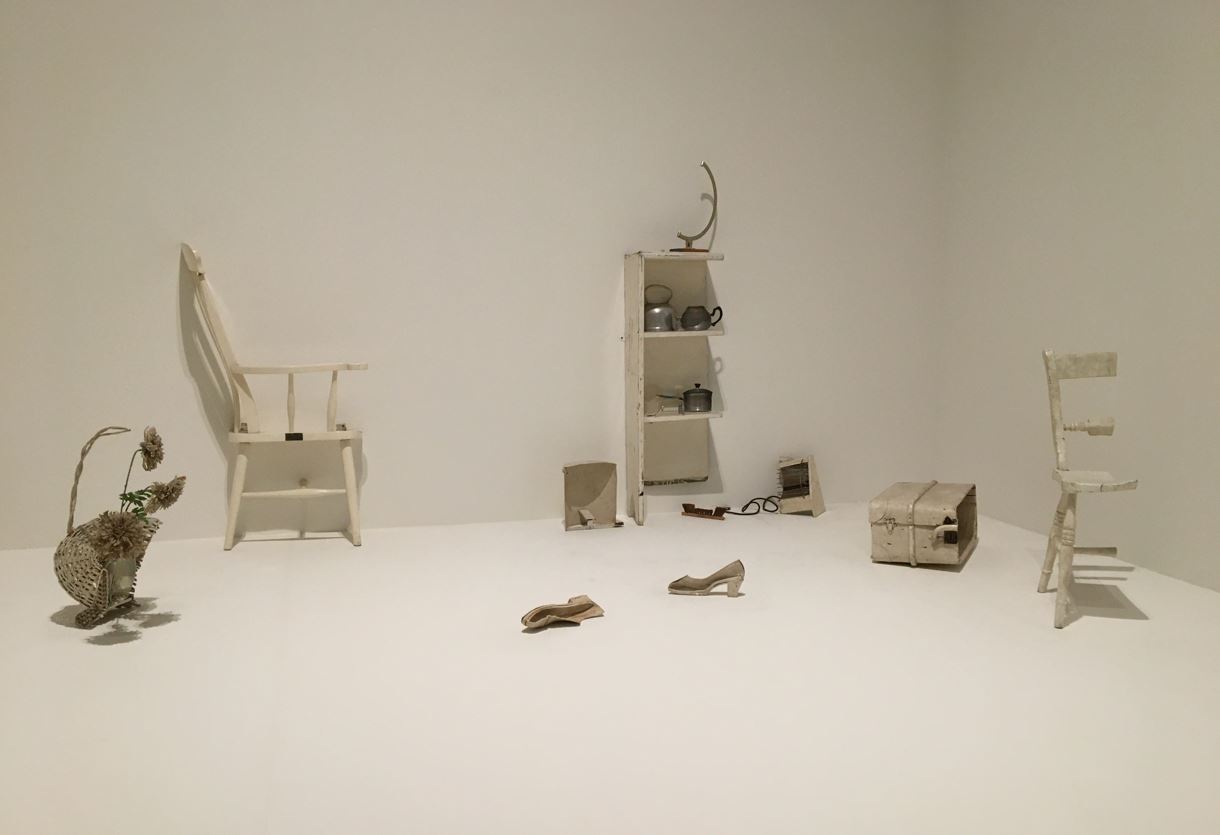
Installation view of ‘Half a Room’ at Yoko Ono: Music of the Mind at Tate Modern (photo by the author)

Or ‘Lion Wrapping Event’, a 26 minute film of wrapping one of the lions in Trafalgar Square in fabric. Or For ‘Promise Piece’ where she smashed a vase with a hammer, inviting audience members to take a piece and promise to return in 10 years to put it back together.

Or Film Number 4 (Bottoms) which edits together close-ups of 200 wobbly bare bottoms. In fact it feature the bottoms of lots of members of the London art scene of the time and features snatches of conversation between Ono and her then husband Anthony Cox.

The film was refused a certificate by the British Board of Film Censors and there’s photos of Ono protesting outside their offices, ‘It’s just part of the human anatomy, there’s nothing rude or sexy about them’ – the touching belief of 1960s idealists that getting naked would solve all the world’s problems from ending the war in Vietnam to abolishing sexism.

But the focus of the next few spaces is the John and Yoko collaboration which became such a big deal from about 1969 onwards.

The late 60s/early 70s peace and politics

A dream you dream alone is only a dream.
A dream you dream together is reality.

One area is devoted to their highly publicised peace projects. There’s a case showing how, on 15 June 1968, the couple planted acorns in the ruins of Coventry Cathedral – famously gutted by German bombing – one person facing east and one facing west to symbolise unity across the world.

In 1969, following their wedding on 20 March, the couple posted an acorn to 96 world leaders, asking each recipient to plant their own acorn for peace. The display case here includes formal replies from three leaders being the King of Malaysia, Prime Minister Golda Meir of Israel and the President of South Africa. They’re all polite but the South African president Jim Fouché wins by promising to plant the acorns on his farm. I wonder if they did. I wonder if they grew. I wonder if they’re still there.

Bed peace

One alcove is dominated by an hour-long film made of the couple’s famous publicity stunt, ‘Bed Peace’. The couple hired a room at the Amsterdam Hilton Hotel in March 1969, immediately after their wedding, and invited the world’s press to come and interview them, during which they, of course, promoted their cause of world peace.

Three months later they staged another bed-in at the Queen Elizabeth Hotel in Montreal from 26 May to 2 June and were more prepared this time. They made sure to be attended by celebrity fans and hangers-on and Lennon had written a song, which he performed live and was recorded, ‘Give Peace a Chance’. Tidied up in the studio and released, it quickly became an anthem of the huge anti-Vietnam War protest movement, being sung by a quarter of a million demonstrators against the Vietnam War in Washington, DC, on 15 November 1969.

In December the couple paid for billboards in 10 cities around the world which declared, in the national language, ‘War Is Over! If You Want It’ and there’s a striking photo of one of these on a billboard in Piccadilly Circus.

‘War is Over! (if you want it)’ poster on Shaftesbury Avenue 23 December 1969 as shown in Yoko Ono: Music of the Mind at Tate Modern (Photo by Evening Standard/Hulton Archive/Getty Images)

(I was struck not by the peace poster but by the cinema hoardings for the films ‘The Lion in Winter’ and ‘On Her Majesty’s Secret Service’ – great month for films!)

Two things:

  1. You can see how the concept and even the name Bed Piece follows on perfectly from all Ono’s previous concept pieces of the 1960s, being the performance of a simple concept (‘Get in bed and wish for peace. Invite the world’s press to watch you’)
  2. How Yoko was now operating in a completely different realm. These weren’t small exhibitions in out-of-the-way art galleries, but statements made in the full glare of the world’s media, this was a completely new stage.

This exhibition devotes an alcove to showing on a wall-sized screen the film which was made of the Montreal bed-in, ‘Bed peace’ (1969) a 16mm film lasting 1 hour 10 minutes, directed by John and Yoko and filmed by Nic Knowland. This appears to be available in its entirety online, so make your own mind up. As usual, seeing it projected on a whole wall is quite a lot more immersive and absorbing than watching it on a computer (or phone).

Yoko Ono’s music

Ono’s involvement with Lennon brought her into the orbit of the music business with mixed results. Previously she had been involved in highly avant-garde music making, working with the conceptual composer John Cage and his pianist David Tudor, staging performances which often included music, or the concept of music, or sounds of various kinds, and so on.

Now she was thrown into the orbit of maybe the most famous pop start in the world (jostling alongside Elvis and Bob Dylan).

The results are very mixed and surprisingly copious. Lennon created a pickup band in New York which they called the Plastic Ono Band which played gigs and benefits in New York at the end of the 1960s and early 70s. In lots of these Yoko added her trademark caterwauling-crying-screeching sounds which can be hard to listen to, especially when set in a fairly traditional rock context. As a student I had all the Lennon albums and couldn’t help skipping over Ono’s screechy bits. See if you can listen to this track all the way to the end. If you like it, there’s plenty more along the same lines.

There are headphones for visitors to listen to some of these concerts and in among the Plastic Ono tracks there’s a recording of her practicing for a gig with Ornette Coleman, the godfather of avant-garde jazz. Now this is interesting. Yoko makes vocal sounds and Coleman picks them up and echoes them on the soprano sax, with a band which is used to playing highly irregular improvised rhythms. I couldn’t help thinking that Ono’s entire approach to vocalising was best suited for this kind of avant-garde jazz setting rather than the limited formulas of rock music.

Anyway, that’s only the introduction, an appetiser, as it were to Ono’s musical career. Because the exhibition features an alcove whose wall is covered with old-fashioned LP covers of every album she’s ever made and it’s an impressive number, somewhere between 20 and 30 I’d guesstimate. The alcove contains seven or eight (very comfy) chairs each with headphones next to it and an interactive screen with a menu of all her albums and then of individual tracks (not every track – 3 or 4 from each album) and you are encouraged to make yourself comfortable and listen a selection of her music from the past 50 years.

Lennon retires

Probably most (middle-aged) people know the story that, after the breakup of the Beatles Lennon produced 6 solo albums but by the mid-1970s had had enough of the music business. Also Yoko finally gave birth after a series of miscarriage, to the boy they named Sean, in October 1975. So Lennon formally announced his retirement from the music business, turned his back on all of that and became a househusband in their New York apartment.

Double Fantasy

Again as most people probably know, Lennon then surprised everyone by, after five years of complete silence, suddenly releasing a brand new album of music in 1980, Double Fantasy.

Three points:

1. According to the Wikipedia article Lennon lacked confidence about the songs and arrangements, feeling he’d lost touch with the whole music scene. He was not wrong. As an ageing fan I was delighted by the appearance of Double Fantasy but it felt instantly nostalgic. It was music from another time, from the previous generation. Music fashions had continued to move as fast as they had in Lennon’s heyday in the 1960s, with glam rock flowering alongside disco, followed by punk, post-punk, synthpop and new Romanticism, and the new genres of Industrial and Goth being defined just as Lennon’s album was released.

It felt like a message from your mum and dad, from a happily married couple enjoying a second honeymoon – which was nice but nothing to do with the exciting young life you were leading. One of the critics called it ‘studio rock’, average material lifted by being performed by top session musicians and expertly produced and utterly soulless.

2. Double Fantasy carefully alternated songs by Lennon with tracks by Ono. Here’s a typical Ono track. Is she having an orgasm at the end?

3. The reason for dwelling on all this is that Double Fantasy is, in effect, the doorway, the gateway into the rest of Ono’s career and the ten or so albums which followed (as well as eight compilation and remix albums). Hence the wall covered in album covers, hence the chairs and headphones.

Yoko’s post-Lennon music career

I listened to a couple of tracks from the five or six albums following Double Wedding and didn’t like any of them. They all feature 1) heavy-handed over-production, with thumping drums and obsolete rock guitar of the worst kind; 2) her would-be poetic lyrics which are, in fact, tritely autobiographical – compare and contrast with any Dylan lyric; 3) her weak voice. If you like it, fine, but her music was never popular, in any sense.

Summary

The point is that for the first time in the exhibition, it felt like Yoko had fallen behind the times. In 1955, 1960 or 1965 she was out ahead of the curve, inventing ideas, methods, events, happenings, stagings, films and performances which stretched and defined the meaning of all those forms and of ‘concept art’. The peace activism with Lennon also set the tone of those last years of the 1960s, moved the avant-garde into the world of tabloid newspapers and TV, invented a new form of art-media-political performance and spectacle.

But by 1980 all that feels long over. And to focus on the music, she committed herself to the most deeply unexperimental, dead and dinosaur kind of Adult Orientated Rock, Dad Rock complete with thumping 1980s drums and air guitar solos. So unimaginative, uninnovative and unlistenable-to that I found the tracks I listened to were embarrassing.

But there’s no accounting for taste. I was astonished to read the curators’ take on her musical career.

Known for her ground-breaking early work and use of experimental vocalising techniques Ono is also recognised as one of the most prolific songwriters of the last century. This playlist highlight’s Ono’s output as a singer songwriter in more conventional pop-rock and electronic structures. It also includes collaborations with other musicians on remixes of her own music.

Then again, to be slightly cynical, this exhibition was obviously staged with Ono’s active support and maybe she sees her musical career as valid and important and worthwhile as her artistic work and so insisted it was included.

Hiatus and modern reprise

As far as I could tell there’s nothing here from most of the 1980s or 1990s. At some point in the 1970s the wave she’d helped to create and had surfed so skilfully from about 1955 to, maybe, 1975, hit the beach and expired. So, as far as I could tell, there’s a big chronological gap in the works here.

And then, in the final couple of exhibition spaces, Ono’s career revives with a new kind of work from the late 1990s. They are far fewer, bigger and far more professionally produced than the charmingly rackety, black and white, home-made experiments and happenings from the 60s and 70s.

They are recognisably high concept art works but executed with the high professional finish of advertising campaigns. Thus:

Helmets (Pieces of Sky)

Take a piece of the sky.
Know that we are all
Part of each other.

This consists of 15 or so World War Two German helmets suspended upside-down from the ceiling, and each one contains pieces from a jigsaw of blue sky and clouds. Visitors are encouraged to take a few pieces of the sky home with them. Personally, I’d have liked to make the jigsaw, asking other visitors who were interested to upend all the pieces onto the floor and then trying to make the sky together. But maybe a bit too subversive and participatory for more sleek and slick late-period Ono.

Helmets (Pieces of Sky) by Yoko Ono (2001) from ‘Between The Sky and My Head’ at Baltic Centre For Contemporary Art, Gateshead, 2008. Photo © Baltic Centre for Contemporary Art

There are some abstract paintings and a series of drawings she’s made in a kind of pointillist style, putting dots on paper as doodles which slowly take shape. They’re quite nice.

Add Colour (Refugee Boat) (concept 1960, execution 2024)

Just blue like the ocean.

By far the most dramatic piece is the entire room dedicated to the refugee boat. This was pure white and place in a nicely boat-sized room painted pure white when the exhibition opened. And there’s a table with a couple of trays of felt-tipped pens, white, blue and darker blue. And visitors are invited to draw or write whatever they want.

Before

‘Add Colour (Refugee Boat)’ by Yoko Ono at ‘Yoko Ono: Music of the Mind’ at Tate Modern, London, 2024. Photo by Reece Straw © Tate

After

‘Add Colour (Refugee Boat)’ by Yoko Ono (concept 1960, execution 2024) at ‘Yoko Ono: Music of the Mind’ at Tate Modern, London, 2024 (photo by the author)

As the curators put it:

Ono invites us to consider the impact collective action can have. The work encapsulates her belief in human agency and her understanding that ‘we are sharing this world’ and sharing our responsibility for it.

What struck me was rather different from this intention, which is how samey people are. For a start we’re all about the same height which explains why the band of wall about five feet high has been overwritten so much as to become an indecipherable sprawl of deep blue. If there are any individual messages there, they’re hard to read. More legible are things written or drawn ether lower down or, especially, higher up.

but people aren’t very original, either. As you can see the biggest single message is an enormous FREE PALESTINE and there are various other expressions of support for Gaza etc scrawled throughout. Then there are lots and lots of messages about love and hope and the planet and hope and love etc.

The problem with the notion of ‘human agency’ is that when you get a lot of these human agents together they generally behave in highly predictable and formulaic ways. That’s what the epidemiology or actuarial science, social media algorithms and AI are based on. I’m sorry to be the one to say it but all the evidence suggests that the notion of ‘human agency’ Ono is promoting is grossly over-rated.

My Mommy Is Beautiful (1997)

Write your thoughts of your mother.
Or pin a photograph of her to the canvas.

The same kind of participatory invitation is at play in the penultimate piece in the show, another invitation for visitors to write a message. So there’s a trestle table piled with cards, as for the Wish Tree, and a tray of pens, and we are invited to write a message or thought about our mothers and tape them to the wall which is, of course, absolutely festooned.

What the visitor doesn’t at first realise is that suspended from the ceiling in this space are a set of photographs of breasts and vulva.

Installation view of ‘My Mommy is Beautiful’ looking up at the photos suspended from the ceiling at Yoko Ono: Music of the Mind at Tate Modern (photo by the author)

Why?

Suspended at height, a series of photographs embody Ono’s humour and humanity. She comments: “One has to look up at the vagina and the breasts on the ceiling – rather like looking up at your mom’s body when you are a baby.”

Once again, as with the Wish Tree and Refugee Boat, the sentiments written by visitors are overwhelming predictable and sentimental (‘I love you Mum’, ‘I never appreciated you Mum’) alongside some occasionally impressive drawings. Purely as relief from the Clinton Cards cloying messages, I liked the one that read ‘My mother was a selfish bitch’, which felt like a rare bit of honesty and truth.

Whisper

If there was any doubt about the importance Ono gives to her musical career this is put to bed by the fact that the very last piece in the show is a music performance. It’s a ten-minute film of her performing at the Sydney Opera House on 17 November 2013. It doesn’t appear to be available online, which is a shame because it showed how the technology had caught up with her style. What I mean was that her voice was looped so whether breathing, sighing, moaning, wailing or screaming, she could play off the looped repetition of herself, and this was interesting (up to a point). Just her experimenting with her voice was good because it had range and variety.

However, go on YouTube and you can find loads of her performances in a rock context which, as I’ve explained, feel reactionary and backward-looking. In the past 50 years popular music has gone through an unbelievable series of fashions, changes and evolutions but not in Yokoworld. In Yokoworld it’s still 1971 and that’s why in something like this performance with her and John’s son Sean on guitar, it feels embarrassingly like watching someone’s home video. Embarrassingly bad…

Summary

This is an excellent exhibition which gives a really good overview of an amazing career. The first half of the show (1955 to 1967) is fascinating, funny, light and inspiring in a charmingly ramshackle home-made video, home publishing kind of way. All those Zen instructions are genuinely mind-opening and smiley.

The Lennon interlude is highly redolent of the late 60s, the Beatles late period and all of that, just as it all began to fall apart.

The wall of Ono albums you can, if you like, just read about and skip, unless you want to hear lots of 1980s AOR, all big shoulder pads and synth drums backing weedy voice and run-of-the-mill lyrics.

And then, after a big gap, there’s the final handful of works – the big ones like the helmets, ship and Mommy wall, and the more discreet series of drawings and paintings which are easy to overlook but quite nice…

What a life! What a career! But also what a fascinating review of the parabola of ‘art’ in the second half of the 20th century, from the genuine avant-garde staging of silly performances in dingy lofts and obscure galleries, then getting involved with the Swinging Sixties drugs and hedonism and fake revolution, then lingering on into the cocaine addiction and bad clothes of the depressed 70s, then justifiably falling silent and then…returning in the form of highly produced, highly finished, slick presentations.

Recognisably the same motivation and the same ‘political’ messages (peace, I love you all) but slickly packaged for the cable TV, then internet, and now social media ages. Clever, slick, virtue signalling which we have discovered, alas, changes nothing because it’s preaching to the converted – to like-minded liberal gallery goers who write ‘Help the refugees’ and ‘I love you mummy’ on gallery walls, while outside, in the real world…

In a way art galleries are safe spaces for certain kinds of like-minded, sentimental liberals who can huddle together and agree that, if only the world thought like us, it would be such a better place. But it isn’t. Trump. Putin. Xi Jinping.


Related links

Related reviews

Philip Guston @ Tate Modern

The curators think the American artist Philip Guston (1913 to 1980) was one of the most remarkable artists of the twentieth century. Usually I can see what they’re getting at, even if I don’t like an artist much, but this a rare occasion when I really didn’t get it at all.

On the evidence of this huge, major retrospective, which contains more than 100 paintings and drawings from across Guston’s 50-year career, it feels like he toyed with or experimented with a series of 20th century styles, never an innovator, seeming much more like a follower who did copied styles invented by other people, often very competently, until, in the late 60s, he had painted himself into a corner, had reached the end of road copying other people, and had a massive block, painting nothing for a couple of years.

When he re-emerged it was with a radically new style, because he had discovered cartoons. The curators call it ‘drawing’ and there’s plenty of drawings here, a roomful of the studies which got him back into the groove, but, in my opinion, all in a cartoon style, and certainly it eventuated in hundreds and hundreds of paintings which look like this.

‘Couple in Bed’ by Philip Guston (1977) The Art Institute of Chicago © The Estate of Philip Guston, courtesy Hauser & Wirth

In this brief review I’ll reprise the shape of his career so you can judge for yourself.

Early years

He was the son of dirt poor Jewish immigrants, the Goldsteins, who had experienced antisemitic pogroms in the Ukraine, and then the tragic deaths of family members when they made it to America, crossing all the way over to Los Angeles to settle in 1922, when our guy was just 9 years old.

So he was raised in a hard-working, socially conscious, left-wing environment, with a particular sensitivity to racism of all forms (which was to come out, a lot later, in the form of a weird obsession with the white hooded figures of the Ku Klux Klan – see below).

Picasso

His early works seem to me to straight copies of Picasso’s neo-classical 1920s style with some surrealism thrown in. Thus this woman seems Picasso while the stitched head or ball on top of the easel looks like de Chirico.

‘Female Nude with Easel’ by Philip Guston (1935) Private Collection © The Estate of Philip Guston, courtesy Hauser & Wirth

But he also did a completely different style of grubby, gritty, stylised but much more realistic portraits, including a powerful one of himself

‘Self-Portrait’ by Philip Guston (1944) Private Collection. © The Estate of Philip Guston

The 1930s were a very political decade, and he was also drawn to the large-scale and very socially conscious mural art of the Mexican Diego Rivera. In fact Rivera helped Guston get a commission, alongside Reuben Kadish and Jules Langsner, to create a large mural in Mexico in 1934.

The result, ‘The Struggle Against Terrorism’ (1934 to 1935) was later painted over by the Mexican authorities. Only recently has restoration work made it available again, and this exhibition features a massive video projection of it, highlighting its theme of the oppressive nature of the Mexican church.

Back in the States Goldstein changed his name to Guston, precisely to avoid a growing swell of antisemitism in America and moved to New York. Moving among artists and writers and intellectuals boosted his left-wing attitudes even more and led, among other works, to a defining work of the era, ‘Bombardment’ from 1937, which combines the clear sheets of colour from the classical Picasso with the large-scale composition of his mural approach and a popular (cartoony?) treatment.

‘Bombardment’ by Philip Guston (1937) Philadelphia Museum of Art © Estate of Philip Guston, courtesy Hauser & Wirth

1940s

Then came a massive change in his style. He began teaching at universities in lowa City and Saint Louis and turned away from public political art. He continued doing portraits (in their quiet way, maybe these are the best bits of the show). But, like so many of his generation, appalled by the trauma of the Second World War and the revelation of the Holocaust, he turned to increasingly abstract compositions. It was the birth of Abstract Expressionism and Guston chucked his old figurative style(s) and threw himself into the new way of seeing and working.

The exhibition has two rooms of his abstract expressionist paintings, one from the 1940s, then moving on to the 1950s and it seemed to me blindingly obvious that he got steadily worse. In the winter of 2016 the Royal Academy hosted a blockbuster exhibition of Abstract Expressionism and it came as a revelation; I was blown away; room after room of masterpieces; a revelation that paintings which don’t depict anything could be so varied and so exciting.

None of Guston’s abstract paintings did it for me. He hadn’t the excitement of Jackson Pollock, the meditative power of Mark Rothko, the dynamic patterning of Lee Krasner, or the stark drama of Clyfford Still. In my opinion the first room of Guston abstracts is bad and the second one is horrible.

‘Passage’ by Philip Guston (1957 to 1958) MFAH © Estate of Philip Guston, courtesy Hauser & Wirth Photograph © MFAH / Will Michels

Nonetheless, he was, apparently, an influential figure in the New York School alongside his high school friend Jackson Pollock, Willem de Kooning and Mark Rothko.

Disillusion

As the gusty 1960s turned into the colourful 1960s, though, Guston got sick of painting in the same mode. For me, it really shows, his abstract paintings start off poor, become terrible, and then it feels like he gives up in disgust. The exhibition compensates for the poor quality of the art with a great deal about Guston’s political views. He was not, as you might have guessed, a big fan of the Vietnam War, but in fact it was the resurgence of racism back home in the states which really got to him.

Extras

The curators have done their best to make this a really defining, landmark exhibition of the full range of Guston’s work, along with all kinds of supporting material and documentation. The show is accompanied by commentary, stories, and personal reflections from Tate curators and guest contributors, including:

  • the artist’s daughter Musa Mayer
  • writer Olivia Laing
  • art historian and curator Aindrea Emelife
  • artist Charles Gaines
  • Tate paintings conservator Anna Cooper
  • illustrator and artist Blk Moodie Boi
  • chef and family friend of Guston’s, Ruth Rogers

Also included in the exhibition are specially commissioned responses from musician Anja Ngozi and poet Andra Simons, inspired by Guston’s collaborative spirit.

In his 1950s abstract phase he was friends with avant-garde composers –John Cage, of course, everyone knew Cagey, but also Morton Feldman and one of the abstract rooms plays bits from the very long (four hours) piece by Feldman which the composer wrote specially for Guston. It is characteristically serialist or abstract, but quiet and lovely. I like Morton Feldman. As one of the commenters on YouTube says, it ‘sounds like an alien trying to make human music’, which is precisely the quality I like, away off the edge of something.

Blockage

A wall label tells us that in the late 60s Guston abandoned painting altogether for 18 months or so. But during that period he continued drawing and sketching obsessively, mainly the objects in his own apartment, tables and chairs and shelves and beds but above all, books.

‘Book and Charcoal Sticks’ by Philip Guston (1968) © Philip Guston Estate, courtesy Hauser & Wirth

Note the vertical black lines in the book, and lying around on the (invisible) table. Using these lines as decoration, to create space, to define objects, would become a signature trick of his final style. Because out of this drawing came a way out of the corner he’d painted himself into. He embraced figuratism again, but of a very, very simplified, reductive type. He expanded the drawings into paintings, and then suddenly found himself painting unstoppably. The dam had broken. His block was over. for the next ten years he would paint hundreds and hundreds of really big paintings all taking the new approach.

‘Painting, Smoking, Eating’ by Philip Guston 1973) Stedelijk Museum, Amsterdam © The Estate of Philip Guston

Note several things. The colour is pink, pinks and reds, a worrying shade of pink skin, pink flesh, a world of burned or flayed human skin. Then the dotted lines, like the nails in hobnailed boots. Are those boots piled up behind the bed? Certainly the use of dots and dashes to fill and decorate objects became a signature.

The Ku Klux Klan

The Klan was a symbol of evil racism for the young Guston. Now in the era of the Vietnam War, of the ferocious racist pushback against the Civil Rights Movement, and the tide of violence sweeping across America, they make a startling reappearance in Guston’s work, as disturbing cartoon emblems of the banality and ludicrousness of evil.

‘City Limits’ by Philip Guston (1969) Museum of Modern Art, New York © The Estate of Philip Guston

So: 1) pink, very pink, buildings, sky, road all shades of pink, so a kind of abstraction. 2) The obviously ‘naive’, untrained, outsider cartoon style. 3) Those lines of dashes, giving definition to everything from the windows in the skyscraper, the wheels of the car (or tractor?), the eyeslits of the Klansmen, and the odd dotted lines on the back of their hoods.

In 1970 Guston showed 30 of these works at a now infamous show at New York’s Marlborough Gallery. Almost all the critics and his friends were appalled. Abstract Expressionism was closely connected with an immensely serious, ‘committed’ attitude to life and art and politics, a tragic worldview mixed up with European existentialism.

All of that had (apparently) been chucked out in the name of what most critics thought a disastrous turn to a naive, crudely cartoony style. But Guston persisted, and the last four rooms of this huge exhibition are stuffed with scores of examples of the same approach applied again and again.

Many of them are depictions of interiors but coloured with a kind of naive surrealism, giant eyes, mountains of legs, abandoned shoes, and everyday objects rendered both familiar and strange. There’s a lot of him or some human being in bed, like ‘Couple in Bed’ that I opened with.

I found that once you’d assimilated the approach, the pink worldview with dots and dashes, men in pointy hats, other men curled up in bed, er, there wasn’t much more to take in. To try and be positive, there’s no doubting that he had finally created a signature style – his early works seem to me straight copies of Picasso, de Chirico-style surrealism, Rivera-style social murals, and then Pollock and Rothko abstraction. In all of them he seems, to me, a follower. Here, though, in  his last fertile decade, he emerges as utterly original and distinctive. I can see that much, and I managed to like some of the images, the best of them, but most of the ones in these four big rooms left me indifferent.

The last room contains one of the best uses of his new style which has, justifiably, been chosen as the poster and promotional image. On its own it looks great. Set amid 30 or so other very similar images in a closely related palette and style, not so much.

‘The Line’ by Philip Guston (1978) © The Estate of Philip Guston, courtesy Hauser & Wirth

If you’re anywhere near Tate Modern and fancy an exhibition, I wouldn’t go and see this – see the outstanding exhibition of African photography, instead.


Related links

Tate Modern reviews

Lessness by Samuel Beckett (1970)

Never but dream the days and nights made of dreams of other nights better days. He will live again the space of a step it will be day and night again over him the endlessness.

Beckett’s writings as antidote to the modern world

Sometime around 1802, that’s to say 220 years ago, William Wordsworth wrote:

The world is too much with us; late and soon,
Getting and spending, we lay waste our powers;—

And nowadays, via smartphones and social media, probably the majority of the population has invited the world right inside their brains, addicting many people to the mini-dopamine hits created by an unending stream of updates on every aspect of an over-wired world, from their friends’ latest makeup secrets to attempted coups in America. Surveys show that people check their smartphones every 12 minutes and spend two and a half hours a day staring at their tiny screens.

Beckett is an antidote to all this. In a world where everything is reduced to easily assimilable, shorter and shorter bite-sized snippets designed to provoke the crudest emotions of mirth or outrage, Beckett’s texts are messages from another planet, one right on the edge of known experience or comprehension. The mere fact that each reader struggles to make sense of many of Beckett’s works, or to make their own sense of it, is a blessèd relief.

Beckett’s nihilism has a place but isn’t the whole story

I can see that the ostensible ‘content’ of much of Beckett often circles around ideas of physical decrepitude, mental collapse, describes human relations which have decayed into the grave and beyond, allegorical figures crawling through mud for years or trapped inside tiny white spaces.

  • Blank planes sheer white calm eye light of reason all gone from mind.
  • Head through calm eye all light white calm all gone from mind.
  • Face to calm eye touch close all calm all white all gone from mind.

And many people respond to his insistent imagery of collapse, decay and futility very strongly – in a positive way if it helps express their own sense of futility, or very negatively if they find his unceasing emphasis on collapse, decay and futility too negative and depressing to handle.

But for me literature is first and foremost about words and how they are deployed. As a middle-aged man whose family has been through various stresses and traumas, I understand where his content is coming from, I can appreciate its grimness, I witnessed at first hand the physical and mental decline and gruelling deaths of my parents, I sometimes feel in myself the symptoms of decay he writes about – all of that is very vividly captured in text after text.

But I also know the world is huge and contains an enormous range of happy and joyful human experiences as well, which are never covered in his writings and that a healthy mental attitude has space for both. My father’s dementia was real and upsetting but it didn’t negate the joy and happiness of playing with my baby son.

Beckett’s subject matter has its place in what you could call a total overview of the human condition, but it is not the be-all and end-all of the human condition. It is one take (a very powerful, haunting take) on one aspect of human existence.

Beckett’s language as a liberation from sense

I’m struggling to express the idea that you can fully and deeply read his works, especially the prose works, without being depressed by them. The opposite. Although the ostensible subject matter may be about mental collapse and decay, the language it is written in and the elaborate structures he creates with his stylised language, can be fantastically liberating.

One way of thinking about it is that Beckett writes at an angle away from ordinary life as most of us live it, in a style of language which is just over the horizon of how any of us think or create sentences, read or write or talk, ourselves – and so it consistently shows us other ways, other possibilities of mental life.

If we take these two elements, style and content – the title of this piece, Lessness, clearly indicates its continuity with Beckett’s interest in collapse, inanition, sparsity and the minimal. In fact it is an attempt to translate the French word Sans which is the title of the original French version of the piece. Possibly Lessness is less good than Sans. At first sight it seems a bit obvious, like a bit of a cliché, another predictable iteration of Beckett’s core theme.

But the actual text is anything but a cliché. The text is something as weird and different now as it was 50 years ago. Here’s the first sentence:

Ruins true refuge long last towards which so many false time out of mind.

It feels like the words are themselves the ruins of longer sentences which once made sense. Maybe it can be parsed as: the ruins are the true refuge towards which, at long last, the speaker or voice or sentence is heading towards after so many false starts, which have been going on time our of mind.

This trope, the endless attempts to start again and try to end an account, to complete a narrative, can’t go on, must go on, features in numerous Beckett texts and is (for me) best expressed in the brilliant radio play Cascando. The central idea is familiar – but if you open your mind to the flow of the words they, for me, open up new mental vistas:

Ruins true refuge long last towards which so many false time out of mind. All sides endlessness earth sky as one no sound no stir. Grey face two pale blue little body heart beating only upright. Blacked out fallen open four walls over backwards true refuge issueless.

Carl Andre’s Equivalents

It’s another example of the central Beckett technique of repetition: ‘Develop a set of key words or phrases. Repeat with variations.’ The technique is cognate with musical composition but words are not music. The technique is closer to minimalist art.

When I was a boy, in 1976, there was a firestorm of criticism in the philistine press at the fact that the Tate Gallery had paid £2,300 for an artwork by minimalist artist Carl Andre titled Equivalent VIII. The eight equivalents consist of 120 firebricks arranged in different simple geometric shapes. Personally I think they’re, well I won’t say ‘genius’, but I like the simplicity of the idea, I like what it says about how you can ring the changes with very simple elements, using the same elements over and over to create an eerie, abstract kind of beauty. I like its crispness and asperity.

The Equivalents series by Carl Andre

Their whiteness is important. The rejection of any colour. Their shape and arrangement set up dynamics in your mind. Repetition of the same basic components, but with teasing and beguiling variations.

Repetition with variation

The visual effect of the Carl Andre is comparable to the verbal effect of Lessness, which is dense with repeated words and phrases, positioned and repositioned so you can admire the angles, enjoy the patterning. Thus the word ‘ruin’ appears 26 times, ‘grey’ 52, ‘earth’ 22, ‘sky’ 30. The phrase ‘gone from mind’ occurs 17 times, the phrase ‘little body’ 22 times.

Scattered ruins same grey as the sand ash grey true refuge. Four square all light sheer white blank planes all gone from mind. Never was but grey air timeless no sound figment the passing light. No sound no stir ash grey sky mirrored earth mirrored sky. Never but this changelessness dream the passing hour.

There does appear to be a human in the text: We are told he will curse God, he has a little body, cracked face, two holes for eyes, looking up at the sky, it will rain, it will rain again.

On him will rain again as in the blessed days of blue the passing cloud

So, if we’re searching for literal meaning, maybe it’s a typical Beckett tramp in a typical Beckett ditch exposed to the typically harsh elements. Although he’s also said to be in sand. Is he on a beach?

  • He will stir in the sand there will be stir in the sky the air the sand.
  • In the sand no hold one step more in the endlessness he will make it.
  • One step in the ruins in the sand on his back in the endlessness he will make it.

While we’re trying to get our head round the variations, Beckett –as is his habit – throws in a few swearwords to épater le bourgeoisie (although nothing as rude as the words we came across in How It Is):

Little body little block genitals overrun arse a single block grey crack overrun.

For those who seek symbolism in literature it appears as if the human figure is the only upright object among the ruins but is also on his back in the sand (22 instances) and ash (18). Contradiction. Paradox. Mirror images.

And insofar as the text describes, or at least references, the notion of a ‘refuge’, it can be manipulated into being ‘about’ man the refugee – a very fashionable concern of our times – endlessly seeking a refuge which is in fact in ruins, haven denied, no home, the endless rain, sand and ash. It has just enough semantic content to snare our minds, but is abstract enough to take almost any concern or idea we wish to project onto it.

Patterns and structures

As it happens, in a neat coincidence (if it is a coincidence) just as Andre’s sculpture Equivalent VIII consists of 120 bricks, so Becket’s prose work Lessness consists of 120 sentences. In fact, digging a little deeper, you discover the entire piece is the creation of a fantastically structuring imagination.

For some printed editions include a dotted line half way through to emphasise that the second 60 repeat the first 60 but in a different order. Because Beckett wrote each sentence on a separate piece of paper and drew them from a hat at random. He then wrote the numbers 3, 4, 5, 6 and 7 on other sheets of paper and drew these at random to determine how many sentences would appear in each paragraph.

The sentences are structured around 6 families of images. In some print editions Beckett gives a guide to them with his usual mathematical precision:

  • Group A: collapse of refuge, key word ‘refuge’
  • Group B: outer world, key words ‘earth sky’
  • Group C: body exposed, key words ‘little body’
  • Group D: refuge forgotten, key phrase ‘all gone from mind’
  • Group E: past and future denied, key word ‘never’
  • Group F: past and future affirmed, key phrase ‘he will’

As Beckett put it, the text weaves through the family of images in, first, one random (dis)order (60 sentences) and then in another. It is a tale of two disorders, each containing, paradoxically, precisely the same 769 words although, to paraphrase Eric Morecambe, not necessarily in the same order.

Aleatory art

In the 1950s John Cage pioneered an aleatory process of composition whereby some elements of the composition are defined but their order, their length, the notes themselves and their pitch, were determined by ‘random’ inputs created by throwing dice or other randomising procedures. In fact Marcel Duchamps and Dadaists had experimented with this approach during the Great War. So Beckett was coming late to a well-established avant-garde practice.

The Beckett Companion (from which the section above is copied) states that this is the only time Beckett experimented with such a strictly aleatory approach, and I think you can see why: that a random approach is never entirely random. After all the author defined the themes, chose the words which express them, invented the number 120 and that it would consist of the same 60 sentences repeated – all this is chosen, is created, before the aleatory element which is, in the overall context, a relatively minor part of the process. The cherry on the cake.

BBC radio production

Interestingly, Lessness was given a full-blown radio production and broadcast on BBC Radio 3 on 7 May 1971. The six ‘image families’ were distributed among six different actors, namely Donal Donnelly, Leonard Fenton, Denys Hawthorne, Patrick Magee, Harold Pinter and Nicol Williamson, directed by Martin Esslin.

The fact this could be done shows there’s more to Lessness than meets the eye. That it exists (as one of the commentaries says) at a place where prose and drama meet. It’s another tangent, or angle from ‘normal’ prose, at which the text operates and which, to repeat my opening point, makes it a kind of antidote to the obvious and the immediate which is what we mostly meet with in contemporary culture.

I’ve searched high and low on the internet for a version of that 1971 BBC production but can’t find it. If anyone has the link I’d love to hear from you.


Related link

Samuel Beckett’s works

An asterisk indicates that a work was included in the Beckett on Film project, which set out to make films of all 19 of Beckett’s stage plays using leading actors and directors. The set of 19 films was released in 2002 and most of them can be watched on YouTube.

The Second World War 1939 to 1945

*Waiting For Godot 1953 Play

Awarded the Nobel Prize for Literature 1969

Breath by Samuel Beckett (1969)

In 1969 Kenneth Tynan wrote to Beckett asking for a contribution to his hit stage revue, Oh! Calcutta!, which made headlines because of the extensive use of full-frontal nudity.

Beckett replied with the stage directions for what must be one of the shortest plays ever written. Some versions barely last a minute. Longer ones stretch it out to two minutes. Here are the directions:

Curtain.
1. Faint light on stage littered with miscellaneous rubbish. Hold for about five seconds.
2. Faint brief cry and immediately inspiration and slow increase of light together reaching maximum together in about ten seconds. Silence and hold about five seconds.
3. Expiration and slow decrease of light together reaching minimum together (light as in 1.) in about ten seconds and immediately cry as before. Silence and hold for about five seconds.

Rubbish No verticals, all scattered and lying.
Cry Instant of recorded vagitus. Important that two cries be identical, switching on and off strictly synchronized light and breath.
Breath Amplified recording.
Maximum light Not bright. If 0 = dark and 10 = bright, light should move from about 3 to 6 and back.

That’s the full text in its entirety. In other words, the stage lighting comes up on a pile of rubbish for a few seconds, there is the distant sound of the cry of a newborn baby followed by a big breath in accompanied by the light growing, followed by a big breath out as the light fades, a repeat of the cry of a newborn baby, then fade to black.

There are quite a few versions on YouTube and one of the funny things about them, taken as a group, is how few of them adhere strictly to Beckett’s directions, but feel the need to add and elaborate and embroider the bleak simplicity of the original.

Absurdist joke

On one level it’s clearly a sort of joke, in the same sort of absurdist spirit as John Cage’s 4’33” or Marcel Duchamp’s urinal – a reduction of theatre to almost its minimal possible components in order to see what the bare bones look like, to see what the most reduced idea of a theatrical piece can be. And yet at the same time be a work which is interesting in its own right – just like John Cage’s 4’33” or Marcel Duchamp’s urinal.

The unsustainability of a nihilistic attitude

At the same time it’s also a kind of reductio ad absurdum of the nihilistic attitude (I hesitate to use the word ‘philosophy’ because although Beckett likes to refer to canonical philosophers and difficult philosophical ideas in his works, he is not a philosopher and doesn’t propound a philosophy) expressed in the famous line from Waiting For Godot:

They give birth astride of a grave, the light gleams an instant, then it’s night once more.

In other words, we are born into a heap of rubbish, cry at our entrance, our entire existence can be summarised as a couple of breaths, and then there is the second cry of our death. Here’s another version, clearly inspired by Philip Glass and Godfrey Reggio’s film Koyaanisqatsi.

But as I remarked of that line in my review of Waiting For Godot, this nihilistic worldview is simply not true and everyone knows it’s not true. Lots of people live long, complex and fulfilling lives. People play computer games and chess, make discoveries, run theatres, write plays, go to art festivals and galleries and football matches, go scuba diving and skiing, build houses and cars, drive across America, join the army, join the navy, go to school, go to church, have children, grandchildren and quite a bit more.

It takes a special kind of imagination to see human life as simply a matter of two cries of pain and a handful of breaths set against a pile of rubbish, and a special kind of mindset to think this could possibly be true. It takes quite a bit of education to be quite this self-deluded.

Of course as a simplified allegory of human existence, as a symbol of a particular worldview, then fine. Paint what you like, draw what you like, write what you like. But as a depiction of the so-called ‘human condition’, it is profoundly untrue.

The unstoppable human instinct to tinker

And this is exactly the point driven home when you watch the half dozen or so short productions of Breath on YouTube – not one of them does it straight, just films Beckett’s simple directions; almost all of them feel compelled to add and embroider and elaborate in all kinds of ways, whether it’s bringing in the music of Philip Glass or a load of slides about the Nazis and the Holocaust.

Now there is where you have the real human spirit or experience – the endless urge to tell stories, tell anecdotes and jokes, harrow with horror, set to music, hum, sing, dance, plunge into grief, gossip about work colleagues, keep a diary, share instagram photos.

The multiplicity of productions which betray Beckett’s simple spartan and crystal clear stage directions, they’re the ones which tell you about ‘the human spirit’, the spirit which can’t stop itself adding, embroidering, inventing, yakking on, adding a new bit, what about some music, hey let’s project some slides, shall we add wheels, how about a flashing light on top and a siren. Humans: incorrigibly gabby.

In fact this betrayal of Beckett’s vision occurred right at the start, when the creator of Oh Calcutta, Kenneth Tynan, gratefully received Beckett’s contribution but thought, ‘Well, that’s a bit boring, let’s adapt it to suit the vibe of our bravely nude stage show’ and added a number of naked men and women to the production. As Beckett’s biographer, Deirdre Blair put it:

‘In one of his few displays of public anger, Beckett called Tynan a “liar” and a “cheat”, prompting Tynan to send a formal notice through his lawyers that he was not responsible for the travesty, which he claimed was due to others … Beckett decided the incident wasn’t worth the argument and dropped it.’

When you think about it it’s a delicious irony, because lovely naked young men and nubile young women, powerful symbols of fertility and sex and the Life Force are pretty much the exact opposite of the nihilistic and bleak ‘philosophy’ the piece supposedly exemplifies.

Drop it, Sam. Walk away. It’s just people, Sam, doing what they do, adding bells and whistles and go-faster stripes. I know you intended it as a searing indictment of the human condition, but the producer wanted boobs and bums.

Beckett as writer not ‘philosopher’

I am interested in Beckett, I am reading my way through his complete works, because I think he is an extraordinary writer – he conceives of language and the scenarios language can conjure and the tension between what can barely be called its ‘subject’ and the wrecked tatters of language it is conveyed in, with extraordinary originality. He repeatedly takes language to entirely new places, creating a kind of powerful and original dynamic interplay between form and content which is unparalleled.

But I don’t think his subject matter is true, good grief, what an idea. It is merely the subject matter he needs to create in order to develop the linguistic effects he is interested in. The white boxes which the narrative finds its protagonists stuck inside in the so-called ‘skullscapes’ or the people crawling through the mud in How It Is are objective correlatives or symbols or scenarios or setups which justify the extreme linguistic experimentation, the phenomenally strange and eerie way he handles the language.

The producers of the Beckett On Film project asked artist Damian Hirst to film it but even though part of an attempt to produce canonical versions, Hirst’s version simply omits the baby’s cry, the vagitus at beginning and end. It’s almost as if the text’s brevity and simplicity taunts producers to over-ride it.

The triumph of stage directions

And, quite obviously, this micro-drama also represents the triumph of stage directions over content. It’s easy to find critics and commentators lauding Beckett as among the greatest prose explorers of the 20th century, and I would whole-heartedly agree. But not so many people make the just-as-obvious point, that he was one of the greatest writers of stage directions.

All of the plays contain very, very detailed stage instructions specifying every aspect of the set, of props, what the characters are wearing, the kind of lighting, exactly how they move, how they speak or whisper or pause.

There’s the story of the hapless Americans who had the bright idea of staging Endgame but setting it in a disused New York subway station. Oops. It is comic and instructive to read the outraged response this prompted from Beckett himself, who tried to get the production stopped and, when that failed, got his lawyers to ensure that the following note was inserted into the programmes for the production:

Any production of Endgame which ignores my stage directions is completely unacceptable to me. My play requires an empty room and two small windows. The American Repertory Theater production which dismisses my directions is a complete parody of the play as conceived by me. Anybody who cares for the work couldn’t fail to be disgusted by this.
(quoted in the Wikipedia article)

What I’m driving at is that many of the later plays can be seen as the triumph of stage directions over prose content. Thus the short work Come And Go really consists of the tightly choreographed movements of the three women. The two Acts Without Words cease to have any dialogue at all, and are what they say on the tin, mimes. Similarly, Quad consists of the wordless movement of four humans dressed in shrouds through a complex series of positions on a stage set conceived as a mathematical quadrant, not really resembling anything we associate with the word ‘play’.

Even some of Beckett’s most famous works can be seen as the triumph of mise-en-scène over content. The only thing most people know or remember about Happy Days is that it’s about a woman trapped up to her waist in a mound of sand trying to look on the bright side of the situation.

Similarly, it’s not really necessary to understand any the text spoken in Not I to be dazzled by the beautiful simplicity of having the stage (or camera) focused entirely and only on a disconcerting close-up of the yammering mouth.

And Krapp’s Last Tape can be summed up as a knackered old man listening in anguish to tape recordings of his much younger, more confident self.

Prose there might have to be, language might be required, to make plays go, to allow a production to go ahead. I’m just suggesting that the stage setups and the fantastically detailed stage directions Beckett supplied to all his dramatic works is at least as, and sometimes maybe more, important than the supposed semantic content of the texts, their so-called ‘philosophy’ and so on. The setup and the actions are the play.

So, to repeat, a minute-long work in which we simply hear the cry of a newborn baby set against a rubbish dump, is brilliantly minimalistic, reduces Beckett’s so-called philosophy of life to one piercing image – but is also a kind of epitome of his theatrical practice.

The law of unintended adaptations

Last point. I suppose there is a cheeky connection between Beckett’s minimalism and the way so many of the interpreters on YouTube and elsewhere have felt free to embroider it. Maybe Beckett’s work survives and his reputation endures precisely because, contrary to his emphatic and repeated directions, the very minimalism, especially of the later plays, allows directors and producers a surprising amount of creative freedom.

More, as I hinted earlier, it’s almost as if the super-precise stage directions are tempting producers to ignore this or that aspect of them, and to improve on Beckett’s vision – to make it contemporary, make it diverse, bring it up to date, make it relevant to the age of social media, Black Lives Matter, #MeToo, and so on.

There’s some kind of perverse law of human nature at play, almost as if the more precise Beckett’s directions became, the more free later generations of producers have felt to bugger about with them,


Related link

Samuel Beckett’s works

An asterisk indicates that a work was included in the Beckett on Film project, which set out to make films of all 19 of Beckett’s stage plays using leading actors and directors. The set of 19 films was released in 2002 and most of them can be watched on YouTube.

The Second World War 1939 to 1945

*Waiting For Godot 1953 Play

Awarded the Nobel Prize for Literature 1969

Mushrooms: The art, design and future of fungi @ Somerset House

Without fungi all ecosystems would fail.

If you enter Somerset House from the terrace facing the River Thames, then immediately on your right is a set of three long consecutive rooms which Somerset House uses to house left-field and intriguing exhibitions. In the past I’ve come to see exhibitions about Tintin, Beards, and Mary Sibald here.

Continuing this tradition is the current exhibition, three long rooms packed with Victorian, 20th century, and contemporary art works all on the theme of mushrooms and fungi.

The show brings together the work of over 40 leading artists, designers and musicians to present an overview of fungi’s colourful cultural legacy, as well as some optimistic ideas about our fungus future.

Mindful Mushroom by Seana Gavin

Fungus facts

Printed around the walls are some of the fungus facts which we all need to know:

  • It was fungi that allowed plants to colonise the earth by mining rocks for mineral nourishment, slowly turning them into what would become soil
  • 90% of living plant species depend on fungi to provide basic nutrients through their roots
  • the largest organism on earth is Armillaria ostoyae which covers 2,385 acres and is at least 2,400 years old
  • mushrooms have hundreds of ‘sexes’ and reproduce by fusing together

Victorians and fungus

Lewis Carroll was partly reflecting the Victorian growth in interest in the natural world, with decades of collectors having amassed mountains of information about the natural world, here in the British Isles and all around the Empire. In Alice In Wonderland Carroll has Alice encounter a caterpillar sitting smoking an elaborate waterpipe on a fly agaric mushroom. He tells her that eating one side of it will make her grow, while eating the other side will make her shrink. And so the exhibition contains a display case showing volumes of Alice open at this scene and illustrated by different illustrators including the original by Sir John Tenniel and a slender Edwardian Alice by Arthur Rackham.

Alice and the caterpillar by Arthur Rackham (1907)

When his intrepid explorers landed in the moon, H.G. Wells had them discover that it was covered in fast-growing fungi. A whole wall is devoted to a dozen or so watercolours of fungi made by children’s author Beatrix Potter, who painted more than 300 watercolours of fungi between 1888 and 1897.

Hygrophorus puniceus by Beatrix Potter (1894)

Twentieth century fungus

The twentieth century is represented by a wall of collages by American artist Cy Twombly – to be precise, No.I – No.X 91974), combining images from the human world with mushroom images, random crayon marks, bits of print and so on. I’ve never liked Cy Twombly.

In a display case is a record of John Cage’s mushroom music and a rare copy of the limited edition Mushroom Book made by the avant-garde composer, John Cage, who was also a dedicated and serious mycologist. The label tells us that Cage helped found the New York Mycological Society with artist Lois Long, and made a living partly by selling luxury mushrooms which he foraged in upstate New York to the city’s top restaurants.

Cochlea Brick Tuft by Hamish Pearch

A dominant theme of this, the second room, is DRUGS, namely the hallucinogenic effects of the chemical psilocybin, a naturally occurring psychedelic prodrug produced by more than 200 species of mushrooms, collectively known as psilocybin mushrooms.

There’s a display case of various literary and counter-culture books and magazines which register the growing interest in mind-altering drugs through the 1950s and into the psychedelic 60s, sparked off by Aldous Huxley’s Doors of Perception, through Timothy Leary, and on into other pop culture references.

As well as these pop culture references, the exhibition tells us that:

  • psilocybin evolved in mushrooms 10 to 20 million years ago, apparently as a way to dampen insect appetites – it is a defence mechanism

Contemporary mushroom art

This is the core of the exhibition, a large number of artworks by over 20 contemporary artists on the subject of fungi, which include paintings, collage, assemblies, installations, video, films, clothes and household ornaments about, with or made from fungi.

Take the jokey film, Fly Amanita by David Fenster, in which he dresses up as a mushroom and shares the thoughts of an Amanita muscaria (also known as Fly Agaric or Fly Amanita) mushroom on his species’ relationship with humans.

British artist Simon Popper has been collecting postage stamps from around the world which depict mushrooms. The result is a large collection of sheets of paper to which the stamps are pinned and titled Mycology Philately.

There’s a video by Egyptian video artist Adham Faramawy showing him and two others doing contemporary dance in a room coloured green with superimposed graphic mushrooms appearing in various corners symbolising, apparently, a break through cultural boundaries’.

There’s a Mushroom Suitcase by Carsten Höller, who trained as a scientist before becoming an artist and plays with the intersection of games, mind tricks, scientific experiments, and scientific research.

Pilzkoffer (Mushroom Suitcase) 2008 by Carsten Holler. Photo by Mark Blower

There are some wall cases containing amazingly realistic, life-sized sculptures of various fungi, done with utter scientific accuracy even down to the trailing roots at the bottom, actually made of silk but designed to look as if each one has been freshly pulled from the soil.

Mushroom sculptures by Amanda Cobbett

Artist Alex Morrison combines arts and crafts patterning with colours and layouts inspired by graffiti found in his native Vancouver. The result is a mildly subversive trippy wallpaper.

Mushroom motif, black and ochre by Alex Morrison (2017)

I liked the work of Laurence Owen who:

draws parallels between humanly-constructed grid systems and modes of connectivity within fungal network systems… [exploring] the innate need within both human and fungal organisms to co-exist and thrive.

In practice this amounted to three large-ish (two foot across) ceramic works hung on the wall which looked like fungus–inspired futuristic cities.

Network by Laurence Owen. Photo © Laurence Owen

And they are hung to quite a few other exhibits by many more contemporary artists, including:

  • Hannah Collins
  • Cody Hudson
  • Jae Rhim Lee
  • Graham Little
  • Mae-ling Lokko
  • Perks and Mini
  • Haroon Mirza
  • Takashi Murakami
  • Hamish Pearch
  • Annie Ratti

Fungi futures

As to the fungi futures, it is estimated that there may be as many as five million fungi species in the world of which we have identified as little as 1%. Considering that penicillin was an accidental discovery made from fungi and has gone on to save more human lives than any other discovery in history, it’s reasonable to wonder how many other wonder-drugs and super-substances may be out there in the Mycological Kingdom.

Some fungi are already used to combat pollution and waste, in rehabilitating oil spills and recolonising the sites of radioactive accidents. And so the third and final room of the exhibition displays examples of the ways fungus material may be turned into more sustainable products that metal and oil-based artefacts. Thus:

  • Sebastian Cox and Ninela Ivanova have produced a series of lamp shades made of mycelium (“Mycelium is the vegetative part of a fungus or fungus-like bacterial colony, consisting of a mass of branching, thread-like hyphae.”)
  • Mae-Ling Lokko works on the upcycling of agro-waste and biopolymer materials into building materials, including blocks built from mycelium
  • there’s a life size ‘burial suit’ by Korean-American artist Jae Rhim Lee, made of biomaterials including mushroom, and designed to prevent the more toxic chemicals from human bodies leeching into the soil
  • another film, this one by Australian director Jason Evans, documenting foragers of the Pacific North-West collecting matsutake mushrooms which only grow in human-disturbed forest.

And clothes. There’s a display case containing a t-shirt, a handbag and what looks like a bra made out of fungus material, the obvious idea being these are more sustainable and less polluting materials than most traditional fabrics let alone plastics.

And some works by Belgian footwear designer Kristel Peters who now focuses on sustainable shoe design. Her focus is on the use of mycelium as a material with little or no environmental impact, so that the samples of her ‘mycoshoes’ on display here demonstrate experiments at the intersection of bio-technology and fashion.

Mycoshoen by Kristel Peters

Curator

The exhibition was curated by writer and curator of contemporary art Francesca Gavin.

This may explain why, after the Alice and Beatrix Potterdisplays, the show cruises briskly through the twentieth century (Cage and Twombly) before arriving very firmly in the absolute present: most of the artworks on display here are bang up to date, with a number of the pieces dating from as recently as 2019.

With the result that, by the end, you realise that this isn’t an exhibition about mushrooms or fungi: an exhibition like that would have to include vastly more botany and science in it, explaining how fungi have evolved, grow, spore, reproduce, exactly how they break down organic waste, and are vital in helping almost all plants and trees to survive.

As an example, there were several references in the wall labels to fungi’s ability to create vast fibrous underground networks and to communicate along them somehow, along with speculation that these networks could be developed in the future to a) transmit electricity b) to form some kind of artificial intelligence network. But then there was no further explanation of any of these mind-blowing notions. I wanted more.

No, this is an exhibition of contemporary art – an impressive selection of videos, installations, clothes and household goods, ceramics, collages and paintings – which just happens to be on the subject of fungi. You learn a few factoids about fungi (some of which the average interested person might well already have known), but what is undeniably new and distinctive is the cross-section of little-known contemporary artists which Gavin has assembled.

Taken as an exhibition about fungi, this show is disappointing. Taken as a wide-ranging exhibition of contemporary art which just happens to have chosen fungi as a subject, this show is a fascinating insight into the contemporary art scene.


Related links

More Somerset House reviews

Vermilion Sands by J.G. Ballard (1971)

All summer the cloud-sculptors would come from Vermilion Sands and sail their painted gliders above the coral towers that rose like white pagodas beside the highway to Lagoon West. The tallest of the towers was Coral D, and here the rising air above the sand-reefs was topped by swan-like clumps of fair-weather cumulus. Lifted on the shoulders of the air above the crown of Coral D, we would carve sea-horses and unicorns, the portraits of presidents and film-stars, lizards and exotic birds. As the crowd watched from their cars, a cool rain would fall on to the dusty roofs, weeping from the sculptured clouds as they sailed across the desert floor towards the sun.

Those who come looking for classic Ballard – all car crashes and multi-story car parks – will be disappointed. The nine stories Ballard wrote about Vermilion Sands are, for the most, part, among his earliest – in fact Prima Belladonna, the first story in the series, is also the first short story he ever had published – and they all reek of early period, fin-de-siecle-cum-surrealist dreams rather than the hard psychoses of the modern world which he became famous for later on.

The idea is that Vermilion Sands is a holiday resort of the very near future, but a desert resort on the model of Palm Springs in southern California. So no sea, no beaches, no sunbathing and all that vulgar paraphernalia. Instead the town is surrounded by a vista of endless rolling dunes, sand-lakes and quartz reefs, among which grow the mysterious ‘sound sculptures’ and out of whose dark grottos fly the ominous sand-rays.

Perfectly at home with this nearly other-planet-like landscape, the denizens of this alternative reality are all well educated and middle class, all seem to work in the arts (we meet an increasingly predictable series of artists, singers, film makers, architects, painters and fashion designers), and indulge strange dreamy fantasies which involve making singing sculptures, tending plants which emit music, selling houses which shape themselves to their owners’ moods and, in the most characteristic story, The Cloud-Sculptors of Coral D, use gliders to carve faces and shapes out of clouds for the entertainment of the jaded inhabitants below.

The stories appear to take place in the present or near future:

  • in Venus Smiles the narrator references the Expo 75 and the Venice Biennale as contemporary events; later he tells us that the artist Lorraine Drexel hobnobbed with Giacommetti and John Cage (making her a very 1950s character)
  • in The Thousand Dreams of Stellavista the architect who is shot dead is described as having hung out in the 1950s with Le Corbusier and Lloyd Wright, and then moved on to Vermilion Sands, ‘1970 shots of him, fitting into the movie colony like a shark into a goldfish bowl’, and since we know he was shot soon after arriving at the resort that sets his murder in the Seventies, and the story is being told some ten years after the trial (p.194)
  • in Say Goodbye To the Wind the lead female character Raine Channing, was a world famous model in the 1970s and the ‘now’ of the story is barely ten years later (p.132)

But the stories take place in a location which is not the same earth or the same present as the rest of us inhabit. Everyone is comfortably off and lazy. All the houses have balconies and verandas where the characters do a good deal of daydreaming and musing. Everyone takes the endless dunes, the singing sculptures, and the flying manta rays for granted.

Ballard is often heralded as the prophet of late-twentieth century urban psychoses but these stories really reveal the late Victorian in him, the man in thrall to a Tennysonian love of euphony, given to long lazy paragraphs describing pre-Raphaelite women who sleepwalk through the dunes under the shimmering moonlight, combined with an 1890s, decadent, Oscar Wilde intoxication with jewels (jeweled eyes, jeweled insects) and the uncanny attraction of the macabre. In these stories Ballard is more of a Symbolist than a modernist.

Standing with one hand on the cabin rail, the brass portholes forming halos at her feet, was a tall, narrow-hipped woman with blonde hair so pale she immediately reminded me of the Ancient Mariner’s Life-in-Death. Her eyes gazed at me like dark magnolias. Lifted by the wind, her opal hair, like antique silver, made a chasuble of the air.

In a short preface Ballard says the stories are his best guess at what ‘the future will actually be like’, a snapshot of ‘the day after tomorrow’ – but I think we can take that with a pinch of salt: the future will obviously look very much like the world of today, only more crowded and polluted; that’s certainly how the future has turned out for the last 40 years that I’ve been experiencing it.

In the 1970s they told us that by the year 2000 there’d be colonies on the moon or even Mars, and we’d all be living in the Leisure Society where the only challenge would be deciding whether to fill your spare time by being an artist or a poet. Forty years later the Space Age is over, everyone works harder than ever, and the world is just more crowded and polluted.

What the Vermilion Sands stories really are is a mental realm where Ballard could go to indulge the most rococo and whimsical of his decadent fantasies, untroubled by any constraints of realism or logic. He is closer to the mark when, later in the Preface, he says that the stories consciously celebrate ‘the neglected virtues of the glossy, lurid and bizarre.’ They are exercises in the strange and the fantastical, the weird and surreal, all told in the calm, bejewelled prose of a latter-day Oscar Wilde.

Memories, caravels without sails, crossed the shadowy deserts of her burnt-out eyes. (p.21)

References in the text to Vermilion Sands

And what they tell us:

Vermilion Sands is my guess at what the future will actually be like.

Vermilion Sands is a place where I would be happy to live. I once described this overlit desert resort as an exotic suburb of my mind…

Vermilion Sands has more than its full share of dreams and illusions, fears and fantasies, but the frame for them is less confining. I like to think, too, that it celebrates the neglected virtues of the glossy, lurid and bizarre.

Where is Vermilion Sands? I suppose its spiritual home lies somewhere between Arizona and Ipanema Beach, but in recent years I have been delighted to see it popping up elsewhere — above all, in sections of the 3,000-mile-long linear city that stretches from Gibraltar to Glyfada Beach along the northern shores of the Mediterranean, and where each summer Europe lies on its back in the sun. That posture, of course, is the hallmark of Vermilion Sands and, I hope, of the future — not merely that no-one has to work, but that work is the ultimate play, and play the ultimate work. (Preface)

‘tourist haunts like Vermilion Sands’ (The Singing Statues)

Ten years ago the colony ‘was still remembered as the one-time playground of movie stars, delinquent heiresses and eccentric cosmopolites…

All the houses in Vermilion Sands, it goes without saying, were psychotropic…

‘Darling, Vermilion Sands is Vermilion Sands. Don’t expect to find the suburban norms. People here were individualists.’ (Stellavista)

… to Vermilion Sands, to this bizarre, sand-bound resort with its lethargy, beach fatigue and shifting perspectives

The Recess

the Recess is referred to in several places as a worldwide economic slump which reduced most people to working a few hours a day (Referred to in The Thousand Dreams of Stellavista and the Cloud Sculptors), but this is as airily vague and meaningless as everything else in the stories.

Vermilion

This is the colour vermilion.

1. Prima Belladonna (1956)

Steve Parker keeps a shop of singing flowers, Parker’s Choro-Fauna. A lot of effort is put into explaining the complexity of singing plants and, in particular, the way they need tuning and Steve does this using the monstrous Khan-Arachnid orchid, a difficult bloom with a range of 24 octaves. When he’s not fussing about these rare and expensive musical plants, Steve hangs out with his pals Tony and Harry, drinking cool beers on his balcony.

What is maybe most characteristic about the story is the notion that it is set during ‘The Recess’, a decade of economic stasis. There’s no socio-economic explanation of this, it just reinforces the sense of slow, lazy, easy-going torpor which hangs over the story.

Into their relaxed, passive lives arrives the stunningly beautiful Jane Cyracylides, long and lean with golden skin and disconcerting eyes which seem like insects. The boys ogle her from their balcony and then one day she comes to the shop.

Tony gets to know here and discovers Jane’s astonishing singing ability, an ability which, if not restrained, badly upsets the flowers in his shop. She starts to make a living singing in nightclubs and becomes famous so Tony is thrilled when they become an item, cruising round together and hanging at the beach.

One day he is awoken by music from the shop, strange, it’s locked up and should be quiet. He goes in to discover the Khan-Arachnid orchid in mad tumescence, rearing up to over nine feet tall and sucking into its core the willing body of Jane Cyracylides. When he tries to pull her free she pushes him away. Later, when he re-enters the shop, the Khan-Arachnid has returned to its normal size and Jane is nowhere to be seen. Has it eaten her?!

2. Venus Smiles (1957)

A broadly comic story. The narrator – Mr Hamilton – is on a small committee which commissioned a sonic sculpture for the central square of Vermilion Sands and awarded the gig to Lorraine Drexel. Unfortunately the finished product looks like a radar aerial with a car radiator grill broken in two so the bars stick up like a big metal comb. And the sound it emits instead of being calm and reassuring is a high pitched whine, a sitar-like caterwauling. The crowd gathered to see the unveiling starts booing.

Quite quickly the statue is withdrawn and ends up in the narrator’s own front garden, and Lorraine Drexel leaves town, laughing. This is because she knows what’s coming next. Which is the statue starts growing, and sprouting more and more sound cores which start broadcasting various classical lollipops like Mendelsohn’s Italian Symphony or Grieg’s Piano Concerto.

Hamilton chops it up with a hacksaw but the parts only grow back. They call in an expert, a Dr Blackett, who spouts some typical half-plausible pseudo-scientific explanation about the sculpture extracting its new content from oxygen in the air and its metal core, creating a dynamic form of rust.

Hamilton wakes up to find the thing smashing through his bedroom window and stretching all over his garden, caterwauling umpteen different pieces of classical music. His colleague on the Art committee, Raymond, comes round with an oxy-acetylene kit and they spend a day chopping the monster singing sculpture up into thousands of tiny pieces. They pay a local contractor to take it away to a steel mill and get it all recycled.

But the sculptress Lorraine Drexel reads about it in the press and sues. The case spends months dragging through the courts and the final verdict is delivered in Vermilion Sands’s new courthouse. They lose the case because the judge doesn’t believe – despite the eye witness testimony – in a growing singing sculpture.

But as they leave the courthouse, Hamilton feels a vibration in his feet. He leans to the floor and hears music. He walks to a window and looks out at some of the unfinished parts of the courthouse. Yes, there are new struts and stanchions growing out from the building even as he watches and new ‘sonic cores’ forming, from which emits louder and louder music.

The sculpture! Its melted-down parts have been mixed with other metal and sent off to construction jobs all over the city. Not only buildings but cars and planes, all the artifacts of modern technology will start budding soundboxes and singing!

3. Studio 5, The Stars (1960)

Studio 5, the Stars is an address – studio 5 is a house half way along a road in Vermilion Sands called The Stars.

It’s a good-humoured joke that the narrator is Paul Ransom, editor of Wave IX, a poetry magazine all of whose works are produced by modern VT technology – punch in your requirements of stanza form, genre, style, metre and so on into an IBM machine and it coughs out as many lines as you like.

Into his life wafts a late-Victorian beauty, the mysterious figure of Aurora Day (much like the slender and mysterious beauties Leonora Chanel and Jane Ciracylades in the other stories), given to mysterious sleepwalking in her billowing white gown or feeding the white fish in her pond or stretching on her divan, her ‘beautiful body uncoiling like a python.’

She is a real poet in that she writes the old fashioned way, with a pen. Once she learns Ransom is editor of a poetry mag she sends her pink Cadillac round every morning so that the hunchback chauffeur can deliver her latest compositions, and in the evening the tapes on which she has written her texts comes roiling and blowing across the sand from her house across the dunes, Studio 5.

But this is just the start. When Ransom rejects her poems, she magically co-opts the entire issue he’s sent to the printers, deleting all the computer-generated poems and replacing them with hers. Far more dramatic, when Ransom gets over burning the tampered copies, he lifts his glass to find a quote of poetry engraved on it, and poetry engraved on the steps of his, and on the doors, and on the walls, and on the floors. Then he looks at his arms and realises they are live with hand-written verse and when he looks in the mirrors he sees that his face it is covered in poetry.

He vaults the balcony, lands on the sand and runs over to Aurora’s house. There she is lazily feeding her fish and asks him if he knows the Greek myth about Melander, goddess of poetry, and Melander, the only true poet of the day who kills himself to prove his devotion to the art of poetry. As she tells it him, Ransom realises there are paintings of the two characters all round the walls. Is she… is she the goddess Melander?

Quickly the plot develops. Ransom utterly gives in to Aurora’s demand that the next edition of his magazine be filled with original, hand-made poetry. But when he gets home he discovers his lovely IBM poetry-making computer has been trashed. He phones the other 23 poets in Vermilion Sands and same has happened to them. How the devil is he going to fill his magazine?

One alone among the other poets isn’t fazed, the good-looking youth Tristram Caldwell. He not only offers to submit some of his verse but comes over and introduces himself to Aurora. Over the next few days they become inseparable. He suggests they go on a sand-ray hunt, sand-rays being things like bats which fly about above the ‘reefs’ but have a sharp and fatal sting.

To cut a long passage short, Tristram fools Aurora into going into a mazy grotto of the reefs and there whipping the sand-rays into such a frenzy that they appear to attack and kill Tristram. Aurora runs off screaming and is driven away the goatish chauffeur who Ransom has, by now, realised must be a reincarnation of the Greek god Pan.

Ransom a) tries to follow them but their big Cadillac loses him b) drives to Aurora’s house only to find it empty, deserted and feeling as if it has never been inhabited (as in a thousand clichéd ghost stories) and c) gets home to find Tristram lazing on his divan. What!

It was a scam by Tristram. He learned how seriously Aurora took the Melander story and how she had cast him as the tragic devotee. So he staged the entire sand-ray hunt in order to fulfil her psychological need. Only he among the little hunting party knew that they are in the ‘off’ season for the rays, and so their blades aren’t poisonous.

And the punchline of the story? Ransom is still stressing about how to fill his next issue when he gets a call from one of the poets who, strange to say, has had a moment of inspiration and has knocked out quite a decent sonnet. And then another phone call. And another. Somehow, Aurora’s presence, or her (probably) commissioning the hunchback to smash up all the poetry computers, has had the desired effect. The poets have learned how to write again.

4. The Singing Statues (1961)

Another story about a beautiful willowy woman who enters the life of the male narrator and entrances him.

In this case he is Milton, an artist, a maker of sonic sculptures and she is Lunora Goalen (what, not the Lunora Goalen, yes!! the Lunora Goalen!!), rich patron of the arts with apartments in Venice, Paris, New York (funny how some things haven’t changed in 60 years), doyenne of the news magazines and celebrity columns and society pages.

Lunora has rented a luxury house in the resort. She has dropped into the art gallery where Milton was just adjusting his latest sound sculpture which looks like an enormous totem pole with wings at the top. Out of the wings come sounds. Milton happens to be inside when the rich client strolls his way and – knowing the musical range of his sculpture is actually pitifully thin – he grabs the microphone and as Ms Rich arrives in range, singes the Creole Love Call which is transmogrified by the computers into a haunting melody which enchants Lunora and she buys it on the spot, turning and walking out to climb back into her white Rolls Royce, leaving it for her sharp-eyed assistant Mme Charcot to make out the cheque to the flustered gallery owner.

Next day they get an angry call complaining that the sculpture only seems to emit a dull booming noise. Milton drives out to the luxury house (like ‘a Frank Lloyd Wright design for an experimental department store’) and pretends to be doing maintenance when he is in fact installing a tape of classical music. This should fix the problem for a day or two.

On successive nights he sneaks back across the dry lake climbs over the wall into the garden, sneaks up onto the unrailed terrace and instals a new tape. Then spends increasing amounts of time looking down to the ground floor where Lunora is sleeping on an open-air divan, topless.

On the climactic day he is rung up by Mma Charcot who insists he comes straight away. Lunora is distraught, her hair undone, dishevelled, crouching beside the sculpture. Milton crouches down beside her and takes her hands in his but Mme Charcot sniggers, it is not him she cares for – it isn’t even the sculpture – it is herself she is in love with.

Appalled, Milton turns and walks away. Next day Lunora, her secretary and chauffeur have gone, When he revisits the house it is cold and empty, the muted statuary standing around like corpses. Months later, in preparation to make a new statue, Milton goes out among the actual living sound sculptures, among the sand dunes and reefs of the desert, and there discovers the sculpture he had sold her, chopped up into pieces and scattered around the sand, some of the fragments still making a sad, whining lament.

5. The Thousand Dreams of Stellavista (1961)

Talbot and his wife Fay are looking for a house to rent in Vermilion Sands. The resort is now past its prime and these new buyers are aware of the history of movie stars and celebrities who populated it in its prime.

The story is based on the idea of Psychotropic Homes – these are homes built in a kind of bioplastic which respond to their owners’ moods and personalities. This immediately leads Ballard into a comic tour of totally unsuitable homes, such as the mock-Assyrian ziggurat whose previous owner had St Vitus dance and so which was still nervously jitterbugging even years after he’d left. Or the converted submarine pen which was the home of an alcoholic and whose vast concrete walls still reek of gloom and helplessness. You get the idea.

Anyway they finally take a nice house with a pool and it’s only when the estate agent ‘turns it on’ (you turn on psychotropic houses) that he reveals it was the home of 70s movie star Gloria Tremayne, who was the defendant at the Trial of the Century, accused of shooting dead her architect husband, Miles Vanden Starr. Now we learn that Talbot, who’d already told us he was a lawyer, was actually a junior defence lawyer on Gloria’s team. Lots of guff about how mysterious and aloof and Greta Garbo she was.

To cut to the chase, Talbot and Fay find themselves beginning to act out the characters of its previous inhabitants. In particular, we learn from Fay’s comments to him, that Talbot has become obsessive, vengeful, permanently angry. One day the house tries to kill her by melting and bending down the ceiling in the living room where she’s sleeping to crush her onto the sofa. Her screams waken Talbot who comes running in to save her.

Next day she’s gone, a note on the memogram saying she’s gone to stay with her sister. Two months later she demands a divorce. Talbot goes on a bender, drinks too much, raves the car back across the lawn, smashing into the automatic garage, throws his coat in the swimming pool, necks a bottle of whiskey and wakes up sprawled across his bed to witness a strange sight.

A pressure zone enters the doorway, but no person, The pressure zone crosses the bedroom towards the bed, there’s a pause, then a convulsion in the air and the house goes into spasm, has a fit. The room he’s in starts to contract, within moments the door and control panel are covered in melting blob, huge veins stand out on the walls. Luckily his lighter is in his pocket and Talbot holds it up to the ceiling which starts to fizz and melt apart and he’s able to pull himself up into the from above, though that is melting and bending, the swimming pool has been upturned and draining.

He realises the house is reliving the moment Gloria Tremayne went into his bedroom to shoot Starr. The spasm was the house re-enacting Starr’s death spasm, the contraction was his lungs and heart ceasing to work, his life force contracting as the room contracted around Talbot.

Talbot makes it to the control panel and turns the house off. Hours later the police leave deciding there’s nothing they can do to prosecute a house for murder. The estate agent looks in horror at the wrecked, erupted shell of the desirable property he sold Talbot only a few months previously, then leaves.

For the time being Starr will remain. He can’t afford to move and the house is turned off. But one day… one day, he will turn it back on… the threat being that he will subsume himself in the damaged psyche of the murderess.

6. The Screen Game (1962)

Paul Golding is an artist, well, an artist in the Vermilion Sands sense, meaning he rarely actually paints anything. He’s co-opted by his friend Tony Sapphire into painting the sets for an avant-garde movie being produced by the millionaire playboy Charles van Stratten (two ex-wives and a controlling mother who mysteriously died in an ‘accident’) who owns a massive house out across the sand lakes.

There’s a cast of distractions including the outrageous director, but the point of the story is to introduce us to the beautiful, slender and (inevitably) troubled young woman at the heart of it. Emerelda Garland used to be a famous actress, darlings, but had a breakdown after her mother died. Now van Stratten (who is, of course, devoted to her) has organised the filming solely to recreate the milieu of her glory years and try and effect a cure.

As an typically eerie and oblique aspect of this cure the narrator is tasked with building a series of twelve enormous screens, which are painted with the signs of the zodiac and are to be moved around what seems to be an enormous chessboard on a terrace below the producer’s summer house.

As the story progresses, Golding produces many more screens than are required and he and his friends develop a strange complicated ‘game’ of moving them around, creating strange patterns and mazes.

Emerelda does indeed find walking among their ever-changing patterns and mazes somehow consoling, although Golding finds it disconcerting that she is followed everywhere or surrounded by an eerie troop of scorpions and spiders with jewels embedded in their heads, jewelled insects which foreshadow the jewelled world created in The Crystal World. (Leonora Chanel is referred to on almost page of her story as having ‘jewelled eyes’, which, we eventually realise, means small decorative jewels stuck around her eyes.)

The climax comes one morning when Charles himself deigns to come down from the summer house and play ‘the screen game’, by now a complex process using the 40 huge screens Paul has painted. But suddenly an abandoned sonic sculpture down on the empty beach sets up a wailing and they realise something is wrong.

Charles starts tearing apart the screens which form the protective carapace the mad Emerelda has made for himself. But when he penetrates to the core and strips away the screens shielding her, exposing her to the harsh sunlight, her entourage of jewelled insects, scorpions and spiders, protects her by leaping onto Charles’s body and covering his face, and stinging him to death as he runs away down the sand embankment screaming in time to the sonic sculpture’s mournful wail.

7. Cry Hope, Cry Fury! (1966)

The first-person narrator, Robert Melville, goes sailing on his sand-yacht across the bone-dry dunes of the sand-sea, in hunt of the eerie sand-rays which fly just out of reach. When one of the tyres of his sand yacht gets a puncture he sets off on foot but the razor sharp sand cuts his feet. Back at the yacht an enormous ray flies overhead till he shoots it dead and it falls out of the sky wrecking his sails and knocking him unconscious.

When he comes to he is being rescued by a much larger sand-yacht under the command of the windswept beauty, Hope Cunard, who tends him in her cabin as they cruise over the smooth dry sand lakes towards her luxury home on the bone dry Lizard Key. Here Melville meets Hope’s small and characteristically troubled entourage, namely her pockmarked half-brother, Foyle, and her secretary Barbara Quimby.

Hope is, of course, a painter, she paints portraits. In a nod to his sci-fi audience Ballard invents a kind of paint which, once you’ve set the basic parameters, you leave out on the canvas in front of the subject and it automatically takes the shape of whatever you intend to paint – similar to the computer programs for making poems in Studio 5, The Stars.

The subject of painting does two things. One, it brings out a profusion of references to artists, including Monet, Renoir, Gainsborough, Reynolds, Balthus, Gustave Moreau, the surrealists as a group and ‘the last demented landscapes of Van Gogh’, as well as literary references to Coleridge’s poem The Ancient Mariner and one of the Surrealists’ holy books, Maldoror. Two, it triggers a glut of sensuous, decadent description, of the desert, the gleaming sand, the sand-rays wheeling above the rock spires and so on. And, of course, the human body as a junction or meeting point of the organic and the crystalline.

Sometimes at night, as she lay beside me in the cabin, the reflected light of the quartz veins moving over her breasts like necklaces, she would talk to me as if completely unaware p.103

It emerges that Hope had a tempestuous affair (underneath the psychological flim-flam there’s quite a lot of Mills and Boon about a Ballard story) with a tall dark stranger who is identified in the story with the Flying Dutchman. He even left a jacket behind with a tell-tale bullet hole in the chest.

Hope lets a portrait of herself and Melville be painted but over the following days it twists and distorts into the macabre figure of a skull-faced woman in a blonde wig and a pig-faced mannequin. The narrator thinks this is a reflection on the weird psychic processes at work in the isolated house, but at the climax of the story we learn that the two other occupants – Foyle and Barbara – have been dressing up in costumes and standing in front of the self-painting paintings, nothing weird and psychic about it at all, it’s a twisted attempt at humour and control.

The climax come when the Flying Dutchman or some such young man does indeed arrive, but Hope has been driven into a state of hysteria and fires a pistol at him, wounding him in the wrist and he and Melville both make their escape, running across the piazza and onto the man’s sand-schooner.

8. The Cloud-Sculptors of Coral D (1966)

This might be the best, the most representative of the stories. Major Raymond Parker has been invalided out of the air force after an accident, hence the crutches. He is building gliders in a disused garage. two freaks pass by, the hunchback Petit Manuel and tall artist Nolan. They’re joined by playboy Charles van Eyck and form the cloud-sculptors of Coral D. a) Coral D is the fourth and largest of the four large coral towers outside vermilion Sands b) cloud sculptors glide among the clouds and release scythes of silver iodide to carve and sculpt them into the shapes of celebrities, presidents and actresses.

Till the day when beautiful reclusive heiress Leonora Chanel (daughter of one of the world’s leading financiers) is driven up in her white Rolls Royce, accompanied by her secretary Beatrice Lafferty (it does feel as if Ballard is writing the same story again and again and again).

As we get to know her we realise Leonora is a monster of egotism. She puts on a massive party at her huge villa and invites the cloud sculptors to perform. Van Eyck and Nolan are vying for her attention and outdo each other. Parker quickly starts an affair with Miss Lafferty and they jointly observe what happens next which is

1. That night there is some kind of argument or fight up on the terrace and Nolan goes running off into the night. We learn that he has in fact already had an affair with Leonora and painted a very unflattering portrait of her. Out of the shadows emerges smooth playboy Van Eyck who now tries his chances with Leonora.

2. Next day there is another party (easy to get the fact there are two, a bit confused) and this time the clouds darken into a storm. First Manuel begs to go up, in order to impress Leonora who had not tried to hide her revulsion at the hunchback. He goes up and his glider is smashed to bits in a storm cloud. Parker and Lafferty go and recover his body which means they are out in the desert when the storm turns into a real tornado and – apparently driven by the vengeful Nolan in his glider -heads straight for Leonora’s villa, where it wreaks tremendous damage.

Emerging from their hidey-hole, Parker and Lafferty tour the ruined, devastated villa, with its wreckage of party chairs, marquee and smashed champagne glasses. They find Leonora dead among her peacock feathers, her face covered by shreds of the many portraits of herself she’d commissioned over the years. And Van Eyck hanging strangled in the wires of the party lights.

9. Say Goodbye to the Wind (1966)

The narrator, Mr Samson, keeps a fashion boutique jokily called ‘Topless in Gaza’, the snazzy sci-fi angle being that the clothes are all bio-clothes, animated clothes, which shape and mould themselves around the owner and are also prone to hysterical fits (much like the sensitive plants and the sensitive houses and the sensitive musical sculptures).

One day a glamorous former supermodel, Raine Channing, turns up at the shop (just as Lunora Goalen turns up at Milton’s art gallery and Jane Cyracylides turns up at Tony Parker’s flower shop) and buys a carful of clothes. This is paid for by her secretary Mme Fournier (same figure as the Mme Charcot who handles everything for Lunora) and has an aggressive chauffeur (as did Lunora and Aurora Day).

Basically, Raine was used and moulded by her svengali, fashion designer Gavin Kaiser. Now she imagines he is coming back to get her and her behaviour becomes increasingly unhinged, particularly her habit of wafting from her hotel room through the empty streets to the abandoned nightclub and dancing by herself to the one record left on the old-fashioned gramophone.

At the climax of the novel the narrator is watching her, when someone creeps up behind him and biffs him on the head. When he regains consciousness he is in a hand-tailored biomorphic golden suit which almost immediately starts contracting and strangling him to death. there’s a couple of sentences of over-the-top description of this Poe-esque fate before strong hands grip him and a macho man cuts open the constricting fabric. It is none other than Jason Kaiser, brother of the dead Gavin Kaiser who has rescued him for obscure reasons.

Five miles away they watch the headlights of Miss Channing’s chauffeur-driven car as it disappears into the night, just like all the other psycho-goddesses in every other one of these stories, disappears back into the shadows of Ballard’s obsessive psyche.


Ballard’s goddesses

Hope Cunard stepped through the open window, her white gown shivering around her naked body like a tremulous wraith. (p.102)

Into all this Emerelda Garland had now emerged, like a beautiful but nervous wraith. (p.65)

Almost all the stories rotate around women of a particular type. Each of Ballard’s narrators meets and falls under the intoxicating influence of glamorous female figures with golden skin and mysterious pasts, former movie stars, reborn goddesses, alluring divas from myth, beguiling heiresses, elusive millionairesses:

  • Jane Ciracylades – mysterious and sexy woman who has a superhuman singing ability
  • Aurora Day – a witch with magic powers who can project poetry quotations into solid objects and onto human skin and murders (she thinks) her lover
  • Leonora Chanel – ‘this beautiful but insane woman’, millionairess who inspires the cloud sculptors, spurring them on to death and destruction
  • Gloria Tremayne – former actress who shot her husband and went mad
  • Emerelda Garland – former actress who had a collapse after her mother died and ends up trying to shoot her lover
  • Hope Cunard – millionaire heiress owner of mansion on Lizard Key who tries to shoot the narrator and her former lover
  • Lunora Goalen – neurotically self-obsessed millionaire art collector who has a breakdown by a sculpture
  • Raine Channing – former teenage supermodel who tries to kill the narrator by dressing him in constricting bio-fabric

These femmes fatales involve the narrator in their strange and dreamlike psychodramas which spiral up towards some kind of often violent climax before they abruptly disappear. He uses the stock phrase – ‘I never saw XX again’ – in so many of these stories it becomes a trademark, a cliché. ‘Of course I never saw her again’ (Gloria); ‘That was the last I saw of Aurora Day’ (p.180) and so on. They come; they entrance and beguile; they disappear – like women in a (very male) dream.

In fact the basic structure – glamorous woman enters life of man with an interesting speciality (animated clothes, musical plants, cloud-carving gliders, computer-generated poetry), after some fencing they ‘fall in love’ i.e. go to bed, before the plot moves to some kind of climax to which she is central and then the woman disappears as abruptly as she arrived – reminds me of the basic template of the James Bond stories (Bond’s interesting speciality being that he is the sexiest spy in the world). The Bond books began appearing only a few years before Ballard’s (first Bond novel 1953, first Ballard short story 1956).

There’s another point worth making: almost all the women are topless or scantily clad at some point; there are quite a few bare bosoms about. Lunora Goalen sleeps topless every night out on the desert terrace where Milton the sound sculptor spends hours watching her. When you see the contemporary illustrations for Ballard’s stories in contemporary sci-fi magazines, you see why coming up with a steady supply of nubile, slender and topless or diaphanously dressed women was required to keep the fans happy.

Cover of the October 1963 issue of Fantastic Stories showing an illustration of The Screen Game – jewelled insects, moveable screens painted with signs of the zodiac and – of course – a slender, half-naked young woman

Some of this – the recurrence of film stars and the entire story about making an avant-garde movie (The Screen Game) – sheds light on Ballard’s later obsession with real-life movie stars like Greta Garbo, Jayne Mansfield and especially Elizabeth Taylor in Atrocity and Crash.

These later texts are usually read as deconstructions of the mediascape in a consumer capitalist society, of the way Hollywood iconography and huge advertising hoardings mediate, focus and exploit primal human longings (for sex, for a better, perfect life) for profit. But a simpler interpretation is that Ballard himself had a deep devotion to the figure of the goddess, the muse, the Perfect Woman, which has more to do with Tennyson and the pre-Raphaelites than the hectic commercial world of the 1960s.

It’s characteristic that even though some of his male narrators sleep with these other-worldly muse figures – as Steve Parker does with Jane Cyracylides and Robert Melville with Hope Cunard – little if anything is made of the sex, as such. It is more important as a symbol of the often oblique psychological bond between the narrator and the goddess-figure.

But even that is not quite accurate, because there is actually little if any psychology in a Ballard novel. Or, to put it another way, Ballard’s novels are full of psychology but it is Ballard’s psychology – the characters are little more than ciphers in the strange trance-worlds Ballard creates, as their generally anonymous names clearly signal – Ransom, Golding, Milton, Talbot, Melville, they’re all dream figures acting out Ballard’s compulsive scenarios, again and again and in Vermilion Sands it’s striking how many of these obsessions are more or less the same one – being entranced by a beautiful, sexy, but mad and dangerous young woman.

As a footnote, they all arrive in very nice cars, and they all have chauffeurs:

  • Leonora Chanel – white Rolls Royce, chauffeur and secretary (p.11)
  • Lunor Goalen – white Rolls Royce, chauffeur and secretary (p.75)
  • Aurora Day – pink Cadillac and chauffeur (p.154)

Once I’d noticed this, I couldn’t help thinking about Lady Penelope, driven about in her pink six-wheeled Rolls Royce by the faithful Parker in Thunderbirds (which was broadcast 1965-66).

Ballard’s buzzwords

There’s a lot of detail and imagination in all of the stories – a lot of sci-fi gags, like the houses which change shape or the mutant plants which can make music or the eerie sand sculptures and so on – but, in the end, I found it a struggle to read the book right to the end. The atmosphere, which starts off as dreamy symbolism, ends up becoming too one-dimensional, the effects too shrill and tinny.

I began to notice the way he throws around the adjective ‘insane’ a lot – insane wishes, insane people, insane ideas, insane landscape, insane logic,

  • fighting the insane air, Manuel piloted the glider downward…
  • For a moment the ambiguous nature of my role, and the questionable morality of abducting a beautiful but insane woman, made me hesitate. (p.67)
  • Convinced at the time of this insane logic, I drove my fists through the canvas… (p.105)
  • I raised my hands to my face, in horror saw that the surface of my skin was interlaced by a thousand tattoos, writhing and coiling across my hands and arms like insane serpents. (p.163)
  • The fragments of Aurora Day’s insane poems caught the dying desert light as they dissolved about my feet… (p.181)
  • I stood up, wondering what insane crisis this psychotropic grand mal duplicated. (p.205)
  • ‘The place must have been insane.’ (p.207)
  • There’s a subtle charm about the house even in its distorted form, like the ambiguous smile of a beautiful but insane woman. (p.208)

And bizarre:

  • the portraits recapitulated in reverse, like some bizarre embryo, a complete phylogeny of modern art… (p.98)
  • a character’s shirt makes him look like ‘some bizarre harlequin’ (104)
  • She seemed to be concealed in this living play-nest like a bizarre infant Venus (p.134)

And demented:

  • We barely noticed the strange landscape we were crossing, the great gargoyles of red basalt that uncoiled themselves into the air like the spires of demented cathedrals. (p.52)
  • In the wardrobe the racks of gowns hung in restive files, colours pulsing like demented suns. (p.136)
  • I woke on Raine’s bed in the deserted villa, the white moonlight like a waiting shroud across the terrace. Around me the shadows of the demented shapes seethed along the walls, the deformed inmates of some nightmare aviary. (p.141)

Yes, nightmare:

  • What had begun as a pleasant divertimento… had degenerated into a macabre charade, transforming the terrace into the exercise area of a nightmare. (p.69)
  • Kicking back the door I had a full glimpse of these nightmare figures. (p.106)
  • The macabre spectacle of the strange grave-flora springing from cracked tombs, like the nightmare collection of some Quant or Dior of the netherworld… (p.130)
  • The cloud if insects returned to the summer house, where Dr Gruber’s black-suited figure was silhouetted against the sky, poised on the white ledge like some minatory bird of nightmare. (p.71)

And macabre. And grotesque. And hell.

  • The livid colours of Hope’s pus-filled face ran like putrefying flesh. Beside her the pig-faced priest in my own image presided over her body like a procurator in hell. (p.107)
  • I remembered the clothes I had seen on a woman killed in a car crash at Vermilion Sands, blooming out of the wreckage like a monstrous flower of hell, and the demented wardrobe offered to me by the family of an heiress who had committed suicide. (p.137)
  • Three nights later, tired of conducting my courtship of Emerelda Garland within a painted maze, I drove out to Lagoon West, climbing through the darkened hills whose contorted forms reared in the swinging headlights like the smoke clouds of some sunken hell. (p.67)

And nightmares. And Bosch.

  • My pig-snouted face resembled a nightmare visage from the black landscapes of Hieronymus Bosch. (p.105)
  • With his beaked face and insane eyes, his hunched figure hung about with the nets of writhing rays, he looked like a figure from Hieronymus Bosch. (p.177)

There’s a tired business mantra that if everything’s a priority then nothing’s a priority. Same here. If everything is ‘insane’, if eveythingis a ‘landscape from hell’ then, eventually, nothing is.

My point is that it’s too easy and glib to chuck around extreme adjectives like that. It devalues them and they quickly lose their evocative affect.

The obsessive repetition of the same basic structure – mysterious glamorous woman entrances naive male protagonists against the backdrop of the endless dunes, sand reefs and sonic sculptures – gets pretty boring after the fourth or fifth iteration. The details of things like the psychotropic houses and the moments when the house tries to kill Fay, then the narrator, are weird and hallucinatory, the details of the gliders flying among the clouds and sculpting them into shapes and faces is wonderful, but:

  1. the human plots which he concocts amid the sand-seas and reefs of quartz are often shallow and disappointing
  2. Ballard’s language is too often cranked up to maximum all the way through; there’s little light or shade, the whole thing does indeed become ‘glossy, lurid and bizarre’ to such an extent that, in the end, it runs the risk of ceasing to register or matter

Maybe literature is something to do with restraint, and the reason Ballard is hard to take seriously as a literary figure is because, although his novels are brilliant (the three disaster novels are breath-taking and ‘Atrocity’ and ‘Crash’ are all outstanding visions), nonetheless Ballard’s writing – considered solely as written prose – is so ridiculously over the top.

In the silence of the villa I listened to [the shadows of the demented shapes] tearing themselves to pieces like condemned creatures tormenting themselves on their gibbets. (p. 141)

Edgar Allen Poe on acid.


Credit

‘Vermilion Sands’ by J.G. Ballard was published by Jonathan Cape in 1973. Page references are to the 1985 J.M. Dent paperback edition. All quotations are used for the purpose of criticism and review.

Related links

Related reviews

Sense Sound/Sound Sense: Fluxus Music, Scores and Records in the Luigi Bonotto Collection @ the Whitechapel Gallery

Fluxus

Fluxus was an international, interdisciplinary community of artists, composers, designers and poets during the 1960s and 1970s who engaged in experimental art performances which emphasized the artistic process over the finished product.

The word Fluxus literally means ‘flow’ and all the artists associated with it were more interested in the process, in interaction rather than a stable polished final product. As such they are associated with performance art – you really had to be there! – or conceptual art which only required thinking about, no finished product necessary.

It was a very loose international association which stretched beyond artists to include musicians, composers, performers, poets, dancers, anyone who was prepared to have a go at experimental performance which, in the later 1960s and through the early 1970s, was a lot of extrovert creative types from John Cage and his Black Mountain College colleagues through to Yoko Ono and friends in Japan.

Display case of records, musical scores, magazine articles and photos at Sense Sound/Sound Sense: Fluxus Music, Scores and Records in the Luigi Bonotto Collection at the Whitechapel Gallery. Photo by the author

Luigi Bonotto and the Bonotto Foundation

This is a FREE one-room display of Fluxus-related objects from the collection of Luigi Bonotto. Who he?

Luigi Bonotto was an Italian businessman who made his money from a textile factory and business in Molvena. He became involved with contemporary art in the 1960s and hosted a series of events by Fluxus artists at this home. Here, artists met each other, planned and created new works which Bonotto took it upon himself to document and record.

Gradually Bonotto set out to keep the work of the artists of Fluxus and Experimental Poetry alive, and dedicated his life to preserving, cataloguing, and promoting their poetry, music, and work.

Forty years later the collection has grown to house over 15,000 documents, often given by the artists themselves, a unique archive with which to study the creative processes, relations and collaborations between the artists. It is now housed in the Luigi Bonotto Foundation which, of course, has its own website.

Sense Sound/Sound Sense

So, after all that explanation, what about the display? Well, it’s like an interesting old junk shop, with display cases showing magazines and photos, a number of fairly big objects, rows of old, long player vinyl records, and some music stands holding iconic Fluxus-related scores such as John Cage‘s iconic 4’33”.

Cage’s ideas about ‘preparing’ a piano by placing nuts and bolts and other impediments among the strings were taken up by a wide variety of followers.

George Brecht (1926 to 2008)

In one of his iconic works Incidental Music, gave musicians a list of ways to interact with a grand piano such as opening the piano and stacking wooden blocks inside the instrument until one falls and creates a noise, or by dropping dried beans onto the keys. Here’s the complete ‘score’, obviously in fact a set of instructions.

Incidental Music by George Brecht (1961) Courtesy of Fondazione Bonotto © George Brecht

Dick Higgins

Higgins had the idea of creating a musical score by firing machine guns at it. Here’s the resulting score and the electronic thingy at the side included headphones so you could listen to the result. Note the written text at bottom left. As so often with conceptual art, it takes longer to read about than it takes to look at.

Installation view of Sense Sound/Sound Sense: Fluxus Music, Scores and Records showing Symphony 245 by Dick Higgins (1981) Photo by the author

Takehisa Kusugi

Kusugi’s score Musical Piece set a new standard of simplicity: simply place the piece of paper these instructions are written on against your ear and rub. That’s it.

Elsewhere there was a piece of music made up of recorded birdsong placed on a loop, quite a funny big cartoon of a man playing flute and out the end of it dripping spittle which was collected in a jar.

Probably the most striking artifact is this missile titled Bomb Cello by Charlotte Moorman.

Installation view of Sense Sound/Sound Sense: Fluxus Music, Scores and Records in the Luigi Bonotto Collection at the Whitechapel Gallery.

Charlotte was a classically trained cellist who teamed up with Fluxus artist Nam June Paik (who recently had an enormous retrospective show at Tate Modern) to create all manner of happenings and wacky performances. She performed naked or wearing a range of outfits, she played a man i.e. had a man sit in front of her while she went through the motions of playing a cello, and did the same to a TV and to a stack of TVs, in various performances.

The photo above captures Charlotte in the process of ‘playing’ a naked man, a performance titled Human Cello (1965). But it was Charlotte herself who designed the bomb cello standing next to it, which has strings, keys and a bow attached.

On the right in the picture is an artifact titled Composition for a record player and five musicians, with the toy musical instruments usefully attached. You get the idea.

Installation view of Sense Sound/Sound Sense: Fluxus Music, Scores and Records in the Luigi Bonotto Collection at the Whitechapel Gallery.

There are lots of LPs, sheet music, photos and magazine articles and wall labels and headphones so you can listen to the wackier compositions to your heart’s delight and study numerous other ‘scores’ for performances, as well as smashed up, fragmented or otherwise twisted and reinterpreted musical objects, like Claes Oldenburg’s drumkit made out of drooping, sagging sewn fabric. Or a violin case filled with lighted candles and titled A Little Night Music.

A Little Night Music by Marchetti Walter

As mad old Uncle Ian used to say: ‘Why not?’


Related links

More Whitechapel Gallery reviews

Nam June Paik at Tate Modern

Nam June Paik (1932 to 2006) was a Korean American artist. He worked with a variety of media and is considered the founder of video art. He is credited with an early usage (1974) of the term ‘electronic super highway’ in application to telecommunications. (Wikipedia)

This is a major retrospective exhibition of the work of Korean-American artist Nam June Paik, a collaboration between Tate Modern and San Francisco Museum of Modern Art.

It’s the most comprehensive survey of the artist’s work ever staged in the UK, bringing together over 200 works – from early compositions and performances, to sculptures, photos and paintings, magazines and drawings – through to rooms full of videos and large-scale television installations, and a final room which is a large scale, pulsating and very loud, multi-media rock installation.

Sistine Chapel (1993) Courtesy of the Estate of Nam June Paik

The Korean War ended in 1953 with South Korea saved from communist tyranny, and the country which saved it – at such cost in blood and money – the USA, proceeded to invest heavily in the South, fuelling a technology and consumer boom.

Paik developed as an artist during this boom and right from the start was interested in the incongruity of a still, in many ways undeveloped, traditional and Buddhist culture taking on the trappings of Middle American consumer capitalism. Hence his frequent images and assemblies playing with and highlighting the clash of these two cultures.

TV Buddha by Nam June Paik (1974) Stedelijk Museum, Amsterdam

When he, inevitably, traveled to America, he was put in touch with other opponents of the swamping consumer culture, the Beat poets like Allen Ginsberg, or the collection of artists musicians and performers at the Black Mountain College, North Carolina, which was home to all sorts of eminent artists and performers, notably the composer John Cage and the choreographer Merce Cunningham.

Cage had an explosive impact on young Paik – he showed him that art can be made out of anything, incorporate any technology, and use chance and randomness. A man on stage twiddling through radio stations can, in the right circumstances be a work of art. A television showing an endless loop of imagery, or weird incandescent patterns you’ve generated to be played through it… or a TV with a magnet on top which distorts the images, or a large magnetic loops around the front with a fluctuating current going through it which makes the images bend and distort.

Why can’t all or any of this be art? After all, this was the age of the atom bomb and the Cold War, when the entire world might be reduced to a smouldering cinder in half an hour if someone pressed the wrong button. How could you possibly go on painting like Rembrandt or Constable in a world like that?

You needed something that responded to the urgency and the crisis of the times. And television seemed to be the new medium, the one through which entertainment and government lies poured in equal measure. A medium which could potentially be used for education and to bring the world together. Or to promote lies and ideology which would tear the world apart.

Why not address its ever-growing centrality, deconstruct it, take it to bits, satirise it, parody it, build sculptures out of it?

TV robots by Nam June Paik

Room by room

This exhibition feels really comprehensive. It’s massive and feels packed with stuff, but still manages to be imaginatively spaced and staged. Its twelve big rooms contain:

Introduction

Paik travelled to work in the US, Germany and Japan. He always questioned not just national borders but professional demarcations – and liked working with collaborators, not just artists, but dancers and musicians, and also fleets of technicians who helped him build robots and experiment with TV technology.

Buddhism. Many of his inventions use Buddhist motifs, from the image of a Buddha statue relayed via a CCTV at the start, to the penultimate room which contains a single lit candle with a camera pointing at it, and the image of the flickering flame reproduced on screens and projected onto the wall.

TV Garden

‘A future landscape where technology is an integral part of the natural world.’ The idea is supposedly related to Paik’s Buddhist feel for the way everything and everyone is connected in the spirit world and, increasingly, in a world dominated by new technology. But it is in fact a load of rubber plants with TV monitors arranged among them.

TV Garden 1974 to 1977 (2002) Tate Modern 2019. Kunstsammlung Nordrhein-Westfalen, Dusseldorf

Googling images of this, you can see that in some places the plants were set among stones in what looks like an actual low-growing garden. Tell you where would be a good place for these – the greenhouse at the Barbican.

Global Groove

According to the wall label: ‘This colourful fast-paced video mixes high and popular cultures, with imagery from traditional and contemporary, Western and non-Western sources.’

Far out, man! Look at the crazy picture distortion and mirroring effects! Top of the Pops 1973!!

From quite early on you get the feeling that all of this – the obsession with TV, the notion of the global village, lumbering robots, pop music and pop videos – it all seems incredibly dated. When I saw that the magnets placed around TV sets were being used to distort speeches by Richard Nixon I realised were in that kind of art, art gallery, curatorial time loops which is obsessed with the 1960s and their crappy hangover in the 1970s. The Vietnam War, the Beatles, Allen Ginsberg chanting blues to his harmonium, Woodstock, Watergate – yeah, man, it was all one heavy trip.

Even in the massive multi-media ‘experience’ which climaxes the exhibition in which a disorientiating stream of intercut images and clips and sounds and music are projected onto the walls and ceiling of the final room, I was astonished when prolonged clips came up of Janis Joplin singing her heart out. She died of a heroin overdose in died 1970.

In one darkened room is a huge wall of TV sets with other big TV monitors on the other walls and it seems to be playing a kind of multinational, global mashup of videos from various cultures, all treated to look over-coloured, cut-up and treated and all playing to… a soundtrack of Beatles songs! – titled Video Commune (Beatles beginning To End) and dating from 1970. Old. Old, old, old.

It is all just about near enough to be sort of familiar, but also old enough to smell musty like grandad.

Electronic music

Paik actually studied to be a classical musician and was an extremely able pianist. Some of the clips of Beethoven featuring in various vidoes are played by him. But when he moved to Germany in 1956 and met Karlheinz Stockhausen and John Cage, it blew his mind daddy-oh.

In 1963 he hosted a one-man show at a villa converted into a gallery stuffed with immersive environments and sculptures which required audience involvement. There were musical instruments modified by the artist, three customised pianos in the Cage manner (Cage composed quite a lot of music for pianos which had had nuts and bolts and screws and elastic bands inserted between the keys or into the wires. They’re surprisingly listenable. Paik took this approach to the next level.

Zen for Wind took lots of random dangling objects which a breath of wind made brush against each other, jingle jangle. Visitors could record their own sounds and snippets on tape recorders and hear them reproduced at random through loudspeakers.

Paik’s friend the German artist Joseph Beuys destroyed one of the pianos and Paik liked it so much he left it on display. Ah, those were the days. Such rebels, back in a time when rebellion had meaning.

Some of Paik’s Cage-like music, some of the dangling objects and one of the pianos are on display here in this exhibition. It was ironic to read on all the wall labels how Paik wanted his visitors to interact with the pieces and then turn to them to find them all protected by plastic covers or behind tripwires which set off alarms.

Installation view of Nam June Paik at Tate Modern

No, children, you could play with these dusty old toys once upon a time, even smash them up for fun, but now times are very different and every scrap of paper and piece of old cable which was ever handled by a Great Artist is now a precious Work of Art, which would fetch millions on the current art market, and so must be protected, curated, catalogued and carefully stored away.

That’s what happens to avant-gardes – they fall into the hands of galleries and curators where their entire disruptive, anarchic charge is neutralised, surgically removed, and replaced by polite wall labels and security barriers.

Merce Cunningham

There’s a room devoted to Paik’s collaborations with and riffing off the work of Cage and choreographer Merce Cunningham, including the film Zen for Film a, blank film ‘exploring themes of emptiness, boredom and random interference’ – and Merce by Merce by Paik.

Charlotte Moorman

As a thoroughly trained classical musician Paik was well placed to make his comment that sex was everywhere in art and literature and yet almost completely absent from the classical canon.

Why is sex, a predominant theme in art and literature, prohibited ONLY in music?

(For a start that shows the extreme limits of his knowledge of contemporary and pop culture: I think even a casual examination would have shown him that popular songs, jazz, blues, rock’n’roll, pop and rock music is OBSESSED with sex.)

So he set out to address this glaring error in a collaboration with classical cellist Charlotte Moorman which lasted for nearly thirty years. Basically, these involved getting Moorman to play the cello in various states of undress, topless, bottomless, totally nude, or with various objects taped onto her boobs, for example mirrors, or what looked like little display cases.

This was such a 60s idea it made me giggle. What’s so funny about peace, love and understanding, man? A big quote from Moorman is printed on the wall of her saying that, in the age of nuclear weapons and Vietnam, you couldn’t expect artists to make art like in the old days. She became known as the Topless Cellist.

Thus there are films of performances which involved Charlotte playing the cello nude, or with mirrors or even small TV monitors taped to her breasts, or playing a TV monitor as if it was a cello, or playing a man sitting in front of her as if he was a cello and, most impressively, climbing topless into a column of oil drums filled with water then climbing out again.

The idea that having women strip off, taking their clothes off or taping things to their boobs, would somehow revolutionise music or put the sex back into classical music is so laughable as to be sweet and quaint.

If there’s one thing that Charlotte Moorman is not, it’s sexy. She looks like a nice young lady who’s decided to take her clothes off to make a statement. But just taking your clothes off does not make you sexy, as anyone who’s been in a gym or swimming pool changing room and looked around knows: it just makes you someone who’s taken their clothes off, often enough a rather pitiable sight. Here she is, combining Paik’s two themes, playing a cello made of television sets.

Charlotte Moorman with TV Cello and TV Eyeglasses (1971) Peter Wenzel Collection

Joseph Beuys

Paik encountered the Zero Group in Dusseldorf in 1961, which included the eccentric German artist Joseph Beuys. They remained close friends and made various collaborations. One of the later ones is a long video of Beuys on stage somewhere, standing wearing his trademark hat and army flak jacket and howling howling howling like a coyote into a microphone.

This room contains a full-sized Mongolian yurt, because Paik felt very in touch with the Mongolian part of his heritage. It’s an impressive object, easily big enough to bend slightly and walk into. It was Paik’s contribution to the German pavilion at the 1993 Venice Biennale.

Mongolian tent by Nam June Paik (1993)

The Sistine Chapel

As mentioned above, the penultimate room contains a flickering flame with a camera pointing at it, and projected on the walls. But this pales into comparison with the elaborate scaffolding which projects a mashup of footage onto the walls and ceiling of the final room all to a deafening rock and blues and classical splice track.

The sound is impressive and the images are sort of immersive, but what really impresses is how much bloody scaffolding and structure it took to project these images. I wonder if the same effect could be achieved nowadays with a fraction of the equipment… as in the nearby exhibition of contemporary immersive artist, Olafur Eliasson. And if so, the thing is impressive less for its effects, than for indicating how laborious and heavy and complicated it was back in 1993, to achieve something which can be done with a few hidden projectors nowadays…

Installation view of Nam June Paik at Tate Modern. Photo by the author

Nothing dates faster than old TV

Well, OK, some things do, bread for example. Or pop music. But not much dates faster and more completely than televison. Watching TV clips of Richard Nixon or John Cage or Janis Joplin or hearing tracks by the Beatles from the 1960s conveys a deep psychological sense that we have stepped back in time not just a few decades, but back into what, is now, a different century – a time which is fast becoming incomprehensible in its political and artistic naivety and optimism

I really enjoyed the exhibition because of its quaint sense of being dated and old. I liked the quaint old bakelite TV sets Paik made his television robots out of, or the extremely ancient tape recorders on which he made his cutting edge music compilations in the 1960s.

But nothing dates faster than old visions of the future. Paik’s wall of video monitors is wonderfully redolent of the 1980s, of MTV and the TV generation. But the future would turn out not to be about walls of TV screens, but screens which are so small you can put them in your pocket or possibly be projected onto your glasses (still waiting for that to be perfected).

This is a beautifully assembled and laid out and clearly explained exhibition, and it explains why Paik was clearly one of the early international art superstars but – Tate’s promotional video includes the slogan THE FUTURE IS NOW. But this exhibition is all about THEN, and quite an outdated THEN at that. To me it ranged from the dated, to the very dated, to the really antique.

Some ancient robots and gizmos by Nam June Paik at Tate Modern.

A fascinating look at the world of a pioneer of TV art, or art for the TV age – but really bringing home the fact that that era, the TV era, is long gone, and we are well into a completely new era, of boundless new communication technologies, bringing with them new social ideas and issues, and new geopolitical threats, which have as yet been very little explored by artists.

Paik appears to have been the grand-daddy to the modern world of video art, a granddad whose pioneering work more or less ended around the same time as the analogue era, sometime in the mid-1990s. He was the great pioneer of analogue visual technology, a revered ancestor. Let’s tap the temple bell, and make a bow to his cheeky, funny, loud and inventive achievements.


Related links

More Tate Modern reviews

Pushing paper contemporary drawing from 1970 to now @ the British Museum

‘Learn to draw, learn to see.’
(Established artist Eugène Boudin to the up-and-coming young Monet)

A travelling show

The British Museum houses the national collection of Western prints and drawings, in the same way as the National Gallery and Tate hold the national collection of paintings. It is one of the top three collections of its kind in the world, and houses approximately 50,000 drawings and over two million prints dating from the beginning of the fifteenth century up to the present day.

Of these 50,000 drawings, some 1,500 are by contemporary or modern artists. From this 1,500, the museum has worked with curators from other galleries around the country to make a selection of 56 drawings for this exhibition, which:

  1. highlight the range and diversity of contemporary drawings
  2. are designed to show how the entire concept of ‘drawing’ has been subjected to radical experiments and redefinitions during this key period, 1970 to the present

The idea is that after a couple of months on display in London, the exhibition will travel to the partner museums around the country, which will add works from their own collections to the display, thus creating a unique combination at each venue.

You can see how this will a) make the works accessible to audiences round the country and b) create a network of curators who are interested and informed about drawings, which could lead to who knows what consequences in the future.

What is a drawing?

Here’s one of the first works you encounter, Untitled by Grayson Perry, featuring an early outing by his transvestite alter-ego, Clare (note what seems to be a dog’s tail coming out the back of her skirt). So far, so gender-bending.

What’s really going on here, though, is the extreme stress Perry is applying to the concept of the ‘drawing’. It clearly contains elements of collage, with stereotypical photos from magazines tacked onto it, plus the diagonal colour washes and diagonal bands of glitter. Is it a drawing at all?

Untitled (1984) by Grayson Perry © The Trustees of the British Museum

That is the question which echoes through the rest of the show. Some works are old-style figurative depictions of some real object in the world, for example this attractive portrait by Jan Vanriet (although I was a little puzzled whether this was a drawing or a watercolour. Is it a drawing which has been watercoloured? Is that still a drawing?)

Ruchla by Jan Vanriet (2011) © The Trustees of the British Museum

It turns out to be one of a series developed from portrait photos of the Jews deported from one particular location in Belgium to concentration camps where they were all murdered. Kind of changes your attitude to the image, doesn’t it?

Drawing also contains the genre of satire or caricature or political cartoon, here represented by Philip Guston‘s unforgiving image of American president Richard Nixon, whose face seems to have turned into a penis and scrotum. To his left what I initially thought was his body is in fact a caricature of Vice President Spiro Agnew, who was addicted to playing golf, hence the clutter of golf clubs and balls. And the crab-like glasses on the right reference Nixon’s adviser Henry Kissinger.

Untitled by Philip Guston (1971) © The Trustees of the British Museum

(This caricature is a reminder to younger viewers that there’s nothing new about Donald Trump: America has a long, long, long track record of scumbag, murdering, lying presidents. Why, then, do the arbiters of culture give America so much weight and respect?)

And then there are what you could call artistic ‘deformations’ of real objects, specifically the human body, subjected to stylisation, morphing into abstract patterns, as in this drawing by Gwen Hardie, the tiggerish striping of the torso counterpointed by the stylisation of what are presumably female sex organs, the leaning-back posture a cross between a cave painting and a Henry Moore sculpture. Gwen is a woman artist ‘who has a longstanding preoccupation with the body and its perception’.

Untitled (1962) by Gwen Hardie © The Trustees of the British Museum

A striking ‘deformation of the actual’ is this work by Hew Locke, a British artist of Guyanese descent. According to the wall label, Locke takes the view that the Queen has been party to countless secrets during her record-breaking reign, and that this nightmarish image captures the corroding and corrupting effect all these secrets and lies have had on her, by the look of it, transforming her face into a mask of eyes against a backdrop of scores of little wiggly lime-green skulls. The image ‘asks us to question the Queen as a symbol of nationhood , as well as the power and history which she embodies.’

Sovereign 3 by Hew Locke (2005) © The Trustees of the British Museum

For those of us who were around during the punk Summer of Hate of 1977 – 42 years ago – this is nothing new. Taking the piss out of the Queen is an extremely old activity, in fact it made me feel quite nostalgic.

Sex Pistols album cover (1977)

According to the curators, the period from 1970 to the present saw a resurgence of interest in drawing. Previously it had mostly been seen as a format in which you practiced life studies, or prepared for work in a more demanding medium such as painting. The 1960s opened the box on this (as on so many other genres and practices) and freed up artists to be as playful and experimental as they could imagine. Thus:

Drawings in the exhibition encroach on territories traditionally associated with mediums including sculpture, land art and even performance.

‘Drawing’ spills out all over the place.

Five themes

The exhibition groups the works into five themes, ‘examining’:

  • Identity
  • Place and Space
  • Time and Memory
  • Power and Protest
  • Systems and Process

Personally, I felt these ‘themes’ rather limited and directed and forced your responses to works which often had nothing at all in common, and could each have stood by themselves. Except for the last one, that is: because a lot of the works genuinely are interested in systems and processes.

For example, there’s a yellow square by Sol LeWitt which is just one of countless of works the American artist generated from algorithms, from sets of rules about geometry, shapes and colours, which he created and then followed through to produce thousands of variations.

There’s a drawing of the tiles on a floor by Rachel Whiteread which comes with quite an extensive label explaining that a) she has always been interested in floors which are the most overlooked parts of a room or building and b) that it’s a heavily painted drawing, done in thick gouache onto graph paper, which points forward, or hints at, the vast casts of rooms and entire buildings which she was soon to create.

There’s a work by Fiona Robinson which juxtaposes two sets of vibrating lines which she created while listening to the music of John Cage, and then of Johann Sebastian Bach.

Related to these, insofar as it’s black and white and made of abstract patterns, is this charming drawing by Richard Deacon.

Some Interference 14.01.06 (2006) by Richard Deacon © The Trustees of the British Museum

I found a lot of these ‘abstract’ works a lot more appealing than many of the rather obvious ‘messages’ in the ‘Power and Protest’ section. But maybe you’d prefer the latter. Different strokes. The whole point is, the exhibition has been designed to showcase the immense variety of images, formats and materials which can go into the making of ‘a drawing’.

The artists

What is a drawing? Well, this exhibition presents an impressive roll call of major contemporary artists all giving answers to that question, including:

  • Edward Allington
  • Phyllida Barlow
  • Louise Bourgeois
  • Stuart Brisley
  • Pablo Bronstein
  • Glenn Brown
  • Jonathan Callan
  • Judy Chicago
  • Adel Daoud
  • Richard Deacon
  • Tacita Dean
  • Michael Ditchburn
  • Peter Doig
  • Tracey Emin
  • Ellen Gallagher
  • Philip Guston
  • Maggi Hambling
  • Richard Hamilton
  • Gwen Hardie
  • Claude Heath
  • David Hockney
  • Andrzej Jackowski
  • Anish Kapoor
  • Anselm Kiefer
  • Minjung Kim
  • Marcia Kure
  • Micah Lexier
  • Liliane Lijn
  • Hew Locke
  • Nja Mahdaoui
  • Bahman Mohassess
  • David Nash
  • Cornelia Parker
  • Seb Patane
  • A R Penck
  • Grayson Perry
  • Frank Pudney
  • Imran Qureshi
  • Gerhard Richter
  • Fiona Robinson
  • Hamid Sulaiman
  • Jan Vanriet
  • Hajra Waheed
  • Rachel Whiteread
  • Stephen Willats

Apart from anything else, it’s a fascinating cross-section of the artistic practices and concerns of some of the most important artists of the last 50 years.

Mountain by Minjung Kim (2009) © The Trustees of the British Museum

Pushing Paper is in room 90, which is right at the back of the British Museum and up several flights of stairs, in the Drawings and Print Department. It is varied and interesting and thought-provoking, and it is FREE.


Related links

  • Pushing Paper continues at the British Museum until 12 January 2020

Other British Museum exhibitions

Robert Rauschenberg @ Tate Modern

This exhibition is a gas, I can’t remember laughing so much at a show for ages. It’s a big one, the biggest retrospective of Rauschenberg’s art for a generation, and he worked for six decades – from the 1940s to the 2000s (his dates are 1925 to 2008) – covering a lot of ground, producing a huge body of work.

I’ve recently read history books about the Second World War in the Pacific, the Korean War, the Cold War, and the Vietnam War. The major theme which emerges from all of them is the incredible, overwhelming power and wealth of America as it emerged from WW2 to be the first superpower in world history, capable of projecting bottomless economic aid and phenomenal military force right around the world, from Korea to Greece and Turkey.

Seen against this historical backdrop, the Abstract Expressionists, Rauschenberg’s generation, and then the Pop artists, represent three waves reflecting the unstoppable economic and military power of their country. As the recent show at the Royal Academy showed, the Abstract Expressionists were very interior, psychological artists, traumatised by the war, the Holocaust and the atom bomb, stuck in their new York lofts painting huge blocks of rough-edged colour or splattering the surface of the canvas with flickering expressions of existentialist angst. The Pop artists from the very end of the 1950s/dawn of the 1960s conveyed the sense of a society drowning in its own consumer products, sometimes with unironic adulation (Warhol), comic book fandom (Lichtenstein) or ironic questioning (Hamilton).

Rauschenberg falls in middle. His works are more fun, open-ended and disruptive than the serious AEs, but deliberately lack the sheen and finish of Pop. They include ready-made objects and junk found in the streets, magazine articles, random objects, and a randomised, carefree approach to cutting and combining materials and objects together. He wanted to bring the outside world into the artist’s studio.

The exhibition is in 11 big rooms which take his career chronologically introducing us to key themes and sets of works in different forms and media.

Photographer

Rauschenberg had an excellent eye as a photographer and at first considered photography as a professional career. An early set of works used photographic images and X-rays to produce experimental images of the human body.

Untitled/double Rauschenberg (c.1950) by Robert Rauschenberg

Untitled/double Rauschenberg (c.1950) by Robert Rauschenberg

Beginnings

Rauschenberg was born in 1925 and grew up in Port Arthur Texas, surrounded by big open spaces and the oil industry. Enrolled in the US Navy he saw his first art gallery in California, used his G.I. Bill money to travel to Paris where he studied art and met his wife-to-be, Susan Weil. Back in the States she enrolled in the experimental Black Mountain College in North Carolina where Rauschenberg quickly became a major player.

Hundreds of books have been written about the college, founded by exiles from the Bauhaus in Germany, who taught a complete integration of all the arts, with no gap between ‘fine’ and ‘applied’. Experimental poets, playwrights, artists, painters, sculptors, composers and choreographers worked together and exchanged ideas. It was the setting for the first ‘happenings’ and multi-media experiments which were to become so widespread in the 1960s.

Here he met the composer John Cage and choreographer Merce Cunningham. Rauschenberg created sets and backdrops for performances of avant-garde dance to Cage’s avant-garde scores, and was to remain involved in dance for decades. He painted a set of pure white canvases, using industrial paint and rollers to achieve no surface texture. The idea was that the art was the change of light and shadow, the drift of motes of dust, across the surface. Apparently this helped inspire Cage’s most famous work, 4’33”, in which the performer comes on stage, opens the piano and sits there without moving. The ‘art’ is in the audience being forced to pay attention, not to the silence (for there is never silence) but to the ambient sounds around them. It creates a Buddhist-style act of attention and focus.

‘The world around him’ could have been Rauschenberg’s motto. Whereas the Abstract Expressionists for the most part stayed inside their New York loft studios, Rauschenberg opened the windows and doors to let in the big dirty world, and went out a-walking through it to see what he could see, and then to create works which brought the ‘outside’ into art.

Hence Automobile Tire print (1951) in which he got twenty or so bits of common or garden typewriter paper, glued them together, then rang up Cage and asked him to come round in his Model A Ford. They applied black paint to the car’s tyre then Cage drove very slowly and carefully along the paper. Voilà!

The audiocommentary for this show is brilliant and nods to Rauschenberg’s love of collage, cutting up and mixing and matching, by having voices of the various curators interrupting each other, contributing questions and answers chopped up and sampled, alongside snippets of Rauschenberg himself from old interviews.

What comes over most is the laughter. Like Cage, Rauschenberg seems to have hugely enjoyed life and saw ‘art’ as a way of extending and exploring that enjoyment. He tells us it was a rainy day, and it was damn hard to get the paper to stay glued together.

The sense of humour comes over in what came to be known as the ‘Combines’ series, paintings made ‘awkward’ by the addition of objects. An example is Bed, a duvet and pillow stuck to a canvas and then spurted with oil paint, pencil, toothpaste and red fingernail polish. Rauschenberg gets a laugh on an interview snippet on the commentary by saying that up till then the quilt had been used to put over the radiator of his knackered car to keep it warm in the New York winter.

Bed (1955) by Robert Rauschenberg. The Museum of Modern Art, New York. © Robert Rauschenberg Foundation, New York

Bed (1955) by Robert Rauschenberg. The Museum of Modern Art, New York. © Robert Rauschenberg Foundation, New York

Junk and Arte Povera

The artist’s poverty is a running thread. The small set of boxes containing found objects, nails, insects, in room one are really the function of extreme poverty. The ‘Combines’ include works which have electric light bulbs, radios, fans, and alarm clocks embedded in them or tacked on them.

Her worked with what came to hand, what was outside on the streets, junk, wood, the cardboard boxes which are the material for a whole set of works later, in the 1990s, wood, tyres – the detritus of America’s booming consumer society.

A standout work from the period is Monogram. He came across a stuffed angora goat in a local junk shop and persuaded the owner to sell it to him, though he couldn’t afford the full $30 cost. Back in the studio he knew he had to do something to make it into ‘art’, and so tried painting its face. wedging it against a combine painting backdrop, or on a combine painting, but none of it really worked. In fact it was only a few years later when he had the idea of using a tyre which was lying around in the studio, slipping it round the goat’s belly that, he says, the thing was finally finished and – as he says on the audioguide, to appreciative laughter – the various elements of the work ‘lived happily ever after’.

Monogram (1955 to 1959) by Robert Rauschenberg. Moderna Museet, Stockholm. © Robert Rauschenberg Foundation, New York

Performance

Mention has been made of his involvement in ballet productions, and he went on a world tour with the Merce Cunningham Dance Company, creating sets and backdrops, often spontaneously from objects found near the theatres. In the later 1950s Rauschenberg staged performances, especially in the creation of ‘combines’. We are told about one which he created in front of a gallery audience using paint and all sorts of objects, including an alarm clock which he set at the start. When the alarm clock rang, the work was finished.

Silk screens

In the late 1950s Rauschenberg discovered that if you apply lighter fluid to the images in glossy magazines, place the page on blank paper and rub it, the image transfers to the white paper, often distressed. Do it with multiple images and you have a collage. Using this technique he created a set of drawings to illustrate Dante’s Divine Inferno, and 20 or so are on display here. They look a bit scrappy at first, but if you look carefully, images begin to emerge, of police, weightlifters, American street scenes, which have a strange appropriateness to Dante’s visions of hell. (Compare and contrast the recent exhibition of Botticelli’s illustrations of Dante. Of course, contemporary references and events is precisely the point of the Divine Comedy)

In 1962, at the same time as Andy Warhol, Rauschenberg began experimenting with making paintings using silk screens, a technique previously restricted to commercial printing. Whereas Warhol’s silks tend to be of one iconic image (Botticelli’s Venus, Marilyn Monroe, Mao, Elvis) Rauschenberg’s are always collages of multiple images and use a far wider range of imagery, including political and social imagery. To the casual viewer (like myself) these are probably his best-known works and the image chosen as poster for the show, the best-known.

Retroactive II (1964) by Robert Rauschenberg © Robert Rauschenberg Foundation, New York. Photo: Nathan Keay © MCA Chicago

Retroactive II (1964) by Robert Rauschenberg © Robert Rauschenberg Foundation, New York. Photo: Nathan Keay © MCA Chicago

Having a roomful of these works all together allows us to see how snippets or individual images are re-used: for example, the classical painting of a woman looking at her own reflection is repositioned as the main feature of Persimmon, the Army truck at the top reappears in other images, and several works feature the same image of mosquitoes, recast, recoloured, with different croppings.

It’s difficult to pin down what makes these works so arresting. First and foremost they are already acute and carefully chosen images, themselves the result of other people’s professional labours – for example, of the photographer who took the Kennedy image and then the newspaper or magazine designers who cropped and positioned it – and many of the other magazine images – just so.

But the assembly of these already-burnished images together creates strange emotions – in one mood they can be experienced as vibrant and exciting depictions of America Superpower, with its go-ahead young president, its space-age technology and so on. But the same montage can also be deeply poignant, recalling a vanished era, with its vanished hopes, assassinated presidents and failed technology.

Performance

In 1964 Rauschenberg broke with the Cunningham Dance Company and formed a new company with his partner, dancer Steve Paxton. Initially he created the sets, as usual, but then experimented with choreography and even performing himself. A video here shows an entrancing work called Pelican where Rauschenberg and another performer move around the stage on roller skates with parachutes attached to their backs. It looks wonderful.

A big space is devoted to the installation titled Oracle (1962 t o1965), ‘a multi-part sculpture made from scrap metal which contained wireless microphone systems, which could be moved around and choreographed in any configuration’. The showerhead in the middle actually spouts pouring water, and concealed loudspeakers play noises and snippets of radio music. This reminded me a lot of John Cage’s hilarious Water Walk as performed live on American TV in 1960.

You get the idea. The richness and power of America isn’t represented by diamonds and tall buildings: the opposite; a lot of this stuff is ramshackle and jimmy-rigged in the extreme. It’s the confidence of these artists, that they can now do whatever they want to, having completely thrown off the chains of the European tradition. If Cage says sitting at a piano without doing a thing is art – then it is, dammit! In another room in the show, if Rauschenberg builds a big metal tank containing 1,000 gallons of bentonite clay mixed with mud, through which pipes blow air which spurts and erupts as geyser-like bubbles on the muddy surface and calls it ‘art’ – then, why not?

After the 60s

Like a lot of artists of the time, Rauschenberg was exhausted by the end of the 1960s. In pop music I think of the famous performers who all managed to die in and around 1970 (Janis Joplin, Jimi Hendrix, Jim Morrison). The whole culture seemed to have become too frenetic and cluttered. Bob Dylan and John Lennon who in their different ways had contributed to the sense of clutter, of psychedelic lyrics packed with references and images, both eventually rejected the whole thing, rolling back to simple folk in Dylan’s case, or a man dressed in white in an empty room playing a white piano, as in Lennon’s Imagine.

In art music, the impenetrably complex mathematically-derived music of serialism began to give way to the repetitive rhythms and simple harmonics of New York pals Philip Glass and Steve Reich which would become known as minimalism. In American art, an art movement also known as minimalism, led by Sol LeWitt, Donald Judd, and Robert Morris, represented a wish to declutter and simplify.

In tune with the mood of the times, Rauschenberg left New York City, his home and inspiration for 20 years, to resettle in Captiva of the coast of Florida, in what looks like an amazing house built on stilts in the ocean.

Deprived of the endless bric-a-brac to be found in New York Rauschenberg chose his materials more carefully and used them to create large, spare, simpler works. One series became known as the Cardboards, for the way they are made of cardboard boxes reworked into large shapes and patterns. Didn’t do much for me. On the other hand, I really like the series known as ‘Jammers’, inspired by the colours and fabrics he encountered on a trip to India in 1975.

Untitled (Venetian) could be a work by one of the Italian Arte Povera artists, which feature elsewhere in Tate Modern, made from large-scale industrial cast-offs and waste material.

One of my favourite works form the show was Albino (Jammer) – four bamboo posts leaning against the wall. On the wall is a rectangle of white fabric and each of the posts is wrapped in the same white fabric. Simple as that. It obviously relates back to the white canvas squares from early in his career, but now more mature, deeper. For me the quietness, dignity, simplicity of the rectangle is beautifully dramatised and energised by the leaning posts.

Abroad

The pop culture I grew up with was all played out by the early 1980s: prog rock, heavy metal, glam rock, disco gave way to punk then post-punk, industrial, Goth and so on. I was struck by how John Peel’s successor Andy Kershaw left the European tradition altogether and, along with other intelligent rock lovers of the period, began to explore world music, and anybody who turned on Radio 1 late at night was likely to hear music from Burundi and Mali. The trend was crystallised by Paul Simon’s best-selling album Graceland, for which he went to South Africa to find inspiration beyond the American tradition and work with vocal group Ladysmith Black Mambazo.

Room nine in the exhibition tells us that Rauschenberg undertook a campaign of travel to exotic countries as part of a project he titled the ‘Rauschenberg Overseas Cultural Exchange’. Between 1982 and 1990 he visited China, Mexico, Chile, Venezuela, Tibet, Japan, Cuba, Russia, East Germany and Malaysia, collaborating with local artists in exploring their materials and traditions, one work from each stop donated to local museums, the rest accumulating to form a travelling show. The products of this project included in this exhibition are mostly collages featuring images from local magazines.

Untitled (Spread) (1983) by Robert Rauschenberg © Robert Rauschenberg Foundation, New York

Untitled (Spread) (1983) by Robert Rauschenberg. Solvent transfer and acrylic on wood panel, with umbrellas © Robert Rauschenberg Foundation, New York

Much more striking is the ‘Gluts’ series. Rauschenberg revisited his hometown in Texas in 1985 and was shocked by the extent of deindustrialisation, abandoned oil wells, derelict gas stations.

The automobile was a potent symbol of American economic power, and the shameless creativity of industrial design in the 1940s and 1950s and as such is a recurrent motif in his work (think of the Tyre work from back in New York City). After two oil crises in the 1970s, those days of boundless prosperity and cheap cruising along endless highways were gone. And so was the happy-go-lucky liberalism of the 1950s and 60s. It is the 1980s of Thatcher and Reagan. Rauschenberg is quoted as saying: ‘It’s a time of glut. Greed is rampant.’ While crooks on Wall street made undreamed-of fortunes, lots of industrial America fell into terminal decline.

The ‘Glut’ works use scrap metal, gas station signs, decayed car and industrial parts to create a series of wall reliefs and freestanding assemblages. I grew up in a petrol station, with the smell of petrol in my nose all day long, the oily sheen on the puddles out front, piles of knackered tyres out back of the tyre change bay, the sound of compressed air pumps which inflate the inner tubes and the machines which derimmed old tyres. I’ve always liked art made from the wreck of our ruinous industrial civilisation. The Glut series do this in excelsis, and are all the more poignant for hearkening back to Rauschenberg’s earliest inspirational use of the junk he found in the streets around his New York base.

Glacial Decoy and Photography

In 1979 Rauschenberg embarked on a 16-year collaboration with choreographer Trisha Brown. In one example of their work, Glacial Decoy, four performers dance in front of an enormous screen onto which are projected four large black-and-white stills of photographs taken by Rauschenberg. New slides appear every few seconds with a very audible click from the projector.

A whole darkened room is devoted to this slide show, each photo projected onto the wall ten or twelve feet tall. There were 620 slides and they are a revelation. They show that Rauschenberg was an extraordinarily talented photographer. All the images are very good and a lot of them are brilliantly evocative – poignant black-and-white images of brick walls, wooden steps, abandoned tyres, lilies, freight trains, roadside flagpoles, on and on, a wonderfully rich and haunting cornucopia of images of American life.

For me these slides revealed the bedrock of Rauschenberg’s artistry, which is his extraordinary ‘eye’ for composition, for imagery, for finding and combining beauty in the everyday, in magazine pictures, found objects, industrial bric-a-brac, cardboard boxes, car speedometers, the readymade junk of our civilisation.

Scenarios and Runts

Rauschenberg’s perfect judgement of how to combine, crop, place, position and work images is still very much in evidence in the final works in the last room, in which photography in fact became more central and prominent in his practice. Using newly developed water-soluble printing techniques, he mounted prints onto polylaminate supports before transferring them to the very large final works – enormous digital photograph montages.

Right up to these final paintings you have the sense of an artist who really did experiment, push the boundaries, try out new things, determined to bring the whole world into modern art and, whenever you hear snippets of him being interviewed, laughing and joking and enjoying himself hugely in the process.

This is a wonderful, eye-opening, life-affirming exhibition.

P.S.

60 years of art and not a single naked body, no tits or bums anywhere: human faces or human bodies are only included in works as semi-abstract shapes, as elements of composition. This near absence of the human face or figure emphasises Rauschenberg’s focus on the man-made, 20th century, industrialised world around us, a really genuinely modern art of the world we step out our front door and start tripping over.


Related links

More Tate Modern reviews