Strike a Pose! 100 Years of the Photobooth @ the Photographers’ Gallery

This is a fun little exhibition. One room at the Photographers’ Gallery is hosting a small display celebrating 100 years of the automatic photobooth. It turns out that 2025 marked the 100th anniversary of the invention of the analogue photobooth by American Anatol Josepho. His first Photomaton appeared on Broadway in New York in 1925. The photobooth was a game-changer for the world of photography and quickly became an everyday sight in cities around the world.

This little exhibition features a range of resources from the collection of photobooth enthusiast Raynal Pellicer. It includes a variety of classic photo strips, montages of historic snaps, display cases showing the different uses these handy little photos have been put to (for passports, identity cards, ration cards and much more). It’s part of a year-long programme of centenary celebrations, in partnership with AUTOFOTO. The gallery has even installed a photobooth for visitors to the Photographers’ Gallery to use (it accepts card payment).

A Photobooth timeline

1852-1915 – Inventors across Europe and the United States of America striving for full automation and experimented with the concept from ferrotypes and ‘Sticky Backs’ to early machines like the Bosco Automat and penny photo devices.

1925 – Anatol Josepho opened the first Photomaton studio in New York. For 25 cents, customers got eight portraits in eight minutes, drawing huge crowds.

1927 – Josepho sold U.S. rights for $1 million. Engineer John Slack improved the booth, cutting photo session time, reducing mechanical jams, and adding mirrors for sitters.

1925-1929 – Photomatons spread rapidly across the U.S., Canada, and Europe, with competitors quickly entering the market.

1928 – The first British Photomaton machines debuted at Selfridge’s in London, becoming an instant sensation.

1929 – The fraud scandal involving Photomaton Parent Corporation’s director, Clarence Hatry, led to the collapse of the British Photomaton company. It became a symbol of overvalued speculation, while photographers’ unions accused the booths of being unfair competition.

1933 – Brighton’s Palace Pier hosted a ‘Photoweigh’ booth, which gave sitters both a miniature portrait and their weight.

1940s to ’50s – Photobooths became fixtures in public spaces, serving as a means for IDs, keepsakes, and casual portraits.

1950s-60s – With the rise of colour, booths evolved into cultural icons found across cities worldwide.

1954 – The first Photo-MeR photobooth appeared in the UK.

1970s-80s – Technological advances improved speed, colour, and durability, boosting the popularity of photobooths.

1989 – Photo-Me® International operated over 15,000 booth in 100 countries.

1994 – The first digital photobooths marked the decline of traditional analogue machines.

1995 – Japan launched purikura sticker booths, turning photography into a playful, customisable social activity.

1999 – The first International Photobooth Convention was hosted in Nottingham by Steve ‘Mixup’ Howard.

2000s – Analogue photobooths resurfaced as artistic and nostalgic mediums, while digital props and features became prevalent Photobooth.net is created by Brian Meacham and Tim Garrett.

2008 – Nakki Goranin published American Photobooth.

2011 – Raynal Pellicer published ‘Photobooth: The Art of the Automatic Portrait’, documenting the medium’s history through his own collection.

2025 – Marks 100 years of Josepho’s Photomaton studio and analogue photobooth.

Installation view of ‘Strike a Pose! 100 Years of the Photobooth’ at the Photographers’ Gallery – the frame in the middle and the display case show how these handy little photos came to be used for passports, identity cards and others forms of identification (photo by the author)

Brief history (the curators’ text)

A combined studio and photography lab in one place, photobooths offered the first affordable access to photography for the general public. With no technical knowledge needed and no operator, anyone could step behind the curtain, put their money in the slot and strike a pose.

After the success of the first booth, when over 7,500 New Yorkers used the booth in its first 5 days, global success quickly followed. The first photobooth launched in the UK in Selfridges, London, in 1928 and was an immediate hit.

In the 1950s and 1960s, photobooths were a common feature at fairs, shopping centres and train stations. These intimate inexpensive spaces gave everyone the freedom to control their own images. Behind the curtain, whether alone or crammed in with friends, the photobooth was a playground, beyond the gaze of a photographer.

The booths were loved by everyone, from John Lennon and Yoko Ono, to John and Jacqueline Kennedy, and used by artist Andy Warhol for his famous series of self-portraits. The coin-operated booths, once ever-present on high streets and stations, disappeared with the rise of digital photography in the 1990s.

However, restored by dedicated experts, analogue booths are nowadays enjoying a resurgence of interest with modern-day fans. As I mentioned, alongside the display of archive prints, vintage strips and materials, there’s also be a booth at the Gallery for visitors to create their own selfie souvenir.

What makes this doubly interesting is that upstairs, in the exhibition itself, there’s a live video feed to a mini camera installed inside the photobooth’s development machinery so you can watch photos visitors are taking of themselves being developed live. Alongside the monitor, is a technical explanation of how the booths are able to process and develop your snaps so quickly.

Installation view of ‘Strike a Pose! 100 Years of the Photobooth’ at the Photographers’ Gallery showing the live feed to inside the photobooth and accompanying technical explanation of how it works (photo by the author)

Critical reflection

The obvious thing about the booths is they give the user agency. Up to this point if you wanted a photo of yourself you had to get a photographer to take it or be lucky enough to be one of the few people who had some kind of timing device which allowed you to take a selfie with a traditional camera. Photobooths set people free to express themselves, and this was encouraged by their cheapness. For a few pennies you could have photos of you, or as many other people as you could cram into the little booth, performing and posing and larking about to your heart’s content. They became a sort of playground, up to a point…

Because the downside of these booths is that they were (and are) always installed in public places, generally very public places like train stations or (like my nearest one) in a supermarket. Not too much scope for larking about then, certainly no nudity or naughtiness. Publicly acceptable larks only – like making faces, wearing clothes you might not usually do i.e. dressing up, messing about with your hair and so on – or, as here, the large number of couples packing themselves into a booth in order to pout, kiss, and strike mutual poses, riffing off each other. Or, as most people probably used them, to take deadly dull and solemn passport photos.

Installation view of ‘Strike a Pose! 100 Years of the Photobooth’ at the Photographers’ Gallery showing the bureaucratic application of photobooth pics used in (French) identity cards (photo by the author)

Now of course, everyone in the world can take high quality selfies with their smartphones and it is estimated that over 90 million selfies are taken every day! And since these can be taken everywhere, they are and the scope of the self-portrait has exploded to cover every conceivable location and activity. If photobooths are making a modest return, as the curators suggest, maybe it’s for several reasons. One is that it represents a particular genre, like the miniatures created by Elizabethan artists, so cramped and restricted that from its limitations it evolved its own conventions.

Another more obvious reason is the ongoing fashion for retro tech, a retreat (by some people) from the glut of digital wonders now available to us, to older formats which are perceived as somehow more authentic. I’m thinking in particular of the revival of vinyl LP records and even, so I’ve read, of tape cassettes.

So there are motives of retro fashion, nostalgia, and fun involved in the revival of photobooths if, in fact, they are undergoing a revival. Although this was a little called into question by the way that, during the half hour I spent in this one-room little display, not a single person used the actual photobooth downstairs, so I never got to see the developing mechanism on the live feed in action. Sad face.

Summary

A small but fascinating slice of social history, included in admission to the larger, more significant Boris Mikhailov and Zofia Rydet exhibitions.


Related links

Related reviews

Andreas Gursky @ White Cube

White Cube is an extremely swish, commercial art gallery, with two branches in London, one each in New York, Paris and Seoul.

Currently showing at their Mason’s Yard gallery, just off Piccadilly, is a characteristically slick, antiseptic display of recent megaphotos by art photography superstar, Andreas Gursky. Let’s quote his Wikipedia article:

Born in Leipzig in 1955, Gursky is known for his large-scale colour photographs of architecture, landscapes and contemporary life—crowds, consumer goods and the infrastructures of global capitalism—combining methodical observation with digital construction to achieve an all-over, hyper-detailed image field. His works reach some of the highest prices in the art market. His photograph Rhein II was sold at Christie’s for $4,338,500 on 8 November 2011. At the time it was the most expensive photograph ever sold at auction, and it remains the most expensive photograph by a living photographer. (In 2022 it was overtaken by Man Ray’s surrealist masterpiece Le Violin d’Ingres, which sold for $12.4 million.)

All of which tends to confirm that modern art, before everything else, is about money. As Depeche Mode put it 42 years ago, ‘everything counts in large amounts’ and of few things is this more true than the billionaires’ investment category formerly known as ‘art’.

Here’s one of the pieces on display. This enormous image, over four years wide, is meant to be a lament for Germany’s endangered steel industry but maybe it could be retitled, ‘Multimillionaire artist sympathises with the working class’.

Glowing steel ingot in Thyssenkrupp, Duisburg, 2025 © Andreas Gursky / DACS 2025. Courtesy White Cube

In the main ground-floor gallery I counted 4 enormous photos and 1 merely large one.

  • Harry Styles on stage (enormous)
  • Eco camp in trees (enormous)
  • umbrellas under some kind of glass roof (enormous)
  • 5 people standing in front of coloured boards on the wall (very big)
  • toddler wearing a wolf t-shirt and wolf mask (large)

On the stairs towards the downstairs gallery, 2 large ones.

  • full moon through mackerel clouds (large)
  • woman holding a baby (large)

Downstairs in the lobby by the lifts, one massive one and 2 large.

  • abstract black and chrome (massive)
  • 2 of a woman creating a tower from Jenga bricks in a living room while wearing a cardboard box on her head (large)

In the main downstairs gallery 8 photos, 5 enormous and 3 merely large.

  • footpath up a mountain (enormous)
  • glacier curving between mountains (enormous)
  • slab of hot metal in a factory furnace (enormous)
  • modern curving office block (enormous)
  • wide shot of a long 1960s style apartment block (enormous)
  • gas cooker (large)
  • electric cooker (large)
  • towel in water (large)

Eighteen in total. Here’s the one depicting eco protestors who’d made a base in the woods.

Protestors in Lüzerath, 2023 © Andreas Gursky / DACS 2025. Courtesy White Cube

Little and large

The fundamental thing to note is the differences in size. With the merely big photos you have to lean in to see the detail; with the supersized ones you have to step back to take in the overall composition and, once you’ve assimilated the sheer scale and shape, then probably go back close-up to appreciate the details. Here’s the massive one in the lift lobby space downstairs. I’ve no idea what it depicts.

Komori by Andreas Gursky © Andreas Gursky / DACS 2025. Courtesy White Cube

Variety and similarity

The next thing to notice is the great variety of subject matter. A towel. A winding path up a mountain. A gas cooker. A modern office block. The moon through clouds. A woman in her front room.

It’s hard to avoid the sense of a very carefully, artfully staged randomness. A meticulous absence of themes or topics. Here’s the underwater towel. Gursky claims that someone dropped it in the bath and it made such a pretty image, with little bubbles of air escaping into the water, that he grabbed his camera and snapped it. A likely story! Nothing Gursky does is casual or contingent; everything is extensively (over)planned.

The underwater towel © Andreas Gursky / DACS 2025. Courtesy of the artist and White Cube

Maybe it was the austere and antiseptic setting of White Cube itself but, regardless of the ostensible subject matter, what all the images really conveyed to me was complete detachment. Clinical. It was like walking into an operating theatre of the imagination. Everything that enters Gursky’s field of composition is stripped of human feeling or overtone to become a kind of lesson or sermon. About what? Nothingness.

Installation view of Andreas Gursky @ White Cube showing (left) Harry Styles onstage and (right) the eco protest photo

And maybe not operating theatre. Maybe the lobby of a very expensive modern hotel, the kind which looks and feels identical, whether it’s in London, Paris, Beijing, Seoul. Completely spic and span antiseptic settings for vast, modern, soulless images, as transnational muzak plays in the background, oligarchs and oil sheikhs check in, as arms dealers and cartel bosses check take a coffee before their next business meeting.

Kunstakademie Düsseldorf

Between 1981 and 1987 Gursky studied at the Kunstakademie Düsseldorf, where he was a student of Bernd Becher. Bernd was one half of the influential husband and wife duo credited with founding the Düsseldorf school of photography, apparently the biggest art movement in Germany since Bauhaus. The Bechers encouraged their students to bring a detached, dispassionate perspective to documentary photography – with the aim of creating a dis-enchanted vision of post-war Germany’s industrial landscapes and architecture.

And I think the calculated detachment of his style would have suited those early industrial subjects, once. But now, 40 years later, it feels like an incredibly professional, digitally-enhanced emptiness. It has become a slick mannerism.

Installation view of Andreas Gursky @ White Cube showing the curving modern office building (left) next to a winding glacier (right)

In many ways this display of enormous works reminded me of the Gilbert and George exhibition of enormous works which I recently went to at the Hayward Gallery. Gursky is 70, Gilbert is 82, George is 83. Curators kid themselves this is still ‘subversive’ or ‘innovative’ art. No it isn’t. It’s old white guy art, now.

Commentary on individual works

Harry Styles

I’ve mentioned the enormous image of Harry Styles onstage, shot from behind and wearing a striking outfit made of what looks like Christmas tree tinsel (it is, in fact, an outfit designed by Gucci, natch) so that his enormous silhouette at first glance blends in with the vast sea of faces in front of him.

It’s only when you look closer that you realise that every face in the crowd is defined with digital precision in a way that a normal photo would be incapable of. This is due to the way they’re made. These enormous photos are not, in fact, one photograph but a whole set of photographs of the same subject taken from different angles and stitched together. The planning, photographing and stitching take a long time. On average, Gursky finishes just three o these megaphotos a year.

Also, when you’re really close up, it hits you how the thousands of members of the audience are super-real, over-finished. Suddenly I wondered whether the whole thing was done by AI – or might as well have been.

Wife

Apparently Gursky’s been experimenting with taking photos with an iPhone. Wow. Down with the kids. That explains the presence, among the megaphotos, of the half dozen much more modest, sensibly-sized works here. For example, the paired images of his wife at home adding a piece to a tower of Jenga blocks, with a cardboard box on her head.

Installation view of Andreas Gursky @ White Cube showing the two photos of his wife making a tower of Jenga bricks (photo by the author) © Andreas Gursky

The domestic scene is banal. The cardboard box feels limply surreal, the kind of surrealism which was revived in the 1960s. It feels very dated, very so what. To be blunt all the smaller images were very meh. Like the nice but so what photo of the full moon in a sky of mackerel clouds.

Installation view of Andreas Gursky @ White Cube showing a full moon in a sky of mackerel clouds (photo by the author) © Andreas Gursky

iPhone, schmy-phone. It feels like his metier is the striking megaphotos. He invented these and no-one does them as well as him. The smaller (still pretty large) works, in my opinion, undermined and weakened the impact of the megaphotos by their banality.

Paris apartment block

Montparnasse II by Andreas Gursky (2025) © Andreas Gursky / DACS 2025

This is an image of a 1960s apartment block in Paris. It has no fewer than with 1,122 windows. It was shot in winter, in a series of photographs of segments of the building shot from the hotel opposite then spliced together.

As I mentioned above, you have to step back and be quite a distance away to take in the scale and scope of the image. Then, when you move closer, you can see lots, hundreds, of details. The curators point out that many of the windows are open and you can see into hundreds of little lives. But what struck me is how unpeopled it is. There are, in fact, if you look closely, a dozen or so human beings pottering around the base of the building but they are irrelevant mannequins, tokens, like an architect’s models. The building and its environs have been dehumanised.

Same goes for the striking image of a steep rocky hillside which, you learn from the catalogue, is the Klausen Pass in the Swiss Alps. First you have to step back to take in the total composition. It’s only when you lean forwards that you realise that on the right-hand size there’s a narrow path winding up towards the rocky peak and, again, only if you look closer still do you realise there are hikers on it. Human beings, but reduced to near invisibility by the scale.

Klausen Pass II by Andreas Gursky (2025) © Andreas Gursky / DACS 2025

In the 3 or 4 images like this I felt that Gursky was depicting vast scales in which individual lives barely register and certainly don’t count.

Then and now

In the name of providing full information, I need to explain that a number of these images are returns to subjects he photographed some time ago.

Thus a stylishly blank antiseptic shot of a gas cooker, which was one of his first successful images back in 1980, has been redone using the same blank style but of an electric cooker hob.

The piece above is titled Klausen Pass II because it marks a return to the same location which he originally photographed in the 1980s.

Same with the huge sinuous glacier depicted four of five photos above, it’s a return to an Alpine glacier he first shot in 1993. The aim of reprising the landscape is to show the accelerating impact of climate change. Well OK but somehow his aesthetic of utter detachment makes it hard to care. And you wouldn’t have known or suspected this if you hadn’t read the accompanying catalogue and notes. It would just have been another huge landscape.

Comparison with Edward Burtyinski

In fact reading the catalogue section about documenting the effects of climate change jogged my memory and reminded me think of the awesome exhibition of almost equally supersized landscape photos by Edward Burtynski at the Saatchi Gallery. These are in a different class from Gursky’s because 1) they are genuinely polemical, systematically recording the devastation inflicted on landscapes around the world by all manner of 21st century over-farming, extraction and pollution; and 2) at the same time they are dazzlingly visually inventive, combining eco politics with a real feel for the abstract patterns to be seen in nature at scale. Here’s an example.

Salinas #2, Cádiz, Spain (2013) photo © Edward Burtynsky, courtesy Flowers Gallery, London

Now we’re motoring! In my view, the Burtynski displays a higher order of aesthetic creativity and taste than Gursky’s deliberately blank, numb, dull, affectless images.

Yoko graffito

In the alleyway out of Mason’s Yard someone has created a Banksy-style life-sized graffito depicting Yoko Ono by a ladder. For me, this had more life and humanity and visual interest than all the Gurskies put together.

Yoko Ono graffito on the way out of Mason’s Yard (photo by the author)

Conclusion

This exhibition is free. Go and see it. Make up your own mind. But I didn’t like it.


Related links

Related reviews

Yoko Ono: Music Of The Mind @a Tate Modern

‘The only sound that exists to me is the sound of the mind. My works are only to induce music of the mind in people…In the mind-world, things spread out and go beyond time.’

This is a big retrospective of the career of trailblazing conceptual artist Yoko Ono (b.1933):

the UK’s largest exhibition celebrating key moments in Ono’s ground-breaking, influential and multidisciplinary career, from the mid-1950s to the present day.

Featuring over 200 works including instruction pieces, scores, installations, films, music and photography. (In the review blow, indented text is a direct quote from the curators’ wall labels.)

Obviously most people have heard of Ono because of her involvement with one of the great pop and rock icons of the last 60 years, John Lennon, and the central part of the exhibition indeed covers their marriage, peace projects and join musical efforts in some detail.

But the point is that well before Yoko met Lennon (at the Indica Gallery in London on 7 November 1966) she was an established conceptual artist, on equal terms with members of the Japanese, American and British avant-garde, and she continued her artistic activity during and after the Lennon years (1967 to 1980) and has continued to produce stimulating and interesting work right up to the present day, as the exhibition amply demonstrates.

Wish tree

The tone is set before you enter the exhibition proper by a wish tree. These are olive trees with bits of car with string nearby and a box of pens. So you’re asked to write your wish on the piece of card and tie it to the tree. I wished my daughter health and happiness. What would you wish for?

Installation view of ‘Wish Trees for London, 2024’ at Yoko Ono: Music of the Mind at Tate Modern, London. Photo © Tate (Reece Straw)

Ono has been installing variations of the Wish Tree around the world since 1996 and over 2 million wishes have been collected, expressed, wished.

The 1950s

In 1956, aged 23, Ono moved to New York City, eloping with Japanese composer and pianist Toshi Ichiyanagi (1933 to 2022). In 1960, she began renting a loft at 112 Chambers Street in Lower Manhattan. Ono and composer La Monte Young (born 1935) programmed concerts and events there, providing a forum for artists, musicians, dancers and poets. Ono performed in other artists’ concerts and installed her instruction-based paintings for the first time.

After university in Japan, Ono moved to New York where she became part of the city’s avant-garde art scene with impressive speed. There are black-and-white photos of her hanging out in New York lofts with avant-garde luminaries such as John Cage, Robert Rauschenberg, David Tudor and La Monte Young.

Conceptual art can be easily defined as ‘art in which the idea or concept presented by the artist is considered more important than its appearance or execution’. This is amply demonstrated by the work which fills room 1 and is titled ‘Lighting Piece. This consists, first and foremost, of instructions for a very simple action: ‘Light a match and watch till it goes out’.

Like most of her instructions ‘Lighting Piece’ is wonderfully light and simple. I don’t think the curators make a big deal out of it, but it felt to me that this lightness is very connected with Japan’s Buddhism tradition, ‘Imagine the sound of one hand clapping’ or ‘If a tree falls in a forest and no one is around to hear it, does it make a sound?’ – those kinds of things. But hers are wonderfully light and original.

Just as characteristic is the way that ‘Lighting Piece’ actually consists of not one but three elements: the original instruction, a performance and a film. Because not only did an unknown number of people follow the written instructions, but one man filmed it. Hence ‘Film Number 1 (MATCH)’ / Fluxfilm Number 14 (1966).

Under Ono’s direction, photographer Peter Moore captured the striking of a match using a high-speed camera, shooting at 2,000 frames per second. Played back at the standard rate of 24 frames per second, the action unfolds in super slow motion, taking 5 minutes and 4 seconds.

It’s one thing seeing it on a little screen, here, quite another watching it projected onto a whole wall.

[A few days later I was reading Walter Benjamin’s collection of essays and came across this quotation from Paul Valéry which seems apt: ‘The invention of the match around the middle of the nineteenth century brought forth a number of innovations which have one thing in common: one abrupt movement of the hand triggers a process of many steps.’]

If you find this idea and film funny or entrancing or calming and meditative, then you’ll love the rest of the exhibition.

In July 1961, Ono’s first solo exhibition opened at AG Gallery in Manhattan. ‘Paintings & Drawings by Yoko Ono’ included more than fifteen Instruction Paintings which were realised through the participation of the artist, visitors or the environment.

There are 200 pieces so I can’t list them all. Another characteristic piece is ‘Painting to Be Stepped On’ (1961), a piece of fabric covered in paint and placed on the floor so that visitors can…step on it. In a similar vein a piece of painted fabric on the floor with a plastic bottle full of water suspended above it with a very very tiny leak. Every now and then a drop of water falls onto the fabric below and you are invited to watch the dark stain of the moisture very slowly spread across the fabric (Waterdrop Painting, 1961).

Early music

Alongside her exhibitions in New York and Tokyo, Ono staged concerts and events. These included periods of complete darkness, electronic sounds and performers with contact microphones taped to their bodies. She brought an element of the absurd and irreverent to her concerts in New York by intermittently playing the amplified sounds of a flushing toilet. Ono titled this work Toilet Piece. Her concerts in Tokyo included The Pulse, in which performers made sounds while tackling mathematical problems on stage, and Audience Piece to La Monte Young, where performers stared at the audience until the audience left.

Instructions for paintings (1961-2)

A list of 20 or so small cards arranged along one wall on which are typed typical instructions.

To avoid the emotion of her own handwriting, and unable to acquire a Japanese typewriter, the instructions were neatly handwritten in Japanese by Ono’s husband Toshi Ichiyanagi. They were shown in the lobby outside Ono’s first concert in Japan in 1962.

My favourite was ‘Waterdrop painting’:

Let water drop.
Place a stone under it.
The painting ends when a hole is drilled in the stone with the drops.
You may change the frequency of the waterdrop to your taste.
You may use beer, wine, ink, blood, etc. instead of water.
You may use typewriter, shoes, dress, etc. instead of stone.

I liked the way it starts out being fairly clear and categorical and then deconstructs itself as you read on until, in the last sentence, all the specificness vanishes into air.

Strip tease

In New York in 1964, Ono held a farewell concert entitled Strip Tease Show, featuring Cut Piece, Bag Piece and Striptease for Three. To ‘strip’, she explains, means ‘not to reveal to others’ but to ‘discover something hidden in humans’ and a ‘stripping of the mind’.

In ‘Striptease for Three’ three chairs are placed onstage and remain there for the audience to stare at until either the curtain was drawn or the chairs removed. The exhibition features three chairs arranged on a dais to recreate the moment.

Installation view of ‘Striptease for Three’ at Yoko Ono: Music of the Mind at Tate Modern (photo by the author)

Cut piece (1964)

This one gained notoriety because of the element salaciousness. Ono sat onstage and invited members of the audience to come up and, using the scissors provided, to cut away her clothes. There’s a video of one performance.

(This reminded me of the retrospective of Serbian conceptual artist Marina Abramović held at the Royal Academy last year, and the work she titled ‘Rhythm 0’. In this Abramović presented herself as an object to be acted upon. She stood motionless for eight hours alongside a table of 72 implements capable of being used for pain or pleasure, for the public to use on her as they wished. I wondered if they were contemporaneous but the Abramović piece is from 1974, so Ono is by far the pioneer.)

Bag piece

In the same room visitors are encouraged to perform ‘Bag Piece’. On the wall are hanging half a dozen black bags and you are invited to take your shoes off and have the gallery assistant put one of these big black fabric bags over you, covering your entire body. Then you can do what you like which, in my case, was make as many funny shapes with your arms and legs as you could think of.

Installation view of ‘Bag Piece’ at Yoko Ono: Music of the Mind at Tate Modern (photo by the author’s friend)

Painting to Shake Hands (concept 1961, first realised 1962)

Drill a hole in a canvas and put your hand out from behind.
Receive your guests in that position.
Shake hands and converse with hands.

In case I haven’t mentioned it before, a central part of the show or experience is that it’s funny. Lots of the instructions make you smile and the interactive activities make you laugh. In the next room is a big fabric freestanding in the middle of the room and she’s punched a hole through it. The idea is you put your hand through it and shake hands with someone on the other side without being able to see who they are. While I was watching a youngish coupe did this, smiling and fumbling, and then two fairly young kids had a go, squealing and giggling as they played with each other’s outstretched arms and hands. It’s fun.

Shadow Piece (concept 1963, first performed 1966)

Put your shadows together until they become one.

As is the piece behind it where a simple light projector is pointing at a wall with a whiteboard on it, next to it a box of felt tip pens. The idea is that you pose midway between light and board and so create a shadow silhouette and someone else draws round your shadow. Having had a go I can tell you that it turns out to be really challenging to hold a completely still pose long enough for someone else to draw round your silhouette…a comment on the restless movement and activity of us all, of life.

Grapefruit

During this period, Ono met and married US filmmaker Anthony Cox (born 1937). Between 1963 and 1967, Cox helped produce and promote Ono’s activities in Tokyo, New York and London.

Ono and Cox’s daughter, Kyoko, was born in Tokyo in 1963. During this time, Ono continued creating instructions and performed some of them in public. In 1964, she published Grapefruit through her own imprint, Wunternaum Press. It includes more than 200 instructions divided into five sections: music, painting, event, poetry and object. Each instruction is dated by the year of its conception, from 1953 to 1964.

Grapefruit is, apparently, considered a cornerstone of conceptual art so there is a fair bit of documentation around it, typescripts, notes etc, as well as a series of the actual instructions. These are very short, somewhere between a poem (not unlike the Japanese haiku in that they are designed to be meditated on. At the same time they are like very small musical scores, in that they are designed to be performed. Except that, being ‘conceptual’, many of them can only be performed in the mind. Which brings us back to the idea of a poem.

You can still buy Grapefruit online.

Records of interventions

there are records of lots and lots more interventions and activities, such as, in Tokyo during the 1964 Olympic Games, leaving random roses on cafe chairs, on the pavement , on parked mopeds. Or selling shards of broken milk bottles in Tokyo, each labelled with a date and time to represent a future morning.

Painting to Hammer a Nail (concept 1961, first realised 1966)

Another piece that visitors can interact with is hammering a nail into a board.

Hammer a nail into a mirror, a piece of glass, a canvas, wood or metal every morning.
Also, pick up a hair that came off when you combed in the morning and tie it around the hammered nail.
The painting ends when the surface is covered with nails.

This was the piece over which Ono and Lennon bonded. It was included in the exhibition ‘Unfinished Paintings & Objects by Yoko Ono’ held at the Indica Gallery in London in 1967. The gallery was a cultural hub run by artist John Dunbar, which attracted figures in the worlds of art, literature and popular music. Dunbar introduced Ono to Lennon who proceeded to offer her an imaginary five shillings to hammer an imaginary nail into the board. Ono later said, ‘I met a guy who plays the same game I played.’

With the entry of Lennon onto the scene everything changes. There are a few more independent pieces, such as the amusing Half-A-Room (1967), 29 domestic objects cut in half and painted white, which is recreated in its entirety here.
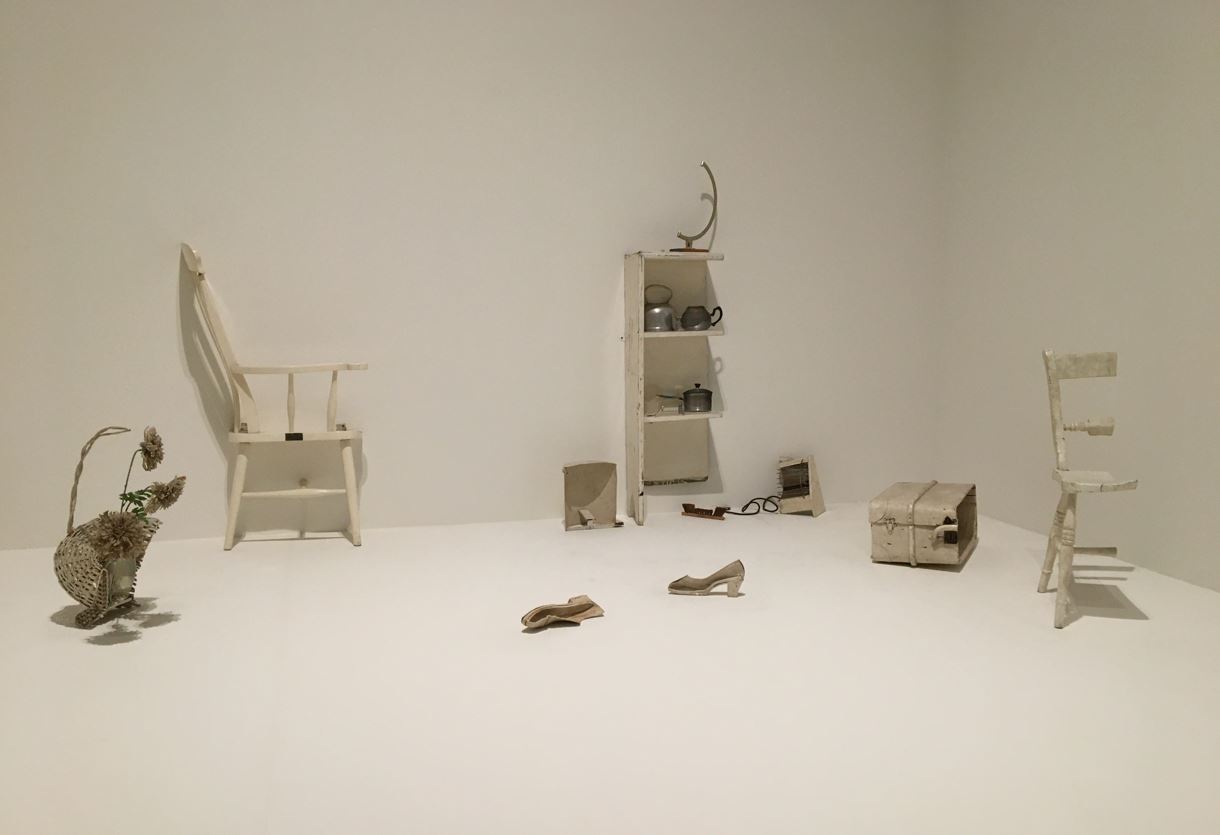
Installation view of ‘Half a Room’ at Yoko Ono: Music of the Mind at Tate Modern (photo by the author)

Or ‘Lion Wrapping Event’, a 26 minute film of wrapping one of the lions in Trafalgar Square in fabric. Or For ‘Promise Piece’ where she smashed a vase with a hammer, inviting audience members to take a piece and promise to return in 10 years to put it back together.

Or Film Number 4 (Bottoms) which edits together close-ups of 200 wobbly bare bottoms. In fact it feature the bottoms of lots of members of the London art scene of the time and features snatches of conversation between Ono and her then husband Anthony Cox.

The film was refused a certificate by the British Board of Film Censors and there’s photos of Ono protesting outside their offices, ‘It’s just part of the human anatomy, there’s nothing rude or sexy about them’ – the touching belief of 1960s idealists that getting naked would solve all the world’s problems from ending the war in Vietnam to abolishing sexism.

But the focus of the next few spaces is the John and Yoko collaboration which became such a big deal from about 1969 onwards.

The late 60s/early 70s peace and politics

A dream you dream alone is only a dream.
A dream you dream together is reality.

One area is devoted to their highly publicised peace projects. There’s a case showing how, on 15 June 1968, the couple planted acorns in the ruins of Coventry Cathedral – famously gutted by German bombing – one person facing east and one facing west to symbolise unity across the world.

In 1969, following their wedding on 20 March, the couple posted an acorn to 96 world leaders, asking each recipient to plant their own acorn for peace. The display case here includes formal replies from three leaders being the King of Malaysia, Prime Minister Golda Meir of Israel and the President of South Africa. They’re all polite but the South African president Jim Fouché wins by promising to plant the acorns on his farm. I wonder if they did. I wonder if they grew. I wonder if they’re still there.

Bed peace

One alcove is dominated by an hour-long film made of the couple’s famous publicity stunt, ‘Bed Peace’. The couple hired a room at the Amsterdam Hilton Hotel in March 1969, immediately after their wedding, and invited the world’s press to come and interview them, during which they, of course, promoted their cause of world peace.

Three months later they staged another bed-in at the Queen Elizabeth Hotel in Montreal from 26 May to 2 June and were more prepared this time. They made sure to be attended by celebrity fans and hangers-on and Lennon had written a song, which he performed live and was recorded, ‘Give Peace a Chance’. Tidied up in the studio and released, it quickly became an anthem of the huge anti-Vietnam War protest movement, being sung by a quarter of a million demonstrators against the Vietnam War in Washington, DC, on 15 November 1969.

In December the couple paid for billboards in 10 cities around the world which declared, in the national language, ‘War Is Over! If You Want It’ and there’s a striking photo of one of these on a billboard in Piccadilly Circus.

‘War is Over! (if you want it)’ poster on Shaftesbury Avenue 23 December 1969 as shown in Yoko Ono: Music of the Mind at Tate Modern (Photo by Evening Standard/Hulton Archive/Getty Images)

(I was struck not by the peace poster but by the cinema hoardings for the films ‘The Lion in Winter’ and ‘On Her Majesty’s Secret Service’ – great month for films!)

Two things:

  1. You can see how the concept and even the name Bed Piece follows on perfectly from all Ono’s previous concept pieces of the 1960s, being the performance of a simple concept (‘Get in bed and wish for peace. Invite the world’s press to watch you’)
  2. How Yoko was now operating in a completely different realm. These weren’t small exhibitions in out-of-the-way art galleries, but statements made in the full glare of the world’s media, this was a completely new stage.

This exhibition devotes an alcove to showing on a wall-sized screen the film which was made of the Montreal bed-in, ‘Bed peace’ (1969) a 16mm film lasting 1 hour 10 minutes, directed by John and Yoko and filmed by Nic Knowland. This appears to be available in its entirety online, so make your own mind up. As usual, seeing it projected on a whole wall is quite a lot more immersive and absorbing than watching it on a computer (or phone).

Yoko Ono’s music

Ono’s involvement with Lennon brought her into the orbit of the music business with mixed results. Previously she had been involved in highly avant-garde music making, working with the conceptual composer John Cage and his pianist David Tudor, staging performances which often included music, or the concept of music, or sounds of various kinds, and so on.

Now she was thrown into the orbit of maybe the most famous pop start in the world (jostling alongside Elvis and Bob Dylan).

The results are very mixed and surprisingly copious. Lennon created a pickup band in New York which they called the Plastic Ono Band which played gigs and benefits in New York at the end of the 1960s and early 70s. In lots of these Yoko added her trademark caterwauling-crying-screeching sounds which can be hard to listen to, especially when set in a fairly traditional rock context. As a student I had all the Lennon albums and couldn’t help skipping over Ono’s screechy bits. See if you can listen to this track all the way to the end. If you like it, there’s plenty more along the same lines.

There are headphones for visitors to listen to some of these concerts and in among the Plastic Ono tracks there’s a recording of her practicing for a gig with Ornette Coleman, the godfather of avant-garde jazz. Now this is interesting. Yoko makes vocal sounds and Coleman picks them up and echoes them on the soprano sax, with a band which is used to playing highly irregular improvised rhythms. I couldn’t help thinking that Ono’s entire approach to vocalising was best suited for this kind of avant-garde jazz setting rather than the limited formulas of rock music.

Anyway, that’s only the introduction, an appetiser, as it were to Ono’s musical career. Because the exhibition features an alcove whose wall is covered with old-fashioned LP covers of every album she’s ever made and it’s an impressive number, somewhere between 20 and 30 I’d guesstimate. The alcove contains seven or eight (very comfy) chairs each with headphones next to it and an interactive screen with a menu of all her albums and then of individual tracks (not every track – 3 or 4 from each album) and you are encouraged to make yourself comfortable and listen a selection of her music from the past 50 years.

Lennon retires

Probably most (middle-aged) people know the story that, after the breakup of the Beatles Lennon produced 6 solo albums but by the mid-1970s had had enough of the music business. Also Yoko finally gave birth after a series of miscarriage, to the boy they named Sean, in October 1975. So Lennon formally announced his retirement from the music business, turned his back on all of that and became a househusband in their New York apartment.

Double Fantasy

Again as most people probably know, Lennon then surprised everyone by, after five years of complete silence, suddenly releasing a brand new album of music in 1980, Double Fantasy.

Three points:

1. According to the Wikipedia article Lennon lacked confidence about the songs and arrangements, feeling he’d lost touch with the whole music scene. He was not wrong. As an ageing fan I was delighted by the appearance of Double Fantasy but it felt instantly nostalgic. It was music from another time, from the previous generation. Music fashions had continued to move as fast as they had in Lennon’s heyday in the 1960s, with glam rock flowering alongside disco, followed by punk, post-punk, synthpop and new Romanticism, and the new genres of Industrial and Goth being defined just as Lennon’s album was released.

It felt like a message from your mum and dad, from a happily married couple enjoying a second honeymoon – which was nice but nothing to do with the exciting young life you were leading. One of the critics called it ‘studio rock’, average material lifted by being performed by top session musicians and expertly produced and utterly soulless.

2. Double Fantasy carefully alternated songs by Lennon with tracks by Ono. Here’s a typical Ono track. Is she having an orgasm at the end?

3. The reason for dwelling on all this is that Double Fantasy is, in effect, the doorway, the gateway into the rest of Ono’s career and the ten or so albums which followed (as well as eight compilation and remix albums). Hence the wall covered in album covers, hence the chairs and headphones.

Yoko’s post-Lennon music career

I listened to a couple of tracks from the five or six albums following Double Wedding and didn’t like any of them. They all feature 1) heavy-handed over-production, with thumping drums and obsolete rock guitar of the worst kind; 2) her would-be poetic lyrics which are, in fact, tritely autobiographical – compare and contrast with any Dylan lyric; 3) her weak voice. If you like it, fine, but her music was never popular, in any sense.

Summary

The point is that for the first time in the exhibition, it felt like Yoko had fallen behind the times. In 1955, 1960 or 1965 she was out ahead of the curve, inventing ideas, methods, events, happenings, stagings, films and performances which stretched and defined the meaning of all those forms and of ‘concept art’. The peace activism with Lennon also set the tone of those last years of the 1960s, moved the avant-garde into the world of tabloid newspapers and TV, invented a new form of art-media-political performance and spectacle.

But by 1980 all that feels long over. And to focus on the music, she committed herself to the most deeply unexperimental, dead and dinosaur kind of Adult Orientated Rock, Dad Rock complete with thumping 1980s drums and air guitar solos. So unimaginative, uninnovative and unlistenable-to that I found the tracks I listened to were embarrassing.

But there’s no accounting for taste. I was astonished to read the curators’ take on her musical career.

Known for her ground-breaking early work and use of experimental vocalising techniques Ono is also recognised as one of the most prolific songwriters of the last century. This playlist highlight’s Ono’s output as a singer songwriter in more conventional pop-rock and electronic structures. It also includes collaborations with other musicians on remixes of her own music.

Then again, to be slightly cynical, this exhibition was obviously staged with Ono’s active support and maybe she sees her musical career as valid and important and worthwhile as her artistic work and so insisted it was included.

Hiatus and modern reprise

As far as I could tell there’s nothing here from most of the 1980s or 1990s. At some point in the 1970s the wave she’d helped to create and had surfed so skilfully from about 1955 to, maybe, 1975, hit the beach and expired. So, as far as I could tell, there’s a big chronological gap in the works here.

And then, in the final couple of exhibition spaces, Ono’s career revives with a new kind of work from the late 1990s. They are far fewer, bigger and far more professionally produced than the charmingly rackety, black and white, home-made experiments and happenings from the 60s and 70s.

They are recognisably high concept art works but executed with the high professional finish of advertising campaigns. Thus:

Helmets (Pieces of Sky)

Take a piece of the sky.
Know that we are all
Part of each other.

This consists of 15 or so World War Two German helmets suspended upside-down from the ceiling, and each one contains pieces from a jigsaw of blue sky and clouds. Visitors are encouraged to take a few pieces of the sky home with them. Personally, I’d have liked to make the jigsaw, asking other visitors who were interested to upend all the pieces onto the floor and then trying to make the sky together. But maybe a bit too subversive and participatory for more sleek and slick late-period Ono.

Helmets (Pieces of Sky) by Yoko Ono (2001) from ‘Between The Sky and My Head’ at Baltic Centre For Contemporary Art, Gateshead, 2008. Photo © Baltic Centre for Contemporary Art

There are some abstract paintings and a series of drawings she’s made in a kind of pointillist style, putting dots on paper as doodles which slowly take shape. They’re quite nice.

Add Colour (Refugee Boat) (concept 1960, execution 2024)

Just blue like the ocean.

By far the most dramatic piece is the entire room dedicated to the refugee boat. This was pure white and place in a nicely boat-sized room painted pure white when the exhibition opened. And there’s a table with a couple of trays of felt-tipped pens, white, blue and darker blue. And visitors are invited to draw or write whatever they want.

Before

‘Add Colour (Refugee Boat)’ by Yoko Ono at ‘Yoko Ono: Music of the Mind’ at Tate Modern, London, 2024. Photo by Reece Straw © Tate

After

‘Add Colour (Refugee Boat)’ by Yoko Ono (concept 1960, execution 2024) at ‘Yoko Ono: Music of the Mind’ at Tate Modern, London, 2024 (photo by the author)

As the curators put it:

Ono invites us to consider the impact collective action can have. The work encapsulates her belief in human agency and her understanding that ‘we are sharing this world’ and sharing our responsibility for it.

What struck me was rather different from this intention, which is how samey people are. For a start we’re all about the same height which explains why the band of wall about five feet high has been overwritten so much as to become an indecipherable sprawl of deep blue. If there are any individual messages there, they’re hard to read. More legible are things written or drawn ether lower down or, especially, higher up.

but people aren’t very original, either. As you can see the biggest single message is an enormous FREE PALESTINE and there are various other expressions of support for Gaza etc scrawled throughout. Then there are lots and lots of messages about love and hope and the planet and hope and love etc.

The problem with the notion of ‘human agency’ is that when you get a lot of these human agents together they generally behave in highly predictable and formulaic ways. That’s what the epidemiology or actuarial science, social media algorithms and AI are based on. I’m sorry to be the one to say it but all the evidence suggests that the notion of ‘human agency’ Ono is promoting is grossly over-rated.

My Mommy Is Beautiful (1997)

Write your thoughts of your mother.
Or pin a photograph of her to the canvas.

The same kind of participatory invitation is at play in the penultimate piece in the show, another invitation for visitors to write a message. So there’s a trestle table piled with cards, as for the Wish Tree, and a tray of pens, and we are invited to write a message or thought about our mothers and tape them to the wall which is, of course, absolutely festooned.

What the visitor doesn’t at first realise is that suspended from the ceiling in this space are a set of photographs of breasts and vulva.

Installation view of ‘My Mommy is Beautiful’ looking up at the photos suspended from the ceiling at Yoko Ono: Music of the Mind at Tate Modern (photo by the author)

Why?

Suspended at height, a series of photographs embody Ono’s humour and humanity. She comments: “One has to look up at the vagina and the breasts on the ceiling – rather like looking up at your mom’s body when you are a baby.”

Once again, as with the Wish Tree and Refugee Boat, the sentiments written by visitors are overwhelming predictable and sentimental (‘I love you Mum’, ‘I never appreciated you Mum’) alongside some occasionally impressive drawings. Purely as relief from the Clinton Cards cloying messages, I liked the one that read ‘My mother was a selfish bitch’, which felt like a rare bit of honesty and truth.

Whisper

If there was any doubt about the importance Ono gives to her musical career this is put to bed by the fact that the very last piece in the show is a music performance. It’s a ten-minute film of her performing at the Sydney Opera House on 17 November 2013. It doesn’t appear to be available online, which is a shame because it showed how the technology had caught up with her style. What I mean was that her voice was looped so whether breathing, sighing, moaning, wailing or screaming, she could play off the looped repetition of herself, and this was interesting (up to a point). Just her experimenting with her voice was good because it had range and variety.

However, go on YouTube and you can find loads of her performances in a rock context which, as I’ve explained, feel reactionary and backward-looking. In the past 50 years popular music has gone through an unbelievable series of fashions, changes and evolutions but not in Yokoworld. In Yokoworld it’s still 1971 and that’s why in something like this performance with her and John’s son Sean on guitar, it feels embarrassingly like watching someone’s home video. Embarrassingly bad…

Summary

This is an excellent exhibition which gives a really good overview of an amazing career. The first half of the show (1955 to 1967) is fascinating, funny, light and inspiring in a charmingly ramshackle home-made video, home publishing kind of way. All those Zen instructions are genuinely mind-opening and smiley.

The Lennon interlude is highly redolent of the late 60s, the Beatles late period and all of that, just as it all began to fall apart.

The wall of Ono albums you can, if you like, just read about and skip, unless you want to hear lots of 1980s AOR, all big shoulder pads and synth drums backing weedy voice and run-of-the-mill lyrics.

And then, after a big gap, there’s the final handful of works – the big ones like the helmets, ship and Mommy wall, and the more discreet series of drawings and paintings which are easy to overlook but quite nice…

What a life! What a career! But also what a fascinating review of the parabola of ‘art’ in the second half of the 20th century, from the genuine avant-garde staging of silly performances in dingy lofts and obscure galleries, then getting involved with the Swinging Sixties drugs and hedonism and fake revolution, then lingering on into the cocaine addiction and bad clothes of the depressed 70s, then justifiably falling silent and then…returning in the form of highly produced, highly finished, slick presentations.

Recognisably the same motivation and the same ‘political’ messages (peace, I love you all) but slickly packaged for the cable TV, then internet, and now social media ages. Clever, slick, virtue signalling which we have discovered, alas, changes nothing because it’s preaching to the converted – to like-minded liberal gallery goers who write ‘Help the refugees’ and ‘I love you mummy’ on gallery walls, while outside, in the real world…

In a way art galleries are safe spaces for certain kinds of like-minded, sentimental liberals who can huddle together and agree that, if only the world thought like us, it would be such a better place. But it isn’t. Trump. Putin. Xi Jinping.


Related links

Related reviews

Sense Sound/Sound Sense: Fluxus Music, Scores and Records in the Luigi Bonotto Collection @ the Whitechapel Gallery

Fluxus

Fluxus was an international, interdisciplinary community of artists, composers, designers and poets during the 1960s and 1970s who engaged in experimental art performances which emphasized the artistic process over the finished product.

The word Fluxus literally means ‘flow’ and all the artists associated with it were more interested in the process, in interaction rather than a stable polished final product. As such they are associated with performance art – you really had to be there! – or conceptual art which only required thinking about, no finished product necessary.

It was a very loose international association which stretched beyond artists to include musicians, composers, performers, poets, dancers, anyone who was prepared to have a go at experimental performance which, in the later 1960s and through the early 1970s, was a lot of extrovert creative types from John Cage and his Black Mountain College colleagues through to Yoko Ono and friends in Japan.

Display case of records, musical scores, magazine articles and photos at Sense Sound/Sound Sense: Fluxus Music, Scores and Records in the Luigi Bonotto Collection at the Whitechapel Gallery. Photo by the author

Luigi Bonotto and the Bonotto Foundation

This is a FREE one-room display of Fluxus-related objects from the collection of Luigi Bonotto. Who he?

Luigi Bonotto was an Italian businessman who made his money from a textile factory and business in Molvena. He became involved with contemporary art in the 1960s and hosted a series of events by Fluxus artists at this home. Here, artists met each other, planned and created new works which Bonotto took it upon himself to document and record.

Gradually Bonotto set out to keep the work of the artists of Fluxus and Experimental Poetry alive, and dedicated his life to preserving, cataloguing, and promoting their poetry, music, and work.

Forty years later the collection has grown to house over 15,000 documents, often given by the artists themselves, a unique archive with which to study the creative processes, relations and collaborations between the artists. It is now housed in the Luigi Bonotto Foundation which, of course, has its own website.

Sense Sound/Sound Sense

So, after all that explanation, what about the display? Well, it’s like an interesting old junk shop, with display cases showing magazines and photos, a number of fairly big objects, rows of old, long player vinyl records, and some music stands holding iconic Fluxus-related scores such as John Cage‘s iconic 4’33”.

Cage’s ideas about ‘preparing’ a piano by placing nuts and bolts and other impediments among the strings were taken up by a wide variety of followers.

George Brecht (1926 to 2008)

In one of his iconic works Incidental Music, gave musicians a list of ways to interact with a grand piano such as opening the piano and stacking wooden blocks inside the instrument until one falls and creates a noise, or by dropping dried beans onto the keys. Here’s the complete ‘score’, obviously in fact a set of instructions.

Incidental Music by George Brecht (1961) Courtesy of Fondazione Bonotto © George Brecht

Dick Higgins

Higgins had the idea of creating a musical score by firing machine guns at it. Here’s the resulting score and the electronic thingy at the side included headphones so you could listen to the result. Note the written text at bottom left. As so often with conceptual art, it takes longer to read about than it takes to look at.

Installation view of Sense Sound/Sound Sense: Fluxus Music, Scores and Records showing Symphony 245 by Dick Higgins (1981) Photo by the author

Takehisa Kusugi

Kusugi’s score Musical Piece set a new standard of simplicity: simply place the piece of paper these instructions are written on against your ear and rub. That’s it.

Elsewhere there was a piece of music made up of recorded birdsong placed on a loop, quite a funny big cartoon of a man playing flute and out the end of it dripping spittle which was collected in a jar.

Probably the most striking artifact is this missile titled Bomb Cello by Charlotte Moorman.

Installation view of Sense Sound/Sound Sense: Fluxus Music, Scores and Records in the Luigi Bonotto Collection at the Whitechapel Gallery.

Charlotte was a classically trained cellist who teamed up with Fluxus artist Nam June Paik (who recently had an enormous retrospective show at Tate Modern) to create all manner of happenings and wacky performances. She performed naked or wearing a range of outfits, she played a man i.e. had a man sit in front of her while she went through the motions of playing a cello, and did the same to a TV and to a stack of TVs, in various performances.

The photo above captures Charlotte in the process of ‘playing’ a naked man, a performance titled Human Cello (1965). But it was Charlotte herself who designed the bomb cello standing next to it, which has strings, keys and a bow attached.

On the right in the picture is an artifact titled Composition for a record player and five musicians, with the toy musical instruments usefully attached. You get the idea.

Installation view of Sense Sound/Sound Sense: Fluxus Music, Scores and Records in the Luigi Bonotto Collection at the Whitechapel Gallery.

There are lots of LPs, sheet music, photos and magazine articles and wall labels and headphones so you can listen to the wackier compositions to your heart’s delight and study numerous other ‘scores’ for performances, as well as smashed up, fragmented or otherwise twisted and reinterpreted musical objects, like Claes Oldenburg’s drumkit made out of drooping, sagging sewn fabric. Or a violin case filled with lighted candles and titled A Little Night Music.

A Little Night Music by Marchetti Walter

As mad old Uncle Ian used to say: ‘Why not?’


Related links

More Whitechapel Gallery reviews

The World Exists to Be Put On A Postcard: artists’ postcards from 1960 to now @ the British Museum

Last year the writer, curator (and sometime expert on The Antiques Roadshow) Jeremy Cooper donated his quirky collection of 1,000 postcards designed by artists from the 1960s to the present day, to the British Museum.

This FREE exhibition presents a selection of 300 works from the collection, and features a wide range of artists and artist collectives from the past five decades including Gilbert & George, Richard Hamilton, Yoko Ono, Guerrilla Girls, Tacita Dean, Andy Warhol, Bruce Nauman, Dieter Roth, Carl Andre, Claes Oldenburg, Gavin Turk, Rachel Whitehead and many more.

The collection – which took 10 years to assemble – now means that the British Museum has one of the world’s leading collections of this rather unexpected art form. I, for one, certainly hadn’t realised how widespread and flexible an art form ‘the postcard’ had become.

Dada Land (1975/1977) by Bill Gaglione and Tim Mancusi. Reproduced by permission of the artists

The idea is that, since the radical conceptual and political breakthroughs of the 1960s, artists have found the postcard to be a cheap, flexible, democratic, accessible and fun format to present a whole range of ideas, whether satirical, subversive, silly or surreal.

Hence, if only at the level of invitation to an art show, many of the most famous artists of the past years have used the format, while others have gone to town with whole conceptual explorations of its possibilities.

The exhibition is divided into the following categories or headings:

Richard Hamilton (1992 to 2011)

In an early work such as Whitley Bay 1996, Hamilton used details of commercially produced postcards in his pop collages. Two years later he produced a concertina, ‘pull-out’ postcard. You unclipped it and eight postcard-sized unfolded, each showing a commercial image of Whitley Bay, which was progressively blown up larger and larger until the image became just an abstract blur of dots and patches.

Dieter Roth (1930 to 1998)

Swiss-born Roth produced various postcard art. He collaborated with Richard Hamilton on paintings made in Spain, and then produced postcards depicting the paintings, but conceived of as artworks in their own right. In a series titled 120 postcards Roth overpainted and reworked a clichéd tourist image of Piccadilly, to create a set of independent artworks.

Fluxus

The Fluxus art movement drew in a large number of artists, composers, designers and poets during the 1960s and 1970s who engaged in experimental art performances. Japanese artist On Kawara made a series titled ‘I GOT UP’ in which he simply sent postcards to hundreds of friends around the world marked with a date stamp declaring ‘I got up at…’ and then the time and date. He continued the series from 1968 to 1979.

An example of the I Got Up series by On Kawara (1979)

These postcards now fetch extraordinary sums at auction. The one above, sent in 1979, was part of a lot of On’s I GOT UP postcards which sold for £162,500. Wish I’d known him and he’d sent me one! As with so much ‘subversive’ art which was going to change the world, it is now bought and sold by Russian oligarchs and Chinese billionaires for sums you and I can only gawk at.

Ben Vautier created a postcard titled The Postman’s Choice with an address box and stamp space on both sides, so you filled in two addressees. Who should the post office send it to?

I liked the extended-size postcard, Beached, by Lawrence Wiener (b.1942). It was made to publicise a video he made in five sections of himself throwing, pulling, lifting, dragging, and levering natural materials to make a sculpture on a beach in Holland.

Beached by Lawrence Weiner (1970)

Feminism

Postcard art was a way for women artists of the 1960s and 70s who felt excluded from the male art world to bypass the traditional gallery system.

From 1971 to 1973 American artist Eleanor Antin (b.1935) sent fifty-one postcards of her hundred-boots project to a thousand people in the art world. During a two-and-a-half year roadtrip round California she placed the hundred boots in various incongruous settings and photographed them. What a brilliant idea!

Four details from 100 Boots (1971-73) by Eleanor Antin

Lynda Benglis (b.1941) and Hannah Wilke (b.1940) made postcards of themselves naked.

Lynda Benglis nude postcard

They were working to ‘challenge the idea of female objectification, often using their own bodies to explore sexuality in their work’.

Ponder-r-Rosa series by Hannah Wilke (1977)

Yes, I always find that pictures of naked young women help me to stop thinking about women in terms of their appearance or sexuality. Male gaze duly obliterated.

Performance

Stelious Arcadiou (b.1946) grew up in Melbourne, Australia, changed his name to Stelarc in 1972, and specialised in self-inflicted performances in which his body was suspended from flesh hooks. And his preferred way of promoting these performances was via photos on postcards distributed to other artists, galleries and critics.

Stelarc, Event for lateral suspension (1978)

In 1979 artist Chris Burden gave an art performance in which he described his relationship with a truck named ‘Big Job’, while clutching a gigantic wrench, and sent out postcards recording the event.

Big Wrench by Chris Burden (1979)

Conceptual I

This category includes Carl Andre – who made postcards of bricks or sections of concrete arranged in urban and landscape settings – landscape art by Richard Long, showing photos of places he’s visited and sculptures he’s made from natural materials in remote locations – and quite a few by Gilbert and George in a variety of settings and with text subverting their own status as artists and the whole point of art. Silly but oddly compelling, as usual.

Gilbert and George in a rural setting (1972)

Richard Long’s postcards of artworks he’d made as part of his long treks, in places as different as rural Devon and Mongolia, struck me as clever use of the medium. Some of his artworks were temporary, made of mud or stones which would decompose or be assimilated back into the landscape. Some resulted in no tangible work whatever, just the record of the walk. Long’s postcards were, therefore, postcards from nowhere, mementos of things which never existed or would soon cease to exist. One of the things I’ve loved about Richard Long’s walking art since I first came across it is the way he captures the spooky, empty, vanishing nature of long-distance walks. You are intensely here, now, in this place. And yet half an hour later you are a mile away, over hill and dale, and the hereness and the nowness… are just memories… or photographs… or postcards…

Conceptual II

American artist Geoff Hendricks (b.1930) made a series of seven postcards depicting beautiful photographs of clouds. He styles himself a ‘cloudsmith’. Very relaxing.

Sky Post Card #7 by Geoff Hendricks (1974)

Endre Tót

Born in Hungary in 1937, Endre Tót trained as a painter but became involved with the Fluxus group. He is represented by possibly the best works in the exhibition, a 1974 series titled One Dozen Rain Postcards.

In these Tót made Xerox copies of photos from newspapers, printed them in purple, and then typed dots and dashes onto the surface of the copies in order to give the effect of rain. Each variation of the rain motif is deliberately humorous: some show heavy rain falling in just one place, or it raining indoors, and so on.

One of the One dozen rain postcards by Endre Tót (1971 to 1973)

These were all very witty – with other subjects including horizon rain (the dashes all running horizontally parallel to the horizon of a sea postcard) and new rain/old rain – but they also struck me as a genuinely innovative use of the size and shape of the postcard format.

Paradise regained

American photographer Duane Michals (b.1932) made a series of six postcards which starts out with a fully clothed couple in a modern office and, in each one, items of clothing are removed from the people while the office becomes more full of pot plants and foliage, until they are naked in an apparent forest.

Paradise regained by Duane Michals (1968)

Graphic postcards

Some of the most innovative postcard art comes in graphic form i.e. text only, or text over minimal imagery. Hence the bold declarative text The World Exists To be Put On A Postcard by Simon Cutts which gives the show its title. Personally, I liked the extreme minimalism of this graphic postcard, made all the funnier by that fact that it required not one but two modern artists to create it, Peter Doig and Matthew Higgs.

There’s a painting on the wall by Peter Doig and Matthew Higgs (1996)

Postcard invitations

In a more traditional use of the format, artists often sent out invitations to art exhibitions (or happenings or performances) in the shape of postcards, detailing the location and time of the exhibition. Many of these were treated like ephemera and lost, only years later did collectors start to value them.

Invitation to Holy Cow! Silver Clouds!! Holy Cow! (1966) by Andy Warhol © 2018 The Andy Warhol Foundation for the Visual Arts, Inc. / Licensed by DACS, London

There’s the original invitation card for the now legendary Freeze exhibition organised by Damien Hirst which introduced the world to the (YBAs) (Young British Artists), and a funky 3-D postcard Julian Opie sent out as an invitation to his 1996 exhibition Walking Dancing Undressing Smoking showing the cartoon of a trim woman in his trademark strong black outlines, but done in that process where, if you shift your point of view, the figure appears to move.

Political postcards I

Because they are cheap and, by their very nature, designed to be distributed, postcards have been an appropriate format for all kinds of artists promoting their political agendas. Using the postal system they can easily be circulated thereby evading traditional gallery and museum networks, which is why many postcard artworks were often politically subversive or carried a social message. Images satirising and lambasting Ronald Reagan and Mrs Thatcher abound.

Thatcher Therapy Dot-to-Dot Puzzle No. 1 (1984) by Paul Morton. Reproduced by permission of the artist. Courtesy Leeds Postcards

There’s a post-card designed by John Lennon and Yoko Ono with the simple text WAR IS OVER. Its optimistic innocence is counterpointed by a completely different pair of postcards by photo-montage artist Peter Kennard of a) some cruise missiles plonked on the back of the hay cart in Constable’s painting The Haywain and b) the super-famous montage of Tony Blair taking a selfie against the backdrop of Iraqi oil wells going up in flames.

There’s another really vivid one with the big angry text I DON’T GIVE A SHIT WHAT YOUR HOUSE IS WORTH (by Leeds Postcards, 1988).

Political postcards II: Feminism

Back in the gritty 1970s artist Alison Knowles and composer Pauline Oliveros published a set of cards commenting on the outsider status of women in the world of classical music. The idea was to take photos of women composers and to attach a big text describing each classical male composer with the kind of derogatory comment they felt women composers were all-too-frequently dismissed with e.g. she’s a lesbian.

Beethoven was a lesbian by Pauline Oliveros with Alison Knowles (1974)

Similar outsider anger is the unique selling point of the Guerrilla Girls collective with their well-known poster slogans such as ‘Do women have to be naked to get into the Met Museum?’

But best of all is the set of works by Jill Posener who, in the 1980s, sprayed witty graffiti ‘with political, feminist, lesbian and anti-consumerist themes’ onto billboards, defacing irritating, sexist and patronising advertising campaigns with hilarious jokes.

Saw his head off by Jill Posener (1981)

Altered postcards

Because they’re so cheap and cheerful artists have felt free to manipulate, transform, burn, cut up, deface, collage, paint over and generally muck about with postcards. Yoko Ono published a white postcard with a little hole in the middle for you to look through at the sky. Ray Johnson cut up, pasted and wrote over whatever printed material he could find. Genesis P/Orridge made a series of postcards in which the same black and white images of his mum and dad were positioned closer and closer to each other, until they merged.

In the 1980s Michael Langenstein (b.1947) made a series titled Fantasy and Surreal Postcards, collages of commercial postcards in which iconic images are made to do funny things, for example the Statue of Liberty is shown on her back in the Hudson River apparently dong the backstroke, or Concorde is shown having flown into and got stuck half-way through one of the great pyramids at Giza.

Excalibur by Michael Langenstein (1986)

Excalibur by Michael Langenstein (1986)

Portrait postcards

Portraits often appeared on exhibition invitations, for example there’s one of David Hockney inviting to an exhibition in the 1960s. American artist Carolee Schneeman (1939 to 2019) and Anthony McCall made their own Christmas postcards. Again, the best of the bunch was, for me, the funniest one, which showed British artist Peter Hutchison (b.1930) being showered with foot-high letters in a work titled Struggling with language from 1974.

Struggling with language by Peter Hutchison (1974)

Recent postcards

Despite being overtaken by digital technology, emails, texts and numerous forms of social media, the postcard continues to thrive, in the real world out there, as well as in the art world. This last section showcases recent postcard art by Tacita Dean and Frances Alÿs, by Braco Dimitrijevic and Alison Wilding, Gillian Wearing and Jeremy Deller.

Sarah Lucas and Tracey Emin are pictured wearing scruffy anoraks and each holding a pair of big balls, in the tradition of the smutty seaside postcard. Meanwhile, Rachel Whiteread – an avid collector of postcards, apparently – has punched holes into innocuous scenic postcards thus turning them into miniature sculptures.

Untitled (2005) by Rachel Whiteread. Photograph © 2018 Rachel Whiteread

Thoughts

Who knew so much work existed in this area, who knew that ‘the postcard’ was a modern art genre in itself. Sceptical to being with, I am now totally converted. The categories I listed above aren’t exhaustive: there were quite a few one-off creative and experimental projects which come under no particular category but are also included.

A test of an exhibition is whether, at the end of it, you want to go round again, and I did. Having gone round once carefully reading the labels, I then went round again, just for fun, stopping at the ones which made me smile or laugh out loud (smiling at the rain postcards, guffawing at Jill Posener’s brilliant anti-sexist cards from the 80s).

It’s fun and it’s FREE. Pop along for an entertaining and enlightening experience.


Related links

Other British Museum reviews

The Hard Way by Lee Child (2006)

‘Very tall, heavily built, like a real brawler. He’s in his late thirties or early forties. Short fair hair, blue eyes.’ (Patti Joseph’s description of Reacher, p.91)

You remember the way episodes of Friends were titled ‘The one with…’ and then specified the core element of that week’s show. You can do the same with the 22 Jack Reacher novels. This is the one where Jack is hired to solve a kidnapping, which turns out to be much more complicated than it seems, and takes him from the streets of New York to a farm in Norfolk.

The café He is sitting in a café in New York when he sees a guy cross the street, get into a Merc and drive off. Nothing special in that. Next morning he’s at the same café when he’s approached by a tough-looking man and persuaded to come with him to meet his boss, Mr Lane. Turns out Mr Lane’s wife has been kidnapped, the kidnappers demanded a million in cash to be left in a car at that location. Lane agreed, had one of his people fill a bag with a million, put it in the boot of the car and drive it to the arranged drop zone. This was the car which Reacher had watched the kidnapper cross the street, get into and drive away. Without knowing it or intending to be, Reacher is a key witness.

The mercenaries Reacher tells them what he knows. ‘Them’? Yes, Lane runs a group of mercenaries (‘a private military corporation’, p.450) tough ex-Army, ex-Marines, U.S. Navy SEALs, British SAS etc. In fact, Reacher analyses their plight so logically and compellingly that Lane hires him on the spot to be a consultant to help manage the situation.

But there is, of course, more to the situation than meets the eye. It takes about 450 pages for Reacher to nail the real story, pages during which he, as usual:

  • acquires a small circle of helpers and supporters
  • who just happen to have privileged access to FBI/Army/Homeland Security sources
  • and manages to wangle financial backing to pay for the endless taxis and trains and planes he needs to take

Not the first time Firstly, it turns out this is the second time a Lane wife has been kidnapped. His first wife, Anne, was kidnapped five years earlier and, although Lane paid the ransom, was found shot dead in New Jersey.

The Dakota Building Reacher quickly discovers that some people suspect the first kidnap was a front, a put-up job. Lane’s base is the famous Dakota Building, next to Central Park, where John Lennon lived and outside which he was shot (Yoko Ono and her bodyguards make a small appearance in the book, walking past Reacher in the lobby).

Patti Joseph Outside the building he is approached by the first wife’s sister, Patti. She is convinced the first kidnap was a sham, and that Lane had her sister murdered. As the book progresses Reacher uncovers the evidence to prove this is true. He discovers that Lane had instructed a member of his inner circle, Knight, who usually drove his wife around, to return to base and tell everyone he’d dropped her off shopping as usual – but in fact to take her out to New Jersey and shoot her. Then paid someone to fake the ransom calls.

Lane had his first wife murdered Why? The first Mrs Lane had come to realise that Lane was a psychopath, and had told him she wanted to leave him. Which hurt his ego so much he had her eliminated. Although Knight – who knew all this – was loyal to his boss, on the mercenaries’ next job – to defend the government of Burkina Faso in Africa, from rebels – Lane contrived a situation whereby he ordered Knight and his best friend among the mercenaries, Hobart, to hold a forward post against the advancing army. Lane then ordered his main force to retreat, abandoning Knight and Hobart to the African rebel soldiers. The aim was to ensure that Knight was killed and along with him the evidence of his wife’s murder. Hobart was just collateral damage.

Detective Brewer The first wife’s sister, Patti Joseph, tells Reacher all this. She has been keeping a close watch on the Dakota Building for years, photographing who goes in and out, keeping a log of the movements of all of Lane’s central circle of mercs, for years. Is that obsessive or is she onto something? She phones in her results to a NYPD detective named Brewer. When Reacher meets Brewer the latter admits that he humours Patti, partly because something might come of her efforts, mostly because she’s a pretty chick.

FBI agent Pauling Turns out that Brewer passes on Patti’s observations to a third party, Lauren Pauling, an ex-FBI agent who was part of the original FBI investigation of the kidnapping of Lane’s first wife and has felt oppressed by guilt for five years that her and her colleagues screwed up the investigation and allowed the first wife to be killed. She is still interested in the case because she hopes evidence will surface to prove that it was Lane who killed the first wife, and not the kidnappers who did it, because that would get the FBI and the cops off the hook for bungling the case.

So who is carrying out the current kidnapping, five years later, of the second Mrs Lane, Kate Lane, a tall, slender, blonde, beautiful model, and her daughter by a previous marriage, Jade (also ‘a truly beautiful child’, p.424)?

Pauling becomes Reacher’s sidekick Reacher develops a close working relationship with Pauling, now a freelance investigator. She has a useful contact in the Homeland Security administration (they always do). Pauling becomes the person Reacher bounces his theories and ideas off, and who accompanies him on his investigations around New York.

Investigations They investigate the house where the kidnapper insisted the keys to each of the cars containing ransom money be dropped through the letterbox. It turns out to be empty. After clever detective work the pair track down the apartment the kidnapper used to oversee the dropping off place for the ransoms. They then manage to locate the apartment where Kate and Jade were kept hostage – though it’s now empty.

The man who doesn’t speak For a long middle stretch of the book, based on eye-witness accounts of neighbours and people who sold the kidnapper bits of furniture, they establish his appearance (non-descript white male) but the standout fact is that he never talks. From several hints they develop the theory that the kidnapper can’t talk and from descriptions of what’s happened to other white mercenaries captures in Africa, they speculate this may be because his tongue was cut out by the rebels.

Africa They think the kidnapper was one of the two men Lane abandoned in Burkina Faso – Hobart or Knight. Using Pauling’s contacts in Homeland Security to identify people who’ve flown back from Africa recently, and then another contact with access to all kinds of security databases, they track down the apartment of Hobart’s sister, which turns out to be conveniently close to the café and to the ransom-money-dropping-off point in Downtown Manhattan.

There’s a very tense moment when they break into the shabby apartment building where Hobart’s sister lives, and climb the squeaking stairs, at pains to be silent in case the kidnapper they’re seeking hears them, and has time to harm or shoot his hostages, Kate and Jade.

Hobart So the reader is surprised and shocked when they kick open the apartment door and find …. a washed-out shabby woman, Hobart’s sister, making soup, and that Hobart himself is a limbless cripple propped up on the sofa.

It is Hobart, he was a member of Lane’s mercenary gang, he was abandoned by Lane, he was captured by the rebel African soldiers. He was held captive for five long years during which he barely survived the starvation and disease and, once a year, they brought him and other prisoners out of their cells into an arena of baying warriors, and asked whether they wanted their left hand, right hand, left foot, or right foot to be hacked off with a machete – and whether they then wanted the stump seared in boiling tar, or left to bleed out.

Which explains why Hobart is in his pitiful state, without feet or hands, a wretched withered stump of a man. Hobart is clearly not the kidnapper, or the man who rented the apartments or who Reacher saw drive away the ransom car right at the start.

But he does confirm that his fellow merc and prisoner, Knight, did carry out the execution of Lane’s first wife, under Lane’s instructions, then helped the fiction that it was a kidnap. So that part of Patti’s story is correct.

Reacher and Pauling have sex Later that night, Pauling expresses to Reacher what a vast relief it is to her, to have confirmed that it was not her professional screw-up which had led to the first wife’s death. The wife was dead before the FBI was even contacted. To celebrate, she and Reacher have his usual athletic, fighting-with-a-bear, championship sex.

She is now his lover, as well as his close associate in the investigation.

The Taylor theory The book sprinkles more dead ends and deliberate false trails for Reacher (and the reader) to work through -, but the main focus of their investigation now shifts to Taylor. This man was in Lane’s inner circle of mercenaries, and was the guy who drove Kate Lane to Bloomingdale’s on the day of the kidnapping. The assumption had been that he was killed almost immediately by someone who got into the stationary car and pointed a gun at the women, forced Taylor to drive wherever they wanted him to go and then killed him.

Child has planted this false version of events in our minds by having Reacher ask not one but two of Lane’s mercs to speculate how they think the kidnapping went down, and both think it happened like that. This version of events had also been confirmed when Pauling’s cop contact, Brewer, told her that the body of a white man had been found floating off a dock in mid-town Manhattan.

Now Pauling and Reacher revisit this story and the first thing they establish is that the ‘floater’ is not Taylor. Wrong height to begin with. Taylor is still alive.

So now Pauling and Reacher develop the theory that Kate and Jade were kidnapped by a disgruntled member of Lane’s inner circle, Taylor, the very driver entrusted with their safety. He pulled out a gun, told her and Jade to shut up, drove them to a safe house, tied them up, made the ransom phone calls and picked up the money. Taylor will have needed an associate, so Reacher and Pauling spend a lot of time thinking through who that could be.

Reacher and Lane In case I haven’t made it clear, all this time – throughout this entire process – Reacher is still nominally under contract to Lane to find the kidnappers. At that first meeting in the Dakota Building, Lane offered Reacher a payment of $25,000 to find Kate and the kidnapper. Reacher is free to go off and roam the city, make his own investigations, contact whoever he likes – but periodically he has to go back to Lane’s apartment, filled with half a dozen surly mercs, and update the boss on progress.

Thus Reacher is sitting with the others when the ransom demand phone calls come through to Len’s apartment. He sits with the others when the second call comes through asking for confirmation that Lane has the cash, and then giving details of the pickup. And then he sits in suspense with the others waiting for a confirmation call that the money has been received, and – hopefully – that Kate is going to be released.

The character of Lane and the mercs Since the kidnapper ends up calling for three separate payments, there are three of these very tense scenes. They also gives Reacher plenty of time to get to know Lane, to witness his psychotic rages, and to see the hold he has over the other mercs. These are strong, well-trained men but each of them, in fact, was a failure in the military, in various ways in need of being led, and prepared to do anything for The Boss.

When there is no call-back after the third and final payment is made, Reacher along with the others begins to fear the worst. That the kidnapper has killed the girls and fled. Child reiterates this idea again and again, having Reacher emphasise that, in his experience, the majority of kidnappings end in the murder of the victims, and that the first 24 hours are key. Every hour after that increases the likelihood of failure.

A bounty on Taylor As the truth sinks in that the girls are probably dead, Lane increases the bounty he will pay Reacher to $1 million. Since he has kept Lane informed of his investigations up to the dismissal of Knight and Hobart as suspects, Lane, Reacher, Pauling and the reader all now think the kidnapping was carried out by Taylor the driver, who faked his own death, held the women hostage in Downtown Manhattan, collected the money three times, killed them, and has now absconded.

Reacher now clicks into Revenge Mode. He knows Lane is a louse, a psychopath who probably had his first wife murdered and abandoned his men to terrible fates in Africa. So he’s not doing it for Lane. He vows to track down Taylor for the sake of the women, for Kate and Jade. In the apartment they have now identified as Taylor’s, which they found empty and abandoned, Reacher noticed one of the speed dial phone numbers was to a number in Britain. He guesses it’s of a close relative.

The novel moves to England

All this has taken about 350 pages. For the last 150 pages of the novel the setting switches to England, for 20 or so pages to London, but then on to rural Norfolk, where Pauling and Reacher track Taylor down to his sister’s farm.

We know that Child – real name James Grant – is himself English. We know that he lives in New York, so we can guess that the extremely detailed descriptions of Reacher and Pauling’s investigative walks around Downtown Manhattan reflect Child’s own detailed knowledge of the area.

It adds a different, not exactly literary but psychological element – maybe a hint of tongue-in-cheek – to the English section of the book, to know that Child is himself English, but pretending to write as an American. So every description in this section is written by an Englishman masquerading as an American writing about a fictional American trying to pretend to fit in with the local Brits.

Thus Child’s description of Reacher walking into a rural pub in Norfolk is layered with ironies, as the Englishman Child imagines what it would be like for an American like Reacher to walk into a pub, and then to try and remember his own (Reacher’s own) days in the U.S. Army when he was stationed in England. All this results in Reacher ordering ‘a pint of best’ while his New York colleague and lover, Pauling, is made to point out all the quaint quirks and oddities of English life.

(The two most notable of these are that a) all the streets are absolutely festooned with signs and painted symbols giving instructions about every element of your driving, ‘the nanny state in action’ and b) London is a vast octopus extending its tendrils into the country for miles and miles, making it impossible to get into or out of at any speed. Both true enough.)

Reacher has been promised $1 million if he can deliver Taylor to Lane. Through British police contacts Reacher and Pauling track down Taylor, confirming he took a flight from New York JFK, arrived at Heathrow and then – using a different line of investigation – establish the whereabouts of his sister.

How? Using the speed dial phone number Reacher had noticed in Taylor’s New York apartment. This locates Taylor’s sister to a farm in Norfolk. Reacher and Pauling hire a car and drive there, locate the village, and the farm, and park in the early morning with binoculars, waiting for Taylor, his sister, her husband and little girl to exit the farmhouse, which they conveniently do a few hours later.

Reacher had already alerted Lane that he has confirmed that Taylor is in England, and so Lane and his crew are en route on a transatlantic flight. Sighting and identity confirmed, Reacher and Pauling drive back to London to meet Lane and his goons in the Park Lane hotel.

Lane doesn’t just want to kill Taylor. He explains how he is going to torture him slowly to death. Reacher is revolted by the psychopath, as ever. A few seats away in the lobby of the hotel, a mother is trying to quiet down her restless squabbling kids. One of them throws an old doll at her brother, which misses and skids across the floor, hitting Reacher’s foot. He looks down at it and has a blinding revelation.

The twist

In a flash Reacher realises what has been wrong with the investigation all along. In a blinding moment he realises he has made a seismic error of judgement and that his entire understanding of the case is not only wrong, but catastrophically wrong.

Why? What vital clues have he and Pauling (and the reader) missed in the last 400 pages? What can it be which totally transforms the situation? Why does he excuse himself from Lane for a moment, walk as if to the toilets, but instead hurtle down into the underground car park, call Pauling to meet him, jump into the hire car, and then drive like a maniac all the way back to Norfolk?

What is the real secret behind the kidnapping of Kate and Jade Lane?

That would be telling. It’s an expertly constructed book with many twists and false trails, tense moments, and sudden surprises. I read it in a day. Take it on your next long train or plane trip or to read by a pool. It is gripping, intelligent and – in much of its factual research (about mercenaries, about the coup in Africa) informative.


Credit

All quotes from the 2011 paperback edition of The Hard Way by Lee Child, first published in 2006 by Bantam Press.

Reviews of other Jack Reacher novels