Yoko Ono: Music Of The Mind @a Tate Modern

‘The only sound that exists to me is the sound of the mind. My works are only to induce music of the mind in people…In the mind-world, things spread out and go beyond time.’

This is a big retrospective of the career of trailblazing conceptual artist Yoko Ono (b.1933):

the UK’s largest exhibition celebrating key moments in Ono’s ground-breaking, influential and multidisciplinary career, from the mid-1950s to the present day.

Featuring over 200 works including instruction pieces, scores, installations, films, music and photography. (In the review blow, indented text is a direct quote from the curators’ wall labels.)

Obviously most people have heard of Ono because of her involvement with one of the great pop and rock icons of the last 60 years, John Lennon, and the central part of the exhibition indeed covers their marriage, peace projects and join musical efforts in some detail.

But the point is that well before Yoko met Lennon (at the Indica Gallery in London on 7 November 1966) she was an established conceptual artist, on equal terms with members of the Japanese, American and British avant-garde, and she continued her artistic activity during and after the Lennon years (1967 to 1980) and has continued to produce stimulating and interesting work right up to the present day, as the exhibition amply demonstrates.

Wish tree

The tone is set before you enter the exhibition proper by a wish tree. These are olive trees with bits of car with string nearby and a box of pens. So you’re asked to write your wish on the piece of card and tie it to the tree. I wished my daughter health and happiness. What would you wish for?

Installation view of ‘Wish Trees for London, 2024’ at Yoko Ono: Music of the Mind at Tate Modern, London. Photo © Tate (Reece Straw)

Ono has been installing variations of the Wish Tree around the world since 1996 and over 2 million wishes have been collected, expressed, wished.

The 1950s

In 1956, aged 23, Ono moved to New York City, eloping with Japanese composer and pianist Toshi Ichiyanagi (1933 to 2022). In 1960, she began renting a loft at 112 Chambers Street in Lower Manhattan. Ono and composer La Monte Young (born 1935) programmed concerts and events there, providing a forum for artists, musicians, dancers and poets. Ono performed in other artists’ concerts and installed her instruction-based paintings for the first time.

After university in Japan, Ono moved to New York where she became part of the city’s avant-garde art scene with impressive speed. There are black-and-white photos of her hanging out in New York lofts with avant-garde luminaries such as John Cage, Robert Rauschenberg, David Tudor and La Monte Young.

Conceptual art can be easily defined as ‘art in which the idea or concept presented by the artist is considered more important than its appearance or execution’. This is amply demonstrated by the work which fills room 1 and is titled ‘Lighting Piece. This consists, first and foremost, of instructions for a very simple action: ‘Light a match and watch till it goes out’.

Like most of her instructions ‘Lighting Piece’ is wonderfully light and simple. I don’t think the curators make a big deal out of it, but it felt to me that this lightness is very connected with Japan’s Buddhism tradition, ‘Imagine the sound of one hand clapping’ or ‘If a tree falls in a forest and no one is around to hear it, does it make a sound?’ – those kinds of things. But hers are wonderfully light and original.

Just as characteristic is the way that ‘Lighting Piece’ actually consists of not one but three elements: the original instruction, a performance and a film. Because not only did an unknown number of people follow the written instructions, but one man filmed it. Hence ‘Film Number 1 (MATCH)’ / Fluxfilm Number 14 (1966).

Under Ono’s direction, photographer Peter Moore captured the striking of a match using a high-speed camera, shooting at 2,000 frames per second. Played back at the standard rate of 24 frames per second, the action unfolds in super slow motion, taking 5 minutes and 4 seconds.

It’s one thing seeing it on a little screen, here, quite another watching it projected onto a whole wall.

[A few days later I was reading Walter Benjamin’s collection of essays and came across this quotation from Paul Valéry which seems apt: ‘The invention of the match around the middle of the nineteenth century brought forth a number of innovations which have one thing in common: one abrupt movement of the hand triggers a process of many steps.’]

If you find this idea and film funny or entrancing or calming and meditative, then you’ll love the rest of the exhibition.

In July 1961, Ono’s first solo exhibition opened at AG Gallery in Manhattan. ‘Paintings & Drawings by Yoko Ono’ included more than fifteen Instruction Paintings which were realised through the participation of the artist, visitors or the environment.

There are 200 pieces so I can’t list them all. Another characteristic piece is ‘Painting to Be Stepped On’ (1961), a piece of fabric covered in paint and placed on the floor so that visitors can…step on it. In a similar vein a piece of painted fabric on the floor with a plastic bottle full of water suspended above it with a very very tiny leak. Every now and then a drop of water falls onto the fabric below and you are invited to watch the dark stain of the moisture very slowly spread across the fabric (Waterdrop Painting, 1961).

Early music

Alongside her exhibitions in New York and Tokyo, Ono staged concerts and events. These included periods of complete darkness, electronic sounds and performers with contact microphones taped to their bodies. She brought an element of the absurd and irreverent to her concerts in New York by intermittently playing the amplified sounds of a flushing toilet. Ono titled this work Toilet Piece. Her concerts in Tokyo included The Pulse, in which performers made sounds while tackling mathematical problems on stage, and Audience Piece to La Monte Young, where performers stared at the audience until the audience left.

Instructions for paintings (1961-2)

A list of 20 or so small cards arranged along one wall on which are typed typical instructions.

To avoid the emotion of her own handwriting, and unable to acquire a Japanese typewriter, the instructions were neatly handwritten in Japanese by Ono’s husband Toshi Ichiyanagi. They were shown in the lobby outside Ono’s first concert in Japan in 1962.

My favourite was ‘Waterdrop painting’:

Let water drop.
Place a stone under it.
The painting ends when a hole is drilled in the stone with the drops.
You may change the frequency of the waterdrop to your taste.
You may use beer, wine, ink, blood, etc. instead of water.
You may use typewriter, shoes, dress, etc. instead of stone.

I liked the way it starts out being fairly clear and categorical and then deconstructs itself as you read on until, in the last sentence, all the specificness vanishes into air.

Strip tease

In New York in 1964, Ono held a farewell concert entitled Strip Tease Show, featuring Cut Piece, Bag Piece and Striptease for Three. To ‘strip’, she explains, means ‘not to reveal to others’ but to ‘discover something hidden in humans’ and a ‘stripping of the mind’.

In ‘Striptease for Three’ three chairs are placed onstage and remain there for the audience to stare at until either the curtain was drawn or the chairs removed. The exhibition features three chairs arranged on a dais to recreate the moment.

Installation view of ‘Striptease for Three’ at Yoko Ono: Music of the Mind at Tate Modern (photo by the author)

Cut piece (1964)

This one gained notoriety because of the element salaciousness. Ono sat onstage and invited members of the audience to come up and, using the scissors provided, to cut away her clothes. There’s a video of one performance.

(This reminded me of the retrospective of Serbian conceptual artist Marina Abramović held at the Royal Academy last year, and the work she titled ‘Rhythm 0’. In this Abramović presented herself as an object to be acted upon. She stood motionless for eight hours alongside a table of 72 implements capable of being used for pain or pleasure, for the public to use on her as they wished. I wondered if they were contemporaneous but the Abramović piece is from 1974, so Ono is by far the pioneer.)

Bag piece

In the same room visitors are encouraged to perform ‘Bag Piece’. On the wall are hanging half a dozen black bags and you are invited to take your shoes off and have the gallery assistant put one of these big black fabric bags over you, covering your entire body. Then you can do what you like which, in my case, was make as many funny shapes with your arms and legs as you could think of.

Installation view of ‘Bag Piece’ at Yoko Ono: Music of the Mind at Tate Modern (photo by the author’s friend)

Painting to Shake Hands (concept 1961, first realised 1962)

Drill a hole in a canvas and put your hand out from behind.
Receive your guests in that position.
Shake hands and converse with hands.

In case I haven’t mentioned it before, a central part of the show or experience is that it’s funny. Lots of the instructions make you smile and the interactive activities make you laugh. In the next room is a big fabric freestanding in the middle of the room and she’s punched a hole through it. The idea is you put your hand through it and shake hands with someone on the other side without being able to see who they are. While I was watching a youngish coupe did this, smiling and fumbling, and then two fairly young kids had a go, squealing and giggling as they played with each other’s outstretched arms and hands. It’s fun.

Shadow Piece (concept 1963, first performed 1966)

Put your shadows together until they become one.

As is the piece behind it where a simple light projector is pointing at a wall with a whiteboard on it, next to it a box of felt tip pens. The idea is that you pose midway between light and board and so create a shadow silhouette and someone else draws round your shadow. Having had a go I can tell you that it turns out to be really challenging to hold a completely still pose long enough for someone else to draw round your silhouette…a comment on the restless movement and activity of us all, of life.

Grapefruit

During this period, Ono met and married US filmmaker Anthony Cox (born 1937). Between 1963 and 1967, Cox helped produce and promote Ono’s activities in Tokyo, New York and London.

Ono and Cox’s daughter, Kyoko, was born in Tokyo in 1963. During this time, Ono continued creating instructions and performed some of them in public. In 1964, she published Grapefruit through her own imprint, Wunternaum Press. It includes more than 200 instructions divided into five sections: music, painting, event, poetry and object. Each instruction is dated by the year of its conception, from 1953 to 1964.

Grapefruit is, apparently, considered a cornerstone of conceptual art so there is a fair bit of documentation around it, typescripts, notes etc, as well as a series of the actual instructions. These are very short, somewhere between a poem (not unlike the Japanese haiku in that they are designed to be meditated on. At the same time they are like very small musical scores, in that they are designed to be performed. Except that, being ‘conceptual’, many of them can only be performed in the mind. Which brings us back to the idea of a poem.

You can still buy Grapefruit online.

Records of interventions

there are records of lots and lots more interventions and activities, such as, in Tokyo during the 1964 Olympic Games, leaving random roses on cafe chairs, on the pavement , on parked mopeds. Or selling shards of broken milk bottles in Tokyo, each labelled with a date and time to represent a future morning.

Painting to Hammer a Nail (concept 1961, first realised 1966)

Another piece that visitors can interact with is hammering a nail into a board.

Hammer a nail into a mirror, a piece of glass, a canvas, wood or metal every morning.
Also, pick up a hair that came off when you combed in the morning and tie it around the hammered nail.
The painting ends when the surface is covered with nails.

This was the piece over which Ono and Lennon bonded. It was included in the exhibition ‘Unfinished Paintings & Objects by Yoko Ono’ held at the Indica Gallery in London in 1967. The gallery was a cultural hub run by artist John Dunbar, which attracted figures in the worlds of art, literature and popular music. Dunbar introduced Ono to Lennon who proceeded to offer her an imaginary five shillings to hammer an imaginary nail into the board. Ono later said, ‘I met a guy who plays the same game I played.’

With the entry of Lennon onto the scene everything changes. There are a few more independent pieces, such as the amusing Half-A-Room (1967), 29 domestic objects cut in half and painted white, which is recreated in its entirety here.
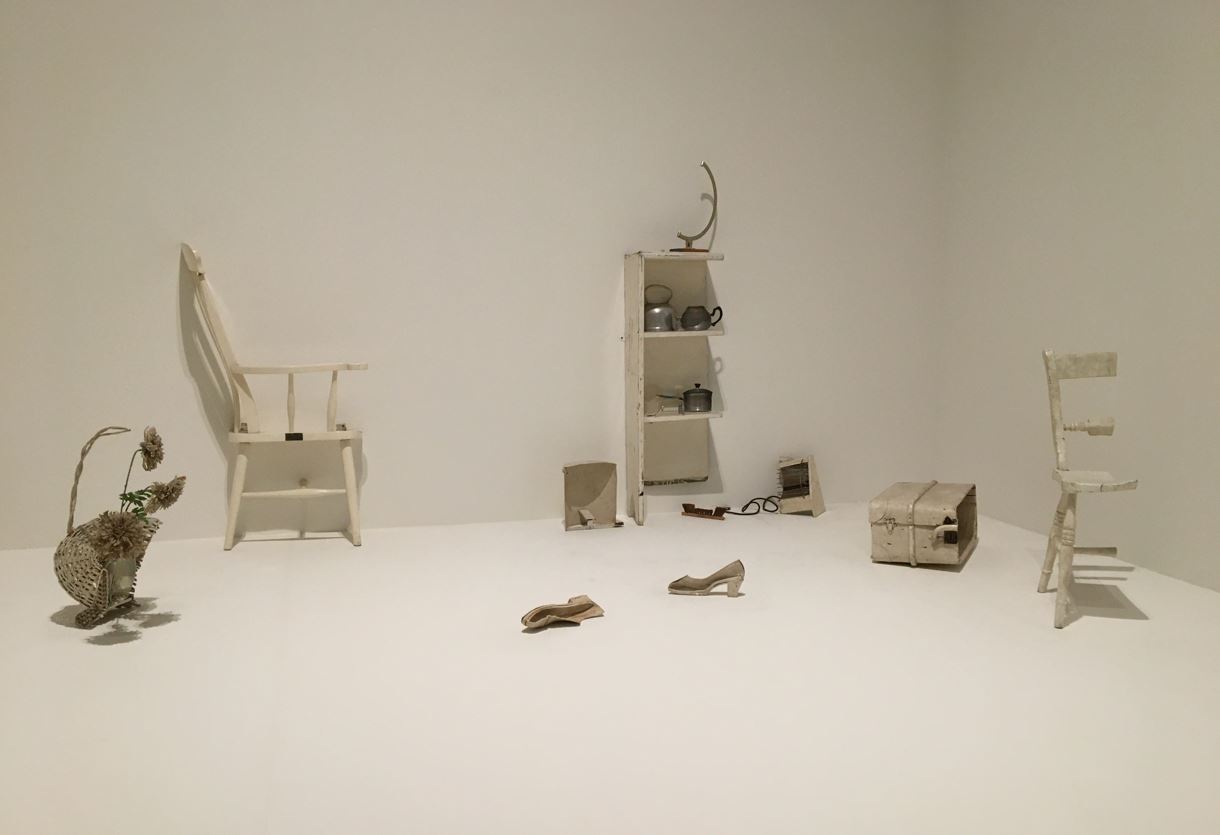
Installation view of ‘Half a Room’ at Yoko Ono: Music of the Mind at Tate Modern (photo by the author)

Or ‘Lion Wrapping Event’, a 26 minute film of wrapping one of the lions in Trafalgar Square in fabric. Or For ‘Promise Piece’ where she smashed a vase with a hammer, inviting audience members to take a piece and promise to return in 10 years to put it back together.

Or Film Number 4 (Bottoms) which edits together close-ups of 200 wobbly bare bottoms. In fact it feature the bottoms of lots of members of the London art scene of the time and features snatches of conversation between Ono and her then husband Anthony Cox.

The film was refused a certificate by the British Board of Film Censors and there’s photos of Ono protesting outside their offices, ‘It’s just part of the human anatomy, there’s nothing rude or sexy about them’ – the touching belief of 1960s idealists that getting naked would solve all the world’s problems from ending the war in Vietnam to abolishing sexism.

But the focus of the next few spaces is the John and Yoko collaboration which became such a big deal from about 1969 onwards.

The late 60s/early 70s peace and politics

A dream you dream alone is only a dream.
A dream you dream together is reality.

One area is devoted to their highly publicised peace projects. There’s a case showing how, on 15 June 1968, the couple planted acorns in the ruins of Coventry Cathedral – famously gutted by German bombing – one person facing east and one facing west to symbolise unity across the world.

In 1969, following their wedding on 20 March, the couple posted an acorn to 96 world leaders, asking each recipient to plant their own acorn for peace. The display case here includes formal replies from three leaders being the King of Malaysia, Prime Minister Golda Meir of Israel and the President of South Africa. They’re all polite but the South African president Jim Fouché wins by promising to plant the acorns on his farm. I wonder if they did. I wonder if they grew. I wonder if they’re still there.

Bed peace

One alcove is dominated by an hour-long film made of the couple’s famous publicity stunt, ‘Bed Peace’. The couple hired a room at the Amsterdam Hilton Hotel in March 1969, immediately after their wedding, and invited the world’s press to come and interview them, during which they, of course, promoted their cause of world peace.

Three months later they staged another bed-in at the Queen Elizabeth Hotel in Montreal from 26 May to 2 June and were more prepared this time. They made sure to be attended by celebrity fans and hangers-on and Lennon had written a song, which he performed live and was recorded, ‘Give Peace a Chance’. Tidied up in the studio and released, it quickly became an anthem of the huge anti-Vietnam War protest movement, being sung by a quarter of a million demonstrators against the Vietnam War in Washington, DC, on 15 November 1969.

In December the couple paid for billboards in 10 cities around the world which declared, in the national language, ‘War Is Over! If You Want It’ and there’s a striking photo of one of these on a billboard in Piccadilly Circus.

‘War is Over! (if you want it)’ poster on Shaftesbury Avenue 23 December 1969 as shown in Yoko Ono: Music of the Mind at Tate Modern (Photo by Evening Standard/Hulton Archive/Getty Images)

(I was struck not by the peace poster but by the cinema hoardings for the films ‘The Lion in Winter’ and ‘On Her Majesty’s Secret Service’ – great month for films!)

Two things:

  1. You can see how the concept and even the name Bed Piece follows on perfectly from all Ono’s previous concept pieces of the 1960s, being the performance of a simple concept (‘Get in bed and wish for peace. Invite the world’s press to watch you’)
  2. How Yoko was now operating in a completely different realm. These weren’t small exhibitions in out-of-the-way art galleries, but statements made in the full glare of the world’s media, this was a completely new stage.

This exhibition devotes an alcove to showing on a wall-sized screen the film which was made of the Montreal bed-in, ‘Bed peace’ (1969) a 16mm film lasting 1 hour 10 minutes, directed by John and Yoko and filmed by Nic Knowland. This appears to be available in its entirety online, so make your own mind up. As usual, seeing it projected on a whole wall is quite a lot more immersive and absorbing than watching it on a computer (or phone).

Yoko Ono’s music

Ono’s involvement with Lennon brought her into the orbit of the music business with mixed results. Previously she had been involved in highly avant-garde music making, working with the conceptual composer John Cage and his pianist David Tudor, staging performances which often included music, or the concept of music, or sounds of various kinds, and so on.

Now she was thrown into the orbit of maybe the most famous pop start in the world (jostling alongside Elvis and Bob Dylan).

The results are very mixed and surprisingly copious. Lennon created a pickup band in New York which they called the Plastic Ono Band which played gigs and benefits in New York at the end of the 1960s and early 70s. In lots of these Yoko added her trademark caterwauling-crying-screeching sounds which can be hard to listen to, especially when set in a fairly traditional rock context. As a student I had all the Lennon albums and couldn’t help skipping over Ono’s screechy bits. See if you can listen to this track all the way to the end. If you like it, there’s plenty more along the same lines.

There are headphones for visitors to listen to some of these concerts and in among the Plastic Ono tracks there’s a recording of her practicing for a gig with Ornette Coleman, the godfather of avant-garde jazz. Now this is interesting. Yoko makes vocal sounds and Coleman picks them up and echoes them on the soprano sax, with a band which is used to playing highly irregular improvised rhythms. I couldn’t help thinking that Ono’s entire approach to vocalising was best suited for this kind of avant-garde jazz setting rather than the limited formulas of rock music.

Anyway, that’s only the introduction, an appetiser, as it were to Ono’s musical career. Because the exhibition features an alcove whose wall is covered with old-fashioned LP covers of every album she’s ever made and it’s an impressive number, somewhere between 20 and 30 I’d guesstimate. The alcove contains seven or eight (very comfy) chairs each with headphones next to it and an interactive screen with a menu of all her albums and then of individual tracks (not every track – 3 or 4 from each album) and you are encouraged to make yourself comfortable and listen a selection of her music from the past 50 years.

Lennon retires

Probably most (middle-aged) people know the story that, after the breakup of the Beatles Lennon produced 6 solo albums but by the mid-1970s had had enough of the music business. Also Yoko finally gave birth after a series of miscarriage, to the boy they named Sean, in October 1975. So Lennon formally announced his retirement from the music business, turned his back on all of that and became a househusband in their New York apartment.

Double Fantasy

Again as most people probably know, Lennon then surprised everyone by, after five years of complete silence, suddenly releasing a brand new album of music in 1980, Double Fantasy.

Three points:

1. According to the Wikipedia article Lennon lacked confidence about the songs and arrangements, feeling he’d lost touch with the whole music scene. He was not wrong. As an ageing fan I was delighted by the appearance of Double Fantasy but it felt instantly nostalgic. It was music from another time, from the previous generation. Music fashions had continued to move as fast as they had in Lennon’s heyday in the 1960s, with glam rock flowering alongside disco, followed by punk, post-punk, synthpop and new Romanticism, and the new genres of Industrial and Goth being defined just as Lennon’s album was released.

It felt like a message from your mum and dad, from a happily married couple enjoying a second honeymoon – which was nice but nothing to do with the exciting young life you were leading. One of the critics called it ‘studio rock’, average material lifted by being performed by top session musicians and expertly produced and utterly soulless.

2. Double Fantasy carefully alternated songs by Lennon with tracks by Ono. Here’s a typical Ono track. Is she having an orgasm at the end?

3. The reason for dwelling on all this is that Double Fantasy is, in effect, the doorway, the gateway into the rest of Ono’s career and the ten or so albums which followed (as well as eight compilation and remix albums). Hence the wall covered in album covers, hence the chairs and headphones.

Yoko’s post-Lennon music career

I listened to a couple of tracks from the five or six albums following Double Wedding and didn’t like any of them. They all feature 1) heavy-handed over-production, with thumping drums and obsolete rock guitar of the worst kind; 2) her would-be poetic lyrics which are, in fact, tritely autobiographical – compare and contrast with any Dylan lyric; 3) her weak voice. If you like it, fine, but her music was never popular, in any sense.

Summary

The point is that for the first time in the exhibition, it felt like Yoko had fallen behind the times. In 1955, 1960 or 1965 she was out ahead of the curve, inventing ideas, methods, events, happenings, stagings, films and performances which stretched and defined the meaning of all those forms and of ‘concept art’. The peace activism with Lennon also set the tone of those last years of the 1960s, moved the avant-garde into the world of tabloid newspapers and TV, invented a new form of art-media-political performance and spectacle.

But by 1980 all that feels long over. And to focus on the music, she committed herself to the most deeply unexperimental, dead and dinosaur kind of Adult Orientated Rock, Dad Rock complete with thumping 1980s drums and air guitar solos. So unimaginative, uninnovative and unlistenable-to that I found the tracks I listened to were embarrassing.

But there’s no accounting for taste. I was astonished to read the curators’ take on her musical career.

Known for her ground-breaking early work and use of experimental vocalising techniques Ono is also recognised as one of the most prolific songwriters of the last century. This playlist highlight’s Ono’s output as a singer songwriter in more conventional pop-rock and electronic structures. It also includes collaborations with other musicians on remixes of her own music.

Then again, to be slightly cynical, this exhibition was obviously staged with Ono’s active support and maybe she sees her musical career as valid and important and worthwhile as her artistic work and so insisted it was included.

Hiatus and modern reprise

As far as I could tell there’s nothing here from most of the 1980s or 1990s. At some point in the 1970s the wave she’d helped to create and had surfed so skilfully from about 1955 to, maybe, 1975, hit the beach and expired. So, as far as I could tell, there’s a big chronological gap in the works here.

And then, in the final couple of exhibition spaces, Ono’s career revives with a new kind of work from the late 1990s. They are far fewer, bigger and far more professionally produced than the charmingly rackety, black and white, home-made experiments and happenings from the 60s and 70s.

They are recognisably high concept art works but executed with the high professional finish of advertising campaigns. Thus:

Helmets (Pieces of Sky)

Take a piece of the sky.
Know that we are all
Part of each other.

This consists of 15 or so World War Two German helmets suspended upside-down from the ceiling, and each one contains pieces from a jigsaw of blue sky and clouds. Visitors are encouraged to take a few pieces of the sky home with them. Personally, I’d have liked to make the jigsaw, asking other visitors who were interested to upend all the pieces onto the floor and then trying to make the sky together. But maybe a bit too subversive and participatory for more sleek and slick late-period Ono.

Helmets (Pieces of Sky) by Yoko Ono (2001) from ‘Between The Sky and My Head’ at Baltic Centre For Contemporary Art, Gateshead, 2008. Photo © Baltic Centre for Contemporary Art

There are some abstract paintings and a series of drawings she’s made in a kind of pointillist style, putting dots on paper as doodles which slowly take shape. They’re quite nice.

Add Colour (Refugee Boat) (concept 1960, execution 2024)

Just blue like the ocean.

By far the most dramatic piece is the entire room dedicated to the refugee boat. This was pure white and place in a nicely boat-sized room painted pure white when the exhibition opened. And there’s a table with a couple of trays of felt-tipped pens, white, blue and darker blue. And visitors are invited to draw or write whatever they want.

Before

‘Add Colour (Refugee Boat)’ by Yoko Ono at ‘Yoko Ono: Music of the Mind’ at Tate Modern, London, 2024. Photo by Reece Straw © Tate

After

‘Add Colour (Refugee Boat)’ by Yoko Ono (concept 1960, execution 2024) at ‘Yoko Ono: Music of the Mind’ at Tate Modern, London, 2024 (photo by the author)

As the curators put it:

Ono invites us to consider the impact collective action can have. The work encapsulates her belief in human agency and her understanding that ‘we are sharing this world’ and sharing our responsibility for it.

What struck me was rather different from this intention, which is how samey people are. For a start we’re all about the same height which explains why the band of wall about five feet high has been overwritten so much as to become an indecipherable sprawl of deep blue. If there are any individual messages there, they’re hard to read. More legible are things written or drawn ether lower down or, especially, higher up.

but people aren’t very original, either. As you can see the biggest single message is an enormous FREE PALESTINE and there are various other expressions of support for Gaza etc scrawled throughout. Then there are lots and lots of messages about love and hope and the planet and hope and love etc.

The problem with the notion of ‘human agency’ is that when you get a lot of these human agents together they generally behave in highly predictable and formulaic ways. That’s what the epidemiology or actuarial science, social media algorithms and AI are based on. I’m sorry to be the one to say it but all the evidence suggests that the notion of ‘human agency’ Ono is promoting is grossly over-rated.

My Mommy Is Beautiful (1997)

Write your thoughts of your mother.
Or pin a photograph of her to the canvas.

The same kind of participatory invitation is at play in the penultimate piece in the show, another invitation for visitors to write a message. So there’s a trestle table piled with cards, as for the Wish Tree, and a tray of pens, and we are invited to write a message or thought about our mothers and tape them to the wall which is, of course, absolutely festooned.

What the visitor doesn’t at first realise is that suspended from the ceiling in this space are a set of photographs of breasts and vulva.

Installation view of ‘My Mommy is Beautiful’ looking up at the photos suspended from the ceiling at Yoko Ono: Music of the Mind at Tate Modern (photo by the author)

Why?

Suspended at height, a series of photographs embody Ono’s humour and humanity. She comments: “One has to look up at the vagina and the breasts on the ceiling – rather like looking up at your mom’s body when you are a baby.”

Once again, as with the Wish Tree and Refugee Boat, the sentiments written by visitors are overwhelming predictable and sentimental (‘I love you Mum’, ‘I never appreciated you Mum’) alongside some occasionally impressive drawings. Purely as relief from the Clinton Cards cloying messages, I liked the one that read ‘My mother was a selfish bitch’, which felt like a rare bit of honesty and truth.

Whisper

If there was any doubt about the importance Ono gives to her musical career this is put to bed by the fact that the very last piece in the show is a music performance. It’s a ten-minute film of her performing at the Sydney Opera House on 17 November 2013. It doesn’t appear to be available online, which is a shame because it showed how the technology had caught up with her style. What I mean was that her voice was looped so whether breathing, sighing, moaning, wailing or screaming, she could play off the looped repetition of herself, and this was interesting (up to a point). Just her experimenting with her voice was good because it had range and variety.

However, go on YouTube and you can find loads of her performances in a rock context which, as I’ve explained, feel reactionary and backward-looking. In the past 50 years popular music has gone through an unbelievable series of fashions, changes and evolutions but not in Yokoworld. In Yokoworld it’s still 1971 and that’s why in something like this performance with her and John’s son Sean on guitar, it feels embarrassingly like watching someone’s home video. Embarrassingly bad…

Summary

This is an excellent exhibition which gives a really good overview of an amazing career. The first half of the show (1955 to 1967) is fascinating, funny, light and inspiring in a charmingly ramshackle home-made video, home publishing kind of way. All those Zen instructions are genuinely mind-opening and smiley.

The Lennon interlude is highly redolent of the late 60s, the Beatles late period and all of that, just as it all began to fall apart.

The wall of Ono albums you can, if you like, just read about and skip, unless you want to hear lots of 1980s AOR, all big shoulder pads and synth drums backing weedy voice and run-of-the-mill lyrics.

And then, after a big gap, there’s the final handful of works – the big ones like the helmets, ship and Mommy wall, and the more discreet series of drawings and paintings which are easy to overlook but quite nice…

What a life! What a career! But also what a fascinating review of the parabola of ‘art’ in the second half of the 20th century, from the genuine avant-garde staging of silly performances in dingy lofts and obscure galleries, then getting involved with the Swinging Sixties drugs and hedonism and fake revolution, then lingering on into the cocaine addiction and bad clothes of the depressed 70s, then justifiably falling silent and then…returning in the form of highly produced, highly finished, slick presentations.

Recognisably the same motivation and the same ‘political’ messages (peace, I love you all) but slickly packaged for the cable TV, then internet, and now social media ages. Clever, slick, virtue signalling which we have discovered, alas, changes nothing because it’s preaching to the converted – to like-minded liberal gallery goers who write ‘Help the refugees’ and ‘I love you mummy’ on gallery walls, while outside, in the real world…

In a way art galleries are safe spaces for certain kinds of like-minded, sentimental liberals who can huddle together and agree that, if only the world thought like us, it would be such a better place. But it isn’t. Trump. Putin. Xi Jinping.


Related links

Related reviews

The Unravelling: High Hopes and Missed Opportunities in Iraq by Emma Sky (2015)

‘The Coalition promised regime change but instead brought about state collapse.’
(Unnamed Iraqi general quoted on page 101)

This is a disappointing book.

Emma Sky is mentioned half a dozen time in Thomas E. Ricks’s book The Gamble: General David Petraeus and the American Military Adventure in Iraq, 2006 to 2008. Her story is extraordinary. Aged 35 she had travelled widely in the Middle East, working for various charities and NGOs. She was working for the British Council back in Blighty when the organisation sent round an email asking if anyone wanted to volunteer to work for the new Coalition Provision Authority (CPA) being set up in the immediate aftermath of the US-led victory over Saddam Hussein in Iraq (May 2003).

Although relying on the authority of the US Army, the CPA itself was an entirely civilian organisation, charged with reconstructing every aspect of Iraqi society, battered by 8 years of war with Iran (1980 to 1988) then 12 years of sanctions after the first Gulf War (1991 to 2003), and then a second bout of disastrously accurate US bombing designed to destroy its infrastructure. The CPA was desperate. Anyone from one of the main allies with experience of working in the Middle East was considered.

Indeed Sky describes the astonishing lack of professionalism about the process whereby she applied, was interviewed, was hired, and found herself on a plane to Baghdad. No-one met her at the airport and when she reported to the ‘Green Zone’ in Baghdad where the new authority was still setting itself up she was casually offered the role of ‘Governorate Coordinator’ of the province of Kirkuk in the north of Iraq, and just as casually accepted it. Within days she found herself based in a military barracks in Kirkuk deep in Iraqi Kurdish territory, one of only a handful of women among over 3,500 US soldiers, and sharing an office with the military commander, Colonel William Mayville of the 173rd Airborne Brigade (p.60).

On pages 17 to 21 Sky gives a potted biography of herself. She came from a broken home whose mother, nonetheless, managed to send her to prep and private school, from where she went on to Oxford and then the British Council. So, poor but pukka. This makes the sequence of events which led to her running an Iraqi province a bit more understandable, but not much.

Little did Emma realise at the time that her destiny was to be intertwined with Iraq for the next ten years nor that she would rise to play a key role as adviser to the head of the US Army in Iraq, General Ray Odierno. To be a bit more precise Emma had two periods of work in Iraq, punctuated by roles elsewhere, before she left altogether to move into academia. Her CV goes something like:

  • 2003 to 2004 Iraq: Governorate Coordinator of Kirkuk
  • 2005 Jerusalem: Political Advisor to General Kip Ward, the US Security Co-ordinator for the Middle East Peace Process
  • 2006 Kabul, Afghanistan: Development Advisor to the Italian and British Commanding Generals of NATO’s International Security Assistance Force
  • 2007 to 2010 Iraq: Political Advisor to US General Raymond T. Odierno, Commanding General of Multi-National Corps; and to General David Petraeus on the subject of reconciliation
  • 2011 to 2012 UK: Visiting Professor at King’s College London and a Fellow at Oxford’s Changing Character of War Programme
  • 2012 America: Senior Fellow at the Yale Jackson School of Global Affairs
  • 2015: Director of the Yale World Fellows international leadership development program

So during her two spells in Iraq, Sky was a central figure. She worked with all the key players on the US side, and met all the powerful Iraqi politicians and religious leaders, as well as countless Iraqis lower down the pecking order, regional administrators, tribal chiefs and so on, right down to the man and woman in the street. She sat in on meetings which made key decisions about Iraq’s future, advised on many of them, had to implement ones she profoundly disagreed with.

It’s a chunky narrative (363 pages), with maps and glossary, which take us from the early days of the occupation in 2003 through to the withdrawal of US troops by President Obama in December 2011 and then through the years of Iraq’s collapse which led to the advent of Islamic State, which rose at great speed to take control of much of northern Iraq by July 2014, which is when Sky’s narrative ends.

Wow. She covers the entire period, she is a clever, independent woman with strong opinions of her own, she isn’t shy about criticising the leaders of the US civilian and military administrations to their faces. She has hundreds of good anecdotes to tell. So why is her book so disappointing?

Two reasons: the flat limited quality of her political analysis, and her pedestrian prose style. Thomas E. Ricks’s highly analytical account of the periods 2003 to 2006 (Fiasco) and 2006 to 2009 (The Gamble) proceeds by ideas or themes. Events out on the street are only mentioned insofar as they influence high-level American political or military policy, which is what Ricks is really interested in.

Sky’s narrative, by contrast, is more like a diary, like the diary of a very clever, independent-minded, sixth form schoolgirl. I did this. Then I did this. I attended dinner with so and so. I met so and so for the first time. Next day we went to meet tribal chiefs. I suggested we set up a committee to ensure better representation / rebuild the economy / provide more schools. That evening there was a formal reception. About this time a religious leader became prominent. I met him at a meeting of tribal chiefs. And so on.

Instead of being arranged by ideas or issue the narrative reads like one damn thing after another. It lacks detachment and analysis, an impression not helped by her often very naive impressions of people. She meets all the key players but her assessments are surprisingly shallow. Ricks portrays all the politicians and religious leaders in post-war Iraq jostling for power, focuses on their roles in Iraq’s poisonous power politics. It’s a rogues gallery of crooks and players. By complete contrast, Sky tells us they’re nice people and have lovely eyes (I’m not kidding, she has a thing about people’s honest trustworthy eyes). She makes friends with lots of leading sheikhs or clerics and is always bursting into tears when it’s time to leave (again I’m not exaggerating; there’s lots of crying).

Her prose style is dead in the water, flat and factual with overtones of The Little House on The Prairie.

We celebrated America’s Independence Day with the Kurds by the shores of Lake Dukan. It was apparently the largest lake in Kurdistan, created by the construction of a dam on the Little Zab River in the 1950s. I sat watching the sun set over the mountains. (p.15)

Or:

In the evenings I would often sit with Colonel Mayville in his office describing the state of the province. Our partnership developed into friendship. To my surprise I found myself growing to like the Colonel as a person and respecting him enormously. I came to realise that behind the bravado was a deep intellect – and a wicked sense of humour. (p.37)

Or:

Kara took me into Kirkuk city one afternoon. We ate in a restaurant and then walked through the market. It felt great to escape the cage from which I viewed Iraq and plunge once more into the Middle East, inhaling deeply the smells of coffee and vegetables, and feasting my eyes on the colours and peoples. (p.61)

‘Wicked sense of humour’, ‘feasting my eyes’. These are magazine clichés and have a cumulatively deadening effect. To quote linguist David Crystal, clichés are phrases which have ‘lost their meaning through overuse. They have become automatic reactions, verbal tics, a replacement for intelligent thinking…’ (The Story of English in 100 Words, 2012).

Every chapter has an epigraph. The epigraph to chapter 1 is: ‘All we are saying is give peace a chance,’ the John Lennon song. I realised at that moment that the narrative was likely to be as obvious and clichéd as that choice of song, and so it turned out.

Moments of thumping obviousness this occur again and again throughout the book and steadily lower your opinion of Sky. She comes over as the kind of person who’d think putting a sign in her office reading ‘Keep calm and drink tea’ was original and funny. Shame. This book cost a lot of money (£10), took 3 or 4 days to read, and wasn’t worth it.

Looking for father figures

In the Ricks book Sky is cited as coming to enormously admire the senior US military personnel she met; in fact she is quoted as saying the US Army is much better than the country it serves. In the hard-headed, cynical context of Ricks’s narrative that feels like an astonishing thing for an outsider, and a pacifist-minded British woman, to say. Unfortunately, once you enter the world of Sky’s narrative with its tendency to gush and hero worship, it doesn’t seem at all surprising.

In this respect I came to realise that the most important fact in the book is when she tells us, really early on in the narrative, that her father left her mother when she was very small. She never knew him, she grew up without a father (p.17). In fact happened not once, but twice. After he biological father walked out her mother fell in love again, and it was this step-father who organised Emma’s education at private schools and then onto Oxford. But while she was at university this step-father ran off with another woman, ‘leaving my mother heartbroken, penniless and distraught’ (p.20). So it happened twice, being abandoned by a father.

I was an only child from a broken-down family. (p.163)

So deep was the wound that she openly tells us it was this that made her, on graduating from university, decide to set out on an adventure to North Africa, ‘to escape the grief and anxiety that family seemed to cause’ (p.20).

I’m not projecting this into her narrative. It’s she herself who devotes several pages right at the start to explaining all this. So it seems pretty reasonable to see these traumatic childhood and teenage experiences as explaining why Sky is so quick to hero worship the big, strong military men she was working with, most of whom are old enough to be, er, her father.

After a while you realise that everywhere she goes, she’s looking for Daddy. Judge for yourself this description of her first meeting with the man who would become the head of the US Army in Iraq:

I could not believe my eyes when I first caught sight of General Odierno. I had never seen such a large human being. He almost seemed a different species. His head was totally shaven. His hands were massive. Yet his face was strangely striking and his eyes were kind. (p.46)

And:

General O was our undisputed boss. He was so big, so confident, so decisive and so determined. I was in awe of him. I thought he was indestructible. As I was sure he could not be killed I felt totally safe when I was with him…(p.163)

And:

I loved travelling with General O and the Sergeant Major. There was so much warmth between the three of us and respect for what we each brought to the mission. (p.171)

And it’s not just big lovable General O. Sky finds father figures everywhere. Take General Mayville.

One evening we went to the local orphanage that we visited from time to time…After the dinner we distributed the presents that had been sent out by the soldiers’ families, keen as ever to support our efforts. It was wonderful to watch the children’s faces light up, loving the attention and gifts. Mayville naturally fell back into the role of father, playing with the kids. (p.74)

Again and again she’s quick to establish father figure-daughter relations with strong or older or important men. Sky’s concern and ability to listen impresses all the Iraqis she comes into contact with (she tells us). But quite often it’s difficult to tell whether she’s being respected or patronised.

Colonel Mayville and I decided in October that it was time to visit [prominent cleric Abdel-Fatah] Mousawi in the al-Husseini Mosque. Sheikh Agar, who frequented the mosque, agreed to take us. He brought me one of his daughter’s abayas and gave it to me as a gift. As we climbed out of the car I covered myself in the abaya, much to everyone’s amusement. Sheikh Agar beamed approval. ‘You are my daughter,’ he said. (p.64)

Or:

Somehow I never felt totally at ease with General Farouq. He kept saying that I was like a daughter to him. (p.192)

Or the extended scene towards the end when it’s announced that General O is being promoted and moving on. He asks about her plans, for example does she intend to marry, have kids maybe, a topic she finds ‘uncomfortable’, maybe because it’s none of his damned business, but also, the Freudian reader by this stage realises, because her unconscious desires (for protection and affection) are projected onto him. ‘He was being all paternal’ (p.341).

Crying

Sky not only converts the men she’s engaging with into father figures, but repeatedly casts herself as a little girl lost. When the tour of duty of the 173rd Airborne Brigade comes to an end and they rotate back to the States, Sky attends the elaborate army ceremony marking the handover to the replacement regiment and makes an emotional speech to the assembled regiment on how much she’s come to respect and admire them all. When their commander, Mayville, shakes her hand and leaves, she is inconsolable with grief. She tells us she spent the entire afternoon crying. Why? Another Daddy has left her (p.89).

Throughout the book this keeps happening; she makes close friends with the locals (pretty much 100% men) or with senior US military figures (all men); then she or they have to leave – when she moves from Kirkuk on to work in Baghdad, or when she leaves Iraq altogether – and there’s lots of crying.

Ismail Abudi came round to see me at the Northern Oil Company in Kirkuk where I was staying the night. We sat on the roof chatting…We discussed the 30 June deadline [when the CPA was due to hand over authority to the Iraqi transitional government]. I told him I would be leaving. ‘No…tell me it is not true,’ he said. We sat on the roof in total darkness with tears streaming down our faces. (p.115)

The Chinook helicopter carrying members of the CPA out of Iraq takes off and:

I had tears streaming down my face. (p.127)

Much later, when she’s leaving for the second time, she goes to visit Sheikh Anwar al-Assi to say goodbye and he tells her to write a book about her experiences. And then:

There were tears in both our eyes when we shook hands. (p.339)

The only woman among men

The other pattern which keeps repeating is the way Sky finds herself the only woman among men. This, also, stems back to her childhood. In that autobiographical sketch she tells us that when she was four her mother got a job as matron at an all-boys preparatory school near Oxford. When she was 7 she was accepted into the school as a boarder, one of only five girls in an all-boys school. When she was ten the stepfather mentioned above entered her life and took her to a new school, The Old Ride, in Bradford-on-Avon. Here she was the only girl at the school (p.17).

She claims to have hated it, saying it was a Lord of the Flies-type experience, with the boys being beastly etc. Nonetheless, it sheds great light on the experience most of this book is dedicated to describing, the way she ‘found herself’ the only woman in a US Army barracks of 3,500 soldiers in the remote north of Iraq, as if this is a completely unexpected surprise instead of, to the Freudian reader, a classic example of a lonely adult seeking to recreate the safe environment of their childhood.

What happens when you are the only woman in a US Army barracks of 3,500 soldiers? You are showered with attention. Lots of big tough men go out of their way to behave chivalrously, open doors, call you ma’am, shower you with attention. You become a very special and notable person.

Same happens when she attends the countless meetings of Kirkuki Arabs or Kurds or Turkmen, Sunni or Shia, religious officials, council meetings, army meetings, and so on: she is again and again the only woman in the room. From time to time she describes this as a great achievement but to the Freudian reader it feels like a situation she has engineered from deep psychological needs. She acquires affectionate nicknames, the Iraqis call her Emmasky, she is effusively greeted and hugged wherever she goes by sheikhs and mullahs.

On one level, obviously this all happened and she (presumably) performed an important function as adviser to the military and civil authorities, first in Kirkuk then in Baghdad. But because she herself has announced the themes of abandonment and loneliness, in some detail, right at the start of the narrative, it is hard not to read the book as the record of a partnerless young woman who again and again places herself in the almost exclusive company of men where she can be made to feel important, and showered with the male love and affection which she completely missed as a child.

I was met at the airport by an Italian colonel who greeted me with a big smile: ‘We are five hundred Italian  men with no women to dance with.’ (p.134)

Thus after her friend Sheikh Agar is assassinated, she attends the funeral and goes on to describe the way she has been virtually adopted by his family:

As I walked in I heard the whisper, ‘Emmasky has come’ being passed down the line. I spoke to the sons. The younger one, who I had often seen around the government building, had aged years. ‘Allah yarhamu,’ (May God have mercy on him), ‘Inna lillali wa inna ilaihi raji’un‘ (We are all from God and to him we return). Family members spoke to me. ‘You are our sister.’ ‘You are my brother’s daughter’. Sheikh Agar, bless him, had told all his family about me. And they were touched I had made the journey from Baghdad to pay my respects. Grief lay heavy in the air. I sat in the tent, the sole woman among so many men. (p.106)

This is just one of the surrogate families she is seeking in order to make up for the one she never knew in childhood:

I was on General O’s team. And no matter how badly we disagreed or argued he was not going to throw me out. This was a family that worked through its problems and did not break down. (p.197)

And so when her second tour of duty as adviser to General Odierno comes to an end, at the end of December 2007, there is the characteristic departure ceremony, with speeches and presents, during which Odierno very graciously thanks Emma for all her help and advice.

His loyalty towards me was extraordinary. And I knew, if ever called on again, I would follow him to the ends of the world – and that he would listen to my advice on how to get there.

Odierno is Emma’s Super Daddy. Then it’s her turn to make a speech, telling the assembled soldiers it had been an honour and privilege to be part of their team. And inside she knew:

I meant it. Amid the horror of war, I had experienced more love and camaraderie than I had ever known. (p.241)

When she has her second farewell, because she’s not just leaving Iraq, the Americans are leaving Iraq, and so she attends the passing out parade held by General O, at which he gives a long heartfelt speech to the assembled troops, then:

A long line had gathered to shake General O’s hand and say goodbye. I hung around saying my farewells to the military men who had made me feel so much one of their band of brothers. (p.342)

Solecisms

This is trivial, really, but your faith in her narrative is frequently rocked by small but symptomatic mistakes in English phraseology. Here she is describing how you ought to avoid a particular seat in an American military helicopter, the one right by the open door which is nicknamed the ‘hurricane seat’:

Whoever sat in the back right seat would have the wind soar through their face, with cheeks and mouth flapping furiously. (p.30)

‘Soar through their face’?

Then again

Then again let’s stop and take stock: Sky is a bureaucrat and maybe this is how effective bureaucrats think and write – in stock formulae, obvious clichés, with a shaky grasp of English. Thomas E. Ricks is a journalist, so he’s paid to make stories sound gripping and important, he’s paid above all to write. Sky is a bureaucrat: her job is to invite people to committee meetings, distribute the agenda, manage relationships with key stakeholders, maintain the organisation’s values, defuse confrontations, find negotiating positions. In other words, her job is to use the safe and uncontroversial language of large organisations, not to rattle cages, to soothe ruffled feathers, to seek consensus, not to stand out or be original.

Having worked in UK government departments and agencies for 15 years or so, I recognise the type and recognise the tone of voice, full of terms borrowed from the private sector – where they mean something – and imported into the public sector where they are neutered of all meaning and verve.

Thus Sky tells us that she held a series of meetings with a view to improving the ethnic balance of the Provincial Council – fair enough – but when she goes on to tell us that ‘”No change” was not an option’ you can hear the tone of the civil servant or bureaucrat, quietly priding themselves on their no-nonsense attitude and tough talk.

In reality Sky seems to have been a people person. Her key achievements aren’t setting up this or that committee (though the narrative is larded with references to them) but getting people to trust her. The stories about local leaders accepting her as family, welcoming them to meals, festivals or funerals which I’ve cited, and more like them, testify to what seems to have been her key skill: this was getting suspicious people, in very perilous situations, to trust her sufficiently that they could talk to her, make their demands clear, and then she work her magic at getting the cumbersome CPA or the military-civilian government which replaced it, to actually accede to these Iraqis’ requests and get them what they want. At which point they trust her even more, and decide to try to get their way without resorting to violence.

In this way, as the narrative develops, Sky becomes a kind of one-woman embodiment of the policy of Reconciliation which accompanied the US military surge in 2007.

And seen from this angle, her readiness to fall into father-daughter relationships with important men was a positive asset, because strong men let their guards down around their daughters, share their feelings and wishes, admit their weaknesses and worries a bit more than they would around rivalrous sons, especially in a very traditional, patriarchal society like Iraq.

Maybe she tells us about her broken family background right at the start, and drops scenes of older men hugging her and calling her their daughter throughout the narrative, because she knows that this – above and beyond all the day-to-day admin and bureaucracy and setting up meetings and getting former enemies to talk – was her secret superpower.

Factual learnings

Lack of native politicians

America was always going to struggle to find politicians and administrators to step into the vacuum they created by ousting Saddam and banning the Ba’ath Party. Most of Iraq’s educated middle class had long since fled the country and had no wish to return. Or Saddam had killed them. He took great care to wipe out potential leaders who rose to prominent in any of the country’s many ethnic or religious minorities or among his own minority Sunni community (p.49).

Debaathification

Sky repeats the account of Ricks and every other reporter, that Paul Bremer’s rash decision to ban all members of the Baath Party from holding any official position ever again in effect decapitated Iraqi government at every level, made it very difficult indeed to find new people with authority or experience to run anything, and turned hundreds of thousands of clever, educated people against the occupiers.

The Kurdish return

Sky arrives in Kirkuk to find the Arabs very pissed off indeed at what they saw as the Kurdish takeover of every level of the administration. Many Sunni Arab families had received cash incentives from Saddam to settle in the north under his policy designed to water down the Kurdish majority (10,000 dinars, p.350). These were referred to as ‘new Arabs’. But now they found the police run by Kurds, local councils run by Kurds, Kurds who had left decades previously being offered incentives to return etc. So many of the new Arabs were looking to allies across the border in Syria to help them. Arab resentment of the Kurds is the persistent theme of the first 100-plus pages of the book, covering her time in Kirkuk, and carrying through to the very last pages, where she revisits a resurgent Kurdish region in 2014.

The sectarianism of Nouri al-Maliki

Sunni leaders were convinced that Nouri al-Maliki’s government was not only dominated by Shias (after all, Iraq as a whole has a Shia majority) but included Shia figures who had spent their exile from Saddam in Iran and were thought to be actively working for Iran. Not only that, but there was evidence al-Maliki protected the firebrand Shia cleric Muqtada al-Sadr, figurehead of the murderous Jaysh al-Mahdi or Mahdi Army or Badr Corps. (On page 253 she describes al-Sadr as ‘rash and irascible’, on the next page refers to his many psychological problems.) If the book has one thread it’s the growing authoritarianism and unpopularity of Maliki which goes hand in hand with the Obama administration’s bad decision to give him their full backing.

The extremists overplay their hands

This explains why many in the Sunni community not only joined the insurgency against the American occupying forces, but also tacitly or actively supported al Qaeda in Iraq when they began recruiting and operating in Sunni areas. However, during 2006 into 2007 al Qaeda overplayed its hand and began killing Sunni leaders who opposed them. When, as part of the so-called surge, US forces made it clear they would amnesty Sunni insurgents who had been fighting them, and even set up a scheme to pay them to join local ‘citizen defence forces’, many Sunni fighters decided they preferred this option and turned on al Qaeda who, as a result, escalated their atrocities, which in turn brought more fence-sitting Sunnis into the process of Reconciliation.

Something similar happened on the Shia side. Sky reports being surprised when al-Sadr announced a ceasefire of his forces against the US and Iraqi Army but it was at least in part because many on his own Shia side had become sick of the violence the Shia militias brought and the apparently endless round of  Shia attacks and reprisals either by US forces or Sunni insurgents. Sky describes the process with characteristic brevity i.e. in not enough detail, on page 238.

The surge

Other factors were at work too, such as 1) the huge shift in attitude among the US Army to the new mode of counterinsurgency, as described in such detail by Thomas E. Ricks, by the change in policy to break up America’s supercamps and set up small operating outposts embedded within towns and cities and communities. Also 2) the fact that the US government finally saw sense, realised they didn’t have enough boots on the ground, and allowed an additional 20,000 soldiers to be sent to Iraq.

British embarrassment

On page 232 she describes the British Chief of the Defence Staff, Sir Jock Stirrup, in a meeting with General Odierno, and visibly embarrassed that the British more or less gave up in Iraq while the Americans persisted and, despite their ongoing losses, were able to learn and change their tactics. (Read Frank Ledwidge’s book ‘Losing Small Wars: British Military Failure in the 9/11 Wars for a searing indictment of the British failure in Iraq.)

Terrible Iraqi politicians

Maybe so many of these countries are doomed because their leaders are blinkered and inept; their political class is irredeemably useless, incompetent and corrupt. This isn’t my view, it’s what many Iraqis say. Sky’s friend Abu Mohamed marvels at the way General Petraeus walked with them on a visit through the streets of a town named Jihad, not wearing body armour, talking to children, taking Iraqi dinars from his own pockets to pay for things in the market. Very clever, very savvy public relations, all of which leads a doleful Mohamed to conclude:

‘We don’t have leaders like that in Iraq.’ (p.250)

Other Iraqis make the same point. Abdul-Rahman Mustafa, former governor of Kirkuk, says:

‘Despite all the resources nothing gets done. Iraq is still going backwards. It is hard to see how the country will stay unified with such politicians in power. Iraq has good people but bad politicians.’ (p.354)

If your political class thinks only in terms of power grabs for themselves and their faction, your national politics will remain fractious. If, as soon as anyone gets power, they set about securing it for themselves, their family and clan, going to the extent of threatening and sometimes murdering rivals, then the only was a war of all-against-all can be brought to an end is by a very strong man, by authoritarian rule, by dictatorship. Which is what keeps happening again and again in Arab countries.

Iraqi politicians the problem not the solution

The American government kept hoping that once the level of violence had been brought down to an acceptable level, it would create the ‘political space’ in which Iraqi politicians could agree national plans of reconciliation and reconstruction. What the Americans were slow to grasp was that all the politicians put themselves and their tribes first and national Iraqi interest a long way second. In fact, many of the politicians were behind the violence the Americans were trying to control. They were using it to rally their own ethnic or religious communities behind them, to create followers and voting blocs to keep themselves in power. Rather as the nationalist leaders in Yugoslavia rallied their own communities and demonised other ethnicities, in order to remain in power (p.257).

Hollywood thinking

Mind you, the Americans have plenty of blind spots of their own. Sky puts into words something I noticed in Michael Ignatieff and Anthony Loyd’s accounts of former Yugoslavia and Ricks’s of Iraq which is that senior American politicians and military leaders have an astonishingly simplistic, black-and-white view of the world. They think in terms of the Good Guys and the Bad Guys, as if life was a Western, or a Hollywood movie. Bush and Cheney and Rumsfeld-level leaders are quoted talking about getting ‘the bad guys’ and helping ‘the good guys’. This incredibly naive way of thinking explains why it took the Americans at least 4 years to understand the polyphonic, multi-stranded political, ethnic and religious situation in post-Saddam Iraq, which was not only complex in itself, but continually shifting (p.230). Where are the good guys, they kept asking? But what if there aren’t any good guys?

This explains something else which is the mistaken belief that if you take out the top ‘bad guy’ you solve the problem. This betrays a complete failure to grasp that societies are complex entities made out of multiple tribes and ethnicities and religious groupings, regions and classes. The Americans were hampered by this simplistic Hollywood thinking right from the start when they thought all they had to do was overthrow the bad guy, Saddam Hussein, and Iraq would promptly turn into a shiny modern democracy like France or Germany. World class idiocy. Breath-taking stupidity and ignorance.

The same magical thinking was revealed in their over-excitement at the assassination of Osama bin-Laden, the same naive belief that if you take out the so-called leader of ‘the bad guys’ then everything will be alright. Whereas, of course a) by 2011 (the year he was assassinated), bin Laden had become irrelevant to the situation in both Iraq and the wider Middle East, which remained as fractious, unstable and violent as ever and b) al Qaeda has gone from strength to strength after his death, extending its reach far across North Africa.

Fear

Fundamentally, what drives the desperation of so many of the politicians in these countries to stay in power at absolutely any cost, is fear of what will happen to them and their people once they lose power. Arrest, exile, prison, execution is the all-too-common fate of political leaders in developing countries once they leave office. In countries like this you don’t cling on to power to serve; you cling on to power to protect yourself and your clients and lackeys from what will happen once you lose it. Fear is the key to the entire political system. Thus:

Even before the last [American] soldier had departed [at the end of 2011] Maliki had launched a political coup aimed at crushing Iraqiya. (p.345)

And Maliki proceeds to arrest, intimidate, threaten or drive into exile most of his political opponents (detailed list on page 360). Abdul-Rahman Mustafa again:

‘[The Americans] should not have tried to transplant Western democracy to Iraq. It is not possible. Iraq is not a democracy. Change takes time. There are no democrats in Iraq.’ (p.358)

Betrayal by Obama and Biden

The most surprising thing about the book is its finale. Sky comes down heavily against President Barack Obama and his Vice-President Joe Biden. Parliamentary elections were held in Iraq on 7 March 2010 to decide the 325 members of the Council of Representatives who would elect the prime minister and president. However, the elections didn’t show a clear winner and so negotiations for those posts proved fraught with tension and delay. A final decision wasn’t taken till November of the same year – after eight months of divisive, sectarian bickering and intimidation.

Sky’s claim is that Obama’s regime, its ambassador and envoys, proved inept at managing the situation. They seemed unaware of Iran’s growing influence in the country, and sitting Prime Minister Nouri Al-Maliki’s tendency throughout the year to become more sectarianly Shia, more prone to Iranian influence, and more authoritarian. Sky meets opposition politicians who are scared that they will be arrested, even tortured by Maliki’s security services.

And yet it was this creepy figure, Maliki, who the Americans now threw their weight behind. Obama had been elected president in November 2008, took office in January 2009, and ratified the deal signed by George W. Bush to withdraw all US troops by the end of 2011. As the Iraqi politicians dragged out the backroom wheeling and dealing about the next Prime Minister for most of 2010 Obama became impatient. He was facing mid-term elections for Congress in November and wanted a foreign policy win.

Thus it was expedient, it was the simplest thing, just to confirm Maliki in the post of Prime Minister which he already held. Thus it was that the US administration averted its gaze from Maliki’s worrying tendencies, including the embarrassing fact that Maliki was Iran’s favourite candidate to continue as Prime Minister, given that the leaders of the other parties were Sunnis.

And so it was that during Joe Biden’s flying visit to Iraq in November 2010, Sky is in the room, and at the table, and makes several attempts to get Biden to change the administration’s approach. She then accompanies him to a meeting with senior members of the Iraqiya party, a secular and diverse grouping more appropriate than Maliki’s State of Law Party. by her account Sleepy Joe Biden was already gaga, repeating an utterly inappropriate anecdote about his Irish grandfather who grew up hating the British and then applying it to the attending notables, as if it somehow shed light on the sectarian problems of Iraq. After Biden finally tottered out some of the Iraqiya Party asked Sky what he’d been on about.

Biden was a nice man but he simply had the wrong instincts on Iraq. If only Obama had paid attention to Iraq. He, more than anyone, would understand the complexity of identities and how people can change. But his only interest in Iraq was in ending the war.

I felt sad, angry and very afraid for Iraq’s future. Washington had reneged on the promises it had made to Iraqis to protect the political process and it had betrayed the very principles the US military believed it was fighting to uphold. (p.338)

Summary

As a personal memoir of a unique experience, The Unravelling is possibly, maybe, an acceptable read. But if you want to understand how the war came about, why it went so badly wrong, and how the Americans struggled to fix a terrible situation, forget it. Read Fiasco and The Gamble. Read Frank Ledwidge and Jack Fairweather.

The looting

Concrete example of Sky’s inadequate treatment: on page 98 Sky deals, in one sentence, with the central fact that the occupying forces left a security and policing vacuum right at the start, immediately after the Iraqi army had surrendered, and that the CPA was never able to recover from that initial loss of initiative and control. One sentence! Ricks devotes half his book to this fact, explaining why it came about, how it manifested itself in the first days and weeks, what the full political, military and social consequences were, returning to them again and again to give you an ever-deepening understanding of this catastrophic failure. But in Sky, just one sentence.

Abu Ghraib

Similarly, Sky records in her characteristic schoolgirl diary way, a visit with other CPA staff to Abu Ghraib prison after the photos were leaked and the scandal broke. Here is her analysis in its entirety:

At Abu Ghraib I saw evidence of the worst side of human nature. With weak supervision in the jail, a number of American soldiers had used their power to create a perverse world, breaking the monotony of their days with sadistic acts on detainees under their control. It was truly sickening. Abu Ghraib was one of those places that exuded evil. (p.94)

This is a wholly inadequate analysis, in fact no analysis at all, it’s just a comment by a tourist. By contrast, Ricks gives a detailed explanation of the complex causes of the scandal, the two most notable ones being: 1) the huge numbers of ‘insurgents’ some American forces were rounding up and indiscriminately sending to prison, instead  of questioning, assessing and probably releasing most of them in their own provinces; and 2) Donald Rumsfeld’s obsession with keeping the number of US forces cut to the bare minimum and his express refusal to send out enough US military police properly trained in running prisons. In their absence, inexperienced managers and completely untrained junior soldiers were lumbered with  a job they didn’t know how to do, with the disastrous outcome the whole world got to see.

Ricks’s account is thorough, well researched, fascinating in its own right, and an illuminating insight into the importance of properly running prisons and interrogation facilities during a conflict. Sky – a one-page description of a tourist visit and a Daily Mail-level comment.

She was there. She worked with the key players. She got to know the country and the situation. And yet her analysis repeatedly feels inadequate and superficial. Making lots of lovely friends and repeatedly bursting into tears is sweet but no replacement for analysis.


Credit

The Unravelling: High Hopes and Missed Opportunities in Iraq by Emma Sky was published by Atlantic Books in 2015. References are to the 2016 paperback edition.

Related link

New world disorder reviews