Millet: Life on the Land @ the National Gallery

Jean-François Millet (1814 to 1875) was the leading painter of rural life in France during the 19th century.

His many drawings and paintings portray farm labourers and rural workers at a variety of activities, with a vivid feel for the physicality of their work, and a quiet, unassuming empathy for their hard lives. His often faceless figures assume a kind of monumental quality as they stolidly go about their work until, without abandoning any of his rural realism, they rise to the level of symbols or allegories.

All this is demonstrated in this small but beautifully formed and FREE exhibition at the National Gallery. The display is in Room 1 (up the grand staircase of the main entrance, turn left then left again) and consists of 15 moderate-sized pieces – seven paintings, seven drawings, and one striking self-portrait — and yet in their understated way, these pictures convey a whole world.

Why show them now? Well, the show coincides with the 150th anniversary of Millet’s death, and is also the first exhibition devoted to his work in England for 50 years. Seen from this angle you might ask: why not more, and bigger, he certainly merits it? But let’s be thankful for what we’ve got…

Born and raised on a farm

Millet (pronounced Mee-A) knew whereof he drew: he was born into a family of farmers in the village of Gruchy in Normandy. His grandparents, parents, siblings and he himself all took part in the often gruelling physical labour involved in life on a farm. But unlike the others, as well as helping in the running of the farm, Millet read widely and drew from an early age.

Career

Millet’s first formal training was with portrait painter Paul Dumouchel in Cherbourg. He subsequently entered the studio of Paul Delaroche in Paris, famous for his dramatic scenes from history, the most famous of which is probably The Execution of Lady Jane Grey. Note its smooth, airbrushed finish.

Well Millet couldn’t be more different. He cultivated a heavier, far more unfinished, proto-Impressionist style and, for subject matter, chose not theatrical moments from the past but the hard lives of working people in the present. It’s no surprise to learn that his training ended badly when Delarouche contemptuously called Millet ‘the wild man of the woods’.

When he’d finished his training, in 1849 Millet moved to the village of Barbizon on the edge of the forest of Fontainebleau south-east of Paris, and this was to be his base for most of the rest of his career.

Country work

In Barbizon Millet set about perfecting his subject matter and approach. In paintings, pastels and drawings he portrayed the heavy, seasonal work of farm workers such as ploughing, sowing, harvesting, winnowing, gathering firewood into faggots, cutting tree trunks and much more. Here’s his breakthrough work, ‘The Winnower’, painted when he was 33.

‘The Winnower’ by Jean-François Millet (about 1847-8) © The National Gallery, London

It’s all about the pose and posture of the winnower. As soon as you realise the burst of yellow in centre-left is the mixed wheat and chaff which he is tossing in the air to be filtered, you realise the full dimensions of the winnowing fan or basket he’s holding, its weight and heft, the effort involved in repeatedly shaking it – and this, too, makes sense of the splay of his feet, braced to bear the weight and effort of his upper body.

The politics of labour

In terms of his career, ‘The Winnower’ was one of Millet’s first paintings to explore the theme of rural labour. It was exhibited at the Paris Salon of 1848 where it was well received, but later works triggered controversy. Progressive politicians and commentators claimed his work promoted their socialist agendas while conservatives to decried his ‘socialist’ motivations. In fact Millet’s own political convictions remain unclear to this day except for the obvious fact that he had great sympathy with the workers around him.  He identified with the hard-working peasantry: ‘A peasant I was born, a peasant I will die’.

Faceless

When out in the countryside Millet would make many small sketches, but when painting in the studio he often worked from memory. As a result, the forms and faces of his figures became simplified, even abstracted. Art scholars argue that this deliberate eliding of individuality, together with the paintings’ large scale, lends his figures a nobility normally only given to figures from history, the Bible or mythology. Personally I don’t think this is quite right. If you think of any history paintings, they tend to very much show the precise facial features of the protagonists, be they gods or Roman emperors, popes or generals. No, the blurring out of Millet’s faces does something else.

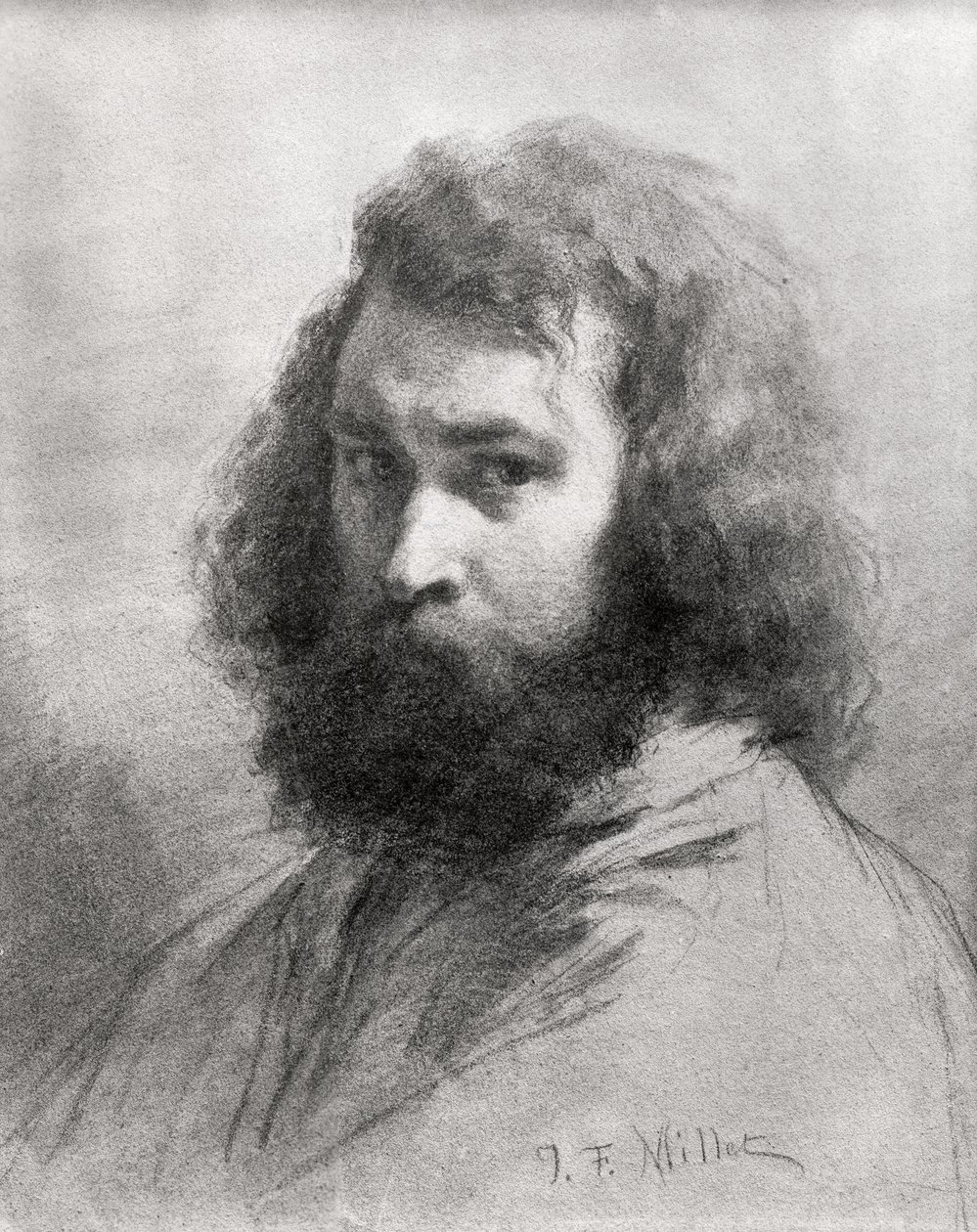
That he could draw faces, and draw them very well indeed (so many artists actually can’t) is demonstrated by the rather stunning self-portrait on display here.

Self-portrait by Jean-Francois Millet (1845-46)

So it was a very conscious decision to anonymise his workers and I think he does it in order to turn them into allegorical or even symbolic figures (see The Faggot Gatherers, below).

Depicting women

Another way in which he quietly rebelled against traditional compositions and portraits was in taking as much time to depict women labourers as men. The curators certainly do, carefully ensuring that precisely half the paintings and sketches here depict women – at their work as shepherdesses and milkmaids, goosegirls and wood gatherers. There’s a vivid but mysterious depiction of a woman drawing water from a well. The wonkiness and rich gold colouring of the two jugs reminds me a bit of Rembrandt’s palette…

‘The Well at Gruchy’ by Jean-François Millet (1854) © V&A Images / Victoria and Albert Museum, London

Feet

Suddenly – walking round for the third time – I realised something had been quietly nagging at me which is the attention Millet to hands and feet. Particularly the feet. He takes care to depict the torque or tension displayed by feet carefully placed at optimal angles to manage the tools of their work, holding a winnowing fan or, as here in the most dynamic image of the show, wrangling a huge saw.

‘The Wood Sawyers’ by Jean-François Millet (1850-2) © V&A Images / Victoria and Albert Museum, London

Note the way the sawyers left foot is not planted flat on the ground but braced up against the side of the huge tree trunk. In the gallery I had a go at copying the stance of his figures in the various pictures, and immediately felt the stress and tension and effort and movement of their bodies, entered into their world of labour.

Hands

The curators explain that gathering sticks of wood to be used as fuel for fires was a task generally given to the weakest, for example old women, much like the similarly humble task of gleaning corn after the main harvest.

Larger sticks and dead wood would be tied together into bundles called ‘faggots’. (It may just be worth explaining to younger readers that until recently ‘faggot’ meant: ‘a bundle of sticks bound together as fuel.’) There are not one but two depictions of women faggot gatherers in the exhibition. The second one is smaller in scale and atmosphere, but is an absolute killer.

‘The Faggot Gatherers’ by Jean-François Millet (about 1850-5) © National Galleries of Scotland

The more you ponder it, the more highly symbolical it becomes, an allegory of Youth and Age. Youth has the energy to stand; Age is exhausted and has to sit. Youth has pink young skin; Age’s skin is dark with sun and toil. Youth is predominantly in the light; Age is in deep shadow. Paying attention to feet, youth is innocently bare-footed… But it’s the old lady’s hands, it’s her gnarled hands, tested with age, which grabbed my attention, which came to haunt me…

Detail of ‘The Faggot Gatherers’ by Jean-François Millet showing an old woman’s hands, gnarled by a lifetime of hard labour

Spirituality

One of the highlights of the show is a loan from the Musée d’Orsay in Paris of ‘L’Angélus’. According to National Gallery Director, Sir Gabriele Finaldi, the Angelus is ‘Millet’s most celebrated work’ and, in some ways, it’s intended to be the centrepiece of the show.

‘L’Angélus’ by Jean-François Millet (1857- 9) © Musée d’Orsay, Dist. Grand Palais Rmn / Patrice Schmidt

French villagers would recite the Angelus prayer three times a day, at dawn, at noon and at dusk which traditionally marked the end of the working day. The whole composition is about capturing the light after the sun has gone down, and conveying the obviously spiritual mood of the man and woman who have ended their work for the day and are reciting the evening prayer.

Clearly the silhouetting of the two quiet figures against both land and sky is intended to convey ‘a profound sense of meditation and introspection’. In fact, for me, on this visit, I wasn’t moved. It was the hands and feet of the hard-working peasants which had tugged at my imagination.

The Angelus is an image of great peace and calm, in its way a comforting image, an image to reassure the bourgeois viewer that life on the land is specially authentic and spititual – so I can see why it has become an iconic painting for so many people.

But for me, as I’ve explained, real worship, the holiness even, is found in Millet’s images of hard physical labour, the deep abiding truth of work and the hard-won endurance and human resilience that it conveys.

‘The Faggot Gatherers’ by Jean-François Millet (1868-75) © Amgueddfa Cymru – National Museum Wales

A note on reproductions

I’ve used the reproductions which the National Gallery Press Office makes available to people reviewing the exhibition online, and it’s worth pointing out that they are rather poor. They look dark and dingy, don’t they? Whereas in the flesh, seeing the paintings in real life, all of them glow – ‘The Wood Sawyers’ blues and yellows and reds are surprisingly bright, ‘the Angelus’ has a mystical nimbus and ‘The Faggot Gatherers’ grabbed me, drew me in, hypnotised me not just with with the power of its understated symbolism but with the vivid impact of its muted colours – in a way that these competent but rather drab reproductions don’t.

Maybe Millet’s generally rather muted palette and brown overtone just doesn’t reproduce very well in photographs. So all the more reason, then, to pop along to the National Gallery and see these lovely paintings for yourself. Forty minutes of loveliness which will enrich your day.


Related links

Related reviews

Royal Academy Summer Exhibition 2025

Huge

The Royal Academy Summer Exhibition 2025 contains the usual overwhelming number of works of art plastered all over the walls of 12 rooms – small, medium and huge. This year’s total is 1,729 prints, paintings, photographs, drawings, sculptures, films and architecture models. Where to start and how to think about this annual jamboree except to abandon yourself to the bombardment.

‘On your marks – get set – go!’ – installation view of Gallery 2 at the Royal Academy Summer Exhibition 2025 (photo © Royal Academy of Arts / David Parry)

Go with someone

I went round once, pretty carefully, trying to look at everything, then went round a couple more times and noticed a load of items I simply hadn’t registered on a first pass. That’s why it’s best to go with friends or family, because there’s too much for one person to process and other people notice other types of things and bring them to your attention. Plus which, it’s always fun to listen to other people’s opinions: why did they love x, y or z?

Installation view of room 1 in the Royal Academy Summer Exhibition, aka the Wohl Central Hall, which is dominated by one of Ryan Gander’s big black balls (left) and a set of ostrich feather car wash wipers suspended from thick chains, ‘Body Shop’ by Alice Channer (£70,000) (photo © Royal Academy of Arts / David Parry)

Exhibition guide

The little pocket-sized exhibition guide they offer each year now costs £3.50, which is beginning to feel a bit pricey, but it is a vital piece of equipment. None of the 1,729 works have captions giving name of work or name of artist, there’s just a number on the wall next to each piece (from 1 to 1,729) so it’s absolutely vital to have the guide to hand in order to look up who the artist is, what the work is called and, because the great majority of works are for sale, the price.

It lists the works in numerical order but, since works by the same artist are sometimes scattered between different rooms, it also lists them by artist. So, for example, we learn from this index that Michael Craig-Martin has five works in the show, numbers 110, 490, 1087, 1205, 1206. Then you scan the main numerical index to discover these are hung in the Lecture Room, Gallery 7, Gallery 4, and Gallery 3.

So if you want to track down works by particular favourite artists (Norman Ackroyd, Tracey Emin, Yinka Shonibare) there’s an element of Where’s Wally or Sudoku sleuthing to find the numbers, find the gallery, and then the challenge of finding them on a wall absolutely plastered with pictures or surfaces crammed with little sculptures.

How many little sculptures can you fit onto one display table? at the Royal Academy Summer Exhibition 2025 (photo © Royal Academy of Arts / David Parry)

The digital version

One last point: most of the works are medium sized, many relatively small, and it is often difficult or even impossible to really see these because a) there are just so many of them and b) lots of them are hung high up on the walls.

This year, as every year, I discovered loads and loads of images on the RA exhibition website that I have no memory of seeing in the flesh. I think it’s reasonable to say that there are, in effect, two Royal Academy Summer exhibitions, the real life one, and the digital one.

The courtyard

As usual the exhibition starts with a big sculpture or installation in the main courtyard. This year it’s a set of huge black inflated balls by Ryan Gander RA. Each one has a gnomic question printed on it in big white letters. Apparently these were developed in collaboration with schoolkids and, well, to be a little harsh, it shows: How much is a lot? When do you know you’re right? Does abstraction have rules? Will time tell?

Courtyard of the Royal Academy Summer Exhibition 2025 showing some of Ryan Gander’s big balls (photo © Royal Academy of Arts / David Parry)

Light white walls

My immediate impression was that the show felt lighter and airier and more attractive than in the past few years, which gave me a positive feeling about the thing. After visiting several rooms it dawned on me that this is because the curators have left (most of) the walls white. Bright white walls respond well to the ambient light coming through skylights and make the place feel light and airy and happy. I was tired from the working week when I headed for the Tube but walking into the galleries was a refreshing and uplifting moment.

And if you turn left out of the Wohl Central Hall into the vast room 3, you are met by a welter of huge and impressive works, with summer light pouring through the skylight and reflected from the white walls. All very positive.

Installation view of the enormous Gallery 3, by far the best room at the Royal Academy Summer Exhibition 2025 (photo © Royal Academy of Arts / David Parry)

However, when I looked closer at the numbers I realised room 3 is pretty much the last room you’re meant to visit (if you care about doing it in order) and you’re in fact meant to turn right out of the Wohl Central Hall into the much smaller Lecture Room.

This room and the subsequent ones (galleries 9, 8, 7, 6 etc), nice and white-painted though they are, had what felt to me far fewer really standout works in them. Obviously lots and lots of goodish things, some very nice things but, as I continued round the overwhelmingly densely hung spaces, navigating the crowds of other visitors, slowly the suspicion grew on me that there were fewer really notable works than in previous years. Maybe. Possibly.

But that’s just one person’s point of view. The point is there’s such a glut of stuff to look at, consider, analyse and judge that everyone’s opinions are going to differ, at hundreds of points. I considered structuring this review by the RA’s own categories:

  • Prints
  • Painting
  • Photography
  • Drawing
  • Sculpture
  • Architecture
  • Film prints

But quickly realised this doesn’t really work. The things you like tend to be random and clustered in certain mediums. In my case, I like paintings and sculptures. I rarely pay much attention to films which a) require a lot of time b) are rarely worth it c) not least because they’re displayed on tiny monitors (poor film-makers, they must be gutted) and d) I used to work in TV where I professionally reviewed films made for the magazine format TV shows I edited, so I am used to a very high standard of image and editing and art films are, on the whole, notable for their deliberately low-fi quality.

And don’t get me started on architecture and architectural models: I regard the entire subject as a colossal fail. While international starchitects devise evermore silly and absurd projects to build dream cities in China or on Mars, the rest of us have to live in the disastrously badly planned, badly designed, badly built houses inflicted on us by previous generations of shoddy planners and cheapskate builders:

‘England boasts the highest percentage of substandard housing in Europe, with 15% of existing homes failing to meet the Decent Homes Standard. This is a higher proportion than countries like Hungary, Poland, and Lithuania.’
(England’s Housing Crisis: Among the Worst in the Developed World?)

I appreciate that architects large and small, world famous or local, have very little to do with all this, with local planning, house design, building, new developments etc, they’re all vying to build the next gherkin or shard or designing ideal communities for Utopia or, as here, Lord Forster of South Bank’s design for the new Manchester United stadium.

But in which case… if most of them have little or no say about the built environment most of us live and move in, why are we bothering to register their fantasias?

Among the numerous architect models, I was struck by this one which appeared to be made almost entirely from corrugated cardboard.

Suspense, Trans-Caucasian Trail, Armenia by Gumuchdjian Architects: number 1584:  5,000

Size matters

It sounds silly but faced with such an overwhelming number of artworks you quickly realise that size really does matter. To give a simple example, there are a number of portraits of dogs or cats which are obviously meant to be twee and sentimental and reassuring and they are nearly all small, deliberately small and intimate in scale.

A lot of them are prints which are designed to be run off in multiple editions and you often see their glass fronts festooned with little red dot stickers. This indicates how many people have bought a copy – so there’s another game you can play here, with friends or family, particularly small children, which is set them to find the most popular picture, by number of sales.

What caught my eye

Having abandoned the attempt to consider the works logically by format or size or price, I’m just going to share half a dozen of the works which really stood out for me.

Mummer

Number 177, Mummer (Irish border sculpture proposal) by Tim Shaw. Sculpture from carved and constructed wood. £150,000, standing in front of a ragged red curtain.

Mummer (Irish border sculpture proposal) by Tim Shaw (photo by the author)

Rats

101 white rat pelts lined with 22 carat gold, by Zatorski + Zatorski. Number 1,713. £85,000

101 white rat pelts by Zatorski + Zatorski. Number 1,713. £85,000 (photo by the author)

Dialogue with God

Dialogue with God by Jane Hewitt, catalogue number 1727, £1,000.

Dialogue with God by Jane Hewitt (photo by the author)

Day 3

Number 1592: Day 3 by Eleanor Lakelin – made from bleached horse chestnut burr. £78,600

Day 3 by Eleanor Lakelin (photo by the author)

Archive of Lost Memories I

Archive of Lost Memories I by Yinka Shonibare, catalogue number 105: £300,000. We’re familiar with Shonibare’s work from his solo exhibition at the Serpentine. Half of it is very post-colonial, with statues of imperial heroes decorated with colourful floral patterns, and this shelf display is a variation on that theme, with its terracotta versions of the Benin bronzes (still to be seen in the British Museum) juxtaposed with a flower-covered imperial bust. But another strand of his work is colourful portraits of African birds generally accompanied by a tribal mask, and there are three or four examples here as well.

Archive of Lost Memories I by Yinka Shonibare, catalogue number 105: £300,000 (photo by the author)

Simorgh and Solent avocet

These could be in a local village craft fair, couldn’t they? But for some reason they caught my eye, made me smile.

Simorgh and Solent avocet by Emma Christmas, numbers 1106 and 1005, £695 and £625 (photo by the author)

Touchstone

Touchstone by Neil Jeffries, number 461, £6,000

The absence of real life

It’s amazing to me how unreal art is, how utterly unlike real, everyday life, how little of most people’s average experiences are captured by art. What do most of us do, what makes up our experience of life? Surely work and commuting to and from work and worrying about work takes up half or more of life, followed by shopping for food, cooking and eating. Vast amounts of time are spent watching telly, going to the movies, taking part in sports or health activities such as simply walking or, in my case, cycling and the gym. And, of course, more or less everybody now seems to have a mobile phone and pay an enormous amount of time looking at a tiny screen.

My point is that none of this is depicted anywhere in any of the 1,729 works of art on show here. When you see it from this perspective, it is absolutely staggering the extent to which ‘art’ – presumably derived from art school, art teaching, art courses and what you could call Art Ideology – suppresses and excludes the vast majority of everyday human experience.

To be more specific, most people’s work involves sitting in front of a computer screen and yet there was just one depiction of this universal activity in the show (At The Screen by David Tindle) plus a schematic Michael Craig-Martin silhouette of a laptop. That’s it.

Driving – how many people own a car, how many hours a week do people spend driving, drive busses coaches vans Deliveroo scooters: yet there were very few depictions of this extremely common activity: some photos of picturesquely derelict old cars, a few photos or paintings of the view through what appear to be wet windscreens. But of the apparatus surrounding driving, and the vast infrastructure of motorways, service stations, A roads, B roads and so on, almost nothing. (Actually there is one picturesque gas station, but it’s in America which is generally considered by the art world to be more picturesque than shabby England, obviously.)

Instead: lots of real life as most of us experience it, there are lots of still lifes of apples, or pears, or vases of flowers, of isolated birds, of landscapes and seascapes, plus hundreds and hundreds of images which aren’t identifiable as anything specific, abstracts and semi-abstracts, vivid, beautifully executed, and all strangely detached from the world we live in…

How many pictures can you fit on a wall? at the Royal Academy Summer Exhibition 2025 (photo © Royal Academy of Arts / David Parry)

All I’m really saying is that, when you assemble nearly 2,000 of the best contemporary artworks, paintings, prints, photos, sculptures and installations by artists famous and obscure, it is really quite striking how much of contemporary lived experience is not in it.

Mr Potato Head

New World Man by Robert Mach

New World Man by Robert Mach, catalogue number 1723, £1,400.

How you’ll feel by the end

Lulu in the Sky with Diamonds Catalogue by John Humphreys (number 1661) from £120,000 (photo by the author)


Related links

Related reviews

Van Gogh: Poets and Lovers @ the National Gallery

Obviously this is an absolutely fabulous, to-die-for, once-in-a-century exhibition, 61 works showcasing van Gogh’s genius, half a dozen of them super-world famous classics (Self portrait, Starry Night over the Rhône, Sunflowers, Van Gogh’s Chair), many of them about as thrilling an encounter with a work of art as you could possibly imagine.

Self-Portrait by Vincent Van Gogh (1889) Image Courtesy National Gallery of Art, Washington

Surprisingly, this is the first van Gogh exhibition ever staged at the National Gallery; it’s been timed to commemorate a century since the Gallery bought the famous Sunflower and Chair paintings. But, as NG Director Gabriele Finaldi put it, a centenary isn’t enough – ‘every exhibition needs to have an idea, a concept’ and this one is no exception. It is very much a show with a thesis or argument to make, which it maintains across its six big exhibition rooms (which are):

  • Room 1 Introduction
  • Room 2 The Garden: Poetic Interpretations
  • Room 3 The Yellow House: An Artist’s Home
  • Room 4 Montmajour: A Series
  • Room 5 Decoration
  • Room 6 Variations on a Theme

And the thesis which holds it all together? Rather than summarise I’ll let the curators explain in their own words:

In February 1888, the Dutch artist Vincent van Gogh (1853 to 1890) went to live and work in the South of France. Over the next two years, in both Arles and Saint-Rémyde-Provence, he created an extraordinary and innovative body of work in which he transformed the people and places he encountered in life. Parks, landscapes and corners of nature became highly expressive, idealised spaces full of literary and poetic references. Similarly, Van Gogh chose individuals from his new surroundings to create portraits of symbolic types, such as The Poet or The Lover.

The careful planning behind Van Gogh’s art extended to creating works in groups or series, and to thinking about how these might be displayed both at his home in Arles and for exhibition in Paris. By gathering a selection of his most famous and beloved creations – and showing them alongside his carefully developed works on paper, a less familiar Van Gogh emerges: an intellectual artist of lucid intention, deliberation and great ambition.

So the curators raise and address about five themes (the ones I’ve put in bold, plus one more which emerges later):

1. Painting archetypes

So this is why the introductory room has just three paintings in it, all of which have the kind of generic, typical titles the curators are talking about, being The Lover, The Poet and the Poet’s Garden. And, indeed, why the entire show is titled ‘Van Gogh: Poets and Lovers’.

In later rooms we see many more paintings of The Garden, along with image of the beautiful Woman of Arles and The Peasant. The idea is to impress us that van Gogh was seeking for archetypes behind the everyday.

2. Literary references and poetic effects

On the walls are quotes from van Gogh’s letters which have been selected to show how he invoked poets and writers as he thought about his painting. Thus the park at Arles is said to be worthy of Dante or Petrarch while, later on (in the room full of landscape drawings) he says the countryside of Montmajour outside Arles strongly reminds him of a favourite Émile Zola novel, ‘The Sin of Abbé Mouret’. Wherever possible, the curators quote Vincent referring to literature or reflecting how views, scenes and people remind him of literary types.

3. Drawing

Room 4 is devoted to showing six amazing drawings. Drawings, being quicker and easier, are more given to being conceived as sets or series than paintings, which are often unique one-off works. As the curators put it:

Van Gogh marvelled at the landscapes surrounding Arles, some of which put him in mind of places mentioned in his favourite novels. Among the most evocative were the grounds surrounding the ruined 12th century Montmajour Abbey, a well-known landmark north of Arles. After making a number of drawings of Montmajour in May 1888, he returned in July to create a series of large-scale works on paper. These remarkable drawings depict a hybrid place; at once the result of meticulous observation and the artist’s imagination.

According to the curators it was during van Gogh’s 2-year sojourn that he realised for the first time that he could really draw, as opposed to paint, and the drawings here show him revelling in that discovery.

Landscape near the Abbey of Montmajour by Vincent van Gogh (1888) © Rijksmuseum, Amsterdam

4. Series

In Room 2 we see quite a few paintings on the theme of the garden, specifically 1) the public gardens at Arles and 2) the garden at the hospital of Saint-Paul de Mausole at Saint-Rémy-de-Provence where he admitted himself in May 1889 after a series of mental breakdowns in the preceding months.

Later on, the last room – Room 6: Variations on a theme – shows how he worked on series or sets depicting variations on several themes, notably 1) the Arles woman, 2) views of the mountains and 3) most brilliantly of all, an amazing series of paintings of wild, writhing olive groves.

Olive trees with the Alpilles in the Background by Vincent Van Gogh (1889) © The Museum of Modern Art, New York/Scala, Florence

5. Displaying his work

Finally, the idea that van Gogh put a lot of thought into how he wanted his work displayed. This is based on what he did with the house he rented in Arles.

Initially Van Gogh only used the Yellow House, which he rented in early May 1888, as a studio because it needed both renovation and furniture. By September he moved in and had bold plans to turn the modest house into an ‘artist’s home’ and a communal ‘studio of the South’ in which his artist friends from Paris could join him to work. He devised a decoration for the house that included his major paintings. This then evolved into carefully conceived ideas about how to present his
art to the public.

So, again, the curators are are at pains to overhaul the image of van Gogh as a kind of naive or mad genius, instead bringing out the sophisticated, calculating, planning and designing part of his personality. A lot of the evidence for this is based on the famous painting of his bedroom.

The Bedroom by Vincent van Gogh (1889) © The Art Institute of Chicago

All very casual, you might think, but the curators bring out van Gogh’s conscious effort to hang and display his works in a deliberate way to create an effect and so describe the 6 paintings you can see hanging in this picture, what they meant to the artist, and why he arranged them the way he did.

6. In the studio

Not mentioned in the curators’ initial survey, as the show progresses another theme emerges, which is Van Gogh’s work painting in the studio, composing scenes from memory.

It came as a surprise to learn that when he was a patient in the asylum he was given a room as a studio to paint in. Some of the paintings in The Garden part of the show (Room 2) depict the view from this ‘studio’ out over the asylum gardens, but we also learn that – in line with the curators’ emphasis on the artifice and intentionality of his work – a number of paintings were painted entirely in the studio, from memory and imagination, as he mixed and matched elements from the real world to achieve a creative and ‘poetic’ effect.

A small example is how in the classic ‘Starry Night over the Rhône’ can Gogh added in the constellation of stars in the sky and the lovers walking in the foreground, to create the poetic effect.

Starry Night over the Rhône by Vincent van Gogh (1888) Photo © Musée d’Orsay, Dist. RMN-Grand Palais / Patrice Schmidt

Larger-scale inventions included adding trees to the garden views of the asylum, along with female figures (which we know are fictional because no women were allowed into the asylum).

And, in the last room, we see many more examples of this invention: landscapes where he added in mountain backdrops to fields or groves which didn’t, in reality, have them. And learn that, lastly, the fabulous rhythmic elements in the paintings of olive trees which cover the last wall in the show, were products of the studio i.e. depicting trees and landscape which he’d certainly seen, but reconfiguring their shapes and layout to create the swirling rhythm he was seeking (see below).

Drawings

I’ve mentioned drawing several times. I think about a dozen of the 61 works are drawings and they serve a number of purposes:

One, they are preparatory studies. Vincent drew and sketched a scene before he painted it to work out his composition and treatment. This applies to the several drawings of the garden at the asylum which he made before he painted the scene.

2) Sometimes he made a drawing after he’d made the painting. These were drawings he sent to his brother Theo as quick guides to paintings he had just made and was describing.

3) Lastly, as indicated above, he realised that he could make series of drawings with a thematic unity, that drawing was a new and distinct medium separate from oil painting. Hence, as I’ve mentioned, the room here devoted to the six brilliant Monmajour drawings.

What you get from the drawings (apart from their intrinsic beauty) is a sense of how his pictures are built up from different types of markings. There are lots of the arrays of dashes and hatching, blizzards of centimetre-long rectangular marks, in sets or groups which you see in the paintings. But there are also dots, intense patches of cross-hatching. If I were a teacher I’d ask my pupils to count how many different types of hatching, shading, stippling and so on he uses in this drawing.

The Rock of Montmajour with Pine Trees by Vincent van Gogh (1888) Van Gogh Museum, Amsterdam

In this respect the drawings are like x-rays of the paintings. In the paintings you can see the same technique at work but the paint is ‘joined up’ to cover the whole canvas, creating a kind of continuous sea of marks and ridges. In the drawings the marks remain isolated, more distinct, much clearer. In this sense the drawings are much more conventional but still radiate the Vincent intensity.

And it’s fascinating to learn that all the drawings were done with reed-pens and quills that he carved and made himself.

Impasto

Impasto is the Italian word used as a technical term in painting and meaning ‘the process or technique of laying on paint or pigment thickly so that it stands out from a surface’ – and, my God! van Gogh is a genius at it.

All the reproductions in this review are useless. They make the paintings seem flat and slick whereas, in the flesh, they are tormented with whorls and ridges of paint applied as with a trowel, building up landscapes of paint across the surface which work with or against the landscapes of the composition. Here a close-up of leaves on an autumnal tree.

Detail of The Public Garden, Arles, by Vincent van Gogh (1888) (photo by the author)

Seeing them so close up, seeing the great ridges of impassioned paint, is like being swept up in a maelstrom of emotions.

Detail of Starry Night over the Rhône by Vincent van Gogh (1888) (photo by the author)

The tiles on the floor of the famous picture of his chair seem to be melting and reforming, rising and rippling from the surface.

Detail of van Gogh’s Chair by Vincent van Gogh (1888) © The National Gallery, London (photo by the author)

In some his technique goes way over the edge, leaving realistic depiction far behind in the really heavy, clotted effect seen in the frankly bizarre ‘The Green Vineyard’.

Detail of The Green Vineyard by Vincent van Gogh (1888) (photo by the author)

This felt like an experiment which he took as far as he could in a particular direction, although there are one or two others of the same murky heaviness. And yet in the same painting, he uses the same technique to create a bird-haunted sky with spectacular results. You feel as you’re entering another universe.

Detail of The Green Vineyard by Vincent van Gogh (1888) (photo by the author)

Maybe simply because it was hung at head height so that my eyes were exactly level with it, but I found that in the painting of his bedroom it wasn’t the table or chairs or paintings hanging on the wall, but the wooden floor which I became more and more mesmerised by, transfixed by.

Detail of The Bedroom by Vincent van Gogh (1889) photo by the author)

Amazing! It’s like a modern abstract painting, a delirious adventure of industrial green and scrappy pink, sculpted into abstract patterns. It feels like the paint has not been applied but has been scraped away to reveal another world beyond, as if we’re peering through a dirty windowpane into a different reality.

Genius

It’s not very often you find yourself in the presence of real genius but in painting after painting, and before some of the drawings, you feel yourself in the presence of a mighty power, a primal energy, a supernatural ability to carve and sculpt blotches and pads of primary colours so as to create great swirling images overflowing with life and energy. I was spellbound, I was overcome, I kept going back to the ones I really liked, it was like drinking sweet wine or strong liqueurs, drinking at the fountainhead, fuelling my eyes and soul.

More masterpieces

Van Gogh’s chair (in which, as I’ve said, it was the floor tiles which got me).

Van Gogh’s Chair by Vincent van Gogh (1888) © The National Gallery, London

The exhibition for the first time brings together two paintings of sunflowers, the one the National Gallery owns hung alongside the one owned by the Philadelphia Museum of Art, reuniting them for the first time since they were painted.

Sunflowers by Vincent van Gogh (1888) © The National Gallery, London

Another example of the vivid depictions of an olive grove which hang side by side in the last room, creating a tremendous impression.

Olive Grove by Vincent van Gogh (1889) © Photo: Gothenburg Museum of Art / Hossein Sehatlou

And an example of maybe his quieter more domestic style, one among several still lives and studies of flowers, in this case a vase of oleanders but still done with his vibrant use of dramatic colour contrast and, when you look close, great swirls of impasto paint.

Oleanders by Vincent van Gogh (1888) © The Metropolitan Museum of Art, New York

The promotional video

This is the best exhibition in London for years, outclassing everything else. Go along and be rhapsodised and bewitched by works of unique genius and intensity.


Related links

Related reviews

Gesture and line: Four post-war German and Austrian artists @ the British Museum

In 2013 the British Museum received a gift of 67 works on paper from the collection of Count Christian Duerckheim. The works are by four German and Austrian artists who are relatively unknown in the UK, being:

  • Karl Bohrmann (German)
  • Rudi Tröger (German)
  • Carl-Heinz Wegert (German)
  • Hermann Nitsch (Austrian)

This FREE exhibition displays about a dozen or so works by each of the four. What they all had in common was a preference for drawing over painting, sculpture etc, which is why the exhibition is situated in the Museum’s print rooms up on the third floor.

Drawing in post-war Germany

From the 1960s drawing assumed a prominent position among a rising generation of post-war artists in Germany and Austria. The works of the three Germans is characterised by a quiet introspection and they largely shunned the limelight of the art world.

Karl Bohrmann (1928 to 1998)

Karl Bohrmann was born in the southern German city of Mannheim in 1928. He studied art in Saarbrucken and from 1948 to 1949 Stuttgart. In 1959 he moved to Munich and started exhibiting regularly. In 1961 he travelled to Paris and encountered the work of Giacometti.

Although he made paintings and prints, drawing was Bohrmann’s preferred medium. From the 1970s he taught at the art school in Frankfurt. By the 1990s he was living in a tiny flat in Cologne, stacked with piles of his drawings – female nudes, still lifes, interiors. His last works were drawn on the back of architectural drafting paper, invoices or old manuscripts. Quietly introspective, they are informed by his dictum: ‘A drawn line is a moment in time through which the artist has lived’.

Drawing by Karl Bohrmann as featured in ‘Gesture and line: Four post-war German and Austrian artists at the British Museum’ © The Trustees of the British Museum

His abstracts are nice enough but what stood out for me was two pairs of rough female nudes, one set in blue, one in red, which stood out as striking images. I really like the combination of big expressive lines creating the image and the space it’s set in, with pale washes gesturing at perspective, and then patches of intense rich blue, particularly in the figure on the left.

The combination of untouched paper with patches of intense colouring create a great visual dynamic. They also indicate the interior space the figure is in, which seems more than domestic, somehow troubled or stricken, a prison cell maybe. Maybe the figure on the left is hanging from a rope, maybe not, but it feels very intense.

Installation view of Untitled (blue female nudes) by Karl Bohrmann (1995). Photo by the author

Rudi Tröger (born 1929)

Tröger is a painter, draughtsman and printmaker who has chosen to live a secluded life away from the art world. He trained at the Munich Art Academy where he met his wife, Klara Weghofer, a textile student who he married in the early 1960s. He went on to be a teacher at the academy from 1967 to his retirement in 1992.

The 16 drawings by Tröger in the Duerckheim gift span the period from the late 1950s to the 1980s. The early ones are figure drawings executed in a thick graphite line, but it was during the 1960s that Tröger developed the thin, wispy line characteristic of his pen and ink drawings.

Ordinary domestic scenes featuring Klara and his family are set in the studio, home or garden. The distorted space and elongated figures give his drawings their highly charged, introspective vision. Tröger once explained what he was after: ‘Drawing something so that it becomes something else’.

Untitled by Rudi Tröger © The Trustees of the British Museum

I think it’s fair to say I actively disliked all the Rudi Tröger drawings on show. A quick skim of the internet suggests that his paintings are much, much better than these drawings.

Carl-Heinz Wegert (1926 to 2007)

Wegert was born and spent most of his life in Munich. A shy, retiring individual, Wegert deliberately avoided the art world as much as possible and it was only due to sponsors like Count Christian Duerckheim and a few others that he was able to survive as an artist.

Wegert worked in collage, drawing, photography and sculpture. Wegert’s sensitive drawings are characterised by a weblike delicacy, creating entire microcosms from just a few spare lines. Some of his larger drawings from the 1980s suggest a spiritual affinity with Japanese Zen, and sometimes go so far as to include a haiku poem or a Chinese seal in the composition.

Untitled by Carl-Heinz Wegert (1986) Blue oil pastel, yellow wash and pencil on white paper © The Trustees of the British Museum

I think Wegert’s work is the subtlest of the four and the easiest to overlook, so delicate that a lot of them placed together dilute the effect. They require the effort to be looked at and pondered individually. So the more you ponder the work, above, I think the more it does its subtle work.

Hermann Nitsch (1938 to 2022)

Nitsch is the only Austrian from the group and, in contrast to the quiet Germans he is a very ‘loud’ presence. From the 1960s Nitsch attracted public controversy through his highly provocative performances, or ‘Actions’, involving nudity, animal slaughter and Christian symbolism.

From 1957 until his death in 2022 the principal theme of his work was the Orgien Mysteriens Theaters, consisting of immersive performances bringing together music, painting and performance, saturating all the senses in semi-ritualistic events designed to attain what he claimed was a ‘more purified place of consciousness’. The events involved scores of participants and took place at the Schloss Prinzendorf, a rundown castle he bought in the 1970s and adapted for his performances.

Nitsch’s prints were a spin-off from this grand project. The 15 lithographs in the Dürckheim gift come from the huge printmaking project which Nitsch ran from 1984 to 1993. Working with the Munich printer Karl Imhof, Nitsch produced hundreds of lithographs in multiple iterations and combinations.

In this one Nitsch drew directly onto the lithographic stone to present an anatomical figure in several layers. The skin has been cut away to reveal the sinews and intestines of the human figure. Nitsch makes reference to Leonardo’s écorché drawings (‘a painting or sculpture of a human figure with the skin removed to display the musculature.’) and to his technique of mirror writing (which you can see in the upper middle of the image).

Installation view of ‘Untitled’ from the series ‘The Architecture of the Orgies Mystery Theatre’ (1984 to 1993) by Hermann Nitsch. Photo by the author

Bloodthirsty, gruesome, but bold and distinctive. The one below is a schematic architectural drawing showing the projected plan for an underground theatre on different levels. Each of the rooms is marked with a different number. The blotches of black ink either indicate that they’re working plans or maybe neglect and ruin. There’s a strong science fiction vibe about Nitsch’s work.

Installation view of ‘Untitled’ from the series ‘The Architecture of the Orgies Mystery Theatre’ (1984 to 1993) by Hermann Nitsch. Photo by the author

Conclusion

By itself this show is maybe not quite worth the hassle of catching the Tube and waiting in the long British Museum queue – but if you’re going to see either the Le Moyne botanical drawings or the Ed Ruscha Insects, then it’s definitely worth making the effort to see these, too. The Bohrmann nudes a bit, but especially the Nitsch works – they have the most distinctive look and impact. And once you’ve processed these, maybe the quieter and Wegert works will work their magic…


Related links

Artist links

More British Museum reviews

Georg Baselitz: Sculptures 2011 to 2015 @ Serpentine South

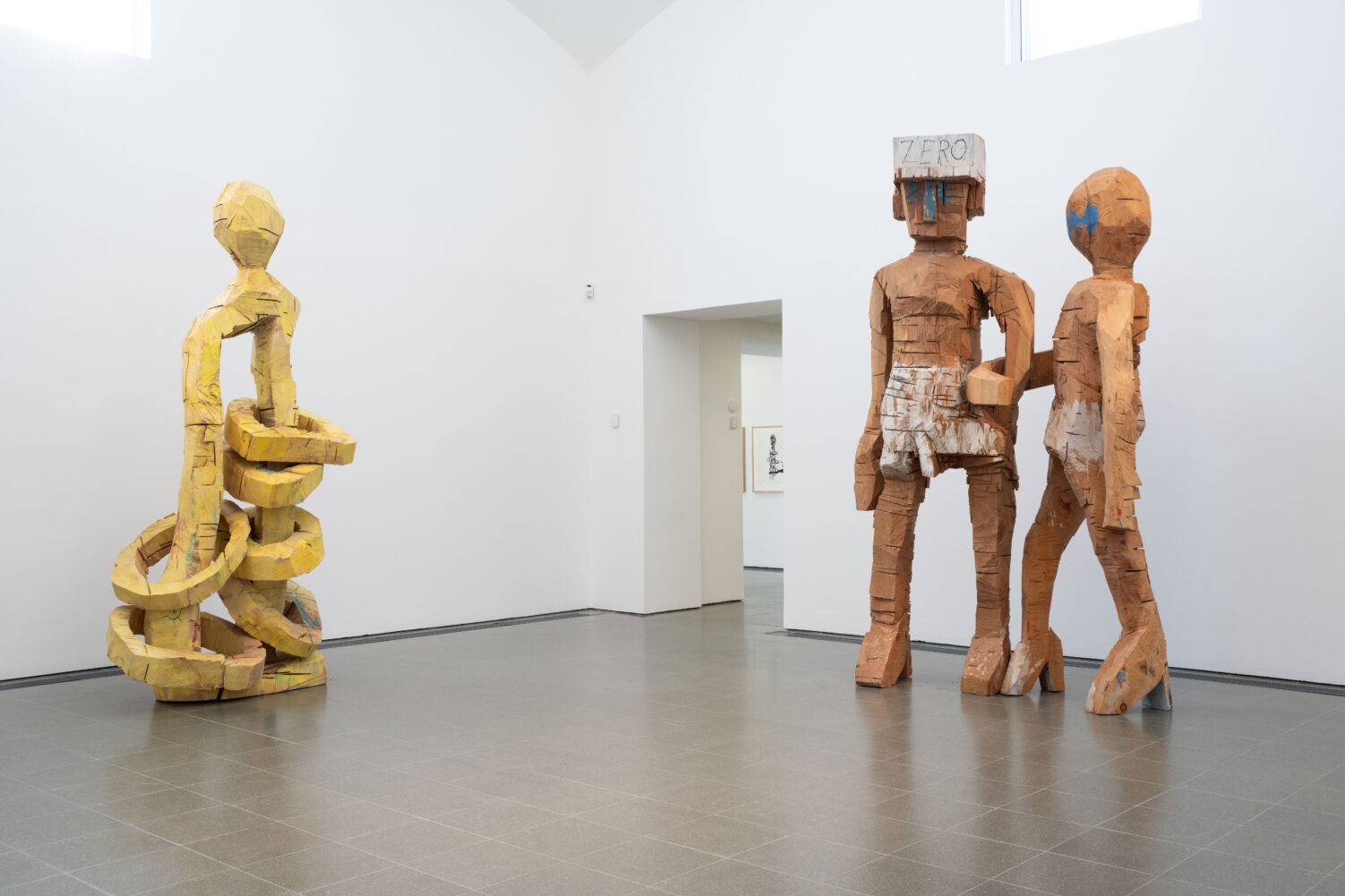
Born 1938 in Deutschbaselitz, Saxony, Georg Baselitz is one of the world’s most prolific living artists. The Serpentine Gallery is hosting a stunning FREE exhibition of his work, which features 10 sculptures plus a monumental nine-metre-tall sculpture, Zero Dome, just outside the gallery.

Zero Mobil (Zero Mobile) by Georg Baselitz (2013 to 2014) © Georg Baselitz 2023. Photo: Jochen Littkemann, Berlin

In the 1960s Baselitz became well known for his figurative, expressive paintings. In 1969 he began painting his subjects upside down in an effort to overcome the representational, content-driven character of his earlier work and stress the artifice of painting. Drawing from myriad influences, including art of Soviet era illustration art, the Mannerist period and African sculptures, he developed his own, distinct artistic language.

In the 1980s Baselitz continued to explore the tensions between the figurative and the abstract through his crude approximations of figures and body parts carved from wood. The Wikipedia entry at one point uses the word ‘unfettered’ and that struck a chord with me. He doesn’t care. What comes over is a lack of concern or intimidation by the Western Tradition, and the freedom to express himself as he wants. The video accompanying the exhibition shows him taking a chainsaw to huge chunks of wood to carve out extremely rough and rugged sculptural shapes.

View of the exhibition © Georg Baselitz 2023. Photo: Hugo Glendinning 2023.

As well as the 10 wooden sculptures – which have never been exhibited before – there are 68 related loose, inky drawings’ rendered in pencil, pen and ink. They also partake of the clenched, heavy, contorted power of the sculptures though obviously, as per the medium, are more fluid and flexible.

Untitled by Georg Baselitz ( 2014) © Georg Baselitz 2023. Photo: Jochen Littkemann, Berlin

The curators’ aim in combining the drawings and sculptures is to give visitors insights into the artist’s studio work and ‘how his sculptural undertaking relates to his two-dimensional practice, to shed light on how the artist considers different approaches to the central themes in his work.’

This is, perhaps, an advanced ambition for those of us not particularly familiar with Baselitz’s work in the first place. More accessible is the idea that these ten wooden sculptures were not originally intended for public exhibition, as they were made as maquettes for bronze works. Each one is carved from a single tree trunk, reduced by using power saws, axes and chisels. This method gives form to solid, impactful figures while maintaining the materiality of timber with distinctive incisions and notches on its surface.

Baselitz in the studio, 2012 © Elke Baselitz 2023

The accompanying drawings were made not as preparatory sketches for the maquettes, but during the sculpting phase. Together, the drawings and maquettes highlight the synthesis of Baselitz’s two and three­ dimensional ways of making and explore the possibilities and impossibilities of translating from painting to sculpture, and from sculpture to drawings. Baselitz is quoted as saying:

‘Sculpture is a thing like a miracle. It is built up, decked out, made arbitrary not as the sign of thoughts but as a thing within the limits of the shape. Even if a sculpture is hung from the ceiling, it remains a thing.

‘My carvings are best described by Immanuel Kant: ‘Out of the crooked wood of humanity, nothing entirely straight can be built. It is only the approximation of this idea that nature imposes upon us.”‘

Outside on the grass of the Royal Parks stands the biggest work, Zero Dome 2021, a nine-metre-tall patinated bronze sculpture on a plinth (we can see its corresponding raw maquette inside the gallery). Made from five carvings in the form of legs, it references Baselitz’s fascination in the foot motif.

Zero Dome 2015/2021 by Georg Baselitz © Georg Baselitz 2023. Photo: Hugo Glendinning 2023

I loved it. And it’s FREE. But you better get your skates on – it’s only on till 7 January.


Related link

More Serpentine reviews

Impressionists on Paper: Degas to Toulouse-Lautrec @ the Royal Academy

This exhibition in is in the smaller set of three rooms at the back of the Royal Academy building i.e. it’s more of an amiable stroll through three rooms of relatively small drawings, rather than, say, the full-on assault course of the 11 big rooms of the extraordinary Marina Abramović show.

It does what it says on the tin, brings together 80 or so works by all the famous Impressionist and post-Impressionist artists plus quite a few I’d never heard of before, experimenting with different media on paper.

Exhibitions need an aim or project and this one aims to explore how Impressionist and Post-Impressionist artists in late 19th-century France didn’t just use paper works as studies but radically transformed the status of works on paper. Previously, drawings were mostly conceived as preparations for paintings; in the hands of the Impressionists drawings, pastels, watercolours, temperas and gouaches were increasingly perceived as more than just preparatory techniques, and became autonomous works of art, claiming a shared aesthetic with painting.

Dancer Seen from Behind by Edgar Degas (c. 1873). Essence (diluted oil paint) on prepared pink paper. Collection of David Lachenmann

Who are we talking about? The eye-catching famous artists are: Mary Cassatt, Paul Cézanne, Edgar Degas, Paul Gauguin, Eva Gonzalès, Claude Monet, Berthe Morisot, Camille Pissarro, Odilon Redon, Pierre-Auguste Renoir, Georges Seurat, Henri de Toulouse-Lautrec and Vincent van Gogh.

Less well known are the likes of Albert Lebourg, Jacques Emile-Blanche, Armand Guillaumin, Frederico Zandemeneghi.

Impressionists recap

As the curators explain:

The avant-garde artists known as the Impressionists came to prominence during the late 1860s and early 1870s, first exhibiting in Paris as a group in 1874. They shared a concern to depict scenes from everyday life and to address contemporary issues, which encouraged them to challenge traditional attitudes to drawing and seek innovation. Vivid colour, a quick, loose touch, and daring viewpoints, together with a deliberate lack of finish, were their means of capturing the fugitive effects of nature as well as vignettes of modern life.

The portability of drawing materials greatly facilitated direct observation and the recording of scenes on the spot. The eight Impressionist exhibitions, held in Paris between 1874 and 1886, included a large number of works on paper and reflected their shift in status. This was also encouraged by dealers who recognised the economic advantage of exhibiting and selling works on paper.

Cliffs at Etretat: The Needle Rock and Porte d’Aval by Claude Monet (c. 1885). Pastel on wove paper. National Galleries of Scotland

What it’s like

The most striking thing, for me, was how the drawings faithfully echo the style of each artist’s paintings i.e. the way each of the artists have strong signature styles or vision no matter what medium they’re working in.

So you see a hazy landscape of cliffs by the sea and instantly know it’s Monet; charcoal images of ballet dancers posed at striking angles and know its Degas; a round-faced woman’s face smiling at some outdoors dance and know it’s Renoir; a grotesque, angular woman in an urban setting and you know it’s Toulouse-Lautrec; a light and airy landscape made out of cubes and rectangles of colour and you know it’s Cezanne.

So you can play an entertaining game of standing far away from the wall to try and identify the artist by their style, then stroll over to the wall label to find out if you were correct. For example, who would you think this is by?

Portrait de Marie-Thérèse Gaillard by Mary Cassatt (1894) Pastel on paper. Private collection. Photo © 2007 Christie’s Images Limited

In this case it’s a trick question. You might have thought Renoir, from the treatment of the face, but it is in fact by Mary Cassatt. Note the striking difference in finish between the face – expertly and completely rendered – and the clothes, rendered in a completely different, hurried, unfinished style, with the background wall hovering somewhere between the two.

What I liked

The most striking work in room 1 is the Portrait of Madame Henri Wallet by Jacques Emile-Blanche simply because of its size. It’s a John Singer Sargent-style and sized portrait of an elegant society woman, and so stands out in a room full of much smaller, much more hazy and impressionistic images.

Degas sketched and drew things around him so compulsively that his colleagues nicknamed him Monsieur Pencil and, appropriately, there are more works by him in this exhibition than any other  artists, 12 in total, all of which I liked.

I love sketches and drawings, I love art which is half-finished, ghostly, hinting at a half-grasped reality, which is why I’ve always loved Degas’ strange and mysterious Woman at a Window (1871), which used to be tucked away in a side room at the Courtauld Gallery. Here it is presented in all its pregnant mystery and an epitome, for me, of the power of paintings or drawings which are better left unfinished, full of hints and implication.

But I’d forgotten, if I ever knew, about Degas’s friend Frederico Zandemeneghi (1841 to 1917). Zandemeneghi was invited by the Impressionists to exhibit at four of their 8 exhibitions. He was particularly close to Degas. They shared an interest in depicting scenes of modern life featuring women subjects, seen from unconventional viewpoints, often cropping the image unexpectedly, and using vibrant colourful pastels.

This example has several of those characteristics in spades, namely the dramatic cropping which makes the subject feel really close-up and in your face. And the very bright colours, blue, yellow, orange, red, making the most of the range of human sight.

Study of a Woman from Behind by Federico Zandomeneghi (1890 to 1897) Pastel on cardboard. Galleria D’Arte Moderna, Milan. Photo © Comune di Milano

The show is in chronological order, starting with works from the 1870s. Room 2 contains works from the 1880s. The highlight for me was van Gogh’s ‘The Fortifications of Paris with Houses’ from 1887, made from a combination of graphite, chalk, watercolour and gouache. This reproduction in no way conveys the glowing brightness of the original. Then I liked the contrast between the architecturally accurate apartment block on the left and the vague ‘impressionistic’ grass in the foreground. Then I noticed the way the big fortification wall is not made of bricks but of hundreds of vertical dabs of orange and grey. And then I noticed the ghostly couple walking past in the foreground, ghosts of the millions of people who lived and died in the great cities of Europe, leaving barely a trace of chalk on paper. At which point I realised that there’s a kind of spectrum of solidity, from the super-solid apartment blocks on the right, to the more dabbed and impressioned fortifications themselves, and then to the human beings, the least permanent or impactful things in the picture or in history, hundreds of millions of us leaving less trace than walls or buildings.

The Fortifications of Paris with Houses by Vincent van Gogh (1887) Graphite, black chalk, watercolour and gouache on paper. The Whitworth, The University of Manchester. Photo by Michael Pollard

The exhibition concludes in room 3 with works from the 1890s and 1900s, which saw an ever-growing appreciation of works on paper and a proliferation of exhibitions of the medium. There’s a lot more Degas who emerges as probably the strongest and most consistent artist on paper. Off in one corner is a set of quiet, thoughtful, washed-out watercolours by Cézanne from late in his career. At the opposite corner of the room, both literally but also in terms of subject matter is a small set of three vivid, scratchy, angular images of the louche underworld of Montmartre by Toulouse-Lautrec.

But floating above this world of human troubles is the work I liked the best, a classic of what, during the 1890s came to be known as Symbolist art, the wonderful, visionary ‘Ophelia among the flowers’ by Odilon Redon.

Ophelia Among the Flowers by Odilon Redon (1905 to 1908) Pastel. The National Gallery, London

The Impressionists were trying to capture the truths of the modern world, applying light quick touches to capture the fleeting moment. Redon, by complete contrast, sought out ‘the light that never was on land or sea’, depicting images from the inner world of fantasy and dream. So I thought he was pretty out of place in an exhibition of impressionists. But his inclusion makes sense if we forget the exhibition’s main title for a moment and think of it more as a study of the evolution of drawing and painting on paper in France from the 1870s to the 1900s. From that perspective the inclusion of Redon makes sense for his technical prowess. The flowers are obviously the dominant element in the work, but after a while you realise that it’s the peculiar quality of the light in the top middle and right of the image which give it its haunting, apocalyptic quality.

Consequences

According to the curators:

The French avant-garde artists’ interest in drawing and the remarkable range of their production had far-reaching consequences. The hierarchical distinction made between painting and drawing ceased to exist. Freedom of execution and a laissez-faire attitude to materials provided an impetus that allowed the world to be depicted in more imaginative ways, leading to developments in 20th-century art such as Abstract Expressionism.

So as we progress through the works in chronological order, we are not just witnessing the development of visual styles, generally away from figurativism and towards greater abstraction, but the evolution of the medium of drawing itself, as it prepares for the great lift-off of modern art at the start of the twentieth century.

It’s not all masterpieces. Some are not-great early works (for example, by van Gogh or Gauguin) which are of largely scholarly interest, others are wishy-washy landscapes which are a bit meh (Armand Guillaumin). But overall it’s a lovely civilised way to spend an hour, enlivened by a regular stream of masterpieces. It’s worth visiting just to see the 12 Degas works and the 3 or 4 pieces by Frederico Zandemeneghi and the van Gogh. But other visitors will find other works to marvel at and cherish.

Dancers on a Bench by Edgar Degas (around 1898) Pastel on tracing paper © CSG CIC Glasgow Museums Collection


Related links

Related reviews

The Rossettis @ Tate Britain

This is a spectacular exhibition, by turns absorbing, inspiring, fascinating and deeply educational about the individuals, their lives and their times. Not all the work on display is good, some is positively poor, but there are good things throughout, and it’s huge – featuring over 150 paintings and drawings as well as photography, design, wallpapers, furniture, rare books, printed and spoken poetry and more. And then, in the last few rooms, it turns into a spectacular celebration of Dante Gabriel Rossetti’s huge, sumptuous paintings of stunning pre-Raphaelite women, an orgy of masterpieces to leave you reeling. More than just an exhibition it feels like a sustained immersion in their lives and times.

I thought the exhibition might disintegrate into a general splurge about the extended network of artists and models which made up the Pre-Raphaelite Brotherhood – surely, the most written-about subject in British art – the gift shop is heaving with books about the Pre-Raphaelites.

But I was wrong. The exhibition remains very, very focused on the Rossetti family and, above all, on the favoured son, Gabriel. (Only in adult life did Gabriel move his middle name, Dante, to the front of his three names – maybe partly to catch up with triple-barrelled friends like John Everett Millais and William Holman Hunt – but the curators refer to him as Gabriel throughout and so shall I.)

Firsts

Tate owns a lot of Pre-Raphaelite paintings and drawings so it’s surprising to learn that this is the first retrospective of Rossetti ever held at Tate, and the largest exhibition of his iconic pictures in two decades. Less surprising to learn that this is also the most comprehensive exhibition of Elizabeth Siddal’s work for 30 years, featuring rare watercolours and important drawings, because most of us have never hear of her.

The rooms devoted to them show how Gabriel and Elizabeth’s relationship and works intertwined and reflected each other. If you like reading about the lives of great artists, then this deep dive into biographical minutiae will be right up your street.

Immigrants

First of all, they were immigrants. Gabriele Rossetti (1783 to 1854) arrived in London in 1824, as a political refugee from Italy. More than that he was an Italian nobleman, poet, constitutionalist, scholar, and founder of the secret society, the Carbonari. A noted Dante scholar he secured the post of Professor of Italian at King’s College London from 1831 as well as teaching Italian at King’s College School. He and his wife Frances Polidori Rossetti had four children, two sons and two daughters. Raised in a home drenched in poetry and literature, all four children went on to become artists or writers in their own right. They were: the writer Maria Francesca Rossetti (1827 to 76); poet, artist and designer Gabriel Charles Dante Rossetti (1828 to 1882); artist and critic William Michael Rossetti (1829 to 1919); and poet Christina Rossetti (1830 to 1894).

The curators add into this gang of four the figure of Elizabeth Siddal, model, artist and poet, who posed for many of the Pre-Raphaelites (most famously as Ophelia in the classic painting by John Everett Millais) but who enjoyed a lengthy relationship with Gabriel, in which they drew and painted the same subjects, copying and learning from each other. They married in 1860 at which point she became Elizabeth Rossetti and this, from a naming point of view, justifies her inclusion in the exhibition.

Christina Rossetti

The curators do something genuinely bold and interesting which is to start a major art exhibition with a room devoted almost entirely to poetry. Never seen that before. They are mostly by Christina Rossetti and are not only printed directly onto the walls in very large font size but, if you stand in places marked by signs on the floor, you can hear the poems being recited by what must be very cleverly focused loudspeakers, which seem to be addressing you and you alone.

Installation view of ‘The Rossettis’ at Tate Britain, showing Room One which features just three paintings because it is devoted to the poetry of Christina Rossetti, which are reproduced on all the walls. Photo by Madeleine Buddo © Tate

All four Rossetti children were artistic and wrote and drew from early ages, but it was Christina who had the earliest success, having a volume of 42 poems published when she was just 16, some of which were written when she was as young as 11!

Remember by Christina Rossetti

Remember me when I am gone away,
Gone far away into the silent land;
When you can no more hold me by the hand,
Nor I half turn to go yet turning stay.
Remember me when no more day by day
You tell me of our future that you plann’d:
Only remember me; you understand
It will be late to counsel then or pray.
Yet if you should forget me for a while
And afterwards remember, do not grieve:
For if the darkness and corruption leave
A vestige of the thoughts that once I had,
Better by far you should forget and smile
Than that you should remember and be sad.

This bold start does two things. One, it fulfils Tate’s feminist aims of promoting women, bringing women out from the shadow of more famous men, giving women more of a voice etc (as the promotion of Elizabeth Siddal later in the show also does). Two, it vividly demonstrates the extraordinary combination of sensitivity and sensuality which, arguably, were to be distinguishing features of the family, and especially the arch-sensualist, Gabriel.

Christina’s talent peaked with the volume containing her most famous poem, Goblin Market, of 1859. During her career she published over 900 poems, a phenomenal output. Taking five minutes to read all the works written on the walls here, and let them alter and direct your thoughts towards her strange combination of Victorian piety, with astonishing sensuality, is a rare and lovely experience.

Early sketches

The narrow but scholarly depth of the exhibition’s focus is established in the second room which contains 30 or so very early drawings and sketches by the boy Gabriel, alongside some by his sister, and two by his brother William. They demonstrate his precocious skill and his enthusiasm for original voices like William Blake and Edgar Allan Poe. Gabriel was an early devotee of the small cult of Blake, who didn’t become widely known until the 1860s. And he did numerous illustrations of Edgar Allen Poe stories and poems, notably The Raven.

The Raven by Dante Gabriel Rossetti (1848) © Victoria and Albert Museum, London

These are very uneven: some have great verve but many of them are cranky and cramped. So I suppose the idea of a progression of beautiful young girl ghosts, on the left, is well done, but nothing about the figure on the right is good, his tangled legs, the odd posture of his hands. But they’re all very interesting in a dry, scholarly way. You rarely get to see the early beginnings of a major painter in such detail and for this reason alone I found myself taking the time to study each of the sketches. I liked two sketches drawn with thick black lines which reminded me of Goya, but these were exceptions.

Man with a Woman Wearing Trousers by Dante Gabriel Rossetti (1844)

To buck the curators a bit, possibly the best things in this room are two marvellous charcoal and white chalk drawings by brother William, studies of Yarmouth beach. These far exceed in sophistication, depth and technique anything by Gabriel. And they are outdoors, giving them an airiness and lightness unlike anything by brother Gabriel. I can’t find them anywhere on the internet 😦

Gabriel’s unevenness

Maybe it’s worth making the point now, early on, that Gabriel Rossetti is strangely patchy or uneven as an artist. Many of these sketches are positively poor. What I mean is their depiction of the human frame is awkward and cranky. Gabriel’s figures are often bent at improbable or at least uncomfortable angles. His faces are sometimes smooth and angelic but sometimes angular and amateurish.

Later on there’s a room devoted to the period he spent living and working with Elizabeth Siddal, originally a model but, as this exhibition goes to great lengths to demonstrate, an artist in her own right. The curators place sketches, drawings and small paintings by Gabriel and Siddal alongside each other but I had the same experience as in Room 2 i.e. a lot of both of their work seemed to me poor, amateurish, ungainly, badly modeled figures and badly drawn faces.

The sketches introduce another theme which is how cramped and confined so much of Gabriel’s art is. At one point the curators point out that The Artist In His Study was a recurring theme of Gabriel’s work, but it’s not just the artist trapped indoors. In sketch after drawing after painting, the subject (always people, never landscapes or still lifes) has to bend over, lean in, wry their neck into the claustrophobic confines of the framing space. Almost all of his people are indoors and in a very cluttered, cramped and confined indoors at that.

All these qualities are on display in Ecce Ancilla Domini. It’s indoors; in a very cramped narrow room, emphasised by the vertical line of the narrow bed and, of course, the standing figure. Look how tightly frame it is with the picture edge right up against the left side of the angel’s gown and the red stand on the right, and the terrified woman pressed up tight against the hard cold whitewashed wall. I can barely breathe.

Ecce Ancilla Domini (The Annunciation) by Dante Gabriel Rossetti (1850)
© Tate

What’s so odd as to be barely believable is that the artist who produced these small cramped images, up to and beyond his Pre-Raphaelite phase in the late 1840s and 50s, then blossomed into the artist of the big, lush, sensual masterpieces of the 1870s and 1880s. It’s as if they were two completely different people.

The Pre-Raphaelite Brotherhood (the PRBs)

The exhibition has to cover Gabriel’s involvement with the Pre-Raphaelite Brotherhood which he founded in 1848 along with soul mates William Holman Hunt, John Everett Millais, James Collinson, Frederic George Stephens and Thomas Woolner, but it keeps it under control, as it were, not splurging but maintaining its focus on Gabriel (and to a lesser extent Christina).

This room is the one place where the curators bring in other works, by Millais and Hunt in particular, in order to explain the shared aims of the group. The idea was to reject the shadowy forms and stylised poses of the Italian Mannerist artists who succeeded Raphael and Michelangelo. The PRBs believed the classical poses and elegant compositions of Raphael, in particular, had been a corrupting influence on the academic teaching of art, hence their ambition to go back before Raphael to recapture the clean, detailed and precise style of artists who preceded the High Renaissance.

This led to a kind of super-realism where you can make out every hair on the head of the figures, where the background isn’t shady and blurred to indicate distance, but everything is seen in full detail, sparkling with a kind of universal light. This is one of the 3 or 4 paintings that the curators include as examples of the early, radical style of the Pre-Raphaelite Brotherhood, a typical selection of a medieval subject by William Holman Hunt. Note the hallucinatory clarity of every detail, of the flowers at bottom centre, the hair of the horseman on the right, the loving detail of the light reflecting on all the armour.

Rienzi vowing to obtain justice for the death of his young brother, slain in a skirmish between the Colonna and the Orsini factions by William Holman Hunt (1849) Private collection of Mrs E. M. Clarke

Realists and rebels – or inventors of a new form of escapism

A comment on the wall caption made me smile. The curators state that ‘The men and women in the Pre-Raphaelites’ circle wanted to express themselves authentically, with art and poetry based on lived experience and nature.’ Elsewhere they talk about the PRB’s commitment to depict the life of their times, and imply that this or that painting is a piercing critique of Victorian sexism, social inequality, poverty and so on. And indeed some, a very small number of paintings and drawings, can be interpreted in this way.

But a wider truth is conveyed in the wall label’s very next sentence: ‘Their paintings and writings explored stories from the Bible and medieval books that resonated with their modern lives.’ That’s closer to the mark because what comes over is the PRB’s commitment to flee the social realities of their time. The curators themselves point out how Gabriel, his family and friends sought inspiration in anything but their own time, in stories from the Bible, fairy tales, folk tales, Greek myths and legends and, above all, by escaping into a beautifully rendered and idealised version of the Middle Ages.

The Decameron, The Canterbury Tales, The Roman de la Rose, the Arthurian legends and, above all of them, a lifelong obsession the 14th century Dante Alighieri – all this was about as far away as you could possibly get from the political, economic or social life of their times.

The PRB’s speciality was escapism, and in this they followed the other poets of their day who mined John Keats’s lush sensuality to produce the medievalising monologues of Robert Browning but above all the tremulous emissions of the presiding poet of the era, Alfred Lord Tennyson. Take Browning’s poem ‘Pippa Passes’, allegedly written ‘to speak for the masses … cuffed and huffed from morn to midnight’. but whose subject, Pippa, is a silkworker who walks through the medieval Italian town of Asolo, singing and inspiring good. Or Tennyson’s log work the ‘Idylls of the King’, the king in question being King Arthur. While the British army subjugated more and more parts of the world, Britain’s poets vapoured about knights and damsels. And the Rossettis? Well, could they have made more drawings, sketches and paintings of knights in armour and damsels in distress?

Arthur’s Tomb by Dante Gabriel Rossetti (1860) © Tate

No, for actual lived experience of the mid-Victorian period the Rossettis and Pre-Raphaelites are the very last source you would consult. You would look in the novelists – the poet laureate of London, Dickens, to a lesser extent Thackeray, or the gritty novels of Mrs Gaskell with their harrowing accounts of working class life.

So taken at face value the notion that the PRBs were radicals who sought ‘authenticity’ and to depict life  with a new realism in defiance of the conventions of the society around them and of the artistic establishment represented by the Royal Academy seems nonsensical.

But maybe I’m missing the point. I think PRB fans would point out that the realism and authenticity they were seeking was an emotional and psychological realism. In the subjects of their art they fled the reality of their times to Greek legends and medieval stories in order to capture complex, fleeting, intense and evanescent emotions which the banality of day-to-day living in industrialising London seemed to crush and stifle.

Thus Gabriel’s very strange painting of Arthur’s Tomb, above, is radical in the sense that it rejects the entire tradition of Salon art, of the huge Grand Historical or Mythological Subjects promoted by the founder of the Royal Academy, Sir Joshua Reynolds, with their grand gestures and beautiful finish. Instead the characteristically cramped and claustrophobic composition, the sense that both figures are being squashed by the tee above, the awkward bending of Lancelot, Guinevere’s hand fending him off – the cramped awkwardness of the entire thing conveys a very modern, complex psychological moment, fraught with tensions.

So the flight into the Middle Ages which is enacted in painting after painting, was it a flight from contemporary reality – or was it the adoption of distant subjects the more easily to convey complex modern psychological states? Discuss.

Elizabeth Siddal

Following new research, Elizabeth Siddal’s surviving watercolours are shown in a two-way dialogue with contemporary works by Gabriel, exploring modern love in jewel-like medieval settings. As a working­ class artist who was largely self-taught, Elizabeth’s work was highly original and inventive, but has often been overshadowed by her mythologisation as a tragic muse (see, for example, this BBC article, The tragedy of art’s greatest supermodel).

According to the curators Siddal and Gabriel’s work together marks a turning point from Pre-Raphaelitism to the new, more imaginative and expressive Aesthetic style which emerged in the 1870s.

Lady Affixing Pennant to a Knight’s Spear by Elizabeth Eleanor Siddal (1856) © Tate

Aestheticism – Gabriel’s second revolution

There’s such a huge difference between Gabriel’s often clunky, cramped compositions of the 1850s and the huge, gorgeous flowing masterpieces of the 1870s that it’s as if they’re by two completely different people. The curators clarify that, a generation after helping found the Pre-Raphaelite Brotherhood, Rossetti was at the epicentre of a second great artistic revolution, this time the Aesthetic Movement with its credo ‘Art for Art’s Sake’.

He went on to lead a new avant-garde group even more influential than the Pre-Raphaelites: the aesthetic movement. This would change ideas, art and design around the world.

Already in 1864 the hazy light, colour and heavy symbolism of Beata Beatrix looked forward to the Aestheticism and the international Symbolist movement later in the century.

Gabriel’s portraits [in the later 1860s and 1870s] reflected the aesthetic movement’s ideals of ‘art for art’s sake’ and a new modern beauty. He adapted the likenesses of working-class women of unconventional appearance, notably model Alexa Wilding, into fantasies of enchanting femininity. Inspired by Renaissance portraiture and mythological texts, these sensual portraits suggested touch, sound and scent as well as vision. They emphasised the pleasure of form and colour, looking ahead to the abstract art of the following century.

This is the thinking behind the final two rooms which amount to an orgy of spectacular Rossetti classics.

Installation view of ‘The Rossettis’ at Tate Britain, showing Room Seven which features ten stunning paintings from Rossetti’s sensual prime. Photo by Madeleine Buddo © Tate

We learn about the art collector Frederick Leyland who owned the three paintings in the photo above plus two more which are hanging nearby. He displayed all five in the drawing room of his mansion at Princes Gate, London, and the exhibition features a contemporary photograph to prove it. Apparently it’s the first time all five paintings have been reunited in one space since Leyland’s heyday in the 1880s.

Originally from a modest background, Leyland rose to run one of the largest transatlantic shipping companies of his day. Because they see it as their job to take every opportunity to remind us of woke and feminist issues, the curators tell us that much of Leyland’s trade was based on the cotton that fed textile manufacturing in northern British towns and that the cotton came from the American South where exploitative labour continued long after the abolition of slavery.

Leyland used the money he made from his business to become a key figure in the aesthetic movement, transforming his Liverpool and London homes into palaces of modern art. It was Leyland who commissioned The Beguiling of Merlin by the Pre-Raphaelite painter Edward Burne-Jones and commissioned the architect Thomas Jeckyll and the American ‘aesthetic’ painter James McNeill Whistler to decorate his dining room, a commission which resulted in the Peacock Room, considered one of Whistler’s greatest works. A really key figure, then, and purchaser of some of Gabriel’s most stunning and sensuous portraits of beautiful, strong-jawed, thick-necked, frizzy-haired aesthetic beauties.

Monna Vanna by Dante Gabriel Rossetti (1866) © Tate

The femme fatale

Uneasy with these lush and opulent depictions of sensual, semi-erotic women, the curators take refuge in a familiar feminist trope. This is the notion that some of Gabriel’s paintings in his mature late style are of femmes fatales. This allows the curators to take refuge in familiar tropes about sexual objectifying of women and gender stereotyping and male anxiety about female sexuality, the usual shopping list.

Gabriel engaged with the idea of the dangerous, sexualised ‘fatal woman’ or the ‘femme fatale’. This usually negative figure of feminine power responded to Victorian anxieties about social change. It became a popular fantasy figure towards the end of the century, and persists in literature and art today.

Persists in literature and art today? Tut tut. And despite all the brave attempts of feminist curators to change the world. Shame. Sometimes I wonder how old art curators think their readers are. 10?

The kind of painting we’re talking about is Gabriel’s depiction of Lady Lilith. The ancient story has it that Lilith was Adam’s independent-minded first wife who he put away and replaced with Eve. In revenge, Lilith seduced and persuaded the serpent to tempt Eve which led to Adam and Eve’s expulsion from Eden’s bower and the fall of mankind. Naughty Lilith.

Lady Lilith by Dante Gabriel Rossetti (1866 to 1868) Delaware Art Museum, Samuel and Mary R. Bancroft Memorial, 1935

If you allow yourself to get worked up about millennia-old stories this is obviously a sexist trope designed to demean and blacken independent women everywhere. For those not so easily upset, it’s a pretext for a staggeringly sensual painting, rich in details of fabric, hair and flowers. Doesn’t look much like a denizen of prehistoric Mesopotamia, does she? Desert, snake, tree? The picture could, frankly, be given the name of almost any woman from myth and legend and make as much sense.

In fact, my view would be that this is a painting about money and luxury. These are the kind of extraordinarily richly coloured, beautifully detailed, dreamily luxurious images of extremely attractive women which Gabriel sold by the cartload to mega-rich patrons like Leyland. It is a luxurious depiction of luxury for those rich enough to live in luxury.

The magic of exhibitions like this is that we poor peasants, for the hour or so that we spend strolling round masterpieces like this, are also lifted into a realm of luxury, beauty, sensuality that has never existed with this kind of other-worldly perfection but which we, for a tenner, can for fleeting moments, enter and inhabit. The scent of the roses! The texture of that silk dress! The luxury of those endless tresses!

Lilith poem

As we’ve learned, Gabriel and many of his friends and lovers often wrote poems about the subjects they were painting or painted their poems, the two art forms interpenetrating. Thus next to this amazing painting there’s a striking sonnet by Gabriel. If you stand in the right spot (on one of the signs on the carpet) you magically trigger a reading of the poem in the lugubrious tones of actor Bill Nighy.

Lilith by Dante Gabriel Rossetti

Of Adam’s first wife, Lilith, it is told
(The witch he loved before the gift of Eve,)
That, ere the snake’s, her sweet tongue could deceive,
And her enchanted hair was the first gold.

And still she sits, young while the earth is old,
And, subtly of herself contemplative,
Draws men to watch the bright web she can weave,
Till heart and body and life are in its hold.

The rose and poppy are her flowers; for where
Is he not found, O Lilith, whom shed scent
And soft-shed kisses and soft sleep shall snare?

Lo! as that youth’s eyes burned at thine, so went
Thy spell through him, and left his straight neck bent
And round his heart one strangling golden hair.

The slightly knotty syntax takes a couple of readings to get quite straight (it took me a couple of goes to understand the importance od ‘not found in the 9th line) but then, wow. You could argue the slight entanglement of the lines deliberately mimics the strangling effect of Lilith’s golden hair.  Maybe. Presumably Lilith’s hair is golden in the poem because ‘golden’ sounds good, but orange-auburn in the painting because orange is such a dramatic and deeply luxurious colour as, for example, in Frederick Leighton’s famous painting, Flaming June.

Special attractions

Curators not only need a theme or pretext with which to concoct an art exhibitions but score extra points if they can come up with rare or unique or special features that make the show extra-special. The curators of this exhibition have excelled themselves with four or five of these ‘special features’ to look out for / be impressed by.

1. The wallpaper

Dante Gabriel Rossetti’s previously unrealised work as a designer is brought to life in The Rossettis. A wallpaper he designed 160 years ago has been created for the first time especially for Tate Britain’s exhibition. Intended to decorate the home that Dante Gabriel shared with Elizabeth Siddal after their marriage, the artist sketched and described the design for this unusual wallpaper in close detail but ever, it was never put into production and only existed as a drawing until now.

Now Tate Britain has worked with illustrator and designer llyanna Kerr to bring Rossetti’s design to life. The design depicts a grove of apple trees at dusk, with stars appearing in the deep blue sky above, in a style that looks forward to the Art Nouveau movement at the end of the 19th century.

Installation view of ‘The Rossettis’ at Tate Britain, showing Room Five which showcases a wallpaper designed by Gabriel but never produced in his lifetime. Photo by Madeleine Buddo © Tate

And it’s not just wallpaper. This room also includes some big bits of furniture, namely a Rossetti-related cabinet, chair, and sofa.

Installation view of ‘The Rossettis’ at Tate Britain, showing King René’s Honeymoon Cabinet (photo by the author)

King René’s Honeymoon Cabinet (1861)

J.P. Seddon (1827 to 1906) designed this architect’s desk, including the metalwork and inlay, in 1861 for his own use. Seddon had the desk made at his father’s cabinet-making firm. He also commissioned ten painted panels depicting the Fine and Applied Arts from Morris, Marshall, Faulkner & Co. Ford Madox Brown, who also designed the panel representing ‘Architecture’, suggested the overall theme. The ‘Painting’ and ‘Sculpture’ panels were by Edward Burne-Jones, while Gabriel was responsible for ‘Music’ and ‘Gardening’. Morris designed the decorative background for each panel. (Text from the V&A article about the cabinet.)

Installation view of ‘The Rossettis’ at Tate Britain, showing chair and sofa designed and decorated by Gabriel (photo by the author)

The chair and sofa

The conspicuous consumption that characterised fashionable Victorian interior design did not suit Elizabeth and Gabriel’s ideal of a more authentic life. They sought out and adapted furniture that was basic and true to its materials and methods of making. They found beauty in handcraft rather than elaborate ornamentation and liked open, gracefully turned wood.

Gabriel collaborated with William Morris’s design firm to create rush-seated chairs like the one on display here, and this early-19th-century style sofa for his and Elizabeth’s home. On the sofa backrests are insets representing Love, the Loving or Lover, and the Beloved, painted by Gabriel.

Honeysuckle wallpaper

The big blue wallpaper isn’t the only one created specially for this exhibition. Room 8 has a wall covered in honeysuckle wallpaper made specially for this exhibition. It’s based on an embroidered hanging designed by William Morris and sewn by Jane Morris. Jane, her sister Bessie and her daughters May and Jenny played a key creative role in the making of textiles and embroideries for the family firm Morris & Co. This collective approach makes it difficult to identify individuals’ work. We know Jane was embroidering Honeysuckle around the end of Gabriel’s life. The finished embroidery was exhibited at the first Arts and Crafts exhibition in 1888.

Installation view of ‘The Rossettis’ at Tate Britain, showing the honeysuckle wallpaper in Room Eight. Photo by Madeleine Buddo © Tate

The blue wallpaper, the closet and the sofa had one overwhelming impact on me which was to get rid of them. ‘Chuck out your chintz’ as the old Ikea ad had it. This was precisely the kind of heavy, dark, wooden, over-decorated clutter which the Modernist designers of the Bauhaus had to reject in order to create the modern, clean, simple design aesthetic of the twentieth century. It has great historical interest, and kudos to Tate for recreating it, but I cordially disliked all of it.

2. A handwritten poem

A handwritten poem by Gabriel is exhibited for the first time, on loan from the University of Delaware Library, Museums and Press. Entitled The Portrait, this is believed to be one of the pages which were buried with Elizabeth Siddal’s body in Highgate Cemetery in 1862. The coffin was later exhumed in October 1869 to retrieve the pages when Gabriel was preparing to publish his first collection of poetry. The manuscript shows his frantic revisions ahead of its publication, including editing out some of the more sensual lines like ‘our hair had to be untangled when we rose’.

The poem describes the ability of a portrait painting to inspire memories of an absent lover and bring her to life. It is closely associated with Gabriel’s iconic painting of Elizabeth, Beata Beatrix, which was created at the time of the poem’s retrieval, seven years after her death. The two are now brought together in this show, and their paring is typical of the way both Gabriel and Elizabeth conceived of poems accompanying paintings and paintings made to accompany poems.

Beata Beatrix by Dante Gabriel Rossetti (1864) © Tate

3. Three Proserpines brought together

Tate’s famous Rossetti painting of Jane Morris as the mythological figure Proserpine has been brought together with two later paintings of the same subject, both on loan from private collections. They reveal the artist’s obsessive attention to detail and his fondness for revision and experimentation, developed over multiple versions spanning many years. The languid yet studied pose, and the amazing finish of the dress, went on to influence many modern artists who wanted to express emotion in art through colour and shape.

Proserpine by Dante Gabriel Rossetti (1874) © Tate

Gabriel first began depicting Jane as Proserpine around the time they became lovers in 1870. Her sadness and longing for the summer months is perhaps intended to evoke the time Jane and Dante Gabriel are not able to be together. The painting is also a study in melancholy, a subject the two often spoke about. The exhibition includes a book on the subject, Robert Burton’s famous ‘Anatomy of Melancholy’, which Dante Gabriel gave to Jane as a Christmas present in 1873. An ink drawing of her, intended for her eyes only, was hidden inside.

4. Portrait of Fanny Eaton

The exhibition is a rare opportunity to see one of Gabriel’s finest drawings. On loan from Stanford University in California, this portrait of Fanny Eaton is one of a series of portrait studies of working-class professional models whose likenesses reappear in paintings throughout the exhibition. Eaton was one of the most successful and sought-after of these models, often shown by other artists in expressive and dramatic roles, but Rossetti here depicts her in a private moment of quiet thought. It is one of the finest images in the show.

Born in 1835 in Surrey, Jamaica, probably the daughter of an enslaved mother, Eaton came to Britain after abolition and set up home with James Eaton, a coach driver. She bore him 10 children who she continued to provide for on her own after James died in his 40s. Her grave in Margravine Cemetery, Hammersmith, was finally marked with a headstone 6 months ago, followed by a blue plaque on her last home near Shepherd’s Bush.

Head of a Young Woman [Mrs. Eaton?] by Dante Gabriel Rossetti (1863 to 1865) © Cantor Arts Center, Stanford University

The Eaton study appears in a fascinating room, Room Six, which is devoted to just one painting, The Beloved.

The Beloved (‘The Bride’) by Dante Gabriel Rossetti (1866) © Tate

To quote the curators:

Gabriel’s composition for ‘The Beloved’ was inspired by Renaissance artist Titian’s painting ‘Woman with a Mirror’ (1515) conceived as a Venus figure surrounded by many mirrors. He adapted this into an image inspired by the biblical ‘Song of Solomon’, about a young woman meeting her bridegroom, surrounded by attendants. In his eyes, the seven figures represented a universal vision of female beauty’. Created at a time when Britain was more connected to the globe through travel and colonial expansion, ‘The Beloved’ is Gabriel’s only oil painting to include models of colour. The work was conceived during the American Civil War (1861 to 1865) when newspapers debated universal freedom and the liberation of Black people enslaved in the Southern US states. The figures, flowers and accessories in the painting are appropriated from cultures around the world, particularly those from Asia and North Africa. They represent an ‘orientalist’ fantasy which mis-imagined these areas as archaic, exotic and interchangeable.

There you have a good example of the censorious, scolding tone of modern art scholarship. The purpose of devoting a room to this one painting is that the curators have assembled Gabriel’s preparatory sketches for each of the six heads which appear in the finished painting. It’s in this context that the stunning Head of a Young Woman appears a study of Mrs Eaton who appears in the final work as the third head from the left, with a completely different expression.

Thus there’s also a study of the black boy at the front of the painting. We don’t know his name but, as you can imagine, the Tate curators are super-alert to all the possible negative implications of his appearance:

Little is known of this boy, a visitor to London. Gabriel met him outside a hotel. Children had few rights in Victorian times. In this case, Gabriel negotiated the boy’s modelling work with an American described as his ‘master’, suggesting he was a student, servant or born into slavery. His gaze engages the viewer strongly, but Gabriel’s main intention was aesthetic. He wanted a model with what he described as ‘pure’ African heritage to add a different skin tone to the composition [giving him a] decorative and dehumanising role…

They go on to say something which slightly puzzled me:

Little is known of the boy’s experience of sitting. Gabriel is believed to have said he was both playful and tearful, and wondered whether he missed his mother. Where the girl models were drawn clothed, the boy was required to pose partly undressed. This may have contributed to his discomfort, expressed, perhaps, in the serious gaze. For the artist, the nudity objectified his appearance, displayed his dark skin and removed him from the present to the archaic fantasy space.

The bit that puzzles me is the idea that just this one boy, because he is black, has suffered a unique and grievous crime in being removed ‘from the present to the archaic fantasy space.’ Hang on. Haven’t the other four models been just as removed ‘from the present to the archaic fantasy space’? In fact, a moment’s reflection suggests that pretty much every model who ever posed for Gabriel and his friends was removed from the gritty realities of 1860s London and magically recreated in, the generally medieval, ‘fantasy space’.

I was genuinely puzzled why this ‘removal to fantasy space’ is absolutely fine and not worthy of comment on the hundreds and hundreds of occasions when it happens to white models, but troubles the curators so much that they comment on it in two separate captions, when the subject is black.

5. Rarely seen photographs of Elizabeth Siddal’s lost drawings

After Elizabeth Siddal’s death, Gabriel collected her drawings, had them photographed, printed and pasted into albums. Three pages of these albums are on display for the first time in this exhibition, on loan from the Ashmolean Museum in Oxford. Many of the original drawings have since been lost, such as her evocative depictions of the knight’s enchantment with the femme fatale from Keats’ poem ‘La Belle Dame Sans Merci’. New research into these drawings has revealed the ‘call and response’ of ideas between Elizabeth and Gabriel, with poses she used in her work reappearing in his later work.

The inclusion of these dozen or so photos of Siddal drawings is important to the curators because it furthers their deep aim of boosting women in art, in this particular instance adding just that bit more evidence to their case for the importance of Elizabeth Siddal, as an artist in her own right, and as a creative partner with Gabriel. They’re not, to be honest, anything special, but I appreciate where the curators are coming from.

Summary

I’m not a particular fan of the PRBs nor of Rossetti but, even as a semi-sceptic, I was blown away. This is a lovingly assembled, deeply intelligent and learned exhibition, beautifully designed and laid out, which includes many fascinating digressions and diversions, before leading up to the final rooms packed with staggering masterpieces. Wonderful. Amazing.

The video


Related links

Merchandise

More Tate Britain reviews

Spain and the Hispanic World @ the Royal Academy

Historical scope

This is a vast exhibition, almost intimidatingly, almost bewilderingly so. Not so much because of the number of objects – although the 150 artifacts it contains must be at the top end of anybody’s ability to really process and appreciate. No, it’s the scale of the subject matter. The poster and promotional material gives the impression that it’s largely an art exhibition but this is way wrong. In fact it’s more of a historical exhibition which aims to give an overview of Spanish cultural history from the earliest times, from around 2,500 BC, to the time of the Great War. Imagine an exhibition which set out to give an overview of British culture starting with the earliest finds at Stonehenge and going century by century through to the War.

But more than that, it also aims to cover the cultural history of Spain’s colonies in the New World i.e. central and South America. Imagine one exhibition which set out to cover the complete cultural history of Britain and its empire! That’s what I mean by the scale and scope of the thing being challenging.

So there are paintings, yes, lots of paintings, quite a few by masters of the Spanish tradition – but there is a lot, lot more besides, lots of other types of object and artifact. At places across the website the RA use the strapline ‘Take a journey through 4,000 years of art-making across Spain and Latin America’ and that’s closer to the mark.

The Hispanic Society

The key fact to understanding the exhibition is given in its sub-title, ‘Treasures from the Hispanic Society Museum and Library’. The Hispanic Society Museum and Library in New York was founded in 1904 by philanthropist Archer M. Huntington in a set of buildings commissioned specially for the collection and which remain its home to this day. It is home to the most extensive collection of Spanish art outside of Spain.

So this exhibition is by way of presenting the greatest hits of the HSM&L’s collection. It contains some 150 works, including:

  • masterpieces by Zurbarán, El Greco, Goya and Velázquez
  • objects from Latin America including stunning decorative lacquerware
  • sculptures, paintings, silk textiles, ceramics, lustreware, silverwork, precious jewellery, maps, drawings, illuminated manuscripts

The exhibition is divided into 9 rooms and because each one makes such huge leaps in place and time and culture this seems the most manageable way of summarising it.

Room 1. The Iberian Peninsula in the Ancient World

A glass case of fine silver torcs and bracelets and suchlike made 2400 to 1900 BC by the so-called Bell Beaker people. By the third century BC the peninsula was inhabited by the people the Romans called the Celts.

The Palencia Hoard by unknown artists (172 to 50 BC)

Quite quickly we’re on to the Roman colonisation, consolidated in the first century BC. The room contains a floor mosaic of Medusa and a breath-taking marble statue of the goddess Diana.

I was surprised there was no mention of the Carthaginians who colonised eastern Spain and exploited its famous silver mines, something I read about in Carthage Must Be Destroyed by Richard Miles (2010) among other sources.

Moving swiftly we beam forwards to the collapse of Roman rule in the 5th century AD and the arrival of the Visigothic tribes. There’s a case with a lovely cloisonné belt buckle from the 6th century, reminiscent of the much better one from the Sutton Hoo horde.

Room 2. Al-Andalus

In 711 Arab and Berber invaders overran the Visigothic kingdom and installed their own Islamic governments. The territory came to be known as al-Andalus. In 756 Abd al Rahman I named himself Caliph and established a celebrated court in Córdoba. The peninsula remained under Muslim rule for the next 700 years with power moving between different dynasties and power centres. The room contains some stunning fabrics.

Alhambra silk from Nasrid, Granada (about 1400)

Among the most prized works by Muslim artisans from the thirteenth to the fifteenth centuries were ceramics and this room contains a lot of plates and bowls.

Deep Plate by an unknown artist (1370s)

This plate is made of tin-glazed earthenware and has been given an iridescent finish by applying a very thin layer of metal oxide. Potters would glaze with tin, lead, copper, silver, gold, or platinum, depending on availability and the desired outcome. For added extravagance, some of the dynamic patterns have been painted in vibrant (and very expensive) cobalt blue. In the centre is a coat of arms of one of the oldest aristocratic families in Catalonia, the Despujol. Designs like this were ostentatious showpieces for Europe’s rich and powerful. The two small holes at the top of this plate indicate that it was designed to be hung as art on a wall rather than piled with food on a table.

Locks and knockers

My favourite case in this room displayed eight or so fine metalwork door knockers and chest locks. The Hispanic Society’s collection of ironwork comprises some 300 pieces, including door knockers, pulls, locks and lock plates. I liked their medieval feel and especially the way they incorporate animals and imaginary beasts, such as a lizard, a wolf and a dragon, with intricate geometric designs influenced by Islamic tradition.

Two metal door knockers, on the left in the shape of a crab’s claw, on the right a bird with a long dropping neck (both around 1500)

The Reconquista

Throughout the Middle Ages Christian kings from the north fought the Muslim invaders, without much luck. The pace of military campaigning picked up from the 11th century onwards. This came to be known as the Reconquista and was the west Mediterranean equivalent of what, in the East, came to be known as the Crusades. Unlike the Crusades it was successful and in 1492 the last Muslim state, of Granada, was overthrown under forces led by the joint monarchs, Queen Isabella I of Castile and King Ferdinand II of Aragon, whose marriage and joint rule marked the de facto unification of Spain.

Slavery

The Spanish pioneered the European slave trade from Africa. The ruthless and forceful displacement of Africans to the Iberian Peninsula began as early as the 1440s. Following the discovery of the Americas the majority of enslaved Africans were trafficked directly across the Atlantic where, throughout the American continent, they were forced to work on plantation and in the notorious silver mining industry. By the sixteenth century, it is thought that Spain had the largest population of enslaved Africans in Europe.

Room 3. Medieval and Early Modern Spain

Room 3 is the biggest in the exhibition and the overwhelming impression in entering is the arrival of painting. There are works by Spanish masters such as El Greco, Velasquez and Zubaran. But, as with the exhibition generally, there’s much more to it than painting. The room covers the period from the triumph of Ferdinand II of Aragon and Isabella I of Castile over the Moors in 1492. They began a programme of forced conversion and violent expulsion of Muslim and Jewish communities as they bid to unite their realms under the Catholic faith. The Catholic Monarchs were followed by Charles V (1500 to 1558) and Philip II (1527 to 1598).

The sixteenth and seventeenth centuries were known as the Age of Gold. This was funded by slave labour in the New World, and especially the gold and silver mined by forced labourers working in terrible conditions in Spain’s Central American colonies.

It was also the Age of the Counter-Reformation when first Charles V then Philip II took it upon themselves to reinforce the Catholic Church at its most fierce and repressive (these were the glory years of the Spanish Inquisition which became notorious across Europe). Spanish rulers commissioned art which emphasised a sickly, sentimental, reactionary form of Catholicism or produced lickspittle portraits of terrifying, brutish kings, politicians and generals.

The Penitent St Jerome by El Greco (1600)

The most prominent painters of the period included artists such as El Greco, who moved to Toledo in 1577, and Diego Velázquez, who was appointed court painter to Philip IV in 1623. I appreciate that El Greco (1541 to 1614) is a classic of European art but I have never liked him. The milky eyes of his sickly saints and martyrs staring up into Catholic heaven have always revolted me.

The room is packed with lots of other nauseating Catholic imagery including an ascension, an altarpiece, images of Mary and Martha, a Mater Dolorosa, crucifixions, mothers and babies, a Pieta, images of the Immaculate Conception. There’s a big painting of St Emerentiana by Francisco de Zurbarán which is dire. The depiction of the fabric is impressive in a stiff late medieval way, but the face is awful.

Revolting in a different way are the power-worshipping portraits by the likes of Diego Rodríguez de Silva y Velázquez (1599 to 1660). There’s a huge portrait of Gaspar de Guzmán, Count-Duke of Olivares, who carried out negotiations with the young Prince Charles who came to Spain to sue for the hand of the Infanta in 1623. With characteristic arrogance Olivares insisted that Charles could only marry her if he promised to convert to Catholicism along with all the British court. This was a non-starter and explains why Charles went onto the court of France and won the hand of Henrietta Maria from the much more pragmatic Henry IV.

Spanish wars of repression

The huge wealth Spain creamed from its black slaves and the enslaved Aztecs and Incas in the New World paid not only for a re-energised and harshly reactionary Catholic Church, but for its wars of conquest designed to undo the Reformation and reimpose Catholicism on Protestant countries. It was with this aim that King Philip II launched the Armada in 1588 which was designed to defeat the English, overthrow their queen, Elizabeth I, who, along with most of the aristocracy would have been treated as heretics and executed, and then a foreign ideology (Catholicism) imposed on the entire population, anyone complaining being subjected to summary execution.

Luckily the English navy disrupted the Spanish fleet and the ‘Protestant wind’ did the rest. But the Netherlands was not so lucky. Originally under the control of the Dukes of Burgundy, with the end of their line the Netherlands fell to the house of Hapsburg, which itself inherited the Spanish throne. Largely Protestant the Netherlands rebelled against Catholic rule in the 1570s starting the prolonged period of rebellion which is known as the Eighty Years War. In 1567 Fernando Álvarez de Toledo, 3rd Duke of Alba arrived with an army of 10,000 Spanish and Italian soldiers and proceeded to institute a reign of terror. As Wikipedia puts it:

Acting on orders of Philip II of Spain, Alba sought to exterminate all manifestations of Protestantism and disobedience through inquisition and public executions.

There was not a lot of difference between this and the Nazi conquest of the Low Countries 400 years later. None of this is mentioned in any of the wall labels. Spain’s role as arch enemy of free Protestant countries in the 16th and 17th centuries simply goes unmentioned.

The Duke of Alba in 1549 by Anthonis Mor, the man who ‘sought to exterminate all manifestations of Protestantism and disobedience through inquisition and public executions.’

Besides paintings testifying to the lachrymose religiosity of the Counter Reformation and the genocidal macho-ness of Spain’s generals, the room also includes:

  • many early maps of the Mediterranean, the Atlantic coast and the New World
  • a baptismal font, a pilgrim flask, a chalice, a reliquary cross, a pendant, a huge bishop’s brocade
  • a set of illuminated manuscripts including a Book of Hours
  • glazed earthenware, goblets and suchlike

My favourite piece was much earlier, a medieval wooden carving of St Martin on a horse from the late 15th century before the Reformation split Europe, before Columbus discovered the New World, before art became really professionalised – from a simpler time.

St Martin 1450 to 1475 by unknown artist

Room 4. Colonial Latin America I: People and place

A huge modern map on the gallery wall gives a sense of the breath-taking amount of territory Spain arrogated to itself after Christopher Columbus stumbled across the New World on his failed attempt to find a western passage to India. He had, in fact, landed on Guanahani, an island in the Caribbean which he renamed San Salvador (in modern-day Bahamas).

His mistaken belief that the natives were Indians condemned indigenous peoples in north, central and south America to be known as ‘Indians’ for centuries afterwards, despite belonging to a huge range of peoples, languages and conditions and explains why the Caribbean islands are erroneously referred to as the West Indies to this day.

The Spanish conquistadors promptly conquered the empires of the Mexica (Aztecs) and Inca, massacring them where necessary, setting the survivors to work as forced labour on huge plantations or in the silver mines which they discovered in 1547 at Potosí in the southern highlands of Bolivia.

Spain divided its vast territories in the Americas into two viceroyalties: Nueva España (New Spain, modern-day Mexico and Guatemala), and Peru (which included Peru, Bolivia and Ecuador). Later, additional viceroyalties were created: Nueva Granada (made up of Colombia and Venezuela) and Mar de la Plata (Argentina, Chile, Uruguay and Paraguay).

Spain was to rule over this huge colonial empire until independence movements in the 1820s forced them to relinquish these territories allowing for the emergence of modern nation states.

Race rules – apartheid

The conquering Spanish implemented a strictly hierarchical society based on purity of bloodlines and skin tone denominating ‘casta’ (caste). Close ties to Spain and white skin elevated the status of the individual: ‘peninsulares’ (literally, those from peninsular Spain) dominated the colonial administration; followed by ‘criollos’ (creoles), those of Spanish (or European) descent born in the Americas; ‘mestizos’, those of mixed parentage; and finally ‘indígenas’, those of indigenous descent. At the bottom of the pile were the tens of thousands black African slaves.

This room contains a lot of surveys and maps, for example several surveys of the new settlement of Mexico City, and including the famous World Map of 1526 by Giovanni Vespucci. This map was a copy of the padrón real, Spain’s master nautical chart which was kept in a secret location in Seville. It’s thought this ornate version was a gift for King Charles V. It includes decorative details such as pictures of ships in the ocean, camels and elephants across Africa, a collapsing Tower of Babel, and the Red Sea coloured a vivid scarlet.

Detail of Giovanni Vespucci’s World Map (1526)

Room 5. Colonial Latin America II: Decorative Arts

In the decades after the conquest there was, surprisingly enough, a flourishing of the arts. Indigenous artists who were skilled with local materials, techniques and iconography adapted their work to satisfy European tastes and religious beliefs. As it was prohibitively expensive to import domestic objects from Spain there was significant demand for locally produced decorative arts. This gallery contains 20 or so examples of this hybrid art including a number of bateas or trays, vases, caskets, bowls and jars, and an impressive shawl.

Shawl (1775 to 1800) by unknown artist

A large rectangular shawl with fringed ends, the rebozo, is perhaps the most enduring of all traditional Mexican garments. It was first recorded in the 1580s, and is still worn by women across the country today.

Room 6. Colonial Latin America III: Religious Art

A room devoted to art and artifacts created for the Spanish Catholic church which moved quickly to lay out a network of ecclesiastical districts or dioceses under the jurisdiction of bishops alongside a far-reaching programme of church and convent building – all designed, of course, to convert the entire native population.

Not many Spanish artists volunteered to go and live in the New World so the religious authorities had to rely on converting and then training indigenous artists. These created fresco cycles, paintings and polychrome sculptures which were made in vast quantities, likewise fine ornamented silver and gold objects, and fabrics.

This gallery contains a range of religious paintings, sculpture and other objects from across the Americas that reveal how local artists used local materials and adapted traditional techniques, incorporating pre-Columbian symbols or other local references such as flora and fauna in their work.

The room contains a number of dubious paintings of varying levels of amateurishness and kitsch, one incorporating fish scales into its surface. The objects, such as lamps, are more persuasive. But the standout item, and one of the highlights of the exhibition, is the set of four small sculptures of figures demonstrating the four states of people after death, namely a rotted skeleton covered in maggots, a flame-red soul burning in hell, a pale white naked person undergoing the torments of purgatory, and a dressed and serene personage enjoying the bliss of heaven.

The Four Fates of Man: Death, Soul in Hell, Soul in Purgatory, Soul in Heaven attributed to Manuel Chili, called Caspicara (around 1775)

Room 7. Goya

The Spanish are everso proud of Francisco José de Goya y Lucientes (1746 to 1828) but a visit to the National Gallery’s exhibition Goya Portraits back in 2015 destroyed my respect for him. That exhibition revealed Goya to be a shockingly bad painter, particularly of portraits. He looks like a bad caricaturist. At one point in that exhibition they had hung Goya’s portrait of the Duke of Wellington alongside the portrait by British painter Sir Thomas Lawrence, and there was no comparison. The Lawrence portrait is a brilliantly penetrating, superbly finished and completely convincing portrait of a noble hero. The Goya portrait is a murky unfinished image of a doubtful, rather haunted-looking man.

In this room there are only six or so works, three big paintings and three small sketches. To my astonishment the Spanish curator of the exhibition, Guillaume Kientz, makes the wild claim that Goya’s portrait of the Duchess of Alba is Spain’s equivalent of the Mona Lisa, a lodestone, a high water mark of the art of painting. Really? I think it’s dire.

Francisco de Goya The Duchess of Alba (1797) © Courtesy of The Hispanic Society of America, New York

The Duchess of Alba by Francisco de Goya (1797)

The background is drab and dead, her posture is stiff, and her face! And yet the curators are so confident that this is a great European masterpiece that they made it the poster for this exhibition. The fact that she is pointing with her right hand to the words ‘Solo Goya’ (‘Only Goya’) written in the sand only make it seem more clumsy, gauche and amateurishness.

Luckily, the room has a redeeming feature, which is a display of three small drawings from what came to be called Albums A and B. These small-scale sketches were to culminate in the better known series of sketches known as Los Caprichos. Goya’s depiction of faces in these is still dire, but the sketches aren’t about the faces, they are about striking and often unusual physical postures and positions, capturing the activities of everyday life of people and peasants with swift, vivid strokes.

This smudgy reproduction doesn’t do justice to the dynamic energy of the original sketch, the excellence of composition, the straining man’s calf muscles, the woman’s hauntingly blank face sketched in with ink. Million times better than the silly duchess standing on a beach.

Peasant Carrying a Woman by Francisco de Goya (1810)

Room 8. Sorolla, Zuloaga and the Hispanic Society

Now, at long last, after what seems like an immensely long and exhausting journey, we finally enter ‘recent’ history i.e. the twentieth century. This is the last proper room of the exhibition and it contains a dozen or so huge paintings, 3 or 4 of them by ‘the Spanish Impressionist’, the master of light, Joaquín Sorolla.

The wall label gives an account of Archer Huntington’s founding of the ‘Spanish Museum’ in New York which opened its doors to the public in 1908. Soon after, Huntington visited Europe, where he saw works by the contemporary Spanish painters Ignacio Zuloaga in Paris and Joaquín Sorolla in London. Archer immediately planned to exhibit their work at
the Hispanic Society the following year as well as setting about buying works by other contemporary Spanish artists including Hermenegildo Anglada Camarasa, Isidre Nonell and José Gutiérrez Solana.

Sorolla and Zuloaga can be seen as presenting differing views of Spain, from the lovely sunlit world of Sorolla to the darker vision of Zuloaga which is why the curators have hung them on opposite walls.

After the Bath by Joaquín Sorolla (1908)

Sorolla is less like an impressionist than the Spanish equivalent of John Singer Sargent, but painting in a Mediterranean setting drenched with light. His paintings look best from the other side of the room where the details of the composition fade a bit and the main impact comes from the drama of light and shade.

Possibly my favourite painting in the whole exhibition was Ignacio Zuloaga’s ‘Lucienne Bréval as Carmen’ from 1908. Why? Because I think I’m right in saying that she is the only human being in the exhibition’s 60 or so paintings of people who is happy, who is laughing. After scores of black-clothed clerics, members of the Inquisition and brutal, exterminating generals on the one hand, and countless Immaculate Conceptions of the Holy Virgin Mary and El Greco saints looking milky-eyed up to a heaven pullulating with baby angels, how lovely to come across an actual human being looking like they’re enjoying being alive.

Lucienne Bréval as Carmen by Ignacio Zuloaga y Zabaleta (1908)

As usual this internet copy isn’t a patch on the size and vibrancy of the original. The more I looked the more relaxed and happy I felt and so so relieved to have escaped the centuries of bleak Catholic oppression.

Room 9. Vision of Spain

More Sorolla. Following the success of the Hispanic Society’s exhibition in 1909, Huntington and Sorolla embarked on an ambitious project that would dominate the rest of the artist’s career. Huntington wanted him to paint a series of murals for the Hispanic Society’s main building. Originally he wanted scenes from Spain’s long colourful history but Sorolla demurred – he wasn’t that kind of painting. The project evolved into the idea for a series of fourteen monumental canvases depicting the peoples, costumes and traditions of different regions of the country and to be titled ‘Vision of Spain’.

Painted between 1911 and 1919, the panoramic series was opened in a purpose-built gallery at the Hispanic Society in 1926, three years after the artist’s death.

Now it would have been very impressive to end the exhibition with one of these finished panels but, for whatever reason, the curators haven’t. Instead, the final room is a long narrow gallery in which is hung a preparatory sketch for the panels.

The wall label tells us that Sorolla produced around 80 of these preparatory studies, painted in gouache. They display a more sketchy, expressionist approach than the final work along, with modern processes such as the collaging technique papier collé.

This is sort of interesting but not as impressive as the final thing would have been. In fact it’s an odd, parochial, anti-climactic way to end an exhibition which, in its central rooms, encompassed the military and religious history of one of the greatest empires the world has ever known.

Sketch for the Provinces of Spain: Castile by Joaquín Sorolla y Bastida (1912 to 1913)

In-depth video

Thoughts

Two thoughts:

1. The end of the exhibition – and so, presumably, the Society’s collection – is strangely incomplete. What I mean is, they have Goya, in 1797 and 1810 and then…Sorolla from 1908: what happened in between? What happened in Spanish art between Goya and Sorolla? There appears to be a big hole in the collection. In France we got reams of Salon art but also Courbet and then the amazing achievement of the impressionists and post-impressionists. Even in unartistic England we had lots of anecdotal and social art and then the pre-Raphaelites morphing into the ‘Olympians’ and then atmospheric fin-de-siècle art with outstanding individuals such as Aubrey Beardsley. Did Huntingdon not buy anything of 19th century Spanish art because he wasn’t interested, because there was nothing worth buying? It’s a big gap.

And then the 20th century. I appreciate Huntingdon was buying in the Edwardian period but…did the trustees of the collection agree not to purchase anything after his commissioning of Sorolla’s ‘Vision of Spain’, nothing from 20th century Spanish culture? For example, by Pablo Picasso or Salvador Dali? And, as I understand it, the Spanish Civil War of 1936 to 1938 was central to Spain’s modern history leading, as it did, to the fascist dictatorship of General Franco which only ended in 1975.

I don’t know what exactly you’d include in the collection or exhibition to cover this period – I’m just saying that the omission of artifacts from almost the entire 19th and 20th centuries feels very strange and surely undermine the collection’s claim to represent ‘Spanish culture’. The last two hundred years are, arguably, the most important part of any modern nation’s history and culture. Which brings me to a bigger question:

2. What is a nation’s culture? I know that the curators at the British Museum or Tate Britain would agree with the curators of this exhibition that a national culture is somehow captured or conveyed by rooms full of medieval ceramics, ancient maps, old paintings and church accessories. But is it? Would you say that the ‘culture’ of Britain would be adequately conveyed by some Roman mosaics, a few medieval church artifacts, a handful of Jacobean paintings and some works by John Singer Sargent (the rough equivalent of Sorolla)? Pretty obviously, no. That would just be a collection of miscellaneous historical objects masquerading as a portrait of a culture.

Surely you’d need to turn to sociologists to learn what a real culture consists of – its language and religion, its human and physical geography, the climate, the agriculture and the traditional foods arising from it (beef and beer in England, tapas, paella and wine in Spain), its laws and customs and traditions, the things that make it unique – and then how it survived the storms and disasters of the 20th century and has fared in the post-industrial, multicultural world of the last 30 years or so.

I understand the aims of this collection and this exhibition, I see its strong points, I marvel at its breadth and detail. But in a sense, isn’t a living, breathing ‘culture’, as lived by a nation’s people, precisely what is missing from this exhibition?


Related links

Related reviews

Cornelia Parker @ Tate Britain

Cornelia Parker (CBE, RA) is a very well-known and successful figure in British art. Born in 1956, she’s become famous for her ‘immersive’ i.e. BIG works. Above all she is a conceptual artist. What is conceptual art? According to the Tate website:

Conceptual art is art for which the idea (or concept) behind the work is more important than the finished art object. It emerged as an art movement in the 1960s and the term usually refers to art made from the mid-1960s to the mid-1970s.

In some exhibitions you react to the painting or sculpture immediately, as an object in space which fills your visual cortex with sensations and impressions. You don’t necessarily have to read the wall labels. With conceptual art it is almost always vital to read the wall label in order to understand what you’re looking at. Sure, you could still respond naively and sensuously to the work’s appearance but you would be missing out on 99% of its meaning and intention.

The wonderful wall labels

This major retrospective of Parker’s career brings together almost 100 works, spanning the last 35 years. So that’s quite a lot of reading you have to do in order to understand almost every one of these pieces.

But a major feature of the exhibition is that the wall labels are written by Parker herself. Most wall labels at exhibitions are written by curators who, in our day and age, are obsessed with the same handful of issues around gender and ethnicity and lose no opportunity to bash the visitor over the head with reminders of Britain’s shameful, imperial, racist, slave-trading past etc etc.

So it is a major appeal of this exhibition that, instead of every single piece explained solely in terms of race or gender – as it would be if Tate curators had written them – Parker’s own wall labels are fantastically interesting, insightful, thought-provoking insights into her way of thinking and seeing the world. Instead of the world of art being reduced to a handful of worn-out ideas, Parker’s wall labels are as entertainingly varied as her subject matter, full of stories, anecdotes, bright ideas, explanations of technique, aims, collaborations.

They give you a really privileged insight into her worldview and into her decades’-long ability to be interested, curious, take everyday objects and have funny and creative ideas about how to transform them. After spending an hour and a half working through her thought processes for the different pieces, some of her creative spirit begins to rub off on you, you begin to see the everyday world the way she does, full of opportunities for disruptive and fun interventions. In this respect, this exhibition is one of the most genuinely inspiring I’ve ever been to.

Types of work

The exhibition includes immersive installations, sculptures, photographs, embroidery and drawings, as well as four large-scale, room-sized installations, and two rooms showing her art films. At the simplest, physical level, the pieces can be divided into two categories: Small and Large. Examples of the small will serve as an introduction to the large.

Introductory

In the downstairs atrium of Tate Britain stands a single sculpture, preparing you for the exhibition ahead.

The Distance (A Kiss with String Attached) by Cornelia Parker (2003) © Tate Photography

It is, of course, a life-size cast of Rodin’s sculpture, The Kiss, wrapped up in a mile of string. A vague symbolic gesture towards ‘the ties that bind’ people in relationships, maybe. In the nearby wall label Parker describes this as a ‘punk gesture’, which I found very significant. It’s the only time she mentions punk but she was just 20 when it hit, maybe at art school by then, so its attitude of really offensive, in-your-face irreverence must have taken her art school by storm. The point is, various later wall labels repeatedly say that she is interested in destruction and violence – but not violence against persons, against things. Her art does violence to inanimate objects in all kinds of inventive, creative and often very funny ways.

But there is, as so often, a further twist to the tail. Wrapping The Kiss in string is a relatively tame thing to do compared with Dada, Surrealist, Duchamp provocations from 100 years ago. It becomes more interesting when you learn that some opponents of conceptual art within the art world, fellow young irreverent artists, vandalised the original version of The Distance by cutting up the string into short sections, thus ‘liberating’ the sculpture.

And best of all, that Parker was undaunted and promptly gathered up all the cut-up pieces of string and tied them back together around a mysterious object at the centre, ‘a secret weapon’, which is unnamed and unknown.

‘The Distance (with concealed weapon)’ by Cornelia Parker (2003) © Cornelia Parker (Photo by the author)

Small

I’ll jump straight in and give examples.

‘The Negative of Words’ (1996)

Parker realised that when an engraver engraves words into silver, for example into a cup like the Wimbledon champion’s cups, tiny fragments or curls of silver are generated. This piece is a pile of the shavings thus created. Parker contacted a silversmith, who agreed to her proposal, and it took several months to accumulate enough shavings for her to create the little mound, with sprinkled outliers, which we see on display here. As she points out, each sliver represents a letter, is the trace of a letter, is the inverse of writing, of language. They are absences made solid. This idea really resonated with me as I admired this carefully created little mound and its sprinkled outliers.

‘The Negative of Words’ by Cornelia Parker (1996) © Cornelia Parker (Photo by the author)

‘Luck Runs out’ (1995)

In the case next to it is an old dictionary. Under careful supervision, Parker arranged for a shotgun loaded with dice to be fired into the back of the book. The die penetrated to different depths into the text and jammed most of the pages together. As it happens the post-shooting dictionary automatically fell open at a page about ‘luck’. Hence the title, The luck of the draw. The roll of the dice.

‘Luck Runs Out’ and ‘The Negative of Words’ by Cornelia Parker © Cornelia Parker (Photo by the author)

Apparently it’s part of a series titled ‘Avoided Objects’, so-called ‘object poems’ which ‘explore the fractured, unmade and unclassified’. The series explores ‘the denied and repressed’, which sounds a bit hackneyed and stale until she goes on to specify what that means in practice – the backs, underbellies or tarnished surfaces of things, which is much more interesting. Hence shooting this dictionary ‘in the back’.

‘Embryo Firearms’ (1995)

While in Hartford Connecticut, Parker asked to visit the factory where the famous Colt 45 handgun is made. She was surprised to discover the process began with blank featureless gun-shaped casts, before any working parts were added. She asked if she could have one and the Americans, obliging as ever, gave her two and gave them a nice smooth industrial polish. Adding the word ’embryo’ to firearm juxtaposes the birth of the gun with the general idea of the birth of a human being, alongside a tool which might potentially bring it to an end.

‘Embryo money’ (1996)

Fascinated by money, Parker asked permission to visit the Royal Mint in Pontyclun, Wales. She asked for some samples of coins before they were ‘struck’ i.e. had the monarch’s face, writing, value, corrugated edges and everything else added – just the blank dummy coins. Embryo money, before it has accrued any of the power which so dominates all our lives.

‘Embryo Firearms’ (1995) and ‘Embryo money’ (1996) by Cornelia Parker © Cornelia Parker (Photo by the author)

See what I mean by ‘conceptual’. You could relate to these just as intriguing objects, but the stories behind them – the anecdotes of Parker’s expeditions to interesting and unusual places to see industrial processes in action – add immeasurably to the enjoyment.

‘Exhaled cocaine’ (1996)

Parker developed a relationship with His Majesty’s Customs and Excise. She visited and got to know them at their Cardiff headquarters over a period of several months. One of the many, many types of contraband objects they confiscate are drugs. Parker persuaded them to let her have a seizure of cocaine after it had been incinerated. A million pounds worth of cocaine turned to ash, which is on display here, as a sad little pile.

In her wall label, Parker adds the coda, which you’d never have got from a curator, that she really loves the way Customs and Exercise destroy things in such a theatrical way, steamrollering fake Rolex watches or alcohol. ‘Like me, they are often symbolically killing things off.’ This kind of casual, candid opinion is a lovely insight into her way of thinking.

Inhaled cliffs’ (1996)

A personal favourite was ‘Inhaled cliffs’. She asked Customs about methods people use to smuggle stuff into the country, especially drugs, and discovered that some drugs can be used to ‘starch’ sheets, so a set of innocuous looking sheets turn out to be drenched in heroin, cocaine or other illicit substances which can be extracted once they’re safely in the country. This notion inspired ‘Inhaled cliffs’ in which Parker starched sheets with chalk from the white cliffs of Dover, ‘smuggling’ those great symbols of England into bed with her. She is tickled by the notion of ‘sleeping between cliffs’.

‘Exhaled cocaine’ (1996) and Inhaled cliffs’ (1996) by Cornelia Parker © Cornelia Parker (Photo by the author)

I’m focusing a bit much on these objects in cases. There were conventional things attached to the wall, prints, flat objects treated in various ways. Photographs, for example. On her way to her studio past Pentonville Prison she noticed workmen plastering cracks in the perimeter wall, creating vivid white abstract shapes. They then started to whitewash the wall as a whole so, before these irregular, crack-shaped gestures disappeared, she quickly took photos with her phone and developed a set of 12 prints which are hung here, titled ‘Prison Wall Abstract’.

Or the ‘Pornographic drawings’ (1996). As part of her ongoing conversations with HM Customs she asked for examples of contraband and they gave her (along with the bag of cocaine ashes) chopped up lengths of pornographic film. Parker dissolved the fragments in solvent to create her own ink. She used this ink to create Rorschach blots i.e. poured them on one side of a piece of folded paper, pressed the other side down on the inked side and reopened it to have a symmetrical image. For some reason, all the ones she made (or chose to display) came out ‘to be particularly explicit’.

It dawns on me that these works are beyond ‘conceptual’ in the sense that they might better be described as anecdotal. Often there isn’t a grand concept, project or goal behind them – there is happenstance and accident. Seeing an opportunity to do something interesting and seizing it.

The other obvious thing is that she’s about transforming objects from one state to another. She starts with ‘found objects’ – gun moulds, unstamped coins, porn movies, cocaine and so on – and, in the examples I’ve given, doesn’t even transform them herself, but recognises their artistic potential.

Medium

Using this technique of remodelling the existing and everyday, is a middle-sized work titled ‘Black Path (Bunhill Fields)’ from 2013. Parker describes playing hopscotch on pavements with her daughter. This led her to pay attention to pavements and to notice the antiquity of the old stone paving in Bunhill Fields near Old Street. She got permission to pour liquid rubber into the cracks in a path through Bunhill Fields. When the rubber dried she used the mould to make a metal cast, memorialising the captured cracks in bronze. She then suspended the mould on pins so that the cracks in the pavement hover a few inches above the floor, making it seem more spectral and ghostly. (It’s an accidental quirk that my photo of it features so many people’s feet.)

‘Black Path (Bunhill Fields)’ (2013) by Cornelia Parker © Cornelia Parker (Photo by the author)

Large

The interest in destruction I’ve mentioned earlier really comes to the fore in the three most famous room-sized installations in the exhibition. These are by way of being her greatest hits. They are:

  • Thirty Pieces of Silver (1988 to 89)
  • Cold Dark Matter: An Exploded View (1991)
  • Perpetual canon (2004)

Cold Dark Matter: An Exploded View (1991)

I’ll quote her wall label in its entirety:

We watch explosions daily, in action films, documentaries and on the news in never-ending reports of conflict. I wanted to create a real explosion, not a representation. I chose the garden shed because it’s the place where you store things you can’t quite throw away. The shed was blown up at the Army School of Ammunition. We used Semtex, a plastic explosive popular with terrorists. I pressed the plunger that blew the shed skywards. The soldiers helped me comb the field afterwards, picking up the blackened, mangled objects. In the gallery, as I suspended the objects one by one, they began to lose their aura of death and appeared reanimated. The light inside created huge shadows on the wall. The shed looked as if it was re-exploding or perhaps coming back together again. The first part of the title is a scientific term for all the matter in the universe that can’t be seen or measured. The second part describes a diagram in which a machine’s parts are laid out and labelled to show how it works.

I’ve seen photos of this many times. Seeing it in the flesh I realised several things:

  1. it is a mobile – a very complex mobile, but in principle the same kind of thing my son makes to hang his origami figures from his ceiling
  2. it has a cubic, rectangular shape i.e. it is the opposite of chaotically exploding outwards; it is very contained
  3. this is achieved by hanging multiple objects from the same string, not just one
  4. as people walk slowly respectfully round it the eddies of air they stir
  5. and placing a single light bulb at the centre of it means not only that is casts shadows on the wall, but as the string move gently, so a) your perspective through the multiple layers of debris shifts and changes b) the shadows they cast on the wall subtly change

Cold Dark Matter: An Exploded View (1991) by Cornelia Parker © Cornelia Parker (Photo by the author)

Perpetual canon (2004)

Again, I’ll give Parker’s words verbatim:

I was invited to make a work for a circular space with a beautiful domed ceiling. I first thought of filling it with sound. This evolved into the idea of a mute marching band, frozen breathlessly in limbo. Perpetual Canon is a musical term that means repeating a phrase over and over again. The old instruments had experienced thousands of breaths circulating through them in their lifetime. They had their last breath squeezed out of them when they were squashed flat. Suspended pointing upwards around a central light bulb, their shadows march around the walls. This shadow performance replaces the cacophonous sound of their flattened hosts. Viewers and their shadows stand in for the absent players.

Perpetual canon (2004) by Cornelia Parker © Cornelia Parker (Photo by the author)

The ghosts of music past. I was really taken by the idea that the shadows of us, the visitors, stand in for the long-dead players of these instruments.

Thirty Pieces of Silver (1988 to 1989)

Tate own this piece. In Tate’s words:

‘Thirty Pieces of Silver’ comprises over a thousand flattened silver objects, including plates, spoons, candlesticks, trophies, cigarette cases, teapots and trombones. All the objects were ceremoniously crushed by a steamroller at Cornelia Parker’s request. She then arranged the transformed silver artefacts into thirty disc-shaped groups, which are suspended about a foot from the floor by hundreds of fine wires. Each ‘disc’ is approximately ninety centimetres in diameter and they are always hung in orderly rows, although their overall configuration is adapted each time to the space in which the work is displayed. The title refers to the biblical story of how the apostle Judas Iscariot betrayed Jesus in return for thirty pieces of silver.

And in Parker’s own words:

Drawn to broken things, I decided it was time to give in to my destructive urges on an epic scale. I collected as much silver plate as I could from car-boot sales, markets and auctions. Friends even donated their wedding presents. All these objects, with their various histories, shared the same fate: they were all robbed of their third dimension on the same day, on the same dusty road, by a steamroller. I took the fragments and assembled them into thirty separate pools. Every piece was suspended to hover a few inches above the ground, resurrecting the objects and replacing their lost volume. Inspired by my childhood love of the cartoon ‘deaths’ of Roadrunner or Tom and Jerry, I thought I was abandoning the traditional seriousness of sculptural technique. But perhaps there was another unconscious reason for my need to squash things. My home in east London was due to be demolished to make way for the M11 link road. The sense of anxiety lingers even now.

‘Thirty Pieces of Silver’ by Cornelia Parker (1988 to1989) © Cornelia Parker (Photo by the author)

Newer works

‘War Room’ (2015)

The biggest thing in the show is a big long room entirely lined with red paper with holes in, titled ‘War Room’, from 2015. As usual, you need to read the wall label to understand what this is about.

‘War Room’ by Cornelia Parker (2015) © Cornelia Parker (Photo by the author)

In Parker’s own words:

I was invited to make a piece of work about the First World War. I had always wanted to go to the poppy factory in Richmond, London. Artificial poppies have been made there since 1922. They are sold to raise for money for ex-military personnel and their families. When I visited the factory, I saw this machine that had rolls of red paper with perforations where the poppies had been punched out. The fact that the poppies are absent is poignant, because obviously a lot of people didn’t come back from the First World War, and other wars since. In this room there’s something like 300,000 holes, and there’s many more lives lost than that. I decided to make War Room like a tent, suspending the material like fabric. It’s based on the magnificent tent which Henry VIII had made for a peace summit with the French king in 1520, known as the Field of the Cloth of Gold. About a year later they were at war again.

The story, the anecdote, is, as usual, interesting but the resulting work less so.. You walk in, you walk round, you walk out. Meh. A slightly shimmery effect is created by having two layers of hole-y red paper hanging everywhere but…this is a minimal effect.

‘Magna Carta (An Embroidery)’ (2015)

One work dominates the penultimate room. It is an enormous, thirteen-metre long, hand-sewn embroidery of the Wikipedia page about Magna Carta.

‘Magna Carta (An Embroidery)’ by Cornelia Parker (2015) © Cornelia Parker (Photo by the author)

It is a collaborative work which involved over 200 volunteers including public figures, human rights lawyers, politicians and prisoners. On the wall is a list of the worthies who signed up to be involved, an entertaining list of the usual suspects: media-friendly left-of-centre politicians (Tom Watson, 55), actors, psychotherapists (Susie Orbach, 75), academics (Germaine Greer, 83), other high profile artists (Antony Gormley, 72), writers (Jeanette Winterson, 63, Philip Pullman, 75) and so on.

What struck me was how old all these people are. Our generation is declining, now, Cornelia. We’ve trashed the planet, wrecked the economy and degraded the political system for our children: best to withdraw tactfully and not keep on shouting and marching and trying to dominate everything. We’ve had our time. Over to a younger generation and hope they can do better.

The videos

There are two rooms featuring 7 or 8 art videos running consecutively. The best thing in the first room is a new six-minute video titled ‘FLAG 2022’ and made specially for this exhibition. Very entertainingly this shows the creation of a Union Jack by seamstresses in a factory only run backwards – so we see the British flag being systematically unsown and unstitched. It’s accompanied by a straight orchestral rendition of the hymn Jerusalem. Shame. It would have been funnier if Jerusalem had been played backwards, too – but maybe that would be a bit too 1960s, too much like the old avant-garde.

The second film room is about America. Oh dear. That far away country of which we hear so little, which is so rarely in the news, whose cultural products we so rarely get to see. This room contains:

  • One film which Parker shot at the annual Halloween Parade in New York, that city we so rarely hear about. Personally, I’d have though New York has enough artists of its own to do this kind of thing.
  • Another film showing supporters of Donald Trump milling about in New York outside Trump Tower sometime during his election campaign. I don’t know whether you’ve heard of Donald Trump? He was quite big in America, apparently.

Frankly, these films are a let-down. It’s disappointing to see Parker genuflecting to God’s Own Country – as if New York or America need the slightest bit more coverage or publicity than the saturation exposure they already enjoy in the British media, TV, radio, films, academia, all across the internet and the toxic marshes of social media. There are other countries in the world, you know.

I’d like to have shared FLAG or any of the others in t his review, but I can’t find any of them on the internet.

Politics

From here onwards – in the second half of the exhibition – politics emerges as an increasingly dominant theme.

As well as the flag movie, the British film room includes a film made in the empty chamber of the House of Commons in 2018 using a camera attached to a drone, titled ‘Left Right and Centre’. Not only did they make this film, but they made a film about the making of the film, in which I caught Parker telling us how damn difficult it was to make because of health and safety, fire risk assessment etc. When artists start to think they are heroes…

I thought the result was very underwhelming. The drone hovered over the table you see in front of the Speaker of the House’s chair, set between the two front benches, which usually has the Mace on it – except in this film it had been covered with copies of England’s daily papers, which fluttered in the downdraft of the drone’s little rotors.

As with Donald Trump, I am sick to death of Parliament, the succession of incompetent politicians we have had leading our nation for the past 12 years, and the corrupt newspapers which lie and distort in order to keep the ruling party in power. Watching a 10-minute film on the wretched subject of contemporary British politics went a long way to destroying the happy, creative, open impression inspired by the first half of the exhibition.

In 2017 Parker was the first woman to be appointed official artist for the General Election. In this role, she observed the election campaign leading up to the 8 June vote, meeting with politicians, campaigners and voters and producing artworks in response. She made several films during this period including the aforementioned drone movie, and one titled ‘Election Abstract 2018’, a documentation of Parker’s observations during the campaign, posted on her Instagram account.

None of this, to my mind, is as funny or inventive as flattening a load of silverware with a steamroller, or displaying a little pile of incinerated cocaine, or soaking sheets in white cliff chalk, or taking a mould of Bunhill pavement. It just looks and sounds like the news, with little or no inventiveness and no particular insight. British politicians are idiots. Our newspapers are studies in bias and lies. So what’s new?

My heart sank even further when I read that another of her films is titled ‘Chomskian Abstract 2007’ and is an interview with the American social critic and philosopher Noam Chomsky, apparently about ‘the entwined relationship between ecological disaster and capitalism’.

Oh dear God. It’s not that Chomsky’s wrong or that hyper-capitalism driven on by American corporations and banks is not destroying the planet; it’s just that he is such a bleeding obvious choice for Great Man of the Left to interview. And so very, very, very old (born in 1928, Noam Chomsky turns 93 this year).

Is this the best Parker can do in the field of ‘radical’ or oppositional politics – interview a 93-year-old? It’s like waking up one morning and deciding you need to make a film about the environment and, after careful consideration, deciding you’d like to interview David Attenborough (aged 96) on the subject. Topics, and interviewees, don’t come more crashingly obvious than this.

Each year thousands and thousands of students in Britain graduate from international studies, politics or environmental courses. It would have been so much more interesting to interview the young, the future generation, and get their point of view rather than the done-to-death, decrepit old.

And he’s another Yank for God’s sake. What is it with the British cultural establishment and their cringing obeisance to American culture, artists, film-makers, politicians and intellectuals. Of the 200 contributors to the Magna Carta embroidery, in their summary of the show the curators single out just two – Wikipedia founder Jimmy Wales (who stitched ‘user’s manual’ into the embroidery) and Edward Snowden (who stitched the word ‘Liberty’).

Notice anything about them? Yes, they’re both American. Americans just seem carry more weight with Britain’s art establishment. They have a little more human value than mere Brits like you and me. More pizzazz, more glamour.

Lastly, what has Chomsky actually changed in his 50-odd years of railing against the American government and global capitalism? Nothing. Come to that, what good does getting 200 media-friendly worthies to contribute bits to a 13-metre-long embroidery achieve? Nothing. It’s a feel-good exercise for everyone involved and maybe it makes some of the gallery visitors feel warm and fuzzy and virtuous, too. Which is nice, but…

But meanwhile, out in the real world, Liz Truss and Kwasi Kwarteng are destroying the economy, ruining Britain’s standing in the financial world, and declaring war on the poor, the unwell, the vulnerable, even trashing support among their own middle-class, mortgage-paying supporters, in a zombie march of ideologues divorced from reality.

Flying a drone round the House of Commons or stitching a room-length embroidery are not only feeble responses to the world we live in but, worse, I found them imaginatively limiting and cramped. If you’re going to tackle the terrible world of contemporary politics, at least do it with some style and imagination. Old newspaper photos of Theresa May or Jeremy Corbyn didn’t take me anywhere new – unlike the pile of silver shavings or a cast of Bunhill pavement or most of the pieces in the first half of the show, which opened magic doors in my mind.

Maybe Parker should stick to what she does best – blowing things up. Guy Fawkes Night is coming. Just a thought…


Related links

More Tate Britain reviews

French Impressions: Prints from Manet to Cézanne @ the British Museum

The British Museum Department of Prints and Drawings

The Department of Prints and Drawings at the British Museum contains the national collection of Western prints and drawings, in the same way as the National Gallery and Tate hold the national collection of paintings. It is one of the top three collections of its kind in the world and home to around 50,000 drawings and over two million prints dating from the beginning of the fifteenth century up to the present day.

French Impressions

This is a lovely FREE selection of prints from the age of the French Impressionists, a wide ranging selection of nearly 80 key works by artists including Manet, Degas, Cézanne, Gauguin and Toulouse-Lautrec. It’s a golden opportunity to view rarely seen artworks by some of France’s most famous artists.

Divan Japonais by Henri de Toulouse-Lautrec (1893) showing the dancer Jane Avril seated next to the critic Édouard Dujardin watching the singer Yvette Guilbert perform on stage, wearing her trademark long black gloves © The Trustees of the British Museum

But the exhibition is more than just a selection of images: it presents a fascinating and authoritative history of print making and distribution in 19th century France.

Print production

The exhibition explains how prints – and in particular etchings – became markedly more popular in the 1860s among France’s growing middle classes, people with money but without the means to afford large oil paintings. At the same time artists became more interested in the expressive possibilities of print-making, a quicker, a more affordable, and a reproducible medium.

Prints reached a wider audience than ever before through the proliferation of illustrated journals and specialist magazines, as well as in portfolios commissioned and financed by enterprising print publishers such as Ambroise Vollard.

Manet

After some explanation about the difference between lithography, etching, woodcut and engraving, the exhibition settles into a tour of characteristic prints by the forty or so artists featured, starting with Manet. He is represented not only by several prints but also by a copy of the enormous illustrated volume devoted to the poet Stéphane Mallarmé’s translation of Edgar Allen Poe’s talismanic poem, The Raven, which was produced in a limited edition illustrated with Manet’s striking black and white images, and signed by the artists.

Berthe Morisot

Next to Manet are works by two woman artists, Berthe Morisot (who Manet knew and often painted – there are two portraits of her by him) and Mary Cassatt. Cassatt was American and moved to Paris in 1874. In 1891 she went to see an exhibition of Japanese prints at the Musêe des Beaux-Arts which had a profound effect on her. She immediately started making a set of ten colour aquatints which combine thin but distinct lines and delicate washes of pale colour and flattened areas of decoration.

The coiffur, fourth and final state by Mary Cassatt (1891) © The Trustees of the British Museum

Japonisme

Which brings us to the influence of Japanese prints on French. As Japan opened up to the West as part of the Meiji Restoration, brightly coloured woodcut prints began appearing on the western market from the end of the 1850s. In 1872 the critic Philipe Burty coined the term ‘Japonisme’, meaning

understanding Japanese art, culture and life solely through contact with the art of Japan

The Japonisme section of the exhibition features a print of a crayfish, fishes and prawns by Utagawa Hiroshige from 1832, next to an earthenware platter decorated with a lobster by Félix Bracquemonde who made a series of 25 prints for the crockery service all based on Japanese designs.

Henri Rivière

Nearby is one of the treats of the show. Artist and designer Henri Rivière was best known for his shadow theatre performances at Le Chat Noir nightclub (as recently covered in the Barbican’s big exhibition about arty nightclubs).

Hokusai

He’s here because in the 1880s he conceived the idea of taking Hokusai’s Thirty-Six Views of Mount Fuji as the starting point for his own series of views of the Eiffel Tower, as it was being constructed. Here’s the Hokusai print the curators have selected:

Tea house at Koishikawa. The morning after a snowfall by Katsushika Hokusai (circa 1830)

And here’s the Rivière: spot the influence! The Eiffel Tower prints chart the slow construction of the tower in thirty-six scenes, in all weathers including, as here, in heavy snow.

The Eiffel Tower under Construction, seen from the Trocadéro (1902) by Henri Rivière

You can see all thirty-six prints on this website:

Toulouse-Lautrec

If they’d been popular earlier in the century, prints underwent an explosion of popularity in the 1890s. Advances in colour printing paved the way for the brilliant designs of Henri Tolouse-Lautrec among many others. Lautrec made a living by producing illustrations for the proliferation of publications in the 1890s which sought to capture the glamour and glitz of the capital, as well as for the explosion of nightclubs which Paris witnessed.

La Revue Blanche

One of the most influential magazines of the period was La Revue Blanche founded and edited by Alfred Natanson, remembered mostly for its connection with literature, but it also included prints and illustrations, including the ones on display here by József Rippl-Rónai, Paul Ranson, Felix Vallotton and Maurice Denis.

Pierre Bonnard

There’s a selection of prints from Pierre Bonnard’s first series of twelve prints commissioned by Vollard in 1899 and some really evocative colour prints by Édouard Vuillard. They’re simple Paris street scenes but half abstracted into pleasing designs and patterns. It’s not Impressionism and not Abstraction, but a pleasingly decorative half way house between the two.

La Pâtisserie by Édouard Vuillard (1899) © The Trustees of the British Museum

There’s a whole wall of French artistic heavy hitters: in quick succession you can see prints by Degas, van Gogh, Pissarro, Puvis de Chavannes, Renoir and Cézanne.

Cézanne

The Cézanne is interesting: it is of Les Baigneurs (the Bathers), one of only eight prints ever made by the artist and a variation on one of his most popular themes (see my review of Tate Modern’s Cezanne exhibition). In fact, the wall label tells us that Cézanne made at least 200 images of bathers, an obsessive reworking of a specific theme which is very characteristic.

Les Baigneurs (grande planche) by Paul Cézanne (c.1898) © The Trustees of the British Museum

I feel ambivalent Paul Cézanne. I loved him as a boy but the recent National Portrait Gallery exhibition of his portraits put me off him, and I’m not sure I really like this image, no matter how famous it is. Maybe it’s because it feels like an image designed for another medium (oil paint) which the impresario Vollard had to persuade Cézanne to make, unlike the Vuillard print which feels like an image which has been conceived and produced with the medium of print in mind.

Richard Ranft

In a different way, the image below is obviously designed to take advantage of the defined lines and vivid colours enabled by 1890s print technology. What’s not to like about this scene from the circus by the less well-known artist Richard Ranft?

L’Ecuyere by Richard Ranft (1898) © The Trustees of the British Museum

A Swiss artist and former student of Gustave Courbet, Ranft produced many images depicting the daily lives and diversions of fin-de-siecle Parisian society. He was also a painter and illustrator, contributing popular images to many of the new journals and magazines. The acrobatic circus horseback rider was a popular subject, and Ranft’s version of it appeared in L’Estampe Moderne, a series of print portfolios, in 1898.

Gauguin

There’s a brilliant double portrait by Gauguin – in the contrary experience to Cézanne, the recent big Gauguin exhibition at the National Gallery made me love him more and want to explore much more of his work.

Whistler

But I’ll end on a figure who is a little apart from all the other artists on display insofar that he was not only not French, he wasn’t even European. It’s easy to walk by the three black and white prints by the American James McNeill Whistler on your way to the more brightly colours Toulouse-Lautrec or Ranft posters, but these relatively small prints from Whistlers series of pictures of late Victorian Venice, are wonderful.

Whistler was, according to the curator, ‘the supreme master of etching and a key figure in nineteenth-century printmaking. Declared bankrupt in 1879, Whistler accepted the offer from the Fine Art Society to produce twelve prints of Venice over a three month period. A year later Whistler returned and made a further 50 etchings, hence the existence of a Venice Set from 1880 and The Second Venice Set of 1886.

This is from the second set and the delicate streaking of the ink in the upper and lower parts convey the shimmering reflection of the buildings by a typically Venetian canal, making it seem as if the sky is as liquid and luminous as the water.

Nocturne: Palaces 1880 by James McNeill Whistler (1886)

Reflecting on the Whistler’s subtlety and sophistication leads you to compare it with the highly stylised works of Toulouse-Lautrec, the fine art works of people like Gauguin or Cézanne, with the deliberately bright and popular art of Richard Ranft , with the dreamy and mysterious works of Nabis like Félix Vallotton, or the intimate scenes of half-naked women bathing and drying themselves by Cassatt or Degas. Wow. What a brilliant, exciting and enjoyable array of the best prints of some of the greatest artists who’ve ever lived, as well as a fascinating selection of works by less well-known figures which are equally and sometimes more beautiful.

Had you heard of Paul Helleu or Jacques Villon or Armand Séguin or Suzanne Valadon or Charles Maurin or Ker-Xavier Roussel or Angelo Jank before? Me neither, but all of them are good, and some of them are surprisingly vivid and modern.

Angelo Jank

This print is a startling image by Angelo Jank (1868-1940), a German animal painter, illustrator and member of the Munich Secession. He specialized in scenes with horses and riders.

It’s an illustration for Léo Desmarais’ work Les Miroirs, which is so obscure I can’t find anything about it on the internet. It’s a plate from the magazine L’Estampe Moderne which appeared from 1897 to 1899 as a series of 24 monthly instalments, each containing four original lithographs, like this striking one of a woman with a brilliant green parrot.

What is going on? Who is the blonde woman? Why is she holding an apple? And why is a brilliantly green parrot looming down at her?

La Femme au Perroquet by Angelo Jank (1898) © The Trustees of the British Museum

Strangely unlike anything else in the show and deceptively modern, it might be from the 1960s. The exhibition is like this, full of unexpected treats and treasures. And it’s FREE!


Related links

Nineteenth century France reviews

More British Museum exhibition reviews