
Jean-François Millet (1814 to 1875) was the leading painter of rural life in France during the 19th century.
His many drawings and paintings portray farm labourers and rural workers at a variety of activities, with a vivid feel for the physicality of their work, and a quiet, unassuming empathy for their hard lives. His often faceless figures assume a kind of monumental quality as they stolidly go about their work until, without abandoning any of his rural realism, they rise to the level of symbols or allegories.
All this is demonstrated in this small but beautifully formed and FREE exhibition at the National Gallery. The display is in Room 1 (up the grand staircase of the main entrance, turn left then left again) and consists of 15 moderate-sized pieces – seven paintings, seven drawings, and one striking self-portrait — and yet in their understated way, these pictures convey a whole world.
Why show them now? Well, the show coincides with the 150th anniversary of Millet’s death, and is also the first exhibition devoted to his work in England for 50 years. Seen from this angle you might ask: why not more, and bigger, he certainly merits it? But let’s be thankful for what we’ve got…
Born and raised on a farm
Millet (pronounced Mee-A) knew whereof he drew: he was born into a family of farmers in the village of Gruchy in Normandy. His grandparents, parents, siblings and he himself all took part in the often gruelling physical labour involved in life on a farm. But unlike the others, as well as helping in the running of the farm, Millet read widely and drew from an early age.
Career
Millet’s first formal training was with portrait painter Paul Dumouchel in Cherbourg. He subsequently entered the studio of Paul Delaroche in Paris, famous for his dramatic scenes from history, the most famous of which is probably The Execution of Lady Jane Grey. Note its smooth, airbrushed finish.
Well Millet couldn’t be more different. He cultivated a heavier, far more unfinished, proto-Impressionist style and, for subject matter, chose not theatrical moments from the past but the hard lives of working people in the present. It’s no surprise to learn that his training ended badly when Delarouche contemptuously called Millet ‘the wild man of the woods’.
When he’d finished his training, in 1849 Millet moved to the village of Barbizon on the edge of the forest of Fontainebleau south-east of Paris, and this was to be his base for most of the rest of his career.
Country work
In Barbizon Millet set about perfecting his subject matter and approach. In paintings, pastels and drawings he portrayed the heavy, seasonal work of farm workers such as ploughing, sowing, harvesting, winnowing, gathering firewood into faggots, cutting tree trunks and much more. Here’s his breakthrough work, ‘The Winnower’, painted when he was 33.

‘The Winnower’ by Jean-François Millet (about 1847-8) © The National Gallery, London
It’s all about the pose and posture of the winnower. As soon as you realise the burst of yellow in centre-left is the mixed wheat and chaff which he is tossing in the air to be filtered, you realise the full dimensions of the winnowing fan or basket he’s holding, its weight and heft, the effort involved in repeatedly shaking it – and this, too, makes sense of the splay of his feet, braced to bear the weight and effort of his upper body.
The politics of labour
In terms of his career, ‘The Winnower’ was one of Millet’s first paintings to explore the theme of rural labour. It was exhibited at the Paris Salon of 1848 where it was well received, but later works triggered controversy. Progressive politicians and commentators claimed his work promoted their socialist agendas while conservatives to decried his ‘socialist’ motivations. In fact Millet’s own political convictions remain unclear to this day except for the obvious fact that he had great sympathy with the workers around him. He identified with the hard-working peasantry: ‘A peasant I was born, a peasant I will die’.
Faceless
When out in the countryside Millet would make many small sketches, but when painting in the studio he often worked from memory. As a result, the forms and faces of his figures became simplified, even abstracted. Art scholars argue that this deliberate eliding of individuality, together with the paintings’ large scale, lends his figures a nobility normally only given to figures from history, the Bible or mythology. Personally I don’t think this is quite right. If you think of any history paintings, they tend to very much show the precise facial features of the protagonists, be they gods or Roman emperors, popes or generals. No, the blurring out of Millet’s faces does something else.
That he could draw faces, and draw them very well indeed (so many artists actually can’t) is demonstrated by the rather stunning self-portrait on display here.
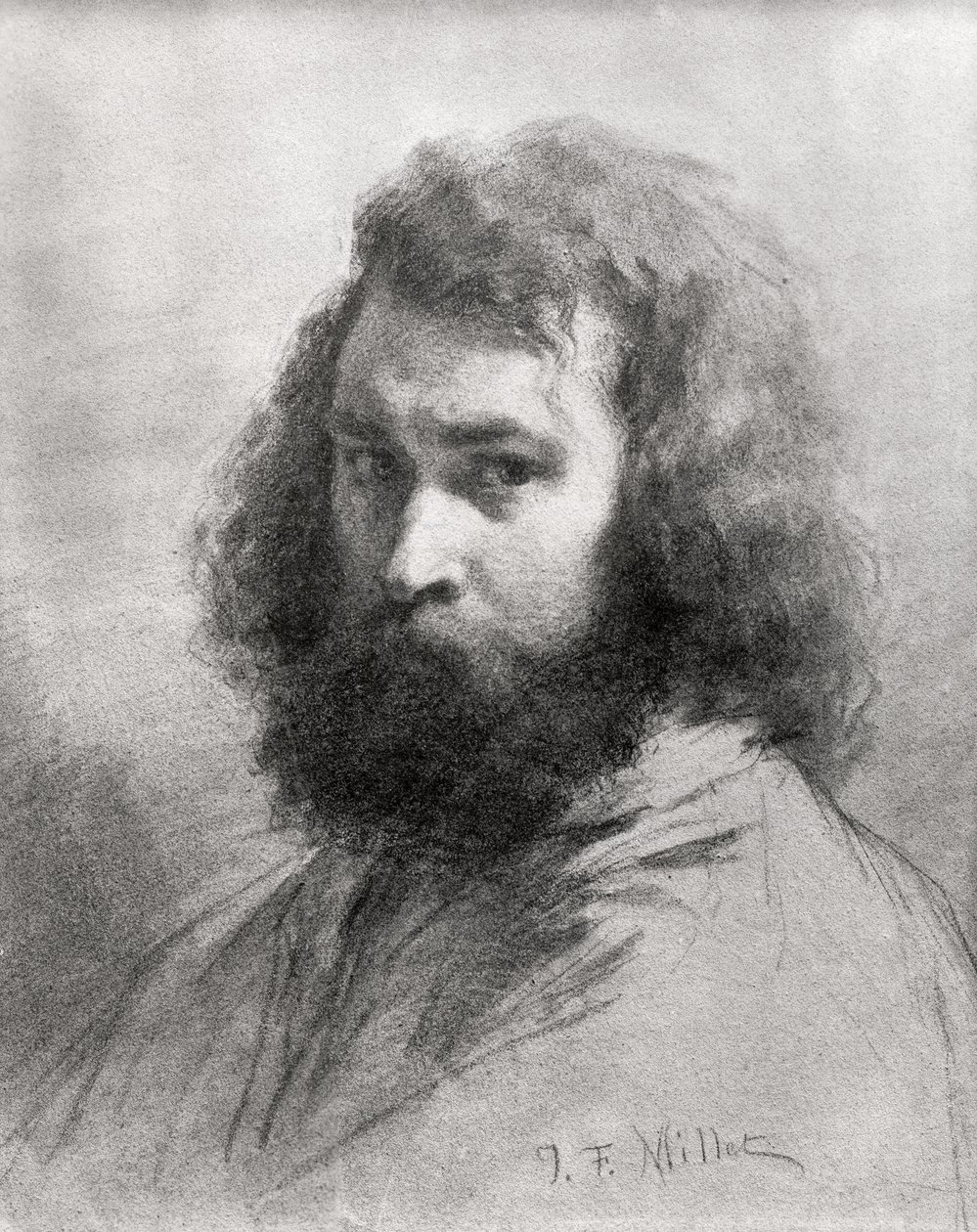
Self-portrait by Jean-Francois Millet (1845-46)
So it was a very conscious decision to anonymise his workers and I think he does it in order to turn them into allegorical or even symbolic figures (see The Faggot Gatherers, below).
Depicting women
Another way in which he quietly rebelled against traditional compositions and portraits was in taking as much time to depict women labourers as men. The curators certainly do, carefully ensuring that precisely half the paintings and sketches here depict women – at their work as shepherdesses and milkmaids, goosegirls and wood gatherers. There’s a vivid but mysterious depiction of a woman drawing water from a well. The wonkiness and rich gold colouring of the two jugs reminds me a bit of Rembrandt’s palette…

‘The Well at Gruchy’ by Jean-François Millet (1854) © V&A Images / Victoria and Albert Museum, London
Feet
Suddenly – walking round for the third time – I realised something had been quietly nagging at me which is the attention Millet to hands and feet. Particularly the feet. He takes care to depict the torque or tension displayed by feet carefully placed at optimal angles to manage the tools of their work, holding a winnowing fan or, as here in the most dynamic image of the show, wrangling a huge saw.

‘The Wood Sawyers’ by Jean-François Millet (1850-2) © V&A Images / Victoria and Albert Museum, London
Note the way the sawyers left foot is not planted flat on the ground but braced up against the side of the huge tree trunk. In the gallery I had a go at copying the stance of his figures in the various pictures, and immediately felt the stress and tension and effort and movement of their bodies, entered into their world of labour.
Hands
The curators explain that gathering sticks of wood to be used as fuel for fires was a task generally given to the weakest, for example old women, much like the similarly humble task of gleaning corn after the main harvest.
Larger sticks and dead wood would be tied together into bundles called ‘faggots’. (It may just be worth explaining to younger readers that until recently ‘faggot’ meant: ‘a bundle of sticks bound together as fuel.’) There are not one but two depictions of women faggot gatherers in the exhibition. The second one is smaller in scale and atmosphere, but is an absolute killer.

‘The Faggot Gatherers’ by Jean-François Millet (about 1850-5) © National Galleries of Scotland
The more you ponder it, the more highly symbolical it becomes, an allegory of Youth and Age. Youth has the energy to stand; Age is exhausted and has to sit. Youth has pink young skin; Age’s skin is dark with sun and toil. Youth is predominantly in the light; Age is in deep shadow. Paying attention to feet, youth is innocently bare-footed… But it’s the old lady’s hands, it’s her gnarled hands, tested with age, which grabbed my attention, which came to haunt me…

Detail of ‘The Faggot Gatherers’ by Jean-François Millet showing an old woman’s hands, gnarled by a lifetime of hard labour
Spirituality
One of the highlights of the show is a loan from the Musée d’Orsay in Paris of ‘L’Angélus’. According to National Gallery Director, Sir Gabriele Finaldi, the Angelus is ‘Millet’s most celebrated work’ and, in some ways, it’s intended to be the centrepiece of the show.

‘L’Angélus’ by Jean-François Millet (1857- 9) © Musée d’Orsay, Dist. Grand Palais Rmn / Patrice Schmidt
French villagers would recite the Angelus prayer three times a day, at dawn, at noon and at dusk which traditionally marked the end of the working day. The whole composition is about capturing the light after the sun has gone down, and conveying the obviously spiritual mood of the man and woman who have ended their work for the day and are reciting the evening prayer.
Clearly the silhouetting of the two quiet figures against both land and sky is intended to convey ‘a profound sense of meditation and introspection’. In fact, for me, on this visit, I wasn’t moved. It was the hands and feet of the hard-working peasants which had tugged at my imagination.
The Angelus is an image of great peace and calm, in its way a comforting image, an image to reassure the bourgeois viewer that life on the land is specially authentic and spititual – so I can see why it has become an iconic painting for so many people.
But for me, as I’ve explained, real worship, the holiness even, is found in Millet’s images of hard physical labour, the deep abiding truth of work and the hard-won endurance and human resilience that it conveys.

‘The Faggot Gatherers’ by Jean-François Millet (1868-75) © Amgueddfa Cymru – National Museum Wales
A note on reproductions
I’ve used the reproductions which the National Gallery Press Office makes available to people reviewing the exhibition online, and it’s worth pointing out that they are rather poor. They look dark and dingy, don’t they? Whereas in the flesh, seeing the paintings in real life, all of them glow – ‘The Wood Sawyers’ blues and yellows and reds are surprisingly bright, ‘the Angelus’ has a mystical nimbus and ‘The Faggot Gatherers’ grabbed me, drew me in, hypnotised me not just with with the power of its understated symbolism but with the vivid impact of its muted colours – in a way that these competent but rather drab reproductions don’t.
Maybe Millet’s generally rather muted palette and brown overtone just doesn’t reproduce very well in photographs. So all the more reason, then, to pop along to the National Gallery and see these lovely paintings for yourself. Forty minutes of loveliness which will enrich your day.
Related links
- Millet: Life on the Land continues at the National Gallery until 19 October 2025






 Books & Boots