Lucian Freud: Drawing into Painting @ the National Portrait Gallery

Lucian Freud (1922 to 2011) was a British painter and draughtsman, specialising in figurative art, who is known as one of England’s leading 20th-century portraitists.

Towards the end of his life, the Lucian Freud Archive was created by accumulating the artist’s personal papers, sketchbooks, and working materials over his lifetime. Spanning his long working life from about 1939 to 2011, the Archive contains over 160 childhood drawings, 47 sketchbooks containing some 600 drawings, and personal letters. In 2015 the Archive was officially acquired by the National Portrait Gallery.

Now a generous selection of images from the Archive is on display at the National Portrait Gallery. These include a wealth of early drawings and sketches, newly acquired etchings of family members which, along with Freud’s etching tools and his paintbox. As we progress through the show, we watch him evolve from his early bug-eyed cartoony style, into something more caustic and realistic, showing his development from standalone drawings into sketches which are obvious preparations for paintings, and then on to a dozen or so finished oil paintings in his mature style. The combination of all these formats is designed to showcase Freud’s skill as a draughtsman across many mediums, in

Created in close collaboration with David Dawson, Director of the Lucian Freud Archive, this is the first exhibition of Freud’s work at the National Portrait Gallery since the major painting retrospective Lucian Freud Portraits, in 2012.

Gallery

The show opens with a wall-sized blown-up image of Freud’s studio.

Wall-sized photo of Freud’s studio towards the end of his life, in ‘Lucian Freud: Drawing into Painting’ at the National Portrait Gallery (photo by the author)

There’s a selection of schoolboy drawings, for real completists.

Lucian Freud schoolboy drawings in ‘Lucian Freud: Drawing into Painting’ at the National Portrait Gallery (photo by the author)

Early style – portrait drawings from the 1940s.

Early ‘cartoon’ style in ‘Lucian Freud: Drawing into Painting’ at the National Portrait Gallery (photo by the author)

‘Girl with Roses’, painted in 1948, is a seminal early oil-on-canvas portrait by Lucian Freud, of his first wife, Kitty Garman. It depicts a tense, pregnant Kitty looking away with a stiff posture, clutching a ‘Peace’ rose while another lies in her lap.

Girl with roses / portrait of his wife (1948) in ‘Lucian Freud: Drawing into Painting’ at the National Portrait Gallery (photo by the author)

One of several display cases showing drawings from the sketchbooks.

Display case of drawings in ‘Lucian Freud: Drawing into Painting’ at the National Portrait Gallery (photo by the author)

Portraits from the 1950s – in my opinion, scrappy and inconsistent.

Wall of 1960s portraits in ‘Lucian Freud: Drawing into Painting’ at the National Portrait Gallery (photo by the author)

Forty years later, 2000s portraits: more consistent, more detailed, darker, closer up. Far more impactful.

Wall of 2000s portraits in ‘Lucian Freud: Drawing into Painting’ at the National Portrait Gallery (photo by the author)

Transitioning to his mature style i.e. naked figures, in ungainly poses, painted with a kind of brutal honesty. This relatively small work is one of a series of naked portraits of his lover Jacquetta Eliot.

Small naked portrait from 1973-4 in ‘Lucian Freud: Drawing into Painting’ at the National Portrait Gallery (photo by the author)

Preparatory sketches and final painting, in his mature style. Studying these, it struck me that the drawings have an open quality – the poses are somehow more free and suggestive – whereas the finished oil painting is much more heavy and closed. On reflection maybe part of this is because the painting has a detailed backdrop – the sofa and rumpled white sheet, depicted in great detail – whereas the bodies in the sketches float free in an abstract white space.

Preparatory sketches and final painting in his mature style in ‘Lucian Freud: Drawing into Painting’ at the National Portrait Gallery (photo by the author)

Letters and comments by friends reveal that as a boy and young man, Freud did lots of drawings of animals. The exhibition includes some of these, including a number of etchings of his whippet, Eli. Here’s one from 2002 set next to a drawing of a toy rabbit from 60 years earlier, in his early style.

Eli (2002) and Rabbit on a chair (1944) in ‘Lucian Freud: Drawing into Painting’ at the National Portrait Gallery (photo by the author)

The exhibition has a section on group portraits he made as direct homages to works by classical painters, one by Watteau (Large interior W11, 1983), a few etchings inspired by Chardin.

The last few rooms contain prime examples of both his massive full body nude paintings, alongside more ‘discreet’ portrait busts. There are famous portraits of David Hockney (2002) and Queen Elizabeth II (2001), alongside equally vivid portraits of less well-known figures, and a couple of his really vivid self portraits.

Thoughts

In my mind I had a simple mental model of Early style – Naked style – Mature style, but this exhibition is distinguished by a lot more variety and digressions and distractions than that suggests (the school drawings, animals, Old Master homages, among many others) which you will either find enchanting (if you’re a Freud fan) or maybe a little confusing (as I think I did).

A problem with Freud is that, once you’ve seen a number of his naked portraits, especially the ones where the sitters are showing off their big, sore-looking red scrotums, it’s a little hard to expunge the shock of these images from your mind.

Sprawling naked men in ‘Lucian Freud: Drawing into Painting’ at the National Portrait Gallery (photo by the author)

In among the mix, a distinct and different theme which came over to me was the importance of Family and Friends – a recurrent theme in the sketches, drawings and paintings of his wife, his lovers, his children and grandchildren. (Freud was known for his vast, often chaotic family life, having acknowledged at least 14 children with various women.) These are ‘intimate’ in a different sense, an emotional sense.

Intimate late portraits in ‘Lucian Freud: Drawing into Painting’ at the National Portrait Gallery (photo by the author)


Related links

Related reviews

The Long Now @ the Saatchi Gallery

The Saatchi Gallery is 40 years old. To celebrate they are staging this big, varied, confusing, uneven and sometimes stunning exhibition of recent and contemporary art. It showcases some 100 works by nearly 50 artists, including new works by some of the iconic artists long associated with the Gallery (such as Damien Hirst and Jenny Saville, Gavin Turk and Jake Chapman), alongside works from a new, younger generation.

Installation view of room 2 in The Long Now at the Saatchi Gallery, showing the Jenny Saville painting at the end and a Polly Morgan sculpture on the wall on the right (photo by the author)

The curators have divided the pieces up into ten sections, each with a distinct theme. The themes reflect concepts which have underpinned exhibitions throughout the Saatchi Gallery’s 40-year existence, and are:

  1. Mark making
  2. Lyrical abstraction
  3. Reverb
  4. Inner landscape
  5. The Yard
  6. Circulation-Refraction
  7. Post-human
  8. Bardo
  9. Exposed
  10. 20:50

But having gone round the exhibition twice, it dawned on me that it’s actually a show of two halves. What I mean is that, varied and often very good though many of the earlier works are, the show feels like it leads up, in the second half, from The Yard onwards, to a succession of large and dazzling installations. These are so striking as to risk overwhelming the earlier, more traditional or modestly sized works. For this review I’ll cut across the themes to divide them up by media or format.

Painting

The curators are at pains to emphasise that the Saatchi Gallery has always had a special commitment to painting, and so the show includes works by leading contemporary painters like Alex Katz, Michael Raedecker, Ansel Krut, Martine Poppe and Jo Dennis. The first room contains one of the most striking paintings, ‘Chance Composition 206’ by Alice Anderson, which dominates by dint of its sheer size. Anderson paints found objects and scatters them across the surface of the canvas, sometimes in the course of dances, and her work apparently references everything from Indigenous dances to quantum physics. What comes over is it’s big and dynamic and exciting.

Installation of The Long Now at the Saatchi Gallery showing ‘Chance Composition 206’ by Alice Anderson (photo by Matt Chung)

The obvious comparison is with the Abstract Expressionism of Jackson Pollock but Anderson does feel, on closer examination, distinctly different. Even after all these years, I still like the drama of seeing the thick congealed daubs and brushstrokes of paint on the canvas, something which thrilled me at the Van Gogh/Anselm Kiefer exhibition.

Detail of ‘Composition 206’ by Alice Anderson in the Long Now at the Saatchi Gallery (photo by the author)

There were lots of subtler works which I don’t have time to linger on, but the other really striking painting in the show is a characteristically enormous portrait by Jenny Saville, ‘Passage’ from 2004.

Installation view of ‘Passage’ by Jenny Saville (2004) in The Long Now at the Saatchi Gallery (photo by Matt Chung)

As you’ll remember from my review of the recent Saville show at the National Portrait Gallery, Saville has triumphantly shown that painting, portrait painting, and nude painting are still very viable formats. As usual the small flat reproduction in this review in no way conveys the energy and excitement of the paint, of seeing first-hand the dynamic swathes and strokes of paint across the canvas.

Obviously the subject matter is that obsession of so many modern artists and curators, gender. In this case the subject is a transvestite with – if I understand the notes right – a ‘natural penis’ and artificial boobs. No doubt he or she is being brave and speaking their truth and being seen etc etc. For me, though, none of that’s very interesting; the magical, riveting thing is the way great daubs of paint on a flat surface can convey weight and shape and heft and character. She really is a painter of staggering genius.

Sculpture

But it was easy to breeze past a lot of the paintings and not give them the time they require because there were so many more funky distracting sculptures. Born in 1973, Jo Dennis is Scottish. Her big (three and a half metres tall) work, ‘Mother’, is constructed from steel frames supporting found material including tent canvas, yarn and the artist’s own clothes, which are them spray painted. I liked it very much, its presence and shape and dynamic. Without touching it you can feel the roughness of the material, and the whole thing has an imposing totemic presence.

‘Mother’ by Jo Dennis (2025) in The Long Now at the Saatchi Gallery (photo by the author)

This second room had a bunch of fun and funky sculptures including works by Olivia Bax, born 1988 in Singapore, which use chicken wire and metal frames as the basis for angular, metallic, wood, clay and plastic pieces, which I liked very much.

Installation view of The Long Now at the Saatchi Gallery (photo by Matt Chung)

In the same room is a clutch of works by Polly Morgan. Born in 1980, the interesting thing about Morgan is she had no formal art training and is self taught. She uses the skins of real snakes, paints and decorates them, then stuffs and coils them within boxes made from polystyrene packing. Striking, aren’t they? Clever idea, lovely designs.

Two coiled snake works by Polly Morgan in The Long Now at the Saatchi Gallery

Photography

There were a handful of works by photographers. By far the most striking is this pastiche of John Everett Millais’s famous painting of Ophelia in the water, recreated in a pool in Hackney not far from a railway line. It comes from a massive series of photos of Hackney taken by English photographer Tom Hunter. Some of these were published in a beautiful book in 2012 and you can read his introductory essay to it online.

From ‘The Way Home’ by Tom Hunter (2000)

Other notable photos include:

  • a characteristically beautiful shot of an open cast coal mine by Edward Burtynsky, shown from far above by a drone camera in such a way as to convert it into an abstract work of art
  • a photo by Jeff McMillan of a long low shed in a desert with six big coloured canvases hung on it, the idea being that the pieces weather naturally in the elements before being displayed in the gallery

Rock star art

A special mention for a work by a bona fide rock star, John Squire. Born in 1962, Squire is famous as the guitarist in the Manchester band The Stone Roses, who lit up the rock firmament with their trippy sound in 1989 and ’90. In case you’ve never heard them, this is what they sounded like. Note Squire’s wonderful, transcendent guitar work, combining gutsy rock chords with shimmering arpeggios.

Anyway, back in the reverential silence of the art world, after their brief glorious career the Roses petered out and Squire took to art. He’s had numerous exhibitions, has his own website and is represented in this show by a big attractive work titled ‘The Way Things Aren’t’. In this series he used editing software to alter online images and then recreates them as paintings. As the title rather obviously indicates, these cut up-and-pasted, refracted-through-three-media images are intended to reflect the post-truth, fake news digital world we all now inhabit – but the point, as always, is the striking impact of the work itself, the intriguing (or disturbing?) interplay of the multiple fingers against the Twiggy-style wide eyes…

Installation view of ‘The Way Things Aren’t’ by John Squire (2018) in The Long Now at the Saatchi Gallery (photo by Matt Chung)

The installations

The problem with The Long Now, if problem it is, is that the subtlety and variety of many of the works, many of the paintings and sculptures in the earlier galleries, is rather swamped by what comes next, a sequence of big, loud, installations in the middle and later galleries.

YARD and Golden Lotus

It begins with the final gallery on the first floor of the exhibition. This contains two installations which are dramatic enough in themselves but have been combined to make an experience which rather eclipses the mute paintings and small sculptures earlier on.

On the floor of this gallery is Allan Kaprow’s YARD, a random arrangement of used car tyres. Very unusually for any art gallery or installation, visitors are encouraged to climb all over it and so I did and it was lots of fun, albeit with a fair risk of twisting your ankle or falling over, given the bendy shifting nature of the tyres. Meanwhile at the same time, suspended from the ceiling is a car, a real, life-size, actual car. It’s a vintage Lotus, suspended upside-down by chains attached to the ceiling and moving; it slowly rotates while pulsing music emanates from a sound system strapped to its chassis. This stunning piece is by Conrad Shawcross and titled ‘Golden Lotus (Inverted)’.

Installation view of YARD by Allan Kaprow and ‘Golden Lotus (Inverted)’ by Conrad Shawcross in The Long View at the Saatchi Gallery (photo by Matt Chung)

As I’ve mentioned before, I grew up in a gas station and so am very partial to industrial subjects, sculptures and installations. The smell of petrol, oil and tyres take me back to my childhood. There was a tyre bay attached to the garage and behind our house was a big old shed, with rotting wooden walls and a rusty corrugated iron roof and in it were piled row upon row of tyres, stacked to form columns. When we played hide and seek as kids, it was a nifty trick to wriggle down the hollow tube formed by the empty centres of a dozen or so tyres stacked in a column, although if you half wriggled, half fell down the tube with your arms by your side, sometimes you got stuck, and sometimes a bit panicky, unless you wobbled the entire column so much it fell over and you were able to free yourself from the resulting mess of tyres, which generally spilled filthy rubbery water all over your clothes. All of which explains why I loved this installation to bits.

The next gallery is a return to the normal, formal, restrained air of a gallery. It has been partitioned off to display two video installations.

Chino Moya

Chino Moya is a London-based, Madrid-raised writer, film director, photographer and artist known for his multidisciplinary approach to exploring themes of collapsing utopias.

One of his ongoing projects is titled ‘Deemona’. It creates a fictional dystopian world expressed across various media, including video installations, photography and digital art. In this future world society is entirely governed by the scientific method and algorithms which act as new gods. This society is divided into four classes members of which are portrayed in the works on show here. They aren’t paintings but video animations and all done in a very distinctive style, a kind of sci fi new-classicism, very restrained and controlled, in a palette of green-blue, burgundy, and grey, designed to evoke non-places like office environments.

Some of the video installations from Deemona by Chino Moya in The Long View at the Saatchi Gallery (photo by Matt Chung)

What you have is eight video installations depicting isolated figures dressed in futuristic costumes who are slowly performing subtle, stylised movements. Each figure is situated in a static landscape filled with geometric architecture, arches, domes, a ‘starved classicism’ most associated with totalitarian regimes or utopian futures. The videos are cool, understated and strangely compelling and note the decoration surrounding them –the black dado railing along the gallery wall and the mysterious geometric objects scattered around the floor all add to the creation of a distinct futureworld. Here’s an interview with Moya explaining it all.

Mat Collishaw

We are polluting the oceans as never before, filling them with heavy metals, microplastics and industrial waste which are devastating marine life. In a darkened room is playing Mat Collishaw’s entrancing film, ‘Aftermath’, which brings together haunting imagines based on these themes. He imagines a future where human cities have been flooded by rising sea levels and in which new, mutated forms of ocean life swim between banks of abandoned, flooded computer servers, the kind which supported (current) the boom in artificial intelligence. The film’s soundtrack is the haunting ‘Cantus in memory of Benjamin Britten’ by Estonian composer Arvo Pärt, which you can hear not only in the darkened space where the film is projected, but in the rooms approaching and after it, casting a ghostly soundscape onto other, silent, works.

Bardo

Thus the Cantus follows you as you walk into the next room which is devoted to just one installation, ‘Bardo’ by ex-Young British Artist Gavin Turk (born 1967). It is, basically, a maze of mirrors, a bit confusing and disorientating as you make your way through its reflective corridors, surprisingly intricate given its relatively small size. I’ve walked through a number of mazes comparable to this but the idea here is that all the panels are not immaculate and shiny but – continuing the theme of environmental degradation – fragmented and dirty, spattered with what looks like peeling plaster or the deteriorated silvering you get behind old mirrors, crumbling and falling off, to convey ideas of decay and collapse.

Bardo by Gavin Turk in The Long View at the Saatchi Gallery (photo by Matt Chung)

20:50

For some time you’ve been able to smell the industrial aroma of heavy motor oil. All is revealed when you walk through the arch into the final space, which is housing Richard Wilson’s seminal installation, 20:50. This was a defining piece of British contemporary art when it was originally presented at the original Saatchi Galleries in north London in 1987. It can be installed in different spaces and involves sealing the floor, walls and doors of the room, building a sort of tray which completely fills the room apart from a walkway like a sort of trench out into it, then pouring thick black engine oil into the tray. The result is you walk along the trench to half way into the room and find yourself surrounded by the absolutely dead calm surface of the black oil in which all the features of the room (including yourself if you lean over it) are reflected.

20:50 by Richard Wilson in The Long View at the Saatchi Gallery (photo by the author)

As mentioned, I grew up in a gas station and filled countless thousands of cars up with petrol before checking their oil with a dipstick and a rag and offering customers top-ups of Castrol GTX or other oil, so the sight and smell of so much oil has a complex impact on me.

But for most people who haven’t had that experience this is still an amazingly potent work. Onto its placid black surface can be projected all a visitor’s anxieties about the dominance of our world by oil: the skewing of global politics and economies by oil; the existence of entire (repressive) regimes based on oil production; its countless toxic by-products destroying, for example, the river deltas of Nigeria; its central role in generating global warming. It was a potent symbol when it was first unveiled in 1987; now it has acquired mountains of additional symbolism and meaning.

And yet, at the same time, its immaculate stillness, the perfection of its reflection of the walls, windows and ceiling, create a strange, eerie, poisoned meditation. Strange, upsetting, beautiful but ominous, all at the same time.

Comments

The room full of engine oil is the climax of the show and there is, appropriately enough, no way out of it. Many galleries are arranged so you exit the last room into the shop, and are dumped from the World of Art into the world of tote bags and fridge magnets. Here, there is no way out of the world of oil except to turn back and retrace your steps, passing all the installations I’ve listed and back towards the paintings and smaller sculptures, dialling down the art and your psychological state, calming down from these big immersive installations, back to the world of modest-scale sculptures and flat paintings, before finally stumbling out of the gallery into the busy streets of Chelsea, dazed and stunned by everything you’ve seen.

Artists

The ones I liked and/or mentioned in my review, are highlighted in bold.

  • Alice Anderson
  • Olivia Bax
  • Frankie Boyle
  • Edward Burtynsky
  • Peter Buggenhout
  • André Butzer
  • Jake Chapman
  • Mat Collishaw
  • Dan Colen
  • John Currin
  • Jo Dennis
  • Zhivago Duncan
  • Olafur Eliasson
  • Rafael Gómezbarros
  • Ximena Garrido-Lecca
  • Damien Hirst
  • Tom Hunter
  • Henry Hudson
  • Alex Katz
  • Allan Kaprow
  • Maria Kreyn
  • Ansel Krut
  • Rannva Kunoy
  • Christopher Le Brun
  • Chris Levine
  • Ibrahim Mahama
  • Carolina Mazzolari
  • Jeff McMillan
  • Misha Milovanovich
  • Polly Morgan
  • Ryan Mosley
  • Chino Moya
  • Tim Noble
  • Alejandro Ospina
  • Steven Parrino
  • Martine Poppe
  • Michael Raedecker
  • Sterling Ruby
  • Jenny Saville
  • Petroc Sesti
  • Conrad Shawcross
  • Soheila Sokhanvari
  • John Squire
  • Dima Srouji
  • Gavin Turk
  • Richard Wilson
  • Alexi Williams Wynn

Related links

  • The Long Now continues at the Saatchi Gallery until 1 March 2026

Related reviews

Deutsche Börse Photography Foundation Prize 2025 @ the Photographers’ Gallery

The annual Deutsche Börse Photography Foundation Prize is awarded to the best photography exhibition staged, or the best photography book published, in Europe, in the preceding twelve months. Obviously they start with a long list, then select a short list, from which are chosen four finalists, and it’s the four finalists’ work which features in this annual exhibition at the Photographer’s Gallery. The winner is announced on 15 May and will be awarded a handsome £30,000 prize, with the other finalists each receiving £5,000.

As usual, each of the four photographers are represented by projects or books which usually take a bit of explaining. Each photographer has a room each devoted to their project. This year’s four finalists are (in alphabetical order):

  • Cristina De Middel
  • Rahim Fortune
  • Tarrah Krajnak
  • Lindokuhle Sobekwa

1. Cristina De Middel (b. 1975, Spain)

De Middel’s project is titled ‘Journey to the Centre’. It’s a photographic testament to the migrants who cross Mexico from South America with the aim of getting into the United States. So it starts off from Tapachula, a town on the southern border of Mexico (with Guatemala) and then covers the trail heading north until it reaches the famous Trump wall, just this side of the border, across from an American town with the ironic name of Felicity.

First off what strikes you about Middel’s room is that it is dominated by a massive orange metal frame on which hang some of her images, presumably representing the Trump Wall.

Installation view of ‘Journey to the Centre’ by Cristina De Middel at the Photographers’ Gallery (photo by the author)

Next thing you notice is that the photos are interspersed by what appear to be picture cards from a game I’m not familiar with.

Installation view of ‘Journey to the Centre’ by Cristina De Middel at the Photographers’ Gallery (photo by the author)

When you look closer you see that the images in the cards are recreated or strongly echoed in the photos placed alongside them. So in this installation view the big picture of the sun is echoed on its left by a photo of a woman holding her hand up to protect herself from the sun, while the red figure of El Diablo is echoed on its right by a man wearing a bright red cloak. This parallelism between the big bright cards and Middel’s clear bright photos is much more obvious than the rather more muted and obscure references to the Jules Verne novel.

The card-photo juxtaposition is also, you come to realise, funny.

Next thing you quickly notice is how classically Middel’s photos are framed and composed. The subjects are in the middle, shot very cleanly and crisply in perfect focus, with a nice space all around, giving a classic, almost studio effect, although all of them are clearly shot on location.

Installation view of ‘Journey to the Centre’ by Cristina De Middel at the Photographers’ Gallery (photo by the author)

In this (admittedly not great) installation shot, you can see at the top-left how the single boot, abandoned and half buried in the desert sand, is shot at just the right distance, square on, with plenty of space around it, so that it almost looks like an image from a surreal ad.

Same with the guy apparently preparing to pole vault over Trump’s Wall – the wall itself is framed carefully so that we fully see its continuation into the sea, while the high jumper himself is set as squarely in the middle of the shot as possible.

These are not casual shots. They have all been carefully composed and framed. And it’s the resultant timeless, classic effect which makes them so appealing. As I’ve said, almost every one looks like an ad for something, whether a commercial product or a charity, but all with a kind of classic, commercial perfectness.

Installation view of ‘Journey to the Centre’ by Cristina De Middel at the Photographers’ Gallery (photo by the author)

Finally, as you can see in this installation view, there’s also a display case showing some of the bric-a-brac Middel came across in her pilgrimage across Mexico, abandoned shoes and the like.

It was only after I’d been round the room three or four times that I realised something else, something connected to the advertisement-style finish, which is the absence of people. Certainly about half of the images feature a person, but only one. Whereas of the ten photos hanging on the frame in my first installation view, only one or two of them feature a human being at all, the other eight or nine are bereft of people – stark but beautifully composed and shot images of the desert, of cacti and scrubland, an ancient pyramid, a Welcome tourists sign, a vivid one of a burned-out car, and so on.

Now when I’ve seen news footage of migrants trekking north through Mexico to try and reach the United States, it’s generally been in family groups, sometimes in big crowds. The curators claim that Middel’s work is challenging stereotypes about the migrants who trek across Mexico to reach America, but the impression I had is that she’s more or less erased those migrants in order to be left with consciously poignant images of emptiness and abandonment.

2. Rahim Fortune

From one project about America to another. Rahim Fortune is a young American Black man. His room doesn’t have a big metal frame or any props, just the old-fashioned thing of 30 or so crisp black-and-white photos depicting aspects of Black culture and community from his home state of Texas and the American South.

His project is titled ‘Hardtack’ which requires a word of explanation.

Hardtack is an unleavened bread made with flour, water and salt that was typical of the southern states of America during the Civil War era. Due to its extremely long shelf life, hardtack is long associated with survivalism and land migration. Fortune draws on this as a metaphor for the enduring nature of Black culture and traditions.

All his photos are great, beautifully framed and beautifully shot, classic, very achieved. But, I’m afraid to say, I feel like I’ve seen them all before. Old Black guys who look like they’ve had a hard life, sweet Black bridesmaids dressed in white at a wedding, the Revivalist meeting, the worn old clapperboard Baptist chapels, random people on horseback emphasising the rural backwardness of the region, I feel like I’ve seen them all before.

Praise Dancers in Edna, Texas by Rahim Fortune (2022) © Rahim Fortune

I felt guilty thinking this but then I came across Fortune himself articulating the thought in the three-minute interview he gave the gallery.

Interview with Rahim Fortune

In his own words:

“There’s a lot of baggage that comes with photographing in the American South. There’s so much photographic fog and fodder and it’s a place that’s been so heavily photographed.”

Well, like I say, all his images are beautifully composed and shot, displaying wonderful technique, and I really liked quite a few of them, it’s just that… I feel like I’ve seen many of them, or shots very like them, lots of times before.

Windmill House by Rahim Fortune © Rahim Fortune

And America again! The rules of the competition are that the prize is awarded to an outstanding exhibition held in Europe so why are these finalists from or about America? Are we seriously to believe that no photography exhibition and no photography book by any European photographer merited inclusion?

3. Tarrah Krajnak

This oppressive sense of American cultural dominance continues with the third finalist, Tarrah Krajnak. Krajnak was born in an orphanage in Lima, Peru, in 1979 and adopted by Slovak-Americans. She is now an American citizen who lives and works in Eugene, Oregon, USA. The curators explain that she subverts this and interrogates that, but the one thing she isn’t interrogating is the American cultural dominance of this exhibition.

In the Krajnak room there’s a massive blue painting and a video but the real meat is two series of black and white works on opposite walls. One of them is titled ‘Self-Portrait as Weston’ which needs a word of explanation: in 1977 a book was published collecting together the the best of the stylised studies of the female nude which classic American photographer Edward Weston had made during his long career (1886 to 1958). So Krajnak (an Associate Professor of Photography at the University of Oregon and so well-versed in the canon) had the bright idea of taking photos of herself nude re-enacting the same poses as the classic Weston poses, with the Weston book placed in shot, open to the relevant image she is recreating or pastiching or subverting.

Self-Portrait as Weston #4 by Tarrah Krajnak © Tarrah Krajnak

You can almost hear Krajnak explaining that she is subverting the male gaze and interrogating the male canon and asserting women’s agency. You can feel her saying ‘This is what a real woman looks like’, her own naked body being a realistic, common-or-garden human shape rather than the svelte and sexy women Weston (sexistly) featured in his studies.

Installation view of ‘Self-Portrait as Weston’ by Tarrah Krajnak at the Photographers’ Gallery (photo by the author)

There are 16 of these homages/subversions, all neatly laid out in rows on the bare white gallery wall. You can see how the walls in the photos are grubby and have a developing world vibe, more like Peru or Mexico than the spick and span studios of the University of Oregon.

I also think the prints have been treated in some way to make them appear agèd, maybe this is what the curators mean when they refer to Krajnak’s use of ‘pigment prints’ and other technical processes. I assume this is all an attempt to recreate the atmosphere of the original Weston photos, some of which date from the 1920s and ’30s.

I dare say Krajnak is interrogating the male gaze and subverting the canon of dead white males, asserting her agency and all the other buzzwords of feminist academia, but it seems like a tired trope to me. As recently as a month ago I visited the exhibitions of Mickalene Thomas and Linder who have both, for decades, been depicting half-naked women in a bid to subvert the male gaze and assert female agency and interrogate the canon of white male art and so on. I do get the idea and am pretty bored by it. Subverting the male gaze isn’t nowadays a radical strategy, if it ever was one, but more a well-established genre like photographs of flowers or village fetes.

My wife, a feminist businesswoman, didn’t like the series because of its obvious and formulaic preachiness; she far preferred the other series in the room, ‘Rock, Paper, Sun’ from 2023.

Installation view of ‘Rock, Paper, Sun’ by Tarrah Krajnak at the Photographers’ Gallery (photo by the author)

Also black-and-white images which have been treated or printed to give the effect of age and depth, this is a series of images of Krajnak holding rocks of different shapes, placed next to photos of her notebook in which she’s sketched each rock and described her feelings about it.

My wife particularly liked the idea that if you hold the rocks long enough, they start to talk to you, to communicate their stories. We both liked that very much.

On the third wall was a smaller set which in a sense combines the best of the other two, in that they are again self portraits, of her whole body (though fully dressed, this time) engaging with rocks. They’re lovely images of her curling up and cuddling rocks and boulders.

‘Sister Rock/Rock that Tries to Forget (from Automatic Rocks/Excavation)’ by Tarrah Kjanak (2020) © Tarrah Krajnak

These feel sweet and lovely and genuinely do convey some sense of harmony between humans and the environment. They’re beautiful because they sweetly convey a beautiful sentiment. They’re gentle. They suggest closure and harmony in a way not many of the other images in the show do.

(The rock hugging reminded me a bit of the tree hugging Chipko movement of women from the villages of the Garhwal Hills in the Himalayas in Uttarakhand as photographed by Pamela Singh and featured in the Barbican exhibition RE/SISTERS: A Lens on Gender and Ecology.)

4. Lindokuhle Sobekwa

The fourth and final entrant is not from or about America, which makes a nice change, although it is from another over-familiar country, South Africa. It’s a room devoted to the highly personal project of the South African (male) photographer Lindokuhle Sobekwa titled ‘I carry Her photo with Me’. Like the others, this needs some explanation.

The project began when Sobekwa found a family portrait with his older sister Ziyanda’s face cut out. It remains the only photograph he has of her. One day when the siblings were seven and thirteen, she chased him and he was hit by a car and badly injured. She disappeared hours later, only returning a decade later, ill. By this time Sobekwa had become a photographer. He tried to take her portrait, but stopped when she reacted angrily. Ziyanda died soon after.

Tragic story of a broken family. The display combines family photographs, handwritten notes, sketches and drawings, as well as photos of the wider environment around Sobekwa’s home, to create a scrapbook-like effect which is deeply rooted in his family but reaches out, as it were, to portray the crushing poverty deeply embedded in South African society to this day.

Again, as with the technically perfect images of Rahim Fortune, many of the photos here are wonderful – an old woman labouring a ploughed field in a vast derelict expanse, a dejected Black woman sitting in a shiny bathroom (the poster image for the whole show) and the one I liked best, a middle-aged Black woman in what looks like a shanty shack, reading by candlelight.

From ‘I carry Her photo with Me’ by Lindokuhle Sobekwa

But, well, like the Fortune set, I feel I know the outline of this story, in fact I am over-familiar with it. Apartheid was terrible. Thirty five years after its fall, there’s still crushing poverty in South Africa. None of this is news. I’m sure I’ve seen loads of photojournalism about grim lives in South Africa, in fact all I had to do was look up last year’s Deutsche Börse Photography Foundation Prize to discover that it, also, featured the work of a Black South African photographer chronicling Black poverty, Lebohang Kganye. Maybe there’s a clause in the competition saying there always has to be an entry from South Africa – and that the curators have to mention the world ‘colonialism’ at least once in every exhibition.

Interview with Lindokuhle Sobekwa

Sobekwa’s personal story and the inclusion of many pages from his scrapbooks, complete with scribbled text and rough drawings projected onto one wall, give this room a distinctive flavour – but then I’m sure I’ve seen the inclusion of a photographer’s scrapbooks and notebooks in at least two other photography exhibitions in the past few years.

In fact arguably the most distinctive thing about his room was the very beautiful, calm if slightly sentimental piano music playing in it. This, we learn, was composed specially for the exhibition, ‘Meditations for Ziyanda’ by Nduduzo Makhathini. This lovely lulling music makes the Sobekwa room the nicest one to linger in, although the actual imagery is (deliberately) the most scrappy and fragmented.

Thoughts: Old

If there’s one thing my kids, now in their early 20s, have taught me, it’s that I’m completely out of date. My entire worldview of what is radical or strange, what is politically or culturally important, what music, films, art or photography I like, not only seem out of date to them, but irrelevant to their tastes and concerns and anxieties.

They live in a hyper-digital age where billions of images and videos about everything are available all the time and they are continually adding to the vast pile by sending each other Snapchat, Whatsapp and TikTok images and texts and sounds all the time.

Even the idea of going to an art or photography gallery seems to them like an incredibly out-of-date, Stone Age thing to do. Why bother when all the art you could ever want to see and much more is available at the touch of a finger?

It’s with this in mind that my overall feeling about the show was how old it all seemed, how old and tired and clichéd so many of the images and earnest concerns seemed.

1. Oh the poor migrants trekking across Mexico to smuggle themselves into America, how long has that being going on? I remember liking the Jack Nicholson movie ‘The Border’, about the US border patrol and the misery of migrants trying to cross into rich America, and that dates from 1982.

2. Similarly, I remember protesting against apartheid South Africa as a student, the radical press swimming in images of the poverty-stricken townships, in the 1980s.

3. I grew up in the 1970s amid the backwash of images from the American Civil Rights movement and pictures of poor rural Blacks in the American South abounded in Sunday supplement photo-essays, in books and posters and movies, half a century ago.

4. Hugging trees and rocks may be a little more recent but concern for the environment likewise dates back to the 1970s when Friends of the Earth and Greenpeace and all the others were founded. I’ve always loved the land art of Richard Long, featuring immaculate photos of rocks and boulders similar to the ones in Krajnak’s work, and he started doing that in the late 1960s.

So, completely contrary to the curators’ claim that these works are somehow cutting edge, state-of-the-art and addressing bang up-to-date issues, I felt the exact opposite. All of them seemed to me to be not only 1) addressing issues which were old and familiar before some of these photographers were even born but 2) in a curiously static, classic and old-fashioned aesthetic which also feels very dated.

Where’s the photography which captures the all-enveloping digital realm all of us live in these days, and register the complex effect that’s had on our perceptions of ‘reality’ and value? Not here, not by a long shot. All four photographers here soak us in the warm and comforting ambience of well-worn and familiar and easily assimilable issues, presented in reassuringly familiar styles.

Making America great again

I know I bang on about it but the inclusion of three projects about or America or the American border made me wonder: were there really no photographers from Europe, no European photography projects, no European photography books, covering European subjects, worthy of inclusion among the finalists?

No photography exhibitions anywhere in Europe about the war in Ukraine, about refugees, about the long afterglow of the wars in Yugoslavia, about the rise of right-wing parties in Italy, Germany, about the bombs and gang warfare in Sweden. No stories and no photographers from Europe? Apparently not. America again. And again. And again.

It feels like the curators, despite all their progressive rhetoric, despite all their conscious intentions, despite Donald Trump demonstrating to the whole world that America is nobody’s friend and should be nobody’s icon, and the obvious fact that we need to consciously decouple – politically, militarily and culturally – from a country which chose authoritarian mobster rule, cannot shake off the dead hand of American cultural imperialism.

Who do you think should win?

From what I’ve shown you and what you can see for yourselves on the links I’ve provided, who do you think should win? Obviously they’re all highly accomplished and technically adept. For me it’s a toss-up between Middel’s advert-slick images of the Mexican desert and the humour of juxtaposing her images with those big colourful playing cards – and Krajnak’s images of her hands holding rocks or herself cuddling a big boulder, for their gentleness and sweetness. Tricky choice. Who would you vote for?

Promo video


Related links

Related reviews

Rubens and Women @ Dulwich Picture Gallery

This is a stunning exhibition bringing together over 40 paintings by one of the most famous names from the classic period of western art, Peter Paul Rubens (1577 to 1640). It brings together masterpieces from international and private collections, many of which are appearing in the UK for the first time i.e. it represents a unique opportunity for lovers of classic Old Master art. There are some really stunning paintings and a suite of exquisitely crafted chalk drawings on display. It is a feast for the eyes and mind and imagination.

Questioning the Rubenesque

However, it cannot be emphasised too strongly that it is very much a themed exhibition. It really is about Rubens and women.

The stereotypical view of Rubens is as a painter of ample, fleshly, nude women, hence the adjective ‘Rubenesque’, which the Collins dictionary defines as:

‘of, characteristic of, or like the art of Rubens; colourful, sensual, opulent, etc. 2. full and shapely; voluptuous; said of a woman’s figure.’

This exhibition very much sets out to question that stereotype and to show that Rubens painted a much broader range of female characters, in a far greater range of postures, poses and compositions, than the stereotype suggests. Which explains why the poster for the show is very much not of a plump scantily clad woman but of the impeccably buttoned-up Marchesa Maria Serra Pallavicino (see below).

Strong independent women

Not only that but, in line with contemporary feminist ideology, the exhibition is keen to emphasise that many of these women were far from being passive victims of the male gaze, but in all kinds of ways were, in real life, and in the iconography of the paintings, strong independent women possessed of that key quality of feminist theory, agency.

Portrait of a Lady (about 1625) by Peter Paul Rubens. Courtesy Dulwich Picture Gallery

Thus almost all the 40 or so pictures here are of women, with men playing only peripheral or negligible roles, if they appear at all.

There are paintings of women members of his family, rich influential female patrons, lovely chalk sketches of naked women, key women figures from Christian iconography, and the show builds to a tremendous climax with a final room showing four enormous oil paintings of women figures from classical mythology.

There are some men in some of the paintings, but they are always playing a secondary or negligible role. In the words of the press release:

‘The exhibition will be the first to challenge the popular assumption that Rubens painted only one type of woman, providing instead a more nuanced view of the artist who painted more portraits of his wives and children than almost any other, even Rembrandt. The exhibition reveals the varied and important place occupied by women, both real and imagined, in his world.’

Rubens’ changing style

In a more specialist, art history kind of way:

‘A further theme follows the evolution of the female nude in Rubens’s art. It demonstrates how Rubens’s early nudes were quite different in style from those he became famous for, tracing how he arrived at his preferred form through an engagement with sculpture, careful study of antique models and observation from life.’

Room 1. Introduction

Room one contains eight wonderful oil paintings. One is an early self portrait to introduce the man himself, and then, in line with the exhibition theme, seven portraits of women. First, some historical background:

‘Early in his career Rubens realised that his extraordinary ability to paint portraits could open doors. In May 1600, aged 22, he left Antwerp for Italy, where he stayed until 1608, employed by Vincenzo I Gonzaga, Duke of Mantua. This position afforded him opportunities to travel to Spain, Venice, Florence, Rome and to Genoa, where his qualities as a portraitist became fully apparent. Rubens’s dazzling and innovative portraits of noblewomen revolutionised the genre and cemented his relationships with wealthy and powerful patrons.’

The first room is dominated by an enormous, sumptuous and commanding full-length portrait of the Marchesa Maria Serra Pallavicino. No reproduction can convey the scintillating, dazzling richness of the oil paint which makes up this awesome, luxury portrait. It is deliberately placed to dominate the first room and announce Rubens’s supreme skill as a painter of power, money and women.

Marchesa Maria Serra Pallavicino by Peter Paul Rubens (1606) National Trust Collections, Kingston Lacy (The Bankes Collection)

Once you’ve gotten over the visual shock of this huge masterpiece, you can move on to process the six other paintings of women. There’s a further portrait of a powerful woman, Isabel Clara Eugenia, Infanta of Spain, though depicted in the outfit of a nun, a member of the Order of Poor Clares, reminding us that this was the period of heightened Catholic religiosity referred to as the Counter Reformation.

There’s a series of portraits of ‘unknown women’, resplendent in 17th century dresses, whose luxury fabrics are depicted with loving precision, obviously well-off though not aristocrats.

But maybe the most affecting paintings is the set of ‘intimate’ portraits depicting Rubens’ family, namely his first wife Isabella Brant (1591 to 1626) and eldest daughter, Clara Serena (1611 to 1623), both of whom died relatively young, his daughter at just 12.

Clara Serena Rubens, the Artist’s Daughter by (1620 to 1623) Private Collection

Room 2. Figuring Faith

The second room is a long corridor shape and contains paintings and drawings of a religious nature. Working for the Catholic rulers of Antwerp, Rubens was commissioned to create works designed to promote the Counter-Reformation, the Europe-wide movement to revive and reinvigorate Catholic faith, theology, institutions, and project the power of the Catholic monarchs who defended it.

However, in line with the exhibition’s theme of women, the 20 or so works on display here are for the most part not huge, grand, overpowering and religiose images; most of them are relatively modest in scale but what they do have in common is the curators’ wish to foreground Rubens’s treatment of women in the Christian stories.

The Virgin in Adoration before the Christ Child by Peter Paul Rubens (1616 to 1619) KBC Bank, Antwerp, Museum Snyders & Rockox House

It is quite drily funny how, no matter what the subject depicted, the curators insist that the female figures in them are the real stars, the real centres of attention, exercising agency and power in the way every 21st century feminist would approve of.

There’s a wall-sized digital print of an adoration of the Virgin, printed out and plastered on the wall, in which the Virgin is quite obviously receiving her dues from an array of grovelling men.

In a depiction of the Flight into Egypt, it is Mary who taking the ‘heroic’ role of protecting the baby Jesus.

‘Despite the sense of foreboding, and the shadowy rider visible on the horizon, Mary radiates calm.’

There’s an Ascension of Mary which features lots of men in 17th century clerical dress (actually the apostles) but all they can do is stare upwards in amazement at the Virgin taking off into the sky.

There’s two long narrow portrayals of women accompanied by skinny clerics and these turn out to be portraits of two women saints, Walburga and Catherine of Alexandria, strong independent saints.

There’s a study of Saint Barbara fleeing from her father, who has his sword drawn ready to kill her. Typical toxic patriarchy.

By now seeing everything through the eyes of the curators what we notice in a depiction of the ‘The Lamentation’ is that:

‘it is the women who model how we are to respond to this heart-breaking sight. Gazing at Christ, Mary Magdalen pulls at her hair in distress. The Virgin cradles Christ’s body and tenderly closes his eyes. At his feet are The Three Maries (Holy Women from the Bible).’

And at the centre of all this fuss, a dead white man, the best kind.

The Lamentation by Peter Paul Rubens (1614) Kunsthistorisches Museum Vienna, Gemäldegalerie

Denying the Rubenesque

The curators are at pains to emphasise that Rubens’ women are no more voluptuous than those of his predecessors. They are simply more life-like, their skin more convincingly elastic and believably warm. Rubens’ nudes aren’t plumper or more fleshly, they insist, just better painted.

It’s an interesting claim, and I suppose you couldn’t assess it for yourself without reviewing hundreds more works by Rubens and as many by his contemporaries. But the evidence of your eyes tends to suggest that the most striking of Rubens’ women, the climax of his development as displayed in the stunning final room, are chubby, well covered, however you want to express it. See room 4, below.

Room 3. Stone Made Flesh

‘The female nude was a subject of fascination and constant evolution within Rubens’s art. In Italy, Rubens intensively studied ancient sculptures, memorising their forms and postures. He also drew on the Renaissance artist Michelangelo who was similarly informed by ancient art. Recording observations in his notebook, Rubens devised a new type of vigorous, monumental, female nude.’

This room is the most scholarly of the three, an exploration of how Rubens’ modelling of the female figure evolved, especially after a visit to Rome early in his career. This includes a series of studies, finished paintings, a classical marble sculpture, a silverware design, sketches of classical statues, and one large finished oil painting, of Adam and Eve, to demonstrate his early handling of the female nude – all demonstrating his changing approach.

‘Rubens’s nudes became increasingly dynamic and lifelike throughout the 1620s and 1630s.’

All of these works are relatively small and require quite a bit more study and historical knowledge than the bigger, more attractive, finished oil paintings, certainly for an amateur like me.

Alongside these scholarly specimens are eight or so lovely chalk studies of female nudes. I love chalk or charcoal sketches of nudes, male or female. After all these years I still find something magical in the way the human form and shape, the lifeliness of a human body, its warmth and shape, the beauty and pathos of the bare forked animal, can be conveyed by lines of chalk on flat paper when crafted by a master.

All of them were, obviously, really good, but one in particular stood out for me and, despite the blare of the bigger, finished paintings, might have been my favourite thing in the show. After I’ve finished walking slowly through an exhibition, weighed down by the duty of reading the wall captions, I always turn around and walk back, liberated from facts and figures and free to like whatever takes my fancy.

I often play a game where I ask myself, if I can choose just one work from each room, which would it be? This is the one work I’d want to own from the whole exhibition. Scholars think it might be a study for Mary Magdelene, maybe leaning down to wash the feet of Jesus.

What grabbed me is the immense skill of the shading and cross-hatching, the use of black and white chalk, leaving most of the surface untouched and so parchment colour standing in for fleshtone, and how this technique, this skill, can make a person of flesh and blood appear in front of you. The depiction of her lower back, the curve of her bottom, the shading of the thighs and the shadow where her calves are tucking up under her thighs, the creases in the sole of her foot, the five little pinkies. The delicacy, the skill and the exactitude never cease to pluck my heart, make me gasp.

Study for Mary Magdalen by Peter Paul Rubens (1610s) British Museum, London

Room 4. Goddesses of Peace and Plenty

In line with their feminist slant the curators emphasise that:

‘The women Rubens depicts are not simply passive figures to be observed but active agents of their own destiny. Nowhere is this clearer than in the dramatic mythological narratives that he loved to paint. Inspired by the Renaissance paintings of Titian and the ancient stories of Ovid and Virgil, in these scenes the goddesses Venus, Juno and Diana are presented as strong and intelligent. It is no coincidence that Rubens’s depictions of powerful, peace-making women were created at a time when his homeland was ravaged by the Eighty Years’ War (1568 to 1648).’

Hence it is that the fourth and final room contains four huge and awe-inspiring paintings with mythological themes and reputedly depicting these active agents of their own destiny, namely:

  • Venus, Mars and Cupid (c. 1614) from Dulwich Picture Gallery’s own collection
  • Diana Returning from the Hunt (1615) from Staatliche Kunstsammlungen Dresden
  • The Birth of the Milky Way (1636 to 1638) from the Museo del Prado, Madrid, on display in the UK for the first time
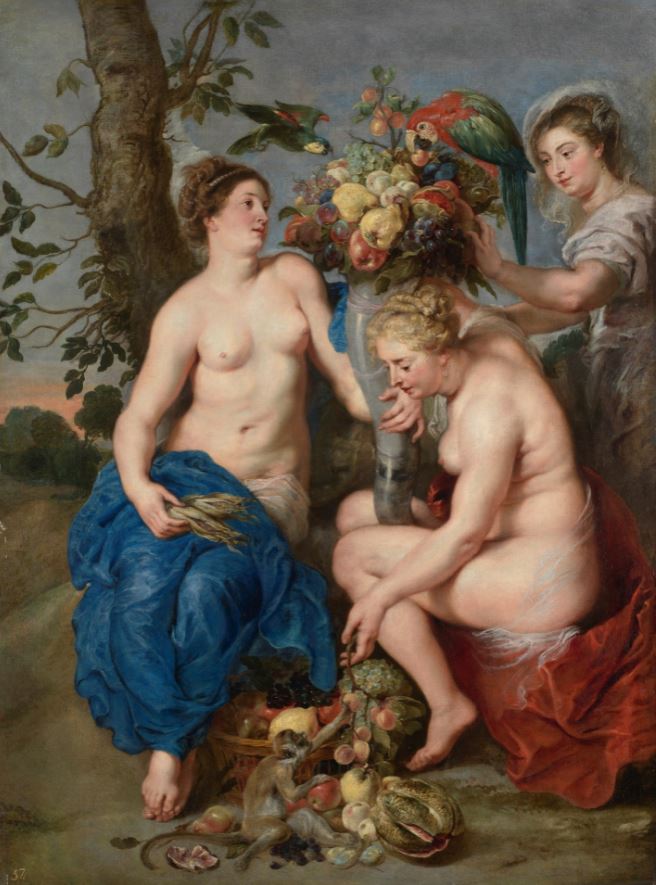
  • Three Nymphs with a Cornucopia (1625 to 1628) Museo Nacional del Prado, Madrid

The thing is that, although the curators try their best to claim that these women are not subject to the male gaze, but are strong independent women overflowing with agency, that’s not really how they actually look.

In my opinion this one, ‘Three Nymphs with a Cornucopia’ can be taken as a test case. It depicts the horn of plenty overflowing with the good things of life, namely a grocer’s shop full of ripe plump juicy fruit, so ripe and juicy that it has attracted the attention of scavenging parrots and a cheeky monkey, to add drama and narrative to a classical allegorical scene.

Is it just me or are the two naked women depicted as extensions of this vision of youthful fertile juicy fruitfulness?

I think they are. Far from asserting anyone’s agency, I’d have thought this picture epitomises the reverse: surely these women are totally objectified, depicted  in all their youthful sexiness as direct extensions of the world of fruit and fecundity.

This is one of eight paintings Rubens took to Spain as a gift from his patron, the Archduchess Isabel Clara Eugenia, to King Philip IV, to butter him up. Made by a man to flatter a king, far from being a rebuttal it strikes me as being a kind of triumph of the male gaze – sexy topless fruitful babes designed to decorate on the walls of the most powerful man in Europe.

Three Nymphs with a Cornucopia by Peter Paul Rubens (1625 to 1628) Museo Nacional del Prado, Madrid

More interesting to me, more persuasive and touching, is the information that Juno, in this huge representation of ‘The Birth of the Milky Way’ resembles Helena Fourment, Rubens’s second wife.

According to the curators, it is thought that his happy second marriage to Helene inspired his increasingly sensuous presentation of women during the 1630s. That seems to me a plausible and happy explanation of the plump sensuality of the nudes he painted in his final decade, just as Rembrandt’s love for his wife shine through his later paintings. I’m not sure anybody portrayed in a painting, male or female, has any ‘agency’. In my opinion they’re all trapped by composition, design, treatment, by the artist’s aims and whims, and all subject to the human gaze of us, centuries later, completely cut off from the value systems in which these works were created.

But paintings very much can convey tenderness and love. And that’s what I found in this small room full of magnificent works of art. The milk of human kindness. Motherly love. The pure, naked, redemptive love we all wish, deep down, we could recapture.

The Birth of the Milky Way by Peter Paul Rubens (1636 to 1638) © Photographic Archive, Museo Nacional del Prado, Madrid

Happily ever after

In fact this final wall caption made me realise that mention of Rubens’ second wife had been seeded throughout the show, starting with early mention of how, after the early death of his first wife, in 1630 Rubens married his second and much younger wife, Helena Fourment (1614 to 1673).

‘Their blissful marital state in the final decade of his life, during which time they had five children, provided a wellspring of love and an increased interest in sensual mythological themes.’

In a world afflicted with terrible pain and suffering it cheered me up to learn that this great artist was blessed with a long, happy, rewarding marriage. Good for him! And these images, painted late in his life, at the peak of his experience of art and life, however others may wish to interpret them, struck me as wonderfully accepting celebrations of beauty, humanity and love.

Rubens among his peers

I was struck by a quote from co-curator Dr Ben van Beneden which gives a pithy summary of three of Western Art’s Golden Greats:

‘If Raphael endowed his female figures with grace, and Titian with beauty, Rubens gave them veracity, energy and soul.’

Strong independent parrots

I noticed that one of the most powerful paintings in the final room, the Cornucopia, featured some beautifully vivid parrots pecking away at the fruit flowing from the horn, and this reminded me that the awesome painting of the Marchesa Maria Serra Pallavicino in the first room also features a parrot perched on her grand chair and bending down, twisting its neck in that inquisitive parrot way.

It occurred to me that maybe Dulwich’s next exhibition should be about ‘Parrots in Painting’. It could bring together depictions of a variety of strong, independent parrots who resist the human gaze to insist on their psittacine agency.

The video


Related links

Related reviews

Lucian Freud: The Self-portraits @ the Royal Academy

‘By the turn of the millennium, Freud was widely acknowledged to be Britain’s greatest living painter.’
(Alex Branczik, Head of Contemporary Art for Sotheby’s Europe)

Contrary to the implications of the title, this exhibition does not include all of Lucian Freud’s self-portraits, nowhere near. Given that Freud was interested in self portraiture throughout his long career, the selection here is a only relatively small percentage. Also, contrary to the title, the exhibition also includes a number of portraits not of himself, in fact arguably the best room is the one devoted to portraits of other people.

Lucian and me

I didn’t use to like Lucian Freud. I associate him with Frank Auerbach and the other dreary, depressing post-war British artists, a kind of visual equivalent of Harold Pinter, who I was force-fed at school. Their dreary, depressed, rainy English miserabilism nearly put me off contemporary art and literature for life.

But this exhibition made me change my mind (a bit) for two reasons:

1. It is told in a straightforward chronological order, which allows us to see the quite remarkable evolution of his style over 60 years of painting. Stories are always interesting and, by stopping to investigate each stage along his journey, the exhibition does a good job of making his development interesting.

2. By luck I got into conversation with another visitor who happened to be an amateur painter and she, for the first time, made me understand how his journey had been one of technique. It dawned on me that, to use a cliché, he may be a painter’s painter. Certainly the last couple of rooms make you think that his paintings may well depict men or women, naked or clothed, including himself, as subjects – but the real subject is the adventure of painting itself.

And this made me go back and really examine the technique of the paintings in the last few rooms and come to respect, in fact to marvel, at the complex painterly effects of his mature style.

A brief outline

Freud was born in Berlin in 1922 and fled Nazi Germany with his family in 1933, coming to London. He held his first solo show as early as 1944. In the late 1940s he chose to make portraiture the focus of his practice.

Drawing

Drawing was central to Freud’s style from the late 30s through to the early 1950s. His drawings from this era are strikingly different from the later work. This is a rare opportunity to see a whole roomful of them together and they come from a different world. They have a graphic sharpness, an economy of line which makes them very like cartoons. Look at the careful shading in the ears and on the cheek, and the extraordinary attention he’s devoted to each individual hair. Critic Herbert Read called him ‘the Ingres of Existentialism’.

Startled Man: Self-portrait (1948) by Lucian Freud © The Lucian Freud Archive / Bridgeman Images

This clear style lent itself to illustration so it’s no surprise to learn that he illustrated a number of books, several of which are in a display case here, Cards of Identity by Nigel Dennis (1955) and Two Plays and a Preface by Nigel Dennis (1958) and that Startled Man was one of five illustrations for a novella by William Sansmon titled The Equilibriad (1948).

Apart from the strikingly clean graphic style, what’s obvious is how performative these pictures are – the male head in them is always striking a pose, adopting an attitude, sometimes with props like a feather, in one dramatic case posing as Actaeon for a book on Greek myths.

Back to painting

Around the mid-1950s Freud turned his attention from drawing to painting and for a period of seven years or so stopped drawing altogether. Initially he painted sitting down using fine brushes. This enabled a smooth finished graphic style, very much in line with the clean defined outlines of his drawings, and the people in them share the same slightly distorted, rather frog-like faces as many of the drawings, more like caricatures than paintings.

Hotel Bedroom by Lucian Freud (1954) © The Lucian Freud Archive / Bridgeman Images

The wall label tells us that Freud associated with fellow painters Frank Auerbach and Francis Bacon. Like him they were figurative painters working against the grain of Abstract Expressionism and, later on, ignoring experimental and conceptual art. That, in a sentence, explains precisely why I don’t like them.

Bigger brushes

Anyway, Bacon inspired Freud to switch from soft sable-hair brushes to hog’s hair brushes which are capable of carrying more paint. This, it seems, was the physical, technical spur for the decisive change in his style. Between the late 1950s and mid-1960s his painting left behind the draughtsmanlike precision, so close to drawing, of paintings like Hotel Bedroom, and became far looser, a matter of large looser brushstrokes, which create more angular images, images made out of clashing planes and angles with an almost modernist feel about them.

Man’s Head (Self-portrait III) by Lucian Freud (1963) © The Lucian Freud Archive / Bridgeman Images

This is the third of three self-portraits which the exhibition reunites for the first time since they were shown together in 1963. You can see how the interest is now in structure more than likeness. There is no attempt to create a realistic background (his studio or a bedroom) which is now a plain matt surface. Similarly, his face has its familiar long, rather hawkish look, but here transformed into a semi-abstract mask.

Watercolours

Surprisingly, in 1961 he took up watercolours alongside paint. Both were ways of escaping from the linearity of pen-and-ink drawing. The exhibition includes a number of watercolours where he is obviously exploring the effect of broad washes, and the dynamic contrast that creates with more sharply defined faces.

In both types of work he drops the symbols and props which had abounded in the drawings. The subject matter is simpler and in a way starker. The paintings still feel pregnant with meaning but their force or charge is achieved by different means, purely by the arrangement of brushstrokes.

Mirrors

Mirrors have been used by artists since time immemorial to paint accurate self-portraits, and countless artists have gone one step further to include mirrors in their paintings to highlight the artifice and paradox or making images which, on one level, claim to be true, claim to be reality, but on another, are patent artifice.

Quite a few Freud self portraits include mirrors or depict himself from angles clearly designed to bring out the mirrorly artifice. When you learn that he did this increasingly from the mid-1960s it makes a kind of sense; you can see the echo of similar experiments going on in in contemporary film posters and album covers. This instance using a mirror on or near the floor is striking enough, but made disturbing by the inclusion of small portraits of two of his children perched ‘outside’ the main frame.

Reflection with Two Children (Self-portrait) by Lucian Freud (1965) © The Lucian Freud Archive / Bridgeman Images

In the studio

The penultimate room is the best and it’s the one which has no self portraits. Instead there’s two massive portraits of naked women on sofas, a huge standing male nude (his son, Freddy), and an eerie portrait of two fully clothed Irish gentlemen.

The wall label emphasises that by the 1970s Freud had established a definite approach. He painted people he had some kind of connection with, himself, some members of his family and friends, and sometimes people he met through chance encounters but who held a special visual importance for him.

They are all painted indoors, in his studios, not outside, not at their houses or in a neutral space. They are always in the familiar space of his studio, whose props and space and dimensions he knows inside out. This allowed him to focus on what he stated in interviews was his aim, which was to recreate in paint a physical presence.

So the obvious things about the paintings you see as you walk into this room of late works is that:

  • they’re huge, compared to what came before
  • they’re of other people
  • they’re full length instead of face portraits
  • they’re (mostly) naked

But, among this surfeit of impressions, maybe the most striking is the extraordinary poses and postures he has put his naked subjects in. In his mature works, this became his trademark – the rather tortured and certainly uncomfortable poses of naked women, which creates an uncomfortable, unsettling psychological affect on the viewer.

Naked Portrait with Reflection by Lucian Freud (1980)

What is going on? Is he torturing and exploiting these naked women, demonstrating his male power, as feminist critics have it? Or is he twisting their bodies round to create symbols of his personal unhappiness or anguish, as psychological critics might have it? Or had he stumbled across a new kind of motif, which he realised he could make uniquely his own, a ‘look’ which he could use to consolidate his ‘brand’ in the highly competitive London art market, as a Marxist critic might have it? (It is rather staggering to learn that this painting fetched over £11 million at auction in 2008. God knows what it’s worth now.)

Cremnitz white

But the wall label draws attention another, more technical feature of his painting from this period.

In 1975 he began using Cremnitz white, a heavy paint which, when mixed with other paints, creates a thick granular affect. Armed with this information, look again at the sprawling nude above. Look at the white highlights on her body. Two things:

1. Identifying the area of pure white prompts you to look closely at how they relate to the other colours around them. Obviously there’s a lot of pink but, when you look closely, there’s a lot of yellow and, looking more closely, brown and grey and even green. In fact, the more you look, the more entranced you become by the interplay of colours which make up her flesh, a panoply of creams and ochres and bistre tones.

It dawns on you that maybe Freud posed his naked women (and men, he painted a lot of naked men, too) in this contorted sprawling style and lying down rather than sitting up, because this way he exposes the maximum amount of flesh. Maybe these distorted poses have nothing to do with misogynist exploitation or twisted sexuality or psychological symbolism. Maybe they simply create the largest possible expanse of human flesh for him to paint.

2. Go up close, right up to the painting, and what becomes strikingly obvious is the immensely contoured, nubbly, grainy nature of the surface of the work. It is as if someone has thrown small gravel or stones onto the surface which have got embedded in the paint. It is immensely grainy and rubbly and tactile.

Here’s a close-up of the shadow along the right-hand side of the model’s body. You can see:

1. the lumps and bobbles of solid matter in the paint of the darker shadow near the middle of the image

2. the grooves of the thick brushstrokes moving up out of that dark patch to form her tummy or, at the bottom left, the long smooth but very visible and ridged strokes which create her thigh

3. the tremendous variety of colours and tints: granted, they’re all from the same tonal range of brown: but when you look closely you can see the extraordinary dynamism and interplay of shades. There’s barely a square inch of the same colour, but a continual variety, and a tremendous interest and even excitement created by the plastic, three-dimensional, raised and very tactile way different areas of colours stroke and swadge and brush, and daub and paste and are modelled and placed over and against each other.

Detail from Naked Portrait with Reflection by Lucian Freud (1980)

As I mentioned above, this was partly the result of chatting to the painter I met at the show. It was her enthusiastic description of Freud as a painter as a handler of paint, as the creator of such drama on the canvas, which made me go back and look at these last paintings in more detail.

Same thing can be seen in the other big nude in the room, Flora with Blue Toenails. Armed with this new way of seeing, what I noticed about this painting were 1. that the surface is so granular and lumpy you can see it even in a reproduction 2. the striking difference in timbre between her light torso and her much darker, more shaded legs. The keynote seemed to me to be grey. Follow the lines of grey. A solid line of grey goes from her cleavage, down her sternum and snakes around the top of her tummy almost creating a circle, where it almost joins to another long serpent of the same grey which snakes across her left thigh and curls round at her knee before reappearing across her right shin.

Flora with Blue Toe Nails by Lucian Freud (2000 to 2001)

My point is that, by this stage I was seeing these compositions as adventures in paint, as incredibly complex interplays of an astonishing range of colours, applied in a thick dense impasto, with heavy brushstrokes and entire regions raised and nubbled with grains and lumps of solid matter.

Here’s a close-up of Flora’s elbow, as transformed by Freud’s painterly prestidigitation. I found it quite thrilling to step right up to the painting and examine small areas in great detail, revelling in the adventures of the tones and surfaces – look at the myriad colours intermingling in the broad horizontal strokes at the top of her forearm, it’s almost like a rainbow, the multi-levelled mixing of colours is so advanced. And all this combined with the gnarly gritty, deliberately granular surface.

Detail of Flora with Blue Toe Nails by Lucian Freud (2000 to 2001)

Which meant that by the time I entered the final room, a collection of self-portraits from his final years, I wasn’t at all interested in either the biographical or supposedly psychological elements to them (‘ruthlessly honest, apparently) but instead was riveted by the extraordinarily vibrant, confident, sweeping, dashing painterliness of the things.

Here’s a medium close-up of the 1985 work, Reflection (Self portrait) which is a prime example of his thickly-painted and complex technique. Note the green – green blodges either side of his nose and the pouches under his eyes.

Detail of Reflection (Self portrait) by Lucian Freud (1985)

I became irrationally fascinated by the patterned edge to the image, to his shoulders which is presumably created by a spatula of some kind to model the border between the figure and the background, and which created the kind of crimping effect you see around the edge of pies.

Detail of Reflection (Self portrait) by Lucian Freud (1985)

But everywhere you look in the painting you see the same supremely confident use of paint, applied in apparently slapdash thick strokes and in a blather and combo of colours which seems almost chaotic when seen from really close up…

Detail of Reflection (Self portrait) by Lucian Freud (1985)

… but you only have to step back a few paces to see how these thick, spattered applications meld, at the ideal viewing distance, into extremely powerful, and even haunting, images.

Reflection (Self-portrait) by Lucian Freud (1985) © The Lucian Freud Archive / Bridgeman Images

So I’m still not sure that I particularly like Lucian Freud’s paintings, but now, thanks to this handy exhibition, I have a much better grasp of the shape of his career, and a completely different way of seeing and conceptualising his paintings – not as the grim and dreary products of a troubled claustrophobe with dubious psychosexual issues, but as thrilling and masterly exercises in painterly technique.

I am not very interested in him as a painter of portraits per se – I couldn’t care less about the various marriages or children which the wall labels tell us about. But this exhibition did help me see how Freud really was one of the greatest painters of human flesh who ever put brush to canvas.


Related links

More Royal Academy reviews

Dora Maar @ Tate Modern

This is the most comprehensive retrospective of photographer and painter Dora Maar ever held in Britain.

Dora Maar photographed by Man Ray (1936)

Brief synopsis

  • Maar was a successful fashion and commercial photographer in the early 1930s
  • a social documentary photographer in the mid-1930s, as well as being a left-wing political activist, signing manifestos, going on marches
  • she developed into a dazzling surrealist photographer in the mid to late-1930s
  • Maar was introduced to Picasso in 1935 and was his mistress for nine years, documenting the creation of his 1937 masterpiece Guernica, providing the model for thirty or so many paintings and many drawings on the theme of the Weeping woman, and under his encouragement taking up painting again
  • 1944 saw the break-up with Picasso, and the start of years struggling with depression – she never returned to photography
  • 1940s to her death in 1997: experiments with a range of painting styles from her home in rural France

Dora Maar

Born in 1907, Maar was encouraged and supported by her father to study art, but became more attracted to photography. Living in Paris, by the late 1920s she had become proficient at photography and made contacts in the Paris artworld, She studied at the École des Beaux-Arts and the Académie Julian, and frequented André Lhote’s workshop where she met Henri Cartier-Bresson. She became friends with the surrealist Jacqueline Lamba, who went on to meet the godfather of the surrealist movement, André Breton.

At the beginning of 1930, she set up a photography studio on rue Campagne-Première (14th arrondissement of Paris) with Pierre Kéfer, photographer and decorator. Though many prints during their collaboration were signed ‘Kéfer–Dora Maar’, Maar was usually the sole author. When their partnership ended around 1935, Maar established her own studio in central Paris and took independent commissions.

Through the early 1930s she undertook a wide range of commercial photography for advertisements and fashion magazines, travel books and some erotic magazines. All the photos from this period are crisp and clean and attractive, several shots of men and women in sporty poses reminding me of glamour photos from 1930s Hollywood of the likes of Gary Cooper or Jean Harlow.

Model in Swimsuit (1936) by Dora Maar. The J. Paul Getty Museum, Los Angeles © ADAGP, Paris and DACS, London 2019

The exhibition has nine rooms and the room of fashion photos and nudes is arguably the most enjoyable, for their variety and their tremendous evocation of 1930s glamour, Paris-style.

But what’s also interesting is you can see the logic of a sort of progression from fashion photos, sports photos, through tasteful nudes, and then increasingly experimental commercial photos, promoting shampoo etc, and then, suddenly…

Surrealism

A severed hand holding a bottle. A fashionably dressed woman in a long backless dress with… a star for a head… Suddenly Maar is a surrealist!

A very successful surrealist. She was one of only a handful of photographers to be included in the big surrealist exhibitions of the 1930s (in Tenerife, Paris, London, New York, Japan and Amsterdam), her work appearing alongside that of Man Ray (for me, maybe the greatest photographer) and Hans Bellmer (very disturbing chopped-up mannequins).

Interestingly, the early surrealists couldn’t quite see how photography fit into their idea of foregrounding the imagination and above all, the unconscious mind, because photography was associated, up till then, with documentary recording of portrait, landscapes or cityscapes. It took the development of photomontage – the cutting and pasting of several photographic images over or on each other – which persuaded the surrealists that photography could, indeed, be a hugely powerful disruptor of ‘bourgeois reality’.

Room five shows photos by her, alongside photos of the leading lights of the surrealist movement, friends ad fellow activists, male and female, including: Man Ray, Ren Crevell, Paul Eluard, Leonor Fini, Christian Berard, Lise Deharme – she was right in there, in the thick of the movement and the contemporary arts scene, and alongside photos of her famous friends, the exhibition displays catalogues and invitations to the surrealist exhibitions where her work was shown.

Anyway, the main thrust of the surrealist room is to showcase a range of experiments with surrealist photography, from fairly basic ideas of cutting and pasting one image onto another photo, to more interestingly experimental.

Several tropes recur:

  1. Cut out a naked woman and stick it on almost any other image and it looks surreal/silly. Eyes.
  2. Cut out eyes and put them anywhere, or create a flock of eyes with wings, or eyes on a beach with legs like crabs.
  3. Shop-window mannequins. Stick them in any window and take a photograph and – hey presto! – poundshop surrealism

But a handful of the images are world class, as good as anything any of the men ever dreamed up.

Untitled (Hand-Shell) (1934) by Dora Maar Photo © Centre Pompidou © ADAGP, Paris and DACS, London 2019

Far more troubling was a set she made where she took the curved vaulted ceiling of a church somewhere, turned it upside down and then superimposed figures on it, on one version a street boy bending his body unnaturally backwards is a genuinely disturbing image (see end of this review).

My point being that a lot of her surreal photographs are relatively smooth and acceptable (like the shell-hand above) – extensions of her fashion shot style. But just a few of them are genuinely chilling and disturbing…

Social documentary

Another big room (room 3) is filled with Maar’s social documentary photographs from the 1930s. She took bleak, honest photographs of the terrible poverty to be found in ‘La Zone’ – a sprawling shanty town on the outskirts of Paris that was home to around 40,000 poverty-stricken Parisians and immigrants.

In 1933 she travelled to the Catalonia and took photos of street people in Barcelona.

Surprisingly, there’s an extended set of photos she took of street people in London, including pearly kings, blind musicians, and all manner of beggars, from the smartly dressed to the really worn-down and impoverished.

And there is a whole room devoted simply to every day scenes, the oddity or strikingness of sudden moments in the city, the kind of moments which the surrealists’ godfather, André Breton, tried and – in my opinion – miserably failed to capture in his self-important and banal ‘masterpiece’, Nadja, which photography, as a medium, is much better equipped to capture than prose.

Girl Blocking the Doorway by Dora Maar (1934)

To be honest, a lot of these are not classics, nothing like the images of the Depression being create by Dorothea Lange at the same time in America, and not as brilliantly composed and framed as the social documentary photos of Edith Tudor-Hart, both of whom have had exhibitions devoted to them recently.

The first five rooms, then, have shown us an extensive selection of photos across a number of genres – commercial, fashion, erotic, nudes, social realism and art-surrealism – that really make the case for Maar being a very significant figure from the time, and a handful of really outstanding surrealist images she created.

Then it all goes pear-shaped.

Picasso

In 1935 she asked a mutual friend to introduce her to Picasso, who fascinated her and, she became his mistress. Unfortunately he already had one mistress, Marie-Thérèse Walter, mother of his daughter Maya. Between 1936 and 1938 they spent summers at Mougins in the South of France, with a group of other artists that included Paul and Nusch Eluard, Man Ray, Roland Penrose, Lee Miller and Eileen Agar, and their relationship lasted until 1946.

I suppose the curators couldn’t avoid this big chunk of her life, but it has a very negative effect. The two rooms which deal with it unavoidably bring out that Picasso was a genius, and seemed to indicate (the narrative was a little unclear) that she more or less abandoned photography.

As to his genius, one entire room is devoted to the masterpiece Guernica, for the slender reason that Maar took a series of seven photos showing the progress of its creation during May and June 1937. Her photos are projected onto the wall and are nearly as bit as the original. This ought to have been fascinating, but wasn’t. They show us that Picasso’s initial pencil composition changed as he painted but beyond that…

Installation view of Dora Maar at Tate Modern showing the projection of Maar’s photos of the progress of Guenrica

The displays also tell us more than once that Maar was the model for the image of the Weeping Woman, an image which is included in Guernica and which he made about thirty versions of. This story is undermined a bit when we read Maar denying it, and claiming all these weeping women were nothing to do with her, but Picasso’s own invention.

‘You need to know that I never really modelled for Picasso. He never painted me “from nature”. One or two drawings, maybe, that’s all, although he did hundreds of portraits of me.’

The exhibition includes one of the Weeping Women (the one, in fact, owned by Tate) and this has a deleterious effect on the rest of the show because it is so brilliant.

Weeping Woman (1937) by Pablo Picasso. Tate

The exhibition includes an experimental series of portraits they made together, combining experimental photographic and printmaking techniques, and one big figurative painting she did during this time. But it’s hard to avoid the conclusion that the relationship was a catastrophe for her.

In the late 1930s she was a photographer at the top of her game, firing on all cylinders, experimenting and developing. Then it all grinds to a halt. She helps Picasso with his work, she gets fed up with being excluded from his circle.

Why did she do it?

After Picasso

Picasso bought Maar a house in Ménerbes, Vaucluse, where she retired and lived alone. She turned to the Catholic religion, met the painter Nicolas de Staël (who lived in the same village), and turned to abstract painting.

The final two rooms give us a cross-selection of her paintings. These come in a bewildering variety of styles.

In the 1940s, hugely under the influence of Picasso she made still life oil paintings, which were well received when she exhibited them in a joint exhibition at the Galerie Jeanne Bucher, alongside those of Georgian artist Vera Pagava.

Still Life by Dora Maar (1941)

She painted semi-abstract landscapes of the countryside around her house in the Vaucluse, some of which are very pleasant. La Grande Range was included in Maar’s last exhibition, held in the Leicester Galleries, London, in 1958 and the curators quote the Times’s art critic, John Russell, praising their sensitivity and feel for large, open rather lonely places.

La Grand Range (1958) by Dora Maar

Another wall shows experiments with very small oil abstract paintings . The fourth wall displays a series of larger abstracts, often with black lines drawn over turquoise colour washes. I liked these more than the rather washed-out landscapes.

Untitled abstracts from the 1970s

And the final room shows her experiments with taking photographs without a camera, camera-less photographs or photograms. A photogram is made by placing an object on photo-sensitive paper and exposing it to light. Where the light strikes the paper, it darkens, where the paper is covered by the object it remains lighter. Maar experimented with household objects with differing degrees of transparency to control the amount of light let through to the paper.

Installation view of Maar’s late photograms

Paintings of the landscapes around her house in Ménerbes,[23] showed locations dominated by wind and clouds, strongly revealing the struggle of an artist with the ghosts of her past.[24]

Conclusion

Well, if the exhibition’s purpose was to pull Maar out from Picasso’s shadow and rehabilitate her as a photographer and artist in her own right, then it certainly succeeds.

However, the effort to rehabilitate her as an artist and painter is, I think, a failure, especially after the curators dazzled us with the Picasso room: nothing from the 40 or so years of painting in the second half of her life comes anywhere near matching the genius and intensity of the Master. Some of it’s attractive, some of it is competent enough cubist still lifes, or a certain type of washed out 1970s abstraction, but…

No, it’s back to the multitude of photos which fill the first five rooms that the visitor has to go to catch the range and inventiveness and technical competence and restless inquiring mind which made Maar such a presence in the world of photography in the 1930s, and which is surely her lasting legacy.

A handful of the images are quite stunning (this is not a subjective view, as the same three or four images – the shell-hand, the face with a spiderweb projected on it, the woman in evening dress with a star for a head – appear on all the posters, on the front of the catalogue, as postcards and associated merch in the Tate shop).

And many of the social documentary photos are good, if lacking the bite of Edith Tudor-Hart.

But scattered in among these 60 or so images are a handful which, as I mentioned above, I thought penetrated to a deeper level, were neither ‘acceptable’ images of poverty or slickly-made surrealism – but took us somewhere quite different, deeper and more disturbing.

Though not reproduced on book covers or postcards or posters or mugs or fridge magnets or tote bags or t-shirts, I thought this small handful of genuinely creepy images captured something genuinely profound and chilling, something which gestures towards real greatness.

The Pretender by Dora Maar (1935) Photograph © ADAGP, Paris and DACS, London 2019


Related links

Other Surrealism reviews

More Tate Modern reviews

Félix Vallotton: Painter of Disquiet @ the Royal Academy

This exhibition is a revelation and a treat. Valloton made lots of immensely pleasing, teasing, entertaining, beautiful and slightly puzzling images, enough to make it hard to leave the show. Normally I have half a dozen highlights from an exhibition, but I wanted to take twenty or thirty of Vallotton’s images away with me, wanted to be able to revisit them regularly, especially the woodcuts, and so I bought the catalogue (which is currently selling at the knock-down price of £12.50).

The exhibition is in six rooms so, rather than reinvent the wheel, I might as well follow the academy’s structure, with comments and observations along the way.

Early works

Félix Vallotton was born in 1865 into a Swiss Protestant family in Lausanne. At 16 he headed off for Paris, the art capital of the world, where he showed prodigious talent. He rejected studying at the prestigious École des Beaux-Arts and enrolled in the more informal Academie Julian. His early works are realistic and figurative in a way which completely ignored the avant-garde of the day, the (by now) prevailing style of Impressionism, or the various post-Impressionist styles which were on the horizon. From the start he went his own way, and his style right to the end would be realistic and, in many ways, deeply conservative. (Note, by the way, the large plain background to this confident self portrait; we’ll come back to it later…)

Self-portrait at the age of twenty (1885) by Félix Vallotton. Musée cantonal des Beaux-Arts de Lausanne. Photo © Nora Rupp

The early Nabis years

The Nabis was a group of French painters who rejected Impressionism in favour of lofty spiritual goals, and were more aligned with the late-nineteenth century movement of Symbolism.

The Nabis (from the Hebrew and Arabic term for ‘prophets’) were a Symbolist, cult-like group founded by Paul Sérusier, who organized his friends into a secret society. Wanting to be in touch with a higher power, this group felt that the artist could serve as a ‘high priest’ and ‘seer’ with the power to reveal the invisible. The Nabis felt that as artists they were creators of a subjective art that was deeply rooted in the soul of the artist. While the works of the Nabis differed in subject matter from one another, they all ascribed to certain formal tenets – for example, the idea that a painting was a harmonious grouping of lines and colours. (from the Art Story website)

The Nabis’ most famous members were Édouard Vuillard and Pierre Bonnard. Valloton became involved with the Nabis in the early 1890s and their ideas produced a dramatic change in his style, as he experimented with non-naturalistic ways of playing with colour, pattern and form to try and convey the higher spiritual ideas the Nabis aspired to. Some of these are wonderful, for example an exquisite small stylised painting of a beach by moonlight, and a highly experimental painting of Parisians ice skating to waltz music, their gyrations throwing up sparkly fragments of ice which shimmer with multiple colours.

Waltz by Félix Vallotton (1893) Musée d’art moderne André-Malraux (MuMa), Le Havre, France. Source: Wikimedia Commons.

By far the oddest of these paintings is Bathing on a summer evening which combines all kinds of influences (from Old Master bathing scenes to the Pointillism of his contemporary Seurat, and maybe something of the naive style of Le Douanier Rousseau) to produce something very strange and ‘modern’. The curators point out the influence on many artists of this time of classic Japanese prints, which liberated Western painters from Renaissance perspective and helped them rethink the picture plane as a flat arrangement of lines and blocks of colours.

Bathing on a Summer Evening (1892 to 1893) by Félix Vallotton © Kunsthaus Zürich

However, as the exhibition progresses you realise that early works like this are the exception rather than the rule. Or maybe that they were stepping stones towards his more mature and rather mysterious style. The oddity and ‘spiritual’ aspect of these Nabis works (if that’s what it is) become subsumed into a return to realism, but of a highly stylised variety.

Woodcuts

Valloton began making woodcuts in 1891 and quickly became an acknowledged expert in the medium, which was undergoing a revival across Europe. Changes in printing technology led in the 1880s and especially 1890s to a proliferation of illustrated journals and magazines.

(It was the proliferation of literary and popular magazines in London which led to the market for, and sudden florescence of, brilliant short fiction commissioned from the likes of Oscar Wilde, Rider Haggard, Conan Doyle and Rudyard Kipling. And in fact, Vallotton was also a writer, producing three novels and eight plays. He was also heavily involved in the theatre, designed stage sets, took photographs and made sculpture. In his best-known novel, The Murderous Life, the protagonist, Jacques Verdier, has a power which causes everyone in his path to die in a tragic accident. Vallotton illustrated the novel himself in the darkly humorous style of his woodcuts. All this is reminiscent of the black humour of exactly contemporary English works like The Picture of Dorian Grey or of Aubrey Beardsley’s black and white prints.)

Valloton turned out to have a gift for woodcut as a form, being able to produce images which were entertaining, troubling, moody, artistic or humorous, as required. He became principal illustrator for the influential journal La Revue Blanche and, as such, came into contact with and befriended many of Paris’s artistic, musical and literary élite – Mallarmé, Debussy, Proust, Satie and so on.

‘This newcomer, who is not a beginner, engraved on blocks of soft pearwood various scenes of contemporary life with the candour of a sixteenth-century woodcut.’ (French critic Octave Uzanne describing Vallotton’s exceptional talent for printmaking)

The exhibition contains some forty of Vallotton’s woodcuts, arranged by series.

Paris life

I can’t find a figure for how many illustrations he created for La Revue Blanche but presumably it was lots. Included here are all kinds of street scenes including crowds caught in downpours and rioters attacking the police, schoolgirls laughing, swans in the park, a sudden downpour of rain, and so on. My favourite was a beautifully clear and precise image of a naked woman lying on her front on a highly patterned coverlet and reaching out to scratch a cat, titled Laziness.

Laziness (1896) by Félix Vallotton

Musicians

The Musicians series shows starchy Victorian ladies and gents playing the violin or piano or trumpet. The one that caught my eye was a man playing the flute but keeping a wary eye on a cat which looks like it’s about to pounce on him or his sheet music.

The Flute (1896) by Félix Vallotton

Worlds Fair

There’s a series of six woodcuts on the subject of the 1900 Paris World Fair, showing visitors gawping at jewels, having a picnic lunch, caught in a sudden rain shower, a recreation of a street scene in Algiers, a footbridge between displays, and, finally, a vivid woodcut depicting fireworks. All these illustrations are wonderfully vivid and characterful and fascinating social history.

Intimacies

Most famous is the series of ten graphic woodcuts he titled Intimacies. These portray the sexual mores of Parisians, and the moral and psychological intensity of late-Victorian affairs. Each one shows a scene fraught with sexual or psychological tension (I say ‘sexual’ – there’s no nudity; everything is implied).

Below is maybe the most striking and intriguing one, Money. What money, where? Is the man handing her money (doesn’t look like it) or offering her money verbally? For what? Sex? To buy her silence? Is she his mistress? Or an unhappy wife?

The curators point out Valloton’s striking use of black. It’s simple but extremely effective to have about two-thirds of the image, the whole right side, jet black. Thus the man doesn’t stand against a backdrop or shadow, but emerges out of the blackness. He is part of the blackness. All the others in the Intimacies series are just as strange and teasing and suggest complex psychodramas on which we are eavesdropping.

Intimacies V: Money (1898) by Félix Vallotton © Musées d’art et d’histoire, Ville de Genève, Cabinet d’arts graphiques

Vallotton’s extensive experience churning out woodcuts recording and satirising contemporary Paris life, fed over into his paintings. During this period they stopped being either the rather stiff portraits and still lifes of his first years in Paris, or the experimental paintings mentioned above like the Waltzers or Bathers, and became more like accompaniments in paint of the contemporary social themes he was depicting in the woodcuts. Especially the Intimacies theme of the complexity of male-female relations, the complex lies and deceptions of the Paris bourgeoisie as they go about their affairs and infidelities. One is titled Five O’Clock which, we learn from the wall label, was the time of day when the Parisian bourgeois left their offices and went to visit their mistresses for an hour of pleasure, before returning home to their wives and families. Another shows a naked woman curled up in a very red chair, in a sort of defensive or foetal posture. You can’t help asking why. Has something bad happened to her, has she received good or bad news, or is it her usual comforting position?

Uncertainties

This is the theme or feeling which is present in his earlier paintings but comes more and more to the fore during the 1890s – which is that, although his technique remained pretty conservative (especially if you consider what was happening around him in Paris, with Picasso and Matisse just over the horizon), nonetheless, there is a very modern sense of unease and ambiguity about his paintings from the 1890s.

A good example is The Visit from 1899. Three points: 1. What is going on in this painting? Has she just arrived? Are they dancing? Or is he pushing her towards the open door at the left which we can assume leads into a bedroom? So is it an illicit visit from a mistress?

The Visit (1899) by Félix Vallotton © Kunsthaus Zürich

2. Note the bold colours. This is what Valloton had in common with the other Nabis: it’s a figurative scene alright, but all the colours are too overbright and simplified. It is this overlit colouring which creates the unsettling mood as much as the composition.

3. As are the faces. You can see the influence of all those hundreds of popular woodcuts, which required often cartoon-like simplicity of faces, spilling over into a simplification of the faces and indeed the outlines of the bodies in his paintings. It’s a painting of a real scene but all done with overbright simplifications of colour and outline which bring to mind, say, the style of American painter Edward Hopper. The clothes and decor have changed but the mood of lassitude or ambiguity, the troubled atmosphere between a man and a woman, are very similiar and above all, conveyed by simplifying the shape and colour of the figures, and leaving their faces blurred and shadowed.

Room in New York by Edward Hopper (1932)

Marriage

In 1899 Valloton dumped the Bohemian mistress he had lived with during the 1890s, and married Gabrielle Rodrigues-Henriques. This was an excellent career move in two ways. 1. She was the widowed daughter of Alexandre Bernheim, one of the most successful art dealers in Europe, and her brothers still ran the immensely successful art dealership. 2. She was rich.

At a stroke Vallotton moved from a garret studio with a mistress into a grand city house with a wife and step-children. He entertained. He became a good bourgeois and family man.

And his style changed, too. For a start he stopped making the woodcuts which had provided his livelihood during the 1890s, and ceased working for La Revue Blanche. Freed from financial worries he concentrated all his energies on painting.

A lot of these new paintings feature his wife, in a variety of respectable family poses, on the family sofa, or at the family dinner table. These portraits show the enduring influence on him of one of his heroes, Ingres, the painter of crystal-clear nudes and women’s faces.

But alongside these respectable paintings are others, also apparently sensible and polite, which nonetheless exude a strange unease and sense of foreboding. It is as if the psychological tensions he had investigated so ably in the Intimacies woodcuts has been driven underground to become merely implicit, barely implicit, only just noticeable.

The curators single out one particular painting from this period, The Ball, which shows a little girl in a garden chasing after a ball. What could be more innocent? And yet, when you look at it in the flesh, there is something very eerie about the way the shadow is creeping across the grass from the left and onto the gravel drive – almost as if it’s reaching out for her. And the darker shadows lurking at the bottom of the shrubbery above the girl. And something a little uncanny about the two figures in the distance…

The Ball (1899) by Félix Vallotton © Musée d’Orsay

This unsettling effect is much more obvious in a brilliant painting titled simply The Pond. A realistic painting of a pond, what could be more plain and simple? And yet (once again, more in the flesh than in this flat reproduction) once you’ve noticed the way the blackness of the pond water is seeping weirdly towards you, it’s impossible not to be a little worried by it. It’s like a still from the Disney film Fantasia, it looks like the shadow of the mountain coming to life, with big devil’s horns, rearing towards you…

The Pond (1909) by Félix Vallotton

Nudes

Also, from about 1904 onwards, alongside the many fully clothed and respectable portraits of his wife and step-children, Valloton began to focus his energies on the nude, the female nude.

If you realise that Picasso and Matisse were just launching their careers at just this time, it is astonishing just how conservative and traditional Valloton’s style was. If you do a quick google search of Félix Vallotton+nude it is astonishing to discover that he did so many of them.

Many of the nudes explicitly refer to the great tradition of Old Masters from his favourite, Ingres, through to Manet’s Olympia. In all of them there is a cold, detached, calculating air. The largest of the half dozen or so on display here is the wonderful White Woman and Black Woman of 1913.

White Woman and Black Woman (1913) by Félix Vallotton © Fondation Hahnloser, Winterthour

1. The clarity There is hardly any shadow in the room. Everything is depicted in the exact crystalline light of Ingres.

2. The technical virtuosity Look at him show off his ability to paint folds of cloth, one of the litmus tests of the Old Masters stretching back to Titian.

3. Psychology In the Olympia of Manet the fully clothed black servant is bringing flowers to the naked prostitute Olympia, very obviously serving her. But what on earth is the relationship here, between the black woman who’s very casually dressed and – for God’s sake – smoking a fag!? All kinds of speculation is possible, the curators’ favourite one being that they are lesbian lovers, but it looks much more complex and weird than that.

4. The nude The depiction of the white woman’s naked body is quite simply stunning. It is a masterwork in the depiction of fleshtones, and the way they vary across the naked body, rising towards her flushed red cheeks. Why are her cheeks flushed and red?

You remember me pointing out about the first painting in this review, how the background is a flat, bare wash? Well, same here. Once I’d processed the lavish sensual appeal of the naked body in this painting, and then wondered about the relationship between the two figures, than I turned to consider a third level or avenue of approach, which is to see it purely as a composition of colours – and surely the most striking thing is the huge size of the aquamarine wall behind both figures. Against which is set the black woman’s brilliant orange headscarf. And then her bright blue wrap, for sure. If it is a virtuoso display of folds and shadows in fabric, it is also, on another level, an exercise in big blocks of colour. Once I’d noticed this fondness for slabs of colour, I began to notice it in many of his paintings, and also link it up with his decisive use of solid black in the woodcuts. It’s an entire visual approach to see things as blocks rather than broken up into the multitude of details.

Landscapes

In 1909, alongside his prodigious output of nudes, Valloton turned his attention to landscapes. As with so many of his earlier depictions of people, these were done in a simplified style which often brought out the basic shapes underlying messy nature and, as with the nude above, done in primary or elemental colours.

A good example is The Pond, above, with its radical simplification of pond, grass, shrubs and trees to create an almost cartoon-like image.

He called them composed landscapes. He had taken to using a box camera at the turn of the century and now it became a habit to take photos of a scene and then use that, once developed, to paint the scene from the simplified (black and white) photo and from memory. He dreamed, he said, ‘of a painting free from any literal respect for nature.’

The result was landscapes reduced to broad ‘zones’ or shapes of colour which recall the simplifications of the woodblock. And also hark back to the principles of the Nabis from a decade or more earlier, the idea that art needn’t be realistic, but was more a matter of finding the colours and patterns which replicated your inner feelings.

A late landscape which really got me was Last Rays painted at Honfleur where Vallotton spent many of his summers and where he made several versions of this scene of umbrella pine trees overlooking the Bay of the Seine. In its simplification and strong sense of design it subtly references the clarity of the Japanese prints which had so influenced him in the 1890s.

Last Rays (1911) by Félix Vallotton © Musée des Beaux-Arts de Quimper

A conventional artist?

But, also, looking round any of the rooms, I kept being amazed at how… conventional Vallottin is. It’s as if Impressionism or any other modern art movement had never happened. Towards the end of the exhibition, I began to realise why I’d never heard of Félix Vallotton before – because he stands so totally outside the classic narrative of Modern Art, and its core lineage from Impressionism thru Post-Impressionism, to the eruption of Picasso and Matisse, and then into Cubism, Futurism etc etc.

None of this seems to have had any impact on Vallotton, and if you look at his Wikipedia article, you do get the impression that many if not most of his paintings can be read as utterly traditional and ‘straight’.

Which set me wondering whether the curator’s attempt to rebrand Vallotton as the painter of ‘unease’ quite stacks up. There’s nothing particularly uneasy about the trees at sunset above, nor about many of the nudes which are just skillful paintings of naked women, often in not very flattering postures, but depicted with beautiful fluency.

Maybe it would be impossible just to stage an exhibition of Vallotton’s work ‘cold’ as it were; maybe it would come across as too conventional and, possibly, in some cases, kitsch, as reworkings of Ingres-style nudes and Flemish-style still lifes being painted in the 1910s.

Maybe the curators had to find an angle, some kind of modernist theme, to make him appear edgy and relevant.

The Great War

Then the Great War broke out. Vallotton was swept up in the patriotic fervour (he had become a French citizen in 1900) but was dismayed to discover he was too old (49) to enlist. Interestingly, the war sparked the decision to create a new series of woodcuts, a genre he hadn’t touched since 1900. Maybe he associated the woodcut with journalism, with the immediate depiction of a society’s life, with the everyday activities of its citizens, and so with the journalistic immediacy of the war and its horrors. In fact the images were copied from newspaper photos or articles before he worked them up into woodcuts.

The result was a series of six woodcuts, collectively titled This is War! and consisting of: The Trench, The Orgy (being a piss-up in a wine cellar), Barbed wire, In the Darkness, the Lookout, and The Civilians.

The Trench (1915) by Félix Vallotton © Bibliothèque de Lausanne / Cabinet de gravures et xylogravures

In their stylised simplification, all six are cartoon-like and almost comic. They remind me a little of the Great War cartoons of William Heath-Robinson. They certainly evince the kind of visual humour which characterised the woodcuts of the 1890s and which largely disappeared from his paintings after 1900. It’s interesting to think that it was there all along, this impish humour, but that he had consciously suppressed it in order to become ‘a serious artist’.

In 1917 Vallotton managed to secure a government commission to tour the trenches in the Champagne region, which led to paintings of the battlefields of Verdun, of ruined churches behind the lines and so on.

Haunted realism

In line with the curator’s thesis that Vallotton is the painter of quiet unease, they end with an image which combines everything we’ve learned so far. It is an astonishingly realistic depiction of peppers on a plate, summarising his prodigious gift as a draughtsman and colorist, and his reverence for the naturalistic tradition of the Old Masters. (Also, I note, the blank slablike colouring of the neutral background.)

But this dazzling work of photorealism was painted during the appalling blood-letting of the Great War, and the curators draw our attention to the knife. Nothing in the picture justifies the way the knife blade is half covered in something red. Is it blood, symbolising the immense bloodletting going on all across the once peaceful civilised continent of Europe? Or just a reflection of the peppers next to it?

Red Peppers (1915) by Félix Vallotton. Kunstmuseum Solothurn, Dübi-Müller Foundation. Photo © SIK-ISEA, Zurich

Disquiet or not?

Let’s weight the evidence.

The popular illustrative woodblocks he made for La Revue Blanche don’t display a trace of ‘disquiet’, they’re entertaining and very straightforward pictures of Parisians in parks or rain showers or at the Worlds Fair. But the Intimacies series of woodcuts are all about bourgeois guilt, hypocrisy and unease.

Some of the landscapes are just simplified landscapes stylised in the way he had made his own. But others, yes, some of the others are strange and a little… disconcerting.

And many of the paintings made during the 1890s definitely depict fully-dressed bourgeois couples in ambiguous situations. Or single individuals in rather… puzzling moods.

Of the half dozen nudes here, most are just paintings of women without their clothes on, highlighting the way women’s tummies or boobs can hang very unromantically downwards if they’re lying on their sides. But some of them hint at something a little more… mysterious and teasing…

So are the curators justified in labelling Vallotton ‘the painter of disquiet’? It’s hard to say. You’d have to review all 70 or so works on display here with this thesis in mind: maybe… And then are you allowed to review the rest of his works which are readily available online and most of which seem remarkably… un-disquieting…

All I can say with certainty is that this exhibition is a revelation of a painter I’d never heard of before – whose woodcuts are entertaining, charming and evocative – and whose range of paintings, from mysterious interiors to stunningly accurate nudes, through to the entrancing simplicity of the ‘composed landscapes’, from family portraits to slightly unnerving still lives – present an array of accessible, attractive, memorable and subtly haunting images. Wow. Very enjoyable. Well worth the price of admission.

Promotional video


Related links

Nineteenth century France reviews

More Royal Academy reviews

Käthe Kollwitz @ the British Museum

This is a really brilliant exhibition. Kollwitz is a genius and this is a searing, dazzling, breath-taking exhibition of 48 of her best prints – and it is FREE! You should go see it.

Biography

Kollwitz (1867 to 1945) was the fifth child of Karl Schmidt, a radical Social democrat, and Katherina Schmidt, daughter of a freethinking pastor. She was born and raised in Koenigsberg in East Prussia. Two key points: her family were committed socialists who exposed her to the social realist novels of Zola et al, as well as discussing the social issues of the day – supported her through her art school studies.

The result was that her work, throughout her life, was devoted to the suffering of the poor – especially poor women – and a particular interest in moments of rebellion and uprising and social conflict.

Plate 2 Death from A Weavers Revolt (1893 to 1897) by Käthe Kollwitz © The Trustees of the British Museum

Berlin

After studying art in Berlin and Munich, in 1891 Kollwitz moved permanently to Berlin, when she married Karl Kollwitz, a doctor. They lived near his practice in a poor working class district of the rapidly growing city. They were both politically committed special democrats, and it shows, God it shows, in a series of dark, raw and intense prints showing the harrowing poverty and squalor of working class life.

Between 1908 and 1910 she made fourteen drawings in this realist style for the satirical magazine Simplicissimus, on social realist themes such as unemployment, alcoholism, unwanted pregnancy and suicide, including this one.

Unemployment (1909) by Käthe Kollwitz © The Trustees of the British Museum

One of the captions refers to the plasticity of her style, the superb modelling of faces and bodies. In a work like Unemployment this comes over in the dramatic contrast between the faces of the two toddlers and the baby on the bed, and the sparseness and vagueness of other areas of the composition, notably the hard troubled faces of the two adults. These key areas are soft and sensitive, while the surroundings – and the brooding figure on the left – feel harsher, darker, rebarbative.

As early as 1888, aged 21 and at the Women’s Art School in Munich, she had realized her strength was not as a painter, but a draughtswoman, and the strength and shape and depth of all the compositions here is wonderful. Thus her increasing focus on the techniques of etching, lithography and woodcuts.

Series

Paintings are often one-off affairs which can be sold at a premium (especially if commissioned by a rich patron), but the effort required in making prints, etchings and woodcuts has meant that artists often conceive of them as series, to be produced and sold in limited runs, and maybe collected into books.

The Weavers: Six prints, 1897 to 1898

Kollwitz based her first series on a play by Gerhart Hauptmann, The Weavers, which dramatized the oppression of the Silesian weavers in Langenbielau and their failed revolt in 1844. She produced three lithographs (Poverty, Death, and Conspiracy) and three etchings with aquatint and sandpaper (March of the Weavers, Riot, and The End). See the grim image which opens this review. When they were exhibited in 1898 they made her name.

The Peasants War: Seven prints, 1902 to 1908

Kollwitz’s second major cycle of works was the Peasants War which occupied her from 1902 to 1908. This was another rebellion of the workers, in this case the maltreated peasants who rose up against their feudal lords in the wake of the Protestant Reformation, in 1525, and were eventually defeated in a bloodbath.

Plate 5 Outbreak from The Peasants War (1902 to 1903) by Käthe Kollwitz © The Trustees of the British Museum

At first sight there is a tremendous dynamism in this image, with the figure of the woman rousing and encouraging the men dominating the foreground. Looking closer I was struck by the ape-like clumpiness of many of the peasants – look at the man on the right. This heaviness, this simian Neanderathal appearance, seems to bespeak their status as oppressed serfs, as people who are in fact, barely human, so low have they been degraded.

All the images are tremendous but I was thrilled by Arming in the vault where she uses dark and light to convey the sense of a great horde of proletarians emerging from the underworld, armed to the teeth, ready to cause havoc.

And there is a detailed and devastating print titled simply Raped which shows the foreshortened body of a woman lying amid dead leaves in an orchard or garden, wearing a skirt but her hard peasant’s feet and calves and knees towards us, while lost in the overhanging trees, her young son looks down at her ravaged body. Note how the woman’s head is set at an unnatural angle, lying back into the leaves.

Sensuality

But alongside the historical-political series, Kollwitz also produced images of startling sensuality. They date from the early 1900s after she had made several trips to Paris and been amazed at the colourfulness and vivacity of its streets and social life as well as its brilliant Impressionist and Post-Impressionist painting. The experience inspired experiments in sensual and also with colour. This female nude is stunning. I found the pinpoint accuracy of the draughtsmanship breathtaking.

Female nude seen from the back with green shawl (1903) by Käthe Kollwitz © The Trustees of the British Museum

Self portraits

Kollwitz made a total of 275 prints, in etching, woodcut and lithography, of which about 50 are self-portraits. The wall labels tell us that she also kept extensive diaries and wrote many letters describing and analysing her own feelings, her art and career.

One wall of the show is devoted to half a dozen or so self-portraits which showcase her tremendous draughtsmanship and accuracy, along with a deep brooding gaze, and the ability to capture mood and personality to a spooky extent. She is as harsh and unforgiving on herself as she is on her grim peasants and mourning mothers. What technique! What a godlike gift for capturing the intensity of the human soul!

Self Portrait (1924) by Käthe Kollwitz © The Trustees of the British Museum

The Great War

Then Europe went to war and her youngest son, Peter, aged 18, volunteered, marched off, and was killed in October 1914. The suffering of poor mothers had been a constant topic of her social-realist work, and – eerily enough – a decade earlier she had created this haunting image of a mother cradling a dead son, for which she had herself modelled, holding the self-same Peter as a seven-year-old boy.

Woman with dead child (1903) by Käthe Kollwitz © The Trustees of the British Museum

In fact the exhibition contains three of the eight working versions of this work, which demonstrate how she created, modelled and evolved her way towards the final image, a fascinating insight into her technique.

The War series: Seven woodcuts, 1922 to 1923

The loss of her son, and the slow strangulation of Germany caused by the Allied blockade, the loss of so many sons and husbands, as well as the gradual impoverishment of the entire nation, burned and purified her art to its essence, resulting in the scathing series of woodcuts she titled simply War.

God! How searing and blistering are her stark woodcut prints of mourning mothers and starving people, carved out of what look like blocks of coal, or ancient fossilised trees, images which reach right down into the roots of the earth, deep into the lineage of human experience.

All the light and shade, the modelling and depth and (sometimes brutal) sensuality of the earlier works has been burnt away in the fires of war. Now Anguish speaks in stark flat images dominated by lignite black, from which lined and haggard faces emerge like nightmares.

Plate 7 The People from the War series (1922) by Käthe Kollwitz © The Trustees of the British Museum

All seven of the War prints are here – The Sacrifice, The Volunteers, The Parents, The Widow I, The Widow II, The Mothers, and The People – ranged along the opening wall, bringing a new visual intensity to her approach.

It’s that emotional intensity and the stark black and white of the images which leads some histories to group her with the German Expressionists, except that the Expressionists were mostly a pre-war movement, and Kollwitz’s pre-war images had been much more smooth and naturalistic, as we have seen.

In fact Kollwitz went on producing work into the 1930s and indeed up till her death, in 1945. Her last great series of prints was the Death cycle of the mid-1930s.

Death Cycle, Eight prints, 1930s

Her last great cycle rotated around the figure of Death and consisted of: Woman Welcoming Death, Death with Girl in Lap, Death Reaches for a Group of Children, Death Struggles with a Woman, Death on the Highway, Death as a Friend, Death in the Water, and The Call of Death.

It marks a return to lithographs, with their ability to give depth and shade, unlike the medieval starkness of the war woodcuts. And also a return of the Neanderthal or simian quality which recurs throughout many of the harsher works, gaunt images of creatures who are barely human, with thick, knotty hands and feet. Big, clunky hands and especially feet, bony feet, huge knuckled feet, used to carrying burdens and long days of physical labour, are a trademark feature of her work, even in so ‘tender’ an image as Woman holding a dead child, the knees and feet are prominent and brutal.

Plate 8 Call of Death from the Death series (1937) by Käthe Kollwitz © The Trustees of the British Museum

This one, Call of Death, reminded me of Holocaust or Gulag or prisoner of war imagery. Homo redux, reduced by the crimes and the atrocities of the twentieth century to a bare minimum, barely human rump. And reminded me of the great poem, Death is a Master from Germany, written at the end of the war by Paul Celan.

death is a master from Germany his eyes are blue
he strikes you with leaden bullets his aim is true

Summary

All of the images in this exhibition are brilliant. I honestly can’t think of another exhibition I’ve ever been to where the quality of all the works is so uniformly high. The images of peasants pulling ploughs in muddy, wet fields, with harnesses round their necks are searing.

The barely human, half-apes sharpening their scythes from the Peasants War series are terrifying.

The woodcut she made commemorating the funeral of Communist agitator Karl Liebknecht is a great piece of popular art, albeit in a dubious cause (Liebknecht wanted to bring Leninist rule to Germany, but was murdered by right-wing militias in 1919 during the chaotic street fighting which followed the collapse of the German Empire. Same year Kollwitz was the first woman elected to the Prussian Academy of Arts. In letters she is recorded as explaining she had no sympathy for his cause, but was moved by the huge crowds of working class mourners who attended his funeral, the class she had been depicting for decades.)

Even before the Great War Kollwitz was a well-established artist in her genre, acknowledged by her receiving the position at the Prussian Academy immediately the war ended. But between the wars she developed a reputation not only in America (land of the rich collector) but, amazingly, in inter-war China, riven by civil war and Japanese invasions, where her blistering images of the poorest of the poor peasants working the land influenced the Woodcut Movement among socially conscious artists in that vast, peasant-based country. Her Peasants War work was seen by, and directly influenced, the Chinese artist Li Hua, who founded the Modern Woodcut Society at the Guangzhou Art School in 1934.

Struggle (1947) by Li Hua © The Trustees of the British Museum

The Campbell Dodgson collection

Kollwitz made a total of 275 prints, in etching, woodcut and lithography. This exhibition features 48. Why these 48 and no others? Because these prints were collected by Campbell Dodgson, former Keeper of the Department of Prints and Drawings (1893 to 1932) who then bequeathed them to the British Museum in 1948. Dodgson was influenced by his colleague Max Lehrs of the Dresden and Berlin Print Rooms – Kollwitz’s first and greatest champion – and acquired as many of her works as he could.

And then donated them to the museum. And now all 48 are on display here, along with generous picture captions and labels which give full explanations of her life and work and the motivation and process behind each one of these wonderful works. She is a really great, great artist. This exhibition is FREE. I can’t recommend it too highly.

Death and woman (1910) by Käthe Kollwitz © The Trustees of the British Museum


Related links

Germany between the wars

Art and culture

History

Victorian poverty and violence

Other British Museum reviews

The Renaissance Nude @ the Royal Academy

In this review I intend to make three points:

  1. This exhibition is without doubt a spectacular collection of outstanding Renaissance treasures, gathered into fascinating groups or ‘themes’ which shed light on the role of the body in Renaissance iconography.
  2. It confirms my by-now firm conviction/view/prejudice that I don’t really like Italian Renaissance art but adore North European late-medieval and Renaissance art.
  3. Despite being spectacular and full of treasures, the exhibition left me with a few questions about the underlying premise of the show.

1. Spectacular Renaissance treasures

The exhibition brings together works by many of the great masters of the Renaissance, including Titian, Raphael, Michelangelo, Leonardo da Vinci, Donatello, Dürer and Cranach. The small sketch by Raphael of the three graces is seraphic, the two pages of anatomical drawings by Leonardo da Vinci are awe-inspiring and the Venus Rising by Titian is wonderful full scale and in the flesh.

Venus Rising from the Sea (‘Venus Anadyomene’) by Titian (1520) National Galleries of Scotland

However, it isn’t just a parade of greatest hits. The exhibition includes works by lots of less-famous figures such as Perugino, Pollaiuolo and Gossaert, and lots of minor works or works which aren’t striving for greatness at all.

Indeed, there are quite a few rather puzzling or perplexing prints and images, like Dürer’s woodcut of naked men in a bath-house, or a battle scene from the ancient world where all the axe-wielding men are naked. The exhibition is more notable for its diversity and range than its concentration on well-known names.

And it is far from all being paintings. There are also large numbers of prints and engravings, alongside drawings and sketches, statuettes in metal and wood, some bronze reliefs, and fifteen or so invaluable books of the time, propped open to display beautiful medieval-style, hand-painted illustrations.

There’s even a case of four or five large circular plaques from the period, showing the patron’s face on one side and nude allegorical figures on the other. There are some 90 works in total.

In other words, this exhibition brings together pieces from across the widest possible range of media, and by a very wide range of artists, famous and not so famous, in order to ponder the role of the naked human body in Renaissance art, showing how the depiction of the nude in art and sculpture and book illustration changed over the period from 1400 to 1530.

A Faun and His Family with a Slain Lion (c. 1526) by Lucas Cranach the Elder. The J. Paul Getty Museum, Los Angeles

It does this by dividing the works into five themes.

1. The nude and Christian art

Medieval art had been concerned almost exclusively with depicting either secular powers (kings and emperors) or religious themes. For the most part the human figure had been covered up. So a central theme in the exhibition is documenting the increasing ‘boldness’ or confidence with which artists from the period handled subjects involving nudity, and the increasing technical knowledge of the human body which gave their images ever-greater anatomical accuracy.

You can trace this growing confidence in successive depictions of key Christian stories such as the countless depictions of Adam and Eve in the Garden of Eden, probably the locus classicus of nudity in the whole Christian canon.

This version by Dürer seems more motivated by the artist showing off his anatomical knowledge and skill at engraving (and learnèd symbolism) than religious piety.

Adam and Eve by Albrecht Dürer (1504) Los Angeles County Museum of Art

Of course the Christian Church still ruled the hearts and imaginations of all Europeans and the Pope’s blessing or anathema was still something to be hoped for or feared. From top to bottom, society was dominated by Christian ideology and iconography. And so alongside Adam and Eve there are quite a few versions of of other subjects which provided an opportunity for nudity, such as Christ being scourged or crucified, or the large number of Last Judgements with naked souls being cast down into Hell.

In fact for me, arguably the two most powerful pictures in the entire show were the images of damned souls being stuffed down into Hell by evil demons, by the two Northern painters Hans Memling and Dirk Bouts.

The Fall of The Damned by Dirk Bouts (1450)

In these images the fact that the men and women have been stripped naked is an important part of their message. It symbolises the way they have been stripped of their dignity and identity. They have become so much human meat, prey for demons to torture and even eat. Paintings like this always remind me of descriptions of the Holocaust where the Jews were ordered to strip naked, men and women and children, in front of each other, and the pitiful descriptions I’ve read of women, in particular, trying to hang on to their last shreds of dignity before being murdered like animals. The stripping was an important part of the psychological degradation which reduced humans to cowed animals which were then easier to shepherd into the gas chambers.

2. Humanism and the expansion of secular themes

Humanism refers to the growth of interest in the legacy of the classical world which began to develop during the 1400s and was a well-established intellectual practice by the early 1500s.

Initially, humanism focused on the rediscovered writings of the Greeks and especially the Romans, promoting a better understanding of the Latin language and appreciation of its best authors, notably the lawyer and philosopher Cicero.

But study of these ancient texts went hand in hand with a better understanding of the classical mythology which informed them. In the 1500s advanced thinkers tried to infuse the ancient myths with deeper levels of allegory, or to reconcile them with Christian themes.

Whatever the literary motivation, the movement meant that, in visual terms, the ancient gods and goddesses and their numerous myths and adventures became increasingly respectable, even fashionable, subjects for the evermore skilful artists of the Renaissance.

In addition, classical figures also became a kind of gateway for previously unexpressed human moods and feelings. For some painters a classical subject allowed the expression of pure sensual pleasure, as in the Titian Venus above.

In this wonderful drawing by Raphael something more is going on – there is certainly a wonderful anatomical accuracy, but the drawing is also expressing something beyond words about grace and gracefulness, about eloquence of gesture and poise and posture, something quite wonderful. It’s relatively small, but this little drawing is among the most ravishing works in the exhibition.

The Three Graces by Raphael (1517 to 1518) Royal Collection Trust © Her Majesty Queen Elizabeth II 2019

The replacement of sex by desire in artspeak

About half way round the exhibition, I began to notice that the words ‘sex’ or ‘sexy’ do not appear anywhere in the wall labels or on the audioguide. This began to seem increasingly odd because some of the paintings are deliberately sexy and sensual, blatant pretexts for the artists to show off their skill at conveying the contours and light and shade of naked human bodies, often deliberately designed to arouse and titillate.

The word ‘sex’ was completely absent from both the wall labels and the audioguide. You get the strong impression that in curatorland it is banned, swept under the carpet. Art scholars prefer to use the vague and willowy term ‘desire’. Not only that, but you also get the strong impression that ‘same-sex desire’ is the optimum form of this, especially when it comes to men. After a good couple of hours you begin to realise that ‘same sex desire’ is preferred to ‘desire’ and wonder if it’s because (predominantly women) art curators and scholars are more comfortable dealing with women’s desire and same-sex desire, than with heterosexual male ‘desire’.

Not just in this exhibition, but in any other you attend nowadays, any way in which a straight man can look at a woman is, certainly in modern art scholarship, immediately brought under the concept of the wicked, controlling, shaping, exploitative, objectifying, judgmental and misogynistic Male Gaze.

The English language possesses many other words to describe these feelings and activities surrounding sex but I was struck how they are all banned from the chaste world of artspeak. Here’s an example:

Within humanist culture, much art created around the nudes was erotic, exploring themes of seduction, the world of dreams, the power of women and same-sex desire.

‘The power of women and same-sex desire.’ These are very much the values promoted by art institutions and art scholars in most of the art exhibitions I go to, and the values which the narrow world of contemporary art scholarship projects back onto all of history.

The sexy or horny male has been quietly and subtly elided from the picture.

I don’t even really disagree with this view, as such; up with empowering women, bully for same-sex male desire. It’s more the narrowness of perception I’m complaining about: the sense that the world of legitimised responses has narrowed down to the same constricted interpretations and carefully limited vocabulary.

For me art is about opening up – perceptions, possibilities; it’s about expanding my sense of visual and conceptual possibility, new ideas, strange feelings. Whereas the repetitive, stock, predictable use of a handful of approved ideas and buzzwords limits and closes down analysis and discussion and enjoyment. It’s not the vocabulary itself, it’s its limitedness and endless repetition which I find depressing.

Saint Sebastian

A good example of the unashamed sensuality of Renaissance art is the image the Academy has chosen for the posters for the exhibition, Saint Sebastian by Agnolo Bronzino.

Saint Sebastian by Agnolo Bronzino (1533) Museo Nacional Thyssen-Bornemisza, Madrid

Saint Sebastian was an early Christian convert who was killed by Roman soldiers by being shot to death with arrows (around the year 288 AD, according to legend). There are four or five depictions of the arrow-peppered saint in the exhibition and what comes over powerfully in all of them is the way that the supposedly tortured saint is obviously experiencing absolutely no pain whatsoever. In fact, in the hands of Renaissance painters, the subject has become an excuse to display their prowess at painting (or sculpting) beautiful, lean, muscular, handsome young men, often seeming to undergo a sexual rather than religious experience.

Bronzino’s painting takes this tendency – the conversion of brutal medieval legend into Renaissance sensuality – to an extreme. The audioguide points out that the unusually large ears and distinctive big nose of this young man suggest it is a portrait from life, maybe the gay lover of Bronzino’s patron?

Whatever the truth behind this speculation, this painting is quite clearly nothing at all to do with undergoing physical agony, torture and dying in excruciating pain in order to be closer to the suffering of our saviour. Does this young man look in agony? Or more as if he’s waiting for a kiss from his rich sugar daddy? It is easy to overlook the arrow embedded deep in his midriff in favour of his hairless sexy chest, his big doe eyes, and Bronzino’s show-off depiction of the red cloak mantled around him.

It is a stunningly big, impactful, wonderfully executed image – but it also epitomises a kind of slick superficiality which, in my opinion, is typical of Italian Renaissance art – a point I’ll come back to later.

3. Artistic theory and practice

This is a scholarly room which explains how Renaissance artists began to submit the human body to unprecedented levels of systematic study and also to copy the best of classical precedents. We see examples of the sketches and sculptures made by Renaissance artists copying newly discovered classical statues, such as the Laocoön and the Boy with a Thorn in his Foot.

At the start of the period covered (1400) life drawing was unheard of, which is why so much medieval art is stylised and distorted and sometimes dismissed as rather ‘childish’. By the end of the period (1530) drawing from life models was standard practice in all reputable artists’ workshops.

It is in this section of the exhibition that we see the enormous guide to anatomy, the Vier Bucher von menschlicher Proportion created by Albrecht Dürer, in a display case, and two examples of Leonardo da Vinci’s extraordinarily detailed drawings of human anatomy (in the example below, of a man’s shoulder).

The Anatomy of the Shoulder and Neck by Leonardo da Vinci (1510 to 1511) Royal Collection Trust © Her Majesty Queen Elizabeth II

It was a fleeting idea, but it crossed my mind that there is something rather steampunk about Leonardo’s drawings, in which intimately depicted human figures are almost turning into machines.

4. Beyond the ideal nude

This small section examines images of the human body being tortured and humiliated. The founding motif in this subject in the Western tradition is of Christ being stripped, whipped, scourged, stoned, crucified and stabbed with a spear as per the Gospel accounts of his interrogation, torture and execution.

There is an exquisite little book illustration in the Gothic style of a Christ naked except for a loincloth tied to the pillar and being scourged. If you can ignore the half naked man being scourged within an inch of his life at the centre, the detail on the faces and clothes and the pillar and architecture are all enchanting.

The Flagellation by Simon Bening (1525–1530)

This room is dominated by a vast depiction of the legend of the ten thousand martyrs who were (according to Christian legend) executed on the orders of the Emperor Hadrian by being spitted and transfixed on thorn bushes. The odd thing about images like this is the apparent indifference of those being skewered and tortured, but there is no denying the sadism of the torturers and, by implication, the dark urges being invoked in the viewer.

Here again, I felt that modern art scholarship, fixated as it is on ‘desire’ and, in particular, determined to focus on women’s desire or the ‘safe’ subject of ‘same-sex desire’, struggles to find the words to describe human sadism, brutality and cruelty.

I had, by this stage, read quite a few wall labels referring to the subtle sensuality and transgressive eroticism and same-sex desire of this or that painting or print. But none of them dwelt on what, for me, is just as important a subject, and one much in evidence in these paintings – the human wish to control, conquer, subjugate, dominate, punish, and hurt.

Reflecting the civilised lives lived by art scholars, wafting from gallery to library, immersed in images of erotic allure and same-sex desire, art criticism tends to underestimate the darker emotions, feelings and drives which exist out here in the real world. The universal use of the bluestocking word ‘desire’ instead of the cruder words which the rest of the English-speaking word uses for the same kind of thing, is a small token of this sheltered worldview.

These thoughts were prompted by the scenes of hell, the numerous battle scenes and the images of martyrdoms and whippings on display in this room. They were crystallised by this image, which was the first one to make me really disagree with the curators’ interpretations.

This is Hans Baldung Grien’s etching of a Witches’ Sabbath. The curators claim the image represents ‘male anxiety’ at the thought of ‘powerful women’ and ‘presents women as demonic nudes, rather than as beauties to be desired’. (Note the buzz word ‘desire’ being shoehorned into the unlikely context of even this dark image.)

Witches’ Sabbath by Hans Baldung Grien (1510)

Anyway, the curators’ interpretation is so bedazzled by feminist ideology as to misread this image in at least two ways.

Number one

Is it really the women’s nudity which is so scary? No. It is the thought that these are humans who have wilfully given themselves to the power of the devil, to Satan, and become his agents on earth to wreak havoc, blighting harvests, infecting the healthy, creating chaos and suffering. That was a terrifying thought to folk living in a pre-scientific age where everyone was utterly dependent on a good harvest to survive. The nudity is simply a symbol of the witches’ rejection of conventional notions of being respectably clothed. The fact that the curators completely miss the religious threat and complexities of the picture in order to focus on the ‘power’ of naked women typifies everything about the shallowness , body obsession and unimaginativeness of their worldview.

Number two

The nudity is surely the least interesting thing in the entire image. Surely the print is packed full of arcane and fascinating symbolism: what are the two great streams issuing up the left-hand side, and ending in what looks like surf? Are they some kind of wind, or actual waves of water? And why does the lower one contain objects in it? Are they both issuing from the pot between the woman’s legs and does the pot bear writing of some sort around it, and if so, in what language and what does it say? Why is the woman riding the flying ram backwards and what is in the pot held in the tines of her long wooden fork? What is lying on the plate held up in the long scraggy arm of the hag in the middle? Is it just a cooked animal or something worse (i.e. a human body part)? Are those animal bones and remains at the witches’ feet? What is the pot at the left doing and what are hanging over another wooden hoe or fork, are they sausages or something more sinister?

Feminist art criticism, by always and immediately reaching for a handful of tried-and-trusted clichés about ‘male anxiety’ or ‘the male gaze’ or ‘the patriarchy’ or ‘toxic masculinity’, all-too-often fails to observe the actual detail, the inexplicable, puzzling and marvellous and weird which is right in front of their eyes. Sometimes it has very interesting things to say, but often it is a way of smothering investigation and analysis under a blanket of tired clichés and corporate buzz words.

5. Personalising the nude

During the Renaissance individual patrons of the arts became more rich and more powerful. Whereas once it had only been Charlemagne and the Pope who could commission big buildings or works of art, by 1500 Italy was littered with princes and dukes and cardinals all of whom wanted a whole range of works to show off how fabulous, rich, sophisticated and pious they were, from palaces and churches, to altarpieces and mausoleums, from frescos and murals to coins and plaques, from looming statues to imposing busts and big allegorical paintings and small, family portraits.

Thus it is that this final room includes a selection of works showing the relationship between patrons and artists, especially when it came to commissioning works featuring nudity.

The most unexpected pieces were a set of commemorative medals featuring the patron’s face on one side and an allegorical nude on the other.

Next to them was a big ugly picture by Pietro Perugino titled The Combat Between Love and Chastity. Apparently, Isabella d’Este, Marchioness of Mantua, was one of the few female patrons of her time and commissioned a series of allegorical paintings for her studiolo, a room designated for study and contemplation.

Isabella gave the artist detailed instructions about what must be included in the work, including portraits of herself as the goddesses Pallas Athena (left, with spear) and Diana (centre, with bow and arrow), as well as various scenes from Ovid’s Metamorphoses which have been chucked into the background (for example, in the background at centre-left you can see what appears to be Apollo clutching the knees of the nymph Daphne who is turning into a laurel tree.)

The Combat Of Love And Chastity Painting by Pietro Perugino (1503)

Maybe the curators included this painting an example of the way nudity had become fully normalised in Western painting by about 1500, but it is also an example of how misguided devotion to ‘the classics’ can result in a pig’s ear of a painting. And this brings me to my second broad point.

I prefer northern, late-medieval art to Italian Renaissance art

Why? Because of its attention to sweet and touching details. Consider The Way To Paradise by Dirk Bouts, painted about 1450. This reproduction in no way does justice to the original which is much more brightly coloured and dainty and gay.

In particular, in the original painting, you can see all the plants and flowers in the lawn which the saved souls are walking across. You can see brightly coloured birds perching amid the rocks on the left. You can even see some intriguingly coloured stones strewn across the path at the bottom left. There is a loving attention to detail throughout, which extends to the sumptuous working of the angel’s red cloak or the lovely rippled tresses of the women.

The Way to Paradise by Dirk Bouts (1450)

So I think one way of expressing my preference is that paintings from the Northern Renaissance place their human figures within a complete ecosystem – within a holistic, natural environment of which the humans are merely a part.

The people in these northern paintings are certainly important – but so are the flowers and the butterflies and the rabbits scampering into their holes. Paintings of the Northern Renaissance have a delicacy and considerateness towards the natural world which is generally lacking in Italian painting, and which I find endlessly charming.

Take another example. In the centre of the second room is a two-sided display case. Along one side of it is a series of Christian allegorical paintings by the Netherlandish painter, Hans Memling. I thought all of them were wonderful, in fact they come close to being the best things in the exhibition for me. They included this image of Vanity, the age-old trope of a woman looking in a mirror.

Vanity by Hans Memling (1485)

I love the sweet innocence of the central figure, untroubled by Leonardo da Vinci’s scientific enquiries into human anatomy, undisfigured by flexed tendons or bulging musculature.

And I like the little doggy at her feet and the two whippets lounging further back. And I really like the plants at her feet painted with such loving detail that you can identify a dandelion and a broad-leaved plantain and buttercups. And I love the watermill in the background and the figure of the miller (?) coaxing a donkey with a load on its back towards the little bridge.

The other side of this display case shows a series of allegorical paintings by the famous Italian artist Giovanni Bellini, titled Allegories of Fortune (below).

In the image on the left, of a semi-naked figure in a chariot being pulled by putti, you can see the direct influence of ancient Roman art and iconography which infused all Bellini’s work. It is learnèd and clever and well-executed.

But my God, isn’t it dull! The figures are placed in generic settings on generic green grass with generic mountains in the distance. All the enjoyment of the life, the loving depiction of natural detail, has – in my opinion – been eliminated as if by DDT or Agent Orange. Unless, maybe, you find the little putti sweet and charming, but I don’t. Compared to the delicacy of medieval art, I find Renaissance putti revolting.

Thinking about these pesky little toddlers gives me another idea. They are sentimental. Northern gargoyles and kids and peasants and farmers and figures are never sentimental in the same way these Italian bambini are. There is something a bit rotten about the Italian paintings, they have the official dullness of those packs of Medici Christmas cards you get in charity shops. Sterile. Dead.

Four Allegories by Giovanni Bellini (1490)

In my opinion, by embracing the pursuit of a kind of revived classicism, many Renaissance paintings lost forever the feel for the decorative elements of the natural world and a feel for the integration of human beings into the larger theatre of nature, which medieval and Northern Renaissance art still possesses.

Reservations about the basic theme of the exhibition

This is without doubt a wonderful opportunity to see a whole range of masterpieces across all forms of media and addressing or raising or touching on a very wide range of topics related to the iconography of nudity.

The curators make lots of valid and interesting points about nudity: they invoke the revival of classical learning, the example of classical sculpture, they describe the importance of nudity in Christian iconography, the way the almost-nudity of Christ on the cross was deliberately echoed in depictions of the almost-nudity of countless saints who are shown being tortured to death.

The curators discuss nudity as symbolic, nudity as allegorical, nudes which appear to be portraits of real people (often the belovèd of the patrons paying the painter), nudes which warn against the evils of sin, nudes which revel in the beauty of the naked male or female body, nude old women acting as allegorical reminders of the passage of Time, nude witches exemplifying ‘male anxiety’ at the uncontrolled nakedness of women – all these points and more are made by one or other of the numerous exhibits, and all are worth absorbing, pondering and reflecting on.

And yet the more varied the interpretations of the nude and naked human form became, the more I began to feel that it was all about everything. Do you know the tired old motto you hear in meetings in big corporations and bureaucracies – ‘If everything is a priority, then nothing is a priority’? Well, I began to feel that if the nude can be made to mean just about anything you want to, maybe it ends up meaning nothing at all.

According to the exhibition, nude bodies can represent:

  • the revival of classical learning – and yet also the portrayal of Christian heroes
  • the scientific study of anatomy – and yet also unscientific, medieval terrors
  • clarity and reason and harmony – and yet also the irrational fears of witches and devils
  • key moments in the Christian story – but also key moments in pagan myth
  • warnings against lust and promiscuity – but also incitements to lust and promiscuity
  • warnings against the effects of Time and old age – and celebrations of beautiful young men and women in their prime

Nakedness can be associated with Christ or… with witches. With the celebration of sexy, lithe young men… or with stern images of torture and sacrifice. With suffering martyrs… or with smirking satyrs tastefully hiding their erections.

In other words, by the end of the exhibition, I felt that nudity in fact has no special or particular meaning in Western art, even in the limited art of this period 1400 to 1530.

The opposite: by the end the exhibition has suggested that nudity had an explosion of meanings, a tremendous diversity of symbols and significances which artists could explore in multiple ways to the delight of their many-minded patrons, and which we are left to puzzle and ponder at our leisure. Nudity, in other words, could be made to mean almost anything an artist wanted it to.

When is a nude not a nude?

There is another, glaringly obvious point to be made, which is that a lot of the figures in the exhibition are not nudes.

  • The Bronzino Saint Sebastian is not nude, he is wearing a cloak which obscures his loins.
  • Christ is always shown wearing a loincloth, never naked.
  • Adam and Eve are held up as examples of the nude but they are, of course, almost never depicted nude but, as in the Dürer woodcut, wearing strategically placed loincloths. 
  • None of the figures in Dirk Bouts’s Way to Paradise is actually nude.
  • In fact one of the several medieval illustrations of Bathsheba shows her fully dressed except that she’s pulled up her dress a bit to reveal some of her thighs. That’s not nude.

So I became, as I worked my way round, a little puzzled as to how you can have an exhibition titled The Renaissance Nude in which quite a few of the figures are not, in fact… nude.

The more you look, the more you realise that something much more subtle is going on in the interplay between fully dressed, partially dressed and completely naked figures, and I felt the full complexities of the interrelationships between total nudity and the various forms of dress and bodily covering to be found in the pictures wasn’t really touched on or investigated as much as it could have been.

Take the Perugino painting, The Combat Of Love And Chastity. I count sixteen figures in the foreground (not counting the irritating cupids). Of these sixteen no fewer than eight are fully dressed, two are partially dressed and only six are nude. So this is not a study in the naked human body. It is a far more subtle study of the interplay between dressed, partially dressed, and fully nude figures, each of these statuses drenched in complex meanings and symbolism.

Again, I wondered whether the curators’ modish obsession with sensuality and desire and ‘the erotic’, and their requirement to assert that this period saw The Rise of the Daring Naughty Nude as a genre, has blinded them to other, far more subtle and interesting interplays between nudity and clothing, which are going on in many of these works.

Summary

This is a fascinating dance around the multiple meanings of nakedness and (near) nudity in Renaissance iconography, and a deeply rewarding immersion in the proliferation of new techniques and new belief systems which characterised the period 1400 to 1530.

But, in the end, as always, the visitor and viewer is left to dwell on with what they like and what they don’t like.

For me, the Renaissance marked a tragic break with the gloriously detailed and eco-friendly world-view of the high Middle Ages, a world (in its iconography) which often achieved a lovely delicacy and innocence.

This late-medieval world is represented in the exhibition by the works by Memling and Bouts which I’ve mentioned, but also by a clutch of exquisite, tiny, illuminated illustrations from a number of medieval books of hours which, we learn, continued to be made and illuminated well into the period of the High Renaissance (around 1500).

So I marvelled, as I am supposed to, at the skill of Bronzino and his sexy Saint Sebastian, at the subtle use of shadow to model the face and torso, at the way the artist shows off his ability to paint the complex folds of the red cloak which sets off the young man’s sexy, hairless chest, and so on.

But I got more genuine pleasure from studying the tiny illuminations in these books of hours, including this wonderful image by Jean Bourdichon, showing the Biblical figure of Bathsheba having her famous bath (in the Bible story she is ‘accidentally’ seen by King David who proceeds to take her to bed).

Yes but note the details – the apples on the tree in the centre and the cherries (?) on the tree on the right. And the flowers on the hedge of bushes across the middle, and the careful detailing of the lattice-work fence. The filigree work of the cloth hanging out the window where King David appears. And the shimmering gold of Bathsheba’s long, finely-detailed tresses as they fall down her back.

‘Bathsheba Bathing’ from the Hours of Louis XII by Jean Bourdichon (1498) The J. Paul Getty Museum, Los Angeles

Compare and contrast the modesty and sweetness of Bourdichon’s image with the big, grandiose, heavy, dark and foreboding symbolism of a classic Italianate Renaissance painting like this one.

Allegory of Fortune by Dosso Dossi (c. 1530) The J. Paul Getty Museum, Los Angeles

The final room is dominated by this enormous painting by Dosso Dossi, the kind of sombre, portentous allegory you could, by the mid-1500s, order by the yard from any number of artists’ workshops, the kind of thing you can nowadays find cluttering up the walls of countless stately homes all across England, helping to make dark, wood-panelled rooms seem ever darker. I find this kind of thing heavy, stuffy, pretentious, dark and dull. The triumph of soulless perfectionism.

But that’s just my personal taste. You may well disagree. Go and see this fabulous exhibition – it is packed with wonders – and decide for yourself.

Curators

The exhibition is curated by Thomas Kren, Senior Curator Emeritus at the J. Paul Getty Museum, in collaboration with Per Rumberg, Curator at the Royal Academy of Arts.


Related links

More Royal Academy reviews

Sorolla: Spanish Master of Light @ the National Gallery

This is the first UK exhibition in over a century of the painter who came to be known as ‘Spain’s Impressionist’, Joaquín Sorolla y Bastida.

The 58 works on show have been loaned from Spanish and private collections to present the most complete exhibition of his paintings outside Spain so this is a unique opportunity to see, enjoy and judge for yourself. (A third of the works are on loan from the Museo Sorolla, ‘one of Madrid’s most dazzling small museums, which occupies the house and garden Sorolla designed and built for his family’. So next time you’re in Madrid…)

Sewing the Sail (Cosiendo la vela), 1896

Almost immediately you can see why Sorolla is known as ‘the master of light’. Room two contains what is surely the most impressive painting here, Sewing the Sail, which is a miracle of evocation. You can feel the harsh Mediterranean sun, you can hear the distant susurration of the sea and the laughing chatter of the women as they work, you can smell the scents from the profusion of flowers in baskets and jars.

It is also a big painting, an enormous painting, which takes up most of one wall. You are immersed in the visual experience. Of all the paintings here this was the hardest to tear yourself away from.

But the exhibition brings together works in an impressive variety of genres, large and small. Sorolla was prolific, leaving at his death over a thousand paintings and several thousand drawings and sketches. The exhibition displays a selection of works including vivid seascapes and bather scenes, studies of architecture and formal gardens, many of the portraits from which he made a lucrative living, a whole room of social conscience paintings, and some of the images he prepared for a vast mural depicting Spanish regional customs and dress.

The Return from Fishing (La vuelta de la pesca), 1894

Room 1. Early works and wife

The first room includes an arresting self-portrait of a man determined to make his way in the world. There are portraits of Sorolla’s wife, Clotilde, as well as his daughters María and Elena, and son Joaquín, who became the Museo Sorolla’s first director.

Sorolla married Clotilde, the daughter of his first major patron, in 1888. She remained his favourite model and, in his many portraits, barely appears to age over the decades. The strong family connection resonates with the painting of a rose bush from Sorolla’s house which, legend has it, withered when the artist passed away and wilted away entirely when Clotilde died.

But the room is dominated by this expressive nude of his wife.

Female Nude (1902) by Joaquín Sorolla. Private Collection. Photo Joaquín Cortés

Three things. 1. He is showing off his skill with oil paint. Look at the shimmer and the shadows and the numerous different shades of pink of the presumably silk sheet she is lying on. 2. He was consciously chanelling the Rokeby Venus, a masterpiece by probably the most eminent Spanish painter Diego Velázquez. Sorolla set himself up as Velázquez’s modern heir and incarnation and, like Velázquez, cultivated a wide circle of rich aristocratic patrons until he reached the social pinnacle of being commissioned to paint a portrait of the Spanish king..

3. How very, very traditional it is. By 1902 the Impressionists had been at it for 30 years, and we had had a decade or more of post-Impressionism, Gauguin, van Gogh and so on and were teetering on the brink of the Fauves with their mad garish daubs of vibrant colour. Not in Sorolla’s world. One of the features of the early rooms is the number of international exhibitions Sorolla sent his work to, and the number of prizes he won, in Madrid, Paris, all over Europe. This is the height of late-Victorian Salon art. Sorolla represents everything modern painting set out to overthrow.

Room 2. Social conscience

Sorolla trained in Valencia and studied in Madrid and Rome. He first won an international reputation for major works tackling social subjects. The second room focuses on the 1890s, when Spain witnessed a period of social unrest as well as the final collapse of its overseas empire.

During this period Sorolla launched his career with a series of monumental canvases depicting the realities and hardships of Spanish life. His first great success was Another Marguerite! which depicted a woman arrested for murdering her child and won great acclaim when it was exhibited in Madrid in 1892.

From there, Sorolla set about gaining an international reputation by sending his pictures to exhibitions across Europe. While Sorolla largely moved away from socially engaged subjects after 1900, the pictures had a lasting impact on the next generation of Spanish painter.

And They Still Say Fish is Expensive! (¡Y aún dicen que el pescado es caro!), 1894

Many of them are wonderful but they feel very old. A painting like this reminds me of the British artist Sir Luke Fildes who was painting grittily realistic depictions of working class life in the 1870s.

Room 3. Portraits

The third room shows how Sorolla positioned himself as the heir to the tradition of Spanish artists such as Velázquez and Goya, whose works he closely studied at the Prado in Madrid.

In his portraits, Sorolla often adopted their distinctive palette of blacks, greys and creams. He also sought to achieve the same psychological penetration and sense of human presence for which both painters were famous.

Lucrecia Arana and Her Son (Lucrecia Arana y su hijo), 1906

I wasn’t convinced. Like all his works I began to realise that they make a better effect the further back you stand. But I still found the three faces in this double portrait unsatisfactory. The boy’s face looks like the black eyed boys you seen in the countless kitsch paintings you can buy in sunny markets and harbours around the Mediterranean. The woman just looks flat and ugly, and the image of the painter at work in the mirror isn’t exactly inspiring.

Many of the portraits are large, portrait-shaped depictions of the grand and rich and naturally invite comparison with one of the most successful portrait painters in Europe at the time, the American John Singer Sargent who based himself in London. Here’s a characteristic Sargent joint portrait from the period.

Lady Adele Meyer and her children (1896) by John Singer Sargent

In my opinion the Sargent is better. It captures the expressions on all three faces with a kind of dainty realism, and the fabric of the woman’s dress, the son’s velvet suit and, above all, of the antique sofa she’s sitting on – all of these seem to me to be caught with a kind of shimmering accuracy which Sorolla can’t match.

Room 4. The beach and sunlight

Room Four celebrates Sorolla’s love of sunlight and the sea. Having grown up by the coast in Valencia, Sorolla began after 1900 to create a substantial body of work, painted out of doors, documenting the mixture of leisure and work he witnessed on beaches close to Valencia and further down the coast at Jávea. These scenes proved hugely popular especially in the United States.

Running along the Beach, Valencia (1908) by Joaquín Sorolla © Museo de Bellas Artes de Asturias. Col. Pedro Masaveu

The audioguide is very thorough and comprehensive and includes several photos showing Sorolla at work on the beach, a) wearing an amazingly thick, heavy, conventional set of clothes (waistcoat, hat) in what must have been sweltering conditions b) with his canvas protected by a windbreak and the easel held down with an elaborate system of ropes and heavy stones.

In my opinion these paintings are wonderfully evocative but tread a fine line just this side of kitsch. On the one hand the use of colours in a painting like Boys on the beach is masterful – the commentary highlighted how he creates shadow out of colours, not using black, but looking at the composition as a whole I was struck by how he captures the many colours of sand, caused by the changing depths of sea water and light refracted through it.

Boys on the Beach (Chicos en la playa), 1909

But some of them topple into kitsch and once I’d though of Jack Vettriano’s immensely popular paintings of people on beaches, I couldn’t get them out of my mind. I found it hard not to see the Athena Posters aspect of many of these beach works.

Mad Dogs by Jack Vettriano

Mad Dogs by Jack Vettriano

Compared to the threatening new style of the Fauves or the Cubism which was just being invented by Picasso and Braques, yes, I can well imagine that American millionaires bought this kind of thing by the yard.

Room 5. Studies for the mural

In 1911 Sorolla was commissioned by the Hispanic Society of America in New York to create a vast mural-like series of paintings entitled Vision of Spain.

As preparation Sorolla travelled extensively through Spain, documenting the country’s regional dress, occupations, and traditions. Local people, often provided by Sorolla with costumes and props, were depicted in situ in works which were painted between 1911 and 1919.

The exhibition includes four large-scale preparatory studies for Vision of Spain demonstrating the intensity with which the artist engaged in Spanish folk tradition. Sorolla also painted the landscapes in these regions which he then incorporated in the Hispanic Society paintings.

Bride from Lagartera (1912) by Joaquín Sorolla © Museo Sorolla, Madrid

Three things:

1. The audioguide explains that, because the subjects were not professional models, they had to be painted quickly. The audioguide emphasises a) the terrific skill this required b) the way the paint was applied very quickly, often direct from the tube, in squiggles across the surface, and it’s true, if you get up close the pictures become almost abstract and, the guide suggests, exercises in pure painterliness.

2. They’re not very good, though, are they? They are not a patch on the huge realist works from the start of the exhibition, from the 1890s and, even allowing for the fact that they were rushed and are only preparatory works, still, the overall effect is negative.

3. Shame there weren’t more big colour photos of the finished mural. This does look very impressive but was only available as tiny black and white photos on the screen of the ipod-sized audioguide. Shame.

Room 6. Landscape and gardens

The sixth room of the exhibition is devoted to Sorolla’s views of landscapes and gardens. From a panoramic vista of the barren mountains of the Sierra Nevada glowing in evening light to the medieval towers of Burgos Cathedral under snow, Sorolla had a gift for finding the viewpoint to best communicate the atmosphere and character of a setting.

On several visits to the south, he recorded the country’s heritage in views of the gardens of the Alcázar in Seville and the Alhambra in Granada. None of these paintings pulled my daisy as much as the big realist works in room two or some of the sunlight beach scenes.

Reflections in a Fountain (Reflejos de una fuente), 1908

Room 7. Family

The final room highlights Sorolla’s fascination with depicting his family in large canvases painted out of doors such as Strolling along the Seashore (1909) and The Siesta (1911).

These works are twenty years on from Another Marguerite! and And They Still Say Fish is Expensive! and Sewing the Sail, and in The Siesta in particular you can see him really exploring the possibilities of oil painting, but in a landscape saturated with light. The Impressionists often painted fog or snow, for the German Expressionists it was always stormy night-time, but for Sorolla – even when he is at his most experimental, verging on abstraction – it is always bright and dazzlingly sunny.

The Siesta (1911) by Joaquín Sorolla © Museo Sorolla, Madrid

The Siesta (1911) by Joaquín Sorolla © Museo Sorolla, Madrid

Conclusion

In June 1920 Sorolla suffered a stroke in the middle of painting a portrait which paralysed him down one side, effectively ending his career, and died on the 10th August 1923.

The downstairs exhibition space at the National Gallery includes a comfy little cinema where they were showing a fifteen-minute documentary about Sorolla, complete with extensive explanations from the show’s curator, Christopher Riopelle.

From this we learn that he was given a state funeral, as befitted the official portraitist of the king and the royal family, and one of the last public painters working in the great European tradition, before Modernism swept all that way forever.

Having walked around it a couple of times and listened to the audioguide, I couldn’t help making continual comparisons to the social realist paintings of a Luke Fildes or the much finer portraits of Singer Sargent and, on the couple of occasions Sorolla does statuesque women in bathing suits, I was immediately reminded of the much more precise and lustrous paintings of the late-Victorian Olympians like Lawrence Alma-Tadema.

But… some of the large scale paintings, notably Sewing the Sail, are really stunning, eye-opening exercise in the overwhelming power of painting, and many of the details of the beach and sunlight paintings are wonderful – there’s a way he has of capturing the fading sunlight as it’s thrown across rocks which reminds you of all the Mediterranean holidays you’ve ever had.

And his use of colour, his juxtaposition of shades and hues to create subtle visual effects, is often dazzling. The more you look, the more absorbed you become. The curator claims that ‘No one before or since has painted Mediterranean sunlight like Sorolla’ and this may well be true.

Young Fisherman, Valencia (1904) by Joaquín Sorolla. Private Collection © Photo Laura Cohen

Videos

Review by Visiting London Guide.

Curator’s introduction by Christopher Riopelle.


Related links

Reviews of other National Gallery exhibitions