Rubens and Women @ Dulwich Picture Gallery

This is a stunning exhibition bringing together over 40 paintings by one of the most famous names from the classic period of western art, Peter Paul Rubens (1577 to 1640). It brings together masterpieces from international and private collections, many of which are appearing in the UK for the first time i.e. it represents a unique opportunity for lovers of classic Old Master art. There are some really stunning paintings and a suite of exquisitely crafted chalk drawings on display. It is a feast for the eyes and mind and imagination.

Questioning the Rubenesque

However, it cannot be emphasised too strongly that it is very much a themed exhibition. It really is about Rubens and women.

The stereotypical view of Rubens is as a painter of ample, fleshly, nude women, hence the adjective ‘Rubenesque’, which the Collins dictionary defines as:

‘of, characteristic of, or like the art of Rubens; colourful, sensual, opulent, etc. 2. full and shapely; voluptuous; said of a woman’s figure.’

This exhibition very much sets out to question that stereotype and to show that Rubens painted a much broader range of female characters, in a far greater range of postures, poses and compositions, than the stereotype suggests. Which explains why the poster for the show is very much not of a plump scantily clad woman but of the impeccably buttoned-up Marchesa Maria Serra Pallavicino (see below).

Strong independent women

Not only that but, in line with contemporary feminist ideology, the exhibition is keen to emphasise that many of these women were far from being passive victims of the male gaze, but in all kinds of ways were, in real life, and in the iconography of the paintings, strong independent women possessed of that key quality of feminist theory, agency.

Portrait of a Lady (about 1625) by Peter Paul Rubens. Courtesy Dulwich Picture Gallery

Thus almost all the 40 or so pictures here are of women, with men playing only peripheral or negligible roles, if they appear at all.

There are paintings of women members of his family, rich influential female patrons, lovely chalk sketches of naked women, key women figures from Christian iconography, and the show builds to a tremendous climax with a final room showing four enormous oil paintings of women figures from classical mythology.

There are some men in some of the paintings, but they are always playing a secondary or negligible role. In the words of the press release:

‘The exhibition will be the first to challenge the popular assumption that Rubens painted only one type of woman, providing instead a more nuanced view of the artist who painted more portraits of his wives and children than almost any other, even Rembrandt. The exhibition reveals the varied and important place occupied by women, both real and imagined, in his world.’

Rubens’ changing style

In a more specialist, art history kind of way:

‘A further theme follows the evolution of the female nude in Rubens’s art. It demonstrates how Rubens’s early nudes were quite different in style from those he became famous for, tracing how he arrived at his preferred form through an engagement with sculpture, careful study of antique models and observation from life.’

Room 1. Introduction

Room one contains eight wonderful oil paintings. One is an early self portrait to introduce the man himself, and then, in line with the exhibition theme, seven portraits of women. First, some historical background:

‘Early in his career Rubens realised that his extraordinary ability to paint portraits could open doors. In May 1600, aged 22, he left Antwerp for Italy, where he stayed until 1608, employed by Vincenzo I Gonzaga, Duke of Mantua. This position afforded him opportunities to travel to Spain, Venice, Florence, Rome and to Genoa, where his qualities as a portraitist became fully apparent. Rubens’s dazzling and innovative portraits of noblewomen revolutionised the genre and cemented his relationships with wealthy and powerful patrons.’

The first room is dominated by an enormous, sumptuous and commanding full-length portrait of the Marchesa Maria Serra Pallavicino. No reproduction can convey the scintillating, dazzling richness of the oil paint which makes up this awesome, luxury portrait. It is deliberately placed to dominate the first room and announce Rubens’s supreme skill as a painter of power, money and women.

Marchesa Maria Serra Pallavicino by Peter Paul Rubens (1606) National Trust Collections, Kingston Lacy (The Bankes Collection)

Once you’ve gotten over the visual shock of this huge masterpiece, you can move on to process the six other paintings of women. There’s a further portrait of a powerful woman, Isabel Clara Eugenia, Infanta of Spain, though depicted in the outfit of a nun, a member of the Order of Poor Clares, reminding us that this was the period of heightened Catholic religiosity referred to as the Counter Reformation.

There’s a series of portraits of ‘unknown women’, resplendent in 17th century dresses, whose luxury fabrics are depicted with loving precision, obviously well-off though not aristocrats.

But maybe the most affecting paintings is the set of ‘intimate’ portraits depicting Rubens’ family, namely his first wife Isabella Brant (1591 to 1626) and eldest daughter, Clara Serena (1611 to 1623), both of whom died relatively young, his daughter at just 12.

Clara Serena Rubens, the Artist’s Daughter by (1620 to 1623) Private Collection

Room 2. Figuring Faith

The second room is a long corridor shape and contains paintings and drawings of a religious nature. Working for the Catholic rulers of Antwerp, Rubens was commissioned to create works designed to promote the Counter-Reformation, the Europe-wide movement to revive and reinvigorate Catholic faith, theology, institutions, and project the power of the Catholic monarchs who defended it.

However, in line with the exhibition’s theme of women, the 20 or so works on display here are for the most part not huge, grand, overpowering and religiose images; most of them are relatively modest in scale but what they do have in common is the curators’ wish to foreground Rubens’s treatment of women in the Christian stories.

The Virgin in Adoration before the Christ Child by Peter Paul Rubens (1616 to 1619) KBC Bank, Antwerp, Museum Snyders & Rockox House

It is quite drily funny how, no matter what the subject depicted, the curators insist that the female figures in them are the real stars, the real centres of attention, exercising agency and power in the way every 21st century feminist would approve of.

There’s a wall-sized digital print of an adoration of the Virgin, printed out and plastered on the wall, in which the Virgin is quite obviously receiving her dues from an array of grovelling men.

In a depiction of the Flight into Egypt, it is Mary who taking the ‘heroic’ role of protecting the baby Jesus.

‘Despite the sense of foreboding, and the shadowy rider visible on the horizon, Mary radiates calm.’

There’s an Ascension of Mary which features lots of men in 17th century clerical dress (actually the apostles) but all they can do is stare upwards in amazement at the Virgin taking off into the sky.

There’s two long narrow portrayals of women accompanied by skinny clerics and these turn out to be portraits of two women saints, Walburga and Catherine of Alexandria, strong independent saints.

There’s a study of Saint Barbara fleeing from her father, who has his sword drawn ready to kill her. Typical toxic patriarchy.

By now seeing everything through the eyes of the curators what we notice in a depiction of the ‘The Lamentation’ is that:

‘it is the women who model how we are to respond to this heart-breaking sight. Gazing at Christ, Mary Magdalen pulls at her hair in distress. The Virgin cradles Christ’s body and tenderly closes his eyes. At his feet are The Three Maries (Holy Women from the Bible).’

And at the centre of all this fuss, a dead white man, the best kind.

The Lamentation by Peter Paul Rubens (1614) Kunsthistorisches Museum Vienna, Gemäldegalerie

Denying the Rubenesque

The curators are at pains to emphasise that Rubens’ women are no more voluptuous than those of his predecessors. They are simply more life-like, their skin more convincingly elastic and believably warm. Rubens’ nudes aren’t plumper or more fleshly, they insist, just better painted.

It’s an interesting claim, and I suppose you couldn’t assess it for yourself without reviewing hundreds more works by Rubens and as many by his contemporaries. But the evidence of your eyes tends to suggest that the most striking of Rubens’ women, the climax of his development as displayed in the stunning final room, are chubby, well covered, however you want to express it. See room 4, below.

Room 3. Stone Made Flesh

‘The female nude was a subject of fascination and constant evolution within Rubens’s art. In Italy, Rubens intensively studied ancient sculptures, memorising their forms and postures. He also drew on the Renaissance artist Michelangelo who was similarly informed by ancient art. Recording observations in his notebook, Rubens devised a new type of vigorous, monumental, female nude.’

This room is the most scholarly of the three, an exploration of how Rubens’ modelling of the female figure evolved, especially after a visit to Rome early in his career. This includes a series of studies, finished paintings, a classical marble sculpture, a silverware design, sketches of classical statues, and one large finished oil painting, of Adam and Eve, to demonstrate his early handling of the female nude – all demonstrating his changing approach.

‘Rubens’s nudes became increasingly dynamic and lifelike throughout the 1620s and 1630s.’

All of these works are relatively small and require quite a bit more study and historical knowledge than the bigger, more attractive, finished oil paintings, certainly for an amateur like me.

Alongside these scholarly specimens are eight or so lovely chalk studies of female nudes. I love chalk or charcoal sketches of nudes, male or female. After all these years I still find something magical in the way the human form and shape, the lifeliness of a human body, its warmth and shape, the beauty and pathos of the bare forked animal, can be conveyed by lines of chalk on flat paper when crafted by a master.

All of them were, obviously, really good, but one in particular stood out for me and, despite the blare of the bigger, finished paintings, might have been my favourite thing in the show. After I’ve finished walking slowly through an exhibition, weighed down by the duty of reading the wall captions, I always turn around and walk back, liberated from facts and figures and free to like whatever takes my fancy.

I often play a game where I ask myself, if I can choose just one work from each room, which would it be? This is the one work I’d want to own from the whole exhibition. Scholars think it might be a study for Mary Magdelene, maybe leaning down to wash the feet of Jesus.

What grabbed me is the immense skill of the shading and cross-hatching, the use of black and white chalk, leaving most of the surface untouched and so parchment colour standing in for fleshtone, and how this technique, this skill, can make a person of flesh and blood appear in front of you. The depiction of her lower back, the curve of her bottom, the shading of the thighs and the shadow where her calves are tucking up under her thighs, the creases in the sole of her foot, the five little pinkies. The delicacy, the skill and the exactitude never cease to pluck my heart, make me gasp.

Study for Mary Magdalen by Peter Paul Rubens (1610s) British Museum, London

Room 4. Goddesses of Peace and Plenty

In line with their feminist slant the curators emphasise that:

‘The women Rubens depicts are not simply passive figures to be observed but active agents of their own destiny. Nowhere is this clearer than in the dramatic mythological narratives that he loved to paint. Inspired by the Renaissance paintings of Titian and the ancient stories of Ovid and Virgil, in these scenes the goddesses Venus, Juno and Diana are presented as strong and intelligent. It is no coincidence that Rubens’s depictions of powerful, peace-making women were created at a time when his homeland was ravaged by the Eighty Years’ War (1568 to 1648).’

Hence it is that the fourth and final room contains four huge and awe-inspiring paintings with mythological themes and reputedly depicting these active agents of their own destiny, namely:

  • Venus, Mars and Cupid (c. 1614) from Dulwich Picture Gallery’s own collection
  • Diana Returning from the Hunt (1615) from Staatliche Kunstsammlungen Dresden
  • The Birth of the Milky Way (1636 to 1638) from the Museo del Prado, Madrid, on display in the UK for the first time
  • Three Nymphs with a Cornucopia (1625 to 1628) Museo Nacional del Prado, Madrid

The thing is that, although the curators try their best to claim that these women are not subject to the male gaze, but are strong independent women overflowing with agency, that’s not really how they actually look.

In my opinion this one, ‘Three Nymphs with a Cornucopia’ can be taken as a test case. It depicts the horn of plenty overflowing with the good things of life, namely a grocer’s shop full of ripe plump juicy fruit, so ripe and juicy that it has attracted the attention of scavenging parrots and a cheeky monkey, to add drama and narrative to a classical allegorical scene.

Is it just me or are the two naked women depicted as extensions of this vision of youthful fertile juicy fruitfulness?

I think they are. Far from asserting anyone’s agency, I’d have thought this picture epitomises the reverse: surely these women are totally objectified, depicted  in all their youthful sexiness as direct extensions of the world of fruit and fecundity.

This is one of eight paintings Rubens took to Spain as a gift from his patron, the Archduchess Isabel Clara Eugenia, to King Philip IV, to butter him up. Made by a man to flatter a king, far from being a rebuttal it strikes me as being a kind of triumph of the male gaze – sexy topless fruitful babes designed to decorate on the walls of the most powerful man in Europe.
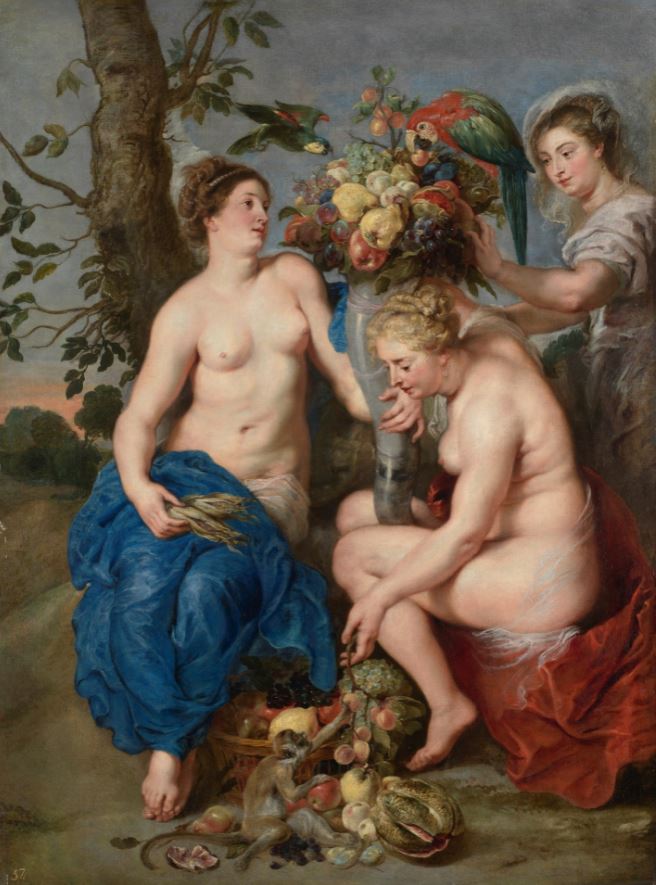
Three Nymphs with a Cornucopia by Peter Paul Rubens (1625 to 1628) Museo Nacional del Prado, Madrid

More interesting to me, more persuasive and touching, is the information that Juno, in this huge representation of ‘The Birth of the Milky Way’ resembles Helena Fourment, Rubens’s second wife.

According to the curators, it is thought that his happy second marriage to Helene inspired his increasingly sensuous presentation of women during the 1630s. That seems to me a plausible and happy explanation of the plump sensuality of the nudes he painted in his final decade, just as Rembrandt’s love for his wife shine through his later paintings. I’m not sure anybody portrayed in a painting, male or female, has any ‘agency’. In my opinion they’re all trapped by composition, design, treatment, by the artist’s aims and whims, and all subject to the human gaze of us, centuries later, completely cut off from the value systems in which these works were created.

But paintings very much can convey tenderness and love. And that’s what I found in this small room full of magnificent works of art. The milk of human kindness. Motherly love. The pure, naked, redemptive love we all wish, deep down, we could recapture.

The Birth of the Milky Way by Peter Paul Rubens (1636 to 1638) © Photographic Archive, Museo Nacional del Prado, Madrid

Happily ever after

In fact this final wall caption made me realise that mention of Rubens’ second wife had been seeded throughout the show, starting with early mention of how, after the early death of his first wife, in 1630 Rubens married his second and much younger wife, Helena Fourment (1614 to 1673).

‘Their blissful marital state in the final decade of his life, during which time they had five children, provided a wellspring of love and an increased interest in sensual mythological themes.’

In a world afflicted with terrible pain and suffering it cheered me up to learn that this great artist was blessed with a long, happy, rewarding marriage. Good for him! And these images, painted late in his life, at the peak of his experience of art and life, however others may wish to interpret them, struck me as wonderfully accepting celebrations of beauty, humanity and love.

Rubens among his peers

I was struck by a quote from co-curator Dr Ben van Beneden which gives a pithy summary of three of Western Art’s Golden Greats:

‘If Raphael endowed his female figures with grace, and Titian with beauty, Rubens gave them veracity, energy and soul.’

Strong independent parrots

I noticed that one of the most powerful paintings in the final room, the Cornucopia, featured some beautifully vivid parrots pecking away at the fruit flowing from the horn, and this reminded me that the awesome painting of the Marchesa Maria Serra Pallavicino in the first room also features a parrot perched on her grand chair and bending down, twisting its neck in that inquisitive parrot way.

It occurred to me that maybe Dulwich’s next exhibition should be about ‘Parrots in Painting’. It could bring together depictions of a variety of strong, independent parrots who resist the human gaze to insist on their psittacine agency.

The video


Related links

Related reviews

Feminine power: the divine to the demonic @ the British Museum

This is the first major exhibition ever held at the British Museum focusing solely on goddesses – on female spiritual beings from mythological traditions from around the world – and it is absolutely fabulous!

Queen of the night relief, c. 1750 BCE, Iraq, painted clay © The Trustees of the British Museum

Questions about women and femininity

The exhibition sets out to ask questions about images and ideas of the divine: How do different traditions view femininity? How has female authority been perceived in ancient cultures? Are sex and desire the foundations of civilisation or their disruptors? To what extent do female deities reinforce patriarchal social systems or subvert them? What relevance to goddess from ancient or remote cultures have for us, here, today?

To ‘answer and explore’ these questions the exhibition brings together female divine and demonic figures feared and revered for over 5,000 years from traditions all round the world. It includes painted scrolls from Tibet, Roman sculpture, intricate personal amulets from Egypt, Japanese prints, Indian relief carvings, statuettes and figurines, alongside contemporary sculptures.

Ancient and modern

It’s important to realise that the exhibition combines ancient and modern. It brings together historical artifacts – ancient sculptures and sacred objects relating to female goddesses from all around the world – but also includes modern and recent works of art by contemporary female artists such as the renowned American feminist artist Judy Chicago, and the creations of less well-known woman artists from various cultures, such as this fearsome headpiece from India.

Dance mask of Taraka, workshop of Sri Kajal Datta (1994) India, papier mâché © The Trustees of the British Museum

The aim is to explore the multitude of ways in which femininity has been perceived, conceived, created and depicted across the globe, from the ancient world to today. The exhibition explores the embodiment of feminine power in deities, goddesses, demons, saints and other spiritual beings, associated with the widest possible range of human experiences and attributes, from sex and fertility, through wisdom, passion and nature, to war, mercy and justice.

18th century Chinese porcelain of Guanyin, the Chinese translation of Avalokiteshvara, the bodhisattva of compassion, with child and attendants © The Trustees of the British Museum

Treasures

What makes the exhibition so enjoyable is not necessarily its feminist aims (although many visitors will, of course, identify with these) but a much simpler factor. Recent British Museum exhibitions about Nero or Stonehenge featured fabulous objects but also a lot of run-of-the-mill coins or skeletons or shards of pottery. These were important because they tell us about the subject’s archaeology and history, but sometimes they can get a bit, well, boring.

Here, by contrast, having selected 50 or so of the most interesting, relevant or thought-provoking goddesses from traditions around the world, the curators were free to pick only the very best objects to represent them. Almost all of the objects are from the museum’s own collection and they showcase its extraordinary breadth and range. But more importantly, lots and lots of them are really beautiful or, if not beautiful, then striking and fascinating.

Statue of Venus, 1st to 2nd century Rome © The Trustees of the British Museum

I studied the labels and read the extensive feminist commentary but then I have read the same kind of thing thousands of times, and read it every day in the papers and hear it every day on the radio and TV. Discussions of gender and sexuality and gender stereotyping and #metoo and the gender pay gap and female empowerment and strong independent women and women pioneers in culture and science and sport are now part of the permanent background hum of modern life.

What is not an everyday experience is to be able to take a walk through the mythologies of the world, to savour the beauty and force of a carefully curated selection of exquisite and surprising and fascinating historical and cultural artifacts.

Not all the objects on display are masterpieces, but many of them are really, really beautiful, and all of them have fascinating stories to tell and many of them shed lights on countries and cultures I knew little or nothing about. The exhibition amounts to a kind of David Attenborough odyssey through the weird and wonderful products of the human imagination.

Mami Wata headpiece, Nigeria, early 1900s, painted wood and metal © The Trustees of the British Museum

Five themes

One of the curators explained that they went out of their way to consult far and wide, with heads of departments across the museum, with stakeholders and members, in order to draw up a long list of themes and subjects relating to female power. Alongside this they drew up a long list of objects to illustrate the themes, at the same time drafting a list of feminist commentators who might be interested in commenting on them.

The outcome of this long process of consultation and consideration has been to divide the exhibition into five themes, each of which is introduced and explained by the curators – and then a leading contemporary feminist was invited to contribute thoughts on the theme and reflections on the objects.

The five themes are:

  • Passion and Desire, introduced and analysed by Classics Professor Mary Beard
  • Magic and Malice, commented on by writer and podcaster Elizabeth Day
  • Forces of Nature, commented on by psychotherapist and campaigner against violence against women, Dr Leyla Hussein
  • Justice and Defence commented on by human rights lawyer Rabia Siddique
  • Compassion and Salvation commented on by writer, comedian and podcaster Deborah Frances-White

Thus each section each of the individual exhibits has two panels, one a factual description by the curators and one a subjective and thoughtful comment by the contributors. There are also some standalone video ‘thought-pieces’ of the five commentators giving their thoughts about women and power.

Creation and nature

To give an idea of the sheer number and range of goddesses and deities involved, this is a list of some of the exhibits in just the first section, devoted to ‘Creation and nature’.

  • Pele, the Hawaiian goddess of volcanoes with flaming red hair and a fiery temper
  • Sedna, the Inuit mistress of the sea
  • Lashmi, the Hindu goddess of abundance
  • Oshun, the Yoruba orisha of water, coolness and healing
  • Mami Wata, the mother water of African spiritual traditions
  • Izarami-no-mikoto, a creator deity of both creation and death in Japanese Shinto mythology
  • sheela-na-gigs, the primitive stone figures found in the Middle Ages across Britain, France and Spain
  • Papatūānuku, the mother earth figure of In Māori tradition, who gives birth to all things, including people

You get the idea. Not so much about the goddesses as such, but the impressive range and diversity of cultures represented.

Kali

The exhibition includes a newly acquired icon of the Hindu goddess Kali by contemporary Bengali artist, Kaushik Ghosh, the first contemporary 3D representation of Kali in the collection.

As one of the most prominent and widely venerated goddesses in India, this devotional image of Kali reflects the living tradition of her worship, important for millions of Hindus around the world today.

The statuette was commissioned especially for the exhibition, together with the London Durgotsav Committee, who run the annual Kali Puja festival in Camden, in Kali’s honour.

According to the curators: ‘Loved and feared for her formidable power and aggression, Kali is the goddess of destruction and salvation, who transcends time and death, destroys ignorance and guides her followers to enlightenment. Although superficially terrifying, the bloodied heads that she wears and carries represent her power to destroy the ego, setting her followers free from worldly concerns, and the belt of severed arms signifies that she liberates them from the cycle of death and rebirth, by the many weapons she wields.’

Kali Murti, Kaushik Ghosh, India, 2022. Image © The Trustees of the British Museum

Ancient and modern

There’s a kind of doubled or paired approach to everything. I’ve mentioned the way many of the exhibits feature a panel giving the historical and cultural facts, as written by the curators, and next to it a panel giving the more subjective view and reflections of the guest commentator. Doubling. Two perspectives.

But I mean it in another way as well, which is the curators’ deliberate juxtaposition of the very old and the very contemporary. This is announced right at the beginning of the exhibition (although it was only when the curator pointed it out that I understood it).

Right at the beginning of the ‘Creation and nature’ section they have two exhibits, not quite next to each other, a bit more subtly placed than that. One is a trio of Cycladic figurines of women, those primitive, flat faced half-abstract figures which date from as long ago as 3,000 BC.

A figurine of a woman, from the Cyclades, over 4,000 years old.

These are so beautiful as objects and shapes that I could look at them all day. Anyway, just round the corner from them the curators have hung a print titled ‘The Creation’ by the American feminist artist, Judy Chicago (born in 1939 and still going strong).

I needee a bit of help deciphering this but it is an image of a woman giving birth, taken from between her parted thighs, with her two breasts as hills on the horizon, one a volcano exploding. Obviously it’s heavily stylised, and features strata of creation on the right including sea life and, above them, lizards and apes and humans.

The Creation, Judy Chicago, USA, 1985, coloured screen print in 45 colours on black paper. Image © The Trustees of the British Museum

In other words, it’s a stylised image of the creation of life on earth. An interview with Chicago is quoted in which she jokes that Michelangelo’s famous image of the ‘Creation’ depicts a man (Adam) lying lazily on his back while a complacent God reaches out and touches his finger. Chicago wanted to counterpoint this patriarchal fantasy with a depiction of the more effortful, bloody and seismic moment of creation in a woman giving birth, but at the same time give it modern mythic overtones, reflecting our knowledge of geology and evolution.

So far so interesting and both works are examples of what I meant by saying that all of the exhibition’s artefacts are powerful and beautiful. It also exemplifies the juxtaposition of ancient and modern I was talking about.

History and art

But it is a dichotomy or duality on another level, as well, which is that the Cycladic figures are conventionally thought of as being of predominantly archaeological and historical interest whereas the Chicago piece is clearly a modern ‘work of art’.

So the curators are enacting another form of doubling: they have deliberately mixed together works which come from the staid academic world of history and anthropology with living works of art.

So there are, arguably, three sets of pairing or doubling going on throughout the exhibition: ancient and modern, curator and commentator, history and art.

These juxtapositions set up forcefields of energy between ancient objects of worship and veneration whose purpose was clearly ‘religious’ and modern works of art whose purpose is, well, what?

In her speech the curator said she was explaining the difference between the consciously ‘sacred’ objects (depicting goddesses and ritual) and the modern ‘profane’ art works to an exhibition sponsor, and the sponsor asked: ‘Is there a difference?’

Good question, and the exhibition provides a fascinating field of study for similar questions and reflections, either prompted by our own impressions as we stroll among these weird and wonderful objects, or by the factual summaries of the curators, or by the reflections of the feminist commentators, or by the vibrant juxtaposition of objects from such different times, places and cultures.

The visitor strolls not only between beautiful objects but amidst a complex matrix of factual information, aesthetic experiences, and intellectual discourses, jangling and buzzing, prompting all manner of thoughts and feelings.

Lilith

Take the figure of Lilith. Since the late first millennium AD, Lilith has been known in Jewish demonology as the first wife of Adam and the consort of Satan. Her origins are thought to lie in Mesopotamian demons. The exhibition includes several representations of this talismanic figure, including a ceramic incantation bowl from Iraq (500 to 800 AD), featuring a rare early image of Lilith in female form. Buried upside down under the thresholds of houses these bowls were inscribed with charms to protect the owners (who are named in the text) from demonic forces. They regularly name Lilith as a demon to be warded off, sometimes as grammatically singular and feminine, but also masculine or plural, one among many indications of the gender fluidity found in many mythologies.

Ceramic incantation bowl from Iraq (500 to 800 AD) © The Trustees of the British Museum

So far, so historical or archaeological. But the exhibition also includes a very striking sculpture of Lilith by American artist Kiki Smith, made in 1994. Smith’s sculpture is cast from the body of a real woman and the striking thing is that this life-size black metal sculpture is attached half way up the gallery wall. This would be a striking installation in a gallery of contemporary art but in the staid world of the British Museum with its glass cases carefully spotlighting tiny coins and bits of pottery, it makes a huge statement, visually and physically. The artist herself writes of her work:

Lilith becomes this disembodied spirit that goes off and wreaks havoc and doesn’t want to be subjugated. Here she is transcending gravity and the constraints of her body.

Yes, the legends about Lilith and the havoc she wrought we may or may not be familiar with. But it’s the fact that she is a life-size sculpture hanging upside down on the gallery wall which makes the statement.

Lilith by Kiki Smith (1994) image © Pace Gallery

The exhibition poster

Of all the objects in the exhibition, the Lilith sculpture is the one the curators chose to go on the poster and promotional material. Personally, I think that was a mistake. I think it would have been better, more accurate, to use a montage of 3 or 4 of the most striking objects to give a true sense of the exhibition’s breadth and diversity. It’s also a bit boring that out of all the cultures of the big wide world, the curators have chosen an artist from America. Disappointing. As if we don’t hear enough about American artists already. Would have been more genuinely diverse to promote a work by a Hindu or Nigerian or Inuit artist.

But then again, it is a strange and disturbing object. Maybe it recaptures, in our blasé culture, some of the shock and mystery and weirdness that many of the more obviously ‘religious’ objects on display conveyed to their contemporaries, long ago and far away.

Lots of goddesses

If nothing else, the exhibition shows that there have been lots of goddesses and female spirits, in all societies, at all times. In the second half of the show I noted a fourth kind of doubling, which is where the curators have a panel describing an important goddess in a general sense, and then introduce a specific instance of the goddess, drawn from their vast collection.

So there’s a curator panel describing the figure of Eve, explaining her provenance and significance in Christian theology; the curators then give an example of the iconography of Eve in the form of a striking woodcut by Renaissance artist Cranach the Elder. Then one of the feminist commentators gives a more subjective assessment of the importance of Eve in shaping and projecting ideas of femininity in the Christian tradition.

A similar two-panel treatment (general explanation, then specific artifact) was meted out to (to name just the ones that really struck me):

  • Radha (Hindu)
  • Ishtar (Babylonia and Assyria)
  • Aphrodite (Greece)
  • Lilith (Jewish-Christian)
  • Tlazo Iteotl (Aztec)
  • Hekate (Greek)
  • Circe (Greek)
  • Cihuateteo (Aztec)
  • Rangda (Bali)
  • Taraka (Hindu)
  • Sekhmet (Egypt)
  • Athena (Greece)
  • Luba (Congo)
  • Mahadevi (Hindu)
  • Kali (Hindu) Isis (Egypt)
  • Maryam (Islam)
  • Mary (Christian)
  • Guanyin (China)
  • Tara (Tibet)
  • Medusa (Greece)
  • witches (Christendom)

Women and gender identity

The curators assert that the representation of feminine power in world belief and mythology has played – and continues to play – an important role in shaping global cultural attitudes towards women and gender identity.

I suppose this is true of many places, still, but…. there’s something not quite right with that statement. On reflection I think it’s that the curators are pushing it a bit far when they say the exhibition explores or investigates the role religion, and female deities, goddesses and spirits have played in representing, defining, limiting and empowering women through the ages. To really properly do that would require a library full of books and studies of religious sociology and anthropology. To be blunt the exhibition, big and broad though it is, only scratches the surface of a vast, global, pan-historical subject.

As an example, the exhibition includes a section devoted to the Virgin Mary who is (obviously) the most prominent female figure in Christianity, itself the most widespread religion on earth. This section contains five artefacts connected with her veneration, which is more than most of the other goddesses get, but, still… It would obviously need quite considerably more than that to amount to a proper ‘investigation’ or ‘exploration’ of the role of Mary in defining and limiting women’s roles in Western society over the past 2,000 years. Vastly more. Thousands of books and objects. A huge exhibition could be devoted to Mary alone. And that’s just one among the 50 or 60 female deities on display here.

And that thought brings out the exhibition’s weakness, which is that a lot of the very broad (and very familiar) generalisations which the feminist commentators make about gender and identity are not really supported by the exhibits.

The curators tell you the facts about Rangda (Bali) or Taraka (Hindu) or Sekhmet (ancient Egypt) and then the commentators shoehorn onto them one of the handful of familiar feminist concerns about gender stereotyping or gender fluidity or the power of desire or women as strong independent figures and so on. Sometimes it works, sometimes it’s spot on. But sometimes it feels…contrived. You feel the unknowable weirdness of some of these objects, the strange worlds they inhabit and the fearsome spirits they represent are being hijacked to pad out a Guardian editorial.

A friend of mine, a designer, goes to lots of exhibitions and makes a point of never reading the labels. She likes to engage directly with the objects on display, unmediated by the curators’ editorialising. The commentators opinions are over familiar and tend to drag you into the squabbling world of the modern media and culture wars and twitter and so on.

Whereas the exhibition’s great strength is the way the objects themselves open doors in your head to weird and wonderful otherplaces and otherminds, leading you through the looking glass, through the back of the wardrobe, into a huge range of times and places and cultures.

And the way these beautiful or fascinating objects have been carefully juxtaposed with notable works of contemporary art to set up all kinds of resonances and vibrations. This – the often strange, haunting beauty of the objects themselves, and resonances set off by their artful positioning – is what I responded to, what I found very stimulating and rewarding.

(To be fair, the exhibition is accompanied by a big heavy catalogue packed with essays by feminist academics, and this does go into considerably more detail about the issues around women and gender and sexuality which the exhibition references. Read the catalogue blurb to get the publishers’ summary of it. ‘The publication concludes with a discussion of contemporary feminism…’)

The curators speak

Here are the voices of two women closely involved with the exhibition. Belinda Crerar, curator, British Museum, writes:

This exhibition is a tour through history and around the world to see the different ways that female power and authority have been perceived in spiritual belief. The diversity of these goddesses, spirits, enlightened beings and saints, and their profound influence in people’s lives today and in the past, gives us pause to reflect on how femininity – and indeed masculinity – are defined and valued now and in the future.

Muriel Gray, Deputy Chair of Trustees of the British Museum, writes:

The Citi exhibition Feminine power: the divine to the demonic is brimming with magic, wisdom, fury and passion. I am very proud that through the breadth and depth of the British Museum’s collection, alongside special loans, we can tell such powerful and universal stories of faith and femininity from the most ancient cultures to living traditions around the world. I would like to thank Citi, whose ongoing support has allowed the Museum to realise this ground-breaking exhibition.

A word from our sponsor

The exhibition is sponsored by Citi. Citi is the swish new name of what used to be Citigroup Inc, an American multinational investment bank and financial services corporation headquartered in New York (where Kiki Smith lives and works). A spokesman for the bank writes:

As a global bank, our mission is to serve as a trusted partner to our clients by responsibly providing financial services that enable growth and economic progress. Success in our mission is only possible if we can continue to foster a culture of equality and inclusion that enables and encourages diversity of thinking. To drive that message of equality and the power and influence of women over time, we are delighted to see the Museum use its collection, along with some spectacular loans, to create a thought-provoking look at the diversity of representations and complex meanings of the divine female over time.

So the exhibition, which the curators and contributors like to see as ‘subverting’ the patriarchy and ‘questioning’ masculinity and ‘interrogating’ gender stereotypes etc – is wholeheartedly aligned with the values of American multinational investment banks and financial services corporations.

Whether you like it or not, ‘equality’ and ‘inclusion’ and ‘diversity’ are now fully integrated into the lexicon of international capitalism, and it is money from American capitalism which makes possible exhibitions like this, makes possible the curators’ good intentions and the feminist commentators’ ‘subversive’ comments. What do you think of that, O goddesses of fire and flood and fury?

Tiare Wahine, Tom Pico, Hawai’i, 2001, Ohi’a wood © The Trustees of the British Museum

I’m not especially singling out this exhibition. It’s the same kind of irony which meant that the huge sculpture lamenting the transatlantic slave trade made by the American artist Kara Walker (also based in New York) was hosted at Tate Modern, a gallery founded by sugar plantation owner Henry Tate who, although he never owned slaves, made a fortune out of black labourers descended from slave in the Caribbean, whose name the Tate organisation insists on retaining despite protests.

Or that until recently Tate, whose exhibitions routinely campaign for a better world, was funded by BP, the oil corporation, which is actively engaged in destroying the world.

Ditto the National Portrait Gallery, which is only ending its funding by BP this year, having only just noticed global warming and oil companies’ role in creating it.

Or that the Serpentine Gallery in London has only just (2021) dropped ‘Sackler’ from its name because of the Sackler family’s involvement in selling the opioid painkillers which have made large numbers of Americans into addicts, wrecking hundreds of thousands of lives. (A link I was making two and a half years ago, Patrick Staff: On Venus @ Serpentine Sackler Gallery.)

In fact I attended a press launch of an exhibition at the Serpentine Sackler Gallery which was addressed by its Chief Executive, Yana Peel, and I squirmed a bit as she imperiously lectured us about sexism and racism (it was the exhibition by African-American female artist Faith Ringgold). So I was all the more surprised and amused when Peel was then forced to step down from her post after the Guardian revealed her involvement in ‘the NSO Group, an Israeli cyber intelligence company whose software has allegedly been used by authoritarian regimes to spy on dissidents’.

And then, of course, there are the many, many art galleries and cultural institutions which have spent the last 30 years deeply entwining themselves with the money or support of Russian oligarchs. Russia. Oligarchs. Putin. Nice company to keep.

So I’m just adding this exhibition to the many which promote high-minded values about gender and race, and advocate for sweeping social change, while being funded by money from harmful or immoral or deeply reactionary sources. You’d have to have a heart of stone not to find this kind of irony hilarious. There’s no point getting upset, it’s the way of the modern world. But you are allowed to smile at the ironies.

For young readers

There is, of course, a sumptuous catalogue accompanying the exhibition, but a book has also been written for younger readers, what the press release describes as a ‘fascinating and empowering introduction to 50 female figures from around the globe’, entitled Goddess: 50 Goddesses, Spirits, Saints and Other Female Figures Who Have Shaped Belief, written by Janina Ramirez and illustrated by Sarah Walsh.


Related links

Other British Museum exhibitions