The Barber in London: Highlights from a Remarkable Collection @: the Courtauld Gallery

The Barber Institute in Birmingham is home to an internationally significant art collection. While the Institute is closed for major refurbishment (reopening in 2026) it has loaned 21 of its greatest paintings to the Courtauld Gallery in London. Fifteen of these have been given their own exhibition space on the third floor, while three others have been slipped into the permanent collection on the second floor, alongside similar works.

The 15 paintings in the main display have been carefully selected to convey the chronological range of the Institute’s collection and, at the same time, showcase successive styles and subjects in Western art. I divided them up into 9 classical or pre-modern works, and 6 modern. They are:

Classical

  1. Giovanni Bellini – Saint Jerome in the Wilderness (around 1445-60)
  2. Jan Gossaert – Hercules and Deianira (1517)
  3. Frans Hals – A Portrait of a Man Holding a Skull (1612)
  4. Nicolas Poussin – Tancred and Erminia (1634)
  5. Peter Paul Rubens – Landscape in Flanders (1635-40)
  6. Claude Lorrain – A Pastoral Landscape (1645)
  7. Thomas Gainsborough – The Harvest Wagon (1767)
  8. Élisabeth Vigée le Brun – Portrait of Countess Golovina (1800)
  9. J.M.W. Turner – The Sun Setting Through Vapour (1809)

Modern

  1. Gabriel Dante Rossetti – The Blue Bower (1865)
  2. James McNeill Whistler – Symphony in White, Number III (1865-7)
  3. Edgar Degas – Jockeys Before the Race (1879)
  4. Claude Monet – The Church at Varengeville (1882)
  5. Henri de Toulouse-Lautrec – A Woman Seated in a Garden (about 1890)
  6. Max Pechstein – Still Life in Grey (1913)

On the second floor

  1. Anthony van Dyck – Ecce Homo (1625)
  2. Sir Joshua Reynolds – double portrait Maria Marow Gideon and her brother William (1787)

Gallery

I’ve chosen four of the eighteen to comment on. First the curators’ official commentary, then my opinion, in italics.

Saint Jerome in the Wilderness by Giovanni Bellini (around 1445-60)

One of the first Venetian landscapes and one of the earliest known paintings by Giovanni Bellini as he set off on his 60-year career. The subject is Saint Jerome (about 342-420 AD), an early Christian theologian, one of the four ‘Doctors of the Church’, who spent some time in the wilderness, fasting and praying, and around whom numerous legends accumulated, one of them being that he pulled a thorn from the paw of a lion before delivering a long sermon on the blessings of Christianity. As Jerome was a scholar, paintings of him were popular with high-class, humanist patrons. The theme brought together the worlds of religion and classical culture.

Saint Jerome in the Wilderness by by Giovanni Bellini (1445-60)

This painting epitomises some of the many reasons I dislike Italian renaissance painting, including the crudeness of the draughtsmanship and the crudeness of the Christian proselytising. But the main reason I am averse to Italian Renaissance art is the barren aridness of the landscapes. I love the lush green landscapes of the northern Renaissance, dotted with all kinds of wild flowers. Here there are no flowers. Maybe that’s a wheat field in the background but it feels like a desert, and this is emphasised by the raw (and improbable) contours of the saint’s hideaway. It feels arid and barren.

The Harvest Wagon by Thomas Gainsborough (1767)

This lovely painting shows a group of rustic figures travelling in a harvest wagon at the end of the working day. The figures are unusually prominent for Gainsborough’s landscapes and are the result of careful study. Two of the women are based on the artist’s daughters, Mary and Margaret, while the landscape is inspired by the countryside around Bath where Gainsborough lived. Unlike his commissioned portraits, Gainsborough painted such landscapes for his own pleasure or as a speculation. This picture was given to his patron and friend Walter Wiltshire when the artist moved to London in 1774, as thanks for the presentation of the grey horse shown here.

The Harvest Wagon by Thomas Gainsborough (1767)

The image has two major elements: the first thing which I saw and enjoyed was Gainsborough’s characteristically ‘feathery’ leafed trees. A few summers ago I went swimming every day at the lido surrounded by trees on Tooting Common and spent the best part of an hour looking up at the trees and leaves, admiring the complex patterns they made as they shimmered and waved in the sun. Gainsborough’s trees always remind me of that strong visual memory.

Then there’s the people. As the curators say, it has an unusually large number of people and their position is unusually dominant and this is emphasised by the lines of the composition, namely the way the figures beside and on the wagon form a diagonal on the right, and to some extent on the left, creating a sort of pyramid effect. This is echoed by the line of the rearing horse at the front. If you drew a line from the horse’s knee through its neck it would closely mirror the line of the woman reaching up on the right of the wagon. All this reaching and rearing give the picture a dynamism unusual in Gainsborough’s usually placid compositions and make it all the more pleasing.

The curators tell us that the complicated composition of the people derives from an unexpected source, namely Peter Paul Rubens’s Descent from the Cross, which Gainsborough copied around this time. Fascinating to learn, my own personal spin would be that it shows Gainsborough translating 17th century European ideology (Catholic Christianity) into an Enlightened and very English painting of sensibility.

Portrait of Countess Golovina by Élisabeth Vigée Le Brun (1797-1800)

Vigée-Lebrun was Marie Antoinette’s favourite artist but when the French Revolution broke out she fled to Russia. Here, in the late 1790s, she befriended the countess Varvara Nikolaevna Golovina (1766–1821). She described Golovina as a ‘charming woman’ who was a talented musician and artist, and a lover of literature. The spontaneous and informal pose conveys Golovina’s lively intelligence and a sympathetic engagement between the two women. The compact octagonal format and the simple setting, with just one diagonal shaft of light behind the figure, reinforce the portrait’s intimacy.

Portrait of Countess Golovina by Élisabeth Vigée Le Brun (1797-1800)

This is the standout image of the show, which is why it appears on the poster and all the promotional material. It is stylised and sentimentalised but, nonetheless, everything about it is exceptional. The extremely simple backdrop with the one shaft of light across it reminded me of the stark, early classical paintings of contemporary French painter Jacques-Louis David. I wonder if they knew each other and if there was any influence.

The Blue Bower by Gabriel Dante Rossetti (1865)

The model for this amazingly colourful and sensual painting was Rossetti’s mistress, Fanny Cornforth. The cornflowers at the front refer to her name and the passion flowers suggest her fiery character. But the image is more a hymn to beauty than a portrait. A bower is a private setting for lovers and Rossetti has decorated it with exotic elements suited to a frankly amorous encounter. The tiles combine a Chinese cherry blossom motif with an Arabic shape and at the front is a Japanese stringed instrument, the koto.

The subject derives from 16th-century Venetian portraits of courtesans by artists such as Titian but instead of Titian’s relatively loose handling of paint, Rossetti treats every element of the picture with a Pre-Raphaelite attention to detail. Rossetti’s work is a celebration of sensuality and aesthetic indulgence that went against the grain of Victorian narrative painting and, indeed, morality, triggering much moralising criticism.

The Blue Bower by Gabriel Dante Rossetti (1865)

It certainly is a visual orgy of sensuality, of soft velvet, sumptuous furs and flowing auburn hair. But what really stands out is the way the subject is no frail and feeble Victorian heroine but a big, strong figure, filling the canvas; after a while you realise the central feature is her strong, wide, rippled neck. It is a bower of bliss but built for muscular encounters.

A bit more about Barber

The Barber Institute of Fine Arts was founded as a university gallery in 1932, the same year as The Courtauld Institute of Art and its collection. Both were intended to encourage the study and public appreciation of art.

The Barber was founded by Hattie, Lady Barber (1869–1933) in memory of her husband, Sir Henry Barber (1860–1927), a wealthy Birmingham property developer and lawyer. Lady Barber did not herself possess a significant collection of art. Instead, she created an endowment that allowed its directors to acquire works ‘of that standard of quality required by the National Gallery and the Wallace Collection’. For for nearly 100 years this founding vision has shaped a carefully selected collection of major works that represent key developments in the history of Western art.

The Institute’s holdings now include some 160 paintings, dating from the early Renaissance through to the late 20th century, more than 800 works on paper, as well as sculpture, decorative arts and one of the most important caches of Roman, Byzantine and Medieval coins in the world.

Lady Barber’s bequest also financed the construction of an elegant, Grade-1 listed building on the University of Birmingham’s Edgbaston campus. Designed by the architect Robert Atkinson (1883–1952), it opened to the public in 1939 with just 14 paintings on display. Intended as a nucleus for the arts and a social hub for the University, the Barber also has an Art Deco concert hall at its heart, as well as a lecture theatre and art history library, and houses the University’s Department of Art History, Curating and Visual Studies.

The Barber Institute of Fine Arts

Promotional video

Curator’s highlights

Highlights explained by curator Dr Chloe Nahum, Bridget Riley Art Foundation Curatorial Fellow at The Courtauld.


Related links

Related reviews

Kerry James Marshall: The Histories @ the Royal Academy

This is a massive, probably epoch-making exhibition, but which I found troubling and repelling for reasons I’ll try to explain later, in part 2 of this review. First I’ll try to give you all the information and as many images as I can so that you can make your own mind up.

Kerry James Marshall

Kerry James Marshall is, according to the curators at the Royal Academy, ‘America’s most important artist‘.

This huge exhibition of Marshall’s enormous paintings at the Royal Academy is the largest ever held outside the US and so the first chance for most of us Brits to experience his works in the UK.

Exhibition structure

The exhibition includes 70 works, primarily paintings, as well as examples of the artist’s prints, drawings and sculpture, from museums and private collections across North America and Europe.

It includes a dramatic new series of paintings made especially for the show.

The show marks Marshall’s 70th birthday (born 17 October 1955).

Marshall works in series and cycles. The exhibition brings together 11 groups of works made between 1980 and the present, displayed in 11 galleries.

For your information I’ll give the curators’ wall labels to each of the 11 rooms verbatim, distinguished from my commentary by being indented.

Gallery 1. The Academy

The works in this room feature scenes from art schools, studios and museums – places, like the Royal Academy, where artists study, create and exhibit their work. There is a deep fascination in Western art with the studio as the locus of production and the museum as the repository of wonders. Adding to this tradition, Marshall transforms it by centring Black figures as both producers and consumers.

The painters he depicts are masters of their medium and materials. The model in ‘The Academy’ strikes a pose reminiscent of the American athletes Tommie Smith and John Carlos at the 1968 Summer Olympic Games. On the student painter’s table there is a preparatory sketch of the model as well as a ‘nkisi nkondi’ ‘power figure’. In ‘Untitled (Studio)’, a painter adjusts the position of her model to match the picture in progress.

Untitled by Kerry James Marshall (2009) Yale University Art Gallery © Kerry James Marshall

These works emphasise the decisions artists make in composing and completing their work: whether to paint precisely or loosely, whether to render objects flatly or with more volume, and how to arrange colours. Marshall uses various black pigments to depict skin colours, layering, or placing side by side, ivory black, Mars black and carbon black, mixing in other colours to render black fully chromatic. As he has said, ‘if you say black, you should see black’. While his blacks are complex, Marshall rarely attempts to depict the browns of real skin tones. His figures are at once individual characters and examples of an emphatic Blackness, real and rhetorical, and as such, provoke wider questions about the idea of Black figures in art.

The Academy by Kerry James Marshall (2012) Collection of Dr. Daniel S. Berger © Kerry James Marshall. Image courtesy of the artist and Jack Shainman Gallery, New York

Gallery 2. Invisible Man

Marshall’s family moved from Birmingham, Alabama, to Los Angeles in 1963. In 1965 he visited the Los Angeles County Museum of Art on a school trip. In 1968 he was selected for a summer drawing workshop at the Otis Art Institute, where he first encountered the work of Charles White and committed to becoming a full-time student there after high school. He enrolled at Otis in 1977 and received his BFA in 1978.

The 1970s was a volatile period at Otis, and within the art world in general. Conceptual artists were abandoning painting; some artists associated with the Black Arts Movement were distancing themselves from European art traditions and devoting themselves to political works aimed at uplift and protest.

Not to be deterred, Marshall continued his pursuit of an education dedicated to maximising the knowledge and skills associated with the best results in picture making. When the time was right, these could be put to effective use. That time arrived after he read Ralph Ellison’s 1952 novel ‘Invisible Man’. In the novel, the protagonist feels he is invisible because he is not seen as desirable in American society. This idea inspired Marshall to begin a series of works in which Black figures are set against a dark ground, so that they become almost invisible to the viewer. The first of these was made with egg tempera, a medium strongly associated with Sienese painters like Duccio, and later revised by artists like Ben Shahn.

In this first major cycle of images, Marshall also explored histories of racial stereotypes and caricatures, choosing to render his figures in black paint. From this point on, his figures function rhetorically, raising questions about Black absence and presence both in society and in art history.

Installation view of Kerry James Marshall: The Histories @ the Royal Academy showing two of the invisible man paintings – if you look closely you can see the white teeth and white eyes of the invisible man (photo by the author)

Gallery 3. The Painting of Modern Life 1

The two largest galleries are devoted to Marshall’s ambitiously composed, large-format paintings that record scenes of everyday life in Black America.

In the nineteenth century, French artists like Édouard Manet and Georges Seurat transformed the genre of history painting to render scenes of modern life on an epic scale. Made on unstretched canvases and secured to the wall with grommets, the paintings in this room date from the early to mid-1990s, when Marshall, having relocated to Chicago and settled into a studio, began to make his own paintings of everyday life: children playing, lovers dancing, families enjoying a day in the park.

‘De Style’ (1993), showing a group of Black men in a barber’s shop, was the first work of Marshall’s to be acquired by a museum, and is both an amalgamation of established art historical styles and a monument to Black style.

De Style by Kerry James Marshall (1993) Los Angeles County Museum of Art © Kerry James Marshall. Photo: © Museum Associates/LACMA

A year after completing it, Marshall embarked on the works in his ‘Garden Project’ series, three of which are shown here. These look back to the American public housing projects named ‘Gardens’ whose first residents included families, like Marshall’s own, who had migrated from the South and settled in the north and west of the United States from the 1940s. Made at a time when many housing projects were suffering from a lack of resources, the images convey the hopes of the past and the resilience of residents in the 1990s.

OR:

Deeply influenced by artists such as Edouard Manet, Gustave Caillebotte, Georges Seurat and other painters of modern life, and conscious of the absence of large-scale images of daily life in the work of many Black artists before him, Marshall depicts Black families picnicking in the park, lovers dancing, children playing in communal gardens, and friends hanging out in hair salons, for example in School of Beauty, School of Culture, 2012 (Birmingham Museum of Art, Birmingham (AL)).

Installation view of Kerry James Marshall: The Histories @ the Royal Academy showing three of the Garden Project paintings (photo by the author)

At the centre of this room hangs the vast Knowledge and Wonder, 1995 (Legler Regional Library, Chicago Public Library, Chicago), Marshall’s largest painting to date, exhibited for the first time outside of Chicago.

Knowledge and Wonder by Kerry James Marshall (1995) City of Chicago Public Art Program and the Chicago Public Library, Legler Regional Library © Kerry James Marshall. Photo: Patrick L. Pyszka, City of Chicago

Gallery 4. Middle Passage

The five paintings in this room were made in the early 1990s and constitute Marshall’s first attempt to address the history of the Middle Passage – the treacherous crossing of the Atlantic Ocean, during which many captive Africans died before reaching the slave markets in the Americas. It is a history understood in fragments, and accordingly, instead of making works functioning like costume dramas, Marshall composes paintings with disparate images, motifs and textures, incorporating symbols and diagrams derived from Yoruban religion, Voodoo and other syncretic religions that were practised across the African diaspora as acts of defiance as well as to maintain connections to Africa.

Installation view of Kerry James Marshall: The Histories @ the Royal Academy showing Great America (left) and Plunge (right) (photo by the author)

Before embarking on the series, Marshall completed a group of woodblock prints called ‘African Powers’, imagining six Yoruban orishas – divine spirits or gods.

Installation view of Kerry James Marshall: The Histories @ the Royal Academy showing the six African Powers woodblock prints (photo by the author)

He had also recently worked as the production designer on Julie Dash’s film ‘Daughters of the Dust’ (1991), for which he constructed sets including bottle trees and grave markers that were derived from African religious traditions. The dream-like structure of the film has an affinity with some of the paintings here.

A section bringing together imagined portraits of historically significant Black figures such as Scipio Moorhead and Harriet Tubman, question how historical portraits can be created in the absence of archives and earlier representations of individuals.

Gallery 6. Vignettes

For Marshall, every historical genre and style of painting is ripe for reinvention, and in a long-running open series he has looked back to romance pictures, challenging himself to make serious and layered paintings with apparently light-hearted subject matter. The first ‘Vignette’, dating from 2003, was a landscape in the manner of Henri Rousseau set in an American park, showing a naked couple wearing jewellery related to the Afrocentric movement. In the later ‘Vignettes’, Marshall reworked the compositions of French Rococo artists like Jean-Antoine Watteau and Jean-Honoré Fragonard.

By painting romantic scenes, Marshall produces images of resistance. ‘Breeding’, not marriage, was encouraged by some slave owners as a way of increasing their wealth and workforce.

Vignette #13 by Kerry James Marshall (2008) Susan Manilow Collection © Kerry James Marshall. Image courtesy of the artist and Jack Shainman Gallery, New York

Although the paintings are filled with flowers and lovebirds, the various scenes are marked in other ways by signs of protest, including burning tyres and political flags. Surrounded by pink brushstrokes and presented as dream scenes, the works also raise the question of whether Black couples can really relax in public spaces or if this idea remains an illusion.

Central Hall. Souvenirs

In 1998, Marshall produced a suite of paintings, photographs, sculpture, prints and video for the exhibition ‘Mementos’ at the Renaissance Society in Chicago – four paintings are reunited here for the first time since their debut. The paintings are set in the middle-class houses of Marshall’s friends and relatives. One is the house of his mother-in-law. Decorations in their living rooms included tributes to the assassinated Kennedys and Dr Martin Luther King Jr. The works concern the ways in which the tumultuous decade of the 1960s, marked by unfulfilled optimism and political upheaval, might be commemorated in the 1990s.

Of the four large horizontal-format paintings in the group, the first two, in full colour, memorialise political and activist martyrs, who are silkscreened as a frieze across the top. The other pictures, rendered in grisaille, expand the tribute to recognise the importance of cultural heroes who died between 1959 and 1970, bracketing the 1960s. As well as thinking about glittery greetings cards, Marshall wanted to transform the genre of Renaissance Annunciation paintings, where the archangel Gabriel appears in Mary’s home to tell her she will give birth to Jesus. The angels in these paintings call on us to remember. They appear somewhat exhausted by the process of assessing the unrealised dreams or real achievements of these political protagonists and cultural heroes.

Lecture Room. The Painting of Modern Life 2

In the 2010s Marshall continued to construct powerful scenes of everyday life. The settings were parks, nightclubs, homes, city streets and art galleries. He often reworked arrangements and elements from famous paintings, none more prominently than when he transformed the anamorphic skull in Hans Holbein’s ‘The Ambassadors’ (1533) into a distorted Sleeping Beauty, disturbing the space of a salon in ‘School of Beauty, School of Culture’, a sister work to his earlier barber’s shop painting ‘De Style’.

School of Beauty, School of Culture by Kerry James Marshall (2012) Collection of the Birmingham Museum of Art, Alabama © Kerry James Marshall. Courtesy of the artist and Jack Shainman Gallery, New York. Photo: Sean Pathasema

Some paintings here refer to specific moments from the past, such as the crowning of Gloria Smith as the second Miss Black America at the height of the ‘Black Is Beautiful’ period in 1969.

Others provoke questions about Marshall’s own time: ‘Untitled (Policeman)’ (2015) was made shortly after the beginning of the Black Lives Matter movement when protesters campaigned to ‘defund the police’. Together, these paintings express a wide range of Black experiences of and attitudes towards America, from deep joy to a profound, uneasy ambivalence.

Untitled (Policeman) by Kerry James Marshall (2015) The Museum of Modern Art, New York © Kerry James Marshall. Photo: The Museum of Modern Art, New York/Scala, Florence

Gallery 7. Africa Revisited

Made specifically for this exhibition, the paintings here concern challenging moments in the recorded history of Africa, not often represented by artists. Five of them address the slave trade, showing people kidnapping children, rowing captives in a canoe to buyers out of scene, returning with all kinds of booty, and celebrating their successful trades. As with his previous works, several of these new paintings present confident Black people acting with agency. These figures are shown having sold slaves, driven by their greed for the consumer goods that Europeans supplied in exchange. Another painting depicts the murder of Shaka Zulu by his half-brothers in Zululand in 1828. Together, these paintings disrupt a view of the African past, providing a fuller picture of a complex history.

Installation view of Kerry James Marshall: The Histories @ the Royal Academy showing three of the Africa Revisited paintings (photo by the author)

Two final paintings depict the so-called ‘white queens’ of Africa, Colette Hubert and Ruth Williams, at their weddings to Léopold Senghor, the first president of Senegal, and Seretse Khama, the first president of Botswana. These scenes, showing real unions but with the details reimagined by Marshall, disturb narratives about the post-colonial period on the continent.

Gallery 8. Wake / Gulf Stream

Marshall first showed these two works together in 2003 at the Venice Biennale.

‘Wake’ centres on a black ship on a pedestal that stands for a black sea. While recalling the journey made by enslaved Africans, the work also suggests the growing power of Black cultural expression. Each time it is displayed, Marshall adds more medallions, representing the proliferating achievements of African Americans. The idea of accumulation comes from the ‘nkisi nkondi’, a type of Kongo ‘power figure’ into which users drove iron nails to increase its spiritual potency.

The painting ‘Gulf Stream’ was shown in front of ‘Wake’ in Venice. In it, Marshall revisits a painting by the American artist Winslow Homer, also called ‘The Gulf Stream’ (1899/1906), which featured a shipwrecked Black sailor whose boat is surrounded by sharks. Set off the coast of America in the present day, the friends in Marshall’s yacht here appear to be enjoying their day sailing, but storm clouds are visible on the horizon, indicative of unpredictable times ahead.

Installation view of Kerry James Marshall: The Histories @ the Royal Academy showing Wake (the sculpture on the floor) and Gulf Stream (the painting on the wall) (photo by the author)

‘Wake’ also encompasses ‘black light’ photographs of a slave ship, and plates commemorating the first cargo of twenty Africans brought to America, as well as one for William Tucker, the first person of African origin born in America in around 1624. Marshall represents Tucker with a photograph of himself as a teenager.

Installation view of Kerry James Marshall: The Histories @ the Royal Academy showing the plate from wake commemorating William Tucker but bearing a photo of the artist as a teenager (photo by the author)

Gallery 9. Red Black Green

In the works gathered here, Marshall deploys the colours of the UNIA (Universal Negro Improvement Association) or Pan-African Flag, created by Marcus Garvey in 1920, as well as the imagery and slogans of the Black Panthers from the late 1960s. But rather than straightforwardly celebrating Black Nationalism, Marshall constructs cheeky and layered works that also reference the connected histories of painting and erotica. Artists from Titian to Goya and Manet made famous canvases of reclining nudes. Marshall exchanges their female figures for a Black man who hides his genitals with a flag. Similarly, struck by the lack of Black women in American pin-up magazines, Marshall decided to make his own images.

One of his imagined models here becomes a ‘Black Star’. The painting also references the ‘Black Star Line’ – the shipping company that Marcus Garvey founded in 1919 to encourage commerce with Africa and the voluntary return of Black Americans to the continent. Gripping a star like a ship’s wheel, the woman here looks back like a model in a photoshoot. We are left to ask whether Garvey’s creations are now just useful for making stylish and sexy images, or if his political project remains relevant today.


Pros

1. Visitors The friend I went with pointed out that an unusually large number of the exhibition visitors were Black, and also young. This was noticeable because, no matter how much galleries go on about diversity and inclusivity, most of the exhibitions I go to have few if any Black visitors and are overwhelmingly populated with old white people. So this is Success if you’re trying to attract a younger, more diverse audience.

2. Black art She went on to say that if you’re a little Black girl or boy, and interested in art and go to galleries, it must be alienating or dismaying to see nothing but white faces in all the art works. You might end up feeling art is a White activity for White people. Whereas Marshall’s works clearly rectify that notion and would make you feel that art can very much be a Black interest and activity, after all.

3. Black presence The size of the paintings, their confident mix of classical examples with modern subject matter, their sweeping range over Black history from the dawn of slavery through key moments of American history, up to his numerous portrayals of everyday life in Black communities – all these triumphantly achieve his goal of restoring and emphasising a Black presence in art. So it’s a triumph.

But do you actually like any of it?

That said, she didn’t actually like any of the paintings on display. Usually we play a game of getting to the end of an exhibition, having read all the wall captions and absorbed all the information – then stroll back through the show selecting one key work from each room, and explaining why we like it more than the others.

But in this huge show neither of us saw any one work we liked in any of the rooms (with the possible exception of the six African Powers woodcuts, which I liked, up to a point). Neither of us chose any of the vast paintings because we didn’t really like any of them. We didn’t really enjoy looking at Marshall’s art. Big, colourful, striking, and in a good cause, sure, but…

So I get the point of the works, and they certainly succeed in fulfilling Marshall’s aims and agenda. But I felt alienated and outside all of them. Why? I think it’s for three reasons.

1. Blackness

It’s no use denying that the paintings’ insistence on Black Black Black was a problem for me for the simple reason that I am not Black. I don’t object or dislike the Blackness, I just don’t feel included. It feels like it’s for a different audience than me, which is fine, but explains why I didn’t feel engaged.

What puzzles me is that I really like specifically Black art. The London art gallery devoted to Black art, Autograph ABP, is one of my favourite galleries, and I go out of my way to review its shows. I absolutely loved shows there by:

To name a couple which really stick in my mind. I really liked Mary Sibande‘s brilliant show at Somerset House and who could forget the great Basquiat exhibition at Barbican? And I’ve really liked all the Afro-Futurism things I’ve seen, for example at the Barbican’s science fiction exhibition. So it’s not Black people or Black culture or Black art which troubled me, it’s something else.

2. American cultural imperialism

A big part of my abreaction is because it’s so American. In my opinion, British culture is super-saturated with American cultural products. In my youth we were exposed to a fair amount of Hollywood movies and TV shows, but this has now gone supersize with the explosion of streaming services, Disney, Netflix, Apple TV, HBO and hundreds of others. Then there’s the entire internet itself with its inbuilt bias towards American products and the American worldview. And then there’s American smartphones and social media which most people have willingly invited into their homes to record every aspect of their lives. And now we are about to be taken over by American artificial intelligence getting to know us better than we know ourselves.

In my opinion, the super-saturation of British culture with American products, ideas, technology and discourse ought to be resisted.

Instead of which British cultural curators and gatekeepers fall over themselves to promote American art and culture and movies and TV shows at every opportunity.

And, disappointingly, the same goes for academia where what used to be called Critical Theory has been superseded by various forms of identity theories (feminist theory, queer theory, Black theory, post-colonial theory) almost all imported from America, led by American academics (I was watching a video about Judith Butler recently, queen of Queer Theory) who speak to specifically American history and circumstances.

In my opinion this has two distinct negative consequences:

a) American culture swamps and obliterates British culture

The actual social and political and cultural situation of my country, England, gets swamped and lost in products, discourse and rhetoric which is and sounds American and stems from American history and politics.

So when I see yet another image of Martin Luther King or John fucking Kennedy, I just think, Fuck off. That’s your country, your history, your politics, your problems, you deal with them. I have my own country with its own history, politics and problems to deal with thank you very much.

b) Importing American culture means importing American politics

But there is a horrible historical inevitability here as well. In terms of social and cultural trends, America has often been seen as ahead of Europe; in some sense, America has often been seen as the future. So what do all these social, political and cultural trends get us? What is the shiny hi-tech America which British cultural guardians fall over themselves to promote, with its fabulous Oscars and Taylor Swift and woke activists, heading towards?

Donald Trump. Taken together, all the efforts of American feminists, queer and Black activists have ended up, through the mad irrationality of human society, handing power to an authoritarian moron and his henchmen. Fifty years of earnest American feminism has led up to… the revocation of Roe versus Wade and the ending of the nationwide right to abortion. All the Black Lives Matter calls to defund the police have ended up with… augmented powers for Immigration and Customs Enforcement (ICE) forces which now roam the streets like a semi-fascist militia, kidnapping and deporting people at will.

In other words, so many of these progressive causes in America, in the unique context of American history, politics, culture and society, have not only failed but triggered a huge and horrifying backlash.

My position is simple: I think of myself as left-wing. I support a woman’s right to abortion, I support LGBTQ+ rights, I sympathise with Black activists’ opposition to police brutality, and so on.

But I greatly fear that the wholesale importation of American cultural and political models and discourse into Britain risks triggering exactly the same white, heteronormative, masculine backlash here as has happened in the States, the followers of the new martyr Charlie Kirk. Why would we want to import the hugely conflicted culture wars which have brought America to the brink of some kind of civil war, into our own society?

And in fact it’s happening already. The rise and rise of Reform at the expense of the feeble Labour Party mirrors the rise of Trump’s MAGA movement within the Republican Party at the expense of the feeble Democrats.

It may seem grotesquely unfair to associate Kerry James Marshall with the rise of Donald Trump. All I’m saying is they both come from the same toxic culture. When I saw the images of Martin Luther King and John F. Kennedy I not only experienced a vast weariness with American pop history, but a premonition of how this all ends up.

I don’t want Reform, I don’t want the Conservative Party to adopt the tone and policies of Trump’s MAGA, and, in my opinion, one way to resist the rise of America-style authoritarianism is to insist on the difference between America and Britain. To insist on the specific Britishness of British social and political issues. To stop kowtowing before American cultural products and importing American discourse, with all its toxic resonances, into British culture.

3. The new figurativism

But just as impactful as all the above was that I was dismayed by the style of all these paintings, namely a return to a kind of naive realism, which I found dismaying. In the RA shop was a big expensive book about The New Figurativism. According to Google AI:

The new figurativism refers to the modern resurgence of figurative art, or art depicting recognizable subjects like people, in contemporary times, driven by a desire for greater artistic representation, a reflection of 21st-century realities, and a break from abstract art’s dominance. This movement allows for the exploration of social and personal identity, particularly for traditionally marginalized groups, and features bold, expressive styles often inspired by past movements like Neo-Expressionism.

Return to Representation: It marks a shift back to depicting the human form and recognizable scenes after a long period where abstract art was dominant.

Emphasis on Representation and Identity: A major driving force is a need for greater diversity and the ability to tell authentic stories from various perspectives, including those of people of colour, women, and LGBTQ+ individuals.

Relevance to Current Reality: The genre’s ability to capture and reflect the contemporary world makes it a potent tool for addressing social issues, expressing personal experiences, and engaging with contemporary culture.

Opportunity for Authenticity: It provides a powerful platform for artists to tell their own stories and to represent their communities in a way that abstract art cannot.

So on this definition, Marshall’s work is a prime example of the New Figurativism, both in style and very much in purpose, namely ‘to tell authentic stories from various perspectives, including those of people of colour’, in his concern to ‘represent his community’ and so on. As the Royal Academy curators put it, Marshall certainly:

makes visible those people who were so noticeably absent in the works that came before him.

But to [put my concerns in a nutshell, what is happening here is that woke political concerns are justifying a return to a deeply conservative, retro, anti-modern style of figurative painting. There are a few stylistic glitches and angularities which feebly gesture to the great innovations of the modernists a hundred years ago. But overall, it feels as if most of twentieth century art never happened.

I’ve just visited the van Gogh / Anselm Kiefer exhibition which is also playing here at the Royal Academy. I was thrilled by watching van Gogh develop his visual language and evolve his deployment of oil paint on an almost week-by-week basis; and dazzled at the enormous, thrilling innovations of Kiefer’s huge canvases clotted with surface detritus, stalks and twigs.

Coming from those thrilling and mind-opening innovations to Marshall’s deeply conservative, old-style, backward-looking figurativism felt like a big, big imaginative letdown.

Conclusion

As I said back at the start, Marshall’s art perfectly achieves his stated aim of putting the Black presence front and centre of his work, which has been enthusiastically taken up by galleries and commissions across the States and, I bet, will open doors for Black kids and teenagers and aspiring artists and just sympathetic gallery goers, to realise that they can do this, too, and that they have a voice and presence in the sometimes intimidating realm of ‘Art’. In terms of cultural politics it is an enormous success.

But in terms of actual aesthetics, of the style and value of what you actually see, I feel Marshall’s art represents an enormous step backwards, to a naively realist approach which erases everything I love and value about modern art.

So that’s the fundamental reason why I really didn’t like this exhibition.

Coda: Kerry Marshall and David Hockney

To take the race element out of the equation altogether, I feel the same when I look at David Hockney’s works from last 20 years or so. In the RA shop, next to a book about New Figurativism and umpteen books about Marshall, was a pile of books and merch celebrating Hockney’s dayglo renderings of the Yorkshire Wolds.

I flicked through one particularly enormous coffee table book and was staggered at how many there are, hundreds and hundreds of huge, vivid, simplistic pictures, I wonder if he’s done over a thousand by now, rattling them off on his ipad.

And as I flicked dispiritedly on, I thought: It’s as if the last 100 years or artistic experimentation never happened. A guy with a great eye and a love of bright colours is creating a never-ending stream of entertaining, easy-on-the-eye figurative paintings of a subject he loves; in Hockney’s case, the landscape of his beloved Yorkshire, in Marshall’s case, Black people, history, art and so on – and in both cases I can see that they’re big [both artists produce very big paintings, which is another rather dismaying aspect of contemporary art], bright and confident but… I just don’t like them.

And found myself thinking that this is anodyne, easy-on-the-eye, deeply reactionary, backward-looking anti-art, an art appropriate for an age which has lost any belief in the future and looks back to multiple pasts with a kind of crippling nostalgia, in both content and style.

Untitled (Porch Deck) by Kerry James Marshall (2014) Kravis Collection © Kerry James Marshall. Image courtesy of the artist and David Zwirner, London


Related links

Related reviews

Rubens and Women @ Dulwich Picture Gallery

This is a stunning exhibition bringing together over 40 paintings by one of the most famous names from the classic period of western art, Peter Paul Rubens (1577 to 1640). It brings together masterpieces from international and private collections, many of which are appearing in the UK for the first time i.e. it represents a unique opportunity for lovers of classic Old Master art. There are some really stunning paintings and a suite of exquisitely crafted chalk drawings on display. It is a feast for the eyes and mind and imagination.

Questioning the Rubenesque

However, it cannot be emphasised too strongly that it is very much a themed exhibition. It really is about Rubens and women.

The stereotypical view of Rubens is as a painter of ample, fleshly, nude women, hence the adjective ‘Rubenesque’, which the Collins dictionary defines as:

‘of, characteristic of, or like the art of Rubens; colourful, sensual, opulent, etc. 2. full and shapely; voluptuous; said of a woman’s figure.’

This exhibition very much sets out to question that stereotype and to show that Rubens painted a much broader range of female characters, in a far greater range of postures, poses and compositions, than the stereotype suggests. Which explains why the poster for the show is very much not of a plump scantily clad woman but of the impeccably buttoned-up Marchesa Maria Serra Pallavicino (see below).

Strong independent women

Not only that but, in line with contemporary feminist ideology, the exhibition is keen to emphasise that many of these women were far from being passive victims of the male gaze, but in all kinds of ways were, in real life, and in the iconography of the paintings, strong independent women possessed of that key quality of feminist theory, agency.

Portrait of a Lady (about 1625) by Peter Paul Rubens. Courtesy Dulwich Picture Gallery

Thus almost all the 40 or so pictures here are of women, with men playing only peripheral or negligible roles, if they appear at all.

There are paintings of women members of his family, rich influential female patrons, lovely chalk sketches of naked women, key women figures from Christian iconography, and the show builds to a tremendous climax with a final room showing four enormous oil paintings of women figures from classical mythology.

There are some men in some of the paintings, but they are always playing a secondary or negligible role. In the words of the press release:

‘The exhibition will be the first to challenge the popular assumption that Rubens painted only one type of woman, providing instead a more nuanced view of the artist who painted more portraits of his wives and children than almost any other, even Rembrandt. The exhibition reveals the varied and important place occupied by women, both real and imagined, in his world.’

Rubens’ changing style

In a more specialist, art history kind of way:

‘A further theme follows the evolution of the female nude in Rubens’s art. It demonstrates how Rubens’s early nudes were quite different in style from those he became famous for, tracing how he arrived at his preferred form through an engagement with sculpture, careful study of antique models and observation from life.’

Room 1. Introduction

Room one contains eight wonderful oil paintings. One is an early self portrait to introduce the man himself, and then, in line with the exhibition theme, seven portraits of women. First, some historical background:

‘Early in his career Rubens realised that his extraordinary ability to paint portraits could open doors. In May 1600, aged 22, he left Antwerp for Italy, where he stayed until 1608, employed by Vincenzo I Gonzaga, Duke of Mantua. This position afforded him opportunities to travel to Spain, Venice, Florence, Rome and to Genoa, where his qualities as a portraitist became fully apparent. Rubens’s dazzling and innovative portraits of noblewomen revolutionised the genre and cemented his relationships with wealthy and powerful patrons.’

The first room is dominated by an enormous, sumptuous and commanding full-length portrait of the Marchesa Maria Serra Pallavicino. No reproduction can convey the scintillating, dazzling richness of the oil paint which makes up this awesome, luxury portrait. It is deliberately placed to dominate the first room and announce Rubens’s supreme skill as a painter of power, money and women.

Marchesa Maria Serra Pallavicino by Peter Paul Rubens (1606) National Trust Collections, Kingston Lacy (The Bankes Collection)

Once you’ve gotten over the visual shock of this huge masterpiece, you can move on to process the six other paintings of women. There’s a further portrait of a powerful woman, Isabel Clara Eugenia, Infanta of Spain, though depicted in the outfit of a nun, a member of the Order of Poor Clares, reminding us that this was the period of heightened Catholic religiosity referred to as the Counter Reformation.

There’s a series of portraits of ‘unknown women’, resplendent in 17th century dresses, whose luxury fabrics are depicted with loving precision, obviously well-off though not aristocrats.

But maybe the most affecting paintings is the set of ‘intimate’ portraits depicting Rubens’ family, namely his first wife Isabella Brant (1591 to 1626) and eldest daughter, Clara Serena (1611 to 1623), both of whom died relatively young, his daughter at just 12.

Clara Serena Rubens, the Artist’s Daughter by (1620 to 1623) Private Collection

Room 2. Figuring Faith

The second room is a long corridor shape and contains paintings and drawings of a religious nature. Working for the Catholic rulers of Antwerp, Rubens was commissioned to create works designed to promote the Counter-Reformation, the Europe-wide movement to revive and reinvigorate Catholic faith, theology, institutions, and project the power of the Catholic monarchs who defended it.

However, in line with the exhibition’s theme of women, the 20 or so works on display here are for the most part not huge, grand, overpowering and religiose images; most of them are relatively modest in scale but what they do have in common is the curators’ wish to foreground Rubens’s treatment of women in the Christian stories.

The Virgin in Adoration before the Christ Child by Peter Paul Rubens (1616 to 1619) KBC Bank, Antwerp, Museum Snyders & Rockox House

It is quite drily funny how, no matter what the subject depicted, the curators insist that the female figures in them are the real stars, the real centres of attention, exercising agency and power in the way every 21st century feminist would approve of.

There’s a wall-sized digital print of an adoration of the Virgin, printed out and plastered on the wall, in which the Virgin is quite obviously receiving her dues from an array of grovelling men.

In a depiction of the Flight into Egypt, it is Mary who taking the ‘heroic’ role of protecting the baby Jesus.

‘Despite the sense of foreboding, and the shadowy rider visible on the horizon, Mary radiates calm.’

There’s an Ascension of Mary which features lots of men in 17th century clerical dress (actually the apostles) but all they can do is stare upwards in amazement at the Virgin taking off into the sky.

There’s two long narrow portrayals of women accompanied by skinny clerics and these turn out to be portraits of two women saints, Walburga and Catherine of Alexandria, strong independent saints.

There’s a study of Saint Barbara fleeing from her father, who has his sword drawn ready to kill her. Typical toxic patriarchy.

By now seeing everything through the eyes of the curators what we notice in a depiction of the ‘The Lamentation’ is that:

‘it is the women who model how we are to respond to this heart-breaking sight. Gazing at Christ, Mary Magdalen pulls at her hair in distress. The Virgin cradles Christ’s body and tenderly closes his eyes. At his feet are The Three Maries (Holy Women from the Bible).’

And at the centre of all this fuss, a dead white man, the best kind.

The Lamentation by Peter Paul Rubens (1614) Kunsthistorisches Museum Vienna, Gemäldegalerie

Denying the Rubenesque

The curators are at pains to emphasise that Rubens’ women are no more voluptuous than those of his predecessors. They are simply more life-like, their skin more convincingly elastic and believably warm. Rubens’ nudes aren’t plumper or more fleshly, they insist, just better painted.

It’s an interesting claim, and I suppose you couldn’t assess it for yourself without reviewing hundreds more works by Rubens and as many by his contemporaries. But the evidence of your eyes tends to suggest that the most striking of Rubens’ women, the climax of his development as displayed in the stunning final room, are chubby, well covered, however you want to express it. See room 4, below.

Room 3. Stone Made Flesh

‘The female nude was a subject of fascination and constant evolution within Rubens’s art. In Italy, Rubens intensively studied ancient sculptures, memorising their forms and postures. He also drew on the Renaissance artist Michelangelo who was similarly informed by ancient art. Recording observations in his notebook, Rubens devised a new type of vigorous, monumental, female nude.’

This room is the most scholarly of the three, an exploration of how Rubens’ modelling of the female figure evolved, especially after a visit to Rome early in his career. This includes a series of studies, finished paintings, a classical marble sculpture, a silverware design, sketches of classical statues, and one large finished oil painting, of Adam and Eve, to demonstrate his early handling of the female nude – all demonstrating his changing approach.

‘Rubens’s nudes became increasingly dynamic and lifelike throughout the 1620s and 1630s.’

All of these works are relatively small and require quite a bit more study and historical knowledge than the bigger, more attractive, finished oil paintings, certainly for an amateur like me.

Alongside these scholarly specimens are eight or so lovely chalk studies of female nudes. I love chalk or charcoal sketches of nudes, male or female. After all these years I still find something magical in the way the human form and shape, the lifeliness of a human body, its warmth and shape, the beauty and pathos of the bare forked animal, can be conveyed by lines of chalk on flat paper when crafted by a master.

All of them were, obviously, really good, but one in particular stood out for me and, despite the blare of the bigger, finished paintings, might have been my favourite thing in the show. After I’ve finished walking slowly through an exhibition, weighed down by the duty of reading the wall captions, I always turn around and walk back, liberated from facts and figures and free to like whatever takes my fancy.

I often play a game where I ask myself, if I can choose just one work from each room, which would it be? This is the one work I’d want to own from the whole exhibition. Scholars think it might be a study for Mary Magdelene, maybe leaning down to wash the feet of Jesus.

What grabbed me is the immense skill of the shading and cross-hatching, the use of black and white chalk, leaving most of the surface untouched and so parchment colour standing in for fleshtone, and how this technique, this skill, can make a person of flesh and blood appear in front of you. The depiction of her lower back, the curve of her bottom, the shading of the thighs and the shadow where her calves are tucking up under her thighs, the creases in the sole of her foot, the five little pinkies. The delicacy, the skill and the exactitude never cease to pluck my heart, make me gasp.

Study for Mary Magdalen by Peter Paul Rubens (1610s) British Museum, London

Room 4. Goddesses of Peace and Plenty

In line with their feminist slant the curators emphasise that:

‘The women Rubens depicts are not simply passive figures to be observed but active agents of their own destiny. Nowhere is this clearer than in the dramatic mythological narratives that he loved to paint. Inspired by the Renaissance paintings of Titian and the ancient stories of Ovid and Virgil, in these scenes the goddesses Venus, Juno and Diana are presented as strong and intelligent. It is no coincidence that Rubens’s depictions of powerful, peace-making women were created at a time when his homeland was ravaged by the Eighty Years’ War (1568 to 1648).’

Hence it is that the fourth and final room contains four huge and awe-inspiring paintings with mythological themes and reputedly depicting these active agents of their own destiny, namely:

  • Venus, Mars and Cupid (c. 1614) from Dulwich Picture Gallery’s own collection
  • Diana Returning from the Hunt (1615) from Staatliche Kunstsammlungen Dresden
  • The Birth of the Milky Way (1636 to 1638) from the Museo del Prado, Madrid, on display in the UK for the first time
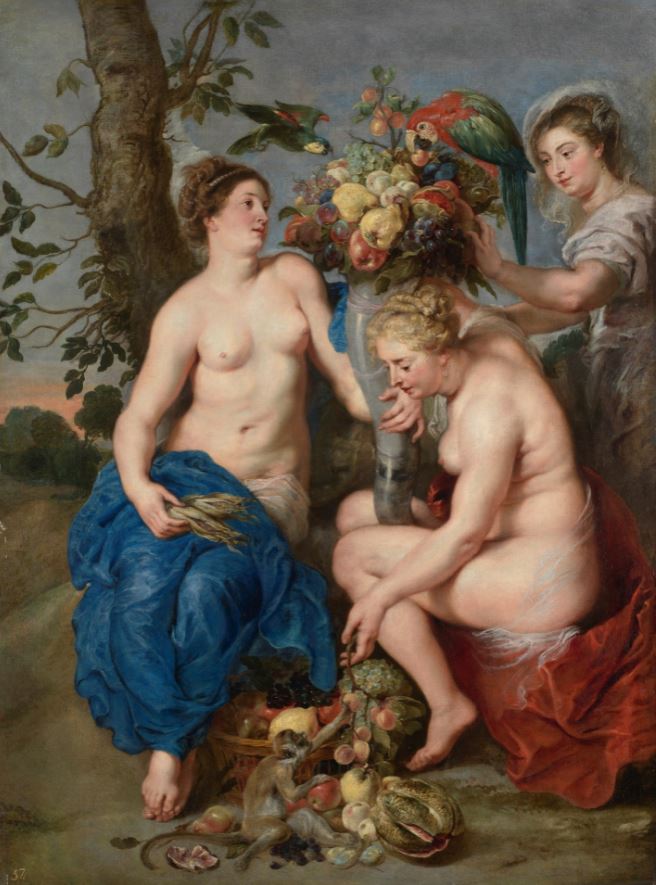
  • Three Nymphs with a Cornucopia (1625 to 1628) Museo Nacional del Prado, Madrid

The thing is that, although the curators try their best to claim that these women are not subject to the male gaze, but are strong independent women overflowing with agency, that’s not really how they actually look.

In my opinion this one, ‘Three Nymphs with a Cornucopia’ can be taken as a test case. It depicts the horn of plenty overflowing with the good things of life, namely a grocer’s shop full of ripe plump juicy fruit, so ripe and juicy that it has attracted the attention of scavenging parrots and a cheeky monkey, to add drama and narrative to a classical allegorical scene.

Is it just me or are the two naked women depicted as extensions of this vision of youthful fertile juicy fruitfulness?

I think they are. Far from asserting anyone’s agency, I’d have thought this picture epitomises the reverse: surely these women are totally objectified, depicted  in all their youthful sexiness as direct extensions of the world of fruit and fecundity.

This is one of eight paintings Rubens took to Spain as a gift from his patron, the Archduchess Isabel Clara Eugenia, to King Philip IV, to butter him up. Made by a man to flatter a king, far from being a rebuttal it strikes me as being a kind of triumph of the male gaze – sexy topless fruitful babes designed to decorate on the walls of the most powerful man in Europe.

Three Nymphs with a Cornucopia by Peter Paul Rubens (1625 to 1628) Museo Nacional del Prado, Madrid

More interesting to me, more persuasive and touching, is the information that Juno, in this huge representation of ‘The Birth of the Milky Way’ resembles Helena Fourment, Rubens’s second wife.

According to the curators, it is thought that his happy second marriage to Helene inspired his increasingly sensuous presentation of women during the 1630s. That seems to me a plausible and happy explanation of the plump sensuality of the nudes he painted in his final decade, just as Rembrandt’s love for his wife shine through his later paintings. I’m not sure anybody portrayed in a painting, male or female, has any ‘agency’. In my opinion they’re all trapped by composition, design, treatment, by the artist’s aims and whims, and all subject to the human gaze of us, centuries later, completely cut off from the value systems in which these works were created.

But paintings very much can convey tenderness and love. And that’s what I found in this small room full of magnificent works of art. The milk of human kindness. Motherly love. The pure, naked, redemptive love we all wish, deep down, we could recapture.

The Birth of the Milky Way by Peter Paul Rubens (1636 to 1638) © Photographic Archive, Museo Nacional del Prado, Madrid

Happily ever after

In fact this final wall caption made me realise that mention of Rubens’ second wife had been seeded throughout the show, starting with early mention of how, after the early death of his first wife, in 1630 Rubens married his second and much younger wife, Helena Fourment (1614 to 1673).

‘Their blissful marital state in the final decade of his life, during which time they had five children, provided a wellspring of love and an increased interest in sensual mythological themes.’

In a world afflicted with terrible pain and suffering it cheered me up to learn that this great artist was blessed with a long, happy, rewarding marriage. Good for him! And these images, painted late in his life, at the peak of his experience of art and life, however others may wish to interpret them, struck me as wonderfully accepting celebrations of beauty, humanity and love.

Rubens among his peers

I was struck by a quote from co-curator Dr Ben van Beneden which gives a pithy summary of three of Western Art’s Golden Greats:

‘If Raphael endowed his female figures with grace, and Titian with beauty, Rubens gave them veracity, energy and soul.’

Strong independent parrots

I noticed that one of the most powerful paintings in the final room, the Cornucopia, featured some beautifully vivid parrots pecking away at the fruit flowing from the horn, and this reminded me that the awesome painting of the Marchesa Maria Serra Pallavicino in the first room also features a parrot perched on her grand chair and bending down, twisting its neck in that inquisitive parrot way.

It occurred to me that maybe Dulwich’s next exhibition should be about ‘Parrots in Painting’. It could bring together depictions of a variety of strong, independent parrots who resist the human gaze to insist on their psittacine agency.

The video


Related links

Related reviews

The Rossettis @ Tate Britain

This is a spectacular exhibition, by turns absorbing, inspiring, fascinating and deeply educational about the individuals, their lives and their times. Not all the work on display is good, some is positively poor, but there are good things throughout, and it’s huge – featuring over 150 paintings and drawings as well as photography, design, wallpapers, furniture, rare books, printed and spoken poetry and more. And then, in the last few rooms, it turns into a spectacular celebration of Dante Gabriel Rossetti’s huge, sumptuous paintings of stunning pre-Raphaelite women, an orgy of masterpieces to leave you reeling. More than just an exhibition it feels like a sustained immersion in their lives and times.

I thought the exhibition might disintegrate into a general splurge about the extended network of artists and models which made up the Pre-Raphaelite Brotherhood – surely, the most written-about subject in British art – the gift shop is heaving with books about the Pre-Raphaelites.

But I was wrong. The exhibition remains very, very focused on the Rossetti family and, above all, on the favoured son, Gabriel. (Only in adult life did Gabriel move his middle name, Dante, to the front of his three names – maybe partly to catch up with triple-barrelled friends like John Everett Millais and William Holman Hunt – but the curators refer to him as Gabriel throughout and so shall I.)

Firsts

Tate owns a lot of Pre-Raphaelite paintings and drawings so it’s surprising to learn that this is the first retrospective of Rossetti ever held at Tate, and the largest exhibition of his iconic pictures in two decades. Less surprising to learn that this is also the most comprehensive exhibition of Elizabeth Siddal’s work for 30 years, featuring rare watercolours and important drawings, because most of us have never hear of her.

The rooms devoted to them show how Gabriel and Elizabeth’s relationship and works intertwined and reflected each other. If you like reading about the lives of great artists, then this deep dive into biographical minutiae will be right up your street.

Immigrants

First of all, they were immigrants. Gabriele Rossetti (1783 to 1854) arrived in London in 1824, as a political refugee from Italy. More than that he was an Italian nobleman, poet, constitutionalist, scholar, and founder of the secret society, the Carbonari. A noted Dante scholar he secured the post of Professor of Italian at King’s College London from 1831 as well as teaching Italian at King’s College School. He and his wife Frances Polidori Rossetti had four children, two sons and two daughters. Raised in a home drenched in poetry and literature, all four children went on to become artists or writers in their own right. They were: the writer Maria Francesca Rossetti (1827 to 76); poet, artist and designer Gabriel Charles Dante Rossetti (1828 to 1882); artist and critic William Michael Rossetti (1829 to 1919); and poet Christina Rossetti (1830 to 1894).

The curators add into this gang of four the figure of Elizabeth Siddal, model, artist and poet, who posed for many of the Pre-Raphaelites (most famously as Ophelia in the classic painting by John Everett Millais) but who enjoyed a lengthy relationship with Gabriel, in which they drew and painted the same subjects, copying and learning from each other. They married in 1860 at which point she became Elizabeth Rossetti and this, from a naming point of view, justifies her inclusion in the exhibition.

Christina Rossetti

The curators do something genuinely bold and interesting which is to start a major art exhibition with a room devoted almost entirely to poetry. Never seen that before. They are mostly by Christina Rossetti and are not only printed directly onto the walls in very large font size but, if you stand in places marked by signs on the floor, you can hear the poems being recited by what must be very cleverly focused loudspeakers, which seem to be addressing you and you alone.

Installation view of ‘The Rossettis’ at Tate Britain, showing Room One which features just three paintings because it is devoted to the poetry of Christina Rossetti, which are reproduced on all the walls. Photo by Madeleine Buddo © Tate

All four Rossetti children were artistic and wrote and drew from early ages, but it was Christina who had the earliest success, having a volume of 42 poems published when she was just 16, some of which were written when she was as young as 11!

Remember by Christina Rossetti

Remember me when I am gone away,
Gone far away into the silent land;
When you can no more hold me by the hand,
Nor I half turn to go yet turning stay.
Remember me when no more day by day
You tell me of our future that you plann’d:
Only remember me; you understand
It will be late to counsel then or pray.
Yet if you should forget me for a while
And afterwards remember, do not grieve:
For if the darkness and corruption leave
A vestige of the thoughts that once I had,
Better by far you should forget and smile
Than that you should remember and be sad.

This bold start does two things. One, it fulfils Tate’s feminist aims of promoting women, bringing women out from the shadow of more famous men, giving women more of a voice etc (as the promotion of Elizabeth Siddal later in the show also does). Two, it vividly demonstrates the extraordinary combination of sensitivity and sensuality which, arguably, were to be distinguishing features of the family, and especially the arch-sensualist, Gabriel.

Christina’s talent peaked with the volume containing her most famous poem, Goblin Market, of 1859. During her career she published over 900 poems, a phenomenal output. Taking five minutes to read all the works written on the walls here, and let them alter and direct your thoughts towards her strange combination of Victorian piety, with astonishing sensuality, is a rare and lovely experience.

Early sketches

The narrow but scholarly depth of the exhibition’s focus is established in the second room which contains 30 or so very early drawings and sketches by the boy Gabriel, alongside some by his sister, and two by his brother William. They demonstrate his precocious skill and his enthusiasm for original voices like William Blake and Edgar Allan Poe. Gabriel was an early devotee of the small cult of Blake, who didn’t become widely known until the 1860s. And he did numerous illustrations of Edgar Allen Poe stories and poems, notably The Raven.

The Raven by Dante Gabriel Rossetti (1848) © Victoria and Albert Museum, London

These are very uneven: some have great verve but many of them are cranky and cramped. So I suppose the idea of a progression of beautiful young girl ghosts, on the left, is well done, but nothing about the figure on the right is good, his tangled legs, the odd posture of his hands. But they’re all very interesting in a dry, scholarly way. You rarely get to see the early beginnings of a major painter in such detail and for this reason alone I found myself taking the time to study each of the sketches. I liked two sketches drawn with thick black lines which reminded me of Goya, but these were exceptions.

Man with a Woman Wearing Trousers by Dante Gabriel Rossetti (1844)

To buck the curators a bit, possibly the best things in this room are two marvellous charcoal and white chalk drawings by brother William, studies of Yarmouth beach. These far exceed in sophistication, depth and technique anything by Gabriel. And they are outdoors, giving them an airiness and lightness unlike anything by brother Gabriel. I can’t find them anywhere on the internet 😦

Gabriel’s unevenness

Maybe it’s worth making the point now, early on, that Gabriel Rossetti is strangely patchy or uneven as an artist. Many of these sketches are positively poor. What I mean is their depiction of the human frame is awkward and cranky. Gabriel’s figures are often bent at improbable or at least uncomfortable angles. His faces are sometimes smooth and angelic but sometimes angular and amateurish.

Later on there’s a room devoted to the period he spent living and working with Elizabeth Siddal, originally a model but, as this exhibition goes to great lengths to demonstrate, an artist in her own right. The curators place sketches, drawings and small paintings by Gabriel and Siddal alongside each other but I had the same experience as in Room 2 i.e. a lot of both of their work seemed to me poor, amateurish, ungainly, badly modeled figures and badly drawn faces.

The sketches introduce another theme which is how cramped and confined so much of Gabriel’s art is. At one point the curators point out that The Artist In His Study was a recurring theme of Gabriel’s work, but it’s not just the artist trapped indoors. In sketch after drawing after painting, the subject (always people, never landscapes or still lifes) has to bend over, lean in, wry their neck into the claustrophobic confines of the framing space. Almost all of his people are indoors and in a very cluttered, cramped and confined indoors at that.

All these qualities are on display in Ecce Ancilla Domini. It’s indoors; in a very cramped narrow room, emphasised by the vertical line of the narrow bed and, of course, the standing figure. Look how tightly frame it is with the picture edge right up against the left side of the angel’s gown and the red stand on the right, and the terrified woman pressed up tight against the hard cold whitewashed wall. I can barely breathe.

Ecce Ancilla Domini (The Annunciation) by Dante Gabriel Rossetti (1850)
© Tate

What’s so odd as to be barely believable is that the artist who produced these small cramped images, up to and beyond his Pre-Raphaelite phase in the late 1840s and 50s, then blossomed into the artist of the big, lush, sensual masterpieces of the 1870s and 1880s. It’s as if they were two completely different people.

The Pre-Raphaelite Brotherhood (the PRBs)

The exhibition has to cover Gabriel’s involvement with the Pre-Raphaelite Brotherhood which he founded in 1848 along with soul mates William Holman Hunt, John Everett Millais, James Collinson, Frederic George Stephens and Thomas Woolner, but it keeps it under control, as it were, not splurging but maintaining its focus on Gabriel (and to a lesser extent Christina).

This room is the one place where the curators bring in other works, by Millais and Hunt in particular, in order to explain the shared aims of the group. The idea was to reject the shadowy forms and stylised poses of the Italian Mannerist artists who succeeded Raphael and Michelangelo. The PRBs believed the classical poses and elegant compositions of Raphael, in particular, had been a corrupting influence on the academic teaching of art, hence their ambition to go back before Raphael to recapture the clean, detailed and precise style of artists who preceded the High Renaissance.

This led to a kind of super-realism where you can make out every hair on the head of the figures, where the background isn’t shady and blurred to indicate distance, but everything is seen in full detail, sparkling with a kind of universal light. This is one of the 3 or 4 paintings that the curators include as examples of the early, radical style of the Pre-Raphaelite Brotherhood, a typical selection of a medieval subject by William Holman Hunt. Note the hallucinatory clarity of every detail, of the flowers at bottom centre, the hair of the horseman on the right, the loving detail of the light reflecting on all the armour.

Rienzi vowing to obtain justice for the death of his young brother, slain in a skirmish between the Colonna and the Orsini factions by William Holman Hunt (1849) Private collection of Mrs E. M. Clarke

Realists and rebels – or inventors of a new form of escapism

A comment on the wall caption made me smile. The curators state that ‘The men and women in the Pre-Raphaelites’ circle wanted to express themselves authentically, with art and poetry based on lived experience and nature.’ Elsewhere they talk about the PRB’s commitment to depict the life of their times, and imply that this or that painting is a piercing critique of Victorian sexism, social inequality, poverty and so on. And indeed some, a very small number of paintings and drawings, can be interpreted in this way.

But a wider truth is conveyed in the wall label’s very next sentence: ‘Their paintings and writings explored stories from the Bible and medieval books that resonated with their modern lives.’ That’s closer to the mark because what comes over is the PRB’s commitment to flee the social realities of their time. The curators themselves point out how Gabriel, his family and friends sought inspiration in anything but their own time, in stories from the Bible, fairy tales, folk tales, Greek myths and legends and, above all, by escaping into a beautifully rendered and idealised version of the Middle Ages.

The Decameron, The Canterbury Tales, The Roman de la Rose, the Arthurian legends and, above all of them, a lifelong obsession the 14th century Dante Alighieri – all this was about as far away as you could possibly get from the political, economic or social life of their times.

The PRB’s speciality was escapism, and in this they followed the other poets of their day who mined John Keats’s lush sensuality to produce the medievalising monologues of Robert Browning but above all the tremulous emissions of the presiding poet of the era, Alfred Lord Tennyson. Take Browning’s poem ‘Pippa Passes’, allegedly written ‘to speak for the masses … cuffed and huffed from morn to midnight’. but whose subject, Pippa, is a silkworker who walks through the medieval Italian town of Asolo, singing and inspiring good. Or Tennyson’s log work the ‘Idylls of the King’, the king in question being King Arthur. While the British army subjugated more and more parts of the world, Britain’s poets vapoured about knights and damsels. And the Rossettis? Well, could they have made more drawings, sketches and paintings of knights in armour and damsels in distress?

Arthur’s Tomb by Dante Gabriel Rossetti (1860) © Tate

No, for actual lived experience of the mid-Victorian period the Rossettis and Pre-Raphaelites are the very last source you would consult. You would look in the novelists – the poet laureate of London, Dickens, to a lesser extent Thackeray, or the gritty novels of Mrs Gaskell with their harrowing accounts of working class life.

So taken at face value the notion that the PRBs were radicals who sought ‘authenticity’ and to depict life  with a new realism in defiance of the conventions of the society around them and of the artistic establishment represented by the Royal Academy seems nonsensical.

But maybe I’m missing the point. I think PRB fans would point out that the realism and authenticity they were seeking was an emotional and psychological realism. In the subjects of their art they fled the reality of their times to Greek legends and medieval stories in order to capture complex, fleeting, intense and evanescent emotions which the banality of day-to-day living in industrialising London seemed to crush and stifle.

Thus Gabriel’s very strange painting of Arthur’s Tomb, above, is radical in the sense that it rejects the entire tradition of Salon art, of the huge Grand Historical or Mythological Subjects promoted by the founder of the Royal Academy, Sir Joshua Reynolds, with their grand gestures and beautiful finish. Instead the characteristically cramped and claustrophobic composition, the sense that both figures are being squashed by the tee above, the awkward bending of Lancelot, Guinevere’s hand fending him off – the cramped awkwardness of the entire thing conveys a very modern, complex psychological moment, fraught with tensions.

So the flight into the Middle Ages which is enacted in painting after painting, was it a flight from contemporary reality – or was it the adoption of distant subjects the more easily to convey complex modern psychological states? Discuss.

Elizabeth Siddal

Following new research, Elizabeth Siddal’s surviving watercolours are shown in a two-way dialogue with contemporary works by Gabriel, exploring modern love in jewel-like medieval settings. As a working­ class artist who was largely self-taught, Elizabeth’s work was highly original and inventive, but has often been overshadowed by her mythologisation as a tragic muse (see, for example, this BBC article, The tragedy of art’s greatest supermodel).

According to the curators Siddal and Gabriel’s work together marks a turning point from Pre-Raphaelitism to the new, more imaginative and expressive Aesthetic style which emerged in the 1870s.

Lady Affixing Pennant to a Knight’s Spear by Elizabeth Eleanor Siddal (1856) © Tate

Aestheticism – Gabriel’s second revolution

There’s such a huge difference between Gabriel’s often clunky, cramped compositions of the 1850s and the huge, gorgeous flowing masterpieces of the 1870s that it’s as if they’re by two completely different people. The curators clarify that, a generation after helping found the Pre-Raphaelite Brotherhood, Rossetti was at the epicentre of a second great artistic revolution, this time the Aesthetic Movement with its credo ‘Art for Art’s Sake’.

He went on to lead a new avant-garde group even more influential than the Pre-Raphaelites: the aesthetic movement. This would change ideas, art and design around the world.

Already in 1864 the hazy light, colour and heavy symbolism of Beata Beatrix looked forward to the Aestheticism and the international Symbolist movement later in the century.

Gabriel’s portraits [in the later 1860s and 1870s] reflected the aesthetic movement’s ideals of ‘art for art’s sake’ and a new modern beauty. He adapted the likenesses of working-class women of unconventional appearance, notably model Alexa Wilding, into fantasies of enchanting femininity. Inspired by Renaissance portraiture and mythological texts, these sensual portraits suggested touch, sound and scent as well as vision. They emphasised the pleasure of form and colour, looking ahead to the abstract art of the following century.

This is the thinking behind the final two rooms which amount to an orgy of spectacular Rossetti classics.

Installation view of ‘The Rossettis’ at Tate Britain, showing Room Seven which features ten stunning paintings from Rossetti’s sensual prime. Photo by Madeleine Buddo © Tate

We learn about the art collector Frederick Leyland who owned the three paintings in the photo above plus two more which are hanging nearby. He displayed all five in the drawing room of his mansion at Princes Gate, London, and the exhibition features a contemporary photograph to prove it. Apparently it’s the first time all five paintings have been reunited in one space since Leyland’s heyday in the 1880s.

Originally from a modest background, Leyland rose to run one of the largest transatlantic shipping companies of his day. Because they see it as their job to take every opportunity to remind us of woke and feminist issues, the curators tell us that much of Leyland’s trade was based on the cotton that fed textile manufacturing in northern British towns and that the cotton came from the American South where exploitative labour continued long after the abolition of slavery.

Leyland used the money he made from his business to become a key figure in the aesthetic movement, transforming his Liverpool and London homes into palaces of modern art. It was Leyland who commissioned The Beguiling of Merlin by the Pre-Raphaelite painter Edward Burne-Jones and commissioned the architect Thomas Jeckyll and the American ‘aesthetic’ painter James McNeill Whistler to decorate his dining room, a commission which resulted in the Peacock Room, considered one of Whistler’s greatest works. A really key figure, then, and purchaser of some of Gabriel’s most stunning and sensuous portraits of beautiful, strong-jawed, thick-necked, frizzy-haired aesthetic beauties.

Monna Vanna by Dante Gabriel Rossetti (1866) © Tate

The femme fatale

Uneasy with these lush and opulent depictions of sensual, semi-erotic women, the curators take refuge in a familiar feminist trope. This is the notion that some of Gabriel’s paintings in his mature late style are of femmes fatales. This allows the curators to take refuge in familiar tropes about sexual objectifying of women and gender stereotyping and male anxiety about female sexuality, the usual shopping list.

Gabriel engaged with the idea of the dangerous, sexualised ‘fatal woman’ or the ‘femme fatale’. This usually negative figure of feminine power responded to Victorian anxieties about social change. It became a popular fantasy figure towards the end of the century, and persists in literature and art today.

Persists in literature and art today? Tut tut. And despite all the brave attempts of feminist curators to change the world. Shame. Sometimes I wonder how old art curators think their readers are. 10?

The kind of painting we’re talking about is Gabriel’s depiction of Lady Lilith. The ancient story has it that Lilith was Adam’s independent-minded first wife who he put away and replaced with Eve. In revenge, Lilith seduced and persuaded the serpent to tempt Eve which led to Adam and Eve’s expulsion from Eden’s bower and the fall of mankind. Naughty Lilith.

Lady Lilith by Dante Gabriel Rossetti (1866 to 1868) Delaware Art Museum, Samuel and Mary R. Bancroft Memorial, 1935

If you allow yourself to get worked up about millennia-old stories this is obviously a sexist trope designed to demean and blacken independent women everywhere. For those not so easily upset, it’s a pretext for a staggeringly sensual painting, rich in details of fabric, hair and flowers. Doesn’t look much like a denizen of prehistoric Mesopotamia, does she? Desert, snake, tree? The picture could, frankly, be given the name of almost any woman from myth and legend and make as much sense.

In fact, my view would be that this is a painting about money and luxury. These are the kind of extraordinarily richly coloured, beautifully detailed, dreamily luxurious images of extremely attractive women which Gabriel sold by the cartload to mega-rich patrons like Leyland. It is a luxurious depiction of luxury for those rich enough to live in luxury.

The magic of exhibitions like this is that we poor peasants, for the hour or so that we spend strolling round masterpieces like this, are also lifted into a realm of luxury, beauty, sensuality that has never existed with this kind of other-worldly perfection but which we, for a tenner, can for fleeting moments, enter and inhabit. The scent of the roses! The texture of that silk dress! The luxury of those endless tresses!

Lilith poem

As we’ve learned, Gabriel and many of his friends and lovers often wrote poems about the subjects they were painting or painted their poems, the two art forms interpenetrating. Thus next to this amazing painting there’s a striking sonnet by Gabriel. If you stand in the right spot (on one of the signs on the carpet) you magically trigger a reading of the poem in the lugubrious tones of actor Bill Nighy.

Lilith by Dante Gabriel Rossetti

Of Adam’s first wife, Lilith, it is told
(The witch he loved before the gift of Eve,)
That, ere the snake’s, her sweet tongue could deceive,
And her enchanted hair was the first gold.

And still she sits, young while the earth is old,
And, subtly of herself contemplative,
Draws men to watch the bright web she can weave,
Till heart and body and life are in its hold.

The rose and poppy are her flowers; for where
Is he not found, O Lilith, whom shed scent
And soft-shed kisses and soft sleep shall snare?

Lo! as that youth’s eyes burned at thine, so went
Thy spell through him, and left his straight neck bent
And round his heart one strangling golden hair.

The slightly knotty syntax takes a couple of readings to get quite straight (it took me a couple of goes to understand the importance od ‘not found in the 9th line) but then, wow. You could argue the slight entanglement of the lines deliberately mimics the strangling effect of Lilith’s golden hair.  Maybe. Presumably Lilith’s hair is golden in the poem because ‘golden’ sounds good, but orange-auburn in the painting because orange is such a dramatic and deeply luxurious colour as, for example, in Frederick Leighton’s famous painting, Flaming June.

Special attractions

Curators not only need a theme or pretext with which to concoct an art exhibitions but score extra points if they can come up with rare or unique or special features that make the show extra-special. The curators of this exhibition have excelled themselves with four or five of these ‘special features’ to look out for / be impressed by.

1. The wallpaper

Dante Gabriel Rossetti’s previously unrealised work as a designer is brought to life in The Rossettis. A wallpaper he designed 160 years ago has been created for the first time especially for Tate Britain’s exhibition. Intended to decorate the home that Dante Gabriel shared with Elizabeth Siddal after their marriage, the artist sketched and described the design for this unusual wallpaper in close detail but ever, it was never put into production and only existed as a drawing until now.

Now Tate Britain has worked with illustrator and designer llyanna Kerr to bring Rossetti’s design to life. The design depicts a grove of apple trees at dusk, with stars appearing in the deep blue sky above, in a style that looks forward to the Art Nouveau movement at the end of the 19th century.

Installation view of ‘The Rossettis’ at Tate Britain, showing Room Five which showcases a wallpaper designed by Gabriel but never produced in his lifetime. Photo by Madeleine Buddo © Tate

And it’s not just wallpaper. This room also includes some big bits of furniture, namely a Rossetti-related cabinet, chair, and sofa.

Installation view of ‘The Rossettis’ at Tate Britain, showing King René’s Honeymoon Cabinet (photo by the author)

King René’s Honeymoon Cabinet (1861)

J.P. Seddon (1827 to 1906) designed this architect’s desk, including the metalwork and inlay, in 1861 for his own use. Seddon had the desk made at his father’s cabinet-making firm. He also commissioned ten painted panels depicting the Fine and Applied Arts from Morris, Marshall, Faulkner & Co. Ford Madox Brown, who also designed the panel representing ‘Architecture’, suggested the overall theme. The ‘Painting’ and ‘Sculpture’ panels were by Edward Burne-Jones, while Gabriel was responsible for ‘Music’ and ‘Gardening’. Morris designed the decorative background for each panel. (Text from the V&A article about the cabinet.)

Installation view of ‘The Rossettis’ at Tate Britain, showing chair and sofa designed and decorated by Gabriel (photo by the author)

The chair and sofa

The conspicuous consumption that characterised fashionable Victorian interior design did not suit Elizabeth and Gabriel’s ideal of a more authentic life. They sought out and adapted furniture that was basic and true to its materials and methods of making. They found beauty in handcraft rather than elaborate ornamentation and liked open, gracefully turned wood.

Gabriel collaborated with William Morris’s design firm to create rush-seated chairs like the one on display here, and this early-19th-century style sofa for his and Elizabeth’s home. On the sofa backrests are insets representing Love, the Loving or Lover, and the Beloved, painted by Gabriel.

Honeysuckle wallpaper

The big blue wallpaper isn’t the only one created specially for this exhibition. Room 8 has a wall covered in honeysuckle wallpaper made specially for this exhibition. It’s based on an embroidered hanging designed by William Morris and sewn by Jane Morris. Jane, her sister Bessie and her daughters May and Jenny played a key creative role in the making of textiles and embroideries for the family firm Morris & Co. This collective approach makes it difficult to identify individuals’ work. We know Jane was embroidering Honeysuckle around the end of Gabriel’s life. The finished embroidery was exhibited at the first Arts and Crafts exhibition in 1888.

Installation view of ‘The Rossettis’ at Tate Britain, showing the honeysuckle wallpaper in Room Eight. Photo by Madeleine Buddo © Tate

The blue wallpaper, the closet and the sofa had one overwhelming impact on me which was to get rid of them. ‘Chuck out your chintz’ as the old Ikea ad had it. This was precisely the kind of heavy, dark, wooden, over-decorated clutter which the Modernist designers of the Bauhaus had to reject in order to create the modern, clean, simple design aesthetic of the twentieth century. It has great historical interest, and kudos to Tate for recreating it, but I cordially disliked all of it.

2. A handwritten poem

A handwritten poem by Gabriel is exhibited for the first time, on loan from the University of Delaware Library, Museums and Press. Entitled The Portrait, this is believed to be one of the pages which were buried with Elizabeth Siddal’s body in Highgate Cemetery in 1862. The coffin was later exhumed in October 1869 to retrieve the pages when Gabriel was preparing to publish his first collection of poetry. The manuscript shows his frantic revisions ahead of its publication, including editing out some of the more sensual lines like ‘our hair had to be untangled when we rose’.

The poem describes the ability of a portrait painting to inspire memories of an absent lover and bring her to life. It is closely associated with Gabriel’s iconic painting of Elizabeth, Beata Beatrix, which was created at the time of the poem’s retrieval, seven years after her death. The two are now brought together in this show, and their paring is typical of the way both Gabriel and Elizabeth conceived of poems accompanying paintings and paintings made to accompany poems.

Beata Beatrix by Dante Gabriel Rossetti (1864) © Tate

3. Three Proserpines brought together

Tate’s famous Rossetti painting of Jane Morris as the mythological figure Proserpine has been brought together with two later paintings of the same subject, both on loan from private collections. They reveal the artist’s obsessive attention to detail and his fondness for revision and experimentation, developed over multiple versions spanning many years. The languid yet studied pose, and the amazing finish of the dress, went on to influence many modern artists who wanted to express emotion in art through colour and shape.

Proserpine by Dante Gabriel Rossetti (1874) © Tate

Gabriel first began depicting Jane as Proserpine around the time they became lovers in 1870. Her sadness and longing for the summer months is perhaps intended to evoke the time Jane and Dante Gabriel are not able to be together. The painting is also a study in melancholy, a subject the two often spoke about. The exhibition includes a book on the subject, Robert Burton’s famous ‘Anatomy of Melancholy’, which Dante Gabriel gave to Jane as a Christmas present in 1873. An ink drawing of her, intended for her eyes only, was hidden inside.

4. Portrait of Fanny Eaton

The exhibition is a rare opportunity to see one of Gabriel’s finest drawings. On loan from Stanford University in California, this portrait of Fanny Eaton is one of a series of portrait studies of working-class professional models whose likenesses reappear in paintings throughout the exhibition. Eaton was one of the most successful and sought-after of these models, often shown by other artists in expressive and dramatic roles, but Rossetti here depicts her in a private moment of quiet thought. It is one of the finest images in the show.

Born in 1835 in Surrey, Jamaica, probably the daughter of an enslaved mother, Eaton came to Britain after abolition and set up home with James Eaton, a coach driver. She bore him 10 children who she continued to provide for on her own after James died in his 40s. Her grave in Margravine Cemetery, Hammersmith, was finally marked with a headstone 6 months ago, followed by a blue plaque on her last home near Shepherd’s Bush.

Head of a Young Woman [Mrs. Eaton?] by Dante Gabriel Rossetti (1863 to 1865) © Cantor Arts Center, Stanford University

The Eaton study appears in a fascinating room, Room Six, which is devoted to just one painting, The Beloved.

The Beloved (‘The Bride’) by Dante Gabriel Rossetti (1866) © Tate

To quote the curators:

Gabriel’s composition for ‘The Beloved’ was inspired by Renaissance artist Titian’s painting ‘Woman with a Mirror’ (1515) conceived as a Venus figure surrounded by many mirrors. He adapted this into an image inspired by the biblical ‘Song of Solomon’, about a young woman meeting her bridegroom, surrounded by attendants. In his eyes, the seven figures represented a universal vision of female beauty’. Created at a time when Britain was more connected to the globe through travel and colonial expansion, ‘The Beloved’ is Gabriel’s only oil painting to include models of colour. The work was conceived during the American Civil War (1861 to 1865) when newspapers debated universal freedom and the liberation of Black people enslaved in the Southern US states. The figures, flowers and accessories in the painting are appropriated from cultures around the world, particularly those from Asia and North Africa. They represent an ‘orientalist’ fantasy which mis-imagined these areas as archaic, exotic and interchangeable.

There you have a good example of the censorious, scolding tone of modern art scholarship. The purpose of devoting a room to this one painting is that the curators have assembled Gabriel’s preparatory sketches for each of the six heads which appear in the finished painting. It’s in this context that the stunning Head of a Young Woman appears a study of Mrs Eaton who appears in the final work as the third head from the left, with a completely different expression.

Thus there’s also a study of the black boy at the front of the painting. We don’t know his name but, as you can imagine, the Tate curators are super-alert to all the possible negative implications of his appearance:

Little is known of this boy, a visitor to London. Gabriel met him outside a hotel. Children had few rights in Victorian times. In this case, Gabriel negotiated the boy’s modelling work with an American described as his ‘master’, suggesting he was a student, servant or born into slavery. His gaze engages the viewer strongly, but Gabriel’s main intention was aesthetic. He wanted a model with what he described as ‘pure’ African heritage to add a different skin tone to the composition [giving him a] decorative and dehumanising role…

They go on to say something which slightly puzzled me:

Little is known of the boy’s experience of sitting. Gabriel is believed to have said he was both playful and tearful, and wondered whether he missed his mother. Where the girl models were drawn clothed, the boy was required to pose partly undressed. This may have contributed to his discomfort, expressed, perhaps, in the serious gaze. For the artist, the nudity objectified his appearance, displayed his dark skin and removed him from the present to the archaic fantasy space.

The bit that puzzles me is the idea that just this one boy, because he is black, has suffered a unique and grievous crime in being removed ‘from the present to the archaic fantasy space.’ Hang on. Haven’t the other four models been just as removed ‘from the present to the archaic fantasy space’? In fact, a moment’s reflection suggests that pretty much every model who ever posed for Gabriel and his friends was removed from the gritty realities of 1860s London and magically recreated in, the generally medieval, ‘fantasy space’.

I was genuinely puzzled why this ‘removal to fantasy space’ is absolutely fine and not worthy of comment on the hundreds and hundreds of occasions when it happens to white models, but troubles the curators so much that they comment on it in two separate captions, when the subject is black.

5. Rarely seen photographs of Elizabeth Siddal’s lost drawings

After Elizabeth Siddal’s death, Gabriel collected her drawings, had them photographed, printed and pasted into albums. Three pages of these albums are on display for the first time in this exhibition, on loan from the Ashmolean Museum in Oxford. Many of the original drawings have since been lost, such as her evocative depictions of the knight’s enchantment with the femme fatale from Keats’ poem ‘La Belle Dame Sans Merci’. New research into these drawings has revealed the ‘call and response’ of ideas between Elizabeth and Gabriel, with poses she used in her work reappearing in his later work.

The inclusion of these dozen or so photos of Siddal drawings is important to the curators because it furthers their deep aim of boosting women in art, in this particular instance adding just that bit more evidence to their case for the importance of Elizabeth Siddal, as an artist in her own right, and as a creative partner with Gabriel. They’re not, to be honest, anything special, but I appreciate where the curators are coming from.

Summary

I’m not a particular fan of the PRBs nor of Rossetti but, even as a semi-sceptic, I was blown away. This is a lovingly assembled, deeply intelligent and learned exhibition, beautifully designed and laid out, which includes many fascinating digressions and diversions, before leading up to the final rooms packed with staggering masterpieces. Wonderful. Amazing.

The video


Related links

Merchandise

More Tate Britain reviews

The Renaissance Nude @ the Royal Academy

In this review I intend to make three points:

  1. This exhibition is without doubt a spectacular collection of outstanding Renaissance treasures, gathered into fascinating groups or ‘themes’ which shed light on the role of the body in Renaissance iconography.
  2. It confirms my by-now firm conviction/view/prejudice that I don’t really like Italian Renaissance art but adore North European late-medieval and Renaissance art.
  3. Despite being spectacular and full of treasures, the exhibition left me with a few questions about the underlying premise of the show.

1. Spectacular Renaissance treasures

The exhibition brings together works by many of the great masters of the Renaissance, including Titian, Raphael, Michelangelo, Leonardo da Vinci, Donatello, Dürer and Cranach. The small sketch by Raphael of the three graces is seraphic, the two pages of anatomical drawings by Leonardo da Vinci are awe-inspiring and the Venus Rising by Titian is wonderful full scale and in the flesh.

Venus Rising from the Sea (‘Venus Anadyomene’) by Titian (1520) National Galleries of Scotland

However, it isn’t just a parade of greatest hits. The exhibition includes works by lots of less-famous figures such as Perugino, Pollaiuolo and Gossaert, and lots of minor works or works which aren’t striving for greatness at all.

Indeed, there are quite a few rather puzzling or perplexing prints and images, like Dürer’s woodcut of naked men in a bath-house, or a battle scene from the ancient world where all the axe-wielding men are naked. The exhibition is more notable for its diversity and range than its concentration on well-known names.

And it is far from all being paintings. There are also large numbers of prints and engravings, alongside drawings and sketches, statuettes in metal and wood, some bronze reliefs, and fifteen or so invaluable books of the time, propped open to display beautiful medieval-style, hand-painted illustrations.

There’s even a case of four or five large circular plaques from the period, showing the patron’s face on one side and nude allegorical figures on the other. There are some 90 works in total.

In other words, this exhibition brings together pieces from across the widest possible range of media, and by a very wide range of artists, famous and not so famous, in order to ponder the role of the naked human body in Renaissance art, showing how the depiction of the nude in art and sculpture and book illustration changed over the period from 1400 to 1530.

A Faun and His Family with a Slain Lion (c. 1526) by Lucas Cranach the Elder. The J. Paul Getty Museum, Los Angeles

It does this by dividing the works into five themes.

1. The nude and Christian art

Medieval art had been concerned almost exclusively with depicting either secular powers (kings and emperors) or religious themes. For the most part the human figure had been covered up. So a central theme in the exhibition is documenting the increasing ‘boldness’ or confidence with which artists from the period handled subjects involving nudity, and the increasing technical knowledge of the human body which gave their images ever-greater anatomical accuracy.

You can trace this growing confidence in successive depictions of key Christian stories such as the countless depictions of Adam and Eve in the Garden of Eden, probably the locus classicus of nudity in the whole Christian canon.

This version by Dürer seems more motivated by the artist showing off his anatomical knowledge and skill at engraving (and learnèd symbolism) than religious piety.

Adam and Eve by Albrecht Dürer (1504) Los Angeles County Museum of Art

Of course the Christian Church still ruled the hearts and imaginations of all Europeans and the Pope’s blessing or anathema was still something to be hoped for or feared. From top to bottom, society was dominated by Christian ideology and iconography. And so alongside Adam and Eve there are quite a few versions of of other subjects which provided an opportunity for nudity, such as Christ being scourged or crucified, or the large number of Last Judgements with naked souls being cast down into Hell.

In fact for me, arguably the two most powerful pictures in the entire show were the images of damned souls being stuffed down into Hell by evil demons, by the two Northern painters Hans Memling and Dirk Bouts.

The Fall of The Damned by Dirk Bouts (1450)

In these images the fact that the men and women have been stripped naked is an important part of their message. It symbolises the way they have been stripped of their dignity and identity. They have become so much human meat, prey for demons to torture and even eat. Paintings like this always remind me of descriptions of the Holocaust where the Jews were ordered to strip naked, men and women and children, in front of each other, and the pitiful descriptions I’ve read of women, in particular, trying to hang on to their last shreds of dignity before being murdered like animals. The stripping was an important part of the psychological degradation which reduced humans to cowed animals which were then easier to shepherd into the gas chambers.

2. Humanism and the expansion of secular themes

Humanism refers to the growth of interest in the legacy of the classical world which began to develop during the 1400s and was a well-established intellectual practice by the early 1500s.

Initially, humanism focused on the rediscovered writings of the Greeks and especially the Romans, promoting a better understanding of the Latin language and appreciation of its best authors, notably the lawyer and philosopher Cicero.

But study of these ancient texts went hand in hand with a better understanding of the classical mythology which informed them. In the 1500s advanced thinkers tried to infuse the ancient myths with deeper levels of allegory, or to reconcile them with Christian themes.

Whatever the literary motivation, the movement meant that, in visual terms, the ancient gods and goddesses and their numerous myths and adventures became increasingly respectable, even fashionable, subjects for the evermore skilful artists of the Renaissance.

In addition, classical figures also became a kind of gateway for previously unexpressed human moods and feelings. For some painters a classical subject allowed the expression of pure sensual pleasure, as in the Titian Venus above.

In this wonderful drawing by Raphael something more is going on – there is certainly a wonderful anatomical accuracy, but the drawing is also expressing something beyond words about grace and gracefulness, about eloquence of gesture and poise and posture, something quite wonderful. It’s relatively small, but this little drawing is among the most ravishing works in the exhibition.

The Three Graces by Raphael (1517 to 1518) Royal Collection Trust © Her Majesty Queen Elizabeth II 2019

The replacement of sex by desire in artspeak

About half way round the exhibition, I began to notice that the words ‘sex’ or ‘sexy’ do not appear anywhere in the wall labels or on the audioguide. This began to seem increasingly odd because some of the paintings are deliberately sexy and sensual, blatant pretexts for the artists to show off their skill at conveying the contours and light and shade of naked human bodies, often deliberately designed to arouse and titillate.

The word ‘sex’ was completely absent from both the wall labels and the audioguide. You get the strong impression that in curatorland it is banned, swept under the carpet. Art scholars prefer to use the vague and willowy term ‘desire’. Not only that, but you also get the strong impression that ‘same-sex desire’ is the optimum form of this, especially when it comes to men. After a good couple of hours you begin to realise that ‘same sex desire’ is preferred to ‘desire’ and wonder if it’s because (predominantly women) art curators and scholars are more comfortable dealing with women’s desire and same-sex desire, than with heterosexual male ‘desire’.

Not just in this exhibition, but in any other you attend nowadays, any way in which a straight man can look at a woman is, certainly in modern art scholarship, immediately brought under the concept of the wicked, controlling, shaping, exploitative, objectifying, judgmental and misogynistic Male Gaze.

The English language possesses many other words to describe these feelings and activities surrounding sex but I was struck how they are all banned from the chaste world of artspeak. Here’s an example:

Within humanist culture, much art created around the nudes was erotic, exploring themes of seduction, the world of dreams, the power of women and same-sex desire.

‘The power of women and same-sex desire.’ These are very much the values promoted by art institutions and art scholars in most of the art exhibitions I go to, and the values which the narrow world of contemporary art scholarship projects back onto all of history.

The sexy or horny male has been quietly and subtly elided from the picture.

I don’t even really disagree with this view, as such; up with empowering women, bully for same-sex male desire. It’s more the narrowness of perception I’m complaining about: the sense that the world of legitimised responses has narrowed down to the same constricted interpretations and carefully limited vocabulary.

For me art is about opening up – perceptions, possibilities; it’s about expanding my sense of visual and conceptual possibility, new ideas, strange feelings. Whereas the repetitive, stock, predictable use of a handful of approved ideas and buzzwords limits and closes down analysis and discussion and enjoyment. It’s not the vocabulary itself, it’s its limitedness and endless repetition which I find depressing.

Saint Sebastian

A good example of the unashamed sensuality of Renaissance art is the image the Academy has chosen for the posters for the exhibition, Saint Sebastian by Agnolo Bronzino.

Saint Sebastian by Agnolo Bronzino (1533) Museo Nacional Thyssen-Bornemisza, Madrid

Saint Sebastian was an early Christian convert who was killed by Roman soldiers by being shot to death with arrows (around the year 288 AD, according to legend). There are four or five depictions of the arrow-peppered saint in the exhibition and what comes over powerfully in all of them is the way that the supposedly tortured saint is obviously experiencing absolutely no pain whatsoever. In fact, in the hands of Renaissance painters, the subject has become an excuse to display their prowess at painting (or sculpting) beautiful, lean, muscular, handsome young men, often seeming to undergo a sexual rather than religious experience.

Bronzino’s painting takes this tendency – the conversion of brutal medieval legend into Renaissance sensuality – to an extreme. The audioguide points out that the unusually large ears and distinctive big nose of this young man suggest it is a portrait from life, maybe the gay lover of Bronzino’s patron?

Whatever the truth behind this speculation, this painting is quite clearly nothing at all to do with undergoing physical agony, torture and dying in excruciating pain in order to be closer to the suffering of our saviour. Does this young man look in agony? Or more as if he’s waiting for a kiss from his rich sugar daddy? It is easy to overlook the arrow embedded deep in his midriff in favour of his hairless sexy chest, his big doe eyes, and Bronzino’s show-off depiction of the red cloak mantled around him.

It is a stunningly big, impactful, wonderfully executed image – but it also epitomises a kind of slick superficiality which, in my opinion, is typical of Italian Renaissance art – a point I’ll come back to later.

3. Artistic theory and practice

This is a scholarly room which explains how Renaissance artists began to submit the human body to unprecedented levels of systematic study and also to copy the best of classical precedents. We see examples of the sketches and sculptures made by Renaissance artists copying newly discovered classical statues, such as the Laocoön and the Boy with a Thorn in his Foot.

At the start of the period covered (1400) life drawing was unheard of, which is why so much medieval art is stylised and distorted and sometimes dismissed as rather ‘childish’. By the end of the period (1530) drawing from life models was standard practice in all reputable artists’ workshops.

It is in this section of the exhibition that we see the enormous guide to anatomy, the Vier Bucher von menschlicher Proportion created by Albrecht Dürer, in a display case, and two examples of Leonardo da Vinci’s extraordinarily detailed drawings of human anatomy (in the example below, of a man’s shoulder).

The Anatomy of the Shoulder and Neck by Leonardo da Vinci (1510 to 1511) Royal Collection Trust © Her Majesty Queen Elizabeth II

It was a fleeting idea, but it crossed my mind that there is something rather steampunk about Leonardo’s drawings, in which intimately depicted human figures are almost turning into machines.

4. Beyond the ideal nude

This small section examines images of the human body being tortured and humiliated. The founding motif in this subject in the Western tradition is of Christ being stripped, whipped, scourged, stoned, crucified and stabbed with a spear as per the Gospel accounts of his interrogation, torture and execution.

There is an exquisite little book illustration in the Gothic style of a Christ naked except for a loincloth tied to the pillar and being scourged. If you can ignore the half naked man being scourged within an inch of his life at the centre, the detail on the faces and clothes and the pillar and architecture are all enchanting.

The Flagellation by Simon Bening (1525–1530)

This room is dominated by a vast depiction of the legend of the ten thousand martyrs who were (according to Christian legend) executed on the orders of the Emperor Hadrian by being spitted and transfixed on thorn bushes. The odd thing about images like this is the apparent indifference of those being skewered and tortured, but there is no denying the sadism of the torturers and, by implication, the dark urges being invoked in the viewer.

Here again, I felt that modern art scholarship, fixated as it is on ‘desire’ and, in particular, determined to focus on women’s desire or the ‘safe’ subject of ‘same-sex desire’, struggles to find the words to describe human sadism, brutality and cruelty.

I had, by this stage, read quite a few wall labels referring to the subtle sensuality and transgressive eroticism and same-sex desire of this or that painting or print. But none of them dwelt on what, for me, is just as important a subject, and one much in evidence in these paintings – the human wish to control, conquer, subjugate, dominate, punish, and hurt.

Reflecting the civilised lives lived by art scholars, wafting from gallery to library, immersed in images of erotic allure and same-sex desire, art criticism tends to underestimate the darker emotions, feelings and drives which exist out here in the real world. The universal use of the bluestocking word ‘desire’ instead of the cruder words which the rest of the English-speaking word uses for the same kind of thing, is a small token of this sheltered worldview.

These thoughts were prompted by the scenes of hell, the numerous battle scenes and the images of martyrdoms and whippings on display in this room. They were crystallised by this image, which was the first one to make me really disagree with the curators’ interpretations.

This is Hans Baldung Grien’s etching of a Witches’ Sabbath. The curators claim the image represents ‘male anxiety’ at the thought of ‘powerful women’ and ‘presents women as demonic nudes, rather than as beauties to be desired’. (Note the buzz word ‘desire’ being shoehorned into the unlikely context of even this dark image.)

Witches’ Sabbath by Hans Baldung Grien (1510)

Anyway, the curators’ interpretation is so bedazzled by feminist ideology as to misread this image in at least two ways.

Number one

Is it really the women’s nudity which is so scary? No. It is the thought that these are humans who have wilfully given themselves to the power of the devil, to Satan, and become his agents on earth to wreak havoc, blighting harvests, infecting the healthy, creating chaos and suffering. That was a terrifying thought to folk living in a pre-scientific age where everyone was utterly dependent on a good harvest to survive. The nudity is simply a symbol of the witches’ rejection of conventional notions of being respectably clothed. The fact that the curators completely miss the religious threat and complexities of the picture in order to focus on the ‘power’ of naked women typifies everything about the shallowness , body obsession and unimaginativeness of their worldview.

Number two

The nudity is surely the least interesting thing in the entire image. Surely the print is packed full of arcane and fascinating symbolism: what are the two great streams issuing up the left-hand side, and ending in what looks like surf? Are they some kind of wind, or actual waves of water? And why does the lower one contain objects in it? Are they both issuing from the pot between the woman’s legs and does the pot bear writing of some sort around it, and if so, in what language and what does it say? Why is the woman riding the flying ram backwards and what is in the pot held in the tines of her long wooden fork? What is lying on the plate held up in the long scraggy arm of the hag in the middle? Is it just a cooked animal or something worse (i.e. a human body part)? Are those animal bones and remains at the witches’ feet? What is the pot at the left doing and what are hanging over another wooden hoe or fork, are they sausages or something more sinister?

Feminist art criticism, by always and immediately reaching for a handful of tried-and-trusted clichés about ‘male anxiety’ or ‘the male gaze’ or ‘the patriarchy’ or ‘toxic masculinity’, all-too-often fails to observe the actual detail, the inexplicable, puzzling and marvellous and weird which is right in front of their eyes. Sometimes it has very interesting things to say, but often it is a way of smothering investigation and analysis under a blanket of tired clichés and corporate buzz words.

5. Personalising the nude

During the Renaissance individual patrons of the arts became more rich and more powerful. Whereas once it had only been Charlemagne and the Pope who could commission big buildings or works of art, by 1500 Italy was littered with princes and dukes and cardinals all of whom wanted a whole range of works to show off how fabulous, rich, sophisticated and pious they were, from palaces and churches, to altarpieces and mausoleums, from frescos and murals to coins and plaques, from looming statues to imposing busts and big allegorical paintings and small, family portraits.

Thus it is that this final room includes a selection of works showing the relationship between patrons and artists, especially when it came to commissioning works featuring nudity.

The most unexpected pieces were a set of commemorative medals featuring the patron’s face on one side and an allegorical nude on the other.

Next to them was a big ugly picture by Pietro Perugino titled The Combat Between Love and Chastity. Apparently, Isabella d’Este, Marchioness of Mantua, was one of the few female patrons of her time and commissioned a series of allegorical paintings for her studiolo, a room designated for study and contemplation.

Isabella gave the artist detailed instructions about what must be included in the work, including portraits of herself as the goddesses Pallas Athena (left, with spear) and Diana (centre, with bow and arrow), as well as various scenes from Ovid’s Metamorphoses which have been chucked into the background (for example, in the background at centre-left you can see what appears to be Apollo clutching the knees of the nymph Daphne who is turning into a laurel tree.)

The Combat Of Love And Chastity Painting by Pietro Perugino (1503)

Maybe the curators included this painting an example of the way nudity had become fully normalised in Western painting by about 1500, but it is also an example of how misguided devotion to ‘the classics’ can result in a pig’s ear of a painting. And this brings me to my second broad point.

I prefer northern, late-medieval art to Italian Renaissance art

Why? Because of its attention to sweet and touching details. Consider The Way To Paradise by Dirk Bouts, painted about 1450. This reproduction in no way does justice to the original which is much more brightly coloured and dainty and gay.

In particular, in the original painting, you can see all the plants and flowers in the lawn which the saved souls are walking across. You can see brightly coloured birds perching amid the rocks on the left. You can even see some intriguingly coloured stones strewn across the path at the bottom left. There is a loving attention to detail throughout, which extends to the sumptuous working of the angel’s red cloak or the lovely rippled tresses of the women.

The Way to Paradise by Dirk Bouts (1450)

So I think one way of expressing my preference is that paintings from the Northern Renaissance place their human figures within a complete ecosystem – within a holistic, natural environment of which the humans are merely a part.

The people in these northern paintings are certainly important – but so are the flowers and the butterflies and the rabbits scampering into their holes. Paintings of the Northern Renaissance have a delicacy and considerateness towards the natural world which is generally lacking in Italian painting, and which I find endlessly charming.

Take another example. In the centre of the second room is a two-sided display case. Along one side of it is a series of Christian allegorical paintings by the Netherlandish painter, Hans Memling. I thought all of them were wonderful, in fact they come close to being the best things in the exhibition for me. They included this image of Vanity, the age-old trope of a woman looking in a mirror.

Vanity by Hans Memling (1485)

I love the sweet innocence of the central figure, untroubled by Leonardo da Vinci’s scientific enquiries into human anatomy, undisfigured by flexed tendons or bulging musculature.

And I like the little doggy at her feet and the two whippets lounging further back. And I really like the plants at her feet painted with such loving detail that you can identify a dandelion and a broad-leaved plantain and buttercups. And I love the watermill in the background and the figure of the miller (?) coaxing a donkey with a load on its back towards the little bridge.

The other side of this display case shows a series of allegorical paintings by the famous Italian artist Giovanni Bellini, titled Allegories of Fortune (below).

In the image on the left, of a semi-naked figure in a chariot being pulled by putti, you can see the direct influence of ancient Roman art and iconography which infused all Bellini’s work. It is learnèd and clever and well-executed.

But my God, isn’t it dull! The figures are placed in generic settings on generic green grass with generic mountains in the distance. All the enjoyment of the life, the loving depiction of natural detail, has – in my opinion – been eliminated as if by DDT or Agent Orange. Unless, maybe, you find the little putti sweet and charming, but I don’t. Compared to the delicacy of medieval art, I find Renaissance putti revolting.

Thinking about these pesky little toddlers gives me another idea. They are sentimental. Northern gargoyles and kids and peasants and farmers and figures are never sentimental in the same way these Italian bambini are. There is something a bit rotten about the Italian paintings, they have the official dullness of those packs of Medici Christmas cards you get in charity shops. Sterile. Dead.

Four Allegories by Giovanni Bellini (1490)

In my opinion, by embracing the pursuit of a kind of revived classicism, many Renaissance paintings lost forever the feel for the decorative elements of the natural world and a feel for the integration of human beings into the larger theatre of nature, which medieval and Northern Renaissance art still possesses.

Reservations about the basic theme of the exhibition

This is without doubt a wonderful opportunity to see a whole range of masterpieces across all forms of media and addressing or raising or touching on a very wide range of topics related to the iconography of nudity.

The curators make lots of valid and interesting points about nudity: they invoke the revival of classical learning, the example of classical sculpture, they describe the importance of nudity in Christian iconography, the way the almost-nudity of Christ on the cross was deliberately echoed in depictions of the almost-nudity of countless saints who are shown being tortured to death.

The curators discuss nudity as symbolic, nudity as allegorical, nudes which appear to be portraits of real people (often the belovèd of the patrons paying the painter), nudes which warn against the evils of sin, nudes which revel in the beauty of the naked male or female body, nude old women acting as allegorical reminders of the passage of Time, nude witches exemplifying ‘male anxiety’ at the uncontrolled nakedness of women – all these points and more are made by one or other of the numerous exhibits, and all are worth absorbing, pondering and reflecting on.

And yet the more varied the interpretations of the nude and naked human form became, the more I began to feel that it was all about everything. Do you know the tired old motto you hear in meetings in big corporations and bureaucracies – ‘If everything is a priority, then nothing is a priority’? Well, I began to feel that if the nude can be made to mean just about anything you want to, maybe it ends up meaning nothing at all.

According to the exhibition, nude bodies can represent:

  • the revival of classical learning – and yet also the portrayal of Christian heroes
  • the scientific study of anatomy – and yet also unscientific, medieval terrors
  • clarity and reason and harmony – and yet also the irrational fears of witches and devils
  • key moments in the Christian story – but also key moments in pagan myth
  • warnings against lust and promiscuity – but also incitements to lust and promiscuity
  • warnings against the effects of Time and old age – and celebrations of beautiful young men and women in their prime

Nakedness can be associated with Christ or… with witches. With the celebration of sexy, lithe young men… or with stern images of torture and sacrifice. With suffering martyrs… or with smirking satyrs tastefully hiding their erections.

In other words, by the end of the exhibition, I felt that nudity in fact has no special or particular meaning in Western art, even in the limited art of this period 1400 to 1530.

The opposite: by the end the exhibition has suggested that nudity had an explosion of meanings, a tremendous diversity of symbols and significances which artists could explore in multiple ways to the delight of their many-minded patrons, and which we are left to puzzle and ponder at our leisure. Nudity, in other words, could be made to mean almost anything an artist wanted it to.

When is a nude not a nude?

There is another, glaringly obvious point to be made, which is that a lot of the figures in the exhibition are not nudes.

  • The Bronzino Saint Sebastian is not nude, he is wearing a cloak which obscures his loins.
  • Christ is always shown wearing a loincloth, never naked.
  • Adam and Eve are held up as examples of the nude but they are, of course, almost never depicted nude but, as in the Dürer woodcut, wearing strategically placed loincloths. 
  • None of the figures in Dirk Bouts’s Way to Paradise is actually nude.
  • In fact one of the several medieval illustrations of Bathsheba shows her fully dressed except that she’s pulled up her dress a bit to reveal some of her thighs. That’s not nude.

So I became, as I worked my way round, a little puzzled as to how you can have an exhibition titled The Renaissance Nude in which quite a few of the figures are not, in fact… nude.

The more you look, the more you realise that something much more subtle is going on in the interplay between fully dressed, partially dressed and completely naked figures, and I felt the full complexities of the interrelationships between total nudity and the various forms of dress and bodily covering to be found in the pictures wasn’t really touched on or investigated as much as it could have been.

Take the Perugino painting, The Combat Of Love And Chastity. I count sixteen figures in the foreground (not counting the irritating cupids). Of these sixteen no fewer than eight are fully dressed, two are partially dressed and only six are nude. So this is not a study in the naked human body. It is a far more subtle study of the interplay between dressed, partially dressed, and fully nude figures, each of these statuses drenched in complex meanings and symbolism.

Again, I wondered whether the curators’ modish obsession with sensuality and desire and ‘the erotic’, and their requirement to assert that this period saw The Rise of the Daring Naughty Nude as a genre, has blinded them to other, far more subtle and interesting interplays between nudity and clothing, which are going on in many of these works.

Summary

This is a fascinating dance around the multiple meanings of nakedness and (near) nudity in Renaissance iconography, and a deeply rewarding immersion in the proliferation of new techniques and new belief systems which characterised the period 1400 to 1530.

But, in the end, as always, the visitor and viewer is left to dwell on with what they like and what they don’t like.

For me, the Renaissance marked a tragic break with the gloriously detailed and eco-friendly world-view of the high Middle Ages, a world (in its iconography) which often achieved a lovely delicacy and innocence.

This late-medieval world is represented in the exhibition by the works by Memling and Bouts which I’ve mentioned, but also by a clutch of exquisite, tiny, illuminated illustrations from a number of medieval books of hours which, we learn, continued to be made and illuminated well into the period of the High Renaissance (around 1500).

So I marvelled, as I am supposed to, at the skill of Bronzino and his sexy Saint Sebastian, at the subtle use of shadow to model the face and torso, at the way the artist shows off his ability to paint the complex folds of the red cloak which sets off the young man’s sexy, hairless chest, and so on.

But I got more genuine pleasure from studying the tiny illuminations in these books of hours, including this wonderful image by Jean Bourdichon, showing the Biblical figure of Bathsheba having her famous bath (in the Bible story she is ‘accidentally’ seen by King David who proceeds to take her to bed).

Yes but note the details – the apples on the tree in the centre and the cherries (?) on the tree on the right. And the flowers on the hedge of bushes across the middle, and the careful detailing of the lattice-work fence. The filigree work of the cloth hanging out the window where King David appears. And the shimmering gold of Bathsheba’s long, finely-detailed tresses as they fall down her back.

‘Bathsheba Bathing’ from the Hours of Louis XII by Jean Bourdichon (1498) The J. Paul Getty Museum, Los Angeles

Compare and contrast the modesty and sweetness of Bourdichon’s image with the big, grandiose, heavy, dark and foreboding symbolism of a classic Italianate Renaissance painting like this one.

Allegory of Fortune by Dosso Dossi (c. 1530) The J. Paul Getty Museum, Los Angeles

The final room is dominated by this enormous painting by Dosso Dossi, the kind of sombre, portentous allegory you could, by the mid-1500s, order by the yard from any number of artists’ workshops, the kind of thing you can nowadays find cluttering up the walls of countless stately homes all across England, helping to make dark, wood-panelled rooms seem ever darker. I find this kind of thing heavy, stuffy, pretentious, dark and dull. The triumph of soulless perfectionism.

But that’s just my personal taste. You may well disagree. Go and see this fabulous exhibition – it is packed with wonders – and decide for yourself.

Curators

The exhibition is curated by Thomas Kren, Senior Curator Emeritus at the J. Paul Getty Museum, in collaboration with Per Rumberg, Curator at the Royal Academy of Arts.


Related links

More Royal Academy reviews

Mantegna and Bellini @ the National Gallery

This is a rich, complex and demanding exhibition in all kinds of ways. For a start it was packed out. I took the ticket lady’s advice to go see the 18-minute long film introduction to the show, off in the auditorium to one side of the Sainsbury Gallery, but this meant I didn’t enter the exhibition proper till 10.30, by which time it was so packed that it was difficult to move around and you had to queue to see many of the paintings.

Secondly, it requires you to listen to a daunting amount of art history and scholarship. The art history is central for this is an exhibition which traces the development of the two painters, pointing out with minute attention to detail their differing interests, styles, areas of expertise and actual careers i.e. the cities they lived in, the courtly patrons they worked for, and so on.

In addition there are quite a few paintings and drawings whose accreditation has until recently, or is still, disputed i.e. you are looking at works which may or may not be by either Mantegna or Bellini, and find yourself listening to learned arguments about who, when and why this or that drawing or painting was made.

Biographies

Giovanni Bellini (1435? to 1516) and Andrea Mantegna (1431 to 1506) were two of the greatest artists of the Italian Renaissance.

In the 1440s the Bellini family ran the most established and successful artistic workshop in Venice. It was overseen by Giovanni’s father, Jacopo Bellini, one of the greatest artistic inventors of his day, pioneering new visual and intellectual ideas in his influential drawing books.

So Giovanni Bellini was born into what was in effect artistic royalty, and given every possibly chance of a good start in his career. By contrast, Andrea Mantegna was born the son of a humble carpenter, and was an entirely self-made man. Born near Padua his prodigious talent brought him into the workshop of Francesco Squarcione – who in fact adopted him as his own son – and inspired in him a lifelong love of the art and architecture of the antique world.

News of the up-and-coming prodigy reached Jacopo Bellini, who made the entirely practical business move of marrying his daughter Nicolosia to the budding genius in 1453. Bellini and Mantegna were now brothers-in-law, and spent the rest of their lives in contact, in artistic rivalry, borrowing ideas, themes and details from each other’s works right to the end of their lives.

For a decade or so they worked in close physical proximity and the exhibition pairs their paintings on the same subjects, showing how they exchanged motifs and techniques – ways of handling figures, animals, elements of landscape – until, in 1460, Mantegna left to spend the rest of his life working for the Gonzaga family which ruled Mantua.

Two styles

Throughout its six rooms the exhibition brings together major works by both artists, from Britain and abroad, paintings as well as rare sketches and drawings and sculptures and friezes – which allow you to trace a) their similarities and differences b) their individual evolutions c) their lasting influence on later art.

You can get a quick understanding of the two approaches by comparing two depictions of Christ’s agony in the garden. Apparently the notion of depicting Christ in the Garden of Gethsemane waiting, while the apostles slept, for Judas to come and betray him, probably derived from the inventive drawing books of Jacopo Bellini, but it is fascinating to have the two artists’ treatments of the identical subject hanging side by side and the audio-commentary gives a detailed comparison.

The Agony in the Garden (about 1455–6) by Andrea Mantegna. Egg tempera on panel © The National Gallery, London

The Agony in the Garden (about 1455 to 1456) by Andrea Mantegna. Egg tempera on panel © The National Gallery, London

In Mantegna’s version you notice:

  • the architectural feel of the composition, with very detailed rocks creating a claustrophobic, full feel to the composition and tightly framing the sleeping apostles
  • the foreshortening of the body of the sleeping apostle – Mantegna was one of the first artists in the West to systematically experiment with painting foreshortened figures in perspective: he was so proud of this that he signed the painting in the rocks directly above the sleepers
  • the tightness of the way the road curves from the sleepers round the rocks to the crowd of soldiers and citizens being led by Judas Iscariot to betray Jesus
  • the architectural details of the city of Jerusalem in the background which, when you look closely, has been done with great precision, including a campanile and a copy of the Roman Colosseum
  • there are some rabbits in the road next to one of the apostle’s feet; there are lots of rabbits in Mantegna’s works

No contrast with Bellini’s treatment of the same subject.

The Agony in the Garden by Giovanni Bellini (about 1458-60) Egg tempera on panel © The National Gallery, London

The Agony in the Garden by Giovanni Bellini (about 1458 to 1460) © The National Gallery, London

Whereas Mantegna’s is packed and stacked with lines and planes – of the busy terraces of rocks and road and distant buildings – Bellini’s composition is much more open, and the central slope Christ is praying on is surprisingly bland and smooth. The audio-commentary points out that Bellini had a go at a Mantegna-style foreshortened figure in the centre, but hasn’t brought it off as well as the Paduan.

Instead, the audio-commentary points to the clouds. They are a surprisingly realistic depiction of the pinkness of dawn, drawing on contemporary Flemish landscape painting. The clouds are not just part of the background as in the Mantegna, but carefully crafted in order to create an atmosphere. Same with the city on the hill to the left. If you look closely (and the joy of visiting exhibitions is that you can look really closely at all these wonderful paintings) you see that the buildings lack detail (windows or doors) and are soft and hazy – much as you would actually see buildings in the far distance in sunny Italy.

This comparison brings out the way that Mantegna is interested in architectural detail and framing, of not only buildings but of people. His works have great clarity and are often full of learned details – he is an intellectual painter – but can also feel harsh and forbidding.

By comparison all Bellini’s works have a softness about them. Whereas Mantegna is interested in line and content, Bellini is interested in tone and atmosphere.

Mantegna = compositional innovation
Bellini = atmospheric, natural landscapes

Mantegna versus Bellini

By and large, whenever I saw a painting from a distance, before I could read the label, I could tell the two artists apart: Bellini’s always have soft outlines, Mantegna’s always have much more defined, sometimes almost cartoon-clear outlines.

By and large I much preferred the Mantegna. Wherever possible the exhibition places paintings on similar subjects by the pair together, so you can compare and contrast, for example their contemporaneous depictions of Saint Jerome in the Desert. Mantegna’s Jerome is set among characteristically lined, striated, and precise rock and is packed with detail – Bellini’s image is much sparer and softer and the composition is emptier, less busy, more atmospheric.

Really looking at these, again, I think I prefer the Mantegna because it is more medieval: he is interested in the saint’s flat-brimmed red hat, in his wooden sandals, in the wooden rack hanging from nails in his cave, in the owl – presumably signifying wisdom – perching at the top of the cave, and so on. I find these details interesting, diverting, charming – and so find the Bellini empty and bland and so you are left solely to concentrate on the bad draughtsmanship of both man and lion.

Similarly, there are direct comparisons between their treatments of Christ’s descent into hell, and the presentation of the infant Christ at the Temple.

Here’s an early Mantegna which shows his love of classical architecture and the way he uses it to frame his compositions. You can look at this painting for quite a long time, enjoying the use of the pillar and broken arch to support the punctured saint. The detailing of the frieze on the stonework is exquisite, as it is in the rubble at his feet or the faces in the broken frieze behind him. The more you look, the more breath-taking the detail becomes. And that’s before you begin to investigate the background, where you can see the three archers who have just done Sebastian to death, strolling casually along the road to the left on their way back to the city across the river, which is itself painted in tiny finicky detail. But it’s the architectural solidity of the composition which is dominant.

Saint Sebastian by Andrea Mantegna (about 1459–60) Egg tempera on poplar © Gemäldegalerie, Kunsthistorisches Museum, Vienna

Saint Sebastian by Andrea Mantegna (about 1460) © Gemäldegalerie, Kunsthistorisches Museum, Vienna

The future of painting

I preferred Mantegna all the way through until we came to the last few rooms. Here, suddenly, Bellini metamorphosed into the Future of Painting and Mantegna suddenly looked old and wooden. Suddenly Bellini was making paintings of Greek mythical subjects which had a softness and haziness, a kind of sweetness about them, which looks like Titian, which looks forward to the next hundred years.

In my ignorance, when I saw this across a crowded room, I thought the bucolic setting and very bright colours meant it was by Poussin. It is in fact still a Bellini, but worlds away from the stilted drawing of Jerome. That was 1460. Now it is nearly fifty years later and Bellini has made extraordinary strides in the art of composition and colouring. Instead of an empty desert he gives us a lazy relaxed pagan landscape in which a whole host of Greek mythical characters are lounging and flirting.

The Feast of the Gods (1514–29) Giovanni Bellini, with later additions by Dosso Dossi and Titian. Image courtesy of the Board of Trustees, National Gallery of Art, Washington, DC

The Feast of the Gods (1514–29) Giovanni Bellini, with later additions by Dosso Dossi and Titian. Image courtesy of the Board of Trustees, National Gallery of Art, Washington, DC

The commentary tells us that Titian (1488 to 1576) was much influenced by Bellini whose workshop he trained in from 1507, and that Titian almost certainly ‘refined’ and ‘improved’ this work by Bellini. You can feel one master handing on the baton to Titian, who will have a transformative effect on Western art. Suddenly, in late Bellini, you feel like you are confronting the future of Western art.

On the opposite wall of this, the fourth and largest room in the exhibition, are hanging three enormous, absolutely huge (2.66 x 2.78 m) paintings depicting the Triumph of Caesar. Mantegna originally created nine of these monster paintings between 1484 and 1492 for the Gonzaga Ducal Palace in Mantua. Acknowledged from the time of Mantegna as his greatest masterpiece, they remain the most complete pictorial representation of a Roman triumph ever attempted.

The Triumphs of Caesar IV: The Vase-Bearers (mid-1480s – before 1506) by Andrea Mantegna. Royal Collection Trust / © Her Majesty Queen Elizabeth II 2018

The Triumphs of Caesar IV: The Vase-Bearers (mid-1480s to before 1506) by Andrea Mantegna. Royal Collection Trust / © Her Majesty Queen Elizabeth II 2018

The structured nature of the composition is awesome. You can feel the intelligence and care which has gone into positioning every element, and Mantegna’s unparalleled knowledge of every element of classical life, which he had spent a lifetime studying.

Still, placed next to the Bellini gods, it feels stagey, and it feels dated. In them Mantegan reaches a kind of peak of magnificence of the architectural composition which he pioneered, and this kind of grand historical painting will go on to be perfected by artists like Veronese. But a glance at the softer, subtler shapes of the Bellini feast tells you that it is his style which will go on to dominate future art.

To see what I mean compare these portraits from the final room of the exhibition. Here is Mantegna demonstrating, as throughout his career, an interest in line and composition. Note the amazing detail on the fabric of the Madonna, and the gauntly ‘realistic’ expressions of the faces of her parents.

The Holy Family by Andrea Mantegna (about 1490–1500) © bpk / Staatliche Kunstsammlungen Dresden / Elke Estel / Hans-Peter Klut

The Holy Family by Andrea Mantegna (about 1490 to 1500) © bpk / Staatliche Kunstsammlungen Dresden / Elke Estel / Hans-Peter Klut

Now compare with a Virgin and child (with Saints Catherine and Mary Magdalene thrown in for good measure) by Bellini.

The Virgin and Child with Saints Catherine and Mary Magdalene (about 1490) by Giovanni Bellini © Su concessione del Ministero dei beni e delle attività culturali e del turismo, Museo Nazionale delle Gallerie dell'Accademia di Venezia

The Virgin and Child with Saints Catherine and Mary Magdalene (about 1490) by Giovanni Bellini © Museo Nazionale delle Gallerie dell’Accademia di Venezia

This reproduction doesn’t do it any justice. In the flesh this is a quite hauntingly, atmospheric painting. The way the softly painted women emerge from the Stygian background is quite magical.

The commentary emphasises that Mantegna’s portraits were often painted with egg tempera or using glue, a technique which resulted in an often dull matt finish, a finish which brought out the line and composition he considered so important.

By sharp contrast, by his later years, Bellini has mastered the use of oil paint to create works of tremendous atmosphere and depth. Although the figures in this painting are not exactly naturalistic, the use of oil joins them together with a real psychological power. Plus Bellini has become a real master of painting details in oil. I marvelled at the exquisite detailing of the pearls and jewels lining the cloaks of Catherine and the Magdalene. This reproduction doesn’t begin to convey what an intense and powerful painting this is in the flesh.

Bellini wins

If this was a football match I’d have said Mantegna was leading 1-0 until the 89th minute and then Bellini stole up and won it with a late equaliser and a winning goal in extra time.

All the way through I had preferred Mantegna’s statuesque line figures and his use of classical architecture and symbolism to adorn paintings historical and mythological. Then, in the last couple of rooms, in his full maturity, Bellini seems to soar to an entirely new place in terms of technique.

Doge Leonardo Loredan by Giovanni Bellini (about 1501-2) Oil on poplar © The National Gallery, London

Doge Leonardo Loredan by Giovanni Bellini (about 1502) Oil on poplar © The National Gallery, London

This reproduction also doesn’t do justice to the original. You could stand for hours just marvelling in Bellini’s use of oil paint in this large portrait, especially in the unbelievable detailing of the Doge’s gown.

The commentary makes the subtle point that the left side of his mouth, in sunlight, is firm and set, whereas the right side, in relative shade, bears the hint of a smile. This can be taken as an allegory of the character required to be leader of a city, a mixture of light (justice) with shade (forgiveness and humour).

In these last few works you can see why the curators claims that without these works imbued with their creativity and innovation, Renaissance art by the likes of Titian, Correggio, and Veronese, would not exist as it does today.

There is much, much more to see at this terrific exhibition, much which repays really intense historical, scholarly, intellectual and aesthetic engagement. It’s an effort, but the rewards are tremendous.

Room one. Beginnings

Introduces the cultural environments of the two cities that shaped Mantegna and Bellini – Padua and Venice. Shows how the tastes of dominant patrons and their working environments (including the family-run workshop) played a role in the development of the artists. Highlight: ‘The Jacopo Bellini album’ on loan from the British Museum (which has lent 18 works to the exhibition). Jacopo’s sketchbook is a key starting point for ‘Mantegna and Bellini.’

Room two. Explorations

Examines the mutual impact of each artist on the other during the years of their closest creative exchange, around the time of the marriage that made them brothers-in-law. A number of juxtapositions compare and contrast their approach to near identical compositions e.g. ‘The Descent into Limbo’ and ‘The Crucifixion’.

Room Three. Pietà

Focuses on the origins and development of a distinctive new type of image in Christian art, the Dead Christ supported by Angels. Works include sculptural reliefs (such as Mantegna’s ‘Grablegung Christ’) as well as works on paper (Mantegna’s Pietà, 1456–9) and Bellini’s tempera on panel ‘Pietà’ from the Uffizi Gallery.

Room Four. Landscape

Explores the enormous importance of Bellini’s particular contribution to the history of art – the depiction of beautifully observed landscape, natural light, and atmosphere as a key element of the composition and meaning of religious works, including Bellini’s ‘Resurrection of Christ’

Highlight: first chance to see the newly restored National Gallery work, ‘The Assassination of Saint Peter Martyr’ (about 1507).

A number of pairings will reveal the differences in approach to landscape between the two artists – and also reveal the ways in which Bellini’s exceptional talent had a lasting effect on Mantegna (such as in his astonishingly accurate view of Mantua in his ‘Death of the Virgin’, 1462).

Room Five. Devotional Paintings and Portraits

A focused insight into a particular contribution to Italian Renaissance art – the development of the ‘sacra conversazione’ in which the seated Virgin and Child appear in the company of saints (‘in conversation’) as if occupying the same space and breathing the same air.

Mantegna’s ‘Holy Family’ (1495 to 1500) and ‘Madonna and Child’ (1455 to 1460) will be placed next to Bellini’s ‘Madonna and Child with two Saints’ and ‘The Virgin and Child’ (about 1475).

Room Six. Antiquity

Features some of the largest and most spectacular loans, which showcase Mantegna’s particular brilliance in the use of antique models and subjects to drive innovation in his art.

Highlight: three of his great ‘Triumphs of Caesar’ (The Bearers of Standards and ‘Siege Equipment’, ‘The Vase-Bearers’, and ‘The Elephants’, c.1484–92) , monumental tempera on canvas works measuring almost three metres square, lent by Her Majesty The Queen.

Contrasted with these will be sculptural monochromes by Bellini, including ‘An Episode from the Life of Publius Cornelius Scipio’ (about 1506) and ‘Two men in antique dress’, along with one of his final paintings, ‘The Drunkenness of Noah’ (about 1515).

In case you need any more persuading, Dr Caroline Campbell, Director of Collections and Research at the National Gallery and curator of ‘Mantegna and Bellini’, says:

Exhibitions focusing on 15th-century art are rare as the works involved are often fragile and so cannot travel very often – therefore ‘Mantegna and Bellini’ really is a once-in-a-lifetime chance to explore the relationship and work of these two artists who played such a pivotal role in the history of art.

Curator’s introduction


Related links

Reviews of other National Gallery exhibitions

Charles I: King and Collector @ the Royal Academy

King Charles I is most famous for getting his head chopped off in 1649, at the climax of the civil war he had triggered against his Puritan, ’roundhead’ opponents in Parliament.

(I am aware that there’s controversy about all aspects of the wars, from their very name [should it be called the Great Rebellion, the British Civil Wars, the Wars of Three Kingdoms, etc] through to the dates, because the civil wars across all four of his realms actually started with the rebellion of the Scots at having an English prayer book imposed on them in 1637 – which triggered Charles’s hapless manoeuvrings with his Parliament to get them to fund an army to repel the Scots invasion of 1638 – although it wasn’t until rebellion broke out in Ireland in 1641 that the final breach between Charles and his Puritan opponents in Parliament became irreconcilable. It’s a much more complicated story than usually depicted.)

Anyway, before he mismanaged his kingdoms so badly that he triggered war in all three of them (Wales was not a kingdom but a principality) Charles had been one of the most sophisticated royal patrons and collectors of art anywhere in Europe. This big exhibition at the Royal Academy brings together an impressive number of the sculptures, paintings, tapestries and so on that Charles either directly commissioned or purchased through his roving agents from the leading artists of the day. it is a magnificent display of some 150 works of art, ranging from classical sculptures to Baroque paintings, and from exquisite miniatures to monumental tapestries.

Equestrian painting of Charles I with M. de St Antoine by Anthony van Dyck (1633)

Scattered and reunited

A simple but important point about the exhibition – and a demonstration of the vanity of human wishes – is that, having spent a lifetime collecting all these riches, soon after Charles’s execution the new Puritan regime sold them off to pay their soldiers and all these masterpieces were scattered across Europe.

Some were tracked down and rebought by his son, Charles II after his restoration to the throne in 1660, especially the ones which had gone to British purchasers who were no keen to ingratiate themselves with the new king. Most remained abroad and, indeed, made very nice additions to the royal collections of the Louvre and the Prado. But what was returned, along with the works which Charles’s queen, Henrietta Maria, had taken to France and brought back in 1660, went on to form the core of the future Royal Collection.

Charles the collector

In 1623, two years before he became king, Prince Charles visited Madrid. The purpose of the visit was to sound out the possibility of marriage to Maria Anna of Spain, daughter of King Philip III of Spain. Negotiations broke down when the new king, Philip IV, demanded that Charles convert to the Catholic Church and live in Spain for a year as pre-conditions.

But although the diplomatic aim of the visit failed, one thing made a deep impact on the future king of England, namely the huge and dazzling art collection of the Philip IV. This, thought Charles, was the magnificence and grandeur befitting a divinely appointed monarch! Charles went shopping and returned to England with a number of works, including paintings by Titian and Veronese, while agents were sent to France and Italy to snap up anything which came on the market. Thus Charles was able to snap up the famous Gonzaga collection which had been accumulated by successive dukes of Mantua, through the work of Nicolas Lanier, his Master of Music and agent.

It was this collection which included Andrea Mantegna’s monumental series, The Triumph of Caesar, (1484 to 1492) which is given a whole room to itself in the exhibition.

Triumph of Caesar: The Vase Bearers by Andrea Mantegna (1484 to 1492)

But it wasn’t just a matter of liking fine art. A king’s collection bespoke his power, both to the few subjects who saw it, but, more importantly, to visiting ambassadors and princes. According to historian Jenny Uglow, ‘ceremonies were delayed and dinners cooled as he showed visiting dignitaries proudly round’ his collection, including the so-called Bear Gallery containing works like Titian’s portrait of Charles V with a Dog (1533) and Rubens’s Daniel in the Lions’ Den (1616), to the Privy Lodging Rooms which housed works by Titian, Correggio, Giorgione and others; and then, the core of the collection, the Cabinet Room, which held 80 paintings, 36 statues and statuettes, as well as bas-reliefs, miniatures, books, engravings, drawings, medals and precious objects.

Charles V with a Dog by Titian (1533) Museo Nacional del Prado

Moreover portraits, such as those by van Dyck, then had multiple copies made of them which could be sent to foreign monarchs as testaments to Charles’s majesty and glory.

By 1649, Charles’s collection comprised around 1,500 paintings and 500 sculptures. An inventory compiled by Abraham van der Doort (c.1580 to 1640), first Surveyor of The King’s Pictures, recorded the contents of the collection, providing a detailed account of the artistic tastes and high level of connoisseurship within the king’s circle.

Changing British taste

One of the aims of the exhibition is to demonstrate how Charles was the first British monarch to really grasp the artistic culture of the Continent. The Protestant Tudor monarchs (Henry VIII, Edward VI, Elizabeth I), with the brief exception of the Catholic Queen Mary (1553 to 1558), had been wary of Catholic Europe and its culture.

But Charles’s father, James I, changed this policy. During the long reign of Queen Elizabeth Catholic Spain had been the enemy, justifiably so since its king, Philip II, had launched an armed invasion of England, which, if it had succeeded, would have resulted in the forced conversion of the church and people back to strict Roman Catholicism, with untold numbers of arrests, tortures and public burners of recusants.

James came from a different family and tradition and so was able to break with Elizabeth’s policy and seek a rapprochement with Catholic Spain. During his reign the treaties with Spain were moderate but still sparked murmurs of dissent from the Protestant aristocracy. (Anti-Spanish murmurings became louder when the Protestant hero, Sir Walter Raleigh, was beheaded in 1618, largely at the behest of the Spanish ambassador, and as a result of a last, ill-fated expedition to South America in 1617.)

The apotheosis of James I, commissioned by Charles I from Peter Paul Rubens to form the centrepiece of the newly refurbished Banqueting House, completed in 1636

James’s eldest son, Henry, surrounded himself with scholars, artists and musicians and acquired ‘Catholic’ paintings from Holland and from Florence. On Henry’s death in 1612 his collection passed to his mother, Anne of Denmark, who herself became a keen patron of painters, dramatists and architects as well as court masques, and filled her rooms at Somerset House and Oatlands Palace with religious pictures, still-lifes, landscapes and allegorical scenes.

So this was the family atmosphere Charles grew up in, far more relaxed about Catholic culture than his Protestant forebears of the previous century. The Puritans in Parliament disliked this cultural shift, as they had disliked Charles’s trip to Spain (still Europe’s most Catholic power) and then really disliked Charles’s marriage to the Catholic Henrietta Maria, youngest daughter of Henry IV of France, who – to the Puritans’ outrage – was allowed to attend Catholic masses in the Royal Palaces.

But Charles wasn’t alone in his taste for Continental art. Other super-rich aristocrats vied with him to create superb collections, including Thomas Howard (1586 to 1646), Earl of Arundel, and George Villiers (1592 to 1628), Duke of Buckingham. At the height of his success, Buckingham’s palace in the Strand contained over 300 paintings by artists including Rubens, Titian, Tintoretto and Bassano. It became a fashion and a competition.

Titian was the main man. Titian (1490 to 1576) had loyally served Habsburg monarchs, sending them paintings on a wide range of subject from his base in Venice. Titian’s portraits, especially those of the Holy Roman Emperor Charles V, proved him the supreme painter of kingly, military and diplomatic power, and Charles wanted some.

The Allocution of Alfonso d’Avalos to His Troops by Titian (1540 to 1541) Museo Nacional del Prado, Madrid

Charles and Van Dyck

The artist most associated with Charles is Sir Anthony van Dyck (1599 to 1641). Charles persuaded the great Flemish painter to come to London in 1632, where he was appointed ‘principalle Paynter in Ordenarie to their Majesties’.

Triple Portrait of Charles I by Sir Anthony van Dyck (1636)

Van Dyck’s achievement was immense. His fluency and sense of composition, his extraordinary ability to capture not just the likeness but the mood and character of his sitters, was unparalleled. The exhibition includes some of his most spectacular works, including:

  • Charles I and Henrietta Maria with Prince Charles and Princess Mary (1632)
  • his two magnificent equestrian portraits, Charles I on Horseback with M. de St. Antoine (1633) and Charles I on Horseback (1638)
  • ‘Le Roi à la chasse’ (1635)

Many portraits were done in several versions, to be sent as diplomatic gifts or given to supporters of the increasingly embattled king. Altogether van Dyck has been estimated to have painted forty portraits of Charles himself, as well as about thirty of the Queen.

Such was the impact and range of his works that van Dyck became the dominant influence on English portrait-painting for the next 150 years. Charles awarded him a knighthood and a £200 annual pension. When van Dyck died young, in 1641, he was buried in (the old) St Paul’s Cathedral.

The Mortlake tapestries

But it wasn’t just van Dyck. Charles I commissioned some of the most important artists of his day. Beside the ceiling of the Banqueting House (above) Charles commissioned from Peter Paul Rubens paintings such as ‘Minerva Protects Pax from Mars’ (1630) and his ‘Landscape with Saint George and the Dragon’ (1630 to 1635).

Another major highlight of the exhibition is the Mortlake tapestries of Raphael’s Acts of the Apostles. These have a complicated history. In 1513 Pope Leo X commissioned Raphael to design a set of tapestries of the Acts of the Apostles to be hung in the Sistine Chapel. Detailed versions of the works were painted in gouache on sheets of paper which were glued together to achieve the scale required, and these preparatory studies are referred to as ‘cartoons’. These cartoons were the send to Brussels, at that time the premiere centre of tapestry making in Europe. The final tapestries took some time to create but were complete and delivered to Rome by the time of the Pope Leo’s death in 1521.

The cartoons were kept on at the workshops in Brussels for some years, and more versions of the tapestries created from them. But a hundred years later many had found their way back to Italy, to the city of Genoa to be precise. And it was here that one of Charles’s agents ascertained that they were available for sale and so young Prince Charles hurriedly bought them.

His aim was to bring the cartoons to England, where they could be used as models for the tapestry factory established in 1619 by his father, James I, at Mortlake in south-west London, and several partial sets of the Acts of the Apostles were indeed woven here over the next two decades. After passing through the hands of various monarchs, the reassembled cartoons were eventually gifted to the Victoria and Albert Museum. And it’s these huge and awesome works that the visitor can see in a room devoted to them.

The Miraculous Draft of Fishes by Raphael (1515 to 1516)

Summary

To visit the exhibition is to bask, for a while, in the reflected glory and magnificence of royalty, strolling past the masterpieces mentioned above as well as stunning works by other Renaissance artists such as Correggio, Agnolo Bronzino, Jacopo Bassano, Tintoretto and Paolo Veronese as well as Albrecht Dürer, Jan Gossaert, Hans Holbein the Younger and Pieter Bruegel the Elder. What a banquet of Baroque art, a visual feast fit for a king.

The promotional video


Related links

More seventeenth century reviews

More Royal Academy reviews

Modigliani by Doris Krystof (1996)

Taschen Publishing specialise in medium-sized art books (23 cm tall x 18.5 cm wide). They’re all originally written in German, this one was translated into English by Christina Rathgeber. I picked it up for a fiver in some art shop years ago, and dusted it off and reread it to coincide with visiting the big Modigliani exhibition at Tate Modern.

The text is eminently readable and it has 88 good quality colour reproductions, not just of paintings and sculptures by the man himself but of works by contemporaries like Picasso, Kirchner and Brancusi, as well as classic nudes by Titian and Giorgione, quoted to compare and contrast with Modigliani’s famous nude paintings.

It is a real visual treat just slowly flipping through the pictures and soaking them up.

Biography

The outline of Modigliani’s life is clear enough. Born in 1884 to an arty Jewish family in northern Italy (his mother translated poetry, wrote essays and book reviews), his creative tendencies were encouraged so that by age 14 he was studying at the art academy in Livorno. He studied from books and attended a life drawing class; he visited Rome and Florence and Venice where he revelled in the Old Masters. He attended the Venice Biennale of 1903 and stayed there two years.

By which point it was time to move on and he headed for the Mecca of modern artists, Paris, arriving in 1906. Quite quickly he made important friends, not least the Spaniard Picasso and the Romanian sculptor Brancusi. For the next few years he experimented with a number of styles, from Cézanne (who had died in 1906 and quickly had several exhibitions devoted to his late work) to Edvard Munch, who impressed everyone with the work displayed at the Salon d’Automne of 1908 – although he avoided the main new movement of the day, Fauvism (given its name in 1905 and which flourished for the next few years).

Similarly, Modigliani was well aware of, but avoided, the arrival of Cubism in 1908, pioneered by Picasso and Braque, which swept up many lesser talents. Instead, he pursued his core interest of depicting the human form using outlines of graceful arabesques.

From about 1909 to 1912 Modigliani devoted himself entirely to sculpture, heavily influenced by the new taste for ‘primitive’ art from Africa and Oceania which became modish from around 1905, and by his friendship with the modernist sculptor, Brancusi.

Although some of his sculptures are obviously influenced by (copies) of African fetish masks which were becoming popular in artistic circles, Modigliani was just as obsessed by the idea of the caryatid, the statue of a woman bearing the weight of a building which had been developed in ancient Greece. He produced scores of sketches and variations on this crouching, hunched-up, female shape.

Eventually Modigliani gave up sculpting, maybe because the dust was bad for his chronic tuberculosis, but his painting style was now purified of the earlier variety and experimentalism – the faces in particular from now on were all variations on the elongated, oval shape with schematic, one-line features (eyes, eyelids and mouth all drawn with a crisp elegant line) which he had perfected in the sculptures and in the numerous preparatory sketches he made for them.

He continued to paint a wide variety of portraits of friends, lovers, fellow artists, collectors and patrons, and in the middle of the Great War began to paint a series of nudes. These differ from the portraits in being really simplified – the skin tone is generally a consistent warm orange colour, and the facial features are purified down to a handful of lines. They sold well – what’s not to like?

Towards the end of the War, Modigliani was advised to head south by his dealer and set up shop in Nice, along with his mistress, Jeanne Hébuterne, mother of his daughter. Here he painted lots more portraits, but in a noticeably lighter style, and of ordinary people – instead of the rich and famous of Paris’s art world – of peasants, hotel cleaners, and even of children. These, along with the nudes, became his most popular images.

By 1919 he was back in Paris, and the final portraits of his mistress and patrons show a further tendency to elongate both the neck and the face even more, making each person even more of an abstract collection of lines and colours.

Modigliani died after a long decline in his health on 24 June 1920. Soon afterwards friends and acquaintances, lovers and patrons began writing their memoirs, and quite quickly the myth grew up of the handsome, charming Wunderkind artist, who endured great poverty in his undying devotion to his art. And his paintings began to sell.

The works

Early paintings

Having seen a lot of the ‘greatest hits’ at the Tate Modern exhibition, I was taken by the more out-of-the-way works included in this book, especially of the early works before he’d perfected the Modigliani ‘look’.

Sketches

From early on he developed a hyper-simplified line, which comes over in nude sketches and then very much in the sketches he made from African artefacts in the Louvre and the Museum of Ethnography.

Sculptures

He took up sculpture in 1909, nobody knows why. Perhaps because he had always revered the sculptural legacy of his native Italy, perhaps because his paintings weren’t selling, perhaps because he moved to a bigger workspace in Montparnasse, perhaps because he met Constantin Brancusi in 19090 and was hugely influenced by him. Or all of the above.

Brancusi (b.1876) had perfected a smooth highly stylised way of working in stone which anticipates Art Deco.

Modigliani’s sculptures are of two types, a squat square type, which could fit at the top of a column –

And the much-better known, highly elongated, ‘primitive’ mask like heads. Although the politically correct like to raise the issue of ‘cultural appropriation’ and the way so many of the avant-garde artists of the 1900s looked to sculptures from Africa or Oceania, the book points out that there are also strong European origins for this look, in the stunningly abstract heads carved in the Cycladic islands of Greece thousands of years BC.

Apparently he conceived of the sculptures, these stone heads, as all being together in one place, creating a kind of temple of beauty. This may partly explain their thematic unity, that they were designed to be displayed and seen as an ensemble.

Nudes

Krystof makes a simple but effective point that it’s not so much in the sculptures but in the sketches for the sculptures, and especially in the sketches of caryatids, that we see Modigliani really simplifying his technique, perfecting a way of depicting the human body entirely made up of simple, one-line, shallow curves – no sketching, and repeated lines or cross-hatching – just one pure line to create the body’s outline, another to distinguish to the two legs, meeting another curve which creates the loins, two simple curves, maybe a bit pointed, to indicate the breasts, a curve for the mouth, a long narrow triangle for the nose, two almonds for eyes – in many ways a child’s eye view of the human body.

She also makes the good point that these curves are consciously not like the focus on blocks and squares and diagonals and geometric shapes of the suddenly fashionable Cubists. It is in pursuit of shallow curves that Modigliani is at odds with the art of his own times, a one-off.

And so to the female nudes which make up about 10% of his output – about 30 nudes in total – and in their simple outlines, as well as their very simple orange flesh colouring, present a kind of cartoon simplicity and pleasingness.

He began painting them in 1916, helped by the important patronage of dealer and friend Léopold Zborowski, who lent the artist use of his apartment, supplied models and painting materials, and paid him between fifteen and twenty francs each day for his work.

The simple graceful outlines, the soft orange skin and pink nipples, the simplified facial features, and the tonal unity of the paintings (compare and contrast with the violent garish colouring of the Fauves) makes Modigliani’s nudes understandably popular even among opponents of modern art.

Krystof also takes some time to explain another reason for their sense of familiarity, the reason they seem so assimilable. It’s because the poses are often based on established classics of Western art.

Quite systematic copying or borrowing or pastiching, isn’t it?

Krystof makes another, subtler, point. In all the classic paintings above you can see the entire body – you, the viewer, are standing some way away. By contrast, all of the Modigliani nudes are cropped, at least part of the arms or legs are out of the frame – as if you were really close up to the model, not so much contemplating them as about to fall over them. Immediacy.

Portraits

But the 20 or so nudes mark a sort of apricot-coloured interlude in Modigiliani’s core activity during his final years, which was the obsessive painting of hundreds of portraits.

Krystof divides them into two categories – one of friends, lovers, patrons, fellow artists and named individuals – the other category of scores of anonymous models, peasants and children.

They are all rougher and harsher, in design and finish, than the nudes.

To get at the essence of the Modigliani approach, Krystof compares his portrait of Jean Cocteau with a portrait done at exactly the same time and place by Moise Kisling.

The immediate and obvious conclusion is the huge amount of clutter Modigliani has chucked out – the window, shutters, table, vase, stove, chair, dog and rug are all not there – and the way he has zoomed in to focus on the top half of the body to create an image which is much simpler, sparer and more intense.

Hence Krystof’s suggestion that Modigliani developed in his portraits ‘the art of omission’ (p.53)

The same technique – cropping sitters at the bust and showing no interest in the details of the backdrop – characterises many of the portraits, which are more varied and interesting than the nudes.

Flight south

In the spring of 1918 the Germans began a final offensive. Planes and Zeppelins bombed Paris and many feared the city would fall. Up to a million people fled the capital, including Modigliani and his mistress / common-law wife, Jeanne Hébuterne, who gave birth to their daughter in 1918. The young family spent over a year in Nice and Cagnes-sur-Mer, where Modigliani painted more feverishly and intensely than ever before.

The light of the South of France lightened his palette and the texture of the paint he used, the paint is thinner. Also the local people he got to model for him lack the specificity of the Paris portraits, becoming more generic – which may account for their later popularity.

Jeanne Hébuterne

Modigliani painted at least 25 portraits of the mother of his children. Photographs of her make her look absolutely stunning, in fact she has something of the long-tressed, full-lipped beauty beloved of the pre-Raphaelites.

In his last paintings of her, the neck and face are more elongated than ever, the background painted in with lighter sketchier colours than previously.

Conclusion

This is a really handy book, containing not only nearly 90 beautiful full-colour illustrations which give you an immediate and comprehensive feel for Modigliani’s unique style, but also a more thoughtful and insightful text by Doris Krystof, than is usual for Taschen books.

Possibly my favourite portrait comes right at the end of the book, one of the few Modigliani portraits which has even a hint of feeling and emotion, in this case a self-contained, winsome sadness.


Related links

Michelangelo and Sebastiano @ the National Gallery

Introduction

Michelangelo Buonarroti was born near Arezzo, in Tuscany, in 1475. At age 13 he was sent to study art in Florence, the greatest centre of art and learning in Italy, where he was apprenticed to Ghirlandaio, a master in fresco painting, perspective, figure drawing and portraiture. Here he imbibed the Florentine principles of meticulous figure drawing and careful planning of a composition.

Sebastiano Luciani, later nicknamed del Piombo, was born ten years later in 1485 in Venice. He became a pupil of Giovanni Bellini and then of Giorgione. From the latter, especially, he absorbed a more improvisatory approach to composition, combined with a soft almost misty use of light, along with the traditional Venetian emphasis on gorgeous colour. (The greatest colourist of all, Titian, was born in Venice just 5 years later.)

In 1511 Sebastiano arrived in Rome whose art world he found riven with rivalries, especially that between the established genius, Michelangelo, who was hard at work painting the ceiling of the Sistine Chapel (a commission which took from 1508 to 1512) and his main rival, Raffaello Sanzio da Urbino – otherwise known as Raphael  born in 1483, who was soon to be commissioned to paint the walls of the nearby Vatican library.

Michelangelo never liked oil painting; he was more a sculpture or a creator of frescos. He quickly realised that Sebastiano was the only oil painter in town who could take on Raphael, so there was a strong element of calculation in his befriending of the younger man. Sebastian, for his part, was able to work with the greatest genius of the age.

It was the start of a 25-year-long friendship, which included a long correspondence, and collaboration on a number of major commissions. This exhibition features seventy or so works – paintings, drawings, sculptures and letters – which are masterpieces in their own right, shed light on the working practices of both men, and chronicle a unique friendship at the height of the Renaissance.

Differing approaches

Their differing approaches are epitomised in the first of the show’s six rooms by two unfinished works. Michelangelo is represented by a painting of The Virgin and Child with Saint John and Angels (‘The Manchester Madonna’). Note the careful composition, the adult figures and child figures in neat rows, and the high finish of the human skin, almost like sculpted stone.

The Virgin and Child with Saint John and Angels ('The Manchester Madonna') by Michelangelo (about 1497) © The National Gallery, London

The Virgin and Child with Saint John and Angels (‘The Manchester Madonna’) by Michelangelo (about 1497) © The National Gallery, London

Compare and contrast with Sebastiano’s Judgement of Solomon. It’s possible to see, on the unfinished legs of the figure at right, various other postures which have been tried out and superseded. Also the faces are much softer and misty, something which is especially clear on the face of the mother on the right.

The Judgement of Solomon (about 1506-9) by Sebastiano del Piombo © National Trust Images / Derrick E. Witty

The Judgement of Solomon (about 1506 to 1509) by Sebastiano del Piombo © National Trust Images / Derrick E. Witty

Collaborations

1. The nocturnal Pieta

Lamentation over the dead Christ, also known as the Viterbo Pietà (about 1512 to 1516) was Michelangelo and Sebastiano’s first collaboration. Michelangelo did the design and detailed sketches of the figures (sketches which can be seen here, next to the finished work) while Sebastiano actually painted it, adding the background landscape characteristic of Venetian art. (Compare and contrast with the softness of the figures and the mysterious background in the famous Tempest of Sebastiano’s teacher, Giorgione). In fact, this is, apparently, one of the first nocturnal landscapes in European art.

For my money, by far the best thing about it is the body of Christ. It has the best of both artists – Michelangelo’s sense of structure and musculature, softened by Sebastiano’s smooth oil technique.

Lamentation over the Dead Christ (1512-16) by Sebastiano del Piombo. Museo Civico, Viterbo © Comune di Viterbo

Lamentation over the Dead Christ (1512 to 1516) by Sebastiano del Piombo. Museo Civico, Viterbo © Comune di Viterbo

2. Raising of Lazarus

There are several stories about this painting.

1. It was commissioned by Cardinal Giulio de’ Medici in Rome, who simultaneously commissioned a ‘Transfiguration’ from Raphael. The Lazarus was taken to Cathedral of Narbonne, where Giulio was cardinal.

2. Raphael’s Transfiguration is arguably the better painting, in terms of the drama of its structure and composition. The Sebastiano comes over as more cluttered and cramped. In fact the reproduction below makes it look better – more dramatic – than it is in real life, where it feels immense and overpowering.

3. X-ray photography has shown that Sebastiano changed the posture of some of the figures. The audioguide suggests that Michelangelo dropped by after the initial outline was created, and suggested changes to make it more dramatic e.g. the arm of Lazarus (bottom right) originally stretched out towards Christ and his head was further back. Changing the arm and head positions makes his figure more dynamic.

4. Lastly, the painting came into the ownership of the British collector Sir George Beaumont who, in turn, left it to the nation in 1824, in the collection which was to become the foundation of the National Gallery. All the NG’s works are numbered and this painting is actually the very first in the catalogue – NG1.

The Raising of Lazarus (1517-19) by Sebastiano del Piombo, incorporating designs by Michelangelo © The National Gallery, London

The Raising of Lazarus (1517 to 1519) by Sebastiano del Piombo, incorporating designs by Michelangelo © The National Gallery, London

3. The Borgherini chapel

The Borgherini Chapel was commissioned by Michelangelo’s friend and broker, the Florentine banker Pierfrancesco Borgherini (1488 to 1558) and was created inside the church of San Pietro in Montorio in Rome.

The frescoes showing The Flagellation of Christ and The Transfiguration were painted by Sebastiano. Michelangelo was slated to provide the designs, but left Rome for Florence after only providing drawings for the central Flagellation and possibly a layout for the Transfiguration. The entire wall and alcove of the chapel has been recreated using state-of-the-art digital technology by Spanish workshop, Factum Arte.

The composition is in three levels: centre bottom is Christ being flagellated; above in the ceiling is Christ rising to heaven; above that is the coat of arms of Pierfrancesco Borgherini. He is flanked by three sets of ‘authorities’: on the lowest level, by Saint Peter (left) and Saint Francis of Assisi (right) (the namesakes of the sponsor); to either side of the transfigured Christ are Moses (left) and Aaron (right); above, on the flat wall, are St Matthew (left) and Isaiah (right). It is these last two figures which are most reminiscent of Michelangelo; they could both have come straight from the Sistine Chapel ceiling.

The exhibition's digital recreation of the alcove at the Borgherini Chapel in the church of An Pietro in Montorio in Rome, featuring designs by Michelangelo but painted by Sebastiano del Piombo

The exhibition’s digital recreation of the alcove at the Borgherini Chapel in the church of San Pietro in Montorio in Rome, featuring designs by Michelangelo but painted by Sebastiano del Piombo

It’s only mentioned a few times, mainly in reference to the stunning over-life-size sculpture of Jesus by Michelangelo which is displayed here in two versions, but I was fascinated to learn how the image of the resurrected Christ was an object not only of anatomical beauty but of philosophical and theological inspiration for these artists and contemporary humanist reformers. The perfection of the naked body, as first created by Greek sculptors 2,000 years earlier, embodied a perfection of moral and theological being to which all humans could aspire. Hence there is a kind of luminous perfection of Michelangelo’s sculptures.

The Risen Christ (1897-8, after the Risen Christ, 1519-21, Santa Maria sopra Minerva, Rome) after Michelangelo. Statens Museum for Kunst, Copenhagen © SMK Photo / Jakob Skou-Hansen

The Risen Christ (1897 to 1898, after the Risen Christ, 1519 to 1521, Santa Maria sopra Minerva, Rome) after Michelangelo. Statens Museum for Kunst, Copenhagen © SMK Photo / Jakob Skou-Hansen

Catholic Christianity and its discontents

It’s sort of obvious, but all these works celebrate Roman Catholic Christianity, at its headquarters in Rome, working for its chief officer on earth, the Pope. As a Protestant I am always aware that these exquisite art works were produced with money mulcted from the peasants and poorest people of Europe by huge numbers of roaming tax collectors, penance providers, summoners and pardoners of the kind satirised by Chaucer over a hundred years earlier, and whose cynicism and corruption so disgusted the monk Martin Luther that he undertook a sweeping condemnation of the entire structure of the church and its underlying theology.

These years of glorious artistic achievement also saw the start of what came to be known as ‘the Reformation’, triggered when Luther nailed his 95 theses against the church to the door of his local church in Wittenberg in 1517.

Luther’s theology was diametrically opposed to the optimistic humanism of Michelangelo and many of the other artists of the High Renaissance. While they thought humans could aspire to an almost supernatural perfection – bodied forth in their immaculate statues – Luther emphasised the irredeemably fallen state of degraded sinful humanity – incapable of anything, any action, any moral behaviour, any thoughts of beauty, without the all-powerful grace of God to lift us.

The sack of Rome

The Reformation itself doesn’t impinge on any of these works, but the chronic instability of central Europe certainly does. For the cardinal who commissioned Sebastiano’s Raising of Lazarus went on to become Pope Clement VII, ruling from 1523 to his death in 1534. In the interminable conflict between the Holy Roman Emperors (in this case, Charles V), the Papacy and the rising power of France, Clement made the mistake of allying with France. This led a large mercenary army of Charles V to lay siege to Rome and, on 6 May 1527, to breach the city walls and go on a week-long rampage of looting, raping, killing and burning.

Clement retreated to the enormous Castel Sant’Angelo, where he was accompanied (presumably among many others) by Sebastiano who forged a close friendship with him. Before and after the siege Sebastiano painted several portraits of Clement. As a result, in 1531 Clement appointed him piombatore, or keeper of the lead seal which was used to seal papal messages. It was a lucrative sinecure paying a stipend of some eight hundred scudi and explains why in later life he was nicknamed ‘del Piombo’, which translates literally as ‘of the lead’ and, more figuratively, as ‘of the seal’.

Portrait of Clement VII (1525-6) by Sebastiano del Piombo/Museo di Capodimonte, Naples © Soprintendenza Speciale per il Polo Museale di Napoli

Portrait of Clement VII (1525 to 1526) by Sebastiano del Piombo/Museo di Capodimonte, Naples © Soprintendenza Speciale per il Polo Museale di Napoli

End of the friendship

Raphael had died suddenly, very young (aged 37) in 1520, at which point Sebastiano became the leading painter in Rome. During the 1520s he gradually lost his Venetian style, adopting more monumental forms and a cooler range of colour. According to Michelangelo’s friend, the painter and great historian of Renaissance art, Giorgio Vasari, Sebastiano grew increasingly lazy, addicted to gaming and drinking.

His friendship with Michelangelo seems to have ended in the mid-1530s. Michelangelo had spent much of the 1520s in Florence, carrying out various commissions for the Medici family. In 1534 he returned to Rome and to a major commission to paint the end wall of the Sistine Chapel with the scene of the Last Judgement. The story goes that Michelangelo asked his old collaborator to prepare the wall for him, but that Sebastiano prepared it to be painted in oil – using a technique he had developed in Michelangelo’s absence. Apparently, Michelangelo was furious, had Sebastiano’s preparatory work torn down and insisted on doing the fresco his way.

Maybe. But Michelangelo was notoriously touchy. As the historian who is interviewed on the audioguide put it, Sebastiano had a longer run than most friends of the irascible genius, possibly because through most of the 1520s they’d lived in different cities. Maybe it was simply living in the same city again, that led to an inevitable break.

The works of art in this exhibition are stunning. But it can also be enjoyed as the story of a remarkable friendship; as giving fascinating insight into the compositional and painting techniques of the High renaissance; and as shedding an oblique light on the seismic contemporary events of the reformation and the Sack of Rome.

Although housed in just six rooms, it feels very, very full – of ideas, insights and breath-taking works of art.

Favourite

It’s easy to be over-awed by the brilliance, or certainly the size, of many of the works on display here. For me (the copy of) Michelangelo’s sculpted Pietà was head and shoulders better than anything else on display. It is an astonishing work and mind-boggling to realise that he made it when he was only 25!

Pietà (copy after Michelangelo's Pietà, 1497-1500, St Peter's, Vatican City) © Photo Vatican Museums

Pietà (copy after Michelangelo’s Pietà, 1497 to 1500, St Peter’s, Vatican City) © Photo Vatican Museums

But it would be easy to overlook the maybe thirty sketches and cartoons by both artists – the Michelangelo generally more forceful and energetic than the Sebastiano. My favourite work in the whole exhibition was Michelangelo’s Seated nude and two studies of an arm. I love sketches and drawings which emphasise structure and draughtsmanship. And I like unfinished works, which are full of mystery and suggestion. So this really pulls my daisy.

Seated nude and two studies of an arm (1510-1512) by Michelangelo © Albertina, Vienna

Seated nude and two studies of an arm (1510 to 1512) by Michelangelo © Albertina, Vienna

The video

No self-respecting exhibition these days is without at least one promotional video.


Related links

Reviews of other National Gallery exhibitions

In the Age of Giorgione @ the Royal Academy

At the very start of the 16th century Giovanni Bellini was still the leading artist in rich, imperial Venice. But a younger generation was emerging in his wake, including Tiziano Vecellio, known as Titian, and another newcomer, later referred to as ‘Giorgione’.

Little is known about Giorgione and there is little agreement on which works can be firmly attributed to him. According to the National Gallery website, he came from Castelfranco in the Veneto, and is referred to as ‘maistro Zorzi da Castelfranco’ in an inscription dated to 1506, Zorzi being Venetian dialect for Giorgi. Giorgione means ‘Big George’.

Giorgione in his time

This exhibition brings together 39 oil paintings, 6 drawings and one carved relief to set Giriogione in the context of the Venice of the day, among his eminent peers, Bellini and Titian, as well as other contemporaries such as Sebastiano del Piombo and Lorenzo Lotto and the largely neglected Giovanni Cariani, with mention of notable visitors to the city at around this time, namely Albrecht Dürer and Leonardo da Vinci (there are several portraits and drawings by Dürer, to show his influence, nothing actually by Leonardo).

Attribution

Giorgione was only active from around 1500 to 1510 when he died, probably in his 30s, probably from the plague. During that time he developed a style notable for its intimacy, sensuality and mystery. But study of Giorgione is plagued by problems of attribution. Numerous paintings here have had contested attributions: Is it Titian? Bellini? Big George? Listening to the audio commentary became quite confusing after a while because so many of the paintings have been attributed first to one, then to the other.

You think you’ve got the hang of Giorgione’s style from the second work in the exhibition, and maybe the best, the Terris portrait.

This is one of the few really brilliant works in an otherwise disappointing show and well worth the admission just to see it in the flesh. The use of shadow on the right side of the face, by the nose, the stubble, the darkness of the chin and jowls, create a tremendous sense of personality and depth. The commentary says the work appears to use or have been influenced by Leonardo’s technique of sfumato, or smokiness.

But having established this as Giorgione’s signature style, surprisingly few of the subsequent works attributed to him show this degree of subtlety and mastery.

Compare and contrast with the Giustiniani Portrait, below. The gaze is striking as is the pose with the hand on the lintel in the foreground, but it is not a complete masterpiece like the Terris portrait, it lacks the amazing modelling of the features, the softness and depth. And there’s something childish, almost naive, about the overall image, unlike the tremendous maturity of the Terris portrait.

Portrait of a Young Man ('Giustiniani Portrait') by Giorgione. Gemaldegalerie, Staatliche Museen zu Berlin, Preubischer Kulturbesitz. Photo (c) Jorg P. Anders

Portrait of a Young Man (‘Giustiniani Portrait’) by Giorgione. Gemaldegalerie, Staatliche Museen zu Berlin, Preubischer Kulturbesitz. Photo © Jorg P. Anders

The exhibition is divided into sections: Portraits; Landscape; Devotional works; Allegorical portraits. The room on landscapes includes a lot of bad paintings by contemporaries, and some so-so drawings by Domenico Campagnola and Titian. Look at the musician’s face and his post-Michelangelo weightlifter’s legs in this Arcadian idyll, attributed to Titian.

Titian, Two Arcadian Musicians in a Landscape. Pen and brown ink over black chalk on paper. On loan from the British Museum, London (c) The Trustees of the British Museum

Two Arcadian Musicians in a Landscape by Titian © The Trustees of the British Museum

Maybe Giorgione’s most famous painting is The Tempest, a puzzling and haunting work, the hazily realistic depiction of an unexplained and strangely symbolic scene, pregnant with meaning. Who is the woman suckling the baby? Who is the man watching (or guarding) them? What city lies (half ruined?) in the background? Why is it set during a storm?

This work isn’t in the exhibition. The nearest thing is the large and nearly as strange work, The Sunset.

Il Tramonto (The Sunset) by Giorgione. The National Gallery, London. Photo (c) The National Gallery, London

Il Tramonto (The Sunset) by Giorgione Photo © The National Gallery, London

Only in the flesh can you appreciate its strange details: a tiny big-beaked bird in the centre right at the bottom, a strange beast emerging from a cave in the bottom right, another weird creature lying on the surface of the pond at the bottom right. The commentary complicates matters by saying the painting was only discovered in the 1930s in a badly degraded condition and was sent off to Rome to be restored. When it reappeared much improved it did so with the completely new figures of St George on horseback lancing the dragon in the centre right! Why? Did the restorer think it needed improving? Did the dealer who went on to sell it think it would sell better if it had a bit of narrative excitement?

And to the amateur eye, although the subject matter is obscure, the overall visual feel of this painting is very different from the Tempest, in at least two striking ways: in The Tempest the focus is very much on the human figures, especially the suckling woman looking at us; here the human figures are an afterthought in what is basically a strange landscape; and the Tempest is green, very green, green grass, green trees, even the river is green; this whole painting is a muddy brown.

This is just one of the most striking examples of the problems of attribution and authenticity which afflict Giorgione’s works.

Devotional works

The biggest room focuses on devotional and religious works by Giorgione and his peers. All of these struck me as ugly and clumsy. At one end is the big work, Jacopo Pesaro being presented by Pope Alexander VI to Saint Peter which is attributed to Titian.

Close up, I didn’t like it at all: the clumsiness of the composition eg the dais St Peter is sitting on is wonky, the way it cuts into the floor tiles is not convincing. Worse still is the way the floor ends and the sea just begins, as if about to pour over the floor at any moment: something is badly wrong with the perspective.

Then there’s the subject matter: this painting glorifies the Pope presenting to St Peter, one Jacopo Pesaro, bishop of Paphos who led the Venetian navy to victory over the Ottoman Turks at the battle of Santa Maura on 28 June 1502. I think it’s a hilariously unsuitable subject for an oil painting: a portrait of the victorious admiral would be one thing: the Pope blessing the victorious admiral would work; but the badly drawn Pope presenting the victorious admiral to St Peter, depicted as sitting on a wonky dais decorated with scenes from Greek mythology, seems tackily ill conceived.

The paintings in this room glorify a Roman Catholic Papacy which was already a byword for rapacity and corruption. Only ten years or so after this painting was made, Martin Luther would rebel against the systematic theological and financial corruption of the Italian church, leading to the wholesale rejection of its organisation, theology and practice by the north of Europe – the Reformation; an upheaval which would then lead to the shambolic attempts to reform the Catholic church known as the Counter-Reformation.

Thus the religious paintings of Giorgione and his peers celebrate the Catholic church at the most corrupt period of its long history. Maybe we could overlook this fact if the paintings were of a ravishing and transcendent perfection. But they aren’t. Here’s Bellini (1430 to 1516) at his best – Virgin and Child with Saint Peter, Saint Mark and a Donor. Not a very appealing painting, I think; the faces of the Madonna and baby Jesus are, in my opinion, actively unpleasant to look at, like looking at photos of deformed people. The commentary points out that the donor’s hand isn’t quite touching the baby Jesus’s feet, but is everso slightly overlapping them, as if this is clever, or as if it it redeems the unattractiveness of the painting. I know it was traditional in the Middle Ages, the Renaissance and beyond for rich people to pay for themselves to be included in paintings of the Madonna, of the Crucifixion and other key moments in Jesus life (less so the Sermon on the Mount or when Jesus attacked the moneylenders in the Temple) but to the liberal mind it always looks phenomenally crude, arrogant and blasphemous.

It is included in the exhibition to demonstrate Bellini’s clarity and crispness of image, the sharp outlines of the figures against the bright blue background, the detailing of the stone plinth behind the Madonna, a clarity which Giorgione and Titian were replacing with their more shady, smoky visions.

Virgin and Child with Saint Peter, Saint Mark and a Donor by Giovanni Bellini. Birmingham Museum and Art Gallery. Photo (c) Birmingham Museums

Virgin and Child with Saint Peter, Saint Mark and a Donor by Giovanni Bellini. Birmingham Museum and Art Gallery. Photo © Birmingham Museums

The Bellini and Titian are hung alongside 10 or so other religious paintings, but directly contrasted with the big painting at the other end of the room, Christ and the Adulteress, which is also attributed to Titian.

Christ and the Adulteress by Titian. Glasgow Life (Glasgow Museums) on behalf of Glasgow City Council. Archibald McLellan Collection, purchased 1856 Photo (c) CSG CIC Glasgow Museum Collections

Christ and the Adulteress by Titian. Glasgow Life (Glasgow Museums) Photo © CSG CIC Glasgow Museum Collections

There is something appealing about the frank posture of the man with the red pantaloons but I am not much moved by the fainting adulteress, let alone the head of the old man in the middle or the dead-looking person at the far left. The audio commentary tells us that for a long time this painting wasn’t attributed to Titian, and even an amateur can see why, because it does seem completely different from the crisp sharp outlines of The Presentation of Jacopo Pesaro. (I was gratified to see the mismatch between these two paintings highlighted in the London Review of Books review of the show by Charles Hope, link below.)

It’s yet another contested attribution which undermines your confidence in a lot of the works here. As if that weren’t enough, the commentary then continues with the stunning revelation that we’re not even sure the painting is depicting the scene of Christ and the adulteress; just possibly it’s depicting the Old Testament scene of Daniel judging Susannah. We’re not sure who painted this painting and we’re not even sure what it depicts!

Mystery, intimacy and sensuality

Nonetheless, through the slightly confusing fog of problematic attribution and doubtful naming, I had just about got the general message that Giorgione’s works are notable for their use of shade and shadow to create a special closeness, a sense of ‘mystery, intimacy and sensuality’, when I came to almost the last painting in the show, an unsparing portrait of an old lady (maybe the artist’s mother, maybe not).

Probably, as so often in an exhibition about a specific artist, we are meant to approach the final works with a hushed feeling of sympathy and pathos, as if last works carry a special message from a genius who has plumbed the depths of wisdom to us, his earthly followers (cf the final work in the big National Gallery Goya exhibition which showed the artist and his doctor in a would-be moving scene).

Certainly La Vecchia is an appealingly vivid picture, a poignant depiction of old age – but surely it’s completely at odds with the smoky use of shadow, with the mystery and sensuality which we first saw in the Terris portrait and have been hearing about ever since. The clarity of the wrinkles, the lined flesh, the detailing of the sparse hair, the quality of the even, unshadowed light, these all look like the work of a completely different artist. Another case of mistaken attribution? Time will tell…

Conclusions

I thought hardly any of the paintings on show here were beautiful: none of them took the breath away for their masterful depiction of the human face, or evocation of the sights and smells of landscape, or pleasing composition or ravishing use of colour. Rather, this exhibition is quite a demanding lesson in art history; it sets out to illustrate the birth of a new, more smooth, sensual and mysterious style in the Venice in the early 1500s, but turns out to be as much or more about quite knotty problems of attribution and authentication.


Related links

More Royal Academy reviews