Radical Harmony Helene Kröller-Müller’s Neo-Impressionists @ the National Gallery

This is a marvellous, informative, inspiring and illuminating exhibition. There are two interweaving aspects, threads or storylines which can be summed up by the questions:

  1. Who was Helene Kröller-Müller?
  2. What was Neo-Impressionism?

Who was Helene Kröller-Müller?

Helene Kröller-Müller (1869–1939) was one of the early 20th-century’s greatest art collectors. Born in Germany, she was the third child of Emilie Neese and the wealthy industrialist Wilhelm Müller, the founder of Wm H. Müller & Co, a trading company in iron and steel. As a child she was precociously intelligent and was given the best education money could buy.

In 1888 i.e. aged 19, she married the husband chosen for her by her father, one of his managers Anton Kröller, a Dutchman (and as you can see, she chose to amalgamate her maiden name with his), and the couple moved to Rotterdam where he was the Müller & Co branch manager. Just one year later, in 1889, Helene’s father died suddenly and Anton became director of the entire company at the tender age of 27. As his wife, Helene overnight became one of the richest women in the Netherlands.

Helene Kröller-Müller © Kröller-Müller Museum

To begin with Helene concentrated on bearing and raising the couple’s four children. But in 1906 she began (along with her eldest child) to study art under painter Henk Bremmer. Given her fortune, he suggested she not only study but begin collecting artworks. Thus began the process which was to lead to her amassing one of the greatest collections of modern art ever created.

Far ahead of her time, she was one of the first to recognise the genius of van Gogh and eventually owning 90 of his paintings.

But from 1912 she began accumulating what would grow into the greatest single collection of Neo-Impressionist art anywhere, often purchasing directly from the artists.

In 1913, in the tradition of philanthropic multimillionaires, she decided to make her collection available to the public and commissioned the building of a modern art gallery by Belgian Neo-Impressionist turned architect Henry van de Velde (1863 to 1957). With its top-lit, white-walled galleries and later, its white picture frames, the gallery set a new tone and became influential in its own right.

The Kröller-Müller Museum opened in parkland near Otterlo in 1938, a year before Helene’s death. By then, her collection numbered around 11,500 works. And you can still visit it today.

This lovely exhibition features 50 or so Neo-Impressionist paintings from the Kröller-Müller Museum along with some from the National gallery and other UK collections and some from private collections to make up one of the largest exhibitions of Neo-Impressionist painting ever seen in the UK.

What is Neo-Impressionism?

The internet tells us that:

Neo-Impressionism is a style of painting, pioneered by Georges Seurat, that uses a scientific approach to colour by applying small, distinct dots of pure colour to the canvas. These dots are intended to blend in the viewer’s eye when seen from a distance, creating more vibrant and luminous effects than traditional mixing methods. The technique was quickly adopted by a surprising number of other artists, notably a member of the previous generation, the impressionist Camille Pissarro. The technique is often referred to as pointillism.

1. Colour

Seurat’s innovative painting technique had its roots in the well- established theory that opposing colours on the colour wheel – yellow and violet, orange and blue, red and green – make each other appear more vivid when juxtaposed. And at the start the exhibition features a classic colour wheel of the kind Seurat would have been familiar with to demonstrate the theory.

Through experiment and research into scientific and optical theory, Seurat determined that even greater luminosity could be achieved if pure colours remained unmixed and were applied in small touches placed side by side – the dots or points in French that led Neo-Impressionism to be popularly known as Pointillism.

Collioure, the Belltower, Opus 164 by Paul Signac (1887) © Collection Kröller-Müller Museum, Otterlo, the Netherlands. Photographer: Rik Klein Gotink

2. Structure

But this exhibition emphasises that, just as important as colour and dots, was its insistence on form and structure and line.

Neo-Impressionism rejected the spontaneity of Impressionism in favour of a more methodical and formal structure.

The Neo-Impressionists aimed to produce pictures that transcended reality, creating radically simplified compositions that captured the essence of what they aimed to depict, attaining harmony through colour and geometry.

Adopters of neo-impressionism

The movement was introduced to the public in 1886 when Georges Seurat exhibited his work ‘A Sunday on La Grande Jatte‘ at what was to prove the final Impressionist exhibition. If the exhibition heralded the end of Impressionism it heralded the genesis of Neo-Impressionism which was to become one of the first modern pan-European art movements

I knew that a very early adopter of Seurat’s method, who went on to popularise and create masterpieces using it, was Paul Signac (1863 to 1935). Signac worked out that the careful juxtaposition of separate dots of pure colour would fuse in the eye, making the surface of the canvas appear to shimmer and realising how the effect was ideally suited to capturing glowing light in landscape.

But the exhibition also includes works by many others who quickly adopted Seurat’s invention. The artists included in the exhibition are:

  • Georges Seurat
  • Paul Signac
  • Henri-Edmond Cross
  • Anna Boch
  • Maximilien Luce
  • Théo van Rysselberghe
  • Camille Pissarro
  • Jan Toorop
  • Lucien Pissarro
  • Henry van de Velde
  • Georges Lemmen
  • Johan Thorn Prikker

There is also one stunning work by Vincent van Gogh (see below), who was interested in the movement and made his own experiments in juxtaposing dashes of pure colour, but was completely different in his approach – as far from the scientific precision of Seurat and Signac as imaginable.

International spread

One of the early converts, Théo van Rysselberghe (1862 to 1926), invited members of the group to exhibit at the avant-garde artistic society Les XX (The Twenty) in Brussels, prompting the international dissemination of neo-impressionism. Hence the exhibition includes works by French, Belgian and Dutch artists.

Negative criticism

As usual, the critics hated it. One critic declared it was the end of painting as we know it in the sense of finished images with invisible brushstrokes (there’s always one).

Another, subtler, criticism, was that the technique lent itself very well to open air landscapes, especially good at capturing the sense of spacious light you experience by the sea, but was unable to depict the human figure as acutely as traditional painting.

Luminous

The many examples here show that the technique does indeed lend itself to landscapes and especially seascapes. The first and last (seventh) room, each contain half a dozen or more luminous landscapes, which definitely demonstrate the Signac ‘shimmer’, conveying a wonderful sense of light and air, with a popular subject being the Brittany coast.

The Channel of Gravelines, Grand Fort-Philippe by Georges Seurat (1890) © The National Gallery, London

You can see in this painting that the Neo-Impressionists often extended the use of the dot technique beyond the subject itself to decorate the edges of their paintings and even the frames.

Political ideals and ironies

Many of these artists held radical political views. They were anarchists or utopian communists (something which attracted the much older impressionist, Camille Pissarro, who was also an anarchist sympathiser, to support and champion them). Thus the exhibition devotes a room to their supposedly political works.

These are depictions of the lives and landscapes of people perceived to be of the exploited classes, be they rural labourers or urban workers. Most of these are in a pleasingly bucolic setting so have a Thomas Hardy feel. Some are more realistic and evoke Emile Zola’s more gritty Naturalism, like the pair of paintings by Jan Toorop which depict a peasant family preparing for a strike and then (in painting 2) carrying the body of the husband who looks like he’d been killed in the police violence which accompanied the strike.

Morning (after the Strike) by Jan Toorop (1888-90) © Collection Kröller-Müller Museum, Otterlo, the Netherlands. Photographer: Rik Klein Gotink

Anarchists championed the ideal of ‘harmony in autonomy’ in which non-exploitative self-government and harmony with nature were fundamental principles. The artists directly associated political harmony with the harmony they were seeking through their sophisticated colour experiments. Harmony in art was the direct corollary of the harmony in politics which they sought.

The most striking work in this room is also the most ironic. This is The Iron Foundry painted by Maximilien Luce quite late in the movement’s history, in 1899. If you go up close you can see the careful, scientific application of the famous dots. But if you step back, obviously what you see are two things: 1) the dynamic composition, with striking contrast between the areas of darkness and the bright red-white coming off the furnace; and, equally important for the Neo-Impressionists, 2) the lines or patterns created by the men’s leaning or bending figures. Line, outline, angles and composition are as important an element of Neo-Impressionism as the dots.

The Iron Foundry by Maximilien Luce (1899) © Collection Kröller-Müller Museum, Otterlo, the Netherlands. Photographer: Rik Klein Gotink

What’s ironic is the way all these artists railed against big business’s capitalist exploitation of the workers and yet these works were eagerly snapped up by the fabulously wealthy wife of… just such a rich capitalist 🙂 To quote the curators:

Kröller-Müller bought this picture directly from Luce in 1922 and it was without any apparent sense of irony that for many years it hung in the office of her husband, Anton Kröller, who ran the family’s iron ore and shipping business.

Portraits

On the face of it Neo-Impressionist theory militated against the whole concept of individual portraits. The traditional expectation that a portrait should capture a specific likeness lay at odds with the Neo-Impressionist principle that harmony in art should be achieved through a generalised distillation of form.

But it didn’t stop them trying and producing numerous very striking portraits. Théo van Rysselberghe, in particular, made a living from commissions to paint the wealthy, progressively-minded supporters of the new art, and the group’s portraits document the group’s highly cultured and politically engaged patrons, families and friends.

By far the most striking is Théo van Rysselberghe’s full-length portrait of his wife, the writer Maria Monnom standing in their fashionable home.

Portrait de Maria Van Rysselberghe-Monnom by Théo Van Rysselberghe (1892) © Collection Kröller-Müller Museum, Otterlo, the Netherlands

Interestingly, the work drew criticism from fellow members. Despite the picture’s shimmering surface of dots, Van Rysselberghe’s reliance on local (natural) colours, such as the orange of Maria’s dress, led Signac to later criticise his friend’s lack of adherence to the rigours of Neo-Impressionist theory.

Drawings

The portraits room includes striking paintings like the woman in orange and a woman seated at a piano but it also contains a couple of marvellous drawings. These are interesting for showing that the technique worked perfectly well without any colour at all. Here’s a quite dazzling portrait of Jan Toorop by Georges Lemmen done using conté crayons.

Jan Toorop by Georges Lemmen (1886) © Museum de Fundatie, Zwolle en Heino/ Wijhe the Netherlands

Caricature

But the portrait room also crystallised a feeling I had, that all this focus on lines and digging below the visible reality to find the ideal forms, created what I began to think of as simplified, almost cartoonish outlines of people, a noticeable tendency towards caricature in which settings, people and faces are simplified and exaggerated.

You can maybe see this tendency in the progression of two paintings by Signac in the room which is ostensibly about the painters’ depictions of bourgeois life. Here’s the first one, The Dining Room, completed in 1887.

The dining room, Opus 152 by Paul Signac (1886/1887) © Collection Kröller-Müller Museum, Otterlo, the Netherlands

The curators inform us that Signac used his own grandfather, mother and the family housekeeper as models for this work, and that the piece is a satire on the stifling atmosphere of the typical middle-class suburban household, pointing out how each figure appears entirely self-absorbed, no to say stifled.

This is all true but I’d add that surely the painting also brings out the tendency within the technique of Neo-Impressionism to conceive of humans as forms, as collections of lines and shapes? A tendency which leads them to seem like self-contained, autonomous units which have no interaction – monads, mannequins. And that many of these images have a heavy tendency towards caricature.

All of which is even more true of its sequel, Sunday, completed in 1890. The dot technique is immaculate. And Signac has included in the composition many more firm, defined outlines. But surely this proves my point, that the more defined these lines and form become, the more cartoon-like the overall image.
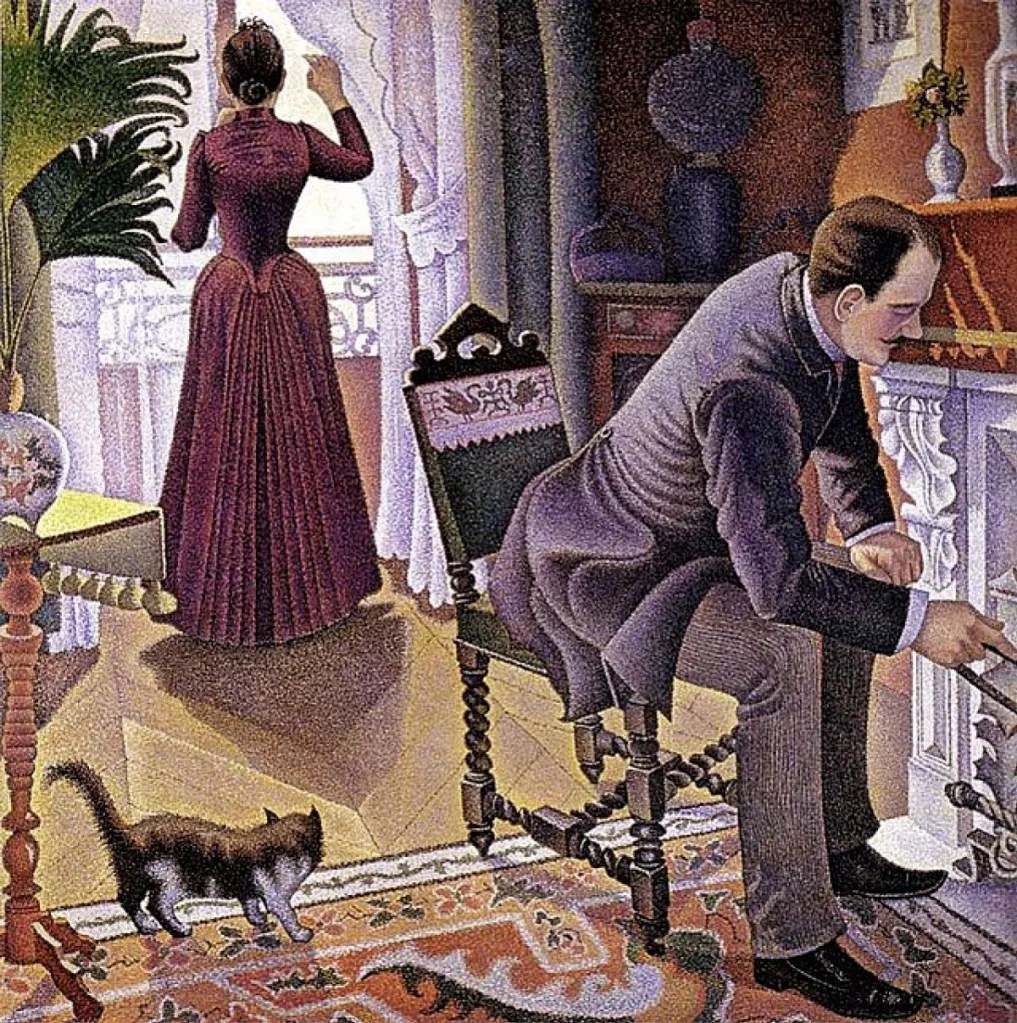
A Sunday, Opus 201 (1888–90) by Paul Signac. Private collection

Chahut

This tendency comes to a climax in the biggest painting on display here, given more or less its own room and space, the enormous ‘Chahut’ by Seurat from 1890.

Le Chahut by Georges Seurat (1889-90) © Collection Kröller-Müller Museum, Otterlo, the Netherlands

The curators have a lot to say about this, for example that it was one of what he called his toiles de luttes meaning ‘battle canvases’. In other words it was intended to be a provocative rallying cry to his movement, a manifesto pictures. In addition, it is intended to be socially subversive or an attack on late-Victorian sexual morality, in that it depicts the ‘chahut’ or ‘can-can’– then the most risqué dance performed in Parisian café-concerts.

All this is no doubt true but surely the obvious thing about this painting is that it’s a cartoon. It’s left reality far behind in order to become something like an illustration in the funny papers. Surely Seurat’s obsession with form and pattern, instead of taking us towards some deeper spiritual reality, in fact takes us away from reality altogether into a realm of caricature and comic illustrations?

(I’ve just visited the Courtauld Gallery where I saw another egregious example of this tendency, Seurat’s Young Woman Powdering Herself from 1890. This is a comical picture, isn’t it? Surely you can’t possibly take it seriously.)

Ladies on lawns

‘Chahut’ is given centre stage in the exhibition but it is in almost all ways an anomaly, an exception. The next room in the show, the one about depicting the bourgeois world, is far more characteristic. As well as the two Signac interiors I’ve mentioned, there are more classically open-air Neo-Impressionist works. The largest and maybe most representative is ‘In July, Before Noon’ by Théo van Rysselberghe, from the same year as Signac’s cartoon music hall.

In July, before Noon, 1890 by Théo van Rysselberghe © Collection Kröller-Müller Museum, Otterlo, the Netherlands

The strengths and weaknesses of the style are obvious. It is superb at conveying not only the detailed light and shade of a sunny day out of doors in July but there is something about the women’s postures which is oddly formalistic and detached. The woman passing by at the back looks like a robot.

I thought I recognised it and, after some rummaging, confirmed that this image was used for the cover of an Oxford University Press edition of Anton Chekhov’s plays. It perfectly captures the late nineteenth century indolence of middle class ladies, arranged in vast folds of fabric and quietly going about their embroidery or needlework in a sunny French garden. Inside they may be seething with the frustrations of characters from Chekhov or Ibsen, but here, on the surface, all is luminous calm.

Neo-Impressionism and van Gogh

As I mentioned, the show includes one splendid van Gogh painting, ‘The Sower’ from June 1888. We know from his letters than van Gogh was interested by the Neo-Impressionists’ experiments with colour and form but he was never a member of the group, not close. ‘The Sower’ is here partly because, alongside the Neo-Impressionists, Kröller-Müller collected van Goghs. And partly to demonstrate the similarities and differences between them.

The Sower by Vincent van Gogh (June 1888) © Collection Kröller-Müller Museum, Otterlo, the Netherlands. Photographer: Rik Klein Gotink

The similarity lies in the radical simplification of the subject in order to focus on vibrant colour contrasts. Van Gogh juxtaposes all kinds of colours not seen together in nature (for example the insistent blue of the turned soil the sower is scattering his seed onto) in order to create his effects.

The difference is in two aspects of approach. The Neo-Impressionists took a calm, detached, almost scientific approach to their work, whereas all eye-witnesses describe van Gogh attacking his canvases in a fever of inspiration. And whereas the Neo-Impressionists famously used dots or dot-like dashes of pain, van Gogh notoriously squeezed out entire worms of paint onto his brush and applied them with slapdash inspiration. Which explains why the Neo-Impressionists’ canvases are almost flat while van Gogh’s canvases are thickly encrusted with gloops and whorls of paint whipping up from the surface like waves on a stormy sea.

Here’s a close-up of pointillist technique from George Lemmen’s Factories on the Thames from 1892.

Detail from ‘Factories on the Thames’ by George Lemmen (1892) (photo by the author)

And a close-up of van Gogh’s Sower.

Detail from The Sower by Vincent van Gogh (photo by the author)

Spot the difference.

Legacy

Google AI tells me that:

Neo-Impressionism’s legacy lies in its scientific approach to colour and form, which heavily influenced later movements like Fauvism, Cubism, Futurism, and Abstract Expressionism. By using optical science, the movement pioneered a new awareness of colour and laid the groundwork for modernist approaches to the flatness of the canvas and simplified geometric forms. This theoretical language and systematic technique offered a new foundation for artists, bridging the gap between Impressionism and the more radical movements of the 20th century.

Seurat at the Courtauld

If you like Seurat, you might be interested to know that the Courtauld Gallery will be hosting an exhibition about Seurat’s coast painting from February next year.


Related links

Related reviews

Kerry James Marshall: The Histories @ the Royal Academy

This is a massive, probably epoch-making exhibition, but which I found troubling and repelling for reasons I’ll try to explain later, in part 2 of this review. First I’ll try to give you all the information and as many images as I can so that you can make your own mind up.

Kerry James Marshall

Kerry James Marshall is, according to the curators at the Royal Academy, ‘America’s most important artist‘.

This huge exhibition of Marshall’s enormous paintings at the Royal Academy is the largest ever held outside the US and so the first chance for most of us Brits to experience his works in the UK.

Exhibition structure

The exhibition includes 70 works, primarily paintings, as well as examples of the artist’s prints, drawings and sculpture, from museums and private collections across North America and Europe.

It includes a dramatic new series of paintings made especially for the show.

The show marks Marshall’s 70th birthday (born 17 October 1955).

Marshall works in series and cycles. The exhibition brings together 11 groups of works made between 1980 and the present, displayed in 11 galleries.

For your information I’ll give the curators’ wall labels to each of the 11 rooms verbatim, distinguished from my commentary by being indented.

Gallery 1. The Academy

The works in this room feature scenes from art schools, studios and museums – places, like the Royal Academy, where artists study, create and exhibit their work. There is a deep fascination in Western art with the studio as the locus of production and the museum as the repository of wonders. Adding to this tradition, Marshall transforms it by centring Black figures as both producers and consumers.

The painters he depicts are masters of their medium and materials. The model in ‘The Academy’ strikes a pose reminiscent of the American athletes Tommie Smith and John Carlos at the 1968 Summer Olympic Games. On the student painter’s table there is a preparatory sketch of the model as well as a ‘nkisi nkondi’ ‘power figure’. In ‘Untitled (Studio)’, a painter adjusts the position of her model to match the picture in progress.

Untitled by Kerry James Marshall (2009) Yale University Art Gallery © Kerry James Marshall

These works emphasise the decisions artists make in composing and completing their work: whether to paint precisely or loosely, whether to render objects flatly or with more volume, and how to arrange colours. Marshall uses various black pigments to depict skin colours, layering, or placing side by side, ivory black, Mars black and carbon black, mixing in other colours to render black fully chromatic. As he has said, ‘if you say black, you should see black’. While his blacks are complex, Marshall rarely attempts to depict the browns of real skin tones. His figures are at once individual characters and examples of an emphatic Blackness, real and rhetorical, and as such, provoke wider questions about the idea of Black figures in art.

The Academy by Kerry James Marshall (2012) Collection of Dr. Daniel S. Berger © Kerry James Marshall. Image courtesy of the artist and Jack Shainman Gallery, New York

Gallery 2. Invisible Man

Marshall’s family moved from Birmingham, Alabama, to Los Angeles in 1963. In 1965 he visited the Los Angeles County Museum of Art on a school trip. In 1968 he was selected for a summer drawing workshop at the Otis Art Institute, where he first encountered the work of Charles White and committed to becoming a full-time student there after high school. He enrolled at Otis in 1977 and received his BFA in 1978.

The 1970s was a volatile period at Otis, and within the art world in general. Conceptual artists were abandoning painting; some artists associated with the Black Arts Movement were distancing themselves from European art traditions and devoting themselves to political works aimed at uplift and protest.

Not to be deterred, Marshall continued his pursuit of an education dedicated to maximising the knowledge and skills associated with the best results in picture making. When the time was right, these could be put to effective use. That time arrived after he read Ralph Ellison’s 1952 novel ‘Invisible Man’. In the novel, the protagonist feels he is invisible because he is not seen as desirable in American society. This idea inspired Marshall to begin a series of works in which Black figures are set against a dark ground, so that they become almost invisible to the viewer. The first of these was made with egg tempera, a medium strongly associated with Sienese painters like Duccio, and later revised by artists like Ben Shahn.

In this first major cycle of images, Marshall also explored histories of racial stereotypes and caricatures, choosing to render his figures in black paint. From this point on, his figures function rhetorically, raising questions about Black absence and presence both in society and in art history.

Installation view of Kerry James Marshall: The Histories @ the Royal Academy showing two of the invisible man paintings – if you look closely you can see the white teeth and white eyes of the invisible man (photo by the author)

Gallery 3. The Painting of Modern Life 1

The two largest galleries are devoted to Marshall’s ambitiously composed, large-format paintings that record scenes of everyday life in Black America.

In the nineteenth century, French artists like Édouard Manet and Georges Seurat transformed the genre of history painting to render scenes of modern life on an epic scale. Made on unstretched canvases and secured to the wall with grommets, the paintings in this room date from the early to mid-1990s, when Marshall, having relocated to Chicago and settled into a studio, began to make his own paintings of everyday life: children playing, lovers dancing, families enjoying a day in the park.

‘De Style’ (1993), showing a group of Black men in a barber’s shop, was the first work of Marshall’s to be acquired by a museum, and is both an amalgamation of established art historical styles and a monument to Black style.

De Style by Kerry James Marshall (1993) Los Angeles County Museum of Art © Kerry James Marshall. Photo: © Museum Associates/LACMA

A year after completing it, Marshall embarked on the works in his ‘Garden Project’ series, three of which are shown here. These look back to the American public housing projects named ‘Gardens’ whose first residents included families, like Marshall’s own, who had migrated from the South and settled in the north and west of the United States from the 1940s. Made at a time when many housing projects were suffering from a lack of resources, the images convey the hopes of the past and the resilience of residents in the 1990s.

OR:

Deeply influenced by artists such as Edouard Manet, Gustave Caillebotte, Georges Seurat and other painters of modern life, and conscious of the absence of large-scale images of daily life in the work of many Black artists before him, Marshall depicts Black families picnicking in the park, lovers dancing, children playing in communal gardens, and friends hanging out in hair salons, for example in School of Beauty, School of Culture, 2012 (Birmingham Museum of Art, Birmingham (AL)).

Installation view of Kerry James Marshall: The Histories @ the Royal Academy showing three of the Garden Project paintings (photo by the author)

At the centre of this room hangs the vast Knowledge and Wonder, 1995 (Legler Regional Library, Chicago Public Library, Chicago), Marshall’s largest painting to date, exhibited for the first time outside of Chicago.

Knowledge and Wonder by Kerry James Marshall (1995) City of Chicago Public Art Program and the Chicago Public Library, Legler Regional Library © Kerry James Marshall. Photo: Patrick L. Pyszka, City of Chicago

Gallery 4. Middle Passage

The five paintings in this room were made in the early 1990s and constitute Marshall’s first attempt to address the history of the Middle Passage – the treacherous crossing of the Atlantic Ocean, during which many captive Africans died before reaching the slave markets in the Americas. It is a history understood in fragments, and accordingly, instead of making works functioning like costume dramas, Marshall composes paintings with disparate images, motifs and textures, incorporating symbols and diagrams derived from Yoruban religion, Voodoo and other syncretic religions that were practised across the African diaspora as acts of defiance as well as to maintain connections to Africa.

Installation view of Kerry James Marshall: The Histories @ the Royal Academy showing Great America (left) and Plunge (right) (photo by the author)

Before embarking on the series, Marshall completed a group of woodblock prints called ‘African Powers’, imagining six Yoruban orishas – divine spirits or gods.

Installation view of Kerry James Marshall: The Histories @ the Royal Academy showing the six African Powers woodblock prints (photo by the author)

He had also recently worked as the production designer on Julie Dash’s film ‘Daughters of the Dust’ (1991), for which he constructed sets including bottle trees and grave markers that were derived from African religious traditions. The dream-like structure of the film has an affinity with some of the paintings here.

A section bringing together imagined portraits of historically significant Black figures such as Scipio Moorhead and Harriet Tubman, question how historical portraits can be created in the absence of archives and earlier representations of individuals.

Gallery 6. Vignettes

For Marshall, every historical genre and style of painting is ripe for reinvention, and in a long-running open series he has looked back to romance pictures, challenging himself to make serious and layered paintings with apparently light-hearted subject matter. The first ‘Vignette’, dating from 2003, was a landscape in the manner of Henri Rousseau set in an American park, showing a naked couple wearing jewellery related to the Afrocentric movement. In the later ‘Vignettes’, Marshall reworked the compositions of French Rococo artists like Jean-Antoine Watteau and Jean-Honoré Fragonard.

By painting romantic scenes, Marshall produces images of resistance. ‘Breeding’, not marriage, was encouraged by some slave owners as a way of increasing their wealth and workforce.

Vignette #13 by Kerry James Marshall (2008) Susan Manilow Collection © Kerry James Marshall. Image courtesy of the artist and Jack Shainman Gallery, New York

Although the paintings are filled with flowers and lovebirds, the various scenes are marked in other ways by signs of protest, including burning tyres and political flags. Surrounded by pink brushstrokes and presented as dream scenes, the works also raise the question of whether Black couples can really relax in public spaces or if this idea remains an illusion.

Central Hall. Souvenirs

In 1998, Marshall produced a suite of paintings, photographs, sculpture, prints and video for the exhibition ‘Mementos’ at the Renaissance Society in Chicago – four paintings are reunited here for the first time since their debut. The paintings are set in the middle-class houses of Marshall’s friends and relatives. One is the house of his mother-in-law. Decorations in their living rooms included tributes to the assassinated Kennedys and Dr Martin Luther King Jr. The works concern the ways in which the tumultuous decade of the 1960s, marked by unfulfilled optimism and political upheaval, might be commemorated in the 1990s.

Of the four large horizontal-format paintings in the group, the first two, in full colour, memorialise political and activist martyrs, who are silkscreened as a frieze across the top. The other pictures, rendered in grisaille, expand the tribute to recognise the importance of cultural heroes who died between 1959 and 1970, bracketing the 1960s. As well as thinking about glittery greetings cards, Marshall wanted to transform the genre of Renaissance Annunciation paintings, where the archangel Gabriel appears in Mary’s home to tell her she will give birth to Jesus. The angels in these paintings call on us to remember. They appear somewhat exhausted by the process of assessing the unrealised dreams or real achievements of these political protagonists and cultural heroes.

Lecture Room. The Painting of Modern Life 2

In the 2010s Marshall continued to construct powerful scenes of everyday life. The settings were parks, nightclubs, homes, city streets and art galleries. He often reworked arrangements and elements from famous paintings, none more prominently than when he transformed the anamorphic skull in Hans Holbein’s ‘The Ambassadors’ (1533) into a distorted Sleeping Beauty, disturbing the space of a salon in ‘School of Beauty, School of Culture’, a sister work to his earlier barber’s shop painting ‘De Style’.

School of Beauty, School of Culture by Kerry James Marshall (2012) Collection of the Birmingham Museum of Art, Alabama © Kerry James Marshall. Courtesy of the artist and Jack Shainman Gallery, New York. Photo: Sean Pathasema

Some paintings here refer to specific moments from the past, such as the crowning of Gloria Smith as the second Miss Black America at the height of the ‘Black Is Beautiful’ period in 1969.

Others provoke questions about Marshall’s own time: ‘Untitled (Policeman)’ (2015) was made shortly after the beginning of the Black Lives Matter movement when protesters campaigned to ‘defund the police’. Together, these paintings express a wide range of Black experiences of and attitudes towards America, from deep joy to a profound, uneasy ambivalence.

Untitled (Policeman) by Kerry James Marshall (2015) The Museum of Modern Art, New York © Kerry James Marshall. Photo: The Museum of Modern Art, New York/Scala, Florence

Gallery 7. Africa Revisited

Made specifically for this exhibition, the paintings here concern challenging moments in the recorded history of Africa, not often represented by artists. Five of them address the slave trade, showing people kidnapping children, rowing captives in a canoe to buyers out of scene, returning with all kinds of booty, and celebrating their successful trades. As with his previous works, several of these new paintings present confident Black people acting with agency. These figures are shown having sold slaves, driven by their greed for the consumer goods that Europeans supplied in exchange. Another painting depicts the murder of Shaka Zulu by his half-brothers in Zululand in 1828. Together, these paintings disrupt a view of the African past, providing a fuller picture of a complex history.

Installation view of Kerry James Marshall: The Histories @ the Royal Academy showing three of the Africa Revisited paintings (photo by the author)

Two final paintings depict the so-called ‘white queens’ of Africa, Colette Hubert and Ruth Williams, at their weddings to Léopold Senghor, the first president of Senegal, and Seretse Khama, the first president of Botswana. These scenes, showing real unions but with the details reimagined by Marshall, disturb narratives about the post-colonial period on the continent.

Gallery 8. Wake / Gulf Stream

Marshall first showed these two works together in 2003 at the Venice Biennale.

‘Wake’ centres on a black ship on a pedestal that stands for a black sea. While recalling the journey made by enslaved Africans, the work also suggests the growing power of Black cultural expression. Each time it is displayed, Marshall adds more medallions, representing the proliferating achievements of African Americans. The idea of accumulation comes from the ‘nkisi nkondi’, a type of Kongo ‘power figure’ into which users drove iron nails to increase its spiritual potency.

The painting ‘Gulf Stream’ was shown in front of ‘Wake’ in Venice. In it, Marshall revisits a painting by the American artist Winslow Homer, also called ‘The Gulf Stream’ (1899/1906), which featured a shipwrecked Black sailor whose boat is surrounded by sharks. Set off the coast of America in the present day, the friends in Marshall’s yacht here appear to be enjoying their day sailing, but storm clouds are visible on the horizon, indicative of unpredictable times ahead.

Installation view of Kerry James Marshall: The Histories @ the Royal Academy showing Wake (the sculpture on the floor) and Gulf Stream (the painting on the wall) (photo by the author)

‘Wake’ also encompasses ‘black light’ photographs of a slave ship, and plates commemorating the first cargo of twenty Africans brought to America, as well as one for William Tucker, the first person of African origin born in America in around 1624. Marshall represents Tucker with a photograph of himself as a teenager.

Installation view of Kerry James Marshall: The Histories @ the Royal Academy showing the plate from wake commemorating William Tucker but bearing a photo of the artist as a teenager (photo by the author)

Gallery 9. Red Black Green

In the works gathered here, Marshall deploys the colours of the UNIA (Universal Negro Improvement Association) or Pan-African Flag, created by Marcus Garvey in 1920, as well as the imagery and slogans of the Black Panthers from the late 1960s. But rather than straightforwardly celebrating Black Nationalism, Marshall constructs cheeky and layered works that also reference the connected histories of painting and erotica. Artists from Titian to Goya and Manet made famous canvases of reclining nudes. Marshall exchanges their female figures for a Black man who hides his genitals with a flag. Similarly, struck by the lack of Black women in American pin-up magazines, Marshall decided to make his own images.

One of his imagined models here becomes a ‘Black Star’. The painting also references the ‘Black Star Line’ – the shipping company that Marcus Garvey founded in 1919 to encourage commerce with Africa and the voluntary return of Black Americans to the continent. Gripping a star like a ship’s wheel, the woman here looks back like a model in a photoshoot. We are left to ask whether Garvey’s creations are now just useful for making stylish and sexy images, or if his political project remains relevant today.


Pros

1. Visitors The friend I went with pointed out that an unusually large number of the exhibition visitors were Black, and also young. This was noticeable because, no matter how much galleries go on about diversity and inclusivity, most of the exhibitions I go to have few if any Black visitors and are overwhelmingly populated with old white people. So this is Success if you’re trying to attract a younger, more diverse audience.

2. Black art She went on to say that if you’re a little Black girl or boy, and interested in art and go to galleries, it must be alienating or dismaying to see nothing but white faces in all the art works. You might end up feeling art is a White activity for White people. Whereas Marshall’s works clearly rectify that notion and would make you feel that art can very much be a Black interest and activity, after all.

3. Black presence The size of the paintings, their confident mix of classical examples with modern subject matter, their sweeping range over Black history from the dawn of slavery through key moments of American history, up to his numerous portrayals of everyday life in Black communities – all these triumphantly achieve his goal of restoring and emphasising a Black presence in art. So it’s a triumph.

But do you actually like any of it?

That said, she didn’t actually like any of the paintings on display. Usually we play a game of getting to the end of an exhibition, having read all the wall captions and absorbed all the information – then stroll back through the show selecting one key work from each room, and explaining why we like it more than the others.

But in this huge show neither of us saw any one work we liked in any of the rooms (with the possible exception of the six African Powers woodcuts, which I liked, up to a point). Neither of us chose any of the vast paintings because we didn’t really like any of them. We didn’t really enjoy looking at Marshall’s art. Big, colourful, striking, and in a good cause, sure, but…

So I get the point of the works, and they certainly succeed in fulfilling Marshall’s aims and agenda. But I felt alienated and outside all of them. Why? I think it’s for three reasons.

1. Blackness

It’s no use denying that the paintings’ insistence on Black Black Black was a problem for me for the simple reason that I am not Black. I don’t object or dislike the Blackness, I just don’t feel included. It feels like it’s for a different audience than me, which is fine, but explains why I didn’t feel engaged.

What puzzles me is that I really like specifically Black art. The London art gallery devoted to Black art, Autograph ABP, is one of my favourite galleries, and I go out of my way to review its shows. I absolutely loved shows there by:

To name a couple which really stick in my mind. I really liked Mary Sibande‘s brilliant show at Somerset House and who could forget the great Basquiat exhibition at Barbican? And I’ve really liked all the Afro-Futurism things I’ve seen, for example at the Barbican’s science fiction exhibition. So it’s not Black people or Black culture or Black art which troubled me, it’s something else.

2. American cultural imperialism

A big part of my abreaction is because it’s so American. In my opinion, British culture is super-saturated with American cultural products. In my youth we were exposed to a fair amount of Hollywood movies and TV shows, but this has now gone supersize with the explosion of streaming services, Disney, Netflix, Apple TV, HBO and hundreds of others. Then there’s the entire internet itself with its inbuilt bias towards American products and the American worldview. And then there’s American smartphones and social media which most people have willingly invited into their homes to record every aspect of their lives. And now we are about to be taken over by American artificial intelligence getting to know us better than we know ourselves.

In my opinion, the super-saturation of British culture with American products, ideas, technology and discourse ought to be resisted.

Instead of which British cultural curators and gatekeepers fall over themselves to promote American art and culture and movies and TV shows at every opportunity.

And, disappointingly, the same goes for academia where what used to be called Critical Theory has been superseded by various forms of identity theories (feminist theory, queer theory, Black theory, post-colonial theory) almost all imported from America, led by American academics (I was watching a video about Judith Butler recently, queen of Queer Theory) who speak to specifically American history and circumstances.

In my opinion this has two distinct negative consequences:

a) American culture swamps and obliterates British culture

The actual social and political and cultural situation of my country, England, gets swamped and lost in products, discourse and rhetoric which is and sounds American and stems from American history and politics.

So when I see yet another image of Martin Luther King or John fucking Kennedy, I just think, Fuck off. That’s your country, your history, your politics, your problems, you deal with them. I have my own country with its own history, politics and problems to deal with thank you very much.

b) Importing American culture means importing American politics

But there is a horrible historical inevitability here as well. In terms of social and cultural trends, America has often been seen as ahead of Europe; in some sense, America has often been seen as the future. So what do all these social, political and cultural trends get us? What is the shiny hi-tech America which British cultural guardians fall over themselves to promote, with its fabulous Oscars and Taylor Swift and woke activists, heading towards?

Donald Trump. Taken together, all the efforts of American feminists, queer and Black activists have ended up, through the mad irrationality of human society, handing power to an authoritarian moron and his henchmen. Fifty years of earnest American feminism has led up to… the revocation of Roe versus Wade and the ending of the nationwide right to abortion. All the Black Lives Matter calls to defund the police have ended up with… augmented powers for Immigration and Customs Enforcement (ICE) forces which now roam the streets like a semi-fascist militia, kidnapping and deporting people at will.

In other words, so many of these progressive causes in America, in the unique context of American history, politics, culture and society, have not only failed but triggered a huge and horrifying backlash.

My position is simple: I think of myself as left-wing. I support a woman’s right to abortion, I support LGBTQ+ rights, I sympathise with Black activists’ opposition to police brutality, and so on.

But I greatly fear that the wholesale importation of American cultural and political models and discourse into Britain risks triggering exactly the same white, heteronormative, masculine backlash here as has happened in the States, the followers of the new martyr Charlie Kirk. Why would we want to import the hugely conflicted culture wars which have brought America to the brink of some kind of civil war, into our own society?

And in fact it’s happening already. The rise and rise of Reform at the expense of the feeble Labour Party mirrors the rise of Trump’s MAGA movement within the Republican Party at the expense of the feeble Democrats.

It may seem grotesquely unfair to associate Kerry James Marshall with the rise of Donald Trump. All I’m saying is they both come from the same toxic culture. When I saw the images of Martin Luther King and John F. Kennedy I not only experienced a vast weariness with American pop history, but a premonition of how this all ends up.

I don’t want Reform, I don’t want the Conservative Party to adopt the tone and policies of Trump’s MAGA, and, in my opinion, one way to resist the rise of America-style authoritarianism is to insist on the difference between America and Britain. To insist on the specific Britishness of British social and political issues. To stop kowtowing before American cultural products and importing American discourse, with all its toxic resonances, into British culture.

3. The new figurativism

But just as impactful as all the above was that I was dismayed by the style of all these paintings, namely a return to a kind of naive realism, which I found dismaying. In the RA shop was a big expensive book about The New Figurativism. According to Google AI:

The new figurativism refers to the modern resurgence of figurative art, or art depicting recognizable subjects like people, in contemporary times, driven by a desire for greater artistic representation, a reflection of 21st-century realities, and a break from abstract art’s dominance. This movement allows for the exploration of social and personal identity, particularly for traditionally marginalized groups, and features bold, expressive styles often inspired by past movements like Neo-Expressionism.

Return to Representation: It marks a shift back to depicting the human form and recognizable scenes after a long period where abstract art was dominant.

Emphasis on Representation and Identity: A major driving force is a need for greater diversity and the ability to tell authentic stories from various perspectives, including those of people of colour, women, and LGBTQ+ individuals.

Relevance to Current Reality: The genre’s ability to capture and reflect the contemporary world makes it a potent tool for addressing social issues, expressing personal experiences, and engaging with contemporary culture.

Opportunity for Authenticity: It provides a powerful platform for artists to tell their own stories and to represent their communities in a way that abstract art cannot.

So on this definition, Marshall’s work is a prime example of the New Figurativism, both in style and very much in purpose, namely ‘to tell authentic stories from various perspectives, including those of people of colour’, in his concern to ‘represent his community’ and so on. As the Royal Academy curators put it, Marshall certainly:

makes visible those people who were so noticeably absent in the works that came before him.

But to [put my concerns in a nutshell, what is happening here is that woke political concerns are justifying a return to a deeply conservative, retro, anti-modern style of figurative painting. There are a few stylistic glitches and angularities which feebly gesture to the great innovations of the modernists a hundred years ago. But overall, it feels as if most of twentieth century art never happened.

I’ve just visited the van Gogh / Anselm Kiefer exhibition which is also playing here at the Royal Academy. I was thrilled by watching van Gogh develop his visual language and evolve his deployment of oil paint on an almost week-by-week basis; and dazzled at the enormous, thrilling innovations of Kiefer’s huge canvases clotted with surface detritus, stalks and twigs.

Coming from those thrilling and mind-opening innovations to Marshall’s deeply conservative, old-style, backward-looking figurativism felt like a big, big imaginative letdown.

Conclusion

As I said back at the start, Marshall’s art perfectly achieves his stated aim of putting the Black presence front and centre of his work, which has been enthusiastically taken up by galleries and commissions across the States and, I bet, will open doors for Black kids and teenagers and aspiring artists and just sympathetic gallery goers, to realise that they can do this, too, and that they have a voice and presence in the sometimes intimidating realm of ‘Art’. In terms of cultural politics it is an enormous success.

But in terms of actual aesthetics, of the style and value of what you actually see, I feel Marshall’s art represents an enormous step backwards, to a naively realist approach which erases everything I love and value about modern art.

So that’s the fundamental reason why I really didn’t like this exhibition.

Coda: Kerry Marshall and David Hockney

To take the race element out of the equation altogether, I feel the same when I look at David Hockney’s works from last 20 years or so. In the RA shop, next to a book about New Figurativism and umpteen books about Marshall, was a pile of books and merch celebrating Hockney’s dayglo renderings of the Yorkshire Wolds.

I flicked through one particularly enormous coffee table book and was staggered at how many there are, hundreds and hundreds of huge, vivid, simplistic pictures, I wonder if he’s done over a thousand by now, rattling them off on his ipad.

And as I flicked dispiritedly on, I thought: It’s as if the last 100 years or artistic experimentation never happened. A guy with a great eye and a love of bright colours is creating a never-ending stream of entertaining, easy-on-the-eye figurative paintings of a subject he loves; in Hockney’s case, the landscape of his beloved Yorkshire, in Marshall’s case, Black people, history, art and so on – and in both cases I can see that they’re big [both artists produce very big paintings, which is another rather dismaying aspect of contemporary art], bright and confident but… I just don’t like them.

And found myself thinking that this is anodyne, easy-on-the-eye, deeply reactionary, backward-looking anti-art, an art appropriate for an age which has lost any belief in the future and looks back to multiple pasts with a kind of crippling nostalgia, in both content and style.

Untitled (Porch Deck) by Kerry James Marshall (2014) Kravis Collection © Kerry James Marshall. Image courtesy of the artist and David Zwirner, London


Related links

Related reviews

The Yellow House: Van Gogh, Gauguin and Nine Turbulent Weeks in Arles by Martin Gayford (2006)

‘I should like to have been born a pig’ – Paul Gauguin

‘One cannot forgo a woman for too long with impunity’ – Vincent van Gogh

‘Calm down, eat well, fuck well, work well and you will die happy’ – Paul Gauguin

‘We painters must get our orgasms from the eye’ – Vincent van Gogh

‘… an art that offers consolation for the broken-hearted’ – Vincent van Gogh

Executive summary

From October to December 1888 two great artistic innovators, Vincent van Gogh and Paul Gauguin, lived and worked, ate and collaborated and argued, in a small house in Arles in the south of France. It was a period of intense inventiveness and productivity – in the month from late November to late December van Gogh painted no fewer than 35 paintings! But as Christmas approached, Vincent’s mood became more troubled and his behaviour more difficult until finally, on 23 December, Gauguin announced he was leaving, prompting van Gogh to carry out the inexplicable atrocity of cutting off his own left ear.

This book, by long-established art critic Martin Gayford, is a fairly long (356 pages), detailed but very readable account of those torrid two months, shedding light on the two men’s careers up to the fateful stay, painting a picture of the networks of experimental and avant-garde artists they operated within, shedding light on aspects of contemporary French society and artistic practice, but mostly concentrating on the day-to-day nuts and bolts of their lives together – who did the cooking, which locals they got on with and painted, locations they chose as subjects of their paintings, letters to and from Vincent’s brother Theo, fellow artist Emile Bernard, and so on.

Longer synopsis

On 20 February 1888, Vincent van Gogh arrived in Arles in the South of France, after having lived and painted in Paris for two years. He had only started painting in 1880, at the age of 27 (born March 1853) but had developed a quirky and unique style, of composition, colour and technique.

Now 35, after staying in various rented rooms, in May 1888 Van Gogh rented what became known as ‘the yellow house’, at Number 2 Place Lamartine, for 15 francs per month. Here he lived and set up his studio. He hoped it would form the nexus of a community of artists, a commune, almost a monastery of ascetics devoted to ‘the new art’, and had reached out to several of his peers.

The Yellow House by Vincent van Gogh (1888) Van Gogh Museum, Amsterdam (Vincent Van Gogh Foundation)

Early on the morning of 23 October the most talented of these friends, Paul Gauguin, having received many invitations, finally arrived in Arles and took the bedroom next to Vincent’s.

For the next two months the two artists lived and painted together, in intense camaraderie, but it was a fractious difficult relationship, Gauguin finding it hard to live with the increasingly unstable Vincent. He threatened to move out several times and the whole thing climaxed on the notorious evening of 23 December 1888 when, after Gauguin announced that he was moving out, van Gogh sliced off pretty much his entire left ear with a razor.

Gauguin went ahead and moved out but van Gogh stayed on in the Yellow House until February of the next year, when he checked himself into a hospital. He continued to work in Arles for a few more months but had himself interned voluntarily in the asylum in Saint-Rémy on 8 May 1889.

The totality of his time in Arles, from February 1888 to May 1889, was a period of intense artistic productivity during which he created over 300 works, including masterpieces like ‘Sunflowers’, ‘The Starry Night Over the Rhône’, ‘The Bedroom’ and ‘The Night Café’.

This book by English art critic Martin Gayford (b. 1952 and so 72 years old) is a retelling of this well-worn story. Does his retelling justify the cost of admission? Well, there are already 1) umpteen editions of Vincent’s letters, which any chronicler of the period has to quote and 2) umpteen other accounts of this famous period, including exhibitions devoted to it and accompanied by scholarly catalogues.

Gayford adds lots of details and spin-off facts, the banalities of life such as how, on the night of Saturday 13 October, Vincent slept for 16 hours straight. He has the letters and memoirs to go on, and so is able to produce a pretty much day-by-day account.

Notable factoids

Neither Gauguin nor van Gogh were leading figures in the art world of the time. That was probably 29-year-old Georges Seurat who had invented an entirely new way of painting (with dots – pointillisme) that had seduced some of the older generation of impressionists. Gauguin loathed it as the peak of rationality, the opposite of the dreamy symbolism he aspired to (p.124-5).

But lots of it is more along the lines of how on 29 September, van Gogh bought two beds for the house, at a cost of 150 francs. He spent more money having gas lighting installed.

Vincent’s drinking was sometimes ‘out of control’. When he was depressed he drank to liven himself up. When he was troubled by anguished thoughts he drank to stupor himself. So whatever mood, drink was the answer. He often stayed late drinking at the Café de la Gare, and spent three evenings making his famous painting of it.

The Night Café by Vincent van Gogh (September 1888) Yale University Art Gallery

Gauguin, by contrast, drank little or nothing, making a small glass last all night, mainly for appearance’ sake. After a couple of months Gauguin thought Vincent was an alcoholic.

That said, Vincent was ‘addicted’ to coffee and one of the first things he did after moving into the yellow House was buy coffee-making apparatus.

Both Gauguin and Vincent smoked pipes, the pipe prolétarienne, the Bohemian alternative to cigars.

They were both frank about visiting one of Arles’s six brothels or maisons de tolerances, agreeing that sex was good for the health. About once a fortnight, though a local later remembered that Vincent was always ‘hanging round’ the brothels.

Prostitution was part of Vincent’s life and long had been. The only women he ever went with, he remarked rather bitterly to Theo, were whores at 2 francs intended for Zouaves. At one time Vincent had lived with a reformed prostitute; now in Arles his only sexual relations were bought with small sums of money. (p.119)

(In fact van Gogh had lived for 21 months with a prostitute, from January 1882 to September 1883 – Cristina or Sien Hoornick in the Hague. She had a four-year-old daughter and during their time together gave birth to a son by another man. Van Gogh declared he wanted to marry her until his scandalised family stepped in and threatened to suspend his financial support. Regretfully Vincent left her, moving away, but was haunted by a sense of loss which informs some of his greatest paintings – pages 228 to 231.)

Prostitution, Vincent felt, would have been bad if society were ‘pure and well-regulated’. As it was, materialism and sanctimonious morality ruled; prostitutes seemed more like ‘sisters of mercy’ to an outcast such as Vincent. He felt no scruple about associating with them; he liked their company. There was something ‘human’ about them. (p.230)

The rent for the Yellow House was paid to Bernard Soulé, manager of the hotel on the Avenue Montmajour.

Vincent liked creating gangs, introducing his friends to each other, choreographing their relationships, trying and continually failing to create a community of artists.

Someone who lives in Arles is a called an Arlésien, or Arlésienne for a woman. The Arlésiens spoke a dialect of French known as Provencal or Occitan, which was closer to Catalan than French. Neither Vincent nor Gauguin could understand them. In any case, Vincent spoke French more purely than Gauguin who had been born and raised abroad.

Paul Cézanne (born 1839), the prototypical painter of the French south, was a god to Gauguin but van Gogh disliked him, thinking his work to finicky and controlled. On the one occasion when Vincent showed the older man his work, Cézanne told him he was a madman.

Gauguin was a keen fencer and brought his foil, gloves and mask with him from Brittany. He also liked boxing. He played board games. He could also play the piano, badly. Vincent could do none of these things.

Gauguin was a detached, rational almost scientific painter, making painstaking preparations. He believed art was an intellectual activity and involved generating abstract patterns from what was in front of you.

‘Do not paint too much from nature. Art is an abstraction; extract it from nature, while dreaming in front of it.’ (quoted on page 69)

‘Abstract’ was a favourite word of Gauguin’s (p.101).

Van Gogh was the direct opposite, working feverishly, impetuously, long splashes of paint worked into swirls and whorls resonating with his passion – ‘very rapidly in one exhilarating rush’.

Which is why van Gogh produced in a working career of just under ten years more paintings than Gauguin produced in 30 (p.113).

Van Gogh wanted to paint what was in front of him but in a feverishly stylised way, especially the heightened colouring. Gauguin didn’t give a damn what was in front of him but wanted to extract the essence of the dream. Which is why he was soon to be invited into Symbolist circle of the poet Stéphane Mallarmé (p.101).

When van Gogh lost his religious faith he discovered a fervent belief in contemporary literature (p.145). Vincent loved the writings of Émile Zola and read his realistic novels avidly. He was reading Zola’s latest novel, The Dream. Gauguin disliked Zola, thinking his style false. Vincent also liked Guy de Maupassant, the Goncourt brothers, Alphonse Daudet and the popular novelist Pierre Loti.

The best art quote is from Gauguin and not about life in the South but in the Brittany he’d just come from, and is a good insight into his painting.

I love Brittany. I find here the savage and the primitive. When my clogs clang on this granite earth, I hear the dull, muffled tone, flat and powerful, that I try to achieve in painting.
(quoted page 58)

Gauguin was designated the cook of the household, he had a feel for good food. Van Gogh on the other hand, had a functional attitude: food was fuel which kept going his intense mind and perceptions. Plus he had a long history of stomach problems, exacerbated by long spells of poverty and/or religious zeal in which he deliberately starved himself. (Both men took a similarly functional attitude towards sex; it was a healthy release from what really mattered, which was painting.) Disappointingly, neither of them left any record of what Gauguin cooked.

Gauguin had attended Roman Catholic school and been drilled in his catechism. Van Gogh was the son of a Protestant pastor. In England he got work as a teaching assistant in a Protestant school and gave sermons (the first, on the subject of pilgrimage, at the Wesleyan chapel in Richmond, p.106). By the time they were at the Yellow House, both men had lost their faiths but Vincent never lost his northern, Protestant earnestness.

Van Gogh wrote repeatedly about wanting to paint the ordinary men and women of his time with the intensity the olden artists reserved for Christian saints. A noble wish but Gayford thinks he was crippled by his Protestant honesty, his dogged commitment to the truth in front of him, ‘too truthful, too wedded to the facts, too Dutch’ (p.250).

Gauguin, with his background in a Catholic seminary, found it much easier to create paintings with a Christian resonance and later would paint works with explicitly religious imagery, invoking Adam and Eve in the Garden of Eden, the Fall, the Crucifixion and much more (p.248).

Both van Gogh and Gauguin were essentially self-taught, picking up tips and ideas from everywhere and their contemporaries.

They had picked it up from other artists and, in Vincent’s case, from life classes at which he tended to clash angrily with the teachers. Essentially, they were self-taught, and that made them more open to innovations of every kind: stylistic, spiritual, technical. (p.71)

This was one of the great objections made by academic artists and critics to the impressionists and the wave of artists who followed them – that they went through none of the careful preparation for a painting enjoined on students, but used their own slapdash methods. (Gayford explains the correct academic stages for creating a painting – consisting of: preliminary sketch; sketch; study; then final tableau – page 104.)

Van Gogh was very messy; he never put the lids back on the paint tubes which were always oozing paint all over the place, which drove Gauguin nuts. And he wasn’t the only one. Half a century later the daughter of a local shopkeeper remembered van Gogh as ‘very ugly, ungracious, impolite, crazy and bad-smelling’ (p.73).

They walked and moved differently. Plenty of eye witnesses testified to van Gogh’s ‘short, quick, irregular’ steps which were echoed by his whole bodily movement which was jerky and ungainly (p.289). All this contrasted with Gauguin who cultivated a calm and stately air, sober gestures and dignity which could come across as aloofness (p.114).

Van Gogh was intolerably prolix. Once started, he tried to persuade everyone he was talking to of his views, yoking in examples from art, music, philosophy, literature and his experiences. His friend, the young painter Emile Bernard, remembered him as ‘vehement in discourse, interminably explaining and developing his ideas’ (p.162). This came over in his letters, which sometimes ran to 16 pages of rambling argumentation. Just one of the things that wore Gauguin down.

Gauguin heard a great deal of Vincent’s views about portraiture, as about everything else. (p.241)

Gauguin was very excited when he learned that Edgar Degas liked his latest paintings. Degas (born 1834) was from the generation above Vincent and Gauguin. According to Gayford he was a ‘crabby and caustic man, known for displays of acerbic wit at Parisian dinner parties’ (p.222).

Gauguin humorously signed his many letters PGo, which could be pronounced as ‘pego’ which, apparently, is French slang for penis.

Les Alyscamps

In the first weeks of the joint stay, Gauguin and van Gogh spent days in Arles’ ancient cemetery, Les Alyscamps, which dated back to Roman times, still very atmospheric despite being encroached on by a big factory and cut across by a modern railways line.

Their different approaches to the purpose of art, their styles and techniques are vividly distinguished in the paintings they made. Gauguin extracted from the scene an abstract view of mysterious figures in a portentous landscape, coloured with rich and unnaturalistic colours.

‘Les Alyscamps or the three graces at the temple of Venus’ by Paul Gauguin (1888) Musée d’Orsay

Van Gogh used colours intensely but a) left in all the modern details, included the factory with smoke coming from its chimneys and b) his people are almost accidental details, giving a sense of the everyday and contingent but made feverishly intense. You can see how messily – and incompletely – the paint has been applied in the foreground.

‘Les Alyscamps, Avenue in Arles’ by Vincent van Gogh (October 1888) Source/Photographer: Goulandris Foundation

Two portraits of Mrs Roulin

Showing just how different two portraits of the same person can be, when executed by two such very different sensibilities. Augustine-Alix Roulin, born in 1851 and so 37, was the wife of a local postal official, Joseph Roulin. In December 1888, Vincent persuaded the entire family to sit for their portraits, including the children and the little baby Marcelle.

On the first occasion, Vincent and Gauguin both painted Madame Roulin at the same sitting, sitting in the same chair, wearing the same clothes, against the same background. The resulting portraits not only show the two artists’ contrasting styles but are a revelation of how utterly differently two people can see exactly the same thing. In fact van Gogh is quoted saying as much, saying of portraits that ‘one and the same person may furnish motifs for very different portraits’ (p.239).

Here’s Vincent’s rendering.

‘Portrait of Madame Augustine Roulin’ by Vincent van Gogh (November to December 1888) Winterthur: Oskar Reinhart Collection

And Gauguin’s. They could barely be more unalike in composition but also the handling of the paint.

‘Madame Roulin’ by Paul Gauguin (1888)

Gayford tells us it was by his portraits that van Gogh wished to be judged whereas Gauguin wasn’t much of a portraitist, except of himself (p.254).

Comments

Gayford’s book is enjoyable partly because it has a great subject and that subject is absolutely awash with sources to draw on. Van Gogh’s paintings, his letters (‘Few people have left a fuller self-portrait in words than Vincent did, p.315); Gauguin’s letters, his later memoirs; the memoirs of their correspondents (notably brother Theo van Gogh and the young painter Emile Bernard); and memories of inhabitants of Arles – there is a wealth of information, before you even start on the secondary material, namely loads of biographies of both men, thousands of essays by art critics and scholars, the catalogues of countless exhibitions, and so on.

Gayford synthesises all this into a competent, interesting and – in the final scenes around the notorious ear-cutting incident – quite gripping narrative. It is told in a straightforward, magazine style, with fairly interesting inserts about Zola or the academic process for creating a painting, the merits of jute versus canvas as a support for an oil painting, a light summary of van Gogh’s rather incoherent colour theory, and so on and so on.

But for such an eminent art writer, and a man who loses no opportunity to remind us how he’s good friends with contemporary artists such as David Hockney and Lucien Freud, Gayford’s commentary is often surprisingly banal.

When he tells us that in the late nineteenth century a lot of people lost their Christian faith and goes on to quote Matthew Arnold’s super famous poem, Dover Beach, as proof, I felt the heavy thump of banality and obviousness. This is A-level standard, if not GCSE English level.

Same with his page and a half explaining Zola’s sequence of Les Rougon-Macquart novels (pages 212 to 213), or telling us that Wagner was a revolutionary composer. GCSE level. Everywhere you look, Gayford states the fairly obvious in an amiably anodyne style. The first page of Sue Prideaux’s epic biography of Gauguin is more arresting and insightful than anything in Gayford.

It’s a good enough book but nowhere does Gayford rise to the eloquence you feel is really required to do justice to van Gogh’s extraordinary genius and the astonishingly creative symbiotic relationship between him and Gauguin. It has puffs on the back from the Mail on Sunday and the Sunday Times. Well, quite. Sunday supplement stuff. Intelligent, thorough, competent, but lacking any fire.

Oh yes, the illustrations The paper quality is poor, cardboardy and the illustrations are in poor quality black and white and small. I had to look all the paintings up online in order to appreciate them. Since this is a book about artists who were revolutionaries in the use of colour, giving the paintings themselves as tiny, poor quality black and white reproductions is so poor as to be absurd.

All in all, it demonstrates Simon’s Law of Books which is: the more you pay for a book, the more you’re likely to be disappointed.

Studio of the South: Van Gogh in Provence by Martin Bailey

In the Royal Academy shop I just saw a copy of this book, ‘Studio of the South: Van Gogh in Provence’ by Martin Bailey. This looks like it’s a different league from the Gayford. It’s not only more recent (2021 compared to 2006), but it’s a bigger format book with lovely shiny paper and lavish full colour illustrations. I haven’t read the text but for the illustrations alone, I’d ignore the Gayford and go with Bailey.

Lautrec’s van Gogh

One of the best things I learned from Gayford’s book was the existence of a portrait of van Gogh done by fellow Bohemian Henri Toulouse-Lautrec, before Vincent left Paris in early 1888. Lautrec was just 23. Genius, isn’t it? And for all its brash technique and colour palette, figuratively accurate in a way nothing by Vincent or Gauguin is.

Vincent van Gogh by Henri de Toulouse-Lautrec (1887) Pastel on cardboard


Credit

The Yellow House: Van Gogh, Gauguin and Nine Turbulent Weeks in Arles by Martin Gayford was first published by Fig Tree books in 2006. I read the 2024 revised Penguin paperback edition.

Related links

Related reviews

Michael Craig-Martin @ the Royal Academy

What happens if a style of art is so accessible as to become almost transparent? That you can look at it and process and understand everything there is to see, with no hesitation or resistance? Where there are no barriers whatsoever to understanding the work, no hidden meaning to uncover, no secrets to decode, where what you see is exactly what you get?

Untitled (corkscrew) by Michael Craig-Martin (2014) © Michael Craig-Martin. Photo: Mike Bruce. Image courtesy of Gagosian

This is one of the questions raised by this massive and hugely enjoyable retrospective of the career of super-successful and instantly recognisable artist, Sir Michael Craig-Martin. As you can see by these examples, at a crucial turning point in the 1980s Craig-Martin stumbled across the fact that there was mileage in depicting common-or-garden everyday objects in the style of a Tintin cartoon i.e. with clear strong outlines, with no shading or inflection on the object itself, set against a pure plain background with no attempt at perspective or depth, with both object and background painted in single strong plain colours. What would happen then?

Common History: Conference by Michael Craig-Martin (1999) Courtesy Gagosian © Michael Craig-Martin. Image courtesy of Gagosian

Turns out what happens is that we realise we are surrounded everywhere we go – from waking in a bedroom, to pottering round the house, to commuting to an office – by objects so humdrum and everyday that nobody really pays attention to them. So why not make them stars of their own paintings?

Craig-Martin spent the first 20 years or more in the States and you can see the debt to Andy Warhol’s depiction of iconic consumer products like the Campbell’s soup cans or Coca Cola bottles in two ways: one is to consider the object in the abstract, devoid of setting and background, like a kind of designer’s diagram. The second is to bring out the genius of their design, by depicting them in such a pure form, concentrating just on lines and outlines, as to bring out the purity and clarity, the design intelligence which has gone into so many of the man-made things which surround us.

Craig-Martin’s paintings make everyday objects thrilling and so make everyday life thrilling.

Starting at the beginning

Born in 1941 (so he’s now 83) Craig-Martin attended art schools in Paris, America and London before starting to create works in the mid to late 1960s, hence the curators’ claim that this represents a summary of a 60-year-long career. Although he’s overwhelmingly known for the object paintings he has in fact worked in sculpture, installation, painting, drawing, printmaking and digital media, creating works that fuse elements of pop, minimalism and conceptual art.

Examples of all these media and approaches are here in what amounts to the largest and most comprehensive exhibition of Craig-Martin’s work ever held in the UK.

The show has a very straightforward chronological structure so room 1 displays his earliest works. They are heavily conceptual in that late-1960s way, in a way which reminded me of Yoko Ono i.e. you have to read the wall label to understand the concept the objects in front of you are fulfilling.

But you also notice that, right from the start, he was interested only in ready-made everyday objects like buckets, milk bottles and clipboards. For example ‘On the table’ which inverts your expectation that a table should be supported by four legs, whereas here it is supported by the objects which are on the table. But the real point is the everyday nature of the table, buckets and rope.

‘On the Table’ by Michael Craig-Martin (1970) Collection Irish Museum of Modern Art © Michael Craig-Martin. Image courtesy of Gagosian

I particularly liked ‘On the Shelf’ for the dramatic sense of jeopardy it creates, the visual cleverness of making the different amounts of water in each bottle create a continuous horizon line, but also because they’re Unigate milk bottles, which I remember from my boyhood.

Installation view of Michael Craig-Martin at the Royal Academy showing ‘On the shelf’ (1970) (photo by the author)

Other conceptual gags

I think of conceptual art as gags: what’s the joke, what’s the trick, what’s the gimmick, what’s the concept?  Apparently by the mid-1970s he felt he’d reached a dead end with the purely conceptual pieces and so reverted to drawing and painting on flat surfaces but using tricks or gags.

Thus a series of ‘Pictures within Pictures’. By inserting paintings found in London flea markets into the  top-left corner of blank canvases, he recontextualised the paintings in a way that ‘completely changed their meaning without changing them at all’.

In 1975 Craig-Martin began a series of ‘drawings’ in white neon, including ‘Reading Light’. His neon works were the first in which he drew rather than used real objects. As with his earliest pieces, the forms he used were primarily objects of daily use.

Installation view of Michael Craig-Martin at the Royal Academy showing ‘Reading light’ (1970) (photo by the author)

To quote the curators:

As part of his exploration of the basic elements of painting, Craig-Martin returned to the use of readymades by using Venetian blinds for this series. The artist’s use of these objects plays with considerations of colour, form, light and space, with their rectilinear shapes and solid colours suggesting a proximity to Abstract Expressionist colour-field painting. They also offer a metaphor for painting itself, framing a window onto the world.

Installation view of Michael Craig-Martin at the Royal Academy showing ‘Venetian blinds’ (1976) (photo by the author)

The invention of outlines

The curators:

In a 1978 landmark exhibition held at the Rowan Gallery, London, Craig-Martin debuted his large-scale wall drawings. Influenced by Marcel Duchamp’s use of prefabricated objects and Andy Warhol’s focus on pop culture, Craig-Martin continued to incorporate recognisable manufactured items that were, in his words, “more famous than famous. So famous that you don’t even notice them.”

He began producing drawings of ubiquitous items, using crepe tape on transparent acetate or drafting film, which were then projected and traced on the wall, again using tape. Through his choice of media, Craig-Martin sought to remove the artist’s ‘hand’ so as to reflect the impersonal character of mass-produced objects.

Installation view of Michael Craig-Martin at the Royal Academy showing ‘Reading with globe’ (1980), made from black tape attached to the bare wall (photo by the author)

This method also enabled him to layer several drawings of objects, leading to complex compositions. Craig-Martin chose a three-quarter view, showing each object slightly from above to emphasise its three-dimensionality.

In the early 1980s Craig-Martin began turning his drawings into wall-mounted sculptures, using thin metal rods. The linear simplicity of these drawings and sculptures became his hallmark and the foundation of his work to this day.

Installation view of Michael Craig-Martin at the Royal Academy showing ‘Seafood’ (1980) (photo by the author)

Eliminating style, creating a style

The curators:

Craig-Martin ‘draws’ with a particular type of crepe tape invented in the 1960s for electronic circuitry. As with his wall drawings, it allows Craig-Martin to achieve his ideal of making the works ‘styleless’, eliminating all trace of the artist’s ‘hand’. Ironically, in attempting to make his work style-free he has created a style that is immediately recognisable as his own.

The big room

All this is by way of explanation and foreplay before you walk into the enormous third room of the exhibition and are overwhelmed by the wall painted a solid Craig-Martin-ish green on which are hung ten ginormous works of his mature, object outline and plain colour paintings.

Installation view of the big green room in Michael Craig-Martin at the Royal Academy (photo by the author)

Beginning with two vibrantly coloured installations in 1993 and 1994, Craig-Martin’s output came to be dominated by site-specific painted installations. By the second half of the 1990s, he brought what these projects taught him to the more traditional medium of paint, which has remained at the heart of his  practice ever since.

The artist’s use of the computer from the early 1990s marked a creative turning point for him. It freed him to alter his drawings’ size and scale dramatically and gave access to an infinite range of colours. By the mid-2000s, as the world shifted from analogue to digital, he introduced depictions of laptops, mobile phones and memory sticks into his images, showing them from the front rather than from an angle.

Around that time, Craig-Martin moved from painting on canvas to using aluminium panels, the smooth surface allowing him to create flatter drawings and more even areas of colour.

Installation view of two paintings in the big green room in Michael Craig-Martin at the Royal Academy (photo by the author)

In around 2000, Craig-Martin began painting crowded groups of objects, packed in ambiguous spaces. Here, objects are placed so close together that the background disappears. The use of non-naturalistic colours and changes in scale disrupt our sense of familiarity with each object and invites the viewer, as Craig-Martin explains, “to pass that first stage of recognition to some kind of second step of actually looking, to consider how things exist in conjunction with each other”.

A classic example being ‘Eye of the storm’ on the left here, painted in 2003 (next to ‘Sharpener’, 2002).

Installation view of two paintings in the big green room in Michael Craig-Martin at the Royal Academy showing ‘Cassette’ (2002), ‘Eye of the storm’ (2003) and ‘Sharpener’ (2002) (photo by the author)

Variations on a theme

OK, so you’ve invented a striking, instantly identifiable look and brand which can be applied to more or less every domestic man-made object in the world. You could spend the rest of your life turning out thousands of these. Or you could play with what you’ve discovered and experiment with different approaches. And so:

Alphabet paintings

In the early 2000s, Craig-Martin embarked on a series of works in which he explored the relationship between text and image. He developed a ‘visual alphabet’ in which every letter was linked to an object, albeit with no apparent connection. For example, an umbrella represented the letter A, while a wine glass represented B and so on.

Word paintings

In the ‘Word Paintings’ gigantic letters spell out abstract concepts, such as ‘art’ or ‘death. They  are then overlaid with the drawings of the objects that correspond to each letter.

Installation view of ‘Death’ by Michael Craig-Martin at the Royal Academy (photo by the author)

In this spirit is ‘Painting’ from 2010 in which the letters are painting in bold capitals while the ghostly outline of his characteristic objects (handcuffs, coke can, safety pin) hover transparently over them.

In these paintings, the letters are filled with solid colour while the objects are outlines. This juxtaposition invites us to contemplate the relationship between abstract concepts and tangible things in our lives.

Untitled (painting) by Michael Craig-Martin (2010) Courtesy Gagosian © Michael Craig-Martin. Photo: Dave Morgan. Image courtesy of Gagosian

Sex, death, love, painting – to be honest, I found these themes or topics pretty banal. Then again, maybe that’s the point. The point is there’s almost nothing behind these works, there are no hidden meanings and when Craig-Martin and the curators talk about ‘eternal themes’ they really mean the most obvious, clichéd themes imaginable. Maybe there banality and obviousness is deliberate.

The only ones with a bit of wit were a series of three paintings making an image rhyme with the word depicted – so a portrait of a pair of pliers with the word LIARS written over the top,  a picture of a glove with the word LOVE. I found these just that little bit more interesting than ones with just ART or DEATH painted on them.

Installation view Michael Craig-Martin at the Royal Academy showing ‘Liars/pliers’ and ‘Love/glove’ on the left, with the more boring ‘Art’ on the right (photo by the author)

Riddle paintings

Craig-Martin creates playful visual puns by connecting a word and an object through rhyme. The so-called ‘Split Paintings’ invite the viewer to imagine a connection between two different objects that have been cut in half and placed alongside one another.

Installation view of two split paintings, being ‘Sardine tin/ handcuff’ and ‘Watch/sandal’, both from 2007, by Michael Craig-Martin at the Royal Academy (photo by the author)

Referencing modern art

Still want more variations? OK. Let’s apply this hugely distinctive outlines-and-bold-colours approach to classics of Western art. And so enormous Craig-Martin remixes of classics such as Édouard Manet’s ‘A Bar at the Folies-Bergère’, ‘Olympia’ and ‘Déjeuner sur l’herbe’, Georges Seurat’s ‘Bathers at Asnières’ and Diego Velázquez’s Las Meninas.

Installation view of Michael Craig-Martin at the Royal Academy showing Craig-Martin’s version of Édouard Manet’s ‘A Bar at the Folies-Bergère’, made in 2023 (photo by the author)

Two thoughts: 1) Craig-Martin has cannily chosen paintings which are themselves very strong in outlining and lack the swirl and confusion of thousands of other subjects. They’re half way to being Craig-Martinesque before he gives them the treatment.

Installation view of Michael Craig-Martin at the Royal Academy showing Craig-Martin’s version of Georges Seurat’s ‘Bathers at Asnières’, made in 2023 (photo by the author)

2) These interested me as being more or less the only works in the show which I actively didn’t like. It’s not spoofing old classics that’s the problem… it took a while for me to realise it’s because they feature people. At a stroke I realised absolutely every other image in the show is inanimate. Even when he does flowers, a bit later on, they are cut flowers, as you’d find them arranged in a vase. For some reason (for me, at any rate) Craig-Martined people just don’t work.

For inanimate household objects, his approach brings out unexpected beauty, especially of the design and outline of these goods, adding, amplifying, making them bigger and rather wonderful. When applied to people it has the opposite affect, of flattening them and so of draining them of meaning.

Doing Duchamp

As we’ve mentioned a number of times, right from the start of his career Craig-Martin has been interested in domestic objects which can also be seen as ‘ready-mades’. Ready-made was a term invented by Marcel Duchamp way back before the First World War for his habit of finding intriguing looking objects and simply placing them in art displays and calling them art. The most famous is the white porcelain urinal but there were others, wine racks and bicycle seats and whatnot.

Here, near the end of the show, are a set of works paying hommage to Duchamp and to his other inspiration, Andy Warhol, him of the soup cans and coke bottles. Both predecessors in finding immense beauty in carefully designed but mass produced everyday objects.

And so there’s a little set of works pastiching the design of Duchamp’s famous late work ‘the bride stripped bare’. I don’t think this adds very much to the original. More fun is a set of split prints this time small enough to fit into one group.

In these he’s chosen a set of iconic chair designs to go at the bottom of each print, accompanied by a classic piece of modern sculpture at the top. It’s a Where’s Wally challenge – can you identify the iconic objects in the top of each section? Top left are the bricks by Carl André, then a mobile by Alexander Calder, a ready-made wine rack by Marcel Duchamp then… it’s over to you!

Installation view of Michael Craig-Martin at the Royal Academy showing ‘Art and Design’ (2012) (photo by the author)

Interestingly:

Of all the objects the artist has drawn, Craig-Martin considers chairs to be the most varied in terms of design, material and execution. He says, ‘the role of designers is to invent; the role of artists is to
observe.’

And what a brilliant observer he is, in his own highly stylised, totally accessible and yet inimitable way.

Installation view of Michael Craig-Martin at the Royal Academy showing ‘Watch fragment’ (2015), ‘Zoom 2’ (2024), ‘Percussion’ (2022), ‘Strings’ (2022) (photo by the author)

Cosmos

From this big red room we walk into a big darkened room hosting Craig-Martin’s first fully immersive digital work of art. It uses more than 300 images of objects the artist has made over the past 45 years, making it a fitting work for a retrospective. The animated video has been developed with Daniel Jackson and the accompanying soundscape with Benji Fox. This is a very enjoyable experience, and the room was full of young people sitting and lying around and oohing and aahing at the pretty pictures and the varied modern ambient soundtrack. As was I.

Central Hall site-specific

Craig-Martin started creating room installations in 1993. The Royal Academy’s Central Hall has four big arched doorways and over each of them he has created an entertaining trademark image beautifully and amusingly mapping onto the arches. Very stylish, very amusing.

Installation view of Michael Craig-Martin at the Royal Academy showing the ‘headphones’ round one of the archways in the Central Hall (photo by the author)

Merch

Obviously there’s a load of merchandise in the shop, ranging from the stylish catalogue to a world of postcards, posters, tote bags and whatnot. But my eye was caught by these polished steel reliefs, titled (go on, guess) ‘Umbrella’ and ‘Book’ both designed and produced this year in a limited edition of 40. You can buy them to attach to your wall and impress visitors and guess how much? £5,400 each including VAT. Bargain. There’s your family Christmas presents solved 🙂

Metal

In the courtyard

Before you enter the show and after you emerge, a little dazed from all this dayglo brightness, in the courtyard to the Royal Academy stands a group of what the curators call ‘monumental sculptures by your man. Except they’re not monumental, are they? They’re actually the opposite of everything the word ‘monument’ suggests. They’re made in steel and painted with his trademark basic colours and were made this year, specially for this show. Designed to pose among and Instagram or Tiktok or Facebook yourself. What fun. What larks. Is this the most innocent art ever?

‘Umbrella’ and ‘Safety pin’ by Michael Craig-Martin in the Royal Academy courtyard (photo by the author)


Related links

Related reviews

Impressionists on Paper: Degas to Toulouse-Lautrec @ the Royal Academy

This exhibition in is in the smaller set of three rooms at the back of the Royal Academy building i.e. it’s more of an amiable stroll through three rooms of relatively small drawings, rather than, say, the full-on assault course of the 11 big rooms of the extraordinary Marina Abramović show.

It does what it says on the tin, brings together 80 or so works by all the famous Impressionist and post-Impressionist artists plus quite a few I’d never heard of before, experimenting with different media on paper.

Exhibitions need an aim or project and this one aims to explore how Impressionist and Post-Impressionist artists in late 19th-century France didn’t just use paper works as studies but radically transformed the status of works on paper. Previously, drawings were mostly conceived as preparations for paintings; in the hands of the Impressionists drawings, pastels, watercolours, temperas and gouaches were increasingly perceived as more than just preparatory techniques, and became autonomous works of art, claiming a shared aesthetic with painting.

Dancer Seen from Behind by Edgar Degas (c. 1873). Essence (diluted oil paint) on prepared pink paper. Collection of David Lachenmann

Who are we talking about? The eye-catching famous artists are: Mary Cassatt, Paul Cézanne, Edgar Degas, Paul Gauguin, Eva Gonzalès, Claude Monet, Berthe Morisot, Camille Pissarro, Odilon Redon, Pierre-Auguste Renoir, Georges Seurat, Henri de Toulouse-Lautrec and Vincent van Gogh.

Less well known are the likes of Albert Lebourg, Jacques Emile-Blanche, Armand Guillaumin, Frederico Zandemeneghi.

Impressionists recap

As the curators explain:

The avant-garde artists known as the Impressionists came to prominence during the late 1860s and early 1870s, first exhibiting in Paris as a group in 1874. They shared a concern to depict scenes from everyday life and to address contemporary issues, which encouraged them to challenge traditional attitudes to drawing and seek innovation. Vivid colour, a quick, loose touch, and daring viewpoints, together with a deliberate lack of finish, were their means of capturing the fugitive effects of nature as well as vignettes of modern life.

The portability of drawing materials greatly facilitated direct observation and the recording of scenes on the spot. The eight Impressionist exhibitions, held in Paris between 1874 and 1886, included a large number of works on paper and reflected their shift in status. This was also encouraged by dealers who recognised the economic advantage of exhibiting and selling works on paper.

Cliffs at Etretat: The Needle Rock and Porte d’Aval by Claude Monet (c. 1885). Pastel on wove paper. National Galleries of Scotland

What it’s like

The most striking thing, for me, was how the drawings faithfully echo the style of each artist’s paintings i.e. the way each of the artists have strong signature styles or vision no matter what medium they’re working in.

So you see a hazy landscape of cliffs by the sea and instantly know it’s Monet; charcoal images of ballet dancers posed at striking angles and know its Degas; a round-faced woman’s face smiling at some outdoors dance and know it’s Renoir; a grotesque, angular woman in an urban setting and you know it’s Toulouse-Lautrec; a light and airy landscape made out of cubes and rectangles of colour and you know it’s Cezanne.

So you can play an entertaining game of standing far away from the wall to try and identify the artist by their style, then stroll over to the wall label to find out if you were correct. For example, who would you think this is by?

Portrait de Marie-Thérèse Gaillard by Mary Cassatt (1894) Pastel on paper. Private collection. Photo © 2007 Christie’s Images Limited

In this case it’s a trick question. You might have thought Renoir, from the treatment of the face, but it is in fact by Mary Cassatt. Note the striking difference in finish between the face – expertly and completely rendered – and the clothes, rendered in a completely different, hurried, unfinished style, with the background wall hovering somewhere between the two.

What I liked

The most striking work in room 1 is the Portrait of Madame Henri Wallet by Jacques Emile-Blanche simply because of its size. It’s a John Singer Sargent-style and sized portrait of an elegant society woman, and so stands out in a room full of much smaller, much more hazy and impressionistic images.

Degas sketched and drew things around him so compulsively that his colleagues nicknamed him Monsieur Pencil and, appropriately, there are more works by him in this exhibition than any other  artists, 12 in total, all of which I liked.

I love sketches and drawings, I love art which is half-finished, ghostly, hinting at a half-grasped reality, which is why I’ve always loved Degas’ strange and mysterious Woman at a Window (1871), which used to be tucked away in a side room at the Courtauld Gallery. Here it is presented in all its pregnant mystery and an epitome, for me, of the power of paintings or drawings which are better left unfinished, full of hints and implication.

But I’d forgotten, if I ever knew, about Degas’s friend Frederico Zandemeneghi (1841 to 1917). Zandemeneghi was invited by the Impressionists to exhibit at four of their 8 exhibitions. He was particularly close to Degas. They shared an interest in depicting scenes of modern life featuring women subjects, seen from unconventional viewpoints, often cropping the image unexpectedly, and using vibrant colourful pastels.

This example has several of those characteristics in spades, namely the dramatic cropping which makes the subject feel really close-up and in your face. And the very bright colours, blue, yellow, orange, red, making the most of the range of human sight.

Study of a Woman from Behind by Federico Zandomeneghi (1890 to 1897) Pastel on cardboard. Galleria D’Arte Moderna, Milan. Photo © Comune di Milano

The show is in chronological order, starting with works from the 1870s. Room 2 contains works from the 1880s. The highlight for me was van Gogh’s ‘The Fortifications of Paris with Houses’ from 1887, made from a combination of graphite, chalk, watercolour and gouache. This reproduction in no way conveys the glowing brightness of the original. Then I liked the contrast between the architecturally accurate apartment block on the left and the vague ‘impressionistic’ grass in the foreground. Then I noticed the way the big fortification wall is not made of bricks but of hundreds of vertical dabs of orange and grey. And then I noticed the ghostly couple walking past in the foreground, ghosts of the millions of people who lived and died in the great cities of Europe, leaving barely a trace of chalk on paper. At which point I realised that there’s a kind of spectrum of solidity, from the super-solid apartment blocks on the right, to the more dabbed and impressioned fortifications themselves, and then to the human beings, the least permanent or impactful things in the picture or in history, hundreds of millions of us leaving less trace than walls or buildings.

The Fortifications of Paris with Houses by Vincent van Gogh (1887) Graphite, black chalk, watercolour and gouache on paper. The Whitworth, The University of Manchester. Photo by Michael Pollard

The exhibition concludes in room 3 with works from the 1890s and 1900s, which saw an ever-growing appreciation of works on paper and a proliferation of exhibitions of the medium. There’s a lot more Degas who emerges as probably the strongest and most consistent artist on paper. Off in one corner is a set of quiet, thoughtful, washed-out watercolours by Cézanne from late in his career. At the opposite corner of the room, both literally but also in terms of subject matter is a small set of three vivid, scratchy, angular images of the louche underworld of Montmartre by Toulouse-Lautrec.

But floating above this world of human troubles is the work I liked the best, a classic of what, during the 1890s came to be known as Symbolist art, the wonderful, visionary ‘Ophelia among the flowers’ by Odilon Redon.

Ophelia Among the Flowers by Odilon Redon (1905 to 1908) Pastel. The National Gallery, London

The Impressionists were trying to capture the truths of the modern world, applying light quick touches to capture the fleeting moment. Redon, by complete contrast, sought out ‘the light that never was on land or sea’, depicting images from the inner world of fantasy and dream. So I thought he was pretty out of place in an exhibition of impressionists. But his inclusion makes sense if we forget the exhibition’s main title for a moment and think of it more as a study of the evolution of drawing and painting on paper in France from the 1870s to the 1900s. From that perspective the inclusion of Redon makes sense for his technical prowess. The flowers are obviously the dominant element in the work, but after a while you realise that it’s the peculiar quality of the light in the top middle and right of the image which give it its haunting, apocalyptic quality.

Consequences

According to the curators:

The French avant-garde artists’ interest in drawing and the remarkable range of their production had far-reaching consequences. The hierarchical distinction made between painting and drawing ceased to exist. Freedom of execution and a laissez-faire attitude to materials provided an impetus that allowed the world to be depicted in more imaginative ways, leading to developments in 20th-century art such as Abstract Expressionism.

So as we progress through the works in chronological order, we are not just witnessing the development of visual styles, generally away from figurativism and towards greater abstraction, but the evolution of the medium of drawing itself, as it prepares for the great lift-off of modern art at the start of the twentieth century.

It’s not all masterpieces. Some are not-great early works (for example, by van Gogh or Gauguin) which are of largely scholarly interest, others are wishy-washy landscapes which are a bit meh (Armand Guillaumin). But overall it’s a lovely civilised way to spend an hour, enlivened by a regular stream of masterpieces. It’s worth visiting just to see the 12 Degas works and the 3 or 4 pieces by Frederico Zandemeneghi and the van Gogh. But other visitors will find other works to marvel at and cherish.

Dancers on a Bench by Edgar Degas (around 1898) Pastel on tracing paper © CSG CIC Glasgow Museums Collection


Related links

Related reviews

After Impressionism: Inventing Modern Art @ the National Gallery

This is a lavish and deeply enjoyable exhibition portraying the great explosion of creativity in West European painting which took place in the decades between the last Impressionist exhibition in 1886 and the outbreak of the First World War in 1914.

Critics then and now struggled to find a blanket term for the period, as Belinda Thompson explains in her excellent survey of the period, ‘The Post-Impressionists’. The term ‘post-impressionism’ persists because the only thing all these different artists had in common was that they were painting after the great Impressionist breakthrough of the 1860s and 1870s and were clearly influenced by it. Beyond that it’s difficult to generalise, except that they were all experimenting and innovating and following through on the countless possibilities inherent in the act of putting oil paint on canvas.

Mont Sainte-Victoire by Paul Cezanne (1902 to 1906) © Philadelphia Museum of Art

Structure

The exhibition structure is simple: it opens by celebrating the artists who have emerged, in retrospect, as the great gods of the period – Paul Cézanne, Vincent van Gogh, Paul Gauguin – and then examines the influence they had on the younger generations of artists, in the hotbed of modern art, Paris.

Where this exhibition strikes out and is distinctive from many surveys of the period is that it then makes a conscious effort to broaden its scope, geographically, with rooms or sections dedicated to other capital cities where exciting experimentation was taking place, namely Barcelona, Berlin, Brussels and Vienna. The curators point out that there was more cross-fertilisation than ever before due to the steadily increasing numbers of exhibitions and exhibiting societies, illustrated periodicals and commercial dealerships.

For once there isn’t a particularly strong central thread or thesis being propounded in the show, just a lot of wall labels describing art movements and groups and trends in all these different places, and then picture captions going into detail on individual works.

The show is, therefore, in effect, just a feast of fabulous post-impressionist masterpieces, and strolling through it is a quite wonderful, mind-blowing, eye-filling experience.

Specific movements are mentioned along the way (the Nabis, Symbolism, Die Brücke, the Fauves), in passing, but towards the end the show crystallises, as it were, presenting examples of the radical Modernism which supplanted what had come before in the form of works by Picasso, Matisse, and Mondrian.

What characterised post-impressionist art?

Impressionism began the movement away from traditional Salon art which a) depicted high historical or mythological subject matter or b) monumental nudes in c) an intensely figurative realistic manner. Instead the Impressionists were interested not in what was there, but in what we see, which is a different thing, trying to capture the shimmer and play of light.

The post-impressionists continued this departure from the conventional representation of the external world. In a host of different ways they developed non-naturalist visual languages, emphasising shape or pattern or colour which don’t exist in the real world. Some of them were interested in line and form, some became obsessed with colour, some with pattern bringing out the decorative potential of art, some focused on symbols and meanings. Once you walked away from the idea of figurative, realistic depiction of the ‘real world’ a thousand doors opened.

All this was helped by the swift development of photography, with many artists realising that their traditional role as makers of portraits, recorders of events, annotaters of landscapes was being superseded by the new technology. But this was entirely positive: it freed them up to explore the expressive potential of paint on flat surfaces in a thousand new ways.

Artists

With almost 100 works, many lent from institutions abroad and seen in London for the first time, the show features a host of big name artists like Paul Cezanne, Vincent Van Gogh, Edgar Degas, Pablo Picasso, Henri Matisse, Gustav Klimt, Käthe Kollwitz, Sonia Delaunay, Wassily Kandinsky, Piet Mondrian, Edvard Munch. It’s mostly paintings  but there’s a selection of ten or so sculptures carefully chosen to demonstrate innovation in that medium, too (notable sculptures by Rodin, Gauguin and Kollwitz).

I’m going to list the rooms, indicate what they contain i.e. which movements and artists, and then pick personal highlights.

Introduction

The introductory room contains just four works, a painting each by Pierre Puvis de Chavannes and Paul Cezanne, framed by two sculptures by Auguste Rodin (‘Monument to Balzac‘, 1898, and ‘Walking man‘, 1907). Cezanne’s ‘Mont Sainte-Victoire’ (1906) is obviously a greatest hit but after the recent Cezanne exhibitions at Tate Modern and the National Portrait Gallery I’m a bit Cézanned out. The Rodin pieces confirm my very strong dislike; I object to because of the lumbering clumsy size of his works and the crude, horrible unfinished nature. In terms of modern sculpture I like Epstein, Gill and Gaudier-Brzeska, small, smooth, beautiful lines and angles, the opposite of everything Rodin stands for.

Therefore I preferred the Puvis work, ‘The Sacred Grove’ from 1885, although this struck me as a very odd choice, because its idyllic classical setting, figurative approach, use of perspective etc seem completely contrary to everything which follows.

The Sacred Grove, Beloved of the Arts and the Muses by Pierre Puvis de Chavannes (1884) Art Institute of Chicago

Room 2: Cézanne, van Gogh, Degas, Gauguin

Greatest hits from some of Western art’s biggest names. Cezanne is represented by a classic version of The Bathers (1905) where he is transforming human figures, trees and landscape into geometric shapes, leaning rectangles of paint, the semi-abstract human figures having blank masks. You can clearly see the origins of Picasso and Braque’s cubism. A still life of a sugar bowl and apples, plus another of his numerous views of Mont Saint-Victoire.

There are 4 works by Van Gogh: ‘Snow-Covered Field with a Harrow (after Millet)‘ (1890) had the classic van Gogh wavy paint, as did ‘Sunset at Montmajour‘ and ‘Enclosed field with ploughman‘. But I found myself more drawn to ‘Houses in Saintes-Maries-de-la-mer’. Apparently the tight, constricted feel of the composition is a new thing in his style. It was painted in the south of France where the bright light made him realise he could exaggerate colour effects even more than he’d been doing previously.

Houses in Saintes-Maries-de-la-mer by Vincent van Gogh (1890)

An oddity I noticed is that the National Gallery itself owns some outstanding van Gogh masterpieces, such as the chair, and sunflowers and these aren’t in the exhibition. The only reason I can think of is that they’re part of the permanent collection which tourists quite possibly come to London to see and so the curators took the decision to exclude them from the exhibition and keep them on general display.

The caption to his ‘Woman from Arles’, a portrait of the owner of the Café de la Gare in Arles, raises an interesting point. Apparently, when they were sharing a house in the south of France, Gauguin and van Gogh had an ongoing argument about the nature of art: Gauguin argued that the artists is like a priest questing for the spiritual essence of a subject and therefore it was best to paint from memory, distance from the actual object freeing the artist to bring out the essential shapes and colours. Van Gogh, on the contrary, argued it is the artist’s sacred duty to paint what they see, as they see it.

No such scruples with the little selection of Degas works, the biggest example of which is the famous ‘Combing the Hair (Le Coiffure)’, an orgy of reds and oranges. It’s accompanied by a good example of his ballet dancers, ‘Dancers practicing in the foyer’. But my favourite piece was a small but exquisite piece, ‘Woman reading’ (1885).

Femme lisant by Edgar Degas (1883 to 1885)

It’s tightly focused, cropping the figure at the knee. Degas applied layers of pastel over a monotype print

Taken together this room makes a strong case for the dazzling impact these artists had both in Paris and elsewhere in Europe, with their reconsiderations of form, surface and space. The strokes are called ‘gestural’ because they convey the actual strokes by the artists as much as the object. Strong short dark lines make it look as if elements of the image have been stitched together. The use of bold pure colours and highly gestural strokes were very influential on later artists.

Then onto the Gauguin section. I was bowled over. Gauguin strikes me as less covered than Cezanne, van Gogh or Degas, maybe because he is the boldest, most radical, most muscular and controversial of them. He’s represented by a greatest hit, ‘Nevermore’, ‘The Wave’, ‘Fête Gloanec’, ‘The Wave’, ‘The Wine Harvest’ and his expressive ‘primitive’ carving in the circular shape of a totem, ‘The afternoon of a faun’. But it was the huge and amazing ‘Vision of the Sermon (Jacob Wrestling with the Angel)’ which bowled me over.

Vision of the Sermon (Jacob Wrestling with the Angel) by Paul Gauguin (1888) © National Galleries of Scotland, Edinburgh

As per the explanation on the van Gogh caption, you can see how Gauguin has taken real elements, such as peasant women from his native Brittany, a cow, a tree, but placed them in an abstract ‘symbolic’ landscape where the grass is bright orange and perspective is gestured at but mocked or transcended. And, contrary to all traditional rules, the nominal subject, the wrestling match, doesn’t take place at the front and centre of the painting, but is a strange, obscure, garbled struggle happening off in the middle distance.

Degas is more consistently sensually and visually pleasing, but Gauguin is bracing and weird. He is a godfather of the pictorial Symbolism which was a major strand of the 1890s with its concern for Big (if often nebulous) Ideas and a completely non-naturalistic treatment, both combining to convey a strong if indefinable emotion.

Room 3: Different paths

Side by side are placed dark, heavily outlined depictions of the city, and the tremendously light and airy works of the ‘divisionists’ or ‘pointillists’.

Part of the enjoyment of visiting art exhibitions is to test out my own tastes. Over the years my tastes have changed, and are also liable to vary from day to day depending on mood and circumstance (e.g. pressure of work). Something which appears to remain consistent is I am instantly drawn to works with strong outlines. This is part of the reason I like Gauguin over van Gogh and Degas over Cezanne.

So in this room I really liked the works by Emile Bernard and Louis Anquetin with their ‘intensified colour and flattened forms bounded by strong outlines’.

‘Avenue de Clichy: five o’clock in the evening’ by Louis Anquetin (1887)

The strong black lines defining figures or folds of clothes were described by some critics as cloisonné work. According to the curators it anticipates and to some extent influence Gauguin.

By contrast I found the works by pointillists Georges Seurat and Paul Signac pallid and limp. These were ‘Setting sun: sardine fishing’ and ‘Bertaud’s Pine’ by Signac, alongside ‘By the Mediterranean by Henri-Edmond Cross. I know they’re great works in their own right. I understand that they called themselves Neo-Impressionists because they saw themselves as applying ‘scientific’ rigour and analysis to the depiction of sunlight and shade. I appreciate that the pointillists were, surprisingly, associated with workers’ rights and socialism and thought of themselves as depicting a better lighter world for all. But it’s the dark urban night-time visions of Louis Anquetin which pull my daisy.

The Channel of Gravelines, Grand Fort-Philippe by Georges Seurat (1890) © National Gallery, London

Room 4:The Nabis

Beside them are two works showing the highly stylised approach of Toulouse Lautrec, ‘Tristan Bernard at the Vêlodrome Buffalo‘ and ‘The Reader‘. The room contains a partitioned-off section about the Nabis or ‘prophets’. According to Wikipedia, the Nabis were:

a group of young French artists active in Paris from 1888 until 1900, who played a large part in the transition from impressionism and academic art to abstract art, symbolism and the other early movements of modernism. They included Pierre Bonnard, Maurice Denis, Paul Ranson, Édouard Vuillard, Ker-Xavier Roussel, Félix Vallotton, Paul Sérusier and Auguste Cazalis.

The show includes what is commonly thought to be the first ‘Nabis’ painting, ‘Le Bois d’Amour à Pont-Aven or Le Talisman’ of 1888 by Paul Sérusier. You can see why it was widely felt to have pushed painting significantly beyond figurativism into an entirely new place where colour and pattern became the main aim of a painting. Serusier painted it under the supervision and direct encouragement of Gauguin at Pont-Aven in Brittany. This fact and the almost complete abstraction of the work itself had a dramatic impact on his friends back in Paris and helped crystallise the new movement.

‘Le Bois d’Amour à Pont-Aven or Le Talisman’ by Paul Sérusier (1888)

And so the show includes comparable works by other members of the Nabis, including ‘Island and village of Le Pecq‘ and ‘The evening wash by lamplight‘ by Maurice Denis. Nearby there’s a work by Pierre Bonnard, ‘Madame Claude Terrasse and her son Charles‘ (1893). I went to the Bonnard exhibition at Tate Modern back in 2019 and, eventually, overcome my initial dislike to sort of ‘get’ his messy way with colour and pattern but this specimen epitomised that lack of draughtsmanship which I find hard to overcome. Next to it are two pieces by Edouard Vuillard, ‘Figures in an interior: Music‘ (1896), ‘Lugny-Poe‘ (1891) and ‘Lady of Fashion‘ (1892), both of which highlight his interest in pattern and design over strict realism. No likee.

Room 5: New voices – Barcelona and Brussels

By my count there were 6 paintings from Barcelona and 5 from Brussels.

Barcelona

Barcelona is represented by works by Hermenglido Anglada-Camaras, Ramon Casas i Carbo, Santiago Rusiñol I Prats, Isidro Nonell i Monturio and Pablo Picasso. The exhibition goes heavy on the enormous painting by Casas i Carbo, ‘The Automobile’.

The Automobile by Ramón Casas i Carbó (about 1900) © Círculo del Liceo / photo Fotogasull

It’s imposingly big and has a long backstory. Casas, a leading figure in the Barcelona avant-garde, was commissioned to the series of 12 paintings for the private club, Círculo del Liceu in Barcelona, depicting modern musical life. In this one a woman dressed in modern (1900) clothes drives that amazing new invention, the automobile. Casas was one of the first in the city to own a motor car and, of course, the curators point out how ‘radical’ it was to depict a woman driving one. The link to ‘music’? She’s meant to be driving to or from a concert. You can see it in the background on the right. The bold simplicity of the design is said to represent ‘Catalan Modernism’ and to have impressed the young Picasso.

Picasso is represented by an early work, ‘The absinthe drinker‘ and a portrait of ‘Gustave Coquiot‘, Hermenglido Anglada-Camaras by ‘The White Peacock‘ (1904), Isidre Nonell by a tough naturalistic depiction of poverty titled ‘Hardship‘. But I particularly liked the portrait of Modesto Sanchez Ortiz by Santiago Rusiñol, not particularly radical or modernist but just very powerful. Ortiz’ eyes followed me round the room.

Brussels

As to Brussels, the curators tell us it was home to progressive exhibiting societies like The Twenty and The Free Aesthetic which fostered close links with the Paris avant-garde. The Twenty was an exhibition society founded in 1883 by 20 artists who wanted to break away from the conventional art establishment. It was in Brussels that van Gogh made his only sale during his lifetime. The five pieces felt very light and pointillist. They include the decorative and soothing ‘The Scheldt upstream from Antwerp‘ by Theo van Rysselberghe (1892), the political motive behind ‘The eve of the strike‘ by Jan Toorop (1889), and a strikingly pointillist work, ‘Going to church’ by Henry van de Velde (1892). As you can see, although pointillist in technique, it has a much darker, gloomier vibe than the sun-drenched works of Signac and Seurat.

Woman in front of the Church by Henry Van de Velde (1889)

Off in a corner is a single work by the outlier James Ensor, ‘Astonishment of the Mask Wouse‘ (1889). As you can see, Ensor’s art goes beyond satire into the weird and the grotesque.

Room 6: New voices – Vienna and Berlin

In both Vienna and Berlin at the start of the 20th century artists withdrew from the traditional art academies and salon exhibitions and set up breakaway organisations, the Secessions.

Vienna

Dominating the left side of the room are two huge portraits of women by Gustav Klimt in his trademark style, combining a highly realistic sensual face with a luscious depiction of stylised dress and fabric: ‘Hermine Gallia (1904) and ‘Adele Bloch-Bauer II‘ (1912). I loved Klimt when I first discovered him at school but move quickly on to prefer his disciple Egon Schiele and eventually found him too sweet and chocolate box. Also from Vienna is ‘The Artist’s Mother‘ by Broncia Koller-Pinell (1907).

Surprisingly, there are some works by Norwegian depressive Edvard Munch. Why? Because Munch actually exhibited and sold his works in Berlin. The works here show a healthy lack of interest in traditional perspective and preference for pattern and design, but aren’t particularly impressive: ‘Consul Christen Sandberg‘. More characteristic is ‘The death bed‘ (1896). I was interested to learn that Munch eventually had a complete nervous breakdown (in 1908) and that, when he returned to painting, it was in a far looser style and of relatively unemotional landscapes: ‘Cabbage field‘ (1915).

Berlin

I was surprised by this room because so many of the works seemed the opposite of ‘modern’ but surprisingly old fashioned. Thus the two works by Lovis Corinth are, maybe, a bit candid and honest about the female body but they are, nonetheless, female nudes in the time-honoured tradition, without a hint of the stylisation we’ve seen throughout the show up to this point: ‘Perseus and Andromeda‘ (1900).

Nana by Lovis Corinth (1911) St Louis Art Museum

There’s a portrait of historian and philosopher George Brandes by Max Liebermann (1901) and ‘Danae‘ (1895) where I really admired the frank peasant ugliness of the servant, and ‘Children by the Pond: The Garden in Godramstein‘ (1909) by Max Slevogt.

I was surprised by this entire room because it all seemed so reactionary and old fashioned. A glimmer of modernism was given by the sole piece by the great German artist Käthe Kollwitz, not a painting but a tightly conceived sculpture, ‘Pair of Lovers‘ from 1913 to 1915. I’m a huge fan.

Room 7: German Expressionism

The penultimate room is a small one tucked off to the side of the flow of big rooms but it came to me as a huge relief after the retro kitsch of the previous room, a sudden burst of vibrant colour and exciting non-conformity.

Why stick to traditional methods of compositions? Why not use blaring flagrant primary colours! Why bother to cover the whole canvas when leaving blank spots creates a sense of urgency and drama! Bang!!

Many of the works are by members of Die Brücke (The Bridge), a group of German expressionist artists formed in Dresden in 1905. Founding members were Fritz Bleyl, Erich Heckel, Ernst Ludwig Kirchner and Karl Schmidt-Rottluff. What they had in common was interest in primitivist art and expressing extreme emotion through high-keyed colours that were non-naturalistic. God, this is the dog’s bollocks, I thought, what a relief after the stodgy naturalism of the previous room!

Here are splendidly bold and unfettered works by Erich Heckel – ‘The house in Dangast‘ (1908) – and Karl Schmitt-Rottluf – ‘Break in the dyke‘) (1910). I loved Sonia Delaunay’s ‘Jeune Finlandaise’ (1907). In this small room experienced a physical sense of liberation.  This is the real McCoy.

Young Finnish woman by Sonia Delaunay (1907)

It’s significant that this painting captures Delauney on her journey towards pure abstraction which she would achieve a few year later. Part of the thrill of paintings like this is you can feel the future in them, ready to burst through. In the same vein is the National Gallery’s portrait of Charlotte Cuhrt by Max Pechstein (1910).

Two outliers are a portrait by Henri Rousseau (‘Joseph Brum’), whose ‘naive’ self-taught style became very popular in turn of the century Paris where ‘primitivism’ of all kinds was becoming fashionable.

And, off to one, side, the eerie and disturbing ‘Seated girl with a white shirt and standing nude girl’ by Paula Modersohn-Becker (1906).

8: New Terrains

Finally the exhibition closes with a big room drawing together strands which have emerged during the exhibition to date, and pointing forwards to the radical ruptures of Modernism.

Thus there’s a work by Wassily Kandinsky which is well on the way of his journey towards abstraction – ‘Bavarian Village with Field‘ (1908).

There are three paintings by Matisse, highlighting his move towards decoration, colour and pattern:

There are three little works by Piet Mondrian which neatly capture his progression from traditional figurativism in a realistic depiction of a tree by a river bank; to a half-way house, a tree painted in a style influenced by van Gogh’s broad brushstrokes; and finally onto pure abstraction:

In a similar spirit there are four Picassos which capture his progression from deliberate ‘primitivism’ of 1907 on to the invention of cubism in 1911:

But dominating the room is the enormous work ‘The Dance’ by André Derain. Derain was one of the group of Parisian artists who, in a review of a 1905 exhibition, were mockingly called ‘les Fauves’ (which simply means ‘the wild things’) by a Parisian critic and adopted the name as a badge of pride. Other works by Derain are included:

But it’s ‘The Dance’ which dominates the entire room and is your lasting, lingering visual image of it. Wild, high-toned colours, a cheerful disregard for perspective and, in this image in particular, a complete transition to fantasy, fairy-tale, exotic subject matter.

‘The Dance’ by André Derain (1906) Private Collection © ADAGP, Paris and DACS, London 2023

It’s funny but, although the curators started out by claiming there was a great explosion of styles and approaches from the late 1880s onwards, the works chosen for this final room suggest that all along there were in fact just two threads or streams or approaches.

For me the drab colouring and obsessive interest in volumes, hard-edged angles, facets and geometry found in the cubism of Picasso and Braque relates directly back to the exploration of volumes, forms, rectangles and blocks developed by Cézanne. Maybe we can call this the Analytic tradition and define it as stretching from (on one wing) the scientific approach of the Neo-Impressionists and, on the other, the pure, geometric abstraction of Mondrian.

Whereas the wild children’s drawing of brightly coloured figures dancing in the jungle obviously comes from a completely different place, clearly relates directly back to Gauguin’s symbolic exoticism. Maybe we could call this the Expressive tradition. Obviously, it incorporates, in Germany, the Bridge artists who we saw in the previous room, and includes the other Fauves, besides Derain.

Analytical versus expressive. Composition versus colour. Well, that’s the neat and simple pattern which struck me as I came to the end of this brilliant, exhilarating exhibition.


Related links

Related reviews

Nineteenth century France reviews

More National Gallery reviews

Bridget Riley @ Hayward Gallery

This is a major retrospective of the work of the celebrated British artist Bridget Riley (b.1931), covering 70 years of her career, and featuring over 200 works and 50 huge and wonderful paintings.

Movement in Squares by Bridget Riley (1961) Arts Council Collection, Southbank Centre, London © Bridget Riley 2019. All rights reserved

  1. It is a big, bright, light, beautifully arranged exhibition for which they’ve removed walls and partitions to make the gallery space as open and light as possible
  2. What’s not to love? Riley’s paintings are large and joyful, life-affirming, wonderfully inventive and teasing and striking and bold and imaginative works

To shake it up, the exhibition is organised thematically rather than chronologically, in order to draw attention to the interests and themes that recur throughout her oeuvre, themes such as ‘Stripes and Diagonals’. ‘Curves’, ‘Black and White’.

An explorer

As you progress through you learn that Riley is a sort of inventor, or explorer, or analyst, of the effects of pattern and colour on the eye and mind.

This becomes clear in what is chronologically the beginning but has been arranged to be the ‘final’ section of the show (though you can wander round it in any order), and is titled Beginnings.

It includes a large selection of drawings right from the start of her career. Some go as far back as her secondary school, the phenomenally posh Cheltenham Ladies College which she attended after the war. Others are from her time at Goldsmiths College (1949–52) and the Royal College of Art (1952–55).

What we see is a very gifted student doing scores of life studies, nudes, portraits, and some landscapes. She was a good drawer and is quoted as saying drawing remains central to her practice – ‘an enquiry, a way of finding out’. I was particularly captivated by this woman’s head, whose beady features reminded me of Daumier.

But the point of showing the early work is to bring home how she was fascinated by the impact of lines and shapes. There are landscapes with detail filled in, and next to them the same landscape but sketched only as parts of lines, leaving the eye to complete the design and also to fill in the volume. Looking at them you realise how she was restlessly investigating the impact of shapes, patterns and design.

Seurat

The post-impressionist painter Georges Seurat is so important to Riley’s art that he merits a section to himself. Seurat pioneered the use of pointillism i.e. reducing the entire painting to blobs or dabs of colour. The aim was to make the colours vibrate against each other and so to capture the effect of light.

But in doing so Seurat discovered that deploying colour like this – not in the long smooth strokes of traditional painting, but in dots placed next to each other – created a curiously dynamic and energetic image. Riley was early on fascinated by the use of contrasting colours, patterns and sapes to create a completely deceptive sense of volume and depth.

So much so that in 1959 Riley made her own, larger version of Seurat’s classic painting The Bridge at Courbevoie. The aim wasn’t to reproduce it but to get right under the skin of Seurat’s method and vision. She’s quoted as saying:

I believed – and in fact still believe – that looking carefully at paintings is the best training you can have as a young painter.

Copy of Le Pont de Courbevoie by Georges Seurat by Bridget Riley (1959) © Bridget Riley 2019

The subject matter isn’t really the point for either painter. It was the way design and depth and volume and shape could all be created by arranging dots. What came next was a breakthrough.

Black and white

She threw out colour. She chose to concentrate on black and white alone, in order to focus on the perceptual potential of the work – in order to explore the nuts and bolts, the bare bones of perception, to explore what goes on when we look at an image. And the results surprised even her.

Blaze 1 by Bridget Riley (1962) © Bridget Riley 2019

From 1961 to 1965 Riley worked only in black and white, exploring a wide range of visual effects, including many which create optical illusions of depth, of the picture plane folding away from the viewer, or emerging from the canvas, or shimmering.

She said at the time that she began with a basic geometrical shape (square, circle, line) and then ‘put it through its paces’ – subjecting it to systematic distortions and experiments.

She was immediately recognised as an exciting new voice and included in a 1965 collective exhibition, The Responsive Eye at the Museum of Modern Art, New York, which featured many exponents of what was becoming known as Op Art (short for optical illusion art), so she found herself grouped with them, though she has always disavowed connection with the movement.

There are several rooms full of these wonderful optical illusions from the 1960s, many of which look like they could be on a polka-dot mini-skirt modelled by Twiggy.

Coloured lines

Then, in 1967, Riley first introduced colour into her work. Since then, the way that colour behaves and the way that different colours interact has been one of her main concerns.

At the core of colour is a paradox. It is simultaneously one thing and several things – you can never see colour by itself, it is always affected by other colours.

In particular her analysis led her to realise the importance of lines and edges.

A long line of colour, essentially an ‘edge’ without a large volume to carry, is the ideal element to work with this elusive relationship between colour and light.

It’s fascinating to share with her the discovery that colour is inherently unstable. The colours we see are defined by the other colours we see them with. Hence her work in the later 1960s and throughout the 1970s which explored a wide range of effects created by long, apparently straight, ‘edges’ of colour and the way they bleed and reverberate against each other.

Chant 2 by Bridget Riley (1967) © Bridget Riley 2019

May sound improbable but many of these vast collections of coloured strips do shimmer and vibrate against each other. And I realised that some of them created colour-based optical illusions. Lines of only red and green, viewed at the right distance, create additional lines of yellow which, in reality, are just not there. But you can see them, loud and clear.

In the early 1980s she expanded her palette to include more colours. Ra from 1981 is the first of Riley’s large-scale ‘Egyptian palette’ paintings, inspired by the colours found in ancient Egyptian art. You can see how much richer and deeper it is than something thinner like Chant 2. That’s also because she began using oil paint instead of her previous staple of acrylic paint, oil giving a richer and deeper effect.

Ra by Bridget Riley (1981) © Bridget Riley 2019

Curves

Curves were present in some of the early black-and-white paintings such as Kiss (1961) and Current (1964) but very much within the geometric simplicity of those early works.

In the 1970s she reintroduced curves as a compositional element using a limited number of colours that cross over each other in twisted curves, such as Aubade (1975), Clepsydra (1976) and Streak 2 (1979). You can see how these compositions lead logically on from – or certainly derive a strong visual debt to – the edge and line drawings. She has taken the discoveries of the use of multiple coloured parallel lines and subjected them to wave-like undulations.

Some of them, huge affairs hanging on the Hayward’s big white walls, are quite wonderfully hypnotic.

Stripes and diagonals

In the late 1980s a major shift occurred in Riley’s work when she crossed the stripe with a diagonal thrust of colour. The exhibition features four of these large ‘rhomboid’ paintings which create visual effects far more complex than the earlier Op Art or line paintings.

High Sky by Bridget Riley (1991) © Bridget Riley 2019

To be honest, paintings like this felt a long, long way from the works of the 60s and 70s. They had a very different vibe, and I didn’t warm to them as much. The Op Art stuff feels cool and stylish, sleek and slick like the original James Bond Aston Martin.

This feels more… well, how would you describe it? It is a natural progression from the line paintings which they’re exhibited next to but… some kind of line has been crossed into a different visual universe.

Even more so when, in the 1990s, Riley returned to the idea of interlocking curved shapes but combining them with what she had discovered about the power of diagonals to create more complex but also more zoomorphic or relaxed or curved patterns. And gone are the lines. These are experiments with blocks of colour as shapes, or with the way shaped colour effects us.

Painting with Verticals 3 by Bridget Riley (2006) © Bridget Riley 2019

What there was of hard angles and linear energy in the diagonals paintings has now been almost entirely lost. These rhomboid paintings are more… decorative. If they have a visual energy it is much more diffused.

Something about their sheer size and their bright bright colours reminded me of David Hockney’s last decade or more, both displaying a late-in-life love of big big brightly coloured, blocks of patterned or abstract shapes for their own sake. There were references to Matisse and his late-in-life highly-coloured cutouts. Maybe it is a state some artists arrive at after 50 years of painting – a sense of complete freedom.

Dots

And just when you thought she’d earned the right to hang up her brushes, Riley surprised everyone with another drastic change of approach – coloured dots. Black and white dots had featured in the early Op Art works, but now she set out to investigate the impact of using quite large coloured discs arranged in regular patterns.

The result was a large painting titled Cosmos and a series painted on canvas and on walls known as the Measure for Measure series, and the wall painting Messengers which was recently unveiled as a permanent decoration to the Annenberg Court in the National Gallery, just across the river from the Hayward.

It’s not just the shapes – it’s another experiment with colour as Riley deliberately pared back her pallete to just purple, orange and green. Then in 2018 she added turquoise.

Measure for Measure by Bridget Riley (2017)

Inventor and superviser

At some point one of the wall labels casually mentions that from quite early on Riley designed her pieces and then had assistants actually paint them. This professional and rather detached, scientific approach to the work is reinforced by the Beginnings section which, alongside the early drawings, includes quite a lot of studies for the early abstract works, cartoons or preparatory sketches, which are covered in notes and instructions and she suggested moving various blocks of colour around to experiment with the effects.

It’s somehow rather wonderful and inspiring to think of her as this chief, boss, head designer, experimenter, analyst and visual scientist, paying others to actually make the work so that she can continue her alchemical investigations into the visual power and patterns, designs and colour.

What I really really really missed from the exhibition is any summary of her findings. After a lifetime devoted to experimenting with visual effects – what conclusions can she share with us? She’s quite liberally quoted on the wall labels, but generally only in respect of particular works or series. Are there no general conclusions which she could share with us? I’d love to know.

Life enhancing

The Director of Hayward Gallery is quoted as saying that Riley’s work is not just vision-enhancing but life-enhancing’ and that seems to me absolutely right. This is a wonderful, inspiring and deeply enjoyable exhibition by a great and lovely artist.

I’ve managed to get to the end without conveying that some of the art has really genuinely hallucinatory optical illusory power. I found myself walking back and forth in front of a series up on the first floor of the curved line paintings from the late 60s. They really did shimmer and billow as you walked past. Maybe you get a little of it from this image on your screen, but imagine something like this only ten feet tall. It’s transporting!

Cataract 3 by Bridget Riley (1967) © Bridget Riley 2019

Interview

The exhibition was first staged at the Royal Scottish Academy. In this video Bridget Riley is interviewed by Sir John Leighton, Director General of the National Galleries of Scotland.

Curators

Senior Curator Dr Cliff Lauson, with Assistant Curator Sophie Oxenbridge and Curatorial Assistant Alyssa Bacon.


Related links

Other Hayward Gallery reviews

The Post-Impressionists by Belinda Thompson (2nd edition 1990)

Impressionist artists paint what they see; post-Impressionist artists paint what they feel.

Post-Impressionism

The most important fact about ‘post-Impressionism’ is that the expression was coined in 1910, by an English art critic (Roger Fry), well after the painters it referred to were all dead. It is generally used to describe the principal French painters of the 1880s and 1890s, specifically Cézanne, Gauguin and Van Gogh, along with lesser artists of the period – but is an entirely invented, post hoc expression.

This large format book (30 cm tall x 23 cm wide) includes 180 illustrations (80 in dazzling full colour) so that, even without reading the text, just flicking through it is a good introduction to the visual world of the era.

The Impressionist legacy

Essentially, the Impressionists in the 1860s and 70s had broken with the constraints of the style of academic painting which was required to gain entry to the annual exhibitions at the official Paris Art Salon – thus also breaking with the traditional career path to establishing a professional livelihood through sales to traditional ‘bourgeois’ patrons.

The Impressionists saw themselves as a group of ‘independents’ or ‘intransigents’ who broke various rules of traditional painting, such as:

  • the requirement that a painting depict grand historical or mythological subjects – the Impressionists preferred to depict subjects and scenes from everyday life
  • the requirement for each painting to be as realistic as possible a window onto an imagined scene by concealing brushstrokes – whereas the Impressionists foregrounded highly visible dabs and brushstrokes
  • the requirement to bring each painting to a peak of completion, with a high finish – whereas the Impressionists often let raw canvas show through, deliberately creating an air of rapid improvisation in pursuit of their stated aim to capture ‘the fleeting moment’

The Impressionists also established the idea of organising group exhibitions independent of the Salon, a new and provocative idea which placed them very firmly outside the official establishment. The history of the eight Impressionist exhibitions, held between 1874 and 1886, is complex and multi-layered.

Meanwhile, their great patron, the art dealer Paul Durand-Ruel, developed the idea of holding one-artist shows organised in such a way as to show each artist’s evolving style and subject matter, itself a novel idea at the time.

And lastly, the Impressionists garnered from their various writerly supporters a range of manifestos, pamphlets and articles defending them and explaining their artistic principles.

These, then, were the achievements and strategies which the post-Impressionists inherited and took full use of.

The weakness of post-Impressionism as an art history term

Thompson’s book from start to finish shows the problematic nature of the term ‘post-Impressionism’ almost as soon as you try to apply it. Sure, many of the ‘post-Impressionists’ exhibited together at a series of exhibitions in the 1880s and 90s – but they were never a self-conscious group, never had manifestos like the Impressionists.

Far from it, during the 1880s Gauguin, who developed into a ‘leader’ of many of the younger artists, expressed a violent dislike of the so-called ‘neo-Impressionist’ group which developed in the 1890s and which was virulently reciprocated. Yet, despite hating each other, they are both now usually gathered under the one umbrella term, post-Impressionism.

The new young artists of the 1880s and 1890s worked amid a great swirl of artistic movements, which included Symbolism (Odilon Redon, Gustave Moreau) and the would-be scientific neo-Impressionism (often identified with Pointillism) of Georges Seurat and Paul Signac, as well as the influence of non-French artists such as Ferdinand Holder (Swiss) or James Ensor (Belgian) and, of course, of the Dutchman Vincent van Gogh. All of these came from different traditions and weren’t so in thrall to the essentially French Impressionist legacy.

Again and again consideration of the term post-Impressionism breaks down into the task of tracking the individual careers and visions of distinct artists – with the dominating personalities being Cézanne, Gauguin and Van Gogh, but with lesser contemporaries including Puvis de Chavannes, Pierre Bonnard, Maurice Denis, Eduard Vuillard also contributing.

If you can make any generalisations about the ‘post-Impressionists’ it is around their use of very bright, harsh garish colours (compared with the Impressionists’ more muted tones) and their departure from, their flying free from, the constraints of a ‘naturalistic’ ideology of painting ‘reality’.

In summary

Thompson’s book is an excellent and thought-provoking account of the complex of commercial pressures, individual initiatives and shifting allegiances, characters, theories, mutual competition, individual entrepreneurship and changing loyalties which undermine any notion of a clear discernible pattern or movement in the period – but which makes for an absorbing read.

Four key exhibitions

The first half of the book gives a detailed account of a series of key exhibitions, which she uses to bring out:

a) the differences between so many of the artists
b) their changing ideas and allegiances

1. The Eighth Impressionist Exhibition (1886)

Of the eighth and final Impressionist exhibition we learn that only Degas, Pissarro, Guillamin and Berthe Morisot of the original group exhibited, Renoir and Monet having cried off, partly hoping still to exhibit at the Salon. Degas created a lot of ructions by insisting that the show take place during the same weeks as the official Salon’s big annual exhibition – a deliberately provocative gesture – and insisting that a number of his figure-painting friends take part, though they had little real affinity with Impressionism (namely Mary Cassatt, Forain, Zandomeneghi and the completely unrelated Odilon Redon).

It is useful to learn that the pointillists Seurat and Signac, along with the old-timer Pissarro and his son Lucien (who were both experimenting with pointillism), were given a room of their own. This explains why they gave such a strong vibe of being a new and distinct movement and so prompted the critic Félix Fénéon to give them the name ‘Neo-Impressionists’.

As mentioned above, Gauguin had a falling-out with Signac which led the followers of both to crystallise into opposing camps.

2. The Volpini Exhibition (1889) ‘Groupe Impressioniste et Synthétiste’

To mark the centenary of the Great Revolution of 1789, the French government sponsored a huge Universal Exhibition, to be held in buildings erected in the grounds around the newly opened Eiffel Tower.

As part of the Exhibition the Salon/Academie of Beaux-Arts staged a big show designed to tell the story of French painting over the previous century, which included some but not many of the Impressionists, and then only of their early works.

Gauguin organised a rival show at the Cafe Volpini in the nearby Champs de Mars made up of artists he had met painting in Brittany, including Émile Bernard, Émile Schuffenecker, Charles Laval, Léon Fauché and Louis Roy. Later historians credit this show with the launch of a ‘Pont-Aven’ school (named after the French town where Gauguin had developed his style) but Thompson shows how varied in look and style these artists were, which tends to undermine that claim.

Notable were the absentees: Toulouse-Lautrec was considered for the Volpini show but eventually debarred because he’d been exhibiting at a private club, and van Gogh, who desperately wanted to be included, was prevented from doing so by his art dealer brother, Theo, who thought it was a tacky alternative to the official Exhibition.

To the untrained eye the pieces shown here:

  • have gone completely beyond the Impressionist concern for the delicate depiction of light and shadow into a completely new world of vibrant colours and stylised forms – The Buckwheat Harvest by Émile Bernard
  • and, if they are depicting ‘modern life’, they do so with – instead of dashes and daubs of light – very strong black outlines and sinewy lines, very much in line with Lautrec’s work and the feel of Art Nouveau – Avenue de Clichy, Five O’Clock in the Evening by Louis Anquetin

The word ‘synthétiste’ appeared, applied to Anquetin’s work, and meaning the combination of heavy dark outlines with areas of flat, unshadowed, uninflected colour.

The art critic Fénéon wrote an insightful review of the exhibition in which he singled out Gauguin as having found a new route past Impressionism which was also completely opposite to the pseudo-scientific approach of the pointillists, a style in which Gauguin:

rejects all illusionistic effects, even atmospheric ones, simplifies and exaggerates lines

giving the areas created by the outlines vibrant, often non-naturalistic colouring. Breton Calvary, the Green Christ (1889).

During the late 1880s a young painter named Paul Sérusier, studying at the Academie Julian, had gathered a number of devotees who called themselves the ‘Nabis’ or prophets, and they decided that Gauguin was the vanguard of a new painting and set off to Brittany to meet and copy the Master.

Gauguin was also at the core of an essay written by the painter and critic Maurice Denis – ‘Definition of Neo-Traditionism’ – which claimed that:

  • Gauguin was a master of a new style which emphasised that a painting is first and foremost an arrangement of colour on a flat surface
  • therefore, it is futile trying to achieve illusionistic naturalism
  • and that the neo-traditionists (as he called them), having realised this, were returning to the function of art before the High Renaissance misled it, namely to create an art which is essentially decorative – which doesn’t pretend to be anything other than it is

3. The Fourth Le Barc de Boutteville Exhibition of Impressionists and Symbolists (1893)

This exhibition featured 146 works by 24 artists and displayed a bewildering variety, including as it did Impressionists like Pissarro, neo-Impressionists like Signac, the independent Toulouse-Lautrec, ‘school of Pont-Aven’ followers of Gauguin, and ‘Nabis’ like Bonnard and Vuillard. If it sounds confusing, that’s because it is confusing.

The explanation for it being such a rag-tag of different artists and styles is that it was one of a series put together by the thrusting new art dealer, Le Barc de Boutteville. The main beneficiaries were the ‘Nabis’ who fitted in well with the contemporary literary movement of symbolism. Nabi landscape by Paul Ranson (1890).

Thompson brings out the political differences between the pointillists – generally left-wing anarchists – and the Nabis – from generally well-off background and quickly popular with established symbolist poets and critics.

4. The Cézanne One-Man Show (1895)

Cézanne acquired the reputation of being a difficult curmudgeon. In the early 1880s he abandoned the Paris art world and went back to self-imposed exile in his home town of Aix-en-Provence. When his rich father died in 1886, Cézanne married his long-standing partner, Hortense, moving into his father’s large house and estate. To young artists back in Paris he became a legendary figure, a demanding perfectionist who never exhibited his work.

The 1895 show was the first ever devoted to Cézanne, organised by the up-and-coming gallery owner and dealer, Ambroise Vollard. The 150 works on display highlighted Cézanne’s mature technique of:

  • creating a painting by deploying blocks of heavily hatched colour built up with numerous parallel brushstrokes
  • his experiments with perspective i.e. incorporating multiple perspectives, messing with the picture plane
  • his obsessive reworkings of the same subject (countless still lives of apples and oranges or the view of nearby Mont Sainte-Victoire)

The one-man show marked a major revaluation of Cézanne’s entire career and even prompted some critics to rethink Gauguin’s previously dominant position, demoting him as leader of the post-Impressionists and repositioning him as the heir to a ‘tradition’ of Cézanne, placing the latter now as a kind of source of the new style.

You can certainly see in this Vollard portrait something of the mask-like faces of early Matisse, and the angular browns of Cubism (Picasso was to paint Vollard’s portrait in cubist style just 11 years later), even (maybe) the angularities of Futurism. It all seems to be here in embryonic form.

Thompson’s analysis of these four exhibitions (chosen from many) provides snapshots of the changing tastes of the period, but also underlines the sheer diversity of artists working in the 1880s and 1890s, and even the way ‘traditions’ and allegiances kept shifting and being redefined (she quotes several artists – Bernard, Denis – who started the 1890s revering Gauguin and ended it claiming that Cézanne had always been their master).

Themes and topics

In the second half of the book Thompson looks in more detail at specific themes and ideas of the two decades in question.

From Naturalism to Symbolism

If one overarching trend marks the shifting aesthetic outlooks from 1880 to 1900 it is a move from Naturalism to Symbolism. In 1880 artists and critics alike still spoke about capturing the natural world. Symbolism was launched as a formal movement in 1886 with its emphasis on the mysterious and obscure. By the end of the 1880s and the early 1890s artists and critics were talking about capturing ‘hidden meanings’, ‘subtle harmonies’, ‘penetrating the veils of nature’ to something more meaningful beneath.

Thus although Monet and Cézanne continued in their different ways to investigate the human perception of nature, the way their works were interpreted – by critics and fellow artists – shifted around them, influenced by the rise of an increasing flock of new art movements.

Thompson vividly demonstrates this shift – the evolution in worldviews from Naturalism to Symbolism – by the juxtaposition of Women Gleaning (1889) by Camille Pissarro and Avril (1892) by Maurice Denis just a few years later.

The difference is obviously one of vision, style and technique, but it is also not unconnected with their political differences. Pissarro was a life-long left-winger with a strong feel for working people: his oeuvre from start to finish has a rugged ‘honesty’ of subject and technique. Denis, by contrast, was a committed Catholic mystic who spent his career working out a private system of religious symbols, a personal way of depicting the great ‘mysteries’ of the Catholic religion.

Politically, thematically, stylistically, they epitomise the shifting currents, especially of the 1890s.

‘Synthesis’

Synthesis/synthetism was a common buzzword of the Symbolists. It means the conscious simplification of drawing, of composition and the harmonisation of colour. Included in this general trend were the taste for Japanese art (liked by everyone from the 1870s onwards), the symbolist fashion for ancient art e.g. from Egypt, and for ‘primitive’ European art i.e. the Italian 14th century.

(This growing taste for exotica and the non-European obviously sets the scene for the taste for Oceanic and African art which was to come in in the early years of the 20th century.)

Interestingly, Thompson shows how this same line of interpretation – simplification, strong outline, unmediated colour – can be applied both to Seurat’s highly academic pointillist paintings and, in a different way, to the violently subjective works of Gauguin. On the face of it completely different, they can be interpreted as following the same, very basic, movement in perception.

Portraiture

Cézanne’s portrait of Achille Emperaire (1868) was contemptuously rejected by the judges at the Salon. 20 years later, hung at the back of the collector Père Tanguy’s shop, it was a subject of pilgrimage and inspiration to the new generation – to the likes of Gauguin, van Gogh, Bernard and Denis.

Thompson explores the differing approach to portraits of more marginal figures like Redon, van Rysselberghe and Laval, but the centre of the chapter compares and contrasts Gauguin’s virile ‘synthetic’ self-portraits with van Gogh’s quite stunning self-portraits.

The examples Thompson chooses show both artists as head and shoulders above their peers, with van Gogh achieving a kind of god-like transcendence.

Gay Paree

Thompson makes the interesting point that ‘Gay Paree’ was largely a PR, press and tourist office invention of the last decades of the 19th century, capitalising on the proliferation of bars, circuses and cabarets, epitomised by the Moulin Rouge, opened in 1889, and marketed through the expanding medium of posters and adverts in new, large-format newspapers and magazines.

Yet by the 1890s this had become a darker vision, a night-time vision. Thompson compares the lovely sun-dappled idylls of Renoir, who painted working class revellers at the Moulin de Galette cafe in Montmartre in the 1870s – with the much darker, sometimes elegant-sometimes grotesque visions of the dwarfish aristocrat, Henri Toulouse-Lautrec – At the Moulin Rouge (1892). The 1890s were a darker decade.

Politics

In the last few chapters Thompson brings in an increasing amount of politics. The chapter on Gay Paree had already brought out how life for the average working class Parisian, despite the tourist posters, still involved harsh, long hours at poor pay (and she throws emphasis in particular on the exploitation of women – as laundry women, washerwomen, shop assistants, and the huge army of prostitutes).

This is all set against the increasing political turmoil in Paris, which saw a number of anarchist bombings in the 1880s and 1890s leading up to the assassination of President Carnot in 1894, who was stabbed to death by an Italian anarchist. In the backlash, some art critics were arrested for their left-wing sympathies and left-wing artists (Pissarro and most of the pointillists) kept their heads down.

Later the same year – 1894 – saw the beginning of the long, scandalous Dreyfus Affair, which started with the arrest of a Jewish army captain for supposedly leaking military secrets to the Germans. He was tried and found guilty on very shaky evidence then, after a long campaign to free him, another trial was held, which found him guilty again and sentenced him to hard labour on Devil’s Island.

(Although it’s a fiction book, Robert Harris’s An Officer and a Spy gives the most detailed account of the evidence and the successive trials which I’ve read.)

The affair dragged on for over a decade, driving a great wedge between supporters of the Establishment, of the law and justice system, of la patrie and of Catholicism – and liberal and left-wing politicians and sympathisers, who saw the whole thing as an embarrassing stitch-up, as the symbol of a fossilised reactionary order which needed to be overthrown.

The Affair also brought out a virulent strain of antisemitism among anti-Dreyfusards, who used his supposed guilt to implicate the whole world of cosmopolitan culture, corruption, decadent art, sexual perversion and all the usual suspects for right-wing ire.

And the Affair divided the art world. Degas, in particular, comes off very badly. As a conservative anti-Dreyfusard, he severed ties with all Jews of his acquaintance (including his old Impressionist colleague, Pissarro). Shameful.

The Dreyfus Affair brought into focus a movement on the right, known as le Ralliement, which attempted to bring all the forces of ‘order’ into one unified movement in order to combat the perceived growth of working class and socialist movements.

Suffice to say that the artistic developments of the 1890s took place against a darker, more intense social background than that of the 1880s.

Thompson shows how this shifting political backdrop can be read into the art of the 1890s, with Catholic artists like Denis producing works full of Christian imagery, while the perfectly balanced and idealised visions of the neo-Impressionists (given that most of them were well-known left-wingers) can be interpreted as the depiction of a perfect socialist world of justice and equality.

In this more heavily politicised setting, the apparently carefree caricatures of Toulouse-Lautrec gain a harsher significance, gain force as biting satire against a polarised society. (Certainly, the grotesqueness of some of the faces in some of the examples given here reminded me of the bitter satirical paintings of post-war Weimar Germany, found in Otto Dix and George Grosz.)

Meanwhile, many other artists ‘took refuge in’ or were seeking, more personal and individual kinds of spirituality.

This is the sense in which to understand Thompson’s notion that if there is one overarching movement or direction of travel in the art of the period it is out of Naturalism and into Symbolism.

At its simplest Symbolism can be defined as a search for the idea and the ideal beneath appearances. Appearances alone made up more than enough of a subject for the Impressionists. But the post-Impressionists were searching for something more, some kind of meaning.

In their wildly different ways, this sense of a personal quest – which generated all kinds of personal symbols and imagery – can be used to describe Cézanne (with his obsessive visions of Mont Sainte-Victoire), Gauguin’s odyssey to the South Seas where he found a treasure trove of imagery, Van Gogh’s development of a very personal symbolism (sunflowers, stars) and even use of colours (his favourite colour was yellow, colour of the sun and of life), as well as the journeys of other fin-de-siecle artists such as the deeply symbolic Edvard Munch from Norway – who Thompson brings in towards the end of the book.

Landscape

In the chapter on landscapes Thompson is led (once again) back to the masterpieces by those two very different artists, van Gogh and Gauguin. Deploying the new, politicised frame of reference which she has explained so well, Thompson judges the success or failure of various artists of the day to get back to nature, specifically to live with peasants and express peasant life.

Judged from this point of view, Gauguin comes in for criticism as a poseur, who didn’t really share the peasant superstitions of the people he lived among in Brittany any more than he really assimilated the non-European beliefs of the peoples of Tahiti where he went to live in 1895.

He is contrasted with the more modest lifestyle of Pissarro, who lived in relative poverty among farmers outside Paris more or less as one of them, keeping his own village plot, growing vegetables, keeping chickens.

Or with van Gogh, who had a self-appointed mission to convey, and so somehow redeem, the life of the poor.

Conclusion

This is an excellent introduction to a complicated and potentially confusing period of art history. Not only does it give a good chronological feel for events, but the chapters on themes and topics then explore in some detail the way the various movements, artists, styles and approaches played out across a range of subjects and themes.

Paradoxically, the book is given strength by what Thompson leaves out. She doesn’t mention the Vienna Secession of 1897, doesn’t really explore the Decadence (the deliberately corrupt and elitist art of drugs and sexual perversion which flourished in the boudoirs and private editions of the rich), she mentions Art Nouveau (named after an art gallery founded in 1895) once or twice, but doesn’t explore it in any detail.

Mention of these other movements makes you realise that post-Impressionism, narrowly defined as the reaction of leading French artists of the 1880s and 1890s to the Impressionist legacy, was itself only part of a great swirl and explosion of new styles and looks in the 1890s.

It may be pretty dubious as an art history phrase, but ‘post-Impressionism’ will probably endure, in all its unsatisfactoriness, because it helps mark out the three or four main lines of descent from Impressionism in France – neo-Impressionism, neo-Traditionism, and specifically the work of Cézanne, Gauguin, van Gogh, and Seurat – from the host of other related but distinct movements of the day.

Self-portrait with portrait of Bernard (1888) by Paul Gauguin

Self-portrait with portrait of Bernard (1888) by Paul Gauguin


Nineteenth century France reviews