Chiharu Shiota: Threads of Life @ the Hayward Gallery

‘Everyone’s different. Everyone’s connected.’
(Chiharu Shiota)

‘While we live our lives separately, we are, at the same time, deeply connected’

This is a weird and wonderful, beguiling and genuinely ‘immersive’ exhibition. Japanese artist Chiharu Shiota was born in Osaka in 1972 but has lived and worked in Berlin, Germany since 1996. ‘Threads of Life’ is her first major solo exhibition in a London public gallery. As a retrospective it includes examples of:

  • drawings
  • early performance videos
  • photographs

But the blockbuster items are the three big gallery-sized installations in which thousands of yards of woollen thread have been intricately woven into dazzling webs and cocoons, strange disorientating mazes which eerily incorporate everyday objects such as shoes, keys, beds, chairs and dresses. The show includes other, less dramatic works, but let’s look at the three big showstoppers first.

1. Threads of Life (2026)

‘Threads that bind us to life, to others, the complex ties that not only bind us to one another and to the world, but also to the memories that are always shaping the cycle of life. networks of relationships and meaning…’

In the Hayward’s biggest upstairs gallery, thousands of yards of bright red wool have been intertwined to create an enormously complicated web of fine filaments covering the whole ceiling and coming down the walls of this big gallery, and from this mesh dangle what the visitor assistant told me is no fewer than 20,000 old keys. And there, abandoned in the middle of this strange entanglement, is the frame of an old wooden, double door, set partly open.

Installation view of Chiharu Shiota at the Hayward Gallery showing the largest installation, ‘Threads of Life’ (photo by the author)

Curators talk a lot about ‘immersive experiences’ but because it comes down from the ceiling at you, and covers the walls and intrudes onto the floorspace it really did feel ‘immersive’. Also the sheer redness, unadulterated, uninterrupted, unrelieved red, the gallery lights shining through the intricate web and turning everything red, red, red. It felt like something urgent and important was happening. What does Shiota herself say?

‘I believe that people are connected by an invisible thread. Some call this ‘the red string of fate,’ but I use red thread because it also resembles the colour of blood. Like threads, human relationships can be tight, loose, dense, cut, or knotted…’

And the keys? Twenty thousand rusty old, second-hand worn keys. What do they symbolise except 20,000 precious locations, places people wanted to keep secure and private – homes, rooms, cupboards, trunks and boxes, safe spaces, protected spaces, locations of experiences and memories and values. And now deracinated, removed from their sources and meanings, from their previous owners, and now dangling from blood red skeins. Why?

Installation view of Chiharu Shiota at the Hayward Gallery showing some of the 20,000 keys hanging by intricate webs of red thread from the ceiling (photo by the author)

And the doors, the double doors, ajar enough for visitors to walk through – what are you walking into? And out of? What happens when you walk through the door? As when Alice stepped through the looking glass. Doors can mark the boundary between the public and private, the known and unknown, the past and the future. Interestingly, lot of visitors were walking round and round the room but very few walking through the obvious opening, as if daunted. Unafraid, I walked self-consciously through the parted portals and nothing happened… or did it?

Installation view of Chiharu Shiota at the Hayward Gallery showing the open doors at the centre of ‘Threads of Life’ (photo by the author)

Another thing: these doors had a lock so the obvious questions arises: which of the 20,000 keys unlocked these doors? As in a fairy story, as in a fable. If I’d been visiting with my young children I’d have asked them to suggest which key was The Key, the Key To The Door and set them off hunting. As Shiota puts it:

‘Although each of our lives is different, we all hold a key in our hands, and with that key, you feel anything is possible. It secures your home, but it can also open the door to new opportunities. My work offers the chance to experience something different from ordinary life: the chance to enter another realm and see the red threads that are invisible in the [real] world, but are impossible to live without.’

2. Letters of Thanks (2026)

Into the next gallery and a variation on the theme: instead of tangled skeins we have thousands of small-gauge ropes , dyed the identical same primary red as in the key room, but this time hanging directly down from the high ceiling until just above the floor. But once again that’s not all, there is another component: as the key room enmeshed thousands of keys, so these hanging threads are interspersed with hundreds and hundreds of sheets of paper, folding, curled, suspended in mid-flutter, frozen in space and time as they appear to fall from the white ceiling.

Installation view of Chiharu Shiota at the Hayward Gallery showing ‘Letters of Thanks’ (photo by the author)

What are they? Thank you letters. Shiota tells us that she wanted to convey her gratitude to her father, who worked so hard for his family but fond it easiest to do in a letter and this prompted thoughts about how it’s often easiest to bare deep emotions in the objective form of writing than by saying them.

And so the genesis of this iterative work: every time the work is exhibited, Shiota invites people to share their own thank you letters, and she proceeds to embed them in the next iteration. This the work includes, in tumbling mid-flight, letters from Brazil, Austria, Germany, Denmark, Japan, and now London.

And clearly the cosmopolitan nature of contemporary art, and Shiota’s many destinations, themselves weave a kind of invisible web of connections. You can imagine a thread following the airplanes she takes round the world, weaving red threads round the globe. And then you could kind of dig deeper, look closer, and imagine the hundreds, probably thousands of thank you letters she’s received and embedded in the work, and the myriad connections those make out to their loved ones, parents, partners, children and so on. Macro and micro meshes.

This exhibition reflects the often-hidden connections between us, with each thread becoming a trace of our shared existence, weaving visible forms from the invisible threads of life. Through my work, I try to make sense of life and its uncertainties; each installation has grown from personal experiences, such as losing my father, facing death and questioning what it means to be human. With this exhibition, I want to highlight the marvellous aspects of ordinary existence.’

3. During Sleep (2026)

The third blockbuster installation is in another big gallery space and consists of half a dozen basic metal beds, such as you might find in an army barracks, laid out in an orderly pattern so you can walk up one aisle, round the end and back out of the gallery – but the point is that these banal objects are enmeshed in an even more invasive, consuming cocoon of thousands and thousands of internetted threads, this time coloured minatory black.

Installation view of Chiharu Shiota at the Hayward Gallery showing ‘During Sleep’ (photo by the author)

The red key room felt wonderful, liberating and life-enhancing whereas, presumably because of the colour black, and the stark contrast between the black thread and the white sheets and pillows and metal frames of the bed – black and white – this space felt both colder and more claustrophobic and downright spooky. Shiota provides a detailed explanation:

‘When I moved to Germany I moved nine times in three years. Every time I changed where I slept, I’d wake up unable to recognise where I was. While sitting in bed, I picked up some yarn and started weaving it around my body, desperate to create a space of my own. It was like painting in the air. The black threads enveloped the bed just like a cocoon.’

So for her the thing appears to have a comforting, protective motivation but I must say it worked the opposite for me. I am scared of spiders and this made me feel like I was entering an enormous spider’s web with a barely suppressed feeling of panic that somewhere, lurking just out of sight, must be an enormous spider. It reminded me of the horrible scene in ‘Lord of the Rings’ where Frodo and Sam find themselves in the pitch black caves of the giant spider, Shelob, monster of nightmares. Or other old-timers like me might remember the famous Dr Who episode from the 1960s where a monster takes over the London Underground and spins a horrifying cocoon of sticky webs which trap its victims.

Well, Shiota’s aim is nothing like that. She goes on to explain that, as part of the exhibition, on certain days, performers are going to get into the beds and lie there for a time, impressing the beds with their weight and shape and warmth.

‘At certain times during the exhibition, performers sleep in the beds. I like the shape of the sheets after someone has slept in them. Each person leaves a different one and I can see their former existence in those traces. A sleeping person occupies the gap between dreaming and reality. To me, death might be the perfect sleep. It represents a new state of existence within the cycle of life, one that moves towards a larger universe.’

Very restful, calm and civilised. I could see the outlines in the beds and sheets where these performers had already slept and I understand the intention. Shiota intends the work to depict a kind of haunting of the real world by ghostly absences. But I couldn’t get past my own sense of uncanny, spooky and barely-suppressed horror.

Installation view of Chiharu Shiota at the Hayward Gallery showing ‘During Sleep’ (photo by the author)

Another web work

State of Being (Dress) (2025)

Between the huge key room and the narrow dangling help note room is what looks like a vitrine, large enough to hold what looks like a white wedding dress, but engulfed in an amazingly intricate web of black thread. Again, total black against total white. Maybe white purity occluded by the thousand striations of real life. Or the purity of the dram world or ideal life, imprisoned in ten thousand compromises and preventions.

Installation view of Chiharu Shiota at the Hayward Gallery showing ‘State of being: Dress’ (photo by the author)

As usual my response is more intense (and negative) than Shiota’s etherial intention:

‘In my work, I use found objects that I come across in my daily life. These items represent an absent person whose story I can never truly know, yet they help me feel connected to universal human experiences. Clothing, in particular, reflects this idea. When we wear our clothes, the fabric accumulates our feelings and memories. It is like a second skin. In the absence of the body, a shell of our existence remains – a state of our being. Piling up layer upon layer of threads creates the entirety of the universe bound within this framed space. When I can no longer trace a single line with my eye, the sculpture is complete. At that point, I feel as if I am able to glimpse what lies beyond, and touch the truth.’

Non-web works

These four web-and-thread works are all relatively recent. As you proceed into the exhibition you go back in time to earlier works from Shiota’s career, specifically to three earlier and non-thread-based pieces.

Video: Wall (2010)

On the stairs to the upstairs gallery you come across a video screen showing all 3 minutes and 39 seconds of ‘Wall’. In this video 38-year-old Shiota is lying naked on a white floor and is covered with a spaghetti tangle of white plastic tubing. As the video proceeds in flickering time-lapse jumps, we discover the tubes are hollow because one by one they fill with a red liquid, red the colour of blood, slowly spurting through all the tubes until a tangle of white tubes has become a tangle of red ones.

Installation view of Chiharu Shiota at the Hayward Gallery showing ‘Wall’ (photo by the author)

Surprisingly, this started from a meditation on the concept of walls:

‘I had wanted to create a work around the theme of walls for a long time. I took photographs of the Berlin Wall and the Western Wall in Jerusalem, but I decided to focus instead on the ‘walls’ within our bloodstream: family, nationality, religion, and other boundaries to do with the human condition. These walls give us comfort and a sense of identity, yet they can also strangle us. In Wall, my body is entangled in red tubes resembling blood vessels, as if the body has been turned inside out, revealing everything that is carried in our blood on the outside.’

I haven’t yet mentioned that there is an audio track on the film which is a slow human heartbeat:

‘The heartbeat of a fetus inside the womb forms the soundtrack, encapsulating my sense of the many things I have experienced over the years – such as illness, pregnancy, miscarriage, and childbirth.’

Try and Go Home (1997)

This feels very basic and entry-level compared to the mature sophistication of the web works. It simply consists of six black and white photos depicting a performance. According to her own account, Shiota moved to Germany in 1996 and enrolled in the University of Fine Arts in Hamburg. Here she took a course with performance artist Marina Abramović who told them to write down one word. ‘Japan’ immediately came to Shiota’s mind.

Her account then jumps to the idea that she went out to the countryside and dug a hollow in the ground. She proceeded to take off all her clothes and performed the attempt to crawl back to the place she wanted to go home to. Again and again she tried, again and again she couldn’t get very far into the cave and rolled back down the slope, obviously becoming more dirty and muddy with every attempt.

Which is why the exhibition presents us with these six photos, presumably taken by a colleague and partner in the performance, of her naked body in various parts of the burrow-and-roll process.

Installation view of Chiharu Shiota at the Hayward Gallery showing six photos from ‘Try and Go Home’ (photo by the author)

This is so far removed from the webworks as to feel like the works of a completely different artist. On the other hand, it is obviously linked to the video by Shiota’s willingness to get naked, to photograph and film herself naked, and to display herself naked in a public gallery for tens of thousands of visitors to look at. Make of that what you will.

The Trainee (2023 to 2024)

Much more recent is another work which, initially, seems completely unrelated to the web works. In the early 2020s Shiota was asked to create illustrations for a novel. Yoko Tawada’s novel ‘The Trainee’ is set in Germany in the 1980s and follows a young woman who works at a book distribution company. It draws from Yoko’s own experience of moving to Germany around the same time, where she felt like she was starting a second life.

The novel was serialised in the Japanese newspaper Yomiuri Shimbun and Shiota created pictures to accompany its daily publication. It was a case of trial and error. Her first illustrations derived from underlining words and transforming them into pictures but when she saw them in print they felt too dark. So she developed a new approach which was to use coloured wrapping and origami paper and interweave them with her trademark red thread. Aha! Return of the threads!

The final result was nearly 400 watercolour and charcoal drawings and collages, each stitched with her signature red threads and they are all exhibited here in one wall-length display.

Installation view of Chiharu Shiota: Threads of Life. Drawings for Yoko Tawada’s Praktikantin (The Trainee) Photo by Mark Blower. Courtesy of the Hayward Gallery © DACS, London, 2026 and Chiharu Shiota

To be honest, I was still so dazzled by the big web rooms that I found it difficult to readjust my sense of scale and response to these relatively small and detailed works. Especially as I had no idea what the plot of the novel was that they’re illustrating. And especially since there are so many of them. To my mind they required a completely different sense of scale and attention than the big web rooms which had completely bowled me over.

Video of Shiota at work and explaining


Related links

Related reviews

Michael Craig-Martin @ the Royal Academy

What happens if a style of art is so accessible as to become almost transparent? That you can look at it and process and understand everything there is to see, with no hesitation or resistance? Where there are no barriers whatsoever to understanding the work, no hidden meaning to uncover, no secrets to decode, where what you see is exactly what you get?

Untitled (corkscrew) by Michael Craig-Martin (2014) © Michael Craig-Martin. Photo: Mike Bruce. Image courtesy of Gagosian

This is one of the questions raised by this massive and hugely enjoyable retrospective of the career of super-successful and instantly recognisable artist, Sir Michael Craig-Martin. As you can see by these examples, at a crucial turning point in the 1980s Craig-Martin stumbled across the fact that there was mileage in depicting common-or-garden everyday objects in the style of a Tintin cartoon i.e. with clear strong outlines, with no shading or inflection on the object itself, set against a pure plain background with no attempt at perspective or depth, with both object and background painted in single strong plain colours. What would happen then?

Common History: Conference by Michael Craig-Martin (1999) Courtesy Gagosian © Michael Craig-Martin. Image courtesy of Gagosian

Turns out what happens is that we realise we are surrounded everywhere we go – from waking in a bedroom, to pottering round the house, to commuting to an office – by objects so humdrum and everyday that nobody really pays attention to them. So why not make them stars of their own paintings?

Craig-Martin spent the first 20 years or more in the States and you can see the debt to Andy Warhol’s depiction of iconic consumer products like the Campbell’s soup cans or Coca Cola bottles in two ways: one is to consider the object in the abstract, devoid of setting and background, like a kind of designer’s diagram. The second is to bring out the genius of their design, by depicting them in such a pure form, concentrating just on lines and outlines, as to bring out the purity and clarity, the design intelligence which has gone into so many of the man-made things which surround us.

Craig-Martin’s paintings make everyday objects thrilling and so make everyday life thrilling.

Starting at the beginning

Born in 1941 (so he’s now 83) Craig-Martin attended art schools in Paris, America and London before starting to create works in the mid to late 1960s, hence the curators’ claim that this represents a summary of a 60-year-long career. Although he’s overwhelmingly known for the object paintings he has in fact worked in sculpture, installation, painting, drawing, printmaking and digital media, creating works that fuse elements of pop, minimalism and conceptual art.

Examples of all these media and approaches are here in what amounts to the largest and most comprehensive exhibition of Craig-Martin’s work ever held in the UK.

The show has a very straightforward chronological structure so room 1 displays his earliest works. They are heavily conceptual in that late-1960s way, in a way which reminded me of Yoko Ono i.e. you have to read the wall label to understand the concept the objects in front of you are fulfilling.

But you also notice that, right from the start, he was interested only in ready-made everyday objects like buckets, milk bottles and clipboards. For example ‘On the table’ which inverts your expectation that a table should be supported by four legs, whereas here it is supported by the objects which are on the table. But the real point is the everyday nature of the table, buckets and rope.

‘On the Table’ by Michael Craig-Martin (1970) Collection Irish Museum of Modern Art © Michael Craig-Martin. Image courtesy of Gagosian

I particularly liked ‘On the Shelf’ for the dramatic sense of jeopardy it creates, the visual cleverness of making the different amounts of water in each bottle create a continuous horizon line, but also because they’re Unigate milk bottles, which I remember from my boyhood.

Installation view of Michael Craig-Martin at the Royal Academy showing ‘On the shelf’ (1970) (photo by the author)

Other conceptual gags

I think of conceptual art as gags: what’s the joke, what’s the trick, what’s the gimmick, what’s the concept?  Apparently by the mid-1970s he felt he’d reached a dead end with the purely conceptual pieces and so reverted to drawing and painting on flat surfaces but using tricks or gags.

Thus a series of ‘Pictures within Pictures’. By inserting paintings found in London flea markets into the  top-left corner of blank canvases, he recontextualised the paintings in a way that ‘completely changed their meaning without changing them at all’.

In 1975 Craig-Martin began a series of ‘drawings’ in white neon, including ‘Reading Light’. His neon works were the first in which he drew rather than used real objects. As with his earliest pieces, the forms he used were primarily objects of daily use.

Installation view of Michael Craig-Martin at the Royal Academy showing ‘Reading light’ (1970) (photo by the author)

To quote the curators:

As part of his exploration of the basic elements of painting, Craig-Martin returned to the use of readymades by using Venetian blinds for this series. The artist’s use of these objects plays with considerations of colour, form, light and space, with their rectilinear shapes and solid colours suggesting a proximity to Abstract Expressionist colour-field painting. They also offer a metaphor for painting itself, framing a window onto the world.

Installation view of Michael Craig-Martin at the Royal Academy showing ‘Venetian blinds’ (1976) (photo by the author)

The invention of outlines

The curators:

In a 1978 landmark exhibition held at the Rowan Gallery, London, Craig-Martin debuted his large-scale wall drawings. Influenced by Marcel Duchamp’s use of prefabricated objects and Andy Warhol’s focus on pop culture, Craig-Martin continued to incorporate recognisable manufactured items that were, in his words, “more famous than famous. So famous that you don’t even notice them.”

He began producing drawings of ubiquitous items, using crepe tape on transparent acetate or drafting film, which were then projected and traced on the wall, again using tape. Through his choice of media, Craig-Martin sought to remove the artist’s ‘hand’ so as to reflect the impersonal character of mass-produced objects.

Installation view of Michael Craig-Martin at the Royal Academy showing ‘Reading with globe’ (1980), made from black tape attached to the bare wall (photo by the author)

This method also enabled him to layer several drawings of objects, leading to complex compositions. Craig-Martin chose a three-quarter view, showing each object slightly from above to emphasise its three-dimensionality.

In the early 1980s Craig-Martin began turning his drawings into wall-mounted sculptures, using thin metal rods. The linear simplicity of these drawings and sculptures became his hallmark and the foundation of his work to this day.

Installation view of Michael Craig-Martin at the Royal Academy showing ‘Seafood’ (1980) (photo by the author)

Eliminating style, creating a style

The curators:

Craig-Martin ‘draws’ with a particular type of crepe tape invented in the 1960s for electronic circuitry. As with his wall drawings, it allows Craig-Martin to achieve his ideal of making the works ‘styleless’, eliminating all trace of the artist’s ‘hand’. Ironically, in attempting to make his work style-free he has created a style that is immediately recognisable as his own.

The big room

All this is by way of explanation and foreplay before you walk into the enormous third room of the exhibition and are overwhelmed by the wall painted a solid Craig-Martin-ish green on which are hung ten ginormous works of his mature, object outline and plain colour paintings.

Installation view of the big green room in Michael Craig-Martin at the Royal Academy (photo by the author)

Beginning with two vibrantly coloured installations in 1993 and 1994, Craig-Martin’s output came to be dominated by site-specific painted installations. By the second half of the 1990s, he brought what these projects taught him to the more traditional medium of paint, which has remained at the heart of his  practice ever since.

The artist’s use of the computer from the early 1990s marked a creative turning point for him. It freed him to alter his drawings’ size and scale dramatically and gave access to an infinite range of colours. By the mid-2000s, as the world shifted from analogue to digital, he introduced depictions of laptops, mobile phones and memory sticks into his images, showing them from the front rather than from an angle.

Around that time, Craig-Martin moved from painting on canvas to using aluminium panels, the smooth surface allowing him to create flatter drawings and more even areas of colour.

Installation view of two paintings in the big green room in Michael Craig-Martin at the Royal Academy (photo by the author)

In around 2000, Craig-Martin began painting crowded groups of objects, packed in ambiguous spaces. Here, objects are placed so close together that the background disappears. The use of non-naturalistic colours and changes in scale disrupt our sense of familiarity with each object and invites the viewer, as Craig-Martin explains, “to pass that first stage of recognition to some kind of second step of actually looking, to consider how things exist in conjunction with each other”.

A classic example being ‘Eye of the storm’ on the left here, painted in 2003 (next to ‘Sharpener’, 2002).

Installation view of two paintings in the big green room in Michael Craig-Martin at the Royal Academy showing ‘Cassette’ (2002), ‘Eye of the storm’ (2003) and ‘Sharpener’ (2002) (photo by the author)

Variations on a theme

OK, so you’ve invented a striking, instantly identifiable look and brand which can be applied to more or less every domestic man-made object in the world. You could spend the rest of your life turning out thousands of these. Or you could play with what you’ve discovered and experiment with different approaches. And so:

Alphabet paintings

In the early 2000s, Craig-Martin embarked on a series of works in which he explored the relationship between text and image. He developed a ‘visual alphabet’ in which every letter was linked to an object, albeit with no apparent connection. For example, an umbrella represented the letter A, while a wine glass represented B and so on.

Word paintings

In the ‘Word Paintings’ gigantic letters spell out abstract concepts, such as ‘art’ or ‘death. They  are then overlaid with the drawings of the objects that correspond to each letter.

Installation view of ‘Death’ by Michael Craig-Martin at the Royal Academy (photo by the author)

In this spirit is ‘Painting’ from 2010 in which the letters are painting in bold capitals while the ghostly outline of his characteristic objects (handcuffs, coke can, safety pin) hover transparently over them.

In these paintings, the letters are filled with solid colour while the objects are outlines. This juxtaposition invites us to contemplate the relationship between abstract concepts and tangible things in our lives.

Untitled (painting) by Michael Craig-Martin (2010) Courtesy Gagosian © Michael Craig-Martin. Photo: Dave Morgan. Image courtesy of Gagosian

Sex, death, love, painting – to be honest, I found these themes or topics pretty banal. Then again, maybe that’s the point. The point is there’s almost nothing behind these works, there are no hidden meanings and when Craig-Martin and the curators talk about ‘eternal themes’ they really mean the most obvious, clichéd themes imaginable. Maybe there banality and obviousness is deliberate.

The only ones with a bit of wit were a series of three paintings making an image rhyme with the word depicted – so a portrait of a pair of pliers with the word LIARS written over the top,  a picture of a glove with the word LOVE. I found these just that little bit more interesting than ones with just ART or DEATH painted on them.

Installation view Michael Craig-Martin at the Royal Academy showing ‘Liars/pliers’ and ‘Love/glove’ on the left, with the more boring ‘Art’ on the right (photo by the author)

Riddle paintings

Craig-Martin creates playful visual puns by connecting a word and an object through rhyme. The so-called ‘Split Paintings’ invite the viewer to imagine a connection between two different objects that have been cut in half and placed alongside one another.

Installation view of two split paintings, being ‘Sardine tin/ handcuff’ and ‘Watch/sandal’, both from 2007, by Michael Craig-Martin at the Royal Academy (photo by the author)

Referencing modern art

Still want more variations? OK. Let’s apply this hugely distinctive outlines-and-bold-colours approach to classics of Western art. And so enormous Craig-Martin remixes of classics such as Édouard Manet’s ‘A Bar at the Folies-Bergère’, ‘Olympia’ and ‘Déjeuner sur l’herbe’, Georges Seurat’s ‘Bathers at Asnières’ and Diego Velázquez’s Las Meninas.

Installation view of Michael Craig-Martin at the Royal Academy showing Craig-Martin’s version of Édouard Manet’s ‘A Bar at the Folies-Bergère’, made in 2023 (photo by the author)

Two thoughts: 1) Craig-Martin has cannily chosen paintings which are themselves very strong in outlining and lack the swirl and confusion of thousands of other subjects. They’re half way to being Craig-Martinesque before he gives them the treatment.

Installation view of Michael Craig-Martin at the Royal Academy showing Craig-Martin’s version of Georges Seurat’s ‘Bathers at Asnières’, made in 2023 (photo by the author)

2) These interested me as being more or less the only works in the show which I actively didn’t like. It’s not spoofing old classics that’s the problem… it took a while for me to realise it’s because they feature people. At a stroke I realised absolutely every other image in the show is inanimate. Even when he does flowers, a bit later on, they are cut flowers, as you’d find them arranged in a vase. For some reason (for me, at any rate) Craig-Martined people just don’t work.

For inanimate household objects, his approach brings out unexpected beauty, especially of the design and outline of these goods, adding, amplifying, making them bigger and rather wonderful. When applied to people it has the opposite affect, of flattening them and so of draining them of meaning.

Doing Duchamp

As we’ve mentioned a number of times, right from the start of his career Craig-Martin has been interested in domestic objects which can also be seen as ‘ready-mades’. Ready-made was a term invented by Marcel Duchamp way back before the First World War for his habit of finding intriguing looking objects and simply placing them in art displays and calling them art. The most famous is the white porcelain urinal but there were others, wine racks and bicycle seats and whatnot.

Here, near the end of the show, are a set of works paying hommage to Duchamp and to his other inspiration, Andy Warhol, him of the soup cans and coke bottles. Both predecessors in finding immense beauty in carefully designed but mass produced everyday objects.

And so there’s a little set of works pastiching the design of Duchamp’s famous late work ‘the bride stripped bare’. I don’t think this adds very much to the original. More fun is a set of split prints this time small enough to fit into one group.

In these he’s chosen a set of iconic chair designs to go at the bottom of each print, accompanied by a classic piece of modern sculpture at the top. It’s a Where’s Wally challenge – can you identify the iconic objects in the top of each section? Top left are the bricks by Carl André, then a mobile by Alexander Calder, a ready-made wine rack by Marcel Duchamp then… it’s over to you!

Installation view of Michael Craig-Martin at the Royal Academy showing ‘Art and Design’ (2012) (photo by the author)

Interestingly:

Of all the objects the artist has drawn, Craig-Martin considers chairs to be the most varied in terms of design, material and execution. He says, ‘the role of designers is to invent; the role of artists is to
observe.’

And what a brilliant observer he is, in his own highly stylised, totally accessible and yet inimitable way.

Installation view of Michael Craig-Martin at the Royal Academy showing ‘Watch fragment’ (2015), ‘Zoom 2’ (2024), ‘Percussion’ (2022), ‘Strings’ (2022) (photo by the author)

Cosmos

From this big red room we walk into a big darkened room hosting Craig-Martin’s first fully immersive digital work of art. It uses more than 300 images of objects the artist has made over the past 45 years, making it a fitting work for a retrospective. The animated video has been developed with Daniel Jackson and the accompanying soundscape with Benji Fox. This is a very enjoyable experience, and the room was full of young people sitting and lying around and oohing and aahing at the pretty pictures and the varied modern ambient soundtrack. As was I.

Central Hall site-specific

Craig-Martin started creating room installations in 1993. The Royal Academy’s Central Hall has four big arched doorways and over each of them he has created an entertaining trademark image beautifully and amusingly mapping onto the arches. Very stylish, very amusing.

Installation view of Michael Craig-Martin at the Royal Academy showing the ‘headphones’ round one of the archways in the Central Hall (photo by the author)

Merch

Obviously there’s a load of merchandise in the shop, ranging from the stylish catalogue to a world of postcards, posters, tote bags and whatnot. But my eye was caught by these polished steel reliefs, titled (go on, guess) ‘Umbrella’ and ‘Book’ both designed and produced this year in a limited edition of 40. You can buy them to attach to your wall and impress visitors and guess how much? £5,400 each including VAT. Bargain. There’s your family Christmas presents solved 🙂

Metal

In the courtyard

Before you enter the show and after you emerge, a little dazed from all this dayglo brightness, in the courtyard to the Royal Academy stands a group of what the curators call ‘monumental sculptures by your man. Except they’re not monumental, are they? They’re actually the opposite of everything the word ‘monument’ suggests. They’re made in steel and painted with his trademark basic colours and were made this year, specially for this show. Designed to pose among and Instagram or Tiktok or Facebook yourself. What fun. What larks. Is this the most innocent art ever?

‘Umbrella’ and ‘Safety pin’ by Michael Craig-Martin in the Royal Academy courtyard (photo by the author)


Related links

Related reviews

Royal Academy summer exhibition 2024

The usual procedure: tens of thousands of artworks submitted by members of the public and Royal Academicians (RAs) and then reviewed and chosen by a panel of eight or so RAs. Result: twelve galleries crammed from floor to ceiling with 1,710 paintings, prints, drawings, sculptures, architectural models, hangings, mobiles, photos and videos.

So, as usual, it takes a lot of time and effort to really focus on, assess and process so very, very many works. By less than half way through I was feeling overwhelmed. Doing the whole show properly requires stamina and determination.

Each work is accompanied by a wall label which just gives the work’s number so it’s well worth investing £3.50 in the little pocket catalogue because only by referring to this can you find out the work’s name, the artist and – subject of perennial fascination – its cost, because the majority of the works on display here are on sale. As far as I could see the cheapest work cost £100, the most expensive was a room-sized installation which could be yours for just £300,000.

I think it was the Guardian who accused this year’s show of being a chaotic jumble sale, but it always feels like that to me. And despite there being few real bangers (like the life-size sculpture of a gorilla made out of coat hangers or the life-sized sculpture of a tiger covered in red and silver Tunnocks teacake wrappers from former shows) there were a lot of really good things.

There’s always a chair of the curators, or chief co-ordinator, and they choose the show’s overall theme. This year’s co-ordinator was Ann Christopher and the supposed theme is MAKING SPACE.

As I walked very slowly through the rooms I marked up on my catalogue the works I really liked or were striking for one reason or another. Here’s my selection of personal favourites. She is quoted as saying:

“I plan to explore the idea of making space, whether giving space or taking space. This can be interpreted in various ways: to make space can mean openness – making space for something or someone, also making space between things. It is my belief that the spaces in between are as important as whatever those spaces separate.”

I think it’s fair to say I didn’t notice or recognise this theme anywhere in the exhibition and you could happily walk through the whole thing without being aware of any central theme, such is the range and diversity of the plethora of works on display.

A few Big Names are represented: the ones whose names I know are Rachel Whiteread, Ron Arad, Frank Bowling, Michael Craig-Martin, Anselm Kiefer, Mick Moon, Allen Jones. The only ones whose work I recognised unprompted were Michael Craig-Martin for the four or so big schematic paintings of everyday objects in room 3, because he has such a clear and recognisable brand and Allen Jones for the sculpture in room 9 because the heads on it had his very characteristic look.

The Annenberg courtyard

In the courtyard is a monumental textile sculpture. From a distance I thought it was a concatenation of chains and was going to be yet another reference to imperialism and slavery, the top subject of our times, but I was wrong. It’s by British artist Nicola Turner and is made of found organic matter, including horsehair and wool with the tips of each of the monstrous legs ending in old-style table legs on castors.

Apparently it is based on one of Reynolds’s own paintings, The Infant Hercules Strangling the Serpents and this explains why the slender tip of what turns into this monstrous rampage of rope emanates from the tip of Sir Joshua’s paintbrush. The work ‘explores the boundaries between life, death and the liminal spaces in between’.

‘The Meddling Fiend’ by Nicola Turner (Exhibit 1)

Room 1 (63 works)

Each room or set of rooms is hung by a member of the selection committee. The first two rooms were hung by Hughie O’Donoghue RA. Not to be too harsh, but both these rooms felt grey and dreary. It’s only in room 3 that things pick up. Apparently O’Donaghue was attracted to works that ‘displayed a painter’s sensibility in which the physical process of painting and a sense of the hard-won image were evident.’ I do, in fact, see what he means and my favourite pieces in this room do just that, show the process of painting making in a way I’ve always like, using or incorporating found materials, having a strong industrial vibe.

This is most clearly demonstrated in a hug work by O’Donoghue himself, ‘Channel’, which is not only dramatic but is painted on industrial tarpaulin complete with eyelets.

Channel (oil, mixed media on tarpaulin) by Hughie O’Donoghue RA £75,000 (32)

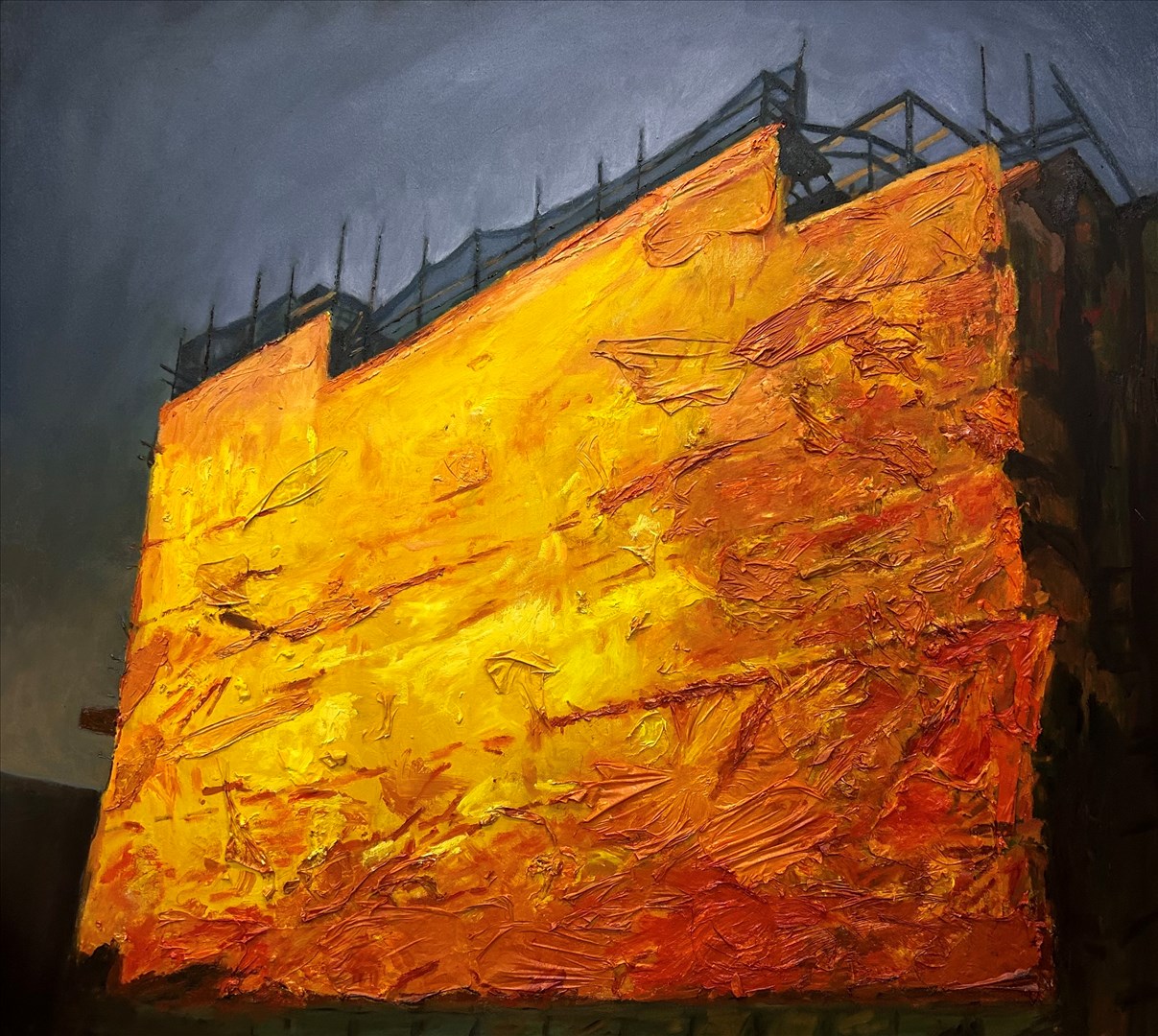
In the same spirit I liked Considerate Construction by Lee Maelzer, mainly for the dramatic gold and orange colouring but also for its industrial vibe.

Considerate Construction (oil and latex) by Lee Maelzer £16,000 (28)

In a completely different vibe, the friend I went with liked:

Love Myself (knitting wool and cotton filling)by Chunyoung Yang £500 (42)

Room 2 (77 works)

Also hung by O’Donoghue. Amid the jumble sale disorder of so many images a number were about the sea, which emerged as a theme in both his rooms.

High and Dry (woodblock and etched lino) by Ian Burke £380 (71)

There was a little area devoted to the works of ‘the late Mick Moon RA’ including this, which I think I’ve seen at a previous show, dramatic in its size and painted on rough industrial planking so right up my street.

Outward Bound (acrylic and mixed media) by Mick Moon £30,000 (111)

The Large Weston Room (242 works)

It comes as a visual and psychological relief to emerge from the first two rooms, characterised by grey and blurred images, and into room 3. This is curated by the fabulous Cornelia Parker who has themed her room round the seven colours of the rainbow and it immediately feels like it. This is the room with the four big Michael Craig-Martins with his trademark flat colouring, and you are also struck by several works with colourful vertical strips. Big relief after the first two grey rooms.

Orchid (by Sir Michael Craig-Martin £8,600

My friend is a birdwatcher and nature lover so she liked the clever Bird Colour Wheel by Jim Moir.

Bird Colour Wheel (pigment print) by Jim Moir £1,250 (149)

There was also the first humorous offerings, including a pair of 18th century paintings spoofed by having 21st century products collaged onto them, by Toby Holmes.

A Bottle of Dog (Newkie Brown) (digital collage; giclee print) by Toby Holmes £250 (188)

I like the woodcut vibe and loveliness of this fine image (in fact a linocut).

Traitorous Trueness (linocut) by Gerard McMenamin £250 (205)

In a similar vein I liked the strong cartoon outlines of this nude.

Untitled Nude 2 (linocut) by Morag Bassinthwaite £250 (256)

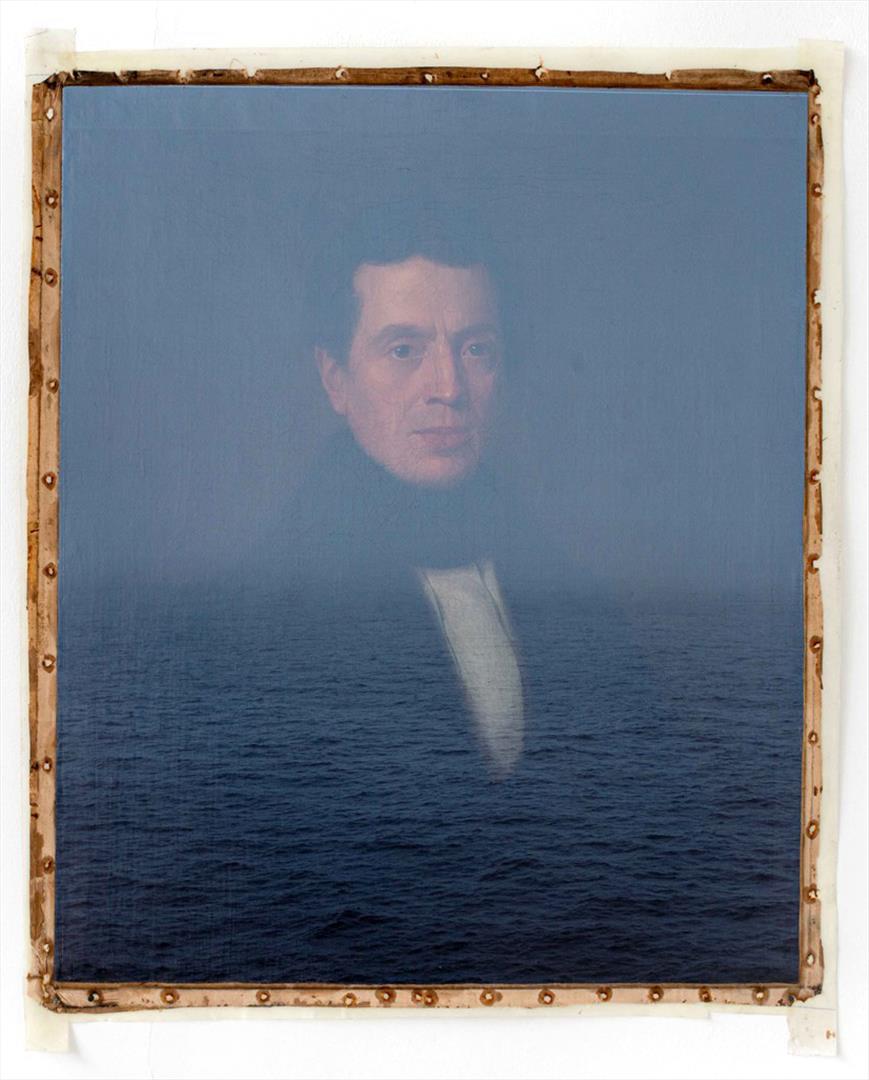
At about this point it dawned on me that maybe, faced with a bombardment of images, the mind prioritises the realistic, naturalistic images. Was that why I was liking recognisable naturalistic images? Is that why I liked this one so much, where Paul Stephenson has merged an original 1820 oil painting (of John Porter by William Bradley) onto an image of the calm flat infinite sea?

Reflets sous la pluie (ink on original oil painting) by Paul Stephenson £2,500 (211)

Remember I mentioned the tiger covered in Tunnock teacake wrappers. The famous tiger was done by David Mach (and there are a couple of smaller works in the same style in the penultimate room). Here’s a jokey hommage by Paula Martyr.

A Teacake Cat (collage) by Paula Martyr Not For Sale (NFS) (210)

When someone’s bought a print which comes in multiple editions, the gallery puts a round red adhesive label by it. I thought it telling that this Parker room has a whole stand devoted to twee and humorous images of cats and dogs which were festooned with red labels. People want art that is a) affordable b) makes you smile.

Resisting the appeal of winsome cats and dogs, I liked the casual gracefulness of this image by Julia Andrews.

In My Mind (five-later screenprint) by Julia Andrews £350 (266)

Small Weston Room (1 video)

The work in the Small Weston Room is by invited artist Carey Young. Filmed at SIGMA Corporation in Japan, ‘The Vision Machine’ captures the company’s female employees, creating a speculative fiction that suggests a lens factory run (and perhaps owned) by women. The factory is used as a metaphor for photography and cinema in a wider sense, and shows how women are framed within, and in relation to those fields. The piece pays homage to women as skilled makers and creators, whilst suggesting a female-centric vision, or perhaps a wider visual culture created by women.

There’s a page of stills from the film on her website. My friend – a woman and a feminist – walked in, watched the video for sixty seconds, and walked out again. Given our saturation with American TV and movies which are designed to grab and keep our attention for every second, it’s very difficult for any art video maker to compete.

Room 3 (63 works)

This room is massive, maybe three times the size of the previous rooms, so it needs big works to make an impression. It was hung by the exhibition’s overall co-ordinator, Ann Christopher who is a sculptor. Her aim (apparently) was to create contrasts of scale. A large collage of woodcuts by Anselm Kiefer (American), a new painting by Rose Wylie and a vibrant work on canvas by Sir Frank Bowling. Alongside are smaller works by artists such as David Remfry and Diana Armfield. Some sculptures are hung on the walls. Cornelia Parker ‘Psychobarn (Flotsam)‘ leans against a wall, while Honorary Academician El Anatsui’s intricate wall-hanging dominates one end of the gallery. I normally love Parker but didn’t react to her shed and the Anatsui is genuinely huge but left me meh. Richard Serra is ‘known for his large-scale abstract sculptures made for site-specific landscape, urban, and architectural settings’ which is why it was odd to see him represented by a painting, which admittedly had a nice Rothko-like abstract vibe (well, without the blurry edges).

Those are all big names but the actual works selected weren’t that exciting, for example a couple of drawings by Rachel Whiteread, who cares? It would have been much better to have one of her huge sculptures, specially for such a big space.

Maybe my favourite piece was the Bowling. There’s a reason why the famous guys are famous – at their best they have a certain something which lifts them above, in this case, the hundreds of other semi-abstract paintings on show. (Incidentally, I think the silver slipper is depicted in the central diamond, something which is much more obvious when you see it in the flesh, as it’s a whopping 3 metres tall.)

Silver Slipper (acrylic and acrylic gel with collaged canvas with marouflage) by Frank Bowling NFS (440)

Room 4 (71 works)

Room 4 was also curated by Christopher. I liked Horror Vacui by Paul Benney which is a digitally animated painting of a candle under a bell jar using up all the oxygen and snuffing out. There’s a slightly worrying big print of a naked man facing away from us by the famous Wolfgang Tillmans. It made me realise how relatively few nudes there were in the show and, as usual, mostly female.

Small but striking (maybe just because it reminds me of the photomontage pioneered by Peter Kennard whose show at the Whitechapel Gallery I recently visited) was this photomontage by Michelle Thompson.

Bomb (digital artwork) by Michelle Thompson £145 (520)

Room 5 (183 works)

Room 5 was hung by Hurvin Anderson and feels packed. Anderson is Black and it’s probably no coincidence that this room has the first real Black presence, for example the big (and not very good) portrait of Linton Kwesi Johnson and a multiple portrait of Bob Marley. (Having been reminded of Johnson I wrote this review listening to his 1979 album ‘Forces of Victory’.

There’s a vast messy colourful painting by Elizabeth Cope; I admired the colourfulness but not the design. My companion liked Storm Light by Leslie Dabson. Interestingly, this doesn’t reproduce at all well online; in the flesh it’s very small and compact and so gives a very strong vibe of a rainy evening in London’s Victorian terraces. One of the most vivid images is the hyper-naturalistic depiction of an abandoned car overgrown with vegetation by Geoff Archer.

440 (oil) by Geoff Archer £2,800 (631)

I really liked a couple of abstracts by Subai Zheng, 628 and 651. As far as I could tell every single one of the thousands of dots had been created by hand with a felt tip pen. The more I looked the more I was drawn into this mesmerising image.

Weaver: 30 Houses (felt tip marker and acrylic on canvas) by Subai Zheng £15,000 (651)

On the left-hand wall I surprised myself by liking Stone Pines Rome by Katharine Edwards, maybe because of its echoes of Piet Mondrian transitioning from naturalism to abstraction. Or just because I liked the design and the colours.

Stone Pines Rome (acrylic) by Katharine Edwards £4,000 (574)

On reflecton, it may also be because so many of the images have a rather dingy grey overcast feel. Maybe without realising it, the curators are biased by the simple fact of living in England to prefer works which are dingy, overcast, grey, or rainy i.e. like the English climate. Thinking about it, there are very few images depicting a fine sunny day let alone the light blue Mediterranean skies you associate with, say, the art of Raoul Dufy or Matisse.

Next to it another imagine I liked the more I looked at it was ‘Yellow Umbrella’ by Bill Jacklin. To me it felt romantic, like an illustration for an adventure novel, two huddled figures rushing through a snowstorm.

Yellow Umbrella (monotype with oil pastel) by Bill Jacklin £5,775 (623)

(See also his Sea at Night I in a later room.)

Room 6 (121 works)

Each year there’s an architecture room and I always amuse myself by calling it ‘the room of shame’. This is based on my lived experience of the vast discrepancy between the pretentious, high-falutin’ language of architects fantasising about building ecocities in Brazil or colonies on the moon, and the crappy, badly built, poorly insulated houses and flats most of us live in, the gritty streets dominated by big impersonal blocks which most of us hurry through against the gritty wind or dirty rain.

Anyway, this year exhibition co-ordinator Ann Christopher handed Room 6 over to Assemble RA with a view to making it ‘a space for making’. Who are Assemble RA?

Assemble RA is a collective based in London, who work across the fields of art, architecture and design. They began working together in 2010 and have described themselves as having between 16 and 20 permanent members. Assemble’s working practice seeks to address the typical disconnection between the public and the process by which places are made. Assemble champion a working practice that is interdependent and collaborative, seeking to actively involve the public as both participant and collaborator in the ongoing realization of the work.

And so Assemble RA transformed this room into ‘an industrial warehouse space, a creative’s store, full to the brim with an eclectic mix of models, machinery and curious objects. On the walls are photographs of interiors and artists’ workspaces, and works exploring different materials such as moss (720), 3d-printed sand and woven rush.

What with the shelves lining the walls and the shelf units displaying architects’ models etc this is the most cluttered and busy room. The standout piece for me was a set of industrial tools which have been remodelled to seem like giant metal monster claws.

Installation view of Room 6 at the Royal Academy Summer Exhibition room 6 showing Nippers (812) by James Capper (photo by the author)

Among the earnest models of sustainable blah blah were a few humorous models such as friends used to make at school.

Amorgos Monastery (plywood, painted light plaster, tree bark and tree branches) by Vasilis Politis NFS (709)

My companion liked this, Vast Seas in Green to Grey by Julie Massie which consists of hundreds of thin fragments of coloured porcelain embedded in wood to create this beautifully shaded but slightly worrying relief.

Vast Seas in Green to Grey (porcelain on wood) by Julie Massie £800 (707)

Room 7 (256 works)

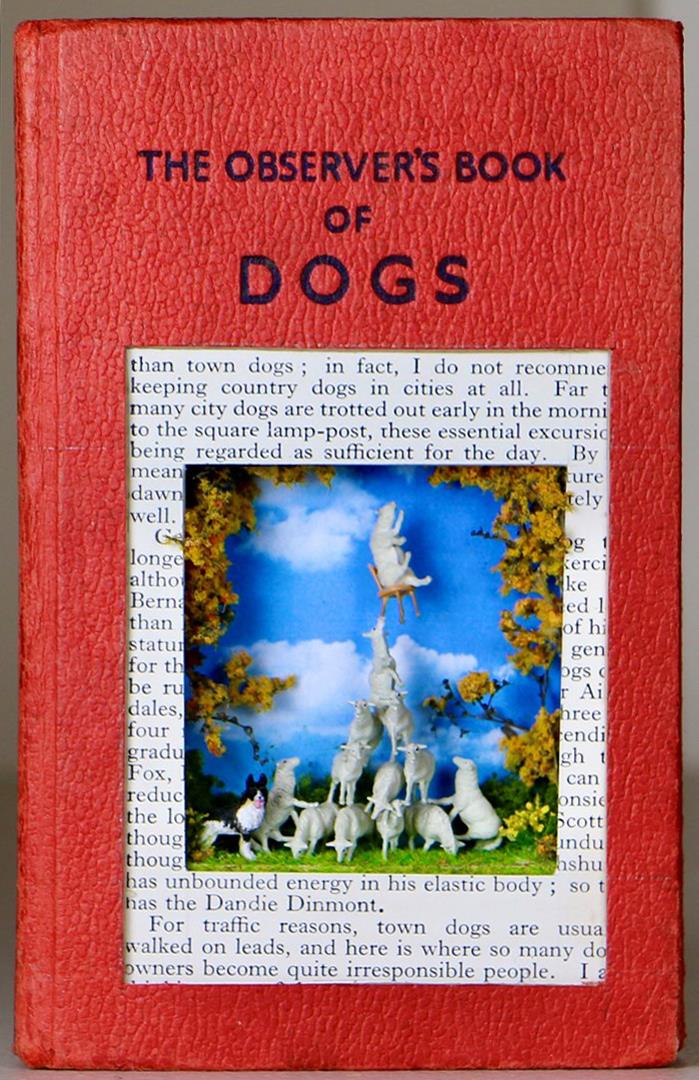
Gallery 7 is the first of two adjacent rooms hung by printmaker Anne Desmet. I recently visited the big exhibition of her work at the Guildhall Art Gallery, which is still open and well worth visiting. There’s a thread of architecture and buildings running through it. But straight off I liked a couple of humorous works by Laura Beaumont who’s gotten old Observer Books, carved a square hole in them and then created tiny dioramas using model railway figures and foliage.

Observers Dogs by Laura Beaumont £1,500 (829)

My favourite piece in this room was hung up high and so you craned your neck, appropriately, to look up at an image of a high rise block. This reproduction doesn’t do it justice. In the exhibition the paper is set on dark brown wood and creates the impression that it’s made of weathered copper.

Cottingley Heights On Oak (Three) (acrylic on oak veneer) by Nicola Rawnsley £380 (841)

In a different mood, I liked Blueprint by Peter Lawrence, maybe because it reminds me of 1950s jazz LP covers. It also links in my mind with the wonderful prints by the Yoshida family currently on display at the Dulwich Picture Gallery.

Blueprint (wood engraving) by Peter Lawrence £175 (872)

Lovely, minimalist and clean are Ian Ritchie’s etchings of foxes (926). For me the standout work in the room was a lovely etching of the BBC offices in Langham Place, possibly because they remind me of the wonderful exhibition of 1930s linocuts at Dulwich Picture Gallery a few years ago.

W1A – BBC AND All Souls Church, Langham Place (etching) by John Duffin £795 (977)

There are lots of images of London streets and buildings which are Desmet’s own subject, in all kinds of styles. I was impressed by the realism of this image of Oxford Street through a rain-drizzled window, presumably of a bus.

Oxford Street (acrylic) by James Condon £5,200 (1015)

Honourable mention Urban Beings V (1024) by Francesco Russo.

Room 8 (259 works)

Second room hung by Anne Desmet, this had a noticeable theme of trees along one wall, with all manner of seascapes on the far wall, many of which I liked. This impressive work is an etching made on sycamore leaves, presumably commemorating the chopping down of the tee in the Sycamore Gap of Hadrian’s Wall. It’s more impressive in the flesh than this reproduction

Acer pseudoplatanus L (etching on sycamore leaves) by Emma Buckmaster and Janet French £7,500 (1132)

In line with my general preference for woodcuts and works with strong outlines, I liked this simple but effective linocut, ‘Trees Beneath a Lemon-Yellow Sky’ by Paul Hogg £750.

Trees Beneath a Lemon-Yellow Sky (linocut) by Paul Hogg £750 (1140)

Twenty of more images of the sea captured it in all its moods, from a lovely print by John Mackenzie of shallow surf over a light sandy beach, to images of waves crashing against rocks, a batch of Norman Ackroyd‘s trademark etchings of remote Scottish islands surrounded by gulls.

An Ocean to Swim (woodcut) (woodcut) by Trevor Price £580 (1189)

High up on a wall was a set of ‘London Heads’. This is small and cute in the flesh (40 x 40 cm) so doesn’t benefit from being blown up in reproduction.

London Heads by Sally Cutler £350

This might be the best room with a wide range of smaller but attractive and quality images. I liked the one of a single fern leaf, another painting of woodland floor all brambles etc. On the opposite wall were characterful images of individuals and groups. This one, also, was all the more powerful for being small (15 x 13 cm) like the illustration to an interesting novel.

Waiting For The Rain To Stop by Barbara Jackson £350

Funniest entries in the show might be the two jokey prints by Ceal Warnent.

Revolutionary by Ceal Warnants (photopolymer relief print on vintage book paper) £130

These prints had almost as many red labels on them as the cute cats and dogs in room 3 and you can see why. They would make you smile every time you look at them.

Room 9 (64 works)

Gallery 9 was hung by Ann Christopher and is dominated by the biggest piece in the show, ‘String Quartet’ by Ron Arad. This is a big carpet draped up the wall and across the floor, on which sit four chairs on which are placed the four instruments of a string quartet and over hidden loudspeakers is projected string quartet music which you can hear from the nearby galleries. It’s odd, really, how little modern art makes use of music or sounds of any sort.

The Quartet by Ron Arad (sculpture made of wood, steel, copper, silicon and cotton £300,000 (1408)

There’s another big showy work, a huge sculpture of a pair of black hands by Tim Shaw which I didn’t like at all. The curators comment ‘a pair of hands where the negative space forms part of the work’ – well, which sculpture does not create a greater or lesser space around it? On the plus side, some of the children visiting the show were enjoying pretending to shake hands with them or dancing in and around them which was fun to watch.

The Space Between (Does Not Come in a Vacuum) by Tim Shaw (sculpture of Painted foam) £35,000 (1410)

My companion the naturalist liked all images of birds throughout the show but particularly the strutting crow.

Strutting (acrylic) by Lisa Badau £645 (1384)

The Lecture Room

This room was hung by Veronica Ryan who had the bright idea of painting the wall turmeric ‘a colour inspired by the culinary spice which is known for its healing properties’. This turns out to be a very dynamic and enjoyable colour to stroll in. This room is full of sculptures, maybe it was unofficially ‘the sculpture room’ and Ryan has made the little innovation of replacing traditional white plinths with wooden shelves and trestle tables. This is cool but also brings out a strong village church jumble sale vibe as well. All kinds of things to admire. My photo of a battleship made of card shows the turmeric colour in the background.

Installation view of the Royal Academy Summer Exhibition 2024 showing ‘Worship-Warship’ by Richard Wilson and, in the background, the orange turmeric colour of the walls and the bric-a-brac vibe created by the trestle tables (photo by the author)

Maybe the most striking piece is an oriental carpet out of which a tiger’s head is mutating, like the alien bursting out of John Hurt’s stomach. It’s life size and genuinely a bit disturbing.

Brown Tiger by Debbie Lawson (sculpture made from Jesmonite, carpet and wood)

There was, maybe, an understated feminist theme in this room, with some paintings of menopause medication by Sara Gregory (1429). I liked the sculptures using an image of a mother and child printed on a metal plate and surrounded by rooster feathers to create a kind of ‘native’ African shield effect.

Female Warrior Army, Motherhood 2 by Emma McGuire (photo decal on porcelain with rooster feathers) £3,500

In a related African vibe (on the same wall) are hung a couple of big prints by Yinka Shonibare CBE (1525, 1526) whose exhibition at Serpentine South you can still visit. I quite liked a lot of things in this room but not burningly so. I suppose this is quite amusing and many of the other sculptures were in the same category: quite good, quite funny. Possibly I was just exhausted by this stage of the marathon.

The Invader by Hannah Simpson (stoneware ceramic) £1,050 (1620)

Wohl Central Hall (81 works)

The Wohl Central Hall is the last room in the show and the second of Assemble RA’s two rooms. The idea is that they’ve ‘created a studio setting and explored the creative process’. This explains why there are random swatches of paint on the walls and a clutter of props including a drafting table and a joinery bench. The plinths in the gallery have been repurposed from waste materials such as discarded slabs from an industrial estate etc. Probably there was lots of interesting and stimulating work here but I was full. My companion, blessed with more stamina than me, and also much clearer about what she likes, liked the big mosaic of ‘Hackney Birds’ and spent a minute or two checking off the ones we see in our garden.

Some Hackney Birds by Hackney Mosaic Project (wall-based glass and ceramic mosaic) NFS

Maintaining the ornithological theme I liked this – maybe because by this stage I was on my last legs and only noticing the really bright obvious pieces.

African Phoenix: Coffin for Qm Nana Yaa Asantewaa by Elsie Owusu (carved wood, paint and glazes) NFS

Thoughts

Despite all the curators’ talk of themes and issues, the experience of visiting is massive, chaotic and exhausting. That said there are hundreds and hundreds of things to like if you have the stamina, determination and patience to look carefully at everything. I wrote this review the day after visiting and was surprised to realise how many works I really liked, including many I haven’t shown here.

After a dingy start in the grey murky opening rooms, and despite the absence of any real showstoppers (apart, I suppose, from Arad’s Quartet and Shaw’s hands, and maybe Parker’s shed and El Anatsui’s wall-hanging, none of which did it for me) there are lots of smaller, sometimes very small, gems, which are worth the effort of carefully reviewing everything in the room to find and cherish and marvel, feel and chortle at.

Tunnocks Maneki-Neko by Robert Mach (kinetic sculpture with confectionary foil on plastic and wood) £1,400 (1555)


Related links

Related reviews

Collapsed Whaling Station Deception Island, Antarctica by Emma Stibbon @ the Royal Academy

This is a small but interesting, free display in The Collection Gallery at the Royal Academy (at the back of the building on the first floor). Its point of departure is an enormous woodcut engraving made by Emma Stibbon of a derelict whaling station in Antarctica. It was Stibbon’s Diploma piece, which she submitted along with related drawings and photos, to gain membership of the Academy.

Collapsed Whaling Station, Deception Island, Antarctica, 2006 by Emma Stibbon

It’s a big work – 1.17 meters tall by 2.38 meters wide. If you’re close up to it, you have to turn your head to take it all in, creating a panoramic effect. Up close you can see how the powerful grain of the woodcarving echoes and amplifies the heavy wooden beams of the structure itself.

Contexts

This mini exhibition also features about twenty other artefacts, which includes prints, drawings and photographs, chosen to expand and contextualise the image:

1. About a third of them deal directly with the whaling station including photos of it during its time as a research base in the 1950s; from just after the volcanic eruption and its abandonment in 1979; through to  the photos Stibbon took on her visits to Antarctica, alongside related sketches and charcoal drawings.

2. Another set of images relate to Robert Scott’s ill-fated British Antarctic Expedition (1910 to 1913).

3. But the biggest amount, about half the display, consists of works by other Royal Academicians of either a) ruined buildings or b) extreme landscapes, which provide visual and conceptual accompaniment to the Stibbon piece.

Section 1. Stibbon

Stibbon is drawn to environments that have been shaped by both the elemental forces of nature and the impact of human endeavour, what she describes as ‘landscapes that have a tension between the natural forces and the manmade’. (So, if you go to her website, you’ll see folders of projects with titles like ‘Polar regions’, Wild lands’, ‘Volcanoes’.)

a) Collapsed Whaling Station

The main woodcut depicts Biscoe House, a large building erected in the early 20th century for the purposes of commercial whaling. In the 1930s it fell into disuse, before being taken over and renovated by the British military during the Second World War. In the 1960 it was damaged by a lava flow. Lava in the Antarctic? Yes, Deception Island itself is actually formed by the crater of a submerged volcano.

Nobody lives permanently on Deception Island though scientific stations run by different nations are visited periodically by scientists. Stibbon saw the building when she accompanied one of these scientific trips in 2006 as an artist in residence. The display includes photos of the station in its heyday, alongside photographs and sketches made by Stibbon on that first trip in 2006, and a subsequent one in 2013.

She tells us that she chose to depict the station in a woodcut because of the physicality of the medium, but also because of the size you can achieve. It’s a very big print, which creates a kind of cinematic, immersive experience.

Installation view of ‘Collapsed Whaling Station, Deception Island, Antarctica, 2006’ by Emma Stibbon

b) Lead

Beside the central woodcut are other works by Stibbon, notably a very striking piece titled ‘Lead’. She made this after her second visit to Deception Island, in 2013. Unlike the big wood carving, it’s an intaglio print. (‘Intaglio describes any printmaking technique in which the image is produced by incising into the printing plate – the incised line or area holds the ink and creates the image.’)

Obviously the central crack in the ice is the thing that catches the eye. It was created by the ice-breaking ship Stibbon was travelling on, and is, perhaps, a vivid symbol of the fragility and contingency of this, and indeed all, environments.

Lead by Emma Stibbon (2014)

But what I liked is the rough and ready finish given by the medium, e.g. the flotsam of white froth at the bottom of the jagged channel of open sea, the black dots in the sky, the strange lizard eye in the hill above the dwindling crack, and the vertical lines at the top left.

I doubt if any of these would appear in a photograph. It’s what art does; even at its most apparently naturalistic, art transforms and amplifies reality, feeding the eye and the mind with more meaning and possibility than we actually see.

Section 2. Scott

Stibbon travelled to Antarctica as artist-in-residence to the Friends of the Scott Polar Research Institute, Cambridge. This, I presume, is why there’s some photos and information panels about Scott’s ill-fated expedition to the Antarctic. This photo shows five members of the British Antarctic Expedition (1910 to 1913) . After much trial and endurance the group reached the South Pole on 17 January 1912 only to discover that the Norwegian expedition under Roald Amundsen had beaten them by 34 days. All five men in this photo perished on the journey back to their base camp.

British Antarctic Expedition and Herbert Ponting at the South Pole, January 18 1912 © Photo: Royal Academy of Arts

But the display highlights some unexpected connections. First, it turns out that Dr Edward Wilson, seated on the right, was himself an artist. Among his belongings at base camp were discovered works he’d made before the expedition set out on the ill-fate final part of their journey. These included a watercolour of Mount Erebus, a volcano in Antarctica. After the expedition perished, a fundraiser was organised to raise money for the wives and children of the dead men, and the print on display here, based on the original watercolour, was sold for the cause.

Watercolour of Mount Erebus by Edward Wilson (1911)

And second, it turns out that the expedition itself was organised from an office in 6 Burlington Gardens, which is now itself part of the Royal Academy buildings! Huge empire but a small world, official London was.

Extreme weather and ruins

a) Extreme conditions

Extreme weather has fascinated artists for centuries and this little display includes some choice examples from the RA’s collection.

This is a print based on William Daniell’s painting of the Eddystone Lighthouse off Rame Head during the Great Storm that battered the south of England in 1824. Huge waves almost engulf the lighthouse, sea and sky are mingled in the tumult. From a compositional point of view the interest is in the light emanating from the vulnerable lamp room at the top of the building: if it wasn’t there you’d need the moon to achieve the same effect of luminous light shed on the towering waves and highlighting the turbulent clouds. It is also symbolic. Given the date, 1824, viewers would be invited to identify the fragile but persistent light as not only a navigational aid to ships in distress but of the resilience of Christian faith in even the most troubled times.

The Eddystone Lighthouse, during a Storm, 6 July 1825 by William Daniell © Photo: Royal Academy of Arts

Hung next to it is a sort of modern equivalent, not a storm but what looks like a steady downpour onto remote rock stacks near St Kilda in the Outer Hebrides. Norman Ackroyd has been producing prints like this for decades, they’re a familiar sight at the Academy’s summer exhibitions. The wall label tells us these two rock formations, Stac Lee and Stac an Armin, the most remote of the thousands of British Isles, became an obsession of Ackroyd’s after his repeated attempts to visit them were defeated by bad weather.

St Kilda – Stac Lee and Stac an Armin, 1990 by Norman Ackroyd. Etching and aquatint © Royal Academy of Arts

Other extreme conditions images in the show include a study of waves by Anthony Gross, the print of Mount Erebus by Edward Wilson mentioned above, and three photographs of Mount Etna erupting by Ledru Mauro. All the images in this display (and tens of thousands more) can be found via the Royal Academy Search the Collection function.

b) Ruins

But ruins have fascinated artists, too. I remember Tate Britain’s 2014 exhibition devoted to the art of ruins. In that spirit, the most extreme ruin here is a photo of one of the galleries at Burlington House after a direct hit from a bomb during World War One, showing broken glass, plaster and stone scattered everywhere. But that’s, obviously enough, the result of human violence. Other images are more in line with Stibbon’s interest in the powerful forces of the natural world.

This is one of several sketches by George Clausen who did naturalistic and no doubt dated sketches and paintings of English rural life, especially in Essex, from the 1870s right through to the 1930s. This isn’t a ruin caused by enemy action or the violence of nature, but a much quieter image of slow decay and collapse. Natural entropy. It doesn’t reproduce as well as some of the other images, but in the flesh I found it reassuring and homely.

Study of a dilapidated cottage, Finchingfield, Essex, after 1907 by Sir George Clausen

Other ruin images in the exhibition include a ruin in Greece by Hugh Casson, a study of Dolbardern Castle Llanberis by George Clausen, and a collapsed gate by Norman Stevens. All the images in this display (and tens of thousands more) can be found via Royal Academy Search the Collection function.

The video

Thoughts

The whaling station woodcut is obviously a fine work in its own right. But this is a charming display because it is designed to lead the eye and the mind on journeys ravelling outwards from the central image. Its juxtapositions tease and inform and entertain. Some of the ancillary art works are as enchanting as the centrepiece. Sometimes the smallest exhibitions are the most enjoyable.


Related links

More Royal Academy reviews

Reviews of other women artists

Käthe Kollwitz: Portrait of the Artist edited by Frances Grady and Max Egremont (2019)

This is the catalogue to accompany the recent Käthe Kollwitz exhibition at the British Museum.

The two or three essays in the book include:

Käthe Kollwitz’s biography

Born Käthe Schmidt in 1867, left-wing upbringing, married a left-wing doctor (Karl Kollwitz) who practiced in the slums of Berlin, specialised in prints, devoted herself to left-wing subjects i.e. lives of the working poor, plus historic subjects e.g. a weavers’ rebellion, sent son off to the Great War and he was killed within weeks, decades of mourning and grief and obsession with death.

Detailed looks at Kollwitz’s major print series

  • A Weavers Revolt (1898)
  • The Peasants War (1902-8)
  • War (1922-3)
  • Death (1932-7)

A lifelong obsession with death

What comes over from the essays is Kollwitz’s obsession with death – possibly, as one essay suggests, as a result of the death of some of her siblings in infancy – definitely compounded by the poverty, sickness and death she saw all around her in the slums of Berlin.

She was unnaturally, morbidly attracted to the subject in the 1890s and 1900s, well before she made the fateful decision to help her beloved son Peter enlist into the army in the first weeks of the Great War, despite him being under age, only for him to be killed a matter of weeks later. The guilt must have been staggering.

From that point onwards, Death and the grief of mothers was to become her enduring subject.

The prints

The factual content of the book, then, is solid but not revelatory, and all the images are hedged around with an extreme of scholarly punctiliousness and accuracy. After all, this is a reference book for other scholars as much as an introduction to us lay people.

No, the reason for owning the book is not for the biography, detailed though it is – but for the quality of the reproductions, including close-ups of many of the key prints. These let you really savour the details, and make them even more powerful and moving.

Some of her images can be a bit clunky, some of the faces in the weaker pictures are less than persuasive, even though her figure drawing and composition are almost always powerful and commanding. But at her best, there’s a solid body of work of breath-taking power and depth which surely make Kollwitz one of the great artists of the twentieth century.

Self portrait 1912

Kollwitz did at least 50 self-portraits and no portraits of anyone else, hence the focus of the BM exhibition and of this book. They are no frills, no pretense records of a journey through a hard life and a gruelling era of history.

Black and white charcoal drawing of an old lady's face

Self-portrait by Käthe Kollwitz (1912) © The Trustees of the British Museum

Woman with dead child (1903)

The most finished or prominent feature is the woman’s left knee and then, perhaps, her big left foot. This isn’t a dainty Rococo woman or an air-brushed sex object. This is a cave woman, Cro-Magnon Woman. No frills or make-up, no sexuality, just blunt primeval human feeling with extraordinary power.

Black and white drawing of a primitive, almost ape-like woman clasping the body of her teenage son

Woman with Dead Child by Käthe Kollwitz (1903) © The Trustees of the British Museum

Unemployment (1909)

A large reproduction lets you see the fullness with which the baby and the children’s faces have been gently etched, and brings out the contrast between their soft child faces and the rest of the spare, scratchy, shadowy scene, the gaunt shadowed face of the exhausted mother.

Black and white drawing of an ill-looking woman tucked up in bed, holding a small baby, with several other small children asleep on the bedding, while the dark image of her husband sits and broods beside the bed

Unemployment by Käthe Kollwitz (1909) © The Trustees of the British Museum

Arming in a vault (1906)

From 1789 to 1989, the great theme of European history – terror of uncontrolled, violent revolution from below.

Very dark image of a hoard of people armed with axes and spears and halberds thronging catacombs and, on the right of the image, surging up a very steep staircase, presumably into the light of day

Arming in a Vault by Käthe Kollwitz (1906) © The Trustees of the British Museum

Call of Death (1937)

Here I come, ready or not.

Stark, primitive black and white charcoal drawing of a bald woman with an ape-like head, hear arms across her chest so you're not sure of her gender, and from the top right a veined and bony hand reaching down to touch her - the touch of Death

Call of Death by Käthe Kollwitz (1937) © The Trustees of the British Museum

This is the eighth and final image in Kollwitz’s final series of prints which was titled, simply, Death. 

In fact it’s also a self-portrait as a glance at the 1912 self-portrait confirms – but now without hair, without any attributes which identify her gender. Just raw, elemental human.

In the Death series, completed before the Blitzkrieg and Stalingrad and Warsaw, before the Holocaust and the camps, it is as if Kollwitz has plumbed the depths of human experience, not in the relatively superficial terms of despair or emotion, but reaching far deeper down than that, to a grunting, primeval, prehistoric stratum of human experience.

Tell me what you think

← Back

Thank you for your response. ✨


Related links

Aubrey Beardsley @ Tate Britain

Aubrey Beardsley must be the most distinctive British artist. If you see any of his mature works, they are immediately recognisable and almost always deeply satisfying, their elegance of line and composition emphasised by the stylish use of huge areas of unmediated black or white, and the sophistication of his sensually charged portrayal of the human figure.

The Black Cape, illustration for Oscar Wilde’s Salome (1893) Photo © Tate

This exhibition is a feast of Beardsleiana, bringing together 200 spectacular works to make the largest display of his original drawings in over 50 years and the first exhibition of his work at Tate since 1923.

The wall labels to the fifteen or so sections the exhibition is divided into are available online:

And it contains a detailed timeline of his career. Rather than repeat all that, I’ll just single out what were, for me, the key learnings or best bits.

Key learnings

As he turned 18 and needed a job, Beardsley got a job working in an insurance office which, as you might imagine, he hated. What other early modern ‘great’ worked in an insurance office, created a distinctive body of work, and died of tuberculosis? Franz Kafka

Arts and Crafts

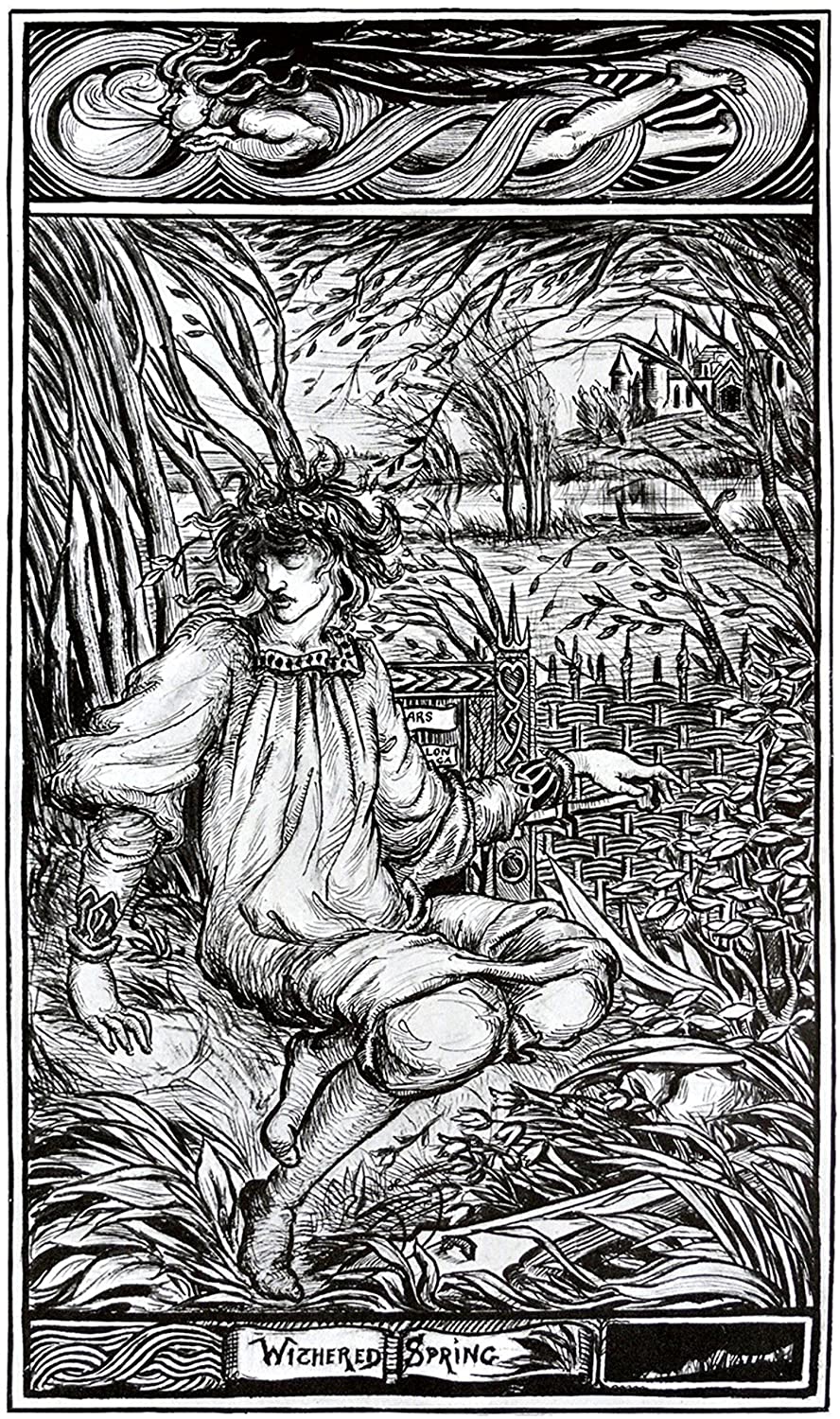
It is interesting to see Beardsley’s tremendous indebtedness to Arts & Crafts ideas of total design, and the importance of intertwining flower and stem motifs. And considering he was only 19!

Withered Spring by Aubrey Beardsley (1891)

Beardsley began his career just as William Morris was producing his luxury designed books from the Kelmscott Press. The curators usefully summarise the elements of a Kelmscott production as:

  • elaborate decorated borders
  • decorated initial letters
  • full page illustration

The hair-line style

The exhibition shows how Beardsley quickly moved from this relatively ‘heavy’ line to move to the extreme opposite, to complex compositions which are covered in a crazy network of super-fine lines. The curators call this his ‘hair line’ style.

How Arthur saw the Questing Beast by Aubrey Beardsley (1893) Victoria and Albert Museum

It is also an early example of Beardsley slipping surreptitious rudeness or irrelevancies into his pictures. At the bottom left of the ‘river bank’, right up against the frame, is the silhouette of an erect penis and scrotum. Towards the top right is a concealed treble clef.

Morte d’Arthur

The picture above is one of the Morte d’Arthur series which made Beardsley’s reputation. He was commissioned to make a hefty 353 illustrations for a new edition of the Morte by publisher J.M. Dent, including full and double-page illustrations, elaborate border designs and numerous small-scale ornamental chapter headings.

However, Beardsley quickly became bored and irked by the subject limitations and began introducing extraneous elements and flights of fancy. Thus the picture above is supposed to be of a medieval knight and a dragon though you wouldn’t really think so. Most disruptive of all is the presence of a pan or satyr from Greek mythology, absolutely nothing to do with medieval legend.

Japanese influence

The exhibition includes one print by Utagawa Kuniyoshi, a lovely coloured woodblock which exemplifies the kind of Japanese influence which impacted European art from the 1870s onwards, and influenced everyone with their:

  • abstract depiction of pictorial space
  • linear intricacy
  • emphasis on flat pattern

Kakemono

kakemono is a Japanese hanging scroll used to display and exhibit paintings and calligraphy inscriptions and designs mounted usually with silk fabric edges on a flexible backing, so that it can be rolled for storage. It is a distinctly different shape from traditional Western portrait shape, and Beardsley was to incorporate it into many later works.

Mantegna

Andrea Mantegna (1431 to 1506) was a key influence for Beardsley. The Italian was famous for his frescos and murals showing parades and processions and groups of people, and Beardsley used ideas and figures and compositions from Mantegna throughout his career. Even in his last accommodation, a hotel room in the south of France, he had a set of photos of works by Mantegna pinned to his wall. Indeed Beardsley produced several Mantegna-style processions, notably The Procession of Joan of Arc which was included as a foldout supplement to the second edition of The Studio magazine in 1892.

Wagnerite

Beardsley was a keen fan of Wagner, attending productions of his operas and illustrating scenes from them. He had ambitions as a writer as well as illustrator and in his last few years worked at a text which was a comic version of the legend of Tannhäuser which Wagner had made into an opera. Given the working title of the Story of Venus and Tannhäuser, excerpts were eventually published in The Savoy magazine under the title Under The Hill, an oddly Hobbit-like title for such a grand Wagnerian subject.

Photo Lineblock

Just as important for the quick evolution of Beardsley’s style was the introduction in the 1890s of the new technology of photo lineblock printing, a photomechanical process. Beardsley was disappointed at the poor reproduction of his washes and shading using this new method, but quickly adapted and made a virtue of leaving large areas of a page completely untouched, others pure black, and ensuring the lines and patterns were crisp and clear. The result is startling.

How la Beale Isoud Wrote to Sir Tristram by Aubrey Beardsley (c.1893) Alessandra and Simon Wilson

In fact this picture is singled out by the curators as exemplifying another of Beardsley’s traits which was his extraordinary ability to assimilate influences and make them his own. Thus the curators point out in this image:

  • Isoud resembles Jane Morris, with the classic pre-Raphaelite jutting chin and mountain of frizzy hair
  • the Germanic form of the desk is borrowed from Albrecht Dürer’s engraving St Jerome in his Study
  • the flattened use of space recalls the influence of Japanese prints
  • whereas the elaborate border of intertwining flower motifs recalls Arts & Crafts designs

Salomé

In 1892 Beardsley made a drawing in response to Salomé, Oscar Wilde’s play, originally written in French and based on the biblical story. Wilde admired the drawing and he and his publisher, John Lane, chose Beardsley to illustrate the English translation of the play. Beardsley produced eighteen designs in total, of which only ten appeared in the first printing of the play. Publisher John Lane suppressed or censored three of Beardsley’s illustrations for their overt sexual references, in particular when female characters’ hands are wandering towards their privates, as if about to masturbate, or unnecessary depictions of the male characters’ phalluses.

The Climax: illustration for Oscar Wilde’s Salome (1893) by Aubrey Beardsley. Photo © Tate

The Yellow Book

The exhibition clarified the timeline around the Yellow Book, and has an entire room devoted to it. Beardsley was made its art editor at its inception in 1894 and contributed the front and back covers for the first five editions. But Beardsley was closely associated with Oscar Wilde (having contributed a suite of illustrations for Wilde’s ‘immoral’ play about Salome), and so soon after Wilde’s arrest in May 1895, Beardsley was fired from the Yellow Book.

On one of the days of his trial, Wilde was seen going into court holding a copy of the Yellow Book and that clinched it for the angry mobs and journalists outside. The offices of the Yellow Book’s publishers, Bodley Head, were attacked by a mob who smashed its windows. In order tonsure the survival of the firm, and its staff, and the continuity of publication of the magazine and all his other titles, publisher John Lane had little choice but to distance himself from Beardsley. The sixth volume, of July 1895, still had the cover and several illustrations by Beardsley but he no longer worked for it. (Later it transpired that Wilde hadn’t been holding a copy of the Yellow Book at all, but a French novel, which tended to be published with yellow covers.)

The Yellow Book Volume I (1894) bound volume. Photo © Tate

It looks as if you can examine every volume of the Yellow Book, all its literary and art contents, online

The room has an example of all five volumes of the Yellow Book that Beardsley was involved with. I’ve read about it ever since I was a teenager at school forty years ago, but I don’t think I’d ever seen a copy before and certainly not six. I’d always envisioned it as magazine-size, but it does indeed look like a hardback book, in size and shape and leather binding.

Beardsley’s work desk

The exhibition includes the very table or desk which Beardsley used during his glory years. Standing a few feet from it, it is hard to imagine that the man produced all these pitch-perfect works without the aid of architects’ tools or computers – just him, a ruler and a pen.

Beardsley’s address

With the money he made from the Salome illustrations and a small legacy Beardsley bought a house at 111 Cambridge Street, Pimlico with his mother and sister, Mabel, to both of whom he remained very close throughout his short life. Only a few hundred yards from Tate Britain where this exhibition is being held…

Oscar Wilde

Wilde was an established writer when he saw the first of Beardsley’s drawings and immediately liked them. He approved the suggestion that Beardsley illustrate the original French version of Salomé and they socialised. So far, so well known. I hadn’t realised that Beardsley satirised Wilde quite so much. There are straightforward lampoons of the increasingly fat and pompous aesthete, but he also slyly slips Wilde’s epicene features into numerous other illustrations, in one giving the moon the eyes and nose of Wilde.

The Woman in the Moon by Aubrey Beardsley (1894)

The Rape of The Lock

This is the title of Alexander Pope’s mock-heroic 18th century satire. I suppose it’s worth clarifying that ‘rape’ in the title doesn’t mean rape in our modern sense, but the older sense of ‘theft’ or stealing away. Thus Pope conceived an extended poem which uses all the devices and machinery of the classical epic to describe how one jaded aristocrat cuts a lock of hair from the head of another jaded aristocrat, and this leads to a feud between their families. Believe it or not this elaborate literary joke extends to five cantos with many extended scenes. Beardsley created nine photo-engravings for an 1896 republication of the poem, five of which are on display here for the first time.

Beardsley had been a fan of 18th century rococo prints, maybe because they – like him – are sophisticated, worldly, stylish and much more open about sexuality than the Victorians. The exhibition shows us some of the original 18th century prints which Beardsley bought at auction in Paris, and then goes on to show all the Pope pictures.

The Dream by Aubrey Beardsley (1896) The J. Paul Getty Museum, Los Angeles

What’s immediately obvious is the that the stark clarity of the Salome illustrations has been abandoned for a much more elaborate style, characterised above all by the stippling that creates a sort of lace doily effect on almost all the fabrics. And look at the patterning of the carpet. A long way from the stark black and white of the Salome illustrations. Many critics thought these his best works as an illustrator.

Posters

The 1890s were the glory decade for poster design in Paris, led by Henri Toulouse-Lautrec and Jules Chéret. I didn’t realise Beardsley produced a number of posters which modified his own style to take on board the need for a) size b) colour.

There’s a room devoted to half a dozen of his posters, none of which match the quality of Lautre or Chéret, and most of which are advertiser’s promotions of new ranges of childrens books or books by women, alongside promotional posters for The Yellow Book and several plays and operas. The section contains the telling quote:

I have no great care for colour, but [in posters] colour is essential.

‘I have no great care for colour’. Worth pondering. And relevant to the one and only oil painting Beardsley is known to have made.

Oil painting

There’s a rare outing for Beardsley’s only oil painting and you can see why – it’s rubbish. His entire style was built around absences, around huge areas of untouched whiteness. Trying to translate that into oil, which specialises in depth and shadow, was a hopeless task.

Porn

After Beardsley was sacked from The Yellow Book, almost the only publisher who would use his drawings was Leonard Smithers. Smithers operated on the fringes of the rare book trade, issuing small, clandestine editions of risqué books with the boast: ‘I will publish the things the others are afraid to touch’. Smithers encouraged Beardsley’s already growing interest in risqué French, Latin and Greek texts and commissioned drawings to illustrate the Satires of the late Roman poet Juvenal and, most famously, Aristophanes’s bawdy satirical play Lysistrata.

In Lysistrata the women of Athens go on a sex strike, refusing to have sex with their menfolk until they stop the ridiculous war against Sparta. Beardsley made eight outrageously sexual illustrations for Smithers’ edition. Among other subjects, this is the set which includes start, beautifully made black and white line drawings of ancient Greeks with humongous erect penises. Maybe if you’re very young or innocent these are ‘shocking’ images, but to the modern viewer they are vaguely reassuring, certainly humorous. The two figures on the right are mildly realistic but it’s the guy on the left who gets the attention, not because of his phallus as such but because the entire character is obviously created for grotesque comedy.

Illustration for Lysistrata by Aubrey Beardsley (1896)

The grotesque

He knew he was attracted to ‘the grotesque’ and there is a wall label which usefully explains the origins of the grotesque in art. Grotesque originally referred to the decoration of grottos, and came to denote the depiction of deliberately hybrid and monstrous forms, which often combined body parts from different animals, like a centaur or mermaid. As the man himself said:

I see everything in a grotesque way. When I go to the theatre, for example, things shape themselves before my eyes just as I draw them. .. They all seem weird and strange to me. Things have always impressed me in this way.

Foetuses

Nobody knows to this day why he drew so many foetuses, either as insets in frames or as characters in the more grotesque illustrations. Maybe it was simply because they are a kind of quintessence of the grotesque.

My favourite

Venus framed by two statues of male gods in the form of herms (a sculpture with a head and perhaps a torso above a plain, usually squared lower section’). I like it because of its formal precision, its symmetry which is, however, broken by the asymmetric sway of Venus’s long dress. I like it because there is no indecency, boobs or penises in sight. Instead there is a sense of genuine menace from the devil eyes of the two herms. And I like it because it is a kind of reversion or revisiting of the Arts & Crafts theme of incredibly ornately interwoven bushes, stems and flowers of (I think) roses. But mostly because it is a pleasingly complete, formal, complex and rather threatening image.

Venus between Terminal Gods (1895) Drawing with india ink by Aubrey Beardsley. The Cecil Higgins Art Gallery, Bedford

Walter Sickert

Almost the best thing in the exhibition is the full-length portrait painting of Beardsley made by the English painter Walter Sickert, after they’d both attended a commemoration ceremony for John Keats. Its sketchy unfinished quality makes it a haunting gesture to the memory of the dandy and artist who died aged just 25.

Aubrey Beardsley by Walter Sickert (1894)

Crucifix

The exhibition includes the last photo of Beardsley, taken in the hotel room in the Hotel Cosmopolitain in Menton where he had gone in search of a warmer dryer climate which would be more favourable to his tuberculosis. The photo shows Beardsley looking tremendously smart in a suit and well-polished shoes opposite a wall on which are pinned reproductions of his beloved Mantegna, and a mantelpiece on which sits a crucifix.

Because although I’ve probably read it numerous times, I’d forgotten that in his last months Beardsley converted to Catholicism. He died holding a crucifix. Just a few days before he died he wrote a letter to Leonard Smithers asking him to destroy all of Beardsley’s risqué images, the Lysistrata illustrations etc. Smithers refused and so they were saved for generations of schoolboys to giggle over.

Who does a deathbed request to destroy his works which its address completely ignored remind you of? Franz Kafka.

Film

There is a room with benches so you can watch Charles Bryant and Alla Nazimova’s 1923 silent movie version of Salomé immediately following the room of Beardsley’s illustrations. For some reason the gallery lights had been left on full power in this room which made it harder to see the image on the screen.

Legacy

The exhibition closes with a sketchy overview of Beardsley’s legacy from his influence on the long sinuous lines of Art Nouveau via a string of now mostly forgotten book illustrators who copied his style (Harry Clarke, Hans Henning Voigt) through the revival of Beardley’s reputation and style which was sparked by a major retrospective of his work at the Victoria and Albert Museum in 1966 which led to the incorporation of Beardsleyesque black and white swirling lines into lots of psychedelic posters and, most famously of all, into the portrait of the four Beatles in the cover art for their LP Revolver.

Portrait of Aubrey Beardsley 1893 by Frederick Evans. Wilson Centre for Photography

This is a long, very thorough, exhaustive and informative exhibition about a truly world class and utterly distinctive English artist.


Related links

More Tate Britain reviews

Piranesi drawings: visions of antiquity @ the British Museum

To mark the 300th anniversary of the Italian printmaker Giovanni Battista Piranesi, the British Museum has created a landmark FREE exhibition displaying the Museum’s complete collection of Piranesi’s drawings.

Piranesi (1720 to 1778) is often reckoned to be the greatest printmaker of the 18th century. He was extremely prolific, producing hundreds of views or veduti, of Rome in particular, focusing on its ancient ruins, sometimes portrayed as monstrously huge and elaborately decayed, in other series shown as if restored to their former glories.

Into these elaborately staged and dramatic scenes he introduced groups of vases, altars, tombs and other baroque details that were never actually present in ancient Rome, in order to produce finely detailed, elaborate and often fantastical views. (Note the very small chariot and people at the bottom centre of this amazingly cluttered composition.)

Fantastical view of the Via Appia. Engraving by Giovanni Battista Piranesi

The Enlightenment taste for ruins

It is fascinating to learn that the taste for ‘views’ of Roman ruins was growing in order to cater for the growing numbers of rich northern Europeans making the Grand Tour of classical sites. To cater for this growing market, Italian artists developed and named a new set of artistic genres, including:

  • veduta – a highly detailed print of a cityscape
  • capriccio – a whimsical aggregate of monumental architecture and ruin which never existed in real life
  • veduta ideata – idealised and larger-than-life depictions of the ancient ruins in their supposed glory
  • veduta di fantasia – architectural fantasies

As this list suggests, the taste of the times was for the fantastical, the awe-inspiring in age and size, curly-cued with fantastical details and elaborations. In fact so exaggerated were the size of many of Piranesi’s images of Roman ruins that when Northern tourists actually arrived, they were sometimes disappointed to discover the actual remains were far more modest in scale.

Goethe is mentioned as one of many Northerners who formed their ideas about Rome from Piranesi’s fabulously successful books of prints and, on finally arriving at the Eternal City, being disappointed.

Interior view of the Flavian Amphitheater, called the Colosseum (1766) by Giovanni Battista Piranesi

Antiques dealer

Although he was born and educated in Venice, Piranesi came to Rome as a young man and made his career there. Not only a frustrated architect and very successful print-maker, Piranesi was also an antiquarian and antiques dealer. He not only dealt in the large number of Roman antiques to be found in and around the city (especially Hadrian’s Villa outside the city which was being uncovered during his lifetime) but he a) incorporated these vases and sarcophagi and reliefs and other detail into his prints and b) he restored many of the antiques to his idea of how they ought to look, often adding his own elaborations.

Thus there are a couple of pieces of sculpture in the exhibition (like the enormous marble horned lion emerging from a lotus) but the commentary also recommends you drop into the Enlightenment galleries back on the Ground Floor of the Museum to check out the two Piranesi vases there.

I’m glad I did, because they are vast, twice the height of a man and so monstrously heavy that, apparently, they simply could not be moved up to the Print Rooms and, if they’d tried, would have broken the floor.

The Piranesi Vase at the British Museum. The vase was discovered at the Villa Hadrian, then restored in Piranesi’s workshop, where other monumental elements were added. It is enormous.

Elements of Piranesi’s style

From below

Architecture is most impressive if seen from below, looking up, especially if features like arches loom over the viewer’s head, as they do in most of the Imagined Prisons pictures.

From the side

Classical art and classical architecture liked to view classical buildings head on, emphasising the clarity and balance of their design, and Piranesi did just that in some of the earliest architectural drawings in this exhibition. But as he matured, Piranesi preferred to look at buildings from the side, creating a more dynamic affect. Here’s a fairly mild example, View of the Campidoglio from the Side.

View of the Campidoglio from the Side. Etching by Piranesi (1761)

You can see how the subject matter is overwhelmingly architectural. Piranesi trained as an architect and throughout his life produced huge numbers of architectural plans, some sensible, some wildly extravagant, yet only once was he actually commissioned to practice some architecture (between 1764 to 66 he carried out restoration work on the Santa Maria del Priorato Church in Rome). There are people in this print, but they’re in a rather disorganised heap at the bottom left and their main contribution is to being out the scale and monumentality of the architecture and the architectural composition.

Light in the distance

Another trick Piranesi used regularly was to make the foreground of an image dark and clotted with the middle distance light and airy. This gives the visual impression of size and scale, as if the building is rising up into a more sunlit region. It’s a trick he used in what are probably his most famous series, the Carceri d’invenzione or Imaginary Prisons, a series of 16 prints that show enormous subterranean vaults with stairs and awesome machines. (And look at the size of the tiny human figures shuffling along floor or gesticulating on various walls and platforms; it looks like an illustration for an H.G. Wells story about the distant future.)

Carceri Plate VI, The Smoking Fire by Giovanni Battista Piranesi (1745)

The Imaginary Prisons series went on to inspire the Romantics and, a lot later, the Surrealists, with their sense of mysterious but looming forces.

People are small

So obvious it barely needs mentioning, but just review how minuscule the human figures are in the Appian Way or the Colosseum or the Imaginary Prisons: this is a monumental architecture of the imagination which is intended to dwarf and overawe mere mortals, including the viewer.

Defender of Roman art

It was fascinating to learn that during the 18th century a controversy developed among critics and writers and artists about the relative merits of ancient Roman and Greek art. More was being learned about ancient Greek architecture and ideas, and its defenders claimed it had greater purity and simplicity, and accused the later Romans of copying everything that was good about Greek architecture and then blowing it up to elephantine proportions and encrusting it with unnecessary details.

By his stage Piranesi had established his reputation as one of the great illustrators of Roman buildings and art, not least via the successful four-volume series Roman Antiquities. he had been elected an Honorary Fellow of the Royal Society of Antiquarians in London, and a member of the Accademia di San Luca in Rome, so it was not, maybe surprising, that he found himself drawn into controversy with the French Hellenophile Pierre-Jean Mariette.

Piranesi defended the more advanced technology used by the Romans to build larger buildings; the awe-inspiring magnificence of their buildings; but also the Romans’ willingness to absorb motifs from other cultures: not just ancient Greek, but Etruscan and even Egyptian, creating a rich and original synthesis.

In other words, it’s fascinating to learn that his works aren’t just whims and fancies, but the putting-into-practice of a thoroughly worked-out theory of art and art history resulting in the conviction that borrowings from exotic sources and bizarre combinations are the paths to originality and creativity.

Piranesi’s drawings

All the foregoing is by way of introducing Piranesi, his main achievements, his interest in architecture and the fantastical, and his patriotic defence of Rome and its artistic legacy.

But this is not an exhibition of Piranesi’s famous prints. It is a comprehensive display of the British Museum’s entire collection of Piranesi drawings.

Throughout his career Piranesi made detailed architectural drawings, first as an apprentice draughtsman and then for all sorts of reasons: as preparations for the prints, as working sketches of antique pieces to either market them or as studies for larger compositions. Some drawings are huge and portrays vast, fantastical, imaginary scenes which he later converted into prints, while others are relatively small detailed studies of particular aspects, like the drawing here of a sword, or a vase.

The 51 drawings are placed in simple chronological order so the visitor can track Piranesi’s artistic evolution from sensible architectural draughtsman to impresario of the fantastical. Here he is in his early 20s, being sensible and factual.

A colonnaded atrium with domes by Giovanni Battista Piranesi (1740 to 1743) © The Trustees of the British Museum

Ten years later, here is the source drawing for the hyper-fantastical vision of an Appian Way that I opened this review with, a helter-skelter surfeit of impossible buildings and exotic details.

The meeting of the Via Appia and the Via Ardeatina, seen at the second milestone outside the Porta Capena by Giovanni Battista Piranesi (1750 to 1756) © The Trustees of the British Museum

If we compare this drawing with the print the differences are immediately apparent. The composition is the same but drawn with surprising freedom and vim, with multiple lines sketching out perspectives and shapes, and with a very loose colour wash creating light and shade.

This lightness of touch and freedom characterises all the drawings which have an expressive charm of their own. I particularly liked the early design for a temple he had drawn, along with careful notes on scale and aspect and then, right at the end, he thought ‘Blow it’ and added a pyramid to the composition.

‘If in doubt, add a pyramid,’ is not a bad rule for life.

When he came to Rome he adopted a yellow paper and washes (as opposed to the more factual white tonalities of his earliest Venetian work) and this palette is compounded in the many later drawings where he used red ink or crayon to really ram home the vibrancy of the composition.

A monumental staircase in a vaulted interior with columns by Giovanni Battista Piranesi (1750 to 1755) © The Trustees of the British Museum

Although the exhibition features nine prints (including the ones of the Colosseum and the Side View of the Campidoglio and several of the Imaginary Prisons) to give context and show what some of the drawings were preparatory drawings for, many of the 51 drawings weren’t preparations for prints at all, but were finished works in their own right, or studies of details.

There’s are some of the scores of drawings he did of human figures (Standing man in profile), the detailed studies of a Roman sword I mentioned above, studies of ancient vases and what are called candelabra, multi-storeyed stone confections – and countless experiments in architectural fantasy, taken from a wide range of perspectives and points of view – as well as a selection of drawings he did when he visited the newly excavated ruins of Pompeii.

View of the Strada Consulare with the Herculaneum Gate in Pompeii by Giovanni Battista Piranesi (c. 1772 to 1778) © The Trustees of the British Museum

By the time of his death Piranesi was one of the most influential interpreters of ancient Rome. His prints and treatises were popular across Europe and his grand, and grandiose, visions of the Eternal City would define the idea of Rome for generations of travellers and armchair tourists.

This exhibition is a fascinating glimpse into the engine room of his creativity, a look behind-the-scenes of the brightly finished and smooth prints at the much more creative, extempore, roughly finished and, in many ways, more exciting drawings.


Related links

More British Museum exhibition reviews

Rembrandt’s Light @ Dulwich Picture Gallery

This beautiful exhibition at Dulwich Picture Gallery is celebrating the 350th anniversary of Rembrandt’s death in 1669 by bringing together 35 of his iconic paintings, etchings and drawings, including major international loans including:

  • The Pilgrims at Emmaus, 1648 (Musée du Louvre, Paris)
  • Philemon and Baucis, 1658 (National Gallery of Art, Washington DC)
  • Tobit and Anna with the Kid, 1645 and The Dream of Joseph, 1645 (Gemäldegalerie, Berlin)

The theme of the exhibition is Light and each of the six exhibition rooms focuses on different ways and different media in which Rembrandt showed his mastery of light and shadow.

Philemon and Baucis (1658) by Rembrandt van Rijn. National Gallery of Art, Washington

Before we look at any of the works in detail the curators introduce us to a couple of key ideas:

1. Theatrical

Apparently a new theatre opened in Amsterdam in the 1640s, and the curators quote its owners as pointing out that all the world’s a stage. There’s no direct link, apparently, between the new theatre and Rembrandt’s work except as a peg to bring out the theatricality of his conception. Once it’s pointed out to you, you realise how obvious it is that so many of Rembrandt’s paintings have been posed and staged and set and lit as if for a stage play or opera; that Rembrandt time after time chooses moments of great human drama to depict.

Hence the centrepiece of the first room is the enormous, square painting showing the moment the cock crows in the story of St Peter denying Christ, a moment of phenomenal psychological and religious drama.

The Denial of St Peter (1660) by Rembrandt van Rijn © The Rijksmuseum

This painting alone would repay hours of study. Suffice to point out the obvious, that most of the picture is in deep shadow or gloom, with the result that where light is portrayed it powerfully draws the eye – towards the mysterious glow behind the woman’s hand and onto Peter’s cloak. It was possible to spend quite a long time in front of it just enjoying the burnish on the soldier’s armour and elaborate helmet.

Reflections and jewels

In fact a kind of sub-theme of the exhibition, for me at any rate, was not only Rembrandt’s use of light so much as his use of reflections, especially off metallic surfaces and jewels. For me an exciting part of the Philemon and Baucis painting is not the light as such, but the way it highlights the gold filigree work on Jupiter’s chest and what looks like a band of pearls around Mercury’s head.

Philemon and Baucis (1658) by Rembrandt van Rijn. National Gallery of Art, Washington. Detail

Similarly, the exhibition includes Rembrandt’s famous Self Portrait with a Flat Hat, but among all the visual and psychological pleasures of this wonderful painting, I was attracted by the light reflected from the pearl necklaces around Rembrandt’s chest, on his gold bracelet, and his cheeky, dangling pearl ear-ring.

Self Portrait by Rembrandt van Rijn, (1642) Royal Collection Trust/© Her Majesty Queen Elizabeth II. Detail

Light not only has a source and comes from somewhere, but also impacts, illuminates and is reflected back from its targets. What I’m struggling to express is that I didn’t just notice the cunning use of light sources in Rembrandt’s paintings, but the extremely clever, inventive and beautiful ways he uses these often obscure light sources to highlight, burnish and illuminate telling details in the compositions.

A word about reproductions

Back to The Denial of St Peter. What’s a little hard to make out in this little reproduction is that off in the background at the top right is Jesus, a shadowy figure with his hands bound behind him being led away and turning to look at the doleful scene of faithless Peter. Which brings us to a general point:

There’s a good catalogue of the exhibition but flicking through it you realise that all reproductions of Rembrandt are inadequate. No photographic reproduction can do justice to the subtlety and depth, the multiple levels of light and shade and darkness which he manages to achieve with oil painting.

One of the best paintings here is Landscape with the Rest on the Flight into Egypt.

Landscape with the Rest on the Flight into Egypt by Rembrandt van Rijn (1647) National Gallery of Ireland

In the flesh it is a marvel, with multiple layers of paint conveying a dark and stormy night, hills in the background and up on a distant hill the silhouette of some kind of building with tiny glowing windows, while down in the foreground the tiny figures of Mary and Joseph and a servant tend a fire which shines out in a darkness which includes multiple shades of grey inflected with the orange of the fire and morphing into a strange preternatural almost purple sky of dusk. But in the catalogue reproduction almost all of this is jet black.

That’s the point of going to art galleries. The real actual art is always, in the flesh, a thousand times more sensual, rich, deep and mysterious than any colour print.

2. Rembrandt’s house

The curators go large on the biographical fact that in 1639 Rembrandt bought a big house in the Jodenbreestraat in Amsterdam, where he lived and painted until he went bankrupt in 1656 (today the Museum Het Rembrandthuis). One wall of room two has an architect’s drawing of the building printed on it.

Rembrandt had his studio on the first floor with its big windows. On the floor above were the smaller studios where he supervised his students. Here, we learn, he set his students all kinds of challenges designed to broaden their technique. Draw or paint a composition with a light source above, to the side, beneath the figures. Make an image with two light sources, one outside the frame. Paint a scene at night. Paint a scene at dawn. Thus the exhibition features drawings by a number of Rembrandt’s students showing them working with light, or by the master himself.

The Artist’s Studio (c. 1658) by Rembrandt van Rijn © Ashmolean Museum, University of Oxford

Mock-ups

This brings us to another notable aspect of the exhibition, which is the way it is laid out and staged. The curators have gone to a lot of trouble to make it a dramatic experience, with each room lit and arranged in a different way. But over and above the lighting, in the room where the drawing above is on display, they have recreated the scene by building into the partition wall high, latticed windows that you can see in the drawing, and above the windows a sheet of muslin or cotton has been hung in a kind of billow, while the lower tier of windows has been blocked off, either by fabric of wooden shutters.

The point, for understanding Rembrandt, is to show how carefully he arranged windows and fabrics in order to create light effects in his studios. The point, for visitors to this exhibition, is to be impressed by the trouble the curators have gone to to recreate this aspect of Rembrandt’s studio in the gallery.

Peter Suschitzky, cinematographer

Related to the care taken over the design and layout of the exhibition, is the fact that the two curators – Jennifer Scott and Helen Hillyard – have collaborated with the award-winning cinematographer, Peter Suschitzky, famed for his work on films such as Star Wars: The Empire Strikes Back to create ‘a unique viewing experience’.

What this means is that, having established which works they were going to display, they collaborated with the lighting guy to really think about how to group them into rooms each of which has its own special lighting design and feel.

The most dramatic example of this is room five which is stripped back to its simplest essence with just one painting hanging in it, Christ and St Mary Magdalen at the Tomb (1638). All kinds of things are going on with light in this painting, as you can see for yourself.

Christ and St Mary Magdalen at the Tomb by Rembrandt van Rijn (1638) Royal Collection Trust/© Her Majesty Queen Elizabeth II

The thing, the schtick, the gimmick or the stroke of brilliance cooked up by Suschitzky, Scott and Hillyard, was the decision to have one narrow spot light focused on this painting and have it set to very slowly fade away to nothing, and then very slowly come on again till it’s bathing the painting in full light.

As it fades and then returns, something really weird happens: at certain moments in the dimming and fading process, it really as if a ray of light from heaven is falling across the scene. In particular, there’s a certain pint when the face of Mary, the light lower left half, becomes briefly luminescent. And you can simply see why this experience required a whole room to really savour.

Draughtsmanship

The middle rooms contain the etchings and drawings, including ones from his pupils. I have to be honest and say I was underwhelmed by these. His capture of light and shade in the punishingly difficult medium of drypoint etching is marvellous; but his actual draughtsmanship isn’t. In fact sometimes it feels positively wonky.

A good example of this mixed impression is Woman with an Arrow, which is important enough to have an audioguide item devoted to it. Now I can see the dramatic contrast between the whiteness of her naked body and the deep gloom of the background. But.. but if you look at her right arm, at some point I think you realise it isn’t quite in the same picture plane as the rest of her body, has a kind of deformed look. It took me a while to notice there’s a face (presumably of a student drawing her) by her left shoulder. Not very good is it? Crude.

Woman with an Arrow (c. 1661) by Rembrandt van Rijn. The Rembrandt House Museum, Amsterdam

This kind of rather blodgy wonkiness with the human figure runs throughout Rembrandt’s work. Sometimes he rises effortlessly above it. But other times, I found it distracting. If you scroll back up to the painting at the start of this review – the painting captures the moment from the Greek myth of Philemon and Baucis when the old peasant couple welcome in two wandering strangers and go to the trouble of slaughtering their best goose to make a fitting meal. And at this point, the wanderers reveal themselves to be no other than king of the gods Jupiter and his messenger Mercury.

It is a typically dramatic moment, and the lighting effect is characteristically subtle, with the natural light coming from the little fireplace on the left eclipsed by the golden light now suddenly emanating from the heads of the visiting gods.

But look closely at those godheads and you might be disappointed by their wonkiness. Jupiter’s eyes in particular look uneven, almost making him look like a cranky Cyclops rather than a figure of majesty and awe.

Heartbroken tenderness

So I’m a big fan of very precise draughtsmanship, for me one of the great thrills of art is the way a handful of pencil or brushstrokes can create a world, and so I felt myself being brought up again and again by the apparent wonkiness of many of the images, viewed as pure exercises in draughtsmanship.

BUT, and it is an enormous but, Rembrandt’s paintings (especially) have a quality which supersedes and outweighs any strict concerns about linesmanship, and this is their immense human warmth. The catalogue quotes a letter van Gogh wrote to his brother in which he describes Rembrandt’s tenderness and then goes on to be more precise, praising the heartbreaking tenderness of his images.

Rembrandt in fact made a very large number of images – paintings, drawings and etchings – and you can see why it’s possible to argue – even on the basis of just the 35 works here – that he inhabited a number of different styles.

But the ones we remember, the famous ones, the ones in the anthologies and you were shown at school all share his great and wonderful quality, a sense of almost superhuman sympathy and understanding with the poor weak vulnerable human animal. He liked painting old people because their faces convey the depth and ravages of experience and yet tremendous dignity. His own mature self portraits convey volumes about human experience which no words can match.

Which is why the sixth and final room of this exhibition is worth the price of admission by itself because it brings together half a dozen of Rembrandt’s greatest hits and the impression is overwhelming. There’s the Self Portrait in a Flat Cap, the Girl At a Window, a wonderfully sensuous and intimate portrait of a woman in bed. All of them convey that sense of immense, almost god-like tenderness which van Gogh described.

Maybe most tender of all is the famous painting of the woman wading into a stream, supposed to be a portrait of his mistress.

A Woman bathing in a Stream (1654) by Rembrandt van Rijn, © The National Gallery, London

In line with my narrow (and maybe illiterate and philistine) views about Rembrandt’s abilities as a draughtsman, I don’t think the face bears too much scrutiny. But detail like that is beside the point. By this stage (the end) of the exhibition, we have been tutored to appreciate:

The theatricality of the image

Not a melodramatic moment from the Bible or classical myth, but nonetheless a very telling, precise and revealing moment of domestic intimacy and candour.

The human tenderness

The tremendous feel for the beauty of the exposed, trusting human being in a moment of vulnerability and honesty.

And – to bring us back to the main theme of the exhibition – to the importance of light in creating the overall effect. In a sense, it is only because he is such a master of light that you don’t really notice the importance of the light to the impact of the image until it is specifically pointed out to you, it is so totally subsumed into the overall composition.

The cumulative effect of looking closely at, and having explained to you, Rembrandt’s various ways and techniques with light is eventually to make you realise that rather startling fact that light alone can convey emotion. Light alone can create meaning in a painting. Light alone can shape images which prompt such powerful feelings of human sympathy and compassion.

The promotional video


Related links

More Dulwich Picture Gallery reviews

Natalia Goncharova @ Tate Modern

This is the UK’s first ever retrospective of the Russian avant-garde artist Natalia Goncharova. It’s huge, bringing together over 160 international loans which rarely travel, including works from Russia’s State Tretyakov Gallery which houses the largest collection of Goncharova’s work.

The exhibition is imaginatively laid out with some lovely rooms, and it certainly gives you a good sense of her range of styles, not only in painting, but in lithographs, fashion and costume design, especially for modern ballet, posters, pamphlets and much more. But it also leaves you with a few nagging questions…

Peasants Picking Apples by Natalia Goncharova (1911) State Tretyakov Gallery, Moscow © ADAGP, Paris and DACS, London 2019

Fabric design

Goncharova was born in Russia in 1881. She grew up on her family’s country estates in Tula province, 200 miles from Moscow. Her family were impoverished aristocrats who made their fortune through textiles, in fact the name of Goncharova’s family estate, Polotnianyi Zavod, means ‘cloth factory’. From early childhood, Goncharova witnessed the rhythms the farmers’ lives – working the land, planting and harvesting – and also became deeply familiar with all the stages of textile production, from shearing sheep to weaving, washing and decorating the fabric.

Hence two threads to her artistic practice:

  1. fabric design, which ran through the 1910s and led to her wonderful designs for the Ballets Russes in the 1920s and 30s, as well as commissions from fashion houses
  2. a profound feel for the rhythms of agricultural labour, which she depicted in a number of early paintings (like Peasants picking apples, above)

The first room epitomises both threads with several paintings showing agricultural labourers, in a highly modernist style, alongside a display case containing an example of the kind of traditional costume worn by the peasant women on Goncharova’s estate.

Installation view of Natalia Goncharova at Tate Modern

Cubo-futurism

What comes over is Goncharova’s very quick artistic development from about 1908, when she was doing stylised but essentially traditional paintings of peasant subjects, to 1911 when she had transformed herself into one of the leading lights of the Moscow avant-garde.

Her swift development was helped by two Moscow industrialists – Ivan Morozov and Sergei Shchukin – who had built up extensive art collections of leading European artists such as Cézanne, Gauguin, Picasso and Derain, and made their collections accessible to the public. These French works had an electrifying effect on young Russian avant-garde artists, which was accentuated by news of the new movement of Italian Futurism, which they could read about in international art magazines.

Goncharova swallowed both influences whole and became the leader of what contemporaries came to call Russian ‘cubo-futurism’. Various contemporaries are quoted commenting that she was the leader of the younger generation, not only in painting, but in self-presentation, creating an avant-garde ‘look’, as well as happenings, given walking through Moscow’s streets wearing stylised tribal markings on her face, or involved in volumes of avant-garde poetry published just before the Great War.

A work like Linen from 1913 seems to be a straight copy of Picasso-style cubism, cutting up an everyday domestic scene into fragments and pasting in some text, as if from a newspaper or advertising hoarding. The main differences from a cubist work by Picasso or Braques is that the text is in Russian, and the bright blue is completely unlike the cubist palette of browns and greys.

Linen (1913) by Natalia Goncharova. Tate © ADAGP, Paris and DACS, London 2019

The 1913 exhibition and ‘everythingism’

This exhibition feels logical and well designed, and features at least two particularly striking rooms. The first one is dedicated to recreating the landmark retrospective Goncharova was given in September 1913 at the Mikhailova Art Salon in Moscow. The 19193 show included more than 800 works (!) and was the most ambitious exhibition given to any Russian avant-garde artist up to that date. Goncharova was thirty-two years old.

The curators have brought together thirty big paintings which featured in the 1913 show and created a central column in the style of those circular bulletin boards you get in Paris, on which they have plastered copies of some of the posters and reviews of the original exhibition.

Here we learn that Goncharova’s fellow artist and long-time partner, Mikhail Larionov, invented the term ‘everythingism’ to describe her openness to diverse styles and sources, the way her paintings invoke all kinds of sources from the folk designs of her family farm, through to the latest ideas from Paris and Rome.

Thus the thing which comes over from the 30 or so works in this room is their tremendous diversity. There’s a striking female nude which reminded me of something similar by Matisse, there’s a pipe smoker at a table, a motif familiar from Cézanne, there’s a surprising work which looks like a dappled impressionist painting. It really is a little bit of everything and so ‘everythingism’ seems an accurate label.

You could claim this is as a positive achievement, indeed one of the wall labels praised the lack of ‘hierarchy’ in Goncharova’s diverse styles and I understood what they were getting at. There was the implication that it is somehow masculine to want to be the leader of the avant-garde, at the cutting edge, always one step ahead: and somehow a slave of capitalist or consumer culture to need to create a unique brand or style.

By contrast, Goncharova is praised for her more easygoing, unmasculine and uncapitalist stance – allowing herself to be open and receptive to all kinds of visual approaches, mixing Cézanne with Russian icons, or cubism with peasant designs, or futurism as applied to distinctly Russian cityscapes. She was presented as ‘a universal artist’.

You can see how, at the time, she seemed to contemporaries to be a one-woman explosion of all the latest visual breakthroughs and trends because she was covering so much territory.

The drawback of this approach is that Goncharova risks, in retrospect, appearing to be a Jill of all trades but a mistress of none. Lots of the works in this room were interesting but you found yourself thinking, ah, that’s the cubist influence, that’s the futurism, that’s a touch of Cézanne, and so on. They all had her mark, but not so many seemed entirely her, if that makes sense.

For me the most distinctive work in the room was the series of paintings she called Harvest, which was originally made up of nine large works which were designed to be hung together. Two have gone missing but Tate have hung the other seven together on one wall and the effect is stunning.

Harvest: Angels Throwing Stones on the City (1911) by Natalia Goncharova. State Tretyakov Gallery, Moscow © ADAGP, Paris and DACS, London 2019

The palette of red, orange and tan runs across all seven paintings and gives them a tremendous visual unity. Also note the highly stylised, almost child-like depiction of the human figure, with simplified arms and legs and big simple eyes. The same big wide white eyes with huge jet black irises which appear in Peasants picking apples. This is maybe her core visual style.

Harvest uses Christian motifs. It was inspired by popular prints and the frescoes in Russian cathedrals and takes its images from the Book of Revelation in which the end of the world is presented as a symbolic harvest with the grapes of human souls being gathered and thrown into the winepress of God’s anger.

All in all, surprisingly religious, unironically religious, for an avant-garde artist. It comes as no surprise to discover that room six of the exhibition is devoted to just her religious paintings, featuring half a dozen enormous works she did on Christian subjects, notably four tall narrow full-length portraits of the four evangelists. I can see the way she has applied her distinctive cubo-futurist style to a very traditional Russian subject – I note her characteristic way with big white eyes – but I didn’t really warm to them.

The Four Evangelists by Natalia Goncharova (1911)

Fashion and design

Room four picks up the theme of Goncharova the fashion designer, showing work commissioned from her by the couturier to the Imperial court, Nadezhda Lamanova, in 1911 to 1912. This room also includes work commissioned from Goncharova after the war by Marie Cuttoli, whose design house Myrbor showcased carpets and fashion designs by famous contemporary artists.

There’s a series of sketches from the 1920s, haute couture-style sketches which make the women subjects look as tubular as a Fairy Liquid bottle, with no hips or waist or bust, which were utterly unlike her modernist paintings, and looked more or less like any other fashion sketches for stick-thin flappers from the Jazz Age.

But on the opposite wall was a piece which I thought might be my favourite from the whole show, a study Goncharova did for a textile design in the later 1920s. I loved the vibrancy of the colours and the primitiveness of the design. In fact it’s only one of a series she did using bird motifs but, to me, it was a standout piece.

Design with birds and flowers: Study for textile design for House of Myrbor 1925 to 1928 by Natalia Goncharova. State Tretyakov Gallery, Moscow © ADAGP, Paris and DACS, London 2019

The Great War

In April 1914, Goncharova and Larionov were invited to Paris by the famous ballet impresario Sergei Diaghilev to work on designs for his opera-ballet The Golden Cockerel. This was presented in Paris to great acclaim and the pair followed it up with an exhibition. But then the Great War broke out, and both were forced to return to Moscow. Larionov was called up for military service and sent to the front line, was wounded within weeks and invalided out of the army.

Goncharova responded to the crisis by creating a series of prints titled Mystical Images of War which brought together symbols Britain, France and Russia together with images from the Book of Revelation and Russian medieval verse. They use her trademark stylisation of the human face and eyes, and throw in the religious iconography which we’ve by now realised was a big part of her psyche.

The fourteen or so prints on display in room five are a really interesting mix of modern warfare and traditional Orthodox iconography, featuring angels wrestling biplanes, the Virgin Mary mourning fallen soldiers, and the Pale Horse from the Apocalypse. She chose to create prints in order to reach a broad popular audience with what are, essentially, patriotic rallying cries, which also feature patriotic heroes who defended Mother Russia against invaders.

‘Angels and Aeroplanes’ from Mystical Images of War by Natalia Goncharova (1914) © ADAGP, Paris and DACS, London 2019

Books and photos

Room seven is a narrow corridor between the conventionally-shaped rooms six and eight. As in other exhibitions, this corridor makes a good space not to hang works of art, but to place books, pamphlets, photos, prints and posters related to the artist under review, in the long rack of display cases lining the wall.

For this exhibition the curators have displayed artist manifestos, exhibition catalogues and a number of books of poetry which Goncharova was involved in writing or designing or illustrating. The later part of the case displays the ephemera she produced for a series of artists’ balls in Paris, including posters, tickets and programmes. There’s a speaker on the wall from which comes a Russian voice reciting some of the avant-garde poetry included in the pamphlets on display. (It is, apparently zaum or ‘transrational’ poetry, from ‘World Backwards’ by Alexey Kruchenykh and Velimir Khlebnikov, and Vzorval or ‘Explodity’ also by Kruchenykh.)

Cubo-futurism

Room eight is devoted to another series of cubo-futurist works, highlighting classic Modernist-style depictions of factories and machines and cars and bicycles, all those implements of power and speed which were fetishised by the Italian founder of Futurism, Marinetti.

There are some great pieces here, classic Futurist depictions of machines and factories, a big painting of a bicyclist, another titled Aeroplane over a Train, and a vivid depiction of rowers on the river (which reminded me of the similar treatment given the same subject by Cyril Powers, the British printmaker, twenty years later, as featured in the current exhibition of the Grosvenor School of Modern Art at Dulwich Picture Gallery).

Cyclist (1913) by Natalia Goncharova (1881 to 1962) State Russian Museum © ADAGP, Paris and DACS, London 2019

Admirable though many of these paintings were, I began to be nagged or puzzled by something. Usually in a major retrospective, you are shown samples of the artist’s work throughout their career. Goncharova was established as a leader of the Russian avant-garde by the time of her huge exhibition in 1913, and lived on until 1962, producing works well into the 1950s.

So where are they? Where are all the later works? Here we are in room eight of ten and we are still… only at 1913?

The first eight rooms of this ten-room survey have all hovered around the years 1910 to 1914. Nowhere does the exhibition say so explicitly, but are we to conclude from this lack of later content that her golden years were a brilliant but brief period, from 1911 to 1914 or 1915?

Goncharova in Paris

Only in this, the ninth and penultimate room, do we learn what happened to Goncharova as a result of the Russian Revolution, namely that she and Larionov were on a tour with Diaghilev’s Ballets Russes through Switzerland, Italy and Spain when the October Revolution broke out. The revolution, and then the civil war, prevented them from returning home, and in 1919 Goncharova moved into a flat in Paris that would remain her home for the rest of her life.

This penultimate room contains half a dozen works from the 1920s during which Goncharova received more commissions for ballet costume, some from fashion houses (as mentioned earlier) and a few funky commissions for interior design, including an impressive painted screen made in 1928 for the American patron Rue Winterbotham Carpenter. She did the interior designs for the Paris house of Serge Koussevitsky, exploring the motif of the Spanish Lady on a monumental scale.

When she had accompanied the Ballet Russe in Spain, Goncharova had become fascinated by the clothes of the Spanish women she saw, and ‘the Spanish woman’ became a recurring motif in her inter-war years, maybe because the vividness and ethnic distinctiveness of the outfits reminded her of the Russian peasant look she knew so well.

By far the most impressive work was a huge abstract work titled Bathers from 1922. It is immense, at least fifteen feet across, and reminded me of all kinds of other modernist abstract painters though I couldn’t quite put my fingers on who. First time it’s ever been exhibited in the UK and a coup for the exhibition organisers.

Bathers by Natalia Goncharova (1922)

Ballet designs

Anyway, the point remains – why isn’t there more of her work from the 1920s, 30s, 40s and 50s? You might have expected the last room in the show to cover the later part of her career but, instead, the exhibition takes an unexpected detour to make this final room, arguably the best in the exhibition.

It is a big space which has been specially darkened to create an atmospheric setting in which to review Goncharova’s work for the ballet and the theatre. Lining the walls are drawings and sketches for costumes Goncharova designed for productions of The Golden Cockerel (Rimsky-Korsakoff) and Les Noces (Stravinsky). There are some videos of her costumes and backdrops being used in revivals of the ballets, The Golden Cockerel footage is a silent but colour film of a production dressed in Goncharova’s costumes which toured Australia in the late 1930s.

But the highlights of the room are four or five of the actual costumes themselves, the costumes Goncharova designed for these classic ballet productions, which are featured in display cases around the room. They are all wonderfully bright and imaginative, drawing on the (to us) exotic and fanciful traditions of Russian legend and folklore.

Theatre costume for Sadko (1916) by Natalia Goncharova. Victoria and Albert Museum, London © ADAGP, Paris and DACS, London 2019

And, last but not least, the room is filled with music, with clips from the famous ballet scores in question, wonderful Russian melodies filling the air as you stroll from wonderful costume to fascinating set designs, or stop to watch footage of actual performances using Goncharova’s colourful and vivid costumes.

The music, the darkened atmosphere, the videos of performances, and the glass cases of costumes – all make this room completely unlike the previous nine and a very evocative space to be in.

Summary

This is a major exhibition by a leading Russian artist who, for a period before the Great War, epitomised the avant-garde for her compatriots. She produced a lot of striking paintings, as well as pioneering designs for ballet costumes and sets, and a wealth of prints and posters and pamphlets and poetry books.

And yet I was left with two nagging questions: first, from such a profusion of images and designs, not that much really rang my bell. A lot of it was striking and thought-provoking and interesting – but possibly only the design with birds and flowers really set me alight.

The stylised human figures with those big eyes is the nearest Goncharova comes to having a recognisable ‘look’ and I liked it, but only up to a point. I actively disliked its application to the icons and evangelists and wasn’t, at the end of the day, that taken with the Great War prints, either.

Comparison with Käthe Kollwitz

Great War prints by a woman artist made me think of the epic prints created by the German woman artist Käthe Kollwitz. These are infinitely more powerful. Comparing the two made me think that maybe Goncharova was held back by her attachment to the Russian Orthodox tradition and its Christian iconography. Kollwitz, by contrast, has broken free of all traditional or religious straitjackets in order to create spartan images of humanity under stress which still speak to us today with horrifying force.

The Survivors by Käthe Kollwitz (1923)

Then again, maybe I’m comparing apples and oranges. Goncharova’s works were created at the very start of the war, when it was thought of as a religious crusade, and everyone thought it would be over by Christmas. Whereas Kollwitz’s haunting images were made nearly ten years later after not only bitter defeat, but collapse of the German state and descent into semi-civil war. So it’s not a fair comparison at all. But you can see why, if you set the two side by side – as we latecomers a hundred years later are able to – Kollwitz’s images are vital, a necessary record of a horrifying period; whereas Goncharova’s are an interesting and nice inclusion in a retrospective of her work, but have nowhere near the same importance or force.

Where is the later work?

And second, where was the work from the later years? Are we to deduce from its almost complete absence from this exhibition, that the curators consider Goncharova’s work from the 1930s, 40s and 50s to be poor or sub-standard? Or is it for some reason hard to borrow and assemble for an exhibition like this?

As far as I could see, the only work dating from either the 1940s or 1950s was one medium-size set design for Stravinsky’s ballet The Firebird, which Goncharova drew in 1954.

Set design for the final scene of The Firebird by Natalia Goncharova (1954) Victoria and Albert Museum, London © ADAGP, Paris and DACS, London 2019

I thought this was brilliant, vivid and fun, in a completely different style from everything which preceded it, like a highly stylised illustration for a children’s book. So is this what Goncharova’s work from the 1950s looked like?

Having devoted eight or so rooms to going over with a fine tooth comb the intricacies of her output from 1911 to 1915 or so, it’s a shame we didn’t get at least one room telling us what happened to her style in the entire last thirty years of her career.

Video

‘Visiting London Guide’ produce handy two-minute video surveys of all London’s major exhibitions. I include them in my blog because they give you an immediate sense of what the exhibition looks like.


Related links

More Tate Modern reviews

Landseer’s The Monarch of the Glen @ the National Gallery

The National Gallery uses room 1 to focus on particular works. (To get there go into the main Trafalgar Square entrance of the gallery, then turn immediate left up the steps, and left again at the landing). These exhibitions, small and thoughtful, are always free.

At the moment they’re displaying one of the world’s best-known animal paintings, Edwin Landseer’s The Monarch of the Glen, alongside fourteen other paintings and drawings, to set the picture in the context of Landseer’s own technical and psychological development, showing how he developed his distinctive approach to the representation of the stag as hero.

The Monarch of the Glen (1851) by Edwin Landseer © National Galleries of Scotland

The Monarch of the Glen (1851) by Edwin Landseer © National Galleries of Scotland

The double doors take up most on one wall so there are in effect three walls in the room:

  • the left-hand wall indicates some of the intellectual and artistic preparation
  • straight ahead is the monarch himself, magnificent, flanked by two other Landseer oil paintings of stags
  • the right-hand wall is devoted to the lion sculptures in Trafalgar Square

1. Preparation

Landseer (1802 to 1873) was one of the most famous and successful artists of his time. Immense painterly talent, charm and good looks helped Landseer achieve early success and he was knighted by Queen Victoria in 1850. I didn’t know that, even this young, he was struggling with alcoholism and mental illness.

Landseer had a deep knowledge of earlier painters, such as Rubens, and experimented with large scale complex compositions in the style of the Old Master.

The half dozen drawings and paintings here include a copy of the head of Christ on the Cross, taken from a painting by Rubens. In 1840 Landseer had had a breakdown, and, for his recovery, his doctors suggested a change of scene, so he went on the tour of Europe. He made this very evocative copy on a visit to Antwerp. We know that Rubens compositions lay behind some of Landseer’s earliest representations of horses and dogs, but the head of Christ powerfully introduces the idea of nobility and sacrifice. More, the Rubens Christ suggests a vision of a lone animal struggling against a hostile universe.

Christ on the Cross after Rubens (1840s) by Edwin Landseer. Royal Collection Trust © Her Majesty Queen Elizabeth II

Christ on the Cross after Rubens (1840s) by Edwin Landseer. Royal Collection Trust © Her Majesty Queen Elizabeth II

Unexpectedly, there’s a drawing by George Stubbs, with a story behind it. Stubbs (1724 to 1806) was of course the great painter of horses. In the 1750s he made hundreds of detailed anatomical drawings of horses for his revolutionary book, The Anatomy of Horses, published in 1766. Amazingly, Landseer acquired the entire collection in around 1817 (i.e. still a boy) and they provided crucial inspiration for the young Landseer’s own studies of animal anatomy.

Next to it is a detailed (and rather gruesome) study by Landseer of the flayed leg of a dog. This kind of detailed study of the weaving of muscle and tendon over bone was and is still referred to as an écorché. This is just one of countless écorchés which Landseer made the better to understand the anatomy of the animals he wanted to pain.

Nearby a pencil study of a dead stag combines some of these themes, Landseer’s staggering draughtmanship, based on detailed study of anatomy, underpinned by profound pathos at the fate of a noble animal cruelly, tragically struck down.

A Dead Stag by Edwin Landseer. Black and white chalk on paper © National Galleries of Scotland

A Dead Stag by Edwin Landseer © National Galleries of Scotland

2. Monarch and other stags

The Monarch of the Glen is hung on the wall facing the visitor, flanked by two other paintings featuring stags. It is by far Landseer’s most famous painting and one of the most famous paintings of an animal in the world.

It was undertaken for the Parliamentary Fine Arts Commission as one of three paintings showing ‘the chase’ i.e. hunting deer. It was originally commissioned to hang above panelling in the dining room of the House of Lords. What a grand location, a constant reminder to the Lords of their nobility and the striking scenery of one of the constituent parts of Great Britain! However, in a typically British fashion, when the time came to pay, the House of Commons refused to grant the £150 promised for the commission, and so the painting went on public sale in the National Gallery and was sold to a private owner. Since then it has passed through about ten sets of hands before the Scottish National Gallery successfully ran a public campaign to buy it for £4 million from the British multinational alcoholic beverages company, Diageo.

The Monarch of the Glen (1851) by Edwin Landseer © National Galleries of Scotland

The Monarch of the Glen (1851) by Edwin Landseer © National Galleries of Scotland

It was intended to be hung above head height. In other words we are looking up, while the stag is painted serenely looking over our heads into an imagined distance.

Knowing what we now do about Landseer’s mental problems and having Rubens’ Christ fresh in our minds we at least understand Landseer’s intention, if it is in practice difficult to put into words, of conveying the idea of nobility, the idea of a kind of superior spirituality which retains its dignity even in a hostile world.

The commentary points out how Landseer gives tints of light to the tips of the stag’s antlers. This subtly conveys the idea of a band of sunlight breaking through clouds to reflect on the antlers, which we cannot see but which the stag can. It sees the view our backs to. It sees – and knows something which we cannot.

There’s a lot more to be said, about the fantastic painting of the deer’s skin and pelt and fur, the way Landseer captures its variations and shimmer – and of course about the violet colouring of the distant crags, a bringing to perfection of the romantic vision of the Scottish Highlands which was to become iconic.

It comes, then, as an amusing surprise to discover that Landseer painted the entire picture in his studio in St John’s Wood where he kept an extensive menagerie, including deer. And he had, of course, been undertaking regular trips to Scotland, sketching and painting, since 1824,

3. Lions

In 1858 Landseer accepted a prestigious commission to create four sculptures of lions to flank Nelson’s column, directly outside the National Gallery, in Trafalgar Square, completing William Railton’s original design for the monument. Landseer’s appointment proved controversial because he was not a sculptor, however his widespread fame as a painter of animals outweighed reservations.

Landseer prepared by, among other things, spending several years doing detailed drawings of the lions at London Zoo. This all contains four drawings and oil sketches, plus a portrait of Landseer working on the actual sculptures in his studio. This is one of two large oil sketches that Landseer made at the London Zoological Gardens which wonderfully captures the menace and power of a pacing lion.

Study of a Lion (about 1862) by Edwin Landseer © Tate, London

Study of a Lion (about 1862) by Edwin Landseer © Tate, London

There are several more sketches and the painting of him working on one of the clay sculptures which were then cast in bronze, done by John Ballantyne.

it was not immediately obvious why four pictures of lions were in an exhibition devoted to the Monarch of the Glen, except that they are further proof of Landseer’s stunning skill at painting animals and the even simpler fact that the results are there for all visitors to go and visit, after they’ve exited the gallery into the square outside.

Curators talk

I really praise the National Gallery for not only hosting extended talks or lectures or discussions about their exhibitions, but for going to the trouble of filming them and posting them on YouTube.

If you have the time, this is a really good way to enter the world of the art or exhibition being discussed.

Here are Susan Foister, curator of Landseer’s The Monarch of the Glen, and Daniel F. Herrmann, National Gallery curator, discussing the Landseer display.


Related links

Reviews of other National Gallery exhibitions