Ithell Colquhoun @ Tate Britain

The Tate Colquhoun archive

A few years ago the National Trust handed over to Tate a large trove of work by the mystical Surrealist female artist Ithell Colquhoun (1906 to 1988) which significantly added to Tate’s existing archive. As far as I can tell, this exhibition is by way of showcasing the new expanded archive and sets out to demonstrate the impressive length, breadth and variety of Colquhoun’s career. As the Tate blurb puts it:

This landmark exhibition of over 140 artworks and archival materials traces Colquhoun’s evolution, from her early student work and engagement with the surrealist movement, to her fascination with the intertwining realms of art, sexual identity, ecology and occultism.

1. Variety of style

Thus the exhibition displays seven or eight completely different visual styles or approaches which Colquhoun developed over her long life, many of which are very attractive. In doing so the curators have to convey quite a lot of information – they have to explain to us the sheer range of Colquhoun’s purely artistic techniques or approaches to art-making, including the ones she copied or adapted from the European Surrealists during her Surrealist phase (1930s and 40s).

2. Esoteric knowledge

But the really striking and distinctive feature of the exhibition is the extraordinary range and depth of Colquhoun’s interests in esoteric wisdom. Almost every painting or drawing requires a hefty label explaining how it relates to ancient theories of magic and mysticism which she moulded and adapted to create a strikingly wide and diverse range of styles and pictures.

3. Eroticism

Then there’s the sex. Plenty of esoteric traditions attribute magical, mystical powers to our sexuality, assigning particular attributes to the male or female ‘principles’, discussing the union of male and female in sexual congress or in mystical figures where male and female actually become one, and so on.

Throughout her career Colquhoun was very interested in the many overlaps between esoteric traditions and sensual and sexual imagery. None of the paintings or sketches is pornographic, most of them are not even what you’d call particularly sensual, but a good number of them, maybe half, deal with sex as described in various mystical traditions.

This includes some of her best and most striking works, such as the lovely ‘Drawing of a red and yellow couple conjoined’, a small ink and watercolour work on delicate tracing paper, which I kept coming back to. Of its kind, perfect.

Drawing of a red and yellow couple conjoined by Ithell Colquhoun © Tate

Thoughts

I’ll give you my opinion now, before itemising some of the traditions and techniques in more detail. My opinion is that Colquhoun is a minor but very attractive figure. By minor I mean that she didn’t establish a school or have followers. If she innovated numerous techniques and approaches these have disappeared into art school practice i.e. are not particularly attributed to her.

Also she didn’t really produce any knock-down masterpieces, pictures which take your breath away. Maybe that’s another definition of a ‘major’ figure. There are only a handful of large, standout, finished pictures. The most striking one is ‘Scylla’, which is why it’s on the poster and all the promotional material.

Scylla (méditerranée) by Ithell Colquhoun (1938) Tate © Spire Healthcare © Noise Abatement Society © Samaritans

But instead of big knockout numbers, there are lots of smaller, not quite finished, not quite perfect, but still very attractive images, which become more appealing the more you read up about her mystical views and beliefs.

There are images to admire in every room and over time it took to wander round, immersing myself in her personality and interests and approaches, well, I came to like her and her work more and more. In particular to admire her restless drive to experiment. The sheer range of styles and approaches is as impressive as any of the actual works.

Artistic styles

  1. Narrative paintings / murals
  2. Art school William Blake
  3. Botanical paintings
  4. Cutout book
  5. de Chirico Surrealism
  6. Dali Surrealism and the double image
  7. Automatic painting
  8. Enamel drip (Taro)

1. Narrative paintings / murals

At the Slade she painted a number of large narrative paintings, especially of biblical subjects with fantastic architectural settings. There’s a death of the Virgin Mary in which the figures kneeling by her bedside are all in modern dress. Judith Showing the Head of Holofernes (1929). Judgement of Paris (1930), Aaron meeting Moses (1932). She remained a member of the Society of Mural Painters into the 1940s.

2. William Blake figures

These early works depict highly stylised human figures, positioned so as to fill the picture plane to overflowing, with a strong outline of the schematic and stylised figures, the exaggerated drawing in of the forehead, and the highly stylised eyes. All this reminded me of William Blake’s highly stylised, moulded and sculpted human figures, drawn with strong defining outlines, only amped up with 1920s modernism, with Art Deco features.

Song of Songs by Ithell Colquhoun (1933) © Tate

3. Botanical paintings

Completely different from these historical subjects, Colquhoun developed a different line, painting flowers and plants in a figurative style, inflected by 1920s modernism to produce what in the German art of the time was referred to as ‘magic realism’. At the same time, you can see how the stylisation of the flowers points towards her interest in surrealism, at the same times as the flowers are becoming symbols.

Water-Flower by Ithell Colquhoun (1938) Arts University Plymouth © Spire Healthcare © Noise Abatement Society © Samaritans

4. Cut-out book, Bonsoir, 1939

One entire wall is devoted to 40 or so small black and white photos and photomontages she created as the storyboard for an unmade surrealist film titled ‘Bonsoir’, which was never made.

The curators point out that the storyline appears to be a lesbian love story, moving from a woman in a cab with a man in a top hat, on towards scenes where two women are lying together in bed, scantily clad and kissing. On the wall opposite are sketches of a woman she apparently had a lesbian affair with, Andromaque Kazou, and the curators quote from ‘Lesbian Shore’, a lesbian text she wrote but which was never published. What I take from this is that Colquhoun was bisexual, or gender fluid, highly and sensual and completely unembarrassed about expressing it in her paintings.

Surrealism

Colquhoun had come across Surrealism in 1931 when she briefly lived in Paris. The 1936 London International Exhibition of Surrealism bowled her over and for some years she submitted entirely to the Surrealist influence, contributing to English Surrealist magazines, exhibiting with fellow British Surrealists. On the evidence here the influence can be divided into several distinct styles.

5. de Chirico surrealism

Next to the ‘Bonsoir’ cut-outs is a very finished and complete painting of a church, with no people in it and a few coloured ribbons or flows of some liquid leaking over the steps. This has the architectural precision but unpeopled ominousness of a de Chirico painting.

6. Dali surrealism

More common is the influence of Salvador Dalí. Colquhoun was very taken with Dalí’s concept of the ‘double image’, of the immaculately painted image of one thing which, on closer examination, can also be another. This is why the Scylla painting is so central to this period of her work. On the face of it, it is a depiction of two large rocks emerging from the sea, with the prow of a yacht coming round behind one of them. Look closer, and you realise it is also a portrait of the artist’s thighs rising out of the water of a bath, with the kelp or seaweed at the bottom representing her pubic hair. As the exhibition progresses there is to be quite a lot of pubic hair…

7. Automatic painting

The Surrealists rejected the world of reason and logic and business and politics which had led to the catastrophic First World War. Inspired by Freud’s theories of the human unconscious – i.e. that the unconscious mind is the large and determining part of our personalities – the Surrealists developed a range of techniques designed to access the unconscious or, alternatively, to startle the conscious mind out of its settled habits. Hence their new aesthetic ideas such as ‘convulsive beauty’ and so on.

Back in the early 1920s the founders of Surrealism, notably André Breton, had developed ‘automatic writing’ i.e. writing down the first random thoughts that came into your head then elaborating them. Later in the 1920s, as the movement became more art-based and visual, various members developed the notion of automatic painting. Colquhoun took this up with a passion. She developed different ways of making the picture creating process random.

She published an influential essay, ‘The Mantic Stain’, in 1949. This explored the spiritual possibilities of automatism and she compared the automatism to divination, the perception of future events or forces beyond our earthly senses.

The exhibition presents a group of paintings made using the decalcomania technique. This involved pressing together two surfaces covered with paint to create a mirror image produced without the intentional use of the artist’s hand i.e. a kind of automatism – to produce a messy gloopy shape (this is what she meant by ‘stain’ in the phrase ‘Mantic Stain’). Which she then worked up into a more elaborate and finished work.

So here’s an initial decalcomianac paint pressing, or what she called the ‘peel’.

Counterpart for Gorgon by Ithell Colquhoun (around 1946) © Tate

And here’s the finished, highly worked-over painting:

Gorgon by Ithell Colquhoun ( 1946) Private Collection © Spire Healthcare © Noise Abatement Society © Samaritans

Note the use of very Dalí-like eggs. But they are placed in a fantastical landscape which is not really like Dalí at all, more like the fantastical highly coloured worlds of Max Ernst or Yves Tanguy. But the gorgeous vibrant colour palette is very distinctive. Lots of her works are very attractively bright and colourful.

She also worked with:

  • écrémage – dipping paper into water with oily ink on the surface
  • fumage – the smoke from a candle or lamp on a surface like paper or canvas
  • parsemage – submerging paper in water sprinkled with powdered charcoal or chalk

Then, in each case, overpainting the random, automatic, ‘spiritual’ images which result.

8. Enamel drip (Taro)

A lot later, and on display in the final room, Colquhoun developed a technique for dripping vibrant paints onto enamel surfaces. She used this in her full set of Tarot cards, created in the 1970s. These are included in their entirety and cover a wall. I know and care nothing about the names and mystical significances of the cards, but I was struck by the abstract beauty of the patterns, almost always a multi-layered blot at the centre of the card but amazing how many variations on the same idea were possible.

The Lord of the Hosts of the Mighty from Taro: Major Arcana by Ithell Colquhoun (1977) Tate Archive TGA 201913. Photo © Tate Photography (Kathleen Arundell)

Esoteric knowledge

While still a student Colquhoun began to be interested in esoteric literature and occult sects and it became a lifelong interest which heavily influenced her art but it was in the early 1940s, sort of emerging from her initial enthusiasm for Surrealism, that she began to base paintings and drawings on esoteric knowledge. From this point onwards barely a wall label goes by without mentioning the influence of one or other of the classics of esoteric thought. These include:

  • alchemy
  • ancient Egyptian religion
  • the Divine Androgyne
  • animism
  • astrology
  • Buddhist Tantra
  • Christian mysticism
  • fertility cults
  • the Hermetic Order of the Golden Dawn
  • Hindu Tantra
  • Jewish kabbala
  • magic
  • mysticism
  • the occult
  • the Philosopher’s Stone
  • shakti, the feminine force in Hindu mysticism which combines spiritual and earthly worlds
  • spiritualism
  • tantra
  • the Quest Society
  • theorhythm
  • theosophy
  • yoga

She had a particularly feminist or female take on all these belief systems, incorporating them into her own bisexual or gender-fluid values, producing numerous images reflecting on the interaction on male and female principles, exploring the idea of a divine feminine power. Take the idea, central to alchemy, that the male and female forms can be merged to create an androgynous whole.

The curators tell us Colquhoun produced work in sets or series which explored various aspects of these esoteric theories, often using particular techniques for particular ideas. As I’ve mentioned, I really liked some of the smaller, more intimate images created from watercolour and ink on delicate tracing paper. Take this attractively schematic watercolour from 1940, ‘The Thirteen Streams of Magnificent Oil’.

The Thirteen Streams of Magnificent Oil by by Ithell Colquhoun (1940) © Tate

The curators explain that in Jewish mysticism the Supreme Being has a beard divided into 13 strands from which flow streams of divine oil which illuminate the earthly world. Colquhoun explored how this substance might enter the human body via different openings, twelve into men’s twelve openings, but women have thirteen openings, can therefore receive all 13 flows, and are therefore superior beings.

But that’s not all. In the writing on the paper Colquhoun refers to the key text of Theosophy, Madame Blavatsky’s ‘The Secret Doctrine’ which makes a connection between the streams of oil and the Tree of Life. The numbers next to each stream indicates the Tree’s ten sephiroth or energy points.

That’s just one wall label. There are a hundred or so like this, quite densely packed with arcane and esoteric learning underpinning the great majority of Colquhoun’s works and series.

Colquhoun the author

Talking of texts, Colquhoun wrote and published a number of essays and books. She described and explained her approach to automatic painting in two important texts, ‘The Mantic Stain’ (1949) and Children of the Mantic Sun’ (1951).

Later, once she’d moved to Cornwall, she wrote a number of works about the mystical landscape including ‘The Living Stones: Cornwall’ (1957).

Cornwall

Colquhoun moved to Cornwall in the late 1940s, where her interest in automatism and the esoteric became combined. She was an acknowledged authority on the occult, and her writing ranged from contributions to such periodicals as Prediction, to Surrealist texts gathered together and published as ‘The Goose of Hermogenes’ (1961).

Colquhoun’s understanding of the world as a connected spiritual cosmos brought her to Cornwall from the early 1940s, where she was inspired by the region’s ancient landscape, Celtic mythologies, and neolithic monuments.

She bought a studio in Lamorna on the Penwith peninsula in 1949 before settling in the nearby village of Paul. She published extensively: essays, surrealist novels and atmospheric travelogues including ‘The Living Stones: Cornwall’ in 1957.

Colquhoun’s fascination with the psychic histories of Celtic lands is evident in visionary works of sacred sites and standing stones in Cornwall and Brittany. This part of the show features the exhibition’s largest works, enormous oil paintings such as such as ‘Landscape with Antiquities’ (1950), the enormous ‘La Cathédrale Engloutie‘ (1940) or ‘Dance of the Nine Opals’ (1942).

You can see how they combine a semi-figurative approach to landscape which is subsumed by a more schematic, diagrammatic imagination which is itself strongly influenced by the still very strong Surrealist influence.

Dance of the Nine Opals by Ithell Colquhoun (1942) The Sherwin Family Collection permanently housed at The Hepworth Wakefield (Wakefield, UK) © Spire Healthcare © Noise Abatement Society © Samaritans

Second conclusion

I liked many of the images here, from whichever period, in whichever style, using whichever technique, and exploring whichever of the many mystical teachings she immersed herself in. Lots of them are just very visually appealing.

Here’s one of the gorgeously rich and Symbolism-heavy paintings created using the decalcomania technique. The curators point out that it combines 1) an automatic origin, with 2) a Surrealist finish, in which 3) lingers the figurative idea of a magical cave, which is also – and very characteristically – 4) a sort of stylised depiction of female genitalia.

Alcove by Ithell Colquhoun (1946) Private Collection © Spire Healthcare © Noise Abatement Society © Samaritans

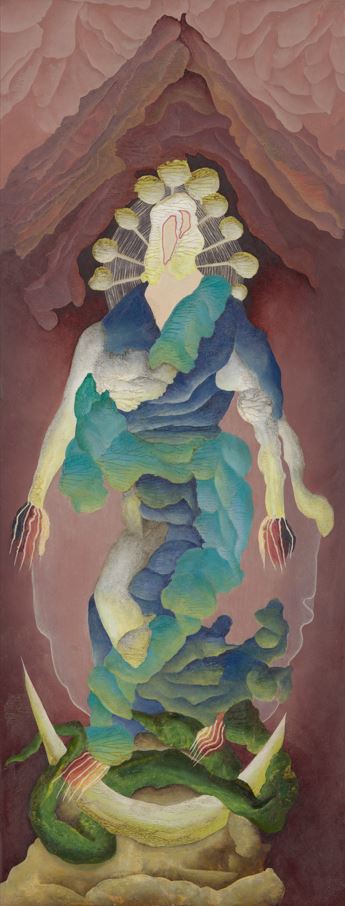
Compare and contrast that with one of the double images, not really in the full Dalí mode but nonetheless a recognisably human figure made entirely out of, well, what? Clouds? Bits of fabric? And what are those hands made out of? All wrapped up in esoteric symbolism of the crescent moon, at the bottom of the image.

Attributes of the Moon by Ithell Colquhoun ( 1947) Tate, presented by the National Trust 2016 © Tate. Photo © Tate (Matt Greenwood)

And in a different style again, here is another overtly erotic work from the extensive ‘Diagrams of Love’ sequence, 20 or so examples of which cover one wall, along with the short elliptical poems she wrote to accompany the series. I think you can see the rude elements without my commentary but what I enjoyed was the spangles scattered over the torso, and the delicate blue of the figure’s wings, tinged with pink and yellow.

Diagrams of Love: The Bird or the Egg? by Ithell Colquhoun (circa 1940) Tate Archive, TGA 929/4/17/3. Photo © Tate Photography (Lucy Green)

It’s full of images like this. The more I looked, the more I liked.


Related links

Related reviews

The Night Wanderers: Uganda’s Children and the Lord’s Resistance Army by Wojchiec Jagielski (2009)

Warning: this review contains graphic descriptions of torture and mutilation.

Were you forced to kill any of your relatives or neighbours?
Were you forced to chop off people’s hands or feet with a machete?
Were you forced to gouge out people’s eyes?
Were you forced to rape women?
Were you forced to burn people alive?

(Part of the questionnaire given to freed child soldiers in north Uganda, quoted in The Night Wanderers, page 38)

Wojchiec Jagielski

Wojchiec Jagielski is a Polish journalist who specialises in reporting from the world’s worst conflicts. Hence, for example, ‘Towers of Stone’, his 2009 book about the gruesome brutal wars in Chechnya, along with books on Afghanistan and South Africa.

But it’s not not just reporting – Jagielski is interested in the psychology created by terrible conflicts and, beyond that, in the voodoo, spectral elements, the worlds beyond normal human experience which extreme situations create, the deprivation, degradation, demoralisation spread over long periods, which create new psychic zones.

For this reason – for Jagielski’s interest in moods and alternative states and his interest in depicting them in prose which is often more about poetry and fleeting perceptions than the journalist’s tradition fare of facts and dates – he has often been compared to the famous master of such writing and fellow Pole, Ryszard Kapuściński.

No surprise that snippets of praise from Kapuściński are found on the jackets of Jagielski’s books (”A stunning and beautiful book…Jagielski has scaled the heights of reportage’), or that Kapuściński wrote the introduction to one of his books, or that this very book was nominated for the Ryszard Kapuściński Prize.

Part 1 (Gulu and its night wanderers)

Ugandan elections 2006

The Night Wanderers is set in Uganda in 2006. Nominally Jagielski was in Uganda to cover the February 2006 general election and party politics are, accordingly, described in part 2. But the meat of the book is his descriptions of the appalling plight of the thousands of children abducted by the rebel group, the Lord’s Resistance Army (LRA), led by the psychopath Joseph Kony. J.M. Barrie wrote about the Lost Boys but it was a fairy tale compared to this lost generation of Ugandan children.

The Acholi

The north of Uganda is inhabited by the Acholi people. Some 2 million of them have been driven out of their villages, forced to abandon their homes, their fields and crops, to leave behind the graveyards full of ancestral spirits, and instead herded into about 200 refugee camps where they have built huts and live, but which they can never regard as home.

Exemplary cruelty

The rebels terrify civilians by attacking villages, hacking people to death with machetes, chopping off their hands, slitting their throats, clubbing them to death, hacking them to pieces with axes, raping the women, herding people into huts and burning them alive. The cruelty is exemplary: it is punishment for not believing in the wonderfulness of Joseph Kony, and also to terrify entire regions into submission. Thus:

On the orders of their commanders, the guerrillas killed the villagers in extremely cruel ways. They butchered and burned them alive, forced the prisoners to commit cannibalism and infanticide. They raped and tortured, cut off people’s lips, gouged out their eyes, and chopped off their hands and feet. They left behind bloodied corpses and gutted houses. (p.138)

(Why does the LRA cut off people’s lips? As a warning to others not to report encounters with them to the authorities or to the Ugandan Army, p.296.)

Refugee village headman

Jagielski meets Abola Imbakasi, headman of one such refugee camp, Palenga. His meek son, Robert, was taken by the guerrillas for 3 months (p.18). On returning he had to be exorcised by a priest but is still not the same. His mind has been permanently damaged by what he saw and was forced to do.

The children’s treatment centre

Jagielski meets Nora who runs a rehabilitation centre (a ‘children’s treatment centre’) for children who’ve escaped or been rescued from the guerrillas. All of them have killed, multiple times. Jagielski watches one of the therapy methods which is to let them act out what they did as a kind of gruesome pantomime, some of them acting out their own roles, some of them playing the villagers who they hacked, burned, tortured, shot and burned. The terrible questionnaire (p.38).

The journalist’s responsibility

Jagielski explains that he’s never had problems interviewing the commanders and leaders who order massacres and atrocities. They’re always confident it was the only way to achieve justice or peace. They are always full of excuses, justifications and blame others (see Putin’s justifications for murdering civilians in Ukraine).

In his experience it is always much harder talking to the victims of atrocities. For many their story, their experience, is all they have left. Therefore sharing it with a journalist is like a precious trust. Part of which is they think that by sharing their story, it will bring about justice in the outside world, and will bring them peace and closure. It is far harder dealing with these poor people when neither of those things happen, when the world doesn’t suddenly galvanise itself to address their wrongs, when they are left feeling even worse than they did before they told their stories (p.33).

Rebel magic

The ferocity of the attackers, the way they chiefly emerged at night, the way they hid in the jungle and picked off anyone foolish enough to stray into the darker jungle, all this gave rise to folk stories and legends: that they could dematerialise at will, could appear anywhere like witches, had magical powers, that they change the children they kidnapped from humans into savage animals (p.39)

And indeed, villagers, adults, normal civilians who haven’t been inducted, regard returnees from the rebels as ‘spirits of the forest’, as bewitched, soulless, voodoo, jinxed, bad luck (p.49).

Initiation killing

Jagielski learns from Nora’s interviews with countless child soldiers how new initiates into the LRA were forced at gunpoint to murder their own fathers, mothers, sisters, brothers, best friends, neighbours, in front of everyone, in front of plenty of witnesses, because then there was no going back, then they were forced to stay. This was the initiation ceremony into the Lord’s Army (p.45).

The boy Samuel

Jagielski is particularly interested in interviewing Samuel, who was abducted at age 9 and was soon afterwards forced to kill his first person, a boy from his village, and whose story Jagielski tries to piece together. Nora tells him the best age to create a child soldier is 9, old enough to be independent, young enough not to really know right and wrong. Mouldable (p.57).

Jackson the journalist

After trips to refugee camps or to interview the children, Jagielski returns to the bar at Franklin’s Inn where he regularly meets Jackson, now a radio journalist, himself inducted into the guerrillas many years earlier. Jackson plays the role of sardonic, satirical commentator on Jagielski’s efforts, claiming that no matter how many questions he asks, he’ll never understand what it’s like (p.46).

Atrocities

The narrative is regularly punctuated by descriptions of the most appalling atrocities, for example on pages 45, 50, 72, 138, 144, 146,

When they had finished their interrogation, the older guerrillas started killing the villagers. The commanders forbade them from shooting unnecessarily, to save bullets, and also because the noise of shots would alert the army. The peasants were tied up and made to lie on the ground, as the guerrillas unhurriedly murdered them one by one – men, women, old people, and also small children who weren’t fit to be prisoners. They killed them with machetes, axes, hoes and large knives usually used as agricultural tools. None of the villagers put up resistance or fought for their lives. Terror and a sense of doom had taken away their capacity for any kind of action. (p.137)

Or the story (repeated twice) of the LRA attack on a funeral procession when they forced the mourners to cook and eat the remains of the deceased, allegedly on the orders of Onen Kamdalu (p.241).

Gulu

Jagielski bases himself in Gulu, administrative capital of north central Uganda and each evening observes the same eerie ritual: every evening as the sun sets thousands of children (as many as 15,000) arrive having trekked from all the surrounding villages, for their own safety, to avoid the risk of being kidnapped and conscripted by the LRA. It is this silent army of forlorn children who arrive every evening and make beds in public spaces and on the sidewalks, who Nora calls ‘the Night Wanderers’ which give the book its title (p.58).

Jagielski describes the arrival of these tens of thousands of silent children in spooky spectral terms. The way the town of Gulu changed its atmosphere. the way adults departed abandoned the streets to the thousands of ghostly children. The peculiar way these children inspired irrational fear in the adult population, harbingers of evil (p.59).

Jagielski tells us he stayed at the Acholi Inn Hotel (p.91). This is a real place, still exists, and you can book a stay there, if you want.

Jagielski tells the history of how Uganda was created as a nation by the British, yoking together completely different peoples and tribes, the Buganda – agriculturalists – in the south, the Acholi, Lango and other peoples who lived by grazing and cattle, in the north.

Milton Obote and Yoweri Museveni

At independence in 1962 the British tried to reconcile these different peoples, making Milton Obote from the Lango tribe prime minister and the king of the Buganda, Frederick Mutesa II, president. But in 1966 Obote overthrew Mutesa and declared himself president. In 1971 Obote was overthrown by his own army chief of staff, Idi Amin from the Kwakwa people. In 1979 Ami invaded Tanzania but was swiftly repulsed and overthrown by the Tanzanian army (for a vivid description of Amin’s horrifying rule and the Tanzanian invasion, see Giles Foden’s powerful novel The Last King of Scotland).

Obote returned to power and swiftly commenced violent repression even worse than Amin’s triggering the Ugandan Bush War against him, led by members of Obote’s army plus tribal opponents. They crystallised into the National Resistance Army (NRA) and attracted support from the many Rwandan Tutsi exiles and refugees living in southern Uganda (who were to go on to form the Rwandan Patriotic Front and invade Rwanda in 1990).

In 1986 Obote was overthrown for the second time and the leader of the NRA, Yoweri Museveni, came to power. Museveni began a campaign of intimidation against the powerful Acholi people in the north and it was this which inspired Acholi resistance.

Alice Auma

Jagielski gives a pen portrait of Alice Auma, a withdrawn young woman who had failed to get pregnant by two husbands and been returned to her father in shame, before she began having visions and claimed to have visitations from spirits and announced she was a prophet of the Lord. She named the chief spirit visitor Lakwena (p.74).

Alice became known as Alice of the Holy Spirit. She set up a temple where she could heal the sick and the mentally disturbed. Then announced she was establishing an army which would not just defend the Acholi from the Ugandan Army’s depredations, but conquer all of Uganda and establish religious rule. She gathered followers from conventional guerrilla forces who were losing encounters against the army. She promised if they sprinkled holy water on their guns every bullet would find its billet, and if they smeared holy oil on their bodies they would be invulnerable.

Although this didn’t actually happen, the intensity of their belief led them to surprising victories over the conventional army and word spread. Conventional troops fled in panic when they heard the psalm-singing Alice army approaching. The army grew to several thousand and fought its way south to within 100 miles of the capital. But then her spirits abandoned her. Her troops said it happened when she crossed the White Nile and went beyond the borders of Acholi land. The central army also recruited powerful witches and magicians and defeated Alice’s army in November 1987.

Alice fled to Kenya where, ten years later (1997), Jagielski interviewed her. She didn’t say much. She claimed to have found a spirit cure for AIDS. She died in 2007.

Joseph Kony

Her father tried to take up her baton for a while but lacked the charisma. Then a new prophet arose in Acholiland, Joseph Kony. He claimed to be visited by Lakwena who had instructed him to create a new army, the Lord’s Army, and liberate Acholiland. One by one other rebel groups folded and ceasefired with the Ugandan army. Only the most fanatical opponents or those who had committed the most barbaric crimes held out and gravitated towards Kony’s army which, by a process of selection, became full of psychopaths, ‘vile, bloodthirsty, accursed creatures’ (p.81). (Jackson explains more about Lakwena, pages 198 to 200).

But they lacked manpower and the villages were no longer as keen to hand over their sons as they had been for Alice’s Army. So Kony took to kidnapping children on an industrial scale. Jagielski thinks the force Kony renamed the Lord’s Resistance Army might be the only child army in history.

Interview with Kony

Jagielski gives extended quotes from what I initially took to be a newspaper interview Kony gave, in which he disclaimed all responsibility for kidnapping children, claiming the mutilations were carried out by the Uganda army not him, swearing that his cause is just etc (pages 201 to 203). In fact the material comes from this video interview carried out by Sam Farmer, who must, as the saying goes, have balls of steel to doggedly track down a known mass murderer to his lair.

Warning: this video contains graphic and upsetting images of mutilation.

Sister Rachele Fassere

The story of Sister Rachele Fassere who tried heroically to rescue the 139 girls abducted by the LRA from the most eminent school in the region, St Mary’s convent school in Aboke.

Britain’s imperial behaviour and legacy: pages 71, 104, 154,

The stock African accusation against imperialists, the British, against all outsiders:

‘And that’s where the problem lies – in the names,’ said Jackson…’You give your own names to whatever you find in your country, and you’re convinced that once you’ve named it all, you’re also going to understand it all. But we have our own names too, but we look at things in our own way.’ (p.114)

Part 2 (Kampala)

In part 2 Jagielski leaves Gulu, travelling south by bus (with Jackson) to the capital of Uganda, Kampala. Thus we get a pen portrait of Kampala’s history – one of the few cities in all Africa that existed before the Europeans arrived i.e. that Europeans didn’t found. Winston Churchill was delighted with it and called it the pearl of Africa (p.154)

Jagielski checks into the Speke Hotel where all the foreign correspondents say, meet and swap knowledge (p.122). How western journalists co-op or rip off the hard-earned knowledge of local African journalists (pages 123 to 126).

Spirits

Alice Auma, and Joseph Kony after her, both triumphed because of the nearly universal belief in spirits. The book adverts again and again to spirit belief. For example, the passage about the area around Luwero where so many villagers were slaughtered that there was no-one to give them burial rites and so the spirits of the dead were trapped in this world and entered the bodies of the living (p.146).

Extended passage naming some of the spirits who take Kony, how he behaves when possessed etc, chief among them Lakwena (pages 166 to 169).

Jackson’s family believed that when his father came home from the war he was possessed by a spirit which eventually drove him to hang himself. The entire family and village were too scared to cut the rope he’d hanged himself by under the belief that anyone who did so would themselves be possessed and die, and had to bribe an old, old lady, known to be an ajwaka or healer, to do it.

Part 2 has more history and politics in it than part 1, which was more about individuals like Nora, Samuel et al. Jagielski is quite a repetitive writer. Some ideas are repeated in nearly the same phrasing. The dispossessed refugee men of Penga often raped women:

as if only by inflicting rape could they come alive and shake off their inertia (p.18)

Two hundred pages later, Nora complains that Acholi men are ‘useless’. They steal the money their womenfolk earn, simply abandon them, or rape them:

as if only through violence, by inflicting pain and harm, could they restrain something beyond their control which was causing their former world and old way of life to slip away before their very eyes. (p.237)

In a bigger example of repetition, the sequence of events whereby the British left Obote as Prime Minister and the king of Buganda as president, then Obote overthrew the king to become a dictator (1966), was himself overthrown by Amin (1971), who was overthrown by the Tanzania War (1979), which brought Obote back to power (Obote II), how Obote was even more bloodthirsty than Amin (maybe as many as 500,000 Ugandans died under his second regime), how this triggered the Ugandan Bush War (1980 to 1986), which eventually overthrew Obote and replaced him with Museveni – this narrative is repeated at least twice, some parts of it 3 or 4 times.

Part 2 goes into more detail about the biographies of all three players, Obote, Amin, Museveni, plus the restored king of Buganda, King Kabaka Ronald Muwenda Mutebi or ‘King Ronnie’ (p.140).

Pages about Amin and the mutual loathing between him and Julius Nyerere (pages 142 to 144); ‘the personification of horror (pages 155 to 166, including some of the scenes described in ‘The Last King of Africa’).

Another thing Jagielski repeats is the claim that Uganda became a place of war, horror and death. Because he repeats this kind of phrasing, stretched out to paragraphs, many times, and because the narrative is non-chronological but hops about in time, it becomes hard to figure out which leader it happened under and why it happened. Many passages like this:

Presidents changed but the nightmare continued and Uganda never stopped flowing with blood, as if it had been sacrificed to the god of war and evil. (p.145)

Wracked by lawlessness and violence, Uganda continued to be a bloodbath, doomed to horrific destruction, curse with an apocalypse. (p.164)

After almost two decades of the tyrannical regimes of Obote and Amin, civil wars, massacres, lawlessness and bankruptcy, plague and famine, and one and a half million corpses, it had come to be known as a doomed country… (p.170)

The bravery of British journalist William Pike, who edited the newspaper New Vision without fear or favour, and his lead journalist, Allio Ewaku Emmy (pages 126 to 129).

What triggers the more political flavour of part 2 is that Museveni had prided himself on not being like the old dictators, not hanging on forever…and yet, at the time Jagielski is writing, Museveni was trying to alter the constitution in order to allow him to run for president more than two times (as most constitutions require). That happened in November 2005, which dates the writing of these sections to that moment, rolling on to the subsequent elections of February 2006.

(In fact as I write, at the start of 2024, Museveni is still president of Uganda, having held the post since 1986, 38 years and counting.)

Museveni

Pen portraits of Museveni on pages 129 to 133, 139 to 140, 144 to 145, 170 to 177. Museveni surprised everyone by changing quickly, on taking power, from a firebrand socialist revolutionary guerrilla to a pragmatic head of state prepared to work with western banks and let capitalism thrive.

Museveni on slavery

Museveni discomfited other African rulers with a few home truths:

‘We like to complain about the whites, but have we ever wondered why only Africans let themselves be enslaved? Why didn’t we put up resistance? It was our own greed and quarrelsome nature that ruined us. That’s why we were defeated and conquered. We ourselves are to blame. It was our chiefs, waging fratricidal wars, who took people prisoner to sell them to slave traders from Europe. It was those black traitors who bear the blame for slavery.’ (quoted on page 171)

1. The kind of thing a white person could never say or think.

2. I think he’s wrong though, in two ways. Firstly, the reason Africa was so prey to depredation was because it was the most economically, socially and technologically backward of the continents (with the exception of Australia) due to the reasons laid out at length in Jared Diamond’s Guns, Germs and Steel.

But there’s a second thing going on here which is that Museveni, like most modern commentators, is thinking within the framework of black and white that has been firmly established over the past 100 years, which has created a false homogeneity among black people. I’m continually impressed, on a pretty much daily basis – reading the papers, listening to the radio, going to exhibitions – how black activists think there is some kind of inherent unity among black people, that all black people share the same interests and concerns. This seems to me wrong, wrong about any community or group of people.

What I’ve read in the books by Jeal or Hochschild or Segal give the impression that the Africans we’re talking about, in the 1700s and 1800s, didn’t have this simplistic modern binary between Black and White, nor share the modern idea that all black people share a common identity, common goals, need to be united etc. This all seems, as far as I can tell, to have sprung up among black people in the West, whether civil rights movements or black power or Nation of Islam or Black Lives Matters – all these groups define themselves by contrast with whites (and mostly derive from America).

My reading of the sources is that back in the 1700s and 1800s this kind of ‘black consciousness’ simply didn’t exist. Instead Africans identified themselves with tribes, maybe religions, with regions and languages, and regarded all Africans outside their tribal or religious group as others, others who could be quite legitimately enslaved or waged war on or whatever. They had no need to feel guilty as they were smiting the enemy and then selling them into slavery, thus boosting their own prowess, preserving their tribe, making their family wealthy, and that’s what mattered to them.

In a nutshell, Museveni is projecting back onto his ancestors a kind of black consciousness which is a twentieth century (and mostly American) creation and (like America) simply didn’t exist so no-one was aware of it and no-one acted on it, in the period he’s projecting it back onto.

African unity

3. Finally, yet again the strong impression given is that the whole concept of black unity in Africa is a joke. Here’s Michela Wrong describing the moribund Organisation of African Unity:

The summit of the Organisation of African Unity, that yearly get-together where insincere handshakes were exchanged, 29-year-old coup leaders got their first chance to play the international statesman, and the patriarchs of African politics politely glossed over the rigged elections, financial scandals and bloody atrocities perpetrated by their peers across the table.

(‘I Didn’t Do It For You: How The World Used and Abused A Small African Nation’ by Michela Wrong, p.357)

Biafra. The Rwanda genocide. The wars in Congo. The civil war in South Sudan. Just the history of Uganda alone makes clear how difficult Africans find it to live in peace with other Africans. One and a half million Ugandans dead in 20 years of civil wars and insurgencies is proof of something.

Look at how the insurgency of the Lord’s Resistance Army got mixed up with ongoing enmity between all the regional nations: at various points the governments of both Sudan and Democratic Republic of Congo gave the LRA aid and support, while Sudan backed Kony in retaliation for Uganda’s longstanding support of the secessionist movement in South Sudan.

Where is the ‘African unity’ in any of this? In fact Jagielski’s description of the poisonous backstabbing rivalry between African states is bleakly hilarious (pages 195 to 196).

The Ugandan opposition

Jagielski visits the HQ of the opposition party, the Forum for Democratic Change.

Portrait of Nasser Sebaggala, opponent of Museveni and mayor of Kampala from 2006 to 2011.

Portrait of Museveni’s slighted mistress Winnie Byanyima, who has blossomed into an international figure (pages 178 to 180). Winnie married Museveni’s one-time physician, Dr Kizza Besigye, and encouraged him to become a leading political opponent, to stand in the presidential election against Museveni (180 to 181).

As usual with the African elections I’ve read about, nobody talks about policies, instead the campaigns rotate solely around personality and character i.e. Museveni is the ‘great leader’ who has saved Uganda or Museveni has hung on too long and must go. Playground level.

Bounty hunters

A page on freelance bounty hunters around the world. The international community put a bounty of $1.5 million on Kony’s head, which attracted freelancers (p.193). In that case surely the question is, how come nobody tracked him down and killed him? Simply because he’s surrounded by trigger-happy bodyguards?

Bishop Joseph Kibwetere

Auma and Kony aren’t the only ones possessed by spirits. The story of Bishop Joseph Kibwetere who gathered a large following when he predicted the end of the world for 31 December 1999. He and his followers all burned to death in a church fire in March 2000. Or did he escape? Prophets and visionaries appear whenever there’s a natural disaster, droughts, floods, epidemics (p.209). (It doesn’t so much sound like, as actually is the European Middle Ages.) The ebola epidemic of the early 2000s which was, of course, seen as another attack of bad spirits and, like so many evil things, came from the Congo (pages 210 to 212).

Jagielski’s unhelpful way of describing disease

Jagielski writes about disease in a melodramatic, anthropomorphised way which undermines your trust in his descriptions of other things. Here he is describing the action of AIDS:

But the invisible virus was alive inside her, lying in wait, and when it launched its lightning attack, giving no chance for defence, it was too late to save her. (p.214)

This isn’t a very useful way of talking about or thinking about infectious diseases. Anthropomorphising disease like this is not far short of the local belief in spirits, except that Jagielski doesn’t have the excuse of no education. He’s dumbing down from dramatic effect.

In fact it has two deleterious effects. 1) Talk to any health professional and they’ll tell you we need to remove moralising and stigma from infectious disease. This kind of dumbed-down anthropomorphising encourages scientific illiteracy and folk attitudes. Most western nations are facing health crises, specifically over measles, caused by the decline in MMR vaccinations, triggered by rumour and false information. Many people thought the COVID vaccines were some kind of state-run conspiracy. For this reason discourse about illness should be kept scientific, factual and precise.

2) The second bad effect is that anthropomorphising illness like this, using this kind of emotionalising, unscientific way of describing disease, opens the door to moralising which quickly leads to judging victims, for example the way AIDS was initially stigmatised as a ‘gay plague’ or more recent slurs about monkeypox. Medieval worldview. Burn witches etc. People need to be encouraged to think about disease in the correct scientific, objective fashion.

A journalist’s complaint

Another thing I didn’t like was his self-centred hand-wringing about the moral challenges and compromises involved in being a journalist.

Messy, abandoned friendships, business started and interrupted, then forgotten, littered the routes of all my journeys. (p.216)

Well, I reflected, as I read the fifth or sixth such passage, if you don’t like it, get a job in an office. A lot of journalists seem to imagine that when I buy a book on a particular subject I’ll really appreciate lots of stuff thrown in about how hard their job is and how they have to continually make work-life compromises and let people down and oh it’s so difficult. Well, I don’t. Boring.

In a way the journalist’s profession has betrayal encoded into it. It demands gaining people’s trust and extracting confidences from them, purely in order to publicise and reveal them, all for a sense of a job well done, for satisfaction, applause and prizes. (p.216)

Like going to see your doctor with troubling symptoms and just wanting a diagnosis and treatment but instead having to listen to a long lecture about how badly paid doctors are and there’s never enough time to see patients and all their other gripes. No. Just diagnose and treat me. Same with journalists: don’t tell me all about your sensitive scruples and heroic regrets. Just tell me the bloody story.

Part 3 (back to Gulu)

To his own surprise, Jagielski didn’t hang around in Kampala to wait for the results of the election. He had unexpectedly bumped into Jackson and decides to return to Gulu. On the way Jackson tells him something extraordinary: most of the guests at the Acholi Inn Hotel where he’s staying are former guerrillas, people who have carried out the most appalling atrocities.

He describes the standard military corruption: all Ugandan soldiers are all corrupt. Their officers keep all their pay for themselves so the ordinary soldiers are forced to steal from the locals, hold them up at temporary roadblocks, even sell their arms and ammunition to the guerrillas.

Not only that, but many of the shops in Gulu sell goods stolen from country villages which the guerrillas  have looted and then send on here. And that the guerrillas, who kidnap other people’s children, send their own children to good public schools here in Gulu. This isn’t a dysfunctional society so much as dysfunctional people. When so many people dysfunction what hope is there for ‘normal’ society?

‘Where two elephants fight, the greatest victim is the grass.’ (Acholi proverb, p.229)

Rehabilitating child brides

Jagielski returns to the child treatment centre. It’s pretty obvious he fancies Nora and she’s quite happy to flirt with him. He admires her tight-fitting jeans. The other care worker, Christine, is careful to knock on Nora’s door, even when it’s open, so she doesn’t walk in on them kissing or worse. I found these scenes a bit icky (for example, page 249).

Lunch. Watching the children at crafts. The eldest girl is 16. All of them who were capable of it, were taken as child brides by guerrilla leaders and have borne children. On returning to the world they are shunned by their families. So the centre teaches them to sew, makes crafts, open market stalls. This is the route to financial independence and, once they’ve earned some money, to interesting some man into marrying them.

Refugees

Refugees are people who may not have lost their lives to war, but their existence has been robbed of its meaning. War has taken away all their faith, hope, dreams and energy. (p.234)

Former guerrilla leaders

Jagielski talks to the former LRA leaders now living quietly at the Acholi Inn:

Jagielski carries out an extended interview with Banya (pages 240 to 248), a characteristic figure in that he had been a senior figure in the formal Ugandan army but quit when Museveni came to power, disgusted that Museveni overthrew the interim rulers (who succeeded Amin) through violence, and also worried Museveni would start persecuting the Acholi (as he did). One day envoys from Kony arrived at his home and told him to come now or they would kill his entire family. So he went with them and was never allowed back.

Christine returning the lost boys

At the centre Nora works alongside Christine. They dislike and avoid each other. Nora thinks Christine obeises herself to a husband who’s moved to Kampala and is rumoured to have taken a second wife. Christine denies all this and thinks Nora is disreputable for not having married and settled down.

A long passage seeing things through Christine’s eyes, the arrival of the first liberated child soldiers at the centre, Christine’s opinion that they need love and support and, above all, to be told it’s not their fault. All of them were forced to kill or mutilate under threat of it happening to themselves.

The best medicine for these damaged children turned out to be routine: wake-up same time, breakfast, chores etc (p.259).

Jagielski accompanies Christine as she takes some of the last boys in the camp back to their various villages, observing their receptions (pages 259 to 269). Life in the dirt poor refugee camps, with absolutely no purpose, is hard for the reclaimed boy soldiers. Many of them run back into the bush, where there’s at least a purpose, and food. Or are so shunned by former neighbours and even their own family that they become embittered, violent. Some of them spontaneously kill.

Mato oput

Jagielski witnesses a ceremony of mato oput meaning reconciliation for a crime, and learns the complex traditional methods for a wrong-doer to admit their guilt, the compensation to be paid by his family, the road to acceptance and reconciliation (pages 266 to 269, 273 to 282).

A detailed description of Acholi beliefs about dead people’s spirits, specially how they persecute the living if they’re not happy (pages 269 to 273). Worth mentioning that a Catholic priest, Father Remigio, accompanied Christine and Jagielski on this trip, and was by his side explaining all aspects of the mato oput ceremony, their provenance and meaning.

The Acholi king

The Achioli king is named David Onen Acana II. His shabby court looks like a provincial post office. Some facts about the Acholi who migrated into north Uganda from Sudan where they were nomadic shepherds, hunters and fishermen.

When he arrives the king is discussing the future of Kony with one of his advisers, Chief Lugai. They’d been invited to meet Kony in the bush but when they got there he didn’t show up. The king and Chief Lugai say Museveni needs to pardon Kony and the International Tribunal at the Hague drop its charges. Only then will Kony come in, and he must be handled with traditional Aconi rites i.e. Mato oput (p.288).

The king then laments at length how the old tribal ways are being destroyed not only by the war, the enforced relocation of 2 million people, but criticism from Christian missionaries and Muslim imams and the new young generation in cities who turn to the West (pages 289 to 291). In other words, the inevitable process of ‘modernisation’ and ‘development’.

Father Cosmas

An interview with the Catholic priest Father Cosmas who is quite clear that Alice was possessed by satanic spirits but that Kony is Satan himself (p.294). Stories he has heard from children who have been rehabilitated and made their confessions to him.

Severino Lukoya

Jagielski says goodbye to Nora, with the uneasy feeling that he has wormed his way into her and Samuel’s affections merely to exploit them for his book then dump them. And that’s what she accuses him of.

The last thing he does in Gulu is go to visit Severino Lukoya. He was the father of Alice Auma who, after Alice’s forces were defeated, claimed that the spirits had entered him and that he was now the spokesman for Lakwena et al. In the event the forces he led were defeated by the Ugandan Army even more heavily than Alice’s, he fled to Kenya, and the mantle passed to Joseph Kony who lied that he was Alice’s cousin. So it’s a family romance, of sorts.

Anyway, Severino quietly returned to Gulu, built a church for his own denomination, and has been living quietly, left in peace by the authorities. Jagielski discovers he is now a very old, weak old man. Severino is assisted by Martin the chaplain who seats him on a chair and hands him one of the holy bottles. Then Jagielski witnesses the old man being possessed by Lakwena.

Severino speaks in Acholi, Martin translates, and it’s basically a recap of Severino’s career i.e. being chosen by God, trying to preach the word of God, going off to bush to live by himself, choosing water to purify and stones to act as weapons and incite his men to fight for the Last Judgement…

Then it’s over and the old man shrinks in his chair, exhausted.

Thoughts

1. This is a very, very good book which doesn’t so much explain as immerse you in the bloody, complex history of modern Uganda and especially the horrifying reality of the LRA’s campaigns and their terrible aftermaths for all concerned.

2. It’s a fount of information not only about the LRA and about Uganda’s troubled history, but many aspects of the folklore and traditional beliefs of the Acholi people, above all their profound belief in the role of spirits in all aspects of human life.

3. It also gathers together a range of valuable eye-witness accounts: from children directly involved, from some of Kony’s henchmen, from Nora and Christine, plus Jagielski’s witnessing of the mato oput ceremony, the knowledge of Father Remigio, the opinion of Father Cosmas, Jackson’s conveying of the voodoo mysticism of the Acholi people which no outsider can really understand.

4. It’s a real shame the book doesn’t have an index as I found myself wanting to reread certain passages or flip through the explanations of particular topics which are scattered in fragments through the text and so hard to re-find unless you’ve made a record or turned down the page. Part of my motivation in making such detailed notes and providing precise page references in this blog is to create such indexes, as best I can, for my own use and as, hopefully, a help to other readers.

5. Jagielski is in the same ballpark as Kapuściński but not in the same class. Kapuściński can be, by turns, genuinely philosophical, reaching deep into human nature, or lyrical, or quirky and drily humorous (as throughout his book about Haile Selassie). Jagielski attempts the same kinds of thing and they’re interesting enough, such as his fairly frequent personification of abstract entities:

The day fixed for the elections overslept and got up late, looking grey. For ages it couldn’t gain full consciousness and get itself going. (p.187)

This kind of thing is entertaining enough, but without the real depth or lyricism of his mentor.

6. Obviously most of the subject matter of The Night Wanderers is beyond appalling but, if you’ve read 20 or 30 books about contemporary Africa, as I have, you get used to Africans massacring each other, generally in the most brutal, sadistic ways possible.

What it makes me wonder is … you know how anti-colonial critics, post-colonial writers and anti-colonial historians often criticise the Europeans for, among countless other crimes, imposing their notion of the nation state onto cultures which were more flexible and fluid, based around tribes and traditional rulers … well, in descriptions of the collapse of whole regions of supposed ‘states’ (such as Rwanda or Congo or Uganda or Sudan) into violent anarchy, I wonder if it’s simply a matter of older traditional African culture reasserting itself, of societies rearranging themselves around their core attachment to tribes…and that the endless guerrilla wars are just the modern name given to the age old tradition of warlords gathering supporters and fighting the ruling king…

They’re called warlords and guerrillas these days but, from my reading of Gerald Segal’s book about Islamic slavery, I learned a lot about the continually shifting, rising and falling kingdoms and empires of west Africa, rising as new warrior chiefs achieved ascendancy, falling as other states seized land and towns under violent new leaders…

So isn’t the violent chaos in many African countries simply a continuation of the old traditions, but now with Kalashnikovs? That’s the strong impression you get from Jagielski’s extended description of the tangled web of insurgencies, civil wars, militias and guerrillas, which completely ignores state borders and sprawls across a huge area of north Africa taking in Somalia, Sudan north and south, Uganda, Congo, Darfur, Chad, Central African Republic, as far west as Niger, large parts of which are under no state control (pages 195 to 197).

And stepping right back – isn’t this patchwork quilt of petty kingdoms based around local chieftains in fact the way most humans have lived through most of history? Wasn’t this the same continually warring tribal world the Romans encountered everywhere they advanced, for example the complex tribal networks of Gaul and Britain endlessly at war with each other as described in Julius Caesar’s Gallic Wars? Or, hundreds of years later, the equally complex, warlord-based societies of Dark Age Britain and, indeed, right across post-Roman Europe? Isn’t it, in fact, the natural way most humans have lived in most of history – and the huge, secular, technocratic and democratic states we in the West take for granted, aren’t these the oddities and exceptions to the rule?

Antonia Lloyd-Jones

A word on the translation by Antonia Lloyd-Jones. It reads very well indeed. The word order and use of subordinate clauses do not feel as if converted from another language, as often happens with translations from French or German. It reads like English and very well written English at that. There are a few odd turns of phrase, which I enjoyed:

  • When Museveni announced new presidential elections that he intended to win again and extend his reign, Dr Besigye cast him a challenge and stood for election too. (p.180)
  • Museveni had the victory in his grasp. (p.184)
  • Emmy cast him a look but didn’t say anything. (p.194)

The only blemish on her style is her very frequent use of the word ‘whom’ which regular readers of this blog will know I have developed an irrational dislike of. I dislike it’s prissy formality. Nobody says it in actual speech. It is becoming a literary fossil.

There he had met Nora, the first person to whom he had told everything he had seen and endured. (p.187)

‘What about those who don’t even know whom they have killed?’ (p.283)

Despite being British, Lloyd-Jones uses the word ‘pants’ for trousers (p.248) and ‘line’ for queue (p.172). Maybe the sub-editors at the New York publishers insisted. But these are microscopic quibbles. It’s a highly readable, fluid translation.


Credit

The Night Wanderers: Uganda’s Children and the Lord’s Resistance Army by Wojchiec Jagielski was published in the Polish original in 2009. The 2012 English translation by Antonia Lloyd-Jones was published by Old Street Publishing (OSP). References are to the OSP paperback edition.

Related links

Related reviews

Two Weeks in November by Douglas Rogers (2019)

This book is great fun. Whereas Martin Meredith regards the history of Zimbabwe as a tragedy and loads every page with doleful hand-wringing, Rogers thinks it’s a hilarious farce.

Rather than thinking of every speech and law as a further nail in the coffin of 1960s dreams of African independence, Rogers is a child of the 1980s, carefree, at home in the modern world, all dark glasses and retro cars, smart phones, snapchat and WhatsApp.

This being the 21st century, you don’t kick a man when he’s down – you tweet insults at him. (p.155)

For Rogers, Harare isn’t the site of crushed dreams of a socialist dream, huge shanty towns and an impoverished populace, no, he’s interested in the upmarket suburb of Borrowdale where the Zanu-PF elite have their lavish mansions, complete with swimming pools, golf courses, fleets of sports cars, yeah baby.

Rogers’s characters aren’t boring old human rights lawyers and grim-faced opposition activists, but flashy international businessmen, like Ameerh Naran, a young Indian-Zimbabwean entrepreneur who owns a private charter jet firm, is a racing driver in his spare time, and holds the licence to import sex toys into Zimbabwe, a man at home in the jet set of Monaco or Miami or Aspen.

Again and again Rogers has his characters refer to ‘the game’ of high politics, intrigues and espionage which may, in the end, actually be the most realistic way of thinking about it.

  • The game they were playing had reached the highest levels and it made the heart race. (p.165)
  • It was a turning point in the great game. (p.176)
  • Such is life in the death game of Zimbabwean politics. (p.210)
  • And so the final stages of the great game began. (p.217)
  • Jacob Zuma was the most powerful and influential figure in the game at this point. (p.221)
  • Such was the surreal nature of the game. (p.235)
  • What it meant was that the game had to play itself out. (p.255)

History as thriller

The whole book is written as a tongue-in-cheek homage to airport thrillers:

On a bright afternoon in the spring of 2015, driving past the mall near his suburban Johannesburg home, Tom Ellis spotted his assassins. (p.37)

Right down to the classic American thriller’s obsession with precisely detailing and enumerating every piece of branded clothing which every character is wearing:

Ellis, wearing slim-fit jeans, short-sleeved checked cotton shirt and the trademark Veldskoens common to white Zimbabweans of his generation, led the way. (p.39)

His favourite adjective is the American ‘upscale’ meaning ‘expensive and designed to appeal to affluent consumers.’ It’s contemporary history in the style of ‘Miami Vice’.

Origin of the book

In November 2017, Robert Mugabe, decrepit ruler of Zimbabwe for 37 long, brutal, corrupt years, aged 93, was finally toppled from his position in an army coup. Rogers was a travel writer and had drafted half a book about the his latest African journey when he heard the news. A native Zimbabwean he had, like so many well-off whites: a) fled the country (to settle in Virginia, USA, in his case) and b) given up any hopes for reform or change to his country.

So he promptly returned to Harare and sniffed about a bit i.e. spoke to various contacts and, as he did so, an amazing story began to unfold. He was put in touch with people who put him in touch with more people who unfurled the nature of the complicated, multi-party coup which had overthrown the old dictator. At which point he rang up his publishers and told them he had something much hotter than another middle-aged road trip to write about and they graciously agreed to wait while he embarked on entirely new book, this book, a detailed exposé of the complex plot to overthrow Robert Mugabe.

And, because he clearly has a terrific sense of humour, and an ironic, detached approach to politics, Rogers has cast the story in the style of an airport thriller. It’s full of facts and figures and explanations of Zimbabwe’s history, Mugabe’s career, Zimbabwe’s steady decline under his management, the failed attempts to oust him by democratic means etc etc. But all told in a bright and cheerful, lollzy manner.

Above all, he zeroes in on the key players in the drama, giving us descriptions of them, their houses, spouses, children, roles in Mugabe’s administration or the Zimbabwe or South African spy agencies and so on, then describes secret meetings at restaurants, late-night flights, smuggling people across the border, clandestine meetings and all the rest of it, exactly as in a poolside spy thriller.

The plot

By the later 2010s the political party Zimbabwe African National Union–Patriotic Front (Zanu-PF), which had ruled Zimbabwe for 37 years, led by the wizened old dictator Mugabe, had split into two warring factions. Very simple reason – the issue of who was going to replace the old brute.

On one side his vice-president and long-time colleague at the top of Zanu, Emmerson Dambudzo Mnangagwa – also known as ‘The Crocodile’, supposedly because he moved slowly but was deadly, but in fact due to his involvement with the so-called Crocodile Gang during the war of independence (p.131). Also known as ED. His supporters were nicknamed ‘the Lacoste faction’ after the stylish brand of polo shirts they sported (p.21). Note that, although Mugabe was a senile 93, ED was no spring chicken himself, at 75.

On the other side was Mugabe’s second wife, Grace Mugabe, forty-one years younger than him, a typist who he began an affair with while his first wife was still alive (though dying of cancer), who he’d married in 1996 and had three children with (p.66). For ten years or more she’d been widely mocked as interested only in bling and shopping and had acquired a series of nicknames including the First Shopper, Gucci Grace and Lady Gaga.

But at the turn of the 2010s, Grace began to show a more active interest in politics and by 2016/17 she was using public appearances to attack the opposing faction in the party, thus positioning herself to inherit Mugabe’s mantle. Her supporters became known as Generation 40 (G40) because they were the new, younger generation. Prominent in her clique were Jonathan Moyo (former Information Minister), and Saviour Kasukewere (ZANU-PF political commissar).

The two weeks in November 2017 began when Mugabe announced, obviously under pressure from his wife, that he was dismissing his long-time deputy, ED, with the threat that he would immediately be arrested, and the narrative proper gets started with the panic-stricken meeting of ED and his sons who spend a feverish evening figuring out escape routes to smuggle their dad out of the country.

It was one of these plans which ropes in Ameerh Naran who I mentioned above. Naran helps them get a doctor’s certificate vouching that ED is ill, which would allow him to be flown to South Africa on a medical flight (seeing as the airports are, by now, all being watched by Zimbabwe’s security service to ensure that ED doesn’t catch a normal flight leaving the country).

In the event, the panic-stricken conspirators ditch that plan half way through and instead drive in a convoy bearing ED, his wife Auxillia, sons (Junior, Sean and Collins), cousin Tarirai, a friend Hosea Manzunzu (aka Limping Jack), Jenfan Muswere andWise Jasi, along the highway east to cross the border into Mozambique.

At which point the narrative cuts back in time and to South Africa, where builder and fixed Tom Ellis (55) has for years helped out a network of anti-Mugabe people. He confronts two agents from Zimbabwe’s secret police who are tailing him, Kasper and Magic (p.57).

Backstory describing Zimbabwe’s decline. Between 2000 and 2010 4 million Zimbabweans left the country, most to go and live in South Africa. Ellis was an emigre but he wanted to heal his home country. At first he worked with the Movement for Democratic Change (MDC), founded in 1999 and which provided a viable opposition in the later 2000s, and actually won the 2013 election, but had itself splintered into factions and lost his drive.

It was then that the rivalry in Zanu-PF began to emerge and Ellis began to make approaches to the people around ED. No doubt his phone was bugged and this explains why he found himself being tailed by Zim secret service agents.

Thumbnail sketch of Kasper, real name Charles Wezhira, who had risen from a dirt poor background with the help of his policeman father, to become a secret service operative. He had fought in the Zimbabwean forces sent to intervene in the Great War of Africa in 1997, which is when he thinks the rot set in with Mugabe’s regime, triggering inflation for ordinary people while Mugabe and the elite made fortunes on military contracts and/or corrupt mineral concessions from Zaire’s short-lived president, Laurent-Désiré Kabila. Then in the early 2000s came the campaigns to dispossess white farmers and give their land to veterans of the liberation war, 1964 to 1979.

In response to increased opposition, which crystallised in the MDC, Mugabe expanded the operations of the Central Intelligence Organisation (CIO) to create a ‘Securocrat State’, until an estimated one fifth of the population were spying on the rest (cf the Stasi in East Germany) (p.54).

The role of Christopher Mutsvangwa, chair of the Zimbabwe National Liberation Veterans Association. After a long and distinguished career serving Zanu-PF (as cabinet minister, ambassador to China), by 2016 Mutsvangwa had had enough. In July he meets with Ellis the fixer, who introduces him to leading MDC members and exiles in South Africa. He made a big speech denouncing the cult of personality around Mugabe, announcing that the war veterans no longer supported him, and was promptly sacked.

The spy element comes in when Ellis’s CIO contact, Kasper, points out that one of the Zimbabwe exiles they’ve just met with in an SA pub is in fact a CIO spy, indeed took a pally, matey photo of the group with Mutsvangwa which he immediately sent back to the CIO for use in Zanu propaganda against him.

Cut to the scene where human rights activist and Zimbabwean exile in South Africa, Gabriel Shumba, is approached by Kasper and Magic who he initially assumes are going to assassinate him. Having been arrested, beaten up, tortured, arrested again and forced into exile, Gabriel isn’t surprised by anything. In fact, Kasper introduces himself as a CIO operative who is, however, working against Grace and G40, and for the replacement of the Old Man by the Crocodile.

Kasper has names for the phases of his operations: 1) The Move 2) Shock Tactics 3) The Final Push 4) Full Scale.

It’s only when, in February 2017, Kasper takes him to the hospital room of the dying MDC leader, Morgan Tsvangirai, who tells him to trust Kasper, that Gabriel signs up for the project. And learns that Ellis had already been signed up for 6 months.

Kasper turns his own assistant, Magic, and introduces a third CIO operative, Horse. He takes to guarding Mutsvangwa in SA, while making regular trips back to Harare to sound out colleagues and contacts. With Gabriel and Ellis working the Zim exiles in SA, they slowly build up a network of important contacts committed to blocking G40 and working for an ED succession. On a particular night after yet another meeting in a bar, Kasper and Tom make a formal agreement which they jokingly title the Northgate Declaration, because that’s the name they can see on a sign from the car park.

On 12 August someone tried to poison ED at a party rally in Gwanda. He was flown to hospital in South Africa and survived. When Kasper heard he knew the conspiracy had entered a new phase. Time to take it to the next level.

And so the narrative returns to where it broke off, with the exciting all night three-car convoy carrying ED and family towards the Mutari crossing into Mozambique. Twenty of more pages are devoted to the Hollywood thriller events which followed: the cars are stopped at the border, there’s a delay, it becomes clear their cover is rumbled and the border guards have called for reinforcements; at which point ED’s sons and cousins cause distractions, get into a brawl with the guards, just long enough for ED to jump into one of the cars and be driven away at high speed. They drive up to the hills and hide out in a village which remembers him from liberation war days. Via cell phones the three groups establish they all escaped.

They then enact an extremely complicated plan: they rustle up some dissident army men who drive them up to an illegal border crossing into Mozambique,,m some way north, but which involves crossing a minefield, which they’re able to do with the help of a local guide. Or so they hope. Then a long arduous trek through sweaty jungle top the nearest two-bit town, where they hole up in a flea-bitten hotel, while waiting for Mozambique contacts to meet them. Then they’re driven to an airfield where there is an immense delay which, in their paranoia, they think must be because the cops are being called but turns out to be because it’s late, there were no more scheduled flights, and all the computers had been turned off!

A private charter plane flies in from South Africa, loads up ED and Junior, and flies them into SA. Even here there are security guards who they think must be setting a trap, but no, they’re waiting for someone else. And, finally, after a 72-hour harem-scarem chase, ED and Collins are driven in black SUVs to a safe house belonging to Zimbabwe millionaire Justice Maphosa, where they join hands (and with the security guards) to pray, before tucking into a meal of chicken and salad.

Joice Mujuru

Zanu-PF’s attempts to ridicule, threaten, sack and hound ED and the long vitriolic ad hominem attacks made by Lady Gucci, were in fact identical tactics used to ruin and disgrace the previous vice-president, Joice Mujuru 2014 when she, too, looked like she was shaping up to be Mugabe’s successor. In other words, it was a repeat of a well worked-out playbook. Mujuru was disgraced and retired from politics. The differences this time were a) ED refused to take it lying down and b) Agent Kasper had for two years been working to create a support network for him, among friendly factions within Zimbabwe, and among the emigre community in SA, which was able to swing into action to support him.

What that means in practice is the Zim exiles call a press conference at a Sandton hotel, in which Mutsvangwa, former leading light of the Mugabe regime, sits next to Gabriel, high profile torture victim of the Mugabe regime, and they jointly declare the Mugabe regime must be overthrown, to a small audience of the world’s press (Times, BBC, CNN etc). More than that, though, it represented a very high official within Zanu-PF (ED), Christopher (head of the war veterans) joining forces with the MDC exile diaspora (represented by Gabriel and Ellis). In other words, a message to ordinary Zimbabweans that a broad front was now united in overthrowing the president.

Rogers then lets slip a lot of information he had been witholding about the scale of the military contacts Kasper had made; about a series of meetings Gabriel, as a lawyer, was invited to with an Zimbabwe army general and brigadier, who probed him about legal means of overthrowing Mugabe.

The team now adopt the Holiday Inn Johannesburg airport at their base. A lot of spooks had been hanging round the press conference; someone tried to assassinate Gabriel earlier in 2017; the rhetoric coming out of Harare about traitors and running dogs etc is hair-raising. The Holiday Inn has only one entrance and exit, through gated doors. Perfect.

Kasper commissions two emigre Zimbabwe commentators (Acie Lumumba and Tino Mambeu) to appear all over SA media saying Mugabe’s time was up. The team is given tasks, with some reaching out to contacts in America to gauge the US response if Mugabe were overthrown. The head of the army had only recently been sent to China; this overlapped with Muntsvabwa’s time as ambassador to China; he made calls to sound out the country which had become the biggest foreign investor in Zimbabwe.

But it’s the army that does it, confirming the reader’s suspicion that, although he has met and interviewed and noted exactly the interactions between Kasper, Ellis and Shumba, there’s a big hole at the centre of Rogers’ narrative, which is the actual planning and carrying out of the military coup.

What he pieces together is that General Chiwenga flew back into Harare airport where his forces, with perfect timing, disarmed the civilian police and the Police Support Unit, their paramilitary wing. Within minutes he is greeted off the plane, greeted by senior officers and whisked off to the main barracks in Harare.

Next day at 3pm, the General gives an unprecedented press conference saying the army will protect itself from insults and abuse, and ‘the revolution’ from counter-revolutionary elements. There is no coverage of all this on that evening’s national news. Next day, Tuesday 14, there is a response of sorts from the young head of Zanu’s Youth League, hardly adequate. Army units begin to leave their barracks.

That evening army units surround and disarm their most serious potential opponents, the PSU, then move to seize Parliament, State House, the Supreme Court, ZANU-PF headquarters and police headquarters. Meanwhile, back in Jo’burg, Gabriel is summoned by his military contacts and spends the next 8 hours giving legal advice, via the general and brigadier, to the forces on the ground in Harare. He has one massage: don’t shoot anyone.

Soldiers seize the headquarters of the state broadcaster. Gabriel is insistent in Jo’berg that the journalists must be treated well, and allowed to leave at the end of their shifts. Miraculously, this comes to pass and the soldiers let the broadcast staff simply walk away and go home. The army units then turn to trundle up the hill to the president’s mansion, known as the Blue Roof. Gabriel’s guys are radioing commanders on the ground to tell them to surround the presidential mansion but to let Mugabe et al come and go as they please. They are trying to avoid the appearance of a coup.

Troops do mount an armed assault on the luxury homes of Finance Minister Ignatius Chombo and of G40 leaders Moyo and Saviour. they phone Grace who sends a car which arrives just after the armed assault is, inexplicably, called off, and which takes the wives and children to the Blue Roof. Saviour and Moyo follow in the footsteps of ED eight short days earlier, and drive to the Mozambique border, crossing into exile.

At 4am on Wednesday 15 November Major General SB Moyo (who hadn’t hitherto appeared in the narrative) makes a broadcast assuring the country the president is safe and free to come and go and assuring viewers abroad that this is not a coup.

Rogers explains why this was so important. During the 1990s the Southern Africa Development Community set up a task force to prevent coups taking place and even overturning them (in Equatorial Guinea, Sao Tome and Principe, in Gabon).

Therefore, it’s interesting to read that former ambassador Muntsvangwa’s role was to talk to South African president Jacob Zuma – well, Zuma’s people, anyway – and establish a clear narrative; that a coup had already taken place, Grace and G40’s seizure of power from Mugabe. What he and the military were doing was reversing that coup. Aha! He plays on their common background as military men who fought in liberation struggles, and points up the difference with Grace and the G40 faction who are unrepentant consumer capitalists.

Another ZDF had just been dispatched to the African Union in Ethiopia where he tells AU officials – also pledged to prevent or undo coups – that this is not a coup it is the reversal of a coup.

But a key element of a change of government is the approval of the people. Rogers gives a fascinating account of how the disparate members of the Core Group reached out to all their contacts and organisations in order to organise a million person march in support of the new regime in just 36 hours.

Rogers devotes a chapter to describing how he and his mates drive back into Zimbabwe and into Harare and took part in the massive march themselves, eyewitnesses to history. He shares some trite tripe about how people are emotional beings:

We like to believe that we are rational, sober-minded people, but we are all driven by emotion, and great political moments appeal to the irrational in us – the heart. (p.246)

So felt the crowds during the French revolution, the Russian revolution, the Iranian revolution, the Arab Springs, all of which led to even worse state terror and repression. Rogers’s lack of policy and reliance on emotion is identical to Mugabe’s reliance on revolutionary fervour and militant rhetoric instead of practical, workable policies. Heart and feeling aren’t enough, nowhere near enough. Then again, I can appreciate it must feel delirious to be in at the end of such a long repressive regime and full of hope for the future.

The real work is being done within ZANU-PF itself, with activists liaising with all its regional offices to send in requests for Mugabe to step down as president and Grace and the G40 to be expelled. A big live TV speech was set up, with cameras showing Mugabe surrounded by the military, looking old and frail. But to everyone’s absolute astonishment he refused to reign, just told the country they were going through a sticky patch, to all pull together, then he got up, shook a few generals’ hands and tottered off.

Mugabe rang political leaders, such as South Africa’s Jacob Zuma and Zambian president Edgar Lungi, but nobody would intervene to prop him up, a fact Mugabe would later bitterly criticise.

Having been let down, the authorities then commenced impeachment hearings against Mugabe on Tuesday 21 November. The proceedings are packed and complicated by last minute negotiations between ZANU-PF and the MDC and also about reluctance to be the individual to launch the impeachment as, if it failed, that person would be guilty of treason.

But proceedings had hardly got under way when a message was brought in that Mugabe had, at long last, officially resigned. Wild partying in all the cities till dawn the next day.

However, a dark note is cast over everything when Kasper and Magic, Horse and Gabriel are driving out to the latter’s farm and stop for refreshments when two carloads of intelligence people pull over and abduct Kasper and Magic, submitting them to a week of beatings and kickings before Gabriel, who escapes back across the border to South Africa, uses all his MDC and NGO and human rights contacts to have them tracked down and released.

Then it’s Friday 24 November and ED is sworn in as new president. And then Rogers tells us, as if it’s a big surprise, that when you overthrow a dictator, you unleash all kinds of forces, rivalries, political bitternesses which had been kept under wraps. Well spotted. I think the people of former Yugoslavia could explain this a bit more. Or Iraq. Or Libya.

Anyway, as he writes his text in February 2019, there have been ruptures within both the MDC (under new leadership since Morgan Tsvangirai died of cancer in February 2018) and ZANU-PF and the army and security forces, not all of whom were happy with the coup that wasn’t a coup.

Then when there were protests which turned to riots, the army shot at protesters, killing a number, and any international businesses or western donors will have thought that Zimbabwe was back to its old ways.

Timeline: November 2017

Sunday 5 – at a Presidential Youth Interfaith rally Grace Mugabwe makes a speech attacking the vice-president, talking about ‘crushing the head’ of the snake of opposition within the Zanu-PF party i.e. Emmerson Dambudzo Mnangagwa (ED).

Monday 6 – ED receives a letter announcing the termination of his position as vice president, a fact announced on the national broadcaster, ZBC

Tuesday 7 – in the early hours ED, his sons and close friends escape down highway, but are stopped in a confusing fracas at the border

Wednesday 8 – having hidden out in the hills, they make another crossing on foot guided through minefields through local dissident soldiers into Mozambique

Thursday 9 – arrive at Beira airport and take charter flight to SA

Sunday 12 – General Chiwenga flies back to Harare from China

Monday 13 – General Chiwenga gives a press conference threatening counter-revolutionary elements in the party i.e. G40

Tuesday 14 – army units leave their barracks and seize key locations around Harare

Thursday 16 – decision taken to organise a people’s march; fake news flashes over social media that Mugabe has resigned

Friday 17 – Muntsvangwa decides they will relocate the SA team to a hotel in Harare, where his veterans have been assembling

Saturday 18 – vast peaceful protest march through the middle of Harare

Friday 24 – ED is sworn in as second president of Zimbabwe

Thoughts

Vivid

I assume the details of Rogers’s narrative are correct, although you can tell that he’s taking liberties inventing characters’ conversations and thoughts. But, despite any misgivings about the semi-fictional format he’s cast his story in, it felt much better at giving you a feel for life in contemporary Zimbabwe than the documentary books by Martin Meredith I’ve read. It gives you a real feel for the depth of corruption, the details of the high life lived by the elite, and the scariness of the secret security state which Mugabe created.

Meredith is on the outside, disapproving, while Rogers is on the inside, marvelling.

No policies

In chapter 12 there’s a lot of soppy maudlin stuff about long-time campaigners for a better Zimbabwe imagining that the way their motley coalition (the military, secret service, army veterans who had displaced white farmers, white farmers in the exile union etc etc) had all gotten together and created a rainbow alliance was somehow a model for a new reborn Zimbabwe.

What this sentimental horseshit shows is a) a complete lack of understanding of what a state is, the depths of corruption which authoritarian rule creates and how it takes generations to overcome and reform; and b) that nobody in the entire book at any stage mentions a single actual policy. The entire narrative and, apparently, all the players in it, see things solely as a political powerplay. Nobody has a clue what to do about reviving the agricultural sector, running state companies effectively, making the country attractive to western investors, restoring an independent legislature and freedom of the press.

The reverse: all the army’s statements continue with the hackneyed dusty old clichés about saving ‘the revolution’ from ‘counter-revolutionary elements’, of saving the Party etc. In other words, the key players in the coup are all operating within the fake-revolutionary ideology and rhetoric which Mugabe used to conceal his corruption and authoritarianism, can’t get out of that controlling mindset.

What happened next?

Even though Mugabe’s gone, his successors will inherit his security apparatus, the webs of surveillance, arrest and torture, and will be tempted to use it. I see from recent news stories that a) Emmerson Mnangagwa is still president of Zimbabwe and that b) he is deploying standard Mugabe-type laws to stifle free speech and opposition.

Plus ça change, plus c’est l’Afrique. Or, as Rogers’ mother tells him when news of the coup first breaks out, whoever takes over, it’ll be ‘same bus, different driver’.


Credit

Two Weeks in November by Douglas Rogers was published by Short Books in 2019.

Related links

Freud and The Problem of God by Hans Küng (1979)

Hans Küng (1928 to 2021) was a Swiss Catholic priest, theologian, and author. These are notes on his 1979 book, ‘Freud and the Problem of God.’

1. The genesis of Freud’s atheism

For the German tradition, ‘theology has been dissolved in the nitric acid of the natural sciences’, so said the philosopher Ludwig Feuerbach. Medicine and physiology were at the centre of German materialism, a movement which aimed to show that the activity of the mind was entirely the result of physiological changes in the brain.

Freud’s father, Jacob Freud, was an orthodox Jew who never converted to Christianity (unlike Marx’s father). Freud was taught Jewish doctrine by his mother and a schoolteacher. In his autobiography, Freud says that early Bible classes had ‘an enduring effect on the direction of my interest.’

Jacob and his first wife had two sons; by his third wife, Amalia, he had eight offspring! Freud was the eldest. A childhood aversion to his distant, forbidding father and the young beauty of his mother led to Freud’s recognition of the Oedipus Complex in himself.

Freud’s early religious experiences:

  1. The Catholic nanny who took Freud to Mass and explained Heaven and Hell to him. Freud used to come home and parody the arm-waving of the priests to his family’s amusement (laying the basis of his later paper Obsessive Actions and Religious Rituals)
  2. Antisemitism: from schooldays onwards Freud suffered persecution by antisemitic Catholics. A founding moment in his life was when, age 12, his father admitted to him how he had acquiesced in his hat being knocked into the mud by racist hoodlums.

When Freud entered university in 1873 there had just been a stock market crash and many in politics and the press explicitly blamed ‘the Jews’.

Freud entered university (aged 17) to study medicine with the aim of seeking answers to the riddles of life rather than merely curing people.

Student Freud fell under the influence of Ernst Brucke, head of the Institute of Physiology, a follower of Hermann von Helmholtz. Helmholtz was a genius who, aged 26, helped secure recognition for the First Law of Thermodynamics (the sum total of energy remains constant in an isolated system). Together with the law of Entropy (energy cannot be turned back into mass without some loss – the Second Law of Thermodynamics) these form the most fundamental of all laws of nature.

Helmholtz later went on to do pioneering work in eye-surgery, optics and physiology. A school grew around him committed to the positivist creed, confident that science would one day be able to explain all the activity in the universe, including all activities of the human mind, on the basis of purely physical and chemical laws.

Brucke was a founder-member of this school in Berlin. When Brucke came to Vienna to head up the Institute of Physiology, he brought this powerful materialistic ideology with him. Freud studied under Brucke for 6 years, years he later recalled as the happiest of his life.

Physicalist physiology got rid of the idealist philosophy of Nature and eliminated the vitalism of the Aristotelian and Scholastic tradition i.e. the belief that God created organisms with forms and purposes, higher goals and objectives of their own. No, said physicalist physiology: all life can be explained in terms of the purely causal, deterministic forces described by biochemistry.

Freud applied these metaphors to clinical psychological observation: he saw the psyche as a machine reacting to the increase and release of tension (the unpleasure-pleasure principle) as a result of the demands of internal instincts on the one hand and external stimuli on the other (the basic argument of An Outline of Psychoanalysis).

For Küng, Freud made the mistake of turning science – a method of investigation – into a worldview – an Idol, in the Baconian sense.

Freud set up his private practice in nervous diseases in 1886, aged 30, on Easter Sunday. His wife, Martha Bernays, came from an eminent orthodox Jewish family in Hamburg. Freud suppressed her religious practices ruthlessly (she later said nothing upset her so much in her life as Freud forbidding her to light the holy candles on the first Friday of their marriage).

They had three sons (Ernst, named after Brucke; Martin, named after Jean-Martin Charcot, the French pioneer of nervous diseases; and Oliver, named after Oliver Cromwell) and two daughters, Sophie and Anna (born in 1895).

In Küng’s opinion, Freud made two great breakthroughs:

a) A theory of the unconscious

Freud’s achievement was to differentiate between the Primary Process of the Unconscious, the vast majority of mental life – and the preconscious and conscious mind, very much the Secondary Process; and to devise a method for examining the workings of the Unconscious.

Freud’s theory that unacceptable wishes are repressed only to return as symptoms. These are expressed in free association so the patient comes to know himself to his depths. All this occurs through transference i.e. replaying the repressed feelings in the privileged arena of ‘the therapeutic alliance’.

Through transference the patient is led to a lasting restructuring of his mental processes, the abolition of morbid symptoms, and restored to the ability to love and work. Interpretation is also carried out on dreams and parapraxes.

b) A theory of libido

Freud’s theory of libido hugely widened the concept of sexuality, extending it far beyond the specifics of genital sexuality in the present, and extending it back in time to cover all of human existence from the earliest part of life i.e. the invention of the concept of childhood sexuality.

Doing this enabled explanations of almost all sexual activity, perversions, love, affection etc to be brought under the rubric of one theory, rather than simply being rejected as extrinsic to human nature, ‘degenerate’ or ‘immoral’, as previously.

The progression of Freud’s medical-scientific investigations can be summarised: cerebral physiology > psychopathology > depth psychology > theory of everything.

2. Freud on the origin and nature of religion

Freud’s critique of religion is twofold:

  1. he tries to explain away the history of religion
  2. he tries to undermine the psychological basis of religion

1. The history

There are two broad theological movements:

  • Degenerationist: pagan religions are distorted versions of the original pristine version of the True Religion clearly understood by Adam and Eve; then came the Fall, the Tower of Babel and it’s been downhill ever since.
  • Meliorist: religion is evolving into higher and purer spiritual forms from its early primitive, half-savage forms.

The 18th century Enlightenment philosophers were degenerationists. For them denominational religion was a distortion of the original clear light of Reason which God had given to Mankind, which had been distorted by popular custom and the inventions of priests.

The nineteenth century saw Enlightenment Nature-theism transmuted into a Science of Religion. Simultaneously, colonial discoveries and the improvement of philology and textual criticism, provided a number of tools for paring away the ‘nonsense’ which had accumulated around the pure creed. The high point of this tradition is the work of Ludwig Feuerbach, who sought to remove the superstitions and legends accumulated over time in order to get back to the original pure creed of Christ.

Darwin turned the theory of degeneration – religion starting from the divine heights – on its head. Evolution implied a struggle upwards of intellect and reason from the savage swamp. This prompted a revolution in the ‘Science of Religion’; instead of hypothesising about what the early and purest creed must have been, scholars now examined earliest religions to ‘get at the heart’ of belief.

It is as a result of this new model that specialists devised a developmental model of religions, speculating that all religions start with primitive animism – then proceed to pagan polytheism – and then evolve to an intellectual and spiritual climax in monotheism (with a possible pre-animistic stage of belief in a world-soul, or mana).

An ethnologist called W. Robertson Smith thought the key parameter was not spirits and gods but the development of ancient rites and rituals: totemism, always accompanied by systems of taboos (‘Thou shalt not kill the totem animal’, ‘Thou shalt not marry thy sister’ (exogamy) and so on). (Taboo is Polynesian for untouchable). Thus civilisations pass through a series of stages: Magic, Religion, Science. These kinds of theories were backed up by the tremendous encyclopedic systematisation of Sir James Frazer (whose masterwork, ‘The Golden Bough’, Freud was such a big fan of – see his own annotated copy included in the exhibition at the Freud Museum).

This was the background Freud drew on when writing Totem and Taboo (1912) – at the suggestion of Carl Jung (still in the Movement at the point).

In Totem and Taboo Freud tries to assimilate the underlying fear of incest expressed in so many taboos (i.e. primitive morality) with the developmental model of religions, and with the ubiquity of totemism based round a holy animal who is eaten in an annual festival. Freud tries to draw a parallel between the religious practice of ‘primitive’ man and the behaviour of modern, urban obsessional neurotics, and between the savage’s reverence for the totem animal, representing the Father, with the explicit rise of the Father to pre-eminence in monotheistic religions.

In explaining the rise of totem animals Freud points to the suggestive way that young children initially like animals but then develop fears of them as they unconsciously project their Oedipal feelings (feelings of rage and of reciprocal anger) onto them.

The classic example in Freud’s writings is the case study of Little Hans, who was petrified of horses. This irrational phobia analyses out into fear they will bite him; and soon enough it is discovered that the horses in fact stand for the father who Han is afraid will chop his penis off.

To revere a totem all the year round and then kill it and eat it in a festive meal is, for Freud, a beautiful demonstration of Oedipal ambivalence, love/hate, revere/kill.

For Freud the Oedipus Complex is at the centre of all religions. The difference with Christianity is that it is a Son-religion. We identify with the Son crucified to appease the guilt we all feel at the communal assassination of the primal Father. To identify with Christ is to be relieved of the guilt of the primal parricide which Freud posits as the basis of human society in Totem and Taboo. It is to become free, rather as the neurotic, after analysis, is freed from his irrational obsessions and becomes free and autonomous to work and love.

2. The essence

Religious belief is an illusion, the fulfilment of the oldest deepest wishes of Mankind, childish wishes for:

  • protection from an uncaring world
  • universal justice (recognition of our own deserts, punishment of those who have wronged us)
  • eternal life

Freud’s diachronic history of religion – comparing early religion with childhood stages of thought – is complemented by his synchronic analysis – comparing contemporary, modern religious belief and practice with the behaviour and motivation of neurotics.

Freud doesn’t really say this fulfilment of deep wishes makes religion wrong – only that all aspects of it can be explained away in other, more scientific terms. Now, he says, as we acquire more knowledge about its origins and nature, religion is gradually dying (just as their as neurosis disappears from a gradually enlightened patient).

By contrast with religion, which fosters and encourages illusions about reality, Freud sees Science as providing an education for reality, in order to abolish childish reliance on religion and rebuild morality and social institutions on a clearer, unillusioned understanding of human nature.

We must grow up, master our own resources for real life, concentrate on this earthly life, prepare to build the New Jerusalem here on earth.

3. Critiques of Freud

In his 1927 pamphlet, The Future of An Illusion, Freud said that attacking religion may do psychoanalysis harm and the book proceeded to do just that by rousing the wrath of churchmen and moralists against him and his movement.

So Freud tried to emphasise that psychoanalysis is a neutral scientific tool, like infinitesimal calculus, a specialised tool for examining the human psyche. It could equally well be used by the defenders of religion.

Eugene Bleuler

Eugene Bleuler was one of the first to take issue with Freud. Bleuler, head of the Bergholzli mental institute in Zurich, Jung’s boss and man who gave us the terms ‘depth psychology’, ‘schizophrenia’ and ‘ambivalence’ was an early convert to psychoanalysis, but he could not go the whole way with Freud.

He granted the discovery of the unconscious but asked, Is it right to consider it only negatively, as a reservoir of repressed wishes, of the dark side? Is it right to regard the psyche as a simple machine, a mechanism within which psychic forces trigger each other and energy is circulated as in a sophisticated steam engine? Is it right to see the human animal motivated only by sexuality (even in the special widened sense Freud gave the word)? Is it right to see the mind as entirely determined by events in the distant past and not as a creative, proactive organism capable of creating new meanings and goals?

Alfred Adler

In 1911 Adler published his Critique of the Freudian Sexual Theory of Mental Life and was expelled from the Psychoanalytic Movement as a result.

A convinced socialist and, later, friend of Trostsky, Adler believed in looking at the individual as a whole in relation to the social world and all his relations with it. The aim of therapy is to build up the individual’s integrity and wholeness. Neuroses start in inferiority (the inferiority complex) and maladjusted attempts to overcome it (“the Masculine Protest”). The patient must abandon these ‘egocentric’ positions and get involved with the group. Happiness is community-based (you can clearly see Adler’s socialist bias).

(Although he powerfully denied Adler’s views once he’d been booted out of the movement, Freud later accepted some of his ideas about aggression. Some critics say Freud’s 1922 revision of instinct-theory dividing instinct into two drives, Eros and the death drive, are indebted to Adler.)

Jung

In 1913 Jung left the Movement and refined his own theories into what became Analytic Psychology. Jung redefined the libido as undifferentiated psychic energy (effectively denying its sexual nature) and claimed that it produces four processes – thinking, feeling, sensation and intuition. Each of these is governed by a dialectic, thus:

  • thinking – the rational evaluation of right and wrong
  • feeling – you divide feelings into pleasurable and unpleasurable
  • sensation – you divide into external and internal stimuli
  • intuition – according as it is effective or ineffective

The individual is governed by two modes of approach to these four processes:

  • extravert – influenced by objective factors
  • introvert – influenced by external factors

The two modes apply to each of the four processes thus giving you eight character types. Whenever the one mode of each process dominates, the opposite mode rules the unconscious, and you have to get to grips with this dark side of the soul, ‘the shadow’.

The psyche is also defined by whether it is dominated by anima (female) or animus (male). Whichever dominates, you have to accept the opposite into your life. And you have to reconcile the ‘persona’, the face we make to meet the outside world, with the demands of the ego.

The aim of Jungian therapy is to bring all these facets of the personality into alignment into one integrated personality. (This brief account leaves out all Jung’s theories of the individual and the collective unconscious, archetypes, myths and symbols etc.)

For Adler, religion is the expression of the will-to-overcome humanity’s perceived inferiority in the face of implacable reality: religion works towards an ideal future perfection. For Adler, God is the perfection of a thoroughly human ideal of overcoming. Adler sees a place for religion in the perfect human society since it reflects a thoroughly human wish – but he doesn’t believe in it.

Jung blamed Freud’s thoroughgoing rejection of religion on his being a child of the late-Victorian rationalist materialist worldview (as described above). For Jung, religion is true insofar as it is believed. Jung wanted to remain a Christian but thought denominational Christianity was chaotic and confused and stood in need of further clarifying about the human soul: and this is what his depth psychology could provide.

Neither Jung nor Adler answer the big question set by Freud: Is religion nothing more than a fulfilment of mankind’s oldest deepest wishes?

Küng’s critique

Freud’s developmental history of religion (animism >pantheism > monotheism > science) is nowhere now taken seriously. All these belief systems exist in various places in the world but have nowhere been found to follow this pattern. Sometimes they’ve gone ‘backwards’. In many places aspects of the supposed different levels of development exist happily alongside each other. Nowhere is there proof of development from one stage to the next.

Nowadays Freud’s optimistic scientism has been replaced by a belief that science may have reached its limits in explaining the origins of the human mind. We even consider that primitive peoples know better than us how to live in sympathy with their environment and that – far from leading us to a utopia cleansed of irrationalism – there may be something inherently destructive in scientific enquiry.

In 1912, the same year as Totem and Taboo was published, Emile Durkheim, the founder of modern sociology, refuted Freud’s idea of primitive religions as slavishly superstitious, but said that they contained a hard core of reality, in laying down codes of practice which had their origins in relationships in primitive society, the clan.

Durkheim was followed by most modern anthropologists and sociologists in looking no further for meaning than the internal rules of each individual tribe and culture. (Compare the anthropological structuralism of Claude Levi-Strauss.)

Thus neither the degenerative or the evolutionary theory of religion can be proved or disproved. Modern ‘primitive’ peoples aren’t photographs of the early days of humanity, as Freud and his sources thought. They themselves are the result of immense histories and traditions, albeit unwritten.

(One modern theory to explain their lack of development is to assign a crucial role to writing; whoever learns to write can leave histories; histories can be compared with modern practice and so enable the beginnings of a rational critique of social practices.)

Today there is less historical speculation, less moral-drawing, more studying of patterns of culture in situ using the functionalist approach pioneered by Bronislaw Malinowski.

At the other end of the scale modern research shows that religion has always existed. 100,000 years ago Neanderthal Man made grave furnishings; 150,000 years ago Heidelberg Man apparently offered the first fruits to his gods. The question has become not to explain away the existence of religion but to understand that for primitive man everything was religious. The more modern challenge is to explain away the rise of the secular, the scientific worldview.

Even Freud’s facts are largely wrong: totemism is not found among the beginnings of religion; among hundreds of totemic tribes discovered and documented only four knew of a rite which even vaguely resembled killing and eating the father. For anthropologist Mircea Eliade, the triumph of Freud’s views for a while was due to fashion: he established a fashionable doctrine which explains nothing in history or the rest of the world but does help explain the western intellectual’s own sense of dissatisfaction with established religion but obscure sense of guilt at the prospect of overthrowing it.

Freud claimed that psychoanalysis was a neutral tool for the cure of souls, practicable by lay and pious alike.

All Freud’s actual arguments for atheism are old, taken from Feuerbach et al but given new impetus by being underpinned by this new method of exploring the psyche. For example, all ‘projection theories’ of God as fictional answer to suffering humanity’s wishes and fantasies stem back to Feuerbach.

But Feuerbach’s, Marx’s and Freud’s atheisms are hypotheses which have not been proved. Against the reality of experience they set theory; and in the end, for all the subtlety of their critique of the social, economic or psychological determinants of the formation of religious belief in individuals and societies, no conclusion can be drawn from their theories about the existence or non-existence of God.

All human believing, hoping, loving contain elements of projection. But its object need not therefore be merely a projection. (page 77)

From the psychological point of view, faith is always going to look like the projection of early father-figures but this does not mean that God does not exist. That’s to say, the mere existence of a wish for God does not throw doubt on the actual existence of God. Perhaps it’s true:

Perhaps this being of our longings and dreams does actually exist. (page 79)

Thus Freud’s atheism (which he professed long before the discovery of psychoanalysis) turns out to ‘a pure speculation, an unproved postulate, a dogmatic claim’, just as dogmatic as anything laid down by his hated Church.

Freud’s scientism

Nowadays it is Freud’s belief in the ability of science to tell us the truth about the world, and to tell us how to behave in the light of this truth, which seems dogmatic and irrational.

Oskar Pfister, prophetically enough, criticised Freud’s position as itself an illusion before the Second World War; and since the experience of National Socialism, communist totalitarianism and the forces unleashed by the Western development of atomic bombs, the promises of atheistic science have themselves come to look deeply compromised.

The nineteenth century positivistic tradition of science delivering a utopian future now seem ludicrous. (To be fair, Freud towards the end of his life became increasingly pessimistic about this). The ideology of total planning based on rational analyses of human nature and human needs now lies in ruins: we are resigned to living with our imperfections.

For many people it is godless technocratic progress which has become the monster from which we must free ourselves. Cannot religion in fact help here, by providing a morality, a synthesis with science to create a humanistic morality?

Or will society create a new space of total disillusion with both modes of thought, neither militantly atheist nor evangelistically believing – simply drifting from belief to belief in a vast supermarket of the soul?

Is psychoanalysis a Jewish science?

Yes, says Kung. Freud was a stern Jewish moralist in a long tradition of stern Jewish moralists. He taught that all decent human life, all civilisation, rests on the suppression of sexuality, instinct and childhood gratification.

Everywhere in Freud you sense the return of the repressed legalism of the Jewish tradition which he ostentatiously rejected. There is little talk of joy or pleasure in Freud (this is what the French brought to it in the ‘jouissance’ of Barthes et al, bringing actual sex into all Freud’s talk about sex).

No, Freud’s psychology is deeply indebted to the repressed heritage of ancient Mosaic legalism. And this helps explain his lifelong obsession with Moses and his embarrassing attempts to explain away, to master, to over-write the mystery of Moses and Monotheism in his last work.

4. Critique of the critique

From Freud onwards every sphere of human knowledge has had to take account of the vast new terrain of the unconscious which Freud uncovered, and its impact on our lives. What Feuerbach wanted to achieve by a ‘cleansed’ philosophy, what Marx wanted to achieve by a science of social relations, Freud wanted to achieve through depth-psychology: an emancipation, a revaluation of the humanity of Man.

Kung concedes Freud’s criticisms of the failings of denominational religion and agrees that psychoanalysis can help in counselling etc. Psychoanalysis can liberate us from neurotic guilt feelings and help the neurotic subject return to autonomy. But it can’t relieve us of the fact of sin.

It can eliminate illness but it cannot answer ultimate questions about meaning and meaninglessness, life and death. Its aim is to bring things into consciousness, not to forgive; it is healing not salvation.

Küng’s advice to therapists is to be more religious.

Küng’s advice to theologians is to take more account of depth psychology.

Freud thought all neuroses were the result of repressed sexuality. On the contrary, Jung thought all neuroses were the result of what used to be called religion; the lack in people’s lives of a system to give their lives meaning or purpose. Jung criticises psychoanalysis for thinking the ego can stand up to the ‘dark side’ of the soul without the help of some revealed superhuman agency. In Jungian analysis this actually becomes the therapist and the therapeutic alliance.

Erich Fromm in Psychoanalysis and Religion sees two kinds of therapist:

  • the adjustment advisers
  • the doctors of the soul, committed to the optimum development of the self

For Fromm psychoanalysis is adaptable to humanitarian religion. ‘Wonder, rapture, becoming one with the world,’ all these feelings are generated in analysis, in the proper acknowledgement of the power of the id and the assent to life with all its imperfections. Fromm is an assimilationist. There should be no enmity between psychoanalysis and religion.

One of Freud’s problems was that he concentrated on an Old Testament punitive, superego-led religion; he completely failed to understand the quality of rational assent to the New Dispensation. For example, Freud tends to see Jesus only in terms of a revision of Judaism – Jesus as the sacrifice of the Son to the Father which ends the thousand years of Jewish guilt. Despite railing against it all his life, Freud showed surprisingly little understanding Christianity and its new creed of Love, of salvation through Love. (This was Pfister’s complaint also).

In pre-War Vienna Victorian sexual repression led to sex, instincts and the id being at the centre of investigations of psychic life. But, Küng argues, since the middle of the twentieth century there has been a steady growth in indulgence of all these instincts. Nowadays (when he was writing, in the 1970s) Küng thought that our biggest problems were caused by the opposite of repression, but by the overindulgence of the instincts and all the addictions and moral anarchy they lead to.

Since repression is no longer the problem it was in Freud’s day (1880s to 1910s) modern psychology has become more ego-orientated: how to give people a meaning and purpose, existential questions. The problem nowadays is one of spiritual emptiness. Technology may be daily triumphing over every aspect of our existence but it cannot finally give that existence a meaning. Küng (like Pfister before him) argues for a rational religion to cure the ill, prevent regression, channel grief and fear, help control the unbridled pleasure principle and contribute to healthy individuation.

Very late in the day, in 1933, when Hitler took power, Freud and Einstein exchanged letters on how to prevent another war. Freud seems in this late exchange to have suddenly grasped the reason behind, and the need for, a socially approved creed of Love.


More Freud reviews

The Question of a Weltanschauung by Sigmund Freud (1932)

Caveat

To avoid misunderstanding, I believe Freud is a figure of huge cultural and historical importance, and I sympathise with his project of trying to devise a completely secular psychology building on Darwinian premises. Many of his ideas about sexuality as a central motive force, about the role of the unconscious in every aspect of mental life, how repressing instinctual drives can lie behind certain types of mental illness, his development of the talking cure, these and numerous other concepts have become part of the culture and underlie the way many people live and think about themselves today.

However, I strongly disapprove of Freud’s gender stereotyping of men and women, his systematic sexism, his assumption of Western superiority over ‘primitive’ peoples, and many other axioms of his theory. Despite the revolutionary impact of his thought, Freud carried a lot of Victorian assumptions over into psychoanalysis. He left a huge and complicated legacy which needs to be examined and picked through with care. My aim in these reviews is not to endorse his opinions but to summarise his writings, adding my own thoughts and comments as they arise.

***

‘The Question of a Weltanschauung’ is the last in Freud’s 35 Introductory Lectures on Psychoanalysis. It is a polemical defence of psychoanalysis seen as the vanguard of science, and an attack on established religion seen as the main obstacle in its way and which it must vanquish.

Weltanschauung is the German word for ‘worldview’. Many people ask Freud if psychoanalysis has a worldview of its own and this irritates him for 2 reasons: 1) psychoanalysis is a branch of psychology and thus shares the general scientific worldview, but 2) science itself can’t even be said to have a proper worldview because it is not complete.

A Weltanschauung is an intellectual construction which solves all the problems of our existence on the basis of one overriding hypothesis which leaves no question unanswered and in which everything that interests us finds its fixed place.
(Pelican Freud Library Volume 2, page 193)

A Weltanschauung, in Freud’s view, is a bad thing. It represents people’s wish to have the answers to everything, including the meaning of life. Science cannot provide this. Science proceeds by trial and error. Its theories are contingent, provisional upon verification. Therefore, science doesn’t have a Weltanschauung in the fullest sense.

Science is the merciless unblinking quest for Truth and:

Truth cannot be tolerant. It admits of no compromise or limitations. Research regards every sphere of human activity as belonging to it and must be relentlessly critical if any other power tries to take over part of it. (2:195)

There are three other worldviews which challenge science: art, philosophy and religion. Art is not a threat because everyone knows it doesn’t aspire to scientific truth. Philosophy is ludicrous because it is always having to change its theories as science discovers more truths about the world and the mind. So religion is the only real enemy to the scientific worldview and, in its bid for a complete explanation to everything, may lay claim to being the most thorough Weltanschauung devised by the human mind.

Why does religion exert such a powerful hold over the human mind?

  1. Religion offers an explanation of how the universe came into being and why we’re here, thus satisfying the human thirst for knowledge.
  2. Religion assures us of ultimate happiness and reward despite the tribulations of life, thus fulfilling the childish wish to be comforted.
  3. Religion lays down precepts for behaviour ie it enforces a morality.
  4. In a word: religion represents a childish wish-fulfilment, the longing for illusions to conceal the brutal realities of life.

How is it that a pseudo-scientific cosmogony, a system of punishment and reward, and an ethical system are always combined in religion?

Because religion is based on the Father, your father, as he appeared in all his magnificence and omnipotence to you when you were a small child. This Father is the reason you exist: he gave you life. He is the source of punishment and praise when you’ve behaved well or badly, even if you don’t quite understand why.

And he is the ultimate source of a steady stream of instruction on how to behave = morality. All the instructions of the Father, all the conditionality of having to behave well to be loved and rewarded, these are introjected by the child to form the superego or conscience, in the first few years of childhood. Later, in puberty, all these rules and conventions are projected outwards onto the Father-figure conveniently offered by organised religion from your earliest youth. Just as you’re making the stormy transition from adolescence to adulthood, society offers you an attractive, age-old and aesthetically pleasing system within which to sublimate many of your strongest drives.

(N.B. Freud said the child is highly sexual between 0 and 5 years of age, during which it undergoes a development through fixed stages: 0-1 oral, obsessed with the breast, pleasure and sustenance through the mouth; 1-3 anal, where you learn to enjoy controlling your bowels and their product, faeces; phallic, when you realise you have a little winkle and your sister doesn’t because Daddy has cut hers off for being naughty. This terrifying realisation results in the Castration Complex and this contributes to the grand resolution of childhood sexuality in the Oedipus Complex, a wish to overcome your father and take possession of your mother. The Oedipus Complex is duly overcome and the child lapses into the Latency Phase (6-11) when you largely forget the upsets and turmoil of the earlier years and become more socialised, introjecting the commands and morality of your parents into the superego. With the eruption of the hormones in puberty many unconscious fears and desires from the infant period are revived and largely dictate how you respond to the new sexual and social demands being made on you. It is at this stage that society holds out organised religion as a way of overcoming many of the problems which face you, notably the perceived weakness of your real father as against the ego-ideal you have set up in your mind; and the fear of loss of love as you move away from your parents. Those childhood feelings of awe and fear and abasement can now be projected onto a Big Daddy in the sky. The strong but confused and contradictory sexual drives which are awakened in adolescence can also be sublimated into adolescent infatuations with the suffering Christ. And this explains why so many adolescents undergo a religious infatuation before settling into the common light of day.)

Freud then recapitulates the argument of ‘Totem and Taboo’. Briefly, he sees societies and their religions as going through fixed developmental stages rather as the human child does. This parallel allows him to make many comparisons between infantile states and early religious beliefs. This parallelism also allows him to say that, just as neurotic, hysterical and obsessive behaviours are the result of a reversion to childhood experiences which exert an unconscious power over the adult – so, by extension, various religious beliefs or practices are reminiscent in appearance and actually identical in structure to mental illnesses.

(This insight first saw the light in Freud’s paper ‘Obsessive Actions and Religious Practices’ (1907) where he compares compulsive religious observance to the kind of obsessive behaviour often practiced by neurotics; for example, obsessively washing your hands or tapping every railing on the way to the Tube etc, and explains how failure to carry out these actions leads to guilt and self-punishment out of all proportion to their external value.)

To return to the analogy between the growing child and the growth of religion: the childish belief in the omnipotence of its thoughts in the child’s oral phase is paralleled in religious history by the development of animism, where the woods and streams are haunted by spirits. The child/primitive man’s tool for propitiating these spirits also relies on the ‘omnipotence of thoughts’ = Magic. Primitive man makes things happen by re-enacting them (performing a rain dance, painting pictures of a successful bison hunt on cave walls). Freud compares primitive ritual to the child’s gameplaying to overcome, to internalise events in the outside world beyond its control (see ‘Beyond The Pleasure Principle’).

Then, just as the child learns to talk and this new skill vastly expands its ability to control the coming and going of its parents, so the primitive mind develops language and is stunned by the effect of this huge leap forward. In religion the full plenitude of language is, again, projected onto God, of which our own language is a puny copy. Let there be light, says God, and there is light. Adam names the animals and knows them. Mastery of language brings to the child, and to the ‘primitive’, alike, a mystical sense of oneness with, and control of, the world. The myth of Babel is necessary to explain the transition from the childish power of language to its sadly limited capability in adult life.

Then comes totemism, where many of the fears of spirits have been concentrated onto the tribal totem, a feared and worshipped animal. The totem is also the nexus of complicated systems of morality based around kinship and marriage. In ‘Totem and Taboo’ Freud says these all boil down to barriers to incest which are powerfully close to the surface in the primitive mind. (In line with the Freudian principle that nothing is ever lost to the psyche, many relics of the age of animism survive to this day in the form of superstitions – black cats – or are incorporated into mainstream religious belief – the enduring belief in ‘dark forces’ and ‘the Evil Spirit’, Satan etc.)

How primitive it feels even to think about Satan, much more exciting than thinking about God – sending us back to a time of primal thrills and excitements and terrors.

For Freud, then, the investigations of the 19th century (and particularly the encyclopedic work of Sir James Frazer, ‘The Golden Bough’ with which ‘Totem and Taboo’ is saturated) show that religion has a natural history like any other human institution. Freud has contributed to this an explanation of how the fulfilments of the wishes of different parts of the developing mind were satisfied by different components in religion which drew them together in evermore sophisticated syntheses.

As to the present day, Freud’s view is that religion is starting to crumble before the investigations of science, of which psychoanalysis is at the cutting edge. Religion’s attraction in the modern world is the guarantee of an all-powerful God who looks after your destiny and rewards virtue. However:

It seems not to be the case that there is a power in the Universe which watches over the well-being of individuals with parental care and brings all their affairs to a happy ending. On the contrary the destinies of Mankind can be brought into harmony neither with the hypothesis of a Universal Benevolence nor with the partly contradictory one of a Universal Justice. Earthquakes, tidal waves, conflagrations, make no distinction between the virtuous and pious and the scoundrel or unbeliever. Even where what is in question is not inanimate Nature but where an individual’s fate depends on his relations to other people, it is by no means the rule that virtue is rewarded and that evil finds its punishment. Often enough, the violent, cunning or ruthless man seizes the envied good things of the world and the pious man goes away empty. Obscure, unfeeling and unloving powers determine men’s fate; the system of reward and punishments which religion ascribes to the government of the universe seems not to exist. (2:203)

The latest contribution to the critique of the religious Weltanschauung has been effected by psychoanalysis, by showing how religion originated from the helplessness of children and by tracing its contents to the survival into maturity of the wishes and needs of childhood. (2:203)

Religion is an attempt to master the sensory world in which we are situated by means of the wishful world which we have developed within us as a result of biological and psychological necessities. But religion cannot achieve this. Its doctrines bear the imprint of the times in which they arose, the ignorant trust of the childhood of humanity. Its consolations deserve no trust. Experience teaches us that the world is no nursery. The ethical demands on which religion lays stress need, rather, to be given another basis; for they are indispensable to human society and it is dangerous to link obedience to them with religious faith. (2:204)

Freud, then, does not set out to subvert conventional morality. On the contrary, he sees some form of morality as vital to civilised life and fears it will be eroded if it remains attached to crumbling religious belief. Freud calls for morality to be rebuilt on the more solid ground of science and a scientific understanding of what is best for human beings.

Religion may well reply to Freud’s attack, ‘What right have you to criticise or judge the noblest creation of the human spirit, inspired by the Divine Creator Himself?’ Freud:

We reply by saying that what is in question is not in the least the invasion of the field of religion by the scientific spirit, but on the contrary an invasion by religion of the sphere of scientific thought. Whatever may be the value and importance of religion, it has no right in any way to restrict thought. (2:206)

Here Freud clearly shows himself the heir to the spirit of the rational Enlightenment.

The prohibition against thought issued by religion to assist in its self-preservation is also far from being free from danger either for the individual or for human society. Analytic experience has taught us that a prohibition like this, even if it is originally limited to a specific field, tends to widen out and become the cause of severe inhibitions in the subject’s conduct of life. This result may be observed, too, in the female sex, following from their being forbidden to have anything to do with their sexuality even in thought. Biography is able to point to the damage done by all religious inhibition of thought in the life story of nearly all eminent individuals in the past. On the other hand intellect – or Reason – is among the powers which we may most expect to exercise a unifying influence on men – on men who are held together with such difficulty and whom it is therefore scarcely possible to rule… Our best hope for the future is that intellect – the scientific spirit, Reason – may in process of time establish a dictatorship in the mental life of man. The nature of reason is a guarantee that afterwards it will not fail to give man’s emotional impulses and what is determined by them the position they deserve. But the common compulsion exercised by such a dominance of reason will prove to be the strongest uniting bond among men and lead the way to further unions. Whatever, like religion’s prohibition against thought, opposes such a development, is a danger for the future of mankind. (2:208)

Here we get to the heart of Freud’s argument; religion is not only an irritating sign of immaturity and the childish wish to live in a world of illusions. It is positively dangerous insofar as it hinders the movement towards the triumph of reason. So what is this scientific spirit which Freud goes on about so much?

Scientific thinking does not differ in its nature from the normal activity of thought, which all of us, believers and unbelievers, employ in looking after our affairs in ordinary life. It has only developed certain features: it takes an interest in things even if they have no immediate, tangible use; it is concerned carefully to avoid individual factors and affective influences; it examines more strictly the trustworthiness of the sense-perceptions on which it bases its conclusions; it provides itself with new perceptions which cannot be obtained by everyday means and it isolates the determinants of these new experiences in experiments which are deliberately varied. Its endeavour is to arrive at correspondence with reality – that is to say, with what exists outside of us and, as experience has taught us, is decisive for the fulfilment or disappointment of our wishes. This correspondence with the real external world we call ‘truth’. It remains the aim of our scientific work even if we leave the practical value of that work out of account. (2:206)

Freud then turns to consider other Weltanshauungen of our times, the intellectual relativism generated by modern physics and the ‘new religion’ of Russian communism etc (cf his savage critique of Bolshevism in ‘Civilization and Its Discontents’).

Thoughts

This is Freud’s best single work outlining what science is, how psychoanalysis fits into it, the origins and growth of religion, and why religion presents a mortal threat to science’s attempts to build a better world. Indispensable even if, by the end, you come out disagreeing with most of his premises and conclusions.

Also, after reading Totem and Taboo, Future of An Illusion, Civilisation and its Discontents, Moses and Monotheism, with their relentless attacks on Christianity, not to mention the countless places in other essays where he suddenly starts attacking Christianity, the reasonably impartial reader can’t help being struck by the deep-seated and lifelong animosity Freud felt, thought and expressed against Christianity at every possible opportunity.

As Pfister’s writings make clear, it was perfectly possible to be a devout Christian and a thorough-going psychoanalyst as well. The more you read of it, the more antiquated and Victorian Freud’s anti-religious prejudice seems, the optimistic anti-Christian positivism of his student days in the 1880s carried over into the 1920s and 30s, and revived any time anyone reads one of these dusty old works.

It feels more than ever outdated in a world where a) religious belief is on the rise, across the Muslim world, the Hindu world, and in Christian Africa; and b) when a central premise of our times, in the multicultural West, is about fluidity of identities and allegiances. In the modern context Feud’s simplistic binary opposition of Science versus Religion seems almost 18th century, Voltairian, and his naive belief that rational science will lead us to some utopian future feels all the more dusty, dated and irrelevant.


Credit

The history of the translation of Freud’s many works into English forms a complicated subject in its own right. ‘The Question of a Weltanschauung’ was first translated into English by James Strachey in 1964 as part of The Standard Edition of the Complete Psychological Works of Sigmund Freud. My quotes are from the version included in volume 2 of the Pelican Freud Library, ‘New Introductory Lectures on Psychoanalysis’, published in the 1973.

Related links

Freud and religion reading list

Freud reviews

Freud on religion

Note: to avoid misunderstanding, I believe Freud is a figure of huge cultural and historical importance, and I sympathise with his project of trying to devise a completely secular psychology building on Darwinian premises. Many of his ideas about sexuality as a central motivation of human behaviour and thought, about the role of the unconscious in every aspect of mental life, how repressing instinctual drives can lie behind certain types of mental illness, his development of the talking cure, these and numerous other ideas have become part of the culture and underlie the way many people live and think about themselves today. However, I strongly disapprove of Freud’s gender stereotyping of men and women, his systematic sexism, his occasional slurs against gays, lesbian, bisexuals and so on. Despite the revolutionary impact of his thought, Freud carried a lot of Victorian assumptions into his theory. He left a huge and complicated legacy which needs to be examined and picked through with care. My aim in these reviews is not to endorse his opinions but to summarise his writings, adding my own thoughts and comments as they arise.

***

‘God is at bottom nothing but a projection of the father.’

The influence of Darwin

In his later writings, in the 1870s, Charles Darwin hinted at the implications of his theory of evolution by natural selection for human psychology. In the 1890s Sigmund Freud, like many other scientists and psychologists of his generation, picked up on these hints by developing a theory of human nature which aimed to be entirely materialistic, secular and biological.

But in Freud’s writings this project became closely linked to his lifelong, systematic and remorseless attack on religion, specifically Roman Catholic Christianity – leading to a lifelong obsession with rewriting Christianity’s history, concepts and present-day appeal in purely secular, materialist, psychological terms.

Freud takes Darwin’s insights into the natural world (i.e. that all life evolved from less organised to more organised forms via countless trillions of variations, with no divine intervention or plan) and applies them to the life of the mind. He aimed to show that the mind, as much a part of the natural world as our legs or eyes, also evolved by a process of natural selection, by trial and error, from below, rather than being divinely created from above.

Freud’s theory of the mind

Building on this foundation Freud went on to claim, and try to prove, that the mind is a complex overlay of different strategies, instincts and forces which are frequently in conflict with each other. It is the conflicts between different instincts in the mind which account for much of our unhappiness, our sense of being at odds with ourselves or with the world.

Freud divides the mind into different compartments or functions which engage in the struggle for survival among themselves: predominantly this is a battle between the unconscious, instinctive part of the mind, the ‘id’, and the rational, strategic, forward-looking ‘ego’.

Freud developed a technique, the so-called talking cure, whereby patients were helped to express these unconscious conflicts in order to become fully conscious of them and so cope with them better. The technique and the theory together came to be called psychoanalysis.

Psychoanalysis has been used differently in the hands of different practitioners, but with Freud it went hand-in-hand with Darwin’s idea that religion, ethics and so on are to be dealt with naturalistically, as products of the developing human species, rather than as supernatural gifts from God.

The roots of Freud’s anti-religion

Freud’s lifelong animus against religious belief was:

  1. partly a product of the antisemitism he encountered from childhood onwards in the Austrian capital, Vienna
  2. partly due to the fierce anti-clericalism of the German, rationalist, materialist tradition which he imbibed at school and while studying science at university

Both these sources were further confirmed by the hypocritical and hysterical attacks made on him by churchmen of all denominations as he published the results of his new discoveries of the mind throughout the early 1900s. As with Darwin, the stupidity and ignorance of the Christian attacks on him confirmed Freud in his low opinion of Christian authorities and ‘thinkers’.

Freud’s critique of religion

Freud critiques religion in a number of ways, approaching the issue from various angles, which this blog post will describe in the following order:

  1. by providing an alternative, purely secular psychological account of religious experience
  2. by demonstrating that religious feeling is at bottom wish-fulfilment, to which we are all susceptible
  3. by drawing an analogy between religious rituals and neurotic obsessions
  4. by analysing specific religious phenomena in secular terms
  5. by rewriting religious history (of Judaism in particular) in purely psychological terms
  6. by showing how harmful religious belief is in modern life, both to the individual and to society as a whole

1. The psychoanalysis of religious experience

Religion, Freud claims, is the fulfilment of mankind’s oldest, deepest wishes, namely:

  • to have a coherent explanation of why we’re here
  • to have our path through the world watched over by a benevolent Providence
  • to have clear-cut guidelines as to how to behave and the promise of reward if we behave well
  • to live forever
  • to be loved unconditionally

Religion answers all of these wishes by creating an all-powerful God:

  • who made the world
  • who watches over and protects all of us so that not even the falling of a sparrow goes unnoticed
  • who created us free to choose, and planted a knowledge of morality in us and a little watchdog in our brains – our ‘conscience’
  • who will reward us for obeying its promptings with eternal life

But for Freud individual religious belief is an illusion because none of the above is true. Very obviously all the qualities attributed to ‘God’ are based on the child’s view of their all-powerful father, or are designed to address the anxieties and uncertainties we all face as adults.

As for society as a whole, society-wide religious belief is a type of mass delusion and, at its most extreme, actually takes the form of mass delusions, from the group weddings of the Moonies to the religious hysteria of entire nations e.g. the Iranians in the aftermath of their revolution, or periodic outbreaks of ‘end-of-the-world’ hysterias.

You don’t have to delve far back into European history to uncover evidence of mass, society-wide outbreaks of madness, many of them centred around hysterical religious fervour, not least the 130 years of social turmoil and civil war which came to be called the Wars of Religion (roughly 1520 to 1648).

In addition to the, as it were, ‘rational’ or sympathetic wishes listed above (the wish to be looked after, protected, comforted etc), religion offers a range of other satisfactions:

  • by teaching you to turn away from relying on the outside world and concentrate on ‘spiritual affairs’, religion helps in the avoidance of the pain inevitably caused by the outside world; for example, the inevitable ageing and death of ourselves and those we love
  • religion helps you sublimate your basic instincts into socially acceptable routes; for example, a powerful sexual drive can become sublimated into a love of all humanity, or into exhausting works of ‘charity’; aggression can be practiced as long as it’s against acceptable objects, like ‘heretics’, ‘the infidel’, Jews etc
  • religion helps you feel part of a gang, of a large organisation which you can devote yourself to, and so helps you to forget your personal difficulties, or submerge them into working for a higher cause
  • religion offers the pleasure of feeling superior to outsiders – ‘I’m saved. You’re damned’ – which has been such a feature in Christian theology

2. Religion as wish-fulfilment

When we turn our attention to the psychical origin of religious ideas we see that they are not the precipitates of experience or the end-results of thinking; they are illusions, fulfilments of the oldest, strongest and most urgent wishes of mankind. The secret of their strength lies in the strength of those wishes. The infant’s terrifying impression of helplessness in childhood arouses the need for the protection provided by the father; and the recognition that this helplessness lasts throughout life makes it necessary to cling to the existence of a father, but this time a more powerful one.

Thus the benevolent rule of a divine Providence allays our fears of the dangers of life; the establishment of a moral world-order ensures the fulfilment of the demands of justice, which have so often remained unfulfilled in human civilisation; and the prolongation of a earthly life in a future life provides the local and temporal framework in which these wish-fulfilments shall take place… It is an enormous relief to the individual psyche if the conflicts of its childhood arising from the father complex – conflicts which it has never wholly overcome – are removed from it and brought to a solution which is universally accepted.

When I say these things are illusions I must define the meaning of the word. An illusion is not the same as an error; nor is it necessarily an error. Aristotle’s belief that vermin arose out of dung was an error. On the other hand it was an illusion of Christopher Columbus’s that he had discovered a new sea route to the Indies. The part played by Columbus’s wish in the illusion is obvious. He wanted to discover a new route to the Indies. And so on the slightest evidence he thought he had.

Thus what is characteristic of illusions is that they are derived from human wishes. Illusions need not necessarily be false – that is to say, unrealisable, or in contradiction with reality. For example, a middle class girl may have the illusion that a prince will come and marry her. This is possible and a few such cases have occurred. But that the Messiah will come and institute a golden age is much less likely, that is, it includes a larger proportion of pure wish-fulfilment… And so we call a belief an illusion when a wish-fulfilment is a prominent factor in its motivation.

(The Future of an Illusion, section 6, Pelican Freud volume 12: pages 212 to 213)

Thus, at the heart of religious belief – or religious illusion – there is a real truth, the truth of our infantile, helpless dependence on our parents and our experience of the unconditional love they showed us. And religious belief arises from a long-suppressed wish to return to such a state of unconditional belovedness.

Submission to an organised religious creed, with its offers of punishment as well as reward, amounts to a compromise between a) the Pleasure Principle’s bottomless need for love and b) the Reality Principle, the rational ego’s knowledge that endless love is difficult if not impossible to attain in this hazardous world. Between optimism and pessimism.

This explains why religious ‘conversion’ is commonly experienced as a breakthrough into a realm of radical happiness, happiness such as we thought we could never have again because it is the re-experiencing of childhood simplicities.

Freud’s theory says that the sense of ‘victory over death’ described by converts is a purely internal, psychological victory of the love-wanting, wishful part of our mind over the mature, realistic, pessimistic part. It is thus a ‘real’ experience, just that it has no reference to events outside our minds.

Christians’ mistake is the elementary one of thinking that this breakthrough inside their own heads is reflective of an objective reality; is fed by, or part of, a great cosmic struggle between good and evil. It is the same mistake made by drug-users, drunks and psychotics of projecting their inner experience onto the universe.

Thus, on Freud’s theory, the success and endurance of religion is its ability to fit the individual’s powerful libidinal wishes into an acceptable, nay, an eminently respectable social structure, the form and hierarchies of the church. In the church the most personal and private, semi-conscious, infantile fantasy-wishes are united with eminently grown-up, sophisticated, objective realities. Are approved.

Where else outside the Church could ordinary, boring, middle-aged men dress up in purple skirts, be adored and worshipped by pretty young boys, move solemnly through an atmosphere rich in incense and gold, and play-act that they have infinite power of judgement, of the forgiveness of sins?

Where else could their rather mediocre opinions and ideas about life be listened to, soaked up and debated with fervour by a large, devout congregation? The power of that experience must be intoxicating. And, since all enjoyment is suspect in Christianity, the very thrill of power and control itself might make the subject think he is being tempted by to the Devil’s sin of Pride. Which explains, in Freud’s view, why so many Christians go around and around in a self-confirming cycle of hyper-self-awareness, doubt, spiritual agonies, religious breakthrough etc etc, all the time convincing themselves that they are not boring, insignificant cyphers who will grow old, grow ill and die – but are at the centre of a great cosmic battle between good and evil.

How boring non-believers’ mundane lives seem in comparison. How lost and unfocused they seem.

3. Religious rituals as forms of neurotic obsession

Freud was the first to draw attention to the similarity in psychological structure between the religious believer’s performance of religious rituals and the array of bizarre obsessions displayed by some mental patients:

It is easy to see where the resemblance lies between neurotic ceremonials and the sacred acts of religious ritual; in the qualms of conscience brought on by their neglect, in their complete isolation from all other actions, and in the conscientiousness with which they are carried out in every detail.

(Obsessive Actions and Religious Practices, 1907)

On the face of it, though, obsessive compulsions – like not walking in cracks in the pavement in case the Devil snatches at your feet, or closing all the doors in a house in a certain fixed order – are meaningless, whereas religious ritual is charged with the highest meaning.

No. This has been psychoanalysis’s greatest achievement: revealing that even the silliest behaviour, the kind of deviant behaviour that in previous ages resulted in witches being burned and lunatics locked up in Bedlam or dismissed as ‘hysterics’, is in fact supercharged with meaning for the subject.

This meaning may be either historical (the compulsive repeating of a real trauma) or symbolical (i.e. a disguised defence mechanism against a perceived threat, where the threat – for example, of a long-dead father’s punishment – no longer exists in the outside world, but is still a terrifying reality in the patient’s mind).

A good deal of Freud’s work consisted in listing compulsive behaviours which seem weird in isolation and showing their origin and root in real unhappiness experienced in a patient’s life. And Freud’s distinctive contribution was to show that often this unhappiness was caused by the repression of an instinctual need.

At the bottom of every obsessional neurosis is the repression of an instinctual impulse which was present in the subject’s constitution and which was allowed to find expression for a while during his childhood but later succumbed to repression. In the course of the repression of this instinct a special conscientiousness is created which is directed against the instinct’s aims; but this psychical reaction-formation feels insecure and constantly threatened by the instinct which is lurking in the unconscious.

Analysis of obsessive actions shows us that the sufferer from compulsions and prohibitions behaves as if he were dominated by a sense of guilt. This sense of guilt has its source in certain early mental events but is constantly being revived by renewed temptation…. This sense of guilt of obsessional neurotics finds its counterpart in the protestations of pious people that they are miserable sinners and the pious observations (such as prayers, etc) with which pious people preface every daily act.

As the mental protection slips, crumbles, the subject – threatened with a return of the repressed and forbidden instinctual wish, and warned of the return by symptoms of anxiety or hysteria – erects ever more frantic mental barriers against its inadmissible return into consciousness, actions which will ward off the unacceptable truth by, as it were, magic.

The same psychic mechanism thus underlies superstitious belief (not walking under ladders), obsessive behaviour (washing of hands, not walking on cracks in the pavement), the games of children with arbitrary but crucial rules (hopscotch), the propitiatory behaviour of primitive peoples towards their gods (for fear that omission of one aspect invalidates the entire ritual and thus will call down the anger of the gods), and the propitiatory behaviour of Christians towards their God (saying three Hail Marys, crossing yourself as you pass in front of the altar in a Church etc).

The formation of a religion, too, seems to be based on the suppression, the renunciation, of certain instinctual impulses. These impulses, however, are not, as in the neuroses, exclusively components of the sexual instinct; they are self-seeking, socially harmful instincts, though, even so, they are usually not without a sexual component.

A sense of guilt following upon continual temptation and an expectant anxiety in the form of fear of divine punishment have, after all, been familiar to us in the field of religion longer than in that of neurosis.

For some reason the suppression of instinct proves to be an inadequate and interminable process in religious life also. Indeed, complete backslidings into sin are more common among pious people than among neurotics and these give rise to a new form of religious activity, namely acts of penance, which have their counterpart in obsessional neurosis.

4. Aspects of organised religion explained in psychoanalytical terms

Communion

A reversion to the primitive oral phase of childhood when we try to control the environment, to assimilate the outside world, by eating it: watch any two-year-old.

Conscience

‘Conscience’ is the superego, the absorption into your psyche of the instructions and demands of your parents from your earliest years, a function of the mind then expanded by later teachers and other authority figures. It hurts to disobey them but we do, and guilt is the result. Guilt is no proof of Man’s uniquely moral nature, as some Christians argue. It is the purely mechanical result of transgressing our early training. Think of dogs who disobey their masters, and then look sheepish.

Conversion

Being ‘born again’ is the result of returning, after a detour, to the sense of being loved by, and of loving, the God-like figures of our parents as they appeared to us in our childhood. Most ‘born-again’ Christians are in fact returning to the religion of their childhood which they had rejected at some stage. Two examples I know of are W.H. Auden and C.S. Lewis who were both brought up in Anglican households, underwent student and early manhood years of light-hearted atheism, and then returned to the religion of their boyhoods with an overwhelming sense of relief and illumination, which went on to underpin all their writings from the moment of their (re)conversions until they died.

God

God is a projection onto the universe of the demanding, caring, loving, all-powerful father as we experienced him in our earliest infancy, in the first couple of years of life.

The devil

The devil is an equal and opposite projection of the father in his bad, punishing aspect. In the Old Testament the two are mixed together in the figure of Yahweh, the demanding, violent jealous god. The achievement of Christianity was to extract and focus on the figure of the God of Love implicit in the Old Testament. Unfortunately, this psychological or theological development also had the effect of bringing into greater clarity the image of the anti-God, the figure of pure malice and evil, the Devil. This explains why there is little mention of the devil in the Old Testament but why he comes to play such a central role in the New Testament.

Immortality

Immortality is everyone’s deepest wish, for death does not exist in the unconscious mind. It is a creation of the conscious mind which we can never quite fully believe. Everyone else might die, but not me.

Morality

Morality is a system of approved behaviour worked out by society, instilled in a child by its parents, and reinforced by later authority figures. Some Christians use the alleged existence of a moral sense in human beings as proof that there is a moral God. But:

  1. the so-called moral sense boils down to a person’s accumulated training in how to behave and not behave
  2. it is, to put it mildly, extremely variable, in content and effectiveness, across individuals, societies, and cultures
  3. it is entirely absent in some people, so God demonstrably did not implant the moral sense in some people – why not?

Guilt

Guilt is an internal psychological response to the act of disobedience to the rules and regulations which have been so strongly inculcated by your parents and other authority figures. It is a purely psychological reaction, a form of fear that punishment will be inflicted if we do something wrong. Inflicted by whom? By our parents, even if they’re dead, because their image and prolonged training live on in our minds, whether they are alive or dead, present or absent. It is the legacy of our earliest, deepest training, which is almost impossible to shake off.

Spiritual feelings

Spiritual feelings are reawakenings of the earliest narcissistic phase of childhood when the child hadn’t yet differentiated between its feelings and the reality of the outside world. These feelings, just like the earliest infantile feeling of fear or abandonment, can be revived in later life. This is the explanation of all forms of religious feelings of the sublime or ‘oneness with the universe’.

Original sin

Original sin combines two emotions:

1. The deeply held feeling all of us have of having been in some way expelled from a paradise of love and physical bliss. Freud says this was the experience of babyhood at the mother’s breast, the immensely powerful, pre-linguistic, pre-conscious experience of inhabiting a wonderland of union and fulfilment.

2. Along with obscure feelings of punishment at the hands of our parents.

Each of these can be experienced individually. What’s interesting is that some individuals, and even entire cultures, fail to combine the two into ‘original sin’ as Christians wish them to.

The two main sources of ‘original sin’ can be explained as the inevitable result of the natural processes of human growth and development, with no supernatural overtones whatever.

Prayer

Prayer is a relic of ‘magic’, a reversion to the child’s primitive belief in ‘the omnipotence of its thoughts’, the childish conviction that the universe revolves around us and can be altered by our wishes and commands. It can’t.

We are taught to pray to ‘our Father’ to make things right, look after us and our loved ones. What could be more transparent?

Superstition

Superstition amounts to relics of animism and primitive (i.e. childish-neurotic) beliefs which have been discarded by religion under the modernising influence of the rational Enlightenment (for example, burning witches, epileptics are possessed by devils, evil omens and unlucky days).

But these primitive psychological formations, anxieties and fears, still threaten to grip the ignorant, the simple, or the extremely repressed. or any of us when we’re in a stressful situation.

5. A psychoanalytical history of Judaism and Christianity

Central to Freud’s theory is the Oedipus Complex. Each of us is born into the world with the problem of how to grow beyond the boundaries of our parents’ care into autonomous individuals. To put it another way, how to overthrow the sometimes terrifying authority of our Father and build on the love and nurturing of our Mother.

In our unconscious minds, swarming with uncontrollable feelings, we act out countless inchoate scenarios of revenge and possession. How effectively we repress these earliest fantasies determines our later character.

Freud (who was, of course, himself Jewish, although a non-believing, atheist Jew) thought that Judaism is the religion of the Oedipus Complex par excellence.

He believed the Jews stood out in the ancient world due to their more advanced ethical code but that this was intimately connected with their greater fear and reverence of a demanding Father-God.

Freud thought that the Jews’ especial devoutness stemmed from an actual historical event when they actually played out an Oedipal scenario. He thought that the Israelites actually rose up and killed their obstinate leader, Moses, who tried to impose his version of monotheism onto the Jews’ primitive worship of the thunder god Yahweh – and were forever afterward guilty about this murder.

Slowly, over the following centuries, the primitive belief in Yahweh was spiritualised by the higher ethical and intellectual content of Moses’ monotheism. A belief grew among the spiritual elite that the Israelites were the chosen people because Moses, the prophet of the One God, had quite literally chosen them.

The Old Testament records a succession of prophets rising up to recall this stubborn, backsliding people (the Israelites) back to the high spiritual requirements of Moses’ idol-less, afterlife-less faith.

Sometime around the fifth century BC priests compiled the various stories handed down by tradition into a coherent and chronological account of:

  • the creation of the world
  • the era of the Patriarchs (Abraham, Isaac, Jacob etc)
  • the era of the Kings (Solomon, David)
  • the era of the Prophets (Ezekial, Isaiah, Jeremiah)

Central to the entire religion are the ‘covenants’ or promises made between the Chosen People and God. Because the Israelites are constantly falling away from God’s detailed and demanding law, they are in continual need of forgiveness.

This process – adoption of pure monotheism and the sorting out of their holy writings – was substantially complete, and the Jewish religion formalised, by about the fifth century BC.

The Jews’ survival was due, paradoxically, to the fact that they were repeatedly conquered and hauled off into bondage, first to Egypt, then Babylon and finally, after the failed wars with Rome, in 70 and 135 AD, expelled from Palestine altogether.

These experiences left the Jews no land or capital or buildings, nothing but a written tradition requiring the highest ethical standards, which both produced a tremendous ethnic cohesion, confidence and success, but also triggered suspicion and resentment of them wherever they went.

Saul of Tarsus was a deeply religious Jew, a Pharisee, steeped in the Orthodox tradition. When he heard about the crucifixion of an obscure wandering preacher in Judea he set about persecuting his blasphemous followers.

But then Paul had a literally blinding insight which changed his life and the course of history. For a thousand years Judaism has been a guilty Father-religion, the purest form of the social memory of the struggle all human beings undergo to wriggle free of their parents’ domination.

Judaism was saturated in the sense of letting the Father down. According to Jewish scripture and tradition, again and again and again the Chosen People fell away from the laws and purity demanded by their God and Father, which resulted in a permanent sense of guilt and unworthiness.

It was Saint Paul who realised that the death of this man who called himself the Son of God had the potential to bring a millennium of crushing guilt to an end. From now on Christians could openly acknowledge the importance of Original Sin, an idea only vaguely formed in official Judaism, because they have been relieved of it. The execution of the Son relieves us of the guilty memory of being the Father-hating children we all were in childhood. In the ultimate sacrifice of the crucified Son, all true believers are freed from their primal guilt and so experience the wonderful psychological liberation of being ‘born again’, of starting a new, guilt-free, sin-free life.

In the decades after Jesus’ execution it quickly became clear that Christianity and Judaism were incompatible. The Jews doubled down on their religion of guilt while the Mediterranean world of the Roman Empire swiftly fell for the new religion of liberation, especially as it proved capable – unlike the racially and geographically restricted religion of the Jews – of claiming to be universal, of welcoming everyone, rich or poor, man or women, free or slave, of any ethnicity.

Christianity also had the advantage of being flexible. In its early inchoate form it had the ability to assimilate a lot of the fringe beliefs which were floating around the Mediterranean during the Roman Empire. For example, Christianity easily assimilated:

  • doctrines based on the oriental Mother goddess
  • the idea of a family of Gods (Father, Son and Holy Spirit, plus the Holy Mother)
  • the idea of a terrifyingly powerful Evil Spirit who came to be called Satan, derived, ultimately from Zoroastrianism
  • a sky full of angels
  • a complicated system of punishment and reward in a place called ‘hell’, only vaguely hinted at in Jewish scripture but worked out by Christians in terrifying detail

In this sense (in Freud’s view), although a step forward psychologically (insofar as it presents a solution to the perennial Oedipus problem), Christianity actually operates at a much lower intellectual level than the rigid monotheism of the Jews. It leads to much more florid and bizarre behaviour (as history, indeed, records: monks, stylites, self-castrators, martyrs, miracles).

The whole thing is so patently infantile, so foreign to reality, that to anyone with a friendly attitude to humanity it is painful to think that the great majority of mortals will never be able to rise above this view of life. It is still more humiliating to discover how large a number of people living today, who cannot but see that this religion is not tenable, nevertheless try to defend it piece by piece in a series of pitiful rearguard actions.

Christianity triumphed because of its ability to combine Jewish high ethical standards with pagan superstition, thus providing a comprehensive home for most people’s deepest fantasies and wishes – of salvation, of punishment, of eternal life.

The notion of an all-powerful all-seeing God who nonetheless allowed His Creation to be wrecked by evil, pain and suffering is a logical nonsense but who cares? It is a bold and imaginative attempt to explain and justify, in mythological terms, the fundamental psychological need of human beings to reconcile the childish experience of our all-powerful, all-seeing parents with the traumas of adult life – and then to project this fantastical narrative onto the (in reality, blank and uncaring) universe.

We need to be helped. We want to be protected. We want to be loved. If something’s gone wrong it must be our fault. ‘I’m sorry, Daddy, say you forgive me.’

So we try to reconcile this deep need for there to be an all-powerful, all-seeing father guiding the universe, with the evidence before our noses that the world is harsh and arbitrary, amoral and terrifyingly indifferent to our little lives.

The doctrine of Original Sin is a mythological way of reconciling these opposite desires. The fact that it makes no sense to those outside the cult is a matter of indifference to those inside the cult; for them it is vital because the deeper ‘Original Sin’ has plunged us into the depths of misery and guilt, then the more intense the feeling of liberation, of being ‘born again’ through the atoning sacrifice of Jesus, becomes. The longer the foreplay, the more intense the feeling of release.

So, in Freud’s view, the psychological mechanism at the heart of Christianity is extremely effective in channelling and resolving very real psychological feelings which we all experience, but it comes at a price: the price being that you accept a good deal of weird, often deeply irrational, beliefs, superstitions and legends.

But even this problem has long ago been worked through and resolved by Christianity’s many, very brilliant, apologists: ‘God moves in a mysterious way, His wonders to perform,’ as the 18th century poet William Cowper wrote i.e. don’t think about any of this too hard or the illogicality and irrationality will undermine your faith. Just accept it.

Jesus himself said: ‘You must become as a little child to enter the Kingdom of Heaven.’ (St Matthew’s Gospel, chapter 18, verse 3). Exactly. Just as Freud said, almost all of our problems, our anxieties, our achievements, our characters, stem from our earliest childhood experiences. One difference between Freud and Christianity is that the latter calls us to relinquish adult intelligence, and adopt a sentimentalised, simplified version of childhood, all submission and innocence. Whereas Freud knew what anyone who can remember their childhood knows, that those years are far from being paradise but often full of dread and anxiety, awash with uncontrollable emotions, and sometimes the scene of terrible experiences which we spend the rest of our lives trying to come to grips with.

6. Religion’s harmful effects

Christianity imposes impossible ethical requirements on people, which result in failure and a crippling sense of guilt (for example, the impossible requirement to ‘love your enemy as yourself’). Imposing these impossible commandments on young children warps their personalities and leads to neurotic illness in later life.

Christianity’s forbidding of open-ended debate, and limiting the spirit of scientific enquiry, damages the prospects of creating a better society.

Christianity suppresses perfectly natural sexuality in a way calculated to produce the maximum number of neurotics and perverts. By restricting sexual activity to heterosexual, adult, married, genital-focused copulation, exclusively for the purposes of procreation, Christian teaching drives people into illness or the arms of prostitutes, makes them choose between madness or immorality; or, more simply, makes them disobedient to their teachers and moral leaders and so habituates them to a life of lies and hypocrisy.

Relying on religion to underpin morality is dangerous because, since religious belief is visibly crumbling away (Freud wrote in the 1920s), so will the foundations of our social morality. Quite obviously, morality needs to be put on a firm, secure, secular basis in order to survive the coming social changes.

Conclusion

In his more optimistic moments Freud thought that organised religion would wither away in a new world shaped by reason and technology – but this turned out to be misplaced optimism.

Indeed, the whole tenor of his work undermines and disproves his own hope. The whole point of his work was to establish the existence of the vast, unconscious, irrational aspects of the mind – primitive, inexpressible urges whose attempts to enter the conscious mind can only be controlled at the expense of a variety of compulsions and obsessions, personal rituals and beliefs.

Precisely the penetrating nature of his critique of religion as an appeasement of so many of our deeply irrational instincts should have alerted Freud to the fact that religious belief will continue as long as human nature continues to be what it is, because – although irrational in form and content – religion does, often very effectively, alleviate many of the anxieties and fears which all human beings will always be prey to.

Therefore, it was childish of Freud to imagine that organised religion and religious belief would die out. They will quite clearly be around as long as there are anxious irrational humans i.e. forever. And in times of stress and uncertainty they will revive and flourish and there is nothing the hyper-rational psychoanalyst can do about it.


Credit

The history of the translation of Freud’s many works into English forms a complicated subject in its own right. All the works cited here were translated into English as part of The Standard Edition of the Complete Psychological Works of Sigmund Freud, published throughout the 1950s and into the early 1960s. My quotes are taken from the versions included in the relevant volumes of the Pelican Freud Library, published in the 1980s.

Freud and religion reading list

  • Three Essays on the Theory of Sexuality (1905)
  • Obsessive Actions and Religious Practices (1907)
  • Totem and Taboo (1913)
  • On Transience (1915)
  • A Seventeenth Century Demonological Neurosis (1923)
  • The Future of An Illusion (1927)
  • Civilisation and Its Discontents (1930)
  • Group Psychology (1930)
  • Question of a Weltanschauung (1933)
  • Moses and Monotheism (1939)
  • Freud, A Life For Our Times by Peter Gay (1988)

More Freud reviews

The Pharsalia by Lucan – 1: Introduction

O mighty the sacred labour of the poet! He rescues
all from fate, and grants immortality to mortal beings.
(Pharsalia Book 9, lines 980 to 981)

Lucan biography

Marcus Annaeus Lucanus (39 to 65 AD), generally referred to in English simply as ‘Lucan’, was a Roman poet, born in Corduba (modern-day Córdoba) in the Roman province of Hispania. Although he was ordered to kill himself by the emperor Nero at the age of just 25, Lucan is regarded as one of the outstanding figures of the Imperial Latin period, particularly for his (unfinished) epic poem, Pharsalia.

Lucan was the son of Marcus Annaeus Mela, younger brother of Seneca the Younger i.e. he was Seneca’s nephew.

Lucan’s father was wealthy, a member of the knightly class, and sent him to study rhetoric at Athens and he was probably tutored in philosophy, and especially Stoic philosophy, by his uncle (maybe by Seneca’s freedman, Cornutus, who also tutored the slightly older poet, Persius).

Lucan was a precocious talent and was welcomed into the literary and philosophical circles around the young emperor Nero, who was only two years older than him (born 37 AD). In 60 AD i.e. aged barely 21, Lucan won prizes for extemporising poems at Nero’s new Quinquennial Games. Nero rewarded him by appointing him to the office of augur, a plum position in Rome’s religious hierarchy.

Soon afterwards Lucan began circulating the first three books of what was intended to be an epic poem about the civil war between Julius Caesar and Gnaeus Pompeius Magnus (generally referred to as Pompey). This has come down to us with the title Pharsalia, or De Bello civili (‘On the civil war’) in other manuscripts. It’s titled Pharsalia because the action focuses on the decisive Battle of Pharsalus, fought on 9 August 48 BC, at which Caesar decisively defeated Pompey’s army.

At some point Nero and Lucan fell out. According to Tacitus (Annals, book 15, section 49) Nero became jealous of Lucan and ordered him to stop publishing the Pharsalia. According to Suetonius (in his brief Life of Lucan, cited in full at the end of this blog post), Nero disrupted a public reading by Lucan by leaving and calling a meeting of the senate. Lucan responded by writing insulting poems about Nero – which is always a bad thing to do against a tyrant. The grammarian Vacca mentions that one of Lucan’s works was entitled De Incendio Urbis (‘On the Burning of the City’) which presumably contained criticism of Nero’s role in the Great Fire of Rome (July 64). This is confirmed by a reference in a poem by Lucan’s younger contemporary, Publius Papinius Statius (45 to 96 AD).

As further proof, after the pro-Nero eulogy of the opening book of the Pharsalia, nearly all the subsequent references to emperors and the empire are vitriolically anti-imperial and pro-republican in tone. To take an example at random, Lucan’s biting criticism of not only Alexander the Great’s achievements, but of the cult of imperial Alexander which followed his death.

For, if the world had regained a shred of liberty
his corpse would have been retained as an object
of derision, not shown as an example to the world
of how a host of lands were subjected to one man.
He left his Macedonian obscurity, spurned Athens
that his father had conquered, and spurred on by
the power of destiny ran amok among the realms
of Asia, slaying humankind, putting every land
to the sword. He stained far-off rivers, Persia’s
Euphrates, India’s Ganges with blood; a plague
on earth, a lightning bolt that struck all peoples
alike, a fateful comet flaring over every nation.

But what ended Lucan’s life was his involvement in Gaius Calpurnius Piso’s conspiracy against Nero, uncovered in 65. Lucan was one of many conspirators revealed by torturing suspects. According to Suetonius he miserably truckled to his persecutors, giving them names of further conspirators, including even his own mother, in the vain hope of winning a pardon.

Once his guilt was established Nero ordered Lucan to commit suicide by opening a vein (the alternative being arrest, torture and public execution). According to Tacitus, as Lucan bled to death he recited some lines he had written about a wounded soldier. I wonder if they were from the passage about the 600 Caesarians who chose suicide rather than surrender to Pompey, in book 4:

how simple it is to escape captivity by suicide
(4.577)

Alternatively, according to Suetonius, Lucan in his dying minutes wrote a letter to his father containing corrections to some of his verses and, after eating heartily, offered his arms to a physician to cut his veins. Lucan’s father and both his uncles, i.e all three sons of Seneca the Elder, were also compelled to kill themselves.

(Statius wrote an elegy to Lucan, the Genethliacon Lucani, which was addressed to his widow, Polla Argentaria, on the dead man’s birthday. It was written during the reign of Domitian (81 to 96) and included in Statius’s collection, Silvae).

Themes in the Pharsalia

De Bello Civili (‘On the Civil War’) or the Pharsalia is long and dense with themes and ideas, some of which I will now consider:

1. No gods

The traditional epic poem is packed with gods, supporting various protagonists and intervening in the events. The entire narrative of the Aeneid exists because of the enmity of the queen of the gods, Juno, to the hero, Aeneas, who she continually enters the story to block and stymie, in doing so setting herself against fellow goddess, Venus, who, for her part, does everything she can to support Aeneas (who is her son). This leads to great set-piece debates in heaven between the rival gods, adjudicated by the king of the heavens, Jupiter.

There’s none of this in Lucan. Lucan took the decision to dispense with all the divine interventions associated with traditional epic. Lucan replaces them with the more up-to-date Stoic notions of Fate and Fortune. These two forces, sometimes blurring into each other and overlapping, at other moments appear as clearly distinct entities, names for two different forces operating at different levels of the universe.

Fate, fatum or fata is Destiny – the fixed, foreordained course of events which underpins the universe. Fate is the name given to the working through of the deep plan for the world and the nations in it.

And now, as light dispersed the chill shades of night,
Destiny lit the flames of war, setting the spur to Caesar’s
wavering heart, shattering the barriers shame interposed
and driving him on to conflict. Fate worked to justify
his rebellion, and found a pretext for his use of arms.
(Book 1, lines 261 to 265)

What but the power of destiny, that tragic fate
decreed by the eternal order, drew him, doomed
to die, to that shore…Yet
Pompey yielded to fate, obeying when requested
to leave his ship, choosing to die rather than show
fear…
(8.571 ff.)

By contrast, Fortune, fortuna, is Chance, a fickle, unpredictable force, continually turning her wheel, ensuring that anyone at the peak of professional or social success, can never be certain that Fortune won’t turn her wheel and plunge them down to the pits of failure.

At a deep level, Fate determines the occurrence of a civil war and that Caesar will win. But Fortune decides the outcome of specific events and details.

Caesar, finding civil war so eagerly welcomed by his men,
and finding fortune favourable, granted destiny no delay
due to idleness, but summoned all his forces scattered
throughout Gaul, moving every legion towards Rome.
(1.392 to 395)

Susan Braund explains all this in the introduction to her translation of the Pharsalia published by the Oxford University Press. The distinct operational levels of the two forces are sometimes made particularly clear:

Caesar, finding civil war so eagerly welcomed by his men,
and finding fortune favourable, granted destiny no delay
(1.392-3)

Here Destiny is the overall force or plan, but whether individual elements of the plan fall this way or that, depends on Fortune. Or:

Fate stirred the peoples and sent them as companions
to a great disaster, as a funeral train fit for Pompey’s
exequies. Even horned Ammon was not slow to send
squadrons from Africa to battle, from all parched Libya,
from Morocco in the west to Egyptian Syrtes in the east.
So that Caesar, fortune‘s favourite, might win all with
a single throw, Pharsalia brought all the world to battle.
(3.291 to 297)

The distinction is made particularly clear in the long speech by the witch Erictho in book 6, where she makes a distinction between ‘the chain of events fixed from the beginning of the world’ which nobody can change or alter, and ‘lesser decrees of fate’, which witches like her can alter. Level 1 and Level 2. (6.609 to 621)

However, at other moments I found the concepts a lot less clear-cut, for example in this passage where you’d expect Pompey’s ultimate death, the deep pattern of his life, to be described as his Fate not his Fortune.

Pompey by then, had gained the open sea, but the luck
that aided his past hunts for pirates was his no longer,
and Fortune, wearied by his triumphs, proved untrue.

And sometimes the two concepts seem interchangeable:

Greedy quicksand and spongy marshes hid the secret
Fate had placed there; yet later that aged general’s flesh
was scarred by iron fetters reduced by long vile imprisonment.
He was to die though as Fortune’s friend, as consul in a Rome
he had ruined.
(2.71 to 75)

Anyway, Lucan’s neglect of the traditional apparatus of gods and his focus on Fate and Fortune do two things for the poem:

  1. Lots of gods would have distracted attention away from what was a very human catastrophe and away from the all-too-human human protagonists.
  2. Also the gods can, in some sense, be appealed to and swayed by humans. Whereas Fate and Fortune are profoundly impersonal forces and so bring out the horror of the unstoppable nature of civil war, Fate emphasising the deep inevitability of the outcome, with Fortune standing for the many chance victims along the way.

There is a simpler explanation, which is that the introduction of the kind of gods found in Virgil was simply inappropriate – would have appeared gauche and clumsy – in a poem dealing with events almost within living memory. Roman literature – Classical literature generally – was very concerned with what was and wasn’t appropriate for every genre, in terms of subject matter, tone and even individual words. Including the gods in a historical epic would have breached the conventions of the genre.

2. No heroes

Epic poems feature the adventures of more-than-human heroes, from Gilgamesh, through Achilles and Aeneas, to Beowulf, humans not only with superhuman power but often the progeny of the gods. Whereas a historical epic like the Pharsalia is concerned with real historical personages, many of whose relatives were still alive when Lucan wrote.

Not only that, but epics generally feature one obvious central protagonist (Gilgamesh, Achilles, Beowulf) but just as there are no gods or divine intervention in the Pharsalia, so there is no one hero or central protagonist. Instead there are three leading but not totally dominating figures:

1. Gaius Julius Caesar

Caesar is the most prominent character in the first part of the poem, active, clear-sighted, ambitious, a force of nature – but not likeable. Lucan’s Caesar approaches closest to the figure of traditional epic hero. He has no moderating feminine influence on him until right at the end, in book 10, where his encounter with Cleopatra is a meeting of two cynical players. After the climactic battle of Pharsalus, however, Caesar is depicted as becoming more ambitious and imperial.

2. Gnaeus Pompeius Magnus

Pompey is portrayed as the opposite – vacillating, indecisive, and past his prime (‘the mere shadow of a mighty name’) but, in scenes with friends, followers and especially his wife, Cornelia, far more human than Caesar. At the end, after Pharsalus, Pompey is transformed into a stoic martyr, receiving a kind of visionary treatment as he nears his tragic death on the beach in Egypt which he meets with Stoic calm acceptance.

3. Marcus Porcius Cato

And, after the death of Pompey in book 8, Cato emerges as the strongest leader of the Republican cause, holed up with Republican legions in North Africa. Cato epitomises stern old-fashioned values. He stands for Roman patriotism and the Stoic contempt for death, notably in the episode in book 9 where he scorns to consult the oracle of Ammon, saying God gave us all the knowledge we need to live a virtuous life at birth; which triggers adulation from Lucan:

Behold, the true father of his
country, a man worthy to be worshipped,
Rome, at your altars; by whom none need
blush to swear, and who, if you ever free
your neck from the yoke, shall be made a god.

In fact, in a striking episode on the march across the desert, Cato not only embodies Stoic resolution in the face of death but inspires it in others:

Alone he was present at every
death; whenever they call, he goes, and confers that
mighty benefit, more than life: the courage to die;
so that, with him as witness, any man was ashamed
to die with a groan on his lips.
(9.882)

When Cato’s first wife, Marcia, returns to him the narrative emphasises that their marriage is sexless; it symbolises his adherence to defunct, sterile values. Many critics think Lucan intended Cato to develop into the central figure of the poem, with the narrative designed to end with his famous suicide in the besieged garrison town of Utica, symbolising the moral victory of Stoic principle and Freedom against Tyranny.

There’s a case for saying the three figures are on a spectrum: Caesar is over-balanced in one direction, all energy and decision and lust (‘impetuous in everything’ 2.657); Cato stands at the other pole, arid, sexless, aloof; with Pompey standing in the middle, reasonable and given scenes of touching married love with Cornelia. As this blog shrewdly suggests, it’s as if the heroic protagonist of Virgil’s epic, Aeneas, has decomposed into three characters, none of which are heroic.

3. The gruesome and the macabre

The supernatural

If the Pharsalia doesn’t have gods, what it does have in abundance is the Supernatural – the poem is awash with visions, dreams, ghosts, magic, rituals and so on. Braund sees the supernatural as falling into two categories, ‘dreams and visions’ and ‘portents, prophecies and consultations of supernatural powers’.

a) Dreams and visions

There are four important dream or vision sequences in the poem:

  1. Caesar’s vision of Roma as he is about to cross the Rubicon.
  2. The ghost of Julia (his beloved dead wife) appearing to Pompey (3.1 to 45)
  3. Pompey’s dream of his happy past (7.1 to 30)
  4. Caesar and his troops’ dream of battle and destruction.

All four of these dream-visions are placed strategically throughout the poem to provide structure, and to dramatise key turning points in the narrative.

b) Portents, prophecies and consultations of supernatural powers

Lucan describes a number of portents, with two specifically oracular episodes. What is a portent? “A sign or warning that a momentous or calamitous event is likely to happen.” So, on the morning of the fateful battle:

Now Fortune too did not hesitate to reveal the future
by diverse signs. When the army made for Thessaly’s
fields, the whole sky opposed their march, hurling
meteors against them, columns of flame, whirlwinds
sucking up water and trees together, blinding their
eyes with lightning, striking crests from their helms,
melting the swords in their scabbards, tearing spears
from their grasp while fusing them, their evil blades
smoking with air-borne sulphur. The standards too
could barely be plucked from the soil, their great
weight bowing the heads of the standard-bearers;
and the standards wept real tears…
(7.151 to 162)

The central example is the necromancy which takes up half of book 6, when Pompey’s son, Sextus, goes to consult the witch Erachtho. Lucan’s description of the witch and her ritual take up half the entire book (lines 413 to 830).

All this appealed to the contemporary Neronian taste for the macabre. Braund cites events in one of the tragedies of Lucan’s uncle, Seneca, his Oedipus, which contains a) a visit to the Delphic oracle, b) a gruesome description of the sacrifice and entrail examination of a bull and heifer (haruspicy), and c) the even more macabre magical rituals by which Tiresias raises the ghost of dead King Laius to accuse Oedipus of his murder.

Chaos on earth reflected in heaven

It is a central feature of the histories that war and disruption on earth must inevitably be accompanied by chaos in the heavens – just as in his uncle Seneca’s tragedies where mayhem on earth is matched and mimicked by cosmic catastrophes. In both Lucan and Seneca the entire universe often seems to be trembling on the brink of complete dissolution.

So when the fabric
of the world dissolves, in that final hour that gathers in the ages,
reverting to primal chaos, star will clash with star in confusion,
the fiery constellations will sink into the sea, and earth heaving
upwards her flat shores will throw off the ocean, the moon will
move counter to her brother, and claiming the rule of day disdain
to drive her chariot on its slanting path, and the whole discordant
frame of the shattered firmament will break free of every law.
(1.72 to 79)

This worldview, the intimate parallelism between human and supernatural affairs, is very prevalent in the biographers Plutarch and Suetonius, writing a generation later.

Haruspicy and necromancy

Along the way, Braund gives useful definitions of two key Roman practices:

  • haruspicy (haruspicies) is the art of studying animal entrails, usually the victims of ritual sacrifices
  • necromancy is the art of getting the dead to speak prophecy; necromancy is not only the general practice of this craft, but you perform a necromancy

4. Extreme rhetoric

Education for Roman aristocrats focused on rhetoric, the ability to speak eloquently and make a persuasive argument. We know from contemporary comments and satires that under the empire many of the exercises which students were given became steadily more extreme and exaggerated. This was reflected in the poetry of the age; from what survives the most extreme example might be the bloodthirsty and over-written tragedies of Seneca.

A central part of the curriculum was the suasoria, an exercise where students wrote speeches advising an historical figure on a course of action. This obviously fed into the largely invented speeches which fill Tacitus’s histories as much as Lucan’s poem.

Lucan is sometimes criticised for the extremity of his rhetoric and the luridness of scenes and imagery. But Susan Braund comes to his defence, with two arguments. One is that Lucan was a product of his times. There was a taste for melodrama and Gothic hyperbole which Lucan catered to.

More interesting is the second argument. This is to do with Virgil. Virgil was the undisputed king of Roman poets and his epic, the Aeneid, was acknowledged as a classic even as he was writing it. The problem for ambitious poets in all the succeeding generations was how to escape Virgil’s dominating influence, how to do anything new. Braund says Ovid found one way, in his Metamorphoses, which was to drop the notion of one, unified, linear narrative and instead string together hundreds of stories and episodes.

Lucan adopted another strategy which was to import into his text the ‘discourse of contemporary rhetoric’, in all its exaggeration and extremity. For there’s another aspect here, which is not to forget that a poem like this was meant to be recited aloud to audiences. Before the rule of Augustus, poetry was recited to group of like-minded friends or patrons. During Augustus’s reign it became common to recite it to larger audiences. We have accounts of Virgil reciting to the emperor and his extended family. Horace was commissioned to write odes to be declaimed at public games.

Braund argues that this trend for declamation had two consequences: it tended to promote more striking and vibrant imagery/style. And it incentivised the poet to think in terms of episodes.

5. Episodic structure

The Aeneid is very carefully constructed and susceptible to many types of structural analysis. Although critics have, of course, made a case for the existence of a deep structure in the Pharsalia (for example, a tetradic structure whereby the first four books focus on Caesar, the next four on Pompey and the final four on Cato) Braund disagrees. She thinks the narrative is far more episodic. In this respect it is like the highly episodic structure of Ovid’s Metamorphoses with one story leading to another, then another, then another – itself a strategy for escaping the highly unified and centralised narrative of the Aeneid.

Like the Metamorphoses, this lack of a single unifying narrative in the Pharsalia allows for more episodes, more adventures, more flicking between channels – episodes which are like mini-genres, containing their own appropriate languages, structure and style.

Lucan is fond of discontinuity. He presents his narrative as a series of discrete scenes, often without any transitional or scene-changing lines. Rather than a continuous narrative, it often feels like scenes are balanced within a book or between books, working by correspondence, similarity and difference between them.

We can imagine how well these dramatic episodes would have gone down as stand-alone recitations to a sophisticated audience of Roman aristocrats. I’m thinking of Appius’s confrontation with the priestess at Delphi or the terrific storm scene or Caesar’s speech of defiance to his mutinous troops, all in book 5.

6. Lucan and Virgil

Lucan frequently appropriates ideas from Virgil’s epic and inverts them to undermine their original, heroic purpose. Sextus’ visit to the Thracian witch Erictho in book 6 is the most obvious example, the scene and language clearly referencing Aeneas’ descent into the underworld (in Book 6 of the Aeneid), but while Virgil’s description, despite its gloomy setting, is an optimistic, nay triumphant vision of the future heroes of Rome leading up to the glories of Augustan rule, Lucan uses his scene to convey a bitter and bloody pessimism about the loss of liberty under the coming empire.

7. Epic similes

Braund and other critics emphasis the way that Lucan seeks to break free from the epic conventions, in particular the way he references Virgil in order to reverse or invert his technique and meaning. But in one respect Lucan strongly conforms with the tradition, which is in his use of epic similes. Straight-up epic similes really litter the narrative. Here’s the famous extended comparison of Pompey, larded with triumphs, to a venerable oak tree:

So some oak-tree towers in a rich grove,
hung with a nation’s ancient trophies, sacred gifts of the victors,
and though its clinging roots have lost their strength, their weight
alone holds it, spreading naked branches to the sky, casting shade
not with leaves but its trunk alone, and though it quivers, doomed
to fall at the next gale, among the host of sounder trees that rise
around it, still it alone is celebrated.
(1.137 to 143)

Or the inhabitants of towns which Caesar’s army approached were conflicted about who to support.

Though loyalty contended with the threat of danger,
they still favoured Pompey, as when a southerly rules
the waves, and all the sea is stirred by its vast power,
so that even if Aeolus’ trident opens the solid earth,
and lets an easterly loose on the mounting breakers,
the ocean, though struck by that second force, stays
true to the first, and though the sky surrenders itself
to the rain-filled easterly, the sea asserts the southerly’s
power.
(2.452 to 460)

Describing Octavius’s naval strategy:

So the hunter works,
holding back the net of coloured feathers that scares
the deer with its scent, till he can pen them all, or
quieting the noise of the swift Molossian hounds,
leashing the dogs of Crete and Sparta, till he has set
his stakes and nets, leaving one hound alone to range
the ground, it puzzling out the scent and only barking
when the prey is found, content then to point toward
the creature’s lair while tugging at the leash.
(4.436 to 444)

Or describing the way Cato’s speech in book 9 persuades the allies to remain with the anti-Caesarian army:

So, when hosts of bees
depart the hive, where their young have hatched,
they neglect the waxy cells, their wings no longer
brush one another, each takes its own way, idling,
refraining now from sipping the flowering thyme
with its bitter taste; yet if the sound of Phrygian
cymbals rises, they interrupt their flight, in alarm,
returning to the performance of their flowery task,
and their love of gathering pollen. The shepherd
in Hybla’s meadows is relieved, delighted that
his honey harvest is secured. So Cato’s speech
persuaded his men to endure the lawful conflict.
(9.282 to 293)

Nothing particularly lurid or extreme or melodramatic or supernatural about these. Very conventional epic similes.

8. Geographical descriptions

Before I started reading the poem I was impressed by Braund’s introduction and its emphasis on the macabre and bloodthirsty in Lucan. But once I began reading, I realised there were a lot of other, more low-key, less sensational elements that go to make up the text. More frequent than descriptions of battle, let alone supernatural visions, are the frequent and very long passages describing the precise geography of a particular location, such as the region around Capua where Pompey first took his army or, in book 6, this very long description of Thessaly.

Mount Pelion’s ridge bounds Thessaly in the quarter where
the winter sun rises, Mount Ossa where in high summer
its shade obstructs the rays of Phoebus rising in the dawn;
while wooded Othrys dispels the flames of the southern sky,
at midsummer, opposing the brow of the all-devouring Lion;
and Mount Pindus outfacing westerlies and north-westerlies,
where daylight ebbs hastens evening on; while those who live
at the foot of Olympus never dreading the northerlies, know
nothing of the Great Bear’s stars shining a whole night long.
The low-lying lands in the region between these mountains
were once covered with endless marshes; since the plains
retained the waters, and the Vale of Tempe was insufficient
for them to reach the sea they formed continuous swampland,
and their only course was to rise. But when Hercules lifted
Ossa’s weight from Olympus, the sea felt a sudden onrush
of waters as Thessalian Pharsalos, that realm of Achilles
the hero born of a sea-goddess, rose above the surface,
a realm better drowned forever. There rose too, Phylace
whose king was first to land in the war at Troy; Pteleos;
Dorion, that laments the Muses’ anger and blind Thamyris;
Trachis; Meliboea whose Philoctetes received Hercules’
bow, for lighting that hero’s funeral pyre; Larisa, powerful
once; and the sites where the plough now passes over famed
Argos, where Echion’s Thebes once stood, to which Agave
howling bore the head of Pentheus giving it to the funeral
pyre, grieving to have carried off no other part of his flesh.
Thus the swamp was drained forming a host of rivers. From
there the Aeas, clear in its flow but of little volume, runs
westward to the Ionian Sea, the Inachus glides with no more
powerful a current (he was the river-god, father of ravished Io)
nor the Achelous (he almost won Deianeira, Oeneus’ daughter)
that silts the Echinades islands; there, the Euhenos, stained
as it is with Nessus’ blood runs through Meleager’s Calydon;
there Spercheos’ swift stream meets the Malian Gulf’s wave,
and the pure depths of the Amphrysos water those pastures
where Apollo herded cattle. There, the Asopos starts its flow,
and the Black River, and the Phoenix; there, the Anauros,
free of moist vapours, dew-drenched air, capricious breezes.
There too are the rivers which do not reach the sea themselves
but are tributaries of Peneus – the Apidanus, robbed of its flow,
the Enipeus never swift until it finds Peneus, and the Titaresos,
which alone, meeting with that river, keeps its waters intact,
glides on the surface, as though the greater river were dry land,
for legend says its stream flows from the pool of Styx, and so,
mindful of its source, scorns commingling with common water,
inspiring still that awe of its current the gods themselves feel.
Once the waters had flowed away leaving dry land, the fertile
soil was furrowed by the ploughs of the Bebryces; the labour
of Leleges drove the share deep; the ground was broken by
Aeolidae and Dolopians, by Magnesians breeders of horses,
Minyae builders of ships.
(6.398 to 416)

Long, isn’t it? A tourist’s guide to the region. I imagine the long lists of not only place names but myths and legends associated with them were a) appropriate to the grandeur of the epic genre, magnifying the action, b) awed Lucan’s readers or auditor’s with the poet’s impressive erudition, c) made those in the aristocratic audience who had visited some or many of those sites nod with smug recognition.

9. Natural history

In his last few years, Lucan’s uncle, Seneca the Younger, composed an enormous work of natural history, the Naturales quaestiones, an encyclopedia of the natural world. A decade later, 77, Pliny the Elder published the first 10 books of his compendious Naturalis Historia (Natural History) (the largest single work to have survived from the Roman Empire to the modern day).

I mention these works to indicate that a taste for ‘natural history’ was obviously in the air and maybe explains the presence of the extended passages of natural history in the Pharsalia. The obvious example is the really extended passage about the snakes of Libya which takes up over 300 lines in book 9.

10. Is the Pharsalia unfinished?

Almost all scholars agree that the Pharsalia as we now have it is unfinished. Lucan was working in book 10 when Nero’s order to commit suicide came through. Book 10 breaks off with Caesar in Egypt. There are numerous theories about this as about all other aspects of the poem. Here are some:

  • Some argue that Lucan intended to end his poem with the Battle of Philippi (42 BC).
  • Some critics speculate that the narrative was intended to continue all the way to the assassination of Julius Caesar four years after the Battle of Pharsalus, in 44 BC.
  • Some even think it was meant to continue all the way to the Battle of Actium in 31 BC.

The latter two theories, in particular, suppose that Lucan intended to write a work many times larger than what we have. The 10-book poem we have today covers a total of 20 months i.e. roughly a book per 2 months; so the 48 months to Caesar’s assassination would imply another 24 books; the 17 years (204 month) to Actium, imply another 102 books!

Another problem with the timeline continuing as far as Caesar’s assassination is that, with both Pompey and Cato dead, Lucan would have had to embark on building up a new set of characters, in particular the leaders of Caesar’s assassination, Cassius and Brutus.

Which is why Braund ends up going with the simplest hypothesis which is that Lucan’s original intent was a 12-book poem, mirroring the length of the Aeneid. The strongest piece of evidence for Lucan consciously modelling the Pharsalia on Virgil is the way Lucan introduces an extended necromantic ritual in his sixth book that deliberately parallels and inverts many of the motifs found in Virgil’s sixth book. Thus Braund goes with the view that the poem was to be 12 books long and was heading towards the suicide of Cato (as the army of Julius Caesar approached his stronghold of Utica in North Africa) held up as a model of Stoic dignity rising above tyranny.

There are a few more scenarios: one is that the Pharsalia is in fact finished, was meant to end at the end of the tenth book, and is complete as we have it. This is the view of Classicist Jamie Masters but most other scholars disagree.

But there is one last logical possibility, which is that Lucan did in fact complete the poem but, for whatever reason, the final few books of the work were lost at some point. Braund notes that little evidence has been found one way or the other, so this option will remain a matter of speculation.

11. The Roman cult of suicide

Throughout the poem suicide is praised as a noble and dignified way to take control of your life. Nothing becomes a true Roman man so much as either a) dying in battle or b) controlling the time and place of his death, especially when faced with tyranny. Thus Afranius contemplates suicide before surrendering to Caesar (book 4), Vulteius and his men commit suicide, en masse, rather than be captured:

No instant is too short for a man
to kill himself; suicide is no less glorious when death
at another’s hand approaches.
(4.480)

Even Julius Caesar unashamedly tells his mutinying soldiers that, if they lose, he will commit suicide:

I shall seek
my own salvation in suicide; whoever looks back
if the foe is unbeaten, will see me stab my breast.
(7.308)

From which Lucan draws the general lesson that suicide is the ultimate way to escape from tyranny:

Yet even after the example set
by such heroes, nations of cowards still do not comprehend
how simple it is to escape captivity by suicide; so the tyrant’s
power is feared, freedom is constrained by savage weapons,
while all remain ignorant that the sword is there to deliver
every man from slavery.

For me, the careful seeding of examples of, and praise of, and defences of, suicide, strongly suggest the poem was building up to the suicide of Cato as its climax and crowning example of resistance. Thus it is that Cato himself sternly celebrates Pompey’s death after defeat:

O happy was he, whose ending
followed on defeat, the Egyptian swords
offering the death he should have sought.
He might perhaps have lived on instead
under Caesar’s rule

Because:

the highest fate
is to know when to die, and the second
best to have such death forced upon one.

The ‘highest fate’, the best thing a man can do, the greatest achievement of human reason, is to know when to die. All the more ghoulishly ironic that Lucan himself was forced to commit suicide before he could complete the depiction of his Stoic hero committing suicide.

12. Lucan and Seneca

I finished reading Seneca’s ‘Letters from a Stoic’ a few weeks after reading the Pharsalia. Reviewing my notes I realise the tremendous overlap in ‘philosophy’ between the two works, namely the absolutely central role played in both texts by suicide as escape from tyranny. It is the central theme of both works. But as I point out in my review of the letters, suicide may be an acceptable theme for a historical poem, but not for a really long work of moral exhortation (the letters) which claim to be instructions on how to live and think. Personally, I recommend not thinking about suicide every moment of every day, as a healthier way to live.

Modern views

Since the Enlightenment the Pharsalia has commonly been considered a second rank offering, not in the same league as the king of the Roman epics, the Aeneid. But in recent decades more sophisticated literary analysis has brought out how the poem’s ‘studied artifice enacts a complex relationship between poetic fantasy and historical reality’.

His narrative of the civil war is pared down to a bare minimum; but this is overlaid with a rich and varied virtuoso display of learning which reflected contemporary interests. (Braund, Introduction, page 37)

All I can add is that I found the Pharsalia a surprisingly gripping and interesting read.

Caesar crossing the Rubicon by Adolphe Yvon (1875)


Related links

Roman reviews

Elegy 1.2 by Tibullus

This is a free adaptation of book one, elegy two, by the Roman poet Tibullus (55 to 19 BC). It’s based on the translation by A.M Juster in the Oxford University Press edition of Tibullus’s elegies. Juster’s version appears to give a pretty close translation of the Latin, in meaning and metre; mine is intended as a very free adaptation.

By this, I mean I’ve followed the logic and sense of Juster’s translation pretty closely but rephrased everything. Why? To try to make it roll and flow more smoothly, to give it more zing, to make it more fun to read.

In my opinion Juster’s attempt to replicate the precise metre of the original – elegiac couplets with the first line a hexameter and the second a pentameter – although a worthy aim, results in his translation feeling crabbed and constipated. From everything I’ve read, Tibullus’s elegiacs were thought by contemporaries to be stylish and attractive. So I’ve largely ignored the elegiac format – more accurately, left it as a buried foundation – and let every line do its own thing.

My adaptation doesn’t try to be elegant, exactly. I simply aim to make it fun and attractive and immediately understandable. (Also because doing an exercise like this really helps you climb inside a poem and understand how it is made.)

Elegy 2.1 by Tibullus

Pour me unwatered wine and let it drench
my grief, let sleep control my eyes
and when my brain is blurred by Bacchus let no one
wake me, let pointless passion sleep.

For my love’s held hostage by a grouchy guard
and shut up tight behind a bolted door.
O may the pelting rain attack that door
and Jupiter send jagged lightning to destroy it.

O please door, open just a pinch for me,
O hinge swing open, slyly, silently.
I’m sorry I was rude to you before,
I was mad with frustration, I admit it, my bad,
but remember I’ve also been respectful to you and kind,
promised you rewards, hung flowers on your frame.

Come lovely Delia, come out, deceive your guard,
remember Venus’s motto: who dares wins!
It’s Venus helps a boy sneak into his lover’s house,
It’s Venus helps a girl pick doorlocks with a hairpin,
It’s Venus shows how to tiptoe from the marital bed,
how to step silently across the bedroom floor,
how, even though she’s sitting next to her husband at dinner,
a woman can give secret signs to her breathless lover.

Venus doesn’t venture these gifts to just anybody,
only to those with life in them, willing to take risks.
For when I’m roaming through the darkened streets
Venus is there to make my passage safe,
making sure I don’t meet some midnight mugger,
keen to stab me, or steal my stuff at knifepoint.

After all, someone in love should travel safely,
protected by the gods, unafraid of attack.
These freezing winter nights don’t bother me,
nor do the heavy showers saturate me.
Nothing can harm me if sweet Delia
opens her door, smiles, and snaps her fingers.

Hey! Whoever that is, walking up towards me,
stop staring, Venus likes her business to be kept secret.
Stop scaring everyone with your clumsy feet, don’t ask
our names, stop waving that bloody torch about!
If anybody happens to see us whispering at the door,
keep schtum, tell the cops you don’t remember nowt.
And if anybody wants to tell tales, they’ll soon find out
why Venus is the child of savage seas and blood!

Mind you, even if people tattle, Delia’s ‘husband’ won’t believe it –
A sorceress assures me he’s been put under a spell.
This witch, I’ve seen her call down the stars from heaven,
divert a raging river with her magic.
Her incantations split the earth, her charms
raise up the dead and bring burned bones back whole from the pyre.
She can drum up demons with her mystic moaning,
then rein them in with the help of sprinkled milk.
Whenever she likes she can chase clouds out of the skies
or summon up snow in summer, if she wants.
Only she has the poisonous herbs which belonged to Medea,
only she tamed the baying hounds of Hecate.

She made a spell to help Delia deceive her husband.
You chant it three times, then three times spit on the floor
and her husband won’t believe anything bad he hears about us,
not even if he found us at it in their bed.

Should I trust this witch? Well, she told me
she could rid me of my love with spells and herbs,
and cleanse me with a pine torch. Late one night
she sacrificed a black beast to the gods of hell.
I wasn’t asking for my love to end, just for it
to become fair between us; I could never leave you, Delia.

O your husband is cold as iron! When he could have had you,
he preferred to go off to war, pursuing plunder.
Well, let him go slaughter the soldiers of Cilicia
and pitch his camp on captured ground.
Let him pose magnificently astride his horse,
strong arms sheathed in stolen gold and silver.

But Delia, just to be with you I would
be happy to yoke oxen and feed sheep on windswept hillsides.
If I could only hold you in my enfolding arms
I’d gladly kip out nights on the stony ground.
What good is lying in a silky Tyrian bed
if I’m without you, loveless, lost in tears?
Not the softest feathers nor the cleanest sheets,
nor the sound of tinkling fountains, nothing could console me.

If I have offended Venus with some of my ranting,
then let my guilty mouth forfeit the price.
People saying I defiled the temples
and stole garlands from altars to decorate your door.
If I’m guilty, I’ll willingly fall full-length before those altars
and kiss their thresholds with my penitent lips,
and crawl on my knees through dirt, as holy penance,
and beat my head against their holy pillars.

But you, passerby, standing there and laughing at me,
while I go through all these turmoils – you beware!
The gods won’t punish me forever, it’ll be your turn soon.
I’ve seen a mature man who mocked a lovestruck youth
himself fall victim to the chains of Venus,
attempt seductive speeches with a shaking voice,
try to comb over his grey hair with his hand,
reduced to hovering by his beloved’s door
and pestering her servants in the market.
I saw young men surrounding him and laughing,
spitting on their chests to ward off the old man’s curses.

Oh spare me, Venus! I will serve you loyally.
I am a rich harvest of devotion, don’t let your anger ruin me.


Roman reviews

Hieroglyphs: unlocking ancient Egypt @ the British Museum

This is a major exhibition held to mark the two hundredth anniversary of the year 1822 when French Egyptologist Jean-François Champollion cracked the code of Egyptian hieroglyphs which had been puzzling scholars for the best part of 1,500 years.

Temple lintel of King Amenemhat III, Hawara, Egypt, 12th Dynasty (1855 to 1808 BC) © The Trustees of the British Museum

At its heart is the eerily beautiful and hugely important Rosetta Stone, discovered by French troops in Egypt in 1799. The central part of the exhibition summarises the genuinely exciting narrative of the great Race To Decipher hieroglyphics, as it developed into a rivalry between Great Britain – represented by antiquarian Thomas Young (1773 to 1829) – and France – represented by the ambitious young scholar Jean-François Champollion (1790 to 1832).

The exhibition brings together a rather staggering 250 artefacts, many (as usual) on loan from foreign museums. As such it provides a unique opportunity to see so much high quality Egyptiana in one place – all presented in a beautifully designed and laid out exhibition space. If the sheer scale sounds daunting, maybe the crucial thing to grasp is that the exhibition is divided into three main areas or parts.

Part one: the end of hieroglyphics, then the revival of interest

Part one briefly covers the end of the millennia-long tradition of writing and reading hieroglyphs in the years after the Greek conquest of Egypt in 320 BC. The Greek dynasty of the Ptolemy family kept up all the Egyptian traditions, but it was the advent of Roman rule from 30 BC (when the last of the Ptolemies, Cleopatra VII, committed suicide) which signalled the slow decline of hieroglyphic writing. It was the imposition of Christianity as the official religion of the Roman Empire by the emperor Theodosius in 391, and the order to close down all pagan temples, which spelled the end of the tradition of writing and reading hieroglyphs. The last known hieroglyphic inscription dates from 394. Byzantine rule of the province continued for centuries until swept away by the great Arab Conquest of the 640s AD.

Intellectual energy in the centuries following the Muslim conquest went into elaborating aspects of Islamic religion and philosophy, as well as preserving and commenting on survivals from antiquity, especially Greek texts. There was only scattered interest in the pictorial language carved into the huge stone monuments all across Egypt.

Some Muslim scholars are namechecked, but for us in Europe it was only the revival of learning from the 1400s onwards, the period which came to be called the Renaissance, which saw sustained scholarly activity to decipher the hieroglyphs. A negative key factor was that there had been some scholarly enquiry during ancient times, with Roman scholars writing books about the hieroglyphs – but that these were often seriously wrong and misleading but were considered indisputable evidence throughout the Renaissance.

Interestingly, study of ancient Egyptian artifacts centred on Rome itself for the simple reason that victorious generals from Julius Caesar onwards had a fondness for stealing and shipping back to Rome impressive numbers of obelisks, stelae, statues, inscriptions and so on (a stela is an inscribed stone or wooden slab) – many of which were still standing 1,400 years later when the revival of interest in old texts (be they ancient Greek, Hebrew, Aramaic, Syrian, Egyptian and so on) gathered pace.

The most significant figure was a German Jesuit and polymath, Athanasius Kircher (1602 to 1680). Working with Arabic grammars and dictionaries of Coptic acquired in Egypt by an Italian traveller, Kircher produced flawed but pioneering translations and grammars of the language in the 1640s and 1650s, leading up to his masterwork, the ‘Oedipus Aegyptiacus’ of 1652.

Unfortunately, Kircher brought to his studies a deep belief in mystic practices and magic. As a Jesuit he believed Egyptian religion must have foreshadowed the One True Religion i.e. Christianity, and so all his interpretations were coloured by a wish to find mystical meanings in even brief sets of symbols. In his hands even short texts of only a few hieroglyphic characters were translated into lengthy sentences describing mystical religious ideas.

But Kircher was only one of hundreds of scholars and commentators, including many of the early Muslim scholars, who were convinced the hieroglyphs represented ancient magic or the secrets of ‘alchemy’, and that true knowledge would allow modern practitioners to revive magical spells and incantations.

The enchanted basin

This belief that the hieroglyphs contained ancient magic is represented here by ‘the enchanted basin’, a large black granite sarcophagus from about 600 BC, covered with hieroglyphs and images of gods. Devotees believed that bathing in the basin (accompanied by the appropriate rituals and spells) could offer relief from the torments of love.

‘The Enchanted Basin’ aka the sarcophagus of Hapmen, Egypt, 26th Dynasty (600 BC) © The Trustees of the British Museum

The ritual bath was discovered near a mosque in Cairo, in an area still known as al-Hawd al-Marsud – ‘the enchanted basin’ – and has been identified as simply a sarcophagus – for Hapmen, a nobleman of the 26th Dynasty.

Exhibition design 1

This first part of the exhibition is presented in the usual glass cases etc but against a backdrop of jet black walls themselves covered in silver hieroglyphic scripts which shimmer and capture the eye as you walk through them – evoking a world of black magic and mystery. Most wall panels relate to specific exhibits but the curators have also had the bright idea of creating standalone panels devoted to specific glyphs, explaining what they are and what they mean. This is one of several aspects designed, I think to appeal to children and school visits, and a charming idea.

One of the panels for schoolchildren in ‘Hieroglyphs: unlocking ancient Egypt’

Part two: the rivalry

The second section declares its change of focus with a complete change of design, layout and atmosphere. No longer black, the gallery walls are lighter and the room is dominated by three long wooden benches, with wooden chairs set in front of them (which I think visitors are encouraged to sit at so as to study the artifacts on offer).

The dominance of stained wood reminds me of the British Museum’s extensive Enlightenment Gallery on the ground floor and is, I assume, intended to convey a sense of 18th and 19th century scholarship taking place in the civilised, wood-panelled rooms of Royal Societies and the private collections of rich European travellers across Enlightenment Europe.

This woody, benchy room is the setting for the gripping story of The Race To Decipher Hieroglyphs between the two men who are presented as rivals in scholarship and representatives of their respective nations, Thomas Young of Great Britain and Jean-François Champollion of France.

The Rosetta Stone

In fact the transition from part 1 to part 2 of the exhibition takes you past the famous Rosetta Stone itself, which was the clue to the whole thing and is a story, or several stories, in itself.

The Rosetta Stone, Rasid, Egypt (Ptolemaic, 196 BC) © The Trustees of the British Museum

History of the discovery

In 1798 Napoleon Bonaparte led an invasion of Egypt with 40,000 troops. By this stage revolutionary France had been at war with Great Britain for five years and the Egyptian strategy was designed to cut off Britain’s lucrative trade with her greatest colony, India. But, being French and priding himself on being a man of the Enlightenment, Napoleon took with him 200 scholars, engineers, antiquarians and so on. Over the next few years these experts made numerous drawings, descriptions and maps of the antiquities of Egypt which were later published in the multi-volume Description de l’Égypte (1809 to 1829).

The following year, in 1799, French forces were rebuilding an old fort in the coastal town of Rashid, when they dug up this large fragment of stone covered in writing. Realising its importance the officer in charge sent it to Napoleon’s headquarters. It was taken into possession of the lead scientist in Napoleon’s force but events were about to take a significant twist. In August 1798 the Royal Navy defeated the French navy at the Battle of the Nile.

A treaty (the Capitulation of Alexandria) was then negotiated (in 1801) between the victorious British and the French by which the victors took possession of most of the artefacts, findings and notes created by the French antiquarians. Discussions were detailed and became heated, but to cut a long story short, the British seized the Rosetta Stone and shipped it back to London, where it was presented to the king who in turn passed it onto the fledgling British Museum. It went on public display in 1802, has been on public display at the British Museum almost continuously and is its most visited object.

Almost immediately the British Society of Antiquarians made plaster copies of the stone and printed reproductions of the text and distributed them to other institutions across Europe.

It is called the Rosetta Stone because Rosette was the name Europeans gave to the town Arabs called Rashid and the name stuck.

What I took from all this was that this breakthrough in Egyptology and understanding of the ancient world came about almost entirely because of war between the great powers.

All down the line, from the first officer to see it, through the experts on Napoleon’s staff, through to the British officers in charge of the peace negotiation, through to the king’s advisors and officials at the British Museum, everyone recognised the stone’s immense importance.

Why is the Rosetta Stone important?

Because it was the first artifact found anywhere in Egypt which contained several languages or scripts in parallel. At a glance you can see that the top part of the stone contains rows of hieroglyphics, the next section contains lines of text in another script, and the lower third of the stone contains text in yet another script, which scholars quickly recognised as Greek.

To be precise, from top to bottom, the top two scripts are in Ancient Egyptian, the top one using hieroglyphic and the second one ‘Demotic’ script, while the bottom one is in Ancient Greek.

What is ‘Demotic’? We now know that the ancient Egyptians used hieroglyphs on their official monuments, but on administrative and religious life used a form of cursive script which was easier to write and read. This cursive script changed and evolved over the thousands of years of Egyptian history:

  • the oldest form is called ‘hieratic’ from its development in the third millennium BC until the rise of Demotic in the mid-first millennium BC
  • the so-called Demotic form of the language developed and then held sway from about 650 BC to the 5th century AD
  • and was replaced by the third major form, Coptic, the final development of the Egyptian language, spoken by the common people from around the third-century AD through till the Muslim conquest in the 7th century AD. Coptic has no native speakers today, although it is preserved and still recited by priests of the Coptic church

So what the Rosetta stone presents is a text in classical hieroglyphs, a text in ‘Demotic’ i.e. the common form of written Egyptian of the day, and then a text in ancient Greek.

Scholars immediately realised that, if the three sets of script represented the same text in three different languages, then they should be able to use the Greek at the bottom to read the hieroglyphs at the top and, in so doing, identify what words or sounds individual hieroglyphs stand for and so crack the code, decipher the language of hieroglyphs.

The Rosetta Stone as it appears in the exhibition. Note the animated timeline of the Race To Decipher in the right background, and blown-up reproductions of scholarly texts hanging from the ceiling

Unexpected delay

In my ignorance I thought the discovery of the stone meant we had the key to the door, the job was done, and we could start deciphering hieroglyphs immediately.

Not at all. Turns out there was still a lot of work to be done, not least because there was disagreement on fundamental facts. For example, not all scholars agreed the three scripts contained the same text. And the stone at first presented more puzzles than solutions because antiquarians could no more read demotic than hieroglyphs. So at first sight the stone presented double the problem, two challenges – of aligning the ancient Greek (readable) with the demotic and hieroglyphs (unreadable).

It took a surprising amount of scholarly guesswork, trial and error, devising and testing different theories for knowledge to inch forward. This room – the wooden table room- presents a year-by-year account of the 20 or so years between the stone going on public display and Champollion’s breakthrough in 1822. You might think all this is a fairly niche subject, but think again; there’s an impressive number of books on the subject:

Major landmarks in the decoding included recognition that:

  • 1799: the stone shows three versions of the same text
  • 1802: the demotic text uses phonetic characters to spell foreign names
  • 1814: the hieroglyphic text uses phonetic characters as well, and so has numerous similarities to the demotic
  • 1822: phonetic characters were used to spell not just foreign names but native Egyptian words

The breakthrough 1822

Scripts for languages can be either:

  • ideographic – symbols are used for words or concepts
  • syllabic – symbols are used to convey the sounds of syllables which make up words
  • alphabetic – a symbol is assigned to individual elements out of which words are built

The latter two are examples of phonetic languages i.e:

You can look at a written word and know how to pronounce it. Or you can hear a word and know how to spell it. With phonetic languages, there is a direct relationship between the spelling and the sound.

The ancient Romans had queered the pitch and misled centuries of scholars by claiming that all hieroglyphs were symbols, one glyph directly standing for one idea or concept. Hundreds of scholars wasted their lives trying to figure out what each hieroglyph ‘stood for’.

As I understand it, Champollion’s big breakthrough was realising that Demotic and hieroglyphic i.e. ancient Egyptian language as a whole, was a combination of ideographic and phonetic. He realised this after seeing another scholar’s decipherment of foreign names as phonetic sounds in the hieroglyphs. This was the actual key – that the names of foreign (generally Greek) rulers, were spelled phonetically.

Rather than try to explain further, I’ll quote Wikipedia:

In 1822, Champollion saw copies of brief hieroglyphic and Greek inscriptions taken from an obelisk found at Philae, on which William John Bankes had tentatively noted the names ‘Ptolemaios’ and ‘Kleopatra’ in both languages. From this, Champollion identified the phonetic characters ‘k l e o p a t r a’. On the basis of this and the foreign names on the Rosetta Stone, he quickly constructed an alphabet of phonetic hieroglyphic characters, completing his work on 14 September and announcing it publicly on 27 September in a lecture to the Académie royale des Inscriptions et Belles-Lettres. On the same day he wrote the famous ‘Lettre à M. Dacier’ to Bon-Joseph Dacier, secretary of the Académie, detailing his discovery. In the postscript Champollion notes that similar phonetic characters seemed to occur in both Greek and Egyptian names, a hypothesis confirmed in 1823, when he identified the names of pharaohs Ramesses and Thutmose written in cartouches at Abu Simbel.

1824 Champollion published a Précis in which he detailed a decipherment of the hieroglyphic script demonstrating the values of its phonetic and ideographic signs.

In 1829, he travelled to Egypt where he was able to read many hieroglyphic texts that had never before been studied, and brought home a large body of new drawings of hieroglyphic inscriptions.

In 1832 Champollion died from illnesses brought on by travel in Egypt.

1838 his Grammar and Dictionary of Ancient Egyptian was published posthumously. But if you thought that was the end of the affair, you’d be wrong, for Champollion erroneously assumed that the hieroglyphs could be read directly in Coptic script, whereas in fact they represented a much older stage of the language which differs in many ways from Coptic.

It took scholars the rest of the century to work through all the details of ancient Egyptian and work is still ongoing because it turns out to have developed in more forms and variations and dialects than initially thought.

What does the Rosetta Stone actually say?

At the end of all that, what does the Rosetta Stone text actually say? Each of the 3 languages records a priestly decree of 196 BC issued by a council of Egyptian priests from the city of Memphis during the reign of Ptolemy V Epiphanes (i.e. ironically, it’s a text about a Greek ruler and not one of the classic ancient Egyptian pharaohs). The text praises the righteous acts of the king and lists the honours bestowed on him by the priests.

So no magic spells or alchemical procedures, much more banal than that. Interestingly, this kind of decree wasn’t even an Egyptian tradition, but hailed from Greece, a type of inscription imported along with the Greek Ptolemaic dynasty.

Part three: modern Egyptology

Design 3: airy design and huge videos

Struggling to process the complexities of this story, the visitor walks from wood-lined part two of the exhibition through an Egyptian archway into a completely different space.

Here the walls are white and the ceiling is high, creating a sense of light and clarity. On the wall on the right is a video projection of part of an ancient wall with birds flying by – but this is dwarfed by the end wall onto which is projected a huge landscape video of the River Nile itself, a long band of rippling blue water, above which sits the fabulously fertile green riverbank – all reeds, grasses and palm trees – and then the deep blue of the Egyptian sky.

So, in terms of design, the visitor has progressed from pitch black walls at the start, though the gentlemen’s-club brown wood panelling of the second part, and now arrives in the kind of bright light space typical of modern art galleries. I guess this is also symbolic of passing from ignorance, through purblind scholarship and study, into the modern age of research and understanding.

Egyptian social history

This final part of the exhibition could almost be staged in its own right, for it is a fascinating overview of Egyptian social history, social life, in all its many aspects.

If you want the history of ancient Egypt – the political history of all those pharaohs, their wars, their dynasties, maps of their territory etc – that is already available in the vast series of rooms which, as it happens, you exit into after the exhibition space, the long gallery called Room 4. This isn’t that.

Instead this third part of the exhibition presents a careful selection of objects which illustrate the modern understanding of all aspects of Egyptian society, which Champollion’s discovery (much elaborated and built on by later scholars) allowed. It is a collection of choice artifacts which shed unparalleled insight into the lives, not of kings and pharaohs, but of ordinary people – their lives, loves, marriages, divorces, financial affairs, loans and mortgages, the stories they told each other, the poems and hymns they recited, their religious beliefs and practices, maths textbooks, guides to the interpretation of dreams, their calendar and how they structured the year, the months, the weeks, the days, even shopping lists and tax returns.

For example, a papyrus from about 1200 BC explains that the Egyptian year was divided into 12 months of 30 days. Their week lasted 10 days, and the year had three seasons – Akhet (flooding), Peret (growing) and Shemu (harvest).

Or take the richly illustrated Book of the Dead papyrus of Queen Nedjmet is over 3,000 years old and more than four metres long. A recitation of the texts demonstrates the power of the spoken word and includes ritual spells. The papyrus features alongside a set of four canopic vessels that preserved the organs of the deceased. These were dispersed over French and British collections after discovery, and this is the first time this set of jars has been reunited since the mid-1700s.

Detail of The Book of the Dead of Queen Nedjmet (papyrus, Egypt, 1070 BC, 21st Dynasty) © The Trustees of the British Museum

The mummy bandage of Aberuait from the Musée du Louvre, Paris has never been shown in the UK. It was a souvenir from one of the earliest ‘mummy unwrapping events’ in the 1600s where attendees received a piece of the linen, preferably inscribed with hieroglyphs.

A 3,000-year-old measuring rod from the Museo Egizio in Turin was an essential clue for Champollion to unravel Egyptian mathematics, discovering that the Egyptians used units inspired by the human body.

Royal cubit rod of Amenemope (18th Dynasty) Torino, Museo Egizio

The cartonnage and mummy of the lady Baketenhor, on loan from the Natural History Society of Northumbria, was studied by Champollion in the 1820s. In correspondence with colleagues in Newcastle, Champollion correctly identified the inscription on the mummy cover as a prayer addressed to several deities for the soul of the deceased only a few years after he cracked the hieroglyphic writing system. Baketenhor lived to about 25 to 30 years of age, sometime between 945 and 715 BCE.

Cartonnage of the lady Baketenhor (late 22nd Dynasty, between 945 and 715 BC) Courtesy of the Natural History Society of Northumbria. Image © Tyne & Wear Archives and Museums

Prayers to Hathor, the goddess of love and music, were often accompanied by the sistrum, a musical instrument used in dances and religious ceremonies. When shaken, the sistrum produced a soft clink or a loud jangle which had power to appease the gods. Note the face at the top of the handle.

Ancient Egyptian sistrum (747 to 332 BC)

(There are references to a sistrum – ‘the sacred rattle… the jingling bronze of the sistrum…’ – being used in worship of Isis, book 9 of Ovid’s Metamorphoses and it’s also referred to in the thirteenth satire of Juvenal.)

On a much more humble level, a papyrus from 1100 BC records the separation of Hessunebef from his wife Hener and tells us that he supported her for three years after the divorce. The reasons for the divorce aren’t stated but we know from other sources that the wife probably kept the possessions she brought to the marriage.

Papyrus from 1100 BC recording the separation of Hessunebef from his wife Hener

We now know the ancient Egyptians had over 90 recipes for the treatment of eye problems. Black and green kohl had antibacterial properties and could be carried around in pots to be used as eye liner.

There’s a book helping with the interpretation of dreams, a perennial topic in the ancient world. This one belonged to a certain Qenherkhepshef and contains the following useful advice:

If a man sees himself in a dream looking after monkeys: bad – a change awaits him!

And hundreds more.

I also noticed the way a number of wall labels featured quotes all attributed to ‘Voices from Rashid’. What is this? The British Museum interviewed schoolchildren from the town of Rashid (modern day Rosetta) about the stone and ancient Egyptian life and these quotes are the opinions of the schoolchildren on aspects of Egyptian history, the hieroglyphics, the stone and so on, sprinkled on panels throughout the exhibition.

Statue of a scribe (6th Dynasty) Photo © Musée du Louvre, Dist. RMN-Grand Palais / Georges Poncet

This exhibition is fascinating, inspiring, beautifully designed and laid out. In the section about the Race To Decipher, it is surprisingly gripping. And the wide-ranging final section brings you closer to the concerns of ordinary ancient Egyptian men and women than you would have thought possible.


Related links

Other British Museum exhibitions

The Eclogues by Virgil

Publius Vergilius Maro, generally referred to in English simply as Virgil (or Vergil), was the greatest Roman poet. He wrote three of the most famous poems in Latin literature: the Eclogues, the Georgics, and the epic poem, the Aeneid.

Historical background

Virgil was born in 70 BC, in the consulships of (the bitter rivals) Marcus Licinius Crassus and Gnaius Pompeius. When Virgil was 7, Cicero was consul and managing the Catiline conspiracy. When he was 10, the rivals Pompey and Crassus were reconciled by Julius Caesar who formed them into the behind-the-scenes alliance which later came to be called the First Triumvirate.

The 50s BC in Rome were characterised by the street violence of rival political gangs led by Publius Clodius Pulcher and Titus Annius Milo. For most of the decade (58 to 50) Julius Caesar was racking up famous victories in his campaign to conquer all of Gaul. In 53 Crassus’s army was destroyed by the Parthians at the Battle of Carrhae and he was killed, ending the triumvirate.

At the end of the 50s, the 18 year old Virgil arrived in Rome to find a career. Throughout 50 BC the political crisis grew deeper and, eventually, in January 49, Caesar illegally led a legion of his Army of Gaul across the river Rubicon, thus triggering civil war with Pompey and the senate. Virgil was 21.

This civil war dragged on for 5 long years, dividing families, laying waste tracts of land which armies marched across despoiling, with a series of battles in which Romans killed Romans at locations around the Mediterranean, until Caesar’s final victory in Spain at the Battle of Munda in March 45.

Caesar returned to Rome and began administering the empire, briskly and efficiently. Soon after he had had himself made dictator for life, he was assassinated in March 44. Virgil was 26. But removing the dictator did not bring the moribund forms of the old Republic back to life, as the conspirators, led by Brutus and Cassius, had hoped. Instead it inaugurated another 13 years of political instability, with the arrival in Rome soon after the assassination of Caesar’s adoptive son and heir, Gaius Octavius, complicating an already fraught situation.

After initially fighting against Caesar’s former lieutenant, Marcus Antonius, Octavius made peace with him in November 43, inviting a third military leader, Marcus Aemilius Lepidus, to form what became known as the Second Triumvirate. Virgil was now 27.

In 42 BC the combined forces of Antony and Octavian defeated those of Brutus and Cassius at the Battle of Philippi (where the poet Horace led a legion on the losing side).

The second triumvirate lasted a long time, from 43 to 31 BC, although the partners often fell out, fiercely criticised each other and sometimes threatened open conflict. Antony assigned himself rule of the eastern Mediterranean in which capacity he a) embarked in 36 BC on an ill-fated attempt to invade the Parthian Empire, which ended in complete failure; and b) based himself in the capital of Egypt, Alexandria, where he famously had a long relationship with its queen, Cleopatra, fathering 2 children by her.

In 36 a war against Pompey’s surviving son, Sextus, who obstinately held the island of Sicily and was using his fleet to attack Roman ships, provided the pretext Octavius needed to accuse Lepidus of ineffectiveness and corruption and send him into internal exile in Italy. Virgil was 34.

The second triumvirate had become a duumvirate and very unstable, with Octavius using Antony’s relationship with Cleopatra to paint him as undignified, unroman, unpatriotic. Eventually Octavius declared open war on Antony, marching his forces to meet Antony’s legions in Greece, and defeating his fleet at the naval Battle of Actium, in September 31, after Cleopatra famously led her small contingent away from the battle, prompting the latter to follow her and abandon his own sailors to defeat.

The ill-fated couple returned to Alexandria and, when Octavius approached the city with his legions, both committed suicide.

Not only was Octavian now the only one of the triumvirate left but, after the long 18 years of almost continual civil war since Caesar crossed the Rubicon, he was the only figure with any authority left in Roman politics.

With astonishing assurance he proceeded to transform the constitution of the old Republic into the shape of what would become the Roman Empire, with him at its centre holding all the strings. Virgil was 39 when Octavius emerged as the strongest figure in Rome, and 43 when, 4 years later, the senate awarded him the title by which he is known to history, ‘Augustus’. His entire adult life had been lived against a backdrop of war, dispute and destruction.

The Oxford University Press edition

The 1930s poet Cecil Day Lewis made translations of The Georgics in 1940 and of The Eclogues in 1963. These (fairly dated) translations are still available in a nifty Oxford University Press paperback, with a 1983 introduction by academic R.O.A.M. Lyne (both, like most classicists, educated at private school and Oxbridge).

Virgil the poet

Let Athena dwell in the cities she has founded. For me the woodlands.
(Eclogue 1, line 62)

Between 42 and 39 Virgil wrote ten short poems known as the Eclogues. In the introduction to this OUP volume, R.O.A.M. Lyne explains that Virgil’s explicit model was the Greek poet Theocritus (300 to 260 BC). Theocritus wrote a variety of poems but is famous for his idylls and bucolics. The word idyll is Greek and originally meant simply ‘little scene’ or ‘vignette’. In Theocritus’s hands, an idyll became a short poem describing an idealised view of country life among peasants, farmers and especially shepherds. A bucolic is a similar form, describing idealised peasant life in the country.

Theocritus helped establish the long literary tradition whereby apparently artless depictions of idealised country life turn out to be the opposite of naive and simple-minded but often the most sophisticated verse of all. Theocritus’s shepherds display a surprising ability to quote previous poets or refer to Greek legend and seem to spend far more time reciting beautifully formed verse to each other than tending their flocks.

Theocritus stands at the start of that tradition that pretending to rural simplicity is nearly always associated with sophisticated and aristocratic audiences who like to take a break from their more serious urban responsibilities with fantasies of country living. Look at the elaborate form and demandingly allegorical content of Spenser’s Faerie Queene or the 18th century’s endless paintings of shepherds and swains. Vide Marie Antoinette’s fondness for dressing up as a shepherdess.

Virgil takes the already sophisticated form Theocritus had developed and adds a whole new range of subterranean depths to it. His stretching of the form he inherited is indicated by the very first eclogue in the set. This deals, albeit tangentially, with a controversial aspect of contemporary Roman policy (see below). Other poems address the turmoil of romantic love with a disruptive intensity not found in Theocritus.

An indication of his difference is that Virgil didn’t use Theocritus’s term, idyll, but called his poems eclogues, eclogue in Latin meaning ‘draft’, ‘selection’ or ‘reckoning’. By the Middle Ages the terms idyllbucolic and eclogue had become almost synonymous.

Eclogue 1

A dialogue between Tityrus and Meliboeus. Tityrus describes having been up to Rome to petition ‘the young prince’ to keep his family land. The prince grants his petition and so Meliboeus is a ‘fortunate old man’, whereas Tityrus laments that he and many like him will be dispersed to Scythia, ‘bone-dry Africa’, even to Britain, ‘that place cut off at the world’s end (line 66).

This poem was probably written in 41 BC, when Octavian was arranging the demobilisation and settlement around Italy of soldiers who had fought for him and Antony in the campaign to defeat the assassins of Julius Caesar, which climaxed in the Battle of Philippi (October 42 BC). Antony went on to sort out the East while Octavian was given the unwelcome task of settling the demobbed veterans. He carried out the very unpopular policy of dispossessing current farmers from their land in order to assign it to veterans (who often had no clue about running a farm, something Meliboeus bitterly points out in this poem):

To think of some godless soldier owning my well-farmed fallow,
A foreigner reaping these crops!

And laments that this is what the civil wars have brought them to:

…To such a pass has civil
Dissensions brought us: for people like these have we sown our fields.

So the first eclogue may be cast as a Theocritan idyll, and feature descriptions of idealised country scenery and farming practices – but it makes no bones about dealing with very contemporary politics, unfair state policy, unfairness and bitterness.

Eclogue 2

By contrast the second eclogue consists of the soliloquy or monologue of the shepherd Corydon who burns with love for the ‘handsome boy’, Alexis. Corydon boasts of his ability with the Pan pipes, the fertility of his flocks, and the idyllicness of the lives they could live together…but to no avail.

And, again, although the poem is deceptively dressed in rural imagery, the feeling is intense:

Yet love still scorches me – love has no lull, no limit. (line 68)

It’s worth pointing out that this is an explicitly homosexual poem, which did Virgil no harm at all with his patron, Maecenas nor his emperor.

Eclogue 3

The third eclogue feels different, again. It features rough and tumble squabbling between Menalcas and Damoetas, which leads up to Damoetas suggesting they hold a singing contest to decide who’s best.

At which point the poem turns from consisting of Virgil’s standard hexameters into alternating series of four-line, four-beat stanzas which have much shorter lines, a lyric format which Day-Lewis captures by making them rhyme.

The wolf is cruel to the sheep,
Cruel a storm to orchard tree,
Cruel is rain to ripened crops,
Amaryllis’ rage is cruel to me.

Eclogue 4

A dramatic departure from the stereotypical idea of an easy-going chat between shepherds, this eclogue is an extremely intense, visionary poem prophesying the birth of a divine baby who will usher in a Golden Age, peace on earth and describes a new age of peace and plenty when farm animals mind themselves and there is enough for all.

Later, Christian, commentators took this to be a prediction of the birth of Christ (about 40 years after the poem was written) and this was part of the mystique that grew up around Virgil in the Middle Ages, one reason why Dante chose him to be his guide through Hell in his long poem, the Divine Comedy.

Chances are, however, that Virgil had a much more mundane practical event in mind. The alliance between Octavian and Antony following Caesar’s assassination was very ropey indeed, and kept needing patching up. One such occasion was the Pact of Brundisium, agreed in 40 BC, whereby, among other provisions, Antony agreed to marry Octavian’s sister, Octavia (a betrothal portrayed in Shakespeare’s play Antony and Cleopatra). According to this interpretation, the ‘saviour child’ of this poem is the son everybody hoped would be born of this union, who would usher in a post-civil war era of peace and plenty.

In the event, the alliance wore very thin before Octavius eventually declared war on Antony and Cleopatra in 31 BC, leading to their naval defeat at the Battle of Actium and their double suicide soon thereafter. Thus, the cynical reader may conclude, all hyperbolic expectations of a New Age tend to be brutally disappointed by real world politics.

Eclogue 5

In a completely different mood, back in the land of idylls, shepherds Menalcas and Mopsus bump into each other and decide to have a singing contest, taking turns to sing poems they have written about the lovely Daphnis.

Eclogue 6

Two naughty shepherds (Cromis and Mnasyllus) come across the old drunk, Silenus, in a cave and tie him up, but he insists on singing a series of strophes absolutely packed with references to Greek mythology, a kind of 2-page summary of Ovid’s Metamorphoses.

Eclogue 7

Goatherd Meliboeus relates how Daphnis called him over to listen to a singing competition between Corydon and Thyrsis, who proceed to take turns singing 12 4-line rhyming stanzas.

More sweet than thyme, more fair than pale ivy,
More white to swans you are to me:
Come soon, when the bulls through the meadows are homing,
Come soon, if you love me, my nymph of the sea!
(lines 37 to 40)

Eclogue 8

Another singing competition, this time between Damon and Alphesiboeus, and this time, instead of alternating short verse, each takes it in turn to sing a page-long poem made of longer, rhyming stanzas, each ending with the same line repeated as a refrain. Damon’s verses go like this:

A child you were when I first beheld you –
Our orchard fruit was chilled with dew –
You and your mother both apple gathering:
Just twelve I was, but I took charge of you.
On tiptoe reaching the laden branches,
One glance I gave you and utterly
My heard was ravished, my reason banished –
O flute of Maenalus, come, play with me!

Alphesiboeus’s verse is more interesting: it describes the magic, witchcraft, incantations and magic objects the narrator creates and casts in order to get his beloved, Daphnis, to return to him:

These keepsakes he left with me once, faithless man:
They are things that he wore – the most precious I own.
Mother earth, now I dig by my door and consign
Them to you – the dear keepsakes that pledge his return.
Make Daphnis come home from the city, my spells!

This also appears to be an explicitly gay poem, a man keening for his male lover.

Eclogue 9

This is another poem lamenting the unfair and divisive policy of land sequestration. Two out of the ten poems are on this subject. Sad Moeris complains to Lycidas that an outsider has taken over his farm and made him a servant on his old land and that’s why he is now driving his (the new owners’) goats to market.

Interestingly, Lycidas says he’d heard that the intercession of the poet Menalcus had prevented the land appropriation going ahead. Not so, replies bitter Moeris. But the interesting point is: is this a reference to Virgil’s attempts to moderate the land confiscation policy by appealing to Augustus? And a sad reflection on his failure?

MOERIS:… But poems
Stand no more chance, where the claims of soldiers are involved,
Than do the prophetic doves if the eagle swoops upon them.

This touches on the broader point of Virgil’s ambiguity: his verse is very finely balanced between political allegory, factual description and poetic fantasia. It hovers and shimmers between different layers of meaning.

Meanwhile, the two characters manage to get over their initial bitterness and swap fragments of poems they themselves have written or other people’s lines which they remember. Lycidas points out that the wind has dropped, the lake waters are still. It’s a golden opportunity to stop their trudge to the market town and recite to each other their favourite old songs. At which point the poem ends.

Complex effects. Although the rural setting and the simple names and many of the homely details about goats and plants and whatnot frankly derive from his Greek model, the emotion or psychological effect is more complex and multiflavoured than Theocritus.

Eclogue 10

A poem dedicated to Virgil’s friend, Caius Cornelius Gallus, politician and poet. He wrote elegies devoted to a fictional female figure, Lycoris who, the note tells us, is probably a code name for the courtesan Cytheris, also Mark Antony’s lover. (Shades of Catullus’s beloved Lesbia, being the code name of Clodia, lover of umpteen other young Roman men. Roman poets and their aristocratic affairs).

The translation

I liked Day Lewis’s translation well enough, it is light and clear, as the examples I’ve quoted demonstrate. I suppose you could quibble about the slight unevenness of register: some of his phrasing uses the vague, rather stagey diction of so much translationese:

Let us honour the pastoral muse of Damon and Alphesiboeus,
Whose singing, when they competed together, left the lynxes
Dumbfounded, caused a heifer to pause in her grazing, spellbound,
And so entranced the rivers that they checked their onward flow.
(Eclogue 8, opening lines)

It’s clear enough but not really what any actual modern poet would write. Anyway, my point is that this slightly stiff style comes a cropper in the many places where Day Lewis attempts a more demotic, matey note:

I’m driven from my home place but you can take it easy…

I have two roes which I found in a dangerous combe…
Thestylis has been begging for ages to take them off me…

‘Bumpkin! As if Alexis care twopence for your offerings!’

I wonder when the last time was that any English speaker used the word ‘bumpkin’ in a literal, serious sense? Or:

‘Watch it! What right do you have to lecture a chap!’

‘You desperado, while his mongrel was barking his head off!’

‘Strike up if you have a song to sing, I’ll not be backward…’

‘I’ll not be backward’ – of course I understand the meaning, I just kept being brought up short by Day Lewis’s well-meaning 1950s slang. Maybe it’s in the original: maybe the Virgil has a variety of tones, from the tragically lovelorn to the banter of farm workers. But this unevenness is definitely a feature of the Day Lewis translation.

Scansion

Scansion means the method of determining the metrical pattern of a line of verse. Latin (and French and Italian) verse uses patterns based on the number of syllables in a line and the different ‘lengths’ of each syllable. English poetry, rather more crudely, is based on the number of beats in each line. In English poetry each beat is at the heart of a ‘foot’, and each foot can have 1, 2 or 3 other unstressed syllables either before or after the beat. Thus a iambic pentameter is a line made up of five beats and so five ‘feet’, with each ‘foot’ made up of two syllables, the beat falling on the second one, di dum. A ‘foot’ with two syllables with the stress falling on the second one was called, by the ancient Greeks, a iamb, and so a iambic pentameter is a five-beat line, consisting of five feet, all of them in the form di dum.

Di dum di dum di dum di dum di dum.

Shall I compare thee to a summer’s day?

But I struggled to figure out the metre of many of Day Lewis’s verses. First off, the eclogues are not all written in the same style. Day Lewis varies the verse forms a lot. There appears to be a long form line for the basic narrative sections, which he varies when the various shepherds and goatherds go into their singing competitions. But I found it difficult to scan even his basic form. Take the opening of Eclogue 4:

Sicilian Muse, I would try now a somewhat grander theme.

This seems to me a regular iambic heptameter i.e. seven beats.

Sicilian Muse, I would try now a somewhat grander theme.

But the next two lines throw me:

Shrubberies or meek tamarisks are not for all: but if it’s
Forests I sing, may the forest be worthy of a consul.

If the first line is intended to have only 7 beats in it, surely it would end on ‘if’. Not only do these lines not have 7 beats but the beat is difficult to assign. Is it shrub-be-ries or shrub-ries? Either way that appears to be a trochee i.e. a foot which starts with the beat instead of having it second.

Maybe it’s deliberate. Maybe Day Lewis writes a loose long line which occasionally falls into the regularity of a heptameter but just as often skips round it. Maybe it’s designed to shimmer round regularity just as Virgil’s allegories and political meanings shimmer into view then disappear again.

At the start of the book Day Lewis writes a brief note about his approach to translation, which mentions that in some of the singing competitions between shepherds he uses ‘rhythms of English and Irish folk song’. This explains the stimulating variety of verse forms found throughout the book. Some of them have a regularity I enjoyed, but I found others puzzling and a bit irritating:

The fields are dry, a blight’s in the weather,
No vine leaves grow – the Wine-god is sour

So far I read these as having four beats per line (and so tetrameters), with variation in the feet i.e. they’re not all strict iambs. But having got into that swing, the next 2 lines (and there are only four; this is a quatrain) threw me by having five beats, but beats which don’t occur in any neat way:

Shading our uplands – but when my Phyllis comes here,
Green shall the woodlands be, and many the shower.

I wondered whether he was using the Latin technique of literally counting the syllables in each line and ignoring the beats, but I don’t think it’s that, since the first line has 10 syllables, the second 9, the third 12 and the fourth 12. Maybe I’m missing something obvious, but I found this lack of regularity in Day Lewis’s verse irksome and distracting.

Competition

All the histories I’ve read of the period describe the escalation of once-sensible rivalry between Rome’s leading men into increasingly violent, bitter and unforgiving conflict. It becomes almost an obsession of Tom Holland’s account, which blames out-of-control, toxic political rivalry for the Republic’s collapse.

That was my first thought when I realised that, far from idyllic peace and tranquility half of the poems describe and enact poetic competitions. Now I know that the competing goatherds aren’t bribing the voters and having each other’s supporters beaten up in the streets, as in the chaotic final decades of the Republic, nothing like that, the competitions are presented as amiable, good-hearted exercises (Eclogues 7 and 8). Still. Its presence in these would-be idyllic poems suggests that competition was a fundamental category which informs / underpins / infects absolutely every aspect of Roman existence.


Credit

The Eclogues by Virgil were translated into English by Cecil Day Lewis in 1963. I read them in the 1999 Oxford University Press paperback edition.

Roman reviews