Kiefer / Van Gogh @ the Royal Academy

Introduction

I didn’t think I liked Anselm Kiefer – some time in the past I went to a show of his which oppressed me with its heavy German guilt and huge, murky pictures – but this show is a revelation, completely changing my opinion of him. The seven enormous Kiefer paintings here are all stunning and two or three of them feel like real masterpieces, transformative dazzling works, thick layers of paint encrusted with twigs and straw and shimmering with gold highlighting – immersive and awesome. Photos cannot convey how entrancing and mesmerising they are.

Installation view of Kiefer / Van Gogh @ the Royal Academy (photo by the author)

Biography

Kiefer is German, born in 1945 in the last months of the Second World War (hence the heavy weight of guilt which hangs over so many of his works). During the 1980s and 90s he went from strength to strength becoming one of the Big Names of contemporary art. In 1996 he was elected an Honorary Royal Academician and his close relationship with the Academy might explain why he seems to have had a big hand in curating this show.

Kiefer’s odyssey

The premise is simple: Way back in 1963, as a promising 18-year-old art student, Kiefer received a travel grant which helped him embark on an artistic and spiritual. He set out to follow in the footsteps of his artistic inspiration Vincent Van Gogh, starting at his home in the Netherlands and travelling through Belgium to Paris and beyond, to Arles in the south of France, where van Gogh spent his last years.

As you go into the exhibition there’s a free A4 handout which contains 20 or so quotes from the diary Kiefer kept of his journey. This very close engagement with the life and locations and works of the earlier artist cemented what was to become a lifelong influence.

Exhibition layout

This exhibition brings together works by van Gogh and Kiefer and sets them side by side to show the influence of the post-impressionist master on the post-modernist master.

The show is in the three big rooms which make up the Gabrielle Jungels-Winkler Galleries round the back of the Academy.

Room 1 contains four absolutely massive, immersive, recent works by Kiefer, dating from 2019 or so.

Room 2 is more intimate and contains 4 van Gogh drawings set against 6 Kiefer drawings from that 1963 trip, most of them very small – less than A4 size – as they were done in the notebook he took with him. Plus 5 van Gogh paintings, late works which demonstrate the Dutchman’s staggering talent, some of which (the poppy field) gesture very clearly towards the kind of abstraction Kiefer was to pick up 80 years later (van Gogh died in 1890, Kiefer really got going in the 1970s).

Room 3 returns to the monumental scale and contains 3 absolutely huge Kiefer paintings and, almost lost in their overwhelming scale, the famous little painting by van Gogh of a pair of empty boots. But it’s the vast Kiefers which overwhelm you.

Installation view of Kiefer / Van Gogh @ the Royal Academy showing Starry Night (2019) (photo by the author)

Influences

There are wall labels for each of the rooms and for many of the individual works. You can read them for yourself in the large print guide (link below). I’ll pick out some themes which struck me.

1. Surface texture

While van Gogh worked in the traditional media of oil paint and ink, Kiefer uses conventional materials – such as oil and acrylic paints, watercolour and photography – combined with more unusual elements such as straw, seeds, lead and gold leaf.

In some of his paintings, Kiefer scorches their surface with fire, evoking a sense of destruction and desolation. Despite these differences of media, the two artists share an affinity for painterly surface textures.

This is most obvious in the two most impactful works here, Starry Night (a direct homage to van Gogh’s painting of the same name) and the Crows (a reference to an equally famous van Gogh work). Here’s a shot of the Crows in its entirety. A photo can’t begin to do its visceral impact justice.

The Crows by Anselm Kiefer (2019). Emulsion, oil, acrylic, shellac, gold leaf, straw and clay on canvas. Courtesy of the artist and White Cube (photo: Georges Poncet) © Anselm Kiefer

And here’s a close-up I took of the surface, which is covered with bales of straw, thrusting out from the canvas, immensely tactile and visceral – you can feel them, their coarseness, you feel like you’re wading waist-high through a field of hard abrasive straw stalks.

Detail of The Crows by Anselm Kiefer (2019) showing how the swirls and ridges of paint are densely encrusted with clusters of straw (photo by the author)

In this side view of Starry Night (2019) I try to capture the way these encrusted elements really stick out of the painting, to some distance, blurring the division between painting and sculpture.

Side view of Starry Night by Anselm Kiefer (2019) showing the canvas’s dense encrustation with straw (photo by the author)

2. The natural world

Kiefer’s and Van Gogh’s works are related through their use of recurring motifs from nature such as earth, fields of wheat, sunflowers and crows, all alluding to the cycle of life.

I’ve been talking about the two massive works which depict wheat fields. In room 3 there’s a big Kiefer work which speaks directly to ‘the cycle of life’, given the portentous title Eros and Thanatos.

In my reviews of Sigmund Freud I explained how, in his later, post-Great War theory, Freud tried to take account of humanity’s lust for destruction by positing the existence within us – in fact within all life forms – of an impulse to live and reproduce, and an equal and opposite impulse, to make the struggle for existence stop, to find complete rest. He rather pompously named these two theoretical ‘drives’ Eros and Thanatos, Greek gods of love and death.

In this huge painting, a life-sized scythe is stuck to the surface – which is already cluttered with swirls of oil and emulsion and acrylic paint, with shellac, sediment of electrolysis, metal wire and burnt wood, all showered with gilt highlighting – and represents not only the life-bringing activity of harvesting wheat to make bread to sustain human life – but also the traditional medieval symbolism representing the Grim Reaper who cuts short every human existence. And so the cycle, or maybe just the tragedy, of life.

Installation view of Eros and Thanatos by Anselm Kiefer (2013 to 2019) Emulsion, oil, acrylic, shellac, gold leaf, sediment of electrolysis, metal wire and burnt wood on canvas. Courtesy of the artist and White Cube

3. Yellow and gold

Van Gogh’s love for and repeated use of yellow is also mirrored in the work of Kiefer, who sees the Dutch artist’s recurrent golden skies and fields as resembling the gilding of religious icons.

The yellowest van Gogh here is ‘Field with Irises near Arles’ from 1888. From one point of view, what’s really striking (certainly about this small reproduction) is the way the composition allows colour to be applied in bands across the painting, from the dark green irises in the foreground, to the lighter green band behind them, and then the narrow triangle of yellow plants behind them, before the row of turquoise trees.

Field with Irises near Arles by Vincent van Gogh (1888) Van Gogh Museum, Amsterdam (Vincent van Gogh Foundation)

Anyway, gold and gilding is what really distinguishes the two most epic of Kiefer’s works here, ‘The Crows’ and ‘Starry Night’ (as well as the less awesome ‘Eros and Thanatos’). It’s hard for a photo to capture the sense of the gleaming, reflecting, shimmering effect Kiefer’s lavish application of gilding across the surface of his twigs and wheat stalks gives to the works. But in this close-up you can see that the gilding along the top of the work is as lavish and solid as the equivalent gilding in a Renaissance religious painting – hinting at the subliminal religious values of Kiefer’s works.

Detail of ‘Eros and Thanatos’ by Anselm Kiefer in Kiefer/ Van Gogh at the Royal Academy

4. Horizons

The influence of Van Gogh on Kiefer can also be seen in relation to the use of compositional devices characterised by elements depicted at close range combined with deep perspectives, high horizon lines and panoramic formats.

As soon as this is pointed out to you, you realise how true it is. All the van Gogh paintings here have a very strong horizon, a very clear horizontal frontier between land and sky. Regarding van Gogh’s painting of irises, above, the curators note that:

In it, the purple of the irises is set against the yellow of the field, and in the background the green of trees is a foil for orange roofs. Describing this work as just like ‘a Japanese dream’ in a letter to his brother Theo, Van Gogh made use of compositional devices found in Japanese woodblock prints, such as zooming in on a foreground detail, juxtaposed with a deep perspective onto the distant town
in the background.

Vivid foreground detail (the individual petals of the irises) set against the deep perspective across the field, through the row of trees and to the rooves of the houses on the horizon. Yes. Beautifully composed.

Horizons may not appear as starkly in the Kiefer works with the exception of The Crows, which is a very direct homage to van Gogh, but nonetheless it is hinted at, spectrally present in one of the not-quite-totally-overwhelming but still huge and powerful and spooky painting of big black ravens flying over another of Kiefer’s wheat fields.

Nevermore by Anselm Kiefer (2014) Emulsion, oil, acrylic, shellac, gold leaf and sediment of electrolysis on canvas. Eschaton Kunststiftung (photo by Charles Duprat) © Anselm Kiefer

This also is a wild image of the dark forces of the natural world, his trademark scouring of the canvas indicating the huge, wayward, uncontrolled stalks of wheat, chaotically astrew an unnatural turquoise background, dominated by a thick flock of matt black ravens, looking a bit like Stuka dive bombers. An enormous and hugely powerful, minatory image.

Thoughts

Obviously it’s worth going to see the van Gogh paintings alone, irises, poppies, a snow-covered field… The man was a magician with oil paints.

But I haven’t dwelt on them (and haven’t even mentioned the lovely drawings and the one sculpture) because you should really go to this exhibition to see what Anselm Kiefer is capable of. I was staggered by the scale but also by the power of his compositions; the use of sheaves of sticks and twigs and straw sticking out all over the surfaces; the awesome sense of composition so that each one has its own distinct visual rhythm and feels just right; and the canny juxtaposition of turquoise colouring with the shiny gilt backgrounds; and everywhere the dramatic eruption of the hugely powerful, non-paint elements of sticks and sheaves, indicating forces way beyond man’s control or understanding.

Absolutely stunning.


Related links

Related reviews

Ithell Colquhoun @ Tate Britain

The Tate Colquhoun archive

A few years ago the National Trust handed over to Tate a large trove of work by the mystical Surrealist female artist Ithell Colquhoun (1906 to 1988) which significantly added to Tate’s existing archive. As far as I can tell, this exhibition is by way of showcasing the new expanded archive and sets out to demonstrate the impressive length, breadth and variety of Colquhoun’s career. As the Tate blurb puts it:

This landmark exhibition of over 140 artworks and archival materials traces Colquhoun’s evolution, from her early student work and engagement with the surrealist movement, to her fascination with the intertwining realms of art, sexual identity, ecology and occultism.

1. Variety of style

Thus the exhibition displays seven or eight completely different visual styles or approaches which Colquhoun developed over her long life, many of which are very attractive. In doing so the curators have to convey quite a lot of information – they have to explain to us the sheer range of Colquhoun’s purely artistic techniques or approaches to art-making, including the ones she copied or adapted from the European Surrealists during her Surrealist phase (1930s and 40s).

2. Esoteric knowledge

But the really striking and distinctive feature of the exhibition is the extraordinary range and depth of Colquhoun’s interests in esoteric wisdom. Almost every painting or drawing requires a hefty label explaining how it relates to ancient theories of magic and mysticism which she moulded and adapted to create a strikingly wide and diverse range of styles and pictures.

3. Eroticism

Then there’s the sex. Plenty of esoteric traditions attribute magical, mystical powers to our sexuality, assigning particular attributes to the male or female ‘principles’, discussing the union of male and female in sexual congress or in mystical figures where male and female actually become one, and so on.

Throughout her career Colquhoun was very interested in the many overlaps between esoteric traditions and sensual and sexual imagery. None of the paintings or sketches is pornographic, most of them are not even what you’d call particularly sensual, but a good number of them, maybe half, deal with sex as described in various mystical traditions.

This includes some of her best and most striking works, such as the lovely ‘Drawing of a red and yellow couple conjoined’, a small ink and watercolour work on delicate tracing paper, which I kept coming back to. Of its kind, perfect.

Drawing of a red and yellow couple conjoined by Ithell Colquhoun © Tate

Thoughts

I’ll give you my opinion now, before itemising some of the traditions and techniques in more detail. My opinion is that Colquhoun is a minor but very attractive figure. By minor I mean that she didn’t establish a school or have followers. If she innovated numerous techniques and approaches these have disappeared into art school practice i.e. are not particularly attributed to her.

Also she didn’t really produce any knock-down masterpieces, pictures which take your breath away. Maybe that’s another definition of a ‘major’ figure. There are only a handful of large, standout, finished pictures. The most striking one is ‘Scylla’, which is why it’s on the poster and all the promotional material.

Scylla (méditerranée) by Ithell Colquhoun (1938) Tate © Spire Healthcare © Noise Abatement Society © Samaritans

But instead of big knockout numbers, there are lots of smaller, not quite finished, not quite perfect, but still very attractive images, which become more appealing the more you read up about her mystical views and beliefs.

There are images to admire in every room and over time it took to wander round, immersing myself in her personality and interests and approaches, well, I came to like her and her work more and more. In particular to admire her restless drive to experiment. The sheer range of styles and approaches is as impressive as any of the actual works.

Artistic styles

  1. Narrative paintings / murals
  2. Art school William Blake
  3. Botanical paintings
  4. Cutout book
  5. de Chirico Surrealism
  6. Dali Surrealism and the double image
  7. Automatic painting
  8. Enamel drip (Taro)

1. Narrative paintings / murals

At the Slade she painted a number of large narrative paintings, especially of biblical subjects with fantastic architectural settings. There’s a death of the Virgin Mary in which the figures kneeling by her bedside are all in modern dress. Judith Showing the Head of Holofernes (1929). Judgement of Paris (1930), Aaron meeting Moses (1932). She remained a member of the Society of Mural Painters into the 1940s.

2. William Blake figures

These early works depict highly stylised human figures, positioned so as to fill the picture plane to overflowing, with a strong outline of the schematic and stylised figures, the exaggerated drawing in of the forehead, and the highly stylised eyes. All this reminded me of William Blake’s highly stylised, moulded and sculpted human figures, drawn with strong defining outlines, only amped up with 1920s modernism, with Art Deco features.

Song of Songs by Ithell Colquhoun (1933) © Tate

3. Botanical paintings

Completely different from these historical subjects, Colquhoun developed a different line, painting flowers and plants in a figurative style, inflected by 1920s modernism to produce what in the German art of the time was referred to as ‘magic realism’. At the same time, you can see how the stylisation of the flowers points towards her interest in surrealism, at the same times as the flowers are becoming symbols.

Water-Flower by Ithell Colquhoun (1938) Arts University Plymouth © Spire Healthcare © Noise Abatement Society © Samaritans

4. Cut-out book, Bonsoir, 1939

One entire wall is devoted to 40 or so small black and white photos and photomontages she created as the storyboard for an unmade surrealist film titled ‘Bonsoir’, which was never made.

The curators point out that the storyline appears to be a lesbian love story, moving from a woman in a cab with a man in a top hat, on towards scenes where two women are lying together in bed, scantily clad and kissing. On the wall opposite are sketches of a woman she apparently had a lesbian affair with, Andromaque Kazou, and the curators quote from ‘Lesbian Shore’, a lesbian text she wrote but which was never published. What I take from this is that Colquhoun was bisexual, or gender fluid, highly and sensual and completely unembarrassed about expressing it in her paintings.

Surrealism

Colquhoun had come across Surrealism in 1931 when she briefly lived in Paris. The 1936 London International Exhibition of Surrealism bowled her over and for some years she submitted entirely to the Surrealist influence, contributing to English Surrealist magazines, exhibiting with fellow British Surrealists. On the evidence here the influence can be divided into several distinct styles.

5. de Chirico surrealism

Next to the ‘Bonsoir’ cut-outs is a very finished and complete painting of a church, with no people in it and a few coloured ribbons or flows of some liquid leaking over the steps. This has the architectural precision but unpeopled ominousness of a de Chirico painting.

6. Dali surrealism

More common is the influence of Salvador Dalí. Colquhoun was very taken with Dalí’s concept of the ‘double image’, of the immaculately painted image of one thing which, on closer examination, can also be another. This is why the Scylla painting is so central to this period of her work. On the face of it, it is a depiction of two large rocks emerging from the sea, with the prow of a yacht coming round behind one of them. Look closer, and you realise it is also a portrait of the artist’s thighs rising out of the water of a bath, with the kelp or seaweed at the bottom representing her pubic hair. As the exhibition progresses there is to be quite a lot of pubic hair…

7. Automatic painting

The Surrealists rejected the world of reason and logic and business and politics which had led to the catastrophic First World War. Inspired by Freud’s theories of the human unconscious – i.e. that the unconscious mind is the large and determining part of our personalities – the Surrealists developed a range of techniques designed to access the unconscious or, alternatively, to startle the conscious mind out of its settled habits. Hence their new aesthetic ideas such as ‘convulsive beauty’ and so on.

Back in the early 1920s the founders of Surrealism, notably André Breton, had developed ‘automatic writing’ i.e. writing down the first random thoughts that came into your head then elaborating them. Later in the 1920s, as the movement became more art-based and visual, various members developed the notion of automatic painting. Colquhoun took this up with a passion. She developed different ways of making the picture creating process random.

She published an influential essay, ‘The Mantic Stain’, in 1949. This explored the spiritual possibilities of automatism and she compared the automatism to divination, the perception of future events or forces beyond our earthly senses.

The exhibition presents a group of paintings made using the decalcomania technique. This involved pressing together two surfaces covered with paint to create a mirror image produced without the intentional use of the artist’s hand i.e. a kind of automatism – to produce a messy gloopy shape (this is what she meant by ‘stain’ in the phrase ‘Mantic Stain’). Which she then worked up into a more elaborate and finished work.

So here’s an initial decalcomianac paint pressing, or what she called the ‘peel’.

Counterpart for Gorgon by Ithell Colquhoun (around 1946) © Tate

And here’s the finished, highly worked-over painting:

Gorgon by Ithell Colquhoun ( 1946) Private Collection © Spire Healthcare © Noise Abatement Society © Samaritans

Note the use of very Dalí-like eggs. But they are placed in a fantastical landscape which is not really like Dalí at all, more like the fantastical highly coloured worlds of Max Ernst or Yves Tanguy. But the gorgeous vibrant colour palette is very distinctive. Lots of her works are very attractively bright and colourful.

She also worked with:

  • écrémage – dipping paper into water with oily ink on the surface
  • fumage – the smoke from a candle or lamp on a surface like paper or canvas
  • parsemage – submerging paper in water sprinkled with powdered charcoal or chalk

Then, in each case, overpainting the random, automatic, ‘spiritual’ images which result.

8. Enamel drip (Taro)

A lot later, and on display in the final room, Colquhoun developed a technique for dripping vibrant paints onto enamel surfaces. She used this in her full set of Tarot cards, created in the 1970s. These are included in their entirety and cover a wall. I know and care nothing about the names and mystical significances of the cards, but I was struck by the abstract beauty of the patterns, almost always a multi-layered blot at the centre of the card but amazing how many variations on the same idea were possible.

The Lord of the Hosts of the Mighty from Taro: Major Arcana by Ithell Colquhoun (1977) Tate Archive TGA 201913. Photo © Tate Photography (Kathleen Arundell)

Esoteric knowledge

While still a student Colquhoun began to be interested in esoteric literature and occult sects and it became a lifelong interest which heavily influenced her art but it was in the early 1940s, sort of emerging from her initial enthusiasm for Surrealism, that she began to base paintings and drawings on esoteric knowledge. From this point onwards barely a wall label goes by without mentioning the influence of one or other of the classics of esoteric thought. These include:

  • alchemy
  • ancient Egyptian religion
  • the Divine Androgyne
  • animism
  • astrology
  • Buddhist Tantra
  • Christian mysticism
  • fertility cults
  • the Hermetic Order of the Golden Dawn
  • Hindu Tantra
  • Jewish kabbala
  • magic
  • mysticism
  • the occult
  • the Philosopher’s Stone
  • shakti, the feminine force in Hindu mysticism which combines spiritual and earthly worlds
  • spiritualism
  • tantra
  • the Quest Society
  • theorhythm
  • theosophy
  • yoga

She had a particularly feminist or female take on all these belief systems, incorporating them into her own bisexual or gender-fluid values, producing numerous images reflecting on the interaction on male and female principles, exploring the idea of a divine feminine power. Take the idea, central to alchemy, that the male and female forms can be merged to create an androgynous whole.

The curators tell us Colquhoun produced work in sets or series which explored various aspects of these esoteric theories, often using particular techniques for particular ideas. As I’ve mentioned, I really liked some of the smaller, more intimate images created from watercolour and ink on delicate tracing paper. Take this attractively schematic watercolour from 1940, ‘The Thirteen Streams of Magnificent Oil’.

The Thirteen Streams of Magnificent Oil by by Ithell Colquhoun (1940) © Tate

The curators explain that in Jewish mysticism the Supreme Being has a beard divided into 13 strands from which flow streams of divine oil which illuminate the earthly world. Colquhoun explored how this substance might enter the human body via different openings, twelve into men’s twelve openings, but women have thirteen openings, can therefore receive all 13 flows, and are therefore superior beings.

But that’s not all. In the writing on the paper Colquhoun refers to the key text of Theosophy, Madame Blavatsky’s ‘The Secret Doctrine’ which makes a connection between the streams of oil and the Tree of Life. The numbers next to each stream indicates the Tree’s ten sephiroth or energy points.

That’s just one wall label. There are a hundred or so like this, quite densely packed with arcane and esoteric learning underpinning the great majority of Colquhoun’s works and series.

Colquhoun the author

Talking of texts, Colquhoun wrote and published a number of essays and books. She described and explained her approach to automatic painting in two important texts, ‘The Mantic Stain’ (1949) and Children of the Mantic Sun’ (1951).

Later, once she’d moved to Cornwall, she wrote a number of works about the mystical landscape including ‘The Living Stones: Cornwall’ (1957).

Cornwall

Colquhoun moved to Cornwall in the late 1940s, where her interest in automatism and the esoteric became combined. She was an acknowledged authority on the occult, and her writing ranged from contributions to such periodicals as Prediction, to Surrealist texts gathered together and published as ‘The Goose of Hermogenes’ (1961).

Colquhoun’s understanding of the world as a connected spiritual cosmos brought her to Cornwall from the early 1940s, where she was inspired by the region’s ancient landscape, Celtic mythologies, and neolithic monuments.

She bought a studio in Lamorna on the Penwith peninsula in 1949 before settling in the nearby village of Paul. She published extensively: essays, surrealist novels and atmospheric travelogues including ‘The Living Stones: Cornwall’ in 1957.

Colquhoun’s fascination with the psychic histories of Celtic lands is evident in visionary works of sacred sites and standing stones in Cornwall and Brittany. This part of the show features the exhibition’s largest works, enormous oil paintings such as such as ‘Landscape with Antiquities’ (1950), the enormous ‘La Cathédrale Engloutie‘ (1940) or ‘Dance of the Nine Opals’ (1942).

You can see how they combine a semi-figurative approach to landscape which is subsumed by a more schematic, diagrammatic imagination which is itself strongly influenced by the still very strong Surrealist influence.

Dance of the Nine Opals by Ithell Colquhoun (1942) The Sherwin Family Collection permanently housed at The Hepworth Wakefield (Wakefield, UK) © Spire Healthcare © Noise Abatement Society © Samaritans

Second conclusion

I liked many of the images here, from whichever period, in whichever style, using whichever technique, and exploring whichever of the many mystical teachings she immersed herself in. Lots of them are just very visually appealing.

Here’s one of the gorgeously rich and Symbolism-heavy paintings created using the decalcomania technique. The curators point out that it combines 1) an automatic origin, with 2) a Surrealist finish, in which 3) lingers the figurative idea of a magical cave, which is also – and very characteristically – 4) a sort of stylised depiction of female genitalia.

Alcove by Ithell Colquhoun (1946) Private Collection © Spire Healthcare © Noise Abatement Society © Samaritans

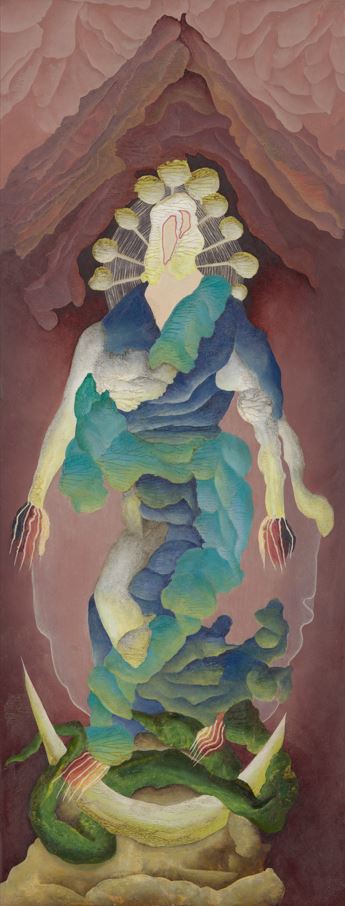
Compare and contrast that with one of the double images, not really in the full Dalí mode but nonetheless a recognisably human figure made entirely out of, well, what? Clouds? Bits of fabric? And what are those hands made out of? All wrapped up in esoteric symbolism of the crescent moon, at the bottom of the image.

Attributes of the Moon by Ithell Colquhoun ( 1947) Tate, presented by the National Trust 2016 © Tate. Photo © Tate (Matt Greenwood)

And in a different style again, here is another overtly erotic work from the extensive ‘Diagrams of Love’ sequence, 20 or so examples of which cover one wall, along with the short elliptical poems she wrote to accompany the series. I think you can see the rude elements without my commentary but what I enjoyed was the spangles scattered over the torso, and the delicate blue of the figure’s wings, tinged with pink and yellow.

Diagrams of Love: The Bird or the Egg? by Ithell Colquhoun (circa 1940) Tate Archive, TGA 929/4/17/3. Photo © Tate Photography (Lucy Green)

It’s full of images like this. The more I looked, the more I liked.


Related links

Related reviews

Leonard Woolf: A Life by Victoria Glendinning (2006)

Leonard and Virginia were agreed that his chief fault was cowardice, and hers was snobbery.
(page 151)

‘If it were not for the divine goodness of L. how many times I should be thinking of death.’
(Virginia Woolf diary 28 May 1931, quoted p.291)

Having read most of Virginia Woolf’s adult work, why read a biography of her husband, Leonard, and not her?

1) Because I’d had enough of Virginia: the essays finished me off, my cup overflowed with Woolf style, snobbery and delirium. 2) I’d learned most of the important facts about her life from the short biographies and notes in each of her novels, and the essays. 3) These notes sometimes referred to books by Leonard, notably a book he wrote called Quack! Quack! mocking the 1930s dictators, Mussolini and Hitler, which intrigued me. He wrote two novels, over 15 books of political science, was a committed socialist, literary editor, publisher, and wrote six volumes of autobiography. Does anyone ever read these? No.

So 4) Leonard is the underdog. The critical industry around Woolf is now mountainous – as Glendinning puts it, ‘There is a small mountain of books and articles on the life and work of Virginia Woolf’ (p.502) – and will only increase year by year. She is a patron saint of feminist writing, as iconic as fellow feminist saints Frida Kahlo and Sylvia Plath. There are lots of biographies of her, hundreds of books and tens of thousands of critical essays about her writing. But what about the mystery man who loved and supported her throughout the years of her great achievements, who tried to manage her recurring bouts of mental illness, who co-founded and ran their famous Hogarth Press? Let’s find out.

Jewish

Woolf was Jewish. He came from a large and extensive Jewish family. I enjoyed Glendinning’s handy summary of the history of the Jews in England, their slow liberation from various legal and customary restrictions during the nineteenth century, and then the transformation in the size of the Jewish population and in attitudes towards them triggered by the mass immigration of Jews from Russia in the 1880s and ’90s.

This more than quadrupled the size of the Jewish community in England and, because so many of them were very poor, from peasant communities, and often settled in the slummiest parts of the East End, it was this mass influx which gave rise to the casual antisemitism you find (distressingly) in so many Edwardian and Georgian writers (Saki and D.H. Lawrence spring to mind. The fact that Virginia includes antisemitic comments in some of her novels, and was regularly casually antisemitic in her letters and diaries – ‘I do not like the Jewish voice, I do not like the Jewish laugh,’ (p.189) – requires a separate explanation).

Father

Woolf was born in London in 1880, the third of ten children of Solomon Rees Sidney Woolf (known as Sidney Woolf), a barrister and Queen’s Counsel, and his wife Marie, maiden name de Jongh). Both parents were Jewish, and from extended families. This is why Glendinning needed four pages to depict the full, extended family trees of both parents. At various points, family members are quoted jokingly referring to it as ‘the Woolf pack’. From time to time grown-up Leonard, feeling sorry for himself, referred to himself as ‘a lone Woolf’.

The family lived at 101 Lexham Gardens off the Earl’s Court Road. The household was:

an example of a typical, well-to-do Victorian way of life, underpinned by an unquestioned social hierarchy and set of values. (p.13)

As a young man Leonard was conscious of ‘the snugness and smugness, snobbery, its complacent exploitation of economic, sexual and racial classes’ (quoted p.15).

We are told all kinds of things about Sidney Woolf but the single most important fact is that he died in his prime, in 1892, aged 47 (p.23). He had earned a lot as a lawyer and that income ended overnight. Now relatively impoverished his widow, Marie, was fortunate enough to have a legacy to live off. She hung on at Lexham Gardens for two years then moved the family to a smaller house further out of town – 9 Colinette Road, off the Upper Richmond Road in Putney.

School

After prep school, Leonard was sent to the prestigious St Paul’s School in west London. Lots of anecdotes, prizes and whatnot, but the important thing is that it was as a slight, shy, Jewish teenager that he developed what he called his ‘carapace’, the protective shell he was to deploy for the rest of his life.

Trinity College, Cambridge

In 1899 he won a classical scholarship to Trinity College, Cambridge. Glendinning vividly paints how he encountered a small group of fellow undergraduates who became soul mates, including the flamboyant Lytton Strachey and the hulking great Thoby Stephen, nicknamed The Goth, son of the biographer Sir Lesley Stephen and brother of the sisters, Vanessa and Virginia Stephen, the second of which Leonard was, of course to marry. But Strachey was the man. Before he’d arrived at Cambridge Strachey was a fully-formed individual with outrageous views and a particular way of speaking which influenced all his friends. Leonard became closer to Lytton Strachey than anyone else in the world, calling him ‘the most charming and witty of human beings since Voltaire’ (p.189).

I tend to think of E.M. Forster as being an old man, but he was actually a year younger than Leonard and they got to know each other at Cambridge.

Leonard was elected to the elite discussion society called The Cambridge Apostles and it is fascinating to learn the rules of this elite club and the kind of topics they discussed. When I was a sixth-former I read A.J. Ayer, learned about Logical Positivism, and went on to read Wittgenstein, all of which convinced me that talk of Beauty and Love and Truth and God is enjoyable, entertaining but ultimately meaningless.

More precisely, they may have a psychological importance and impact on the people who discuss, write and read about such topics, but they don’t really relate to anything in the real world. They derive from a misunderstanding of language. Because we talk about a good meal, a good person and a good day, it’s easy to be deluded into thinking there must be something they have in common. Plato started the ball rolling by writing dialogues in which Socrates and his followers endless debate the True Nature of The Good. Two and a half thousand years later, clever undergraduates at Cambridge were doing just the same.

I follow Wittgenstein in believing there can be no answer to these kinds of questions because they are non-questions based on a misapplication of language. Viewed from a correct understanding of language i.e. that language consists of a vast number of language games – then any given use of language may or may not be appropriate to the vast number of language games people continually play, invent and evolve and self-important Oxbridge discussions of these great big concepts simply take their place among myriads of other linguistic interactions.

Anyway, all this was to come. For the time being these clever young men thought Truth and Beauty were excellent subjects to write long papers about and present at gatherings of like-minded chaps who all considered themselves part of a literally self-selecting intellectual elite, the Apostles. Members of the Apostles included Leonard, Strachey, E. M. Forster and a year or so later, John Maynard Keynes. Thoby Stephen (his future wife’s brother) was friendly with the Apostles, though not a member himself. What comes over from Glendinning’s comprehensive accounts of these meetings and discussions is how absolutely irrelevant everything they discussed is to us today. Here are the dates of Leonard and significant contemporaries:

  • E.M. Forster b. 1879
  • Lytton Strachey b.1880
  • Thoby Stephen b.1880
  • Leonard Woolf b. 1880
  • Clive Bell b.1881
  • John Maynard Keynes b.1883

G.E. Moore

All of them were deeply in thrall to the moral philosopher George Edward (G. E.) Moore (1873 to 1958), himself an older member of the Apostles. They were still undergraduates when Moore published his influential book, Principia Ethica, in 1903, which was concerned with that age-old problem, What is the good? Moore decides that ‘the good’ is ultimately unknowable, so that:

By far the most valuable thing, which we can know or can imagine, are certain states of consciousness, which may roughly be described as the pleasures of human intercourse and the enjoyment of beautiful objects.’ (p.63)

1. The pleasures of human intercourse and 2. the enjoyment of beautiful objects. Friends, lovers and art. Or, as Wikipedia summarises it:

that the summum bonum lies in achieving a high quality of humanity, in experiencing delectable states of mind, and in intensifying experience by contemplating great works of art,

Moore’s conclusions led his book to be treated as a kind of Bible by the network of friends which came to be known as the Bloomsbury Group, validating their belief that human relationships are what count most: Love and Beauty. Sounds like Keats, doesn’t it, from almost a century earlier? Glendinning quotes John Maynard Keynes’s extravagant response to Moore’s theory: ‘It seemed the opening of a new heaven on a new earth’ (p.64).

The thing to understand is that the younger generation experienced this as a tremendous liberation from the oppressive burden of Victorian beliefs in duty and honour and nation and empire and queen and country and all the rest of it. For believers like Leonard the book stripped away centuries of oppressive religious beliefs, shedding the calm light of common sense on the agonising questions of how to live and what to believe.

‘Isn’t that the supreme, the only thing – to be loved.’ (Strachey, quote p.98)

But there were plenty of critics who mocked these earnest young believers. Glendinning quotes Beatrice Webb’s shrewish view that the book had little or no value and simply gave the young generation who worshipped it ‘a metaphysical justification for doing what you like’ (p.65).

Glendinning herself criticises the Principia because:

  1. Its unquestioning definition of The Beautiful was heavily Victorian and becoming out of date as the new aesthetics of the 20th century kicked in
  2. Moore’s idea of the good life was very passive and quiescent i.e. simply ignored the active life of politicians, engineers, administrators, people who did things. It was a privileged academic’s conclusion that the best possible way of life was… to be a privileged academic.
  3. No sex please, we’re British: Moore’s ‘asexual mind-set seemed to preclude the “intrinsic value” of any “state of consciousness” elicited by anything more urgent than affection’ (p.63). In other words, Moore’s was a very pallid, underpowered, sexless view of human emotions.

Choice of career and the Civil Service exam

Woolf was awarded his BA in 1902 but stayed on at Cambridge for another year to study for the Civil Service examinations which he took in the summer of 1904. He got a low pass, 69th in the list, and was offered a job as an imperial administrator in Ceylon. First he went the round saying goodbye to his uni friends and this included dinner at the Stephens new house. Sir Leslie Stephen had recently died (February 1904) and his children had moved out of the gloomy family house in Hyde Park Gate to a roomier lighter one in Bloomsbury. Visiting his friend Thoby (the Goth), meant meeting the two beautiful sisters, Vanessa and Virginia. Glendinning points out that the latter was still recovering from the nervous breakdown triggered by her father’s death, one of what was to become a string of breakdowns and mental health problems. During this breakdown she had made the first of several suicide attempts (p.129).

Ceylon

Woolf was in Ceylon for 7 long years, 1904 to 1911. Glendinning makes the point that he met hundreds of native Sinhalese and Tamils but never became friendly with one of them. He liked Ceylon, some of the scenery was breath-taking. He wrote that the jungle:

‘is a cruel and dangerous place, and, being a cowardly person, I was always afraid of it. Yet I could not keep away from it.’ (quoted p.109)

, but he became an increasingly conflicted imperialist. As he was slowly, systematically promoted, he found himself adjudicating law cases and arguments and realised the only thing to do was be as strict and impartial as possible. At the same time he came to hate the impact many imperial laws and restrictions had on the natives.

Glendinning gives a vivid and fascinating account of all this, based on the twin sources of the official diary he kept of his duties, along with the many letters he exchanged with his friends back in England, Thoby, a friend called Saxon but above all Lytton Strachey.

He lost his virginity to a Singhalese woman and seems to have had occasional sexual encounters, but didn’t keep a native mistress as many other young male imperial administrators did.

The conversation of whores is more amusing than the conversation of bores.

The correspondence with Lytton back in England, in Cambridge, is extraordinarily candid about sex. Lytton deploys what he himself calls ‘the dialect of their intimacy’ (p.146). Lytton was a promiscuous homosexual who needed to be falling in love with new young men all the time. Glendinning quotes liberally from his letters which depict not just his sex life, but the sex lives of those in their set or circle, including Duncan Grant, Clive Bell and Keynes. For example, where he explains that he is having an affair with Duncan Grant, who is also sleeping with Keynes. Lytton and the others delighted in using the word ‘copulate’, in a self-mocking tone.

‘I copulated with him [Duncan] again this afternoon, and at the present moment he is in Cambridge copulating with Keynes.’ (p.115)

As always, it’s the promiscuity of gay men which staggers me, compared with the, as far as I can tell, complete chastity of their female contemporaries, specifically Virginia and Vanessa.

A note that Leonard’s sister, Bella, came out to Ceylon in 1907. She married a colonial administrator, Robert Heath Lock, Assistant Director of the Peradeniya Botanical Gardens, near Kandy in 1910. She wrote children’s books and the first tourist guide to Ceylon. She was one of many voices advising Leonard to get married. She merits a Wikipedia page of her own.

The Longest Journey

While Leonard was in Ceylon, his friend E.M. Forster published an autobiographical novel, The Longest Journey which describes the coming-to-maturity of young Frederick ‘Rickie’ Elliott, including lengthy descriptions of his time as an undergraduate at Cambridge. Critics think the character of Stewart Ansell, the clever student which Rickie’s and their circle look up to, is at least partly based on Woolf. Certainly the flashy pseudo-philosophical conversations at Cambridge which the novel opens with, are based on The Apostles. Woolf and Strachey both hated it.

Back from Ceylon

After seven years service Leonard was given an extended leave to return to England. Glendinning quotes many of the colleagues and managers in the Colonial Service who advised him to get married. it’s interesting to read the opinions of quite a few contemporaries all advising that marriage is the best thing or only thing which a young man can do to acquire focus and purpose in his life. ‘Marriage was the only way forward’ (p.120).

We know from their letters and diaries that it was Lytton who first proposed to Virginia, in a panic that she might accept (p.114). You have to have followed the text quite closely to understand why this flamboyant queer would even consider such a mad move in the first place. She sensibly turned him down.

Virginia’s character As the focus of the story turns towards Virginia Stephen, Glendinning gives a useful profile and description of her (pages 128 to 130). The bit that stood out for me was the notion that her mother was aloof and distant, so that the girl Virginia hardly ever had time with her alone.

In adolescence and beyond, she became emotionally attached to older women. (p.128)

Aha, I thought – this sheds light on the warmth and fondness for mother figures and older women which you find in her fiction – Betty Flanders, Clarissa Dalloway, Mrs Ramsay, Lucy Swithin.

Virginia’s physicians We learn about the wonderfully named Dr Savage, the physician treating her mental illness, and that he had treated her father for depression, and one of her cousins, who ended up committing suicide. Also, we learn that her sister, Vanessa, was also prey to anxiety and depression. She had her own ‘nerve doctor’, Dr Maurice Craig of 87 Harley Street. So was it genetic?

Brunswick Square The Stephens children moved again, to 38 Brunswick Square, and invited several friends to move in and take rooms. Among these was Leonard who moved in on 20 November 1911. Their wooing was slow and painful.

The Aspasia Papers Constant company led Leonard to fell deeper and deeper in love with the beautiful, mercurial, charismatic Virginia, who he came to nickname Aspasia. This was the name of the wife of Pericles (495 to 429 BC), leader of Athens during its so-called Golden Age. He wrote descriptions of her and these expanded to become sketches of the entire social circle or set, all under pen-names, eventually called the Aspasia Papers. The whole gang he joking referred to as The Olympians.

Leonard proposes to Virginia On 10 January 1912 he proposed to her. This upset her so much she took to her bed. But over the following weeks he maintained his suit and the great day came on Wednesday 29 May when she acknowledged the loved him. They told the gang who reacted in different ways. Rupert Brooke claimed it was Leonard’s sexual know-how that got her. He described her eyes lighting up when Leonard described having sex with prostitutes in Ceylon. Put simply, he was the only man she knew who wasn’t gay and had had sex. With a woman!

He was 31, she was 30, both getting on a bit.

Quits the Colonial Service The Colonial Office required him to end his leave and return to Ceylon by May at the latest but Leonard realised he couldn’t go back, and after some surprising shows of flexibility by Whitehall, he eventually resigned his position. Now what was he going to do? He was writing a novel and had written some short stories, but hadn’t made any money from them.

Wedding They were married on Saturday 10 August 1912 at St Pancras Registry Office, a very small low-key affair. As Glendinning puts it:

Leonard and Virginia were agreed that his chief fault was cowardice, and hers was snobbery.
(p.151)

And both faults lay behind his failure to invite his mother to the wedding. Not being invited to the most important day of a son for whom she had made such sacrifices as a single mother deeply hurt her.

Sex

Glendinning (like all their friends) moves onto the subject of sex. Virginia seems to have got to the ripe old age of 30 without every experiencing sexual feelings. This is what you’d deduce from her novels and essays which have a kind of hallucinatory sexlessness. So she didn’t have a clue and he wasn’t savvy enough to be a teacher. He’d only slept with a few Singhalese prostitutes and prostitutes are 1) experienced and 2) compliant. Apparently when Leonard went to make his move, Virginia became increasingly anxious and over-excited in the way which preceded her breakdowns so he had to desist. Permanently.

Glendinning cites a letter exchange of 1933 with Ethel Smyth the feminist composer, where they talk about a news story that young women are having operations to break their hymens ahead of getting married, and joke about going to have the operation themselves. Woolf was 51 and apparently serious. Glendinning concludes from this and plenty of other evidence that Leonard and Virginia never had penetrative sex, so the marriage was never consummated in the normal way. Within a year they took to sleeping in separate rooms and never again slept together.

Events

Breakdown and suicide attempt After the marriage Virginia’s anxiety, nerves and depression grew worse. She became extremely anxious about the likely reception of her first novel, ‘The Voyage Out’. They went to the country hotel to celebrate the first anniversary of their honeymoon but it was a disaster. Virginia had high anxieties about food and refused to eat. Back in Brunswick Square, unattended for a few hours, she took an overdose of veronal (100 grains of veronal) sleeping pills. Prompt action by Keynes’s brother, Geoffrey who was staying in the house, and a stomach pump, saved her life but this necessitated a round of carers, nurses, consultations with the three physicians now treating her.

The Village in the Jungle In the middle of all this Leonard’s first novel, The Village in the Jungle, was published to good reviews. It’s set in Ceylon but not among the white ex-pat and colonial community, instead it entirely habits the minds of poor Singhalese villagers. And it’s written in what, for the times, was very plain factual English, what Glendinning calls ‘spare and unmannered’. Woolf’s old boss, Sir Hugh Clifford, wrote that:

‘Your book is the best study of Oriental peasant life that has ever been written, or that I have ever read.’ (p.168)

It’s available online and I’ve read and reviewed it for this blog.

Virginia Woolf was five feet ten inches tall. She had a ‘cut glass accent’ (p.299).

The Women’s Co-operative Guild The misery with Virginia lasted for months. Throughout this period Leonard became involved with the Women’s Co-Operative Guild, led by its young and energetic president, Margaret Llewelyn Davies. He went to meetings and the annual conference and write articles to promote their work.

He was by this stage writing lots of articles and reviews for a variety of journals, including the New Statesman.

Exempted from war service When the war came the army was at first fuelled with volunteers. The Military Service Act of 1916 widened the age of conscription to all men aged between 16 and 41. Leonard was 35 but underweight and anxious, with a permanent tremor in his hands. In the next three years he underwent three medical examinations but each time presented a letter from his doctor exempting him, predicting that if he were conscripted he would have a physical and mental breakdown within months.

The Fabian Society As well as the Women’s Co-Operative, Leonard had been collared by Sidney and Beatrice Webb, leading lights of the Fabian Society, who were always recruiting likely young chaps for their cause. Sympathetic to gradualist socialism based on facts and figures, Leonard was commissioned to research and write various reports. Thus in 1916 was published the result of extensive researches, his International Government. The book’s central proposal was for an international agency to enforce world peace, and he went on to join a number of the organisations lobbying for a League of Nations to be set up, becoming friendly with the genial H.G. Wells in the process.

Labour Party Leonard joined the Labour Party and helped research and write policy papers. Women’s Co-Operative, League of Nations charities, Fabians and Labour, he wrote research papers, pamphlets and books for all of them. His next book was the thoroughly researched Empire and Commerce in Africa.

1917 Club As a left-winger Leonard welcomed the Russian Revolution. As promptly as December 1917 he helped set up the 1917 Club in Soho as a discussion forum.

The Hogarth Press In 1917 the couple bought an old printing press for £19 and set it up on the dining room table of Hogarth House in Richmond and taught themselves how to use it, to print pages and stitch them together into books. Their first publication was Two Stories, one by Leonard, one by Virginia. Hers was The Mark On The Wall, a free-associating flight of fancy. It was her first published story. His old friend Lytton Strachey immediately saw it was a work of genius. But as Virginia’s confidence grew, Leonard’s shrank. He had published two novels but began to lose faith. He was happier writing factual books.

Mark Gertler, Lady Morrell, Katherine Mansfield They make friends with Mark Gertler, self-obsessed Jewish painter and lover of Dora Carrington. At Garsington Manor, home of Lady Ottoline Morell, they meet the New Zealand short story writer Katherine Mansfield and her husband, the editor John Middleton Murray. They agreed to published Mansfield’s 68-page story The Prelude on their press

Leonard produced another book, Co-operation and the Future of Industry and agreed to edit a journal called International Review. The publishing sensation of 1918 was his old friend, Lytton Strachey’s debunking work of biography, Eminent Victorians.

In the war one of Leonard’s brothers, Cecil, was killed and one, Philip, badly wounded.

Recap When the war ended Glendinning summarises that Woolf had established himself as a documentary journalist and political propagandist, an experienced public speaker and author of distinguished books, as well as a seasoned book reviewer, and publisher in his own right. He was a behind-the-scenes figure in the growing Labour Party and was offered a seat to contest as an MP but, after some hesitation, turned it down.

James Joyce In April 1918 Harriet Weaver, patron of The Egoist magazine, approached them with the unfinished manuscript of James Joyce’s Ulysses but they had to turn it down. Far too big for their expertise, it was rejected on the grounds of obscenity by the two commercial printers they approached. Obscenity was Virginia’s central objection to Joyce, see her essay Mr Bennett and Mrs Brown (1923). She couldn’t get past her snobbish aversion to his references to peeing, pooing and the male anatomy. (The book’s central character, Leopold Bloom, has a bath and idly watches his willy floating in the water.) In her own fictions, almost all references to the body, let alone sex (God forbid) are rigorously excluded, which helps to give them their strange, bloodless, ethereal character.

Woolf’s problematic reaction to Joyce (admiration, envy, rivalry, disgust at his physicality) are explored in two excellent essays by James Heffernan:

T.S. Eliot Conversation with Weaver turned to her other protegé, T.S. Eliot, who they invited to tea to discuss whether he had anything to publish. As a result they published seven of his poems in a small edition of 140 in November 1919. Initially stiff and inhibited, Eliot became friends with Virginia who referred to him, unpretentiously, as Tom. He, like Leonard, was to become carer to a mad wife. He was six years younger than Virginia (born 1888 to Virginia’s 1882). (Later Glendinning wryly notes that ‘Eliot continued to consult Leonard as an expert on mad wives,’ p.265. Ten years later they could have both helped Scott Fitzgerald with Zelda.)

Monk House In 1919 they were meant to go down to Cornwall to join the ménage which had been set up by D.H. Lawrence, his wife Frieda, Middleton Murray and Mansfield – but never did. They had been used to a place in the country named Asheham House but it was sold by the owner. They looked around and settled on Monks House in the village of Rodmell in Sussex. They paid £580 plus £120 for the freehold. This is now a National Trust property. When they moved in it had no running water, electricity or toilet facilities. These two highbrows put up with conditions which would nowadays as unfit for human habitation. Leonard became addicted to working in the garden and had to be dragged away to take Virginia for constitutional walks.

Back in London they bought a bigger press and began to consider the Hogarth Press as a commercial venture. They published Virginia’s story, Kew Gardens. It was 1919 the year of the Paris Peace Conference and Leonard nearly went. They printed Leonard’s Three Tales from the East with a cover by Dora Carrington, to very positive reviews.

Friends’ success Lytton had become a famous name with his Eminent Victorians and Keynes became famous for writing a scathing indictment of the peace terms imposed on Germany in The Economic Consequences of the Peace (December 1919). But although much of Leonard’s research for International Government was used by the British government or other organisations at the Conference, he got little recognition.

Empire and Commerce in Africa: A Study in Economic Imperialism (1920) a scathing indictment of British imperial policy in Africa. He was writing for the New Statesman and wrote leading articles on foreign affairs for the Nation. He was secretary to the Labour Party Committee on International and Imperial Questions. He was in the loop.

The Memoir Club Molly McCarthy set up the Memoir Club to bring together old pals from Cambridge to read works in progress. A propos of this you realise that Leonard, the man, was the objective authoritative and grounded one; Virginia, the woman, was flighty, solipsistic, experimental (p.237).

Gorki and the Russians In 1919 Maxim Gorky sent a friend of theirs, Kotelianski, a manuscript of his life of Trotsky, which he brought to the Woolfs. Thus began a series of careful translations of contemporary Russian literature by the Hogarth Press.

Teeth out In June 1921 Virginia had another nervous collapse. It is mind-boggling to read that some experts thought that having your teeth extracted was a cure from mental illness. On this occasion she had three pulled out. By the end of her life she’d had all her teeth pulled out by these experts.

Jacob’s Room In November 1921 she finished writing Jacob’s Room but with the end of any book came a rush of doubt, anxiety and sometimes collapse. She had come to rely on Leonard entirely, and he had evolved to know his place was by her side and supporting. At the time of the peace conference he had been asked to travel abroad, the Webbs asked him to visit Bolshevik Russia and report back, but he turned all offers down in order to remain by Virginia’s side. This makes him a hero, doesn’t it?

Passage To India Leonard played a key role in helping Morgan Foster complete his most important novel, A Passage To India, when Forster had severe doubts and thought of abandoning it (p.242). Passage was published in 1926 and made Forster famous and financially secure. Leonard was the grey eminence behind it.

Stands for Parliament Leonard stood as a Labour candidate for Liverpool in the 1922 General Election but, thanks to his lacklustre speeches about international affairs and against imperialism, came bottom of the poll. It was a relief.

Literary editor

‘I expect you have heard that, having failed as a) a civil servant b) a novelist c) an editor d) a publicist, I have now sunk to the last rung… literary journalism. I am now Literary Editor of The Nation and Athenaeum.’ (letter to Lytton Strachey, 4 May 1923)

The salary, £500 a year, gave the couple some financial stability and coincided with the start of ‘the most prolific and successful period of Virginia’s writing life’ (p.248). She had published Jacob’s Room and started the long process of writing Mrs Dalloway and was, in addition, writing important essays and reviews.

Leonard’s literary positions Wikipedia gives a handy list of Leonard’s editorial positions:

  • 1919 – editor of the International Review
  • 1920 to 1922 edited the international section of the Contemporary Review from 1920 to 1922
  • 1923 to 1930 – literary editor of The Nation and Athenaeum (generally referred to simply as The Nation)
  • 1931 to 1959 – joint founder and editor of The Political Quarterly from 1931 to 1959

The Waste Land It’s a bit mind-boggling to learn that the Hogarth Press published The Waste Land and the type was set in the household larder. ‘Tom’ was pleased with the typescript and layout. In the same year he established a literary magazine of his own, the Criterion and he and Leonard now were friendly and conspiring literary editors, swapping reviewers and ideas. Tom became a regular visitor to their house, mostly alone, in fact maybe a bit too often as his marriage with the mentally unstable Vivian sank into misery.

Glendinning very entertainingly punctuates the key events of Leonard’s life with a roundup of what all the other Bloomsburies were doing, which is mainly having hetero or bisexual affairs with each other. A little grenade was thrown into the mix when Keynes announced he was not only in love with, but going to marry a dancer from the Ballets Russes, Lydia Lopokova (p.249).

52 Tavistock Square Virginia felt out of it in Richmond and wanted to socialise more. So they sold Hogarth House (for £1,350) and rented 52 Tavistock Square for £140 a year.

Vita Sackville-West At this time Virginia met and became friends with socialite and author Vita Sackville-West. She was married to diplomat Harold Nicholson but they led separate lives, he with a string of boyfriends, she having affairs with women and, eventually, with Virginia. They became ‘tentative’ lovers for about three years. But sex was alien to Virginia’s nature and Vita was a passionate collector of conquests.

Labour As well as working full time as literary editor of the Nation, he continued to be secretary to Labour’s Advisory Committee on International and Imperial Questions. He drafted the foreign policy section of Labour’s 1929 manifesto. Throughout the 1920s he campaigned for India and Ceylon to be given independence. If they had, he later wrote, the murder and mayhem of the independence struggle and the catastrophe of partition would never have happened.

Freud The Hogarth Press embarked on publishing the complete works of Freud being translated by James and Alix Strachey. This project carried on into the 1960s, long after Leonard had parted company with Hogarth, and they’re the edition I own, as republished by Penguin. Despite this, Leonard grew more anti-analysis as he grew older. I’ve reviewed quite a few of Freud’s works:

Vita It became a love affair in December 1925. They took trouble to conceal the full depth of it from Leonard.

Car In August 1927 he bought a car. He drove Virginia all round the country. They drove to the south of France. He wrote that nothing changed his life as much as owning a car.

Mrs Dalloway was published by the Hogarth Press on 14 May 1925. The Common Reader, a volume of 21 short literary essays, was published the same year, and the following year was the first one in which Virginia’s income exceeded Leonard’s. In 1927 her masterpiece To The Lighthouse was published. In 1928 she earned £1,540 to his £394.

Nicknames Virginia never called him Len, she called him Leo. From the start of the marriage they had numerous nicknames for each other but the enduring ones were the Mongoose and the Mandrill. Before she married, Virginia’s nickname in the Stephen household was ‘the Goat’.

They went to Berlin to visit Harold Nicholson, it was a long draining visit with many late nights, and on her return she had a relapse and was in bed for three weeks. Glendinning quotes her as saying she really wanted ‘the maternal protection which… is what I have always wished from everyone’. Suddenly, reading that, I saw how Woolf was a child, endlessly seeking reassurance. And it made me see her novels as essentially childlike, a sexless, jobless, workless, child’s-eye view of life.

Orlando: A Biography was published on 11 October 1928 and sold well, securing their finances. A year later, in October 1929, A Room of One’s Own was also successful.

Richard Kennedy, 24, was the latest young graduate taken on to help out at the Hogarth Press. He describes how Leonard was:

the magician who keeps us all going by his strength of will… and Mrs W is a beautiful, magical doll, very precious but sometimes rather uncontrollable.’

He describes how, when she was lifting off into one of her manic spells, Leonard would gently tap her on the shoulder and she would stop talking, and quietly follow him, go to her bedroom where he talked quietly, read to her and calmed her down. Leonard had to warn new people what they could not say to Virginia to avoid a problem/getting her over-excited. I hadn’t realised she was this on the edge, all the time.

Ethel Smyth During 1930 Virginia gets to know the deaf, feminist composer Ethel Smyth and they become regular, and sometimes bawdy, correspondents. Smyth was 72, Virginia 48. Here’s Smyth’s most famous work, The March of The Women. Very worthy, but heavily Victorian and boring.

New Fabian research Bureau Leonard is appointed to its executive committee in 1931.

Kingsley Martin, an earnest young nonconformist, is appointed editor of the New Statesman which he would remain for 30 years. Leonard became joint editor of the Political Quarterly which he remained for the next 27 years.

The Hogarth Press published 31 books or pamphlets in 1930, 34 in 1931.

John Lehmann just down from Trinity Cambridge, was hired to work on the Press. He lasted two years. While here he published New Signatures, the selection which introduced the poets of the Auden generation. He introduced the Woolfs to Christopher Isherwood. They published Laurens van der Post’s first book. The more I read about the Hogarth press, the more impressive it becomes.

Glendinning cites eye witness accounts from Lehmann, Barbara Bagenal and Harold Nicholson of how Virginia needed Leonard to calm her when she got over-excited or had a fugue, a loss of awareness of where she was or what she was doing (p.294).

There are plenty of eye witnesses testifying to how happy Leonard and Virginia were at Monks House, how relaxed with each other and a civilised routine. Visitors heard Virginia endlessly talking to herself, in the bath, as she pottered round the big garden, and along country lanes, so that the locals came to think of her as bonkers. The servant Louie Everest came to recognise when Virginia was having one of her bad headaches because she pottered round the garden, bumping into trees.

1932

21 January: Lytton Strachey died of cancer. Leonard wrote a sensitive obituary. He had been Leonard’s best friend in their youth. His death confirmed Leonard was middle aged.

11 March, Lytton’s partner, the painter Dora Carrington, shot herself.

Mains water is brought to Monks House and they get a telephone, Lewes 832. Virginia buys new beds from Heals.

1 October Oswald Mosley founded the British Union of Fascists. Marches, rallies and violence in the East End. The Woolfs were connected to all this because up till this point Virginia’s lover, Vita Sackville West’s husband, Harold Nicholson, had been secretary to Mosley. Now he quit.

Conversely, T.S. Eliot‘s mentally unstable wife, Vivian, joined the Fascists. Eliot separated from her and never saw her but she stalked him and made public scenes. Virginia sympathised and ‘Tom’ became a good friend and regular visitor to their London or Sussex house.

1933

1933: Victor Gollancz asked Leonard to edit An Intelligent Man’s Way to Prevent War. This is the same subject as prompted Virginia’s great book, Three Guineas. In April Mosley held a rally for 10,000 followers at the Albert Hall. Leonard and the Fabians thought he might be in power in five years’ time.

1934

July: they visited the fabulously wealthy Victor Rothschild and promised to look after his pet marmoset while he went abroad. It was called Mitzy and became so attached to Leonard’s kindness that she never went back. She perched on Leonard’s shoulder or head and the back of his jacked was routinely strewn with her poo.

5 to 10 September: Leonard listens to the Nazi Nurenberg rally, relayed on the radio. He was inspired to write his satire on the totalitarian regimes, Quack Quack!

9 September: art critic and populariser of the French post-impressionist painters, Roger Fry, died. Vanessa had had a fiercely sexual affair with him (13 years older than her) and was inconsolable. Slowly the idea crystallised that Virginia should write his biography. This was to turn into a chore and produce a not very good book.

1935

May: Driving to Italy Leonard decided to take a detour through Nazi Germany. Glendinning points out that in his autobiographies he doesn’t mention the antisemitism of the 1930s, doesn’t mention Mosley or the British Union of fascists. She thinks this is because he didn’t want to put down in black and white even the possibility of his country’s rejection of himself, as a Jew. The British Foreign Office advised Jews not to visit Hitler’s Germany. Brief description of their journey through Nazi Germany, soldiers everywhere, public notices against Jews, mobs of children giving the Nazi salute. They had taken Mitzy the marmoset with them who made people laugh and defused tensions.

June: published his attack on the Fascist governments, Quack Quack!

September: Nazi Nuremberg Race Laws Jews legally different from their non-Jewish neighbours introducing all kinds of legal discrimination.

September: Leonard and Virginia attended the Labour Party Conference where Ernest Bevin argued that Britain had to rearm to face the Fascist powers, annihilating pacifist speaker in the process.

2 October: Mussolini invaded Abyssinia. Sanctions were useless as didn’t include Germany or the USA. Leonard wrote bleakly about the failure of the League of Nations. He had spent 20 years arguing that the only way to keep peace was international co-operation. Now he was forced to abandon that position and agree with Bevin that Britain needed to re-arm and make itself strong.

1 November: UK General Election in which Labour were thrashed and the new coalition government of Conservatives along with small breakaway factions of the Labour and Liberal parties, was headed by Conservative Stanley Baldwin.

Tom Eliot brought Emily Hale, a former love and confidante, to meet Leonard and Virginia, who left a record of their tea, finding Leonard more sympathetic, warm and tired.

1936

20 January: King George V died, succeeded by his son, Edward VIII.

6 March: Hitler’s troops reoccupied the Rhineland in breach of the Versailles Treaty. The atmosphere of growing antisemitism in Britain. British Union of Fascists symbols drawn on the walls.

Trying to finalise The Years and separate out the polemical book which was to become Three Guineas brought Virginia closer to breakdown than she’d been since 1913. She lost half a stone and for over three months was unable to work, an unusual hiatus. Only in the last 3 months of the year could she resume work on what was to be her longest novel.

July: Spanish Civil War broke out with the army’s coup against the republican, anti-clerical socialist government. Leonard concluded the international system had collapsed and a European war was inevitable.

Sunday 4 October: the Battle of Cable Street as anti-fascists attacked a march by the British Union of Fascists through the East End.

5 to 31 October: the Jarrow march.

19 December: after a prolonged constitutional crisis, Edward VIII abdicates because of the Establishment’s refusal to let him marry the American divorcee, Wallis Simpson.

1937

Leonard was ill for an extended period of time. Glendinning thinks it expressed his anguish about the international situation and dread for the plight of the Jews. He tried various consultants who thought it was diabetes or prostate trouble i.e. didn’t have a clue.

April: the bombing of Guernica.

24 June: Leonard and Virginia were among many artists and performers onstage at the Albert Hall for a concert to raise money for Basque orphans.

20 July: the terrible news that Virginia’s nephew (Vanessa’s son) Julian Bell had been killed after volunteering to drive an ambulance in Spain.

Leonard was diagnosed with numerous ailments and prescribed loads of medicines none of which worked. He even went to see the inventor of the Alexander technique, Frederick Alexander, but gave it up as too arduous. His ongoing illness prompted love and support from Virginia. Glendinning quotes Virginia’s diary describing them walking round Tavistock Square like a lovestruck couple:

‘love-making – after 25 years can’t bear to be separate…you see it is enormous pleasure being wanted: a wife. And our marriage so complete.’ (Virginia’s diary 22 October 1937)

21 October: after a long gestation, Virginia’s final and longest novel, The Years was published. It received good reviews and was her most commercially successful novel although Leonard thought it was her worst.

In late 1937 John Lehmann became a partner in the Hogarth press, buying out Virginia’s share for £3,000.

1938

March: Lehmann started full time as co-director of the Hogarth Press. Endless bickering with Leonard. But it was making more money than ever, £6,000 in this tax year.

March: Leonard installs a wireless in 52 Tavistock Square. He himself makes regular radio broadcasts.

12 March: the Anschluss, Nazi Germany marches into Austria and takes it over. At the Labour Party Executive Leonard argues for a coalition with the Conservatives and the introduction of conscription.

April: Lady Ottoline Morrell, hostess of the literary salon at Garsington Manor, died.

June: Three Guineas published. Leonard thought it typified Virginia’s impeccable feminism but their friends didn’t like it. Forster thought it cantankerous, Keynes thought it silly, Vita thought it unpatriotic. I think its structure (like a lot of Woolf’s writing) is eccentrically oblique and sometimes confusing, but the picture she builds up, especially through the extended notes, of the patriarchy which held back British women, is magnificent, radiating scorn and quiet rage.

August: Tom Eliot’s wife Vivian was certified insane and sent to a lunatic asylum where she spent the last 9 years of her life. Eliot never visited her.

September: the Munich Crisis, Neville Chamberlain flies to Munich and along with the French Prime Minister allows Hitler to annex the Sudetenland, part of Czechoslovakia with a large German population. Leonard predicted war. Virginia is still very much in love with him. She bakes a loaf of bread and calls out to the garden, where he’s up a ladder ‘where he looked so beautiful my heart stood still with pride that he had ever married me’ (letter to Vanessa Bell, October 1938).

9 November: Kristallnacht when the Nazis unleashed stormtroopers on Jewish homes, business and synagogues across Germany. Hundreds of synagogues throughout Germany, Austria and the Sudetenland were damaged, over 7,000 Jewish businesses were damaged or destroyed, and 30,000 Jewish men were arrested and incarcerated in concentration camps. Leonard has a recurrence of the painful rash which covers his back and other parts. He sees doctors but Glendinning thinks it was psychosomatic, stress, and to do with the persecution of the Jews.

December: Leonard finished the first volume of After the Deluge, an analysis of Enlightenment thought into the early nineteenth century. His aim was to show the psychological and sociological process which bring about wars, and so avoid them. Fat chance. When it was published in September 1939 it sold pitifully.

1939

January: Leonard and Virginia go to tea with Sigmund Freud, recently escaped from Nazi Vienna. The Hogarth press had been publishing his works for 15 years. Leonard was struck by Freud’s aura of greatness. Freud died a few weeks into the war, on 23 September 1939.

15 March: German army annexes the rest of Czechoslovakia and claims the country has ceased to exist. France and Britain bring forward their rearmament programmes. Leonard’s psychosomatic rash returns with a vengeance.

23 June: their friend the artist Mark Gertler gassed himself. He was suffering from financial difficulties, his wife had recently left him, his most recent exhibition had been slammed, he was still depressed by the death of his mother and the suicide of Dora Carrington with whom he’d been madly in love, and was fearful of the imminent world war.

Victor Gollancz commissioned Leonard to write a book in defence of civilisation and tolerance for the Left Book Club for £500. But the final manuscript of Barbarians at the Gate contained criticisms of the Soviet Union which were unacceptable to the communists at the club, leading to a prolonged exchange of angry letters.

2 July: Leonard’s mother died. He was unsentimental.

The Woolfs moved to 37 Mecklenburg Square, taking their thousands of books and the Hogarth printing press.

23 August: Germany and Russia signed their non-aggression pact. 1 September Germany invaded Poland. 3 September Britain was at war with Germany.

November: The Barbarians at the Gate was published and slated by left-wing fellow travellers.

1940

The War for Peace published in which Leonard defended what critics called his utopianism in international relations.

June: France collapsed. Hitler enters Paris. Dunkirk. Leonard was shaken.

September: the Blitz began and was to last until May 1941. The blackout is enforced in Rodmell (the village where they had their country home). Virginia spoke to the local Women’s Institute then became its secretary. Like many others they equipped themselves with means of committing suicide should the Germans invade (p.353).

Correspondents: Virginia was still writing letters about her everyday life to Ethel Smyth who didn’t die until May 1944. Leonard still wrote letters to Margaret Llewelyn Davies of the Women’s Co-operative Guild.

They drove to London but couldn’t get as far as Mecklenburgh Square because of the bombing. A pill box was built in the field beyond their garden. German planes flew overhead every day. The flat in Mecklenburgh had its windows blown out by bombs, but their old place at 52 Tavistock Square was reduced to rubble. The Hogarth press machinery was evacuated to Letchworth. The books from Mecklenburgh were shipped down to Monks House where they packed the corridors.

23 November: Virginia finishes first draft of Between the Acts. She slowly fell into a depression, Her hand started to shake.

1941

25 January: Virginia turned 59 and Leonard began to be worried about her persistent depression. She was revising Between the Acts, always a dangerous time. They socialise, Virginia telling people her new novel is no good, though Leonard praised it.

March: she went for a walk in the fields and fell into the river whose banks had broken and flooded some of their land. Leonard returned from giving a talk to find her staggering back towards the house, wet and upset. Vanessa visits and tries to cheer her up.

Monday 24 1941: he realised she was becoming suicidal. The situation was as bad as her collapse in 1913. He consults a friend, Octavia Wilberforce, about whether to his nurses and force 24 hour supervision on Virginia against her will. But this is what had triggered furious psychotic breakdowns in the past so they decided to try and gentler approach, of Leonard calmly supporting and encouraging her.

Next day was a series of humdrum chores, recorded by Leonard and the house servant, and Virginia said she was going for a walk before lunch. An hour or so later Leonard went up to his sitting room and found two letters there, one for Vanessa one for himself, suicide notes. The letter to him is so full of love it made me cry. She thanked him and said she had had a wonderful life but she could feel her madness coming on, she was hearing voices, she couldn’t read, he would be better off without her.

Obviously he came running downstairs, hailed all the servants, sent one to get the police and help and spent the day till sunset searching the flooded river Ouse. He found Virginia’s walking stick lying on the bank. In subsequent days the river was dragged for the body. Eventually the authorities gave up the search for her body.

Three weeks later he body was discovered floating in the river by some teenagers having a picnic. They called the police. Leonard had to identify it. Coroner’s report etc. Leonard drove on his own to the cremation.

All his friends tried to console him, saying she was better off dead than really mad, but Leonard swore she would have recovered from this attack as from previous ones. He buried her ashes under two elm trees in the garden at Monks House which they had jocularly named after themselves.

Joyce and death Born February 2, 1882, Joyce was precisely eight days younger than Virginia. Two days after his death on January 13, 1941, she noted in her diary that he was ‘about a fortnight younger’ (D 5: 352-53). She outlived him by just a little over ten weeks.

Virginia asked Leonard to destroy all her papers

He disobeyed and in the years to come Virginia Woolf’s diaries and letters, autobiographical writings and unpublished works, were to be published and pored over in ever greater detail. The shape of her legacy, and the broader picture of the Bloomsbury Group, would have been very different if he’d obeyed her wishes.

Was he right to ignore her explicit, direct request, as Max Brod disobeyed Kafka’s request to burn his papers?

The shocked response of friends and family, other writers, journalists, and the wider world, are described and done with by about page 380 of this 500-page book. Leonard Woolf still had 28 years to live (died 14 August 1969). A man who was born the year Gladstone replaced Disraeli as Prime Minister (1880) lived to see men land on the moon. The twentieth century, century of marvels but also cataclysmic disasters.

After Virginia

What’s interesting is the power of the biography completely evaporates with Virginia’s death. I hadn’t realised how much Leonard’s story had come to be entwined with hers, and his existence justified by his support of her as she wrote her masterpieces. When it’s back to just him it remains sort of interesting in a journalistic gossipy way but the pressure drops right down.

Twenty-eight more years of living, writing, politicking, editing, publishing and loving – one year less than his marriage to Virginia (1912 to 1941). According to Glendinning ‘Few people are so fortunate in their later life as Leonard Woolf’ and he had many happy years. But for this reader, at any rate, all the life went out of the book when Virginia died.

Trekkie

In the next few years he fell in love with a woman called Trekkie (real name Margaret Tulip) Parsons, a keen but nondescript painter, married to Ian Parsons, an editor at Chatto and Windus, a handsome charming man. Ian sort of permitted a menage a trois to develop though it’s doubtful that Leonard and Trekkie ever had sex, and I hate myself for reading about other people’s sex lives, though this is an unavoidable aspect of modern biography. Ian meanwhile was having an affair with his editorial assistant Norah Smallwood so… so people will be people.

Superficial though it sounds, the relationship with Trekkie lasted for the rest of their lives.

The growth of Bloomsbury

The other theme which emerges is the slow steady growth of the Bloomsbury industry. Post-war interest in Virginia and other figures just kept on growing. The surviving members of the network –published books every year and fed the market throughout the 1950s (p.433). The advent of the swinging 60s, sexual liberation, the decriminalisation of homosexuality in 1967, a greater openness about sex, made the Bloomsburies, with their fluid sexuality and open relationships, seem forebears and founders.

The members wrote autobiographies and memoirs, and a steadily growing tribe of academics wrote books about them. Glendinning describes some of the early Virginia scholars who began to approach Leonard asking for help, advice, an interview, and whatever papers he could spare.

Glendinning records Leonard’s growing involvement with not just American scholars but professional buyers of manuscripts such as Hamill and Barker, to whom he sold off packets and parcels of letters, manuscripts and diaries, through the 1950s and ’60s, for lucrative sums (pages 427, 450).

The schism between academics and public intellectuals

This move to biography was encouraged by the growing schism between general, freelance public intellectuals such as Leonard, and the growing number of professional academics housed in the growing number of postwar universities. When Virginia and Leonard started writing all intellectuals were on about the same level, with some being experts at universities, but many freelance writers knowing quite as much across a broad range of subjects. The tone of discourse across public writers and academics was comparable. In the new era of academic specialisation, academics developed technical terms and jargon, assumed specialist knowledge, which increasingly cut them off from generalists let alone the man in the street.

Leonard fell victim to this specialisation with his book on international politics, After the Deluge, published in 1955. He intended it to form the third part of a trilogy (the previous books published in 1931 and 1939) which he allowed himself to be persuaded to give the grandiose title Principia Politica. This begged comparisons with the masterworks of Newton (Philosophiæ Naturalis Principia Mathematica), Whitehead and Russell’s Principia Mathematica or GE Moore’s Principia Ethica, but it was nothing of the kind, as reviewers were quick to point out. Compared to the new ranks of professional academics, Leonard appeared discursive, repetitive, anecdotal and amateurish (p.444).

The spread of universities and growth of a class of specialist academics was epitomised by the opening, in 1961, of the University of Sussex, just outside Brighton and only 5 miles from Leonard’s rural retreat in the village of Rodmer (p.465).

For the public intellectual locked out of the growing ivory tower of academia, there remained publishing (he continued to be a director of the Hogarth Press), ‘the higher journalism’ (he continued to edit the Political Quarterly, and biography and memoirs. So this feeds back into the growth of Bloomsbury books – none of the survivors (Vanessa, Duncan, Quentin and so on) were really expert, scholarly expert-level on anything except… themselves.

Leonard himself epitomised the trend. Having had his masterwork of political commentary rubbished he retreated to the safer territory of his own life, and commenced his own autobiography which ended up taking no fewer than six volumes:

  • Sowing: An Autobiography of the Years 1880 to 1904 (1960)
  • Growing: An Autobiography of the Years 1904 to 1911 (1961)
  • Diaries in Ceylon 1908 to 1911, and Stories from the East: Records of a Colonial Administrator (1963)
  • Beginning Again: An Autobiography of the Years 1911 to 1918 (1964)
  • Downhill All the Way: An Autobiography of the Years 1919 to 1939 (1967)
  • The Journey Not the Arrival Matters: An Autobiography of the Years 1939 to 1969 (1969)

I’d never heard of these but they won him prizes. Beginning Again won the W.H. Smith book prize and the handy sum of £1,000.

Michael Holroyd’s two-volume biography of Lytton Strachey published in 1967-8 proved to be a turning point. Its openness about Strachey’s homosexuality, his numerous affairs, his thousands of camp letters, shed a completely new light on the Bloomsburies, rendering much that had been written up to that point obsolete, but confirming their reputation as sexual pioneeers (p.475).

Pointless

In the last volume of his autobiography Leonard candidly, devastatingly, adjudged that a lifetime of political activism, sitting on innumerable committees, spending years researching and writing position papers and polemical books (calling for international co-operation for peace) achieved more or less nothing.

‘I see clearly that I achieved practically nothing.’ (quoted p.484)

Thoughts

Authoritative, thorough, empathetic, insightful, fascinating and often very funny, nonetheless Glendinning’s definitive biography becomes increasingly focused on the mental illness of poor Virginia, relentlessly building up to Virginia’s suicide which is so terrible, so upsetting, so devastating, that I could barely read on and stopped trying to review it after that point.


Credit

‘Leonard Woolf: A Life’ by Victoria Glendinning was first published by Simon and Schuster in 2006. Page references are to the 2007 Pocket Books paperback edition.

Related links

Virginia explaining and justifying her technique in ‘Modern Novels’ (TLS 10 April 1919):

The mind, exposed to the ordinary course of life, receives upon its surface a myriad impressions–trivial, fantastic, evanescent, or engraved with the sharpness of steel. From all sides they come, an incessant shower of innumerable atoms, composing in their sum what we might venture to call life itself; and to figure further as the semi-transparent envelope, or luminous halo, surrounding us from the beginning of consciousness to the end. Is it not perhaps the chief task of the novelist to convey this incessantly varying spirit with whatever stress or sudden deviation it may display, and as little admixture of the alien and external as possible.

Let us record the atoms as they fall upon the mind in the order in which they fall, let us trace the pattern, however disconnected and incoherent in appearance, which each sight or incident scores upon the consciousness. Let us not take it for granted that life exists more in what is commonly thought big than in what is commonly thought small.

Revised as ‘Modern Fiction’ in The Common Reader (1925).

Not I, But The Wind… by Frieda Lawrence (1935)

We are so much more than we understand. Understanding is such a little part of us, there is so much in us of unexplored territory that understanding can never grasp.

I believe the chief tie between Lawrence and me was always the wonder of living . . . every little or big thing that happened carried its glamour with it. (p.60)

D.H. Lawrence died of tuberculosis in Vence in the south of France on 2 March 1930. His wife and soul-mate Frieda Lawrence tells us that she initially meant to pay her husband the tribute of complete silence about their 18 turbulent years together. But someone obviously prevailed on her to write a memoir and this book was published in 1935.

I owe it to him and to myself to write the truth as well as I can.

Ceaseless travelling

It’s an odd, uneven, patchwork but compelling work. On the factual front, it is arranged in simple chronological order with a chapter apiece about each of the main eras of their marriage. In particular you learn a lot about the extraordinary number of places they lived in. They were tramps, hobos, perpetual itinerants. At two or three places they seem to have lived for a couple of years, maximum, but some of the chapters describe half a dozen places they moved between, and they are always moving, travelling. After the war to Florence, then Capri, then several different residences in Sicily, before they took up Mabel Luhan’s invitation to join her in Taos, New Mexico, which triggered their round the world journey by ship across the Mediterranean, to Ceylon, to Australia, where they stay at a place on the west coast, before a few days in Sydney, then moving to a cottage 50 k south. Even when they arrived in Toas they moved locations till Mabel kindly gifted them a ranch in the foothills of the Rockies. But after a hard winter Lawrence took Frieda south to Mexico where, again, they never settled, staying in Mexico City, then to a place on Lake Chapara, then somewhere in Oaxaca.

Here it gets complicated because Frieda wanted to go back to Europe to see her mother, so they travelled together to New York, where she caught a ship for Europe (after a flaring argument on the quayside). After heading west to Chicago, then back to Taos, we suddenly find that Lawrence has taken ship for England, where he stays a bit in London, before heading south to France to a quiet place on the Italian border named Spotalino. They take a breather here, but only a few pages later are heading for Switzerland, then jaunts back to Germany to see her family.

What I found mind-boggling about all this is that they were poor, really poor, dirt poor, and yet could afford to up sticks and travel round the world and stay at a bewildering number of places, many if not most of which were in lovely settings. The world they moved through seems in this account to have been simpler and much, much, much cheaper than the world I grew up in fifty years later, and vastly more free and easy than the super-expensive Euro world we live in today.

Domesticity

What comes over is how, at every place they settled in, Lawrence and Frieda set about washing and cleaning and scrubbing, throwing out the awful old furniture and buying old native furniture or even making their own, painting the walls and crockery, turning every place they stayed into a home, no matter how transiently. Whether laying the pipes from a spring or carving a rocking chair, or making sure there were vases of flowers everywhere, the book is flavoured with a lovely sense of beautifying domesticity.

Arguments

Not that it was all sweetness and light. For feminist readers, or anyone looking for ammunition to attack Lawrence, Frieda gives plenty of examples of his temper tantrums, his bullying and abuse: he ridiculed her painting, mocked her in letters to her own mother, threw a glass of wine in her face at a dinner with her own family. He could be a very difficult man to live with. It’s not only ridiculous that such a weedy, frail specimen wrote so cockily about the need for men to be men, about the need for male culture and male struggle and so on – at some points it becomes creepy when he demands her submission to him.

Living intensely

But then, there are two things which redeem the situation. For all his demanding nature, Lawrence let Frieda live as no-one before or since had done. So when they kissed and made up, on the sunny days, she experienced a fullness of life, a richness in moment-to-moment living unlike anything else, wonderful incandescent.

Everything he met had the newness of a creation just that moment come into being. (p.31)

Wherever Lawrence was, the surroundings came alive so intensely. (p.99)

Travelling with him was living new experiences vividly every minute. (p.101)

Living with a genius

The other thing she makes clear is that Lawrence was a genius and genius is difficult.

As for pretending to understand Lawrence or to explain him, I am neither so impertinent nor such a fool. We are so much more than we understand. Understanding is such a little part of us, there is so much in us of unexplored territory that understanding can never grasp. As Lawrence and I were adventurers by nature, we explored.

I only know that I felt the wonder of him always. Sometimes it overwhelmed me, it knocked out all my consciousness as if a flame had burnt me up. I remained in awe and wonder.

Sometimes I hated him and held him off as if he were the devil himself. At other times I took him as you take the weather. Here’s a spring day, glorious sunshine, what a joy!…

I learned that a genius contains the whole gamut of human emotions, from highest to lowest. I learned that a man must be himself, bad or good at any price.

Patchwork

I mentioned it being a bit of a patchwork. This is because it contains quite a few of Lawrence’s letters. A standard biography would consist mostly of the author’s text with selected quotations from the subject’s letters to demonstrate a point. But here Frieda gives you 6, 7, 8 pages describing the events of a particular period (their time in Cornwall during the Great War, say, or their stay in Australia) and then a block of 7, 8, 9, 10 letters from Lawrence in their entirety. There are so many letters, quoted in full, that it’s almost like reading two books, Frieda’s version of events, then Lawrence’s dashed-off letters, side by side.

And not just letters but poems, the text includes half a dozen or so poems which she associates with particular places and times. Towards the end she just includes an essay of Lawrence’s about nightingales. So it’s a sort of mosaic. Or maybe a scrapbook of memories.

Mother

If Frieda was by his side most of their lives who were these letters to? Her mother. Lawrence developed a close relationship with Frieda’s mother and wrote her long, considerate, informative and funny letters describing their latest adventures in Australia or New Mexico or Mexico. He regularly addresses her, jocularly, as die Schwiegermutter (German for mother-in-law). But there are also letters to Frieda’s older sister, Else. Most if not all of these he wrote in German and Frieda has translated.

At moments it almost feels like an edition of Lawrence’s letters with a little light commentary from Frieda. For example, the chapter called ‘Going away together’ has just 2 pages of Frieda and 21 pages of Lawrence’s letters and the ‘Back to Europe’ chapter includes an epic 70 pages of letters. But then again, other chapters are entirely Frieda with no letters at all. So it varies.

Lack of specificity about Lawrence’s writings

About Lawrence’s actual writing, Frieda is often quite vague. She mentions particular works which were written at particular places but rarely goes into any detail, about characters, plot or meaning. Here’s a typical example:

We spent some weeks at Zell-am-See with Nusch, her husband and children at her villa. We bathed and boated and Lawrence wrote his ‘Captain’s Doll’ there. (p.84)

Or:

He wrote ‘Birds, Beasts and Flowers’ and ‘Sea and Sardinia’ at Fontana Vecchia, and also ‘The Lost Girl’. ‘Sea and Sardinia’ he wrote straightaway when we came back from Sardinia in about six weeks. And I don’t think he altered a word of it. (p.100)

Anybody looking for insight into particular works will be disappointed. I was particularly disappointed that there was no detail about the three big legal controversies: the banning of ‘Women in Love’, the banning of ‘Lady Chatterley’s Lover’, and the shutting down of the exhibition of his paintings in London.

She does the general psychological impact rather than the details. So in several places she comments on Lawrence’s ability to utterly focus.

Then he would sit in a corner, so quietly and absorbedly, to write. The words seemed to pour out of his hand onto the paper, unconsciously, naturally and without effort, as flowers bloom and birds fly past. His was a strange concentration, he seemed transferred into another world, the world of creation. (p.38)

And, later:

Often before he conceived a new idea he was irritable and disagreeable, but when it had come, the new vision, he could go ahead, and was eager and absorbed. (p.173)

Chapters

  1. Foreword
  2. We Meet
  3. Going Away Together
  4. Isartal
  5. Walking to Italy
  6. 1913 to 1914
  7. The War
  8. Lawrence and My Mother
  9. After the War
  10. America
  11. Going Back to Europe
  12. Nearing the End
  13. Conclusion

1. Foreword

Frieda establishes the setting where she is writing the book. She is back on the ranch, the Kiowa Ranch, which Mabel Luhan gave to them, and where she, Lawrence and, later, the artist Brett, lived together, in 1924 and 1925. Many of the chapters start with her describing the peaceful rural scenery around her, before she starts describing the events of each chapter.

It was still cold last night, though it is the middle of May.

Here the ranch, with the Sangre de Cristo mountain range behind it to the northeast, slopes to the desert. The big pine trees stand like dark sentinels in the night at the edge of the twenty acre alfalfa field. Beyond them floats the desert. You can see far. A few lights twinkle at Ranches de Taos. A shepherd’s fire glows. All is covered by an enormous sky full of stars, stars that hang in the pine trees, in Lawrence’s big tree with his phœnix on it that the Brett painted, stars that lean on the edge of the mountains, stars twinkling out of the Milky Way. It is so still. Only stars, nothing but stars.

This morning early there was still ice on the edge of the irrigation ditch from the Gallina Canyon. There is such a rush of water. The ice is melting high up in the mountains and the water sings through one’s blood.

But now, about midday, it is warm. The desert below circles in rings of shadow and sunshine. The alfalfa field is green, during these last days of sunshine it has turned green.

I am in the little cabin that Lawrence built with the Indians. I sit in the chair that he made with the ‘petit point’ canvas that we bought in the Rue de la Paix in Paris and that I embroidered. It took me a long time, and when I got bored, he did a bit.

It is a nice chair, although a bit rough, carved as it was with only a penknife.

So here I sit and try to write.

2. We Meet

Three and a half pages. Frieda was 33 and had everything a woman was meant to hope for, a respectable marriage to a man successful in his field (the notable philologist Ernest Weekley), a nice home and three lovely children. But a friend had recently been teaching her the new theories of Sigmund Freud which had begun to make her think about the search for an authentic self. So the door was already ajar when Lawrence came to lunch with her husband. They had some time alone together chatting before the meal and found themselves on the same wavelength. Rather vaguely, Frieda describes three or four further meetings, often with the children. The following appears to be the crunch moment:

One day we met at a station in Derbyshire. My two small girls were with us. We went for a long walk through the early-spring woods and fields. The children were running here and there as young creatures will. We came to a small brook, a little stone bridge crossed it. Lawrence made the children some paper boats and put matches in them and let them float downstream under the bridge. Then he put daisies in the brook, and they floated down with their upturned faces. Crouched by the brook, playing there with the children, Lawrence forgot about me completely. Suddenly I knew I loved him. He had touched a new tenderness in me.

3. Going Away Together

Two pages of Frieda’s narrative, 21 pages of his letters to her. They meet at Charing Cross station, take ship across the Channel, travel to Metz. Lawrence met Frieda’s father just the once, and they sat in glowering silence, the hostile aristocrat facing the miner’s son.

4. Isartal

Isartal is a name given to the valley of the River Isar, near Munich, in Bavaria, south Germany. Here, after delays, they met up and started their life together, living cheaply in a little flat lent them by a friend.

This morning I found the wild red columbines that I had first found with him. There they were at my feet, in the hollow where the workmen have been cutting the logs for the new house. A delicate blaze of startling red and yellow, in front of me, the columbines, like gay small flags. A rabbit stood still behind an oak shrub and watched me. A humming-bird hummed at me in consternation, as startled at me as I was at him. These things are Lawrence to me…

When Lawrence first found a gentian, a big single blue one, I remember feeling as if he had a strange communion with it, as if the gentian yielded up its blueness, its very essence, to him. Everything he met had the newness of a creation just that moment come into being.

Lawrence talked about his embattled boyhood, whereas Frieda had a lovely childhood in the garrison town of Metz.

Lawrence’s thriftiness

One day I bathed in the Isar and a heel came off one of my shoes on the rough shore; so I took both shoes off and threw them into the Isar. Lawrence looked at me in amazement. ‘He’s shocked, as I must walk home barefoot, but it’s a lonely road, it doesn’t matter,’ I thought. But it wasn’t that; he was shocked at my wastefulness. He lectured me: ‘A pair of shoes takes a long time to make and you should respect the labour somebody’s put into those shoes.’ To which I answered: ‘Things are there for me and not I for them, so when they are a nuisance I throw them away.’

Frieda’s children

She is mortally wounded about having to abandon her children. Her husband vowed she’d never see them again. Her mourning irritated Lawrence. Selfishly, he wanted her to devote herself to him alone, and have no rivals for her love.

Lawrence’s changeableness

He’d have quick changes of mood and thought. This puzzled me. ‘But Lawrence, last week you said exactly the opposite of what you are saying now.’ ‘And why shouldn’t I? Last week I felt like that, now like this. Why shouldn’t I?’

5. Walking to Italy

In August 1913 they set off to walk from south Germany across the Alps into Italy. It was Lawrence’s birthday en route. It took about 6 weeks. Sometimes they slept in haylofts. They were tramps.

I remember Lawrence saying to me: ‘You always identify yourself with life, why do you?’ I answered: ‘Because I feel like it.’

They danced and sang with the peasants they met en route.

6. 1913 to 1914

Back in London their best friends are John Middleton Murry and Katherine Mansfield, a perfect friend. When they finally got married at a registry office, JMM and KM were the witnesses. Lawrence quickly bought a new wedding ring and Frieda gave her old one to Katherine, and it was buried with her when she died (wretchedly young, in 1923) (p.66). Cynthia and Herbert Asquith became friends and Cynthia stuck with them during the bad times of the war and legal prosecution.

They went back to Italy and found a cottage at Lerici and got to know the housekeeper and her family. Here he wrote The Rainbow, originally titled ‘The Sisters’. He was upset when his literary mentor, novelist, literary critic, editor and reviewer of the day, David Garnett, didn’t like it (p.61).

Rejection

When I think that nobody wanted Lawrence’s amazing genius, how he was jeered at, suppressed, turned into nothing, patronized at best, the stupidity of our civilization comes home to me. How necessary he was! How badly needed! Now that he is dead and his great love for his fellowmen is no longer there in the flesh, people sentimentalize over him. (p.63)

Frieda’s lack of social stuffiness

With the dangerous quality of his work he accepted his more than doubtful financial position and I think one of my merits in his eyes was my never being eager to be rich or to play a role in the social world. It was hardly merit on my part, I enjoyed being poor and I didn’t want to play a role in the world.

7. The War

War breaks out. They are in London. They meet Eddie Marsh and Rupert Brooke who already looks doomed. One night they see a zeppelin over Hampstead Heath. They take a cottage in Berkshire. They have a Christmas 1914 meal with guests Gordon Campbell, Koteliansky, the Murrys, the artist Mark Gertler and Gilbert and Mary Cannan.

He goes to meet Bertrand Russell and is introduced to Lady Ottoline Morrell and her clique at Garsington Manor. The Rainbow is published then prosecuted in an obscenity trial at Bow Street Magistrates’ Court on 13 November 1915. As a result 1,011 copies were seized and burnt. After this ban, it became unavailable in Britain for 11 years. Lawrence was very bitter indeed and took it out on Frieda and vowed not to write another book.

‘The Rainbow’ appeared and was suppressed. When it happened I felt as though a murder had been done, murder of a new, free utterance on the face of the earth. I thought the book would be hailed as a joyous relief from the ordinary dull stuff, as a way out into new and unknown regions. With his whole struggling soul Lawrence had written it. Then to have it condemned, nobody standing for it—the bitterness of it! He was sex-mad, they said. Little even now do people realize what men like Lawrence do for the body of life, what he did to rescue the fallen angel of sex. Sex had fallen in the gutter, it had to be pulled out. What agony it was to know the flame in him and see it quenched by his fellowmen! ‘I’ll never write another word I mean,’ he said in his bitterness; ‘they aren’t fit for it,’ and for a time the flame in him was quenched. (p.71)

They move to a cottage in Cornwall, along with the Murrys who come to live nearby. Charming details of domestic life. They plan a commune of like-minded artists. But they are spied on and suspected. Their house is repeatedly searched. These sorry events are chronicled in great detail in the famous Nightmare chapter of ‘Kangaroo’. Eventually the authorities gave them three days to pack their bags, and expelled them from Cornwall.

When we were turned out of Cornwall something changed in Lawrence for ever. (p.78)

They go to London to stay with the poet H.D. and Richard Aldington, who would edit so many of Lawrence’s writings and provide introductions to the Penguin editions of his works. Then they go to stay at a cottage in Berkshire which partly heals Lawrence, but even here they are surveilled and followed. Then the Armistice (11 November 1918).

8. Lawrence and My Mother

A short chapter detailing the close relationship between Lawrence and Frieda’s mother who was the much-loved matriarch of the Richthofen household, wonderful mother to her and her two sisters. How much Lawrence enjoyed the company of the three women.

9. After the War

Lawrence doesn’t want to visit Germany immediately after the war so he goes direct to Florence. Frieda meets him there. She arrives at 4am and he insists on taking her on a carriage ride tour of the city in the mist: ‘and ever since Florence is the most beautiful town to me, the lilytown, delicate and flowery’.

Frieda makes passing reference to what I think she implies is the community of gay Brits in Florence but Frieda wasn’t impressed by their ‘wickedness’.

The wickedness there seemed like old maids’ secret rejoicing in wickedness. Corruption is not interesting to me, nor does it frighten me: I find it dull.

They move on to Capri but Frieda didn’t like it.

From Florence we went to Capri. I didn’t like Capri; it was so small an island, it seemed hardly capable to contain all the gossip that flourished there. So Lawrence went to Sicily and took Fontana Vecchia for us, outside Taormina. Living in Sicily after the war years was like coming to life again.

Frieda gives half a dozen letters Lawrence wrote to her mother. One of them is interesting from a literary point of view:

I am not working at the present time. I wrote three long stories since we are here—that will make quite a nice book. I also collected my short stories ready for a book. So, for the moment I am free, I don’t want to begin anything else…

This is interesting because it confirms the sense you have, reading his works chronologically, that after ‘Women in Love’ was published, and the three novellas and the short stories arranged – there was a hiatus. There is a distinct pause and change of pace in Lawrence’s output. And when he resume writing novels they feel considerably different from the pre-war ones, with all three of ‘Aaron’s Rod’, ‘Kangaroo’ and ‘The Plumed Serpent’ feeling below par, what Richard Aldington called improvisations.

Frieda briefly describes their travels and experiences in Sicily. She doesn’t explain any of the reasoning for why they decided to take up Mabel Luhan’s invitation to go and stay in her artists’ colony in Toas, New Mexico, and why Lawrence decided to travel there Eastwards, across the Mediterranean, through the Suez Canal, onto Ceylon and then stopping at Australia. Frieda gives us five of Lawrence’s letters to her mother and daughter, in which he gives wonderfully spooky descriptions of Australia’s uncanniness which haunt his novel ‘Kangaroo’.

Australia is a weird, big country. It feels so empty and untrodden. The minute the night begins to go down, even the towns, even Sydney, which is huge, begins to feel unreal, as if it were only a daytime imagination, and in the night it did not exist. That is a queer sensation: as if life here really had never entered in: as if it were just sprinkled over, and the land lay untouched. (p.115)

10. America

16 pages of text, 22 of letters.

A brisk account of settling at Taos and some of the friends they made. The chief point is the battle with Mabel Dodge for Lawrence’s soul. After just a few pages she’s whisked us off to Mexico.

Lawrence went to Guadalajara and found a house with a patio on the Lake of Chapala. There Lawrence began to write his ‘Plumed Serpent’. He sat by the lake under a pepper tree writing it. (p.122)

After six months or so in Mexico, they went back to the States, going to New York where she caught a ship back to Europe, while Lawrence headed west then south, back to Taos. Then he was persuaded to go back to England. As so often, it descends into a bewildering list of destinations: London, then to Paris, to Strassburg and Baden-Baden, back by ship to America, New York then back to Taos.

Here they had an idyllic summer. Middleton Murry and Katherine Mansfield came to stay nearby. They laid pipes from the freshwater spring. they had a cow and chickens. In the autumn they went back to Mexico City. Brief anecdote about a lunch with Somerset Maugham who Frieda thought was an acid, unhappy man. Then they rented a house in Oaxaca where Lawrence quickly write ‘Mornings in Mexico’ and revised ‘The Plumed Serpent’. Interestingly, Lawrence later told Frieda he wished he’d ended the novel differently. Anthony Burgess doesn’t like its hanging, indeterminate ending, either. But I think it’s entirely appropriate to Lawrence characters’ endless vacillations.

Here he becomes ill and they go back to Mexico City where a specialist tells them Lawrence has tuberculosis and only a few years to live (p.133).

They had returned to New Mexico with Brett, the artist, and Frieda devotes a couple of pages to describing how unhappy she was at Brett’s slavish devotion to Lawrence so that it turned into a competition for his approval. Throw in Mabel Luhan, the American patron, and you had three women vying for Lawrence’s affections.

11. Going Back to Europe

Leaping over times and details, Frieda says Lawrence wanted to return to Europe and lo and behold they take a house in Spotorno which had been recommended to them by the published Martin Secker. Her grown-up daughter Barbara comes to stay and there is an almighty argument between the three of them with Lawrence throwing a glass of wine in Frieda’s face and Barbara telling Lawrence he doesn’t deserve Frieda. Compounded when Lawrence’s sister, Ada, turns up, and forms an anti-German alliance with her so that Lawrence for a while locks his bedroom door to Frieda.

That spring, they move again, this time to a villa outside Florence – the Villa Mirenda – and, for the first time, she thinks she gets the Italian feel for life. It’s here that he starts writing ‘Lady Chatterley’. This is everything she has to say about it.

Then he wrote ‘Lady Chatterley’. After breakfast – we had it at seven or so – he would take his book and pen and a cushion, followed by John the dog, and go into the woods behind the Mirenda and come back to lunch with what he had written. I read it day by day and wondered how his chapters were built up and how it all came to him. I wondered at his courage and daring to face and write these hidden things that people dare not write or say.

For two years ‘Lady Chatterley’ lay in an old chest that Lawrence had painted a greeny yellow with roses on it, and often when I passed that chest, I thought: ‘Will that book ever come out of there?’

Lawrence asked me: ‘Shall I publish it, or will it only bring me abuse and hatred again?’ I said: ‘You have written it, you believe in it, all right, then publish it.’ So one day we talked it all over with Orioli; we went to a little old-fashioned printer, with a little old printing shop where they had only enough type to do half the book — and ‘Lady Chatterley’ was printed. When it was done, stacks and stacks of ‘Lady C …’, or Our Lady, as we called it — were sitting on the floor of Orioli’s shop. There seemed such a terrific lot of them that I said in terror: ‘We shall never sell all these’. A great many were sold before there was a row; first some did not arrive at their destination in America, then there came abuse from England… but it was done… his last great effort.

He had done it… and future generations will benefit, his own race that he loved and his own class, that is less inhibited, for he spoke out of them and for them, there in Tuscany, where the different culture of another race gave the impetus to his work. (p.172)

Lawrence takes up painting, with absolutely no training. In one of the letters he says:

I seem to be losing my will-to-write altogether: in spite of the fact that I am working at an English novel – but so differently from the way I have written before! I spend much more time painting – have already done three, nearly four, fairly large pictures. I wonder what you’ll say to them when you’ll see them. Painting is more fun than writing, much more of a game, and costs the soul far, far less. (p.196)

Aldous and Maria Huxley come to stay nearby and become good friends. Huxley tried to teach Frieda how to ski but her legs got tangled up and she was always falling over.

But Lawrence gets tired of the country and wants the sea so he goes and finds a place to stay at Port Cros, an island off the south of France. He’s become friendly with Richard Aldington and Frieda tells us it was here that Aldington began his classic novel ‘Death of a Hero’. Then they move to Toulon and spend the winter in the Beau Rivage hotel. Here Lawrence wrote his series of poems titled ‘Pansies’ (p.175).

In the spring they went to Spain, to Barcelona then to Mallorca. See what I mean by their restless, endless travelling? She barely mentions the publication and legal proceedings against Lady Chatterley (‘…what with the abuse of Lady Chatterley and the disapproval of the paintings…’ is as much detail as we get). They both travel to London to see the exhibition of his paintings at the Warren Gallery. It’s not clear from her account whether they’re still there when the paintings were confiscated by the police.

Suddenly Lawrence is in Florence and falls ill again. So Frieda takes him north, to Germany, to the Tegernsee, where they stay in a rough peasant house. From now on it was all about tending to his ill health.

It’s here that Frieda inserts a seven-page essay about the nightingale, which is a sort of commentary on John Keats’s famous poem on the same subject, followed by a huge section of letters, 70 pages, 46 letters, in total! They contain lots and lots about travel arrangements, and all kinds of boring details about publishers and translations and fees and contracts. One of the most striking passages is in a letter to Else where Lawrence gives his response to prosecution brought against his paintings in London.

You hear the pictures are to be returned to me on condition that they are never shown again in England, but sent away to me on the Continent, that they may never pollute that island of lily-livered angels again. What hypocrisy and poltroonery, and how I detest and despise my England. I had rather be a German or anything than belong to such a nation of craven, cowardly hypocrites. My curse on them! They will burn my four picture books, will they? So it is decreed. But they shall burn through the thread of their own existence as a nation, at the same time. Delenda est Cartago – but she will destroy herself, amply. Che nuoia! (p.248)

12. Nearing the End

Moving and upsetting description of Lawrence’s steady decline in the villa Beau Soleil at Bandol, her pity for his painful coughing, the wearisome drawing of breath as his TB progressed, and their mutual forgiveness.

I can only think with awe of those last days of his, as of the rays of the setting sun . . . and the setting sun obliterates all the sordid details of a landscape. So the dreary passages in our lives were wiped out and he said to me: ‘Why, oh why did we quarrel so much?’ and I could see how it grieved him… our terrible quarrels… but I answered: ‘Such as we were, violent creatures, how could we help it?’

It was here, on his deathbed, that he wrote his final work, ‘Apocalypse’. A doctor sent by their friend Mark Gertler, advises he move to a higher altitude, and so he took the exhausting train journey from Toulon to Antibes and then by car up to Vence, to a sanatorium named ‘Ad Astra’ (Latin for ‘To the stars).

There’s no indication how long this all took, though time for lots of visitors, close friends bringing varieties of food to find something he could keep down. I was intrigued to learn he was visited by H.G. Wells. Sometimes he was cruel to her.

One day he said to my daughter: ‘Your mother does not care for me any more, the death in me is repellent to her.’ (p.262)

The fact that she sets this down suggests how much it hurt her. They took him out of the sanatorium to a villa, putting him to bed. Right at the end he was in such pain he cried out for morphine. Fascinating that Aldous and Maria Huxley were there in these last days and it was Aldous who went off to find a doctor to get the drug. He returns with a doctor who injected morphine, he grew calmer, his breathing slowed, became interrupted, then stopped. He was dead. Frieda’s account of her loss, the completeness of her loss, the extinction of someone so full of life, made me cry.

13. Conclusion

In its entirety, this last section consists of a disclaimer:

Now that I have told my story in such a condensed way, letting blow through my mind anything that wanted to blow, I know how little I have said – how much I could say that perhaps would be more interesting. But I wrote what rose up, and here it is.

So there you go.

Thoughts

As I’ve said, there are fascinating biographical titbits scattered throughout, such as Frieda freely admitting she was useless at housework and Lawrence did it all, the strong implication that he was really unpleasant to her during the war years, some upsetting accounts of his nastiness to her – then again, loads of descriptions of bucolic happiness at Taos or their various villas.

But what stands out head and shoulders above all that is their extraordinary freedom to travel. All the world seems to be their oyster. There are hundreds of descriptions of wonderful places that turn the reader quite green with envy.

We are on the top of the island, and look down on green pine-tops, down to the blue sea, and the other islands and the mainland. Since I came I have not been down to the sea again – and Frieda has bathed only once. But it is very pretty. And at night the lights flash at Toulon and Hyères and Lavandou.

Or:

I think of Bandol and our little villa ‘Beau Soleil’ on the sea, the big balcony windows looking toward the sea, another window at the side overlooking a field of yellow narcissus called ‘soleil’ and pine trees beyond and again the sea. I remember sunny days when the waves came flying along with white manes, they looked as if they might come flying right up the terrace into his room.

I wish I’d had even one holiday as fresh and scenic and lovely as Lawrence and Frieda seemed to enjoy on almost every day of their blessed existence.


Credit

‘Not I, But The Wind… by Frieda Lawrence was published in 1935 by William Heinemann. References are to the 1983 Granada paperback edition.

Related links

Related reviews

Lord Jim by Joseph Conrad (1900)

‘It is from weakness unknown, but perhaps suspected, as in some parts of the world you suspect a deadly snake in every bush – from weakness that may lie hidden, watched or unwatched, prayed against or manfully scorned, repressed or maybe ignored more than half a lifetime, not one of us is safe.’
(Marlow in chapter 5)

Facts! They demanded facts from him, as if facts could explain anything!
(Marlow, appalled at the inadequacy of legal procedures to capture the complexity of life, Chapter 4)

‘We never know what a man is made of.’
(Captain Brierly’s first mate, Mr Jones, after Brierly commits suicide, Chapter 6)

I was doomed to be the recipient of confidences, and to be confronted with unanswerable questions.
(Marlow feeling sorry for himself, Chapter 34)

It was a lesson, a retribution – a demonstration of some obscure and awful attribute of our nature which, I am afraid, is not so very far under the surface as we like to think.
(Marlow reflecting on the massacre which ends the book and its connection to fundamental human nature, Chapter 44)

Lord Jim was Joseph Conrad’s next publication after Heart of Darkness (1899). Like Heart of Darkness it was first published as a serial in Blackwoods Magazine, in this case from October 1899 to November 1900, and then published in book form. However, Lord Jim is a lot longer than Heart of Darkness (around 80,000 words and 313 Penguin pages compared to Heart’s 38,000 words and 111 pages) and uses the same techniques of a story-telling narrator who mingles a main narrative with numerous flashbacks, to much more complex effect.

My review divides the text into three parts. These aren’t in the book, which is simply divided into 45 chapters, but, as you read it, there is very obviously a part one (aboard the Patna), a part two (in Patusan), a few chapters at the end concluding the narrative, which I’ve labelled part 3. And I suppose the first four chapters, told by an omniscient third-person narrator, amount to an introduction.

Plot summary: Introduction

The first four chapters are told by an omniscient third person narrator and give a potted biography of the central protagonist. Jim (last name never mentioned) is a sound-looking young man from a country parsonage who trains to be a merchant sailor, gets his seaman’s license, gets work aboard various ships out East till he is injured by a falling spar. Not fully fit, he gets a job aboard a notorious old steamer, the Patna, 1,400 tons, captained by a fat and foul-mouthed German captain and owned by an unscrupulous Chinese. It describes the fateful voyage of the steamship Patna, up to and including its accident before cutting away to the courtroom where an official enquiry into the accident is being held. At the end of the fourth chapter we are introduced to Charles Marlow, captain in the merchant marine, and his interest in Jim’s case. In the courtroom he is described as:

A white man who sat apart from the others, with his face worn and clouded, but with quiet eyes that glanced straight, interested and clear. (Chapter 4)

All this is preparation for what follows.

Plot summary: part 1

Setting

It’s after dinner out East somewhere, in the imperialist 1890s. On a veranda half a dozen professional white men have dined well and, as it gets dark, they call on one of their number, Charles Marlow, the only seaman among them, to give them one of his famous ‘yarns’, and so he does.

The Patna

The core of the story is simple. Several years ago there’d been a scandal among seaman out East about an old rustbucket of a ship, the Patna, which was contracted to carry 800 pilgrims to Mecca and which, en route to Aden, struck some underwater obstacle, split the hull and began taking water. It was the middle of the night, the pilgrims were all asleep, and the drunken cowardly crew panicked and fled the ship in a lifeboat. A squall came up at just that moment and the survivors, once the lifeboat was picked up next day and brought to Aden, insisted they saw the ship go down, quickly and mercifully drowning all the pilgrims.

The scandal derived from the fact that the ship very much did not go down, but remained half afloat, despite the holing and the squall, which merely blew it out of sight of the crew in the lifeboat. The next day the Patna was spotted by a French warship who cabled her up and towed the stricken ship to Aden, where all the pilgrims were successfully unloaded.

An official enquiry was held but the captain of the Patna, an obese German named Gustav, skedaddled, and the chief engineer had an alcoholic collapse and was confined to hospital. Therefore the main witness and accused in the case was the young mate, 23-year-old Jim, who cut a defiant but forlorn figure in the courtroom.

Marlow, captain of a merchant vessel, happened to be in the port where the public enquiry was being held and went along out of curiosity. He was intrigued by the character of this Jim fellow and, after bumping into him in the crowd outside when the court recessed for lunch, invited him to dinner at the Malabar Hotel where he was staying.

The Malabar Hotel confession

After dinner they go onto the terrace of the hotel and there follows Marlow’s very long, very intense account of the interview he held with Jim, not exactly like a police interview but more like a therapy session, or maybe a Catholic confession – but very long and exhaustive. Although he teases out of Jim all the unflattering details, Jim is so young and woebegone that he is pitifully grateful for being given the opportunity to get everything off his chest.

‘Last night already you had done me no end of good. Listening to me – you know… I’ve thought more than once the top of my head would fly off… You have given me confidence.” (p.142)

Marlow is motivated because, as he tells his listeners on the veranda, he is a connoisseur of people (he repeatedly describes Jim as ‘too interesting‘ to ignore). Which explains why he is so fascinated by, and comments on, every single remark, gesture and expression which crosses Jim’s face, analysing and re-analysing everything Jim says and even the silences when he stumbles, hesitates or falls silent. An approach which explains why just this first section lasts about 100 densely-packed pages.

The factual content of this vast text goes into more detail about events, retelling it in nailbiting real time, putting the reader on the edge of their seat:

The ship hit something, the forward bulkhead gave and started flooding with water; when Jim went down to check the main bulkhead protecting the rest of the ship he saw it bulging with the pressure and bits falling off the rusty iron. Back on deck the captain and three white crew were wrestling to free the lifeboat while Jim stood back, detached from them and stricken with conscience. He saw one of them, George, keel over as if in a faint. Finally, the three crew members release the boat and descend rapidly into the sea (all this without warning the sleeping pilgrims) and yell up for their mate, George to join them

The jump

And this is the big thing, from Jim’s perspective and for the entire moral framework of the book. Jim was not a coward. Jim realised his responsibility to the 800 innocent pilgrims. Jim realised someone ought to stay on board to organise an evacuation, no matter how chaotic, no matter there weren’t enough lifeboats for the entire 800. As he heard the cowardly crew yelling up from the darkness (it is pitch black night) below him, urging ‘George’ to jump, all these responsibilities flashed through his mind and yet…

The next thing Jim knows he is in the boat, he has jumped (p.88). While his mind is still processing this fatal step, a squall comes up and sheets of rain hide the Patna from view and, when it passes, they can’t see the ship’s lights and assume it sank.

In the pitch dark it takes a while for the others to realise Jim is not George and, when they do, they are not only furious at having lost their comrade, but also there’s much muttering about whether Jim will betray them when they eventually are rescued, with a strong undertone of menace.

Jim stays up all night gripping the boat’s tiller in fear of his life. Next day the boat is picked up by a passing ship, a ‘Dale Line steamer’, and taken to Aden where they discover to their horror and chagrin that the Patna didn’t sink but has been towed there, too. Then, a few days later, they are compelled to attend the enquiry, which is where Marlow comes in.

Romantic imaginings versus bitter reality

The point to grasp, the central theme of this long dense novel, is the discrepancy between Jim’s fond fantasies and the bitter reality of his actions. Again and again Marlow brings out the way that Jim, from his boyhood, revelled in romantic stories of the sea and imagined himself to be a brave bold sailor, a doughty captain, a swashbuckling buccaneer in the mode of Raleigh and Drake. As he underwent his training, as he served on various ships, as he took the crappy job on the Patna, all the time he reassured himself that when push came to shove, when the crisis arrived, he would be the hero, he would be the man of resolve, he would save the day.

And yet, in the event, when the crisis came, it was this very imaginative faculty which undid him. As he stood wavering on the bridge he imagined all too vividly the remaining bulkhead bursting, the water flooding in, the realisation and panic among the pilgrims, the screams of men, women and children as the gushing water frothed around them, a great confusion of brown bodies all screaming in their death agonies and…next thing he knew he was in the boat. Again and again he insists to Marlow that he never made a conscious decision. The thing just happened. He leaped and, with that one action, undid the entire basis of his self image, the heroic fantasies he had nurtured all his life.

By the time this very long confession-cum-therapy session has ended, all the other guests at the hotel are long gone to bed and on impulse Marlow makes Jim an offer: he’ll write him a letter of recommendation to a friend out East and help him do a bunk to avoid the findings of the enquiry. But Jim is offended:

‘You don’t seem to understand, he said incisively; then looking at me without a wink, ‘I may have jumped, but I don’t run away.’

Intense scrutiny

Several things are important. First, the book is so enormously long, dense and chewy because Marlow makes a mountain out of every word, hesitation, gesture and flicker from Jim, freighting them all with huge and portentous significance.

Hyperbolic language

Two, Conrad is very prone to hyperbole, to interpreting relatively mundane actions with extreme words like horror, madness, vengeance, Fate etc. Sentences like this occur hundreds of times:

I knew too much already to hope for the grace of a single uplifting touch, for the favour of hinted madness, of shadowed horror.

At around the same time (the later 1890s) Sigmund Freud was paying exorbitant attention to the dreams, memories and verbal slips of his patients, freighting them an immense load of psychological and, above all, sexual significance. Conrad’s Marlow subjects Jim and his story to the same kind of hyper-intense scrutiny except that, instead of sex, Conrad detects in every word and phrase signs of the horror, despair, futility and madness which he sees everywhere, in everything, on every page.

Trust a boat on the high seas to bring out the Irrational that lurks at the bottom of every thought, sentiment, sensation, emotion.

Digressions

Third thing is that, being a discursive, after-dinner narrator means that Marlow is free to jump around in time, frequently interrupting the great Malabar Hotel Confession scene with memories of people he talked to at the time or later, in the same port town or miles away, inserting facts and perspectives on Jim’s account which he only learned years later and sometimes rambling right off the main story altogether.

For example, he not only tells us that one of the officials who sat on the Board of Enquiry, Captain Montague Brierly, shortly afterwards committed suicide (which is odd and distracting enough in its own right), but spends some pages retailing the account of the captain’s last movements given by his first mate, a Mr Jones. And not only this, but this digression involves some Conradian pondering on Jones’s appearance, character, motivation and style of talking.

Again, some years later he meets one of the French officers who went on board the abandoned Patna, supervised its cabling up and towing to Aden, and this passage includes nearly as much circumstantial detail about this man’s appearance and manner as he does about Jim’s.

Again and again the flow of Jim’s story is interrupted by digressions like this which not only take us to other times and places, but dwell on and analyse other people.

Other characters

Thus although the basic narrative consists of this intense colloquy between Marlow and Jim, it digresses so often onto the subsidiary stories of others that it slowly builds up into a kind of matrix of secondary characters, which themselves shed light not only on the factual content of the narrative, but 1) build up the sense of the wider world of ships and crews and ports, painting a broader picture of ‘Conrad’s world’, as well as 2) shedding direct or indirect light onto the central theme of how we humans are so often undone, undermined from our best intentions by the perversity of events, Fate, call it what you will.

Secondary characters mentioned or described, sometimes at length, in part one, in include:

– ‘that unspeakable vagabond’, Antonio Mariani, owner of Mariani’s billiard-room and grog-shop near the bazaar. It’s typical that Marlow hears Mariani’s version of events ‘a long time after’, ‘when he came on board one day to dun my steward for the price of some cigars’.

– the (unnamed) engineer of the Patna, an alcoholic who goes on a three-day bender before the official enquiry and ends up in the local hospital with powerful delirium tremens. It is here that Marlow, playing the detective, visits him to shed more light on Jim’s actions. The man insists not only that he saw the ship go down but, in his delirium, insists that it was full of reptiles, monsters, threatening him. He howls so loudly that the other inmates of the ward yell at him to shut up. (Chapter 5)

Captain Montague Brierly, captain of the Ossa and one of the three men on the Board of Enquiry, catches up with Marlow after the first adjournment and spends a couple of pages lamenting how beastly the trial is and how demoralising it is for everyone in the merchant service that Jim has ‘let the side down’. He echoes Marlow’s insistence on the standards of behaviour demanded by ‘the craft’.

‘We’ve got all kinds amongst us – some anointed scoundrels in the lot; but, hang it, we must preserve professional decency or we become no better than so many tinkers going about loose.’ (Chapter 6)

Mr Jones, first mate of the Ossa, vividly describes the last time he saw Captain Brierly on the bridge of the Ossa before Brierly committed suicide by jumping overboard, only a week or so after the Board of Enquiry. Jones describes Brierly’s concern that his pet dog be locked in the bridge so it didn’t follow him overboard, then expressed his contempt for the replacement captain appointed by the Company. (Chapter 6)

– An elderly French lieutenant. He is third lieutenant of the Victorieuse, flagship of the French Pacific squadron and the French gunboat which finds the Patna marooned and adrift. He’s one of the party who boarded the abandoned Patna. One afternoon in Sydney, after they have met ‘by the merest chance, in a sort of cafe’, he tells Marlow that he stayed on board the Patna for the entire 30 hours it took to haul it to the nearest English port, Aden, going on to say how impressed he was when the boats of two other British ships in the harbour took off all the 800 pilgrims in just 25 minutes (pages 107 to 116).

Deckhand of the Sephora, a completely different ship which also got into difficulties and sank, who describes watching a member of that crew (a completely different crew), little Bob Stanton who looked like a bearded gnome, go back onboard to try and rescue a maid who refused to leave the sinking ship. She refused and they both drowned, an anecdote which sheds oblique light on Jim’s story (p.116).

– Selvin, chief mate of Marlow’s own ship, who nurses a fiery jealousy of his mousey wife which can drive him into homicidal rages (p.121).

– The Australian Captain Chester sees Jim stagger off after the enquiry’s verdict and asks Marlow whether he could persuade him (Jim) to come in on his dodgy scheme of buying a knackered old steamer to collect guano off a remote reef. Marlow says no and the digression could have ended there but, in Conrad’s hands, it has barely even begun. Because Conrad now bolts on the completely unnecessary detail that this Captain Chester has already secured one backer, a decrepit old captain named Robinson. Conrad then adds the lurid detail that this man acquired the nickname ‘Holy-Terror Robinson’ because he was involved in a scandal where he and six others were shipwrecked on Stewart Island and when, some months later, a Royal Navy ship spotted him on the shore, he was the only one left – with the result that there was lots of muttering about cannibalism. The relevance to Jim is that Chester admires the way Robinson didn’t care a fig for what others thought, rejected all accusations and got on with his life just fine, the total opposite of Jim, who is visibly shattered by the court’s verdict that his master’s certificate be taken away (pages 124 to 130). Then, later on in the narrative, Marlow tells us that the knackered old ship which Chester chartered to head out for this guano-deep island went down with all hands in a hurricane (p.135).

Hopefully these examples demonstrate how the net effect of hearing about, seeing and reading the stories of all these other characters is to build up the impression of a whole world, the world of the merchant marine in the 1890s, Conrad’s world, the world of ‘the craft’ – and to provide foils, comparisons and contrasts for Jim’s behaviour, never bluntly direct, but numerous sidelights and oblique angles.

Malabar Hotel second night

Next day Marlow attends the conclusion of the public enquiry and hears the magistrate read out their verdict: the German skipper (who has long since disappeared) and Jim (sitting humiliated in court) are to lose their seaman’s licenses.

After the court breaks up and empties, Marlow is temporarily delayed but then finds Jim down at the dockside and invites him back to his hotel room. He realises that the poor man has just lost the only profession he had, has nowhere to go, and is the talk of the town. Marlow, very compassionately, gives him refuge for one long day, not bothering him with talk but sitting and quietly writing letters and leaving Jim in silence as it gets slowly darker toward evening and then a tropical storm breaks out.

The tone and content is very different from the long night of the Confession. Now it is full of pregnant silences and the ominous symbolism of approaching darkness. Finally, after much stilted dialogue, Marlow explains that he’s written a letter of recommendation of Jim to an old friend, Mr Denver, who owns a rice mill in another country. Jim thanks Marlow for listening to him and giving him some confidence back. He vows to start over with ‘a clean slate’.

Intermezzo: Jim’s jobs

1) Six months later Marlow, docked in Hong Kong, gets a letter from Denver, a confirmed anti-social misanthrope (characteristically, Conrad gives us a pen portrait), saying Jim is turning out very well, very companionable, good worker. He (Denver) wonders what Jim did to abandon the sea, which tells us that Denver is utterly in the dark about the Patna incident. All is well.

But a few months later Marlow gets back from a voyage to find another letter saying Jim has absconded from Denver’s employ. In the same pile of letters is one from Jim himself explaining why: by a far-fetched coincidence the drunken second engineer from the Patna turned up in this distant place and also got a job at Denver’s mill. The engineer didn’t blab but he established a greasy rapport with Jim about ‘our little secret’, the suggestion of their exact moral equivalence, which Jim found impossible to bear.

2) So Jim moved on and got a job with a ship chandler’s company called Egstrom & Blake. Marlow calls in at the relevant (unnamed) port, calls in on the shop and he and Jim have a catch-up. Jim explains why he left Denver and says he’s doing OK as the runner to the two owners, Egstrom & Blake. He claims to be able to put up with the way the owners notoriously bicker and fight all the time, though Marlow secretly thinks he must find it all very humiliating.

A few months later Marlow calls by and is upset to discover Jim has done another bunk. Egstrom explains that some captains came by and were jawing in the shop in Jim’s presence and the Patna case came up and one of the old captains said what ‘scoundrels’ the Patna‘s crew had been and Jim froze. When the captains left, Jim gave Egstrom his notice despite all the latter’s reassurance and pleas. Marlow has to explain that Jim was one of the ‘scoundrels’, which Egstrom, like Denver, did not know.

3) And so Jim fled from job to job until he became notorious. He works for the Yucker brothers in Bangkok where Schomberg, the keeper of the hotel where he boarded, ‘a hirsute Alsatian of manly bearing and an irrepressible retailer of all the scandalous gossip of the place’, would tell anyone who cared to hear, all about Jim’s story. Jim leaves this berth after he gets into a fight with a drunken Dane who whispered something at him and who Jim threw off the veranda into the river (p.152).

4) Marlow takes Jim away with him in his ship. By now, as we can tell, he is heavily involved in Jim’s life, and next places him as a ‘water clerk’ with another ship’s chandler named de Jongh, ‘with his little leathery face’. (Chapter 13).

Plot summary: part 2

Stein

This big book enters part two when Marlow turns for advice about what to do with Jim to Stein, ‘a wealthy and respected merchant, lead partner in Stein & Co, ‘an eminently suitable person to receive my confidences about Jim’s difficulties as well as my own.’

Stein is an old hand, a German trader with a long and colourful life story in his own right, which (of course) Marlow gives us in full. He had in his time been merchant, adventurer, sometime adviser of a Malay sultan who he always referred to as ‘my poor Mohammed Bonso’ because he was assassinated at the end of a tumultuous eight-year civil war. We hear that Stein inherited his position from a venerable old Scot named Alexander M’Neil who was well in with the local tribe, which was ruled by a tough old woman queen. Nowadays he is owner of a trading firm in the Malaysian islands.

Marlow discusses Jim’s case with Stein who says he runs a trading post on the remote island of Patusan, forty miles up the river in the interior. The current factor or head of the trading post is a Portuguese named Cornelius, who is giving an unsatisfactory performance. Stein says why not send keen young Jim to replace Cornelius? And so is comes about.

Patusan

Jim comes to thank Marlow for getting him the post, takes some last minute equipment, including Marlow’s service revolver (although, characteristically, he forgets the ammunition) and sets off on one of Stein’s ships.

What follows is, once again, chopped up into a mosaic of accounts which Marlow only pieces together over the following years. Roughly speaking there are three elements or phases:

1. Jim arrives and discovers the trading post not some isolated cabin but embedded in a native town, which itself consists of various quarters or neighbourhoods, which are supervised by a couple of competing native rulers. I.e. he finds himself thrown into a complex political situation which it takes him some time to understand.

2. A full two years later, when much has happened in this complex situation, Marlow makes his only visit, staying for 4 weeks. and getting introduced to all the major players, interspersing his account of his trip with flashbacks to Jim’s arrival and the incidents which follow. In other words, you have to be on your toes to keep track of the multiple timelines involved.

3. Finally there is the disastrous denouement of the book – maybe I should call it Part 3 – which is conveyed in a completely different manner, because it consists of letters sent to one of the men who listened to Marlow’s account on the veranda. Yes, I’ll make that part 3.

The politics of Patusan

Briefly, Patusan is is divided between three communities each with their own rulers. The main town is ruled by a native Sultan but the real power resides with Rajah Allang, the worst of the Sultan’s uncles, ‘the governor of the river, who did all the extorting and the stealing, and ground down to the point of extinction the country-born Malay’. (Chapter 22).

On his initial arrival Jim is promptly arrested and imprisoned in this man’s compound. In a bizarre touch the Rajah gives him an ancient broken clock to fix. It is only on the third day that he plucks up the guts to jump over the wooden stakes which ring the compound, run down to the estuarine river which is at low tide, and make a great leap across it, landing in the mud on the other side before, after some exertion, making it up onto dry land, hurrying threw the settlement on the other side and throwing himself on the mercy of the Sultan’s rival, Doramin.

Two things: Conrad makes much of this leap, making it into a Leap To Freedom and directly comparing it with the ill-fated lap Jim made from the bridge of the Patna, his leap into shame and guilt.

Second, who is Doramin? Well, Doramin is the leader of the community of Bugis, settlers from abroad who have lived and thrived her for generations. He is an old man now and very fat (he can’t stand up unaided) but led his people in the long civil war which wracked the island. It was during this that he became close friends with Stein, and gave him a silver ring as token of their friendship. When he briefed Jim, Stein had given him this ring as proof of his (Stein’s) trust and told him to contact Doramin. This is why Jim knew he had to escape from the Rajah’s captivity, and why he leapt across the river into the Bugis side and made his way to Doramin, who recognised the ring and did, indeed, treat him well, and protect him from the Rajah.

We are introduced to his tiny wife and his son, Dain Waris, who is the apple of his father’s eye.

But there’s a third element in this uneasy ethnic rivalry. Up on top of a nearby mountain is the base of Sherif Ali, an Arab, leader of a band of ‘wild men.’

The battle of Sherif Ali’s compound

To cut a long story short, once Jim had got cleaned up, fed and water, found his feet and won Doramin’s trust he persuades him to let him lead his men in an assault on the hilltop base of Sherif Ali. As you can imagine this is described at length with many flashbacks and accounts from other people which Marlow splices together but, in brief, Jim supervises the hauling up the neighbouring hill of some of Doramin’s antique cannons, then orchestrates a dawn attack, with cannons firing from one hill onto Sherif’s compound at the same time as Doramin’s best warriors attack, led by Jim.

Lord Jim

Suffice to say that Sherif and his men flee and Jim establishes himself as the Power in the Land. He fortifies Stein’s compound and establishes himself as the White Man who will bring peace and justice to the town. In this capacity he judges cases and complains between Doramin and the Sultan’s people and gains the trust of the people and the two suspicious rulers. He is awarded the title tuan or Lord Jim. He acquires Tamb ‘Itam, a Malay servant who becomes a loyal bodyguard.

Cornelius

However, there is a big fly in the ointment. Jim has been sent to replace Stein’s current factor, the Portuguese Cornelius. Stein knows he is lazy and corrupt, routinely stealing the supplies Stein sends him to sell.

Initially Cornelius helps Jim but, when he realises the Englishman has been sent to replace him, becomes resentful and then starts to scheme and plot against Jim. He certainly refuses to pack up and leave. He can’t. He is too embedded in the place’s politics. He had worked hard to build up a position of trust and refuses to be thrown out and start again somewhere else. Also he has a daughter.

Jewel

Cornelius has a step-daughter. A native woman was made pregnant and had a child by a white man, a trader, who then abandoned her, so the baby girl is mixed race. Cornelius, when he arrived, fell for the attractive and loving mother and marries her, this becoming the girl’s step-father. When the mother died, he was left to bring up the girl, resenting her just as he came to dislike her step-father and be full of enduring resentment at her biological father, who impregnated her mother and then abandoned them both.

Rather improbably, given the immense world of harshly utilitarian facts about sailing, shipwrecks, enquiries and suicides which have characterised the narrative up to now, Conrad says:

Remember this is a love story I am telling you now. (Chapter 33)

Long story short, they fall in love and she becomes his woman (I’m not sure whether they get married or not). But she lives in fear that he, too, will leave, when his contract is up, when he gets some command from the mysterious world over the seas (none of the natives have ever left the island). She lives in terror of betrayal.

Jim names her Jewel.

Assassination attempts

Straying into James Bond territory, Jim learns that the Rajah is planning to assassinate him. Although he doesn’t realise it at the time, Jewel stays up night after night watching over him as he sleeps and to protect him from any assassination attempts. This passage ends with Jim confronting a pack of assassins sent to kill him, confronting them in one of the rotten outhouses, shooting one dead and uncovering the three others who were hiding. Instead of killing them as Doramin would, Jim marches them to the river and makes them jump across the muddy banks, sending them back to the Rajah.

As you might expect, once word gets round this escapade enormously increases Jim’s ‘face’, leading to folk stories that he is invulnerable to weapons, a god. All of which Jim exploits to make himself master of the place and establish peace and justice.

Marlow’s visit

As mentioned, it’s two years later that Marlow visits, for four weeks, being introduced to all the characters – the Rajah, Doramin and Dain Waris, Jewel, Cornelius, Tamb ‘Itam and so on – and, in the Conradian manner, with lots of flashbacks and interspersing of accounts from moments in that two year period which shed light on the characters or Jim’s rise; plus, of course, reflections on Stein’s adventures in the place, long before Jim arrived. As in part one, you need to keep your wits about you to keep track of all the different timelines, episodes and ramifications which throng the text.

1. Marlow has a set-piece interview with Jewel, who’s terrified Jim’s going to leave like her father, the white man who abandoned her mother.

2. And a similar interview with slimy Cornelius who says he wants compensation from bringing up Jewel, as a kind of dowry. Both echo or are based on the same technique as the epic interview with Jim back at the Malabar Hotel.

Marlow stays four Sundays, then the day of his departure is described at some length. How he gets a boat down the river with Jim to the sea to rendezvous with the ship that’s been sent to collect him. He observes how Jim has to deal with two inhabitants of the beach village who keep being pillaged by the Rajah’s people and realises how Jim’s power and implementation of justice stretches right across the island.

On the beach Jim and Marlow says goodbye and, he tells his audience (we are still on the veranda after dinner, remember, with half a dozen white professionals listening to this immensely long yarn), it is the last time he sees Jim.

Momentarily, Jim is tempted to leave with Marlow, to leap into another boat and betray a community of natives (as he did on the Patna) but this time makes the conscious decision to stay where is he trusted, where he has regained his confidence, where he can make a contribution. He knows that ‘out there’ in the white man’s world, his name is a byword for scandal and shame. Only here, in this island paradise, is he a man, is he trusted, does he have integrity. Conrad describes his last sight of him with characteristic verbosity but also great power and symbolism, starting by describing the two natives who are still talking to Jim, as Marlow’s boat is rowed out to the schooner waiting to take him back into the world.

Their dark-skinned bodies vanished on the dark background long before I had lost sight of their protector. He was white from head to foot, and remained persistently visible with the stronghold of the night at his back, the sea at his feet, the opportunity by his side – still veiled. What do you say? Was it still veiled? I don’t know. For me that white figure in the stillness of coast and sea seemed to stand at the heart of a vast enigma. The twilight was ebbing fast from the sky above his head, the strip of sand had sunk already under his feet, he himself appeared no bigger than a child – then only a speck, a tiny white speck, that seemed to catch all the light left in a darkened world… And, suddenly, I lost him… (Chapter 35)

And with that, Marlow’s epic narrative, the yarn he’s telling to the men on the veranda, comes to an end.

Part 3. The tragic climax

Marlow’s epic yarn comes to an end and Conrad describes it thus:

With these words Marlow had ended his narrative, and his audience had broken up forthwith, under his abstract, pensive gaze. Men drifted off the veranda in pairs or alone without loss of time, without offering a remark, as if the last image of that incomplete story, its incompleteness itself, and the very tone of the speaker, had made discussion in vain and comment impossible. Each of them seemed to carry away his own impression, to carry it away with him like a secret; but there was only one man of all these listeners who was ever to hear the last word of the story. It came to him at home, more than two years later, and it came contained in a thick packet addressed in Marlow’s upright and angular handwriting. (Chapter 36)

So the provenance, the nature of the text completely changes. The long speech of Marlow ends and we switch to the point of view of one of the auditors. It is over two years later when this man revives a bundle of documents from Marlow. He’s been singled out because, as Marlow writes in his covering letter:

‘You alone have showed an interest in him that survived the telling of his story, though I remember well you would not admit he had mastered his fate. You prophesied for him the disaster of weariness and of disgust with acquired honour, with the self-appointed task, with the love sprung from pity and youth…’

He is never named and the narration refers to him as ‘the privileged man’ and then by the pregnant phrase, the privileged reader.

The documents Marlow has sent the privileged reader tell the story of Jim’s final tragedy and death. It’s actually quite a complicated story, full of the usual details and descriptions. As briefly as I can, Jim is well established as the master of Patusa with Jewel his wife and the devoted bodyguard Tamb’ Itam.

Into this picture comes a notorious pirate, an Englishman, a brute ironically nicknamed ‘Gentleman Brown’. After a downward turn of his fortunes this man persuaded the crew of his ship that there easy pickings on Patusan and they set sail East to visit it. On the way they ran low on food and were desperate by the time they anchored at the mouth of the river and Brown took most of the ship’s crew in a large rowing boat up the river.

They had expected a tiny settlement they could plunder and so were dismayed to find a reception committee. Word had been passed up the river and so as they arrived near the town they were greeted with shots from the native troops lined up to greet them. Brown’s men fired back, quickly beached the boat on the mud flats and ran up to a slight mound where they build a makeshift fort from dead boughs and trunks and branches and dug in.

It was at this point that Jim tries to negotiate. The locals, led by Doramin, are all for storming the little palissade or certainly for wiping out the band of pirates as soon as they try to make it back to their dinghy. But Jim quells all this and approaches the dug-in bad guys under a flag of truce.

Here something bad and strange happens, for as he gets talking to Brown, Brown unknowingly invokes ideas of integrity and honesty and moral firmness all of which, without him knowing it, push Jim’s buttons. Conrad manipulates the dialogue so that Jim, eerily and uneasily comes to realise there is some kind of moral equivalence between himself and this hoodlum.

The upshot is that Jim agrees the pirates can leave under a flag of truce and won’t be attacked. The fly in the ointment is Cornelius who has, by now, become a ‘motiveless malevolence’, to quote Shakespeare’s description of Iago. Over the 2 days or so that the pirates are holed up, Cornelius approaches and introduces himself to Brown and explains the political situation in the town. Cornelius’s motive is to create mischief and mayhem, and knowledge of the situation makes Brown all the cockier when he comes to negotiate with Jim.

Above all Cornelius tells Brown that a cohort of native warriors has been sent back down the river, to camp on a flat sandbank at a curve in it, to ambush them on the way back. the force is led by Doramin’s much-beloved only son Dain Waris. Now Jim, having concluded his deal with Brown that he and his men can leave peacefully, doesn’t tell him about this camp because he doesn’t need to. But when Cornelius tells him about it, Brown – estimating Jim by his own morals – guesses it’s a trap.

So the big moment comes and Brown and his men are allowed back down into their dinghy and set off rowing downriver and Jim, Doramin, the Rajah, think the job is done. But a few hours later, as they draw abreast of Dain’s camp, Cornelius treacherously shows them an obscure offshoot of the river which Brown detours into. It doesn’t help that a tropical fog has descended and shrouded the river and its environs.

It is in these circumstances that Brown silently leads his men to a position behind Dain’s camp, line up, aim their rifles, wait till they see figures moving around and then… let fly a series of lethal volleys. Dain’s men, taken completely by surprise, fall left and right and, as Dain comes running out of his tent, he is shot clean through the forehead and dies on the spot.

Their grisly massacre performed, Brown and his men retreat to their dinghy, push off and row back down the river to rejoin their ship anchored off the coast.

Meanwhile, messengers from the massacre quickly arrive at the main town and Jim is roused by the sound of weeping and wailing and lamentation. Once he learns what has happened he is not only appalled but realises what the death of Doramin’s son means – it is the end of his rule and authority. Worse, by counselling mercy and letting Brown and his men go, Jim is directly responsible for Dain Waris’s death. And, worst of all, he knows in his conscience that it was Brown’s appeal to something broken and corrupt in his (Jim’s) own life story, it was by establishing a horrible connection of moral failure between them, that Brown was able to play on Jim’s weakness.

That moment of moral failure all those years before on the Patna has come back to haunt him again. Realising he will never be free of it no matter where he goes, Jim ignores the desperate pleas of his wife Jewel not to abandon her (like her father did, like white man always do) and the urgent recommendations of his loyal bodyguard Tamb’ Itam to flee – and instead crosses the river and walks up to the grand compound of Doramin, who, in his vast obese way, is a crushed man. And Jim stands there with no excuses while Doramin raises his treasured 18th century pistols and shoots Jim in the chest, killing him instantly.

THE END. Except that:

The last word is not said – probably shall never be said. Are not our lives too short for that full utterance which through all our stammerings is of course our only and abiding intention? I have given up expecting those last words, whose ring, if they could only be pronounced, would shake both heaven and earth. There is never time to say our last word – the last word of our love, of our desire, faith, remorse, submissions, revolt. (p.172)

Themes

Conrad’s texts overflow with mannerisms of style and approach, with clever techniques and vivid language, not to mention countless traces of the worldview of his day, the late-Victorian era, strewn throughout the story, characters and style. In other words, Conrad’s texts are almost too rich in themes and ideas. In what follows I’ve tried to marshal some obvious ones into a useful order.

Imagination

Imagination is a destructive force in Conrad. Like a male Madame Bovary, Jim had lived his youth awash with dreams and ideals picked up from popular books, in his case of manly heroism, imagining himself superior to the drunk middle-aged cynics he found himself among (‘those men did not belong to the world of heroic adventure’), imagining that, when the moment came, his true mettle as doughty hero would be revealed to an admiring world.

At such times his thoughts would be full of valorous deeds: he loved these dreams and the success of his imaginary achievements. They were the best parts of life, its secret truth, its hidden reality. They had a gorgeous virility, the charm of vagueness, they passed before him with an heroic tread; they carried his soul away with them and made it drunk with the divine philtre of an unbounded confidence in itself. There was nothing he could not face. He was so pleased with the idea that he smiled… (Chapter 3)

Yet it was this very imaginative faculty which undermined him when the moment of crisis came: all-too-vividly he could imagine the main bulkhead bursting, the floods of water, the pilgrims in the hold screaming and drowning in a terrible mass of bodies and then the ship foundering and sinking amid the screams of men, women and their children.

On one level the novel is about Jim’s struggle to face the reality of who he really is, and the terrible gap between a man’s find fantasies about himself and the always disappointing and sometimes sordid reality.

Jim’s significance

Marlow knows how trivial the story is, how crazy it is to lavish 300 pages on such an incident:

The occasion was obscure, insignificant – what you will: a lost youngster, one in a million – but then he was one of us; an incident as completely devoid of importance as the flooding of an ant-heap, and yet the mystery of his attitude got hold of me as though he had been an individual in the forefront of his kind, as if the obscure truth involved were momentous enough to affect mankind’s conception of itself…’ (Chapter 8)

Conrad’s two voices

1. The third-person narrator

The first four chapters are told by an omniscient third-person narrator and are highly enjoyable, in fact I found myself mesmerised by Conrad’s long, lulling descriptions of ships and the sea, his addiction to repeating clauses with variations, often in sets of three, as rhythmic as waves on a beach.

They [the pilgrims] streamed aboard over three gangways, they streamed in urged by faith and the hope of paradise, they streamed in with a continuous tramp and shuffle of bare feet, without a word, a murmur, or a look back; and when clear of confining rails spread on all sides over the deck, flowed forward and aft, overflowed down the yawning hatchways, filled the inner recesses of the ship – like water filling a cistern, like water flowing into crevices and crannies, like water rising silently even with the rim. (Chapter 2)

Eight hundred men and women with faith and hopes, with affections and memories, they had collected there, coming from north and south and from the outskirts of the East, after treading the jungle paths, descending the rivers, coasting in praus along the shallows, crossing in small canoes from island to island, passing through suffering, meeting strange sights, beset by strange fears, upheld by one desire. (Chapter 2)

It was they that possessed him and made him their own to the innermost thought, to the slightest stir of blood, to his last breath. (p.189)

To us, their less tried successors, they [the early explorers of the Malay archipelago] appear magnified, not as agents of trade but as instruments of a recorded destiny, pushing out into the unknown in obedience to an inward voice, to an impulse beating in the blood, to a dream of the future. They were wonderful; and it must be owned they were ready for the wonderful. They recorded it complacently in their sufferings, in the aspect of the seas, in the customs of strange nations, in the glory of splendid rulers. (Chapter 22)

But, abruptly, at the start of chapter 5, we join Marlow’s first-person narrative and it’s Marlow who proceeds to narrate most of the rest of the book (excluding the last two chapters, which are guided by an omniscient narrator but in which the privileged reader is reading letters written by Marlow, so his voice still dominates.)

2. Marlow as narrator

At the very end of Chapter 4 Marlow is introduced by the omniscient narrator in the classic Conrad setting. It is after dinner and half a dozen well-fed Englishmen are sitting in darkness on a veranda in the East somewhere, puffing cigars and deciding to listen to one of Marlow’s famous long yarns (Marlow is the only seaman among them, Chapter 12). But Marlow doesn’t just tell stories, there is a mystical, other-worldly aspect to his tellings which turns them into performances, in which he ventriloquises the past.

With the very first word uttered Marlow’s body, extended at rest in the seat, would become very still, as though his spirit had winged its way back into the lapse of time and was speaking through his lips from the past. (Chapter 4)

Marlow’s Englishisms

The switch in narrator brings out lots of aspects of Marlow’s voice which I hadn’t quite realised before, chief among them that he is disconcertingly pukka, posh, English, given to defending British values of hard work and steadfastness, given to almost caricature English ejaculations.

‘I couldn’t help exclaiming, “What an extraordinary affair!”

He is concerned with the stereotypical British virtues of good form and what’s done and what’s not done, with late-Victorian values. He may question them, but he always returns to them. This gives the whole thing a peculiar almost vertiginous flavour because he actual content of his stories is so corrosively nihilistic. His stories drip with futility and despair and horror so it’s often plain weird when, after long paragraphs describing men going to pieces in the tropics, Marlow is made to say things like ‘It was all so dashed unfair’. It’s a startling gear change, a clash of worldviews, almost as if the jolly English chap phrases were bolted onto the unnerving and nihilistic narrative right at the last minute.

Jim’s Englishisms

This schizophrenia in the text is even more true of Jim. On the one hand he is the focal point of this immense 300-page narrative and Marlow and Conrad pile on his shoulders a vast freight of significance and meaning whereby his fate summarises all human nature, the plight of the human race, the cruelty of Fate and so on. There are countless passages which make Jim symbolic of the entire universe:

When your ship fails you, your whole world seems to fail you; the world that made you, restrained you, took care of you. It is as if the souls of men floating on an abyss and in touch with immensity had been set free for any excess of heroism, absurdity, or abomination. Of course, as with belief, thought, love, hate, conviction, or even the visual aspect of material things, there are as many shipwrecks as there are men, and in this one there was something abject which made the isolation more complete – there was a villainy of circumstances that cut these men off more completely from the rest of mankind, whose ideal of conduct had never undergone the trial of a fiendish and appalling joke. (Chapter 10)

And yet every time Jim opens his mouth he sounds like a character from P.G. Wodehouse.

  • ‘Dashed if I do…’
  • ‘It was a dashed conundrum…’
  • ‘What a bally ass I’ve been…’
  • ‘By Jove…’
  • ‘Amazing old chap…’
  • ‘How beastly it would be to get a jab with a bally long spear…’
  • ‘Confounded nonsense, don’t you know?’
  • ‘Oh it was beastly!’
  • ‘He was off his chump…’
  • ‘I was deucedly tired…’
  • ‘Glad to get rid of the bally thing…’

This and hundreds of other Bertie Wooster phrases trip from the mouth of this symbol of Nature’s wanton destructiveness in a disorientating clash of cultures and worldviews. Everyone remembers Conrad’s lush prose and complex narrative structures but they tend to forget that his protagonists often sound like Jeeves and Wooster.

Xenophobia

Alongside the bally English locutions goes a very English dismissal of all other nationalities. In his narrative Marlow takes a lofty disdain, not so much to the ‘natives’ but to all other Europeans who aren’t made of ‘the right stuff’. Here’s his opinion of the captain of the Patna:

‘You Englishmen are all rogues,’ went on my patriotic Flensborg or Stettin Australian. I really don’t recollect now what decent little port on the shores of the Baltic was defiled by being the nest of that precious bird.

‘Defiled’, eh? Marlow is casually judgemental of every non-Brit in the story, confident in the knowledge that his pukka English auditors will agree.

Comparing the two narrators

But not only is Marlow lavish of criticism, he is also incredibly prolix and profuse. A paragraph of Conrad’s narration intoxicates with its colourful imagery and beguiling rhythms. Marlow, in sharp contrast, is often prosey and long-winded.

‘Talk? So be it. And it’s easy enough to talk of Master Jim, after a good spread, two hundred feet above the sea-level, with a box of decent cigars handy, on a blessed evening of freshness and starlight that would make the best of us forget we are only on sufferance here and got to pick our way in cross lights, watching every precious minute and every irremediable step, trusting we shall manage yet to go out decently in the end – but not so sure of it after all – and with dashed little help to expect from those we touch elbows with right and left. Of course there are men here and there to whom the whole of life is like an after-dinner hour with a cigar; easy, pleasant, empty, perhaps enlivened by some fable of strife to be forgotten before the end is told – before the end is told – even if there happens to be any end to it.’ (Chapter 5)

Reading this particular passage out loud, for the first time it occurred to me that Marlow might be an old buffer, a tubby, red-faced whiskery old cove that the others invite along because they enjoy his long – his very long – and very rambling yarns after a good dinner. As he himself puts it at the start of his narrative.

‘Charley, my dear chap, your dinner was extremely good, and in consequence these men here look upon a quiet rubber as a tumultuous occupation. They wallow in your good chairs and think to themselves, “Hang exertion. Let that Marlow talk.”’ (Chapter 5)

Multiple perspectives

As already mentioned, the book is made up of the subtle and complex interweaving of multiple perspectives. Marlow circles round the central figure of Jim almost like a detective piecing together testimony from a wide range of witnesses who all saw part of the story, but never the whole.

But unlike a detective Marlow knows, from the start, that there is no such thing as the ‘truth’ of what happened. He isn’t really interested in events, he is hypnotised by the prospect of trying to reach into that unplumbable mystery, the soul of another person.

These glimpses or perspectives come in two levels or types.

1. Direct encounters with Jim

Marlow’s direct encounters with Jim. Marlow first sees Jim at the inquest, then bumps into him outside the court building, where there’s the unfortunate incident of the ‘cur’. (The man Marlow’s talking to spots a mongrel dog wandering amid the crowd and complains to Marlow about such ‘curs’ being aloud to roam free and Jim, passing by at that moment, thinks the man is referring to him.)

This gets them talking and Marlow takes Jim for dinner at the Malabar House hotel where he’s staying. These conversations are recounted with a great weight of puzzled and verbose interpretation by Marlow, who repeatedly uses the image of a fog or cloud to explain how impenetrable he found Jim.

I don’t pretend I understood him. The views he let me have of himself were like those glimpses through the shifting rents in a thick fog – bits of vivid and vanishing detail, giving no connected idea of the general aspect of a country. They fed one’s curiosity without satisfying it; they were no good for purposes of orientation. (Chapter 6)

The muscles round his lips contracted into an unconscious grimace that tore through the mask of his usual expression – something violent, short-lived and illuminating like a twist of lightning that admits the eye for an instant into the secret convolutions of a cloud… (Chapter 10)

It was one of those bizarre and exciting glimpses through the fog. It was an extraordinary disclosure. (Chapter 10)

I had another glimpse through a rent in the mist in which he moved and had his being… And even as I looked at him the mists rolled into the rent… (Chapter 11)

The mist of his feelings shifted between us, as if disturbed by his struggles, and in the rifts of the immaterial veil he would appear to my staring eyes distinct of form and pregnant with vague appeal like a symbolic figure in a picture. (Chapter 12)

My mind floated in a sea of conjectures… (Chapter 7)

2. Other voices

At a second level, there is the long list of witnesses who share with Marlow their various and fragmentary parts of Jim’s story. Their primary use is to fill in facts about various events which Marlow doesn’t directly witness (most of the story, in fact) – but Marlow is every bit as interested in their motives, in their psychology and characters, as in the light they shed on the central case history.

Marlow is a tremendous gossip. He gives the impression of knowing everyone – from the Consul to the dodgiest wharf rats, from rancid barkeepers to disreputable captains – and having a story or to tell about all of them.

He pokes and pries into everyone’s lives. Why, for example, does Marlow end up at the bedside of the mate of the Patna to witness at first-hand the man hallucinating that swarms of reptiles are attacking him? Why do we find him listening to the confession of Jones, mate of the Ossa whose captain, Brierly, in a completely unrelated event, committed suicide? Because he pops up everywhere, poking around, being in the right place, listening to so-and-so tell their tale. Because people seem to tell him everything.

The result is that Marlow’s voice in fact contains scores of other voices, he is a cacophony of characters, a plurality of personages. Through Marlow’s urbane tones we hear the gossip and chatter of all kinds of other people. I’ve listed the main ones above. Here are some more:

Ruthvel, who told me the sight was so discomposing that for some time he listened, quite unable to make out what that apparition wanted…

Jones: ‘This was the last time I heard his voice, Captain Marlow…’

One of the hands told me, hiding a smile at the recollection, ‘It was for all the world, sir, like a naughty youngster fighting with his mother.’

And not only does he bump into them, hear gossip about them, but he is able – absurdly – to repeat their immensely long conversations word for word. The mate of the Ossa sees fit not only to talk to him about the suicide of stout old, reliable old Captain Montague Brierly but does so via an improbably detailed, word-for-word reconstruction of their last conversation before the captain jumped overboard.

The whole book is like this. One enormous suspension of disbelief about how much of a long ago conversation a man could possibly remember, let alone quote perfectly.

Dubious English

For the most part Conrad’s bending of English idiom stays within limits, his deployment of unusually lush vocabulary in luxuriously repetitive phrases, stays within semantically the acceptable bounds of English usage. But from time to time he oversteps the mark and the reader is brought up short, remembering all over again that Conrad was not a native English speaker.

He accepted the disappointing course of events with a sulky obstinacy which seemed to draw more together his little yellow old face; and as he went down he glanced askant here and there, never giving up his fixed idea. (Chapter 42)

Meaning rather than story

Marlow’s focus on seeking some impenetrable inner ‘meaning’ to Jim’s life explains why he tells the story, the actual sequence of events, in such a round-the-houses way. For example, it’s only casually, a good way into his first meal with Jim, that the reader discovers, almost by accident, the single most important fact about the Patna incident – which is that it didn’t sink. The crew, including Jim, abandoned her – but she didn’t sink. The reader is left to work through the implications of this, while also still trying to follow the dinner conversation. This casual revelation of the most important fact in the book, as an almost casual aside, struck me as a mimesis of how we often actually come across information in the world – partially, obliquely, not understanding its significance at the time.

And instead of a straight line, the narrative is more like a shape made in the froth on the top of a takeaway cappucino which the drinker undermines when they empty a sachet of sugar into it and give it a stir. The narrative is like a froth of countless bubbles which has been stirred.

To give an early example: Marlow tells us that Old Brierly was the leading figure on the three-man tribunal which looked into the fate of the Patna.

Nothing more awful than to watch a man who has been found out, not in a crime but in a more than criminal weakness. The commonest sort of fortitude prevents us from becoming criminals in a legal sense; it is from weakness unknown, but perhaps suspected, as in some parts of the world you suspect a deadly snake in every bush – from weakness that may lie hidden, watched or unwatched, prayed against or manfully scorned, repressed or maybe ignored more than half a lifetime, not one of us is safe. (Chapter 5)

These thought bubbles, the author’s editorialising, float u away from any sense of narrative movement, floating sideways like a balloon into a world of fanciful speculation about the meaning of life. The whole book is like this, bubbles sticking to and circling other bubbles in a vast foam.

Conrad’s worldview

The permanent risk of solitary collapse…

So what worldview emerges from the book? A relatively straightforward one: the world, or ‘life’, is treacherous and cruel. You never know when it is going to get you, pounce with a cruel smile on its face, and bring you to your knees. Death isn’t the enemy – the enemy is psychological collapse: it is humiliation and despair that will get you (and count the triplet clauses):

It is only now and then that there appears on the face of facts a sinister violence of intention—that indefinable something which forces it upon the mind and the heart of a man, that this complication of accidents or these elemental furies are coming at him with a purpose of malice, with a strength beyond control, with an unbridled cruelty that means to tear out of him his hope and his fear, the pain of his fatigue and his longing for rest: which means to smash, to destroy, to annihilate all he has seen, known, loved, enjoyed, or hated; all that is priceless and necessary – the sunshine, the memories, the future; which means to sweep the whole precious world utterly away from his sight by the simple and appalling act of taking his life. (Chapter 2)

Lord Jim is twinned with Heart of Darkness not only because they both have Marlow as their narrator, but because they are both extended studies of the psychology of failure of one central figure. Mr Kurtz is the brightest and best Europe has to offer but unrestricted power turns him into a monster. Jim is a variation on the theme, tall (5’11”), blonde, blue-eyed, in his heart valiant and pure:

This was my first view of Jim. He looked as unconcerned and unapproachable as only the young can look. There he stood, clean-limbed, clean-faced, firm on his feet, as promising a boy as the sun ever shone on… (Chapter 5)

Surely a model white man in every respect. Jim is, as Marlow keeps telling his audience, ‘one of us’.

  • His frank aspect, the artless smile, the youthful seriousness. He was of the right sort; he was one of us. (Chapter 7)
  • I knew his appearance; he came from the right place; he was one of us… (Chapter 5)
  • Even Stein could say no more than that he was romantic. I only knew he was one of us. (Chapter 21)

And yet it turns out that there is something… something… something nagging at Jim, wearing him away from inside, the idea Conrad returns to again and again, ‘the subtle unsoundness of the man’ (p.72) which undermines him no matter what he tries to do, intends to do, wants to do. The narrator doesn’t let this go uncommented:

It is my belief no man ever understands quite his own artful dodges to escape from the grim shadow of self-knowledge. (Ch 7)

… versus communal solidarity

Set against the tripwires and pitfalls of the individual life – as a bulwark against the unknown terrors and psychological collapse which haunt all Conrad’s characters, and eat away at Jim – our best protection is to cleave to the fellowship of a cause, in particular the community of European sailors or ‘the craft’ as Marlow keeps calling it.

In all Conrad’s tales of the sea, this community is made up of sailors, of the merchant marine. We know many of them are crooks and scoundrels but… at least there is a standard of behaviour people pay lip service to, aspire to, cling to. This is better than nothing. It is a guide rail in the darkness.

  • ‘Haven’t I turned out youngsters enough in my time, for the service of the Red Rag, to the craft of the sea, to the craft whose whole secret could be expressed in one short sentence.’ (Chapter 5)
  • ‘I wanted to see him squirm for the honour of the craft.’ (Chapter 5)
  • ‘Don’t you see what I mean by the solidarity of the craft?’ (Chapter 11)
  • ‘We’ve got all kinds amongst us – some anointed scoundrels in the lot; but, hang it, we must preserve professional decency or we become no better than so many tinkers going about loose.’ (Captain Brierly)
  • The real significance of crime is in its being a breach of faith with the community of mankind (p.121)

Marlow repeatedly declares himself and his auditors all members of this community and craft:

‘of an obscure body of men held together by a community of inglorious toil and by fidelity to a certain standard of conduct.’ (Chapter 5)

‘Hang it, we must preserve professional decency or we become no better than so many tinkers going about loose. We are trusted. Do you understand?—trusted! Frankly, I don’t care a snap for all the pilgrims that ever came out of Asia, but a decent man would not have behaved like this to a full cargo of old rags in bales. We aren’t an organised body of men, and the only thing that holds us together is just the name for that kind of decency.’ (Captain Brierly, Chapter 6)

And then there is the work itself. It may not prompt joy but the work itself enforces a kind of purity which Conrad conveys very eloquently in numerous passages:

He made many voyages. He knew the magic monotony of existence between sky and water: he had to bear the criticism of men, the exactions of the sea, and the prosaic severity of the daily task that gives bread – but whose only reward is in the perfect love of the work. (Chapter 2)

Hard work, the moral standards enforced by the craft, commitment to its values, these are what we must cling to in order to remain:

a member of an obscure body of men held together by a community of inglorious toil and by fidelity to a certain standard of conduct… (Chapter 5)

Suicide and the perils of the imagination

When he was twenty Conrad tried to commit suicide by shooting himself through the chest with a revolver. He has Marlow make the assumption that all men of sense have felt a similar impulse, at some point or another, to just give in.

Which of us here has not observed this, or maybe experienced something of that feeling in his own person – this extreme weariness of emotions, the vanity of effort, the yearning for rest? (Chapter 7)

In one sense this huge, long, convoluted text repeats again and again the same nihilistic sense of futility and wish for death, suicide.

He had pricked the bubble. The blight of futility that lies in wait for men’s speeches had fallen upon our conversation, and made it a thing of empty sounds. (Chapter 13)

Mention of suicide recurs a surprising number of times, the suicide of Captain Brierly embodies it and is, somehow, an anticipation of Jim’s suicidal surrendering of himself to Doriman which he knows can end only one way, in his own death.

It may be that before and afterward his suicide attempt, Conrad found himself to be over-thoughtful, racked with anxieties and imagined terrors which the sturdy men of the sea he moved among seemed to utterly lack. Hence his admiration for the solid-as-a-rock, utterly imagination-free man, but his nagging worry that even the most solid-seeming of them may be undermined, may be rotten at the foundations.

‘Imagination’ is mentioned 17 times in the novel, and always in a bad light, as the enemy of man, as thronging his mind with perils and fears, as undermining his ability to ‘do the right thing’. Jim is a prey to fantasies and over-romantic ideas about The Sea, and about his own Bravery. In the event, at the critical moment he is overcome by unexpected fears, overwhelmed by the negative power of:

Imagination, the enemy of men, the father of all terrors… (Chapter 2)

It is because Jim’s vivid imagination foresees the bulwark giving way, the ship flooding, the screams of the drowning pilgrims, that he is carried away on a tide of panic of his own making – and jumps ship. The same ‘imagination’ which stoked his unrealistic dreams of heroic achievement fuels his panic in the fateful moments on the Patna. Either way, it is a disastrous faculty to give in to.

Jim as a universal case history

Marlow is attracted by Jim’s ‘case’ (attracted enough to speak for nearly 300 densely-printed pages about it) because he feels that Jim’s failure somehow reflects on all of us, on all men trying to keep on the right track.

Marlow refers to Jim as ‘one of us’ no fewer than eight times in the text, and once in the introduction. It is clearly an obsessive idea. Behind it lies the unexpressed notion that by penetrating into the heart of Jim’s mystery, Marlow can reveal something profound and deep about all human nature, and particularly about ‘us’, about the white professional men engaged in the craft of the sea.

Which is why Marlow’s feelings are profoundly ambivalent: Jim is so very like ‘one of us’ and yet his moment of cowardice shows the inhuman temptations and failures lurking within all of us.

‘Don’t you see what I mean by the solidarity of the craft? I was aggrieved against him, as though he had cheated me – me! – of a splendid opportunity to keep up the illusion of my beginnings, as though he had robbed our common life of the last spark of its glamour. (Chapter 11)

This is the nagging worry that keeps Marlow returning again and again to this powerful symbol of the weakness potentially lurking in all of us, as if by repeating Jim’s story he can somehow inoculate himself against his unsoundness, against his failure… despite knowing that he never can.

Worldly wisdom

For all its pomp, Conrad’s worldview is pretty simple. What is impressive is how many ways Conrad finds to say the same thing. This is partly because almost every encounter – with the impressive cast of characters, with Jim himself, and most of all as Marlow reflects, repeatedly and at length, on the ‘meaning’ of Jim’s story – triggers lengthy ‘philosophical’ reflections or throwaway remarks which all amount to repetitions of the same three or four basic elements.

We never know what a man is made of. (Chapter 6)

It is when we try to grapple with another man’s intimate need that we perceive how incomprehensible, wavering, and misty are the beings that share with us the sight of the stars and the warmth of the sun. (Chapter 16)

It is my belief no man ever understands quite his own artful dodges to escape from the grim shadow of self-knowledge. (Chapter 7)

Hang ideas! They are tramps, vagabonds, knocking at the back-door of your mind, each taking a little of your substance, each carrying away some crumb of that belief in a few simple notions you must cling to if you want to live decently and would like to die easy! (Chapter 5)

Trust a boat on the high seas to bring out the Irrational that lurks at the bottom of every thought, sentiment, sensation, emotion. (Chapter 10)

The wisdom of life, which consists in putting out of sight all the reminders of our folly, of our weakness, of our mortality; all that makes against our efficiency – the memory of our failures, the hints of our undying fears, the bodies of our dead friends (p.134)

When young, I often read novels in order to track down and isolate passages like these as Guides to the Big Questions of Life. Now I appreciate that they are artistic effects, no more intrinsically meaningful than Conrad’s descriptions of the jungle or the river or the sea are meaningful. They are colours in a painting.

To try and be more precise: they only make sense or mean something in the context of the fiction. Saying ‘Life’s a bitch’ or ‘You never really know what’s going on inside someone else’s head’ are thumping clichés. It is only in the framework of Conrad’s repetitive and incantatory prose that these expressions gain meaning and force. Red, on its own, is just red. But dabs of red in a painting by Monet or Klimt become deeply significant parts of an overall composition.

Obviously words convey meaning and so readers are free to take Conrad’s many, many ‘philosophical’ passages out of context and adopt them as t-shirt slogans or memes, but having read the same kind of negative and nihilistic thoughts, in scores of authors, thousands and thousands of times, nowadays they have hardly any emotional impact or resonance for me: I simply register them as part of the design.

Hyperbole

To read Conrad is to be plunged into a boiling cauldron of extraordinary rhythmical nihilism.

In this assault upon his fortitude there was the jeering intention of a spiteful and vile vengeance; there was an element of burlesque in his ordeal – a degradation of funny grimaces in the approach of death or dishonour… (Chapter 9)

Almost every paragraph describes some variation on the persistent theme that life is terrifying, that every situation triggers the most extreme emotions and reactions which are:

The corpse of his mad self-love uprose from rags and destitution as from the dark horrors of a tomb… (Chapter 41)

It was all threats, all a terribly effective feint, a sham from beginning to end, planned by the tremendous disdain of the Dark Powers whose real terrors, always on the verge of triumph, are perpetually foiled by the steadfastness of men. (Chapter 10)

In this assault upon his fortitude there was the jeering intention of a spiteful and vile vengeance; there was an element of burlesque in his ordeal – a degradation of funny grimaces in the approach of death or dishonour. (Chapter 9)

He must have had an unconscious conviction that the reality could not be half as bad, not half as anguishing, appalling, and vengeful as the created terror of his imagination. (Chapter 10)

No point reading Conrad if you’re not prepared to submit to vast quantities of hyperbole and emotional extremity.

There is something peculiar in a small boat upon the wide sea. Over the lives borne from under the shadow of death there seems to fall the shadow of madness. When your ship fails you, your whole world seems to fail you; the world that made you, restrained you, took care of you. It is as if the souls of men floating on an abyss and in touch with immensity had been set free for any excess of heroism, absurdity, or abomination. (Chapter 10)

I believe that, in this first moment, his heart was wrung with all the suffering, that his soul knew the accumulated savour of all the fear, all the horror, all the despair of eight hundred human beings pounced upon in the night by a sudden and violent death… (Chapter 10)

On every page, almost in every paragraph, the same extremity, hyperbole, shrill and wailing.

I knew too much already to hope for the grace of a single uplifting touch, for the favour of hinted madness, of shadowed horror.

Therapy

You can’t help thinking that Conrad’s (early) prose works amount to an immense act of public therapy in which he obsessively described the wailing banshees of despair which thronged his mind, the futility and madness which underlies all human endeavour, and desperately tried to quell them with brave but unconvincing talk of ‘the craft’ and ‘one of us’ and so on. But anyone who’s read any Conrad knows that the banshees burst through, again and again, and talk of ‘the craft’ is weak…

If writing the texts was a form of therapy for Conrad, then his characters also find solace in talking. Marlow’s immense after-dinner interview with Marlow at the Malabar hotel is really a huge therapy session and its purpose is not just to elicit the ‘facts’ from Jim (the ‘facts’ are, after all, trivially simple), but to get Jim to utter his complex feelings in a way which (as he himself admits) he finds psychologically very helpful.

‘You are an awful good sort to listen like this,’ he said. ‘It does me good. You don’t know what it is to me. You don’t… words seemed to fail him… ‘You don’t know what it is for a fellow in my position to be believed – make a clean breast of it to an elder man. It is so difficult – so awfully unfair – so hard to understand.’ (Chapter 11)

But it’s not just the beneficial impact on the client: this huge text also vividly describes the dynamic interplay between therapist and therapee, and describes the changing moods, feelings, fleeting thoughts and impressions of the interviewer as much as the interviewee.

For Marlow’s narrative dwells just as much on his own fascination for this patient, for this type, this case, this victim, and minutely describes how his own feelings continually fluctuate from sympathy to fascination, from worry to aversion. One aspect of this is the way his questions are not neutral and supportive, but inflected with his own emotions.

‘A hair’s-breadth,’ he muttered. ‘Not the breadth of a hair between this and that. And at the time…’
‘It is difficult to see a hair at midnight,’ I put in, a little viciously I fear. Don’t you see what I mean by the solidarity of the craft? I was aggrieved against him, as though he had cheated me – me! – of a splendid opportunity to keep up the illusion of my beginnings, as though he had robbed our common life of the last spark of its glamour. (Chapter 11)

The therapist gets angry, resentful, contemptuous, dismissive of his patient and then, at other moments, listening to Jim bewail his sense of abandonment and loss, Marlow is continually infected with the same feelings.

‘What do you believe?’ he asked with violence. A pause ensued, and suddenly I felt myself overcome by a profound and hopeless fatigue, as though his voice had startled me out of a dream of wandering through empty spaces whose immensity had harassed my soul and exhausted my body. (Chapter 11)

The more you look, the more you ponder it, the more complicated and significant the interplay between questioner and questioned in that long evening on the terrace of the Malabar Hotel inescapably becomes.

Summary

Late-Victorian readers hoping for an adventure yarn set in the exotic Malayan islands were disappointed. More literary readers realised that Conrad was doing fascinating things with narrative, swirling it round and round to create an enormous vortex of narrative moments, viewed in sophisticated and complex timelines, bubbling with the froth of his luxuriant prose, dotted with an unending stream of solemn apothegms about life and horror and defeat.

Only a meticulous precision of statement would bring out the true horror behind the appalling face of things. (Chapter 4)

I would have trusted the deck to that youngster on the strength of a single glance, and gone to sleep with both eyes – and, by Jove! it wouldn’t have been safe. There are depths of horror in that thought. (Chapter)

When I was young I thought Conrad was offering profound insights into the nature of a Godless universe. Now I think he gives a rich and deep impression of offering profound insights into the nature of a Godless universe but is really about creating a huge, rich, dense, luxurious painting. He is a style and a manner, immensely powerful, luxuriating in despair, bewitching and persuasive but it is ultimately… only a style, a wonderful, deep and luxuriant late-Victorian style but it isn’t ‘the truth’. Nothing is the truth.

End! Finis! the potent word that exorcises from the house of life the haunting shadow of fate. (Chapter 16)


Related links

Conrad reviews

Related reviews

Freud reviews

Works

Exhibitions

Freud and His Followers by Paul Roazen (1975)

Paul Roazen (1936 to 2005) was a political scientist who became a leading historian of psychoanalysis. I first read this history of Freud and the psychoanalytic movement back in the early 1990s when it was only 15 or so years old. Now it’s getting on for 50 years old and, as I set off to read it again, I wondered about its value and relevance. Hasn’t it been superseded by more recent accounts with more modern perspectives?

Interviews

But, as I read on I discovered that this book has one really unique and enduring selling point which keeps it relevant. In 1964 Roazen set out to interview as many people as possible who had had direct experience and knowledge of Sigmund Freud. He managed to interview over 70 people who knew Freud personally; 40 or so who had taken part in the early movement or had a professional interest in its history; 25 of Freud’s actual patients; Freud’s sister-in-law, two daughters-in-law and three of Freud’s children.

(Roazen gives a full list of all those interviewed in an appendix. He also gives an extensive account of his interviewing methodology in the opening chapter.)

So even though this book is almost 50 years old, and the project itself began almost 60 years ago, the number and range of people he interviewed makes the book itself a unique historical record. While he was doing his research a steady stream of the interviewees, many in their 70s or 80s, passed away, slowly converting the book into a unique source of opinions from people who were patients of, trained under, or were directly related to Freud.

Having established his methodology, Roazen goes on to compare himself with the leading Freud biography of his day. From 1953 to 1957 Freud’s most loyal English disciple, Ernest Jones, wrote his epic three-volume biography of Freud. In this, as in all his other assessments and judgements, Roazen gives the impression of being thorough and balanced and fair. His view is that Jones was immensely thorough but, at many points, erred on the side of caution and discretion, not least to please Freud’s daughter Anna who, as early as the 1920s, had emerged as Freud’s heir and keeper of the flame and was to live on, protecting her father’s archive and reputation, until 1982.

So Roazen’s aim was to go beyond Jones, not by doing more work in the Freud archives (although he did gain unique access to the archive, as well as to the papers Jones acquired in researching his biography); but by using the method outlined above, by undertaking the most comprehensive possible set of interviews with people who knew Freud.

Context

This means that the book has much more context than a straight biography, in at least three distinct ways.

1. The followers

The most obvious way is indicated in the title of the book, which declares that it will treat Freud’s followers as thoroughly as the master. Hence, after spending 200 pages retelling the story of Freud’s early life, family, student days, tentative steps as a medical researcher, then covering the breakthrough into the invention of psychoanalysis and his development of it up to about 1910 – Roazen then devotes the remainder of this long book to a series of lengthy, in-depth chapters about ‘the followers’. These are:

  • Alfred Adler and Wilhelm Stekel (pages 187 to 233)
  • Jung (pages 235 to 300)
  • the followers who remained ‘loyal’, being Victor Tausk, Lou-Andreas-Salomé, Ernest Jones, Sandor Ferenczi, JJ Putnam, HW Frink, AA Brill (pages 304 to 386)
  • another rebel, Otto Rank (pages 389 to 413)
  • a chapter devoted to women followers: Ruth Mack Brunswick, Anna Freud, Helene Deutsch, Melanie Klein (pages 415 to 478)
  • a short section about Erikson and Hartmann (pages 499 to 505)

All this before finally returning to the man himself in the final chapter to describe Freud’s decline, flight to England, and death. Well over half the book’s 520 or so pages of text are devoted to ‘the followers’.

2. Using the interview material

Early on, when dealing with Freud’s parents and birth and boyhood and so on, all the interview material Roazen goes to some trouble to explain right at the start of the book, isn’t used very much. Even when we get to the time Freud spent in Paris studying under Jean-Martin Charcot (October 1885 to January 1886), or his ten-year collaboration studying the origins of neuroses with Josef Breuer (1890 to 1900), or his intense correspondence with sounding board Wilhelm Fliess (1887 to 1904) – Roazen gives some quotes and opinions from his interview material but not enough to change the already established stories.

The benefit of the interview project really kicks in when Roazen starts to explain the theory and practice of psychoanalytical therapy itself, the famous talking cure. This is because he now quotes extensively from many of the actual patients Freud treated, and so you he starts to depart from all the official, stiff and often pompous descriptions which Freud and his followers gave in their writings, and depicts actual practice which is far more irregular, ad hoc, unpredictable than you would have imagined. Suddenly the narrative becomes really gripping, and really human. Roazen’s interviewees’ testimonies build up a vivid picture of a flawed and deeply complicated person.

This account feeds off in two directions. It links up with the idea of the ‘followers’ because many of the patients not only describe their therapy with Freud himself, but were farmed out to what, by the 1920s, had become a sizeable number of disciples in what was now an international Psychoanalytical Movement. My point being you don’t have to wait till the later chapters to hear about the followers, you begin to get a sense of which patients Freud assigned to which of his followers, and why, and how they fared, and sometimes the conversations which went on between, say Ferenczi or Deutsch, about a patient he’d given them.

There’s a fascinating section about how long an analysis should last, with a wild variation, from one or two months to 3 or 4 or 5 years, with some patients requiring top-ups for the rest of their lives (p.145). He even admitted, on a rare occasion, that analysis could in fact, last a lifetime (p.146).

It’s here, about page 140, that the book suddenly opens up and starts giving you all kinds of insights and information you don’t get from a standard biography.

If Freud allowed himself privileges which were not for younger and more inexperienced analysts, it was because he was above all an investigator and would try almost anything once. (p.139)

Suddenly, you start seeing Freud in the wider context of the broad Psychoanalytic Movement, at first regarding treatment of patients, then other issues, and this prepares you for what’s coming up, which is the major disagreements which caused the schisms.

3. The American context

Lastly, Roazen is an American academic living on the East Coast familiar with New York and New York psychoanalysts. So a thread running through the book (once it gets warmed up about page 140) is continual comparisons between Freud’s official writings and the (sometimes wild variation in his actual) therapeutic practice on the one hand – and the staid, dull, conformist practice of the American psychoanalysts Roazen appears to know or writes confidently about.

In a nutshell, the early psychoanalytic movement included quite a few madly inventive, not to say screwed-up, individuals who rang all possible changes on Freud’s original ideas, from modifying them, to introducing new concepts, to rejecting the entire thing and walking away to set up their own movements (Adler, Jung, Rank).

But when the founding fathers and mothers fled Europe with the rise of the Nazis and then the Second World War, they found themselves in a completely different culture, far less anarchic and individualistic, far more intensely capitalist and professionalised than the old world. And so the next generation of analysts, American-born, tended to be much more professional and regular and strict and boring.

Psychoanalysis grew so fast as a movement that it has sometimes oversold itself as therapy; Americans in particular have been guilty of this. (p.186)

This decline was part of the general disappointment which came to characterise the movement, and which Roazen mentions again and again:

Psychoanalysis began with the bold hope of freeing us from mental conflicts. Its history, however, records a series of retreats in its claims for therapeutic efficacy. Originally Freud proposed to apply depth psychology to all the human sciences. But by now psychoanalysts are largely content to restrict their profession to a medical specialty. Whereas Freud and his immediate followers were radical in their expectations and their promises, and considered themselves at odds with conventional society, success has now bred a very different group of psychoanalysts … Psychoanalysis as a field is now incapable of attracting people as original and, it should be said, as undisciplined as those who joined it half a century ago. (p.32)

Compare with the repeated criticism of contemporary (1975) New York analysts for being cold and distant (p.147). But the real criticism of American psychoanalysis is that it lost its theoretical energy, its radical charge, and became just one depth therapy among many others (p.388).

(Compare with Helene Deutsch’s disappointment, in later life, at the relative failure of analysis as a therapy, p.465.)

A lot later, Roazen summarises that the trend in American psychoanalysis has been towards emphasising the ego and the healthy-minded aspects of Freud’s work. It ‘hinges on Heinz Hartmann’s concept of the “autonomous” ego to resist regressions’ (p.473)

Recap

To recap, then, this is far superior to a standard biography because it a) quite quickly places Freud amid the burgeoning, squabbling world of his followers; b) Roazen’s unique interview material provides amazing insights into the actual practice of therapy in the 1920s and 30s, as well as the complex network of therapists and patients which surrounded the great man; and c) Roazen is viewing the whole thing from 30 or so years later, when the initial, explosive creativity of the movement has fizzled out (in America, anyway) into professional conformity. It went from being a radical revolution to a conservative profession. Freud unhappily anticipated this and tried to prevent it:

‘Because of the rarity of such a combination of qualities as are needed to form the true master of mental healing by the psychoanalytic method, psychoanalysis should always remain a vocation, a mission, and should never become (as unhappily it often does today) a mere occupation or business.’ (Freud quoted on page 143)

Topics

Rather than summarise the whole book, I’ll highlight interesting topics.

The roles of Charcot and Breuer

Charcot discovered that by implanting an idea into the unconscious mind, via hypnotism, he could trigger hysterical symptoms in a patient.

Breuer discovered that if you extracted a pathological idea from the unconscious by making it conscious, then a pathological symptom disappeared.

Is psychoanalysis a Jewish invention or profession?

Personally, I think it’s obvious that psychoanalysis was a Jewish invention, something to do with:

  • close scrutiny of the self
  • a Talmudic attention to texts and words for hidden meanings
  • the outsiderness of Jews in antisemitic central Europe made it easier for them to take unorthodox risks
  • a certain type of neurotic intensity which seems to be part of Jewish culture (this may be wrong, but my views are based on the novels of Saul Bellow, Philip Roth and the movies of Woody Allen, all of which tend to ridicule goyim for being so much simpler, cruder and less obsessively reflective than Jews)

But because its founder and earliest adherents were all Jewish doesn’t make it a ‘Jewish science’. Obviously, its teachings have been taken up and developed by plenty of non-Jews and it works as a therapy for all kinds of people. In the same way that soul music is indisputably the invention of Black people, comes out of black social and musical culture, but can be enjoyed by anyone and has led plenty of white people to develop their own variations.

For what it’s worth, here are some of Roazen’s references to Jews and Jewishness in the book:

  • Freud could be suspicious of non-Jews. (p.36)
  • A Viennese Jewish analyst, Hanns Sachs, on moving to America and treating more gentile patients than he had in Europe, was worried how he could continue to analyse without Jewish stories. (p.42)
  • Freud remained sensitive to antisemitism and wary of all gentiles. He believed that basically there was no-one who was not antisemitic. (p.49)
  • To accomplish a great intellectual (rather than military) achievement was not only far more in accord with Jewish culture but was also in itself enough to establish the superiority of the Jewish spirit over the philistine Gentile world. (p.55)
  • Freud founded a great movement by which, in a sense, he sought to undermine Gentile values. (p.55)
  • As a Jew, Freud felt keenly the need for the help of the Gentile Jung. The Viennese psychoanalytic group was made up almost entirely of Jews, and Freud wanted psychoanalysis to be something more than a Jewish sect. (p.238)
  • ‘It is really easier for you than it is for Jung to follow my ideas, for in the first place you are completely independent, and then you are closer to my intellectual constitution because of racial kinship, while he as a Christian and a pastor’s son finds his way to me only against great inner resistances. His association with us is the more valuable for that. I nearly said that it was only by his appearance on the scene that psychoanalysis escaped the danger of becoming a Jewish national affair.’ Freud writing to Abraham (quoted page 239)
  • As a Jew trying to subvert and overcome Christian standards of morality, Freud had to break out of the constricting confines of Jewish circles in Vienna. (p.239)
  • Others in the movement regarded Freud’s reliance on Jung as currying favour with the Gentile world. (p.259)
  • Freud as a Jew sought Jung for the sake of breaking out of the constricting milieu of Viennese Jewry. (p.261)
  • In Freud’s movement Ernest Jones stood out as one of the few notable Gentiles. (p.347)
  • [Freud was] a master of Jewish anecdotes. (p.405)
  • Like Jung, [Heinz] Hartmann represented the world of academic psychiatry and was the Gentile Freud could rely on to keep analysis from being a completely Jewish affair. (p.505)

Why did psychoanalysis take off so quickly in America?

Roazen lists possible reasons:

  • core aspects of American culture – optimism and belief in individualism – chimed with a therapy which promised that the individual can cure themselves, through their own efforts
  • a child-centred culture liked the idea that all problems can be traced to childhood traumas or, to put it another way, we can develop new types of education to prevent those traumas ever taking place
  • a childish culture took to the idea of idealising child-like spontaneity over stifling ‘society’
  • America contained many rich people, specially in New York where the fleeing analysts arrived; before they knew it, they were treating the neuroses of the very, very rich
  • the rich like fashions and fads; psychoanalysis became steadily more and more fashionable in the 1920s and 30s
  • America, as a young nation, had a young unformed, malleable culture which this ‘radical’ new therapy could penetrate more easily than in hidebound European societies
  • America is a nation of immigrants who must carve out their own identities – psychoanalysis promises to help you do that, get in touch with your inner child, work through your problems, become successful etc
  • America, unlike France, Germany, Britain, lacked a psychiatric tradition of their own, so they, in effect, imported one and adopted it

In 1921 Freud had nine patients in analysis: 6 were new, of which 5 were Americans (p.145). By 1928 the majority of Freud’s patients were Americans (p.137).

American analysts in particular tended to be more orthodox than Freud, since European analysts were likely to have more regular contact with him. (p.142)

Later, discussing the influence of Putnam, Frink and Brill in America, Roazen suggests the US has an odd schizophrenia because its public rhetoric is all about individualism and self expression and yet in many ways it’s a deeply conformist society (shaped, although he doesn’t say this, by the all-pervasive effect of consumer capitalism).

American psychoanalysis quickly became professionalised, and well paid, talking among themselves the rhetoric of rebellion and radicalism, but in practice helping the mentally ill fit better into their society’s needs.

Although Freud loathed America…

Freud visited America along with Jung in 1909. He was quietly appalled at the lack of manners and ceremony surrounding, for example, barbecues, the lack of culture, the frenetic pace of life. Throughout the 1910s and 20s Freud’s dislike of America steadily grew. He called America ‘a gigantic mistake’. He denied ‘hating’ America, merely ‘regretted’ it.

America offended Freud ‘by its deference to numerical superiority, its belief in statistics, and its worship of brash wealth’. He called Americans ‘savages (p.406).

Roazen shrewdly points out this was partly due to Freud’s aversion to feeling dependent and, by the later 1920s, most of his patients were American i.e. he had become financially dependent on the Yankee dollar (p.382 ff.) Well into the 1930s his American patients paid Freud $20 an hour (p.419).

Is psychoanalysis based around Freud’s own personality?

Yes and no. If you’re not expecting it, it comes as a surprise to read Freud and discover just how much he refers to his own experiences and dreams and intuitions on every page. His collected writings are more like literary works than scientific papers, and literary works which are, moreover, continually, insistently autobiographical. As he himself wrote in his Autobiographical Study:

Two themes run through these pages: the story of my life and the history of psychoanalysis. They are intimately interwoven. (quoted p.507)

Or as Roazen puts it:

It would be impossible to overestimate how much of himself Freud put into his work. (p.103)

His founding text, the Interpretation of Dreams, is one of the most autobiographical works ever written, the general principles he writes about being extrapolated from an apparently endless stream of Freud’s own dreams – many, many dreams from other sources, historical, from literature, from patients or friends; buy many of Freud’s own personal ones, too. And this feels like a fundamentally literary strategy:

As with other great writers, it required a rich self to enable him to recreate a version of human experience out of his autobiography. (p.44)

Freud was aware this was a very weak spot for his theory, and touchy about suggestions that the entire theory was a huge extrapolation of his personal neuroses (p.150), so there’s weight to the attack.

But you can’t dismiss psychoanalysis as being the extrapolation of one man’s personality for two obvious reasons: one, Freud developed and evolved his ideas, quite drastically, over the 40 years he wrote on the subject; sure, these were based on his own changing beliefs, but they also reflected changes in the evidence: some the result of long analyses over decades with scores or patients; some from the evidence of other analysts in the growing movement; but the biggest change coming as a result of the First World War and the epidemic of shell shock it created.

And the second rebuttal is the way psychoanalysis was taken up and developed and fine-tuned by plenty of other people, initially in the shadow of Freud (from which some rebelled), but then, in the next generation, among analysts who’d never met him and took his teachings in whole new directions.

Especially the women analysts. Yes, you can critique some aspects of the original teachings as reflecting his personality and obsession, for example, his persistent denigration of women:

  • He thought that shame was a specifically feminine trait (p.49)
  • Freud tended in an old-fashioned manner to idealise and yet also denigrate women…In Freud’s world women are treated as objects, rarely as subjects. (p.67)

And the way his entire model of the mind privileged the experience and development of boys and men, and placed the son’s alleged struggle with his father (the Oedipus complex, p.119) dead centre of his first model of the mind. Yes, his theory had far less to say about girls and women, and when it did, was of a consistently insulting nature:

Freud’s resistance to religious ideas as akin to his more general rejection of dependence and passivity, which he associated with femininity. (p.260)

But his followers a) included leading women figures, such as Anna Freud, Helene Deutsch, Melanie Klein  and b) they developed, rejected, improved and changed his teachings in all sorts of ways, especially regarding the role of mothers in the child’s development (see below).

Above all, psychoanalysis survived, as a theory and a practice, down to the present day, which it could never have done if it had just been an elaboration of just one man’s idiosyncrasies.

Psychoanalysis eventually became something quite different from Freud personally. As the movement expanded, changes were introduced into psychoanalytic thinking which would have been utterly alien to Freud himself. Working with the method he gave them, later investigators revised some of his most cherished positions. (p.46)

Prophet of doom

An interesting aspect which ties together the issues of Freud personality and success in America was his strong personal sense that civilisation was doomed (p.53). He was a pessimistic old so-and-so. He took a ‘characteristically harsh view of human nature’ (p.162).

Freud was inclined to think that not much could help improve mankind. (p.311)

Personally, I find his gloomy pessimism about human nature appealing about his work – as opposed to the happy, smiley, religiosity of Jung, which I find off-putting.

But there are two points: in his gloomy sense that civilisation was going down the tubes, Freud was very much of his time and place. Central European thinkers had been lamenting The End of Western Civilisation since the 1890s, a process crystallised in Oswald Spengler’s famous book, ‘The Decline of the West’ (1918). Freud’s own, late work, ‘Civilisation and Its Discontents’, published in 1930, took its place in this tradition of hand-wringing lament.

But it goes to show how little his personal opinions were stamped onto psychoanalysis that, in America, this gloomy old European defeatism was completely rejected in favour of the shiny can-do positivism mentioned above.

How important was the practice of psychotherapy to Freud?

The answer which emerges very clearly is ‘not very much’. Roazen’s account quotes sometimes shocking passages from Freud’s own letters to highlight two running themes:

1. Freud quite frequently refers to his patients as scum and riff-raff.

  • ‘I do not break my head very much about good and evil, but I have found little that is ‘good’ about human beings on the whole. In my experience most of them are trash…’ (quoted p.161)
  • ‘In the depths of my heart I can’t help being convinced that my dear fellow men, with a few exceptions, are worthless.’ (quoted p.161)

2. Freud thought psychoanalysis could only really work with patients who were a) mature and b) well educated enough for the ego to be able to make sense of the revelations therapy throws up (p.152); he preferred patients from ‘the more educated classes’ (p.153). In fact he went so far as stating that the ‘optimum conditions for psychoanalysis exist where it is not needed – among the healthy’ (p.175). He hoped for far more than palliating the anxieties of the well-off.

  • He had in mind something more cultured and more elevated than the treatment of psychotics; he wanted people to be higher and better. (p.158)
  • He demanded that people grow up; he expected more of mankind. (p.178)

And anyway: ‘No one has ever been fully satisfied with therapeutic results, analytic or otherwise’ (p.363).

3. He increasingly thought the hard labour of spending years trying to help people with obstinate mental problems was for ‘the theoretical yield’. In other words, he thought treating patients was only really justified by the new theoretical insights it could give you.

Freud the wordsmith

It’s extremely obvious that Freud was one of the great writers of the 20th century, that he based his theory and practice on a very close attention to words (in free association, slips of the tongue, as they transmuted into images in dreams, the acting out of transference in the analytical situation) and spread his teachings very successfully through his charming and persuasive writings.

An interesting light is shed by the fact that he didn’t like music because there are no words for the rational mind to latch onto.

  • Of all the arts music is perhaps closest to the id, and without a guide from the more rational part of his mind Freud felt uneasy. Unable to analyse the effects of music on himself, Freud could not enjoy it. (p.57)
  • ‘Music did not interest him because he regarded it as an unintelligible language.’ (Edward Hitschmann, quoted p.270)
  • ‘I feel no need for a higher moral synthesis in the same way that I have no ear for music.’ (Freud, quoted p.377)

The limits of psychoanalysis

Among the most interesting passages in the book is Roazen’s discussion of whether psychoanalysis can help mental illness beyond mild neurosis. Can it help with the more severe mental illnesses such as schizophrenia, manic-depression, multiple personality disorder? Short answer: No.

Tellingly, Roazen digresses from Freud to point out that psychiatry as a profession still (well, in 1975) had no hard and fast method of distinguishing between neurosis and psychosis, and only a poor understanding of the combined organic and psychological causes of severe mental illness; and a limited range of treatments, which often don’t really work.

That is the biggest context of all. Psychoanalysis evolved into a system of hermeneutics or interpretation – of signs, symbols, literature, art, film etc – in the essentially well. That’s where it has ended up having the longest life and biggest significance.

In the real world of psychology, it takes its place among a range of other talking therapies, strategies and medical treatment, of mild disorders such as neuroses and depression. It has turned out not to be the complete revolution in psychiatry which Freud and the early disciples hoped for.

Transference

The key criterion for deciding whether a patient was treatable was whether they could establish transference to the analyst. Yes, and the patient can project stifled feelings and act out smothered wishes onto the figure of the analyst and both can use these to dig down and unearth the roots of the neurosis. But if no transference can be established, no treatment is possible (p.165).

Darwin

Paul Robinson implies that describing Freud’s theory as an outcrop of Darwin’s theory of evolution was errant or scandalous, but that’s how I’ve always approached Freud. If there is no God, no plan, no teleology, if we have evolved by accident through a vast series of untold contingencies, if we are just another type of animal, but admittedly with this astonishing ability of reflection and thought – how would this ‘thought’ develop in the infant, how would its developmental stages linger in adult thinking; what is thinking? I like Freud because he situates us firmly in the animal kingdom where we belong, with no special dispensation.

It may be difficult for many of us to abandon the belief that there is an instinct towards perfection at work in human beings, which has brought them to their present high level of intellectual achievement and ethical sublimation and which may be expected to watch over their development into supermen. I…cannot see how this benevolent illusion is to be preserved. The present development of human beings requires, as it seems to me, no different explanation from that of animals. (p.261)

Its main legacy

Psychoanalysis has left a legacy too pervasive on twentieth century culture to be measured. But Roazen has a very simple paragraph which says that Freud’s greatest and indisputable discovery in psychology is the persistence of infantile remnants in the adult mind, to a greater extent and of a vastly more complex nature than anyone had ever realised before. (Mind you, he has Erik Erikson saying a sentence later that Freud’s ‘greatest contribution’ was the importance of psychosexuality, p.200).

Looked at another way, Freud’s main legacy is the widespread availability of depth psychological therapy in every country in the world. The basic idea that psychological problems and symptoms in any of us may have their roots in early infant experiences and that these can be recovered, remembered and resolved, may not be the universally recommended treatment of mental ailments, but is universally accepted as at least one of the main therapeutic strategies.

Titbits

Height

Freud was only just about five foot seven in height, whereas Jung, 19 years younger, was a strapping six foot two. If we adopt a heightist theory of history, trouble was inevitable.

The schism with Jung

After seven years of correspondence, during which Freud had adopted Jung as the Crown Prince of psychoanalysis, their relationship ended. On a lecture tour of America in 1912 Jung made his differences from Freud quite clear and throughout 1913 they argued, leading up to the Psychoanalytic Congress of September 1913 where battle lines were decisively drawn. Jung rejected the primacy of sexuality. He rejected the notion that children were in any sense sexual. He had the insight that the fact that so many patients in analysis brought up infantile sexual memories was in fact a screening device, a projection back into earliest memory, of problems the patient was facing in the present. That psychoanalysis presented many patients with the easy option of dwelling endlessly on the past rather than confront the difficult future. According to Roazen this insight is now generally accepted among contemporary psychoanalysts. In 1913 Jung delivered his paper announcing his concepts of introversion and extroversion, with Freudian psychoanalysis seen as merely a subset of the former.

He was, in short, developing an entirely different model of the psyche and Freud felt he had to make an absolute break in order to protect the integrity of his model and his movement.

Jung thought he was making common-sense adaptations to the evidence continually being thrown up by actual treatment of patient. But Freud thought the sexuality of children was the absolute bedrock of his theory and saw in Jung the same pattern he’d seen in Adler and, indeed, in most western medicine and psychiatry, which was inability to face the fact of childhood sexuality which was itself based on repression among the deniers. In a typically Freudian manoeuvre, he thought the more everyone around him denied the existence of childhood sexuality, the more true it must be.

Jung resigned his editorship of the movement’s magazine in late 1913 but hung on until April 1914 before resigning as president of the International Psychoanalytical Association.

Freud had to see things in embattled oppositions, a dialectic; at first the conflict between conscious and unconscious, after the Great War the conflict between the Life Drive and the Death Drive. Above all Freud had a strict requirement to make everything rational and clear and understandable; anything which couldn’t be clearly explained was a neurosis which had to be brought into the light of explanation.

Jung had a different temperament: he saw unity in the human mind, which could incorporate these other elements. He thought the mystical and unexplained needed to be experienced and healing, wholing properties. Freud thought only the unhappy neurotic man has fantasies. Jung saw fantasy as an aspect of creativity, as a positive component in a healthy mind.

Freud was obsessed with the impact of the earliest infant and childhood experiences on the adult. Jung became increasingly interested in the problems of the elderly. Older people are less concerned about the vicissitudes of sexuality, but by a search for meaning in life.

Jung had much more clinical experience working with the seriously mentally ill. This opened him up to a far greater range of ideas of what therapy could consist of and what ‘well’ looked like. Freud had a far narrower view and thought therapy could only work with neuroses and obsessions, in other words with relatively minor mental illness. This was because Freud’s model relied on the patient’s ego or rational self being relatively intact. Once the repressed traumas of childhood sexuality were dragged into the light of day and accepted, the patient could be relied on to integrate these insights and get on with life.

Whereas Jung treated patients whose egos were splintered and needed help just getting out of bed or getting dressed. So his model of therapy was far more interventionist. Freud advocated an aloof detachment, giving rise to a tradition of cold and antiseptic therapists. Jung thought therapy should more like a collaboration and a journey.

  • ‘The therapist is no longer the agent of treatment but a fellow participant in a process of individual development.’ (p.282)
  • ‘The psychotherapist should be absolutely clear in his own mind that the psychological treatment of the sick is a relationship in which the doctor is involved quite as much as the patient.’ (p.283)

Mind you Jung was a bigot, too. He was notoriously intolerant of male homosexuality. And he thought university education had a disastrous impact on women’s personalities (p.278).

Science

It was very characteristic of Freud not to define ‘science’ in terms of methodology, hypotheses, experiments and data, but solely in terms of his own model of the mind. Thus:

To Freud, the essence of science was that it represented ‘the most complete renunciation of the pleasure principle of which our mental activity is capable.’ (p.245)

But Roazen points out that this metaphor is immensely autobiographical. It simply described Freud’s personality – tight-lipped, stoical, immensely self-contained, aloof. An entirely subjective autobiographical model which every other analyst and therapist has been free to ignore, not least Jung with his emphasis on a more humane therapeutic engagement.

According to Roazen, it was in the 1920s that Freud moved away the often literary basis of his writings in a bid to emphasise the scientific nature of psychoanalysis.

Superstition

Superstition derives from suppressed hostile and cruel impulses. Superstition is in large part the expectation of trouble; and a person who has harboured frequent evil wishes against others, but has been brought up to be good and has therefore repressed such wishes into the unconscious, will be especially ready to expect punishment for his unconscious wickedness in the form of trouble threatening him from without. (Psychopathology of Everyday Life, 1901.)

Totem and Taboo

Roazen rubbishes Totem and Taboo as do all modern commentators. Freud projected his fairy tale ‘discovery’ of the Oedipus Complex back onto ‘primitive’ societies claiming that every society passed through the same developmental phase (just as he insisted all toddlers do), namely when the horde is dominated by a great Father who hogs all the nubile women, the young generation of men (all his sons) band together to kill and eat him, then are overcome with guilt and so institute a new religion around a great sacrificed god alongside complex taboos regarding incest and exogamy.

No anthropologist has ever found any evidence to support this story which amounts to a fairy tale, a projection by Freud of his pet developmental theory back into an invented prehistory. Totem and Taboo is Freud’s silliest book, though it has steep competition in the equally ludicrous Moses and Monotheism (Freud had the grace to describe Totem as a ‘novel’, though it is really the fantastical farrago of a very old man working out his obsessions in public) (p.301).

Famous analysands

‘Analysand’ means ‘someone undergoing psychoanalysis’. The most famous analysands would include composer Gustav Mahler, poet Rainer Maria Rilke, and novelist Herman Broch.

Ego psychology

Freud’s emphasis was on decoding the repressed wishes of the unconscious via dreams, slips and free association. His focus was on the unconscious and repressed drives. From the 1930s the younger generation of analysts began to switch the focus to the conscious mind, the ego, specifically to understand the mechanisms of coping and defence which the ego deployed.

In 1936 Freud’s daughter, Anna, who had followed him into analysis, published ‘The Ego and the Mechanisms of Defence’, a study of the ‘ways and means by which the ego wards off depression, displeasure and anxiety’. It became a founding work of ego psychology. By the 1950s this focus on ego psychology had become the main stream of psychoanalysis.

Two paradoxes

Calvinism, Marxism and Psychoanalysis are all deterministic ideologies, propounding iron laws of causation, and yet all relied very heavily on the achievements of zealous and energetic individuals (p.350).

Marx loathed Russia, its backwardness and brutality, and yet it was in Russia, of all the European countries, that his followers seized power and he was set up as a god. Similarly, Freud came to deeply loathe America and all it stood for (fake egalitarianism, lack of culture, surplus money) and yet it was in the single nation he hated most that Freud’s invention became most successful and lucrative (p.384).

A fine figure

Ernest Jones, the only Gentile in Freud’s close circle, a feisty defender of the Master, and very energetic organiser, the man who wrote the magisterial three-volume biography of Freud – was also an excellent figure skater and actually wrote a book about figure skating. (p.353)

Freud’s followers

  • Paul Federn (1871 to 1950)
  • Edward Hitschmann (1871 to 1957)
  • Victor Tausk (1879 to 1919) suicide after Freud told Helene Deutsch to stop analysing him
  • Lou Andreas-Salome (1861 to 1937)
  • Hanns Sachs (1881 to 1947)
  • Theodor Reik (1888 to 1969)
  • Herman Nunberg (1883 to 1970)
  • Karl Abraham (1877 to 1925) solid, reliable
  • Max Eitingon (1881 to 1943) Russian with enough private fortune to fund the Berlin Psychoanalytic Institute; analysed by Freud on evening strolls
  • Georg Groddeck (1866 to 1934) disorganised, Freud stole the word das Es for the unconscious, Groddeck believed organic illnesses were the product of thwarted desires, he specialised in applying psychoanalysis to organically sick patients
  • Paul Schilder (1886 to 1940) as professor of psychiatry at University of Vienna did more than any other man to promote psychoanalysis
  • Herbert Silberer (1882 to 1923) suicide
  • Ernest Jones (1879 to 1958)
  • Sandor Ferenczi (1873 to 1933) delightful, popular; Freud wrote more letters to Ferenczi than anyone else (2,500); diverged from Freud in later years by thinking patients needed the parenting and motherly love they often lacked in childhood
  • James Jackson Putnam (1846 to 1918) a Gentile, professor at Harvard and early American adopter of psychoanalysis; disagreed with Freud’s emphasis on conflict and the dark side of the unconscious
  • Horace W. Frink (1883 to 1935) a Gentile, had 2 analyses with Freud but then suffered a complete mental breakdown
  • Abraham A. Brill (1884 to 1948) by end of the Great War the acknowledged head of psychoanalysis in America (p.380)
  • Sandor Rado (1890 to 1972) brilliant pupil who was sent to direct training at the New York Institute but the faithful felt he had deviated in some of his books and led attacks which ended in him being expelled
  • Franz Alexander (1891 to 1964)
  • Erich Fromm (1900 to 1980) politically committed (Marxist) Fromm tried to integrate psychoanalysis with contemporary social thought. Together with Karen Horney and Harry Stack Sullivan, Fromm belongs to a Neo-Freudian school of psychoanalytical thought which is outside the scope of Roazen’s book
  • Erik Erikson (1902 to 1994) an intuitive child analyst with no medical or university training, Erikson was spotted and encouraged to become an analyst by Anna Freud. He found the atmosphere of the Vienna group stifling; after he fled the Nazis to America, Erikson worked on the formation of identity, postulating a sequence of identities which the developing must create in order to achieve ‘ego strength. Erikson coined the term ‘identity crisis’

Otto Rank

Otto Rank (1884 to 1939) from a very lowly background, was mentored and supported by Freud, became his indispensable secretary, expert on mythology, wrote The Myth of the Birth of the Hero which, in offering psychoanalytic interpretations of literature, was right up Freud’s street.

When the breach came it was about the role of the mother, and the aims of therapy. Up till the 1920s Freud’s theory focused almost entirely on the role of the father, specifically the boy child’s resentment and efforts to overthrow him, named the Oedipus complex. Mothers existed, but as the source of the succouring breasts or as objects of infantile sexual fantasy, rarely for themselves.

Rank greatly expanded the importance of the mother, the closeness of the mother-infant bond, and the importance of separation anxiety. Rank then sought the deep origin of that anxiety in the experience of the trauma of being born, a horrifying experience laid down in the unconscious and triggered by all kinds of later experiences. Therefore, he developed the idea that the patient relive the experience of being born; or at least act out the anxieties and terrors it gave rise to.

This was in flat contradiction to Freud’s notion that therapy be an entirely rational process whereby infantile issues were dragged into the light of day and calmly examined by the detached, clinical adult. Freud’s therapy was all about intellectual insight. Rank was suggesting emotional release. Insight was not enough; the patient needed active emotional support (something Jung had suggested before the war). All this was expressed in his 1924 book, The Trauma of Birth.

Wilhelm Reich (1897 to 1957)

Reich was one of the most extreme and radical analysts and Freud disliked him from the start. Where Freud thought therapy was predominantly about memory i.e. dredging up specific repressed memories which lay behind specific neurotic symptoms, Reich (like Jung and Adler) thought therapy should address the whole person.

He took a literalistic definition of sexuality as genital gratification, which Freud thought a massive step backwards to the traditional view of sex which his theory of libido was meant to expand and deepen. Reich thought mental illness was caused by sexual repression and therefore he promoted free expression of sexuality. In the 1960s this fed into the notion of ‘free love’ i.e. having sex whenever you wanted with whoever you fancied, leaving no sexual urge unexpressed.

Reich thought the family was the institution whereby each generation’s sexuality was defined, controlled, monitored and repressed and so he recommended abolishing the nuclear family, and having children raised by communities of adults (as later practiced in Israeli kibbutzim).

Finally, he was a Marxist, a rare political radical among the bourgeois analysts, who linked the overthrow of bourgeois society and taking ownership of the means of production, as cognate with overthrowing the nuclear family so that every individual could take ownership of their own sexuality.

In the late 1920s Reich went on a lecture tour of Bolshevik Russia where he claimed that without a full sexual revolution the Soviet state would degenerate into a repressive bureaucracy, the net effect of which was, amusingly, to prompt the Soviet authorities to shut down the until-then thriving Russian Psychoanalytic Society (p.493).

Reich was kicked out of the International Psychoanalytical Society in 1934. Reich moved to Norway where he carried out investigations into the nature of the orgasm (trying to measure electrical activity in the brain during sex). With the outbreak of war he fled to America.

Shortly after he arrived in New York in 1939 that Reich first said he had discovered a biological or cosmic energy, an extension of Freud’s idea of the libido. He called it ‘orgone energy’ or ‘orgone radiation’, and the study of it ‘orgonomy. (Wikipedia)

His increasingly wild experiments with orgone and erratic behaviour drew the attention of the authorities and, after a sequence of legal problems, he was sent to prison in Pennsylvania where he died of heart failure in 1957.

Women psychoanalysts

The penultimate chapter, chapter 9, (pages 415 to 478), is devoted to the key women in the movement, namely:

Ruth Mack Brunswick née Blumgart (1897 to 1946)

Brunswick worked closely with Freud to flesh out his theories, subtly bringing out the importance of the mother in the development of the child, and the importance of the pre-oedipal period, especially in women, which Freud admitted he had been unable to get at because his women patients always projected memories of their fathers onto him (p.424). Brilliant theorist but Roazen depicts her as working too closely with Freud, her extended analysis with him (1922 to 1938) turning into a psychological addiction. She became addicted to painkillers and died miserably.

Anna Freud (1895 to 1982)

Freud’s youngest child, an unwanted pregnancy, ended up becoming his primary carer after he was diagnosed with jaw cancer in 1923, and then jealous protector of the family archive, letters and so on. Nowhere near as intellectually brilliant or as good a writer as her father, she nonetheless developed into a leading figure in the next generation of the movement for her pioneering work with children. For five years before she thought about becoming an analyst, she worked as a schoolteacher with small children, and this experience fed into her therapeutic practice and then theoretical writing (p.433). She set up the Anna Freud Clinic which continues to this day.

Anna said that children couldn’t be directly analysed because their chief transference remained onto their parents. Therefore the analyst had to a) develop an educative relationship with the child i.e. stand in the relationship of teacher but also b) work through the parents. Often, changing the family situation was enough to cure a child’s symptoms (p.438).

But her key theoretical work was to pioneer the new focus from the 1930s onwards on ego psychology (see above). Her most famous book, ‘The Ego and the Mechanisms of Defence’, listed these mechanisms: regression, repression, reaction-formation, isolation, undoing, projection, introjection, turning against the self, denial, identification with the aggressor – all strategies to help the ego cope, manage, survive.

With Dorothy Burlingham she set up a hostel for parentless children during the Second World War and noticed that if one of the women carers succeeded in forming a mothering bond with a child, the child’s halted development could resume. The importance of mothering. During the 1950s and 60s it became more obvious that relationships with the good or bad mother played as much or a greater role in child development as with the threatening father depicted in Freud’s version of analysis.

Helene Deutsch (1884 to 1982)

Pioneer of female psychology. Published The Psychology of Women (1945). Despite her emphasis on the importance of the mother in the child’s development, many of Deutsch’s views were, echoing Freud’s sexism, surprisingly conservative, and she has come in for criticism from feminists. For example, Deutsch’s belief that a woman only becomes fully a woman by transferring her agency onto a strong man to whom she willingly becomes a dependent. She must leave the initiative to the man; she must renounce her originality, etc. Roazen cites a critique by Germaine Greer. (Roazen gives a jaw-dropping compilation of Freud’s sexist assumptions, pages 462 to 465).

She was Freud’s golden girl in the early 1920s but they had a falling out and she never regained his trust, which hurt her for the rest of the life. She played a key role in setting up and running the Vienna Psychoanalytic Society, but spotted the looming threat of the Nazis and emigrated to America in 1935, where she continued practicing and was held in high esteem.

Melanie Klein (1882 to 1960)

Klein was one of the next generation of women who emphasised the importance of the Mother in a child’s development, in Freudian terms focusing on ‘pre-oedipal’ layers of child development.

Freud, in his rationalist patriarchal way, had emphasised the importance of words and reason: the repressed material has to be dragged into the light of day in the form of words. The female psychoanalysts highlighted the pre-verbal communication of the really young infant.

Klein caused a lot of controversy because she moved a lot of Freud’s developmental schema much earlier, into the life of the pre-verbal baby. She sees the baby as seething with the rage and jealousies which Freud had attributed to the Oedipus complex about age 5.

Klein was a zealot. She believed that children responded to the same therapeutic environment as adults. She thought the child playing with toys as the exact equivalent of the adult’s free association with words, and both as direct channels into the unconscious. She thought every child without exception should be given analytic therapy as a prophylactic against later neurosis. Roazen calls Klein’s approach ‘crusading’ and ‘utopian’ (p.478).

In this stern inflexibility she was the opposite of Anna Freud’s more nurturing, mothering supportiveness. The differences between the two women were made explicit when they both gave papers on child psychoanalysis at a psychoanalytical congress in 1927, and remained the source of sometimes bitter enmity. Freud was prepared to leave a patient with some neuroses if they helped him or her cope. Klein was ferocious to pursue every single neurosis in order to effect a complete ‘cure’.

Freud came to disapprove of Klein as the 1920s went on but was wanted to avoid an open break as he had with the big male schismatics: partly because the big three schisms were with men he had overloaded with oedipal significance and seen as his ‘son and heir’, Crown Prince etc, whereas he never gave any female analyst the same significance; partly because Klein’s theory came from a place doubly removed from his own experience, analysing children and deep consideration of the female psyche, neither of which Freud had a feel for.

When, in 1926, Ernest Jones offered Klein a job at the British Psychoanalytic Institute in London in a bid to beef up its intellectual level, she accepted the offer, moved to London and lived there for the rest of her life. Her fierce character and intense convictions strongly influenced British psychoanalysis and Roazen speculates that the British wing might, eventually have been forced to secede from the international movement if it hadn’t been for the Nazis.

The advent of the Second World War brought a wave of Viennese analysts to London along, of course, with the Master himself and her daughter. The newcomers thought Klein’s focus on pre-oedipal experiences was yet another denial of and resistance to the centrality of the Oedipus Complex – the same crux which had forced out Jung, Adler and Rank.

This town ain’t big enough for the both of us describes the daggers drawn atmosphere that developed between the well-established Kleinians and the newly arrived, orthodox Freudians.

Reading about the way Freudian psychoanalysis developed, evolved and splintered, creating divergent heretics and sects, gives exactly the same pleasure as reading about the first few hundred years of Christian history. There are multiple levels of pleasure. One is watching the way a fundamental idea can be reinterpreted, expanded, followed to its logical conclusions in ways its founders never dreamed of – like watching a game of chess unfold, like watching the plot of a good novel develop in ways you never expected but seem logical as soon as they’re explained.

And the other pleasure is a soap opera-level enjoyment of watching very clever people fight like ferrets in a sack. Roazen’s descriptions of Ernest Jones’s political manoeuvrings are entertaining, but not as funny as his account of the way Jones’s number two in London, Edward Glover, was conducting an analysis on Klein’s daughter, Melitta Schmideberg, and used material thrown up by this to attack Klein in the name of orthodoxy and Anna.

In a phrase, these very clever, very subtle people, who liked to imagine they held the key to solving all the psychological problems of mankind, turn out to be just as underhand, devious, manipulative and vicious as a cellarful of rats.

Thus Roazen speculates the way Melanie Klein’s writings emphasise the goodness of the mother but the child’s vicious, negative emotions, its possessiveness and anger, can plausibly be mapped onto the way her own daughter, Melitta, attacked her, in writing and in public forums.

The war of words really broke out at the end of the bigger world war, in 1944 and 45. A compromise was proposed whereby two groups would have separate facilities, the B group (Anna and followers) and the B group (everyone else). Some members joined the A group, some the B group, but at least half rejected the idea of a split, and wanted peace.

These became known as the Middle Group or Independents, and it’s from their number that the most influential British theorists emerged, namely John Bowlby, Michael Balint and Donald Winnicott.

Other notable women in the movement included:

  • Dorothy Burlingham, American who left her disturbed husband to move to Vienna with her four children; worked closely with Anna
  • Marianne Kris
  • Jeanne Lampl-de Groot
  • Eva Rosenfeld
  • Hermine von Hug-Hellmuth
  • Princess Marie Bonaparte (1882 to 1962)

Thoughts – the widest impact

Reading this book through to the bitter end (Roazen’s apparently never-ending list of Freud’s followers eventually becomes quite exhausting) makes you realise it’s getting on for pointless to try and assess ‘the legacy of Freud’ because his biggest legacy was that he created an entire new field of human enquiry and medical practice, which has spawned scores, maybe hundreds, of followers, acolytes and heretics who have themselves gone on to develop or invent whole new sub-domains and new channels of investigation.

Without Freud an Adler, Jung, Rank or Erikson and some of his umpteen other followers might have gone into psychiatry, but many wouldn’t have because they didn’t have the strict medical training required. So Roazen’s book teaches us that alongside a consideration of Freud’s achievement in terms of his writings and theory, must go the obvious fact that just as important was his creation of such a league of followers.

And that it is often through the followers that major ideas have emerged which have percolated into popular consciousness and popular culture. The concepts of the inferiority complex, identity crisis, separation anxiety, are all products of the intellectual framework Freud created.

*****

Great men

The most dated thing about the book is that Roazen comes from a time and place where he still believes in ‘Great Men’ and ‘Great Thinkers’. Although he critiques multiple aspects of Freud’s character and theory, nonetheless his basic instinct is to place Freud firmly in the pantheon of Great Men.

  • ‘Freud’s genius’ (p.13)
  • ‘a revolutionary in the world of ideas’ (p.29)
  • ‘Freud deserves to be a hero of our time’ (p.40)
  • Jones interpreted Freud’s credulity as part of the receptivity and open-mindedness that accompanies genius. (p.108)

He carries a 1940s/50s mental model of Great Men who Made the Modern World and are Heroes of Thought, Intellectual Giants etc. I don’t know exactly when this model died off – sometime in the 1980s? – giving way to a far more complex model which, for a start, includes lots more women, but more generally opened up the world of the mind to thousands more creative thinkers, across the full range of the arts and humanities and sciences, and also opened the doors to non-white people beyond the Anglosphere – till you arrive at the jostling, thronged, progressive and often dangerous, sometimes bewildering, multicultural intellectual world we live in today.

Americanisation

The second aspect I found odd was how conventional and conservative his view of psychoanalysis is. This might partly be because he’s American. Americans are (or were) notorious for their positive, upbeat, can-do attitude. Businesslike, have-nice-a-day consumer capitalism. It’s fairly well known that most of the first generation psychoanalysts, being Jewish, fled Europe with the rise of the Nazis and settled in America, especially in New York with its large Jewish population.

In America the questing, experimental, tentative, the Middle European and often quite bleak, pessimistic tone of Freud and his first followers, refugees from the land of Kafka and Musil, was converted into a positive, upbeat, we-can-fix-you procedure for the land of Walt Disney and Oprah Winfrey. You can achieve your dreams! You can be happy and healthy! You can have it all! Just sign up here for your starter course of psychotherapy at the very reasonable price of 25 bucks an hour and we’ll have you back on your feet and back in the office in no time.

So although Roazen pays lip service to Freud as discoverer of the unconscious blah blah, along with all the other stuff about libido, repression, transference and so on, it doesn’t really worry him. He doesn’t seem to take on board what is truly revolutionary about Freud which is that he destroyed the rationale of two and a half thousand years of philosophy, theology, legal and political theory which were all based on the notion that human beings have a capacity for objective reason.

No they don’t. We are terrified animals which, in the course of our infant development, develop a set of psychic defence mechanisms to mediate between the inner world of our raging drives/desires and the cold, brutal outside world which doesn’t give a damn about us. No wonder so many people are damaged and betray odd compulsions, obsessions and anxieties. It’s a very anxious position to be in!

But deeper and more subversive than that, Freud asserts that the rational mind isn’t a shining Greek god, isn’t a gleaming repository of reason and morality, but is made out of the same dark chaotic stuff as the unconscious. The so-called ego is just bits of the unconscious which are split off by the human organism, which can’t help itself developing strategies to try and cope with the ongoing frustration of nearly all its instinctual drives and fantasies.

This is a complete, radical and devastating break with the age-old tradition that all humans contain a fragment of the divine reason in their minds, are mostly capable of rational self-interest (as the economists ridiculously claim), of rational debate and political decisions (as political theorists absurdly claim). No. We are petrified animals subject to a bewildering variety of psychic mechanisms and strategies designed first and foremost to allow us to fulfil psychic wishes and desires, albeit often sublimated into socially acceptable forms.

Thus all the social labels and categories dished out by traditional psychology, ‘neurotic’, ‘obsessive’, ‘degenerate’ and so on, are all relative. We are all on the spectrums of weird behaviour. People don’t just have quirks and anomalies which are basically additions to a reliable core of common sense and reason. There is no common sense and reason. We are all made entirely out of quirks and weirdness. Freud hoped his therapy might, a little, ameliorate and lessen the quirks and weirdnesses which afflict all of us, which humans are, in fact, made of.


Credit

Freud and His Followers by Paul Roazen was published by Alfred Knopf in the USA in 1975, and by Allen Lane in the UK in 1976. References are to the 1979 Peregrine paperback edition.

More Freud reviews

An Outline of Psychoanalysis by Sigmund Freud (1940)

Note: to avoid misunderstanding, I believe Freud is a figure of huge cultural and historical importance, and I sympathise with his project of trying to devise a completely secular psychology building on Darwinian premises. Many of his ideas about sexuality as a central motive force, about the role of the unconscious in every aspect of mental life, how repressing instinctual drives can lie behind certain types of mental illness, his development of the talking cure, these and numerous other concepts have become part of the culture and underlie the way many people live and think about themselves today. However, I strongly disapprove of Freud’s gender stereotyping of men and women, his systematic sexism, his assumption of Western superiority over ‘primitive’ peoples, and so on. Despite the revolutionary impact of his thought, Freud carried a lot of Victorian assumptions over into his theory. He left a huge and complicated legacy which needs to be examined and picked through with care. My aim in these reviews is not to endorse his opinions but to summarise his writings, adding my own thoughts and comments as they arise.

***

Background

Freud was allowed to leave Austria by the newly installed Nazi authorities in early June 1938. The unfinished manuscript of ‘An Outline of Psychoanalysis’ bears the date July 1938, so scholars think that he began to write it either while waiting for permission to leave Austria or soon after his arrival in England. By early September he had written 63 sheets of notepaper but broke off to undergo a serious operation for the spreading cancer of his jaw and he never resumed work on it.

The manuscript was discovered among his papers after his death in September 1939. The editors of the Pelican Freud Library point out that although it might be unfinished, it is not incomplete. The final chapter is shorter than the others but appears to complete the prospectus laid out in the preface.

Almost all Freud’s previous works (for example, the Introductory and New Introductory Lectures) were aimed at the general public. The Outline, the editors explain, is not. It is more like a refresher course for established students of psychoanalysis with the result that the style is clipped and many matters alluded to only briefly, on the assumption that the reader is already familiar with sometimes quite detailed aspects of the theory.

The work is in three parts. Part one describes the structure of the mind, its division into id, ego and superego, and the pressure of the external world. It lays out the nature of the two great categories of primal drive – the sexual urge to procreate (Eros) and the organism’s wish to cease stimuli and excitation (the death drive or Thanatos).

In part two, Freud discusses the technique of psychoanalysis, what its aims are, how it works.

In part three, Freud (briefly) situates psychoanalysis within the broader realms of philosophy and psychology, before recapping the theory.

Preface

The teachings of psychoanalysis are based on an incalculable number of observations and experiences and only someone who has repeated these observations on himself and on others is in a position to arrive at a judgement of his own upon it.

Part 1. The mind and its workings

Chapter 1. The psychical apparatus

The oldest part of the psyche is the id. It contains everything inherited at birth, which means the instincts. The id develops an outer layer to mediate with the external world, the ego. The ego has the task of self-preservation. As regards external events it does this:

  • by storing up stimuli in the memory
  • by avoiding excessively strong stimuli (through flight)
  • dealing with moderate stimuli (through adaptation)
  • learning to bring about change in the external world to its own advantage (activity)

As regards the internal world the ego performs its task of self-preservation by gaining mastery of the instincts, deciding which ones will gain satisfaction and when, or vetoing them altogether.

It is guided in these decisions by tensions caused by (internal and external) stimuli: raised tension is experienced as unpleasure, lowered tension is experienced as pleasure. The ego strives after pleasure and to avoid displeasure. A foreseeable increase in unpleasure leads to anxiety. From time to time the ego retires from its job of mediation into sleep, which appears to be necessary to rest the body and brain.

The long period of human childhood leaves behind a precipitate of parental strictures, the superego. The ego has to satisfy the demands of 1) the superego, 2) the id and 3) external reality. The superego is formed not only from the strictures of the specific parents but from the family, national and racial demands, as well as the demands of the immediate social milieu; and then, along the way, incorporates material from teachers and other authority figures.

The id is the forces of nature, of heredity; the superego, the broad forces of culture and environment; the ego is formed as a result of the accidental experiences of the individual.

Chapter 2. The theory of the instincts

The general theory of instincts is not well understood. Insofar as instincts replace each other and displace energy onto each other there may be thousands of instincts. To be simple, psychoanalysis discriminates two basic instincts, Eros and the destructive instinct, elsewhere referred to as Thanatos. (Contrasting instincts of self-preservation and preservation of the species, between ego-love and object-love, fall within the realm of Eros).

Eros sets out to bind things together and preserve them; Thanatos seeks to tear things apart and destroy them. Thanatos tends ultimately to an inorganic state, hence it is also known as the Death Drive.

The two instincts can combine or oppose. Thus eating is an act of killing something for our satisfaction; sex incorporates aggression with reproduction. A surplus of the destructive instinct turns the lover into Jack the Ripper; a deficit, into a peeping Tom.

The two instincts exist alongside each other in the childish ego-id. The death instinct is easily detected when directed outwards in aggression; when the superego is constructed, the death instinct is attached to it and can operate self-destructively against the organism itself. Holding back aggressiveness can be just as detrimental as restraining sexual desire.

The libido is detectable in the primary infant state of pure narcissism when the ego takes itself as object. As the child develops it projects libido onto external objects. Throughout life the ego remains the reservoir of the libido from which libido is sent out to cathect (or charge) objects and to which it returns. Only when the subject is completely in love is the majority of the libido cathected onto the object which takes the place of the ego.

The nature of the libido has been deduced from its behaviour in the form of the sex instinct. This aspect of the libido develops out of the contributions of a succession of component instincts which are variously attached to different erotogenic zones.

Chapter 3. The development of the sexual function

The traditional view has it that human sexual life consists in bringing your genitals into contact with the genitals of someone of the opposite sex, with accompanying phenomena such as like kissing and touching. This activity is supposed to start at puberty. How does the traditional view then deal with the fact that:

a) some people are attracted to people of their own sex with similar genitals?
b) some people seek sexual satisfaction but ignore the genitals or other people altogether (called ‘perverts’)?
c) some children take an early interest in their own genitals (called ‘degenerate’)?

In contrast to the evident failure of the traditional theory, psychoanalysis has discovered that:

a) sexual life doesn’t begin at puberty but soon after birth
b) it is necessary to distinguish between sexuality and genitality, the former vastly outcompassing the latter
c) sexual pleasure can be obtained from many zones of the body and that these often only imperfectly overlap with the organs of reproduction

Childhood sexuality develops to a peak in the fifth year and thereafter falls into a lull during which much is forgotten: the latency period.

The onset of sexuality in man is therefore diphasic, first occurring in infancy, falling into latency, and re-efflorescing in puberty. The latency period seems to play a vital role in the process of acculturation unique to man, the passing on of traditional wisdom and knowledge to the next generation.

The first stage of childish development is the oral phase of suckling; the continuation of sucking after the baby is fed is evidence of the separation of pleasure-seeking and physiological need. This – the separation of strict physical need from the enjoyment of physical pleasure – is the justification for describing the baby as ‘sexual’.

Elements of sadism are present in the baby biting the nipple. This sadism is expanded in the next stage, the anal-sadistic phase, where biting and defecation become sources of pleasure.

Finally comes the phallic period when the child detaches sexual pleasure from bodily functions altogether and associates it with playing with its penis or clitoris. The little boy playing with his penis obscurely associates this pleasure with his mother; he wants to be the sole object of its mother’s attention and to do away with the father who keeps taking her away. This is the Oedipus Complex. The little girl, as and when she comes to see or hear about a boy’s genitalia, perceives the absence of a penis as a loss and conceives penis envy. The childish turning away from sexuality which this produces in women often lasts a lifetime.

These developmental phases do not develop in a simple pattern but overlap, often becoming fixated at particular levels. With the onset of puberty these earlier patterns return to influence sexual behaviour. Some early pleasures become focussed on traditional genital activity; some remain in residue as types of foreplay; some become the object of perverted sexual practice; some are repressed, or employed by the ego in forming character traits, and the energy of still others are sublimated into higher and socially acceptable cultural activity.

These discoveries mean that:

a) the phenomenology of the subject has to be examined from a dynamic or economic point of view
b) the aetiology of later mental illness is to be found in the patient’s early life

Chapter 4. Psychical qualities

What is the psyche? Behaviourism says there isn’t one, that we observe and quantify each other like machines.

Traditional psychology says there is a psyche and that it is synonymous with consciousness. Consciousness is hard to define but we all know what we mean by it. A psychology which confines itself to consciousness studies the difference between perceptions, feelings, thought-processes and wishes. But it is clear to self-reflection that these processes are not as continual, as transparent or sequential as earlier philosophers, for example John Locke, thought.

What are we to make of the gaps, the blanks, the dysjunctions in attempts to describe our mental life which trouble the ‘continuous consciousness’ model of the old view?

Psychoanalysis shifts the whole playing field by saying that the overwhelming bulk of psychic life is unconscious. It cannot be known (as the workings of chemistry or physics in the brain cannot be experienced) but its activity can be deduced and general laws governing its behaviour worked out by observation.

Some things out of consciousness become conscious easily; they originate in the pre-conscious, a kind of ante-chamber to consciousness and can be readily accessed. But the lion’s share of mental activity is unconscious and therefore can only ever be inferred or deduced from other evidence

Preconscious material makes its way into our conscious mind with little effort, but unconscious material can only be reclaimed for consciousness by a great effort. One is aware of resistance to its extraction. Sometimes unconscious material forces its way into consciousness and dominates it – as in psychotic illness. Sometimes preconscious material can be subject to repression and become inaccessible – as when we lose our memory.

Animals may well function with just an ego-unconscious. In men this happy state is complicated by the existence of speech which links perceptions to mnemic images and residues of perception, or memory. We don’t operate in a permanent present; we accumulate a huge weight of experiences.

In human beings, since the invention of language, internal events, thanks to being verbalised, can acquire a kind of reality which rivals outer perceptions. To test which is coming from where the ego develops methods for reality-testing. Errors which easily arise due to the new situation – where we mistake internal psychic experiences for ‘reality’ – are called hallucinations or dreams.

The inside of the ego is largely preconscious, with a thin layer of consciousness monitoring outside perceptions and an inner stream of consciousness. The id is entirely unconscious. What the nature of the physical processes are which make the biochemical changes which the mind is capable of perceiving remain a mystery.

Chapter 5. Dream interpretation as an illustration

A model mind is one in which the frontiers of the ego are safeguarded from the encroachments of the id by effective repression, and in which the superego and the ego work together as one. To find out how these forces work together we should see them malfunctioning and an easy way to begin is with dreams.

Everyone dreams. In dreams our experiences are hallucinatory, surreal, bizarre, nonsensical – everything we believe the unconscious to be. Dream interpretation distinguishes between the manifest content, what we remember of the dream upon waking, and the latent content, the real message of the dreams.

In a dram unconscious material has forced its way past the slumbering defences of repression into the preconscious; here it is scrambled by the Censor in such a way as not to disturb the sleep which the human organism requires. In other words, dreams enable refreshing sleep to occur because, although we are more vulnerable to raids from the unconscious, the censor steps in to distort the latent content of the impulse.

Dreams can originate from either suppressed wishes deep in the unconscious or from preconscious traces of the day’s activities to which deeper unconscious urges attach themselves.

Evidence that dreams are indeed the irruption of the repressed are:

a) dreams contain a high degree of material forgotten or inaccessible to waking consciousness
b) dreams partake of linguistic symbols derived from earlier stages in the subject’s development
c) dreams often repeat scenes from childhood which are repressed in waking life
d) dreams incorporate memories not accessible to the individual, possibly memories from the origins of the race

But Freud has called dream interpretation ‘the royal road to the unconscious’ because dreams make accessible to us the bizarre laws to which unconscious life is subject. These include processes of distortion called condensation and displacement.

The deduction from dreams is that the unconscious is desirous of expending its energy regardless of object. The dream is the guardian of sleep because it fulfils this rude instinct, this pressing unconscious wish, in the shape of a fantasy.

Anxiety dreams, which seem to disprove the thesis that dreams are fulfilments of wishes, happen when the instinct overpowers the Censor and is threatening to storm the ego in the full ugliness of its naked lust. The only option open to the ego is to wake up, switch defences up to full, and stuff the repressed material back into oblivion – but at the cost of an all too palpable effort (sweats, adrenalin, anxiety etc).

Part 2. The practical task

Chapter 6. The technique of psychoanalysis

A dream, then, is a psychosis which remains under our control. By contrast other mental illnesses are less controllable. They may come about when the urgings of the id unbalance the ego, or when the superego makes impossible demands, or when both gang up on the poor ego.

In analysis the analyst comes to the ego’s aid with a promise to reinforce his mechanism of defence in return for the subject giving us the complete honesty and candour we need to examine the unconscious. [N.B. it is this bolstering of defences which was pursued in the work of ego psychology developed by Freud’s daughter, Anna Freud].

Psychotics who have completely abandoned contact with reality are beyond the terms of this pact and cannot be treated by psychoanalysis. But there is another class of psychiatric patient who still has enough contact with reality to undertake the pact required to carry out therapy – ‘the vast number of people suffering severely from neuroses.’

The therapeutic pact If the neurotic gives us his full story in full candour we will help rebuild his ego. Sounds like the role of the master-confessor from the olden days of religion? Yes, except for the all-important distinction that a psychoanalyst can learn from the patient what he does not know himself, which Christian confession can never do.

In order to do this the psychoanalyst must extract everything whatever that comes to the patient’s mind, no matter how trivial. It is from this material that the analyst deduces the unconscious urges which are dominating the patient.

But the analyst will meet resistance. And after resistance, transference. The patient will begin to project onto the analyst all the feelings evoked by their memories of childhood, for example, the ambivalent love-hate feelings which every child projects onto its first authority figure, the Father.

Transference has the advantage that the analyst can then act with the authority of the father and the patient may make great efforts to please Daddy. Plus, the analyst has the advantage of seeing a key period from the patient’s life acted out in front of them rather than inconclusively reported by a confused patient.

Unfortunately, transference has a negative side as the repressed anger and defiance of the patient, also, can be projected onto the analyst. Worse, the repressed erotic wish for the parent of the opposite sex can emerge in the shape of the patient falling in love with the analyst.

If the patient thinks these are real experiences, it’s tricky; the analyst has to disabuse them and make them see that these are just repetitions of childhood feelings. Once transference is acknowledged, the patient can begin the process of rebuilding, of broadening the area of control of, the ego.

The second part of the cure is the overcoming of resistances. The ego, threatened from within and without, expends a lot of energy clinging to certain anti-cathexes, resistances to repressed material. It is the job of analysis to embolden the ego, to give it the power to regain mastery over its whole domain and not to feel threatened and embattled (anxious, hysterical, neurotic or obsessive).

As resistances to the expression of forbidden material are overcome, welcome mental energy is liberated for the ego to redeploy across its kingdom. When the analysis has progressed this far, two factors now become evident. The first is Guilt, which is the shape taken by resistance in the superego, which expends energy punishing the ego. The superego insists that:

The patient must not become well but must remain ill because they deserve no better.

The analyst has to make the unreasonableness of this self-punishment clear to the patient. The second factor is a complete takeover of the ego by the will to destruction, the death wish, which often leads to suicide.

Chapter 7. An example of psychoanalytic work

One fundamental discovery of psychoanalysis has been that neurotics have the same pathology as normal people, they have the same innate disposition as normal people, the same experiences, the same problems to solve. They are simply people who find this framework of requirements too much, resulting in misery, anxiety, symptoms.

On closer investigation, it appears that almost all these neuroses have their origin in childhood. Hardly surprising when you consider the primal power of the id and the vulnerability of the still-developing ego, feeble, immature and incapable of resistance.

The ego copes with excess stimuli from the external world with flight; with excess stimuli from the internal world with repression, attempts at mental flight, denial and rejection. It later turns out that these have been paid for at the cost of full development, and that the libidinal energy devoted to holding these instincts back, permanently cripples and disables the ego; stunts its proper development.

Why has evolution permitted such an apparently costly mechanism to afflict the young animal? Because it’s a small price to pay compared to the epic task which the ego has to achieve in its first five years:

In the space of a few years the little primitive creature must turn into a civilized human being; he must pass through an immensely long stretch of human cultural development in an almost uncannily abbreviated form. This is made possible by hereditary disposition; but it can never be achieved without the additional help of upbringing, of parental influence which, as a precursor to the superego, restricts the ego’s activities by prohibitions and punishments and encourages the setting-up of repressions.

Thus, the influence of civilisation is among the determinants of neurosis. It is easy for a barbarian to be happy – he gives way to all his basest desires, represses nothing and so has no neuroses. For a civilised man it is a long strenuous journey, with many pitfalls.

The central role of sexuality in this developmental journey has been proved by psychoanalysis time after time:

The symptoms of neuroses are either a substitutive satisfaction of some sexual urge or measures to prevent such a satisfaction; usually some kind of compromise between the two.

Why should this be so surprising? The one essential role of every organism is to reproduce; preparation for reproduction is crucial; and yet in the rise of civilisation no instinct is more thoroughly repressed than sexuality. Given such strong opposing forces why be surprised that so many people fall victim in one way or another to illness caused by the repression of their innermost desires?

Central to the child’s experience is the Oedipus Complex. Freud approaches it via a developmental history of the child.

The child’s first erotic experience is sucking at the breast, the primary model of gratification (‘Love and hunger meet at a woman’s breast’, The Interpretation of Dreams, page 295). Initially breast and baby are one polymorphously perverse substance.

Soon the breast is differentiated and becomes cathected (i.e. charged) with conflicting feelings of love and hate (tiny aggression is shown by biting the nipple) in the oral phase. Soon the breast forms itself into the whole of the mother who pampers and plays with the child, prompting a galaxy of feelings, gratifications and frustrations, pleasures and rages.

Thus the mother is the first seducer, the prototype of all later love-relations.

At three and four, in the phallic stage, the baby boy is aware of the pleasure given by playing with his penis and shows it off proudly to his mother. He associates this pleasure with her and wants to possess her, according to the prompting of obscure feelings. If the child shares the Mother’s bed and then Daddy comes home and he is returned to his cot, the feelings of little Oedipus can be imagined. Rage and hatred and lust and desire seethe in the toddler mind. Eventually the mother or father tell little Johnny to stop playing with himself or being so stubborn or bad tempered and all these injunctions are accompanied by the explicit or implicit threat to deprive the boy of the source of his greatest pride and pleasure, his penis.

This is the castration complex and is the most terrifying experience of a small boy’s life. It echoes down the ages in the Greek myths where successive gods castrate their father, and in the age-old practice of circumcision by which pubescent boys submit to authority, in both Judaism and Islam.

In response to this terrifying fear the child suppresses its masturbatory activities and sublimates them into fantasies. It fosters resentment, defiance and fear of the father and practices a total renunciation of the mother or slavish identification with her, in order to be spared by the Father.

It is precisely because this ‘nuclear complex’ paves the way for so many strategies of defence that psychoanalysis calls it the founding moment in the development of human character. All these seething feelings are repressed in childhood, go underground during the latent phase. But then they return in new guises at puberty that explosive period of sexual and egoistic efflorescence, with the arrival of full-blown sexual awareness. The revival of repressed material with the onset of puberty plays a large role in determining character.

On this model girls are born inferior. Their lack of a penis leads to penis envy. Their attempts at masturbation are failures, hence a general turning away from sexual life in girls and women.

They may try to introject the masculinity they lack and become lesbians. They may turn to hatred of the mother who brought them into the world without a penis and so turn their love toward the father. In this narrative the girl’s attempt to be like their father and to incorporate his penis-authority is finally sublimated into the wish to take the mother’s place, to bear Daddy a baby. Once formulated, this wish may, like the boy’s forbidden fantasies, be repressed into the unconscious but, with the onset of puberty, the wish is revived but directed outwards, so that the young woman goes off to attach herself to the first suitable male who reminds her of Daddy.

Part 3. The theoretical yield

Chapter 8. The psychical apparatus and the external world

Ultimate reality is itself unknowable. All we can know is reality as mediated by our sense perceptions and ‘known’ as it is perceived by our organ of knowledge, the mind.

Thus, in describing the workings of the mind most psychology, and most ordinary people, have to work with concepts which are largely metaphorical, concepts like height, depth, width or more advanced concepts like time, like cause and effect, which have no physical, tangible ‘reality’. We have imposed them on ‘reality’ because they provide us with a working model, a way of getting on with the real world.

Psychoanalysis is no different. It invokes metaphorical concepts like the unconscious, the repressed, the libido and so on. We can never know exactly what these things ‘are’. Possibly, we will one day be able to correlate them to specific physical, biochemical changes in the brain. In the meantime we use them because they provide a workable explanation of the many other phenomena we observe in the mind.

To recapitulate: the id is the realm of unconscious drives; it is ruled by two broad instincts 1) the desire to fulfil every instinctual wish 2) the equal and opposite drive to reduce tension. Ultimately, the second wish is pushing for the cessation of all tension and stimuli (‘Nirvana’). The two broad streams of instincts are assigned to two broad categories: the desire for pleasure, of which sexual pleasure is a subset, fall under the heading of Eros; and the wishes for all stimuli to cease fall under the death instinct.

Mediating between the id and external reality is the ego. The ego attempts to control the instincts of the id such that they can be fulfilled at the most propitious moments in the external world. Sometimes desires which threaten the ego’s function have to be entirely repressed and the ego has to expend energy doing this. The id is driven exclusively by desire for pleasure, the Pleasure Principle, while the ego is driven by a desire for safety, the Reality Principle.

Most of the ego is preconscious. Occasional strands of association, images and verbal residues, drift across the part of the psyche which is capable of self-reflection, often puzzling or even bewildering us.

The ego develops and separates itself off from the primal id at a price. Its autonomy is always contingent and subject to disruptive incursions from ‘below’, from the unconscious, and to a constant stream of punitive demands from ‘above’, from the superego. And the ego is constantly under attack from the terrifying forces of external reality.

No wonder the ego often cracks under the strain and has a ‘breakdown’. It is at this stage that psychoanalysis sets out to trace the fissures, the cracks of the breakdown, back to their earliest origins in childhood. And, once the repressed material has been dragged into the light of consciousness, the patient can acknowledge the long buried childhood experiences which are at the root of the problem and begin rebuilding new, better ego defences with which to face the world.

Chapter 9. The external world

Guilt is the punitive action of the superego upon the ego. The superego is the concentrate of injunctions laid upon us by our first objects, the parents. Thus the psyche has three parts:

  1. the deep inner world – the id
  2. a special part of the outside world introjected or brought inside – the superego
  3. a bit that mediates between outer and inner – the ego

The superego is the heir to the Oedipus Complex. Its intensity has nothing to do with the actual strictness of the real-life parents, but is a function of the intensity of the Oedipal feelings which the child had to repress.

It is a dim perception of this sense of a planting-from-outside which has led theologians to account for conscience as being implanted in us by a higher cause, God.

The superego is initially based on the residue of the Oedipus Complex, but attracts to itself all the teachings of the parents, of teachers and authority figures, general social morality and the accumulated wisdom of the past…

[Here the manuscript breaks off in mid-sentence. The editors of the Pelican edition end the text with ellipses…Quite poignant.]

Comment

This is Freud’s most concentrated theoretical exposition of psychoanalysis, rich in new insights and cross-connections and very persuasive, especially where he gives a bit of wider context, mentioning (albeit briefly) psychoanalysis’s position vis-a-vis philosophy and other psychological theories i.e. it goes deeper than both, far, far deeper.

The passage describing the actual process of psychotherapy is the clearest, most persuasive summary of how the analytic therapy works which I have read.

Possibly it is so effective because he largely eschews the florid metaphors he is so prone to in the rest of his work (analysis as archaeology etc) and also because he doesn’t waste time going off on one of his rants against religion or into a long digression on a literary text (Gradiva, Hamlet etc).

Instead, he bases the theory on the basis of a materialist, biological interpretation of the human organism and human mind,  stopping to consider what the evolutionary reason or advantage for this or that mental strategy might be – and this gives it more scientific weight and authority than almost anything else I’ve read by him.

If you were going to read one work by Freud, maybe this is the one; it’s barely 70 pages long in the Pelican Freud Library paperback.


Credit

The history of the translation of Freud’s many works into English forms a complicated subject in its own right. ‘An Outline of Psychoanalysis’ was first translated into English by James Strachey in 1964 as part of The Standard Edition of the Complete Psychological Works of Sigmund Freud. My quotes are from the version included in volume 15 of the Pelican Freud Library, published in the 1986.

More Freud reviews

Moses and Monotheism by Sigmund Freud (1938)

Note: to avoid misunderstanding, I believe Freud is a figure of huge cultural and historical importance, and I sympathise with his project of trying to devise a completely secular psychology building on Darwinian premises. Many of his ideas about sexuality as a central motive force, about the role of the unconscious in every aspect of mental life, how repressing instinctual drives can lie behind certain types of mental illness, his development of the talking cure, these and numerous other concepts have become part of the culture and underlie the way many people live and think about themselves today. However, I strongly disapprove of Freud’s gender stereotyping of men and women, his systematic sexism, his assumption of Western superiority over ‘primitive’ peoples, and so on. Despite the revolutionary impact of his thought, Freud carried a lot of Victorian assumptions over into his theory. He left a huge and complicated legacy which needs to be examined and picked through with care. My aim in these reviews is not to endorse his opinions but to summarise his writings, adding my own thoughts and comments as they arise.

***

‘Moses and Monotheism’ was Freud’s last published work, written when he was wracked by painful cancer of the jaw, and anxiety about the Nazis who had taken over his native Austria in March 1938. This relatively short pamphlet (just 50 pages in the Pelican Freud Library edition) is characterised by much hesitancy, repetition and apologies, most unlike Freud and unlike the ‘Outline of Psychoanalysis’ (1940)’ written at the same time, which is a masterpiece of confidence and brevity.

1. Moses an Egyptian (10 pages)

The Bible tells us Moses was born the son of poor Israelites in bondage in Egypt who abandoned him in a basket and let him drift down the river where he was found by a princess of the Egyptian royal family and adopted by Pharaoh. Freud says Moses was an Egyptian for two reasons:

1) his name takes the same form as the Egyptian suffix for child, ‘mosis’, frequently added to parental forms, thus Tuth-Mosis or Ra-Mosis (Rameses) mean child of Tut and Ra.

2) The second reason is longer. Otto Rank, Freud’s faithful amanuensis, in 1909 wrote ‘The Myth of The Birth of The Hero’ which shows a surprising similarity between ancient myths of heroes. Sargon, Cyrus, Oedipus, Paris, Romulus, Gilgamesh – according to Rank, a hero is someone who has the courage to stand up to his father. Almost always the hero is made the child of an aristocratic couple – then oracles or prohibitions lead the father to decide to abandon him – he is found and reared by a lowly family (or even animal, in Romulus’s case) – and returns in glory to take revenge on his father and become the leader of the people.

Rank/Freud psychoanalyse all these stories as fictional reworkings of every child’s prehistory. The child’s earliest years are dominated by an enormous overvaluation of his parents – they are the king and queen of fairy tale. Later, disappointed by their banality and weakness, the child figures himself the real son of an aristocratic family who have for some reason abandoned him to these two losers. This pattern of fantasy, repeated by all children, Freud names the Family Romance. Thus the two families of myth are one. (Freud doesn’t mention it but also this myth helps ratify the power of whichever strong leader arises to rule the tribe by linking him in a subterranean way with the established royal line.)

Fine. But the Moses myth actually stands out from this pattern because the process is reversed: his first family are lowly Israelites, his second family, from which he must rebel, royal. Freud says the other way of considering this myth is to realise that the first family (i.e. the long-lost aristocratic family which the angry child constructs for itself in the Family Romance) is always a figment. Why not apply this to the Moses myth? Thus, the lowly Israelite family is a figment added by later chroniclers, to explain the embarrassing fact that their national leader was in fact an Egyptian aristocrat.

2. If Moses Was An Egyptian… (40 pages)

According to Freud, Moses was a follower of the reforming Pharaoh Akhenaten. As a result of the military exploits of the great pharaoh Tuthmosis III, hero of the Eighteenth Dynasty, Egypt ruled a vast empire stretching from Sudan in the south as far as Syria and Mesopotamia in the East. Around 1375 BC, towards the end of the Eighteenth Dynasty, the young Pharaoh Amenophis IV came to power. The Empire was dominated by a complicated theology involving hundreds of local gods – some of the most important of which were Ra, the sun god, Osiris, god of the afterlife, and Amon, god of life. Maybe no religion in history has been so obsessed with the afterlife and ensuring the safe passage of its leaders to Elysium (witness the Pyramids).

Amanhotep IV came to power and set about replacing the polytheism of his people with belief in one god, Aten. He changed his name to incorporate the new deity – Akhenaten. This is commonly held to be the first monotheistic religion in the world. But, as Freud dryly remarks, barely did you have monotheism before you had persecution. Akhenaten supervised the destruction of existing gods’ statues and struck the names of earlier gods off stelae.

The new emperor, obsessed with his religious reforms, ignored the state of the Empire which began to suffer from enemy incursions. The affronted priests, the frustrated generals and the common people angry at the loss of their traditional gods rose up and overthrew Akhenaten, whose end is obscure. He died in 1358 BC. Briefly his son-in-law ruled, a boy called Tutankhaten who was forced to change his name to remove the offending Aten-suffix and replace it with the name of the traditional god, Amun: Tutankhamen. The old gods returned and there was a time of civil war. Around 1350 BC the Eighteenth Dynasty ended. This much is historical fact. (cf Philip Glass’s opera, Akhenaten).

What we know of Akenhaten and his new religion is found at the ruins of the new capital he tried to establish around the new worship; after his fall this was sacked and plundered. But enough remains to give an indication of what his religion was like. Akhenaten’s was the first attempt at monotheism recorded anywhere in the world. It preached one sole god, creator of the universe. It proscribed magic and ritual; no visual imagery has been found of Aten. Lastly there is no mention of the dead, of an afterlife, of the all-powerful death god Osiris who dominates orthodox Egyptian worship. Suspiciously like what came to be called Judaism, eh?

In the Bible Moses is described as being a great Egyptian general before he discovers the truth about his Jewish lineage; surely it is clear, says Freud, that he was a great Egyptian general fighting for the new Pharoah, and that the chaos caused by the overthrow gave him the opportunity to take away a whole people and subject them to Akhenaten’s monotheism, now overthrown in the land of its birth. A clue is given by circumcision, a common Egyptian practice which Moses imposed on his new people.

But Moses’ beliefs never really caught on except among the narrow circle of his Egyptian soldiery. After years of tyrannical rule the Jews rose up and killed their leader, Moses (cf Freud’s fantasies about early human societies in ‘Totem and Taboo’, the Oedipus myth and the passion of Christ).

According to the historians Freud refers to, soon afterwards another part of the Jewish people, meeting at Kadesh near the Midianite kingdom, adopted belief in Yahweh, a volcano god from the Saudi peninsula.

(Freud observes the interesting correlation between Yahweh and Jove, ‘the thunderer’. A cult of the volcano god may have derived from the cataclysm which swept away ‘Atlantis’ i.e. the Minoan civilisation about 1300BC i.e. a generation or two after Akhenaten. Freud speculates that the cataclysm may also have swept away the prevailing matriarchies in favour of a powerful masculine thunder god.)

Some Jews, then, adopted the new religion of Yahweh; the others clung to the memory of their Egyptian exile and the great leader. At a further stage the two parts of the tribe became reunited. After negotiations it was decided to coalesce the two histories: the national liberator became a servant of Yahweh. This coalition explains discrepancies in the story, one Moses being violent and impatient (as you’d expect a great general to be) the other, the founder of the Yahweh cult, gentle and mild. Soon afterwards the Jews were ready to invade Canaan and set up a nation state.

The historical record is thus: The events of the Exodus c 1300 BC. Of the first four books of the Pentateuch the oldest part was written by J (since he refers to God as Yahweh or Jehovah) around 1000 BC; sometime later bits were added by E (so-called because he refers to God as Elohim). After the collapse of the Northern Kingdom in 722 BC a Jewish priest combined J and E and added some of his own material. In the seventh century the fifth book, Deuteronomy, is added. In the period after the destruction of the Temple, 586 BC, the revision known as the Priestly Code was made. The Jewish character and religion was finalised by the reforms of Ezra and Nehemiah in the fifth century before Christ.

It is during this process that the teachings of Judaism are formulated, that Moses and his monotheism are given an honourable prequel in the lives of the Patriarchs, all of whom are given initial contacts with Yahweh and the special covenant devised. That retrospective fabrication parallels the prospective history as the Prophets call the people of Israel back to the pure monotheism of Moses and that tradition becomes more central.

(Freud then rehearses his earlier theory: the human family, i.e. early communities, underwent a similar history to individual families: early trauma, repression, latency, puberty and return of the repressed. Thus some early trauma occurred in prehistory and its resultant neurosis is religion – ‘Totem and Taboo’, the exiled brothers band together to overthrow the father of the horde, kill him, eat him. This is the origin of law and morality; law because they realise they can’t all have what the father possessed; morality because they create a ban on incest. The tribe sets up a totem animal as a representative of the father’s authority and a guarantor of the new morality. In the course of time the animal totem is humanised into a god, maybe with animal parts or accompanied by an animal. This involves into polytheism where the gods jostle under civil constraint (as the sons do). And eventually to the return of the repressed Father as a single god of unlimited dominion.)

The uniquely monotheistic tradition of the Jews accounts for their uniquely concentrated guilt. Their idea of being the Chosen of God gave them a unique sense of coherence and high calling. And the high spirituality and concern with morality associated with Jews is connected with their Advance In Intellectuallity:

  • their prohibition of all graven images (so you can only think about God)
  • the embodiment of religion in texts which have to be guarded and interpreted by sophisticated schools of rabbis
  • their diaspora after the destruction of the second temple in 70 AD which made preservation of the texts and their right interpretation essential

Finally, the repressed guilt returns in the figure of Paul of Tarsus, a Roman Jew who sets out a theology around the figure of an obscure Nazarene preacher. The Good News is that the (repressed) historic guilt is atoned for, says Paul, and we have entered a new era of Love. The Son has atoned for the primal guilt all of us sons feel, having inherited the guilt of the primal crime. Christianity was able to reintroduce many elements of the old Atum religion, and incorporated elements from its time – a mother goddess, lesser gods (the angels), a dark spirit (Satan) much magic and spells, an afterlife with a heaven and hell. It represents a step back intellectually from Judaism but – in analytical terms, in terms of dealing with guilt and the unconscious – it is a step forward.

Antisemitism

Is due to specific historic reasons: 1) the Jews’ outsiderness and 2) their surprising success at intellectual activities for their numbers. Also 3) a deep resentment among their ‘host’ populations, of their supposed arrogance, of their thinking they are the ‘Chosen’ people. And also due, Freud thinks, to 4) their not having consciously acknowledged responsibility for killing the Father. The Christians can say we killed our Father-returned-as-the-Son, we acknowledge it, we live in a new era, redeemed by Christ’s sacrifice on behalf of all of us; but the Jews won’t face it. Paul reformed Judaism by re-enacting its repressed secret and in so doing made Judaism a fossil.

How does all this work?

Freud gives a resume of the topographical theory of the psyche: ego, id and the repressed. He then says analysis has shown that children appear to remember an archaic heritage, composed of memory traces of the childhood of the race ‘memory traces of the experiences of earlier generations!’ (volume 13, page 345)

If we assume the survival of these memory traces in the archaic heritage, we have bridged the gulf between individual and group psychology: we can deal with peoples as we do with an individual neurotic…Men have always known in this special way that they had a primal father and that they killed him.

The crucial premise is that these events are stored in the unconscious; because only unconscious forces are capable of generating the amount of irrational compulsion we see produced by religion. A rational response to clearly perceived events would lead to discussion etc. Only the unconscious can produce such forces. And after a period similar to the latency period in individuals, the Prophets mark a pubescent revival of the original fervour. Freud then goes on to explain the mechanism of pride associated with advances in intellectuality. Renouncing instinctive wishes is, in a sense, automatic for the ego. But it can bring definite affects from the superego. The superego of the Jews is the memory of Moses; with every renunciation of the life of the spirit, the Jews acquired more pride.

The superego is the successor and representative of the individual’s parents who supervised his actions in the first period of his life. It keeps the ego in a permanent state of dependence and exercises a constant pressure on it. Just as in childhood the ego is apprehensive about risking the love of its supreme master; it feels his approval as liberation and satisfaction and his reproaches as pangs of conscience. When the ego has brought the superego the sacrifice of an instinctual renunciation, it expects to be rewarded by receiving more love from it. The consciousness of deserving this love is felt as pride. (13:364)

So, according to Freud, the Jew’s pride is based on:

  1. renunciation of primitive wishes by the adoption of monotheism and becoming the Chosen people
  2. the evident growth in ethical and intellectual superiority this led to

Both achievements, alas, only generated more resentment of the Jews in the less psychologically advanced populations they found themselves living among, whether that was first century Romans, nineteenth century Russians or twentieth century Germans.

Thoughts

Freud was right to adopt a tentative and hesitant tone in this, his last published work, because pretty much every expert in ancient history, the history of the Jews or Egyptians, regards the book as a farrago of distortions, fantasy and wild speculations. I enjoyed the judgement of the former Archbishop of Canterbury, Rowan Williams, who described Freud’s theories about the origins of Judaism as ‘painfully absurd’.

Freud’s speculations about early history (Totem and Taboo, Moses), and to some extent his naive and obsessive attacks on religion, demonstrate what a fool a clever thinker can make of themselves when they stray well beyond their field of expertise, especially when they start dabbling in big cultural and historical speculations. Stick to what you know.


Credit

The history of the translation of Freud’s many works into English forms a complicated subject in its own right. ‘Moses and Monotheism’ was first translated into English by James Strachey in 1964 as part of The Standard Edition of the Complete Psychological Works of Sigmund Freud. My quotes are from the version included in volume 13 of the Pelican Freud Library, published in the 1985.

Related links

Freud and religion reading list

  • Three Essays on the Theory of Sexuality (1905)
  • Obsessive Actions and Religious Practices (1907)
  • Totem and Taboo (1913)
  • On Transience (1915)
  • A Seventeenth Century Demonological Neurosis (1923)
  • The Future of An Illusion (1927)
  • Civilisation and Its Discontents (1930)
  • Group Psychology (1930)
  • Question of a Weltanschauung (1933)
  • Moses and Monotheism (1939)

More Freud reviews

The Question of a Weltanschauung by Sigmund Freud (1932)

Caveat

To avoid misunderstanding, I believe Freud is a figure of huge cultural and historical importance, and I sympathise with his project of trying to devise a completely secular psychology building on Darwinian premises. Many of his ideas about sexuality as a central motive force, about the role of the unconscious in every aspect of mental life, how repressing instinctual drives can lie behind certain types of mental illness, his development of the talking cure, these and numerous other concepts have become part of the culture and underlie the way many people live and think about themselves today.

However, I strongly disapprove of Freud’s gender stereotyping of men and women, his systematic sexism, his assumption of Western superiority over ‘primitive’ peoples, and many other axioms of his theory. Despite the revolutionary impact of his thought, Freud carried a lot of Victorian assumptions over into psychoanalysis. He left a huge and complicated legacy which needs to be examined and picked through with care. My aim in these reviews is not to endorse his opinions but to summarise his writings, adding my own thoughts and comments as they arise.

***

‘The Question of a Weltanschauung’ is the last in Freud’s 35 Introductory Lectures on Psychoanalysis. It is a polemical defence of psychoanalysis seen as the vanguard of science, and an attack on established religion seen as the main obstacle in its way and which it must vanquish.

Weltanschauung is the German word for ‘worldview’. Many people ask Freud if psychoanalysis has a worldview of its own and this irritates him for 2 reasons: 1) psychoanalysis is a branch of psychology and thus shares the general scientific worldview, but 2) science itself can’t even be said to have a proper worldview because it is not complete.

A Weltanschauung is an intellectual construction which solves all the problems of our existence on the basis of one overriding hypothesis which leaves no question unanswered and in which everything that interests us finds its fixed place.
(Pelican Freud Library Volume 2, page 193)

A Weltanschauung, in Freud’s view, is a bad thing. It represents people’s wish to have the answers to everything, including the meaning of life. Science cannot provide this. Science proceeds by trial and error. Its theories are contingent, provisional upon verification. Therefore, science doesn’t have a Weltanschauung in the fullest sense.

Science is the merciless unblinking quest for Truth and:

Truth cannot be tolerant. It admits of no compromise or limitations. Research regards every sphere of human activity as belonging to it and must be relentlessly critical if any other power tries to take over part of it. (2:195)

There are three other worldviews which challenge science: art, philosophy and religion. Art is not a threat because everyone knows it doesn’t aspire to scientific truth. Philosophy is ludicrous because it is always having to change its theories as science discovers more truths about the world and the mind. So religion is the only real enemy to the scientific worldview and, in its bid for a complete explanation to everything, may lay claim to being the most thorough Weltanschauung devised by the human mind.

Why does religion exert such a powerful hold over the human mind?

  1. Religion offers an explanation of how the universe came into being and why we’re here, thus satisfying the human thirst for knowledge.
  2. Religion assures us of ultimate happiness and reward despite the tribulations of life, thus fulfilling the childish wish to be comforted.
  3. Religion lays down precepts for behaviour ie it enforces a morality.
  4. In a word: religion represents a childish wish-fulfilment, the longing for illusions to conceal the brutal realities of life.

How is it that a pseudo-scientific cosmogony, a system of punishment and reward, and an ethical system are always combined in religion?

Because religion is based on the Father, your father, as he appeared in all his magnificence and omnipotence to you when you were a small child. This Father is the reason you exist: he gave you life. He is the source of punishment and praise when you’ve behaved well or badly, even if you don’t quite understand why.

And he is the ultimate source of a steady stream of instruction on how to behave = morality. All the instructions of the Father, all the conditionality of having to behave well to be loved and rewarded, these are introjected by the child to form the superego or conscience, in the first few years of childhood. Later, in puberty, all these rules and conventions are projected outwards onto the Father-figure conveniently offered by organised religion from your earliest youth. Just as you’re making the stormy transition from adolescence to adulthood, society offers you an attractive, age-old and aesthetically pleasing system within which to sublimate many of your strongest drives.

(N.B. Freud said the child is highly sexual between 0 and 5 years of age, during which it undergoes a development through fixed stages: 0-1 oral, obsessed with the breast, pleasure and sustenance through the mouth; 1-3 anal, where you learn to enjoy controlling your bowels and their product, faeces; phallic, when you realise you have a little winkle and your sister doesn’t because Daddy has cut hers off for being naughty. This terrifying realisation results in the Castration Complex and this contributes to the grand resolution of childhood sexuality in the Oedipus Complex, a wish to overcome your father and take possession of your mother. The Oedipus Complex is duly overcome and the child lapses into the Latency Phase (6-11) when you largely forget the upsets and turmoil of the earlier years and become more socialised, introjecting the commands and morality of your parents into the superego. With the eruption of the hormones in puberty many unconscious fears and desires from the infant period are revived and largely dictate how you respond to the new sexual and social demands being made on you. It is at this stage that society holds out organised religion as a way of overcoming many of the problems which face you, notably the perceived weakness of your real father as against the ego-ideal you have set up in your mind; and the fear of loss of love as you move away from your parents. Those childhood feelings of awe and fear and abasement can now be projected onto a Big Daddy in the sky. The strong but confused and contradictory sexual drives which are awakened in adolescence can also be sublimated into adolescent infatuations with the suffering Christ. And this explains why so many adolescents undergo a religious infatuation before settling into the common light of day.)

Freud then recapitulates the argument of ‘Totem and Taboo’. Briefly, he sees societies and their religions as going through fixed developmental stages rather as the human child does. This parallel allows him to make many comparisons between infantile states and early religious beliefs. This parallelism also allows him to say that, just as neurotic, hysterical and obsessive behaviours are the result of a reversion to childhood experiences which exert an unconscious power over the adult – so, by extension, various religious beliefs or practices are reminiscent in appearance and actually identical in structure to mental illnesses.

(This insight first saw the light in Freud’s paper ‘Obsessive Actions and Religious Practices’ (1907) where he compares compulsive religious observance to the kind of obsessive behaviour often practiced by neurotics; for example, obsessively washing your hands or tapping every railing on the way to the Tube etc, and explains how failure to carry out these actions leads to guilt and self-punishment out of all proportion to their external value.)

To return to the analogy between the growing child and the growth of religion: the childish belief in the omnipotence of its thoughts in the child’s oral phase is paralleled in religious history by the development of animism, where the woods and streams are haunted by spirits. The child/primitive man’s tool for propitiating these spirits also relies on the ‘omnipotence of thoughts’ = Magic. Primitive man makes things happen by re-enacting them (performing a rain dance, painting pictures of a successful bison hunt on cave walls). Freud compares primitive ritual to the child’s gameplaying to overcome, to internalise events in the outside world beyond its control (see ‘Beyond The Pleasure Principle’).

Then, just as the child learns to talk and this new skill vastly expands its ability to control the coming and going of its parents, so the primitive mind develops language and is stunned by the effect of this huge leap forward. In religion the full plenitude of language is, again, projected onto God, of which our own language is a puny copy. Let there be light, says God, and there is light. Adam names the animals and knows them. Mastery of language brings to the child, and to the ‘primitive’, alike, a mystical sense of oneness with, and control of, the world. The myth of Babel is necessary to explain the transition from the childish power of language to its sadly limited capability in adult life.

Then comes totemism, where many of the fears of spirits have been concentrated onto the tribal totem, a feared and worshipped animal. The totem is also the nexus of complicated systems of morality based around kinship and marriage. In ‘Totem and Taboo’ Freud says these all boil down to barriers to incest which are powerfully close to the surface in the primitive mind. (In line with the Freudian principle that nothing is ever lost to the psyche, many relics of the age of animism survive to this day in the form of superstitions – black cats – or are incorporated into mainstream religious belief – the enduring belief in ‘dark forces’ and ‘the Evil Spirit’, Satan etc.)

How primitive it feels even to think about Satan, much more exciting than thinking about God – sending us back to a time of primal thrills and excitements and terrors.

For Freud, then, the investigations of the 19th century (and particularly the encyclopedic work of Sir James Frazer, ‘The Golden Bough’ with which ‘Totem and Taboo’ is saturated) show that religion has a natural history like any other human institution. Freud has contributed to this an explanation of how the fulfilments of the wishes of different parts of the developing mind were satisfied by different components in religion which drew them together in evermore sophisticated syntheses.

As to the present day, Freud’s view is that religion is starting to crumble before the investigations of science, of which psychoanalysis is at the cutting edge. Religion’s attraction in the modern world is the guarantee of an all-powerful God who looks after your destiny and rewards virtue. However:

It seems not to be the case that there is a power in the Universe which watches over the well-being of individuals with parental care and brings all their affairs to a happy ending. On the contrary the destinies of Mankind can be brought into harmony neither with the hypothesis of a Universal Benevolence nor with the partly contradictory one of a Universal Justice. Earthquakes, tidal waves, conflagrations, make no distinction between the virtuous and pious and the scoundrel or unbeliever. Even where what is in question is not inanimate Nature but where an individual’s fate depends on his relations to other people, it is by no means the rule that virtue is rewarded and that evil finds its punishment. Often enough, the violent, cunning or ruthless man seizes the envied good things of the world and the pious man goes away empty. Obscure, unfeeling and unloving powers determine men’s fate; the system of reward and punishments which religion ascribes to the government of the universe seems not to exist. (2:203)

The latest contribution to the critique of the religious Weltanschauung has been effected by psychoanalysis, by showing how religion originated from the helplessness of children and by tracing its contents to the survival into maturity of the wishes and needs of childhood. (2:203)

Religion is an attempt to master the sensory world in which we are situated by means of the wishful world which we have developed within us as a result of biological and psychological necessities. But religion cannot achieve this. Its doctrines bear the imprint of the times in which they arose, the ignorant trust of the childhood of humanity. Its consolations deserve no trust. Experience teaches us that the world is no nursery. The ethical demands on which religion lays stress need, rather, to be given another basis; for they are indispensable to human society and it is dangerous to link obedience to them with religious faith. (2:204)

Freud, then, does not set out to subvert conventional morality. On the contrary, he sees some form of morality as vital to civilised life and fears it will be eroded if it remains attached to crumbling religious belief. Freud calls for morality to be rebuilt on the more solid ground of science and a scientific understanding of what is best for human beings.

Religion may well reply to Freud’s attack, ‘What right have you to criticise or judge the noblest creation of the human spirit, inspired by the Divine Creator Himself?’ Freud:

We reply by saying that what is in question is not in the least the invasion of the field of religion by the scientific spirit, but on the contrary an invasion by religion of the sphere of scientific thought. Whatever may be the value and importance of religion, it has no right in any way to restrict thought. (2:206)

Here Freud clearly shows himself the heir to the spirit of the rational Enlightenment.

The prohibition against thought issued by religion to assist in its self-preservation is also far from being free from danger either for the individual or for human society. Analytic experience has taught us that a prohibition like this, even if it is originally limited to a specific field, tends to widen out and become the cause of severe inhibitions in the subject’s conduct of life. This result may be observed, too, in the female sex, following from their being forbidden to have anything to do with their sexuality even in thought. Biography is able to point to the damage done by all religious inhibition of thought in the life story of nearly all eminent individuals in the past. On the other hand intellect – or Reason – is among the powers which we may most expect to exercise a unifying influence on men – on men who are held together with such difficulty and whom it is therefore scarcely possible to rule… Our best hope for the future is that intellect – the scientific spirit, Reason – may in process of time establish a dictatorship in the mental life of man. The nature of reason is a guarantee that afterwards it will not fail to give man’s emotional impulses and what is determined by them the position they deserve. But the common compulsion exercised by such a dominance of reason will prove to be the strongest uniting bond among men and lead the way to further unions. Whatever, like religion’s prohibition against thought, opposes such a development, is a danger for the future of mankind. (2:208)

Here we get to the heart of Freud’s argument; religion is not only an irritating sign of immaturity and the childish wish to live in a world of illusions. It is positively dangerous insofar as it hinders the movement towards the triumph of reason. So what is this scientific spirit which Freud goes on about so much?

Scientific thinking does not differ in its nature from the normal activity of thought, which all of us, believers and unbelievers, employ in looking after our affairs in ordinary life. It has only developed certain features: it takes an interest in things even if they have no immediate, tangible use; it is concerned carefully to avoid individual factors and affective influences; it examines more strictly the trustworthiness of the sense-perceptions on which it bases its conclusions; it provides itself with new perceptions which cannot be obtained by everyday means and it isolates the determinants of these new experiences in experiments which are deliberately varied. Its endeavour is to arrive at correspondence with reality – that is to say, with what exists outside of us and, as experience has taught us, is decisive for the fulfilment or disappointment of our wishes. This correspondence with the real external world we call ‘truth’. It remains the aim of our scientific work even if we leave the practical value of that work out of account. (2:206)

Freud then turns to consider other Weltanshauungen of our times, the intellectual relativism generated by modern physics and the ‘new religion’ of Russian communism etc (cf his savage critique of Bolshevism in ‘Civilization and Its Discontents’).

Thoughts

This is Freud’s best single work outlining what science is, how psychoanalysis fits into it, the origins and growth of religion, and why religion presents a mortal threat to science’s attempts to build a better world. Indispensable even if, by the end, you come out disagreeing with most of his premises and conclusions.

Also, after reading Totem and Taboo, Future of An Illusion, Civilisation and its Discontents, Moses and Monotheism, with their relentless attacks on Christianity, not to mention the countless places in other essays where he suddenly starts attacking Christianity, the reasonably impartial reader can’t help being struck by the deep-seated and lifelong animosity Freud felt, thought and expressed against Christianity at every possible opportunity.

As Pfister’s writings make clear, it was perfectly possible to be a devout Christian and a thorough-going psychoanalyst as well. The more you read of it, the more antiquated and Victorian Freud’s anti-religious prejudice seems, the optimistic anti-Christian positivism of his student days in the 1880s carried over into the 1920s and 30s, and revived any time anyone reads one of these dusty old works.

It feels more than ever outdated in a world where a) religious belief is on the rise, across the Muslim world, the Hindu world, and in Christian Africa; and b) when a central premise of our times, in the multicultural West, is about fluidity of identities and allegiances. In the modern context Feud’s simplistic binary opposition of Science versus Religion seems almost 18th century, Voltairian, and his naive belief that rational science will lead us to some utopian future feels all the more dusty, dated and irrelevant.


Credit

The history of the translation of Freud’s many works into English forms a complicated subject in its own right. ‘The Question of a Weltanschauung’ was first translated into English by James Strachey in 1964 as part of The Standard Edition of the Complete Psychological Works of Sigmund Freud. My quotes are from the version included in volume 2 of the Pelican Freud Library, ‘New Introductory Lectures on Psychoanalysis’, published in the 1973.

Related links

Freud and religion reading list

Freud reviews