Leonard Woolf: A Life by Victoria Glendinning (2006)

Leonard and Virginia were agreed that his chief fault was cowardice, and hers was snobbery.
(page 151)

‘If it were not for the divine goodness of L. how many times I should be thinking of death.’
(Virginia Woolf diary 28 May 1931, quoted p.291)

Having read most of Virginia Woolf’s adult work, why read a biography of her husband, Leonard, and not her?

1) Because I’d had enough of Virginia: the essays finished me off, my cup overflowed with Woolf style, snobbery and delirium. 2) I’d learned most of the important facts about her life from the short biographies and notes in each of her novels, and the essays. 3) These notes sometimes referred to books by Leonard, notably a book he wrote called Quack! Quack! mocking the 1930s dictators, Mussolini and Hitler, which intrigued me. He wrote two novels, over 15 books of political science, was a committed socialist, literary editor, publisher, and wrote six volumes of autobiography. Does anyone ever read these? No.

So 4) Leonard is the underdog. The critical industry around Woolf is now mountainous – as Glendinning puts it, ‘There is a small mountain of books and articles on the life and work of Virginia Woolf’ (p.502) – and will only increase year by year. She is a patron saint of feminist writing, as iconic as fellow feminist saints Frida Kahlo and Sylvia Plath. There are lots of biographies of her, hundreds of books and tens of thousands of critical essays about her writing. But what about the mystery man who loved and supported her throughout the years of her great achievements, who tried to manage her recurring bouts of mental illness, who co-founded and ran their famous Hogarth Press? Let’s find out.

Jewish

Woolf was Jewish. He came from a large and extensive Jewish family. I enjoyed Glendinning’s handy summary of the history of the Jews in England, their slow liberation from various legal and customary restrictions during the nineteenth century, and then the transformation in the size of the Jewish population and in attitudes towards them triggered by the mass immigration of Jews from Russia in the 1880s and ’90s.

This more than quadrupled the size of the Jewish community in England and, because so many of them were very poor, from peasant communities, and often settled in the slummiest parts of the East End, it was this mass influx which gave rise to the casual antisemitism you find (distressingly) in so many Edwardian and Georgian writers (Saki and D.H. Lawrence spring to mind. The fact that Virginia includes antisemitic comments in some of her novels, and was regularly casually antisemitic in her letters and diaries – ‘I do not like the Jewish voice, I do not like the Jewish laugh,’ (p.189) – requires a separate explanation).

Father

Woolf was born in London in 1880, the third of ten children of Solomon Rees Sidney Woolf (known as Sidney Woolf), a barrister and Queen’s Counsel, and his wife Marie, maiden name de Jongh). Both parents were Jewish, and from extended families. This is why Glendinning needed four pages to depict the full, extended family trees of both parents. At various points, family members are quoted jokingly referring to it as ‘the Woolf pack’. From time to time grown-up Leonard, feeling sorry for himself, referred to himself as ‘a lone Woolf’.

The family lived at 101 Lexham Gardens off the Earl’s Court Road. The household was:

an example of a typical, well-to-do Victorian way of life, underpinned by an unquestioned social hierarchy and set of values. (p.13)

As a young man Leonard was conscious of ‘the snugness and smugness, snobbery, its complacent exploitation of economic, sexual and racial classes’ (quoted p.15).

We are told all kinds of things about Sidney Woolf but the single most important fact is that he died in his prime, in 1892, aged 47 (p.23). He had earned a lot as a lawyer and that income ended overnight. Now relatively impoverished his widow, Marie, was fortunate enough to have a legacy to live off. She hung on at Lexham Gardens for two years then moved the family to a smaller house further out of town – 9 Colinette Road, off the Upper Richmond Road in Putney.

School

After prep school, Leonard was sent to the prestigious St Paul’s School in west London. Lots of anecdotes, prizes and whatnot, but the important thing is that it was as a slight, shy, Jewish teenager that he developed what he called his ‘carapace’, the protective shell he was to deploy for the rest of his life.

Trinity College, Cambridge

In 1899 he won a classical scholarship to Trinity College, Cambridge. Glendinning vividly paints how he encountered a small group of fellow undergraduates who became soul mates, including the flamboyant Lytton Strachey and the hulking great Thoby Stephen, nicknamed The Goth, son of the biographer Sir Lesley Stephen and brother of the sisters, Vanessa and Virginia Stephen, the second of which Leonard was, of course to marry. But Strachey was the man. Before he’d arrived at Cambridge Strachey was a fully-formed individual with outrageous views and a particular way of speaking which influenced all his friends. Leonard became closer to Lytton Strachey than anyone else in the world, calling him ‘the most charming and witty of human beings since Voltaire’ (p.189).

I tend to think of E.M. Forster as being an old man, but he was actually a year younger than Leonard and they got to know each other at Cambridge.

Leonard was elected to the elite discussion society called The Cambridge Apostles and it is fascinating to learn the rules of this elite club and the kind of topics they discussed. When I was a sixth-former I read A.J. Ayer, learned about Logical Positivism, and went on to read Wittgenstein, all of which convinced me that talk of Beauty and Love and Truth and God is enjoyable, entertaining but ultimately meaningless.

More precisely, they may have a psychological importance and impact on the people who discuss, write and read about such topics, but they don’t really relate to anything in the real world. They derive from a misunderstanding of language. Because we talk about a good meal, a good person and a good day, it’s easy to be deluded into thinking there must be something they have in common. Plato started the ball rolling by writing dialogues in which Socrates and his followers endless debate the True Nature of The Good. Two and a half thousand years later, clever undergraduates at Cambridge were doing just the same.

I follow Wittgenstein in believing there can be no answer to these kinds of questions because they are non-questions based on a misapplication of language. Viewed from a correct understanding of language i.e. that language consists of a vast number of language games – then any given use of language may or may not be appropriate to the vast number of language games people continually play, invent and evolve and self-important Oxbridge discussions of these great big concepts simply take their place among myriads of other linguistic interactions.

Anyway, all this was to come. For the time being these clever young men thought Truth and Beauty were excellent subjects to write long papers about and present at gatherings of like-minded chaps who all considered themselves part of a literally self-selecting intellectual elite, the Apostles. Members of the Apostles included Leonard, Strachey, E. M. Forster and a year or so later, John Maynard Keynes. Thoby Stephen (his future wife’s brother) was friendly with the Apostles, though not a member himself. What comes over from Glendinning’s comprehensive accounts of these meetings and discussions is how absolutely irrelevant everything they discussed is to us today. Here are the dates of Leonard and significant contemporaries:

  • E.M. Forster b. 1879
  • Lytton Strachey b.1880
  • Thoby Stephen b.1880
  • Leonard Woolf b. 1880
  • Clive Bell b.1881
  • John Maynard Keynes b.1883

G.E. Moore

All of them were deeply in thrall to the moral philosopher George Edward (G. E.) Moore (1873 to 1958), himself an older member of the Apostles. They were still undergraduates when Moore published his influential book, Principia Ethica, in 1903, which was concerned with that age-old problem, What is the good? Moore decides that ‘the good’ is ultimately unknowable, so that:

By far the most valuable thing, which we can know or can imagine, are certain states of consciousness, which may roughly be described as the pleasures of human intercourse and the enjoyment of beautiful objects.’ (p.63)

1. The pleasures of human intercourse and 2. the enjoyment of beautiful objects. Friends, lovers and art. Or, as Wikipedia summarises it:

that the summum bonum lies in achieving a high quality of humanity, in experiencing delectable states of mind, and in intensifying experience by contemplating great works of art,

Moore’s conclusions led his book to be treated as a kind of Bible by the network of friends which came to be known as the Bloomsbury Group, validating their belief that human relationships are what count most: Love and Beauty. Sounds like Keats, doesn’t it, from almost a century earlier? Glendinning quotes John Maynard Keynes’s extravagant response to Moore’s theory: ‘It seemed the opening of a new heaven on a new earth’ (p.64).

The thing to understand is that the younger generation experienced this as a tremendous liberation from the oppressive burden of Victorian beliefs in duty and honour and nation and empire and queen and country and all the rest of it. For believers like Leonard the book stripped away centuries of oppressive religious beliefs, shedding the calm light of common sense on the agonising questions of how to live and what to believe.

‘Isn’t that the supreme, the only thing – to be loved.’ (Strachey, quote p.98)

But there were plenty of critics who mocked these earnest young believers. Glendinning quotes Beatrice Webb’s shrewish view that the book had little or no value and simply gave the young generation who worshipped it ‘a metaphysical justification for doing what you like’ (p.65).

Glendinning herself criticises the Principia because:

  1. Its unquestioning definition of The Beautiful was heavily Victorian and becoming out of date as the new aesthetics of the 20th century kicked in
  2. Moore’s idea of the good life was very passive and quiescent i.e. simply ignored the active life of politicians, engineers, administrators, people who did things. It was a privileged academic’s conclusion that the best possible way of life was… to be a privileged academic.
  3. No sex please, we’re British: Moore’s ‘asexual mind-set seemed to preclude the “intrinsic value” of any “state of consciousness” elicited by anything more urgent than affection’ (p.63). In other words, Moore’s was a very pallid, underpowered, sexless view of human emotions.

Choice of career and the Civil Service exam

Woolf was awarded his BA in 1902 but stayed on at Cambridge for another year to study for the Civil Service examinations which he took in the summer of 1904. He got a low pass, 69th in the list, and was offered a job as an imperial administrator in Ceylon. First he went the round saying goodbye to his uni friends and this included dinner at the Stephens new house. Sir Leslie Stephen had recently died (February 1904) and his children had moved out of the gloomy family house in Hyde Park Gate to a roomier lighter one in Bloomsbury. Visiting his friend Thoby (the Goth), meant meeting the two beautiful sisters, Vanessa and Virginia. Glendinning points out that the latter was still recovering from the nervous breakdown triggered by her father’s death, one of what was to become a string of breakdowns and mental health problems. During this breakdown she had made the first of several suicide attempts (p.129).

Ceylon

Woolf was in Ceylon for 7 long years, 1904 to 1911. Glendinning makes the point that he met hundreds of native Sinhalese and Tamils but never became friendly with one of them. He liked Ceylon, some of the scenery was breath-taking. He wrote that the jungle:

‘is a cruel and dangerous place, and, being a cowardly person, I was always afraid of it. Yet I could not keep away from it.’ (quoted p.109)

, but he became an increasingly conflicted imperialist. As he was slowly, systematically promoted, he found himself adjudicating law cases and arguments and realised the only thing to do was be as strict and impartial as possible. At the same time he came to hate the impact many imperial laws and restrictions had on the natives.

Glendinning gives a vivid and fascinating account of all this, based on the twin sources of the official diary he kept of his duties, along with the many letters he exchanged with his friends back in England, Thoby, a friend called Saxon but above all Lytton Strachey.

He lost his virginity to a Singhalese woman and seems to have had occasional sexual encounters, but didn’t keep a native mistress as many other young male imperial administrators did.

The conversation of whores is more amusing than the conversation of bores.

The correspondence with Lytton back in England, in Cambridge, is extraordinarily candid about sex. Lytton deploys what he himself calls ‘the dialect of their intimacy’ (p.146). Lytton was a promiscuous homosexual who needed to be falling in love with new young men all the time. Glendinning quotes liberally from his letters which depict not just his sex life, but the sex lives of those in their set or circle, including Duncan Grant, Clive Bell and Keynes. For example, where he explains that he is having an affair with Duncan Grant, who is also sleeping with Keynes. Lytton and the others delighted in using the word ‘copulate’, in a self-mocking tone.

‘I copulated with him [Duncan] again this afternoon, and at the present moment he is in Cambridge copulating with Keynes.’ (p.115)

As always, it’s the promiscuity of gay men which staggers me, compared with the, as far as I can tell, complete chastity of their female contemporaries, specifically Virginia and Vanessa.

A note that Leonard’s sister, Bella, came out to Ceylon in 1907. She married a colonial administrator, Robert Heath Lock, Assistant Director of the Peradeniya Botanical Gardens, near Kandy in 1910. She wrote children’s books and the first tourist guide to Ceylon. She was one of many voices advising Leonard to get married. She merits a Wikipedia page of her own.

The Longest Journey

While Leonard was in Ceylon, his friend E.M. Forster published an autobiographical novel, The Longest Journey which describes the coming-to-maturity of young Frederick ‘Rickie’ Elliott, including lengthy descriptions of his time as an undergraduate at Cambridge. Critics think the character of Stewart Ansell, the clever student which Rickie’s and their circle look up to, is at least partly based on Woolf. Certainly the flashy pseudo-philosophical conversations at Cambridge which the novel opens with, are based on The Apostles. Woolf and Strachey both hated it.

Back from Ceylon

After seven years service Leonard was given an extended leave to return to England. Glendinning quotes many of the colleagues and managers in the Colonial Service who advised him to get married. it’s interesting to read the opinions of quite a few contemporaries all advising that marriage is the best thing or only thing which a young man can do to acquire focus and purpose in his life. ‘Marriage was the only way forward’ (p.120).

We know from their letters and diaries that it was Lytton who first proposed to Virginia, in a panic that she might accept (p.114). You have to have followed the text quite closely to understand why this flamboyant queer would even consider such a mad move in the first place. She sensibly turned him down.

Virginia’s character As the focus of the story turns towards Virginia Stephen, Glendinning gives a useful profile and description of her (pages 128 to 130). The bit that stood out for me was the notion that her mother was aloof and distant, so that the girl Virginia hardly ever had time with her alone.

In adolescence and beyond, she became emotionally attached to older women. (p.128)

Aha, I thought – this sheds light on the warmth and fondness for mother figures and older women which you find in her fiction – Betty Flanders, Clarissa Dalloway, Mrs Ramsay, Lucy Swithin.

Virginia’s physicians We learn about the wonderfully named Dr Savage, the physician treating her mental illness, and that he had treated her father for depression, and one of her cousins, who ended up committing suicide. Also, we learn that her sister, Vanessa, was also prey to anxiety and depression. She had her own ‘nerve doctor’, Dr Maurice Craig of 87 Harley Street. So was it genetic?

Brunswick Square The Stephens children moved again, to 38 Brunswick Square, and invited several friends to move in and take rooms. Among these was Leonard who moved in on 20 November 1911. Their wooing was slow and painful.

The Aspasia Papers Constant company led Leonard to fell deeper and deeper in love with the beautiful, mercurial, charismatic Virginia, who he came to nickname Aspasia. This was the name of the wife of Pericles (495 to 429 BC), leader of Athens during its so-called Golden Age. He wrote descriptions of her and these expanded to become sketches of the entire social circle or set, all under pen-names, eventually called the Aspasia Papers. The whole gang he joking referred to as The Olympians.

Leonard proposes to Virginia On 10 January 1912 he proposed to her. This upset her so much she took to her bed. But over the following weeks he maintained his suit and the great day came on Wednesday 29 May when she acknowledged the loved him. They told the gang who reacted in different ways. Rupert Brooke claimed it was Leonard’s sexual know-how that got her. He described her eyes lighting up when Leonard described having sex with prostitutes in Ceylon. Put simply, he was the only man she knew who wasn’t gay and had had sex. With a woman!

He was 31, she was 30, both getting on a bit.

Quits the Colonial Service The Colonial Office required him to end his leave and return to Ceylon by May at the latest but Leonard realised he couldn’t go back, and after some surprising shows of flexibility by Whitehall, he eventually resigned his position. Now what was he going to do? He was writing a novel and had written some short stories, but hadn’t made any money from them.

Wedding They were married on Saturday 10 August 1912 at St Pancras Registry Office, a very small low-key affair. As Glendinning puts it:

Leonard and Virginia were agreed that his chief fault was cowardice, and hers was snobbery.
(p.151)

And both faults lay behind his failure to invite his mother to the wedding. Not being invited to the most important day of a son for whom she had made such sacrifices as a single mother deeply hurt her.

Sex

Glendinning (like all their friends) moves onto the subject of sex. Virginia seems to have got to the ripe old age of 30 without every experiencing sexual feelings. This is what you’d deduce from her novels and essays which have a kind of hallucinatory sexlessness. So she didn’t have a clue and he wasn’t savvy enough to be a teacher. He’d only slept with a few Singhalese prostitutes and prostitutes are 1) experienced and 2) compliant. Apparently when Leonard went to make his move, Virginia became increasingly anxious and over-excited in the way which preceded her breakdowns so he had to desist. Permanently.

Glendinning cites a letter exchange of 1933 with Ethel Smyth the feminist composer, where they talk about a news story that young women are having operations to break their hymens ahead of getting married, and joke about going to have the operation themselves. Woolf was 51 and apparently serious. Glendinning concludes from this and plenty of other evidence that Leonard and Virginia never had penetrative sex, so the marriage was never consummated in the normal way. Within a year they took to sleeping in separate rooms and never again slept together.

Events

Breakdown and suicide attempt After the marriage Virginia’s anxiety, nerves and depression grew worse. She became extremely anxious about the likely reception of her first novel, ‘The Voyage Out’. They went to the country hotel to celebrate the first anniversary of their honeymoon but it was a disaster. Virginia had high anxieties about food and refused to eat. Back in Brunswick Square, unattended for a few hours, she took an overdose of veronal (100 grains of veronal) sleeping pills. Prompt action by Keynes’s brother, Geoffrey who was staying in the house, and a stomach pump, saved her life but this necessitated a round of carers, nurses, consultations with the three physicians now treating her.

The Village in the Jungle In the middle of all this Leonard’s first novel, The Village in the Jungle, was published to good reviews. It’s set in Ceylon but not among the white ex-pat and colonial community, instead it entirely habits the minds of poor Singhalese villagers. And it’s written in what, for the times, was very plain factual English, what Glendinning calls ‘spare and unmannered’. Woolf’s old boss, Sir Hugh Clifford, wrote that:

‘Your book is the best study of Oriental peasant life that has ever been written, or that I have ever read.’ (p.168)

It’s available online and I’ve read and reviewed it for this blog.

Virginia Woolf was five feet ten inches tall. She had a ‘cut glass accent’ (p.299).

The Women’s Co-operative Guild The misery with Virginia lasted for months. Throughout this period Leonard became involved with the Women’s Co-Operative Guild, led by its young and energetic president, Margaret Llewelyn Davies. He went to meetings and the annual conference and write articles to promote their work.

He was by this stage writing lots of articles and reviews for a variety of journals, including the New Statesman.

Exempted from war service When the war came the army was at first fuelled with volunteers. The Military Service Act of 1916 widened the age of conscription to all men aged between 16 and 41. Leonard was 35 but underweight and anxious, with a permanent tremor in his hands. In the next three years he underwent three medical examinations but each time presented a letter from his doctor exempting him, predicting that if he were conscripted he would have a physical and mental breakdown within months.

The Fabian Society As well as the Women’s Co-Operative, Leonard had been collared by Sidney and Beatrice Webb, leading lights of the Fabian Society, who were always recruiting likely young chaps for their cause. Sympathetic to gradualist socialism based on facts and figures, Leonard was commissioned to research and write various reports. Thus in 1916 was published the result of extensive researches, his International Government. The book’s central proposal was for an international agency to enforce world peace, and he went on to join a number of the organisations lobbying for a League of Nations to be set up, becoming friendly with the genial H.G. Wells in the process.

Labour Party Leonard joined the Labour Party and helped research and write policy papers. Women’s Co-Operative, League of Nations charities, Fabians and Labour, he wrote research papers, pamphlets and books for all of them. His next book was the thoroughly researched Empire and Commerce in Africa.

1917 Club As a left-winger Leonard welcomed the Russian Revolution. As promptly as December 1917 he helped set up the 1917 Club in Soho as a discussion forum.

The Hogarth Press In 1917 the couple bought an old printing press for £19 and set it up on the dining room table of Hogarth House in Richmond and taught themselves how to use it, to print pages and stitch them together into books. Their first publication was Two Stories, one by Leonard, one by Virginia. Hers was The Mark On The Wall, a free-associating flight of fancy. It was her first published story. His old friend Lytton Strachey immediately saw it was a work of genius. But as Virginia’s confidence grew, Leonard’s shrank. He had published two novels but began to lose faith. He was happier writing factual books.

Mark Gertler, Lady Morrell, Katherine Mansfield They make friends with Mark Gertler, self-obsessed Jewish painter and lover of Dora Carrington. At Garsington Manor, home of Lady Ottoline Morell, they meet the New Zealand short story writer Katherine Mansfield and her husband, the editor John Middleton Murray. They agreed to published Mansfield’s 68-page story The Prelude on their press

Leonard produced another book, Co-operation and the Future of Industry and agreed to edit a journal called International Review. The publishing sensation of 1918 was his old friend, Lytton Strachey’s debunking work of biography, Eminent Victorians.

In the war one of Leonard’s brothers, Cecil, was killed and one, Philip, badly wounded.

Recap When the war ended Glendinning summarises that Woolf had established himself as a documentary journalist and political propagandist, an experienced public speaker and author of distinguished books, as well as a seasoned book reviewer, and publisher in his own right. He was a behind-the-scenes figure in the growing Labour Party and was offered a seat to contest as an MP but, after some hesitation, turned it down.

James Joyce In April 1918 Harriet Weaver, patron of The Egoist magazine, approached them with the unfinished manuscript of James Joyce’s Ulysses but they had to turn it down. Far too big for their expertise, it was rejected on the grounds of obscenity by the two commercial printers they approached. Obscenity was Virginia’s central objection to Joyce, see her essay Mr Bennett and Mrs Brown (1923). She couldn’t get past her snobbish aversion to his references to peeing, pooing and the male anatomy. (The book’s central character, Leopold Bloom, has a bath and idly watches his willy floating in the water.) In her own fictions, almost all references to the body, let alone sex (God forbid) are rigorously excluded, which helps to give them their strange, bloodless, ethereal character.

Woolf’s problematic reaction to Joyce (admiration, envy, rivalry, disgust at his physicality) are explored in two excellent essays by James Heffernan:

T.S. Eliot Conversation with Weaver turned to her other protegé, T.S. Eliot, who they invited to tea to discuss whether he had anything to publish. As a result they published seven of his poems in a small edition of 140 in November 1919. Initially stiff and inhibited, Eliot became friends with Virginia who referred to him, unpretentiously, as Tom. He, like Leonard, was to become carer to a mad wife. He was six years younger than Virginia (born 1888 to Virginia’s 1882). (Later Glendinning wryly notes that ‘Eliot continued to consult Leonard as an expert on mad wives,’ p.265. Ten years later they could have both helped Scott Fitzgerald with Zelda.)

Monk House In 1919 they were meant to go down to Cornwall to join the ménage which had been set up by D.H. Lawrence, his wife Frieda, Middleton Murray and Mansfield – but never did. They had been used to a place in the country named Asheham House but it was sold by the owner. They looked around and settled on Monks House in the village of Rodmell in Sussex. They paid £580 plus £120 for the freehold. This is now a National Trust property. When they moved in it had no running water, electricity or toilet facilities. These two highbrows put up with conditions which would nowadays as unfit for human habitation. Leonard became addicted to working in the garden and had to be dragged away to take Virginia for constitutional walks.

Back in London they bought a bigger press and began to consider the Hogarth Press as a commercial venture. They published Virginia’s story, Kew Gardens. It was 1919 the year of the Paris Peace Conference and Leonard nearly went. They printed Leonard’s Three Tales from the East with a cover by Dora Carrington, to very positive reviews.

Friends’ success Lytton had become a famous name with his Eminent Victorians and Keynes became famous for writing a scathing indictment of the peace terms imposed on Germany in The Economic Consequences of the Peace (December 1919). But although much of Leonard’s research for International Government was used by the British government or other organisations at the Conference, he got little recognition.

Empire and Commerce in Africa: A Study in Economic Imperialism (1920) a scathing indictment of British imperial policy in Africa. He was writing for the New Statesman and wrote leading articles on foreign affairs for the Nation. He was secretary to the Labour Party Committee on International and Imperial Questions. He was in the loop.

The Memoir Club Molly McCarthy set up the Memoir Club to bring together old pals from Cambridge to read works in progress. A propos of this you realise that Leonard, the man, was the objective authoritative and grounded one; Virginia, the woman, was flighty, solipsistic, experimental (p.237).

Gorki and the Russians In 1919 Maxim Gorky sent a friend of theirs, Kotelianski, a manuscript of his life of Trotsky, which he brought to the Woolfs. Thus began a series of careful translations of contemporary Russian literature by the Hogarth Press.

Teeth out In June 1921 Virginia had another nervous collapse. It is mind-boggling to read that some experts thought that having your teeth extracted was a cure from mental illness. On this occasion she had three pulled out. By the end of her life she’d had all her teeth pulled out by these experts.

Jacob’s Room In November 1921 she finished writing Jacob’s Room but with the end of any book came a rush of doubt, anxiety and sometimes collapse. She had come to rely on Leonard entirely, and he had evolved to know his place was by her side and supporting. At the time of the peace conference he had been asked to travel abroad, the Webbs asked him to visit Bolshevik Russia and report back, but he turned all offers down in order to remain by Virginia’s side. This makes him a hero, doesn’t it?

Passage To India Leonard played a key role in helping Morgan Foster complete his most important novel, A Passage To India, when Forster had severe doubts and thought of abandoning it (p.242). Passage was published in 1926 and made Forster famous and financially secure. Leonard was the grey eminence behind it.

Stands for Parliament Leonard stood as a Labour candidate for Liverpool in the 1922 General Election but, thanks to his lacklustre speeches about international affairs and against imperialism, came bottom of the poll. It was a relief.

Literary editor

‘I expect you have heard that, having failed as a) a civil servant b) a novelist c) an editor d) a publicist, I have now sunk to the last rung… literary journalism. I am now Literary Editor of The Nation and Athenaeum.’ (letter to Lytton Strachey, 4 May 1923)

The salary, £500 a year, gave the couple some financial stability and coincided with the start of ‘the most prolific and successful period of Virginia’s writing life’ (p.248). She had published Jacob’s Room and started the long process of writing Mrs Dalloway and was, in addition, writing important essays and reviews.

Leonard’s literary positions Wikipedia gives a handy list of Leonard’s editorial positions:

  • 1919 – editor of the International Review
  • 1920 to 1922 edited the international section of the Contemporary Review from 1920 to 1922
  • 1923 to 1930 – literary editor of The Nation and Athenaeum (generally referred to simply as The Nation)
  • 1931 to 1959 – joint founder and editor of The Political Quarterly from 1931 to 1959

The Waste Land It’s a bit mind-boggling to learn that the Hogarth Press published The Waste Land and the type was set in the household larder. ‘Tom’ was pleased with the typescript and layout. In the same year he established a literary magazine of his own, the Criterion and he and Leonard now were friendly and conspiring literary editors, swapping reviewers and ideas. Tom became a regular visitor to their house, mostly alone, in fact maybe a bit too often as his marriage with the mentally unstable Vivian sank into misery.

Glendinning very entertainingly punctuates the key events of Leonard’s life with a roundup of what all the other Bloomsburies were doing, which is mainly having hetero or bisexual affairs with each other. A little grenade was thrown into the mix when Keynes announced he was not only in love with, but going to marry a dancer from the Ballets Russes, Lydia Lopokova (p.249).

52 Tavistock Square Virginia felt out of it in Richmond and wanted to socialise more. So they sold Hogarth House (for £1,350) and rented 52 Tavistock Square for £140 a year.

Vita Sackville-West At this time Virginia met and became friends with socialite and author Vita Sackville-West. She was married to diplomat Harold Nicholson but they led separate lives, he with a string of boyfriends, she having affairs with women and, eventually, with Virginia. They became ‘tentative’ lovers for about three years. But sex was alien to Virginia’s nature and Vita was a passionate collector of conquests.

Labour As well as working full time as literary editor of the Nation, he continued to be secretary to Labour’s Advisory Committee on International and Imperial Questions. He drafted the foreign policy section of Labour’s 1929 manifesto. Throughout the 1920s he campaigned for India and Ceylon to be given independence. If they had, he later wrote, the murder and mayhem of the independence struggle and the catastrophe of partition would never have happened.

Freud The Hogarth Press embarked on publishing the complete works of Freud being translated by James and Alix Strachey. This project carried on into the 1960s, long after Leonard had parted company with Hogarth, and they’re the edition I own, as republished by Penguin. Despite this, Leonard grew more anti-analysis as he grew older. I’ve reviewed quite a few of Freud’s works:

Vita It became a love affair in December 1925. They took trouble to conceal the full depth of it from Leonard.

Car In August 1927 he bought a car. He drove Virginia all round the country. They drove to the south of France. He wrote that nothing changed his life as much as owning a car.

Mrs Dalloway was published by the Hogarth Press on 14 May 1925. The Common Reader, a volume of 21 short literary essays, was published the same year, and the following year was the first one in which Virginia’s income exceeded Leonard’s. In 1927 her masterpiece To The Lighthouse was published. In 1928 she earned £1,540 to his £394.

Nicknames Virginia never called him Len, she called him Leo. From the start of the marriage they had numerous nicknames for each other but the enduring ones were the Mongoose and the Mandrill. Before she married, Virginia’s nickname in the Stephen household was ‘the Goat’.

They went to Berlin to visit Harold Nicholson, it was a long draining visit with many late nights, and on her return she had a relapse and was in bed for three weeks. Glendinning quotes her as saying she really wanted ‘the maternal protection which… is what I have always wished from everyone’. Suddenly, reading that, I saw how Woolf was a child, endlessly seeking reassurance. And it made me see her novels as essentially childlike, a sexless, jobless, workless, child’s-eye view of life.

Orlando: A Biography was published on 11 October 1928 and sold well, securing their finances. A year later, in October 1929, A Room of One’s Own was also successful.

Richard Kennedy, 24, was the latest young graduate taken on to help out at the Hogarth Press. He describes how Leonard was:

the magician who keeps us all going by his strength of will… and Mrs W is a beautiful, magical doll, very precious but sometimes rather uncontrollable.’

He describes how, when she was lifting off into one of her manic spells, Leonard would gently tap her on the shoulder and she would stop talking, and quietly follow him, go to her bedroom where he talked quietly, read to her and calmed her down. Leonard had to warn new people what they could not say to Virginia to avoid a problem/getting her over-excited. I hadn’t realised she was this on the edge, all the time.

Ethel Smyth During 1930 Virginia gets to know the deaf, feminist composer Ethel Smyth and they become regular, and sometimes bawdy, correspondents. Smyth was 72, Virginia 48. Here’s Smyth’s most famous work, The March of The Women. Very worthy, but heavily Victorian and boring.

New Fabian research Bureau Leonard is appointed to its executive committee in 1931.

Kingsley Martin, an earnest young nonconformist, is appointed editor of the New Statesman which he would remain for 30 years. Leonard became joint editor of the Political Quarterly which he remained for the next 27 years.

The Hogarth Press published 31 books or pamphlets in 1930, 34 in 1931.

John Lehmann just down from Trinity Cambridge, was hired to work on the Press. He lasted two years. While here he published New Signatures, the selection which introduced the poets of the Auden generation. He introduced the Woolfs to Christopher Isherwood. They published Laurens van der Post’s first book. The more I read about the Hogarth press, the more impressive it becomes.

Glendinning cites eye witness accounts from Lehmann, Barbara Bagenal and Harold Nicholson of how Virginia needed Leonard to calm her when she got over-excited or had a fugue, a loss of awareness of where she was or what she was doing (p.294).

There are plenty of eye witnesses testifying to how happy Leonard and Virginia were at Monks House, how relaxed with each other and a civilised routine. Visitors heard Virginia endlessly talking to herself, in the bath, as she pottered round the big garden, and along country lanes, so that the locals came to think of her as bonkers. The servant Louie Everest came to recognise when Virginia was having one of her bad headaches because she pottered round the garden, bumping into trees.

1932

21 January: Lytton Strachey died of cancer. Leonard wrote a sensitive obituary. He had been Leonard’s best friend in their youth. His death confirmed Leonard was middle aged.

11 March, Lytton’s partner, the painter Dora Carrington, shot herself.

Mains water is brought to Monks House and they get a telephone, Lewes 832. Virginia buys new beds from Heals.

1 October Oswald Mosley founded the British Union of Fascists. Marches, rallies and violence in the East End. The Woolfs were connected to all this because up till this point Virginia’s lover, Vita Sackville West’s husband, Harold Nicholson, had been secretary to Mosley. Now he quit.

Conversely, T.S. Eliot‘s mentally unstable wife, Vivian, joined the Fascists. Eliot separated from her and never saw her but she stalked him and made public scenes. Virginia sympathised and ‘Tom’ became a good friend and regular visitor to their London or Sussex house.

1933

1933: Victor Gollancz asked Leonard to edit An Intelligent Man’s Way to Prevent War. This is the same subject as prompted Virginia’s great book, Three Guineas. In April Mosley held a rally for 10,000 followers at the Albert Hall. Leonard and the Fabians thought he might be in power in five years’ time.

1934

July: they visited the fabulously wealthy Victor Rothschild and promised to look after his pet marmoset while he went abroad. It was called Mitzy and became so attached to Leonard’s kindness that she never went back. She perched on Leonard’s shoulder or head and the back of his jacked was routinely strewn with her poo.

5 to 10 September: Leonard listens to the Nazi Nurenberg rally, relayed on the radio. He was inspired to write his satire on the totalitarian regimes, Quack Quack!

9 September: art critic and populariser of the French post-impressionist painters, Roger Fry, died. Vanessa had had a fiercely sexual affair with him (13 years older than her) and was inconsolable. Slowly the idea crystallised that Virginia should write his biography. This was to turn into a chore and produce a not very good book.

1935

May: Driving to Italy Leonard decided to take a detour through Nazi Germany. Glendinning points out that in his autobiographies he doesn’t mention the antisemitism of the 1930s, doesn’t mention Mosley or the British Union of fascists. She thinks this is because he didn’t want to put down in black and white even the possibility of his country’s rejection of himself, as a Jew. The British Foreign Office advised Jews not to visit Hitler’s Germany. Brief description of their journey through Nazi Germany, soldiers everywhere, public notices against Jews, mobs of children giving the Nazi salute. They had taken Mitzy the marmoset with them who made people laugh and defused tensions.

June: published his attack on the Fascist governments, Quack Quack!

September: Nazi Nuremberg Race Laws Jews legally different from their non-Jewish neighbours introducing all kinds of legal discrimination.

September: Leonard and Virginia attended the Labour Party Conference where Ernest Bevin argued that Britain had to rearm to face the Fascist powers, annihilating pacifist speaker in the process.

2 October: Mussolini invaded Abyssinia. Sanctions were useless as didn’t include Germany or the USA. Leonard wrote bleakly about the failure of the League of Nations. He had spent 20 years arguing that the only way to keep peace was international co-operation. Now he was forced to abandon that position and agree with Bevin that Britain needed to re-arm and make itself strong.

1 November: UK General Election in which Labour were thrashed and the new coalition government of Conservatives along with small breakaway factions of the Labour and Liberal parties, was headed by Conservative Stanley Baldwin.

Tom Eliot brought Emily Hale, a former love and confidante, to meet Leonard and Virginia, who left a record of their tea, finding Leonard more sympathetic, warm and tired.

1936

20 January: King George V died, succeeded by his son, Edward VIII.

6 March: Hitler’s troops reoccupied the Rhineland in breach of the Versailles Treaty. The atmosphere of growing antisemitism in Britain. British Union of Fascists symbols drawn on the walls.

Trying to finalise The Years and separate out the polemical book which was to become Three Guineas brought Virginia closer to breakdown than she’d been since 1913. She lost half a stone and for over three months was unable to work, an unusual hiatus. Only in the last 3 months of the year could she resume work on what was to be her longest novel.

July: Spanish Civil War broke out with the army’s coup against the republican, anti-clerical socialist government. Leonard concluded the international system had collapsed and a European war was inevitable.

Sunday 4 October: the Battle of Cable Street as anti-fascists attacked a march by the British Union of Fascists through the East End.

5 to 31 October: the Jarrow march.

19 December: after a prolonged constitutional crisis, Edward VIII abdicates because of the Establishment’s refusal to let him marry the American divorcee, Wallis Simpson.

1937

Leonard was ill for an extended period of time. Glendinning thinks it expressed his anguish about the international situation and dread for the plight of the Jews. He tried various consultants who thought it was diabetes or prostate trouble i.e. didn’t have a clue.

April: the bombing of Guernica.

24 June: Leonard and Virginia were among many artists and performers onstage at the Albert Hall for a concert to raise money for Basque orphans.

20 July: the terrible news that Virginia’s nephew (Vanessa’s son) Julian Bell had been killed after volunteering to drive an ambulance in Spain.

Leonard was diagnosed with numerous ailments and prescribed loads of medicines none of which worked. He even went to see the inventor of the Alexander technique, Frederick Alexander, but gave it up as too arduous. His ongoing illness prompted love and support from Virginia. Glendinning quotes Virginia’s diary describing them walking round Tavistock Square like a lovestruck couple:

‘love-making – after 25 years can’t bear to be separate…you see it is enormous pleasure being wanted: a wife. And our marriage so complete.’ (Virginia’s diary 22 October 1937)

21 October: after a long gestation, Virginia’s final and longest novel, The Years was published. It received good reviews and was her most commercially successful novel although Leonard thought it was her worst.

In late 1937 John Lehmann became a partner in the Hogarth press, buying out Virginia’s share for £3,000.

1938

March: Lehmann started full time as co-director of the Hogarth Press. Endless bickering with Leonard. But it was making more money than ever, £6,000 in this tax year.

March: Leonard installs a wireless in 52 Tavistock Square. He himself makes regular radio broadcasts.

12 March: the Anschluss, Nazi Germany marches into Austria and takes it over. At the Labour Party Executive Leonard argues for a coalition with the Conservatives and the introduction of conscription.

April: Lady Ottoline Morrell, hostess of the literary salon at Garsington Manor, died.

June: Three Guineas published. Leonard thought it typified Virginia’s impeccable feminism but their friends didn’t like it. Forster thought it cantankerous, Keynes thought it silly, Vita thought it unpatriotic. I think its structure (like a lot of Woolf’s writing) is eccentrically oblique and sometimes confusing, but the picture she builds up, especially through the extended notes, of the patriarchy which held back British women, is magnificent, radiating scorn and quiet rage.

August: Tom Eliot’s wife Vivian was certified insane and sent to a lunatic asylum where she spent the last 9 years of her life. Eliot never visited her.

September: the Munich Crisis, Neville Chamberlain flies to Munich and along with the French Prime Minister allows Hitler to annex the Sudetenland, part of Czechoslovakia with a large German population. Leonard predicted war. Virginia is still very much in love with him. She bakes a loaf of bread and calls out to the garden, where he’s up a ladder ‘where he looked so beautiful my heart stood still with pride that he had ever married me’ (letter to Vanessa Bell, October 1938).

9 November: Kristallnacht when the Nazis unleashed stormtroopers on Jewish homes, business and synagogues across Germany. Hundreds of synagogues throughout Germany, Austria and the Sudetenland were damaged, over 7,000 Jewish businesses were damaged or destroyed, and 30,000 Jewish men were arrested and incarcerated in concentration camps. Leonard has a recurrence of the painful rash which covers his back and other parts. He sees doctors but Glendinning thinks it was psychosomatic, stress, and to do with the persecution of the Jews.

December: Leonard finished the first volume of After the Deluge, an analysis of Enlightenment thought into the early nineteenth century. His aim was to show the psychological and sociological process which bring about wars, and so avoid them. Fat chance. When it was published in September 1939 it sold pitifully.

1939

January: Leonard and Virginia go to tea with Sigmund Freud, recently escaped from Nazi Vienna. The Hogarth press had been publishing his works for 15 years. Leonard was struck by Freud’s aura of greatness. Freud died a few weeks into the war, on 23 September 1939.

15 March: German army annexes the rest of Czechoslovakia and claims the country has ceased to exist. France and Britain bring forward their rearmament programmes. Leonard’s psychosomatic rash returns with a vengeance.

23 June: their friend the artist Mark Gertler gassed himself. He was suffering from financial difficulties, his wife had recently left him, his most recent exhibition had been slammed, he was still depressed by the death of his mother and the suicide of Dora Carrington with whom he’d been madly in love, and was fearful of the imminent world war.

Victor Gollancz commissioned Leonard to write a book in defence of civilisation and tolerance for the Left Book Club for £500. But the final manuscript of Barbarians at the Gate contained criticisms of the Soviet Union which were unacceptable to the communists at the club, leading to a prolonged exchange of angry letters.

2 July: Leonard’s mother died. He was unsentimental.

The Woolfs moved to 37 Mecklenburg Square, taking their thousands of books and the Hogarth printing press.

23 August: Germany and Russia signed their non-aggression pact. 1 September Germany invaded Poland. 3 September Britain was at war with Germany.

November: The Barbarians at the Gate was published and slated by left-wing fellow travellers.

1940

The War for Peace published in which Leonard defended what critics called his utopianism in international relations.

June: France collapsed. Hitler enters Paris. Dunkirk. Leonard was shaken.

September: the Blitz began and was to last until May 1941. The blackout is enforced in Rodmell (the village where they had their country home). Virginia spoke to the local Women’s Institute then became its secretary. Like many others they equipped themselves with means of committing suicide should the Germans invade (p.353).

Correspondents: Virginia was still writing letters about her everyday life to Ethel Smyth who didn’t die until May 1944. Leonard still wrote letters to Margaret Llewelyn Davies of the Women’s Co-operative Guild.

They drove to London but couldn’t get as far as Mecklenburgh Square because of the bombing. A pill box was built in the field beyond their garden. German planes flew overhead every day. The flat in Mecklenburgh had its windows blown out by bombs, but their old place at 52 Tavistock Square was reduced to rubble. The Hogarth press machinery was evacuated to Letchworth. The books from Mecklenburgh were shipped down to Monks House where they packed the corridors.

23 November: Virginia finishes first draft of Between the Acts. She slowly fell into a depression, Her hand started to shake.

1941

25 January: Virginia turned 59 and Leonard began to be worried about her persistent depression. She was revising Between the Acts, always a dangerous time. They socialise, Virginia telling people her new novel is no good, though Leonard praised it.

March: she went for a walk in the fields and fell into the river whose banks had broken and flooded some of their land. Leonard returned from giving a talk to find her staggering back towards the house, wet and upset. Vanessa visits and tries to cheer her up.

Monday 24 1941: he realised she was becoming suicidal. The situation was as bad as her collapse in 1913. He consults a friend, Octavia Wilberforce, about whether to his nurses and force 24 hour supervision on Virginia against her will. But this is what had triggered furious psychotic breakdowns in the past so they decided to try and gentler approach, of Leonard calmly supporting and encouraging her.

Next day was a series of humdrum chores, recorded by Leonard and the house servant, and Virginia said she was going for a walk before lunch. An hour or so later Leonard went up to his sitting room and found two letters there, one for Vanessa one for himself, suicide notes. The letter to him is so full of love it made me cry. She thanked him and said she had had a wonderful life but she could feel her madness coming on, she was hearing voices, she couldn’t read, he would be better off without her.

Obviously he came running downstairs, hailed all the servants, sent one to get the police and help and spent the day till sunset searching the flooded river Ouse. He found Virginia’s walking stick lying on the bank. In subsequent days the river was dragged for the body. Eventually the authorities gave up the search for her body.

Three weeks later he body was discovered floating in the river by some teenagers having a picnic. They called the police. Leonard had to identify it. Coroner’s report etc. Leonard drove on his own to the cremation.

All his friends tried to console him, saying she was better off dead than really mad, but Leonard swore she would have recovered from this attack as from previous ones. He buried her ashes under two elm trees in the garden at Monks House which they had jocularly named after themselves.

Joyce and death Born February 2, 1882, Joyce was precisely eight days younger than Virginia. Two days after his death on January 13, 1941, she noted in her diary that he was ‘about a fortnight younger’ (D 5: 352-53). She outlived him by just a little over ten weeks.

Virginia asked Leonard to destroy all her papers

He disobeyed and in the years to come Virginia Woolf’s diaries and letters, autobiographical writings and unpublished works, were to be published and pored over in ever greater detail. The shape of her legacy, and the broader picture of the Bloomsbury Group, would have been very different if he’d obeyed her wishes.

Was he right to ignore her explicit, direct request, as Max Brod disobeyed Kafka’s request to burn his papers?

The shocked response of friends and family, other writers, journalists, and the wider world, are described and done with by about page 380 of this 500-page book. Leonard Woolf still had 28 years to live (died 14 August 1969). A man who was born the year Gladstone replaced Disraeli as Prime Minister (1880) lived to see men land on the moon. The twentieth century, century of marvels but also cataclysmic disasters.

After Virginia

What’s interesting is the power of the biography completely evaporates with Virginia’s death. I hadn’t realised how much Leonard’s story had come to be entwined with hers, and his existence justified by his support of her as she wrote her masterpieces. When it’s back to just him it remains sort of interesting in a journalistic gossipy way but the pressure drops right down.

Twenty-eight more years of living, writing, politicking, editing, publishing and loving – one year less than his marriage to Virginia (1912 to 1941). According to Glendinning ‘Few people are so fortunate in their later life as Leonard Woolf’ and he had many happy years. But for this reader, at any rate, all the life went out of the book when Virginia died.

Trekkie

In the next few years he fell in love with a woman called Trekkie (real name Margaret Tulip) Parsons, a keen but nondescript painter, married to Ian Parsons, an editor at Chatto and Windus, a handsome charming man. Ian sort of permitted a menage a trois to develop though it’s doubtful that Leonard and Trekkie ever had sex, and I hate myself for reading about other people’s sex lives, though this is an unavoidable aspect of modern biography. Ian meanwhile was having an affair with his editorial assistant Norah Smallwood so… so people will be people.

Superficial though it sounds, the relationship with Trekkie lasted for the rest of their lives.

The growth of Bloomsbury

The other theme which emerges is the slow steady growth of the Bloomsbury industry. Post-war interest in Virginia and other figures just kept on growing. The surviving members of the network –published books every year and fed the market throughout the 1950s (p.433). The advent of the swinging 60s, sexual liberation, the decriminalisation of homosexuality in 1967, a greater openness about sex, made the Bloomsburies, with their fluid sexuality and open relationships, seem forebears and founders.

The members wrote autobiographies and memoirs, and a steadily growing tribe of academics wrote books about them. Glendinning describes some of the early Virginia scholars who began to approach Leonard asking for help, advice, an interview, and whatever papers he could spare.

Glendinning records Leonard’s growing involvement with not just American scholars but professional buyers of manuscripts such as Hamill and Barker, to whom he sold off packets and parcels of letters, manuscripts and diaries, through the 1950s and ’60s, for lucrative sums (pages 427, 450).

The schism between academics and public intellectuals

This move to biography was encouraged by the growing schism between general, freelance public intellectuals such as Leonard, and the growing number of professional academics housed in the growing number of postwar universities. When Virginia and Leonard started writing all intellectuals were on about the same level, with some being experts at universities, but many freelance writers knowing quite as much across a broad range of subjects. The tone of discourse across public writers and academics was comparable. In the new era of academic specialisation, academics developed technical terms and jargon, assumed specialist knowledge, which increasingly cut them off from generalists let alone the man in the street.

Leonard fell victim to this specialisation with his book on international politics, After the Deluge, published in 1955. He intended it to form the third part of a trilogy (the previous books published in 1931 and 1939) which he allowed himself to be persuaded to give the grandiose title Principia Politica. This begged comparisons with the masterworks of Newton (Philosophiæ Naturalis Principia Mathematica), Whitehead and Russell’s Principia Mathematica or GE Moore’s Principia Ethica, but it was nothing of the kind, as reviewers were quick to point out. Compared to the new ranks of professional academics, Leonard appeared discursive, repetitive, anecdotal and amateurish (p.444).

The spread of universities and growth of a class of specialist academics was epitomised by the opening, in 1961, of the University of Sussex, just outside Brighton and only 5 miles from Leonard’s rural retreat in the village of Rodmer (p.465).

For the public intellectual locked out of the growing ivory tower of academia, there remained publishing (he continued to be a director of the Hogarth Press), ‘the higher journalism’ (he continued to edit the Political Quarterly, and biography and memoirs. So this feeds back into the growth of Bloomsbury books – none of the survivors (Vanessa, Duncan, Quentin and so on) were really expert, scholarly expert-level on anything except… themselves.

Leonard himself epitomised the trend. Having had his masterwork of political commentary rubbished he retreated to the safer territory of his own life, and commenced his own autobiography which ended up taking no fewer than six volumes:

  • Sowing: An Autobiography of the Years 1880 to 1904 (1960)
  • Growing: An Autobiography of the Years 1904 to 1911 (1961)
  • Diaries in Ceylon 1908 to 1911, and Stories from the East: Records of a Colonial Administrator (1963)
  • Beginning Again: An Autobiography of the Years 1911 to 1918 (1964)
  • Downhill All the Way: An Autobiography of the Years 1919 to 1939 (1967)
  • The Journey Not the Arrival Matters: An Autobiography of the Years 1939 to 1969 (1969)

I’d never heard of these but they won him prizes. Beginning Again won the W.H. Smith book prize and the handy sum of £1,000.

Michael Holroyd’s two-volume biography of Lytton Strachey published in 1967-8 proved to be a turning point. Its openness about Strachey’s homosexuality, his numerous affairs, his thousands of camp letters, shed a completely new light on the Bloomsburies, rendering much that had been written up to that point obsolete, but confirming their reputation as sexual pioneeers (p.475).

Pointless

In the last volume of his autobiography Leonard candidly, devastatingly, adjudged that a lifetime of political activism, sitting on innumerable committees, spending years researching and writing position papers and polemical books (calling for international co-operation for peace) achieved more or less nothing.

‘I see clearly that I achieved practically nothing.’ (quoted p.484)

Thoughts

Authoritative, thorough, empathetic, insightful, fascinating and often very funny, nonetheless Glendinning’s definitive biography becomes increasingly focused on the mental illness of poor Virginia, relentlessly building up to Virginia’s suicide which is so terrible, so upsetting, so devastating, that I could barely read on and stopped trying to review it after that point.


Credit

‘Leonard Woolf: A Life’ by Victoria Glendinning was first published by Simon and Schuster in 2006. Page references are to the 2007 Pocket Books paperback edition.

Related links

Virginia explaining and justifying her technique in ‘Modern Novels’ (TLS 10 April 1919):

The mind, exposed to the ordinary course of life, receives upon its surface a myriad impressions–trivial, fantastic, evanescent, or engraved with the sharpness of steel. From all sides they come, an incessant shower of innumerable atoms, composing in their sum what we might venture to call life itself; and to figure further as the semi-transparent envelope, or luminous halo, surrounding us from the beginning of consciousness to the end. Is it not perhaps the chief task of the novelist to convey this incessantly varying spirit with whatever stress or sudden deviation it may display, and as little admixture of the alien and external as possible.

Let us record the atoms as they fall upon the mind in the order in which they fall, let us trace the pattern, however disconnected and incoherent in appearance, which each sight or incident scores upon the consciousness. Let us not take it for granted that life exists more in what is commonly thought big than in what is commonly thought small.

Revised as ‘Modern Fiction’ in The Common Reader (1925).

Literary Life by Posy Simmonds (2003)

Front cover of Literary Life by Posy Simmonds (2003)

I’ve noticed that many of Simmonds’s books are not numbered. This slender hardback contains sixty-four pages of cartoons satirising all aspects of the literary life, from the panic of sitting in an empty room staring at a computer with writer’s block, to the backstabbing and paranoia of literary parties, to the loneliness of book signings, to the plight of small independent bookshops, and so on.

The obvious thing about this subject is its extreme obviousness. They say, ‘Write about what you know’, well what could be more familiar, and more hackneyed, clichéd and done to death, than the subject of a writer writing about writing – about the petty discomforts, the irritations, the niggling jealousy and petty rivalries and bitching and in-fighting and gossiping of the literary world.

What ‘serious’ novelist hasn’t written a book about a novelist writing a book or how tough it is being a writer or how hard it is coming up with new stuff, and so on and self-pityingly, narcissistically on…

Literary Life

  • Writer’s block Six frames showing a woman writer alone in her kitchen (apart from her cat, natch) struggling from 9.05 am to 12.30 pm to produce just one sentence and that one, in the end, one of venom and violence expressing her suppressed frustration.
  • Wintergreenes An independent bookshop which is being threatened because a vast branch of ‘Boulders’ has just opened down the road. Three characters, the plump middle-aged owner, Penny, a skinny girl assistant Zoe, and a stubbly angry young man who swears so much abuse at the new Boulders that Penny calls him in because he’s putting off the customers.
  • Wintergreenes Colin is still moaning about the new branch of Boulders up the road to which optimistic Penny replies that it’s a muzak-filled hypermarket whereas what their little shop offers is intimacy and personal service. Colin jaundicedly replies that what their shop offers is shelter from the rain for a couple of alcoholics and a mum with her shopping.
  • Time goes by… At a book launch a middle aged man tells his companion that when he was young, he used to get turned on by leggy young things dressed in short black skirts but nowadays he remembers they’re just from the publicity department and fantasises about… them selling more copies of his novel.
  • Panel A Q&A session at a literary festival. The joke is the panel consists of a kindly old buffer, a smart young woman, a stubbly dud smoking a fag and a broad serious-looking man, so that when a guy in the audience asks a question about so-and-so’s work being all about extreme violence and sadism and coprophilia and so on, we’re expecting him to be addressing stubbly bloke or broad serious bloke, but it turns out he’s talking about the works of the harmless looking old buffer in the half-rim glasses.

Q&A by Posy Simmonds (2002)

  • The same character in the right of the strip above (Owen), appears at home in a book-lined study reading a newspaper review to his wife and rejoicing because it slaughters the new book of a rival, right up till the moment that his wife points out that the only reason he hates his rival (Denton) is because he slept with her (the wife) at Oxford.
  • One big picture showing four adults on a long train journey trying to read their own books while an enthusiastic schoolgirl gives them a long, detailed explanation of the latest Harry Potter book. (The first book in the series, Harry Potter and the Philosopher’s Stone, was published on 26 June 1997.)
  • Wintergreene The rep of a publishers makes his monthly visit and tries to interest Penny in their latest publication. She insists it is garbage, rubbish, with zero cultural value until the rep mentions that the same author’s last book sold 400,000… at which Penny swiftly changes her tune and says, Put me down for six.
  • A man’s soliloquy about moving to the country and joining the village reading group which gives an accurate and withering portrayal of all the petty jealousies and rivalries and irritations it causes.
  • Owen’s book signing We learn that the rugged-face author we first met in the Q&A panel is named Owen Lloyd and we see him at a book signing in a bookshop where no one at all stops by to buy a copy of his book. There is some bitter Simmonds satire because what we read is Lloyd’s maundering self-pity about nobody coming up, the pity in the eyes of the booksellers and his PR agent, and how nobody, oh nobody, knows what it is like to be ignored, he thinks as… he and the pretty young publishers assistant walk right by a homeless man on the street begging for some change.
  • A teenage couple are in bed asleep when there’s a knocking at the door and they realise her parents have come home early. She opens the door an fraction to the suspicious parents but then completely diverts their attention by assuring them she is doing her revision and quoting from Keats. Mollified, they go away.
  • Enemies of promise A woman writer is trying to write in the stylish open plan house but is completely put off by the sound of her husband upstairs trying to give a bottle to their toddler, with accompanying commentary and chatter. Pity the poor woman writer in her luxury house!
  • Big single cartoon of a drinks party in a big bookshop and a middle-aged writer chatting up one of the short-skirted waitresses with the immortal line: ‘You know, you’re really beautiful… Have you ever thought of being a novelist?’
  • A cool, stubbly author in shades spends ten pictures of the strip complaining like mad about how awful it is to be so successful and rich and be recognised everywhere and be bothered by fans all the time – his doleful friend uttering agreement – saying they just won’t leave him alone, take that couple of young women over there, they… they… but in fact the two women get up and simply walk out the bar… at which point the ‘successful’ author says ‘Bitches’.
  • Same young male author who we now learn is named Sean Poker and is ringing his agent because he’s been offered the opportunity to model for a new set of designer pants.
  • A woman writer in a nice Pringle sweater is sitting in a front room festooned with Christmas tree and cards (and accompanied by her cat, natch) as she reads through several paragraphs she’s written about the First World War till she comes to the word stuffing (‘kicked the battered armchair whose stuffing…) at which point she leaps up and runs outside to catch her husband who’s just getting into the car to go shopping, and tells him not to forget the stuffing.
  • At a literary party attended by Owen Lloyd a woman is explaining how she organised a petition to complain about some political cause. ‘And has there been a reaction?’ asks Owen. ‘You know, the usual predictable stuff,’ she replies, and what she means is there’s been a jealous outcry from all the authors who weren’t invited to join the petition.
  • Wintergreene In the local independent bookshop one customer is giving bother, dripping rainwater and coughing and sneezing over the books.

Wintergreene by Posy Simmonds

  • One big illustration showing a confident man leading his reluctant wife and friends on a big walk through the woods and pontificating: ‘… and when, you know, any minute we could all die of smallpox, or anthrax… you think “Why? Why does one write? What a futile occupation! What difference could a bloody book make to anything!?… and then you think, “No, come on… isn’t that something rather magnificent – sitting at one’s PC in the face of Armageddon?” And, that in a nutshell, is the theme of…’
  • Wintergreene Penny the owner tells skinny Zoe to be more polite so the next customer who comes in get the full ingratiating service and Zoe agrees to order three copies of a book which, it turns out, the lady ordering wrote herself and is published by a vanity press – at which point Penny explodes with swearing and angriness, contradicting her own earlier strictures for Zoe to be polite, at which point… they both realise that trying to give up cigarettes is HELL, so that’s what the strip is really about.
  • Full page cartoon showing a big tall paunchy man in a suit on the phone in an open plan office complaining, at length, about the shoddy production values on a recent book…
  • Ecstasy Featuring the thickset author Owen Lloyd, he is surfing the internet looking to see how much copies of his novels are fetching on Ebay and is gratified that first editions are fetching up to $790 until he comes across a copy which bears a personal inscription, which he remembers writing to the love of his life, and so is FURIOUS with her.
  • A big one-page cartoon showing various children’s characters (bears, giraffes, Alice in Wonderland I think) all drinking and smoking in a book-lined room, obviously at a sort of party for children’s book characters and one rabbit is asking another: ‘So how did you get into children’s publishing?’ and the other is replying, ‘Oh, it’s in the family… my father was a Flopsy Bunny’. As so often with Simmonds, you feel it’s clever without being actually funny.
  • A big, page-sized cartoon spoofing magazines aimed at women and their babies: this is called Your new Baby but ‘baby; is metaphor’ for book.
  • The Literary Three Three parody schoolgirls from a 1950s private school receive a book from their time-travelling Uncle Bill. It is a book about schoolgirls in 2003, for some reasons schoolgirls in New York whose parents are frightfully rich if divorced, and she and her friends play truant, nick things from shops, smoke joints and go all the way with boys.
  • A writer sits in a book-lined room with his laptop open, unable to write while he flips through TV channels, which are showing: 10 worst motorway pile-ups, Killer mud-slides, Killer bees, Hitler’s torturers, until he finally comes upon a channel showing Noddy, cheers up, and starts tapping away at his book.
  • A strip satirising a woman writer writing a sex scene who, the more feverish the scene becomes, the more intensely she focuses and writes. More to the point, the more brutal and primal the cartoon becomes, until drawn in wide, thick, primal lines. The couple she’s describing climax, and the writer leans back and lights herself a cigarette.

Writer’s orgasm by Posy Simmonds

  • Wintergreene Zoe is off to the local supermarket. The ‘joke’ is that she can buy books from the supermarket to stock their little independent bookshop cheaper than they can buy them from the publishers.
  • One large cartoon showing a tearful woman walking out on a bespectacled writer sitting in front of his computer, and saying: ‘Wait, Charlotte!.. You can’t leave me now, I haven’t finished my novel – I need your misery!’
  • A young woman tells her frumpy middle-aged mother that she’s packing in writing a book, and even being a reviewer, because she wants to be a full-time, stay-at-home mum. The mum gives a whole list of how horrible it will be to be so isolated and patronised and then cheerfully concludes, there’ll be a good polemical feminist book in it!
  • The national character Successive hikers come across a stand of daffodils and, in succession, fumble to quote the famous Wordsworth poem.
  • Dr Derek’s casebook Spoof advice column in which the twist is that Dr Derek gives ‘literary’ advice to struggling writers. Suzie X spends sits for hours and hours in her little room and nothing comes out. Yes, she has writer’s block!
  • Dr Derek’s casebook Vicki X comes about her husband, who’s developed a swollen head ever since he won the Booker Prize. Yes, he’s suffering from ‘swollen head’.
  • One big cartoon in which a couple well into middle-age are sitting in their book-littered front room and, to his great irritation, his wife is reading some of the old love letters he sent her.
  • Facts and fallacies No.6 Children’s picture books An extended satire on common misconceptions about children’s books i.e. they are written by women in Suffolk cottages, only take five minutes to think of the story, 98% of people who work in children’s publishing are called Emma, everyone who works in picture books are held in the highest esteem. — Reading a strip like this you get the impression that there is no aspect of her life which Posy Simmonds can not feel aggrieved about. It doesn’t strike me as at all funny, but a moan from someone who feels that their own picture books aren’t taken seriously enough.

Facts and Fallacies No. 6 by Posy Simmonds

  • Spot the differences Two large cartoons of a dad in his dressing gown in the family kitchen reading review of his new book in the paper watched by his wife and two little girls (and the cat). We are invited to ‘spot the difference’ between one picture in which ‘They rate it’ and the other picture in which ‘they hate it.’ I looked quite carefully and decided there are no differences except that in the ‘rate’ it one, the author, the wife and daughters and the cat are smiling. At about this point I wondered why I was bothering to read this book.
  • Pride and prejudice Jane Austen is invited to return from the Great Beyond and be given the full media treatment of an author i.e. rude and probing questions and decides, er, no thanks.
  • Facts and fallacies No.11: Publishers’ readers i.e. it is not a cushy little job, 97% of publishers’ readers are not multi-tasking home-makers, there is not a cabal of London writers who reject possible rivals, and so on.
  • A big, single cartoon satirising the vast multi-story, department store-style bookshop.

Department store bookshop by Posy Simmonds

  • Dr Derek’s casebook James X turns up at Dr Derek’s surgery bleeding, it’s one of the worst cases of ‘a critical mauling’ that he’s ever seen.
  • A modern woman is at home on the sofa watching the tennis, for nine frames. On the ninth she hears the front door opening, turns the telly off, and sneaks back into her study, which is where her husband, returning from taking the kids out for a walk, finds her pretending to be hard at work.
  • Dr Derek’s casebook Quite a humorous strip in which Dr Derek counsels novelist Colin X about how to do sex in novels properly i.e. cut the purple passages, don’t feel shy about using a rubber (to rub out embarrassing passages) and… once a chapter is quite normal!

Dr Derek’s casebook by Posy Simmonds

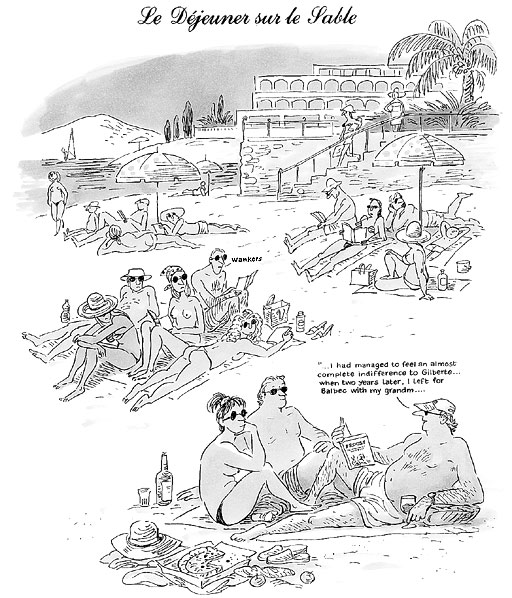
  • Le Déjeuner sur le Sable One big cartoon parodying Manet’s famous painting Le Déjeuner sur l’herbe adapted to show three posy Brits sunning themselves in the South of France, with the main male figure reading Proust. — Simmonds has parodied this painting in at least two previous strips.

Le Déjeuner sur le Sable by Posy Simmonds

  • Dynaglobe’s summer party Once again we are with author Owen Lloyd as he attends the annual party given by publishing conglomerate, Dynaglobe. How he hates it, getting trapped with some stupendously successful airport novelist, who patronises him on his minuscule sales, the coven of women writers, either trying to rope him into discussion groups, or who you shagged last year and can’t remember their names, or a new young nymphet who you just start chatting up when you notice the gaggle of middle-aged women opposite all watching and tittering. He only goes so people know he’s still alive. — Having been to similar London parties of the well-heeled and successful I find this totally accurate and grimly depressing.
  • Nurse Tozer Quite a funny strip which extends the idea of Dr Derek, the literary doctor, over-wrought and on holiday he overhears some bronzed bimbo dismissing a book by Victor Hugo as ‘junk’ and explodes, explaining who Victor Hugo was and calling the woman a moron, until he is hustled away by ever-watchful Nurse Tozer, who then gives quite an interesting speech to the holiday woman about how popular literature comes in bite-sized chunks which wear down your brain. — This was a good strip because it felt like the comedy premise really bore up all the way through the strip.
  • Writer’s problems No.4 How to create a buzz An unnamed male author complains that, although he has written three successful crime novels, he has never created a buzz, his real-life persona is too boring, he doesn’t take drugs or have affairs, he loved his parents etc. The strip then ironically recommends that next time he’s at a literary party he takes a pair of rubber gloves, blows one up, places it over his head, then lets it go and it will blow round the room creating… a tremendous buzz!
  • seasonal traditions in the book trade No.2 Spotting the Christmas turkeys The three staff at the independent bookshop, Wintergreene, which we’ve come to know through several strips – owner Penny, slender sprite Zoe and stubbly earnest young man Colin – are depicted reading the publishers’ catalogues for the upcoming Christmas period and taking the mickey out of the synopses of the direst-sounding books – ‘lifts the lid off media-folk in Alderley Edge…’, ‘… an epistolary novel done in text messages…’, ‘… another bloody book about moving to a Provençal village…’
  • One enormous cartoon showing a disgruntled author (Nat Tarby) in a vast modern bookstore all set and ready to do a book-signing with piles of his books on the table in front of him and… not a customer in sight. — I feel like Simmonds has depicted this scene of the disappointing book-signing at least 3 or 4 times already. She may think it’s endlessly funny, but once was sort of enough.

Murder at Matabele Mansions: A Christmas Mystery

A six-page graphic short story, a murder mystery in which woman Detective Sergeant Stoker phones Detective Inspector Collar from a crime scene at the back of a mansion block. The body of unpopular second-hand book-seller Godfrey Fibone, 58, is found round the back of Matabele Mansions, apparently in the act of carrying a black bin liner out to the dustbins he slipped and cracked his head.

However, Stoker and Collar notice that the contents of the bin-liner are strangely inappropriate for a man who lived alone, including dirty nappies (he had no children), tea bags, a curry TV dinner, and cat food tins (he didn’t own a cat).

So they set about interviewing all the inhabitants of the mansions – which gives Simmonds an opportunity to display her gift for characterisation, not only in drawing but in the very dense text which describes each of the dead man’s neighbours, being:

  • Viv and Chris Collins-Smith, website designers
  • June Tozer, divorcee and masseuse
  • Gavin Boyce, novelist
  • rude Dennis Buttril
  • Mrs Kowalski, entertaining her daughter and son-in-law to dinner
  • Tim Makepeace, a research chemist
  • Ian MacDire, worked for British Telecom

Next day forensics confirm Fibone was murdered, then carried out to where his body was arranged to make it look as if he’d slipped and had an accident. The detritus in the bin bag, combined with what the two police learned in their interviews, should be enough for the reader to work out who the murderer was. Can you work it out?

Cinderella

Another six-page graphic short story, starts with Desmond Duff, 85, inhabitant of an old people’s home (alert readers will remember that Desmond featured as the man of the month for April in the calendar for 1988 which Simmonds drew for the Spectator).

He and his fellow inhabitant, Joan, learn the owners are throwing a lavish Christmas party to which residents are not invited. As they hear the first sounds of music a fairy god-daughter appears and gives them their wish, giving them back their youths, making Desmond a very smart, svelte 20-something, and Joan a stylish young lady in a ball gown and fur. But they must be back in the home by midnight.

They set off to the party and make quite a splash, Desmond impressing with his suavity, Joan being immediately chatted up by a lothario who invites her out to his car for a bit of slap and tickle. Several guests trigger Desmond into giving a blistering lecture about how miserable it is living in their hosts’ old people’s home, how they’re treated like crap, the accommodation is rotting, the food is dismal, and is in mid-flow when he hears the clock ringing midnight and so runs out into the snow where he transforms back into his 85-year-old body…

Finds himself in the car park where the young Lothario emerges partly unbuttoned and holding a slipper, describes how he was in a passionate clinch with the ravishing young beauty who suddenly wriggled out of his grasp and ran off, leaving only a slipper behind. Clutching the slipper, he stumbles back into the party and old Joan comes out of her hiding place behind a car, embraces Desmond, says ‘Wasn’t it wonderful?’ and they potter slowly back towards the home.

But there is a happy end note. Desmond’s rant in the party, in front of lots of influential guests, has spurred the owners to make improvements, sort out the smell on the stairs and fix Desmond’s radiator etc, and generally fuss over Desmond and Joan. So it’s a happy ending! Cheers!


Thoughts

The subject of writers, authors, novelists agonising, writer’s block, book-signings and endless literary parties – I don’t think any subject could bore me more. A few of the strips or cartoons are amusing, but most are wearing, or positively depressing.

The interest, such as it is, comes from the extraordinary variety of cartooning styles which Simmonds deploys. There’s:

  • the spoof true romance style of the Dr Derek strip, where the characters all have the same kind of chiselled angular outlines
  • the freestanding humorous cartoon of the department story-style book warehouse, where all the figures have softened rounded outlines
  • the facts and fallacies strip which, along with the Owen Lloyd cartoons, has a looser drawing style and is meant to create a much wider variety of faces and characters
  • the sketchy loose, unfinished lines of the Writer’s orgasm strip, which starts loose and then deliberately becomes bold and fragmented to visually make the point
  • the ‘cartoon realism’ of the Wintergreene strips – in the one above look at the tremendous attention to detail paid in the opening picture which depicts the shop frontage in the rain, or the third picture which shows the geography of the shop’s interior, dominated by a stand of books in the foreground which divides the disapproving owner on the left and browsing punter on the right
  • the Le Déjeuner sur le Sable style, which is so loose and scratchy that bits of it could almost be by Quentin Blake
  • and the Writers’ panel at the top of this review which has realism of a sort – witness the microphones in front of the speakers – but a sort of wobbly or wonky realism – the microphones aren’t drawn with the same razor sharp precision as the exterior of the Wintergreene shop – instead it is a realism softened or mollified in order to bring out the variety of human faces in the audience and on the panel – it is just enough realism to create a space in which comic types can exist

These are all distinct drawing or cartooning styles (plus some others I haven’t mentioned) which Simmonds has mastered and can deploy at will. It’s an impressive display of versatility and virtuosity.

So for me, there are half a dozen funny strips in the book (if their aim is to be funny or entertaining) but the real pleasure to be had derives from Simmond’s impressive mastery of the craft of drawing, her fluency and versatility.


Related links

Other Posy Simmonds reviews

The Ghost by Robert Harris (2007)

This is a cracking thriller, exciting, intelligent and insightful about a range of contemporary issues.

Robert Harris and Tony Blair

The unnamed narrator is a ghost writer i.e. he co-writes the memoirs of sportsmen, entertainers, celebrities, people in the public eye who have a life story to tell but can’t write.

Out of the blue he is invited to ‘ghost’ the memoirs of former British Prime Minister, Adam Lang (obviously based on Tony Blair, who stepped down from the premiership in June 2007; this novel was published in September of the same year).

Harris was an early supporter of Blair in the mid-1990s. As a personal friend he had access to Blair throughout his premiership and, as a political journalist (political editor of the Observer newspaper, aged just 30) he also possessed a solid understanding of the wider British political scene. This comes over in the book which shows both a humorous familiarity with both the publishing world and an insider’s knowledge of the machinations, the personalities, of high politics.

Harris takes us through the process of meeting agents, publishers, negotiating and signing a deal, with lots of snappy insights into the ruthless commercialism of the process and the boardroom politics involved.

The narrator has just split up with his on-again, off-again girlfriend Kate, who was once a devoted supporter of Lang and is now an equally firm denouncer of him as a traitor and war criminal, because of his decision to help the Americans invade Iraq.

So with nothing to tie him down, the narrator flies out to Boston, takes a cab on to the luxury house located on a remote stretch of the coast of Martha’s Vineyard. It’s actually the ultra-modern beach-side mansion of the owner of the publishing house which has paid $10 million in advances for Lang’s autobiography, Marty Rhinehart.

Here he meets the man himself, his secretarial staff – notably the blonde, over-made-up Personal Assistant Amelia Bly – and Lang’s redoubtable wife, Ruth.

Elements of unease

The pace is superbly managed. Harris masterfully deploys plotlines, details and atmosphere to combine and create a powerful sense of unease, slowly undermining the breezy narrative tone, like a dinghy springing multiple leaks.

McAra’s death Right at the start we learn that someone else had been working on the autobiography before our man – one of Lang’s entourage, a loyal party hack named Mike McAra. One bleak December night he appears to have fallen over the edge of the ferry you have to take to get to Martha’s Vineyard. Everyone concludes it was suicide. But a doubt has been planted in our minds…

Panic rush Meanwhile, McAra’s abrupt removal from the scene creates a crisis in the publishing timeline. The narrator is horrified to learn that the publishers expect him to deliver a finished manuscript within a month. Almost impossible, but his worries are assuaged by the fee: he’ll get $250,000! Well, that will help – but still it means the narrator feels crowded, hassled and under pressure.

Mugged and set up? When he leaves the publishers (at its horrible, modern, windswept offices out towards Heathrow) Rhinehart presses on him another manuscript he’d like the narrator to read. This is odd, given the tight deadline on the main book, and odd that it’s wrapped in a bright yellow bag.

Just after the narrator gets out of the cab back at his flat and is turning to open the door, he is brutally mugged, punched in the gut and knocked to the floor. When he comes round he a) feels terrible, bruised and grazed b) realises the bag has been stolen.

Recovering in the safety of his flat, the Narrator has a paranoid moment when he wonders whether Rhinehart gave him the yellow bag as a test, thinking someone might think the narrator was carrying the manuscript of Lang’s autobiography – and that this is worth mugging someone and stealing.

Terrorism The novel was written and published soon after the 7/7 terrorist attacks in London and the narrator conveys the jaded expectation that bombings might become a regular occurrence of modern London life. In fact, there is a (fictional) Tube bombing, at Oxford Circus, on the same day he visits the publisher and receives the assignment.

Security When his cab arrives at the remote Martha’s Vineyard house, the narrator is unnerved at the level of security surrounding the former Prime Minister. Security guards patrol the perimeter of the property, check his ID as his cab approaches, the house windows are bullet proof and so on. The narrator is scared witless when there is a sudden emergency lockdown of the house, complete with metal panels descending over the windows and a deafening klaxon – although this turns out to be the regular weekly test.

Complicity in torture Even as he sets off, the Narrator sees on the TV news at home, then at the airport terminal and glimpses in the courtesy newspapers, a breaking news story that Lang is being named as having personally ordered the capture of four British Muslims in Pakistan by the SAS, who then handed them over to the CIA to be interrogated as possible terrorism suspects. This is to be the mainspring of the plot and to blow up into a fast-moving crisis.

The plot

Once past security, introduced to everyone and ensconced in the beachfront house, the narrator has a successful morning working session with Lang, teasing out personal stories from his early life.

However, the process has barely begun before it is blown off course by news that Lang’s former Foreign Secretary has personally intervened in the news story about the four Muslims, to name Lang as guilty of ordering their arrest.

Immediately, there is speculation on the TV news that Lang might be indicted at the Hague for war trials. Gathered round the TV in the isolated house, Lang, Ruth, Amy and the narrator watch, appalled, as the lead prosecutor at the Hague announces she will be leading a full investigation into the accusations. While the group feverishly discuss what Lang’s response should be – fly back to Britain to face out the charge, fly to Washington to meet his pal the President – the narrator finds himself drafted in to write Lang’s official response, which is then released to the press.

All this blows a big hole in the Narrator’s plans for a week of cosy chats about his life and career, as Lang and his entourage abruptly depart for Washington, there to be photographed shaking hands with a grateful President etc, and leaving the Narrator suddenly alone in the big echoing luxury mansion by the slate-grey winter sea.

What McAra discovered

Here, to his discomfort, he has been given the room used by the dead aide, McAra, and it is as he is clearing out the dead man’s stuff that he comes across a pack of photos and documents from Lang’s university career, posted to him by the Lang Foundation archive.

And notices something odd. Among a series of old photos of Lang at Cambridge there’s one of him with various student actors in the famous Footlights review, and scribbled on the back a phone number. When the narrator tentatively rings it he is horrified to hear the voice of the ex-Foreign Secretary, Rycart, Lang’s mortal enemy, answering the phone. In a panic, he breaks the connection.

At the beach

With Lang now departed for the airport and nothing to do or read, the narrator finds himself brooding on McAra and his mysterious death. He borrows one of the house bicycles and cycles out to where McAra’s body was found on an isolated beach. Harris gives a brilliant description of a dark rainstorm coming in, then breaking. The narrator takes shelter in the porch of an old timer who comes out to tell him there’s no way that body could have drifted from the ferry route to this beach, not with the currents round here; and all about ‘the lights on the beach’ the night McAra’s body was found. And then about the old lady who was telling everybody what she saw until she had an accident, fell down the stairs, poor thing, and is now in a coma. The narrator is seriously spooked. Could it be McAra’s accident/suicide was staged. Was he in fact murdered? And why?

Barely has he started thinking this through than he is disconcerted to see Ruth Lang (and her bodyguard, who follows her everywhere) trudging up the beach towards him. She insists they pile the bike in the back of their hummer and drive him back to the mansion.

Sleeping with the Prime Minister’s wife

Here they have hot baths, dress and have dinner, during which the narrator finds himself confiding some of his new discoveries to Ruth. She is shocked, and then concerned. What has Adam got himself into? At the end of the evening she comes into his room, still in her night-dress and collapses in tears into his arms. And into his bed. And they have sex.

The narrator knows it’s a bad idea and in the morning it seems a lot worse. Ruth is brisk and hard and efficient, dismissing their overnight dalliance, making cutting remarks about him not being ‘a real writer’.

The narrator has had enough and decides to get off the island altogether for a break. The house servants this time persuade him not to cycle but to take the spare car, one of those all-mod-cons American jeeps. He is disconcerted to learn it is the car McAra was driving when he disappeared off the ferry, but it’s the only one available.

Where the satnav takes him

The narrator gets in and drives towards the ferry, all the time irritated by the satnav which he can’t figure out how to turn off. Doesn’t matter at first because it directs him to the ferry and then on to the nearest town, where our man will be quite happy to sit in a Starbucks and ponder his odd situation.

But the Satnav has other plans. It insistently tells him to turn around and take the next exit out of town. Because he is bored, irritated and curious, he gives in and does what it tells him. Only as he proceeds further into the new England wilderness does it dawn on him that he is following the route of McAra’s last journey.

Professor Emmett

The directions bring him to an isolated track into deep woodland, where there are a few scattered homesteads, and to the house of – he discovers when he looks at the mail in the mailbox – a certain Professor Paul Emmett. Even as he’s sitting there in the car wondering what to do next, Emmett’s car sweeps by and into his drive. So the narrator rings the intercom and gets invited up to the house.

Here Emmett proves himself at first a genial host, happy to answer questions about his magical year at Cambridge as a Rhodes scholar. He is less forthright about his memories of Lang, who he claims not to remember at all, until the narrator confronts him with the old photos he’s got showing Emmett and Lang together in the same drama production. He becomes cagey. Then when the narrator produces his news that McAra drove up here to meet him on the night of his death, Emmett point blank denies it. In fact he produces his wife who independently looks up their diary and shows that they were at an academic conference all the weekend in question. And his geniality has long worn out. He asks the narrator to leave.

Emmett – CIA – Lang?

In the nearby village of Belmont the narrator finds an internet café and spends some time googling Paul Emmett. He discovers Emmett is head of a typical right-wing US think tank and lobby group. He googles the CVs of the other directors and discovers they are all in the military or the arms trade. Then he stumbles across an accusation made years back by a CIA whistleblower that Emmett was himself a CIA agent, from as far back as the 1970s. The CIA? And Adam Lang, Britain’s Prime Minister?

Outside the internet café the narrator notices a black car parked a discreet distance from his jeep. He begins to look at the other occupants of the café with a suspicious mind. Is that just an ordinary couple sitting looking at the one laptop? What about the middle-aged guy over in the corner? Do they know what the narrator has found out? Is he being followed?

By now seriously spooked, the narrator uses the phone number he found on McAra’s Lang photo and rings Rycart again, but this time stays on the line. He explains who he is and how he found the number. Rycart tells the narrator to fly up to New York, he’ll arrange a secure cab to collect him, and bring him to an airport hotel where they can talk.

Conference with Rycart

And that’s what happens. Once frisked and checked out by the security guard-cum-cabbie, the narrator meets Rycart in an airport hotel and they tentatively share their knowledge. McAra had found out that Lang as a student was close to Emmett – hence them being together in the Cambridge photos – for Emmett had an American scholarship to Cambridge for a year.

Both of them think that Emmett must have been acting as a CIA recruiter even at that early stage, and that he recruited Lang as a CIA agent. For Rycart this explains why ‘everything went wrong’ during Lang’s premiership. Can he, he asks the narrator, think of a major decision the government took which did not favour US foreign policy? Agreeing to the invasion of Iraq and being its vociferous defender? Agreeing to ‘extraordinary rendition’ ie kidnapping suspects? Not contesting Guantanamo Bay? Unequal trade agreements? The list goes on…. All sponsored by a British Prime Minister who was in fact acting under orders from his American puppet masters!

Rycart confirms that this was McAra’s conclusion, too, and that – in a bombshell for the narrator – was McAara, one of Lang’s oldest and most loyal lieutenants, who handed Rycart the information about the four Muslims who were kidnapped by the SAS! Who betrayed his boss, having come to the conclusion that his boss had betrayed the entire country.

Their hotel room confabulation is suddenly interrupted when Lang himself phones the narrator’s mobile. ‘Where are you, man? In New York, why? Oh to meet your publishers, OK. Well, come up and meet us, we’re at the Waldorf Hotel.’

Rycart nods his agreement so the narrator says yes – now terrified that he is probably under surveillance and of what happened to McAra and to the little old lady. ‘They’ have shown they will stop at nothing to hush the story up.

Back with Lang

He gets a cab from the hotel airport to the Waldorf but finds the Lang entourage just on the point of leaving. They are hurrying to fly back to the Vineyard and the narrator gets caught up in the hurry and panic, and swept up into one of the cars.

Once aboard the small plane, and everyone is settled, the narrator gets one final opportunity to interview Lang – seven minutes it turns out to last, he tapes it – and asks him directly about McAra. Ruth had said they had a terrible row the night before McAra died: what was it about? Lang says he doesn’t want to talk about it. But when the narrator reveals that it was McAra who handed the evidence of Lang’s orders for the Muslims to be kidnapped over to Rycart, he is shaken to his core. ‘Mike, Mike, Mike, what have you done?’

But it was a short flight and the plane is coming in to land. The narrator and the PA, Amelia, watch Lang, now haggard and gaunt, walk onto the plane steps and down and begin to cross the runway to the departure lounge, where they can see Ruth waiting.

A British voice rings out – ‘Adam!’ – it is one of the baggage handlers and Lang, ever the pro, breaks his walk to turn and shake hands with him when BOOM! – a big explosion throws the narrator, Amelia and everyone else back through the door.

A British suicide bomber has blown up himself and Lang. As the narrator recovers in hospital he finds out the bomber’s son died in Iraq and then his wife in a terrorist bombing. Ex-Army himself, he’d made himself a suicide vest. Lang is blown to smithereens, and so end the narrator’s worries.

Recuperation and writing

He recovers in hospital – it was his hearing which took the most damage – and then in a blaze of inspiration he writes the book, having found the ‘voice’ which can speak for Lang the strange, empty actor he’s got to know as well as anybody ever has, filling the book with his own brief, passionate involvement with this strange man.

He meets the deadline and the book is published on time. Like most ghosts, he isn’t invited to the launch party but Amelia is and she takes him as her plus one.

Ruth is there and air kisses the narrator – mwah mwah – then he sees her looking over her shoulder making some subtle indication of her head, turns – and is amazed to see Emmett standing behind him! He has a horrible flash, a moment if insight. What if… it wasn’t Lang that Emmett recruited?

The secret revealed

Back at his flat the narrator remembers some throwaway words Rycart used in their furtive hotel meeting: McAra had said something about the truth being in the beginning of his original long manuscript. What if he meant – in the beginnings? Suddenly he looks at the first word of each chapter of the manuscript and they spell out a hidden message:

Langs wife Ruth studying in 76 was recruited as a CIA agent in America by Professor Paul Emmett of Harvard University

So the most effective British Prime Minister in a generation turns out to have been manipulated in all his major policy decisions by his more clever, canny wife, who all along had been an agent for the CIA!

That explains why, as Rycraft enumerates them, that government was a lapdog to the yanks and never took a single decision that didn’t favour America’s aggressive foreign policy. Lang wasn’t influenced by the CIA: he was shallow and impressionable enough to be influenced in all these major decisions by his wife!

Envoi

The final, genuinely spooky, pages are written by the narrator on the run. Convinced his life is at risk he is now moving from hotel to hotel changing name, spending only cash. He is confirmed in his paranoia when he reads in the paper that Rycart and his driver have died in a freak road accident. God, the net is closing in.

In the final paragraphs we learn that he has sent the manuscript of the text we’re reading to his girlfriend, Kate – the one who was no friend to Lang – with instructions to open it and send it to a publisher if she doesn’t hear from him every month or reads that he is dead.

So the fact we are reading this novel at all implicates us, the readers – the narrator must have been killed. But at least the truth is out! It is a cheesy but convincing end to a brilliantly convincing thriller.


Politics

I shared the general euphoria when Tony Blair and New Labour came to power in 1997. As I worked on an international news programme in the late 1980s/early 1990s, I knew a bit about the Middle East, but wasn’t especially appalled when the Coalition invaded Iraq, though I knew (apparently, unlike most MPs) that the WMD argument for the invasion was a load of guff. So I am not one of the vengeful who feel Tony Blair must be indicted for war crimes.

International affairs have never been an appropriate place for western morality, it is entirely a question of Realpolitik and the art of the achievable. So I think the main accusation against the Americans isn’t immorality, but sheer ineptitude. Every schoolchild should be made to read Fiasco by Thomas E. Ricks, a truly awe-inspiring account of the way the Americans screwed up every aspect of the invasion and especially the post-war ‘pacification’ of Iraq. We are still, 13 years later, dealing with the fallout, which may last more than a generation.

What is impressive about Harris’s novel is the way he dramatises so many points of view about the war and the resulting terror attacks – Lang gets to have his say justifying the invasion and the war on terror; Rycart, his ally-turned-enemy, has his say about betrayal at government level; Kate, the narrator’s girlfriend, embodies the reaction of many New Labour devotees turned vengeful in their disillusionment; and the ex-Army man who blows up himself and Lang represents all those who lost family as a direct or indirect result.

Amid the bombings, news alerts and general hysteria, the narrator is a deliberate everyman figure, someone we can all relate to, someone aware of the scary changes in the society around him but with a living to make, who just has to get on with it.

Having read a newspaper report accusing Lang of giving the authorisation for the four Muslims to be kidnapped and rendered to Guantanamo, the narrator thinks:

I read it through three times. It didn’t seem to add up to much. It was hard to tell any more. One’s moral bearings were no longer as fixed as they used to be. Methods my father’s generation would have considered beyond the pale, even when fighting the Nazis – torture, for example – were now apparently acceptable civilised behaviour. I decided that the ten per cent of the population who worry about these things would be appalled by the report, assuming they ever managed to locate it; the remaining ninety would probably just shrug. We had been told that the Free World was taking a walk on the dark side. What did people expect? (p.57)

That captures the feeling of most of us, doesn’t it? Aware that bad things are being done in our name but powerless to stop any of it.

Style and feel

Reviewing Harris’s previous thrillers, I noted that they all use ‘modern thriller prose’, fairly plain and functional in its clarity – but that he gave each novel a distinctive slant or angle. This one is comedy. The narrator is the wrong side of 30, in an unhappy relationship with TV producer ‘Kate’, lives in a poky top floor flat in Notting Hill, and wonders how his early ambitions came to this. Nonetheless he approaches every situation, almost to the end, with attractive hangdog humour, and quite quickly you are charmed by his humorous take on situations and people. Of the head of the publishing firm:

Maddox sat with his back to the window. He laid his massive, hairless hands on the glass-topped table, as if to prove he had no intention of reaching for a weapon just yet. (p.22)

It is a clever trick – in a book full of cleverness and alertness – to establish the narrator as an easy-going comic turn, before the suspense of the conspiracy starts to kick in. His humorous mind-set makes him easy to warm to and sympathise with and this makes it all the more plausible and compelling to accompany him on his slow-dawning journey of realisation.

This, Harris’s fourth thriller, seemed to me to have more a few more poetic touches, more descriptions and atmosphere than his previous novels. In particular there is lots of description of out of season New England seaside resorts in blustery January, of the lowering weather and half-abandoned streets.

After a while we came to a crossroads and turned into what I guessed must be Edgartown, a settlement of white clapboard houses with white picket fences, small gardens and verandas, lit by ornate Victorian streetlamps. Nine out of ten were dark but in a few windows which shone with yellow light I glimpsed oil paintings of sailing ships and whiskered ancestors. At the bottom of the hill, past the Old Whaling Church, a big, misty moon cast a silvery light over shingled roofs and silhouetted the masts in the harbour. Curls of wood smoke rose from a couple of chimneys. I felt as though I was driving on to a film set for Moby Dick. (p.53)

This one seemed to me to have more, and more imaginative, similes than its predecessors – a steady trickle of imaginative, stimulating, useful comparisons.

The receptionist at the hotel in Edgartown had warned me that the forecast was for a storm, and although it still hadn’t broken yet, the sky was beginning to sag with the weight of it, like a soft grey sack waiting to split apart. (p.195)

Amelia slipped into position in front of the computer screen. I don’t think I ever saw fingers move so rapidly across a keyboard. the clicks seemed to merge into one continuous purr of plastic, like the sound of a million dominoes falling. (p.125)

Not only is the plot gripping and enthralling, but sentence by sentence, Harris’s prose is a delight to read. Easy, limpid, intelligent, imaginative.

The book reeks of intelligence, a profound understanding of the processes of politics, a solid grasp of the social and political scene in the terror-wary 2000s. This is the second time I’ve read it and, like all Harris’s novels, I can imagine giving it a few years, and then rereading it again, for the pure intellectual pleasure of engaging with such a smart and savvy author.

Cast

  • The unnamed narrator – a seasoned, good humoured ghost writer
  • Kate – his left-wing girlfriend, formerly a member of the Labour Party, who now hates Adam Lang
  • Marty Rhinehart – head of a multinational publishing corporation which spent a $10 million advance on Lang’s memoirs, who’s loaned his house out to Lang as a bolthole to work on the memoirs
  • John Maddox – scarily bullish chief executive of Rhinehart Inc.
  • Roy Quigley – 50-ish, senior editor at Rhinehart Publishing (UK Group Editor-in-Chief) who we see almost get sacked
  • Sidney Kroll – Lang’s sharp Washington attorney
  • Nick Riccardelli – the narrator’s hussling agent
  • Adam Lang – former British Prime Minister
  • Ruth Lang – his clever scheming wife
  • Mike McAra – former staffer for Lang, who spent two years doing preparatory research for his boss’s autobiography, then mysteriously disappeared off a ferry, presumed suicide
  • Amelia Bly – Lang’s elegant, blonde, over-made-up personal assistant, who, it becomes clear, Lang is having an affair with
  • Richard Rycart – former Foreign Secretary under Lang, now a rather vainglorious member of the UN, it is he who sends the International Criminal Court the documents implicating Lang in the kidnapping (‘rendition’) of four Muslim terror suspects
  • Professor Emmett – CIA agent who was sent to Cambridge in the 1970s to recruit rising stars, and recruited Ruth Lang

The movie

The movie was directed by no less a luminary than Roman Polanski. It is astonishingly faithful to the novel, featuring almost the identical scenes and much of the original dialogue, which shows how focused and lean Harris’s writing is. The most obvious change is that whereas Lang is assassinated by a (white English) suicide bomber in the novel, the same angry character assassinates him using a sniper rifle in the movie. I think the bomb is more fitting / ironic / poetical, and explains why the narrator is laid up in hospital for a while afterwards. People being shot are ten a penny in American movies, as in American life.

I watched it with my son (18), who hadn’t read the book, was thoroughly gripped by the narrative’s slow building of tension and fear, and then amazed at the final revelation that it was Ruth all along.


Credit

The Ghost by Robert Harris was published by Hutchinson in 2007. Page references are to the 2008 Arrow Books paperback edition.

Related links

Robert Harris reviews

The Great Pursuit by Tom Sharpe (1977)

Tom Sharpe’s longest novel to date, a satire on the worlds of literary criticism and publishing. For the first time it contained what felt like genuine personal concerns and attitudes in the narrator’s fierce animus against the hypocritical literary critic, Dr Louth.

Plot

Frederick Frensic is a successful literary agent who has built his career on inverting everything he learned at Oxford, under the elitist (lady) literary critic, Dr Louth. Out of the blue he is posted an anonymous novel of breath-taking pornographic content describing the love affair between a 17-year-old boy and an 80-year-old woman – Pause O Men For The Virgin – via a firm of solicitors who instruct him to do his best with it.

Now Frensic has had on his books for ten years a no-hoper novelist named Peter Piper, a lost soul thoroughly misled by his literary education into thinking he must only write high-mindedly about ‘significant relationships’ and ‘meaning’ and ‘the soul’, who treats the very same Dr Louth’s masterwork of criticism, The Moral Novel, as holy writ, reading it every night before bed, and who every year rewrites his hopeless account of his sensitive adolescence in the style of one of the literary Greats.

So Frensic and his American partner, Sonia Futtle, decide to pass off the crude novel off as being by Piper and oh what a tangled web this creates, a web of deceits and contracts which determines the rest of the increasingly labyrinthine plot:

Piper is told he will get money and the wretched book he’s been working on for so long will be released as his second novel, so he reluctantly agrees. A firm of posh British publishers which is down on its luck is persuaded to publish the English version because Frensic, correctly, predicts that this high-brow imprimatur will make it easier to convince the American publisher Hutchmeyer, ‘the Al Capone of publishing’, to snap it up and publish and promote it in the States. This the bullish, illiterate Hutchmeyer does, paying an incredible $2 million advance, not least because Sonia flirts outrageously with him.

But things begin to veer out of control when Hutchmeyer insists that this Piper fellow does a promotional tour of the States to do TV and book signings. There is a very funny scene at New York’s docks where Hutchmeyer’s sidekick organises an ‘event’ for Piper’s reception, something that will get him on the news, by inviting activists from widely varying groups to meet him – Jews are told he’s an ex-Nazi Peipmann, Palestinians that he’s a leader of the PLO Piperfat, the Irish that he’s O’Piper the IRA leader, gays something else, with the result there is a massive riot, from which Piper barely emerges in one piece to scramble into a waiting ambulance, where the fixer – MacMordale – grabs a bag of blood from the bewildered nurse and breaks it over the dazed Piper’s head. Any publicity’s good publicity, right?

At the upstate Hutchmeyer residence, actually a vast tasteless mansion, a bloodied and bandaged Piper is introduced to his overwhelming host and his wife, Baby, one-time beauty queen in the 1930s, now the recipient of so many facelifts that, as Sonia points out, if she smiled, she’d scalp herself. In typical Sharpe fashion Hutchmeyer and his wife hate each other and, by a roundabout process, Baby comes to believe Piper is the real thing, a young man of genius and sensitivity who deserves protection from the cruel world.

Sonia, drunk, flirts with Hutch and persuades him to take her out in his yacht in bad weather. Baby takes advantage of the fact to act on impulse and reject the lies and frustrations of the past 40 years. Pack your bags, she tells Piper, we’re getting out of here, as she determines to act out a scene from one of the great historical novels. What makes it Sharpe is she decides to burn down the wretched mansion, so empties cans of petrol across it and sets them afire, but has brought the last one trailing gas down to the quayside and the cruiser where a very nervous Piper is waiting with his bags, so that the trail of flame follows her and leaps into the boat just as Piper accelerates the engines. They both leap off into the sea as the cruiser, now aflame, heads off into the bay where it collides with Hutch’s yacht and explodes. Hutch is rescued by the typically Sharpe Sonia, a big, strong, calculating lady, while Piper and Baby swim ashore further down the coast.

Baby realises she has burnt her bridges (and her husband’s house to the ground) and decides on impulse to head South, to the Deep South, of slavery and mangrove swamps and drags a reluctant Piper along with her. Everyone presumes they are dead and in scenes reminiscent of Wilt for a while Hutchmeyer is suspected of murdering his wife. Instead Baby persuades Piper – his head still swathed in bandages from the New York riot, to write out a full draft of Pause O Men For The Virgin, which they photocopy and post to Frensic in London.

Frensic had become very nervous about Piper revealing the elaborate scam to Hutch who would doubtless sue for all his money back and more, but when he receives the manuscript of the novel in Piper’s own hand-writing he is very perplexed. He goes back to the firm of solicitors in Oxford who posted him the typewritten manuscript and winkles out of them the name of the secretarial company which typed it up, run by a Miss Bogden.

In the true Sharpe manner this Miss Bogden is a frustrated divorcee and, having had his phone enquiry flatly turned down, he realises he must woo her: so he sends her red roses then phones posing as a long-time admirer from a distance, then invites her to dinner, all the time probing for any proof of the author’s whereabouts. Miss Bogden drops that she had a phone number she could ring if she had problems with the manuscript but then evades the subject and Frensic finds himself forced to accompany her back to her flat and, well, to be engulfed in her consuming sexual appetites in the name of his quest. He goes so far as to propose to her and, next morning, finds himself going to a jewellers to choose a ring before he finally finally gets the phone number out of her and makes his excuses. It is a funny moment when, after all this build-up, Frensic rings the number and it is an Indian takeaway 🙂 He realises he’s transposed the numbers in his excitement, and dials again, A quavery voice answers and says it is is Dr Louth here.

Frensic puts down the phone thunderstruck. So the high-minded and elitist literary critic, whose insistence that her students only read novelists of her Great Tradition – Austen, James, Conrad, Lawrence – and who cast into the outer darkness all mere entertainers, anyone who wrote for money – Dickens and Trollope and Meredith, let alone the entertainers from an earlier era, Smollett and Sterne and Fielding – whose baleful influence ruined generations of would-be writers by making them aspire to an impossible, and irrelevant, high-mindedness, who misled Frensic in his early career until he threw off her influence, and whose damaging influence is embodied in Piper’s unreadable screeds – it was she who wrote this pornographic best-seller. Frensic’s anger at her is real, and bespeaks Sharpe’s own experience at Cambridge in the heyday of the elitist literary critic, Frank Leavis, who similarly insisted on the existence of a Great Tradition. In fact the title of this novel is a simple merging of two of Leavis’s most famous books of criticism, The Great Tradition and The Common Pursuit. And of course, in none of these books or Leavis’s lectures or stern admonitions was there any place for the kind of well-crafted entertainments that Sharpe himself writes.

The novel hints at the journey Sharpe himself had to make, to throw off the stifling high-mindedness of Cambridge, before he could find his own voice and métier as a satirist and entertainer of genius.

Frensic goes on a hateful pilgrimage to Oxford, visits Louth in her ancient house, confronts her with the truth and forces her to burn the manuscript of the novel as going some way to making reparations for all the lives she’s ruined. Meanwhile, we learn that Hutchmeyer, liberated from his nagging wife, has made the umpteenth proposition to tough Sonia and – to his surprise – been accepted, and they get happily married.

In the tiny southern hamlet of Bibliopolis Baby and Piper come across Deep South prejudice and real hellfire preaching. In fact at the first service they are forced by their fanatical landlady to attend, the congregation get so carried away they insist on ‘bringing out the snakes’ which promptly go mad, biting lots of people, in fact killing the preacher himself while Baby, in an orgy of guilt and self-recrimination rips open her blouse a) to reveal her perfect (silicone) breasts b) to let a poisonous coral snake take hefty bites of them – to no effect. This so impresses the good folks of Bibliopolis that they promptly elect Baby their new preacher, and Piper finds himself giving hand-writing lessons to the locals, in time (ironically) setting up an official School of Writing.

Coda

As with many of Sharpe’s novels, you would have thought things could stop right here: The mystery of the book’s author has been revealed; Frensic’s quest is at an end; Hutch and Sonia are happily married; Baby and Piper have found their niche in a sleepy southern backwater.

But no. There is more. It’s a little hard to follow, but Baby has encouraged Piper to continue writing out Pause O Men For The Virgin in his own hand-writing, but each time, making it more in his voice, turning it into his version. Which Piper does, dutifully posting it off to Frensic in London, who is perplexed. Like everyone else, he thinks Piper and Baby perished in the fire at the mansion.

Meanwhile, Miss Bogden, jilted by Frensic (who had used a false name during his 24 hours of passion with her), is set on revenge and tracks him down. Frensic hears her voice on the stairs to his Hampstead flat, grabs his essentials and decamps to Corkadale’s house where he reveals the truth that Piper is not the author of this wretched book. He then takes a plane to new York, on to Miami, and hires a car to drive to this wretched place Bibliopolis. Here he finds Piper a part-time preacher in the Church of the Great Pursuit and there is space for another bitter screed against Dr Louth/Leavis and their deadening, anti-humane influence, before Frensic confronts Piper, lashing out at his wretched ambitions and telling him to stop sending him rubbish manuscripts of his awful novel.

But outside a ‘welcoming committee’ of the local sheriff and assorted hicks await Frensic; they’ve all heard him crticising that nice Mr Piper, a fine upstanding pillar of the community, and drag Frensic before the local judge who turns out to be — none other than Baby Hutchmeyer. She grimly dangles in front of Frensic the prospect of being sentenced to the local chain-gang, which he will survive for, ooh, maybe a month. The alternative is the final stitch-up in a book made up of crooked contracts and devious deceptions. He, Frensic, must allow his name to go on the succession of novels which Piper will send him, once a year, from Bibliopolis. He, Frensic, must arrange for them to be published and promoted.

And so it comes to pass. Frensic arranges for Piper’s first novel to be published, but under his name: he quits his literary agency and goes to live in obscurity in the South Downs and – the final cruel irony – the critics love Piper’s first novel, and it is a roaring success.

Anti-American

The entirely gratuitous excursion into the deep South reminded me a bit of the journey of young Martin and Mark Tapley to a disease-ridden swamp in Dickens’s funniest novel, Martin Chuzzlewit (1844), which was criticised in its day for its surprisingly savage satire on the bad manners, appalling speech, filth and greed of contemporary America. Something similar is going on here. In Wilt the worst excesses of fashionable politics and trendy sexual openness are associated with the American couple, the Pringsheims, who are slowly exposed as hateful liars. The Great Pursuit moves almost all its plot to America the better to satirise the crass commercialism, philistinism, crudity, violence and shallowness of American life.

F.R. Leavis

That said, the real core of the novel’s anger is with Dr Louth, a transparent version of F.R. Leavis, the enemy is English through and through.

The Great Pursuit was Dr Sydney Louth’s latest, a collection of essays dedicated to F.R.Leavis and a monument to a lifetime’s execration of the shallow, the obscene, the immature and the non-significant in English literature. Generations of undergraduates had sat mesmerised by the turgid inelegance of her style while she denounced the modern novel, the contemporary world and the values of a sick and dying civilisation. Frensic had been among those undergraduates and had imbibed the truisms on which Dr Louth’s reputation as a scholar and a critic had been founded. She had praised the obviously great and cursed the rest and for that simple formula she was known as a great scholar. And all this in language which was the antithesis of the stylistic brilliance of the writers she praised. But it was her anathema which had stuck in Frensic’s mind, those bitter, graceless curses she had heaped on other critics and those who disagreed with her. By her denunciations she had implanted the inhibitions which had spoilt Frensic and so many others like him who had wanted to write. To appease her he had adopted the grotesque syntax of her lectures and essays. By their style Louthians were instantly recognisable. And by their sterility. (p.205)

F.R. Leavis was still alive when this novel was published. Was he made aware of its savage criticism of his life’s work? What on earth must he have made of it?


Credit

‘The Great Pursuit’ by Tom Sharpe was published by Martin Secker and Warburg in 1977. Page references are to the 1979 Pan paperback edition. All quotations are used for the purpose of criticism and review.

Related link

Related reviews