Deutsche Börse Photography Foundation Prize 2025 @ the Photographers’ Gallery

The annual Deutsche Börse Photography Foundation Prize is awarded to the best photography exhibition staged, or the best photography book published, in Europe, in the preceding twelve months. Obviously they start with a long list, then select a short list, from which are chosen four finalists, and it’s the four finalists’ work which features in this annual exhibition at the Photographer’s Gallery. The winner is announced on 15 May and will be awarded a handsome £30,000 prize, with the other finalists each receiving £5,000.

As usual, each of the four photographers are represented by projects or books which usually take a bit of explaining. Each photographer has a room each devoted to their project. This year’s four finalists are (in alphabetical order):

  • Cristina De Middel
  • Rahim Fortune
  • Tarrah Krajnak
  • Lindokuhle Sobekwa

1. Cristina De Middel (b. 1975, Spain)

De Middel’s project is titled ‘Journey to the Centre’. It’s a photographic testament to the migrants who cross Mexico from South America with the aim of getting into the United States. So it starts off from Tapachula, a town on the southern border of Mexico (with Guatemala) and then covers the trail heading north until it reaches the famous Trump wall, just this side of the border, across from an American town with the ironic name of Felicity.

First off what strikes you about Middel’s room is that it is dominated by a massive orange metal frame on which hang some of her images, presumably representing the Trump Wall.

Installation view of ‘Journey to the Centre’ by Cristina De Middel at the Photographers’ Gallery (photo by the author)

Next thing you notice is that the photos are interspersed by what appear to be picture cards from a game I’m not familiar with.

Installation view of ‘Journey to the Centre’ by Cristina De Middel at the Photographers’ Gallery (photo by the author)

When you look closer you see that the images in the cards are recreated or strongly echoed in the photos placed alongside them. So in this installation view the big picture of the sun is echoed on its left by a photo of a woman holding her hand up to protect herself from the sun, while the red figure of El Diablo is echoed on its right by a man wearing a bright red cloak. This parallelism between the big bright cards and Middel’s clear bright photos is much more obvious than the rather more muted and obscure references to the Jules Verne novel.

The card-photo juxtaposition is also, you come to realise, funny.

Next thing you quickly notice is how classically Middel’s photos are framed and composed. The subjects are in the middle, shot very cleanly and crisply in perfect focus, with a nice space all around, giving a classic, almost studio effect, although all of them are clearly shot on location.

Installation view of ‘Journey to the Centre’ by Cristina De Middel at the Photographers’ Gallery (photo by the author)

In this (admittedly not great) installation shot, you can see at the top-left how the single boot, abandoned and half buried in the desert sand, is shot at just the right distance, square on, with plenty of space around it, so that it almost looks like an image from a surreal ad.

Same with the guy apparently preparing to pole vault over Trump’s Wall – the wall itself is framed carefully so that we fully see its continuation into the sea, while the high jumper himself is set as squarely in the middle of the shot as possible.

These are not casual shots. They have all been carefully composed and framed. And it’s the resultant timeless, classic effect which makes them so appealing. As I’ve said, almost every one looks like an ad for something, whether a commercial product or a charity, but all with a kind of classic, commercial perfectness.

Installation view of ‘Journey to the Centre’ by Cristina De Middel at the Photographers’ Gallery (photo by the author)

Finally, as you can see in this installation view, there’s also a display case showing some of the bric-a-brac Middel came across in her pilgrimage across Mexico, abandoned shoes and the like.

It was only after I’d been round the room three or four times that I realised something else, something connected to the advertisement-style finish, which is the absence of people. Certainly about half of the images feature a person, but only one. Whereas of the ten photos hanging on the frame in my first installation view, only one or two of them feature a human being at all, the other eight or nine are bereft of people – stark but beautifully composed and shot images of the desert, of cacti and scrubland, an ancient pyramid, a Welcome tourists sign, a vivid one of a burned-out car, and so on.

Now when I’ve seen news footage of migrants trekking north through Mexico to try and reach the United States, it’s generally been in family groups, sometimes in big crowds. The curators claim that Middel’s work is challenging stereotypes about the migrants who trek across Mexico to reach America, but the impression I had is that she’s more or less erased those migrants in order to be left with consciously poignant images of emptiness and abandonment.

2. Rahim Fortune

From one project about America to another. Rahim Fortune is a young American Black man. His room doesn’t have a big metal frame or any props, just the old-fashioned thing of 30 or so crisp black-and-white photos depicting aspects of Black culture and community from his home state of Texas and the American South.

His project is titled ‘Hardtack’ which requires a word of explanation.

Hardtack is an unleavened bread made with flour, water and salt that was typical of the southern states of America during the Civil War era. Due to its extremely long shelf life, hardtack is long associated with survivalism and land migration. Fortune draws on this as a metaphor for the enduring nature of Black culture and traditions.

All his photos are great, beautifully framed and beautifully shot, classic, very achieved. But, I’m afraid to say, I feel like I’ve seen them all before. Old Black guys who look like they’ve had a hard life, sweet Black bridesmaids dressed in white at a wedding, the Revivalist meeting, the worn old clapperboard Baptist chapels, random people on horseback emphasising the rural backwardness of the region, I feel like I’ve seen them all before.

Praise Dancers in Edna, Texas by Rahim Fortune (2022) © Rahim Fortune

I felt guilty thinking this but then I came across Fortune himself articulating the thought in the three-minute interview he gave the gallery.

Interview with Rahim Fortune

In his own words:

“There’s a lot of baggage that comes with photographing in the American South. There’s so much photographic fog and fodder and it’s a place that’s been so heavily photographed.”

Well, like I say, all his images are beautifully composed and shot, displaying wonderful technique, and I really liked quite a few of them, it’s just that… I feel like I’ve seen many of them, or shots very like them, lots of times before.

Windmill House by Rahim Fortune © Rahim Fortune

And America again! The rules of the competition are that the prize is awarded to an outstanding exhibition held in Europe so why are these finalists from or about America? Are we seriously to believe that no photography exhibition and no photography book by any European photographer merited inclusion?

3. Tarrah Krajnak

This oppressive sense of American cultural dominance continues with the third finalist, Tarrah Krajnak. Krajnak was born in an orphanage in Lima, Peru, in 1979 and adopted by Slovak-Americans. She is now an American citizen who lives and works in Eugene, Oregon, USA. The curators explain that she subverts this and interrogates that, but the one thing she isn’t interrogating is the American cultural dominance of this exhibition.

In the Krajnak room there’s a massive blue painting and a video but the real meat is two series of black and white works on opposite walls. One of them is titled ‘Self-Portrait as Weston’ which needs a word of explanation: in 1977 a book was published collecting together the the best of the stylised studies of the female nude which classic American photographer Edward Weston had made during his long career (1886 to 1958). So Krajnak (an Associate Professor of Photography at the University of Oregon and so well-versed in the canon) had the bright idea of taking photos of herself nude re-enacting the same poses as the classic Weston poses, with the Weston book placed in shot, open to the relevant image she is recreating or pastiching or subverting.

Self-Portrait as Weston #4 by Tarrah Krajnak © Tarrah Krajnak

You can almost hear Krajnak explaining that she is subverting the male gaze and interrogating the male canon and asserting women’s agency. You can feel her saying ‘This is what a real woman looks like’, her own naked body being a realistic, common-or-garden human shape rather than the svelte and sexy women Weston (sexistly) featured in his studies.

Installation view of ‘Self-Portrait as Weston’ by Tarrah Krajnak at the Photographers’ Gallery (photo by the author)

There are 16 of these homages/subversions, all neatly laid out in rows on the bare white gallery wall. You can see how the walls in the photos are grubby and have a developing world vibe, more like Peru or Mexico than the spick and span studios of the University of Oregon.

I also think the prints have been treated in some way to make them appear agèd, maybe this is what the curators mean when they refer to Krajnak’s use of ‘pigment prints’ and other technical processes. I assume this is all an attempt to recreate the atmosphere of the original Weston photos, some of which date from the 1920s and ’30s.

I dare say Krajnak is interrogating the male gaze and subverting the canon of dead white males, asserting her agency and all the other buzzwords of feminist academia, but it seems like a tired trope to me. As recently as a month ago I visited the exhibitions of Mickalene Thomas and Linder who have both, for decades, been depicting half-naked women in a bid to subvert the male gaze and assert female agency and interrogate the canon of white male art and so on. I do get the idea and am pretty bored by it. Subverting the male gaze isn’t nowadays a radical strategy, if it ever was one, but more a well-established genre like photographs of flowers or village fetes.

My wife, a feminist businesswoman, didn’t like the series because of its obvious and formulaic preachiness; she far preferred the other series in the room, ‘Rock, Paper, Sun’ from 2023.

Installation view of ‘Rock, Paper, Sun’ by Tarrah Krajnak at the Photographers’ Gallery (photo by the author)

Also black-and-white images which have been treated or printed to give the effect of age and depth, this is a series of images of Krajnak holding rocks of different shapes, placed next to photos of her notebook in which she’s sketched each rock and described her feelings about it.

My wife particularly liked the idea that if you hold the rocks long enough, they start to talk to you, to communicate their stories. We both liked that very much.

On the third wall was a smaller set which in a sense combines the best of the other two, in that they are again self portraits, of her whole body (though fully dressed, this time) engaging with rocks. They’re lovely images of her curling up and cuddling rocks and boulders.

‘Sister Rock/Rock that Tries to Forget (from Automatic Rocks/Excavation)’ by Tarrah Kjanak (2020) © Tarrah Krajnak

These feel sweet and lovely and genuinely do convey some sense of harmony between humans and the environment. They’re beautiful because they sweetly convey a beautiful sentiment. They’re gentle. They suggest closure and harmony in a way not many of the other images in the show do.

(The rock hugging reminded me a bit of the tree hugging Chipko movement of women from the villages of the Garhwal Hills in the Himalayas in Uttarakhand as photographed by Pamela Singh and featured in the Barbican exhibition RE/SISTERS: A Lens on Gender and Ecology.)

4. Lindokuhle Sobekwa

The fourth and final entrant is not from or about America, which makes a nice change, although it is from another over-familiar country, South Africa. It’s a room devoted to the highly personal project of the South African (male) photographer Lindokuhle Sobekwa titled ‘I carry Her photo with Me’. Like the others, this needs some explanation.

The project began when Sobekwa found a family portrait with his older sister Ziyanda’s face cut out. It remains the only photograph he has of her. One day when the siblings were seven and thirteen, she chased him and he was hit by a car and badly injured. She disappeared hours later, only returning a decade later, ill. By this time Sobekwa had become a photographer. He tried to take her portrait, but stopped when she reacted angrily. Ziyanda died soon after.

Tragic story of a broken family. The display combines family photographs, handwritten notes, sketches and drawings, as well as photos of the wider environment around Sobekwa’s home, to create a scrapbook-like effect which is deeply rooted in his family but reaches out, as it were, to portray the crushing poverty deeply embedded in South African society to this day.

Again, as with the technically perfect images of Rahim Fortune, many of the photos here are wonderful – an old woman labouring a ploughed field in a vast derelict expanse, a dejected Black woman sitting in a shiny bathroom (the poster image for the whole show) and the one I liked best, a middle-aged Black woman in what looks like a shanty shack, reading by candlelight.

From ‘I carry Her photo with Me’ by Lindokuhle Sobekwa

But, well, like the Fortune set, I feel I know the outline of this story, in fact I am over-familiar with it. Apartheid was terrible. Thirty five years after its fall, there’s still crushing poverty in South Africa. None of this is news. I’m sure I’ve seen loads of photojournalism about grim lives in South Africa, in fact all I had to do was look up last year’s Deutsche Börse Photography Foundation Prize to discover that it, also, featured the work of a Black South African photographer chronicling Black poverty, Lebohang Kganye. Maybe there’s a clause in the competition saying there always has to be an entry from South Africa – and that the curators have to mention the world ‘colonialism’ at least once in every exhibition.

Interview with Lindokuhle Sobekwa

Sobekwa’s personal story and the inclusion of many pages from his scrapbooks, complete with scribbled text and rough drawings projected onto one wall, give this room a distinctive flavour – but then I’m sure I’ve seen the inclusion of a photographer’s scrapbooks and notebooks in at least two other photography exhibitions in the past few years.

In fact arguably the most distinctive thing about his room was the very beautiful, calm if slightly sentimental piano music playing in it. This, we learn, was composed specially for the exhibition, ‘Meditations for Ziyanda’ by Nduduzo Makhathini. This lovely lulling music makes the Sobekwa room the nicest one to linger in, although the actual imagery is (deliberately) the most scrappy and fragmented.

Thoughts: Old

If there’s one thing my kids, now in their early 20s, have taught me, it’s that I’m completely out of date. My entire worldview of what is radical or strange, what is politically or culturally important, what music, films, art or photography I like, not only seem out of date to them, but irrelevant to their tastes and concerns and anxieties.

They live in a hyper-digital age where billions of images and videos about everything are available all the time and they are continually adding to the vast pile by sending each other Snapchat, Whatsapp and TikTok images and texts and sounds all the time.

Even the idea of going to an art or photography gallery seems to them like an incredibly out-of-date, Stone Age thing to do. Why bother when all the art you could ever want to see and much more is available at the touch of a finger?

It’s with this in mind that my overall feeling about the show was how old it all seemed, how old and tired and clichéd so many of the images and earnest concerns seemed.

1. Oh the poor migrants trekking across Mexico to smuggle themselves into America, how long has that being going on? I remember liking the Jack Nicholson movie ‘The Border’, about the US border patrol and the misery of migrants trying to cross into rich America, and that dates from 1982.

2. Similarly, I remember protesting against apartheid South Africa as a student, the radical press swimming in images of the poverty-stricken townships, in the 1980s.

3. I grew up in the 1970s amid the backwash of images from the American Civil Rights movement and pictures of poor rural Blacks in the American South abounded in Sunday supplement photo-essays, in books and posters and movies, half a century ago.

4. Hugging trees and rocks may be a little more recent but concern for the environment likewise dates back to the 1970s when Friends of the Earth and Greenpeace and all the others were founded. I’ve always loved the land art of Richard Long, featuring immaculate photos of rocks and boulders similar to the ones in Krajnak’s work, and he started doing that in the late 1960s.

So, completely contrary to the curators’ claim that these works are somehow cutting edge, state-of-the-art and addressing bang up-to-date issues, I felt the exact opposite. All of them seemed to me to be not only 1) addressing issues which were old and familiar before some of these photographers were even born but 2) in a curiously static, classic and old-fashioned aesthetic which also feels very dated.

Where’s the photography which captures the all-enveloping digital realm all of us live in these days, and register the complex effect that’s had on our perceptions of ‘reality’ and value? Not here, not by a long shot. All four photographers here soak us in the warm and comforting ambience of well-worn and familiar and easily assimilable issues, presented in reassuringly familiar styles.

Making America great again

I know I bang on about it but the inclusion of three projects about or America or the American border made me wonder: were there really no photographers from Europe, no European photography projects, no European photography books, covering European subjects, worthy of inclusion among the finalists?

No photography exhibitions anywhere in Europe about the war in Ukraine, about refugees, about the long afterglow of the wars in Yugoslavia, about the rise of right-wing parties in Italy, Germany, about the bombs and gang warfare in Sweden. No stories and no photographers from Europe? Apparently not. America again. And again. And again.

It feels like the curators, despite all their progressive rhetoric, despite all their conscious intentions, despite Donald Trump demonstrating to the whole world that America is nobody’s friend and should be nobody’s icon, and the obvious fact that we need to consciously decouple – politically, militarily and culturally – from a country which chose authoritarian mobster rule, cannot shake off the dead hand of American cultural imperialism.

Who do you think should win?

From what I’ve shown you and what you can see for yourselves on the links I’ve provided, who do you think should win? Obviously they’re all highly accomplished and technically adept. For me it’s a toss-up between Middel’s advert-slick images of the Mexican desert and the humour of juxtaposing her images with those big colourful playing cards – and Krajnak’s images of her hands holding rocks or herself cuddling a big boulder, for their gentleness and sweetness. Tricky choice. Who would you vote for?

Promo video


Related links

Related reviews

Deutsche Börse Photography Foundation Prize 2023 @ the Photographers’ Gallery

The Deutsche Börse Photography Foundation Prize is not an open competition which anyone can apply to, like the BP Portrait Award or the Royal Academy Summer exhibition. The exact opposite: the curators choose just four finalists from what they consider to have been the best photographic exhibitions staged by individual photographers, in Europe, in the previous 12 months. To be precise, the stated aim of the prize is to ‘reward artists and their projects considered to have made the most significant contribution to photography over the previous 12 months.’

Therefore, if you visit the Photographers’ Gallery in the next few weeks you will find four rooms, each devoted to an in-depth display of work by just four international shortlisted artists. In alphabetical order these are Bieke Depoorter, Samuel Fosso, Arthur Jafa and Frida Orupabo. The winner of the prize was announced on 11 May and got a tidy sum of £30,000 (the other three entrants got £5,000 each). Who was the lucky winner? I’ll tell you at the end of this review.

I’m going to address the photographers in the order you actually encounter them in the gallery, rather than alphabetically.

1. Frida Orupabo

Frida Orupabo (born 1986) is a Norwegian of Nigerian heritage i.e. Black. She began posting photo collages on Instagram in the mid-2010s, cutting and pasting together images of Black bodies using historical and archive material; then in 2017 she took her approach into the real world (i.e. not just on a screen), creating the large collages you see here. All this led up to the exhibition which brought her to the curators’ attention, which was titled ‘I’ve seen a million pictures of my face and still have no idea’, which was held at the Photomuseum Winterthur, Switzerland, February to May 2022.

Installation view of Frida Orupabo at the Photographers’ Gallery

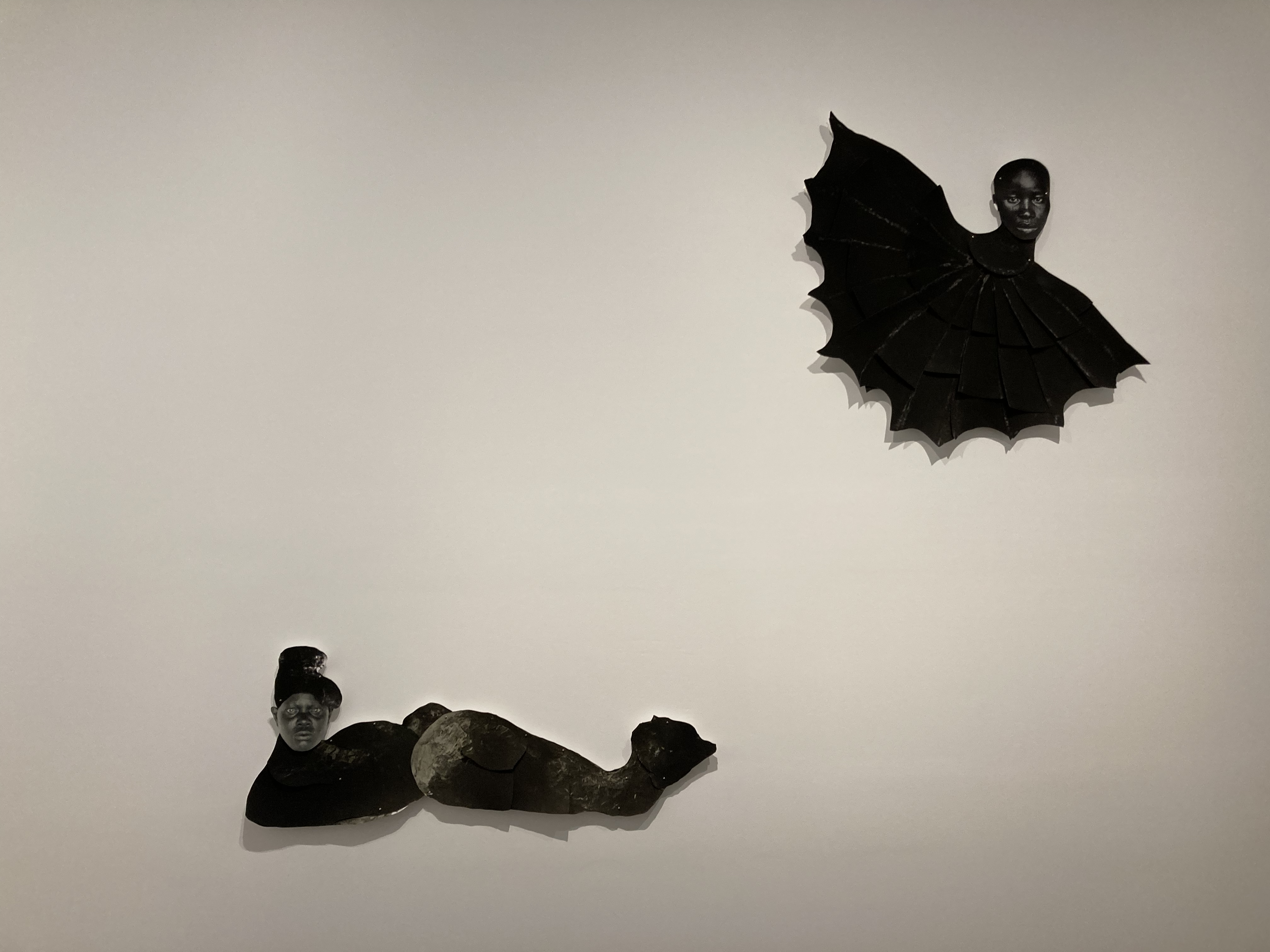
I immediately liked the results – very big, frameless, freestanding works which are more like sculptures hanging on walls than traditional photos. As far as I could tell, none of them had titles. Orupabo’s being Black and being a woman i.e. pressing contemporary art’s two big buttons of race and gender, sends the curators into a tizzy of artspeak:

The sculptural collages and digital works of Frida Orupabo are multi-layered formations, exploring questions of race, sexuality and identity. Orupabo, a Norwegian Nigerian artist and sociologist, grounds her inquiry in her own experience of cultural belonging. Utilising visual material circulating online, spanning colonial-era photographs and ethnographic relics to contemporary imagery, Orupabo’s hand-wrought works re-arrange and re-make the archive. The resulting images take the shape of fragmented Black, mostly female-bodied, figures.

These figures, first dislocated, are reassembled layer by layer in a complex and poetic manoeuvre that simultaneously denounces one-dimensional depictions of Black lives. Her collaged cutouts hold our gaze and invite various readings of the stories and lives of the people depicted, many of whom are entirely absent from the archives. In this way Orupabo invites a consideration of how photography significantly contributes to the formation and perpetuation of colonial power relations and violence.

Turning by Frida Orupabo (2021) © Frida Orupabo Courtesy of the artist and Galerie Nordenhake, Berlin, Stockholm, Mexico City

Does photography ‘significantly contribute to the formation and perpetuation of colonial power relations and violence’? Isn’t that like saying books ‘significantly contribute to the formation and perpetuation of colonial power relations and violence’ or laws ‘significantly contribute to the formation and perpetuation of colonial power relations and violence’? Surely any technology can ‘significantly contribute to the formation and perpetuation of colonial power relations and violence’ if that’s how the people wielding it want to use it. Probably guns contributed quite a bit ‘to the formation and perpetuation of colonial power relations and violence’, probably quite a bit more than photography. In fact photographs of the atrocities carried out by the authorities in the Belgian Congo did as much to disgrace and discredit that authority, as the kind of photographs the curators have in mind, the kind used to measure and categorise the Indigenous peoples, did to define and control them. Photography is just a technology. I can be used for good or evil. Writing that ‘photography significantly contributes to the formation and perpetuation of colonial power relations and violence’ is just art school boilerplate, modish rhetoric, smart-sounding swank (definition: ‘behaviour, talk, or display intended to impress others).

Anyway, as so often, the curators’ obsession with the twin shibboleths of race and gender blind them to the specificity of the actual art in front of them. Two things struck me. One was the way the deliberate crudeness of the artefacts is intentional: heads are pasted onto bodies at anatomically impossible angles, a pair of legs are completely separated from a body. She is highlighting the utter dysjunctive effect of her collages, their complete artificiality, and that reminded me of Dada, of the deliberately unsmooth, jagged photocollages of George Grosz or John Heartfield from 100 years ago.

Installation view of Frida Orupabo at the Photographers’ Gallery

But something not at all hinted at in the curators’ commentary is the horror tropes. In the top photo you can see that the loosely female figures are, from left to right, 1) attended by two sort of flying rabbit demons; 2) sitting on a monster’s head; 3) is shaped like a mermaid; and 4) in the most striking image, is a human head cut and pasted onto the body of a bat. A whole lot of stuff is going on here, but what strikes me is the invocation of imagery of Gothic tales and horror stories; it’s the stuff of Goya nightmares. What? Why? In this respect she reminds me of the way Kara Walker’s silhouettes of Black people in ante-Bellum Deep South morph into nightmare, monster images.

Installation view of Frida Orupabo at the Photographers’ Gallery

Anyway, it was the sheer weirdness of these big collages which grabbed me, not their alleged commentary on colonialist this, that or the other, and so I’ll tell you straightaway that, for the uncanny unexpected weirdness of her images, Orupabo was my favourite of the four artists: I wanted her to win.

2. Bieke Depoorter

Bieke Depoorter was born in 1986 in Belgium. She was selected for this prize on the basis of a 2022 exhibition titled ‘A Chance Encounter’, staged at C/O Berlin from April to September 2022. The display here consists of two parts, titled ‘Michael’ and ‘Agata’. Apparently:

In ‘Agata’, a first meeting [with Agata Kay] in a Parisian strip-club in 2017 evolves with complex tension into an intricate, changing narrative. The project explores questions of collaboration, the limits of a creative friendship, performance, boundaries and authorship.

I couldn’t find ‘Agata’. Possibly it amounted to one framed photo of a pink room, and maybe a collage of movie posters on one wall, but these weren’t labelled so I wasn’t sure. Going back to reread the introductory wall label more carefully I realised that the subject of Depoorter’s photos, the stripper Agata, eventually asked Depoorter to suspend their relationship and asked that all record of the photos, conversations and letters involved in it be erased. Maybe the Agata project is the absence of any materials about the Agata project. OK. That has a pleasing 1970s conceptual art feel about it.

But the reason I wasn’t too sad about not finding ‘Agata’ is because it was completely dwarfed by the other project displayed here, ‘Michael’. This is an epic, dense, absorbing and deeply unsettling work.

in 2015 Depoorter met a middle-aged, confused man named Michael on the streets of Portland, Oregon, USA. They got talking and Michael took her to his apartment which turned out to be covered from floor to ceiling with scrapbook-style cut-outs from magazines, books, newspapers, school reports, journals and diaries and all manner of bric-abrac.

Michael at home, Portland, Oregon, May 2015 by Bieke Depoorter, © Bieke Depoorter/Magnum Photos. Courtesy the artist

As a result of this encounter Michael gave Depoorter three suitcases containing a trove of his personal items, sketchbooks and essays which she, for unexplained reasons, accepted. Then, presumably, she departed Portland, for the wall label explains that, at some point later on, she tried to contact him again and failed. When she flew back to Portland to find him she discovered his flat rented to someone else and  that Michael had vanished, leaving no trace.

At which point Depoorter commenced what appears to have been months if not years of effort to track him down, the start of an obsessive quest to find Michael and to understand his life. As far as the labels tell us, to this day she still hasn’t found him, but along the way she has created the two big things which this darkened room is filled with. One is the way all the walls are even more covered in detritus and scraps of every kind than Michael’s apartment was, the records and ephemera of her hunt which Depoorter has acquired over the past 6 or 7 years.

Installation view of Michael by Bieke Depoorter at the Photographers’ Gallery

Post-its festoon multiple layers of documents and diaries and journals and magazine photos and contact sheets. Arrows connect different pieces of evidence. It’s exactly like the room of the crazed serial killer which the cops eventually break into in all those American psycho movies. She calls it ‘The investigation room’ and what we see here is just a fragment of the materials she’s accumulated in her obsessive, endless search. She has supplemented Michael’s own collection of ephemera with her own. The two sets of detritus are intimately interwoven. But spooky though this is, it isn’t the main thing: the main thing is the film.

Installation view of ‘Michael’ by Bieke Depoorter at the Photographers’ Gallery

It’s a 31-minute-long film detailing Depoorter’s obsessive quest so far. There are no moving segments. It consists entirely of still photos, so it’s by way of being a slideshow of places she’s been to and people she’s interviewed as she delves deeper into Michael’s life and past, her words and those of the interviewees appearing as captions on the screen.

So, in the sequence I watched, Depoorter spoke to some people who were at high school with Michael, who described his intense upbringing by nice but weird Mormons. We see stills of Michael’s high school yearbook with jagged, uneven hand-written notes scrawled across it. It has lots of overtones of serial killer movie, except Michael is no killer, just an oddball Depoorter bumped into and became slowly obsessed with.

If all this sounds weird (and it definitely is) after just a few minutes I found the pace and determination of Depoorter’s narrative drawing me into the film. Michael may have been just an insignificant nobody and yet, in Depoorter’s powerful telling, the memories of childhood friends and schoolmates become weirdly compelling. I realised I was being drawn into Depoorter’s own obsession. It’s contagious!

The curators comment that this work interrogates:

the complex ethical relationship and boundaries…between the photographer and their subject [and] questions the role and responsibilities of the photographer, the possibility or impossibility of truth in representation and grapples with personal and professional boundaries.

No doubt. But something deeper and weirder was also at work here. I was quite relieved to break away from the film and step back out into the light airy gallery space.

3. Samuel Fosso

Samuel Fosso was born in 1962 in Kumba, Cameroon. He was selected for the prize on the basis his exhibition ‘Samuel Fosso’ at the Maison Européenne de la Photographie, Paris, from November 2021 to March 2022.

Since the mid-1970s Fosso has dedicated his artistic practice to self-portraits and performative photography. In vulgar language, he dresses up and photographs himself. At the tender age of 13 he set up a Studio Photo Nationale in Bangui, capital of the Central African Republic. Alongside commercial work, Fosso began a series of self-portraits, and has carried on to the present day, hence a nickname he picked up along the way, ‘the man of a thousand faces’.

Autoportrait by Samuel Fosso, from the series 70s Lifestyle (1976) © Samuel Fosso. Courtesy of the artist and JM Patras, Paris

More recently Fosso has created a series titled ‘African Spirits’ in which he dressed up as – and recreated famous photographs featuring – Black celebrities such as (the ones on display here) radical activist Angela Davis, Martin Luther King, Malcolm X, Haile Selassie and Tommie Smith, one of the African Americans who gave the Black Power clenched fist salute from the podium of the 1968 Olympics.

Installation view of ‘African Spirits’ by Samuel Fosso at the Photographers’ Gallery. Can you name all 6 of these famous Black figures?

According to the curators:

Playing the role of key historical figures and social archetypes in front of the camera, Fosso embodies a powerful way of existing in the world, and a vivid demonstration of photography’s role in the construction of myths.

There’s also a pair of huge colour photos of himself dressed as soldiers from the First and Second World Wars, tribute to the many African and Black soldiers who fought in those wars (see my blog post, Congolese soldiers in the world wars).

Compared to the previous two displays, photocollage sculptures and a weirdly compelling documentary film, Fosso’s exhibits – classic framed photographs – seemed, well, kind of obvious, kind of quaint.

4. Arthur Jafa

Arthur Jafa was born in 1960, Tupelo, Mississippi, USA. He is an artist and filmmaker. What is an American doing in an exhibition supposedly restricted to exhibitions in Europe?

Well, one answer is that art curators can’t stop themselves promoting the Great Yoonited States of America: after all, Depoorter’s  ‘Michael’ project is about an American and entirely set in America and half of Fosso’s African Spirits are American. And now we have an actual American photographer. Three out of the four displays are heavily or entirely American.

Why do British curators love American art?

What can you do against the endless tide of American art and artists being promoted by British art curators and adding to the vast sea of American culture which floods all our channels? If Britain’s art curators are so hell-bent on promoting American culture and American values at every opportunity, all I can do is register my feeble protest and point out that there are, in fact, other countries in the world apart from America. Quite a few, actually.

Why do we rarely or never hear about them? Because America is easy, that’s why. American art comes pre-packaged with 1) fluent, articulate artists who are great in interviews 2) innumerable American critics who bubble over with rhetoric about race and gender and 3) political and cultural ‘issues’ which we all already know too much about about because they flood our TV, radio, movies, documentaries, newsfeeds, twitter and all the other American-run social media.

When an American artist gives an interview saying they’re addressing issues of #metoo or Black Lives Matter,everybody immediately knows what they’re talking about and nods in concerned sympathy because we’ve already seen and heard and read hundreds and hundreds of news items and newspaper stories and magazine features and documentaries interviews and tweets about just these ‘issues’.

American art is like McDonalds art. It’s smooth, pre-packaged, ready to consume, processed, pre-masticated, baby food. Just add water and you’re good to go. Compare and contrast the problems you’d encounter with the language barrier and with explaining all the little-known historical and cultural references if you tried to stage an exhibition of contemporary, say, Indonesian or Peruvian art. But another African American artist yakking about slavery or the institutional racism of American society – piece of cake, child’s play, no brainer, no mental effort required, just the appropriate amount of liberal sympathy.

Arthur Jafa

Anyway, Jafa is here despite not being European because his exhibition, ‘Live Evil’, was shown at Arles in the South of France i.e. a European venue, from April to November 2022.

There’s a video of an extended interview with Jafa. He’s very angry about racism, in America, Europe, everywhere. In the bit I watched he quoted Malcolm X and the Black Panthers. In a modern art gallery you’re never far away from the 1960s. My eyes glazed over because I have heard scores of Black artists complaining about racism in America and read hundreds of articles about racism in America. Black Lives Matter posters hang in the windows of concerned students round where I live.

The stories of Uyghurs Muslims locked up and tortured in Xinjiang, of the people dying and displaced in Yemen or Syria, of the 920,000 Rohingya refugees from Myanmar living in the world’s largest refugee camp in Bangladesh, now as I write and you read? Are these packing the walls of the Barbican, Tate Modern, the Royal Academy, the Photographers’ Gallery? No. Silence. Nada. Their stories will never be told. They might as well not exist. But another American artist doing another show about how racist America is? Take your pick.

One last obvious point about the ubiquity of American artists: America is rich. It has the wealth to support a huge class of artists who, if they play their cards right, can become very wealthy, successful, appear in all the right magazines, and generally enjoy a great lifestyle. Makes me feel a bit sick when artists from the richest country in the world complain about their suffering and oppression. Go and live in Somalia, Sudan, Liberia, Afghanistan for a month then fly back to your air-conditioned studio in LA and tell me about the suffering of ‘your people’.

Anyway, according to the curators, Jafa’s work is another ‘extended meditation on the issues of race and the Black experience’. Just like Frida Orupabo’s display, then. I’d swear there are other ethnicities in the world apart from Black and White. There are quite a lot of Indians and not a few Chinese, for a start. But not in Curatorworld. Black, Black and more Black, preferably American Black, is the only experience, the only voice, the only art we are going to be shown. I’m not saying ‘the Black experience’ is not a thing to investigate. I’m just saying that maybe it’s not the only story in the entire world to be aware of, to listen to.

Anyway, to quote the curators:

Drawing from a rich collection of images, film footage and music, Arthur Jafa uncompromisingly articulates Black experience, providing us with an exercise in visual literacy, confronting us with a new Black aesthetic which avoids fixed hierarchies and linear storytelling

There are just six works in Jafa’s display, six very large photos. First, maybe a word of explanation about the tile. ‘Live Evil’ is the name of a Miles Davis album, released in 1971, a live recording of a concert performed in December 1970 in Washington DC. After the epoch-making ‘Bitches Brew’ of 1969, Miles was working with a large group of almost entirely electric instruments, producing a strange voodoo swamp sound, mashing up heavy funk grooves with Jimi Hendrix guitar, and his own trumpet heavily electronically distorted. During this period Miles cultivated a dark and brooding image. He revelled in the nickname ‘the Prince of Darkness’, in fact he released an album titled ‘The Prince of Darkness’ in 1971, same years as ‘Live Evil’. Anyway, ‘Live Evil’, which sounds like this:

Miles Davis (1926 to 1991) was without doubt one of the great musical artists, composers and performers of the twentieth century. In the show he is featured in a diptych (‘any object with two flat plates which form a pair’) alongside the godfather of the Delta Blues, acoustic guitarist and singer Robert Johnson (1911 to 1938), which looks like this:

Bloods II by Arthur Jafa (2020) © Arthur Jafa. Courtesy of the artist and Gladstone Gallery

Johnson died young leaving only 20 or so recordings behind which have, nonetheless, become legendary and inspired all the blues guitarists of the 1940s and since. Dying young, Johnson left a legend or urban myth about himself which is that, in order to play so amazingly, he had sold his soul to the Devil. This legend was fostered by tracks with titles like ‘Me and the Devil Blues’ or ‘Hellhound on my trail’:

So what does Jafa’s juxtaposition of these two Black musical icons tell us? Well for a start, they both made smoking look cool. To consider their music, although only about 40 years separate the photos (1930 to 1970) they seem musically and technologically galaxies apart. Then again, maybe they’re linked by the common thread of their devilish reputations, hellhounds and princes of darkness. Finally, maybe it’s simpler than that: Robert and Miles were both outstanding musicians, embodiments of Black excellence.

Across the room is another, bigger and more dramatic juxtaposition:

‘Mickey Mouse was a Scorpio’ by Arthur Jafa (2016) © Arthur Jafa. ). Courtesy the artist and Gavin Brown’s enterprise

On the face of it, this is a straight contrast between an image of innocence and one of scary threat. Yet some other visitors I got talking to explained to me that they’re both images of identity masquerade: apparently, the earliest iterations of Mickey were based on white entertainers who’d blacked up as minstrels; while the figure on the right is actually a white actor who has blacked up using scary voodoo imagery (I assume this photo was shot on a film set but I can’t find out which one. Do you know?). They’re both lies, or deceptions, or multi-layered images of Blackness. Is that it?

This article explains that Jafa’s work:

tackles the complexity of African-American cultural identity, as defined by an existential paradox that places the Black subject ‘in essential intimacy with death’, as Saidiya Hartman explains in Jafa’s documentary ‘Dreams are Colder than Death’ (2013).

The endlessness of American pop culture

I liked the clarity of these dyptychs and also the fact that they were much deeper than they first appeared to be. The trouble, though, with popular culture, especially American popular culture, is that it is endless. Like the Bible, you can find a passage or quotes to prove anything you want to. I can cut and paste Homer Simpson next to Superman and straightaway I’m making important statements about masculinity, or something. Given such a vast sea of pop ephemera it would be hard to splice together two random elements and not find yourself raising interesting cultural or semiotic issues.

American culture combines technological wizardry with super-refined commercial strategising. Look at the Marvel Comic Universe movies, which are spectacular viewing, rank as the highest-grossing film series of all time, having netted over $29.1 billion, and have a mental age of around 9.

And American artists are trapped within this culture, condemned to try and imbue meretricious trash with meaning – and Black American artists are doubly trapped, trapped in a sea of Americana from which they (apparently, if someone like Jafa is to be believed) feel profoundly alienated. So I understand Jafa when he says that Black American artists are they trying to create narratives of Blackness which will help them navigate the bottomless dumpster of American pop culture, and the complex matrix of racist laws, assumptions and culture. I assimilate this kind of message because I’ve heard it hundreds, maybe thousands of times. It comes pre-packaged and ready to consume.

Anyway, the puzzling thing about the Arthur Jafa display is that the use of these two sly juxtapositions is not his only trick – only two of the six items use it; the other four items are single images and far more varied, not to say troubling.

One is a treated image of the Black singer of a rock band (HR of Bad Brains) jumping about onstage, which left me cold, having spent too much of my teenage year paying attention to images of rock performers to be impressed by one more.

But in a completely different tone from everything else, one entire wall is taken up with an enormous photo of what appears to be a room somewhere in Rwanda, empty of people, but filled with washing lines (?) from which hang the clothes and rags of people hacked to pieces in the terrible genocide.

Installation view of Arthur Jafa at the Photographers’ Gallery

Is this part of ‘the Black experience’? Or the African experience? Or the human experience? It was certainly part of this generation of Rwandans’ experience. Does it directly impact anyone who wasn’t there? If so, why more so than the Armenian genocide or the Holocaust or – the most disastrous civil war in history, the Taiping Rebellion in China in which at least 20 million perished (which I’ve just been reading about at the new exhibition at the British Museum)? Or the Great Leap Forward, 1958 to 1962, in which anything up to 50 million Chinese starved to death? Or, during my lifetime, the killing fields of Pol Pot’s Kampuchea in which up to 2 million people, a quarter of the population, were murdered or starved to death, 1975 to 1978?

I carry the images and histories of all these atrocities in my head, which not only gives me a very dim view of human nature, but also appears to be where I differ from someone like Jafa, because I don’t categorise these atrocities by the skin colour of the victims. They’re all human to me, each one an individual who suffered more than I can imagine, died in misery and terror, mounting up to a vast weight of guilt on the conscience of mankind. The collected atrocities of mankind don’t respect colour or ethnicity, which is why I find the foregrounding or privileging of some massacres or genocides over others morally repugnant.

Anyway, back to Jafa. The last piece in his display is a partial sculpture, a kind of bas-relief hanging on the wall of the whip-scarred back of a Black slave, a very potent image of man’s grotesque inhumanity to man or the atrocities of the Atlantic Slave Trade.

Ex-Slave Gordon 1863 by Arthur Jafa (2017) © Arthur Jafa. Courtesy of the artist and Gladstone Gallery. Photo by the author

I get it, the Black slave trade was a very, very bad thing and generations of white exploiters captured, bought, transported and treated their African slaves with unbearable savagery and brutality. But I happen to have just finished reading Robert Hughes’s epic history of transportation to Australia, The Fatal Shore, and it is packed to overflowing with the unspeakably sadistic treatment meted out to the transported white convicts, especially in the penal colonies of Port Moresby and Norfolk Island. For even slight misdemeanours like looking at an overseer the wrong way, a convict could get three hundred lashes till bystanders could see their spine and ribs through the remains of their butchered back and the bystanders had to pick gobbets of raw human flesh off their clothes. Hughes repeats descriptions of British or Irish convicts who were whipped to death. So this, for me, is the image of a whipped human.

Most of human history is an abattoir. To limit notions of suffering and injustice to just one ethnicity or to one group or one class seems to me historically and morally questionable. It’s a form of boasting – my grievance is bigger than your grievance. It’s very much part of the grievance and victim culture which America has perfected and exported to the rest of the developed world.

But billions have suffered abominably, in every continent, at the hands of all races. The génocidaires in Rwanda weren’t white. The killers in Cambodia weren’t white. The people who implemented the Great Leap forward weren’t white. The murderers of 1.5 million Armenians weren’t white. The administrators of the gulags weren’t Western imperialists.

If these seem disproportionately enormous ideas for a photography exhibition that’s because Jafa is aiming to trigger big ideas about history. It’s just that I happen to be, maybe, more knowledgeable about the history of atrocity than the average gallery goer and so my frame of reference is wider, maybe, than he intends. Maybe it’s just me. I’ve read more widely about atrocities throughout history than is good for anyone, and so this powerful object triggers a wider, deeper historical response than he was, maybe, expecting.

I’m reading Emma Sky’s book about Iraq. She mentions General David Petraeus raising Thucydides’s Melian Dialogue in conversation. This was written about the siege of Melos in 416 BC, part of the wider the Peloponnesian War. When the Athenians finally took the city of Melos they executed the entire male population and enslaved all the women and children. My year of reading Roman history and literature drummed into me that slavery was a universal institution throughout the ancient world, that the civilisations of ancient Athens, Rome and Egypt entirely depended on it and that the huge slave population was subjected to terrible, awful lives of unending labour and liable to whipping, cutting, maiming and torture for the slightest infraction.

That’s what I know, that’s what an image like this triggers; not the suffering of one particular group, but the universal horror of human history.

Jafa summary

Anyway, back from these vast horizons to a small room in Soho containing half a dozen artworks by Arthur Jafa. The conclusion from this small display seems to be that Jafa has at least two modes of operation, one consisting of the canny juxtaposition of images from popular culture, an astute form of curating and darkling satire; the other mode, flat-out horrific memorials of ‘the Black experience’.

This latter is, as you can imagine, catnip to modern white curators, driven by the bottomless resource of white bourgeois guilt:

By placing one resonant cultural artefact next to another Jafa references and questions the universal and specific articulations of Black experience. Eschewing a linear narrative, Jafa organises his material through formal and affective associations, linking his images through visual resemblance or thematic resonance. In this way Jafa aspires to an art that harnesses ‘the power, beauty, and alienation of black music.’

That’s from the press release. On the introductory wall label the curators say:

Embracing slippage and dissonance Jafa creates art that is as fluid and multidimensional as Blackness itself.

‘…as fluid and multidimensional as Blackness itself.’ What I took from the four exhibits on show here is that ‘Blackness’ as an artistic, critical and curatorial concept is indeed so fluid and multidimensional that artists, critics and curators can say almost anything about it and sound convincing. It lends power and a sense of urgency and relevance to even the most anodyne exhibition. It adds the spice of the ‘radical’ to a medium which all curators are uneasily aware is overwhelmingly white and bourgeois. Along with Gender it is a power word and, more than that, a kind of ideological matrix or discursive machine, which will continue to generate works and words, art and discourse, with ever-proliferating effect, for the foreseeable future.

From one perspective, ‘the Black experience’ as an art category is not so much the product of Black people’s actual experiences (which I imagine are very varied and complex) as it is of the liberal guilt of the White art establishment.

Who won?

Who do you think should have won the prize? It was won by Samuel Fosso, ‘the man of a thousand faces’. Why? Shoair Mavlian, the (White, obvz) Director of The Photographers’ Gallery and Chair of the Jury said that Fosso’s:

‘sustained exploration of self-portraiture uses a traditional, studio-based approach steeped in history, while at the same time his work remains relevant and addresses contemporary political issues of today with humour and authenticity. His work has created an extraordinary platform for Black voices and artists throughout his career.’

It’s a difficult choice but I think I liked Frida Orupabo’s weird, Gothic photomontages more than Fosso’s dressing up; and, although I’ve just given him a hard time, actually the clarity and design of Arthur Jafa’s diptychs have stayed with me days later, but then that’s American art for you, as slick and efficient as a Spielberg movie.

Who would you have given the prize to?


Related links

Atrocity reviews

More Photographers’ Gallery reviews

An Alternative History of Photography: Works from the Solander Collection @ the Photographers Gallery

The Solander Collection

OK, so what is the Solander Collection? In its own words:

Dedicated to the enjoyment and understanding of photographic art in all its forms, the Solander Collection has a special emphasis on international traditions, under-represented and forgotten artists, ethnic diversity, and women. The aim of the collection is to broaden the understanding of photography as inclusive and democratic.

Nearly all works are vintage (made within a few years of the negative) and include many rarities and ‘firsts’. It is a working collection, intended to be shared through exhibitions and publications. The collection is based in Oregon and California and is available to view by appointment, when it is not on public view. (About the Solander Collection)

It’s named after the Solander Box, the cloth-covered black box that museums use to store flat works in.

This exhibition

This exhibition at the Photographers’ Gallery displays over 130 works from the Solander Collection. They’ve been selected to make visitors “look again at well-known works by major artists, alongside forgotten greats, regional champions and unknown artists”. Here are curators Graham Howe and Phillip Prodger explaining.

Keywords are:

“feminist photography…connections between things that don’t always get connected…more inclusive, more welcoming…never meant to be a chronology…pockets of thought, ways of seeing, ways of thinking of photography…you’re meant to feel how organic everything is and the connections that exist between different time periods…a wider view, a more diverse pluralistic approach to looking at photography…as rich and diverse and interesting as the people of the world…”

Does it match up?

Does this exhibition match up to these brave words about diversity and inclusiveness? Well, yes and no. On the No side:

Still chronological

Although the curators claim to be eschewing chronology, the exhibition is still very chronological in feel. It starts with works from the very dawn of photography in the 1840s, when people used photos as the basis for fine art and painted over prints, or used the camera lucida as an aid to drawing, or when subjects were chosen to match the subjects of fine art and sculpture, for example the striking male nude included here by Charles Nègre.

It starts with the usual early pioneers such as William Henry Fox Talbot, Julia Margaret Cameron, Roger Fenton and Eadweard Muybridge. And then moves slowly forward through the decades of the nineteenth century before arriving at the explosion of Modernism around the time of the Great War.

So this is all reassuringly chronological and follows the same timeline as umpteen other history of photography exhibitions I’ve been to. The very fact that the curators feel compelled to call the exhibition ‘An alternative history‘ indicates how far they are from throwing off the shackles of chronology and arranging works by some other method. Why not call it ‘Selection from the Solander Collection’ and arrange the pieces in a genuinely non-linear, themed, or free associative manner?

Still very American-centric

Of the 130 or so pieces I counted 24 by American photographers, or about a fifth. There are also a lot from Europe, obvz, and then only a handful each from China, Japan, a few each from some south American countries, and about a dozen in total from Africa. So it may be more geographically diverse than your standard history of photography, but not as diverse as the actual world, the real world out there beyond Galleryland. In the real world the top half dozen nations are currently ordered by population thus:

  1. China 1.5 billion
  2. India 1.4 billion
  3. Africa 1.3 billion
  4. America 335 million
  5. Indonesia 280 million
  6. Pakistan 240 million

So, to be strictly ‘representative’, there ought to be four times as many photos by Chinese, Indian or African photographers as Americans. Another statistic is that America makes up 4.25% of the total world population so to be utterly ‘representative’ exhibitions of global art like this ought to have that amount of representation – whereas, of course, it’s nothing like that. America, with the imperial reach of its technological and commercial supremacy, is still the single most represented country.

The fact that Americans think it is an impressive achievement to feature handfuls of photographers from other countries tells you just how deep-grained American parochialism and chauvinism is, and how slavish the obeisance of British art and culture gatekeepers to American culture is that they unquestioningly, enthusiastically go along with America’s ongoing dominance.

Obscure photographers?

Well, yes, up to a point but maybe a third of the 100 exhibits were by famous photographers – the Victorians ones I’ve mentioned above, plus ‘legends’ like Ansel Adams, Diane Arbus, Robert Frank, Man Ray, Edward Weston, Rodchenko, and the fairly well known African studio photographer, Malick Sidibé.

On the Yes side:

More nationalities

Yes, there are works from Poland, Uzbekistan, Mali, Cameroon, as well as East Germany, Australian, Chile, Jamaica, Mexico, Singapore, Ukraine – nations you rarely see represented in any Anglo art exhibition. It does feel as if more nationalities are represented, albeit in nothing like the proportions they ought to be.

More obscure works

There are a number of anonymous works (particularly from the early period), odd or unexpected works like the studies using native peoples of John William Lindt; and, in the later part of the show, quite a few photos from what feel like obscure and overlooked photographers, from the under-represented countries mentioned above, Poland, Mali and so on.

The Western Gaze

More important/significant/telling is the curators’ inability to escape Anglocentric or Western notions of beauty or quality or the notion of ‘interest’ which they mention in the video. On my trips to Muslim countries, in my engagement with Chinese or Indian or Japanese art, I’ve realised that many other regions of the world have traditions and definitions and canons of ‘art’ utterly different, alien from, the Christian, white western ones I was brought up in.

Feminist curators and critics go on rather a lot about ‘the male gaze’. The phrase often appears on wall labels of numerous exhibitions. But I’m not sure I’ve read so much about ‘the Western gaze’, the way all western people bring very Western values and aesthetics and judgements to bear on all the art forms – music, sculpture, photography – we encounter outside our culture. Often it’s not even clear whether it is art, as we understand it; or some part of what we’d categorise as religious artifacts or cultural traditions or traditional practices.

The mindset whereby we want to take objects from their original location and categorise and label them and put them behind glass cases in antiseptic museums and galleries, that’s quite a Western way of thinking, specific to certain locations and times in Europe then America, and not necessarily fund in other cultures. (Rooms 1 to 5 at the British Museum, the long wood-panneled room on the right of the big central atrium, are devoted to describing the invention of the Western tradition of collecting, categorising and displaying precious artefacts. Visually, it’s the least sexy part of the British Museum but conceptually, maybe the most important: it’s an exploration of the origins of the entire concept of The Museum and The Collection.

In my opinion the curators of this exhibition have obviously made an effort, and have included works from a few more countries than you might expect; but they have come nowhere near throwing off the shackles of the Western Gaze and Western aesthetics, and so barely engaged with other ways of seeing.

The narrowing effect of photography

Then again, when it comes to photography, this may be because the technology and the form themselves such Western creations. Cameras, film and all the rest of the paraphernalia were invented, developed and improved in the advanced industrial nations of Europe and America (and Japan), and exported to other countries.

Maybe photography itself is an imperialist form, colonising the minds of everyone who uses it, co-opting them into modes of observation, alienation, categorisation and detached gazing, which are intrinsically Western.

Maybe to pick up a camera (or a phone with a camera in it i.e. pretty much every smartphone in the world) is to adopt an entirely Western technology and take on Western blinkers. Maybe, on this reading, it’s impossible for photography to be truly ‘diverse’ because, even though the person taking the photograph may be from Jakarta or Kinshasa or Shanghai, or an aborigine or native American, as soon as they pick up a camera they are infected, taken over, co-opted, colonised by the Western controlling, objective, alienating way of seeing. Just a thought…

Commentaries

Arguably, the single most important thing about this exhibition is the commentaries. The Solander Collection maintains a network of contributors in countries around the world, photographers but also critics and writers, and well over half (not all) of the photos in the exhibition are accompanied by fairly long wall labels, four or five thick paragraphs long, short essays –giving detailed information about how each photo was made, the photographer, the subject matter and so on.

if you read all of these commentaries it makes progressing around the two rooms which host the exhibition quite a slow business.

Selected works

So what did I like or what stood out for me? I’ll make a personal selection i.e. create my own networks of connections through the very varied corpus or body of work they’ve selected. To give it some structure I’ll base it on topic or subject matter.

African studio photography

Several African studio photographers are represented including the famous Malick Sidibé from Mali. Apparently the golden age of studio photography in West Africa was during the 1960s and early 70s i.e. the decade following independence from colonial rule.

Studio photographers used the conventions inherited from the West (the very idea of a studio; deeper than that, the very idea of a photograph) but gave it a style and swing, matching the newfound confidence of young urban types dressing according to new Africanised forms of fashion.

I’ve selected a pic by the less well-known Michel Kameni (1935 to 2020) from Cameroon. Apparently his photos are that bit less flamboyant than Sidibé’s, which you can see in the exhibition where examples of each guy’s work are place side by side. This example uses technical tricks to create a mirror image of the same woman, momentarily appearing as her own twin. Thus it is more mysterious and strange than Sidibé’s generally cool and confident but straightforward portraiture. What is the woman looking at us thinking? She’s a kind of African Mona Lisa.

Double Portrait by Michel Kameni (1966) © Studio Kameni

Constructed photography

Oscar Gustave Rejlander (1813 to 1875) spent much of his own life in poverty and set out to document the lives of the poorest in society. But that’s not the most interesting thing here. The interesting thing is that this photo was constructed. Not just staged – as the girl in the foreground standing on a suspiciously clean street sweeping broom is – no, the entire backdrop, a waybill publicising an 1871 rally in Trafalgar Square against the match industry – was added to the photo of the girl. Or the photo of the girl was superimposed onto the background. Fascinating that right from the start photographs were subject to artificial intervention.

Match Girl, 1871 by Oscar Gustave Rejlander

Documentary photography

Meaning recording the lives and practices of ordinary people. Or as the Tate website puts it:

a style of photography that provides a straightforward and accurate representation of people, places, objects and events, and is often used in reportage.

This is an apparently simple documentary photograph taken by Emilio Amero (1901 to 1976) recording a moment in a wedding celebration in Mexico. But this is a carefully curated photograph so it has depths which become clearer the longer you look.

Obviously, the woman is beautiful with a beguiling spiritual beauty which becomes more entrancing the more you look. But her dress is wonderful too, particularly the concatenation of metal necklace, pendant and ear-rings. And the bracelets on her right wrist. How beautiful she looks! And then – this is all happening in the street, far different from an English wedding in a crabbed and constricted English church. This is happening outside and, you realise, there seem to be loads of people in the background, some milling about but a row of figures on the left sitting down. Are all of these people here just for her wedding? How wonderful and sociable! How communal and shared and happy it looks. Which makes the look of concentration and seriousness on the young bride’s face all the more sweet, touching, foreboding, intense and magical.

A Bride Dances by Emilio Amero (about 1937) © Estate of the Artist

Ethnographic photography

John William Lindt (1845 to 1926) was an interesting character (Wikipedia article). Born in Germany he travelled to Australia where he built a reputation as ‘a landscape and ethnographic photographer, early photojournalist, and portraitist’. This is one of 31 photos Lindt took of Gumbaynggirr and Bundjalung people in a book titled ‘Australian Aboriginals’ in 1874. There are all kinds of things going on in this charged image. Most obvious is the clash or tension between the staged background and props and the vivid presence of the woman and child. And cross-threading against that, the similarity to the great Christian image of the madonna and child which he’s posed them in.

The early photographers saw the technology as a way to copy, re-enact, reproduce the poses and subject matter of the fine arts, of the Old Masters of the European visual tradition. One of the most interesting things about photography is how long it took for its practitioners to realise it could represent the world in ways not limited to fine art precedents, it could depict the world as it is, and then the development by Modernist practitioners of realising photography was susceptible to techniques which broke with reality altogether to create forms unique to the technology, such as photomontage, solarisation and so on.

Young Woman with Sleeping Child, Clarence Valley (1870 to 1873) by John William Lindt

Feminist photography

The whole point of ‘feminist photography’ is it has many strands and many meanings. Here are two quotes which indicate what they have in common, namely the quest to overthrow gendered stereotypes and expectations.

Feminist photographers turned a medium used traditionally to reinforce gender norms into a powerful tool of transformation and emancipation, reimagining not only the possibilities of photographic self-expression, but also the kinds of subjects and environments thought to be deserving of aesthetic representation.
(Beyond the Male Gaze: Photography and Feminist Theory)

Photography became an important tool of second-wave feminism to critique the established visual conventions through which gender, sexual, racial, and class identities have been constructed.
(Women and photography)

This pair of photos by German photographer Annegret Soltau (b.1946) were made in 1975 and have no written commentary, leaving us free to interpret or make up our own meanings. I’d have thought the place to start is the way the myriad fine threads covering her face in the left-hand picture have been snapped in the one on the right. But it’s not as if this has been caused by her, for example, opening her eyes to symbolise awakening from her heteronormative slumber or opening her mouth to break the silence and express her truth etc. It’s less predictable than that. Something has snapped, but what has caused it, and what it means remain suggestive but mysterious.

Self by Annegret Soltau (1975). Diptych of gelatin silver prints © Annegret Soltau, courtesy Richard Saltoun Gallery

Glum photography

Not exactly a happy couple, but the main thing about this photograph is that it was hand coloured, which explains the bright but somehow aged and faded tone of the pink shawl and yellow blouse. In one way this image links to the studio photos of the Africans, Malick Sidibé and Michel Kameni, displayed on the wall opposite – but it also links to the painted photo of the maharajah with tiger (see below) raising interesting questions about tradition and continuity.

Portrait of a Couple 1970s by Ram Chand. Hand-coloured gelatin silver print © Ram Chand, courtesy Christophe Prebois

Happy photography

‘Laugh, and the world laughs with you.’ Hard not to find these girls’ innocent mirth infectious. People from sometime in the 1970s and yet you feel an immediate deep contact with them, they could be a couple of girls giggling in gallery right next to me. Photography can do that, make unnerving links with people you know are long dead in places and cultures which have long ago vanished. If you’re feeling robust this can be wonderfully life-enhancing, expanding your sense of humanity. If you’re feeling tragic, it can give you a bad case of Weltshchmerz and loss. Où sont the giggling girls of yesteryear?

Two girls in Kingston, Jamaica by Unknown, possibly Ernesto Bavastro (1870s to 1880s)

Historic photography

This is the first known photograph of a Chinese police unit, which began serving in Hong Kong shortly after its establishment as a British colony in 1841. The tut-tutting wall label reminds us that colonial police forces like this were strictly hierarchical, with British officers in charge, then Indians who could serve as sergeants or inspectors, then local, in this case Chinese people who could serve as constables or sergeants but weren’t allowed to rise higher.

This wasn’t a one-off by the photographer, Lai Fong (1839 to 1890). Lai “created a body of work that laid the foundation for the art of photography in China”. The wall label optimistically declares the Lai “offered a window into the pictorial traditions, history and social structures of the late Qing dynasty” but it’s not obvious that there’s anything particularly Chinese about this photo: the staging of the men and the draped curtains to either side strongly suggest the European, semi-classical visual conventions. This is what I meant, above, when I said that, possibly, photography is an intrinsically imperialist form. If Lai indeed did lay the foundations for photography in China he appeared to do so by importing entirely Western visual conventions.

A Group of Hong Kong Native Police, 1870s, by Lai Fong

Humorous photography

This piece by Austrian artist Valie Export (b.1940) is the biggest thing in the show and more or less the only one which made me laugh. I suppose it’s straight satire, 1970s satire on the identification of women with housework, using the cut-up collage techniques which people like George Grosz pioneered in the 1920s. Obviously it’s taking the mickey out of a thousand renaissance paintings which show a Madonna holding the Christ child, satirically replacing the baby with a hoover, symbol of 1970s women’s greatest care/oppression.

Expectation (1976) unique photomontage by Valie Export © Valie Export 2022

It is an example of photomontage which wasn’t that represented in the show. I can imagine a section of it could have been devoted to this technique, alongside works by Grosz or John Heartfield or other photomontageurs from other traditions making political/satirical points.

Or, at the same time or alternatively, it’s also possibly an example of ‘sculptural photography’ because the silhouetted 70s woman and hoover aren’t laid flat on the surface of the painting but are attached so as to be raised and physically distinct from the backdrop. Which is why the thing requires not a flat frame but more like a glass case to cater for the depth of the effect created.

Anyway, the classical painting in the background is Botticelli’s ‘Madonna of the Pomegranate’ (1487).

Modernist photography

Double exposure became a standard Modernist device. Mark Neven DuMont (1892 to 1959) was born in Germany but emigrated to England. His friend, the avant-garde painter and provocateur George Grosz, was a leading exponent of photomontage so the curators reckon that’s where DuMont got the idea to experiment with it himself. The wall label tells us that photomontage – using two or more camera negatives to create a composite image – is as old as photography; but the striking make-up of the female model and the geometric shape of the palm tree give it a very modernist, Art Deco feel.

Patricia by Mark Neven DuMont (1930s)

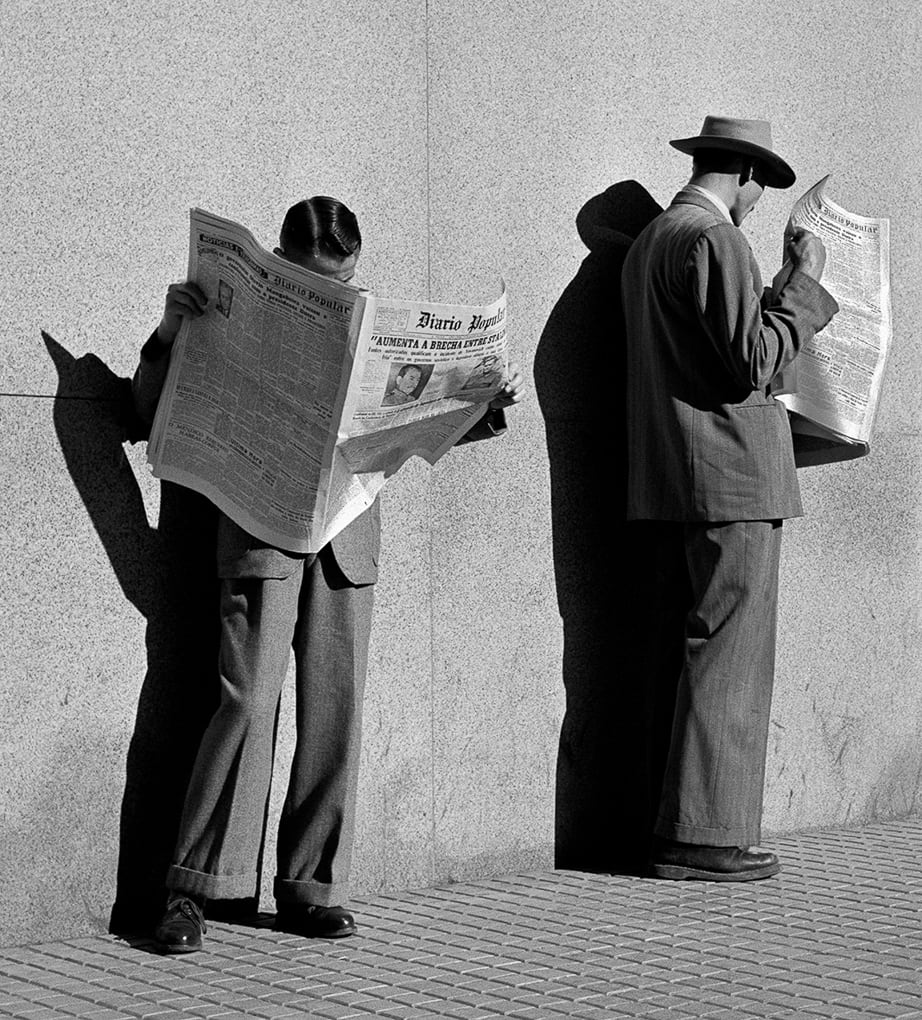
If modernist visual forms (sculpture, painting, drawing as well as photography) have one thing in common it’s a love of sharp lines and geometric shapes. In contrast with gauzy impressionism, gloomy symbolism or scratchy expressionism, modernism loves slick lines and sharp angles. Almost everything in this photograph by the Brazilian photographer German Lorca (1922 to 2021) is precise and geometric: from the tiny regular squares of the paving to the straight seams of the concrete wall behind the two figures; the neatly pressed seams of the two men’s suits to the super-precise outline of the shadows behind them thrown by the hot tropical sun. It’s part of the hyper-modern effect that we don’t see the men’s face, which are turned away or hidden behind a newspaper, thus increasing the sense that this sidewalk drama is not about people but about the lines and energies of the modern city.

Looking for a job by German Lorca (1948)

Motion photography

Eadweard Muybridge (1830 to 1904) is the famous pioneer of ‘motion photography’ which caught the imagination of artists and scientists around the (developed) world. In his studio he set up series of cameras in the same position or staggered along the course of the action he wanted to record, and then fired them off at intervals, experimenting with doing it closer or further apart.

The result was his famous sets of photos showing successive stages in dramatic actions. Once he’d nailed the technique he went mad and, between 1884 and 1886, produced 781 new sequences! The art of fencing is peculiarly suited to this process because it involves dramatic gestures and physical postures while the body itself doesn’t actually change position very much.

Fencing by Eadweard Muybridge (1887) collotype

Naked photography

Lots of women artists and photographers in the 1970s and 80s thought it was a radical and subversive act to take their clothes off and stage happenings or interventions or performances featuring themselves naked, and record themselves for posterity. No doubt this was a radical, subversive and so on gesture in Russian-controlled communist Poland back in 1980. Forty-three years later it looks like a naked young woman in heels confronting a woman cop. What’s not to love?

It is a little disappointing, then, to learn that this scene never took place, but that the piece is in fact a photomontage, combining a shot Ewa Partum (b.1945) took of herself nude in the studio, superimposed on a straightforward snap of a cop in the street.

Döppelgängers always fascinate us and so we are taken by the dualistic oppositions suggested here, between the naked and the clothed, between authority and submission, between the ‘authenticity’ of the artistic naked woman with nothing to hide and the overdress authority figure encumbered with all the rigmarole of legal and physical repression (radio, handcuffs, baton, gun?)

(I appreciate this photo could also come under ‘feminist photography’ or ‘political photography’. But I’m enjoying making up frivolous headings and my own connections.)

Self and policewoman by Ewa Partum (1980)

Nature photography

Possibly my favourite photo of the 130 on display. I myself have taken lots of photos of trees, flowers, plants, lichen on stones and so on, but trees are special. I think trees are talking to us but so slowly, so very slowly, that we can’t slow down enough to hear what they’re saying. And so we chop them down and burn them, over vast areas, and will end up burning the entire planet in the process. Tant pis.

Meanwhile, this is just one of many studies the American photographer Paul Strand (1890 to 1976) took of driftwood, showing a profound feel for the shapes and twists and knots and gnarls which are created by this most beautiful of life forms. Although hyper-naturalistic in feel, capturing every fibre of the gnarled old wood, Strand’s studies like this at the same time suggest flowing zoomorphic forms and, if you’ve smoked a little dope, are gateways almost into another world, enabling the viewer to immerse themselves in the non-human world around us. Entirely naturalistic they are also like meditative states of mind.

Driftwood, Gaspé, Quebec, 1928 by Paul Strand © Paul Strand Archive/ Aperture Foundation

Painted photography

Believe it or not this is a photo, taken about 1890 by an unknown photographer. It looks like a painting because the entire surface has been covered with a thick layer of pigment, so it is a painting: a photo-painting. Apparently this kind of embellishment or overwriting of a factual photographic base with an extravagantly idealised and Romantic backdrop and details was very common. It has a floridness we don’t associate with the European tradition and feels genuinely ‘other’.

This image links to the portrait of a couple from the 1970s shown above. Was this a distinctively Indian approach to photography? Did other cultures do the same kind of thing? Does it persist to this day? Be interesting to know more.

Maharaja with Tiger, possibly Duleep Singh, after a hunt (about 1890) vintage gelatin silver print with hand painting. Maker unknown (India)

Soviet photography

In the heyday of the 1920s and early 1930s Soviet artists made some of the boldest, most radical art of the century in the name of the new society they were building. Alexander Rodchenko (1891 to 1956) specialised in taking photos from experimental and unconventional angles. This was called rakurs in Russian. The most powerful, impactful of these is looking up at the subject from below. This conveys a string sense of dynamism and energy which, when combined or attached to an image of a youth, conveyed just the sense of forward-looking, visionary, striding-into-the-future energy which Stalin and his commissars wanted. As the commentator points out, it also makes the figure look monumental, a photographic equivalent of all those huge statues of working men and women striding boldly into the brave Soviet future which used to litter communist cityscapes.

Pioneer girl (1930) by Alexander Rodchenko

Street photography

Harold Cazneaux (1878 to 1953) became known for naturalistic studies of children, often taken outdoors. During and after the war there was an explosion of technical experimentation associated with modernism, plus a great surge in popular magazines which relied on evermore photos. Thus this photo was taken for a spread in The Home magazine. It’s what you could call soft modernism or popular modernism, in the sense that a) the focus is on the children’s faces, not the ostensible subject (the Punch and Judy show); b) it’s taken from a relatively low angle, a characteristic modernist trait, but not actually down on the ground. So it’s assimilated enough modernist tricks to be considered ‘modern’ and not rattle any cages.

Punch and Judy (1930) by Harold Cazneaux

The promotional video


Related links

More Photographers’ Gallery reviews

The Lathe of Heaven by Ursula Le Guin (1971)

Coming to this novel was a shock after reading five of Le Guin’s Hainish cycle, science fantasy novels in a row. The Hainish stories are set in a remote future on remote planets and feature a range of humans, humanoids and aliens with Lord of the Rings-type names like Shevek, Ong Tot Oppong or Pemmer Harge rem ir Tibe, who travel vast interstellar distances in spaceships or ride flying tigers, use telepathy and fire laser guns.

So it was a surprise to read this 1971 novel which is:

  1. set on earth
  2. in the very near future
  3. above all, features recognisably ‘normal people with names like George, William and Heather

George Orr the dreamer

The premise is disarmingly simple: George Orr is an ordinary, unassertive 30-year-old office worker living in Portland, Oregon, who has started to have particularly intense dreams which come true – his dreams alter reality and retrospectively change history!

The dreams started fairly modestly – as a shy teen he was irritated by an aunt living with his family who kept trying to hit on him. One night he dreamed the aunt had died in a car crash 18 months earlier and when he woke up – it was true! He was living in a new reality in which the aunt had died 18 months earlier, and his parents and all his relatives and the authorities all accepted the fact, had never known any other reality, lived entirely inside the alternative history he had dreamed into being. George’s dream had not only changed reality but he was the only one who knew it had changed.

The narrative opens a few years later with George on the verge of a nervous breakdown because he is dosing himself with high-powered drugs to try and stop himself doing any more dreaming. When he nearly overdoses and a local doctor is called in who refers him to a psychiatrist, a certain Dr William Haber. Haber is a specialist in dreams and the human brain and is working on an invention, the Augmentor, a device which detects and amplifies a person’s natural brainwaves, with a view to treating the people with mental problems who are referred to him by identifying and restoring their ‘normal’ brainwave patterns.

In their first interview, Haber slowly wheedles out of George his incredible story and, of course, as a scientist and psychiatrist, dismisses it as one more of the many florid hallucinations and delusions he’s dealt with over the years. He puts George to sleep with a combination of hypnosis and pinching his carotid artery which he has perfected over the years and, as he goes under, suggests he dream of a horse running free. When George awakes, the big picture of Mount Hood on Haber’s wall has changed into a big picture of the horse he saw running wild and free in his dream.

Did Haber notice the change or is he like everyone else who lives in whatever new reality George dreams into existence, as if it has always been that way?

Over subsequent sessions, George realises that Haber, being at the epicentre of The Change, right next to the Dreamer, does notice the change. At the next session Haber witnesses George’s dream turn the horse picture back into a view of Mount Hood. Haber insists they continue the ‘sessions’, but George starts to realise the doctor has plans to plant evermore ambitious suggestions into his head.

Thus soon Haber is transformed from a struggling researcher in the cramped room on the 64th floor of a rundown building, but the head of a prestigious dream research institute with a big office and a stunning picture window commanding a view over the surrounding landscape. And each successive phase of the story records Haber’s increasingly ambitious attempts to restructure the entire world to make it a better place.

Unfortunately the human mind, the unconscious dreaming mind, or George’s mind anyway, responds to Haber’s prompts in unnervingly indirect or unexpected ways. Thus, when Haber puts George to sleep, turns on the brainwave Augmentor and suggests to him that he overcome his fear of people, of being claustrophobically trapped in the overcrowded transport system and inadequate housing of modern Portland – George responds with a particularly vivid dream in which mankind has experienced a horrific plague a few years earlier, which devastated the earth’s population, reducing it from 7 billion to less than 1 billion. In this new reality everybody has experienced and refers to the Crash (p.79) a carcinomic plague caused by toxic chemicals in the air from car and industrial pollution.

And when he wakes up – it is true: George’s dream version of events has become human history, the overcrowded city of Portland with its gleaming skyscrapers has morphed into an underpopulated town of 100,000 whose outer suburbs were looted then burned down in the social chaos which followed the Great Plague. Both Orr and Haber manage to accommodate to this new reality – and to the fact that all their loved ones, parents and wives, have died in this vast global holocaust.

Even more drastic is Haber’s next attempt to make a better world. Throughout the narrative characters have been referring to a war bubbling away in Eurasia, which seems to involve Israel, Egypt, Iran, Iraq, India, Pakistan and threatens to drag in other countries. So at their next session Haber puts Orr under and, as he goes into deep sleep, suggests that George creates World Peace.

Unfortunately, Orr’s imagination does this via the unexpected route of inventing an attack on humanity by aliens from outer space who capture the moon, murder the handful of earth colonists living on a moonbase and then threaten earth itself. George has certainly achieved peace on earth, and united the squabbling nations of the world – but at the cost of threatening all mankind with attack by ferocious aliens, methane-based forms of life from the planet Alderbaran (pp.132,142).

And so, bizarrely, on – each successive dream world session raising the stakes, and plunging George into deeper and deeper panics and bewilderment.

Even more dramatic than the Crash, the next sequence in which the aliens suddenly attack Portland, leading to the US launching nuclear weapons and bombing raids against them which go horribly wrong and end up doing far more damage to the city and its inhabitants than to the aliens. They even trigger the dormant volcano, Mount Hood, into having a full-blown volcanic eruption and raining lava bombs onto the terrorised city. Chaos!

In the midst of this pandemonium, Orr makes his way across the ruined city dodging bombs and flying lava and makes it up to Haber’s office, where, ignoring the pandemonium, Haber puts George into deep sleep just as an alien appears, hovering at Haber’s smashed-out window and threatens to blast them all, and….

George’s dream once again transforms reality. For now it turns out the aliens are peace-loving, the attack on the moon settlers was a misunderstanding, they don’t have any weapons, there are only a thousand or so of them and they came in peace. So much so that, in this new reality, aliens are integrated into human society, walking the streets (admittedly in their eight-foot-tall spacesuits which make them look like giant turtles), Portland is restored to pristine condition and Dr Haber has been promoted once again, becoming a leading light in the World Planning Centre, the chief agency of the new, global ‘Federation of Peoples’ (p.126).

The future

So far I haven’t mentioned an important element of the novel which is that it is set in the future – not the remote, far-distant future of the Hainish novels but what was then – for Le Guin writing in 1970 – a mere thirty years in the future: the novel is set in 2002.

Quite apart from the mayhem caused by George’s dreaming, this futureworld is quite a lot to take on board, for Le Guin sees it as a dystopia. In this future, the global population is over seven billion, with the result that there isn’t enough food: many foodstuffs we are familiar with have disappeared, such as meat and any interesting alcoholic drinks. The doctor who first treats George casually mentions the incidence of kwashiorkor, a disease caused by malnutrition, among the city’s children. An oppressive aspect of George’s life in the early parts of the story is the horrifying cramped and packed conditions of public transport (private cars have long since been banned) – an anxiety which eventually leads him, as we’ve seen, to dream of a global plague which kills off most of the human population.

(I smiled as I read the ‘horrifying’ descriptions of George being pressed up against the other commuters on Portland’s packed trains and trams – that’s what I and tens of thousands of Londoners experience every day, trying to fight our way onto tube and overground trains every morning and evening.)

But by far the most striking aspect of Le Guin’s mentions of Global Warming. 1971 and she is talking about Global Warming! As Le Guin envisions it, the huge increase in carbon dioxide in the atmosphere from industrial output and unfettered internal combustion engine usage has set in train global warming, which, by the time the novel is set – 2002 – has become unstoppable. The polar ice caps are melting, New York is going to be drowned, the average temperature has gone up – with the result that Portland experiences a permanent warm drizzle:

the endless warm drizzle of spring—the ice of Antarctica, falling softly on the heads of the children of those responsible for melting it.

It is like, George reflects, walking around in a thin warm soup.

It is quite a thing to be reading, in 2019, a novel which warns so accurately and prophetically about the catastrophic impact of manmade pollution and global warming. Shows you just how long anyone who cares about the environment, or understands environmental science, has known about the threat – fifty years! And yet what has been done to reduce carbon emissions, to limit car and plane and ship use, industrial emissions or ruinous agricultural practices in all that time?

Nothing.

Love interest

The other big thread I haven’t mentioned yet is the love interest. On page 40 George goes to visit a lawyer, Heather Lelache. Characteristically for the original version of the ruined dystopia, Heather works at a law firm whose offices are in a converted multi-storey car park – remember that, by 2002, private cars are a thing of the past and the huge concrete infrastructure built around them has had to be repurposed.

As with all Le Guin’s novels, it is nothing like a conventional love affair. Heather is described as being festooned with bangles, hard and clacking, a loud brass necklace, and is hugely unsympathetic to George when he comes to see her. He wants her to intervene with Haber somehow, maybe under privacy law. Heather listens with ill-concealed boredom as George tells his increasingly mad tale about how his dreams can change the world. She finally reluctantly agrees to arrange to visit Haber’s practice in the guide of a health and safety lawyer – but he persuades her to attend a session with Haber under the guide of a kind of health and safety inspector and arrange it so she sits in on a session with George.

This she duly does, and is present to witness the dream in which George dreams of the Great Plague, the Crash, which wiped out six-sevenths of the human population. She is staring out Dr Haber’s window over the skyscrapers of downtown Portland as the Change kicks in and she watches them shimmer, melt and disappear, to be replaced by the ruined low-rise town which Portland has become six years after the Crash (p.61).

Whereas Haber is a megalomaniac who quickly seizes upon the situation to implement his world reforms, Heather is more like you and me and responds to the change with terror and confusion. From that moment on she believes George but struggles to really accept the implications. A few days later she goes to see him at his rented apartment and discovers him in a terrible state, having tried to stay permanently awake. She persuades him to leave the city and drives him to the cabin in the countryside (which he has awarded himself as winner of a state lottery, in one of his many dreams) and here she cares for him, feeds and waters him, loads him onto the cot bed and falls asleep beside him.

They are both jerked out of their sleep by sirens and explosions. It is the invasion of the aliens I mentioned above, in which the US responds by firing nuclear missiles into space, some of which are deflected back to earth and explode setting off the vast volcanic eruption of Mount Howe, and so on. It is Heather who helps George drive back to the city and make it up to Dr Haber’s office, be wired up to the Augmentor and go into deep sleep just as a weird ovoid alien vehicle smashes through Haber’s office window…

In the new peaceful world which follows George sorting out this crisis, Heather and George become close. She is black, one of many black or non-white leading characters which populate Le Guin’s novels. She explains that her father was a radical black activist back in the 1970s (i.e. when the novel was written) and her mother a rich man’s daughter who rebelled against her privileged background (p.102).

Heather is, potentially, an interesting character and yet… Le Guin never really conveys her as a character apart from having lots of clacking bangles and clicking handbags and projecting a tough armature.

Humour

Le Guin is not a very funny writer. There is hardly any humour and certainly no warmth in her novels. I find them cold and heartless. But, unlike any of the Hainish novels, this one does have some attempts at humour.

There is some fairly crude satire in having the President of the United States named President Merdle (Albert B. Merdle, in fact):

  1. the association with the French word merde meaning shit and
  2. the other association, with the fictional character in Dickens, the millionaire financier Merdle in Little Dorrit who turns out to be a complete fraud

There is a flicker of humour in the start of the scene where Heather visits Haber’s office, and uses a pocket tape recorder to record their conversation which goes teep every few seconds and at one point Haber’s phone goes off, making a deep bong noise, the two sounds creating an antiphonal piece of minimalism.

And there’s humour of a sort in the unintended shape some of George’s dreams take: – I suppose it’s ‘funny’ that when Haber tries to get him to create World Peace, George does so at the cost of inventing an alien invasion!

Along the same lines, once the alien situation is dealt with and it turns out that they were friendly all along and are perfectly integrated into human society, Haber has a go at solving another social problem, the ‘race problem’ (like the references to global warming, it’s salutary and rather shocking to be reminded how long topics which are in the headlines as some kind of ‘news’ have in fact been around).

Anyway, when George comes round from this dream it is to find that he has indeed solved the ‘race problem’ – by turning everyone grey! There are no longer white or black or brown or yellow people. Everyone is the same uniform shade of battleship grey.

I suppose that’s sort of funny, but Le Guin has a way of draining the life out of everything. What could possibly have become a funny theme is made to feel tragic when George realises that Heather – who he has come to love who, indeed, in one of the worlds he creates, he has made into his loving wife! – as George realises that his beloved Heather is gone. Gone. Everything he loved about her, the tone of her jet black skin, the shape of her skull, her black physiognomy, and the feisty, no-nonsense attitude it gave her…. all these have disappeared in a world of same-colour but drab and rather sad humans.

Le Guin is making a sort of interesting point – that maybe the inequalities and frictions between races, genders and classes are precisely what make life interesting – but the reader – well, this reader – experienced it simply as a loss. The same kind of loss as when Falk leaves behind Parth or Strella is revealed to be a treacherous alien in The Lathe of Heaven or when the swashbuckling Lord Mogien, who we’d got to like in Rocannon’s Planet, is killed off, or – much more seismically – when Lord Estraven, one of the two central protagonists whose strange alien condition we had grown to understand and respect in The Left Hand of Darkness is simply machine-gunned to death, pointlessly, to no-one’s advantage, by overzealous border guards.

So many of the details are what old hippies called downers. In a tiny example, in the post-alien-war peaceful world where Dr Haber has become a senior official at the World Planning Centre, George is walking across of futuristic plaza when he witnesses a ‘citizen’s arrest’ i.e. a public-spirited citizen has tracked down a man who was diagnosed with a terminal cancer and gone on the run. But now he’s been tracked down and, once he’s rounded up the ten witnesses required by law, the public spirited one euthenases the cancer sufferer with a poison dart gun.

It’s a throwaway detail, a moment in a much larger narrative and I can see it’s making a point about a new and different type of dystopia which George has dreamed and yet…it’s harsh and cruel, and… unnecessary. Cruelty is thrown in; the extra detail will always be brutal.

Le Guin’s fiction seems to me to be full of these moments of loss or cruelty and, after a while, I find the cumulative effect to be emotionally draining and upsetting.

Pessimism

So the occasional flickers of possible humour cannot outweigh the relentless negative pessimism of her worldview. It is a bleak future indeed that she foresees for us, living in an over-populated planet characterised by food shortages and malnutrition, many familiar animal species wiped out, much of the forest chopped down, the thin permanent polluted drizzle falling on everyone, the sea levels rising and drowning coastal cities.

And, as if this wasn’t bad enough – there’s a horrifying moment in the middle of the novel where George revels his really big secret to Heather; not that his dreams change reality – but that the world has ended. The over-pollution and radioactive waste was so severe that by April 1998 most of humanity had died out, and he, George, was sick and ill and dying and staggering through the corpse-strewn streets of Portland and, as he collapsed on a cracked concrete step, with his last flickering moments of life, he dreamed, dreamed of a better world, dreamed that humanity survived.

In other words the badly polluted, overpopulated, malnourished world the novel opens in, is a saved version of the world. The real one came to an end in April 1998 (p.104). He explains to a horrified and disbelieving Heather that all the subsequent versions of reality they have lived through together are not only dreams, they are essentially lies, fictions, inventions. The real world ended ‘and we destroyed it.’

Eastern mysticism

A lot is made of Le Guin’s abiding interest in Eastern mysticism, which informs her whole approach to character and plot, and underlies her interest in alternative states of mind, of perception, of consciousness. Indeed the title of the book is a quote from the writings of Zhuang Zhou, specifically a passage from Book XXIII, paragraph 7, quoted as an epigraph to Chapter 3 of the novel:

To let understanding stop at what cannot be understood is a high attainment.
Those who cannot do it will be destroyed on the lathe of heaven.

And at moments, very characteristic Le Guin moments, the narrative steps back from what you could call its Western technocratic  mindset to create epiphanies of peace and detachment. In particular, at several points George – for most of the book a whining, stressed individual – is portrayed as momentarily monumental, the still point of a chaotic world, somehow the centre of something awesome.

George himself is aware of the value of silence and contemplation. In a central scene (pp.136-140) Haber tells George that all the tests he’s run on him indicate that he is dead centre, totally average, average height, weight, brain patterns, EEG; in a weird way he is kind of at the dead centre of the human condition.

‘If you put them all onto the same graph you sit smack in the middle at 50. Dominance, for example; I think you were 48.8 on that. Neither dominant nor submissive. Independence / dependence – same thing. Creative / destructive, on the Ramirez scale – same thing. Both, neither. Either, or. Where there’s an opposed pair, a polarity, you’re in the middle; where there’s a scale, you’re at the balance point. You cancel out so thoroughly that, in a sense, nothing is left.

(Either/or. Aha. Now we see the meaning of George’s name. George Orr, a kind of permanent doorway into alternatives…)

This scene evolves into a confrontation where the pair challenge each other with speeches outlining the aggressive, technocratic, always-busy, improving and building western mindset (Haber) – and George’s intuition that humans are also capable of just being, and of going with the flow of nature and the universe – the Le Guin worldview.

So her feel for apparently Taoist, Eastern values threads in and out of the narrative, with sometimes very powerful effects in some scenes, butwith fortune cookie glibness at others. The aliens from Aldabaran have a very detached pint of view, if you can call it that. After all, they are inventions of George’s passive, middle-of-the-road imagination. As one alien tells him,

To go is to return

And yet, for me, whatever associations Eastern mysticism is meant to have with detachment and serenity are utterly overshadowed by Le Guin’s very Western obsession with technology, cities, urban living, drugs, dystopias, end of the world, science fiction, spaceships and aliens and murders and death. There is nothing detached, serene or blissful about any of these subjects. The Taoist thread is there to light a scene and gild a few perceptions. But for me it is totally outweighed by a heavy, endless acid rain pours grim and unrelenting pessimism over all her books.

Heather returns

Distraught at losing Heather, George drops into an antiques shop run by one of the now-friendly aliens. The aliens have their own language and somehow seem to know that George possesses a skill which they have a word for, iahklu. After a weird Zen conversation which may, or may not, mean anything, the alien apparently on the spur of the moment gives George an ancient 45rpm single vinyl record. George takes it home to his modest apartment, pouts it on the turntable, and plays it over and over again. It is Help From My Friends by the Beatles. He falls asleep and dreams.

Suddenly we are in the mind of Heather, as she awakens in George’s apartment, watching him sleep, listening to the Beatles on a loop. She’s back! He’s dreamed her back! Although it becomes clear this version of her has not experienced the Change and so doesn’t know about George’s dreams.

At almost every turn of the story Le Guin wrings the maximum amount of confusion from her characters.

The end

The narrative had been heading for the moment when Dr Haber perfected his ‘dream augmentor’ and this is the trigger for the book’s climactic scenes.

Haber puts George under one last time and instructs him to dream that his dream skills have gone, disappeared, ended. George awakens, and they have.

Haber thanks George for all his co-operation and bids him and Heather goodbye and they set off across the now, finally at-peace city — but they have got only a mile or so away when the entire world begins to fall to pieces.

Haber has hooked himself up to the Augmentor and is copying and augmenting the brain rhythms he’s spent the book recording off George. Now he is having his own reality-changing dream and it is a nightmare. Because he has no personality, no inner life apart from his burning ambition, the dream is the first genuine nightmare we’ve experienced, in which everything disintegrates into a terrible swirling maelstrom of emptiness.

George makes his way through the mounting chaos as the city and landscape melts into a tornado of meaninglessness, by sheer effort of will maintaining just enough physical reality to allow him to walk up melting stairs, cross disappearing floors, and ride disintegrating escalators to the collapsing office where Haber is lying wired up to the Augmentor and with one, final, terrific effort of willpower… to turn it OFF.

Coda

The scene cuts to a few months later, and the world is still struggling to come to grips with what everyone refers to as The Event. The world was restored to a kind of reality after Haber’s nightmare, but seriously out of kilter, with buildings, roads and so on half-built or built in two zones or clashing styles, starting and ending abruptly. As do people’s personal lives, and human history, which is now full of all sorts of inexplicable and nonsensical non-sequiturs – a kind of world of solidified chaos which has given rise to an epidemic of mental illness. Among whose victims is Haber, who is now confined to a mental home, silent, withdrawn, catatonic.

In this topsy-turvy world George has got a job in an antiques store, working for a detached, courteous ten-foot-tall, turtle-suited alien named E’nememen Asfah (now there’s the Ursula Le Guin I’m used to, with her silly made-up names).

George mourns for his lost wife, beautiful black Heather. Then one day he bumps into her in the shop being sold kitchenware by her boss. But she is not the same Heather. She is back to black (the grey world has gone) and is much harsher and harder than the grey woman who became his wife. She tells him she is married and his heart quietly breaks. She tells him her husband died in that war in the Middle East and his heart quietly soars.

She vaguely remembers meeting him once or twice at some doctors’ office; wasn’t he the guy who thought his dreams changed everything. Is he cured now? Yes, quite cured he say. And he invites her for a cup of coffee, both of them with a whole new unknown future to pay for.


Related links

Reviews of Ursula Le Guin novels

1966 Rocannon’s World
1966 Planet of Exile
1967 City of Illusions
1968 A Wizard of Earthsea
1969 The Left Hand of Darkness
1971 The Lathe of Heaven
1972 The Word for World Is Forest
1974 The Dispossessed

Other science fiction reviews

Late Victorian
1888 Looking Backward 2000-1887 by Edward Bellamy – Julian West wakes up in the year 2000 to discover a peaceful revolution has ushered in a society of state planning, equality and contentment
1890 News from Nowhere by William Morris – waking from a long sleep, William Guest is shown round a London transformed into villages of contented craftsmen

1895 The Time Machine by H.G. Wells – the unnamed inventor and time traveller tells his dinner party guests the story of his adventure among the Eloi and the Morlocks in the year 802,701
1896 The Island of Doctor Moreau by H.G. Wells – Edward Prendick is stranded on a remote island where he discovers the ‘owner’, Dr Gustave Moreau, is experimentally creating human-animal hybrids
1897 The Invisible Man by H.G. Wells – an embittered young scientist, Griffin, makes himself invisible, starting with comic capers in a Sussex village, and ending with demented murders
1899 When The Sleeper Wakes/The Sleeper Wakes by H.G. Wells – Graham awakes in the year 2100 to find himself at the centre of a revolution to overthrow the repressive society of the future
1899 A Story of the Days To Come by H.G. Wells – set in the same future London as The Sleeper Wakes, Denton and Elizabeth defy her wealthy family in order to marry, fall into poverty, and experience life as serfs in the Underground city run by the sinister Labour Corps

1900s
1901 The First Men in the Moon by H.G. Wells – Mr Bedford and Mr Cavor use the invention of ‘Cavorite’ to fly to the moon and discover the underground civilisation of the Selenites
1904 The Food of the Gods and How It Came to Earth by H.G. Wells – scientists invent a compound which makes plants, animals and humans grow to giant size, prompting giant humans to rebel against the ‘little people’
1905 With the Night Mail by Rudyard Kipling – it is 2000 and the narrator accompanies a GPO airship across the Atlantic
1906 In the Days of the Comet by H.G. Wells – a comet passes through earth’s atmosphere and brings about ‘the Great Change’, inaugurating an era of wisdom and fairness, as told by narrator Willie Leadford
1908 The War in the Air by H.G. Wells – Bert Smallways, a bicycle-repairman from Kent, gets caught up in the outbreak of the war in the air which brings Western civilisation to an end
1909 The Machine Stops by E.M. Foster – people of the future live in underground cells regulated by ‘the Machine’ until one of them rebels

1910s
1912 The Lost World by Sir Arthur Conan Doyle – Professor Challenger leads an expedition to a plateau in the Amazon rainforest where prehistoric animals still exist
1912 As Easy as ABC by Rudyard Kipling – set in 2065 in a world characterised by isolation and privacy, forces from the ABC are sent to suppress an outbreak of ‘crowdism’
1913 The Horror of the Heights by Arthur Conan Doyle – airman Captain Joyce-Armstrong flies higher than anyone before him and discovers the upper atmosphere is inhabited by vast jellyfish-like monsters
1914 The World Set Free by H.G. Wells – A history of the future in which the devastation of an atomic war leads to the creation of a World Government, told via a number of characters who are central to the change
1918 The Land That Time Forgot by Edgar Rice Burroughs – a trilogy of pulp novellas in which all-American heroes battle ape-men and dinosaurs on a lost island in the Antarctic

1920s
1921 We by Evgeny Zamyatin – like everyone else in the dystopian future of OneState, D-503 lives life according to the Table of Hours, until I-330 wakens him to the truth
1925 Heart of a Dog by Mikhail Bulgakov – a Moscow scientist transplants the testicles and pituitary gland of a dead tramp into the body of a stray dog, with disastrous consequences
1927 The Maracot Deep by Arthur Conan Doyle – a scientist, engineer and a hero are trying out a new bathysphere when the wire snaps and they hurtle to the bottom of the sea, where they discover…

1930s
1930 Last and First Men by Olaf Stapledon – mind-boggling ‘history’ of the future of mankind over the next two billion years – surely the most sweeping vista of any science fiction book
1938 Out of the Silent Planet by C.S. Lewis – baddies Devine and Weston kidnap Oxford academic Ransom and take him in their spherical spaceship to Malacandra, as the natives call the planet Mars

1940s
1943 Perelandra (Voyage to Venus) by C.S. Lewis – Ransom is sent to Perelandra aka Venus, to prevent a second temptation by the Devil and the fall of the planet’s new young inhabitants
1945 That Hideous Strength: A Modern Fairy-Tale for Grown-ups by C.S. Lewis– Ransom assembles a motley crew to combat the rise of an evil corporation which is seeking to overthrow mankind
1949 Nineteen Eighty-Four by George Orwell – after a nuclear war, inhabitants of ruined London are divided into the sheep-like ‘proles’ and members of the Party who are kept under unremitting surveillance

1950s
1950 I, Robot by Isaac Asimov – nine short stories about ‘positronic’ robots, which chart their rise from dumb playmates to controllers of humanity’s destiny
1950 The Martian Chronicles – 13 short stories with 13 linking passages loosely describing mankind’s colonisation of Mars, featuring strange, dreamlike encounters with Martians
1951 Foundation by Isaac Asimov – the first five stories telling the rise of the Foundation created by psychohistorian Hari Seldon to preserve civilisation during the collapse of the Galactic Empire
1951 The Illustrated Man – eighteen short stories which use the future, Mars and Venus as settings for what are essentially earth-bound tales of fantasy and horror
1952 Foundation and Empire by Isaac Asimov – two long stories which continue the future history of the Foundation set up by psychohistorian Hari Seldon as it faces attack by an Imperial general, and then the menace of the mysterious mutant known only as ‘the Mule’
1953 Second Foundation by Isaac Asimov – concluding part of the ‘trilogy’ describing the attempt to preserve civilisation after the collapse of the Galactic Empire
1953 Earthman, Come Home by James Blish – the adventures of New York City, a self-contained space city which wanders the galaxy 2,000 years hence powered by spindizzy technology
1953 Fahrenheit 451 by Ray Bradbury – a masterpiece, a terrifying anticipation of a future when books are banned and professional firemen are paid to track down stashes of forbidden books and burn them
1953 Childhood’s End by Arthur C. Clarke a thrilling narrative involving the ‘Overlords’ who arrive from space to supervise mankind’s transition to the next stage in its evolution
1954 The Caves of Steel by Isaac Asimov – set 3,000 years in the future when humans have separated into ‘Spacers’ who have colonised 50 other planets, and the overpopulated earth whose inhabitants live in enclosed cities or ‘caves of steel’, and introducing detective Elijah Baley to solve a murder mystery
1956 The Naked Sun by Isaac Asimov – 3,000 years in the future detective Elijah Baley returns, with his robot sidekick, R. Daneel Olivaw, to solve a murder mystery on the remote planet of Solaria
Some problems with Isaac Asimov’s science fiction
1956 They Shall Have Stars by James Blish – explains the invention, in the near future, of i) the anti-death drugs and ii) the spindizzy technology which allow the human race to colonise the galaxy
1956 The Stars My Destination by Alfred Bester – a fastpaced phantasmagoria set in the 25th century where humans can teleport, a terrifying new weapon has been invented, and tattooed hard man Gulliver Foyle is looking for vengeance
1959 The Triumph of Time by James Blish – concluding story of Blish’s Okie tetralogy in which Amalfi and his friends are present at the end of the universe

>1960s
1961 A Fall of Moondust by Arthur C. Clarke a pleasure tourbus on the moon is sucked down into a sink of moondust, sparking a race against time to rescue the trapped crew and passengers
1962 A Life For The Stars by James Blish – third in the Okie series about cities which can fly through space, focusing on the coming of age of kidnapped earther, young Crispin DeFord, aboard space travelling New York
1962 The Man in the High Castle by Philip K. Dick In an alternative future America lost the Second World War and has been partitioned between Japan and Nazi Germany. The narrative follows a motley crew of characters including a dealer in antique Americana, a German spy who warns a Japanese official about a looming surprise German attack, and a woman determined to track down the reclusive author of a hit book which describes an alternative future in which America won the Second World War
1966 Rocannon’s World by Ursula Le Guin – a ‘planetary romance’ or ‘science fantasy’ set on Fomalhaut II where ethnographer and ‘starlord’ Gaverel Rocannon rides winged tigers and meets all manner of bizarre foes in his quest to track down the aliens who destroyed his spaceship and killed his colleagues, aided by sword-wielding Lord Mogien and a telepathic Fian
1966 Planet of Exile by Ursula Le Guin – both the ‘farborn’ colonists of planet Werel, and the surrounding tribespeople, the Tevarans, must unite to fight off the marauding Gaal who are migrating south as the planet enters its deep long winter – not a good moment for the farborn leader, Jakob Agat Alterra, to fall in love with Rolery, the beautiful, golden-eyed daughter of the Tevaran chief
1967 City of Illusions by Ursula Le Guin – an unnamed humanoid with yellow cat’s eyes stumbles out of the great Eastern Forest which covers America thousands of years in the future when the human race has been reduced to a pitiful handful of suspicious rednecks or savages living in remote settlements. He is discovered and nursed back to health by a relatively benign commune but then decides he must make his way West in an epic trek across the continent to the fabled city of Es Toch where he will discover his true identity and mankind’s true history
1968 2001: A Space Odyssey a panoramic narrative which starts with aliens stimulating evolution among the first ape-men and ends with a spaceman being transformed into a galactic consciousness
1968 Do Androids Dream of Electric Sheep? by Philip K. Dick In 1992 androids are almost indistinguishable from humans except by trained bounty hunters like Rick Deckard who is paid to track down and ‘retire’ escaped ‘andys’ – earning enough to buy mechanical animals, since all real animals died long ago
1969 Ubik by Philip K. Dick In 1992 the world is threatened by mutants with psionic powers who are combated by ‘inertials’. The novel focuses on the weird alternative world experienced by a group of inertials after they are involved in an explosion on the moon
1969 The Left Hand of Darkness by Ursula Le Guin – an envoy from the Ekumen or federation of advanced planets – Genly Ai – is sent to the planet Gethen to persuade its inhabitants to join the federation, but the focus of the book is a mind-expanding exploration of the hermaphroditism of Gethen’s inhabitants, as Genly is forced to undergo a gruelling trek across the planet’s frozen north with the disgraced lord, Estraven, during which they develop a cross-species respect and, eventually, a kind of love

1970s
1970 Tau Zero by Poul Anderson – spaceship Leonora Christine leaves earth with a crew of fifty to discover if humans can colonise any of the planets orbiting the star Beta Virginis, but when its deceleration engines are damaged, the crew realise they need to exit the galaxy altogether in order to find space with low enough radiation to fix the engines – and then a series of unfortunate events mean they find themselves forced to accelerate faster and faster, effectively travelling forwards through time as well as space until they witness the end of the entire universe – one of the most thrilling sci-fi books I’ve read
1971 The Lathe of Heaven by Ursula Le Guin – thirty years in the future (in 2002) America is an overpopulated environmental catastrophe zone where meek and unassuming George Orr discovers that is dreams can alter reality, changing history at will. He comes under the control of visionary neuro-scientist, Dr Haber, who sets about using George’s powers to alter the world for the better with unanticipated and disastrous consequences
1971 Mutant 59: The Plastic Eater by Kit Pedler and Gerry Davis – a genetically engineered bacterium starts eating the world’s plastic
1972 The Word for World Is Forest by Ursula Le Guin – novella set on the planet Athshe describing its brutal colonisation by exploitative Terrans (who call it ‘New Tahiti’) and the resistance of the metre-tall, furry, native population of Athsheans
1973 Rendezvous With Rama by Arthur C. Clarke – in 2031 a 50-kilometre-long object of alien origin enters the solar system, so the crew of the spaceship Endeavour are sent to explore it in one of the most haunting and evocative novels of this type ever written
1974 Flow My Tears, The Policeman Said by Philip K. Dick – America after the Second World War is a police state but the story is about popular TV host Jason Taverner who is plunged into an alternative version of this world where he is no longer a rich entertainer but down on the streets among the ‘ordinaries’ and on the run from the police. Why? And how can he get back to his storyline?
1974 The Dispossessed by Ursula Le Guin – in the future and 11 light years from earth, the physicist Shevek travels from the barren, communal, anarchist world of Anarres to its consumer capitalist cousin, Urras, with a message of brotherhood and a revolutionary new discovery which will change everything

1980s
1981 The Golden Age of Science Fiction edited by Kingsley Amis – 17 classic sci-fi stories from what Amis considers the ‘Golden Era’ of the genre, basically the 1950s
1982 2010: Odyssey Two by Arthur C. Clarke – Heywood Floyd joins a Russian spaceship on a two-year journey to Jupiter to a) reclaim the abandoned Discovery and b) investigate the monolith on Japetus
1984 Neuromancer by William Gibson – burnt-out cyberspace cowboy Case is lured by ex-hooker Molly into a mission led by ex-army colonel Armitage to penetrate the secretive corporation, Tessier-Ashpool at the bidding of the vast and powerful artificial intelligence, Wintermute
1986 Burning Chrome by William Gibson – ten short stories, three or four set in Gibson’s ‘Sprawl’ universe, the others ranging across sci-fi possibilities, from a kind of horror story to one about a failing Russian space station
1986 Count Zero by William Gibson – second in the ‘Sprawl trilogy’
1987 2061: Odyssey Three by Arthur C. Clarke – Spaceship Galaxy is hijacked and forced to land on Europa, moon of the former Jupiter, in a ‘thriller’ notable for Clarke’s descriptions of the bizarre landscapes of Halley’s Comet and Europa
1988 Mona Lisa Overdrive by William Gibson – third of Gibson’s ‘Sprawl’ trilogy in which street-kid Mona is sold by her pimp to crooks who give her plastic surgery to make her look like global simstim star Angie Marshall who they plan to kidnap but is herself on a quest to find her missing boyfriend, Bobby Newmark, one-time Count Zero, while the daughter of a Japanese ganster who’s sent her to London for safekeeping is abducted by Molly Millions, a lead character in Neuromancer

1990s
1990 The Difference Engine by William Gibson and Bruce Sterling – in an alternative history Charles Babbage’s early computer, instead of being left as a paper theory, was actually built, drastically changing British society, so that by 1855 it is led by a party of industrialists and scientists who use databases and secret police to keep the population un

Karl Marx on the American Civil War (1861-65)

Marx the journalist

Karl Marx fled the revolutions which rocked Europe in 1848 to the relative calm and safety of London. Although he never intended to, Marx then ended up spending the rest of his life, in fact three quarters of his entire adult life, in capitalist England.

Ironically for Marx the revolutionary, he lived here during pretty much the quietest period of 19th century English history. The uproar surrounding the Great Reform Act of 1832 was long over, and the Chartist Movement failed and fizzled out after 1848. There followed 25 years or so of growing wealth, accompanied by (admittedly piecemeal) Parliamentary legislation to try and improve the lot of the working classes toiling in the new industrial cities in their grim seven-days-a-week factories. It was the era of the triumphant bourgeoisie and the unstoppable rise of British Imperialism, in India, China and around the world.

Although Karl wanted to write great masterworks of historical and economic theory, these wouldn’t pay the rent for himself, his wife and growing family. Although he wanted to be at the head of great revolutionary organisations, the Communist League with which he’d been associated during the 1848 revolutions, splintered and fizzled into insignificance.

So Karl turned to journalism, which he had actively pursued in Germany since his student days (it was his editorship of the seditious Neue Rheinische Zeitung in Cologne which was the reason he was kicked out of Germany in 1849).

Incongruously, Marx ended up getting a job not even with a British publication, but with the New York Daily Tribune, working as its European correspondent, from 1852 to 1862. The Tribune had wide working-class appeal in America and, at two cents, was inexpensive. It had a circulation of 50,000 copies per issue and its editorial line was progressive and anti-slavery.

So it was a this progressive New York newspaper which ended up paying the rent of the Marx household living in Soho, London for a decade. However, when civil war broke out in America in the spring of 1861, it was for the Liberal Vienna paper Die Presse that Karl wrote 37 articles about it, starting six months into the conflict, on 20 October 1861.

Karl Marx

Karl Marx

Marx’s articles about the American Civil War

The American Civil War began with the secession of the southern slave states, starting with South Carolina, which declared independence in January 1861.

The eight seceded states went on to declare themselves a new nation, the Confederacy, with its capital at Montgomery, Alabama. On 12 April 1861 Confederate forces shelled Fort Sumter, a fort off the coast of South Carolina which was still held by units of the U.S. or Union army. It was this action which signalled the start of the American Civil War.

Of Karl’s 37 articles just two are translated and published in the Penguin selection of Karl’s Writings From Exile 1848-1863, which is a shame. I wonder if you can read the lot online.

Karl begins by lining up the London papers of the day, The Times, The Economist, The Saturday Review and summarising their positions.

Most of the British press sympathised with the southern states. They thought the war was mostly about the issue of trade tariffs. The North imposed various tariffs on imports and exports, whereas the South didn’t. Moreover, an enormous amount of southern cotton was bought by British factory owners, turned into clothes, and traded back to the South (or sold on to India).

This explains why Britain, being a free trade nation, and economically linked to the region, had strong sympathies with the South.

It was because of this economic self-interest – Karl argued – that Britain’s papers and politicians argued, ‘Why shouldn’t the South declare itself a separate nation?’ And ‘Why should the North bother, or dare, to try and invade and suppress this new nation?’

Buried, pushed aside, undiscussed in all the mainstream media articles which Marx quotes, is the issue of slavery. In the two articles published in the Penguin selection, Marx sets out to contradict and refute the British bourgeois position, and to put the issue of slavery smack bang in the middle of the argument.

Marx’s knowledge

Marx is incredibly knowledgeable. I found reading the nineteen pages which these articles make up in the Penguin edition nearly as illuminating as reading James McPherson’s 860-page history of the war. Karl demonstrates a surprisingly detailed grasp of the geography, the economic facts, the demographic changes and the political manoeuvring that led up to the war.

Karl gives his unstinting support to the North and says it must conquer the South and overthrow its iniquitous slavery system. Otherwise the South will triumph in its pre-war attempts to impose and spread slavery to all parts of America and with it, to enslave the working classes, too.

Karl says the war is about slavery pure and simple. The Founding Fathers may have been slave-owners (most famously Washington and Jefferson), but they thought slavery was an evil imported from England which they hoped would eventually die out. By contrast, apologists for the South treated slavery as a good in itself which deserved to be spread as widely as possible. According to them, slaves loved their slavery. Not only that, they wished to spread and cement slavery as a core element in American society. The South is fighting, as one apologist put it, for ‘the foundation of a great slave republic,’ (page 336).

Karl details the political build-up to the war, including:

  • the Missouri Compromise of 1820 (which established 36º 30′ as the northernmost extent of slavery)
  • the Kansas-Nebraska Bill of 1854 (which retracted that ruling)
  • the attempt to spread slavery into New Mexico
  • the controversial 1850 Fugitive Slave Act which forced northern officials to acquiesce in the hunting, kidnapping and return of slaves who had fled North into slavery-free states
  • the 1857 Dred Scott case which established that slave owners had a right to take their slaves anywhere in the country

Marx describes the revival of the slave trade in the years running up to the war which, he claims, had resulted in 15,000 new Africans being kidnapped and brought to America (making a bigger deal of it than McPherson does in his history).

And Marx repeats the outrageous but widely publicised aims of the southern states to conquer Cuba for America, and to extend their rule throughout Central America (specifically in Nicaragua where, for a year, a southern American mercenary did, indeed, manage to become president!).

All of these political events show, to Karl, the wish of the South not just to defend slavery, but to actively extend it throughout the wider region.

Why?

Marx’s economic explanation for the motives of the Confederate states

Karl gives a characteristically economic explanation for political events.

The old slave states are exhausting their soil. Maryland, Virginia, even South Carolina, have become net exporters of slaves. ‘Breed ’em and sell ’em,’ is the slavers’ policy. Therefore, the slave states need a steady supply of new markets, they need to make new territorial conquest, in order to maintain their economies.

Even in South Carolina, where slaves form four sevenths of the population, the cultivation of cotton has remained almost stationary for years due to the exhaustion of the soil… South Carolina has become partly transformed into a slave-raising state by pressure of circumstances in so far as it already sells slaves to the states of the Deep South and South-West to the tune of four million dollars annually. As soon as this point is reached the acquisition of new territory becomes necessary, so that one section of the slave-holders can introduce slave labour into new fertile estates and thus create a new market for slave-raising and the sale of slaves. (page 341)

There is also politics. Each American state sends two senators to the Senate, regardless of population. Therefore, there is a naked power struggle whenever a new state is admitted to the Union as to whether its two senators will be pro or anti slavery, each new state’s nature threatening to upset the very finely tuned balance of power between slave and anti-slave states in Congress.

Who is pushing the drive to extend slavery? Karl estimates that there are only some 300,000 significant slave owners in the whole of the country. So an oligarchy of 300,000 has been trying to impose the political, legal and economic system which underpins its wealth onto the other 20 million Americans.

This ‘plantocracy’ was well aware what it was fighting for and understood that to restrict slavery to its current territories would:

  • reduce slaver representation in the senate i.e. undermine their political power
  • lead, over the long term, to the inevitable extinction of slavery
  • and the consequent general impoverishment of the South would lead to class warfare between the slave-owners and the poor whites who would, finally, realise how they are being exploited by the wealthy 300,000

Thus the war is nothing to do with free trade and tariffs, as the respectable London papers were trying to claim. It was about whether:

  • the 20 million free Americans should submit to a political and economic system imposed by an oligarchy of 300,000
  • the vast new territories of the Republic should be slave or free
  • whether the foreign policy of America should be peaceful – or get dragged into further wars with Cuba and Central America

Punchy and pithy

Karl is at his journalistic, punchy and pithy best. In the second article he makes the rhetorical point that the South – which had declared itself a new nation – isn’t a proper nation at all.

It is not a country at all, it is a battle-cry. (p.344)

In the second article he gives a detailed description of the geography and slave populations of all the ‘border’ states between south and north and describes how the slave states had made political, legal and, finally, armed attempts to infiltrate and capture these states for slavery.

Conventional opinion had it that it was the northern armies who had invaded the south, and indeed most of the fighting was done on the soil of southern or the so-called ‘border’ states. But Karl’s list of, first, the political attempts to suborn the border states, and then his detailed accounts of border incursions and raids by southern forces, makes a powerful case that the war is in fact:

a war of conquest for the extension and perpetuation of slavery. (page 350)

A glance at the map of America in 1854 shows what was being fought over. The southern slave states (dark green) already controlled significantly more land than the northern free states (pink). The issue was: should slavery be extended into the huge expanse of land to the west (light green) – nearly half of the American land mass, which was still only roughly parcelled out into territories provisionally named Kansas, New Mexico, Oregon etc, but which would, in the near future, attain the status of ‘states’ and be admitted to the union. Should they be slave – or free?

American states in 1854

American states in 1854

Marx was wrong about lots of things but the materialist worldview which predisposed him to see all major events in terms of their economic basis and in terms of the class conflicts which capitalism inevitably give rise to, often gave him a thrillingly incisive vision which cut through the painful bombast and wordy rhetoric of the stuffy, obtuse Victorians he lived among.

Thus in Marx’s view the American Civil War was emphatically not about tariffs or free trade or the right to have a separate culture or any of the other mystifications and obfuscations which filled so many speeches and newspaper columns, no:

The present struggle between South and North is thus nothing less than a struggle between two social systems: the system of slavery and the system of free labour. The struggle has broken out because the two systems can no longer peacefully co-exist on the North American continent. It can only be ended by the victory of one system or the other.

He thought the North would win and that the full emancipation of the slaves was inevitable.

Given that he was writing in November 1861, with the war only six months old and most Republicans (including President Lincoln) still reluctant to countenance slave emancipation under any circumstances, Karl in these articles was not only typically incisive and insightful, but remarkably prophetic.


Related links

Related blog posts

Karl Marx

Communism in Russia

Communism in China

Communism in Vietnam

Communism in Germany

Communism in Poland

  • Warsaw 1920 by Adam Zamoyski (2008) How the Polish army stopped the Red Army’s advance into Poland in 1920 preventing them pushing on to support revolution in Germany
  • The Captive Mind by Czesław Miłosz (1953) A devastating indictment of the initial appeal and then appalling consequences of communism in Poland: ‘Mass purges in which so many good communists died, the lowering of the living standard of the citizens, the reduction of artists and scholars to the status of yes-men, the extermination of entire national groups…’

Communism in France

Communism in Spain

  • The Battle for Spain by Antony Beevor (2006) Comprehensive account of the Spanish civil war with much detail on how the Stalin-backed communist party put more energy into eliminating its opponents on the Left than fighting the fascists, with the result that Franco won
  • Homage to Catalonia by George Orwell (1938) Orwell’s eye-witness account of how the Stalin-backed communist party turned on its left-wing allies, specifically the Workers’ Party of Marxist Unification which Orwell was fighting with, and how he only just managed to escape arrest, interrogation and probable execution

Communism in England