Prester John by John Buchan (1910)

I was going into the black mysterious darkness, peopled by ten thousand cruel foes.
(Davie Crawfurd penetrating the headquarters of the great black rebellion, Prester John page 99)

John Buchan (1875 to 1940) was absolutely determined to be a writer, and started being published while still at university in the 1890s. Prester John was Buchan’s sixth published novel but the first to reach a wide readership, establishing him as a writer of fast-paced adventures in exotic settings.

The historical Prester John

Between about the 12th and 17th centuries stories circulated throughout Europe of a legendary Christian patriarch and king ruling a fabulous kingdom somewhere in ‘the Orient’ named Prester John. At first Prester John’s kingdom was imagined to be in India, later its location moved to Central Asia. As European explorers, starting with the Portuguese in the 16th century, discovered Africa, Prester John’s mythical kingdom was relocated there, starting with the little-known coastal kingdom of Ethiopia, especially once it was understood that Ethiopia was a Christian enclave in what had been thought to be the Muslim world. Later still the mythical kingdom was said to be located somewhere in the African interior. By the time Buchan’s novel was published, most of Africa had been explored and nobody seriously believed in Prester John any more. He had become one among many children’s legends and stories.

Buchan knew about Africa. Soon after leaving university, he had spent two years in South Africa (1901 to 1903) as political private secretary to Lord Milner, High Commissioner for Southern Africa, who many people held responsible for the Boer War which was in its closing phases (it only ended in May 1902).

He puts this knowledge to good use in a story which deliberately harks back to the Africa adventure stories of Henry Rider Haggard, especially the ones about the hero Allan Quatermain, which were still being published when Prester John came out (Haggard novels continued to be published into the late 1920s). Presumably there’s a whole category of these kinds of fictions, given a name like ‘Imperialist Africa fictions’.

Prester John

Prologue with dancing black minister

The opening chapters of Prester John have a very consciously Scottish tone and vocabulary (see the vocabulary list at the end of this review). It opens in the village of Kirkcaple. The boy hero, David Crawfurd’s father is minister of Portincross. A black preacher comes to town and preaches about racial equality. The boy hero has a gang of mates, including Archie Leslie and Tam Dyke. One night they come across the black preacher on the beach, stripped down walking round a fire, lifting his hands to the moon, having drawn symbols in the sand. They creep up closer to get a better view but one of them makes a sound and the infuriated black man chases them up the gully of the stream which feeds down to the beach. David only escapes by throwing rocks in the pursuer’s face.

Next day they see him again, all respectable in his minister’s clothes, being driven in the free Church minister’s trap, gratified to see he has a swollen eye, and two strips of sticking-plaster on his cheek.

Seven years later

Years pass (on page 72 Arcoll states it is seven years since Davie saw Laputa dancing on the shore at Kirkcaple). David finishes his education in Edinburgh and goes on to the university. Then his father dies and his mother can’t live on the tiny pension he bequeaths. An uncle steps in on the basis that Davie and his mum move to Edinburgh. Days later this uncle says he’s had a word with a friend who runs one of the biggest businesses in South Africa – Mackenzie, Mure and Oldmeadows – and has secured him the job of assistant storekeeper at a place called Blaauwildebeestefontein. The general idea is that Davie will be encouraged to open up trade to the area north, becoming a successful entrepreneur or maybe getting involved with gold and diamonds. Better than sitting on a stool in an Edinburgh office.

The journey out

David makes friends with a couple of fellow Scots aboard the ship heading from Southampton to South Africa but gets the shock of his life when one day he sees the black man he hasn’t seen for years, since the incident on the sand, travelling first class. He discovers his name is the Reverend John Laputa. At one point David eavesdrops Laputa conferring with a bad-tempered, ugly-looking baddie named Henriques (‘that ugly yellow villain’).

The ship docks at several places in South Africa, at Cape Town where Henriques disembarks, then Durban where David meets up with his cousin, then with the local manager of the firm he’s going to be employed by, one Mr Colles. Colles briefs him on the place he’s going and why so many previous employees have quit: it’s in the middle of nowhere, there’s hardly any white men to socialise with, but also there’s some kind of religious centre nearby which natives for miles around go on pilgrimage to.

Lourenço Marques

David then takes a small cargo steamer to Lourenço Marques, the capital of Portuguese East Africa, and discovers that none other than his boyhood friend Tam is the second mate. They have a good yarn but are both amazed when, just before the ship sails, none other than the black minster, Mr Laputa, comes hustling up the gangplank. Tam is indignant when he is turned out of his cabin which is given to this VIP passenger.

When the ship docks at Lourenço Marques, Tam takes him to meet a Mr Aitken, ‘landing-agent for some big mining house on the Rand’ who was born and raised in Fife and turns out to have heard David’s father preach in his young days. Within the skeins of the British Empire was this subsidiary matrix of Scotsmen. Aitken gives him another layer of briefing about Blaauwildebeestefontein, namely 1) it’s the location of a wizard famous among the natives and 2) it’s a centre for diamond smuggling.

Blaauwildebeestefontein

After a journey by rail and then rickety ‘Cape cart’ across arid plains, through dusty gorges, David finally makes it to Blaauwildebeestefontein and he discovers it is a one-horse settlement, with just two solid buildings and twenty native huts. He discovers his boss-to-be, Mr Peter Japp, an old, balding, smelly man, passed out in a room reeking of alcohol on a shabby palette bed.

On the ship out from Britain David had met a small modest schoolteacher who, it turned out, was also heading for Blaauwildebeestefontein. Relations with Japp deteriorate, not least because of the appalling way he treats their girl servant Zeeta, one day whipping her till David seizes the whip (sambok) from his hand and promising to whip him (Japp) within an inch of his life if he does it again. At the same time Japp is strangely servile to the big booming black men who patronise the shop.

David buys a dog off a stony-broke prospector, ‘an enormous Boer hunting-dog, a mongrel in whose blood ran mastiff and bulldog and foxhound, and Heaven knows what beside. In colour it was a kind of brindled red, and the hair on its back grew against the lie of the rest of its coat.’ He takes some breaking in but eventually becomes David’s loyal companion. David names him Colin, and the dog proceeds to follow him everywhere and protect him.

Slowly, David comes to realise he is being spied on by natives hiding among bushes during the day and sometimes coming right up to his bedroom window at night.

Umvelos’

David’s manager, Colles, writes to revive an old idea, that he set up a commercial outpost at a place called Umvelos’. David travels half the way there with a convoy of Boers who he comes to admire as rugged honest country folk. Ample descriptions of the countryside, and of the Boers’ culture, tales of hunting, lore about the local tribes, with a sprinkling of Boer vocabulary. He admires the oldest of the party, a farmer called Coetzee, who’s a crack shot with a rifle.

As he penetrates into Africa, he finds people call him Davie.

The Rooirand

Arriving in his own cart at Umvelos’, Davie gets a mix of Dutchmen and natives to build a shop and house. While they do so he explores the mountainous ridge to the north, known as the Rooirand. An extended passage describing his arduous trek there and then dangerous climbing up cracks and chimneys and whatnot. The most significant event is he has made it back down off the cliffs when he becomes aware of someone moving through the jungle, creeps closer, and observes a black in a leopard skin marching towards the cliff face. But when David makes his way through the jungle to the same rockface he discovers the man has disappeared without a trace. Black magic! He half walks half runs away from the area, back along the road towards Umvelos’ where he rendezvous with one of the black workers from the new shop and homestead who was sent to meet him.

‘Mwanga

David arrives back early at Blaauwildebeestefontein and catches Japp discussing stolen diamonds with the most frequent black visitor to the shop, ‘Mwanga. So Japp is a fence for stolen diamonds! David tells Japp he must write a letter to Colles quitting, then leave and not be found within 20 miles or he’ll report him to the police.

Wardlaw’s premonitions

Davie moves in with Mr Wardlaw the schoolteacher who tells him about his paranoid premonition that the native blacks could rise up and massacre all the whites, as in the Indian Mutiny. There seem to be more blacks around than actually live there and the black kids have all stopped coming to his school. Davie calms him down, but moves his own bed out of direct sight of the window, keeps a loaded shotgun by the bed, and has his massive dog Colin sleep close by.

Days pass and the tension, the sense of being spied on and surrounded increases. Henriques pays a visit to Japp who takes him up to his bedroom but Davie is a building across the road and can’t see what they’re discussing, diamonds or the native insurrection Wardlaw is so worried about?

On a walk with Wardlaw they hear a shiver of drums rolling from north to south, are they war drums? A scribbled note arrives with the cryptic message ‘The Blesbok are changing ground’ (p.65). What does it mean? Davie gathers together all the firearms in the shop, plus some knives.

James Arcoll the spy

Late one cold afternoon (the town is on a berg or mountainside) a broken-down old black beggar appears. Davie kindly gives him some meal but then he invites himself inside, makes sure the door is secure, takes off his wig, washes his face and is transformed into Captain James Arcoll. He is, of course, a British Intelligence Officer (p.75) and, first, quizzes Davie about what he knows, then reveals the situation:

The idea is that Prester John was a real historical conqueror, founder of an empire in Ethiopia, as the generations passed, various successors claimed his title and the specificity of the historical figure blurred into legend. The key point is his power came to be associated with a particular fetish, probably a wooden carving. Chaka who built the great Zulu emperor had it but his successors couldn’t find it.

Ethiopianism

Arcoll has found that a black evangelist has been travelling up and down south Africa, preaching the word but going way beyond that and telling his audiences ‘Africa for the Africans’, claiming they can kick out the whites and establish a great empire again. Also known as Ethiopianism.

Laputa the reincarnation of Prester John

There’s a lot of detail (Arcoll has met Laputa disguised as a native in Africa but formally dressed like a white man in Britain, where he addressed Church gatherings and hobnobbed with MPs) but at his meetings with minor chiefs learns that Laputa considers himself the Umkulunkulu, the reincarnated spirit of Prester John, and he owns the Ndhlondhlo, the great snake necklet of Prester John.

Laputa has been making a fortune from the illegal diamond trade, working partly through Henriques, generating a fortune which he has spent arming the different tribes from the Zambezi to the Cape. Davie is stunned when Arcoll tells him the native rising is planned for the day after tomorrow! BUT Davie goes to bed happy and no longer scared. Arcoll has told him that, although Laputa has organised the tribes to rebel he, Arcoll, has also established a network of a) informers in those same tribes and b) alerted the authorities and settlers who are ready to rise up once the rebellion kicks off. So Davie is no longer frit because a) a leader has appeared who is going to take control, and b) far from being alone he’s discovered he’s a part of a huge co-ordinated army.

The plan

Arcoll knows that Laputa is scheduled to meet Henriques next day at Davie’s store, so the conspirators decide it will look perfectly natural if Davie turns up there but surreptitiously tries to gather as much intel as possible about the uprising.

To his horror, en route Davie encounters Laputa. Worth noting that Laputa, despite claiming to be the reincarnation of Prester John, has a far from classical African physiognomy, for Davie recognises ‘the curved nose, the deep flashing eyes, and the cruel lips of my enemy of the Kirkcaple shore.’

Davie the storekeeper

Somehow Laputa gains in stature and presence through the narrative. Davie now observes that he is a massive 6 foot 6 tall, and of ‘noble’ proportions. When Laputa says he’s heading for the store, Davie plays the fool and says he is the storekeeper. He gives Laputa a chair to sit on, shares dinner with him, even gives him a fine cigar, prattles on about how he believes the blacks are fine fellows, better than ‘the dirty whites’, how he hopes Africans will take Africa back for themselves etc, all designed to ingratiate himself with the man he knows is leader of the rebellion. In return Laputa politely warns him to leave this remote outpost and head back to ‘the Berg’, and not tomorrow, but tonight!

Davie spies

Later, Henriques arrives. He and Laputa confer in the outhouse and Davie sneaks through the cellar to eavesdrop. He’s nearly discovered but rushes back to the store and pretends to be dead drunk. Henriques wants to murder Davie in his supposed sleep, but Laputa stays his hand. Soon as they’ve left, Davie scribbles everything he’s heard about Laputa’s plans on a scrap of paper which he ties to the dog’s collar and tells it to run back to Blaauwildebeestefontein. Then Davie steals one of the horses and sets off north to the rendezvous point Laputa had mentioned.

The secret ceremony

Here he arrives and is greeted by black guards and led a merry tour into the face of the cliff, up narrow passages, emerging onto a ledge with a stone bridge across a chasm in which a fierce river flowed, then further in into the mountain till he emerges in a huge open space, one wall of which is a thundering waterfall.

We are, in other words, in the Land of Fantasy, a fantastical setting almost as dazzling as the Lost City in ‘She’. There are some 200 blacks gathered in a circle round an old blind black man with a circlet of gold on his forehead who is obviously ‘The Keeper of the Snake’ who Arcoll described as a key player in the ritual of anointing Laputa the rebel leader. Davie has been accepted because he claimed to be a messenger from Laputa, and he knew the password (‘Immanuel’) which he’s overheard Laputa sharing with Henriques.

Davie witnesses the impressive ritual of the reincarnation of Laputa with the spirit of Prester John, the daubing on the forehead of all present with the blood of a sacrificed goat, and the bestowal on Laputa of an ancient necklace of priceless rubies once worn by the Queen of Sheba, taken from an ivory box

During all this the narrative tells us that Davie is still only nineteen years old! (p.105)

To Davie’s amazement the priest and then Laputa invoke not pagan African gods but Christ and Christianity, a wild incantation, a long recital of glorious rulers from African history – ‘I was horribly impressed’. Once installed, Laputa delivers an awe-inspiring sermon listing all the infamies of the white man and calling on his black brothers to rise and overthrow them. Davie finds himself stirred and displaying fascist tendencies:

I longed for a leader who should master me and make my soul his own, as this man mastered his followers.

(He likes to be mastered. A lot later, when he meets up again and is close to passing out, Arcoll fixes him with his gaze: ‘Arcoll, still holding my hands, brought his face close to mine, so that his clear eyes mastered and constrained me,’ p.164.)

A key part of the vows Laputa makes is that for the next 24 hours nobody will commit any act of violence. As I read this I thought this was pretty much to ensure Davie’s safe escape or at least guarantee that he doesn’t get bumped off when he is discovered, as he surely soon must be.

Then the leaders of all the tribes take turns to kneel and swear allegiance to Laputa. Buchan gives a vivid sense of the varied appearance and appurtenances of the different tribesmen:

Such a collection of races has never been seen. There were tall Zulus and Swazis with ringkops and feather head-dresses. There were men from the north with heavy brass collars and anklets; men with quills in their ears, and earrings and nose-rings; shaven heads, and heads with wonderfully twisted hair; bodies naked or all but naked, and bodies adorned with skins and necklets. Some were light in colour, and some were black as coal; some had squat negro features, and some thin, high-boned Arab faces. But in all there was the air of mad enthusiasm.

Finally, it’s Davie’s turn to advance from the shadows to take the vow and, of course, first Henriques and then Laputa recognise him as the storekeeper, denounce him, he is seized by a hundred hands, beaten and passes out.

Tied to a horse

When he comes to Davie finds he is, of course, bound hand and foot and tied to the horse of none other than Mwanga, the domineering black who Japp fawned over and Davie chased out of the store. Now he has his revenge, gloating over Davie’s capture. The entire black army is marching south for a rendezvous with more forces at a place called Dupree’s Drift. Haggard and almost delirious from exhaustion and lack of food, nonetheless Davie estimates the black army at maybe 20,000 strong (!).

Finally there’s a break in the marching and a ‘savage’ looking native comes to check his bonds and give him some food but then whispers and turns out to be a messenger from Arcoll. Improbably enough his dog, Colin, got back to Blaauwildebeestefontein, Arcoll found him and read the message i.e. that the black army was going to march south to Dupree’s Drift. The messenger tells Davie that Arcoll will start firing just before the army gets to the drift at which point the native will cut his bonds and Davie can scamper free.

Along comes Henriques who stands gloating over him but then leans down and whispers that, actually, he is loyal to the white man’s cause, that he never killed the Boers he claimed to have, and that he’s on Davie’s side. I thought this might be an interesting development but Davie lets fly a deluge of insults and accusations and Henriques spits in his face before ordering a nearby African to tighten Davie’s bonds.

Henriques, looking tall despite being described in the text as short and slight, gloating over our hero, Davie, looking surprisingly fresh-faced for someone the text describes as dirty and fainting with hunger. Illustration by Henry Clarence Pitz (1910)

The ambush at Dupree’s Drift

At sunset they reach Dupree’s Drift and the army are half-way across the ford, and the litter carrying the priest bearing the ivory box containing the ruby necklace are precisely half-way across, when firing breaks out from a bluff on the other side. It is Arcoll and the white men, as arranged. As promised the African leading Davie falls to cutting through his bonds. However, firing hits the litter bearers from somewhere much closer. Once Davie is free he realises it’s Henriques who has only one motive, to seize the priceless necklace. He is a crack shot and shoots several of the litter guards and then the old priest himself.

It is now almost dark and Davie trails Henriques into the shallow water, watches him take the ivory box from the dead priest’s hand, open it and extract the ruby necklace. He is just standing up with it when Davie cracks him one on the chin, knocking him out, grabs the necklace, stuffs it in his breeches’ pocket. But instead of running downstream and crossing somewhere safe to join Arcoll’s men on the bluff, in the heat of the moment, scared by the size of the black army and the fact Laputa was riding back across the drift towards him, Davie bolted back up the track they’d come along.

Davie’s flight

After the initial buzz of the battle and his punch have calmed down, he realises he has a march of something like 30 miles to the West to ‘the Berg’ or the foothills to the mountains, which he regards as ‘white man’s territory’, ‘white men and civilisation’. For some reason the cool hills he regards as ‘white’ and the hot plains as ‘black’.

An exciting account of Davie’s feverish scared trek across wild African country, involving crossing two rivers, in one of which he manages to lose the revolver he’d nicked from Henriques. The stars are bright in the big black sky.

It was very eerie moving, a tiny fragment of mortality, in that great wide silent wilderness, with the starry vault, like an impassive celestial audience, watching with many eyes.

Davie is caught

Dawn shows him he is not far from the first glen which will lead him up into the safety of the mountains but at that moment he is cut off by black scouts who have beaten him to it. He makes it into the glen and climbs a good way through its varied terrain including jungle, but comes out to see a number of black figures spread out ahead of him. He slips into a side glen, slips off the necklace and places it in a cleft in rocks which gives onto a still shallow pool. Then he returns to face the men who are from Machudi’s tribe and explain they’ve been ordered to capture and bring Davie to Laputa. They treat him well, giving him food and letting him sleep before they set off back east and south to the place Laputa had appointed for meeting place of the tribes, Inanda’s Kraal.

At Inanda’s Kraal

He is too weak to walk and has to be carried in a litter which Machudi’s men efficiently construct. Description of the long trek and final arrival at Inanda’s Krall. Here all is pandemonium because the 24 hours of peace the vow pledged the army to make has lapsed and now scores of natives crowd round Davie threatening him with their assegais or spears. He sees Laputa surrounded by lesser chiefs and strides boldly over towards him. Laputa weighs him up, says it was folly to try and escape and tells his men to take Davie to his kya or hut, but Davie makes an impassioned attack on Henriques as the real traitor. Henriques lurches forward and goes for his pistol to shoot Davie. In that second Colin leaps forward and pushes Henriques to the ground but the Portuguese gets his gun hand free and shoots Colin three times. End of faithful hound.

Davie leaps forward but is soundly beaten and pricked by some of the spears before a final blow knocks him senseless.

Davie bargains for his freedom

When he comes round it is in a darkened hut being spoken to softly by Laputa who describes in detail the sadistic tortured death he is about to meet. Davie responds that Laputa needs the necklace. Laputa loses his temper and says is Davie so stupid as to believe his power derives from a petty trinket. He has the ivory box and if he chooses not to open it nobody will be any the wiser.

“Imbecile, do you think my power is built on a trinket? When you are in your grave, I will be ruling a hundred millions from the proudest throne on earth.” (p.147)

Davie is inspired to offer him a deal. Give him his life and he will lead him to where he hid the necklace. Even if his men torture him he wouldn’t be able to describe where it is, because he doesn’t know the country well enough. Laputa hesitates then accepts the deal. He has Davie blindfolded and shackled to his horse which he then rides at a slow trot so that Davie can just about keep up, stumbling and nearly falling.

Shattered David Crawfurd tethered to the horse of Laputa as they go off in search of Prester John’s necklace. Note Laputa’s angular features, more like a native American than an African. Illustration by Henry Clarence Pitz (1910)

Journey back to the Berg

It’s a long trek. At one point Davie asks Laputa how, as a sincere Christian, he can unleash a bloodbath against the whites. Laputa replies briskly that a) Christ turfed the moneychangers out of the temple and said he came to bring a sword b) Christianity in the intervening centuries has had many bloody reformations c) the Africans are ‘his people’.

After a long trek with various incidents they arrive at the glen where Davie hid the necklace. He has to be untied to clamber up the rocks and waterfalls to the pool where he hid it. He finds it and hands it to Laputa who transforms into ‘savage’ mode, demanding that Davie bow down to it.

At the sight of the great Snake he gave a cry of rapture. Tearing it from me, he held it at arm’s length, his face lit with a passionate joy. He kissed it, he raised it to the sky; nay, he was on his knees before it. Once more he was the savage transported in the presence of his fetish. He turned to me with burning eyes. “Down on your knees,” he cried, “and reverence the Ndhlondhlo. Down, you impious dog, and seek pardon for your sacrilege.” (p.157)

Davie escapes

Laputa’s anger distract him while Davie backs away up a ledge and works loose a big rock which he topples into the pool momentarily blinding Laputa with the splash. In that moment Davie is away up a ‘chimney’ in the cliff, staggers out onto the grassy top, leaps onto Laputa’s horse and, as the latter fires shots at him, gallops away, to safety!

I found the bridle, reached for the stirrups, and galloped straight for the sunset and for freedom. (p.159)

Pulp fiction (or what Buchan in the dedication to The Thirty-Nine Steps calls ‘shockers’) delivers simple, simple narrative pleasures.

Looking back

He rides through meadows as the sun sets, in a kind of transport of delight, delivered from the constant fear of death that has hung over him. Reminiscent of another boys’ adventure story, ‘Moonfleet’, which I’ve just read, the narrator is obviously writing some considerable time later, as a mature man looking back on the immature actions of his 19-year-old self.

Remember that I was little more than a lad, and that I had faced death so often of late that my mind was all adrift. (p.160)

Davie at Arcoll’s camp

But after the initial euphoria wears off he realises he has a duty to find Arcoll’s camp and warn him that Laputa is nearby and cut off from his army. An hour passes till his horse stumbles out of woods onto a path where a figure approaches. It is a white man who helps exhausted Davie out of the saddle then he hears the voice of Aitken, the Scot he met at Lourenco Marques. By luck (!) Arcoll’s camp is only 200 yards away and soon Davie is telling his story, but through a tide of weariness, barely able to remember. But he conveys the crucial fact that Laputa is without a horse, on foot and will have to cross the very road Davie has just reached i.e. if Arcoll can line the road with his men they can capture Laputa and prevent an Armageddon of bloodshed!

Davie passes out and so has the rest of the adventure told him later by Arcoll and Aitken. The trope of his narrative being set down much later is emphasised by mention of a two-volume history of the abortive rising which he is looking at as he writes i.e. it must be some years later.

The war against the rebels

Long story short, the various forces (Boer commandos, farmers, loyal blacks) deployed along the road force Laputa to try all kinds of angles to get south but in the end he is turned north, joining up at one point with Henriques, and the pair are forced all the way back to the cavern

Meanwhile Davie sleeps for 24 hours but has fever dreams in which he, spookily and supernaturally, sees Laputa meet up with Henriques, the pair swimming the river, arriving at the very store he had set up and spied on them at, then heading further north. In his exhausted feverish sate, Davie knows they are heading for the holy cave and feels it somehow his duty to find and confront them. He staggers out of the tent where he’s been sleeping, orders an astonished native to fetch him the same horse that he arrived on, and then he’s off for the final climactic 20 pages of the book.

Back at the secret cavern

He rides in a dream but nerveless, cold, sober, unafraid. He thinks he is riding to meet his God-given destiny and that he, Henriques and Laputa will somehow all died in the holy cavern. After riding all night he arrives at the cliff face where he had been brought four long days ago.

I marched up the path to the cave, very different from the timid being who had walked the same road three nights before. Then my terrors were all to come: now I had conquered terror and seen the other side of fear. I was centuries older. (p.175)

At the entrance to the path up to the cave Davie discovers Henriques’ body, His neck has been broken. But there is blood on his clothes and he finds his revolver nearby with two chambers empty. Henriques must have shot Laputa, hoping at the last to get his hands on the black man’s accumulated treasure, and wounded him, but Laputa still sprang at him and strangled him to death.

Vivid description of Davie retracing his steps through the various obstacles, the secret stone entrance, up the narrow steps, across the perilous rock bridge etc, and finally into the cavern. Here he finds Laputa badly wounded and bleeding from his side, kneeling before the ashes of the fire which had burned so brightly during the ceremony.

Death of Laputa

It takes Laputa ten pages to die during which he a) shows David all the chests and coffers filled with gold and jewels which he has amassed b) throws into the abyss the stone bridge over the river, cutting off Davie’s escape and c) maunders on at length about how he would have created a legendary kingdom and ruled his people wisely and well. Now his race will go down as drudges and slaves. At which he ceremonially clasps John’s necklace round his neck and throws himself into the cascade of water which runs along one wall of the cavern and is gone. A grand, romantic ending.

Davie climbs to freedom

At first Davie is overcome with lassitude and indifference sitting staring at the cascade. Only slowly does the will to live return. Then there is an epic description of his heroic act of climbing up the rock face, onto a tiny spur of rock jutting out of the cascade and so by slow painful ascent eventually up out of the cleft in the rock and into the joy of sunlight and the joy of lying on fresh turf. Saved!

It is very noticeable the way Buchan associates the binary worlds of darkness and light, the subterranean cave and the sunlit plateau, with savagery and civilisation.

Here was a fresh, clean land, a land for homesteads and orchards and children. All of a sudden I realized that at last I had come out of savagery. The burden of the past days slipped from my shoulders. I felt young again, and cheerful and brave. Behind me was the black night, and the horrid secrets of darkness. Before me was my own country, for that loch and that bracken might have been on a Scotch moor. (p.189)

Going over to the external cliff face he looks down, far down to the foot of the cliff, and sees the body of Henriques and two whites beside it, his friends Aitken and Wardle. Saved.

Epilogue

The uprising continued but without Laputa’s leadership degenerated into guerrilla warfare, inevitable white victory followed by white reprisals and then the magnanimous gesture of an official amnesty for the chiefs involved. Davie is brought to Arcoll and tells him about his escape and about the treasure. Thus Arcoll learns that Laputa is dead and is silent a long time. As for the treasure, he says it should be Davie’s reward.

The final act comes as Davie is involved in debate about what to do about the rebel army now surrounded in Inkana’s Kraal. The white forces could shell them then attack, but Davie has a brainwave. Rather than a bloodbath Davie suggests they walk in under a flag of truce and offer the rebels a decent deal – and this is what they do.

They’re allowed in and Arcoll makes a speech to the chiefs about the white man’s justice but it doesn’t move them. In desperation he calls on Davie to talk and Davie delivers a moving account of his last encounter with Laputa and the death of their leader. He describes it with respect and the chiefs respect him for it. One by one they lay down their arms.

And so the entire army is disarmed section by section, a prolonged process lasting months. Davie then delivers a controversial passage about the white man’s burden:

Yet it was an experience for which I shall ever be grateful, for it turned me from a rash boy into a serious man. I knew then the meaning of the white man’s duty. He has to take all risks, recking nothing of his life or his fortunes, and well content to find his reward in the fulfilment of his task.

That is the difference between white and black, the gift of responsibility, the power of being in a little way a king; and so long as we know this and practise it, we will rule not in Africa alone but wherever there are dark men who live only for the day and their own bellies.

Moreover, the work made me pitiful and kindly. I learned much of the untold grievances of the natives, and saw something of their strange, twisted reasoning. Before we had got Laputa’s army back to their kraals, with food enough to tide them over the spring sowing, Aitken and I had got sounder policy in our heads than you will find in the towns, where men sit in offices and see the world through a mist of papers. (p.198)

This passage combines the patronising patriarchalism of the colonial mentality with, towards the end, the endlessly repeated complaint from white men on the ground about their higher-ups not understanding the reality of colonial rule. This is a note sounded again and again by Kipling but also, 60 years later, attributed to the white colonial officials in Chinua Achebe’s Africa trilogy.

Finally, Arcoll supervises white soldiers blowing open the secret rock entrance to the steps up to the cavern, they throw planks across the chasm, and so liberate the boxes of treasure. The government intervenes and diamond companies lay claim to the stolen diamonds, but Davie had become a popular hero especially for the parlay with the chiefs which persuaded them to end the uprising without bloodshed and so he is awarded some of the gold and diamonds to the eventual tune of a quarter of a million pounds.

Davie goes home

He takes the train to Cape Town puzzled and perplexed by his sudden fortune, wondering what to do. He bumps into his old friend Tam who he treats to a luxury dinner. It’s a way of rehabilitating himself (and the reader) back from the realm of Adventure into the prosaic world of the everyday. We feel like we are being eased gently back into the real world.

The text finishes with the idea that two years later Aitken finds the pipe from which the biggest diamonds in Laputa’s treasure had been taken, sets up a lucrative mining business but spends a lot of the profits setting up a college for young Blacks, technical training, experimental farms, modern agriculture.

There are playing-fields and baths and reading-rooms and libraries just as in a school at home.

The white man’s burden. Well, this could either be described from a white perspective as philanthropy and development or, as in the novels of Chinua Achebe and Ngũgĩ wa Thiong’o, as deracination and cultural destruction.

In charge is Mr Wardle, the very schoolmaster Davie met on the voyage out and who at one time ran the dusty little classroom in Blaauwildebeestefontein. How far they have both come since then.

The many faces of John Laputa

I was hypnotised by the man. To see him going out was like seeing the fall of a great mountain.

Laputa is obviously the centre of the story and the narrative does a good job of developing a kind of cult around him. The seeds is sown on that fateful night on the Fife shore but once we’re in South Africa, and meet the savvy intelligence officer Arcoll, the latter massively expands Laputa’s cult image with his tales of meeting the black leader in various settings, concluding that he is:

‘The biggest thing that the Kaffirs have ever produced. I tell you, in my opinion he is a great genius. If he had been white he might have been a second Napoleon. He is a born leader of men, and as brave as a lion. There is no villainy he would not do if necessary, and yet I should hesitate to call him a blackguard. Ay, you may look surprised at me, you two pragmatical Scotsmen; but I have, so to speak, lived with the man for months, and there’s fineness and nobility in him. He would be a terrible enemy, but a just one. He has the heart of a poet and a king, and it is God’s curse that he has been born among the children of Ham. I hope to shoot him like a dog in a day or two, but I am glad to bear testimony to his greatness.’

And this is all before we meet Laputa again about half-way through the book and learn of his plan to reincarnate the power of Prester John and lead a black uprising. What’s interesting (maybe) is the way Buchan attributes to Laputa such a variety of facets or personalities. There is the Christian preacher. The suited mover and shaker in meetings of MPs. The educated scholar who can quote Latin. The inspiring leader and general. The awesome figure at the centre of a thrilling religious ceremony. And the ‘bloodthirsty savage’.

This multifacetedness is all made explicit in the last scene, as Laputa kneels dying:

He had ceased to be the Kaffir king, or the Christian minister, or indeed any one of his former parts. Death was stripping him to his elements, and the man Laputa stood out beyond and above the characters he had played, something strange, and great, and moving, and terrible. (p.178)

On the face of it this multifacetedness builds up his stature as a Prize Baddie. But from another, more pragmatic point of view, it allows Buchan to write about him in different ways – I mean it gives Buchan the opportunity of using different baddie tropes.

Or, if you want an interpretation which foregrounds Buchan’s racism I suppose it could be interpreted as Buchan implying that not far below the surface of even the most ‘civilised’ black person lurks the ‘bloodthirsty savage’.

To really assess where Buchan stands in this regard, I think you’d have to be familiar with pulp adventure tropes of the time. For example, mention of Napoleon made me think of Sherlock Holmes’s adversary, Professor Moriarty, regularly described as ‘the Napoleon of Crime’ and who is, like Holmes himself, a master of disguise. But I wonder if other pulp characters, such as Sax Rohmer’s Fu Manchu, are described in a similar way. I wonder whether multifacetedness is in some deep way the hallmark of the stage or pulp villain?

More recently, and in a much more grown-up novel, Giles Foden’s terrifying book The Last King of Scotland contains a sustained portrait of Ugandan dictator Idi Amin which makes it clear that a lot of his success was down to his terrifying unpredictability, moving from genuine laughter and bonhomie to loud anger, from civilised plans for his country to personally overseeing torture and executions, in a completely arbitrary way which kept everyone, even his closest entourage and family, on permanent tenterhooks.

So maybe what at first glance seems like a fictional trope in fact reflects the real world where real (male) terror figures are partly so scary because of their many faces and the unpredictability with which they move between them.

(Actually, I’ve just read commentary on Buchan’s 1916 novel ‘The Power-House’ where critics are quoted as saying that the central obsession of all Buchan’s fiction was the thin dividing line between civilisation and barbarism, that the novel contains the most famous line in all his works, when the baddie tells the hero ‘You think that a wall as solid as the earth separates civilisation from barbarism. I tell you the division is a thread, a sheet of glass’ (the Power-House, chapter 3). So maybe it isn’t a sentiment targeted specifically at Blacks, but just the local expression of the deep fear he felt about all supposedly civilised men or societies: one blow hard enough and they crumble.)

(Incidentally, the fact that ‘Napoleon’ was the stock go-to name for great leaders is reinforced by the incident in Buchan’s comic novel John McNab, where a housekeeper is said to have handled a horde of over-inquisitive reporters ‘like Napoleon’ (World Classics edition page 148), and by the five references to Napoleon in his short novel, The Power-House.)

Race

The book is so drenched in the racial attitudes of its time that it’s hard to know where to start. Buchan’s narrator takes it for granted that white man’s rule is just and inevitable. As so often in this kind of colonial writing, the narrator is alive to the native’s grievances, the way their culture has been erased by the white man who has seized all the best land for himself etc – all this is explicitly stated in Laputa’s rabble-rousing speech – yet at the same time ignores it and depicts Laputa’s goal of rousing the Africans to overthrow white rule as ‘treason’, ‘treachery’ and betrayal.

When they are submissive passive objects of the white gaze, then the white master can indulge a kind of patronising aesthetic appreciation of black bodies – hence the narrator’s repeated admiration of Laputa’s stunning physical magnificence and charisma, and Arcoll’s admiration of him as a black Napoleon.

I forgot all else in my admiration of the man. In his minister’s clothes he had looked only a heavily built native, but now in his savage dress I saw how noble a figure he made. He must have been at least six feet and a half, but his chest was so deep and his shoulders so massive that one did not remark his height.

But as soon as these black bodies start to display agency i.e. a determination to reclaim their ancestral land (a cause which must have awakened some stirrings in a Scot like Buchan, whose own country had been absorbed by the English, whose own traditional warriors i.e. the Highland clans, had been disarmed and disempowered) then they suddenly become ‘savages’, routinely described as ‘bloodthirsty’, ‘maddened savages’, ‘the wave of black savagery seemed to close over my head’.

And once Davie is among the black army, the narrative lets rip with a whole series of racial stereotypes:

To be handled by a multitude of Kaffirs is like being shaken by some wild animal. Their skins are insensible to pain, and I have seen a Zulu stand on a piece of red-hot iron without noticing it till he was warned by the smell of burning hide…

You know how a native babbles and chatters over any work he has to do. It says much for Laputa’s iron hand that now everything was done in silence…

A Kaffir cannot wink, but he has a way of slanting his eyes which does as well, and as we moved on he would turn his head to me with this strange grimace. (p.119)

It was Laputa’s voice, thin and high-pitched, as the Kaffir cries when he wishes his words to carry a great distance.

A note on ‘Kaffir’

To paraphrase Wikipedia:

The term was used for any black person during the Apartheid and Post-Apartheid eras, closely associated with South African racism. It became a pejorative by the mid-20th century and is now considered extremely offensive hate speech. Punishing continuing use of the term was one of the concerns of the Promotion of Prevention of Unfair Discrimination Act enacted by the South African parliament in 2000 and it is now euphemistically addressed as the K-word in South African English.

I’ve only just read this and discovered how offensive the word is. Obviously I am citing quotes which include it precisely to show the negative way it’s used by Buchan. But now I’m aware, I’ll make every effort not to use it in my own prose.

Bravery

Of course Buchan was not so consumed with the issue of race as we are nowadays. The issues were much simpler and untroubled for him. Instead, the novel contains a number of reflections on the nature of bravery and duty which were probably more salient for its Edwardian readers.

As to duty, the several occasions when Davie’s conscience overrides his animal wish for safety, compelling him to do the right thing for ‘his own people’, for the white race. I’m thinking of his realisation that instead of merely escaping on Laputa’s horse, he must actively seek out Arcoll in order to isolate Laputa north of the highway and thus cut of the general from his army, nipping the uprising in the bud. As to courage, he reflects on its nature half a dozen times, including right at the end when he and Arcoll walk into the rebel stronghold:

I believed that in this way most temerarious deeds are done; the doer has become insensible to danger, and his imagination is clouded with some engrossing purpose. (p.195)

Thoughts

Possibly other considerations distracted me (I read it at a time when I was very busy with work) but I found the book hard to get into. The word that initially came to mind was ‘forced’: Buchan’s narrator tells the reader he is embarking on an adventure rather than showing it. On the face of it, Davie is going to Africa to work in a shop, nothing very adventurous about that. OK, he recognises a black man he saw in outlandish circumstances in Scotland on the boat out but, again, there’s nothing desperately exciting about this.

For the first 80 pages or so, it felt like Buchan was telling us to be excited when I didn’t feel at all gripped. Even when Davie begins to suspect he’s being spied on, it doesn’t really make sense why Laputa’s people should spy on a teenage shop assistant. For quite a while the narrative tells us that it’s all a huge adventure before the adventure actually arrives. It doesn’t quite hang together.

The adventure only really kicks in when Arcoll wipes off his disguise as old black man, reveals the scope of the conspiracy – i.e. a mass uprising of Blacks across South Africa – and that it’s going to kick off tomorrow! From that point onwards the adventure really does kick in and I found it much more readable and gripping.

Different vocabularies

Obviously, most of the text is written in standard English but Buchan makes surprisingly extensive use of terms from other languages. At the start of the book, set in rural Fife, he deliberately deploys Scottish dialect words, including one in the very first sentence – ‘I mind as if it were yesterday my first sight of the man’ – where the Scottish word ‘mind’ stands for the English word ‘remember’. Later on, once he’s arrived in Africa, the text becomes littered with words of Afrikaner or Boer i.e. Dutch origin (although Scots keeps glimmering through the text as well).

Scottish vocabulary

  • to bide – stay or remain somewhere
  • a brae – a steep bank or hillside
  • a burn – a stream
  • a burnfoot – place at the foot of a burn or stream
  • a cockloft – a small upper loft under the ridge of a roof
  • to collogue – talk confidentially or conspiratorially
  • a fanner – a wind machine that blows away the husks during the process of threshing wheat
  • to fling up (a game) – to give up
  • to fossick – to rummage
  • a glen – a narrow valley
  • a glim – a candle or lantern
  • to grue – to shiver or shudder especially with fear or cold
  • hotching – swarming
  • a linn – a waterfall or the pool below a waterfall
  • ower – Scots for ‘over’
  • podley – a young or small coalfish
  • scrog – a stunted shrub, bush, or branch
  • a shebeen – an unlicensed establishment or private house selling alcohol and typically regarded as slightly disreputable (also Irish and South African)
  • a stell – a shelter for cattle or sheep built on moorland or hillsides
  • thrawn – twisted, crooked
  • whins – gorse bushes

Afrikaner vocabulary

  • battue of dogs
  • a baviaan – baboon
  • a blesbok – a kind of antelope
  • an indaba – a discussion or conference
  • a kaross – a rug or blanket of sewn animal skins, formerly worn as a garment by African people, now used as a bed or floor covering
  • a kopje – a small hill in a generally flat area
  • a kloof – a steep-sided, wooded ravine or valley
  • knobkerrie – a short stick with a knob at the top, traditionally used as a weapon by some indigenous peoples of South Africa
  • a kraal – an enclosure, either around native huts, forming a village, or an enclosure for livestock
  • a laager – an encampment formed by a circle of wagons and, by extension, an entrenched position or viewpoint defended against opponents
  • a naachtmaal – the Communion Sabbath
  • outspan – verb: to unharness (an animal) from a wagon. noun: a place for grazing or camping on a wagon journey
  • a reim – a strip of oxhide, deprived of hair and made pliable, used for twisting into ropes
  • a ring-kop – the circlet into which Zulu warriors weave their hair
  • a rondavel – a traditional circular African dwelling with a conical thatched roof
  • a schimmel – type of stallion
  • a sjambok – long, stiff whip, originally made of rhinoceros hide
  • Skellum! Skellum – rascal
  • a spruit – a small watercourse, typically dry except during the rainy season
  • a stope – a veranda in front of a house
  • a vlei – a shallow pond or marsh of a seasonal or intermittent nature

Plus a number of Afrikaans names for plants and animals e.g. tambuki grass, eland, koodoo, rhebok, springbok, duikers, hartebeest, klipspringer, koorhan

African vocabulary

Part of the problem or challenge for the white colonials was that there were so many tribes and cultures and languages in Africa, which they rode roughshod over. I’m aware that words here come from different languages but I’m trying to keep these headings simple and also couldn’t always find which language a specific word comes from. I like the flavour of diverse and novel words but I’m not an expert in them.

  • assegai – the slender javelin or spear of the Bantu-speaking people of southern Africa
  • dacha – hemp or marijuana
  • impi – an armed band of Zulus involved in urban or rural conflict
  • induna – a tribal councillor or headman
  • the Inkula – title applied only to the greatest chiefs
  • isetembiso sami – very sacred thing
  • a kya – Zulu for hut
  • a tsessebe – a species of buck, famous for its speed

Rare English words

  • to snowk – to smell something intensely by pushing your nose into it like a dog (Yorkshire)

European vocabulary

  • en cabochon – (of a gem) polished but not faceted (French)
  • machila – a kind of litter (Portuguese)

Conrad

The morning after he witnesses the great inauguration of Laputa, Davie reflects: ‘Last night I had looked into the heart of darkness, and the sight had terrified me.’ Joseph Conrad’s great novella Heart of Darkness had been published just ten years earlier (1899 to Prester John’s 1910). Presumably this a deliberate reference to it? The fact that writers as wildly diverse as John Buchan and Chinua Achebe felt compelled to quote or reference Conrad, is testament to the huge imaginative shadow cast by his famous novella.

The Thirty-Nine Steps

In a sense ‘The Thirty-Nine Steps’ takes up where ‘Prester John’ leaves off. ‘Prester John’ ends with the young hero returning to England having made his fortune in Africa (if not quite in the way his uncle imagined he would) and not sure what to do next. ‘The Thirty-Nine Steps’ opens with the hero, Richard Hannay, having just returned to England from Africa (from Buluwayo in modern-day Zimbabwe, to be precise) having made his fortune and discovering that … he is bored (‘I was the best bored man in the United Kingdom’, page 1) – boredom, in Buchan, invariably being the prelude to an exciting new adventure!


Credit

Prester John by John Buchan was published in 1910 by T. Nelson & Sons. References are to the 1987 Penguin paperback edition.

Related links

John Buchan reviews

Deutsche Börse Photography Foundation Prize 2023 @ the Photographers’ Gallery

The Deutsche Börse Photography Foundation Prize is not an open competition which anyone can apply to, like the BP Portrait Award or the Royal Academy Summer exhibition. The exact opposite: the curators choose just four finalists from what they consider to have been the best photographic exhibitions staged by individual photographers, in Europe, in the previous 12 months. To be precise, the stated aim of the prize is to ‘reward artists and their projects considered to have made the most significant contribution to photography over the previous 12 months.’

Therefore, if you visit the Photographers’ Gallery in the next few weeks you will find four rooms, each devoted to an in-depth display of work by just four international shortlisted artists. In alphabetical order these are Bieke Depoorter, Samuel Fosso, Arthur Jafa and Frida Orupabo. The winner of the prize was announced on 11 May and got a tidy sum of £30,000 (the other three entrants got £5,000 each). Who was the lucky winner? I’ll tell you at the end of this review.

I’m going to address the photographers in the order you actually encounter them in the gallery, rather than alphabetically.

1. Frida Orupabo

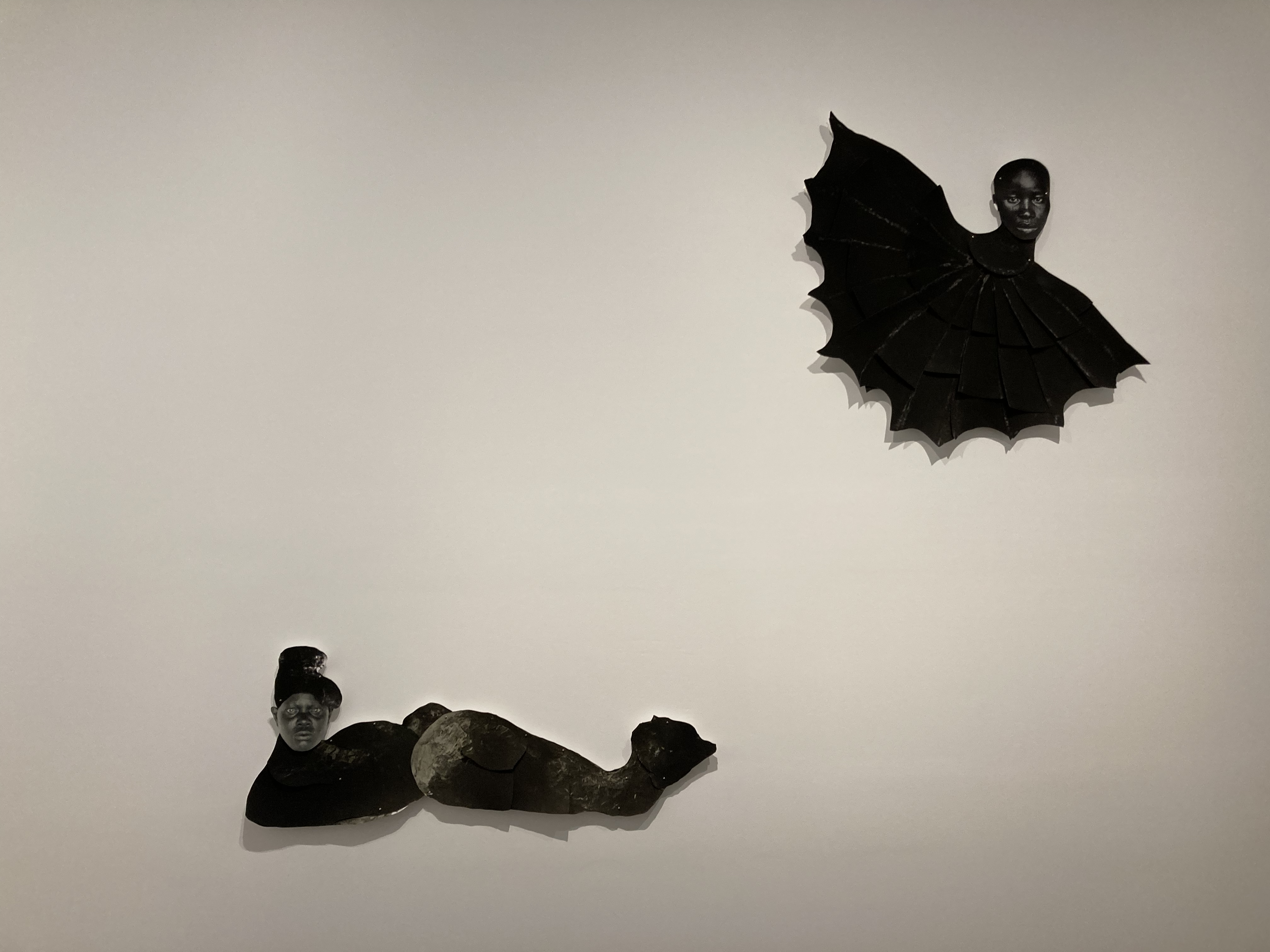
Frida Orupabo (born 1986) is a Norwegian of Nigerian heritage i.e. Black. She began posting photo collages on Instagram in the mid-2010s, cutting and pasting together images of Black bodies using historical and archive material; then in 2017 she took her approach into the real world (i.e. not just on a screen), creating the large collages you see here. All this led up to the exhibition which brought her to the curators’ attention, which was titled ‘I’ve seen a million pictures of my face and still have no idea’, which was held at the Photomuseum Winterthur, Switzerland, February to May 2022.

Installation view of Frida Orupabo at the Photographers’ Gallery

I immediately liked the results – very big, frameless, freestanding works which are more like sculptures hanging on walls than traditional photos. As far as I could tell, none of them had titles. Orupabo’s being Black and being a woman i.e. pressing contemporary art’s two big buttons of race and gender, sends the curators into a tizzy of artspeak:

The sculptural collages and digital works of Frida Orupabo are multi-layered formations, exploring questions of race, sexuality and identity. Orupabo, a Norwegian Nigerian artist and sociologist, grounds her inquiry in her own experience of cultural belonging. Utilising visual material circulating online, spanning colonial-era photographs and ethnographic relics to contemporary imagery, Orupabo’s hand-wrought works re-arrange and re-make the archive. The resulting images take the shape of fragmented Black, mostly female-bodied, figures.

These figures, first dislocated, are reassembled layer by layer in a complex and poetic manoeuvre that simultaneously denounces one-dimensional depictions of Black lives. Her collaged cutouts hold our gaze and invite various readings of the stories and lives of the people depicted, many of whom are entirely absent from the archives. In this way Orupabo invites a consideration of how photography significantly contributes to the formation and perpetuation of colonial power relations and violence.

Turning by Frida Orupabo (2021) © Frida Orupabo Courtesy of the artist and Galerie Nordenhake, Berlin, Stockholm, Mexico City

Does photography ‘significantly contribute to the formation and perpetuation of colonial power relations and violence’? Isn’t that like saying books ‘significantly contribute to the formation and perpetuation of colonial power relations and violence’ or laws ‘significantly contribute to the formation and perpetuation of colonial power relations and violence’? Surely any technology can ‘significantly contribute to the formation and perpetuation of colonial power relations and violence’ if that’s how the people wielding it want to use it. Probably guns contributed quite a bit ‘to the formation and perpetuation of colonial power relations and violence’, probably quite a bit more than photography. In fact photographs of the atrocities carried out by the authorities in the Belgian Congo did as much to disgrace and discredit that authority, as the kind of photographs the curators have in mind, the kind used to measure and categorise the Indigenous peoples, did to define and control them. Photography is just a technology. I can be used for good or evil. Writing that ‘photography significantly contributes to the formation and perpetuation of colonial power relations and violence’ is just art school boilerplate, modish rhetoric, smart-sounding swank (definition: ‘behaviour, talk, or display intended to impress others).

Anyway, as so often, the curators’ obsession with the twin shibboleths of race and gender blind them to the specificity of the actual art in front of them. Two things struck me. One was the way the deliberate crudeness of the artefacts is intentional: heads are pasted onto bodies at anatomically impossible angles, a pair of legs are completely separated from a body. She is highlighting the utter dysjunctive effect of her collages, their complete artificiality, and that reminded me of Dada, of the deliberately unsmooth, jagged photocollages of George Grosz or John Heartfield from 100 years ago.

Installation view of Frida Orupabo at the Photographers’ Gallery

But something not at all hinted at in the curators’ commentary is the horror tropes. In the top photo you can see that the loosely female figures are, from left to right, 1) attended by two sort of flying rabbit demons; 2) sitting on a monster’s head; 3) is shaped like a mermaid; and 4) in the most striking image, is a human head cut and pasted onto the body of a bat. A whole lot of stuff is going on here, but what strikes me is the invocation of imagery of Gothic tales and horror stories; it’s the stuff of Goya nightmares. What? Why? In this respect she reminds me of the way Kara Walker’s silhouettes of Black people in ante-Bellum Deep South morph into nightmare, monster images.

Installation view of Frida Orupabo at the Photographers’ Gallery

Anyway, it was the sheer weirdness of these big collages which grabbed me, not their alleged commentary on colonialist this, that or the other, and so I’ll tell you straightaway that, for the uncanny unexpected weirdness of her images, Orupabo was my favourite of the four artists: I wanted her to win.

2. Bieke Depoorter

Bieke Depoorter was born in 1986 in Belgium. She was selected for this prize on the basis of a 2022 exhibition titled ‘A Chance Encounter’, staged at C/O Berlin from April to September 2022. The display here consists of two parts, titled ‘Michael’ and ‘Agata’. Apparently:

In ‘Agata’, a first meeting [with Agata Kay] in a Parisian strip-club in 2017 evolves with complex tension into an intricate, changing narrative. The project explores questions of collaboration, the limits of a creative friendship, performance, boundaries and authorship.

I couldn’t find ‘Agata’. Possibly it amounted to one framed photo of a pink room, and maybe a collage of movie posters on one wall, but these weren’t labelled so I wasn’t sure. Going back to reread the introductory wall label more carefully I realised that the subject of Depoorter’s photos, the stripper Agata, eventually asked Depoorter to suspend their relationship and asked that all record of the photos, conversations and letters involved in it be erased. Maybe the Agata project is the absence of any materials about the Agata project. OK. That has a pleasing 1970s conceptual art feel about it.

But the reason I wasn’t too sad about not finding ‘Agata’ is because it was completely dwarfed by the other project displayed here, ‘Michael’. This is an epic, dense, absorbing and deeply unsettling work.

in 2015 Depoorter met a middle-aged, confused man named Michael on the streets of Portland, Oregon, USA. They got talking and Michael took her to his apartment which turned out to be covered from floor to ceiling with scrapbook-style cut-outs from magazines, books, newspapers, school reports, journals and diaries and all manner of bric-abrac.

Michael at home, Portland, Oregon, May 2015 by Bieke Depoorter, © Bieke Depoorter/Magnum Photos. Courtesy the artist

As a result of this encounter Michael gave Depoorter three suitcases containing a trove of his personal items, sketchbooks and essays which she, for unexplained reasons, accepted. Then, presumably, she departed Portland, for the wall label explains that, at some point later on, she tried to contact him again and failed. When she flew back to Portland to find him she discovered his flat rented to someone else and  that Michael had vanished, leaving no trace.

At which point Depoorter commenced what appears to have been months if not years of effort to track him down, the start of an obsessive quest to find Michael and to understand his life. As far as the labels tell us, to this day she still hasn’t found him, but along the way she has created the two big things which this darkened room is filled with. One is the way all the walls are even more covered in detritus and scraps of every kind than Michael’s apartment was, the records and ephemera of her hunt which Depoorter has acquired over the past 6 or 7 years.

Installation view of Michael by Bieke Depoorter at the Photographers’ Gallery

Post-its festoon multiple layers of documents and diaries and journals and magazine photos and contact sheets. Arrows connect different pieces of evidence. It’s exactly like the room of the crazed serial killer which the cops eventually break into in all those American psycho movies. She calls it ‘The investigation room’ and what we see here is just a fragment of the materials she’s accumulated in her obsessive, endless search. She has supplemented Michael’s own collection of ephemera with her own. The two sets of detritus are intimately interwoven. But spooky though this is, it isn’t the main thing: the main thing is the film.

Installation view of ‘Michael’ by Bieke Depoorter at the Photographers’ Gallery

It’s a 31-minute-long film detailing Depoorter’s obsessive quest so far. There are no moving segments. It consists entirely of still photos, so it’s by way of being a slideshow of places she’s been to and people she’s interviewed as she delves deeper into Michael’s life and past, her words and those of the interviewees appearing as captions on the screen.

So, in the sequence I watched, Depoorter spoke to some people who were at high school with Michael, who described his intense upbringing by nice but weird Mormons. We see stills of Michael’s high school yearbook with jagged, uneven hand-written notes scrawled across it. It has lots of overtones of serial killer movie, except Michael is no killer, just an oddball Depoorter bumped into and became slowly obsessed with.

If all this sounds weird (and it definitely is) after just a few minutes I found the pace and determination of Depoorter’s narrative drawing me into the film. Michael may have been just an insignificant nobody and yet, in Depoorter’s powerful telling, the memories of childhood friends and schoolmates become weirdly compelling. I realised I was being drawn into Depoorter’s own obsession. It’s contagious!

The curators comment that this work interrogates:

the complex ethical relationship and boundaries…between the photographer and their subject [and] questions the role and responsibilities of the photographer, the possibility or impossibility of truth in representation and grapples with personal and professional boundaries.

No doubt. But something deeper and weirder was also at work here. I was quite relieved to break away from the film and step back out into the light airy gallery space.

3. Samuel Fosso

Samuel Fosso was born in 1962 in Kumba, Cameroon. He was selected for the prize on the basis his exhibition ‘Samuel Fosso’ at the Maison Européenne de la Photographie, Paris, from November 2021 to March 2022.

Since the mid-1970s Fosso has dedicated his artistic practice to self-portraits and performative photography. In vulgar language, he dresses up and photographs himself. At the tender age of 13 he set up a Studio Photo Nationale in Bangui, capital of the Central African Republic. Alongside commercial work, Fosso began a series of self-portraits, and has carried on to the present day, hence a nickname he picked up along the way, ‘the man of a thousand faces’.

Autoportrait by Samuel Fosso, from the series 70s Lifestyle (1976) © Samuel Fosso. Courtesy of the artist and JM Patras, Paris

More recently Fosso has created a series titled ‘African Spirits’ in which he dressed up as – and recreated famous photographs featuring – Black celebrities such as (the ones on display here) radical activist Angela Davis, Martin Luther King, Malcolm X, Haile Selassie and Tommie Smith, one of the African Americans who gave the Black Power clenched fist salute from the podium of the 1968 Olympics.

Installation view of ‘African Spirits’ by Samuel Fosso at the Photographers’ Gallery. Can you name all 6 of these famous Black figures?

According to the curators:

Playing the role of key historical figures and social archetypes in front of the camera, Fosso embodies a powerful way of existing in the world, and a vivid demonstration of photography’s role in the construction of myths.

There’s also a pair of huge colour photos of himself dressed as soldiers from the First and Second World Wars, tribute to the many African and Black soldiers who fought in those wars (see my blog post, Congolese soldiers in the world wars).

Compared to the previous two displays, photocollage sculptures and a weirdly compelling documentary film, Fosso’s exhibits – classic framed photographs – seemed, well, kind of obvious, kind of quaint.

4. Arthur Jafa

Arthur Jafa was born in 1960, Tupelo, Mississippi, USA. He is an artist and filmmaker. What is an American doing in an exhibition supposedly restricted to exhibitions in Europe?

Well, one answer is that art curators can’t stop themselves promoting the Great Yoonited States of America: after all, Depoorter’s  ‘Michael’ project is about an American and entirely set in America and half of Fosso’s African Spirits are American. And now we have an actual American photographer. Three out of the four displays are heavily or entirely American.

Why do British curators love American art?

What can you do against the endless tide of American art and artists being promoted by British art curators and adding to the vast sea of American culture which floods all our channels? If Britain’s art curators are so hell-bent on promoting American culture and American values at every opportunity, all I can do is register my feeble protest and point out that there are, in fact, other countries in the world apart from America. Quite a few, actually.

Why do we rarely or never hear about them? Because America is easy, that’s why. American art comes pre-packaged with 1) fluent, articulate artists who are great in interviews 2) innumerable American critics who bubble over with rhetoric about race and gender and 3) political and cultural ‘issues’ which we all already know too much about about because they flood our TV, radio, movies, documentaries, newsfeeds, twitter and all the other American-run social media.

When an American artist gives an interview saying they’re addressing issues of #metoo or Black Lives Matter,everybody immediately knows what they’re talking about and nods in concerned sympathy because we’ve already seen and heard and read hundreds and hundreds of news items and newspaper stories and magazine features and documentaries interviews and tweets about just these ‘issues’.

American art is like McDonalds art. It’s smooth, pre-packaged, ready to consume, processed, pre-masticated, baby food. Just add water and you’re good to go. Compare and contrast the problems you’d encounter with the language barrier and with explaining all the little-known historical and cultural references if you tried to stage an exhibition of contemporary, say, Indonesian or Peruvian art. But another African American artist yakking about slavery or the institutional racism of American society – piece of cake, child’s play, no brainer, no mental effort required, just the appropriate amount of liberal sympathy.

Arthur Jafa

Anyway, Jafa is here despite not being European because his exhibition, ‘Live Evil’, was shown at Arles in the South of France i.e. a European venue, from April to November 2022.

There’s a video of an extended interview with Jafa. He’s very angry about racism, in America, Europe, everywhere. In the bit I watched he quoted Malcolm X and the Black Panthers. In a modern art gallery you’re never far away from the 1960s. My eyes glazed over because I have heard scores of Black artists complaining about racism in America and read hundreds of articles about racism in America. Black Lives Matter posters hang in the windows of concerned students round where I live.

The stories of Uyghurs Muslims locked up and tortured in Xinjiang, of the people dying and displaced in Yemen or Syria, of the 920,000 Rohingya refugees from Myanmar living in the world’s largest refugee camp in Bangladesh, now as I write and you read? Are these packing the walls of the Barbican, Tate Modern, the Royal Academy, the Photographers’ Gallery? No. Silence. Nada. Their stories will never be told. They might as well not exist. But another American artist doing another show about how racist America is? Take your pick.

One last obvious point about the ubiquity of American artists: America is rich. It has the wealth to support a huge class of artists who, if they play their cards right, can become very wealthy, successful, appear in all the right magazines, and generally enjoy a great lifestyle. Makes me feel a bit sick when artists from the richest country in the world complain about their suffering and oppression. Go and live in Somalia, Sudan, Liberia, Afghanistan for a month then fly back to your air-conditioned studio in LA and tell me about the suffering of ‘your people’.

Anyway, according to the curators, Jafa’s work is another ‘extended meditation on the issues of race and the Black experience’. Just like Frida Orupabo’s display, then. I’d swear there are other ethnicities in the world apart from Black and White. There are quite a lot of Indians and not a few Chinese, for a start. But not in Curatorworld. Black, Black and more Black, preferably American Black, is the only experience, the only voice, the only art we are going to be shown. I’m not saying ‘the Black experience’ is not a thing to investigate. I’m just saying that maybe it’s not the only story in the entire world to be aware of, to listen to.

Anyway, to quote the curators:

Drawing from a rich collection of images, film footage and music, Arthur Jafa uncompromisingly articulates Black experience, providing us with an exercise in visual literacy, confronting us with a new Black aesthetic which avoids fixed hierarchies and linear storytelling

There are just six works in Jafa’s display, six very large photos. First, maybe a word of explanation about the tile. ‘Live Evil’ is the name of a Miles Davis album, released in 1971, a live recording of a concert performed in December 1970 in Washington DC. After the epoch-making ‘Bitches Brew’ of 1969, Miles was working with a large group of almost entirely electric instruments, producing a strange voodoo swamp sound, mashing up heavy funk grooves with Jimi Hendrix guitar, and his own trumpet heavily electronically distorted. During this period Miles cultivated a dark and brooding image. He revelled in the nickname ‘the Prince of Darkness’, in fact he released an album titled ‘The Prince of Darkness’ in 1971, same years as ‘Live Evil’. Anyway, ‘Live Evil’, which sounds like this:

Miles Davis (1926 to 1991) was without doubt one of the great musical artists, composers and performers of the twentieth century. In the show he is featured in a diptych (‘any object with two flat plates which form a pair’) alongside the godfather of the Delta Blues, acoustic guitarist and singer Robert Johnson (1911 to 1938), which looks like this:

Bloods II by Arthur Jafa (2020) © Arthur Jafa. Courtesy of the artist and Gladstone Gallery

Johnson died young leaving only 20 or so recordings behind which have, nonetheless, become legendary and inspired all the blues guitarists of the 1940s and since. Dying young, Johnson left a legend or urban myth about himself which is that, in order to play so amazingly, he had sold his soul to the Devil. This legend was fostered by tracks with titles like ‘Me and the Devil Blues’ or ‘Hellhound on my trail’:

So what does Jafa’s juxtaposition of these two Black musical icons tell us? Well for a start, they both made smoking look cool. To consider their music, although only about 40 years separate the photos (1930 to 1970) they seem musically and technologically galaxies apart. Then again, maybe they’re linked by the common thread of their devilish reputations, hellhounds and princes of darkness. Finally, maybe it’s simpler than that: Robert and Miles were both outstanding musicians, embodiments of Black excellence.

Across the room is another, bigger and more dramatic juxtaposition:

‘Mickey Mouse was a Scorpio’ by Arthur Jafa (2016) © Arthur Jafa. ). Courtesy the artist and Gavin Brown’s enterprise

On the face of it, this is a straight contrast between an image of innocence and one of scary threat. Yet some other visitors I got talking to explained to me that they’re both images of identity masquerade: apparently, the earliest iterations of Mickey were based on white entertainers who’d blacked up as minstrels; while the figure on the right is actually a white actor who has blacked up using scary voodoo imagery (I assume this photo was shot on a film set but I can’t find out which one. Do you know?). They’re both lies, or deceptions, or multi-layered images of Blackness. Is that it?

This article explains that Jafa’s work:

tackles the complexity of African-American cultural identity, as defined by an existential paradox that places the Black subject ‘in essential intimacy with death’, as Saidiya Hartman explains in Jafa’s documentary ‘Dreams are Colder than Death’ (2013).

The endlessness of American pop culture

I liked the clarity of these dyptychs and also the fact that they were much deeper than they first appeared to be. The trouble, though, with popular culture, especially American popular culture, is that it is endless. Like the Bible, you can find a passage or quotes to prove anything you want to. I can cut and paste Homer Simpson next to Superman and straightaway I’m making important statements about masculinity, or something. Given such a vast sea of pop ephemera it would be hard to splice together two random elements and not find yourself raising interesting cultural or semiotic issues.

American culture combines technological wizardry with super-refined commercial strategising. Look at the Marvel Comic Universe movies, which are spectacular viewing, rank as the highest-grossing film series of all time, having netted over $29.1 billion, and have a mental age of around 9.

And American artists are trapped within this culture, condemned to try and imbue meretricious trash with meaning – and Black American artists are doubly trapped, trapped in a sea of Americana from which they (apparently, if someone like Jafa is to be believed) feel profoundly alienated. So I understand Jafa when he says that Black American artists are they trying to create narratives of Blackness which will help them navigate the bottomless dumpster of American pop culture, and the complex matrix of racist laws, assumptions and culture. I assimilate this kind of message because I’ve heard it hundreds, maybe thousands of times. It comes pre-packaged and ready to consume.

Anyway, the puzzling thing about the Arthur Jafa display is that the use of these two sly juxtapositions is not his only trick – only two of the six items use it; the other four items are single images and far more varied, not to say troubling.

One is a treated image of the Black singer of a rock band (HR of Bad Brains) jumping about onstage, which left me cold, having spent too much of my teenage year paying attention to images of rock performers to be impressed by one more.

But in a completely different tone from everything else, one entire wall is taken up with an enormous photo of what appears to be a room somewhere in Rwanda, empty of people, but filled with washing lines (?) from which hang the clothes and rags of people hacked to pieces in the terrible genocide.

Installation view of Arthur Jafa at the Photographers’ Gallery

Is this part of ‘the Black experience’? Or the African experience? Or the human experience? It was certainly part of this generation of Rwandans’ experience. Does it directly impact anyone who wasn’t there? If so, why more so than the Armenian genocide or the Holocaust or – the most disastrous civil war in history, the Taiping Rebellion in China in which at least 20 million perished (which I’ve just been reading about at the new exhibition at the British Museum)? Or the Great Leap Forward, 1958 to 1962, in which anything up to 50 million Chinese starved to death? Or, during my lifetime, the killing fields of Pol Pot’s Kampuchea in which up to 2 million people, a quarter of the population, were murdered or starved to death, 1975 to 1978?

I carry the images and histories of all these atrocities in my head, which not only gives me a very dim view of human nature, but also appears to be where I differ from someone like Jafa, because I don’t categorise these atrocities by the skin colour of the victims. They’re all human to me, each one an individual who suffered more than I can imagine, died in misery and terror, mounting up to a vast weight of guilt on the conscience of mankind. The collected atrocities of mankind don’t respect colour or ethnicity, which is why I find the foregrounding or privileging of some massacres or genocides over others morally repugnant.

Anyway, back to Jafa. The last piece in his display is a partial sculpture, a kind of bas-relief hanging on the wall of the whip-scarred back of a Black slave, a very potent image of man’s grotesque inhumanity to man or the atrocities of the Atlantic Slave Trade.

Ex-Slave Gordon 1863 by Arthur Jafa (2017) © Arthur Jafa. Courtesy of the artist and Gladstone Gallery. Photo by the author

I get it, the Black slave trade was a very, very bad thing and generations of white exploiters captured, bought, transported and treated their African slaves with unbearable savagery and brutality. But I happen to have just finished reading Robert Hughes’s epic history of transportation to Australia, The Fatal Shore, and it is packed to overflowing with the unspeakably sadistic treatment meted out to the transported white convicts, especially in the penal colonies of Port Moresby and Norfolk Island. For even slight misdemeanours like looking at an overseer the wrong way, a convict could get three hundred lashes till bystanders could see their spine and ribs through the remains of their butchered back and the bystanders had to pick gobbets of raw human flesh off their clothes. Hughes repeats descriptions of British or Irish convicts who were whipped to death. So this, for me, is the image of a whipped human.

Most of human history is an abattoir. To limit notions of suffering and injustice to just one ethnicity or to one group or one class seems to me historically and morally questionable. It’s a form of boasting – my grievance is bigger than your grievance. It’s very much part of the grievance and victim culture which America has perfected and exported to the rest of the developed world.

But billions have suffered abominably, in every continent, at the hands of all races. The génocidaires in Rwanda weren’t white. The killers in Cambodia weren’t white. The people who implemented the Great Leap forward weren’t white. The murderers of 1.5 million Armenians weren’t white. The administrators of the gulags weren’t Western imperialists.

If these seem disproportionately enormous ideas for a photography exhibition that’s because Jafa is aiming to trigger big ideas about history. It’s just that I happen to be, maybe, more knowledgeable about the history of atrocity than the average gallery goer and so my frame of reference is wider, maybe, than he intends. Maybe it’s just me. I’ve read more widely about atrocities throughout history than is good for anyone, and so this powerful object triggers a wider, deeper historical response than he was, maybe, expecting.

I’m reading Emma Sky’s book about Iraq. She mentions General David Petraeus raising Thucydides’s Melian Dialogue in conversation. This was written about the siege of Melos in 416 BC, part of the wider the Peloponnesian War. When the Athenians finally took the city of Melos they executed the entire male population and enslaved all the women and children. My year of reading Roman history and literature drummed into me that slavery was a universal institution throughout the ancient world, that the civilisations of ancient Athens, Rome and Egypt entirely depended on it and that the huge slave population was subjected to terrible, awful lives of unending labour and liable to whipping, cutting, maiming and torture for the slightest infraction.

That’s what I know, that’s what an image like this triggers; not the suffering of one particular group, but the universal horror of human history.

Jafa summary

Anyway, back from these vast horizons to a small room in Soho containing half a dozen artworks by Arthur Jafa. The conclusion from this small display seems to be that Jafa has at least two modes of operation, one consisting of the canny juxtaposition of images from popular culture, an astute form of curating and darkling satire; the other mode, flat-out horrific memorials of ‘the Black experience’.

This latter is, as you can imagine, catnip to modern white curators, driven by the bottomless resource of white bourgeois guilt:

By placing one resonant cultural artefact next to another Jafa references and questions the universal and specific articulations of Black experience. Eschewing a linear narrative, Jafa organises his material through formal and affective associations, linking his images through visual resemblance or thematic resonance. In this way Jafa aspires to an art that harnesses ‘the power, beauty, and alienation of black music.’

That’s from the press release. On the introductory wall label the curators say:

Embracing slippage and dissonance Jafa creates art that is as fluid and multidimensional as Blackness itself.

‘…as fluid and multidimensional as Blackness itself.’ What I took from the four exhibits on show here is that ‘Blackness’ as an artistic, critical and curatorial concept is indeed so fluid and multidimensional that artists, critics and curators can say almost anything about it and sound convincing. It lends power and a sense of urgency and relevance to even the most anodyne exhibition. It adds the spice of the ‘radical’ to a medium which all curators are uneasily aware is overwhelmingly white and bourgeois. Along with Gender it is a power word and, more than that, a kind of ideological matrix or discursive machine, which will continue to generate works and words, art and discourse, with ever-proliferating effect, for the foreseeable future.

From one perspective, ‘the Black experience’ as an art category is not so much the product of Black people’s actual experiences (which I imagine are very varied and complex) as it is of the liberal guilt of the White art establishment.

Who won?

Who do you think should have won the prize? It was won by Samuel Fosso, ‘the man of a thousand faces’. Why? Shoair Mavlian, the (White, obvz) Director of The Photographers’ Gallery and Chair of the Jury said that Fosso’s:

‘sustained exploration of self-portraiture uses a traditional, studio-based approach steeped in history, while at the same time his work remains relevant and addresses contemporary political issues of today with humour and authenticity. His work has created an extraordinary platform for Black voices and artists throughout his career.’

It’s a difficult choice but I think I liked Frida Orupabo’s weird, Gothic photomontages more than Fosso’s dressing up; and, although I’ve just given him a hard time, actually the clarity and design of Arthur Jafa’s diptychs have stayed with me days later, but then that’s American art for you, as slick and efficient as a Spielberg movie.

Who would you have given the prize to?


Related links

Atrocity reviews

More Photographers’ Gallery reviews

The Epistles of Horace book 2

If only my powers matched my yearning…
(Epistles Book 2, number 1)

The ancient Roman poet Quintus Horatius Flaccus (universally referred to as ‘Horace’ in the English-speaking world) wrote two books of epistles.

The first one, published in 21 BC, contains 20 shortish poems on a variety of subjects. The second one, published some ten years later in 11 BC, differs in two ways. First, it contains just three poems, but they’re long ones: whereas epistle 1.8 is 17 lines long and 1.9 is just 13 lines, the first two epistles in book 2 are 270 lines and 216 lines long, respectively, and the third one is nearly as long as the two preceding ones put together (476 lines). The second difference is that, whereas the 20 odes in Book 1 are varied in subject matter, the three longer poems in Book 2 are all very much on the same subject – poetry.

Epistle 1 (270 lines)

This poem is addressed personally to Augustus and is a defence of modern poetry.

Horace opens with a panegyric to Augustus and his achievements (bringing peace, re-establishing the rule of law etc) and says that, unlike earlier heroes of Rome, Augustus hasn’t had to wait till he’s dead to be worshipped: the population realises his importance while he’s still alive.

But then it turns out he’s said all this to make the point that when it comes to poetry, the Romans take a very different view from how they regard their leader. Instead of valuing the new for its achievements they obsessively worship the old and fusty, using age alone as a measure of quality. He lists the first Roman writers, from Ennius in epic to Terence in comedy, and says these are the writers the Roman population venerate as if they could never be improved upon. But they’re wrong. Many of those pioneering works are crude and clumsy but people persist in venerating them and rubbishing much better work, purely because it’s new.

It makes me annoyed that a thing should be faulted, not for being
crudely or clumsily made but simply for being recent.

People venerate and defend the old works because it’s what they grew up with and understand, which leads them to frown on new works because they don’t properly understand them.

What if the Greeks had only venerated the old and stifled innovation? We wouldn’t have most of the works we now enjoy and which the Romans can copy so freely.

Then Horace changes tack somewhat and laments the fact that Rome is undergoing a craze for writing poetry; everyone’s at it, even he, who had sworn to pack it in, is up before dawn calling for pen and parchment. But they’re all amateurs! You wouldn’t take medicine from someone who wasn’t a doctor or ask someone who wasn’t an experienced sailor to take the helm of your yacht: so why should you read verses by a complete amateur?

On the upside, one thing that can be said for proper poets is they live very modestly. Horace never cheats, fights, causes social strife –, on the contrary, he is content to sit quietly, reading and scribbling, living off pulses and second-rate bread. Here is how the poet serves his country:

The poet shapes the tender faltering speech of a child,
already turning the ear away from coarse expressions.
Later he moulds the disposition by kindly maxims,
using his voice to correct cruelty, envy and temper.
He recounts noble actions, equips the new generation
with old examples, and brings relief to the poor and sick.
Where would innocent boys and girls who are still unmarried
have learnt their prayers if the Muse had not vouchsafed them a poet?
The choir asks for aid and feels the deities’ presence;
by the poet’s prayers it coaxes heaven to send us showers;
it averts disease and drives away appalling dangers;
it gains the gift of peace and a tear of bumper harvests.
Song is what soothes the gods above and the spirits below.

I’ve quoted this passage at such length for two reasons. One is to refute Horace’s optimistic claim for the poet, that:

He recounts noble actions, equips the new generation
with old examples

Is that true of Catullus, with his spiteful lampoons of helpless victims, with his hate poems against Lesbia after she dumped him? No. It’s not even true of Horace himself, whose 104 odes I have just read and which are about drinking, parties, the joys of the countryside, advice to friends about affairs, poems of longing for beautiful young boys, and so on.

To claim his own poetry is full of noble actions designed to instruct the next generation is ludicrous. A lot of it is just tittle-tattle and gossip, entertaining but hardly educational. In other words, this is the kind of stock, boilerplate excuse poets trot out to justify their profession to the public when the reality of what they write is often wildly different.

But the second reason is sociological. It would be easy to end the quote at the word poet, as if writing poetry were a solitary activity to be enjoyed by solitary readers. It certainly is this, but the final five lines are interesting because they put the act of poetry in a much more public context. Remember that Augustus commissioned Horace to write a hymn to be sung by a choir at the opening of the Secular Games, which Augustus revived in 17 BC. By a choir! Learning his words and learning to sing them to (presumably) an ancient melody.

And what could a public hymn to be sung by a choir in front of an audience of hundreds of thousands of Roman citizens possibly be about but an invocation of the gods and plea for peace and plenty? So I included this latter half of the quote to show the intensely public and social side of the poet’s role in ancient Rome. (I was going to write ‘very unlike our own times’ when I remembered the stunning performance by poet Amanda Gorman at Joe Biden’s inauguration as president in January 2021.)

Horace changes tack again to give a brief history of Roman poetry. The native Roman tradition began with coarse rural songs sung at country festivals of marriage or harvest. These became so wild and often abusive that they eventually had to be reined in and restricted by laws. Only late in their history did the Romans become aware of the centuries-old tradition of Greek poetry, overflowing with sophistication, a wide variety of metres, a number of well worked-out genres and conventions. Only after the final Punic War and crushing of Carthage in 146 BC did educated Romans think of imitating the sophisticated Greeks, and even then moments of ‘farmyard’ vulgarity still came through.

This morphs into contempt for current Roman taste. Horace thinks Plautus’s comedies were feeble with poor characterisation of his various stock types (I genuinely enjoyed Plautus’s comedies). But he is appalled by the modern theatre which doesn’t even stage plays any more so much as pageants and spectacles, featuring bears or boxers – a cross between pantomime and the circus. Nonetheless, Horace is full of admiration for playwrights who write proper plays and evoke genuine deep emotions: that’s something he could never do.

Then he switches tack again and brings Augustus back to the poet who writes not for a fickle audience but for the individual reader. Now it’s true that poets are sometimes their own worst enemies, and he gives an interesting list of the ways they can screw up:

  • thrusting a book on Augustus when he is tired or worried with important concerns of state
  • being oversensitive to criticism of even a single line
  • when, in a reading, they repeat a favourite section without being asked
  • when they moan that their excellence goes unrecognised
  • when they arrogantly assume that as soon as Augustus hears they’re writing something, he’ll immediately summon them to court and make them a gift to relieve their financial worries

Nonetheless, it is important to choose the right poet, qualified and able poets, to celebrate your successes. A long paragraph tells the story of Alexander who patronised a third rate poet, Choerilus, and so, alas, was never immortalised in verse. Horace then flatters Augustus for his excellent choice of chief poets, namely Virgil and Varius.

Horace draws to a close by wishing that he, too, could write epic poetry about Augustus’s achievements, describing ‘the Parthian foe overawed by your imperial Rome’ but alas, he is not talented enough: ‘If only my powers matched my yearning’. But he would be rash to embark on a task so far beyond his abilities.

I don’t understand the final 11 lines. I think the general idea is that it is better to have no lines at all written about you than to be remembered for being memorialised in hilariously bad verse. It would be embarrassing and might even be fatal!

All this I take to be yet another grovelling apology to Augustus for not writing him some grand, noble and dignified Poem, and instead offering short, ad hoc poems which play to Horace’s talent for moral sermons and gossipy odes.

Epistle 2 (216 lines)

Is addressed to Julius Florus and is a long apology by Horace for not writing lyric poetry.

But I had barely got going before, once again, as so often in Roman literature, I stumbled over the slavery issue. Epistle 2.2 opens with 20 lines describing the imagined sales patter of a slave trader, describing the merits of a young man he’s selling. It’s obviously designed to be comic in the way a modern comedian impersonating the bluster of a second-hand car trader could be done for comic effect. Horace has his slave trader make his sales pitch a bit more plausible by admitting that, ok, the slave for sale isn’t perfect: once or twice he dodged his work and hid under the stairs ‘for fear of the strap on the wall’ i.e. of being whipped (which was the standard punishment for slaves, in Republican Rome in the 20s BC as in European sugar plantations in the 18th and 19th centuries).

The point of this elaborate analogy is that Horace tells Florus that the slave trader of the anecdote was being honest about his merchandise’s flaws – and that, in the same way, he, Horace, was being open and honest when he told Florus, as he was leaving for duty in the army abroad, that he, Horace, is lazy and was unlikely to send letters as often as Florus demanded, and also was unlikely to send him as many poems as he hoped.

He, Horace, was quite frank about this, so why is Florus now upbraiding him? That’s the point of the opening anecdote…But I’m thinking about the slave boy cowering under the stairs, waiting for the master to come after him with the blood-stained whip…

If slavery matters, it matters everywhere, at any time, and to all peoples who have been enslaved.

Forcing myself back into the ‘civilised’ ‘cultured’ world of Horace’s poetry, the epistle now cuts away from this anecdote to give us another vignette, this time about one of Lucullus’s poor soldiers who’d saved up a nice sum of money. One night someone stole it. Next day, bubbling with rage, the aggrieved soldier flung himself at the enemy and dislodged them from a well-defended position. For this act of bravery he was acclaimed, decorated and given money. At which point he stopped being angry. So that when the general came to him a few days later to ask him to lead a similar assault on another fort, the soldier refused. If you want someone to lead a suicidal attack, the yokel told the general – find someone who’s just been robbed.

Horace then cuts away again, this time to a passage of autobiography: He tells us he was raised in Rome, went for further education in Athens, but was caught up in the civil wars and recruited into Brutus’s army (which was based in Greece) and found himself commanding a legion at the Battle of Philippi, where he saw the line break and be massacred, so flung away his shield and ignominiously legged it (as he had already described in ode 2.7. All this is by way of saying that when he finally fetched up back in Rome, discovering his father was dead and his land confiscated, he wangled a minor job in the Treasury and took to writing verses, inspired by ‘Lady Poverty’.

The point of this digression being that Horace is like the soldier who had his wallet stolen. When he was poor, he was highly motivated and turned out verse at speed. But now he is successful and well enough off to suit his needs, like the soldier once he’d made his pile, he doesn’t need to return to the fray.

He takes another tack at justifying the same thing, saying his slowing down in writing poems is due to age. Age strips away all our pleasures, fun, sex, parties and sport. Now it’s denuding him of his ability to write poems.

The poem is turning into a litany of excuses. His next excuse is that, even if Horace did write some new verse, it’s impossible to please everyone: take three guys and the chances are one will like lyric poetry, one iambics and one ‘the tangy wit of Bion’s homilies’. So, what kind of poem should Horace write or avoid?

He then changes tack to make another excuse: How can Florus expect him to write poems while living amid ‘the storms of city life’ in Rome? There are two types of distraction: people, who endlessly demand attention, want him to be their patron, do business with him or are ill and demand visits. The second is the sheer racket: building works, wailing funeral processions, lumbering carts, mad dog barking, how can a man concentrate on writing verse?

He changes the subject again to mock the literary world, full of writers lavishing extravagant praise on each other, and in particular of poets, ‘that hypersensitive species’. He recalls putting up with recitals from terrible poets and replying tactfully. But now he breathes a sigh of relief that that period is over, his work is done, and he doesn’t have to listen to another word.

Too many modern poets praise their own work, regarding each line as sacred. Horace, by contrast, says the true poet is as stern as a censor, cutting any word ‘deficient in lustre or lacking solidity’ or which he deems unworthy of honour. He will revive worthy old words from the time of Cato, which have fallen into disuse and he will adapt new ones, where needed. Thus his work will flow strong and clear like an unpolluted river, enriching the land with his wit and the wealth of his language.

But then, it’s best to abandon verse altogether. It’s a children’s activity. Instead seek the good life:

instead of hunting for words to set to the lyre’s music
to practice setting one’s life to the tune and rhythms of truth.

I don’t fully understand the next 30 lines or so but I think they are a version of Horace’s core moral message, which is that we should be content with what we need and not be greedy, not hanker after unnecessary wealth or luxury.

I shall enjoy what I have and draw on my modest supplies
as needed…

We shouldn’t waste our lives scheming to make money and then splashing it around wastefully. Instead we should:

make the most of the short and beautiful time

What started in a tone of abject apology to Florus for not having kept up his side of the correspondence or sent the poems he promised, has somehow turned right around to become quite a harsh criticism of his friend. Quite rudely, he says possessing a thicker wallet doesn’t appear to have made Florus any the wiser. Florus claims he isn’t a miser, but Horace rather accusingly asks whether he’s banished the other vices, related to miserliness. Is his heart no longer obsessed with futile ambition, or with fear of death? Does he treat dreams and prophecies as the jokes they are, or live in superstitious fear of them? Florus should be improving his mind and morals, living sensibly. In a brutal last few lines, Horace concludes:

If you can’t live as you ought, give way to those that can.

Epistle 3 – The Art of Poetry

Epistle 3 has a special place in literary history as it is clearly quite different in length and ambition from the other epistles and quite early on was extracted and published by itself with the title Ars Poetica or The Art of Poetry.

The epistle is addressed to Horace’s friend Lucius Calpurnius Piso (a Roman senator and consul) and his two sons and forms a long and wide-ranging meditation on the rules and conventions applying not only to the kind of lyric poetry Horace himself wrote, but, above all, to plays.

What struck me most was the structurelessness of it. There’s no introduction or explanation or laying out of the themes. Instead Horace launches right in, in the conversational tone, and rather haphazard structure, of the epistles rather than the academic tone of a treatise.

Horace kicks off by explaining the importance of unity and simplicity by imagining the case of a painter who painted a human head on a horse’s body, a body which was itself covered in feathers and ended in a fish’s tail. How absurd everyone would find that. Well, that’s because an artist should observe decorum and restraint. Don’t just tack beautiful passages about temples or rainbows onto a work if it’s about something else.

Make what you like, provided the thing is a unified whole.

Horace himself tries to be brief and smooth, though he admits often failing at both.

Writers must give thought to what subject and format suits their powers, rather than attempt something they’re incapable of. If you choose a theme within your scope, the rest should follow. It should become obvious what to leave in and what to leave out.

Do not be afraid of simple and obvious words. Often they are best. Invent new words reluctantly. New terms imported from Greek are acceptable if kept to a minimum. Language is like trees. The old leaves (words) wither and fall, to be replaced by new ones. In the long run, our entire civilisation will crumble and fall, so how can we keep our language from changing and evolving?

Usage is king. Usage determines the meaning and validity of words. Use the language the men of your time use.

Horace briefly explains the advent of different metres for the various kinds of poetry: epic, elegiac, dramatic, and lyric.

Everything has its appropriate place and ought to stay there.

So the first job of the poet is to learn about the different genres, their histories, the appropriate subject matter for each, their format in terms of metres, their diction.

But correctness is only the beginning. A poem must be attractive, it must evoke the listener’s emotions. It must match the words to the emotion being portrayed or the audience will burst out laughing.

Follow the tradition regarding well known characters, for example the heroes of the Trojan war or the gods. If you dare to innovate a character, making him or her consistent. ‘You’d be well advised to spin your plays from the songs of Troy’ i.e. rely on tried and trusted characters from legend.

My Roman friends, I urge you:
get hold of your Greek models and study them day and night.

The good writer doesn’t start with bombastic invocations and promises. Chances are you won’t be able to live up to it. The mountains will labour and give birth to a mouse! The good writer hurries the reader into the middle of things (in media res) as though they are quite familiar.

Horace gives an entertaining review of the ages of man, entertaining in that classical sense of pleasingly reiterating obvious clichés and stereotypes. The old man is:

morose and a grumbler, he is always praising the years gone by
when he was a boy, scolding and blaming ‘the youth of today’…

So attribute behaviour and views to characters which are appropriate for their stage and situation in life.

Some actions should be presented onstage, for things seen make much more of an impression than things merely described. However, there are events which shouldn’t be described but must take place offstage and be reported, for example Medea killing her own children or Atreus killing, cooking and serving up his brother’s sons to him at dinner. (Hannibal Lecter has been on my mind and this line reminds me of how modern American culture deliberately, consciously, drives a coach and horses through norms of restraint and decorum.)

He then gives very strict rules about plays. All plays should contain exactly five acts. Do not let a god intervene. You can have a fourth character but they should not speak (thus following very strictly the convention of ancient Greek theatre.) The chorus should take the place of an actor, sing between the acts, but only of subjects which are tightly relevant to the plot. The chorus should side with the good and give them advice, and try to restrain the bad.

Horace gives in to his own stereotype of the ‘grumpy old man’ and laments the good old days and simplicity of Greek drama. Back then the ‘pipe’ then was a simple instrument which performed simple ditties because the theatre was relatively small and not packed, and the audience had ‘honest hearts, decent and modest.’

But victories brought wealth which encouraged (presumably he’s talking solely about Athens here) the Athenians to allow drinking in daytime, allowing greater liberty in tunes and tempos, encouraged actors to dress up in more and more sumptuous costumes and ‘mince’ across the stage, the tunes of the lyre became more complex and the delivery of moral homilies became more complex and obscure.

Horace attributes the word ‘tragedy’ to the Greek tragos, meaning goat, and ‘satire’ to the mythical figure of the half-goat satyr.

In Greek theatre three tragedies were performed in succession, and were followed by a comic to lighten the mood and lead into festival and celebration. This satyric drama was not the same as comedy and had its rules and restraints. Horace warns against having gods or heroes who feature in the tragedies dragged onstage and mocked in the satyr play.

If he ever wrote a satyr drama, it would mix high and low, blending ‘familiar ingredients’. The artifice would be in creating seamless joins, ‘such is the power of linkage and joinery’. But don’t be crude: cultured ‘knights’ i.e. semi-aristocracy, are repelled by jokes from the streets and back alleys.

Horace turns to (briefly) consider specific metres, considering ‘feet’ such as the iamb (da-dum) and the spondee (dum-dum).

Not for long, though because he moves on to give a brisk history of the origin of the dramatic genres. Thespis invented tragedy and was followed by Aeschylus who elaborated it. This was followed by Old Comedy which became, however, too abusive and violent and so had to be reined in by law.

Roman playwrights have copied the Greeks and left nothing untried; they have often been at their best when they’ve departed from Greek models. But their weakness is carelessness. A good work should be like fingernails, trimmed and filed to a perfect shape. Some writings have encouraged writers to believe that the true poet is mad and so they’ve cultivated eccentricity instead of studying.

Horace sees himself as a grindstone which sharpens the steel but takes no part in its creation. Hence this epistle of advice. At bottom, the fundamental basis for writing is Good Moral Sense.

Moral sense is the fountain and source of proper writing.

The Greeks had this. Study Socrates. Be clear on what is due to your country and friends; what is involved in loving a parent, brother or guest; what is the conduct required of a judge or senator; what are the duties of a general. This way you will know the correct sentiments and speech to give to these kinds of characters when you present them. The playwright should look to real life for examples of behaviour and speech.

A play with attractive moral comments and credible characters may work onstage even if it lacks finish and polish and style. The basic subject matter wins assent.

One problem is that, unlike the Greeks, the Romans are a money-grubbing nation, and he gives a little vignette of children being taught their fractions.

The aim of the poet should be to instruct and delight. To do so: keep it brief. Old people in the audience want morals; young dandies appreciate style. To please both, make your work useful and sweet (utile et dulce), blending help and delight.

That said everyone makes mistakes, and he can forgive blots of style in an otherwise good-hearted work. Even Homer nods.

The raison d’etre for a poem is to please the mind. It’s alright to have average lawyers or generals. But a poem, in order to justify its existence, should be as excellent as possible. Therefore, read your works to good critics, to Horace himself if you can, but then…sit on it for 9 years. Then take it out and reread it and edit and trim it coming it to cold and mature.

You can always delete what hasn’t been published; a word let loose is gone forever.

A brisk summary of the founding of civilisation by Orpheus, Amphitryon and so on. The establishment of laws and boundaries. Homer inspired to battle. Song was the medium for oracles. Poems sought a king’s favour, or celebrated the end of a season’s work. Therefore, don’t be ashamed to study the tradition.

Is it a gift or craft which makes good poetry? Both. Olympic athletes train hard for their supremacy. So do musicians. Why is it only poetry where any amateur can put forward shoddy offerings and claim himself to be a genius?

Quite a funny passage describing the rich man surrounded by flatterers who announces he has written some verses, does anyone want to hear them? Of course the flatters jump to attention and turn pale with emotion, weep, or laugh and cheer, as required by the verse. Doesn’t mean it’s any good. Beware of flatterers.

He remembers how honest his friend Quinctilius was. If you read him your verses he’d honestly tell you  which bits to amend. If you swore you’d tried already, he’d recommend you go back to the drawing board and try to express it some other way. An honest friend honestly points out your errors and so saves you from being laughed at if you publish rubbish.

After all this description of sense and hard work and clarity of thought, Horace ends, very incongruously, with 20 or so lines describing the ‘madness’ of the poet, who wanders the fields, head in the air, reciting his lines, and if he happens to fall into a deep well, who’s to say he didn’t do so on purpose! Consider Empedocles, so irrational he threw himself into the volcano of Mount Etna.

So why is a wretched poet condemned to write poetry? Is it punishment for some gross act of sacrilege like ‘pissing on his father’s ashes’. Did he profane a holy place?

All this seemed very out of place with Horace’s usual calm, even tone, and I began to suspect it was comic hyperbole, when, in the last few lines, he claims that a poet is like a wild bear which has smashed the bars of its cage and scattered everyone, cultured or not, by the threat of reciting. The wild poet threatens to grab anyone who comes within reach, in a fatal bear hug, and then read them to death!

Yes. I think this entire final passage is intended to be ironic, a satire on the popular stereotype of the poet – which is completely unlike the careful, studious, hard-working figure the preceding 450 lines had gone to such lengths to describe.


Credit

Niall Rudd’s translation of the Epistles of Horace was published by Penguin books in 1979. All references are to the 2005 Penguin paperback edition.

Roman reviews

Pseudolus by Plautus (191 BC)

‘She was mine to do as I liked with.’
(Ballio the pimp about Calidorus’s lady love, the slave-courtesan Phoenicium, page 230)

Of the 20 or so plays by Plautus which have survived from antiquity, this is the longest. We have the precise date of production, 191 BC. As so often it is set in the street in front of two houses and the lead figure is a canny slave. Yet the real star of the show turns out to be Ballio, the wretched pimp.

Setup

Calidorus is the stock young man. He is in love with Phoenicium, who is a slave-prostitute ‘singing girl’ who belongs to the wretched pimp, Ballio. The play opens with Calidorus showing his father’s chief slave and loyal servant, Pseudolus, a letter he’s just received from Phoenicium telling Calidorus that she’s been sold by her master to a Macedonian officer who just has to complete the payment of 2,000 drachmas and will take her away forever tomorrow. After some banter, Pseudolus promises to devise some way of getting her back or else he’ll pay Calidorus 2,000 drachmas. They hide to one side as Ballio appears.

The plot

Enter Ballio

In one of the two houses onstage lives Ballio, the pimp. It’s his birthday today. He enters brandishing a whip and terrifying his male slaves. He calls them lazy good-for-nothings and whips at least one of them. Then he gives them all chores to do as he’s planning to hold a feast to impress some VIPs.

The slaves go off about their chores, then Ballio calls out his female slaves, presumably his ‘courtesans’ i.e. sex workers, among whom is Calidorus’s true love, Phoenicium. Ballio shouts at the women slaves that today he will set one of them free, but the criterion will be, which one can get her lover to bring him, Ballio, the most extravagant birthday presents. Otherwise what’s the point of keeping such a harem of greedy lazy slaves?

Ballio goes through each of his ‘girls’ by name, pointing out the sectors of the market they specialise, namely the corn merchants (Hedylium), the butchers (Aeschrodora), the olive oil men (Xystilis) and finally Phoenicium, who he characterises as a gentleman’s pet, always promising to bring him the fee for her freedom but never actually delivering it (p.224).

Ballio dismisses the women, while in their hiding place Calidorus and Pseudolus bicker about what to do. Ballio is just setting off for town with his boy when Pseudolus calls out to him. After some banter in which it becomes clear the Ballio knows and dislikes our boys, Pseudolus takes command of the conversation and says Calidorus is sorry for not having come up with the cash to buy Phoenicium. Ballio has no sympathy: he should borrow it from a friend or steal it from his father. After Calidorus has stopped being scandalised, Pseudolus takes the lead again and promises Ballio he’ll come up with the money somehow within three days.

Ballio teases Calidorus by telling him Phoenicium is not for sale…at which point Calidorus rejoices and says Ballio is a second Jupiter and he needs to send Pseudolus to buy a lamb whose giblets they can sacrifice to this wonderful fellow. But, Ballio continues, Phoenicium is not for sale because she’s already been sold (p.230).

In a comic passage Pseudolus and Calidorus stand either side of Ballio and call him every abusive term they can come up with, but it is water in a sieve, he doesn’t care: he happily admits he killed his own parents to avoid having to pay for their care, he is a worm and it doesn’t bother him. And in that spirit he tells them that the Macedonian officer has only put down 1,500 of the 2,000 drachmas he’s contracted to pay for Phoenicium. If the boys can being him, Ballio, the full 2,000 today, maybe he’ll change his mind. And with an evil grin he sets off for the market.

Pseudolus soliloquy 1

Pseudolus then explains to Calidorus that he has a cunning plan, but he needs Calidorus to provide a friend, an intelligent, reliable friend to play a role in his plan. So Calidorus exists to find one.

Pseudolus is left onstage to admit to the audience that he doesn’t have the slightest idea or plan he just wanted to get rid of Calidorus. Much more likely is that he might be able to wangle the 2,000 drachmas out of his master Simo, who just at this moment happens along with his neighbour Callipho.

Simo

Simo tells the audience his son Calidorus is the talk of the town, everyone knows he’s desperate to buy his courtesan girlfriend but doesn’t have the money. Callipho says he shouldn’t be so hard on his son after all he was a tearaway and libertine in his own youth. They both spot Pseudolus listening to them and approach and say hello.

A feature of this play is it is quite slow moving. This is because the characters spend quite a lot of time in extended conversation: first Calidorus and Pseudolus with Ballio, now Pseudolus with Simo and Callipho – extended pleasantries and banter. Basically Simo tells Pseudolus he knows all about his son’s plight and is well aware that Pseudolus is planning to extract 2,000 drachmas out of him, but assures him it won’t work. Pseudolus declares that, on the contrary, he will get it out of him, which both Simo and Callipho consider a cheeky threat.

CALLIPHO: ‘Ye gods! The man’s a living marvel – if he can be as good as his word.’

Not only that, Pseudolus assures the two sceptical old men that before the day is through he will have won not one but two victories: he is going to extract the 2,000 drachmas from Simo and he is going to remove the girl from Ballio’s grasp! Pseudolus says, if he manages in the former, will his master give him the money and his freedom? Reluctantly, Simo agrees.

Callipho finds all this very amusing and when Pseudolus announces he needs him for his plans, happily agrees to cancel his planned trip to the country to do so. What’s more, he cheerfully tells Pseudolus that if Simo refuses to give him the money he, Callipho, will. All very relaxed and amused. Callipho goes into his house, Simo goes off into town.

Pseudolus soliloquy 2

Pseudolus not only speaks directly to the audience, he breaks the conceptual fourth wall by talking about the play itself, saying he currently has no idea how he’s going to pull it all off but what’s a play without surprises, so he begs our indulgence while he goes for a think and, meantime, there will be a musical interlude.

Musical interlude with a flute player

Pseudolus re-enters and fools around making a speech in the grand style describing how he will mount a siege and storm the house of his enemy i.e. Ballio. He’s in mod flow when he spies someone coming, and hides.

Enter Harpax

Harpax is a soldier, the representative of the Macedonian officer who’s put a down payment on Phoenicium. He talks out loud as he tries to figure out which of these houses is Ballio’s which gives Pseudolus the opportunity to step forward and pretend to be Ballio’s steward, Syrus. Harpax says he’s come with a purse of the outstanding sum, 500 drachmas, plus a sealed letter and the personal token of his master, the Macedonian officer, as agreed with Ballio. Pseudolus says his ‘master’ Ballio is out right now, and tries to persuade him to give him the purse but Harpax isn’t that dumb. He does, on the other hand, give him the sealed letter to give to Ballio, before announcing he’s going back to his inn to have lunch and a nap and for Pseudolus to send a message to him when Ballio returns. And so he exits.

Pseudolus soliloquy 3

Pseudolus tells us this is the lucky break he needed and launches into extended philosophising about the best laid plans and Lady Luck and so on, when he spies young Calidorus returning with a friend.

Enter Calidorus and Charinus

Pseudolus likes putting on funny voices and so adopts a tone of royal grandiloquence to greet his master. But he quickly comes to have a low opinion of the friend, Charinus, who is nettled by his disrespect. Nonetheless he shows Calidorus the letter and token.

Pseudolus says he will need a man. A slave? suggests Charinus. Yes. Well Charinus just happens to know a slave his master has freshly sent from their country estate to here, in Athens, named Simia. Perfect. And is he a slippery eel and trickster? Yes. And might Charinus happen to have a soldier’s cloak at his house? Yes. Pseudolus has gained new respect for Charinus, he’s a veritable charitable institution.

The plan? They’ll dress up this newly arrived slave as a a soldier, give him the letter and token and 500 drachmas and he will pretend to the Macedonian’s man and secure Phoenicium from the pimp. Pseudolus tells the chaps to go and prepare him.

Pseudolus soliloquy 4

Two enjoyable features of the play:

  1. Pseudolus amusingly uses military metaphors to describe how he is laying sieges and strategems to take Ballio’s fortress by storm.
  2. Pseudolus in a very post-modern way keeps referring to the play he’s actually in. So when Calidorus and Charinus ask him how he got the better of Harpax, he simply replies that the audience has seen everything so there’s no point repeating it (p.245)

He also leaves the stage.

Ballio’s slave boy

A touching soliloquy from Ballio’s slave boy describing how being an ugly boy in a whorehouse is a miserable fate. Ballio threatened everyone with the whip if they couldn’t come up with fine presents for him, but he hasn’t got anything.

Ballio returns with a cook

Ballio has hired a cook and assistants for his feast. It is typical of this play that there’s quite a long passage of dialogue devoted entirely to fleshing out his character, in which Ballio insults the cook for being an evil looking wretch and the cook cannily defends himself by saying he is always last to be hired because is more expensive and better quality than the ruck.

As with the role of the ‘table companion’ in Menaechmi, this gives a vivid sense of the forum as the place where people went to be hired for jobs for the day.

Anyway, Ballio orders his ‘ugly boy’ to keep a sharp watch on the cook and his assistants to make sure he doesn’t pinch anything. When they’ve all gone into his house, Ballio gives a little soliloquy in which he explains that he bumped into Calidorus’s father in the market and the latter warned him that Pseudolus has got a cunning plan to wangle Phoenicium off him. So he’s going to tell all his slaves to be on the lookout for the tricky Pseudolus.

Pseudolus and Simia

Enter Pseudolus with Simia, the smooth, handsome young slave Charinus promised. He is dressed up in a soldier’s outfit and very pleased with himself, super confident of his ability to ‘fake and fiddle’, rather to Pseudolus’s irritation. Pseudolus keeps asking if he remembers what he is so say and Simia crossly says yes yes yes.

As with all the other scenes and exchanges in this play, the two pages of Pseudolus fussing over Simia and the latter getting increasingly irritated, are not really necessary to the plot, but add colour and depth.

Ballio comes out his front door, still fussing about the cook he’s hired and Simia steps boldly forward, pretending to be the soldier Harpax finding his way. Pseudolus stays in hiding, wincing at more or less every one of Simia’s cocky remarks. But, to cut a long story, short, Simia hands over the letter and token and succeeds in persuading Ballio that he is the emissary of the Macedonian officer. Ballio reads the letter (which is quite rude about him), Simia hands over the money, Ballio says, Right, come and get her, and they go into his house.

Pseudolus steps out of hiding. All is going well but his nerves are wracking, any number of things could still go wrong: his master might turn up, the real Harpax might turn up, or Simia might go over to the enemy for a cash reward!

In the event the door opens and Simia and Phoenicium emerge and are waved off by Ballio who goes back into his house. Pseudolus hurries to join them and says, Quick, quick, while the coast is clear! and so they make off. Worth noting that the military metaphors deployed by Pseudolus are echoed by Simia who is, of course, dressed as a soldier. The entire thing has a comic thread of military pastiche running through it.

PSEUDOLUS: ‘Forward march! For victory and the cup of triumph!’

Enter Simo

Simo is Calidorus’s father and the subject of the bet with Pseudolus. He now enters with a view to checking with Ballio how things are going. He says hello, they talk and Ballio is so confident that the deal has gone  his way he hustles Simo into making a bet with him: Ballio promises to give Simo 2,000 drachmas (and a girl thrown in) if Calidorus gets possession of the girl today. Simo has nothing to lose so he shakes on the bet.

When Simo asks what this Harpax was like, Ballio, like Pseudolus, breaks the illusion of reality by saying Harpax used the usual type of gags used in this kind of comedy, and was used the stock terms given to pimps in comedies. Part of the enjoyment is the way the comic characters know they are in a play, readily admit it and play up to it.

Anyway, Ballio assures him on his life that Pseudolus won’t be able to pull one of his tricks, it’s too late, he has handed over the girl to the Macedonian officer’s man, who was bearing his letter and token, there’s absolutely no way anything can go wrong.

Enter Harpax

Oops. At which point the real Macedonian emissary, Harpax, arrives. He gives a little speech about how the good servant is always thinking of his master’s best interests, even if he’s not physically there, giving orders. This is interesting because it’s almost identical to the speech on the same subject given by Messenio in Menaechmi – the point being it’s obviously a stock sentiment given to the Good Slave in this kind of play.

Anyway, he waited at the inn for the fellow claiming to be Ballio’s steward (in reality Pseudolus) to come and get him, but he never showed up so here he is, taking the initiative in carrying out his master’s orders.

So comic misunderstanding. At first Ballio sees a stranger approaching and tells Simo here’s business for his whorehouse. He’ll take his money and be glad. But then Harpax declares his is the emissary of the Macedonian and has the money for the girl. At which point, instead of realising he’s been diddled, Ballio chats aside to Simo and declares that this must be a fake soldier put up to it by that rascal Pseudolus – well, he won’t fool old Ballio!

Ballio and Simo proceed to take the mickey out of Harpax, grabbing his cloak and hat and sword, and saying his officer must have rescued him from prison and insinuating that he’s gay and generally ragging him under the assumption that he’s a fake. But, inevitably, they begin to falter as Harpax sticks to his story and goes on to say he gave his master’s letter and token to a slave from this very house, one Syrus. Then Ballio asks Harpax for a description of this ‘Syrus’ and Harpax describes Pseudolus to a t. It’s interesting to learn what Pseudolus is meant to look like:

HARPAX: Ginger hair, fat belly, thick legs, dark skin, big head, sharp eyes, red face and very large feet. (p.263)

With horror Harpax realises what’s happened. Pseudolus has had him after all. It was the earlier Harpax who was fake, this is the real one. Not only that but Harpax now insists on having his 2,000 drachmas back and Simo chips in, insisting on Ballio coughing up the 2,000 drachmas he confidently bet him 5 minutes earlier.

Ballio realises he is lost. Harpax insists on marching him off to the bank to collect his 2,000 drachmas. Ballio just has time for an aside to the audience, bleakly saying ‘birthday’? This is more like his death day!

Simo soliloquises

Left alone onstage Simo tells us he’s going to spring a surprise on Pseudolus, but not the kind of one you usually get in comedies like this, a surprise of whips and chains. No, he is full of admiration at the canny trick Pseudolus has pulled off, putting Odysseus’s trick which won the war at Troy in the shade. No, he’s going to get the 2,000 drachmas he wagered him and have it read to hand over next time they meet.

Drunk Pseudolus

And rather than any more dramatic encounters or revelations or dialogue, the play ends with Pseudolus staggering onstage, plastered, and drunkenly telling the audience what a fabulous feast they’re having inside. Calidorus has gotten married to Phoenicium, everyone’s drinking and singing at the wedding feast – and Pseudolus does a drunken little dance onstage.

Anyway, drunk though he is, he’s come to see his old master i.e. Simo, and now knocks on his door. Simo opens the door prepared to be gracious but Pseudolus, very drunk, embraces him and burps in his face. When Simo hands him the big sack of silver coins he owes him, Pseudolus at first plans to drag Simo through the streets, as in a victory triumph, humiliating him. But Simo gets down on his knees and begs not to be humiliated and so Pseudolus, in a lazy drunken way, says: Of course, not, can’t have that can we? And instead makes it clear he’s inviting the old ‘master’ to the wedding feast of his son.

At which point they stop and ask themselves, as they always do in Plautus’s plays – what about the audience, are you going to invite them? And, as usual, one of them points out there are far too many to invite to a little house, so the next best thing – would they kindly applaud?

Thoughts

Not at all ‘boy meets girl’ comedy, is it? ‘Clever slave outwits pimp’ doesn’t have quite the same ring, but that’s what this is.

Not only is it not a ‘boy meets girl’ story but the girl in question – I wanted to write ‘doesn’t even appear’ but she does appear, and she does at least have a name, unlike the ‘wife’ and ‘father’ in Menaechmi who remain unnamed cyphers. But it’s the briefest of appearances, walking once across the stage as she’s taken away by Simia-posing-as-Harpax.

I’ve pointed out that most of the characters in Plautus plays are pawns in the machinations of the plot, but it’s hard to deny that the female characters are very often the pawniest of the pawns.


Credit

Page references are to the Penguin paperback edition of The Pot of Gold and Other Plays by Plautus, translated by E.F. Watling and published by Penguin in 1965.

Related link

Roman reviews

Narrative of the Life of Frederick Douglass by Frederick Douglass (1845)

I have found that, to make a contented slave, it is necessary to make a thoughtless one. It is necessary to darken his moral and mental vision, and, as far as possible, to annihilate the power of reason. He must be able to detect no inconsistencies in slavery; he must be made to feel that slavery is right; and he can be brought to that only when he ceases to be a man.
(Narrative of the Life of Frederick Douglass, chapter X)

Brief bio

Frederick Douglass was born Frederick Augustus Washington Bailey to Harriet Bailey, a slave woman, and an unknown white father, probably in February 1818. He speculated that his father was the plantation master, but he never had any proof.

Fred Bailey, as everyone called him, was about seven years old when his mother died, and soon after that he was given to Lucretia Auld, who sent him to serve her brother-in-law, Hugh Auld in Baltimore and his wife, Sophia, who was the first to teach him to start to read and write, until her husband forbade her.

After seven years of relative good treatment as a domestic slave in Baltimore, Bailey was sent to a plantation to work in the fields and subjected to brutal treatment. He made good comrades among the other male slaves and helped organise a group escape of about 6 slaves in April 1836, but the conspiracy was discovered and Bailey was severely punished.

Two years later, in September 1838, aged 20, he finally managed to escape to the free North. In 1837, Bailey had met and fallen in love with Anna Murray, a free black woman in Baltimore about five years his senior. She encouraged his aspirations to be free, lent him money and helped his escape. The escape was quite elaborate, requiring Bailey to take a train north, then a steam ferry across the Susquehanna River, and then resume the train journey, to arrive at Philadelphia, Pennsylvania, an anti-slavery stronghold.

To do this he required a sailor’s uniform provided to him by Murray, who also gave him part of her savings to cover his travel costs and he needed to carry identification and protection papers certifying that he was free, which he had obtained from a free black seaman. Full details of the thrilling escape are given in the Wikipedia article.

Three points about this:

  1. Anna’s help was absolutely central to Bailey’s escape.
  2. Bailey gives no details whatsoever of the escape in this book: in this narrative he says that even hints about how he did it would close the escape route for any who wanted to follow him.
  3. It reads like one of the accounts of Allied airman escaping Nazi-occupied France, what with the need for a disguise and false papers. They are two very similar genres.

Bailey moved on from Philadelphia to New York where he was married to Anna Murray then, to be safe, they moved further north, to New Bedford, Massachusetts. Here he was welcomed by a network of  abolitionists who helped freed slaves. He wanted to change his name to establish a new identity and one of these white supporters suggested the name Douglass, the name of a character in Walter Scott’s novel The Lady of the Lake, which the supporter happened to be reading at the time (explained in chapter XI).

After the newly named Frederick Douglass made a speech at an anti-slavery meeting in Nantucket he was hired by the Massachusetts Anti-Slavery Society to lecture about his life as a slave. He was so eloquent that auditors doubted such an articulate man could ever have been a slave and that was the spur for him to write this autobiography, the Narrative, which became an international bestseller.

The publicity the Narrative brought made him made Douglass fear he might be tracked down and recaptured by his previous owner, so he fled to England. Here he became a free man when a group of supporters purchased his liberty for $700. In spring 1847 Douglass returned to America and launched his own newspaper. He published a second autobiography, My Bondage and My Freedom, in 1855.

Following the outbreak of the civil war in April 1861, Douglass lobbied President Lincoln to allow black men to enlist as soldiers in the Union cause and lobbied for the emancipation of slaves to become a Union war aim and so his joy when Lincoln finally makes the Emancipation Proclamation on 1 January 1863 is often quoted by historians. After the war he campaigned for the swift passage of the Fifteenth Amendment granting suffrage to freed slaves. It was finally ratified in 1870.

Douglass rose to hold a series of official positions, serving the US government as a Federal Marshall in the District of Columbia, as consul to Haiti and chargé d’affaires to the Dominican Republic. These experiences form the basis for his third autobiography, Life and Times of Frederick Douglass, published in 1881.

Douglass died in 1895 shortly after delivering a speech about women’s rights.

Narrative of the Life of Frederick Douglass

It’s a short text. In the Oxford University Press edition, it’s 92 pages. But a little like another short book, One Day In The Life of Ivan Denisovich, it manages to convey an entire world of suffering and humiliation in a short span.

The text is packed with examples of the wickedness and evil of slavery which appal and disgust the reader. But what really strikes home is the universal perversion of normal human relationships which slavery brings. He never knew his birthday, no-one told him. He was separated from his mother when he was months old; she was sent off to slave from dawn to dusk at another of his master’s holdings. On a handful of occasions, when her day’s work was done, she walked miles to see him and bed down with him for a few hours but she was always gone in the morning. When he was seven he learned, some time after the fact, that she had died.

He explains how frequent it is that a master impregnates one of his female slaves and goes on to raise the child, his own child, as another slave. On the one hand it is ‘cheaper’ than buying new slaves. But on the other, it leads to terrible perversions of human relations. Think about it: a man makes his own child a slave. If he shows any partiality for the child, his white children or wife and even the other slaves will resent it. And he looks on while overseers whip his own child, or watches his half-brothers whip his own child.

The slave narrative genre and its conventions

The notes in the OUP version I read mention the 1839 book, American Slavery as It Is: Testimony of a Thousand Witnesses. This was an anthology of documents assembled by the American abolitionist Theodore Dwight Weld, his wife Angelina Grimké, and her sister Sarah Grimké. They bought thousands of old newspapers from libraries and scoured them for all references to slavery, personal accounts, letters, articles and hundreds of adverts, especially for runaway slaves, written by slavers themselves.

When cut and pasted together the book formed a harrowing testimony to the brutality of the slave regime which completely contradicted the lying speeches of southern politicians and commentators.

But from a literary point of view, the important thing about American Slavery As It Is is how influential it was. Harriet Beecher Stowe used it as the direct inspiration for her novel, Uncle Tom’s Cabin, which itself influenced millions. Charles Dickens’s American Notes quotes whole ads from American Slavery. And  also Frederick Douglass quoted extensively from the book in the many speeches he gave.

My point is that the recycling and formatting of descriptions meant that anti-slavery books quickly became a genre with its own conventions and formats. Certain topics were expected. Certain arguments were repeated. As I read through the Narrative I was certainly horrified by Douglass’s experiences of the systematic heartlessness, cruelty and brutality of the American slave system. But I also began to notice that the narrative is artfully arranged to press its readers’ buttons.

Consider his audience. It was the educated, bien-pensant, North American nineteenth-century middle-classes, the same high-minded New England abolitionists who attended his lectures. What were their values? They believed in family, in home, in chastity and fidelity. They believed in religion, the ten commandments, we should love our neighbour as ourselves. They believed in the sanctity of the Sabbath, that men should use chaste and dignified language and refrain from swearing. They had a sentimental post-romantic ideology of fine feelings and romantic attachments. They disapproved of alcohol and many advocated complete abstention.

As I read Douglass’s Narrative it almost felt like he had a checklist of these Victorian values in front of him and went out of his way to show how slavery, slave owners and their overseers were the exact opposite of everything the Victorians held precious, and embodied the diabolical anti-type of every single Victorian value.

Chastity

Many male slave owners had sex with their female slaves. Female slaves were unable to maintain their chastity and there was no-one to protect them. All those fair damsels being rescued from dragons in sentimental Victorian art and literature were mocked by the reality of the systematic raping of millions of helpless black women.

Family values

Rape

Male slave owners completely inverted the idea of family values by siring multiple mulatto children with numerous slave women, obviously out of wedlock. Douglass himself thought his father was probably the white owner of the plantation he was born on. It is doubtful if his mother gave anything like what we mean by ‘consent’ to him raping her. Douglass must have gone through his life knowing he was the result of white master rape.

Destroying families

Not only that, but slave owners thought nothing of breaking up families, dividing husband and wife or parents from children, at the drop of a hat, with no warning, and forever. After Colonel Lloyd hears criticism of himself from a slave who didn’t even realise Lloyd was his master (Lloyd had some 1,000 slaves), he acts decisively and cruelly.

The poor man was then informed by his overseer that, for having found fault with his master, he was now to be sold to a Georgia trader. He was immediately chained and handcuffed; and thus, without a moment’s warning, he was snatched away, and forever sundered, from his family and friends, by a hand more unrelenting than death.

Douglass being separated from his mother while still a baby was no accident; it was an intrinsic part of a system which went out of its way to destroy all natural family feeling.

My mother and I were separated when I was but an infant—before I knew her as my mother. It is a common custom, in the part of Maryland from which I ran away, to part children from their mothers at a very early age. Frequently, before the child has reached its twelfth month, its mother is taken from it, and hired out on some farm a considerable distance off, and the child is placed under the care of an old woman, too old for field labour. For what this separation is done, I do not know, unless it be to hinder the development of the child’s affection toward its mother, and to blunt and destroy the natural affection of the mother for the child. This is the inevitable result.

Anti-fathers

The fathers of these half-breed slave children were happy to watch them be degraded, worked to death, punished and whipped to shreds. Pretty much the exact opposite of what the ideal, caring and loving Victorian paterfamilias ought to be. A diabolical inversion.

Truth telling and lies

Colonel Lloyd had met the slave about an errand on a road, asked him who he belonged to, was told ‘Colonel Lloyd’ and when he asked what kind of owner Lloyd was, the slave (not realising he was talking to the man himself) replied that he wasn’t treated well. Tearing him away from his family was the slave’s punishment.

OK, upsetting story: but, as is his way, Douglass then goes on to make a much wider sociological point, which is that it was this kind of event which taught all slaves never to tell the truth. Again, for the Victorians this was a much more important issue than it is to us today. Douglass was addressing the Victorian value which goes something like ‘a gentleman always tells the truth’. All Victorian mummies told their little boys and girls to always tell the truth. Well here, Douglass shows his reader, is a vast system which indoctrinates millions of slaves into never telling the truth, into hesitating to reply to any enquiry, of being afraid to tell the truth to anyone, in any situation, in case they are a spy for their owner trying to catch them out (which does, Douglass assures us, frequently happen).

Slavery was not only based on multiple lies about human nature but it created a culture of systematic lying. For God-fearing Victorian evangelists this was horrifying for who is the Father of Lies in the Bible? The Devil. Slavery does the Devil’s work by turning its wretched subjects into sinners.

Chivalry towards the fairer sex

As we all know Victorian ladies fainted at the sight of a grand piano’s legs and Victoria chaps were aroused by an exposed ankle. Slave culture drove a coach and horses through these fancy pretensions with slave women regularly stripped naked and degraded.

I have often been awakened at the dawn of day by the most heart-rending shrieks of an own aunt of mine, whom he used to tie up to a joist, and whip upon her naked back till she was literally covered with blood. No words, no tears, no prayers, from his gory victim, seemed to move his iron heart from its bloody purpose. The louder she screamed, the harder he whipped; and where the blood ran fastest, there he whipped longest. He would whip her to make her scream, and whip her to make her hush; and not until overcome by fatigue, would he cease to swing the blood-clotted cowskin.

Male slave owners could have sex with any slave they wanted to. Apart from anything else the system institutionalised rape on an industrial scale. He tells the story of his Aunt Hester, a good looking woman who he now realises his master was raping. When his master catches her in the company of a male slave from another property:

Before he commenced whipping Aunt Hester, he took her into the kitchen, and stripped her from neck to waist, leaving her neck, shoulders, and back, entirely naked. He then told her to cross her hands, calling her at the same time a d——d b——h. After crossing her hands, he tied them with a strong rope, and led her to a stool under a large hook in the joist, put in for the purpose. He made her get upon the stool, and tied her hands to the hook. She now stood fair for his infernal purpose. Her arms were stretched up at their full length, so that she stood upon the ends of her toes. He then said to her, ‘Now, you d——d b——h, I’ll learn you how to disobey my orders!’ and after rolling up his sleeves, he commenced to lay on the heavy cowskin, and soon the warm, red blood (amid heart-rending shrieks from her, and horrid oaths from him) came dripping to the floor.

If chivalry means something like respect towards and consideration for ‘the fairer sex’, then slavery was its diabolical antitype, combining systematic rape, stripping naked and degradation, along with the most violent and cruel physical punishment imaginable.

Decency

Not only were the women regularly raped and/or stripped and whipped, but most slaves had very few clothes to cover their bodies with, to maintain what the Victorians thought of as their ‘decency’, and then only of the poorest quality. These often degenerated to rags. Where Douglass grew up, the children weren’t given any underclothes or garments to his their privates, just one long shirt.

The children unable to work in the field had neither shoes, stockings, jackets, nor trousers, given to them; their clothing consisted of two coarse linen shirts per year. When these failed them, they went naked until the next allowance-day. Children from seven to ten years old, of both sexes, almost naked, might be seen at all seasons of the year.

This indecency would have scandalised Douglass’s high-minded, religious readers.

Christian values

Slave owners simply deny that slaves are human and therefore ineligible for the rights and respect preached by Christianity (see below). By direct contradiction, Douglass makes plain at various points in the narrative that he is a practising Christian who believes the series of incidents which led to his eventual freeing were the results of a special Providence. In fact he devotes the final section of the text, the Appendix, to making an unambiguous extended declaration of his profound Christian faith.

As to whether religion had a positive effect on slave owners, the answer is No. In 1832 Douglass was transferred to the ownership of young Master Thomas Auld who turns out to be a mean and cruel owner. In August 1832 his master attends a Methodist camp meeting and is converted to the new religion, and yet it in no way moderates his behaviour. He continues to whip and punish Douglass for  numerous infringements of his petty rules. In fact, Douglass states that conversion to more active Christian belief made his master’s behaviour worse:

I indulged a faint hope that his conversion would lead him to emancipate his slaves, and that, if he did not do this, it would, at any rate, make him more kind and humane. I was disappointed in both these respects. It neither made him to be humane to his slaves, nor to emancipate them. If it had any effect on his character, it made him more cruel and hateful in all his ways; for I believe him to have been a much worse man after his conversion than before. Prior to his conversion, he relied upon his own depravity to shield and sustain him in his savage barbarity; but after his conversion, he found religious sanction and support for his slaveholding cruelty.

Douglass routinely watches Auld whip a helpless young slave woman, Henny, and piously quote scripture to justify doing so: ‘“He that knoweth his master’s will, and doeth it not, shall be beaten with many stripes’ (Luke 12:47).

Not really up to managing slaves, Auld loans Douglass out to a Mr Covey, a notorious ‘nigger breaker’, even though he was a professor of religion—a pious soul—a member and a class-leader in the Methodist church. Once again this Mr Covey manages to be super-pious and extremely violent to his slaves. Covey whipped Douglass more than any other master. Later on Douglass is totally explicit on this issue:

I assert most unhesitatingly, that the religion of the south is a mere covering for the most horrid crimes,—a justifier of the most appalling barbarity,—a sanctifier of the most hateful frauds,—and a dark shelter under, which the darkest, foulest, grossest, and most infernal deeds of slaveholders find the strongest protection.

Were I to be again reduced to the chains of slavery, next to that enslavement, I should regard being the slave of a religious master the greatest calamity that could befall me. For of all slaveholders with whom I have ever met, religious slaveholders are the worst. I have ever found them the meanest and basest, the most cruel and cowardly, of all others.

It was my unhappy lot not only to belong to a religious slaveholder, but to live in a community of such religionists. Very near Mr. Freeland lived the Rev. Daniel Weeden, and in the same neighbourhood lived the Rev. Rigby Hopkins. These were members and ministers in the Reformed Methodist Church. Mr. Weeden owned, among others, a woman slave, whose name I have forgotten. This woman’s back, for weeks, was kept literally raw, made so by the lash of this merciless, ‘religious’ wretch.

For pious, religious Northern readers, what could be more horrifying than this hypocrisy and the devilish quoting of scripture to justify cruelty and sadism?

Bad language

The Victorians disapproved of bad language. D—n and b——h are spelled with the central letters omitted so as not to offend the gentle reader. By contrast, the overseers who managed their slaves on the owners behalves are consistently depicted as swearing their heads off and uttering all the worst oaths available.

This ‘profanity’ was far more offensive to Victorian readers than it is to us today. The height of this sin was blasphemy, to take the Lord’s name in vain, to use the name of God or Jesus in angry outbursts instead of contexts of veneration. Profanity had been a serious crime in early modern (Elizabethan and Restoration) times and was still highly frowned on in polite society in the nineteenth century. Whereas:

Mr. Severe [the overseer] was rightly named: he was a cruel man. I have seen him whip a woman, causing the blood to run half an hour at the time; and this, too, in the midst of her crying children, pleading for their mother’s release. He seemed to take pleasure in manifesting his fiendish barbarity. Added to his cruelty, he was a profane swearer. It was enough to chill the blood and stiffen the hair of an ordinary man to hear him talk. Scarce a sentence escaped him but that was commenced or concluded by some horrid oath. The field was the place to witness his cruelty and profanity. His presence made it both the field of blood and of blasphemy.

Mr. Plummer was a miserable drunkard, a profane swearer, and a savage monster. He always went armed with a cowskin and a heavy cudgel. I have known him to cut and slash the women’s heads so horribly, that even master would be enraged at his cruelty, and would threaten to whip him if he did not mind himself.

Drunkenness

Same with alcohol. Overseers are often depicted as the worse for wear, another value whose transgression meant much more to Victorians than to us. Drunkenness was seen as a vice, and one which degraded its practitioner.

In this respect, as so many others, Douglass goes out of his way to show how Southern slaveowner behaviour was the exact antitype of ‘true’ religion and civilised values.

Whipping and blows

So much for Douglass’s enumeration of the way the institution of slavery mocked and inverted traditional Christian and Victorian values.

At a kind of higher level, slavery mocked the very idea of a civilised society. The most obvious way is that, in a civilised society, men show respect and courtesy to each other, whereas slave society was drenched in wanton cruelty and, in particular, the universality of whipping.

It would astonish one, unaccustomed to a slaveholding life, to see with what wonderful ease a slaveholder can find things, of which to make occasion to whip a slave. A mere look, word, or motion,—a mistake, accident, or want of power,—are all matters for which a slave may be whipped at any time. Does a slave look dissatisfied? It is said, he has the devil in him, and it must be whipped out. Does he speak loudly when spoken to by his master? Then he is getting high-minded, and should be taken down a button-hole lower. Does he forget to pull off his hat at the approach of a white person? Then he is wanting in reverence, and should be whipped for it. Does he ever venture to vindicate his conduct, when censured for it? Then he is guilty of impudence,—one of the greatest crimes of which a slave can be guilty. Does he ever venture to suggest a different mode of doing things from that pointed out by his master? He is indeed presumptuous, and getting above himself; and nothing less than a flogging will do for him. Does he, while ploughing, break a plough,—or, while hoeing, break a hoe? It is owing to his carelessness, and for it a slave must always be whipped.

Douglass shows that pretty much all slaves are whipped, some to a hair-raising degree, whipped for half an hour solid till the overseer is exhausted and strips of skin hang off the slaves’ bloody backs.

I have seen Colonel Lloyd make old Barney, a man between fifty and sixty years of age, uncover his bald head, kneel down upon the cold, damp ground, and receive upon his naked and toil-worn shoulders more than thirty lashes at the time. Colonel Lloyd had three sons—Edward, Murray, and Daniel,—and three sons-in-law, Mr. Winder, Mr. Nicholson, and Mr. Lowndes. All of these lived at the Great House Farm, and enjoyed the luxury of whipping the servants when they pleased, from old Barney down to William Wilkes, the coach-driver. I have seen Winder make one of the house-servants stand off from him a suitable distance to be touched with the end of his whip, and at every stroke raise great ridges upon his back.

At the other end of the spectrum, less devastatingly violent but just as demoralising, are the frequent blows and cuffs and beatings which some slave owners handed out to their chattel, sometimes on a constant level, for almost all a slave’s waking hours. He evidences the household of Mrs Hamilton in Baltimore, who sat in the middle of her living room with a bullwhip by her side and:

Scarce an hour passed during the day but was marked by the blood of one of these slaves. The girls seldom passed her without her saying, ‘Move faster, you black gip!’ at the same time giving them a blow with the cowskin over the head or shoulders, often drawing the blood.

Compare and contrast with all those Victorian novels where the weak and fey female politely accepts the visitation of a charming young gentleman and they politely discourse over tea and cakes. The reality of slave society’s continual, constant violence makes a mockery of those scenes.

Injustice and murder

Obviously slavery was a vast system of injustice which gave rise to countless millions of daily instances of injustice. But Douglass is careful to include some instances of what he regards as murder, where a slave overseer simply murders a slave dead. Now entire mid-Victorian novels could rotate around just one murder, the newspapers went mad every time a salacious murder was committed and there were outcries against the heartless perpetrators or such heinous crimes. As long as the victims were white.

Douglass goes out of his way to describe the murders of several slaves, namely when the grave and serious overseer Mr Gore shoots dead Demby, a slave, for running away during a whipping and hiding in a creek. Mr Gore tells him to come out of the creek, says he’ll count to three, counts to three then shoots Demby through the head.

Or Mr Thomas Lanman of St Michael’s who murders two of his slaves, one of them by knocking his brains out with a hatchet.

The individual stories are upsetting, but the point Douglass is making is that both times the overseers got away with it. They were never charged or ‘brought to justice’. Even if the white ‘justice’ system made a few cursory attempts at an investigation it soon fizzled out, the whole thing was hushed up, and the overseers continued on their career of whipping and occasionally killing their slaves.

Slavery was a system which literally got away with murder, thus undermining the fundamental basis of all civilised society, which is the sanctity of human life.

Suicide

Nowadays we think of suicide as the result of mental illness or mental problems to which we must be sympathetic and supportive. But for the Victorians it was first and foremost a terrible sin which automatically condemned its practitioner to hell.

Which is the relevance of Douglass’s admission that it was only when he could read and began to read abolitionist tracts against slavery that the full force of the horrific iniquitous system in which he found himself became clear and he began to have suicidal thoughts. Reading had shown him the hellhole he was in but offered no escape. Anyone who has had suicidal feelings will recognise that mental condition, the feeling that you are trapped, in a box, in a cell, in a hole, with no way out except to do away with yourself.

Thus Douglass’s admission of his own suicidal ideas is an example of the double-sidedness of the narrative: it is a true and accurate first person description of his feelings. But at the same time makes a massive general point about the effect of the system on its victims, creating widespread feelings of hopelessness and despair, so frowned on by Victorians, and which often led to the actual act of suicide, which was an unambiguous sin which condemned its practitioner to hell.

In its way, suicide was more iniquitous and evil than murder, in which the victim, according to Victorian theology, at least stood the chance of going to heaven. Douglass shows that slavery was not just a system of universal violence, rape and sadistic punishment, but also spread the sin of suicidal thoughts and actions.

Are slaves human?

The fundamental crux of the issue was whether slaves were fully human. Southerners said no. They used a wide variety of arguments to support this position, but sooner or later all the arguments boil down to claiming slaves are a difference race, a different species: they were cursed to slavery in the Bible, they enjoy slavery, they were animals so they couldn’t be reasoned with and needed the firm discipline of slavery, they were congenitally unfit for freedom, and so on.

Whereas abolitionists argued that, yes, slaves are human, as human as all other humans, with the full set of human feelings, emotions, perceptions, thoughts and intellect, they are creatures of God like you and me, and so are due the entire panoply of human rights, freedom under the law, equal access to justice and so on.

It is to address the slaver accusation that slaves are somehow not fully human in their a) intellect and b) feelings that Douglass goes out of his way to prove the opposite.

Feelings

This motivation (to prove that slaves are capable of all the human emotions) underlies the passages in the first few chapters about his mother, Harriet Bailey, how they were separated when he was a baby but how she still made long pilgrimages to see her son. These passages are not only heart-breaking in their own right but are making a fundamental point: slaves have feelings, too. They are capable of just the same fine family sentiments as the most dignified of white people.

This is not a trivial issue. A key plank in the defence of slavery was that slaves were incapable of finer feelings and emotions. You could split up their family units as if they were livestock because they were incapable of feelings, you could whip them like you whipped a donkey because they didn’t feel it. Passages like the ones about his mother are at pains to utterly discredit this argument.

Intellect

As to intellect, slavers were able to use the circular argument that their slaves were ignorant, illiterate and stupid and so it was pointless trying to educate them. Douglass singles out the key moment in his escape from slavery as coming when his mistress in Baltimore, Mrs Sophia Auld, naively offered to teach him to read and write. In fact she didn’t get very far before her husband learned what she is doing and delivers a key speech:

‘If you give a nigger an inch, he will take an ell. A nigger should know nothing but to obey his master—to do as he is told to do. Learning would spoil the best nigger in the world. Now,’ said he, ‘if you teach that nigger (speaking of myself) how to read, there would be no keeping him. It would forever unfit him to be a slave. He would at once become unmanageable, and of no value to his master. As to himself, it could do him no good, but a great deal of harm. It would make him discontented and unhappy.’

Hearing this was like a thunderbolt to Douglass’s mind. It lay bare in a flash the key to the white man’s domination over the black. Education. Literacy. Those were the sources of the white man’s power:

These words sank deep into my heart, stirred up sentiments within that lay slumbering, and called into existence an entirely new train of thought. It was a new and special revelation, explaining dark and mysterious things, with which my youthful understanding had struggled, but struggled in vain. I now understood what had been to me a most perplexing difficulty—to wit, the white man’s power to enslave the black man…From that moment, I understood the pathway from slavery to freedom.

And although his mistress obeyed her husband and abruptly stopped teaching him his letters, the next few chapters give a moving account of how Douglass picked it up on the streets, doing favours for white boys and getting them to identify the different letters for him, picking them out in the dirt or on brick walls, slowly learning to spell out the words in adverts and shop signs, painfully teaching himself to read. Also his master’s son, Master Thomas, was attending junior school and so Douglass was able to sneak looks at his schoolbooks and even swipe his old ‘copy books’ and use them to teach himself to write out letters. And once he could read, it opened up the vast treasure house of knowledge, law and power.

So Douglass’s narrative not only describes the author’s slow, painful self-education and the path to empowerment which he undertook – but the narrative itself, its sheer existence, is a massive rebuttal and disproof of a central plank of the slaver argument that blacks are somehow intrinsically incapable of thought and intellect.

This book at a stroke demolished that argument forever. Give a black child the same education as a white one and he or she can go on to become easily the equal of any white person, arguably their superior because they have had to overcome so many obstacles in a white persons’ society.

A treasury of arguments and examples

Douglass’s narrative became such a central text in abolitionist literature not only because it is a vividly written, easily accessible and heart-breaking first-hand testimony to an evil system; but also because it was a cannily assembled series of counter-arguments to all the slavers’ justifications for their system.

It can be plundered for scenes which graphically depict the stomach-churning violence or the subtly corrupting effect of slave-owning on initially ‘good’ people. But it was also a goldmine of anti-slavery arguments which could, and would, be quoted extensively in abolitionist lectures, articles and speeches for decades to come.

P.S.

I had included some photos of slaves taken for Harvard zoologist Louis Agassiz in 1850 for a study in which he tried to prove that black people constituted a different and inferior race to whites. The ownership and purpose of these images is now highly contested, as is Agassiz’s reputation. I had included the photos as visual evidence of the abjection and humiliation to which slaves were subjected. But, on reflection, I think a) I was perpetuating that very objectification and humiliation by including them, and b) the people in the photos have living descendants who have complained to Harvard about the ownership and use of the images, and, to be blunt, how would I like to see photos of my great-great-great grandparents stripped naked and humiliated? So I’ve removed them.


Related links

Other posts about slavery and racism

Origins

Slavery

The civil war

20th century racism

Art