Occidentalism: A Short History of Anti-Westernism by Ian Buruma and Avishai Margalit (2004)

The dehumanising picture of the West painted by its enemies is what we have called Occidentalism. It is our intention in this book to examine this cluster of prejudices and trace their historical roots.
(Occidentalism: A Short History of Anti-Westernism, page 6)

Some features of Occidentalism

Many groups have queued up to hate ‘the West’ over the past 200 years, for many reasons, claiming that:

  • the West is a purveyor of ‘poisonous materialism’
  • Westernism is a disease of the spirit
  • the Western mind splits human knowledge into soulless specialisms
  • Westernism promotes alienated individualism over communal belonging
  • Western science destroys religious belief and faith
  • Western media are decadent and pornographic
  • Western culture is shallow and materialist so destroys spiritual values
  • Western society is capitalist, greedy, exploitative
  • Westernism is a ‘machine civilisation’ (compared to hand-made rural arts and crafts)
  • resentment / hatred of Western imperialism
  • of Western colonialism
  • of Western (particularly American) global power and selfish foreign policy
  • Western civilisation is associated with huge, degraded, corrupt cities (compared with organic rural life)
  • the West represents ‘rootless cosmopolitanism’ and multiculturalism (compared with homogeneous native traditions)

These are the accusations and stereotypes which the authors set out to analyse and investigate, going much further afield than the contemporary Middle East, and much further back in time than the past few troubled decades, to do so.

The authors

Ian Buruma (born 1951, aged 72) is a Dutch writer and editor who lives and works in the US. Much of his writing has focused on the culture of Asia, particularly that of China and 20th-century Japan.

Avishai Margalit (born 1939, aged 83) is an Israeli professor emeritus in philosophy at the Hebrew University of Jerusalem. From 2006 to 2011 he was George F. Kennan Professor at the Institute for Advanced Study in Princeton.

Both were contributors to The New York Review of Books during the 1990s and in fact this book grew out of an article published in that magazine in 2002, less than 12 months after the 9/11 attacks on New York shook the world of international affairs.

The background: Edward Said’s Orientalism

Buruma and Margalit don’t mention Edward Said in the text but they explicitly state that their concept of ‘Occidentalism’ is conceived as a mirror image of the notion of Orientalism which Said was instrumental in defining and popularising.

The view of the West in Occidentalism is like the worst aspects of its counterpart, Orientalism, which strips its human targets of their humanity. Some Orientalist prejudices made non-Western people seem less than fully adult human beings; they ha the minds of children and could thus be treated as ‘lesser breeds’. Occidentalism is at least as reductive; its bigotry simply turns the Orientalist view upside down. [It reduces] an entire society or civilisation to a mass of soulless, decadent, money-grabbing, rootless, faithless, unfeeling parasites… (p.11)

Prior to Said’s book, Orientalism had been the value-neutral name given to a perfectly respectable academic discipline, the study of the languages, peoples and societies of ‘the East’ (loosely defined as lands from the Middle East to Japan) until Said published his landmark study, Orientalism in 1978.

Orientalism was a long, thorough, polemical attack on the entire discipline, claiming that from its earliest beginnings it 1) drew up a clear unbridgeable distinction between ‘The East’ and ‘The West’, 2) invented stereotypes of ‘the Oriental’, ‘the Arab’, ‘the Muslim’ and 3) attributed to them and their world a shopping list of negative qualities, the stereotypical ‘Oriental’ being lazy, irrational, dominated by a simple-minded religion, corrupt, sensual, and so on.

Orientalism was intended to be a comprehensive demolition of an entire academic field which Said proved by showing that the same mental structures underpinned, and the same demeaning stereotypes and clichés appeared in, almost all Orientalist writing, from the late eighteenth century right up to the present day.

This would all have been fairly academic, in the narrow sense – academics squabbling over the epistemological foundations of a particular academic field – but for the real bite of the book which is its highly political approach.

This has two elements. Firstly Said claims that the entire field of research into the languages, culture, religions, society and so on of ‘the Orient’ enabled and justified imperial control of the region. Knowledge is power, and the ever-more comprehensive and intrusive studies done of the countless peoples, religions and cultures of this vast area enabled Western imperial control over them. Orientalist academic studies served colonial power.

The Palestinian issue

This by itself would have been a fairly controversial conclusion, but there’s a second, really inflammatory element to Said’s critique. This is his attempt to show the discredited assumptions and degrading attitudes of Orientalism played, and continue to play, an important role in determining attitudes across western culture and politics to the Problem of Palestine.

This, as every educated person knows, is one of the most contentious issues in international affairs. In 1917 the British Home Secretary, Arthur Balfour, declared that Britain would support the Jews of Europe in their wish to create a homeland in the Biblical Lands of Palestine. Between the wars increasing numbers of Jewish immigrants fled Europe and settled in Palestine, buying land from its Arab owners. Tensions between incomers and natives erupted into regular bouts of violence which the British authorities, given a ‘mandate’ to run the area after the First World War, struggled to contain. After the Second World War, an exhausted, impoverished Britain tried to hold the ring between increasingly violent Jewish and Arab nationalist political parties and militias, until, in 1948, they effectively gave up and withdrew.

The well-organised and well-armed Jewish settlers promptly declared the existence of the independent state of Israel and the neighbouring Arab countries promptly attacked it, seeking to strangle it at birth. The Israeli army successfully defended its country and amid, much bloodshed, hundreds of thousands of Palestinians fled, or were expelled, into neighbouring countries, especially Jordan.

In 1967 a joint force of Arab countries led by Egypt was mobilising for another attack when Israel launched a lightning pre-emptive strike, crushing the Egyptian army and forcing the Arabs to sign an armistice after just six days. As a result Israel seized the Jordanian-annexed West Bank (including East Jerusalem), and Egypt’s Sinai Peninsula as well as the Egyptian-occupied Gaza Strip.

As many as 325,000 Palestinians and 100,000 Syrians fled or were expelled from the West Bank and the Golan Heights, respectively, creating a humanitarian crisis.

In 1973 the Arabs launched a surprise attack on October 6, the Jewish holy day of Yom Kippur. Once again Israel faced numerically overwhelming forces but fought them off in what was effectively the Third Arab-Israeli War. In the aftermath of the war the Israelis realised that they couldn’t rely on fighting off Arab armies indefinitely, and so they began to put out feelers for some kind of peace treaty, which was to lead to the 1978 Camp David Accords under which Israel return the entire Sinai Peninsula to Egypt.

Orientalist attitudes to the Palestinian problem

The point of this long digression is that Said was a Palestinian. Both his parents were of Palestinian heritage, he was born in Palestine and raised in Egypt, attending English-language schools in Jerusalem and then Alexandria. Said’s father had served with US Army during the Great War and so earned US citizenship so, when he was expelled from his Egyptian private school for being a troublemaker he was sent to a private boarding school in Massachusetts, USA. Thus began his career as an academic in America (in New York).

But as he progressed through the academic hierarchy, as well as his purely academic publications about comparative literature, Said became known for his ‘outspoken’ opinions about the Palestinian issue, namely speaking up for the plight of the hundreds of thousands of Palestinian refugees, calling for the government of Israel to moderate its policies in the occupied territories and so on.

This, as you might have expected in polarised politicised America, drew down on his head the wrath of numerous journalists, commentators, Jewish groups and so on, many of which didn’t refrain from employing exactly the kinds of denigratory stereotypes he had listed in Orientalism against Said himself and the Palestinians he spoke up for.

In the Introduction to Orientalism Said explains that the motivation to write the book was partly driven by his own personal experience of Orientalist tropes. In New York academia he found himself extremely isolated as almost the only Palestinian and Arab working in an academic and publishing environment dominated by white liberals or Jews sympathetic to Israel and its policies.

So his own personal experience of having anti-Arab, anti-Palestinian and anti-Muslim slurs directed at himself, his writings and his opinions was a big motivation behind the years of research and labour of love which Orientalism amounts to.

This explains why the huge book, with its mountains of evidence, all work one way, criticising ‘the West’, Western attitudes, Western academia, Western imperialism, Western racism and so on.

In the Introduction Said explicitly says that he is not interested in exploring ‘the Arab Mind’ or ‘the Islamic World’ and so on. That would have doubled or quadrupled the length of the book, plus which he wasn’t professionally qualified to take on such huge subjects. His interest is solely in a deep investigation of how Western attitudes against ‘the Orient’ were created and proliferated throughout Orientalist studies, fiction and so on.

9/11

A lot happened in the real world between Orientalism‘s publication in 1978 and the publication of Occidentalism in 2002, but in the world of academia, magazines and publishing Said’s critique of Western attitudes had become very widespread among bien-pensant liberals. In the academy and liberal journals Said’s view that ‘the West’ continually sees the Middle East, the Arab world and Islam through simplistic, racist ‘Orientalist’ stereotypes, had become very widely accepted.

The 9/11 attacks on the World Trade Centre in New York, the Pentagon and (possibly) the White House (the fourth plane that came down in Washington) galvanised and transformed the culture, shocking and terrifying people around the Western world. It led numerous commentators and analysts to claim that we had entered a new era of war between ‘the West’ and ‘Islam’ or ‘Islamic terrorism’ or ‘Islamofascism’ etc, an inflammatory rhetoric which translated into actual war when, within a month of the 9/11 attacks, in October 2001, US forces invaded Afghanistan to overthrow the Taliban regime there.

Occidentalism

This is where Buruma and Margalit come in. They readily concede that 9/11, like the First Gulf War before it, led to an explosion throughout the media of just the kind of Orientalist racist stereotypes which Said had dedicated his life to uncovering and critiquing. But they point out that there was a gap in the whole discussion. If ‘the West’ could be accused of deploying Orientalist stereotypes against ‘the East’, ‘the Arab world’ etc, what about the stereotypes of the West which could be found in the media and political and terrorist discourse of the East? Didn’t Arab and Palestinian and Muslim leaders regularly rail against ‘the West’, didn’t an endless stream of news footage show enraged mobs burning the American flag and shouting ‘Down with America’, and wasn’t this anti-western rhetoric routinely associated with a predictable shopping list of negative stereotypes? Short answer, yes.

So what are these anti-Western tropes and where did they come from?

The West and ‘the Modern’

Right at the start Buruma and Margalit made a fundamental conceptual decision which underpins everything that follows: this is to identify anti-Western discourse with anti-Modernism. They argue that when nationalist commentators and activists in the rest of the world attack ‘the West’, they almost always conflate ‘the West’ with every aspect of the modern world which they dislike, despise or fear, everything from industrialisation, secularism, capitalism, rationalism through to cultural products such as pop music and pornography.

What many of the anti-Western nationalist movements of the past 100 or 150 years, whether in India or China or Japan, in the Middle East or across Africa, have in common is that they want to turn the clock back. They dream of an era which preceded the arrival of the West with its monstrous attributes of godless science, nation states, brutal capitalism, cultural hegemony and so on, they dream of an era when their countries were untainted by western influence, untainted by godless capitalism, when everyone lived in small rural communities and shared the same simple faith and devoutness.

At the roots of much anti-Western feeling is a deeper resentment at all these aspects of the modern world and a passionate desire to turn the clock back to simpler, more spiritual times. This leads them to a counter-intuitive conclusion:

Anti-westernism is a western product

The first people to loathe and hate modernism i.e the rise of a secular, godless, liberal, pluralistic society based on industrial capitalism, with the uprooting or rural populations and their herding into monster cities which became sinks of immorality and degeneracy etc, were westerners themselves.

It is one of our contentions that Occidentalism, like capitalism, Marxism, and many other modern isms, was born in Europe before it was transferred to other parts of the world. (p.6, emphasis added)

The main opponents to the birth and spread of industrial capitalist society were inhabitants of that society itself. Marx is the obvious epitome of this trend, but there had been plenty of opponents to the rise of godless rationalism and capitalist industrialisation for generations before him, and loads of theoreticians who tried to cling onto older ideas of pre-industrial societies bound together by a common religion

To put it simply, Western society has, for well over 200 years, contained a large number of intellectuals who fear, hate and loath their own western society, and who have developed an extensive set of concepts and vocabulary to express that hatred in.

Communist anti-westernism

The Bolshevik revolution of 1917 appeared, at a stroke, to validate the enormous, world-reaching rhetoric of Marxist analysis, to prove the inevitable collapse of capitalism and of communist revolution, and the Soviet regime spent the next 70 years energetically spreading its anti-western ideas and rhetoric around the world.

Fascist anti-westernism

But the Bolsheviks triggered an equal and opposite reaction in the extreme nationalist movements which developed into totalitarian fascism in Italy, then Germany and the other European governments who fell prey to authoritarian or fascist regimes between the wars.

And the fascist, anti-modern rhetoric developed by these regimes and their numerous intellectual defenders and propagandists, continued long after the Second World War, helping to justify and underpin semi-fascist military regimes in, for example, Franco’s Spain, Salazar’s Portugal, the Greece of the generals, or right-wing regimes in South America such as Pinochet’s Chile (1973 to 1990) or the military government in Argentina (1976 to 1993).

So this is the most fundamental thing about the book – Buruma and Margalit’s decision to expand its frame of reference faaaar beyond a consideration of anti-western rhetoric in the Middle East, in the Arab world or as expressed by Islamic terrorists like Osama bin Laden, and to turn it into an investigation of anti-Western thought in its widest possible definition.

Scope

In their introduction, on page 11, Buruma and Margalit briefly consider taking a chronological approach to the subject, tracing the origins of anti-western feeling all the way back to the Counter-Reformation, through the Counter-Enlightenment, before exploring the roots of the various types of socialist, communist and fascist opposition to the modern world.

Mercifully, maybe, instead of the kind of exhaustive multi-volume study this would have turned into, they decide to take a thematic approach. They will look at certain key images or symbols of the decadent, greedy, rootless etc West, and sketch out their origins in (mostly) Western discourse. This helps explain why the book is a light and frolicsome 149 pages long, although some of the explication is so dense and compressed that it sometimes feels like longer…

Contents

Accordingly, the text is divided into six chapters. The headings are neat and logical but I found the text they contain often very digressive, in the sense that it hops between quite disparate topics, times and places and then, just as unpredictably, returns to what they were originally discussing. On the upside this means the text is often as interesting for the sidelights or incidental observations it throws out as for the central points.

1. War Against The West

Introduction, as summarised above.

2. The Occidental City

Contrary to received opinion, people who hold strong Occidentalist views tend to be educated, or at least educated enough to be familiar enough with the values of the West to hate them. Taking the view that ‘Western values’ are undermining this or that set of traditional native values requires you to have a pretty good theoretical understanding both of what your native values are, what Western values are, and how the latter is ‘poisoning’ the former.

Far from being a dogma favoured by downtrodden peasants, Occidentalism more often reflects the fears and prejudices of urban intellectuals, who feel displaced in the world of mass commerce. (p.30, emphasis added)

Re. the 9/11 attacks on hi-tech buildings, Osama bin Laden trained as a civil engineer. the ringleader of the hijackers, Mohamed Atta, studied architecture at Cairo University and went on to do a Masters in urban planning at the Hamburg University of Technology. He hated modern architecture. He thought the concrete high-rise buildings built in Cairo and across the region in the 1960s and 1970s ruined the beauty of old neighbourhoods and robbed their people of privacy and dignity.

The tower of Babel

Tall buildings have been a focus of anxieties and symbols of ill omen from at least as long ago as the Bible. The Old Testament or Jewish Bible has barely got going before, in chapter 11, we are told about Nimrod who built the Tower of Babel with a view to making a name for themselves. God and, it appears, his angels, feared what they might do next, so afflicted the workers on it with different languages so they couldn’t understand each other, and then dispersed them across the face of the earth.

I visited New York in the 1980s and went to the top of the South Tower of the World Trade Centre which had an observation deck on the 107th floor and an outdoor viewing platform. It was 1,377 feet above street level. You could feel the building moving under your feet since it was designed to have a certain amount of ‘give’. I have acute vertigo and was terrified.

Cities as sinks of iniquity

Throughout recorded history, cities in every culture have been associated with corruption, greed, exploitation of the poor by the rich, decadence and immorality.

It is a universal story, this clash between old and new, authentic culture and metropolitan chicanery and artifice, country and city. (p.27)

Western sources

Regarding the authors’ focus on western texts, they live down to my expectations. In just the first part of this chapter they quote the Bible, Juvenal, the Goncourt brothers, William Blake (Dark Satanic mills), T.S. Eliot (The Rock), Richard Wagner (despised the frivolity of Paris), Voltaire (admired the liberty of eighteenth century London), Theodor Fontane (disliked London’s materialism), Friedrich Engels (horrified by the poverty of Manchester) and not a single Arab or Muslim voice.

It feels like a fairly obvious sixth form selection of obvious cultural figures (Blake, Eliot, Wagner). I’d so much have preferred an explanation of Islamic traditions about ‘the city’.

Antisemitism

They then move onto antisemitism, long associated with cities, cosmopolitan i.e. non-native culture, money-lending and capitalism etc, citing (again) Eliot, Pierre-Joseph Proudhon, Marx. The Nazis incorporated late-nineteenth century tropes of seeking to escape the city for a healthier life in the country into their fascist propaganda about racial purity, despising a checklist of big capitalism, cosmopolitan crowds, decadence (nightclubs and jazz), corruption of good Aryan women into prostitution and, of course, managed to blame all of this on ‘the Jews’.

A lot of these concerns and the language they were expressed in were picked up by other nativist nationalists, in Japan (about which Buruma knows a lot and which developed its own form of fascism during the 1930s) and in the Arab Middle East, developing its anti-colonial, anti-western rhetoric (many nationalist Arab leaders allied with Nazi Germany on the twin bases that a) my enemy (Britain)’s enemy is my friend and b) shared antisemitism).

Sayyid Qutb

They make a brief mention of Sayyid Qutb (1906 to 1966), widely considered the father of modern Islamic fundamentalism, to address not his writings, but his miserable alienation when he moved to New York to study in the 1940s and was repelled by absolutely everything about American life, its soulless materialism, its obsession with capitalist consumerism, its degraded immorality. Maybe they felt obligated to wedge him in somewhere, but Qutb’s importance to the development of Islamism or Islamic fundamentalism or Islamic terrorism isn’t developed at all. A paragraph on him before swooping back to Europe and…

The French Revolution

Surprisingly, maybe, they then move to the French Revolution. The French Revolution crystallised Enlightenment trends against medieval monarchs and aristocrats, the rule of the Church, traditions of all sorts, which needed to be torn up and thrown away, replaced by the cult of Reason, modern laws for modern enlightened citizens.

Antisemitism was implicit in Christianity from the beginning, with the Jews being blamed for insisting on the crucifixion of Jesus by the earliest Church Fathers. Buruma and Margalit attribute the birth of modern antisemitism to the French Revolution. Traditional upholders of the monarchy, the aristocracy and the Catholic Church were easily persuaded that the whole thing was a Jewish conspiracy, and so was born a whole modern antisemitic way of thinking about the world, which was to flourish and become steadily more toxic in the heart of Europe as the nineteenth century progressed.

The German Volk

Soon after the revolution, France invaded Germany, or the German states. Ideological opposition to the teachings of the French Revolution became mixed up with patriotic fervour. This all happened to the first generation of German Romantics. France came to represent the modern, godless, cosmopolitan city, riddled with over-clever philosophers and money-grubbing Jews, which was trying to conquer and obliterate the values of the Volkisch, spiritual German town, the German landscape of sturdy peasants, wise artisans and soulful poets. The authors cite the German folklorist Gottfried von Herder (1744 to 1803) as an example of this view.

Japan and China struggle to adopt Western culture

But western ideas of democracy, industrialism, capitalism and so forth were undeniably effective. They provided the underpinnings for the astonishing spread of Western imperialism. The question for rulers in countries from Morocco to Japan was which ideas from the West it would be profitable to accept, and which they needed to reject in order to maintain their culture and traditions, protect their nations from ‘spiritual pollution’ i.e. Western liberal ideas. Tricky.

Japan and China in different ways tried to adopt Western techniques without changing the core of their culture. Japan was much more successful, maybe because its centralised administration was stronger: it imported Western industrialisation while managing to keep a strong sense of national culture. By contrast the Chinese political system had become corrupt and inefficient so it failed to import Western industrialisation but instead found itself infected with all kinds of Western ideas about republics and democracy and the individual etc, ideas which led to the overthrow of the monarchy in 1911.

The appeal of Marxism to anti-colonial nationalists

For the central 70 years of the twentieth century many developing countries thought that Marxism offered a way forward. It was modern, industrial, scientific but rejected the soulless materialism, corruption and imperialist mindset of the Western capitalist societies. hence its attraction for many developing countries, especially in the decades after independence in the 1940s and 50s.

Unfortunately it was the dream which failed. The failure of the secular socialist nationalism promoted by the likes of President Nasser of Egypt, Gaddafi in Libya, Saddam in Iraq, Assad in Syria led to a wave of disillusion across the Arab world and opened the cultural space for Islamists who promoted a radical solution, a return to a world before any kind of modernity existed, back to the pure, unsullied, pious and unified world of the early Caliphate.

Mao and the war against the city

The authors devote 4 or 5 pages to Chairman Mao, ruler of China from 1949 to 1976. They see Mao as the biggest exponent in all world history of the war of the country against the city. The corrupt westernised city was epitomised for Chinese communists like Mao by Shanghai, administered by westerners and packed with a cosmopolitanism, capitalism and corruption. Mao thought such places needed to be purged in the name of a peasant communism.

Mao’s promotion of peasant values promised an escape route from Western capitalism, from urban alienation, decadence and corruption, and a return to integrated rural communities, where life and work would have proper, deep human meaning and purpose.

And so during the 1950s he unleashed the Great Leap Forward which involved rounding up and shooting hundreds of thousands of members of the urban bourgeoisie, those who survived being sent to huge rural labour camps. It was, he boomed, in countless speeches, a good thing ‘to exterminate the bourgeoisie and capitalism in China’ (p.42).

The Khmer Rouge 1975 to 1979

This is the mindset which went on to guide the horrific Khmer Rouge regime in Cambodia, 1975 to 1979. Most of Pol Pot’s soldiers were illiterate peasants, often only boys. When they took the capital, Phnom Penh, they were staggered by the wealth, the size, the swarming multinational population, the coffee shops and fleshpots. All these were ruthlessly emptied and its inhabitants either shot on the spot, or dragged off to be tortured, or marched off to labour camps in the countryside. Only by exterminating the urban bourgeoisie could the country be restored to purity and truth and correct living. It was a kind of logical end point of centuries of anti-city rhetoric.

The Taliban 1996

Same with the Taliban, illiterate peasants in flipflops armed with weapons seized from the fleeing Soviets or donated by America. After a ruinous civil war they took the capital of Afghanistan, Kabul, in 1996. First they butchered the leader of the pro-Soviet regime, Mohammad Najibullah, then they banned everything to do with modern life, which they associated with the hated West, in a bid to return society to the ‘purity’ of the earliest days of the Muslim Caliphate.

All music was banned, along with television, soccer, and most forms of socialising. Women had to cover themselves from head to foot and were not allowed out without a chaperone. Kabul was ruled by a six-man shura not one of them from Kabul, not one of them had ever lived in a city.

The Khmer Rouge and the Taliban represented the triumph of ‘authentic’ rural values over the corrupt, decadent modern city.

Germania

The authors then take a characteristic leap in subject, concluding with a page describing a different way of triumphing over the chaotic modern western city: this was to demolish it and build a totalitarian alternative.

Hitler hated Berlin and planned to rebuild it as a totalitarian capital, its alleys and slums replaced by broad boulevards designed for marching armies, its swarming cosmopolitan crowds replaced by the unified adoring Aryan crowd. All the messy attributes of the decadent West – civil liberties, free market economies, democracy, individualism – would be replaced by one Folk, one Reich, one Führer and one Capital City.

The Hitler regime was overthrown before building got very far but other countries have made the experiment. The authors cite Pyongyang, capital of North Korea, as what Germania might have looked like, a neoclassical testament to untrammeled, totalitarian power.

Lastly, they reference the steel and glass cities of coastal China which have mushroomed in the last twenty years, which represent a kind of defiant triumph over the less impressive, shop-soiled cities of the West. We can do it bigger, better and shinier than you, say high rises such as the Burj Khalifa in the United Arab Emirates, Merdeka 118 in Kuala Lumpur, the Shanghai Tower in Shanghai, the Abraj Al-Bait Clock Tower in Mecca, the Ping An International Finance Centre in Seoul and so on.

These are not so much anti-Western, as supra-western, denying old ideas of Western supremacy by outdoing it.

3. Heroes and Merchants

Werner Sombart

This focuses on the roots of Germany’s sustained sense of being different from ‘the West’, which German intellectuals defined as soulless mercantile Britain and godless revolutionary France.

The authors zero in on a book written in 1915 by a German sociologist named Werner Sombart and titled Händler und Helden or Merchants and Heroes. In the book Sombart contrasted the commercial civilisation of Britain and the liberty, equality, fraternity culture of France with the heroic culture of Germany. The Western bourgeois is satisfied with ‘comfort’ (in German Komfortismus) and the soporific sports of the British. By contrast the German welcomes death as the ultimate sacrifice he can make for the Volk.

Similar ideas were shared by the historian Oswald Spengler and the warrior-author Ernst Jünger. Happy happy Germany to have such ideologues of the glory of war. The fundamental trahison des clercs (‘treason of the intellectuals’) is to promote exciting ideas about glory and sacrifice which lead hundreds of thousands of young men to their death. ‘The young must shed their blood,’ write Thomas Abbt (p.58). Other young men, obviously. You need to stay safe in your study in order to produce such intellectual masterworks.

The authors make a direct link between the widespread contempt for bourgeois Komfortismus described by numerous right-wing German intellectuals, and the attitude of the jihadi fighter interviewed early in the 2001 Afghan who said that the Islamists would triumph because ‘You [the West] love life, but we love death’.

Personally, taking a materialist Darwinian evolutionary view of Homo sapiens, it seems unlikely that impatience to make live heroic lives and die in a noble cause, particularly among zealous young men ‘ardent for some desperate glory’, will ever die out. It has been so ubiquitous throughout all human history, in all cultures, that it appears to be hard-wired into the species. I’ve recently read a suite of books about the problems of African society and prominent among them is what to do about disaffected, unemployed youths, hanging round, looking for a cause to redeem their alienated lives…

Military death cults in Japan

The authors go on to trace how German hyper-nationalism and Occidentalism went on to become surprisingly influential in intellectual circles in the Middle East and Japan. The same valuing of a heroic ideal of nationhood which led Hitler to sacrifice an entire generation of German youth, was the one that made the Japanese fight to the death, island by island and send waves of kamikaze pilots in 1944.

Buruma has a counter-intuitive interpretation of Japanese suicide warriors. The phenomenon was considered at the time as being somehow specifically Japanese, but Buruma says the surviving farewell letters of many of the kamikaze pilots (and drivers of the less well-known suicide torpedoes) indicate that most were highly educated students studying the humanities at leading universities, and that a surprising number of them were well read in German literature and philosophy. They dressed up their feelings in tropes about the Samurai and cherry blossom but their fundamental ideas about the diseased decadence of the West and the need for heroic sacrifice are actually Western ideas.

Buruma gives a potted summary of the way Japanese politicians and intellectuals in the mid-nineteenth century cobbled together a patchwork copy of Western intellectual, economic, political, military and religious life, not least in the cobbling together of a state religion, Shinto, which they thought would echo the Christianity which seemed to be such a central part of European life. Ditto the transition of the emperor from a remote and powerless figure in Kyoto, who was moved to Tokyo to become a combination of kaiser, generalissimo, Shinto pope, and highest living deity. People talk (dismissively) about the British inventing many of their ‘traditions’ in the nineteenth century (Christmas trees, the kilt) but the Japanese did the same with knobs on.

Regarding the development of a cult of heroic sacrifice Buruma says an important source was the Imperial Rescript to Soldiers and Sailors of 1882 which the armed forces learned by heart and included a passage commanding the ultimate sacrifice for the emperor.

A practical consequence of this Occidentalism were that, when Western forces surrendered, as at Singapore in 1942, the Japanese viewed surrendering forces as dishonourable cowards who preferred to save their skins rather than fight on to the death i.e. the exact opposite of Japanese martial values.

As a result the Japanese regarded the surrendering British forces as less than human and treated them accordingly, working them to death in brutal labour camps. My best friend at school’s dad was in the army in Burma at the end of the war. He saw the state of soldiers repatriated from the Japanese camps. As a result he refused to have anything Japanese in the house.

The Rashtriya Swayamsevak Sangh

The authors then move on to India for a quick description of the Rashtriya Swayamsevak Sangh (RSS) which means the ‘National Volunteer Organisation’. Founded in 1925 this was a far-right, Hindu nationalist paramilitary organisation which aimed to instil ‘Hindu discipline’ in order to unite the Hindu community and establish a Hindu Rashtra (Hindu nation). Like the Nazis they aimed to create a new society based on racial purity, military discipline and sacrifice.

Osama bin Laden

Then, in this whistlestop tour, we are on to your friend and mine, the demon figure of the first decade of the 21st century, Osama bin Laden. The authors give quotes from an interview bin Laden gave after the 1996 al-Khobar Tower attack in Saudi Arabia. They say the language bin Laded uses of self-sacrifice, of suicide attacks, is emphatically not part of the Islamic mainstream tradition. In mainstream Islam dying in battle against the infidel is what creates justified martyrs; blowing yourself up along with unarmed civilians is something quite different, feared and despised by many Muslims as much as by Westerners.

They slightly contradict themselves by then describing the death cult of the Assassins, created in the 13th century for reasons which are still debated, and the pattern they set for being prepared to die for Islam in taking out an infidel opponent.

Anyway, whatever the precise roots there’s no denying that throughout the nineteenth century Muslim leaders called for jihad against western colonists and their godless capitalism, against their Jewish agents, and against native leaders who had been corrupted by their infidel ways.

Assassination

When I read this I immediately thought of President Anwar Sadat of Egypt. He was assassinated in 1981 by members of Egyptian Islamic Jihad for signing a peace treaty with Israel and instigating a crackdown on Islamic extremists, and so was painted as ‘a traitor to Islam’.

Sadat’s fate raises a general principle of Occidentalism which is that often opponents of the West aren’t actually opposed to the distant West, which they had never visited and of which they knew relatively little, so much as against the westernisers in their own society, political or social leaders who they blame for importing Western secular values. So they kill them.

Historically, the main embodiment of Muslim resistance to westernisation was the Muslim Brotherhood, founded in 1928 with the following manifesto:

‘God is our objective; the Qu’uran is our constitution; the Prophet is our leader; Struggle is our way; and death for the sake of God is our highest aspiration.’

Then, in another leap, the authors tell us that Japanese kamikaze tactics were adopted by the Hezbollah in the Lebanon with the 1983 Beirut barracks bombings which killed 241 US and 58 French military personnel.

Buruma and Margalit wrote this book before the US invaded Iraq in March 2003, an occupation which triggered an epidemic of suicide bombings by Sunni and Shias against the occupying forces.

Weimar

They conclude with a simple but crucial message. The Weimar Republic didn’t die because it was liquidated by Nazis, big business and the Army. It died because too few people were prepared to defend it. See the books on the subject by Peter Gay and Walter Laqueur. Passionate young men from the Right and the Left conspired to attack and undermine it at every opportunity. Nobody stood up for the boring, unromantic business of liberal democratic political life.

4. Mind of the West

Russian anti-westernism

Occidentalists accuse the West of being effective, technologically adroit, economically triumphant, and yet lacking the soul, depth, spirit and godliness which the critics, of course, pride themselves on having. I particularly despise the long tradition in Russian culture of belittling the frivolity and superficiality of France or Britain compared to the Great Russian Soul and its vast capacity for Noble Suffering. Tolstoy. Dostoyevsky. Occidentalists.

Dostoyevsky despised the West because it sought happiness and comfort whereas it should have been seeking salvation. And the route to salvation is via suffering. Only suffering brings wisdom. The West is afraid of suffering. The West can never be wise. Only a people devoted to suffering can be genuinely holy. The Russian soul welcomes and endures great suffering. Thus it is superior to everyone else’s.

Dostoyevsky and the propagandists for Russian suffering prepared the way (or just accurately reported the mindset) of the great Soviet barbarism of the twentieth century, the horrific civil war, the mass famines of Stalin, the huge gulags, total repression of civil society, the incredible death toll of the Great Patriotic War caused by Stalin’s ineptitude (and having massacred all his leading army officers) and Russian military readiness to sacrifice soldiers by the hecatomb in ways the Western Allies couldn’t believe. Still. Spiritual superiority, that’s what counts.

The line continues all the way through to Vladimir Putin. Putin sits in the main line of Russian cultural thought in despising, like Tolstoy, like Dostoyevsky, the decadence of Western liberalism, whose rapid end he has confidently predicted in numerous speeches.

Meanwhile, while he wastes his nation’s resources on a stupid nationalist war, the population of Mother Russia is going into decline as people flee Putin’s dictatorship or just die of ill health due to its wretched health problems.

Russia has the world’s 11th-largest economy but ranks 96th in life expectancy. Life expectancy for Russian men is 67, lower than in North Korea, Syria or Bangladesh. Still. Spiritual superiority, that’s what counts, eh.

The authors spend a long section describing ‘the love affair of Russians with their own soul’ and the achievement of nativist thinkers, loosely termed ‘Slavophiles’.

Anti-westernism’s German roots

In fact, counter-intuitively, Buruma and Margalit attribute Slavophilia, like so much anti-westernism, to German roots, specifically German Romanticism. Humiliated by Napoleon’s victories over them, conscious of their political backwardness (fragmented into scores of little princedom and dukedoms) German intellectuals, in a massive case of sour grapes, said worldly success didn’t matter, what mattered was what was in your soul. They compensated for their economic, social, political backwardness by asserting the supremacy of their spiritual life.

A spectrum

It occurs to me that there was a spectrum in the moving west to east across Europe in the nineteenth century. At the western extreme was Britain, economic powerhouse of the world but almost bereft of genuine art, philosophy or religion (sure it had the oppressive Church of England but this had little or no spiritualist tradition). Then came France, nearly as economically diverse as Britain, a good deal more artistic and philosophical. Then Germany, economically and politically backward but packed with ‘deep’ philosophers and its great musical tradition. Poland, which is never taken account of by anybody in these kinds of surveys. And finally Russia, the most economically and socially backward of European nations and, accordingly, possessed of a self-congratulatory sense of its immense spiritual superiority over everyone else.

In the authors’ view, to be blunt, it’s all the Germans’ fault. Extremely resentful of the military, economic and artistic success of Napoleon’s France, German Romantics compensated for national humiliation by working out the theory of the superior spiritual value of Das Volk and the nobility of dying for it.

Isaiah Berlin on German Romanticism

No less an authority than Isaiah Berlin thought this was the case and, moreover, thought the model the Germans worked out became a template which could be exported to all peoples who feel mocked and humiliated. The template was copied by the Russians during the nineteenth century and, as we’ve seen, adopted by Arab and Indian nationalists between the wars.

Buruma and Margalit summarise Berlin’s model. The German Romantic movement was the Counter-Enlightenment. It valued intuition and spirit over reason and calculation. It preferred heroes to shopkeepers. It looked back to a lost era of national and religious unity and looked forward to its glorious restoration.

On this view Nazism, Japanese fascism and Islamic fundamentalism are all the heirs to the original German Romantic anti-Westernism.

Russian Orthodox Christianity

The authors tell me things about Russian Christianity I didn’t know. They describe the messianic conviction that Moscow is a second Rome and only home to true Christianity. They explain that Russian Orthodox Christianity is far less interested in theology than Greek or Roman Christianity and far more concerned with custom and practice. Icons are more important than intellectual debate.

Intellectualism is suspect. And any kind of change is not needed. The thousand year old tradition of the Russian church suffices. Innovation tends to come from outside, representing threat and betrayal.

The authors give a potted history of Russia, with Peter the Great and Catherine the Great realising they had to import Western technology and ideas. Throughout the nineteenth century Russian intellectuals split into westernising and slavophile parties. They give potted biographies of individual westernisers. And they explain that for these men, the West meant Germany and its succession of Romantic philosophers.

As with Orientalism, all these Russian thinkers worked out their theories and defined themselves against the Other, the Other being a highly simplistic, stereotyped view of The West, a West which was materialistic, godless, mechanical, superficial, divided, corrupt and decadent, which lacked the soulfulness and the unity of people and purpose which characterised Mother Russia.

The triumph of will over reason

One major aspect of Occidentalism is the valorising of will over reason. Timid reason calculates the best course of action, tots up the pros and cons, a shopkeeper mentality. All this contrasts with the will which acts instinctively, in large glorious romantic causes. Following the footsteps of Friedrich Nietzsche, Hitler and the Nazis famously praised the Triumph of the Will over pettifogging rationalism. And so did nineteenth century Russians.

Konstantin Leontiev

The Russian Nietzsche was Konstantin Leontiev (1831 to 1891). He wrote a big book, Russia and Europe, which made a big splash. He was one of hundreds of late-nineteenth century philosophers and commentators who worked up an ‘organic’ theory of history i.e. that societies are like organisms which have a birth, a youth, a maturity and then a decay.

Surprise, surprise, Leontiev thought that the West with its decadent liberal democracy was in the last stages of decay. Exactly what Vladimir Putin thinks today, 150 years later. Continuities like this demonstrate that this is not a rational belief based on evidence, it is a prejudice, an unchanging tenet of anti-western bigotry, of Occidentalism.

The authors end the chapter with a brief history of the word nihilism which came to prominence, in Russia, in Ivan Turgenev’s novel Fathers and Sons. The chapter ends with more evidence of Dostoyevsky’s fanatical hatred of the West and fear that it’s godless, scientistic values were undermining the noble soul of Mother Russia.

5. The Wrath of God [Muslim fundamentalism]

 Buruma and Margalit draw a distinction between religious Occidentalism and secular Occidentalism. 

They say that Islamism is the form Occidentalism is taking in our time. What is new or unique is Islamism’s view that the West is guilty of barbarous idolatry and proceed to explain what this means, starting with a definition of idolatry.

They give a pocket history of the concept of idolatry which stems from the Jewish Bible. Here God is depicted as a jealous husband who is hurt when his Chosen People whore after strange gods. But obviously it has a deeper charge than that. God is also king of the universe, master of creation, source of existence. Denying God is the worst kind of blasphemy imaginable. In the Old Testament numerous kings and rulers are depicted as behaving as if they were as powerful as, or more powerful than, their creator, and demanding the veneration which is due to God.

So idolatry is giving to men the devotions and worship which are due to god. They discuss the meaning of Arab terms such as tajhiljahiliyya and jahili. jahiliyyahas been used to describe the religious ignorance which prevailed in Arabia before the advent of the Prophet Mohammed but also, more metaphorically, as the notion of barbarism, in the same way the ancient Greeks used it to refer to everyone who wasn’t Greek. At school I was told it was a joke term for people whose unGreek languages made them sound like they were saying ba-ba-ba-ba.

To summarise, the use of the term jahiliyya in Islamist discourse can be interpreted as referring to a new barbarism (godless idolatry) which originates from the West and is infecting the Muslim world.

The authors have a digression into the history of Manicheism, first as an actual belief system propounded by the Iranian prophet Mani (216 to 277 AD) then as the strand in most religions which posits an absolute divide between God and Evil. Then they show how ‘evil’ in most religious traditions is associated with the body, with its weakness, tendency to degrade and die, its distracting appetites, worst of which is, as we all know, sex. The body is contrasted with the soul which is taken to be immortal and the part of a human body which can approach or commune with god.

Ali Shari’ati

They discuss Ali Shari’ati (1933 to 1977), an Iranian Shia Muslim revolutionary and opponent of the westernising regime of the Shah. Shari’ati thought the best way for developing countries to fight back against the infection of godless western materialism was by rallying around their religious beliefs and traditions, in his case, Islam. He explicitly linked the influence of the West as encouraging Muslims to idolatry i.e. diverting worship away from God and towards the godless things of man i.e. money, consumer goods.

The industrial revolution made the West rich but it led to what sociologist Max Weber called ‘the disenchantment of the world’. It lost its magic and spirits. It lost God. And so all its goods and products are tainted by this tendency to disenchant and divert men’s worship from God to things. Idolatry.

Sayyid Qutb

The authors tell us about Islamic radical thinkers who fought back against the forces of secularism, for example Muhamed Taleqani in Iran, before returning to Sayyid Qutb, first mentioned in chapter 2.

For Qutb the whole world, from decadent Cairo to New York, was in a state of jahiliyya. He saw the West as a gigantic brothel, steeped in animal lust, greed and selfishness. Human thought, in the West, was ‘given the status of God.’ Material greed, immoral behaviour, inequality and political oppression would end only once the world was ruled by God and by His laws alone. The opportunity to die in a holy war would allow men to overcome selfish ambitions and corrupt oppressors (p.117)

One of the appeals of Islam is its egalitarianism: all men really are equal in the eyes of God in a way they rarely have been in the Christian West, and the Islamic dream is of a society where all men worship God, all laws derive from God, all behaviour is godly, and so it is literally impossible for large disparities in wealth or for corrupt immoral rulers ever to arise.

Qutb is given more space this time around, with a thumbnail biography describing the two years he spent in America to improve his English and which turned him into a West-hating Occidentalist. He also became a ferocious antisemite, literally believing in the famous forgery, The Elders of Zion and the ‘worldwide Jewish conspiracy’ and associating the global nature of finance capital with ‘Jewish bankers’ and so on. Schoolboy antisemitism.

To look at it another way, Qutb thought he was developing an approach which saved the noble and godly in human nature. The West wasn’t just godless, it actively worshipped the things of the body, the West is a cult of physical appetites, valuing food, drink, sex, holidays, fast cars, thus degrading human nature, instead of uplifting it through things of the soul by focusing solely on God. jahiliyya is the culture of animals or, worse, of humans who have thrown away their human attributes in a mad rush to become animals.

So, if Westerners have deliberately denied their humanity and turned themselves into animals, then they can be treated like animals, as worse than sub-humans. It’s this development of a train of thought which led him to consider all Westerners as sub-human which makes Qutb, as Buruma and Margalit out it, ‘the high priest of Occidentalism’ (p.121).

More, the world is in a state of war, between those who seek the righteousness of Islam and the rest. Even Islamic countries have been tainted to some extent by Western or secular innovations, and so jihad must be fought to overthrow idolatrous leaders. This is, obviously enough, an incitement to permanent warfare. You can see why it would appeal to zealous young men disgusted by the West, such as Mohamed Atta and so it explains the never-ending supply of young men prepared to take up arms to defend and assert radical Islam. But it just as easily explains why those societies, Islamic societies, will never be at peace with themselves. Libya, Egypt, Yemen, Syria, Iraq. Permanent war.

Abu-l-A’la Maudadi

Then we are introduced to Abu-l-A’la Maudadi (1903 to 1979) Islamic scholar, Islamist ideologue, Muslim philosopher, jurist, historian, journalist and activist, who is described (on his Wikipedia page) by Wilfred Cantwell Smith as ‘the most systematic thinker of modern Islam’.

The thing about all these Islamic thinkers is it’s hard to remember them because they all appear to have had the same pretty simple idea: Islam needed to reject the corruption of the West, purged of Western corruption, in order to become pure. Then everyone will live happy godly lives.

In practice Maudadi opposed Indian nationalism because it was Hindu, and democracy because it would impose majority Hindu values on Muslims. He said in a speech that anyone who voted would be a traitor to the Prophet and to God. He wanted to revive the early Caliphate (what Islamic fundamentalist doesn’t?).

Maudadid founded the Jamaat I-Islami Party which went on to be influential in the politics of the new country formed at the Partition of India, of Pakistan.

Tawhid and Muhammed Iqbal

Tawhid is the doctrine of the Unity of God. One of its proponents was Muhammed Iqbal (1877 to 1938) writer, philosopher and politician, considered by many to be ‘the spiritual father of Pakistan’. In his view human society should practice unity, harmony and justice in order to reflect the Unity of God. Against this settled social background each individual should be able to develop their individuality or khudi.

So, Buruma and Margalit ask, what was it that made Qutb an Occidentalist and Iqbal not? Partly it was personal psychology; Qutb was overwhelmed and disgusted by everything he experienced in America, whereas Iqbal enjoyed his British education and took a degree at Cambridge.

But basically Iqbal was tolerant. He thought there were many ways to God; the best way is Islam but there might be others for men of good faith. Qutb, by contrast took a fiercely Manichean view: there was the world of Islam and then everything else, which was full of sub-human barbarians. Qutb wrote:

Any society that is not Muslim is jahiliyya

And true believers need to take up jihad to enforce the rule of God in their nations. Permanent war.

Protestantism and liberalism

The authors then shift their ground to explain that the Reformation i.e. rebellion against the grip of the Roman Catholic Church, began the long process whereby religion and the personal sphere were separated out, in the Protestant countries of the West. The separation of church and state. The right to freedom of conscience, of belief, of religion.

And this is anathema to Islamists who insist there is not, there cannot be, a divide between religion and private belief or morality. Everyone must believe and worship the same, follow the same morality. This is why some critics of political Islam liken it to fascism. More accurately it might be likened to totalitarianism. Mussolini said: ‘Everything in the State, nothing outside the State, nothing against the State.’ Swap ‘Islam’ for state. Note the Morality Police in Saudi Arabia and Iran.

Women in Islam

Buruma and Margalit finally get around to the hugely contentious subject of women in Islam. They claim that many Muslims yearn for a return to traditional and community values. Islamic fundamentalism draws its support from a nostalgia for a return to proper Muslim values, which are associated with tradition beliefs and customs.

One of the central areas is the role and behaviour of women because in a patriarchal culture like Islam, the behaviour of women directly reflects on the honour of their menfolk, in a way most of us in the West just don’t understand.

Countless visitors to Muslim countries in the eighteenth and nineteenth centuries observed the strict segregation of the sexes, the way women were completely invisible in many rural communities, or else were covered from head to foot in towns.

They zero in on the issue of the veil. The veil for women appears to have existed way before Islam there are depictions of it in pictures from the first century. Maybe Muslims copied it from the Byzantine Empire. It came to signify that the owner did not do manual labour i.e. became a status symbol.

During the independence struggle in Algeria many women took the veil as a proud assertion of their Islamic heritage and defiance of the French colonialists. But 50 years later, in the era of the Taliban, women are to be covered in what are effect shapeless sacks, completely denying their physicality, the assumption being that the merest glimpse of female flesh will cause an outbreak of ungodly fleshly thinking among surrounding men. In this respect ‘the veil’ is a symbol of a Manichean tension between the Spirit and the Body.

Wisely the authors don’t propose to delve deeper into the symbolism, meaning and all the debates raging around ‘the veil’, as fully explicating the history and then trying to find quotes in the Koran or the hadith to back up all the different opinions would keep us here till Doomsday.

Their book is not about Islamic beliefs and customs, it has the narrower focus of being about Muslim opinions about the West, in this case, Eastern views about Western women.

Islamic fundamentalists (and, the authors emphasise, Orthodox Jews) regard women’s dress and behaviour in the West as little better than prostitutes’. Here we’re back to Sayid Qutb’s opinion that Western immorality isn’t just bad, but degrades human beings to a level lower than animals. Animals don’t know any better, but humans do, and to reject what they know (of God’s demands for respect and morality) means they forfeit their humanity.

Also, in a patriarchal society, a woman is the ‘protected jewel’ in the crown of a man’s honour. Which means that how a man protects and defends his woman is a large part of his honour or identity. And here’s the point: Western men who relate to Western women as if they were just other citizens without any of the respect due to them in a Muslim country, show that they lack even the most basic sense of honour.

Wahhabism and Saudi Arabia

Three packed little pages which describe the alliance in the eighteenth century of fiercely puritanical preacher Muhammad Ibn Abd al-Wahhab and warlord Muhammad Ibn Saud. The warlord adopted the puritanical beliefs of the preacher and together they conquered the Holy Places. Then a lot of history as first the Ottomans and then the British took control of the Saudi peninsula, but by shrewd manoeuvring the family of the Sauds took control of the new kingdom and imposed an extremely fierce version of Islam on their population.

Then came the discovery of oil and these phenomenally strict Puritans found themselves among the richest people in the world. The result, say Buruma and Margalit, is an uneasy form of ‘officially sanctioned hypocrisy’, where the Saudi authorities impose a strict morality in public but live like Roman emperors in the privacy of their own palaces, or in their mansions in London and New York.

Saudi ‘hypocrisy’ would be of limited interest or importance if it weren’t for the fact that in the last decades of the twentieth century the Saudis began to export their form of intolerant Islam. As of 2004 the authors thought that:

Saudi Arabia is now the prime source of fundamentalist, puritanical ideology affecting Muslims everywhere, from North Africa to Indonesia. Oil money is used to promote religious radicalism around the world… (p.136)

That was 20 years ago, the trend has only increased since then, with Saudi involved not only in the Arab Spring uprisings and aftermaths, funding groups in Tunisia, Libya and Egypt, but also bankrolling sides in the ruinous civil wars in Syria and Yemen; and that’s before accounting for their promotion of their particularly virulent purist form of Islam in Muslim countries across North Africa and central Asia and into the Far East, in countries like Indonesia and Malaysia. And part of the package is a virulently anti-Western Occidentalist message.

6. Seeds of Revolution

A 12-page chapter on how the main venom of Occidentalism falls, even more than on distant America, on Israel. Eccentrically, they tackle this vast bottomless subject via a little known, unimportant novel published by the Theodor Herzl (1860 to 1904), the Austro-Hungarian Jewish journalist who was the father of modern political Zionism.

The Encyclopedia Britannica defines Zionism as a Jewish nationalist movement, originating in central and eastern Europe, that had for its goal the creation of a Jewish national state in Palestine, the ancient homeland of the Jews.

The novel was titled Altneuland which was translated into English as ‘The Old New Land’ when it was published in 1902. It’s apparently a huge text but the core of it is a vision of what Palestine will look like twenty years hence i.e. in 1922, after Palestine has been successfully occupied by Jews. The place has become a technological and economic miracle, the previously barren desert blooming, the previously rundown ports now full of cranes and ships, the rundown towns transformed into European-style cities with wide boulevards and cafes. Religion there is some, but hollowed out to become little more than the civic holidays of a mostly secular European culture.

Visitors to this brave new Jewish world marvel at the gleaming cities and high technology but find time to ask the one Arab in the book what he thinks, and he is overjoyed. Palestinian land-owners sold to the Jews for good prices, Palestinians are employed in all the new works, even the poor are lifted up by the rising standard of living. It’s win-win-win.

Of course it didn’t turn out that way and the modern state of Israel has become the number one hate figure for Arab politicians and Islamists throughout the region, a running sore in the Middle East which will, probably, never go away.

Anyway, the authors don’t really scratch the surface of the issue before proceeding to their rather rushed conclusion: this is that most of the nationalist responses to western imperialism borrowed western ideas to fight it with, whether they be the liberty-equality-fraternity of the French Revolution, the scientific positivism of Comte, the communism of Karl Marx, the anti-Enlightenment tropes of the German Romantics.

They move from Margalit’s home territory (Jerusalem/Israel) back to Buruma’s, Japan. He explains how the samurai leaders of Japan who realised in the 1860s that they needed to carry out a wholesale modernisation of their nation did so by importing selected Western ideas but also sparked a nativist nationalist backlash. But even this, although dressed in Japanese costume, borrowed ideas on how to run society from European fascists and the Nazis in particular.

They conclude that no Occidentalist can be free of ideas from the Occident. The modernisation of Japan gave rise to an anti-modern backlash which borrowed ideas and technology of the modern world in their effort to reject it. Same, they suggest, with Islamic fundamentalists. They loathe and fear western materialism, but communicate using laptops and mobile phones.

On almost the last page the authors start discussing the Ba’ath Party, which gained power in post-independence Syria and Iraq, and how it was forged in the 1930s from a combination of nostalgia for a holistic Arab community and ideas taken from European fascism. One of its theoreticians, Sati’ Husri, was a keen student of German Romantic theorists like Fichte and Herder who rejected the French Enlightenment by promoting the notion of the organic, völkisch nation united by blood and soil. This was translated by Husri into the Arab word asabiyya or (Arab) blood solidarity

The end of the book feels rushed and hurried. Only here do they make the big point that Arab ‘nationalist’ leaders have killed far more of their fellow Arabs than all the colonialists and Zionists put together, witness Saddam Hussein and Hafez al-Assad, who everyone thought was a cruel mass murderer until the Syrian civil war broke out in 2011 and we all discovered that his son, Bashar al-Assad, is even viler. Over half a million Arabs have died in the Syrian civil war.

What not to think

 Buruma and Margalit conclude with some very rushed thoughts. For a start they predict that the war against terror will mostly be fought within Arab states, against extremists. 

Secondly, they say the conflict is against a worldwide, loosely affiliated underground movement. (Presumably they mean al-Qaeda, though they don’t say so.)

As to the first prediction, now, in 2023, 20 years after the book was written, we know that America went ahead with its idiotically badly conceived invasion of Iraq, which on the face of it was an invasion by a foreign power, but that this triggered the collapse of Iraq into prolonged civil war and ethnic cleansing. The ‘within states’ thesis was more dramatically proven by the Arab Spring which led to the disintegration of the states of Libya and Syria, turmoil in Egypt, and a cruel civil war in Yemen. Presumably al-Qaeda and all its affiliates wanted to create pure Islamic states or restore the Caliphate, but they’ve turned out to be part of a process which has destabilised and wrecked much of the Arab world. My view is that it’s their culture, they’re their countries, we’ve interfered enough in that part of the world (and too many other parts of the world, too). Let them sort it out.

Buruma and Margalit say we shouldn’t be paralysed by ‘colonial guilt’ but I think we’re way beyond that now. Every time we intervene we make things worse. We turned Iraq into an abattoir. The Yanks spent a trillion dollars in Afghanistan over 20 years and look at it now: still the poorest country in the world and back to being ruled by the Taliban.

The West intervened in Libya to prevent Gaddafi massacring protesters in Benghazi but didn’t follow it through by leading and uniting the opposition which, instead, collapsed into regional factions, so that twelve years later, Libya has no one central government.

Total intervention, as in Iraq or Afghanistan, failed.

Partial intervention, as in Libya, failed.

I suggest the only viable policy is complete non-intervention as the West, in effect, is doing in Syria.

If Arabs and Muslims want to spend decades massacring each other, it’s not so much that we don’t want to intervene, or don’t have a moral duty or whatever to intervene; it’s more that we’ve tried intervening, in different countries in different ways, and almost always we make it worse. Non-intervention seems to me the only responsible policy.

This book was written when the Western world was reeling from the 9/11 attacks which everybody felt turned the world on its axis and introduced a whole new era. There was felt to be an urgent need for commentary and analysis, not least explanations of what Islamic fundamentalism was and why the terrorists hated us so much. This book was an interesting attempt to fill that gap.

By the end, although it contains lots of references to specific writers and theories, it feels somehow rushed and superficial. Buruma and Margalit’s thesis, which they repeat half a dozen times, is that German Romantic writers of the early nineteenth century developed a worldview opposing the rational scientific values of the French Enlightenment and Revolution, and this template for opposing all the forces of ‘modernity’ was then taken up by intellectuals in other countries which resented the way the godless materialism of Britain and France seemed to be destroying traditional values, in countries as far afield as Russia, China, Japan and India, and, in the twentieth century got mixed into the anger, resentment and humiliation of a number of Arab and Muslim theorists and theologians.

Their basic idea is that opposition to the West, and the negative stereotypes which its enemies use to characterise it which the authors call Occidentalism, began in the West and always carries the spoor of its Western origins.

However, it’s a long time since 9/11. Now, in 2023, it feels like a lot of the excitement, paranoia and hyperbole of that era has drained away. The Arab Spring, then the Arab Winter, then the collapse of Libya, Syria and Yemen, changed the landscape. Up till then Arab nationalists and radical Islamists believed that all they had to do was overthrow the ageing dictators who in one way or another had imposed Western ideas (nationalism, socialism, science) onto their peoples, and the purified, communal, traditional Islam of the good old days would rush back in to restore the Caliphate. Instead , when the dictators were overthrown, first in Iraq, then Tunisia, Libya, Egypt, with the vain attempt to do so in Syria, the result wasn’t the Unity of Islam but chaos and massacre.

Al Qaeda affiliates across North Africa continue to terrorise their countrymen but they will never be able to seize power; all they do is create the chaotic conditions in which warlords and mercenaries like the Wagner group thrive (in places like Chad, Mali or the Central African Republic or the wretched failed state of Somalia), while political and military leaders with no principles overthrow each other in naked bids for power, as in the utterly pointless Sudanese Civil War.

Piled onto all this is the relentless degradation of the environment of the Arab world, which is only going to get hotter and hotter, with evermore water shortages and the loss of evermore agricultural and even pasturing land. A lot of the Arab world is going to become a hellish place to live.

So the situation is massively more screwed up than when Buruma and Margalit wrote this book and their scholarly shuffling through tomes by Herder and Fichte, Schelling and Nietzsche, Dostoyevsky and Tolstoy, feels like bookish trip down memory lane. Then again maybe they were right to stick to the library; their treatment of the role of Israel in all this, approached through Theodor Herzl’s novel and a half page description of modern Jerusalem, feels entirely inadequate.

Either way, ahead lies total chaos in which the Occidentalism they describe and define will seem increasingly irrelevant to an Arab world collapsing into endless civil war and social collapse. The West wasn’t behind the Arab Springs, that was what so excited the protesters, they were entirely homemade, of domestic Arab and Muslim origin. But so was the chaos and collapse they brought in their wake, of entirely Arab and Muslim origin. It’s their countries, their people, their problems. We’ve intervened too many times. We shouldn’t get involved.


Credit

Occidentalism: A Short History of Anti-Westernism by Ian Buruma and Avishai Margalit was published in 2004 by Atlantic Books. References are to the 2005 Atlantic Books paperback edition.

Related reviews

Deutsche Börse Photography Foundation Prize 2023 @ the Photographers’ Gallery

The Deutsche Börse Photography Foundation Prize is not an open competition which anyone can apply to, like the BP Portrait Award or the Royal Academy Summer exhibition. The exact opposite: the curators choose just four finalists from what they consider to have been the best photographic exhibitions staged by individual photographers, in Europe, in the previous 12 months. To be precise, the stated aim of the prize is to ‘reward artists and their projects considered to have made the most significant contribution to photography over the previous 12 months.’

Therefore, if you visit the Photographers’ Gallery in the next few weeks you will find four rooms, each devoted to an in-depth display of work by just four international shortlisted artists. In alphabetical order these are Bieke Depoorter, Samuel Fosso, Arthur Jafa and Frida Orupabo. The winner of the prize was announced on 11 May and got a tidy sum of £30,000 (the other three entrants got £5,000 each). Who was the lucky winner? I’ll tell you at the end of this review.

I’m going to address the photographers in the order you actually encounter them in the gallery, rather than alphabetically.

1. Frida Orupabo

Frida Orupabo (born 1986) is a Norwegian of Nigerian heritage i.e. Black. She began posting photo collages on Instagram in the mid-2010s, cutting and pasting together images of Black bodies using historical and archive material; then in 2017 she took her approach into the real world (i.e. not just on a screen), creating the large collages you see here. All this led up to the exhibition which brought her to the curators’ attention, which was titled ‘I’ve seen a million pictures of my face and still have no idea’, which was held at the Photomuseum Winterthur, Switzerland, February to May 2022.

Installation view of Frida Orupabo at the Photographers’ Gallery

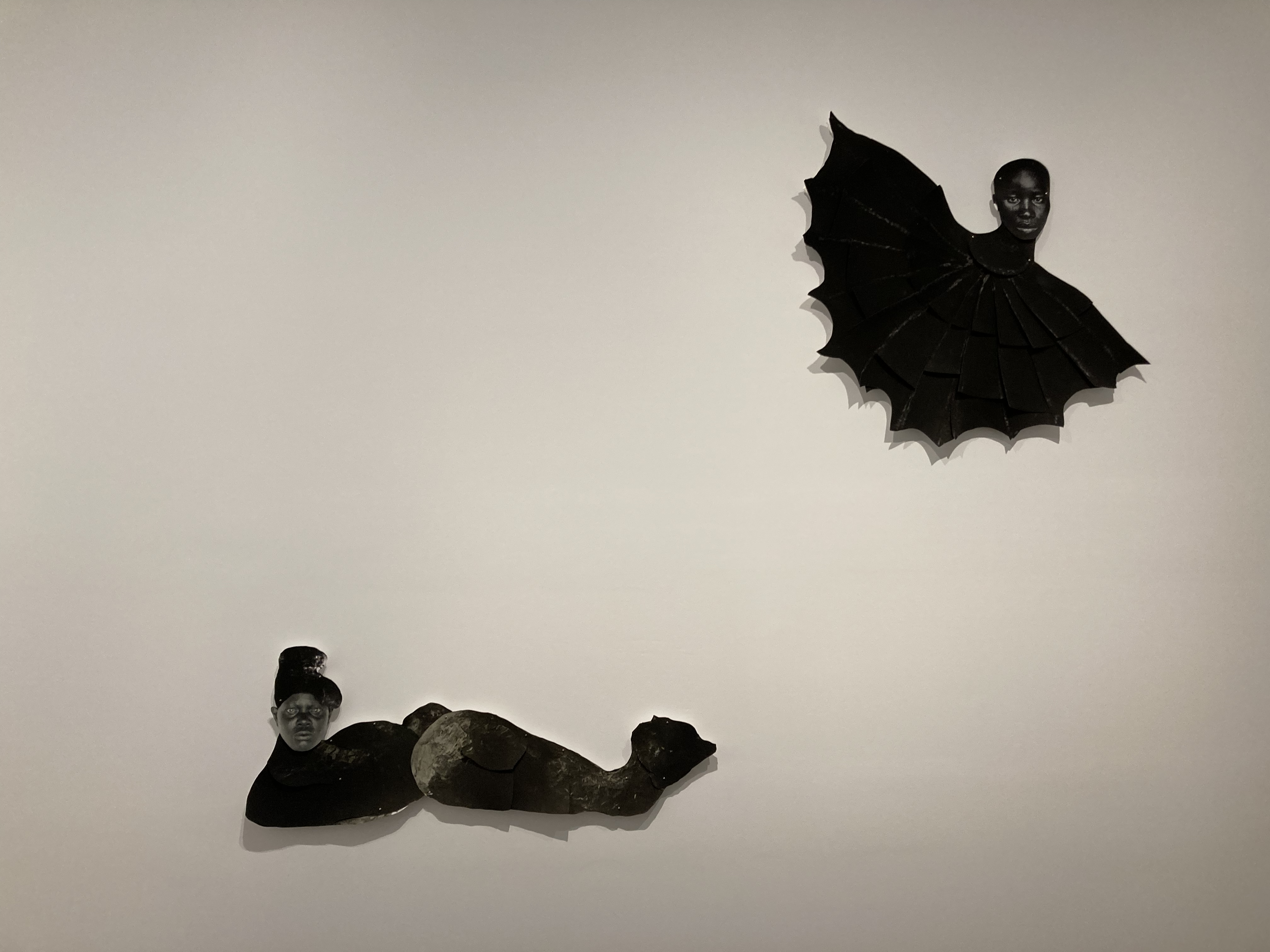
I immediately liked the results – very big, frameless, freestanding works which are more like sculptures hanging on walls than traditional photos. As far as I could tell, none of them had titles. Orupabo’s being Black and being a woman i.e. pressing contemporary art’s two big buttons of race and gender, sends the curators into a tizzy of artspeak:

The sculptural collages and digital works of Frida Orupabo are multi-layered formations, exploring questions of race, sexuality and identity. Orupabo, a Norwegian Nigerian artist and sociologist, grounds her inquiry in her own experience of cultural belonging. Utilising visual material circulating online, spanning colonial-era photographs and ethnographic relics to contemporary imagery, Orupabo’s hand-wrought works re-arrange and re-make the archive. The resulting images take the shape of fragmented Black, mostly female-bodied, figures.

These figures, first dislocated, are reassembled layer by layer in a complex and poetic manoeuvre that simultaneously denounces one-dimensional depictions of Black lives. Her collaged cutouts hold our gaze and invite various readings of the stories and lives of the people depicted, many of whom are entirely absent from the archives. In this way Orupabo invites a consideration of how photography significantly contributes to the formation and perpetuation of colonial power relations and violence.

Turning by Frida Orupabo (2021) © Frida Orupabo Courtesy of the artist and Galerie Nordenhake, Berlin, Stockholm, Mexico City

Does photography ‘significantly contribute to the formation and perpetuation of colonial power relations and violence’? Isn’t that like saying books ‘significantly contribute to the formation and perpetuation of colonial power relations and violence’ or laws ‘significantly contribute to the formation and perpetuation of colonial power relations and violence’? Surely any technology can ‘significantly contribute to the formation and perpetuation of colonial power relations and violence’ if that’s how the people wielding it want to use it. Probably guns contributed quite a bit ‘to the formation and perpetuation of colonial power relations and violence’, probably quite a bit more than photography. In fact photographs of the atrocities carried out by the authorities in the Belgian Congo did as much to disgrace and discredit that authority, as the kind of photographs the curators have in mind, the kind used to measure and categorise the Indigenous peoples, did to define and control them. Photography is just a technology. I can be used for good or evil. Writing that ‘photography significantly contributes to the formation and perpetuation of colonial power relations and violence’ is just art school boilerplate, modish rhetoric, smart-sounding swank (definition: ‘behaviour, talk, or display intended to impress others).

Anyway, as so often, the curators’ obsession with the twin shibboleths of race and gender blind them to the specificity of the actual art in front of them. Two things struck me. One was the way the deliberate crudeness of the artefacts is intentional: heads are pasted onto bodies at anatomically impossible angles, a pair of legs are completely separated from a body. She is highlighting the utter dysjunctive effect of her collages, their complete artificiality, and that reminded me of Dada, of the deliberately unsmooth, jagged photocollages of George Grosz or John Heartfield from 100 years ago.

Installation view of Frida Orupabo at the Photographers’ Gallery

But something not at all hinted at in the curators’ commentary is the horror tropes. In the top photo you can see that the loosely female figures are, from left to right, 1) attended by two sort of flying rabbit demons; 2) sitting on a monster’s head; 3) is shaped like a mermaid; and 4) in the most striking image, is a human head cut and pasted onto the body of a bat. A whole lot of stuff is going on here, but what strikes me is the invocation of imagery of Gothic tales and horror stories; it’s the stuff of Goya nightmares. What? Why? In this respect she reminds me of the way Kara Walker’s silhouettes of Black people in ante-Bellum Deep South morph into nightmare, monster images.

Installation view of Frida Orupabo at the Photographers’ Gallery

Anyway, it was the sheer weirdness of these big collages which grabbed me, not their alleged commentary on colonialist this, that or the other, and so I’ll tell you straightaway that, for the uncanny unexpected weirdness of her images, Orupabo was my favourite of the four artists: I wanted her to win.

2. Bieke Depoorter

Bieke Depoorter was born in 1986 in Belgium. She was selected for this prize on the basis of a 2022 exhibition titled ‘A Chance Encounter’, staged at C/O Berlin from April to September 2022. The display here consists of two parts, titled ‘Michael’ and ‘Agata’. Apparently:

In ‘Agata’, a first meeting [with Agata Kay] in a Parisian strip-club in 2017 evolves with complex tension into an intricate, changing narrative. The project explores questions of collaboration, the limits of a creative friendship, performance, boundaries and authorship.

I couldn’t find ‘Agata’. Possibly it amounted to one framed photo of a pink room, and maybe a collage of movie posters on one wall, but these weren’t labelled so I wasn’t sure. Going back to reread the introductory wall label more carefully I realised that the subject of Depoorter’s photos, the stripper Agata, eventually asked Depoorter to suspend their relationship and asked that all record of the photos, conversations and letters involved in it be erased. Maybe the Agata project is the absence of any materials about the Agata project. OK. That has a pleasing 1970s conceptual art feel about it.

But the reason I wasn’t too sad about not finding ‘Agata’ is because it was completely dwarfed by the other project displayed here, ‘Michael’. This is an epic, dense, absorbing and deeply unsettling work.

in 2015 Depoorter met a middle-aged, confused man named Michael on the streets of Portland, Oregon, USA. They got talking and Michael took her to his apartment which turned out to be covered from floor to ceiling with scrapbook-style cut-outs from magazines, books, newspapers, school reports, journals and diaries and all manner of bric-abrac.

Michael at home, Portland, Oregon, May 2015 by Bieke Depoorter, © Bieke Depoorter/Magnum Photos. Courtesy the artist

As a result of this encounter Michael gave Depoorter three suitcases containing a trove of his personal items, sketchbooks and essays which she, for unexplained reasons, accepted. Then, presumably, she departed Portland, for the wall label explains that, at some point later on, she tried to contact him again and failed. When she flew back to Portland to find him she discovered his flat rented to someone else and  that Michael had vanished, leaving no trace.

At which point Depoorter commenced what appears to have been months if not years of effort to track him down, the start of an obsessive quest to find Michael and to understand his life. As far as the labels tell us, to this day she still hasn’t found him, but along the way she has created the two big things which this darkened room is filled with. One is the way all the walls are even more covered in detritus and scraps of every kind than Michael’s apartment was, the records and ephemera of her hunt which Depoorter has acquired over the past 6 or 7 years.

Installation view of Michael by Bieke Depoorter at the Photographers’ Gallery

Post-its festoon multiple layers of documents and diaries and journals and magazine photos and contact sheets. Arrows connect different pieces of evidence. It’s exactly like the room of the crazed serial killer which the cops eventually break into in all those American psycho movies. She calls it ‘The investigation room’ and what we see here is just a fragment of the materials she’s accumulated in her obsessive, endless search. She has supplemented Michael’s own collection of ephemera with her own. The two sets of detritus are intimately interwoven. But spooky though this is, it isn’t the main thing: the main thing is the film.

Installation view of ‘Michael’ by Bieke Depoorter at the Photographers’ Gallery

It’s a 31-minute-long film detailing Depoorter’s obsessive quest so far. There are no moving segments. It consists entirely of still photos, so it’s by way of being a slideshow of places she’s been to and people she’s interviewed as she delves deeper into Michael’s life and past, her words and those of the interviewees appearing as captions on the screen.

So, in the sequence I watched, Depoorter spoke to some people who were at high school with Michael, who described his intense upbringing by nice but weird Mormons. We see stills of Michael’s high school yearbook with jagged, uneven hand-written notes scrawled across it. It has lots of overtones of serial killer movie, except Michael is no killer, just an oddball Depoorter bumped into and became slowly obsessed with.

If all this sounds weird (and it definitely is) after just a few minutes I found the pace and determination of Depoorter’s narrative drawing me into the film. Michael may have been just an insignificant nobody and yet, in Depoorter’s powerful telling, the memories of childhood friends and schoolmates become weirdly compelling. I realised I was being drawn into Depoorter’s own obsession. It’s contagious!

The curators comment that this work interrogates:

the complex ethical relationship and boundaries…between the photographer and their subject [and] questions the role and responsibilities of the photographer, the possibility or impossibility of truth in representation and grapples with personal and professional boundaries.

No doubt. But something deeper and weirder was also at work here. I was quite relieved to break away from the film and step back out into the light airy gallery space.

3. Samuel Fosso

Samuel Fosso was born in 1962 in Kumba, Cameroon. He was selected for the prize on the basis his exhibition ‘Samuel Fosso’ at the Maison Européenne de la Photographie, Paris, from November 2021 to March 2022.

Since the mid-1970s Fosso has dedicated his artistic practice to self-portraits and performative photography. In vulgar language, he dresses up and photographs himself. At the tender age of 13 he set up a Studio Photo Nationale in Bangui, capital of the Central African Republic. Alongside commercial work, Fosso began a series of self-portraits, and has carried on to the present day, hence a nickname he picked up along the way, ‘the man of a thousand faces’.

Autoportrait by Samuel Fosso, from the series 70s Lifestyle (1976) © Samuel Fosso. Courtesy of the artist and JM Patras, Paris

More recently Fosso has created a series titled ‘African Spirits’ in which he dressed up as – and recreated famous photographs featuring – Black celebrities such as (the ones on display here) radical activist Angela Davis, Martin Luther King, Malcolm X, Haile Selassie and Tommie Smith, one of the African Americans who gave the Black Power clenched fist salute from the podium of the 1968 Olympics.

Installation view of ‘African Spirits’ by Samuel Fosso at the Photographers’ Gallery. Can you name all 6 of these famous Black figures?

According to the curators:

Playing the role of key historical figures and social archetypes in front of the camera, Fosso embodies a powerful way of existing in the world, and a vivid demonstration of photography’s role in the construction of myths.

There’s also a pair of huge colour photos of himself dressed as soldiers from the First and Second World Wars, tribute to the many African and Black soldiers who fought in those wars (see my blog post, Congolese soldiers in the world wars).

Compared to the previous two displays, photocollage sculptures and a weirdly compelling documentary film, Fosso’s exhibits – classic framed photographs – seemed, well, kind of obvious, kind of quaint.

4. Arthur Jafa

Arthur Jafa was born in 1960, Tupelo, Mississippi, USA. He is an artist and filmmaker. What is an American doing in an exhibition supposedly restricted to exhibitions in Europe?

Well, one answer is that art curators can’t stop themselves promoting the Great Yoonited States of America: after all, Depoorter’s  ‘Michael’ project is about an American and entirely set in America and half of Fosso’s African Spirits are American. And now we have an actual American photographer. Three out of the four displays are heavily or entirely American.

Why do British curators love American art?

What can you do against the endless tide of American art and artists being promoted by British art curators and adding to the vast sea of American culture which floods all our channels? If Britain’s art curators are so hell-bent on promoting American culture and American values at every opportunity, all I can do is register my feeble protest and point out that there are, in fact, other countries in the world apart from America. Quite a few, actually.

Why do we rarely or never hear about them? Because America is easy, that’s why. American art comes pre-packaged with 1) fluent, articulate artists who are great in interviews 2) innumerable American critics who bubble over with rhetoric about race and gender and 3) political and cultural ‘issues’ which we all already know too much about about because they flood our TV, radio, movies, documentaries, newsfeeds, twitter and all the other American-run social media.

When an American artist gives an interview saying they’re addressing issues of #metoo or Black Lives Matter,everybody immediately knows what they’re talking about and nods in concerned sympathy because we’ve already seen and heard and read hundreds and hundreds of news items and newspaper stories and magazine features and documentaries interviews and tweets about just these ‘issues’.

American art is like McDonalds art. It’s smooth, pre-packaged, ready to consume, processed, pre-masticated, baby food. Just add water and you’re good to go. Compare and contrast the problems you’d encounter with the language barrier and with explaining all the little-known historical and cultural references if you tried to stage an exhibition of contemporary, say, Indonesian or Peruvian art. But another African American artist yakking about slavery or the institutional racism of American society – piece of cake, child’s play, no brainer, no mental effort required, just the appropriate amount of liberal sympathy.

Arthur Jafa

Anyway, Jafa is here despite not being European because his exhibition, ‘Live Evil’, was shown at Arles in the South of France i.e. a European venue, from April to November 2022.

There’s a video of an extended interview with Jafa. He’s very angry about racism, in America, Europe, everywhere. In the bit I watched he quoted Malcolm X and the Black Panthers. In a modern art gallery you’re never far away from the 1960s. My eyes glazed over because I have heard scores of Black artists complaining about racism in America and read hundreds of articles about racism in America. Black Lives Matter posters hang in the windows of concerned students round where I live.

The stories of Uyghurs Muslims locked up and tortured in Xinjiang, of the people dying and displaced in Yemen or Syria, of the 920,000 Rohingya refugees from Myanmar living in the world’s largest refugee camp in Bangladesh, now as I write and you read? Are these packing the walls of the Barbican, Tate Modern, the Royal Academy, the Photographers’ Gallery? No. Silence. Nada. Their stories will never be told. They might as well not exist. But another American artist doing another show about how racist America is? Take your pick.

One last obvious point about the ubiquity of American artists: America is rich. It has the wealth to support a huge class of artists who, if they play their cards right, can become very wealthy, successful, appear in all the right magazines, and generally enjoy a great lifestyle. Makes me feel a bit sick when artists from the richest country in the world complain about their suffering and oppression. Go and live in Somalia, Sudan, Liberia, Afghanistan for a month then fly back to your air-conditioned studio in LA and tell me about the suffering of ‘your people’.

Anyway, according to the curators, Jafa’s work is another ‘extended meditation on the issues of race and the Black experience’. Just like Frida Orupabo’s display, then. I’d swear there are other ethnicities in the world apart from Black and White. There are quite a lot of Indians and not a few Chinese, for a start. But not in Curatorworld. Black, Black and more Black, preferably American Black, is the only experience, the only voice, the only art we are going to be shown. I’m not saying ‘the Black experience’ is not a thing to investigate. I’m just saying that maybe it’s not the only story in the entire world to be aware of, to listen to.

Anyway, to quote the curators:

Drawing from a rich collection of images, film footage and music, Arthur Jafa uncompromisingly articulates Black experience, providing us with an exercise in visual literacy, confronting us with a new Black aesthetic which avoids fixed hierarchies and linear storytelling

There are just six works in Jafa’s display, six very large photos. First, maybe a word of explanation about the tile. ‘Live Evil’ is the name of a Miles Davis album, released in 1971, a live recording of a concert performed in December 1970 in Washington DC. After the epoch-making ‘Bitches Brew’ of 1969, Miles was working with a large group of almost entirely electric instruments, producing a strange voodoo swamp sound, mashing up heavy funk grooves with Jimi Hendrix guitar, and his own trumpet heavily electronically distorted. During this period Miles cultivated a dark and brooding image. He revelled in the nickname ‘the Prince of Darkness’, in fact he released an album titled ‘The Prince of Darkness’ in 1971, same years as ‘Live Evil’. Anyway, ‘Live Evil’, which sounds like this:

Miles Davis (1926 to 1991) was without doubt one of the great musical artists, composers and performers of the twentieth century. In the show he is featured in a diptych (‘any object with two flat plates which form a pair’) alongside the godfather of the Delta Blues, acoustic guitarist and singer Robert Johnson (1911 to 1938), which looks like this:

Bloods II by Arthur Jafa (2020) © Arthur Jafa. Courtesy of the artist and Gladstone Gallery

Johnson died young leaving only 20 or so recordings behind which have, nonetheless, become legendary and inspired all the blues guitarists of the 1940s and since. Dying young, Johnson left a legend or urban myth about himself which is that, in order to play so amazingly, he had sold his soul to the Devil. This legend was fostered by tracks with titles like ‘Me and the Devil Blues’ or ‘Hellhound on my trail’:

So what does Jafa’s juxtaposition of these two Black musical icons tell us? Well for a start, they both made smoking look cool. To consider their music, although only about 40 years separate the photos (1930 to 1970) they seem musically and technologically galaxies apart. Then again, maybe they’re linked by the common thread of their devilish reputations, hellhounds and princes of darkness. Finally, maybe it’s simpler than that: Robert and Miles were both outstanding musicians, embodiments of Black excellence.

Across the room is another, bigger and more dramatic juxtaposition:

‘Mickey Mouse was a Scorpio’ by Arthur Jafa (2016) © Arthur Jafa. ). Courtesy the artist and Gavin Brown’s enterprise

On the face of it, this is a straight contrast between an image of innocence and one of scary threat. Yet some other visitors I got talking to explained to me that they’re both images of identity masquerade: apparently, the earliest iterations of Mickey were based on white entertainers who’d blacked up as minstrels; while the figure on the right is actually a white actor who has blacked up using scary voodoo imagery (I assume this photo was shot on a film set but I can’t find out which one. Do you know?). They’re both lies, or deceptions, or multi-layered images of Blackness. Is that it?

This article explains that Jafa’s work:

tackles the complexity of African-American cultural identity, as defined by an existential paradox that places the Black subject ‘in essential intimacy with death’, as Saidiya Hartman explains in Jafa’s documentary ‘Dreams are Colder than Death’ (2013).

The endlessness of American pop culture

I liked the clarity of these dyptychs and also the fact that they were much deeper than they first appeared to be. The trouble, though, with popular culture, especially American popular culture, is that it is endless. Like the Bible, you can find a passage or quotes to prove anything you want to. I can cut and paste Homer Simpson next to Superman and straightaway I’m making important statements about masculinity, or something. Given such a vast sea of pop ephemera it would be hard to splice together two random elements and not find yourself raising interesting cultural or semiotic issues.

American culture combines technological wizardry with super-refined commercial strategising. Look at the Marvel Comic Universe movies, which are spectacular viewing, rank as the highest-grossing film series of all time, having netted over $29.1 billion, and have a mental age of around 9.

And American artists are trapped within this culture, condemned to try and imbue meretricious trash with meaning – and Black American artists are doubly trapped, trapped in a sea of Americana from which they (apparently, if someone like Jafa is to be believed) feel profoundly alienated. So I understand Jafa when he says that Black American artists are they trying to create narratives of Blackness which will help them navigate the bottomless dumpster of American pop culture, and the complex matrix of racist laws, assumptions and culture. I assimilate this kind of message because I’ve heard it hundreds, maybe thousands of times. It comes pre-packaged and ready to consume.

Anyway, the puzzling thing about the Arthur Jafa display is that the use of these two sly juxtapositions is not his only trick – only two of the six items use it; the other four items are single images and far more varied, not to say troubling.

One is a treated image of the Black singer of a rock band (HR of Bad Brains) jumping about onstage, which left me cold, having spent too much of my teenage year paying attention to images of rock performers to be impressed by one more.

But in a completely different tone from everything else, one entire wall is taken up with an enormous photo of what appears to be a room somewhere in Rwanda, empty of people, but filled with washing lines (?) from which hang the clothes and rags of people hacked to pieces in the terrible genocide.

Installation view of Arthur Jafa at the Photographers’ Gallery

Is this part of ‘the Black experience’? Or the African experience? Or the human experience? It was certainly part of this generation of Rwandans’ experience. Does it directly impact anyone who wasn’t there? If so, why more so than the Armenian genocide or the Holocaust or – the most disastrous civil war in history, the Taiping Rebellion in China in which at least 20 million perished (which I’ve just been reading about at the new exhibition at the British Museum)? Or the Great Leap Forward, 1958 to 1962, in which anything up to 50 million Chinese starved to death? Or, during my lifetime, the killing fields of Pol Pot’s Kampuchea in which up to 2 million people, a quarter of the population, were murdered or starved to death, 1975 to 1978?

I carry the images and histories of all these atrocities in my head, which not only gives me a very dim view of human nature, but also appears to be where I differ from someone like Jafa, because I don’t categorise these atrocities by the skin colour of the victims. They’re all human to me, each one an individual who suffered more than I can imagine, died in misery and terror, mounting up to a vast weight of guilt on the conscience of mankind. The collected atrocities of mankind don’t respect colour or ethnicity, which is why I find the foregrounding or privileging of some massacres or genocides over others morally repugnant.

Anyway, back to Jafa. The last piece in his display is a partial sculpture, a kind of bas-relief hanging on the wall of the whip-scarred back of a Black slave, a very potent image of man’s grotesque inhumanity to man or the atrocities of the Atlantic Slave Trade.

Ex-Slave Gordon 1863 by Arthur Jafa (2017) © Arthur Jafa. Courtesy of the artist and Gladstone Gallery. Photo by the author

I get it, the Black slave trade was a very, very bad thing and generations of white exploiters captured, bought, transported and treated their African slaves with unbearable savagery and brutality. But I happen to have just finished reading Robert Hughes’s epic history of transportation to Australia, The Fatal Shore, and it is packed to overflowing with the unspeakably sadistic treatment meted out to the transported white convicts, especially in the penal colonies of Port Moresby and Norfolk Island. For even slight misdemeanours like looking at an overseer the wrong way, a convict could get three hundred lashes till bystanders could see their spine and ribs through the remains of their butchered back and the bystanders had to pick gobbets of raw human flesh off their clothes. Hughes repeats descriptions of British or Irish convicts who were whipped to death. So this, for me, is the image of a whipped human.

Most of human history is an abattoir. To limit notions of suffering and injustice to just one ethnicity or to one group or one class seems to me historically and morally questionable. It’s a form of boasting – my grievance is bigger than your grievance. It’s very much part of the grievance and victim culture which America has perfected and exported to the rest of the developed world.

But billions have suffered abominably, in every continent, at the hands of all races. The génocidaires in Rwanda weren’t white. The killers in Cambodia weren’t white. The people who implemented the Great Leap forward weren’t white. The murderers of 1.5 million Armenians weren’t white. The administrators of the gulags weren’t Western imperialists.

If these seem disproportionately enormous ideas for a photography exhibition that’s because Jafa is aiming to trigger big ideas about history. It’s just that I happen to be, maybe, more knowledgeable about the history of atrocity than the average gallery goer and so my frame of reference is wider, maybe, than he intends. Maybe it’s just me. I’ve read more widely about atrocities throughout history than is good for anyone, and so this powerful object triggers a wider, deeper historical response than he was, maybe, expecting.

I’m reading Emma Sky’s book about Iraq. She mentions General David Petraeus raising Thucydides’s Melian Dialogue in conversation. This was written about the siege of Melos in 416 BC, part of the wider the Peloponnesian War. When the Athenians finally took the city of Melos they executed the entire male population and enslaved all the women and children. My year of reading Roman history and literature drummed into me that slavery was a universal institution throughout the ancient world, that the civilisations of ancient Athens, Rome and Egypt entirely depended on it and that the huge slave population was subjected to terrible, awful lives of unending labour and liable to whipping, cutting, maiming and torture for the slightest infraction.

That’s what I know, that’s what an image like this triggers; not the suffering of one particular group, but the universal horror of human history.

Jafa summary

Anyway, back from these vast horizons to a small room in Soho containing half a dozen artworks by Arthur Jafa. The conclusion from this small display seems to be that Jafa has at least two modes of operation, one consisting of the canny juxtaposition of images from popular culture, an astute form of curating and darkling satire; the other mode, flat-out horrific memorials of ‘the Black experience’.

This latter is, as you can imagine, catnip to modern white curators, driven by the bottomless resource of white bourgeois guilt:

By placing one resonant cultural artefact next to another Jafa references and questions the universal and specific articulations of Black experience. Eschewing a linear narrative, Jafa organises his material through formal and affective associations, linking his images through visual resemblance or thematic resonance. In this way Jafa aspires to an art that harnesses ‘the power, beauty, and alienation of black music.’

That’s from the press release. On the introductory wall label the curators say:

Embracing slippage and dissonance Jafa creates art that is as fluid and multidimensional as Blackness itself.

‘…as fluid and multidimensional as Blackness itself.’ What I took from the four exhibits on show here is that ‘Blackness’ as an artistic, critical and curatorial concept is indeed so fluid and multidimensional that artists, critics and curators can say almost anything about it and sound convincing. It lends power and a sense of urgency and relevance to even the most anodyne exhibition. It adds the spice of the ‘radical’ to a medium which all curators are uneasily aware is overwhelmingly white and bourgeois. Along with Gender it is a power word and, more than that, a kind of ideological matrix or discursive machine, which will continue to generate works and words, art and discourse, with ever-proliferating effect, for the foreseeable future.

From one perspective, ‘the Black experience’ as an art category is not so much the product of Black people’s actual experiences (which I imagine are very varied and complex) as it is of the liberal guilt of the White art establishment.

Who won?

Who do you think should have won the prize? It was won by Samuel Fosso, ‘the man of a thousand faces’. Why? Shoair Mavlian, the (White, obvz) Director of The Photographers’ Gallery and Chair of the Jury said that Fosso’s:

‘sustained exploration of self-portraiture uses a traditional, studio-based approach steeped in history, while at the same time his work remains relevant and addresses contemporary political issues of today with humour and authenticity. His work has created an extraordinary platform for Black voices and artists throughout his career.’

It’s a difficult choice but I think I liked Frida Orupabo’s weird, Gothic photomontages more than Fosso’s dressing up; and, although I’ve just given him a hard time, actually the clarity and design of Arthur Jafa’s diptychs have stayed with me days later, but then that’s American art for you, as slick and efficient as a Spielberg movie.

Who would you have given the prize to?


Related links

Atrocity reviews

More Photographers’ Gallery reviews

The Epistles of Horace: Book 1

In a world torn by hope and worry, dread and anger,
imagine every day that dawns is the last you’ll see;
the hour you never hoped for will prove a happy surprise.
(Epistle 4)

As to the genre of ‘epistles, according to translator Niall Rudd in his introduction, one of the earliest examples of an epistle as a literary form is a fragment of an epistle by Lucilius (180 to 103; the founder of the genre of satire, none of whose works have survived complete) complaining to a friend who had failed to visit him when he was sick. And it appears from other references that Lucilius had given some thought to the place of ‘the epistle’ in literature. But the idea of composing a whole book of verse epistles was completely novel and apparently invented by the ancient Roman poet Quintus Horatius Flaccus (usually referred to in English as Horace).

Horace wrote two books of epistles, which take their place in his oeuvre thus:

Book 1 contains 20 epistles. Book 2 contains just 2 (long ones), followed by the 476-line epistle universally referred to the Ars Poetica or Art of Poetry.

Horatian urbanity

The epistles are characteristically Horatian in the way they are addressed to the same kind of circle of friends as the odes and reflect on similar themes of: friendship, the nature of civilised behaviour and how to achieve true happiness (adopt the golden mean; leave the stressful city for the relaxed countryside; don’t hanker after wealth and luxury; be content with the simple things of life, like wine and the company of good friends).

What is an epistle?

The English word ‘epistle’ comes direct from the Latin word epistola which means ‘a letter’, itself derived from the Greek epistole meaning ‘message, letter, command, commission, whether verbal or in writing’.

Were Horace’s ‘epistles’ actual letters, written to people, sent and expecting a reply? Critics debate this question to this day. Some of the epistles contain specific questions to the addressee and explicitly expect a reply (for example, Epistle 3 to Julius Florus posted to Tiberius’s army). Others are more like moral essays, addressed to an individual but which make general points about life i.e. not letters in our sense (Epistle 2 to Lollius Maximus). The shortest one really feels like a note to a friend (Epistle 4, 16 lines). Either way, there’s no doubt they are the result of much art and effort; no-one ‘dashes off’ a 300-line poem in finely judged hexameters on the spur of the moment.

One other thing that’s so obvious no-one comments on it, but in a standard letter the author indicates their identity. In English we used to write ‘Your sincerely’, ‘Kind regards’ or similar. There’s nothing like that here. The text of each epistle just ends.

Wikipedia has a handy one-line summary of each of the epistles, which I found very useful to consult before reading each one, and so get a quick grasp of the general purpose and shape of each of the poems.

Age-appropriate genres

Rudd mentions a twelfth century scholar who suggested that Horace wrote his four major types of poetry for four different age groups: the odes for boys, the Ars Poetica for young men, the satires for mature men, and the epistles for old and complete men.

This doesn’t reflect modern scholarly opinion about when the different types were published, but contains a big grain of truth. The odes feel very active and exuberant; the Ars Poetica is a useful vade mecum for poets just starting out; the satires are for men of business and affairs; the epistles are for men heading into old age, who are past life’s storms and stresses and able to look back and reflect on their own and other people’s behaviour.

‘Morality is obvious’

In some ways Horace’s epistles continue the form of the satires, but the epistles are more philosophic, more ethical and meditative. For me the most obvious difference is that many of the satires were in dialogue form, like mini plays; whereas the epistles are more often monologues (although several of them include the imagined dialogue of critics or opponents, and some of them morph into anecdotes which features the dialogue of the characters involved).

As so often when classic poets or writers give life advice, Horace’s lessons are often obvious and a bit boring. In Epistle 1 (to Maecenas) Horace tells us that Virtue’s first rule is ‘avoid vice’ and Wisdom’s first rule is ‘get rid of folly’. Not exactly ground-breaking information stuff, is it? In Epistle 2 (to Lollius Maximus) he says:

  • despise pleasure – often the price of the resulting pain outweighs it (drunkenness leads to illness, promiscuous sex leads to disease)
  • the greedy are never content, always wanting more
  • envious people are driven mad by wanting what everyone else has
  • unrestrained anger drives people away and makes them hate you

So don’t overdo it. Moderation in all things. Train yourself to be happy with what you’ve got.

Maybe this is as useful as moral writing can get. Maybe reflecting on these suggestions for the half hour or so it takes to read each poem does make readers stop and think a bit about their own attitudes and behaviour. Maybe they have had a beneficial effect on people’s lives. But it’s difficult to know how you’d go about measuring this.

I’m tempted to say, though, that the interest isn’t in the moral lessons, which are a bit samey and a bit obvious, it’s in two other things. One is the incidental social history which the epistles are full of, descriptions of the habits and behaviour of the rich and boastful of his day, of the poor in their crappy slums, tips on how to be the client of a rich patron, how to approach Augustus so as not to irritate him and so on – a mosaic of snapshots of Roman society.

Second, and a bit deeper, is the psychology of the thinking about the moral lessons. The lessons themselves, when bluntly stated, are a bit trite. But when he reflects on his own attitudes to them, how he’s come to these conclusions, how he tries to apply them in his own life – then the lessons come a bit more to life, they are dramatised. If the ostensible lessons are mostly a bit obvious, the text and texture and presentation are often interesting and genuinely entertaining.

Addressees

In my review of Horace’s Odes I remarked that the sheer number of people Horace addresses in them creates a sense of a sociable, civilised society. Same here, along with endearingly casual references to the ordinary humdrum concerns of him and his friends. Not great affairs of state or business deals or law cases, but who’s going to whose dinner party, who’s falling in or out of love, impressions of famous tourist attractions, what the weather’s like on the coast this time of year, the changing scenery around his farm (1.16) and so on. Tittle tattle. Gossip. Thoughts.

The poems are addressed to:

  • Maecenas, Horace’s patron (1.1, 1.7, 1.19)
  • Lollius Maximus, served under Augustus in Spain (1.2, 1.18)
  • Julius Florus, a young aristocrat who wrote satires (1.3)
  • Albius Tibullus, the poet famous for his elegies (1.4)
  • Manlius Torquatus, an aristocrat (1.5)
  • Numicius (unknown) (1.6)
  • Celsus Albinovanus, serving on Tiberius’s staff in Asia (1.8)
  • Tiberius, future emperor, recommending a friend (1.9)
  • Aristius Fuscus, friend (1.10)
  • Bullatius (unknown) (1.11)
  • Iccius, steward of Agrippa’s property in Sicily (1.12)
  • Vinius Asina, a centurion in Augustus’s praetorian guard (1.13)
  • the unnamed bailiff of his country property, written to when Horace is in Rome on business (1.14)
  • Numonius Vala (1.15)
  • Quinctius Hirpinus (1.16)
  • Scaeva (1.17)

But just listing the addressees doesn’t convey their sociable quality. The poems address named individuals, as above, but often refer to other people as well, male or female, sometimes to mutual friends, sometimes to the rich and grand, sometimes to figures from Roman history (all Roman writers were obsessed with figures from their history), to figures from myth and legend (that bloody Trojan War!), and sometimes contain anecdotes like the extended story about the lawyer Philippus who persuaded the auctioneer Volteius Mena to change professions and become a farmer ((1.7). The epistles are inclusive, chatty, populous. From one perspective, the pleasure of Horace’s poems is the pleasure of gossip.

Themes

Since Wikipedia and umpteen other websites give epistle-by-epistle commentaries, I’ll look instead at recurring themes.

Maturity

Born in 65 BC, Horace was about 44 when the first book was published. He says his age and keenness are not what they were. He feels like an old horse which has had its best days. Time to get a bit serious:

Now I am laying aside my verses and other amusements.
My sole concern is the question ‘What is right and proper?’

Certainty instead of change

Everyone has an opinion, and even people with well-worked out opinions change them from time to time. The great flux of dinner party chat and commentating. Instead of this endless flux, Horace wants certitude.

Be content with what you have

…Avoid what’s big. In a humble house
you can beat kings and the friends of kings in the race for life….
If you’re happy with the deal you’ve received, you’ll live wisely. (1.10)

Whatever lucky hour heaven has offered you, take it
gratefully (1.11)

The retired life

Small things for the small. It isn’t royal Rome
that attracts me now, but quiet Tibur or peaceful Tarentum. (1.2)

Country over city

If we are supposed to live in accordance with nature,
and we have to start by choosing a site to build a house on,
can you think of any place to beat the glorious country?

In any case, do what you will, you can’t fight the deep slow force of nature.

Expel nature with a fork; she’ll keep on trotting back.
Relax – and she’ll break triumphantly through your silly refinements. (1.10)

In praise of wine

Think of the wonders uncorked by wine! It opens secrets,
gives heart to our hopes, pushes the cowardly into battle,
lifts the load from anxious minds, and evokes talents.
Thanks to the bottle’s promptings no-one is lost for words,
no one who’s cramped by poverty fails to find release.
(Epistle 5)

The first half of 1.19 jokingly claims that all the best poets were drunks.

Sex and slavery

Maybe I’m overdoing it, maybe it’s a personal obsession; I wonder because so few of the translators and writers of introductions mention it, but – this was a slave society. A society built on slavery. Slaves were worked to death in the gold and silver mines to produce the fancy trinkets which Catullus and Horace mock. Slaves by the hundreds of thousands worked the huge estates which produced the food to feed the empire.

Horace writes repeatedly about his lovely little farm, the Sabine farm, the lovely scenery around it and so on. (Scholars and historians refer to it as the Sabine farm because he tells us, in Epistle 1.10, that his villa was next to the sanctuary of the Sabine goddess, Vacuna.) He describes it with such affection that it is easy to join his affectionate tone. But it was run by slaves, 8 slaves, slaves he called ‘boy’. Slaves who I know, from umpteen other sources, were not only bought and sold, but could be whipped or subject to any other form of punishment at the whim of the owner.

If a slave’s testimony was required in a trial, it had to be extracted under torture. Quite trivial offences could be punished by having your legs broken, or being crucified. Plautus’s plays are full of slave characters nervously worrying about being crucified if their master’s scams and tricks are revealed.

Maybe it’s me, maybe I’m eccentric, but the knowledge that the lovely lifestyle praised in all these poems was based on the sweat and punishment of hundreds of thousands of slaves brings me up short. Makes me shiver with horror.

Epistle 1.18 is quite a long set of advice to Lollius Maximus on how to behave well if you are the client of a rich patron. There’s loads of points of etiquette or correct behaviour you have to look out for. Immediately after telling him to be careful what he says, and who to, because tactless remarks are always passed on, he comes to this bit of advice:

Don’t let any maid or lad arouse your desires
within the marble hall of the friend you hope to impress.
The owner may give you the pretty boy or the darling girl
(and add nothing of substance!) or cause you pain by refusing.

Hang on. ‘The owner may give you the pretty boy or the darling girl…’ As if you said, ‘Oh I like that vase’ and the rich blasé owner said, ‘Well, have it’, in the same spirit you might say, ‘Your wine girl is very sexy’ and the rich blasé owner would just say, ‘Well, you can have her.’ The girl gets no say. She is a slave. So is the boy you fancy. Either of them are just handed over to you for your sexual pleasure.

All this is said in passing because Horace is concerned about the problems of etiquette which arise if you let one of your patron’s slaves arouse you. The fact of a human being being treated as an object by everyone, including (apparently) the translator, goes unremarked. But I remark it. And I can’t help finding it disgusting.

Bookishness

In 1.18 Horace utters a little prayer, which includes the line ‘May I have a decent supply of books and enough food for the year’. In 1.2 he instructs Lollius Maximus to send for a book and a lamp before daylight and study noble aims. In 1.7 he tells Maecenas he plans to go down to the seaside and ‘take it easy, curled up with a book’. Epistle 13 entirely consists of instructions to Vinius Asina about delivering a copy of his odes to Augustus. Epistle 3 enquires about the literary activities of a bunch of young writers who are officers with Tiberius’s army.

These and other references add a layer of bookishness the general air of civilised chat and banter. But I couldn’t help starting to detect in them what I understand is called ‘the Liberal Fallacy’, which is the belief that, if only people – the population in general – were more bookish, and read the right sort of books, and read them in the right sort of spirit, well…the world would be a much better place.

A decade ago I read an article in the Guardian by a nice middle-class white man which overflowed with empathy for black people and women, with sensitive support for #metoo and Black Lives Matter. What made it Peak Guardian was that at the end of the article he included a reading list. The article wasn’t about a particular subject and so the reading list wasn’t addressing a particular topic: it was a reading list to help the article’s readers become like the author, sharing, caring and inclusive. I wish I’d bookmarked it because it perfectly embodied this belief: If only everyone were bookish like me, what a wonderful world it would be.

The two obvious flaws with this view are that:

  1. Most people don’t read, certainly not books. Huge numbers of working class people struggle to read or have a low reading age, or aren’t interested; and I’ve met many highly educated professional people who have the smarts to read, but are simply too busy: one or two thrillers on their annual holiday and that’s their lot. So an outbreak of mass reading is never going to happen.
  2. Anyway, reading doesn’t make you a better person, in fact excess study can reinforce evil behaviour, vide the very intelligent and well-read Lenin, Trotsky, and any number of revolutionaries. Pol Pot was educated at some of Cambodia’s most elite schools and worked as a teacher. Mao went to university, worked for a while as the university librarian, was an intellectual, wrote numerous books. Bookishness, by itself, means nothing.

Obviously book learning was nowhere near as poisonous in Horace’s day as it had become 2,000 years later, and curling up with a good book is still a fabulous thing to do, I do it all the time. But believing that reading makes you a better person or that if only more people read books, the world would be a better place are both absurd contentions. It would be lovely, but…

Leave your cares

Ultimately Horace has three messages:

  1. Stop worrying, be happy.
  2. Learn to be content with what you have.
  3. Enjoy the simple and good things in life while you can.

They’re summed up in Epistle 5 where he tells Manlius Torquatus to leave Rome. Leave the city. Stop worrying about politics and ambition and money. Forget about your wretched law case. Stop worrying about the ‘threat’ from the Parthians or the Cantabrians or whoever. Come down to my place in the country. I’ve got some good wine stored up and I’ve invited all our friends. We’re going to drink our fill and stay up late into the night laughing and joking. Who knows what the future holds. Stop worrying about it because you can’t do anything about it. This is what life is about. Wine and good company. As he tells Albius in Epistle 4: ‘Come and see me when you want a laugh.’

It is a hugely attractive and sane worldview.


Credit

Niall Rudd’s translation of the Epistles of Horace was published by Penguin books in 1979. All references are to the 2005 Penguin paperback edition.

Roman reviews

Super-Cannes by J.G. Ballard (2000)

‘Madness – that’s all they have, after working sixteen hours a day, seven days a week. Going mad is their only way of staying sane.’ (Frank Halder to Paul Sinclair)

You can tell late-period Ballard novels by their sheer size – Super-Cannes is a whopping 392 pages long, in the shiny Flamingo paperback edition I own.

The swimming pool had calmed.

The book is on the same topic and has much the same structure as its predecessor, Cocaine Night, but is, at least to begin with, noticeably more believable and enjoyable.

I circled the artificial lakes, with their eerily calm surfaces…

The plot: 1

First the plot: As with its predecessor, we’re among an élite of the well-educated, prosperous, professional middle-classes again. And abroad again: in the Costa del Sol for Cocaine Nights, the South of France for Super-Cannes.

At Eden-Olympia the medical staff were calm and unrushed…

And Super-Cannes is, like Cocaine Nights, told by a first-person narrator, in this case Paul Sinclair (how does Ballard manage to come up with such boring names for his protagonists?).

Trying to calm her, I took the phone from her surprisingly soft hand…

Paul is a pilot of small planes and editor of a couple of aviation magazines. He was injured in a flying accident nine months earlier and his knee refuses to heal properly. As the novel opens it is still in an uncomfortable brace.

Calming myself, I stared down at the dappled floor…

His new young wife, Jane, has taken up a post at the newish Eden-Olympia complex, part of the European Silicon Valley being built north-west of Cannes (in the south of France), a self-contained luxury business park which contains the European headquarters of major European banks and car manufacturers, along with exquisitely manicured villas, a world of tennis courts and swimming pools, luxury homes where all these busy executives spend the little time left over when they’re not at their offices.

 Jane sat calmly in her white coat, dwarfed by a black leather chair contoured like an astronaut’s couch…

The story opens with even more doctors than usual for a Ballard story (if I had a pound for every Ballard protagonist who is a doctor): Paul’s wife, Jane, is a doctor and is replacing the previous doctor working in the Eden-Olympia clinic, Dr Greenwood, and they’re met on arrival at the park by its head psychiatrist, Dr Wilder Penrose, who plays a pivotal role in the story.

Sitting by the open doors of the limousines, they were almost Roman in their steely-eyed calm…

The similarities to Cocaine Nights are obvious from the start: just like Estrella da Mar in that novel, Eden-Olympia looks, on the surface, to be a perfectly organised, self-contained, respectable and hard-working bourgeois paradise, located in an idyllic setting on the Mediterranean, and yet… it has a dark side! Oooh, yes, I know… who would have imagined!

Halder gave up his attempt to calm me…

The two books share the same basic structure in the sense that a 1. mass murder 2. triggers a visit from 3. an outsider who proceeds to 4. investigate deeper and deeper into this self-enclosed sub-culture’s 5. murky depths, and 6. finds himself becoming changed and depraved by it.

Calmly, I said: ‘You’ve had a bump. Cutting corners too fast?’

In Cocaine Nights it was the arson attack on one of the ex-pat community’s luxury villas in which five leading figures burned to death which led to the narrator’s brother being arrested for the crime (because of the strong evidence against him), and prompts the protagonist to fly out to the beach resort to investigate…

Her fingers moved towards a salt sachet, stopped and calmed themselves by eviscerating the stub of her cigarette…

In this book, Jane’s predecessor as doctor at the business park’s clinic, Dr Greenwood, ‘went postal’, went on the rampage with a rifle, locking three chauffeurs hostage in his garage, before going to the business district and cold-bloodedly assassinating seven managing directors and top executives, before returning to his villa and executing the three ‘hostages’ in his garage.

Or did he? [Cue spooky made-for-TV thriller music]

The first person narrator, Paul Sinclair, is disconcerted to discover that he and his wife have been allotted the very same villa Greenwood lived in, and where the hostages were kept and then shot dead – though he is assured the house has been deep-cleaned and, in the case of the garage, rebuilt.

I imagined her lying awake at night, in this electrified but nerveless world, thinking that if only she had forgone her holiday she might have reached out to Greenwood and calmed his dream of death…

Except that Paul finds some evidence overlooked by the police, three bullets in and around the swimming pool which conflict with the official version of events. And, with his wife quickly drawn into the austere work culture of this dream executive-class business park, Paul finds himself with plenty of time on his hands to hobble round the manicured woodland, and explore the office blocks, and to start to make appointments to interview people involved in ‘the tragic events’, including, for example, the three widows of the hostages supposedly shot in cold blood.

He calmed himself, trying to steady his pulse…

Thus, on one level, the book amounts to a long investigation, as Paul slowly increases elements of the chain of events which are at odds with the official story put out by the business park’s press and PR people, and is given (pretty heavy-handed) clues from various officials – from Wilder Penrose the psychologist to Frank Halder, a senior security guard, who takes a strange watchful interest in Paul’s well-being.

‘He helps me park my car, and hangs around the clinic with those calm eyes. He’s waiting for something to happen.’

Slowly pretty much the same picture emerges as in Cocaine Nights, which is that the pampered, bored, professional bourgeoisie need livening up, need excitement – and that this takes the form of random crime, drug dealing, BDSM sex and so on. The usual suspects, then. The characters don’t really hide this, it is mentioned right from the start thus killing off any sense of suspense.

‘I like to stir things up, keep the adrenalin flowing. The more they hate you, the more they stay on their toes.’ (Wilder in chapter 1)

The posh neighbours, Simone and Alain Delage, don’t mind parading round in the nude. Pretty soon they are coming over to Jane and Paul’s to smoke dope and watch porn movies. Paul sees plastic sachets of white powder in various offices and in still photos of the crime scenes and he, and we, are quick to suspect they contain cocaine or heroin.

Halder raised a hand to calm me…

On one of his forays into Cannes proper, Paul stays on into the evening and watches the streets bloom with prostitutes and their terrifying East European pimps. He’s particularly struck, attracted and appalled at the same time by the vision of an 11-year-old girl wearing inappropriate make-up and sexualised clothes and finds himself approaching her pimp and asking how much she is with a view to ‘saving’ her. At least that’s what he tells himself.

Halder pinched his nose, and calmed his fluttering nostrils…

In the event he doesn’t get far with the transaction because a squad of three Range Rovers screech onto the scene, out of which leap a bunch of men in tight black leather jackets wielding baseball bats who proceed to beat the crap out of the little crowd of pimps. The leatherjackets beat the East Europeans and Arabs to the floor, smashing their teeth and smashing in the windscreens of their cars. Paul himself receives a hefty whack over the back before he’s pulled into a doorway by a figure he realises is the park security guy, Halder, a figure who slowly develops into his guardian angel. Paul is to discover that these are regular outings by the more psychopathically-minded senior executives at the business park and are jocularly referred to as ratissages.

He opened his envelope of photographs, waiting for me to calm myself.

Thus it comes as little surprise to the savvy reader when, once the mayhem is over, some of the leather-jacketed vigilantes remove their balaclavas and are revealed as the head of security at Eden-Olympia and several of its younger chief executives. Do they do it out of morality, policing Cannes’ underworld? Paul asks Halder. ‘No,’ Halder replies. ‘For kicks.’

Later, when Paul mentions why he got caught up in the vigilante attack to Penrose, the latter quizzes him about his interest in the 11-year-old girl and then goes on to be as plain as can be about the worldview which underpins the book:

‘Sordid. What can one say? Tragic for the child, but sexual pathology is such an energizing force. People know that, and will stoop to any depravity that excites them.’

So before we’re half way through the book we are fully informed that the business park full of hard-working European professionals is also a hotbed of drugs, kinky sex and violent vigilante squads, and we know at least one of them went off the deep end and went on a killing spree.

‘Some people say she tried to calm him down.’ ‘Brave woman.’

So there’s little surprise about the story. There’s not much place for it to go if we’ve established before we’re even half way through, that the main character is at least partly attracted to the idea of child sex, that the business park’s resident psychiatrist more than half sympathises with him and finds an attitude like that perfectly natural.

He composed himself, waiting for the muscles of his face to calm themselves…

Savvy and grip

Still, what makes Super-Cannes feel significantly better than the previous three or four novels is the savviness of the narrator.

He thrust the envelope of photographs through the open window, his face fully calm for the first time that day.

Rushing to Paradise is an unsatisfactory book because, although the plot has a certain plausibility (oddball environmentalists left on a remote Pacific atoll forget their eco crusade and descend into Lord of the Flies psychosis) the central character whose eyes we see it all through, 16-year Neil Dempsey, is very slow on the uptake. Slow and dim. It takes him ages to cotton on to things the savvy reader has spotted hundreds of pages earlier, such as that the leader of the eco-warriors is a psychopath. The reader is way ahead of the characters, which makes for a frustrating read.

She spoke calmly, her face only a few inches from mine, and I could smell the sweet Turkish tobacco on her breath.

A bald summery of Cocaine Nights also makes it seem groovy (man arrives at self-contained ex-pat community on the Costa del Sol to discover its cheerful bourgeois daytime life conceals a jungle of dark-side activities such as hard drugs, wifeswapping, BDSM and, at its extreme, murder). It’s a good idea but, again, lacks suspense because the reader is way ahead of the plodding narrator.

‘Forget it.’ I tried to calm her. ‘They’ve gone.’

Grip

No, if you’re going to write in the thriller genre (which Ballard seems to have decided to do in his last books) you need to demonstrate the quality that one of its founding fathers, Henry Rider Haggard, called ‘grip’.

In romance ‘grip’ is almost everything. Whatever its faults, if a book has ‘grip’, these may be forgiven. (The Days of My Life by Henry Rider Haggard, 1912)

By ‘grip’ Haggard means that the reader’s imagination is so gripped, so thrilled and excited that you can’t stop turning the pages.

The last book I read which had ‘grip’ in the way Haggard describes was Mutant 59: The Plastic Eater by Kit Pedler and Gerry Davis, a few years ago. I was on a weekend break and picked it up in the hotel library. I planned to get up the next morning in time to a) go for a swim in order to b) enjoy the massive hotel breakfast before c) going to visit a nearby castle. But all my plans were wrecked because I found myself literally unable to put Mutant 59 down. I knew it was pulpy rubbish and at midnight, and 2 and 3 o’clock I tried to mark the page and turn the light off, telling myself I’d finish it tomorrow – but each time ended up picking it up again to read ‘just one more chapter’, and the next thing I knew dawn was coming up. That’s grip.

Alarmed, Frances held my wrist. ‘Calm down. You’re safe here.’

So Cocaine Nights is clever: its basic plot proposes a sociological theory about human nature and culture (humans need excitement and their society must find some way of providing that or they’ll engineer their own wayward forms).

Penrose tried to calm me…

It is carefully plotted, contains a number of vivid scenes, and is written in Ballard’s artful style which combines incisive descriptions with a careful deployment of his key terms and phrases (characters are constantly unsettled, need calming, sooner or later become ‘demented’ or ‘deranged’; have their ‘reasons’ and their ‘motives’ which the narrator always struggles to figure out; the narrator never notices, guess or intuits, he always ‘senses’: thus Ballard artfully creates a claustrophobic world by the almost incantatory repetition of the same words, same attitudes, same situations, etc).

‘Jane…’ I stepped through the clutter of unpaired shoes that she was rooting from the cupboard, placed my hands under her arms and lifted her to her feet, surprised by how much weight she had lost. ‘Calm down…’

But I found Cocaine Nights a struggle because it was so obvious what was going on, and when the ‘revelation’ came I thought, ‘oh, OK, that’s clever’ and went to sleep.

I wanted to calm her, and took away her cigarettes.

Part of the reason for this is that the narrator is depicted as implausibly naive, in order that he can then be ‘shocked’ when he discovers some of the prim bourgeois types he’s introduced to take drugs or have rough sex.

Frances had calmed herself, and waited for me to reply.

Shocked? That’s standard behaviour in a Ballard novel. That’s what we come to a Ballard novel expecting.

So part of the reason Super-Cannes is distinctly better than Cocaine Nights – even though it has a similar structure and is putting forward much the same view of human nature – is that the central character is that much more sophisticated and savvy.

As we took the lift to the basement garage she touched the dinner jacket, trying to calm a fleeting ghost.

Paul Sinclair is funny. His wife, Jane, is funny. Thus he or she can engage in banter that is genuinely funny. Super-Cannes is a better book despite the fact that the plot structure and worldview are almost identical to its predecessor, largely because the narrator is more sympathetic.

‘Frances, relax…’ I moved her edgy hand from the gear lever, trying to calm her.

Some of the exchanges with Wilder made me smile and, as I did so, I realised that’s a quality you rarely associate with Ballard – humour. Here are Paul and Jane in their car, just as they arrive at Eden-Olympia and the psychiatrist Penrose has gotten into the car and is guiding them through the quiet avenues to their villa.

We were driving along the shore of a large ornamental lake, an ellipse of glassy water that reflected the nearby mountains and reminded me of Lake Geneva with its old League of Nations headquarters, another attempt to blueprint a kingdom of saints. Apartment houses lined the waterfront, synchronized brises-soleils shielding the balconies. Jane slowed the car, and searched the windows for a single off-duty resident.
‘A fifth of the workforce live on-site,’ Penrose told us. ‘Middle and junior management in apartments and townhouses, senior people in the residential estate where you’re going. The parkland buffers the impact of all the steel and concrete. People like the facilities yachting and water-skiing, tennis and basketball, those body-building things that obsess the French.’
‘And you?’ Jane queried.
‘Well…’ Penrose pressed his large hands against the roof, and lazily flexed his shoulders. ‘I prefer to exercise the mind. Jane, are you keen on sport?’
‘Not me.’
‘Squash, aerobics, roller-blading?’
‘The wrong kind of sweat.’
‘Bridge? There are keen amateurs here you could make an income off.’
‘Sorry. Better things to do.’
‘Interesting…’ Penrose leaned forward, so close to Jane that he seemed to be sniffing her neck. ‘Tell me more.’
‘You know…’ Straight-faced, Jane explained: ‘Wife-swapping, the latest designer amphetamines, kiddy porn. What else do we like, Paul?’
Penrose slumped back, chuckling good-humouredly.

A rare burst of genuine comedy in Ballard. And a moment’s reflection suggests why: it’s because humour, to some extent, relies on the unexpected. A good punchline reveals a hidden connection or punning misinterpretation you hadn’t seen, and the sudden short circuit makes you laugh.

Careful to remain calm, and glad of the day’s first injection, I returned the sergeant’s salute…

Pondering this made me realise that there is little or no humour in Ballard because, in a way, everything in his stories is totally predictable and expected. In pretty much all his novels and short stories the characters do one and the same thing, which is go downhill – from an initial position of pukka British correctness they descend by carefully calibrated steps into mania and psychosis.

Frances gripped the steering wheel as if to brace herself before a collision. Trying to calm her, I moved her hands to her lap…

Arguably High Rise is the epitome of this narrative arc because it pushes the classic Ballard narrative of decline and fall to genuinely gruesome depths, into final scenes where it is revealed that some of the characters have resorted to cannibalism, which did come as a surprise.

The release of this long-repressed material seemed to calm her, rage diffused into the cooling waters of truth.

This is one of the reasons Rushing to Paradise is disappointing, because the characters follow exactly the same downward spiral as in all the other novels, but the descent only gets as far as the vengeful women hunting Neil through the tropical rainforest in scenes which, far from taking us into new levels of late 20th-century psychosis, ought to remind any reader of Lord of the Flies. I.e. instead of going forward, the novel, in the end, takes the reader (surprisingly) backward to a conclusion about human nature first made (much more powerfully) in the 1950s. That’s not prophecy: in a twisted kind of way, it’s almost nostalgia.

Her moment of panic had passed, and she spoke calmly.

Anyway, in a sentence, Super-Cannes is the best of these later novels because the narrator is as funny and savvy as the reader. And these moments of banter with the resident shrink, Dr Wilder Penrose, are indicative of a kind of confidence which the book exudes overall. It’s not perfect as a thriller, but I actively wanted to get back to reading it, whereas I had to more or less force myself to read Rushing To Paradise which is brilliantly written but whose plot I found a predictable chore.

I wrenched myself from him, and raised a fist to strike his face, but he clamped his hand over my mouth, trying to calm me. ‘Mr Sinclair… take it easy. I’m with you.’

The plot: 2

The tour of the murder scene

Running WildCocaine Nights and Super-Cannes are all set in gated communities of upper-middle-class professionals which go badly off the rails and become the scenes of massacres. Each of them features a tour of the crime scene, in the company of a police or security guard, which allows Ballard to describe the gruesome and sadistic killings with lips-macking precision. Thus the nervy black security guard, Halder, takes Paul on an extended recreation of the route taken by Dr Greenwood as he went on his killing spree.

 I pulled away from them and leaned against the roof of the Mercedes. Calmly, I said: ‘I’m glad I came. What exactly is going on?’

The Big Speech explaining everything

In the second half Paul – with breath-taking naivety – decides he’ll go meet and share with the business park psychiatrist, Dr Wilder Penrose, what he’s discovered so far, and the scenes he’s witnessed, specifically the gangs of leather-jacketed vigilantes who let off steam by beating up pimps and low-level crims in the backstreets of Cannes.

Only to discover that, of course, Wilder knows all about it. In fact Wilder is given a BIG SPEECH in which he explains the secret of life at the business park. He explains that the park managers slowly realised that these busy executives were working themselves to death and coming down with all kinds of psychosomatic ailments. They needed some RELEASE. What started as tentative suggestions that they try transgressive behaviours (the usual checklist of banned drugs, BDSM sex, combined with violent forays into the rougher parts of Cannes where they beat the crap out of East European pimps and Arab immigrants) turned out to be spectacularly successful at curing the busy executives’ many psychosomatic illnesses, boosting their immune systems and, above all, improving their decision-making and managerial effectiveness. Boosting profits. Thus every level of Eden-Olympia has been drawn into turning a blind eye to, or actively encouraging, the violence and decadent behaviour of the most aggressive executives.

She peered at me over her sunglasses, unsettled by my restless and eager manner.

The whole conception that our ‘innocent’ hero confronts the mastermind behind a wicked plan, who then proceeds to give an extended explanation of what is really going on, and how the hero ought to ‘join us’, comes straight out of a James Bond movie or any number of other tuppenny thrillers.

The victim turns out to be as bad as the baddies

Similarly, just as we slowly learned that Frank, who’s been locked up for the arson attack in Cocaine Nights, is not as innocent as his brother thinks, in fact by the end we learn that he is deeply implicated in all the criminal activities at Estrella de Mar; so we now slowly learn that the Dr Greenwood who went nuts and went on the shooting spree that triggers the start of Super-Cannes, was himself deeply implicated in some very unsavoury behaviour. He was a volunteer at a clinic for immigrant children in a poor part of Cannes which sounds noble enough, he has thirty or more copies of Alice Through The Looking Glass in his spare bedroom which – apparently -he read to them;, but slowly the truth emerges that he took these vulnerable children back to his villa in Eden-Olympia for sex. The other doctor in the clinic, who he shot? She helped round up likely child sex victims from the slums of Cannes. They were both in it together.

The hero’s wife becomes involved

Paul has realised from quite early on that his wife Jane is perfectly suited to the park. She loves working long hours. He has previously told us that she’s always been a rebel, a loose cannon, previously a punk and into drugs, she did a medical degree to piss her parents off, and was insubordinate to the male medical hierarchy. As the months go by Paul realises she only married him on an impulsive whim, and also begins to realise their marriage is ending at Eden-Olympia.

Jane becomes notable for two things:

1. She starts to have a lesbian affair with the Belgian woman who lives opposite and often traipses around naked on her balcony, Simone Delage, late-night sex with marijuana. Which turns into a threesome with the husband, Alain.

2. Paul’s knee continues to play him up and Jane takes to prescribing him painkillers, so much so that he wanders round in a daze and finds himself going along with the increasingly outrageous behaviour he sees around him. Eventually he stops taking the painkillers Jane is mixing for him, and has them analysed in a lab and discovers they contain a very strong tranquiliser used on mental patients. I.e. Jane has gone over to Eden-Olympia and is doping him.

The party at the Villa Grimaldi

How far they have both fallen becomes clear on the night of a swanky party at the Villa Grimaldi overlooking Cannes attended by lots of swells from the Cannes Film Festival. After some satire about the film world, a complex little sequence of events follows. Greenwood had shot dead the park’s previous head of security. He had been replaced by a big boorish drunk, Pascal Zander. Paul learns that on one of the many evenings when he’s in Cannes late, Zander had been at his house and had come on very strong to his wife Jane. When Paul arrived home that night it was to find Jane in bed with a bruised mouth and face where Zander hit her.

Now, at this party, Paul goes in search of Zander and nearly has a fight with him,. He’s dragged away to her car by his lover Frances Baring (Paul has started an affair with this nervy woman who works in Eden-Olympia’s personnel department and had herself had an affair with Dr Greenwood). They leave the party a few moments later and slowly become aware that they’re being followed by an Audi. But then Paul realises that the Audi is itself being chased by two huge BMW limousines. He and Frances duck into a side street to let the other cars overtake them, then pull out again and watch the chase become more intense, like a scene from Crash. Eventually the big BMWs railroad the Audi into crashing through a roadside barrier and flying down onto the beach below, landing on its roof upside down on the edge of the surf.

Paul and Frances park up and Paul goes down onto the beach where he discovers the driver – who is dead – is Pascal Zander. He was a loose cannon, he had been finding out too much about the illegal activities at Eden-Olympia and so the leatherjackets killed him.

But here’s the thing. Paul walks up from the beach to the limos, opens the door and discovers… his wife Jane cowering in the back seat, stoned off her face. Next morning he describes all this to her and she point blank rejects it. She has been told Zander died in a freak car accident, that she went down to the beach to verify the body – neither of which is true. But she believes it. Paul grasps the extent to which she really has been sucked into Eden-Olympia’s dark underbelly.

She had relaxed a little, no longer unsettled by my presence,

Racism

And just a note that this is the first Ballard novel I can remember where the issue of race is mentioned. Frank Halder, who guards Paul and intervenes at key moments to rescue him, is black and resentful of the way he is made to feel it by the powers-that-be at the park. Paul witnesses half a dozen violent outings or ratissages carried out by the leatherjackets, and it is obvious that they target Arab immigrants. Early on he witnesses some park security guards severely beating a harmless Arab street vendor. There’s a strong element of racism in the fact that Pascal Zander, the admittedly fat, sweaty, creepy drunk who takes over as head of park security, is eventually hounded to his death, partly because he was trying to blackmail the leading organisers of the park’s criminal activities, but just as much because he was an Arab.

This element of race-awareness is new in Ballard, and permeates the entire novel, and is part of the justification for characters making rather wild comparisons with Hitler and the Nazis (both mentioned twice in the text), which lead up to the preposterous idea that European business parks might be the breeding ground for the next fascist leaders (see below).

A lot more happens but it closely follows the same broad trajectory as Cocaine Nights, namely Paul finds himself drawn more and more into Eden-Olympia’s dark underbelly, but not in a good way. There are two more key elements:

Paul’s presence in Eden-Olympia is an experiment

Between Wilder Penrose and the security man, Halder, Paul realises that the park authorities housed Paul and Jane in Dr Greenwood’s old villa as an experiment. They wanted to understand what made Greenwood snap. Why? Out of more than scientific interest. As the novel approaches its climax we learn that a second, far more extensive business park is being planned and laid-out close to the original Eden-Olympia. 20,000 people will end up living here, and Penrose and his clique will be wanting to extend their experiments in psychopathy to the new inhabitants. Therefore it’s vital they understand what factors drove Greenwood off the rails. And thus Paul realises he is the lab rat in an experiment; they are trying to recreate the circumstances which led to Greenwood snapping, so they can prevent it happening in the future. That’s why Penrose approved Paul’s ambiguous interest in the 11-year-old sex worker in the back streets of Cannes; he was excited that Paul really did seem to be going down the same track of paedophile exploitation which eventually led Greenwood to such a pitch of self-loathing that he set out on his killing spree which, Paul now realises, was designed to expose what was really going on at the park to the world at large.

They murder Paul’s lover, Frances Baring

The key trigger point comes when he drives out to his lover Frances’s apartment and discovers she has been beaten to death by the leatherjackets. At that point something in him snaps, and he realises he is going to have to repeat Greenwood’s modus operandi. He acquires guns and ammunition from the brother of one of the chauffeur-hostages who was killed in the Greenwood massacre, and gets Halder’s co-operation. Halder gives him his gun and then promises to take Jane, stoned off her box, to the British consul in Marseilles and then packed on a plane back to London.

And the novel ends early in the morning as Paul psyches himself up to go and finish what Greenwood began, to kill all the senior personnel at the park starting with Penrose. Just as Charles Prentice turns into his predecessor, his transgressive brother, in Cocaine Nights, so Paul Sinclair turns into his predecessor, Dr Greenwood, on the last page of Super-Cannes.

I loaded the shotgun, and then stowed it under the rear seat. By the time I reached Eden-Olympia my targets would still be asleep. I would start with Alain and Simone Delage, drowsy after their late night in the Rue Valentin. Jane had told me that Simone kept a small chromium pistol in her bedside table, so she would be the first. I would kill her while she slept, using Halder’s handgun, and avoid having to stare back into her accusing eyes. Then I would shoot Alain as he sat up, drenched in his wife’s blood, moustache bristling while he reached for his glasses, unable to comprehend the administrative blunder that had led to his own death. The Delages slept with their air-conditioning on, and no one would hear the shots through the sealed windows.

Wilder Penrose would be next, ordered from his bed at gunpoint and brought down to the bare white room where he had set out his manifesto. He would be amiable, devious and concerned for me to the end, trying to win me with his brotherly charm while unsettling my eyes with the sight of his raw fingernails. I admired him for his hold over me, but I would shoot him down in front of the shattered mirror, one more door to the Alice world now closed for ever.

Destivelle and Kalman would follow, and the last would be Dmitri Golyadkin, asleep in his bunk in the security building. I would reach the TV centre in time for a newsflash on the early-afternoon news, but whatever happened I knew that Eden-Olympia would lead the bulletins. This time there would be questions as well as answers… I drove on, thinking of Jane and Frances Baring and Wilder Penrose, ready to finish the task that David Greenwood had begun.

In both cases I think the reader is meant to be shocked and horrified by this last-page revelation, and that we are meant to have shared the hero’s descent into psychosis. But, I’m afraid to say, in both instances I saw it coming a mile off and felt the endings were cheesy and predictable.

Ballard’s bogus futurology

‘The future is going to be like a suburb of Stuttgart.’ (Paul Sinclair to Frank Halder)

Only it isn’t, is it? It’s going to be a world of sprawling slums without clean water or enough food, in an overheating world subject to more and more extreme weather events and characterised by the extinction of species, the destruction of entire eco-systems, and increasingly desperate mass migrations of people.

The future is emphatically not going to be a sanitised business park full of trim, fit chief executives of Siemens and BMW who are so bored they indulge in heavy drugs and kinky sex with a bit of vigilante work against foreign pimps thrown in on the side.

You could only possibly believe that this is a useful idea of the future if you live in an upper-middle-class professional bubble, or have the poor grasp on reality of a literary critic or a university-bound academic, both groups which tend to mix with unrepresentative, well-educated, young cosmopolitan progressives.

But the London I live in is now 45% white i.e. the majority of modern Londoners in the London I live in come from an amazing range of non-Caucasian ethnic groups.

At the 2011 census, London had a population of 8,173,941. Of this number 44.9% were White British. 37% of the population were born outside the UK, including 24.5% born outside of Europe

In my borough there are high-profile Somali and Brazilian communities, plus a whole range of African and Caribbean nationalities, alongside the usual groundswell of hard-working Polish labourers. Every day I’m amazed at the number of dirty, exhausted-looking Chinese labourers on my train home, and I don’t understand why most of the people having loud mobile phone conversations on my commuter train are Spanish.

So the future I’m already living in is one where huge mongrel populations from all over the world inhabit sprawling cities and live in a sort of surly indifference alongside each other, none of them speak what was once the native language, most scratching a living on zero hour jobs, as Uber drivers or riding Deliveroo scooters, work long hours labouring on building sites or as cleaners or who knows what activities in the black economy.

Towards the end of the book Paul’s lover, nervy Frances Baring, wails that ‘they’re’ coming to get us, the business parks are expanding in all directions, that one day a new Hitler or Pol Pot will emerge from them.

‘Their moral perception of evil was so eroded that it failed to warn them of danger. Places like Eden-Olympia are fertile ground for any messiah with a grudge. The Adolf Hitlers and Pol Pots of the future won’t walk out of the desert. They’ll emerge from shopping malls and corporate business parks.’

That just struck me as preposterous. For a start, Adolf Hitler and Pol Pot didn’t emerge from any desert, they were both well-educated revolutionaries and both had experience of front-line combat. They emerged from armies. For seconds, the worrying populist leaders we now have did not emerge from a business environment but from repressive state/party apparatuses, I’m thinking of Xi Jinping of China (lifelong Communist Party functionary) and Vladimir Putin of Russia (former KGB official), Recep Tayyip Erdoğan (lifelong politician) and Jair Messias Bolsonaro (graduate of military academy and the army before becoming a professional politician). The notable exception to this rule is Donald Trump, who doesn’t have military or political experience, who does indeed come from a business background, but is assuredly not one of the tightly-wrapped, quiet and efficient, but secretly psychotic, types Ballard is describing in this novel.

‘Wilder Penrose and Delage have to be stopped, along with their lunatic scheme. Not because it’s crazy, but because it’s going to work. The whole world will soon be a business-park colony, run by a lot of tight-lipped men who pretend to be weekend psychos.’

That’s just melodramatic tripe.

They are entertaining, written with real style and inventiveness and full of hundreds of brilliantly perceived details – but Ballard’s three novels about über-privileged, gated communities full of entirely white, upper-middle-class professional types – Running WildCocaine Nights and Super-Cannes – degenerating into sadism and savagery, might as well be messages from the moon for all the relevance they have to my life and the life of my times.


Credit

‘Super-Cannes’ by J.G. Ballard was published by Flamingo in 2000. Page references are to the 2001 Flamingo paperback edition. All quotations are used for the purpose of criticism and review.

Related links

Related reviews