Theatre Picasso at Tate Modern

From a hurried glance at the exhibition title and web page, I mistakenly assumed this was an exhibition about Picasso’s involvement in the theatre i.e. a detailed look at the succession of plays and ballets he did set or costume design for. This turns out to be completely wrong. There is one, relatively small, display case about his theatre, ballet (and film) work, but it’s a relatively small part of this exhibition. No, to explain it, we have to start from a different position.

2025 marked the centenary of the painting of one of Tate’s strongest Picasso possessions, The Three Dancers. Instead of doing the usual chronological overview of his career, Tate invited a couple of guest curators, contemporary artist Wu Tsang and author and curator Enrique Fuenteblanca, to review the entirety of Tate’s Picasso collection and come up with a new and inventive way of presenting it.

The Three Dancers by Pablo Picasso (1925) Tate

Performance

So, after some research and thought, the two guest curators came up with the idea that Performance was a central aspect of Picasso’s work and persona. Many of his works depict performances, not only onstage, but in the many paintings and drawings he did of bullfights, circus performers, acrobats and so on.

Portraits You can consider portraiture as a sort of performance, by both artist and sitter, in which both are playing a part. What else does the sitter do but pose? And so the exhibition contains a dozen or so portraits in different styles. What is being scripted, dramatised and performed in this picture?

Nude woman in a red armchair by Pablo Picasso (1932) Tate

Studio as theatre In which case, the studio is a kind of theatre in which the artistic performance takes place – so there are photos of his studio, paintings of the studio, and a particularly poignant late painting of an empty studio made in tribute to his friend and rival Henri Matisse a year after his death.

The Studio by Pablo Picasso (1955) Tate

Performing for the camera Picasso was always shrewdly aware of his image and loved performing for the cameras – so we have a short film of him dressed up as Carmen! photos of him posing on the beach wearing a fake bull’s head, and even a sound recording of him reading his own poems (all dwarfed by him performing in the documentary about him, see below).

Pablo Picasso wearing a cow's head mask at the beach, Pablo Picasso, Photography, 1949 : r/Art

Picasso wearing a bull’s head used for the training of bullfighters in La Californie, Cannes (1959) Courtesy Gagosian Photograph by Gjon Mili/Time and Life, in ‘Picasso Theatre’ at Tate Modern

Ballet and theatre And, as mentioned above, he was involved in costume and set design for a number of plays, operas and ballets so there are several display cases showing photos, designs and programs connected to productions of, for example Pulcinella, Parade, Mercure. He even wrote directed his own play, ‘Desire Caught by the Tail’, in 1941.

So as you can see, the exhibition takes Performance in the broadest sense as being the central thread or theme of Picasso’s life and art and then works through its implications.

Staged

First among these is the fact that the exhibition itself is conceived as a show and a sort of performance.

Behind the scenes This approach explains why 1) the first thing you see (before you get into the dark room) is a metal fence with random works tied to it and then 2) the passageway you walk along to get into the dark room is designed to look like the back of a stage set i.e. rude, unfinished wooden slatting supporting the fancy audience-facing facade on the other side. We are behind the scenes in a theatre, about to walk into the darkened performance area.

A gallimaufrey of Picasso works grouped together under the theme of Transgression (brothels and naked women) at ‘Theatre Picasso’ at Tate Modern (photo by the author)

Darkened space Normal exhibitions are divided into distinct whitewalled rooms. By contrast this one is a) set in a darkened space with black walls, and b) amounts to one main central space with temporary partition walls scattered about to support the works. It feels far more open, loose and walk-aroundable than most formal exhibitions.

Installation view of ‘Theatre Picasso’ at Tate Modern showing the black walls, darkened layout, mixed display (on the immediate left are the display cases showing photos and programmes from theatre and ballet productions he did. On the right is the ramp down to the audience viewing area, explained below (photo by the author)

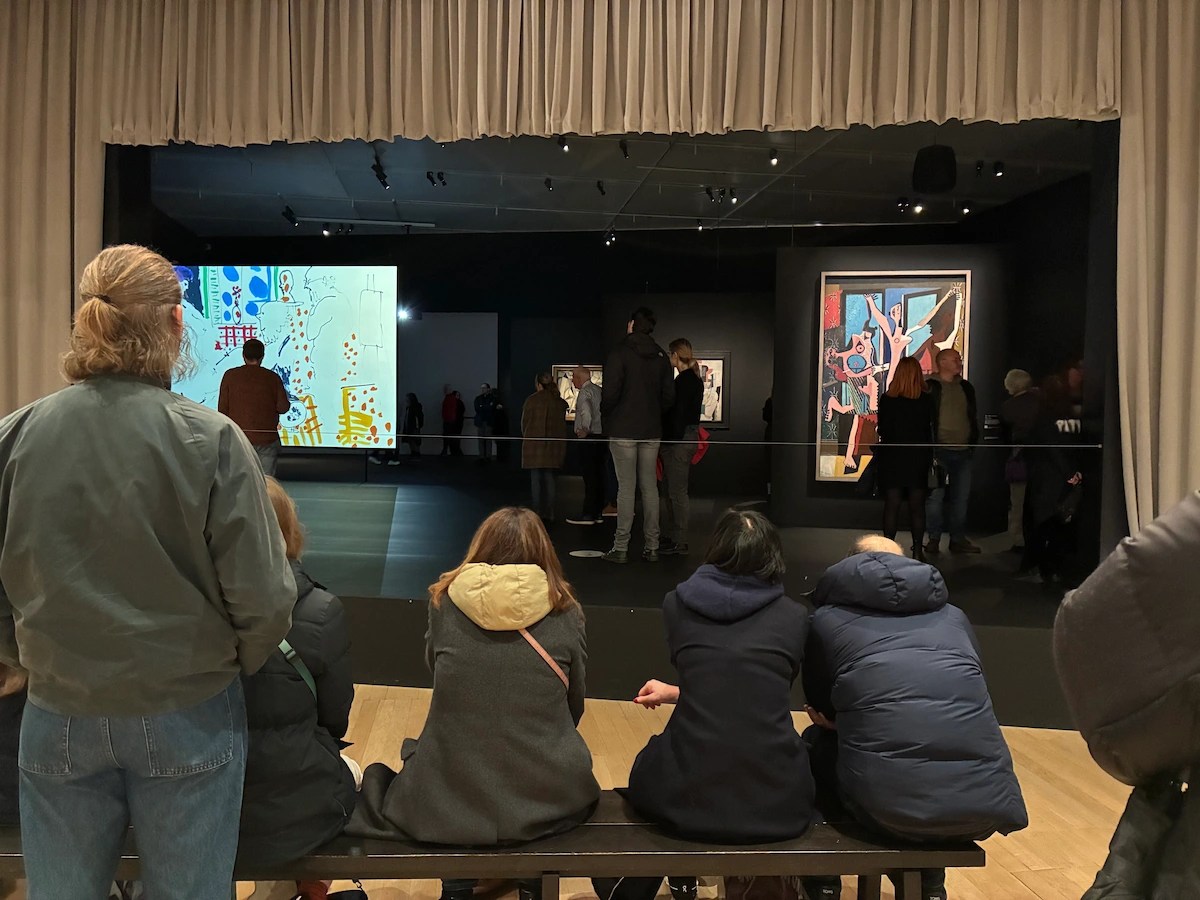
A performance space This perspective explains another massive design aspect of this exhibition which is that the main space, the main display area for paintings, drawings, sculptures, photos and so on, is raised and framed by curtains as if it was itself a theatre, and the second space visitors walk into is on a lower level with a bench for you to sit and look through a prosceniun arch fringed by curtains at all the other visitors as if they’re on a stage. Yes, the curators have turned their own exhibition into a performance.

Visitors watching other visitors ‘onstage’ ie through a curtain-edged proscenium arch, in ‘Picasso Theatre’ at Tate Modern (photo by the author)

And here’s a view of the viewing room (which itself contains three fairly large works, notably The Painter and His Model (1926) on the right. Note the girl sitting on the floor drawing the scene; arguably she’s the one with the right idea: don’t watch, do).

Reverse view of visitors watching other visitors ‘onstage’ ie through a curtain-edged proscenium arch, incidentally showing a couple more late-period works, in ‘Picasso Theatre’ at Tate Modern (photo by the author) You can see how excited they are by the whole thing

The Mystery of Picasso

And finally, by far the most dominant feature of the whole show is a massive cinema screen onto which is projected in its entirety a 1956 French documentary film titled ‘The Mystery of Picasso’, directed by Henri-Georges Clouzot, which shows Picasso at work creating some 20 drawings. This is a huge installation, it is dynamic, it has lots of movement and colour, and it has a soundtrack by the avant-garde composer Georges Auric which is also very loud, varied and dramatic.

The size, the colour, the movement and the loud music totally dominate the entire space. So much so that the curators have installed tiered rows of benches for people to settle down on and watch the entire thing which runs to 75 minutes! On a rainy Sunday morning I settled down leaned back and watched the entire film, savouring the way the great man starts by creating simple marker drawings in black and white before progressing to full-scale collages and oil paintings.

The entire film is available to watch online. This appears to be the most complete version if not the best picture quality.

Comment on the film

One thing which comes over really, really, really strongly from the film is that, without exception, he overdoes it. All of the images start with a few simple lines and then he adds in more details and shading so that you magically see the image coming to life before your eyes. However, in almost all cases it reaches a kind of perfection of lightness and deftness but he doesn’t stop. He keeps on adding heavier and heavier washes of colour and ink, obliterating the airy lightness of the original under swamps of murky blues and thick black lines, until they feel utterly ruined.

Mixing it up

One last point. Having done all this, the curators take one more step which is not to present the 50 or so other works (paintings, drawings, fabric, sculpture, collage, cartoons, photos, set designs, theatre programs and so on) in boring chronological order. No, no, they take their inspiration from the first retrospective of his work which Picasso himself supervised, in 1932, where he went out of his way to mix it up, to place works from completely different periods and styles side by side. And so that’s what the curators do here, pairing up works from completely different periods by virtue of their theme or the aspect of performance which they demonstrate.

A nice mix of Picasso works from across his periods and styles in ‘Theatre Picasso’ at Tate Modern (photo by the author)

Thoughts

I’m not sure whether I like Picasso. I can appreciate that he was a genius who revolutionised art etc but that doesn’t mean I particularly warm to any of his individual works. He’s certainly not my favourite modern artist, I like scores of 20th century artists more than him, Paul Klee, Kandinsky, Schiele, Wyndham Lewis, Epstein, Nevinson, Spencer, Pollock, Riley, Saville, loads.

I like the lightness of some of his works, like the woman in a red armchair. But I actively dislike the pre-cubist portraits and I find the cubist stuff deadly dull – bottles of wine and fragments of Figaro, seen a couple and you’ve seen thousands. I can appreciate that the 1920s tubular women running along beaches is an achieved style, and I suppose I ought to admire the 1930s weeping women biting their fingernails etc. And ought to be moved by Guernica et al. The first time you see one of his dove sketches you think Wow, but after you’ve seen 20 or 30 the effect wears off.

I’m ranging over his different styles like this because that’s what this exhibition does, showcasing good examples of each of Picasso’s styles and periods, as well as demonstrating his range of materials or formats, such as painting, drawing, etching, woodcut, lithograph, print, fabric, sculpture and the aforementioned set and costume designs. It’s a very varied and impressive selection, and I could see that much of it is very good, but none of it touched me.

When I was a student I liked the Minotaur prints, in fact a girlfriend bought me a book of them I liked them so much, but I’ve gone off them too. They feel too fussy and too amateurish. Silly poses, cartoon faces, monotonous subject matter.

In fact wandering round the show I realised I’ve slowly gone off Picasso’s entire masculine ethos, the obsession with bulls and bullfighting and bullheaded men has come to seem steadily more ridiculous to me. Living in a culture where gay and lesbian and gender fluid ideas have become more prevalent, most of Picasso’s masculinist posing now seems not just dated but ludicrous. As you wander round this striking and ambitious exhibition, dominated by the big loud central film, you can’t help thinking: what a lot of naked women; what a lot of bulls.


Related links

Related reviews

Picasso

Tate

Right Ho, Jeeves by P.G. Wodehouse (1934)

The exquisite code of politeness of the Woosters prevented me clipping her one on the ear-hole, but I would have given a shilling to be able to do it.

I curbed my resentment. We Woosters are fair-minded. We can make allowances for men who have been parading London all night in scarlet tights.

‘No. It is too late. Remarks have been passed about my tummy which it is impossible to overlook.’

I must say for Jeeves that—till, as he is so apt to do, he starts shoving his oar in and cavilling and obstructing—he makes a very good audience. I don’t know if he is actually agog, but he looks agog, and that’s the great thing.

‘Right Ho, Jeeves’ is the second of the 11 full-length Jeeves and Wooster novels by P.G. Wodehouse. After the first novel took the characters off to the Somerset estate of Chuffy Chuffnell, this is a return to the more familiar setting of London, but the basic motor of the plot remains the same: one of Bertie Wooster’s old school friends falls in love, triggering a world of problems and complications which can only be solved by the miraculous powers of Jeeves. In this case the young chap in trouble is the unworldly nature fan, Gussie Fink-Nottle who has fallen in love with Madeline

All the usual mannerisms are here: farcical plots based on the complicated misunderstandings of posh young people falling in love and managing their eccentric parents, all refracted through the ludicrously upper class attitude of the wonderfully dim and self-deluding narrator, the upper-class idler Bertram ‘Bertie’ Wooster. And all the usual stylistic elements:

Comically dim references to classical literature

‘Well, let me tell you that the man that hath no music in himself…’ I stepped to the door. ‘Jeeves,’ I called down the passage, ‘what was it Shakespeare said the man who hadn’t music in himself was fit for?’
‘Treasons, stratagems, and spoils, sir.’
‘Thank you, Jeeves.’

It’s a running gag that Bertie regularly wants to quote some gem of English literature but can never remember the details:

I remember when I was a kid at school having to learn a poem of sorts about a fellow named Pig-something—a sculptor he would have been, no doubt—who made a statue of a girl, and what should happen one morning but that the bally thing suddenly came to life.

Bertie forgets his words

Forgetting famous quotations is just one aspect of the broader comic topos of Bertie constantly forgetting the words for things:

There you will be, up on that platform, a romantic, impressive figure, the star of the whole proceedings, the what-d’you-call-it of all eyes.

‘Come, come, Tuppy, don’t let us let this little chat become acrid. Is ‘acrid’ the word I want?’

There’s a word beginning with r——“re” something——“recal” something—No, it’s gone. But what I am driving at is that is what this Angela was showing herself.

And needing to be corrected, generally by Jeeves:

She proceeded to develop her theme, speaking in ringing, enthusiastic tones, as if she loved the topic. Jeeves could tell you the word I want. I think it’s “ecstatic”, unless that’s the sort of rash you get on your face and have to use ointment for.

And:

‘To be quite candid, Jeeves, I have frequently noticed before now a tendency or disposition on your part to become—what’s the word?’
‘I could not say, sir.’
‘Eloquent? No, it’s not eloquent. Elusive? No, it’s not elusive. It’s on the tip of my tongue. Begins with an ‘e’ and means being a jolly sight too clever.’
‘Elaborate, sir?’
‘That is the exact word I was after. Too elaborate, Jeeves.’

And:

‘What do you call it when two people of opposite sexes are bunged together in close association in a secluded spot, meeting each other every day and seeing a lot of each other?’
‘Is ‘propinquity’ the word you wish, sir?’
‘It is. I stake everything on propinquity, Jeeves. Propinquity, in my opinion, is what will do the trick.’

Jeeves’s command of vocabulary is a small but significant aspect of his overall command of all situations. Jeeves’s interventions to correct Bertie’s speech, to suggest the correct word or phrase, to supply the quotations Bertie has forgotten, these are all verbal indications or equivalents of his role in the stories, which is to be the still point around which all the stormy plot complications rage.

And it’s not just on Bertie; the narrative notes Jeeves’s effect on everyone’s vocabulary:

‘Well, it’s a matter of psychology, he said.’
There was a time when a remark like that would have had me snookered. But long association with Jeeves has developed the Wooster vocabulary considerably.

The ‘the’

A really prominent part of Bertie’s diction (defined as: ‘the choice and use of words and phrases in speech or writing’) is his insistent use of ‘the’ where everyone else would use a personal pronoun such as ‘my’, ‘his’ and so on.

Until she spoke them, I had been all sweetness and light—the sympathetic nephew prepared to strain every nerve to do his bit. I now froze, and the face became hard and set.

Tuppy, old man. Your tone shocks me. One raises the eyebrows.

He did a sort of twiddly on the turf with his foot. And, when he spoke, one spotted the tremolo in the voice.

I stroked the chin thoughtfully.

The face was pale, the eyes gooseberry-like, the ears drooping, and the whole aspect that of a man who has passed through the furnace and been caught in the machinery

Bertram in the third person

There are the many times Bertie refers to himself in the third person, mockingly but also seriously, as ‘Bertram’, both in the narrative and in dialogue with others.

‘You have Bertram Wooster in your corner, Gussie.’

Bertram Wooster is not accustomed to this gluttonous appetite for his society.

Nobody is more eager to oblige deserving aunts than Bertram Wooster, but there are limits, and sharply defined limits, at that.

Well, as anybody at the Drones will tell you, Bertram Wooster is a pretty hard chap to outgeneral.

The Woosters

In the same spirit, Bertie strews his narrative with many comically mock heroic references to his family.

I mean to say, while firmly resolved to tick him off, I didn’t want to gash his feelings too deeply. Even when displaying the iron hand, we Woosters like to keep the thing fairly matey.

Half a dozen sentences start with the formula ‘we Woosters’ before going on to boast of their accomplishments.

A Wooster’s word is his bond. Woosters may quail, but they do not edge out.

I had won the victory, and we Woosters do not triumph over a beaten foe.

We Woosters are men of tact and have a nice sense of the obligations of a host

When we Woosters put our hands to the plough, we do not readily sheathe the sword.

Slang

Slang is language at play. It is so enjoyable because it represents energy and life and is often very funny, as, for example, in rhyming slang. Wodehouse’s stories are characterised from start to finish by their extreme deployment, their barrage, of upper-class slang, which is endlessly inventive and amusing.

The mystery had conked. I saw all.

Not to put too fine a point upon it, I consider that of all the dashed silly, drivelling ideas I ever heard in my puff this is the most blithering and futile.

‘I like your crust, wiring that you would come next year or whenever it was. You’re coming now.’

The way I look at it is that, as the thing is bound to be a frost, anyway, one may as well get a hearty laugh out of it.

But I claim the right to have a pop at these problems, as they arise, in person, without having everybody behave as if Jeeves was the only onion in the hash.

I was heart and soul in favour of healing the breach and rendering everything hotsy-totsy once more between these two young sundered blighters.

The pathos of the thing gave me the pip.

He was smelling a rose at the moment in a limp sort of way, but removed the beak as I approached.

We had hit the great open spaces at a moment when twilight had not yet begun to cheese it in favour of the shades of night.

This time she shook the pumpkin.

Abbreviations

An increasingly prominent category of slang is abbreviations, abbreviating a word down to just one syllable or, increasingly often, just to one letter, ‘conspic. by its a.’ being an instance which combines both types. The abbreviated syllables cropped up in some of the short stories but I think these one-letter abbreviations only make their first appearance in the first novel i.e. are a newish innovation.

One syllable

Anybody been phoning or calling or anything during my abs.?

In the circs., no doubt, a certain moodiness was only natural.

‘No, Jeeves. No more. Enough has been said. Let us drop the subj.’

The persp., already bedewing my brow, became a regular Niagara.

‘Could?’ I said, for my attensh had been wandering.

‘I don’t suppose she said two words to anybody else, except, of course, idle conv. at the crowded dinner table.’

His manifest pippedness excited my compash, and I ventured a kindly word.

One letter

‘I wouldn’t have thought that this Fink-Nottle would ever have fallen a victim to the divine p, but, if he has, no wonder he finds the going sticky.’

However, on consideration, I saw that there was nothing to be gained by trying to lead up to it gently. It is never any use beating about the b.

I took another oz. of the life-saving and inclined my head.

I could see at a g. that the unfortunate affair had got in amongst her in no uncertain manner. Her usually cheerful map was clouded, and the genial smile conspic. by its a.

There was no play of expression on his finely chiselled to indicate it. There very seldom is on Jeeves’s f-c.

Presently I was sauntering towards the drawing-room with the good old j. nestling snugly abaft the shoulder blades.

In the stress of recent happenings I had rather let that prize-giving business slide to the back of my mind; but I had speedily recovered and, as I say, was able to reply with a manly d.f.

‘This habit of the younger g. of scattering ‘darlings’ about like birdseed is one that I deprecate.’

‘I assumed that you were apologizing for your foul conduct in looping back the last ring that night in the Drones, causing me to plunge into the swimming b. in the full soup and fish.’

Old Pop Kipling never said a truer word than when he made that crack about the f. of the s. being more d. than the m.

Binge

A note on the word ‘binge’ which in Bertie’s hands, sometimes means simply party or ‘do’ (synonymous with ‘beano’); but at other times means something more like that other fashionable ’20s and ’30s word, ‘stunt’.

a) Party

This birthday binge of his was to be on a scale calculated to stagger humanity…

These country binges are all the same. A piano, one fiddle, and a floor like sandpaper.

b) More general event

‘Gussie,’ I said, ‘take an old friend’s advice, and don’t go within a mile of this binge.’

I had told Jeeves that this binge would be fraught with interest, and it was fraught with interest.

Those interruptions had been enough to prove to the perspicacious that here, seated on the platform at the big binge of the season, was one who, if pushed forward to make a speech, might let himself go in a rather epoch-making manner.

The Drones club

Bertie is a member of the Drones Club, a collection of like-minded posh wastrels. It’s been mentioned before, but felt a bit more prominent in this book.

I sent this [telegram] off on my way to the Drones, where I spent a restful afternoon throwing cards into a top-hat with some of the better element.

I remember Cats-meat Potter-Pirbright bringing a police rattle into the Drones one night and loosing it off behind my chair…

I sang as I dressed for dinner that night. At the Drones I was so gay and cheery that there were several complaints.

Long association with the members of the Drones has put me pretty well in touch with the various ways in which an overdose of the blushful Hippocrene can take the individual…

Bertie’s memoirs

It’s a small thing, but I’m struck by the detail that Bertie refers to the texts we’re reading as his memoirs.

If you have followed these memoirs of mine with the proper care, you will be aware that I have frequently had occasion to emphasise the fact that Aunt Dahlia is all right.

This self-consciousness about the status and genre of the text – mentioning their format and motivation – harks back to Victorian story-tellers and is just one way in which it echoes Conan Doyle.

Echoes of Sherlock: cases, clients and methods

Surprisingly, Sherlock Holmes casts a long shadow over Wodehouse. For example Bertie, author of ‘these memoirs’ (much as Dr Watson is the author of the Holmes accounts), routinely refers to the challenges and problems which make up the plot as ‘cases‘ (exactly as Watson refers to Holmes’s cases). (To be fair, plenty of other detectives used the same word, but it’s Holmes they most remind us of.)

My report of the complex case of Gussie Fink-Nottle, Madeline Bassett, my Cousin Angela, my Aunt Dahlia, my Uncle Thomas, young Tuppy Glossop and the cook, Anatole.

I nodded. ‘I remember. Yes, I recall the Sipperley case.’

He deliberately echoes Watson’s way of referring to Holmes’s cases when he talks about ‘the Sipperley Case, the Episode of My Aunt Agatha and the Dog McIntosh, and the smoothly handled Affair of Uncle George and The Barmaid’s Niece’.

They are so much conceived of as ‘cases’ that they need to be handled.

‘In handling the case of Augustus Fink-Nottle, we must keep always in mind the fact that we are dealing with a poop.’

Only a couple of days ago I was compelled to take him off a case because his handling of it was so footling.

And it’s not just the concept of ‘cases’ which echo the Holmes stories but his deliberate description of the people who come to him9 with their problems as ‘clients’.

In the excitement of getting Gussie fixed up I had rather forgotten about this other client. It is often that way when you’re trying to run two cases at once.

He jokingly refers to the way so many of his friends consult Jeeves about their problems that he in effect runs ‘a consulting practice’.

That’s how these big consulting practices like Jeeves’s grow. When he’s got A out of a bad spot, A puts B on to him. And then, when he has fixed up B, B sends C along. And so on, if you get my drift, and so forth.

At one point Wodehouse has Bertie deliberately citing a very famous quote which occurs in several the Holmes stories:

‘You know my methods, Jeeves. Apply them.’

And at not one but several points, the comparison is made absolutely explicit:

One can’t give the raspberry to a client. I mean, you didn’t find Sherlock Holmes refusing to see clients just because he had been out late the night before at Doctor Watson’s birthday party.

Or when Jeeves explains to Bertie that:

‘Possibly you may recollect that it was an axiom of the late Sir Arthur Conan Doyle’s fictional detective, Sherlock Holmes, that the instinct of everyone, upon an alarm of fire, is to save the object dearest to them.’

The plot

Bertie returns to London from a holiday in Cannes spent in the company of his Aunt Dahlia Travers, her daughter Angela and her soppy friend, Madeline Bassett.

The white mess jacket

Before I get too far I need to mention that Bertie brought back from Cannes a white mess jacket (with brass buttons) and that when Jeeves sees it he takes strong objection to it. As you know, this squabble about clothes happens in many of the short stories and always follows the same pattern: the subject is established near the start, Bertie insists he’s going to put his foot down and stand no nonsense from Jeeves, then Jeeves repeatedly saves the day getting Bertie and chums out of dire situations, so that at the conclusion Bertie is so overcome with gratitude that he caves in to Jeeves and gets rid of the offending article of clothing.

Jeeves advises Gussie Fink-Nottle

Anyway, on his return he discovers that in his absence, his valet, Jeeves, has been advising Bertie’s old school friend, Gussie Fink-Nottle about a love affair. Gussie is an anti-social teetotaller who lives out in the countryside where he devotes himself to caring for newts. What has brought him to London is that he is smitten with the wet fish Madeline but is too timid to propose.

Fancy dress

When Bertie gets back to his flat after an evening at the Drones club, he discovers Gussie in conversation with Jeeves and dressed as (the devil) Mephistopheles. This is because Madeline has invited him to attend a fancy-dress ball and Jeeves has advised he doesn’t go as the standard poshboy outfit of Pierrot but something more virile and dashing (he had originally suggested a pirate outfit but Gussie ‘objected to the boots’).

In the event the fancy dress scheme is a washout because Gussie is so useless. He is staying in London with his uncle and takes a cab to the party, dressed as the devil, but en route realises he’s left his money back at his uncle’s. He thinks he’ll tap someone at the party to pay the taxi but when they arrive he finds he’s got the wrong address and the butler at the big house they’ve arrived at disclaims all knowledge of any party. He can’t even go back to his uncle’s because all the servants have been given the night off and he’s forgotten his key. So the best he can do is try to run off without paying the cab. But when the driver grabs his coat and pulls it off, Gussy is revealed in all his glory as the devil, freaking the driver out and terrifying passersby. So not, on the whole, the most successful of evenings.

Aunt Dahlia requests

The next theme is introduced when Bertie receives a telegram from his Aunt Dahlia demanding that he go down to her country seat immediately. When Bertie is too dim to do this, she storms up to London, into his flat and trumpets her plan at him: she is a governor of the local grammar school, Market Snodsbury Grammar School, which is due to have its summer prize-giving ceremony the next month and she wants Bertie to give the prizes. Incidentally, Aunt Dahlia calls Bertie:

  • you old ass
  • you maddening half-wit
  • a fathead
  • greedy young pig
  • poor fish
  • abysmal chump
  • eyesore
  • ‘What a pest you are, you miserable object,’ she sighed

Gussie leaves for Brinkley Court

Next morning young Gussie comes round to Bertie’s flat, and Bertie solemnly ticks him off for listening to Jeeves and not to him, Bertie. (This is hubris. We know that all Bertie’s plans end in disaster and that time after time he is only saved by Jeeves’s ingenuity.) Then Gussie informs him that his beloved Madeline is leaving London anyway. She’s going to the country, to stay with a family named Travers at a place called Brinkley Court! This is, of course, the home of Aunt Dahlia!!

So Bertie has, what for him, is a brainwave, sees he can kill two birds with one stone. First he tells Gussie he’ll get him an invite to Brinkley Hall so he can go see his lady love. But then he telegrams to Aunt Dahlia saying he is indisposed/too busy to perform the prize-giving she bullied him into, but has found a replacement, by which he of course means Gussie.

Bertie is summoned to Brinkley Court

All appears settled but the next thing that happens is that Bertie receives an anguished telegram from Aunt Dahlia telling him that the long-planned engagement between her daughter Angela and Tuppy Glossop has been cancelled. The couple has fallen out. Apparently he said that her new hat made her look like a Pekinese dog. But what clinched it is that during her holiday in Cannes, Angela was attacked by a shark (this is played for laughs although ever since the 1977 movie of the same name, no-one thinks a shark attack is funny) but when she retold the story, Tuppy mockingly said it was probably just a log, or a flatfish at most. Which led Angela to reply that he ought to lay off the carbs as he was getting pretty lardy. And so the argument unravelled.

The reader is a bit surprised that this appears to be a big enough crisis that Bertie feels obliged to hot foot it down to Brinkley Court to comfort his aunt. Here she lays out her troubles:

  • Tuppy and Angela have broken off their engagement
  • she has to find someone to conduct the school prize-giving
  • her husband just received a whopping income tax bill (which he is convinced symbolises the end of British civilisation as we known it)
  • at the same moment that she needs to find £500 to keep her magazine, Milady’s Boudoir, afloat
  • but that in fact he gave her the necessary money but she lost it playing baccarat at Cannes, and can’t pluck up the courage to tell him

It’s important to emphasise that Aunt Dahlia thinks Bertie is a complete clot, thinks that every plan he suggests, in fact almost everything he says, is unmitigated idiocy. And that she prefers Jeeves. In fact it’s a recurring comic trope that everyone Bertie talks to sooner or later thanks him for coming but asks where Jeeves is. This begins to really rile Bertie.

The dinner refusal

Later, talking to Tuppy, Bertie comes up with a cunning plan. He will advise Tuppy to refuse dinner that evening, the point being is it will be a dinner cooked by Anatole, the legendary chef. And this unprecedented gesture well convince Angela he has gone off his food for love of her. And they’ll be reconciled.

When Aunt Dahlia comes to him, saying she’s had no opportunity of talking to her husband about the lost money, Bertie advises her to push away Anatole’s dinner, in order to persuade Uncle Tom how upset she is.

And when Gussie comes to him for help in wooing Madeline, he advises him to reject Anatole’s meal with the same aim in mind.

Unfortunately this cunning plan backfires big time because Anatole, like all culinary geniuses, is very sensitive, and when dish after dish is brought back to the kitchen untouched, the Frenchman decides it is a deliberate snub to his skills and quits! Vowing to return to his native Provence. Which pitches Tom Travers into depths of misery because his stomach was ruined by long years living Out East and Anatole is the only cook who can make dishes acceptable to Tom’s sensitive tum-tum.

Aunt Dahlia suggests suicide

Which is why when he next sees Aunt Dahlia she cheerfully suggests that he goes and drowns himself in the nearby pond. the plan failed for both Tuppy and Gussie as well.

So, as you can see, what we have here is five or six ‘issues’, problems or, as Bertie puts it, ‘cases’, which he sets out to solve with increasingly wayward results until, of course, finally, Jeeves steps in and saves the day.

But first things have to get worse before they can get better. And so:

1. Bertie roasts Tuppy

Bertie has the bright idea of using reverse psychology on Angela, taking her out into the garden and slagging off Tuppy to her, with the idea that she will jump to his defence. Unfortunately, the more Bertie vilifies Tuppy, the more Angela agrees with him, concluding she was wise to dump him before heading indoors. It’s at that moment that, as in a stage farce, Tuppy himself emerges from the bushes nearby where he heard every word, and proceeds to chase Bertie round the garden bench, with a view to smashing his face in.

The thing is Tuppy not only heard Bertie slagging him off but has become convinced that Angela is in love with another man and when Bertie innocently remarks that he (Bertie) and Angela were inseparable in their two-month holiday at Cannes, Tuppy puts 2 and 2 together and concludes that Angela dumped him because she is really in love with Bertie. Obviously Bertie goes to great lengths to emphasis that this isn’t true, but Tuppy still insists on thinking there must be some other man…

2. The drunken prize-giving

In an obvious set-piece, Gussie undertakes the prize-giving at the local grammar school (which Bertie had adroitly ducked) completely drunk. How come? Bertie has the disastrous idea that Gussie is failing to propose to Madeline because he is so cripplingly shy and the way to circumvent this is to pop some booze in his daily orange juice. Bertie starts from the comic premise that no man in his right mind would give up his bachelor freedom for the married state, or could bring himself to spout loads of romantic nonsense – and therefore a chap needs to be well-oiled to even try. The first problem is that, before he gets to the spiked orange juice, Gussie takes Bertie’s advice to heart and swigs half a bottle of Scotch. Realising this Bertie then tries to hide the spiked OJ but when his back is turned, Gussie swigs this as well.

Thus he is completely trolleyed when he is motored to the school by Aunt Dahlia and Uncle Tom (Jeeves and Bertie following in the latter’s car). There follows exactly the kind of comic set-piece you might expect, with Gussie shown to the place of honour on the stage in front of a hundred silent schoolboys and all their parents and proceeding, of course, to make an ass of himself.

3. The girls get engaged to the wrong men

When Gussie starts to single Bertie out for criticism from the stage, our hero legs it, gets back to Brinkley and goes for a lie-down. When he rises for dinner, he is astonished to learn that a) Angela has got engaged to drunken Gussie (!!!) and b) Madeline has gotten it into her head that she (Madeline) is engaged to Bertie. This is because the day before Bertie took her into the garden and described how there was someone staying at the house whose heart beat deeply for her – and listening to her vapourings about fairies and stars. Obviously he intended to be selling her on Gussie but Madeline got the wrong end of the stick and thinks i) he is in love with her and ii) his witless ramblings amounted to a proposal!

Aunt Dahlia is delighted

One silver lining in all this is that Aunt Dahlia, instead of being outraged at Gussie’s drunken shambles of a presentation speech, thought it was immensely entertaining, not least because he singled out her husband, Tom, for some drunken criticism, and then accused Bertie of cheating at school (in order to win the much-coveted Scripture Prize, which Bertie is very proud of and keeps reminding us of, mainly because it was the peak of his academic career). As she puts it:

‘What was there to be peeved about? I took the whole thing as a great compliment, proud to feel that any drink from my cellars could have produced such a majestic jag. It restores one’s faith in post-war whisky.’

Also, after a day of beseeching and wheedling, Dahlia has managed to persuade Anatole to withdraw his resignation. Tom (of the gyppy tummy) is delighted and so is the Aunt.

But no sooner has she finished explaining this than her butler, Seppings, enters the room to ask whether my lady gave permission for Gussie to be on the roof, making rude faces through the skylight of Anatole’s bedroom. There’s a little comic pastiche as Wodehouse describes Bertie, Aunt Dahlia and Seppings in the manner of racehorses charging up the stairs to see who can get to Anatole’s attic room first. (Aunt Dahlia won by a short head. Half a staircase separated second and third.)

At long last, Bertie asks Jeeves

Maybe I’d had a particularly trying day at work, but eventually all this farcical complexity began to wear a little. Wooster by himself eventually gets a bit much; it’s the dynamic between him and Jeeves which is so priceless. For most of this novel Bertie is not just narrating but the active protagonist of all the plot developments and this eventually starts to feel a bit monotonous.

Finally, about 83% into the text (according to my Kindle edition) Bertie swallows his pride and asks Jeeves if he can think of a way out of the terrible mess everything’s got into.

The fire alarm stunt

Jeeves proposes the old fire alarm stunt i.e. ring the house’s (very large) alarm bell as if there’s a fire, on the principle that the two erring couples will run to save each other and True Love be revealed.

The bell ringing goes easily enough but when all the inhabitants have evacuated the building and are standing around on the lawn, none of the estranged couples have gotten together. Seems like a failure.

Aunt Dahlia is amused at Bertie’s idiocy and doesn’t even mind too much when it is revealed that the front door has blown shut and all the other windows and doors are locked. Nobody has a spare key. Why not call the staff or ask the butler? Because the entire staff have gone off to Kingham Manor, the stately-home belonging to the Stretchley-Budd family, who are hosting a big dance party for servants. So it looks like all the posh inhabitants are going to have to spend the night on the lawn and everyone, accordingly, blames Bertie.

They have the bright idea to motor over to Kingham Manor to get the keys off the butler until they discover that the garage, also, is locked up and the chauffeur off at the party.

It’s at this point the Jeeves makes the suggestion that Bertie should cycle over to Kingham Manor and get the front door key. Bertie puts up every sort of objection, but Aunt Dahlia imperiously commands him to go. It’s a nightmare journey 9 miles along country lanes in the dark but there is a surprise in store. For when Bertie finally arrives at Kingham Manor, makes his way to the dance, identifies the butler and interrupts his dance, the man tells him he doesn’t have the key. More astonishing still, he tells Bertie that he gave the key to Jeeves!

Astonished and then furiously angry, Bertie sets off, with a saddle-sore bum and aching legs, the 9 mile return journey. but when he pulls up outside Brinkley Manor he discovers everyone has gone inside. And the person who answers the front door is wet Madeline who, to his vast relief, gaspingly asks Bertie to release her from their vow (their engagement that never was). This is because she realises that all along she has been bearing the flame of true love for Gussie, and wants to marry him. Bertie is amazed and relieved.

Next person he meets is Tuppy, breezily coming up from the wine cellar with bottles under his arm, who tells him they’re having a little party in the drawing room. As to the disagreement with Angela, all has been forgiven and forgotten and they are re-engaged.

As to Aunt Dahlia she is delighted because Anatole has finally decided to stay, which delights Uncle Tom so much that he has happily given her the £500 she needs to save her magazine.

In fact all the issues which have been plaguing the book have been completely sorted while Bertie was away. Of course he soon bumps into Jeeves and is too amazed at this reversal of fortune to be cross with him. And Jeeves explains: he explains that his family used to have a relative they all loved to hate; whenever she was around, she united the family in their dislike of her. Well, that’s what Jeeves did to Bertie. He let him go ahead with the fire alarm stunt precisely because it was such a bad idea that it would bring everyone together in complaining about him. Even more so when they could all complain about it being his fault they were all locked out of the house.

So while Bertie was cycling off, this rallying round a common hate figure made everyone forget their grievances and, once they’d done that, they naturally gravitated towards the people they really loved.

‘It occurred to me that were you, sir, to be established as the person responsible for the ladies and gentlemen being forced to spend the night in the garden, everybody would take so strong a dislike to you that in this common sympathy they would sooner or later come together.’

Then, when Jeeves ‘found’ the front door key (which he had had on him all the time) and it became obvious that Bertie’s long bicycle odyssey was pointless, they switched from hatred to humour and then feeling sorry for him. So by the time Bertie arrived back the bad feeling that had brought them together had evaporated and he was once again regarded as a harmless buffoon.

Very, very clever. Typically double-edged or multi-layered solution from Jeeves. And in the same way, Bertie’s anger which he nursed all the way back from the dance, dissipates when he sees the magical effects of Jeeves’s trick.

And one last thing: the clothes stunt. Like so many of the short stories, the argument between Jeeves and Bertie over an item of clothing the latter loves and the former loathes, is, as usual, decided in Jeeves’s favour. He regretfully informs Bertie that he accidentally burned the mess jacket while ironing it. To be honest, this is not a particularly clever way of solving the clothes issue; in other stories the destruction of the contentious item of clothing is intimately tied up with the denouement of the plt. Here it is just bolted on as a completely separate event. Still, as Bertie slangily sums the whole thing up:

‘The place is positively stiff with happy endings.’

The cast

  • Bertie Wooster – private school, Eton and Oxford, an ass and an idiot with a comically inflated sense of his own abilities
  • Jeeves – his valet
  • Augustus ‘Gussie’ Fink-Nottle – timid and anti-social, lives in Lincolnshire with his newts – ‘one of those timid, obsequious, teacup-passing, thin-bread-and-butter-offering yes-men whom women of my Aunt Dahlia’s type nearly always like at first sight’ – according to Bertie, ‘wabbling, shrinking, diffident rabbit in human shape’
  • Miss Madeline Bassett – only daughter of Sir Watkyn Bassett CBE – ‘a pretty enough girl in a droopy, blonde, saucer-eyed way, but not the sort of breath-taker that takes the breath’
  • Aunt Dahlia of Brinkley Court aka Mrs Travers, married to Tom Travers, editor of Milady’s Boudoir, ‘a large, genial soul, with whom it is a pleasure to hob-nob’
  • Uncle Tom Travers – Aunt Dahlia’s husband – ‘who always looked a bit like a pterodactyl with a secret sorrow’
    • Seppings – Aunt Dahlia’s butler, a cold, unemotional man
    • Anatole – Aunt Dahlia’s legendary cook – ‘a tubby little man with a moustache of the outsize or soup-strainer type, and you can generally take a line through it as to the state of his emotions. When all is well, it turns up at the ends like a sergeant-major’s. When the soul is bruised, it droops’
    • Waterbury – their chauffeur
  • Hildebrand ‘Tuppy’ Glossop – ‘was the fellow who, callously ignoring the fact that we had been friends since boyhood, betted me one night at the Drones that I could swing myself across the swimming bath by the rings—a childish feat for one of my lissomeness—and then, having seen me well on the way, looped back the last ring, thus rendering it necessary for me to drop into the deep end in formal evening costume’ – ‘In build and appearance, Tuppy somewhat resembles a bulldog’
  • Pongo Twistleton – fellow member of the Drones Club whose birthday party goes on late into the night with the result that Bertie has a crushing hangover when Aunt Dahlia storms into his bedroom demanding that he officiate at her prize-giving

The Freudian presence

As you know I’ve been collecting references in 1920s and 1930s popular literature to Freud and Freudian ideas.

The nibs who study these matters claim, I believe, that this has got something to do with the subconscious mind, and very possibly they may be right. I wouldn’t have said off-hand that I had a subconscious mind, but I suppose I must without knowing it, and no doubt it was there, sweating away diligently at the old stand, all the while the corporeal Wooster was getting his eight hours. For directly I opened my eyes on the morrow, I saw daylight. Well, I don’t mean that exactly, because naturally I did. What I mean is that I found I had the thing all mapped out. The good old subconscious m. had delivered the goods.

And:

Jeeves, when I discussed the matter with him later, said it was something to do with inhibitions, if I caught the word correctly, and the suppression of, I think he said, the ego. What he meant, I gathered, was that, owing to the fact that Gussie had just completed a five years’ stretch of blameless seclusion among the newts, all the goofiness which ought to have been spread out thin over those five years and had been bottled up during that period came to the surface on this occasion in a lump—or, if you prefer to put it that way, like a tidal wave.

Jeeves’s miraculous mode of transportation

My private belief, as I think I have mentioned before, is that Jeeves doesn’t have to open doors. He’s like one of those birds in India who bung their astral bodies about—the chaps, I mean, who having gone into thin air in Bombay, reassemble the parts and appear two minutes later in Calcutta. Only some such theory will account for the fact that he’s not there one moment and is there the next. He just seems to float from Spot A to Spot B like some form of gas.

Jeeves’s character

One thing I have never failed to hand the man. He is magnetic. There is about him something that seems to soothe and hypnotize. To the best of my knowledge, he has never encountered a charging rhinoceros, but should this contingency occur, I have no doubt that the animal, meeting his eye, would check itself in mid-stride, roll over and lie purring with its legs in the air.

Choice phrases

She unshipped a sigh that sounded like the wind going out of a rubber duck.

You can’t expect an empty aunt to beam like a full aunt.

It isn’t often that Aunt Dahlia, normally as genial a bird as ever encouraged a gaggle of hounds to get their noses down to it, lets her angry passions rise, but when she does, strong men climb trees and pull them up after them.

Hunting, if indulged in regularly over a period of years, is a pastime that seldom fails to lend a fairly deepish tinge to the patient’s complexion, and her best friends could not have denied that even at normal times the relative’s map tended a little toward the crushed strawberry. But never had I seen it take on so pronounced a richness as now. She looked like a tomato struggling for self-expression.


Credit

‘Right Ho, Jeeves’ was published in 1934 by Herbert Jenkins. I read it online.

Related links

Related reviews

The Green Hat by Michael Arlen (1924)

‘It might be nice for you to take a house in London for the spring season—I know a dove of a house in Talbot Square you could get, furnished. I mean, living with sane, well-balanced English people.’
She would have gone on to tell him all the old propaganda stories of 1914 if he had not laughed and said:
‘I’ve been reading a book by Michael Arlen and if that’s—’
She ruined Michael Arlen with a wave of her salad spoon.
‘He only writes about degenerates. I mean the worthwhile English.’
(Baby Warren and Dick Diver chatting in ‘Tender Is The Night’ by F. Scott Fitzgerald, Book 2, chapter 21)

‘Your generation,’ said Hilary thoughtfully, ‘is a mess.’
(The Green Hat, chapter 3)

She suspected they might be thinking she was going to more than powder her nose. They were, she was, who cared?
(chapter 4)

She drove with assurance, that is to say, she drove as though her mind was not in the same world as the steering-wheel.
(chapter 4)

‘The Marches are never let off anything…’
(The sense of doom clinging round twins Iris and Gerald March, a phrase often repeated)

She [Billee Ponthéveque, a cocotte] never saw her parents, she would say, because of a funny idea they had that it was bad for her health to take cocaine on an empty stomach.
(The blasé attitude to sex and drugs which helped make the book notorious; chapter 7)

‘Why is every one so awful these days!’
(poor Venice Pollen, wailing the eternal wail; chapter 7)

I couldn’t help thinking of her as of someone who had strayed into our world from a strange land unknown to us, a land where lived a race of men and women who were calmly awaiting their inheritance of our world when we should have annihilated one another in our endless squabbles about honour, morality, nationality.
(One of hundreds of passages where the narrator adulates the protagonist, Iris Storm; chapter 9)

‘The Green Hat’ by Michael Arlen was the publishing sensation of 1924, making its author famous overnight, quickly becoming a touchpoint for the culture, going on to be referenced in contemporary newspapers, magazines and other fictions for the next decade and more, as epitomising the spirit of the day and the year.

It more or less invented the concept of the heedlessly hedonistic bright young things of London. More specifically, it crystallised and defined the idea of the new woman about town, smartly dressed, comfortably off, defying conventions (wearing short skirts, bobbing her hair, smoking!). The heroine in question is Iris Storm, wearer of the green hat in question, fast driver of a Hispano-Suiza motor car and breaker of men’s hearts.

Michael Arlen

The most striking thing about the author of this quintessentially English comedy is that he wasn’t English at all, but a Bulgarian of Armenian descent. He was born Dikran Sarkis Kouyoumdjian in Bulgaria to an Armenian merchant family. In 1892, his family moved to Plovdiv, Bulgaria, after fleeing Turkish persecutions of Armenians in the Ottoman Empire. In Plovdiv, Arlen’s father set up an import-export business and a few years later, he moved his family to England. It was here that young Dikran went to school and was raised speaking posh English, before enrolling at Edinburgh University.

During the Great War Dikran was regarded with suspicion as Bulgaria was allied to Germany and Austria. He gravitated to London and fell in with other conscientious objectors and outsiders. He began writing essays and article for the New Age magazine, and took to signing them Michael Arlen to allay the xenophobia his real name aroused.

During the 1920s Arlen rented rooms opposite ‘The Grapes’ public house in Shepherd Market, then a bohemian Mayfair address. He used Shepherd Market as the setting for the novel. Here’s Shepherd Market on Google Maps. In 1920 he became infatuated with one of the leading socialites of her day, the brilliant and charismatic Nancy Cunard, and she is the inspiration for Iris Storm.

It is, then, as you can see, a strongly autobiographical novel, but with the central character exaggerated for sensational effect.

‘The Green Hat’ made Arlen famous and rich. He enjoyed dressing smartly, driving round London in a yellow Rolls Royce (precursor to John Lennon’s white Rolls Royce forty years later), hobnobbing with other celebrities. He regularly travelled to the United States to work on plays and films. He was understandably nervous about writing a follow-up to his big hit and, indeed, none of his subsequent novels were nearly as successful but he was, until his death in 1956, famous for being famous.

Chapter 1. The Green Hat

Introducing the narrator and Iris Storm

It is the summer of 1922. The story is a first-person narrative told in a breezily facetious style by a well-educated, posh but poor man about town. He lives in a crappy flat above a sordid alleyway in Mayfair’s Shepherd’s market and takes us into his confidence with various arch and self-conscious narrative comments, which hark back to Victorian storytelling.

It is late, after midnight, when the tale begins…

He has just got back to his flat after a party when the front doorbell rings. It is a woman wearing a fashionable small green hat pulled down over her eyes, come to visit her brother, Gerald March, who lives in the flat above the narrator.

As he lets her into the ramshackle house, the narrator is dazzled by her beauty and self possession, by her striking car, a big yellow Hispano-Suiza, by the panache of her green hat, by her small face and dancing auburn hair. He notices she is wearing a large green emerald ring on the third finger of her right hand. He comes to notice that she has tiger-tawny hair and a husky voice. Unfortunately, when they get to the door of Gerald’s flat they see that he is blind drunk.

After the first few pages you realise it is going to overflow with infatuated descriptions of the charismatic Iris. Rhapsodies. A love letter.

She stood carelessly, like the women in Georges Barbier’s almanacks, Falbalas et Fanfreluches, who know how to stand carelessly.

About her, it was perfectly obvious, was the aura of many adventures.

The magic of the sea was in her eyes, whipped with salt and winds.

It seemed to me that across her gentleness flamed a bar of fire. She walked, oh, impersonally, in the fires of herself.

One was to find later that she was completely without a sense of property, either her own or other people’s.

She had a great talent for looking at nothing in particular,

She walked, oh, impersonally, in the fires of herself.

She showed you first one side of her and then another, and each side seemed to have no relation with any other, each side might have belonged to a different woman; indeed, since then I have found that each side did belong to a different woman. I have met a hundred pieces of Iris, quite vividly met them, since last I saw her. And sometimes I have thought of her—foolishly, of course, but shall a man be wise about a woman?—as someone who had by a mistake of the higher authorities strayed into our world from a land unknown to us, a land where lived a race of men and women who, the perfection of our imperfections, were awaiting their inheritance of this world of ours.

She wasn’t that ghastly thing called ‘Bohemian’, she wasn’t any of the ghastly things called ‘society’, ‘county’, upper, middle, and lower class. She was, you can see, some invention, ghastly or not, of her own. But she was so quiet about it, she didn’t intrude it on you, she was just herself, and that was a very quiet self. You felt she had outlawed herself from somewhere, but where was that somewhere? You felt she was tremendously indifferent as to whether she was outlawed or not.

One was to find later that she was completely without a sense of property, either her own or other people’s.

She looked at me through the smoke of her cigarette. She was grave, intent. But one never knew what about…

Arlen isn’t afraid to deploy shamelessly poetic prose:

White she was, very white, and her painted mouth was purple in the dim light, and her eyes, which seemed set very wide apart, were cool, impersonal, sensible, and they were blazing blue. Even in that light they were blazing blue, like two spoonfuls of the Mediterranean in the early morning of a brilliant day. The sirens had eyes like that, without a doubt, when they sang of better dreams.

She was like a tower of beauty in the morning of the world.

Anyway, they look into Gerald’s room long enough to realise he has passed out drunk again. The narrator explains that his binges go on for three days. Iris introduces herself, Iris Storm, Mrs Storm, and explains that she and Gerald are twins, born within the same hour 29 years ago. They come from a posh landed family, the Marches, which has fallen on hard times.

I could somehow ‘cope with’ my time and generation, while they were of the breed destined to failure. I was of the race that is surviving the England of Horatio Bottomley, the England of lies, vulgarity, and unclean savagery; while they of the imperious nerves had failed, they had died that slow white death which is reserved for privilege in defeat…

Gerald is ‘absurdly shy’, can’t cope with life hence the alcoholism. She spends most of her time abroad, which she explains why she hasn’t seen her brother for ten years. But he’s drunk and after a bit of chat and explaining these facts, they leave the drunken brother, Iris bitterly commenting that ‘the Marches are never let off anything…’ which becomes a refrain through the book.

On the way back down she suddenly drops into his room asking for a glass of water. The narrator is embarrassed because he is moving out of the place next day and his belongings are scattered all over the floor. She picks up various books, we discover that the narrator is (alas) a writer, and they have some literary chat (she thinks D.H. Lawrence is ‘nice’) which seems terribly dated and irrelevant, for example about the quality of ‘vulgarity’. Then they’re talking about ‘the Jews’ and their love of luxury which leads into a consideration of Chesterton, his Catholicism and blowing on about beer and Britain. Very dated, almost at times incomprehensible.

But the conversation is just filler while he observes and studies the woman he has already become besotted by:

The lady of the green hat said nothing, and that was how I knew that for her everything was inevitable. That is an important thing to know about a woman, for you know then that you will never know where you are.

She kept strange, invisible company, this lady. She walked in measureless wastes, making flames rush up from stones, making molehills out of mountains.

She shook her head, staring at me with a mischievous smile. Her childishness did not jar. She was always herself.

Her hair was thick and tawny, and it waved like music, and the night was tangled in the waves of her hair.

More information is revealed, such as Iris has been married two times, both dead. Second husband, Captain Storm, won a Victoria Cross in the Great War but a year later was murdered by Sinn Feiners in Ireland.

There’s a knock at the door and it’s the local policeman on his beat and worried about an unusual car parked in the alley. The narrator reassures him, but when he returns to his flat, discovers Iris has gone into his bedroom and fallen asleep on the bed. He studies her beauty intently, sitting in a chair smoking till dawn. At which point she awakes, puts on some powder and the famous hat, and departs.

Her eyes were full on mine, naked, expressionless. I felt that they were the heads of the nails under which she had nailed herself.

Wow! He is hooked.

Chapter 2. The Cavalier Of Low Creatures

Profiling Iris’s twin brother, [the alcoholic] Gerald March

The book very heavily uses the old thriller trick of saying ‘But one was to learn later…’, ‘As I found out later…’, ‘That was to come much later…’ and most ominously of all, ‘But now I’ll never know what she was thinking’, ‘that faint dry scent whose name I shall now never know…’ and the like, incredibly obviously signalling that something bad is going to happen, that the astonishingly charismatic Iris Storm is doomed to die!

More generally the narrator spends a lot of time telling us what he’s going to tell us later, constantly promising us stuff later: ‘He will have his place, that dead Boy Fenwick. A deep place.’ He fusses about what he’s going to say when.

At some point the narrator began to remind me of the narrator of Ford Madox Ford’s masterpiece, The Good Soldier‘, John Dowell, who comes over as an amateur storyteller, constantly fussing about when to tell us and how to tell us key elements of the plot, continually explaining how he didn’t understand this or that at the time they occurred. ‘It was only later that I realised…’ ‘But one notices those things only later on…’

In this manner the narrator declares that he’s talked the events which make up the narrative he’s going to tell with friends who knew Iris, Hilary Townshend and Guy de Travest, friends of the late Barty March, had known Gerald and Iris since their earliest childhood. Guy de Travest had been Gerald’s colonel in the Grenadiers for some time during the war (‘I had a sort of eye on him in France, and he seemed as sensitive as a violin string’).

This chapter is about Gerald March, twin brother of Iris Storm, six foot two, lean, one time captain in the Grenadier Guards, who’s gone completely to pot after the war. ‘He was, I mean, so afraid of life that he simply couldn’t exist but by pretending to despise it’, ‘the most lovable man I ever met.’,

That was always Gerald’s trouble, he never was given the credit for being shy, he put himself between you and any sympathy with him, he made it clear that he didn’t want your infernal sympathy

The dark eyes haunted with abstraction, the thin hawk’s nose, the fine, twisted, defiant mouth…

If I haven’t mentioned it before, Arlen’s prose style is odd, quirky, eccentric, mannered.

It was on the fifth morning after the coming and going of the green hat that I was on an instant afflicted with an impulse, and did on the same instant act upon it.

There was by ordinary no grinning froth about Gerald.

I thought I heard Guy mutter something between his teeth.

He has an odd way of saying, not that so and so was an x type of person, but that ‘that was an x type of person’.

That was a most deficient man in every other respect

That was a sad lady, most grave… That was a very quiet lady… That was a gallant lady.

That was a conscientious man, Conrad Masters.

That was a fell lady for whom I bought a green hat that day.

Now that was a loquacious lady.

It seems just not quite standard English usage, although maybe it overlaps with American street slang of the same period or a bit later, Damon Runyon characters saying ‘Now that was some swell broad!’ And he’s addicted to reversing standard word order, often sounding like Yoda from Star Wars.

Thoughtful he was always.

But not I to be provoked!

His eyes pierced the pavement the other side of my shoulder, for tall was Gerald.

Dolorous it was, yet phantasm of gaiety lay twined in it.

Dark it was, the curtains drawn.

A boyish voice, a very boyish voice Venice had.

Weighed down I was by the chill of my journey.

Wise those eyes were now, and steady as stars in a cavern.

Too tall was Guy, in that light.

An amiable man, he looked.

Impatient, Iris’s voice was, I thought.

Soft she was now, soft and white and small.

Or both in one sentence:

The Blues, that man knows.

A man given to muttering, that.

I thought of… Mrs Conrad Masters. A dashing lady, that.

Faintly amused those worried eyes looked to be. That was that man’s way.

Why? Maybe he thought it was modish and modern. Throughout the book his style is often just odd;

We would then, at about eleven o’clock, have by ordinary gone towards bed.

Venice was in high looks that day.

The narrator first met Gerald when he turned up at the magazine where the narrator worked, the New Voice edited by the testy Horton. He gruffly declares he has written a novel. It’s big, titled ‘The Savage Device’, concerns a young idealist named Felix Burton who marries the ghastly Ava Foe. Only later does Iris tell the narrator that Ava is based on her and Burton is based on her first husband, the legendary Boy Fenwick.

Back in the present, when the narrator rings Iris’s London home, the woman she rents the place to, Mrs Oden, tells her Iris left that day for Paris. Some days later he gets a git package from Paris. Iris has sent him a pack of beautiful writing paper with his new address printed on it.

Chapter 3. For Purity!

Portrait of family friend Hilary Townshend

Sometimes his prose is so overwrought and baroque as to be almost incomprehensible.

The cavalier of low creatures dies hard; surviving even our gesture, he loiters dangerously in the tail of our eye, he awaits, with piratical calm, the final stroke; and only will he fade and be forever gone, despised, and distraught, before the face of him who bore the magic device For Purity, whose ghost was to be raised by Mr Townshend over dinner on the twelfth night after the coming of the green hat.

At other times, in fact very frequently, he’s suddenly bright and clever.

Hilary was a man of various ages; when nothing was going well with him, he would look no more than forty; when everything was going well with him, he would look about forty-five; when he was crossing a road, that is to say when he was thinking, he looked about fifty. This last was, I believe, his age.

Grey and thoughtful and kind, he stood there in the doorway of his tall sombre house, looking up at the faint stars on the ceiling of Chesterfield Street: his was just that contained air of loneliness that unmarried schoolmasters wear during their holidays.

‘Oh, Naps, such a wonder!’ cried Venice on the instant, and I saw what one is so apt to see after an intimate talk with a woman, that one has only been talking to a mood. (chapter 7)

‘Growing-pains, Masters. One is always growing up, at other people’s expense…’ (chapter 8)

‘Oh, friends and enemies! One relies on what people are in themselves, no matter what circumstances may make them feel.’ (chapter 10)

And funny:

Hilary, like all middle-aged men who detest night-clubs, at once left me to dance with the first acquaintance he saw. (chapter 4)

The faint, slow lilt of the tango, pleasantest of all dances but one that is so seldom danced in London because nobody in London can dance it… which is a pity. (chapter 9)

She [Iris] drove that menacing bonnet ever more furiously along the road to Maidenhead, so that corners perished like midgets before our head-lights and Hugo and Shirley, who sat behind, murmured against her driving, saying that it would be bad for their reputation as a happily-married couple to be found dead on the road to Maidenhead. ‘A friend of mine,’ yelled Hugo, ‘was asked to resign from Buck’s for being found dead on the Maidenhead road…’ (chapter 9)

‘I do wish,” Hugo said violently, ‘that perfect strangers wouldn’t force themselves on us like this. Any one would think we were at a Royal Garden Party!’ (chapter 10)

And has some dazzling phrases:

Napier stared at her—he was sitting now—and it was as though he had put his hand to his mouth and placed a smile there. (chapter 7)

In the still air of Guy’s great, bare dining room those cameo flames never flickered even so much, they might have been flowers of light cut out of the stifling heat. (chapter 10)

Iris smiled, and those very white teeth bit the moment into two pieces with their smile and dropped the pieces into limbo. (chapter 11)

Well, in the days after Iris Storm’s apparition, the narrator goes for dinner with Hilary and we learn a bit more about all the characters. For example that shy alcoholic Gerald is heir to the earldom of Portairly (would become the 19th Earl of Portairley and Axe). That the second husband, Hector Storm V.C., left Iris everything, which explains why she’s loaded and can jaunt off to the continent all the time.

That her first husband was the legendary Boy Fenwick. That his body was found on the courtyard below their bedroom window on the first night of their honeymoon, Hilary thinks Boy threw himself to his death on a matter of purity. In other words, he discovered the love of his life, Iris March, was not a virgin. Iris could have stuck to the hotel’s suggestion that Boy was drunk on champagne and fell out the window by accident. But she is constitutionally incapable of lying and so said he threw himself out the window while she watched and lit a cigarette. Thus damning her reputation for ever.

The stilted, antagonistic dinner with Hilary is often very funny.

‘Seldom,’ said Hilary thoughtfully, ‘have I known a man pull his weight less than you are doing this evening. Hm. I should try some brandy.’

Chapter 4. Aphrodite

At the Loyalty nightclub

Not wanting to go home to bed the narrator invites Hilary to a new nightclub on Pall Mall, the Loyalty, overseen by its directeur du restaurant, the Chevalier Giulio di Risotto, and packed with social luminaries, an embodification of the roaring twenties.

As she danced she stared thoughtfully at the glass dome of the ceiling. She looked bored with boredom.

He had observed that the whole purpose of a “best-seller” is to justify a reasonable amount of adultery in the eyes of suburban matrons.

The best way to keep old friends is not to see them, for then you can at least keep the illusion that they are friends.

There was a group of tall young men at the entrance, maybe waiting for their women from the Cloak-Room, maybe waiting for sirens to come to them from the night, maybe waiting for taxicabs, maybe only waiting for the next minute, as young men will.

The Loyalty is packed with people they know, and it’s maybe in this scene that Arlen created the sense of ‘Mayfair’ and nightclubs full of cynical bright young things dancing to ‘the Blues’.

There’s a buzz of news, people talking about the evening papers. Then suddenly everyone knows: the news is that Gerald was arrested in Hyde Park for bothering a woman, sitting at the same bench and making indecent proposals to a middle aged women who started screaming and the police appeared.

Iris is at this nightclub and comes up to the narrator and asks him to accompany her to his old house (which we saw him packing to move out of) but where Gerald still lives, because the narrator has a key to get in.

So they drive there and the narrator lets himself in, goes up to Gerald’s flat and it is elliptically done, but we slowly realise he discovered Gerald has blown his brains out. Without pausing he goes back down to Iris who’d waited in the hall and tells Iris he found Gerald in the same posture as the other day, i.e. sprawled drunk and insensible.

She thanks him and jumps into her powerful roadster and drives off. Turning back to his old house he discovers Guy who took a taxi there, who smokes thoughtfully and says: ‘Had an idea he might blow his brains out.’

Chapter 5. The Dark Letter

Paris 10 months later

All the preceding happened in June 1922. The narrative suddenly cuts to the last week of January of the year 1923 (although he later says it’s 10 months after Gerald’s death?) – and to the Place Vendôme in Paris and a description of that floating population of a few thousand dressing-tables, sables and Cachets Faivre which, under the lofty title of l’aristocratie internationale; the shops, the tourists, the Americans buying everything.

The narrator is with his sister. He’s spent four months at Cannes where he bumped into her and they drove across France to Paris. The sense of France, and the south of France, as a playground for tourists, reminds me of ‘Tender is The Night’ and perhaps explains why ‘The Green Hat’ is specifically referenced in it: Arlen described this world exactly a decade before Fitzgerald’s (far more profound and moving) account of it was published.

He has several amusing glances at the habitual rudeness of the French, especially French hotel staff, who refuse to help him or his sister, along with a number of comic generalisations (slurs) on the French character.

The French sections evinces a cosmopolitan knowingness epitomised by the dandyish Mr Cherry-Marvel who knows everybody and knows everything about everybody but drones on in endless confidential monologues. In the middle of this endless droning, the narrator drifts off to the present moment, the moment of writing, and tells us how he had, in the 6 months of Iris’s absence, received some long rambling often indecipherable letters from her, and quotes and comments from them at length, hence the title of this chapter.

But somehow, in the middle of his summary of the letters, the narrator describes Guy paying a visit to Iris lying ill in bed, and their conversation (as reported to him later by Guy). This long conversation included stuff about her marriage to Hector which seems to include references to her having gotten pregnant by Hector but Hector being killed before she came to term. This is all very obscure: did Iris have an abortion? Was that so completely illegal and socially stigmatised that Arlen can’t spell it out, even in fiction?

Eventually the narrator manages to interrupt Cherry-Marvel and extract the address of the house where Iris is staying. So he jumps into a taxi, a ‘clever little Citroën taxi’ which takes him on a delirious midnight drive into dark areas of Paris he has never been before, and Arlen gives a wonderfully purple description of the dream Paris of debauchery.

Montparnasse lay somewhere behind, or to the east, or to the west. We were in unknown Paris, silent, ill-lit, fantastic Paris: silent but for a rending crash here, a jarring cry there. Cold as the devil it was now, as though because the prickly warmth of many lamps and shops was withdrawn. Carefully we traversed a broad avenue as yet scarcely paved, beneath the skeleton shapes of great tenement-houses. Ah, Paris, that we should have come to this, you and I! Paris, that we should have come together down to this! In how many moods you and I have passed the time of day and night together, we have sat in strange places and dared the most devilish shadows, we have wandered from the Rotonde to the crowning grubbiness of the Butte, we have raced in the Bois and up the Mont Valérien, we have laughed at painted boys and been reviled by painted women, we have danced, loved, gambled, drunk, and together we have been bored by the unmentionable and terrified by that which makes the eyes bright and the face white as a soiled handkerchief, while Mio Mi Marianne danced a minuet du cœur with a crimson garter and the moon fell across the French-windows of Berneval’s house to be lost in the soft shadows of giant poppies. Paris, that we should now have come down to this, lost together in these nameless darknesses beyond even the low darkness of the Bal Bullier, that glory of another time than ours…

The taxi pulls up in front of the address Cherry-Marvel gave him, a huge dark imposing building which he hallucinates is like a fortress or an asylum.

Chapter 6. The Red Lights

The nursing home where Iris is recovering

Continues straight on from the previous scene: When the narrator rings the bell the door is opened by a nun (who turns out to be a lay sister) and who explains that it is a convent-nursing-home. (‘Perhaps of all the nations in the world the French alone are capable of fixing the loudest possible bell to a nursing-home.’) When she explains:

‘Nous avons ici,’ she was pleased to add, ‘la clientèle européenne la plus chic’. [‘We have here the smartest European clientele]

It really made me think of ‘Tender Is The Night’ with its theme of high living inextricably linked with mental collapse. Except that Fitzgerald’s great achievement is to make everything seem wonderful and romantic and somehow innocent. Even when describing squalid scenes Fitzgerald somehow manages to keep his aura of romantic innocence. Not so Arlen:

Perhaps that was the worst stroke of that day, so far. Iris among a clientèle européenne la plus chic…. One saw the cosmopolitan divorcées, their secret illnesses and guileful pains, their nasty little coquetries and the way they would blackmail their lovers with their sufferings, and one felt the sticky night-club breath of all the silly, common harlotries of England, France, America.

When I read the following sentence it struck me that Arlen is attempting in prose the wild coloration and stylisation of modernist painting.

How afraid one always is of the callous French doctors with their cynical eyes and purple beards….

Silence. Anxieties walked across it arm-in-arm with that lank man’s doubtful heat.

The nun fetches the doctor in charge who turns out to be someone the narrator knows (of course), Dr Conrad Masters, a compulsive bridge player. Masters is a haunted, nervous man and twitchily leaks out to the narrator that Iris has been there for weeks, something to do with ‘septic poisoning’ leading to some kind of nervous collapse, delirium, occasionally waking into lucidity, but not caring. Then Dr Masters goes home in his flash Renault car.

Cut to the narrator that evening taking his (older) sister to the latest Paris nightclub, La Plume de Ma Tante – leaving reader to ask, why didn’t he simply ask to see Iris or force his way to her room? Because the doctor said she needed rest?

Anyway, this Paris nightclub is significantly more debauched than the London one, and reading Arlen’s description of it you realise why the book crystallised an entire era and came to be so widely referenced. Sorry it’s such a long quote but it’s the accumulation that makes its impact.

La Plume de Ma Tante. Bright green walls splashed with vermilion. A platform at one end, whereon five blackamoors perspired. At the other, a naked woman. She was without hips, according to the fashion for women. Her arms were twined above her head, and raised on the tip of her fingers was a bowl of green malachite from which pink water splashed into a white alabaster basin at her feet. Many English people were present. They would be going to the Riviera, then they would be coming back from the Riviera. Colonel Duck was there, with the quality. Colonel Duck was, no doubt, just returned from some notably swift exploits on the Cresta Run. But he never was so talkative about his outdoor activities. Cherry-Marvel was there, with a great big woman and a nice-looking boy with the hands of a housemaid who was a famous boxer. There was the usual group of Argentines, very well dressed indeed. They talked about le polo. All over the room elderly women were dancing with young men of both sexes. Mio Mi Marianne was there, sitting alone, but I might not speak with her because I was with my sister. A demi-mondaine will feel insulted if you speak with her when you are with your sister. Two years before Mio Mi Marianne had one night tied a silk handkerchief round her wrist, and it became the fashion for women to tie silk handkerchiefs round their wrists. Then Mio Mi Marianne tied a silk handkerchief round her throat, and that became the fashion. She thought of these things while smoking opium. She sat alone, staring into a glass of Vichy Water. A young American polo-player called Blister went up to her table, and maybe he asked her to dance, but she just looked at him and he went away again. Her eyes were intent on an opium-dream, and she was very happy in the arms of the infinite. Mio Mi Marianne will be found one day lying on the Aubusson carpet of her drawing-room. There will be a hole in the carpet where her cigarette has died out.

A blackamoor beat a warning roll on his drum, the dancers left the floor, the lights dwindled and awoke again in swaying shadows of blue and carmine. A heavily built young man with the face of a murderer danced a tango with a lovely young girl with short golden curls. Then he threw her on the floor, and picked her up again. Rudolf and Raymonde. He did it beautifully. An American woman called the Duchess of Malvern threw Rudolph a pink carnation. The Baron de Belus said harshly: ‘That is a white carnation really, but it is blushing at the fuss that women make of Dagoes.’

(I comment below on the occasional use of racial terms or slurs in the text which we obviously find unacceptable now, a century later. On the other hand, modish open-mindedness about gender, about ‘dancing with young men of both sexes’ etc.)

Later that night the narrator returns to the nursing home and is surprised to discover young Napier Harpenden there as well, ‘Napier, favourite of the gods, shy, sensitive, fine’, ‘a strange, secret, saintly youth, a favourite of the gods’. He’s passing through Paris on the way to the Riviera with his wife Venice. When we last saw them both, in the nightclub scene at the Loyalty club, they were three days away from getting married. Now it’s ten months later. In Arlen’s characteristic tortured and oblique style, I think we learn from their extended but elliptical conversation, that Napier and Iris had an affair which started on the fateful night that Gerald killed himself. In fact, the narrator realises, he in a way facilitated it because, if he’d told Iris the truth about Gerald she would have reacted, gone home by herself etc, but instead thought everything was normal and so succumbed to the advances of Napier, who had followed her to Gerald’s digs from the club. Complicated.

Also complicated that his wife, Venice, is waiting outside in the car all this time. And Napier has a letter Iris wrote him. Just imagine if Venice saw it! Devastated! End of marriage!

Dr Master emerges and tells them Iris knows they’re there, and asks for Napier. So he takes Napier in to see her, leaving the narrator outside. Is she going to die without ever seeing the narrator again? Is that the drift of all the doom-laded prolepsis in the opening chapter (‘I was never to find out…’).

Back out front of the building Venice is sleeping in the taxi she and Napier came in. The doctor invites the narrator back to his place to join a bridge party. On the way he explains that Iris’s problem is she doesn’t care whether she lives or dies. She bucked up when she saw Napier. And that’s why he – the narrator – must do all he can to prevent Napier travelling on to the South the next morning.

Chapter 7. For Venice!

Venice’s torment that her husband, Napier, doesn’t love her

Next morning the narrator wakes up in his hotel in the Rue de la Paix. When he’s gotten up he phones Venice Harpenden at her hotel and she in that posh darlings loves kind of way compels him to come meet her and buy her lunch.

This lunch is an agonising affair because Venice reveals she is stricken with jealousy by the way Napier (or ‘Naps’, as she calls him) seems obsessed with this Mrs Storm. They had planned to leave Paris this morning and now Naps has changed all their plans. Why? This puts the narrator in the embarrassing position of having to defend Napier and explain away his dogged visits to Iris’s care home as the loyalty of an old friend.

It’s made ten times worse when young innocent Venice confides in the narrator that she cannot have children, and asks him whether that puts a man off a girl, her being infertile; whether it might be enough to drive the man away and into the arms of an old lover (Mrs Storm)?

They’re in the middle of this sticky conversation when Naps himself walks in. The narrator tries to get away but is forced to sit there as the happy-happy conversation of the couple becomes more and more strained until she becomes angry-upset and he momentarily loves his temper. He says Alright then let’s go, let’s go now, let’s go right away to the South. (There’s a detail that Venice had met the narrator’s sister who kindly agreed to loan them her car and its chauffeur to drive them south.)

Only the narrator knows what a sacrifice this is to Naps, not just because he (apparently) loves Iris, but because Dr Masters had specifically said Iris’s recovery rested on Naps visiting her; that only Naps’s presence was giving her any reason to live. And now because of the nagging of his wife, she’s forced him to break his promise and jeopardise Iris’s life (‘a very cruel decision’). Only the narrator realises what this means, as they all get up, shake hands and part with jolly smiles.

And after they’re gone he is left to ponder the infinite capacity of human beings to screw up their loves lives. When he phones Dr Masters to tell him Napier won’t be coming to the nursing home this afternoon, the doctor swears freely. Will I do? asks the narrator. ‘You!’ The doctor says he’ll come and collect him. (If it was lunch he just ate with Venice then this might only be 2 or 3 in the afternoon.)

Chapter 8. Piqure Du Cœur

French for ‘heart sting’, description of very ill Iris in the nursing home

So Dr Masters drives the narrator to the nursing home, they enter a series of courtyards and quadrangles, all appropriately solemn, the narrator led by a gruff unsympathetic nun until he finally comes to the door on a dark corridor. It is opened by a radiantly beautiful nun, Sister Virginie, whose compassion shine forth. She indicates Iris lying in the bed and leaves.

It is dark. All Iris’s curled hair and style has disappeared. She looks small and frail and asleep but the narrator is reassured by her steady breathing. He is turning to go when he realises her great dark eyes are open and staring at him. He is worried she will mistake him for Napier but then sees in her eyes (as people in novels supernaturally can) that she recognised him. She says just one word, ‘Dying’. He goes to the bed to reassure her, takes a comb from the bedside table and gently combs her damp straight hair until she closes her eyes and breathes slowly. Then carefully gets up and leaves and silently closes the door. He is crying.

Sister Virginie accompanies him back to the doctor’s office. Masters tells him off for letting Napier leave. He was doing her some good. The narrator’s visit, not so much. Later, in a phone call Masters tells him not to visit for a while, say ten days.

In the event it’s longer than that, ‘quite a while more.’ Description of his second visit, on 15 February. She talks a lot more this time, telling him off for still being in Paris, so he has an excuse ready, which is that an idea for a story came to him and he wants to stay in Paris to write it. (The idea is about a man who would not dance with his wife. Not a humdinger, is it?)

She’s been told by the doctors to lie perfectly still and not move hear head, not even a finger. She can’t laugh because it hurts. She says nobody wants her, not even a God and makes a joke about having all the paperwork reading, a temperature of 106, getting to the Pearly Gates but being told she is too full of life and rejected by God himself, who tells the archangel Gabriel to escort her back to the world.

She thanks him for bringing Naps to see her, chats some more but then turns querulous and tearful as the really sick do. More clearly than ever it is hinted that her ailment is something to do with pregnancy:

“As for me,” she whispered, “all this effort wasted … no playmate, no nothing. Masters warned me, too…. Dead as dead, the poor darling was….”

So was it a miscarriage? Or did Iris carry the baby to term and it was stillborn? Dr Masters enters and accuses the narrator of making her cry and Iris stands up for him, but it’s time to go.

She tells him she will never return to England.

Chapter 9. Talking Of Hats

London, July 1923: the narrator and Guy see Iris sweep past in a taxi with Napier

Six months later. July that year was swelteringly hot. After dinner at the Café Royal one boiling hot night, the narrator is walking home along Piccadilly with his older friends, Guy de Travest and Hilary. They’re thinking about popping into White’s, the gentlemen’s club, to fetch Napier when they see the very man come bounding down the steps and jump into a tax which roars past them. Both Guy and the narrator see that sitting on the back seat next to him was Iris Storm! Guy invites the narrator back to his house where, incongruously enough, they play squash before bathing and drinking cold drinks.

Guy idly casually says he was thinking of having a dinner party to which he’d invite Venice and Iris so they could finally meet each other. Does the narrator think that would be a good idea?

In fact Iris calls him the next day and insists that he take her shopping and buy her a new green hat. Which he does, and then lunch. She has fully recovered, she looks radiant, she is splendidly imperious.

I couldn’t help thinking of her as of someone who had strayed into our world from a strange land unknown to us, a land where lived a race of men and women who were calmly awaiting their inheritance of our world when we should have annihilated one another in our endless squabbles about honour, morality, nationality. Strong were the people of that land, stronger than the gold they despised but used, deterred by not qualm nor fear, strong and undefeatable. And just like that was the white mask of this beautiful woman, strong and undefeatable. It knew not truth nor lying, not honour nor dishonour, not loyalty nor treachery, not good nor evil: it was profoundly itself, a mask of the morning of this world when men needed not to confuse their minds with laws with which to confuse their neighbours, a mask of the evening of this world when men shall have at last made passions their servants and can enter into their full inheritance…

Nietzsche wrote about the Superman. Iris Storm is the Superwoman.

Chapter 10. The Fall Of The Emerald

The skinny-dipping party at Maidenhead

Way back in the first chapter, Iris had told the narrator about the oversized green emerald ring she wears on the third finger of her right hand. It was given her by her second husband, Hector Storm, who told her he intended it a symbol of her inconstancy, which has driven him to despair: ‘my life is darkness without you, I love you so, and it’s a perfect hell with you, I love you so!’

Cut back to the present of the story, in which, after that dinner at Guy’s house, they all pile into cars and drive for Maidenhead to go swimming, they being: Guy, the narrator and Iris, Napier and Venice, and another young pair of newlyweds, Hugo and Shirley Cypress.

Iris drives like a demon. The narrator is amazed that everyone seems to be behaving as if nothing is wildly wrong. For he knows that Iris is planning to run away to Rio de Janeiro off Napier in a few days, and he knows Guy invited Iris solely to show her what she is doing is wrong, to show her the happiness of these young couples – Napier and Venice and Hugo and Shirley – to show Iris that she comes from a different world and must not interfere in and wreck their happiness. And yet no-one, not even Guy, acknowledges the elephant in the room. The narrator marvels at their English nonchalance and wonders at what point it becomes hypocrisy.

So when Guy mentions the notion of driving to Maidenhead to go skinny dipping they all jump at the idea, especially Venice and Shirley who think it’s too super! Guy chivalrously says it was the narrator’s idea and they all mockingly refer to him from that point onwards as the ‘he-man’, obviously the latest phrase from America (a phrase mocked by Gertrude Stein in a story told by Scott Fitzgerald).

While Venice and Shirley were gushing, the narrator lit a cigarette for Venice and his hand momentarily touched hers and he discovered it was cold as ice, and in a flash he realised the toll knowing her husband is in love with Iris has taken, how it has undermined that marriage, how desperate she is.

Anyway – the party drive in two cars from West London to Maidenhead, late at night, going at 70mph, taking bends at crazy speeds, Iris driving like a mad thing. They pull into the courtyard of hotel which is closed and bribe the grumpy owner to lend them towels, then stumble in the intense dark down to the river. The narrator finds Iris leaning on him in the darkness and goes purple:

She leaned on my arm, completely. “Foot hurts.” I wished she wouldn’t. I almost said, “don’t.” Her touch confounded, confused. She was tangible, until she touched you. She was finite, until she touched you. She was a woman, until she touched you. Then she became woman, and you water. She became a breath of womanhood clothed in the soft, delicious mystery of the flesh. Touching her, you touched all desire. She was impersonal and infinite, like all desire. She was indifferent to all but her desire, like all desire. She was a breath carved in flesh, like all desire. She was the flower of the plant of all desire. Desire is the name of the plant that Lilith sowed, and every now and then it puts out the flower that in the choir of flowers is the paramour of the mandrake.

She is also, as we have realised by this stage, poison.

They discover boats moored to a jetty and fuss around a motorboat. Several locals, apparently the hotel owner and a local constable, tell them they can’t, but they make all kinds of witty replies and go ahead anyway. Posh privilege.

I think they strip off – as with the situation around Iris’s pregnancy, Arlen’s style or his entire mentality, is so roundabout that it’s hard to be sure – and swim in the water, all except Iris who lounges among the cushions in the motorboat.

Guy warns of dangerous currents and I felt the hot breath of tragedy on my shoulder – would one of them drown like the young couple in Women in Love? No.

But there is a bad moment when the bantering men realise Iris’s dress is in the boat but no Iris! She must have decided to go in after all. Lots of shouting and they realise they can’t see or hear Iris, or Venice. There’s a mad couple of minutes while they splash and yell and swim off in different directions before they find them and bring them back to the jetty.

In fact Venice insists that she’d gotten into a bit of trouble, called out, and that’s why Iris dived in: to save her. She tells everyone crowded round her in the bottom of the motorboat the Iris saved her life! Which triggers tense and varied responses from the menfolk, who are all aware of the tangled web between Napier, his wife Venice, and his lover Iris.

Iris is cold. The menfolk fuss, Guy and Napier worry, after her illness. She gets dressed but is still cold. They make their way back to the cars and Iris snuggles up next to the narrator. He discovers she’s lost the famous emerald ring. Yes, at the bottom of the Thames, she explains. So after all the heavy symbolism attributed to it, associated with infidelity by husband Hector, it was in saving a rival woman’s life that she lost it, an unambiguously moral act.

Then again, as she falls asleep on the narrator’s arm, she whispers that she thinks Venice got into trouble, half consciously, on purpose. Why? To make her (Iris) like her (Venice). Like her enough to back off from stealing her husband. ‘Will it?’ asks the narrator. ‘No,’ replies Iris.

The Last Chapter: St George For England!

Arlen has his narrator introduce us to his Last Chapter with a heavy sense of impending doom, commenting on his own practice with the airy self-consciousness theorising of an eighteenth century novelist, of a Henry Fielding, or maybe Robert Louis Stevenson at his most chatty.

NOW as I come to that last night of all, a night that was as though set on a stage by a cunning but reckless craftsman of the drama, and as I look every way I may at the happenings that were staged on the platform of that night, I do sincerely thank my stars that it is no novel I have set my hand to, but a faithful chronicle of events. For it would seem that the novelist, so he is an honest man and loves his craft, must work always under a great disadvantage in his earnest wish to tell of life truthfully; since, as the old, old saying is, he never can dare to be so improbable as life. He may, to be sure, be as dingy as life, according to the mode of the day, or he may even achieve the impossible and be more dingy than life, also according to the mode of the day, but to be as improbable as life will be as far beyond the honest novelist’s courage as it must be against the temper of his craft; for should his characters have to “break out,” should the novelist be so far gallant as to concede something to the profligate melodrama of life, his people may only “break out” along lines which the art of their creator has laid out and made inevitable for them; whereas you and I know that living men will do queer things which are desperately alien from what we had thought their possibilities—nay, impossibilities—to be, living men will defy the whole art of characterisation in the twinkling of an eye and destroy every canon of art in a throb of a desire: so that we may make no count or chart of the queer, dark sides of our fellows, nor put any limit, of art, psychology, romance or decency, to the impossibilities which are, within the trembling of a leaf, possible to men and women.

It’s a big chunk of text but not particularly clever. Truth is stranger than fiction, so what. It’s this kind of rambling banter which makes the book approachable and easy company, but by the same token also prevents it being literature. It’s not deep or pioneering or particularly thought-provoking. Indeed at some moments it’s almost gibberish, like the long exchange between the narrator and Iris about why she’s inviting him to come for a drive into the country.

‘We are driving into the country, let me tell you, to meet my fear. And when we meet it I shall not mock, nor tremble, nor quail, but I shall be a very Saint George for steadfastness. That is the programme, so far. And you, will you be my esquire?’
‘You speak of darkness, of sun-dials, of fear, of Sir Maurice Harpenden, whom I do not know, of Saint George of Cappadocia, whom, alas, one sees only too little of these days. I think that you, too, must have dined alone. And you have gone mad. Else why must we drive into the country?’
‘But we go to keep high company to-night, that’s why! Are you afraid of that? The captains and the kings of the countryside are our adversaries. Sweet, you and I shall stand arrayed against the warriors of conduct.’
‘Not I, Iris! I am for conduct.’

There’s piles more like this but, despite the deep purple passages – or maybe because of them – it was wildly popular.

So what happened ‘on that night’ of dark repute? Well, Iris invites the narrator to accompany her as she drives west out of London towards a place called Sutton Marle and the house of Sir Maurice Harpenden, father of Napier, being irritatingly vague and obscure to begin with, and then spouting a lot of stuff to justify running off with Napier and ruining poor Venice’s life. She laments that Venice couldn’t have a child; then everything would be different.

Then in the middle of the countryside, she pulls up by a field with the headlights shining on a tree in a field and delivers a massive burst of backstory. She was brought up alongside her twin brother Gerald, Boy Fenwick and Napier, son of Sir Maurice. Her mother died and her father declined. Sometimes an aunt took her and Napier up to London, for tea at Harrods, which they loved as children because they got gleefully lost in it. And so they nicknamed the tree they played around ‘Harrods’.

Napier and she became very close but his father wanted him to marry rich, not the daughter of a bankrupt family and so forced Napier, when he got old enough to go to university, never to see Iris again.

She reveals that when they met for one last time by the tree they played in as children, she told him she loved him and would never love another man. And she kept her vow. She gave herself to Boy and then to Hector in marriage, but they both realised she didn’t love them. Hector volunteered to go off to Ireland where he was killed, because one night he heard Iris whisper Napier’s name in her sleep.

Now she has come back to beard Sir Maurice and tell him that his ban on their love consigned her to twelve years of hell, to the deaths of two husbands, and to the future misery of Venice Pollard.

She starts the car again and sweeps up the drive to Sir Maurice’s house and comes to a halt in front of the grand steps. Out comes the ancient butler, Truble, to greet them. He starts wittering about how he’s known Iris all his life, held her in his arms when she was a baby, and she declares he is her oldest friend, then he is crying and she tries to comfort him.

The narrator and Iris go round the back of the house and spy through the long windows three men inside playing bridge: Guy de Travest, Hilary Townshend and Sir Maurice. Iris forces the narrator to give a quick moral profile of all three. God this is dragging on. What’s going to happen?

They knock and the men get up from their game and greet them. Iris is, as he first saw her, wearing a green hat. Turns out Sir Maurice invited Iris down. The three men have known and loved Iris since she was a girl which is why they want to confront her about her plan to run away with Napier. There’s a lot of talk but it develops into a confrontation between Iris and Maurice who hate and fear each other. He says:

‘This isn’t badness. Damn it, girl, this is evil! There aren’t any words in English to describe what we think of a woman who comes wantonly between a man and his wife, a man and his career.’

It turns into a long, melodramatic, overwritten confrontation, in which Iris, Maurice, Hilary and Guy all have extended speeches considering every aspect of the issue at inordinate length. I wasn’t very interested in all the fol-de-rol about love and the gods and destiny and whatnot, what interested me was the way Arlen makes it at least in part a clash of the generations. The old men realise that their generation screwed it up; with all their fine talk of honour and decency, they’re the generation which gave the world the Great War, which in fact destroyed all those values. Hilary states it clearly:

‘Maurice, years ago, didn’t realise that in our time we are not our children’s masters. Their ideas are not ours, their ambitions are not ours. And there’s no reason why they should be, since ours have sent all Europe to the devil.’

A point echoed by Guy:

‘I fancy Hilary’s right about this father and child business… after all, our cubs can’t make more of a mess of everything than we and our fathers have done.’

When Maurice states, or implies, that Iris is going to ruin Napier’s career in the Foreign Office, Iris makes the kind of set-piece statement that is quoted in history books about the 1920s generation rebelling against their parents’ bankrupt values:

‘You talk to me of your England. I despise your England, I despise the ‘us’ that is ‘us’. We are shams with patrician faces and peasant minds. We are built of lies, Maurice, and we toil for the rewards of worms.

‘You would have Napier toil for a worm’s reward, you are sorry I have broken Napier’s career in the Foreign Office. Maurice, I am glad. To you, it seems a worthy thing for a good man to make a success in the nasty arena of national strifes and international jealousies.

‘To me, a world which thinks of itself in terms of puny, squalid, bickering little nations and not as one glorious field for the crusade of mankind is a world in which to succeed is the highest indignity that can befall a good man, it is a world in which good men are shut up like gods in a lavatory. Maurice, there are better things, nobler things, cleaner things, than can be found in any career that will glorify a man’s name or nationality.

‘You thought to bully me with our traditions. You are right, they are mine as well as yours. May God forgive you the sins committed in their name! And may He forgive me for ever having believed in them…’

This all feels immensely theatrical, like the last act in a play by George Bernard Shaw, what with its strong independent female protagonist and stirring speeches against the dead hand of the older (male) generation.

It obviously represents a clash of moralities, as well: the older generation condemn people like iris for their selfishness, promiscuity or adultery; whereas people like Iris see themselves as being true to Life unlike the small-minded, parochial and stifling lives of the older generation which – unanswerable argument – led up to the greatest cataclysm in human history.

At the height of the confrontation there suddenly comes a voice from the French windows (it’s always the French windows) and it’s Napier himself! He’s come all this way to rescue Iris. And Venice has come with him, standing behind him. Napier steps forward and it is his father he steps towards. He says he wants to clear Iris’s name, Iris begs him not to confront his father, Maurice says they must part, Hilary says the young people must go now, it’s a very fraught busy scene.

Napier now makes his grand speech, accusing his father of sacrificing his life on the altar of stupid outworn values and traditions:

‘You sacrificed Iris for what you call my future, my career. Weigh Iris on one side and on the other my future, my career, now that I am thirty! You sacrificed my happiness to the ghastly vanity of making our name something in this world. You call that ‘working for my future,’ sir. And I call it the cruel sort of humbug which has dragged God knows how many decent people into a beastly, futile unhappiness. Here I am at thirty, a nothing without even the excuse of being a happy nothing, a nothing liked by other nothings and successful among other nothings, a nothing wrapped round by the putrefying little rules of the gentlemanly tradition. And, my God, they are putrefying, and I bless the England that has at last found us out.’

Then becomes clear one of the most striking things in this madly extended and over-the-top finale, which is that Venice has come round to Iris’s point of view. She is ready to give her husband to her because she has come to appreciate how truly and deeply Iris loves him.

Napier’s anger has been intensified because when he happened to walk in Sir Maurice was yet again throwing the fact of Boy Fenwick’s suicide in her face, and this goads Napier beyond endurance. After a lot more ranting and raging he finally spits out why this is so unfair. Iris deliberately let people believe it was something in her that triggered Fenwick’s suicide, allegedly ‘for purity’. Now Napier reveals that Fenwick had syphilis when he married Iris, and killed himself when he realised he had given it to her.

!!!!

Iris is mortified and whispers, very powerfully, that Napier has taken from her the only gracious thing she ever did in her life. And with that they leave, Iris and Napier, through the open French windows.

Venice faints, the older chaps kindly bring her round and are just tending her when… Napier appears back in the French windows and there’s the deafening roar of Iris’s car, starting up, revving up, then roaring off into the night! What!?

Napier walks across the room, looking defeated, and tells Venice that he can’t leave her like that, he is not such a cad. Venice asks what he’s talking about? Napier says Iris tried to conceal it, said she’s promised not to tell, but then tells him that Venice is pregnant, with his child! So that’s why he came back. He’s not a perfect cad. He’ll stand by her.

Except it’s a lie! Venice screams that it’s a lie! She is not pregnant. Iris lied to him to send him back! Chaos, pendemonium, all manner of recriminations and explanations!

But above it all Sir Maurice confronts the narrator about the unnatural loudness of Iris’s car. Suddenly panic grips everyone. Is she going to do something stupid? And so they jump into Sir Maurice’s car and go hurtling off down the drive, then out into the country lanes, chasing Iris’s headlights which they can see in the night.

As the chase reaches its climax, they watch Iris’s car leave the road and race towards the talismanic tree named ‘Harrods’, the place she was happy as a child, race towards it and crash into it with a huge crash and flare of flame.

The others slow their car and park and run towards the wreck. The narrator’s foot touches something soft and he picks up her green hat, the green hat.

Thoughts

Goodness me, what a ridiculously over-extended and over-excited farrago it turned into at the end!

I’ve read so much about ‘The Green Hat’ that it’s a great relief to finally read it. I can see why it was such a hit, crystallising the frenetic partying of the era which everyone, at the same time, felt was so ill-omened and fated. It certainly portrays its little set of high society hedonists with imaginative force and humour, and combines a gossip column view of Paris and London, with tear-jerking scenes in the nursing home, naughty high jinks in Maidenhead, and then a Bernard Shaw moral confrontation followed by a fireball climax. No wonder it was immediately made into a play and soon afterwards into a movie.

At numerous points it has subtlety, acute observations and sharp writing. But a lot of it is obscure, oblique, written in an elliptical style which makes such a fetish of avoiding the point, as to make plenty of passages puzzling and some bits of it almost incomprehensible.

And the final chapter with its torrent of revelations feels as if it has been hammered onto the rest of the narrative with six inch nails. All the revelations of her happy childhood, the tragic blocking of her love for Napier imposed by Sir Maurice, 12 years of hell, all this makes you fall right out of love with the book and then left reeling by the melodramatic ending.

I can see why it is on no-one’s academic reading list and is not even currently in print. Shame. A properly edited edition by, say, the Oxford University Press, would be worth reading for the historical footnotes and explanations alone.

Arlen was soon to be outdone. All around were other gifted writers describing the same sort of thing, but with much more restraint, balance, style and depth. Pure posh dimwit comedy was done better by P.G. Wodehouse; more thoughtful satire was being done by Aldous Huxley; far more stylish bright young comedy was to be done by Evelyn Waugh a few years later; Catholic guilt (if that’s what partly drives Iris) was to be patented by Graham Greene a few years later; while the psychological costs of all this frivolity was brilliantly captured by Noel Coward and, a bit later, by F. Scott Fitzgerald. Even D.H. Lawrence wrote some stories depicting the fast cars and partying of the younger generation (The Virgin and the Gypsy) – to name just a few.

On each of those individual terrains, Arlen compares badly but, at that moment, in 1924, Arlen combined them all to create a smash hit and he lived off its reputation for the rest of his life. Kudos.

Cast

London

Unnamed narrator

Gerald March

Iris March / Fenwick / Storm

Boy Fenwick – apostle of purity, killed himself on his wedding night to Iris when he learned she wasn’t a virgin (?)

Hector Storm – Iris’s second husband, hero in the war, came to realise she was incurably promiscuous, ironically gave her emerald ring, shot dead by nationalists in Ireland

Hilary Townshend – older friend of the narrator and friend of the March family, knew Iris as a girl – amusingly says ‘hm’ every other sentence

Guy de Travest – older friend of the narrator

The London nightclub

  • The Chevalier Giulio di Risotto, directeur du restaurant of the Loyalty Club
  • Mr Trehawke Tush, the popular novelist, who knows all the tricks of success
  • Hugo Cypress
  • Colonel Duck
  • Mrs Angela Ammon
  • Lady Cornelia Pynte

Paris

Venice Pollen, fragrant daughter of Nathaniel Pollen who owns half the newspapers in England, engaged then married to…

Napier Harpenden – ‘Napier, favourite of the gods, shy, sensitive, fine’, ‘a strange, secret, saintly youth, a favourite of the gods who never once relied on the favouritism of gods or men’ – says what at the end of every other sentence

  • Mr Cherry-Marvel – master of gossip
  • Dr Conrad Masters – treats Iris
  • Eugene Martel-Bonnard, the surgeon who owns the nursing home where Iris is treated
    Donna Anna Estella Guelãra who Martel-Bonnard nearly killed with his treatment

Names of background characters in hotels and bars to create a sense of being in the swim of cosmopolitan fast set:

  • Lady Tekkleham
  • The Baron de Belus
  • Fay Avalon

The climax

Sir Maurice Napier – handsome, cunning old soldier, Iris’s sworn enemy for 12 years

Mr Truble – Sir Maurice’s fat old butler and Iris’s ‘only friend’

The roaring 20s

Direct description

By halfway through I realised the novel’s success, almost regardless of the ‘plot’, was at least in part because of its vivid picture of the world of the rich cosmopolitan fast set of London and Paris. This rises to a peak in the two nightclub scenes, the one at the Loyalty Club in London (chapter 4), one in La Plume de Ma Tante (chapter 6). They have the same kind of appeal as celebrity gossip columns do to this day, although with the added value of literary references or artfulness. (Compare the nightclub scenes in chapters 15 and 16 of Aldous Huxley’s 1923 novel Antic Hay.)

The narrator’s worldliness

The image of bright young things is supposedly embodied in Iris Storm but really it resides in the tone of voice and tremendous worldliness evinced by the narrator. He knows everyone but, deeper than that, he has had experiences, many experiences. In every situation he remembers other times when… and lots of dark and troubled experiences are attributed to him. Oooh. Conveyed in almost every sentence, sometimes rising to a Noel Coward level of blasé worldly cynicism:

‘There is a new dance place open. I heard about it from a friend of mine, Mr Cherry-Marvel. You will meet him, he is charming. This new place is called La Plume de Ma Tante. It has only been open three nights, so it will be very modish for another two.’

Casual racism

Part of the breezy cynical dismissal of everything and everyone associated with these posh affluent characters, is a breezy cynical use of what we, a hundred years later, consider racist slurs and stereotypes, in particular of Jews and people of colour.

When the narrator is describing the new Paris nightclub La Plume de Ma Tante to his sister, and mentions it has a caged nightingale to sing, he goes on:

‘There is probably baser music to supplement this nightingale. There are, in fact, five lovely niggers.’

This is the only use of the n word, so it is not a major or even minor theme, just a throwaway remark, although soon afterwards:

La Plume de Ma Tante. Bright green walls splashed with vermilion. A platform at one end, whereon five blackamoors perspired. At the other, a naked woman. She was without hips, according to the fashion for women. Her arms were twined above her head, and raised on the tip of her fingers was a bowl of green malachite from which pink water splashed into a white alabaster basin at her feet…

Any slur on people of colour is clearly just a detail in the general mockery of the whole scene and the entire milieu of international debauchery, but still…

Slightly less throwaway is the unpleasant references to ‘the wrong sort of Jewess’. In the nightclub scene, chapter 4, the narrator is emphasising how the Loyalty club is full of all sorts of colourful people, and:

There was a Jewess of the wrong sort in the wrong sort of green. She looked like a fat asparagus whose head had been dipped in dressing and then put in a warm place to dry. She dried in patches. A caravan of pearls crawled upwards from her bosom to her throat, and she said to Mr Trehawke Tush, the novelist: ‘The only decent cocktails you can get in Paris are at the Ritz Bar…’

He goes on to be just as rude about Mr Trehawke Tush, and then Venice Pollen, and pretty much all the other characters at the nightclub, in fact both remarks come amid a welter of descriptions of other aspects of nightclub life which the narrator clearly finds risible. The point is it is a satire on all these posh pretentious people and frenetic 1920s nightclub culture. But still…

Sex

How much literature is about the incredible difficulties human beings have finding and keeping a mate? Half of all world literature? More?

I sat there in that deep armchair, subdued by the thought of the awful helplessness of men and women to understand one another, and of the terrible thing it would be for some of them if ever they did understand one another, and how many opportunities the devil is always being given of making plunder out of decent people.

Such a simple task. So completely beyond the powers of people in most novels or plays, operas and poems.

P.S.

Mrs Forrest, a fabulously fashionable young woman in Dorothy L. Sayers’s 1927 novel ‘Unnatural Death’, proclaims that she ‘adores Michael Arlen’ and asks Lord Peter Wimsey whether he’s read his latest novel, ‘Young Men in Love’ yet.


Credit

‘The Green Hat’ by Michael Arlen was published in 1924 by William Collins. I read it online.

Related link

Related reviews

  • 1920s reviews

‘Certainly, he once wrote a novel, but who does not once write a novel?’ (the narrator about Gerald March, chapter 2)

Super-Cannes by J.G. Ballard (2000)

‘Madness – that’s all they have, after working sixteen hours a day, seven days a week. Going mad is their only way of staying sane.’ (Frank Halder to Paul Sinclair)

You can tell late-period Ballard novels by their sheer size – Super-Cannes is a whopping 392 pages long, in the shiny Flamingo paperback edition I own.

The swimming pool had calmed.

The book is on the same topic and has much the same structure as its predecessor, Cocaine Night, but is, at least to begin with, noticeably more believable and enjoyable.

I circled the artificial lakes, with their eerily calm surfaces…

The plot: 1

First the plot: As with its predecessor, we’re among an élite of the well-educated, prosperous, professional middle-classes again. And abroad again: in the Costa del Sol for Cocaine Nights, the South of France for Super-Cannes.

At Eden-Olympia the medical staff were calm and unrushed…

And Super-Cannes is, like Cocaine Nights, told by a first-person narrator, in this case Paul Sinclair (how does Ballard manage to come up with such boring names for his protagonists?).

Trying to calm her, I took the phone from her surprisingly soft hand…

Paul is a pilot of small planes and editor of a couple of aviation magazines. He was injured in a flying accident nine months earlier and his knee refuses to heal properly. As the novel opens it is still in an uncomfortable brace.

Calming myself, I stared down at the dappled floor…

His new young wife, Jane, has taken up a post at the newish Eden-Olympia complex, part of the European Silicon Valley being built north-west of Cannes (in the south of France), a self-contained luxury business park which contains the European headquarters of major European banks and car manufacturers, along with exquisitely manicured villas, a world of tennis courts and swimming pools, luxury homes where all these busy executives spend the little time left over when they’re not at their offices.

 Jane sat calmly in her white coat, dwarfed by a black leather chair contoured like an astronaut’s couch…

The story opens with even more doctors than usual for a Ballard story (if I had a pound for every Ballard protagonist who is a doctor): Paul’s wife, Jane, is a doctor and is replacing the previous doctor working in the Eden-Olympia clinic, Dr Greenwood, and they’re met on arrival at the park by its head psychiatrist, Dr Wilder Penrose, who plays a pivotal role in the story.

Sitting by the open doors of the limousines, they were almost Roman in their steely-eyed calm…

The similarities to Cocaine Nights are obvious from the start: just like Estrella da Mar in that novel, Eden-Olympia looks, on the surface, to be a perfectly organised, self-contained, respectable and hard-working bourgeois paradise, located in an idyllic setting on the Mediterranean, and yet… it has a dark side! Oooh, yes, I know… who would have imagined!

Halder gave up his attempt to calm me…

The two books share the same basic structure in the sense that a 1. mass murder 2. triggers a visit from 3. an outsider who proceeds to 4. investigate deeper and deeper into this self-enclosed sub-culture’s 5. murky depths, and 6. finds himself becoming changed and depraved by it.

Calmly, I said: ‘You’ve had a bump. Cutting corners too fast?’

In Cocaine Nights it was the arson attack on one of the ex-pat community’s luxury villas in which five leading figures burned to death which led to the narrator’s brother being arrested for the crime (because of the strong evidence against him), and prompts the protagonist to fly out to the beach resort to investigate…

Her fingers moved towards a salt sachet, stopped and calmed themselves by eviscerating the stub of her cigarette…

In this book, Jane’s predecessor as doctor at the business park’s clinic, Dr Greenwood, ‘went postal’, went on the rampage with a rifle, locking three chauffeurs hostage in his garage, before going to the business district and cold-bloodedly assassinating seven managing directors and top executives, before returning to his villa and executing the three ‘hostages’ in his garage.

Or did he? [Cue spooky made-for-TV thriller music]

The first person narrator, Paul Sinclair, is disconcerted to discover that he and his wife have been allotted the very same villa Greenwood lived in, and where the hostages were kept and then shot dead – though he is assured the house has been deep-cleaned and, in the case of the garage, rebuilt.

I imagined her lying awake at night, in this electrified but nerveless world, thinking that if only she had forgone her holiday she might have reached out to Greenwood and calmed his dream of death…

Except that Paul finds some evidence overlooked by the police, three bullets in and around the swimming pool which conflict with the official version of events. And, with his wife quickly drawn into the austere work culture of this dream executive-class business park, Paul finds himself with plenty of time on his hands to hobble round the manicured woodland, and explore the office blocks, and to start to make appointments to interview people involved in ‘the tragic events’, including, for example, the three widows of the hostages supposedly shot in cold blood.

He calmed himself, trying to steady his pulse…

Thus, on one level, the book amounts to a long investigation, as Paul slowly increases elements of the chain of events which are at odds with the official story put out by the business park’s press and PR people, and is given (pretty heavy-handed) clues from various officials – from Wilder Penrose the psychologist to Frank Halder, a senior security guard, who takes a strange watchful interest in Paul’s well-being.

‘He helps me park my car, and hangs around the clinic with those calm eyes. He’s waiting for something to happen.’

Slowly pretty much the same picture emerges as in Cocaine Nights, which is that the pampered, bored, professional bourgeoisie need livening up, need excitement – and that this takes the form of random crime, drug dealing, BDSM sex and so on. The usual suspects, then. The characters don’t really hide this, it is mentioned right from the start thus killing off any sense of suspense.

‘I like to stir things up, keep the adrenalin flowing. The more they hate you, the more they stay on their toes.’ (Wilder in chapter 1)

The posh neighbours, Simone and Alain Delage, don’t mind parading round in the nude. Pretty soon they are coming over to Jane and Paul’s to smoke dope and watch porn movies. Paul sees plastic sachets of white powder in various offices and in still photos of the crime scenes and he, and we, are quick to suspect they contain cocaine or heroin.

Halder raised a hand to calm me…

On one of his forays into Cannes proper, Paul stays on into the evening and watches the streets bloom with prostitutes and their terrifying East European pimps. He’s particularly struck, attracted and appalled at the same time by the vision of an 11-year-old girl wearing inappropriate make-up and sexualised clothes and finds himself approaching her pimp and asking how much she is with a view to ‘saving’ her. At least that’s what he tells himself.

Halder pinched his nose, and calmed his fluttering nostrils…

In the event he doesn’t get far with the transaction because a squad of three Range Rovers screech onto the scene, out of which leap a bunch of men in tight black leather jackets wielding baseball bats who proceed to beat the crap out of the little crowd of pimps. The leatherjackets beat the East Europeans and Arabs to the floor, smashing their teeth and smashing in the windscreens of their cars. Paul himself receives a hefty whack over the back before he’s pulled into a doorway by a figure he realises is the park security guy, Halder, a figure who slowly develops into his guardian angel. Paul is to discover that these are regular outings by the more psychopathically-minded senior executives at the business park and are jocularly referred to as ratissages.

He opened his envelope of photographs, waiting for me to calm myself.

Thus it comes as little surprise to the savvy reader when, once the mayhem is over, some of the leather-jacketed vigilantes remove their balaclavas and are revealed as the head of security at Eden-Olympia and several of its younger chief executives. Do they do it out of morality, policing Cannes’ underworld? Paul asks Halder. ‘No,’ Halder replies. ‘For kicks.’

Later, when Paul mentions why he got caught up in the vigilante attack to Penrose, the latter quizzes him about his interest in the 11-year-old girl and then goes on to be as plain as can be about the worldview which underpins the book:

‘Sordid. What can one say? Tragic for the child, but sexual pathology is such an energizing force. People know that, and will stoop to any depravity that excites them.’

So before we’re half way through the book we are fully informed that the business park full of hard-working European professionals is also a hotbed of drugs, kinky sex and violent vigilante squads, and we know at least one of them went off the deep end and went on a killing spree.

‘Some people say she tried to calm him down.’ ‘Brave woman.’

So there’s little surprise about the story. There’s not much place for it to go if we’ve established before we’re even half way through, that the main character is at least partly attracted to the idea of child sex, that the business park’s resident psychiatrist more than half sympathises with him and finds an attitude like that perfectly natural.

He composed himself, waiting for the muscles of his face to calm themselves…

Savvy and grip

Still, what makes Super-Cannes feel significantly better than the previous three or four novels is the savviness of the narrator.

He thrust the envelope of photographs through the open window, his face fully calm for the first time that day.

Rushing to Paradise is an unsatisfactory book because, although the plot has a certain plausibility (oddball environmentalists left on a remote Pacific atoll forget their eco crusade and descend into Lord of the Flies psychosis) the central character whose eyes we see it all through, 16-year Neil Dempsey, is very slow on the uptake. Slow and dim. It takes him ages to cotton on to things the savvy reader has spotted hundreds of pages earlier, such as that the leader of the eco-warriors is a psychopath. The reader is way ahead of the characters, which makes for a frustrating read.

She spoke calmly, her face only a few inches from mine, and I could smell the sweet Turkish tobacco on her breath.

A bald summery of Cocaine Nights also makes it seem groovy (man arrives at self-contained ex-pat community on the Costa del Sol to discover its cheerful bourgeois daytime life conceals a jungle of dark-side activities such as hard drugs, wifeswapping, BDSM and, at its extreme, murder). It’s a good idea but, again, lacks suspense because the reader is way ahead of the plodding narrator.

‘Forget it.’ I tried to calm her. ‘They’ve gone.’

Grip

No, if you’re going to write in the thriller genre (which Ballard seems to have decided to do in his last books) you need to demonstrate the quality that one of its founding fathers, Henry Rider Haggard, called ‘grip’.

In romance ‘grip’ is almost everything. Whatever its faults, if a book has ‘grip’, these may be forgiven. (The Days of My Life by Henry Rider Haggard, 1912)

By ‘grip’ Haggard means that the reader’s imagination is so gripped, so thrilled and excited that you can’t stop turning the pages.

The last book I read which had ‘grip’ in the way Haggard describes was Mutant 59: The Plastic Eater by Kit Pedler and Gerry Davis, a few years ago. I was on a weekend break and picked it up in the hotel library. I planned to get up the next morning in time to a) go for a swim in order to b) enjoy the massive hotel breakfast before c) going to visit a nearby castle. But all my plans were wrecked because I found myself literally unable to put Mutant 59 down. I knew it was pulpy rubbish and at midnight, and 2 and 3 o’clock I tried to mark the page and turn the light off, telling myself I’d finish it tomorrow – but each time ended up picking it up again to read ‘just one more chapter’, and the next thing I knew dawn was coming up. That’s grip.

Alarmed, Frances held my wrist. ‘Calm down. You’re safe here.’

So Cocaine Nights is clever: its basic plot proposes a sociological theory about human nature and culture (humans need excitement and their society must find some way of providing that or they’ll engineer their own wayward forms).

Penrose tried to calm me…

It is carefully plotted, contains a number of vivid scenes, and is written in Ballard’s artful style which combines incisive descriptions with a careful deployment of his key terms and phrases (characters are constantly unsettled, need calming, sooner or later become ‘demented’ or ‘deranged’; have their ‘reasons’ and their ‘motives’ which the narrator always struggles to figure out; the narrator never notices, guess or intuits, he always ‘senses’: thus Ballard artfully creates a claustrophobic world by the almost incantatory repetition of the same words, same attitudes, same situations, etc).

‘Jane…’ I stepped through the clutter of unpaired shoes that she was rooting from the cupboard, placed my hands under her arms and lifted her to her feet, surprised by how much weight she had lost. ‘Calm down…’

But I found Cocaine Nights a struggle because it was so obvious what was going on, and when the ‘revelation’ came I thought, ‘oh, OK, that’s clever’ and went to sleep.

I wanted to calm her, and took away her cigarettes.

Part of the reason for this is that the narrator is depicted as implausibly naive, in order that he can then be ‘shocked’ when he discovers some of the prim bourgeois types he’s introduced to take drugs or have rough sex.

Frances had calmed herself, and waited for me to reply.

Shocked? That’s standard behaviour in a Ballard novel. That’s what we come to a Ballard novel expecting.

So part of the reason Super-Cannes is distinctly better than Cocaine Nights – even though it has a similar structure and is putting forward much the same view of human nature – is that the central character is that much more sophisticated and savvy.

As we took the lift to the basement garage she touched the dinner jacket, trying to calm a fleeting ghost.

Paul Sinclair is funny. His wife, Jane, is funny. Thus he or she can engage in banter that is genuinely funny. Super-Cannes is a better book despite the fact that the plot structure and worldview are almost identical to its predecessor, largely because the narrator is more sympathetic.

‘Frances, relax…’ I moved her edgy hand from the gear lever, trying to calm her.

Some of the exchanges with Wilder made me smile and, as I did so, I realised that’s a quality you rarely associate with Ballard – humour. Here are Paul and Jane in their car, just as they arrive at Eden-Olympia and the psychiatrist Penrose has gotten into the car and is guiding them through the quiet avenues to their villa.

We were driving along the shore of a large ornamental lake, an ellipse of glassy water that reflected the nearby mountains and reminded me of Lake Geneva with its old League of Nations headquarters, another attempt to blueprint a kingdom of saints. Apartment houses lined the waterfront, synchronized brises-soleils shielding the balconies. Jane slowed the car, and searched the windows for a single off-duty resident.
‘A fifth of the workforce live on-site,’ Penrose told us. ‘Middle and junior management in apartments and townhouses, senior people in the residential estate where you’re going. The parkland buffers the impact of all the steel and concrete. People like the facilities yachting and water-skiing, tennis and basketball, those body-building things that obsess the French.’
‘And you?’ Jane queried.
‘Well…’ Penrose pressed his large hands against the roof, and lazily flexed his shoulders. ‘I prefer to exercise the mind. Jane, are you keen on sport?’
‘Not me.’
‘Squash, aerobics, roller-blading?’
‘The wrong kind of sweat.’
‘Bridge? There are keen amateurs here you could make an income off.’
‘Sorry. Better things to do.’
‘Interesting…’ Penrose leaned forward, so close to Jane that he seemed to be sniffing her neck. ‘Tell me more.’
‘You know…’ Straight-faced, Jane explained: ‘Wife-swapping, the latest designer amphetamines, kiddy porn. What else do we like, Paul?’
Penrose slumped back, chuckling good-humouredly.

A rare burst of genuine comedy in Ballard. And a moment’s reflection suggests why: it’s because humour, to some extent, relies on the unexpected. A good punchline reveals a hidden connection or punning misinterpretation you hadn’t seen, and the sudden short circuit makes you laugh.

Careful to remain calm, and glad of the day’s first injection, I returned the sergeant’s salute…

Pondering this made me realise that there is little or no humour in Ballard because, in a way, everything in his stories is totally predictable and expected. In pretty much all his novels and short stories the characters do one and the same thing, which is go downhill – from an initial position of pukka British correctness they descend by carefully calibrated steps into mania and psychosis.

Frances gripped the steering wheel as if to brace herself before a collision. Trying to calm her, I moved her hands to her lap…

Arguably High Rise is the epitome of this narrative arc because it pushes the classic Ballard narrative of decline and fall to genuinely gruesome depths, into final scenes where it is revealed that some of the characters have resorted to cannibalism, which did come as a surprise.

The release of this long-repressed material seemed to calm her, rage diffused into the cooling waters of truth.

This is one of the reasons Rushing to Paradise is disappointing, because the characters follow exactly the same downward spiral as in all the other novels, but the descent only gets as far as the vengeful women hunting Neil through the tropical rainforest in scenes which, far from taking us into new levels of late 20th-century psychosis, ought to remind any reader of Lord of the Flies. I.e. instead of going forward, the novel, in the end, takes the reader (surprisingly) backward to a conclusion about human nature first made (much more powerfully) in the 1950s. That’s not prophecy: in a twisted kind of way, it’s almost nostalgia.

Her moment of panic had passed, and she spoke calmly.

Anyway, in a sentence, Super-Cannes is the best of these later novels because the narrator is as funny and savvy as the reader. And these moments of banter with the resident shrink, Dr Wilder Penrose, are indicative of a kind of confidence which the book exudes overall. It’s not perfect as a thriller, but I actively wanted to get back to reading it, whereas I had to more or less force myself to read Rushing To Paradise which is brilliantly written but whose plot I found a predictable chore.

I wrenched myself from him, and raised a fist to strike his face, but he clamped his hand over my mouth, trying to calm me. ‘Mr Sinclair… take it easy. I’m with you.’

The plot: 2

The tour of the murder scene

Running WildCocaine Nights and Super-Cannes are all set in gated communities of upper-middle-class professionals which go badly off the rails and become the scenes of massacres. Each of them features a tour of the crime scene, in the company of a police or security guard, which allows Ballard to describe the gruesome and sadistic killings with lips-macking precision. Thus the nervy black security guard, Halder, takes Paul on an extended recreation of the route taken by Dr Greenwood as he went on his killing spree.

 I pulled away from them and leaned against the roof of the Mercedes. Calmly, I said: ‘I’m glad I came. What exactly is going on?’

The Big Speech explaining everything

In the second half Paul – with breath-taking naivety – decides he’ll go meet and share with the business park psychiatrist, Dr Wilder Penrose, what he’s discovered so far, and the scenes he’s witnessed, specifically the gangs of leather-jacketed vigilantes who let off steam by beating up pimps and low-level crims in the backstreets of Cannes.

Only to discover that, of course, Wilder knows all about it. In fact Wilder is given a BIG SPEECH in which he explains the secret of life at the business park. He explains that the park managers slowly realised that these busy executives were working themselves to death and coming down with all kinds of psychosomatic ailments. They needed some RELEASE. What started as tentative suggestions that they try transgressive behaviours (the usual checklist of banned drugs, BDSM sex, combined with violent forays into the rougher parts of Cannes where they beat the crap out of East European pimps and Arab immigrants) turned out to be spectacularly successful at curing the busy executives’ many psychosomatic illnesses, boosting their immune systems and, above all, improving their decision-making and managerial effectiveness. Boosting profits. Thus every level of Eden-Olympia has been drawn into turning a blind eye to, or actively encouraging, the violence and decadent behaviour of the most aggressive executives.

She peered at me over her sunglasses, unsettled by my restless and eager manner.

The whole conception that our ‘innocent’ hero confronts the mastermind behind a wicked plan, who then proceeds to give an extended explanation of what is really going on, and how the hero ought to ‘join us’, comes straight out of a James Bond movie or any number of other tuppenny thrillers.

The victim turns out to be as bad as the baddies

Similarly, just as we slowly learned that Frank, who’s been locked up for the arson attack in Cocaine Nights, is not as innocent as his brother thinks, in fact by the end we learn that he is deeply implicated in all the criminal activities at Estrella de Mar; so we now slowly learn that the Dr Greenwood who went nuts and went on the shooting spree that triggers the start of Super-Cannes, was himself deeply implicated in some very unsavoury behaviour. He was a volunteer at a clinic for immigrant children in a poor part of Cannes which sounds noble enough, he has thirty or more copies of Alice Through The Looking Glass in his spare bedroom which – apparently -he read to them;, but slowly the truth emerges that he took these vulnerable children back to his villa in Eden-Olympia for sex. The other doctor in the clinic, who he shot? She helped round up likely child sex victims from the slums of Cannes. They were both in it together.

The hero’s wife becomes involved

Paul has realised from quite early on that his wife Jane is perfectly suited to the park. She loves working long hours. He has previously told us that she’s always been a rebel, a loose cannon, previously a punk and into drugs, she did a medical degree to piss her parents off, and was insubordinate to the male medical hierarchy. As the months go by Paul realises she only married him on an impulsive whim, and also begins to realise their marriage is ending at Eden-Olympia.

Jane becomes notable for two things:

1. She starts to have a lesbian affair with the Belgian woman who lives opposite and often traipses around naked on her balcony, Simone Delage, late-night sex with marijuana. Which turns into a threesome with the husband, Alain.

2. Paul’s knee continues to play him up and Jane takes to prescribing him painkillers, so much so that he wanders round in a daze and finds himself going along with the increasingly outrageous behaviour he sees around him. Eventually he stops taking the painkillers Jane is mixing for him, and has them analysed in a lab and discovers they contain a very strong tranquiliser used on mental patients. I.e. Jane has gone over to Eden-Olympia and is doping him.

The party at the Villa Grimaldi

How far they have both fallen becomes clear on the night of a swanky party at the Villa Grimaldi overlooking Cannes attended by lots of swells from the Cannes Film Festival. After some satire about the film world, a complex little sequence of events follows. Greenwood had shot dead the park’s previous head of security. He had been replaced by a big boorish drunk, Pascal Zander. Paul learns that on one of the many evenings when he’s in Cannes late, Zander had been at his house and had come on very strong to his wife Jane. When Paul arrived home that night it was to find Jane in bed with a bruised mouth and face where Zander hit her.

Now, at this party, Paul goes in search of Zander and nearly has a fight with him,. He’s dragged away to her car by his lover Frances Baring (Paul has started an affair with this nervy woman who works in Eden-Olympia’s personnel department and had herself had an affair with Dr Greenwood). They leave the party a few moments later and slowly become aware that they’re being followed by an Audi. But then Paul realises that the Audi is itself being chased by two huge BMW limousines. He and Frances duck into a side street to let the other cars overtake them, then pull out again and watch the chase become more intense, like a scene from Crash. Eventually the big BMWs railroad the Audi into crashing through a roadside barrier and flying down onto the beach below, landing on its roof upside down on the edge of the surf.

Paul and Frances park up and Paul goes down onto the beach where he discovers the driver – who is dead – is Pascal Zander. He was a loose cannon, he had been finding out too much about the illegal activities at Eden-Olympia and so the leatherjackets killed him.

But here’s the thing. Paul walks up from the beach to the limos, opens the door and discovers… his wife Jane cowering in the back seat, stoned off her face. Next morning he describes all this to her and she point blank rejects it. She has been told Zander died in a freak car accident, that she went down to the beach to verify the body – neither of which is true. But she believes it. Paul grasps the extent to which she really has been sucked into Eden-Olympia’s dark underbelly.

She had relaxed a little, no longer unsettled by my presence,

Racism

And just a note that this is the first Ballard novel I can remember where the issue of race is mentioned. Frank Halder, who guards Paul and intervenes at key moments to rescue him, is black and resentful of the way he is made to feel it by the powers-that-be at the park. Paul witnesses half a dozen violent outings or ratissages carried out by the leatherjackets, and it is obvious that they target Arab immigrants. Early on he witnesses some park security guards severely beating a harmless Arab street vendor. There’s a strong element of racism in the fact that Pascal Zander, the admittedly fat, sweaty, creepy drunk who takes over as head of park security, is eventually hounded to his death, partly because he was trying to blackmail the leading organisers of the park’s criminal activities, but just as much because he was an Arab.

This element of race-awareness is new in Ballard, and permeates the entire novel, and is part of the justification for characters making rather wild comparisons with Hitler and the Nazis (both mentioned twice in the text), which lead up to the preposterous idea that European business parks might be the breeding ground for the next fascist leaders (see below).

A lot more happens but it closely follows the same broad trajectory as Cocaine Nights, namely Paul finds himself drawn more and more into Eden-Olympia’s dark underbelly, but not in a good way. There are two more key elements:

Paul’s presence in Eden-Olympia is an experiment

Between Wilder Penrose and the security man, Halder, Paul realises that the park authorities housed Paul and Jane in Dr Greenwood’s old villa as an experiment. They wanted to understand what made Greenwood snap. Why? Out of more than scientific interest. As the novel approaches its climax we learn that a second, far more extensive business park is being planned and laid-out close to the original Eden-Olympia. 20,000 people will end up living here, and Penrose and his clique will be wanting to extend their experiments in psychopathy to the new inhabitants. Therefore it’s vital they understand what factors drove Greenwood off the rails. And thus Paul realises he is the lab rat in an experiment; they are trying to recreate the circumstances which led to Greenwood snapping, so they can prevent it happening in the future. That’s why Penrose approved Paul’s ambiguous interest in the 11-year-old sex worker in the back streets of Cannes; he was excited that Paul really did seem to be going down the same track of paedophile exploitation which eventually led Greenwood to such a pitch of self-loathing that he set out on his killing spree which, Paul now realises, was designed to expose what was really going on at the park to the world at large.

They murder Paul’s lover, Frances Baring

The key trigger point comes when he drives out to his lover Frances’s apartment and discovers she has been beaten to death by the leatherjackets. At that point something in him snaps, and he realises he is going to have to repeat Greenwood’s modus operandi. He acquires guns and ammunition from the brother of one of the chauffeur-hostages who was killed in the Greenwood massacre, and gets Halder’s co-operation. Halder gives him his gun and then promises to take Jane, stoned off her box, to the British consul in Marseilles and then packed on a plane back to London.

And the novel ends early in the morning as Paul psyches himself up to go and finish what Greenwood began, to kill all the senior personnel at the park starting with Penrose. Just as Charles Prentice turns into his predecessor, his transgressive brother, in Cocaine Nights, so Paul Sinclair turns into his predecessor, Dr Greenwood, on the last page of Super-Cannes.

I loaded the shotgun, and then stowed it under the rear seat. By the time I reached Eden-Olympia my targets would still be asleep. I would start with Alain and Simone Delage, drowsy after their late night in the Rue Valentin. Jane had told me that Simone kept a small chromium pistol in her bedside table, so she would be the first. I would kill her while she slept, using Halder’s handgun, and avoid having to stare back into her accusing eyes. Then I would shoot Alain as he sat up, drenched in his wife’s blood, moustache bristling while he reached for his glasses, unable to comprehend the administrative blunder that had led to his own death. The Delages slept with their air-conditioning on, and no one would hear the shots through the sealed windows.

Wilder Penrose would be next, ordered from his bed at gunpoint and brought down to the bare white room where he had set out his manifesto. He would be amiable, devious and concerned for me to the end, trying to win me with his brotherly charm while unsettling my eyes with the sight of his raw fingernails. I admired him for his hold over me, but I would shoot him down in front of the shattered mirror, one more door to the Alice world now closed for ever.

Destivelle and Kalman would follow, and the last would be Dmitri Golyadkin, asleep in his bunk in the security building. I would reach the TV centre in time for a newsflash on the early-afternoon news, but whatever happened I knew that Eden-Olympia would lead the bulletins. This time there would be questions as well as answers… I drove on, thinking of Jane and Frances Baring and Wilder Penrose, ready to finish the task that David Greenwood had begun.

In both cases I think the reader is meant to be shocked and horrified by this last-page revelation, and that we are meant to have shared the hero’s descent into psychosis. But, I’m afraid to say, in both instances I saw it coming a mile off and felt the endings were cheesy and predictable.

Ballard’s bogus futurology

‘The future is going to be like a suburb of Stuttgart.’ (Paul Sinclair to Frank Halder)

Only it isn’t, is it? It’s going to be a world of sprawling slums without clean water or enough food, in an overheating world subject to more and more extreme weather events and characterised by the extinction of species, the destruction of entire eco-systems, and increasingly desperate mass migrations of people.

The future is emphatically not going to be a sanitised business park full of trim, fit chief executives of Siemens and BMW who are so bored they indulge in heavy drugs and kinky sex with a bit of vigilante work against foreign pimps thrown in on the side.

You could only possibly believe that this is a useful idea of the future if you live in an upper-middle-class professional bubble, or have the poor grasp on reality of a literary critic or a university-bound academic, both groups which tend to mix with unrepresentative, well-educated, young cosmopolitan progressives.

But the London I live in is now 45% white i.e. the majority of modern Londoners in the London I live in come from an amazing range of non-Caucasian ethnic groups.

At the 2011 census, London had a population of 8,173,941. Of this number 44.9% were White British. 37% of the population were born outside the UK, including 24.5% born outside of Europe

In my borough there are high-profile Somali and Brazilian communities, plus a whole range of African and Caribbean nationalities, alongside the usual groundswell of hard-working Polish labourers. Every day I’m amazed at the number of dirty, exhausted-looking Chinese labourers on my train home, and I don’t understand why most of the people having loud mobile phone conversations on my commuter train are Spanish.

So the future I’m already living in is one where huge mongrel populations from all over the world inhabit sprawling cities and live in a sort of surly indifference alongside each other, none of them speak what was once the native language, most scratching a living on zero hour jobs, as Uber drivers or riding Deliveroo scooters, work long hours labouring on building sites or as cleaners or who knows what activities in the black economy.

Towards the end of the book Paul’s lover, nervy Frances Baring, wails that ‘they’re’ coming to get us, the business parks are expanding in all directions, that one day a new Hitler or Pol Pot will emerge from them.

‘Their moral perception of evil was so eroded that it failed to warn them of danger. Places like Eden-Olympia are fertile ground for any messiah with a grudge. The Adolf Hitlers and Pol Pots of the future won’t walk out of the desert. They’ll emerge from shopping malls and corporate business parks.’

That just struck me as preposterous. For a start, Adolf Hitler and Pol Pot didn’t emerge from any desert, they were both well-educated revolutionaries and both had experience of front-line combat. They emerged from armies. For seconds, the worrying populist leaders we now have did not emerge from a business environment but from repressive state/party apparatuses, I’m thinking of Xi Jinping of China (lifelong Communist Party functionary) and Vladimir Putin of Russia (former KGB official), Recep Tayyip Erdoğan (lifelong politician) and Jair Messias Bolsonaro (graduate of military academy and the army before becoming a professional politician). The notable exception to this rule is Donald Trump, who doesn’t have military or political experience, who does indeed come from a business background, but is assuredly not one of the tightly-wrapped, quiet and efficient, but secretly psychotic, types Ballard is describing in this novel.

‘Wilder Penrose and Delage have to be stopped, along with their lunatic scheme. Not because it’s crazy, but because it’s going to work. The whole world will soon be a business-park colony, run by a lot of tight-lipped men who pretend to be weekend psychos.’

That’s just melodramatic tripe.

They are entertaining, written with real style and inventiveness and full of hundreds of brilliantly perceived details – but Ballard’s three novels about über-privileged, gated communities full of entirely white, upper-middle-class professional types – Running WildCocaine Nights and Super-Cannes – degenerating into sadism and savagery, might as well be messages from the moon for all the relevance they have to my life and the life of my times.


Credit

‘Super-Cannes’ by J.G. Ballard was published by Flamingo in 2000. Page references are to the 2001 Flamingo paperback edition. All quotations are used for the purpose of criticism and review.

Related links

Related reviews