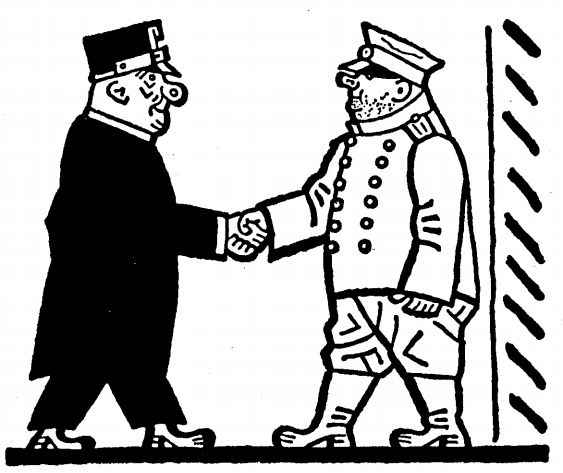
The Inimitable Jeeves by P.G. Wodehouse (1923)

‘This looks like being another of your successes. I’ve always said, and I always shall say, that for sheer brain, Jeeves, you stand alone. All the other great thinkers of the age are simply in the crowd, watching you go by.’
‘Thank you very much, sir. I endeavour to give satisfaction.’

‘Bertie,’ said Bingo reproachfully, ‘I saved your life once.’
‘When?’
‘Didn’t I? It must have been some other fellow, then.’

I bit the bullet and had a dash at being airy.
‘Oh, well, tra-la-la!’ I said.
‘Precisely, sir,’ said Jeeves.

‘This is a rotten country,’ said Cyril.
‘Oh, I don’t know, you know, don’t you know!’ I said.

‘Hallo! Hallo! Hallo!’ I said. ‘What?’ There didn’t seem much else to say.

‘The Inimitable Jeeves’ by P.G. Wodehouse, published in 1923, was the first of the Jeeves novels. It wasn’t originally conceived as a single narrative and was cobbled together from 11 previously published short stories featuring the same characters.

All the stories had previously appeared in The Strand magazine in the UK, between December 1921 and November 1922, except for one, ‘Jeeves and the Chump Cyril’, which had appeared in the Strand in August 1918.

This was the second collection of Jeeves stories, after ‘My Man Jeeves’ (1919) although the four Jeeves stories in that collection would be reprinted in the next one, ‘Carry On, Jeeves’, in 1925.

Bingo’s infatuations

The stories are connected and feature either Bertie Wooster’s friend Richard ‘Bingo’ Little, who is always falling in love (with no fewer than seven young ladies in this volume):

  • Bingo Little is a chap I was at school with, and we see a lot of each other still. He’s the nephew of old Mortimer Little, who retired from business recently with a goodish pile. (You’ve probably heard of Little’s Liniment—It Limbers Up the Legs.)
  • I don’t know why, ever since I first knew him at school, I should have felt a rummy feeling of responsibility for young Bingo. I mean to say, he’s not my son (thank goodness) or my brother or anything like that. He’s got absolutely no claim on me at all, and yet a large-sized chunk of my existence seems to be spent in fussing over him like a bally old hen and hauling him out of the soup.
  • ‘I suppose what it amounts to, Jeeves, is that, when young Bingo really takes his coat off and starts in, there is no power of God or man that can prevent him making a chump of himself.’

Bertie dodges matrimony

Or Bertie himself as he tries to dodge romantic liaisons organised by his fearful Aunt Agatha.

Jeeves

In most of the stories Jeeves smoothly saves both Bertie and Bingo, proving himself an invaluable and almost supernaturally clever valet.

Arguments over clothes

Bertie is a fussy dresser, almost a dandy:

As a rule, I’m what you might call a slow and careful dresser: I like to linger over the tie and see that the trousers are just so;

Jeeves lays out his outfit for him every morning. But another thread running through the stories is that Bertie and Jeeves have disagreements, almost like lovers’ tiffs, caused when Jeeves disapproves of one of Bertie’s clothing choices, such as a bright red cummerbund or a pair of mauve socks or coloured spats, and a coldness affects their relationship.

I went straight back to my room, dug out the cummerbund, and draped it round the old tum. I turned round and Jeeves shied like a startled mustang.
‘I beg your pardon, sir,’ he said in a sort of hushed voice. ‘You are surely not proposing to appear in public in that thing?’
‘The cummerbund?’ I said in a careless, debonair way, passing it off. ‘Oh, rather!’
‘I should not advise it, sir, really I shouldn’t.’
‘Why not?’
‘The effect, sir, is loud in the extreme.’

Hence the three or four periods of froideur in the relationship. But not for long.

Bertie is loaded

Another theme is that, despite his modesty, Bertie is the only one with any money. All the other posh young men he knows – Bingo, Eustace and Claude – are constantly touching him for small loans. Bertie himself admits he enjoys ‘a sizable private income and a topping digestion’.

Gambling

Cliché for centuries that posh young aristocrats had nothing to do except gamble. Same here, in a comic mode. Bertie and pals are shown routinely betting on horse races. hence the chapter set at the Goodwood races, and its sequel, the comic chapter when the young chaps bet on how long local vicars’ sermons will be.

If there is one thing we Woosters are simply dripping with, it is sporting blood.

New York

I’m always surprised by the number of stories in which Bertie jaunts off to New York. He goes there to escape Aunt Agatha’s wrath after he had a disastrously bad lunch with Sir Roderick Glossop, father of Honoria Glossop who Agatha wanted Bertie to marry. The story in question (A Letter of Introduction) features a priceless exchange between another Brit newly arrived in the city, Cyril Bassington-Bassington and Bertie’s long-time pal George Caffyn:

‘This is a rotten country,’ said Cyril.
‘Oh, I don’t know, you know, don’t you know!’ I said.
‘We do our best,’ said George.
‘Old George is an American,’ I explained. ‘Writes plays, don’t you know, and what not.’
‘Of course, I didn’t invent the country,’ said George. ‘That was Columbus. But I shall be delighted to consider any improvements you may suggest and lay them before the proper authorities.’

Cast

  • Bertie Wooster – idle, upper-class loafer
  • Jeeves – his faithful valet
  • Bingo Little – his idiot friend, always falling in love with inappropriate types, ‘perpetually hard-up’
  • Mortimer Little – Bingo’s uncle, who becomes Lord Bittlesham
  • Miss Watson, Uncle Mortimer’s cook – with whom Jeeves, for a while, has ‘an understanding’
  • Aunt Agatha aka Mrs Gregson – Bertie’s arch enemy, ‘a sort of human vampire-bat’
  • Spenser – her butler
  • Mabel – the tearoom waitress Bingo thinks he’s in love with
  • Aline Hemmingway – confidence trickster
  • Soapy Sid – her accomplice posing as her brother
  • McGarry – barman
  • Honoria Glossop – young woman Aunt Agatha tries to fix Bertie up with – ‘To me the girl was simply nothing more nor less than a pot of poison. One of those dashed large, brainy, strenuous, dynamic girls you see so many of these days. She had been at Girton [College, Cambridge] where, in addition to enlarging her brain to the most frightful extent, she had gone in for every kind of sport and developed the physique of a middle-weight catch-as-catch-can wrestler’
  • Oswald Glossop – Honoria’s kid brother
  • Sir Roderick Glossop – Honoria’s father, nerve specialist, owner of Ditteredge Hall – ‘an extraordinarily formidable old bird he was. He had a pair of shaggy eyebrows which gave his eyes a piercing look which was not at all the sort of thing a fellow wanted to encounter on an empty stomach. He was fairly tall and fairly broad, and he had the most enormous head, with practically no hair on it, which made it seem bigger and much more like the dome of St. Paul’s’
  • Claude and Eustace – twins, kids at school with Bertie in his last summer term
  • Cyril Bassington-Bassington – ‘a thin, tall chappie with a lot of light hair and pale-blue goggly eyes which made him look like one of the rarer kinds of fish’
  • George Caffyn – acquaintance in New York – ‘a fellow who wrote plays and what not’, author of new musical comedy, ‘Ask Dad’
  • Blumenfield – manager of the theatre where ‘Ask Dad’ is being staged – ‘an absolutely round chappie with big spectacles and a practically hairless dome’
  • Charlotte Corday Rowbotham – Bingo falls for
  • Cynthia Wickhammersley – pal of Bertie’s – ‘I think she’s a topper, and she thinks me next door to a looney, so everything’s nice and matey’
  • Lord Wickhammersley
  • Lady Wickhammersley
    • Brookfield, their butler
  • Rupert Steggles – chief opponent in the gambling chapters – ‘a little, rat-faced fellow, with shifty eyes and a suspicious nature’
  • Rev. Francis Heppenstall – author of the famously long sermon on brotherly love who, at the last minute, hands it to his nephew to deliver, thus ruining the great sermon handicap
  • the Reverend Mr Wingham – Mr Heppenstall’s new curate and Bingo’s rival for the love of Miss Mary Burgess
  • Miss Mary Burgess
  • Wilfred Burgess – her kid brother
  • Marion Wardour – friend of Bertie’s who both Eustace and Claude claim to have fallen in love with

Aspects of Wodehouse’s style

1. First-person narrative by Bertie, which consists of:

2. Direct address – treating the reader as a confidential chum:

The audience was settling down into the sort of torpor usual on these occasions, when the first of Bingo’s interpolated bits occurred. It was that number which What’s-her-name sings in that revue at the Palace—you would recognise the tune if I hummed it, but I can never get hold of the dashed thing.

A small boy with a face like a turbot edged out in front of the curtain, which had been lowered after a pretty painful scene about a wishing-ring or a fairy’s curse or something of that sort, and started to sing that song of George Thingummy’s out of ‘Cuddle Up’. You know the one I mean. ‘Always Listen to Mother, Girls!’ it’s called, and he gets the audience to join in and sing the refrain.

3. This artless candour is related to disarming honesty about his charming brainlessness.

4. It’s easy to overlook that the entire thing is a satire on the kind of posh dimwits epitomised by Bertie and his friends.

5. Much of this is embodied in the prose style of the text and, in particular, in the relentless use of upper-class slang.

An endless fount of posh slang

Two things. 1) the text is so solidly stuffed with upper-class slang, in both dialogue and the first-person narrative, that it creates its own world. 2) It is so exuberant and creative and original that the endless slang is a major contributor to the light, bubbly comic vibe. Thus:

Bingo biffs about London on a pretty comfortable allowance given him by his uncle…

He had been clearing away the breakfast things, but at the sound of the young master’s voice cheesed it courteously.

Bingo, while not absolutely rolling in the stuff, has always had a fair amount of the ready. [money]

The man was goggling. His entire map was suffused with a rich blush. [face]

If anyone had told me that a tie like that suited me, I should have risen and struck them on the mazzard

Anyway, he was there, swinging a dashed efficient shoe. [dancing well]

‘What might you have missed?’ I asked, the old lemon being slightly clouded.

If he cut off my allowance, I should be very much in the soup. So you put the whole binge to Jeeves and see if he can’t scare up a happy ending somehow.

To round it all off, my Aunt Agatha had gone to France and wouldn’t be on hand to snooter me for at least another six weeks.

Never before had I encountered a curate so genuinely all to the mustard.

Little as he might look like one of the lads of the village, he certainly appeared to be the real tabasco.

I mean, even a chappie endowed with the immortal rind of dear old Sid is hardly likely to have the nerve to come back and retrieve these little chaps.’

‘Well, then, dash it, I’m on velvet. Absolutely reclining on the good old plush!’

I knocked but no one took any notice, so I trickled in.

Once a year Jeeves takes a couple of weeks’ vacation and biffs off to the sea or somewhere to restore his tissues.

‘Worships the ground you tread on, but can’t whack up the ginger to tell you so.’

‘And what might all this be, Jeeves?’ I said, giving the thing the glassy gaze.

‘I’m feeling frightfully braced, don’t you know!’

‘My jolly old guv’nor wouldn’t stick it at any price. Put the old Waukeesi down with a bang.’

‘Toodle-oo!’ I said sadly, and the blighter scudded off.

What with trying to imagine how Aunt Agatha was going to take this thing, and being woken up out of the dreamless in the small hours every other night to give my opinion of some new bit of business which Cyril had invented, I became more or less the good old shadow.

‘Well, never mind about him, Jeeves. Read this letter.’ He gave it the up-and-down.

I gave the couple the wary up-and-down

‘Of course,’ I said, after I had given it the east-to-west, ‘I expected this, Jeeves.’

I mean to say, he sent me over here to broaden my jolly old mind and words to that effect, don’t you know, and I can’t help thinking it would be a bit of a jar for the old boy if I gave him the bird and went on the stage instead.

‘Isn’t she the most wonderful girl you ever saw in your puff?’ [in your life]

Few people have ever looked fouler than young Bingo in the fungus. [with a beard]

‘Well, when I tell you he got me through Smalls, you’ll gather that he’s a bit of a hummer.’

I found him eventually in his room, lying on the bed with his feet on the rail, smoking a toofah.

‘Bertie,’ said Claude, deeply agitated, ‘unless we take immediate action and do a bit of quick thinking, we’re in the cart.’

He started in about the female the moment we had begun to hoof it. [walk]

I can’t go chucking all my engagements every second week in order to biff down to Twing.

He gave one frosty look at the spats and biffed off.

The blighter had appeared from nowhere and was in my bed, sleeping like an infant with a sort of happy, dreamy smile on his map.

Anything merrier and brighter than the Twins, when they curveted into the old flat while I was dressing for dinner the next night, I have never struck in my whole puff. [life]

‘You heard about the binge, Bertie?’ [spot of bother]

‘He could use a bit of the right stuff paid every quarter, if you felt like unbelting.’ [money]

‘Something tells me that this show of his is going to be a frost.’ [failure, disaster]

‘This morning young Bingo went and jumped off the dock.’ [got married]

Posh abbreviations

The good old persp. was bedewing my forehead by this time in a pretty lavish manner. [perspiration]

I had just had one quick and another rather slower, and was feeling about as cheerio as was possible under the circs. [circumstances]

‘I think we’ve had about enough of the metrop. for the time being, and require a change.’ [metropolis i.e. London]

‘I’m beginning to wonder,’ said Eustace gloomily, ‘if there’s such a thing as a cert. in this world.’ [certainty – racing term]

We Woosters are all for the good old mediæval hosp. and all that… [hospitality]

I sent Jeeves a telegram saying I was coming, and drove straight to Bingo’s place when I reached town. I wanted to find out the general posish of affairs.

Verbs for entering or leaving a room

Jeeves poured silently in.

I then perceived that the stout stripling had trickled into the room.

About half-past ten next morning, just after I had finished lubricating the good old interior with a soothing cup of Oolong, Jeeves filtered into my bedroom…

He sallied forth,

Old Rowbotham took three and dropped the subject, and Jeeves drifted away.

‘Sir?’ said Jeeves, who had just meandered in with my breakfast.

And then through the doorway there shimmered good old Jeeves in the wake of a tray full of the necessary ingredients…

Jeeves had materialised from nowhere, and was standing at my elbow.

The idle rich

The text has moments of self criticism or self awareness, albeit themselves played for laughs, one useless upper class layabout berating his pals for being useless upper class layabouts – the entire ‘serious’ world of politics, socialism and so on co-opted, emptied and turned into yet another trope for gags.

‘Good night!’
‘But, I say, George, old man!’
You didn’t get my last remark. It was ‘Good night!’ You Idle Rich may not need any sleep, but I’ve got to be bright and fresh in the morning.’

And:

I saw that the bearded chappie was pointing at us. ‘Yes, look at them! Drink them in!’ he was yelling, his voice rising above the perpetual-motion fellow’s and beating the missionary service all to nothing. ‘There you see two typical members of the class which has down-trodden the poor for centuries. Idlers! Non-producers! Look at the tall thin one with the face like a motor-mascot. Has he ever done an honest day’s work in his life? No! A prowler, a trifler, and a blood-sucker! And I bet he still owes his tailor for those trousers!’

Comic similes

Young Bingo is long and thin and hasn’t had a superfluous ounce on him since we first met; but the uncle restored the average and a bit over. The hand which grasped mine wrapped it round and enfolded it till I began to wonder if I’d ever get it out without excavating machinery.

I tottered back to my room to dress for dinner, feeling like a toad under the harrow.

At this point the brother, who after shedding a floppy overcoat and parking his hat on a chair had been standing by wrapped in the silence, gave a little cough, like a sheep caught in the mist on a mountain top.

She had a penetrating sort of laugh. Rather like a train going into a tunnel.

The stage seemed to stretch out in front of me like a trackless desert, and there was a kind of breathless hush as if all Nature had paused to concentrate its attention on me personally.

I could see that these harsh words had hit the old Bassington-Bassington family pride a frightful wallop. He started to get pink in the ears, and then in the nose, and then in the cheeks, till in about a quarter of a minute he looked pretty much like an explosion in a tomato cannery on a sunset evening.

On the occasions when Aunt is calling to Aunt like mastodons bellowing across primeval swamps and Uncle James’s letter about Cousin Mabel’s peculiar behaviour is being shot round the family circle (‘Please read this carefully and send it on to Jane’), the clan has a tendency to ignore me.


Related links

Related reviews

The Green Hat by Michael Arlen (1924)

‘It might be nice for you to take a house in London for the spring season—I know a dove of a house in Talbot Square you could get, furnished. I mean, living with sane, well-balanced English people.’
She would have gone on to tell him all the old propaganda stories of 1914 if he had not laughed and said:
‘I’ve been reading a book by Michael Arlen and if that’s—’
She ruined Michael Arlen with a wave of her salad spoon.
‘He only writes about degenerates. I mean the worthwhile English.’
(Baby Warren and Dick Diver chatting in ‘Tender Is The Night’ by F. Scott Fitzgerald, Book 2, chapter 21)

‘Your generation,’ said Hilary thoughtfully, ‘is a mess.’
(The Green Hat, chapter 3)

She suspected they might be thinking she was going to more than powder her nose. They were, she was, who cared?
(chapter 4)

She drove with assurance, that is to say, she drove as though her mind was not in the same world as the steering-wheel.
(chapter 4)

‘The Marches are never let off anything…’
(The sense of doom clinging round twins Iris and Gerald March, a phrase often repeated)

She [Billee Ponthéveque, a cocotte] never saw her parents, she would say, because of a funny idea they had that it was bad for her health to take cocaine on an empty stomach.
(The blasé attitude to sex and drugs which helped make the book notorious; chapter 7)

‘Why is every one so awful these days!’
(poor Venice Pollen, wailing the eternal wail; chapter 7)

I couldn’t help thinking of her as of someone who had strayed into our world from a strange land unknown to us, a land where lived a race of men and women who were calmly awaiting their inheritance of our world when we should have annihilated one another in our endless squabbles about honour, morality, nationality.
(One of hundreds of passages where the narrator adulates the protagonist, Iris Storm; chapter 9)

‘The Green Hat’ by Michael Arlen was the publishing sensation of 1924, making its author famous overnight, quickly becoming a touchpoint for the culture, going on to be referenced in contemporary newspapers, magazines and other fictions for the next decade and more, as epitomising the spirit of the day and the year.

It more or less invented the concept of the heedlessly hedonistic bright young things of London. More specifically, it crystallised and defined the idea of the new woman about town, smartly dressed, comfortably off, defying conventions (wearing short skirts, bobbing her hair, smoking!). The heroine in question is Iris Storm, wearer of the green hat in question, fast driver of a Hispano-Suiza motor car and breaker of men’s hearts.

Michael Arlen

The most striking thing about the author of this quintessentially English comedy is that he wasn’t English at all, but a Bulgarian of Armenian descent. He was born Dikran Sarkis Kouyoumdjian in Bulgaria to an Armenian merchant family. In 1892, his family moved to Plovdiv, Bulgaria, after fleeing Turkish persecutions of Armenians in the Ottoman Empire. In Plovdiv, Arlen’s father set up an import-export business and a few years later, he moved his family to England. It was here that young Dikran went to school and was raised speaking posh English, before enrolling at Edinburgh University.

During the Great War Dikran was regarded with suspicion as Bulgaria was allied to Germany and Austria. He gravitated to London and fell in with other conscientious objectors and outsiders. He began writing essays and article for the New Age magazine, and took to signing them Michael Arlen to allay the xenophobia his real name aroused.

During the 1920s Arlen rented rooms opposite ‘The Grapes’ public house in Shepherd Market, then a bohemian Mayfair address. He used Shepherd Market as the setting for the novel. Here’s Shepherd Market on Google Maps. In 1920 he became infatuated with one of the leading socialites of her day, the brilliant and charismatic Nancy Cunard, and she is the inspiration for Iris Storm.

It is, then, as you can see, a strongly autobiographical novel, but with the central character exaggerated for sensational effect.

‘The Green Hat’ made Arlen famous and rich. He enjoyed dressing smartly, driving round London in a yellow Rolls Royce (precursor to John Lennon’s white Rolls Royce forty years later), hobnobbing with other celebrities. He regularly travelled to the United States to work on plays and films. He was understandably nervous about writing a follow-up to his big hit and, indeed, none of his subsequent novels were nearly as successful but he was, until his death in 1956, famous for being famous.

Chapter 1. The Green Hat

Introducing the narrator and Iris Storm

It is the summer of 1922. The story is a first-person narrative told in a breezily facetious style by a well-educated, posh but poor man about town. He lives in a crappy flat above a sordid alleyway in Mayfair’s Shepherd’s market and takes us into his confidence with various arch and self-conscious narrative comments, which hark back to Victorian storytelling.

It is late, after midnight, when the tale begins…

He has just got back to his flat after a party when the front doorbell rings. It is a woman wearing a fashionable small green hat pulled down over her eyes, come to visit her brother, Gerald March, who lives in the flat above the narrator.

As he lets her into the ramshackle house, the narrator is dazzled by her beauty and self possession, by her striking car, a big yellow Hispano-Suiza, by the panache of her green hat, by her small face and dancing auburn hair. He notices she is wearing a large green emerald ring on the third finger of her right hand. He comes to notice that she has tiger-tawny hair and a husky voice. Unfortunately, when they get to the door of Gerald’s flat they see that he is blind drunk.

After the first few pages you realise it is going to overflow with infatuated descriptions of the charismatic Iris. Rhapsodies. A love letter.

She stood carelessly, like the women in Georges Barbier’s almanacks, Falbalas et Fanfreluches, who know how to stand carelessly.

About her, it was perfectly obvious, was the aura of many adventures.

The magic of the sea was in her eyes, whipped with salt and winds.

It seemed to me that across her gentleness flamed a bar of fire. She walked, oh, impersonally, in the fires of herself.

One was to find later that she was completely without a sense of property, either her own or other people’s.

She had a great talent for looking at nothing in particular,

She walked, oh, impersonally, in the fires of herself.

She showed you first one side of her and then another, and each side seemed to have no relation with any other, each side might have belonged to a different woman; indeed, since then I have found that each side did belong to a different woman. I have met a hundred pieces of Iris, quite vividly met them, since last I saw her. And sometimes I have thought of her—foolishly, of course, but shall a man be wise about a woman?—as someone who had by a mistake of the higher authorities strayed into our world from a land unknown to us, a land where lived a race of men and women who, the perfection of our imperfections, were awaiting their inheritance of this world of ours.

She wasn’t that ghastly thing called ‘Bohemian’, she wasn’t any of the ghastly things called ‘society’, ‘county’, upper, middle, and lower class. She was, you can see, some invention, ghastly or not, of her own. But she was so quiet about it, she didn’t intrude it on you, she was just herself, and that was a very quiet self. You felt she had outlawed herself from somewhere, but where was that somewhere? You felt she was tremendously indifferent as to whether she was outlawed or not.

One was to find later that she was completely without a sense of property, either her own or other people’s.

She looked at me through the smoke of her cigarette. She was grave, intent. But one never knew what about…

Arlen isn’t afraid to deploy shamelessly poetic prose:

White she was, very white, and her painted mouth was purple in the dim light, and her eyes, which seemed set very wide apart, were cool, impersonal, sensible, and they were blazing blue. Even in that light they were blazing blue, like two spoonfuls of the Mediterranean in the early morning of a brilliant day. The sirens had eyes like that, without a doubt, when they sang of better dreams.

She was like a tower of beauty in the morning of the world.

Anyway, they look into Gerald’s room long enough to realise he has passed out drunk again. The narrator explains that his binges go on for three days. Iris introduces herself, Iris Storm, Mrs Storm, and explains that she and Gerald are twins, born within the same hour 29 years ago. They come from a posh landed family, the Marches, which has fallen on hard times.

I could somehow ‘cope with’ my time and generation, while they were of the breed destined to failure. I was of the race that is surviving the England of Horatio Bottomley, the England of lies, vulgarity, and unclean savagery; while they of the imperious nerves had failed, they had died that slow white death which is reserved for privilege in defeat…

Gerald is ‘absurdly shy’, can’t cope with life hence the alcoholism. She spends most of her time abroad, which she explains why she hasn’t seen her brother for ten years. But he’s drunk and after a bit of chat and explaining these facts, they leave the drunken brother, Iris bitterly commenting that ‘the Marches are never let off anything…’ which becomes a refrain through the book.

On the way back down she suddenly drops into his room asking for a glass of water. The narrator is embarrassed because he is moving out of the place next day and his belongings are scattered all over the floor. She picks up various books, we discover that the narrator is (alas) a writer, and they have some literary chat (she thinks D.H. Lawrence is ‘nice’) which seems terribly dated and irrelevant, for example about the quality of ‘vulgarity’. Then they’re talking about ‘the Jews’ and their love of luxury which leads into a consideration of Chesterton, his Catholicism and blowing on about beer and Britain. Very dated, almost at times incomprehensible.

But the conversation is just filler while he observes and studies the woman he has already become besotted by:

The lady of the green hat said nothing, and that was how I knew that for her everything was inevitable. That is an important thing to know about a woman, for you know then that you will never know where you are.

She kept strange, invisible company, this lady. She walked in measureless wastes, making flames rush up from stones, making molehills out of mountains.

She shook her head, staring at me with a mischievous smile. Her childishness did not jar. She was always herself.

Her hair was thick and tawny, and it waved like music, and the night was tangled in the waves of her hair.

More information is revealed, such as Iris has been married two times, both dead. Second husband, Captain Storm, won a Victoria Cross in the Great War but a year later was murdered by Sinn Feiners in Ireland.

There’s a knock at the door and it’s the local policeman on his beat and worried about an unusual car parked in the alley. The narrator reassures him, but when he returns to his flat, discovers Iris has gone into his bedroom and fallen asleep on the bed. He studies her beauty intently, sitting in a chair smoking till dawn. At which point she awakes, puts on some powder and the famous hat, and departs.

Her eyes were full on mine, naked, expressionless. I felt that they were the heads of the nails under which she had nailed herself.

Wow! He is hooked.

Chapter 2. The Cavalier Of Low Creatures

Profiling Iris’s twin brother, [the alcoholic] Gerald March

The book very heavily uses the old thriller trick of saying ‘But one was to learn later…’, ‘As I found out later…’, ‘That was to come much later…’ and most ominously of all, ‘But now I’ll never know what she was thinking’, ‘that faint dry scent whose name I shall now never know…’ and the like, incredibly obviously signalling that something bad is going to happen, that the astonishingly charismatic Iris Storm is doomed to die!

More generally the narrator spends a lot of time telling us what he’s going to tell us later, constantly promising us stuff later: ‘He will have his place, that dead Boy Fenwick. A deep place.’ He fusses about what he’s going to say when.

At some point the narrator began to remind me of the narrator of Ford Madox Ford’s masterpiece, The Good Soldier‘, John Dowell, who comes over as an amateur storyteller, constantly fussing about when to tell us and how to tell us key elements of the plot, continually explaining how he didn’t understand this or that at the time they occurred. ‘It was only later that I realised…’ ‘But one notices those things only later on…’

In this manner the narrator declares that he’s talked the events which make up the narrative he’s going to tell with friends who knew Iris, Hilary Townshend and Guy de Travest, friends of the late Barty March, had known Gerald and Iris since their earliest childhood. Guy de Travest had been Gerald’s colonel in the Grenadiers for some time during the war (‘I had a sort of eye on him in France, and he seemed as sensitive as a violin string’).

This chapter is about Gerald March, twin brother of Iris Storm, six foot two, lean, one time captain in the Grenadier Guards, who’s gone completely to pot after the war. ‘He was, I mean, so afraid of life that he simply couldn’t exist but by pretending to despise it’, ‘the most lovable man I ever met.’,

That was always Gerald’s trouble, he never was given the credit for being shy, he put himself between you and any sympathy with him, he made it clear that he didn’t want your infernal sympathy

The dark eyes haunted with abstraction, the thin hawk’s nose, the fine, twisted, defiant mouth…

If I haven’t mentioned it before, Arlen’s prose style is odd, quirky, eccentric, mannered.

It was on the fifth morning after the coming and going of the green hat that I was on an instant afflicted with an impulse, and did on the same instant act upon it.

There was by ordinary no grinning froth about Gerald.

I thought I heard Guy mutter something between his teeth.

He has an odd way of saying, not that so and so was an x type of person, but that ‘that was an x type of person’.

That was a most deficient man in every other respect

That was a sad lady, most grave… That was a very quiet lady… That was a gallant lady.

That was a conscientious man, Conrad Masters.

That was a fell lady for whom I bought a green hat that day.

Now that was a loquacious lady.

It seems just not quite standard English usage, although maybe it overlaps with American street slang of the same period or a bit later, Damon Runyon characters saying ‘Now that was some swell broad!’ And he’s addicted to reversing standard word order, often sounding like Yoda from Star Wars.

Thoughtful he was always.

But not I to be provoked!

His eyes pierced the pavement the other side of my shoulder, for tall was Gerald.

Dolorous it was, yet phantasm of gaiety lay twined in it.

Dark it was, the curtains drawn.

A boyish voice, a very boyish voice Venice had.

Weighed down I was by the chill of my journey.

Wise those eyes were now, and steady as stars in a cavern.

Too tall was Guy, in that light.

An amiable man, he looked.

Impatient, Iris’s voice was, I thought.

Soft she was now, soft and white and small.

Or both in one sentence:

The Blues, that man knows.

A man given to muttering, that.

I thought of… Mrs Conrad Masters. A dashing lady, that.

Faintly amused those worried eyes looked to be. That was that man’s way.

Why? Maybe he thought it was modish and modern. Throughout the book his style is often just odd;

We would then, at about eleven o’clock, have by ordinary gone towards bed.

Venice was in high looks that day.

The narrator first met Gerald when he turned up at the magazine where the narrator worked, the New Voice edited by the testy Horton. He gruffly declares he has written a novel. It’s big, titled ‘The Savage Device’, concerns a young idealist named Felix Burton who marries the ghastly Ava Foe. Only later does Iris tell the narrator that Ava is based on her and Burton is based on her first husband, the legendary Boy Fenwick.

Back in the present, when the narrator rings Iris’s London home, the woman she rents the place to, Mrs Oden, tells her Iris left that day for Paris. Some days later he gets a git package from Paris. Iris has sent him a pack of beautiful writing paper with his new address printed on it.

Chapter 3. For Purity!

Portrait of family friend Hilary Townshend

Sometimes his prose is so overwrought and baroque as to be almost incomprehensible.

The cavalier of low creatures dies hard; surviving even our gesture, he loiters dangerously in the tail of our eye, he awaits, with piratical calm, the final stroke; and only will he fade and be forever gone, despised, and distraught, before the face of him who bore the magic device For Purity, whose ghost was to be raised by Mr Townshend over dinner on the twelfth night after the coming of the green hat.

At other times, in fact very frequently, he’s suddenly bright and clever.

Hilary was a man of various ages; when nothing was going well with him, he would look no more than forty; when everything was going well with him, he would look about forty-five; when he was crossing a road, that is to say when he was thinking, he looked about fifty. This last was, I believe, his age.

Grey and thoughtful and kind, he stood there in the doorway of his tall sombre house, looking up at the faint stars on the ceiling of Chesterfield Street: his was just that contained air of loneliness that unmarried schoolmasters wear during their holidays.

‘Oh, Naps, such a wonder!’ cried Venice on the instant, and I saw what one is so apt to see after an intimate talk with a woman, that one has only been talking to a mood. (chapter 7)

‘Growing-pains, Masters. One is always growing up, at other people’s expense…’ (chapter 8)

‘Oh, friends and enemies! One relies on what people are in themselves, no matter what circumstances may make them feel.’ (chapter 10)

And funny:

Hilary, like all middle-aged men who detest night-clubs, at once left me to dance with the first acquaintance he saw. (chapter 4)

The faint, slow lilt of the tango, pleasantest of all dances but one that is so seldom danced in London because nobody in London can dance it… which is a pity. (chapter 9)

She [Iris] drove that menacing bonnet ever more furiously along the road to Maidenhead, so that corners perished like midgets before our head-lights and Hugo and Shirley, who sat behind, murmured against her driving, saying that it would be bad for their reputation as a happily-married couple to be found dead on the road to Maidenhead. ‘A friend of mine,’ yelled Hugo, ‘was asked to resign from Buck’s for being found dead on the Maidenhead road…’ (chapter 9)

‘I do wish,” Hugo said violently, ‘that perfect strangers wouldn’t force themselves on us like this. Any one would think we were at a Royal Garden Party!’ (chapter 10)

And has some dazzling phrases:

Napier stared at her—he was sitting now—and it was as though he had put his hand to his mouth and placed a smile there. (chapter 7)

In the still air of Guy’s great, bare dining room those cameo flames never flickered even so much, they might have been flowers of light cut out of the stifling heat. (chapter 10)

Iris smiled, and those very white teeth bit the moment into two pieces with their smile and dropped the pieces into limbo. (chapter 11)

Well, in the days after Iris Storm’s apparition, the narrator goes for dinner with Hilary and we learn a bit more about all the characters. For example that shy alcoholic Gerald is heir to the earldom of Portairly (would become the 19th Earl of Portairley and Axe). That the second husband, Hector Storm V.C., left Iris everything, which explains why she’s loaded and can jaunt off to the continent all the time.

That her first husband was the legendary Boy Fenwick. That his body was found on the courtyard below their bedroom window on the first night of their honeymoon, Hilary thinks Boy threw himself to his death on a matter of purity. In other words, he discovered the love of his life, Iris March, was not a virgin. Iris could have stuck to the hotel’s suggestion that Boy was drunk on champagne and fell out the window by accident. But she is constitutionally incapable of lying and so said he threw himself out the window while she watched and lit a cigarette. Thus damning her reputation for ever.

The stilted, antagonistic dinner with Hilary is often very funny.

‘Seldom,’ said Hilary thoughtfully, ‘have I known a man pull his weight less than you are doing this evening. Hm. I should try some brandy.’

Chapter 4. Aphrodite

At the Loyalty nightclub

Not wanting to go home to bed the narrator invites Hilary to a new nightclub on Pall Mall, the Loyalty, overseen by its directeur du restaurant, the Chevalier Giulio di Risotto, and packed with social luminaries, an embodification of the roaring twenties.

As she danced she stared thoughtfully at the glass dome of the ceiling. She looked bored with boredom.

He had observed that the whole purpose of a “best-seller” is to justify a reasonable amount of adultery in the eyes of suburban matrons.

The best way to keep old friends is not to see them, for then you can at least keep the illusion that they are friends.

There was a group of tall young men at the entrance, maybe waiting for their women from the Cloak-Room, maybe waiting for sirens to come to them from the night, maybe waiting for taxicabs, maybe only waiting for the next minute, as young men will.

The Loyalty is packed with people they know, and it’s maybe in this scene that Arlen created the sense of ‘Mayfair’ and nightclubs full of cynical bright young things dancing to ‘the Blues’.

There’s a buzz of news, people talking about the evening papers. Then suddenly everyone knows: the news is that Gerald was arrested in Hyde Park for bothering a woman, sitting at the same bench and making indecent proposals to a middle aged women who started screaming and the police appeared.

Iris is at this nightclub and comes up to the narrator and asks him to accompany her to his old house (which we saw him packing to move out of) but where Gerald still lives, because the narrator has a key to get in.

So they drive there and the narrator lets himself in, goes up to Gerald’s flat and it is elliptically done, but we slowly realise he discovered Gerald has blown his brains out. Without pausing he goes back down to Iris who’d waited in the hall and tells Iris he found Gerald in the same posture as the other day, i.e. sprawled drunk and insensible.

She thanks him and jumps into her powerful roadster and drives off. Turning back to his old house he discovers Guy who took a taxi there, who smokes thoughtfully and says: ‘Had an idea he might blow his brains out.’

Chapter 5. The Dark Letter

Paris 10 months later

All the preceding happened in June 1922. The narrative suddenly cuts to the last week of January of the year 1923 (although he later says it’s 10 months after Gerald’s death?) – and to the Place Vendôme in Paris and a description of that floating population of a few thousand dressing-tables, sables and Cachets Faivre which, under the lofty title of l’aristocratie internationale; the shops, the tourists, the Americans buying everything.

The narrator is with his sister. He’s spent four months at Cannes where he bumped into her and they drove across France to Paris. The sense of France, and the south of France, as a playground for tourists, reminds me of ‘Tender is The Night’ and perhaps explains why ‘The Green Hat’ is specifically referenced in it: Arlen described this world exactly a decade before Fitzgerald’s (far more profound and moving) account of it was published.

He has several amusing glances at the habitual rudeness of the French, especially French hotel staff, who refuse to help him or his sister, along with a number of comic generalisations (slurs) on the French character.

The French sections evinces a cosmopolitan knowingness epitomised by the dandyish Mr Cherry-Marvel who knows everybody and knows everything about everybody but drones on in endless confidential monologues. In the middle of this endless droning, the narrator drifts off to the present moment, the moment of writing, and tells us how he had, in the 6 months of Iris’s absence, received some long rambling often indecipherable letters from her, and quotes and comments from them at length, hence the title of this chapter.

But somehow, in the middle of his summary of the letters, the narrator describes Guy paying a visit to Iris lying ill in bed, and their conversation (as reported to him later by Guy). This long conversation included stuff about her marriage to Hector which seems to include references to her having gotten pregnant by Hector but Hector being killed before she came to term. This is all very obscure: did Iris have an abortion? Was that so completely illegal and socially stigmatised that Arlen can’t spell it out, even in fiction?

Eventually the narrator manages to interrupt Cherry-Marvel and extract the address of the house where Iris is staying. So he jumps into a taxi, a ‘clever little Citroën taxi’ which takes him on a delirious midnight drive into dark areas of Paris he has never been before, and Arlen gives a wonderfully purple description of the dream Paris of debauchery.

Montparnasse lay somewhere behind, or to the east, or to the west. We were in unknown Paris, silent, ill-lit, fantastic Paris: silent but for a rending crash here, a jarring cry there. Cold as the devil it was now, as though because the prickly warmth of many lamps and shops was withdrawn. Carefully we traversed a broad avenue as yet scarcely paved, beneath the skeleton shapes of great tenement-houses. Ah, Paris, that we should have come to this, you and I! Paris, that we should have come together down to this! In how many moods you and I have passed the time of day and night together, we have sat in strange places and dared the most devilish shadows, we have wandered from the Rotonde to the crowning grubbiness of the Butte, we have raced in the Bois and up the Mont Valérien, we have laughed at painted boys and been reviled by painted women, we have danced, loved, gambled, drunk, and together we have been bored by the unmentionable and terrified by that which makes the eyes bright and the face white as a soiled handkerchief, while Mio Mi Marianne danced a minuet du cœur with a crimson garter and the moon fell across the French-windows of Berneval’s house to be lost in the soft shadows of giant poppies. Paris, that we should now have come down to this, lost together in these nameless darknesses beyond even the low darkness of the Bal Bullier, that glory of another time than ours…

The taxi pulls up in front of the address Cherry-Marvel gave him, a huge dark imposing building which he hallucinates is like a fortress or an asylum.

Chapter 6. The Red Lights

The nursing home where Iris is recovering

Continues straight on from the previous scene: When the narrator rings the bell the door is opened by a nun (who turns out to be a lay sister) and who explains that it is a convent-nursing-home. (‘Perhaps of all the nations in the world the French alone are capable of fixing the loudest possible bell to a nursing-home.’) When she explains:

‘Nous avons ici,’ she was pleased to add, ‘la clientèle européenne la plus chic’. [‘We have here the smartest European clientele]

It really made me think of ‘Tender Is The Night’ with its theme of high living inextricably linked with mental collapse. Except that Fitzgerald’s great achievement is to make everything seem wonderful and romantic and somehow innocent. Even when describing squalid scenes Fitzgerald somehow manages to keep his aura of romantic innocence. Not so Arlen:

Perhaps that was the worst stroke of that day, so far. Iris among a clientèle européenne la plus chic…. One saw the cosmopolitan divorcées, their secret illnesses and guileful pains, their nasty little coquetries and the way they would blackmail their lovers with their sufferings, and one felt the sticky night-club breath of all the silly, common harlotries of England, France, America.

When I read the following sentence it struck me that Arlen is attempting in prose the wild coloration and stylisation of modernist painting.

How afraid one always is of the callous French doctors with their cynical eyes and purple beards….

Silence. Anxieties walked across it arm-in-arm with that lank man’s doubtful heat.

The nun fetches the doctor in charge who turns out to be someone the narrator knows (of course), Dr Conrad Masters, a compulsive bridge player. Masters is a haunted, nervous man and twitchily leaks out to the narrator that Iris has been there for weeks, something to do with ‘septic poisoning’ leading to some kind of nervous collapse, delirium, occasionally waking into lucidity, but not caring. Then Dr Masters goes home in his flash Renault car.

Cut to the narrator that evening taking his (older) sister to the latest Paris nightclub, La Plume de Ma Tante – leaving reader to ask, why didn’t he simply ask to see Iris or force his way to her room? Because the doctor said she needed rest?

Anyway, this Paris nightclub is significantly more debauched than the London one, and reading Arlen’s description of it you realise why the book crystallised an entire era and came to be so widely referenced. Sorry it’s such a long quote but it’s the accumulation that makes its impact.

La Plume de Ma Tante. Bright green walls splashed with vermilion. A platform at one end, whereon five blackamoors perspired. At the other, a naked woman. She was without hips, according to the fashion for women. Her arms were twined above her head, and raised on the tip of her fingers was a bowl of green malachite from which pink water splashed into a white alabaster basin at her feet. Many English people were present. They would be going to the Riviera, then they would be coming back from the Riviera. Colonel Duck was there, with the quality. Colonel Duck was, no doubt, just returned from some notably swift exploits on the Cresta Run. But he never was so talkative about his outdoor activities. Cherry-Marvel was there, with a great big woman and a nice-looking boy with the hands of a housemaid who was a famous boxer. There was the usual group of Argentines, very well dressed indeed. They talked about le polo. All over the room elderly women were dancing with young men of both sexes. Mio Mi Marianne was there, sitting alone, but I might not speak with her because I was with my sister. A demi-mondaine will feel insulted if you speak with her when you are with your sister. Two years before Mio Mi Marianne had one night tied a silk handkerchief round her wrist, and it became the fashion for women to tie silk handkerchiefs round their wrists. Then Mio Mi Marianne tied a silk handkerchief round her throat, and that became the fashion. She thought of these things while smoking opium. She sat alone, staring into a glass of Vichy Water. A young American polo-player called Blister went up to her table, and maybe he asked her to dance, but she just looked at him and he went away again. Her eyes were intent on an opium-dream, and she was very happy in the arms of the infinite. Mio Mi Marianne will be found one day lying on the Aubusson carpet of her drawing-room. There will be a hole in the carpet where her cigarette has died out.

A blackamoor beat a warning roll on his drum, the dancers left the floor, the lights dwindled and awoke again in swaying shadows of blue and carmine. A heavily built young man with the face of a murderer danced a tango with a lovely young girl with short golden curls. Then he threw her on the floor, and picked her up again. Rudolf and Raymonde. He did it beautifully. An American woman called the Duchess of Malvern threw Rudolph a pink carnation. The Baron de Belus said harshly: ‘That is a white carnation really, but it is blushing at the fuss that women make of Dagoes.’

(I comment below on the occasional use of racial terms or slurs in the text which we obviously find unacceptable now, a century later. On the other hand, modish open-mindedness about gender, about ‘dancing with young men of both sexes’ etc.)

Later that night the narrator returns to the nursing home and is surprised to discover young Napier Harpenden there as well, ‘Napier, favourite of the gods, shy, sensitive, fine’, ‘a strange, secret, saintly youth, a favourite of the gods’. He’s passing through Paris on the way to the Riviera with his wife Venice. When we last saw them both, in the nightclub scene at the Loyalty club, they were three days away from getting married. Now it’s ten months later. In Arlen’s characteristic tortured and oblique style, I think we learn from their extended but elliptical conversation, that Napier and Iris had an affair which started on the fateful night that Gerald killed himself. In fact, the narrator realises, he in a way facilitated it because, if he’d told Iris the truth about Gerald she would have reacted, gone home by herself etc, but instead thought everything was normal and so succumbed to the advances of Napier, who had followed her to Gerald’s digs from the club. Complicated.

Also complicated that his wife, Venice, is waiting outside in the car all this time. And Napier has a letter Iris wrote him. Just imagine if Venice saw it! Devastated! End of marriage!

Dr Master emerges and tells them Iris knows they’re there, and asks for Napier. So he takes Napier in to see her, leaving the narrator outside. Is she going to die without ever seeing the narrator again? Is that the drift of all the doom-laded prolepsis in the opening chapter (‘I was never to find out…’).

Back out front of the building Venice is sleeping in the taxi she and Napier came in. The doctor invites the narrator back to his place to join a bridge party. On the way he explains that Iris’s problem is she doesn’t care whether she lives or dies. She bucked up when she saw Napier. And that’s why he – the narrator – must do all he can to prevent Napier travelling on to the South the next morning.

Chapter 7. For Venice!

Venice’s torment that her husband, Napier, doesn’t love her

Next morning the narrator wakes up in his hotel in the Rue de la Paix. When he’s gotten up he phones Venice Harpenden at her hotel and she in that posh darlings loves kind of way compels him to come meet her and buy her lunch.

This lunch is an agonising affair because Venice reveals she is stricken with jealousy by the way Napier (or ‘Naps’, as she calls him) seems obsessed with this Mrs Storm. They had planned to leave Paris this morning and now Naps has changed all their plans. Why? This puts the narrator in the embarrassing position of having to defend Napier and explain away his dogged visits to Iris’s care home as the loyalty of an old friend.

It’s made ten times worse when young innocent Venice confides in the narrator that she cannot have children, and asks him whether that puts a man off a girl, her being infertile; whether it might be enough to drive the man away and into the arms of an old lover (Mrs Storm)?

They’re in the middle of this sticky conversation when Naps himself walks in. The narrator tries to get away but is forced to sit there as the happy-happy conversation of the couple becomes more and more strained until she becomes angry-upset and he momentarily loves his temper. He says Alright then let’s go, let’s go now, let’s go right away to the South. (There’s a detail that Venice had met the narrator’s sister who kindly agreed to loan them her car and its chauffeur to drive them south.)

Only the narrator knows what a sacrifice this is to Naps, not just because he (apparently) loves Iris, but because Dr Masters had specifically said Iris’s recovery rested on Naps visiting her; that only Naps’s presence was giving her any reason to live. And now because of the nagging of his wife, she’s forced him to break his promise and jeopardise Iris’s life (‘a very cruel decision’). Only the narrator realises what this means, as they all get up, shake hands and part with jolly smiles.

And after they’re gone he is left to ponder the infinite capacity of human beings to screw up their loves lives. When he phones Dr Masters to tell him Napier won’t be coming to the nursing home this afternoon, the doctor swears freely. Will I do? asks the narrator. ‘You!’ The doctor says he’ll come and collect him. (If it was lunch he just ate with Venice then this might only be 2 or 3 in the afternoon.)

Chapter 8. Piqure Du Cœur

French for ‘heart sting’, description of very ill Iris in the nursing home

So Dr Masters drives the narrator to the nursing home, they enter a series of courtyards and quadrangles, all appropriately solemn, the narrator led by a gruff unsympathetic nun until he finally comes to the door on a dark corridor. It is opened by a radiantly beautiful nun, Sister Virginie, whose compassion shine forth. She indicates Iris lying in the bed and leaves.

It is dark. All Iris’s curled hair and style has disappeared. She looks small and frail and asleep but the narrator is reassured by her steady breathing. He is turning to go when he realises her great dark eyes are open and staring at him. He is worried she will mistake him for Napier but then sees in her eyes (as people in novels supernaturally can) that she recognised him. She says just one word, ‘Dying’. He goes to the bed to reassure her, takes a comb from the bedside table and gently combs her damp straight hair until she closes her eyes and breathes slowly. Then carefully gets up and leaves and silently closes the door. He is crying.

Sister Virginie accompanies him back to the doctor’s office. Masters tells him off for letting Napier leave. He was doing her some good. The narrator’s visit, not so much. Later, in a phone call Masters tells him not to visit for a while, say ten days.

In the event it’s longer than that, ‘quite a while more.’ Description of his second visit, on 15 February. She talks a lot more this time, telling him off for still being in Paris, so he has an excuse ready, which is that an idea for a story came to him and he wants to stay in Paris to write it. (The idea is about a man who would not dance with his wife. Not a humdinger, is it?)

She’s been told by the doctors to lie perfectly still and not move hear head, not even a finger. She can’t laugh because it hurts. She says nobody wants her, not even a God and makes a joke about having all the paperwork reading, a temperature of 106, getting to the Pearly Gates but being told she is too full of life and rejected by God himself, who tells the archangel Gabriel to escort her back to the world.

She thanks him for bringing Naps to see her, chats some more but then turns querulous and tearful as the really sick do. More clearly than ever it is hinted that her ailment is something to do with pregnancy:

“As for me,” she whispered, “all this effort wasted … no playmate, no nothing. Masters warned me, too…. Dead as dead, the poor darling was….”

So was it a miscarriage? Or did Iris carry the baby to term and it was stillborn? Dr Masters enters and accuses the narrator of making her cry and Iris stands up for him, but it’s time to go.

She tells him she will never return to England.

Chapter 9. Talking Of Hats

London, July 1923: the narrator and Guy see Iris sweep past in a taxi with Napier

Six months later. July that year was swelteringly hot. After dinner at the Café Royal one boiling hot night, the narrator is walking home along Piccadilly with his older friends, Guy de Travest and Hilary. They’re thinking about popping into White’s, the gentlemen’s club, to fetch Napier when they see the very man come bounding down the steps and jump into a tax which roars past them. Both Guy and the narrator see that sitting on the back seat next to him was Iris Storm! Guy invites the narrator back to his house where, incongruously enough, they play squash before bathing and drinking cold drinks.

Guy idly casually says he was thinking of having a dinner party to which he’d invite Venice and Iris so they could finally meet each other. Does the narrator think that would be a good idea?

In fact Iris calls him the next day and insists that he take her shopping and buy her a new green hat. Which he does, and then lunch. She has fully recovered, she looks radiant, she is splendidly imperious.

I couldn’t help thinking of her as of someone who had strayed into our world from a strange land unknown to us, a land where lived a race of men and women who were calmly awaiting their inheritance of our world when we should have annihilated one another in our endless squabbles about honour, morality, nationality. Strong were the people of that land, stronger than the gold they despised but used, deterred by not qualm nor fear, strong and undefeatable. And just like that was the white mask of this beautiful woman, strong and undefeatable. It knew not truth nor lying, not honour nor dishonour, not loyalty nor treachery, not good nor evil: it was profoundly itself, a mask of the morning of this world when men needed not to confuse their minds with laws with which to confuse their neighbours, a mask of the evening of this world when men shall have at last made passions their servants and can enter into their full inheritance…

Nietzsche wrote about the Superman. Iris Storm is the Superwoman.

Chapter 10. The Fall Of The Emerald

The skinny-dipping party at Maidenhead

Way back in the first chapter, Iris had told the narrator about the oversized green emerald ring she wears on the third finger of her right hand. It was given her by her second husband, Hector Storm, who told her he intended it a symbol of her inconstancy, which has driven him to despair: ‘my life is darkness without you, I love you so, and it’s a perfect hell with you, I love you so!’

Cut back to the present of the story, in which, after that dinner at Guy’s house, they all pile into cars and drive for Maidenhead to go swimming, they being: Guy, the narrator and Iris, Napier and Venice, and another young pair of newlyweds, Hugo and Shirley Cypress.

Iris drives like a demon. The narrator is amazed that everyone seems to be behaving as if nothing is wildly wrong. For he knows that Iris is planning to run away to Rio de Janeiro off Napier in a few days, and he knows Guy invited Iris solely to show her what she is doing is wrong, to show her the happiness of these young couples – Napier and Venice and Hugo and Shirley – to show Iris that she comes from a different world and must not interfere in and wreck their happiness. And yet no-one, not even Guy, acknowledges the elephant in the room. The narrator marvels at their English nonchalance and wonders at what point it becomes hypocrisy.

So when Guy mentions the notion of driving to Maidenhead to go skinny dipping they all jump at the idea, especially Venice and Shirley who think it’s too super! Guy chivalrously says it was the narrator’s idea and they all mockingly refer to him from that point onwards as the ‘he-man’, obviously the latest phrase from America (a phrase mocked by Gertrude Stein in a story told by Scott Fitzgerald).

While Venice and Shirley were gushing, the narrator lit a cigarette for Venice and his hand momentarily touched hers and he discovered it was cold as ice, and in a flash he realised the toll knowing her husband is in love with Iris has taken, how it has undermined that marriage, how desperate she is.

Anyway – the party drive in two cars from West London to Maidenhead, late at night, going at 70mph, taking bends at crazy speeds, Iris driving like a mad thing. They pull into the courtyard of hotel which is closed and bribe the grumpy owner to lend them towels, then stumble in the intense dark down to the river. The narrator finds Iris leaning on him in the darkness and goes purple:

She leaned on my arm, completely. “Foot hurts.” I wished she wouldn’t. I almost said, “don’t.” Her touch confounded, confused. She was tangible, until she touched you. She was finite, until she touched you. She was a woman, until she touched you. Then she became woman, and you water. She became a breath of womanhood clothed in the soft, delicious mystery of the flesh. Touching her, you touched all desire. She was impersonal and infinite, like all desire. She was indifferent to all but her desire, like all desire. She was a breath carved in flesh, like all desire. She was the flower of the plant of all desire. Desire is the name of the plant that Lilith sowed, and every now and then it puts out the flower that in the choir of flowers is the paramour of the mandrake.

She is also, as we have realised by this stage, poison.

They discover boats moored to a jetty and fuss around a motorboat. Several locals, apparently the hotel owner and a local constable, tell them they can’t, but they make all kinds of witty replies and go ahead anyway. Posh privilege.

I think they strip off – as with the situation around Iris’s pregnancy, Arlen’s style or his entire mentality, is so roundabout that it’s hard to be sure – and swim in the water, all except Iris who lounges among the cushions in the motorboat.

Guy warns of dangerous currents and I felt the hot breath of tragedy on my shoulder – would one of them drown like the young couple in Women in Love? No.

But there is a bad moment when the bantering men realise Iris’s dress is in the boat but no Iris! She must have decided to go in after all. Lots of shouting and they realise they can’t see or hear Iris, or Venice. There’s a mad couple of minutes while they splash and yell and swim off in different directions before they find them and bring them back to the jetty.

In fact Venice insists that she’d gotten into a bit of trouble, called out, and that’s why Iris dived in: to save her. She tells everyone crowded round her in the bottom of the motorboat the Iris saved her life! Which triggers tense and varied responses from the menfolk, who are all aware of the tangled web between Napier, his wife Venice, and his lover Iris.

Iris is cold. The menfolk fuss, Guy and Napier worry, after her illness. She gets dressed but is still cold. They make their way back to the cars and Iris snuggles up next to the narrator. He discovers she’s lost the famous emerald ring. Yes, at the bottom of the Thames, she explains. So after all the heavy symbolism attributed to it, associated with infidelity by husband Hector, it was in saving a rival woman’s life that she lost it, an unambiguously moral act.

Then again, as she falls asleep on the narrator’s arm, she whispers that she thinks Venice got into trouble, half consciously, on purpose. Why? To make her (Iris) like her (Venice). Like her enough to back off from stealing her husband. ‘Will it?’ asks the narrator. ‘No,’ replies Iris.

The Last Chapter: St George For England!

Arlen has his narrator introduce us to his Last Chapter with a heavy sense of impending doom, commenting on his own practice with the airy self-consciousness theorising of an eighteenth century novelist, of a Henry Fielding, or maybe Robert Louis Stevenson at his most chatty.

NOW as I come to that last night of all, a night that was as though set on a stage by a cunning but reckless craftsman of the drama, and as I look every way I may at the happenings that were staged on the platform of that night, I do sincerely thank my stars that it is no novel I have set my hand to, but a faithful chronicle of events. For it would seem that the novelist, so he is an honest man and loves his craft, must work always under a great disadvantage in his earnest wish to tell of life truthfully; since, as the old, old saying is, he never can dare to be so improbable as life. He may, to be sure, be as dingy as life, according to the mode of the day, or he may even achieve the impossible and be more dingy than life, also according to the mode of the day, but to be as improbable as life will be as far beyond the honest novelist’s courage as it must be against the temper of his craft; for should his characters have to “break out,” should the novelist be so far gallant as to concede something to the profligate melodrama of life, his people may only “break out” along lines which the art of their creator has laid out and made inevitable for them; whereas you and I know that living men will do queer things which are desperately alien from what we had thought their possibilities—nay, impossibilities—to be, living men will defy the whole art of characterisation in the twinkling of an eye and destroy every canon of art in a throb of a desire: so that we may make no count or chart of the queer, dark sides of our fellows, nor put any limit, of art, psychology, romance or decency, to the impossibilities which are, within the trembling of a leaf, possible to men and women.

It’s a big chunk of text but not particularly clever. Truth is stranger than fiction, so what. It’s this kind of rambling banter which makes the book approachable and easy company, but by the same token also prevents it being literature. It’s not deep or pioneering or particularly thought-provoking. Indeed at some moments it’s almost gibberish, like the long exchange between the narrator and Iris about why she’s inviting him to come for a drive into the country.

‘We are driving into the country, let me tell you, to meet my fear. And when we meet it I shall not mock, nor tremble, nor quail, but I shall be a very Saint George for steadfastness. That is the programme, so far. And you, will you be my esquire?’
‘You speak of darkness, of sun-dials, of fear, of Sir Maurice Harpenden, whom I do not know, of Saint George of Cappadocia, whom, alas, one sees only too little of these days. I think that you, too, must have dined alone. And you have gone mad. Else why must we drive into the country?’
‘But we go to keep high company to-night, that’s why! Are you afraid of that? The captains and the kings of the countryside are our adversaries. Sweet, you and I shall stand arrayed against the warriors of conduct.’
‘Not I, Iris! I am for conduct.’

There’s piles more like this but, despite the deep purple passages – or maybe because of them – it was wildly popular.

So what happened ‘on that night’ of dark repute? Well, Iris invites the narrator to accompany her as she drives west out of London towards a place called Sutton Marle and the house of Sir Maurice Harpenden, father of Napier, being irritatingly vague and obscure to begin with, and then spouting a lot of stuff to justify running off with Napier and ruining poor Venice’s life. She laments that Venice couldn’t have a child; then everything would be different.

Then in the middle of the countryside, she pulls up by a field with the headlights shining on a tree in a field and delivers a massive burst of backstory. She was brought up alongside her twin brother Gerald, Boy Fenwick and Napier, son of Sir Maurice. Her mother died and her father declined. Sometimes an aunt took her and Napier up to London, for tea at Harrods, which they loved as children because they got gleefully lost in it. And so they nicknamed the tree they played around ‘Harrods’.

Napier and she became very close but his father wanted him to marry rich, not the daughter of a bankrupt family and so forced Napier, when he got old enough to go to university, never to see Iris again.

She reveals that when they met for one last time by the tree they played in as children, she told him she loved him and would never love another man. And she kept her vow. She gave herself to Boy and then to Hector in marriage, but they both realised she didn’t love them. Hector volunteered to go off to Ireland where he was killed, because one night he heard Iris whisper Napier’s name in her sleep.

Now she has come back to beard Sir Maurice and tell him that his ban on their love consigned her to twelve years of hell, to the deaths of two husbands, and to the future misery of Venice Pollard.

She starts the car again and sweeps up the drive to Sir Maurice’s house and comes to a halt in front of the grand steps. Out comes the ancient butler, Truble, to greet them. He starts wittering about how he’s known Iris all his life, held her in his arms when she was a baby, and she declares he is her oldest friend, then he is crying and she tries to comfort him.

The narrator and Iris go round the back of the house and spy through the long windows three men inside playing bridge: Guy de Travest, Hilary Townshend and Sir Maurice. Iris forces the narrator to give a quick moral profile of all three. God this is dragging on. What’s going to happen?

They knock and the men get up from their game and greet them. Iris is, as he first saw her, wearing a green hat. Turns out Sir Maurice invited Iris down. The three men have known and loved Iris since she was a girl which is why they want to confront her about her plan to run away with Napier. There’s a lot of talk but it develops into a confrontation between Iris and Maurice who hate and fear each other. He says:

‘This isn’t badness. Damn it, girl, this is evil! There aren’t any words in English to describe what we think of a woman who comes wantonly between a man and his wife, a man and his career.’

It turns into a long, melodramatic, overwritten confrontation, in which Iris, Maurice, Hilary and Guy all have extended speeches considering every aspect of the issue at inordinate length. I wasn’t very interested in all the fol-de-rol about love and the gods and destiny and whatnot, what interested me was the way Arlen makes it at least in part a clash of the generations. The old men realise that their generation screwed it up; with all their fine talk of honour and decency, they’re the generation which gave the world the Great War, which in fact destroyed all those values. Hilary states it clearly:

‘Maurice, years ago, didn’t realise that in our time we are not our children’s masters. Their ideas are not ours, their ambitions are not ours. And there’s no reason why they should be, since ours have sent all Europe to the devil.’

A point echoed by Guy:

‘I fancy Hilary’s right about this father and child business… after all, our cubs can’t make more of a mess of everything than we and our fathers have done.’

When Maurice states, or implies, that Iris is going to ruin Napier’s career in the Foreign Office, Iris makes the kind of set-piece statement that is quoted in history books about the 1920s generation rebelling against their parents’ bankrupt values:

‘You talk to me of your England. I despise your England, I despise the ‘us’ that is ‘us’. We are shams with patrician faces and peasant minds. We are built of lies, Maurice, and we toil for the rewards of worms.

‘You would have Napier toil for a worm’s reward, you are sorry I have broken Napier’s career in the Foreign Office. Maurice, I am glad. To you, it seems a worthy thing for a good man to make a success in the nasty arena of national strifes and international jealousies.

‘To me, a world which thinks of itself in terms of puny, squalid, bickering little nations and not as one glorious field for the crusade of mankind is a world in which to succeed is the highest indignity that can befall a good man, it is a world in which good men are shut up like gods in a lavatory. Maurice, there are better things, nobler things, cleaner things, than can be found in any career that will glorify a man’s name or nationality.

‘You thought to bully me with our traditions. You are right, they are mine as well as yours. May God forgive you the sins committed in their name! And may He forgive me for ever having believed in them…’

This all feels immensely theatrical, like the last act in a play by George Bernard Shaw, what with its strong independent female protagonist and stirring speeches against the dead hand of the older (male) generation.

It obviously represents a clash of moralities, as well: the older generation condemn people like iris for their selfishness, promiscuity or adultery; whereas people like Iris see themselves as being true to Life unlike the small-minded, parochial and stifling lives of the older generation which – unanswerable argument – led up to the greatest cataclysm in human history.

At the height of the confrontation there suddenly comes a voice from the French windows (it’s always the French windows) and it’s Napier himself! He’s come all this way to rescue Iris. And Venice has come with him, standing behind him. Napier steps forward and it is his father he steps towards. He says he wants to clear Iris’s name, Iris begs him not to confront his father, Maurice says they must part, Hilary says the young people must go now, it’s a very fraught busy scene.

Napier now makes his grand speech, accusing his father of sacrificing his life on the altar of stupid outworn values and traditions:

‘You sacrificed Iris for what you call my future, my career. Weigh Iris on one side and on the other my future, my career, now that I am thirty! You sacrificed my happiness to the ghastly vanity of making our name something in this world. You call that ‘working for my future,’ sir. And I call it the cruel sort of humbug which has dragged God knows how many decent people into a beastly, futile unhappiness. Here I am at thirty, a nothing without even the excuse of being a happy nothing, a nothing liked by other nothings and successful among other nothings, a nothing wrapped round by the putrefying little rules of the gentlemanly tradition. And, my God, they are putrefying, and I bless the England that has at last found us out.’

Then becomes clear one of the most striking things in this madly extended and over-the-top finale, which is that Venice has come round to Iris’s point of view. She is ready to give her husband to her because she has come to appreciate how truly and deeply Iris loves him.

Napier’s anger has been intensified because when he happened to walk in Sir Maurice was yet again throwing the fact of Boy Fenwick’s suicide in her face, and this goads Napier beyond endurance. After a lot more ranting and raging he finally spits out why this is so unfair. Iris deliberately let people believe it was something in her that triggered Fenwick’s suicide, allegedly ‘for purity’. Now Napier reveals that Fenwick had syphilis when he married Iris, and killed himself when he realised he had given it to her.

!!!!

Iris is mortified and whispers, very powerfully, that Napier has taken from her the only gracious thing she ever did in her life. And with that they leave, Iris and Napier, through the open French windows.

Venice faints, the older chaps kindly bring her round and are just tending her when… Napier appears back in the French windows and there’s the deafening roar of Iris’s car, starting up, revving up, then roaring off into the night! What!?

Napier walks across the room, looking defeated, and tells Venice that he can’t leave her like that, he is not such a cad. Venice asks what he’s talking about? Napier says Iris tried to conceal it, said she’s promised not to tell, but then tells him that Venice is pregnant, with his child! So that’s why he came back. He’s not a perfect cad. He’ll stand by her.

Except it’s a lie! Venice screams that it’s a lie! She is not pregnant. Iris lied to him to send him back! Chaos, pendemonium, all manner of recriminations and explanations!

But above it all Sir Maurice confronts the narrator about the unnatural loudness of Iris’s car. Suddenly panic grips everyone. Is she going to do something stupid? And so they jump into Sir Maurice’s car and go hurtling off down the drive, then out into the country lanes, chasing Iris’s headlights which they can see in the night.

As the chase reaches its climax, they watch Iris’s car leave the road and race towards the talismanic tree named ‘Harrods’, the place she was happy as a child, race towards it and crash into it with a huge crash and flare of flame.

The others slow their car and park and run towards the wreck. The narrator’s foot touches something soft and he picks up her green hat, the green hat.

Thoughts

Goodness me, what a ridiculously over-extended and over-excited farrago it turned into at the end!

I’ve read so much about ‘The Green Hat’ that it’s a great relief to finally read it. I can see why it was such a hit, crystallising the frenetic partying of the era which everyone, at the same time, felt was so ill-omened and fated. It certainly portrays its little set of high society hedonists with imaginative force and humour, and combines a gossip column view of Paris and London, with tear-jerking scenes in the nursing home, naughty high jinks in Maidenhead, and then a Bernard Shaw moral confrontation followed by a fireball climax. No wonder it was immediately made into a play and soon afterwards into a movie.

At numerous points it has subtlety, acute observations and sharp writing. But a lot of it is obscure, oblique, written in an elliptical style which makes such a fetish of avoiding the point, as to make plenty of passages puzzling and some bits of it almost incomprehensible.

And the final chapter with its torrent of revelations feels as if it has been hammered onto the rest of the narrative with six inch nails. All the revelations of her happy childhood, the tragic blocking of her love for Napier imposed by Sir Maurice, 12 years of hell, all this makes you fall right out of love with the book and then left reeling by the melodramatic ending.

I can see why it is on no-one’s academic reading list and is not even currently in print. Shame. A properly edited edition by, say, the Oxford University Press, would be worth reading for the historical footnotes and explanations alone.

Arlen was soon to be outdone. All around were other gifted writers describing the same sort of thing, but with much more restraint, balance, style and depth. Pure posh dimwit comedy was done better by P.G. Wodehouse; more thoughtful satire was being done by Aldous Huxley; far more stylish bright young comedy was to be done by Evelyn Waugh a few years later; Catholic guilt (if that’s what partly drives Iris) was to be patented by Graham Greene a few years later; while the psychological costs of all this frivolity was brilliantly captured by Noel Coward and, a bit later, by F. Scott Fitzgerald. Even D.H. Lawrence wrote some stories depicting the fast cars and partying of the younger generation (The Virgin and the Gypsy) – to name just a few.

On each of those individual terrains, Arlen compares badly but, at that moment, in 1924, Arlen combined them all to create a smash hit and he lived off its reputation for the rest of his life. Kudos.

Cast

London

Unnamed narrator

Gerald March

Iris March / Fenwick / Storm

Boy Fenwick – apostle of purity, killed himself on his wedding night to Iris when he learned she wasn’t a virgin (?)

Hector Storm – Iris’s second husband, hero in the war, came to realise she was incurably promiscuous, ironically gave her emerald ring, shot dead by nationalists in Ireland

Hilary Townshend – older friend of the narrator and friend of the March family, knew Iris as a girl – amusingly says ‘hm’ every other sentence

Guy de Travest – older friend of the narrator

The London nightclub

  • The Chevalier Giulio di Risotto, directeur du restaurant of the Loyalty Club
  • Mr Trehawke Tush, the popular novelist, who knows all the tricks of success
  • Hugo Cypress
  • Colonel Duck
  • Mrs Angela Ammon
  • Lady Cornelia Pynte

Paris

Venice Pollen, fragrant daughter of Nathaniel Pollen who owns half the newspapers in England, engaged then married to…

Napier Harpenden – ‘Napier, favourite of the gods, shy, sensitive, fine’, ‘a strange, secret, saintly youth, a favourite of the gods who never once relied on the favouritism of gods or men’ – says what at the end of every other sentence

  • Mr Cherry-Marvel – master of gossip
  • Dr Conrad Masters – treats Iris
  • Eugene Martel-Bonnard, the surgeon who owns the nursing home where Iris is treated
    Donna Anna Estella Guelãra who Martel-Bonnard nearly killed with his treatment

Names of background characters in hotels and bars to create a sense of being in the swim of cosmopolitan fast set:

  • Lady Tekkleham
  • The Baron de Belus
  • Fay Avalon

The climax

Sir Maurice Napier – handsome, cunning old soldier, Iris’s sworn enemy for 12 years

Mr Truble – Sir Maurice’s fat old butler and Iris’s ‘only friend’

The roaring 20s

Direct description

By halfway through I realised the novel’s success, almost regardless of the ‘plot’, was at least in part because of its vivid picture of the world of the rich cosmopolitan fast set of London and Paris. This rises to a peak in the two nightclub scenes, the one at the Loyalty Club in London (chapter 4), one in La Plume de Ma Tante (chapter 6). They have the same kind of appeal as celebrity gossip columns do to this day, although with the added value of literary references or artfulness. (Compare the nightclub scenes in chapters 15 and 16 of Aldous Huxley’s 1923 novel Antic Hay.)

The narrator’s worldliness

The image of bright young things is supposedly embodied in Iris Storm but really it resides in the tone of voice and tremendous worldliness evinced by the narrator. He knows everyone but, deeper than that, he has had experiences, many experiences. In every situation he remembers other times when… and lots of dark and troubled experiences are attributed to him. Oooh. Conveyed in almost every sentence, sometimes rising to a Noel Coward level of blasé worldly cynicism:

‘There is a new dance place open. I heard about it from a friend of mine, Mr Cherry-Marvel. You will meet him, he is charming. This new place is called La Plume de Ma Tante. It has only been open three nights, so it will be very modish for another two.’

Casual racism

Part of the breezy cynical dismissal of everything and everyone associated with these posh affluent characters, is a breezy cynical use of what we, a hundred years later, consider racist slurs and stereotypes, in particular of Jews and people of colour.

When the narrator is describing the new Paris nightclub La Plume de Ma Tante to his sister, and mentions it has a caged nightingale to sing, he goes on:

‘There is probably baser music to supplement this nightingale. There are, in fact, five lovely niggers.’

This is the only use of the n word, so it is not a major or even minor theme, just a throwaway remark, although soon afterwards:

La Plume de Ma Tante. Bright green walls splashed with vermilion. A platform at one end, whereon five blackamoors perspired. At the other, a naked woman. She was without hips, according to the fashion for women. Her arms were twined above her head, and raised on the tip of her fingers was a bowl of green malachite from which pink water splashed into a white alabaster basin at her feet…

Any slur on people of colour is clearly just a detail in the general mockery of the whole scene and the entire milieu of international debauchery, but still…

Slightly less throwaway is the unpleasant references to ‘the wrong sort of Jewess’. In the nightclub scene, chapter 4, the narrator is emphasising how the Loyalty club is full of all sorts of colourful people, and:

There was a Jewess of the wrong sort in the wrong sort of green. She looked like a fat asparagus whose head had been dipped in dressing and then put in a warm place to dry. She dried in patches. A caravan of pearls crawled upwards from her bosom to her throat, and she said to Mr Trehawke Tush, the novelist: ‘The only decent cocktails you can get in Paris are at the Ritz Bar…’

He goes on to be just as rude about Mr Trehawke Tush, and then Venice Pollen, and pretty much all the other characters at the nightclub, in fact both remarks come amid a welter of descriptions of other aspects of nightclub life which the narrator clearly finds risible. The point is it is a satire on all these posh pretentious people and frenetic 1920s nightclub culture. But still…

Sex

How much literature is about the incredible difficulties human beings have finding and keeping a mate? Half of all world literature? More?

I sat there in that deep armchair, subdued by the thought of the awful helplessness of men and women to understand one another, and of the terrible thing it would be for some of them if ever they did understand one another, and how many opportunities the devil is always being given of making plunder out of decent people.

Such a simple task. So completely beyond the powers of people in most novels or plays, operas and poems.

P.S.

Mrs Forrest, a fabulously fashionable young woman in Dorothy L. Sayers’s 1927 novel ‘Unnatural Death’, proclaims that she ‘adores Michael Arlen’ and asks Lord Peter Wimsey whether he’s read his latest novel, ‘Young Men in Love’ yet.


Credit

‘The Green Hat’ by Michael Arlen was published in 1924 by William Collins. I read it online.

Related link

Related reviews

  • 1920s reviews

‘Certainly, he once wrote a novel, but who does not once write a novel?’ (the narrator about Gerald March, chapter 2)

The Fox by D.H. Lawrence (1922)

‘There wants a man about the place,’ said the youth softly. Banford burst out laughing. ‘Take care what you say…’
(Don’t mess with the lesbians, page 99)

Like ‘the Ladybird’, ‘The Fox’ is a wartime story. Early on Lawrence mentions the passage of the new Daylight Saving Act (which was passed 1916), the third of the three characters is a soldier just back from the front, we hear about rationing, about the billetting of soldiers in the local village, and so on. Wartime.

The narrative concerns two single women in their late twenties, Jill Banford and Ellen ‘Nellie’ March, who decide to go shares and make a living on a farm. They have a very close relationship and I assume they are lesbians, maybe wrongly. Banford is the thin one with spectacles but she brings the capital, gifted to her by her father, a tradesman in Islington.

March was more robust. She had learned carpentry and joinery at the evening classes in Islington. She would be the man about the place… she looked almost like some graceful, loose-balanced young man, for her shoulders were straight, and her movements easy and confident.

So they buy Bailey Farm (no indication where it is, which county). Banford’s old grandfather lived with them at the start and he had been a farmer but he died after a year. Initially they had a load of chickens and two heifers but the one heifer refuses to stay in the fields, was continually breaking out and roaming free so they sold it. The other heifer they sold after the grandfather died, and so they became two single women running a chicken farm. I’m not sure how ‘exotic’ this notion of two women living alone and running a farm would have been in the 1920s…

But try as they might, they simply couldn’t get the chickens to lay eggs, despite March building them a lovely hencoop and taking pains over their feed.

And then there was the fox, which continually carries off their best fowl. Two years pass without them turning a profit. That summer they rent out the farm house and retreat to live in an abandoned railway carriage in a field, but it doesn’t solve the problem of the non-viability of the place.

All this is the setup. The narrative proper gets going one evening at the end of August (p.88) when March has gone out with a gun to hunt the fox. She sees him and he sees her in a standoff, then the fox slips away into the woods. Somehow, the fox has cast his spell over her. Several more times she sees it but it slips away but its spell infiltrates her quiet, musing times. November comes and the long dark nights.

Then one night they hear footsteps approaching, March sweeps up her gun, the kitchen door opens and there stands a young man in army uniform. He had expected to find William Grenfel, his grandfather, who he lived with there for five years. The girls tell him they’ve been living there for three years. They’d heard tell of an old man who lived here before them but he died before they bought the place.

Something about the boy’s fair-haired appearance and bright eyes and thrust-forward face holds March ‘spellbound’ (the same word used of the fox) and, in that voodoo way of Lawrence’s, she sees the boy as the fox. Now he is here, she can cease to be two-minded, a daytime mind and the dark fox mind. Now the boy-fox is here she can relax.

Back in the real world, they invite the young man (aged about 20) into the house, and give him a basic dinner of bread, margarine and jam. He explains how he ran away from his grandfather to Canada, volunteered for the Army when the war broke out, has just returned from his final posting in Salonika (Greece). His name is Henry (never Harry) Grenfel. When the women describe their failures at farming he can’t help bursting out laughing. When he says they need a man about the place, March warns him to watch his tongue.

But when Henry asks if he can stay, none of them can think of a reason not and so he does. That night March dreams of the fox and, from now on, seeing Henry, being near him, hearing his voice, brings back the vivid intimacy of the powerful fox dream. So he stays for a few days, which turn into weeks etc. It is late November 1918 i.e. the war is just over. (Historical note: When Henry says he’ll go and stay at the village pub, The Swan, the girls tell him the owners are all laid up with the flu i.e. the famous Spanish Flu which swept the world in 1918.)

Slowly, Lawrence achieves the effect of making Henry a fox-man by overlapping their physical descriptions. Like the fox, Henry has bright eyes, brown hair except light round his face, walks with his head thrust forward, like loping around the fields after dark. He discomfits both the women.

He likes living there so much that one rainy night in November he conceives the notion of proposing to March. But not proposing so much as hunting her. It’s worth quoting the passage in full.

How to hunt a wife

He would have to go gently. He would have to catch her as you catch a deer or a woodcock when you go out shooting. It’s no good walking out into the forest and saying to the deer: ‘Please fall to my gun.’ No, it is a slow, subtle battle. When you really go out to get a deer, you gather yourself together, you coil yourself inside yourself, and you advance secretly, before dawn, into the mountains. It is not so much what you do, when you go out hunting, as how you feel. You have to be subtle and cunning and absolutely fatally ready. It becomes like a fate. Your own fate overtakes and determines the fate of the deer you are hunting. First of all, even before you come in sight of your quarry, there is a strange battle, like mesmerism. Your own soul, as a hunter, has gone out to fasten on the soul of the deer, even before you see any deer. And the soul of the deer fights to escape. Even before the deer has any wind of you, it is so. It is a subtle, profound battle of wills which takes place in the invisible. And it is a battle never finished till your bullet goes home. When you are really worked up to the true pitch, and you come at last into range, you don’t then aim as you do when you are firing at a bottle. It is your own will which carries the bullet into the heart of your quarry. The bullet’s flight home is a sheer projection of your own fate into the fate of the deer. It happens like a supreme wish, a supreme act of volition, not as a dodge of cleverness.

He was a huntsman in spirit, not a farmer, and not a soldier stuck in a regiment. And it was as a young hunter that he wanted to bring down March as his quarry, to make her his wife. So he gathered himself subtly together, seemed to withdraw into a kind of invisibility. He was not quite sure how he would go on. And March was suspicious as a hare. So he remained in appearance just the nice, odd stranger-youth, staying for a fortnight on the place.

Henry proposes to March in the woodshed and she says no. Neither of them tell Banford but she senses something has taken place and there is tension in the evenings as they all sit quietly trying to crochet or read but unable to settle. March is miles away, thinking she can hear the singing of the fox around the house. After Banford goes to bed, Henry hunts-seduces March again, deploying his soft, velvety voice, insistently telling March that she will marry him, insinuating himself, sliding closer, touching her arm, then kissing her neck until, in an agony to break away, she says Yes yes, now I have to go upstairs to bed.

Next day he announces the marriage to Banford who is full of disbelief. That night he hears the two girls arguing in their room. He goes out with his gun and spots the fox and shoots it dead. This wakes the girls. He holds up the fox by its brush in a flashlight for them to see. That night March has another dream about the fox, this time she dreams that Banford dies and she has to find something to line the coffin and so uses a lovely soft fox skin.

Henry is meant to be leaving in a few days’ time, catching the train. Banford taunts him, asking if he really is going to marry March and how he is going to support her. She forces Henry to extemporise that he’s going back to Canada and he’ll take March with him. Banford continues to badger him, asking whether they’ll marry before or after he’s found a place in Canada.

Next day she goes into town on the train, returning at 4.30. Henry watches her cross the fields, his heart full of hatred of her for continually thwarting him. When she returns, March joins her to help her carry the bags and he overhears their conversation, Banford berating March for letting herself be treated so cheaply.

It’s he last night before he’s due to catch the train. The last supper of bread and butter and a bit of meat. Henry wants Banford to go to bed so he can seduce March again but she won’t. Instead, Henry insists on taking March out to the woodshed, despite Banford’s entreaties for her to stay in the farm, and there he batters her down till she agrees to marry him as a soon as possible and he kisses her (although he gets nowhere near touching her breasts, as he had spent half a page, earlier, fantasising about doing).

Next morning Henry and March go to the town and see a registrar and pledge to marry, before he catches the train back to his garrison in the West. Nine days later she writes a long letter saying it’s madness to marry him and go off to Canada since she hardly knows him, whereas she knows Banford inside out and loves her and they look after each other and she can imagine them growing old together. It is a very reasonable letter and she asks him to forgive and forget her.

The letter infuriates young Henry who feels he is being balked again. He is described biting his teeth with his snout raised, like an angry fox. He gets permission from his captain (a fellow Cornish man) for one day’s leave and cycles off to the station.

It is just before Christmas. Banford’s old mother and father are staying at the farm. March is in the final stages of chopping down a big fir tree. They’re standing round calculating where it fall, when Henry arrives, hot and sweaty on his bike.

Embarrassment all round except that when March sees Henry she feels lost all over again, completely under his influence. Several times she’s been described as drawing her lips back so her teeth make her look like a rabbit. She is the plump aimless rabbit to his focused fox.

There is a lot of fol-de-rol and fussing about giving the final chops to the tree with an axe, but Henry volunteers to do it and sees that there’s a way of doing it which will ensure it falls onto Banford, who’s standing away from the main group. He makes a big show of telling her to move in case it falls awkwardly but she mockingly refuses so then he strikes the last few blows and it does, indeed, fall on top of her, breaking her neck and killing her. General hysteria and that sad sinking feeling I always have in short stories which can’t think of any other way of ending than having someone die.

To Cornwall

The last four or five pages leave reality altogether to enter the Lawrence realm of hyperbolic emotions. With Banford out of the way, Henry has definitely ‘won’ March. They are married within weeks and he takes her as honeymoon to his village in Cornwall.

Here they sit on the rocks staring West over the sea but they are not at rest. With mad unrealism she doesn’t blame him for killing her best friend, her one true love. This thought doesn’t even appear in the delirious last four or five pages. Instead we get peak Lawrence describing her feeling that life always ends in failure, that she (March) set out to protect Banford but failed because every attempt at happiness ends in the pit.

The more you reached after the fatal flower of happiness, which trembles so blue and lovely in a crevice just beyond your grasp, the more fearfully you became aware of the ghastly and awful gulf of the precipice below you, into which you will inevitably plunge, as into the bottomless pit, if you reach any farther. You pluck flower after flower — it is never the flower. The flower itself — its calyx is a horrible gulf, it is the bottomless pit.

Henry has ‘won’ and yet he doesn’t ‘possess’ her. Her sadness resists him. Sometimes he wishes he’d left them both at the farm where they’d have ended up killing each other (unlikely). He just wants to hustle her across the sea to Canada where they can, somehow, start a new life, but – it is strongly implied – this is not going to happen. But not for the obvious reason you or I might have imputed, namely he murdered her girlfriend. Instead, for deeply Lawrentian reasons which are hard to follow or credit.

He wanted her to give herself without defences, to sink and become submerged in him. And she – she wanted to sit still, like a woman on the last milestone, and watch. She wanted to see, to know, to understand. She wanted to be alone: with him at her side…

He wants her asleep, unconscious in the sea of his love or possession, while she insists on staying awake.

He wanted her asleep, at peace in him. He wanted her at peace asleep in him… [but] She seemed to stretch her eyes wider in the obstinate effort and tension of keeping awake. She would keep awake. She would know. She would consider and judge and decide. She would have the reins of her own life between her own hands. She would be an independent woman to the last… (p.158)

Let’s make a wild guess and predict that it is not likely to be a happy marriage.

Thoughts

Lawrence really only has one subject which is the extraordinarily intense vision of the love between a man and a woman. The basic idea is padded out with the intrusion of a third party to create a love triangle, as in both ‘The Ladybird’ and this story.

The last four or five pages, the extended description of March’s feelings, are so wildly improbable and almost incomprehensible that it’s hard to tell whether it’s twaddle or some kind of visionary genius.

Lawrence’s characters seem to live more intensely than you or I. Whether he’s summarising passages of time or character or specific events or conversations, they seem more alert, alive, full of more depth and resonance of life and experience, than I am in a week!

Then again, they seem to only live in their emotions. They have next to no work to do. A good deal of my life, my time and my mental energy goes in planning, organising, scheduling and doing work. At the end of all that I’m often too tired to read or think. Lawrence’s characters, by contrast, spend all their time feeling passionately and intensely. In this sense, his fictions are wonderful dreams or delusions, escapes from our real experiences of exhausting life.

Turns of phrase

His face seemed extraordinarily like a piece of the out-of-doors come indoors: as holly-berries do.

A line of four brown-speckled ducks led by a brown-and-green drake were stemming away downhill from the upper meadow, coming like boats running on a ruffled sea, cockling their way top speed downwards towards the fence and towards the little group of people, and cackling as excitedly as if they brought news of the Spanish Armada.


Credit

‘The Fox’ by D.H. Lawrence was first published in 1922 in The Dial magazine. References are to the 1973 Penguin paperback edition, where it is packaged with The Ladybird and The Captain’s Doll.

Related links

Related reviews

The Ladybird by D.H. Lawrence (1923)

‘The Ladybird’ is a war story, set across the last years of the First World War, from the autumn of 1917 through all of 1918 and into spring of 1919. It describes the impact of the war on five lives.

It is, a bit surprisingly, set among the aristocracy. Lady Beveridge was a sprightly bluestocking in the 1890s but she has been broken by the deaths of both her sons and her brother in the war. Now the new, hard young generation see her as ‘a shabby, old-fashioned little aristocrat’. Her husband, the Earl, has decamped to their place in Scotland for the duration. But charitable Lady B insists on regarding enemy prisoners and wounded as human beings like us.

One day she visits a hospital for German prisoners at Hurst Place just outside London. Among the ranks of beds she recognised Count Johann Dionys Psanek, a Bohemian. She had known him when he was a boy, and only in the spring of 1914 he and his wife had stayed with Lady Beveridge in her country house in Leicestershire. She addresses him but he is too weak to talk. He has two bad bullet wounds and is expected to die.

She goes on to visit her daughter, Lady Daphne. Daphne married one of the most famous young politicians in the land who was, nonetheless, a commoner with little money. Now she lives in a shabby block of flats. She is another victim of the war.

Lady Daphne was tall, only twenty-five years old. She had been one of the beauties, when the war broke out, and her father had hoped she would make a splendid match. Truly, she had married fame: but without money. Now, sorrow, pain, thwarted passion had done her great damage. Her husband was missing in the East. Her baby had been born dead. Her two darling brothers were dead. And she was ill, always ill.

Lawrence gives her a very schematic character. He says that she has been brought up in her mother’s milk-and-kindness charity but this is completely at odds with her inheritance. She inherited from her father and her father’s desperate race a wild energy which is eating her away from within.

The earldom had begun with a riotous, dare-devil border soldier, and this was the blood that flowed on. And alas, what was to be done with it? Daphne had married an adorable husband: truly an adorable husband. Whereas she needed a dare-devil. But in her mind she hated all dare-devils: she had been brought up by her mother to admire only the good. So, her reckless, anti-philanthropic passion could find no outlet… So her own blood turned against her, beat on her own nerves, and destroyed her.

Lady Beveridge tells her daughter about meeting the Count. Daphne dutifully phones the hospital in succeeding days to check on his progress. A week or so later she hears news that her husband is captured but alive in Turkey and she decides to pay the Count a visit.

She ends up going back repeatedly and they develop a twisted sort of bond. The Count is notably small and, the narrative keeps insisting, has a low-browed, round-nosed appearance, ‘A queer, dark, aboriginal little face he had, with a fine little nose: not an Aryan’.

He is moved from Hurst Place to Voynich Hall. As he slowly recovers, he shares with Lady Daphne his strange theories. For a start he is full of deep anger against the world and life. Not only that, but he detects in her the deep urge for wild dare-devil living which she has repressed, disturbing her. He has a theory that the real life is inside and we must live ‘inside out’.

‘We’ve got the world inside out. The true living world of fire is dark, throbbing, darker than blood. Our luminous world that we go by is only the reverse of this… You and your beauty – that is only the inside-out of you. The real you is the wild-cat invisible in the night, with red fire perhaps coming out of its wide, dark eyes. Your beauty is your whited sepulchre.’ (p.36)

This is flirtatious talk and Daphne finds herself comparing her husband, who loves the pale moon in her, to the Count, who has perceived her secret wild-cat nature, and wondering what it would be like to be loved by him.

One odd conversation leads round to the odd request, he asks her if she could make him a hand-made shirt. Here in England, a prisoner, he is wearing prison uniform: as an aristocrat he’s never worn anything but hand-made items. He gives her a metal thimble which has an elaborate design. And he explains that his shirts always bear the family emblem, a small ladybird, at the back of the neck where a label would go. It is March 1918.

Daphne makes several silk shirts for him but then her visits and even their correspondence cease as she makes plans for her husband’s arrival home from prisoner of war camp. Her husband is called Basil. She compares Basil – tall, handsome, English, adoring her white outside – with the Count – small, aboriginal, almost like a goblin or figure from fairy tale, who perceives her secret wild-cat side.

Months pass and she makes a shirt for her husband – she is discovered doing so by Basil’s sister, Primrose, on a sudden visit. But then she misplaces the thimble and its loss nags at her. It had become a talisman of something. And through some subterranean train of thought, she finds herself drawn back to visit Count Dionys at Voynich Hall. It is now autumn 1918 and she finds him ruffling through the leaves looking for chestnuts. The visit is really an excuse for the Count to explain to her his new philosophy if destruction. He has found a new God.

‘I found the God who pulls things down: especially the things that men have put up…Not the devil of destruction, but the god of destruction. The blessed god of destruction… I have found my God. The god of anger, who throws down the steeples and the factory chimneys. Ah, Lady Daphne, he is a man’s God, he is a man’s God… I say to my heart: Beat, hammer, beat with little strokes. Beat, hammer of God, beat them down. Beat it all down… The world, the world of man.’ (p.42)

He sounds like a lunatic and scares her.

‘I believe in the power of my red, dark heart. God has put the hammer in my breast–the little eternal hammer. Hit–hit–hit! It hits on the world of man. It hits, it hits! And it hears the thin sound of cracking. The thin sound of cracking. Hark!’

Dazzled and bewildered, Daphne finds herself asking the Count whether he wants to kiss her but he bridles and says No, whereupon she shakes his hand, says her polite goodbyes, and returns home, determined to put him out of her mind.

It is late in the year when Basil, Major Apsley, arrives at the London flat, after the Armistice (11 November 1918). He has a scar from his mouth across his cheek, is gaunt and has a new intense white gleam in his eye. He is just as gentlemanly and posh in his speech, as polite and diffident. But there is something fanatical about the way he abjectly worships Daphne, in a strange scene insisting on getting right down on his hands and knees and kissing her feet (p.48).

‘I knew,’ he said in a muffled voice. ‘I knew you would make good. I knew if I had to kneel, it was before you. I knew you were divine, you were the one–Cybele–Isis. I knew I was your slave. I knew. It has all been just a long initiation. I had to learn how to worship you.’ He kissed her feet again and again, without the slightest self-consciousness, or the slightest misgiving. Then he went back to the sofa, and sat there looking at her, saying: ‘It isn’t love, it is worship. Love between me and you will be a sacrament, Daphne. That’s what I had to learn. You are beyond me. A mystery to me.’ (p.49)

Daphne lets him slake his long-absent desire on her but feels strange and alienated (mind you, this is a common condition for even the most passionate Lawrence lovers). She doesn’t feel strong enough to bear her husband’s intense ‘adoration-lust’. She becomes ill again in what we now know to be caused by the conflict between her role as white moon goddess to her husband, and the inner wildcat which has been aroused by the strange, God-of-destruction gnome Count Dionys.

I realised the two men have been allotted symbolic names: Basil is Greek for ‘king’ while Dionys is an abbreviation of Dionysus, the god of ecstasy.

On the same afternoon that Basil arrived back he discovers Count Psanek’s thimble down the back of her sofa, and in it a scrap of paper which Daphne, in a mooning moment, had written a piece of German doggerel poetry on. Daphne straight out tells Basil she’s been visiting the Count and Basil is intrigued. As she becomes ill and unable to bear the weight of her husband’s adoration-lust she wishes to see the Count and Basil says he’d love to come, too.

So a few weeks before Christmas the pair go and visit him together. The contrast between the two types of men is made super-clear:

The Major looked with his keen, white attention into the dark, low-browed face of the other man… She could feel that the presence of her tall, gaunt, idealistic husband was hateful to the little swarthy man. (p.55)

There follows a strange interview, where the Count and Basil have a long dialogue. It starts with the Major saying he thinks the war and wounding and imprisonment showed him a higher level of love. Then that the war revealed something about men, about the deep love between them. There is talk of whether or not love involves an amount of submission and this morphs into Basil asking whether the Count expects his serfs, the people on his estate, to submit to his authority when he returns home, and this moves to the general point of how men will obeise themselves before a true leader.

‘At a certain moment the men who are really living will come beseeching to put their lives into the hands of the greater men among them, beseeching the greater men to take the sacred responsibility of power.’ (p.59)

The Count appears to say it will be the entire people, the whole people will look for new leaders in defeat and willingly consign themselves to complete obedience.

‘My chosen aristocrat would say to those who chose him: “If you choose me, you give up forever your right to judge me. If you have truly chosen to follow me, you have thereby rejected all your right to criticize me. You can no longer either approve or disapprove of me. You have performed the sacred act of choice. Henceforth you can only obey.”‘ (p.60)

Out of this rather obscure conversation suddenly looms the spectre of fascism and the Nazis but way before anybody knew of them as a real threat (the story was published in 1923).

From the narrative point of view, Daphne is irritated to be left out by the two men, who disagree but enjoy their rather prickly conversations. In fact Basil becomes addicted to the Count’s company but, in a funny threesome or love triangle, they only get on when Daphne is present; somehow, she completes the triangle. Left to themselves they become tongue-tied. And Daphne becomes alienated from both these bothersome men.

Basil initiates the final movement of the play. He invites the Count to come and stay at the family’s Scottish estate, Thoresway. The old Earl, who lives there, is a large passionate man, utterly disgusted by the way the democratic rabble (‘smelly mongrels’) have risen to the top of society. He tentatively welcomes the German Count.

There are five at dinner (the Earl, Lady Beveridge, Major Apsley, Lady Diana and Count Dionys). They start off all agreeing that there will be no more war after this one before moving on to ask the Count about his wife and two daughters (he’s no idea where they are). All the time the Count is tormented by the presence next to him of beautiful young Daphne, the key phrase of this passage being that she is like a hot-house flower.

Only Daphne was making him speak. It was she who was drawing the soul out of him, trying to read the future in him as the augurs read the future in the quivering entrails of the sacrificed beast. She looked direct into his face, searching his soul.

Conversation goes on to the subject of the Count’s family emblem, the ladybird. Surprisingly, he associates it with the scarab beetle of the ancient Egyptians, which the Earl has read was a symbol of the origin of the universe. There you go.

The Earl and Countess depart leaving the three young people. Thoresway is a lovely Elizabethan mansion which Lawrence describes very evocatively. It is early spring 1919. They take to living apart, doing their own thing, only occasionally meeting up. Lady Daphne likes to talk to the staff. There’s a groundsman she could fancy if only they were the same class. (Obviously the reader sees this as an anticipation of the plot of Lady Chatterley’s Lover.)

There was a gamekeeper she could have loved–an impudent, ruddy-faced, laughing, ingratiating fellow; she could have loved him, if he had not been isolated beyond the breach of his birth, her culture, her consciousness. Her consciousness seemed to make a great gulf between her and the lower classes, the unconscious classes. She accepted it as her doom. She could never meet in real contact anyone but a super-conscious, finished being like herself: or like her husband. (p.70)

A funny thing happens. After bedtime the Count sings to himself, strange foreign ditties, ‘the old songs of his childhood’. And Daphne hears him once and from then on is impatient every night for everyone to go to bed, so she can wait a bit, then open her door to catch the Count’s strange singing. And the singing seems an invitation for her to leave the world and follow the tune to the underworld. Lawrence describes her wish to escape the world and even herself which is almost identical to the feelings Ursula has at the end of The Rainbow.

It was like a thread which she followed out of the world: out of the world. And as she went, slowly, by degrees, far, far away, down the thin thread of his singing, she knew peace – she knew forgetfulness. She could pass beyond the world, away beyond where her soul balanced like a bird on wings, and was perfected. So it was, in her upper spirit. But underneath was a wild, wild yearning, actually to go, actually to be given. Actually to go, actually to die the death, actually to cross the border and be gone, to be gone. To be gone from this herself, from this Daphne, to be gone from father and mother, brothers and husband, and home and land and world: to be gone. To be gone to the call from the beyond: the call. It was the Count calling. He was calling her. She was sure he was calling her. Out of herself, out of her world, he was calling her.

And it does summon her. She takes to sitting in a big old wooden chair outside the Count’s room, swaddled in a big black shawl, in order to hear his singing. On the third night she can’t help it but knocks on his door. When he opens, surprised to see her, she insists on going into his bedroom.

Somewhat predictably they end up sitting together on the couch in the darkness but then, completely unpredictably, with the deep absurdity of Lawrence, she throws herself at his feet and kisses them, bathing them in tears, and he feels like an Egyptian god, sitting erect.

And he declares she is now the night wife of the ladybird (in its ancient form of the hold scarab, symbol of the birth of the universe). Although he has no power in the mundane daylight of etiquette and convention, he will come to her in the darkness and she will always be his. So, a kind of spiritual marriage of souls.

Basil notices and the next evening, as they’re preparing for bed, asks her if she loves the Count. She doesn’t reply because she doesn’t know. By this time a lot of the initial lust for her has damped down and, at this, it vanishes. Now Basil feels for Daphne like a sister, a much more profound, pure and wonderful emotion. So he tells her he will never touch her again in a sexual way but will love her with a pure devotion. For her part, Daphne knows she belongs to the Count now:

It was to the Count she belonged. This had decided itself in her down to the depths of her soul. If she could not marry him and be his wife in the world, it had nevertheless happened to her for ever. She could no more question it. Question had gone out of her.

He has to leave, to go back to Germany. But he leaves her with parting words which encapsulate the uncanny weirdness, the preposterousness and yet power of the entire worldview.

‘Don’t forget me. Always remember me. I leave my soul in your hands and your womb. Nothing can ever separate us, unless we betray one another. If you have to give yourself to your husband, do so, and obey him. If you are true to me, innerly, innerly true, he will not hurt us. He is generous, be generous to him. And never fail to believe in me. Because even on the other side of death I shall be watching for you. I shall be king in Hades when I am dead. And you will be at my side. You will never leave me any more, in the after-death. So don’t be afraid in life. Don’t be afraid. If you have to cry tears, cry them. But in your heart of hearts know that I shall come again, and that I have taken you for ever. And so, in your heart of hearts be still, be still, since you are the wife of the ladybird.’

And the narrative ends with Basil driving the Count to the station, no hard feelings at all, in fact the opposite, as both men puzzle how they will find their true selves in the new post-war world but, characteristically for Lawrence, completely free from, oblivious of, the wider world, of society or work or any external pressures. Solely in terms of cultivating the self.

‘You know, Count, something of me died in the war. I feel it will take me an eternity to sit and think about it all.’
‘I hope you may think it out to your satisfaction, Major.’
‘Yes, I hope so too. But that is how it has left me – feeling as if I needed eternity now to brood about it all, you know. Without the need to act – or even to love, really. I suppose love is action.’
‘Intense action,’ said the Count.
‘Quite so. I know really how I feel. I only ask of life to spare me from further effort of action of any sort – even love. And then to fulfil myself, brooding through eternity. Of course, I don’t mind work, mechanical action. That in itself is a form of inaction.’
‘A man can only be happy following his own inmost need,’ said the Count.
‘Exactly!’ said Basil. ‘I will lay down the law for nobody, not even for myself. And live my day – ‘
‘Then you will be happy in your own way. I find it so difficult to keep from laying the law down for myself,’ said the Count. ‘Only the thought of death and the after life saves me from doing it any more.’
‘As the thought of eternity helps me,’ said Basil. ‘I suppose it amounts to the same thing.’

‘I will lay down the law for nobody, not even for myself. And live my day – .’ That sounds like Lawrence’s credo.

Thoughts

It is, like all Lawrence, peculiar. It doesn’t make any rational sense but it has a peculiar, worrying, subterranean plausibility. Some of the phrasing, especially at the start, seems unusually mundane or banal, but most of it has the strange, angled unexpectedness of prime Lawrence. And the repetition of key words in particular paragraphs or passages gives it a subtly incantatory, hieratic quality, a semi-religious feel which emerges in the visionary speeches of the Count, at first about the god of destruction then, towards the end, in his vision of being a king in Hades.

The Count is described as regularly laughing and Daphne frequently smiles and yet, as far as I could see, none of the characters says anything remotely funny or amusing. Lawrence knows humour exists but he can’t do it.


Credit

‘The Ladybird’ by D.H. Lawrence was first published in book form in 1923. References are to the 1973 Penguin paperback edition, where it is packaged with ‘The Fox’ and ‘The Captain’s Doll’.

Related links

Related reviews

The Good Soldier Švejk, Volume Four: The Glorious Licking Continues by Jaroslav Hašek (1923)

Chapter One – Švejk in a transport of Russian prisoners

At the end of Volume Three, Švejk, acting as orderly to the 11th march company of the 91st Infantry Regiment of the Austrian Army, had been sent ahead by his commanding officer, Lieutenant Lukáš, to scout out a village in Galicia, southern Poland, where the command could billet.

Švejk ended up on his own and came across a Russian prisoner of war who had a) escaped from his captors b) stripped off by a lake to go skinny-dipping. Terrified, the Russian gets out further along the lake and legs it. Like a numpty, Švejk tries on the Russian’s uniform for fun and is promptly arrested by a passing troop of Hungarians.

Švejk tries to explain that he’s a Czech, a fellow subject of his Imperial Highness, but the Hungarians don’t speak Czech and, reasonably enough since he’s wearing a Russian uniform, take him for a captured Russian.

It’s only at a roll-call later, when the officer asks if anyone speaks German and Švejk steps forward, that he is able to explain to someone that he is actually a Czech not a Russian. However, the officer Švejk explains all this to, an ‘interpreter sergeant-major’, doesn’t believe him and insists he is a Jew since all the German-speakers they’ve caught have been Jews.

(There is a digression while the sergeant demonstrates how perfectly he has his orderly trained, by making him walk round the office on all fours and bark like a dog.)

And since the Jews are ‘intelligent’, the ‘interpreter sergeant-major’ sets ‘Švejk the Jew’ to record the name of all the other prisoners in the camp. This leads to comedy since the prisoners come from a broad cross-section of nationalities and have weird and garish names, like Muhlahaley Abdrachmanov or Davlatbaley Nurdagaljev. Which leads Švejk to tell them all off for not having sensible easy-to-pronounce names like him and his fellow Czechs. Not that any of them understand him.

‘Švejk had experienced much in his life, but all the same these Tartar, Georgian and Morodvin names simply would not stick in his head’

Švejk returns to the office to find the interpreter sergeant-major drunk (as he had got sloshed he had taken to his favourite habit of setting adverts from the newspapers to the music of the Radetzky March and singing them at top volume, p.676). Švejk tries to explain his predicament again, but the sergeant-major slowly falls asleep and then off his chair onto the floor.

Next morning Švejk is sent to help with the rebuilding of the huge fortress at Przemyśl. This is being supervised by one Major Wolf. Wolf asks the assembled prisoners if any of them speak German and Švejk steps forward, but when he explains that he is in fact Czech, Wolf immediately jumps to the conclusion that he’s one of the many Czechs who have defected to the Russians and got caught.

Wolf is all for hanging Švejk there but is prevailed upon to carry out a minimum of formalities and so sends Švejk to garrison command, hoping to gain merit from his astuteness. Here Švejk is thrown into a dirty cell, kicking out a Polish prisoner who shouts something rude at him in the process. There are lots of mice in the cell which make a comfortable home in Švejk’s mattress, which he doesn’t mind, and triggers a digression about cats in the military, how some good mousers were given medals, while other cats which failed in their mousing duties were hanged.

The door opens and another Czech is thrown into Švejk’s cell. It becomes clear to the reader that he is an agent provocateur, who’s been tasked with entrapping Švejk by getting to talk about how he defected to the Russians. A bit of exposition explains that the Austrian authorities knew Czechs were deserting but didn’t know how many or whether they were being organized into regiments under the Russians. All this the spy hopes to extract from Švejk but Švejk, of course, is too simple, or simple-clever, to fall for his game and replies with a selection of characteristically long-winded and confusing stories, anecdotes about people he knows back in Prague, sticking to his story that he changed into a Russian uniform for a laugh and this is all a big misunderstanding, which eventually convinces the spy he is a simpleton.

Švejk is then hauled in front of a kangaroo court which uses ‘evidence’ gathered by the informer to incriminate him, but once again Švejk sets off on a long rambling story, this one about a Mr Božetěch who got into trouble for going for a swim in a lake and meeting a nice man and splashing about for ages, till the man made his excuses and left and when nice Mr Božetěch got out, he found a note where his clothes had been, saying the other man was a tramp who’d apologetically stolen his clothes. Mr Božetěch reluctantly got into the tramp’s dirty clothes and on the way back into Prague was arrested for vagrancy.

Because of language difficulties the prosecuting officer decides this Mr Božetěch must be a dangerous traitor, too!

Leading the kangaroo court is General Fink von Finkenstein (p.690) who has been put in charge of rebuilding Przemyśl fortress. His favourite hobby is hanging people and the text quotes a letter he’s written to his wife describing the jolly larks he has hanging people who sometimes manage to escape or evade punishment. Fink closing the letter with love and kisses for his son, little Willi (p.691).

This is one more example of the numerous places where the book is spookily prescient of the horrors of the Second World War. Again and again Hašek describes the complete lack of respect for human life, and – as here – the positive enjoyment anyone in a position of power on the Eastern Front appears to have taken in humiliating, tying up, kicking, beating, hanging or shooting anyone more vulnerable and helpless than them. The reader remembers the poor Ruthenians who were being rounded up from far and wide, tied up, kicked and beaten and probably worse, which Švejk’s regiment saw from their train in Volume Three.

It’s also the second example of someone in power innocently writing home and expecting their wife to revel as much in torturing and killing people as the letter-writer does, without recognizing any clash or incongruity.

The point is, many people wring their hands to this day wondering how the smart and sophisticated Germans, the country of Bach and Goethe blah blah blah, could have carried out the Holocaust.

One not very funny conclusion to draw from The Good Soldier Švejk is that many, many officials, all across the Bloodlands of Eastern Europe, held these same inhumane attitudes, demonstrated a complete indifference to human life and suffering, decades before the Holocaust and all the other horrors of the East commenced.

In a way, you could say that the Holocaust was like the values of Eastern Europe (of Russia with its generations of pogroms and Poland with its entrenched anti-semitism) as demonstrated in this book and others like it, encroaching into central and western Europe.

In the end a persistent major in the kangaroo court insists that they try and contact this 11th march company of the 91st regiment that Švejk keeps going on about, to check his story. Fink is forced, grumpily, to acquiesce.

The chapter ends with some comedy about a new character, one Chaplain Martinec. Chaplain Martinec is ‘one of those few who still believe in the Lord’ and was so disgusted by the drunken antics of his vicar that he volunteered to join the army to get away from him.

This was, of course, jumping out of the frying pan into the fire, as he is appointed to the command of General Fink, who turns out to be another drunk and womanizer. Under his influence Martinec finds himself coerced into joining the general for drinks on a daily basis, which sometimes lead him to get completely drunk, at which point the General orders up a couple of pretty fillies to entertain them. Afterwards the chaplain feels disgusted with himself, and is starting to believe he deserves a daily flogging.

General Fink calls the chaplain in, tells him they’ve got a chap in gaol he’d like to hang and be done with it (Švejk) but he’s a Catholic so, reluctantly, he’s agreed to let him (Švejk) have some ‘spiritual consolation’ before they string him up. Fink sends Martinec to tender to Švejk’s spiritual needs.

Chapter Two – Spiritual consolation

The shortest chapter in the book, at a mere nine pages, is a kind of set-piece example of how Švejk’s good-humoured idiocy, and his non-stop barrage of long, inconsequential stories, can reduce even the strongest man to blubbering bewilderment.

Švejk and Chaplain Martinec at the optimistic start of their relationship

For example, Martinec barely manages to explain that he’s a chaplain before Švejk leaps in to commiserate with him for being banged up in prison, asks him to sit beside him on his prison bunk and launches into a complicated story about five chaplains he once knew.

Then the chaplain has barely offered him a cigarette before Švejk launches into another long story about waitress of easy virtue who brought a paternity suit against eighteen of the customers of the café where she worked, and when she had twins, they each turned out to have genetic elements of all eighteen, plus the café owner thrown in for good luck.

Martinec had prepared a long speech full of worthy sentiments about how the Emperor was Švejk’s lord and master on earth and he owed him his loyalty etc, but is now finding it hard going against the vast tide of Švejk’s peasant eloquence. He just about manages to utter that he’s here for ‘spiritual consolation’, which Švejk hilariously misinterprets to mean that the chaplain is seeking spiritual consolation from him, Švejk.

Which triggers a really long anecdote about a Mr Faustyn who was a porter in a local hotel to Švejk in Prague and used to procure women for the hotel’s guests. He prided himself on taking highly specific orders – for fat or thin women, tall or short, clever or dumb, blonde, brunette or redhead – and being able to fulfil it in ten minutes flat.

He always prided himself on not taking money from the women – he was not a common pimp – though he did present the hotel customers with carefully itemised bills. Now, in the story, he turns up on Švejk’s doorstep, distraught. Someone has accused him of behaving like a common bawd, him! Mr Faustyn! Who has such high standards!

Now he shares a bottle of rum with Švejk then asks him to throw him out of the third floor window and end it all, he can’t cope with the shame. So Švejk being Švejk, simply agrees, manhandles drunk Mr Fausyn over to the window and throws him out. To demonstrate how he did it, Švejk grabs Chaplain Martinec, pulls him up to where he’s now standing on his bunk and then…. drops him onto the floor.

Because, Švejk goes on to explain, drunk Mr Faustyn had forgotten that Švejk had moved flat, to the ground floor. Švejk had simply pushed him out the ground floor window and the drunk had rolled onto the pavement. As he has just dropped Chaplain Martinec to the cell floor.

Martinec is realises that he is dealing with a madman and bangs on the door and shrieks to be let out. Švejk watches through the bars as the chaplain goes across courtyard accompanied by guards and gesticulating wildly. Obviously a madman, thinks Švejk, probably taking him off to the mental ward. And he starts singing merrily.

As I say, a textbook example of how Švejk’s a) stolid unflappability and b) relentless cheerfulness and c) unstoppable torrent of long inconsequential stories, reduces character after character to drivelling idiocy.

The chaplain reports to General Fink’s office to find a number of other officers drinking heavily attended by ladies of the night who, the more the chaplain complains about Švejk and how he obstructed his plans to give him spiritual succour, laugh louder and louder and throw cigarettes at him and put their legs up on the table so he can see their knickers, and Chaplain Martinec feels the claws of Beelzebub reaching out for him!

Chapter Three – Švejk back in his march company

Ah, there was me thinking the Russian uniform gambit would mean abandoning forever all the other characters we’d come to know so well. But hooray! Švejk is reunited with them!

The major who had argued they don’t hang Švejk straight away was attending the party at the General’s. In the middle of it he leaps to his feet and drunkenly declares he’s going to interview the prisoner, blusters and insults his way past the guards and sits on Švejk’s bunk, demanding to know where the prisoner. ‘Sir, humbly report I am the prisoner,’ Švejk replies, and the major passes out on his bed.

Alcohol, drinking to excess and passing out really are the recurrent troop in the novel.

Next morning the major wakes up horribly hungover to have Švejk tell him a typical story about a man he knew back in Prague, a professional mourner who’d come to the pub and get drunk but somehow manage to sleep on his formal top hat without ever denting it.

The major brushes Švejk off and makes his way back to his apartment where he discovers General Fink strangling his batman (once again, we note the casual brutal violence of the entire officer class) in a bid to discover the major’s whereabouts. We discover the major is named Major Derwota,

The General furiously throws at the major a telegram ordering that Švejk be sent to his company at the Galician town of Wojalycze. They summon Švejk and make him tell his story again. The General says out loud that the man must be an idiot, prompting a classic exchange:

‘The fellow is a complete imbecile,’ said the major to the general. ‘Only a bloody idiot would put on a Russian uniform left on the dam of a lake by goodness knows whom and then get himself drafted into a party of Russian prisoners.’
‘Humbly report, sir,’ Švejk said, ‘you are right. I do sometimes notice myself that I’m feeble-minded, especially towards evening when…’
‘Shut up, you ox,’ the major said to Švejk and turned to the general to ask what they should do with him.
‘Let his brigade him him,’ the general decided. (p.716)

This little exchange summarises the essence of the book: Švejk confronted by angry officials, his harmless deflection of their anger with his idiot’s simplicity, his tendency at the slightest provocation to set off on another long wandering anecdote, and the casual, sweary brutality of the official response.

So the hanging general is forced to let Švejk be despatched back to his regiment at Wojalycze.

Švejk is put under the supervision of four soldiers each of different nationality, an epitome of the multicultural Empire – a Pole, a Hungarian, a German and a Czech. I found it very telling that the corporal in charge (the Czech, as it happens) is described as being a) a cowman i.e. an illiterate peasant, and that therefore b) he is very brutal. He is not intelligent to win respect by intelligent decisions; all he has is his jumped-up power. Extend that principle across millions and millions of junior officers and petty tyrants right across Eastern Europe and the region’s tortured history makes more sense.

I laughed at the way the Hungarian only knew two words of German, Jawohl and Was?, so that the German explained things at great length to him, the Hungarian nodding and saying Jawohl, Jawohl all the way through, and then when the German had quite finished, saying Was?, so that the German started all over again.

They escort him by train to Wojalycze where, after some typical confusion at the station, Švejk eventually, by page 720, arrives at brigade headquarters for his regiment. He finds that command of brigade staff has been given to Colonel Gerbich who is an affable incompetent who suffers from bad gout. When it hurts he shouts and yells at everyone. When it fades away, he invites all the officers to his rooms to tell them dirty stories.

Now, as Švejk is ushered into the colonel’s presence, we discover that irascible Lieutenant Dub is in the room, who promptly leaps to his feet and starts berating Švejk as a deserter etc while Švejk bemusedly puts his side of the story in his usual placid, untroubled way.

Lieutenant Dub ranting at the Good Soldier Švejk in front of gouty Colonel Gerbich

(By the way, we learn that in the few days that Švejk’s been absent Lieutenant Dub a) made a recovery from his cholera attack and b) was showing off his horsemanship skills when  he rode into a marsh where he had to be rescued by soldiers with a rope during which he suffered a mild concussion and as a result is even more angry than usual.)

The gouty colonel overrules Lieutenant Dub’s ranting and orders Švejk to go and get a proper uniform, collect some pay, and catch a train back to his company.

Švejk arrives in Żółtańce to find real confusion – he is near the front line now and sees baggage and artillery trains, soldiers from all regiments milling about. Disturbingly the so-called ‘Reich Germans’ (Germans from Germany, not Austria) are far better provisioned and turned out than the scruffy Austrians, strolling round in their gleaming boots, handing out cigarettes and chocolate to their poor colleagues – but what makes it disturbing is that Hašek crowds of Jews milling round, waving their hands and lamenting the burning of their villages, and ‘every moment’ gendarmerie patrols bring in another terrified Jew who they accuse of spreading false news, and then proceed to beat and whip them till their backsides are ‘lacerated’ (p.725).

After being shouted at by more army bureaucrats, a rare friendly officer tells Švejk his company are billeted in the village of Klimontów. He makes his way there to discover them in the biggest building in the village, a school (which, he waspishly points out, was built by the Polish authorities in this predominantly Ukrainian region in order to increase Polish influence: it’s hard not to see the Austro-Hungarian Empire as a kind of permanent battlefield between competing national groups).

We have seen Jews being whipped, it’s true, but in Volume Three we also saw entire communities of Ruthenians being rounded up, tied up, and beaten. Now we learn that on the tree outside the school was recently hanged a Greek Catholic vicar.

Here Švejk is reunited with his friends and we re-encounter big bearded Baloun, permanently starving hungry who is just getting into a fight with the occultist cook, Jurajda, who is making sausage meat in the school kitchen. Upstairs Captain Ságner is cursing the Jewish merchant who’s sold the regimental officers a concoction of crude corn spirit coloured yellow with onion peel juice which he claimed was finest Napoleonic brandy.

Švejk strolls into the battalion office which is empty except for the one-year volunteer, Marek, who you will remember has been commissioned to write a history of the regiment and has risen to the occasion with glee, fabricating all sorts of heroic escapades for the regiment as a whole and inventing all kinds of glorious deaths for its members. This is a simple idea which I found epically funny as it allows Hašek to satirise all sorts of heroic writing which glorifies war.

Obviously, they’ve barely got chatting before Švejk is off telling numerous digressive anecdotes – ‘There was a preacher who…At U Brejsku there was a cellarman years ago…In Nusele there is a certain Mr Hauber and…’ plus an off-colour story about a soldier who comes across a woman on all fours scrubbing the floor, spanks her once on his vast bum, spanks her twice, spanks her a third time and since she doesn’t move, hoiks up her skirt and has his wicked way with her… only for her to turn round at the end and reveal the face of a 70-year-old and cackle.

Marek says Švejk hasn’t changed at all, and Švejk goes upstairs to the first floor where the officers are awaiting the arrival of the feast prepared by the occultist cook. He walks in just as his name was being mentioned and takes Captain Ságner and Lieutenant Lukáš by surprise, the latter once again horrified and appalled at the reappearance of his bad penny.

They throw things and swear at Švejk until he retreats back to the kitchen where he’s reunited with the rest of the boys. Here Baloun tries to wangle some of the roast meat and sauce which the occultist is preparing, giving long descriptions of meals from freshly slaughtered animals back home, but Jurajda kicks him out and gives a morsel of bread dipped in sauce to Švejk (p739).

Quartermaster Sergeant-Major Vaněk is plunged into gloom at Švejk’s return because it is going to throw his carefully calibrated company accounts, based on Švejk’s disappearance. He was hoping Švejk had drowned 🙂

Marek bursts through the door to announce that Lieutenant Dub with the young puppy, Cadet Biegler. Dub is furious as usual, and lays into Švejk who is his usual imperturbable self. There’s a very funny account of how Cadet Biegler has survived the supposed cholera (which he never had, as explained in volume three, chapter one) but has emerged from prolonged treatment in cholera hospitals with such weakened bowels that he has to visit more or less every WC he sees, and missed every train and every connection because he was visiting all the WCs between the hospital and regiment, but he finally made it back, brave boy! This fact, that Cadet Biegler is, from now onwards, going to be condemned to get stuck in every possible public convenience is rich with comic potential, made all the more preposterous because we are told that Biegler spends all these hours on the can replaying the great battles of the Austro-Hungarian army throughout history.

In a flashback we learn that Lieutenant Dub and Cadet Biegler have had the most ferocious argument, which began when Biegler was camped out in a WC which Dub wanted to use, and then continued on into the car which they got to drive them from brigade HQ out to the regiment, and got worse on the way.

As Dub and Biegler pursue their argument upstairs to the officers quarters, in the kitchen the lads have finished feasting deep on the pork soup he occultist cook has made and conversation has a rich, post-prandial feel to it, with the cook revealing that he used myrtle instead of marjoram in the soup, in fact myrtle he found in the rather dried-up wedding garland hanging in a village house. The owners didn’t take too kindly to him impounding it.

The occultist cook Juradja requisitioning the wedding garland of myrtle from Galician peasants

This leads into a discussion about herbs and spices in cooking, which triggers an anecdote from Švejk about a butcher who one drunk day mixed up his spice box with a packet of insect powder which he tipped into the sausage meat and to his amazement it went down a treat, people stormed his shop to get it and, funny to tell, it also killed all the insects and bugs so that the town where it happened became one of the cleanest in Bohemia.

Then Marek goes on about the delights of iced soup, Vaněk mentioned frozen goulash, and Švejk is just starting a story about a Lieutenant Zákrejs who was always aggressively threatening to turn poor squaddies into various forms of food (like beaten steak or mashed potato) when there’s a piercing scream from upstairs.

It is the continuation of the argument between Dub and Biegler. Dub was greeted with a great roar when he entered the room because a) all his brother officers were by now very drunk on the filthy liquor supplied by the Jewish merchant and b) they are all taking the mickey out of him for his riding accent with merry yells of ‘Welcome cowboy!’ and the like.

A little offended, Dub is soon handed a glass of the ‘cognac’ while poor Biegler is more or less ignored, and finds a chair in the corner. Dub meanwhile, beginning to be affected by the booze, raps on the table and stands to make a speech about patriotism.

And that is where the book ends abruptly, Jaroslav Hašek dying suddenly of heart failure on 3 January 1923. Thank you, Jaroslav.

Thoughts

And you know the quirkiest thing about this 750-page-long novel about the First World War? Švejk never hears a shot fired in anger. He never actually arrives at ‘the front’. He never sees any fighting (the aftermath of shelling, networks of trenches and damaged buildings, for sure, but no actual fighting). In fact, I think that nowhere in the novel is a shot actually fired at all. It is a 750-page-long novel without any actual fighting in it!

OR maybe that’s part of its satirical intent. Because as you reflect back over the long sprawling text, you realise most of the conflict, of the violence, came not between nations; although there is doubtless vast bloodshed and massacre going on between nations, what we mostly see is violence between classes, the most obvious violence of the book being carried out by furious police, state officials and army officers against ordinary citizens and ordinary soldiers.

Credit

This translation into English of The Good Soldier Švejk by Cecil Parrott was first published by William Heinemann in 1973. All references are to the Penguin Modern classic edition, published 1983.


Related links

The Good Soldier Švejk

Our Betters by Somerset Maugham (1923)

This is another of Maugham’s well-made comedies. Apparently it was written during the Great War, in 1915, but not staged in England until 1923 because it was thought that it might alienate American public opinion, which we were trying to persuade to enter the war.

It is set in the cynical but stylish High Society we are used to from Maugham, but this time concerns a group of Americans, not posh Brits – Americans who have married into British or European ‘Society’.

The characters

There is a sort of chorus of three mature American matrons who have married British, French or Italian aristocrats:

  1. Pearl, Lady Grayston who married George Grayston, a baronet
  2. Minnie Hodges who married and then divorced the Duc de Surennes and now is always in love with some beautiful young man or other, currently the gorgeous pouting young Tony Paxton
  3. Flora van Hoog, who married an Italian aristocrat to become the Princess della Cercola but, when he began taking mistresses, abandoned him to come and live in London and now pursues philanthropic causes and charities which she pesters her friends about.

There is also a couple of older American men who have made their way in British society: the brash, loud and over-dressed Thornton Clay, and the corrupt 70-year-old American Arthur Fenwick who made his fortune selling poor quality food to the American working classes and is now opening stores to do the same here in London.

Together these five represent a variety of ways older Americans have integrated and exploited their position. Set against them are the Younger Generation who are trying to make their life decisions, namely whether to marry for love or money (a dilemma which would have been familiar to Jane Austen a century earlier).

Young Bessie Saunders is heiress to an American fortune staying with her older sister, Pearl. Pearl’s husband, Lord George Grayston, very conveniently doesn’t live with her, allowing her to conduct her gay social life and numerous flirtations in London’s High Society without hindrance. All three acts are set in her houses – Act One in her grand town house in Grosvenor Square Mayfair, and Acts Two and Three in Pearl’s country retreat at Abbots Kenton, Suffolk.

Bessie has only recently arrived from America and been swept off her feet by the giddy whirl of London society. Back in the States she was engaged to a nice, unspoilt, young American gentleman, Fleming Harvey when she was 16 and he 18. Soon after arriving in London and seeing the wider world she wrote him a letter breaking off the engagement. She is being wooed by an English aristocrat, Lord Harry Bleane. Now Harvey has arrived in London and, understandably, commences trying to woo her back.

Meanwhile Act One introduces the love triangle between the good looking, slender, immaculately dressed but poor young Brit, Tony Paxton, with whom the ‘Duchesse’ (original name Minnie Hodgson, daughter of a Chicago millionaire who made his money in pork) is besottedly in love. It only slowly emerges that Tony is revolted by the desperation of the Duchesse’s passion and has become smitten with Pearl, precisely because she is so playfully unavailable.

Comedy

Comedy is extracted from the interaction of all these types – the three cynical ladies, the earnest and easily shocked young American boy Harvey, the sincere English Lord Bleane, the spoilt brat Tony Paxton, with Bessie playing her part: only slowly does it emerge that the play hinges on Bessie’s choice of whether to stay in England and marry an English lord in order to join the kind of amoral if stiflingly ‘correct’ lifestyle the three ladies live – or whether to reject European corruption and return to pure and innocent America (the subject of many of Henry James’s novels).

And there is something deeply comic about the way all these amoral characters pursue their cynical schemes against the backdrop of the impeccable formality of the grand house in Grosvenor Square Mayfair and at Pearl’s country retreat at Abbots Kenton, Suffolk, with their silent servants, especially the butler, Pole.

Just the existence of a dutiful and obedient butler, overhearing all their selfish schemes with complete discretion, is itself funny. ‘Very good, m’lady.’

Speaking of Funny, Maugham isn’t Oscar Wilde. His bon mots don’t ring and dazzle. But the play does have quite a few moments of brightly comic dialogue.

Bessie: Does George know?
Pearl: Who is George?
Bessie: Don’t be absurd, Pearl. George – your husband.

Or:

Fleming: Has it occurred to you that he wants to marry you for your money?
Bessie: You could put it more prettily. You could say that he wants to marry me with my money.

Or:

Clay: Some of these American women are strangely sexless.
Fleming: I have an idea that some of them are even virtuous.
Pearl [with a smile]: It takes all sorts to make a world.

Or:

Duchesse: I know he’s lying to me, there’s not a word of truth in anything he says. But he’s so slim I can never catch him out.

Or:

Pearl: You’re the very person we want, Thornton. An entirely strange young man has suddenly appeared on my doorstep and says he is my cousin.
Clay: My dear Pearl, that is a calamity which we Americans must always be prepared for.

And:

Duchesse: He makes me so miserable but I love him… He wants to marry me, Pearl.
Pearl: You’re not going to!
Duchesse: No, I won’t be such a fool as that. If I married him I’d have no hold over him at all.

Act Two

In Act Two, at Pearl’s country house, various interactions give us a deeper sense of the characters – of the three older women’s American backgrounds, the men they married, how they’ve coped with divorce and separation and so on.

Fleming is still really sweet on Bessie but she is agonising over whether to accept Lord Bleane. Fleming would like to hate Bleane but is disappointed to discover that he’s actually a good guy who tells Bessie he was originally attracted to her money (the fact that she was rich being broadcast all over London by her elder sister, Pearl) but that now he really is in love with her.

Their story is, for this middle part of the play, eclipsed by the passion with which pretty young Tony Paxton a) is revolted by the cloying over-attention the lurid Duchesse lavishes on him b) is powerfully attracted to Pearl. Against the latter’s better judgement Paxton persuades her to accompany him to the tea-house in the garden. Duchesse, in her violent jealousy, suspecting something is up, despatches innocent little Bessie to fetch her handbag from the same tea-house where Bessie sees… something so horrible that she rushes back into the drawing room where all the other characters are playing cards (are the couple having just a snog or actually having sex??). When Minnie provocatively asks what on earth is wrong with her, it prompts the tear-filled admission that she has seen Pearl and Tony… together!

When Pearl and Paxton make a nonchalant entrance to the drawing room it is to discover that everybody knows (know what? were they having a snog? a grope? full-on sex? it is never explained).

Tony has blown his relationship with Duchesse. More fatally, the doting old millionaire Fenwick has all his fond illusions about Pearl being pure and romantic utterly burst. ‘The slut, the slut’ he repeats, in angry despair. Given that he substantially funds her lifestyle this is a major blow.

Act Three

Act Three takes place in the same drawing room on the afternoon of the following day. The atmosphere is very strained, Pearl didn’t come down from her bedroom for either breakfast or lunch, the innocent menfolk (Clay and Fleming) and women (the Princess) tiptoed around the furious fuming Duchess while Fenwick was purple with rage. Their conversation informs us that the previous evening turned into a blazing row with words exiting the dementedly angry Duchess’s mouth that none of them had ever heard before, as she screamed her rage at Tony and Pearl.

The Duchess is pouring her heart out to the Princess when Tony sidles in looking for cigarettes. There is a comic scene where she turns on him, all outraged pride and anger, insisting he leave the house immediately and will be booted out of the flat in London which she pays for him to live in, while Tony is all sullen pouting. But the comedy is in the slow insinuating way in which their positions shift until the Duchesse is begging Tony to be nice to her and, eventually, she makes the Grand Concession of relenting and saying she will marry him – to which Tony’s only response is ‘Does that mean I’ll be able to drive the Rolls-Royce?’ By this stage we have grasped the depths of the Duchess’s helpless infatuation and the true extent of Paxton’s shallow selfishness.

The remaining scenes showcase Pearl’s brilliantly scheming to redeem a tricky situation: it will take all her wiles and cunning.

First she makes an entrance looking fabulous. Then she holds tete-a-tetes with Bessie, Clay, the Duchess and Fenwick. She reveals all her cunning ploys to Clay (and thus, to us, the audience).

1. To the Duchess she reveals that she has been phoning all her contacts that morning and has managed to get Tony a job in the government, nothing too demanding. Over the course of feline dialogue she is slowly able to win the Duchess back round to being her friend.

2. Then she explains to Clay how she is going to play the little-girl-lost for Fenwick whose self-image is of a Strong Masterly Man; she will play weak to encourage his narcissistic sense of his own masculine resilience, and so it pans out. After five minutes she has him back eating out the palm of her hand under the delusion that he is magnanimously forgiving her.

Only Bessie, her sister, sees straight through her and indeed through the lifestyle of all these Americans-in-Europe.

She has a big scene where she begs Lord Blaine to release her from their engagement. At the centre of the scene is the Author’s Message: Bessie has seen that English girls are bred up to responsibility and dignity and so know how to handle and manage their wealth; whereas the American women who marry into the British aristocracy have no sense of noblesse oblige or duty, but simply see it as an opportunity for frivolous pleasure, hence their silly flirting and superficial romances. It is not them, it is the niche they move into, which turns them into monsters. As Bessie has seen at close quarters how her beloved elder sister Pearl has become a monster of manipulation. Bessie is determined not to become like that.

The play ends with her witnessing her sister’s pièce de resistance – first thing that morning Pearl had sent her Rolls to London to collect the most fashionable dancing teacher in London and beg him to come down and stay the night. When he enters all the guests who swore they would leave in disgust at her behaviour (Fenwick, the Princess, but especially the Duchesse and Paxton) all confirm that they will stay for dinner and dancing. Despite committing just about the worst social crime imaginable (being caught red-handed being unfaithful to her elderly lover and stealing her best friend’s lover) Pearl has manipulated everyone into forgiving and forgetting.

Bessie watches all this with disgust and, in the last line of the play, vows she will be returning to America at the first opportunity.

So it’s a brittle social comedy of comically amoral, upper-class behaviour among rich American title-hunters in England – with just enough of a sting in the tail to elude the censorship but have the more high-minded critics admitting that it does have a sound moral message. It is, in other words, a clever and entertaining theatrical confection perfectly suited for its times.

Adaptations

The play was turned into a Hollywood movie in 1933, directed by George Cukor. Here’s a clip.

It was adapted for BBC radio in 1998.

It had previously been revived at the Chichester Theatre in 1997, with the throaty American actress Kathleen Turner playing Pearl and Rula Lenska as the Duchesse. The fact that Turner plays the same role in the radio broadcast suggests that one led on to the other. The Daily Telegraph reviewed the stage play. I am puzzled why Patrick O’Connor casually calls Maugham misogynist since a) all the strongest characters are women, the men being just foils and pretexts b) the women themselves cover a wide range from the strong, clever, scheming Pearl to the genuinely innocent but, ultimately decisive, Bessie.


Related links

Somerset Maugham’s books

This is nowhere near a complete bibliography. Maugham also wrote countless articles and reviews, quite a few travel books, two books of reminiscence, as well as some 25 successful stage plays and editing numerous anthologies. This is a list of the novels, short story collections, and the five plays in the Pan Selected Plays volume.

1897 Liza of Lambeth
1898 The Making of a Saint (historical novel)
1899 Orientations (short story collection)
1901 The Hero
1902 Mrs Craddock
1904 The Merry-go-round
1906 The Bishop’s Apron
1908 The Explorer
1908 The Magician (horror novel)
1915 Of Human Bondage
1919 The Moon and Sixpence

1921 The Trembling of a Leaf: Little Stories of the South Sea Islands (short story collection)
1921 The Circle (play)
1922 On a Chinese Screen (travel book)
1923 Our Betters (play)
1925 The Painted Veil (novel)
1926 The Casuarina Tree: Six Stories
1927 The Constant Wife (play)
1928 Ashenden: Or the British Agent (short story collection)
1929 The Sacred Flame (play)

1930 Cakes and Ale: or, the Skeleton in the Cupboard
1930 The Gentleman in the Parlour: A Record of a Journey From Rangoon to Haiphong
1931 Six Stories Written in the First Person Singular (short story collection)
1932 The Narrow Corner
1933 Ah King (short story collection)
1933 Sheppey (play)
1935 Don Fernando (travel book)
1936 Cosmopolitans (29 x two-page-long short stories)
1937 Theatre (romantic novel)
1938 The Summing Up (autobiography)
1939 Christmas Holiday (novel)

1940 The Mixture as Before (short story collection)
1941 Up at the Villa (crime novella)
1942 The Hour Before the Dawn (novel)
1944 The Razor’s Edge (novel)
1946 Then and Now (historical novel)
1947 Creatures of Circumstance (short story collection)
1948 Catalina (historical novel)
1948 Quartet (portmanteau film using four short stories –The Facts of Life, The Alien Corn, The Kite and The Colonel’s Lady)
1949 A Writer’s Notebook

1950 Trio (film follow-up to Quartet, featuring The Verger, Mr. Know-All and Sanatorium)
1951 The Complete Short Stories in three volumes
1952 Encore (film follow-up to Quartet and Trio featuring The Ant and the GrasshopperWinter Cruise and Gigolo and Gigolette)

1963 Collected short stories volume one (30 stories: Rain, The Fall of Edward Barnard, Honolulu, The Luncheon, The Ant and the Grasshopper, Home, The Pool, Mackintosh, Appearance and Reality, The Three Fat Women of Antibes, The Facts of Life, Gigolo and Gigolette, The Happy Couple, The Voice of the Turtle, The Lion’s Skin, The Unconquered, The Escape, The Judgement Seat, Mr. Know-All, The Happy Man, The Romantic Young Lady, The Point of Honour, The Poet, The Mother, A Man from Glasgow, Before the Party, Louise, The Promise, A String of Beads, The Yellow Streak)
1963 Collected short stories volume two (24 stories: The Vessel of Wrath, The Force of Circumstance, Flotsam and Jetsam, The Alien Corn, The Creative Impulse, The Man with the Scar, Virtue, The Closed Shop, The Bum, The Dream, The Treasure, The Colonel’s Lady, Lord Mountdrago, The Social Sense, The Verger, In A Strange Land, The Taipan, The Consul, A Friend in Need, The Round Dozen, The Human Element, Jane, Footprints in the Jungle, The Door of Opportunity)
1963 Collected short stories volume three (17 stories: A Domiciliary Visit, Miss King, The Hairless Mexican, The Dark Woman, The Greek, A Trip to Paris, Giulia Lazzari, The Traitor, Gustav, His Excellency, Behind the Scenes, Mr Harrington’s Washing, A Chance Acquaintance, Love and Russian Literature, Sanatorium)
1963 Collected short stories volume four (30 stories: The Book-Bag, French Joe, German Harry, The Four Dutchmen, The Back Of Beyond, P. & O., Episode, The Kite, A Woman Of Fifty, Mayhew, The Lotus Eater, Salvatore, The Wash-Tub, A Man With A Conscience, An Official Position, Winter Cruise, Mabel, Masterson, Princess September, A Marriage Of Convenience, Mirage, The Letter, The Outstation, The Portrait Of A Gentleman, Raw Material, Straight Flush, The End Of The Flight, A Casual Affair, Red, Neil Macadam)

2009 The Secret Lives of Somerset Maugham by Selina Hastings

Bauhaus by Frank Whitford (1984)

It is perhaps details of the more trivial aspects of life which help us more clearly to imagine the atmosphere of the Bauhaus. (p.162)

This is a wonderful book. I’ve read plenty of accounts of the Bauhaus which emphasise its seismic importance to later design and architecture, but this is the only one which really brings it alive and makes it human. It is almost as gripping, and certainly filled with as many vivid characters and funny anecdotes, as a good novel.

Whitford’s book really emphasises that the Bauhaus was not some mythical source of everything wonderful in 20th century design, but a college of art and design, in essence like many others of the day, staffed by a pretty eccentric bunch of teachers and the usual scruffy, lazy and sometimes brilliant students. During its very chequered fifteen year history it faced all the usual, mundane problems of funding, staffing, organisation and morale with often chaotic and sometimes comic results.

Part of the Bauhaus building at Dessau, Germany

Part of the Bauhaus building at Dessau, Germany

Two things really stand out from this account:

One is Whitford’s attitude, which is refreshingly honest and accessible. He tells jokes. Usually the names of Paul Klee and Wassily Kandinsky (who both taught the college’s innovative Introductory course) are mentioned with reverend awe. It is extremely refreshing, then, to read accounts left by students who didn’t understand their teachings at all, and even more so for Whitford himself to admit that, even to their most devoted fans, the writings of both Klee and Kandinsky are often incomprehensible.

The practical problems of resources and staffing loom large in Whitford’s down-to-earth account. While Klee and Kandinsky were trying to teach their esoteric theories of line and picture construction to uncomprehending neophytes, the director Walter Gropius was doing deals with local grocers and merchants to get enough food for the students to eat, and wangling supplies of coal to keep the draughty old buildings heated.

Walter Gropius, founding director of the Staatliches Bauhaus

Walter Gropius, founding director of the Staatliches Bauhaus

The second key element is that the book is very rich in quotes, memories, diaries, letters, memoirs, later accounts from the successive directors, the teaching staff and – crucially – from the students. Kandinsky is an enormous Legend in art history: it makes him come alive to learn that although he dressed impeccably, in a sober suit with a wing collar and bow tie, he also loved cycling round the campus on a racing bike.

Whitford quotes a student, Lothar Schreyer, who decided to take the mickey out of the Great Man. Believing that abstract painting was nonsense he solemnly presented Kandinsky with a canvas painted white. Kandinsky went along with the plan by taking it intensely seriously and discussing his motivation, his choice of white, the symbolism of white and so on. But then he went on to say that God himself created the universe out of nothing, so ‘let us create a little world ourselves’, and he proceeded to carefully paint in a red, a yellow and a blue spot, with a shadow of green down the side. To the surprise of Schreyer and the students watching, the result was astonishingly powerful and ‘right’, in the way of the best abstract art. He was converted on the spot.

God, to have such teachers today!

Composition VIII by Wassily Kandinsky (1923)

Composition VIII by Wassily Kandinsky (1923)

The power of Whitford’s account is that he doesn’t stop at generalisations about teaching methods or philosophies; he gives vivid examples. Here’s an actual homework Kandinsky set:

For next Friday please do the following: take a piece of black paper and place squares of different colours on it. Then place these squares of the same colours on a white sheet of paper. Then take the coloured squares and place on them in turn a white and then a black square. This is your task for next class. (quoted page 100)

The aim wasn’t to produce works of art or learn to paint. It was to conduct really thorough systematic experiments with the impacts of countless combinations of colours and shapes. After a year of doing this (plus other things) in the introductory course, students would then move on in the second year to specialise in metalwork, ceramics, glasswork, industrial design, household products and so on – but with a year’s worth of experimenting with lines and shapes and colour combinations behind them.

The equally legendary Hungarian polymath László Moholy-Nagy arrived at the Bauhaus in 1923, taking over from the eccentric spiritualist Johannes Itten as teacher of the Bauhaus preliminary course, also replacing Itten as Head of the Metal Workshop.

Moholy-Nagy wore worker’s overalls to emphasise his communist Constructivist views, sweeping away the soft arts and crafts approach which had dominated the school for its first four years and implementing an entirely new approach, focused on designing and producing goods which could be mass produced for the working classes.

László Moholy-Nagy, the stern constructivist man of the people

László Moholy-Nagy, the stern constructivist man of the people

So far, so legendary. But it’s typical of Whitford’s account that he tells us that about the only thing Moholy-Nagy didn’t do well was speak German, with the result that the students took the mickey out of his appalling accent and nicknamed him ‘Holy Mahogany’. Now that sounds like a proper art school.

Even details like exactly how many people were on the teaching staff (12) and how many students there were (initially about 100, rising to 150) gives you a sense of the scale of the operation. Tiny, by modern standards.

I laughed out loud when Whitford tells us that Gropius very optimistically held an exhibition of students work in 1919 that was so disastrous – the exhibits were so poor and the reaction of the press was so scathing – that he swore never to hold another one (p.136).

For it was a college like any other and had to justify its costs to the local authorities. The government of Weimar (one of Germany’s many Länder, or mini-states) funded it for six years before withdrawing their funding. The director, Walter Gropius, had to advertise to the other states in Germany, asking if any others would be willing to fund the school. From the first it aimed to become self-supporting by selling its products (ceramics, rugs, fixtures and fittings, metal work, the occasional full-scale architectural commission) but it never did.

Herbert Bayer's cover for the 1923 book Staatliches Bauhaus

Herbert Bayer’s cover for the 1923 book Staatliches Bauhaus

So the school’s reliance on state funding put it at the mercy of the extremely volatile politics and even more unstable economics of Germany during the 20s. László Moholy-Nagy didn’t just join the Bauhaus, he joined a school of art and design which was struggling to survive, whose teaching staff were in disarray, which had failed to deliver on many of its initial aims and promises, and at the time of Germany’s ridiculous hyper-inflation which looked as if it might see the overthrow not only of the government but of the entire economic system.

Thus the sweeping changes to the syllabus he and his colleague Albers introduced weren’t just a personal whim, they were absolutely vital of the school was to stand a hope of breaking even and surviving. For the first four years Johannes Itten had included meditation, breathing exercises and the cultivation of the inner spirit in the Induction Course. Moholy-Nagy scrapped all of it.

Typically, Whitford finds a humorous way of conveying this through the words of a student eye witness. According to this student, they had previously been encouraged to make ‘spiritual samovars and intellectual doorknobs’; Moholy-Nagy instructed them to start experimenting with a wide range of modern materials in order to design practical household objects, tea sets, light fittings. Using glass and metal, they made what are probably the first globe lamps made anywhere.

It’s Whitford’s ability to combine a full understanding of the historical background, with the local government politics of Weimar or Dessau, with the fluctuating morale at the school and the characters of individual teachers, and his eye for the telling anecdote, which contribute to a deeply satisfying narrative.

Even if you’re not remotely interested in art, it would still be an interesting book to read purely as social history. Again Whitford made me laugh out loud when he pointed out that, although Germany’s hyperinflation of 1923 was catastrophic for most people, it was, of course, boom times for the printers of bank notes! Verily, every cloud has a silver lining.

Bauhaus student Herbert Bayer was commissioned to design 1 million, two million and one billion Mark banknotes. They were issued on 1 September 1923, by which time much higher denominations were needed.

Emergency bank notes designed by Herbert Bayer (1923)

Emergency bank notes designed by Herbert Bayer (1923)

Against his better judgement Gropius was persuaded to hold another exhibition, in 1923. This one, to everyone’s pleasant surprise, was a commercial and critical success. It ran from 15 August to 30 September. When it opened one dollar was worth two million Marks; by the time it ended a dollar bought 160 million Marks (p.147). What a catastrophe.

Brief timeline

The Bauhaus school of art, architecture and design lived precisely as long as the Weimar Republic. It was founded in 1919 by architect Walter Gropius, who was invited by the government of Weimar to take over a merger of the Grand Ducal School of Arts and Crafts and the Weimar Academy of Fine Art. Gropius wanted to integrate art and design with traditions of craft and hand manufacture, following the beliefs of the English critic John Ruskin and artist-entrepreneur and activist William Morris and the atmosphere of the early school was intensely spiritual and arty. The teachers were divided into ‘Masters of Form’ – responsible for theory of design – and ‘Workshop Masters’ – experts at rug-making, ceramics, metalwork and so on. The idea was that the two would work in tandem though in practice the relationship was often problematic.

Johannes Itten, follower of the fire cult Mazdaznan, deeply spiritual and the main influence on the first period of the Bauhaus to 1923

Johannes Itten, follower of the fire cult Mazdaznan, deeply spiritual and the main influence on the first period of the Bauhaus to 1923

As mentioned above, the hyper-inflation and the political crisis of 1923 helped to change the culture. Gropius managed to sack the spiritual Ittens and bring in the no-nonsense Moholy-Nagy and Albers. This inaugurated the Second Phase, from 1923 to 1925, when Romantic ideas of self-expression were replaced by rational, quasi-scientific ideas. Whitford points out that this shift was part of a wider cultural shift across Germany. The tradition of Expressionism which lingered on from before the Great War was decisively dropped in a whole range of arts to be replaced by a harder, more practical approach which soon came to be called the New Objectivity.

In 1925 a nationalist government took power in Weimar and withdrew funding from the school, which they portrayed (not inaccurately) as a hotbed of communists and subversives. The Bauhaus quit Weimar and moved to purpose-built buildings in Dessau. 1925-28 are probably its glory years, the new building inspiring a wave of innovations as well as – as Whitford emphasises – the themed parties which soon became legendary.

A new younger cohort of teachers, the so-called Young Masters, most of whom had actually been students at the school, were now given teaching places and generated a wave of innovations. Herbert Bayer pioneered the use of simple elegant typefaces without serif or even capital letters. Marcel Breuer designed the first ever chair made from tubular steel with leather pads stretched across it, a design which was still going strong when I started work in media land in the late 1980s, 60 years later. Breuer named it the Wassily chair in honour of his older colleague.

The Wassily Chair by Marcel Breuer (1925)

The Wassily Chair by Marcel Breuer (1925)

In 1928 Gropius quit and handed over the directorship to Hannes Meyer, an avowed Marxist who saw art and architecture solely in terms of social benefit. The merit of Whitford’s account is that for 150 pages or so, he has made us share Gropius’s triumphs and disasters, made us feel for him as he fought the local governments for funding, tried to stage exhibitions to raise the school’s profile and to sell things, battled against critics and enemies of both the right and the left.

Whitford quotes from the letters which Gropius sent out to his colleagues in which he explained that, after ten years of fighting, he is exhausted. More than that, Gropius realised that it was make or break time for him as a professional architect: either he was going to spend the rest of his life as a higher education administrator or get back to the profession he loved.

Similarly, Whitford deals sympathetically with the directorship of Meyer, which lasted for two short years from 1928 to 1930. Usually this seen as a period of retrenchment when the last dregs of the school’s utopianism were squeezed out of it. But Whitford is sympathetic to Meyer’s efforts to keep it afloat in darkening times. Students complained that all the other specialities were now subjugated to Meyer’s focus on architecture, for example explorations of how to use prefabricated components to quickly build well-designed but cheap housing for the masses.

But it was during Meyer’s time that the school had its biggest-ever commercial success. Whitford tells the story of how the school received a commission to design wallpaper, a challenge which was handed over to the mural-painting department. Staff and students developed a range of ‘textured and quietly patterned’ designs which were unlike anything else then on the market. To everyone’s surprise they turned out to be wildly popular and became the most profitable items the school ever produced. In fact they are still available today from the firm which commissioned them, Emil Rasche of Bramsche.

Meyer really was a devoted communist. He instituted classes in political theory and helped set up a Communist Party cell among the students. Opposition from powerful factions in the government of Thuringia (of which the city of Dessau was capital) lobbied continuously for Meyer to be replaced or the entire school closed down. The older generation of teachers were just as disgruntled as the last dregs of Expressionist feeling were squashed beneath revolutionary rhetoric.

The mayor of Dessau fired Meyer on 1 August 1930. Meyer promptly went to Russia to work for the Soviet government, taking several Bauhaus students with him.

Radical Bauhaus designs for household appliances

Radical Bauhaus designs for household appliances

Meyer was replaced by the internationally renowned architect Mies van der Rohe, who Gropius had sounded out about replacing him back in 1928.

Mies was more open to ideas of beauty and design than the functionalist Meyer, but he was forced by the Thuringian authorities (who, after all, owned and funded the school) to cut down severely on political activity at the college. This backfired as the politicised students demanded to know by what right Mies was implementing his policies and organised meetings, several of which descended into near riots.

The police were called and the school was closed. Not for the last time, ‘radical’ students were playing into the hands of their political enemies. Mies re-opened the school and insisted on a one-to-one interview with all the returning students, each of which had to make a personal promise, and sign a contract, to avoid political activity and trouble-making.

Of all the teachers who’d been at the college when it opened, only Kandinsky and Klee remained and Klee resigned soon after Mies’s arrival.

Of course, looming behind all this was the Great Depression, which had begun with the Wall Street Crash of October 1929. America had been the main backer of the German economy via the Dawes Plan of 1924 (which is what had brought the hyper-inflation under control). Now American banks, under extreme pressure, demanded all their loans back, and there was no-one to replace them.

Nesting tables designed by Josef Albers (1927)

Nesting tables designed by Josef Albers (1927)

Companies throughout Germany went bankrupt and millions of workers were laid off. In September 1928 Germany had 650,000 unemployed, By September 1931 there were 4,350,000 unemployed (and the number continued to rise, reaching a staggering 6,100,000 unemployed by January 1933, the year Hitler came to power promising jobs and work for all Germans.)

In 1931 the growing Nazi Party achieved control of the Dessau city council. After a campaign of criticism of its foreign-influenced and un-German designs, the school was closed on 30 September 1932. Nazi officials moved in, smashing windows and throwing paperwork and equipment out into the street.

It stuttered on. Heroically, Mies rented space in a disused telephone factory in Berlin and turned the school into a private institution, requiring private fees. They set about constructing workshops and teaching areas. Amazingly, Kandinsky was still on the faculty, though whether he was still cycling round on his racing bike isn’t recorded. Even this private incarnation was targeted by the Nazis and Whitford quotes a student’s vivid eye-witness account of truckloads of Nazi police rolling up outside the building on 11 April 1933.

Whitford reports the fascinating coda when, for a few months, letters were exchanged and discussion had with the new authorities about whether a school of modern design could find a place in the new Reich – after all the Nazi leadership had a keen sense of the arts and had utopian plans of their own to rebuild Berlin as the capital of Europe. But the discussions petered out and on 10 August 1933 Mies sent a leaflet to the remaining students telling them the school had been wound up.

Bauhaus chess set designed by Josef Hartwig in 1923

Bauhaus chess set designed by Josef Hartwig in 1923 (the shape of the pieces indicates the moves they can take)

Impact

After being closed down by the Nazis many of the teaching staff went abroad to found similar schools, colleges and institutes in other countries. In particular Germany’s loss was America’s gain. Moholy-Nagy founded the ‘New Bauhaus’ in Chicago in 1937. Gropius taught at Harvard. Albers taught at the hugely influential Black Mountain College. After the war a Hochschule für Gestaltung was set up in Ulm, which continued the school’s investigations into industrial design.

As to the Bauhaus’s general influence, Whitford opened the book with a summary. The Bauhaus influenced the practice and curriculums of post-war art schools around the world:

  • Every student who does a ‘foundation course’ at art school has the Bauhaus to thank for this idea.
  • Every art school which offers studies of materials, colour theory and three dimensional design is indebted to the experiments Bauhaus carried out.
  • Everyone sitting in a chair made with a tubular steel frame, or using an adjustable reading lamp, or is in a building made from pre-fabricated elements is benefiting from Bauhaus inventions.

I was particularly struck by the section about the model house, the Haus am Horn designed by Georg Muche, which Bauhaus architects and designers built as a showcase for the 1923 exhibition. It was the first building constructed based on Bauhaus designs, and its simplicity and pure lines were to prove very influential in international modern architecture.

Whitford, as ever, goes into fascinating detail, quoting a student who remarked of the interior designs by Marcel Breuer (then still himself a student) that it included: the first kitchen in Germany with separated lower cupboards, suspended upper cupboards attached to the walls, a continuous work surface running round the wall, and a main workspace in front of the kitchen window. (p.144)

The revolutionary kitchen of the Haus am Horn (1923)

The revolutionary kitchen of the Haus am Horn (1923)

Whitworth also points out that the Bauhaus legacy isn’t as straightforward as is often portrayed. From the mid-20s journalists began to associate the name with everything modern and streamlined in contemporary design, everything functional and in modern materials. But this was misleading; it certainly hadn’t been Gropius’s intention. He never wanted there to be a ‘Bauhaus style’; the whole idea was to encourage new thinking, questioning and variety.

The Bauhaus style which sneaked its way into the design of women’s underwear, the Bauhaus style as ‘modern decor’, as rejection of yesterday’s styles, as determination to be ‘up-to-the-minute’ at all costs – this style can be found everywhere but at the Bauhaus. (Oskar Schlemmer, quoted page 198)

Summary

By treating each period of the school’s evolution so thoroughly, beginning with a fascinating account of the pre-war sources of much of its thinking in the arts and crafts of Morris or the Expressionism of Kandinsky and Marc, Whitworth restores to the story its complexity, its twists and turns, showing that at different moments, and to different teachers and students, Bauhaus meant completely different things. The full fifteen year story has to be taken and understood as a whole to give a proper sense of the exciting experimentalism, diversity, challenges and achievements of this extraordinary institution.

This is a really good book, authoritative, sensible, funny – deeply enjoyable on multiple levels.


Related links

Related reviews

Dr Dolittle’s Post Office by Hugh Lofting (1923)

28 February 2012

Reading Daisy chapters from ‘Dr Dolittle’s Post Office’ at bedtime.

I loved these books when I was her age. I remember the thick, well-thumbed plastic covers of the big hardback copies I borrowed from the village library. Hugh Lofting volunteered for the Army and served in France from 1916, before being wounded and invalided out in 1918. He began writing the Dr Dolittle stories in letters to his children. Apparently, he was inspired by the fortitude of the many horses and mules he saw in France. Cf ‘War Horse’, the film of which is out now. And cf Elgar’s heartbreak at the killing of so many poor horses. A book about Elgar and the war takes a famous sentence from a letter of his as its title – Oh My Horses! Elgar, the Music of England and the Great War. It was a common theme at the time.

‘Dr Dolittle’s Post Office’ on Amazon