Three Guineas by Virginia Woolf (1938)

Almost the same daughters ask almost the same brothers for almost the same privileges. Almost the same gentlemen intone the same refusals for almost the same reasons.
(The eternal patriarchy, skewered by Woolf in Three Guineas, page 147)

I think this long essay is Virginia Woolf’s most important book 1) for the subject matter itself 2) because it is a key which explains the attitudes and experiences of so many of the female characters in her novels.

First the basic fact that this long essay or pamphlet was originally conceived as an integral part of an experimental fiction. Wikipedia tells us that:

Although ‘Three Guineas’ is a work of non-fiction, it was initially conceived as a ‘novel–essay’ which would tie up the loose ends left in her earlier work, ‘A Room of One’s Own’ (1928). The book was to alternate between fictive narrative chapters and non-fiction essay chapters, demonstrating Woolf’s views on war and women in both types of writing at once. This unfinished manuscript was published in 1977 as ‘The Pargiters’. When Woolf realised the idea of a ‘novel–essay’ wasn’t working, she separated the two parts. The non-fiction portion became ‘Three Guineas’. The fiction portion became Woolf’s most popular novel during her lifetime, ‘The Years’, which charts social change from 1880 to the year of publication through the lives of the Pargiter family. It was so popular, in fact, that pocket-sized editions of the novel were published for soldiers as leisure reading during World War II.

‘Three Guineas’ is 127 pages long in the 2015 Oxford University Press version, compared to ‘A Room of One’s Own’s 83 pages i.e. half as long again. It is a far more serious, structured and well-argued book than its predecessor. It is also far more mocking and scornful of the many forms of sexism, chauvinism and misogyny current in 1920s and ’30s British society. It is far more angry and, in the final, third, section, far more radical.

Woolf did a lot of reading and research for it. Whereas ‘A Room of One’s Own’ has only a dozen or so footnotes, ‘Three Guineas’ has an entire section at the end devoted to extensive notes, references and quotations which make up 36 tightly printed pages in the OUP edition, some 124 notes in total, some as much as a page long.

These notes are well worth reading, in fact in one way they are more rewarding than the text itself. This is because they are extremely focused and to-the-point, whereas the text tends to demonstrate Woolf’s weaknesses: these include her own deliberate foregrounding of her own amateurishness and haphazard research; her temptation to wander off into lyrical passages, to paint a picture and populate her essays with fictional characters.

Most importantly, the overall premise of the essay (which is that she’s answering a series of letters from people who’ve written asking donations to their causes) and its structure – the way answering a pacifist’s request for her support leads into an extended and impassioned defence of women’s rights – these are sometimes hard to follow and can feel a little cranky. By contrast, her extended footnotes present the range, extent and impact of the anti-women animus of the patriarchy of her day with shocking clarity.

The essay is in three parts. Each part purports to answer a correspondent who’s written to Woolf asking for a donation to a good cause. After very extended, discursive and sometimes baffling arguments, Woolf ends each section by agreeing to give a guinea to their cause, but only on the basis of the conditions which she’s spent the section exploring. There are three parts, three causes and so three guineas. Neat.

Part 1. Women’s education

The master letter which gets the whole thing rolling and to which she returns throughout all three sections is a letter she’s received from a gentleman of her own class, a barrister, writing to ask Woolf ‘how can war be prevented?’

What the unnamed correspondent can’t have expected was that this apparently straightforward question would trigger this vast screed about the historic oppression of women throughout English history, described in such boggling details, and Woolf’s outraged calls for sweeping reform.

To kick off, Woolf explains that you can’t even begin to think about answering this question (‘how can war be prevented?’) until she has considered her place as one of a class and gender in a society which still restricts the education and life opportunities of millions of women like her.

First of all Woolf establishes the completely different ways of approaching and thinking about the issue  taken by men and women, which is caused by the enormous discrepancies in their life experiences. She points out that all the men of their (her and the letter-writer’s) class have enjoyed expensive private educations topped off at the universities of Oxford or Cambridge, whereas both these (private school, Oxbridge) have been denied all through history to all women of her class.

While the men of her class enjoyed what she jokingly refers to as Arthur’s Education Fund (AEF), the daughters were given little if any formal education. Their plight is symbolised by the ethnographer, writer and explorer Mary Kingsley (1862 to 1900) who complained that she received no education whatsoever except a little bit of instruction in German. Woolf quotes a letter:

‘I don’t know if I ever revealed to you the fact that being allowed to learn German was all the paid-for education I ever had. Two thousand pounds was spent on my brother’s…’

(As in ‘A Room of One’s Own’, these initial ideas or quotes, fairly innocuous or random the first time you read them – in this instance the contrast between the fortunes English middle class families lavished on ‘Arthur’s Education Fund’ and the pitiful amount grudgingly spent on Mary Kingsley – will be repeated again and again, until they acquire a kind of mythic status, coming to symbolise the grotesque gender inequalities of English society.)

So – Woolf explains to her correspondent – it’s because of this and countless other differences in upbringing, education and opportunity between the sexes that her response will be different from an educated man’s. She thinks this massive difference in educational opportunities and women’s exclusion from all-male institutions explain why an educated woman’s response to calls for patriotism, and to the patriotic cliché of calling England ‘the home of freedom’, will be very different from a man’s. It’s for the simple reason that most women, through most of English history, have been radically, drastically unfree.

Her correspondent’s suggested ways of opposing war

Woolf tells us that the (unnamed) writer of the letter to her has suggested three ways of opposing war:

  1. sign a letter to the newspapers
  2. join a pacifist society
  3. donate to the society’s funds

These seem laughably ineffectual to us, but Woolf takes them seriously and they in fact provide a structure for the whole essay.

Woolf’s blistering descriptions of the patriarchy

Possibly the main strength of the essay derives not from its sometimes confused, circular and even contradictory arguments (I try to give a critique of these shortcomings at the end of this review), but from Woolf’s vivid depictions of the plight of women, the numerous concrete examples she gives of women’s exclusion from so many elements of a patriarchal society, in the Victorian era through to her own day.

She starts by giving her innocent letter writer a basic explanation of women’s condition in 1930s England.

You [her male interlocutor], of course, could once more take up arms – in Spain, as before in France – in defence of peace. But that presumably is a method that having tried you have rejected. At any rate that method is not open to us; both the Army and the Navy are closed to our sex. We are not allowed to fight. Nor again are we allowed to be members of the Stock Exchange. Thus we can use neither the pressure of force nor the pressure of money. The less direct but still effective weapons which our brothers, as educated men, possess in the diplomatic service, in the Church, are also denied to us. We cannot preach sermons or negotiate treaties. Then again although it is true that we can write articles or send letters to the Press, the control of the Press – the decision what to print, what not to print – is entirely in the hands of your sex. It is true that for the past twenty years we have been admitted to the Civil Service and to the Bar; but our position there is still very precarious and our authority of the slightest. Thus all the weapons with which an educated man can enforce his opinion are either beyond our grasp or so nearly beyond it that even if we used them we could scarcely inflict one scratch. If the men in your profession were to unite in any demand and were to say: ‘If it is not granted we will stop work’, the laws of England would cease to be administered. If the women in your profession said the same thing it would make no difference to the laws of England whatever. Not only are we incomparably weaker than the men of our own class; we are weaker than the women of the working class. If the working women of the country were to say: ‘If you go to war, we will refuse to make munitions or to help in the production of goods,’ the difficulty of war-making would be seriously increased. But if all the daughters of educated men were to down tools tomorrow, nothing essential either to the life or to the war-making of the community would be embarrassed. Our class is the weakest of all the classes in the state. We have no weapon with which to enforce our will.

And:

Your class possesses in its own right and not through marriage practically all the capital, all the land, all the valuables, and all the patronage in England. Our class possesses in its own right and not through marriage practically none of the capital, none of the land, none of the valuables, and none of the patronage in England… Though we see the same world, we see it through different eyes.

Vivid and repeated descriptions of the extent, depth and power of the patriarchy in England.

Within quite a small space are crowded together St Paul’s, the Bank of England, the Mansion House, the massive if funereal battlements of the Law Courts; and on the other side, Westminster Abbey and the Houses of Parliament. There, we say to ourselves, pausing, in this moment of transition on the bridge [where she imagines herself standing], our fathers and brothers have spent their lives. All these hundreds of years they have been mounting those steps, passing in and out of those doors, ascending those pulpits, preaching, money-making, administering justice. It is from this world that the private house (somewhere, roughly speaking, in the West End) has derived its creeds, its laws, its clothes and carpets, its beef and mutton.

And from all of which, all women, through all of English history, have been excluded.

Shortcoming 1. Lack of analysis of the causes of war

However, quite early on you become aware of various shortcomings in her approach. One is that the entire essay is triggered by that question, ‘how can war be prevented?’, but Woolf gives no analysis of the causes for the momentum towards war in the 1930s. No attempt to describe the triumph of fascism in Italy and, especially, Nazism in Germany. She gives no sense of the economic and social causes of the war i.e. the crushing of the German economy after the Great War and the confiscation of so much German territory by the Allies, which undermined the viability of the Weimar Republic and led so many Germans to vote for extreme populist parties offering magical solutions to their impoverishment and humiliation.

War is seen as some great looming threat (which it obviously was in 1938) but her analysis almost entirely omits the fact that the threat comes from abroad, in order to focus on the role of the patriarchy in England. That’s what I meant by saying that her blistering account of women’s suppression sometimes sits oddly with the essay’s nominal subject.

Men, status and silly costumes

Nothing that intellectual. Instead Woolf digresses into a long and amusing passage about the ludicrous ceremonial outfits which many men wear on formal occasions or as part of their ceremonial roles (judges, Chelsea pensioners, officials in Parliament) and the medals and titles men give each other. In her opinion these are all designed to flaunt their superiority over others. The book includes four contemporary photos of contemporary men dressed in regalia at formal ceremonies and very silly they look, too.
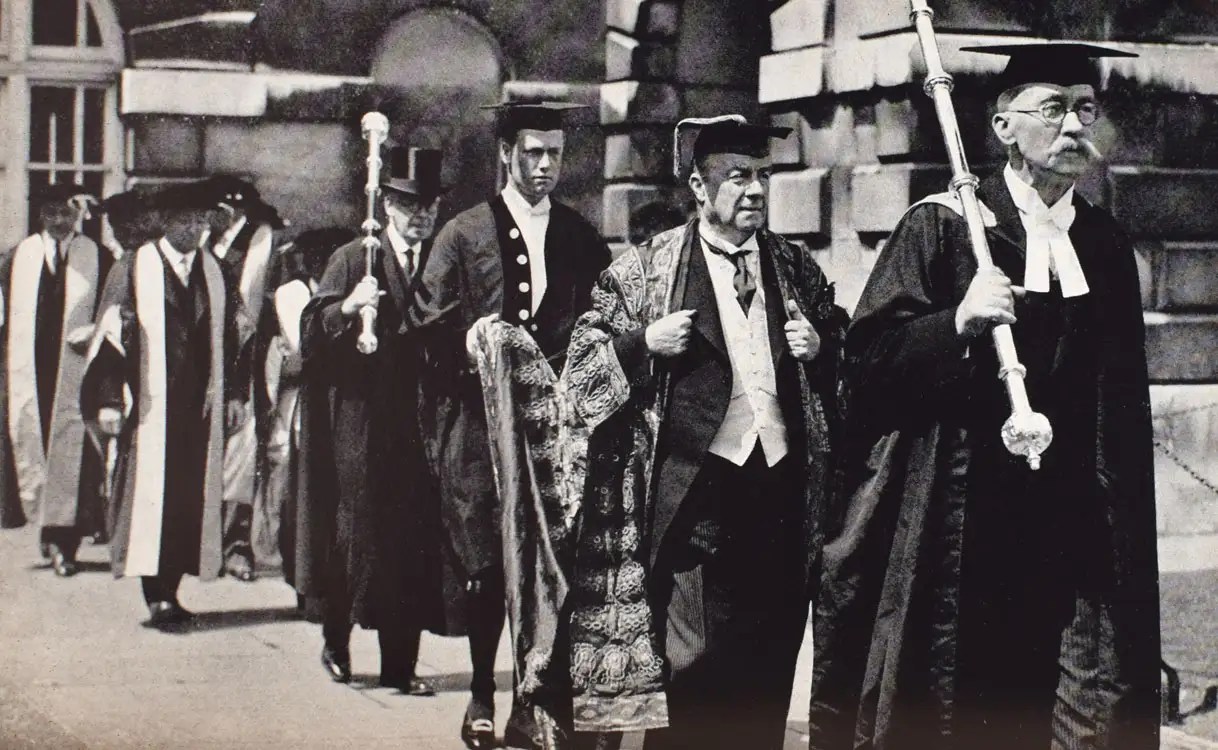
A university procession, from ‘Three Guineas’

She makes a simple point: men down the ages have ridiculed women for being so concerned about their clothes and dress; well, just look at these preposterous old buffers in their wigs and gowns and cloaks and gaiters.

But there’s also a serious point which is germane to her war theme: for she suggests that it is this flaunting of hierarchy and status, this cursed male wish to be superior, which is one of the roots of war. And so she thinks a good way to prevent war would be to attack this cause at the root and refuse to accept honours (as she did) or take part in silly ceremonies (a point developed at length in section 3).

Shortcoming 2. Over-reliance on biography as her primary evidence

The limitations of her education partly explain Woolf’s over-reliance on biography as evidence. She shows little sign of having read much history, economics, science or engineering, philosophy, psychology or sociology – some, but not much, and when she cites history books it’s rarely for the economic or social data.

Instead, what she does rely on to an overwhelming extent is biographies: all the damning evidence she assembles to demonstrate British society’s engrained misogyny and the power of the patriarchy is rarely drawn from history or sociology but relies exclusively on biographies and autobiographies and letters. The phrase you get in so many book titles, ‘Lives and Letters’, sums it up exactly. As an indication of her reliance on biography, here are quotes from just on one page:

  • ‘The witness of biography — that witness which any one who can read English can consult on the shelves of any public library…’
  • ‘Biography proves this in two ways…’
  • ‘Of this, too, there is ample proof in biography…’
  • ‘The study of biography… proves…’
  • ‘Perhaps the greatest testimony to the value of education with which biography provides us is…’
  • ‘You will find, if you consult biography…’

No need to consult facts and figures, assess data, decipher manuscripts, spend years in the archives. Again and again she takes the biography of an eighteenth century bluestocking or a nineteenth century hack writer like Mrs Oliphant off the shelf, and finds and pastes into her narrative their complaints about their limited lives and the dire condition of women in their time, which suit her argument.

(She does mention some histories but, when you look closely you see that she picks out of her historical sources the lives and opinions of her women witnesses: in other words, she selects the biographical elements of history and ignores the statistics, data, political history and so on.)

Late in the essay, rather as she does with her claims to be an amateur, untrained in academic enquiry, she turns an apparent weakness on its head. She tells us that she relies so much on (a very limited view of) history, on biography and newspapers, because they are the only sources of information open to a woman who has been denied a better, higher education, because of her sex; for:

history, biography, and… the daily paper [are] the only evidence that is available to the ‘daughters of educated men’.

Her very lack of scholarly rigour is itself an indictment of the patriarchal oppression which kept her excluded from the higher education her brothers and millions of men had benefited from.

And newspapers

She regards newspapers as ‘history and biography in the raw’. The excellent introduction by Anna Snaith tells us that Woolf kept three scrapbooks in which she gathered evidence for this book. It is striking how many of these snippets and excerpts are taken from newspaper articles or magazines, not the most in-depth kind of research. Newspapers are, by their nature, selective and biased and superficial. They sensationalise in order to sell copies. They are, in other words, the opposite of academic research into history, sociology and so on. This is a weakness in her evidence base.

On the other hand, newspapers are topical and up to date and give her useful snapshot of contemporary opinion – which makes them very interesting for the causal reader, 90 years later. Here’s a sample of the sources, taken from the numbered list of references at the back, which shows the combination of biography and newspaper cuttings which she overwhelmingly relies on as evidence.

  1. ‘Personal Reminiscences of a Great Crusade’ / a cutting from The Herald
  2. a cutting from The Listener / ‘Reflections and Memories’ by Sir John Squire
  3. ‘The Life of Sophia Jex-Blake’ by Margaret Todd
  4. Letter to The Times
  5. Debretts
  6. ‘Life of Sir Ernest Wild, K.C.’ by R.J. Rackham
  7. Lord Baldwin, speech reported in The Times
  8. ‘Life of Charles Gore’ by G.L. Prestige
  9. ‘Life of Sir William Broadbent’ edited by his daughter
  10. ‘The Lost Historian, a Memoir of Sir Sidney Low’ by Desmond Chapman-Huston
  11. ‘Thoughts and Adventures’ by Winston Churchill
  12. Speech at Belfast by Lord Londonderry, reported in The Times

You get the picture: her main sources are lives, letters and newspapers.

The second letter: funding a women’s college

Since the essay is in three parts and the introduction says it addresses three letters, I thought it would be a part per letter, so I was surprised when the second letter pops up at the end of part one. It is from a women-only college writing to ask Woolf to contribute to their fund raising. Anna Snaith’s excellent notes tell us it was a real letter Woolf received from Joan Strachey, Principal of the women-only Newnham College in Cambridge, asking for a donation to renovate the college buildings.

Woolf shows with some doleful quotations and examples, how petty-minded, snobbish and fierce for their stupid rules and regulations the existing (men-only) universities are. She harks back to the notorious incident of being kicked off the grass by the beadle early in ‘A Room of One’s Own’, which clearly still rankles.

Therefore, she replies to this letter that she will consider contributing to a women-only college but only if it is drawn up on a completely different basis from the male colleges. She proceeds to lay out the principles for an experimental college, one which will eschew all competition and exams, be open to the poor, and teach the humanities in a spirit of openness and collaboration:

A place where society was free; not parcelled out into the miserable distinctions of rich and poor, of clever and stupid; but where all the different degrees and kinds of mind, body and soul merit cooperated. Let us then found this new college; this poor college; in which learning is sought for itself; where advertisement is abolished; and there are no degrees; and lectures are not given, and sermons are not preached…

She warns that if the women-only colleges model themselves along male lines, with all the snobbery and competition and status-seeking and petty rankings that entails… those are precisely the kinds of habits of thought, the endless seeking superiority, which create the war mentality and she will not contribute to it.

And no chapels. She is as vehemently against the all-women colleges having chapels as she is violently against the engrained misogyny of the Church of England.

No to teaching English literature

She has a fierce passage execrating the teaching of English literature and its packaging into classes and exams, which she describes as ‘vain and vicious’. This is why Woolf herself refused to accept honorary degrees or prizes, despite being offered many in the later part of her life, and turned down offers to lecture (the exception which proves the rule being the lectures which formed the basis of ‘A Room of One’s Own’).

Woolf explains women’s war patriotism as an escape from domestic oppression

In a wonderfully irrational peroration she thinks that it can only have been delirious joy at being released from the narrow, cramped, uneducated lives forced upon Victorian daughters and spinsters which explained the huge outburst of patriotic enthusiasm among women at the outbreak of the Great War in 1914.

So profound was her unconscious loathing for the education of the private house with its cruelty, its poverty, its hypocrisy, its immorality, its inanity, that she would undertake any task however menial, exercise any fascination however fatal that enabled her to escape. Thus consciously she desired ‘our splendid Empire’; unconsciously she desired our splendid war.

This is splendid rhetoric but it’s a symptomatic of her failure to understand the causes of war, her failure to understand the psychology of crowds and societies embarking on war, her failure to understand genuine feelings of patriotism or national pride which are such big motivators for large numbers of people in any country – in a nutshell, her failure to understand anyone outside her own narrow upper-middle-class milieu.

Shortcoming 3. Ignorance of the wider world

I think her failure to understand the patriotic zeal which accompanied the start of World War One is indicative of her broader failure to understand the range and complexities of human nature, of all human nature across all of society.

Of the narrow little world of upper-middle-class women whose lives are supported by fleets of nameless servants which allow them to pursue their tedious obsession with art and poetry, of this tiny privileged world, she was a brilliant painter.

Of the big wide world, of the thousands of occupations, jobs and livelihoods, in finance, business, economics, trade, law, science, technology and engineering, of the lives of the working classes with their labour in coal mines and iron works, building ships, sailing the oceans, building trains and cars, laying down telegraph cables – in other words, in almost all the wide world and its billions of inhabitants, she has little or no interest and makes no effort to understand.

As an artist, as a writer, it doesn’t matter. Her novels focus on her chosen terrain and are masterpieces. As an essayist, claiming to gather evidence in order to analyse large social issues, it is, to say the least, problematic.

Giving a guinea

Out of this rather convoluted flow of arguments, Woolf concludes that she ought to give a guinea to the building of the women’s college, because it was entrapment in the family home that led so many women to explode with patriotism upon the outbreak of war. Building a college for the public education of the same class will prevent that and so materially contribute to the prevention of war which, if you recall, was the aim proposed right at the start of the essay.

Part 2. The professions

How can we enter the professions and yet remain civilized human beings, human beings who discourage war?

Woolf says a woman like her has only one weapon at her command to use against war, ‘the weapon of independent opinion based upon independent income.’ Now she will try to use this to sway the men in the professions.

The pretext is another letter she has received, from a society supporting women in the professions, asking for another donation, this time to the support of hard-up professional ladies. For Woolf it begs the question why, 20 years after women were admitted to the professions (1919) so few have risen to the top rank and so many are hovering round the bottom.

Woolf’s answers are convoluted and involve replies to other letters and lengthy addresses to her fictional interlocutor, they but boil down to:

  • women have much shorter traditions of thriving in the professions and so lack the centuries-old networks of male patronage and preferral
  • there are no limits to educated men churned out by the public schools and major universities, whereas there are far fewer schools for girls, only four or five colleges for women, and even the numbers admitted to these are severely restricted (only 500 women students were permitted at Cambridge in her day)
  • exams in the professions advantage those who have spent their lives taking exams, i.e. privileged, privately-educated men, and bar women who have (as she shows) vastly less access to private education
  • the nearly universal sexism and misogyny found at all levels of English society

Sexism and misogyny

As mentioned above, the flow of Woolf’s arguments is sometimes hard to follow, especially when it feels like she’s twisting the flow in order to fit her broader feminist critique to fit the essay’s ostensible subject of how to prevent war – but what the essay indisputably does do is powerfully convey the deeply entrenched tentacles of the patriarchy in contemporary 1930s England. She presents a wealth of facts and figures about the systematic prevention of women being educated, getting jobs, entering the professions and so on.

In this second part, the essay builds up into a devastating demonstration of English society’s hair-raising sexism and misogyny. In the main text but especially in the extensive notes which illustrate it, Woolf gives extended quotes from a wide range of men in powerful positions expressing the most hair-raising prejudices and slurs. I can’t give brief quotations, you have to read the notes, and the extended stories she gives, of awful politicians, judges, professionals, writers and commentators taking every opportunity to demean and limit women.

Fascists and Nazis

Woolf cranks up the temperature a lot by comparing several terrible British chauvinists who pontificate that a woman’s place is in the home, with a quote from none other than Adolf Hitler saying the exact same kind of thing.

Herr Hitler and Signor Mussolini have both often in very similar words expressed the opinion that ‘There are two worlds in the life of the nation, the world of men and the world of women’; and proceeded to much the same definition of the duties.

The juxtaposition of the two explains in a flash why Woolf is so resistant to all male talk about patriotism and ‘our country’. In what possible sense is it ‘her country’ when the Archbishop of Canterbury and the editor of the Daily Telegraph hold identical views about women’s place in society as Adolf Hitler? The same point is made in one of the long notes:

‘My husband insists that I call him “Sir”,’ said a woman at the Bristol Police Court yesterday, when she applied for a maintenance order. ‘To keep the peace I have complied with his request,’ she added. ‘I also have to clean his boots, fetch his razor when he shaves, and speak up promptly when he asks me questions.’ In the same issue of the same paper Sir E. F. Fletcher is reported to have ‘urged the House of Commons to stand up to dictators.’ (Daily Herald, 1 August 1926.)

Why, Woolf asks, all this fuss about opposing dictators abroad when every level of British society supports domestic tyrants at home?

Pay for housework

Men work in the public realm and get paid, sometimes a small fortune, often for jobs of dubious worth. Women labour in the home to raise families and manage households and care for the elderly, all unpaid. So: women’s domestic work should be paid.

The work of an archbishop is worth £15,000 a year to the State; the work of a judge is worth £5,000 a year; the work of a permanent secretary is worth £3,000 a year; the work of an army captain, of a sea captain, of a sergeant of dragoons, of a policeman, of a postman – all these works are worth paying out of the taxes, but wives and mothers and daughters who work all day and every day, without whose work the State would collapse and fall to pieces, without whose work your sons, sir, would cease to exist, are paid nothing whatever.

I wonder who first originated this call? Mary Wollstonecraft in ‘A Vindication of the Rights of Woman’ (1792)? Certainly Friedrich Engels mentions it in his 1884 book ‘The Origin of the Family, Private Property and the State’. Anyway, Woolf makes a sustained case for it over many pages, 30 years before the issue was revived by second-wave feminists in the 1970s:

Note: I was a househusband for eight years. I did all the childcare, running children round to nurseries, playgroups, parties, doing all the shopping, cooking and cleaning, changing thousands of nappies, giving bedtime baths and so on, while my wife earned the family income. So I have lived experience of issues like this. It’s this lived experience which feeds into my scepticism about feminism, not as a theory (fine and dandy) but in practice (complicated and compromised). I met plenty of women who were extremely happy to pack in office work and become full-time mums and housewives, who loved looking after their young children, dressing them up, holding parties, dropping them at nurseries or infant school and going to meet girlfriends for lunch or coffee.

Then again, some didn’t. Some felt trapped and needed support, would have welcomed free or cheap childcare, or just wanted to go back to work which they found more fulfilling than hanging round playgrounds or hosting rooms full of screaming kids.

I had many conversations with scores of mums about how the state should provide cheap childcare, or if only companies would allow more flexible work based around school hours, if only housework was recognised and paid for like other forms of work, and so on and so on. Hundreds of conversations on these and related subjects, over years and years.

So my scepticism about feminism is not ideological or temperamental. It’s based on the lived experience of being a housekeeper and child-rearer myself, and talking to hundreds of women in the same situation. The problem is not the top-level slogans and demands, anyone can come up with catchy slogans and carry banners – “Wages for Housework” – it’s figuring out the practical policies and application: where would the money come from? How would it be paid out? Who defines ‘housework’? Like child benefit would it go to anyone caring for a child or be subject to conditions? How would you prove that you do the housework and don’t sub-contract this or that part to cleaners or nannies? etc etc.

The procession

Back to the Woolf on the professions. She gives a vivid description of the processions of all the professions through London’s streets to the centres of law, finance and so on and asks her women readers: do we, in fact, want to be part of this procession? Do we want to do the same jobs but for less pay and more condescension? Or do we want to strike out on our own and lead our lives differently?

The facts… seem to prove that the professions have a certain undeniable effect upon the professors. They make the people who practise them possessive, jealous of any infringement of their rights, and highly combative if anyone dares dispute them. Are we not right then in thinking that if we enter the same professions we shall acquire the same qualities? And do not such qualities lead to war? In another century or so if we practise the professions in the same way, shall we not be just as possessive, just as jealous, just as pugnacious, just as positive as to the verdict of God, Nature, Law and Property as these gentlemen are now?

She gives a number of quotes from lawyers, clerics and politicians complaining they lead a dog’s life, and have sacrificed all their pleasures and family time to their work. Do modern women want to rush into exactly the same kind of wage slavery?

Woolf wonders if we can turn to the lives of nineteenth century women in the professions to help us find a more humane way to have one of these high-powered jobs and live properly? No, because there weren’t any women in the nineteenth century professions. They weren’t allowed. Instead:

We find, between the lines of their husbands’ biographies, so many women practising – but what are we to call the profession that consists in bringing nine or ten children into the world, the profession which consists in running a house, nursing an invalid, visiting the poor and the sick, tending here an old father, there an old mother? – there is no name and there is no pay for that profession; but we find so many mothers, sisters and daughters of educated men practising it in the nineteenth century that we must lump them and their lives together behind their husbands’ and brothers’.

The validity of housework and child-rearing, again, and the long buried, unrecorded of the scores of millions of women who spent their entire lives doing it.

Giving the second guinea

All these arguments have been contained, rather confusingly, in a very long letter replying to the letter she received asking for financial aid for impoverished women professionals. Woolf sums up her position by saying she will send the letter-writer one guinea ‘on condition that you help all properly qualified people, of whatever sex, class or colour, to enter your profession’, and in addition ensure that women:

  • must earn enough to be independent
  • must not prostitute their brain to their profession
  • must refuse all prizes, medals and awards, and be content with obscurity
  • must rid themselves of religious pride, college pride, school pride, family pride, sex pride and those unreal loyalties that spring from them

These are obviously very strict, probably utopian conditions, as with her demand for a completely different type of college which ended section 1. But:

If you agree to these terms then you can join the professions and yet remain uncontaminated by them; you can rid them of their possessiveness, their jealousy, their pugnacity, their greed. You can use them to have a mind of your own and a will of your own. And you can use that mind and will to abolish the inhumanity, the beastliness, the horror, the folly of war.

Antigone saying No to male tyranny

Part two rises to a very powerful invocation of Sophocles’ play, Antigone. Woolf studied this when young and it stayed with her all her life as a powerful story of female resistance to male tyranny. In the era of Hitler and Mussolini it was more than ever relevant. She comes back to it later.

No risk because of exclusion

Woolf ends part 2 with a grand fanfare of irony, saying there is no immediate risk of women professionals losing their souls and working themselves to shreds so long as the laws of England hold their nationality so lightly, prevent them from working in many professions, limit the numbers who can attend university, and ensure that so many women continue to live in the tradition of neglect and contempt, living gruelling lives of unpaid work in dark patriarchal homes.

Part 3. The Outsider Society

The sarcasm and irony which have been present throughout the essay rise to a real anger and bitterness in this, the longest of the three parts.

Woolf reverts back to the original letter she was sent, the one from the unnamed male correspondent asking her how they can prevent a war, and she repeats his three suggestions, namely that we should:

  1. sign a manifesto pledging ourselves ‘to protect culture and intellectual liberty’
  2. join a certain society, devoted to certain measures whose aim is to preserve peace
  3. should subscribe to that society which like the others is in need of funds

Failure of the universities

She addresses these points one by one. First she is satirical about this idea of ‘protecting culture and intellectual liberty’. Isn’t this what the Great Universities have said they were devoting themselves to for centuries, the ones which have been teaching men these values and brutally excluding their sisters and daughters? Is the fact that these values now need such support from society an admission that all those centuries of learning have failed? And if they’ve failed, why should the impoverished, life-opportunity-deprived daughters and sisters suddenly rush to the help of their oppressors?

What is ‘culture and liberty’?

Anyway, what is this ‘culture and liberty’ the letter writer refers to? She knows what it isn’t. Characteristically, she turns to biography and uses the life of an author like Mrs Margaret Oliphant (1828 to 1897) who, after her husband died, churned out meretricious romances to support her children. Was this intellectual liberty? No, this was intellectual prostitution and Woolf angrily takes it as typical of the intellectual prostitution forced on so many women writers and artists who had to sell their souls and prostitute their art because of the patriarchy’s refusal to let them earn a living any other way.

So she mocks the letter writer’s suggestion that women, victims of centuries of repression, should suddenly rush to help the poor privileged men in their time of need. He wants her to join his pacifist society, does he? Well, no. The very word ‘society’ denotes the systematic exclusion of women from education and influence and power and money, so screw society.

The very word ‘society’ sets tolling in memory the dismal bells of a harsh music: shall not, shall not, shall not. You shall not learn; you shall not earn; you shall not own; you shall not – such was the society relationship of brother to sister for many centuries.

The Outsiders Society

She’s not going to join any boys’ club. Instead she proposes setting up a separate organisation, for women of her class and (lack of) education. It would be called The Outsiders Society. It would consist of educated men’s daughters working through their own class and by their own methods for liberty, equality and peace. Members would:

  • not fight
  • not work in munitions factories or nurse the injured
  • not encourage men to go and fight but maintain an attitude of neutrality, as fighting is a ‘sex characteristic which she cannot share’

She rises to real bitterness:

She will find that she has no good reason to ask her brother to fight on her behalf to protect ‘our’ country. ‘”Our country,”‘ she will say, ‘throughout the greater part of its history has treated me as a slave; it has denied me education or any share in its possessions. “Our” country still ceases to be mine if I marry a foreigner. “Our” country denies me the means of protecting myself, forces me to pay others a very large sum annually to protect me, and is so little able, even so, to protect me that Air Raid precautions are written on the wall [i.e. women are defenceless against modern warfare]. Therefore if you insist upon fighting to protect me, or “our” country, let it be understood, soberly and rationally between us, that you are fighting to gratify a sex instinct which I cannot share; to procure benefits which I have not shared and probably will not share; but not to gratify my instincts, or to protect either myself or my country. For,’ the outsider will say, ‘in fact, as a woman, I have no country. As a woman I want no country. As a woman my country is the whole world.’

Wow. Very powerful. Furthermore, The Outsider will cultivate complete indifference to male nonsense about patriotism, war and fighting. On the contrary, she will:

  • take no part in patriotic demonstrations
  • not take part in patriotic praise
  • absent herself from military displays, tournaments, tattoos, prize-givings and all such ceremonies as encourage the desire to impose ‘our’ civilization or ‘our’ dominion upon other people

The idea is that this ‘indifference’ will damp down patriotic fervour in those around her and thus, in a tiny way, help to avoid war.

All this makes a sort of sense. But it feels like twisting logic when Woolf goes on to assert a link between these anti-war steps and the positive demands of her feminist programme. The connection feels tenuous and forced. Because she now switches to say that in order for their opinion or actions to matter, the outsiders must push for a raft of feminist requirements, being:

  • they must earn their own livings
  • they must press for a living wage in their professions
  • they must create new professions in which they can earn a living wage
  • they must press for press for a money wage for the unpaid worker in her own class – the daughters and sisters of educated men
  • they must press for a wage to be paid by the State to the mothers of educated men

Make the state pay for housework

This last is vital because until she has complete financial independence, a wife is dependent on her husband for money and will follow his opinions and men are for war. Therefore, in order to create an influential bloc of educated women who are against war, this class must be given financial, and so intellectual, independence. Women must be paid by the State for their work as mothers.

And she tells her male interlocutor that this step – paying women for their housework – would also liberate husbands, because by sharing the burden of earning an income they would no longer be wage slaves, slaves to the rat race. It would have an enlightening and life-enhancing effect all round.

I gave my thoughts on this proposal earlier. It sounds great, and you can see her logic – that women can only be truly independent and free if they have their own income, separate from their father’s or husband’s – but how would it be implemented in practice?

I’ll just make the additional point that its recurrence here is characteristic of how key themes and suggestions recur throughout the essay, building up power through repetition and echoes, not unlike her technique in her novels.

Outsider demands

But she hasn’t finished with her demands. The Outsiders would:

  • not only earn their own livings but become so expert that their threat to down tools would have power and influence
  • when they have earned enough to live on they would earn no more i.e. not pile up obscene wealth
  • they would reject any profession hostile to freedom such as the arms trade
  • they would refuse to take office in any institution which pretends to respect liberty but actually restricts it, such as Oxford and Cambridge

Outsiders will eschew all the stupid costumes and ceremonies so beloved by men (see the section about silly ceremonials in part 1).

Outsiders will eschew ‘the coarse glare of advertisement and publicity’ and prefer to work in honest obscurity.

The secret society already exists

Wandering into thriller territory, Woolf suggests that this Outsider Society already exists but is secret and underground in its activities. Her very dubious evidence for this far-fetched claim is a clutch of newspaper reports of various women officials making comments against war, opposing arms manufacture and the like. From random quotes and newspaper clippings she based the existence of a secret society operating across English society. Is this an example of her sometimes utopian or far-fetched argumentation – or an example of her dry sense of humour? Difficult to tell.

Against the Church of England

Outsiders will:

  • fearlessly investigate and criticise public institutions they are forced to contribute to, such as the universities, but especially the Church of England
  • by criticizing religion they would attempt to free the religious spirit from its present servitude and would help, if need be, to create a new religion based it might well be upon the New Testament, but, it might well be, very different from the religion now erected upon that basis

Woolf’s attitude to the Church of England had already been indicated in the passage about cited above about Antigone where she writes that ‘Antigone’s five words are worth all the sermons of all the archbishops’, those five Greek words (they total 11 in the English translation) being:

‘Tis not my nature to join in hating, but in loving.’

Pages 196 to 202 give a scathing account of how Jesus Christ’s own admonition that his followers are equal which promised equality between men and women was denied by St Paul, who invented the idea that women must be veiled in church and not speak. This bigotry hardened over the centuries into a church which forbids any positions of power or influence in the most powerful and prestigious organisation in the land, to women.

With the result that the salary of an archbishop is £15,000, the salary of a bishop is £10,000 and the salary of a dean is £3,000. But the salary of a deaconess is £150; and as for the ‘parish worker’, who ‘is called upon to assist in almost every department of parish life’, whose ‘work is exacting and often solitary…’ and who is most likely to be a woman, she is paid from £120 to £150 a year.

It’s a pattern mirrored in all the other professions and walks of life: women excluded from all the prestigious, well-paid higher positions, and forced to undertake the most menial and poorly-paid jobs.

Psychoanalysis, anger and fear

One of Anna Snaith’s excellent notes tells us that ‘Woolf’s brother Adrian [Stephen] and his wife Karin were trained psychoanalysts and were crucial in disseminating Freud’s work in England.’ This is relevant because Woolf quotes at length from the Archbishops’ Commission on the Ministry of Women (1936) and in particular from the appendix written by Professor Grensted, the Nolloth Professor of the Philosophy of the Christian Religion in the University of Oxford.

This professor concluded that there is no reason in theology (Christ’s teachings) why there should not be women priests, but there were strong objections to women priests among the clergy. Digging deeper he uses Freudian terminology to suggest the deep conviction held by many men of men’s superiority and women’s inferiority.

The causes are obscure but the outcome is obvious: that whenever a conversation lights on the topic of equality for women and women holding roles up till now reserved for men, many man become angry and many women become fearful. This imbalance leads women not to raise, mention or discuss the issue which, as a result, goes underground.

The infantile fixation

Woolf takes from Grensted the notion of the ‘infantile fixation’. I didn’t quite understand this and I didn’t see her defining it anywhere. Instead she gives three examples of what she means (taken, inevitably, from biographies), namely the wildly irrational anger and jealousy triggered in three classic Victorian fathers when their daughters asked permission to get married or (worse than that) to get a job. The fathers being:

  • Mr Barrett (father of Elizabeth who wanted to marry the poet Robert Browning)
  • the Reverend Patrick Brontë (father of Charlotte who wanted to marry)
  • Mr Jex-Blake (father of Sophia who was offered a small sum for tutoring mathematics to a friend)

By contrast, to show the impact of a father’s liberality, she gives the story of Mr Leigh Smith. It’s worth quoting at length because the impact is in all the details. Smith had a daughter, Barbara, who he loved.

When Barbara came of age in 1848 he gave her an allowance of £300 a year. The results of that immunity from the infantile fixation were remarkable. For ‘treating her money as a power to do good, one of the first uses to which Barbara put it was educational.’ She founded a school; a school that was open not only to different sexes and different classes, but to different creeds; Roman Catholics, Jews and ‘pupils from families of advanced free thought’ were received in it. ‘It was a most unusual school,’ an outsiders’ school. But that was not all that she attempted upon three hundred a year. One thing led to another. A friend, with her help, started a cooperative evening class for ladies ‘for drawing from an undraped model’. In 1858 only one life class in London was open to ladies. And then a petition was got up to the Royal Academy; its schools were actually, though as so often happens only nominally, opened to women in 1861; next Barbara went into the question of the laws concerning women; so that actually in 1871 married women were allowed to own their property; and finally she helped Miss Davies to found Girton. When we reflect what one father who was immune from infantile fixation could do by allowing one daughter £300 a year we need not wonder that most fathers firmly refused to allow their daughters more than £40 a year with bed and board thrown in.

The difference just one liberal father made. What if all Victorian fathers had been like that.

Sexist science

There follows a passage giving some examples of how even contemporary science is twisted to prove the inferiority of women. To be honest this section is neither very compendious nor persuasive. She doesn’t really go into the most basic accusation against women, that their bodies are designed for childbirth and child-rearing and this explains why their minds are limited to domestic subjects and childish logic. (I’m not saying this, I’m repeating the sexist, misogynist accusation.)

This is a failing but I think reflects the limitations of Woolf’s knowledge and education. Of science she knows next to nothing and so is simply incapable of unpacking all the biological and psychological aspects of woman-hating. She is much more at home in her comfort zone of education and literature, the lives of women writers.

She cites Bertrand Russell pointing out the sheer sadism of much medical science towards women (the medical profession’s reluctance to provide painkillers to women in childbirth) or the twisting of scientific knowledge to justify male superiority – but not as amply as this huge subject demands.

Cleons

Instead she reverts to literature again, and her obsession with Antigone. In the play the oppressive father is Cleon, the archetype for the Victorian paterfamilias and the modern fascist. Here is Cleon speaking dictator-talk:

‘Whomsoever the city may appoint, that man must be obeyed, in little things and great, in just things and unjust… disobedience is the worst of evils… We must support the cause of order, and in no wise suffer a woman to worst us… They must be women, and not range at large. Servants, take them within.’

Order and the oppression of women, Mr Barrett and Mussolini.

The personal and the private

In the essay’s last pages she brings things together by (rightly) saying that she has shown how male tyranny in the personal, domestic realm and in the public realm, are intimately linked:

that the public and the private worlds are inseparably connected; that the tyrannies and servilities of the one are the tyrannies and servilities of the other.

Despite the strangeness of the letter-answering structure and the oddly digressive, rambling flow of the argument, by the end she has presented a devastating barrage of evidence, as well as making a host of demands and suggestions.

The third guinea

So she refuses to sign the form her correspondent had sent her. She refuses to sign up to his society because of her opposition to all such male bodies, but she will send him a guinea to support it.

Their aims are the same, to oppose the tyrants in the name of Justice and Equality and Liberty. But, as this amazing book has explained, as a woman, as the patchily educated ‘daughter of educated men’, as someone with completely different life experiences and, consequently, utterly different perspectives from the male sender of the letter, she shares the same aim but insists that she will try to bring it about using, not the old male forms and words, but new words and new ideas appropriate for women.

Magnificent

For all its faults, ‘Three Guineas’ is a magnificent, powerful and very persuasive piece of work. Her assembly of a very wide range of evidence, facts and figures really bring home the historical endurance, depth and wide range of the legal, financial and cultural oppression of women throughout English history and the stupid, patronising and misogynist attitudes and opinions deployed to maintain that oppression.

The notion of the Outsiders Society is the crystallisation of the massive theme which emerges repeatedly throughout the text, the idea that women – not because of any biological or psychological differences – but purely because of the legal, financial, professional and cultural apartheid they have suffered for centuries, bring to the table a different perspective from men across a whole range of issues.

I think it’s a magnificent example of a polemical essay, of an impassioned political pamphlet.

Criticisms

There are a number of problems or issues with Woolf’s way of arguing. Initially I included them in my review where they occurred but they cluttered up the flow of my review, and gave an unduly negative opinion too early on. I mentioned three earlier on. Here are a few more.

Shortcoming 4. Woolf’s intellectual confusions

Periodically throughout the text Woolf freely admits to own intellectual shortcomings: for example, right at the start she admits being bewildered that there seems to be a wide range of opinions about whether war is good or inevitable. She herself tells us that the more she reads, the more opinions she discovers, the more confused she becomes. But… is that not the point of being an intellectual: to read all the opinions, weigh the evidence, and develop your own line of argument, based on the evidence you uncover and reacting to other people’s arguments?

This activity, intellectual activity, always puzzles and confuses Woolf. In ‘A Room of One’s Own’ there’s the section where she orders up some books in the British Museum and opens them up, expecting to discover The Truth staring her in the face.

Sometimes this is part of her general mocking irony, mocking the pretensions of pretty much all male activity, including the grand Pursuit of Truth. But at other times it can give you the worrying sense that she doesn’t really understand what intellectual enquiry is.

Her intellectual confusion as evidence of her case

In the opening and then at various transition moments, Woolf explicitly tells us that she struggles to marshal the evidence, is embarking on something too big for her abilities, and wonders if she’d be better off abandoning it. After a while I realised that maybe these passages are designed to dramatise the issue of women’s exclusion from formal education by using herself as an example.

Woolf’s brothers went to top private schools and Oxbridge whereas she more or less had to educate herself at home and mostly taught herself by browsing through her father’s extensive library. In other words, every time she shares how confused by the evidence or daunted by the challenge of answering big question she is, she is demonstrating the effect of the grotesquely unequal education of the genders, how women have been the victims of ‘tradition, poverty and ridicule’, and showing the reader how she (and we) are suffering for it.

Maybe that’s why she flaunts her own intellectual limitations so much: the intellectual inability she frequently laments is the result of her exclusion from higher education. It makes her case for her.

Shortcoming 5. Her analysis is restricted to a (relatively) small class

Her lack of real confidence in her own research, and her need to make her feminist points as categorical and powerful as possible, explain why Woolf makes the strategic decision of restricting her analysis to a relatively small class, to women like herself, to ‘the daughters of educated men’, as she describes them. As she puts it:

Our ideology is still so inveterately anthropocentric that it has been necessary to coin this clumsy term – ‘educated man’s daughter’ – to describe the class whose fathers have been educated at public schools and universities. Obviously, if the term ‘bourgeois’ fits her brother, it is grossly incorrect to use it of one who differs so profoundly in the two prime characteristics of the bourgeoisie – capital and environment.

She makes it quite clear on page one that she is only discussing upper-middle-class women, women like herself, women with immaculate manners who are used to managing servants and know which of the many forks and spoons to use at a formal dinner.

In order to avoid the confusions, contradictions and conflicting evidence I mentioned above, in order for her analysis to work, she has to reject the vast majority of the population (the working class and lower classes, of both sexes) and identify her cause with just this numerically small and limited class of posh ladies.

It isn’t just me pointing this out. The Wikipedia article about Three Guineas tells us that the noted academic Q.D. Leavis wrote a scathing review of ‘Three Guineas’ soon after it was published:

She denounces the essay because it is only concerned with ‘the daughters of educated men’, seeing Woolf’s criticisms as irrelevant to most women because her wealth and aristocratic ancestry means she is ‘insulated by class’.

And Anna Snaith’s notes in the Oxford University Press edition tell us that Woolf received letters from working class women readers who complained about being left out of her analysis, notably a long semi-autobiographical one from a working class woman named Agnes Smith.

This is closely related to what I called shortcoming 3, ignorance of the wider world. But it’s also a decision. She found it hard enough gathering the evidence for the sexist discrimination against her own type and class of woman. If she opened it up to the broader middle and working classes she’d never have finished it.

2025: the perils of intersectionality

Many of these criticisms are mentioned in Anna Snaith’s introduction to the Oxford University Press edition. Here she indicates the larger cultural and political problems the essay falls foul of. This is that there are, nowadays, so many grievances, so many groups claiming to be victims, so many communities and identities who feel that they, too, have been subjected to centuries of oppression, that it is hard to focus on just one, and it is especially hard to focus on the group Woolf defines as the ‘daughters of educated men’.

As you read Snaith’s account of Woolf’s life and social circle, with so many friends among England’s political and cultural elite, the idea of her as a persecuted outsider feels more and more ludicrous. She wasn’t a Jew in Hitler’s Germany, a Black in the American South, a kulak in Stalin’s Russia, an Aborigine in Australia, she grew up in a house full of books which she was actively encouraged to read and went on to become a centre of London’s literary and artistic elite.

This doesn’t invalidate any of the points she makes in the book or detract from the essay’s tremendous power. It’s just to say that the struggle for women’s equality takes its place among quite a few other struggles. I’ve a book about the Irish Civil War on my desk and Irish nationalists have quite a story to tell about 1,000 years of British oppression. Her husband was a Jew who had his own story about the legal and financial persecution of Jews. Something similar could be said of England’s Roman Catholics, prevented by law from holding official positions. Or – a group close to my heart – England’s non-conformists, banned by law from holding any positions of authority for 300 years after the civil war. Citizens from India or any of the colonies we ruled for centuries might have a thing or two to say about Britain’s oppression of their peoples and cultures.

Being a modern academic, Snaith is contractually obliged to drag in slavery – the progressive topic par excellence – to her discussion of ‘Three Guineas’, on the rather tenuous basis that guineas were, apparently, first used as currency in the British slave trade. Don’t know what Virginia would have made of that scholarly leap of imagination.

To repeat – this little digression about the modern over-abundance of historical grievances is not entirely my view but simply expanding points made by the book’s editor, Anna Snaith, in her introduction.

All these other issues don’t invalidate any of the points Woolf makes in the book but they place it in a much larger, real world context. If you’re a feminist, you can insist that your cause and your history of oppression is the real one, the big one, the important one and, convinced of your righteousness, overlook or downplay the grievances of all the other groups I’ve mentioned. In a sense, to get anything done, you have to focus on your issues and grievances; nobody can represent the issues of the whole world. You have to pick your battles. And this explains why Woolf realised that, in order to get her book written, she had to concentrate just on relatively privileged upper-middle-class women like herself, on ‘the daughters of educated men’.

Conclusion

It’s a very powerful book. Very. To repeat what I said at the start, from one point of view it may be her most important work. It’s a bit of a struggle, a bit meandering, a bit puzzling in places, her proposals such as for the Outsider Society are a bit eccentric – and yet so many of her main points drive right home, and the evidence gathered in the notes at the end is searing, blistering, eye-opening. It shook this old cynic. It materially changed my views about feminism. I strongly recommend it.


Credit

‘Three Guineas’ by Virginia Woolf was first published by the Hogarth Press in 1938. Page references are to the 2015 Oxford University Press paperback edition, edited and annotated by Anna Snaith, although the text is easily available online.

Related links

Related reviews

Flame Into Being: The Life and Work of D.H. Lawrence by Anthony Burgess (1985)

Man belonged to the cosmos and was fulfilled through his natural instincts, of which love was the greatest.
(Burgess’s summary of Lawrence’s credo, page 62)

Anthony Burgess (1917 to 1993) was a composer, poet, novelist, essayist, librettist, screenwriter, critic, provocateur and media personality. In the 1980s I watched him appear on TV arts programmes and read his numerous book reviews, essays and novels (notably ‘Earthly Powers’, 1980, and ‘The End of the World News’, 1982). He was great fun, an unashamed entertainer. This book is a classic example of his work: opinionated, interesting, drily amusing, sensible, packed with ideas and insights.

Preface

Part of this is because Burgess, like Lawrence, was an outsider. Most 20th century English authors went to private school and Oxbridge and so, whether they were radicals or conservatives, maintained the same kind of tone and worldview, the same manners, the same limited, privileged experience of life in their works. Burgess, as he explains in his preface, grew up in the pub and shop culture of working class Manchester, with little cultural capital and, like Lawrence, largely had to teach himself about literature. And they both married foreign wives and left England to live abroad, Lawrence in his pilgrimage round the world, Burgess to live in Monte Carlo.

That said, Burgess says there are also big differences. Burgess came of an Irish family and was raised a Catholic. This explains his attraction to James Joyce. But also puts him in a different tradition from Lawrence who came from non-conformist stock, proud of his puritanism, attracted to the old pagan gods, son of a miner.

Burgess admires Lawrence’s intransigence and sympathises with his sufferings on behalf of free expression. Lawrence stands for:

that fighting element in the practice of literature without which books are a mere decor or confirmation of the beliefs and prejudices of the ruling class. (p.x)

‘Literature is essentially subversive’ and Lawrence was a leading practitioner of that subversion.

Chapter 1. Lawrence and Myself When Young

Burgess quotes Lawrence’s biographer and critic Richard Aldington saying Joyce and Lawrence are diametrically opposed: Joyce is about being and Lawrence is about becoming.

Stylistically Joyce is drawn to economy and exactness, Lawrence to a diffuseness which looks for what he is trying to say while he is saying it. (p.4)

This strikes me as the single most important aspect of Lawrence’s style as a writer of prose and poetry. His paragraphs feel like they’re being shaped and formed, often reusing the same words and phrases, as you watch. It’s a unique experience of being involved in the writing, as it happens.

His writing does not seem to have emerged, lathed and polished, from the workshop: when we read him we are in that workshop, witnessing a hit-and-miss process of creation in which orthodox faults – prolixity, repetition, apparent absurdity – are idiosyncratic virtues. (p.9)

He is a writer taking chances and trusting that he will be taken seriously.

In the 1910s literature was influenced by the serious scientific predictions of H.G. Wells and George Bernard Shaw with their promotion of Scientific, Rational solutions to society’s ills. Lawrence reacted against all this, despised all politics – maybe all rationality – and spoke for the Natural Man.

The purest exponent of the Natural Man after the Great War was Ernest Hemingway who saw that the complex sentences of Edwardian literature reflected a society and values which had all been exploded. He developed a stripped back, simple and repetitive style which promoted a simplistic code of honour. I like where Burgess says:

It may be that Hemingway’s prose is the biggest stylistic innovation of the century… Hemingway genuinely starts again from scratch. (p.8)

When I was a schoolboy and student, that was my view. From E.M. Forster to Ernest Hemingway was a leap from the 19th into the 20th century and, reading literary books today, they almost all still copy the Hemingway formula: short sentences, simple vocabulary, delete all adjectives and adverbs.

The pre-scientific or irrational in Lawrence made him a genuine primitive man, a pagan. He has a profound feeling for the pagan gods. Even the books set in England contain characters who talk like pagan deities. His people aspire to be naked, and their dialogue is voices from the unconscious, from another realm of experience.

Chapter 2. Beginnings

Lawrence’s father was a miner who worked at Brinsley Colliery, Eastwood, so you might have expected Lawrence’s subject to be squalor, dirt and struggle, for him to have become a proletarian writer. But Eastwood, ten miles north-east of Nottingham, in his day looked out over countryside, and Lawrence chose instead to become a writer of the countryside, flowers and animals.

Lawrence’s parents’ marriage was a warzone. His father was a miner, technically a ‘butty’ or supervisor of a gang of other miners. He was almost illiterate, spelling out the newspaper a word at a time, whereas Lawrence’s mother had been a teacher and clung to the idea that she came of gentle stock. Lawrence was unusually close to his mother – she is the central figure in his first major novel Sons and Lovers, and he was devastated when she died – but, by the same token, he was impressed by his father’s big beefy masculinity and the sodality of the miners.

Lawrence was an amateur painter till he was 20. His surviving paintings are vivid but demonstrate his complete lack of training in perspective or anatomy. Words were different. Poems and prose bent to the force of his imagination with little or no training.

At 17 he went as a pupil-teacher to Ilkeston training centre. At 21 he went to Nottingham University. Aged 23 he went to teach in Croydon. He discovered the ‘English Review’, edited by Ford Madox Hueffer, who ‘had the greatest editorial flair of his time, if not of the century’ and sent in some poems (p.20). Hueffer recognised the boy’s genius, invited him up to tea, introduced him to Ezra Pound. Lawrence showed Hueffer his first novel, ‘The White Peacock’.

Burgess makes a characteristically sweeping statement:

One of the uses of fiction is to affirm the values of the bourgeoisie. (p.24)

Lawrence is ‘this most visual of novelists’. Burgess emphasises the brilliant physical details in so many scenes.

Joyce, by contrast, was an urban man and knew nothing of flowers. Lawrence is the great novelist of flowers.

Snobbishness Lawrence’s mother felt she married down when she married his father. She aspired for her boys, wanted them to climb the social ladder. This is reflected from as early as ‘The Peacock’, with characters saying ‘awfully’ and ‘frightfully’, words never used in the Lawrence household. He was aping his social superiors, he was pitching the narrative at a higher social level.

Chapter 3. The Denial of Life

Lawrence’s second novel, ‘The Trespasser’, was published in 1912. It’s set on the Isle of Wight which was as far abroad as he’d managed to get by that point. The lead character Siegmund, hangs himself. The is the only suicide in Lawrence’s oeuvre.

In 1912 Lawrence eloped with Frieda Richtofen, the wife of his French tutor at Nottingham University, philologist and professor of modern languages, Ernest Weekley. She describes how they fell in love in her memoir, Not I, but the Wind…, how she was forced to abandon her three children when they eloped abroad, ending up in a rented house on Lake Garda in north Italy.

Mr Noon: Lawrence drafted the first part of this novel before the war. It was published as a fragment in 1934. Only 50 years later, in 1984, was the second part, which existed in papers belonging to a friend of Lawrence’s, published. The two halves or parts were first published together in 1984. The second half is quite different from the first. It appears to be a factually accurate and barely fictionalized account of Lawrence and Frieda’s early sexual relations. Burgess makes the point that:

It was common practice for Lawrence to write half a novel, abandon it, and then pick it up again with no great concern for plausible continuity; when in doubt, change your main character’s character, though retaining the name, and make him or her start a new life somewhere, preferably in Italy. (p.33)

This happens in ‘Mr Noon’, ‘The Lost Girl’ and ‘Aaron’s Rod’.

Marriage It is amusing that Lawrence was very fierce for marital fidelity, had a pagan reverence for the union of one man and one woman and yet the partner of his life was secured by wrecking her marriage to Professor Weekley. Also ironic that Frieda was (allegedly) unfaithful to him.

Anywhere Lawrence was one of those rare writers who could write anywhere, even amid noise and distractions. He never had a permanent home and so no book-lined study, was able to be interrupted mid-sentence to meet people or go and do some chore, come back hours later and pick up where he left off. In the relationship with Frieda, he did all the household chores while she lay in bed smoking. He reflected this aspect of himself in the character of Rawdon Lilly in ‘Aaron’s Rod’:

He put on the kettle, and quietly set cups and plates on a tray. The room was clean and cosy and pleasant. He did the cleaning himself, and was as efficient and inobtrusive a housewife as any woman. While the kettle boiled, he sat darning the socks which he had taken off Aaron’s feet when the flautist arrived, and which he had washed. He preferred that no outsider should see him doing these things. Yet he preferred also to do them himself, so that he should be independent of outside aid. (Aaron’s Rod, p.121)

England, My England Soon after eloping, Burgess quotes letters in which Lawrence lambasted the English and England in extreme terms. And yet he remained an Englishman through and through. Richard Aldington amusingly said Lawrence was as English as a wet Sunday in Hull.

Son and Lovers Another joke: given the theme of this novel is a young man’s struggle to break free from the smothering influence of his mother, Frieda playfully suggested it should be titled ‘Sons and Lovers: Or, His Mother’s Darling’. Lawrence was not amused.

Chapter 4. Son and Lover

David Herbert Lawrence was called Bert in the family home. He disliked his first name. After he eloped and became more cosmopolitan he liked his female admirers, starting with Frieda, to call him Lorenzo.

‘Sons and Lovers’ was published in May 1913. Giving its protagonist the French surname Morel is symptomatic of Lawrence’s aspiring cosmopolitanism. Burgess describes it as a ‘florescent, leafy, pullulent’ book (p.50).

Lawrence’s modernism lies not in the formal technique of his novels: they display none of the agonising over technique obvious in Conrad, Ford Madox Ford, James or Joyce. The modernism is in the content for two reasons to do with the characters.

1) His characters’ identities are extraordinarily labile: they change all the time. Not just that, but sometimes they disappear altogether, subsumed into the weather, the moonlight or other settings or environments.

2) All Lawrence’s characters point away from the conventions of normal social life towards primeval depths. They repeatedly sink to, or strip back layers to reveal, the elemental layer of human existence. This is deeper than anything in the history of the novel, deeper even than the Greeks in their tragedies.

Symptomatic that, ‘no strong believer in the solidity of human identities’ Lawrence had a lifelong fondness for charades (p.54). This spilled over into the best poems where he mimics or inhabits a bird, beast or flower to an extraordinary degree.

Masculinity All his life Lawrence kept a reverence for beautiful men, for the beauty of the male body, linking back to the strong nudity of his coal-miner father (stripped to the waist and washing in a tin bath every evening) and the community of tough men he managed.

Chapter 5. Coming Through

Lawrence was ‘arrogant, dogmatic, messianic, inconsistent’ but also loveable. He wasn’t troubled by his own faults or the impression they gave in society because society was a spume, a phantom: reality lay much, much deeper, and chasing, revealing and describing the depths of human experience was his challenge.

Reason Lawrence never understood rational argument, which was a kind of giving-in to the surface, the superficial, instead of seeking the core.

Friendship pattern The success of ‘Sons and Lovers’ introduced him to the upper echelons of English culture and society and inaugurated the rhythm he enacted with almost everyone he met: 1) ingratiating charm; 2) lecturing about eternal depths which they barely understood; 3) bitter rejection and immortalisation as satirised characters in whichever novel he was working on; 4) with the frequent threat of libel action (p.55).

‘Love Poems and Others’ published February 1913. In the summer Lawrence and Frieda returned from Germany to England principally because Frieda wanted to see her three children by Weekley.

In the autumn of 1913 he wrote a good deal of The Rainbow, provisionally titled ‘The Sisters’. In July 1914 Frieda’s divorce came through and the couple came to London to sign the papers, then get married. A few weeks later the Great War erupted and they were trapped in England for four long bitter years.

Chapter 6. Dementia

The Lawrences didn’t have money to pay the lawyers’ fees for the divorce so he was declared bankrupt. In December The Prussian Officer and Other Stories was published. In 1915 the odd story England, My England‘. Lawrence is always unsettling because he says the uncomfortable, inconvenient thing.

In 1915 Lawrence worked on ‘The Sisters’ and decided to divide it in two. He developed the notion of setting up a commune of like-minded artistic people in Cornwall. He tried to recruit Lady Ottoline Morrell for this. He wrote long letters raving about the collapse of British society to poor Bertrand Russell, with whom he was initially very taken before they had a huge falling out. Russell accused him (after his death) of being a proto-fascist.

Lawrence said he rewrote ‘The Rainbow’ about seven times. It was published on 30 September 1915. Just a week later, a negative review in the Daily News triggered outcry at the book’s supposed obscenity. The book was taken to court for breaching obscenity laws. Many witnesses for the prosecution and none for the defence. Lawrence wasn’t called. His publisher, Methuen, meekly apologised, withdrew the book, pulped the remaining copies and paid a fine of ten guineas. Britain’s writers did nothing. The Society of Authors did nothing. That maligned figure, Arnold Bennett, was the sole author to publicly protest (he had already sent the impoverished author a gift of £40).

The impact was to ruin Lawrence’s reputation, livelihood and career. It delayed publication of the second half of the novel, Women In Love, by five years, giving the misleading impression that it is a book of the 1920s, which it very much isn’t.

Burgess, of course, defends ‘The Rainbow’ but even he, in his summary, zeroes in and quotes some of the passages describing sex (in extremely vague and gaseous way). He himself doesn’t convey how much of the novel isn’t about sex at all, but about the tempestuous and primeval emotions of the characters, described in an amazingly impassioned prose.

In my review of The Rainbow I point out that with the arrival of Ursula to young womanhood the novel drastically changes tone, moving out of its kind of primitive pagan rural background and arriving in the modern world of schools and trams. Burgess makes the nice point that this is the ‘Wellsian mode’, the tone of Ann Veronica and Wells’s Edwardian social novels.

Chapter 7. Westward

Lawrence fantasised about setting up a colony of like-minded artists in America, maybe Florida, until the authorities made it clear he couldn’t leave the country. So he settled on Cornwall where he founded an artistic community. Two leading figures were the gifted editor John Middleton Murry and the brilliant New Zealand short story writer, Katherine Mansfield.

Lawrence was at one point so close to Murry that he suggested becoming blood brothers. The quartet shared a cottage for a while but inevitably fell out. Nearly 20 years later Murray was cruelly satirised as the slimy seducer Denis Burlap in Aldous Huxley’s novel ‘Point Counter Point’.

In Cornwall Lawrence revised part two of The Sisters, which came to be titled Women in Love. He finished in November 1916 but could find no publisher. July 1916, his travel book about his time in Italy, Twilight in Italy, was published.

During this period he was summoned to several Army medicals in Bodmin. He was always rejected but found the poking and prodding of his body deeply humiliating. His horrible wartime experiences are dramatised in the long, brilliantly vivid ‘Nightmare’ chapter in ‘Kangaroo’.

Lawrence spoke openly against the madness of the war. His wife was German. On 12 October 1917 local police raided his home and ransacked it for evidence they were spies, signalling to German U-boats with their washing or their late-night lights. No evidence was found but Lawrence was ordered to leave Cornwall.

Lawrence and Frieda went to stay with H.D. in London. He started writing Aaron’s Rod. In November 1917 the poetry collection ‘Look! We Have Come Through’ was published. In 1918 they went to live in Derbyshire. In October ‘New Poems’ came out. As soon as the war finished (November 1918) they set about leaving England but it took a year, until October 1919, before they could get passports.

During this period Lawrence did the reading for his book of criticism, Studies in Classic American Literature, which was eventually published by Thomas Seltzer in the United States in August 1923. It contains essays on Benjamin Franklin, Hector St. John de Crevecoeur, James Fenimore Cooper, Edgar Allan Poe, Nathaniel Hawthorne, Richard Henry Dana Jr., Herman Melville and Walt Whitman. It contributed to establishing Herman Melville as a seminal figure in American literature.

Some critics criticise it for being a rushed, superficial and highly impressionistic study; Burgess calls it ‘a series of jolts and lunges… meant to jolt Americans’ into reading their great authors. He claims it is one of the few books which created an entire new discipline, as it apparently helped jolt Americans into creating course of America literature at their universities.

Chapter 8. Nakedness

Burgess devotes an entire chapter to ‘Women in Love‘ which Burgess considers one of the ten great novels of the century. The central point of the novel is the way the characters are stripped down to their essentials, stripped to their primitive emotional cores which are depicted as bubbling over with extreme emotions, continually changing.

They are not human beings as we expect to meet them either in real life or in fiction. They are close to animals in the discontinuousness of their emotions, with unpredictable shifts of feeling which are always intense… they are capable of great emotional and even physical violence; they seem to have a skin missing. This is the peculiar quality of Women in Love which could as well be called Women in Hate. (p.89)

He outlines the main characters, identifies some of their real-life bases (Rupert Birkin is Lawrence, Hermione Roddice was partly based on Ottoline Morrell, Gudrun bears many of the traits of Katherine Mansfield).

Burgess singles out three big scenes: 1) how the violence of the big half-wild rabbit scene, in which it scratches and draws blood from both Gudrun and Gerald, anticipates the violence of their relationship and his final attempt to murder her.

2) When Ursula comes across Rupert throwing stones at the reflection of the moon in the millpond to try and abolish the power of the feminine moon over him.

3) The naked wrestling scene between Birkin and the mine owner Gerald Crich, which is deeper than homoerotic, far more primal, and its sad incompletion, the way Gerald can’t rise to Birkin’s wishes.

If we are startled by this scene we are merely experiencing the shock that it was Lawrence’s lifelong mission to impart – the shock of meeting [elemental] truths which logic and science… have tried to drive out. (p.96)

Burgess thinks it is a great novel because it is completely new: the novel, as a form, is mostly concerned with people in a social context, it is the quintessentially bourgeois art form, hedged round by manners and etiquette. From Samuel Richardson through Jane Austen to Henry James and E.M. Forster, the most earnest novels had always been about social convention and good manners. Lawrence tears the face off all this and shows his characters as madly irrational complexes of blood and nerves; primal, pagan wild animals: they have a social face (they have jobs and responsibilities) but their private lives are thronged with out-of-control primeval forces, ‘naked primitives’.

He makes the further point that the novel, up to that point, existed to convey a plot, a story. In their different ways Joyce, Lawrence, Hemingway and Ford Madox Ford showed that you could achieve new literary heights by jettisoning the straitjacket of a logical plot and instead showing human reality in a heightened form.

Chapter 9. A Snake and Sardinia

Burgess is dismissive of ‘Aaron’s Rod’, the novel Lawrence began in 1918, set aside, then completed in the spring of 1921. ‘It is a loose improvisation of which not much need be said’ (p.101).

More interesting is The Lost Girl, which he had also abandoned, and now took up and completed. It is a hokey tale in the popular style of Arnold Bennett with lots of authorial buttonholing – ‘Now fancy our two young heroes walking up the steps to the hotel…’ and, being absolutely unthreatening, won a literary prize and £100.

Lawrence and Frieda visited Florence, which he liked. He fancied it a place of manliness and virile statues, now gone to seed and packed with a large expatriate British community of ‘aesthetes’. Some of these are portrayed pretty blatantly in ‘Aaron’s Rod’ leading to accusations of bad manners and caddishness.

They moved on to Sardinia, then to Sicily where they found a cottage where they lived, off and on, for two years. The stay in Sardinia inspired Sea and Sardinia the most charming book Lawrence ever wrote and, in Burgess’s opinion, the best single introduction to his oeuvre.

Chapter 10. The Prophecy is in the Poetry

This chapter covers:

  1. Lawrence’s best book of poems, Birds, Beasts and Flowers
  2. his two works triggered by Freud, Psychoanalysis and the Unconscious and Fantasia of the Unconscious
  3. his final, posthumous work, Apocalypse

Chapter 11. Eastward

1921, year of The Captain’s Doll, in which the captain and his German paramour turn into Lawrence and Frieda, endlessly bickering, with their famously arduous trek up a glacier during which they bickered and argued every inch of the way there and back.

In October 1921 ‘Sea and Sardinia’ was serialised in The Dial magazine and was read by the American socialite Mrs Mabel Dodge Luhan. She was starting an artists’ community in Taos, New Mexico, with the aim of preserving the arts and crafts of the local Indians. She fancied having a writer-in-residence to record the way of life and ‘Sea and Sardinia’ convinced her that D.H. was the man. She wrote offering him free board and lodging and Lawrence bit.

He and Frieda decided to visit America not by crossing the Atlantic but by heading East. They took ship from Naples in February 1922, passed through the Suez Canal arriving at Ceylon in March. He discovered he really hated tropical jungles.

They sailed on to Australia, arriving at Perth at the start of May 1922 and stayed with friends for a fortnight. Staying in a town outside Perth they met Maria Louisa Skinner, a minor writer who was emboldened to show Lawrence her manuscript of a novel. For reasons that puzzle Lawrence scholars to this day, he was inspired to take it up as a collaboration and rewrite it the Lawrence way. It was eventually published as The Boy in the Bush with Skinner credited as co-author. Burgess thinks Lawrence collaborated because Australia made a big impact on him but he simply wasn’t there long enough to pick up the local lore. This manuscript was packed with local lore and just needed the psychological depth which he tried to add.

After just two weeks, they took ship to Sydney. He only stayed here two days (too expensive) before heading to a house 50 kilometres south.

Chapter 12. A Comical-Looking Bloke

Here Lawrence wrote Kangaroo which Burgess calls ‘the strangest but in some ways most satisfying novel of his entire career’ (p.135). It was an improvisation i.e. he set off without having a plot or characters but the book’s slapdash unevenness of tone 1) allows for all kinds of elements, including extended lyrical descriptions of the Australian landscape and 2) creates an overall sense of spontaneity and immediacy which is very appealing.

Kangaroo’s main characters are transparently based on Lawrence and Frieda, being Richard Lovat Somers, an English writer, and his wife Harriet, who has a foreign look. They arrive in Sydney, find a house to rent. The neighbours are a childless couple and the husband, Jack Callcott, explains he’s a member of a secretive authoritarian political movement, the Diggers, who are seeking to overthrow democracy. He introduces Lovat to their leader, a charismatic Jewish lawyer named Ben Cooley and codenamed ‘Kangaroo’.

Burgess points out that the novel is about types of power:

  • there is an entire chapter devoted to the dynamic of Frieda and Lawrence’s marriage, and Lawrence’s preposterous efforts to convince her that she should submit to him as lord and master, which she robustly ridicules
  • the political plot, sort of, about the Diggers and Cooley, although his so-called ideology is disappointingly wishy-washy, all about love of your fellow men, and Colley asks Somers (in several embarrassingly bad scenes) to love him

The plot, such as it is, leads up to a riot at a meeting of the Australian Socialist Party, which is attacked by a phalanx of pseudo-fascist Diggers, complete with gunshots, a bomb being thrown, and Kangaroo being mortally wounded. Burgess points out how all this is prefaced by an extended passage about the nature of the ‘mob’, reminiscent of Freud’s work ‘Group Psychology and the Analysis of the Ego’ which had just come out (in 1921), which Burgess says ‘shows an acuteness worthy of Adolf Hitler’ (p.142). I found it, like most of Lawrence’s attempts to tackle serious political or sociological issues, so wordy, so convoluted, and so embroiled with his personal mythology around the sexes and the deep gods, as to be almost unreadable.

Burgess briskly summarises that Lovat cannot give his allegiance to Kangaroo because the latter’s philosophy of brotherly love is shallow piffle beside Lovat’s deep feeling for the dark gods lying behind everything, deeper than humanity.

In a side note, Burgess picks out one of the final scenes of Lovat walking by moonlight by the seashore as being as magical and symbolic as Burkin throwing stones in the millpond to break the image of the moon in ‘Women in Love’. Lawrence’s novels overflow with wonderful, wonderful nature descriptions.

Chapter 12. Quetzalcoatl

After their Australian sojourn Lawrence and Frieda continued their odyssey east, arrived in San Francisco and took train to the artists’ community at the pueblo town of Taos, New Mexico, in the south-west USA. They had, as you recall, been invited by its owner Mabel Dodge Luhan, the American socialite, who had read Lawrence’s poetry and thought he’d be a perfect fit.

They were found a ranch fifteen or so miles from the town and endured a tough and demanding winter in its very primitive conditions, helped by a couple of Danish artists they sub-let some outhouses to.

By spring 1923 they needed a break and Lawrence took Frieda to Mexico. After some weeks in Mexico City, they headed south west and settled in a house on Lake Chapala. Over the next few years they made three trips in all. Out of them came a long novel, The Plumed Serpent (1926), an epic 462 pages in the Penguin edition, and the travel book, Mornings in Mexico (1927).

Burgess gives a workmanlike summary of ‘The Plumed Serpent’ but doesn’t do this vast, complex, brilliant and ridiculous book justice. He calls it ‘the least liked of Lawrence’s novels and one can see why’. It is humourless, and pontificates, at length, on a subject of little interest to most English readers (a couple of Mexicans leading the rise of the new religion of the old Aztec god Quetzalcoatl ).

One key point I nearly forgot by the time I’d staggered to the end of it, is that it, also, was very obviously written at two different times. The opening chapters are written in a surprisingly pared-back prose, lacking the usual Lawrentian guff, repetition and rhetoric. Almost as if he’d been reading Hemingway (who, however, hadn’t published much yet). Whereas the second half, describing the proponents of the new religion of the old Aztec god Quetzalcoatl is an orgy of half-baked mysticism, pseudo-psychology and tedious ‘hymns’.

Burgess suggests the difference in style is explained by facts on the ground. After 6 months Frieda was fed up of Mexico’s searing heat and (probably) Lawrence’s insistence on her submission to his religious fantasies. So she booked a berth on a ship from New York back to Britain (as the novel’s protagonist Kate Leslie, also does). On the New York quayside they had such an intense argument that they for a while thought the marriage was over.

He travelled west across America, stopping in the young Hollywood, before making it back to Mexico City. Here he completed the novel unrestrained by Frieda’s presence and influence. So you could argue that the first, very restrained and unLawrentian half, with its sensible characters doing believable things, was written under Frieda’s influence; and that the wildly self-indulgent second half, a fantasia of the new religion, accompanied by long poem-hymns he attributes to the new religionists, is Lawrence unleashed.

In real life Lawrence for a while felt he had lost Frieda and that, in her insistence on being free, independent and going her own way (home), she had ‘won’ their endless battle; whereas in the novel, Lawrence has the very strong character Kate Leslie in the end bow and submit to the male principle of her dark native husband. I.e. in the novel Lawrence faked that he’d won. In reality he swallowed his pride, and also took ship to Britain, ending in London where he realised just how much he disliked the English.

In his brisk summary of ‘The Plumed Serpent’ Burgess doesn’t mention the book’s countless breath-takingly beautiful prose descriptions of the Mexican landscape and mood. Equivalents to the wonderful evocation of the Australian landscape in ‘Kangaroo’. In both these novels, for my money, the ‘plot’ is dubious but the sense of place is astonishing.

Burgess thinks ‘there is no less convincing ending in the Lawrence oeuvre’ (p.157) but I found the ending of ‘The Plumed Serpent’ appropriately ambiguous and uncertain. It just stops in mid-conversation as the protagonist, Kate Leslie, rather hopelessly asks the Mexican general she’s married and who wants her to join their religious movement, Cipriano Viedma, to make her stay with him – despite the fact that we’ve seen her pining for Britain and booking a berth on a ship home. It ends on a note of irresolution and ambiguity which, I thought, accurately sums up the Lawrentian protagonist, endlessly conflicted and contradictory and changeable.

Chapter 13. A Spot of Red

In London Frieda and Lawrence became close to the artist (the Right Honourable) Dorothy Brett, and she accompanied them when they sailed back across the Atlantic in March 1924. They travelled from New York to Chicago and then back to Taos. Here Mable Luhan gave the Lawrences 170 acres of land and Lawrence, always surprisingly practical, threw himself (alongside native labourers) into rebuilding the adobe shacks, clearing the irrigation ditches, planting a flower garden.

In this period Lawrence wrote St Mawr. Like so many of Lawrence’s fictions it splits into two distinct parts (England and America), maybe three (London, Shropshire, Texas). The first, longer part portrays the posh, upper-middle-class world Lawrence was now moving in (the miner’s son had come a long, long way in a little over 10 years), set in London mews cottages and posh grand houses.

St Mawr is the name of a horse, a stallion, bought by Mrs Witt, a redoubtable American widow of independent means, for her son-in-law Henry Carrington, so he can join her and her daughter, Louise (Lou), as they go riding in Rotten Row (in Hyde Park) and mingle with London’s elite. Here the nervy, uncontrollable horse causes a scene and is banned as a danger to the public.

The scene then shifts to the West Midlands on the Welsh border, where a posse of posh people go for an extended break and where St Mawr is startled by a snake in the heather and rears backwards, kicking one of the men in the party in the face then rolling onto Henry and crushing his foot.

In part two, the leading figure, Mrs Witt, takes daughter, son-in-law and difficult horse by ship back to America, to the ranch where she grew up and whose profits pay for her pampered lifestyle travelling round Europe (and which explains why she and her daughter like horses).

But they don’t stop here. Lou looks for somewhere isolated where she can be herself and discovers a half-abandoned old ranch in the foothills of the Rocky Mountains and buys it, and persuades her mother to join her and the family retainer, a native American named Phoenix, in rebuilding and furbishing it.

Burgess makes the obvious point that the entire narrative arc of the story follows Lawrence’s recent life, from posh nobs in London, via an excursion into the English countryside, then back to the States, to the dusty desert reminiscent of Taos, and then the final 20 pages are a pretty literal description of the ranch which Mabel Luhan, with great generosity, gave to Lawrence.

Burgess goes on to make the fairly obvious point which I’d completely missed that St Mawr is Lawrence: wounded, angry, liable to lash out. When the horse kicks a nice posh chap in the face up in the Shropshire hills it is Lawrence spitting in the face of the posh people he met in London and claimed to love his work and who he loathed. In fact St Mawr overflows with hatred of just about everyone, as I itemise in my review of it.

According to Burgess, right at the end of 1924 Lawrence travelled with Frieda and Brett back to Mexico. The British vice-consul found them a cottage in Oaxaca and it was here that he completed ‘The Plumed Serpent’, in all its madness.

He also completed the odd book of travel sketches combined with anthropological reportage, ‘Mornings in Mexico’. The book starts out as restrained and observant sketches of his hacienda, his servant, a long walk to a remote village and a description of a market day; but then the second half and the last three or four chapters become more anthropological, describing trips to observe traditional Indian music and dances, and taking it on himself to explain the Indians’ entire animistic worldview. Several of these chapters do not take place in Mexico at all, but in the United States, so the title of the book is pretty misleading.

Here in Oaxaca, in early 1925, Lawrence fell very ill. He went down with malaria but also food poisoning causing diarrhoea. To compound his misery, the region was hit by an earthquake. He was moved to the one decent hotel in Oaxaca. He was left weak and ill. All the old fight went out of him. For years he had written fantasies of subjecting Frieda to his imperious male will. Now he could barely walk and realised how utterly dependent on her he had become.

A doctor in Mexico City diagnosed tuberculosis and told Frieda that Lawrence only had a year or two left to live. When they tried to return to Taos the US immigration officials prevented him, until overridden by a kindly official in the embassy in Mexico City. But only with a 6-month visa.

In the event Lawrence recovered back on the ranch and was fit enough to get involved in all manner of outdoor chores and work. Burgess dwells on his finding a porcupine with cactus needles in its nose and carefully extracting them, which led to one of his many essays about man’s place in nature.

In September 1925 his US visa expired, he travelled to Washington with Frieda, then they caught a liner back across the Atlantic. He kidded himself he’d come back but, of course, he never did. His ranch is now a museum dedicated to him, the D.H. Lawrence ranch.

Lawrence disapproved of the Atlantic – ‘a dismal kind of ocean; it always affects me as the grave of Atlantis’ – although not as much as he disapproved of England.

Chapter 14. Life in Death

Lawrence passed through England en route for the continent. Burgess thinks Italy was Lawrence’s true home and the Mediterranean his proper sea. By the autumn of 1925 they had settled at a place called Spotorno, on the coast just over the border from France. Here he turned 40.

Burgess summarises Lawrence’s life to date: he had travelled right around the world looking for a race unspoiled by western materialism but hadn’t found it. He had hated the tropics (Ceylon), ignored the native people of Australia, seen the corruption and lassitude of the Mexicans, hated America’s Fordist culture, loathed England’s imperial snobbery.

Etruscan Places Now, back in Italy, he persuaded himself he’d found it in the long-extinct and legendary race of the Etruscans. Hence his book Etruscan Places. The Etruscans created a civilisation in west and north-west Italy which reached its height around 500 BC. To Lawrence’s mind they were an example of a primitive people in touch with their sensual pagan selves who were crushed out of existence by the cerebral, law-obsessed, imperialistic Romans.

This is obviously a grotesque distortion of the historical facts since 1) if crushed they were, it was by the Roman Republic, centuries before there was a Roman Empire (see Roman–Etruscan Wars), 2) the Romans were indeed an obsessively militaristic culture but at the same time they also practiced a florid variety of blood-thirsty cults, traditions and ceremonies which you’d have thought Lawrence would have had sympathy for.

But really what Lawrence does is reshape the Etruscans into his own image, as embattled outsiders fighting several types of ‘establishment’. This is why the book opens with an attack on all historians of the ancient world who Lawrence accuses of being in thrall to the glamour of Greece and Rome and downplaying all other cultures.

And, as Burgess points out, when Lawrence was anathematising an empire which crushed scores of native peoples in the name of ‘freedom’ he was also obviously referring to the British Empire, whose subjugation of native peoples around the world Lawrence deplored.

The Man Who Died Burgess devotes 4 pages to a summary of this vivid short story depicting Jesus waking from the dead in his tomb. In the story Jesus stumbles out and takes shelter with a peasant before the several encounters with disciples described in the New Testament.

These encounters are given according to the Biblical sources but we see that the resurrected man who lived them is radically different from the Jesus of the Bible account. For he has thrown off his mission to convert the world to love. He now sees all that as a form of narcissism. Now he will live for the instinctive life within him i.e. become Lawrentian man.

And so in the second half of the story (and, as Burgess points out, so many of Lawrence’s stories and novels fall into two distinct halves) he travels south along the coast. Here he comes to a small domestic temple to the goddess Isis and falls under the spell of its priestess, culminating in their having sex at the pagan altar.

Burgess doesn’t quite bring out how brilliantly vivid and imaginative this story is, with scores of moments of insight, starting with the searing description of what it feels like to rise from the dead – but he correctly points out the other striking thing about it which is – why wasn’t it banned? Why wasn’t Lawrence prosecuted for blasphemy? What kind of story could possibly be more blasphemous? Instead, as we know, the Establishment reserved its fury for his next novel, Lady Chatterley’s Lover. It’s always sex with the philistine, guttersnipe British, who are too thick to notice transgressive ideas.

Chapter 15. A Woman’s Love

‘Lady Chatterley’s Lover’ is a book about fidelity. Lady Constance Chatterley and the gamekeeper Oliver Mellors must be true to each other and what they awaken in each other – a true awakening of their bodies’ sensual and sexual identities – despite the full panoply of opposition society can throw at them: gossip and rumour, social disapproval, censure from her father and sister, the howling anger of his shrewish wife, the cold anger of her husband, and the minefields of the law.

He began it at Scandicci in Italy in October 1926 and over the next two years wrote three versions. Many critics think the shorter first version is best, but it was the longest version which he chose to have privately printed in 1928.

Burgess correctly points out that for a book which supposedly champions free and ecstatic sex, ‘Chatterley’ is embarrassingly limited and ignorant. Lawrence is embarrassingly fixated on the penis, the phallus, on Mellors’s erect penis, and the sex is entirely orientated around his quick phallic penetration of Lady C. There is little or no foreplay and no attention whatsoever is given to Connie’s pleasure or orgasm. She is condemned to find all her pleasure in response to his quick thrusting cock.

As Burgess says, not just any modern westerner with an interest in the subject, but any literate member of the world’s other cultures, readers of Japanese, Chinese or India erotica, would know vastly more than Lawrence describes. Lawrence’s supposed sex set-pieces make us look like an embarrassment on the world stage. ‘Lady Chatterley’s Lover’ only counts as a ‘sexy’ book when set against the narrow, blinkered, strangled, philistine background of early 20th century Anglo-Saxon culture. Compared with the erotic writings of virtually any other tradition, it is pitifully inadequate.

Burgess is critical of it. He thinks Connie isn’t as interesting a female figure as Ursula, Gudrun (who is?) or Kate Leslie, while her desertion of a crippled husband subverts her moral standing. Mellors is less attractive than the gamekeeper in The White Peacock. In my reading, I didn’t like Mellors. He is unnecessarily chippy and shirty with Clifford and, especially with the painter Duncan Forbes who offers to help them out and Mellors rudely dismisses. By the end I didn’t like either of the lovers. My sympathy went out to Mrs Bolton, a battling single mum from the village who comes to be Clifford’s housekeeper and manages to stay sympathetic to all three parties in the love triangle.

Both Lawrence’s US and British publishers refused to publish it. Lawrence had a full version privately printed in Italy and distributed 2,000 copies. Wikipedia describes the fate of various expurgated and pirated editions. Burgess summarises Lawrence’s own account of printing a private edition, as given in ‘A Propos of Lady Chatterley’s Lover’.

The famous 1960 trial came about because Penguin decided to use the text as a test of the recent Obscene Publications Act 1959.

When the jury found against the prosecution i.e. that paperback publication could go ahead, Burgess and other critics like him were relieved because now they were free to discuss the book on its merits and admit the fact that it’s a flawed novel.

Official persecution continued. When he sent the manuscript of his poetry collection ‘Pansies’ to his London publisher, it was intercepted, opened, and alleged ‘obscenities’ cut.

In 1919 the Warren Gallery held an exhibition of Lawrence’s paintings. A surprising 12,000 people paid to see them. They yellow press got wind of the nudity and egged on the police to raid the gallery and confiscate 14 of the pictures. The authorities proposed to destroy the paintings and the book of the exhibition though the gallery owners rounded up some contemporary artists to defend him.

Burgess doesn’t think much of the paintings, says the paintings ascribed to Mark Rampion, the character based on Lawrence in Huxley’s novel Point Counter Point, are better.

Chapter 17. Death in Vence

Burgess dwells on the friendship between Aldous Huxley and Lawrence and he quotes a nice section from an interview given late in life where Huxley says that Lawrence was, above all, happy. Burgess thinks Huxley absorbed enough of the scientific worldview ‘to bring a new intellectual rigour to the novel’. Having just read a load of Huxley’s novels I think this is rubbish. There’s nothing intellectually rigorous about them, my abiding impression is of the endless vapouring gaseous trip about Love and Art gassed by preposterous pseudo-intellectual rentiers. And his later writings about drugs and religion dress up in scientific terminology but are basically spiritualist nonsense.

What comes over from Lawrence’s last months spent dying from tuberculosis was his own foolish denialism, and the complete wretched inadequacy of contemporary medicine. Only antibiotics can treat TB and they hadn’t been discovered/invented yet.

Testimony from various sources suggest that Frieda was worse than useless at looking after Lawrence. She couldn’t cook, turned the kitchen of the villa where he spent his last weeks into a slum. Everything had to be cleaned and tidied by Aldous and especially Maria Huxley who worshipped Lawrence like a god.

We have it on the testimony of Aldous Huxley that, a day or two before he died, Lawrence said of his wife: ‘Frieda, you have killed me.’ The best source for his final days is from the English poet Robert Nichol. He wrote:

Aldous would not repeat such a terrible saying unless he felt it to be true. And he said, ‘I like Frieda in many ways but she is incurably and incredibly stupid – the most maddening woman I think I ever came across. Nevertheless she was the only sort of woman with whom D.H.L. could live. (quoted p.196)

Burgess makes the point that if Lawrence had married little Maria Huxley, she would have been a faithful, efficient, kind wife, creating order and tidiness everywhere, as she did for Huxley – but Lawrence needed chaos. He thrived on the battle of wills, the clash between his domesticity and Frieda’s slovenliness, between his working class background and her aristocratic hauteur, between his English puritanism and her continental sensuality, on her willingness to fight back.

Mind you, these comments shed light on Frieda’s own memoirs, one of the most salient parts of which, for me, was the way she doesn’t actually comment on any of the numerous books he wrote during their 18-year marriage. I thought it was tact. Maybe she was just too stupid, and didn’t try.

He died peacefully in his sleep and was buried at Vence. A year later he was exhumed and shipped over to Taos where Fried built a shrine for him at the ranch.

Burgess calls him ‘the most English of our writers’, is that true? More English than Chaucer, Shakespeare or Dickens? He’s nearer the mark when he says:

The British expect comfort from their writers, and Lawrence offers very little. (p.197)

The tenor of the text and endings of most of his stories offer very little comfort, from the bleak endings of ‘Women in Love’ and ‘The Fox’, to the uncertain ending of ‘The Plumed Serpent’ or the hanging ending of ‘Lady Chatterley’s Lover’ – you go through these great emotional rollercoaster rides reading his stories but then, at the end… what?

Chapter 18. On The Side of Life

Burgess has a half-hearted go at speculating what might have happened if Lawrence had lived longer. Would he have come over to Huxley’s way of seeing i.e. combining all the blood and dark gods stuff with a more rational point of view? Unlikely.

Like most critics, Burgess thinks Lawrence had, in fact, done his best work. Some people think Sons and Lovers is his masterpiece; Burgess thinks it’s Women In Love. But after that it was all slowly downhill, there is a steady diminution in force, he is never so wildly radical again.

Then Burgess adds his own interpretation which is that Lawrence was a professional writer. He could sit down anywhere and bang out letters, stories, essays, poems or continue with a novel. More than most we have to take his oeuvre, across its many genres, as one thing.

Was he a prophet? Burgess acknowledges Lawrence’s writings about power, his dislike of Italian fascism, but his own flirting with power and submission in ‘Kangaroo’ and ‘The Plumed Serpent’. But he doesn’t mention what I think is stronger, which is the sense of doom which dogs Mellors in ‘Lady Chatterley’. Mellor’s conviction that a great crash was coming and the future was going to be very dark proved to be right.

Lawrence would have been dismayed to learn his name is associated in the common culture with sex, with the scandal surrounding Lady Chatterley, with the soft porn movie versions, as a prophet of soft-porn sensuality. There’s nothing soft porn about Lawrence: his writings are hard and rebarbative, they are not relaxing or lulling.

This is Burgess at his weakest. He wanders off into a lengthy consideration of Henry James and his criticism of Tolstoy and Dostoyevsky as he tries to define what ‘life’ means in the context of a novel. But he’s over-thinking it. Think back to reading ‘The Rainbow’: it is the most fantastic depiction of the complexity of human existence, of being a person plonked down amid families, in settlements and cultures, in the natural and man-made worlds, and the endless fizzing popping confusing experience of being alive to all these endless inputs and experiences. Comparisons with Henry James or James Joyce or any other writers are beside the point. Lawrence was the poet laureate of the teeming richness of Life and delves so deep, drilling beneath all conventional notions of identity, taking his characters to primeval, archetypal depths. And his novels inhabit the animals they describe and bring to life the myriads of flowers quite as fully as his human characters, maybe more so.

It seems overblown when Lawrence writes about the ‘cosmos’ but surely Lawrence, more than any other writer, had the right to do so, because he deliberately moved out of all his comfort zones, left England behind, and wrote dazzling evocations of the landscapes, flora and fauna of the Mediterranean, Australia, and the American and Mexican desert. Who cares what Henry James wrote about ‘form’ or why James Joyce deployed such complex symbolical structures – you only have to read any of Lawrence’s descriptions of the Australian outback, of the silver fish in the cold Pacific, of the thunderhead clouds massing over the distant mountains in Mexico, and you realise you are in the presence of a great, great writer, who owned and described more of the world than most of his contemporaries even saw.

Burgessian vocabulary

  • allumeuse = French for ‘tease’
  • hypergamy = the action of marrying or forming a sexual relationship with a person of a superior sociological or educational background (as working class men do with upper class women, as Lawrence men do in a number of his stories: Virgin and Gypsy, Lady Chatterley)
  • prevernal = relating to the early stages of spring, or the end of winter

Credit

Flame Into Being: The Life and Work of D.H. Lawrence by Anthony Burgess was published by William Heinemann in 1985. Page references are to the 1986 Abacus paperback version.

Related reviews

Brecht: fragments @ Raven Row

This is a fascinating and thought-provoking exhibition, in a lovely setting, I’m just kicking myself that I found out about it too late to see the theatrical performances (see below).

Raven Row

Raven Row is a secret treasure of a gallery tucked away in Spitalfields. It’s adapted from the domestic rooms of a tall thin eighteenth century building at the eastern end of Artillery Lane (nearest tube station Liverpool Street station). Raven Row is a charity committed to displaying art which is diverse and unusual, sometimes by established international artists, sometimes more out-of-the-way figures, united by having escaped the notice of the big name London art galleries. Their programme aims to be ‘improvisatory and undogmatic.’

This photo of the interior of one of the rooms immediately gives you a feel for how they’ve retained most of the original Georgian features and decoration.

Installation view of ‘brecht: fragments’ at Raven Row (photograph by Marcus J Leith)

Bertolt Brecht

Bertolt Brecht (1898 to 1956) has a claim to be the greatest German writer of the twentieth century, certainly the most famous. He had a first burst of fame when his musical, The Threepenny Opera, became a hit, and its signature tune, ‘Die Moritat von Mackie Messer’ was covered by American performers as ‘Mack the Knife’.

But it was after the Second World War when the radically innovative approach of his so-called ‘epic theatre’, as performed by his touring theatre company The Berliner Ensemble, revolutionised the possibilities of theatre. The spread of his technique was also helped by the fact that he wrote some of the great plays of the period such as ‘Mother Courage’, ‘The Chalk Circle’, ‘Galileo’ and many others.

But Brecht wasn’t just a world class playwright, he was also a noted poet, he wrote many essays in support of his theatre theory and, as this exhibition sets out to show, he could also be considered an artist of a particular type.

brecht: fragments

In the late 1930s Brecht came under attack from Soviet administrators of the new doctrine of Socialist Realism, most notably the powerful critic Gyorgy Lukács, who criticised him for using elitist, avant-garde techniques which were difficult for ‘the masses’ to understand. In one of his replies defending the use of modernist aesthetics for revolutionary communist purposes, Brecht mentions that, even though he was now in exile in Denmark, he was currently working on a surprising number of projects and goes on to mention 2 novels, a play and a book of poetry, not including the essay in which he describes all this (Aesthetics and Politics, Verso Books, 1977, p.70).

In other words, it was Brecht’s working practice throughout his career to be working on a multitude of projects, and to be surrounded by fragments of works in progress, across a range of genres and forms.

Found images

What this many-sided exhibition at Raven Row shows is how this concept, or category, of ‘fragments’ can be seen as not just a side effect of Brecht’s work-in-progress, but a fundamental principle which applies to them at every level. For, as this exhibition shows, Brecht was a compulsive collector of found images, often from newspapers and magazines. He pasted these into notebooks where he collected them by theme. He strewed his manuscripts with them where they obviously acted as inspiration or captured ideas, sometimes literal, sometimes tangential.

Installation view of ‘brecht: fragments’ at Raven Row showing a typical page from his notebook from the mid-1920s (photo by the author)

For example, why paste a postcard image by Pieter Breughel onto the front page of the manuscript of his great play ‘The Caucasian Chalk Circle’ except that it, in some sense, crystallised or captured the mood, or a mood, which the work was designed to present?

Installation view of ‘brecht: fragments’ at Raven Row showing the cover page of the manuscript of The Caucasian Chalk Circle, showing the cut and pasted letters and a postcard of a painting by Breughel (photo by the author)

Photomontage

Photos could be used in another way, to create photomontages, cutting out images from one context and pasting them into others, in the style of the radical photomontage artist John Heartfield. In actual fact, there isn’t much here in that style. For the most part, Brecht didn’t interfere with, cut and paste together, his images. They tended to go into his albums and notebooks and be pasted into play manuscripts unaltered. The artistry was in the initial selection.

The War Primer

Another use of news photos was when Brecht began collecting images during the Second World War and writing one four-line quatrains underneath them, producing what he came to call ‘photo-epigrams’. Over time this developed into a book which, after the war, came to be called the ‘War Primer’, containing 75 photo-epigrams.

A bunch of the original paste-ups for the book (actually created by Ruth Berlau, one of Brecht’s long-term collaborators) are hung across one wall. The quatrains, like most of Brecht’s poetry, consist of direct statement, unadorned by similes and metaphors, blunt and political. For example, under a photo of a bombardier in uniform inside a bomber:

You’re looking at a bastard, and a poor one!
‘I laugh at news of other men’s distress,
A corset salesman, formerly from Nürnberg,
A dealer now in death and wretchedness.’

Here’s an example, a striking magazine image of men in a steelworks which inspired Brecht to write the quatrain you can see, typed out, cut and pasted beneath it.

Paste-up for a page of War Primer (1940 to 1949) by Bertolt Brecht in collaboration with Ruth Berlau. Courtesy the Bertolt Brecht Archive, Akademie der Künste, Berlin (BBA 2096/38)

The quatrain for this one reads (in English translation):

‘What are you making, brothers?’ ‘A car of steel.
‘And what about these plates here, lying on the side?’
‘For shells that slice through sheer armoured walls.’
‘Why all this, brothers?’ ‘That we stay alive.’

Encyclopedia of gestures

Yet another use for images was that, heavily involved as he was in the staging of  his plays, he was very interested in the actors’ gestures. What happens if you get an actor to stand on a stage so? Or hold his arms just so? And now in this position? And now in that? How much can be achieved without words, without even action, just by posture and gesture? And then what happens if you add words to gestures, is it possible to make the words and gestures contradict each other or at least play off each other.

Dictatorial poses

Which explains why there’s a room of sheets from his numerous notebooks, which consists of newspaper photos of generally eminent men of the time (the obvious tyrants – Hitler, Mussolini and Stalin – with other lesser known politicians such as Daladier, Laval et al). Anyway, Brecht managed to get hold of photos them making speeches and it’s genuinely fascinating to study how they held themselves and what they did with their arms and hands. Thus prompted I adopted some of the poses of Hitler in full flow (hold two clenched fists up, palms towards you, in front of your chest – and instantly felt some of the coiled rage at the world. Elsewhere, Brecht picked up this improbable series of snaps of the Führer throwing a few shapes.

Installation view of ‘brecht: fragments’ at Raven Row showing the sheet of photos of Hitler posing and prancing (terrible photo by the author)

And, in the next glass case, copied a series of poses of Comrade Stalin addressing a meeting, which have him leaning forward and pointing an accusing finger, – and you immediately feel yourself dominating a room full of people petrified that there going to be the next one accused of some crime and hauled off to the gulag.

Installation view of ‘brecht: fragments’ at Raven Row showing the sheet of photos of Stalin, smiling, playing the affable good fellow, and pointing a finger at people he’s about to send to the gulag. Copy the poses for yourself and see how they make you feel (photo by the author)

Collaboration

Back to the plays, the wall labels tell us that it was Brecht’s common practice to be highly collaborative, to sit round a table with other writers, director, actors, to discuss parts and action and dialogue. Lines of dialogue or action were typed on strips of paper and often moved around in a process of continual shuffling and improvement.

Installation view of ‘brecht: fragments’ at Raven Row showing a typical Brecht manuscript showing how sections of dialogue were created as blocks before being moved around, all accompanied by a typical contemporary news photo (photo by the author)

Pictures for plays

Once you grasp the centrality of collaboration in Brecht’s practice then it makes perfect sense that so many of his manuscripts are not neatly typed out finished products, but highly fragmented texts made out of typed lines pasted onto notebook pages, often with lines of commentary scrawled around then and, as mentioned, often with a photo from a newspaper pasted in. Now you can see how the use of images like this 1) helps everyone involved understand the directly political context of a piece 2) captures the mood of discussions and decisions without needing to be put into words. ‘Yes, that’s it.’

Hence the examples here of work notebooks, and ‘finished’ manuscripts, which are festooned with cut out lines of dialogue or text, crystallised in newspaper photos.

Many scenes

In his conversations with Walter Benjamin, Brecht explained how he conceived of his plays less as made from ACTS, in the traditional way, but more as collections of lots of freestanding scenes. In the reply to Lukács mentioned above, he describes how the play he’s working on, describing life under the Nazis, consists of 27 short scenes with no overarching narrative arc. In other words, Brecht constructed many of his plays as if they were a series of snapshots.

Development and flux

Because another key part of Brecht’s practice is that the plays were never really finished. They always changed and developed in production as the actors and director discovered what worked, and from production to production as Brecht changed lines, or action or moved about the scenes. Narrative ideas, situations and segments of dialogue were subject to continuous cutting and rearrangement, often literally, using scissors and glue.

Recap

So from the smallest photo cut out from a magazine and pasted into a notebook, to the large scale of his three-hour-long plays, this sense of flux and fragments was foundational to Brecht’s conception of his works and his practice in assembling them.

The Brecht Archive

That’s probably enough to give you a feel for the exhibition and the light it sheds on the practice and process of Brecht’s imagination, and an indication of the kind of visual material you see (lots of pages from his notebooks and scrapbooks, lots of news and magazine photos from the 1930s, ’40s and ’50s).

Just a note that the entire thing hails from the Brecht Archive now, of course, housed in Berlin and this is the first time most of this (largely unknown) material has ever been shown in the UK. It is, as I hope I’ve indicated, a fascinating treasure trove of ideas, images, documentary background to not only Brecht’s numerous works, finished and unfinished, along with glimpses of the social history of the period (1930s to the early 1950s) all combined.

Performances

A major part of the exhibition was the theatrical performances which took place twice a day during most of its run. Because I only stumbled across this so late, like a fool I missed them. The idea was that twice a day a bunch of actors led visitors through the gallery spaces, performing dramatic fragments from four of Brecht’s unfinished plays from the 1920s, showing how montage and snapshot techniques played a crucial part in his conception of playwriting.

Unfinished

Because that’s another aspect of the show I’ve forgotten to mention, which was that not only a lot of his plays changed and evolved during production, but a sizeable number never even made it that far. In short, Brecht left behind lots and lots of unfinished works. So four of the galleries contain props and production notes, including photos and visual materials relating to four plays which were never completed, but are here summarised and explained, namely:

Performance 1: The Breadshop

A 1930 collaboration addressing issues of poverty and hunger after the Wall Street Crash, which eventually ran to 245 pages but was never completed or performed. For some reason the conception began to focus on the role of the Salvation Army (SA), with a surprising number of accompanying images and biographies of SA notables.

Installation view of ‘brecht: fragments’ at Raven Row showing the performance space for The Breadshop (note the production notes and accompanying photos pasted to the wall) (photo by the author)

Performance 2: The Flood

An unfinished draft for a radio play, written 1927 to 1928, about a man-made apocalypse, inspired by a hurricane which devastated Miami in 1926.

Performance 3: Fleischhacker

A collaboration with Elisabeth Hauptmann, worked on till 1931, this told the story of Jae Fleischhacker, a futures trader in Chicago, as he plays the wheat market. This is interwoven with the story of a ‘Family from the Savannah’, who move to Chicago to try their luck following crop failure in the wheat district.

Installation view of ‘brecht: fragments’ at Raven Row showing the performance space and props for the performance of Fleischhacker (photo by the author)

Performance 4: Fatzer

Title of a dramatic fragment that Brecht worked on intensively for four years, from 1926 to 1930, and returned to throughout his creative life. It tells the story of a four-man tank crew, led by Johann Fatzer,  who desert their post during the First World War. Amazingly, the manuscript ended up running to 500 pages but remained fragmented and unresolved and unperformable – until, that is, some scenes were reshaped and performed here, for this show.

Concluding scene from the performance of Fatzer in ‘brecht: fragments’ at Raven Row (2024) photograph by Anne Tetzlaff

Two films

And there are two films.

1. On a small TV monitor an experimental contemporary filming of a production of Mann ist Mann (Man Equals Man) from 1931. Set in British colonial India, the play concerns the brainwashing of an ordinary civilian, Galy Gay, into the perfect soldier. This film documents the 1931 production of the play at the Berlin State Theatre, for which Brecht was director, Peter Lorre played Galy Gay, and stage design was by Brecht’s long-time collaborator Caspar Neher. It was made using the experimental procedure of shooting film at a slowed rate of around one frame per second.

2. And in a darkened room, projected on a larger screen, are excerpts from the 1932 German feature film ‘Kuhle Wampe or Who Owns the World?’ about unemployment, homelessness and left-wing politics in the Weimar Republic. Brecht conceived and wrote the script, and directed the final debate scene, while the music was written by his long-term collaborator Hanns Eisler.

Gallery

Here’s the star performer of the era, Herr Adolf Hitler, cut out and pasted on the back of a manuscript page from ‘The Resistible Rise of Arturo Ui’. There are many photos of him, the most fascinating ones being the series depicting him in the full flood of his impassioned speeches.

Manuscript page from ‘The Resistible Rise of Arturo Ui’ (1941) courtesy the Bertolt Brecht

This one is a highly political photo showing Spanish peasants marching off to seize land owned by exploitative landlords.

From an album compiled by Brecht in the late-1940s, courtesy the Bertolt Brecht Archive, Akademie der Künste, Berlin (BBA 1198/058)

Here’s a vivid snapshot of Berlin men, the guy at the back giving it a particularly thuggish, threatening tone.

Image from research for Fatzer (1926 to 1930) by Bertolt Brecht. Courtesy the Bertolt Brecht Archive, Akademie der Künste, Berlin (BBA 0111/062)

The booklet

Usually galleries produce coffee-table catalogues to accompany their exhibitions, large-format, heavy books full of colour reproductions, which cost anything from £20 to £50.

Rather amazingly, the brecht: fragments exhibition at Raven Row is accompanied by an impressive 113-page pamphlet, consisting of five high quality essays by experts in the field, along with a chronology and bibliography, and it is COMPLETELY FREE. I can’t remember a comparably generous gesture by any gallery I’ve ever visited.

Envoi

One of the things that made Brecht such an interesting, innovative and powerful poet was his commitment to direct statement undeformed by the needs of scansion or rhyme. The power derives from the fundamental gestus, a word he coined to mean attitude or opinion but indicating more than that, evoking the pose and gestures of an actor onstage, a kind of mental image of how you would stand and move as you declaim the words. It’s a style epitomised by the plain but powerful final poem in the huge volume, ‘Poems 1913 to 1956’, edited by John Willett and Ralph Mannheim (1976):

And I always thought

And I always thought: the very simplest words
Must be enough. When I say what things are like
Everyone’s heart must be torn to shreds.
That you’ll go down if you don’t stand up for yourself
Surely you see that.

Although most of us disagree with his doctrinaire Marxism and foolish faith in Soviet communism, it’s hard not to be impressed by Brecht’s unflinching commitment to the victims of tyranny and exploitation everywhere, captured in so many of these photos, and in the texts and poems and fragments he derived from them.


Related links

Related reviews

Kiss Kiss by Roald Dahl (1960)

A collection of 11 short stories by Roald Dahl, most published in magazines during the 1950s. The blurb says it contains some of his most macabre stories. Let’s pause a moment to define exactly what that means. Macabre = ‘disturbing because concerned with or causing a fear of death’ but that doesn’t seem adequate. Wikipedia devotes an entire article to the concept and gives some history:

The word has gained its significance from its use in the French phrase la danse macabre describing the allegorical representation of the ever-present and universal power of death. This was known in German as Der Totentanz and later in English as The Dance of the Dead. The typical form which the allegory takes is that of a series of images in which Death appears, either as a dancing skeleton or as a shrunken shrouded corpse, to people representing every age and condition of life, and leads them all in a dance to the grave.

So it’s to do not just with death by itself, but with creating a heavy, spooky, oppressive atmosphere of death and all its trappings. The Wikipedia links off to another article about Body horror which goes a bit deeper:

Body horror, or biological horror, is a subgenre of science fiction that intentionally showcases grotesque or psychologically disturbing violations of the human body or to any other creature.

So it’s not about death on its own, by itself, which can, after all, be pretty boring (as my mother’s slow passing in an NHS hospital was surrounded by the run-of-the-mill administration of a terminal ward). It’s about concocting or dwelling on gruesome and horrific and uncanny and generally scary and maybe disgusting aspects of death, especially lurid and melodramatic ways to die.

This then links to the notion of the gruesome, namely ‘causing repulsion or horror; grisly’. So to take just the first two stories, a young man realises that he is being poisoned so that his landlady can kill him, that’s odd but essentially boring, but when we learn she’s doing this in order to stuff him to create a permanent mannequin – now that’s grotesque. And a man’s brain is preserved after his death with a view to having great philosophical thoughts, that’s sort of standard sci fi – but what it means is that, now he is completely at her mercy, his wife can take revenge on him for years of abuse and oppression, now that’s grotesque.

So it’s not about death as such, it’s about horrifying types of death and twisted, perverse, unnaturally cruel ramifications of death.

  1. The Landlady (November 1959)
  2. William and Mary
  3. The Way Up to Heaven (February 1954)
  4. Parson’s Pleasure
  5. Mrs. Bixby and the Colonel’s Coat (1959)
  6. Royal Jelly
  7. Georgy Porgy
  8. Genesis and Catastrophe: A True Story
  9. Edward the Conqueror (October 1953)
  10. Pig
  11. The Champion of the World

1. The Landlady (November 1959: 13 pages)

Bath. Billy Weaver is 17 and keen to make his way in the firm he works for. Head office send him to Bath where he’s to find somewhere to stay then report to regional office the next morning. At the station a porter recommends a pub, but en route to it Billy notices a sign in the window of one of those Regency terraced houses saying ‘bed and breakfast’. When he peers through the window he sees a dachshund dog and a parrot and thinks any place which has pets must be alright, mustn’t it? He knocks and the landlady lets him in and shows him round. She is extremely kind and solicitous. The whole point of the story is that only slowly does Billy realise something is wrong, which comes to a head when he recognises the names of the two previous guests, written in the Visitors Book, as men who were in the news for going missing. Then the landlady reveals that the two previous tenants have never left, they’re still here, ‘upstairs’. Then she reveals that the pets Billy saw are all stuffed. Then she reveals that she herself stuffed them, being a keen taxidermist.

All the while Billy has been drinking the nice cup of tea she made him although it has a flavour of bitter almonds which, as any fan of spy fiction knows, is what arsenic tastes of. So you’d have to be pretty dim not to realise that she has poisoned him, is going to kill and stuff him to join her other ‘young men.’ Super creepy.

2. William and Mary (35 pages)

Oxford. A very macabre story indeed. William Pearl was an unbearably controlling husband to resentful Mary. A lofty Professor of Philosophy at Oxford, he imposed strict rules on her – no smoking, no TV, no lipstick and so on. When they sat in silence in the living room, he reading some worthy tome, she darning his socks or buttons on his shirts, she could feel his cold disapproving eyes on her. He face has sagged, she’s lost her looks through years of joyless, bullied married life.

Then William got pancreatic cancer, wasted away and died but after his death his solicitor hands Mrs P a sealed letter which turns out to contain the most gruesome, macabre idea ever. It is that, on his deathbed Pearl was visited by a doctor/scientist colleague, Dr Landy, who tells him that they’ve been experimenting with animals and were now ready to keep a human brain alive after its body dies – and would he like to be the first human guinea pig for their procedure?

I think there’s the gruesome and macabre right there. It takes pages for the doctor to explain to Pearl the process (the brain will be kept in a vat and have fresh blood pumped through it by a machine) and a while for Pearl to overcome his distaste and all the obvious objections (he won’t have a body so won’t be able to hear or talk or move). The one thing they’ll give him is one eye, carefully extracted from his skull to ensure the optic nerve isn’t damaged. But in the end Pearl says yes to this gruesome experiment.

Back in the present Mrs Pearl reads the long explanation of all this which the letter contains and which ends by instructing her to phone Dr Landy to see how things turned out. He says come over so half an hour later she’s at his laboratory and is taken into the sealed room where her husband’s brain is being kept alive, attached to just one eye. Peering into the basin full of liquids and cables she’s sees something like a large walnut with a loop of spaghetti attached to a round eyeball fixed in position.

So far so much like a cheap and cranky science fiction story. What makes it Dahl, though, is the couple of pages which end the tale in which it slowly dawns on Mrs Pearl that now, after years of bullying, she can get her own back on her husband. He had forbidden her from wearing lipstick or smoking. But she had put on lipstick before coming to the lab and now, in front of the solitary eye, she lights up a cigarette, inhales deeply and blows the smoke out through her nose and – and this is the point – thinks she sees the pupil of the eye contract into a black dot of frustrated fury. Excellent! Suddenly she sees the appeal of the situation and tells the surprised Dr Landy that she wants to take ‘her husband’ home with her where, we get the strong impression, she will enjoy doing everything he ever banned her from doing, in full view of the eye, driving him mad with frustration.

Marital revenge. Revenge of the bullied woman.

3. The Way Up to Heaven (February 1954: 18 pages)

New York, a smart house at 9 East Sixty-Second Street. Elderly Mr Foster looks like Andrew Carnegie and dominates every aspect of his poor wife’s life. She has one particular weakness which is a morbid fear of being late for planes or trains. But more than that, her husband takes a quiet delight in always being late, taking too much time and then more to get ready, thus reducing his wife to a nervous wreck. Emotional sadism.

The story kicks off when Mrs Foster is preparing to fly to Paris to see her daughter who lives over there, is married with children. Mr Foster does everything he can to delay their departure from their house and then, as a thick fog comes in, spends the entire journey (in a chauffeur-driven car) telling her the flight will be cancelled. In the event it is and Mrs Foster a) waits all afternoon and evening hoping it will be reinstated then, when the airport announces all flights have been rescheduled for the next morning b) catches a cab back to their house where her husband says I told you so.

Next morning she is up bright and early and dressed and ready to take the (chauffeur-driven) car back to the airport when her husband once again deliberately delays their departure, coming out of his dressing room late and then continually remembering little extra things. He keeps this low-level torment up even after they’ve gotten into the car when he suddenly claims to remember a gift he wants to give to his wife to give to their daughter, in a little white box, but can’t find it in his coat or jacket and so, despite his wife’s desperate pleas, insists on going back into the house although they are, by now, perilously late.

Suddenly the wife sees the little white box stuffed down the side of the car seat and is overcome with fury. Finally she snaps and the worm turns. She gets out the car, storms up the steps to the apartment building and is poised with her key to open the door when she stops. She stops and listens. She can hear something. She stops altogether, frozen. Then she goes back down to the car, gets in and tells the driver to take her straight to the airport.

She has a lovely six weeks in Paris with her daughter then flies back to New York and takes a cab to the building. First thing she notices is all the mail piled up inside the door i.e. no-one’s been opening it. And the next thing is that the elevator is stuck between floors. The implication, though not made explicit, is that her husband is dead. The lift got caught between floors, he had no-one to help, so was trapped and died. She expresses no emotion or upset but calmly phones the lift repair people.

Marital revenge. Revenge of the bullied woman.

4. Parson’s Pleasure (33 pages)

Buckinghamshire. It’s another story about the clod-hopping yokel Claud Cubbin, linked to the four Claud stories in ‘Someone Like You’. We are introduced to Mr Boggis, an antiques expert who owns a high class antique shop in Chelsea, Eight years previously his car broke down, he stopped at a local farmhouse to ask for help and spotted a priceless antique in their kitchen which he proceeded to buy for a price which made the farmer happy, but then took back to London, polished up and sold for ten times the price.

Thus began Mr Boggis’s standard practice of spending every Sunday systematically scouring quadrants of the Home Counties which he has marked out on Ordnance Survey maps. s a result of trial and error, he’s discovered it’s best to pose as a vicar – the most harmless possible persona – and one claiming to work for an antiquarian society interested in identifying old antiques.

So the story opens on a particular Sunday as Mr Boggins sets about visiting a bunch of farm houses in north Buckinghamshire, the part of the country we know from previous stories is home to Claud Cubbins and crooked old Mr Rummins, with his idiot son Bert.

Long story short: in Mr Rummins’ kitchen Boggis discovers an extreme rarity, a perfectly preserved Chippendale dresser with all the original trimmings of vast value. It might fetch up to £10,000! Rummins has painted it white to fit his kitchen but the paint is easily removed. There follows a wealth of arcane knowledge about Chippendale furniture, along with loads of tricks which crooked antiques dealers to make their merchandise look either less or more valuable – similar in its thoroughness to the lore or ratcatching and especially how to fix dog racing, which featured in the other Claud stories.

Rummins, Bert and Claud are all witnesses to Boggis’s enthusiasm and they’re ignorant but not fools, they realise he’s interested in this old dresser and begin to sniff money. So Boggis makes the fateful decision to hoodwink them by saying it’s not really that valuable, going to the extent of walking away as if he’s not interested, only turning at the door and saying, well, the legs may be useful. He’s got a coffee table at home whose legs are going and maybe he’d buy the dresser for the legs alone; the rest, well it’s little more than firewood.

By dint of this extreme lie Boggis manages to haggle a very suspicious Boggis down to a price of just £20, agrees the sale and hands over the cash. He then sets off walking 600 yards back to the main road where he parked his van, his mind overflowing with images of vast riches not to mention the press coverage, for the press, and all his colleagues in the trade, will be riveted by the announcement of such a rare and precious find.

Unfortunately, Boggis’s long walk back to his van has disastrous consequences. It gives idiot Rummins and Claud time to ponder the fact that Boggis will never get a big dresser like that into the kind of little car vicars usually drive. What’s more he said he only really wanted the legs. So in the five minutes it takes Boggis to walk to his van, Rummins set about sawing the chunky legs off the dresser. Having done this, the pair further reflect that it’s still too big to get into a little car like a Morris Eight or Austin Seven (p.101) and so they do Mr Boggis a favour by chopping the dresser up into firewood. It’s hard work but they manage to completely destroy the priceless dresser just as Mr Boggis drives up with his van.

In a way this is the most shocking and traumatic of all the stories because people are ten-a-penny, and we’re making new ones all the time (the human race currently produces 385,000 new humans every day) whereas priceless old works of art, not so much.

5. Mrs. Bixby and the Colonel’s Coat (1959: 23 pages)

New York. Mrs Bixby is married to a mousy dentist, Cyril, but is having an affair with the Colonel. Every month she goes to stay with her ‘aunt Maude’ in Baltimore, in reality to have a wile time with the Colonel who is a big virile huntin’ and fishin’ man.

The story starts when, at the end of one of these frolics, she is driven to the station by the Colonel’s groom, Wilkins, who proceeds to give her a large flattish cardboard box as a present. When she opens it on the train she discovers that it contains a) an amazing dark mink coat, made from real wild Labrador mink, that must have cost thousands of dollars and b) a note from the Colonel ending the affair. Oh well, bit sad, but the coat!

Then she worries that it’ll look very odd, returning from a visit to her poor old aunt Maude with an amazing mink coat so, when she gets to New York, she asks a porter where she can find a pawn shop. Plenty on Sixth Avenue he says so she takes a cab there. Here she finds a suspicious pawn shop owner who is prepared to give her $50 for the coat.

When he goes to give her the pawn ticket he goes to write down her name and address and a description of the item, as per standard practice, but she tells him not to. Her plan requires it to be anonymous.

So then she returns back to her husband, there are the usual greetings, he makes her a nice welcome home martini, and in the middle of it all she takes out her hankie to blow her nose and out of it falls the pawn ticket. As if just remembering it she tells Cyril that she found this pawn ticket in the taxi home. The husband looks at it and points out that it has no name, address or description and therefore whatever item it refers to is now hers. Finders keepers. All it has is the address of the pawn shop.

Cyril tells her that he’ll go along to the pawn shop on Monday to pick up the item himself while Mrs Bixby pretends she has no idea what it might be and encourages her husband to speculate widely about its possible nature, all the while muddying the waters and putting him off any possible scent connecting her and the Colonel. When Cyril invites her to go accompany him she has to restrain her fervour and say no because, of course, the pawn broker will recognise her and give the game away.

Anyway, Cyril promises to pop into the pawnbrokers on Monday and Mrs Bixby, pretending to be mad with curiosity for what it is, makes an appointment to meet up with her husband at lunchtime. Monday comes, Cyril goes off to work and then Mrs Bixby catches a cab to his surgery. He confirms that he’s been to the pawn shop and reclaimed the item and he makes a big deal of saying it’s a wonderful thing, much lovelier than she imagined, and she expects any moment to be reunited with her wonderful mink coat. To ratchet up the tension Cyril/Dahl makes her close her eyes as he gets it ready for her, Dahl even teases us by having the dentist say ‘mink, it’s beautiful mink’ before Mrs Bixby opens her eyes and…is horrified to see her husband is holding a mink neckpiece the kind of narrow thing you wrap round your throat, made from the actual body of two minks, with the heads still attached! It is cheap and disgusting.

But Mrs Bixby has, of course, to conceal her horror and dismay and pretend to be thrilled, despite experiencing agonies of disappointment, but also realising that her husband is a liar and a thief. Luckily he interprets her blushes and hesitation as her being overwhelmed.

But worse is to come, for as she steps out into the corridor, dazed with this revelation of her husband’s sneakiness, she sees his secretary-assistant Miss Pulteney swan by wearing her priceless mink coat. Dahl leaves it there, not giving us Mrs Bixby’s thoughts which must be a mixture of rage that her husband has swindled her, dismay at discovering her husband is a sneaky liar, real shock at discovering that he must be having an affair with his assistant, and immense mortification that her cunning plan has backfired so spectacularly.

You can see how all this is better left unexpressed and left for the reader to supply. At which point you realise that it’s a technique and skill of Dahl’s to end his stories at just the right moment, just before the full implications have sunk in or become explicit. Leaving them pregnant with meaning. Less is more.

6. Royal Jelly (37 pages)

This is another horror story – several people I’ve spoken to say this is the Dahl story which most freaked them out when they read it and has most haunted them since.

A young couple, Albert and Mabel Taylor, have been trying for years to have a baby. Finally they succeed but the story starts just a few days later with the young mother, Mabel, desperately concerned that the baby is losing weight and seriously ill, driving herself to distraction, ‘half dead with exhaustion’ in her attempts to feed it. At six weeks old the baby is so poorly that she weighs two pounds less than she did when she was born.

Now the key and central fact in the story is that Albert is a beekeeper. Every since boyhood he’s had a special affinity with bees, they used to crawl all over him without stinging him and he could tend and clean beehives without wearing the elaborate protection normal beekeepers use. This boyhood hobby turned into a job and now, aged 29 (p.131), he owns six acres of land and 240 well-stocked hives and sells high quality honey.

Long story short, Albert, has a brainwave while reading one of his beekeeping magazines which features an article about the extraordinary nourishing quality of royal jelly, the special substance fed to queen bee larvae in a hive in order to make them grow super-big super fast.

So without telling Mabel he starts to mix royal jelly from his hives in with the baby’s milk and lo and behold, the baby starts to thrive, gulping down the new milk feed and bawling for more! Mabel is flooded with relief and gratitude to Albert until, that is, he fesses up to what he’s done.

Two points. Firstly, the story contains a heroic amount of factual information about bees and hives and how the different types of bees (drones and workers and queens) are hatched and fed, and the nature and abilities of queen bees and so on, even referencing particular articles by named experts in specific journals (e.g. the article about the work of Dr Frederick A. Banting in the American Bee Journal, p.151). It displays the same in-depth research as other rural stories such as Claud and the rat catcher or Claud and the greyhound scam.

Second point is that during this whole sequence of events, Dahl has been planting pretty obvious clues as to Albert’s own beelike qualities.

Looking at him now as he buzzed around in front of the bookcase with his bristly head and his hairy face and his plump pulpy body, she couldn’t help thinking that somehow, in some curious way, there was a touch of the bee about this man… (p.152)

Anyway, to get to the conclusion, two more pieces of jigsaw. First of all, over the next few days, not only does the baby put on weight phenomenally quickly, but, if Mabel’s eyes don’t deceive here, is starting to change shape! It body is plump as a barrel and its belly bulges high in the air, yet despite this, its arms and legs seem thin and twiggy, like sticks protruding from a ball of fat. Not only that but Albert points out the baby is starting to develop a nice bit of fuzz on her tummy ‘to keep her warm’, running his hand over the silky yellow-brown hairs that had suddenly appeared on the baby’s tummy. So even slow readers will be realising that their baby is developing beelike qualities.

But the twist (or sting) comes in the tail for on the very last page Albert reveals the secret he’s been keeping from Mabel these nine months which is – that the articles he’d read not only discussed the nutritive qualities of royal jelly but one of them revealed that when fed to rats, it made infertile rats fertile – and so this is why they were finally able to conceive after nine barren years of trying: because Albert has been dosing himself with royal jelly!

And now he’s said it she looks back down at the baby and suddenly sees it not as human but as a big fat white grub approaching the end of its larval stage, preparing to burst free and emerge to the world complete with mandibles and wings!

The story started so slowly and naturalistically and soberly that you barely notice yourself being slowly lured into this world of melodrama and horror. I can see why it still haunts the imaginations of friends who read it as impressionable teenagers.

7. Georgy Porgy (33 pages)

A hilarious rambling account told in the first person by a garrulous, timorous vicar named George. He is of unprepossessing appearance, five foot five tall, with protruding teeth and bright red hair, with a nervous rash and a habit of flicking his earlobe. This dweeb is convinced that all the spinster women in his parish are ‘after’ him, telling stories of them suddenly grabbing his hand or slipping their arms into his.

Dahl gives this character a backstory designed to explain his simultaneous fear of and attraction towards women, stemming as it does from a mother with whom he had an unusually close and intimate bond and yet who terrified the life out of him before meeting an untimely death when run over on a busy highway near their house, when the boy George was just ten.

George the timorous vicar is so worried that it might be him to blame and his lascivious thoughts which seem to attract all the spinsters, that he carries out a gruesome experiment. He takes a pack of rats he’s confiscated from one of his choirboys (!) and separates the males and females for weeks and weeks, enough to render them randy with sexual frustration. Then he sets 6 male rats and 6 female rats in a cage dividing them by a wire carrying a household current of 240 volts. To make it all the more grotesque and/or humorous, he names all six rats after prominent spinsters in his parish – and is then very gratified when one by one all the female rats hurl themselves at the males, trying to duck under the wire or hump over it, but all of them being electrocuted to death. From this gruesome experiment he makes the mad conclusion that the women are to blame.

Women are like that. Nothing stimulates them quite so much as a display of modesty or shyness in a man. (p.179)

In the final part of the story George goes mad, has a complete mental breakdown. He is invited to Lady Birdwell’s tennis party and makes an impression by being unusually rude and forthright. Then the gaggle of spinsters serve him up a sweet drink full of fruit which he wolfs down under the impression it is alcohol-free but there are strong hints that it is the powerful gin-based liqueur, Pimms.

Two glasses of this and he becomes very light-headed, an experience he describes with great vividness as being lifted off the ground by balloons. In this drunken state he allows himself to be taken for a walk by Miss Roach towards the garden’s summer house where, as far as we can tell from his drunken account, she holds his hand, then puts her arms round him, then asks him to kiss her.

This is where the insanity comes in. Early in the story he shared with us the very traumatic story of his mother’s death. This came about because one day, when he was ten, she took him into the garage to witness their pet rabbit, Josephine giving birth. However, to his complete horror, after licking clean the first of the little baby rabbits to pop out, the mother rabbit proceeded to eat it. Not only that but George’s mother then leaned over the little boy to see why he was suddenly gasping and crying and, in his hysterical state, her mouth seemed to be getting bigger and bigger and bigger as if she was going to eat him just like the mummy rabbit. At which point he set off screaming and running down the drive and down the road towards the local main road and it was in pursuing him out onto this very busy road that his mother was run over and killed.

All this explains why, in his drunken state, as Miss Roach leans closer and closer and closer to kiss him, mad George can only see her face and her enormous red mouth opening wide to swallow him. And then the madness takes over. In a vivid, mad delusion he thinks he is being sucked into Miss Roach’s giant mouth. He clings onto her teeth, lying athwart her tongue while avoiding her tonsils and epiglottis before he eventually is sucked free and swallowed down into her stomach and then on through loops and chambers deeper into her guts.

We have a brief vision of the ‘real’ world, in which he appears to have punched out or somehow extracted some of Miss Roach’s teeth (!) before we plunge back into the mad maelstrom of his mind, through whose delusions we eventually make out that he is now residing in a lunatic asylum, in a space he thinks of as the primary section of Miss Roach’s duodenal loop but which is quite plainly a padded cell, in and out of which men with white coats periodically come, along with other lunatics who cater to or try to contradict his delusions.

This obviously strikes the same note as the two earlier stories which plunge us deep into the minds of very disturbed/mad individuals, ‘The Wish’ and ‘The Soldiers’ in Someone Like You.

8. Genesis and Catastrophe: A True Story (10 pages)

Vivid description of the birth of Adolf Hitler, seen from the point of view of his long-suffering mother who’s seen three of her children die already and pleads with God to spare this baby, with bit parts for the doctor who tries to reassure her and Adolf’s drunken father, Alois, who chooses the baby’s name. If you’re going to write a short story about Hitler it better be original and this one sort of is but still feels, in the end, a bit cheap and exploitative i.e. its impact ultimately rides entirely on the charge and power of Hitler’s monstrous crimes, rather than on the power of the ‘story’, such as it it.

9. Edward the Conqueror (October 1953: 27 pages)

Third person story about a middle-aged, middle-class couple, Edward and Louisa, living in a big house without kids. He’s gardening and has made a big fire when she goes out into the garden, calls him to lunch and spots a funny-looking cat by the fire. The cat follows them indoors and she gives it a bowl of milk. After lunch Louisa sits down to play some piano. She’s a fair pianist and goes through classical numbers by Schubert and the like but notices that when she plays a piece by famous Hungarian composer Franz Liszt (1811 to 1886), the cat suddenly sits up and becomes attentive. Slowly, carefully, Dahl describes a number of further incidents or details which convince Louisa that the cat is the reincarnation of Franz Liszt. It sounds bonkers writing it down in black and white which is precisely why you have to read the story and enter into the mindset of Louisa as she plays different pieces and notes the cat’s responses in ever-greater detail. She even pops out to the local library to borrow a book about reincarnation, some of which the story summarises (‘Recurring Earth-Lives: How and Why’ by F. Milton Willis).

Anyway, by the time her husband comes in from an arduous afternoon’s gardening, Louisa has convinced herself that the cat is the reincarnation of Franz Liszt and proceeds to tell her husband that she is going to invite the world’s leading composers to come and meet him! Obviously he thinks she’s gone mad, as she goes on to explain that she hasn’t made him, her husband, any tea yet because she needs to go and cook the cat a special dish appropriate for such a genius and goes into the kitchen to make the cat her best soufflé.

When she returns to the living room the cat has gone and her husband is just coming back in from the garden, sweating a bit and acting suspiciously. When she looks closely she notices a raw scratch across his hand. He tries to persuade her that it was one of the beastly brambles he’s been clearing, but she, and the reader, know better. Without being told we know he’s done away with the wonder-cat!

10. Pig (29 pages)

Gruesome beyond belief. None of the stories are really for adults. Most of them are for impressionable teenagers. This one starts off as if it’s actively for children, what with its cartoon action and silly characters, but it builds to an unexpected and grotesque ending.

We are in New York (again), itself a kind of cartoon version of the Big Bad City as it has been for the past century or so. Lexington is born to two wonderful parents who, on the twelfth day of his existence, decide to hire a nanny and paint the town red. Unfortunately when they get home the nanny is fast asleep and husband has forgotten his keys, so in a drunken larkey way he smashes the ground floor window and is half way through helping his drunk wife up and through it when a carful of cops draws up and shoots them both dead. We know we are in the presence of cartoon satire when the narrative tells us the three homicidal cops were all awarded citations for this murderous action.

Thus just a few days old baby Lexington finds himself an orphan. Next Dahl satirises all the relatives who come along to the funeral and see the lawyer and make umpteen excuses for not being able to take in the hapless infant. Secretly it’s because they all know that Lexington’s family were broke and had mortgaged the house i.e. there’s no money in it for them.

But the problem is solved when in storms Great Aunt Glosspan like a character from a children’s story, aged 70 and still going strong, scoops up the infant and carries off to her remote farm in Virginia. She buys a book about rearing infants at the station and has finished it by the end of the journey, merrily chucking it out the window.

Aunt Glosspann proceeds to raise Lexington very well and he grows into a fine handsome little boy. Aunt Glosspan is a vegetarian and feeds him a wide diet of veggie food. At the age of six she decides to home school him, teaching him reading, writing, geography but above all cooking. She teaches him all her tasty veggie recipes and together they experiment with more.

By the age of ten Lexington is a gifted cook and embarks on writing a big book titled ‘Eat Good and Healthy’. By the age of 17 he has recorded over 9,000 recipes. Then Aunt Glosspan dies. (There is a strong suspicion it’s because of some poisoned mushroom burgers Lexington served her.)

The Aunt leaves a letter instructing him to go down the mountain to the local town and register her death with a doctor, then travel to New York to see her lawyer, Mr Samuel Zuckerman. Lexington is such a newbie that he walks to New York, feeding himself on berries and roots.

The interview with Zuckerman is another very broad satire. There is a hint of antisemitism in it because Dahl paints Zuckerman as an absolute crook who reveals to the startled Lexington that his mother left him $500,000! but then proceeds to announce he’ll have to take 1 50% cut, then there’s the costs of the funeral, then the cost of bribing the right officials because he, Lexington, didn’t fill in the right death certificate or bury Aunt Glosspan appropriately etc etc. In the end he should consider himself lucky to receive $15,000. But Lexington the naive, does consider himself lucky, pockets the money (which Zuckerman gets his clerk to give him out of petty cash) and sets off into the mean streets of New York.

He goes into a diner and Dahl satirises the tired jaded stupidity of the waiter and then the disgusting chef, who has a rash down his neck which he regularly scratches while preparing food. Anyway, through a series of misunderstandings, Lexington gets served roast pork and greens. The point is that after a lifetime of vegetarian food, it’s the first time he’s tasted meat and the tastiest meal he’s ever eaten.

First Lexington asks what it is and when they explain ‘pig’ it takes a while for Lexington to understand that it’s dead pig which has been slaughtered in the city. In a ghoulish aside the chef confides that sometimes they get human meat but you never can tell because it’s difficult to tell them apart. Lexington is wildly waving his money around, foolishly tipping the waiter $100, so he and the chef willingly give him the address of the slaughterhouse where the pork comes from, and off Lexington heads in a taxi.

Here the narrative crosses a line from a kind of satirical child’s story into horror. For the ‘packing-house’ appears a reputable establishment with a big sign reading Guided Tours Here and a number of smart young men and women come into the waiting room to join Lexington, some being taken off before he and his group.

They are shown the enclosure where the pigs are kept, then onto the place where the pigs are corralled and watch an employee slip a chain round a pig’s rear leg, the chain being attached to a moving pulley which pulls the terrified pig backwards then, as the conveyor chain turns upwards and disappears through a hole in the ceiling taking the pig hanging upside down squealing with it.

So far, so gruesome, but nothing prepares you for what happens next, for one of the pig handlers sneaks up behind Lexington and slips a chain round his leg. Before he knows it, he is being pulled backwards by the conveyor belt, then is swung off his feet and lifted up through the hole in the ceiling, shouting ‘Stop, stop, there’s been a mistake.’

Shortly the conveyor chain bends back to the horizontal and drags him along towards a man with a wonderful serene expression sitting by a square hole in another wall, like St Peter waiting at the gates of heaven and, as Lexington comes close, the man leans over and slashes Lexington’s jugular vein!

As he bleeds out the last thing Lexington sees is the series of dying pigs being lowered into a great smoking cauldron of water, although he thinks one had gloves on its hands. In other words the place slaughters pigs and humans indiscriminately. It’s worth quoting the final sentence because it gives the flavour of bitter satire which underpins the whole thing.

Suddenly our hero started to feel sleepy, but it wasn’t until his good strong heart had pumped the last drop of blood from his body that he passed on out of this, the best of all possible worlds, into the next. (p.265)

What comes over is Dahl’s nihilistic anger at a whole range of aspects of the modern world.

11. The Champion of the World (37 pages)

Another story about the character Claud Cubbin who we first met in the four stories about him in ‘Someone Like You’ and again in ‘Parson’s Pleasure’ in this collection, making six Claud stories in all.

Claud is the ox-faced mate of Gordon, who owns and runs a village petrol station and the pair of them are always cooking up crooked schemes, or hanging with vivid lowlifes, as in my favourite Dahl story, about the rat catcher. (In this story we learn, for the first time, that Claud lives in a caravan parked behind the filling station, p.268, and that Gordon’s last name is Hawes, p.288).

Claud’s always been an expert poacher but this year Gordon’s noticed a new vigour about his activities, almost as if they’re a vendetta against the local landowner, self-made brewer and social climber, Victor Hazel who every morning cruises past in his chauffeur-driven Rolls Royce, too hoity-toity to mingle with the ordinary folk of the village.

In a great scene Claud shares with Gordon the Three Methods for Poaching Pheasants which were invented by his father, one of the greatest poachers of all time (pages 274 to 275).

Method 1 is soak raisins till they’re juicy and stick a horsehair through each one till an eighth of an inch of hair is sticking out either side then strew them on the ground. When a pheasant eats one it starts choking and hacking to try and clear its throat and doesn’t move so you can walk up and just pick it up.

Method 2 is you get a fishing rod, bait a hook with a plump raisin, wait till the pheasant bites, and then reel it in like a fish. Trouble is the pheasant kicks up a fuss and every gamekeeper comes running.

Method 3 is you dig a little hole then put into it a piece of strong paper cut and curved into the shape of a cone, cover it in lime, chuck in a few juicy raisins, then the pheasant comes along, sticks its head in the cone to peck the raisins but when it straightens up the cone is stuck to its head so it cannot see and it stands stock still. Once again you just walk up to it and pick it up, easy-peasy. So respect to Claud’s dad, the great inventor and innovator of Poaching.

Having listened to all this Gordon now comes up with a fourth method, which is to soak the raisins, then carefully slit them open, then pour into each one the contents of one of Gordon’s sleeping pills, a nice dose of seconal, then carefully sew them up again. Pheasant eats a raisin or two, flies up to a branch at sunset, starts to feel drowsy, falls down onto the ground, Gordon and Claud come along and collect them.

The thing is, Claud has a grand plan. He doesn’t want to pick up one or five or even ten pheasants. Because of his hatred of domineering show-off Mr Victor Hazel Claud wants to ruin the Grand First Day of Hazel’s annual shoot. Every October the fat red-faced man invites all the gentry of the county, the lords and ladies and even the Lord Lieutenant, to the best day’s shooting in the county. He carefully rears upwards of 200 pheasants to lay on a grand day’s entertainment for the nobs, and Claud wants to ruin it.

All this is by way of backstory leading up to where we are now which is that Claud and Gordon have completed the arduous task of soaking some 200 raisins and then inserting the little doses of seconal into each one before sewing them all up, and have packed them into a sack, and are now very cautiously and quietly climbing the side of the hill into the woods and Victor Hazel’s property. Comedy is added because Gordon is scared of being caught so Claud goes out of his way to tell him horror stories about what landowners used to do to poachers in the olden days. Particularly striking is his claim that they used to shoot poachers on sight and many’d the night, when he was a boy, that Claud would find his dad bent over the kitchen table while his mum picked the shotgun pellets out of his buttocks with a knife. Eventually, his bum was so covered in little white scars ‘that it looked like it was snowing’. Locals used to call it Poacher’s Arse (p.282).

So they sneak up the clearing where the pheasants have lived since Hazel’s people reared them and where they prefer to stay. There is one gamekeeper on duty, silent and motionless but Claud sees him. He chucks some raisins off into the distance to distract him and when the keeper looks off in the wrong direction takes all the other doped raisins in his hand and scatters them with one throw across the clearing. The keeper hears it and then notices the pheasants all ducking and pecking and thinks about investigating but decides to stay still and see if anything else suspicious happens. Nothing does so he relaxes and, after a while, Claud makes Gordon crawl away with him, face close to the earth, for a hundred yards or so before it’s safe to get up and run.

Finally they emerge off Hazel’s land and back into a lane which is a public thoroughfare. They’re just sitting on the bank having a fag when the head gamekeeper, Rabbitts, comes along with a labrador dog and shotgun under his arm. Rabbitts is a hard man, identifies them by name, says he’s got his eye on them and tells them to hop it. This Claud does with the measured insubordinate slowness of the criminal youth. In fact he only takes Gordon a few hundred yards down the lane, which is becoming impenetrably black as night falls, before climbing over a gate and hiding in a field. They watch as Rabbitts walks by on his way home for tea.

Once it’s completely dark they make their way back to the woods and on to the clearing and are just wondering whether the whole scam will work when they hear the thump of a pheasant falling out of a tree. Then another one. Then another one. Soon they’re falling like raindrops. Claud runs round in a whirl of ecstasy, ‘like a child who has just discovered that the whole world is made of chocolate’ (p.293). He finds all the pheasants and brings them back into a pile. Soon it’s as big as a bonfire, living but doped pheasants. Eventually the thumping stops and Claud excitedly counts the bodies. Two hundred! A world record! You can see how this is, essentially, a child’s story in adult clothing. No surprise that Dahl expanded it to become the popular children’s book ‘Danny, The Champion of the World’.

Gordon and Claud quickly chuck the doped pheasants into the sacks Claud has brought but Gordon finds his is far too heavy to carry. It’s now that Claud now reveals that he has a partner in crime, toothless old Charlie Kinch who drives a ramshackle old taxi. It’s waiting in the lane. All they have to do is drag the sacks that far. Which they proceed to do, whisper ‘Charlie’ and the toothless face appears in the moonlight, they heave the sacks into the back of the cab and set off slowly and quietly down the lane towards the village.

And only now does he reveal another secret of his trade which is he never goes home with that night’s booty, he always drops it off with Bessie Organ to safekeep for a day or two. Gordon is flabbergasted because Bessie Organ is the vicar’s wife. So Charlie drives them to the vicarage, then round the back where Claud and Gordon stealthily drag their sacks into the coal shed, shake hands with Charlie who drives off, then walk calm and law-abiding back to the filling station.

The scene then cuts to the next morning, when Claud points out to Gordon the figure of Bessie Organ pushing a pram in which lies little baby Christopher Organ and underneath him, a whole bunch of doped pheasants packed tight.

Claud gave me a sly look.
‘There’s only one safe way of delivering game,’ he announced, ‘and that’s under a baby.’
‘Yes,’ I murmured, ‘yes, of course.’ (p.298)

Only problem is the seconal is wearing off and they can see Bessie walking agitatedly and then break into a run and then – horror of horrors – a pheasant flies up out of the pram! Then a second, then a third, fourth fifth. All the time the traffic on the road and passersby are watching. As she comes into the filling station forecourt she grabs her baby in fright and that releases all the other pheasants who fly out of the pram and fill the air above the petrol pumps. Except they’re too dopey to go far and settle all over the garage, atop the pumps, along the roof and concrete canopy and clinging to the sill of the office window. Cars are stopping and people are getting out to get a better look. Worst of all, any minute Victor Hazel’s chauffeur-driven Rolls Royce will drive past on his daily commute and he will see all his stolen pheasants and put 2 and 2 together. Quick, Gordon shouts, lock up the pumps and put the ‘Closed for the day’ sign up. Then they’d better scarper.

Thoughts

The stories are more macabre, gruesome and cruel than the ones in the previous collections, a grotesqueness told with undisguised relish.

Related to this is the way that, although supposedly written for adults, they all have an unmistakable boyish gleefulness. Dahl delights in the twisted sadistic physical and psychological torment he inflicts on his characters.

Also related to this heightened gruesomeness, there’s 1) a greater emphasis on the physical appearance of many of the characters and 2) these appearances are becoming more and more freakish. In the real world most people are boringly samey but in these Dahl stories the characters are vividly individualised, and the physical portraits have become increasingly grotesque.

He was a small fat-legged man with a belly. The face was round and rosy, quite perfect for the part, and the two large brown eyes that bulged out at you from this rosy face gave an impression of gentle imbecility. (Mr Boggis, p.77)

He looked round and saw the three men standing absolutely still, watching him suspiciously, three pairs of eyes, all different but equally mistrusting, small pig-eyes for Rummins, large slow eyes for Claud, and two odd eyes for Bert, one of them very queer and boiled and misty pale, with a little black dot in the centre, like a fish eye on a plate. (p.88)

His was a long bony countenance with a narrow nose and a slightly prognathous jaw (Cyril Bixby, p.115)

He was not a tall man; he had a thick plump pulpy-looking body that was built close to the ground on abbreviated legs. The legs were slightly bowed. The head was huge and round, covered with bristly, short-cut hair and the greater part of the face – now that he had given up shaving altogether – was hidden by a brownish yellow fuzz about an inch long. In one way or another he was rather grotesque to look at… (Albert Taylor, p.152)

He was a small spongy man with livid jowls and a huge magenta nose, and when he smiled bits of gold flashed at you marvellously from lots of different places inside his mouth. (p.250)

Note how many of these trolls are short. Dahl was, himself, notoriously tall, at six foot six. I suppose from his lofty vantage point, more or less everyone looked like dwarves.

Note also how many times Dahl compares people’s appearance with animals.

He had a peculiar way of cocking the head and then moving it in a series of small, rapid jerks. Because of this and because he was clasping his hands up high in front of him, hear the chest, he was somehow like a squirrel standing there – a quick clever old squirrel from the Park. (Mr Foster, p.55)

She turned and faced him, her eyes blazing, and she looked suddenly like some kind of little fighting bird with her neck arched over towards him as though she were about to fly at his face and peck his eyes out. (p.161)

I could watch [women] for hours on end with the same peculiar fascination that you yourself might experience in watching a creature you couldn’t bear to touch – an octopus, for example, or a long poisonous snake. (p.179)

He turned his head, fixing me with pale eyes. The eyes were large and wet and ox-like… (p.272)

Comparing people with animals is self-evidently a dehumanising tactic, emphasising the process of making his characters seem strange and alien. In the hands of a different writer these tendencies might have developed into a fully adult, disorientating strategy, something like the thorough-going psychological alienation cultivated by a writer like Kafka – but instead Dahl a) steers it towards the merely grotesque and, more importantly b) contains it.

These animal comparisons tend to be grotesque moments in otherwise extremely polite and well-mannered prose. OK most of the stories have grotesque outcomes but the very power of this derives from how they are, generally, for the majority of their length, describing civilised people with good manners speaking in clear Standard English. Part of the power comes precisely from the abrupt irruption into civilised middle-class lives of savage or brutal or cruel events.

Anyway, back to the theme of freakish-looking people, the conception of many of them as gargoyles means they’re well on the way to becoming the cartoon caricatures which populate the children’s books.

You can also see this tendency in some of the more florid names: Mr Boggis, Claud Cubbin, Mr Rummins, Nanny McPottle, Great Aunt Glosspan, Bessie Organ. Even fairly sensible names, when they come within Dahl’s sphere of influence, begin to sound faintly ridiculous, such as the regiment of spinsters in ‘Georgie Porgie’: Miss Elphinstone, Miss Roach, Lady Birdwell.

Lastly, a small point, but Dahl had, by this stage, developed a particular style mannerism which is, in his descriptions of characters’ appearances, to drop the personal pronoun (his or her) and replacing it with ‘the’. In the description of Albert Taylor he writes the legs and the head, rather than the more usual ‘his’. He does this throughout and it compounds the sense of detached, forensic examination of alien species. It turns the characters from people into specimens being coldly examined.

The wide frog-mouth widened a fraction further into a crafty grin, showing the stubs of several broke teeth. (p.84)

‘The’ instead of the more natural ‘his’. Or:

A peculiar hardness had settled itself upon the features. The little mouth, usually so flabby, was now tight and thin, the eyes were bright and the voice, when she spoke, carried a new note of authority. (Mrs Foster, p.65)

The use of ‘the’ not ‘her’ creates a distance, a forensic gap. Or take this description of Mabel Taylor’s baby after feeding:

There was no protest from the baby, no sound at all. It lay peacefully on the mother’s lap, the eyes glazed with contentment, the mouth half-open, the lips smeared with milk. (p.158)

Not ‘its’ or ‘her’, just the cold detached ‘the’. In Dahl’s hands, we are all specimens.


Credit

Kiss Kiss by Roald Dahl was published by Michael Joseph in 1960. References are to the 2011 Penguin paperback edition.

Related links

Roald Dahl reviews

Monty: His Part in My Victory by Spike Milligan (1976)

‘Hurry up, shouted Bombardier Fuller, ‘We’re keeping Adolf waiting.’
(Monty: His Part in My Victory, page 118)

In my reviews of the previous volumes of Spike’s war memoirs I’ve pointed out that the humour relies mostly on quickfire gags based on terrible puns and verbal quibbles.

Edgington squeezed in.
‘Anything on the wireless?’ he said.
‘No, the batteries are flat.’
‘I thought they were square,’ he said. (p.14)

In this short 127-page book there are:

  • about 73 photos, usually with facetious and comic captions added
  • Spike’s own cartoons (which I find very poor)
  • some sketches of the scenery
  • photocopies of official documents
  • a copy of the running order at a musical review his jazz band took part in

I.e. a lot of the space is taken up with visuals, so that maybe only half the space is actual text. Here’s a typical photo-plus-comic caption:

‘A British soldier with an incredible weapon’

Then there are the bloody awful Hitlergrams, a potentially great idea which he invented in the first book – spoof conversations involving Hitler which punctuate the text – but which are consistently unfunny:

Hitlergram No. 96133a

HITLER: Mein Gott, zey are smoking our fags! Zat is terrible.
EVA BRAUN: I know. I’ve smoked them.
HITLER: To get our fags to Tunis ve have to go through Allied Air Raids on zer Factories! bombs on zer Railways! zer boats to Africa are torpedoed and zer fags end up being smoked by zat Huddersfield Schit Gunner White!
EVA BRAUN: It’s not right and it’s not fair.
HITLER: Vot isn’t.
EVA BRAUN: Zer left leg of Joe Louis.
HITLER: I don’t vish to know zat, kindly leave the stage. (p.41)

There’s an almost complete absence of the genuinely comic, of entire scenes or comic threads cleverly worked out over an extended length. Comedy is something to do with the overall arc or structure of a narrative: good comic stories build up tension, including details which add to this, before the big comic punchline or reveal. The great comic novels are comic in structure and form as well as details (I’m thinking of the brilliantly humorous war novels of Evelyn Waugh – ironically, as Spike for some reason hated Waugh and singled him out for scathing abuse).

Anyway, there’s almost none of that careful structuring here, no extended comic scenes; instead it’s  a daily diary packed with a rat-a-tat barrage of thin puns and verbal gags.

The cookhouse waggon was missing. ‘I don’t miss it at all,’ said Gunner White. (p.71)

Diary format and sources

The memoirs are based on authentic sources: on the diaries of Spike, some of his friends (notably Driver Alf Fildes), the official war diary of the regiment he served with, and of the specific battery, and letters and journals of some of his mates in the regiment (‘wonderful comrades who made life worthwhile’). These have been compiled into a fairly basic chronological, day-by-day account, enlivened by as many cheap gags as Spike can cram in, with no attempt at perspective or analysis such as you’d get in a proper history. Instead gags gags gags.

I picked up a faint German broadcast of a very corny band playing old Jack Hylton arrangements. The singer, could I ever forget his name! – Ernst Strainz! His vibrato sounded like he was driving a tractor over ploughed fields with weights tied to his scrotum. (p.21)

Its predecessor, the Rommel book, featured short inserted passages utterly bereft of humour, in which Spike the victim of nervous breakdown and mental illness, looks back on those wartimes from the time of writing (i.e. the mid-70s), unhappy, lonely, afflicted by his memories, especially of the men he loved who died. Nothing funny at all about them, sad and lowering. There’s none of those here, but the bad taste lingers.

Here’s a typical Spike cartoon, illustrating the notion that you could identify the men from their distinctive boots. It’s a vaguely OK idea, a sort of OK execution, maybe raises a smile, but…

Timeline

Volume 3 covers from the fall of Tunis until Spike’s regiment embarked for the Salerno landings in Italy, from 7 May 1943 to 22 September 1943 = 5 months. The fighting – described in sometimes hair-raising detail in the Rommel book – is over, and the boys are mostly bored or very bored.

Just a reminder that Spike is a Bombardier in 19 or D Battery, the 56th Heavy Regiment, the Royal Artillery.

As they drive through the new camp Spike and his mates are amazed at the number of Italian and German prisoners of war, often stopping to cadge fags and, on one occasion, whiskey off them.

As in the previous books, the ordinary soldiers are obsessed with getting pissed and getting laid. ‘Plunger’ Bailey (named after his big willy) sets up a shagging scoreboard.

We learn that Spike’s dad was obsessed with Westerns, owned a number of old pistols and liked to kick open doors and duck behind tables as if in a shootout in the movies. One of the two things that made me laugh in the entire book was Spike describing watching from his bedroom window Crystal Palace burn down in a great inferno (30 November 1936) his dad, next to him, watched it through binoculars, eventually putting it down and saying, expressively: ‘Navajo!’

Spike’s Catholic mum sends him packages containing holy medals, rosaries etc. His commanding officer, Major Chater Jack, asks if she can send one of her yummy fruit cakes. When there’s spotted dick for pudding at the canteen, it’s hard to tell the flies from the raisins.

They find a Stuka standing alone in a piece of scrub, one of them accidentally starts the engine and propellor and none of them know how to turn it off.

They take part in army exercises and training. They go into Tunis to try out the bars and brothels. They climb a ruined Roman aqueduct and get stuck half way up (cue a Spike cartoon).

There’s a victory parade in Tunis, with generals galore taking the salute including Eisenhower (cue a couple of photos).

They’re ordered to move to a new camp, at Hammam Lif, a seaside town just outside Tunis. Cue as many excursions for beach swimming as they can manage…

With three mates Spike takes several days to drive into the desert to see the ruins of Carthage, with moderately soulful stuff about sitting out under the stars, boiling tins of rations in a billy over a fire, laughing and joking, it’s all a long way from Bromley. In fact sleeping out under the stars at night, and stopping driving along some coast road to simply strip off and run into the sea and try to stand on each others’ shoulders, you can see why these are lovely, bittersweet memories. ‘We were as free as we’d ever be in our lives…’ (p.62)

They’re ordered to move camp to a place called Ain Abessa (p.71).

2 to 6 June 1943. They drive to the beautiful Kerrata Gorge, camp, explore, spend a day climbing up the mountainside, another going on a fruitless pig hunt, led by local Arabs, notable for their prodigious farting (‘Christ, no wonder the Crusaders lost!’ said Jordy Dawson, p.76), before gorging on sausages and wine by a camp fire. Memorable days. On the last day they go swimming in a mountain stream, giving rise to the typically tinny piece of doggerel:

It’s chilly
On your willy
In the water
At Kerrata

Their CO suggests that Spike’s jazz band, such as it is, plays a concert for the mayor of Setif, a dire occasion held at the Salle de Fête. His mate, Gunner Edgington, ‘called it a Fête worse than death’ (p.82). Thin stuff, eh?

The other thing that made me laugh was when Spike and his band are ordered to play in an ENSA (Entertainments National Service Association) concert at the camp of the 74 Mediums (presumably a regiment) and arrive to be greeted a captain who explains that he’d like them to play in the miggle of the show.

The miggle of the show? He definitely said miggle – so he couldn’t pronounce his d’s. ‘How woulg you like to be announeg?’
I paused. ‘D Battery Dance Duo and Doug on Drums.’ (p.83)

Another member of the troupe is an enormous opera singer, Mlle Beth Villion, with an enormous bust.

We listened spellbound as she sang the Habanera from Carmen, her voice was pure silver. In the war, African night it was an unforgettable experience, with the moon shining down on those lovely white boobs. She stopped the show but then she would have stopped anything. (p.85)

As in the previous two books, it’s music which provides solace and escape, not only from the war and the rough philistine squaddies but even, you suspect, from himself and the demons inside his head. Warmed up by Mlle Villion I also laughed at his description of a dire audition he attended, years earlier, back in Blighty, when he watched in disbelief a series of soldiers trying to impress by: playing the spoons whistling Rhapsody in Blue, walking on their hands, doing cartwheels, somersaults, and one soldier who thought he’d get a slot falling on his back.

‘Is that all?’ said the officer.
‘Yes sir, it takes it out of you.’ (p.87)

It’s amazing that England had any entertainment industry at all, and made me think that even then, most of the best stuff was all imported from America: the jazz Spike loves to pieces is entirely American and his squaddie mates talk only of American movies and their stars.

22 June 1943. They’ve joined a large Navy, Army and Air Force Institutes (NAAFI) camp on the beautiful Ziama Bay and have a lovely day swimming, sunbathing and eating but that night a sirocco hits the camp with 100 mph winds blowing sand in everyone’s faces, blowing tents and equipment out to sea, sending the men running to hole up in the cabs of the trucks.

Some of the men are fishing using hand grenades and a dead 7-foot hammerhead shark comes to the surface. Spike is curious and barters a slice of it with Major Chater Jack in exchange for a promise of his mum’s fruitcake. But in the event:

To duplicate the taste of a hammerhead shark, boil old newspapers on Sloan’s Liniment. (p.91)

Their CO, Major Chater Jack, who understood what they’d been through and organised holidays and R&R to keep them out of mischief, is promoted away from the unit. He is replaced by Major Evan Jenkins who Spike loathes, calling ‘a real bastard’ and ‘a mean sod’ (p.91). He insisted on giving cultural lectures, as announced by an officious sergeant:

‘H’eyes front! Today the major will be talking about’ – here he consulted a piece of paper – ‘Keats, and I don’t suppose one of you higgerant bastards knows what a Keat is.’ (p.93)

Everyone hates his officious insistence on the rules. He makes them take their bootlaces out and iron them so they’re nice and flat. The cook gets revenge by mixing goat shit in with potatoes and flour to produce shit rissoles which the Major loves and asks for more. ‘Now he really is full of shit,’ says cook May (p.93).

Spike and his best friend, Edgington, have the bright idea of improving on the idea of a tent by rigging canvas over a wadi, more floor space, well ventilated…until there’s a flash flood in which they discover the dictionary definition of wadi and most of their gear is washed away.

Spike’s band was talent spotted at the ENSA show and is invited to play a bigger concert. He includes a photocopy of the running order or playbill and waxes lyrical about the joy of performing live.

You can’t describe a show, you have to be there at that time with that audience, that’s what makes it come alive and come alive it did… (p.98)

To his surprise his band is ordered to join the concert party on a tour of towns, all along the coast, so there is plenty of swimming during the day. At one place they find in the theatre props room a selection of plaster arms and legs which they take into the sea to fool around with, lots of silliness to impress a party of WRENS (Women’s Royal Naval Service) who are sunbathing nearby. Boys will be boys and puns will be puns:

Carter was a stickler for perfection so it was midnight before we finished. We were all dog tired and barked ourselves to sleep. (p.101)

When his mate gets knocked off a diving board and, as he falls, curls up protectively, he enters the water ‘foetus firstus’ (p.101). They sunbathe and get badly sunburned (I suppose this was before any kind of sun creams existed).

‘Cor, that sun’s hot,’ said Kidgell.
‘Well, you shouldn’t touch it,’ I said. (p.102)

See what I mean by snappy wordplay. Maybe, for the generation which saw Groucho Marx, this was wit:

From out of the sea came the sound of heavy guns.
‘Sounds like a naval engagement.’
‘I hope they’re both very happy,’ I said. (p.103 )

Mind you, Spike refers to the (very British) Crazy Gang in the text. I think you’d have to be familiar with the Crazy Gang and other popular comic acts of the 1930s to really understand the context of Spike’s humour. Read cold, now, 80 years after the event, is, I suppose, unfair. This becomes increasingly obvious as the final 30 or so pages dwell on this travelling revue, describing each night’s performance, analysing improvements, the evolution of the gags and turns, and so on.

Something sets him thinking about Christmas back in Blighty, at Bewhill (does he mean Bexhill? the text is full of typos and dubious punctuation) and the time a nice local lady’s dog ran into a minefield on the cliffs and got blown to smithereens.

The Concert Party that had toured Tunisian seaside towns during July is so popular it is revived for a few last shows in August. But then the good times come to an end and there’s a sudden blizzard of training and route marches. A week on artillery ranges revising their skills, they’re issued with a new type of wireless, taught new signal codes, had to adopt the American phonetics (A for Able instead of Ack, B for Baker instead of Beer etc).

8 September the amazing news that Italy has surrendered. Compare how this affected Eric Newby in his Apennine prisoner of war building and the Italians on Cephallonia in Captain Corelli’s Mandolin. Next day the Allies landed at Salerno but encountered stiff opposition from the Germans. Apparently it was Churchill’s idea to attack Germany via ‘the soft underbelly of Europe’ and it turned out to be nearly as disastrous as his idea of attacking Germany via Turkey in the previous war (p.120).

Spike makes the point that none of them realised how brutal the fighting at Salerno was; he only really found out when he read General Alexander’s biography in 1973, which was about 30 years too late! (p.117)

Spike and his battery are ordered to load up and proceed in convoy with their guns to an embarkation point back in Tunisia (this was a bit unclear to me; have they been in neighbouring Libya for the last sections?). Anyway, it means driving through the scenes of the brutal fighting back at the start of 1943, when artillery regiments like his suffered heavy losses. Burned out tanks and cemeteries.

They arrive at a vast American base, ranks of vehicles and munitions, outside Bizerta. They are issued Italian money and a booklet on the customs and language of Italy. Finally they realise they’re departing when they see the officers running round like blue-arsed flies, and line up in their vehicles to embark on ‘landing ships, tank’ or LSTs.

And the narrative ends with him lying atop a huge Scammell lorry overnight, with the ship still anchored, smoking fags and laughing with his mates about his last will and testament, joking about the ‘birds’ back home he’ll leave to them, and teeing us up for volume 4.

Monty

Despite being named in the title of the book, I don’t think there’s a single reference to Field Marshal Bernard Montgomery (1887 to 1976) anywhere in the actual text. There’s just one photo of him with four Chinese soldiers (?) with a typically ‘humorous’ caption reading: ‘General Montgomery wondering why he is surrounded by Chinese generals – as he neither drinks nor smokes’ (p.111).

Nature

Apart from music, the other thing which lights his soul is nature, which brings out a surprisingly poetic streak in the gag-meister:

22 May 1943. That evening, excited as schoolboys, we drove off along the Tunis-Bezerta road, it was as though the war didn’t exist, eventually we pull up on a sandy beach for the night.
There was no moon but the sky was a pin cushion of stars. Great swathes of astral light blinked at us across space. We made a fire, glowing scarlet in cobalt black darkness, showers of popping sparks jettisoning into the night air. (p.58)

This is so unlike Spike the joker that you wonder how much of these kinds of passages was written by his editor and collaborator Jack Hobbs, although even passages like this have the Spike clumsiness (‘jettisoning’). Or:

The beach was copper coloured, sunlight reflecting from the bottom gave the water a shimmering Caesar’s royal purple colour. (p.88)

Thoughts

Apparently Spike was needled that reviewers of the first in the series, ‘Adolf Hitler: My Part in his Downfall’, thought most of it was made up. This motivated him to emphasise the rock-solid truthfulness of his accounts in all the subsequent books, especially of the actual fighting in the Rommel book. Thus, I would say, over the course of the three books, there’s a tendency to rely more and more on these half dozen diaries, journals and other sources and the net effect of that is … to make it more boring. Despite the blizzard of gags the basic underlying structure is a simple day-to-day diary and this, accurate enough in its own terms, lacks any depth, any sense of a deeper narrative, any sense of the opening of themes at the beginning and their crafted resolution at the end.


Credit

Monty: His Part in My Victory by Spike Milligan was published by Michael Joseph in 1976. References are to the 1978 Penguin paperback edition.

Related reviews

Adolf Hitler: My Part in his Downfall by Spike Milligan (1971)

Milligan’s war memoirs

The same year that Eric Newby published his memoir of being an escaped prisoner of war in ‘Love and Death in the Apennines‘, Spike Milligan published his own contribution to the roster of Second World War memoirs, ‘Adolf Hitler: My Part in his Downfall’.

In the preface Milligan says it was intended to be the first part of a trilogy about his war experiences, covering the period from his conscription in 1939 till the time his regiment landed at Algiers. Volume 2 would cover from going into action till VJ day. Volume 3 would cover from his demobilisation in 1945 to his eventual return to England. In the event, according to Wikipedia, Milligan ended up writing no fewer than seven (!) volumes of war memoirs:

  • Adolf Hitler: My Part in His Downfall
  • ‘Rommel?’ ‘Gunner Who?’
  • Monty: His Part in My Victory
  • Mussolini: His Part in My Downfall
  • Where Have All the Bullets Gone?

The Goons

A few year after the end of the war, Milligan would be central to setting up the fantastically popular radio programme, The Goon Show, which ran from 1951 to 1960 and created characters and catchphrases which entertained a mass audience during the decade of Austerity. (He has a brief passage explaining the origin of the word ‘Goon’ which he took from a US TV series about Popeye, on page 77 and further references to proto-Goon writing on pages.) In theory I ought to like The Goons, and I sort of enjoy the silly voices, but between my youth and the Goons lies, like an Iron Curtain, the vast presence of Monty Python, like an impassable barrier.

Monty Python

The thing about the Pythons, for me, was their intelligence and cultural capital; it was the logic and thoroughness of the thinking, where an idea is worked through with a thoroughness which takes it beyond the everyday and far into the surreal, such as the dead parrot sketch or ‘is this the right room for an argument’ sketch, combined with their easy familiarity with advanced cultural knowledge, for example the confidence with which they handle the material in the Philosophers’ Song. It’s written by someone who really has done a degree in philosophy and really knows what they’re talking about and it shows. They also had tremendous variety due to all the members being capable of writing material.

By contrast, The Goons always seemed very thin to me. It relied entirely on Milligan as the main writer and, although he has a fertile way in creating characters many of whom became popular figures, and it has silly voices and absurdist scenarios, for me it lacks the conceptual depth, the twisted logical thoroughness and the cultural confidence of the Pythons.

I’ve never met anyone who quote Goon Show sketches but all through my life I’ve met lots of bores who can reel off entire Monty Python sketches, and this is why. The Goons relied on silly voices and quickfire gags, whereas Python was all about very clever concepts worked out very cleverly, so that anyone repeating them not is not only funny but experiences the deep logic many of them follow.

So that’s why I feel the way I do about this book – that the comedy aspects of it depend entirely on the textual equivalent of him doing funny voices and pulling funny faces, and these are, frankly, pretty limited tricks and quickly become over-familiar.

Types of Milligan joke

What I mean is he has a limited number of types of gag and you quickly come to recognise and expect them. Most of them are types of wordplay. For example, over and again he quotes a common or garden English locution then takes it to extremes, exploiting its latent absurdity:

I heaved at the weights, Kerrrrrrissttt!! an agonised pain shot round my back into my groin, down my leg, and across the road to a bus stop. (p.19)

Father and son were then shown the door, the windows, and finally the street. (p.16)

The walls once white were now thrice grey. (p.27)

Very closely related is taking a common or garden phrase and taking it literally and/or giving it an unexpected (and therefore comic) spin.

I was put in Lewisham General Hospital under observation. I think a nurse did it through a hole in the ceiling.

The fog was very dense, as were Signallers Devine and White.

Sergeant Harris was a regular. He went every morning without fail. (p.50)

He said I couldn’t climb a tree for toffee. I said, ‘Who climbs trees for toffee? I get mine in a shop.’ (p.94)

We had arrived at a hundred-year old deserted chalk quarry. How can people be so heartless as to desert a hundred-year-old chalk quarry?

The dance was held in a large and comfortable countrystyle lounge: chairs and sofas clad in loose floral covers, plenty of polished wood, a few Hercules Brabizon-Brabizon water colours on walls, standard lamps with silk shades, a few oriental curios, traces of visits to foreign climes. (What are foreign climes? Waiter! A pound of foreign climes, please!) (p.98)

A deliberate misunderstanding can be worked up into a bit of repartee:

A worried officer rushed up. ‘Can you play “The Maple Leaf Forever”?’ ‘No sir, after an hour I get tired.’ ‘You’re under arrest,’ he said. (p.48)

[The cook] doled out something into my mess tin. ‘What is it?’ I asked. ‘Irish Stew,’ he said, ‘Then,’ I replied. ‘Irish Stew in the name of the Law.’ (p.141)

There’s the verbal trick of offering a clichéd phrase then doing a comic reversal of it:

Occasionally he sang ‘Mighty Like a Rose’ in a quavering light baritone (or mighty like a baritone, in a quivering rose).

Taking words intended metaphorically literally:

The Catholic priest warned, ‘Avoid loose women.’ I never told him the women I knew were so loose they were falling to bits. (p.49)

These all strike me as variations on the same idea, the deliberate misinterpretation of an everyday phrase for comic effect, or the revealing of the comic implications laying dormant in a phrase which he makes explicit, or the taking of a common phrase to absurd extremes. Puns, in other words.

Another strand is what you could call English suburban surrealism like the jokey stuff at the beginning about his mum making an air raid shelter in the garden or his dad putting a road block across their street, silliness of a very ‘Diary of a Nobody’ kind. It’s surrealism but of a very mundane flavour. Of the statutory cross country run in the army he knocks off a quick one-line gag:

Many tried to husband their energy by running on one leg.

Or:

‘Silence when you speak to an officer,’ said Battalion Sergeant Major. (p.29)

All of his humour depends on a kind of rapid, quickfire delivery which, once it gets going, keeps you permanently off balance, vulnerable to the next gag, then the next one then the next one.

It can become quite painful. 1) Milligan’s humour is very hit and miss. On the radio it didn’t matter too much because the script was made up entirely of absurdist scenarios which carry you with them, and in whose chaotic context a barrage of one-liners worked. Plus, crucially, 2) the performance was shared between Milligan and two performers of genius, Harry Secombe and especially Peter Sellers.

But in static prose Milligan doesn’t have any of those resources. It’s just him and the written word, no silly scripts, silly voices or silly collaborators egging each other on.

Read cold on the page this reveals a number of things. One is that, after an opening flurry of silliness – taking the mickey out of Neville Chamberlain, the silly stories about his father and older brother trying to get the Ministry of Defence interested in patently absurd inventions, getting into trouble with the police for erecting a barrier across their road on the day war is declared and so on – the book settles down and becomes more factual and this is generally to the good.

Behind the tiresome gags is an interesting account of being conscripted and sent to join a gunnery regiment on the south coast. There’s all kinds of stuff about men in the army but what really comes over is how he set up a jazz band with three like-minded blokes and managed to play gigs and parties around the region, sometimes picking up hefty fees. The story of him being invited to the BBC studios in Maida Vale to play with a scratch band and actually record some tracks is memorable because it is sincere; his love of music and of performing shines through.

A second thing which emerges is that his style is wildly uneven, veering from semi-illiterate, passing through competent enough, and on to the extremely idiosyncratic. Here he is, struggling to write a sentence.

From motor vehicles we went on to Bren Carriers, they were marvellous, they’d go anywhere, and didn’t we just do that. (p.111)

At the other end of the spectrum his attempts at normal prose are liable to be interrupted by his fondness for staccato and/or telegraphese: he is very partial to one-word sentences, verbless sentences and abrupt transitions.

At six o’clock we arrived at the night rendezvous, a field of bracken resting on a lake. We got tea from a swearing cookhouse crew, who took it in turns to say ‘piss off’ to us. We were given to understand we could have a complete night’s sleep. Good. We tossed for who was to sleep in the truck. I lost. Sod. Rain. Idea! Under the truck! Laid out ground sheet, rolled myself like a casserole in three blankets. I dropped into a deep sleep. I awoke to rain falling on me. The truck had gone. Everybody had gone. (p.85)

There’s one particular passage where he attempts to describe the simple beauty of lazing around in the sunshine on the South Downs and his attempt to write descriptive prose is so weird it’s worth quoting in full:

No matter what season, the Sussex countryside was always a pleasure. But the summer of 1941 was a delight. The late lambs on springheel legs danced their happiness. Hot, immobile cows chewed sweet cud under the leafchoked limbs of June oaks that were young 500 years past. The musk of bramble and blackberry hedges, with purpleblack fruit offering themselves to passing hands, poppies red, red, red, tracking the sun with open-throated petals, birds bickering aloft, bibulous to the sun. White fleecy clouds passing high, changing shapes as if uncertain of what they were. To break for a smoke, to lie in that beckoning grass and watch cabbage white butterflies dancing on the wind. Everywhere was saying bethankit.

All that said, I liked the descriptions, right at the end, of going aboard ship. The vividness of the experience has obviously stayed with him and brings out some of his best description.

Nobody wanted to sleep. I worked out we were waiting for the tide. About one o’clock the ship took on an air of departure. Gangways were removed. Hatches covered. Chains rattled. The ship started to vibrate as the engines came to life. Waters swirled. Tugs moved in. Donkey-engines rattled, hawsers were dropped from the bollards, and trailed like dead eels into the oil-tinted Mersey. We were away. Slowly we glided downstream. To the east we could hear the distant cough of Ack-Ack. The time was 1.10 a.m., January 8th, 1943. We were a mile downstream when the first bombs started to fall on the city. Ironically, a rosy glow tinged the sky, Liverpool was on fire. The lads came up on deck to see it. Away we went, further and further into the night, finally drizzle and darkness sent us below. (p.130)

Q TV

In the 1970s when I started watching TV as a boy, Milligan wrote and presented the Q series of absurdist, surreal comedy sketches. He seemed to have a lot more fun making them than it was to watch them. Even as a boy I felt there was something wrong about them. I wasn’t surprised, later on, to learn that Milligan had had a mental breakdown towards the end of the war and that it was the start of a lifelong battle against depression. He didn’t seem to be master of his material but letting it gush out and master him. Well, the same feels true of the passage I’ve just quoted – he’s letting the first things that come to mind, the gags, verbal fizzes and bangs, have their way. Possibly the text took ages to compose and revise and hone but I’m talking about the final effect, which is of a man carried away by the exuberance of his own deranged antics.

Class and education

What also comes over is a class thing, that Milligan was lower-middle class with little or no higher education. His humour, and this text, entirely lacks any cultural or intellectual depth. Most male British writers of the twentieth century went to a) public school and b) Oxford or Cambridge, where they were pumped full of the Latin classics and English literature’s greatest hits. Those kinds of authors (and their fictional protagonists) feel perfectly at home dropping quotes and references from the standard Western canon of poets, playwrights, philosophers and so on. These kinds of knowing references are the natural accompaniment of the smooth narratives, rounded sentences and well-shaped paragraphs which they were taught to write at school and which are so enjoyable to read in their novels, poems, autobiographies and so on.

Milligan has absolutely none of this. There are no literary or intellectual or cultural references of any kind anywhere in the book (actually I spotted two things: one where he paraphrases ‘The Walrus and the Carpenter’ by Lewis Carroll, and another occasion where he spoofs the style of the King James Bible. That’s it as far as cultural references go.) Lacking any literary or cultural depth, there’s just the basic narrative of events during his period of service in a gunnery battery based on the south coast of England, which is continually interrupted by the incessant fizzing and banging of his literalism, puns and wordplay.

This inability to create larger structures or develop a flowing narrative is connected to the way the text isn’t structured in chapters (which you strongly suspect he wouldn’t have been able to plan and flow over a long stretch) but into short sections given blunt headings such as RELIGION, FOOD, SPORT, BARRACK ROOM HUMOUR and so on. Rather as the Q TV series was almost like notes for a comedy show, with the half-finished chaotic nature of the notes left in full view, so ‘Adolf Hitler: My Part in his Downfall’ feels like notes for an autobiography, a ramshackle rummage of sections devoted to specific themes, pasted together in roughly chronological order, with no attempt to join them together into a coherent narrative.

And all of this is connected with what I mentioned earlier about class. Although Milligan was in the army there’s surprisingly little about the army as a career – nothing like the earnest engagement in the RAF of Geoffrey Wellum, for example. Instead, army life is depicted from the classic perspective of the non-officer class, as a predicament to be mocked with work and duties to be dodged whenever possible.

Spike is determined to make you see life and the Army from the squaddie’s point of view, as an organisation characterised by mismanagement and shambles, as an opportunity for pranks and practical jokes, and a set of rules and enforcers (for example, scary sergeant-majors) to be broken, dodged and avoided – all with the aim of furthering the three classic interests of uncultured working class life – grub, booze and shagging.

Anti-romance

He warns us in the preface that it’s going to be ‘bawdy’ and it is, indeed, crude bunk-up-behind-the-bike-sheds stuff.

If we take John Buchan in his Sir Edward Leithen books, as a type of the very upper-class, tight-lipped, chivalrous view of women and romance, then Spike is at the extreme opposite end of the spectrum. He, like, one suspects, many of his fellow 20-something conscript soldiers, is permanently on the lookout for sex. Whichever bars, pubs or clubs they visit or his band plays in, he’s always got an eye open for the birds, makes a point of chatting them up, is constantly aware of then. The main reason he applied to join the RAF in 1940 was that men in RAF uniform were always surrounded by the best birds in pubs (‘All the beautiful birds went out with pilots’) and he wanted some of that. Nothing to do with wanting to fly let alone serve his country. Birds. Women. Chicks.

Whereas Eric Newby’s war memoir contains a chaste and sensitive and romantic portrait of the woman who helped him on the run and went on to become his wife, a typical Milligan anecdote describes the way the high-minded Jehovah’s Witness in his unit, Bombardier MacDonald, was slowly degraded by military life until one night the guard on duty, Gunner Devine, was puzzled to hear a funny rhythmic thumping noise coming from the back of the coal sheds. Upon investigation he found Bombardier MacDonald, his trousers round his ankles, ‘having a late-night knee-trembler with a local fat girl.’ But that’s not the end of it.

Gunner Devine watched until the climax was nigh, then shouted, ‘Halt! Who comes there?’ The effect was electric. MacDonald ran into the night shouting ‘Armageddon’. The girl, still in a sexual coma, was given Gunner Devine’s rifle to hold, while he terminated her contract.

The picture of the local fat girl holding the gunner’s rifle while he took his turn screwing her is about as far from the upper-class nobility of Buchan or the romantic love affair of Newby as it’s possible to get.

But ‘Adolf Hitler: My Part in his Downfall’ is packed with incidents like this – blunt descriptions of crude practical jokes, awful food, the odd characters you’re forced into proximity with in the army (the soldier who turned up on parade naked, the hypochondriac, the madman), silly escapades and shagging stories – only Milligan’s love of jazz and the regular playing of his band offer any sort of escape, the one place, you feel, where he can be himself and stop having to be the relentless gagster.

Happiness was a mug of tea, a cigarette, and a record of Bunny Berrigan playing ‘Let’s do it’.

It’s a great feeling playing jazz. Most certainly it never started a war. (p.135)

Birds

We had three [observation posts]: Galley Hill, Bexhill; a Martello Tower, Pevernsey and Constables Farm on the BexhillEastbourne Road. Most of us tried for the Martello on Pevensey Beach as the local birds were easier to lay, but you had to be quick because of the tides.

After a quick drink in The Devonshire we ended up at the Forces Corner to finish off the evening. I started chatting up the birds, one especially, Betty Aspnel, a plain girl who made up for it with a sensational figure, man has to be satisfied with his lot, and man! this girl had the lot.

In the evenings after dark, one or two of our favourite birds would visit us and bring fish and chips; once in we bolted the door.

That night there was an Officers’ and All-Ranks’ dance in the Drill Hall. We all worked hard to extricate all the bestlooking A.T.S. girls from the magnetic pull of the officers and sergeants. Alas, we failed, so we reverted to the time-honoured sanctuary of the working man – Drink.

Sex

At this new billet we received morning visits from a W.V.S. Canteen Van. A very dolly married woman took a fancy to me and one night, after a dance, she took me home.

Sometimes he tells what you could call a straightforward anecdote, without the odd prose style and quickfire gags. Probably the best example is, again, about sex.

It was all sex in those days it was that or the ‘flicks’ and flicks cost money. There was a lovely busty bird called Beryl, who had hot pants for me. During the interval of our first dance at Turkey Road I took her to the lorry park, into the back of a fifteen hundredweight truck. We were going through our third encore when the truck drove off. Apart from the jolting it must have been the best ride we’ve ever had. It stopped at Hastings. Through the flap I saw our chauffeur was Sergeant ‘Boner’ Hughes who hated my guts (I don’t know why, he’d never seen them). He backed the truck up an alley and left it while he went into The White Lion for a drink with his bird who was barmaid. Slipping into the driving seat I drove it back, and arrived in time to play the second half of the dance. ‘Where the bloody hell have you been?’ asked Edgington, sweating at the piano. ‘I, Harry, have been having it off in the back of a lorry, and I got carried away.’

Pranks

These include:

  • the variety of farting skills in the unit, including the man who had an assistant light his farts
  • the gunner who always reeled back to barracks blind drunk and had a piss in a corner of the dorm, till a new recruit asked where to sleep and they all told him to put a bunk in the corner with the result that that night he got covered in a stream of pee
  • the bombardier they all hated so when he passed out drunk one night they removed his trousers, then loaded him, in his bed, into a lorry and deposited him in Bexhill cemetery
  • the soldier who did impersonations with his cock and balls, arranging them to produce tableaux with titles such as ‘Sausage on a Plate’, ‘The Last Turkey in the Shop’, ‘Sack of Flour’, ‘The Roaring of the Lions’ and, by using spectacles, ‘Groucho Marx’

Spike worked in the signals part of the regiment.

One of the pleasures of Duty Signaller was listening to officers talking to their females. When we got a ‘hot’ conversation we plugged it straight through to all those poor lonely soldiers at their OR’s and gun positions. It was good to have friends.

Army foolishness

Allegedly when he arrived his unit had some Great War-period 9.2 inch artillery pieces with only one drawback. There were no shells. This didn’t stop their commanding officer insisting on training the correct drills over and over except, when it came to the crucial moment, the entire gun crew was trained to shout BANG in unison.

The actual war

The narrative does follow a simple chronology describing him and his family hearing Neville Chamberlain’s declaration of war, the repeated official letters announcing his call-up and then, once he’s in the army, the months leading up to Dunkirk (26 May to 4 June 1940), the rest of 1940 and into 1941. During this entire period he and his battalion are shunted from one south coast posting to another.

In the passages about Dunkirk an unusual degree of seriousness breaks through:

Next day the news of the ‘small armada’ came through on the afternoon news. As the immensity of the defeat became apparent, somehow the evacuation turned it into a strange victory. I don’t think the nation ever reached such a feeling of solidarity as in that week at another time during the war. Three weeks afterwards, a Bombardier Kean, who had survived the evacuation, was posted to us. ‘What was it like,’ I asked him. ‘Like son? It was a fuck up, a highly successful fuck up.’

The same is even more true of the Blitz, which historians date from 7 September 1940 to 11 May 1941. Milligan and his mates lie in their dormitories on the south coast and hear the German bombers fly over night after night. Sometimes they go outside and can see the sky to the north lit up orange as London burns. Lots of them are Londoners, so they lie awake at nights trying to cheer each other up with stories of how solid Anderson shelters are and how the bombs will never penetrate to the Tube shelters. Worried men.

Damage

This brings me to how the war quite obviously damaged him quite severely. In the preface he warns:

There were the deaths of some of my friends, and therefore, no matter how funny I tried to make this book, that will always be at the back of my mind…

He describes how in 1941 they made friends with a jazz drummer named Dixie Dean whose Dad owned a radio shop in Hailsham. On Sunday evening he invited the band over to listen to jazz records all evening. It was his greatest joy. When he was posted overseas he left his jazz record collection in Dixie’s dad’s care and, of course, his shop suffered a direct hit, destroying all his records bar one.

Among the losses was my record collection, all save one, which I still have, Jimmy Lunceford’s Bugs Parade. I daren’t play it much; it creates such vivid memories. I have to go out for a walk; even then it’s about three hours before I can settle down again. (p.102)

When he worked as a signaller, a wartime telephone exchange was set up:

It was installed in a concrete air-raid shelter at the back of Worthingholm. In 1962 I took a sentimental journey back to Bexhill. The shelter was overgrown with brambles; I pushed down the stairs and by the light of a match I saw the original telephone cables still in place on the wall where the exchange used to be. There was still a label on one. In faded lettering it said, ‘Galley Hill O.P.’ in my handwriting. The place was full of ghosts – I had to get out. (p.73)

‘I had to get out’ – just those five words, if you give them their proper weight, reveal the truth behind the entire book; almost buried in the welter of gags, one-liners, excruciating puns and absurdist flights of fantasy, lurks the deep, abiding mental anguish.


Credit

Adolf Hitler: My Part in his Downfall by Spike Milligan was published by Michael Joseph in 1971. References are to the 1973 Penguin paperback edition.

Related link

Related reviews

Eastern Approaches by Fitzroy MacLean (1949)

The situation, I felt, was fraught with amusing possibilities.
(Fitzroy’s confidently aristocratic attitude in a nutshell, page 142)

Brigadier Sir Fitzroy Hew Royle Maclean, 1st Baronet (1911 to 1996) was phenomenally posh, came from a landed Scottish aristocratic family with a long history of service in the British Army, and had the very best education Britain could provide (Eton, King’s College Cambridge), before joining the Diplomatic Service in 1933.

This classic, awesomely impressive (and surprisingly long) memoir reeks of the confidence and privilege of the class and generation of British aristocrats who ruled a quarter of the world at the peak  extent of the British Empire between the wars, and then led Britain’s war against Nazi Germany.

The book covers the eight years from 1937 to 1945 and divides into three distinct periods of employment and adventure:

  1. serving in the British Embassy in Moscow from 1937 until late 1939
  2. as soon as the war broke out he enlisted (as a private in the Queen’s Own Cameron Highlanders, his father’s old regiment) but the adventure really kicks off when, in early 1942, he joined the newly formed Special Air Service and spent a year or so in the North African desert
  3. in summer 1943 Churchill chose Maclean to lead a liaison mission (‘Macmis’) to central Yugoslavia to liaise with Josip Broz (also known as Tito) and his partisan forces, the longest, most detailed part of the book

It’s a long book at 540 pages. With a few more photos and maps, it crossed my mind that these three quite distinct adventures could possibly have been broken up into three smaller, more focused books. Combined like this, the range of the three subjects gives it an epic, almost unmanageably vast reach.

(Incidentally, the chapters in each of the three parts each start again at number 1, so there are three sets of chapters 1, 2, 3 etc.)

Part 1. Moscow and Central Asia (pages 11 to 179)

Paris politics

Maclean joined the Diplomatic Service in 1933 and in 1934 was posted to the Paris Embassy. The book kicks off with a brief summary of his experiences at the British Embassy in Paris and French politics of the mid-1930s i.e. hopelessly divided and chaotic, at times almost verging on civil war. It’s important to bear these divisions in mind when considering 1) the creation of the Vichy regime and how the Vichy French fought the British, especially in the Middle East (see A Line In The Sand: Britain, France and the Struggle That Shaped the Middle East by James Barrine) and 2) the nature of the French Resistance which, as numerous eye-witness accounts in Ben Macintyre’s book about the SAS explain, was tremendously fractured and often bitterly divided, including everyone from right-wing monarchists to fiery communists who often fought each other as much as the Germans.

Moscow and the show trials

Anyway, after a few years Maclean bored of Paris and in February 1937 asked to be sent to the Moscow embassy. Here he discovers the small foreign diplomatic community lives very isolated from the ordinary Russian people who, he discover, live in terror of the regime, everyone scared of any contact with foreigners, repressed, tight-lipped because of the spies and informers everywhere.

He arrives at a fascinating moment, just as Stalin’s show trials are getting into their swing. For the political analyst this is the best part of this section. He describes how Stalin’s purges swept away huge swathes of the top leadership in the Red Army and Navy – notably the charismatic Marshal Tukhachevsky – and then leading figures in the Soviet administration – notably the trial and execution of Zinoviev, Kamenev and other Old Bolsheviks in 1936.

The purges created a climate of terror in which the ordinary round of diplomatic parties and receptions became painful as all the Soviet officials stood on one side of the room, all of them terrified that the slightest contact with a foreigner would be reported and doom them, literally, to death. The centrepiece of all this is his eye-witness description of the trial of a dozen or so key figures in the Party, centring on Nikolai Ivanovich Bukharin.

Bukharin was tried in what came to be known as the ‘Trial of the Twenty One’, which took place on 2 to 13 March 1938, along with ex-premier Alexei Rykov, Christian Rakovsky, Nikolai Krestinsky, Genrikh Yagoda and 16 other defendants alleged to belong to a so-called ‘Bloc of Rightists and Trotskyites’. The trial was designed to be the culmination of the previous show trials, a climactic Final Act. The prosecutor alleged that Bukharin and others had been traitors from the start, had conspired to assassinate Lenin and Stalin, had murdered Maxim Gorky with poison, and planned to overthrow the regime, partition the Soviet Union and hand her territories over to their foreign collaborators in Germany, Japan and Great Britain.

All this is given in great detail in the book’s longest chapter, chapter 7, ‘Winter in Moscow’, pages 80 to 121, with vivid portraits of the state prosecutor Andrey Vyshinski and President of the Court Vasiliy Ulrich.

The purpose of the show trials

To many in the West the grotesque aspect of the show trials – the ridiculously lurid accusations and the grovelling obeisance of the accused – confirmed that Stalin’s rule was a dictatorship of the crudest kind. The trial was a breaking point for many western communists, the moment they were forced to concede that the dream of a communist utopia was in fact a totalitarian nightmare.

But Maclean spends a couple of pages explaining not only why the accused were reduced to grovelling self-accusation, but also the purpose the trials served within the Soviet Union. You should never forget that the majority of any population is not very well educated and not very interested in politics and this was especially true of the USSR where the majority of the population was still illiterate peasants. That’s why the accusations had to be so lurid and extreme, to create cartoon images of total iniquity – that the accused had conspired to murder Lenin, conspired with foreign powers to overthrow the regime, had kidnapped, tortured and murdered people. Their villainy had to be caricatured enough to be understood by the most illiterate peasants and workers.

The extremity of the alleged crimes was designed to scare peasants and workers into thinking there was a relentless conspiracy against the regime, even at the highest levels, and this justified the atmosphere of fear, paranoia and suspicion which characterised Soviet Russia. Everybody should be on their guard all the time because anyone – even the highest in the land such as those on trial – could turn out to be wicked traitors.

This worked in Stalin’s favour because it universalised the climate of fear in which people would barely be able to think about questioning the regime, let alone organising meetings or planning anything.

Stories about foreigners bringing their foreign plans to overthrow the Workers’ Paradise would also make the entire population suspicious not only of foreigners and foreign ideas and the whole notion of outsiders. Good. This suited Stalin, too.

And the trials also provided scapegoats for the failings of the state. If there were famines, if there were shortages, blame it on the wreckers and the saboteurs. Papa Stalin is doing everything he can to combat the traitors and it’s a hard struggle but you can help him and help your comrades by reporting anyone you see talking or behaving suspiciously.

So the very grotesqueness and extremity and absurdity which broke the allegiance of western intellectuals like Arthur Koestler were precisely the qualities Stalin was aiming at in order to spread his message to the furthest reaches of the Soviet regime and its dimmest least educated citizens (p.118).

Travels in Central Asia

But the show trial, dramatic though it is, only takes up one chapter. The Russia section is better known for MacLean’s extensive travels to legendary locations in Central Asia, namely the romantic cities of Tashkent, Samarkand and Bokhara. Only a handful of Europeans had traveled to these places during the later Victorian period and then, with the war, revolution and civil war, then Bolshevik rule, they had been completely inaccessible under Soviet rule.

The chapters describing his attempts to visit them are, therefore, as much about his convoluted machinations to evade Soviet bureaucracy and play local officials and NKVD operatives as about the places themselves, with lengthy descriptions of the difficulties of travelling by Russian train, bus, lorry, horse or just walking, in his relentless odysseys around central Asia.

He undertook these epic journeys during periods of leave from the embassy.

Trip 1 – Baku

By train to Kharkov. Rostov on Don. Kuban Steppe. Baku. By boat (the Centrosoyuz) to Lenkoran. Boat back to Baku. Train to Tiflis, capital of Georgia, where he visits the British Military Cemetery and meets old English governess, Miss Fellows. By truck along the Military Road to Ordzhonikidze. Train back to Moscow.

Trip 2 – Alma Ata-Tashkent-Samarkand (September 1937)

Trans-Siberian train from Moscow. Alights at Sverdlovsk (former Ekaterinburg, p.54). Train to Novosibirsk. Changes to Tirksib railway (only completed in 1930) south towards Turkmenistan (p.56). The three categories of Soviet railway carriage: international, soft and hard. Alights at Biisk. Takes another train, south to Altaisk then onto Barnaul. Enter the Soviet Republic of Kazakhstan near Semipalatinsk. Alights and catches a lorry to Alma Mata ‘one of the pleasantest provincial towns in the Soviet Union’ (p.65), one of the first Russian towns built in Central Asia, in the 1850s, and which is ten miles from the railway. Lorry 40 miles to the village of Talgar in the foothills of the Tien Shen mountains. Dinner with locals then hitched a lorry back to Alma Ata. By dilapidated Ford motor car up into the mountains, to Lake Issik and magnificent view over the Steppe. Sleeps in a hut. Next morning bit of an explore then car back to Alma Ata.

Next day catches train the 500 miles south-west to Tashkent. It stops at Samarkand where he alights for a few hours and explores, seeing the domes of Shakh Zinda and the Gur Emir (p.73) then back onto the very crowded train. Extensive description of Samarkand pages 73 to 76. Tashkent, centre of the Soviet cotton industry (pages 76 to 78).

Having achieved his goals, by train back to Moscow, first across the Kazakh Steppe, then (in Russia proper) by way of Orenburg, Kuibyshev and Penza. But he had conceived two new goals: further south-west to Bokhara, and east across the Tien Shan mountains into the Chinese province of Sinkiang…

Trip 3 – Failing to get to Urumchi, capital of Sinkiang province (June 1938)

(Chapter 8) To Maclean’s delight he is given an official mission to travel to Urumchi, capital of Sinkiang, to ask the Chinese authorities for better treatment of Indian merchants. After comic wrangling with the Chinese embassy in Moscow he sets off on the 5-day rail journey to Alma Ata, two days across European Russia arriving at Orenburg ‘base of the imperial Russian forces in their campaign against the rulers of Tashkent, Samarkand and Bokhara during the second half of the last century’ (p.125). On past the Sea of Aral and along the course of the river Syr Darya, through Arys, Chimkent and Mankent to Alma Ata. Change rail lines to the Turksib line and head north and east 400 miles to Ayaguz, where starts the main road out of Soviet Russia and into Sinkiang.

At Ayaguz the Soviet officials and local NKVD are surprisingly helpful and lay on a bus (which quickly fills up) to take him to the border town of Bakhti. Overnight in the village of Urdjar, next morning arrive in Bakhti (p.130). Here a Sovsintorg official commandeers a lorry and they set off on the 48-hour journey to Urumchi.

However they barely get across the border with China, and arrive at the Chinese border post, when there are problems. His passport is taken off him and he is detained for hours. He discovers the passport has been sent by special messenger to the governor of the local area, Chuguchak, and they have to wait for a reply. Eventually a car returns from this mission and a sleek Chinese official informs Maclean the governor has received no information or authorisation about him and so, despite all his protestations, he must return to the Soviet Union, in fact all the way back to Alma Ata where he must contact the Chinese consul.

At the border Maclean gets the impression the Soviet officials knew all along this would happen and gently mock him. As it happens, one says with a smile, the same bus that brought him is still waiting. He can board it now and return to Bakhti. After driving all night he arrives at Ayaguz in time to catch the train back to Alma Ata.

Here there is more fol-de-rol between the Soviet authorities and the local Chinese Consul, a seedy man residing in a rundown building. The Soviet plenipotentiary instructs the Chinese to send a message to Urumchi. Next day the Chinese inform him that he is not allowed into the country, and an imposing NKVD officer tells him he must leave Alma Ata immediately, as it is a restricted area. The entire trip has been a complete failure (p.137).

It is interesting to read that Sinkiang was a rebellious troublesome province for the Chinese ever since it was incorporated into their empire and was in Maclean’s time because of course, it still is today:

Trip 4 – through Soviet central Asia to the Oxus and on to Kabul (autumn 1938)

(Chapter 9) He sets his sights on visiting Bokhara, former capital of the emirs, of reaching the fabled river Oxus, and crossing into Afghanistan. Leaves Moscow on 7 October on a train bound for Askabad. Third evening arrive at Orenberg ‘which for more than one hundred years marked the furthest point of Russia’s advance against the Kirghiz and Turkomans and the Khans of Bokhara and Khiva.’ Two more days the train passes through the Kara Kum or Black Desert past the bleak mud flats of the Aral Sea. On the fifth night reached Tashkent and woke not far from Samarkand but he decides not to revisit it, but to continue on the train, west, following the river Zaravshan, to Bokhara.

He alights at Kagan. He learns that the daily train to Bokhara has left so, on impulse, seeing a lorry laden with cotton bales just starting off down the road to Bokhara, he runs and jumps in the back. Unfortunately so does one of the NKVD minders who’ve been following him, and he’s been reported so after a short stretch a car packed with officials pulls the lorry over but by this time it is packed with Uzbeks who’d followed his example so Maclean is able to sneak off and hide behind a tree. Eventually, after the lorry has been thoroughly searched and no foreigner found it is allowed to continue on its way and the NKVD car turns back to Kagan. There’s nothing for it but to walk. It’s a very long walk, into the night, until he tops a slight rise and finds himself looking at the legendary city of Bokhara by moonlight.

(Chapter 10) Story of the Reverend Joseph Wolff. He explores Bokhara, finds no inn to take him so sleeps rough in a public garden, which irks the NKVD agents who he knows are tailing him. Next day he’s up and exploring again, seeing the ‘Tower of Death’, the principal mosques, the Kalyan, or Kok Gumbaz (Blue Dome), the grim thousand-year-old Ark or Citadel of the Emirs. He gives us a characteristically pithy historical summary.

With the capture in 1868 of Samarkand and the upper reaches of the Zaravshan by the Russians, who thus gained control of his water supply, the Emir of Bokhara was obliged to accept the suzerainty of the Tsar and Russian control of his relations with the outside world; but inside his own dominions he maintained his own army and enjoyed absolute power of life and death over his unfortunate subjects. The Russian population was limited to a few officials and merchants, while the Emir excluded other Europeans from his domains with a jealousy which has been emulated by his Bolshevik successors. Bokhara thus remained a centre of Mohammedan civilization, a holy city with a hundred mosques, three hundred places of learning, and the richest bazaar in Central Asia. It was not until 1920, three years after the downfall of his imperial suzerain, that the last Emir, after vainly invoking the help of both the Turks and the British, fled headlong across the Oxus to Afghanistan, dropping favourite dancing boy after favourite dancing boy in his flight, in the hope of thus retarding the advance of the pursuing Red Army, who, however, were not to be distracted from their purpose by such stratagems. (A leading part was played in these events by the same Faisullah Khojayev, whom I had seen condemned to death in Moscow six months earlier.)

He could have stayed a month but his leave is limited, so he catches a train back to Kagan, then another one south, heading towards Stalinabad, the capital of Tajikistan. The last section follows the course of the Oxus (Amu Darya) passing through eastern Turkmenistan. The far bank of the river was Afghan territory and that’s where he wanted to head next.

(Chapter 11. Across the Oxus) He alights at Termez, which he explores then seeks out the chief of police  and presents his diplomatic laisser passer which should allow him to the exit the Soviet Union anywhere, in this case crossing the river Oxus into Afghanistan. The chief of police gives him permission but when Maclean arrives at the actual frontier post at Patta Hissa, they haven’t been notified. By gentle persistence Maclean eventually persuades the officer in charge to arrange for the repair of one of the three paddle boats kept to cross the river but which had fallen into disrepair. Soldiers and engineers get the most viable steamer, ‘which rejoiced in the name of Seventeenth Party Congress,’ working and fix it up enough to put-put him across the river, it takes half an hour because of treacherous sand banks.

On the Afghan side some locals take his bags and him under their wing. They examine his passport without understanding it and he manages to convey he wants to head to Mazar-i-Sharif. Dinner and sleep. Next morning a horse is provided and he sets off under escort. the riverside reeds give way to desert. He is detained at a saria or mud fort by fierce locals before being grudgingly allowed to continue.

Off to the west are the ruins of Balkh, the ancient Bactria. The oasis of Seyagird. Tea with the headman who provides a cart for his baggage, then a further trek across desert eventually arriving at Mazar. He discovers a Russian couple who take him in but inform him of the cholera epidemic sweeping the area which means it is quarantined. He locates the local Director of Sanitation who agrees, after some negotiation, to sign a medical certificate declaring Maclean has had cholera and recovered. Portrait of Mazar, main point being it is the capital of what he calls Afghan Turkestan, which is cut off geographically and ethnically from Kabul and the south (p.164).

A truck was scheduled to drive the 300 or so miles to Afghanistan and the authorities assign him a seat. Tashkurgan and then up into rocky mountains to a place named Hai-Bak and, at 3 in the morning, to Doaba in the Andarrab valley, where he sleeps in a government rest house. In the way of British aristocrats, especially the Scots, he discovers ‘a fellow clanswoman’ Mrs Fraser-Tytler who, it turns out, he had known during his childhood in Inverness.

He takes a detour west to the Bamyan valley to see the two immense Buddhas carved in the rock. Then across the mountain which is the watershed between the Oxus and the Indus at a height of 12,000 feet and soon arrives at Kabul.

(Chapter 12. Homeward bound) He had hoped to head west to Herat and cross back into the USSR at Kershk and join the railway at Merv but none of this was to be. the Soviet consulate in Kabul made it quite clear that, because of the cholera epidemic, nobody was being allowed back into the USSR from Afghanistan.

Instead he is forced to head south into British India and fly. The route is: Kabul. Jalalabad. The Khyber Pass. Into British India and the town of Peshawar. Train to Delhi. As a pukka diplomat he meets the most senior British officials, dinner, good beds, a world away from his recent experiences. He obtains the visa he’ll need to exit Persia into the USSR.

From Delhi by plane to Baghdad, stopping over in Basra. After staying over in Baghdad, ‘a disappointing city’, he takes a car towards Tehran. Across the border into the Persia at Khanikin. Along a road built by the Brits to Kermanshah, and then to Hamadan, ‘the Ecbatana of the ancients’ (p.170). Changes car and car shares with four bulky Iranians driving north for the border with the USSR at Djulfa. Stops at Kavin (to eat), Zenjan (to sleep), through Mianeh, arriving at Tabriz the capital of Persian Azerbaijan.

Two days hobnobbing with the British Consul and haggling with the Persian governor about the validity of his exit visa. Eventually given permission to head north to the border, Djulfa in the valley of the Araxes. Comic scene where the Persian guards happily allow him onto the bridge across the river but the Soviet guard at the other end refuses to let him enter the USSR and when he turns to re-enter Persia the Persian border guard says this is impossible. Luckily a car arrives with a Soviet official who, reluctantly, accepts his diplomatic laisser-passer and lets him enter. He cashes money at the post office and checks into an inn.

Train to Erivan, capital of Soviet Armenia, running alongside the river Araxa which forms the border. Portrait of Erivan. Train to Tiflis, capital of Soviet Georgia, and so on to Batum, the second largest city in Georgia, on the banks of the Black Sea. He observes that so many of these central Asian towns were only conquered by the advancing Russian from the 1870s and many only began to be developed in a modern way after the Russian Civil War, so many of them have the same air of being half built, of having grand central squares full of vast totalitarian Soviet buildings, quickly giving way to a few streets of bourgeois wealth, and then extensive hovels and shacks.

He had hoped to sail from Batum but storms meant departures were cancelled. So by train back to Tiflis. It was 18 months since he was last there (on his first trip) and he finds it has been noticeably Sovietised and security tightened. He is arrested by the NKVD and spends a day arguing with NKVD officers until the commander returns and releases him back to his hotel.

Next morning he takes a lorry to Ordzhonikidze by the Georgian Military Road which is covered in snow; they regularly have to stop and dig the lorry out of drifts. From Ordzhonikidze he catches the sleeper train back to Moscow, arriving two days later in time to receive an invitation to dinner from the Belgian chargé d’affaires (see below).

What an extraordinary adventure! What a mind-boggling itinerary! It is a mark of how backward we have gone that Maclean was able to travel through all those countries in complete safety whereas now, in the supposedly enlightened and progressive 2020s, I don’t think any Westerner in their right mind would want to travel through central Asia, let along Afghanistan, or contemplate a jolly car trip across Iraq and Iran.

The glamour of central Asia

For those susceptible to it, all these places – Tashkent, Samarkand, the Oxus, western outposts of the legendary Silk Road – have a tremendous glamour and attraction. Reading his account you realise it’s  1) partly because they’re so remote and inaccessible and so simply to have visited them is an achievement which gains you kudos in a certain kind of upper-middle class circle; 2) partly because of the wonders and treasures when you arrive, such as the grand Registran in Samarakand; but also 3), as so often with travelling, because it is an escape from the humdrum modern world. A number of throwaway remarks indicate this, including one which leapt out at me: ‘Uzbek houses have changed very little since the days of Tamerlane‘ (p.143). These are places where you can, for long spells, believe that you have travelled back in time to the Middle Ages and not just of banal Britain, but to the glamorous days of Tamerlane and such legendary figures, or even further back, visiting the ruins of cities founded by Alexander the Great! It is, in a way, an escape back to the Arabian Nights wonderlands of childhood.

And picking up on the previous section, reading it now, in 2024, one can only marvel at the relative peacefulness and security and scope of where you could travel freely in the 1930s – albeit the entire system was about to be plunged into a global holocaust.

The methodology of Soviet imperialism

On a political level his travels in Central Asia give him an insight into the effectiveness of the Soviet empire:

As the basis for a policy of imperialism, this system has much to recommend it. Power is vested in the hands of a group of reliable natives, who are responsible for seeing that the wishes of the central authority are carried out. If they prove unreliable, they can be replaced by others, while, if the worst comes to the worst, an emissary of the central authority can be sent to put things right. By this means, no risks are taken and an appearance of autonomy is preserved. Moreover it is a system which is capable of application to any new country which happens to fall under Soviet dominion. Thus, more recently, in Estonia, Latvia and Lithuania Soviet Socialist Republics have been set up and politically reliable governments formed from members of the local Communist Parties. It is, we are now learning, a stereotyped pattern into which almost any people or country can be made to fit with a little squeezing and pushing. (p.35)

A German official predicts the course of the war

All this took place at the end of the 1930s as Europe hurtled towards war but there is surprisingly little about Hitler and the Nazis; in fact, given that MacLean was a diplomat, there’s surprisingly little about international affairs at all.

It’s only at the very end of the Asian adventures section, after he’s arrived back in Moscow exhausted, filthy and unshaven from his final trip to discover an invitation to a formal dinner being given by the Belgian chargé d’affaires that very evening, that there’s finally something about the broader international situation. And this is given as a prediction by a friend of his, his opposite number at the German embassy, Johnny Herwarth von Bittenfeld.

Herwarth (in MacLean’s account) makes a number of predictions which all were to come true. He thinks Britain backing down at Munich (September 1938) is a disaster because:

  • it will embolden Hitler to make more and more outrageous demands
  • it will weaken all voices within Germany calling for restraint
  • it will, thus, make war inevitable
  • war is only tenable if Germany can make peace with the Russians
  • if not, there will be a war on two fronts which Germany will lose and be utterly ruined

Part 2. War (183 to 299)

Coming from a long line of soldiers, when war breaks out Maclean wants to fight but discovers that it is impossible for someone serving in the Diplomatic Service to join the army. He is not allowed to resign in order join up. So he studies the Foreign Office rules intensely and realises there’s a loophole. He is allowed to resign from the service in one situation – if he wants to go into politics. So he contacts the Conservative Party who say they’ll be happy to have him as a candidate for the next constituency which becomes vacant and, armed with this, marches into his boss’s office (the Permanent Under-Secretary for Foreign Affairs, Sir Alexander Cadogan) and declares that he wants to go into politics, resignation in hand. As he predicts, his superiors are unable to stop him and so let him resign.

He promptly walks round to the recruiting office of his father’s regiment, the Queen’s Own Cameron Highlanders, where he enlists as a private soldier. (p.184). But, when the next by-election crops up he is  legally obliged, under the terms of his resignation letter, to stand and so finds himself the Conservative candidate and then wins the election to become Conservative MP for Lancaster in 1941 (p.189). He hadn’t hidden from the electors that he was in the Army and first duty was to serve and all through his subsequent service he remains, I think, Tory MP for Lancaster.

There are some pages about basic army life and training. As you might expect of someone so over-qualified to be a simple squaddy he is soon promoted to lance-corporal. Among other things he confirms that, in the Army, almost every other word is the F word which he demonstrates by quoting conversations or orders with the offending word bleeped out (pages 184 to 186).

Desert War

After two years of training and exercises he is, as you might expect, in 1941 commissioned as an officer and receives orders to fly to Cairo (p.189). After the retreat from Dunkirk, apart from a few abortive expeditions (a failed attack on Norway or on the French coast) North Africa was the main area of British overseas military activity.

Because I myself am not too clear about this and Maclean’s book refers only to some aspects, I’m going to cheat and quote Wikipedia’s summary of the entire Desert War:

Military operations began in June 1940 with the Italian declaration of war and the Italian invasion of Egypt from Libya in September. Operation Compass, a five-day raid by the British in December 1940, was so successful that it led to the destruction of the Italian 10th Army (10ª Armata) over the following two months. Benito Mussolini sought help from Adolf Hitler, who sent a small German force to Tripoli under Directive 22 (11 January). The Afrika Korps (Generalleutnant Erwin Rommel) was formally under Italian command, as Italy was the main Axis power in the Mediterranean and North Africa.

In the spring of 1941, Rommel led Operation Sonnenblume, which pushed the Allies back to Egypt except for the siege of Tobruk at the port. At the end of 1941, Axis forces were defeated in Operation Crusader and retired again to El Agheila. In early 1942 Axis forces drove the Allies back again, then captured Tobruk after the Battle of Gazala but failed to destroy their opponents. The Axis invaded Egypt and the Allies retreated to El Alamein, where the Eighth Army fought two defensive battles, then defeated the Axis forces in the Second Battle of El Alamein in October 1942. The Eighth Army drove Axis forces out of Libya to Tunisia, which was invaded from the west by the Allied First Army in Operation Torch. In the Tunisian campaign the remaining Axis forces surrendered to the combined Allied forces in May 1943.

North Africa was so important because of the Suez Canal in the heart of Egypt. If the Germans captured Cairo it would have at least three results: 1) they would cut off easy communications with India (a huge source of manpower) and with the entire theatre of war in the Far East (Burma). More importantly 2) the Germans would be able to push on through Palestine to Iraq and Persia, source of much of the oil which was fuelling the British war effort. 3) This oil would be sent to support the German war effort in Russia and German troops coming up from Persia through the Caucasus would open a new front against Russia leading, perhaps, to the decisive defeat of Russia and to Germany, in effect winning the war.

Those were the ultimate stakes behind the Desert War and explains the genuine concern and even panic when the Afrika Corps, at its furthest extent, got within 80 miles of Cairo, and that explains why the (second) Battle of El Alamein was so important, signalling the definitive end of German advances, the beginning of German defeats, and the widespread sense that the tide of the war was changing.

Chapter 1. Special Air Service

Maclean had been invited to join some sort of commando but this fell through. Instead he literally bumps into David Stirling (who he knows vaguely because he’s good friends with Stirling’s brother, Peter, and they’re both from another grand, ancient, noble Scottish family) who invites him to join the SAS.

Stirling explains that the idea is to parachute small numbers of men behind enemy lines in North Africa and cause as much mayhem as possible, thus drawing vital resources away from the front line. After various experiments they’ve discovered that attacking lightly defended airfields is the most destructive thing they can do. They use the Lewis Bomb, a clump of explosive with a pencil fuse developed by SAS founder member Jock Lewis (p.194). Profile of the dedicated fighting machine, Paddy Mayne (p.195).

Maclean describes the Free French who were part of the unit almost from the start. The physical training i.e. long hikes in the desert and practice parachuting. He has to make six jumps and hates it. All a bit futile seeing as by the time he joined, the unit had settled down to being taken and collected from missions by the Long Range Desert Group (p.196).

Chapters 3 and 4. Raid on Benghazi

May 1942: Detailed description of the build up to, and execution of a ‘daring’ raid against Benghazi led by Stirling, accompanied by Randolph Churchill (compare and contrast the account of the same farcical raid given in Ben Macintyre’s SAS: Rogue Heroes).

I have always found that in dealing with foreigners whose language one does not speak, it is best to shout. (p.221)

They manage to penetrate into the highly defended city and find a safe (bomb-damaged) house to hole up in but that evening both the inflatable dinghies they’ve brought to paddle out to enemy ships and attach limpet mines to them, turn out to have leaks and simply won’t inflate. Disheartened, they spend a tense day hiding out in this damaged house, petrified of discovery, before exiting the city in the same clanking car they’d entered by, bluffing their way past the Italian guards thanks to Maclean’s fluent demotic Italian and everyone’s (Maclean, Stirling, Randolph Churchill’s) aristocratic confidence.

Chapters 5 and 6

Having extricated themselves from this failed and farcical attempt, they withdraw to Cairo. He mentions the dinner he and Stirling were invited to which was given by Winston Churchill, Chief of the General Staff General Smuts and General Alexander, the first time he meets Churchill.

The strategic situation has deteriorated and Rommel is now at El Alamein just 90 miles from Alexandria. So the SAS’s plans for a second go at Benghazi escalate into a full-blown raid by some 200 men backed by aerial bombing. Trouble is so many people are involved that security is breached and word gets around. Thus, after a very long and painful 800 mile drive of a lengthy convoy across the desert, with many mishaps, our boys finally get to the very edge of Benghazi but are greeted by a hail of machine guns and mortars, are forced to make a hasty retreat, and are pursued up into the Gebel mountains by squads of Italian warplanes who strafe and bomb them. Several trucks full of explosives and stores are blown up and it’s a miracle they weren’t all killed.

There then follows the very long account of their perilous escape across the desert, driving by night, by day being seriously bombed and strafed by Italian planes, running so low on food that eventually the entire day’s ration was one spoonful of bully beef.

A number of good men are killed on this mission. Maclean initially thought it had been a futile waste of time but GHQ assured them that it had kept a lot of enemy resources tied up, extra men to guard Benghazi and then squadrons of airplanes to search for them which were, therefore, not at the front i.e. it had been useful (p.256).

Chapter 7. Persia

Maclean explains that the British now faced the threat of an enormous pincer movement, with German forces trying to take Stalingrad up in southern Russia and pushing forward in north Africa towards Cairo and, ultimately, the Suez Canal (p.263). If you look at a large-scale map you can see how, if the Germans were victorious, they would not only take the Suez Canal, lifeline to British India, but push on through Palestine to take Iraq and Iran, meeting up with their comrades who would have pushed on south through the Caucasus. And the point of Iran was the oil. Command of Persia, and to a lesser extent Iraq, would give the Nazi empire all the oil it ever needed to maintain its war industry.

Which is why Maclean found himself posted to the Middle East and Persia service. Here, conferring with the commanding officer, General Maitland Wilson, he discovered the problems facing the British occupation of the country, most obviously that there were very few British soldiers involved. He had been summoned to discuss with Wilson the possibility of setting up an SAS-style outfit to operate behind enemy lines if the worst came to the worst and the Germans conquered Persia (p.264).

Kidnapping the general

Out of this conference comes the specific idea of kidnapping a man named General Zahidi, an unpleasant type who had sway over the tribes of south Persia, was known to be hoarding grain to inflate the price but, most importantly, was thought to be in communication with the Germans and helping them make plans to conquer Persia.

This chapter describes in great detail the preparation and execution of ‘Operation Pongo’ which, despite all the hoopla, boils down to parking a lorryload of British soldiers out the front and back of the General’s house in Isfahan, and then Maclean accompanied by a few other officers walking in, insisting to see the General, then holding him up at gunpoint, walking him out to a waiting car, and driving him off to the nearest military airport where he was flown out of the country and interned under British custody in Palestine.

On searching Zahedi’s bedroom Maclean confirms British suspicions, discovering ‘a collection of automatic weapons of German manufacture, a good deal of silk underwear, some opium, an illustrated register of the prostitutes of Isfahan and correspondence from a local German agent’ (p.274).

Incidentally, remember how I suggested part of the appeal of the mysterious cities of Central Asia was the sense of stepping back in time into the Middle Ages or beyond, well the same goes for the Persian city of Isfahan, one of the few cities Maclean has been to which lives up to its reputation, and of which he writes:

Despite the hideous modern statue of the late Shah still standing there and despite his misguided attempts, fortunately abandoned by his successor, to bludgeon Persia into giving a half-hearted and entirely superficial imitation of a modern Western industrial state, Isfahan recalls the great capital city of the Middle Ages. (p.270)

And the whole notion of kidnapping an enemy general recalls the comparable exploit, the kidnapping of General Heinrich Kreipe, the German commander of Crete, by a group of super-pukka chaps, as described in Ill Met by Moonlight by William Stanley Moss (1950), albeit it considerably more fraught and dangerous for being carried out in enemy territory.

Chapter 8

The strategic situation changes. The Germans are checked in North Africa and at Stalingrad. The immediate threat to Persia has abated. After the capture of David Stirling in January 1943 the SAS had split up into different units (including a Special Boat Service run by George Jellicoe).

Maclean is summoned back to Cairo and told that, with North Africa on the verge of being secure, the Allied focus is turning to Italy. He is ordered to plan for SAS-style raids on Sicily but the mission is called off at the last moment. He’s at a bit of a loose end when he is summoned back to London where he meets Churchill for a weekend conference at Chequers (p.280). Here he is told he is going to be dropped into Yugoslavia (spelled ‘Jugoslavia’ throughout the book) to find out more about the partisans who have been fighting against the Germans and to contact their supposed leader, ‘Tito’. Nobody’s sure, at this point, whether Tito exists, whether he’s a man (or even a woman) or maybe the name of a committee of some kind?

Churchill tells him to establish the situation on the ground, find out whichever partisan group is killing most Germans, and help them to kill more. Churchill wrote that he wanted: ‘a daring Ambassador-leader to these hardy and hunted people’ (p.294).

What we knew for sure was that the partisans were communists and so likely to be in thrall to Soviet central control so Maclean asks Churchill directly, should he be worried about the political aspects of the situation. The straight answer is No. His mission is to find out who is killing the most Germans and help them to kill more (p.281), a point reiterated when he meets Churchill in Cairo (p.403).

He gives a detailed and very useful summary of the origins of Yugoslavia, going back to the conquest of Constantinople by the Ottoman Turks, and the long struggle of the Balkan Christian nations to free themselves, leading into a detailed description of the region before, during and after the Great War and leading up to the Nazi invasion (pages 279 to 293). He’s especially good on the deeply embedded enmity between Serbs (Orthodox Christians who fought hard against the occupying Turks i.e. have a paranoid embattled mindset) and the Croats (Catholic Christians who were part of the Austro-Hungarian Empire and so considered themselves civilised and superior to their barbarian neighbours) still a good read for anyone interested in the background to the ruinous civil wars of the 1990s. Right at the end of the Yugoslavia section he comments:

In the Balkans the tradition of violence is old-established and deep-rooted. (p.524)

Part 3. Yugoslavia

Zivio Tito. Smrt Fašismu. Sloboda narodu.
(‘Long live Tito. Death to Fascism. Liberty to the People.’ Partisan slogans, page 345)

Maclean is now aged 32. He selects a team of a dozen or so men who are trained, equipped and parachuted into Yugoslavia a week after the Italian capitulation i.e. early September 1943. They are met by Partisans and efficiently taken to Tito’s headquarters in an old castle. Maclean introduces himself and his team and makes it plain he is here on an investigation into the overall situation.

His description and analysis of the situation in Yugoslavia is fascinating and spread over many pages as new facts come in and shift his understanding. It contains many insights into the situation in Yugoslavia and of partisan fighting in general.

Occupation mentality Nobody who hasn’t lived under enemy occupation, specially Nazi occupation, can understand the bitter enmities, rivalries and retaliations it triggers.

For anyone who was not himself in German-occupied Europe during the war it is hard to imagine the savage intensity of the passions which were aroused or the extremes of bitterness which they engendered. In Jugoslavia the old racial, religious and political feuds were, as it were, magnified and revitalized by the war, the occupation and the resistance, the latent tradition of violence revived. The lesson which we were having was an object-lesson, illustrated by burnt villages, desecrated churches, massacred hostages and mutilated corpses. (p.338)

Tito’s intelligence and independence What makes Tito so impressive is his readiness to argue any point out with a completely open mind then make a decision, which is generally the right one.

Tito’s name derives from this quickness to make decisions. He so regularly said to his men ‘You will do this, and you will do that’ which, in Serbo-Croatian, is ‘Ti to; ti to’, hence his nickname (p.311).

– Maclean concludes that the partisans are so numerous (at least 100,000 under arms) and well organised that they will probably emerge as the major element in post-war Yugoslav politics. At which point the big question will be: Will Tito, a dedicated communist, fall into line behind Moscow as all other communist parties have? (p.339) But Maclean quotes a conversation he had with him where Tito emphasises that so many Yugoslavs have been killed or tortured that they won’t willingly throw away their hard-earned independence (p.316) and Tito himself has undergone the experience of building up and leading a national resistance movement from scratch, a position, Maclean thinks, he will be reluctant to surrender (p.340).

The Četniks The other resistance fighting organisation is the Četniks led by Draža Mihailović. Two points: 1) they were Royalists who took their orders from the king who was in exile in Italy and so fundamentally detached from the realities on the ground. 2) They were demoralised by the Nazis brutal reprisals for their activities (p.336). This contrasted with the Partisans who ignored Nazi reprisals and won a grudging admiration for fighting on regardless of how many men, women and children were murdered, tortured or burnt alive by the blonde beasts from Germany.

The Ustaše (also called Ustashas or Ustashi) was a Croatian racist, terrorist, and Nazi-like movement, active from before the war (1929) which during the war was allowed to implement a reign of terror. Their genocide of the Orthodox, murdering priests, locking villages in churches and burning them down (p.334). Events which shed light on or explained the brutality of the Bosnian war of the 1990s:

This kaleidoscope of heroism and treachery, rivalry and intrigue had become the background to our daily life. Bosnia, where we had our first sight of enemy-occupied Jugoslavia, was in a sense a microcosm of the country as a whole. In the past it had been fought over repeatedly by Turks, Austrians and Serbs, and most of the national trends and tendencies were represented there, all at their most violent. The population was made up of violently Catholic Croats and no less violently Orthodox Serbs, with a strong admixture of equally fanatical local Moslems. The mountainous, heavily wooded country was admirably suited to guerrilla warfare, and it had long been one of the principal Partisan strongholds, while there was also a considerable sprinkling of Cetnik bands. It had been the scene of the worst of the atrocities committed by the Ustase, of the not unnaturally drastic reprisals of the Cetniks and Partisans. (p.337)

The power of communism In guerrilla warfare ideas matter more than material resources (p.331). This is where the devoted belief of the communists comes in and Maclean’s analysis suggests a very profound historical point that he doesn’t quite articulate: that communism flourished in countries all round the world, and particularly among guerrillas, partisans and militias all across the Third World after the war, not because it was right, but because it was the most effective ideology for binding together and motivating those kinds of liberation fighters. Communism triumphed in the Darwinian struggle of ideologies for a number of obvious reasons:

  • it promises a better fairer world; if you care for humanity, you must be a communist
  • it is based on scientific principles and a teleological view of history which means it is inevitable, unstoppable
  • it transcends ethnic or national rivalries, purports to unite all people, races and creeds, in a transnational crusade for justice and equality
  • these and other considerations bred a fanatical adherence

(Seen from this strictly utilitarian point of view, communism’s modern equivalent would be militant Islam, extreme Islamic groups across the Middle East and North Africa being shown to create not only fanatical devotees but to unite fighters from all backgrounds and races (a theme mentioned in The World’s Most Dangerous Place: Inside the Outlaw State of Somalia by James Fergusson, 2013).)

He gives a good potted biography of Tito, son of a Croatian peasant (pages 310 to 313).

The epic trek to the Adriatic

The army engineer he’s brought with him supervises the flattening of a likely looking field to make a runway for the RAF to fly in much-needed supplies to the Partisans, but HQ back in Cairo make it clear the RAF aren’t keen on entrusting their pilots’ lives to amateur airfield builders. A new plan is suggested: that the Royal Navy brings supplies to a port on the coast of Dalmatia, until recently held by the Italians and not yet annexed by the Germans. In fact the Navy are wary, too, and prefer to drop supplies at an island off the coast.

Anyway, Maclean agrees a plan with Tito (impatient to get supplies anyway he can) who gives him Partisans to escort Maclean and a few of his team (Street, Henniker-Major and Sergeant Duncan) across country to the Adriatic coast, there to assess the situation and suggest the best island. Thus commences a long and arduous trek across mountains, through woods, crossing a German-patrolled road, fording a river, meeting all kinds of eccentric characters along the way and seeing for themselves the carnage meted out by the once-occupying Italians.

The itinerary is: Jajce (Tito’s base in Bosnia). Bugojno. Kupres. Livno (recently recovered from the Germans amid much fighting). Arzano (‘a few tiny white-washed houses, clinging to the side of a hill’). Zadvaije.

Then, at last, we heard the dogs barking in Baska Voda, were challenged once more, and, between high white-washed walls, found ourselves on a narrow jetty, looking out over a tiny harbour.

Then by local fishing boat out to the island of Korcula. They are treated royally, swim in the sea, taken round all the villages on the coast and greeted with acclaim. Trouble is, the bloody radio has stopped working so he can’t radio his whereabouts back to Cairo HQ. In the event a Navy motorboat turns up with, of course, an old chum of his from the navy and some tons of equipment.

Summary

An enormous amount happens in the next year and a half, described in 120 closely-written pages. Here are some highlights in note form:

The Germans consolidate their hold on the Dalmatian coast thus slowly squeezing off possible places for the Allies to land munitions for the partisans.

He is collected by Royal Navy motor boat and taken across the Adriatic to Allied HQ in southern Italy for orders. He is flown to Malta, then on across Libya to Cairo. Preparations are underway for a Big Three conference in the Middle East. Maclean submits his report, conclusion so far about the situation in Yugoslavia and the central importance of the partisans.

On return to Bari he finds the situation has deteriorated the Germans have seized more of the coastline. Repeated attempts to fly him back in are defeated by fog and snow. A captured German airplane is filled with top envoys from Tito to fly to Allied HQ but it has just loaded up when a German plane appears out of nowhere, attacking it with bombs and machine gun fire, killing some of Tito’s top lieutenants and some of Maclean’s British friends.

Finally he gets to land, drops some equipment and British officers, takes on board a new selection of Tito representatives, and flies back to Bari with a view to taking them on to Allied HQ in Egypt. Churchill and staff have returned from the Tehran conference with Stalin and Roosevelt (28 November to 1 December).

The central problem is that Britain has, up until now, been giving official support to the Royal Yugoslav Government in exile, appointed by King Peter, and sending arms to the Royalist Cetniks led by by Draža Mihailović. Now Maclean has to tell Churchill and other bigwigs that the Cetniks are not only not very effective on the ground but strongly suspected of acquiescing or even helping the Germans. Meanwhile, the real anti-German force is the partisans. So Maclean’s meetings with Churchill are designed to make him switch official British government support from the Cetniks to the partisans. But this leaves the  big problem that Maclean is reporting that Tito’s partisans will not only be the biggest force in post-war Yugoslavia but will probably form the government. Therefore British support for the King and the royal government in exile is increasingly irrelevant and backing the wrong horse. But how to switch British support without alienating the king, the Cetniks and the large proportion of the Yugoslav population which remains royalist? (Later on Maclean says that even the communists conceded that over half the population of Serbia was monarchist, p.490.)

This tricky diplomatic challenge runs throughout the rest of the Yugoslav part of the book and negotiations, between so many different parties, moving through so many different stages, are impossible to summarise. In a nutshell, young King Peter acquiesces in the decision but, as so often, it is his older advisors and other members of the royal family, who prove intractable and complicate the situation.

Maclean is flown back to Bari and then makes the dicey crossing back to an unoccupied Yugoslav port in a RN motor-torpedo boat. He reunites with his small staff and Tito’s staff and, after studying maps and latest German troop movements, they all agree the only viable island base for operations is the island of Vis. He then travels back to Bari to meet the Commander in Chief, General Alexander, to persuade him to assign the resources and troops required to convert Vis into a stronghold, for example building a large airfield and barracks for a permanent British force.

Yet another flight, from Bari to Marrakesh in Morocco where Churchill is recovering from flu, to persuade the great man to sign off on the Vis plan. they learn that Tito’s old headquarters in Jajce has fallen to the Germans and so, thinking they need some bucking up, Churchill writes a personal letter to Tito for Maclean to deliver by hand (p.413).

He is flown back to Bari and then parachuted into Bosnia to find and report the decision to Tito.

(Chapter 10) He is taken to meet Tito at temporary headquarters and discovers a Yugoslav Anti-Fascist Council has bestowed in Tito the rank of Marshall. Tito is delighted by the letter in which Churchill flatters him and readily agrees with the plan to make Vis a major support base for his partisans. They move about a lot and finally make a new HQ in caves overlooking a valley.

Chapter 11. New deal

Increasing air drops from the RAF and USAAF. Maclean is responsible for assigning officers to work with partisan units throughout the country.

Despite occasional stoppages, air-supplies were now arriving on a far larger scale. Air-support, too, was increasing by leaps and bounds….It was now possible, owing to the presence of my officers with Partisan formations throughout the country, to co-ordinate their operations with those of the Allied Armies in Italy. (p.429)

A Russian Mission arrives led by a Red Army general. This is the thin end of the wedge as East and West start to compete for the allegiance of Tito and his partisans.

A passage giving the decision, context and implications of the British government decision to stop supplying the Cetniks and diplomatic negotiations with King Peter (in exile in London) to see if he’s prepared to form a government of national unity i.e. let communist partisans enter his government in exile (pages 438 to 441). This would be best achieved if Maclean flies back to London to give advice, preferably accompanied by a representative of Tito.

Chapter 12. Change of scene

So he’s picked up by Dakota and flies to Algiers to meet with the new Supreme Allied Commander, General Wilson. Here, among many other decisions, it is decided to set up a Balkan Air Force which would train partisan volunteers and be responsible ‘for the planning, co-ordination and, to a large extent, execution of air operations in the Balkans’ (p.444). Long-distance phone call to Churchill with comedy because neither of them know how to use the newfangled scrambling equipment.

Next day he flies to London with the Tito delegate, Major Vlatko Velebit. It’s the spring of 1944 and England is overflowing with Americans and rumours of D-Day. He is summoned to a meeting with General Eisenhower, then to another one at Number 10. the military side – more supplies to the partisans – is easily agreed. The political negotiations with King Peter and the Royalists much more challenging. Peter has by now made an important public announcement telling his people to drop the Cetniks and support the partisans but this only has the effect of weakening his own support among disgruntled royalists without much increasing support for the partisans which was already strong.

Maclean receives a call from Buckingham Palace to go and brief the king who he finds to be surprisingly well-informed about the situation in Yugoslavia (p.449).

Then they get a radio message from Vivian Street, British officer with Tito HQ, that the cave hideout came under heavy attack from a co-ordinated German attack, many partisans were killed through Tito and senior officers made their escape. (Maclean gives a sustained description of the attack and gripping escape, pages 450 to 452.)

The HQ had been near the village of Drvar. In retaliation for supporting the partisans the Germans exterminate every man, woman and child in the village. That level of barbarism is what we were fighting to liberate Europe from.

The Germans pursue and harass Tito’s team who eventually radio for help. A date is made for a US Dakota to land at a cleared strip and Tito and key staff (and his dog Tigger) are loaded aboard and evacuated to Bari, the first time he’s been forced to leave Yugoslav soil since the conflict began (p.454).

Everyone agrees that, in order to continue functioning and provide a figurehead he must be returned to Yugoslav soil as soon as possible and the island of Vis, so long pondered as a new HQ, is agreed. Tito and his staff are taken there by Royal Navy destroyer, HMS Blackmore.

Chapter 13. Island base and brief encounter

Maclean drily observes that Tito likes caves. He makes his base on the island of Vis three-quarters up the side of Mount Hum. Since he was last there the island has been transformed with a huge Allied airfield built with as many as a dozen huge American bombers parked up.

The narrow roads were crammed with Army trucks and jeeps, stirring up clouds of red dust as they rushed along. Every few hundred yards dumps of stores and ammunition, surrounded by barbed wire and by brightly painted direction posts, advertised the presence of R.E.M.E., of N.A.A.F.I., of D.A.D.O.S., and of the hundred and one other services and organizations… Down by the harbour at Komisa was the Naval Headquarters, presided over by Commander Morgan Giles, R.N., who had what was practically an independent command over a considerable force of M.T.B.s and other light naval craft, with which he engaged in piratical activities against enemy shipping up and down the whole length of the Jugoslav coast… (p.458)

Also the establishment of the Balkan School of Artillery, set up on Vis as part of Maclean’s Mission under the command of Lieutenant-Colonel Geoffrey Kup:

whose life-work it became to instruct the Partisans in the use of the American 75-mm. Pack Howitzer. This was a light mountain gun, transportable on mule-back, if there happened to be any mules, and in general ideally suited to the type of warfare in which we were engaged. (p.459)

Also a partisan tank squadron being trained up in North Africa (p.464).

The Germans undertake another offensive, called the Seventh Offensive, against the partisans which starts with fierce fighting but then, like all the others, peters out.

The tide of the war is really turning. On 5 June 1944 Rome fell to the Allies. The following day saw the D-Day landings in Normandy. The Allies need to co-ordinate attacks on the Germans with the partisans; there needs to be discussion of the parts of northern Italy Tito wants to claim for Yugoslavia; plus the ever-intractable problem of the king and royalists. So it is that Supreme Allied Command in Italy ask for him to visit and Maclean organises the trip, accompanied by senior advisers, bodyguards and the faithful dog, Tigger.

It had been kept secret from Maclean, Tito and others that Churchill himself intended to fly in and meet Tito for the first time, and so the so-called Naples Conference came about. Churchill is fulsome in his praise, Maclean thinks Tito is amazed and pleased, the one-time peasant and revolutionary now sitting at the same table as one of the big three world leaders.

The high political problem is still how to reconcile with communist partisans with the royal government in exile, which has now crystallised round its prime minister, Dr Ivan Subasic. After ten days the Naples Conference ends and Subasic flies with Tito, his staff, Maclean etc back to Vis where the two Yugoslav parties hold a series of negotiations while the Brits sunbathe and swim in the beautiful aquamarine sea.

In the end a deal of sorts is agreed and Subasic flies back to London to put it to the king and his government.

Chapter 14. Ratweek plan

June 1944. Rumours that the Germans might retreat, withdrawing to a line they could better defend to the north of Yugoslavia. To do this they will need the central railway line from Belgrade to Salonika. Therefore it is the Allied aim to blow up the line and trap German forces in Yugoslavia.

The scheme was called ‘Operation Ratweek’. My proposal was that, for the space of one week, timed to coincide as closely as possible with the estimated beginning of the German withdrawal, the Partisans on land and the Allies on the sea and in the air, should make a series of carefully planned, carefully co-ordinated attacks on enemy lines of communication throughout Jugoslavia. This would throw the retiring forces into confusion and gravely hamper further withdrawal.

In drawing up these plans, we had recourse to all available sources of information concerning the enemy’s order of battle and the disposition of his troops, while at every stage we consulted by signal the British officers and the Partisan Commanders on the spot. Thus, the whole of the German line of withdrawal would be covered and every possible target accounted for. In the light of what we guessed the enemy’s plans to be the attack was fixed for the first week of September. (p.471)

Maclean decides to go from Bosnia to see for himself the situation in Serbia. Flies in and rendezvous with John Henniker-Major who’s been with the Serb Partisans since April. The Serb Partisans the Cinderellas of the movement, with less support from the local population, fewer rough mountains to hide in (unlike Bosnia), less successful against the Germans and so seizing fewer arms and so less well supplied than elsewhere. Lucky they have a good leader in Stambolic.

In April/May had come a change. The King announced his rapprochement with Tito and that led many to switch from supporting the passive Cetniks. Tito sent some of his best commanders to shake up the Serbian operation, notably Koca Popovic. And the Allies made a decision to stop supplying the Cetniks and supply the Partisans. As a result the latter began undertaking more operations and having greater success. Those who wanted to fight the invader went over to them, more successes, more seized arms and more prestige and respect, created a snowball effect. But still the deadly civil war between Partisans and Cetniks persisted.

So Maclean has been flown in to liaise with the Serb partisans. He is introduced to Koca, they pull out maps and have a comprehensive review of the situation, with Koca explaining where his forces can attack by themselves and where they’ll need air support, and what supplies.

Chapter 15. Ratweek fulfilment

He marches with partisans to Bojnik then onto the village where the Commander of the 24th Partisan Division, the formation responsible for the attack on the railway in the Leskovac area, had set up his Headquarters and where he finds Johnny Tregida, his liaison officer with the 24th Division. He kips in a courtyard full of Bulgarian prisoners. Next day they ride horses to Leskovac, where the attack on the railway is to take place. Information has found the town packed with German armour and motor transport and so HQ back in Bari had decided to send an unusually heavy fleet of bombers, some 50 Flying Fortresses. Maclean and his partisans watch from a nearby hill as these silver planes from high in the sky unload a huge payload on Leskovac and flatten it.

That night he observes the partisan attacks on the railway line, tackling enemy pillboxes while they set charges to blow up bridges and culverts, then tear up the railway itself and burn the sleepers. The idea is to delay or even trap the German forces in Greece and Yugoslavia, to prevent them being transferred to north Italy and Austria, to make the Allies job in those places easier.

All over occupied Yugoslavia similar attacks take place to destroy communications and bottle up the German forces. They notice enemy planes flying north and suspect they are carrying senior staff officers, communicate this to HQ who undertake attacks of these little convoys which promptly cease.

Maclean rides north to reunite with Boca, and is struck by the lush fertility of the Serb countryside and its rural prosperity, compared to rockier, poorer Bosnia. It’s a long journey over many days and Maclean gives a wonderful impressionistic account of the small villages of whitewashed houses, the locals bringing food, waking up in an orchard of plum trees, and so on. What experiences he had!

News comes through that the Bulgarians are negotiating an armistice and then that they have come in on the Allied side, with the result that Bulgarian forces throughout Yugoslavia switch sides. He meets up with Boca and Partisan headquarters which is itself riding north, now making a convoy.

They enter Prokuplje as liberators and are feted and feasted. He has just rigged up a bath and is having locals boil water when news comes of a German counter-attack, they have to quickly load their belongings and ride out.

He really enjoys life on the move in Serbia, the lush countryside and friendly villagers and wonderful food and so is annoyed when he receives a direct order from General Wilson. Tito has disappeared from Vis and Maclean is to report to the nearest partisan airstrip in order to be flown out of Serbia and find him.

Chapter 16. Grand finale

Tito has disappeared from Vis and his unexplained absence causes quite a bit of resentment among the British who had been entirely funding the partisans and lost good men among their liaison officers. After confirming his absence Maclean returns to Serbia, to hook up with the troops of Peko Dapcevic at Valjevo in time to see it fall to the partisans, helped by British Beaufighters. He finally locates Tito who’s in the Vojvodina and replies equably enough to a letter he sends him.

The second half of the chapter, pages 504 to 514, is devoted to Maclean being in at the liberation of Belgrade, the notable aspects of which are: 1) that the advance and battle are dominated by the Red Army which has crossed the Danube into Serbia – there’s lots of fraternising with Russians so lucky that Maclean speaks fluent Russian and also has received a Russian military medal which he dusts off and pins prominently to his uniform; and 2) the Germans put up a fierce resistance as they retreat, some of which Maclean witnesses at close quarters.

Chapter 17. Who goes home?

A few days after the conquest of Belgrade, Tito flies in and holds a victory march where Maclean is much moved by the ramshackle, dirty, patched-up appearance of the partisans, indicative of years of struggle, living off the land, guerrilla warfare. Now the partisans set about consolidating their grip on power. Tito negotiates a power-sharing deal with Royalists but it is plain this is only a temporary agreement.

On 27 October Maclean has his first meeting with Tito and conveys British irritation at his unexplained disappearance. In fact by this time the mystery has been cleared up because Stalin, at their most recent meeting, had told Churchill that Tito was visiting him in Moscow.

Maclean’s team of officers who had each been assigned to various partisan groups, now assemble in Belgrade and quickly convert themselves to a working British embassy. The last few pages describe this transition of the partisans from wartime guerrillas to peacetime administration. There is still fighting in the north but Tito has settled into the White Palace, Prince Paul’s former residence on the outskirts of the city (p.523). Maclean is still involved in negotiations with the king and royal government in exile, featuring Dr Subasic (who flies to Moscow to get Stalin’s blessing, p.520) which are detailed and complex but ultimately futile, for the partisans are solidly in power, with the numbers, the arms and the organisation to enforce it.

There is a lot of detail about the negotiations which dragged on until early March 1945 (p.530). But for Maclean the glory days of guerrilla warfare and living in the field were over and he asks to be transferred away from Yugoslavia. In mid-March he flies out after 18 months’ very intensive engagement, before the geopolitics and diplomacy get complex and messy. The book ends with his description of getting into the plane, taking off and watching the coastline disappear behind him. He had just turned 34. What an amazing series of adventures to have had by such a young age!

It’s very striking that the book ends with no summary, no conclusions, no Final Thoughts, no analysis of the political situation, let alone a retrospective description of how the war ended, how relations with Russia deteriorated, the start of the Cold War, Yugoslavia’s evolution under Tito’s rule or any of that – nothing, nada.

Maclean restricts himself very consciously to a first-person account of the immediate, of what he saw and thought and said and experienced. He gets on the plane and flies West and it’s over. It’s a very abrupt but totally appropriate ending.


In his father’s footsteps

Very slightly and subtly, Maclean’s father hovers in the background. Once or twice he casually mentions that some of the places he visits in Central Asia were visited by his father 30 years earlier. He enlists in the same regiment as his father. His father fought in the North African desert in the First World War and at some points MacLean passes through some of the same places e.g. Matruh (p.204). Living up to his father’s achievements.

Private school

Maclean’s aristocratic upbringing and bearing are present throughout, in his confidence and savoir vivre, in his practical skills (skiing, camping, hunting and shooting), in his urbane easiness in the company of filthy partisans or prime ministers and kings. Only once or twice does he explicitly refer to his privileged upbringing, but then in the same kind of way that all his generation and class did (the tones collected and defined by Cyril Connolly for so influencing the mindset and writing of the 1930s generations of poets and novelists):

The M.L. arrived that night and I went on board, as excited as a schoolboy going home for his first holidays.

Upper-class chums

A central characteristic of the posh, of aristocrats, of the landed gentry, reinforced by the network of private schools they attend, is that they all know each other, they are all ‘old friends’. Not only that but it only suffices to work with someone for a bit – in the Foreign Office or the Army, say – for them to be recruited into your cohort of ‘old friends’. And so these people move in a kind of gilded world filled with old friends and bonhomie.

And so, leaving them in the able and experienced hands of Jim Thomas, an old friend from Foreign Office days, I went…

In Mrs. Fraser-Tytler I found a fellow clanswoman with whom my friendship dated back to the days of my childhood in Inverness…

It was in this frame of mind that I went to see Rex Leeper, an old friend from Foreign Office days, and now His Majesty’s Ambassador to the Greek Government then in exile in Cairo… (p.278)

One of the sailors I recognized as Sandy Glenn, an old friend with a number of adventurous exploits to his credit… (p.373)

I recognized the work of my old friends Mark Chapman Walker and Hermione Ranfurly, the Commander-in-Chief’s highly efficient Military Assistant and Private Secretary… (p.401)

John Clarke and Andrew Maxwell were both old friends of mine… (p.432)

The problem which had been exercising me for some time, namely, how to get my old friend Sergeant (now Sergeant-Major) Charlie Button into Jugoslavia… (p.435)

Ralph Stevenson…British Ambassador to the Royal Jugoslav Government…was an old friend from Foreign Office days… (p.468)

The example of a partisan they worked with closely – ‘Brko, by now an old friend…’ (p.491) – indicates how it’s not length of time that makes someone an ‘old friend’, but depth of experience and closeness of companionship. Old friends need not, in fact, be old friends at all, just people you’ve gotten to know and trust, sometimes over comparably short periods of time.

This is a quality I commented on in my reviews of John Buchan, whose fabulously posh protagonists are continually bumping into ‘old friends’ whenever they need help. Not being plugged into a network of successful, well-connected ‘old friends’ in commanding positions across politics, business, the forces, the arts, I can only marvel at the ease and confidence with which these privileged creatures lived out their charmed lives. For example, take this profile of David Stirling’s Intelligence Officer, Gordon Alston:

By the time he reached the age of twenty-five Gordon had managed to have a remarkably full life. Having got off to a flying start when he left Eton at seventeen to become a racing motorist in Italy, he had later tried his hand at journalism in France and brewing beer in Germany. Since early in the war he had served in Commandos or Commando-type units. This varied experience had left him with a taste for adventure, a knowledge of foreign languages, and, most conveniently for us, an altogether remarkable flair for military intelligence.

How ripping! A big part of the pleasure of reading books like this is not only all the operational war stuff, but simply marvelling at the wonderfully varied, adventurous lives these privileged people seemed to live.

(And, as a digression, it crosses my mind that it’s the quality whose degraded, shabby, poor relation – a seedy, fake bonhomie – is satirised and ripped to shreds in William Boyd’s comic novel A Good Man in Africa.)

Upper-class manners

Being phenomenally posh, being a polished specimen of the British upper class, gives him the impeccable manners, savoir faire and confidence to meet and socialise with all ranks, from peasants to monarchs. The book invites us into this world, lends us the cloak of his manners and politesse, so that we are not as surprised as we maybe should be when Maclean calmly records being sent to meet the future leader of Yugoslavia, invited to spend the weekend with Churchill or to dine with exiled King Peter. Other countries will continue to have kings and emperors and aristocrats and leaders who reek authority and stickle for etiquette and procedure, so it makes sense that we should have a cohort of impeccably turned-out sophisticates who can match them at their game.

It is a symbol of how far Britain has fallen that the shambling liar Boris Johnson was Foreign Secretary from 2016 to 2018, embarrassing Britain at international events around the globe purely because Theresa May needed to keep a potential usurper and his faction in the ever-fractious Conservative Party onside. Shaming.

Roughing it

Aristocrats aren’t all floppy haircuts and parties in Chelsea, especially the Scottish variety. Instead, Maclean really loves roughing it, and takes to life on the road in Central Asia or on the run with partisans in the forests of Bosnia with equal alacrity. He likes the simple life.

Having eaten my breakfast, I cleaned out my mess tin and used it for boiling some snow-water on the stove, to shave in. It was an agreeably compact mode of life, with no time, space or energy wasted on unnecessary frills. (p.420)

Time after time he tells us that sleeping rough, bunking down in an orchard wrapped only in his greatcoat and with his backpack for a pillow, eating primitive food in a cave in Bosnia or bully beef in the Libyan Desert, this is what he wants, this is how he likes it, pure and clean and simple.

Lols

Maclean has a dry, understated sense of humour, the true aristocratic drollness, an unflappable ability to put up with discomfort and find the amusing in every situation. The book is studded with a number of comic setpieces.

Our short train journey had an improbable, dreamlike quality, which even while it was actually in progress, made it hard to believe that it was really happening. From the inside, Tito’s special coach was even more like a hut than from the outside, with an open stove in the middle and benches round the wall. The stifling heat of the stove induced sleep. The benches on the other hand were just too narrow to sleep on with any security. On the floor lay Tigger, in a bad temper and snapping at everyone’s ankles. At last, after a great deal of fussing and settling down, he went to sleep, only to be woken again almost immediately by a Cabinet Minister falling off one of the benches on top of him, whereupon pandemonium broke loose. It was not a restful journey… (p.421)

Also the story of the British officer, living and working with the partisans who, wherever he puts his sleeping bag and goes to sleep, always fidgets and ends up rolling yards, sometimes quite a distance away, one time being found wrapped round a tree stump, another time on the edge of a precipice, each time fast asleep and snoring his head off.

An eye for the ladies

There’s no mention of a girlfriend, lovers, no romance and certainly no sex of any kind. It’s part of the book’s tact and discretion. But Maclean does have what we used to call ‘an eye for the ladies’ and permits himself regular mention of particularly toothsome young women whenever he encounters them:

[In Korcula] a small crowd had soon collected to look at us. It included, I noticed with pleasure, one extremely pretty girl., (p.366)

From now onwards [Charlie Button] took charge of the Mission’s administrative arrangements, and ‘Gospodin Charlie’, as he was known, could be seen planning moves, negotiating for pack-horses, bartering strips of parachute silk for honey or eggs with buxom peasant girls… (p.435)

The technicalities involved were explained to me by an officer of the United States Army Signal Corps, while a pretty W.A.C. Sergeant prepared to take a recording of what was said. (p.444)

The Americans furnished me, in case of need, with a stenographer, a blonde young lady of considerable personal attractions wearing a closely fitting tropical uniform… (p.466)

Most of them [the population of the little Serbian town of Dobrovo] were rosy-cheeked, stolid-looking creatures, broad in the beam, with thick arms and legs, but amongst them, I noticed, was one exceptionally pretty girl, slim and dark, with classical features and a clear, pale skin, holding a little curly-haired child by the hand. (p.492)

And many more.

Upper-class tact

A crucial aspect of good manners, as of diplomacy, is tact. As the book progressed I became increasingly aware of the narrative’s tact. What I mean is that he is very discreet and polite about the many individuals named in it. About his army colleagues, first in the SAS then on location in Yugoslavia, he is uniformly full of praise, especially praising those who won medals. He has to use tact when dealing with all manner of Soviet officials and local peasants and brigands in Central Asia. He has to be tactful in his dealings with Tito, and in Yugoslavia has to train his officers in how to interact with the partisans tactfully i.e. show them how to use equipment without insulting their manhood or achievements. (Maclean has some comic stories about illiterate partisans eating various supplies such as plastic explosive, stories echoed in Ben Macintyre’s stories about the French Resistance.)

This quality comes out into the open, as it were, in the various descriptions of Winston Churchill, where Maclean allows himself to mention Churchill’s eccentricities:

  • at Chequers insisting on spending the evening with senior military staff watching Mickey Mouse cartoons in his private cinema
  • meeting underlings at his Cairo villa lying in bed in a silk dressing gown smoking a cigar (p.401)

But he only goes exactly to the same point as the common myth of Churchill’s whimsical personal style and no further. He tells humorous anecdotes about people but is never indiscreet. That would be bad form.

Once this had occurred to me I realised you could regard the abrupt ending of the book as itself an act of tactfulness. If he’d gone on to describe events after his departure from Yugoslavia in March 1945 (the final months of the war, conflict with Russia, the Cold War and scores of other issues such as the election defeat of Churchill) it would have stained and muddied the purity of the kind of narrative he wants to tell. Ending his text so abruptly is an aesthetic statement – less is more – and supreme act of tactfulness.

H.G. Wells

Happening to be reading a lot about H.G. Wells at the moment, I was struck when Maclean makes a reference to him, describing the American Lightning aircraft, with their twin tails and bristling cannon, as ‘like something out of H.G. Wells’ (p.393) – presumably he’s referring to Wells’s Edwardian novels about the war in the air, although also, maybe, to his description of apocalyptic war in ‘The Shape of Things To Come’ (1933) – either way, testimony to the grip on the popular imagination, about the future and disastrous wars, that Wells continued to exert.

Penguin are pants

I’m reluctant to buy new paperback books because they’re generally such poor quality. This book is a case in point. The typeface was degraded and poor quality on every page. Random words appear in lighter typeface than their neighbours. Random letters within words are partly effaced. Entire lines have either the upper or lower part of the letters distorted. You know when you make a photocopy of a document and position the original badly so that the photocopy misses off one side of the page? Like that, the final parts of letters are cut off all down the right hand side of the text. Some pages are in a different font from the main text (pages 152 to 153).

Precisely 24 hours after it arrived I noticed that, looked at side-on, the middle pages of this brand new book had ceased to lie flat but had become wavy. When I opened to these pages I discovered they were the ones containing half a dozen or so very very very bad quality reproductions of photographs, and something about reproducing these photos in plain ink on normal paper must have somehow made them absorb moisture from the atmosphere and become wrinkled and creased. They look like they’ve been dropped in the bath.

Only occasionally did all this make it impossible to actually read, but these marks of poor quality appeared on every one of the book’s 543 pages and were a constant distraction. They made me think what a mug I was to spend £12.99 on such a shoddy production. Never buy new Penguin books. Very poor print standards.


Credit

Eastern Approaches by Fitzroy MacLean was published by Jonathan Cape in 1949. All references are to the 2019 Penguin paperback edition – printed to a very poor standard.

Related link

Related reviews

SAS: Rogue Heroes by Ben Macintyre (2016)

Courage, like death, seldom appears where it is expected.
(One of Ben Macintyre’s reflections in ‘SAS: Rogue Heroes’, page 178)

This is the official history of the Special Air Service (SAS) during the Second World War, from its inception in July 1941 to its disbandment in October 1945.

Among all the other textual paraphernalia there’s a two-page ‘select’ bibliography which includes no fewer than 25 other books which had already been written about the SAS when this one was published (2016) and I bet more have been published since. So it’s a very popular and well-trodden subject. Indeed, Macintyre writes that as the Second World War reached an end, and the British press discovered the SAS:

The hints of roguish derring-do, combined with a distinct lack of hard detail, created a hunger for SAS stories that has never abated. (p.273)

What distinguishes this book from its competitors is its official status and therefore the access Macintyre was given to a mass of material including: the regimental diary (the SAS War Diary), personal accounts, top secret reports, memos, private diaries, letters, memoirs, maps, never-before-released archival material and hundreds of photos. The result is a 310-page Penguin paperback which is presumably as close to the definitive account as we’re likely to get.

The narrative is surrounded by textual apparatus, including a Foreword by the Right Honourable Viscount Slim, patron of the SAS Association; seven good, clear maps; a list of all the SAS operations during the war; a regimental roll of honour; a chapter giving the post-war careers of the book’s leading figures; numerous photos; the bibliography and an index.

Overshadowing all this is the fact that the book was made into a big-budget BBC drama series, broadcast in 6 episodes at the end of 2022, well reviewed in the press and watched by millions. I bought the book after watching the series, probably like tens if not hundreds of thousands of others. So it’s not only a popular history of then, the Second World War, but very much an artefact of our times, of now.

Part 1. War in the Desert

‘SAS: Rogue Heroes’ is immensely readable, clearly, authoritatively, grippingly written, a perfectly calibrated entertainment. I couldn’t put it down and read it in two highly enjoyable evenings. No wonder it was a Sunday Times bestseller.

You can read the basic facts on the SAS Wikipedia article and countless other web pages. My blog posts are always too long because I summarise everything; this time I’m just going to give the most striking, dramatic or funny elements in note form:

David Stirling

The SAS was founded by Sir Archibald David Stirling who came from a grand, landed Scottish aristocratic family. His family connections helped at key moments drum up support from Scottish grandees high up in the British Army: ‘This was an age when family and class connections counted for much’ (p.23). And:

Stirling was possessed of a profound self-belief, the sort of confidence that comes from high birth and boundless opportunity. (p.10)

Apparently, the decisive moment in Stirling’s life was when he was rejected from a Paris art school for being no good. He became determined to prove himself some other way (pages 9 and 91).

Stirling prided himself on being a renegade, a rebel against traditional army discipline and authority, an opinion vouchsafed by everyone who knew him plus all subsequent biographers. After completing officer training his report summarised him as ‘irresponsible and unremarkable.’

In return he powerfully disliked army discipline and hierarchy, calling military bureaucracy ‘a freemasonry of mediocrity’ and ‘layer upon layer of fossilised shit’ (p.22).

Surprisingly (or maybe not) everyone who worked with him said he was quietly spoken, respectful of his men, got to know them all, rarely raised his voice or lost his temper. He presented comrades in the group with challenges or missions and somehow made them feel like it was their duty to do it.

He was also very against boasting and swank which he described as being ‘pomposo’ (p.126).

Alternative tactics

Traditionalists still thought of wars in terms of huge armies clashing across defined fronts. Stirling conceived of a small agile force working behind enemy lines to sabotage enemy resources.

This was war on the hoof, invented ad hoc, unpredictable, highly effective and often chaotic. (p.172)

This ended up working dramatically well in the North African desert where civilisation amounts to a thin strip along the roads by the coast, inland from which stretch truly vast areas of desert, many of which were unexplored and unmapped in the 1940s.

I was staggered to learn that the Libyan desert covers half a million square miles, nearly half the area as India (1.269 miles²) (p.58).

Stirling badly damaged his back on his first parachute jump, losing consciousness and, when he awoke, unable to walk. Doctors thought he’d be crippled for life. Slowly feeling returned but later he suffered from blinding migraines.

Operation Squatter

Notoriously, the first SAS ‘mission’, Operation Squatter, on 16 November 1941, was a catastrophic blunder. The aim was to parachute at night behind German lines in the Libyan desert, infiltrate five enemy airfields on foot, plants explosives on as many German and Italian airplanes as possible, then head south to a rendezvous with the jeeps of the Long Range Desert Group (LRDG) deep in the desert.

But a fierce storm blew up just as the planes were due to depart. At that point, and then again when they were over the drop zone and due to jump, Stirling was warned to abort, but he took the pig-headed decision to proceed. 1) One of the aircraft carrying the SAS men was shot down – all 15 soldiers and the crew were killed. 2) The pilots were flying absolutely blind in a howling desert storm, had no idea where they were and told the soldiers to jump blind. 3) Some members of the remaining four teams were killed when they landed badly or were dragged across rocky, thorn-bush-full landscape by their chutes. Half a dozen were so badly injured they were left with pistols and told to fend for themselves. At least one shot himself there and then. Three of the teams couldn’t find the packs of ammunition, food and explosives that were dropped with them so were rendered useless. One by one they stumbled south to the rendezvous point. The mission failed to destroy a single enemy aircraft and of the 65 SAS men who set off only 21 made it back (p.55).

It was such a traumatic incident that Macintyre covers it twice, once in the brief prologue to the entire book, designed to drum up excitement (pages 1 and 2), then in an entire chapter (chapter 4, pages 47 to 56) which makes very grim reading.

Amazing that the powers that be let Stirling continue with his experiment. After this fiasco the only way was up.

Paddy Mayne

Top international rugby player. Notorious drunk with a terrible temper. Only close friend he had was Eoin MacGonigal with whom he forged a close, possibly homoerotic, bond, but who was killed during Operation Squatter. Mayne was never the same. Six months later Mayne took leave to go look for MacGonigal’s grave in the desert (p.116). Mayne was a core member of the early group but he and Stirling were never close.

Mayne seemed to take pleasure in slaughter: ‘Fighting was in his blood: he thrived on it.’ (p.115)

The attack on Tamet airfield, designed to knock out Axis planes, but when Paddy heard sounds of merriment from the pilots hut he and two others kicked the door open and opened up with machine guns massacring all the Germans and Italians within. Just one of many such incidents.

Jock Lewes

The exact opposite of Mayne, John Steele ‘Jock’ Lewes was a strict disciplined Englishman. Macintyre says he toured Nazi Germany in the late 1930s and even fell in love with a German woman, but when she introduced him to hard core fascists the scales fell from his eyes and he behave ever afterwards like a man angry at having been fooled.

Lewes was a key player in the formation of the unit with whom Stirling developed the idea of a special force which could be parachuted behind enemy lines and after seeing action in the defence of Tobruk, he joined the unit as Stirling’s second in command.

He was involved in the design of the unit’s badge and motto and was an inveterate tinker, designing the ‘Lewes bomb’ which could be attached to enemy planes or vehicles with an inbuilt timer. To cite his Wikipedia page:

To destroy Axis vehicles, members of the SAS surreptitiously attached small explosive charges. Lewes noticed the respective weaknesses of conventional blast and incendiaries, as well as their failure to destroy vehicles in some cases. He improvised a new, combined charge out of plastic explosive, diesel and thermite. The Lewes bomb was used throughout the Second World War.

He was killed by enemy airplane fire after leading an attack on Nofilia aerodrome, on 30 December 1941 aged 28 (p.79). Stirling later stated that Lewes had a better right to be the founder of the SAS than he did. Lewes’s death in the TV series is very upsetting and feels like the end of an era. It’s only by reading this book that you realise the entire North Africa era was just the first part of a much, much longer story.

Amateurishness

Throughout the book there’s a tension between the initial amateurishness of the group Stirling assembled and its home-made training regimes (for example, his bonkers idea that jumping out the back of a jeep travelling at 30 miles per hour was good training for making a parachute jump) and the tremendous commitment of everyone in the group to their leader and their methods.

Unlike most officers, who thought in linear terms, and care about promotion, medals and the steady progression of the battlefront, Stirling approached warfare sideways and from an amateur perspective. (p.99)

Fitzroy Maclean

Also from a grand family, Fitzroy Hew Royle Maclean, 1st Baronet, (1911 to 1996), unlike Stirling, was a scholar and an intellectual (p.83). When war broke out he transferred to the army from a successful career in the diplomatic service. He was with the SAS for about a year, in 1942, taking part in numerous raids, including the farcical attack on Benghazi. Later that year he was transferred to the Middle East as part of the Persia and Iraq Command before, in 1943, Churchill chose him to lead a liaison mission to Tito’s partisans in Yugoslavia in 1943. After the war he served as a Conservative MP and recorded his extraordinary career in the classic book ‘Eastern Approaches’. Maclean is routinely cited as a possible inspiration for Ian Fleming’s creation of the character of James Bond. He is quoted delivering a classic English attitude to foreigners (uncharacteristically philistine for a man fluent in numerous languages):

‘I have always found that in dealing with foreigners whose language one does not speak, it is best to shout.’ (p.105)

The motto

He describes the debate about designing a badge for the unit and choosing a motto. ‘Who dares wins’ motto beat alternative suggestions ‘Strike and destroy’ (too blunt) and ‘Ascend to descend’ (obscure) (p.85).

The French

Surprisingly ‘French troops would play a vital role in the evolution of the SAS’ (p.87). This remark is à propos the arrival of 52 Free French paratroopers under the command of Colonel Georges Bergé and it is, indeed, surprising to learn the extent to which Free French troops were involved in SAS operations.

The farcical raid on Benghazi

Featuring Maclean and Randolph Churchill. Chapter 9, pages 97 to 110, a) from a base in the Jebel mountain range and b) using the ‘Blitz Buggy’. This was a Ford V8 station wagon with a top speed of 70 mph containing two rows of 3 seats, with the roof and windows removed and painted Wehrmacht grey. (p.94).

On the evening of 21 May 1942 the Blitz Buggy, containing Stirling, Maclean, Randolph Churchill (Winston’s son) and three others bluffed their way past German then Italian guards and into Benghazi where they hid out in a ruined house while planning to row dinghies out to ships in the harbour and attach limpet mines. Everything went wrong starting with the fact that the drive across the desert and up and down gullies etc damaged the rods or something in the buggy which led to it making a howling racket wherever it went. Their night-time attempt to blow up the ships is fouled by heavy guards and the fact that the two inflatable dinghies they brought along both have punctures (and the pumping equipment makes an incredibly loud racket). They nearly get caught umpteen times and are forced to hole up in the ruined flat all day, twitching with nerves as enemy patrols pass by neighbours interfere and, at one point, a drunken Italian blunders in, only to run off at the sight of filthy bearded men with guns. Eventually they drive back out of town in the racketing Blitz Buggy after a very intense 24 hours. The whole thing is like a comic movie and makes for a tense but hilarious scene in the TV series.

In fact Randolph Churchill wrote a highly dramatic ten-page account of the day to his father, Winston, precisely the kind of buccaneering adventure designed to appeal to the wartime PM, and which helped bolster his support for Stirling and the SAS (p.110).

Car crash

It’s typical of Stirling, who really was reckless, not just in military sense, that the four days later, safely back behind British lines, Stirling was driving the Blitz Buggy far too fast, took a corner at speed and, to avoid an oncoming lorry, swerved and ended up rolling the vehicle resulting in: the death of Arthur Merton the distinguished war correspondent; Maclean suffering a broken arm, collarbone and fractured skull; Randolph Churchill receiving three crushed vertebrae; and Sergeant Rose having his arm broken in three places. Maclean quipped that:

‘David Stirling’s driving was the most dangerous thing in World War Two.’ (p.109)

I know he’s a great hero and everything, but quite regularly Stirling comes over as a reckless idiot, the death toll in Operation Squatter and incidents like this providing a powerful indictment.

Captain George Jellicoe

George Patrick John Rushworth Jellicoe, 2nd Earl Jellicoe (1918 to 2007) sailed out to the Middle East with Layforce, met Stirling in the bar at Shepheard’s hotel in April 1942, and signed up for the SAS (p.120). He joined the raiding party of 13 June 1942 which attacked fortifications at Heraklion on Crete. It was led by Colonel Georges Bergé. Disguised as Cretan peasants they cut through the perimeter barbed wire surrounding Heraklion airfield and planted bombs on the fleet of parked Junkers 88 bombers. As they started exploding, the team escaped back to the perimeter fence in the confusion.

Bergé paused after half an hour and announced that they would all be awarded the Croix de Guerre for the night’s work. He then led the party south. Or rather north, because in the excitement he had been reading the map upside down. (p.121)

We get a lot of detail about Jellicoe’s time with the SAS but the most memorable remark is his comic comment on the Free French:

‘They were very, very free; and very, very French.’ (p.124)

An independent force

By June 1942 what had started as L Detachment had raided all the important German and Italian airfields within 300 miles of the forward area. It had long ago dropped the idea of parachuting behind enemy lines and instead had worked closely with the Long Range Desert Group which, basically, drove them to within walking distance of targets, dropped them off, then hung around for a day or two to pick up the returning survivors of each attack.

But during this period it had itself got to know and understand all kinds of desert terrain and benefited from the inspired navigating skills of Mike Sadler.

With its own transport base and navigators, and the ability to attack at will from a forward base, L Detachment was fast becoming what Stirling had always intended it to be: a small, independent army, capable of fighting a different sort of war. (p.132)

Stirling discovers from intercepted messages that the Germans are calling him ‘the Phantom Major’ (p.138).

Sidi Haneish

The extraordinary story of the massed jeep attack on Sidi Haneish airfield. Eighteen jeeps drove 50 miles across the desert from their hideout in Bir el Quseir and then overran the airfield, driving along the main runway in two columns, each jeep armed with Vickers K machine guns, incredibly powerful weapons originally designed for RAF aircraft, causing incredible destruction (pages 139 to 142).

Dinner with Winston Churchill

On pages 153 to 156 Macintyre describes Stirling, back in Cairo, washed and scrubbed and attending dinner with Winston Churchill, with Field Marshall Jan Smuts and General Alexander, C-in-C of the African front. Churchill was, predictably, bowled over by Stirling’s enthusiasm and asked him to write a memo laying out aims of the SAS, a document which still survives.

Stirling asked the three eminent leaders, Churchill, Smuts and Alexander, to sign a piece of paper as a souvenir. Later, with typical chutzpah he typed above it ‘Please give the bearer of this note every possible assistance’ and use it shamelessly to cajole quartermasters into supplying immense amounts of new equipment (p.156).

Expansion

In September 1942 the SAS was recognised in the official British Order of Battle. It was expanded to include 29 officers and 572 other ranks. It was divided into four squadrons, one under Stirling, one under Paddy Mayne, one devoted to the French forces, and a newly commissioned Special Boat Service put under George Jellico (p.167).

At the age of 26 Stirling had become the first man to create his own new regiment since the Boer War. (p.167)

At the end of 1942 a second SAS regiment came into being, commanded by Stirling’s brother, Bill (p.179).

Battle of El Alamein November 1942

The final actions of the SAS in North Africa took place within the much larger event of the (second) Battle of El Alamein, October to 1942. The Germans had advanced inside the borders of British Egypt, and to within forty miles of Alexandria. Not only Egypt was at stake but the country contained the Suez Canal which was the lifeline to the entire British presence in the Far East, as well as controlling access to the oil fields of Persia, also vital for the Allied war effort.

Over two months the new commander of British Forces Lieutenant-General Bernard Montgomery led the Eighth Army to a victory which was the beginning of the end of the Western Desert Campaign. Victory eliminated the Axis threat to Egypt, the Suez Canal and the Middle Eastern and Persian oil fields. It revived the morale of the Allies, and coincided with the Allied invasion of French North Africa far to the West, thus trapping Rommel’s Afrika Corps in a classic pincer movement.

Stirling is captured

Stirling was desperate to make a contribution to this vast effort. On 16 January a force of 14 men in five jeeps set off from their base in the Tunisian desert aiming to link up with the fast-moving First Army near the coast. The Germans had, of course, for some time been aware of a roving force of saboteurs operating behind their lines and Rommel had ordered sweeps and searches to be made of desert areas close to his main forces. And so it was that, at a rest stop in a ravine en route to the coast, Stirling and his force were surrounded and arrested by a much larger German force. (In fact three of the group managed to escape in the initial confusion and trekked west through the desert to meet up, more dead than alive, with American forces advancing from the West, which I mentioned above.)

But for Stirling the war was over. He was sent to bases in Africa, then Italy, interrogated at all of them. He made some notable escapes but always managed to be recaptured until he was eventually sent to the impregnable fortress of Colditz near Leipzig in East Germany.

Because his capture happened at more or less that same time that the Desert War came to an end (with Allied victory) it coincided in a significant change in the personnel and purpose of the SAS. Macintyre has an elegiac page remembering the members who died during the desert campaign, before turning to the fact that the regiment was now to have a new leader, the dedicated stone-cold killer Paddy Mayne, and was now to operate entirely in occupied Europe.

Part 2. War in Europe

As I mentioned, I bought the book after watching the hugely enjoyable BBC TV series. which, I now realise, only dramatised part one of the book, the Desert War section, pages 1 to 189. It turns out that pages 193 to 310 describe the completely different environment the unit faced fighting in Europe, first up through Italy, then playing their part in the D-Day landings and the push across France, then fighting in Germany itself. All this leads up to the surprising fact that it was SAS men, some of whom we met way back in the early part of the desert campaign, who were the first to enter the Bergen-Belsen concentration camp in April 1945 which tends to cast a grim nihilistic shadow over everything which preceded it.

As I mentioned, the thing about the army, especially in wartime, is that it continually chops and changes and rearranges its units to suit changing needs. Thus, at the end of the desert war, in 1943, 1SAS was split into two parts, a Special Boat Squadron (SBS) under Jellico and a Special Raiding Squadron under Mayne. 2SAS continued in existence under the command of Stirling’s brother, Bill. I imagine for an author like Macintyre the main challenge is which activities of which unit to include.

Sicily

July 1943 Mayne’s SRS was tasked with knocking out defences on beaches on Sicily, ahead of the main allied invasion. In the event:

The Italians surrendered with indecent haste. ‘They gave up very easily,’ said [Johnny] Wiseman. (p.197)

During the assault they had had to paddle their dinghies past Allied paratroopers who were intended to land behind enemy lines but whose gliders got blown off course, crashed in the sea, and now they were drowning. Hard man Reg Seekings describes how they had to paddle straight past them, as stopping to pick them up would wreck their own mission, upon which lives depended.

Seeking emerges, in the second half of the book, as a barely controlled psychopath and hard man. He becomes the Spirit of Killing.

Seekings stormed the machine gun post, hurled in a grenade and then killed the occupants with a revolver as they staggered out, one after the other. ‘I enjoyed the killing. I was scared but I would have gone into action every day if I could.’ (p.197, and cf the massacre on page 293)

If war with Russia comes, then we will want lots of Reg Seekings.

Italy

The assault on Bagnara, a port on the Italian mainland. Then they’re tasked with taking Termoli on the opposite, northern coast of Italy. The Germans were pulling out when an SRS force of 207 men landed and seized the town. The German C-in-C, Field Marshall Kesselring was furious and ordered a counter-attack. Enemy spotters guided artillery fire into the town. There was a direct hit on a lorry loading up with 17 men and bags of grenades. After a huge explosion, not a single body was left intact, with heads and legs and other body parts strewn around the street. Seekings had just walked away from the lorry, Wiseman had just jumped down from the cab, and so both survived but were badly traumatised. An Italian family had been at a doorway watching. the mother and father were both killed instantly but then Seekings saw the little boy running round screaming with a his intestines hanging out of a bad stomach wound, so Seekings grabbed him and shot him dead on the spot. Yes, we want the Reg Seekings on our side.

Hitler’s commando order

On 18 October 1942 the German High Command had issued the ‘Commando Order’ which stated that any Allied soldiers captured in Europe and Africa should be summarily executed without trial, even if in proper uniforms or if they attempted to surrender. Any commandos or similar unit not in proper uniforms should be executed on the spot (p.208).

Three points:

1) This meant men in units like the SAS fought harder to avoid falling into enemy hands, and then made every effort to escape (and Macintyre describes some mind boggling escapes). Many others were caught and executed according to the Order (the execution of Sergeant Bill Foster and Corporal James Shortall, page 210).

2) It indicated a general darkening of the war. In the desert the unit had felt like it was having tally-ho adventures, a freewheeling band of buccaneers. In Europe the fighting got a lot dirtier, darker and more sadistic (p.205).

3) This last relates to the way the SAS found itself being used more and more as a commando i.e. an extension of the proper army, going ahead to defuse enemy defences, and not the band of pirates Stirling conceived of, operating for long stretches behind enemy lines to distract and demoralise the enemy. The tension between the two roles waxed and waned over the next two years (pages 201, 209).

An estimated 250 Allied servicemen, including downed airmen, perished under Hitler’s Commando Order. (p.311)

France (pages 212 to 274)

D-Day was 6 June 1944. The SAS had grown. 1SAS and 2SAS, combined with two French SAS regiments, a Belgian contingent and a signals squadron brought the total of the SAS Brigade to 2,500, commanded by a new, regular brigadier.

When Bill Stirling learned that a lot of these SAS forces were to be parachuted in ahead of the landings to act as shock troops ahead of the main attack he was furious; this was the climax of ‘ordinary’ military thinking and completely against the spirit of the SAS, so he resigned, an act which ‘signalled the end of the Stirling brothers’ leadership of the SAS’ (p.215).

The maquis

The following chapters depict the many adventures of the many different units of the SAS parachuted in to work with, lead and train, the French Resistance, or maquis as it was more commonly referred to.

Main learnings:

1) The maquis contained a surprising number of fighters from other nations, above all Russians, prisoners of the Germans who had somehow escaped and headed west.

2) There was a continual risk of treachery and betrayal; quite a few SAS-led hideaways in forests and mountains were betrayed to the Germans, who surrounded, captured and then, as per the Commando Order, executed everyone.

3) Some of this was because the maquis was riddled with internal politics, in fact the maquis was the continuation by other means of normal French politics and that politics was riddled with extremist factions who hated each other, notably the die-hard communists at one end of the spectrum and right-wing Catholic nationalists at the other. These were the dire political and social divisions which undermined the French republic throughout the 1930s, weakened France’s resistance to the initial German invasion, and would return to dog French politics even after the war. As Reg Seekings put it, the maquis were:

‘really political parties who had run away into the woods.’ (p.228)

And as Macintyre comments:

By 1944, the conflict in rural France had taken on many of the aspects of a civil war, with all the treachery and cruelty which that entails. (p.229)

4) Lack of proper military training or discipline often hampered the maquis’ usefulness.

The French resisters were fickle allies, riven by internecine disputes that often turned deadly. ‘The blood feud between the maquis was terrible,’ wrote [Johnny] Cooper. Fraser McLuskey considered even the most competent French fighters to be liabilities: ‘Co-operation with them in military operations is in most cases inadvisable and in many cases highly dangerous.’ Spies, real and imagined, were everywhere, and as the German occupation was rolled back the score-settling intensified. (p.240)

The book includes eye witness descriptions from our boys of watching the resistance hold quick kangaroo courts and then execute civilians accused of ‘collaboration’, often on no evidence apart from gossip and malice. For all these reasons the straight-down-the-line British SAS often found them difficult allies to work with. See my review of:

There was another aspect to all the SAS operations in occupied France which was German reprisals; almost every SAS-led attack on rail lines or fuel dumps or tank camps was met a few days later by the Germans’ wholesale slaughtering of entire nearby villages, farmsteads and so on, for example the rape, murder and burning the Germans inflicted on the village of Vermot (p.236).

The parachute padre

1SAS received its first chaplain, the Reverend Fraser McLuskey, who came to be known as ‘the parachute padre’ (p.230). This figure slowly grows in importance, getting to know the men, listening in private to their fears and concerns, holding (quite) services in their forest or mountain hideouts, helping improve morale and cement bonds.

Paris

Head of the SAS Paddy Mayne and seasoned navigator Mike Sadler arrived in liberated Paris on 25 August 1944.

It’s a recurring theme of this period that SAS groups entering towns were surrounded by deliriously happy civilians and especially young women throwing flowers and kisses but that, occasionally, enemy snipers or forces had remained behind, opened up firing, and then all these civilians got in the way of effective armed response.

SAS killings

Macintyre makes much of the illegality and immorality of the Hitler Commando order and yet, as the France chapters proceed, the objective reader notices quite a few times when SAS men have gone on the record, either in writings or interviews, as shooting dead surrendering opponents, for example this, from Roy Farran. During the Battle for Crete of 1941, his squadron encountered a group of surrendering soldiers:

‘Five parachutists came out of the olive trees with their hands up. I was not in any mood to be taken in by German tricks. I ordered the gunner to fire.’ (p.253)

Operations were now so continual that Macintyre includes a diary of Farran’s: 4 September destroyed two staff cars and a ten-ton troop carrier; 5 September ambushed a motorcycle convoy killing 6; 6 September surrounded by girls with flowers so not able to properly engage a German staff car making a getaway; 7 September attacked by 600 German troops, counter-attacked killing the German colonel and second in command – every day like that, for months.

SAS headquarters were moved to Hylands House near Chelmsford in Essex.

The Vosges

the campaign in the Vosges mountains led by Captain Henry Carey Druce of 2SAS, who went by the nom de guerre of ‘Colonel Maximum’. There’s no point detailing their actions which are too long and complicated, but they, like almost everything in the book, read like scenes from the most action-packed war movies.

North Italy

Back to Italy and a detailed account of Operation Tombola to shoot up German headquarters in the town of Albinea.

Into Germany

SAS forces followed the main Allied advance into Germany. the key learning here is that, in the desert and in France the Germans had been operating in neutral or opposition territory where the SAS or resistance could move freely to the indifference or active support of the native populations, could find good hideouts and strike at will.

When they entered Germany the tables were turned. Now the entire civilian population was against them, now the Germans were on home soil, now it was the Allies who drove along the main roads in large convoys and were vulnerable to sudden ambushes by small, mobile enemy units. Plus, of course, the fanaticism of the real die-hard Nazis.

The SS seemed ‘happy to die’ and the SAS often seemed happy to oblige them. (p.289)

The other thing was the child soldiers. In its dying months Hitler’s regime press-ganged tens of thousands of boys under 18 into uniform and forced to fight. You might think these children, some only 14 or 13, pitiable victims, but the accounts here show that many of them were as much if not more fanatical than their often demoralised elders (p.292). Macintyre gives accounts of children shooting not just machine guns but Panzerfaust single-shot man-portable anti-tank weapons at them. And the SAS responding in kind. An anonymous SAS soldier is quoted as saying:

‘If you shot one little bastard the others would all start crying.’ (p.292)

Big question: Did the Nazis pioneer the use of indoctrinated child soldiers (which I have recently been reading about in Africa, Sierra Leone and Uganda)? Did Germans invent the phenomenon?

Operation Howard

Worth mentioning this incident, on 10 April 1945, near the village of Börger, where a unit of SAS driving in jeeps came under fierce attack from a wood and where Paddy Mayne – still alive and still leading from the front – displayed unbelievable courage in leading the attack on the ambushers (pages 296 to 300). By this stage in the narrative Mayne has emerged as a beyond larger-than-life figure, as a force of nature, a whirlwind of cold-eyed death and destruction wrought on the enemy. He was nominated for the Victoria Cross (VC) but in the end received another bar to his Distinguished Service Order.

Macintyre contrasts Mayne’s action with that of a Dane, Major Anders Lassen, who in April 1944 led an SAS action against the Greek island of Santorini and was the only non-Commonwealth soldier in the Second World War to be awarded a VC.

Bergen-Belsen

The war narrative climaxes with the SAS unit which came across Bergen-Belsen concentration camp in April 1945, described in chapter 23, pages 303 to 306. It seems like something from a movie that among the unit which discovered it were individuals we’ve come to know very well throughout their previous operations and escapades, including Johnny Cooper, the Reverend Fraser McLuskey, the hard case Reg Seekings, and officer in charge Major John Tonkin. Amazing that they all survived this long.

Among the horror and evil of the Nazi death camp, the most telling moment is when the SAS officer in charge, Tonkin, ordered the camp guards and officer not to be shot on the spot. God knows they’d killed enough Germans in the preceding years. Instead:

Calmly and quietly, Tonkin chose to demonstrate what civilisation meant. (p.305)

Eight months later the commandant and warden of women prisoners were tried, convicted and hanged in Hamelin prison. He doesn’t mention what happened to the guards.

Colditz

On the same day that Belsen was liberated, so was Colditz Castle where Stirling had spent two long years as a prisoner of war. Two days earlier the camp commandant had received orders to ship the entire population of POWS East. Suspecting they would be used as bargaining chips or simply murdered, the senior British officer refused. Stirling was back in England by 17 April. Next day he broke out of the psychiatric evaluation camp where he was being held, headed for London, hit a nightclub and by 2 in the morning was having his ‘first roger for years’ (p.308).

But fighting continued up to the final German surrender on 8 May 1945. On 1 October the combined SAS forces paraded for the last time at Hyland House and were then officially disbanded.

War Crimes Investigation Team

There’s an odd coda which is that after the fighting ended, the head of 2SAS Brian Franks, sent Major Eric ‘Bill’ Barkworth to find the burial places of all SAS men listed as lost during the war and to track down all the German officers responsible for their murders as a result of the Commando Order. Macintyre calls it the last operation of the wartime SAS and describes it, along with the trials and punishments it led to, in fascinating detail pages 311 to 315.

The SAS idea spreads

Initially, after the dropping of the atom bombs on Japan, the Army chief of staff thought we were entering an entirely new era of warfare and so disbanded the SAS. However, just two years later they realised that a host of small conflicts had sprung up around the world, not least in Britain’s efforts to hang onto its empire, and so the SAS was re-established in January 1947.

Not only that but the idea of a small armed force of soldiers trained in survival behind the lines and sabotage spread to Allie countries and was replicated in Canada, New Zealand, Australia, and, after some delay, in America, taking the form of what became known as Delta Force. Right at the end of this splendid book Macintyre give a quick summary of the unit’s rationale:

In tactics and intentions, American and British special forces still follow the principles pioneered by the SAS in the desert more than seventy years ago: attacking the most valuable strategic targets without warning and then melting way again, forcing the enemy to remain on constant, debilitating alert. (p.317)

Afterlives

This wonderfully researched, brilliantly written, absolutely riveting book comes to a logical conclusion with six pages on the post-war lives and careers of the main characters we’ve got to know well during the main narrative, including David Stirling, the man who really emerges as the embodiment of SAS values Paddy Mayne, and others such as Roy Farran, Mike Sadler, Jim Almond, Reg Seekings and Johnny Cooper, the reverend Fraser McLuskey, John Tonkin and Bill Fraser. Not all these lives had happy endings, a kind of muted indication of the long-term psychological damage caused by the terrible scenes they’d witnessed and sometimes dreadful things they’d done.

I liked it that Reg Seekings for many years ran a pub in Cambridgeshire. There’s one landlord you wouldn’t want to have an argument with about chucking out time.

Many of them, like Reg and Stirling, went on to serve or lead forces in various parts of the British Empire, against communists, insurgents and nationalist forces, but that is another, and morally far more complicated story.

Within the context of this book and this war these men really were amazing heroes, models of unbelievable bravery and daring. And this book is an outstanding tribute to them.

Unexpected comedy

Macintyre has some nice comic timing and phrasing. Stories which made me laugh include the Churchill faked request form, plus:

1) When Dr Malcolm Pleydell was assigned as medical officer to the group, he expected to find a bunch of cold-eyed killers. Instead Stirling showed him round the camp like the host of a village garden party, explaining that the distant bangs were because some of the group were about to go out ‘on a party’ i.e. attacks on coastal defences, and were just practicing the explosives.

Pleydell had been expecting a man of blood and steel, a ruthless trained killer; instead he was made to feel as if he had just joined a particularly jolly beachfront house party, with bombs. (p.113)

2) Of the storming of Italian defences on Sicily, Macintyre writes:

A Cambridge graduate and former spectacles salesman, [Johnny] Wideman lost his false teeth but won a Military Cross that day. (p.197)

3) A lot later, in August 1944 in occupied France, Henry Druce was leading a group of SAS hooked up with a large party of French Resistance (which in fact included renegade Russian soldiers). The Resistance was generally referred to as the maquis, referencing the tough scrubland found in the south of France which made for good hiding places. The problem with the maquis was their lack of discipline, their poor training, and their fierce internal squabbles. Anyway, they light flares for an RAF drop of ammunition and food but, with typical indiscipline, members of the maquis rip the canisters of supplies open before Druce and the Brits can gather and guard them. Some of the French, starved from long months in hiding, ripped open the provisions in the canisters and started gorging themselves.

‘One Frenchman died of over-eating,’ Druce recorded. Another of the maquis extracted what he took to be a hunk of soft cheese from one of the containers and devoured it only to discover that it was plastic explosive, which contains arsenic. He then ‘died noisily’. (p.265)

4) At the end of 1944, operating in north Italy, SAS forces are joined by Captain Bob Walker-Brown, the son of a Scottish surgeon who had joined the SAS after tunnelling out of an Italian POW camp, crawling through the main sewer then walking to Allied lines.

He had an enormous moustache, a bluff sense of humour, an upper-class accent so fruity that the men barely understood his commands, and a habit of saying ‘what what’ after every sentence, thus earning himself the nickname ‘Captain What What’. (p.279)

So there is, throughout the book, a thread of very English humour, Macintyre entering into the spirit of self-deprecating humour and understatement evinced by so many of these soldiers, both at the time and in later memoirs and interviews.

A non-British account?

Once the SAS started working alongside the Americans, after D-Day, I began to wonder what the Yanks made of the determinedly upper-class, stiff-upper-lip, committed but often ramshackle and amateurish shenanigans of the Brits described in this book.

Most of the books about the SAS and its leading figures are written by Brits who share their private school and Oxbridge background (Macintyre attended a private school, then Cambridge) and so buy into their values, assumptions and banter – so they tend to be eulogies which draw you into that world.

I wonder if an account exists written by a complete outsider, say an American, which doesn’t buy into the self-reinforcing mythology surrounding this group, and gives a more objective and possibly critical account of their actual military achievement?


Credit

SAS: Rogue Heroes by Ben Macintyre was published by Viking in 2016. References are to the 2022 TV tie-in Penguin paperback edition.

Related reviews

Freud’s Antiquity: Object, Idea, Desire @ the Freud Museum

The Freud Museum

The Freud Museum is located at 20 Maresfield Gardens, London NW3 5SX, a six or seven minute walk from Finchley Road tube station.

It’s the house which Freud’s English colleagues and supporters bought for him and his family to come to after the Nazis annexed Austria and Freud’s lifelong home town of Vienna in March 1938, forcing him to flee the country.

Freud himself was already very ill with the throat cancer which would kill him 18 months later in September 1939. But after his death Maresfield Gardens remained the Freud family home until his daughter, Anna Freud, herself a pioneer of child psychoanalysis, died in 1982. The house opened as a museum four years later.

It’s a fascinating place to visit at any time, light and clean and airy, with a comprehensive bookshop at the back, opening into a modest, leafy London garden.

But the centrepiece of the museum is the ground floor where Freud recreated the study from his house in Vienna and which has been lovingly restored to how it was in his time. You can see the desk where he wrote so many great works, his bookshelves packed with leather-bound volumes of psychology, history and literature.

Freud’s desk at the Freud Museum, London (photo by the author)

You can see the famous couch, smothered in dark patterned rugs, where his patients came and lay and free associated their thoughts, projecting their hopes and fears and fantasies onto the inventor of psychoanalysis, who sat quietly listening.

Freud’s couch at the Freud Museum (photo by the author)

So far, so Victorian, in décor and furnishings.

But maybe the most striking and unexpected aspect of the room is the astonishing number of antiquities scattered everywhere. There are half a dozen or more glass cases packed with ancient statuettes and figurines, vases and jugs, there are busts on platforms and stands, lined up along shelves all round the room, and a double row of small antique figurines on his desk right in front of him, in his field of vision every day as he either wrote or listened to his patients.

Freud was an obsessive collector of ancient figures and antiquities all his life, building up a collection of several thousand by the time he died, and literally hundreds are stacked on shelves, in cases, on mantlepieces and stands. Everywhere you look, in every direction, hundreds of ancestral presences sit silently, looking out at you with a cold timeless regard, from very angle.

Another view of Freud’s study, showing desk (in the foreground), shelves and glass cases packed with antiquities

And that’s what this exhibition is about. It’s a small but powerful exploration of Freud’s lifelong fascination with archaeology and antiquity and the role they played in his writings, his practice, in his deepest formulations of the new ‘science’ of psychoanalysis which he invented and developed through 40 intensely productive years, and in the successive models of the human mind which he developed, refined and publicised.

Freudian reservations

Let me explain my position regarding Freud. Very like the other two world-shattering geniuses, Karl Marx and Charles Darwin, Freud’s influence is so enormous and all-pervasive, so underpins almost everybody’s modern notions of human nature and our behaviour in the world, that it’s more or less irrelevant whether most or all of it is ‘true’ or not.

The various versions of his theories and the hundreds of insights they generate have provided mental maps, sociological constructs amounting to an entire worldview which we all now inhabit, thronged with insights, phrases and terminology (Freudian slip, the unconscious, the ego, being repressed, ‘anal’ behaviour, Oedipal conflict) which are freely used in newspapers, magazines and conversation.

With regard to the psychoanalytical method – the talking cure – my understanding is that many scientific trials have been undertaken to assess the efficacy of psychoanalytical therapy compared with other depth psychologies, with more orthodox psychiatric treatment, with cognitive behavioural therapy (CBT), and with drugs. But the attempt is problematic for quite a few reasons. For a start no two people are alike so what works for one patient might simply not work for another. It’s impossible or very challenging to set up a double-blind, controlled study.

For another thing, Freudian psychoanalysis doesn’t necessarily aim at a fixed outcome. CBT may cure a symptom which is preventing you from living your life happily, but Freudians would say it’s only addressed a symptom, not the underlying cause. Freudian psychoanalysis can be open-ended, can indeed last the whole of the rest of your life – which leads cynics and critics to attack it as a money-making scam, hooking the vulnerable into an endless sequence of sessions, at an exorbitant fee.

I was offered and took depth therapy on the NHS in my 20s, and know lots of people who’ve had extended psychotherapy of one sort or another. It didn’t cure me of anything but it certainly helped to be listened to, at length, discussing issues and memories which became quite painful to recall.

Nut even then, in the 1980s, there were lots of varieties and schools and flavours of psychotherapy and my understanding is that the range of practices and theories underlining them has continued to grow. But my understanding is that Freud invented the paradigm of counselling, of extended therapy which aims to dig deep to resolve deep psychological problems, on which all other schools of therapy are based.

Another line of attack is the number of scandals which have come to light about abusive analysts, drunk analysts, power-mad analysts, and so on. The analyst-analysand (therapist-patient) relationship does give the therapist an unprecedented amount of power to steer and control the emotional lives of the very vulnerable. But my understanding is that this kind of thing, like the abuse of power in many other positions (in the church, in sports coaching) can be reported and handled by the relevant professional bodies as well as the police and legal system.

Another line of attack comes from feminists who, right from the start, pointed out the hair-raisingly sexist nature of almost everything Freud wrote and protested his engrained view of women as biologically, physically and mentally inferior to men. You can’t deny it, it’s there on almost every page, along with entire essays dedicated to proving women’s inferiority. Feminist Freudians have tried to overwrite concepts like the notorious ‘penis envy’ which he thought girls and women suffered from, but  in this and many other concepts and assumptions, Freud remains rebarbatively sexist.

Then there’s the earliest and most unimaginative argument against Freud, that his obsession with sex, sexual drives, libido, anal eroticism, fetishism and so on prove that he himself was a sex maniac, a pervert, and so discredit the theory. You can see why a one-sided reading of his earlier theory, especially the early focus on the sexuality of children, would trigger this attack. But, for me, it betrays ignorance of the wider context of the theory which, especially in its later, expanded form, is just as interested in aggression, anger, depression, group psychology, and spends a lot of time exploring the idea of the conscience, the part of the mind which holds us to high standards and punishes us for our failures.

And most powerful of all is the accusation that, although many of his patients in the 1890s told him they had suffered real, physical sexual abuse as children, he was so disturbed by its apparent ubiquity that he couldn’t countenance it, couldn’t accept it; and that one of his central claims – that children fantasise about sexual activity (sex with the parent of the opposite sex, while hating the parent of the same sex, the insight he named the Oedipus complex) – was a denial of the reality of child abuse; that  Freud made what we now regard as the cardinal sin when treating child abuse, which is to refuse to listen and refuse to believe what his patients were telling him.

If true, this was obviously shameful for a physician, sworn to help his patients; but, more powerfully, successive critics have argued that this rejection of actual real-world abuse compromises his entire theory, leading to the accusation that the entire theory is based on a self-serving lie. His rejection of the fact of child abuse and transformation of it into the realm of infantile fantasy may be the most difficult accusation to counter and one which resonates to this day.

So I hope I’m aware of the battery of arguments which can be brought against Freud the man, against his theories, against his personal attitudes, against the inefficacy and/or luxury nature of his type of therapy, of the disproveability of the efficacy of the talking cure, along with plentiful historical examples of its abuse.

But, in my opinion, although many of these attacks deserve to be taken seriously, especially the final one, none of them can really dent the incalculable impact, for good or ill, which Freud has had on the vast shared set of values, ideas, concepts, phrases and ideas which we call Western culture.

Ancient figurine of the sphinx, central player in the legend of Oedipus, symbolising for Freud, as for generations of thinkers before him, the riddle of human existence, but which Freud boldly (arrogantly) thought he had solved

Until Freud’s time most psychologists, most philosophers and lawyers and, following them, most people thought of the human mind as basically Rational, a thinking machine which is aware of its own thoughts, can order and control them, home to Reason which guides our behaviour to rational, definable ends.

If people behaved irrationally then experts directly involved with human nature, such as philosophers or theologians or lawyers, developed explanations and excuses for this falling away from Ideal reason, ideas of possession by outside forces, or temporary madness and so on, notions which explained away people’s irrational behaviour in such a way as to preserve the basic premise that man is the Rational Animal.

In the Christian tradition which dominated western thought for a thousand years, and which in fact predates Christianity, going back through Stoic philosophy for centuries before Christ (cf Cicero and Seneca) – in this immense tradition, human beings have been endowed with reason by the Creator of the universe and, although this spark of Divine Reason may sometimes be clouded by ‘passions’ or frenzy or extreme emotion or drink or drugs, these are temporary aberrations from the basically rational soul which God has given each of us.

Freud’s theory blasts this model to smithereens. By the 1890s there had been plenty of secular thinkers, especially in the life sciences which were swiftly converted to Darwin’s revolutionary theory of evolution by natural selection, but no-one who undermined the old models of a God-given, rational mind so completely.

For Freud the mind is a battlefield, a site of endless conflict between conflicting psychological forces, drives, urges, instincts, wishes, dreams, fantasies, angers, anxieties and many more. His fundamental insight was that the human mind, far from growing into a stable, mature and reliable tool for managing our way through the world, is a dynamic, ever-changing site of tremendous psychic conflict.

Because – second big idea – the majority of mental activity is unconscious. We are only dimly aware or not aware at all, of the tremendous forces, urges, drives and so on which motivate us every waking moment and haunt us in our dreams. Why do so many people behave so irrationally? Why are so many people in the grip of compulsive behaviour which they know is self-destructive (smoking, alcohol, over-eating, drugs, risk-taking, outbursts of psychopathic anger or helpless despair) yet feel powerless to change?

Because we are driven by tremendously powerful unconscious forces which we repress and prevent ever emerging into full consciousness.

As Freud stumbled deeper into these discoveries in the 1980s, trying to make sense of what his clinical patients were telling him, engaging in the slightly dubious ‘self analysis’ of his own dreams and memories and feelings, and corresponding with his friend and intellectual confidant Wilhelm Fliess, he threw again and again used metaphors around the idea of having to dig down below the level of conscious thought, having to excavate layer after layer to get down to the basic fears, anxieties and so on which seemed to be driving his patients.

“Thus it came about that in this, the first full-length analysis of a hysteria undertaken by me, I arrived at a procedure which I later developed into a regular method and employed deliberately. This procedure was one of clearing away the pathogenic psychical material layer by layer, and we liked to compare it with the technique of excavating a buried city.”
(Studies on Hysteria, 1895)

Again and again Freud referred to the work he was doing with his patients to try and rediscover their childhood memories in order to free them of their adult illnesses, and the parallel work he was doing on himself, digging deeper and deeper into his own repressed memories, as forms of archaeology.

And it’s this, the meeting place between Freud’s continua use of the metaphor of excavation and archaeology, and the ancient objects derived from the actual practice of real world archaeology which Freud obsessively collected and packed into his study and invoked in his writings from the start to the end of his career as a thinker and writer – which this exhibition addresses and explores. Which it excavates.

The exhibition

The exhibition space is upstairs. It’s only one room but, considering the ideas whose origin it describes and investigates went on to transform all human culture and to underpin how almost everyone alive today conceives of human nature and of themselves, it feels like it contains an entire world. An atom bomb of ideas.

Installation view of ‘Freud’s Antiquity: Object, Idea, Desire’ at the Freud Museum, showing three of the six themes and their display cases, being Oedipus, Charcot and Dreams. Note the small number of items on display. But it isn’t the number of artefacts, it’s the ideas behind them that fill the room.

Exhibition structure

The exhibition selects twenty-five key objects – antiquities, figurines and statuettes, books and prints – each normally hidden from view, extracted from the clutter of Freud’s study for special attention and investigation at close range, to illustrate how Freud’s collecting was bound up with his development of the concepts and methods of psychoanalysis.

The exhibition is divided into six themes, which I’ll briefly list here then explore in greater detail:

  1. Oedipus:
  2. Charcot
  3. Dreams
  4. Gradiva
  5. Totem and Taboo
  6. Moses

1. Oedipus: the riddle of desire

Inevitably the narrative must start with Oedipus who gave his name to Freud’s notion of the Oedipus Complex. This is in fact just one part of the process of growth and maturing which Freud thought all boys go through. At around the age of 5 all boys have grown enough, and experienced enough pre-pubescent sexual feeling, to sense that they want to be very close to their mother and come to resent their father’s possession of her. In the unconscious mind, the boy wants to have sex with his mother and kill his father. Freud introduced the idea in The Interpretation of Dreams (1899) and coined the term in his paper A Special Type of Choice of Object made by Men (1910).

The Oedipus story is super well-known ad previous thinkers had interpreted it and its symbolism. Freud used it to dramatise what he saw as a universal condition, a universal experience of all growing boys which they have to completely suppress in order to mature properly, but whose repression leaves its marks on the adult and, in some men, is constantly threatening to return, so that it has to be staved off with harsh mental defences which sometimes result in florid mental beliefs, patterns and behaviour.

But early on in the myth of Oedipus he has to solve the riddle put to him by the sphinx and so the story had another significance for Freud: for trying to excavate down into the psyche of each patient could also be described as solving their riddle.

Objects on display

On display from Freud’s collection are six objects connected with Oedipus, three vases, a statuette, an amulet and a print of Ingres’ classic painting of Oedipus and the Sphinx.

2. Charcot: from iconography to archaeology

Jean-Martin Charcot was a French neurologist and professor of anatomical pathology. Freud went to study with him in Paris in 1885 (when Freud, born in 1856, was 29). Charcot used hypnosis to treat patients who displayed physical symptoms with no organic cause, a class of patients categorised as ‘hysterics’. His work made the subject of ‘hysteria’ a popular one for doctors interested in psychology across Europe. A book was published containing comprehensive descriptions of Charcot’s work and numerous prints of his hypnosis of hundreds of patients.

A Clinical Lesson at the Salp​etri​ere​. Print of engraving by E. Pirodon after the oil painting by Andre Brouillet​ (​1888​)

But this stuff about Charcot is really here because Charcot was about the surface. There was a fair amount of showmanship in Charcot’s demonstrations, made to auditoriums full of admiring students, and Freud came to dislike the way Charcot exaggerated the patient’s superficial symptoms in order to cure them.

In reaction against Charcot, Freud set off in the opposite direction. His cures would be conducted not in public but in private; they would not be wonder cures achieved in one flashy demonstration, but the result of sustained engagement over a prolonged period of time. And above all they would not work by bringing florid symptoms (hysteria, weeping, sobbing, moaning, screaming) to the surface of the human mind, but quite the opposite, entail a systematic, extended, and ever-deeper excavation down through layer after layer of the human psyche.

Which is why the exhibition places next to the Charcot print a copy of the big leather-bound volume of Ilios, the huge work in which the German archaeologist Heinrich Schliemann described his discovery of the legendary city of Troy (in western Turkey). Freud was going to be an archaeologist of the human psyche.

3. Dreams: decoding the way to the wish

From ancient times through the Middle Ages and Renaissance, dreams were given a special place as omens, as warnings from the gods, as indicators of good or bad fortune for the dreamer, and thousands of books had been written interpreting the universal symbolism of dreams. In 1880s and 1890s scientific circles the view was the opposite: that dreams are the meaningless by-products of physiological processes of the mind.

In his breakthrough book, The Interpretation of Dreams, Freud proposed a middle way: that dreams do have a meaning, a symbolic purpose, but that they are not universal to mankind. Each dream has a meaning which is specific to the dreamer. Each dreamer’s mind selects images which symbolise individual and specific hopes, fears etc.

Each dream is a wish fulfilment but what exactly the wish is, and how it is converted into particular images, can only be established by lengthy, in-depth excavation down through the layers of the conscious mind and into each patient’s unconscious.

The display case shows an ancient wine jug, a bust and a warrior figurine. The Interpretation of Dreams includes scores of Freud’s own dreams. In one of them his wife Martha gives him a drink from an Etruscan cinerary urn like the one on display here. The urn represents satisfaction of a basic instinct (thirst) but also symbolises the wished-for return of an object like it which he had given away then regretted.

It’s a fairly simple demonstration of the way we humans give objects multiple everyday or conscious meanings, and then how images of the objects are recombined in the unconscious to emerge in strange combinations, accompanied by sometimes haunting, sometimes terrifying, sometimes blissful emotional feelings, in our dreamlife.

4. Gradiva: tracing the pathways of archaeological desire

Gradiva plays a special role in the history of Freud’s writing about writing i.e. about literature, which he was to come to have such a seismic influence on. In 1907 he published his first full-length analysis of a literary text, a novel by the German writer and poet Wilhelm Jensen titled Gradiva: A Pompeian Fantasy which had been published in Vienna in 1902, so it was quite a current work.

Straightaway the word Pompeii should alert us to the fact that the book is going to play straight into Freud’s fascination with ancient ruins. Freud refers to the relevance of Pompeii, where secrets had been long buried and were now being excavated and restored to the light, to his own concepts of psychoanalytical therapy, in his letters to Fliess in the mid-1890s, and he actually visited Pompeii itself in 1902.

In this novel the hero, Norbert Hanold, who is studying archaeology, ‘falls in love with’ (becomes obsessed with) an ancient bas-relief of a young woman striding along in a Roman toga.

Cast relief of ‘Gradiva’​ (​1908​)

Since the relief was found as part of the excavation of the buried city of Pompeii (just recently being unearthed) the hero decides to travel to Italy, and to the archaeological site, to find this woman, or her spirit, or her reincarnation.

So you can straightaway see how the novel is about a man in the grip of a delusion and a compulsion, psychological territory Freud was striving to make his own during the later 1890s and early 1900s.

In the end, after failing to find the modern avatar of the beautiful statue anywhere in the real world and after some painful self-analysis, Hanold comes to realise that who the woman reminds him of is a childhood friend who lives opposite him back home, returns, tells her of his love etc.

For Freud the novel is rich in confirmations of his theories. The hero had youthful erotic feelings for this neighbour but his strict upbringing forbade him from acknowledging them. Instead he repressed them and sublimated them i.e. redirected his psychic energy into the socially acceptable medium of studying archaeology and ancient history.

When he came across the bas relief as part of his studies, he was seized, possessed by something about it which he couldn’t define. Well, that’s because he had completely repressed his childhood longing for his sweetheart. the feeling remained but divorced from its source. So the bas relief became what Freud calls a compromise formation i.e. a real-world object which can ‘satisfy’ his libidinal drive and desire, but in a socially acceptable mode (i.e. a perfectly natural part of his adult studies).

The obsession he develops with it, however, obviously goes beyond the bounds of the ‘normal’ and this is like the patients who came to see Freud, people in the grip of obsessive, compulsive, neurotic thoughts or behaviour which they couldn’t explain and couldn’t shake off.

It also plays right into Freud’s hands that the hero is depicted as having numerous florid and bizarre dreams, thus allowing Freud to apply the insights he’d recorded in The Interpretation of Dreams to show how Hanold’s dreams were continually urging acknowledgement of his real-world love, but were blocked from doing so by the forces of repression and so emerged in complex combinations of symbols and imagery.

And the way the heroine, Zoe, cares for Hanold after his breakdown, slowly coaxing him back to health and to accept his love for her, is comparable to the psychoanalytic method Freud had devised, the famous listening cure.

Objects on display

On another level, the novel is about the journey of a repressed north European to the warm south which has, for centuries, symbolised release into and acceptance a world of sensual pleasures which we uptight northerners deny ourselves in order to function in our advanced capitalist economies.

The excavations of Herculaneum and Pompeii had unearthed a surprising number of explicitly sexual objects, specifically depictions of the erect penis, often with wings, a magical object worthy of veneration or kept as a lucky charm or amulet. The fact that this is still regarded as shocking or bizarre shows you how far we are from the ancient world’s frank acceptance of the facts of sex.

Six phallic objects and amulets from various cultures of antiquity, part of Freud’s collection. You are free to regard these as sinister, sexually suggestive, funny (as I do), or as examples of the ancient world’s frank acknowledgement of the importance of sexuality in human life, which had to be censored, suppressed and policed in industrialised, capitalist societies. At the same time, this or any other view you have is quite obviously a projection of your own personal ideas, memories, associations and patterns of thought onto simple, cold, inanimate objects, and it is this power of mental projection onto objects which it is part of the aim of the exhibition to both explore and to demonstrate.

5. Totem and Taboo: the search for origins

Another criticism of Freud is that he quite early on strayed beyond his area of supposed expertise i.e. psychology (theory of the mind) and psychiatry (practical cure of mental illness) into subjects quite beyond his speciality. And it’s true. He not only produced a substantial body of literary and art criticism (essays and book-length studies) but did the same in anthropology and theology.

In 1913 he published Totem and Taboo. It was partly a response to his protegé Carl Jung who was rebelling against Freud’s insistence on the centrality of repressed sexuality and the Oedipus Complex in all human development. Therefore it ups the stakes by asserting that the Oedipus Complex is not only a part of the normal development of every boy, but explains a founding event in actual, real-world history.

Freud asserted that the founding event of ancient societies was an actual parricide, where the sons of the chief rose up and killed him, then claimed access to the queen or women of the harem. A sexual rebellion. But, crippled by guilt at murdering their father, the sons then set about repressing all memory of it, denying and blocking anything which would indicate their great crime. And this is the origin of the compulsive taboos which contemporary anthropologists observed in so many ‘primitive’ societies.

Freud then goes on to make the grandiose claim that this Primal Event was the foundation stone of all religion, morality, society and related art.

Objects on display

On display are copies of ‘The Golden Bough: A Study in Comparative Religion’, the hugely influential compendium of myths, legends gathered from all round the world by the Scottish anthropologist Sir James George Frazer, which influenced a generation of writers and thinkers. A two-volume edition had been published in 1890 but Freud owned the twelve volumes of the third edition, published serially from 1906 to 1915. His copies, some of which are on display here, are covered with pencilled notes and he incorporated much material from the book into Totem.

Amusingly, Freud sent a copy of Totem and Taboo to Fraser, who didn’t deign to reply.

The curators don’t mention this but my understanding is that almost every aspect of Totem and Taboo has been disproved. It very obviously represents a kind of imperial ambition by Freud to move his theory out of the world of private practice and discreet papers written for specialist journals, and stake a claim to making major discoveries in history, anthropology, the origins of religion, morality and so on.

Although the specific claims made about ‘primitive’ societies being comprehensively rejected by actual anthropologists, Freud successfully made a new myth about himself and his role as explainer of everything. It was the kind of grandiose ambition which drove one-time followers like Jung, and others like Adler and Rank, to secede from the official psychoanalytic movement and set up their own variations.

A digression on Freud’s sociological writings

This world-claiming ambition, this tendency to stray way beyond his area of expertise and set himself up as a master explainer of society is evident in many of Freud’s later works. In The Future of An Illusion (1927) he sets out to disprove religious belief by rewriting every religious belief and practice in terms of psychoanalytic terminology (repression of sexual urges, ‘sublimated’ into love of an all-powerful father, accompanied by a world of obsessive-compulsive rituals and ceremonies).

In 1930’s Civilization and Its Discontents Freud applies psychoanalysis to sociology, arguing that modern, mass, industrial, capitalist societies need to enforce widespread suppression and control of people’s libidinal urges, not just to sex but to express other needs and drives, and it is this systematic repression of human needs which makes so many people unhappy in modern society. In many ways this turned out to be Freud’s most influential work, because it influenced social reformers and would-be revolutionaries, especially in the utopian 1960s.

Anyway, this final display is about Freud’s deepest foray into myth, legend and so on as he took on the roots of Christianity and, behind it, of Christianity’s parent, Judaism.

Freud was a Jew who accepted his secular inheritance but rejected the religious aspects of Judaism. Running alongside the obsessive references to archaeology throughout his writing career, which this exhibition focuses on, was Freud’s parallel obsession with denying and debunking religious belief and practice at every opportunity.

There are quite a few Freudian explanations of this noticeable obsession. One is that he was guilty about rejecting the religion of his forefathers and so spent his entire life trying to deny its reality. A subtler one is that Freud didn’t so much deny the reality of the Jewish religion as attempt to rewrite it in his own terms. In his imperial way, he attempted to overwrite religion, to write it away. Coming from a different angle, you could say that this ‘obsession’ was a response to the lifelong anti-semitism which he and his family and Jewish friends and colleagues suffered on an almost daily basis, in personal encounters but also in the press and culture of turn of the century Vienna.

Everyone mentions the fact that from 1897 to 1910 Vienna was run by the unusually powerful mayor, Karl Lueger, who oversaw the transformation of the city into a modern metropolis but at the same time exploited populist and anti-semitic feeling, legitimising widespread and semi-official antisemitism which some historians think established a model for the psychotic racism promoted by Adolf Hitler who was, of course, Austrian and an impressionable teenager during Lueger’s time in office.

You can take your pick of interpretations or mix and match all of them and this, also, is a Freudian idea which he called over-determination. In The Interpretation of Dreams Freud speculated that individual dream images or narratives can operate on multiple levels or be representing more than one wish or drive. Same with the symptoms his patients presented with. Overdetermination occurs when a single-observed effect is determined by multiple causes any one of which alone would be sufficient to account for the effect.

Thus I routinely describe historical events as ‘over determined’, such as the First World War, for which historians have proposed a vast number of causes. The Freudian notion of over-determination i.e. multiple cause for one event, frees you up, allows you to accept a number of different explanations, allows you to experiment with apportioning different levels of responsibility for different events.

It’s an example of the way Freud’s theory gives conceptual definition to the complexity of life, motivation, simple and complex events which we all know are multi-levelled and multi-motivated. Freud’s theory provides a theoretical underpinning for this multiplicity of viewpoints, about anything.

6. Moses: the return of the repressed

Freud’s last published work was not a grand summary of his theory (although he was working on one, which remained unfinished). It was the long, densely argued and eccentric work of religious sociology, Moses and Monotheism. In it he applies the Oedipus story to the entire history of the Jewish people, his people, in an attempt to dethrone the founder of Judaism, Moses. It was itself a nakedly Oedipal attempt to overthrow the father and assert his (Freud’s) moral and intellectual independence.

For Freud makes the scandalous assertion that Moses was not himself Jewish. Freud argues that Moses was in fact an Egyptian prince, but one who followed the heretical teachings of the pharaoh Akhenaten. From what we can tell, Akhenaten, the tenth pharaoh of the 18th dynasty, who ruled from 1353 to 1336 BC, attempted to overthrow the Egyptians’ traditional polytheism i.e. belief in a large and florid pantheon of gods, and replace it with worship of the One True God.

Tasked with overseeing the Israelite captives in their slave tasks, this Egyptian prince, Moses, tried to impose Akhenaten’s strict monotheism on them but they rose up and, as in the classic Oedipal narrative, murdered their father figure. But, like all good Oedipal actors, they then couldn’t cope with the guilt of their deed and repressed it, wiping out all memory of the historical event, and instead reinventing Moses as one of their own and a wise and good teacher.

Following the basic model of the mind he had postulated as long ago as 1897, Freud speculated that knowledge of their collective murder kept threatening to leak out and so the Jews, as a people, instituted a comprehensive system of taboos and restrictions, the most famous being not to eat pork, but there are hundreds of others. As time went by these taboos were expanded and elaborated until they dictated almost every aspect of everyday life, as well as a host of religious rituals.

This last display takes Moses and Monotheism to be not only the climax of Freud’s career as a writer but of his vaulting ambition to establish a psychoanalytical version of human history, society, and the origins of religion and morality. Like Totem and Taboo there’s something slightly mad about this book, disreputable about its theories and the interpretations which Freud applies to history and strain to breaking point. It’s absurd. But there’s also something awe inspiring about the man’s grandiose ambition.

If you stop thinking about it as a serious piece of archaeology or sociology and consider it as simply a piece of imaginative writing, the ambition and the ingenuity with which Freud attaches his theory to every aspect of Jewish history, theology and practice are dizzying.

Objects on display

A small statuette of the Egyptian god Amon-Ra, who Akhenaten promoted as the one true God. A print of Rembrandt’s famous painting of Moses coming down from the mountain holding the tablets of the law. An edition of the Philippson edition of the German Bible. And a small hannukah lamp, associated with domestic Jewish ritual.

The end wall and right-hand wall of the exhibition, showing the section about Gradiva (at the end) and Totem and Moses, on the right

Objects and meanings

The title of the exhibition includes the word ‘objects’ because among Freud’s many insights is the way all of us project wishes, desires, anxieties onto all the objects around us all the time. We not only relentlessly anthropomorphise the world – that’s level one psychology; we also personalise the world by investing all manner of objects around us with value and meaning. And these meanings alter over time, over very short periods as our moods or memories change, as events invest them with new auras of meaning, some of them over lifetimes.

In other words, all the objects around us are invested with some measure of significance, we can’t stop ourselves. And so the exhibition’s attention to the objects which Freud a) collected obsessively b) positioned all around him in his working environment c) described, discussed, referred to and invoked endlessly in all his writings from start to finish is both an ‘exploration’ of the significance of some of the objects, but also the evocation of all kinds of associations and feelings in us, the visitors.

H.D.’s interpretation

Freud arrived in London before his belongings. When these arrived, especially the crates containing his carefully wrapped antiquities, his friend and former patient, the American poet H.D., sent Freud a bunch of gardenias with a note ‘to greet the return of the Gods’.

HD is also represented by a short but powerful quote on the main introductory wall label. Here she is recorded as noting, in her memoir of Freud and her psychoanalytical treatment, what we’ve already observed, that his rather staggering array of figurines, statuettes and antiquities were intimately bound up with his development of the concepts and methods of psychoanalysis. But she goes on to say something more. She has the insight that they helped Freud to ‘stabilise the evanescent thought’ that was continually at risk of dissipation.

This is a new and powerful insight. I’ve already mentioned the idea of ambivalence, which follows from Freud’s dual structure of the mind (conscious mind struggling to repress all kinds of unconscious urges). Once developed, this explains how we can all have ambivalent or contradictory feelings about objects, because there is so much going on in the unconscious which we’re not aware of, and because the human psyche’s tendency to project these feelings, moods, anxieties, desires onto all manner of inanimate objects around us.

So much for ambivalence. And so much for the notion that Freud used the antiquities to inspire his ideas about excavating and archaeology. It’s a typically voodoo, Freudian, psychoanalytical insight, one which appears absurd on the surface but slowly makes more sense the more you ponder it, that the figurines littering his desk and study, also in some sense, limited and controlled his thought.

Because if there’s one thing about Freud’s achievement as a writer, it’s that he was so very fecund with ideas. From the initial insights around 1900 were to spring an exploding, ever-ramifying, ever-more complex system or network or matrix of ideas and insights and categories and theories and terminology which he never ceased developing and refining, and which he consciously amplified and spread beyond psychology into disciplines far removed from his area of expertise, as this exhibition makes abundantly clear.

So maybe the figurines not only inspired his writing (and his treatment) but also brought him back to the thing he started writing about, focused things back on the project in hand. They were instruments of inspiration and control.

Who’s to say whether this is ‘true’ or not, but by this stage, hopefully, you have joined me in not being so concerned about the truth of a lot of this so much as its interpretive and, above all discursive power. It enables the imagination. Psychoanalysis’s uncanny combination of scientific phraseology applied to ideas which sometimes seem acute, sometimes way off beam, sometimes suck you in and make you see the world in a completely different way, this all leaves the pragmatic world of truth values far behind as we go romping through a wild and shaggy, dense and huge, huge and fascinating imaginative realm.

Three figurines from Freud’s collection. Which one – smooth elegant Egyptian, primitive fertility figure, or happy dancer – do you identify with, and why?

Digital archive

The exhibition is accompanied by a digital multimedia resource, containing video recordings, podcasts, photos of rarely seen objects from the collection, and a list of suggested reading.


Related links

The Freud Museum has had a previous exhibition specifically on the theme of archaeology:

Related books

The Museum has produced a comprehensive catalogue for the exhibition, with essays expanding the themes raised in the wall labels. But, unsurprisingly, there also turn out to be quite a few book-length academic studies of Freud’s fascination with antiquity and obsession with collecting:

Reflections on The Age of Empire: 1875 to 1914 by Eric Hobsbawm (1987)

Critique of Hobsbawm’s Marxisant approach

In the third of his mighty trilogy of histories of the long nineteenth century, The Age of Empire: 1875 to 1914, as in its two predecessors, Hobsbawm makes no attempt to hide his strongly Marxist point of view. Every page shouts his contempt for the era’s ‘bourgeois’ men of business, its ‘capitalists’ and bankers, the despicable ‘liberal’ thinkers of the period and so on. From time to time his contempt for the bourgeoisie rises to the level of actual abuse.

The most that can be said of American capitalists is that some of them earned money so fast and in such astronomic quantities that they were forcibly brought up against the fact that mere accumulation in itself is not an adequate aim in life for human beings, even bourgeois ones. (p.186)

Replace that final phrase with ‘even Jewish ones’ or ‘even Muslim ones’ or ‘even black ones’ to get the full sense of how deliberately insulting it is intended to be and how unacceptable his invective would be if applied to any other group of people.

Hobsbawm loses no opportunity to quote Marx (who died in 1883, saddened by the failure of his communist millennium to arrive) or Lenin’s views on late capitalism and imperialism (Lenin published his first political work in 1893), and he loses absolutely no opportunity to say ‘bourgeoisie bourgeoisie bourgeoisie’ scores of times on every page till the reader is sick of the sight of the word.

Hobsbawm’s highly partisan and politicised approach has strengths and weaknesses.

Hobsbawm’s strengths

On the up side, using very simplistic binary oppositions like ‘the developed world’ and ‘the undeveloped world’, the ‘bourgeoisie’ and the ‘proletariat’, helps him to make great sweeping generalisations which give you the impression you are gaining secret access to the engine room of history. If you ignore the complexity of the histories and very different cultures of individual nations such as America, Britain, France and Germany, and lump them altogether as ‘the West’, then you can bring out the broad-brush historical and economic developments of the era, grouping together all the developments in science, chemistry, physics, technology, industry and consumer products into great blocks, into titanic trends and developments.

This gives the reader a tremendously powerful sense of bestriding the world, taking part in global trends and huge international developments. Just as in The Age of Capitalism, the first half or so of the book is thrilling. It makes you feel like you understand for the first time the titanic historical forces directing world history, and it’s this combination of factual (there are lots of facts and figures about industrial production) and imaginative excitement which garnered the trilogy so many positive reviews.

Hobsbawm’s obsession with capitalism’s contradictions

Hobsbawm makes obeisance to the Marxist convention that ‘bourgeois’ ideology was riddled with ‘contradictions’. The most obvious one was the contradiction between the wish of national politicians to define and delimit their nations and the desire of ‘bourgeois’ businessmen to ignore all boundaries and trade and invest wherever they wanted around the globe (p.40).

Another ‘contradiction’ was the way the spread of ‘Western ideology’ i.e. education and values, to developing countries, or at least to the elites within European colonies, often led to the creation of the very Western-educated elites who then helped to overthrow it (he gives the London-trained lawyer Gandhi as the classic example, p.77, though he could as easily have mentioned Jawaharlal Nehru, educated at Cambridge, trained at London’s Inner Temple as a barrister).

Another ‘contradiction’ was the between the way the mid-century ‘bourgeois’ industrial and economic triumph rested on a mechanical view of the universe, the mechanical laws of physics and heat and chemistry underpinning the great technological advances of the later nineteenth century. Hobsbawm then delights in the way that, at the end of the century, this entire mechanistic worldview was overturned in a welter of discoveries, including Einstein’s theory of relativity, the problematic nature of the sub-atomic world which gave rise to quantum physics, and deep discoveries about the bewildering non-rational basis of mathematics.

These are just some of the developments Hobsbawm defines as ‘contradictions’ with the aim of proving that Marx’s predictions that capitalism contained within itself deep structural contradictions which would undermine it and lead inevitably to its downfall.

Why Hobsbawm was wrong

Except that Marx was wrong and Hobsbawm is wrong. His continual mentioning Marx, quoting Lenin, harking back to the high hopes of the revolutionaries of 1848, invoking the memory of the Commune (redefined, in good Marxist style, as a heroic rising of the downtrodden working classes, rather than the internecine bloodbath that it actually was), his continual harking forward to the Bolshevik revolution as somehow the climax of all the trends he describes, his insistence that we, he and his readers, all now (in the mid-1980s when he wrote this book) still live in the forbidding shadow of the Russian revolution, still haunted by the spectre of communist revolution — every aspect of his attitude and approach now seems dated and irrelevant.

Now, in 2021, it is 30 years since the collapse of the Soviet Union and its satellites revealed:

  1. Their complete failure to build an economic and social system which could be a serious alternative to ‘capitalism’.
  2. The extraordinary extent to which communist regimes had to surveil, monitor and police every aspect of their populations’ behaviour, speech and thoughts, in order to prevent them relapsing into the ways of human nature – the prison camps, the psychiatric wards, the secret police. Look at China today, with its censorship of the internet and its hounding of dissidents, its suppression of Falun Gong and the Muslim Uighurs of Xinjiang.

Seen from our contemporary perspective, Hobsbawm tendentious habit of naming every clash in policies, every development in cultural thinking as some kind of seismic ‘contradiction’ which will bring global capitalism tumbling down, looks like what it is, a biased obeisance to Marxist ideas which have long ago proved to be untrue.

The misleading use of terms like ‘bourgeois’

To some extent his attitude is based on one particular logical or rhetorical trick which can be proved to be false.

In the later chapters of the book, about the arts, the hard and social sciences, Hobsbawm repeatedly claims that this or that aspect of ‘bourgeois ideology’ of the mid-nineteenth century came under strain, suffered insoluble contradictions, underwent a crisis, and collapsed.

I think this is the crux of the massive mistake he makes. It consists of several steps:

  1. identifying every element of mid-nineteenth century political and cultural theory as some universal thing called ‘bourgeois’
  2. identifying this ‘bourgeoisie’ as the central and necessary figure of the capitalist system
  3. and then claiming that, because in the last few decades of the nineteenth century this ‘bourgeois’ ideology came under strain and in many ways collapsed, that therefore this shows that capitalism itself, as a system, must come under strain caused by its internal contradictions and therefore must collapse

Surely anyone can see the logical error here. All you have to do is stop insistently repeating that mid-nineteenth century ideology was identical with some timeless ‘bourgeois’ ideology which necessarily and uniquely underpins all capitalism, and simply relabel it ‘mid-nineteenth century ideology’, and then all your sentences stop being so apocalyptic.

Instead of saying ‘bourgeois ideology was stricken by crisis’ as if The Great Revolution is at hand, all you need say is ‘mid-nineteenth century political and social beliefs underwent a period of rapid change at the end of the century’ and the portentous sense of impending doom hovering over the entire system vanishes in a puff of smoke – and you are left just describing a fairly banal historical process, namely that society’s ideas and beliefs change over time, sometimes in abrupt reversals resulting from new discoveries, sometimes as slow evolutionary adaptations to changing social circumstances.

Put another way, Hobsbawm identifies mid-nineteenth century liberal ideology as if it is the one and only shape capitalist thinking can possibly take and so excitedly proclaims that, by the end of the century, because mid-nineteenth century ‘bourgeois’ beliefs were quite visibly fraying and collapsing, therefore capitalism would collapse too.

But quite obviously the ‘capitalist system’ has survived all the ‘contradictions’ and ‘crises’ Hobsbawm attributes to it and many more. It is still going strong, very strong, well over a century after the period which Hobsbawm is describing and when, he implies, it was all but on its last knees.

In fact the basic idea of manufacturing products cheap and selling them for as much profit as you can, screwing the workers who make them and keeping the profits to a) enjoy yourself or b) invest in other business ventures, is probably more widespread than ever before in human history, seeing how it’s been taken up so enthusiastically in post-communist Russia but especially across hyper-modernising China.

In other words, Hobsbawm’s use of Marxist terms like ‘bourgeois’ and ‘proletarian’ may have a certain explanatory power for the era he’s describing, but after a certain point they are too simplistic and don’t describe or analyse the actual complexity of even one of the societies he describes, let alone the entire world.

At some point (which you can almost measure in Hobsbawm’s texts) they cease to be explanatory and become obfuscatory, hiding the differences which separate America, Britain and Germany much more than unite them. Use of the terms simply indicate that you have entered a certain worldview.

Imagine a Christian historian identifying mid-nineteenth century ideology as the one and only expression of ‘Christian’ ideology, an ideology which divided the population into ‘believers’ and ‘unbelievers’, into the ‘saved’ and the ‘damned’. Imagine this historian went on to describe how the widespread ‘crisis’ in Christian belief at the end of the century indicated that the entire world was passing out of the phase of Christian belief and into infidel unbelief.

If you read something like that you would immediately know you are inside the particular worldview of an author, something which clearly means a lot to them, might shed light on some aspects of the period – for example trends in religious belief – but which in no way is the interpretation of world history.

a) Plenty of other interpretations are available, and b) despite the widespread laments that Christianity was dying out in the later nineteenth century, contrary to all their pessimism, Christianity now has more adherents worldwide than ever before in human history. And ditto capitalism.

The dominance of the key terms Hobsbawm deploys with such monotonous obsessiveness (capitalism, bourgeoisie, proletariat, liberal ideology) don’t prove anything except that you have entered the worldview of a particular author.

The system with the real contradictions, contradictions between a) its utopian claims for equality and the reality of a hierarchical society which privileged party membership, b) between its promises to outproduce the West and the reality of permanent shortages of consumer goods and even food, c) between its rhetoric of ‘freedom’ and the reality of the harsh repression of any kind of political or artistic unorthodoxy – was communism, whose last pitiful remnants lie rusting in a thousand statue parks across Russia and Eastern Europe.

The fundamental sleight of hand in Hobsbawm’s argument

Because Hobsbawm identifies the mid-nineteenth century worldview with the ‘bourgeoisie’ and the ‘bourgeoisie’ as the indispensable foundation of ‘capitalism’, he tries to pull off the conjuring trick of claiming that, since the mid-nineteenth century worldview drastically changed in all kinds of ways in the last decade of the century, these change invalidate the ‘bourgeoisie’, and that this, in turn, invalidates ‘capitalism’. Proves it is wrong and doomed to collapse.

You can see how this is just a three-card trick which moves vague and indefinable words around on the table at speed to bamboozle the impressionable. For despite the trials and tribulations of the century of extremes which followed, ‘capitalism’ in various forms appears to have triumphed around almost the entire world, and the materialistic, conventional, liberal ‘bourgeoisie’ which Hobsbawm so despises… appears still to be very much with us, despite all Hobsbawm’s protestations about its terminal crises and death throes and contradictions and collapse.

Victimology tends to tyranny

To anyone familiar with the history of communist Russia, communist China and communist Eastern Europe, there is something unnerving and, eventually, worrying about Hobsbawm’s very broad-brush division of the entire world into victims and oppressors.

The first half of the twentieth century was the era of totalitarian governments seeking to gain total control over every aspect of their populations and mould them into better humans in a better society. The first thing all these regimes did was establish goodies and baddies, and rouse the population to be on perpetual guard against the enemy in whatever guise – ‘the bourgeoisie’, the ‘kulaks’, ‘capitalist roaders’, ‘reactionary elements’, ‘the Jews’, and so on.

Dividing the entire huge world and eight billion people into simple binaries like ‘oppressors’ and ‘victims’, ‘bourgeoisie’ and ‘workers’, ‘exploiters’ and ‘exploited’, ‘white’ masters and ‘black’ victims, is worryingly reminiscent of the simplistic, binary thinking which the twentieth century showed leads to genocides and mass killing.

Hobsbawm criticises the nationalist parties of the late-nineteenth century for dividing up populations into citizens and outsiders, members of the Volk or aliens, a process of which the Jews were notable victims. And yet he enacts the very same binary oppositioning, the same outsidering of a (large) group of society, by objectifying and insulting the ‘bourgeoisie’ at every opportunity.

It’s the same old mental slum: if only we could get rid of the gypsies / homos / lefties / commies / bourgeoisie / capitalists / Catholics / Protestants / Armenians / Jews / Croats / Serbs / Tutsis / Hutus / men / whites / blacks / immigrants / refugees, then society would be alright. I call it ‘If-only-ism’.

If capitalism and imperialism were inevitable, how can anyone be guilty?

In Age of Capital Hobsbawm describes how the industrial revolution amounted to a lucky fluke, a coming together of half a dozen circumstances (of which the most important was, in his view, Britain’s command of the waves and extensive trading network between colonies) and this helps you realise that some people were able to seize the opportunity and exploit it and become masters of small firms and then of factories etc. Clever, quick, resourceful or well-placed men leapt to take advantage of new opportunities. Any history of the industrial revolution names them and gives biographies of individuals central to the series of inventions or who then set up successful firms to exploit them.

However, the tendency of Hobsbawm’s very high-level Marxist approach, his sweeping surveys which pull together evidence from Austria, or France, from north Italy or New York, is, paradoxically, to remove all sense of agency from the humans involved. Hobsbawm makes it seem almost inevitable that the first industrial revolution (textiles) would give rise to a second (iron and coal) which in turn would give rise to a third (steel, organic chemistry, electrics, oil).

And he makes it seem inevitable that, once the world was fully mapped and explored, then the other ‘western powers’ which by 1890 had more or less caught up with Britain in terms of industrialisation, would join the competition to seize territories which contained valuable minerals or exotic produce (tea, coffee, bananas). That an acceleration of imperial rivalry was inevitable.

But if it had to pan out this way, how can you blame anyone? If, viewed from this lofty godlike perspective, it was inevitable that industrialisation broke out somewhere, that it would spread to all similar regions and states, that the now numerous industrial nations would find themselves in competition for the basic resources (food) and more arcane resources (rubber, oil, rare metals) required to drive the next stage of industrial development – can you blame them?

You could call it Hobsbawm’s paradox, or Hobsbawm’s Choice. The more inevitable you make the entire process sound, the less reason you have to be so cross at the ‘bourgeoisie’.

The reality is that you can, of course, hold the western nations accountable for their actions, but only if you descend to a lower level of historical discourse than Hobsbawm’s. Only if you begin to look at specific actions of specific governments and specific men in specific times and places an you begin to make assessments and apportion praise or blame.

Responsibility and guilt can’t really exist at the level Hobsbawm is operating on because he goes out of his way to avoid mentioning individuals (with only a few exceptions; Bismarck’s name crops up more than any other politician of the period) and instead emphasises that it all unfolded according to almost unavoidable historical laws, implicit in the logic of industrial development.

If humans couldn’t avoid it, then they can’t very well be blamed for it.

In light of Hobsbawm’s theory, is equality possible?

The same set of facts give rise to a parallel thought, which dogged me throughout reading this book, which is — if what Hobsbawm says is true, if industrial and technological developments tend to be restricted to just a handful of certain nations which have acquired the technology and capital resources to acquire ‘liftoff’ to industrialisation, and if, within those nations, the benefits of industrialisation accrue overwhelming to a small proportion of the population; and if this process is so stereotyped and inevitable and unstoppable — then, well… is it even possible to be fair? Is it possible to achieve anything like ‘equality’? Surely the entire trend of the history Hobsbawm describes with so much verve suggests not.

Putting aside the issue of fairness in one nation aside in order to adopt Hobsbawm’s global perspective, he often repeats the formula that countries in the ‘undeveloped’ or ‘developing’ or ‘Third World’ (whatever you want to call it) were forced by the demands of consumer capitalism or The Market to turn themselves into providers of raw materials or a handful of saleable commodities – after all, this was era which saw the birth of the banana republic. But, I thought as I ploughed through the book… what was the alternative?

Could undeveloped nations have turned their backs on ‘international capitalism’ and continued as agrarian peasant nations, or resisted the western imperative to become ‘nations’ at all and remained general territories ruled by congeries of local sheikhs or tribal elders or whatever?

At what stage would it have been possible to divert the general trend of colonial takeover of the developing world? How would it have happened? Which British leader would have stood up and said, ‘This is wrong; we renounce all our colonies and grant them independence today?’ in the1870s or 1880s or 1890s? What would have happened to the sub-continent or all those bits of Africa which Britain administered if Britain had simply packed up and left them in 1885?

As to all the wealth accumulating in Britain, among its sizeable cohort of ship-owners, traders, factory owners, bankers, stockbrokers and what not. On what basis would you have taken their wealth away, and how much? Half? All of it and shot them, as in Bolshevik Russia?

Having seized the wealth of the entire ‘bourgeoisie’, how would you then have redistributed it to the bedouin in the desert or the native peoples of Australia or the Amazon, to the workers on the rubber plantations, in the tin and gold mines, in the sugar fields, to squabbling tribes in central Africa? How could that have been done without a vast centralised redistribution system? Without, in fact, precisely the centralising, bureaucratic tendencies of the very capitalist system Hobsbawm was criticising?

And who would administer such a thing? Having worked in the civil service for over a decade I can tell you it would take hordes of consultants, program managers, project managers and so on, who would probably be recruited from the host country and make a packet out of the process?

And when was all this meant to happen? When, would you say, the awareness of the wrongs of the empire, or the wrongs done to the ‘undeveloped world’ became widespread enough to allow such policies to be enacted in a democracy where the government has to persuade the majority of the people to go along with its policies? In the 1860s, 70s, 80s?

Live Aid was held in 1985, just as Hobsbawm was writing this book, and which I imagine brought the issue of Third World poverty and famine to the attention of even the dimmest members of the population. But did that global event abolish poverty, did it end inequality and injustice in in the Third World? No, otherwise there would have been no need for the Live 8 concerts and related charity efforts 30 years later, in 2005. Or the ongoing efforts of all the industrialised nations to send hundreds of millions of dollars of support to the Third World every year (hence the furore surrounding the UK government cutting back on its foreign aid budget this year.) Not to mention the continuous work of thousands of charities all across the ‘developing world’.

When you look at the scale of activity and the amounts of money which have been sent to developing countries since the Second World War, it makes you wonder how much would be enough? Should every citizen of every industrialised nation give, say, half their annual earnings to people in the Third World? To which people? In which countries? To India, which has invested tens of billions in a space program? To China, which is carrying out semi-genocidal policy of incarceration and mass sterilisation in its Xinjiang province? Do we need to take money from the British public to give it to Narendra Modi or Xi Jinping? Who would manage that redistribution program, for whatever civil servants and consultants you hired to make it work would earn much, much more than the recipients of the aid.

Student excitement, adult disillusion with Hobsbawm

When I was a student, reading this trilogy educated me about the broad industrial, economic and social forces which created and drove forward the industrial revolution in the Western world throughout the nineteenth century, doing so in thrilling style, and for that I am very grateful. Hobsbawm’s books highlighted the way that, through the 1850s and 1860s, capitalism created an ever-richer class of ‘owners’ set against a rapidly growing number of impoverished workers; how the industrial and financial techniques pioneered in Britain spread to other Western nations; how the industrial system evolved in the 1880s and 1890s into a) a booming consumer society in the West and b) the consolidation of a system of colonial exploitation around the world.

I had never had the broad trends of history explained so clearly and powerfully and excitingly. It was a memorable experience.

But rereading the books 40 years later, I am now painfully aware that the simplistic Marxist concepts Hobsbawm uses to analyse his period may certainly help to elucidate it, but at the same time highlight their own ineffectiveness.

The confidence that a mass working class movement which will rise up to overthrow the inequalities of the West and liberate the developing world, that this great liberation is just around the corner – which is implicit in his numerous references to 1848 and Marx and the Commune and Lenin – and that all it needs is a few more books and pamphlets to spark it off….goes beyond boring to become sad. Although the historical facts he describes remain as relevant as ever, the entire ideology the books are drenched in feels terribly out of date.

Democracy not the blessing it is cracked up to be

In chapter 4 Hobsbawm discusses the politics of democracy. Throughout he takes it for granted that extending the franchise to all adults would result in the revolutionary change he supports. He starts his discussion by referencing the powerful German Social Democratic Party (founded back in 1863) and the British Labour Party (founded in 1900) and their campaigns for universal suffrage, as if giving the vote to ‘the working class’ would immediately lead to a social revolution, the end of inequality and exploitation.

Only in the chapters that follow does he slowly concede that new mass electorates also helped to create new mass, populist parties and that many of these catered not to the left at all, but to right-wing nationalist ideas of blood and Volk. For example, the notorious Karl Luger, mayor of Vienna from 1897 to 1910, whose Christian Social Party espoused populist and antisemitic politics which are sometimes viewed as a model for Adolf Hitler’s Nazism.

In fact it had already been shown that universal male suffrage not only didn’t lead to socialist revolution but the exact opposite, when, in the aftermath of the 1848 revolution which overthrew the French monarchy, the French granted universal male suffrage and held a presidential election in which the opera bouffe candidate, Louis-Napoléon Bonaparte, promptly won with 74% of the entire male adult vote, and then went on to win the plebiscite held after his 1851 anti-leftist coup with 76%.

So any educated person knew in the 1850s that extending the franchise did not, in and of itself, lead to red revolution. Often the opposite. (This is a point picked up in Richard Shannon’s book The Crisis of Imperialism 1865 to 1915 which quotes umpteen later Victorian politicians and commentators arguing against extending the franchise precisely because they’d seen what it led to in France, namely the election of a repressive, right wing autocrat.)

Hobsbawm’s excited description of the way the ‘scary’ working class were ‘threatening’ bourgeois hegemony, were on the brink of ‘seizing power’ and righting the world’s wrongs, underplays the extent to which universal suffrage led:

  1. directly to the rise of populist nationalist anti-left wing governments
  2. and to the fragmentation of the left into ‘reformists’, prepared to compromise their radical principles and ally with liberal parties in order to get into parliament, and the die-hards who held out for radical social change

In other words, extending the franchise led to the exact opposite of what Hobsbawm hopes. Something borne out after the Great War, when the franchise was drastically extended to almost all adults in most European countries and the majority of European governments promptly became either right-wing or out-and-out dictatorships. Mussolini won the 1924 Italian general election; Hitler won the largest share of the vote in the Weimar Republic’s last election. Or Hungary:

In January 1920, Hungarian men and women cast the first secret ballots in the country’s political history and elected a large counterrevolutionary and agrarian majority to a unicameral parliament. (Wikipedia)

Switching from Hobsbawm altogether to the present day, 2021, any reader of the English left-liberal English press must be struck how, since the Brexit vote, it has stopped being a taboo subject to suggest that quite possibly a large proportion of the British electorate is thick and uneducated (terms you frequently meet in the Guardian newspaper). You can nowadays read plenty of ‘progressive’ commentators pointing out that the great British electorate was persuaded, in voting for Brexit (2016) and Boris (2019), to vote for populist right-wing demagoguery and against their own best interests as working people. I have read so many commentators pointing out that it is the very conservative working class communities who voted for Brexit who are most likely going to suffer the prolonged consequences of economic dislocation and decline.

In other words, right now in 2021, you can read representatives of the left openly stating that universal franchise, one person one vote, not only doesn’t lead to the socialist paradise Hobsbawm implies it will, but the opposite – rule by right-wing populists.

As far as I can remember, thoughts like this would have been utterly taboo in the 1980s, or have immediately identified you as a right-wing conservative. But now I read comments like this every day in the Guardian or New Statesman.

So – this is the recent experience and current political discourse I bring to reading Hobsbawm’s chapter about democracy and which makes me think his assumption, his faith, his Marxist belief, that simply expanding the franchise to all adults would of itself bring about social revolution and justice and equality is too simplistic.

  • It doesn’t correlate with the historical fact that, as soon as the franchises of most European nations had been radically expanded (after the Great War), lots of them became very right-wing.
  • It doesn’t speak to our present situation where, it’s true that no-one is openly suggesting restricting the franchise, but many progressives are questioning whether the universal franchise produces the optimum results for a nation and its working class. Trump. Brexit.

The world is not as we would like it to be.

My opposition to Hobsbawm’s teleology

I am a Darwinian materialist. I believe there is no God and therefore no purpose or direction to human lives or events. There is no plan, divine or otherwise. Shit happens, people try to cope. Obviously shit happens within a complex web of frameworks and structures which we have inherited, it takes a lot of effort to disentangle and understand what is going on, or what we think is going on, and sometimes it may happen in ways some of which we can broadly predict. But ‘events, dear boy, events’ are the determining feature in human affairs. Take Afghanistan this past week. Who knew? Who expected such a sudden collapse?

This isn’t a very profound analysis but my aim is to contrast my preference for a theory of the unpredictable and chaotic nature of human affairs with Hobsbawm’s profound belief in Marxist teleology, meaning the very nineteenth century, rationalist, scientistic belief that there are laws of history and that human societies obey them and that they can be predicted and harnessed.

Teleology: the doctrine of design and purpose in the material world.

Teleology is the belief that if you shave away all the unfortunate details of history, and the peculiarities of culture, and the impact of charismatic individuals, in fact if you pare away enough of what makes people people and societies societies, you can drill down to Fundamental Laws of History. And that Karl Marx discovered them. And that these laws predict the coming collapse of capitalism and its replacement by a wonderful classless society. And that you, too, can be part of this future by joining the communist party today for the very reasonable online registration fee of just £12!

Anyway, the teleology (‘sense of direction, meaning or purpose’) which is a vital component of Marxism, the confidence in an inevitable advent of a future of justice and equality, which underpins every word Hobsbawm wrote, evaporated in 1991 and nothing has taken its place.

There will be no Revolution. The ‘capitalist system’ will not be overthrown. At most there will be pointless local revolts like the Arab Spring, revolts which, more than likely, end up with regimes more repressive or anarchic than the ones they overthrew (Syria, Libya, Egypt).

This sort of thing will occur repeatedly in countries which did not enjoy the early or middle benefits of the technological revolutions Hobsbawm describes, countries of the permanently developing world, which will always have largely peasant populations, which will always depend on the export of raw materials (oil being the obvious one), which will always have unstable political systems, liable to periodic upheavals.

The environmental perspective

If there is One Big Thing we do know about the future, it is something which isn’t mentioned anywhere in Hobsbawm’s book, which is that humanity is destroying the environments which support us.

My son is studying biology at university. He says it amounts to having world-leading experts explain the beauty and intricacy of various eco-systems in beautiful places around the planet – and then describing how we are destroying them.

As a result, my son thinks that human civilisation, in its present form, is doomed. Not because of global warming. But because we are killing the oceans, exterminating all the fish, destroying species diversity, wrecking agricultural land, using up all the fresh water, relying more on more on fragile monocultures, and generally devastating the complex web of ecosystems which make human existence possible.

Viewed from this perspective, human activity is, overall, fantastically destructive. And the massive ideological divide Hobsbawm makes between the tradition of the nineteenth century ‘bourgeoisie’, on the one hand, and the revolutionaries, Communards, Bolsheviks and communists he adulates, on the other, fades into insignificance.

We now know that polluting activity and environmental destruction were as bad or worse under communist regimes as they were under capitalist ones. It was the Soviet system which gave us Chernobyl and its extended cover-up. Capitalist ones are at least capable of reform in a way communist regimes turned out not to be. Green political movements are a feature of advanced ‘capitalist’ countries but were suppressed, along with every other form of deviance, under communist governments.

But then again, it really doesn’t matter from a global perspective. Looked at from the planet’s point of view, all human activity is destructive.

So this is why, looking at them from a really high-level perspective, as of aliens visiting earth and reviewing the last couple of centuries, these books no longer make me angry at the wicked ‘capitalist’ exploitation of its workers and entire colonial nations and the ‘heroic’ resistance of the proletariat and the exploited peoples of the colonial nations.

I just see a swarm of humans ruining their habitat and leading, inevitably, to their own downfall.

Hobsbawm’s style

Hobsbawm is very repetitive. He mentions bicycles and cars and so on representing new technologies at least three times. I swear he points out that imperialism was the result of increasing competition between the industrial nations at least half a dozen times. He tells us that a number of Germany’s most eminent revolutionaries came from Russia, namely Rosa Luxemburg, at least four times. He repeats President Porfirio Diaz’s famous lament, ‘Poor Mexico! So far from God, so close to the United States’ twice. He tells us twice that western governments were keen to invest in medical research into tropical fevers solely because the results promised to help their officers and administrators survive longer in colonial outposts several times. He repeatedly tells us that Bismarck was the master of maintaining peace between the powers (pp.312 and 318).

The impression this gives is of rambling, repetitive and circular arguments instead of linear, logical ones.

Hobsbawm’s discussions are often very gaseous in the sense that they go on at length, use lots of highbrow terminology, but at the end it’s hard to make out or remember what he’s said. The discussion of nationalism in Age of Capital was long and serious-sounding but I emerged at the end of it none the wiser. The long discussion of sociology in chapter 11 of this book left me none the wiser about sociology except for Hobsbawm’s weird suggestion that, as a social science, it was founded and encouraged in order to protect society against Marxism and revolution. Really?

In a similar spirit, although he uses the word ‘bourgeoisie’ intensively throughout both books, I emerged with no clearer sense of what ‘bourgeoisie’ really means than I went in with. He himself admits it to be a notoriously difficult word to define and then more or less fails to define it.

On a more serious level I didn’t understand his discussion of nationalism in Age of Capital or his discussion of the increasing democratisation in the 1890s in this volume, because they were vague and waffly. It seemed to me that as soon as he left his home turf of economic development, his ideas become foggy and repetitive.

And sometimes he comes over as a hilariously out of touch old buffer:

By 1914 the more unshackled youth in the western big cities and resorts was already familiar with sexually provocative rhythmic dances of dubious but exotic origin (the Argentinian tango, the syncopated steps of American blacks). (p.204)

‘The syncopated steps of American blacks’. No wonder American capitalism was doomed to collapse.

Overall conclusion

Hobsbawm’s books are thrilling because of their scope and range and the way he pulls together heterogenous material from around the world, presenting pages of awe-inspiring stats and facts, to paint a vivid, thrilling picture of a world moving through successive phases of industrialisation.

But he is eerily bereft of ideas. This comes over in the later chapters of both books in which he feels obligated, like so many historians before him, to write a chapter about The Arts. This is not his natural territory and the reader has to struggle through turgid pages of Hobsbawm dishing up absolutely conventional judgements (Van Gogh was an unrecognised genius; the arts and crafts movement was very influential), which are so lame and anodyne they are embarrassing.

I had noticed his penchant for commenting on everything using numbered points (‘The bourgeois century destabilised its periphery in two main ways…’; ‘Three major forces of resistance existed in China…’, ‘Three developments turned the alliance system into a time bomb…’, and many others). Eventually it dawned on me that he produces these nifty little sets of issues or causes or effects instead of having ideas. Lists beat insights.

Considering how fertile Marxist literary and art criticism has been in the twentieth century (cf György Lukács, Walter Benjamin, Theodor Adorno, Frederick Jameson) it is very disappointing how flat and untheoretical and banal Hobsbawm’s comments about the arts in both books are. In these later sections of each book it is amazing how much he can write without really saying anything. He is a good example of someone who knows all the names and terminology and dates and styles and has absolutely nothing interesting to say about them.


Credit

The Age of Empire: 1875 to 1914 by Eric Hobsbawm was published in 1975 by Weidenfeld and Nicholson. All references are to the 1985 Abacus paperback.

Hobsbawm reviews

Related reviews

Reviews about Marx and communism

Karl Marx

Communism in Russia

Communism in China

Communism in Vietnam

Communism in Germany

Communism in Poland

  • Warsaw 1920 by Adam Zamoyski (2008) How the Polish army stopped the Red Army’s advance into Poland in 1920 preventing them pushing on to support revolution in Germany.
  • The Captive Mind by Czesław Miłosz (1953) A devastating indictment of the initial appeal and then appalling consequences of communism in Poland: ‘Mass purges in which so many good communists died, the lowering of the living standard of the citizens, the reduction of artists and scholars to the status of yes-men, the extermination of entire national groups…’

Communism in Czechoslovakia

Communism in France

Communism in Spain

  • The Battle for Spain by Antony Beevor (2006) Comprehensive account of the Spanish civil war with much detail on how the Stalin-backed communist party put more energy into eliminating its opponents on the Left than fighting the fascists, with the result that Franco won.
  • Homage to Catalonia by George Orwell (1938) Orwell’s eye-witness account of how the Stalin-backed communist party turned on its left-wing allies, specifically the Workers’ Party of Marxist Unification which Orwell was fighting with, and how he only just managed to escape arrest, interrogation and probable execution during the communist purges.

Communism in England