
Almost the same daughters ask almost the same brothers for almost the same privileges. Almost the same gentlemen intone the same refusals for almost the same reasons.
(The eternal patriarchy, skewered by Woolf in Three Guineas, page 147)
I think this long essay is Virginia Woolf’s most important book 1) for the subject matter itself 2) because it is a key which explains the attitudes and experiences of so many of the female characters in her novels.
First the basic fact that this long essay or pamphlet was originally conceived as an integral part of an experimental fiction. Wikipedia tells us that:
Although ‘Three Guineas’ is a work of non-fiction, it was initially conceived as a ‘novel–essay’ which would tie up the loose ends left in her earlier work, ‘A Room of One’s Own’ (1928). The book was to alternate between fictive narrative chapters and non-fiction essay chapters, demonstrating Woolf’s views on war and women in both types of writing at once. This unfinished manuscript was published in 1977 as ‘The Pargiters’. When Woolf realised the idea of a ‘novel–essay’ wasn’t working, she separated the two parts. The non-fiction portion became ‘Three Guineas’. The fiction portion became Woolf’s most popular novel during her lifetime, ‘The Years’, which charts social change from 1880 to the year of publication through the lives of the Pargiter family. It was so popular, in fact, that pocket-sized editions of the novel were published for soldiers as leisure reading during World War II.
‘Three Guineas’ is 127 pages long in the 2015 Oxford University Press version, compared to ‘A Room of One’s Own’s 83 pages i.e. half as long again. It is a far more serious, structured and well-argued book than its predecessor. It is also far more mocking and scornful of the many forms of sexism, chauvinism and misogyny current in 1920s and ’30s British society. It is far more angry and, in the final, third, section, far more radical.
Woolf did a lot of reading and research for it. Whereas ‘A Room of One’s Own’ has only a dozen or so footnotes, ‘Three Guineas’ has an entire section at the end devoted to extensive notes, references and quotations which make up 36 tightly printed pages in the OUP edition, some 124 notes in total, some as much as a page long.
These notes are well worth reading, in fact in one way they are more rewarding than the text itself. This is because they are extremely focused and to-the-point, whereas the text tends to demonstrate Woolf’s weaknesses: these include her own deliberate foregrounding of her own amateurishness and haphazard research; her temptation to wander off into lyrical passages, to paint a picture and populate her essays with fictional characters.
Most importantly, the overall premise of the essay (which is that she’s answering a series of letters from people who’ve written asking donations to their causes) and its structure – the way answering a pacifist’s request for her support leads into an extended and impassioned defence of women’s rights – these are sometimes hard to follow and can feel a little cranky. By contrast, her extended footnotes present the range, extent and impact of the anti-women animus of the patriarchy of her day with shocking clarity.
The essay is in three parts. Each part purports to answer a correspondent who’s written to Woolf asking for a donation to a good cause. After very extended, discursive and sometimes baffling arguments, Woolf ends each section by agreeing to give a guinea to their cause, but only on the basis of the conditions which she’s spent the section exploring. There are three parts, three causes and so three guineas. Neat.
Part 1. Women’s education
The master letter which gets the whole thing rolling and to which she returns throughout all three sections is a letter she’s received from a gentleman of her own class, a barrister, writing to ask Woolf ‘how can war be prevented?’
What the unnamed correspondent can’t have expected was that this apparently straightforward question would trigger this vast screed about the historic oppression of women throughout English history, described in such boggling details, and Woolf’s outraged calls for sweeping reform.
To kick off, Woolf explains that you can’t even begin to think about answering this question (‘how can war be prevented?’) until she has considered her place as one of a class and gender in a society which still restricts the education and life opportunities of millions of women like her.
First of all Woolf establishes the completely different ways of approaching and thinking about the issue taken by men and women, which is caused by the enormous discrepancies in their life experiences. She points out that all the men of their (her and the letter-writer’s) class have enjoyed expensive private educations topped off at the universities of Oxford or Cambridge, whereas both these (private school, Oxbridge) have been denied all through history to all women of her class.
While the men of her class enjoyed what she jokingly refers to as Arthur’s Education Fund (AEF), the daughters were given little if any formal education. Their plight is symbolised by the ethnographer, writer and explorer Mary Kingsley (1862 to 1900) who complained that she received no education whatsoever except a little bit of instruction in German. Woolf quotes a letter:
‘I don’t know if I ever revealed to you the fact that being allowed to learn German was all the paid-for education I ever had. Two thousand pounds was spent on my brother’s…’
(As in ‘A Room of One’s Own’, these initial ideas or quotes, fairly innocuous or random the first time you read them – in this instance the contrast between the fortunes English middle class families lavished on ‘Arthur’s Education Fund’ and the pitiful amount grudgingly spent on Mary Kingsley – will be repeated again and again, until they acquire a kind of mythic status, coming to symbolise the grotesque gender inequalities of English society.)
So – Woolf explains to her correspondent – it’s because of this and countless other differences in upbringing, education and opportunity between the sexes that her response will be different from an educated man’s. She thinks this massive difference in educational opportunities and women’s exclusion from all-male institutions explain why an educated woman’s response to calls for patriotism, and to the patriotic cliché of calling England ‘the home of freedom’, will be very different from a man’s. It’s for the simple reason that most women, through most of English history, have been radically, drastically unfree.
Her correspondent’s suggested ways of opposing war
Woolf tells us that the (unnamed) writer of the letter to her has suggested three ways of opposing war:
- sign a letter to the newspapers
- join a pacifist society
- donate to the society’s funds
These seem laughably ineffectual to us, but Woolf takes them seriously and they in fact provide a structure for the whole essay.
Woolf’s blistering descriptions of the patriarchy
Possibly the main strength of the essay derives not from its sometimes confused, circular and even contradictory arguments (I try to give a critique of these shortcomings at the end of this review), but from Woolf’s vivid depictions of the plight of women, the numerous concrete examples she gives of women’s exclusion from so many elements of a patriarchal society, in the Victorian era through to her own day.
She starts by giving her innocent letter writer a basic explanation of women’s condition in 1930s England.
You [her male interlocutor], of course, could once more take up arms – in Spain, as before in France – in defence of peace. But that presumably is a method that having tried you have rejected. At any rate that method is not open to us; both the Army and the Navy are closed to our sex. We are not allowed to fight. Nor again are we allowed to be members of the Stock Exchange. Thus we can use neither the pressure of force nor the pressure of money. The less direct but still effective weapons which our brothers, as educated men, possess in the diplomatic service, in the Church, are also denied to us. We cannot preach sermons or negotiate treaties. Then again although it is true that we can write articles or send letters to the Press, the control of the Press – the decision what to print, what not to print – is entirely in the hands of your sex. It is true that for the past twenty years we have been admitted to the Civil Service and to the Bar; but our position there is still very precarious and our authority of the slightest. Thus all the weapons with which an educated man can enforce his opinion are either beyond our grasp or so nearly beyond it that even if we used them we could scarcely inflict one scratch. If the men in your profession were to unite in any demand and were to say: ‘If it is not granted we will stop work’, the laws of England would cease to be administered. If the women in your profession said the same thing it would make no difference to the laws of England whatever. Not only are we incomparably weaker than the men of our own class; we are weaker than the women of the working class. If the working women of the country were to say: ‘If you go to war, we will refuse to make munitions or to help in the production of goods,’ the difficulty of war-making would be seriously increased. But if all the daughters of educated men were to down tools tomorrow, nothing essential either to the life or to the war-making of the community would be embarrassed. Our class is the weakest of all the classes in the state. We have no weapon with which to enforce our will.
And:
Your class possesses in its own right and not through marriage practically all the capital, all the land, all the valuables, and all the patronage in England. Our class possesses in its own right and not through marriage practically none of the capital, none of the land, none of the valuables, and none of the patronage in England… Though we see the same world, we see it through different eyes.
Vivid and repeated descriptions of the extent, depth and power of the patriarchy in England.
Within quite a small space are crowded together St Paul’s, the Bank of England, the Mansion House, the massive if funereal battlements of the Law Courts; and on the other side, Westminster Abbey and the Houses of Parliament. There, we say to ourselves, pausing, in this moment of transition on the bridge [where she imagines herself standing], our fathers and brothers have spent their lives. All these hundreds of years they have been mounting those steps, passing in and out of those doors, ascending those pulpits, preaching, money-making, administering justice. It is from this world that the private house (somewhere, roughly speaking, in the West End) has derived its creeds, its laws, its clothes and carpets, its beef and mutton.
And from all of which, all women, through all of English history, have been excluded.
Shortcoming 1. Lack of analysis of the causes of war
However, quite early on you become aware of various shortcomings in her approach. One is that the entire essay is triggered by that question, ‘how can war be prevented?’, but Woolf gives no analysis of the causes for the momentum towards war in the 1930s. No attempt to describe the triumph of fascism in Italy and, especially, Nazism in Germany. She gives no sense of the economic and social causes of the war i.e. the crushing of the German economy after the Great War and the confiscation of so much German territory by the Allies, which undermined the viability of the Weimar Republic and led so many Germans to vote for extreme populist parties offering magical solutions to their impoverishment and humiliation.
War is seen as some great looming threat (which it obviously was in 1938) but her analysis almost entirely omits the fact that the threat comes from abroad, in order to focus on the role of the patriarchy in England. That’s what I meant by saying that her blistering account of women’s suppression sometimes sits oddly with the essay’s nominal subject.
Men, status and silly costumes
Nothing that intellectual. Instead Woolf digresses into a long and amusing passage about the ludicrous ceremonial outfits which many men wear on formal occasions or as part of their ceremonial roles (judges, Chelsea pensioners, officials in Parliament) and the medals and titles men give each other. In her opinion these are all designed to flaunt their superiority over others. The book includes four contemporary photos of contemporary men dressed in regalia at formal ceremonies and very silly they look, too.
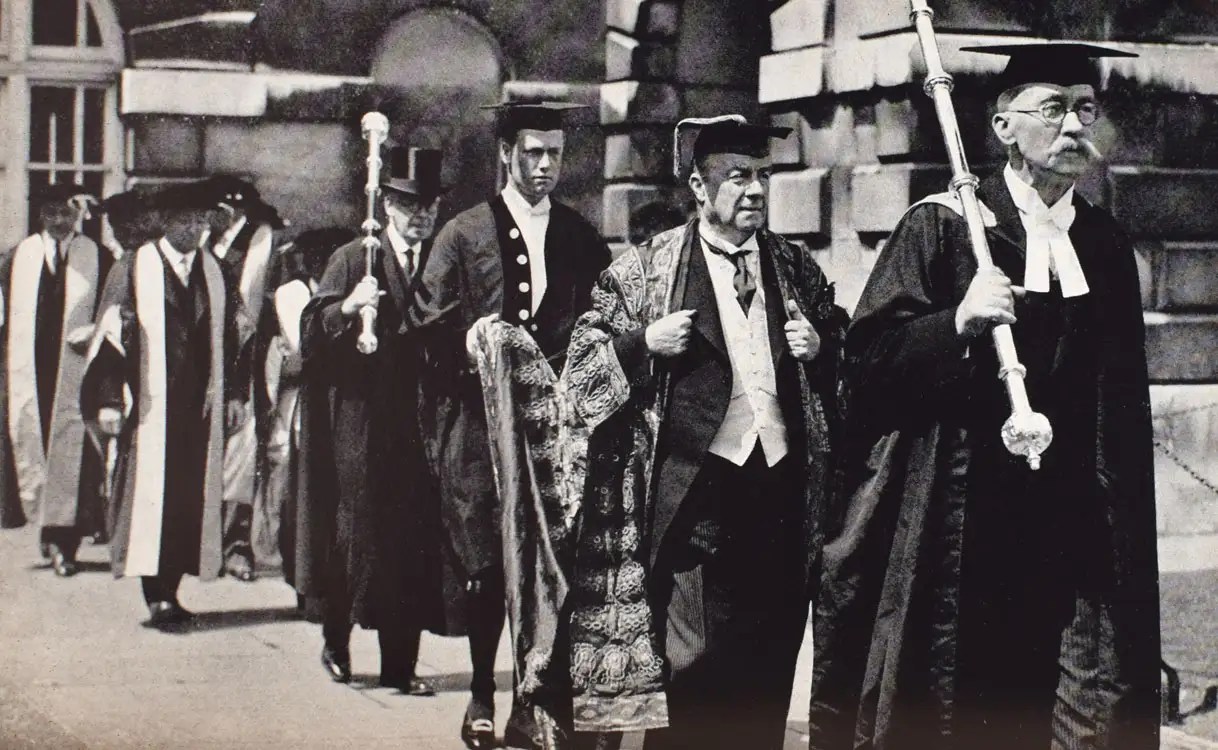
A university procession, from ‘Three Guineas’
She makes a simple point: men down the ages have ridiculed women for being so concerned about their clothes and dress; well, just look at these preposterous old buffers in their wigs and gowns and cloaks and gaiters.
But there’s also a serious point which is germane to her war theme: for she suggests that it is this flaunting of hierarchy and status, this cursed male wish to be superior, which is one of the roots of war. And so she thinks a good way to prevent war would be to attack this cause at the root and refuse to accept honours (as she did) or take part in silly ceremonies (a point developed at length in section 3).
Shortcoming 2. Over-reliance on biography as her primary evidence
The limitations of her education partly explain Woolf’s over-reliance on biography as evidence. She shows little sign of having read much history, economics, science or engineering, philosophy, psychology or sociology – some, but not much, and when she cites history books it’s rarely for the economic or social data.
Instead, what she does rely on to an overwhelming extent is biographies: all the damning evidence she assembles to demonstrate British society’s engrained misogyny and the power of the patriarchy is rarely drawn from history or sociology but relies exclusively on biographies and autobiographies and letters. The phrase you get in so many book titles, ‘Lives and Letters’, sums it up exactly. As an indication of her reliance on biography, here are quotes from just on one page:
- ‘The witness of biography — that witness which any one who can read English can consult on the shelves of any public library…’
- ‘Biography proves this in two ways…’
- ‘Of this, too, there is ample proof in biography…’
- ‘The study of biography… proves…’
- ‘Perhaps the greatest testimony to the value of education with which biography provides us is…’
- ‘You will find, if you consult biography…’
No need to consult facts and figures, assess data, decipher manuscripts, spend years in the archives. Again and again she takes the biography of an eighteenth century bluestocking or a nineteenth century hack writer like Mrs Oliphant off the shelf, and finds and pastes into her narrative their complaints about their limited lives and the dire condition of women in their time, which suit her argument.
(She does mention some histories but, when you look closely you see that she picks out of her historical sources the lives and opinions of her women witnesses: in other words, she selects the biographical elements of history and ignores the statistics, data, political history and so on.)
Late in the essay, rather as she does with her claims to be an amateur, untrained in academic enquiry, she turns an apparent weakness on its head. She tells us that she relies so much on (a very limited view of) history, on biography and newspapers, because they are the only sources of information open to a woman who has been denied a better, higher education, because of her sex; for:
history, biography, and… the daily paper [are] the only evidence that is available to the ‘daughters of educated men’.
Her very lack of scholarly rigour is itself an indictment of the patriarchal oppression which kept her excluded from the higher education her brothers and millions of men had benefited from.
And newspapers
She regards newspapers as ‘history and biography in the raw’. The excellent introduction by Anna Snaith tells us that Woolf kept three scrapbooks in which she gathered evidence for this book. It is striking how many of these snippets and excerpts are taken from newspaper articles or magazines, not the most in-depth kind of research. Newspapers are, by their nature, selective and biased and superficial. They sensationalise in order to sell copies. They are, in other words, the opposite of academic research into history, sociology and so on. This is a weakness in her evidence base.
On the other hand, newspapers are topical and up to date and give her useful snapshot of contemporary opinion – which makes them very interesting for the causal reader, 90 years later. Here’s a sample of the sources, taken from the numbered list of references at the back, which shows the combination of biography and newspaper cuttings which she overwhelmingly relies on as evidence.
- ‘Personal Reminiscences of a Great Crusade’ / a cutting from The Herald
- a cutting from The Listener / ‘Reflections and Memories’ by Sir John Squire
- ‘The Life of Sophia Jex-Blake’ by Margaret Todd
- Letter to The Times
- Debretts
- ‘Life of Sir Ernest Wild, K.C.’ by R.J. Rackham
- Lord Baldwin, speech reported in The Times
- ‘Life of Charles Gore’ by G.L. Prestige
- ‘Life of Sir William Broadbent’ edited by his daughter
- ‘The Lost Historian, a Memoir of Sir Sidney Low’ by Desmond Chapman-Huston
- ‘Thoughts and Adventures’ by Winston Churchill
- Speech at Belfast by Lord Londonderry, reported in The Times
You get the picture: her main sources are lives, letters and newspapers.
The second letter: funding a women’s college
Since the essay is in three parts and the introduction says it addresses three letters, I thought it would be a part per letter, so I was surprised when the second letter pops up at the end of part one. It is from a women-only college writing to ask Woolf to contribute to their fund raising. Anna Snaith’s excellent notes tell us it was a real letter Woolf received from Joan Strachey, Principal of the women-only Newnham College in Cambridge, asking for a donation to renovate the college buildings.
Woolf shows with some doleful quotations and examples, how petty-minded, snobbish and fierce for their stupid rules and regulations the existing (men-only) universities are. She harks back to the notorious incident of being kicked off the grass by the beadle early in ‘A Room of One’s Own’, which clearly still rankles.
Therefore, she replies to this letter that she will consider contributing to a women-only college but only if it is drawn up on a completely different basis from the male colleges. She proceeds to lay out the principles for an experimental college, one which will eschew all competition and exams, be open to the poor, and teach the humanities in a spirit of openness and collaboration:
A place where society was free; not parcelled out into the miserable distinctions of rich and poor, of clever and stupid; but where all the different degrees and kinds of mind, body and soul merit cooperated. Let us then found this new college; this poor college; in which learning is sought for itself; where advertisement is abolished; and there are no degrees; and lectures are not given, and sermons are not preached…
She warns that if the women-only colleges model themselves along male lines, with all the snobbery and competition and status-seeking and petty rankings that entails… those are precisely the kinds of habits of thought, the endless seeking superiority, which create the war mentality and she will not contribute to it.
And no chapels. She is as vehemently against the all-women colleges having chapels as she is violently against the engrained misogyny of the Church of England.
No to teaching English literature
She has a fierce passage execrating the teaching of English literature and its packaging into classes and exams, which she describes as ‘vain and vicious’. This is why Woolf herself refused to accept honorary degrees or prizes, despite being offered many in the later part of her life, and turned down offers to lecture (the exception which proves the rule being the lectures which formed the basis of ‘A Room of One’s Own’).
Woolf explains women’s war patriotism as an escape from domestic oppression
In a wonderfully irrational peroration she thinks that it can only have been delirious joy at being released from the narrow, cramped, uneducated lives forced upon Victorian daughters and spinsters which explained the huge outburst of patriotic enthusiasm among women at the outbreak of the Great War in 1914.
So profound was her unconscious loathing for the education of the private house with its cruelty, its poverty, its hypocrisy, its immorality, its inanity, that she would undertake any task however menial, exercise any fascination however fatal that enabled her to escape. Thus consciously she desired ‘our splendid Empire’; unconsciously she desired our splendid war.
This is splendid rhetoric but it’s a symptomatic of her failure to understand the causes of war, her failure to understand the psychology of crowds and societies embarking on war, her failure to understand genuine feelings of patriotism or national pride which are such big motivators for large numbers of people in any country – in a nutshell, her failure to understand anyone outside her own narrow upper-middle-class milieu.
Shortcoming 3. Ignorance of the wider world
I think her failure to understand the patriotic zeal which accompanied the start of World War One is indicative of her broader failure to understand the range and complexities of human nature, of all human nature across all of society.
Of the narrow little world of upper-middle-class women whose lives are supported by fleets of nameless servants which allow them to pursue their tedious obsession with art and poetry, of this tiny privileged world, she was a brilliant painter.
Of the big wide world, of the thousands of occupations, jobs and livelihoods, in finance, business, economics, trade, law, science, technology and engineering, of the lives of the working classes with their labour in coal mines and iron works, building ships, sailing the oceans, building trains and cars, laying down telegraph cables – in other words, in almost all the wide world and its billions of inhabitants, she has little or no interest and makes no effort to understand.
As an artist, as a writer, it doesn’t matter. Her novels focus on her chosen terrain and are masterpieces. As an essayist, claiming to gather evidence in order to analyse large social issues, it is, to say the least, problematic.
Giving a guinea
Out of this rather convoluted flow of arguments, Woolf concludes that she ought to give a guinea to the building of the women’s college, because it was entrapment in the family home that led so many women to explode with patriotism upon the outbreak of war. Building a college for the public education of the same class will prevent that and so materially contribute to the prevention of war which, if you recall, was the aim proposed right at the start of the essay.
Part 2. The professions
How can we enter the professions and yet remain civilized human beings, human beings who discourage war?
Woolf says a woman like her has only one weapon at her command to use against war, ‘the weapon of independent opinion based upon independent income.’ Now she will try to use this to sway the men in the professions.
The pretext is another letter she has received, from a society supporting women in the professions, asking for another donation, this time to the support of hard-up professional ladies. For Woolf it begs the question why, 20 years after women were admitted to the professions (1919) so few have risen to the top rank and so many are hovering round the bottom.
Woolf’s answers are convoluted and involve replies to other letters and lengthy addresses to her fictional interlocutor, they but boil down to:
- women have much shorter traditions of thriving in the professions and so lack the centuries-old networks of male patronage and preferral
- there are no limits to educated men churned out by the public schools and major universities, whereas there are far fewer schools for girls, only four or five colleges for women, and even the numbers admitted to these are severely restricted (only 500 women students were permitted at Cambridge in her day)
- exams in the professions advantage those who have spent their lives taking exams, i.e. privileged, privately-educated men, and bar women who have (as she shows) vastly less access to private education
- the nearly universal sexism and misogyny found at all levels of English society
Sexism and misogyny
As mentioned above, the flow of Woolf’s arguments is sometimes hard to follow, especially when it feels like she’s twisting the flow in order to fit her broader feminist critique to fit the essay’s ostensible subject of how to prevent war – but what the essay indisputably does do is powerfully convey the deeply entrenched tentacles of the patriarchy in contemporary 1930s England. She presents a wealth of facts and figures about the systematic prevention of women being educated, getting jobs, entering the professions and so on.
In this second part, the essay builds up into a devastating demonstration of English society’s hair-raising sexism and misogyny. In the main text but especially in the extensive notes which illustrate it, Woolf gives extended quotes from a wide range of men in powerful positions expressing the most hair-raising prejudices and slurs. I can’t give brief quotations, you have to read the notes, and the extended stories she gives, of awful politicians, judges, professionals, writers and commentators taking every opportunity to demean and limit women.
Fascists and Nazis
Woolf cranks up the temperature a lot by comparing several terrible British chauvinists who pontificate that a woman’s place is in the home, with a quote from none other than Adolf Hitler saying the exact same kind of thing.
Herr Hitler and Signor Mussolini have both often in very similar words expressed the opinion that ‘There are two worlds in the life of the nation, the world of men and the world of women’; and proceeded to much the same definition of the duties.
The juxtaposition of the two explains in a flash why Woolf is so resistant to all male talk about patriotism and ‘our country’. In what possible sense is it ‘her country’ when the Archbishop of Canterbury and the editor of the Daily Telegraph hold identical views about women’s place in society as Adolf Hitler? The same point is made in one of the long notes:
‘My husband insists that I call him “Sir”,’ said a woman at the Bristol Police Court yesterday, when she applied for a maintenance order. ‘To keep the peace I have complied with his request,’ she added. ‘I also have to clean his boots, fetch his razor when he shaves, and speak up promptly when he asks me questions.’ In the same issue of the same paper Sir E. F. Fletcher is reported to have ‘urged the House of Commons to stand up to dictators.’ (Daily Herald, 1 August 1926.)
Why, Woolf asks, all this fuss about opposing dictators abroad when every level of British society supports domestic tyrants at home?
Pay for housework
Men work in the public realm and get paid, sometimes a small fortune, often for jobs of dubious worth. Women labour in the home to raise families and manage households and care for the elderly, all unpaid. So: women’s domestic work should be paid.
The work of an archbishop is worth £15,000 a year to the State; the work of a judge is worth £5,000 a year; the work of a permanent secretary is worth £3,000 a year; the work of an army captain, of a sea captain, of a sergeant of dragoons, of a policeman, of a postman – all these works are worth paying out of the taxes, but wives and mothers and daughters who work all day and every day, without whose work the State would collapse and fall to pieces, without whose work your sons, sir, would cease to exist, are paid nothing whatever.
I wonder who first originated this call? Mary Wollstonecraft in ‘A Vindication of the Rights of Woman’ (1792)? Certainly Friedrich Engels mentions it in his 1884 book ‘The Origin of the Family, Private Property and the State’. Anyway, Woolf makes a sustained case for it over many pages, 30 years before the issue was revived by second-wave feminists in the 1970s:
Note: I was a househusband for eight years. I did all the childcare, running children round to nurseries, playgroups, parties, doing all the shopping, cooking and cleaning, changing thousands of nappies, giving bedtime baths and so on, while my wife earned the family income. So I have lived experience of issues like this. It’s this lived experience which feeds into my scepticism about feminism, not as a theory (fine and dandy) but in practice (complicated and compromised). I met plenty of women who were extremely happy to pack in office work and become full-time mums and housewives, who loved looking after their young children, dressing them up, holding parties, dropping them at nurseries or infant school and going to meet girlfriends for lunch or coffee.
Then again, some didn’t. Some felt trapped and needed support, would have welcomed free or cheap childcare, or just wanted to go back to work which they found more fulfilling than hanging round playgrounds or hosting rooms full of screaming kids.
I had many conversations with scores of mums about how the state should provide cheap childcare, or if only companies would allow more flexible work based around school hours, if only housework was recognised and paid for like other forms of work, and so on and so on. Hundreds of conversations on these and related subjects, over years and years.
So my scepticism about feminism is not ideological or temperamental. It’s based on the lived experience of being a housekeeper and child-rearer myself, and talking to hundreds of women in the same situation. The problem is not the top-level slogans and demands, anyone can come up with catchy slogans and carry banners – “Wages for Housework” – it’s figuring out the practical policies and application: where would the money come from? How would it be paid out? Who defines ‘housework’? Like child benefit would it go to anyone caring for a child or be subject to conditions? How would you prove that you do the housework and don’t sub-contract this or that part to cleaners or nannies? etc etc.
The procession
Back to the Woolf on the professions. She gives a vivid description of the processions of all the professions through London’s streets to the centres of law, finance and so on and asks her women readers: do we, in fact, want to be part of this procession? Do we want to do the same jobs but for less pay and more condescension? Or do we want to strike out on our own and lead our lives differently?
The facts… seem to prove that the professions have a certain undeniable effect upon the professors. They make the people who practise them possessive, jealous of any infringement of their rights, and highly combative if anyone dares dispute them. Are we not right then in thinking that if we enter the same professions we shall acquire the same qualities? And do not such qualities lead to war? In another century or so if we practise the professions in the same way, shall we not be just as possessive, just as jealous, just as pugnacious, just as positive as to the verdict of God, Nature, Law and Property as these gentlemen are now?
She gives a number of quotes from lawyers, clerics and politicians complaining they lead a dog’s life, and have sacrificed all their pleasures and family time to their work. Do modern women want to rush into exactly the same kind of wage slavery?
Woolf wonders if we can turn to the lives of nineteenth century women in the professions to help us find a more humane way to have one of these high-powered jobs and live properly? No, because there weren’t any women in the nineteenth century professions. They weren’t allowed. Instead:
We find, between the lines of their husbands’ biographies, so many women practising – but what are we to call the profession that consists in bringing nine or ten children into the world, the profession which consists in running a house, nursing an invalid, visiting the poor and the sick, tending here an old father, there an old mother? – there is no name and there is no pay for that profession; but we find so many mothers, sisters and daughters of educated men practising it in the nineteenth century that we must lump them and their lives together behind their husbands’ and brothers’.
The validity of housework and child-rearing, again, and the long buried, unrecorded of the scores of millions of women who spent their entire lives doing it.
Giving the second guinea
All these arguments have been contained, rather confusingly, in a very long letter replying to the letter she received asking for financial aid for impoverished women professionals. Woolf sums up her position by saying she will send the letter-writer one guinea ‘on condition that you help all properly qualified people, of whatever sex, class or colour, to enter your profession’, and in addition ensure that women:
- must earn enough to be independent
- must not prostitute their brain to their profession
- must refuse all prizes, medals and awards, and be content with obscurity
- must rid themselves of religious pride, college pride, school pride, family pride, sex pride and those unreal loyalties that spring from them
These are obviously very strict, probably utopian conditions, as with her demand for a completely different type of college which ended section 1. But:
If you agree to these terms then you can join the professions and yet remain uncontaminated by them; you can rid them of their possessiveness, their jealousy, their pugnacity, their greed. You can use them to have a mind of your own and a will of your own. And you can use that mind and will to abolish the inhumanity, the beastliness, the horror, the folly of war.
Antigone saying No to male tyranny
Part two rises to a very powerful invocation of Sophocles’ play, Antigone. Woolf studied this when young and it stayed with her all her life as a powerful story of female resistance to male tyranny. In the era of Hitler and Mussolini it was more than ever relevant. She comes back to it later.
No risk because of exclusion
Woolf ends part 2 with a grand fanfare of irony, saying there is no immediate risk of women professionals losing their souls and working themselves to shreds so long as the laws of England hold their nationality so lightly, prevent them from working in many professions, limit the numbers who can attend university, and ensure that so many women continue to live in the tradition of neglect and contempt, living gruelling lives of unpaid work in dark patriarchal homes.
Part 3. The Outsider Society
The sarcasm and irony which have been present throughout the essay rise to a real anger and bitterness in this, the longest of the three parts.
Woolf reverts back to the original letter she was sent, the one from the unnamed male correspondent asking her how they can prevent a war, and she repeats his three suggestions, namely that we should:
- sign a manifesto pledging ourselves ‘to protect culture and intellectual liberty’
- join a certain society, devoted to certain measures whose aim is to preserve peace
- should subscribe to that society which like the others is in need of funds
Failure of the universities
She addresses these points one by one. First she is satirical about this idea of ‘protecting culture and intellectual liberty’. Isn’t this what the Great Universities have said they were devoting themselves to for centuries, the ones which have been teaching men these values and brutally excluding their sisters and daughters? Is the fact that these values now need such support from society an admission that all those centuries of learning have failed? And if they’ve failed, why should the impoverished, life-opportunity-deprived daughters and sisters suddenly rush to the help of their oppressors?
What is ‘culture and liberty’?
Anyway, what is this ‘culture and liberty’ the letter writer refers to? She knows what it isn’t. Characteristically, she turns to biography and uses the life of an author like Mrs Margaret Oliphant (1828 to 1897) who, after her husband died, churned out meretricious romances to support her children. Was this intellectual liberty? No, this was intellectual prostitution and Woolf angrily takes it as typical of the intellectual prostitution forced on so many women writers and artists who had to sell their souls and prostitute their art because of the patriarchy’s refusal to let them earn a living any other way.
So she mocks the letter writer’s suggestion that women, victims of centuries of repression, should suddenly rush to help the poor privileged men in their time of need. He wants her to join his pacifist society, does he? Well, no. The very word ‘society’ denotes the systematic exclusion of women from education and influence and power and money, so screw society.
The very word ‘society’ sets tolling in memory the dismal bells of a harsh music: shall not, shall not, shall not. You shall not learn; you shall not earn; you shall not own; you shall not – such was the society relationship of brother to sister for many centuries.
The Outsiders Society
She’s not going to join any boys’ club. Instead she proposes setting up a separate organisation, for women of her class and (lack of) education. It would be called The Outsiders Society. It would consist of educated men’s daughters working through their own class and by their own methods for liberty, equality and peace. Members would:
- not fight
- not work in munitions factories or nurse the injured
- not encourage men to go and fight but maintain an attitude of neutrality, as fighting is a ‘sex characteristic which she cannot share’
She rises to real bitterness:
She will find that she has no good reason to ask her brother to fight on her behalf to protect ‘our’ country. ‘”Our country,”‘ she will say, ‘throughout the greater part of its history has treated me as a slave; it has denied me education or any share in its possessions. “Our” country still ceases to be mine if I marry a foreigner. “Our” country denies me the means of protecting myself, forces me to pay others a very large sum annually to protect me, and is so little able, even so, to protect me that Air Raid precautions are written on the wall [i.e. women are defenceless against modern warfare]. Therefore if you insist upon fighting to protect me, or “our” country, let it be understood, soberly and rationally between us, that you are fighting to gratify a sex instinct which I cannot share; to procure benefits which I have not shared and probably will not share; but not to gratify my instincts, or to protect either myself or my country. For,’ the outsider will say, ‘in fact, as a woman, I have no country. As a woman I want no country. As a woman my country is the whole world.’
Wow. Very powerful. Furthermore, The Outsider will cultivate complete indifference to male nonsense about patriotism, war and fighting. On the contrary, she will:
- take no part in patriotic demonstrations
- not take part in patriotic praise
- absent herself from military displays, tournaments, tattoos, prize-givings and all such ceremonies as encourage the desire to impose ‘our’ civilization or ‘our’ dominion upon other people
The idea is that this ‘indifference’ will damp down patriotic fervour in those around her and thus, in a tiny way, help to avoid war.
All this makes a sort of sense. But it feels like twisting logic when Woolf goes on to assert a link between these anti-war steps and the positive demands of her feminist programme. The connection feels tenuous and forced. Because she now switches to say that in order for their opinion or actions to matter, the outsiders must push for a raft of feminist requirements, being:
- they must earn their own livings
- they must press for a living wage in their professions
- they must create new professions in which they can earn a living wage
- they must press for press for a money wage for the unpaid worker in her own class – the daughters and sisters of educated men
- they must press for a wage to be paid by the State to the mothers of educated men
Make the state pay for housework
This last is vital because until she has complete financial independence, a wife is dependent on her husband for money and will follow his opinions and men are for war. Therefore, in order to create an influential bloc of educated women who are against war, this class must be given financial, and so intellectual, independence. Women must be paid by the State for their work as mothers.
And she tells her male interlocutor that this step – paying women for their housework – would also liberate husbands, because by sharing the burden of earning an income they would no longer be wage slaves, slaves to the rat race. It would have an enlightening and life-enhancing effect all round.
I gave my thoughts on this proposal earlier. It sounds great, and you can see her logic – that women can only be truly independent and free if they have their own income, separate from their father’s or husband’s – but how would it be implemented in practice?
I’ll just make the additional point that its recurrence here is characteristic of how key themes and suggestions recur throughout the essay, building up power through repetition and echoes, not unlike her technique in her novels.
Outsider demands
But she hasn’t finished with her demands. The Outsiders would:
- not only earn their own livings but become so expert that their threat to down tools would have power and influence
- when they have earned enough to live on they would earn no more i.e. not pile up obscene wealth
- they would reject any profession hostile to freedom such as the arms trade
- they would refuse to take office in any institution which pretends to respect liberty but actually restricts it, such as Oxford and Cambridge
Outsiders will eschew all the stupid costumes and ceremonies so beloved by men (see the section about silly ceremonials in part 1).
Outsiders will eschew ‘the coarse glare of advertisement and publicity’ and prefer to work in honest obscurity.
The secret society already exists
Wandering into thriller territory, Woolf suggests that this Outsider Society already exists but is secret and underground in its activities. Her very dubious evidence for this far-fetched claim is a clutch of newspaper reports of various women officials making comments against war, opposing arms manufacture and the like. From random quotes and newspaper clippings she based the existence of a secret society operating across English society. Is this an example of her sometimes utopian or far-fetched argumentation – or an example of her dry sense of humour? Difficult to tell.
Against the Church of England
Outsiders will:
- fearlessly investigate and criticise public institutions they are forced to contribute to, such as the universities, but especially the Church of England
- by criticizing religion they would attempt to free the religious spirit from its present servitude and would help, if need be, to create a new religion based it might well be upon the New Testament, but, it might well be, very different from the religion now erected upon that basis
Woolf’s attitude to the Church of England had already been indicated in the passage about cited above about Antigone where she writes that ‘Antigone’s five words are worth all the sermons of all the archbishops’, those five Greek words (they total 11 in the English translation) being:
‘Tis not my nature to join in hating, but in loving.’
Pages 196 to 202 give a scathing account of how Jesus Christ’s own admonition that his followers are equal which promised equality between men and women was denied by St Paul, who invented the idea that women must be veiled in church and not speak. This bigotry hardened over the centuries into a church which forbids any positions of power or influence in the most powerful and prestigious organisation in the land, to women.
With the result that the salary of an archbishop is £15,000, the salary of a bishop is £10,000 and the salary of a dean is £3,000. But the salary of a deaconess is £150; and as for the ‘parish worker’, who ‘is called upon to assist in almost every department of parish life’, whose ‘work is exacting and often solitary…’ and who is most likely to be a woman, she is paid from £120 to £150 a year.
It’s a pattern mirrored in all the other professions and walks of life: women excluded from all the prestigious, well-paid higher positions, and forced to undertake the most menial and poorly-paid jobs.
Psychoanalysis, anger and fear
One of Anna Snaith’s excellent notes tells us that ‘Woolf’s brother Adrian [Stephen] and his wife Karin were trained psychoanalysts and were crucial in disseminating Freud’s work in England.’ This is relevant because Woolf quotes at length from the Archbishops’ Commission on the Ministry of Women (1936) and in particular from the appendix written by Professor Grensted, the Nolloth Professor of the Philosophy of the Christian Religion in the University of Oxford.
This professor concluded that there is no reason in theology (Christ’s teachings) why there should not be women priests, but there were strong objections to women priests among the clergy. Digging deeper he uses Freudian terminology to suggest the deep conviction held by many men of men’s superiority and women’s inferiority.
The causes are obscure but the outcome is obvious: that whenever a conversation lights on the topic of equality for women and women holding roles up till now reserved for men, many man become angry and many women become fearful. This imbalance leads women not to raise, mention or discuss the issue which, as a result, goes underground.
The infantile fixation
Woolf takes from Grensted the notion of the ‘infantile fixation’. I didn’t quite understand this and I didn’t see her defining it anywhere. Instead she gives three examples of what she means (taken, inevitably, from biographies), namely the wildly irrational anger and jealousy triggered in three classic Victorian fathers when their daughters asked permission to get married or (worse than that) to get a job. The fathers being:
- Mr Barrett (father of Elizabeth who wanted to marry the poet Robert Browning)
- the Reverend Patrick Brontë (father of Charlotte who wanted to marry)
- Mr Jex-Blake (father of Sophia who was offered a small sum for tutoring mathematics to a friend)
By contrast, to show the impact of a father’s liberality, she gives the story of Mr Leigh Smith. It’s worth quoting at length because the impact is in all the details. Smith had a daughter, Barbara, who he loved.
When Barbara came of age in 1848 he gave her an allowance of £300 a year. The results of that immunity from the infantile fixation were remarkable. For ‘treating her money as a power to do good, one of the first uses to which Barbara put it was educational.’ She founded a school; a school that was open not only to different sexes and different classes, but to different creeds; Roman Catholics, Jews and ‘pupils from families of advanced free thought’ were received in it. ‘It was a most unusual school,’ an outsiders’ school. But that was not all that she attempted upon three hundred a year. One thing led to another. A friend, with her help, started a cooperative evening class for ladies ‘for drawing from an undraped model’. In 1858 only one life class in London was open to ladies. And then a petition was got up to the Royal Academy; its schools were actually, though as so often happens only nominally, opened to women in 1861; next Barbara went into the question of the laws concerning women; so that actually in 1871 married women were allowed to own their property; and finally she helped Miss Davies to found Girton. When we reflect what one father who was immune from infantile fixation could do by allowing one daughter £300 a year we need not wonder that most fathers firmly refused to allow their daughters more than £40 a year with bed and board thrown in.
The difference just one liberal father made. What if all Victorian fathers had been like that.
Sexist science
There follows a passage giving some examples of how even contemporary science is twisted to prove the inferiority of women. To be honest this section is neither very compendious nor persuasive. She doesn’t really go into the most basic accusation against women, that their bodies are designed for childbirth and child-rearing and this explains why their minds are limited to domestic subjects and childish logic. (I’m not saying this, I’m repeating the sexist, misogynist accusation.)
This is a failing but I think reflects the limitations of Woolf’s knowledge and education. Of science she knows next to nothing and so is simply incapable of unpacking all the biological and psychological aspects of woman-hating. She is much more at home in her comfort zone of education and literature, the lives of women writers.
She cites Bertrand Russell pointing out the sheer sadism of much medical science towards women (the medical profession’s reluctance to provide painkillers to women in childbirth) or the twisting of scientific knowledge to justify male superiority – but not as amply as this huge subject demands.
Cleons
Instead she reverts to literature again, and her obsession with Antigone. In the play the oppressive father is Cleon, the archetype for the Victorian paterfamilias and the modern fascist. Here is Cleon speaking dictator-talk:
‘Whomsoever the city may appoint, that man must be obeyed, in little things and great, in just things and unjust… disobedience is the worst of evils… We must support the cause of order, and in no wise suffer a woman to worst us… They must be women, and not range at large. Servants, take them within.’
Order and the oppression of women, Mr Barrett and Mussolini.
The personal and the private
In the essay’s last pages she brings things together by (rightly) saying that she has shown how male tyranny in the personal, domestic realm and in the public realm, are intimately linked:
that the public and the private worlds are inseparably connected; that the tyrannies and servilities of the one are the tyrannies and servilities of the other.
Despite the strangeness of the letter-answering structure and the oddly digressive, rambling flow of the argument, by the end she has presented a devastating barrage of evidence, as well as making a host of demands and suggestions.
The third guinea
So she refuses to sign the form her correspondent had sent her. She refuses to sign up to his society because of her opposition to all such male bodies, but she will send him a guinea to support it.
Their aims are the same, to oppose the tyrants in the name of Justice and Equality and Liberty. But, as this amazing book has explained, as a woman, as the patchily educated ‘daughter of educated men’, as someone with completely different life experiences and, consequently, utterly different perspectives from the male sender of the letter, she shares the same aim but insists that she will try to bring it about using, not the old male forms and words, but new words and new ideas appropriate for women.
Magnificent
For all its faults, ‘Three Guineas’ is a magnificent, powerful and very persuasive piece of work. Her assembly of a very wide range of evidence, facts and figures really bring home the historical endurance, depth and wide range of the legal, financial and cultural oppression of women throughout English history and the stupid, patronising and misogynist attitudes and opinions deployed to maintain that oppression.
The notion of the Outsiders Society is the crystallisation of the massive theme which emerges repeatedly throughout the text, the idea that women – not because of any biological or psychological differences – but purely because of the legal, financial, professional and cultural apartheid they have suffered for centuries, bring to the table a different perspective from men across a whole range of issues.
I think it’s a magnificent example of a polemical essay, of an impassioned political pamphlet.
Criticisms
There are a number of problems or issues with Woolf’s way of arguing. Initially I included them in my review where they occurred but they cluttered up the flow of my review, and gave an unduly negative opinion too early on. I mentioned three earlier on. Here are a few more.
Shortcoming 4. Woolf’s intellectual confusions
Periodically throughout the text Woolf freely admits to own intellectual shortcomings: for example, right at the start she admits being bewildered that there seems to be a wide range of opinions about whether war is good or inevitable. She herself tells us that the more she reads, the more opinions she discovers, the more confused she becomes. But… is that not the point of being an intellectual: to read all the opinions, weigh the evidence, and develop your own line of argument, based on the evidence you uncover and reacting to other people’s arguments?
This activity, intellectual activity, always puzzles and confuses Woolf. In ‘A Room of One’s Own’ there’s the section where she orders up some books in the British Museum and opens them up, expecting to discover The Truth staring her in the face.
Sometimes this is part of her general mocking irony, mocking the pretensions of pretty much all male activity, including the grand Pursuit of Truth. But at other times it can give you the worrying sense that she doesn’t really understand what intellectual enquiry is.
Her intellectual confusion as evidence of her case
In the opening and then at various transition moments, Woolf explicitly tells us that she struggles to marshal the evidence, is embarking on something too big for her abilities, and wonders if she’d be better off abandoning it. After a while I realised that maybe these passages are designed to dramatise the issue of women’s exclusion from formal education by using herself as an example.
Woolf’s brothers went to top private schools and Oxbridge whereas she more or less had to educate herself at home and mostly taught herself by browsing through her father’s extensive library. In other words, every time she shares how confused by the evidence or daunted by the challenge of answering big question she is, she is demonstrating the effect of the grotesquely unequal education of the genders, how women have been the victims of ‘tradition, poverty and ridicule’, and showing the reader how she (and we) are suffering for it.
Maybe that’s why she flaunts her own intellectual limitations so much: the intellectual inability she frequently laments is the result of her exclusion from higher education. It makes her case for her.
Shortcoming 5. Her analysis is restricted to a (relatively) small class
Her lack of real confidence in her own research, and her need to make her feminist points as categorical and powerful as possible, explain why Woolf makes the strategic decision of restricting her analysis to a relatively small class, to women like herself, to ‘the daughters of educated men’, as she describes them. As she puts it:
Our ideology is still so inveterately anthropocentric that it has been necessary to coin this clumsy term – ‘educated man’s daughter’ – to describe the class whose fathers have been educated at public schools and universities. Obviously, if the term ‘bourgeois’ fits her brother, it is grossly incorrect to use it of one who differs so profoundly in the two prime characteristics of the bourgeoisie – capital and environment.
She makes it quite clear on page one that she is only discussing upper-middle-class women, women like herself, women with immaculate manners who are used to managing servants and know which of the many forks and spoons to use at a formal dinner.
In order to avoid the confusions, contradictions and conflicting evidence I mentioned above, in order for her analysis to work, she has to reject the vast majority of the population (the working class and lower classes, of both sexes) and identify her cause with just this numerically small and limited class of posh ladies.
It isn’t just me pointing this out. The Wikipedia article about Three Guineas tells us that the noted academic Q.D. Leavis wrote a scathing review of ‘Three Guineas’ soon after it was published:
She denounces the essay because it is only concerned with ‘the daughters of educated men’, seeing Woolf’s criticisms as irrelevant to most women because her wealth and aristocratic ancestry means she is ‘insulated by class’.
And Anna Snaith’s notes in the Oxford University Press edition tell us that Woolf received letters from working class women readers who complained about being left out of her analysis, notably a long semi-autobiographical one from a working class woman named Agnes Smith.
This is closely related to what I called shortcoming 3, ignorance of the wider world. But it’s also a decision. She found it hard enough gathering the evidence for the sexist discrimination against her own type and class of woman. If she opened it up to the broader middle and working classes she’d never have finished it.
2025: the perils of intersectionality
Many of these criticisms are mentioned in Anna Snaith’s introduction to the Oxford University Press edition. Here she indicates the larger cultural and political problems the essay falls foul of. This is that there are, nowadays, so many grievances, so many groups claiming to be victims, so many communities and identities who feel that they, too, have been subjected to centuries of oppression, that it is hard to focus on just one, and it is especially hard to focus on the group Woolf defines as the ‘daughters of educated men’.
As you read Snaith’s account of Woolf’s life and social circle, with so many friends among England’s political and cultural elite, the idea of her as a persecuted outsider feels more and more ludicrous. She wasn’t a Jew in Hitler’s Germany, a Black in the American South, a kulak in Stalin’s Russia, an Aborigine in Australia, she grew up in a house full of books which she was actively encouraged to read and went on to become a centre of London’s literary and artistic elite.
This doesn’t invalidate any of the points she makes in the book or detract from the essay’s tremendous power. It’s just to say that the struggle for women’s equality takes its place among quite a few other struggles. I’ve a book about the Irish Civil War on my desk and Irish nationalists have quite a story to tell about 1,000 years of British oppression. Her husband was a Jew who had his own story about the legal and financial persecution of Jews. Something similar could be said of England’s Roman Catholics, prevented by law from holding official positions. Or – a group close to my heart – England’s non-conformists, banned by law from holding any positions of authority for 300 years after the civil war. Citizens from India or any of the colonies we ruled for centuries might have a thing or two to say about Britain’s oppression of their peoples and cultures.
Being a modern academic, Snaith is contractually obliged to drag in slavery – the progressive topic par excellence – to her discussion of ‘Three Guineas’, on the rather tenuous basis that guineas were, apparently, first used as currency in the British slave trade. Don’t know what Virginia would have made of that scholarly leap of imagination.
To repeat – this little digression about the modern over-abundance of historical grievances is not entirely my view but simply expanding points made by the book’s editor, Anna Snaith, in her introduction.
All these other issues don’t invalidate any of the points Woolf makes in the book but they place it in a much larger, real world context. If you’re a feminist, you can insist that your cause and your history of oppression is the real one, the big one, the important one and, convinced of your righteousness, overlook or downplay the grievances of all the other groups I’ve mentioned. In a sense, to get anything done, you have to focus on your issues and grievances; nobody can represent the issues of the whole world. You have to pick your battles. And this explains why Woolf realised that, in order to get her book written, she had to concentrate just on relatively privileged upper-middle-class women like herself, on ‘the daughters of educated men’.
Conclusion
It’s a very powerful book. Very. To repeat what I said at the start, from one point of view it may be her most important work. It’s a bit of a struggle, a bit meandering, a bit puzzling in places, her proposals such as for the Outsider Society are a bit eccentric – and yet so many of her main points drive right home, and the evidence gathered in the notes at the end is searing, blistering, eye-opening. It shook this old cynic. It materially changed my views about feminism. I strongly recommend it.
Credit
‘Three Guineas’ by Virginia Woolf was first published by the Hogarth Press in 1938. Page references are to the 2015 Oxford University Press paperback edition, edited and annotated by Anna Snaith, although the text is easily available online.
Related links
Related reviews
- Virginia Woolf reviews
- 1920s reviews
 Books & Boots