José María Velasco: A View of Mexico @ the National Gallery

José María Velasco (1840 to 1912) was Mexico’s most famous nineteenth century painter. He was a member of the Mexican Academy of Arts and a professor at the Instituto Nacional de Bellas Artes y Literatura. In the 1870s and ’80s he had works exhibited in the United States and France, where he won awards and medals, being awarded the Legion of Honour by the French. In other words he was celebrated at home and internationally recognised as the premier Mexican artist of his time. He is most famous for his big landscapes, especially his numerous depictions of The Valley of Mexico.

The Valley of Mexico from the Hill of Santa Isabel by José María Velasco (1875) Museo Nacional de Arte, INBAL, Mexico City © Reproducción autorizada por el Instituto Nacional de Bellas Artes y Literatura . Photo: Francisco Kochen

This smallish but beautifully curated exhibition in the Sunley Rooms at the National Gallery centres around two enormous depictions of the Valley of Mexico but also brings together 28 paintings of all shapes and sizes, along with ten or so sketches and drawings, to give a broader account of Velasco’s career and achievement.

Why a big exhibition of Velasco now? To mark the 200th anniversary of the establishment of diplomatic relations between Britain and the newly independent Mexico in 1825. The show is also the first ever dedicated to a historical Latin American artist to be held at the National Gallery.

Academic training

Velasco studied at the Academy of San Carlos under the professor of landscape, the Italian painter Eugenio Landesio. For most of his painting career, from the 1860s to the 1890s, he adhered to the traditional style of picturesque landscape. The curators claim that in the 1890s he was influenced by the Impressionists and then developed a late style in the 1900s, but none of this affects his most famous works which are from much earlier.

Flora…

Velasco wasn’t just a painter but a polymath with a deep interest in an impressive range of subjects. He was a founding member of the Sociedad Mexicana de Historia Natural and took a serious approach to Mexican plant life. In 1869 Velasco devised ‘Flora of the Valley of Mexico’, a short-lived publication for which he made precise illustrations. So, the curators tell us, all of his paintings pay attention to the shapes and leaves and colours of native plant.

To be honest, I didn’t really buy this. For a while I wrote a blog about English wildflowers and on my weekly walks in the country paid microscopic attention to shape and size, the colours and leaves and flowers of a wide variety of wild flower. For a while I worked at Kew Gardens. Among its other treasures, Kew has a gallery devoted to the botanical paintings of Marianne North. Nowhere in Velasco’s studies of plants or broader landscapes did I see anything with this much attention or detail.

The lack of botanical detail is made abundantly clear in what, we are told, is one of his most famous and totemic paintings, of a giant cactus.

Cardón, State of Oaxaca by José María Velasco (1887) Museo Nacional de Arte, INBAL, Mexico City. Image: Museo Nacional de Arte, Mexico City © Reproduction authorised by the Instituto Nacional de Bellas Artes y Literatura

Even from a distance this image has a cartoonish simplicity, which isn’t helped by the cartoon figure in a sombrero standing in the shade. But when you go close up you see that, although the vertical ribs of the cactus spines are carefully defined, especially by the way the light falls on some of them, close up there there’s a limit to the detail. You don’t, for example, see any hint of the spikes which are a key feature of cacti.

This demonstrates a general rule I found which is that it doesn’t do to look too closely at Velasco’s paintings. Something similar is true of his depiction of lichen on trees and rocks. It’s impressive that he wants to depict them but when you get in close to the painting you discover they’ve been rendered with surprisingly broad, rough brushstrokes, not at all the kind of detailed academic realism you might have expected.

… and fauna

In 1879 Velasco published a monograph on the axolotl, a type of gilled amphibian found only in the lakes of the Valley of Mexico. Given the curators’ mention of this, and his naturalist interests generally, it’s striking how few animals there are in any of the se 28 paintings. A donkey in one, two little dogs frolicking in the Valley of Mexico painting at the top of this review, and an eagle in his most famous Valley of Mexico work (below) – and that’s about it.

Archaeology

Velasco had a profound interest in Mexico’s archaeological heritage and painted many landscapes featuring remains of the area’s original inhabitants. This culminated in him being appointed as a draughtsman for the Mexican Museo Nacional in 1880. A particularly striking subject which he painted many times were the ancient pyramids and city of Teotihuacán, just 50 kilometres north-east of Mexico City. The show includes three or four studies of this type, the biggest of which is:

The Pyramids of the Sun and the Moon by José María Velasco (1878) © Colección Pérez Simón, Mexico. Photo: Oliver Santana

Once again, if you lean into the painting the detail becomes muzzier. Velasco’s paintings are best seen at a distance. In fact, coming home and reviewing the images on my laptop, I realised they epitomise the phenomenon I noticed reviewing one of the Impressionist shows a few years ago which is that they look much better as reproductions. The valley reproductions are as big as a wall and leaning in you can see the looseness of the brushwork. Reduced to an image 6 inches by 4, it looks absolutely immaculate.

Geology

Velasco by the advances in geology throughout the nineteenth century. His love of geology is clear to see at every level of the paintings, from the snow-capped mountains in the distance to the hills and ridges which break up his large landscapes, all the way through to outsized rocks and boulders in the foreground. The most famous of these and, I think, my favourite work in the exhibition, is of a particularly striking rock or boulder.

Rocks by José María Velasco (1894) Museo Nacional de Arte, INBAL, Mexico City © Reproducción autorizada por el Instituto Nacional de Bellas Artes y Literatura

The curators rightly point out that this is framed almost like the portrait of a person. The shades of colouring on the rock and the balance between the patch of light on the grass in the foreground and the grey and white clouds in the sky… I see the appeal of the valley pictures but on this visit, in this exhibition, seeing them in the flesh, I think this rocks picture is his most successful composition,

Also, I suddenly realised it reminded me of Sir Edwin Landseer, famous for his depictions of the rugged  Highlands of Scotland and his signature work, Monarch of the Glen. A comparison between Landseer and Velasco immediately highlights the fanatical attention to detail of the Englishman – look at the grasses at the stag’s feet, look at the highlights on its nose and antlers, look at the detail of the fur. In many of the paintings here Velasco never aspired to the same level of finish. Look at the sombrero figure standing under his giant cactus, the smudgy lichen on an old tree or rocks. A loose impression was enough for Velasco most of the time. In this respect, too, the rocks stand out for the beautiful detailing of the grass and its silver seedheads.

Landscape

Back to landscape and the centrepiece and obvious masterwork in the show, ‘View of the Valley of Mexico from the Hill of Santa Isabel’.

View of the Valley of Mexico from the Hill of Santa Isabel by José María Velasco (1877) Museo Nacional de Arte, INBAL, Mexico City © Reproducción autorizada por el Instituto Nacional de Bellas Artes y Literatura. Francisco Kochen

This is not only a huge and awesome painting but in a sense draws together all the elements I’ve been analysing. Note the dazzling realism of the rock ridge in the foreground and the trees and scrub growing out of it. There’s a tremendous drama of light and shadow, behind the mound on the left and deep shadow side of the ridge on the right. The more you look for this interplay of light the more you see, like the light reflecting from some of the pads on the cactus tree on the lower left.

Not immediately obvious, there’s also a element of the built environment in the image: in the road which curves round the dark hill and then turns into the long straight avenue across the shallow lake to Mexico City, an almost imperceptible line of tiny buildings the other side of what looks like a lake.

Sooner or later you notice that right down the front, light against the darkest part of the black shadow like a diamond on black felt, there’s a vivid depiction of an eagle flying across the view, creating a sense of space and spontaneity. It’s an extremely professional, technically adept, perfectly composed image.

History and symbolism

In fact the cactus on the left and the eagle in the middle have a symbolic importance. Apparently they reference the founding story of Mexico City, according to Mexica – or Aztec – history. Both feature prominently on Mexico’s flag today.

See the two snow-capped mountains on the left of the horizon? These are the extinct volcanoes Popocatepetl and Iztacchihuatl which were characters in a legend about an Aztec princess (Iztacchihuatl or ‘white woman’) and a brave warrior (Popocatepetl or ‘smoking mountain’).

But that’s not all. At the bottom of the smaller of the two hills which the road curves around, is a church commemorating the site where the Virgin of Guadalupe first appeared to a native man, Juan Diego, in 1531. The view has multiple historical resonances: ancient Aztec, early Spanish colonial, and contemporary 1870s.

So ‘View of the Valley of Mexico from the Hill of Santa Isabel’ is an extremely accomplished example of Velasco’s skill at incorporating all these historical and symbolic references, as well as architectural structures, into a breath-taking landscape. If you weren’t told about it, you’d never guess that this large, tranquil image contains so many references to Mexico’s multi-layered history.

In fact the painting was made specially for the 1878 International Exhibition in Paris where it became known as ‘Mexico 1877’.

All this explains why Velasco was by the later nineteenth century not just Mexico’s premier artist but the creator of images whose complex historical and patriotic symbolism came to represent the young nation to itself and in international expositions.

Comparisons

The show is dominated by the two enormous vistas of the Valley of Mexico, the one featured at the top of this review, from 1875, and the one above, from 1877. It’s an obvious temptation to compare them. In a nutshell I prefer the later one (above), predominantly because it is so light. There is a lot of big blue sky and this is very relaxing to look at. The way the 1875 has much darker shadows around the rocky ridges on the lower right makes the entire image feel darker and a bit ominous. For pure visual pleasure, the lovely airy sunlit version wins.

But the darker 1875 version is spoiled, for me, by the presence of the figures in the foreground, what look like a mother holding a baby, a boy carrying a bundle of sticks, and two frolicking dogs.

Detail of The Valley of Mexico from the Hill of Santa Isabel by José María Velasco (1875) Museo Nacional de Arte, INBAL, Mexico City

They are, frankly, cheesy. They detract from the grandeur of the scene and turn it into postcard kitsch. It’s interesting to consider that the taste of the time (1870s) required and valued such silly figures. (For  a sympathetic explanation of the tradition of incorporating small human figures into vast landscapes which stems from German Romanticism, see the article on Smarthistory.)

It’s precisely the absence of figures, of any human traces at all, which makes the painting of the rocks my favourite image. It is uncompromised by human or even animal presence and so the rocky outcrop dominates the image with a kind of tough purity.

The exhibition contains nearly 30 other images of various subjects and levels of interest (including his most famous late work, of a comet poised dramatically over the Valley of Mexico), but the two big valley paintings and the rocky outcrop are, in my opinion, the only ones really worth paying to see.

Diego

Lastly, after all this highly conventional Victorian Salon art, it is a very great surprise indeed when the curators tell us that one of Velasco’s students at the Academy of San Carlos was none other than Diego Rivera, who has a claim to be the joint most famous twentieth century Mexican artist (probably eclipsed these days by his one-time wife Frida Kahlo). The curators tell us that, despite being associated with the revolutionary avant-garde and then going onto create his famous communist murals, Rivera in fact respected Velasco’s work. He said of it:

“Velasco’s work is greater than a mural painting or a pyramid, it is a poem of colour with mountains as its stanzas.”

Three years after Velasco’s death in 1912, Rivera painted the astonishingly modernist ‘Zapatista landscape’ which, despite its avant-garde angularity and almost complete abstraction, in fact references Velasco’s Valley of Mexico paintings, notably the ridges and mountains, and even the snow-capped volcanoes, on the horizon.

Zapatista Landscape by Diego Rivera (1915)

What a vast, an almost incomprehensible gulf, separates the airy realism of Velasco’s landscapes and Rivera’s wild overthrow of every axiom of the academic tradition in his modernist classic.


Related links

Related reviews

Flame Into Being: The Life and Work of D.H. Lawrence by Anthony Burgess (1985)

Man belonged to the cosmos and was fulfilled through his natural instincts, of which love was the greatest.
(Burgess’s summary of Lawrence’s credo, page 62)

Anthony Burgess (1917 to 1993) was a composer, poet, novelist, essayist, librettist, screenwriter, critic, provocateur and media personality. In the 1980s I watched him appear on TV arts programmes and read his numerous book reviews, essays and novels (notably ‘Earthly Powers’, 1980, and ‘The End of the World News’, 1982). He was great fun, an unashamed entertainer. This book is a classic example of his work: opinionated, interesting, drily amusing, sensible, packed with ideas and insights.

Preface

Part of this is because Burgess, like Lawrence, was an outsider. Most 20th century English authors went to private school and Oxbridge and so, whether they were radicals or conservatives, maintained the same kind of tone and worldview, the same manners, the same limited, privileged experience of life in their works. Burgess, as he explains in his preface, grew up in the pub and shop culture of working class Manchester, with little cultural capital and, like Lawrence, largely had to teach himself about literature. And they both married foreign wives and left England to live abroad, Lawrence in his pilgrimage round the world, Burgess to live in Monte Carlo.

That said, Burgess says there are also big differences. Burgess came of an Irish family and was raised a Catholic. This explains his attraction to James Joyce. But also puts him in a different tradition from Lawrence who came from non-conformist stock, proud of his puritanism, attracted to the old pagan gods, son of a miner.

Burgess admires Lawrence’s intransigence and sympathises with his sufferings on behalf of free expression. Lawrence stands for:

that fighting element in the practice of literature without which books are a mere decor or confirmation of the beliefs and prejudices of the ruling class. (p.x)

‘Literature is essentially subversive’ and Lawrence was a leading practitioner of that subversion.

Chapter 1. Lawrence and Myself When Young

Burgess quotes Lawrence’s biographer and critic Richard Aldington saying Joyce and Lawrence are diametrically opposed: Joyce is about being and Lawrence is about becoming.

Stylistically Joyce is drawn to economy and exactness, Lawrence to a diffuseness which looks for what he is trying to say while he is saying it. (p.4)

This strikes me as the single most important aspect of Lawrence’s style as a writer of prose and poetry. His paragraphs feel like they’re being shaped and formed, often reusing the same words and phrases, as you watch. It’s a unique experience of being involved in the writing, as it happens.

His writing does not seem to have emerged, lathed and polished, from the workshop: when we read him we are in that workshop, witnessing a hit-and-miss process of creation in which orthodox faults – prolixity, repetition, apparent absurdity – are idiosyncratic virtues. (p.9)

He is a writer taking chances and trusting that he will be taken seriously.

In the 1910s literature was influenced by the serious scientific predictions of H.G. Wells and George Bernard Shaw with their promotion of Scientific, Rational solutions to society’s ills. Lawrence reacted against all this, despised all politics – maybe all rationality – and spoke for the Natural Man.

The purest exponent of the Natural Man after the Great War was Ernest Hemingway who saw that the complex sentences of Edwardian literature reflected a society and values which had all been exploded. He developed a stripped back, simple and repetitive style which promoted a simplistic code of honour. I like where Burgess says:

It may be that Hemingway’s prose is the biggest stylistic innovation of the century… Hemingway genuinely starts again from scratch. (p.8)

When I was a schoolboy and student, that was my view. From E.M. Forster to Ernest Hemingway was a leap from the 19th into the 20th century and, reading literary books today, they almost all still copy the Hemingway formula: short sentences, simple vocabulary, delete all adjectives and adverbs.

The pre-scientific or irrational in Lawrence made him a genuine primitive man, a pagan. He has a profound feeling for the pagan gods. Even the books set in England contain characters who talk like pagan deities. His people aspire to be naked, and their dialogue is voices from the unconscious, from another realm of experience.

Chapter 2. Beginnings

Lawrence’s father was a miner who worked at Brinsley Colliery, Eastwood, so you might have expected Lawrence’s subject to be squalor, dirt and struggle, for him to have become a proletarian writer. But Eastwood, ten miles north-east of Nottingham, in his day looked out over countryside, and Lawrence chose instead to become a writer of the countryside, flowers and animals.

Lawrence’s parents’ marriage was a warzone. His father was a miner, technically a ‘butty’ or supervisor of a gang of other miners. He was almost illiterate, spelling out the newspaper a word at a time, whereas Lawrence’s mother had been a teacher and clung to the idea that she came of gentle stock. Lawrence was unusually close to his mother – she is the central figure in his first major novel Sons and Lovers, and he was devastated when she died – but, by the same token, he was impressed by his father’s big beefy masculinity and the sodality of the miners.

Lawrence was an amateur painter till he was 20. His surviving paintings are vivid but demonstrate his complete lack of training in perspective or anatomy. Words were different. Poems and prose bent to the force of his imagination with little or no training.

At 17 he went as a pupil-teacher to Ilkeston training centre. At 21 he went to Nottingham University. Aged 23 he went to teach in Croydon. He discovered the ‘English Review’, edited by Ford Madox Hueffer, who ‘had the greatest editorial flair of his time, if not of the century’ and sent in some poems (p.20). Hueffer recognised the boy’s genius, invited him up to tea, introduced him to Ezra Pound. Lawrence showed Hueffer his first novel, ‘The White Peacock’.

Burgess makes a characteristically sweeping statement:

One of the uses of fiction is to affirm the values of the bourgeoisie. (p.24)

Lawrence is ‘this most visual of novelists’. Burgess emphasises the brilliant physical details in so many scenes.

Joyce, by contrast, was an urban man and knew nothing of flowers. Lawrence is the great novelist of flowers.

Snobbishness Lawrence’s mother felt she married down when she married his father. She aspired for her boys, wanted them to climb the social ladder. This is reflected from as early as ‘The Peacock’, with characters saying ‘awfully’ and ‘frightfully’, words never used in the Lawrence household. He was aping his social superiors, he was pitching the narrative at a higher social level.

Chapter 3. The Denial of Life

Lawrence’s second novel, ‘The Trespasser’, was published in 1912. It’s set on the Isle of Wight which was as far abroad as he’d managed to get by that point. The lead character Siegmund, hangs himself. The is the only suicide in Lawrence’s oeuvre.

In 1912 Lawrence eloped with Frieda Richtofen, the wife of his French tutor at Nottingham University, philologist and professor of modern languages, Ernest Weekley. She describes how they fell in love in her memoir, Not I, but the Wind…, how she was forced to abandon her three children when they eloped abroad, ending up in a rented house on Lake Garda in north Italy.

Mr Noon: Lawrence drafted the first part of this novel before the war. It was published as a fragment in 1934. Only 50 years later, in 1984, was the second part, which existed in papers belonging to a friend of Lawrence’s, published. The two halves or parts were first published together in 1984. The second half is quite different from the first. It appears to be a factually accurate and barely fictionalized account of Lawrence and Frieda’s early sexual relations. Burgess makes the point that:

It was common practice for Lawrence to write half a novel, abandon it, and then pick it up again with no great concern for plausible continuity; when in doubt, change your main character’s character, though retaining the name, and make him or her start a new life somewhere, preferably in Italy. (p.33)

This happens in ‘Mr Noon’, ‘The Lost Girl’ and ‘Aaron’s Rod’.

Marriage It is amusing that Lawrence was very fierce for marital fidelity, had a pagan reverence for the union of one man and one woman and yet the partner of his life was secured by wrecking her marriage to Professor Weekley. Also ironic that Frieda was (allegedly) unfaithful to him.

Anywhere Lawrence was one of those rare writers who could write anywhere, even amid noise and distractions. He never had a permanent home and so no book-lined study, was able to be interrupted mid-sentence to meet people or go and do some chore, come back hours later and pick up where he left off. In the relationship with Frieda, he did all the household chores while she lay in bed smoking. He reflected this aspect of himself in the character of Rawdon Lilly in ‘Aaron’s Rod’:

He put on the kettle, and quietly set cups and plates on a tray. The room was clean and cosy and pleasant. He did the cleaning himself, and was as efficient and inobtrusive a housewife as any woman. While the kettle boiled, he sat darning the socks which he had taken off Aaron’s feet when the flautist arrived, and which he had washed. He preferred that no outsider should see him doing these things. Yet he preferred also to do them himself, so that he should be independent of outside aid. (Aaron’s Rod, p.121)

England, My England Soon after eloping, Burgess quotes letters in which Lawrence lambasted the English and England in extreme terms. And yet he remained an Englishman through and through. Richard Aldington amusingly said Lawrence was as English as a wet Sunday in Hull.

Son and Lovers Another joke: given the theme of this novel is a young man’s struggle to break free from the smothering influence of his mother, Frieda playfully suggested it should be titled ‘Sons and Lovers: Or, His Mother’s Darling’. Lawrence was not amused.

Chapter 4. Son and Lover

David Herbert Lawrence was called Bert in the family home. He disliked his first name. After he eloped and became more cosmopolitan he liked his female admirers, starting with Frieda, to call him Lorenzo.

‘Sons and Lovers’ was published in May 1913. Giving its protagonist the French surname Morel is symptomatic of Lawrence’s aspiring cosmopolitanism. Burgess describes it as a ‘florescent, leafy, pullulent’ book (p.50).

Lawrence’s modernism lies not in the formal technique of his novels: they display none of the agonising over technique obvious in Conrad, Ford Madox Ford, James or Joyce. The modernism is in the content for two reasons to do with the characters.

1) His characters’ identities are extraordinarily labile: they change all the time. Not just that, but sometimes they disappear altogether, subsumed into the weather, the moonlight or other settings or environments.

2) All Lawrence’s characters point away from the conventions of normal social life towards primeval depths. They repeatedly sink to, or strip back layers to reveal, the elemental layer of human existence. This is deeper than anything in the history of the novel, deeper even than the Greeks in their tragedies.

Symptomatic that, ‘no strong believer in the solidity of human identities’ Lawrence had a lifelong fondness for charades (p.54). This spilled over into the best poems where he mimics or inhabits a bird, beast or flower to an extraordinary degree.

Masculinity All his life Lawrence kept a reverence for beautiful men, for the beauty of the male body, linking back to the strong nudity of his coal-miner father (stripped to the waist and washing in a tin bath every evening) and the community of tough men he managed.

Chapter 5. Coming Through

Lawrence was ‘arrogant, dogmatic, messianic, inconsistent’ but also loveable. He wasn’t troubled by his own faults or the impression they gave in society because society was a spume, a phantom: reality lay much, much deeper, and chasing, revealing and describing the depths of human experience was his challenge.

Reason Lawrence never understood rational argument, which was a kind of giving-in to the surface, the superficial, instead of seeking the core.

Friendship pattern The success of ‘Sons and Lovers’ introduced him to the upper echelons of English culture and society and inaugurated the rhythm he enacted with almost everyone he met: 1) ingratiating charm; 2) lecturing about eternal depths which they barely understood; 3) bitter rejection and immortalisation as satirised characters in whichever novel he was working on; 4) with the frequent threat of libel action (p.55).

‘Love Poems and Others’ published February 1913. In the summer Lawrence and Frieda returned from Germany to England principally because Frieda wanted to see her three children by Weekley.

In the autumn of 1913 he wrote a good deal of The Rainbow, provisionally titled ‘The Sisters’. In July 1914 Frieda’s divorce came through and the couple came to London to sign the papers, then get married. A few weeks later the Great War erupted and they were trapped in England for four long bitter years.

Chapter 6. Dementia

The Lawrences didn’t have money to pay the lawyers’ fees for the divorce so he was declared bankrupt. In December The Prussian Officer and Other Stories was published. In 1915 the odd story England, My England‘. Lawrence is always unsettling because he says the uncomfortable, inconvenient thing.

In 1915 Lawrence worked on ‘The Sisters’ and decided to divide it in two. He developed the notion of setting up a commune of like-minded artistic people in Cornwall. He tried to recruit Lady Ottoline Morrell for this. He wrote long letters raving about the collapse of British society to poor Bertrand Russell, with whom he was initially very taken before they had a huge falling out. Russell accused him (after his death) of being a proto-fascist.

Lawrence said he rewrote ‘The Rainbow’ about seven times. It was published on 30 September 1915. Just a week later, a negative review in the Daily News triggered outcry at the book’s supposed obscenity. The book was taken to court for breaching obscenity laws. Many witnesses for the prosecution and none for the defence. Lawrence wasn’t called. His publisher, Methuen, meekly apologised, withdrew the book, pulped the remaining copies and paid a fine of ten guineas. Britain’s writers did nothing. The Society of Authors did nothing. That maligned figure, Arnold Bennett, was the sole author to publicly protest (he had already sent the impoverished author a gift of £40).

The impact was to ruin Lawrence’s reputation, livelihood and career. It delayed publication of the second half of the novel, Women In Love, by five years, giving the misleading impression that it is a book of the 1920s, which it very much isn’t.

Burgess, of course, defends ‘The Rainbow’ but even he, in his summary, zeroes in and quotes some of the passages describing sex (in extremely vague and gaseous way). He himself doesn’t convey how much of the novel isn’t about sex at all, but about the tempestuous and primeval emotions of the characters, described in an amazingly impassioned prose.

In my review of The Rainbow I point out that with the arrival of Ursula to young womanhood the novel drastically changes tone, moving out of its kind of primitive pagan rural background and arriving in the modern world of schools and trams. Burgess makes the nice point that this is the ‘Wellsian mode’, the tone of Ann Veronica and Wells’s Edwardian social novels.

Chapter 7. Westward

Lawrence fantasised about setting up a colony of like-minded artists in America, maybe Florida, until the authorities made it clear he couldn’t leave the country. So he settled on Cornwall where he founded an artistic community. Two leading figures were the gifted editor John Middleton Murry and the brilliant New Zealand short story writer, Katherine Mansfield.

Lawrence was at one point so close to Murry that he suggested becoming blood brothers. The quartet shared a cottage for a while but inevitably fell out. Nearly 20 years later Murray was cruelly satirised as the slimy seducer Denis Burlap in Aldous Huxley’s novel ‘Point Counter Point’.

In Cornwall Lawrence revised part two of The Sisters, which came to be titled Women in Love. He finished in November 1916 but could find no publisher. July 1916, his travel book about his time in Italy, Twilight in Italy, was published.

During this period he was summoned to several Army medicals in Bodmin. He was always rejected but found the poking and prodding of his body deeply humiliating. His horrible wartime experiences are dramatised in the long, brilliantly vivid ‘Nightmare’ chapter in ‘Kangaroo’.

Lawrence spoke openly against the madness of the war. His wife was German. On 12 October 1917 local police raided his home and ransacked it for evidence they were spies, signalling to German U-boats with their washing or their late-night lights. No evidence was found but Lawrence was ordered to leave Cornwall.

Lawrence and Frieda went to stay with H.D. in London. He started writing Aaron’s Rod. In November 1917 the poetry collection ‘Look! We Have Come Through’ was published. In 1918 they went to live in Derbyshire. In October ‘New Poems’ came out. As soon as the war finished (November 1918) they set about leaving England but it took a year, until October 1919, before they could get passports.

During this period Lawrence did the reading for his book of criticism, Studies in Classic American Literature, which was eventually published by Thomas Seltzer in the United States in August 1923. It contains essays on Benjamin Franklin, Hector St. John de Crevecoeur, James Fenimore Cooper, Edgar Allan Poe, Nathaniel Hawthorne, Richard Henry Dana Jr., Herman Melville and Walt Whitman. It contributed to establishing Herman Melville as a seminal figure in American literature.

Some critics criticise it for being a rushed, superficial and highly impressionistic study; Burgess calls it ‘a series of jolts and lunges… meant to jolt Americans’ into reading their great authors. He claims it is one of the few books which created an entire new discipline, as it apparently helped jolt Americans into creating course of America literature at their universities.

Chapter 8. Nakedness

Burgess devotes an entire chapter to ‘Women in Love‘ which Burgess considers one of the ten great novels of the century. The central point of the novel is the way the characters are stripped down to their essentials, stripped to their primitive emotional cores which are depicted as bubbling over with extreme emotions, continually changing.

They are not human beings as we expect to meet them either in real life or in fiction. They are close to animals in the discontinuousness of their emotions, with unpredictable shifts of feeling which are always intense… they are capable of great emotional and even physical violence; they seem to have a skin missing. This is the peculiar quality of Women in Love which could as well be called Women in Hate. (p.89)

He outlines the main characters, identifies some of their real-life bases (Rupert Birkin is Lawrence, Hermione Roddice was partly based on Ottoline Morrell, Gudrun bears many of the traits of Katherine Mansfield).

Burgess singles out three big scenes: 1) how the violence of the big half-wild rabbit scene, in which it scratches and draws blood from both Gudrun and Gerald, anticipates the violence of their relationship and his final attempt to murder her.

2) When Ursula comes across Rupert throwing stones at the reflection of the moon in the millpond to try and abolish the power of the feminine moon over him.

3) The naked wrestling scene between Birkin and the mine owner Gerald Crich, which is deeper than homoerotic, far more primal, and its sad incompletion, the way Gerald can’t rise to Birkin’s wishes.

If we are startled by this scene we are merely experiencing the shock that it was Lawrence’s lifelong mission to impart – the shock of meeting [elemental] truths which logic and science… have tried to drive out. (p.96)

Burgess thinks it is a great novel because it is completely new: the novel, as a form, is mostly concerned with people in a social context, it is the quintessentially bourgeois art form, hedged round by manners and etiquette. From Samuel Richardson through Jane Austen to Henry James and E.M. Forster, the most earnest novels had always been about social convention and good manners. Lawrence tears the face off all this and shows his characters as madly irrational complexes of blood and nerves; primal, pagan wild animals: they have a social face (they have jobs and responsibilities) but their private lives are thronged with out-of-control primeval forces, ‘naked primitives’.

He makes the further point that the novel, up to that point, existed to convey a plot, a story. In their different ways Joyce, Lawrence, Hemingway and Ford Madox Ford showed that you could achieve new literary heights by jettisoning the straitjacket of a logical plot and instead showing human reality in a heightened form.

Chapter 9. A Snake and Sardinia

Burgess is dismissive of ‘Aaron’s Rod’, the novel Lawrence began in 1918, set aside, then completed in the spring of 1921. ‘It is a loose improvisation of which not much need be said’ (p.101).

More interesting is The Lost Girl, which he had also abandoned, and now took up and completed. It is a hokey tale in the popular style of Arnold Bennett with lots of authorial buttonholing – ‘Now fancy our two young heroes walking up the steps to the hotel…’ and, being absolutely unthreatening, won a literary prize and £100.

Lawrence and Frieda visited Florence, which he liked. He fancied it a place of manliness and virile statues, now gone to seed and packed with a large expatriate British community of ‘aesthetes’. Some of these are portrayed pretty blatantly in ‘Aaron’s Rod’ leading to accusations of bad manners and caddishness.

They moved on to Sardinia, then to Sicily where they found a cottage where they lived, off and on, for two years. The stay in Sardinia inspired Sea and Sardinia the most charming book Lawrence ever wrote and, in Burgess’s opinion, the best single introduction to his oeuvre.

Chapter 10. The Prophecy is in the Poetry

This chapter covers:

  1. Lawrence’s best book of poems, Birds, Beasts and Flowers
  2. his two works triggered by Freud, Psychoanalysis and the Unconscious and Fantasia of the Unconscious
  3. his final, posthumous work, Apocalypse

Chapter 11. Eastward

1921, year of The Captain’s Doll, in which the captain and his German paramour turn into Lawrence and Frieda, endlessly bickering, with their famously arduous trek up a glacier during which they bickered and argued every inch of the way there and back.

In October 1921 ‘Sea and Sardinia’ was serialised in The Dial magazine and was read by the American socialite Mrs Mabel Dodge Luhan. She was starting an artists’ community in Taos, New Mexico, with the aim of preserving the arts and crafts of the local Indians. She fancied having a writer-in-residence to record the way of life and ‘Sea and Sardinia’ convinced her that D.H. was the man. She wrote offering him free board and lodging and Lawrence bit.

He and Frieda decided to visit America not by crossing the Atlantic but by heading East. They took ship from Naples in February 1922, passed through the Suez Canal arriving at Ceylon in March. He discovered he really hated tropical jungles.

They sailed on to Australia, arriving at Perth at the start of May 1922 and stayed with friends for a fortnight. Staying in a town outside Perth they met Maria Louisa Skinner, a minor writer who was emboldened to show Lawrence her manuscript of a novel. For reasons that puzzle Lawrence scholars to this day, he was inspired to take it up as a collaboration and rewrite it the Lawrence way. It was eventually published as The Boy in the Bush with Skinner credited as co-author. Burgess thinks Lawrence collaborated because Australia made a big impact on him but he simply wasn’t there long enough to pick up the local lore. This manuscript was packed with local lore and just needed the psychological depth which he tried to add.

After just two weeks, they took ship to Sydney. He only stayed here two days (too expensive) before heading to a house 50 kilometres south.

Chapter 12. A Comical-Looking Bloke

Here Lawrence wrote Kangaroo which Burgess calls ‘the strangest but in some ways most satisfying novel of his entire career’ (p.135). It was an improvisation i.e. he set off without having a plot or characters but the book’s slapdash unevenness of tone 1) allows for all kinds of elements, including extended lyrical descriptions of the Australian landscape and 2) creates an overall sense of spontaneity and immediacy which is very appealing.

Kangaroo’s main characters are transparently based on Lawrence and Frieda, being Richard Lovat Somers, an English writer, and his wife Harriet, who has a foreign look. They arrive in Sydney, find a house to rent. The neighbours are a childless couple and the husband, Jack Callcott, explains he’s a member of a secretive authoritarian political movement, the Diggers, who are seeking to overthrow democracy. He introduces Lovat to their leader, a charismatic Jewish lawyer named Ben Cooley and codenamed ‘Kangaroo’.

Burgess points out that the novel is about types of power:

  • there is an entire chapter devoted to the dynamic of Frieda and Lawrence’s marriage, and Lawrence’s preposterous efforts to convince her that she should submit to him as lord and master, which she robustly ridicules
  • the political plot, sort of, about the Diggers and Cooley, although his so-called ideology is disappointingly wishy-washy, all about love of your fellow men, and Colley asks Somers (in several embarrassingly bad scenes) to love him

The plot, such as it is, leads up to a riot at a meeting of the Australian Socialist Party, which is attacked by a phalanx of pseudo-fascist Diggers, complete with gunshots, a bomb being thrown, and Kangaroo being mortally wounded. Burgess points out how all this is prefaced by an extended passage about the nature of the ‘mob’, reminiscent of Freud’s work ‘Group Psychology and the Analysis of the Ego’ which had just come out (in 1921), which Burgess says ‘shows an acuteness worthy of Adolf Hitler’ (p.142). I found it, like most of Lawrence’s attempts to tackle serious political or sociological issues, so wordy, so convoluted, and so embroiled with his personal mythology around the sexes and the deep gods, as to be almost unreadable.

Burgess briskly summarises that Lovat cannot give his allegiance to Kangaroo because the latter’s philosophy of brotherly love is shallow piffle beside Lovat’s deep feeling for the dark gods lying behind everything, deeper than humanity.

In a side note, Burgess picks out one of the final scenes of Lovat walking by moonlight by the seashore as being as magical and symbolic as Burkin throwing stones in the millpond to break the image of the moon in ‘Women in Love’. Lawrence’s novels overflow with wonderful, wonderful nature descriptions.

Chapter 12. Quetzalcoatl

After their Australian sojourn Lawrence and Frieda continued their odyssey east, arrived in San Francisco and took train to the artists’ community at the pueblo town of Taos, New Mexico, in the south-west USA. They had, as you recall, been invited by its owner Mabel Dodge Luhan, the American socialite, who had read Lawrence’s poetry and thought he’d be a perfect fit.

They were found a ranch fifteen or so miles from the town and endured a tough and demanding winter in its very primitive conditions, helped by a couple of Danish artists they sub-let some outhouses to.

By spring 1923 they needed a break and Lawrence took Frieda to Mexico. After some weeks in Mexico City, they headed south west and settled in a house on Lake Chapala. Over the next few years they made three trips in all. Out of them came a long novel, The Plumed Serpent (1926), an epic 462 pages in the Penguin edition, and the travel book, Mornings in Mexico (1927).

Burgess gives a workmanlike summary of ‘The Plumed Serpent’ but doesn’t do this vast, complex, brilliant and ridiculous book justice. He calls it ‘the least liked of Lawrence’s novels and one can see why’. It is humourless, and pontificates, at length, on a subject of little interest to most English readers (a couple of Mexicans leading the rise of the new religion of the old Aztec god Quetzalcoatl ).

One key point I nearly forgot by the time I’d staggered to the end of it, is that it, also, was very obviously written at two different times. The opening chapters are written in a surprisingly pared-back prose, lacking the usual Lawrentian guff, repetition and rhetoric. Almost as if he’d been reading Hemingway (who, however, hadn’t published much yet). Whereas the second half, describing the proponents of the new religion of the old Aztec god Quetzalcoatl is an orgy of half-baked mysticism, pseudo-psychology and tedious ‘hymns’.

Burgess suggests the difference in style is explained by facts on the ground. After 6 months Frieda was fed up of Mexico’s searing heat and (probably) Lawrence’s insistence on her submission to his religious fantasies. So she booked a berth on a ship from New York back to Britain (as the novel’s protagonist Kate Leslie, also does). On the New York quayside they had such an intense argument that they for a while thought the marriage was over.

He travelled west across America, stopping in the young Hollywood, before making it back to Mexico City. Here he completed the novel unrestrained by Frieda’s presence and influence. So you could argue that the first, very restrained and unLawrentian half, with its sensible characters doing believable things, was written under Frieda’s influence; and that the wildly self-indulgent second half, a fantasia of the new religion, accompanied by long poem-hymns he attributes to the new religionists, is Lawrence unleashed.

In real life Lawrence for a while felt he had lost Frieda and that, in her insistence on being free, independent and going her own way (home), she had ‘won’ their endless battle; whereas in the novel, Lawrence has the very strong character Kate Leslie in the end bow and submit to the male principle of her dark native husband. I.e. in the novel Lawrence faked that he’d won. In reality he swallowed his pride, and also took ship to Britain, ending in London where he realised just how much he disliked the English.

In his brisk summary of ‘The Plumed Serpent’ Burgess doesn’t mention the book’s countless breath-takingly beautiful prose descriptions of the Mexican landscape and mood. Equivalents to the wonderful evocation of the Australian landscape in ‘Kangaroo’. In both these novels, for my money, the ‘plot’ is dubious but the sense of place is astonishing.

Burgess thinks ‘there is no less convincing ending in the Lawrence oeuvre’ (p.157) but I found the ending of ‘The Plumed Serpent’ appropriately ambiguous and uncertain. It just stops in mid-conversation as the protagonist, Kate Leslie, rather hopelessly asks the Mexican general she’s married and who wants her to join their religious movement, Cipriano Viedma, to make her stay with him – despite the fact that we’ve seen her pining for Britain and booking a berth on a ship home. It ends on a note of irresolution and ambiguity which, I thought, accurately sums up the Lawrentian protagonist, endlessly conflicted and contradictory and changeable.

Chapter 13. A Spot of Red

In London Frieda and Lawrence became close to the artist (the Right Honourable) Dorothy Brett, and she accompanied them when they sailed back across the Atlantic in March 1924. They travelled from New York to Chicago and then back to Taos. Here Mable Luhan gave the Lawrences 170 acres of land and Lawrence, always surprisingly practical, threw himself (alongside native labourers) into rebuilding the adobe shacks, clearing the irrigation ditches, planting a flower garden.

In this period Lawrence wrote St Mawr. Like so many of Lawrence’s fictions it splits into two distinct parts (England and America), maybe three (London, Shropshire, Texas). The first, longer part portrays the posh, upper-middle-class world Lawrence was now moving in (the miner’s son had come a long, long way in a little over 10 years), set in London mews cottages and posh grand houses.

St Mawr is the name of a horse, a stallion, bought by Mrs Witt, a redoubtable American widow of independent means, for her son-in-law Henry Carrington, so he can join her and her daughter, Louise (Lou), as they go riding in Rotten Row (in Hyde Park) and mingle with London’s elite. Here the nervy, uncontrollable horse causes a scene and is banned as a danger to the public.

The scene then shifts to the West Midlands on the Welsh border, where a posse of posh people go for an extended break and where St Mawr is startled by a snake in the heather and rears backwards, kicking one of the men in the party in the face then rolling onto Henry and crushing his foot.

In part two, the leading figure, Mrs Witt, takes daughter, son-in-law and difficult horse by ship back to America, to the ranch where she grew up and whose profits pay for her pampered lifestyle travelling round Europe (and which explains why she and her daughter like horses).

But they don’t stop here. Lou looks for somewhere isolated where she can be herself and discovers a half-abandoned old ranch in the foothills of the Rocky Mountains and buys it, and persuades her mother to join her and the family retainer, a native American named Phoenix, in rebuilding and furbishing it.

Burgess makes the obvious point that the entire narrative arc of the story follows Lawrence’s recent life, from posh nobs in London, via an excursion into the English countryside, then back to the States, to the dusty desert reminiscent of Taos, and then the final 20 pages are a pretty literal description of the ranch which Mabel Luhan, with great generosity, gave to Lawrence.

Burgess goes on to make the fairly obvious point which I’d completely missed that St Mawr is Lawrence: wounded, angry, liable to lash out. When the horse kicks a nice posh chap in the face up in the Shropshire hills it is Lawrence spitting in the face of the posh people he met in London and claimed to love his work and who he loathed. In fact St Mawr overflows with hatred of just about everyone, as I itemise in my review of it.

According to Burgess, right at the end of 1924 Lawrence travelled with Frieda and Brett back to Mexico. The British vice-consul found them a cottage in Oaxaca and it was here that he completed ‘The Plumed Serpent’, in all its madness.

He also completed the odd book of travel sketches combined with anthropological reportage, ‘Mornings in Mexico’. The book starts out as restrained and observant sketches of his hacienda, his servant, a long walk to a remote village and a description of a market day; but then the second half and the last three or four chapters become more anthropological, describing trips to observe traditional Indian music and dances, and taking it on himself to explain the Indians’ entire animistic worldview. Several of these chapters do not take place in Mexico at all, but in the United States, so the title of the book is pretty misleading.

Here in Oaxaca, in early 1925, Lawrence fell very ill. He went down with malaria but also food poisoning causing diarrhoea. To compound his misery, the region was hit by an earthquake. He was moved to the one decent hotel in Oaxaca. He was left weak and ill. All the old fight went out of him. For years he had written fantasies of subjecting Frieda to his imperious male will. Now he could barely walk and realised how utterly dependent on her he had become.

A doctor in Mexico City diagnosed tuberculosis and told Frieda that Lawrence only had a year or two left to live. When they tried to return to Taos the US immigration officials prevented him, until overridden by a kindly official in the embassy in Mexico City. But only with a 6-month visa.

In the event Lawrence recovered back on the ranch and was fit enough to get involved in all manner of outdoor chores and work. Burgess dwells on his finding a porcupine with cactus needles in its nose and carefully extracting them, which led to one of his many essays about man’s place in nature.

In September 1925 his US visa expired, he travelled to Washington with Frieda, then they caught a liner back across the Atlantic. He kidded himself he’d come back but, of course, he never did. His ranch is now a museum dedicated to him, the D.H. Lawrence ranch.

Lawrence disapproved of the Atlantic – ‘a dismal kind of ocean; it always affects me as the grave of Atlantis’ – although not as much as he disapproved of England.

Chapter 14. Life in Death

Lawrence passed through England en route for the continent. Burgess thinks Italy was Lawrence’s true home and the Mediterranean his proper sea. By the autumn of 1925 they had settled at a place called Spotorno, on the coast just over the border from France. Here he turned 40.

Burgess summarises Lawrence’s life to date: he had travelled right around the world looking for a race unspoiled by western materialism but hadn’t found it. He had hated the tropics (Ceylon), ignored the native people of Australia, seen the corruption and lassitude of the Mexicans, hated America’s Fordist culture, loathed England’s imperial snobbery.

Etruscan Places Now, back in Italy, he persuaded himself he’d found it in the long-extinct and legendary race of the Etruscans. Hence his book Etruscan Places. The Etruscans created a civilisation in west and north-west Italy which reached its height around 500 BC. To Lawrence’s mind they were an example of a primitive people in touch with their sensual pagan selves who were crushed out of existence by the cerebral, law-obsessed, imperialistic Romans.

This is obviously a grotesque distortion of the historical facts since 1) if crushed they were, it was by the Roman Republic, centuries before there was a Roman Empire (see Roman–Etruscan Wars), 2) the Romans were indeed an obsessively militaristic culture but at the same time they also practiced a florid variety of blood-thirsty cults, traditions and ceremonies which you’d have thought Lawrence would have had sympathy for.

But really what Lawrence does is reshape the Etruscans into his own image, as embattled outsiders fighting several types of ‘establishment’. This is why the book opens with an attack on all historians of the ancient world who Lawrence accuses of being in thrall to the glamour of Greece and Rome and downplaying all other cultures.

And, as Burgess points out, when Lawrence was anathematising an empire which crushed scores of native peoples in the name of ‘freedom’ he was also obviously referring to the British Empire, whose subjugation of native peoples around the world Lawrence deplored.

The Man Who Died Burgess devotes 4 pages to a summary of this vivid short story depicting Jesus waking from the dead in his tomb. In the story Jesus stumbles out and takes shelter with a peasant before the several encounters with disciples described in the New Testament.

These encounters are given according to the Biblical sources but we see that the resurrected man who lived them is radically different from the Jesus of the Bible account. For he has thrown off his mission to convert the world to love. He now sees all that as a form of narcissism. Now he will live for the instinctive life within him i.e. become Lawrentian man.

And so in the second half of the story (and, as Burgess points out, so many of Lawrence’s stories and novels fall into two distinct halves) he travels south along the coast. Here he comes to a small domestic temple to the goddess Isis and falls under the spell of its priestess, culminating in their having sex at the pagan altar.

Burgess doesn’t quite bring out how brilliantly vivid and imaginative this story is, with scores of moments of insight, starting with the searing description of what it feels like to rise from the dead – but he correctly points out the other striking thing about it which is – why wasn’t it banned? Why wasn’t Lawrence prosecuted for blasphemy? What kind of story could possibly be more blasphemous? Instead, as we know, the Establishment reserved its fury for his next novel, Lady Chatterley’s Lover. It’s always sex with the philistine, guttersnipe British, who are too thick to notice transgressive ideas.

Chapter 15. A Woman’s Love

‘Lady Chatterley’s Lover’ is a book about fidelity. Lady Constance Chatterley and the gamekeeper Oliver Mellors must be true to each other and what they awaken in each other – a true awakening of their bodies’ sensual and sexual identities – despite the full panoply of opposition society can throw at them: gossip and rumour, social disapproval, censure from her father and sister, the howling anger of his shrewish wife, the cold anger of her husband, and the minefields of the law.

He began it at Scandicci in Italy in October 1926 and over the next two years wrote three versions. Many critics think the shorter first version is best, but it was the longest version which he chose to have privately printed in 1928.

Burgess correctly points out that for a book which supposedly champions free and ecstatic sex, ‘Chatterley’ is embarrassingly limited and ignorant. Lawrence is embarrassingly fixated on the penis, the phallus, on Mellors’s erect penis, and the sex is entirely orientated around his quick phallic penetration of Lady C. There is little or no foreplay and no attention whatsoever is given to Connie’s pleasure or orgasm. She is condemned to find all her pleasure in response to his quick thrusting cock.

As Burgess says, not just any modern westerner with an interest in the subject, but any literate member of the world’s other cultures, readers of Japanese, Chinese or India erotica, would know vastly more than Lawrence describes. Lawrence’s supposed sex set-pieces make us look like an embarrassment on the world stage. ‘Lady Chatterley’s Lover’ only counts as a ‘sexy’ book when set against the narrow, blinkered, strangled, philistine background of early 20th century Anglo-Saxon culture. Compared with the erotic writings of virtually any other tradition, it is pitifully inadequate.

Burgess is critical of it. He thinks Connie isn’t as interesting a female figure as Ursula, Gudrun (who is?) or Kate Leslie, while her desertion of a crippled husband subverts her moral standing. Mellors is less attractive than the gamekeeper in The White Peacock. In my reading, I didn’t like Mellors. He is unnecessarily chippy and shirty with Clifford and, especially with the painter Duncan Forbes who offers to help them out and Mellors rudely dismisses. By the end I didn’t like either of the lovers. My sympathy went out to Mrs Bolton, a battling single mum from the village who comes to be Clifford’s housekeeper and manages to stay sympathetic to all three parties in the love triangle.

Both Lawrence’s US and British publishers refused to publish it. Lawrence had a full version privately printed in Italy and distributed 2,000 copies. Wikipedia describes the fate of various expurgated and pirated editions. Burgess summarises Lawrence’s own account of printing a private edition, as given in ‘A Propos of Lady Chatterley’s Lover’.

The famous 1960 trial came about because Penguin decided to use the text as a test of the recent Obscene Publications Act 1959.

When the jury found against the prosecution i.e. that paperback publication could go ahead, Burgess and other critics like him were relieved because now they were free to discuss the book on its merits and admit the fact that it’s a flawed novel.

Official persecution continued. When he sent the manuscript of his poetry collection ‘Pansies’ to his London publisher, it was intercepted, opened, and alleged ‘obscenities’ cut.

In 1919 the Warren Gallery held an exhibition of Lawrence’s paintings. A surprising 12,000 people paid to see them. They yellow press got wind of the nudity and egged on the police to raid the gallery and confiscate 14 of the pictures. The authorities proposed to destroy the paintings and the book of the exhibition though the gallery owners rounded up some contemporary artists to defend him.

Burgess doesn’t think much of the paintings, says the paintings ascribed to Mark Rampion, the character based on Lawrence in Huxley’s novel Point Counter Point, are better.

Chapter 17. Death in Vence

Burgess dwells on the friendship between Aldous Huxley and Lawrence and he quotes a nice section from an interview given late in life where Huxley says that Lawrence was, above all, happy. Burgess thinks Huxley absorbed enough of the scientific worldview ‘to bring a new intellectual rigour to the novel’. Having just read a load of Huxley’s novels I think this is rubbish. There’s nothing intellectually rigorous about them, my abiding impression is of the endless vapouring gaseous trip about Love and Art gassed by preposterous pseudo-intellectual rentiers. And his later writings about drugs and religion dress up in scientific terminology but are basically spiritualist nonsense.

What comes over from Lawrence’s last months spent dying from tuberculosis was his own foolish denialism, and the complete wretched inadequacy of contemporary medicine. Only antibiotics can treat TB and they hadn’t been discovered/invented yet.

Testimony from various sources suggest that Frieda was worse than useless at looking after Lawrence. She couldn’t cook, turned the kitchen of the villa where he spent his last weeks into a slum. Everything had to be cleaned and tidied by Aldous and especially Maria Huxley who worshipped Lawrence like a god.

We have it on the testimony of Aldous Huxley that, a day or two before he died, Lawrence said of his wife: ‘Frieda, you have killed me.’ The best source for his final days is from the English poet Robert Nichol. He wrote:

Aldous would not repeat such a terrible saying unless he felt it to be true. And he said, ‘I like Frieda in many ways but she is incurably and incredibly stupid – the most maddening woman I think I ever came across. Nevertheless she was the only sort of woman with whom D.H.L. could live. (quoted p.196)

Burgess makes the point that if Lawrence had married little Maria Huxley, she would have been a faithful, efficient, kind wife, creating order and tidiness everywhere, as she did for Huxley – but Lawrence needed chaos. He thrived on the battle of wills, the clash between his domesticity and Frieda’s slovenliness, between his working class background and her aristocratic hauteur, between his English puritanism and her continental sensuality, on her willingness to fight back.

Mind you, these comments shed light on Frieda’s own memoirs, one of the most salient parts of which, for me, was the way she doesn’t actually comment on any of the numerous books he wrote during their 18-year marriage. I thought it was tact. Maybe she was just too stupid, and didn’t try.

He died peacefully in his sleep and was buried at Vence. A year later he was exhumed and shipped over to Taos where Fried built a shrine for him at the ranch.

Burgess calls him ‘the most English of our writers’, is that true? More English than Chaucer, Shakespeare or Dickens? He’s nearer the mark when he says:

The British expect comfort from their writers, and Lawrence offers very little. (p.197)

The tenor of the text and endings of most of his stories offer very little comfort, from the bleak endings of ‘Women in Love’ and ‘The Fox’, to the uncertain ending of ‘The Plumed Serpent’ or the hanging ending of ‘Lady Chatterley’s Lover’ – you go through these great emotional rollercoaster rides reading his stories but then, at the end… what?

Chapter 18. On The Side of Life

Burgess has a half-hearted go at speculating what might have happened if Lawrence had lived longer. Would he have come over to Huxley’s way of seeing i.e. combining all the blood and dark gods stuff with a more rational point of view? Unlikely.

Like most critics, Burgess thinks Lawrence had, in fact, done his best work. Some people think Sons and Lovers is his masterpiece; Burgess thinks it’s Women In Love. But after that it was all slowly downhill, there is a steady diminution in force, he is never so wildly radical again.

Then Burgess adds his own interpretation which is that Lawrence was a professional writer. He could sit down anywhere and bang out letters, stories, essays, poems or continue with a novel. More than most we have to take his oeuvre, across its many genres, as one thing.

Was he a prophet? Burgess acknowledges Lawrence’s writings about power, his dislike of Italian fascism, but his own flirting with power and submission in ‘Kangaroo’ and ‘The Plumed Serpent’. But he doesn’t mention what I think is stronger, which is the sense of doom which dogs Mellors in ‘Lady Chatterley’. Mellor’s conviction that a great crash was coming and the future was going to be very dark proved to be right.

Lawrence would have been dismayed to learn his name is associated in the common culture with sex, with the scandal surrounding Lady Chatterley, with the soft porn movie versions, as a prophet of soft-porn sensuality. There’s nothing soft porn about Lawrence: his writings are hard and rebarbative, they are not relaxing or lulling.

This is Burgess at his weakest. He wanders off into a lengthy consideration of Henry James and his criticism of Tolstoy and Dostoyevsky as he tries to define what ‘life’ means in the context of a novel. But he’s over-thinking it. Think back to reading ‘The Rainbow’: it is the most fantastic depiction of the complexity of human existence, of being a person plonked down amid families, in settlements and cultures, in the natural and man-made worlds, and the endless fizzing popping confusing experience of being alive to all these endless inputs and experiences. Comparisons with Henry James or James Joyce or any other writers are beside the point. Lawrence was the poet laureate of the teeming richness of Life and delves so deep, drilling beneath all conventional notions of identity, taking his characters to primeval, archetypal depths. And his novels inhabit the animals they describe and bring to life the myriads of flowers quite as fully as his human characters, maybe more so.

It seems overblown when Lawrence writes about the ‘cosmos’ but surely Lawrence, more than any other writer, had the right to do so, because he deliberately moved out of all his comfort zones, left England behind, and wrote dazzling evocations of the landscapes, flora and fauna of the Mediterranean, Australia, and the American and Mexican desert. Who cares what Henry James wrote about ‘form’ or why James Joyce deployed such complex symbolical structures – you only have to read any of Lawrence’s descriptions of the Australian outback, of the silver fish in the cold Pacific, of the thunderhead clouds massing over the distant mountains in Mexico, and you realise you are in the presence of a great, great writer, who owned and described more of the world than most of his contemporaries even saw.

Burgessian vocabulary

  • allumeuse = French for ‘tease’
  • hypergamy = the action of marrying or forming a sexual relationship with a person of a superior sociological or educational background (as working class men do with upper class women, as Lawrence men do in a number of his stories: Virgin and Gypsy, Lady Chatterley)
  • prevernal = relating to the early stages of spring, or the end of winter

Credit

Flame Into Being: The Life and Work of D.H. Lawrence by Anthony Burgess was published by William Heinemann in 1985. Page references are to the 1986 Abacus paperback version.

Related reviews

After Tamerlane: The Rise and Fall of Global Empires 1400 – 2000 by John Darwin (2007)

Empires exist to accumulate power on an extensive scale…
(After Tamerlane: The Rise and Fall of Global Empires 1400 – 2000 page 483)

Questions

Why did the nations of Western Europe rise through the 18th and 19th centuries to create empires which stretched around the world, how did they manage to subjugate ancient nations like China and Japan, to turn vast India into a colonial possession, to carve up Africa between them?

How did white European cultures come to dominate not only the territories and peoples who they colonised, but to create the modern mindset – a vast mental framework which encompasses capitalist economics, science and technology and engineering, which dominates the world right down to the present day?

Why did the maritime states of Europe (Britain, France, the Dutch, Spanish and Portuguese) end up either settling from scratch the relatively empty places of the world (America, Australia), or bringing all the other cultures of the world (the Ottoman Empire, Hindu India, Confucian China and Shinto Japan) under their domination?

Answers

For at least two hundred years politicians, historians, economists and all kinds of academics and theoreticians have been writing books trying to explain ‘the rise of the West’.

Some attribute it to the superiority of the Protestant religion (some explicitly said it was God’s plan). Some that it was something to do with the highly fragmented nature of Europe, full of squabbling nations vying to outdo each other, and that this rivalry spilled out into unceasing competition for trade, at first across the Atlantic, then along new routes to India and the Far East, eventually encompassing the entire globe.

Some credit the Scientific Revolution, with its proliferation of new technologies from compasses to cannons, an unprecedented explosion of discoveries and inventions. Some credit the slave trade and the enormous profits made from working to death millions and millions of African slaves which fuelled the industrial revolution and paid for the armies which subjugated India.

Lenin thought it was the unique way European capitalism had first perfected techniques to exploit the proletariat in the home countries and then applied the same techniques to subjugate less advanced nations, and that the process would inevitably lead to a global capitalist war once the whole world was colonised.

John Darwin

So John Darwin’s book, which sets out to answer all these questions and many more, is hardly a pioneering work; it is following an extremely well-trodden path. BUT it does so in a way which feels wonderfully new, refreshing and exciting. This is a brilliant book. If you were only going to read one book about imperialism, this is probably The One.

For at least three reasons:

1. Darwin appears to have mastered the enormous revisionist literature generated over the past thirty years or more, which rubbishes any idea of innate European superiority, which looks for far more subtle and persuasive reasons – so that reading this book means you can feel yourself reaping the benefits of hundreds of other more detailed & specific studies. He is not himself oppressively politically correct, but he is on the right side of all the modern trends in historical thought (i.e. is aware of feminist, BAME and post-colonial studies).

2. Darwin pays a lot more attention than is usual to all the other cultures which co-existed alongside Europe for so long (Islam, the Ottoman Empire, the Mughal Empire, the Safavid Empire, the Chinese Empire, Japan, all are treated in fascinating detail and given almost as much space as Europe, more, in the earlier chapters) so that reading this book you learn an immense amount about the history of these other cultures over the same period.

3. Above all, Darwin paints a far more believable and plausible picture than the traditional legend of one smooth, consistent and inevitable ‘Rise of the West’. On the contrary, in Darwin’s version:

the passage from Tamerlane’s times to our own has been far more contested, confused and chance-ridden than the legend suggests – an obvious enough point. But [this book places] Europe (and the West) in a much larger context: amid the empire-, state- and culture-building projects of other parts of Eurasia. Only thus, it is argued, can the course, nature, scale and limits of Europe’s expansion be properly grasped, and the jumbled origins of our contemporary world become a little clearer.

‘Jumbled origins’, my God yes. And what a jumble!

Why start with Tamerlane?

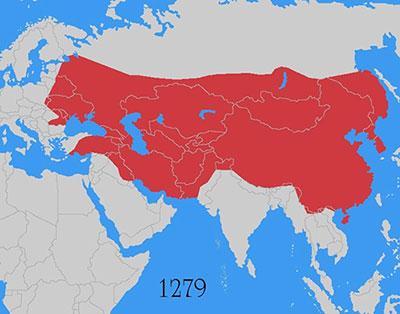
Tamerlane the Eurasian conqueror died in 1405. Darwin takes his death as marking the end of an epoch, an era inaugurated by the vast wave of conquest led across central Asia by Genghis Khan starting around 1200, an era in which one ruler could, potentially, aspire to rule the entire Eurasian landmass.

When Tamerlane was born the ‘known world’ still stretched from China in the East, across central Asia, through the Middle East, along the north African shore and including Europe. Domination of all of China, central Asia, northern India, the Middle East and Europe was, at least in theory, possible, had been achieved by Genghis Khan and his successors, and was the dream which had inspired Tamerlane.

Map of the Mongol Empire created by Genghis Khan

But by the death of Tamerlane the political situation across Eurasia had changed. The growth in organisation, power and sophistication of the Ottoman Empire, the Mamluk state in Egypt and Syria, the Muslim sultanate in north India and above all the resilience of the new Ming dynasty in China, meant this kind of ‘global’ domination was no longer possible. For centuries nomadic tribes had ravaged through Eurasia (before the Mongols it had been the Turks who emerged out of Asia to seize the Middle East and found the Ottoman Dynasty). Now that era was ending.

It was no longer possible to rule the sown from the steppe (p.5)

Moreover, within a few decades of Tamerlane’s demise, Portuguese mariners had begun to explore westwards, first on a small scale colonising the Azores and Canary Islands, but with the long-term result that the Eurasian landmass would never again constitute the ‘entire world’.

What was different about European empires?

Empires are the oldest and most widespread form of government. They are by far the commonest way that human societies have organised themselves: the Assyrians, Babylonians, Egyptians, Persians, the Greek and Roman Empires, the Aztec Empire, the Inca Empire, the Mali Empire, Great Zimbabwe, the Chinese empire, the Nguyễn empire in Vietnam, the Japanese Empire, the Ottoman empire, the Mughal empire, the Russian empire, the Austro-Hungarian empire, to name just a few.

Given this elementary fact about history, why do the west European empires come in for such fierce criticism these days?

Because, Darwin explains, they were qualitatively different.

  1. Because they affected far more parts of the world across far more widespread areas than ever before, and so ‘the constituency of the aggrieved’ is simply larger – much larger – than ever before.
  2. Because they were much more systematic in their rapaciousness. The worst example was surely the Belgian Empire in the Congo, European imperialism stripped of all pretence and exposed as naked greed backed up by appalling brutality. But arguably all the European empires mulcted their colonies of raw materials, treasures and of people more efficiently (brutally) than any others in history.

The result is that it is going to take some time, maybe a lot of time, for the trauma of the impact of the European empires to die down and become what Darwin calls ‘the past’ i.e. the realm of shadowy past events which we don’t think of as affecting us any more.

The imperial legacy is going to affect lots of people, in lots of post-colonial nations, for a long time to come, and they are not going to let us in the old European colonial countries forget it.

Structure

After Tamerlane is divided into nine chapters:

  1. Orientations
  2. Eurasia and the Age of Discovery
  3. The Early Modern Equilibrium (1750s – 1800)
  4. The Eurasian Revolution (1800 – 1830)
  5. The Race Against Time (1830 – 1880)
  6. The Limits of Empire (1880 – 1914)
  7. Towards The Crisis of The World (1914 – 42)
  8. Empire Denied (1945 – 2000)
  9. Tamerlane’s Shadow

A flood of insights

It sounds like reviewer hyperbole but there really is a burst of insights on every page of this book.

It’s awe-inspiring, dazzling, how Darwin can take the elements of tremendously well-known stories (Columbus and the discovery of America, or the Portuguese finding a sea route to India, the first trading stations on the coasts of India or the unequal treaties imposed on China, or the real consequences of the American Revolution) and present them from an entirely new perspective. Again and again on every page he unveils insight after insight. For example:

American

Take the fact – which I knew but had never seen stated so baldly – that the American War of Independence wasn’t about ‘liberty’, it was about land. In the aftermath of the Seven Years War (1756 – 63) the British government had banned the colonists from migrating across the Appalachians into the Mississippi valley (so as to protect the Native Americans and because policing this huge area would be ruinously expensive). The colonists simply wanted to overthrow these restrictions and, as soon as the War of Independence was over (i.e. after the British gave up struggling to retain the rebel colonies in 1783), the rebels set about opening the floodgates to colonising westward.

India

Victorian apologists claimed the British were able to colonise huge India relatively easily because of the superiority of British organisation and energy compared with Oriental sloth and backwardness. In actual fact, Darwin explains it was in part the opposite: it was because the Indians had a relatively advanced agrarian economy, with good routes of communication, business hubs and merchants – an open and well-organised economy, which the British just barged their way into (p.264).

(This reminds me of the case made in The Penguin History of Latin America by Edwin Williamson that Cortés was able to conquer the Aztec and Pissarro the Incas, not because the Indians were backward but precisely because they were the most advanced, centralised and well organised states in Central and South America. The Spanish just installed themselves at the top of a well-ordered and effective administrative system. Against genuinely backward people, like the tribes who lived in the arid Arizona desert or the swamps of Florida or hid in the impenetrable Amazon jungle, the Spanish were helpless, because there was no one emperor to take hostage, or huge administrative bureaucracy to take over – which explains why those areas remained uncolonised for centuries.)

Cultural conservatism

Until about 1830 there was still a theoretical possibility that a resurgent Ottoman or Persian empire, China or Japan, might have reorganised and repelled European colonisers. But a decisive factor which in the end prevented them was the intrinsic conservatism of these cultures. For example, both Chinese and Muslim culture venerated wisdom set down by a wise man (Mohammed, Confucius) at least a millennium earlier, and teachers, professors, civil servants were promoted insofar as they endorsed and parroted these conservative values. At key moments, when they could have adopted more forward-looking ideologies of change, all the other Eurasian cultures plumped for conservatism and sticking to the Old.

Thus, even as it dawned on both China and Japan that they needed to react to the encroachments of the Europeans in the mid-nineteenth century, both countries did so by undertaking not innovations but what they called restorations – the T’ung-chih (‘Union for Order’) restoration in China and the Meiji (‘Enlightened rule’) restoration in Japan (p.270). (Darwin’s description of the background and enactment of both these restorations is riveting.)

The Western concept of Time

Darwin has a fascinating passage about how the Europeans developed a completely new theory of Time (p.208). It was the exploration of America which did this (p.209) because here Europeans encountered, traded and warred with Stone Age people who used bows and arrows and (to start with) had no horses or wheeled vehicles and had never developed anything like a technology. This led European intellectuals to reflect that maybe these people came from an earlier phase of historical development, to develop the new notion that maybe societies evolve and develop and change.

European thinkers quickly invented numerous ‘systems’ suggesting the various ‘stages of development’ which societies progressed through, from the X Age to the Y Age and then on to the Z Age – but they all agreed that the native Americans (and even more so, the Australian aborigines when they were discovered in the 1760s) represented the very earliest stages of society, and that, by contrast, Western society had evolved through all the intervening stages to reach its present state of highly evolved ‘perfection’.

Once you have created mental models like this, it is easy to categorise all the other cultures you encounter (Ottomans, Hindus, China, Japan, Siam, Annamite etc) as somewhere lower or backward on these paths or stages of development.

And being at the top of the tree, why, naturally that gave white Europeans the right to intervene, invade, conquer and administer all the other people of the world in order to ‘raise’ them to the same wonderful level of civilisation as themselves.

18th and 19th

I’ve always been a bit puzzled by the way that, if you read accounts of the European empires, there is this huge difference between the rather amateurish 18th century and the fiercely efficient 19th century. Darwin explains why: in the eighteenth century there were still multiple European players in the imperial game: France was the strongest power on the continent, but she was balanced out by Prussia, Austria and also Spain and Portugal and the Dutch. France’s position as top dog in Europe was admittedly damaged by the Seven Years War but it wasn’t this, it was the Napoleonic Wars which in the end abolished the 18th century balance of power in Europe. Britain emerged from the Napoleonic Wars as the new top dog, with a navy which could beat all-comers, which had hammered the French at the Battle of the Nile and Trafalgar, and which now ruled the waves.

The nineteenth century feels different because Britain’s world-encompassing dominance was different in kind from any empire which ever preceded it.

The absence of Africa

If I have one quibble it’s that I’d like to have learned more about Africa. I take the point that his book is focused on Eurasia and the Eurasian empires (and I did learn a huge amount about Persia, the Moghul empire, China and Japan) and that all sub-Saharan Africa was cut off from Eurasia by the Sahara, but still… it feels like an omission.

And a woke reader might well object to the relative rareness of Darwin’s references to the African slave trade. He refers to it a few times, but his interest is not there; it’s in identifying exactly where Europe was like or unlike the rival empires of Eurasia, in culture and science and social organisation and economics. That’s his focus.

The expansion of the Russian empire

If Africa is disappointingly absent, an unexpected emphasis is placed in each chapter on the imperial growth of Russia. I knew next to nothing about this. A quick surf on Amazon suggests that almost all the books you can get about the Russian ’empire’ are about the fall of the Romanovs and the Bolshevik Revolution and then Lenin or Stalin’s creation of a Bolshevik empire which expanded into Eastern Europe after the war. That’s to say it’s almost all about twentieth century Russia (with the exception of a crop of ad hoc biographies of Peter the Great or Catherine the Great).

So it was thrilling to read Darwin give what amounts to a sustained account and explanation of the growth of the Kingdom of Muscovy from the 1400s onwards, describing how it expanded west (against Poland, the Baltic states, Sweden), south towards the Black Sea, south-west into the Balkans – but most of all how Russian power was steadily expanded East across the vast inhospitable tundra of Siberia until Russian power reached the Pacific.

It is odd, isn’t it, bizarre, uncanny, that a nation that likes to think of itself as ‘European’ has a huge coastline on the Pacific Ocean and to this day squabbles about the ownership of small islands with Japan!

The process of Russian expansion involved just as much conquering of the ‘primitive’ tribal peoples who hunted and trapped in the huge landmass of Siberia as the conquest of, say, Canada or America, but you never read about it, do you? Can you name any of the many native tribes the Russians fought and conquered? No. Are there any books about the Settling of the East as there are thousands and thousands about the conquest of the American West? Nope. It is a historical black hole.

But Darwin’s account of the growth of the Russian Empire is not only interesting as filling in what – for me at any rate – is a big hole in my knowledge. It is also fascinating because of the role Russian expansion played again and again in the game of Eurasian Risk which his book describes. At key moments Russian pressure from the North distracted the attention of the Ottoman Empire from making more offensive thrusts into Europe (the Ottomans famously encroached right up to the walls of Vienna in 1526 and then again in 1683).

When the Russians finally achieved one of their territorial goals and seized the Crimea in 1783, as a result of the Russo-Turkish War, it had the effect, Darwin explains, of cracking the Ottoman Empire open ‘like an oyster’. For centuries the Black Sea had been an Ottoman lake and a cheaply defensible frontier. Now, at a stroke, it became a massive vulnerability which needed costly defence (p.175).

And suddenly, seeing it all from the Russian perspective, this sheds new light on the timeworn story of the decline of the Ottoman Empire which I only know about from the later 19th century and from the British perspective. For Darwin the role of Russian expansionism was vital not only in itself, but for the hemming in and attritional impact it had on the other Eurasian empires – undermining the Ottomans, making the Chinese paranoid because Russian expansion around its northern borders added to China’s sense of being encircled and endangered, a sense that contributed even more to its risk-averse policy of doubling down on its traditional cultural and political and economic traditions, and refusing to see anything of merit in the Westerners’ technology or crude diplomacy. A policy which eventually led to the Chinese empire’s complete collapse in 1911.

And of course the Russians actually went to war with imperial Japan in 1905.

Numbered lists

Darwin likes making numbered lists. There’s one on almost every page. They rarely go higher than three. Here are some examples to give a flavour of his careful, forensic and yet thrillingly insightful way of explaining things.

The 18th century geopolitical equilibrium

The geopolitical revolution which ended the long equilibrium of the 18th century had three major effects:

  1. The North American interior and the new lands in the Pacific would soon become huge extensions of European territory, the ‘new Europes’.
  2. As a result of the Napoleonic war, the mercantile ‘zoning’ system which had reflected the delicate balance of power among European powers was swept away and replaced with almost complete control of the world’s oceans by the British Navy.
  3. Darwin gives a detailed description of why Mughal control of North India was disrupted by invasions by conquerors from the north, first Iran then Afghanistan, who weakened central Indian power at just the moment the British started expanding from their base in Bengal. Complex geopolitical interactions.

The so-called stagnation of the other Eurasian powers can be characterised by:

  1. In both China and the Islamic world classical, literary cultures dominated the intellectual and administrative elites – the test of intellectual acumen was fitting all new observations into the existing mindset, prizes went to those who could do so with the least disruption possible.
  2. Cultural and intellectual authority was vested in scribal elites backed up by political power, both valuing stasis.
  3. Both China and the Islamic world were profoundly indifferent and incurious about the outside world.

The knowledge revolution

Compare and contrast the East’s incuriosity with the ‘West’, which underwent a cognitive and scientific revolution in which merit went to the most disruptive inventors of new theories and technologies, and where Darwin describes an almost obsessive fascination with maps. This was supercharged by Captain Cook’s three huge expeditions around the Pacific, resulting in books and maps which were widely bought and discussed, and which formed the basis of the trade routes which followed in his wake, and then the transportation of large numbers of convicts to populate Australia’s big empty spaces (about 164,000 convicts were transported to the Australian colonies between 1788 and 1868).

Traumatic impact of the Napoleonic Wars

I hadn’t quite realised that the Napoleonic Wars had such a traumatising effect on the governments of the main European powers who emerged in its aftermath: Britain, France, Prussia, Austria and Russia. Very broadly speaking there was peace between the European powers between the 1830s and 1880s. Of course there was the Crimean War (Britain, France and Turkey containing Russia’s imperial expansion), war between Austria and Prussia (1866) and the Franco-Prussian War. But all these were contained by the system, were mostly of short duration and never threatened to unravel into the kind of general conflict which ravaged Europe under Napoleon.

Thus, from the imperial point of view, the long peace had four results:

  1. The Royal Navy’s policing of all trade routes across the Atlantic and between Europe and Asia kept trade routes open throughout the era and kept costs down for everyone.
  2. The balance of power which the European powers maintained among themselves discouraged intervention in either North or South America and allowed America to develop economically as if it had no enemies – a rare occurrence for any nation in history.
  3. The post-Napoleonic balance of power in Europe encouraged everyone to tread carefully in their imperial rivalries.
  4. Geo-political stability in Europe allowed the growth across the continent of something like a European ideology. This was ‘liberalism’ – a nexus of beliefs involving the need for old-style autocratic power to be tempered by the advice of representatives of the new middle class, and the importance of that middle class in the new technologies and economics unleashed by the industrial revolution and in founding and administering the growing colonies abroad.

Emigration

Emigration from Europe to the New World was a trickle in the 1830s but had become a flood by the 1850s. Between 1850 and 1880 over eight million people left Europe, mostly for America.

  1. This mass emigration relieved the Old World of its rural overcrowding and transferred people to an environment where they could be much more productive.
  2. Many of the emigrants were in fact skilled artisans. Moving to an exceptionally benign environment, a vast empty continent rich in resources, turbo-charged the American economy with the result that by the 1880s it was the largest in the world.

Fast

His chapter The Race Against Time brings out a whole area, an entire concept, I’ve never come across before, which is that part of the reason European colonisation was successful was it was so fast. Not just that Western advances in military technology – the lightning advances in ships and artillery and guns – ran far ahead of anything the other empires could come up with – but that the entire package of international finance, trade routes, complex webs sending raw materials back home and re-exporting manufactured goods, the sudden flinging of railways all across the world’s landmasses, the erection of telegraphs to flash knowledge of markets, prices of goods, or political turmoil back from colonies to the European centre – all of this happened too quickly for the rival empires (Ottoman, Japan, China etc) to stand any chance of catching up.

Gold rushes

This sense of leaping, hurtling speed was turbo-charged by literal gold rushes, whether in the American West in the 1840s or in South Africa where it was first gold then diamonds. Suddenly tens of thousands of white men turned up, quickly followed by townships full of traders and artisans, then the railway, the telegraph, the sheriffs with their guns – all far faster than any native American or South African cultures could hope to match or even understand.

Shallow

And this leads onto another massive idea which reverberates through the rest of the book and which really changed my understanding. This is that, as the spread of empire became faster and faster, reaching a kind of hysterical speed in the so-called Scramble For Africa in the 1880s (the phrase was, apparently, coined by the London Times in 1884) it meant that there was something increasingly shallow about its rule, especially in Africa.

The Scramble for Africa

Darwin says that most radical woke historians take the quick division of Africa in the 1880s and 1890s as a kind of epitome of European imperialism, but that it was in fact the opposite, and extremely unrepresentative of the development of the European imperialisms.

The Scramble happened very quickly, markedly unlike the piecemeal conquest of Central, Southern of North America, or India, which took centuries.

The Scramble took place with almost no conflict between the European powers – in fact they agreed to partitions and drew up lines in a very equable way at the Congress of Berlin in 1885. Other colonies (from the Incas to India) were colonised because there were organised civilisations which could be co-opted, whereas a distinctive feature about Africa (‘historians broadly agree about one vital fact’ p.314) was that people were in short supply. Africa was undermanned or underpeopled. There were few organised states or kingdoms because there simply wasn’t the density of population which lends itself to trading routes, settled farmers and merchants – all the groups who can be taxed to create a king and aristocracy.

Africans hadn’t progressed to centralised states as humans had in Eurasia or central America because there weren’t enough of them. Hence the poverty and the lack of resistance which most of the conquerors encountered in most of Africa.

In fact the result of all this was that most of the European governments weren’t that keen on colonising Africa. It was going to cost a lot of money and there weren’t the obvious revenue streams that they had found in a well-established economy like India.

What drove the Scramble for Africa more than anything else was adventurers on the ground – dreamers and fantasists and ambitious army officers and business men and empire builders who kept on taking unilateral action which then pitched the home government into a quandary – deny their adventurers and pass up the opportunity to win territory to a rival, or reluctantly support them and get enmeshed in all kinds of messy responsibilities.

For example, in the mid-1880s a huge swathe of West Africa between the desert and the forest was seized by a buccaneering group of French marine officers under Commandant Louis Archinard, and their black rank and file. In a few years these adventurers brought some two million square miles into France’s empire. The government back in Paris felt compelled to back them up which meant sending out more troops, police and so on, which would cost money.

Meanwhile, modern communications had been invented, the era of mass media had arrived, and the adventuring soldiers and privateers had friends and boosters in the popular press who could be counted on to write leading articles about ‘the white man’s burden’ and the torch of civilisation and ask: ‘Isn’t the government going to defend our brave boys?’, until reluctant democratic governments were forced to cough up support. Modern-day liberals often forget that imperialism was wildly popular. It often wasn’t imperialist or rapacious governments or the ruling class which prompted conquest, but popular sentiment, jingoism, which couldn’t be ignored in modern democracies.

Darwin on every page, describes and explains the deep economic, trade and financial structures which the West put in place during the nineteenth century and which eventually underpinned an unstoppable steamroller of annexation, protectorates, short colonial wars and long-term occupation.

The Congress of Berlin

The Congress of Berlin helped to formalise the carving up of Africa, and so it has come to be thought of as evil and iniquitous, particularly by BAME and woke historians. But once again Darwin makes you stop and think when he compares the success of the congress at reaching peaceful agreements between the squabbling European powers – and what happened in 1914 over a flare-up in the Balkans.

If only Bismarck had been around in 1914 to suggest that, instead of rapidly mobilising to confront each other, the powers of Europe had once again been invited for tea and cake at the Reichstag to discuss their differences like gentlemen and come to an equable agreement.

Seen from this perspective, the Berlin Congress is not so much an evil colonialist conspiracy, but an extremely successful event which avoided any wars between the European powers for nearly thirty years. Africa was going to be colonised anyway because human events have a logic of their own: the success was in doing so without sparking a European conflagration.

The Scramble for China

The Scramble for China is not as well known as its African counterpart,  the competition to gain ‘treaty ports’ on the Chinese coast, impose unfair trading terms on the Chinese and so on.

As usual, though, Darwin comes at it from a much wider angle and makes one massive point I hadn’t registered before, which is that Russia very much wanted to seize the northern part of China to add to its far eastern domains; Russia really wanted to carve China up, but Britain didn’t. And if Britain, the greatest trading, economic and naval power in the world, wasn’t onside, then it wouldn’t happen. There wasn’t a genuine Scramble for China because Britain didn’t want one.

Why not? Darwin quotes a Foreign Office official simply saying, ‘We don’t want another India.’ One enormous third world country to try and administer with its hundreds of ethnic groups and parties growing more restive by the year, was quite enough.

Also, by the turn of the century, the Brits had become paranoid about Russia’s intentions to conquer Afghanistan and march into North India. If they partitioned China with Russia, that would mean policing an even longer frontier even further way against an aggressive imperialist power ready to pounce the moment our guard was down.

Summary

This is an absolutely brilliant book. I don’t think I’ve ever come across so many dazzling insights and revelations and entirely new ways of thinking about a time-worn subject in one volume.

This is the book to give anyone who’s interested not just in ‘the rise of the West’ but how the whole concept of ‘the West’ emerged, for a fascinating description not just of the European empires but of all the empires across Eurasia – Ottoman, Persian, Moghul, Chinese and Japanese – and how history – at this level – consists of the endless juggling for power of these enduring power blocs, the endless and endlessly

complex history of empire-, state- and culture-building. (p.490)

And of course it all leads up to where we are today: a resurgent Russia flexing its muscles in Ukraine and Crimea; China wielding its vast economic power and brutally oppressing its colonial subjects in Tibet and Xinkiang, while buying land, resources and influence across Africa. And both Russia and China using social media and the internet in ways we don’t yet fully understand in order to undermine the West.

And Turkey, keen as its rulers of all colours have been since the Ottoman days, to keep the Kurds down. And Iran, as its rulers have done for a thousand years, continually seeking new ways to extend its influence around the Gulf, across Syria and to the Mediterranean, in eternal rivalry with the Arab world which, in our time, means Saudi Arabia, against whom Iran is fighting a proxy war in the Yemen.

Darwin’s books really drives home the way the faces and the ideologies may change, but the fundamental geopolitical realities endure, and with them the crudeness and brutality of the tools each empire employs.

If you let ‘morality’, especially modern woke morality, interfere with your analysis of this level of geopolitics, you will understand nothing. At this level it always has and always will be about power and influence, dominating trade and ensuring raw resources, and behind it all the never-ending quest for ‘security’.

At this level, it isn’t about following narrow, English notions of morality. Getting hung up on that only gets in the way of grasping the utterly amoral forces at play everywhere in the world today, just as they’ve always been.

Darwin stands up for intelligence and insight, for careful analysis and, above all, for a realistic grasp of human nature and human society – deeply, profoundly flawed and sometimes pitiful and wretched though both routinely are. He takes an adult view. It is absolutely thrilling and a privilege to be at his side as he explains and analysis this enormous history with such confidence and with so many brilliant ideas and insights.


Related reviews

Exhibitions

History

Imperial fiction

Frida Kahlo: Making Her Self Up @ the Victoria and Albert Museum

Frida Kahlo (1907 to 1954) has a unique international appeal, as both an artist, personality and icon. Her image in oil paintings and photographs is instantly recognizable.

This is a beautifully curated and designed exhibition which left me with a much deeper understanding of Kahlo’s life, her work, her toughness in the face of terrible adversity, and the Mexican roots of her distinctive and powerful self-image.

Frida Kahlo in blue satin blouse, 1939, photograph by Nickolas Muray © Nickolas Muray Photo Archives

Frida Kahlo in blue satin blouse, 1939, photograph by Nickolas Muray © Nickolas Muray Photo Archives

The treasure trove

The pretext or premise or prompt for the exhibition was the discovery of a treasure trove. After Frida died at the horribly early age of 47, her mourning husband, the famous Mexican mural painter, Diego Rivera, ordered all her belongings in the famous ‘Blue House’ they shared together, to be locked up and sealed away.

Rather incredibly, it was only in 2004 that this room was re-opened, to reveal a treasure trove of Kahlo-iana – including her jewellery, clothes, prosthetics and corsets, along with self-portraits, diary entries, photos and letters. Together they shed a wealth of new light on her life, personality, illness and endurance, on her art and on her extraordinary achievement in fashioning herself into an iconic image and brand.

And this is what the exhibition is based on.

Self-portrait by Frida Kahlo (1941) © The Jacques and Natasha Gelman Collection of 20th Century Mexican Art and The Vergel Collection

Self-portrait by Frida Kahlo (1941) © The Jacques and Natasha Gelman Collection of 20th Century Mexican Art and The Vergel Collection

Biography

The show is smaller than some recent ones at the V&A. Not so much a blockbuster, as an intimate portrait. It starts with a corridor-like room divided into small recesses, each of which take us briskly through a chapter in her early life, using black and white photos, a few early paintings and some home movies.

The key elements for me were that:

  • Her father was German, emigrated to Mexico in the 1890s and set up a photographic studio. She helped him and learned photographic technique, how to compose and frame a subject. No accident, maybe, that she is best known for her painted and photographic self portraits.
  • Her full name was Magdalena Carmen Frida Kahlo y Calderón. She always preferred Frida because it her father’s name for her. I was mulling this over when I came to the section describing her marriage to the, by then, already famous Mexican mural painter, Diego Rivera, in 1928, who was a lot older than her, 43 to her 22. I.e. a big, reassuring father figure. Daddy.
  • When Frida was 6 she contracted polio and was seriously ill. She was left with one leg shorter than the other.
  • When she was 18 she was on a bus which was in a collision with a tram, resulting in her being both crushed against the window and having a piece of metal penetrate her abdomen. This accident and her long recovery put paid to the idea of studying to become a doctor. Confined to bed for months, she began to expand the sketching, drawing and painting she’d already been toying with.

In the late 1920s she developed a kind of naive, symbolic style, drawing inspiration from Mexican folk culture. After marrying Rivera, she accompanied him on a number of trips to the United States, where he had been commissioned to paint murals, socially conscious murals being a big part of 1930s American artistic activity.

Here’s a good example, from 1932. I don’t know if I like it. I understand the fairly simple ideas: on the left are images of Mexico, Aztec ruins and figurines, flowers and agricultural produce, with their roots in the good earth: on the right is Detroit, highly industrialised ‘Motor City’ (the name FORD is spelled out on the smoking chimneys), the American flag, skyscrapers, and growing out of the soil are not beautiful flowers but lamps and fans.

And in between is a self portrait of Frieda in a formal pink dress holding the Mexican flag. Between two worlds, eh? I get it.

Self-portrait on the Border between Mexico and the United States of America by Frida Kahlo (1932) © Modern Art International Foundation

Self-portrait on the Border between Mexico and the United States of America by Frida Kahlo (1932) © Modern Art International Foundation

Her naive symbolism matches the simple-minded ‘political’ attitude of Rivera’s murals. They both thought of themselves as communists and went on marches supporting strikers etc, but, nonetheless, liked visiting the heart of capitalism, America – or ‘Gringolandia’, as Frida called it. The money was good and there were lots of opportunities for Rivera to get commissions. And it was in New York, in 1939, that Frida held her first successful one-woman show. Capitalism is an awful thing – unless you can get money, commissions, promotions and sales out of it: the attitude of many 20th century artists.

One of the most interesting biographical facts is that Lev Davidovich Bronstein, known to the world as Leon Trotsky, having been exiled from the Soviet Union, was offered refuge by the revolutionary government of Mexico and came to stay with the Riveras, not for a few weeks, but for two years.

The exhibition includes a black-and-white film of Comrade Trotsky explaining, in English, how badly he has been treated by comrade Stalin. He insists he is really a man of honour – as anyone whose family was murdered by the Red Army he set up, would surely have testified.

Mexican roots

These early biographical roots are interesting but they are eclipsed by the power of the later rooms.

These start with the room on Kahlo’s Mexican roots. It explains that during the 1920s and even more so the 1930s, Mexico underwent a cultural renaissance. Part of this was the exploration and promotion of the country’s pre-Colombian culture, but it also included the first real appreciation of the folk customs and costumes of peasants and the poor around the country.

Interest in the country spread abroad, with American artists, photographers and film makers attracted to its sunny, bright and passionate culture. John Huston made films here. Even the young British writer Graham Greene made a tour of the country (he hated it) and then set his most powerful early novel here, The Power and the Glory. I’ve reviewed them both.

Frida and Diego were part of this revival of interest in Mexico’s culture and history. They both sought inspiration in the folk and workers culture of their country. In particular they were attracted to the area called Tehuantepec in the Oaxaca region. People here followed traditional ways, and the exhibition includes a whole wall of traditional icons of the Virgin Mary, establishing a link between these images of saintly femininity and Kahlo’s self portraits and explorations of her identity.

The dress room

The final room in the show is the biggest and I involuntarily exclaimed ‘wow’ as I walked into it.

Centre stage is a huge central glass case displaying some 20 of Frida’s dresses. Full length, made of colourful fabrics and bright designs, each one has been carefully displayed and annotated, giving a powerful sense of Frida’s sense of colour and dress.

Cotton huipil with machine-embroidered chain stitch; printed cotton skirt with embroidery and holaün (ruffle) Museo Frida Kahlo

Cotton huipil with machine-embroidered chain stitch; printed cotton skirt with embroidery and holaün (ruffle) Museo Frida Kahlo

There are only 10 or so paintings in the whole exhibition and six of them are in this room. They’re later works, when she had realised that she was her own best subject and that self portrait was her best medium.

Looking out at the viewer, flat and unemotional, her iconic features by now well established – the monobrow, the faint moustache on her top lip, her strong brown eyes, the sideways pose – she is flatly, unashamedly, blankly herself.

In the painting below even the tears don’t really affect the expressionless face. Or they appear as surreally detached embellishments of the fundamental design. Much weirder is the ‘ruff’ dominating the image. The exhibition explains that this is a huipil de tapar, a traditional Mexican item popular in Tehuantepec, designed to frame the face and extend over the neck and shoulders. There is another larger painting of her wearing the same outfit and a full scale example of a huipil de tapar on a display mannequin for us to compare and contrast reality with painted depiction.

Self-Portrait by Frida Kahlo (1948) © Private Collection

Self-Portrait by Frida Kahlo (1948) © Private Collection

Kahlo is, you realise, a perfect subject for the V&A because she was not only an artist, but someone with a fascination for clothes and costumes – in her case, of her native Mexico. The exhibition is less about the ar per se and more about how she drew heavily on these costume traditions and elaborated them into a highly colourful style of her own.

Hence there are more than twice as many dresses as there are Kahlo artworks. Hence, also, the display cases devoted to the heavy and ornate jewellery she wore, the elaborate ear-rings and thick heavy necklaces, set off against the bright and colourful hair ribbons.

In this respect it is fascinating to watch the 9-minute tourist film from the Tehuantepec region which is on view just next to the dresses and necklaces. Look at the colours and designs of the dresses, the heavy gold jewellery, and the brightly coloured ribbons in the women’s hair. In a flash you understand. Kahlo was a conduit for these traditional dresses, colours, fabrics and jewellery, into the international art world.

She gave it her own style. She combined it in her own way and, above all, gave it the imprimatur of her own face, of her very distinctive features (eyes, monobrow, moustache) and her unsmiling, detached, dream-like appearance.

But a great deal of her ‘look’ quite obviously stems directly from the traditions of the women of Tehuantepec.

Frida Kahlo on a bench, carbon print (1938) Photo by Nickolas Muray © The Jacques and Natasha Gelman Collection of 20th Century Mexican Art and The Verge, Nickolas Muray Photo Archives

Frida Kahlo on a bench (1938) Photo by Nickolas Muray © The Jacques and Natasha Gelman Collection of 20th Century Mexican Art and The Verge, Nickolas Muray Photo Archives

The sick room

The big dress room is the climax of the exhibition, in terms of dresses, design, jewellery, paintings and photos.

But arguably the biographical core of the exhibition is the room before it, entitled ‘Endurance’. In an imaginative but spooky display, the curators have commissioned the creation of six small four-poster beds and made each into a display case which, along with photos and text along the walls, give a quite harrowing account of Kahlo’s many illnesses, ailments, treatments, and lifelong suffering.

The polio left her with a limp. The bus accident left her with serious internal injuries. In the 1930s she began to experience back problems and underwent a series of treatments and operations to fix them. At the end of her life one foot became infected and then gangrenous, requiring the whole leg to be amputated. It’s gruesome stuff.

This room includes examples of the medical equipment she was forced to wear or endure. There are platform shoes for the shorter leg, a prosthetic leg made for her to wear after the amputation but, most evocative of all, a series of corsets, plaster casts and back braces to help support her failing spine.

Kahlo decorated, painted and embellished as many of these as she could. The plaster casts, in particular, are painted with abstract patterns. The most elaborate one carries a painted hammer and sickle of the Soviet Union and, underneath, an image of the foetus she was carrying before she had a miscarriage in 1932.

Frida Kahlo wearing a plaster cast, which she decorated with the hammer and sickle (c.1950) photo by Florence Arquin

Frida Kahlo wearing a plaster cast, which she decorated with the hammer and sickle (c.1950) photo by Florence Arquin

The record of her illnesses and, in her later years, the almost constant pain she endured, make for harrowing reading, but there are also two really powerful insights in this room.

1. Painting in bed

One is that she was, at various periods, confined to her bed, it being too painful for her to walk or even stand. (Imagine!) So she had a mirror rigged up in the canopy above her and an easel on the side of the bed. From here she could paint, but paint what?

The answer is dreams – surreal images based on dreamlike symbolism, repeated images of her or a body in a bed – and her face. Over and over again the face of someone in discomfort or pain, staring, blankly, inscrutably, down from the ceiling.

Photos show the actual set-up, with Frida lying in bed, beneath a big mirror, the easel right next to her, on which she is painting.

This sheds quite a lot of light on her subject matter, and lends a depth and dignity to the pictures. Modern critics, obsessed with feminism and identity, may well write about the paintings ‘transgressing’ this or that convention and ‘subverting’ ‘gender stereotypes’.

But they are also the image of someone in tremendous pain. Knowing this, getting the really deep feel for her physical suffering which the ‘Endurance’ room gives you – lends tremendous depth of character and meaning to the detached, slightly dream-like expression you encounter again and again in her paintings.

The Broken Column by Frida Kahlo (1944)

The Broken Column by Frida Kahlo (1944)

2. The construction of the self

The other insight is easy to miss. Off to one side is a set of three black and white photos taken of Frida topless. They were taken by Julien Levy, the owner of the New York art gallery where she had her first solo show in 1939 and with whom she had an affair.

The insight comes in the text underneath, where Levy is quoted describing Frida doing and undoing her braids. First she undid the braids, carefully removing all the objects which were in them and held them in place, arranging them all carefully and in order on the dressing table. Later, she remade the braids, carefully and meticulously taking the ribbons and clips and other elements from their place on the dressing table, and putting them back in just the right places to create just the right effect.

In the context of the ‘Endurance’ room, next to so much physical pain and discomfort and demoralising bad luck – this ritual takes on a whole new significance.

You realise it was a way of controlling and ordering her life, a life of illness and pain which might so easily slip into indiscipline, depression or addiction. Instead she maintained control by paying minute attention to every element of her self-presentation. There are several cases showing the lipstick, and makeup, and nail polishes and eye liner and other accoutrements she used to create her image. To make herself up. To control, create and bolster herself.

Might sound stupid, but this knowledge makes the dazzling inventiveness of her self-creation seem genuinely heroic.

3. Long dresses

That’s why she liked to wear long dresses – because they hid her polio limp. This explains why all twenty dresses in the dress room are full length, reaching right down to and covering the feet. It’s a very Victorian effect, in some of the photos every inch of her body is covered save for her hands and face. But a Victorian outfit on acid, blitzed with brilliantly coloured fabrics and designs.

Conclusion

If you like Frida Kahlo this exhibition is a dream come true. There was a long queue to get in and the rooms were quickly packed out.

That said, there is remarkably little about her art, as art. A few mentions of the influence of Rivera’s socialist murals, a bit about Mexican symbolism, mention that the Godfather of Surrealism, André Breton, heavily promoted her, writing at length about the more surreal and dreamlike of her fantasy paintings (none of which are on display here).

But all in all, surprisingly little commentary or analysis of the paintings as paintings, except for comments about the dresses she’s wearing in them, the hair, the jewellery, the way she presents herself in them.

Self Portrait with Braid ( 1941) by Frida Kahlo

Self Portrait with Braid ( 1941) by Frida Kahlo

A moment’s googling shows that Frida Kahlo painted hundreds of paintings. Only ten are on show here. This exhibition is much more about the creation of her image, all the exhibits inhabit concentric circles spreading out from that premise.

I found it hard to get very worked up about 70 or 80 year-old makeup sets (in the outer circle). Her dresses and fabrics are colourful and interesting but, at the end of the day, not really my thing – though I could see plenty of women visitors being riveted by their designs and fabrics. Kahlo’s mural-style, political or symbolic art is sort-of interesting – although murals aren’t a format I warm to – and I found them less compelling than comparable murals by Stanley Spencer or Thomas Hart Benton.

No, it’s only when I came to her paintings of herself that I felt a real power and forcefulness in the image, the way they bring out her stern, unsmiling expression.

But even more central than her self portraits, and – in my opinion – at the absolute heart of the exhibition are the contemporary photos of Frida. It is the photos which bring together all the elements mentioned above, her great taste for colourful fabrics, bright designs, adventurous headgear, stunning jewellery and vivid lipstick to match, her deep sense of Mexican folk art and culture – all this funneled, channeled and focused in a series of stunning and powerful photos.

Frida Kahlo with Olmec figurine (1939) by Nickolas Muray © Nickolas Muray Photo Archives

Frida Kahlo with Olmec figurine (1939) by Nickolas Muray © Nickolas Muray Photo Archives

Nickolas Muray

Thus it was often the photos which impressed me most in any given room. And looking closely, it quickly became clear that the photos we know, the ones we’re familiar with, and by far the best ones, were taken by Nickolas Muray.

There is almost no information about Muray in the exhibition, which is a shame because his images are iconic. According to Wikipedia, Muray had a ten-year-long affair with Frida, from 1931 to 1941. (During this period she divorced, then remarried Rivera. And sometime in there, she also managed to have the affair with Levy, which led to the nude photos. Those bohemian artists, eh?)

The only flicker of recognition of Muray’s role in helping to crystallise the Kahlo brand is a wall label next to one of the portraits. Here Muray is quoted as saying

colour calls for new ways of looking at things, at people

This struck me as pointing towards something very profound. Most of Kahlo’s paintings are striking in composition (and for their generally ‘naive’ style) but are surprisingly drab, especially the earlier, political ones. the later paintings are marvellously colourful and inventive. But in a way it is these photos alone which do justice to the tremendous colourfulness of her self-presentation.

According to Wikipedia, Muray was:

famous for his creation of many of the conventions of colour advertising. He was considered the master of the three-color carbro process. (Nikolas Muray Wikipedia article)

In other words, Muray wasn’t just quite a good colour photographer – he was one of the inventors of colour photography for the modern age.

This knowledge goes a long way to understanding why Muray’s photos of Kahlo stand out from the other contemporary photos of her, done at the same time, by other photographers. The coming together of Muray and Kahlo’s bodies in their long affair is trivial compared to the coming together of their shared understanding of colour and design – with phenomenal results.

The (admittedly black and white) photo of her by Florence Arquin makes her look like a person, an ordinary human being, squinting in the sun. But the three photos I’ve included by Muray give Kahlo a feeling of power, self-control, majesty, an almost goddess-like calm. In Muray’s hands Kahlo becomes an icon to be worshiped.

You can imagine these images of Frida Kahlo carrying on being iconic for a very long time. Iconic of what, exactly? Whatever you want: our current cultural obsessions are with gender, sexuality, race, identity and so on. But I think her image transcends any one set of ‘issues’ and lends itself to infinite reformulation. Which is one of the characteristics of great art.

The movie

A film of her life was released in 2002. According to the trailer, Frida was ‘one of the most seductive, and intriguing women, of ours or any time’, and it features numerous clips of her jumping into bed with men and women, with little of no mention of the physical disabilities and ailments.

The merch

Kahlo was an ardent communist. Today she is marketed as a fashion icon, feminist saint, and, more to the point, inspirer of a whole world of merchandise.

In the shop you can buy some 134 items of merchandise including at least 20 books about her, notebooks, greeting cards, pencils, lapel badges, earrings, necklaces, brooches, jewellery, sunglasses, scarves and shawls, t-shirts, handbags, tote bags ( I counted 20 different design of bag), a Mexican cookbook and ingredients, pillows and socks – yes, Frida Kahlo socks. It’s what she would have wanted. Here’s the full list of Kahlo merch:


Related links

More V&A reviews

Mexico reviews (including more Frida and Diego)

Every room in the British Museum

A friend’s son comes to stay from Spain. He’s studying art and culture and so we spent two days, from 10am till chucking out time at 5.30pm, on a mission to visit every room in the British Museum. And we did it.

The British Museum owns some 8 million artefacts, of which fewer than 1% are on display, amounting to around 50,000 objects. It is the most popular tourist attraction in the UK with nearly 7 million visitors annually. Before the doors even opened at 10, the crowds flocking into the main forecourt reminded me of the crowds heading for the turnstiles at a football match.

Confusing layout

The official floorplan gives 95 numbered rooms, but closer examination shows several are missing. For example, I couldn’t find mention of the 80s, whereas some numbers are used two or three times: eg 18, 18a and 18b are the rooms dedicated to the Elgin Marbles – or 33, 33a and 33b, sound like one number but turn out to label the long hall running along the north wing of the building, the room at the end and a long narrow hall running south from it, which between them contain all of India and China: two distinct and massive subjects/areas, covering a profusion of sub-subjects – all contained by one innocent sounding 33.

The collection is spread vertically between levels -2 to level 5, so there are lots of floors and lifts. But not all the stairs give access to all the levels ie some stairs only go from one level to another, or only to one or a few room: like the steps which only go from room 21a down to rooms 77 and 78 (devoted to Greek and Roman architecture, an interesting collection of just the tops of classical columns which allow you to get close to the various decorative styles and patterns, and to classical inscriptions). Or the one staircase (the North stairs) which are the only way to get up to the Japan displays (rooms 92 to 94).

The way some rational sequences of numbered rooms are suddenly interrupted or require a detour up or down back stairs, give the place a pleasing element of chance or randomness eg the way room 67 (the Korea Foundation Gallery) continues seamlessly into room 95 (the Sir Joseph Hotung Centre for Ceramic Studies). But overall, the visit prompted two big questions:

Why are the Egyptian and Roman and Greek collections split up?

The massive long hall-type room 4 contains a wonderful collection of Egyptian sculptures and next to it are rooms displaying the similarly huge Assyrian sculptures (rooms 6 to 10) and then loads of rooms – 11 to 23 – displaying the development of Greek sculpture (including the vast Duveen Galleries showing the Elgin Marbles). But then you have to go across the Museum and up to level 3 to visit the completely separate suite of rooms – 61 to 66 – displaying Egyptian mummies and sarcophaguses, in carefully explained chronological order. Why are the Egyptians split up like this? Why not have everything Egyptian all together? Similarly why, after you’ve done the evolution of Greek sculpture, do you have to go across and up to level 3 (rooms 69 to 73) to see more Greek pots and find out about the Greek colonies in the south of Italy before the rise of Rome?

Why is the chronological account of civilisations sometimes done in rooms numbered sequentially, but sometimes done against the order of the rooms?

For example, rooms 11 to 23 on the ground floor take you through the history of Greek art in a nice logical sequence, from the earliest, primitive cycladic figures through to the artistic heights of the Parthenon, then on to Alexander the Great and the Romans. Whereas on the third floor, rooms 52 to 59 have to be visited in reverse order to experience the chronological progression, with 59 introducing the Levant ie Mesopotamia, Persia, Turkey – and then rooms moving forward in time as the numbers decrease (room 56 Mesopotamia 6000 to 1500, room 55 Mesopotamia 1500 to 539 and so on). Similarly, the history of Europe starts in room 51 (Europe and Middle East 10,000 to 800) then proceeds through rooms which count downwards: room 50 for Britain and Europe 800BC to 43 AD, room 49 for Roman Britain. Just when you’re getting used to this backwards progression, you have to leap straight to room 41 (Sutton Hoo and Europe 300 to 1100) and room 40 (Medieval Europe 1050 to 1500), because the missing rooms in between – rooms 46, 47, 48 (admittedly off to one side) turn out to contain rather unexpected and rather odd displays of Europe 1400 to 1800, Europe 1800 to 1900, and Europe 1900 to the present, respectively (mostly made up of ceramics, pottery, vases and plates).

In other words, finding your way around the British Museum is neither logical nor intuitive, making the visit of anyone with a limited amount of time really quite demanding. Especially if you’re trying to please impatient hectoring children. Don’t give up! It’s not you, it’s the museum.

On the other hand, if you do have the time or the opportunity to visit more than once, then the quirky layout, with countless unexpected and hidden treasures to stumble upon, maybe adds to the mystery and romance of the place…

Highlights

Obviously, not any kind of official highlights, this is a list of things that made me stop and think or want to make a note:

A dentil is a small block used as a repeating ornament in the ‘bedmould’ of a cornice. Picture of dentils.

African wooden fetishes contained the spirits of gods, ancestors or spirits. Banging nails or bits of metal into them activated the god, woke up the spirit. Photo of African fetish

Porcelain was invented around 600AD in China and was a practical cheap new way of making dishes, pots, cups etc.

In a traditional Korean house the male area or sarangbang, was prized for its simplicity and clarity: here the man of the house studied, worked, wrote poetry. The woman’s room, or anbang, was highly decorated, painted, adorned and ornamented.

Ganesh, the Hindu god, has the head of an elephant because his father, Shiva, cut off his human head in a fit of anger and said he’d replace it with the head of the first thing he saw.

The Buddhist chant Om mani padme om means ‘hail to the jewel in the lotus’.

The hands of the Buddha in statues can represent a number of meanings, in fact they are broken down into categories. The palm raised towards the viewer is the abhayamudra, which symbolises reassurance. (The right hand in this image.)

Many of the Indian statues are posed in the traditional tribhanga posture where the body is slightly bent at the neck, waist and knee, giving it a sensuous S shape. Tribhanga Wikipedia article

The Egyptian cat god was named Bastet. Epitomised by the famous Guyer-Andersen cat. The udjat-eye hieroglyph on its chest is a symbol of protection.

Egyptians were buried on the west bank of the Nile (eg the Valley of the Kings) right on the edge of the desert. They were buried facing east, facing back towards the living.

No-one knows who the mysterious figurines found in earliest cycladic sites represent or why they were nearly all female. Cycladic figure.

King Ashurbanipal of Assyria (685 to 627 BC) held lion hunts, where caged lions were brought to an enclosure and released so the king could chase after them on his chariot. He is depicted with one lion leaping up into the chariot and, while two soldiers hold it back with spears, Ashurbanipal in person leans forward to deliver the coup de grace with a short sword. Ashurbanipal killing a lion 640BC.

Egyptians believed the scarab beetle symbolised the sun, because each day as the sun rose beetles emerged from their dung balls or holes. Egyptian scarab statue.

At the temple complex of Kom Ombo in Upper Egypt, where crocodiles were worshipped as symbols of caring and nurturing, but also images of fear (?), over 300 mummified crocodiles have been found. The mummies include mummified versions of their tiny baby crocodiles, placed along the mother croc’s back. The crocodile god is Sobek.

My favourite thing in the Japanese gallery wasn’t the magnificent Samurai armour, it was the painted screen, ‘Pine trees at Maiko-no-hama beach‘, by Mori Ippo (1847).

Farming was invented about 12,000 years ago. Writing was invented about 5,000 years ago. Money was invented around 600AD.

The Queen of the Night dates from 1800 BC in Mesopotamia.

The walls of ancient Nineveh, capital of the Assyrian empire in the 7th century BC, are now cheek-by-jowl with the modern Iraqi city of Mosul, which is currently held by forces of the Islamic State of Iraq and the Levant (ISIL).

The most beautiful statue I saw was of Antinous, the young man beloved of the Roman emperor Hadrian.

I learned that it was during the Hellenistic period after the death of Alexander the great (323BC) that Greek art became more individualised. When Greek statues reached their peak in the Athens of Pericles (495 to 429 BC) they depicted idealised images of power which reflected the communal values of the city state. After Alexander the Great (died 323 BC) effectively unified the Mediterranean world in one cosmopolitan culture, the rich became more individualistic, collecting rare and precious objects, and wanted to be depicted as they actually appeared. So by the time the Roman republic reached its peak and then became the Empire (27 BC), although bodies were still depicted with the Greek idealism – the super-defined muscles and bone structure etc – the faces had become the faces of individuals. Hence the faces of the Roman emperors, which are so individualised and evocative.

The invention of the pendulum clock in 1656 by Christiaan Huygens was a massive step forward in accurate measure of time and therefore of all kinds of processes, from the movement of the planets to new industrial or chemical processes. The super-accurate telling of time was one of the foundations of the industrial revolution and of the West’s dominance over the rest of the world.

When wound up this Mechanical Galleon, made in Germany in the 1590s, played music from a little organ as it trundled over the dinner table until it came to a stop and the model guns fired little puffs of gunpowder.

The Ram in a Thicket is one of a pair of figures excavated in Ur in southern Iraq. They date from 2600 to 2400 BC.

I’d heard of most of the other cultures mentioned here, but never of Urartu, a kingdom in the east of Turkey near Mount Ararat. This is a bronze winged bull’s head from the handle of a large cauldron, 8th to 7th century BC.

King Ashurbanipal established the world’s first library (as far as we know) consisting of thousands of clay tablets from the 7th century BC. The British Museum is embarked on a large project working with the University of Mosul to digitise the original texts and translations, making the entire library available online.

The double headed snake was important in Aztec mythology. The Museum houses an elaborate sculpture of a double headed snake covered in hundreds of tiny fragments of turquoise. What interested me is that this nearby mosaic skull also has snake motifs curling around the eyes of the nose and down to the lips.

A cabinet of curiosities is a display case an Enlightenment or Victorian collector might use to display his collection of interesting and unusual objects. It is in stark contrast to a ‘treasure room’ (exemplified by room 2, the The Waddesdon Bequest, donated by Baron Ferdinand Rothschild MP (1839 to 1898)) which contains objects of exquisite beauty and craftsmanship designed to highlight the owner’s refined taste. I preferred the cabinets.

Room one

Room 1 runs the length of the ground floor, along the right hand side as you enter the courtyard. The entry, opposite the east part of the bookshop, looks like a dusty old library, but don’t be put off: room 1 is dedicated to a permanent exhibition, in seven themed sections, showing why the Enlightenment period (roughly the 1700s) saw a new fashion among the rich and educated for collecting everything – stones, flints, flowers, trees, books, manuscripts, languages, paintings, sculptures, machinery, statues – you name it, someone somewhere, rich aristocrat or modestly funded vicar, was collecting it.

And how it was from the urge to collect and assess and categorise and compare all these innumerable specimens, that many of the disciplines we know today emerged – most notably archaeology, the science of dating and naming and categorising and understanding all the objects from the human past.

It may look a bit unexciting, but room 1 not only contains many objects which are fascinating in their own right, but provides just the right introduction, not just to the museum but to the whole ‘idea’ of a museum and what museums are for. And since the British Museum was founded with the bequest of one such personal collection, that of the physician and scientist Sir Hans Sloane, in 1753, room 1 is the ideal place to begin to understand the urge to collect and the urge to view, see and understand, which underlies the whole place and explains why you’re there.


Related links

Other British Museum reviews