The New Machiavelli by H.G. Wells (1911)

I want to show a contemporary man in relation to the state and social usage, and the social organism in relation to that man.
(The New Machiavelli, page 287)

All I have had to tell is the story of one man’s convictions and aims and how they reacted upon his life; and I find it too subtle and involved and intricate for the doing…
(page 210)

Executive summary

‘The New Machiavelli’ is a first-person narrative told by its protagonist, Richard Remington MP (sleek, tall and neat, p.216). He starts his story in exile in Italy, his promising political career in ruins and his marriage destroyed after he has eloped with pretty young Isabel River. The long rambling narrative that follows aims to explain how he came to this state of affairs.

Remington was a middle-class public schoolboy with a lifelong passion for ‘statecraft’ and dreams of reforming the social and political practices of England. He was a brilliant student at Cambridge, then came down to London where he won a reputation for his books and articles on political themes. He was matched off with an eligible heiress and entered parliament as a Liberal MP in the Liberal landslide of 1906. He was influenced by the gradualist socialism of Altiora and Oscar Bailey, a couple clearly based on Sidney and Beatrice Webb of the Fabian Society.

Once in Parliament, Remington mixes widely with members of the ruling class and of all political parties and slowly his political ideas shift away from the Liberals, as he develops a cult proposal for a kind of ideal aristocracy, one which will promote science and research and art and beauty, a cockamamie idea which eventually leads him to ‘cross the floor’ of the House and join the Conservatives.

He sets up and edits a new magazine, the ‘Blue Weekly’ (‘a little intellectual oasis of good art criticism and good writing’, p.282). In the 1910 general election triggered by the political crisis surrounding David Lloyd George’s Budget, Remington is returned to parliament. He has by now developed an entirely new idea, a version of eugenics suggesting state support for women to marry and raise children, his Endowment for Motherhood scheme, and his career is on the up.

But everything is wrecked when he begins a love affair with a brilliant, playful Oxford graduate, Isabel Rivers. When rumours of their affair begin to circulate, Remington tries to break the affair off but, after much soul searching, resolves to abandon wife, career, party and country to go and live with Isabel in Italy. And it is here that, as the opening chapter makes clear, he sits down to write this extended (380-page) autobiography and justification for his life and actions.

Why it’s titled The New Machiavelli

The narrator clearly states his aim in the opening chapter. After a (relatively short) intellectual life spent worrying about politics, he came to the conclusion that the main aim should be, not fussing about this or that piece of legislation, but the education of a new technocratic elite to properly plan and organise a modern 20th century society – and, on a deeper level, the problem of how to the politician or theorist can reconcile their theories and policies with their personal life.

To be honest, I found the details of this a little hard to nail down, but it’s clear that the overall shape of this long narrative is Remington’s attempt to reconcile his wish to improve society with his wish to be true to himself (i.e. his adulterous affair with a young woman).

Half way through the book, he ties this to the idea that we are just puppets floating on the tide of history, individual cells in the great global brain and that, somehow, by removing the public mask and acknowledging ourselves for what we are, we also connect ourselves to the deeper movements of history. I think.

Anyway, all this led him to reread Machiavelli’s complete works and what he found was a man after his own heart, a man who recorded in his writings his true, deeper self, warts and all. This is strikingly unlike other famous authors in the canon of political writing such as Plato or Confucius, who wrote profoundly about statecraft but left not a trace of their personal lives behind. They are fine statues on plinths but not real people. Hence Remington’s devotion to warts-and-all Machiavelli, and his conscious attempt to integrate the personal into his own policies.

Also, like Machiavelli, the narrator has been driven into exile.

Also, he tells us that, after the Florentine Republic which he supported had fallen, Machiavelli set about writing his famous guide to rulers, ‘The Prince’, but also wondering who in contemporary Italy (in the 1510s) he should be advising. In just the same way, Wells’s narrator tells us that he, to begin with, set out to write a modern-day version of The Prince and also pondered who to dedicate it to, who to set out to teach and instruct (as both Plato and Confucius are recorded as seeking rulers to instruct).

This opening chapter goes on to explain that Remington, in the end, abandoned the idea of writing a new ‘Prince’, and decided to go whole hog and integrate the lessons he had learned from politics into a total portrait of himself i.e. into his autobiography.

So: those are the three or four reasons why the name Machiavelli is in the title: because the author wants to copy the aim of writing a treatise on statecraft, but also to integrate it with an account of his own life, which ended up being so long and detailed that it swamped the theory and turned into an autobiography.

[This lengthy and rather convoluted introduction to the text is very reminiscent of Wells’s long, tortuous introduction to his 1905 novel, The Modern Utopia. In both Wells spends quite a long time sharing with the reader the struggle he had to order and structure his text. If you have a lot of time to disentangle his motives and the convolutions of narrative structure which they result in, it may be worth it. But I think it’s no accident that both books, with their long tortuous rationales leading to very long texts, are not much read, compared to Wells’s earlier, shorter, more focused and exciting works.]

Longer critique

Critics have criticised ‘The New Machiavelli’ for being a poor novel for at least five reasons: 1) It is hugely rambling and digressive, lacking the discipline to cut extraneous matter and concentrate on the plot, instead overflowing with Wells’s hobby horses including great digressions on his pet subjects (the shambolic state of education, urban planning, economic policy), far in excess of anything needed for either plot or characterisation.

2) Despite its promise to be about Edwardian politics (as indicated by the title and the opening chapter, and as Wells promised his publisher) it turns out, like all Wells’s social novels, to be about ‘love’, in this case with the element of sex more prominent than ever before. In fact it was the candid descriptions – not of sex itself, which is nowhere actually described – but of the dominating role the sex urge plays in a young man’s mental life and development, which led his usual publisher (Macmillans) to turn it down, and to widespread accusations of ‘immorality’ by the critics.

3) The third reason is that Wells had recently ‘scandalised’ society by, in the glare of his role as public figure, commentator, novelist etc, having an affair with a much younger woman, Amber Reeves and abandoning his wife to run away with her. Well, the narrator of this long book is also a man prominent in public life who has an affair with a much younger woman and abandons his wife to run away with her. So it was easy to accuse ‘The New Machiavelli’ of being not a novel at all but (yet another) lightly fictionalised autobiography.

4) And not only that but this great long narrative (380 pages in the Everyman paperback edition) is tendentious, has an aim on us. It is cast in the form of a first-person apologia, an ‘apologia pro vita sua’, as Remington recounts in great detail his entire life story with a strong emphasis on sex. From the start he carefully seeds references to his sex urge, describes his first sexual experiences etc, all the while arguing that society needs to be more open and acknowledge the role the sex instinct plays in human life, so that by the time the narrative gets to the affair and elopement (the last quarter of the book) it’s difficult not to read the book as an extended justification of Well’s own behaviour.

5) Finally, Wells had recently ended his 5-year involvement with the Fabian Society (1903 to 1908), quitting the organisation in high dudgeon after a failed attempt to take it over for his own purposes, and the book contains extended and pretty negative portraits of the founders of the Fabians, Sidney and Beatrice Webb, lightly fictionalised as Oscar and Altiora Bailey. For those who knew the Webbs (and the other political figures Wells satirises) the book seemed like a cheap act of revenge. More broadly, this inclusion of public figures he had a grudge against reinforced the sense that Wells didn’t write ‘novels’ but fictionalised autobiographies stuffed with his hobby horse ideas.

For all these reasons it’s easy to dismiss ‘The New Machiavelli’ as less a novel than the latest fictionalising of the main events in Wells’s life which he had already used extensively in the plots of the preceding social novels – Love and Mr Lewisham, Kipps, Mr Polly, Tono-Bungay and Ann Veronica – to which he was now adding his latest scandalous sexual adventure and the Fabian fiasco.

But having said all that, there’s still a lot to redeem ‘The New Machiavelli’ and make it worth reading. Wells is always an interesting writer. I enjoy his prose style, I look forward to the occasional surprising simile, and – to turn the standard criticism on its head – it’s precisely because it’s not a carefully crafted, focused and honed work of art (cf The Good Soldier, The Great Gatsby) but instead a great rambling grab-bag of ideas and issues and memories and vividly imagined scenes and conversations – that it’s an enjoyable read. In some respects it’s like reading a series of articles about late-Victorian and Edwardian social history and I found it very readable on that level.

Muddle versus planning

Also it contains the most extensive statements of the key elements of Wells’s philosophy or politics (if either of them really deserve the name). This is that Wells, like the protagonist of the book, Richard Remington, grew up in a late-Victorian Britain characterised by laissez-faire economic policy and a minimal state devoted to interfering as little as possible in business or society, which had resulted, by the turn of the 20th century, in extraordinary and highly visible shambles in just about every sphere of English society. Six which Wells singles out for special criticism are:

  • the brutally exploitative nature of unregulated industrial capitalism, 7 day weeks, 12 hour days etc
  • the patchy, limited and regressive nature of the British educational ‘system’, which taught the ruling class nothing but Classics and cricket and taught the lower classes hardly anything at all
  • the absolute shambles of urban development without any planning or supervision, which had created great sprawling slums
  • the repressive and retarding influence of the Church on every aspect of society but especially through its network or Church schools
  • the ruinous state of the British Army, badly trained soldiers led by bumbling officers, as revealed by the national humiliation of the Boer War
  • the shameful, furtive, fumbling British attitude to sex which caused so much suffering and harm (disease, abortion, death)

The chaos in all these aspects and more of English society Wells sums up in the key word muddle, which recurs again and again, throughout the novel:

No, the Victorian epoch was not the dawn of a new era; it was a hasty, trial experiment, a gigantic experiment of the most slovenly and wasteful kind. I suppose it was necessary; I suppose all things are necessary. I suppose that before men will discipline themselves to learn and plan, they must first see in a hundred convincing forms the folly and muddle that come from headlong, aimless and haphazard methods…

Muddle,’ said I, ‘is the enemy.’ That remains my belief to this day. Clearness and order, light and foresight, these things I know for Good. It was muddle had just given us all the still freshly painful disasters and humiliations of the war, muddle that gives us the visibly sprawling disorder of our cities and industrial country-side, muddle that gives us the waste of life, the limitations, wretchedness and unemployment of the poor. Muddle!

Against this muddle and shambles Wells sets the concepts of Planning and Order. And he associates these virtues with Science – which establishes the latest information about all aspects of the world – and Education – which disseminates this latest knowledge as widely as possible to the entire population.

[My father] gave me two very broad ideas in that talk and the talks I have mingled with it; he gave them to me very clearly and they have remained fundamental in my mind; one a sense of the extraordinary confusion and waste and planlessness of the human life that went on all about us; and the other of a great ideal of order and economy which he called variously Science and Civilisation… he led me to infer rather than actually told me that this Science was coming, a spirit of light and order, to the rescue of a world groaning and travailing in muddle for the want of it…

So the dichotomy in Wells’s mind isn’t between industrial capitalism and socialism or between the bourgeoisie and the proletariat or between the exploiting class and the exploited or between imperial colonists and colonised natives. It is between Muddle and Planning.

This fundamental dichotomy, or binary opposition, sheds light on Wells’s own personal version of ‘socialism’. By ‘socialism’ he doesn’t mean the political system whereby (to quote a dictionary) ‘the means of production, distribution and exchange should be owned or regulated by the community as a whole’ – he simply means where there should be a carefully thought through and orchestrated plan. ‘Socialism’ is more a codeword for the new world of Order, Reason and Planning which he wished to see.

We were socialists because Individualism for us meant muddle, meant a crowd of separated, undisciplined little people all obstinately and ignorantly doing things jarringly, each one in his own way… Order and devotion were the very essence of our socialism, and a splendid collective vigour and happiness its end. We projected an ideal state, an organised state as confident and powerful as modern science, as balanced and beautiful as a body, as beneficent as sunshine, the organised state that should end muddle for ever; it ruled all our ideals and gave form to all our ambitions.

So, on the one hand you had the actual condition of Britain in the 1880s and ’90s, dominated by a reactionary church and two political parties led by idiotic aristocrats who could quote Latin and Greek tags till the cows came home but knew little else, parties which both believed in keeping state intervention to the absolute minimum, in not making any overarching social plans but responding to events in a chaotic manner…

…And on the other hand, Wells’s belief in total state intervention, in drawing up an all-encompassing, long-term plan to abolish waste and muddle, with religious obscurantism replaced by the latest scientific knowledge, and squabbling petty party politics replaced by a unified ruling elite of technocrats, engineers and scientists acting in the best interests of the whole country, promoting:

educational reorganisation, scientific research, literature, criticism, and intellectual development. (p.273)

What appealed to Wells about ‘socialism’ wasn’t the overthrow of the grotesquely rich ruling class and landed aristocracy in the name of the urban proletariat, but the replacement of the laissez-faire approach which dominated the entire Victorian era with massive, indeed total state control, but a state run by modern scientifically minded elite.

‘Monstrous muddle of things we have got,’ I said, ‘jumbled streets, ugly population, ugly factories —’
‘And you’d do a sight better if you had to do with it?’ said my uncle, regarding me askance.
‘Not me. But a world that had a collective plan and knew where it meant to be going would do a sight better, anyhow. We’re all swimming in a flood of ill-calculated chances —’

Grasp this fundamental dichotomy and you’ve more or less grasped everything Wells had to say and wrote about continuously for over 40 years (from the early 1900s to 1945). ‘The New Machiavelli’ is a realistic novel and so the protagonist – politician Richard Remington – sets out on his crusade to end muddle and impose order, within a relatively realistic setting. Whereas in the numerous science fiction and utopian novels he wrote, Wells looked forward to Order not being imposed by this or that local government but by a World Government made up of a technocratic elite of scientists, engineers and the like, devising 5-, 10-, 50-year plans to reform and rationalise all aspects of human life. Planning. Order. Science. Education. All aspects of the same fundamental vision.

That’s why he dwells at such length, in an early section, on the destruction of the small, self-contained and harmonious community of Bromstead when it was overrun by developers and hack builders and property speculators and the rest of the crooks involved in housing who turned the place into a polluted slum. It’s both an evocative and sad description in itself, but also a microcosm of the national problem: laissez-faire speculation run rampant, unsupervised, uncontrolled, with no guiding plan, leads to slums, dirt, pollution, poverty, bad houses which fall down or rot. It’s a powerful symbol of everything wrong with the British state.

The real villain in the piece – in the whole human drama – is the muddle-headedness, and it matters very little if it’s virtuous-minded or wicked. I want to get at muddle-headedness.

And all this explains why the real battleground for Wells was and remained education. That’s why he gives such a long account of Remington’s education at a public school (strikingly unlike the wretched educational experiences of Arthur Kipps and Alfred Polly). Because even here, at a top public school, the education is shockingly bad, with Wells dwelling on the utter fatuousness of making teenage boys waste thousands of hours learning Latin and ancient Greek, instead of modern science and engineering. Not only does it explain why Britain was, by the 1890s, falling behind America and Germany on every economic measure, but why it produced such strikingly dim and obtuse leaders.

The real scandal, as his long digression about education makes clear, is that it’s yet another aspect of English life which is the result of centuries of muddle and bodging and compromise and a complete lack of a centrally co-ordinated, rational plan.

Modern scientific central planning run by technocrats versus chaotically fragmented muddling through, managed by Latin-quoting buffoons – that is the dichotomy which underpins Wells’s writing, both fiction and non-fiction, articles, encyclopedias, novels, pamphlets, the lot.

Free Love

That and Free Love. During the Edwardian decade Wells became notorious for the many affairs he had while still married to long-suffering Amy Catherine Robbins (always referred to as ‘Jane’). This novel was scandalous in its day because the plotline of the married male protagonist, Richard Remington, having a passionate affair with a much younger woman before running off abroad, was so obviously an only lightly fictionalised autobiographical account of Wells’s own recent affair with the young Amber Reeves who he eloped with.

It wasn’t just that Wells cast the book in the form of a first-person narrative by Remington and so takes us directly into the passions and saucy descriptions of the affair. But that the entire huge narrative is a massive apologia, exemplifying the dictionary definition of ‘a formal written defence of the narrator’s opinions or conduct’.

But it wasn’t just that the entire novel was widely seen as a thinly disguised piece of special pleading by Wells trying to explain and justify what, by the standards of the day, was seen as utterly reprehensible behaviour. More than this, Wells went on to turn his immoral behaviour into a kind of social and political crusade, insisting that society needed to be more tolerant of lovers who breached narrow social rules. And – what alienated many – was that he went further and associated the reform of sexual morality with all the other social reforms he postulated. He in effect insisted that if you wanted to see this better future of Order and planned government by an oligarchy of technocrats, you also had to buy into his crusade for sex reform. In fact at various points the narrator insists that a reformed sexual morality is central to any attempt to reform this muddle-headed nation.

A people that will not valiantly face and understand and admit love and passion can understand nothing whatever.

It was this yoking of his personal (scandalous and ‘immoral’) behaviour to his notions of social, economic and educational reform, his insistence that if you were to follow his political ideals you also had to accept his shameless philandering – which set people against Wells, and which certainly put the prissy Fabians off him.

The social comedies

‘The New Machiavelli’ was in one sense the climax of the series of ‘social comedies’ which started with ‘Love and Mr Lewisham’, ‘Kipps’, ‘Mr Polly’, ‘Tono-Bungay’ and ‘Ann Veronica’. But at the same time it can be seen as the first of his ‘discussion novels’ (although that title probably belongs to ‘Ann Veronica’. It was the most ambitious of them in several respects. 1) It’s by far the longest. 2) It tries to not only define the social and political challenges facing Edwardian England but to show how an intelligent man developed his understanding of them, became aware of them, felt his way into them, and came to develop possible solutions. 3) The hero, Richard Remington, is a distinct class above all the previous protagonists (Lewisham, Kipps, Polly) and enjoys a vastly better education (at public school and Cambridge) than figures like Kipps (dim, left school at 14) or Polly, and so the account of his boyhood, teenage years and schooling is that more thoughtful and considered.

This and the fact that Wells is almost always a very vivid writer. If the book contains numerous digressions or passages about his hobby horses which are too long for ‘artistic’ effect (as his friend and critic Henry James was always pointing out) they are often interesting – especially for someone like me interested in social history as much as the ‘artistic’ effects. In fact you could accurately describe it as a series of magazine articles and features on various subjects gathered together and put into the voice of the narrator to create the appearance of a novel. I liked lots of bits of it.

Interesting passages

On his boyhood

As with the other social novels, arguably the best part is the first part, about his childhood and boyhood, school days and early student years (the first 100 or so pages of this 378-page-long Everyman edition). As with the comparable sections of Kipps, Mr Polly and Tono-Bungay, he writes vividly about childhood and boyhood, with a freshness that mostly disappears when his protagonist becomes a boring grown-up.

On his parents

I enjoyed the characterisation of Remington’s parents. His persuasive portrait of a mother who is a dogmatic low Christian, stern, humourless, anxious and dogmatic leads into passages lamenting the repressive impact of the Church of England on all aspects of English life.

And the portrait of his father, Arthur, as an amiably incompetent science teacher and frustrated gardener. The couple of pages about his father’s persistent failures in every aspect of trying to grow vegetables both struck a chord with me and made me laugh out loud.

At last with the failure of the lettuces came the breaking point. I was in the little arbour learning Latin irregular verbs when it happened. I can see him still, his peculiar tenor voice still echoes in my brain, shouting his opinion of intensive culture for all the world to hear, and slashing away at that abominable mockery of a crop with a hoe. We had tied them up with bast only a week or so before, and now half were rotten and half had shot up into tall slender growths. He had the hoe in both hands and slogged. Great wipes he made, and at each stroke he said, ‘Take that!’ The air was thick with flying fragments of abortive salad. It was a fantastic massacre. It was the French Revolution of that cold tyranny, the vindictive overthrow of the pampered vegetable aristocrats. After he had assuaged his passion upon them, he turned for other prey; he kicked holes in two of our noblest marrows, flicked off the heads of half a row of artichokes, and shied the hoe with a splendid smash into the cucumber frame…

On boyhood memories of Bromley as a village overcome by development

There’s a long digression on the history of Bromstead, the name Wells rather pointlessly gives to what is transparently the real London suburb of Bromley where he grew up. In his entertaining book about Wells, ‘The Culminating Ape’, Peter Kemp uses this passage about Bromstead as an example of Wells’s obsession with muddle, bad planning and environmental degradation. But first and foremost it is a vivid and very enjoyable description of the delights of boyhood, nearly as good as the boyhood sections of ‘Kipps’.

On monkey parades

It was in that phase of an urban youth’s development, the phase of the cheap cigarette, that this thing happened. One evening I came by chance on a number of young people promenading by the light of a row of shops towards Beckington, and, with all the glory of a glowing cigarette between my lips, I joined their strolling number. These twilight parades of young people, youngsters chiefly of the lower middle-class, are one of the odd social developments of the great suburban growths—unkindly critics, blind to the inner meanings of things, call them, I believe, Monkeys’ Parades—the shop apprentices, the young work girls, the boy clerks and so forth, stirred by mysterious intimations, spend their first-earned money upon collars and ties, chiffon hats, smart lace collars, walking-sticks, sunshades or cigarettes, and come valiantly into the vague transfiguring mingling of gaslight and evening, to walk up and down, to eye meaningly, even to accost and make friends. It is a queer instinctive revolt from the narrow limited friendless homes in which so many find themselves, a going out towards something, romance if you will, beauty, that has suddenly become a need — a need that hitherto has lain dormant and unsuspected. They promenade.

This is set in the 1880s but it reminded me of the Mods of the 1960s or the nattily dressed followers of ska at the end of the 1970s, similarly style-conscious, nattily dressed working class boys.

On public school

He gives an interesting portrait of the public school his hero goes to, the City Merchants which, in the absence of any notes in this Everyman edition, I presume refers to the Merchant Tailors School. He gives a satirical account of his hero faking an interest in cricket, the number one focus of a public school education, as well as withering criticism of the obsessive study of Classics, a subject completely and utterly useless for life in the modern world.

On Cambridge

The conversations between his student friends are staggeringly banal and dim, unformed, lacking any depth or data, they refute each other by simply saying ‘What rot old chap’ and so on.

On Kipling

The prevailing force in my undergraduate days was not Socialism but Kiplingism. Our set was quite exceptional in its socialistic professions. And we were all, you must understand, very distinctly Imperialists also, and professed a vivid sense of the ‘White Man’s Burden’.

It is a little difficult now to get back to the feelings of that period; Kipling has since been so mercilessly and exhaustively mocked, criticised and torn to shreds;—never was a man so violently exalted and then, himself assisting, so relentlessly called down. But in the middle nineties this spectacled and moustached little figure with its heavy chin and its general effect of vehement gesticulation, its wild shouts of boyish enthusiasm for effective force, its lyric delight in the sounds and colours, in the very odours of empire, its wonderful discovery of machinery and cotton waste and the under officer and the engineer, and ‘shop’ as a poetic dialect, became almost a national symbol. He got hold of us wonderfully, he filled us with tinkling and haunting quotations, he stirred Britten and myself to futile imitations, he coloured the very idiom of our conversation. He rose to his climax with his ‘Recessional’ while I was still an undergraduate.

What did he give me exactly? He helped to broaden my geographical sense immensely, and he provided phrases for just that desire for discipline and devotion and organised effort the Socialism of our time failed to express, that the current socialist movement still fails, I think, to express. The sort of thing that follows, for example, tore something out of my inmost nature and gave it a shape, and I took it back from him shaped and let much of the rest of him, the tumult and the bullying, the hysteria and the impatience, the incoherence and inconsistency, go uncriticised for the sake of it:

Keep ye the Law—be swift in all obedience—
Clear the land of evil, drive the road and bridge the ford,
Make ye sure to each his own That he reap where he hath sown
By the peace among Our peoples let men know we serve the Lord!

On the Boer War

South Africa seems always painted on the back cloth of my Cambridge memories. How immense those disasters seemed at the time, disasters our facile English world has long since contrived in any edifying or profitable sense to forget! How we thrilled to the shouting newspaper sellers as the first false flush of victory gave place to the realisation of defeat. Far away there our army showed itself human, mortal and human in the sight of all the world, the pleasant officers we had imagined would change to wonderful heroes at the first crackling of rifles, remained the pleasant, rather incompetent men they had always been, failing to imagine, failing to plan and co-operate, failing to grip. And the common soldiers, too, they were just what our streets and country-side had made them, no sudden magic came out of the war bugles for them. Neither splendid nor disgraceful were they — just ill-trained and fairly plucky and wonderfully good-tempered men — paying for it. And how it lowered our vitality all that first winter to hear of Nicholson’s Nek, and then presently close upon one another, to realise the bloody waste of Magersfontein, the shattering retreat from Stormberg, Colenso — Colenso, that blundering battle, with White, as it seemed, in Ladysmith near the point of surrender! and so through the long unfolding catalogue of bleak disillusionments, of aching, unconcealed anxiety lest worse should follow. To advance upon your enemy singing about his lack of cleanliness and method went out of fashion altogether! The dirty retrogressive Boer vanished from our scheme of illusion.

All through my middle Cambridge period, the guns boomed and the rifles crackled away there on the veldt, and the horsemen rode and the tale of accidents and blundering went on. Men, mules, horses, stores and money poured into South Africa, and the convalescent wounded streamed home. I see it in my memory as if I had looked at it through a window instead of through the pages of the illustrated papers; I recall as if I had been there the wide open spaces, the ragged hillsides, the open order attacks of helmeted men in khaki, the scarce visible smoke of the guns, the wrecked trains in great lonely places, the burnt isolated farms, and at last the blockhouses and the fences of barbed wire uncoiling and spreading for endless miles across the desert, netting the elusive enemy until at last, though he broke the meshes again and again, we had him in the toils. If one’s attention strayed in the lecture-room it wandered to those battle-fields.

And that imagined panorama of war unfolds to an accompaniment of yelling newsboys in the narrow old Cambridge streets, of the flicker of papers hastily bought and torn open in the twilight, of the doubtful reception of doubtful victories, and the insensate rejoicings at last that seemed to some of us more shameful than defeats….

The British Empire

I think of St. Stephen’s tower streaming upwards into the misty London night and the great wet quadrangle of New Palace Yard, from which the hansom cabs of my first experiences were ousted more and more by taxicabs as the second Parliament of King Edward the Seventh aged; I think of the Admiralty and War office with their tall Marconi masts sending out invisible threads of direction to the armies in the camps, to great fleets about the world. The crowded, darkly shining river goes flooding through my memory once again, on to those narrow seas that part us from our rival nations; I see quadrangles and corridors of spacious grey-toned offices in which undistinguished little men and little files of papers link us to islands in the tropics, to frozen wildernesses gashed for gold, to vast temple-studded plains, to forest worlds and mountain worlds, to ports and fortresses and lighthouses and watch-towers and grazing lands and corn lands all about the globe. Once more I traverse Victoria Street, grimy and dark, where the Agents of the Empire jostle one another, pass the big embassies in the West End with their flags and scutcheons, follow the broad avenue that leads to Buckingham Palace, witness the coming and going of troops and officials and guests along it from every land on earth… Interwoven in the texture of it all, mocking, perplexing, stimulating beyond measure, is the gleaming consciousness, the challenging knowledge: ‘You and your kind might still, if you could but grasp it here, mould all the destiny of Man!’ (p.220)

On his Staffordshire uncle

Remington has an uncle who runs a successful business in the Potteries. When his father dies, this uncle appears, sells off the properties his dad tried and failed to maintain and rent out, and collates the capital into a pension for Remington and his mother and him. When his mother dies, this uncle appears again and becomes Remington’s guardian. By the time he’s a student, Remington has begun to see his limitations and Wells gives a funny caricature of him:

Essentially he was simple. Generally speaking, he hated and despised in equal measure whatever seemed to suggest that he personally was not the most perfect human being conceivable. He hated all education after fifteen because he had had no education after fifteen, he hated all people who did not have high tea until he himself under duress gave up high tea, he hated every game except football, which he had played and could judge, he hated all people who spoke foreign languages because he knew no language but Staffordshire, he hated all foreigners because he was English, and all foreign ways because they were not his ways. Also he hated particularly, and in this order, Londoner’s, Yorkshiremen, Scotch, Welch and Irish, because they were not ‘reet Staffordshire,’ and he hated all other Staffordshire men as insufficiently ‘reet.’ He wanted to have all his own women inviolate, and to fancy he had a call upon every other woman in the world. He wanted to have the best cigars and the best brandy in the world to consume or give away magnificently, and every one else to have inferior ones. (His billiard table was an extra large size, specially made and very inconvenient.) And he hated Trade Unions because they interfered with his autocratic direction of his works, and his workpeople because they were not obedient and untiring mechanisms to do his bidding.

On his first marriage to an unsuitable woman

The text is divided into four ‘books’ and the second one (pages 117 to 205) is devoted to his wooing and marriage to the lovely Margaret Seddon. Exactly as in ‘Lewisham’, ‘Polly’ etc, this is closely based on Wells’s own life in which he married young and naively to his cousin, projecting onto her all the qualities he wanted in a woman (namely intelligence and sensuality) which, unfortunately, she turned out to completely lack, being a very mundane unintellectual person and sexually unresponsive. Hence Wells’s affairs, hence the eventual running off with a younger, more sensual woman. In various permutations the same basic plot is recycled in all the social novels, and here again.

‘The New Machiavelli’ is a longer, deeper book than the previous ones, and consciously set in a higher social class than previously – so the wooing of Margaret Seddon is not pitched in the comic mode of Kipps or Polly and, as a result, feels all the more sad. Both figures are pathetic, the narrator not concealing the fact that he desperately wanted this beautiful ‘dropping’ woman to have all the qualities he projected onto her, hiding from himself what he already knew, namely that she has no ideas and nothing to say for herself,

Her mind had a curious want of vigour, “flatness” is the only word…a beautiful, fragile, rather ineffective girl…I wanted her so badly, so very badly, to be what I needed. I wanted a woman to save me. I forced myself to see her as I wished to see her. Her tepidities became infinite delicacies, her mental vagueness an atmospheric realism…

But then they go on honeymoon to Venice and Richard realises, for the first time, her lack of sensual passion and her dim, conforming mediocrity.

It was entirely in my conception of things that I should be very watchful not to shock or distress Margaret or press the sensuous note. Our love-making had much of the tepid smoothness of the lagoons. We talked in delicate innuendo of what should be glorious freedoms. (p.176)

I haven’t got round to mentioning yet that Margaret was an heiress. Remington meets her on one of his periodic visits to his uncle, the successful businessman in the Potteries, where Margaret is a friend of the uncle’s daughters i.e. his cousins. A few years later he bumps into her at a little dinner given by the ‘Baileys’ and quickly realises that Altiora Bailey is pushing her on him. Margaret is young and attractive, wealthy and looking for a cause. Remington is a clever young man on the way up. Hence Altiora’s match-making.

Sex

This has brought us to what the book is ultimately about, which is sex – and on this subject, possibly the one closest to Wells’s heart and groin, he has much to say. Just to repeat, there is nowhere any description of actual sex, no nudity even. What we’re talking about is the character’s descriptions of sexual relationships.

The subject is broached when Remington is still a schoolboy. There’s nothing about the perils of puberty, about his first orgasm, about masturbation and so on, there’s no graphic detail. The subject is approached in a much more roundabout, euphemistic way. But nonetheless, it is mentioned as becoming an issue at school.

In his entertaining book about Wells, ‘The Culminating Ape’, Peter Kemp sheds light on an unusual aspect of Wells’s sexual education, which is that he had some of his first erotic feelings standing before the huge statues of bare-breasted female figures displayed at the Crystal Palace (representing Greek gods or the continents of the world etc) and the same again with the naked statues in the Victoria and Albert Museum. And some of the main source passages Kemp uses are from this book.

Then, at Cambridge, sex is one among many topics these bright but vague and inexpressive undergraduates discuss.

It’s only when he goes on a walking holiday in Italy with a friend, that Remington, to his amazement, finds himself having a fling with an older, married woman in their hotel. She and he hit it off, come to a quick understanding, and then he’s pulling her into his room, kissing her and… the rest is glossed over, but you get the idea. Four afternoons of ‘passion’ introduce him to sex. Not only are there no descriptions of any kind, but nothing about the actual problems and mechanics of sex – female arousal and lubrication, the problem of contraception and so on. It is his introduction to a kind of sex which goes undescribed and assumed.

After he leaves university, five years pass while he makes his way in London and, he tells us, becomes an expert in sordid affairs. I think he’s saying that he has several affairs, with married women (it was more feasible to have affairs with married women because single women were more tightly chaperoned and/or tightly protected their virginity). But he also, apparently, goes with prostitutes.

It’s not really the relationships, it’s Wells’s polemical way with the subject that’s eye-catching. He insists that sex is the great taboo subject, that it isn’t discussed or written about – and yet every adult knows it is a major part of adult life and is also a major part of the urban scene, especially in London whose streets all eye witnesses describe as being packed with prostitutes. His insistence that we give the subject its proper weight and importance, both in any account of the development of a character, and also in any description of London, both of these are surely laudable aims.

(All this candour echoes the prominence of sex as a theme in Ann Veronica, particularly the memorable passage of Ann innocently arriving in London only to be followed and propositioned by men on the street or wandering by accident into an obvious prostitute neighbourhood near Covent Garden; and the scenes of her being harassed and eventually almost raped by Ramage.)

Sex and Margaret

Anyway, the narrator is very aware that he has ‘descended’ into sordid affairs and sleeping with hookers, a world he characteristically doesn’t describe in terms of boobs and willies, but in moralising psychological terms:

I would feel again with a fresh stab of remorse, that this was not a flash of adventure, this was not seeing life in any permissible sense, but a dip into tragedy, dishonour, hideous degradation, and the pitiless cruelty of a world as yet uncontrolled by any ordered will.

He has an affair with a married woman, a Mrs Larrimer, and feels immensely guilty about it, assailed by a sense that it is not so much morally ‘wrong’ (as all the moralists of his age insisted) so much as the purely utilitarian sense that it is a waste of his time, mind and intellect.

She was at once unfaithful and jealous and full of whims about our meetings; she was careless of our secret, and vulgarised our relationship by intolerable interpretations; except for some glowing moments of gratification, except for the recurrent and essentially vicious desire that drew us back to each other again, we both fretted at a vexatious and unexpectedly binding intimacy. The interim was full of the quality of work delayed, of time and energy wasted, of insecure precautions against scandal and exposure. Disappointment is almost inherent in illicit love. I had, and perhaps it was part of her recurrent irritation also, a feeling as though one had followed something fine and beautiful into a net – into bird lime! These furtive scuffles, this sneaking into shabby houses of assignation, was what we had made out of the suggestion of pagan beauty; this was the reality of our vision of nymphs and satyrs dancing for the joy of life amidst incessant sunshine. We had laid hands upon the wonder and glory of bodily love and wasted them….

I like Wells’s way of writing about human nature. The overall shape of the novels is rambling, entire subjects are dragged in yes yes, but I like the way he writes about human relationships and feelings, it’s with a subtlety and insight I enjoy. And this oppressed sense of failing in life is connected with Wells’s central idea of muddle and confusion:

I felt that these great organic forces were still to be wrought into a harmony with my constructive passion. I felt too that I was not doing it. I had not understood the forces in this struggle nor its nature, and as I learnt I failed. I had been started wrong, I had gone on wrong, in a world that was muddled and confused, full of false counsel and erratic shames and twisted temptations.

Anyway, part of the naivety and mistakenness which leads him to woo and marry Margaret, is the misconceived idea that she will save him from the dark and sordid world which his (pretty basic, male) desires have led him into, will save him from himself.

Margaret shone at times in my imagination like a radiant angel in a world of mire and disorder, in a world of cravings… (p.169)

He projects onto her an entire narrative of salvation from squalor by a shining angel which she, of course, is both unaware of and completely unqualified to perform.

I suppose it was because I had so great a need of such help as her whiteness proffered, that I could ascribe impossible perfections to her, a power of intellect, a moral power and patience to which she, poor fellow mortal, had indeed no claim. (p.169)

Politics

Some reviewers criticised it for the incoherence of its politics. What they meant was that on the few occasions when Wells makes any attempt to state Remington’s political ideas or policies, they appear an incoherent mish-mash of Tory Liberal ideas. I think I can explain that.

The real-life Tories and Liberals were divided by very real political philosophies, which came into sharper contrast as the radical Liberals (David Lloyd George and Winston Churchill) took forward their policies to sanction trade union rights, to set up a welfare state and so on. The Edwardian political class was riven by divisions over Ireland, protectionism i.e. imperial tariffs, legislation around the nascent trade union movement and much more. None of this appears in Wells’s account. I don’t think Wells is interested in actual politics at all because he is fixated on his utopian vision of a world run by a technocratic elite. So that when he gets involved in political discussions as a young MP, he or his supporters repeat the same (boring, limited, impractical) Wellsian mantra:

‘Mr Remington has published a programme… Mr Remington stands for constructing a civilised state out of this muddle.’

Politics is a) speeches and manifestos setting out principles and plans, and b) the art of cobbling together acts and whipping enough support to get them passed through Commons and Lords. Wells’s novel deals with neither of those. There are descriptions of political conversations over dinner party tables which are heroic in their vagueness and uselessness.

The chapter titled ‘The Riddle For The Statesman’ ostensibly summarises the evolution of Remington’s political sympathies. This largely consists of him explaining why he grew disillusioned with the Liberal party, partly for its ‘essential littleness’, and came to realise that what he was seeking was a king of aristocracy, but not one ruled by the descendants of William the Conqueror’s lieutenants or other lackeys of monarchs, but the brightest and best, technocrats and engineers etc. In other words, a restatement of his fundamental idea that society needs to be guided by a technocratic elite in order to become the New Republic (a concept already treated in in his books ‘Anticipations’, 1902, ‘Mankind in the Making’, 1903 and ‘A Modern Utopia’, 1905).

[I was disconcerted when he identified this idea with the best of contemporary imperialism, a benevolent imperialism, and astonished when he writes enthusiastically about the Boy Scout movement as a model for what he intends (p.243)]

In this chapter he explains how his idea is to educate everyone up to appreciate the finest things in life and how this led him to admire the breadth and confidence of the actual aristocrats he now met with at grand London mansions and country houses.

I have given now the broad lines of my political development, and how I passed from my initial liberal-socialism to the conception of a constructive aristocracy.

His conversion to Conservative aristocracy is not in the slightest bit believable. Maybe it was a fundamental structural part of the plot, that the man abandons not only his wife but his party and the two are intimately linked because she believed in (and funded) his work for the Liberal Party with complete trust. So it’s a twofold breach of faith, a double betrayal. I can see the structural neatness. I just don’t believe the reasons Wells gives his protagonist.

Why so much political discourse is abuse

Remington hangs out at the Liberal Club and is amazed at its extraordinary diversity of beliefs and opinions (including the black and brown members who hale from distant parts of the empire). Anyway, he wonders at how you manage to keep so many disparate groups together and concludes you do so by attacking the enemy:

What but a common antagonism would ever keep these multitudes together? I understood why modern electioneering is more than half of it denunciation. Let us condemn, if possible, let us obstruct and deprive, but not let us do. There is no real appeal to the commonplace mind in ‘Let us do.’ That calls for the creative imagination, and few have been accustomed to respond to that call. [Denunciation] merely needs jealousy and hate, of which there are great and easily accessible reservoirs in every human heart… (p.224)

Wells’s way with conversations

Wells is very good at describing the ebb and flow of conversations, and their sub-texts and hidden meanings and implications, as well as the simple common experience of running out of things to say, or someone saying something too earnest and serious to be processed in dinner party chitchat, or a casual flirtation between a young couple taking an unexpectedly deep and serious turn.

I’ll never forget the scene in ‘Mr Polly’ where the hero is visiting his friends the Larkins sisters and suddenly, in the course of a page, finds himself coming to the verge of proposing to one of them, purely as a result of bravado and daring, suddenly realising the brink to which his playful banter has taken him. I think he’s very good at capturing all the unintended overtones and implications of conversations, as well as capturing very common problems and experiences. So, in no particular order:

There came that kind of pause that happens when a subject is broached too big and difficult for the gathering. Margaret’s blue eyes regarded the speaker with quiet disapproval for a moment, and then came to me in the not too confident hope that I would snub him out of existence with some prompt rhetorical stroke… (p.194)

Good Lord! what bores the Cramptons were! I wonder I endured them as I did. They had all of them the trick of lying in wait conversationally; they had no sense of the self-exposures, the gallant experiments in statement that are necessary for good conversation. They would watch one talking with an expression exactly like peeping through bushes. Then they would, as it were, dash out, dissent succinctly, contradict some secondary fact, and back to cover… (p.212)

I had the experience that I suppose comes to every one at times of discovering oneself together with two different sets of people with whom one has maintained two different sets of attitudes.

Similes

I mentioned the way Wells’s prose is always alive, there are unexpected phrases on every page, and sometimes he leaps out in vivid similes.

I see old Dayton sitting back and cocking his eye to the ceiling in a way he had while he threw warmth into the ancient platitudes of Liberalism, and Minns leaning forward, and a little like a cockatoo with a taste for confidences, telling us in a hushed voice of his faith in the Destiny of Mankind.

One might think at times there was no more of him than a clever man happily circumstanced, and finding an interest and occupation in politics. And then came a glimpse of thought, of imagination, like the sight of a soaring eagle through a staircase skylight.

Thin to non-existent philosophy

I enjoyed reading about Remington’s boyhood, about his mismatched parents, his father’s comic mishaps at market gardening, his mother’s addiction to vengeful Christian booklets; about running free in the countryside around Bromstead, his vivid description of its destruction by the cancer of London; the extended passages about the hero’s boyish attachment to toy soldiers and playing ‘war’; and the interesting descriptions of the private school he attends, right in the heart of London, the importance attached to Classics and cricket and very little else.

But apart from the conviction that education needs to be given a complete overhaul and the country run by a planful elite, the protagonist (and, you feel, Wells himself) doesn’t have an idea in his head. For example, as Remington hits his later teens he tells us he always had an interest in theology and talked the big issues through with his best friend at school, Britten. What does this mean? That he has deeply considered the doctrine of the atonement, pondered the nature of the trinity, considered the heresies surrounding the incarnation of God in man, has wondered about the justice of the doctrine of original sin, has weighed whether the linear descent of Catholic Christianity from St Peter outweighs its dismal track record and frequent absurdities, or whether Martin Luther’s grim doctrine of predestination is outweighed by the social benefits of the Reformation (namely mass literacy)? No, it means this:

I came at last into a phase that endures to this day, of absolute tranquillity, of absolute confidence in whatever that Incomprehensible Comprehensive which must needs be the substratum of all things, may be. Feeling OF IT, feeling BY IT, I cannot feel afraid of it. I think I had got quite clearly and finally to that adjustment long before my Cambridge days were done. I am sure that the evil in life is transitory and finite like an accident or distress in the nursery; that God is my Father and that I may trust Him, even though life hurts so that one must needs cry out at it, even though it shows no consequence but failure, no promise but pain… (p.68)

This is, to be frank, pitiful, and he claims to have reached this Great Conclusion at Cambridge. No. This isn’t theology, it’s just his personal psychology. This is much the same level as those soul music classics which assure us ‘it’s gonna be alright’. Most of Wells’s thinking is like this, whether it be this ridiculously simple-minded ‘theology’ or his thinking about ‘socialism’ which just amounts to better social planning. For a man with such a reputation as a ‘thinker’ it’s remarkable how most of  his ‘ideas’ lackiany definition or precision or value, are little more than wordy feel-good mottos.

Thoughts

Wells rails against ‘muddle’ and makes ‘muddle’ the central enemy of his critique. And yet he himself is hopelessly confused and muddled about the solution. The very fact that his hero crosses from Fabian socialism, through Liberalism and onto the Conservative Party indicates how confused and shambling his thought is. Wells tries to dignify it by having his hero explain how hard it is to come up with a coherent philosophical and political position:

It is perplexingly difficult to keep in your mind, fixed and firm, a scheme essentially complex, to keep balancing a swaying possibility while at the same time under jealous, hostile, and stupid observation you tread your part in the platitudinous, quarrelsome, ill-presented march of affairs… I have thrown together in the crudest way the elements of the problem I struggled with, but I can give no record of the subtle details; I can tell nothing of the long vacillations between Protean values, the talks and re-talks, the meditations, the bleak lucidities of sleepless nights…

But this fools no-one. His protagonist preaches against muddle but, in the end, is the most muddle-headed and confused person in the story. There’s no way Remington could have written anything as clever and consistent as The Prince. He’s too confused and incoherent.

Then again, this is a novel not a treatise, and so it is possible that Wells intended us to find Remington a well-meaning but long-winded rambling fool. Was that his aim?

Conclusion

‘The New Machiavelli’ was Wells’s sixth and final attempt to write a Proper Novel (following ‘Love and Mr Lewisham’, ‘Kipps’, ‘Mr Polly’, ‘Tono-Bungay’ and ‘Ann Veronica’) and, having worked my way through it, I can see what a huge effort he made to give it far more intellectual and psychological depth than its predecessors, to create a kind of Summa of all his life experiences and profoundest beliefs to date.

So that when it was so widely criticised and when, eventually, Wells himself came to see it as flawed in its basic conception, as more an encyclopedia rather than a novel – stung and mortified, he gave up trying to write serious literary fiction and gave himself more and more to thinly-fictionalised screeds and manifestos, increasingly based on repetitive plots and situations. Most critics and readers regard everything that followed as a long 30-year decline in quality.


Credit

The New Machiavelli by H.G. Wells was published by Bodley Head in 1911. References are to the 1994 Everyman paperback edition edited by Norman Mackenzie.

Related links

H.G. Wells reviews

After Tamerlane: The Rise and Fall of Global Empires 1400 – 2000 by John Darwin (2007)

Empires exist to accumulate power on an extensive scale…
(After Tamerlane: The Rise and Fall of Global Empires 1400 – 2000 page 483)

Questions

Why did the nations of Western Europe rise through the 18th and 19th centuries to create empires which stretched around the world, how did they manage to subjugate ancient nations like China and Japan, to turn vast India into a colonial possession, to carve up Africa between them?

How did white European cultures come to dominate not only the territories and peoples who they colonised, but to create the modern mindset – a vast mental framework which encompasses capitalist economics, science and technology and engineering, which dominates the world right down to the present day?

Why did the maritime states of Europe (Britain, France, the Dutch, Spanish and Portuguese) end up either settling from scratch the relatively empty places of the world (America, Australia), or bringing all the other cultures of the world (the Ottoman Empire, Hindu India, Confucian China and Shinto Japan) under their domination?

Answers

For at least two hundred years politicians, historians, economists and all kinds of academics and theoreticians have been writing books trying to explain ‘the rise of the West’.

Some attribute it to the superiority of the Protestant religion (some explicitly said it was God’s plan). Some that it was something to do with the highly fragmented nature of Europe, full of squabbling nations vying to outdo each other, and that this rivalry spilled out into unceasing competition for trade, at first across the Atlantic, then along new routes to India and the Far East, eventually encompassing the entire globe.

Some credit the Scientific Revolution, with its proliferation of new technologies from compasses to cannons, an unprecedented explosion of discoveries and inventions. Some credit the slave trade and the enormous profits made from working to death millions and millions of African slaves which fuelled the industrial revolution and paid for the armies which subjugated India.

Lenin thought it was the unique way European capitalism had first perfected techniques to exploit the proletariat in the home countries and then applied the same techniques to subjugate less advanced nations, and that the process would inevitably lead to a global capitalist war once the whole world was colonised.

John Darwin

So John Darwin’s book, which sets out to answer all these questions and many more, is hardly a pioneering work; it is following an extremely well-trodden path. BUT it does so in a way which feels wonderfully new, refreshing and exciting. This is a brilliant book. If you were only going to read one book about imperialism, this is probably The One.

For at least three reasons:

1. Darwin appears to have mastered the enormous revisionist literature generated over the past thirty years or more, which rubbishes any idea of innate European superiority, which looks for far more subtle and persuasive reasons – so that reading this book means you can feel yourself reaping the benefits of hundreds of other more detailed & specific studies. He is not himself oppressively politically correct, but he is on the right side of all the modern trends in historical thought (i.e. is aware of feminist, BAME and post-colonial studies).

2. Darwin pays a lot more attention than is usual to all the other cultures which co-existed alongside Europe for so long (Islam, the Ottoman Empire, the Mughal Empire, the Safavid Empire, the Chinese Empire, Japan, all are treated in fascinating detail and given almost as much space as Europe, more, in the earlier chapters) so that reading this book you learn an immense amount about the history of these other cultures over the same period.

3. Above all, Darwin paints a far more believable and plausible picture than the traditional legend of one smooth, consistent and inevitable ‘Rise of the West’. On the contrary, in Darwin’s version:

the passage from Tamerlane’s times to our own has been far more contested, confused and chance-ridden than the legend suggests – an obvious enough point. But [this book places] Europe (and the West) in a much larger context: amid the empire-, state- and culture-building projects of other parts of Eurasia. Only thus, it is argued, can the course, nature, scale and limits of Europe’s expansion be properly grasped, and the jumbled origins of our contemporary world become a little clearer.

‘Jumbled origins’, my God yes. And what a jumble!

Why start with Tamerlane?

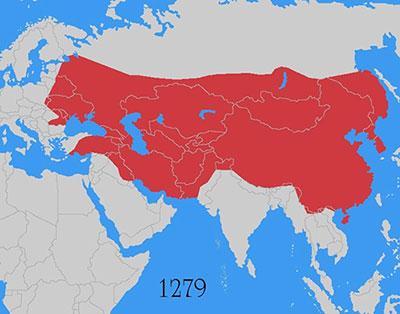
Tamerlane the Eurasian conqueror died in 1405. Darwin takes his death as marking the end of an epoch, an era inaugurated by the vast wave of conquest led across central Asia by Genghis Khan starting around 1200, an era in which one ruler could, potentially, aspire to rule the entire Eurasian landmass.

When Tamerlane was born the ‘known world’ still stretched from China in the East, across central Asia, through the Middle East, along the north African shore and including Europe. Domination of all of China, central Asia, northern India, the Middle East and Europe was, at least in theory, possible, had been achieved by Genghis Khan and his successors, and was the dream which had inspired Tamerlane.

Map of the Mongol Empire created by Genghis Khan

But by the death of Tamerlane the political situation across Eurasia had changed. The growth in organisation, power and sophistication of the Ottoman Empire, the Mamluk state in Egypt and Syria, the Muslim sultanate in north India and above all the resilience of the new Ming dynasty in China, meant this kind of ‘global’ domination was no longer possible. For centuries nomadic tribes had ravaged through Eurasia (before the Mongols it had been the Turks who emerged out of Asia to seize the Middle East and found the Ottoman Dynasty). Now that era was ending.

It was no longer possible to rule the sown from the steppe (p.5)

Moreover, within a few decades of Tamerlane’s demise, Portuguese mariners had begun to explore westwards, first on a small scale colonising the Azores and Canary Islands, but with the long-term result that the Eurasian landmass would never again constitute the ‘entire world’.

What was different about European empires?

Empires are the oldest and most widespread form of government. They are by far the commonest way that human societies have organised themselves: the Assyrians, Babylonians, Egyptians, Persians, the Greek and Roman Empires, the Aztec Empire, the Inca Empire, the Mali Empire, Great Zimbabwe, the Chinese empire, the Nguyễn empire in Vietnam, the Japanese Empire, the Ottoman empire, the Mughal empire, the Russian empire, the Austro-Hungarian empire, to name just a few.

Given this elementary fact about history, why do the west European empires come in for such fierce criticism these days?

Because, Darwin explains, they were qualitatively different.

  1. Because they affected far more parts of the world across far more widespread areas than ever before, and so ‘the constituency of the aggrieved’ is simply larger – much larger – than ever before.
  2. Because they were much more systematic in their rapaciousness. The worst example was surely the Belgian Empire in the Congo, European imperialism stripped of all pretence and exposed as naked greed backed up by appalling brutality. But arguably all the European empires mulcted their colonies of raw materials, treasures and of people more efficiently (brutally) than any others in history.

The result is that it is going to take some time, maybe a lot of time, for the trauma of the impact of the European empires to die down and become what Darwin calls ‘the past’ i.e. the realm of shadowy past events which we don’t think of as affecting us any more.

The imperial legacy is going to affect lots of people, in lots of post-colonial nations, for a long time to come, and they are not going to let us in the old European colonial countries forget it.

Structure

After Tamerlane is divided into nine chapters:

  1. Orientations
  2. Eurasia and the Age of Discovery
  3. The Early Modern Equilibrium (1750s – 1800)
  4. The Eurasian Revolution (1800 – 1830)
  5. The Race Against Time (1830 – 1880)
  6. The Limits of Empire (1880 – 1914)
  7. Towards The Crisis of The World (1914 – 42)
  8. Empire Denied (1945 – 2000)
  9. Tamerlane’s Shadow

A flood of insights

It sounds like reviewer hyperbole but there really is a burst of insights on every page of this book.

It’s awe-inspiring, dazzling, how Darwin can take the elements of tremendously well-known stories (Columbus and the discovery of America, or the Portuguese finding a sea route to India, the first trading stations on the coasts of India or the unequal treaties imposed on China, or the real consequences of the American Revolution) and present them from an entirely new perspective. Again and again on every page he unveils insight after insight. For example:

American

Take the fact – which I knew but had never seen stated so baldly – that the American War of Independence wasn’t about ‘liberty’, it was about land. In the aftermath of the Seven Years War (1756 – 63) the British government had banned the colonists from migrating across the Appalachians into the Mississippi valley (so as to protect the Native Americans and because policing this huge area would be ruinously expensive). The colonists simply wanted to overthrow these restrictions and, as soon as the War of Independence was over (i.e. after the British gave up struggling to retain the rebel colonies in 1783), the rebels set about opening the floodgates to colonising westward.

India

Victorian apologists claimed the British were able to colonise huge India relatively easily because of the superiority of British organisation and energy compared with Oriental sloth and backwardness. In actual fact, Darwin explains it was in part the opposite: it was because the Indians had a relatively advanced agrarian economy, with good routes of communication, business hubs and merchants – an open and well-organised economy, which the British just barged their way into (p.264).

(This reminds me of the case made in The Penguin History of Latin America by Edwin Williamson that Cortés was able to conquer the Aztec and Pissarro the Incas, not because the Indians were backward but precisely because they were the most advanced, centralised and well organised states in Central and South America. The Spanish just installed themselves at the top of a well-ordered and effective administrative system. Against genuinely backward people, like the tribes who lived in the arid Arizona desert or the swamps of Florida or hid in the impenetrable Amazon jungle, the Spanish were helpless, because there was no one emperor to take hostage, or huge administrative bureaucracy to take over – which explains why those areas remained uncolonised for centuries.)

Cultural conservatism

Until about 1830 there was still a theoretical possibility that a resurgent Ottoman or Persian empire, China or Japan, might have reorganised and repelled European colonisers. But a decisive factor which in the end prevented them was the intrinsic conservatism of these cultures. For example, both Chinese and Muslim culture venerated wisdom set down by a wise man (Mohammed, Confucius) at least a millennium earlier, and teachers, professors, civil servants were promoted insofar as they endorsed and parroted these conservative values. At key moments, when they could have adopted more forward-looking ideologies of change, all the other Eurasian cultures plumped for conservatism and sticking to the Old.

Thus, even as it dawned on both China and Japan that they needed to react to the encroachments of the Europeans in the mid-nineteenth century, both countries did so by undertaking not innovations but what they called restorations – the T’ung-chih (‘Union for Order’) restoration in China and the Meiji (‘Enlightened rule’) restoration in Japan (p.270). (Darwin’s description of the background and enactment of both these restorations is riveting.)

The Western concept of Time

Darwin has a fascinating passage about how the Europeans developed a completely new theory of Time (p.208). It was the exploration of America which did this (p.209) because here Europeans encountered, traded and warred with Stone Age people who used bows and arrows and (to start with) had no horses or wheeled vehicles and had never developed anything like a technology. This led European intellectuals to reflect that maybe these people came from an earlier phase of historical development, to develop the new notion that maybe societies evolve and develop and change.

European thinkers quickly invented numerous ‘systems’ suggesting the various ‘stages of development’ which societies progressed through, from the X Age to the Y Age and then on to the Z Age – but they all agreed that the native Americans (and even more so, the Australian aborigines when they were discovered in the 1760s) represented the very earliest stages of society, and that, by contrast, Western society had evolved through all the intervening stages to reach its present state of highly evolved ‘perfection’.

Once you have created mental models like this, it is easy to categorise all the other cultures you encounter (Ottomans, Hindus, China, Japan, Siam, Annamite etc) as somewhere lower or backward on these paths or stages of development.

And being at the top of the tree, why, naturally that gave white Europeans the right to intervene, invade, conquer and administer all the other people of the world in order to ‘raise’ them to the same wonderful level of civilisation as themselves.

18th and 19th

I’ve always been a bit puzzled by the way that, if you read accounts of the European empires, there is this huge difference between the rather amateurish 18th century and the fiercely efficient 19th century. Darwin explains why: in the eighteenth century there were still multiple European players in the imperial game: France was the strongest power on the continent, but she was balanced out by Prussia, Austria and also Spain and Portugal and the Dutch. France’s position as top dog in Europe was admittedly damaged by the Seven Years War but it wasn’t this, it was the Napoleonic Wars which in the end abolished the 18th century balance of power in Europe. Britain emerged from the Napoleonic Wars as the new top dog, with a navy which could beat all-comers, which had hammered the French at the Battle of the Nile and Trafalgar, and which now ruled the waves.

The nineteenth century feels different because Britain’s world-encompassing dominance was different in kind from any empire which ever preceded it.

The absence of Africa

If I have one quibble it’s that I’d like to have learned more about Africa. I take the point that his book is focused on Eurasia and the Eurasian empires (and I did learn a huge amount about Persia, the Moghul empire, China and Japan) and that all sub-Saharan Africa was cut off from Eurasia by the Sahara, but still… it feels like an omission.

And a woke reader might well object to the relative rareness of Darwin’s references to the African slave trade. He refers to it a few times, but his interest is not there; it’s in identifying exactly where Europe was like or unlike the rival empires of Eurasia, in culture and science and social organisation and economics. That’s his focus.

The expansion of the Russian empire

If Africa is disappointingly absent, an unexpected emphasis is placed in each chapter on the imperial growth of Russia. I knew next to nothing about this. A quick surf on Amazon suggests that almost all the books you can get about the Russian ’empire’ are about the fall of the Romanovs and the Bolshevik Revolution and then Lenin or Stalin’s creation of a Bolshevik empire which expanded into Eastern Europe after the war. That’s to say it’s almost all about twentieth century Russia (with the exception of a crop of ad hoc biographies of Peter the Great or Catherine the Great).

So it was thrilling to read Darwin give what amounts to a sustained account and explanation of the growth of the Kingdom of Muscovy from the 1400s onwards, describing how it expanded west (against Poland, the Baltic states, Sweden), south towards the Black Sea, south-west into the Balkans – but most of all how Russian power was steadily expanded East across the vast inhospitable tundra of Siberia until Russian power reached the Pacific.

It is odd, isn’t it, bizarre, uncanny, that a nation that likes to think of itself as ‘European’ has a huge coastline on the Pacific Ocean and to this day squabbles about the ownership of small islands with Japan!

The process of Russian expansion involved just as much conquering of the ‘primitive’ tribal peoples who hunted and trapped in the huge landmass of Siberia as the conquest of, say, Canada or America, but you never read about it, do you? Can you name any of the many native tribes the Russians fought and conquered? No. Are there any books about the Settling of the East as there are thousands and thousands about the conquest of the American West? Nope. It is a historical black hole.

But Darwin’s account of the growth of the Russian Empire is not only interesting as filling in what – for me at any rate – is a big hole in my knowledge. It is also fascinating because of the role Russian expansion played again and again in the game of Eurasian Risk which his book describes. At key moments Russian pressure from the North distracted the attention of the Ottoman Empire from making more offensive thrusts into Europe (the Ottomans famously encroached right up to the walls of Vienna in 1526 and then again in 1683).

When the Russians finally achieved one of their territorial goals and seized the Crimea in 1783, as a result of the Russo-Turkish War, it had the effect, Darwin explains, of cracking the Ottoman Empire open ‘like an oyster’. For centuries the Black Sea had been an Ottoman lake and a cheaply defensible frontier. Now, at a stroke, it became a massive vulnerability which needed costly defence (p.175).

And suddenly, seeing it all from the Russian perspective, this sheds new light on the timeworn story of the decline of the Ottoman Empire which I only know about from the later 19th century and from the British perspective. For Darwin the role of Russian expansionism was vital not only in itself, but for the hemming in and attritional impact it had on the other Eurasian empires – undermining the Ottomans, making the Chinese paranoid because Russian expansion around its northern borders added to China’s sense of being encircled and endangered, a sense that contributed even more to its risk-averse policy of doubling down on its traditional cultural and political and economic traditions, and refusing to see anything of merit in the Westerners’ technology or crude diplomacy. A policy which eventually led to the Chinese empire’s complete collapse in 1911.

And of course the Russians actually went to war with imperial Japan in 1905.

Numbered lists

Darwin likes making numbered lists. There’s one on almost every page. They rarely go higher than three. Here are some examples to give a flavour of his careful, forensic and yet thrillingly insightful way of explaining things.

The 18th century geopolitical equilibrium

The geopolitical revolution which ended the long equilibrium of the 18th century had three major effects:

  1. The North American interior and the new lands in the Pacific would soon become huge extensions of European territory, the ‘new Europes’.
  2. As a result of the Napoleonic war, the mercantile ‘zoning’ system which had reflected the delicate balance of power among European powers was swept away and replaced with almost complete control of the world’s oceans by the British Navy.
  3. Darwin gives a detailed description of why Mughal control of North India was disrupted by invasions by conquerors from the north, first Iran then Afghanistan, who weakened central Indian power at just the moment the British started expanding from their base in Bengal. Complex geopolitical interactions.

The so-called stagnation of the other Eurasian powers can be characterised by:

  1. In both China and the Islamic world classical, literary cultures dominated the intellectual and administrative elites – the test of intellectual acumen was fitting all new observations into the existing mindset, prizes went to those who could do so with the least disruption possible.
  2. Cultural and intellectual authority was vested in scribal elites backed up by political power, both valuing stasis.
  3. Both China and the Islamic world were profoundly indifferent and incurious about the outside world.

The knowledge revolution

Compare and contrast the East’s incuriosity with the ‘West’, which underwent a cognitive and scientific revolution in which merit went to the most disruptive inventors of new theories and technologies, and where Darwin describes an almost obsessive fascination with maps. This was supercharged by Captain Cook’s three huge expeditions around the Pacific, resulting in books and maps which were widely bought and discussed, and which formed the basis of the trade routes which followed in his wake, and then the transportation of large numbers of convicts to populate Australia’s big empty spaces (about 164,000 convicts were transported to the Australian colonies between 1788 and 1868).

Traumatic impact of the Napoleonic Wars

I hadn’t quite realised that the Napoleonic Wars had such a traumatising effect on the governments of the main European powers who emerged in its aftermath: Britain, France, Prussia, Austria and Russia. Very broadly speaking there was peace between the European powers between the 1830s and 1880s. Of course there was the Crimean War (Britain, France and Turkey containing Russia’s imperial expansion), war between Austria and Prussia (1866) and the Franco-Prussian War. But all these were contained by the system, were mostly of short duration and never threatened to unravel into the kind of general conflict which ravaged Europe under Napoleon.

Thus, from the imperial point of view, the long peace had four results:

  1. The Royal Navy’s policing of all trade routes across the Atlantic and between Europe and Asia kept trade routes open throughout the era and kept costs down for everyone.
  2. The balance of power which the European powers maintained among themselves discouraged intervention in either North or South America and allowed America to develop economically as if it had no enemies – a rare occurrence for any nation in history.
  3. The post-Napoleonic balance of power in Europe encouraged everyone to tread carefully in their imperial rivalries.
  4. Geo-political stability in Europe allowed the growth across the continent of something like a European ideology. This was ‘liberalism’ – a nexus of beliefs involving the need for old-style autocratic power to be tempered by the advice of representatives of the new middle class, and the importance of that middle class in the new technologies and economics unleashed by the industrial revolution and in founding and administering the growing colonies abroad.

Emigration

Emigration from Europe to the New World was a trickle in the 1830s but had become a flood by the 1850s. Between 1850 and 1880 over eight million people left Europe, mostly for America.

  1. This mass emigration relieved the Old World of its rural overcrowding and transferred people to an environment where they could be much more productive.
  2. Many of the emigrants were in fact skilled artisans. Moving to an exceptionally benign environment, a vast empty continent rich in resources, turbo-charged the American economy with the result that by the 1880s it was the largest in the world.

Fast

His chapter The Race Against Time brings out a whole area, an entire concept, I’ve never come across before, which is that part of the reason European colonisation was successful was it was so fast. Not just that Western advances in military technology – the lightning advances in ships and artillery and guns – ran far ahead of anything the other empires could come up with – but that the entire package of international finance, trade routes, complex webs sending raw materials back home and re-exporting manufactured goods, the sudden flinging of railways all across the world’s landmasses, the erection of telegraphs to flash knowledge of markets, prices of goods, or political turmoil back from colonies to the European centre – all of this happened too quickly for the rival empires (Ottoman, Japan, China etc) to stand any chance of catching up.

Gold rushes

This sense of leaping, hurtling speed was turbo-charged by literal gold rushes, whether in the American West in the 1840s or in South Africa where it was first gold then diamonds. Suddenly tens of thousands of white men turned up, quickly followed by townships full of traders and artisans, then the railway, the telegraph, the sheriffs with their guns – all far faster than any native American or South African cultures could hope to match or even understand.

Shallow

And this leads onto another massive idea which reverberates through the rest of the book and which really changed my understanding. This is that, as the spread of empire became faster and faster, reaching a kind of hysterical speed in the so-called Scramble For Africa in the 1880s (the phrase was, apparently, coined by the London Times in 1884) it meant that there was something increasingly shallow about its rule, especially in Africa.

The Scramble for Africa

Darwin says that most radical woke historians take the quick division of Africa in the 1880s and 1890s as a kind of epitome of European imperialism, but that it was in fact the opposite, and extremely unrepresentative of the development of the European imperialisms.

The Scramble happened very quickly, markedly unlike the piecemeal conquest of Central, Southern of North America, or India, which took centuries.

The Scramble took place with almost no conflict between the European powers – in fact they agreed to partitions and drew up lines in a very equable way at the Congress of Berlin in 1885. Other colonies (from the Incas to India) were colonised because there were organised civilisations which could be co-opted, whereas a distinctive feature about Africa (‘historians broadly agree about one vital fact’ p.314) was that people were in short supply. Africa was undermanned or underpeopled. There were few organised states or kingdoms because there simply wasn’t the density of population which lends itself to trading routes, settled farmers and merchants – all the groups who can be taxed to create a king and aristocracy.

Africans hadn’t progressed to centralised states as humans had in Eurasia or central America because there weren’t enough of them. Hence the poverty and the lack of resistance which most of the conquerors encountered in most of Africa.

In fact the result of all this was that most of the European governments weren’t that keen on colonising Africa. It was going to cost a lot of money and there weren’t the obvious revenue streams that they had found in a well-established economy like India.

What drove the Scramble for Africa more than anything else was adventurers on the ground – dreamers and fantasists and ambitious army officers and business men and empire builders who kept on taking unilateral action which then pitched the home government into a quandary – deny their adventurers and pass up the opportunity to win territory to a rival, or reluctantly support them and get enmeshed in all kinds of messy responsibilities.

For example, in the mid-1880s a huge swathe of West Africa between the desert and the forest was seized by a buccaneering group of French marine officers under Commandant Louis Archinard, and their black rank and file. In a few years these adventurers brought some two million square miles into France’s empire. The government back in Paris felt compelled to back them up which meant sending out more troops, police and so on, which would cost money.

Meanwhile, modern communications had been invented, the era of mass media had arrived, and the adventuring soldiers and privateers had friends and boosters in the popular press who could be counted on to write leading articles about ‘the white man’s burden’ and the torch of civilisation and ask: ‘Isn’t the government going to defend our brave boys?’, until reluctant democratic governments were forced to cough up support. Modern-day liberals often forget that imperialism was wildly popular. It often wasn’t imperialist or rapacious governments or the ruling class which prompted conquest, but popular sentiment, jingoism, which couldn’t be ignored in modern democracies.

Darwin on every page, describes and explains the deep economic, trade and financial structures which the West put in place during the nineteenth century and which eventually underpinned an unstoppable steamroller of annexation, protectorates, short colonial wars and long-term occupation.

The Congress of Berlin

The Congress of Berlin helped to formalise the carving up of Africa, and so it has come to be thought of as evil and iniquitous, particularly by BAME and woke historians. But once again Darwin makes you stop and think when he compares the success of the congress at reaching peaceful agreements between the squabbling European powers – and what happened in 1914 over a flare-up in the Balkans.

If only Bismarck had been around in 1914 to suggest that, instead of rapidly mobilising to confront each other, the powers of Europe had once again been invited for tea and cake at the Reichstag to discuss their differences like gentlemen and come to an equable agreement.

Seen from this perspective, the Berlin Congress is not so much an evil colonialist conspiracy, but an extremely successful event which avoided any wars between the European powers for nearly thirty years. Africa was going to be colonised anyway because human events have a logic of their own: the success was in doing so without sparking a European conflagration.

The Scramble for China

The Scramble for China is not as well known as its African counterpart,  the competition to gain ‘treaty ports’ on the Chinese coast, impose unfair trading terms on the Chinese and so on.

As usual, though, Darwin comes at it from a much wider angle and makes one massive point I hadn’t registered before, which is that Russia very much wanted to seize the northern part of China to add to its far eastern domains; Russia really wanted to carve China up, but Britain didn’t. And if Britain, the greatest trading, economic and naval power in the world, wasn’t onside, then it wouldn’t happen. There wasn’t a genuine Scramble for China because Britain didn’t want one.

Why not? Darwin quotes a Foreign Office official simply saying, ‘We don’t want another India.’ One enormous third world country to try and administer with its hundreds of ethnic groups and parties growing more restive by the year, was quite enough.

Also, by the turn of the century, the Brits had become paranoid about Russia’s intentions to conquer Afghanistan and march into North India. If they partitioned China with Russia, that would mean policing an even longer frontier even further way against an aggressive imperialist power ready to pounce the moment our guard was down.

Summary

This is an absolutely brilliant book. I don’t think I’ve ever come across so many dazzling insights and revelations and entirely new ways of thinking about a time-worn subject in one volume.

This is the book to give anyone who’s interested not just in ‘the rise of the West’ but how the whole concept of ‘the West’ emerged, for a fascinating description not just of the European empires but of all the empires across Eurasia – Ottoman, Persian, Moghul, Chinese and Japanese – and how history – at this level – consists of the endless juggling for power of these enduring power blocs, the endless and endlessly

complex history of empire-, state- and culture-building. (p.490)

And of course it all leads up to where we are today: a resurgent Russia flexing its muscles in Ukraine and Crimea; China wielding its vast economic power and brutally oppressing its colonial subjects in Tibet and Xinkiang, while buying land, resources and influence across Africa. And both Russia and China using social media and the internet in ways we don’t yet fully understand in order to undermine the West.

And Turkey, keen as its rulers of all colours have been since the Ottoman days, to keep the Kurds down. And Iran, as its rulers have done for a thousand years, continually seeking new ways to extend its influence around the Gulf, across Syria and to the Mediterranean, in eternal rivalry with the Arab world which, in our time, means Saudi Arabia, against whom Iran is fighting a proxy war in the Yemen.

Darwin’s books really drives home the way the faces and the ideologies may change, but the fundamental geopolitical realities endure, and with them the crudeness and brutality of the tools each empire employs.

If you let ‘morality’, especially modern woke morality, interfere with your analysis of this level of geopolitics, you will understand nothing. At this level it always has and always will be about power and influence, dominating trade and ensuring raw resources, and behind it all the never-ending quest for ‘security’.

At this level, it isn’t about following narrow, English notions of morality. Getting hung up on that only gets in the way of grasping the utterly amoral forces at play everywhere in the world today, just as they’ve always been.

Darwin stands up for intelligence and insight, for careful analysis and, above all, for a realistic grasp of human nature and human society – deeply, profoundly flawed and sometimes pitiful and wretched though both routinely are. He takes an adult view. It is absolutely thrilling and a privilege to be at his side as he explains and analysis this enormous history with such confidence and with so many brilliant ideas and insights.


Related reviews

Exhibitions

History

Imperial fiction

Funeral In Berlin by Len Deighton (1964)

‘What I’d like is an interest-free loan of eight hundred quid to buy a new car’, I said.
Dawlish gently packed tobacco into the bowl of his pipe with a match. He put the pipe into his mouth before looking up at me.
‘Yes,’ he finally said.
‘Yes I want it or yes I can have it?’ I said.
‘Yes, everything they say about you is true,’ said Dawlish. ‘Go away and let me work.’
(Funeral in Berlin, Chapter 13)

‘You live only once,’ said Stok.
‘I can make once do,’ I said.
(p.37)

There is no point in just wondering about the things that puzzle us. (p.105)

It’s O.K. to have soft feelings knowing that years of training preclude one from obeying them. (p.217)

‘You are a terrible tease,’ said Hallam. ‘I never know when you’re serious.’ (p.230)

Funeral In Berlin, the third novel of the Ipcress File tetralogy, strikes me as being more relaxed and funnier than its predecessors.

‘Do you ever imagine what it would be like to be on the moon?’ Sam said.
‘Nearly all the time,’ I said. (Ch 15)

The humour works better and the disconnected, angular style is, initially at least, less impenetrable than in The Ipcress File. Several times I even thought I knew what was going on although, no, it was as murky and rifted by double meanings, ambiguities and uncertainties as the first two. Even when things are made (relatively clear) in a brief explanation in chapter 44, it turns out this explanation needs further explanation in chapter 49, pages 245-6.

‘I never joke, Chico. The truth is quite adequately hilarious.’ (Ch 13)

Street smart

It’s set just slightly before the Swinging Sixties, when people still talked about ‘beatniks’ and hung out in Soho coffee bars and the most raucous sounds seem to come from loud jazz. A world where the nameless Narrator is keen to demonstrate his street smarts, his cool, his savvy.

Charlotte Street runs north from Oxford Street and there are few who will blame it. By mid-morning they are writing out the menus, straining yesterday’s fat, dusting the plastic flowers and the waiters are putting their moustaches on with eyebrow pencils. (Ch 13)

The colour and detail of ‘pads’ which are about to feature in colour supplements about Jean Shrimpton or Burt Bacharach.

I walked into the lounge. It was about thirty foot of ankle-high carpeting from silk wall to silk wall. The cocktail cabinet was in the corner. I opened it and was socked in the head by pink neon. (Ch 14)

And yet, as I’ve noted before, the cool of Deighton (b. 1929) is combined with what later generations, or even the Beatles generation (b.1940), would think of as still very high-brow intellectual pursuits: when he wines and dines the sexy American girl he’s picked up – or who’s picked him up – they agree to go to a concert at the South Bank which includes the music of Charles Ives, Berg and Schoenberg. In fact the Schoenberg piece – Variations for Wind band – appears three times, in different places, like a leitmotiv. Maybe its recurrence is a hint that the novel itself is made out of a theme and variations, as the Schoenberg piece is, with the same recurring motifs given different treatment, seen from different angles (and, in an innovation for Deighton, we are given the points of view of several characters, see below).

Security Service savvy

Deighton does a very good job of conveying how we imagine the Security Services to actually be i.e. not at all glamorous jetsetting but a pettifogging bureaucratic cross between the Army and the Civil Service, snowed under with paperwork, its employees fussing about pay and pensions and expenses, thrilling to little perks like luxury lunches at the club – except that the petty jealousies and rivalries which plague all bureaucracies in this context overlap with very real plots and conspiracies to frame each other (as in Ipcress) or to hamstring each other’s projects to double-cross or treble-cross the Russian, or German, or Israeli secret services.

Textual apparatus

The security savviness is reinforced by more of the larky apparatus surrounding the text that was deployed in Ipcress and Horse Under Water:

  • in the classic spy manner, each short chapter has a date stamp (e.g. Berlin, Monday, October 7th – since Bonfire Night, November 5th, is a Tuesday, it must be set in 1963)
  • there are, again, numerous footnotes explicating Security Service acronyms or military practice, specialist knowledge such as what a D notice is, 18 in the first 60 pages alone
  • there are half a dozen appendices at the end of the text giving longer explanations of aspects of the story (poisonous insecticides; Gehlen Organisation; the Abwehr; Soviet security systems; French security systems; Official Secrets Act 1911)
  • as Ipcress File had horoscopes at the head of each chapter, and Horse Under Water had crossword clues, so each of Funeral‘s 52 chapters has an epigraph which is a rule or tip about chess. I play chess pretty well so was mildly interested in some of them, but they added nothing to my enjoyment and, as far as I could see, nothing to the meaning of the story so, like the horoscopes, I learned to ignore them
  • right at the end we learn that throughout the adventure, the Narrator has been doing an ‘It pays to increase your word power’ game. His rating is ‘fair’

The Narrator

The greatest tribute you can pay to a secret agent is to take him for a moron. All he has to do is to make sure he doesn’t act too exactly like one. That was my concern now. (p.109)

Funeral has the same unnamed, first-person Narrator as The Ipcress File, working for the same obscure intelligence unit (W.O.O.C.(P.)) and the same boss – Dawlish – as in Horse:

Dawlish and I have a perfect system. It is a well-known fact that I am an insolent intractable hooligan over whom Dawlish has only a modicum of control. Dawlish encourages this illusion. One day it will fail. Dawlish will throw me to the wolves. (p.170)

He has the same secretary (Jean Tonnesson) and staff (Alice Bloom, Chico), working out of the same dingy Charlotte Street office. As in Horse, it is emphasised that the Narrator owes his position to his specialist knowledge of finances:

The system upon which we ran the department was that I took responsibility for all financial problems, although what might be called ‘accounts’ were seen by Alice and I merely initialled them. It was my special knowledge of finance which had brought me into W. O. O. C.(P) and compelled them to put up with me. (p.225)

He wears spectacles. He smokes Gauloise cigarettes. He is knowledgeable about modern classical music. He lives in a flat in Southwark, although he tells old General Borg ‘I live behind Waterloo Station’.

And he’s getting fat. There are half a dozen references to him ‘throwing caution to the wind’ when he eats out, just casual throwaway moments like:

The steak was O.K. and I was strong-willed enough not to hit the sweet-trolley too hard.

These hints are reinforced in the sequel, Billion Dollar Brain.

Plot

The novel follows a series of trips the Narrator makes to Cold War Berlin (under the pseudonym Edmond Dorf) and starts off being about the defection of a Russian scientist, Semitsa, reputedly an expert on enzymes used in pesticides and so useful to the West, the deal being arranged by ‘our’ Berlin fixer and chancer, Johnnie Vulkan.

Slowly it emerges that this is a red herring and that the plot is really about the legacy of the war, about the fate of a German murderer who was in a concentration camp during the Nazi era and who has survived into post-War Berlin, although wanted by both the Communists and the Israelis.

The progress of the plot and of the Narrator’s efforts are closely monitored by the Russian General Stok, who pops up throughout the book, initially hinting that he himself wants to defect and that Semitsa’s passage will be a dry run for him. Later on, Stok admits that he just wants to keep an eye on everything. Stok is a broadly comic character, forever making toasts with vodka and caviare, engaging in witty banter with the wryly understated Narrator. Though there are a couple of sinister moments when the Narrator is pulled over by police in East Germany, then in Czechoslovakia, and thinks he might be about to be arrested – only for Stok to emerge from the shadows with a big grin and a bottle of vodka!

In Ipcress the Narrator says plots aren’t as easy to define or tie up as writers of spy fiction would have you expect. He claims to have some 600 files open at any one time, each of which is highly complex and may not even be a definite ‘case’, may just be an accidental overlapping of circumstances, while real ‘cases’ i.e. interconnected purposeful events, are going undetected.

All three novels dramatise this sense of uncertainty. It’s difficult to know what’s going on because in the ‘real world’ which the spy inhabits, everyone is lying, everyone has multiple identities and concealed agendas, you’re not even certain what your ‘own’ side wants, let alone the other official agencies, let alone the numerous freelancers you continually meet and who are continually making dubious offers and suggestions.

Thus for most of the novel it’s difficult to know whether this is:

  • a true case of a Russian scientist defecting
  • something to do with the Gehlen Bureau or Organisation, a branch of German Intelligence – creepy Teutonic types we meet a couple of times and who offer to help facilitate the smuggling of Semitsa through the wall – or are they up to something more?
  • a dummy run for General Stok’s own plan to defect. In the end it turns out he doesn’t want to and is interested in something else completely

The main love interest is the gorgeous Samantha Steele, who seduces the Narrator while posing as an American agent. In the final quarter she is revealed to be an Israeli agent (for the Shin Bet) and for a while it seems the plot might be about the Israelis tracking down a concentration camp guard who was responsible for murders in the death camps, and is still alive, and therefore deserves punishing…

At one point is seems as if Johnnie Vulkan has taken British money to facilitate the smuggling of the Russian scientist Semitsa, across the Berlin Wall hidden in a coffin – hence the title – but plans to double cross the Narrator and the British by selling Semitsa on to Sam and Israeli Intelligence.

But when Vulkan and the Narrator open the coffin as delivered to them in a West Berlin garage, they find no scientist, just a load of propaganda pamphlets. It seems this is a joke the ubiquitous Colonel Stok has played on them; not only did he never intend to defect himself, he never intended to supply any Russian scientist either – all along he simply wanted to poke and pry into British Intelligence methodology, and also entrap the members of the Gehlen Bureau who had been helping, five of whom mysteriously disappear.

But in any case it then turns out that Vulkan doesn’t give a damn about Semitsa or the Israelis – all along Vulkan had insisted the papers for the ‘corpse’/coffin be made out in the name of one Paul Louis Broum. For a while it seemed to be merely a coincidence that, upon deeper investigation, this Broum had been a real person who had survived for a while in Treblinka concentration camp before being murdered on the long walk West escaping the advancing Russians – it was just a useful name to put on the documentation covering the smuggling of Semitsa through the wall.

But slowly this Broum figure becomes more important: could it be that he had lived on and that his murder was really a story and Broum was in fact Vulkan or one or other of his dodgy underworld contacts?

The Narrator probes this murky history on a vividly described trip to Prague where he meets two ageing Jews (Jan-im-Gluck and Josef-the-gun) who survived the camps and knew the real Broum, and claimed to witness his murder. It is typical of the novel (and of ‘reality’?) that they give sharply differing accounts of Broum’s character and fate…

the novel builds up to an extended set-piece wherein a hearse navigates the security checks and concrete traffic blocks at Checkpoint Charlie, carrying a dead Berliner who wants to be buried in the West, which passes through unhindered and drives on to an abandoned warehouse.

Here the Narrator and Vulkan open the coffin and discover it contains no Russian scientist but is packed with propaganda pamphlets – this is Colonel Stok’s little joke. Thinking the Narrator has double crossed him Vulkan turns nasty and pulls a gun, demanding the Narrator hands over all the Broum paperwork. Through sheer (bad) luck the Narrator knocks Vulkan backwards onto a rack of drills and Vulkan dies a horrible agonising death from a punctured lung.

The Narrator promptly takes out the pamphlets and packs Vulkan’s body into the coffin in time for the Israeli agents to arrive and collect it at gunpoint. This team is led by his brief one-time lover Sam Steele whose real name is now revealed as Hannah Stahl, who explains to the Narrator that they need Semitsa because his innocent-sounding work on enzymes is a cover for research into deadly nerve gases, and this information will be vital for Israel when the next Arab-Israeli War breaks out (as it, of course, did, three years after this novel was published).

Boy, is she in for a surprise when she opens the coffin and finds no Russian scientist, just the embarrassing corpse of a Berlin playboy and chancer (with whom, incidentally, she had also had a fling; the chapter giving her point of view has her comparing Vulkan and the narrator as lovers, and potential fathers) – although we are not shown this scene, Deighton leaves her and the truck carrying the coffin as it drives through West Germany, so leaving the revelation to our imagination.

And then there’s the departmental politics back in dear old London, where the narrator can never be sure whether his boss is backing him up or framing him, or whether other departments like the War Office or Foreign Office or Home Office are helping whatever it is he’s trying to do, or are playing completely different games in which he is only a pawn.

Explanation 1

It’s only right at the end that, in two conversations with his boss, the Narrator finally explains everything:

  • ‘In a concentration camp there is a very wealthy man named Broum. Broum’s family left him about a quarter of a million pounds in securities in a Swiss bank. Anyone who can prove he is Broum can collect a quarter of a million pounds. It’s not hard to understand; Vulkan wanted those papers to prove that he was Broum. All the other things were incidental. Vulkan made Gehlen’s people ask us for the papers to make it appear more genuine.’
  • Sam the Israeli intelligence agent wanted Semitsa for the Israeli scientific programme.
  • ‘Vulkan wanted to give Semitsa to the Israeli Government. In exchange for this they would endorse his claim to the Broum fortune. The Swiss banks are very sensitive to the Israeli Government. It was a brilliant touch.’

Explanation 2

Goes into more detail:

‘Vulkan existed all right,’ I said. ‘He was a concentration-camp guard until a wealthy prisoner (who had been an assassin for the Communist Parties) arranged to have him killed. This man was Broum, and an S.S. medical officer named Mohr… ‘
‘The one in Spain now. Our Mohr.’
I nodded. ‘… made a deal. The S.S. officer staged a death scene and made sure that Broum was believed dead by all the prisoners. Broum meanwhile dressed as a German soldier and disappeared. In 1945 even being a German soldier was better than being a murderer. What’s more Broum (or Vulkan) got along very well financially even without the £250,000, but it was nice to think it was there waiting. Perhaps he intended to leave it to someone. Perhaps on his death-bed, beyond the reach of the guillotine, he was going to say who he really was. No. It was this new law about unclaimed property that made him suddenly start to move. What he needed was a way of proving he was Broum and then of not being Broum just as quickly.’
‘It’s astonishing,’ said Dawlish, ‘to think of a Jewish prisoner who had suffered so much going all through his life saying that he had been a Nazi guard in a concentration camp.’
‘He didn’t know whether he was up or down,’ I said. ‘He came to the conclusion that if you throw enough money around you don’t have enemies. Vulkan, Broum, whatever you want to call him, his final allegiance was to cash.’

The new law referred to had just been passed by the Swiss government and allowed any descendants of Jews murdered by the Nazis to apply for Nazi money which had been deposited in Swiss banks. As per explanation 1, ‘Broum’s family left him about a quarter of a million pounds in securities in a Swiss bank. Anyone who can prove he is Broum can collect a quarter of a million pounds.’ So the man who had been passing himself off as Johnny Vulkan for so long, wanted the paperwork in the name of his own actual, real identity, Broum, so as to apply for the money. He only arranged ‘the defection of Semitsa to the West’ with a view to immediately handing him over to the Israelis to help their war effort, in exchange for their ratifying his claim for the Swiss money. In doing so he was planning to completely double-cross the Narrator and British Intelligence. In the event they were all double-crossed by Colonel Stok who had the last laugh by stringing everyone along without the slightest intention of helping a Russian scientist defect. In a bid to make the smuggling look genuine, Vulkan had the Gehlen Group ask the British security services for paperwork in the name of Broum as if it was plucked at random, and to throw them off the scent, when in fact the paperwork was all he wanted out of the whole complicated scenario. And so the trajectory of the novel is us following the Narrator as he slowly pieces together the true history of this Broum/Vulkan, and piecing together the motivation of the various players.

To recap: the entire scientist-smuggling operation was, for Vulkan, purely a pretext to get his hands on a set of British government-authenticated identity papers in the name of Broum. He would then use these to reclaim Broum’s fortune. It was a straightforward criminal scam.

The Hallam connection

As with the previous novels, the plot felt like it was over with the failure of the Semitsa defection and the death of Vulkan but there is one last act. This is where the homosexual official in the Home Office, Hallam, who had commissioned the documents in Broum’s name which were given to the Narrator to hand over to Vulkan, turns nasty. He takes the Narrator to a fireworks night display in a bombed-out vacant lot near Gloucester Road. Here, amid the bangs and crashes, and in an impenetrably thick London fog, Hallam tries to shoot the Narrator, confirming the Narrator’s hunch that he was in on Vulkan’s scam and is now after the Broum documents (which he knows are worth quarter of a million pounds).

Only in the Narrator’s final wind-up conversation with his boss, Dawlish, does it emerge that they both knew that Hallam was on the verge of being sacked for his ‘homosexual tendencies’. This is what drove him to throw in his lot with Vulkan and then to make a rather panicky attack on the Narrator. In this dramatic scene, the Narrator avoids Hallam’s shots while throwing fireworks at him until Hallam’s long flamboyant scarf catches fire then ignites the bottle of booze in his pocket, so that he goes up like a Roman candle. Nasty.

What gives the novel its peculiarly Deightonesque quality – apart from the vivid descriptive passages, zippy similes and elliptical dialogue – is that the narrator – who holds all the cards i.e. has his suspicions and is calculating the angles on all the scenarios mentioned above – does not share this knowledge with the reader. In this novel, as in Ipcress, it is only at the very, very end that any kind of order or pattern emerges from the events described, and then only in laconic conversations with his secretary or boss – and even this ‘final roundup’ still leaves holes in the narrative and motivation. Like, is any of this long complicated farrago actually remotely believable?

Cast

  • Narrator
  • Jean Tonnesson – his secretary and girlfriend
  • Dawlish – his boss, Hallam disrespectfully calls him ‘Granny’ Dawlish – is cultivating English wildflowers (also known as hedgerow flowers) at home
  • Hallam – gay, corrupt, upper-class Home Office civil servant – owner of two cats, Confucius and Fang – dies horribly after a shooutout at a Bonfire Night party (chapter 2 is told from his point of view)
  • Johnny Vulkan – freelance agent in Berlin: on the payroll of British Intelligence, but doesn’t work only for them, not for ‘a lousy two grand a month’ – ‘Growing older seemed to agree with him. He didn’t look a day over forty, his hair was like a tailored Brillo pad and his face tanned’ – according to Stok, the best chess player in Berlin – the novel turns out to centre on his secret identity, a Jew, Broum, who escaped from a Nazi concentration camp
  • Colonel Stok – Soviet intelligence officer who offers to help Semitsa defect to the West – ‘He was a big-boned man, his hair was cropped to the skull and his complexion was like something the dog had been playing with. When he stood up to greet us his huge hands poked out of a bright red silk smoking-jacket with gold-braid frogging’ (chapter 34 is told from his point of view)

‘It’s not my job to think,’ said Stok. ‘I employ youngsters to do that; their minds aren’t so
cluttered up with knowledge.’ (p.150)

  • the Gehlen Bureau – Later the B.N.D. or Federal German Intelligence Service, but still generally referred to as the ‘Gehlen Bureau’, it has an appendix devoted to it
  • Semitsa – Soviet scientist, enzyme specialist, we never meet him, might be completely fictional
  • Sam Steele – 5 foot 10, sexy American young woman the Narrator starts an affair with – he thinks she’s an American agent then realises she’s working for The Shin Bet, or Israel Security Agency, real name Hannah Stahl (chapter 43 is told from her point of view)

She combed her hair through her fingers. It was soft and young; fine silky hair. She let it fall against her neck like murmurs of love.

  • Austin Butterworth aka ‘Ossie’ – professional burglar who the Narrator pays to break into and ransack Sam’s flat, cover for searching for clues to her real identity
  • Grenade – French agent working for Direction de la Surveillance du Territoire (DST)
  • Harvey Newbegin – US State Department man in Prague; takes the Narrator out to a rural pub to meet…
  • Jan-im-Gluck (Lucky Jan) – Jewish, the dark vole-like old man Harvey takes him to see in a peasant restaurant outside Prague who tells him about the character of Paul Louis Broum, a charismatic figure in Treblinka concentration camp, the last days of the camp, the death march, how Broum was strangled that night, how in the morning several prisoners were shot point blank for his murder
  • Josef-the-gun – so named because of his stutter, Jan-im-Gluck’s brother, ‘they hate each other’ – at the Pinkas synagogue in Prague he stuns the Narrator by telling him the man who murdered Broum on the death march from Treblinka was named Vulkan!
  • Paul Louis Broum – Czech German Jew who, according to the brothers, was killed on the death march from Treblinka (Alice christens the Broum report Death’s-head hawk moth) – only late in the novel do we realise that Johnny Vulkan is this Broum who arranged his own ‘death’ on the march from Treblinka, took the identity of a German guard and disappeared, has been concealing his identity for 20 years, but has organised the entire defection scenario solely to get his hands on UK government paperwork for Broum, in order to present it to the Swiss government and claim the £250,000 left him by relatives in a Swiss bank
  • Colonel-General Erich Borg, Commander Panzer Group ‘Borg’ – ‘General Borg was a tall thin man. Sitting low in the ancient armchair, all knees and elbows, he looked as delicate as a stick insect. His face was very white and very wrinkled like a big ball of string’ – the Narrator visits him to confirm details of Broum’s fate because he has kept ‘one of the best collections of military records in the whole of Germany’ – assisted by his daughter, Heidi
  • Heidi Borg – daughter and secretary for the above
  • Dr Ernst Mohr – Nazi doctor who helped arrange Broum/Vulkan’s escape, identified thanks to a photo taken at the camp – survived the war and now a successful businessman in Spain, where Vulkan goes to visit him – Vulkan blackmails Mohr into keeping silent about his true identity by claiming Sam and Shin Bet are after him but he’ll throw her off the trail

Multiple points of view

In a narrative development over the previous two novels, some of the chapters in Funeral take the perspective of characters other than the main narrator. These chapters are told by an omniscient third-person narrator who allows us into these other characters’ thoughts. This is a small mercy and makes Funeral easier to enjoy, if not exactly to follow, than Ipcress, which is so dominated by the concealing, allusive style of the narrator. Deighton relaxes (slightly) and draws extended pen portraits of other key characters and these are enjoyable in their own right.

It’s in two of these alternative POV chapters that we learn about the Narrator’s coming from Burnley. In chapter 2 Hallam the homosexual gives us a brief and much-quoted description of the anonymous narrator:

An upstart from Burnley – a supercilious anti-public school technician who thought he was an administrator.

While, towards the end, in chapter 43, Samantha Steel, now revealed to be Hannah Stahl, reflects on her brief fling with the Narrator:

She wished she had known him many years ago when he was at his red-brick university, this provincial boy wandering through the big city of life. She envied him his simplicity and briefly wished she had been the girl next door in Burnley, Lancs – wherever that was! (p.218)

Smart similes

In this slightly more forgiving book the similes also seem less incongruous, more of a piece with the humour. Similes, like metaphors are, after all, a kind of joke, a revelation of incongruous similarities.

‘Ha ha ha,’ said Stok, then he exhaled another great billow of cigar smoke like a 4.6.2 pulling out of King’s Cross. (Ch 6)

Damp leaves shone underfoot like a million newly struck pennies. (Ch 15)

Now the powdery skin [of his face], sun-lamped to a pale nicotine colour, was supported only by his cheek-bones, like a tent when the guy ropes are slackened. (Ch 16)

Though some of the comparisons, as in Ipcress, strain a little harder than others.

From underfoot the sweet smell of damp grass rose like perfume. Birds were still singing in the trees that stood across the major surgery of sunset like massed artery forceps. (15)

Inside the semi-precious light of the stained glass softly dusted the smooth, worn pews, and a complex of brass candlesticks glinted like a medieval oil refinery. (15)

These last two indicate the fundamentally anti-Romantic, unsentimental stance of his no-nonsense Narrator: he dumps his secretary-girlfriend of the first book, Jean in order to have an affair with the leggy American agent, Sam Steele; then arranges for her flat to be burgled to establish who she really is, confirming his hunch that she is an Israeli agent. He mistakenly beats up an elderly messenger in the street in Berlin and has no regrets (Ch 19). He kills two more major – and rather sympathetic – characters (Johnnie Vulkan and Hallam). And this hard, metallic attitude extends all the way down to small descriptions and casual phrases.

In Horse Guards Avenue and right along the Thames Embankment, hollow tourist buses were parked and double-parked. The red-cloaked Horse Guards sat motionless clutching their sabres and thinking of metal polish and sex. In Trafalgar Square pigeons were enmeshed in the poisonous diesel gauze. (Ch 17)

I walked out along the moonlit sea front. The phosphorescent breakers crumbled into shimmering lacework and the moon was an overturned can of white paint that had spilled its contents across the sea. (Ch 24)

This tough but humorous tone is the distinctive feature of the novel’s worldview and of its prose. Tough but humorous also characterises Raymond Chandler’s innovative style in the detective genre, and it is probably this elliptical humour – along with the impenetrable plots – which are Deighton’s big contribution to the spy novel. A tone of underplayed humour which is perfectly captured by Michael Caine’s performance in the movie adaptations of these books. It’s full of dryly humorous quips.

‘I wish you would try to understand,’ said Stok. ‘I am really sincere about giving you my allegiance.’
‘Go on,’ I said. ‘I bet you say that to all the great powers.’ (Ch 5)

Russian sayings

Deighton enjoyed littering Horse Under Water with Portuguese proverbs. Proverbs, like similes, are related to the kind of pithy, gnomic puzzles that appeal to him (like the books’ crossword puzzles and chess rules). In the same spirit Colonel Stok is given a few entertaining Russian sayings:

  • ‘In my country we have a saying, “a man who trades a horse for a promise ends up with tired feet”.’
  • In Russia we have a proverb, “Better a clever lie than the foolish truth”.’ (p.38)

Jokes

And jokes:

‘I heard a very good joke the other day.’ He [Stok] was speaking very softly now as though there was a chance of us being overheard. ‘Ulbricht is going about incognito testing his own popularity by asking people if they like Ulbricht. One man he asks says, “Come with me.” He takes Ulbricht on a train and a bus until they are deep in the Saxon hills near the Czechoslovak border. They walk in the country until they are many kilometres from the nearest house and then they finally stop. This man looks all around and whispers to Ulbricht, “I personally,” the man says, “don’t mind him at all.” ‘ Stok roared with laughter again. ‘I don’t mind him at all,’ said Stok again, pointing at his own chest and laughing hysterically.

Stok was bubbling over with gaiety. He prodded Harvey and said, ‘I tell you a joke. The factory workers say that it’s impossible to do anything right. If you arrive five minutes early you are a saboteur; if you arrive five minutes late you are betraying socialism; if you arrive on time they say, “Where did you get the watch?” ‘ Stok laughed and spilled his drink. (p.144)

‘Another,’ said Stok. ‘Capitalism is the exploitation of man by man. Yes? Well socialism is exactly the reverse.’ Everyone laughed and swilled down another drink. (p.145)

Later, in the chapter devoted to his point of view, as he shares a drink with the humourless Czech apparatchik Vaclav, Stok is more cynical.

‘We are policemen, Vaclav; and policemen can’t get mixed up with justice. It’s bad enough being mixed up with the law.’ Vaclav nodded but did not smile. (p.154)

The anxiety of influence

By 1964 there was already quite a boom of spy novels, TV shows and movies:

  • Danger Man started in 1960, with Patrick McGoohan playing John Drake, an American NATO investigator.
  • The Avengers TV series started in January 1961.
  • The Bond movies – Dr No (1962), From Russia With Love (1963), Goldfinger (1964)
  • The Modesty Blaise cartoon strip started appearing in the Evening Standard in May 1963.
  • The Man From UNCLE TV series started in September 1964.

And all this is reflected in the text’s arch self-awareness. When the Narrator is arrested in East Berlin and taken to a police station, he reflects:

I knew there must be a way out. None of those young fellows on late-night TV would find it any sort of dilemma. (p.34).

The Narrator gets a bit riled when ordered to give Hallam some money to establish his identity:

Who the hell is he going to think I am if I don’t give him four half-crowns – James Bond?’ (p.57)

Then his employee, upper-class twit Chico, comes in.

‘I’ve got a file from A.E.A.S.D.’
‘What?’ I said.
‘Atomic Energy Authority, Security Department,’ Chico said.
‘That’s better,’ I said. ‘You’ve been watching those spy films on TV again.’ (p.68)

When he mistakenly beats up Stok’s messengers, he reflects:

These were no B-picture heavies, just two elderly messengers.

In the early 1960s spy fictions went from a minority genre to becoming big business in books, films and TV so that by the late 1960s, TV schedules were packed with special agents and the cinemas bulged with Bond lookalikes. Why? Is it as simple as that the genre is desperately romantic? Handsome capable men defeat baddies, bed willing dollybirds, get to drive fast cars, and play with guns? Fulfilling every adolescent boy’s fantasies?

Google AI suggests something a bit more cunning. It was an era of genuine Cold War tension, marked by the 13 tense days of the Cuban Missile Crisis, 16 to 28 October 1962, when the world held its breath. So it was a period of genuine geopolitical stress. The spy boom transformed a terrifying geopolitical reality into fashionable, fast-paced, sexy, stylish media products. It was a form of sublimation. And then it just became another fashion, a cultural wave, with everyone – authors, producers, film makers – trying to capitalise on the trend.

Foreign locations

  • London
  • Berlin
  • the France-Spain border
  • Prague

One aspect of spy fiction’s glamour was that the boom coincided with the advent of jet airliners and the Sunday supplement world of travel to exotic destinations. When I was a boy in the 1970s, Spain and Italy and Greece were still Romantic destinations. Bond was always swanning off to the Caribbean and admittedly Deighton isn’t quite that glamorous; but still, there’s a fair bit of jetsetting in these early novels: Beirut and a Pacific island in Ipcress; Portugal and Marrakesh in Horse; Berlin, France and Prague in this one.

Not only are the locations colourful in themselves, but some of Deighton’s extended descriptions sound very much like travel writing of the time, like it could be taken right out of a spy novel and put in a travel article or book:

The roads out of Prague are lined with cherry trees; in the spring the blossom follows the road like smoky exhaust and in the summer it is not unusual to see a driver standing on top of his lorry munching at the fruit. Now it was autumn and the trees had just the last few tenacious leaves hanging on like jilted lovers. Here and there young girls or tiny children dressed always in trousers attended to a cow or a goat or a few geese. High-wheeled bullock carts moved ponderously along the narrow roads and sometimes a big truck filled with mocking gesticulating girls being taken home from their work in the fields.

And foreign food:

Harvey probably knew how to carve a goose but it was his co-ordination that proved such a handicap. We all got large torn pieces of hot, crisp, juicy, oily goose and we had a large plate of those breadrolls that come with great chunks of sea-salt and poppy seeds baked to the top of them. There was slivovice which Harvey liked and tiny pots of Turkish coffee of which he wasn’t so fond.

Homosexuality

Hallam the Home Office official is gay – the narrator teasing/bullying him about his campness right from the beginning – but then his chief significance becomes that his homosexuality has made him a ‘security risk’ and led to his early retirement, and it is this, the official attitude, which drives him into criminal behaviour. In the final pages, the hero and his boss discuss the stupidity of anti-gay laws which make it easier to turn closet gays into security risks, a sympathetically liberal point of view. It was only in 1967 that homosexual acts in private between two men over the age of 21 were decriminalised.

Cars

There’s quite a lot of driving around. Only when you Google the cars mentioned in the text do you realise how antiquated they are, how distant that world is, how long ago it all was.

The movie

Michael Caine was signed up to reprise the role of Harry Palmer he had first played in the film version of The Ipcress File. The movie was released in December 1966 and was directed by Guy Hamilton, who had directed Goldfinger in 1964 and went on to direct three more Bond films in the early 1970s.

‘Girls always make passes at spies who wear glasses.’


Credit

‘Funeral in Berlin was published by Jonathan Cape in 1964. Page references are to the 1966 Penguin paperback edition. All quotations are used for purposes of criticism and review.

Related links

Related reviews

1964 in spy novels

  • A Kind of Anger by Eric Ambler – Journalist Piet Maas is tasked with tracking down a beautiful woman who is the only witness to the murder of an exiled Iraqi colonel in a remote villa in Switzerland.
  • You Only Live Twice by Ian Fleming – Shattered by the murder of his one-day wife, Bond goes to pieces with heavy drinking and erratic behaviour. After 8 months or so M sends him on a diplomatic mission to persuade the head of the Japanese Secret Service, ‘Tiger’ Tanaka to share top Jap secret info with us Brits.
  • Robert Harris’s debut novel, Fatherland (1992), is set in 1964, in an alternative unverse where Germany won the Second World War.