Entangled Pasts, 1768 to Now: Art, Colonialism and Change @ the Royal Academy

The Royal Academy has discovered that Britain used to have an empire, and that this empire and many other aspects of British culture and economy were deeply indebted to the Atlantic slave trade and wants to tell everyone about it! Those of us who have known, read and written about the British Empire and the Atlantic slave trade for a quite a long time are not quite as excited about these great discoveries as the curators of this exhibition are.

But then we don’t work for an organisation like the Royal Academy which, like a growing number of British institutions (banks, insurance companies, the Church of England, the National Trust) are coming under pressure to uncover, publish and apologise for all their institutional connections with slavery and imperialism.

Installation view showing ‘The First Supper (Galaxy Black)’ by Tavares Strachan (2023), commissioned specially for this exhibition

So that’s what this exhibition is about. It is a huge, dazzling and quite exhausting exhibition about the links between Slavery and the Royal Academy, ‘informed by our ongoing research of the RA and its colonial past.’ Featuring over a hundred works by around 50 artists connected to the RA, it is designed:

‘to explore themes of migration, exchange, artistic traditions, identity and belonging.’

A theme of our times

These, as anyone who reads my blog knows, are the same kinds of themes which dominate most contemporary art exhibition. Notable recent examples which focus on empire, slavery or the Black experience include:

‘no world’ from ‘An Unpeopled Land in Uncharted Waters’ by Kara Walker, Hon RA (2010) British Museum, London © Kara Walker, courtesy of Sikkema Jenkins & Co. and Sprüth Magers

Mixing ancient and modern

Of all of these shows Entangled Pasts most resembles the 2016 Tate show which took a very straightforward view of the British Empire and colonial guilt, and mixed up classical works from the 18th and 19th centuries with bang up-to-date pieces by contemporary Black artists. Same here. Maybe the most striking thing about this huge show is the way that it deliberately mixes up past and present, into a sometimes confusing, a-chronological, thematic display.

Portrait of a Man, probably Francis Barber by Sir Joshua Reynolds PRA (around 1770) The Menil Collection, Houston Photo © Hickey-Robertson, Houston

So paintings by old masters like Royal Academy founding president Joshua Reynolds, John Singleton Copley and J.M.W. Turner are presented alongside works by what the curators call ‘leading contemporary British artists of the African, Caribbean and South Asian diasporas’, including by Ellen Gallagher, Yinka Shonibare and Hew Locke, Sonia Boyce, Frank Bowling and Mohini Chandra.

Installation view of ‘Woman Moving Up’ by showing Yinka Shonibare (2023) Courtesy the artist and James Cohan Gallery, New York. Photo © Royal Academy of Arts, London / David Parry © Yinka Shonibare CBE RA

Exhibition premise

The exhibition starts from the fact that the Royal Academy was founded in 1768, at more or less the peak of the transatlantic slave trade. Some of its early members actually owned slaves, but most of them certainly painted portraits of rich people who derived their wealth from sugar or tobacco plantations which were worked by slave labour, generally painting their portraits in England or, occasionally, painting life on slave plantations in the colonies.

Britain banned the slave trade in 1807, although the legal condition of slavehood wasn’t abolished until much later, in 1833. So for the fifty years or so between the founding of the Academy (1768) and the final abolition of slavery in the British colonies (1833) people at all levels of British society continued to benefit from slave labour – at the low end of the social scale, workers in factories using raw cotton from American plantations, at the high end, rich plantation owners, merchants and companies which benefited from the profits of the slave triangle.

So the early part of the exhibition brings together lots of work by Royal Academicians which:

  • portray rich slave owners and their plantations
  • portray families in Britain who benefited directly or indirectly from slave labour
  • more generally portray Black people in the 18th and 19th centuries, many of whom have a backstory involving slavery and liberation

These early works provide an impressive and interesting range of paintings to look at, enjoy, and read picture captions about. In addition there are display cases containing relevant relics, such as early editions of memoirs by freed slaves such as Olaudah Equiano or Frederick Douglass, and correspondence about them with various members of the Academy.

As it happens, I’ve written for this blog a detailed summary of Douglass’s most famous work:

But right from the first room, mixed up with all these classical works are a variety of much more modern pieces by predominantly Black artists, including bang up-to-date pieces and some works commissioned specially for the exhibition.

I was expecting to mostly like the classical pieces but was impressed by a lot of the contemporary work. Some was super-memorable, like Hew Locke’s installation of a fleet of model boats, created with loving attention to detail, and suspended from the ceiling to create an ‘armada’. As a keen model-maker, I really loved these.

Installation view of ‘Armada’ by Hew Locke (2017 to 2019) Photo by the author

The videos

What nothing I’d read had prepared me for was the impact of the two enormous videos. An entire room has been hung with thick red velvet curtains to create a heavy Victorian flavour and onto a big wall-sized screen is projected a nicely-shot and powerful 26 minute film by Isaac Julien about the African-American abolitionist Frederick Douglass who, during his active years in the 1840s and 50s, was ‘the most photographed person in the USA’ and a tireless campaigner against slavery. Here’s a clip:

In my opinion moving pictures quite eclipse static ones in interest and imaginative power which is why I am prejudiced against films and movies – their appeal is too immediate and visceral and flashy. Watching a movie and then returning to a book or painting is like staring at the sun and then looking back at trees or flowers, you are too dazzled to register their much weaker but more profound content. In this exhibition the two videos were beautifully made, with powerful polemical messages but, in my opinion, tended to drain the impact of the paintings.

This was even more true of the second video piece, an enormous installation towards the end of the exhibition. This is ‘Vertigo Sea’ by John Akomfrah, which involves the projection of immaculate, high definition videos onto three enormous screens. The piece dates from 2015 and lasts a whopping 48 minutes.

The 3 or 4 minutes I watched contained awesome footage of whales cavorting in the southern seas (according to the wall label, the film incorporates footage from the legendary BBC Natural History unit) before introducing old black and white footage of whales being harpooned by whaling ships, dragged aboard and their carcases eviscerated. This was unpleasant enough but was intercut with shots of Black people in chains washed up on a beach, presumably intended to depict victims of the vast evil of the slave trade, so I could sort of see a connection, how an instrumental view of others – whether people or animals – leads us to brutality. But then, suddenly, there was black and white footage of an atom bomb going off in the Pacific, and this cut to footage of Japanese survivors of Hiroshima, looking very sick indeed.

So it felt like the whole 48-minute video was turning into a review of humanity’s worst actions and activities (after all, countries like Norway and Japan still pursue commercial whaling). It felt like a long powerful Feel Bad movie and, as someone who reads the daily news headlines, I really don’t need any more bad news to tip me over the edge.

Responses

This brings me to my responses to the exhibition. Well, I can see that the basic premise – a review of the involvement of the Royal Academy and leading individual academicians to the issues of slavery and empire and then, by extension, attitudes to race and ethnicity, from its founding to the present day – is valid and interesting. And many of the works from the classic period (18th and 19th centuries) had interesting wall labels which highlighted direct links between the grand, beautifully dressed sitters for various portraits and their involvement in the slave trade, members or the aristocracy and royal family, portraits of plantation life, and much more.

But when art curators write about history you start to get into difficulties. Art curators are not historians. They are paid to keep up with developments in art studies, they are not trained to undertake historical research or to assess new evidence and ideas in historical studies.

It is this, I think, which accounts for the way that this and all the exhibitions about slavery and imperialism I’ve been to feel – no matter how thorough their selection of works of art and how scrupulous the art historical research has been – from a purely historical perspective, shallow and superficial.

If we take ‘history’ to be the record of all human activity, then you can’t just take an enormously long period, from the start of the European slave trade around 1500 until the cessation of slave trading to places like Brazil in the 1900s – and make it all about just one issue.

1. A simplistic view of imperialism

It may be true to say that a good deal of the history of the European nations from the 1500s to the 1960s was affected by or heavily involved in, imperial and colonial activities, but the more you simplify that huge and multifarious history down to the two ‘issues’ of slavery and imperialism, the more you realise you are missing out on all the multiple complexities which make it ‘history’.

To take an obvious aspect, for most of that period, the European nations were at one another’s throats with an enormous number of wars, on mainland Europe and at sites around the world. If we focus on the period from the founding of the Academy, you have the Seven Years War, then the American War of Independence, and then the gargantuan Napoleonic wars between Britain and France. At the end of the period you have the two great conflicts of the twentieth century.

So both the trade and the broader activity of imperialism must be set against the complex, troubled conflicts between the colonial powers and the permanently shifting web of alliances they created, other people’s battles which the populations of Africa, in particular, found themselves caught up in (resentment against fighting in the white man’s wars is a recurring theme of the three novels by Kenyan author Ngũgĩ wa Thiong’o which I recently reviewed).

Presenting ‘imperialism’ as just the One Bad Thing which characterises the history of Western Europe misses out on all the multitudinous complexity of imperialism in practice, and its complex embedding in a host of other historical, economic, social and military realms. The best introduction to this complexity that I know of are John Darwin’s brilliant books:

The first one, in particular, goes into great detail about the many types of imperial enterprise which came under the heading imperialism (commercial, military, territorial, legal and so on) and the more you read, the more vastly complicated and confusing the subject becomes.

It also makes the staggeringly obvious but often forgotten point that, for most of history, most human beings have lived under empires. Empires have been the usual way in which societies have been organised for as long as we have written records. Therefore, the European empire builders were simply expanding a mode of social organisation which can be found in the Chinese Empire, the Assyrian Empire, the Egyptian Empire, the Roman Empire, the Persian Empire, the Aztec Empire, the Inca Empire, the Mongol Empire, the Ottoman Empire, the Russian Empire, and many others.

One of the interesting questions, from an intellectual or historical point of view, is how the European empires differed from the many, many empires which preceded them or existed alongside them. And that is the kind of question, triggering detailed and sophisticated analysis, which makes studying the concept of empire, as explained by professional historians, so rewarding – but visiting simple-minded, dumbed-down exhibitions like this so shallow and frustrating.

It’s not that an exhibition like this one which presents ‘imperialism’ as one thing, carried out by one group of people – ‘white people’ or ‘Europeans’ – with one sole aim in mind, which was the exploitation of all non-white peoples, is wrong, exactly – it’s just that it’s so simplistic. It doesn’t begin to capture the multi-layered complexity of everything that happened over such a long period of time.

2. A simplistic view of slavery

Similarly, the exhibition takes a very simple view of slavery, which is that it was something done exclusively to Black Africans by white European nations who were all as bad as each other and had no redeeming features. There are, of course, numerous caveats to this naive idea.

1. Slavery is a universal human institution. It existed in all the empires I listed above. The Romans exported slaves from Britain. the Vikings captured Saxons as slaves. When William of Normandy conquered Britain in 1066 an estimated 10% of the population were slaves. But there’s not much here about the Roman slave trade, the Viking slave trade or Saxon slavery because they’re the wrong kinds of slaves, white slaves.

2. About a million white Europeans were carried off into slavery by Arab raiders:

Many historical studies exist but you won’t find them mentioned in exhibitions like this. Wrong kind of slaves.

3. Slavery existed in Africa before Europeans ever arrived.

4. Slavery existed between Black people who. Before the advent of Europeans with their binary notions of ‘black’ and ‘white’, Africans divided themselves into numerous tribes, all of which were continually fighting and jockeying for power with their neighbours, some of which rose to becomes ’empires’, such as the Empire of Mali (1226 to 1670) or Greater Zimbabwe (1220 to 1450). But the history of Black imperialism and of Black-on-Black slavery are rarely if ever mentioned in exhibitions like this.

5. Long before Europeans arrived, there was a thriving Arab slave trade, the systematic kidnapping of Black Africans by Arab slavers who shipped them across the Sahara or up the East coast to the slave-hungry markets of the Arab heartlands. For a comprehensive description see Islam’s Black Slaves: The Other Black Diaspora by Ronald Segal (2001). Segal cites scholars Ralph Austen, Paul Lovejoy and Raymond Mauvey who estimate the total number of black Africans trafficked into the Islamic world between 650 and the twentieth century was between 11 and 14 million i.e. directly comparable to the number trafficked in the transatlantic slave trade we hear so much about. None of this alleviates the guilt and responsibility for the Atlantic slave trade, it just puts it in wider, fuller historical context – but it is rarely if ever mentioned in exhibitions like this because the enslavers weren’t white, and this is an exhibition about white guilt.

6. Once the Europeans arrived, Black Africans conspired to capture and sell their African ‘brothers and sisters’ to the slavers. The full extent of the complicity of Black tribes and leaders in capturing and selling into captivity other Blacks is rarely if ever mentioned in exhibitions, nor how it continued long after the British banned slavery and tried to stamp out slave trading at its source in Africa.

All these omissions are glossed over and suppressed because exhibitions like this, and entire subject of imperialism and slavery in broader cultural discourse, in the media, in education, is less about these messy complexities and more about emphasising white guilt, British guilt.

Taken together, all these omissions build up an impression that only white Europeans are capable of evil and exploitation. The implication throughout, in every wall label, video and caption, is that no Africans or non-white groups ever did anything wrong, that all Black people were always and everywhere only the innocent victims of the appalling trade. It’s an impression encouraged by the complete omission of any reference to the Arab slave trade.

I’m not saying the Atlantic slave trade wasn’t a monstrous evil, a crime against humanity, a scar on European history, a scandal whose damning legacy we may well never escape from. I’m just making the fairly obvious point that like any other historical event which took place over hundreds of years, across two or three continents and involved scores of millions of people, it was a very complicated phenomenon, which breaks down into countless millions of smaller actions and events. The interest, for me at any rate, is precisely in the full historical complexity, not in simplistic naming and shaming.

To someone like me the interest of history is in the complexity of human affairs and the often counter-intuitive nature of people and events. That’s one of the things which I would have thought make art and literature valuable – their capacity to surprise us in the same way that people we know, even the ones we think we know well, sometimes surprise us. Unexpected twists. Strange ironies. Moments of humanity amid the darkness.

But in an exhibition like this there are no surprises. Empire bad. Slavery bad. White people bad. Britain bad. Anyone who disagrees with these uninflected sentiments runs the risk of being ostracised or cancelled because the conflation of empire and slavery, and a uniform, unquestioned condemnation of  both, have become the new cultural orthodoxy, and nuance, complexity and contradiction, questioning and curiosity, are not welcome.

7. One last point, the guilt of the British (traders, businessmen, plantation owners, politicians, army, artists) is hammered home in wall label after label, caption after caption, for running this wicked, evil thing the British Empire. But something you rarely if ever see referred to is that, once the wicked British Empire had gotten round to banning the slave trade in 1807, the Royal Navy, the British Army, countless British missionaries and a good deal of British diplomatic activity was deployed to get other countries to follow suit – to ban slavery, to end the Arab slave trade in Africa, and to intercept ships carrying slaves across the Atlantic and set them free.

The naval campaign against slavery is documented in books such as:

But none of the slavery and empire exhibitions I’ve visited ever mention the huge cost in men, resources, time, money and effort which Britain devoted to trying to end the slave trade. Why not? Because these exhibitions aren’t about presenting a complete review of all the historical evidence, in its vast and confusing complexity – they are about making the simple-minded political points relevant to our present cultural concerns and anxieties.

After a while the systematic erasure and suppression of all these other strands and of the broader context starts to look more like propaganda than history.

Installation view of ‘I’ll bend but I will not break’ by Betye Saar (1998) which combines a white sheet as worn by the Ku Klux Klan with an ironing board showing the famous image of slaves packed into a slave ship (for the importance of this iconic image see Bury the Chains: The British Struggle to Abolish Slavery by Adam Hochschild). Photo by the author

Labels or works?

As I’ve mentioned lots of times, my friend Andrew the designer long ago stopped reading the wall labels at art exhibitions. He just strolls around responding to the art works as contemporary artefacts, reacting to shapes and designs, patterns and poses, colours and textures, as he finds them.

Unfortunately, I had a lot more of a literary education than him and am addicted to texts, so I’m the kind of visitor who reads every single wall label, sometimes several times, in order to orientate myself within the curators’ worldview and claims.

Very often I end up disagreeing with these labels because curators have only one job, which is to write just enough to justify their exhibition and their selection of works but nowhere near enough to deeply analyse and work through the issues which they routinely raise, name-check, and then leave hanging.

Art curators’ grasp of history is generally superficial and is always selective, carefully selected to make the kinds of points that will justify, market and promote exhibitions which are themselves responding to contemporary times and trends.

Art galleries (surprise surprise) have to make money. They need visitors and so have to wait until they think a blockbuster exhibition like this will be commercially viable i.e. until pretty much all the ideas in it have become common currency and widely accepted, in this case, by the kind of people who visit Royal Academy exhibitions. This is why so many of the big exhibitions tend to be on trend but rarely ahead of it.

And what could be more on trend, what is dominating the news and the political agenda these days more than issues of race and ethnicity, what with politicians and businessmen accusing each other of racism, and making outrageous slurs against Black and Asian people? (I am, of course, referring to the scandalous remarks allegedly made by businessman and Conservative Party donor Frank Hester about former Labour MP Diane Abbott, coming hot on the heels of former Conservative Party deputy chairman Lee Anderson’s outrageous comments about London mayor Sadiq Khan)

And these recent controversies involving (Conservative) politicians’ views about Black and Asian people come against the grim backdrop of the 7 October Hamas attack into Israel and Israel’s subsequent invasion of Gaza, which have, apparently, triggered an alarming rise in incidents of both antisemitism and Islamophobia.

Political, social and cultural problems or issues around race, and the role of the British Empire whose legacy, in the form of a deeply multicultural society we now live in, could hardly be more topical.

The way this kind of exhibition is following public opinion, not leading it, is clearly indicated by the press release for the show. This explicitly states that the curators were reacting to events and responding to public opinion, not shaping it.

The exhibition was programmed in 2021 in response to the urgent public debates about the relationship between artistic representation and imperial histories. These debates were prompted by the Black Lives Matter protests and the toppling of the statue of Edward Colston in Bristol in 2020.

All of this, the responsive nature of the thinking behind this exhibition and the fraught nature of recent headlines about race and racism, all explain why the show feels in many places more like an extension of the news – illustrated by a selection of works from the Royal Academy archives – than an exhibition in its own right – because that’s, in a sense, what it is.

Then again, maybe I’m wrong. Maybe the omission of the more complex perspectives I mentioned above (Darwin, Segal) rubbed me up the wrong way and gave me an unduly negative view of the whole thing.

Maybe I should be more like Andrew the gay designer, who strolls around the same exhibitions as me, but never gets cross or confused because he never reads the curators’ wall labels and so never takes issue with them. Instead he simply delights in the wonderful things that he encounters – an armada of model boats hanging from the ceiling (Hew Locke), a sculpture of a woman with a globe for ahead struggling up some broken stairs (Yinka Shonibare), beautifully realistic portraits of Black men, women and children from the 18th century (Reynolds, Copley), not one but two rooms full of life-sized cartoon cut-out figures of Black people in colourful costumes (Lubaina Himid), two enormous immersive film installations (Isaac Julien, John Akomfreh), and the many other visual and artistic delights this huge and dazzling exhibition has to offer.

Installation view of ‘Naming the Money’ by Lubaina Himid RA (2004) © Lubaina Himid. Photo by the author.

Warning

As the topics of race, imperialism, immigration, identity and gender become ever more dominant in the art world as in the so-called ‘real’ world, so, apparently, does the need to warn people about some of the exhibits found in these exhibitions.

Long ago in the 1960s and 70s the aim of radical art was to shock the staid bourgeoisie. Nowadays, the exact opposite is the case. Anything which might possibly shock or trigger any possibly type of visitor has to be flagged up in advance with multiple warnings.

Tate did it in their exhibition about the British Baroque because it contained some paintings of Black slaves in chains. This exhibition also comes with a general warning:

This exhibition contains themes of slavery and racism. Some works include historical racial language and violent imagery.

Accompanied by warnings at the entrances to individual rooms that you are about to be confronted with upsetting imagery depicting racism and slavery. We didn’t use to need these kinds of warnings. Now we do. They are straws in the wind indicating the huge social and cultural changes which we are all living through.

P.S.

I got chatting to Lee, one half of the gay couple who live opposite, just as I was heading off to the Summer Exhibition, which prompted him to tell me that he has cancelled his friendship of the Royal Academy because he’s so fed up up of being lectured and harangued about race. As he said half a dozen times, ‘OK, I get it, yes, I get it, I get it, slavery was bad, I get it’. When he goes to an exhibition he wants to see good works and be given enough useful context to enjoy them, not be presented with rooms of mediocre or bad art whose sole purpose is to hit the visitor over the head with the same points about the British Empire and the slave trade.

Interesting. He’s young. He’s gay. Part of the ‘diverse and inclusive’ audience the RA and other galleries loudly claim to be attracting. Yet he was so turned off by the incessant lecturing about race that he cancelled his membership. So it’s not just middle-aged straight men like me then.


Related links

Related reviews

Other posts about slavery and racism

Origins

The Islamic slave trade

The Atlantic slave trade

The American civil war and slavery

Slave accounts

Orientalism by Edward Said (1978) part 1

(I believe you pronounce his surname Si-, to rhyme with sky, and -eed; Edward Si-eed.)

Orientalism created a big splash when it was published way back in 1978, nearly 50 years ago. It opened doorways into radical new ways of thinking about imperialist history and culture. It has gone on to be translated into more than 40 languages and had an immense influence right across the humanities. It’s a classic of cultural criticism.

An example of its ongoing impact is the way the very first wall label which introduced the 2019 exhibition at the British Museum about the interplay between the Muslim world and Europe – Inspired by the East – quotes page one of Orientalism and then liberally applies Said’s perspectives throughout the rest of the show. It may nowadays be impossible to discuss the cultural and ideological aspects of Western imperialism, specifically as it affected the Middle East and India, without taking into account his perspective and sooner or later mentioning his name.

There are probably four ways of considering the book:

  1. The thesis.
  2. What the text actually says, its discussion of individual Orientalists (I try to give a summary in part 2 of this review).
  3. Its implications and influence.
  4. The practical political conclusions Said draws from his thesis.

Said’s thesis

Said’s thesis is relatively simple in outline and consists of a set of interlocking contentions:

The ‘West’ has always defined itself against the ‘East’. In earlier centuries, Europeans defined Christianity and Christendom partly by contrasting it with Islam and the Muslim world. In the imperial nineteenth century Europeans thought and conceived of themselves as energetic, dynamic, inventive and ‘advanced’ partly by comparing themselves with an ‘Orient’ which was slothful, decadent and ‘backward’.

But this entire notion of ‘the Orient’ is a creation, a fiction, a fantasy, created over centuries by Western scholars and writers and artists. It is a self-contained, self-referential image which is the product of Western fantasies and needs and bears little or no relationship to the confusing and complex reality of peoples and races and religions which actually inhabit the very varied territories which Europeans all-too-easily dismissed as ‘the Orient’.

These fantasies and fictions and fabrications about ‘the Orient’ were created by a sequence of Orientalist scholars, starting in the later 18th and continuing throughout the 19th centuries. Orientalism as a discipline began back in the 18th century with the first studies of Arabic, the Semitic languages and Sanskrit.

The bulk of Said’s text comprises portraits of, and analyses of the work of, the leading Orientalist scholars who, from the late eighteenth century onwards, founded and then developed what turned into an eventually enormous body of work, given the disciplinary name of Orientalism. This far-flung discipline, whose attitudes leeched into arts, sciences, anthropology, economics and so on, set out to categorise, inventorise, define, label, analyse and intellectually control every aspect of life and culture in ‘the Orient’.

This body of ‘knowledge’ ramified out through Western societies: it was packaged and distributed via newspapers, magazine articles, the new technology of photography, and informing, and in turned informed by, creative writing – novels and stories and poems about the ‘exotic East’ – and the arts – painting, sculpture and so on – to produce an immense, self-reinforcing, self-justifying network of verbal, textual, intellectual, ideological and artistic, popular, journalistic and political stereotypes and clichés about ‘the mysterious East’, and its supposedly sullen, childlike, passive, sensual and barbarous peoples.

Eventually this huge network of images and texts became received opinion, idées recues, hardened into ‘common sense’ about the Ottoman Empire, the Middle East and the Islamic world. And all of it – Said’s main and central point – was completely and utterly misleading.

Why did it thrive? How was it used? Said contends that this eventually huge set of preconceptions, this extensive set of prejudices, supported by leading scholars in the field, backed up by the narratives of various explorers and adventurers, given visual power in thousands of lush, late-Victorian paintings of the sensual, slothful, backward ‘Orient’, all this provided the discourse – the network of texts and images and ideas and phrases – which European rulers (of France and Britain in particular) invoked to justify invading, conquering, oppressing and exploiting those countries and peoples.

Orientalism justified empire. Orientalism provided the ideological, cultural, scientific and academic discourse which justified western colonialism.

When imperialist politicians, adventurers, soldiers or businessmen wrote or spoke to justify the imperial conquest and exploitation of the Middle East they quoted extensively from this storehouse of supposedly ‘objective’ academic studies, from supposedly ‘eye-witness’ accounts, from the widely diffused visual and verbal stereotypes and clichés of European artists, from what had become the received wisdom about ‘the Orient’ which ‘every schoolboy knows’ – in order to justify their imperial conquests and ongoing domination. But which were, in fact, the profoundly misleading creations of Orientalist scholars, ethnographers, writers, artists and so on.

The logical consequence of this sequence of arguments or worldview is that all Western narratives and images of the so-called ‘Orient’ produced during the 18th, 19th and indeed the first half of the twentieth centuries, are deeply compromised – because they all, wittingly or unwittingly, to a greater or lesser degree, helped to justify and rationalise the grotesque racism and unfair domination and economic exploitation of an entire region and all its peoples.

Orientalism is not only a positive doctrine about the Orient that exists at any one time in the West; it is also an influential academic tradition…as well as an area of concern defined by travellers, commercial interests, governments, military expeditions, readers of novels and accounts of exotic adventure, natural historians, and pilgrims to whom the Orient is a specific kind of knowledge about specific places, peoples and civilisations. (p.203)

Compromised learning

Said’s basic premise is that all knowledge, including academic knowledge, is not pure, objective truth, but highly constrained and shaped by the society, and people, which produced it.

My principle operating assumptions were – and continue to be –that fields of learning, as much as the works of even the most eccentric artist, are constrained and acted upon by society, by cultural traditions, by worldly circumstance, and by stabilising influences like schools, libraries, and governments; moreover, the both learned and imaginative writing are never free, but are limited in their imagery, assumptions, and intentions; and finally, that the advances made by a science like ‘Orientalism’ in its academic form are less objectively true than we like to think. (p.202)

Foucault

Said is a chronic name-dropper. He namechecks what has become the standard sophomore checklist of French and Continental literary and political theorists so very fashionable when the book was written. Thus he refers to Walter Benjamin, Antonio Gramsci and Louis Althusser. It’s notable that these are all Marxist theoreticians and critics, because, at bottom, his project is not only to inject contemporary politics back into academic discourse, but specifically left-wing, anti-imperialist politics. But the figure Said refers to most often (fourteen times by my count) is the French historian and critical theorist, Michel Foucault.

This is because Said’s thesis piggybacks on Foucault’s notion of discourse. Foucault was a French historian who studied the institutions of prisons and madhouses (among other subjects) with a view to showing how the entire discourse around such institutions was designed to encapsulate and promote state power and control over citizens, and in that very Parisian perspective, over citizens’ bodies. So you could argue that Said is copying Foucault’s approach, lock, stock and two smoking barrels, and applying it to his own area of interest (hobby horse) the colonial Middle East.

Contents

Rather than give my own impressionistic view of a book, I generally find it more useful for readers to see the actual contents page. Then we can all see what we’re talking about. Here’s the table of contents. (I give a detailed summary of the actual contents of the book in part 2 of this review; and a summary of the long Preface and Afterword in a third review):

Chapter 1. The Scope of Orientalism

‘Draws a large circle around all the dimensions of the subject, both in terms of historical time and experiences and in terms of philosophical and political themes.’

1. Knowing the Oriental

2. Imaginative Geography and its Representations: Orientalising the Oriental

3. Projects

4. Crisis

Chapter 2. Orientalist Structures and Restructures

‘Attempts to trace the development of modern Orientalism by a broadly chronological description, and also by the description of a set of devices common to the work of important poets, artists and scholars.’

1. Redrawn frontiers, Redefined Issues, Secularised Religion

2. Silvestre de Sacy and Ernest Renan: Rational Anthropology and Philological Laboratory

3. Oriental Residence and Scholarship: The Requirements of Lexicography and Imagination

4. Pilgrims and Pilgrimages, British and French

Chapter 3. Orientalism Now

‘Begins where its predecessor left off at around 1870. This is the period of greatest colonial expansion into the Orient…the very last section characterises the shift from British and French to American hegemony. I attempt to sketch the present intellectual and social realities of Orientalism in the United States.’

1. Latent and Manifest Orientalism

2. Style, Expertise, Vision: Orientalism’s Wordliness

3. Modern Anglo-French Orientalism in Fullest Flower

4. The Latest Phase

Said’s personal position

Limiting his scope to the Middle East

On page 17 of the introduction Said says that, in order to avoid writing a book about ‘the Orient’ in its widest definition, he’s going to limit himself to writing about Islam and the Middle East. Sounds like a reasonable plan, the kind of defining of the boundaries of an intellectual project which you’d expect in any objective academic study. But the last pages of the Introduction give a whole new spin to this decision. On page 11 he writes that:

No production of knowledge in the human sciences can ever ignore or disclaim its author’s own circumstances.

He says this in order to broach his own relationship with the entire subject, then goes on to indulge in more pages of autobiography than you’d expect in a scholarly work. He tells us that the subject is in fact very, very close to his heart.

My own experience of these matters are in part what made me write this book. The life of an Arab Palestinian in the West [he’s obviously referring to himself], particularly in America, is disheartening. There exists here an almost unanimous consensus that politically he [Said] does not exist, and when it is allowed that he does, it is either as a nuisance or as an Oriental. The web of racism, cultural stereotypes, political imperialism, dehumanising ideology holding in the Arab or the Muslim is very strong indeed, and it is this web which every Palestinian has come to feel is his uniquely punishing destiny. It has made matters worse for him [i.e. Said] to remark that no person academically involved with the Near East – no Orientalist, that is – has ever in the United States culturally and politically identified himself wholeheartedly with the Arabs… (p.27)

So the book really is by way of being a very personal (and I use the word with knowing irony) crusade, coming out of his own personal experiences of discrimination and erasure, or, as he puts it in the 1994 Afterword to the book, from:

an extremely concrete history of personal loss and national disintegration. (p.338)

And written in the passionate hope that, by revealing the power structures behind the academic discipline of Orientalism in all its manifold forms, he can overthrow the false dichotomy between Orient and Occident, between East and West.

It’s a judgement call whether you find this frankness about his personal investment in the project admirably honest and an example of fessing up to the kind of personal position behind the text which his project sets out to expose in so many Orientalist scholars – or whether you think it reveals a highly partisan, parti pris perspective which invalidates his approach.

Said’s involvement in the Palestine-Israel problem overshadows the work

Said goes on to tie his detailed cultural analysis to a highly controversial contemporary political issue, namely the ever-fraught Israel-Palestine situation, as screwed up back in 1978 as it remains today. Crucially, his Introduction describes how this plays out in America culture, in academia and the media in the present day:

the struggle between the Arabs and Israeli Zionism, and its effects upon American Jews as well as upon liberal culture and the population at large (p.26)

In other words, Said explicitly ties his analysis of historical Orientalism to the bang up-to-date (albeit nearly 50 years old) political and cultural view of the Arab-Israeli conflict held inside American academia and the media and political establishments. This is obviously a perilous approach because the liveness of the current political debate around Israel-Palestine continually threatens to overshadow his academic, scholarly findings or ideas.

And Said was in fact far from being a distant academic viewer of the conflict. Said’s Wikipedia page tells us that from 1977 until 1991 he was a member of the Palestinian National Council (PNC) and deeply involved in negotiations to try and find a two-state solution to the Palestinian Problem.

1) It’s ironic that his book accuses all Orientalist scholars of being parti pris and biased, even if they don’t know it, while he himself is phenomenally biased and parti pris. But that’s a small point, and one he was perfectly aware of. He is perfectly clear about not really believing in the possibility of disinterested academic research:

I find the idea of strict scholarly work as disinterested and abstract hard to understand. (p.96)

2) More importantly, his political involvement threatens to a) distract from and b) overshadow Said’s entire project. In practice it meant he was forever getting dragged into stupid media squabbles, like the one featured on his Wikipedia page about him throwing a stone in Lebanon which managed to get blown up into press headlines about ‘The Professor of Terror’.

This is an American problem and links into the issues of the power of the Jewish lobby in Washington which is itself (as I understand it) linked to the even larger power of the fundamentalist Christian lobby in Washington, which (as I understand it) strongly supports the state of Israel for theological and eschatological reasons.

All I’m saying is that Said positions himself as someone who is bravely and pluckily bringing ‘politics’ into academia, revealing the power structures and political motivations behind an entire academic discipline, ‘Orientalism’, and good for him. But it’s a double-edged and very sharp sword. He who lives by politics dies by politics. Discussing radical political theory is relatively ‘safe’, as so many Marxist academics prove; but if you bring clarion calls about one of the most contentious issues in international affairs right into the heart of your academic work, and you shouldn’t be surprised if your political opponents will throw any mud to blacken your name.

Ironies

It’s a central irony of Said’s work that although he went to great lengths to expose the Islamophobia at the heart of the Orientalist project, he himself, despite being of Palestinian heritage, was not a Muslim, but had been raised a Christian.

In other words, all his writings about how Orientalists write about Islam without being inside it, without understanding it, without giving voices to Islam itself – the very same accusations could be brought against him.

From start to finish his book lambasts Westerners for speaking over the Orient, for never giving it a voice so it is a delicious irony that:

  1. There are no Muslim voices in his book – as far as I can tell he doesn’t quote one Arab or Muslim scholar anywhere, so he’s largely replicating a practice he is fiercely critical of.
  2. Said himself is not a Muslim – he lambasts various Western simplifications and demonisations of Islam with a strong sense of ownership and partisanship – but he himself comes from a completely different tradition.

I’m not saying either of these aspects negate his argument: but the whole thrust of the book is to teach us to pay more attention to the political aims and ideologies underlying apparently ‘objective’ academic texts, to question every author’s motives, to question the power structures they are part of and which permit their teaching, their research, their publishing. So these thoughts arise naturally from Said’s own promptings.

Problems and counter-arguments

Despite its astonishing success and the widespread adoption of its perspective throughout the humanities, Orientalism has many problems and issues.

Defining the ‘Orient’ and ‘Orientalism’

For a start, Said’s use of the word ‘Orient’ is extremely slippery. Sometimes he is referring just to the Middle East, sometimes he includes all of Muslim North Africa, sometimes he is referring to the entire Islamic world (which stretches to Indonesia in the Far East), sometimes he throws in India, the jewel in the crown of the British Empire, whichever suits him at the time.

In an ironic way Said’s definition(s) of Orientalism are as slippery and detached from reality as he says Orientalists’ discourse about ‘the Orient’ were.

One upshot of this is that you get right to the end of the book without ever reading a simple, definitive, usable definition of the central word. Here’s what the Etymological Dictionary has to say about ‘Orient’:

Late 14th century: ‘the direction east; the part of the horizon where the sun first appears,’ also (now with capital O-) ‘the eastern regions of the world, eastern countries’ (originally vaguely meaning the region east and south of Europe, what is now called the Middle East but also sometimes Egypt and India), from Old French orient ‘east’ (11th century), from Latin orientem (nominative oriens) ‘the rising sun, the east, part of the sky where the sun rises,’ originally ‘rising’ (adj.), present participle of oriri ‘to rise’.

Same applies to his slipperiness in defining what ‘Orientalism’ means. He gives at least ten distinct definitions (on pages 41, 73, 95, 120, 177, 202, 206, 300 and more) but it’s possible to arrive at the end of the book without have a really crystal clear definition of his ostensibly central concept.

Said is not a historian

This really matters because he is dealing with history, the history of European empires and of the texts which, he claims, though written by supposed ‘scholars’, in practice served to underpin and justify imperial rule. But thousands of historians of empire have passed this way before him and his text , whenever it strays into pure history, feels like history being done by an amateur.

It feels particularly true when he again and again suggests that what underpinned the British and French Empire’s control of their colonial subjects was the academic knowledge grouped under the heading Orientalism – and takes no account of some pretty obvious other factors such as economic, technological or military superiority.

In a sense he can’t afford to for at least two reasons: 1) because if he did get into, say, the economic basis of empire, his account would end up sounding like conventional history, and second-rate economic history at that; 2) literature and scholarly texts are his stomping ground a) because he’s just more familiar with them b) because his central premise is that knowledge is power; conceding that there are other types of power immediately undermine the narrow if intense scope of his book.

Histories of empires

In the introduction Said says that the chief imperial powers in the Middle East and India were a) Britain and France through to the mid-twentieth century, and b) America since.

This feels a bit gappy. John Darwin’s brilliant comparative study of the Eurasian empires, After Tamerlane, teaches us that ’empire’ has been the form of most governments of most civilisations for most of history. Imperialism is the ‘natural’ form of rule. It’s ‘democracy’ which is historically new, problematic and deeply unstable.

Were the British and French empires somehow unique?

No, in two ways. Taking a deep historical view, Darwin shows just how many empires have ruled over the Middle East over the past two and a half thousand years, namely: the Assyrian Empire, the Babylonian Empire, the Parthian Empire, the Persian Empire, the Moghul Empire, the Athenian Empire, the Roman Empire, the Byzantine Empire, the Seljuk Empire, various Muslim caliphates who concentrated on conquering territory the Umayyad Caliphate, the Abbasid Caliphate, and the Ottoman Empire (or Caliphate). So the British Empire’s relatively brief period of control was neither the sole nor the most important influence.

The role of the Ottoman Empire in falling to pieces during the nineteenth century, leading to mismanagement, repression and the rise of nationalist movements across its territories is never given enough credit in these kinds of books. It’s always the French and British’s faults, never the Turks’.

Second, focusing on Britain and France may be justified by the eventual size of their territorial holdings, but downplays the rivalry with and interference of other European imperial powers. For example, Sean McMeekin’s brilliant book ‘The Berlin-Baghdad Express: The Ottoman Empire and Germany’s Bid for World Power, 1898 to 1918‘ shows how the newly united German Reich (or empire) elbowed its way into the Middle East, with its own Orientalising scholars and preconceptions.

And Said completely ignores the Russian Empire. For me this is the most interesting empire of the 19th century because I know nothing about it except that it expanded its control relentlessly across central Asia, as far as the Pacific where it eventually got into a war with Japan (1905). But long before that Russia had ambitions to expand down through the Balkans and retake Constantinople from the Turks, re-establishing it as a new Christian city, the Second Rome. This is one of the most mind-boggling aspects of Orlando Figes’s outstanding book about The Crimean War (1853 to 1856).

Blaming Britain and France just feels like blaming ‘the usual suspects’. Very limited.

Putting politics back into scholarship

He says on numerous occasions that 19th century Orientalist scholars claimed that their work was objective and scholarly and completely unconnected with the way their countries exercised imperial dominion over the countries whose cultures they studied – and that this was of course bullshit. The Orientalist scholars were only able to carry out their studies because they could travel freely across those countries as if they were the members of the imperial ruling caste. Therefore his project is very simple: it is to put the politics back into supposedly neutral, ‘detached’ scholarly analysis.

This struck me as being very Marxist. It was Marx who suggested that cultures reflect the interests of the ruling class, aristocratic art in the 17th and 18th centuries, bourgeois art and literature with the rise of the industrial bourgeoisie in the 19th century – and made the point which underpins Said’s whole position, that supposedly ‘neutral’ bourgeois scholarship always always always justifies and underpins the rule of the bourgeoisie, there’s nothing ‘neutral’ about it.

Christendom versus Islam

Said claims that Western civilisation, that Christendom, largely defined itself by contrast with the Muslim world for 1,000 years from the rise of Islam to the decline of the Ottoman Empire, as if this is a subversive insight. But to anyone who knows European history it’s obvious. Expansionist militarist Islam had already seized half the territory of the former Roman Empire and threatened to invade up through the Balkans and, potentially, exterminate Christendom. You would notice something like that. I’d have thought it was schoolboy-level obvious.

General thoughts

The Other

At regular intervals Said invokes the notion of ‘the Other’ which is always presented in critical books like this as if it was a big bad bogeyman, but I always find the idea a) childish b) too simplistic. If you read Chaucer you’ll see that his notion of ‘the Good’ is defined in hundreds of ways, most of which have nothing to do with Islam. OK when he refers to the Crusades (the Knight’s Tale) he does mention Islam. But there’s lots of other things going on in European texts, lots of ways of creating value and identity, which Said just ignores in order to ram home his point.

It’s an irony that Said says the use of the simple binary of East and West is too simplistic but then uses an even more simplistic term, ‘the Other’, replacing one simplistic binary with another which just sounds more cool.

What if the East really is a threat to the West?

Fear of the Other is always treated in modern humanities, in countless books, plays, documentaries, in artworks and exhibition texts, as if it is always a bad thing, irrational, can only possibly be prompted by racism or sexism or xenophobia or some undefined ‘anxiety’.

But what if things really do get worse the further East you go? What if the governments of Eastern Europe, such as Poland or Hungary, really are worryingly authoritarian and repressive? What if the largest country in the world, which dominates ‘the East’, Russia, has clearly stated that Western liberal democracy is finished, carries out cyber-warfare against infrastructure targets in the West, and has invaded and committed atrocities in a West-friendly neighbour? What if ‘the East’ is a source of real active threat?

As to the Middle East, what if it is subject to one or other type of civil war, insurgency, and horrifying acts of Islamic terrorism, widespread atrocities committed in the name of Allah, and the region’s chronic political instability?

And further East, what if the most populous nation on earth, China, is also known to be carrying out cyber attacks against Western targets, operates spy networks in the West, and is raising tensions in the Pacific with talk of an armed invasion of Taiwan which could escalate into a wider war?

Isn’t it a simple recognition of the facts on the ground to be pretty alarmed if not actually scared of many of these developments? I don’t think being worried about Russian aggression makes me racist. I don’t think being appalled by barbaric acts in the Middle East (ISIS beheading hostages, Assad barrel-bombing his own populations) means I’m falling prey to Orientalist stereotypes.

I don’t think I’m ‘Othering’ anybody, not least because there are lots of players in these situations, lots of nations, lots of governments, lots of militias and ethnic and religious groups, so many that simply summarising them as ‘the Other’ is worse than useless. Each conflict needs to be examined carefully and forensically, doing which generally shows you the extreme complexity of their social, political, economic, religious and ethnic origins.

Just repeating the mantras ‘Oriental stereotyping’ and ‘fear of the Other’ strikes me as worse than useless.

Britain and the East

Said goes on at very great length indeed about the British Empire and its patronising stereotyped attitudes to ‘the East’, ‘the Orient’ and so on.

But, because he’s not a historian, he fails to set this entire worldview within the larger perspectives of European and British history. Attacks and threats have always come from the East.

The ancient Greeks and Romans feared the East because that’s where the large conquering empires came from: the Persian Empire which repeatedly tried to crush the Greek city states and the Parthian Empire’s threat to the Romans went on for centuries. When Rome was overthrown it was by nomadic warrior bands from ‘the East’.

As to Islam, all of Europe was threatened by its dynamic expansion from the 7th century onwards, which conquered Christian Byzantium and pushed steadily north-west as far as modern Austria, while in the south Muslim armies swept away Christian Roman rule across the whole of North Africa, stormed up through Spain and conquered the southern half of France. They were only prevented from conquering all of France – which might have signalled the decisive overthrow of Christian culture in Europe – had they not been halted and defeated at the Battle of Tours in 732.

As to Britain, we were, of course, invaded again and again for over a thousand years. Britain was invaded and conquered by the Romans, invaded and conquered by the Anglo-Saxons, invaded and conquered by the Vikings, then invaded and conquered by the Normans.

Attacks on Europe always come from the East and attacks on Britain always come from the East. Napoleon threatened to invade in the early 1800s and in the later part of the nineteenth century many Britons lived in paranoid fear of another French invasion. Hitler threatened to invade and obliterate British culture in the name of a horrifying fascism.

So the fundamental basis of these views isn’t some kind of persistent racism, isn’t fancy ideas about ‘the Other’ or ‘imperial anxiety’, it’s a basic fact of geography. Look at a map. Where else are attacks on Europe, and especially Britain, going to come from? The Atlantic? No, from the East.

Throughout European history the East has been synonymous with ‘threat’ because that’s where the threat has actually come from, again and again and again. For me, these are the kinds of fundamental geographical and historical facts which Said simply ignores, in order to sustain his thesis.

And what if the Orient actually was alien, weak, corrupt and lazy?

Said repeats over and over again that Western, Orientalising views of the Middle East or Islam loaded it with negative qualities – laziness, inefficiency, corruption, violence, sensuality – in order to help us define and promote our own wonderful values, of hard work, efficiency, honesty in public life, good citizenship, Protestant self restraint and so on.

You can see what he’s on about and I accept a lot of what he says about Western stereotyping, but still… what if the West was, well, right. This is where a bit of history would come in handy because even modern, woke, post-Said accounts of, say, the declining Ottoman Empire do, in fact, depict it as corrupt, racked with palace intrigue, home to astonishing brutality from the highest level (where rival brothers to the ruling Sultan were liable to be garrotted or beheaded) to public policy.

I’ve just been reading, in Andrew Roberts’s biography of Lord Salisbury, about the Bulgarian Atrocities of 1876 when an uprising of Bulgarian nationalists prompted the Ottoman Sultan to send in irregular militias who proceeded to rape, torture and murder every Bulgarian they came across, with complete impunity. Up to 30,000 civilians were slaughtered, prompting the British government to abandon its former stalwart support for the Ottomans. My point is this wasn’t invented by Orientalists to justify their racist stereotypes about the violent barbaric East; nobody denies that it happened, it was widely publicised at the time, and it moulded a lot of people’s opinions about Ottoman rule based on facts.

Anybody who tried to do business or diplomacy with the Ottoman Empire quickly came to learn how corrupt and venal it was. So what happens to Said’s thesis that all these views were foundationless stereotypes, artificial creations of the racist Western imagination – if historical accounts show that inhabitants of the Orient, which he defines at the Middle East, really were lazy, inefficient, corrupt, violent.

For example, in his book about the railway line which the Kaiser wanted to build to Baghdad, Sean McMeekin describes the comic meeting between German engineers and Turkish labourers. No ‘Orientalism’ was required for the contrast between Teutonic discipline and efficiency and the corrupt, lazy ineffectiveness of the Turks to be clear to all involved.

Said’s style

Said is long-winded and baggy. He never uses one word or concept where fifteen can be crammed in. Moreover, he is clearly aspiring to write in the high-falutin’ style of the Parisian intellectuals of the day, Roland Barthes or Michel Foucault, who used recherché terms and tried to crystallise new ideas by emphasising particular terms, words used in new, lateral ways, teasing out new insights. At least he hopes so. Here’s a slice of Said, made up of just two sentences.

Orientalism is not a mere political subject matter or field that is passively reflected by culture, scholarship, or institutions; nor is it a large and diffuse collection of texts about the Orient; nor is it representative and expressive of some nefarious ‘Western’ imperialist plot to hold down the ‘Oriental’ world. It is, rather, a distribution of geopolitical awareness into aesthetic, scholarly, economic, sociological, historical, and philological texts; it is an elaboration not only of a basic geographical distinction (the world is made up of two unequal halves, Orient and Occident) but also of a whole series of ‘interests’ which, by such means as scholarly discovery, philological reconstruction, psychological analysis, landscape and sociological description, it not only creates but also maintains; it is, rather than expresses, a certain will or intention to understand, in some cases to control, manipulate, even to incorporate, what is a manifestly different (or alternative and novel) world; it is, above all, a discourse that is by no means in direct, corresponding relationship with political power in the raw, but rather is produced and exists in an uneven exchange with various kinds of power, shaped to a degree by the exchange with power political (as with a colonial or imperial establishment), power intellectual (as with reigning sciences like comparative linguistics or anatomy, or any of the modern policy sciences), power cultural (as with orthodoxies and canons of taste, texts, values), power moral (as with ideas about what ‘we’ do and what ‘they’ cannot do or understand as ‘we’ do). (p.12)

That second sentence is quite exhaustingly long, isn’t it? In my experience, you often get to the end of Said’s huge unravelling sentences with the impression that you’ve just read something very clever and very important, but you can’t quite remember what it was.

A key element of his style, or his way of thinking, is the deployment of lists. He loves long, long lists of all the specialisms and areas which he claims his ideas are impacting or pulling in or subjecting to fierce analysis (power political, power intellectual, power cultural, power moral and so on).

On the one hand, he is trying to convey through monster lists like this, a sense of the hegemony of Orientalist tropes i.e. the way they – in his opinion – infuse the entire world of intellectual discourse, at every level, and across every specialism. This aim requires roping in every academic discipline he can think of.

On the other hand, his continual complexifying of the subject through list-heavy, extended sentences, through the name-dropping of portentous critical theorists, threatens to drown his relatively straightforward ideas in concrete.

Said describes the process of close textual analysis very persuasively but, ironically, doesn’t actually practice it very much – he is much happier to proceed by means of lists of Great Writers and Orientalist Scholars, than he is to stop and analyse any one of their works.

He explains that it would be ‘foolish to attempt an encyclopedic narrative history of Orientalism’ but this is deeply disappointing. That might have been really solid and enduring project. Instead we are given a surprisingly random, digressive and rambling account.

His actual selection of example, of texts which he studies in a bit of detail, is disappointingly thin. This explains why you can grind your way through to the end of this densely written 350-page book and not actually have a much clearer sense of the history and development of the academic field of Orientalism.

And lastly, he just often sounds unbearably pompous:

And yet, one must repeatedly ask oneself whether what matters in Orientalism is the general group of ideas overriding the mass of material? (p.8)

One uses the phrase ‘self conscious’ with some emphasis here because… (p.159)

And his frequent straining for Parisian-style intellectual rarefication sometimes makes him sound grand and empty.

I mean to say that in discussions of the Orient, the Orient is all absence, whereas one feels the Orientalist and what he says as presence; yet we must not forget that the Orientalist’s presence is enabled by the Orient’s effective absence. (p.208)

No, no we must never forget that. Forgetting that would be dreadful.

Lastly, he cites quotations, sometimes quite long quotations, in French without bothering to translate them. This is impolite to readers. On a smaller scale he drops into his prose Latin or French tags with the lofty air of an acolyte of Erich Auerbach’s grand traditions of humanist criticism who expects everyone else to be fluent in French and German, Latin and Greek.

Nevertheless, [in French Orientalist Louis Massigon’s view] the Oriental, en soi, was incapable of appreciating or understanding himself. (p.271)

It would be more polite, and effective, to take the trouble to find adequate English equivalents.

Immigration

When the book was published, in 1978, there weren’t many immigrants of any colour in Britain and Said could confidently talk about scholars and an academic world, as well as the nation at large, which was largely white. In other words ‘Orientals’ were still rare and relatively unknown.

In the 45 years since the book was published, mass immigration has changed the nature of all Western countries which now include not only large communities of black and Asian people, but eminent black and Asian cultural, political and economic figures. As I write we have a Prime Minister, Home Secretary and mayor of London who are all of Asian heritage.

I dare say fans of Said and students of post-colonial studies would point out the endurance of ‘latent’ Orientalism i.e. the continuation of prejudice and bigotry against the Arab and Muslim and Indian worlds, especially since the efflorescence of vulgar imperialist nostalgia around the Brexit debate.

Nevertheless, I imagine the unprecedented numbers of what used to be called ‘Orientals’ who now routinely take part in Western political and cultural discourse, who write novels and plays, direct films, comment in newspapers and magazines, host TV shows and, of course, teach courses of postcolonial and subaltern studies, would require Orientalism to be comprehensively rethought and brought up to date.

The modern Middle East

At the end of the day, Orientalism is a largely ‘academic’ book in two senses:

1. On reading lists for students

Said primarily set out to change attitudes within universities and the humanities. In this he was dramatically successful, and it is impossible to read about the European empires and, especially, to read about 19th century imperial art, without his name being invoked to indicate the modern woke worldview, the view that almost all European arts and crafts which referenced ‘the Orient’ are morally, politically and culturally compromised or, as he bluntly puts it on page 204, racist, imperialist and ethnocentric.

Said provides some of the concepts and keywords which allow modern students of the humanities to work up a real loathing of Western civilisation. Good. The Russians want to abolish it, too.

Irrelevant for everyone else

But it’s also ‘academic’ in the negative sense of ‘not of practical relevance; of only theoretical interest’. What percentage of the public know or care about the opinions of nineteenth century Orientalist scholars? For all practical purposes, nobody. Who gets their ideas about the modern Middle East from the poetry of Gérard de Nerval, the letters of French novelist Gustave Flaubert or umpteen Orientalising Victorian paintings? Nobody.

I suggest that most people’s opinions about the Middle East derive not from poetry or paintings but from the news, and if they’ve been watching or reading the news for the last 20 years, this will have involved an enormous number of stories about 9/11, Islamic terrorism, Islamic terror attacks in London and Manchester and other European cities, about the 2001 US overthrow of the Taliban in Afghanistan, the 2003 coalition invasion of Iraq, the long troubled military struggles in both countries, the 2011 Arab Spring followed swiftly by civil war in Libya, the terrible civil war in Syria, the military coup in Egypt, the ongoing civil war in Yemen, and just recently the humiliating and disastrous US withdrawal from Kabul (2021).

Remember the heyday of Islamic State, the videos they shot of them beheading Western hostages with blunt knives? Footage of them pushing suspected gays off rooftops? Blowing up priceless ancient monuments?

Alongside, of course, the perma-crisis in Israel with its never-ending Palestinian intifadas and ‘rockets from the Gaza Strip’ and retaliatory raids by the Israeli Defence Force and the murder of Israeli settlers and the massacres of Palestinians, and so on and so on.

And you shouldn’t underestimate the number of Westerners who personally know people who fought in one or other of those wars; for example, 150,610 UK personnel served in Afghanistan and some 141,000 in Iraq. All those soldiers had family, who heard about their experiences and shared their (sometimes appalling) injuries and traumas. First hand testimony trumping Victorian paintings.

And quite a few Westerners have been affected by one or other of the many Islamic terrorist attacks on Western cities, starting with the 2,996 killed in the 9/11 attacks and all their extended families, the 130 people killed in the 2015 Bataclan attack in Paris, the families of the 22 people killed and 1,017 injured in the 2017 Manchester Arena bombing; or attacks on tourists in Muslim countries such as the 202 killed and 209 injured in the 2002 Bali bombings, numerous Islamist attacks in Egypt, Tunisia and other tourist favourites.

Compared to the images and news footage and reports and first hand experience of these kinds of events, I’m just suggesting that Said’s warning about the frightful stereotyping of the Orient carried out by nineteenth century and early twentieth century writers, artists and scholars is a nice piece of academic analysis but of questionable relevance to the views about Arabs, Muslims and the Middle East currently held by more or less everyone living in the contemporary world.

Said addresses this point by saying that there is a direct link between older imperial views and current views, that his entire project was not only to show the origins and development of Orientalist views but how they continue up to the present day to inform contemporary news and TV and magazine and political discourse about Islam and the Middle East.

But proving that would require a completely different kind of book, something from the field of media studies which examined how the tropes and stereotypes Said complains are utterly without foundation in the real world, have gained renewed life from actual events which people not only consume via TV and newspapers, but via social media, massacres filmed live, as they happen.

In the 1995 Afterword and 2003 Preface which he added to the book (and I review separately) he does indeed try to do this, but he died (in 2003) well before the advent of social media and cheap phones transformed the entire concepts of media, news and information out of recognition.

In almost all ways, this book feels as if it comes from a bookish, scholarly, library-based world which has been swept away by the digital age.

An interview with Edward Said (1998)

This interview was produced in 1998, so before 9/11, the Afghan War, the Iraq War, al-Qaeda, ISIS, the Arab Spring etc. If Said thought Western attitudes to Middle Eastern countries were bad then, what must he have made of the hugely negative shift in impressions caused by 9/11 and the subsequent wars (he passed away in September 2003, living just long enough to see the American invasion of Iraq, commenced in March 2003, start to unravel)? You could almost say that the interview hails from a more innocent age.

Practical criticism

See if you can identify the kind of essentialising Orientalist stereotypes about the Middle East, Arabs and Islam which Said describes in the coverage of the recent Hamas attack on Israel (I’m just giving the BBC as a starting point):


Credit

Orientalism by Edward Said was first published by Routledge and Kegan Paul in 1978. References are to the 2003 Penguin paperback edition (with new Afterword and Preface).

Related reviews

Eighteenth century reviews

Literature

History

British domestic

British empire

Australia

America

Slavery

Exhibitions

Art books

After Tamerlane: The Rise and Fall of Global Empires 1400 – 2000 by John Darwin (2007)

Empires exist to accumulate power on an extensive scale…
(After Tamerlane: The Rise and Fall of Global Empires 1400 – 2000 page 483)

Questions

Why did the nations of Western Europe rise through the 18th and 19th centuries to create empires which stretched around the world, how did they manage to subjugate ancient nations like China and Japan, to turn vast India into a colonial possession, to carve up Africa between them?

How did white European cultures come to dominate not only the territories and peoples who they colonised, but to create the modern mindset – a vast mental framework which encompasses capitalist economics, science and technology and engineering, which dominates the world right down to the present day?

Why did the maritime states of Europe (Britain, France, the Dutch, Spanish and Portuguese) end up either settling from scratch the relatively empty places of the world (America, Australia), or bringing all the other cultures of the world (the Ottoman Empire, Hindu India, Confucian China and Shinto Japan) under their domination?

Answers

For at least two hundred years politicians, historians, economists and all kinds of academics and theoreticians have been writing books trying to explain ‘the rise of the West’.

Some attribute it to the superiority of the Protestant religion (some explicitly said it was God’s plan). Some that it was something to do with the highly fragmented nature of Europe, full of squabbling nations vying to outdo each other, and that this rivalry spilled out into unceasing competition for trade, at first across the Atlantic, then along new routes to India and the Far East, eventually encompassing the entire globe.

Some credit the Scientific Revolution, with its proliferation of new technologies from compasses to cannons, an unprecedented explosion of discoveries and inventions. Some credit the slave trade and the enormous profits made from working to death millions and millions of African slaves which fuelled the industrial revolution and paid for the armies which subjugated India.

Lenin thought it was the unique way European capitalism had first perfected techniques to exploit the proletariat in the home countries and then applied the same techniques to subjugate less advanced nations, and that the process would inevitably lead to a global capitalist war once the whole world was colonised.

John Darwin

So John Darwin’s book, which sets out to answer all these questions and many more, is hardly a pioneering work; it is following an extremely well-trodden path. BUT it does so in a way which feels wonderfully new, refreshing and exciting. This is a brilliant book. If you were only going to read one book about imperialism, this is probably The One.

For at least three reasons:

1. Darwin appears to have mastered the enormous revisionist literature generated over the past thirty years or more, which rubbishes any idea of innate European superiority, which looks for far more subtle and persuasive reasons – so that reading this book means you can feel yourself reaping the benefits of hundreds of other more detailed & specific studies. He is not himself oppressively politically correct, but he is on the right side of all the modern trends in historical thought (i.e. is aware of feminist, BAME and post-colonial studies).

2. Darwin pays a lot more attention than is usual to all the other cultures which co-existed alongside Europe for so long (Islam, the Ottoman Empire, the Mughal Empire, the Safavid Empire, the Chinese Empire, Japan, all are treated in fascinating detail and given almost as much space as Europe, more, in the earlier chapters) so that reading this book you learn an immense amount about the history of these other cultures over the same period.

3. Above all, Darwin paints a far more believable and plausible picture than the traditional legend of one smooth, consistent and inevitable ‘Rise of the West’. On the contrary, in Darwin’s version:

the passage from Tamerlane’s times to our own has been far more contested, confused and chance-ridden than the legend suggests – an obvious enough point. But [this book places] Europe (and the West) in a much larger context: amid the empire-, state- and culture-building projects of other parts of Eurasia. Only thus, it is argued, can the course, nature, scale and limits of Europe’s expansion be properly grasped, and the jumbled origins of our contemporary world become a little clearer.

‘Jumbled origins’, my God yes. And what a jumble!

Why start with Tamerlane?

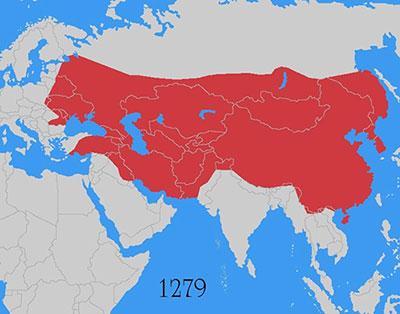
Tamerlane the Eurasian conqueror died in 1405. Darwin takes his death as marking the end of an epoch, an era inaugurated by the vast wave of conquest led across central Asia by Genghis Khan starting around 1200, an era in which one ruler could, potentially, aspire to rule the entire Eurasian landmass.

When Tamerlane was born the ‘known world’ still stretched from China in the East, across central Asia, through the Middle East, along the north African shore and including Europe. Domination of all of China, central Asia, northern India, the Middle East and Europe was, at least in theory, possible, had been achieved by Genghis Khan and his successors, and was the dream which had inspired Tamerlane.

Map of the Mongol Empire created by Genghis Khan

But by the death of Tamerlane the political situation across Eurasia had changed. The growth in organisation, power and sophistication of the Ottoman Empire, the Mamluk state in Egypt and Syria, the Muslim sultanate in north India and above all the resilience of the new Ming dynasty in China, meant this kind of ‘global’ domination was no longer possible. For centuries nomadic tribes had ravaged through Eurasia (before the Mongols it had been the Turks who emerged out of Asia to seize the Middle East and found the Ottoman Dynasty). Now that era was ending.

It was no longer possible to rule the sown from the steppe (p.5)

Moreover, within a few decades of Tamerlane’s demise, Portuguese mariners had begun to explore westwards, first on a small scale colonising the Azores and Canary Islands, but with the long-term result that the Eurasian landmass would never again constitute the ‘entire world’.

What was different about European empires?

Empires are the oldest and most widespread form of government. They are by far the commonest way that human societies have organised themselves: the Assyrians, Babylonians, Egyptians, Persians, the Greek and Roman Empires, the Aztec Empire, the Inca Empire, the Mali Empire, Great Zimbabwe, the Chinese empire, the Nguyễn empire in Vietnam, the Japanese Empire, the Ottoman empire, the Mughal empire, the Russian empire, the Austro-Hungarian empire, to name just a few.

Given this elementary fact about history, why do the west European empires come in for such fierce criticism these days?

Because, Darwin explains, they were qualitatively different.

  1. Because they affected far more parts of the world across far more widespread areas than ever before, and so ‘the constituency of the aggrieved’ is simply larger – much larger – than ever before.
  2. Because they were much more systematic in their rapaciousness. The worst example was surely the Belgian Empire in the Congo, European imperialism stripped of all pretence and exposed as naked greed backed up by appalling brutality. But arguably all the European empires mulcted their colonies of raw materials, treasures and of people more efficiently (brutally) than any others in history.

The result is that it is going to take some time, maybe a lot of time, for the trauma of the impact of the European empires to die down and become what Darwin calls ‘the past’ i.e. the realm of shadowy past events which we don’t think of as affecting us any more.

The imperial legacy is going to affect lots of people, in lots of post-colonial nations, for a long time to come, and they are not going to let us in the old European colonial countries forget it.

Structure

After Tamerlane is divided into nine chapters:

  1. Orientations
  2. Eurasia and the Age of Discovery
  3. The Early Modern Equilibrium (1750s – 1800)
  4. The Eurasian Revolution (1800 – 1830)
  5. The Race Against Time (1830 – 1880)
  6. The Limits of Empire (1880 – 1914)
  7. Towards The Crisis of The World (1914 – 42)
  8. Empire Denied (1945 – 2000)
  9. Tamerlane’s Shadow

A flood of insights

It sounds like reviewer hyperbole but there really is a burst of insights on every page of this book.

It’s awe-inspiring, dazzling, how Darwin can take the elements of tremendously well-known stories (Columbus and the discovery of America, or the Portuguese finding a sea route to India, the first trading stations on the coasts of India or the unequal treaties imposed on China, or the real consequences of the American Revolution) and present them from an entirely new perspective. Again and again on every page he unveils insight after insight. For example:

American

Take the fact – which I knew but had never seen stated so baldly – that the American War of Independence wasn’t about ‘liberty’, it was about land. In the aftermath of the Seven Years War (1756 – 63) the British government had banned the colonists from migrating across the Appalachians into the Mississippi valley (so as to protect the Native Americans and because policing this huge area would be ruinously expensive). The colonists simply wanted to overthrow these restrictions and, as soon as the War of Independence was over (i.e. after the British gave up struggling to retain the rebel colonies in 1783), the rebels set about opening the floodgates to colonising westward.

India

Victorian apologists claimed the British were able to colonise huge India relatively easily because of the superiority of British organisation and energy compared with Oriental sloth and backwardness. In actual fact, Darwin explains it was in part the opposite: it was because the Indians had a relatively advanced agrarian economy, with good routes of communication, business hubs and merchants – an open and well-organised economy, which the British just barged their way into (p.264).

(This reminds me of the case made in The Penguin History of Latin America by Edwin Williamson that Cortés was able to conquer the Aztec and Pissarro the Incas, not because the Indians were backward but precisely because they were the most advanced, centralised and well organised states in Central and South America. The Spanish just installed themselves at the top of a well-ordered and effective administrative system. Against genuinely backward people, like the tribes who lived in the arid Arizona desert or the swamps of Florida or hid in the impenetrable Amazon jungle, the Spanish were helpless, because there was no one emperor to take hostage, or huge administrative bureaucracy to take over – which explains why those areas remained uncolonised for centuries.)

Cultural conservatism

Until about 1830 there was still a theoretical possibility that a resurgent Ottoman or Persian empire, China or Japan, might have reorganised and repelled European colonisers. But a decisive factor which in the end prevented them was the intrinsic conservatism of these cultures. For example, both Chinese and Muslim culture venerated wisdom set down by a wise man (Mohammed, Confucius) at least a millennium earlier, and teachers, professors, civil servants were promoted insofar as they endorsed and parroted these conservative values. At key moments, when they could have adopted more forward-looking ideologies of change, all the other Eurasian cultures plumped for conservatism and sticking to the Old.

Thus, even as it dawned on both China and Japan that they needed to react to the encroachments of the Europeans in the mid-nineteenth century, both countries did so by undertaking not innovations but what they called restorations – the T’ung-chih (‘Union for Order’) restoration in China and the Meiji (‘Enlightened rule’) restoration in Japan (p.270). (Darwin’s description of the background and enactment of both these restorations is riveting.)

The Western concept of Time

Darwin has a fascinating passage about how the Europeans developed a completely new theory of Time (p.208). It was the exploration of America which did this (p.209) because here Europeans encountered, traded and warred with Stone Age people who used bows and arrows and (to start with) had no horses or wheeled vehicles and had never developed anything like a technology. This led European intellectuals to reflect that maybe these people came from an earlier phase of historical development, to develop the new notion that maybe societies evolve and develop and change.

European thinkers quickly invented numerous ‘systems’ suggesting the various ‘stages of development’ which societies progressed through, from the X Age to the Y Age and then on to the Z Age – but they all agreed that the native Americans (and even more so, the Australian aborigines when they were discovered in the 1760s) represented the very earliest stages of society, and that, by contrast, Western society had evolved through all the intervening stages to reach its present state of highly evolved ‘perfection’.

Once you have created mental models like this, it is easy to categorise all the other cultures you encounter (Ottomans, Hindus, China, Japan, Siam, Annamite etc) as somewhere lower or backward on these paths or stages of development.

And being at the top of the tree, why, naturally that gave white Europeans the right to intervene, invade, conquer and administer all the other people of the world in order to ‘raise’ them to the same wonderful level of civilisation as themselves.

18th and 19th

I’ve always been a bit puzzled by the way that, if you read accounts of the European empires, there is this huge difference between the rather amateurish 18th century and the fiercely efficient 19th century. Darwin explains why: in the eighteenth century there were still multiple European players in the imperial game: France was the strongest power on the continent, but she was balanced out by Prussia, Austria and also Spain and Portugal and the Dutch. France’s position as top dog in Europe was admittedly damaged by the Seven Years War but it wasn’t this, it was the Napoleonic Wars which in the end abolished the 18th century balance of power in Europe. Britain emerged from the Napoleonic Wars as the new top dog, with a navy which could beat all-comers, which had hammered the French at the Battle of the Nile and Trafalgar, and which now ruled the waves.

The nineteenth century feels different because Britain’s world-encompassing dominance was different in kind from any empire which ever preceded it.

The absence of Africa

If I have one quibble it’s that I’d like to have learned more about Africa. I take the point that his book is focused on Eurasia and the Eurasian empires (and I did learn a huge amount about Persia, the Moghul empire, China and Japan) and that all sub-Saharan Africa was cut off from Eurasia by the Sahara, but still… it feels like an omission.

And a woke reader might well object to the relative rareness of Darwin’s references to the African slave trade. He refers to it a few times, but his interest is not there; it’s in identifying exactly where Europe was like or unlike the rival empires of Eurasia, in culture and science and social organisation and economics. That’s his focus.

The expansion of the Russian empire

If Africa is disappointingly absent, an unexpected emphasis is placed in each chapter on the imperial growth of Russia. I knew next to nothing about this. A quick surf on Amazon suggests that almost all the books you can get about the Russian ’empire’ are about the fall of the Romanovs and the Bolshevik Revolution and then Lenin or Stalin’s creation of a Bolshevik empire which expanded into Eastern Europe after the war. That’s to say it’s almost all about twentieth century Russia (with the exception of a crop of ad hoc biographies of Peter the Great or Catherine the Great).

So it was thrilling to read Darwin give what amounts to a sustained account and explanation of the growth of the Kingdom of Muscovy from the 1400s onwards, describing how it expanded west (against Poland, the Baltic states, Sweden), south towards the Black Sea, south-west into the Balkans – but most of all how Russian power was steadily expanded East across the vast inhospitable tundra of Siberia until Russian power reached the Pacific.

It is odd, isn’t it, bizarre, uncanny, that a nation that likes to think of itself as ‘European’ has a huge coastline on the Pacific Ocean and to this day squabbles about the ownership of small islands with Japan!

The process of Russian expansion involved just as much conquering of the ‘primitive’ tribal peoples who hunted and trapped in the huge landmass of Siberia as the conquest of, say, Canada or America, but you never read about it, do you? Can you name any of the many native tribes the Russians fought and conquered? No. Are there any books about the Settling of the East as there are thousands and thousands about the conquest of the American West? Nope. It is a historical black hole.

But Darwin’s account of the growth of the Russian Empire is not only interesting as filling in what – for me at any rate – is a big hole in my knowledge. It is also fascinating because of the role Russian expansion played again and again in the game of Eurasian Risk which his book describes. At key moments Russian pressure from the North distracted the attention of the Ottoman Empire from making more offensive thrusts into Europe (the Ottomans famously encroached right up to the walls of Vienna in 1526 and then again in 1683).

When the Russians finally achieved one of their territorial goals and seized the Crimea in 1783, as a result of the Russo-Turkish War, it had the effect, Darwin explains, of cracking the Ottoman Empire open ‘like an oyster’. For centuries the Black Sea had been an Ottoman lake and a cheaply defensible frontier. Now, at a stroke, it became a massive vulnerability which needed costly defence (p.175).

And suddenly, seeing it all from the Russian perspective, this sheds new light on the timeworn story of the decline of the Ottoman Empire which I only know about from the later 19th century and from the British perspective. For Darwin the role of Russian expansionism was vital not only in itself, but for the hemming in and attritional impact it had on the other Eurasian empires – undermining the Ottomans, making the Chinese paranoid because Russian expansion around its northern borders added to China’s sense of being encircled and endangered, a sense that contributed even more to its risk-averse policy of doubling down on its traditional cultural and political and economic traditions, and refusing to see anything of merit in the Westerners’ technology or crude diplomacy. A policy which eventually led to the Chinese empire’s complete collapse in 1911.

And of course the Russians actually went to war with imperial Japan in 1905.

Numbered lists

Darwin likes making numbered lists. There’s one on almost every page. They rarely go higher than three. Here are some examples to give a flavour of his careful, forensic and yet thrillingly insightful way of explaining things.

The 18th century geopolitical equilibrium

The geopolitical revolution which ended the long equilibrium of the 18th century had three major effects:

  1. The North American interior and the new lands in the Pacific would soon become huge extensions of European territory, the ‘new Europes’.
  2. As a result of the Napoleonic war, the mercantile ‘zoning’ system which had reflected the delicate balance of power among European powers was swept away and replaced with almost complete control of the world’s oceans by the British Navy.
  3. Darwin gives a detailed description of why Mughal control of North India was disrupted by invasions by conquerors from the north, first Iran then Afghanistan, who weakened central Indian power at just the moment the British started expanding from their base in Bengal. Complex geopolitical interactions.

The so-called stagnation of the other Eurasian powers can be characterised by:

  1. In both China and the Islamic world classical, literary cultures dominated the intellectual and administrative elites – the test of intellectual acumen was fitting all new observations into the existing mindset, prizes went to those who could do so with the least disruption possible.
  2. Cultural and intellectual authority was vested in scribal elites backed up by political power, both valuing stasis.
  3. Both China and the Islamic world were profoundly indifferent and incurious about the outside world.

The knowledge revolution

Compare and contrast the East’s incuriosity with the ‘West’, which underwent a cognitive and scientific revolution in which merit went to the most disruptive inventors of new theories and technologies, and where Darwin describes an almost obsessive fascination with maps. This was supercharged by Captain Cook’s three huge expeditions around the Pacific, resulting in books and maps which were widely bought and discussed, and which formed the basis of the trade routes which followed in his wake, and then the transportation of large numbers of convicts to populate Australia’s big empty spaces (about 164,000 convicts were transported to the Australian colonies between 1788 and 1868).

Traumatic impact of the Napoleonic Wars

I hadn’t quite realised that the Napoleonic Wars had such a traumatising effect on the governments of the main European powers who emerged in its aftermath: Britain, France, Prussia, Austria and Russia. Very broadly speaking there was peace between the European powers between the 1830s and 1880s. Of course there was the Crimean War (Britain, France and Turkey containing Russia’s imperial expansion), war between Austria and Prussia (1866) and the Franco-Prussian War. But all these were contained by the system, were mostly of short duration and never threatened to unravel into the kind of general conflict which ravaged Europe under Napoleon.

Thus, from the imperial point of view, the long peace had four results:

  1. The Royal Navy’s policing of all trade routes across the Atlantic and between Europe and Asia kept trade routes open throughout the era and kept costs down for everyone.
  2. The balance of power which the European powers maintained among themselves discouraged intervention in either North or South America and allowed America to develop economically as if it had no enemies – a rare occurrence for any nation in history.
  3. The post-Napoleonic balance of power in Europe encouraged everyone to tread carefully in their imperial rivalries.
  4. Geo-political stability in Europe allowed the growth across the continent of something like a European ideology. This was ‘liberalism’ – a nexus of beliefs involving the need for old-style autocratic power to be tempered by the advice of representatives of the new middle class, and the importance of that middle class in the new technologies and economics unleashed by the industrial revolution and in founding and administering the growing colonies abroad.

Emigration

Emigration from Europe to the New World was a trickle in the 1830s but had become a flood by the 1850s. Between 1850 and 1880 over eight million people left Europe, mostly for America.

  1. This mass emigration relieved the Old World of its rural overcrowding and transferred people to an environment where they could be much more productive.
  2. Many of the emigrants were in fact skilled artisans. Moving to an exceptionally benign environment, a vast empty continent rich in resources, turbo-charged the American economy with the result that by the 1880s it was the largest in the world.

Fast

His chapter The Race Against Time brings out a whole area, an entire concept, I’ve never come across before, which is that part of the reason European colonisation was successful was it was so fast. Not just that Western advances in military technology – the lightning advances in ships and artillery and guns – ran far ahead of anything the other empires could come up with – but that the entire package of international finance, trade routes, complex webs sending raw materials back home and re-exporting manufactured goods, the sudden flinging of railways all across the world’s landmasses, the erection of telegraphs to flash knowledge of markets, prices of goods, or political turmoil back from colonies to the European centre – all of this happened too quickly for the rival empires (Ottoman, Japan, China etc) to stand any chance of catching up.

Gold rushes

This sense of leaping, hurtling speed was turbo-charged by literal gold rushes, whether in the American West in the 1840s or in South Africa where it was first gold then diamonds. Suddenly tens of thousands of white men turned up, quickly followed by townships full of traders and artisans, then the railway, the telegraph, the sheriffs with their guns – all far faster than any native American or South African cultures could hope to match or even understand.

Shallow

And this leads onto another massive idea which reverberates through the rest of the book and which really changed my understanding. This is that, as the spread of empire became faster and faster, reaching a kind of hysterical speed in the so-called Scramble For Africa in the 1880s (the phrase was, apparently, coined by the London Times in 1884) it meant that there was something increasingly shallow about its rule, especially in Africa.

The Scramble for Africa

Darwin says that most radical woke historians take the quick division of Africa in the 1880s and 1890s as a kind of epitome of European imperialism, but that it was in fact the opposite, and extremely unrepresentative of the development of the European imperialisms.

The Scramble happened very quickly, markedly unlike the piecemeal conquest of Central, Southern of North America, or India, which took centuries.

The Scramble took place with almost no conflict between the European powers – in fact they agreed to partitions and drew up lines in a very equable way at the Congress of Berlin in 1885. Other colonies (from the Incas to India) were colonised because there were organised civilisations which could be co-opted, whereas a distinctive feature about Africa (‘historians broadly agree about one vital fact’ p.314) was that people were in short supply. Africa was undermanned or underpeopled. There were few organised states or kingdoms because there simply wasn’t the density of population which lends itself to trading routes, settled farmers and merchants – all the groups who can be taxed to create a king and aristocracy.

Africans hadn’t progressed to centralised states as humans had in Eurasia or central America because there weren’t enough of them. Hence the poverty and the lack of resistance which most of the conquerors encountered in most of Africa.

In fact the result of all this was that most of the European governments weren’t that keen on colonising Africa. It was going to cost a lot of money and there weren’t the obvious revenue streams that they had found in a well-established economy like India.

What drove the Scramble for Africa more than anything else was adventurers on the ground – dreamers and fantasists and ambitious army officers and business men and empire builders who kept on taking unilateral action which then pitched the home government into a quandary – deny their adventurers and pass up the opportunity to win territory to a rival, or reluctantly support them and get enmeshed in all kinds of messy responsibilities.

For example, in the mid-1880s a huge swathe of West Africa between the desert and the forest was seized by a buccaneering group of French marine officers under Commandant Louis Archinard, and their black rank and file. In a few years these adventurers brought some two million square miles into France’s empire. The government back in Paris felt compelled to back them up which meant sending out more troops, police and so on, which would cost money.

Meanwhile, modern communications had been invented, the era of mass media had arrived, and the adventuring soldiers and privateers had friends and boosters in the popular press who could be counted on to write leading articles about ‘the white man’s burden’ and the torch of civilisation and ask: ‘Isn’t the government going to defend our brave boys?’, until reluctant democratic governments were forced to cough up support. Modern-day liberals often forget that imperialism was wildly popular. It often wasn’t imperialist or rapacious governments or the ruling class which prompted conquest, but popular sentiment, jingoism, which couldn’t be ignored in modern democracies.

Darwin on every page, describes and explains the deep economic, trade and financial structures which the West put in place during the nineteenth century and which eventually underpinned an unstoppable steamroller of annexation, protectorates, short colonial wars and long-term occupation.

The Congress of Berlin

The Congress of Berlin helped to formalise the carving up of Africa, and so it has come to be thought of as evil and iniquitous, particularly by BAME and woke historians. But once again Darwin makes you stop and think when he compares the success of the congress at reaching peaceful agreements between the squabbling European powers – and what happened in 1914 over a flare-up in the Balkans.

If only Bismarck had been around in 1914 to suggest that, instead of rapidly mobilising to confront each other, the powers of Europe had once again been invited for tea and cake at the Reichstag to discuss their differences like gentlemen and come to an equable agreement.

Seen from this perspective, the Berlin Congress is not so much an evil colonialist conspiracy, but an extremely successful event which avoided any wars between the European powers for nearly thirty years. Africa was going to be colonised anyway because human events have a logic of their own: the success was in doing so without sparking a European conflagration.

The Scramble for China

The Scramble for China is not as well known as its African counterpart,  the competition to gain ‘treaty ports’ on the Chinese coast, impose unfair trading terms on the Chinese and so on.

As usual, though, Darwin comes at it from a much wider angle and makes one massive point I hadn’t registered before, which is that Russia very much wanted to seize the northern part of China to add to its far eastern domains; Russia really wanted to carve China up, but Britain didn’t. And if Britain, the greatest trading, economic and naval power in the world, wasn’t onside, then it wouldn’t happen. There wasn’t a genuine Scramble for China because Britain didn’t want one.

Why not? Darwin quotes a Foreign Office official simply saying, ‘We don’t want another India.’ One enormous third world country to try and administer with its hundreds of ethnic groups and parties growing more restive by the year, was quite enough.

Also, by the turn of the century, the Brits had become paranoid about Russia’s intentions to conquer Afghanistan and march into North India. If they partitioned China with Russia, that would mean policing an even longer frontier even further way against an aggressive imperialist power ready to pounce the moment our guard was down.

Summary

This is an absolutely brilliant book. I don’t think I’ve ever come across so many dazzling insights and revelations and entirely new ways of thinking about a time-worn subject in one volume.

This is the book to give anyone who’s interested not just in ‘the rise of the West’ but how the whole concept of ‘the West’ emerged, for a fascinating description not just of the European empires but of all the empires across Eurasia – Ottoman, Persian, Moghul, Chinese and Japanese – and how history – at this level – consists of the endless juggling for power of these enduring power blocs, the endless and endlessly

complex history of empire-, state- and culture-building. (p.490)

And of course it all leads up to where we are today: a resurgent Russia flexing its muscles in Ukraine and Crimea; China wielding its vast economic power and brutally oppressing its colonial subjects in Tibet and Xinkiang, while buying land, resources and influence across Africa. And both Russia and China using social media and the internet in ways we don’t yet fully understand in order to undermine the West.

And Turkey, keen as its rulers of all colours have been since the Ottoman days, to keep the Kurds down. And Iran, as its rulers have done for a thousand years, continually seeking new ways to extend its influence around the Gulf, across Syria and to the Mediterranean, in eternal rivalry with the Arab world which, in our time, means Saudi Arabia, against whom Iran is fighting a proxy war in the Yemen.

Darwin’s books really drives home the way the faces and the ideologies may change, but the fundamental geopolitical realities endure, and with them the crudeness and brutality of the tools each empire employs.

If you let ‘morality’, especially modern woke morality, interfere with your analysis of this level of geopolitics, you will understand nothing. At this level it always has and always will be about power and influence, dominating trade and ensuring raw resources, and behind it all the never-ending quest for ‘security’.

At this level, it isn’t about following narrow, English notions of morality. Getting hung up on that only gets in the way of grasping the utterly amoral forces at play everywhere in the world today, just as they’ve always been.

Darwin stands up for intelligence and insight, for careful analysis and, above all, for a realistic grasp of human nature and human society – deeply, profoundly flawed and sometimes pitiful and wretched though both routinely are. He takes an adult view. It is absolutely thrilling and a privilege to be at his side as he explains and analysis this enormous history with such confidence and with so many brilliant ideas and insights.


Related reviews

Exhibitions

History

Imperial fiction

Inspired by the East: how the Islamic world influenced Western Art @ the British Museum

European explorers

As John Darwin’s brilliant history of Eurasian empires, After Tamerlane, makes clear, in the centuries after the death of Tamerlane the Great in 1405, quite a few things distinguished European culture from the cultures of the other Eurasian empires (i.e. the Ottoman Empire based in Turkey, the Safavid Empire in Persia, the Moghul Empire in northern India, the Chinese Empire and the Japanese Empire).

Just two of them were 1) a readiness, on the part of the Europeans, to travel and explore, and 2)  an endless curiosity which led to almost obsessive collecting and categorising and curating and exhibiting.

No Chinese explorers visited Europe during the 19th century and were so dazzled by its history and architecture and art that they made copious sketches and drawings, took photographs, bought up every quaint European curio they could get their hands on, and carried them all back to China to catalogue and categorise and trigger an artistic renaissance.

That kind of thing just didn’t happen because few Chinese travelled abroad. Very few wanted to, or had the means to, and anyway it was frowned upon because every educated Chinese knew that the Celestial Empire was the centre of the universe, the possessor of a perfect culture, which didn’t need or want to know anything at all about the outside world, overrun as it was by cultureless barbarians.

And Darwin shows how this complacent and self-centred attitude was echoed by the cultural and political elites of Japan, Moghul India, the Safavid Empire and the sprawling Ottoman Empire, for centuries.

No, the wandering, exploring, collecting bug seems to have affected Europeans on a completely different scale from any of the world’s other civilisations.

Thus it was that from the 1500s onwards a steadily increasing stream of travellers, explorers, soldiers and sailors, archaeologists and artists travelled all over the Muslim lands lining the North African coast and the Middle East – territory nominally under the control of the extensive Ottoman Empire – to explore and describe and paint and buy and plunder.

Inspired by the East

This ambitious exhibition delves into one aspect of this huge European enterprise by looking at the long and complex history of cultural interchanges between the Islamic Middle East and Europe from about 1500 onwards.

Not surprisingly several of the earliest objects are swords and helmets since the single most important fact about Islam is that it was a conqueror’s religion, spread by highly organised and zealous Arabs as they exploded out of Arabia in the 7th and 8th centuries to seize the Christian Middle East and North African coastline.

Gilt-Copper helmet, Turkey (about 1650) © Islamic Arts Museum Malaysia

The Ottoman Empire

The Ottoman dynasty which began its rise to prominence in the 1200s was itself just the last in a line of dynasties which had vied for leadership of the Muslim world since the birth of Islam in the 630s.

The Ottoman Turks rose to dominate the area we call the Middle East during the period 1300 to 1453 (the year when the Ottomans seized Christian Constantinople and made it into their capital, Istanbul). I’ve reviewed several books about the decline of the Byzantine Empire as it came under relentless pressure from successive Muslim rulers, until its eventual fall to the Ottomans.

The Ottoman heyday is usually dated from the year of the fall of Byzantium – 1453 – to around 1600, during which they extended their power across all of North Africa and deep into Europe. It’s salutary to remember that twice the Ottoman army besieged Vienna, in 1526 and 1683, and was only just defeated both times i.e. they could have penetrated even further into Christian Europe.

As it was, throughout this period the Ottomans ruled the extensive territory of former Christian Europe which we call the Balkans, as well as Christian Greece and Christian subjects in numerous Mediterranean islands.

Mainly Victorian

A handful of pieces and a few wall labels in the exhibition gesture towards this long and complex early history of Ottoman rise and conquest and domination, including the striking portrait of Sultan Bayezid I by a painter from the school of Veronese, which has been used as the poster for the show.

A Portrait of Sultan Bayezid I by a member of the School of Veronese (c. 1580) © Islamic Arts Museum Malaysia

But the exhibition really focuses on works from the much later period of the 19th and early 20th centuries, partly for the simple reason that the period 1800 to the outbreak of the Second World War saw a steadily increasing number of European travellers to North Africa and the Middle East.

Some of this was simply a function of continually improving transport, sailing ships giving way to steamships, the steady spread of railways, the industrial revolution creating a new leisured class, especially in Britain and France, who wanted to see the world, helped along by firms like Thomas Cook which launched its first cruises in the 1870s.

Many devout Victorians, such as the Pre-Raphaelite artist William Holman Hunt, wanted to tour the Holy Land and see for themselves the places where Our Lord had stood. Flocks of visitors drew and sketched and painted watercolours and oils and bought all manner of souvenirs, carpets and clothes, tiles and glasswork. By the time of the Great Exhibition of 1851 the British public was highly aware of the extremely diverse and colourful cultures of the peoples it ruled over.

But the thesis of this exhibition is that the Islamic culture of the Ottoman Empire bore a uniquely close and fractious relationship with Europe, was the predominant colonial and foreign cultural ‘Other’ for Europe throughout the period – a kind of backward cousin, a slothful and declining ‘Orient’ against which we could measure our ever-growing knowledge, technology and power. And that a huge number of craftsmen and artists and metalworkers and glassblowers and designers and artists and architects were particularly dazzled and influenced and inspired by Islamic and Middle Eastern art and culture.

So this exhibition, Inspired by the East, aims to bring together a wealth of artifacts to show a) some of the original Islamic arts and crafts from the era and b) the impact Islamic architecture, designs and patterns had on European craftsmen, artists and designers through a large selection of European objects.

Enamelled glass lamp made by Philippe-Joseph Brocard, France (about 1877)

Thus the exhibition includes wonderful, ornate and beautiful examples from a whole range of media and crafts such as:

  • tiles
  • glasswork
  • ceramics
  • metalwork
  • jewellery
  • clothing
  • architecture
  • design

I was interested to learn there was a genre called ‘costume books’ which simply showed the costumes of all the new races and peoples Europeans had discovered as they expanded and explored from the 1500s onwards and which, of course, featured books devoted to the clothes and garments of the Middle East.

I learned that all kinds of products by Islamic artisans were prized in the West from early on, such as Egyptian metalwork and Persian ceramics. During the 19th century Western craftsmen could use developing technology to reproduce much of this work. The exhibition includes Arab-inspired ceramics by Théodore Deck, a leading French ceramicist who in the late nineteenth century created a range of pieces directly inspired by Islamic originals.

Nearby is a section devoted to Owen Jones, one of the most influential tastemakers of the Victorian era. His pioneering studies on colour theory, geometry and form still inspire designers to this day. Jones was an architect, designer and design theorist and was Superintendent of Works for the 1851 Great Exhibition. His masterpiece was Grammar of Ornament, a huge and lavish folio displaying stunning patterns, motifs and ornaments in 112 illustrated plates, many of which featured Islamic decorations and motifs. Some of the Islamic plates from the book are on display here.

But but but… I was struck by several obvious problems.

Number one was that most of the works on display are by Europeans. They are not original works by the Islamic craftsmen and artists who are so praised. They are European copies, displayed with the intention of showing how widespread the impact of Islamic styles and motifs was on the European arts. If you’re looking for a world of authentically Islamic arts and crafts you’d do better to go the V&A.

Number two was that, despite the beauty of individual works, it became difficult to avoid a sense of scrappiness, a sense that the curators are trying to cover a lot of ground, in fact an enormous subject – the impact of the Muslim world on the art and culture of the West – with a surprisingly small range of exhibits.

Take my home area, history: A few helmets and a sword are accompanied by a paragraph or two about the extent of the Ottoman Empire – but this, the military rise and dominance of the Ottoman Empire, is a huge, a vast subject, which I felt was barely scratched and whose omission made the entire show feel one-sided i.e. presented only the Europeans as aggressive colonialists whereas, as I’ve explained, it was the Muslims who originally conquered half the Christian Mediterranean.

Similarly, the friend I went with is mad about Islamic tiles so was pleased to see a display of half a dozen beautiful and ornate tiles – but disappointed that they turned out to be made by a Victorian British manufacturer using Islamic motifs – and that that was it when it came to tiles.

Islamic architecture is distinctive and beautiful and exists over half the world, but it was dealt with via just a few British buildings which used Islamic motifs, such as the well-known artist Lord Leighton’s famous house in West London which he had modelled inside to recreate some of the rooms from the Alhambra in Spain, namely ‘the Arab Hall’. Leighton had the place covered in Islamic tiles designed by William de Morgan. There are photos of the interior and a lovely wooden model but… is that it?

The single most dominant impression was made by the paintings, a few scattered in the early sections but then leading up to a huge wall displaying about 20 classic, late-Victorian, Orientalist paintings.

In the Madrasa by Ludwig Deutsch (1890) © Islamic Arts Museum Malaysia

Orientalism

This brings us to the several meanings of ‘Orientalism’, a word and idea which are raised early in the exhibition and then referenced throughout.

1. The word Orientalism was originally, during the 19th century and first half of the 20th, a value-neutral term applied to all or any scholars, linguists, archaeologists or artists who specialised in ‘the Orient’, a vague expression generally taken to be Islamic North Africa and Middle East but sometimes stretching to include India. It survives in this neutral sense in many places to this day, for example in the name of London’s School of Oriental and African Studies.

2. However, the term underwent a revolutionary change in 1978 when the Palestinian-American scholar Edward Said published his academic study Orientalism. In this book Said subjected the so-called ‘scholarly’ works of 19th century Orientalist academics to in-depth analysis in order to support one big radical idea: that almost all the supposedly scholarly and academic books and ideas produced by European scholars about the Orient were the witting or unwitting handmaids of Western Imperialism.

Almost all the nineteenth-century Orientalists declared the Ottoman Empire corrupt and stagnant, Islam itself incapable of change. The people living there were stereotyped as somehow more primitive, dressing in loose but colourful clothing, slothful and lazy and corrupt.

Probably the most notable idea was the fascination the institution of the harem had for repressed Westerners who projected all kinds of sexual fantasies onto Oriental woman and painted no end of soft porn depictions of the sultan and his slaves and concubines and slave auctions and so on.

So powerful was Said’s critique that it spread and prospered in the academy, becoming the new orthodoxy and casting a critical shadow back over everything written or painted about the Middle East in the previous 200 years or more. Since its publication almost everything any European said, wrote or painted about the Ottoman Empire has been reappraised to appear in a much more sinister light, either furthering malicious racist stereotypes, aiding in imperial exploitation, or the shameless appropriation of a weaker culture’s art and designs.

Schizophrenia

Now the woke young curators of this exhibition are fully paid-up subscribers to Said’s unforgiving views about Western exploitation of the Middle East. This isn’t a guess on my part. They quote page one of Orientalism in the very opening wall label which introduces the exhibition:

The Orient is not only adjacent to Europe; it is also the place of Europe’s greatest and richest and oldest colonies, the source of its civilizations and languages, its cultural contestant… The Orient is an integral part of European material civilization and culture.

And every other wall label takes pains to remind us that the plate or vase or tile or translation of The 1001 Nights or any other cultural product which we’re looking at and which references Islam may well seem beautiful to us but, tut tut, we should be aware that it was part of the wicked European fashion to appropriate Islamic patterns for vases or the exploitative trend for mock Moorish architecture, or the thieving use of Arabic script in picture frames and so on.

And that behind all of this detail, all of these individual examples of cultural appropriation, lies the huge looming shadow of Western Imperialism!

Four tiles by William De Morgan & Co, Britain (1888 to 1897)

Cumulatively, these hectoring labels and panels created, for me at any rate, a strange sense of schizophrenia. In one and the same wall label the curators might both praise the craftmanship of a western tile maker or architect – and yet accuse them of being part of the general movement of cultural appropriation. Praise and damn almost in the same breath.

As so often in modern exhibitions, I began to feel that I got more visual and aesthetic enjoyment if I just stopped reading the hectoring labels – felt less harangued and nagged to feel guilty about things which happened 150 years before I was even born.

Orientalist painting

It’s probably in painting that the Orientalist issue is most obvious, or most familiar to most of us because the antique shops of the West are awash with third-rate late-Victorian depictions of the Arab world, of mosques, old men in long gowns with even longer beards, camels crossing the desert, Oriental markets, scantily dressed concubines and so on.

Said’s idea is that, although these images are fairly harmless looked at individually, taken together they become condescending, sexist and racist, depicting a fantasy world of harems and sultans, long-gowned scholars in picturesque mosques, colourful markets or the desert at dawn – all of which, taken together, creates a patronising distortion of the complex realities of the many peoples and tribes and ethnic groups and nations scattered across North Africa and the Middle East.

Moreover, taken together, they all tend in the same direction, promoting an ideology claiming that all these cultures and peoples might well be noble and beautiful, but were also backward and in decline, and therefore needed to be taken in hand, taken over, guided and ruled by us, the enlightened West.

At Prayer by Ludwig Deutsch (1923)

The big wall hanging of twenty or so massive Orientalist paintings which I mentioned earlier are obviously meant to represent a kind of ‘Wall of Shame’. Tut tut, we are encouraged to think: look at all these stereotypical markets and mosques and rugs and carpets. Look how oppressive they are.

However, I just didn’t feel the moral outrage I think the curators intend us to feel. The real impact of hanging so many Orientalist paintings next to each other was, in my opinion, to make you feel a bit sick, as if you’d been let loose in a sweetshop and eaten everything in sight. They are self-consciously opulent and gorgeous to the point of absurdity.

Another, more objective result of examining so many of these over-ripe productions was that, pace Said, most of them are not from the imperial nineteenth century, nor, surprisingly, were many of them produced by the classic imperialist powers who carved up the Middle East between them, France and Britain.

At least half of them were from the twentieth century, many from after the Great War (the two above are from 1913 and 1923). And quite a few were by either German or American painters, not by the cultural Anglo-French cultural appropriators. Neither the Germans nor the Americans had any colonial presence in the Middle East till well after the Great War and even then, not very much.

Orientalism or Romanticism?

As I read yet another wall label pointing out how the Orientalist painters fantasised and romanticised and embellished lots of the subjects they painted, as if this was a shockingly immoral and exploitative thing to do, a simple thought occurred to me: Didn’t all 19th century artists?

There are thousands and thousands of Victorian genre paintings which romanticise and glamorise all kinds of subjects, from their own working classes (cf the exhibition of cheesy paintings of Victorian children I saw earlier this year at the Guildhall) to windswept Hebridean crofters.

In other words, wasn’t the entire artistic movement of Romanticism about, well, stereotypically romantic subject matter – about mountains and storms at sea and heroic adventures and tormented heroes and shy maidens with heaving bosoms who needed rescuing from dragons (I’m thinking of the amazing late-Victorian fantasies of Edward Burne-Jones as recently displayed at Tate Britain).

The same exaggerated depiction of popular conceptions of subjects was applied to everything – I bet medieval knights weren’t as manly and knightly as they appear in Victorian paintings, that Highland crofters weren’t as proud and noble, or our brave soldiers quite as manly and beautifully kitted out, as they appear in those big hearty late-Victorian paintings.

Don’t all Victorian paintings depict extravagant stereotypes in lush and glamorous colours? In other words, there is nothing particular or exceptional about this hyper-romantic style being applied to ‘Oriental’ subjects: it was applied to countless other subjects as well.

The Guard by Antonio María Fabrés y Costa (1889)

The harem

I was especially looking forward to the section about the harem, not because I was expecting to be particularly titillated but because I was looking forward to the riot of outraged feminist commentary it would provoke.

After all, one of the most obvious and much-repeated claims of anti-orientalist literary critics, feminists and curators is that Western white men used the Ottoman institution of the harem as a pretext to concoct a vast number of soft porn, erotic fantasies which bore no relation to reality at all, but merely satisfied the gloating gaze of fat, rich, white, male collectors. Pale, male and stale. Gammons etc.

So a surprising single thing about this exhibition of Western depictions of the Orient is the complete absence of even one decent painting showing a classic, late-Victorian harem scene. Not one. No book about Orientalism is complete without a cover depicting a sexist Orientalist image or a chapter of objectifying Oriental women, so I was puzzled.

I thought I must have missed a room somewhere and went back through the exhibition to check, but eventually realised that the little collection of five or so chaste drawings and one painting – none of which show a nude woman, all of them very restrained – is all they have! There’s a tiny photo of one of the classic nude-in-a-Turkish-bath paintings by Ingres, but none of the thousands of huge colourful harem scenes by him or Eugène Delacroix or John Frederick Lewis or any number of their followers and copiers.

At some point it dawned on me the the feminist curators of the exhibition might simply have been enacting their own principles, and not hanging pictures they deplore. Maybe the absence of those kinds of stereotyped images was itself a statement of intent.

Off to one side there is one little drawing of a woman playing a musical instrument by a French artist we are assured, by the conscientious curators, was a notorious Orientalist. Does this image strike you as being offensively racist and sexist, stereotyping the Orient and providing visual underpinning for Western imperialism? Because that is the intellectual framework or ideology within which the entire exhibition exists.

Study of a girl playing a stringed instrument by Jean Léon Gérôme (1886)

This little sketch sort of raises a politico-aesthetic question, because the curators point out that the artists, Jean Léon Gérôme, was well known for the meticulous sketches and drawings which he made, preparatory to creating an oil painting. Which made me reflect: in what way can these artists be accused of peddling lazy stereotypes if they were carefully and meticulously depicting what they saw, what was actually in front of them?

The sex object bites back (or photographs itself wearing clothes)

The absolute of real killer harem scenes is all the more puzzling because it is meant to set up the final part of the exhibition, which is devoted to contemporary works by modern Muslim women artists.

The curators have chosen to interpret these contemporary Muslim women artists as responding to the despicable tradition of Western Orientalism. They are ‘speaking back to Orientalist representations of the east’. They are ‘subverting and undermining works by earlier European and North American artists’.

But alas the curators’ plan doesn’t really work because we have not seen any of the sexy, sexist Orientalist representations of the east which these contemporary artists are kicking back against. We pretty much have to imagine them, or remember them from other exhibitions or books.

In fact I thought all four of the women artists on display here were very good, very very good, in their way better than the rest of the exhibition. Best of the four was a triptych of images by Lalla Essaydi, part of a large series of works titled Women of Morocco.

In them Essaydi, or her models, adopt the poses of the scantily-clad women draped around in famous Orientalist paintings, only here the women are chastely and Islamically dressed and – and this is the distinctive thing, from a visual point of view – both they, their clothes and the studio backcloths are covered in Islamic script. I thought it was a brilliant idea, brilliantly executed, to produce really vibrant and exciting images.

Les Femmes du Maroc by Lalla Essaydi (2005) © Lalla Esaydi

Conclusion

Inspired by the East feels, in the end, like a rather thin exhibition.

Firstly, it claims to be a look at the interaction between East and West, so you’d expect it to be divided into two parts; How East affected West and how West affected East.

As noted, there’s plenty of examples of the way Westerners appropriated Eastern designs and motifs and patterns, architecture and design (although this felt like a much larger subject which really deserved to be investigated in much greater depth – All over London are buildings which incorporate Islamic motifs; if you add in tiling and ceramics and metalwork you have a huge subject).

But as to West affecting East, this section felt very skimpy indeed, with just one small room showing a couple of photo albums by pioneering photographers in Istanbul and a map or two. Is that it?

Secondly, there is the big shadow of Edward Said and his embittering theory of Orientalism threaded throughout the show, the premise that all depictions of the Middle East and all forms of appropriation of its culture were handmaidens to the wicked, Western imperial exploitation of the area.

But this rather harsh and inflexible approach militates against the more nuanced vibe of the ‘cultural interactions’ parts of the show. One minute the curators are praising Western craftsmen; the next they are berating the subtle cultural imperialism of copying Islamic designs.

Hence my comment about the unsettling schizophrenia I thought the show suffered from.

3. And when I got to the section on the harem and realised how tragically thin it was, it suddenly crystallised for me how skimpy the rest of the exhibition feels. It feels like it’s trying to address two or three really big issues and not quite doing any of them quite properly.

Alhambra vase, Spain 1800–1899 © Islamic Arts Museum, Malaysia

Writing versus art

I read Orientalism at university four or five years after it was published, when it still had ‘the shock of the new’, before it settled down to become the new orthodoxy taught to each new generation of humanities and art students.

And Said’s book is almost entirely concerned with Orientalist writing – with the supposedly factual works of Orientalist ‘scholars’ (who he systematically debunks) and with the Western literary writers who perpetuated stereotypes about the Exotic East (Byron, Nerval, Flaubert just for starters).

A lot of this kind of writing was produced in the nineteenth century and so Said had a rich vein to draw on, and was able to show how the supposedly ‘scholarly’ writing, and the literary works, easily morphed into official, governing and imperial writing, could be co-opted into government reports and assessments, how anthropological studies could be quoted in business cases for invading Egypt, say, or Iraq.

But it is much harder to divine a particularly patronising, racist or imperialist motive behind a set of porcelain which just happens to use an Islamic motif, or in picture frames which use Arabic script as decoration, or in glassware which incorporates Islamic patterns.

It’s easier to imagine that they were just one among the millions of other ranges of pottery and ceramics and frames produced during the consumer boom of the nineteenth century, which cannibalised motifs and patterns from all available sources – from India and China and Japan to name just a few – if it produced something which would sell.

To see most of the objects in this exhibition as part of an enormous explosion of art and crafts products which catered for the burgeoning middles classes as, to some extent, they still do today.

So my last thought is that maybe the bittiness and thinness of the exhibition is owing to the fact that the curators are trying to illustrate a basically literary theory with works of art and museum objects. And not nearly enough of them to really round out the argument.

Whatever the reason, for me this exhibition contained an entertaining pot-pourri of lovely objects, but didn’t really hang together either as history, or as a sustained exploration of the themes it purports to address.

Promotional video


Related links

More British Museum exhibition reviews

Unfinished Empire: The Global Expansion of Britain by John Darwin (2012)

Empire – as the assertion of mastery (by influence or rule) by one ethnic group, or its rulers, over a number of others – has been the political rule of the road over much of the world and over most of world history: the default mode of state organisation.
(‘Unfinished Empire’, page 7)

This is a much more sober, earnest and thoughtful account of the British Empire than Niall Ferguson’s popular blockbuster, Empire. Whereas Ferguson references popular myths and preconceptions in order to puncture them in the manner of a swashbuckling columnist, Darwin is the cautious scholar, thoughtfully engaging with the voluminous literature of other historians on the subject – which makes his book a much denser, more challenging, but hugely more rewarding read.

The medieval origins

Ferguson’s account starts with the Elizabethans establishing plantations in Ireland and America at the same time as they set up their own offshoot of the Atlantic slave trade (roughly the 1590s). Darwin takes the more interesting and, characteristically more thorough, approach of going back much further, to the Norman Conquest, to trace the origins of the attempts by the conquering Normans to take an ‘imperial’ approach to the British Islands.

Among the hundreds of rewarding points Darwin makes is that the entire left-wing critique of the British Empire tends to treat it as if it was a historical freak, a one-off, as if only this empire ever existed and was uniquely evil, racist and sexist.

In fact, as Darwin calmly points out, empire has been the normal form of rule for most of the world for most of history.

Thus, just looking at Britain, we were part of the Roman Empire for 400 years; we were invaded and conquered by sea-borne tribes from northern Germany and Denmark who set up their own settler states from the 5th to the 9th century; we were then invaded and part-colonised by the Vikings (800 to 950), before becoming part of Canute’s Danish Empire from 1014 to 1042. Were then invaded and colonised by the Normans (1066), brutal subjugaters who imposed their economic system, language and laws on their subjects, as well as confiscating vast swathes of their land, and massacred any resisters (the Harrying of the North).

Darwin picks up the story with the Plantagenet kings (1154 to 1485), who ran an essentially French Empire which included a large chunk of western France (wine-producing Gascony). The Plantagenets tried to extend their control of England into Wales (it was the Plantagenet Edward I who built all those Welsh castles in the late 1200s), and tried with varying success to push into Scotland and Ireland.

In the 14th century England hung on to her possessions in south-west France in the face of growing power of the centralised French state, but eventually lost them in 1453. In fact the steady consolidation of the European kingdoms of France and Spain effectively locked Britain out of Continental Europe and forced us to look elsewhere for growth. In other words, Britain’s efforts to find gold and wealth abroad were bound to be maritime, not continental. Locked out of Europe, Britain had to look further across the seas for conquest and colonies.

Before we even get to Ferguson’s start point of Elizabeth’s reign, England had already been part of five or six different empires, depending how you define them.

Protestant paranoia

Darwin adds to Ferguson’s account of the Elizabethan period, the importance of Protestant paranoia. It’s worth remembering that, after Henry VIII’s declaration of independence from the Roman Catholic church in the 1530s, English monarchs lived in fear of being invaded and conquered by the military superpower of the day for the next 250 years, first Spain, then France.

The campaigns to pacify Wales and Scotland were wars of conquest designed to protect the English monarchy’s exposed flanks. Scotland remained an entry point for invasions long after the Scottish Reformation partly calmed English fears. Even after the semi-forced Act of Union of 1707 created a country called ‘Great Britain’, there were still threatening Scottish insurrections – the last one, armed and supported by the Catholic French, as late as 1745, and only defeated after the Catholic army had got as far as Derby, just 130 miles from London.

Unrepentently Catholic Ireland, though, remained an enduring problem for England’s Protestant monarchs, from the first attempts to assert authority over it in the 1100s right up to the present day (today I read a news story saying the Irish Taoiseach, Enda Kenny, warned David Cameron that a Brexit from the EU might jeopardise the Good Friday Agreement).

Rivalry with other empires

My recent visit to the British Museum reminded me of the long list of empires which battled for supremacy throughout  history: just in the Middle East, the so-called ‘cradle of civilisation’, we have the Assyrians, the Medes, the Persians, the Babylonians and so on – while successive emperors ruled the vast area known as China, and waves of imperial invaders conquered and tried to bind together enormous India, leading up the Mughal emperors that the British had to deal with in the 18th century. When Cortes and Pizarro arrived in Mexico they didn’t discover vegan environmentalists but well-organised, centralised empires – Aztec and Inca – which had been vying for supremacy for centuries, supported by their blood-thirsty religions.

What we think of as the Tudor period, when Henry and his successors tried to conquer and bind together the people on these British islands, was also the era when the kings of Spain and France were doing the same in their realms, fighting to create strong centralised states. In this as in so many other ways, England was just one among many European nations doing the same thing at the same time.

And so, whenever we consider the complex, byzantine history of all the enterprises and entities which eventually coalesced into something we call ‘the British Empire’, we shouldn’t forget that:

a) it was always in rivalry and competition with the other, often more powerful and better-established, European empires
b) in many places it came up against existing ‘native’ empires, for example the Mughal empire in India or the Zulu empire in South Africa

Complexity

From the first pages Darwin emphasises the complexity of the imperial story, that there were a myriad stories of negotiation, business deals, trades, coercion, attack, rebuff, invasion and so on. And they jostled against each other. The imperialists and colonisers, the traders and soldiers, the central government and the men on the ground, not to mention the Christian missionaries, often had wildly different aims and strategies.

Throughout his book Darwin defines different ‘types’ of empire – which immediately make you realise that what later history too glibly thinks of as the ‘rulers’ of ‘the Empire’ always had conflicting aims, which often led to confusion, sometimes disaster.

And even a cursory reading of the history soon makes you aware of the arguments, often bitter angry arguments, between the so-called ‘ruling classes’ back home.

The most obvious example is the fierce arguments surrounding the anti-slavery movement which overcame the angry resistance of the plantation owners and slave traders to eventually ban the institution of slavery, then ban the slave trade, so that, from the 1830s onwards, Britain become the world’s leading agent against slavery. The ruling classes were anything but monolithic – they were at daggers drawn.

Similarly, a strong anti-imperial party always existed in British society, arguing from morality, from Christian principle or just for pragmatic reasons, that ruling an empire was immoral, it distorted the economy and made it too reliant on cheap external commodities or foreign trade, and so on.

I studied the later Victorian period for A-Level and had drummed into me the level of personal and political dislike between Disraeli, the slippery impresario of Empire, and Gladstone, its pompous opponent who carried on vigorously arguing against it into the 1890s.

By the late 19th century you have organised socialist parties giving coherent economic and social reasons against Empire, a set of arguments encapsulated in the classic text, Imperialism: A Study (1902) by the British political scientist John Hobson, which argued that imperialism is an immoral and unnecessary extension of capitalism.

There was always opposition in Britain to ‘Empire’, and imperial rule itself was bedevilled by the frequent changes of government and sudden changes of strategy caused by the pesky democratic system. A central strand of Rudyard Kipling‘s work is his real anger and hatred of idiot politicians, especially Liberal politicians, who were constantly meddling with things they didn’t understand and making the lives of the men on the spot, the men trying to run things, difficult and often dangerous.

So these are just some of the ways in which the Empire was always ‘unfinished’ – giving the book its title.

The British Empire never achieved stasis; it was always too big, too complex, too unstable, and in a permanent state of crisis, dealing with local wars or rebellions, the threats of rival European empires, economic woes like depressions or agricultural blights, the disruptive impact of new technologies like electricity or the wireless.

Darwin quotes the historian John Gallagher who wrote: ‘Once the British Empire became world-wide the sun never set on its crises.’

Each generation of rulers felt it had been handed a vast can of worms to try and make sense of, organise, maintain and keep secure. It was like the game show challenge of keeping all those plates spinning on the top of the poles, and it is amazing how such a small country managed to keep so many plates spinning for so long until, during the Second World War, they all began crashing to the ground.

Types of empire

  • Entrepôt empire: from the 1690s to 1790s British merchants thrived on the Atlantic trade, moving around slaves and sugar to make profits
  • Free trade empire: from the 1790s onwards, diversifying into the spices, calico and other stuffs supplied from Asia
  • Conquest empire: military conquest to make existing territories secure, to overthrow troublesome ‘native’ rulers
  • The English Atlantic empire: based on a series of early, coastal bridgeheads around the Atlantic
  • The Trading empire in India: run by the East India Company and dependent on the goodwill of local rulers

And amid this diversity of empire, Darwin also defines a whole variety of types of colony. There were at least five large categories:

  • Company Rule
  • Colonies
  • Protectorates
  • Dominions
  • Mandates

However many you count, the point is that they were diverse: from tiny Hong Kong to vast Canada, from almost empty land settled by convicts (Australia) to countries teeming with well-established populations, cultures and rulers (India) – each colony required different handling, legal and trade arrangements.

Strength in diversity

This is a brilliant book which quietly, calmly, confidently dispenses with left-wing rhetoric about the British Empire and shows, again and again, what a weird, peculiar hodge-podge of disparate entities ‘it’ really was.

Darwin refers to Edward Said and his ground-breaking work, Orientalism, as the source of the theory that the European empires, and the British Empire above all, were ruled by a monolithic ideology which drummed home the repressive messages of racism, white supremacy, gender stereotyping, masculine violence and so on, via a set of channels – the press, magazines, music hall, literature, art and so on – which were completely controlled by a unified Imperialist ruling class.

According to this view, all our modern ills – racism, sexism, inequality etc – directly stem from a unified imperial ideology which oppressed the British population as much as the foreign peoples it was used to control.

Darwin says the reality was more or less the opposite. It was precisely the extremely diverse nature of British society, with a strong central spine of monarchy and a settled parliamentary and legal framework providing the base for a huge diversity of religious belief, cultural practice and even languages among the populations of England, Wales, Scotland and Ireland, which meant that Britain was uniquely well-placed to ‘engage’ with the lands its settlers, merchants and missionaries discovered, in a kaleidoscopic variety of ways.

It was the diversity of Britain which helped it cope with, engage with, conquer, negotiate with and manage the extraordinary diversity of peoples, races, cultures, civilisations and traditions which it found itself fighting, conquering and ruling.

*********

All these ideas are conveyed in just the first 50 pages of this brilliantly insightful, calm, measured and fascinating book, which is too crowded and packed with insights to do proper justice to in a summary. Do your mind a favour and read it.


More eighteenth century reviews

More blog posts about Empire