Liotard and the Lavergne Family Breakfast @ the National Gallery

‘The Lavergne Family Breakfast’ is generally considered the masterpiece of Swiss painter Jean-Etienne Liotard (1702 to 1789). It was made not in oil paint but in pastel, of which Liotard was an acknowledged master.

Executed across more than six sheets of paper, ‘The Lavergne Family Breakfast’ is Liotard’s largest and most ambitious pastel. It depicts a breakfast between an elegantly dressed woman and a young girl, whose hair is still in paper curlers. Between the two lies a luxurious breakfast still life. Although not strictly a portrait, the sitters have long been associated with relatives of Liotard’s, the Lavergne family, who lived in Lyon.

The calm domesticity of the scene is accentuated by the tremendous technical brilliance of his pastelwork, recording a hundred tiny details – the sheen on the metal coffee pot, the shiny ceramic jug, the silky fabrics, the reflections in the black lacquer tray, down to individual notes on the sheet music peeping out from the drawer at the bottom left.

The Lavergne Family Breakfast in pastel by Jean-Etienne Liotard (1754) Private collection, Waddesdon © Courtesy the owner

But it is not only a remarkable work in itself, it is also remarkable for the fact that twenty years later, Liotard painted exactly the same scene, with almost digital accuracy, in oil paint. According to the curators this is an extremely rare example of a painter anywhere ever painting the precise same subject with such photographic accuracy, in two different media. Above is the pastel version. Below is the paint version.

The Lavergne Family Breakfast in paint by Jean-Etienne Liotard (1773) © The National Gallery, London

In 2019 the National Gallery acquired the oil version and this provided the impetus to request the loan of the pastel version (in a private collection) so that the two works could be hung side by side. Both versions were made for Liotard’s most important patron, William Ponsonby, Viscount Duncannon (1704 to 1793) and this is probably the first time in 250 years that they have been seen side by side to compare and admire the difference in technique and effect between the two.

Can you spot the differences? The oil one is better at depicting darkness – the shadows, on the figures’ skin and on the background wall, are deeper and richer. As to the actual design, the curators remark only two significant differences between the two versions: There are only two differences: in the oil painting the bright blue decorations on the porcelain have turned brown, probably due to the use of smalt (a blue pigment that loses its colour), and in both works the signature on the sheet of music poking out of the table drawer bears a different date.

Using this pairing as a centrepiece the National Gallery has created a small (three rooms) but lovely and FREE exhibition, bringing together about 20 other works and objects to give a charming overview of Liotard’s life and career.

Pastel

Liotard was extremely versatile, producing works in pastel, oil, enamel, chalk and even on glass, but was best known for his work in pastel. Pastel is a notoriously delicate medium but the exhibition doesn’t just tell us this, it devotes an entire display to it.

Installation view of ‘Liotard and the Lavergne Family Breakfast’ at the National Gallery. Photo by the author

Here we can see an antique box of pastels from 1910 Paris alongside the tools you needed to use them, namely:

  • a colour chart from La Maison du Pastel, Paris, showing the range of colours available in the 1930s
  • a box of charcoal sticks for drawing, produced by the Maison Macle in the second half of the 19th century
  • a porte-crayon (chalk holder) used for holding chalks whilst drawing
  • a selection of ‘stumps’ used to blend pastels on the picture surface
  • blue rag paper, of the sort used by pastellists

And there’s a lovely, calm, silent 4-minute video showing modern-day French artisans creating pastel pencils by hand. As the curators explain:

Pastel crayons are made of coloured pigment, a pale, chalky filler and a binder to hold them together. Until the late 17th century they had to be rolled by hand in the studio – a lengthy and laborious process. By the 18th century it was possible to buy ready-made pastel crayons in major European cities. The pastels on view here are antiques, made in Paris in the 1910s.

The act of using pastels is described as ‘painting’ in pastel. But unlike oil paint, pastel was not applied with a brush, nor could you mix pastel crayons to create new colours. Artists therefore needed many crayons to work with. In Liotard’s day pastellists painted onto vellum (prepared animal skin) or thick paper made from rags. These surfaces were often roughened with pumice stones or razor blades so that the pastel medium – in essence, millions of coloured particles – had something onto which to cling. The 18th-century art critic and philosopher Denis Diderot (1713 to 1784) described pastel, which commanded very high prices but was also extremely fragile, as ‘precious dust’.

Fascinating and instructive.

Travels

Liotard worked across the length and breadth of 18th-century Europe, from Paris, Rome, London and Amsterdam to the courts of Versailles and Vienna, and the show features a wall-sized map showing his extensive peregrinations.
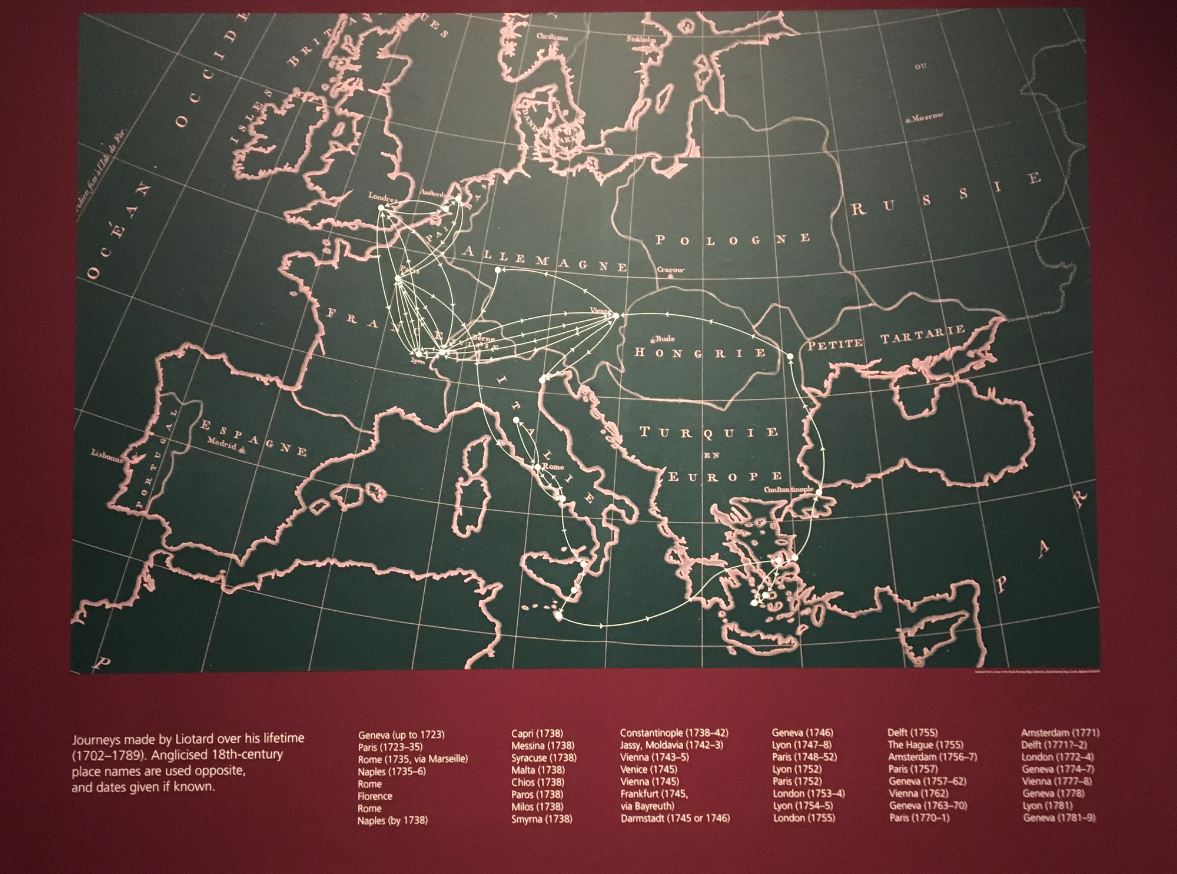
Map showing Jean-Etienne Liotard’s travels round Europe. Photo by the author

Liotard’s most extended stay was in distant Constantinople where he accompanied his patron Viscount Duncannon. He spent four years there and developed a taste for oriental life and manners. He grew a long beard, adopted Turkish dress and nicknamed himself ‘the Turkish painter.’ The exhibition includes a group of black and red chalk drawings made on his travels, most strikingly charming studies he made of (European) women in Oriental dress.

Portrait of Signora Marigot, Smyrna by Jean-Etienne Liotard (1738) Musée du Louvre. Photo © RMN-Grand Palais (Musée du Louvre) / Jean-Gilles Berizzi

On this portrait the curators comment:

Liotard drew this portrait in Smyrna (present-day Īzmir) in May 1738, while on route to Constantinople. Smyrna was the busiest port on the Turkish coast, and Signora Marigot probably belonged to its thriving international community. Liotard captures her confident pose with great economy, using bare paper to create the folds of her gown and the ornaments in her hair. The high level of detail is characteristic of an artist skilled at working on a miniaturist’s scale.

Liotard in London

Liotard’s arrival in London in 1753, with a full beard and Turkish dress, created a sensation. He was introduced to the Royal Family, took lodgings in Golden Square near Piccadilly and advertised his works in the newspapers. A young Joshua Reynolds, later first President of the Royal Academy, enviously described Liotard’s ‘vast business at 25 guineas a head in crayons’ and Horace Walpole marvelled at a viscountess having her four daughters painted by Liotard ‘as his price is so great’.

London provided rich possibilities for a portraitist. It was taken as fact in the 18th century that the British loved having their portraits painted. Even allowing for a visit to Lyon in 1754, where ‘The Lavergne Family Breakfast’ was painted, some 50 works survive from the two years that Liotard spent in London between 1753 and 1755. Nobles, celebrities and even the Royal Family asked Liotard to paint their portraits in pastel, some of them donning Turkish dress themselves.

Take this striking portrait of Lady Anne Somerset, later Countess of Northampton.

Lady Anne Somerset, later Countess of Northampton by Jean-Etienne Liotard (about 1755) © The Devonshire Collections, Chatsworth. Reproduced by permission of the Chatsworth Settlement Trustees

As the curators explain:

With her cascading auburn locks and plunging neckline, Lady Anne (1741 to 1763) looks older than her fourteen years. But women’s lives were accelerated in the 18th century and Lady Anne was already active on the London social scene when this portrait was painted. She may have chosen this Turkish dress – either a garment Liotard owned or one inspired by his drawing Woman from Constantinople (also in display) – to create a more grown up, sophisticated persona.

Miniatures

Liotard also gained a reputation for his skill at creating miniatures. Several are featured here including a stunning miniature self-portrait. It’s only about 2 inches tall so the exquisiteness of the detail is breath-taking. Surely he must have used some kind of magnifying glass and the brushes must have had only a handful of hairs in them. A photo doesn’t do the richness of the real thing justice. Look at the perfectly painted flowers decorating his collar!

Self Portrait on enamel with ivory backing by Jean-Etienne Liotard (about 1753) Royal Collection Trust © His Majesty King Charles III 2023

The curators:

Liotard exploits the smooth and luminous surface of enamel to paint his wiry beard, the folds of his raspberry-red jacket and the tiny flowers that dance along his collar in minute detail. His first training as an artist in Geneva was with a miniaturist and he could rely on his skill in this demanding form of painting to impress. This miniature was probably intended as a means of self-promotion on his first arrival in London, capturing his unusual appearance.

Chocolate tracing

As well as the Family Breakfast the exhibition displays several other works highlighting Liotard’s skill at depicting porcelain services. Sadly, they don’t have the original of one of his other Greatest Hits, The Chocolate Girl (about 1756), which is astonishing both for the wonderful poise of the central figure and the incredible realistic detail of the chocolate cup and glass of water. What they do have is a tracing of the original work which Liotard would have used to generate copies, the same technique he used for making his copy of the Family Breakfast.

Porcelain

And this brings us to the final section of the exhibition, which focuses on Liotard’s fascination for, and incredible skill at depicting, porcelain.

Throughout his career Liotard was fascinated by porcelain, repeatedly depicting cups, saucers and the act of using them in his works. In this he was not alone: throughout the 18th century, paintings of people drinking tea, coffee and chocolate became extremely popular. Such paintings played on the idea of taste: both the literal tastes depicted in these pictures and the tasteful refinement of the scenes portrayed. Liotard was unusual, however, in his fidelity to the porcelain he depicted.

The cups and saucers in ‘The Lavergne Family Breakfast’, for example, can be identified as true Japanese porcelain and not cheaper European imitations. It is not surprising that Liotard owned several pieces of important porcelain, including the boxed tea service displayed nearby.

And here’s a photo of that tea service:

Luxury tea service given to Liotard by the Empress Maria-Theresa during his third visit to Vienna in 1777. Photo by the author

The curators:

Liotard received this luxury tea service as a gift from the Empress Maria-Theresa (1717 to 1780) during his third visit to Vienna in 1777 to 1778. He had not only worked extensively for the Empress as a portraitist, producing likenesses of her and her family in pastel, oil, enamel and chalk, but he had also enjoyed privileged access to the Imperial Porcelain Manufactory where this tea service was made. Liotard’s lifelong fascination with technical experimentation led him to help develop new enamel colours for production.

Summary

Eccentric man, amazing skills, beautiful art, lovely exhibition. And it’s FREE.

Video focusing on pastel


Related links

More National Gallery reviews

Every room in the British Museum

A friend’s son comes to stay from Spain. He’s studying art and culture and so we spent two days, from 10am till chucking out time at 5.30pm, on a mission to visit every room in the British Museum. And we did it.

The British Museum owns some 8 million artefacts, of which fewer than 1% are on display, amounting to around 50,000 objects. It is the most popular tourist attraction in the UK with nearly 7 million visitors annually. Before the doors even opened at 10, the crowds flocking into the main forecourt reminded me of the crowds heading for the turnstiles at a football match.

Confusing layout

The official floorplan gives 95 numbered rooms, but closer examination shows several are missing. For example, I couldn’t find mention of the 80s, whereas some numbers are used two or three times: eg 18, 18a and 18b are the rooms dedicated to the Elgin Marbles – or 33, 33a and 33b, sound like one number but turn out to label the long hall running along the north wing of the building, the room at the end and a long narrow hall running south from it, which between them contain all of India and China: two distinct and massive subjects/areas, covering a profusion of sub-subjects – all contained by one innocent sounding 33.

The collection is spread vertically between levels -2 to level 5, so there are lots of floors and lifts. But not all the stairs give access to all the levels ie some stairs only go from one level to another, or only to one or a few room: like the steps which only go from room 21a down to rooms 77 and 78 (devoted to Greek and Roman architecture, an interesting collection of just the tops of classical columns which allow you to get close to the various decorative styles and patterns, and to classical inscriptions). Or the one staircase (the North stairs) which are the only way to get up to the Japan displays (rooms 92 to 94).

The way some rational sequences of numbered rooms are suddenly interrupted or require a detour up or down back stairs, give the place a pleasing element of chance or randomness eg the way room 67 (the Korea Foundation Gallery) continues seamlessly into room 95 (the Sir Joseph Hotung Centre for Ceramic Studies). But overall, the visit prompted two big questions:

Why are the Egyptian and Roman and Greek collections split up?

The massive long hall-type room 4 contains a wonderful collection of Egyptian sculptures and next to it are rooms displaying the similarly huge Assyrian sculptures (rooms 6 to 10) and then loads of rooms – 11 to 23 – displaying the development of Greek sculpture (including the vast Duveen Galleries showing the Elgin Marbles). But then you have to go across the Museum and up to level 3 to visit the completely separate suite of rooms – 61 to 66 – displaying Egyptian mummies and sarcophaguses, in carefully explained chronological order. Why are the Egyptians split up like this? Why not have everything Egyptian all together? Similarly why, after you’ve done the evolution of Greek sculpture, do you have to go across and up to level 3 (rooms 69 to 73) to see more Greek pots and find out about the Greek colonies in the south of Italy before the rise of Rome?

Why is the chronological account of civilisations sometimes done in rooms numbered sequentially, but sometimes done against the order of the rooms?

For example, rooms 11 to 23 on the ground floor take you through the history of Greek art in a nice logical sequence, from the earliest, primitive cycladic figures through to the artistic heights of the Parthenon, then on to Alexander the Great and the Romans. Whereas on the third floor, rooms 52 to 59 have to be visited in reverse order to experience the chronological progression, with 59 introducing the Levant ie Mesopotamia, Persia, Turkey – and then rooms moving forward in time as the numbers decrease (room 56 Mesopotamia 6000 to 1500, room 55 Mesopotamia 1500 to 539 and so on). Similarly, the history of Europe starts in room 51 (Europe and Middle East 10,000 to 800) then proceeds through rooms which count downwards: room 50 for Britain and Europe 800BC to 43 AD, room 49 for Roman Britain. Just when you’re getting used to this backwards progression, you have to leap straight to room 41 (Sutton Hoo and Europe 300 to 1100) and room 40 (Medieval Europe 1050 to 1500), because the missing rooms in between – rooms 46, 47, 48 (admittedly off to one side) turn out to contain rather unexpected and rather odd displays of Europe 1400 to 1800, Europe 1800 to 1900, and Europe 1900 to the present, respectively (mostly made up of ceramics, pottery, vases and plates).

In other words, finding your way around the British Museum is neither logical nor intuitive, making the visit of anyone with a limited amount of time really quite demanding. Especially if you’re trying to please impatient hectoring children. Don’t give up! It’s not you, it’s the museum.

On the other hand, if you do have the time or the opportunity to visit more than once, then the quirky layout, with countless unexpected and hidden treasures to stumble upon, maybe adds to the mystery and romance of the place…

Highlights

Obviously, not any kind of official highlights, this is a list of things that made me stop and think or want to make a note:

A dentil is a small block used as a repeating ornament in the ‘bedmould’ of a cornice. Picture of dentils.

African wooden fetishes contained the spirits of gods, ancestors or spirits. Banging nails or bits of metal into them activated the god, woke up the spirit. Photo of African fetish

Porcelain was invented around 600AD in China and was a practical cheap new way of making dishes, pots, cups etc.

In a traditional Korean house the male area or sarangbang, was prized for its simplicity and clarity: here the man of the house studied, worked, wrote poetry. The woman’s room, or anbang, was highly decorated, painted, adorned and ornamented.

Ganesh, the Hindu god, has the head of an elephant because his father, Shiva, cut off his human head in a fit of anger and said he’d replace it with the head of the first thing he saw.

The Buddhist chant Om mani padme om means ‘hail to the jewel in the lotus’.

The hands of the Buddha in statues can represent a number of meanings, in fact they are broken down into categories. The palm raised towards the viewer is the abhayamudra, which symbolises reassurance. (The right hand in this image.)

Many of the Indian statues are posed in the traditional tribhanga posture where the body is slightly bent at the neck, waist and knee, giving it a sensuous S shape. Tribhanga Wikipedia article

The Egyptian cat god was named Bastet. Epitomised by the famous Guyer-Andersen cat. The udjat-eye hieroglyph on its chest is a symbol of protection.

Egyptians were buried on the west bank of the Nile (eg the Valley of the Kings) right on the edge of the desert. They were buried facing east, facing back towards the living.

No-one knows who the mysterious figurines found in earliest cycladic sites represent or why they were nearly all female. Cycladic figure.

King Ashurbanipal of Assyria (685 to 627 BC) held lion hunts, where caged lions were brought to an enclosure and released so the king could chase after them on his chariot. He is depicted with one lion leaping up into the chariot and, while two soldiers hold it back with spears, Ashurbanipal in person leans forward to deliver the coup de grace with a short sword. Ashurbanipal killing a lion 640BC.

Egyptians believed the scarab beetle symbolised the sun, because each day as the sun rose beetles emerged from their dung balls or holes. Egyptian scarab statue.

At the temple complex of Kom Ombo in Upper Egypt, where crocodiles were worshipped as symbols of caring and nurturing, but also images of fear (?), over 300 mummified crocodiles have been found. The mummies include mummified versions of their tiny baby crocodiles, placed along the mother croc’s back. The crocodile god is Sobek.

My favourite thing in the Japanese gallery wasn’t the magnificent Samurai armour, it was the painted screen, ‘Pine trees at Maiko-no-hama beach‘, by Mori Ippo (1847).

Farming was invented about 12,000 years ago. Writing was invented about 5,000 years ago. Money was invented around 600AD.

The Queen of the Night dates from 1800 BC in Mesopotamia.

The walls of ancient Nineveh, capital of the Assyrian empire in the 7th century BC, are now cheek-by-jowl with the modern Iraqi city of Mosul, which is currently held by forces of the Islamic State of Iraq and the Levant (ISIL).

The most beautiful statue I saw was of Antinous, the young man beloved of the Roman emperor Hadrian.

I learned that it was during the Hellenistic period after the death of Alexander the great (323BC) that Greek art became more individualised. When Greek statues reached their peak in the Athens of Pericles (495 to 429 BC) they depicted idealised images of power which reflected the communal values of the city state. After Alexander the Great (died 323 BC) effectively unified the Mediterranean world in one cosmopolitan culture, the rich became more individualistic, collecting rare and precious objects, and wanted to be depicted as they actually appeared. So by the time the Roman republic reached its peak and then became the Empire (27 BC), although bodies were still depicted with the Greek idealism – the super-defined muscles and bone structure etc – the faces had become the faces of individuals. Hence the faces of the Roman emperors, which are so individualised and evocative.

The invention of the pendulum clock in 1656 by Christiaan Huygens was a massive step forward in accurate measure of time and therefore of all kinds of processes, from the movement of the planets to new industrial or chemical processes. The super-accurate telling of time was one of the foundations of the industrial revolution and of the West’s dominance over the rest of the world.

When wound up this Mechanical Galleon, made in Germany in the 1590s, played music from a little organ as it trundled over the dinner table until it came to a stop and the model guns fired little puffs of gunpowder.

The Ram in a Thicket is one of a pair of figures excavated in Ur in southern Iraq. They date from 2600 to 2400 BC.

I’d heard of most of the other cultures mentioned here, but never of Urartu, a kingdom in the east of Turkey near Mount Ararat. This is a bronze winged bull’s head from the handle of a large cauldron, 8th to 7th century BC.

King Ashurbanipal established the world’s first library (as far as we know) consisting of thousands of clay tablets from the 7th century BC. The British Museum is embarked on a large project working with the University of Mosul to digitise the original texts and translations, making the entire library available online.

The double headed snake was important in Aztec mythology. The Museum houses an elaborate sculpture of a double headed snake covered in hundreds of tiny fragments of turquoise. What interested me is that this nearby mosaic skull also has snake motifs curling around the eyes of the nose and down to the lips.

A cabinet of curiosities is a display case an Enlightenment or Victorian collector might use to display his collection of interesting and unusual objects. It is in stark contrast to a ‘treasure room’ (exemplified by room 2, the The Waddesdon Bequest, donated by Baron Ferdinand Rothschild MP (1839 to 1898)) which contains objects of exquisite beauty and craftsmanship designed to highlight the owner’s refined taste. I preferred the cabinets.

Room one

Room 1 runs the length of the ground floor, along the right hand side as you enter the courtyard. The entry, opposite the east part of the bookshop, looks like a dusty old library, but don’t be put off: room 1 is dedicated to a permanent exhibition, in seven themed sections, showing why the Enlightenment period (roughly the 1700s) saw a new fashion among the rich and educated for collecting everything – stones, flints, flowers, trees, books, manuscripts, languages, paintings, sculptures, machinery, statues – you name it, someone somewhere, rich aristocrat or modestly funded vicar, was collecting it.

And how it was from the urge to collect and assess and categorise and compare all these innumerable specimens, that many of the disciplines we know today emerged – most notably archaeology, the science of dating and naming and categorising and understanding all the objects from the human past.

It may look a bit unexciting, but room 1 not only contains many objects which are fascinating in their own right, but provides just the right introduction, not just to the museum but to the whole ‘idea’ of a museum and what museums are for. And since the British Museum was founded with the bequest of one such personal collection, that of the physician and scientist Sir Hans Sloane, in 1753, room 1 is the ideal place to begin to understand the urge to collect and the urge to view, see and understand, which underlies the whole place and explains why you’re there.


Related links

Other British Museum reviews